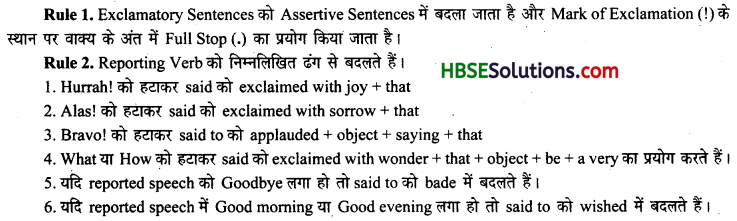
Author name: Bhagya

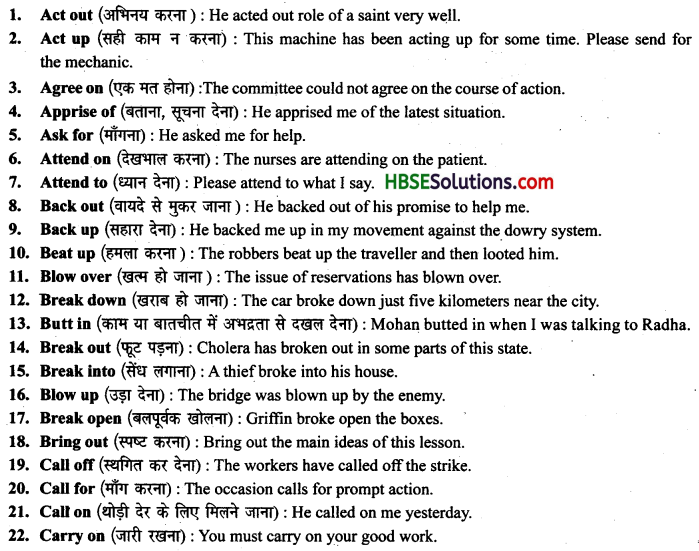
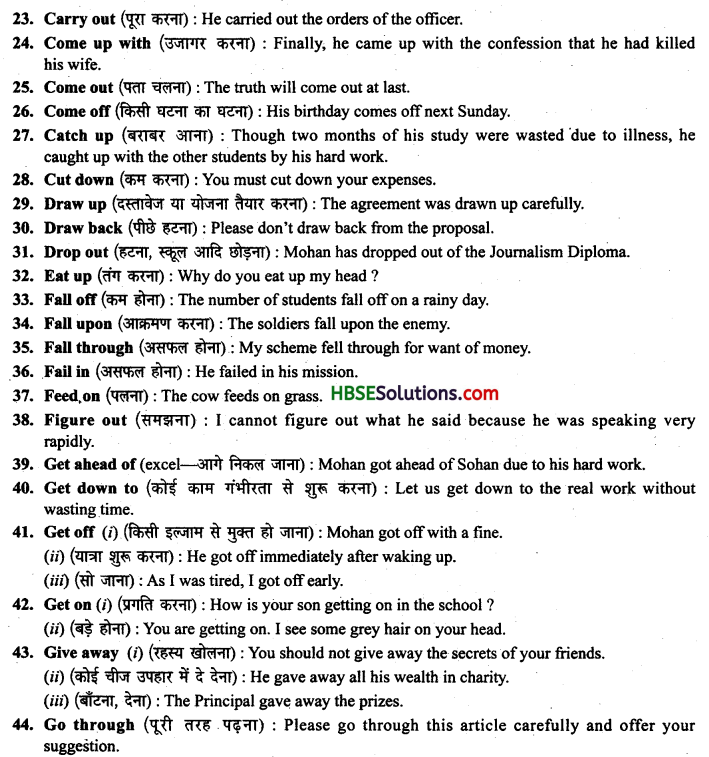
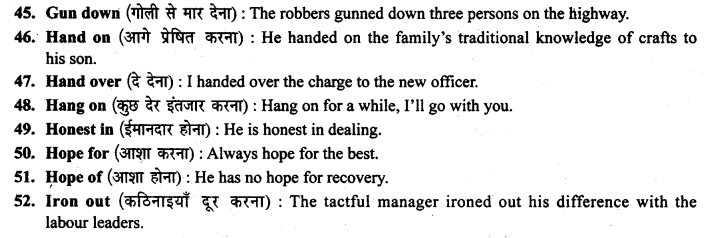
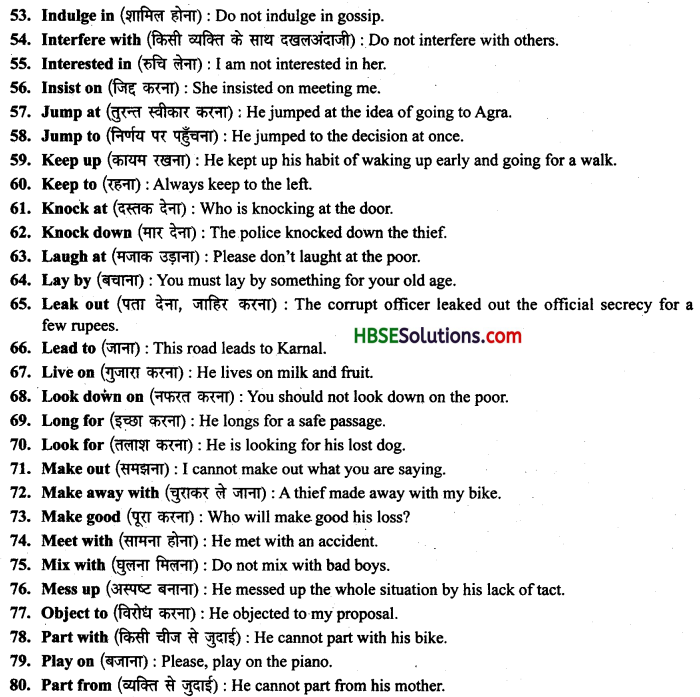
HBSE 10th Class English Grammar Idioms

Haryana State Board HBSE 10th Class English Solutions Grammar Idioms Exercise Questions and Answers.

Haryana Board 9th Class English Grammar Idioms

1. Above all (chiefly, before everything else) – He is rich and good. Above all, he is honest.
2. Above-board (not open to question, honest, straightforward, beyond reproach) – His integrity is above-board.
3. Above par (of superior quality) – Of all my suits, the blue one is above par.
4. On account of – (for the sake of) – The college will be closed on account o/holidays.
5. On no account (not for any reason) – On no account will I help you.
6. To give a good account of oneself (to act with credit to oneself) – She gave a good account of herself in singing.
7. A fidus Achates (a faithful friend) – I can trust Gurgeet as he is a fidus Achates.
8. The heel of Achilles (a weak spot) – Drinking of wine proved to be the heel ofAchilles for him.
9. An Adonis (a very handsome man) – Simran fell in love with Harjeet as he is an Adonis.
10. To build castles in the air (to think of something impossible of realisation; to day-dream; to conceive fanciful ideas) – Do some solid work; do not build castles in the air.
11. To assume airs (to affect superiority) – He is an egoist; he always assumes airs.
12. To air one’s opinions (to give vent to one’s feelings in public) – Don’t air your opinions in this controversial matter.

HBSE 10th Class English Grammar Idioms

13. To stand aloof (to keep to oneself and not mix with others) – I have decided to stand aloof on this issue.
14. To lead to the altar (to marry) – He is willing to lead Harsharan to the altar.
15. An Amazon (a warlike woman) – He fears his wife as she is an Amazon.
16. An Ananias (a liar) – Nobody trusts him, because he is known as an Ananias.
17. To weigh anchor (to be about to sail) – I boarded the ship as it was to weigh anchor.
18. To cast anchor (to drop anchor into the sea; to fix oneself) – The captain ordered the crew to cast anchor at New York.
19. An Apollo (a man with a perfect physique) – Even an Apollo cannot lift this stone.
20. The apple of discord (a cause of strife, contention, or quarrel) – Land is the apple of discord between the two brothers.
21. To upset the apple cart (to disturb the peace) – His tricks have upset the apple cart of his rival.
22. Apple pie order (in perfect order) – I keep all my things in an apple pie order.
23. To be tied to his mother’s apron strings (to be under the control and influence of his mother) – As he is tied to his mother’s apron strings, he cannot take any decision by himself.
24. Arcadian life (A blissfully happy rural and simple life) – People living in big cities are not acquainted with the Arcadian life.
25. To keep a person at arm’s length (to avoid coming in contact with a person) – I always keep selfish friends at arm’s length.
26. To take up arms (to fight; to go to war) – Bhagat Singh took up arms against the British Rule.
27. To receive with open arms (to welcome cordially) – My friend in Mumbai received me with open arms.
28. Attic salt [refined subtle wit (for which the Athenians were famous)] – Among the scholarly circles, he is known as a man of attic salt.
29. To cleanse the Augean stables (to effect great improvements in government, or to abolish great abuses) – To remove corruption is like cleansing the Augean stables.
30. To have an axe to grind (to have some selfish objective in view) – Behind his offer of help, he has an axe to grind.

HBSE 10th Class English Grammar Idioms

31. Not to know B from a bull’s foot (to be ignorant of even the simplest things) – He cannot succeed in life as he does not know B from bull s foot.
32. A Babel (A confused noise) – I was disturbed by a Babel of voices from the next room.
33. To break the back of anything (to perform the most difficult part of it) – I have broken the backbone of the problem.
34. To backbite a person (to slander or to speak ill of someone) – He is in the habit of backbiting others.
35. To get one’s back up (to rouse one s anger) – By making a noise, the students got the teacher s back up.
36. He is the backbone of his team (he is the one on whom his team mainly relies for its successes) – Virat is the backbone of our cricket team.
37. He has no backbone (he has no will of his own) – A henpecked husband has no backbone.
38. Backstairs influence (influence exerted in an underhand or clandestine manner) – He went scot-free in the case because of his backstairs influence.
39. To cause bad blood (to cause strife and enmity) – The land dispute has caused bad blood between the two brothers.
40. A bad egg (a bad penny a worthless fellow) – He has proved a bad egg!penny in his family.
41. Bad form (bad manners) – To curse is bad form.
42. Bag and baggage (with all one’s belongings) – He has shifted from Ludhiana to Phagwara with bag and
baggage. .
43. To keep the ball rolling (to keep things going on) – Don’t stop the fun; keep the ball rolling.
44. To bandy words (to wrangle or exchange arguments) – You should not bandy words with your seniors.
45. Baptism of fire (a soldier’s first experience of actual war) – He faced his baptism office in the Kargil sector.
46. To call to the bar (to admit as a barrister) – Kulwant was called to the bar last year.
47. Barmicide’s feast (imaginary benefits) – Barmicide s feast has no charm for me.
48. Off one’s own bat (on one s own initiative) – I’ll succeed in life off my own bat.
49. To bear down on (to sail in the direction of) – The angry mob was bearing down on the culprit.

HBSE 10th Class English Grammar Idioms

50. To lose one’s bearings (to be uncertain of one sposition) – He is sure to lose his bearings when confronted with corrupt police.
51. To beat about the bush (to talk in a round about manner) – Come to point; don’t beat about the bush.
52. To be dead beat (worn out by fatigue) – After a long journey, I am dead beat.
53. Bed and board (lodgings and food) – You will be provided with bed and board at our expenses.
54. As you make your bed, so you must lie on it (you will have to bear the consequences of your own mistakes or misdeeds) – You will have to suffer for your sins for as you make your bed, so you must lie on it.
55. To take to one’s bed (to have to be confined to bed as a result of sickness) – Due to over work, he took to his bed.
56. To have a bee in one’s bonnet (to be cranky) – He is a mechanic but wants to buy a Roll Royce car. He must be having a bee in his bonnet.
57. Bee-line (the shortest distance between two places) – There is no bee-line to success. You must work hard for it.
58. To go a-begging (to be sold very cheaply because no one cares to buy) – Soon after the summer season, fans go a begging.
59. Behind one’s back (without one’s knowledge) – My son started learning music behind my back.
60. Behind the scenes (in private; out of sight) – Most of the politicians do evil things behind the scenes.
61. To make’believe (to feign or pretend) – He made me believe that he was rich.
62. To bell the cat (to do something extremely dangerous) – Asking the boss for Increasing the salary was like belling the cat.
63. To hit below the belt (to act unfairly in a contest) – If you hit below the belt, you will be punished.
64. To give a person a wide berth (to keep as far away from him as possible) – As he is dishonest, I always like to give him a wide berth.
65. His better half (a man s wife) – He is fully under the control of his better half.
66. A bird in the hand is worth two in the bush (certainly is better than possibility) – I don’t want to wait for the prices to go up for selling my scooter as I believe that a bird in the hand is worth two in the bush.
67. An old bird is not to be caught with chaff (Experienced people are not easily fooled or deceived)-You cannot make him pay you money; an old bird is not to be caught with chaff.
68. To take the bit between one’s teeth (to get out of control; to become unmanageable) – Because his father’s excessive love, Manpreet has taken the bit between his teeth.
69. To bite the dust (to be defeated in war) – In the war India made Pakistan bite the dust.

HBSE 10th Class English Grammar Idioms

70. The bitter bit (to cheat the cheater) – The bitter was bitten at last when he picked the pocket of a thief.
71. His bark was worse than his bite (He usually makes a lot of vain verbal threats) – Although his actions were harmless his bark was worse than his bite.
72. Let me see it in black and white (Write it down) – The agreement was in black and white.
73. A wet blanket (a person who discourages others; one who is a damper to enjoyment) – Don’t take him to the picnic, he is like a wet blanket.
74. To have kissed the blarney stone (to have a very persuasive tongue) – Although he has kissed the blarney storie, he cannot be fool me.
75. In cold blood (deliberately; not in passion) – It was a murder in cold blood.
76. Blood is thicker than water (One usually takes the side of one s relation against another who is not of one s own blood) – He appeared as a witness in favour of his criminal son; after all blood is thicker than water.
77. To blow hot and cold (to do one thing at one time and the opposite soon after) – I don’t trust him, for he always blows hot and cold.
78. A blue stocking (a learned woman, inclined to pedantry) – She is respected in the society of scholars, as she is a blue stocking.
79. Once in a blue moon (a very rare occurrence) – He visits me once in a blue moon.
80. Blue Ribbon (the highest prize in any sport competition or tournament) – He won the Blue Ribbon in the athletic meet.
81. At first blush (at first sight) – He fell in love with her at first blush.
82. In the same boat (in the same misfortune or circumstances) – My friends and I are sailing in the same boat.
83. A bolt from the blue (a sudden and unexpected occurrence) – The crash of the stock market was bolt from the blue for him.
84. A bone of contention (a cause of dispute) – Property is the bone of contention between the two brothers.
85. To have a bone to pick with someone (to have something to say to someone which might cause a quarrel) – He is rough and always has a bone to pick with one or the other.
86. A bookworm (a person who has excessive love of reading books) – He spends most of his time in the library as he is a bookworm.
87. By leaps and bounds (with remarkable speed) – India is making progress by leaps and bounds.
88. Homeward bound (on the way home) – As our cricket team did not reach the semifinals, it was soon homeward bound.
89. To Bowdlerise (to remove all the objectionable passages from a book (Thomas Bawdier in 1818 published an expurgated version of Shakespeare s works) – hence the name)-His speech was published after it had been bowdlerised.

HBSE 10th Class English Grammar Idioms

90. To boycott (to avoid; to shun; to have no dealings with) – Lala Lajpat Rai boycotted the Simon Commission.
91. Breach of promise (Failure to keep a promise to marry one to whom you are betrothed) – She accused Jhanda Singh of breach of promise.
92. One’s bread and butter (one s means of livelihood) – He earns his bread and butter by selling fruit.
93. His bread is well buttered (He is in fortunate circumstances As his bread is well buttered; he does not care for expenses.)
94. To bread winner – (one who provides the means of livelihood for himself and his family) – Kuldeep is the breadwinner of his family.
95. To break in (to tame; to bring under control in a gentle manner) – The lion was broken in with a great difficulty.
96. To break the news (to reveal something unpleasant in a gentle manner) – I don’t know how to break the news of his failure.
97. To break the ice (to be the first to begin; to break the silence) – Mohan broke the ice in this matter.
98. To make a clean breast of anything (to make a full confession) – He made a clean breast of having committed the theft. Rahul made a clean breast his role in the conspiracy.
99. To breathe one’s last (to die) – He breathed his last after a long illness.

HBSE 10th Class English Grammar Idioms

100. To breathe freely again (to feel comfortable) – She was able to breathe freely again after the death of her mother-in-law.
101. To make bricks without straw (to attempt to do something without proper materials or due preparation) – Trying to cross the ocean in a boat is like trying to make bricks without straw.
102. Never cross the bridge until you come to it (Do not anticipate difficulties) – Your fear about offending your officer is baseless. In fact, never cross the bridge until you come to it.
103. To bring down the house (to cause rapturous applause) – His musical performance brought down the house.
104. To bring up the rear (to be the last in the line) – As I reached, late, I brought up the rear.
105. It is as broad as it is long (It is the same whichever way you view it) – This room is as broad as it is long.
106. To knit the brow (to frown) – It is a bad habit to knit one’s brow.
107. To brow beat (to bully) – He is in the habit of brow beating others.
108. To kick the bucket (to die) – He kicked the bucket after a long distance.
109. To buckle on one’s armour (to set to work energetically) – During the examination days, students buckle on their armour.
110. To take the bull by the horns (to tackle any difficulty in a bold and direct manner) – Don’t be afraid of the difficulty and take the bull by the horns.
111. John Bull (an Englishman) – A John Bull considers himself superior to others.
112. To burke a question (to suppress or prevent any discussion on it.) – The Prime Minister tried to burke the question raised by the opposition parties.
113. To bury the hatchet (to forget past quarrels and be friends again) – The American Indians had the custom of burying their tomahawks when peace was concluded, as a symbol of their peaceful intentions – Let us bury the hatchet and be good friends once again.
114. Good wine needs no bush (there is no need to advertise something good) – Every student knows a good professor because a good wine needs no bush.
115. But me no buts (Do not bring forward objections) – But me no buts in my efforts to help the poor.
116. To raise cain (to rebuke severely) – Do not raise coin your child.
117. To take the cake (to take the first prize; to be the best of the lot) – He, being the best player, took the cake.
118. To burn the candle at both ends (expend energy in two directions at the same time) – He is a spendthrift and bums the candle at both ends.
119. The game is not worth the candle (the undertaking is not worth the trouble) – Don’t run after that worthless girl; the game is not worth the candle.
120. To paddle your own canoe (to be responsible for your actions; to act independently) – Now you are a grown up boy and must learn to paddle your own canoe.

HBSE 10th Class English Grammar Idioms

121. If the cap fits, wear it (If you think the remarks made refer to you, then act accordingly) – The officer has great trust in you; if the cap fits, wear it.
122. To go cap in hand (to beseech in a humble manner) – After making mischief, he went cap in hand to apologise to the teacher.
123. Capital punishment (the death sentence or penalty) – Some people think that capital punishment is better than life imprisonment.
124. Capital ship (a warship of the most powerful kind) – The Capital ship was sunk in the war.
125. To put the cart before the horse (to do first what ought to be done afterwards; to reverse the proper order of things) – By taking the last step first, he tried to put the cart before the horse.
126. To let the cat out of the bag (to expose the trick; to let out the secret) – He let the cat out of the bag by disclosing that his friend was the culprit.
127. To fight like cats and dogs (to be always quarrelling and fighting) – Gurbux and his wife always fight like cats and dogs.
128. Care killed the cat (Don’t worry and fret yourself to death) – You should not worry much about this problem, for care killed the cat.
129. See which way the cat jumps (Sit on the fence; see how things are likely to turn out before deciding on a course of action) – Before joining any party, I will see which way the cat jumps.
130. To rain cats and dogs (to rain incessantly) – It has been raining cats and dogs since morning.
131. He is a cat’s paw (one used as a tool to do something dangerous.) – In the fable the Monkey used the Cat’s paw to pull chestnuts out of the fire. He is not guilty but he has been used as a cat’s paw by his officer.
132. To catch one’s eye (to attract attention)- – -She caught everyone’s eye at the function.
133. To give a sop to Cerberus (to appease someone by gift or bribe; to bribe) – These days you have to give a sop to Cerberus in every office for getting your work done.
134. To take the chair (to preside at a meeting) – Mohan took the chair at the meeting of the working committee.
135. To ring the changes (to be continually making alterations and trying new methods) – He never follows old methods and is always ringing the changes.
136. Chauvinism (absurd patriotism which manifests itself in warlike conduct) – From Nicholas Chauvin, a soldier ardently devoted to Napoleon. Chauvinism is a dangerous trait of character.
137. Catch at a straw (a help in dire need) – A drowning man catches at a straw.
138. She is no chicken (She is older than she says, or appears to be) – She appears to be very young but she is no chicken.
139. Chicken-hearted (weak timid, cowardly) – He appears to be very brave but in fact he is a chicken- hearted fellow.

HBSE 10th Class English Grammar Idioms

140. Don’t count your chickens before they are hatched (Don’t calculate your gains before they are realised) – Let the result come; don t count your chickens before they are hatched.
141. A chip of the old block (a son resembling his father in face, disposition, habits etc) – He resembles his father in appearance and actions; he is a chip of the old block.
142. Chock full (full to overflowing) – The drains of the city are chock full.
143. Hobson’s choice (no alternative; take what you are offered or none at all.) – Girls these days are not given Hobson ’s choice at the time of their marriage.
144. To pick and choose (to make a careful selection) – It is not easy to pick and choose a wife.
145. A Cicerone (a guide who takes strangers and tourists over a country and explains to them all the curiosities and features of the place ) – A Cicerone enlighted us about the importance of the ancient monument.
146. Cimmerian darkness (profound darkness) – There was Cimmerian darkness in the room.
147. To square the circle (to attempt something impossible) – By trying to reform Harbhajan, you are trying to square the circle.
148. Close fisted (mean, miserly) – Don’t expect any charity from him as he is a close-fisted man.
149. Every cloud has a silver lining (Adverse conditions do not last for ever, brighter days are usually in store) – Don’t lose heart in your adversity as every cloud has a silver lining.
150. To have one’s head in the clouds (to live in dreamland; to have fanciful ideas) – He is not a practical man; he has his head in the clouds.
151. To live in clover; to be in clover (to be living in great luxury) – Almost all the film stars live in clover he is the son of a millionaire and lives in clover.
152. To carry coals to Newcastle (to do anything superfluous or unnecessary) – Newcastle, a great coal port in England.’ By teaching business tips to that great businessman, you are trying to carry coal to Newcastle.
153. To haul over the coals (to scold severely; to reprimand) – If you make a noise, your teacher will haul you over the coals.
154. To heap coals of fire (to return good for evil) – A saint has no ill will; he heaps coals of fire.
155. The coast is clear (the danger is past; there is no sign of interference) – Don’t be afraid. Everybody is asleep and the coast is clear.
156. Cut your coat according to your cloth (Live within your income; make what you possess serve your needs) – If you don’t cut your coat according to your cloth, you will repent.
157. A cock and bull story (a foolishly incredible story) – Nobody will believe your cock and bull story of having seen a ghost.
158. To be cock-sure (to be absolutely certain; extremely self-reliant) – He is cock-sure of getting first division.
159. To throw cold water upon anything (to discourage effort) – His treachery threw cold water upon my plans.

HBSE 10th Class English Grammar Idioms

160. To give the cold shoulder (to rebuff, to treat with indifference) – He went to meet his friend with great hope but was given a cold shoulder by him.
161. Off colour (not in the usual form) – He is off colour and does not appear cheerful.
162. To show one’s colours (to reveal one s true intentions by no longer pretending) – In time of my need he showed his colours.
163. To come off flying colours (to succeed brilliantly) – He came off with flying colours in the final examination.
164. To commit to memory (to learn by heart) – He has committed the whole book to memory.
165. Too many cooks spoil the broth (When there are more workers than necessary they are likely to get in each other s way and the result is apt to be a failure) – He was attended by four doctors, yet he died; too many cooks spoiled the broth.
166. To send to Coventry (to boycott; to refuse to be on familiar terms or to have any dealings with someone) – He tried to be friendly with his class-fellows but they sent him to Coventry.
167. An admirable Crichton (a very talented person) – An admirable Crichton is successful in life.
168. Crocodile tears (hypocritical tears) – He shed crocodile’s tears at his uncle’s death.
169. By hook or crook (by fair means or foul) – He wants to succeed in life by hook or crook.
170. As the crow flies (in a direct line, the shortest distance between two points) – For reaching the post office, turn left and then go as the crow flies.
171. To take up the cudgels (to champion or fight for someone) – He has taken up the cudgels against his corrupt officer.
172. To curry favour (to seek favour by flattery) – He does not work but tries to curry favour of his officer.
173. Cut and dry (ready made) – He is in search of a cut and dry formula for success.
174. To cut a dash (to make an impression) – He cut a dash by his excellent performance.
175. A cut-throat (a murderer) – The police has caught the cut-throat who committed two murders.
176. To be at daggers drawn (to be deadly enemies) – Santa Singh dnd Banta Singh are at daggers drawn over a piece of land.
177. To have the sword of Damocles hanging over one’s head (to be in imminent danger of losing one’s life; to live in constant fear of some impending danger) – As his post is temporary, he has the sword of Damocles hanging over his head.
178. A Daniel – (an imperial judge) (‘Shakespeare, “Merchant of Venice”; Daniel I-VI) – The officer is so honest that people call him a Daniel.
179. A dare-devil (a fearless, reckless man) – He fought like a dare-devil in the battle.

HBSE 10th Class English Grammar Idioms

180. Up to date (recent, modem) – This is an up to date directory.
181. In Davy Jones’s locker (drowned, at the bottom of the sea) – He got in Davy Jones’s locker when swimming.
182. He has seen better days (He was once prosperous) – He is a bankrupt, but he has seen better days.
183. Evil days (a period of misfortune) – I have fallen on evil days. You should face these evil days bravely.
184. To gain or win the day (to be victorious) – Our hockey team has won the day.
185. Halcyon days (a time when there is peace and happiness in the land) – During the reign of Harshwardhan India witnessed its Halcyon days.
186. Dead beat (quite exhausted) – After the long journey, I am dead beat.
187. Dead broke (penniless) – Gambling made him dead broke.
188. To run dead heat (a race in which the contestants came in together) – It was a dead heat race and the winner was judged with the help of video re-play.
189. A dead letter (something which no longer exists) – In some parts of India Sati system is still not a dead letter.
190. To step into dead man’s shoes (to come into an inheritance; to succeed someone who died) – He has stepped into the dead man’s shoes and is managing his father’s business.
191. To give the devil his due (give a person credit for his good qualities however worthless he may be) – He is mischievous, but to give the devil his due he is intelligent also.
192. Go to the devil (Be off) – Go to the devil, and don’t disturb me.
193. Devil’s playthings (playing cards) – He has been ruined by Devil’s playthings.
194. Devil’s bones (dice) – In the past a kind of gambling was played with Devil s bones.
195. To be between the devil and the deep sea (to be faced with two dangerous situations, each of which is to be dreaded as much as the other) – I will be ruined both ways; I am between the devil and the deep sea.
196. To be on the horns of a dilemma (to be in such a position that it is difficult to decide what to do) – I am on the horns of a dilemma whether I should lend him money or not.
197. Give a dog a bad name and hang him (Once a person loses his reputation, he is likely to be blamed for the misdeeds of other) – He is not guilty, but the opposition parties are trying to give a dog a bad name and hang him.
198. To be a dog in the manger (to prevent others from using what one cannot use oneself; to be selfish) – He neither plays himself nor lets others play. He is a dog in the manger.
199. Every dog has his day (Sooner or later, everyone has his share of good fortune) – From a clerk, he has become an officer. Every dog has his day.

HBSE 10th Class English Grammar Idioms

200. To be in the doldrums (to be in low spirits; to be out of sorts) – After losses in business Mahinder is in doldrums.
201. The Dole (money given in charity, and also allowances to the unemployed) – The dole granted to the war widow is not sufficient.
202. To dole out (to give out in small quantities) – A very small amount of money is being doled out to the flood victim.The government has doled out a small amount of money to be spent on education.
203. To darken one’s door (to pay a visit to one’s house) – Yesterday, one of my old friends darkened my door.
204. Ups and downs (varying fortunes; changes and chances of life) – Life is full of ups and downs.
205. Down and out (penniless, ruined) – After loss in business, he is down and out.
206. Draconian legislation (very severe laws) – From Draco an Athenian legislator, whose laws were extremely severe) – The government passed Draconian legislation during the emergency.
207. To draw the long bow (to relate fantastic stories) – He draws the long bow about his visit to America.
208. To draw the line at (to refuse to go beyond a certain limit) – I have drawn the line and will not give you any more money.
209. To throw dust in one’s eyes (to try to deceive someone) – He threw dust in the police’s eyes and ran away.
210. Dutch courage (bravery induced by alcoholic liquors) – His Dutch courage has been of no use to him.
211. Eagle-eye (quick to discover, very discerning) – Nothing can escape Mohan’s eagle-eye.
212. To set by the ears (to cause strife or incite to quarrel) – The clever wife set her husband by the ears against his own brother.
213. To eat one’s words (to apologise; to take back what one has said) – He spoke without thinking and had to eat his words later.
214. A bad egg (a worthless person) – Satvinder is a bad egg in the whole class.
215. To egg on (to spur on to further action) – He egged me on to talk to the officer, but I was hesitant.
216. Do not put all your eggs in one basket (Do not stake all your money on a single industry; Spread your resources over a variety of transactions) – By purchasing the shares of one company, he has put all his eggs in one basket.
217. A white elephant (a useless possession which is extremely expensive to keep) – His imported car is a white elephant for him.
218. At the eleventh hour (at the last moment) – I reached the railway station at the eleventh hour and caught the train.
219. Give him an inch he’ll take an ell (He will abuse his privilege and take great libertie) – Don’t give him any concession, for if you give him an inch, he ‘ll take an ell.

HBSE 10th Class English Grammar Idioms

220. Elysian happiness (a state of perfect bliss) – The period of a few months after marriage was Elysian happiness for him.
221. At his Writ’s end (utterly confounded) – He was at his wit’s end when he got the news of his failure.
222. At the end of his tether (unable to proceed any further) – After working for ten hours, I was at the end of my tether.
223. Odds and ends (remnants) – He gathered his odds and ends and went away.
224. To make both ends meet (lo keep expenses within one income) – These days it is difficult for a poor man lo make both ends meet.
225. Without end (forever lasting) – These days student unrest seems to be without end
226. A blot on the escutcheon (a disgrace on the reputation of a family) – His bad ways are a blot on the escutcheon
227. An exodus (the departure of a large body of people. From the Exodus of the is raelites from Egypt under Moses) – These days there is an exodus of people from villages to cities.
228. An eye for an eye (tit for tat; to return evil for evil; retaliaze) – He believes in the principle of an eye for an eye.
229. To keep an eye on (to watch carefully) – You should keep an eye on your expenses.
230. To see eye to eye (to be in complete agreement with the views of another) – The two brothers cannot see each other eye to eye.
231. Fabian tactics (a policy of wearing down an opponeni by delaying action; harassing an enemy by avoiding open battle) – Fabians Maximus, a Roman Consul, wore down Hannibal by refraining from engaging him in actual battle in the second Public War. The employers adopted Fabian tactics when the workers went on strike.
232. To save one’s face (to avoid disgrace) – In order lo save face, the corrupt minister resigned.
233. The fairer sex (women) – Many battles have been fought for the sake of the fairer sex.
234. Bad faith (dishonest intentions) – I cannot trust him as he is a man of bad faith,
235. In good faith (with honest intentions) – l told him my secret in good faith.
236. A breach of faith (to act contraly to what one had professed) – It was a breach off faith on your part to disclose my secret to my enemies.
237. To fall out (lo quarrel) – The two friends have fallen out on a trivial matter.
238. To fall through (to fail) – The plan fell through for want of funds.
239. To fall upon (to anack) – The lion fell upon the lamb.

HBSE 10th Class English Grammar Idioms

240. To sail under false colours (to attempt to deceive) – The criminal tried to sail under false colours but was caught.
241. A feather In one’s cap (an honour; a distinction) – He added another feather in his cap by getting first division.
242. Birds of a feather flock together (People of similar tastes and dispositions crave each other s company) – Most of his friends are of his age, for birds of a feather flock together.
243. To feather one’s nest (to provide for the furture) – He has feathered his nest by saving a lot of money.
244. To show the white feather (to show signs of cowardice) – H e showed a white feather in the battle.
245. To sit on the fence (to remain neutral; to take neither side in a conhvversy) – He has not joined any party; he is sitting on the fence.
246. As fit as a fiddle (in excellent health) – He remained ¡II for many days but now he is flt as a fiddle.
247. To play second fiddle (to take a subordinate position) – He plays second fiddle to his wife.
248. To march In single, or Indian file (to march in a single line, one behind another) – The students came out of the class in Indian file.
249. To have at one’s finger tips (to know thoroughly) – I have all the details of the case at my finger tips.
250. To set the Thames on fire (to do something sensational or remarkable) – His interview to the press has set the Thames on fire.

HBSE 10th Class English Grammar Idioms Read More »

HBSE 10th Class English Grammar Modals

Haryana State Board HBSE 10th Class English Solutions Grammar Modals Exercise Questions and Answers.

Haryana Board 9th Class English Grammar Modals

What is a Modal?
Modals एक प्रकार की सहायक क्रियाएं हैं। ये main verb के साथ मिलकर कार्य करने के mode या तरीके को बताती हैं। ये योग्यता, अनुमति, संभावना, कर्तव्य जैसे विचारों को व्यक्त करती हैं। मुख्यतः will, shall, would, should, can, could, may, might, must, need, dare, ought to और used to आदि modal auxiliaries हैं।

Features of Modals (सहायक क्रियाओं की विशेषताएँ)
(a) Modals कभी अकेली नहीं आतीं। इनका प्रयोग सदा main verb के साथ किया जाता है; जैसे
You must do this work.
I can solve this sum.

(b) Subject के number, gender या person का modals पर कोई प्रभाव नहीं होता; जैस
I can go there.
We can go there.
You can go there.
They can go there.
He can go there.
She can go there.

(c) Modals के साथ verb की Ist form का प्रयोग होता है। परंतुought और used के साथ ‘to’ Infinitive का प्रयोग होता है; जैसे
He will leave for Mumbai today.
You should work hard.
I can help you.
We ought to serve our country.
He used to help me in the past

(d) Modals के साथ ‘be’ लगाने पर उसके बाद verb की Ist form और ing का प्रयोग करते हैं, जैसे
Sudha will be writing a letter.
I shall be travelling in a train tomorrow.
Poonam will be dancing.

(e) Modals के बाद ‘have’ लगने पर उसके बाद verb की IIIrd form का प्रयोग करते हैं, जैसे
He must have done this work.
He should have passed the test.
He may have gone to Delhi.

HBSE 10th Class English Grammar Modals

Uses of Modals:

1. SHALL

(i) Shall का प्रयोग Ist person (I, we) के साथ साधारण future tense को व्यक्त करने के लिए किया जाता है; जैसे
I shall know my result tomorrow.
We shall leave for Mumbai in the evening.

(ii) आदेश (command) के लिए second और third persons के pronouns के साथ; जैसे
You shall do as I say.
You shall not disobey your parents.

(iii) वचन (promise) को व्यक्त करने के लिए; जैसे
You shall get a prize.
You shall have a wrist watch on your birthday

(iv) बाध्यता या अनिवार्यता (compulsion or necessity) को व्यक्त करने के लिए; जैसे
You shall not enter the kitchen with dirty feet.
You shall not make a noise.

(v) संकल्प (determination) अथवा निश्चय (certainty) को व्यक्त करने के लिए; जैसे
He shall take revenge on his enemy.
He shall get good marks, I am sure.

(vi) प्रश्नवाचक वाक्यों (interrogative sentences) में shall का प्रयोग I/we के साथ किसी दूसरे के सामने अपनी सेवा . प्रस्तुत करने के लिए या प्रार्थना करने के लिए किया जाता है; जैसे
Shall I carry your heavy bag ?
Shall we go to see a film today ?

HBSE 10th Class English Grammar Modals

2. WILL

(i) Will का प्रयोग IInd और IIIrd person (you, he, she, they, it आदि) के साथ simple future tense को व्यक्त करने के लिए किया जाता है; जैसे
He will come here at Diwali.
They will never learn good manners.

(ii) प्रार्थना या निमंत्रण के लिए; जैसे
Will you open the door, please?
Will you have a cup of tea?

(iii) आदत के लिए; जैसे
A dog’s tail will never become straight.
He will never tell the truth.

(iv) Ist person (I/we) के साथ निश्चय (certainty) को व्यक्त करने के लिए; जैसे
I will write a letter to her in the evening.
We will visit the theatre next week.

(v) I/we के साथ संकल्प (determination) को व्यक्त करने के लिए, जैसे
I will get 1st division.
We will win the race.
I will become a great man one day.

(vi) ‘इच्छा’ (willingness) को व्यक्त करने के लिए; जैसे
I will come with you if you want.
I will help you in this matter.

(vii)आदेश (order) या निर्देश (instruction) को व्यक्त करने के लिए; जैसे
You will do as I say.
You will not beat your brother.

(viii) अनुमान या संभावना (inference or probability) को व्यक्त करने के लिए; जैसे
The boys in blue dress will be his brother.
By this time Mohan will be there.

(ix) शर्त वाले (conditional) वाक्य के लिए; जैसे
If you work hard, you will pass.
If you don’t run, you will miss the train.

(x) चेतावनी देने के लिए or या otherwise वाले वाक्यों में; जैसे
Work hard otherwise you will fail.
Run fast or you will miss the train.

HBSE 10th Class English Grammar Modals

3. SHOULD

(i) Indirect speech में shall के past tense के रूप में; जैसे-
I told him that I should help him.
He said that they should go there.

(ii) कर्त्तव्य (duty) की भावना प्रकट करने के लिए; जैसे-
We should obey our parents.
We should help the poor.

(iii) सलाह तथा सझाव (advice or suggestion) को व्यक्त करने के लिए; जैसे-
You should work hard.
You should take exercise.

(iv) Lest के पश्चात उद्देश्य (purpose) को व्यक्त करने के लिए; जैसे-
Work hard lest you should fail.
Walk carefully lest you should fall.

(v) नैतिक उत्तरदायित्व (moral obligation) को व्यक्त करने के लिए; जैसे-
You should not drink wine.
You should help your sister.

(vi) कल्पना (supposition), संभावना (possibility) तथा शर्त (condition) की भावना को व्यक्त करने के लिए; जैसे-
Should you see my brother ? Tell him to send me a good book.
I think you should win the championship.

(vii) अनुमान (assumption) की भावना को दर्शाने के लिए; जैसे-
She should be here by now.
They should have reached Delhi.

HBSE 10th Class English Grammar Modals

4. WOULD

(i) Indirect speech में will के past के रूप में; जैसे
He told me that he would go to Mumbai.
Mohan said that he would not do that work.

(ii) Past के किसी कार्य को करने की आदत को व्यक्त करने के लिए; जैसे
Gandhiji would spin for hours.
He would often study till late in the night.

(iii) विनम्र प्रार्थना (polite request) के लिए; जैसे
Would you open the door, please?
Would you lend me your bicycle for an hour?

(iv) किसी की इच्छा को जानने के लिए; जैसे
Would you have a cup of tea?
Would you like to come with me?

(v) कोरी कल्पना (wish) को व्यक्त करने के लिए; जैसे
Would that I were a king!
Would that my son were a hard worker!

(vi) असंभावित परिस्थिति (improbable condition) को व्यक्त करने के लिए; जैसे
If a thief came here, he would find only books.
If I got a lottery, I would be very happy.

(vii) दृढ़-निश्चय (determination) को व्यक्त करने के लिए; जैसे
He would have his own way.
I would buy that car at any cost.

(viii)अधिमान (preference) को बताने के लिए; जैसे
I would like to have coffee.
I would rather starve than beg.

HBSE 10th Class English Grammar Modals

5. CAN

(i) योग्यता (ability) को व्यक्त करने के लिए; जैसे

He can swim across the river.
Can you stand on your head ?

(ii) अनुमति (permission) देने के लिए; जैसे
You can see a film if you like.
You can go home if you have done your work.

(iii) अनुमति मांगने के लिए; जैसे
Can I use your dictionary?
Can I go home?

(iv) संभावना (possibility) को व्यक्त करने के लिए; जैसे
Death can come anytime.
He can reach here anytime.

(v) क्षमता या शक्ति (capacity or power) को व्यक्त करने के लिए; जैसे
I can lift this heavy table.
The headmaster can remit your fine.

HBSE 9th Class English Grammar Modals

6. COULD

(i) Indirect speech में can के past के रूप में; जैसे
Mohan said that he could solve the sum.
He asked me if I could help him.

(ii) Past की अनुमति (permission) को दर्शाने के लिए; जैसे
Father said that he could see the film.
She asked me if she could meet me.

(iii) Past की संभावना (possibility) को व्यक्त करने के लिए; जैसे
If he had money, he could buy a scooter.
I wondered whether the news could be true.

(iv) भूतकाल में क्षमता (capacity) या योग्यता (ability) को व्यक्त करने के लिए; जैसे
I could swim when I was young.
She could solve the sum when she was only five years old.

HBSE 10th Class English Grammar Modals

7. MAY

(i) औपचारिक अनुमति (formal permission) लेने या देने के लिए; जैसे
May I come in, Sir ? Yes, you may.
May I use your book? Yes, you may use it.

(ii) इच्छा (wish), प्रार्थना (prayer) या आशीर्वाद (blessing) को व्यक्त करने के लिए; जैसे
May you live long !
May I be able to cross the river !
May God bless her with a son!

(iii) संभावना (possibility) को व्यक्त करने के लिए; जैसे
There are clouds in the sky. It may rain.
Mohan may reach here anytime.

(iv) उद्देश्य (purpose) को बताने के लिए so that से पहले verb की Ist Form लगी होती है। जैसे
We eat so that we may live.
I go to school so that I may become a great man.

(v) अतीत की संभावना (Past possibility) को व्यक्त करने के लिए may have का प्रयोग होता है; जैसे
He may have reached Kanpur.
You may have heard about Akbar.

HBSE 10th Class English Grammar Modals

8. MIGHT

यह may का past रूप है। इसका प्रयोग निम्नलिखित अवस्थाओं में किया जाता है।
(i) भूतकाल में अनुमति लेने या देने के लिए; जैसे
I asked him if I might use his book.
My father told me that I might see a picture.

(ii) भूतकाल (past) में संभावना (possibility) को व्यक्त करने के लिए; जैसे
The doctor said that the patient might recover.

(iii) भूतकाल की इच्छर (wish) को व्यक्त करने के लिए; जैसे
I wished that I might pass the examination.
Mohan wished that his sister might win the race.

(iv) भविष्य काल में किसी क्षीण संभावना (remote possibility) को व्यक्त करने के लिए; जैसे
I might go to the market, but I am not sure.
He might come, if he gets time.
The prices might fall down a little.

(v) उद्देश्य को बताने के लिए; so that से पहले verb की 2nd form लगी होती है। जैसे
He died so that his country might survive.
He worked hard so that he might pass.
If he worked hard, he might get 1st prize.

9. MUST

(i) तीव्र आवश्यकता (dire necessity) को व्यक्त करने के लिए: जैसे
You must take an umbrella as it is raining.
We must run if we want to catch the train.

(ii) अनिवार्यता (compulsion) या बंधन (obligation) को व्यक्त करने के लिए कार्य न करने पर यदि सजा मिलने का प्रावधान हो; जैसे
A servant must obey his master.
We must obey the laws of our country.

(iii) दृढ़-संकल्प (determination) को व्यक्त करने के लिए; जैसे
I must finish this work by evening.
We must attack the enemy before day-break.

(iv) कर्त्तव्य (duty) को व्यक्त करने के लिए; जैसे
You must obey your parents.
We must serve our country.

(v) मनाही (prohibition) को व्यक्त करने के लिए; जैसे
We must not touch electricity.
You must not disobey your elders.
Children must not play on the road.

(vi) संभावना (possibility) को व्यक्त के लिए; जैसे
He must have reached Delhi,
She must have gone to bed by now.

HBSE 10th Class English Grammar Modals

10. OUGHT

Ought का प्रयोग should के स्थान पर किया जा सकता है, मगर इसके साथ ‘to’ का प्रयोग आवश्यक है। इसके प्रयोग निम्नलिखित हैं

(i) नैतिक एवं सामाजिक कर्त्तव्य (moral and social duty) के लिए; जैसे
We ought to obey our teachers.
You ought to help the poor and the needy.
We ought to take pity on the beggars.

(ii) सलाह (Advice) या सुझाब (Suggestion) को व्यक्त करने के लिए; जैसे
You ought to work hard for the examination.
You ought to consult the doctor.

(iii) Ought to + have + verb की IIIrd form के द्वारा यह व्यक्त किया जाता है कि कार्य होना चाहिए था, मगर हुआ नहीं; जैसे
You ought to have met the principal (but you did not).
You ought to have informed the police.

11. NEED

Need एक नियमित क्रिया भी है और एक modal भी। Modal के रूप में इसका प्रयोग केवल नकारात्मक (Negative) तथा प्रश्नवाचक (Interrogative) वाक्यों में होता है; जैसे
(i) आवश्यकता का न होना; जैसे
You needn’t take an umbrella as it has stopped raining.
You need not go on foot.

(ii) आवश्यकता के बारे में कोई प्रश्न पूछना; जैसे
Need you go home so soon? .
Need you speak so fast?
Need she run for catching the bus ?

HBSE 10th Class English Grammar Modals

12. DARE

Need की तरह dare का प्रयोग भी नियमित क्रिया एवं modal दोनों प्रकार से होता है। Modal के रूप में इसका प्रयोग केवल नकारात्मक (Negative) और प्रश्नवाचक (Interrogative) वाक्यों में निम्नलिखित रूप से होता है
(i) साहस का न होना; जैसे-
I dare not enter the Headmaster’s office.
The child dare not go into a dark room at night.

(ii) साहस के बारे में प्रश्न करना; जैसे
Dare you catch a lion by its tail?
How dare you insult me?

13. USED TO

Used to का प्रयोग निम्नलिखित अवस्थाओं में किया जाता है :

(i) भूतकाल की किसी आदत (past habitual action) को दशनि के लिए; जैसे
In the past people used to believe that the earth was flat.
Before marriage, he used to drink a lot.

(ii) भूतकाल में किसी वस्तु के अस्तित्व के लिए; जैसे-
There used to be a big building at the comer.
A fair used to be held in this ground every year.

HBSE 10th Class English Grammar Modals

Exercise 1

Fill in the blanks-with the models given in brackets :

1. We …………… (serve) our country, (must, should, could)
2. He has burnt midnight oil. He …………… win a scholarship, (will/would/ought to)
3. He …………… read and write english. (can, could, must)
4. …………… your future be bright! (Would/May/Might)
5. …………… we go to see a movie today ? (Will/Would/Shall)
6. …………… you like to come with me? (would, should, could)
7. I have no pets. They …………… be very troublesome, (can, must, should)
8. Before marriage, he …………… drink a lot. (would/could/used to)
9. ……….. she have good health ! (Might/Would/May)
10. It …………… be not in the evening; who knows? (will, shall, may)
Answers:
1. We must (serve) our country, (must, should, could)
2. He has burnt midnight oil. He ought to win a scholarship, (will/would/ought to)
3. He can read and write english. (can, could, must)
4. May your future be bright! (Would/May/Might)
5. Shall we go to see a movie today ? (Will/Would/Shall)
6. Would you like to come with me? (would, should, could)
7. I have no pets. They can be very troublesome, (can, must, should)
8. Before marriage, he used to drink a lot. (would/could/used to)
9. May she have good health ! (Might/Would/May)
10. It may be not in the evening; who knows? (will, shall, may)

HBSE 10th Class English Grammar Modals

Exercise 2

Fill in the blanks with the modals given in brackets :

1. The candidates …………… to appear for an interview, (must, will, have)
2. Work hard lest you …………… fail, (must, will, should)
3. …………… that I were rich (would, could, may)
4. Radha…………… play harmonium well, (will/shall/can)
5. …………… I fetch a doctor, (will, shall, can)
6. We …………… practise virtue, (must/may/might)
7. I still remember my childhood. I …………… play hockey then, (might, used to, must)
8. …………… you have a cup of tea? (Would, Can, Must)
9. I go to school so that I …………… become a great man. (can/may/might)
10. …………… that I were a millionaire, (can, shall, would)
Answers:
1. The candidates have to appear for an interview, (must, will, have)
2. Work hard lest you should fail, (must, will, should)
3. Would that I were rich (would, could, may)
4. Radha can play harmonium well, (will/shall/can)
5. shall I fetch a doctor, (will, shall, can)
6. We must practise virtue, (must/may/might)
7. I still remember my childhood. I used to play hockey then, (might, used to, must)
8. Would you have a cup of tea? (Would, Can, Must)
9. I go to school so that I may become a great man. (can/may/might)
10. Would that I were a millionaire, (can, shall, would)

Exercise 3

Fill in the blanks with the modals given in brackets:

1. Walk slowly lest you …………… fall, (should, could, may)
2. We …………… try to speak correct English, (may/shall/should)
3. …………… that I were a bird ! (Must/Should/Would)
4. You …………… give him a lift. He has his own car. (shouldn’t/mustn’t/needn’t)
5. You …………… to pay your debts, (should, ought, could)
6. He …………… come home late at night, (used, used to, use to)
7. I …………… study day and night in my student life, (can/would/used to)
8. If you work hard, you …………… pass, (could, will, would)
9. …………… I assist you? (shall, will would)
10. …………. build a hospital if I won a lottery, (might, must, wolud)
Answers:
1. Walk slowly lest you should fall, (should, could, may)
2. We should try to speak correct English, (may/shall/should)
3. Would that I were a bird ! (Must/Should/Would)
4. You needn’t give him a lift. He has his own car. (shouldn’t/mustn’t/needn’t)
5. You ought to pay your debts, (should, ought, could)
6. He used to come home late at night, (used, used to, use to)
7. I used to study day and night in my student life, (can/would/used to)
8. If you work hard, you will pass, (could, will, would)
9. Shall I assist you? (shall, will would)
10. Would build a hospital if I won a lottery, (might, must, wolud)

HBSE 10th Class English Grammar Modals

Exercise 4

Fill in the blanks with modals given in the brackets:

1. A dog ………… usually obey his master. (will/can/must)
2. I …………. rather have coffee than tea. (would/should/could)
3. …………. you succeed in the exams ! (may/can/would)
4. …………. that I were a king ! (Would/Should/Might)
5. If you do not run, you …………. miss the flight. (will/shall/can)
6. Rani said that she …………. solve the sum. (could/should/would)
7. …………. that I were a rich man. (Shall/Should/Would)
8. They …………. to pass the exams to appear for interview. (must/have/will)
9. You are strong & wise, you help me. (will/may/can)
10. Children …………. obey their parents. (must/should/would)
11. Talk slowly lest you …………. awaken the baby. (should/would/could)
12. ………. I help you ? (May/Can/Shall)
Answers:
1. A dog must usually obey his master. (will/can/must)
2. I would rather have coffee than tea. (would/should/could)
3. May you succeed in the exams ! (may/can/would)
4. Would that I were a king ! (Would/Should/Might)
5. If you do not run, you will miss the flight. (will/shall/can)
6. Rani said that she could solve the sum. (could/should/would)
7. Would that I were a rich man. (Shall/Should/Would)
8. They have to pass the exams to appear for interview. (must/have/will)
9. You are strong & wise, you help me. (will/may/can)
10. Children should can obey their parents. (must/should/would)
11. Talk slowly lest you should awaken the baby. (should/would/could)
12. May I help you ? (May/Can/Shall)

Exercise 5

HBSE 10th Class English Grammar Modals

We use would to express willingness, an unreal condition and a past habit Example:

(a) If he were a millionaire, he would donate every penny to the needy, (unreal condition)
(b) She would sit for hours listening to music, (past habit)

Complete the following paragraph using will/won’t/would/wouldn’t. ‘

We won’t be here in the school next July. It is hard to believe, isn’t it ? Soon we ____ (a) ____ complete our ten years of general education. Once the results are out, I ____ (b) ____ be sure what stream I should take. Then I ____ (c) ____ know where I am heading. It ____ (d) ____ take long. Who knows what the future ____ (e) ____ bring ? I ____ (f) ____ agree with this idea. I feel, as a student I ____ (g) ____ put in my sincere efforts and ____ (h) ____ let any obstacle come in my way. I ____ (i) ____ go by my teacher’s advice. ____ (j) ____ you mind taking a tip ? ‘To achieve something in life one should have faith in oneself.
Answers:
We won’t be here in the school next July. It is hard to believe, isn’t it ? Soon we Will complete our ten years of general education. Once the results are out, I would be sure what stream I should take. Then I will know where I am heading. It won’t take long. Who knows what the future will bring ? I would agree with this idea. I feel, as a student I will put in my sincere efforts and won’t let any obstacle come in my way. I will go by my teacher’s advice. would you mind taking a tip ? ‘To achieve something in life one should have faith in oneself.

Exercise 6

Complete the conversation. Fill ¡n the blanks with should/can/could/mwst/wih/would/can ‘t.

Suhani : How many instruments (a) ______ you play?
Deepak : Three — the harmonium, the flute and the violin.
Suhani : That’s terrific. (b) ______ you please play violin for us?
Deepak : Yes, of course. But you’ve to come to my house with me.
Suhani : I (c) ______ say this music room looks like a place of worship.
Deepak : Yes. One has to concentrate and practice a lot to have a mastery over a particular art.
Suhani : How many hours (d) ______ you practise at a stretch?
Deepak : It depends. Normally I practise two hours a day in this room. (e) ______ you like to try the harmonium?
Suhani : I’m not musical at all. I (j) ______ sing.
Deepak : But you appreciate music! You (g) ______ learn if you are interested. For that matter every individual is musical. Even animals, birds and plants react to music.
Suhani : With your encouragement I (h) ______ definitely try.
Answers:
Suhani : How many instruments (a) can you play?
Deepak : Three — the harmonium, the flute and the violin.
Suhani : That’s terrific. (b) will you please play violin for us?
Deepak : Yes, of course. But you’ve to come to my house with me.
Suhani : I (c) must say this music room looks like a place of worship.
Deepak : Yes. One has to cóncentrate and practice a lot to have a mastery over a particular art.
Suhani : How many hours (d) can you practise at a stretch?
Deepak : It depends. Normally I practise two hours a day in this room. (e) would you like to try the harmonium?
Suhani : I’m not musical at all. I (j) can’t sing.
Deepak : But you appreciate music! You (g) should learn if you are interested. For that matter every individual is musical. Even animals, birds and plants react to music.
Suhani : With your encouragement I (h) will definitely try.

HBSE 10th Class English Grammar Modals Read More »

HBSE 10th Class English Grammar Articles

Haryana State Board HBSE 10th Class English Solutions Grammar Articles Exercise Questions and Answers.

Haryana Board 9th Class English Grammar Articles

Articles :
The demonstrative adjectives a, an and the have been given the collective name ‘Articles’. These are divided into two categories :
(a) The Definite Article : The
(b) The Indefinite Article : A or an

HBSE 10th Class English Grammar Articles

The Definite Article:

Uses of the Definite Article:

(a) ‘The’ is used before a noun which has become definite as it has been mentioned a second time. When it is introduced the first time, it takes ‘a/an’.
(‘The’ का प्रयोग ऐसी संज्ञा से पहले किया जाता है जो दोबारा जिक्र करने के कारण विशेष हो जाती है। जब इसका जिक्र पहली बार करते हैं तो इसके साथ a / a n लगाते हैं।)
A man is going on a road. The man has a bag.
The bag contains clothes. The road goes to Kamal.

(b) It is used before nouns of which there is only one, or which are considered as one:
(ऐसी संज्ञाओं के साथ जो केवल एक ही हैं या एक ही माने जाते हैं।)
The earth, the sky, the weather, the North Pole

(c) It is also used with a noun of which there is only one example in some given situation.
(ऐसी संज्ञा के साथ जिसका किसी विशेष हालत में केवल एक ही उदाहरण है।)
The Principal is on leave.
Has the postman come yet ?

(d) The definite article is placed before the superlative degree of adjectives.
(विशेषण के तीसरे दर्जे से पहले ‘The’ लगाते हैं।)
He is the best teacher I have known.
She is the most intelligent girl in the class.

HBSE 10th Class English Grammar Articles

(e) When the nouns like English, Russian, French, and Greek mean language’ no article is placed before them. But when they stand for People (Nations), they are preceded by the definite article :
(ऐसी संज्ञाएँ जैसे कि English, Russian, French, Greek आदि के साथ अगर article न लगा तो उनका अर्थ है वह भाषा। लेकिन इनसे पहले ‘The’ लगाने से उनका अर्थ लोग या राष्ट्र हो जाता है।)

The English ruled India for a long time. They introduced English as a medium of education in India.

(f) The nouns like hospital, school, college, church, temple, prison, cinema, bed, table, market, office, etc. denote their primary function if no article is placed before them. The use of the’ before them makes them definite and particular.

(इस प्रकार की संज्ञाएँ जैसे कि हस्पताल, स्कूल, कॉलेज, गिरजाघर, जेल, सिनेमा, बिस्तर, मेज, बाजार, दफतर आदि से पहले अगर कोई article न हो तो उनका प्राथमिक कार्य स्पष्ट होता है। उनसे पहले ‘The’ लगाने से वह विशेष हो जाते हैं।)
He met with an accident and was taken to hospital.
When I came to know of it, I went to the hospital to meet him.

(g) It is used before singular nouns to represent a class of things.
(इसका प्रयोग एकवचन संज्ञाओं के साथ चीजों के वर्ग को बताने के लिए होता है।)
The donkey is lazy (All donkeys are lazy).

(h) It is used before an adjective to represent a class of things.
(इसका प्रयोग तब भी होता है जब किसी विशेषण द्वारा पूरे वर्ग को बताया जाए।)
The rich should not exploit the poor.
Today a gap exists between the old and the young.

HBSE 10th Class English Grammar Articles

(i) ‘The’ is used when we refer to a particular thing or a person.
(‘The’ का प्रयोग तब होता है जब हम विशेष वस्तु या व्यक्ति का जिक्र करें।)
In that group, the boy in red shirt is my son.

(j) The definite article is used before ‘first/second’, etc. and ‘only’.
(‘प्रथम द्वितीय’ आदि तथा ‘केवल’ से पहले ‘The’ का प्रयोग करते हैं।)
He was the first man to reach the party. Sunita was the second guest. In fact, she was the only lady present there.

(k) Before the plural names of countries.
(उन देशों के साथ जिनके नाम बहुवचन में हैं।)
The United States of America, The West Indies.

(l) Before Special meals; as (विशेष भोजनों के साथ।)
I take dinner at 9.00 p.m. (usual dinner)
but Are you attending the dinner being given by Mohan ?

(m) Article the is used before the names of the following nouns:
Mountain ranges : The Himalayas, the Alps. the Pyrenees etc.
Rivers : The Ganga, The Brahamputra, the Thames, etc.
Oceans : The Indián Ocean, the Pacific, the Antractic, etc.
Islands : The Andamans, The West Indies etc.
Holy Books : The Geeta, The Quran, The Bible etc.
Newspapers : The Indian Express, The Times of India. etc.
Magazines : The Reader’s Digest. The Competition Master. etc.
Historical Buildings : The Parliament. The White House. etc.
Historical Events : The First Battle of Panipat. The First/Second World War.
Trains, Ships. Planes : The Shatabadi Express, The Vikrant. The Ashoka. etc.

HBSE 10th Class English Grammar Articles

The Indefinite Article:

Form
The form of the Indefinite article is a or an. The form ‘a’ is used before a word beginning with a consonant. It is also used with a word beginning with a vowel which sounds like a consonant:
a pen, a table, a boy
also : a university, a European, a useful thing.

The form ‘an’ is used before words beginning with a vowel (a, e, i. o, u) or words beginning with a mute ‘h’.
an owl, an elephant, an apple, an hour, an honourable man.

Uses of the Indefinite Article
(a) It is used before a singular noun which is countable, when it is mentioned for the first time.
(इसका प्रयोग ऐसी एकवचन संज्ञा के साथ होता है जो गिनी जा सके और जब इसका जिक्र पहली बार हो।)
I see a bird on that tree.
A house has a roof.

(b) Before a singular countable noun which is used as an example of the class of things or species.
(ऐसी एकवचन गिनी जा सकने योग्य संज्ञा के साथ, जो चीजों के वर्ग या जाति का उदाहरण हो।)
A horse is an animal. A cow has homs.
A pine tree grows very tall.

(c) In the numerical sense of the word ‘one’
(‘एक’ शब्द के गणनात्मक भाव के रूप में।)
He gave me a gift.
Not a word was spoken.

(d) In expressions of price, speed, etc. ‘alan’ are used in the sense of ‘per’.
(‘a/an’ का प्रयोग कीमत, गति आदि के लिए “प्रति” के अर्थ के रूप में किया जाता है।)
Milk sells eight rupees a kilo.
He drives at forty miles an hour.

(e) The names of professions and occupations take the indefinite article:
(व्यवसायों या धन्धों के नामों के साथ हम Indefinite article लगाते हैं।)
My father is a doctor.
He grew up to be a politician.

HBSE 10th Class English Grammar Articles

(f) Sometimes ‘a’ can be used before Mr./Mrs./Miss + surname. Then it means a man/woman/girl of that name:
(कई बार ‘a’ का प्रयोग श्री/श्रीमती कुमारी के नाम के पहले लगता है। तब इसका अर्थ है कि उस नाम का कोई आदमी, औरत, लड़की आदि।)
Mr. Mehta came to see you when you were away.
(This sentence means : “Aman called Mr. Mehta came …..”)

(g) Use of ‘a’ before few and little :

(i) a few and a little mean a small number or a small amount (‘few stands for number and little for amount).
(a few और alittle का अर्थ है कुछ संख्या या कुछ मात्रा। few का अर्थ संख्या और little का अर्थ मात्रा से होता है।)

(ii) ‘few’ and ‘little without article have an almost negative meaning.
(बिना article के few और little का अर्थ लगभग नकारात्मक होता है।)

I am thirsty but I am afraid there is little water in the pitcher.
But there is a little water in the fridge.
The college reopened today but there were few students in the classes. A few senior students came to the college but remained away from the classes.

(h) To attribute the qualities of a man (usually someone famous) to another person.
(किसी प्रसिद्ध व्यक्ति के गुणों का जिक्र किसी अन्य व्यक्ति के नाम के साथ करने के लिए।)

He is a Shakespeare (He is a genius like Shakespeare).

HBSE 10th Class English Grammar Articles

Omission of Articles :

Articles are not used in the following cases :
(Articles का प्रयोग निम्नलिखित हालातों में नहीं किया जाता।)

(a) No article is placed before abstract nouns when they are used in a general sense.
(जिस भाववाचक संज्ञा का प्रयोग सामान्य रूप से किया जाता है तो उसके साथ article नहीं लगता।)
Honesty is the best policy.
Happiness is what everyone longs for.

But abstract nouns take “the” before them when they are used in the particular sense.
(मगर-जब भाववाचक संज्ञा का प्रयोग विशेष रूप से होता है तो उसके साथ ‘The’ लगता है।)

We must work for the happiness of all sections of society.

(b) The article is omitted before ‘man’ and ‘woman’ when they are used in a general sense.
(जब man या woman का प्रयोग सामान्य रूप से हो तो उनके साथ article नहीं लगता।)
Man is mortal.
Woman is considered weaker than man.

(c) The article ‘the’ is omitted before the names of meals when used in a general sense. But we use ‘the’ when a specific meal is mentioned.
(सामान्य रूप से प्रयोग किए जाने पर भोजनों के नाम से पहले हम ‘the’ नहीं लगाते। मगर जब भोजन का जिक्र विशेष रूप से हो तो ‘the’ का प्रयोग करते हैं।)
He invited me to dinner. We take breakfast at 8 a.m.
The lunch given by him was fine.

(d) Collective nouns such as humanity, labour, mankind, posterity, society, don’t usually take an article.
(सामूहिक संज्ञाओं के साथ आमतौर पर article नहीं लगाते।)
Society must take care of its old persons.
Mother Teresa has devoted her life to the welfare of humanity.

(e) Articles are not used before proper nouns :
(व्यक्तिवाचक संज्ञा से पहले articles नहीं लगाते।)
Shakespeare was a genius.
Mumbai is a metropolitan city.

HBSE 10th Class English Grammar Articles

(f) No article is placed before the names of metals, materials and games when used in a general sense. But when they are used specifically, the is placed before them.
(सामान्य रूप से प्रयोग किए जाने पर धातुओं, पदार्थों तथा खेलों के नाम से पहले article नहीं लगाते। मगर जब वे विशेष रूप से प्रयोग किए जाएँ तो ‘the’ उनसे पहले लगता है।)

Gold is a costly metal. Many people in India play cricket
The Gold found in Kolar mines is of superior quality.

(g) Articles are not used in certain phrases consisting of a preposition followed by its object :
(उन निश्चित वाक्यांशों में जहाँ preposition का प्रयोग कर्म के साथ किया हो तो articles का प्रयोग नहीं होता।)
at home, in hand, in debt, by day/night, on demand, at sunset/night, on earth, by land/water/air, on foot etc.
You must finish the work in hand.
He started the journey at day break.

HBSE 10th Class English Grammar Articles

Exercise 1

Fill in the blanks with ‘a’, ‘an’ or ‘the’:

1. The box was made of ……………. wood.
2. According to ……………. Bible, God Made ……………. the world in six days.
3. I saw ……………. one-rupee note lying on the ground.
4. ……………. rose smells sweet.
5. By ……………. united effort w’e may achieve success.
6. He is ……………. African by birth, not European.
7. ……………. camel is ……………. ship of the desert.
8. ……………. man is mortal.
9. This is ……………. first time I have asked for help.
10. My son will be old enough to go to …………… school next year.
Answers:
1. The box was made of wood.
2. According to the Bible, God Made the the world in six days.
3. I saw a one-rupee note lying on the ground.
4. Rose smells sweet.
5. By a united effort w’e may achieve success.
6. He is an African by birth, not European.
7. The camel is a ship of the desert.
8. ……………. man is mortal.
9. This is the first time I have asked for help.
10. My son will be old enough to go to school next year.

Exercise 2

Fill in the blanks with appropriate articles, wherever necessary:
1. Ink is ……………. useful article .
2. ……………. Taj Mahal is ……………. most beautiful building.
3. ……………. flowers in that vase are very beautiful.
4. ……………. Gold is found in Australia and South Africa.
5. The more you earn ……………. more you spend.
6. What are we having for ……………. lunch ?
7. He did not speak ……………. word in self-defence.
8. Have you read ……………. Ramayana.
9. ……………. owl cannot see during day time.
10. She thanked me for ……………. present I gave her.
Answers:
1. Ink is a useful article .
2. The Taj Mahal is the most beautiful building.
3. The flowers in that vase are very beautiful.
4. Gold is found in Australia and South Africa.
5. The more you earn the more you spend.
6. What are we having for lunch ?
7. He did not speak a word in self-defence.
8. Have you read the Ramayana.
9. Owl cannot see during day time.
10. She thanked me for the present I gave her.

HBSE 10th Class English Grammar Articles

Exercise 3

Fill in the blank spaces in the following sentences with the word or words given in brackets. Use either the plain noun, or the noun preceded by the (whichever you think is correct) :

1. In Austria the people speak ……………. (German).
2. ……………. (English) is spoken in many countries.
3. ……………. lunch given by him was fine.
4. Can you speak ……………. ?
5. ……………. (Italians) are a very musical nation.
6. ……………. wise should be sober.
7 ……………. (India) is a very large country in ……………. (Asia)
8. ……………. wisdom is better than wealth.
9. His uncle is manager of ……………. (Overseas Bank) in this town.
10. Everest is ……………. highest mountain peak in ……………. world.
Answers:
1. In Austria the people speak German.
2. English is spoken in many countries.
3. The lunch given by him was fine.
4. Can you speak ?
5. The (Italians) are a very musical nation.
6. The wise should be sober.
7 India is a very large country in Asia.
8. Wisdom is better than wealth.
9. His uncle is manager of the (Overseas Bank) in this town.
10. Everest is the highest mountain peak in the world.

Exercise 4

Insert a or an in the blank spaces in the following sentences:

1. ……………. elephant is a very strong animal.
2. He had always hoped that his son would go to ……………. university.
3. Italy is ……………. European country.
4. He has ……………. ulcer on his mouth.
5. Is there ……………. hospital in this town?
6. Everyone respects ……………. honest person.
7. His brother is ……………. university professor.
8. Ram is ……………. one eyed person.
9. He is ……………. M.P
10. ……………. honour was conferred on him for his services to his country.
Answers:
1. An elephant is a very strong animal.
2. He had always hoped that his son would go to a university.
3. Italy is a European country.
4. He has an ulcer on his mouth.
5. Is there a hospital in this town?
6. Everyone respects an honest person.
7. His brother is a university professor.
8. Ram is a one eyed person.
9. He is an M.P
10. An honour was conferred on him for his services to his country.

HBSE 10th Class English Grammar Articles

Exercise 5

Fill in the blanks with appropriate articles, wherever necessary:

1. Westayedat ……………. hotel in the centre of the town.
2. It is ……………. great honour to be invited to such a gathering.
3. The English introduced ……………. English as a medium of education in India.
4. ……………. honorary secretary is one who is not paid for his services.
5. The proposal was accepted by ……………. unanimous vote.
6. There is ……………. hourly bus service on this route.
7. ……………. pine tree grows very tall.
8. We shall come if we get ……………. opportunity.
9. That was not ……………. very honest thing to do.
10. He gave me ……………. one rupee note.
Answers:
1. Westayedat a hotel in the centre of the town.
2. It is a great honour to be invited to such a gathering.
3. The English introduced English as a medium of education in India.
4. An honorary secretary is one who is not paid for his services.
5. The proposal was accepted by a unanimous vote.
6. There is an hourly bus service on this route.
7. A pine tree grows very tall.
8. We shall come if we get an opportunity.
9. That was not a very honest thing to do.
10. He gave me a one rupee note.

HBSE 10th Class English Grammar Articles

Exercise 6

Fill in the blanks with ‘a’, ‘an’ or ‘the’:

1. I ate ……………. orange.
2. This is ……………. first university in Northern India.
3. ……………. Tribune is a daily newspaper.
4. ……………. dinner given by me was appreciated by all.
5. I shall be back in less than ……………. hour.
6. ……………. rose smells sweet.
7. New York is ……………. large city.
8. I respect him because he is ……………. honest man.
9. ………. little knowledge is ……………. dangerous thing.
Answers:
1. I ate an orange.
2. This is the first university in Northern India.
3. The Tribune is a daily newspaper.
4. The dinner given by me was appreciated by all.
5. I shall be back in less than an hour.
6. Rose smells sweet.
7. New York is a large city.
8. I respect him because he is an honest man.
9. A little knowledge is a dangerous thing.

HBSE 10th Class English Grammar Articles Read More »

HBSE 10th Class English Grammar Tenses

Haryana State Board HBSE 10th Class English Solutions Grammar Tenses Exercise Questions and Answers.

Haryana Board 10th Class English Grammar Tenses

Tense :
(काल किसे कहते हैं ?)
The tense of a verb shows the time of an action or event. (क्रिया का काल, कार्य या घटना के समय के बारे में । जानकारी देता है।)

Verb (क्रिया किसे कहते हैं ?)
The word that tells us about the process of doing any action or event is known as a verb. (जो शब्द किसी कार्य या घटना के करने या होने के बारे में जानकारी देता है, उसे क्रिया कहते हैं।)
अंग्रेज़ी भाषा में verb के तीन रूप होते हैं-
(1) Present
(2) Past
(3) Past Participle.

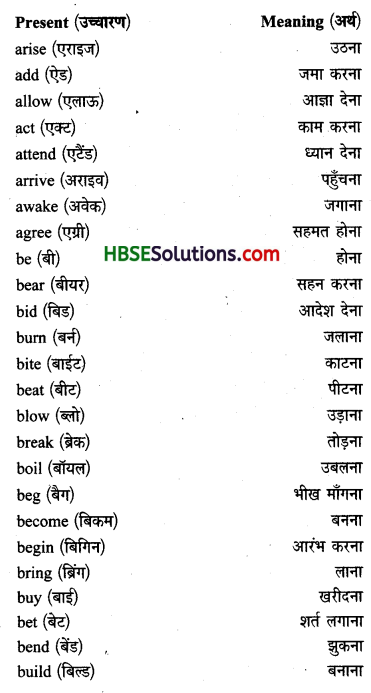
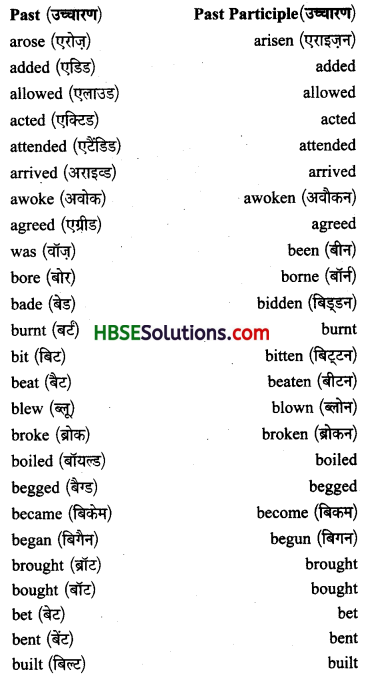
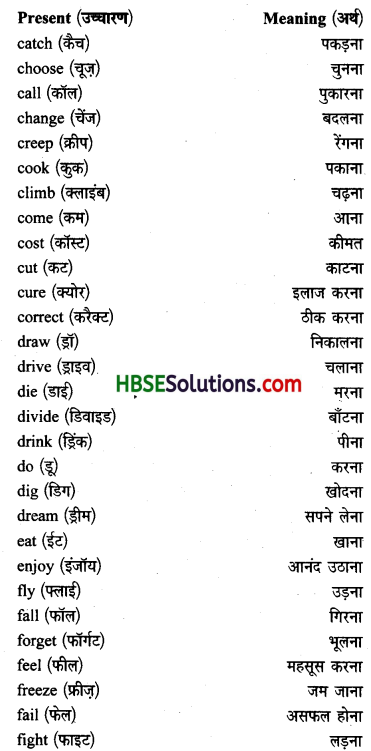
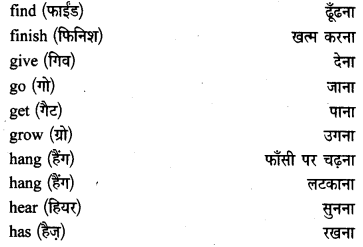
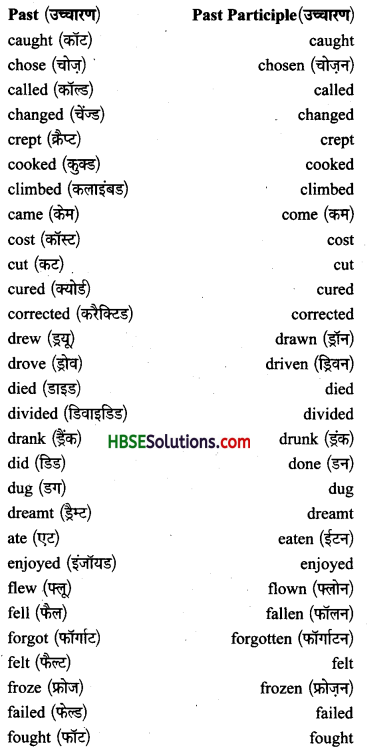
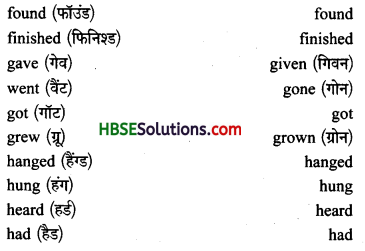
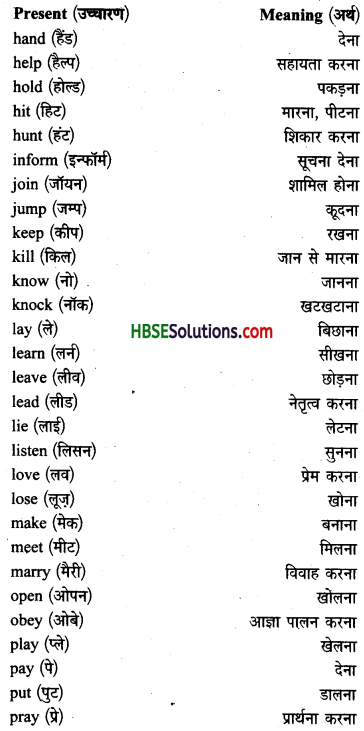
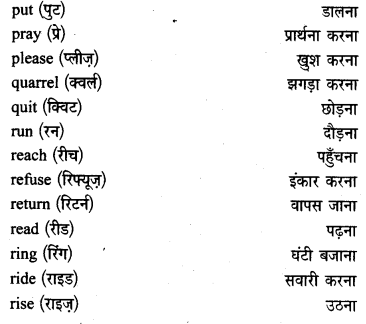
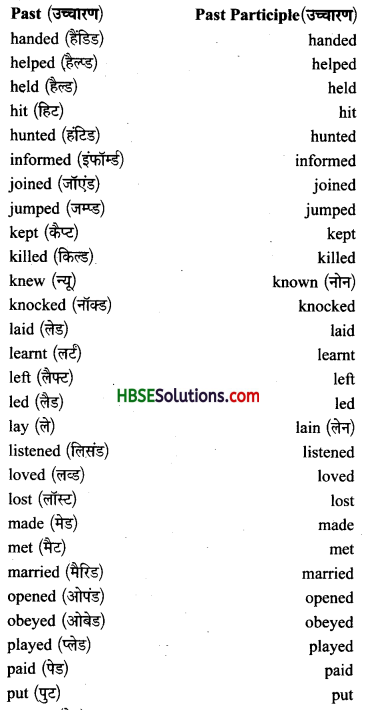
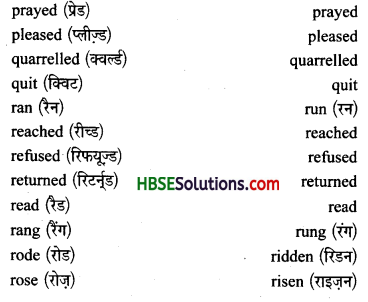
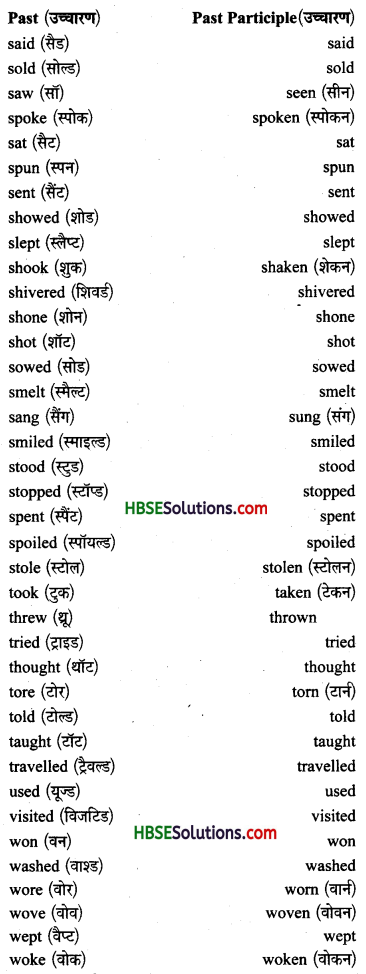
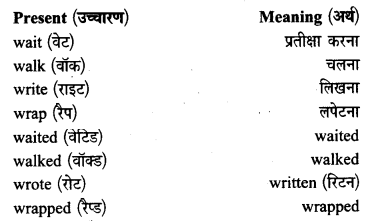
Some Important Three Forms of The Verb:
HBSE 10th Class English Grammar Tenses -1
HBSE 10th Class English Grammar Tenses -2
HBSE 10th Class English Grammar Tenses -3.1
HBSE 10th Class English Grammar Tenses -3.2
HBSE 10th Class English Grammar Tenses -4.1

HBSE 10th Class English Grammar Tenses -4.2
HBSE 10th Class English Grammar Tenses -5.1

HBSE 10th Class English Grammar Tenses -5.2
HBSE 10th Class English Grammar Tenses -6.1

HBSE 10th Class English Grammar Tenses -6.2

HBSE 10th Class English Grammar Tenses -7

HBSE 10th Class English Grammar Tenses -8

HBSE 10th Class English Grammar Tenses -9

There ate three main tenses corresponding the three divisions of time, these are :
(काल मुख्य रूप से तीन प्रकार के होते हैं।)
(a) The Present Tense.
(b) The Past Tense.
(c) The Future Tense.

Sack of these thtee main tenses has four forms :
(i) Simple or Indefinite
(ii) Continuous or Progressive
(iii) Perfect
(iv) Perfect Continuous

HBSE 10th Class English Grammar Tenses

There are three main, tenses corresponding the three divisions of time. These are:

(a) The Present Tense.
(b) The Past Tense.
(c) The Future Tense.

Each of these three main tenses has four forms :
(i) Simple or Indefinite
(ii) Continuous or Progressive
(iii) Perfect
(v) Perfect Continuous

HBSE 10th Class English Grammar Tenses

(A)

I. The Simple Present (Or The Present Indefinite)

Form:
इस Tense से संबंधित वाक्य का जब हिंदी में उच्चारण किया जाता है तो वाक्य के अंत में ता है, ती है, ता हूँ… ते हैं, की आवाज आती है।
HBSE 9th Class English Grammar Tenses -10

S= Subject (कर्ताकारक)
V= Verb (क्रिया)
O= Object (कर्म कारक)
यदि Subject (he, she, it, singular Noun हो तो V1 के साथ s/es लगाते हैं। जैसे-)
My mother goes to temple daily.
My mother does not go to temple daily.
Does your mother go to temple daily?
I play cricket.
They work in a factory.

Uses :
इन वाक्यों में daily, every, always, often, usually, generally शब्द लगे होते हैं।
(a) To describe habitual actions.
(आदत वाले कार्य को बताने के लिए।)
Ram gets up early in the morning. Then he goes for a walk.
He always speaks the truth.

(b) To express a general, universal or scientific truth.
(सामान्य, शाश्वत या वैज्ञानिक तथ्य को बताने के लिए।)
The sun rises in the east.
The rain falls from the clouds.

(c) To express a fact which is true at the time of speaking.
(ऐसे तथ्य को व्यक्त करने के लिए जो बात करते समय सत्य है।)
Krishma lives in Mumbai.
The Express train does not stop at this station.

(d) In describing running commentaries :
(आँखों देखा हाल बताने के लिए।
Raman passes the ball to Kamal and he hits it into the goal.

HBSE 10th Class English Grammar Tenses

II. The Present Continuous Tense

Form :
इस Tense से संबंधित वाक्य का जब हिंदी में अनुवाद किया जाता है तो वाक्य के अंत में रहा है, रही है, रहे। हैं, की आवाज आती है।

Simple Sentences – S+ Is/Am/Are + Vi+ing +O
Negative Sentences – S + Is/Am/Are +not+V, + ing+O
Interrogative Sentences – Is/Am/Are +S+V.+ing +O?

I के साथ am का प्रयोग करते हैं।
He, She, It और singular noun के साथ is का प्रयोग करते हैं।
We, you, they और Plural Noun के साथ are का प्रयोग करते हैं; जैसे-
Look ! the two boys are fighting. I am doing my work.

Uses :
(a) It shows what is happening now, at the time of writing or speaking.
(जो कार्य अब बात करते या लिखते समय हो रहा है।)
Shubham is studying in his room, but his brother Arun is playing in the garden.

(b) To express an action which may not be actually going on at the time of speaking, but it is going on in general.
(जो कार्य बात करते समय नहीं चल रहा, मगर सामान्य रूप से चल रहा है, उसे व्यक्त करने के लिए।)
She is writing a book on Economics.
He is building a new house.

(c) To express an action which is likely to happen in near future.
(उस घटना को व्यक्त करने के लिए जो निकट भविष्य में हो सकती है।)
My brother is coming next week.
I am going to Delhi tomorrow.

HBSE 10th Class English Grammar Tenses

Exercise 1

Put the verbs in brackets into the simple present tense or the present continuous tense :
1. Suman generally (wear) a white suit but today she (wear) a blue one.
2. He (go) for a walk everyday.
3. What (make) the moon go round the earth?
4. Crime never (pay).
5. The workers (repair) the road at present.
6. People (wear) new clothes at Diwali.
7. My children generally (go) to their uncle during the holidays. But they (not go) this summer as we all (go) to Shimla.
8. I usually (drink) coffee but now I (drink) tea.
9. We (have) our lunch at the Ashoka Restaurant this afternoon.
10. Look! she (tremble) with fear.
11. The doctor (examine) the patient in the next room.
12. Do not make a noise. The baby (sleep) in the cradle. .
13. Bad students never (work) hard.
14. Going to war (mean) killing a lot of people.
15. He (want) to buy a scooter.
Answers:
1. wears; is wearing
2. goes
3. makes
4. pays
5. are repairing
6. wear
7. go ; are not going; are going
8. drink; am drinking
9. are having
10. is trembling
11. is examining
12. is sleeping
13. work
14. means
15. wants.

HBSE 10th Class English Grammar Tenses

Exercise 2

Put the verbs in brackets into the simple present or present continuous tense:
1. Ice (melt) at 0” centigrade.
2. ‘Silence please’. The students (write) their examination in the next room.
3. What (make) an apple fall ?
4. I (hear) a continuous noise in the next room. What (go on) there ?
5. She (write) a book on English nowadays.
6. The car (need) servicing. I (send) it to the garage tomorrow.
7. It (rain) hard. 1 am afraid the match will have to be cancelled.
8. My sister (take) lessons in Western music. She (practise) on the piano everyday.
9. He (say) that he (not leave) now.
10. The boys (rehearse) a play for College Day.
Answers:
1. melts
2. are writing
3. makes
4. hear; is going on
5. is writing
6. needs; am sending
7. is raining
8. is taking; practises
9. says; is not leaving
10. are rehearsing.

Exercise 3

Put the verbs in brackets into the simple present or present continuous tense :
1. Snakes (not make) holes. They (live) in the holes made by other creatures.
2. You cannot see Raman; he (have) a bath.
3. Kalpana usually (drink) tea, but today she (drink) coffee.
4. I (write) a book at a present moment.
5. Our teacher (speak) so quickly that most of the students (not understand) him.
6. In Tamil Nadu men usually (wear) lungis.
7. He (wear) a coat today as it is very cold.
8. I cannot answer the telephone because I (make) an omelette.
9. He always (buy) tickets but he never (win) anything.
10. You (love) her ? No, I (like) her manners but I (not love) her.
11. You (know) why water (boil) when we (heat) it ?
12. Who (make) so much noise in the next room ?
13. Irregular work (not bring) success.
14. The stars (shine) during the night.
15. Look! The two boys (fight).
Answers:
1. do not make; live
2. is having
3. drinks; is drinking
4. am writing
5. speaks; do not understand
6. wear
7. is wearing
8. am making
9. buys; wins
10. Do you love; like; do not love
11. Do you know; boils; heat
12. is making
13. does not bring
14. shine
15. are fighting.

HBSE 10th Class English Grammar Tenses

III. The Present Perfect Tense

Form :
इस Tense से संबंधित वाक्य का जब हिंदी में अनुवाद किया जाता है तो वाक्य के अंत में चुका है, या लिया है, की आवाज आती है।

Simple Sentences – S + has/have + V3 + O
Negative Sentences – S + has/have + not + V3 + O
Interrogative Sentences – Has/Have + S + V3 + 0 + ?

He, she, it और singular noun के साथ has का प्रयोग होता है।
I, we, you, they और plural noun के साथ have का प्रयोग होता है। जैसे-
The Bell has gone.
I have learnt my lesson.
Have you returned the library books ?

Uses
(a) To express an action which has just been completed.
(किसी ऐसे कार्य का वर्णन करने के लिए जो अभी-अभी पूर्ण हुआ है।)
Have you written a letter ?
Yes, I-have just completed it.

(b) To express an action which began in the past and has continued upto the present. For this use of the tense, for and since can be used to denote the length of time. For is used to show the length of time and since to show the point of time.
(किसी ऐसे कार्य का वर्णन करने के लिए जो भूतकाल से चलकर वर्तमान समय तक जारी रहा हो। समय की अवधि कां वर्णन करने के लिए since और for का प्रयोग किया जाता है। For का प्रयोग समय की अवधि दर्शाने के लिए और Since का प्रयोग निश्चित समय-बिंदु को दर्शाने के लिए किया जाता है।)
He has been a teacher since 1995.
I have known him for the last ten years.

(c) To express an action which happened in the past at an indefinite time. We either don’t know the time of its happening or we don’t mention it.
(भूतकाल में किसी अनिश्चित समय में घटित होने वाले कार्य का वर्णन करने के लिए। हम कार्य के होने के समय के बारे में नहीं जानते और न ही उसका वर्णन करते हैं।)
I have seen the Taj Mahal.
I have met the author of this book.

HBSE 10th Class English Grammar Tenses

(d) In the sentences having ‘yet’, negative sentences of this are formed.
(जिस वाक्य में yet लगा होता है उसमें इस tense के साथ not का प्रयोग करते हैं।)
The match has not started yet.
He has not come yet.
They have not visited us yet.

IV. The Present Perfect Continuous Tense

पहचान : वाक्य के अंत में से रहा है, से रही है, से रहा हूँ, से रहे हैं, इत्यादि लगा होता है।
Simple Sentences – S + has/have + been + V1 + ing + O
Negative Sentences – S + has/have + not been + V1 + ing + O
Interrogative Sentences – Has/Have + S + been + V1 + ing + O + ?

I have been living here only for five years.
No, I have not been living here since long.
Have you been living here for a long time ?

Uses :
(a) To express an action which began in the past but is still continuing. Since and For are used to denote the length of time.
(किसी ऐसे कार्य का वर्णन करने के लिए जो भूतकाल में किसी समय से आरंभ होकर अभी भी निरंतर रूप से चल)
It has been raining since morning.
We have been waiting for the rain to stop.

(b) To express an action, which has just finished, but whose effect or result still continues.
(किसी ऐसे कार्य का वर्णन करने के लिए जो अभी-अभी पूरा हुआ है लेकिन उसका प्रभाव या परिणाम अभी भी जारी है।)
I am tired; I have been watering the plants since morning.
I am late because I have been washing my car.

HBSE 10th Class English Grammar Tenses

Exercise 4

Put the verbs in the present perfect or present perfect continuous tense:
1. He (take) his meal and is playing in the garden now.
2. Please give me your pen. I (forget) mine at home.
3. I (ring) the bell for five minutes, but nobody (come) to answer.
4. This woman (visit) the shop five times, but so far she (not purchase) anything.
5. He is a famous player. He (play) football since he was ten years old.
6. I (wait) for you for the last one hour.
7. Mohan (live) in this town since 1985.
8. You cannot meet Rajesh. He (just go) out.
9. Geeta went to Delhi six months ago, but I (not hear) from her so far.
10. I (not see) the Taj Mahal but I am planning to visit Agra next week.
11. India and Pakistan (fight) three wars.
12. You cannot go out till you (complete) your home work.
13. I (help) him five times in the past, but he (not improve).
14. He already (write) five letters and is still writing.
15. My uncle just (arrive) from Kolkata.
Answers:
1. has taken
2. have forgotten
3. have been ringing; has come
4. has visited; has not purchased
5. has been playing
6. have been waiting
7. has been living
8. has just gone
9. have not heard
10. have not seen
11. have fought
12. have completed
13. have helped; but has not improved
14. has already written
15. has just arrived.

Exercise 5

Put the verb in brackets into the correct tense (simple present, present continuous, present perfect or present perfect continuous) :
1. He always (find) fault with others.
2. He (play) for two hours and still (not stop).
3. The burglars (try) to get into the house for two hours.
4. We (wait) for the school bus at the moment.
5. He generally (go) to college in a car, but today he (go) on a cycle.
6. Sugar (cost) thirty rupees a kilo.
7. I (not met) the minister so far but I (meet) him tomorrow.
8. There is no use of calling the doctor; the patient already (die).
9. He (work) in the bank since 1976.
10. No one besides the nurse (know) this secret.
11. He (wear) that coat for fifteen years and it (wear out) at the elbows.
12. I never (see) such a beautiful garden.
13. I shall not go to his house unless he (invite) me.
14. I hear that Ram Lai (go) to London.
15. I want to go to the theatre; I not (see) a good play for a long time.
Answers:
1. finds
2. has been playing; has still not stopped
3. have been trying
4. are waiting
5. goes; is going
6. costs
7. have not met; am meeting
8. has already died
9. has been working
10. knows
11. has been wearing; has worn out
12. have never seen
13. invites
14. has gone
15. have not seen.

HBSE 10th Class English Grammar Tenses

(B)
I. The Simple Past Tense

Form:
इस Tense वाले वाक्यों का हिंदी अनुवाद करने पर वाक्य के अंत में आ, ए, ई, की आवाज आती है।
Simple Sentences – S + V2 + O
Negative Sentences – S + did not + V1 + O
Interrogative Sentences – Did + S + V1 + O?
Mohan went to Agra.
Mohan did not go to Agra.
Did Mohan go to Agra?

Some other examples :

AffirmativeNegativeInterrogative
I sang a song.I did not sing a song.Did I sing a song?
Anu sang a song.Anu did not sing a song.Did Anu sing a song?
They sang a song.They did not sing a song.Did they sing a song?
He sang a song.He did not sing a song.Did he sing a song?

(a) To express an action completed in the past at a definite time.
(अतीत में निश्चित समय पर पूरे हुए कार्य को व्यक्त करने के लिए।)

Nehru died in 1964. (die)
I met Shyam yesterday, (meet)
I visited Lucknow four years ago. (visit)
She did not visit us last year, (visit)

इन वाक्यों में भूतकाल का वर्णन करने के लिए yesterday, last, ago और in + सन् (year) आदि शब्द लगे होते हैं।

(b) To express a past habit.
(अतीत की आदत को व्यक्त करने हेतु।)

My grandfather always went for a walk in the morning, (go)
He always carried an umbrella, (carry)

(c) To express an action which took place at a definite time in the past even though the time is not given.
(अतीत के उस कार्य को व्यक्त करने के लिए जो किसी निश्चित समय पर हुआ था चाहे उसका समय नहीं बताया गया।)

Kamal arrived ten minutes late and his officer rebuked him. (arrive)
I bought this suit at Connaught Place, (buy)

(d) To express some historical events.
(कुछ ऐतिहासिक घटनाओं का वर्णन करने के लिए, जैसे-)

Shahjahan built the Taj. (build)
Babar founded the Mughal Empire, (found)
Columbus discovered America, (discover)
Gandhiji span on the charkha daily, (spin)

(e) If one part of the sentence is in Past Continuous Tense.
(यदि वाक्य का एक भाग Past Continuous Tense में है।)

I was taking my lunch when he arrived, (arrive)
I saw that the two boys were fighting. (see)

(f) To express the condition of past.
(भूतकाल की शर्त का वर्णन करने के लिए if वाले वाक्यों में यदि एक भाग में would/should/could + Verb की 1st form लगी हो तो दूसरे भाग में Verb की IInd form का – प्रयोग करते हैं।)
He would pass if he worked hard, (work)
She would get a job if she applied for it. (apply)

(g) Connectors (neither, and, but, because, as) के साथ यदि एक भाग में Verb की IInd form लगी हो तो दूसरे भाग में भी Verb की IInd form का प्रयोग करते हैं।

Neither he came nor sent any message, (send)
He failed because he did not work hard, (fail)
He came in and saw everything with his own eyes, (see)

HBSE 10th Class English Grammar Tenses

Exercise 6

Fill in the blanks with the simple Past Tense:
1. I was walking along the road when suddenly I ………….. (meet) an old lady.
2. My uncle just ………….. (arrive) from Kolkata.
3. I ………….. (tell) him that I was going to Pindara.
4. The old man was a beggar. He ………….. (beg) me to give him something.
5. “I have not eaten anything since morning,” the old man ………….. (say).
6. I ………….. (save) fifty hundred rupees last month.
7. I ………….. (feel) happy for helping an old and hungry man.
8. I returned from Pindara after one hour and ………….. (meet) the same old man again.
9. I recognised him but he ………….. (not recognise) me.
10. My servant ………….. (leave) me two weeks ago.
Answers:
1. I was walking along the road when suddenly I met (meet) an old lady.
2. My uncle just arrived (arrive) from Kolkata.
3. I told (tell) him that I was going to Pindara.
4. The old man was a beggar. He begged (beg) me to give him something.
5. “I have not eaten anything since morning,” the old man said (say).
6. I saved (save) fifty hundred rupees last month.
7. I felt (feel) happy for helping an old and hungry man.
8. I returned from Pindara after one hour and met (meet) the same old man again.
9. I recognised him but he did not recognise (not recognise) me.
10. My servant left (leave) me two weeks ago.

II. Past Continuous Tense

Form
वाक्य का हिंदी अनुवाद करने पर वाक्य के अंत में रहा था, रही थी, रहे थे की आवाज आती है।
Simple Sentences – S + was/were + V) + ing + O
Negative Sentences – S + was/were + not + V, + ing + O
Interrogative Sentences – Was/Were + S + V] + ing + 0?

He was writing a letter.
He was not writing a letter.
Was he writing a letter?

Uses
(a) इस Tense का प्रयोग भूतकाल में किसी निश्चित समय पर किसी क्रिया के निरंतर रूप से जारी रहने के बारे में किया जाता है; जैसे,

The teacher found that the boys were making a noise.
When I visited his house, he was taking his bath.

(b) Past Continuous Tense के साथ मुख्य रूप से when या while के साथ Past Indefinite Tense का प्रयोग होता है।
Past Indefinite Tense में क्रिया पूर्ण हो जाती है और Past Continuous Tense में क्रिया चल रही होती है।

A car left me when I was crossing the road.
He fell down while he was trying to climb a tree.

HBSE 10th Class English Grammar Tenses

Exercise 7

Fill in the blanks using Simple Past or Past Continuous Tense:
1. When the teacher came, the students …………. (make) a noise.
2. I …………. (not notice) that the teacher was standing behind me.
3. I did not see the teacher …………. (stand) behind me.
4. I …………. (take) my breakfast when the door bell rang.
5. The snake bit the boy while he …………. (try) to catch it.
6. Columbus …………. (discover) America.
7. A thief …………. (break) into our house last night.
8. He jumped off the train while it …………. (move).
9. She …………. (copy) from a paper when the teacher caught her red handed.
10. Who …………. (found) the Mughal Empire ?
Answers:
1. When the teacher came, the students were making (make) a noise.
2. I did not notice (not notice) that the teacher was standing behind me.
3. I did not see the teacher was standing (stand) behind me.
4. I was taking (take) my breakfast when the door bell rang.
5. The snake bit the boy while he was trying (try) to catch it.
6. Columbus discovered (discover) America.
7. A thief broke (break) into our house last night.
8. He jumped off the train while it was moving (move).
9. She was copying (copy) from a paper when the teacher caught her red handed.
10. Who founded (found) the Mughal Empire ?

III. Past Perfect Tense

Form
वाक्य का हिंदी अनुवाद करने पर वाक्य के अंत में चुका था, चुके थे, चुकी थी की आवाज आती है।

Simple Sentences S + had + V3 + O
Negative Sentences S + had + not + V3 + O
Interrogative Sentences Had + S + V3 + O ?
Mohah had made a plan.
Mohan had not made a plan.
Had Mohan made a plan?

Some other examples :

AffirmativeNegativeInterrogative
I had sung a song.I had not sung a song.Had I sung a song?
She had sung a song.She had not sung a song.Had she sung a song?
They had sung a song.They had not sung a song.Had they sung a song?
The boys had sung a song.The boys had not sung a song.Had the boys sung a song?

Uses

(a) To express an action that has completed before the fixed time in past.
(किसी ऐसे कार्य को व्यक्त करने के लिए जो किसी दूसरे कार्य के आरंभ होने से पहले पूरा हो चुका था;)
जैसे-
The fire had burnt the huts before the fire brigade came, (bum)
The thief had run away before the police came, (run)
The patient had died before the doctor came, (die)
The train had left before we reached the station, (leave)

नोट-इन वाक्यों में कार्य के संपन्न होने का वर्णन करने के लिए before, after, already, by, till और until शब्द लगे होते हैं।

(b) To express an action that has completed before the beginning of second action. (किसी ऐसे कार्य को व्यक्त करने के लिए जो past के निश्चित समय से पहले पूरा हो गया था;) जैसे-
I had already done my work by 6 p.m. yesterday, (do)
He had not met me before, (not meet)
She had not reached Agra till yesterday, (not reach)

(c) To express an unfulfilled wish of the past. (अतीत की किसी अपूर्ण इच्छा को व्यक्त करने के लिए);
जैसे-
He wished that he had accepted the offer, (accept)
If only you had worked hard, (work)

HBSE 10th Class English Grammar Tenses

(d) If in past happens more than one action, for former action past perfect is used.
(अगर past में एक से अधिक कार्य हुए हों तो पहले होने वाले कार्य के लिए Past Perfect का प्रयोग करते हैं);
जैसे-
I went home after I had finished the work, (finish)
He returned after he had seen off his wife at the station, (see)

(e) To express an impossible condition of the past.
(अतीत की असंभव शर्त को व्यक्त करने के लिए if वाले वाक्यों में); जैसे-
If he had walked carefully, he would not have fallen, (walk)
If you had worked hard, you would have passed, (work)
You would have caught the train if you had run faster, (run)

Exercise 8

Supply the correct Past Tense of the verb given in the brackets:
1. He told the doctor that his son just …………… (break) his leg.
2. The accident …………… (occur) at 6 o’clock this evening.
3. When I reached the house I …………… (find) that thieves …………… (break) into it.
4. I …………… (finish) my homework.
5. The thieves …………… (run) away before I reached the house.
6. If I …………… (have) a dictionary of my own, I would not bother you.
7. The thieves …………… (run) away before the police (arrive).
8. When I reached the cinema hall, the picture already …………… (begin).
9. I wish I …………… (work) harder.
10. If he …………… (walk) carefully, he would not have fallen.
Answers:
1. He told the doctor that his son just had just broken (break) his leg.
2. The accident occurred (occur) at 6 o’clock this evening.
3. When I reached the house I found (find) that thieves had broken (break) into it.
4. I had finished (finish) my homework.
5. The thieves had run away (run) away before I reached the house.
6. If I had (have) a dictionary of my own, I would not bother you.
7. The thieves had run away (run) away before the police arrived (arrive).
8. When I reached the cinema hall, the picture already had already begun (begin).
9. I wish I had worked (work) harder.
10. If he had walked. (walk) carefully, he would not have fallen.

HBSE 10th Class English Grammar Tenses

IV. Past Perfect Continuous Tense

Form
वाक्य का हिंदी अनुवाद करने पर वाक्य के अंत में, से रहा था, से रही थी, से रहे थे की आवाज आती है।

Uses
(I) इस Tense से संबंधित वाक्यों में since/for के साथ वाक्य के एक भाग में verb की 2nd Form लगी होती है अर्थात् भूतकाल में किसी निश्चित समय तक कोई कार्य किसी समय से निरंतर रूप से चला आ रहा था।

Exercise 9

Fill in the blanks with correct forms of verbs given in the brackets:
1. She …………. (sleep) for half an hour w hen I w’ent to her house.
2. I …………. (study) for three hours when the lights off.
3. The maid …………. (cook) the vegetables for fifteen minutes when my mother came.
4. The earthquake …………. (occur) before we reached there.
5. The clouds …………. (gather) in the sky since morning when the storm came.
6. I …………. (wait) for him for an hour when I received this message.
7. It …………. (rain) heavily for a week and the dam was flooded.
8. When I saw her, she …………. (weep).
9. I …………. (prepare) for the test for the last two months, when I received your letter.
10. We …………. (go) for a walk after the rain had stopped.
Answers:
1. She had been sleeping (sleep) for half an hour w hen I w’ent to her house.
2. I had been studying (study) for three hours when the lights off.
3. The maid had been cooking (cook) the vegetables for fifteen minutes when my mother came.
4. The earthquake had occurred (occur) before we reached there.
5. The clouds had been gathering (gather) in the sky since morning when the storm came.
6. I had been waiting (wait) for him for an hour when I received this message.
7. It had been raining (rain) heavily for a week and the dam was flooded.
8. When I saw her, she was weeping (weep).
9. I had been preparing (prepare) for the test for the last two months, when I received your letter.
10. We went (go) for a walk after the rain had stopped.

HBSE 10th Class English Grammar Tenses

(C)
I. The Simple Future Tense

Form
वाक्य का हिंदी अनुवाद करने पर गा, गे, गी की आवाज़ आएगी।
Simple Sentences – S + will/shall + V, + O
Negative Sentences – S + will/shall + not + V] + O
Interrogative Sentences – Will/Shall + S + V, + O ?

Geeta will visit us next week.
Geeta will not visit us next week.
Will Geeta visit us next week?

Uses
(a) To show future. (भविष्य को दर्शाने के लिए)
की राय या
He will go to Mumbai next week.

(b) To express the speaker’s opinions or assumptions about the future. (भविष्य के बारे में वक्ता मत को व्यक्त करने के लिए)
I think he will not come back.
We hope that Mohan will get First Division.

(c) Sometimes, the simple future tense is used to express habitual actions or general truths.
(का प्रयोग कई बार आदत संबंधी कार्यों और सामान्य सच्चाइयों के लिए भी किया जाता है।)
He will always tell lies.
A dog’s tail will remain crooked.

(d) Generally, shall is used with first person (I, we) and will is used with 2nd and 3rd persons. But will can be used with 1st person in order to express intention or promise. Shall can be used with promise, prohibition, etc. etc.
(प्रायः I, we के बाद shall तथा अन्य Nouns/pronouns के साथ will का प्रयोग होता है, लेकिन धमकी देने या वचन देने के बदले I, we के बाद will तथा अन्य Nouns के साथ shall का प्रयोग होता है।)

I will always help you in your need (promise).
We will fight to the finish (determination).
You shall not enter my room with muddy feet (prohibition).

HBSE 10th Class English Grammar Tenses

II. The Future Continuous Tense

Form
इस Tense के वाक्यों के अन्त में रहा होगा, रही होगी, रहे होंगे की आवाज आती है।
Simple Sentences S + will/shall + be + V, + ing + O
Negative Sentences S + will/shall + not + be + V| + ing + O
Interrogative Sentences Will/Shall + S + be + Vj + ing + O ?

She will be watching movie.
She will not be watching movie.
Will she be watching movie?

Uses
(a) To express an action which is expected to take place in the normal course. It is less definite than the present continuous.
(भविष्यकाल में सामान्य रूप से होने के कार्य का वर्णन करने के लिए। यह Present Continuous से कम निश्चित होता है।)
We are seeing the manager tomorrow (definite arrangement).
We shall be seeing the manager tomorrow (less definite).

(b) To express an action that will be in progress at a given point of time in future :
(भविष्यकाल में किसी निश्चित समय पर कोई कार्य चल रहा होगा।)
When you reach Shimla, it will be snowing there.
At this time tomorrow, I shall be travelling in a train.

(c) In the interrogative, the Future Continuous implies a polite request or query.
(प्रश्नवाचक वाक्यों में Future Continuous बिना प्रार्थना को व्यक्त करता है।)
Will you be coming with me?

HBSE 10th Class English Grammar Tenses

III. The Future Perfect Tense

Form
इस Tense के वाक्यों के अन्त में चुका होगा या लिया होगा इत्यादि की आवाज आती है।

Simple Sentences – S + will/shall + have + V3 + O
Negative Sentences – S + will/shall + not + have + V3 + O
Interrogative Sentences – Will/Shall + S + have + V3 + O ?

She will have done this work.
She will not have started the next work. She will have gone home.
Will she have started the next work also ?

Uses
(a) To express an action which is expected to be completed by a given future time.
(भविष्यकाल में किसी निश्चित समय से पहले किसी कार्य के पूर्ण होने का वर्णन करने के लिए)
By the time the doctor arrives, the patient will have died.

(b) To express the speaker’s belief or guess about an action.
(वक्ता के अनुमान का वर्णन करने के लिए)
Mohan will have reached Chandigarh by now.
You will have read about Alexander the Great.

HBSE 10th Class English Grammar Tenses

IV. The Future Perfect Continuous Tense

Form
वाक्य के अन्त में से रहा होगा, से रही होगी, से रहे होंगे, की आवाज़ आती है।
Simple Sentences S + will/shall + have been + V j + ing + O
Negative Sentences S + will/shall + not + have been + V, + ing + O
Interrogative Sentences Will/Shall + S + have been + Vj + ing + O ?
She will have been waiting for you for two hours when you reach there.
She will not have been watering the plants.
Will the gardener have been watering the plants in the evening ?

Uses

This tense is used to express an action which began in the past, or will begin before a certain time in the future, will be continuing at that certain point of time and will continue even after that.
(भविष्यकाल में किसी point of time से पहले कार्य आरंभ होकर उस point of time के बाद तक भी जारी रहेगा।)

When you reach the ground, the match will have been going on for one hour. (The match will begin, one hour before you reach, will still be in progress at the time of your reaching there and will continue even after your arrival).

Exercise 10

Put the verbs in brackets into the correct future form :
1. I wonder if I ………… (get) tickets in advance.
2. I ………… (know) the results in a week’s time.
3. This is February. Then the next month ………… (be) march.
4. Perhaps he ………… (arrive) in time for lunch.
5. At this time tomorrow, I ………… (travel) in a train.
6. By six p.m. tomorrow, I ………… (do) this work.
7. You ………… (open) the door, please ?
8. There is going to be a bus strike. Everyone ………… (look) for taxis and rickshaws next week.
9. I don’t like that man and I ………… (not help) him.
10. Mohan says that he ………… (not lend) me the book, because I never return the books.
Answers:
1. I wonder if I shall get (get) tickets in advance.
2. I shall know (know) the results in a week’s time.
3. This is February. Then the next month will be (be) march.
4. Perhaps he will arrive (arrive) in time for lunch.
5. At this time tomorrow, I shall be travelling (travel) in a train.
6. By six p.m. tomorrow, I shall have done (do) this work.
7. You will you open (open) the door, please ?
8. There is going to be a bus strike. Everyone will be looking (look) for taxis and rickshaws next week.
9. I don’t like that man and I will not help (not help) him.
10. Mohan says that he will not lend me (not lend) me the book, because I never return the books.

HBSE 10th Class English Grammar Tenses

Exercise 11

Put the verbs in brackets into the correct future form (Future Simple, Future Continuous, Future Perfect, Future Perfect Continuous) :
1. If you walk fast, you ………… (catch) the train.
2. When you reach there he ………… (read) a book.
3. By evening I ………… (read) half the book.
4. By the end of this month I ………… (learn) driving for two months.
5. I ………… (return) your book tomorrow.
6. I ………… (finish) my work by 12 p.m.
7. You ………… (know) your result next week.
8. A number of tourists (arrive) Shimla next summer.
9. The train ………… (leave) by the time you reach the station.
10. As you sow, so you ………… (reap).
11. The gardener ………… (water) the plants before the sun rises.
12. The sun ………… (rise) before we reach the top.
13. I ………… (do) the washing tomorrow morning.
14. I ………… (buy) a shirt for you, if I go to market.
15. He ………… (be) sixteen next Monday.
Answers:
1. If you walk fast, you will catch (catch) the train.
2. When you reach there he will be reading (read) a book.
3. By evening I will have read (read) half the book.
4. By the end of this month I shall have been learning (learn) driving for two months.
5. I shall return (return) your book tomorrow.
6. I will finish (finish) my work by 12 p.m.
7. You shall know (know) your result next week.
8. A number of tourists will arrive (arrive) Shimla next summer.
9. The train will have left (leave) by the time you reach the station.
10. As you sow, so you shall you reap (reap).
11. The gardener will have watered (water) the plants before the sun rises.
12. The sun will have arisen (rise) before we reach the top.
13. I will do (do) the washing tomorrow morning.
14. I shall buy (buy) a shirt for you, if I go to market.
15. He will be (be) sixteen next Monday.

Exercise 12

Supply the correct tense forms of the verbs given in brackets:
1. I …………. (finish) my homework.
2. India …………. (get) independence in 1947.
3. It …………. (rain) since morning. .
4. He …………. (kill) a tiger before I reached the forest.
5. They …………. (live) here for many years.
6. The river …………. (overflow) its banks before the dam was built.
7. He …………. (stand) first in the class.
8. I …………. (like) to take tea daily.
9. I …………. (go) out for a walk daily.
10. It …………. (rain) when you reach home.
11. The police …………. (catch) the thief last night.
12. I …………. (not finish) my work yet.
Answers:
1. I have finished (finish) my homework.
2. India got (get) independence in 1947.
3. It has been raining (rain) since morning. .
4. He had killed (kill) a tiger before I reached the forest.
5. They lived (live) here for many years.
6. The river had overflown (overflow) its banks before the dam was built.
7. He stood (stand) first in the class.
8. I like (like) to take tea daily.
9. I go (go) out for a walk daily.
10. It will be raining (rain) when you reach home.
11. The police caught (catch) the thief last night.
12. I have not finished (not finish) my work yet.

HBSE 10th Class English Grammar Tenses

Exercise 13

Supply the correct tense forms of the verbs given in brackets:
1. What you …………. (do) in the afternoon ?
2. You …………. (like) playing cricket ?
3. I …………. (live) here since 1958.
4. Curd …………. (cost) fifty rupees a litre.
5. My mother just …………. (arrive) from Kamal.
6. My sister …………. (write) a book at the present moment.
7. Why not two & two …………. (make) five ?
8. Kashmir …………. (call) heaven on the earth by people.
9. My friend recognized one but I …………. (not recognize) him.
10. Our school …………. (begin) with prayer everyday.
11. We …………. (do) our homework. Do not disturb us.
12. He …………. (buy) a new house last year.
Answers:
1. What you do you do (do) in the afternoon?
2. You Do you like (like) playing cricket ?
3. I have been living (live) here since 1958.
4. Curd costs (cost) fifty rupees a litre.
5. My mother just arrived (arrive) from Kamal.
6. My sister is writing (write) a book at the present moment.
7. Why not two & two do not two & two make (make) five?
8. Kashmir is called (call) heaven on the earth by people.
9. My friend recognized one but I did not recognize (not recognize) him.
10. Our school begins (begin) with prayer everyday.
11. We are doing (do) our homework. Do not disturb us.
12. He bought (buy) a new house last year.

HBSE 10th Class English Grammar Tenses Read More »

HBSE 10th Class English Grammar Punctuation

Haryana State Board HBSE 10th Class English Solutions Grammar Punctuation Exercise Questions and Answers.

Haryana Board 10th Class English Grammar Punctuation

What is Punctuation?
Punctuation का अर्थ है, विराम चिह्नों का सही प्रयोग। लिखते समय भावों को समझाने के लिए कहीं-कहीं रुकना पड़ता है। इसके लिए कुछ चिह्न लगाने होते हैं। इन रुकने के या विराम चिह्नों के प्रयोग को Punctuation कहते हैं। इनके लिए कुछ विशेष नियम हैं जिनका अध्ययन हम एक-एक करके करेंगे।

Important Marks of Punctuation :

1. Capital letters (A, B, C, …………)
2. Full stop (.)
3. Comma (,)
4. Mark of interrogation or Question Mark (?)
5. Inverted commas (” “)
6. Apostrophe (‘)
7. Sign of exclamation (!)
8. Semicolon (;)
9. Colon (:)
10. Hyphen (-)
11. Dash (_)
12. Brackets or Parenthesis [( )]

HBSE 10th Class English Grammar Punctuation

Uses Of The Marks of Punctuation :

1. Capital Letters (A, B, C, ………..) :

(a) प्रत्येक वाक्य का पहला अक्षर Capital (बड़ा) होता है; जैसे-
Radha is an intelligent girl. She goes to school daily. Last year she stood first in the class. Her teachers praise her.

(b) Proper Nouns और Proper Adjectives का पहला अक्षर बड़ा होता है।
He is Mohan, (proper noun)
John is a European, (proper adjective)
She lives in Mumbai, (proper noun)
I love Chinese food, (proper adjective)

(c) Direct Speech Inverted Commas (“ ”) के भीतर लिखे वाक्य का पहला अक्षर बड़ा होता है।
I She said, “I am going to Ludhiana.”

(d) दिनों, महीनों और त्योहारों के नामों के पहले अक्षर Capital (बड़े) होते हैं; जैसे-
I shall visit Delhi in December.
He came here on Friday.
People wear new clothes on Diwali.

(e) Abbreviations अर्थात् संक्षिप्त रूप का पहला अक्षर बड़ा होता है; जैसे-
M.A., M.B.B.S., M.L.A., P.M., Mr., etc.

(f) धर्मों या मतों के नाम के पहले अक्षर Capital होते हैं, जैसे-
Hinduism, Christianity, Jainism.

(g) भाषाओं और विषयों के नामों के पहले अक्षर capital होते हैं, जैसे-
History, English, Science, Hindi, etc.

HBSE 10th Class English Grammar Punctuation

2. Full Stop (.)
(a) प्रत्येक वाक्य के अंत में Full Stop लगता है। मगर यह नियम विस्मयसूचक एवं प्रश्नवाचक वाक्यों पर लागू नहीं होता, जैसे-
Mohan is a good singer.
Come here.
Post this letter.
Go and bring some sugar.

(b) Abbreviations और उन छोटे रूपों के साथ full Stop का प्रयोग होता है जो बड़े शब्दों के स्थान पर प्रयोग किए जाते जैसे-
M.L. Verma, M.B.B.S., M.P., N.R., Mr., Mrs., etc.

3. Comma (,) :
Comma एक महत्त्वपर्ण विराम चिहन है। इसलिए इसके प्रयोग के नियमों को ध्यान से पढ़ें।

(a) विभिन्न nouns, adjectives आदि को एक-दूसरे से अलग व्यक्त करने के लिए, जैसे-
I want a pen, a pencil, an inkpot, a few books, some papers and a table.
He is kind, brave, gentle and handsome.

(b) Apposition अर्थात् किसी शब्द के साथ लगकर व्याख्या करने के लिए Comma का प्रयाग करत है।
Akbar. the Great, ruled India for a long time.
Pawan, my friend, is a reporter.
Madan, a landlord, is very famous.

(c) Direct Narration के वाक्यों में Reporting Verb और Reported Speech के बीच में Comma लगता है।
Navneet said, “I am going, to Delhi.”
Radha said, “I love Krishan.”

(d) Yes या No के पश्चात्; जैसे-
Yes, I will help you.
No, I cannot do this work.

(e) तिथि को साल से अलग करने के लिए; जैसे-
May 10, 20….. या 10th May 10…………

(f) When, if, as आदि से आरम्भ होने वाले Clauses को मुख्य Clause से अलग करने के लिए, जैसे-
When I saw a lion, I ran away.
As I was going in, I met Subhash.
If you work hard, you will get first division.

4. Marks of interrogation Or Question Works (?)

प्रश्नसूचक चिह्न (?) का प्रयोग सीधे प्रश्न (Direct Question) में किया जाता है; जैसे-
Are you going to Jaipur?
Have you taken your lunch?
May I come in, Sir? .
What is your name?
मगर अप्रत्यक्ष प्रश्नों (Indirect Questions) के साथ Sign of Interrogation का प्रयोग नहीं होता; जैसे-
The teacher asked me where I was going.

5. Inverted Commas (“ ”) :

Inverted Commas के प्रयोग निम्नलिखित हैं-
(a) Direct Speech में; जैसे-
I said to him, “What are you doing ?”
Kishore said, “I have won the first prize.”

(b) किताबों, कविताओं, कहानियों, फिल्मों आदि के नामों को Inverted Commas में रखा जाता है-
Shakespeare has written the play “The Merchant of Venice.”
I have seen the film “Dil Se.”
I am reading the chapter “The Clever Rogue.”

HBSE 10th Class English Grammar Punctuation

6. Apostrophe (’) :

यह विराम चिह्न अधिकारात्मक बात को प्रकट करने के लिए प्रयोग किया जाता है।

(a) संज्ञा का Possessive Case बनाने के लिए यह विराम चिह्न Noun के अन्तिम अक्षर और ‘s’ के बीच में लगाया जाता है।
Shyam’s house.
I saw Ram’s book lying on Sohan’s table.
Sheela’s father met Naren’s father.

(b) ऐसे बहुवचन Noun जिनके पीछे ‘s’ आता है, उनमें Apostrophe को ‘s’ के बाद में लगाते हैं-
This is a girls’school.
That is the kids’room.
She went to a boys’ hostel.
The teachers’ rooms are separate.

(c) विस्मयसूचक वाक्यों अर्थात् सुख, दुःख आदि वाले वाक्यों के लिए इसका प्रयोग करते हैं; जैसे-
M.L.A.’s, M.P.’s, the three’s

(d) किसी वस्तु या व्यक्ति के बारे में हमारे विचारों को जोर देकर बताने के लिए; जैसे-
Don’t, Won’t, Didn’t, That’s.

7. Sign of Exclamation (!) :

(a) शुभकामना प्रकट करने वाले वाक्यों के अन्त में यह चिह्न लगाया जाता है; जैसे-
Alas ! I have injured my foot.
Hurrah ! We have won the match.

(b) किसी वस्तु या व्यक्ति के बारे में हमारे विचारों को जोर देकर बताने के लिए; जैसे-
What a beautiful girl!
How fine is the weather !

(c) शुभकामना प्रकट करने वाले वाक्यों के अन्त में यह चिह्न लगाया जाता है; जैसे-
May you live long !
May you stand first!

HBSE Class 9 English Grammar Punctuation

8. Semicolon (;) :

The semicolon is a pause longer than the comma but shorter than that of the full stop. It is used :
(a) When two opposite things are said in the same sentence :
I admire his intelligence; I hate his character.
God made the country; man made the town.

(b) to separate co-ordinate clauses, joined by the conjunctions, for, therefore, while, otherwise, etc. You must work hard; otherwise you will not get good marks.

(c) between itcnis in a suies of items that contain commas
The bedroom contained one wardrobe, one double bed. two chairs. one dressing cable; the nursery. one cot, one cheat of drawers, two chairs, one racking horse: the dinning room, six chairs. one table and one side board.

9. Colon (:) :

A colon is used:
(a) Lo imi’oducc a quotation
Keats said : ‘A thing of beauty la a joy for ever”.

(b) to explain and ebboraLe what has already been said
There is bad news : our team has lost the match.

(c) to introduce allai or a sencs
Faut boys have wan prizes : Suresh. Mahesh, Lalit and Rain.

10. Dash (_) :

The dash is used:
(a) to expees.s a sudden change of thought:
I don’t like it—but let us forget the matter altogether.

(b) to indicate a break in thought or hesitation:
I—l don’t accept this charge.

(c) to act as a bracket:
Drinking of wine—we all know it is a curse—has spoiled the Lives of countless people.

11. Hyphen (-) :

A hyphen is a shorter horizontal line than the dash. h is used to join the parts of a compound word:
Father-in-law, prisoner-of-war. toodi-brush.

Brackets or Parenthesis [()] :
Brackets serve the purpose of double dashes. They are used to separate from the main part of the
sentence a phrase or a clause which doca not belong to it.
Pappu (I do not know his full name) is a very intelligent boy.

HBSE 10th Class English Grammar Punctuation

Exercises for Pratice (Solved)

Exercise 1

Punctuate the following:
1. her father died on 24th jane 2004
2. his marriage has been fixed for monday the 26th may 20…
3. his father mr s m acharya is ma.bed
4. he says i am ill
5. sit down my Friend i have to talk to you
6. ram says that mr sham lad teaches him Hindi
7. i met mohan on friday
8. drop Sharma is an mbb
9. the name of his wife is veena gaba
Answers :
1. Her father died on 24th June, 2004.
2. His marriage has been fixed for Monday, the 26th May, 20..
3. His father, Mr. S. M. Acharya, is M.A., B.Ed.
4. He says, “I am ill.”
5. Sit down, my friend, I have to talk to you.
6. Ram says that Mr. Sham Lai teaches him Hindi.
7. I met Mohan on Friday.
8. Dr. O.P. Sharma is an M. B. B. S.
9. The name of his wife is Veena Gaba.

HBSE 10th Class English Grammar Punctuation

Exercise 2

Punctuate the following:
1. she is a beautiful lady
2. she has done her ma in english
3. for some time she worked as lecturer in english
4. ram said i am a good boy
5. sham and ram live in delhi
6. delhi is the capital of india
7. you should help the poor the teacher said
8. in that room there is an indian a Chinese a japanese a russian and a Pakistani
9. i am william tell replied the man
Answers:
1. She is a beautiful lady.
2. She has done her M. A. in English.
3. For some time, she worked as Lecturer in English.
4. Ram said, “I am a good boy.”
5. Sham and Ram live in Delhi.
6. Delhi is the capital of India.
7. “You should help the poor,” the teacher said.
8. In that room, there is an Indian, a Chinese, a Japanese, a Russian and a Pakistani.
9. “I am William Tell”, replied the man.

Exercise 3

Punctuate the following:
1. alas my dog is thirsty said the old man will you give him a drop of water
2. the monkey took away the money of mithu
3. delhi is 121 kms from kamal
4. mohan das karam chand gandhi was born in a small town in gujarat
5. our prime minister knows german Chinese and russian languages
6. mohan said i go to the library
7. hari said sheela is my sister
8. the himalayas are in the north of india
9. they, all said it is a lovely scene
Answers :
1. “Alas ! My dog is thirsty,” said the old man, “Will you give him a drop of water ?”
2. The monkey took away the money of Mithu.
3. Delhi is 121 kms from kamal.
4. Mohan Das Karam Chand Gandhi was born in a small town in Gujarat.
5. Our Prime Minister knows German, Chinese and Russian languages.
6. Mohan said, “I go to the library.”
7. Hari said, “Sheela is my sister.”
8. The Himalayas are in the north of India.
9. They all said, “It is a lovely scene.”

HBSE 10th Class English Grammar Punctuation

Exercise 4

Punctuate the following :
1. he said to me why do you want so much money
2. ranti deva helped the poor
3. i want a pen a pencil a book and a table
4. go home raju said gopal
5. if you were a king what would you do
6. father i want a knife
7. yes replied mohan i beat him
8. the fox said these grapes are sour
9. mr m l verma is a reporter
Answers:
1. He said to me, “Why do you want so much money ?”
2. Ranti Deva helped the poor.
3. I want a pen, a pencil, a book and a table.
4. “Go home, Raju,” said Gopal.
5. If you were a king what would you do? ‘
6. Father, I want a knife.
7. “Yes”, replied Mohan, “I beat him.”
8. The fox said, “These grapes are sour.”
9. Mr. M.L. Verma is a reporter.

Exercise 5

Punctuate the following:
1. gandhi fought for india’s freedom
2. the ramayana is the holy book of the hindus
3. how did you spend the money, father asked sohan
4. he was poor hungry and sad
5. we went to nainital on friday
6. we saw many buildings in agra
7. the taj mahal stands on the banks of the yamuna
8. i purchased one shirt one tie two socks and shoes
9. Chandigarh is the capital of haryana
Answers :
1. Gandhi fought for India’s freedom.
2. The Ramayana is the holy book of the Hindus.
3. “How did you spend the money ?” father asked Sohan.
4. He was poor, hungry and sad.
5. We went to Nainital on Friday.
6. We saw many buildings in Agra.
7. The Taj Mahal stands on the banks of the Yamuna.
8. I purchased one shirt, one tie, two socks and shoes.
9. Chandigarh is the capital of Haryana.

HBSE 10th Class English Grammar Punctuation

Exercise 6

Punctuate the following:
1. he said this is gods will
2. he said to rama he has got his fathers share
3. what have you to sell dear lady he asked
4. the fox said these grapes are sour
5. he said to me please give me your pen
6. work hard because the examination is drawing near said the father to his son
7. rewari is twenty miles from my village
8. of all the mughal emperors akbar is the most popular
Answers :
1. He said, “This is God’s will.”
2. He said to Rama, “He has got his father’s share.”
3. “What have you to sell, dear lady,” he asked.
4. The fox said, “These grapes are sour.”
5. He said to me, “Please give me your pen.”
6. “Work hard because the examination is drawing near,” said the father to his son.
7. Rewari is twenty miles from my village.
8. Of all the Mughal Emperors, Akbar is the most popular.

Exercise 7

Rewrite the following sentences with marks of punctuation by using capital letter, full stops and question marks where necessary:
1. please bring three cups of ice-cream
2. what do you want
3. all the boys are present
4. where are they sitting
5. was there a theft in your house last night
6. you , are a very kind man
7. have you any red bangles
8. two policemen came to our house this morning
9. open your books at page twenty
10. look at the blackboard
Answers:
1. Please bring three cups of ice-cream.
2. What do you want?
3. All the boys were present.
4. Where are they sitting?
5. Was there a theft in your house, last night?
6. You are a very kind man.
7. Have you any red bangles?
8. Two policemen came to our house this morning.
9. Open your books at page twenty.
10. Look at the blackboard.

HBSE 10th Class English Grammar Punctuation

Exercise 8

Rewrite the following sentences by using capital letters, full stops and question marks where necessary :
1. she knows sita and gopal
2. his name is balbir singh
3. when will kuldip come here
4. i am going to ludhiana
5. durga dass is a rich man
6. the himalayas are in the north of india
7. the rajdhani express is a very fast train
8. did mohan and kamala go to the park with their father and mother
9. a hockey team from delhi went to sri lanka last month
10. who is he talking to he is talking to rajinder singh
Answers :
1. She knows Sita and Gopal.
2. His name is Balbir Singh.
3. When will Kuldip come here ?
4. I am going to Ludhiana.
5. Durga Dass is a rich man.
6. The Himalayas are in the north of India.
7. The Rajdhani Express is a fast train.
8. Did Mohan and Kamla go to the park with their father and mother ?
9. A hockey team from Delhi went to Sri Lanka last month.
10. Who is he talking to ? He is talking to Rajinder Singh.

Exercise 9

Punctuate the following sentences with commas and inverted commas where necessary :
1. Rajan said Goodbye.
2. Meena said I will miss you.
3. Sheela says In our house there are chairs tables fans and radios.
4. Kamla says Are your parents coming ?
5. Leela said have you any small bangles ?
6. The driver said Which way shall we go ?
7. The headmaster said Perhaps it is in your bag. Did you look for it there?
8. Mohan said I looked for my pen everywhere.
9. Ajit said We will go to the dam. It is a beautiful spot and we shall enjoy the trip.
10. mr das said whose books are these
Answers:
1. Rajan said, “Goodbye.”
2. Meena said, “I will miss you.”
3. Sheela says, “In our house there are chairs, tables., fans and radios.”
4. Kamla says, “Are your parents coming ?”
5. [cela said, “Have you any small bangles ?”
6. The driver said, “Which way shall we go ?”
7. The headmaster said, “Perhaps it is in your bag. Did you look for it there ?”
8. Mohan said. “I looked for my pen everywhere.”
9. Ajit said, “We will go to the dam. It is a beautiful spot and we shall enjoy the trip.”
10. Mr. Das said, “Whose books are these ?”

HBSE 10th Class English Grammar Punctuation

Exercise 10

Punctuate the following sentences with commas and inverted commas where necessary :
1. my sister is a ph d student
2. i would rather die she said than beg
3. may i come in sir
4. the ramayana is a sacred book of the hindus
5. harpreet was elected an m 1 a
6. he asked me why i was crying
7. he passed the b a exam last year
8. long live the president
9. he was honest sincere and hard working
10. the teacher said honesty is the best policy
11. my uncle dr c 1 sharma lives in shimla
12. if you go to agra do visit the taj mahal
Answers:
1. My sister is a Ph.D student.
2. “I would rather die,” she said, “than beg.”
3. May I come in, sir ?
4. The Ramayana is a sacred book of the Hindus.
5. Harpreet was elected an M.L.A.
6. He asked me w hy I was crying ?
7. He passed the B.A. exam last year.
8. Long live the President.
9. He was honest, sincere and hard working.
10. The teacher said, “Honesty is the best policy.”
11. My uncle, Dr C.L. Sharma, lives in Shimla.
12. If you go to Agra, do visit the Taj Mahal.

HBSE 10th Class English Grammar Punctuation Read More »

HBSE 9th Class English Unseen Passages

Haryana State Board HBSE 9th Class English Solutions Unseen Passages Exercise Questions and Answers.

Haryana Board 9th Class English Unseen Passages

इस प्रश्न में एक Para दिया होगा। विद्यार्थियों को उसके नीचे लिखे प्रश्नों के उत्तर देने होंगे।

COMPREHENSION के प्रश्न को किस प्रकार हल किया जाए?
Comprehension का प्रश्न हल करते समय निम्नलिखित कुछ नियमों को ध्यान में रखो।
1. Passage को ध्यान से पढ़ो और उसे अच्छी प्रकार समझो। अगर कुछ शब्दों के सही अर्थ आप को पता नहीं लग रहे तो भी ध्यान से पढ़ने पर passage का भाव आप को समझ आ जाएगा।
2. पूरे Passage का भाव या Main idea समझो-देखो कि लेखक क्या कहना चाहता है।
3. सभी प्रश्नों को ध्यान से पढ़ो और समझो कि उनमें क्या पूछा गया है।
4. अब Passage में जहाँ-जहाँ इन प्रश्नों के उत्तर हैं, वहाँ निशान लगा लो।
5. प्रत्येक प्रश्न के अंत में उत्तर के चार विकल्प दिए होंगे। विद्यार्थी को उन विकल्पों में से सही उत्तर को छाँटना है।
6. बार-बार विकल्पों को मत बदलिए।

HBSE Class 9 English Composition Unseen Passages

What is Comprehension?
Comprehension का अर्थ है किसी बात को अच्छी प्रकार समझना। Comprehension के पैराग्राफ के नीचे दिए गए प्रश्न इस बात को परखने के लिए होते हैं कि आपने उस पैराग्राफ को कितनी अच्छी तरह से समझा है।
इस प्रश्न के उत्तर में छात्र प्रायः दो गलतियाँ करते हैं-
(a) वे पैराग्राफ को अच्छी तरह पढ़ते नहीं हैं और
(b) वे प्रश्नों का उत्तर अपनी भाषा में नहीं देते हैं। वे प्रश्नों के उत्तर बिना भाषा बदले Passage में से नकल कर लेते हैं, चाहे वे ठीक या सही न भी बैठे।

Comprehension का प्रश्न हल करते समय निम्नलिखित कुछ नियमों को ध्यान में रखें-
1. Passage को ध्यान से पढ़ो और उसे अच्छी प्रकार समझो। अगर कुछ शब्दों के सही अर्थ आपको पता नहीं लग रहे
तो भी ध्यान से पढ़ने पर Passage का भाव आपको समझ आ जाएगा।
2. पूरे Passage का भाव या main idea समझो और देखो कि लेखक क्या कहना चाहता है।
3. अब सभी प्रश्नों को ध्यान से पढ़ो और समझो कि उनमें क्या पूछा गया है।
4. अब Passage में जहाँ-जहाँ इन प्रश्नों के उत्तर हैं, वहाँ निशान लगा लो।
5. अब इन प्रश्नों के उत्तर उत्तरपुस्तिका में अपनी भाषा में लिख दीजिए।
6. प्रत्येक प्रश्न का उत्तर उसी Tense में दो जिस Tense में यह पूछा गया है अर्थात् यदि प्रश्न में do लगा होता है तो
उत्तर verb की Ist form में देते हैं। यदि प्रश्न में does लगा होता है तो उत्तर verb की Ist form + s/es के साथ देते
हैं और यदि प्रश्न में did लगा होता है तो उत्तर verb की 2nd form में देते हैं।
7. प्रश्नों के उत्तर सटीक (To the point) होने चाहिएँ। जो कुछ पूछा गया है, केवल उसी का उत्तर दो। व्यर्थ की बातें मत लिखें।
8. यदि Passage का शीर्षक देने को कहा गया हो तो शीर्षक संक्षिप्त होना चाहिए और उस Passage के theme पर आधास्ति होना चाहिए।
9. उत्तर लिखते समय लिखाई का विशेष ध्यान रखें तथा cutting और overwriting न करें।
10. सभी प्रश्नों के उत्तर क्रमानुसार दें।

HBSE Class 9 English Composition Unseen Passages

Some Solved Examples

Read the following passages and answer the questions given at the end of each :

Passage 1

The elephant, the largest living land animal on earth has interested man from time immemorial. Its immense size, strength and intelligence has played a very important role in the economy, culture and religion of the country where it is found. Over the past 40 million years, more than 600 species of elephants have roamed the earth. Changes in climate and vegetation caused the extinction of many elephant species. The growth of human civilization also added to their suffering. Today only two species are alive—the African elephant and the Asian elephant. They not only inhabit different geographical regions, but also have distinct physical characteristics. Asian elephants are smaller in size than the African elephants. They are more easily tamed than their larger and wilder African counterparts. In fact humans have used the docile Asian elephants for over 5000 years as beasts of burden, in warfare, and in ceremonial activities.
Questions:
(a) What qualities of an elephant help it to play an important role in the economy of a Country ?
(b) Which species of elephants have survived till today ?
(c) Differentiate between African and Asian elephants. (Give any two points)
(d) Mention any two uses of elephants.
(e) Which word from the passage means ‘domesticated’ ?
Answers:
(a) Its immense size, strength and intelligence help it to play an important role in the economy of a country.
(b) Only two species of elephants—the African elephant and the Asian elephant have survived till today.
(c) (i) The Asian elephants are smaller in size than the African elephants.
(ii) The Asian elephants are more easily tamed than the African elephants.
(d) (i) Elephants are used for carrying burden.
(ii) Elephants are used in ceremonial activities.
(e) tamed

HBSE Class 9 English Composition Unseen Passages

Passage 2

Junk food is a term describing food that is perceived to be unhealthy or having poor nutritional value, according to Food Standards Agency. The term is believed to have been coined by Michael Jacobson, Director of the Center for Science in the Public Interest in 1972. The term has since become common usage.

Junk food typically contains high levels of fat, salt or sugar and numerous food additives such as monosodium glutamate and tartrazine; at the same time, it is lacking in proteins, vitamins and fiber, among others. It is popular with suppliers because it is relatively cheap to manufacture, has a long shelf life and may not require refrigeration. It is popular with consumers because it is easy to purchase, requires little or no preparation, is convenient to consume and has lots of flavour. Consumption of junk food is associated with obesity, heart disease, Type 2 diabetes and dental cavities. There is also concern about the targeting of marketing at children.
Questions:
(a) What is Junk Food ?
(b) Who coined the term‘Junk Food’?
(c) What does Junk Food lack in ?
(d) Why is Junk Food popular with suppliers ?
(e) Why is Junk Food popular with consumers ?
(f) Find a word in the passage that means‘Many’.
Answers :
(a) Junk food is a term describing food that is perceived to be unhealthy or having poor nutritional value.
(b) Michael Jacobson, Director of the Center for Science in the Public Interest coined the term ‘Junk food’.
(c) Junk food lacks in proteins, vitamins and fiber.
(d) It is popular with suppliers because it is relatively cheap to manufacture, has a long shelf life and may not require refrigeration.
(e) It is popular with consumers because it is easy to purchase, requires little or no preparation, is convenient to consume and has lots of flavour.
(f) Lots of.

HBSE Class 9 English Composition Unseen Passages

Passage 3

Late in the afternoon, Swami Vivekananda spoke in the great meeting. He was dressed in the yellow robes of a Sanyasi. When he came and stood before the people, they were charmed by his appearance. He was silent for some time and then he felt a divine power in him. He began his speech. He addressed the gathering as ‘Sisters and Brothers of America.’ People clapped their hands and gave him hearty cheers. When the clapping ceased, Swami spoke on Hinduism. He said that the religion of the world were the same. They were all true. Only the paths leading to the goal were different. He also said that Hinduism regards every man, woman and child as a part of God. To a Hindu, the service of man is the true service of God.
Questions:
(a) What time did Vivekananda give his speech ?
(b) What did Swami say about the religions of the world ?
(c) What did he feel in him before his speech ?
(d) What did Swami say about all the religions of the world ?
(e) What did Swami Vivekananda say about Hinduism ?
(f) Find in the passage a word that means ‘stopped’.
Answers:
(a) Vivekananda gave his speech late in the afternoon.
(b) He said that all religions of the world were the same.
(c) He felt a divine power in him before his speech.
(d) He said that all the religions were true. Only the paths leading to the goal were different.
(e) He said that Hinduism regards every man, woman and child as a part of God.
(f) ‘ceased’.

HBSE Class 9 English Composition Unseen Passages

Passage 4

People often curse poverty as a great evil, and it seems to be an accepted belief that if people only had plenty of money, they would be happy and useful and get more out of life. But the reality is that while palaces give a comfortable life, peace and contentment dwell in cottages. I always pity the sons and daughters of rich parents who are attended by servants and governesses. It is because I know how sweet and happy and pure the home of honest poverty is and how loving and united the members of poor families are in common interests. It is for these reasons that so many strong, eminent and self-reliant men have always sprung from poor families.
Questions :
(a) Why do people want to have plenty of money?
(b) Why have so many strong, eminent and self-reliant men sprung from poor families?
(c) How do people curse poverty? ‘
(d) From where have most of the famous men come?
(e) What does a cottage life give us?
(f) Find the words from the passage having the same meanings as :
(i) live (ii) satisfaction.
Answer:
(a) They think that if they had plenty of money, they would live happily.
(b) The cottages of the poor people have honesty, peace and contentment. Their members love each other. So strong and self-reliant men have sprung from these cottages.
(c) People curse poverty as a great evil.
(d) They have come from the cottages of the poor.
(e) A cottage life gives us contentment.
(f) (i) dwell (ii) contentment.

HBSE Class 9 English Composition Unseen Passages

Passage 5

The great advantage of early rising is the good start it gives us to our day’s work. The early riser has done a large amount of hard work before other men have got out of bed. In the early morning the mind is fresh, and there are few sounds or other distractions, so the work done at that time is generally well done.

In many cases the early riser also finds time to take some exercise in the fresh morning air, and this exercise supplies him with a fund of energy that will last until the evening. By begining so early, he knows that he has plenty of time to do thoroughly all the work he can be expected to do, and is not tempted to hurry over any part of it.

All his work being finished in good time, he has a long interval of rest in the evening before the timely hour when he goes to bed. He gets to sleep several hours before midnight, at the time when sleep is most refreshing, and after a sound night’s rest rises, early next morning in good health and spirits for the labours of a new day.
Questions :
(a) How is early morning different from other hours of the day?
(b) Why is the early riser not tempted to hurry over his day’s work?
(c) What enables the early riser to go to bed at the proper time?
(d) What are the advantages of going to sleep well before midnight?
(e) How does an early riser find himself for the day’s work?
(f) Find words from the passage having the same meaning as :
(i) utility or use (ii) something that disturbs.
Answer:
(a)In the early morning, the air is fresh and there is no disturbance.
(b) As he has plenty of time, he is not tempted to hurry over his day’s work.
(c) His day’s work is completed in time. This enables an early riser to go to bed at the proper time.
(d) At that time the sleep is most refreshing.
(f) An early riser finds himself in good health and spirits for the labour of a new day.
(i) advantage (ii) distraction.

Passage 6

Rabindra Nath Tagore raised the stature of our country in the eyes of the world. A versatile genius, a literary artist, an educator, a composer, a singer, an actor, R. N. Tagore had all gifts of Nature and fortune in his favours. Bom in a renowned Hindu family, R.N. Tagore pleaded not only for concord with the past but also for freedom from the past. All healthy growth needs continuity and change. We are not free unless our minds are liberated from dead forms, tyrannical restrictions and crippling social habits. Tagore condemned the corruption of many of our social practices. He believed that the essence of life was perpetual renewal and rededication to self development.
Questions: .
(a) Who raised the stature of our country in the eyes of the world ?
(b) Rabindra Nath Tagore was a versatile genius. How ?
(c) What are the essentials of healthy growth according to him ?
(d) When can we be termed as free ?
(e) What is the essence of life according to R.N. Tagore ?
(f) Pick out a word from the passage that means‘Everlasting’.
Answers: .
(a) Rabindra Nath Tagore raised the stature of our country in the eyes of the world.
(b) He was a versatile genius, a literary artist, an educator, a composer, a singer, an actor.
(c) According to Rabindra Nath Tagore, continuity and change are the essentials of healthy growth.
(d) We are not free unless our minds are liberated from dead forms, tyrannical restrictions and crippling social habits.
(e) He believed that the essence of life was perpetual renewal and rededication to self development.
(f) Perpetual.

Passage 7

He saw a most wonderful sight. Through a little hole in the wall the children had crept in, and they were sitting in the branches of the trees. In every tree that he could see there was a little child. And the trees were so glad to have the children back again that they had covered themselves with blossoms and were waving their arms gently above the children’s heads. The birds were flying about and twittering with delight, and the flowers were looking through the green grass and laughing. It was a lovely scene. Only in one comer, it was still winter. It was the farthest comer of the garden, and in it was standing a little boy. He was so small that he could not reach upto the branches of the tree, and he was wandering all around it, crying bitterly. The poor tree was still covered with frost and snow, and the North Wind was blowing and roaring about it. “Climb up ! little boy”, said the tree and it bent its branches as low as it could, but the boy was too tiny.
Questions :
(a) How had the children entered the garden?
(b) Why were the trees so happy?
(c) Why was there still winter in one comer of the garden ?
(d) Why couldn’t the little boy climb up the tree?
(e) What was the North wind doing?
(f) Find out the words from the passage which mean :
(i) chirping (ii) joy.
Answers :
(a) The children had entered the garden through a hole in the wall.
(b) The trees were happy because the children had come back.
(c) There was still winter in one comer because a small boy was standing there. He could not climb the tree.
(d) The little boy couldn’t climb the tree because he was too small.
(e) The North wind was blowing and roaring.
(f) (i) twittering (ii) delight.

HBSE Class 9 English Composition Unseen Passages

Passage 8

Once there lived a slave in Greece. His name was Androcles. He worked very hard, but his master was very cruel to him. He was badly treated by his master. He was sick of life. He ran away to the forest. He was dead tired so he lay down to rest. Suddenly, he heard the roar of a lion. He was frightened. The lion came towards him. He seemed to be in great pain. The slave saw a big thorn in the lion’s paw. He pulled out the thorn. The lion felt relieved and began to lick the slave’s feet. A few days later, the slave was arrested by his master. He ordered that the slave be thrown before a hungry lion. A big crowd assembled to see the cruel act. The lion was let loose. It recognised Androcles and began to lick his hands. Every one was surprised. Androcles related the whole story and he was set free.
Questions :
(a) Why was the slave sick of life?
(b) Why did the lion cry with pain?
(c) When did the lion feel relieved?
(d) How did the lion thank the slave?
(e) Why did the slave lie down?
(f) Make nouns from : (i) lived (ii) hungry.
Answers:
(a) He was sick of life because he worked hard but his master was very cruel.
(b) The lion cried with pain because it had a thorn in its paw.
(c) The lion felt relieved when the slave pulled out the thorn.
(d) The lion thanked the slave by licking his feet.
(e) He was dead tired so he lay down to rest.
(f) (i) Livelihood (ii) Hunger.

Passage 9

Cheating in examination is a major defect of our education system. The cheating had become so common that students consider it their birthright to use unfair means in the examination. The root cause of this evil lies in our schools. Short-cuts have replaced hard labour. Guides and notes are encouraged in place of textbooks. In all schools examinations, except the Middle and Matric examination, teachers show leniency to the students and pass most of them. Sometimes, even the parents are at fault. They get their undeserving wards promoted to higher class. The students don’t cultivate the habit of self-study and hard work. Then in the Board Examination, students resort to copying. The teachers on duty encourage the students to use unfair means to pass the examinations. The desire to show good results motivates them to adopt wrong methods.
Questions:
(a) What is the major defect of our education system ?
(b) What do students feel about using unfair means in the examination ?
(c) What is used in place of textbooks ?
(d) What leniency do the teachers show ?
(e) Why do teachers encourage the students to use unfair means ?
(f) Which word in the passage means ‘to make use of’?
Answers:
(a) Cheating in examination is the major defect of our education system.
(b) They consider it their birthright to use unfair means in the examination.
(c) Guides and notes are used in place of textbooks.
(d) In non-board classes the teachers pass most of the students.
(e) They do so with the desire to show good results.
(f) ‘adopt’.

HBSE Class 9 English Composition Unseen Passages

Passage 10

The present system of education does not teach us the dignity of labour. A student is not taught or trained to do things with his hands. Manual or physical labour finds no place in education. Educated young men are fit only to be clerks in offices. They look down upon manual labour. They consider it below their dignity to work with their hands in fields or factories.

Vocational education is the need of the hour. We need more and more technicians, engineers and doctors. But, the number of vocational institutions — Engineering and Medical Colleges, Polytechnics and ITI’s is limited. A large number of young men and women, who can do well as technicians, are deprived of technical or vocational training.

The present system of education gives too much importance to English. At many places, it is the medium of instruction. English may be an international language. It may have rich treasures of science and literature. But it can never be our national language. Education must be imparted in the mother tongue. This will save much talent of the country from going waste.
Questions:
(a) What is the greatest drawback of the present system of education ?
(b) What is the need of the hour ?
(c) What is vocational education ?
(d) What should be the medium of instruction in educational institutions ?
(e) Find a word from the passage which means ‘to give
Answers:
(a) The present system of education does not teach us the dignity of labour.
(b) Vocational education is the need of the hour.
(c) The education of engineering and medical is vocational education.
(d) Mother tongue should be the medium of instruction in educational institutions.
(e) imparted.

HBSE 9th Class English Unseen Passages Read More »

HBSE 9th Class English Grammar Transformation of Sentences

Haryana State Board HBSE 9th Class English Solutions Grammar Transformation of Sentences  Exercise Questions and Answers.

Haryana Board 9th Class English Grammar Transformation of Sentences

वाक्य के एक रूप को दूसरे रूप में परिवर्तित करना Transformation of sentences कहलाता है। Transformation के निम्न रूप हैं-
1. Simple sentences to Interrogative Sentences.
2. Simple sentences to complex sentences.
3. Simple sentences to compound sentences.
4. Complex sentences to compound sentences.
5. Compound sentences to complex sentences.

  • Affirmative Sentence (साधारण वाक्य):

An affirmative sentence makes a statement. It often starts with a noun or pronoun. It ends with a full stop. An affirmative sentence can be positive or negative.
(एक साधारण वाक्य किसी कथन का वर्णन करता है। यह प्रायः किसी noun या pronoun के साथ आरम्भ होता है। यह Full stop के साथ समाप्त होता है। एक साधारण वाक्य सकारात्मक और नकारात्मक हो सकता है।)

  • Interrogative Sentences (प्रश्नवाचक वाक्य):

An Interrogative sentence asks questions. It ends with a question mark (?) (प्रश्नवाचक वाक्यों में प्रश्न पूछे जाते हैं। इन वाक्यों के अंत में प्रश्नवाचक चिहून लगता है।)

HBSE 9th Class English Grammar Transformation of Sentences

1. प्रश्नवाचक वाक्य दो प्रकार के होते हैं-
प्रश्नवाचक प्रश्नों से शुरू होने वाले वाक्य

Question word + Helping verb + Noun/Pronoun + Verb…?
Img 1

Change Of Affirmative Sentences To Interrogative Sentences

1. Present Indefinite Tense
Noun/Pronoun + verb + object → Helping verb + Noun/Pronoun + verb + object ? यदि Affirmative sentence में verb की Ist form लगी है तो Interrogative sentence को Do से आरम्भ करते हैं। जैसे

You make a noise. → Do you make a noise ?
They play football. → Do they play football ?
The girls perform good dance. → Do the girls perform good dance ?
We wiir the match. → Do we win the match ?
Mohan and Sohan read in 8th class. → Do Mohan and Sohan read in 8th class ?
यदि Affirmative sentence में verb की Ist form के साथ s/es लगा है तो Interrogative sentences को Does से शुरू करते हैं; जैसे-

He sings a song. → Does he sing a song ?
Mohan reads in 8th class. → Does Mohan read in 8th class ?
The teacher teaches a poem. → Does the teacher teach a poem ?
She does not tell a lie. → Doesn’t she tell a lie ?
He runs a race. → Does he run a race ?
I saw a snake. → Did I see a snake ?
You played a joke. → Did you play a joke ?
The teacher taught a poem. → Did the teacher teach a poem ?
They made a mistake. → Did they make a mistake ?
You met me at the station. → Did you meet me at the station ?
Tense से संबंधित शेष वाक्यों को निम्न ढंग से Affirmative से Interrogative में बदलते हैं।
Img 2

HBSE 9th Class English Grammar Transformation of Sentences

Miscellaneous Exercises

Exercise 1

1. She is making a doll ?
2. They were not coming.
3. I shall do it for you.
4. Radha will paint a picture.
5. He did not tell a lie.
6. I do not make false excuses.
7. She has done her work.
8. You have spoiled my chance.
9. You should go there.
10. He can solve this sum.
Answers:
1. Is she making a doll ?
2. Were they not coming ?
3. Shall I do it for you ?
4. Will Radha paint a picture ?
5. Didn’t he tell a lie ?
6. Don’t I make false excuses ?
7. Has she done her work ?
8. Have you spoiled my chance ?
9. Should you go there ?
10. Can he solve this sum ?

Exercise 2

1. He has told me to leave.
2. He is my best friend.
3. She respects her teachers.
4. I pray to God daily.
5. She hasn’t come yet.
6. They haven’t sent any response.
7. She will be waiting for you. .
8. It has been raining since Monday.
9. He loves me.
10. They honoured the teacher.
Answers:
1. Has he told me to leave ?
2. Is he my best friend ?
3. Does she respect her teachers ?
4. Do I pray to God daily ?
5. Has she not come yet ?
6. Have they not sent any response ?
7. Will she be waiting for you ?
8. Has it been raining since Monday ?
9. Does he love me ?
10. Did they honour the teacher ?

HBSE 9th Class English Grammar Transformation of Sentences

Types of Sentences:

There are three types of sentences:
Img 3

What is a finite verb?
The verb which is limited by tense, number or person of the subject is called a finite verb.
(जो क्रिया काल, वचन तथा कर्ता के पुरुष से सीमित हो जाती है, उसे finite verb कहते हैं।)

He goes to school.
I am going to school.
I do not go to school.
He does not go to school.

(उपरोक्त सभी वाक्यों में goes, am, do, does आदि सभी finite verbs हैं। ये वचन, काल तथा कर्ता के पुरुष के बदलने के साथ बदलते हैं।)

One finite verb is necessary for one predication.
वाक्य को भागों में बाँटा जा सकता है। Subject तथा Predicate, Subject के बारे में जो कुछ कहा जाए उसे Predicate कहा जाता है।

Whatever is said about the subject is called predicate.
He/does not want to go to school.
He = Subject
does not want to go to school = Predicate
Finite Verb = does

One finite verb = One Predicate = Simple sentence.
In a simple sentence, there is only one Predicate. So there is only one finite verb in it.
एक Simple sentence में एक ही Predicate होता है। इसलिए उसमें एक ही finite verb होता है।

Two finite verbs = Two Predicates = Complex or Compound sentence.
दो Predicates में दो ही finite verbs होंगे। वाक्य या तो complex होगा या फिर compound.

(i) He worked hard so that he could score high marks.
Finite verbs = (i) worked (ii) could
Predicates = (i) worked hard (ii) could score high marks
Sentence = Complex

(ii) (You) Work hard otherwise you will fail.
Finite verbs = (i) work (ii) will

Predicates = (i) work hard (ii) will fail

Sentence = Compound

A Complex sentence has—
(i) One Principal Clause
(ii) One or more Subordinate clause/clauses.

(i) Principal Clause = main clause = independent clause
This clause does not depend on the other clause for its meaning.

(यह clause अपने अर्थ के लिए किसी दूसरी clause पर निभर नहीं करता ।)
(ii) Subordinate Clause = Dependent Clause.
This clause depends on the Principal Clause for its meaning. clause

He will not succeed if he does not work hard.
(i) He will not succeed → Principal Clause
(ii) If he does not work hard → Subordinate Clause.

HBSE 9th Class English Grammar Transformation of Sentences

Exercise 1

Tell whether the following sentences are simple, complex or compound:

1. Work hard otherwise you will fail.
2. I will tell you the whole truth about the matter.
3. Since you say so, I believe it. ,
4. He approached me to get my favour.
5. Two and two make four.
6. She does not want to oblige you.
7. If you have a ticket, you may go inside.
8. You cannot come in until you feel sorry.
9. Walk fast lest you should miss the train.
10. As soon as I reached my house, it started raining.
Answers:
1. compound sentence
2. simple sentence
3. complex sentence
4. simple sentence
5. simple sentence
6. simple sentence
7. complex sentence
8. complex sentence
9. complex sentence
10. complex sentence.

HBSE 9th Class English Grammar Transformation of Sentences

Kinds of Sub ordinate Clauses

There are three kinds of Subordinate Clauses:
(i) Noun Clauses
(ii) Adjective Clauses
(iii) Adverb Clauses

(i) Noun Clauses
A noun in a sentence functions as a subject or an object. So a noun clause also does the function either of subject or of an object.
(एक वाक्य में संज्ञा एक कर्ता या कर्म के रूप में कार्य करती है। इसलिए एक Noun clause भी एक कर्ता या कर्म का कार्य करती है।)
How can we recognise a noun clause in a complex sentence ?

  • Replace the whole subordinate clause with the word‘something’.
  • If the sentence remains grammatical it will be a Noun Clause.

Exercise 2

Pick out the ‘noun clauses’ from the sentences given below:
1. I want to ask if you will go to Delhi tomorrow or not.
2. What he said, he did.
3. How he got this prize is a secret.
4. He know where he was going.
5. I know that you are telling a lie.
6. The rumour that he has been selected as an I.A.S. officer is true.
7. The news that India has won the match brought relief to me.
8. He liked the idea that I have decided to go on a tour.
9. He thanked me for what I did for him.
10. He said that he was a cheat.
Answers:
1. if you will go to Delhi tomorrow or not
2. what he said
3. How he got this prize
4. where he was going
5. that you are telling a lie
6. that he has been selected as an I.A.S. officer
7. that India has won the match
8. that I have decided to go on a tour
9. what I did for him 10. that he was a cheat.
10. that he was a cheat.

HBSE 9th Class English Grammar Transformation of Sentences

* Different Uses of Noun Clause:

Noun Clause का प्रयोग निम्नलिखित प्रकार से होता है-
(a) As a subject: (Noun Clauses को वाक्य के कर्ता के रूप में प्रयोग कर सकते हैं; जैसे-)
What you said was interesting.
How he got so much money is a mystery.

(b) As an object: (Noun clauses को वाक्य के कर्म (object) के रूप में प्रयोग कर सकते हैं; जैसे-)
Mohan said that he knew the answer.
We knew where he was hiding.
Have you heard what has happened ?
I know that the scheme is not good.

(c) In apposition to the noun: (इसे संज्ञा के नजदीक लगाकर प्रयोग कर सकते हैं; जैसे-)
The rumour that he is a thief is true.
The news that India has won was pleasing.

(d). In apposition to the object:(Noun Clauses को वाक्य में कर्म (object) के नजदीक लगाकर प्रयोग कर सकते हैं; जैसे-)
He disliked the idea that I should go there.
He welcomed the suggestion that we should see the film.

(e) As a complement: (पूरक के रूप में; जैसे-)
The news was that he had passed.
The fact Was that Griffin was a lawless man.

(f) By using with ‘It’: (Noun Clause को ‘It’ के साथ प्रयोग कर सकते हैं; जैसे-)
I believe it that he does not know the answer.
I doubt it whether he will pass.

(g) As an object of preposition: (इसे preposition का कर्म बना सकते हैं। जैसे-)
He thanked me for what I had done.
He was lost in what I was saying.

HBSE 9th Class English Grammar Transformation of Sentences

(h) As an object of infinitive: (Noun Clause को infinitive का कर्म बना सकते हैं। जैसे-)
She wanted to say that she was beautiful.
I am sorry to say that Mohan has failed.

(i) As an object of Gerund: (Noun Clause को Gerund का कर्म बना सकते हैं। जैसे-)
She enjoys doing what she likes.
He suggested doing what everyone was doing.

नोट-
1. Noun Clauses की रचना that से या what, where, how, when, who, which or why: जैसे question words से की जाती है। इसके अतिरिक्त जब Noun Clauses में Yes or No questions बनाए जाते हैं तो clause में if या whether का प्रयोग करते हैं; जैसे

Combination of Simple Sentences into a complex sentence by using a noun clause:

(दो वाक्य दिए होंगे। जिनमें से एक वाक्य Noun Clause होता है और दूसरा वाक्य Principal Clause होता है। इन्हें एक वाक्य में जोड़ना है।)

1. यदि Noun Clause Question Word से शुरू होती है और Principal Clause के अन्त में thisit लगा होता है तो Principal Clause को पहले लिखते हैं, This या it को हटा देते हैं और Noun Clause को बाद में लिखते हैं लेकिन Noun Clause को लिखते समय इस बात का ध्यान रखते हैं कि Helping Verb (सहायक क्रिया) को Noun/Pronoun के बाद लिखते हैं।

(a) Where is your pen ? Tell me this.
Tell me where your pen is.

(b) When will the next train arrive ? Go and ask the guard.
Go and ask the guard when the next train will arrive.

2. यदि Noun Clause Question Word से शुरू होती है और This/It Principal Clause के शुरू में लगा होता है तो Noun Clause को वाक्य के शुरू में लिखते हैं और This/lt को हटाकर Principal Clause को वाक्य के अंत में लिखते हैं।

(a) When did he leave the town ? It is a wonder.
When he left the town is a wonder.

(b) What does he do for a living ? It is a mystery.
What he does for a living is a mystery.

3. यदि Noun Clause साधारण वाक्य में है और Principal Clause के अंत में this/it लगा है तो Principal Clause को पहले लिखते हैं (this/it को हटाकर) और उसके बाद that लगाकर Noun Clause को लिखते हैं
(a) He would pass. I knew it.
I knew that he would pass.

(b) The patient will recover soon. The doctor is confident of it.
The doctor is confident that the patient will recover soon.

4. निम्नलिखित परिवर्तनों पर ध्यान दीजिए
(a) (Something को हटाकर योजक शब्द What का प्रयोग करते हैं।)
(i) He said something. I am not impressed by it.
I am not impressed by what he said.

(ii) He does something. It is not known to me.
What he does is not known to me.

(b) (Somewhere और the place को हटाकर योजक शब्द Where का प्रयोग करते हैं।)
He worked somewhere. Tell me the place.
Tell me where he worked.

(c) (The reason को हटाकर योजक शब्द Why का प्रयोग करते हैं।)

(i) You have rejected my application. Tell me the reason.
Tell me why you have rejected my application.

(ii) You come late daily. I want to know the reason.
I want to know why you come late daily.

HBSE 9th Class English Grammar Transformation of Sentences

(d) (Someone को हटाकर who का प्रयोग करते हैं।)
Someone has stolen your book. I know him.
I know who has stolen your book.

5. (Noun Clause का प्रयोग Verb (क्रिया) के complement के रूप मैं)
(i) He will improve. This is our hope.
Our hope is that he will improve.

(ii) I have not got the money. This is the fact.
The fact is that I have not got the money.

6. (Noun Clause का प्रयोग Noun/Pronoun के object के रूप में)
(i) Who is responsible for the loss ? My question has not been answered.
My question who is responsible for the loss has not been answered.

(ii) India has won the match. The news is true.
The news that India has won the match is true.

Exercise 1

Combine the following pairs of sentences into complex sentences by using Noun Clause:

1. What the thieves did with all the money. It is a mystery.
2. The prices will not come down. You can be sure.
3. He will pass. I am confident.
4. He was saying something. They were listening to it.
5. He has lost his way. This is my fear.
6. He would go on a pilgrimage. He said that.
7. He will win the election. It is clear.
8. The bridge will collapse. The engineers are afraid.
9. They suggested something. We were all against it.
10. He will win a scholarship. I am sure.
Answers:
1. What the thieves did with all the money is a mystery.
2. You can be sure that the prices will not come down.
3. I am confident that he will pass.
4. They were listening to what he was saying.
5. My fear is that he has lost his way.
6. He said that he would go on a pilgrimage.
7. It is clear that he will win the election.
8. The engineers are afraid that the bridge will collapse.
9. We were all against what he suggested.
10. I am sure that he will win a scholarship.

HBSE 9th Class English Grammar Transformation of Sentences

Exercise 2

Combine the following sentences into complex sentences by using one of the sentences in each set into a Noun Clause:

1. He says something. We can’t rely on that.
2. You demand some money. I am ready to lend it.
3. You are innocent. That is a fact.
4. He would soon pay back the debt. He promised it.
5. He was a party to the plot. It is not a fact.
6. The result will be out tomorrow. I am sure of it.
7. He may be honest. I do not know.
8. The accident took place somewhere. I shall take you to the place.
9. I said something. I am sorry for it.
10. Death keeps no calendar. We all know it.
Answers:
1. I can’t rely on what he says.
2. I am ready to lend you what you demand.
3. The fact is that you are innocent.
4. He promised that he would soon pay back the debt.
5. It is not a fact that he was a party to the plot.
6. I am sure that the result will be out tomorrow.
7. I do not know that he is honest.
8. I shall take you to the place where the accident took place.
9. I am sorry for what I said.
10. We all know that death keeps no calendar.

Exercise 3

Join the following pairs of sentences, into complex sentences using noun clauses:

1. The patiept has died. This is my fear.
2. The police has arrested the murderer. This is the news.
3. He was taking a risk. He realised that.
4. He will get first division. This is certain.
5. The conversation was upsetting him. It was a fact.
6. We should drop the plan. This is my suggestion.
7. There is a lot of corruption in the country. The opposition pointed out this fact.
8. The audience listened to the speech. The speaker gave that speech.
9. The audience followed the speaker. It was a wonder.
10. Mohan has no money. That is a fact.
Answers:
1. My fear is that the patient has died.
2. The news is that the police has arrested the murderer.
3. He realised that he was taking a risk.
4. This is certain that he will get first division.
5. The fact was that the conversation was upsetting him.
6. My suggestion is that we should drop the plan.
7. The opposition pointed out the fact that there was a lot of corruption in the country.
8. The audience listened to what the speaker said.
9. It was a wonder that the audience followed the speaker.
10. The fact is that Mohan has no money.

HBSE 9th Class English Grammar Transformation of Sentences

Exercise 4

Combine the sentences using a noun clause in each case:

1. Why is he coming here? Does Mohan know this?
2. When will I catch the train ? I don’t know this.
3. Why does Mohan beat his brother ? I cannot understand this.
4. The money is missing. This is the fact.
5. When did she leave the town? It is a mystery.
6. How does he earn so much money? Nobody knows this.
7. He would come. I was certain of that.
8. What does the teacher say? Listen to it.
9. He did something. I am not impressed by it.
10. The principal was coming. The whole class knew it.
Answers:
1. Does Mohan know why he is coming here ?
2. I don’t know when I will catch the train.
3.1 can’t understand why Mohan beats his brother.
4. The fact is that the money is missing.
5. When she left the town is a mystery.
6. Nobody knows how he earns so much money.
7. I was certain that he would come.
8. Listen to what the teacher says.
9. I am not impressed by what he did.
10. The whole class knew that the principal was coming.

Exercise 5

Combine the following sentences into a complex sentence in each pair using Noun Clauses:

1. (i) What is your decision? Please let me know.
(ii) When did I see her last? I don’t recollect.
(iii) He works somewhere. I don’t know the place.
(iv) You have rejected my application. Can you tell me the reason?

2. (i) Why has he left the job? We all know.
(ii) Where does he live? I do not know.
(iii) Who are you? I don’t know.
(iv) Why were they late? It is .not clear.

3. (i) When are you coming here? Please inform me.
(ii) Why were they late? It is not clear.
(iii) How does this machine work? I don’t know.
(iv) Where do you live? I don’t remember.
Answers.
1. (i) Please let me know what your decision is.
(ii) I don’t recollect when I saw you last.
(iii) I don’t know where he works
(iv) Can you tell me why you have rejected my application.

2. (i) We all know why he has left the job.
(ii) I don’t know where he lives
(iii) I don’t know who you are.
(iv) Why they were late is not clear.

3. (i) Please inform me when you are coming here
(ii) Why they were late is not clear
(iii) I don’t know how this machine works
(iv) I don’t remember where you live.

(ii) Adjective Clauses

An adjective qualifies a noun or a pronoun. So an adjective clause also qualifies a noun or a pronoun. (विशेषण किसी संज्ञा या सर्वनाम की विशेषता बताता है। इसलिए Adjective Clause भी किसी संज्ञा या सर्वनाम की विशेषता बताती है।)

जैसे- This is the house where I was born.
(यह वह घर है जहाँ पर मेरा जन्म हुआ था।)

Here, the adjective clause ‘where I was born’ qualifies the house’.
(यहाँ पर adjectiveclause where I was born’ ‘the house’ की विशेषता बताती है।)

How to recognise an adjective clause ?
Conjunction (योजक) से पहले कोई संज्ञा या सर्वनाम अवश्य होंगे; (जैसे उपरोक्त वाक्य में योजक ‘where’ से पहले ‘the house’ था।)

Sub ordinate clause (Adjective Clause) ‘something’ शब्द को अपना स्थान नहीं देगी। (यदि ‘something’ उसके स्थान पर रख भी दिया तो वाक्य निरर्थक हो जाएगा; जैसे)
This is the house something.

(वाक्य निरर्थक है। Main clause से मुख्य verb से यदि प्रश्न किया जाए कि ‘कौन’, ‘कौन-सा’, किसे ?, किसका ? तो subordinate clause उसका उत्तर देती है; जैसे This is the house where I was born.)

Principal Clause = This is the house.
(प्रश्न करो-कौन-सा घर ?)
(उत्तर मिलेगा-where I was borm.)
(जहाँ पर मेरा जन्म हुआ था।)

Similarly we may have one more example:
The boy who is wearing a red shirt is a friend of mine.

Principal Clause = The boy is a friend of mine.
(प्रश्न करो कि कौन-सा लड़का है ?)
(उत्तर Subordinate Clause देगी-)
(‘जिसने लाल कमीज पहन रखी है।’)

‘Whois wearing a red shirt’.
Thus we can recognise an adjective clause.
Conjunctions of relative clauses:
(i) Relative Pronouns: who, whose, whom, which, that etc.
(ii) Relative adverbs when, how, where, why, etc.

HBSE 9th Class English Grammar Transformation of Sentences

Exercise 1

Combine the following pairs of sentences by using defining relative (adjectival) clauses:

1. The man composed this song. He is visiting us tomorrow.
2. I saw several houses. They were quite unsuitable.
3. She was dancing with a student. He had a slight limp.
4. The man was sitting at the desk. He was the manager.
5. This is Jhanda Singh. His son won the scholarship this year.
6. I saw a picture. It fascinated me.
7. I have bought a watch. It shows date.
8. I met Mohan. He gave me ten rupees.
9. I purchased a map. It helped me in finding the way.
10. This is Harish. His pocket was picked yesterday.
11.He painted a picture. It fetched him 10,000 rupees.
12. He is the man. I went to see him.
13. The man was sitting in the chair. I had gone to meet him.
14.1 was waiting for a man. He did not come.
15. He introduced me to Sheela. She has become famous for painting.
Answers:
1. The man who composed this song is visiting us tomorrow.
2. I saw several houses which were quite unsuitable.
3. She was dancing with a student who had a slight limp.
4. The man who was sitting at the desk was the manager.
5. This is Jhanda Singh whose son won the scholarship this year.
6. I saw a picture which fascinated me.
7. I have bought a watch which shows date.
8. I met Mohan who gave the ten rupees.
9. I purchased a map which helped me in finding the way.
10. This is Harish whose pocket yesterday.
11. He painted a picture which fetched him 10,ooo rupees.
12. He is the man with whom I went to see him.
13. The man whom I had gone to meet was sitting in the chair.
14. I was waiting for a man who did not come.
15. He introduced me to Sheela who has become famous for painting.

HBSE 9th Class English Grammar Transformation of Sentences

(iii) Adverb Clauses

An adverb clause functions as an adverb in the sentence.
(एक adverb clause में क्रिया विशेषण का कार्य करती है।)

Kinds of Adverb Clauses:
1. Adverb Clauses of Time (कब ?):
Conjunctions: when, whenever, while, after, before, since, as soon as etc. You may come to my office whenever you like.
The bell rang after I reached school.
The patient had died before the doctor came.

2. Adverb Clauses of Place (कहाँ ?):
Conjunctions: where, wherever, whence.
I left the car where it broke down.
You may go wherever you like Go whence you came.

3. Adverb Clause of Reason/cause (क्यों ?):
Conjunctions: because, since, as, etc.
I could not attend you properly because I was so busy.
Since you say so, I believe you.

4. Adverb Clause of Manner (कैसे ?):
Conjunctions: as if, as though, as Do as I tell you.
She behaves as though she is a fairy queen.

5. Adverb Clause of Purpose (उद्देश्य):
Conjunctions: that, so that, in order that, for fear that etc.
We eat so that we may live. He drove fast in order that he might reach on time.

6. Adverb Clause of Result (परिभाषा):
Conjunctions: So + adjective + that etc.
He worked so hard that he scored 80% marks.

7. Adverb Clause of Contrast/concession:
Conjunctions: though, although, even though etc.
Although he has crossed seventy, he is very active.
Though he is poor, he is very contented.

8. Adverb Clause of Comparison:
Conjunctions: as-as; so-as; than.
She is not so rude as her mother.
She is as bold as her father.
He speaks more softly than his friends.

HBSE 9th Class English Grammar Transformation of Sentences

9. Adverb Clause of Condition:
Conjunctions: if, in case, unless, whether, provided that, as long as supposing that, etc.
If you work hard, you will pass.
Unless you work, you cannot succeed in life.

10. Adverb Clause of Proportion:
The higher you go, the cooler it is.

Exercise 1

Combine the following sentences using an Adverb Clause in each case:
1. He injured himself. He was alighting from the bus. (use as or while)
2. The platform became quiet. The train had left. (use when or after)
3. Arrange these books. I have shown you. (use as)
4. I was very upset. I felt like ciying. (use so + adj + that)
5. Your brother is tall. My brother is taller. (use than)
6. You finish the work early. We can play tennis. (use if)
7. It was raining cats and dogs. They were playing football. (use although)
8. Mohan should start very early. It will be better. (use the earlier, the better)
9. My brother could not do homework. There was no power last night. (use because)
10. She dances extremely well. You cannot help clapping. (use so… that)
Answers:
1. He injured himself as/while he was alighting from the bus.
2. The platform became quiet after the train had left
3. Arrange these books as I have shown you.
4. I was so upset that I left like crying.
5. My brother is taller than your brother.
6. If you finish the work early, we can play tennis.
7. Although it was raining like cats and dogs, they were playing football.
8. The earlier Mohan start, the better it wifi be for him.
9. My brother could not do homework because there was no power last night.
10. She dances so extremely well that you cannot help clapping.

HBSE 9th Class English Grammar Transformation of Sentences

Compound Sentences:

A compound sentence has more than one main clauses. These clauses are joined together by co-ordinating conjunctions such as…… (and, but, yet, still, so, therefore, or, otherwise, neither……. nor, not only but also, either……. or)

(एक compound sentence में एक से अधिक main clauses होती हैं। ये clauses co-ordinating conjunctions के द्वारा जुड़ी होती हैं।

Co-ordinating conjunctions के द्वारा जोड़ी गई दोनों clause एक समान status की होती हैं।
He came in.
He saw everything with his own eyes.
He said nothing.
He came in and he saw everything with his own eyes but he kept silent.

(उपरोक्त वाक्य में तीन main clauses को co-ordinating conjunctions का प्रयोग करके जोड़ा गया है अतः यह एक compound sentence (संयुक्त वाक्य) है।)

Examples:
He should work hard or he will fail.
you can either eat an apple or you can drink apple juice.
He is neither intelligent nor is he a hard worker.
He is ill but he is still working.
He closed the shop and then he went to a temple.

HBSE 9th Class English Grammar Transformation of Sentences

Exercise 1

Combine each of the following groups of sentences into compound sentences using co-ordinating conjunctions:
1. He got the best treatment. He is not out of danger.
2. Mohan worked hard. He passed the examination.
3. He was absent. He was fined.
4. Vinod burnt the midnight oil. He did not get 1st division.
5. Kamla went to the market. She purchased a suit.
6. Work hard. You will fail otherwise.
7. Suresh is very rich. He is not happy.
8. You may write with a pen. You may use a pencil.
9. He knocked several times. No one came to open the door.
10. He is honest. He is faithful.
Answers:
1. He got the best treatment, yet he is not out of danger.
2. Mohan worked hard and passed the examination.
3. He was absent, so he was fined.
4. Vinod burnt the midnight oil, but he did not get 1st division.
5. Kamla went to the market and purchased a suit.
6. Work hard or you will fail.
7. Suresh is very rich, yet he is not happy.
8. You may either write with a pen or you may use a pencil.
9. He knocked several times, but no one came to open the door.
10. He is honest as well as faithful.

Exercise 2

Combine each of the following groups of sentences into compound sentences using co-ordinating conjunctions:
1. You may read. You may play.
2. The villager could note read. He could not write.
3. Radha’s marks were not high. She was able to get admission to a College.
4. Suresh is intelligent. His brother is dull.
5.1 lost my way. I asked a passer-by the way. Being new he could not guide me.
6. He took me to his home. He gave me good food. He helped me with money.
7. He taught me. He also gave me books free.
8. He is very rich. He is not proud.
9. Mohan is not at school. He is not at home.
10.1 am tired. I have been working all day.
Answers:
1. You may either read or play.
2 The villager could neither read nor write.
3. Radha’s marks were not high, yet she was able to get admission to a college.
4. Suresh is intelligent, but his brother is dull.
5. I lost my way and asked a passer-by the way, but being new he could not guide me.
6. He took me home, gave me good food and helped me with money.
7. He not only taught me, but also gave me books free.
8. He is very rich yet he is not proud.
9. Mohan is neither at school nor at home.
10. I am tired as I have been working all day.

HBSE 9th Class English Grammar Transformation of Sentences

Exercise 3

Combine each of the following groups of sentences into compound sentences using co-ordinating conjunctions:
1. Gopal passed. His sister failed.
2. Work hard. You will fail.
3.1 help the poor. You tease them.
4. He did not come. He did not send any message.
5. Hire a taxi. You will miss the train.
6. We visited Agra. We visited Mathura also.
7. You should give up smoking. You will suffer from cancer.
8. He talked. The teacher taught.
9. Our team played well. We won the match.
10. Our team played well. We lost the match.
Answers:
1. Gopal passed, but his sister failed.
2. Work hard or you will fail.
3. I help the poor while you tease them.
4. Neither he came nor sent any message.
5. Hire a taxi or you will miss the train.
6. We visited not only Agra but Mathura also.
7. You should give up smoking otherwise you will suffer from cancer.
8. He talked while the teacher taught.
9. Our team played well and we won the match.
10. Our team played well but we lost the match.

Exercise 4

Combine each of the following groups of sentences into compound sentences using co-ordinating conjunctions:
1. The horse reared. The rider was thrown.
2. He is fond of music. He plays very well.
3. He is slow. He is sure.
4. She must weep. She will die.
5. Don’t be a borrower. Don’t be a lender.
6. He is diligent. He will succeed.
7. God made the country. Man made the town.
8. He cannot speak. He cannot write.
9. He is rich. He is not happy.
10. Some praise the work! Some praise the architect.
Answers:
1. The horse reared and the rider was thrown.
2. He is fond of music and he plays very well.
3. He is slow, but he is sure.
4. She must weep or she will die.
5. Neither a borrower nor a lender be.
6. He is diligent and he will succeed.
7. God made the country and man made the town.
8. He can not speak, nor can he write.
9. He is rich yet he is not happy.
10. Some praise the work and some praise the architect.

HBSE 9th Class English Grammar Transformation of Sentences Read More »

HBSE 9th Class English Grammar Preposition

Haryana State Board HBSE 9th Class English Solutions Grammar Preposition Exercise Questions and Answers.

Haryana Board 9th Class English Grammar Preposition

What is Preposition ?
Preposition अंग्रेजी भाषा के वे छोटे-छोटे शब्द होते हैं जो एक Noun (संज्ञा) तथा दूसरे Noun के बीच में या एक Noun और Verb (क्रिया) के बीच सम्बन्ध बताते हैं।
जैसे-
1. The pen is on the table.
2. She is looking at the picture.
पहले वाक्य में preposition है ‘on’ यह हमें pen का table से सम्बन्ध बताती है कि किताब मेज के “ऊपर” है, नीचे, दाएँ या बाएँ नहीं है।

दूसरे वाक्य में ‘at’ नाम की preposition क्रिया “looking” और संज्ञा the picture का सम्बन्ध बताती है कि देखने का काम तस्वीर ‘पर’ है न कि उसके पीछे, नीचे आदि।

Prepositions का अंग्रेजी भाषा में बहुत महत्त्व है। इनके बिना अंग्रेजी भाषा लिखना लगभग असम्भव है।

Prepositions हिन्दी के ‘साथ’, ‘के’, ‘ऊपर’, ‘नीचे’, ‘आगे’, ‘पर’, ‘भीतर’, ‘बाहर’, ‘द्वारा’, ‘में’, ‘से’ आदि का बोध करवाती हैं। अंग्रेजी भाषा में बहुत-सी prepositions हैं। मगर विद्यार्थियों को एक बात ध्यान में रखनी चाहिए कि अंग्रेजी में preposition का अर्थ वाक्य के भाव के अनुसार बदलता रहता है अर्थात् एक preposition के कई अर्थ हो सकते हैं।

HBSE 9th Class English Grammar Preposition

For Example:
I will do this work by 8 o’clock.
(मैं यह काम आठ बजे तक कर लूँगा।)

We escaped by chance.
(हम किस्मत से बच गए।)

He came by bus.
(वह बस के द्वारा आया।)

He will get the work done by hook or by crook.
(वह जैसे-तैसे काम करवा लेगा।)

She sat by her husband.
(वह अपने पति के पास बैठी थी।)

उपर्युक्त वाक्यों में ‘by’ नाम की Preposition का अर्थ वाक्य के भाव के साथ-साथ बदल गया है।

HBSE 9th Class English Grammar Preposition

Some Important Preposition:

कुछ महत्त्वपूर्ण prepositions के प्रयोग इस प्रकार हैं :

1. AT
‘At’ के प्रयोग निम्नलिखित हैं-
(a) स्थान के लिए :
I met her at the Railway station.

(b) ‘पर’ :
He threw stones at the dogs.

(c) त्योहारों के लिए:
People wear new clothes at Diwali.

(d) निश्चित समय के लिए :
Sudha met me at 5 p.m.

2. ABOUT

‘About’ को निम्नलिखित अर्थों में प्रयोग कर सकते हैं :
(a) के बारे में:
They told me about their journey.

(b) ‘लगभग’ :
I have about six hundred rupees in my pocket.

(c) के आस-पास या इधर-उधर :
He went about the forest.

HBSE 9th Class English Grammar Preposition

3. BY

‘By’ का प्रयोग कई अर्थों में होता है; जैसे-
(a) ढंग या बोध के द्वारा :
He came by train

(b) के द्वारा कोई काम होना :
This book has been written by Mohan.

(c) ‘के निकट’ :
He sat by the temple and begged.

(d) ‘तक’
He can do this work by 5 p.m.

(e) माप-तोल के लिए :
Milk is sold by litres.

(f) समय के लिए:
I travelled by the night.

4. BETWEEN

‘Between’ का प्रयोग ‘दो के बीच’ के लिए होता है।
He divided his property between his two sons.
नोट : अगर बात दो से अधिक के बीच की हो तो ‘among’ का प्रयोग करते हैं।
He divided his property among his five sons.

5. FOR
‘For’ का प्रयोग कई अर्थों में होता है :

(a) उद्देश्य के लिए :
He went to America for higher studies.

(b) अवधि या दूरी के लिए:
I have been living in Delhi for ten years. I was ill for a week.
The desert was spread for miles.

(c) ‘कारण’ को बताने के लिए:
He was sent to jail for theft.

(d) ‘दिशा’ :
The bus is leaving for Chandigarh.

(e) प्रभाव को प्रकट करना :
Milk is good for health. Drinking ton much tea is had for you

HBSE 9th Class English Grammar Preposition

6. FROM

‘From’ के मुख्य अर्थ निम्नलिखित हैं :

(a) ‘से’ आना:
He is coming from Chandigarh.

(b) गति, हलचल, हटाना आदि के लिए:
He rose from his seat.
Remove that cycle from there.

(c) आरम्भ या उद्गम स्थान को दर्शाना :
Tea comes from Assam.
He lived there from March to May.

(d) ‘अलग’, ‘दूर’ :
He is away from me.

7. IN

‘In’ का प्रयोग निम्नलिखित अर्थों के लिए होता है :

(a) में :
He is in the room.

(b) ‘किसी समय में’ को दर्शाने के लिए :
I can do this work in four hours.

(c) महीने, साल, शताब्दी आदि के लिए :
He came here in December.
Nehru died in 1964.

(d) स्थानों के लिए:
She lives in Kolkata.
I met her in the street.

HBSE 9th Class English Grammar Preposition

8. ON

‘On’ के प्रयोग निम्नलिखित हैं :
(a) ‘पर’, के ‘ऊपर’
He is sitting on the roof.

(b) दिन या तारीख के लिए :
He went to Delhi on Sunday.
He came here on 10th March.

(c) किसी विशेष दिन के विशेष भाग के लिए :
Many people gamble on the night of Diwali.

9. TO
‘To’ का प्रयोग निम्नलिखित अर्थों के लिए होता है :
(a) ‘को’ जाना:
He went to Rohtak.

(b) From के बाद To’ का अर्थ ‘तक’ के लिए होता है : :
He worked from 6 p.m. to 8 p.m.

(c) को (देना):
He gave a pen to me.

(d) “भावना’ :
He is rude to her parents.

(e) ‘तुलना’ :
His pen is superior (अधिक श्रेष्ठ) to my pen.
This table is inferior (निम्न श्रेणी) to that table.

10. WITH

‘With’ निम्नलिखित अर्थों को दर्शाता है:

(a) ‘के साथ’ :
He went to Delhi with his friend.

(b) ‘साधन’, ‘के द्वारा :
He killed the lion with a gun.

(c) ‘कारण’
He is dying with hunger.

(d) किसी गुण या शारीरिक विशेषता का होना :
The girl with red hair.
The boy with a limp. (लंगड़ापन)

(e) ‘ढंग’
He fought with bravery.

(f) ‘से’ जैसे ‘से भरा होना
The room was filled with smoke.

HBSE 9th Class English Grammar Preposition

Uses Of Some Important Prepositions

(A)

1. Agree with (किसी व्यक्ति से सहमत होना); I agree with you. (मैं आप से सहमत हूँ।)

2. Agree to (किसी बात, सुझाव आदि से सहमत होना); I agree to your proposal. (मैं आपके सुझाव से सहमत हूँ।)

3. Act upon (या on) (अमल करना); I acted on my father’s advice. (मैंने अपने पिता की सलाह पर अमल किया।)

4. Angry with (किसी व्यक्ति से नाराज होना); He is angry with me. (वह मुझसे नाराज है।)

5. Angry at (किसी बात पर नाराज होना); He is angry at your behaviour. (वह आपके बर्ताव पर नाराज है।)

6. Aim at
(i) (निशाना लगाना); Shayam aimed at the bird. (श्याम ने पक्षी पर निशाना साधा।)
(ii) (लक्ष्य होना); He has aimed at becoming a doctor. (उसने डॉक्टर बनने का लक्ष्य बनाया हुआ है।)

7. Accuse of (का इल्ज़ाम लगाना); He was accused of cheating his friend. (उस पर अपने मित्र को धोखा देने का इल्ज़ाम लगाया गया।)

HBSE 9th Class English Grammar Preposition

8. Apply to (प्रार्थना-पत्र दिया है।); He has applied to the officer for leave. (उसने डॉक्टर प्रार्थना-पत्र दिया है।)

9. Apply for (किसी चीज के लिए प्रार्थना पत्र देना); I have applied for the post of a clerk. (मने क्लर्क के पद के लिए प्रार्थना पत्र दिया है।)

10. Attend to (ध्यान देना); Please attend to the lecture. (कृपया भाषण पर ध्यान दो।)

11. Abstain from (परहेज करना); You should abstain from smoking. (तुम्हें धूम्रपान से परहेज करना चाहिए।)

12. Abound in (प्रचुर मात्रा में होना); This pond abounds in fish. (इस तालाब में मछलियाँ प्रचुर मात्रा में हैं।)

13. Acquit of (बरी कर देना); The judge acquitted him of the crime. (जज ने उसे अपराध से बरी कर दिया।)

14. Amazed at (हैरान होना); I was amazed at his progress. (मैं उसकी प्रगति पर हैरान हुआ।)

15. Ashamed of (शर्मसार होना); He was ashamed of his conduct and did not meet me. (वह अपने व्यवहार पर शर्मिन्दा था और मुझे नहीं मिला।)

HBSE 9th Class English Grammar Preposition

(B)

16. Beg for (गिड़गिड़ाना, भीख माँगना); The criminal begged for mercy. (अपराधी ने दया की भीख माँगी।)

17. Benefit from (से फायदा उठाना); He has benefitted from the new scheme. (उसने नई योजना से फायदा उठाया है।)

18. Believe in (में विश्वास करना); He does not believe in God. (उसे भगवान में विश्वास नहीं है।)

19. Base on (पर आधारित करना या होना); This film is based on a famous novel. (यह फिल्म एक प्रसिद्ध उपन्यास पर आधारित है।)

20. Blind to (अनदेखी करना); You are blind to the faults of your brother. (आप अपने भाई के दोषों की अनदेखी करते हैं।)

21. Boast of (डींग मारना); He always boasts of his wealth. (वह सदा अपनी दौलत की डींग मारता रहता है।)

22. Born in (जन्म होना); He was born in a rich family. (उसका जन्म एक अमीर परिवार में हुआ था।)

23. Blame for (दोष देना); He blamed me for his failure. (उसने अपनी असफलता के लिए मुझे दोष दिया।)

24. Backward in (किसी चीज में पिछड़े होना); This area is backward in education. (यह क्षेत्र शिक्षा में पिछड़ा हुआ है।)

25. Belong to (से सम्बन्ध स्थापित रखना); This house belongs to Mohan. (यह धर मोहन से सम्बन्ध रखता है, अर्थात् यह घर मोहन का है।)

HBSE 9th Class English Grammar Preposition

(C)

26. Care for (परवाह करना); I do not care for Mohan. (मैं मोहन की परवाह नहीं करता।)

27. Care about (देखभाल करना); You should take care about your health. (तुम्हें अपने स्वास्थ्य की देखभाल करनी चाहिए।)

28. Charged with (इल्जाम लगाना); He was charged with murdering a man. (उस पर एक व्यक्ति की हत्या करने का इल्जाम लगाया गया।)

29. Cry for (किसी बात के लिए रोना या चिल्लाना); He is crying for his lost wealth. (वह अपने खोए हुए धन के लिए रो रहा है।)

30. Complain of (शिकायत करना); He complained of low pressure of water. (उसने पानी के कम दबाव की शिकायत की।)

31. Compromise with (समझौता करना); He compromised with me and settled the matter.(उसने मेरे साथ समझौता कर लिया और मामला निपटा दिया।)

32. Capable of (समर्थ होना); He is capable of doing great work. (वह महान कार्य करने में समर्थ है।)

33. Cure of (इलाज करना); The doctor cured me of cold. (डॉक्टर ने मेरे जुकाम का इलाज कर दिया।)

34. Cure for (का इलाज); What is the cure for cold ? (जुकाम का इलाज क्या है?)

35. Careful of (जागरुक, सावधान होना); He is careful of his health. (वह अपने स्वास्थ्य के प्रति सावधान है।)

HBSE 9th Class English Grammar Preposition

(D)

36. Deal in (व्यापार करना); He deals in cloth. (वह कपड़े का व्यापार करता है।)

37. Deal with (व्यवहार करना); You must deal with the others politely. (तुम्हें अन्य लोगों से अवश्य ही नम्रता का व्यवहार करना चाहिए।)

38. Depend on (पर निर्भर होना); He depends on his father for all his needs. (वह अपनी आवश्यकताओं के लिए अपने पिता पर निर्भर है।)

39. Die of (किसी बीमारी से मरना); He died of cancer. (वह कैंसर से मर गया।)

40. Die from (कुछ करने से मरना); He died from over eating. (वह अधिक खाने से मर गया।)

41. Die for (किसी उद्देश्य के लिए मरना); He died for his country. (वह अपने देश के लिए मरा।)

42. Different from (से भिन्न); This book is different from your book. (यह पुस्तक तुम्हारी पुस्तक से भिन्न है।)

HBSE 9th Class English Grammar Preposition

(E)

43. Exception to (अपवाद होना); There is exception to every rule. (हर नियम का अपवाद है।)

44. Escape from (बच निकलना); He escaped from jail. (वह जेल से बच निकला।)

45. Enquire into (छानबीन करना); The police enquired into the matter. (पुलिस मामले की छानबीन कर रही है।)

46. Equal to (के बराबर); The weight of this packet is equal to the weight of that packet. (इस पैकेट का वजन उस – पैकेट के बराबर है।)

(F)

47. Faithful to (के प्रति वफादार होना); Ram is faithful to his master. (राम अपने मालिक के प्रति वफादार है।)

48. Full of (से भरा होना); I found a purse full of money. (मुझे पैसों से भरा हुआ पर्स मिला।)

49. Fond of (शौकीन होना); I am fond of apples. (मैं सेबों का शौकीन हूँ।)

50. Fire at (किसी पर गोली चलाना); The soldiers fired at the enemy. (सैनिकों ने दुश्मन पर गोली चलाई।)

51. Feed on (पर पलना); The cow feeds on grass. (गाय घास पर पलती है।)

HBSE 9th Class English Grammar Preposition

(G)

52. Good at (किसी काम में निपुण होना); He is good at English. (वह अंग्रेजी में निपुण है।)

53. Good for (उपयोगी होना); Playing is good for health. (खेलना स्वास्थ्य के लिए उपयोगी है।)

54. Gaze at (ध्यान से देखना); He was gazing at the flower. (वह फूल को ध्यान से देख रहा था।)

55. Guilty of (का दोषी होना); He is guilty of breaking the law. (वह कानून तोड़ने का दोषी है।)

56. Grateful to (कृतज्ञ होना); Mohan is grateful to Ram for helping him. (मोहन सहायता करने के लिए राम का कृतज्ञ है।)

(H)

57. Hope for (आशा करना); He hopes for the best. (उसे शुभ होने की आशा है।)

58. Hopeful of (का आशावान होना); He is hopeful of getting the Ist division. (उसे प्रथम श्रेणी प्राप्त होने की आशा है।)

59. Hungry for (भूखा होना, तीव्र लालसा होना); He is hungry for love. (वह प्यार का भूखा है।)

60. Hint at (इशारा करना); He hinted at the new plan. (उसने नई योजना का इशारा किया।)

61. Hinder from (रोकना); The storm hindered me from reaching the city. (तूफान ने मुझे शहर पहुंचने से रोका।)

HBSE 9th Class English Grammar Preposition

(I)

62. III with (से ग्रस्त); He is ill with fever. (वह बुखार से ग्रस्त है।)

63. Interfere in (दखल देना); He interfered in my work. (उसने मेरे काम में दखल दिया।)

64. Interested in (में रुचि होना); I am interested in stamp collecting. (मेरी रुचि टिकटें इकट्ठी करने में है।)

65. Insist on (पर जोर देना); He insisted on going to Rewari. (उसने रिवाड़ी जाने पर जोर दिया।)

66. Inferior to (से घटिया); This chair is inferior to that. (यह कुर्सी उससे घटिया है।)

(J and K)

67. Junior to (से कनिष्ठ); Mohan is junior to Sohan. (वह सोहन से कनिष्ठ है।)

68. Jeer at (मजाक उड़ाना); The crowd jeered at the player. (भीड़ ने खिलाड़ी का मजाक उड़ाया।)

69. Jealous of (ईर्ष्या करना); Radha is jealous of her sister. (राधा को अपनी बहन से ईष्ा है।)

70. Knock at (खटखटाना); He knocked at the door for some time. (उसने कुछ देर तक दरवाजा खटखटाया।)

71. Key to (कुंजी होना); Hard work is the key to success. (कठिन मेहनत सफलता की कुंजी है।)

72. Laugh at (पर हँसना); The boys are laughing at the beggar. (लड़के भिखारी पर हंस रहे है।)

73. Loyal to (वफादार होना); We should be loyal to the country. (हमें अपने देश के प्रति वफादार होना चाहिए।)

74, Lead to (की ओर जाना); This road leads to Ambala. (यह सड़क अम्बाला जाती है।)

75. Liking for (रुचि होना); I have a liking for cricket. (मेरी क्रिकेट में रुचि है।)

HBSE 9th Class English Grammar Preposition

(M and N)

76. Made of (का बना होना); This table is made of wood. (यह मेज लकड़ी की बनी हुई है।)

77. Mix with (से मिलना, संगति करना); You should not mix with bad boys. (तुम्हें बुरे लड़कों की संगति नहीं करनी चाहिए।)

78. Meddle with (दखल देना); Pakistan is meddling with our affairs. (पाकिस्तान हमारे मामलों में दखल दे रहा है।)

79. A need of (आवश्यकता होना); I am in need of money. (मुझे पैसे की आवश्यकता है।)

(O and P)

80. Obliged to (आभारी होना / कृतज्ञ करना); I shall be obliged to you. (मैं आपका आभारी रहूंगा।)

81. Pleased with (प्रसन्न होना); He is pleased with my work. (वह मेरे काम से प्रसन्न है।)

82. Prefer to (प्राथमिकता देना); I prefer tea to coffee. (मैं चाय को कॉफी से अधिक प्राथमिकता देता हूँ।)

83. Popular with (प्रसिद्ध); Mohan is popular with his friends. (मोहन अपने मित्रों में बहुत प्रसिद्ध है।)

84. Prevent from (रोकना); He prevented me from going to Hisar. (उसने मुझे हिसार जाने से रोका।)

85. Protect from (रक्षा करना); Woollen clothes protect us from cold. (गर्म कपड़े ठण्ड से हमारी रक्षा करते हैं।)

HBSE 9th Class English Grammar Preposition

(Q and R)

86. Quarrel with (किसी व्यक्ति से झगड़ा करना); He quarrelled with me. (उसने मुझसे झगड़ा किया।)

87. Quarrel over (किसी बात पर झगड़ना); He quarrelled over a pen. (उसने एक पैन के बारे में झगड़ा किया।)

88. Recover from (ठीक होना); He has recovered from illness. (बह बीमारी से ठीक हो गया है।)

89, Remind of (याद दिलाना); He reminded me of his application. (उसने मुझे अपने प्रार्थना-पत्र की याद दिलाई।)

90. Rebel against (विद्रोह करना); People rebelled against the cruel king. (लोगों ने क्रूर राजा के विरुद्ध विद्रोह कर दिया।)

91. Rule over (शासन करना); Akbar ruled over India for a long time. (अकबर ने भारत पर लम्बे समय तक शासन किया।)

92. Repent of (पछताना); He repented of his misdeeds. (वह अपने बुरे कामों पर पछताया।)

(S) 93, Send for (बुला भेजना); They sent for the doctor. (जन्होंने डॉक्टर को बुला भेजा।)

94. Search for (तलाश करना); The police is searching for the thief. (पुलिस चोर की तलाश कर रही है।)

95. Similar to (के समान); This shirt is similar to that. (यह कमीज उस कमीज़ के समान है।)

96. Short of (कमी होना); At present I am short of money. (इस समय मेरे पास पैसे की कमी है।)

97. Sorry for (अफसोस होना); I am sorry for troubling you. (मुझे आपको तंग करने का अफसोस है।)

98. Surrendered to (आत्म-समर्पण करना); The enemy surrendered to our army. (दुश्मन ने हमारी सेना के सामने आत्म-समर्पण कर दिया।)

99. Slow at (धीमे होना); He is slow at learning English. (वह अंग्रेजी सीखने में धीमा है।)

100. Succeed in (सफल होना); Mohan succeeded in getting Ist division. (मोहन प्रथम श्रेणी प्राप्त करने में सफल हुआ।)

101. Stare at (पूर-चूर कर देखना); The old man stared at me for a long time. (बूढ़ा आदमी मुझे बहुत देर तक घूर-यूर कर देखता रहा।)

102. Speak to (से बात करना); Ispoke to him about it. (मैंने उससे इस बारे में बात की।)

HBSE 9th Class English Grammar Preposition

(T)

103. Tired of (तंग आ जाना); I am tired of waiting. (मैं इंतजार करने से तंग आ गया हूँ।)

104. Think of (विचार होना); What do you think of this plan? (आपका इस योजना के बारे में क्या विचार है ?)

105. True to (पालन करना); You should be true to your word. (तुम्हें अपने वचन का पालन करना चाहिए।)

106. Talk about (बात करना); Everybody is talking about the new film. (हर व्यक्ति नई फिल्म के बारे में बात कर रहा

107. Threaten to (धमकी देना); The terrorist threatened to blow up the plane. (आतंकवादियों ने जहाज़ को बारुद से उड़ा देने की धमकी दी।)

108. Trust in (विश्वास करना); We should trust in God. (हमें भगवान् में विश्वास करना चाहिए।)

109. Taste for (रुचि होना); She has no taste for painting. (उसकी चित्रकारी में कोई रुचि नहीं है।)

(U to Z)

110. Useful to (व्यक्ति के लिए लाभदायक); This book is useful to me. (यह पुस्तक मेरे लिए लाभदायक है।)

111. Useful for (किसी काम के लिए लाभदायक); This machine is useful for cleaning the wells. (यह मशीन कुएँ साफ करने के लिए लाभदायक है।)

112. Vain of (घमण्डी होना); He is vain of his wealth. (वह अपने धन के बारे में घमण्डी है।)

113. Wait for (प्रतीक्षा करना); He is waiting for the bus. (वह बस की प्रतीक्षा कर रहा है।)

114. Weep for (के लिए रोना); The brothers wept for their lost wealth. (भाई अपनी खोई हुई दौलत के लिए रोए।)

115. Wish for (कामना करना); He wished for good weather. (उसने अच्छे मौसम की कामना की।)

116. Wonder at (हैरान होना); He wondered at the skill of that man. (वह उस व्यक्ति की निपुणता पर हैरान हुआ।)

117. Weary of (तंग आ जाना); I am weary of listening to him. (मैं उसकी बातें सुनकर तंग आ गया हूँ।)

118. Warn against/of (चेतावनी देना); The government warned the terrorists of serious results. (को गम्भीर परिणामों की चेतावनी दी है।)

HBSE 9th Class English Grammar Preposition

119. Worthy of (के योग्य); He is worthy of respect. (वह सम्मान के योग्य है।)

120. Weak in (में कमजोर); She is weak in Mathematics. (वह गणित में कमजोर है।)

121. Write to (को लिखना); I have written to him about my plan. (मैंने उसे अपनी योजना के बारे में लिखा है।)

122. Worry about (चिंता करना); He worried about the success of his son. (उसे अपने बेटे की सफलता की चिंता हुई।)

123. Witness of (गवाह होना); He is the witness of the whole scene. (वह पूरे दृश्य का गवाह है।)

124, Yield to (हार मानना); The enemy yielded to us. (दुश्मन ने हमारे सामने हार मान ली।)

125. Zeal for (जोश होना); He showed a great zeal for the party. (उसने पार्टी के लिए जोश दिखाया।)

Exercises For Practice (Solved)

Fill in the the blanks with the help of the given prepositions :

Set 1

to,with, at, of, in, over.
1. He is fond …………. music.
2. He fired …………. the beast.
3. Fill this jug …………. milk.
4. My father will come …………. the evening.
Answer:
1. He is fond of music.
2. He fired at the beast.
3. Fill this jug with milk.
4. My father will come in the evening.

Set 2

with, at, over, from, to, on, at.
1. I prefer coffee …………. tea.
2. Why do you prevent me …………. going to the bus stand ?
3. He presided …………. the meeting.
4. He is good …………. English.
Answer:
1. I prefer coffee to tea.
2. Why do you prevent me from going to the bus stand ?
3. He presided over the meeting.
4. He is good at English.

HBSE 9th Class English Grammar Preposition

Set 3

with, at, by, to, on, to.
1. Please listen …………. me.
2. Children depend …………. their parents.
3. Gopal quarrelled …………. me.
4. Radha is known …………. me.
Answer:
1. Please listen to me.
2. Children depend on their parents.
3. Gopal quarrelled with me.
4. Radha is known to me.

Set 4

of, to, at, with, for, in, of.
1. He had to part …………. his watch.
2. Be loyal …………. your country.
3. Don’t laugh …………. the poor man.
4. Her mother died …………. fever.
Answer:
1. He had to part with his watch.
2. Be loyal to your country.
3. Don’t laugh at the poor man.
4. Her mother died of fever.

HBSE 9th Class English Grammar Preposition

Set 5

for, in, to, of, by, at.
1. I remind you …………. your promise.
2. This house is similar …………. yours.
3. He has a zeal …………. music.
4. My sister is good …………. Hindi.
Answer:
1. I remind you of your promise.
2. This house is similar to yours.
3. He has a zeal for music.
4. My sister is good at Hindi.

Set 6

with, up, down, to, on, of, off.
1. The villagers listened …………. those stories and enjoyed them.
2. Then he drove …………. the two bulls.
3. Your name is …………. both your boxes.
4. He met …………. an accident.
Answer:
1. The villagers listened to those stories and enjoyed them.
2. Then he drove off the two bulls.
3. Your name is on both your boxes.
4. He met with an accident.

Set 7

at, of, with, for, from, of.
1. We wish …………. peace.
2. Abstain …………. smoking.
3. I agree …………. Sulabh.
4. I am in need …………. money.
Answer:
1. We wish for peace.
2. Abstain from smoking.
3. I agree with Sulabh.
4. I am in need of money.

HBSE 9th Class English Grammar Preposition

Set 8

with, by, with, till, at, to.
1. The hunter aimed …………. the bird.
2. I spoke …………. Mohini.
3. He writes …………. his left hand.
4. Do not mix …………. bad boys.
Answer:
1. The hunter aimed at the bird.
2. I spoke to Mohini.
3. He writes with his left hand.
4. Do not mix with bad boys.

Set 9

of in, for, against, of, by.
1. He is waiting …………. the train.
2. Mohan is the brother …………. Kamal.
3. Do you believe …………. ghosts?
4. The wheels were.also made …………. wood.
Answer:
1. He is waiting for the train.
2. Mohan is the brother of Kamal.
3. Do you believe in ghosts?
4. The wheels were.also made of wood.

Set 10

of between, under, with, to, on.
1. I don’t agree …………. you.
2. He acted …………. my advice.
3. The chair is made …………. wood.
4. He is obedient …………. his teacher.
Answer:
1. I don’t agree with you.
2. He acted on my advice.
3. The chair is made of wood.
4. He is obedient to his teacher.

HBSE 9th Class English Grammar Preposition

Set 11

with, by, on, at, to, of.
1. The enemy yielded …………. us.
2. The cat jumped …………. the table.
3. He came …………. his brother.
4. He is in need …………. money.
Answer:
1. The enemy yielded to us.
2. The cat jumped on the table.
3. He came with his brother.
4. He is in need of money.

Set 12

in, into, with, at, for, of, to.
1. All the land was covered …………. dust and sand.
2. We have no use …………. talks like these.
3. After the mud-bath it rolls …………. the dust.
4. Are you related …………. Shyam?
Answer: 1. 2. 3. 4. .
1. All the land was covered with dust and sand.
2. We have no use for talks like these.
3. After the mud-bath it rolls into the dust.
4. Are you related to Shyam?

HBSE 9th Class English Grammar Preposition

Set 13

at, in, for, on, for, by.
1. He acts …………. the advice of his father.
2. Send …………. a doctor at once.
3. He repented …………. his folly.
4. He begged …………. mercy.
Answer:
1. He acts on the advice of his father.
2. Send for a doctor at once.
3. He repented at his folly.
4. He begged for mercy.

Set 14

for, to, from, on, at, with.
1. Gluck went to his room and lay down …………. sleep.
2. The thief climbed …………. the ladder.
3. Did you go to the pump …………. midnight ?
4. The thief placed a ladder …………. the window.
Answer:
1. Gluck went to his room and lay down to sleep.
2. The thief climbed on the ladder.
3. Did you go to the pump at midnight ?
4. The thief placed a ladder with the window.

Set 15

over. at. in, ro, fromon.
1. Gopal has recovered …………. illness.
2. Do not rely …………. him.
3. The D.M. has consented to preside …………. the function.
4. He added a lot of water …………. his milk.
Answer:
1. Gopal has recovered from illness.
2. Do not rely on him.
3. The D.M. has consented to preside over the function.
4. He added a lot of water to his milk.

HBSE 9th Class English Grammar Preposition

Set 16

in, against, during, of, under, with.
1. He warned me …………. danger.
2. He believes …………. God.
3. The purse is full …………. money.
4. Pratap was very pleased …………. his new eye.
Answer:
1. He warned me against danger.
2. He believes in God.
3. The purse is full of money.
4. Pratap was very pleased with his new eye.

Set 17

at, against, in, to, on, from.
1. The foreign rulers put him …………. jail.
2. Hard work is the key …………. success.
3. The villagers were warned …………. flood.
4. She depends …………. her brother.
Answer:
1. The foreign rulers put him in jail.
2. Hard work is the key to success.
3. The villagers were warned against flood.
4. She depends on her brother.

Set 18

at, for, of, at, to, against.
1. He wrote a letter …………. his brother.
2. Beware …………. pickpockets.
3. I wish …………. your success.
4. Some of them shot arrows …………. his face.
Answer:
1. He wrote a letter to his brother.
2. Beware to pickpockets.
3. I wish for your success.
4. Some of them shot arrows at his face.

HBSE 9th Class English Grammar Preposition

Set 19

in, at, on, to, of, at.
1. He wondered …………. your conduct.
2. One should be faithful …………. the elders.
3. The coins fell …………. ground.
4. Mohan threw a ball …………. the wall.
Answer:
1. He wondered at your conduct.
2. One should be faithful to the elders.
3. The coins fell on ground.
4. Mohan threw a ball at the wall.

Set 20

from, on, at, on, by, at.
1. The train is running …………. time.
2. Gessler placed his hat …………. a pole.
3. He ate …………. a wooden bowl.
4. The money is …………. the bottom of the lake.
Answer:
1. The train is running on time.
2. Gessler placed his hat on a pole.
3. He ate from a wooden bowl.
4. The money is at the bottom of the lake.

Set 21

to, for, for, against, of under.
1. Iam short …………. money.
2. The crow searched …………. water.
3. The army rebelled …………. the king.
4. He is famous …………. his honesty.
Answer:
1. I am short of money.
2. The crow searched for water.
3. The army rebelled against the king.
4. He is famous for his honesty.

HBSE 9th Class English Grammar Preposition

Set 22

at, to, by, to, in, on.
1. Please invite all …………. this party.
2. He is knocking …………. the door.
3. Ajit and Suijit met …………. the park.
4. Please attend …………. what I say.
Answer:
1. Please invite all to this party.
2. He is knocking at the door.
3. Ajit and Suijit met in the park.
4. Please attend to what I say.

Set 23

of, for, in, by, from, of
1. Where does this water flow …………. ?
2. But he was afraid …………. the king.
3. He then sent …………. the minister.
4. Hari was ashamed …………. his conduct.
Answer:
1. Where does this water flow from ?
2. But he was afraid of the king.
3. He then sent for the minister.
4. Hari was ashamed of his conduct.

Set 24

with, into, to, against, over, of.
1. The captain is popular …………. all the players.
2. I enquired …………. the matter.
3. Ram was married …………. Sita.
4. I am hard …………. hearing.
Answer:
1. The captain is popular with all the players.
2. I enquired into the matter.
3. Ram was married to Sita.
4. I am hard of hearing.

HBSE 9th Class English Grammar Preposition

Set 25

at, with, to, in, on, in.
1. The boy yielded …………. pressure.
2. She is weak …………. English.
3. I agree …………. you in this matter.
4. I am busy …………. work.
Answer:
1. The boy yielded to pressure.
2. She is weak in English.
3. I agree with you in this matter.
4. I am busy in work.

Set 26

In, at, upon, for, from
1. He jumped …………. the wall.
2. Send …………. a doctor, please.
3. Hanu is weak …………. English.
4. He wondered …………. your conduct.
Answer:
1. He jumped upon the wall.
2. Send for a doctor, please.
3. Hanu is weak in English.
4. He wondered at your conduct.

Set 27

at, to, of, of
1. He is tired …………. work.
2. Leela is good …………. English.
3. The old man died …………. fever.
4. Are you blind …………. your faults?
Answer:
1. He is tired of work.
2. Leela is good at English.
3. The old man died of fever.
4. Are you blind to your faults?

HBSE 9th Class English Grammar Preposition

Set 28

for, in, to, at, of.
1. I am short …………. money.
2. Don’t laugh …………. others.
3. This wood is inferior …………. that.
4. Trust …………. God.
Answer:
1. I am short of money.
2. Don’t laugh at others.
3. This wood is inferior to that.
4. Trust in God.

Set 29

in, at, during, of, for.
1. Navneet lives …………. Ballabgarh at YMCA.
2. It rained heavily …………. the night.
3. The stool is made …………. wood.
4. They wished …………. peace.
Answer:
1. Navneet lives in Ballabgarh at YMCA.
2. It rained heavily during the night.
3. The stool is made of wood.
4. They wished for peace.

Set 30

on, from, to, at, in.
1. He is knocking …………. the door.
2. A cow feeds …………. grass.
3. He has recovered …………. illness.
4. I prefer coffee …………. tea.
Answer:
1. He is knocking at the door.
2. A cow feeds on grass.
3. He has recovered from illness.
4. I prefer coffee to tea.

HBSE 9th Class English Grammar Preposition

Set 31

to, in, on, for, of.
1. It rained continuously …………. two hours.
2. Please invite all to the party …………. your birthday
3. I prefer coffee …………. tea.
4. He is hopeful …………. a reward.
Answer:
1. It rained continuously for two hours.
2. Please invite all to the party on your birthday
3. I prefer coffee to tea.
4. He is hopeful of a reward.

Set 32

Since, for, in, on.
1. Manu was born at Shivaji Nagar …… Gurugram.
2. Neerja left …………. Banasthali on Monday.
3. I have been living here …………. 1982.
4. His birthday falls …………. 5th October.
Answer:
1. Manu was born at Shivaji Nagar in Gurugram.
2. Neerja left for Banasthali on Monday.
3. I have been living here since 1982.
4. His birthday falls on 5th October.

Set 33

at, for, in, on.
1. Always hope …………. the best.
2. Do not rely …………. his words.
3. Leela is good …………. English.
4. He deals …………. cloth.
Answer:
1. Always hope for the best.
2. Do not rely on his words.
3. Leela is good at English.
4. He deals in cloth.

HBSE 9th Class English Grammar Preposition

Set 34

by, in, at, across.
1. She-swam …………. the river.
2. We went there …………. taxi.
3. The train will arrive …………. 9 : 30 am.
4. The apples are …………. the basket.
Answer:
1. She-swam across the river.
2. We went there by taxi.
3. The train will arrive at 9 : 30 am.
4. The apples are in the basket.

Set 35

with, at, of, of
1. The hunter fired …………. the tiger.
2. Don’t boast …………. your new house.
3. I agree …………. you.
4. All my furniture is made …………. wood.
Answer:
1. The hunter fired at the tiger.
2. Don’t boast of your new house.
3. I agree with you.
4. All my furniture is made of wood.

HBSE 9th Class English Grammar Preposition

Set 36

out of, from, for, with, in
1. The soldiers fought …………. bravery.
2. I bought my shirt …………. Delhi.
3. The lion came …………. its hiding place.
4. I am leaving …………. Chandigarh today.
Answer:
1. The soldiers fought with bravery.
2. I bought my shirt from Delhi.
3. The lion came out of its hiding place.
4. I am leaving for Chandigarh today.

Set 37

at, on, in, to, with.
1. He depends …………. me.
2. Trust …………. God.
3. I prefer coffee …………. tea.
Answer:
1. He depends on me.
2. Trust in God.
3. I prefer coffee to tea.

Set 38

under, for, by, from
1. The Mahabharata was written …………. Ved Vyas.
2. I like him …………. his honesty.
3. Anita is suffering …………. high temperature.
4. I took rest …………. the shade of a tree.
Answer:
1. The Mahabharata was written by Ved Vyas.
2. I like him for his honesty.
3. Anita is suffering from high temperature.
4. I took rest under the shade of a tree.

HBSE 9th Class English Grammar Preposition

Set 39

to, on, in, after
1. Nehru was born …………. a rich family.
2. I will look …………. a rich family.
3. He depends …………. his salary.
4. She is going …………. attend a marriage.
Answer:
1. Nehru was born in a rich family.
2. I will look after a rich family.
3. He depends on his salary.
4. She is going to attend a marriage.

Set 40

for, at, with, of, in.
1. He died …………. fever.
2. My father deals …………. sugar.
3. He wondered …………. your conduct.
Answer:
1. He died of fever.
2. My father deals in sugar.
3. He wondered at your conduct.

HBSE 9th Class English Grammar Preposition Read More »

HBSE 9th Class English Grammar Conjunctions

Haryana State Board HBSE 9th Class English Solutions Grammar Conjunctions Exercise Questions and Answers.

Haryana Board 9th Class English Grammar Conjunctions

What are Sentence Connectors or Conjunctions ?
Sentence connectors or conjunctions are those words or phrases which help us in linking sentences. These linkers are used for combining words, phrases or clauses.

Sentences connectors वे शब्द या शब्द-समूह होते हैं जो शब्दों, शब्द-समूहों या उप-वाक्यों को आपस में जोड़ते हैं; जैसे-

Suman and Kusum are sisters.
Work hard or you will fail.
I know that he is a wise man.
The thief ran away when he saw the policeman.
उपरोक्त वाक्यों में and, or, that और when, sentence connectors हैं। And Suman और Kusum नाम के दो शब्दों को जोड़ता है, ‘or’ दो phrases ‘work hard’ और ‘you will fail’ को जोड़ता है और that’तथा’when’उप-वाक्यों (Clauses) को जोड़ते हैं।

HBSE 9th Class English Grammar Conjunctions

Kinds of Sentence Linkers (Conjunctions) :

Sentence linkers निम्नलिखित तीन प्रकार के होते हैं-
1. Co-ordinating Conjunctions
2. Subordinating Conjunctions
3. Correlative Conjunctions
अब हम एक-एक करके इनका अध्ययन करेंगे।

1. Co-ordinating Conjunctions (linkers):

दो समान या बराबर के दर्जे वाले शब्दों या phrases (शब्द-समूहों) को जोड़ने वाले conjunctions को co-ordinating conjunctions कहते हैं; जैसे-

कुछ महत्त्वपूर्ण Co-ordinating conjunctions हैं-

and, or, but, only, while, so, for, then, both…….. and, as well as, not only…… but also, either…… or, neither…….. nor, otherwise, else, still (or yet), nevertheless, therefore, etc.

2. Subordinating Conjunctions (linkers):

जो conjunctions किसी subordinate clause को main clause से जोड़ने के लिए प्रयुक्त हों, उन्हें subordinating conjunctions कहते हैं; जैसे-
Wait here till he comes back.
You will fail if you do not work hard.
He sat down after he had delivered the speech.
I met him while I was going to college.

कुछ महत्त्वपूर्ण subordinating conjunctions हैं-
because, as, since, so that, lest, that, in order that, if, provided, as if, unless, otherwise, so ……. that, such …….. that, as …. as, as much as, more than, no less than, though, although, however, as far as, when, before, after, while, till, until, as soon as, no sooner …….. than, as long as, etc.

HBSE 9th Class English Grammar Conjunctions

3. Correlative Conjunctions (linkers):

जिन conjunctions को जोड़ों (pairs) के रूप में प्रयोग किया जाए, उन्हें correlative conjunctions कहते हैं। ये आपस में एक-दूसरे से या अन्य व्यक्ति या वस्तु से संबंध दर्शाती हैं। कुछ महत्त्वपूर्ण correlative conjunctions हैं-

either ……… or, neither ……… nor, such ……… as, though ……… yet, such ……… that, both ……… and, as ……… as, as ……… so, so ……… that, no sooner ……… than, scarcely/hardly ……… when, not only ……… but also, rather ……… than.
For example:
Either Ram or Sham has stolen the pen.
He is not such a man as you can hate.
He is both handsome and intelligent.
No sooner had I reached the station than the train started.
Hardly did the teacher leave the class when the students started making a noise.
हम मुख्य sentence linkers (conjunctions) का अध्ययन एक-एक करके करेंगे।

Uses Of Various Sentence Linkers (Connectors)

AS:

(a) It is used to show ‘because’ (“क्योंकि” अर्थात वाक्य के शुरू में कारण को बताने के लिए)
(i) It is raining. I shall not go to the office.
As it is raining, I shall not go to the office.

(ii) I was tired. I sat down to rest.
As I was tired, I sat down to rest.

(b) To show “when” इसका प्रयोग “जब” को बताने के लिए होता है-
I reached the railway station. The train started.
As I reached the station, the train started.

(c) When two works continue together (जब दो कार्य साथ-साथ चलें)
(i) She worked. She sang.
She sang as she worked.

(ii) He stammers. He speaks.
He stammers as he speaks.

(d) To show something happening gradually (शनैः शनैः होने वाले कार्य के लिए)
The sun rises. The fog disappears.
As the sun rises, the fog disappears.

(e) To express ‘the time when’ (वह समय जब” को दर्शाने के लिए)
He was going to the office. I saw him.
I saw him as he was going to the office.

(f) To show ‘manner’ ((“तरीके” को बताने के लिए)
He ordered me. I did the work likewise.
I did the work as he ordered me.

(g) For comparison (तुलना के लिए)
Sita is tall, Gita is equally tall.
Gita is as tall as Sita is.

HBSE 9th Class English Grammar Conjunctions

SINCE:

(a) It is used to show reason (कारण बताने के लिए)
I was busy. I could not meet him.
Since I was busy, I could not meet him.

(b) To show the length of time for some fixed point (किसी निश्चित बिंदु तक समय की लंबाई के लिए)
Mohan went to Delhi. He has not written to me after that.
Mohan has not written to me since he went to Delhi.

WHILE:

(a) To show the duration of time (समय की अवधि को दर्शाने के लिए)
(i) He was playing in the garden. During that time, sister was working.
While he was playing in the garden, his sister was working.

(ii) The clouds were thundering. The frogs were croaking.
While the clouds were thundering, the frogs were croaking.

(iii) I was playing in the ground. I lost my pen.
I lost my pen while playing in the ground.

(b) To say ‘but’ (‘लेकिन’ को कहने के लिए)
He likes tea. But his brother likes coffee.
He likes tea while his brother likes coffee.

(c) एक समय में दो अलग-अलग व्यक्तियों या समूहों के द्वारा किए जाने वाले अलग-अलग या विपरीत कार्यों का वर्णन करने के लिए-
(i) The teacher was teaching. The boys were making a noise.
The teacher was teaching while the boys were making a noise.

(ii) Some men were going to the fair. Others were coming back.
Some men were going to the fair while others were coming back.

HBSE 9th Class English Grammar Conjunctions

THAN:

(a) For comparison with comparative degree (तुलना के लिए)

(i) Ram is intelligent. Sham is more intelligent.
Sham is more intelligent than Ram.

(ii) The moon is big. The sun is bigger.
The sun is bigger than the moon.

(b) It is also used with would, rather and no sooner-
(i) I would die. I will not beg.
I would rather die than beg.

(ii) We reached the station. The train started.
No sooner had we reached the station than the train started.

JUST THEN:

‘Just then’ is used to denote some action which takes place suddenly when some other action has already been going on.
(“Just then’का प्रयोग उस कार्य को बताने के लिए होता है जो उचानक तब हो जाए जब कोई और कार्य पहले से ही चल रहा है।)

(i) He prayed to God to send rain. Suddenly clouds appeared in the sky.
He prayed to God to send rain, just then clouds appeared in the sky.

(ii) The students were making a lot of noise. The principal came there.
The students were making a lot of noise, just then the principal came there.

(iii) The thief was coming out of the house. A policeman reached there.
The thief was coming out of the house, just then a policeman reached there.

HBSE 9th Class English Grammar Conjunctions

JUST BECAUSE:

Just because tells the reason for something. This shows that often the reason for something is trivial and not very important.
(“Just because” किसी चीज का कारण बताता है। इससे पता चलता है कि अकसर किसी चीज का कारण तुच्छ है और महत्त्वपूर्ण नहीं।)

(i) He did not lend you money. You should not hate him for that.
You should not hate him just because he did not lend you money.

(ii) I didn’t complain. You must not suppose that I was satisfied.
Just because I did not complain, you must not suppose that I was satisfied.

UNTIL (तक नहीं):

‘Until’ means up to the time when. For example: the sentence “Let’s wait until the rain stops” means that we should wait up to the time when the rain stops.
(“Until” का अर्थ है जब तक कोई अन्य कार्य नहीं हो जाता।)

(i) They waited for the police. They didn’t move anything up to that time.
They did not move anything until the police came.

(ii) You promise to help her. She will not go up to that time.
She will not go until you promise to help her.

HBSE 9th Class English Grammar Conjunctions

TILL (तक):

Till is used to tell about some time limit,
(0 We stayed there till 5 o’ clock.
(ii) Please wait here till I return.

IF (यदि):

Future Tense वाले वाक्यों में यदि (option) को व्यक्त करने के लिए।
(i) You will fail if you do not work hard.
(ii) The match shall be cancelled if it rains today.

UNLESS (यदि नहीं):

Future Tense वाले वाक्यों में ‘यदि नहीं’ को व्यक्त करने के लिए
(i) Unless you work hard you will fail.
(ii) I shall not attend the meeting unless I am personally invited.

LEST:

इसका अर्थ है “कहीं ऐसा न हो”; (Lest का प्रयोग चेतावनी देने के लिए should वाले वाक्यों में करते हैं।)
(i) You should work hard. If you don’t, you may fail.
Work hard lest you should fail.

(ii) I ran fast. I feared that I might miss the train.
I ran fast lest I should miss the train.

HBSE 9th Class English Grammar Conjunctions

WHEN:

इसका अर्थ है “जब” या “उस समय”; जैसे-
(i) They arrived. At that time we were arguing.
When they arrived, we were arguing.

(ii) The police came. It was three o’clock at that time.
It was three o’ clock when the police arrived.

ALTHOUGH:

इसका अर्थ है “यद्यपि” अर्थात किसी कार्य का किसी बात के बावजूद होना या न होना।
He worked hard. He did not succeed.
He did not succeed although he worked hard.

SO….. THAT:

इसमें कोई बात किसी अन्य बात पर आधारित होती है।
He is very poor. He cannot pay his fees.
He is so poor that he cannot pay his fees.

OTHERWISE:

इसका अर्थ है ‘नहीं तो’।
Walk fast. If you don’t, you will miss the train.
Walk fast otherwise you will miss the train.

BEFORE (से पहले):

The doctor came. The patient had already died.
The patient had died before the doctor came.
Look before you leap.

AFTER (के बाद):

Turn off the tap after use.
He posted the letter after he had written it.

BECAUSE (क्यौंकि):

To express the reason farm (कारण बताने के लिए)
(0 He failed. He did not work hard.
He failed because he did not work hard.

(ii) I can’t come to school. I am suffering from fever.
I can’t come to school because I am suffering from fever.

SO/THEREFORE (इसलिए):

To express the result (परिणाम बताने के लिए)
(i) He did not work hard. He failed in all subjects.
He did not work hard so he failed in all subjects.

(ii) Aman is working very hard. She will top the class.
Aman is working very hard, therefore, she will top the class.

HBSE 9th Class English Grammar Conjunctions

THAT (की):

To combine two simple sentences. (दो साधारण वाक्यों को जोड़ने के लिए)
(i) The earth is round. The teacher told us.
The teacher told us that the earth is round.

(ii) He is a sincere worker. All know this.
All know that he is a sincere worker.

IF (कि क्या):

To combine a simple sentence with an interrogative sentence starting with a Helping verb
(साधारण वाक्यों को सहायक क्रिया से शरू होने वाले प्रश्नवाचक वाक्य के साथ जोड़ने के लिए)

(i) May I take your pen ? Please tell me.
Please tell me if I may take your pen.

(ii) Can you swim? I want to know this.
I want to know if you can swim.

AND (और):

(a) To express two similar qualities and actions
(दो समान विशेषताओं और कार्यों का वर्णन करने के लिए)
(i) Someone pulled the chain and the train stopped.
(ii) He came in and sat beside me.

(b) To express the result according to action (कार्य के अनुकूल परिणाम का वर्णन करने के लिए)
(i) He worked hard and got very good marks.
(ii) He did his best and achieved the goal.

HBSE 9th Class English Grammar Conjunctions

BUT (लेकिन):

(a) To express two opposite qualities and actions (दो विपरीत गुणों और कार्यों का वर्णन करने के लिए)
(i) The bus overturned but none was injured.
(ii) I went to meet him but he was not at home.

(b) To express the result opposite to action (कार्य के विपरीत परिणाम का वर्णन करने के लिए)
(i) He worked hard but failed.
(ii) Our team played well but lost the match.

WHAT (क्या/जो):

To express something (किसी विषय-वस्तु का वर्णन करने के लिए)
You want something. Tell me this.
Tell me what you want ?

WHEN (कब/जब):

To express point of time (निश्चित समय का वर्णन करने के लिए)
(i) Do you know when the next train will arrive ?
(ii) Someone picked my pocket when I was getting off the train.

WHY (क्यों):

To know the reason (कारण जानने के लिए)
(i) You have rejected my application. Tell me the reason.
Tell me why you have rejected my application.

(ii) I can’t explain why he has not come today.

WHERE (कहाँ जहाँ):

To tell about the place (स्थान का वर्णन करने के लिए)
(i) Tell me where you live.
(ii) This is the place where Gandhiji was born.

HBSE 9th Class English Grammar Conjunctions

WHO (कौन किसने/जो जिसने):

To tell/know about some person (किसी व्यक्ति के बारे में बताने या जानने के लिए)
(i) Tell me who stole my pen.
(ii) This is the boy who won the fifst prize.

WHOSE (किसका जिसका):

To tell/know about some person (किसी व्यक्ति के बारे में बताने या जानने के लिए)
(i) This is Mrs. Usha. Her son is a doctor.
This is Mrs. Usha whose son is a doctor.

(ii) Do you know whose bag is this ?

WHOM (किसे जिसे जिन्हें):

For person (व्यक्तियों के लिए)
(i) Those die young whom the gods love.
(ii) Tell me whom you gave my book.

WHICH (कौन सी/जो):

To tell/know about some object (किसी चीज के बारे में जानने या बताने के लिए)
(i) Give me the book which is lying on the table.
(ii) The car which I bought last year has been stolen.

HOW (कैसे):

To tell/know about the method (विधि का वर्णन करने के लिए)
(i) He solved the sum. Did he tell you the method ?
Did he tell you how he solved the sum ?

HBSE 9th Class English Grammar Conjunctions

Exercises For Practice (Solved)

Exercise 1

Fill in the blanks with appropriate conjunctions:
1. I am very tired. Give me a cup of ………… coffee ………… tea.
2. There are thirty boys ………… twenty girls in the class.
3. I am helping you ………… you are friend of my son.
4. Mohan is tall ………… his brother is short.
5. The current was fast, ………… we swam across the river.
6. She sings ………… a nightingale does.
7. He cried ………… a mad man.
8. ………… the traffic rush was very heavy, I did not reach on time.
9. ………… Kapil Dev is at the crease, our team can hope to achieve a big total.
10. ………… did the teacher enter the class ………….. the boys stood up.
Answers:
1. I am very tired. Give me a cup of either coffee or tea.
2. There are thirty boys and twenty girls in the class.
3. I am helping you because you are friend of my son.
4. Mohan is tall but his brother is short.
5. The current was fast, nevertheless we swam across the river.
6. She sings as a nightingale does.
7. He cried like a mad man.
8. Because the traffic rush was very heavy, I did not reach on time.
9. As long as Kapil Dev is at the crease, our team can hope to achieve a big total.
10. No sooner did the teacher enter the class than the boys stood up.

HBSE 9th Class English Grammar Conjunctions

Exercise 2

Complete the sentences given below with appropriate sentence connectors:
1. …………. he says is not correct.
2. …………. he would succeed was beyond doubt.
3. Wait here …………. I return.
4. Strike the iron …………. it is hot.
5. …………. he is my friend, I trust his word.
6. Nothing is more pleasant …………. climbing a mountain.
7. …………. she left the house, she remembered her purse.
8. She speaks English better …………. I do.
9. …………. she was sharpening a pencil, she cut her finger.
10. …………. I was getting off the bus, I slipped and injured my foot.
Answers:
1. What he says is not correct.
2. That he would succeed was beyond doubt.
3. Wait here until he would succeed was beyond doubt.
4. Strike the iron while it is hot.
5. As he is my friend, I trust his word.
6. Nothing is more pleasant than
7. As she left the house, she remembered her purse.
8. She speaks English better than I do
9. While she was sharpening a pencil, she cut her finger.
10. As I was getting off the bus, I slipped and injured my foot.

HBSE 9th Class English Grammar Conjunctions

Exercise 3

Use appropriate sentence connectors:
1. Do …………. you are advised.
2. It is Mohan …………. won the 1st prize.
3. Make hay …………. the sun shines.
4. Work hard …………. you should fail.
5. …………. you walk fast, you will miss the train.
6. I waited for him …………. the clock struck seven.
7. The man was angry …………. the vendor had cheated him.
8. …………. the teacher came, the students became silent.
9. We crossed the river …………. the current was; fast.
10. Speak …………. you think fit.
Answers:
1. Do as you are advised.
2. It is Mohan who won the 1st prize.
3. Make hay while the sun shines.
4. Work hard lest you should fail.
5. Unless you walk fast, you will miss the train.
6. I waited for him till the clock struck seven.
7. The man was angry because the vendor had cheated him.
8. As soon as the teacher came, the students became silent.
9. We crossed the river though the current was; fast.
10. Speak when you think fit.

HBSE 9th Class English Grammar Conjunctions

Exercise 4

Use suitable sentence connectors into the blank spaces in the following sentences:
1. You will not get the telephone number …………. you put a coin in the slot.
2. …………. you say so, I must believe it.
3. Men will reap …………. they sow.
4. Mohan speaks English better …………. I do.
5. We shall play …………. the bell goes.
6. She could not see clearly …………. it was very dark.
7. I called him yesterday …………. he did not come.
8. Hardly had he reached the platform …………. the train arrived.
9. It has been a year ……….. I saw him.
10. The children were playing ………… the parents were quarrelling.
Answers:
1. You will not get the telephone number unless you put a coin in the slot.
2. Since you say so, I must believe it.
3. Men will reap as they sow.
4. Mohan speaks English better than I do.
5. We shall play until the bell goes.
6. She could not see clearly because it was very dark.
7. I called him yesterday but he did not come.
8. Hardly had he reached the platform when the train arrived.
9. It has been a year since I saw him.
10. The children were playing while the parents were quarrelling.

Exercise 5

Join each pair of sentences using the sentence linkers given in the brackets:
1. You should wait here. He will return soon, (until)
2. He has been ill. He came here in July last, (since)
3. He walks down to his school. He never reaches his school late, (still)
4. The pen is mighty. The sword is not so mighty, (than)
5. Everybody loves him. He is honest, (because)
6. I lay thinking. My friend dropped in just then, (as)
7. People do not like him. He shirks work, (because)
8. I will not rise from my seat. I should be asked to rise, (until)
9. He laughs at me. Any fool will do like that, (as)
10. I bought this house. Two years have passed, (since)
Answers:
1. Wait here until he returns.
2. He has been ill since he came here in July last.
3. He walks down to his school still he never reaches his school late.
4. The pen is mightier than the sword.
5. Everybody loves him because he is honest.
6. As I lay thinking, my friend dropped in.
7. People do not like him because he shirks work.
8. I won’t rise from my seat until I am asked to.
9. He laughs at me just as any fool will do.
10. Two years have passed since I bought this house.

HBSE 9th Class English Grammar Conjunctions

Exercise 6

Join the following pair of sentences using the sentence linkers given in the brackets:
1. You should recover fully. You must take light food till then, (until)
2. I Cannot attend my office. I am not feeling well, (because)
3. Remain where you are. Wait for my return, (until)
4. Five months have passed. His father died in May. (since)
5. She took a taxi. It was raining, (because)
6. Mohan was angry. He had suffered loss in business, (because)
7. Do not go. Let me get ready, (until)
8. I do not know the script. I can’t read this letter, (since)
9. I shall give in writing. You desire it. (since)
10. He wastes his time. He cannot pass the test, (as)
Answers:
1. You must take light food until you recover fully.
2. I cannot attend office because I am not feeling well.
3. Remain where you are until I return. ’
4. It is five months since his father died in May.
5. She took a taxi because it was raining.
6. Mohan was angry because he had suffered loss in business.
7. Do not go until I get ready.
8. Since I do not know the script, I can’t read this letter.
9. Since you desire it, I shall give in writing.
10. As he wastes his time, he cannot pass the test.

Exercise 7

Combine the sentences in each of the following pairs into one sentence using the sentence linkers given in the brackets:

1. The water was cold. He crossed the river, (although)
2. He is poor. He is honest, (although) ,
3. He is very rich. He is miserly, (although)
4. The moon is big. The sun is bigger, (than)
5. He came out. He remembered the key. (as)
6. The teacher was teaching. Amit was looking out of the window, (while)
7. He is very poor. He cannot buy a bicycle, (because)
8. Work hard. You will get first division, (and)
9. He can see. He can hear either, (either or)
10. Rakesh was there. His friends were also there, (as well as)
Answers:
1. Although the water was cold, yet he crossed the river.
2. Although he is poor, yet he is honest.
3. Although he is very rich, yet he is miserly.
4. The sun is bigger than the moon.
5. He remembered the key as he came out.
6. Amit was looking out of the window while the teacher was teaching.
7. He cannot buy a bicycle because he is very poor.
8. Work hard and you will get first division.
9. He can either see or hear.
10. Rakesh as well as his friends were there.

HBSE 9th Class English Grammar Conjunctions

Exercise 8

Combine the sentences in each of the following pairs into one sentence using the sentence linkers given in the brackets:

1. He wastes his time. He cannot pass the examination, (as)
2. I can not decide the case. I will hear both the parties, (until)
3. The moon is big. The sun is bigger, (than)
4. We have no money. We cannot buy a new dress, (since)
5. The train was crossing the bridge. The accident took place then, (while)
6. I will come back soon. Do not move from here, (till)
7. The sun rose. The fog disappeared, (as)
8. I was playing. I lost my purse, (while)
9. He came here. He has been ill. (since)
10. You did not do your home work. You were punished, (because)
Answers:
1. He cannot pass the examination as he wastes his time.
2. I cannot decide the case until I hear both the parties.
3. The sun is bigger than the moon.
4. Since we have no money, we cannot buy a new dress.
5. The accident took place while the train was crossing the bridge.
6. Do not move from here till I come back.
7. The fog disappeared as the sun rose.
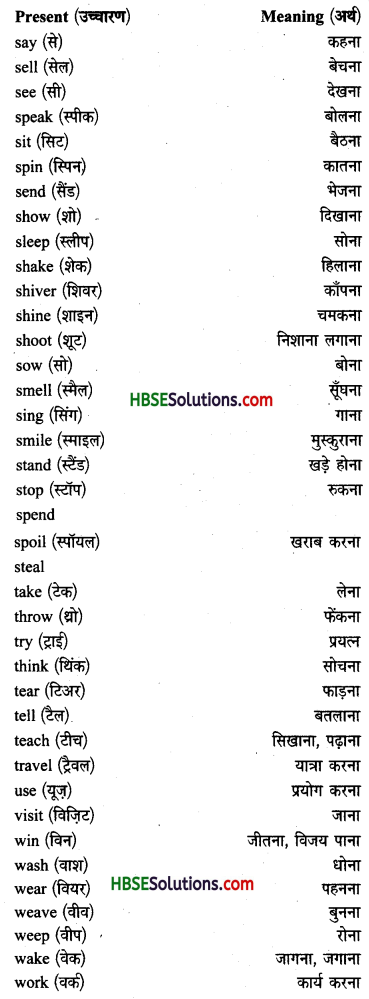
8. I lost my purse while playing.
9. He has been ill since he came here.
10. You were punished because you did not do your home work.

HBSE 9th Class English Grammar Conjunctions

Exercise 9

Combine the sentences in each of the following pairs into one sentence using the sentence linkers given in the brackets:

1. A cell-phone is an essential item these days. You should always keep it with you. (because)
2. You can expect an excellent return. You have invested a lot of money in your business, (as)
3. Work hard. You will not pass, (otherwise)
4. The maintenance of a Maruti car is easy. I want to purchase it. (because)
5. You are very hard working. You are bound to get success, (as)
6. The cat is away. The mice will play, (when)
7. Smriti is ill. I must help Smriti. (since)
8. The pick-pocket saw the policeman. He ran away, (as soon as)
9. Kalidas was a great poet. I like him. (because)
10. Sanjay is tall. Sunil is taller, (than)
Answers:
1. You should always keep a cell-phone with you because it is an essential item these days.
2. You can expect an excellent return as you have invested a lot of money in your business.
3. Work hard otherwise you will not pass.
4. I want to purchase a Maruti car because its maintenance is easy.
5. You are bound to get success as you are very hard working.
6. When the cat is away, the mice will play.
7. Since Smriti is ill, I must help her.
8. As soon as the pick-pocket saw the policeman, he ran away.
9. I like Kalidas because he was a great poet.
10. Sunil is taller than Sanjay.

HBSE 9th Class English Grammar Conjunctions Read More »

HBSE 9th Class English Grammar Suffixes

Haryana State Board HBSE 9th Class English Solutions Grammar Suffixes Exercise Questions and Answers.

Haryana Board 9th Class English Grammar Suffixes

A suffix is a letter or a group of letters that is usually added onto the end of words to change it into a new word.
boy + s = boys
play + ed = played
sing + ing = singing
kind + ness = kindness
general + ly = generally
appoint + ment = appointment
cash + less = cashless

HBSE 9th Class English Grammar Suffixes

List of Suffixes :

1. er – train + er = trainer, teach + er = teacher, preach + er = preacher
2. or – protect + or = protector
3. ness – kind + ness – kindness
4. less – cash + less = cashless
5. al – refuse + al = refusal
6. age – parent + age = parentage
7. dom – free + dom = freedom
8. ee – employ + ee = employee
9. ess – lion + ess = lioness
10. est – tall + est = tallest
11. fy – beauty + fy = beautify
12. hood – child + hood = childhood
13. ian – India + ian = Indian
14. full – house + full = houseful
15. en – light + en = lighten
16. es – bench + es = benches
17. s – toy + s = toys
18. ing – swim + ing = swimming
19. ty – able + ity = ability
20. al – nation + al = national
21. ism – ideal + ism – idealism
22. ation – inform + ation – information
23. ial – judge + ial – judicial
24. ian – library + ian = librarian
25. etic – energy + etic = energetic
26. ial – finance + ial = financial

HBSE 9th Class English Grammar Suffixes

Rule 1.
When the suffix ‘full’ is added to a word one l’ is removed. यदि किसी शब्द के साथ ‘full’ का प्रयोग suffix के रूप में किया जाता है तो नए शब्द में full का एक ‘l’ हटा देते हैं;
house + full = houseful
faith + full = faithful

Rule 2.
जिस शब्द के साथ ‘full’ suffix के रूप में प्रयोग होता है, यदि उसके अन्त में ‘Ir लगा है तो उसमें भी एक ‘ हटा देते हैं;

skill + full = skilful
will + full = wilful

Rule 3.
दो या तीन syllables वाला शब्द जो single vowel + single consonant ध्वनि से समाप्त होता है तो उसके साथ ‘ed’ और ‘ing’ की suffix लगाते हैं तो अंतिम consonant को Double कर देते हैं;

pennit + ed = permitted
occur + ed = occured
control + ed = controlled
swim + ing = swimming
begin + ing = beginning

HBSE 9th Class English Grammar Suffixes

Rule 4.
यदि शब्द के अन्त में ” लगा है और उससे पहले vowel लगा है तो उसके साथ vowel से शुरू होने वाली suffix लगाते समय ! को double कर देते हैं;

signal + ing = signalling
signal + ed = signalled
repel + ent – repellent
quarrel + ed = quarrelled
travel + er = traveller

Rule 5.
यदि शब्द के अन्त में silent ‘e’ लगा हो तो उसके अन्त में vowel से शुरू होने वाली suffix लगाते समय ‘ए’ को हटा देते हैं;
smoke + ing = smoking
hope + ing = hoping
live + ed = lived
drive + er = driver
tire + ing = tiring

Rule 6.
लेकिन यदि suffix किसी consonant से शुरू होती है तो ” को नहीं हटाते,

hope + full = hopeful
sincere + ly = sincerely
लेकिन *
true + ly = truly
nine + th = ninth
argue + ment = argument

HBSE 9th Class English Grammar Suffixes

Rule 7.
यदि वाक्य के अन्त में ‘y’ लगा है और उससे पहले consonant लगा है तो suffix लगाते समय ” को ” में बदल देते हैं;

happy + ly = happily
carry + ed = carried
marry + age = marriage
beauty + full = beautiful
लेकिन *
marry + ing = marrying

Rule 8.
यदि अंत में लगे ” से पहले vowel लगा है तो ‘ को नहीं हटाते;

play + ing = playing
play + ed = played
pray + er = prayer
pray + ed = prayed

HBSE 9th Class English Grammar Suffixes

Rule 9.
जब ‘ce’ से समाप्त होने वाले वाक्य के साथ ‘ous’ suffix का प्रयोग किया जाता है तो ‘ce’ में लगे ” को ” में बदल देते हैं;

space + ous = spacious
grace + ous = gracious
malice + ous = malicious
vice + ous = vicious

Rule 10.
जब ‘ie’ से समाप्त होने वाले शब्द के अन्त में ‘ing’ suffix लगाते हैं तो ‘ie’ को ‘y’ में बदल देते हैं

lie + ing = lying
tie + ing = tying
die + ing = dying

HBSE 9th Class English Grammar Suffixes

Exercise

Make new words using suffixes :
1. Great + full
2. Sincere + ly
3. Gamble + ing
4. Cry + ed
5. Try + ing
6. Jump + ed
7. Stop + irig
8. Face + ing
9. Grace + ous
10. Stoop + ed
11. Swim + er
12. Will + full
13. Skim + ed
14. Smoke + ing
15. Use + ing

HBSE 9th Class English Grammar Suffixes Read More »