Author name: Bhagya

HBSE 7th Class Social Science Solutions History Chapter 3 The Delhi Sultans

Haryana State Board HBSE 7th Class Social Science Solutions History Chapter 3 The Delhi Sultans Textbook Exercise Questions and Answers.

Haryana Board 7th Class Social Science Solutions History Chapter 3 The Delhi Sultans

HBSE 7th Class History The Delhi Sultans Years Textbook Questions and Answers

LET’S RECALL

Question 1.
Which ruler first established his or her capital at Delhi?
Answer:
Tomara Rajputs established his capital at Delhi.

Question 2.
What was the language of administration under the Delhi Sultans?
Answer:
The language of administration under the Delhi Sultans was Persian.

Question 3.
In whose reign did the sultanate reach its farthest extent?
Answer:
Under the reign of Ala-ud-din-Khilji, the sultanate reached its farthest extent.

HBSE 7th Class Social Science Solutions History Chapter 3 The Delhi Sultans

Question 4.
From which country did Ibn Batuta travel to India?
Answer:
Ibn Batuta travelled to India from Morocco (Africa).

LET’S UNDERSTAND

Question 5.
According to the ‘Circle of Justice’ why was it important for military commander to keep the interest of peasantry in mind?
Answer:
According to the Circle of Justice it was important for military commander to keep the interest of peasantry in mind, because each commander got the salary from the Iqta he got. They could not collect more revenue than the fixed by the govt. Accountant were appointed by the state to check the amount of revenue collected by them (rhuqtis).

Question 6.
What is meant by the ‘Internal’ and external frontier of the Sultanate?
Answer:
Internal Frontier of the Sultanate: By this term we mean that the Sultanate aimed at consolidating the hinterland of the garrison town.
External Frontier of the Sultanate: It aims at the military expeditions of the Sultanate in Southern India started during the reign of Ala-ud-din Khilji and culminated with Muhammad Tughlaq.

Question 7.
What were the steps taken to ensure that muqtis performed their duties? Why do you think they may have wanted to defy the orders to sultans?
Answer:
Following steps were taken to ensure that muqtis performed their duties:
1. They were not awarded Iqta for throughout their life.
2. They were appointed for a very short tenure.
3. They were transferred from one Iqta to another Iqta.

They wanted to defy the order, because there were number of restrictions on them. At any time they could be transfer. Moreover accountants were appointed by the state to check the amount collected by him. Care was also taken that muqtis collected only the taxes prescribed by the state.

Question 8.
What was the impact of Mongols invasion on Delhi Sultanate?
Answer:
The Mongols under the Genghis Khan invaded Transwiana in north-east Iran in 1219 and then on Delhi. Mongols attacks increased on Delhi during the reign of Ala- ud-din Khilji.
Impact:
1. Jt paved the way for the disintegration of Delhi Sultanate.
2. It forced the two rulers (Ala-ud-din Khilji and Muhammad Tughluq) to mobilise a large standing army in Delhi which passed a huge administrative challenge.

HBSE 7th Class Social Science Solutions History Chapter 3 The Delhi Sultans

LET’S DISCUSS

Question 9.
Do you think the authors of tawarikh would provide information about the lives of ordinary men and women? I do not think.
Answer:
The authors of tawarikh provided information about the lives of ordinary men and women. They often wrote their histories for Sultans in the hope of rich awards. He mainly lived in Delhi and hardly ever visited a village.

Question 10.
Raziyya Sultan was unique in the history of the Delhi Sultanate. Do you think women leaders are accepted more readily today?
Answer:
Yes, today women leaders are accepted more readily today. For example, Indira Gandhi became a successful and lover Prime Minister of India.

Question 11.
Why were the Delhi Sultans interested in cutting down forests? Does deforestation occur for the same reason?
Answer:
The Sultans of Delhi wanted to extend cultivation so that they could collect more land revenue. Hence, they ordered the cutting of forests. Today, forests are cut for the extension of agriculture and establishment of industrial units.

LET’S DO

Question 12.
Find out whether there are any buildings built by the Delhi Sultans in your area. Are there any other buildings in your area that were built between the twelfth and fifteenth centuries? Describe some of these buildings and draw sketches of them.
Answer:
Try yourself with the help of your class-teacher.

Question 13.
Do you think the circle of justice is an appropriate term to describe the relationship between the king and his subjects?
Answer:
Yes, I think the circle of justice is an appropriate term to describe the relationship between the king and his subjects.

HBSE 7th Class Social Science Solutions History Chapter 3 The Delhi Sultans

Question 14.
Express Minhaj’s ideas in your own words. Do you think Raziyya shared these ideas? Why do you think it was so difficult for a woman to be a ruler?
Answer:
1. According to Minhaj, God has created a social order in which woman is subordinate to man. Therefore, a woman like Raziyya does not have right to rule. It is totally against the ideal social order created by God.
2. I think Raziyya did not share these ideas.
3. It was very difficult for a woman to be a ruler because of her belonging to a subordinate gender, according to the social set up at that time.

Question 15.
But how complete and effective was its control over such a vast territory?
Answer:
Thp Sultanate did not have complete and much effective control over such a vast territory, except under the rule of Alauddin Khalji.

Question 16.
(i) Compare figures 2, 3, 4 and 5. What similarities and differences do you notice amongst the mosques?
Answer:
Similarities:
(a) Every mosque has a big entrance door
(b) Every mosque’s entrance door is extended to both sides in the corridors
(c) Domes are made over the entrance and corridor.

Differences:
(a) The designs around the entrance door become complex and intricate from fig. 2 to fig. 5.
(b) The small window over the entrance door can be seen only in three mosques in figs. 3, 4, 5. But fig. 3 show three such windows. Whereas figs. 4 and 5 shows only single window over the entrance
(c) There is a boundary around the dome over the entrance door in fig. 5. This is not seen in any other figure.

Question 17.
(i) Can you think of any reason why a slave would be better than a son?
Answer:
A well brought up slave always serves better than the son in the old days of master.

(ii) Why do you think Barani criticised the Sultan?
Answer:
The Sultan Muhammad Tughluq appointed lower-caste or base-born people to the higher administrative post by ignoring the nobles. That is why, Barani criticised Sultan.

Question 18.
Describe the ways in which the chieftains arranged for their, defence.
Answer:
(a) The chieftains fortified themselves in mountains, in rocky, uneven and rugged places as well as in bamboo groves.
(b) The bamboo grove forest served as ramparts, inside which people lived with their cattle and their crops
(c) Also rain water was collected to fulfil water needs
(d) The bamboo remained unaffected by fire and was very hard to cut. This made it a suitable and most defensive place to live in.

IMAGINE

Question 19.
You are a peasant in Alauddin Khalji’s or Muhammad Tughluq’s reign and you cannot pay the taxes demanded by the Sultan. What will you do?
Answer:
(a) If I were a peasant in Alauddin Khalji’s reign. I would try to save my life because I might have captured by Sultan’s men and would be severely punished.
(b) If I were a peasant in Muhammad Tughluq’s reign I would join the rebel against the sultan.

HBSE 7th Class Social Science Solutions History Chapter 3 The Delhi Sultans

HBSE 7th Class History The Delhi Sultans Important Questions and Answers

Very Short Answer Type Questions

Question 1.
Who lived in Delhi before Delhi Sulans occupied it?
Answer:
Many rich Jaina merchants lived in the city of Delhi before Delhi Sultans occupied it.

Question 2.
Name the coin that was in circulation in Delhi.
Answer:
Dehliwal was the name of coin that was in the circulation in Delhi.

Question 3.
Name the cities built by Delhi Sultans in Delhi.
Answer:
Delhi-i-Kuhna, Siri and Jahanpanah were the names of various cities built by Delhi Sultans in Delhi.

Question 4.
What is the main source of information about Delhi Sultanate?
Answer:
The main source of information about Delhi Sultanate in “histories” tarikh (singular) or tawarikh (plural) written in Persian.

Question 5.
Who wrote tawarikh?
Answer:
The authors of tawarikh were learned men: Secretaries, administrators, poets and courtiers.

Question 6.
Why did Iltutmish favour bandagan?
Answer:
Bandagan were special slaves purchased for military service. Hence, Iltutmish favoured them.

Short Answer Type Questions

Question 1.
What is meant by the following terms: namaz, imam, khutba, qibla?
Answer:
namaz: prayers; imam: leader of muslims at the time of prayer; khutba: sermon delivered by imam during the Friday prayer; qibla: facing towards Mecca while praying.

Question 2.
What was iqta?
Answer:
Iqta was the land governed by military commanders, as it was granted to them by Sultans in the place of cash salary for their services.

HBSE 7th Class Social Science Solutions History Chapter 3 The Delhi Sultans

Question 3.
Which regional states came up at about. 1526 AD in Indian subcontinent?
Answer:
At about 1526 AD, Delhi Sultanate had declined. The regional states that rose to the power in thq subcontinent were Jaunpur, Bengal, Malwa, Gujarat’ Rajasthan, etc.

Question 4.
Why did the early Delhi Sultans favoured their special slaves purchased for military service?
Answer:
The early Delhi Sultans favoured their special slaves purchased for military service because:
1. They were carefully trained to man some of the most important political offices in the kingdom.
2. They were totally dependent upon their master, the Sultan could trust and rely upon them.

Question 5.
How was the control over muqtis maintained during the reigns of Alauddin Khilji and Muhammad Tughluq?
Answer:
The control over muqtis was maintained because:
(a) Their office was not inheritable.
(b) They were assigned iqtas for a short period of time before being shifted.

Question 6.
What were the three types of taxes collected under Delhi Sultanate?
Answer:
The three types of taxes collected
under Delhi Sultanate were as follows:
(а) On cultivation called Kharaj and amounting to about 50 percent of the peasant’s produce.
(b) On cattle
(c) On houses.

Long Answer Type Questions

Question 1.
How did Ala-ud-din Khilji and Muhammad Tughluq deal differently with administrative challenges posed by Mangol attacks on the Delhi Sultanate?
Answer:

Ala-ud-din KhiljiMuhammad Tughluq
(i) (a) Delhi was attacked twice.

(b) Alauddin Khilji raised a large standing army.

(i) (a) Sultanate was attacked in early years of his reign.

(b) The Mongol army was defeated.

(ii) Constructed a new garrison town named Giri for his soldiers.(ii) The oldest of the foul! cities of Delhi (Delhi-i-Kuhna) was emptied of its residents and soldies garrisoned there.
(iii) The soldiers were fed through the produce collected as tax from lands between the Ganga and Yamuna.(iii) Produce from the same area was collected as tax to feed the army. Additional taxes were also lived.
(iv) The soldiers were paid in cash rather than Iqtas. To stop the merchants from raising the prices Alauddin controlled the prices of goods in Delhi.(iv) He paid cash salaries to soldiers. He used a ‘token’ currency However, this currency was ch. ap and people did not trust these coins.

Question 2.
Ala-ud-din wanted to became second Alexander and conquer the world. What steps did he take to achieve his aim? How far did he succeed?
Answer:
Khiljis established their empire in 1290 A.D. on the ruins of the kingdom of the Slave Sultans. Jalal-ud-din-Khilji was the first king of this dynasty He was succeeded by Ala-ud-din-Khilji in 1296 A.D. He was very ambitious. He wanted to become a second Alexander and like him to conquer the world.

Steps taken to achieve the aims:
1. Ala-ud-din tried to win loyalty of his nobles and curb their power.
2. He tried to conquer the Deccan and Rajasthan.
3. He tried to force the Mongols to withdraw.

In order to achieve his aim he needed a large army which meant, vast sum of money so, he had to think ways and means of getting more revenue for which he took the following steps:
(1) He raised the lamp taxes on the wealthier people of the tioab.
(2) He kept a strict watch on the revenue which the nobles got from their land and did not allow them to keep anything which was not their due.
(3) He controlled the prices of goods also so that no one could make large profits and everyone could afford to pay the price demanded.
(4) He made it clear that he would deal severely with anyone who showed signs of disloyalty.
(5) He ordered a new assessment of the cultivated land and the revenue. By doing so he was able to record the amount of revenue collected by various persons and thus kept a control on it.

HBSE 7th Class Social Science Solutions History Chapter 3 The Delhi Sultans

Question 4.
What were the causes of the downfall of Delhi Sultanate?
Answer:
Causes of the downfall of Delhi Sultanate:
1. They were despotic by nature.
2. The Sultans Delhi Sultanate ruled India by sword.
3. The Hindus were not happy during their rule. They were even made to pay Jazia.
4. Most of the Sultans were pleasure-loving and weak rulers.
5. The army was not well-organisd and was ill-disciplined.
6. There was no definite law of succession.

MAP WORK

Question 1.
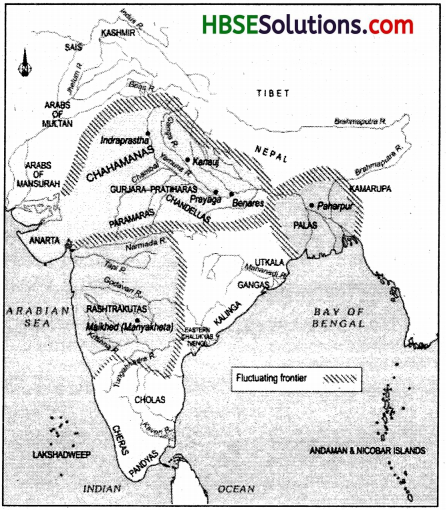
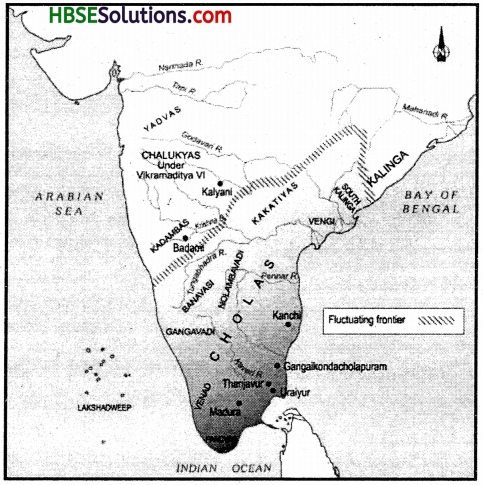
On an outline map of India show Alauddin Khalji’s campaign into South India.
Answer:
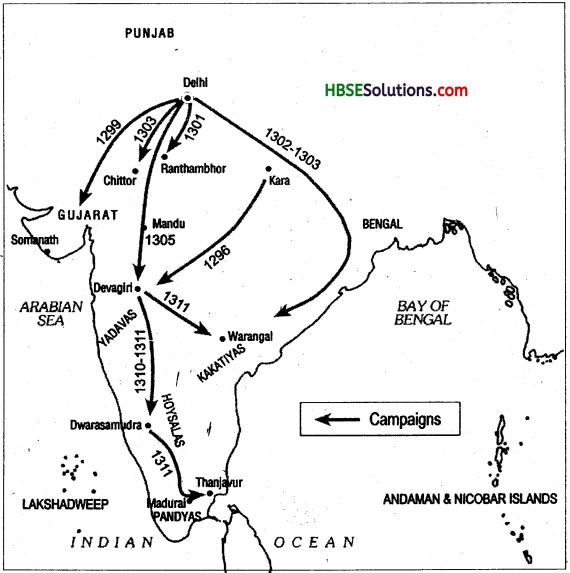
HBSE 7th Class Social Science Solutions History Chapter 3 The Delhi Sultans-1


The Delhi Sultans Class 7 HBSE Notes

  • Birthright: Privileges claimed on account of birth.
  • Gender distinctions: Social and biological differences between women and men.
  • Hinterland: The lands adjacent to a city or port that supply it with goods and services.
  • Garrison Town: A fortified settlement with soldiers.
  • Client: Someone who is under the protection of another, a dependent or hanger on.
  • Siydati: A form of salutation in which the person converned had to kneel down and touch the ground with his forehead.
  • Ulemas: Scholars of Islamic learning who were generally orthodox in their outlook.
  • Iqtas: The grant of revenue from a village or a piece of land.
  • Patwari: The officer who kept the land revenue record.
  • Paibos: It was a Persian custom of kissing the feet of the Sultan (king).
  • Sikandar-i-Sahi: The title adopted by Alla-ud-din Khilji.
  • Jagir: A piece of land given to officials of the kingdom.
  • Kharaj: The tax on cultivation was known as Kharaj.
  • Bandagn: The early Delhi Sultans especially Iltutmish favoured their slaves purchased for military service. These slaves were known as bandagm in Persian.

HBSE 7th Class Social Science Solutions History Chapter 3 The Delhi Sultans Read More »
HBSE 7th Class Social Science Solutions History Chapter 7 Tribes, Nomads and Settled Communities

Haryana State Board HBSE 7th Class Social Science Solutions History Chapter 7 Tribes, Nomads and Settled Communities Textbook Exercise Questions and Answers.

Haryana Board 7th Class Social Science Solutions History Chapter 7 Tribes, Nomads and Settled Communities

HBSE 7th Class History Tribes, Nomads and Settled Communities Textbook Questions and Answers

IMAGINE

Question 1.
You are a member of a nomadic community that shifts residence every three months. How would this change your life?
Answer:
Shifting residence every three months would change our style of living frequently.

  • We would have to shift our belongings every now and then and we would not hatfe any settled life.
  • We would not be able to practise any settled occupation.

LETS RECALL

Question 1.
Match the following:

GarhKhel
TandaChaurasi
LabourerCaravan
ClanGarha Katanga
Sib SinghAhom State
DurgawatiPaik

Answer:

GarhChaurasi
TandaCaravan
LabourerPaik
ClanKhel
Sib SinghAhom state
DurgawatiGarha Katanga

Question 2.
Fill in the blanks:
(a) The new castes emerging with in varnas were called ………….. .
(b) ……….. were historical works written by the Ahom.
(c) The ……….. mentions that Garha Katanga had 70,000 villages.
(d) As tribal states became bigger and stronger, they gave land grants to ………… and ………….. .
Answer:
(a) jatis
(b) Buranjis
(c) Akbamama
(d) temples, Brahmanas.

Question 3.
State whether true or false:
(а) Tribal societies had rich oral traditions.
(b) There were no tribal communities in the north-western part of the subcontinent.
(c) The Chaurasi in Gond states contained several cities.
(d) The Bhils lived in the north-eastern part of sub continent.
Answer:
(a) True
(b) Flase
(c) Flase
(d) Flase.

LETS UNDERSTAND

Question 4.
What kinds of exchanges took place between nomadic pastoralists and settled agriculturists?
Answer:
The nojnadic pastoralists exchanged wool, ghee, etc. with settled agriculturists for grain, cloth, utensils and other products.

Question 5.
How was the administration of Ahom state organised?
Answer:
The following were the ways in which the administration of Ahom state was organised.
(a) The Ahom state depended upon forced labour. Those forced to work for the state were called paiks.
(b) A census of the population was taken. Each village had to send a number of paiks by rotation.
(c) People from heavily populated areas . were shifted to less populated areas.
(d) Ahom clans were thus broken up.
(e) By the first-half of the seventeenth century, the administration became quite centralised.
(f) Almost all adult males severed in the army during war.
(g) Ahom society was divided into clans or Khels.

Question 6.
What changes took place in Varna-based society?
Answer:
The following changes took place in uama-based society:
(i) Smaller castes or Jatis emerged within varnas.
(ii) Many tribes and social groups were taken into caste-based society and given status of jatis.
(iii) Specialised artisans. such as smiths, carpenters and masons were also recognised as separate jatis by the Brahmanas.
(iv) Jatis rather than varna became the basis for organising society.
(v) Among the Kshatriyas, new Rajput clans became powerful by the eleventh and twelth centuries.

HBSE 7th Class Social Science Solutions History Chapter 7 Tribes, Nomads and Settled Communities

Question 7.
How did tribal societies change after being organised into a state?
Answer:
The emergence of large states changed the nature of tribal society.
(A) The Gond Society:
(i) The basically equal society of Gond gradually got divided into unequal social classes.
(ii) Brahmanas received land grants from the Gond rajas and became more influential.
(iii) The Gond chiefs now wished to be recognised as Rajputs.

(B) The Ahom Society:
(i) Ahom society became very sophisticated.
(ii) Poets and scholars were given land grants.
(iii) Theatre was Encouraged.
(iv) Important works of Sanskrit were translated into local language.
(v) Historical works, known as banjaras were also written first in the Ahom language and then in Assamese.

LET’S DISCUSS

Question 8.
Were the banjaras important for the economy?
Answer:
The banjaras were the important for the economy. They were the most important trader-nomads.
(i) Sultan Alauddin Khilji used the banjaras to transport grain to the city markets.
(ii) Banjaras carried grain on their bullocks from different areas and sold it in towns.
(iii) Banjaras transported food grain for the Mughal towns. They transported food grain for the Mughal army during military campaigns.

Question 9.
In what ways was the history of the Gonds different from that of the Ahoms? Were there any similarities?
Answer:
History of Gonds was different from Ahom in the following ways:

GondsAhoms
(i) Gonds lived in Gondwana.(i) Ahoms lived in Brahmaputra valley.
(ii) Gonds practised shifting culti-vation.(ii) Ahoms did not practise shifting cultivation.
(iii) Gonda kingdoms were large.(iii) Ahom kingdom was small.
(iv) Gond kingdoms were divided into grahs.(iv) Ahoms built a ‘ large state.
(v) Gonds did not use fire arms.(v) Ahoms used fire arms for the first time in the history of the subcontinent.

LET’S DO

Question 10.
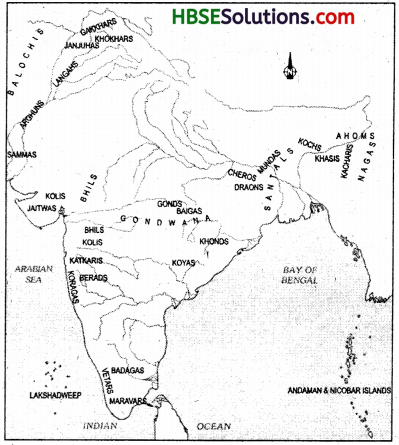
Plot the location of the tribes mentioned in this chapter on a map. For any two, discuss whether their mode of livelihood was suited to the geography and environment of the area where they lived.
Answer:
HBSE 7th Class Social Science Solutions History Chapter 7 Tribes, Nomads and Settled Communities-1
(A) Tribe of Bhils: The large tribe of Bhils was spread across western and central India. Many of them because settled agriculturists and some even zamindars. They remained hunter gatherers.
(B) Kolis, Beards lived in Maharashtra highlands and Karnataka.

Question 11.
Find out about present day government policies towards tribal populations and organise a discussion about thdse.
Answer:
(i) Government has reserved some seats in State Assemblies and in Lok Sabha.
(ii) Some seats have been reserved in state and central government jobs.
(iii) Some economic and educational facilities are provided to tribal population.
(iv) Economic, agricultural and industrial development is being provided them for quick growth and development.
(v) Their culture, religion, customs are not being disturbed. In short very good and progressive policies are being followed towards tribal population.

Question 12.
Find out more about present day nomadic pastoral groups in the subcontinent. What animals do they keep? Which are the areas frequented by the groups?
Answer:
(i) There are several present day nomadic pastoral groups in the subcontinent. They keep sheep, goat, cows, camels, horses, etc. Many tribals obtained their livelihood from forests, agriculture, hunting and gathering also.

(ii) Most often they combined their economic activities to make full use of the natural resources of the area in which they lived.

(iii) Some tribes are still nomadic and move from one place to another.

(iv) A tribal nomadic group controlled land and pastures jointly and divide these amongst households according to its own rules.

(v) Usually they are living in different forests, hills, deserts and places difficult to reach the sub-continent.

(vi) The Nagas are living in Nagalands. The Ahoms are still living in Assam. The Cheros are living in Jharkhand. The Mundas and Samtals are living in Orissa, Bengal, Bihar and Jharkhand. Kolis are living in Maharashtra highlands and Karnataka. The Banjaras are living in Rajasthan. The Gonds are living in a vast forest region still called Gondwana.

HBSE 7th Class Social Science Solutions History Chapter 7 Tribes, Nomads and Settled Communities

HBSE 7th Class History Tribes, Nomads and Settled Communities Important Questions and Answers

Very Short Answer Type Questions

Question 1.
Name a Himalayan tribe.
Answer:
The Himalayan shepherd tribe is Gaddi.

Question 2.
Tribes of which areas adopted Islam as their religion.
Ans.
Many tribes of Punjab, Sind and the North-West Frontier adopted Islam as their religion.

Question 3.
What was the name of the son of Rani Durgawati?
Answer:
The name of the son of Rani Durgawati was Bir Narain.

Question 4.
Which Mughal general attacked Garh Katanga?
Answer:
Asaf Khan attacked Garba Katanga.

Question 5.
Which Mughal general attacked Ahoms?
Answer:
Mir Jumla attacked Ahoms.

Question 6.
Which Gond king assumed title of Sangram Shah?
Answer:
Aman Das, the Gond raja of Garha Katanga assumed the title of Sangram Shah.

Question 7.
How was Ahom society divided?
Answer:
Ahom society was divided into clans or khels.

HBSE 7th Class Social Science Solutions History Chapter 7 Tribes, Nomads and Settled Communities

Short Answer Type Questions

Question 1.
How is shifting cultivation practiced?
Answer:
Trees and bushes in a forest area are first cut and burnt. The crop is sown in the ashes. When this land loses its fertility an other plot of land is cleared and planted in the same way.

Question 2.
How can you say that Garh Katanga is a rich estate?
Answer:
Garha Katanga was rich estate. It earned much wealth by trapping and exporting wild elephants to other kingdoms. When the Mughals defeated the Gonds, they captured a huge booty of precious coins and elephants. They annexed part of the kingdom and granted the rest of Chandra Shah.

Question 3.
Who were paiks? To which region did they belong to?
Answer:
The Ahom state depended upon forced labour. Those forced to work for the state are called paiks.

Question 4.
Ahom State was very sophisticated. Explain.
Answer:
Ahom society was very sophisticated. Poets and scholars were given land grants. Theatre was encouraged. Important works of Sanskrit were translated into local language.

Question 5.
How was the rule, under Durgawati Rani?
Answer:
Dalpat died early. Rani Durgawati was very capable and started ruling on behalf of her five year old son, Bir Narain. Under her, the kingdom becaihe even more extensive. In 1565, the Mughal forces under Asaf Khan attacked Garha Katanga. A strong resistance was put up by Durgawati. She was defeated and preferred to die rather than surrender.

Long Answer Type Questions

Question 1.
Give an account of the life style of tribal people.
Answer:
(a) Members of tribal groups were united by friendship or kingship bonds.
(b) Many tribes obtained their livelihood from agriculture. Others were hunter gatherers or herderers.
(c) Most often they combined these activities to make full use of the natural resources in the area they lived.
(d) A tribal group controlled land and pastures jointly and divided these amongst household according to its own rules.

Question 2.
Illustrate the tribal rule of present-day Bihar and Jharkhand.
Answer:
In many areas of present-day Bihar and Jharkhand, Chero chiefdoms had emerged by the 12th century. Raja Man
Singh, Akbar’s famous general attacked and defeated the Cheros in 1591.
The Hundas and Santals were among the other important tribes that lived in this region and also in Orissa and Bengal.

HBSE 7th Class Social Science Solutions History Chapter 7 Tribes, Nomads and Settled Communities

Question 3.
Write a short note on Banjaras.
Answer:
(a) The Banjaras were the most important trade nomads.
(b) They moved through caravans called tandas.
(c) They were used by Sultan Alauddin Khilji to transport grains to the city market.
(d) Banjaras carried grains on their bullocks from different areas and sold it in towns.
(e) They transported it for the Mughal Army during Military campaign.

Tribes, Nomads and Settled Communities Class 7 HBSE Notes

  • Pastoralism: The system which is related with the care and domestication of grazing animals.
  • Polygamous: Practising system of having many wives.
  • Nomads: Wanderer members of those group of people are called nomads who move from place to place in search of food items.
  • Assimilation: To become adjusted.
  • Aristocracy: Government run by nobles are known as aristocracy.
  • Itinerant groups: Wandering tribes are known as itinerant groups.
  • Swayamvara: Women were allowed to choose their husbands df their own choice.
  • Jauhar: Practice of mass sacrifice by women to save their honour and chastity.
  • Adivasi: The primitive people living in a particular area are called Adivasis.
  • The Gonds are the largest tribe in Central India.
  • Gondwana: The region of-central India is known as Gondavana due to the concentration of the Gonds in that area.

HBSE 7th Class Social Science Solutions History Chapter 7 Tribes, Nomads and Settled Communities Read More »

HBSE 7th Class Social Science Solutions History Chapter 6 Towns, Traders and Craftpersons

Haryana State Board HBSE 7th Class Social Science Solutions History Chapter 6 Towns, Traders and Craftpersons Textbook Exercise Questions and Answers.

Haryana Board 7th Class Social Science Solutions History Chapter 6 Towns, Traders and Craftpersons

HBSE 7th Class History Towns, Traders and Craftpersons Textbook Questions and Answers

LET S RECALL

Question 1.
Fill in the blanks:

  1. The Rajarajeshvara temple was built in
  2. Ajmer iff associated with the Sufi saint
  3. Hampi was the capital of the Empire.
  4. The Dutch established a settlement at in Andhra Pradesh.

Answer:

  1. Thanjavur (Tamil Nadu)
  2. Muinuddin Chishti
  3. Vijayanagara
  4. Masulipatnam

HBSE 7th Class Social Science Solutions History Chapter 6 Towns, Traders and Craftpersons

Question 2.
State whether true or false:

  1. We know the name of the architect of the Rajarajeshvara temple from an inscription.
  2. Merchants preferred to travel individually rather than in caravans.
  3. Kabul was a major centre for trade in elephants.
  4. Surat was an important trading port on the Bay of Bengal.

Answer:

  1. True
  2. False
  3. False
  4. False

Question 3.
How was water supplied to the city of Thanjavur?
Answer:
Water was supplied from wells and tanks to the city of Thanjavur.

Question 4.
Who lived in the “Black Town” in cities such as Madras?
Answer:
Merchants and artisans (such as weavers) or craftspersons along with the white rulers (European traders) lived in the cities like Madras during the British rule.

LET’S UNDERSTAND

Question 5.
Why do you think towns grew around temples?
Answer:
(i) Temple towns represented a very important pattern of urbanisation, the process by which cities develop.
(ii) Temples were often central to the economy and society.
(iii) Rulers built temples to demonstrate their devotion to various dieties. They also endowed temples with grants of land and money to carry out elaborate rituals, feed pilgrims and priest and celebrate festivals.
(iv) Pilgrims who flocked to the temples also made donations.
(v) Temple authorities used their wealth to finance trade and banking.
(vi) Generally, a large number of priests, workers, artisans, traders etc. settled near the temple to cater to the needs and those of the pilgrims.
For example: Billasvamin and Somnath in Gujarat.

Question 6.
How important were craftspersons for the building and maintenance of temples?
Answer:
(i) Craftspersons were very important for building and maintenance of temples.
(ii) For instance the Panchalas or Vishwakarama community, consisting of goldsmith, bronzesmith, blacksmiths, masons are carpenters were essential to the building of temples.
(iii) The craftsmen also played an important role in the construction of big buildings for pilgrims, used to visit temples as visitors or tourists and also in construction of tanks and reservoirs, attacked to temples.
(iv) The craftspersons of Bidar were so fapied for their inlay work in copper and silver that it came to be called Bidri.
(v) Weavers such as the Saliyar or Kaikkolars emerged as prosperous communities, making donations to temples.

HBSE 7th Class Social Science Solutions History Chapter 6 Towns, Traders and Craftpersons

Question 7.
Why did people from distant lands visit Surat?
Answer:
1. Surat was the most important medieval port on the west coast of Indian subcontinent.
2. It was the emporium of western trade during the Mughal period.
3. Surat was the gateway for trade with west Asia via the Gulf of Ormuz.
4. Surat has also been called the gate of Mecca, because many pilgrim ships get sail from here.
5. There were also several retail and wholesale shops selling cotton textiles.
6. Surat was famous for the textiles with gold lace borders (zari).
Due to all such reasons many people from distant lands visited Surat.

Question 8.
In what ways craft production in cities like Calcutta different from that in cities like Thanjavur?
Answer:

Craft Production in ThanjavurCraft Production in Calcutta
1. Craftspersons were free to be as much creative as they could be.1. Craftspersons had to produce what was demanded by the East India Company.
2. Craftpersons used to live near temple. They always get buyers of their products.2. The craftspersons were force to live in the “Black Towns”. The only buyer of their products was the East India Company.
3. There was no system pf advances.3. There existed system of advances, which meant that they have to weave cloths which were already promised to European agents.
4. Weavers had the freedom of selling their own cloths or weaving by their own patterns.4. Weavers no longer had liberty of selling their own cloths or weaving by their own patterns.
5. They didn’t have to reproduce same designs.5. They had to reproduce the designs supplied to them by the company agents.

LET’S DISCUSS

Question 9.
Compare any one of the cities described in the chapter with a town or a village with which you are familiar. Do you notice any similarities or differences?

HampiAjmer
1. Hampi is located in the Krishna, Tungabhadra basin, which formed the nucleus of the Vijay Nagar Empire, founded in 1336.1. Ajmer is in Rajasthan. It was the capital of the Chauhan kings in the twelfth century. Later, Ajmer became the suba headquarters under the Mughals.
2. The magnificent ruins at Hampi reveal a well fortified city. The architecture of Hampi was distinctive.
The buildings in the royal complex had splendid arches, domes and pillared halls with niches for building sculptures.
2. Ajmer remained a famous pilgirmage centre for the Hindus. There is a holy water tank at Puskar near Ajmer. There is a world wide famous temple of the Brahmaji.
3. Temples were the hub of cultural activities and devadasis (temple dancers) performed before the deity, royalty and masses in the many pillared halls in the virupaksha temple, known today as Navaratri in the south, was one of the most important festivals celebrated at Hampi.3. Ajmer also provides an excellent example of religious co-existence, Khwaja Muinud- din Chishti, the celebrated sufi-saint who settled there in the twelfth century attracted devotees from all creeds.

Question 10.
What were the problems encountered by merchants? Do you think some of these problems persist today?
Answer:
Some of the problems faced by the merchants were as under:

  • They had to travel through forests and there was always the fear of robbers. Therefore, pierchants travelled in caravans.
  • Merchants such as Mulla Abdul Ghafur and Indian Virji Vora, who owned a large number of ships were subdued by the East India Company ships. Then, they have to work as agents of the company instead of running their own business.
  • Yes, such problems do exist today.

HBSE 7th Class History Towns, Traders and Craftpersons Important Questions and Answers

Very Short Answer Type Questions

Question 1.
Give the capital of Cholas.
Answer:
Thanjavur.

Question 2.
Who built Rajarajeshwara temple?
Answer:
King Rajaraja Chola.

Question 3.
What type of a town is Thanjavur?
Answer:
Temple town.

Question 4.
Name an alloy of copper and tin.
Answer:
Bronze.

Question 5.
What is the capital of the Chauhan kings in the 12th century?
Answer:
Ajmer.

Question 6.
Give two groups of weavers that emerged as prosperous communities.
Answer:
Saliyar, Kaikkolars.

HBSE 7th Class Social Science Solutions History Chapter 6 Towns, Traders and Craftpersons

Short Answer Type Questions

Question 1.
Name the trading groups in Masulipatnam.
Answer:
The Golconda nobles, Persian merchants, Telugu Komati Chettis and European traders were the trading groups in Masulipatnam.

Question 2.
What was the ‘system of advances’?.
Answer:
The system of advances was a system under which craftspersons like weavers were given advance payments so that they had to weave cloths for European agents only.

Question 3.
What were the main features of medieval towns?
Answer:
The main features of medieval towns were as under:
(a) The towns probably emerged from large villages.
(b) Towns had mandapika (or mandi of later times) to which nearby villages brought their produce to sell.
(c) Towns also had market streets calle hatta lined with shops.
(d) There were streets for different kinds of artisans such as potters, oil pressers, sugar makers, toddy makers, smiths, stone masons, etc.

Question 4.
How was the architecture of Hampi distinctive?
Answer:
Due to following reasons, the architecture of Hampi was distinctive:
(a) The building in the royal complex had splendid arches, domes and pillared halls with niches for holding sculptures.
(b) There were well planned orchards and pleasure gardens with sculptural motifs such as lotus and corbels.
(c) The Wall of Hampi fort was constructed without using mortar or cement. The technique of wedging bricks together by interlocking was used.

Long Answer Type Questions

Question 1.
Why did Masulipatnam port decline?
Answer:
(a) The Dutch and English companies had settled in Masulipatnam.
(b) But the Qutab Shahi rulers of Golconda exerted their influence on the trade and settlement in the port city of Masulipatnam.
(c) After Mughal occupation of Golconda, Mughal Governor Mir Jurnla who was also a merchant, began to play off the Dutch and English against each other.
(d) Due to this the European Companies looked for alternative and hence, they developed the port city of Madras.
(e) Thus, Masulipatnam lost both its merchants and prosperity and declined.

Question 2.
How was the Indian textile business affected when the European Companies entered in it?
Answer:
The Indian textile business was affected when the European Companies entered it in the following ways:
(i) The demand of Indian textiles increased manifolds.
(ii) This led to a great expansion of the crafts of spinning, weaving, bleaching, dyeing, etc.
(iii) The employment opportunities also increased.
(iv) Indian textile designs became increasingly refined.
(v) But due to the system of advances, the independent craftspersons declined.
(vi) Indian traders, weavers and merchants had to live in “Black Towns” whereas “White” people lived in superior residencies of Fort St. George in Madras or Fort St. William in Calcutta.

HBSE 7th Class Social Science Solutions History Chapter 6 Towns, Traders and Craftpersons

Question 3.
What were the causes of decline of Surat as a commercial town?
Answer:
(i) From 17th century onwards the 1 town of Surat began to decline in the commercial activities.
(ii) The main cause was loss of markets and productivity because of the decline of the Mughal Empire.
(iii) Sea routes were controlled by Portuguese.
(iv) The newly built Bombay port gve tough English competition to the port of Surat.
(v) East India Company shifted its headquarters to Bombay in 1668.

Question 4.
Describe the rise of Bombay, Calcutta and Madras as trading towns.
Answer:
(i) Bombay, Calcutta, and Madras rose as nodal cities.
(ii) Crafts and commerce underwent major changes as merchants and artisans (such as weavers) were moved into the Black Towns established by the European Companies within these new cities.
(iii) The blacks or native traders and craftspersons were confined here.
(iv) The ‘White’ rulers occupied the superior residencies of Fort St. George in Madras or Fort St. William in Calcutta.

Towns, Traders and Craftspersons Class 7 HBSE Notes

  • Hinterland: A piece of land beyond the coast is known as a hinterland.
  • Administrative Town: It is a town from where the administrative functions are carried on.
  • Temple Town: It is a town with prominent temples or temples.
  • Commercial Town: It is a town where the sale and purchase of commodities take place.
  • Pilgrimage Towns: Places, where people go for pilgrimage, are called pilgrimage towns.
  • Chintz: A type of cotton cloth with a printed design on it is called Chintz.
  • Black Town: That part of town where artisans and merchants of Indian origin used to live was called Black Town.
  • Emporium: A place where goods from diverse production centers are bought and sold is called an emporium.
  • Hundi: It is a note recording a deposit made by a person. The amount deposited can be claimed in another place by presenting the record of the deposit.
  • Factor: An official merchant of the East India Company is called a factor.
  • Sthapatis: Sculptors who made bronze idols and tall ornamental bell metal lamps are called Sthapatis.

HBSE 7th Class Social Science Solutions History Chapter 6 Towns, Traders and Craftpersons Read More »

HBSE 7th Class Social Science Solutions History Chapter 5 Rulers and Buildings

Haryana State Board HBSE 7th Class Social Science Solutions History Chapter 5 Rulers and Buildings Textbook Exercise Questions and Answers.

Haryana Board 7th Class Social Science Solutions History Chapter 5 Rulers and Buildings

HBSE 7th Class History Rulers and Buildings Textbook Questions and Answers

LET’S RECALL

Question 1.
How is the ‘Trabeate’ principle of architecture, different from the ‘arcuate’?
Answer:
‘Trabeate’ principle of architecture is different from the ‘arcuate’ principle in the following way:
(a) In ‘trabeate’ principle, a horizontal beam is placed across two vertical columns and roofs, doors and windows were made.
HBSE 7th Class Social Science Solutions History Chapter 5 Rulers and Buildings-1
(b) In ‘acruate’ style of architecture, the weight of the superstructure above the door and window was carried by arch.

HBSE 7th Class Social Science Solutions History Chapter 5 Rulers and Buildings

Question 2.
What is Shikhara?
Answer:
Shikhara is the pyramid structure on the central shrine of the temple.

Question 3.
What is Pietra Dura?
Answer:
Pietra Dura is the inlays that depicted the legendary Greek God Orpheus playing the lute. They are coloured, hard stones placed in depressions carved into marble or sandstone creating beautiful ornate pattern.

Question 4.
What was the element of a Mughal Chahar Bagh garden?
Answer:
The elements of a Mughal Chahar Bagh (garden).

  • They were placed with in rectangular walled enclosures.
  • They were divided into quarter by artificial channels.
  • Divided into four equal quarters.
  • Symmetry in the four divisions.

LET’S UNDERSTAND

Question 5.
How did a temple communicate the importance of a king?
Answer:
Temples were also meant to demonstrate the power, wealth and devotion and parton by the ruler.
(a) The names of the ruler and the god were similar, for example:
Rajarajeshvara temple was built by the king Rajarajadeva for the worship of his god, Rajarajeshvaram.
(b) Temple was the miniature model of the world ruled by the king and his allies.
(c) The other lesser dieties in the temple were gods and goddesses of the allies and subordinates of the ruler.

Question 6.
An inscription in Shahjahan’s diwan-i-khas in Delhi stated: “If there is Paradise on Earth; it is here, it is here, it is here.” How was this image created?
Answer:
Diwan-i-khas was designed in such a way that different elements of Mughal architecture were fused together in a grand harmonious synthesis. It was carefully planned. This image was created as a result of his marvellous architectural skill. It was created by provided all the possible facilities to the subjects (people) by the king.

HBSE 7th Class Social Science Solutions History Chapter 5 Rulers and Buildings

Question 7.
How did the Mughal Court suggest that everyone-the rich and the poor, the powerful and the weak received justice equally from the emperor.
Answer:
(a) Behind emperor’s throne were a series of pietra dura inlays that depicted the legendary Greek God Orpheus playing the lute.
(b) It was believed the Orpheus’s music could calm ferocious beasts until they co¬existed together peaceably.
(c) This image communicated that the king’s justice would treat high and the low as equal which create a world where all could live together in harmony.

Question 8.
What role did the Yamuna play in the layout of the Mughal city at Shahjahanabad?
Answer:
The river Yamuna played a crucial role in the layout of the Mughal city at Shahjahanabad in the following ways:
(a) The imperial place commanded the river front. Only specially favoured noble were given access to the river.
(b) Ordinary people had to construct their home in the city away from the river.
(c) Taj Mahal was also constructed on the left edge of this river.
(d) In Agra at Taj Mahal, white marble mausoleum was place on terrace by the edge of the river as the garden was to its south.

LET’S DISCUSS

Question 9.
The rich and the powerful construct large houses today. In what ways were constructions of kings and their courtriers different in the past.
Answer:
The constructions of the kings and their courtiers in the past were different from the construction of large houses by the rich and the powerful.
The constructions of the kings and their courtiers had the safety and security as their major consideration. The houses of the kings and their coutriers had big courtyards, thick walls and huge walls. This constructions were generally surrounded by water bodies.
Today, the constructions of the rich and the powerful are quite different. They have less open areas and meet mainly individual requirements.

Question 10.
Look at picture. How could that building be constructed faster today?
Answer:
HBSE 7th Class Social Science Solutions History Chapter 5 Rulers and Buildings-2
The building could be constructed faster today with the help of latest tools and advanced skills.

LET’S DO

Question 11.
Find out whether there is a statue of or a memorial to a great person in your village or town. Why was it placed there? What purpose does it serve?
Answer:
Try to find out any memorial surrounding you and write a note on it:
Why it was established?
Where it was situated?
Who was the founder?
What is its significance?

Question 12.
Visit and describe any park or garden in your neighbourhood. In what ways is it similar to or different from the gardens of the Mughals?
Answer:
Discuss it with your class teacher in the class room. (Hint: Throw light on Chahar Bhagh and its significance)

HBSE 7th Class Social Science Solutions History Chapter 5 Rulers and Buildings

HBSE 7th Class History Rulers and Buildings Important Questions and Answers

Very Short Answer Type Questions

Question 1.
What are ‘tombs’ referred to?
Answer:
Tombs are safe, protected and grandiose places of rest in this world and the next.

Question 2.
Which style of construction was used in the construction of temples, mosques, tombs attacked to large- stepped wells, between the seventh and tenth century?
Answer:
‘Trabeate’ style of construction was used in the construction of temples, mosque, tombs between seventh and tenth century.

Question 3.
What were the temples and mosques meant to demonstrate?
Answer:
The temples and mosques were meant to demonstrate the power, wealth and prayer.

Question 4.
Why did the king Rajarajesh- wara take the god’s name?
Answer:
The king took the god’s name because it was auspicious and he wanted to appear like a god.

Question 5.
What was qibla?
Answer:
The pedestal on which Shahjhan’s throne was placed was frequently described as the qibla.

Question 6.
What was special about the city of Agra?
Answer:
Agra city was special because nobility had constructed their homes in the city on the banks of the river Yamuna.

HBSE 7th Class Social Science Solutions History Chapter 5 Rulers and Buildings

Short Answer Type Questions

Question 1.
How did Shahjahan adapt the river front garden while laying out the Taj Mahal?
Answer:
While laying out the Taj Mahal, Shahjahan adapted the river-front garden. The white marble mausoleum was placed on a terrace by the edge of the river and the garden was to its south. Shahjahan developed this architectural form as a means to control the access that nobles had jto’the river.

Question 2.
Who were given access to the river-front by Shahjahan?
Answer:
In the city of Shahjahanabad, the imperial palace constructed the river front. Only specially favoured nobles like his eldest son Dara Shukoh were given access to the river. All others had to construct their homes in the city away from river Yamuna.

Question 3.
What were the special features of Humayun’s tomb?
Answer:
The special features of Humayun’s tomb were:
(a) The central towering dome and the tall gateway known as pishtaq became important aspects of Mughal architecture. This tomb structure was first visible in Humayun’s tomb.
(b) The tomb was placed in the centre of a huge Chahar Bagh and built in the tradition known as ‘eight paradises’ a central hall surrounded by eight rooms
(c) The building was constructed with red sandstone, edge with white marble.

Question 4.
How did the Pandaya king Shrimara Shrivallabh loot the temples when he invaded Sri Lanka and defeated the king?
Answer:
Shrimara Shrivallabh removed all the valuables from the temple like the status of the Buddha made entirely of gold in the jewel places and the golden images in the various monastries.

HBSE 7th Class Social Science Solutions History Chapter 5 Rulers and Buildings

Long Answer Type Questions

Question 1.
What was the significance of temples, mosques and tanks?
Answer:
Temples and mosques were the places of worship. They were beautifully constructed.

  • They demonstrated the power, wealth and devotion of the patron.
  • The name of the ruler and the god were very similar. For example: Rajarajeshvara temple was built by Jong Rajarajadeva for the worship of his God, Rajarajeshvaram. Through the rituals of worship in temple one God, Rajarajeshvaram.
  • The kings constructed the largest of the temples.
  • The temple was a miniature model of the world.
  • They worshipped their dieties together in the royal temples as if they brought the just rule of the Gods on earth.

Question 2.
Explain the beginning of the reign of Shahjahan at Agra.
Answer:
In the beginning of his reign, Shahjahan’s capital was at Agra. It is a city where the nobility had constructed their homes on the banks of the river Yamuna. They were set in the midst of formal gardens constructed in the Chahar Bagh format. The Chahar Bagh garden was also desribd the river front garden. In this the dwelling was not located in the middle of the Chahar Bagh at its edge, close to the bank of the river.

Shahjahan took the river front garden in the layout of the Taj Mahal. It was the grandest architectural accomplishment of his reign. Here the white marble mausoleum was placed on a terrace by the edge of the river and garden was to its south.

Question 3.
Who all were involved in the construction of Qutab Minar? Describe the main architectural styles adopted.
Answer:
The Qutab Minar is five storeys high. The first floor was constructed by Qutabuddin Aybak and the ret by Iltutmish around 1229. Over the years it was damaged by lighting and earthquakes and repaired by Alauddin. Khilji, Muhammad Tughluq, Firuz Shah Tughluq and Ibrahim Lodhi. Architectural Styles of Qutab Minar

  • Qutab Minar has a pattern under the balcony by the small arches and geometrical designs.
  • It has two banks of inscriptions under the balcony.
  • The surface of the minar is curved and angular. Placing an inscription on such a surface required great precision. Only the most skilled craftsperson could perform this task.

HBSE 7th Class Social Science Solutions History Chapter 5 Rulers and Buildings

Rulers and Buildings Class 7 HBSE Notes

  • Superstructure: The part of a building above the ground floor.
  • Pietra Dura: Coloured, hard stones placed in depressions carved into marble or sandstone creating beautiful, ornate patterns.
  • Gopuram: The gateway of the temple.
  • Shikhara: A spire-like structure over the central shrine of a temple.
  • Mandapa: A structure set up or constructed in front of the main shrine.

HBSE 7th Class Social Science Solutions History Chapter 5 Rulers and Buildings Read More »

HBSE 7th Class Social Science Solutions History Chapter 4 The Mughal Empire

Haryana State Board HBSE 7th Class Social Science Solutions History Chapter 4 The Mughal Empire Textbook Exercise Questions and Answers.

Haryana Board 7th Class Social Science Solutions History Chapter 4 The Mughal Empire

HBSE 7th Class History The Mughal Empire Textbook Questions and Answers

LET’S RECALL

Question 1.
Match the following:

MansabMarwar
MongolGovernor
Sisodiya RajputUzbeg
Rathore RajputMewar
Nur JahanRank
SubedarJahangir

Answer:

MansabRank
MongolUzbeg
Sisodiya RajputMewar
Rathore RajputMarvyar
Nur JahanJahangir
SubedarGovernor

Question 2.
Fill in the blanks:
(a) The capital of Mirza Hakim, Akbar’s half-brother, was …………………. .
(b) The five Deccan Sultanate were Berar, Khandesh, Ahmednagar ……………. and ……….. .
(c) If zat determined a mansabdar’s rank and salary, sewar indicated his ………….. .
(d) Abul Fazal, Akbar’s friend and counseller, helped him frame the idea of ……………. so that he could govern a society composed for many religions, çultures and castes.
Answer:
(a) Kabul
(b) Bijapur, Golconda
(c) Number of horses maintained
(d) Administration.

HBSE 7th Class Social Science Solutions History Chapter 4 The Mughal Empire

Question 3.
What were the central provinces under the control of Mughals?
Answer:
Gujarat and Madhya Pradesh were the central provinces under the control of Mughals.

Question 4.
What was the relationship between the mansabdar and the Jagir?
Answer:
• Mansabdars were the persons who joined the Mughal service.
• Jagirs were the salaries received by the mansabdar as revenue assignments.
• Mansabdars depended on jagirs for their livelihood.
• Mansabdar died not actually reside in or administer their jagir. They had only right to the revenue of their assignments which were collected by the servants while they serve in other part of the country.

LETS UNDERSTAND

Question 5.
What was the role of Zamindars in Mughal administration?
Answer:

  • Zamindars were all intermediaries whether they were local headmen of villages or a powerful chieftains.
  • They collected taxes from peasants and deposited them with the treasury.
  • Sometimes, they revolted against Mughal authority. Their revolts changed the stability of the Mughal empire from the end of the 17th century.

Question 6.
How were the debates with the religious scholars iiiiportant in the formation of Akbar’s ideas on government?
Answer:
The debates with the religious scholars were important in the formation of Akbar’s ideas on government:

  • Their teachings created divisions and disharmony amongst the subjects.
  • Akbar followed the idea of Sulh-i-Kul (Universal peace and tranquility).
  • This idea did not discriminate between people of various castes and focused on a system of ethics such as peace, justice and honesty.
  • Abul Fazal helped him in forming a vision governance around the idea of Sulh-i-Kul.

Question 7.
Why did the Mughal underline their Timurid and not their Mughal descent?
Answer:
Mughal underlined their Timurid and not their Mughal descent because:
(а) They were proud of their Timurid ancestry who had captured Delhi in 1398.
(b) They celebrated their genealogy pictorially each ruler getting a picture mode of Timur and himself.
(c) Genghis knows memory was associated with the massacre of innumerable people. So Mughals did not like to be called Mughal.

HBSE 7th Class Social Science Solutions History Chapter 4 The Mughal Empire

LETS DISCUSS

Question 8.
How important was the income from land revenue to the stability of the Mughal Empire?
Answer:
The income from land revenue was important to the stability of the Mughal Empire because:
(a) The land revenue system before Akbar was lawful.
(b) The land revenue was important because with this the king could pay the salary of his soldiers, do welfare work.
(c) The land revenue was important to meet the administrative expenses.

Question 9.
Why was it important for Mughal to reAjmit Mansabdars from diverse bac/kgf^und and not just Turains and Iranis?
Answer:
It -was important for Mughal to recruit Mansabdars from diverse background and not just ,Turanis and Iranis because:
(i) Mughal empire expanded to encompass different regions. It was- important for the Mughals to recruit diverse bodies of people in order to make people comfortable with them.
(ii) They included Indian, Muslims, Afghans, Rajputs, Marathas and other groups.

Question 10.
Like the Mughal Empire, India today is also made up of many social and cultural units. Does this pose a challenge to national integration?
Answer:
No the cultural and social diversity of India today does not pose a challenge to national integration because today we have a democratic, republic government appointed by the common people of the land through elections.

Question 11.
Peasants were vital for the economy of the Mughal Empire. Do you think that they are as important today? Has the gap in the income between the rich and the poor in India changed a great deal from the period of the Mughals?
Answer:
Yes, they are also important for today’s economy.
Yes, the gap in the income between the rich and poor in India changed a great deal from the period of great Mughals.

LET’S DO

Question 12.
The Mughal Empire left its impact on the different regions of the subcontinent in a variety of ways. Find out if it had any impact in the city/ village region in which you live.
Answer:
The impact of the message ‘Sulh- i-kul’ (universal peace), we can still find in the cities/village/region arounds.

Question 13.
Do you think this painting suggests that the Mughals claimed kingship as a birthright?
Answer:
As this painting portraits the hierarchy of the Mughal emperors right from Timur to Aurangzeb, it depicts that the Mughals claimed kingship as a birthright.

HBSE 7th Class Social Science Solutions History Chapter 4 The Mughal Empire

Question 14.
(i) How was Humanyun’s relationship with Safavid Iran different from Akbar’s?
Answer:
(a) Humayun took refuge in the court of Safavid Iran when he was dogged out of the subcontinent by Sher Shah Suri. Therefore, he had friendly relations with Iran.
(b) On the other hand, Akbar seized Qandahar from Safavid Iranian rulers. Therfore, he was at war with them.

(ii) Did the annexation of Golconda and Bijapur in Aurangzeb’s reign end hostilities in the Deccan?
Answer:
No, in the spite of the annexation of Golconda and Bijapur, Aurangzeb faced unending disturbance in Deccan as Marathas started guerrilla warfare against him. Ultimately, he had to personally manage campaigns in Deccan from 1698 onwards.

Question 15.
Which do you think is a fairer division of inheritance: primogeniture or coparcenary?
Answer:
According to me, coparcenary is the fairer division of inheritance as it is based on the principle of equality.

Question 16.
(i) What was the consequence of this insult (of Shivaji by Aurangzeb)?
Answer:
When Aurangzeb insulted Shivaji, when later came to accept Mughal authority, Shivaji escaped from prison and began great guerrilla warfare in Deccan against Mughals.

(ii) Would this have meant more expenditure for the state?
Answer:
Yes, the increase in number of mansabdar with higher zat rankings would have led to more expenditure for the State.

Question 17.
Can you identify the Jesuit priests in this picture?
Answer:
Two persons sitting on the upper left side in the picture wearing black robes are the Jesuit priests.

HBSE 7th Class History The Mughal Empire Important Questions and Answers

Very Short Answer Type Questions

Question 1.
Who were Mughals?
Answer:
Mughals were the inhabitants of Central Asia and descendants of Mongols of Mongolia.

Question 2.
Why did Akbar choose Fatehpur Sikri to be his capital?
Answer:
Akbar chose Fatehpur Sikri to be his capital because this was where the Sufi Saint Salim Chishti lived and he had great respect for him.

Question 3.
Who offered to help Babur against the Lodhis?
Answer:
Rajput Prince Rana Sanga of Mewar offered to help Babur against Lodhis.

HBSE 7th Class Social Science Solutions History Chapter 4 The Mughal Empire

Question 4.
When and where Babar – defeated Lodhis army?
Answer:
Babar defeated the Lodhis army in 1526 on the historic battle of Panipat.

Question 5.
What were the two early problems faced by Humayun?
Answer:
(i) His own brother were hostile to him.
(ii) He faced the rebellions in Malwa and; Gujarat in the very beginning.

Question 6.
Why Shahjahan’s period is known as Golden Age?
Answer:
Shahjahan’s period is often known, as Golden Age because of the buildings and the architectural activities.

Short Answer Type Questions

Question 1.
Give two instances of the Mughal marriages with the Rajputs.
Answer:
(a) The mother of Jahangir was a Kachhwaha princess, daughter of the Rajput ruler, of Amber (Modern day Jaipur).
(b) The mother of Shahjahan was a Rathore princess, daughter of the Rajput ruler of Marwar (Jodhpur).

Question 2.
How could Mughals extend their influence over many kings and chieftains? Was this possible all the time?
Answer:
Mughals could extend their influence over many kings and chieftains by keeping a careful balance between defeating but not humiliating their opponents.

Question 3.
What were the main features of Sulh-i-kul?
Answer:
(a) The idea of Sulh-i-kul was introduced by Akbar, the Great.
(b) Sulh-i-kul meant universal peace.
(c) Sulh-i-kul was based on the idea of tolerance which did not differentiate between the people of different religions in Akbar’s realm.
(d) This system focused on a system of ethics, justice which were universally applicable.

Question 4.
What did Akbar realise when he had discussion with people of different faiths?
Answer:
On his discussion, with different faiths, Akbar realised that religious scholars: who emphasised ritual and dogma were often bigots. Their teachings created divisions and disharmony amongst his subjects.

Long Answer Type Questions

Question 1.
Who was Akbar’s revenue minister? Comment on the revenue system introduced by him.
Answer:
Akbar’s revenue rriinister was Todar Mai. The main feajAibesof the revenue system introduced by him were as follows:
(a) Todar Mai carried out a careful survey
(b) Tax was fixed on each crop in cash.
(c) Each province was divided into revenue circles with its own schedule of revenue; rates for individual crops.
(d) This revenue system was known as zabt.
(e) This system was prevalent in those areas where Mughal administrators could survey the land and keep careful accounts.
(f) This system was not possible in provinces such as Gujarat and Bengal.

HBSE 7th Class Social Science Solutions History Chapter 4 The Mughal Empire

Question 2.
Write about the main administrative policies of Akbar.
Answer:
The third-volume of Akbarnama Ain-i-Akbari contains a detailed account of Akbar’s administration. The main features were:
(a) The empire was divided into provinces called subas: governed by a subedar
who carried out both political and military functions.
(b) Each province also had a financial officer or diwan.
(c) The subedar was supported by other officers such as the military paymaster, the minister in change of religious and charitable patronage, military commander and the town police commander.
(d) Akbar gave utmost importance to the idea of tolerance.
Ce) After his discussion with people like Ulama, Brahmanas and priests etc., he decided to introduce idea of Sulh-i-kul, universal peace.

MAP TIME

On the given river map, mark the following areas of military campaigns under Akbar and Aurangzed.
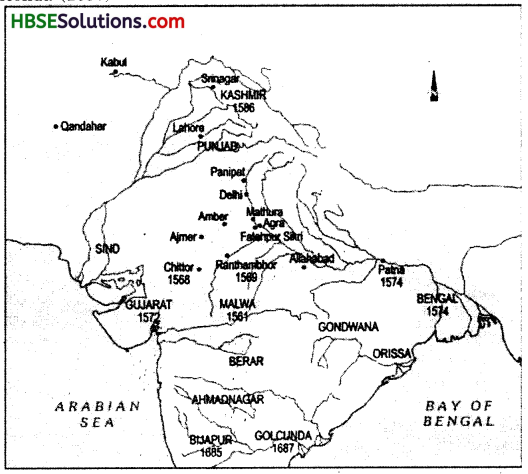
(i) Malwa (1561)
(ii) Gujarat (1572)
(iii) Bengal (1574)
(iv) Bijapur (1685)
Answer:
HBSE 7th Class Social Science Solutions History Chapter 4 The Mughal Empire-1

The Mughal Empire Class 7 HBSE Notes

  • Genealogy: History of generations of one’s family in sequence.
  • Confederacy: A group of state (or a union of state) for mutual support.,
  • Regent: A person appointed to govern on the behalf of the samrat (king).
  • Jazia: A tax paid by the non-Muslims.
  • Zabt: Each province during Mughals was divided into revenue circles with its own schedule of revenue rates for individual crops. This revenue system was called as Zabt.
  • Suba: The empire was divided into provinces. These provinces were called subas.
  • Subedar: Subedar was the person who carried both political and military functions.
  • Diwan: The financial officer of a suba was called as Diwan.
  • Sulh-i-kul: Literally Sulh-i-Kul means universal peace. It is the idea of tolerance where there is no discrimination between people of different religions in the realm of Akbar.
  • Primogeniture: It is a rule of inheritance in which the eldest son is the heir to the throne of his emperor father.
  • Bigot: A bigot is an individual who is intolerant of another person’s religious belief or
  • Dogma: It is a statement or an interpretation declared as authoritative with the expectation that it would be followed without question.

HBSE 7th Class Social Science Solutions History Chapter 4 The Mughal Empire Read More »

HBSE 6th Class Social Science Solutions Civics Chapter 6 Rural Administration

Haryana State Board HBSE 6th Class Social Science Solutions Civics Chapter 6 Rural Administration Textbook Exercise Questions and Answers.

Haryana Board 6th Class Social Science Solutions History Chapter 6 Rural Administration

HBSE 6th Class Civics Rural Administration Textbook Questions and Answers

Question 1.
If there is a theft in your house which police station would you go to register your complaint?
Answer:
In such a situation I would go to the police station of my area to register my complaint.

Question 2.
What was the dispute between Mohan and Raghu?
Answer:
Raghu had taken over some of Mohan’s land and increased the size of his own field. Angry Mohan went to Raghu’s house to make complaints. But Raghu did not accept what he had done with Mohan’s land. This caused a dispute between the two.

Haryana Board HBSE 6th Class Social Science Solutions Civics Chapter 6 Rural Administration

Question 3.
Why was Mohan worried about picking a quarrel with Raghu?
Answer:
Mohan was worried about picking a quarrel with Raghu because Raghu’s uncle was the Sarpanch of the village. Raghu was quite influential as his family owned many fields. None in the village had ever dared to confront him. Mohan, being a small farmer had picked up courage to make complaints about what Raghu had done.

Question 4.
Some people said Mohan should report the matter to the police and others said he should not. What were the arguments they gave?
Answer:
Some people suggested Mohan to go to the police station to report the matter. Since Mohan was badly hurt on his head and hand, his friend suggested that they should go to the local police station and file a report. Others said that Mohan should not go to the police station as they know about Raghu’s influence and power. They also know that Raghu’s uncle was the sarpanch of the village. They felt reporting the case at the police station would involve a lot of money and nothing would come out it.

Question 5.
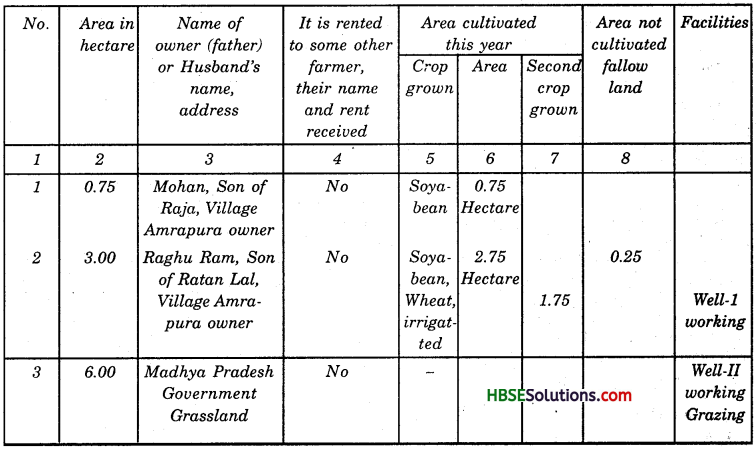
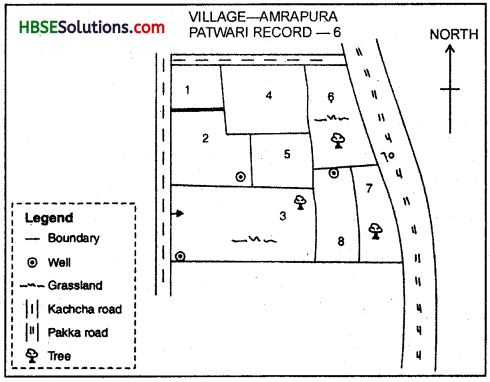
The Khasra record of the Patwari gives you information regarding the map given below. It identifies which plot of land is owned by whom. Look at both the records and the answer the questions given below regarding Mohan and Raghu’s land.
HBSE 6th Class Social Science Solutions Civics Chapter 6 Rural Administration-1
HBSE 6th Class Social Science Solutions Civics Chapter 6 Rural Administration-2
(1) Who owns the land south of Mohan’s field?
(2) Mark the common boundary between Mohan’s and Raghu’s land.
(3) Who can use field no. 3?
(4) What information can one get field no. 2 and field no. 3?
Ans.
(i) Raghu owns the land south of Mohan’s field.
(ii) Common boundary is marked with dark line.
(iii) Madhya Pradesh government can use field No 3.
(iv) The total area of field 2 is 2.75 hectare it belongs to Raghu who grows soyabean and wheat in this field. The land is not on rent and it is irrigated. Second crop is grown in 1.75 hectare. 0.2 hectare of the total area is a fallow land. There is one well in the field and it is working.

Field No. 3 belongs to Madhya Pradesh government. It is a grassland. It is not on rent. There is one well in the field and it is working. This grassland is used for grazing purposes.

EXERCISE

Question 1.
What is the work of the police?
Answer:
The work of the police is to:
(a) maintain law and order to establish peace in the society.
(b) to register case of theft, accident, injury, fights etc.
(c) to inquire, investigate and take action on the cases within its area.

Question 2.
List two things that the work of a Patwari includes.
Answer:
(a) Patwari measures land and keeps land records.
(b) He organises the collection of land revenue from the farmers and provides information to the government about the crops grown in that area.

Question 3.
What is the work of a tehsildar?
Answer:
(a) A tehsildar supervises the work of the Patwari.
(b) It hears disputes.
(c) It ensures that records are properly kept and land revenue is collected.
(d) He also sees to it that the farmers can easily obtain a copy of their record and students can obtain their caste certificates etc.

Haryana Board HBSE 6th Class Social Science Solutions Civics Chapter 6 Rural Administration

Question 4.
What issue is the poem trying to raise? Do you think this is an important issue? Why?
Answer:
The poem emphasises on the rights of a girl child. It is trying to raise the issue of inheritance of daughters and mothers in the property of their father/husband.

This is an important issue because in our country before Hindu Succession Amendment Act (2003) women can not get a share in the family’s agricultural land and after her father/ husband death the property was equally divided among her sons. This poem highlights that Dowry is not a compensation to a girl child. It should be abolished.

Question 5.
In what ways are the work of a Panchayat that you read about in the previous chapter and the work of the Patwari related to each other?
Answer:
Village Panchayat tries to solve the problem of the villagers at village level, and make it sure that the life of the people could be made prosperous. Patwari is a Government official at village level, who measures the land and collects the land revenue at village level.

The works of the Village Panchayat and Patwari are related to each other because they equally work for the welfare of the villagers. The revenue collected by Patwari is spent on welfare of the people.

Question 6.
Visit a police station and find out the work that the police have to do to prevent and maintain law and order in their area especially during festivals, public-meetings etc.?
Answer:
Police exercise following programs to prevent the crime and to maintain law and order in their areas:
1. Recruitment and deployment of Special Task Force to handle different crucial situations.
2. The police officer always keeps a vigilant eye on the criminals.
3. To ensure internal peace and justice (i.e. law and order position) these are kept open for twenty four hours a day.
4. During festivals they move with the public in civil dress, so that they can keep festivals free from apprehension of any mishappening.
5. To control the rush they make barrier and check post at various entrance.
6. Police can stop the people taking weapon inside the area/campus of the fair or festival.

Question 7.
Who is in-charge of all police stations in a district? Find out.
Answer:
The In-Charge of all police stations in district is Senior Superintendent of Police (S.S.P). The in-charge of a police station is known as S.H.O. (Station House Officer).

Haryana Board HBSE 6th Class Social Science Solutions Civics Chapter 6 Rural Administration

Question 8.
How do women benefit under new law?
Answer:
New Law: Hindu Succession (Amendment) Act, 2005 is known as New Law.
According to this law, women in India can get a share in the family’s agricultural land. Women get equal share in the property/lands.
Benefit of Law: Women can get transfer land and even purchased land. They can also take share of family’s land or property.

Question 9.
In your neighbourhood are there women who own property? How did they acquire it?
Answer:
Yes, In our neighbourhood there are women who owned their property. They acquired it with the help of their village Patwari and their brothers or sisters.

HBSE 6th Class Civics Rural Administration Important Questions and Answers

Very Short Answer Type Questions

Question 1.
What is called bund?
Answer:
The boundary that separates one land from another is called ‘bund’.

Question 2.
How does the Patwari measure the agricultural fields?
Answer:
The Patwari measures the land with the help of chain.

Question 3.
What is the work of Tehsildar?
Answer:
Tehsildar supervises the work of the Patwari and ensures that records are properly kept and land revenue is collected.

Short Answer Type Questions

Question 1.
How would have Patwari decided whether the common boundary of Mohan and Raghu Helds had been shifted?
Answer:
Patwari would have measured both Mohan’s and Raghu’s fields and compared them with the measurements on the map. If they did not match, then it was obvious that the boundaries had been changed.

Question 2.
When do you think farmer may require a copy of his land record?
Answer:
We think farmer may require a copy of his land record when:
1. he wants to sell or buy his land.
2. he wants loan from bank to dig a tubewell for his land.
3. he divides his property.

Haryana Board HBSE 6th Class Social Science Solutions Civics Chapter 6 Rural Administration

Question 3.
Mention any three works of the revenue department of the government.
Answer:
1. The revenue department of the government supervisor the work of the Patwari.
2. It ensures that records are properly kept and land revenue is collected.
3. It is the revenue department that makes the students obtain their caste certificates.
4. It also resolves the revenue deposits.

Long Answer Type Questions

Question 1.
Explain the right of women in property before and after Hindu Succession Amendment Act, 2005.
Answer:
Before:
1. Hindu women did not get a share in the family’s agricultural land.
2. After the death of the father, property was divided equally only among his sons.

After:
1. In the new law sons, daughters and their mothers can get an equal share in the land.
2. The new law will benefit a large number of women.
3. They can enjoy their independent status with equal rights.

Rural Administration Class 6 HBSE Notes

  • Nayaya Panchayat: A rural body of local administration constituted for disposal of funds, quarrels disputes of minor nature.
  • Chokidar: Chokidar in a village keeps birth and death record and also works as a messenger between the people and Gram Panchayat or any Government agency related with the welfare of the village.
  • Patwari: He is the land revenue officer at village level. He measure the land of the farmer and keeps the record.
  • Tehsildar: He is the officer at district level. He keeps a checking eyes on revenue officers.
  • Lekhpal, Kanungo or Karamchari, or Village Officer: These are the different names of the Patwari. He is known by different names in different parts of our country.
  • Khasra Number: These are the number used for land which is owned by an individual villager or village community.
  • A New Law: According to the new law, the son, daughter, and their mother can get equal parts of (shares of) the land owned by Karta of their family.
  • S.H.O: Station House Officer of a police station or a person in charge of the police station.
  • S.S.P: Senior Superintendent of Police is the highest rank of a police officer at the district level.

HBSE 6th Class Social Science Solutions Civics Chapter 6 Rural Administration Read More »

HBSE 7th Class Social Science Solutions History Chapter 2 New Kings and Kingdoms

Haryana State Board HBSE 7th Class Social Science Solutions History Chapter 2 New Kings and Kingdoms Textbook Exercise Questions and Answers.

Haryana Board 7th Class Social Science Solutions History Chapter 2 New Kings and Kingdoms

HBSE 7th Class History New Kings and Kingdoms Years Textbook Questions and Answers

Question 1.
Match the following:

Gurjara-PratiharasWestern Deccan
RashtrakutasGujarat and Rajasthan
PalasBengal
CholasTamil Nadu

Answer:

Gurjara-PratiharasGujarat and Rajasthan
RashtrakutasWestern Deccan
PalasBengal
CholasTamil Nadu

HBSE 7th Class Social Science Solutions History Chapter 2 New Kings and Kingdoms

Question 2.
Who were the parties involved in the tripartite struggle?
Answer:
Palas-Rashtrakutas and Pratiharas were the parties involved in the tripartite struggle.

Question 3.
What were the qualifications necessary to become a ‘member of a committee of Sabha in the Chola empire?
Answer:
Qualifications necessary to become a member of a committee of the Sabha in the Chola Empire:
(a) Prominent Brahamanas landlords.
(b) His name must have been selected when a young boy picks up the ticket of the eligible members from each committee.

Question 4.
What were the two major cities under the control of the Chahamanas ?
Answer:
Delhi and Ajmer were the two major cities under the control of the Chahamanas.

LET’S UNDERSTAND

Question 5.
How did the Rashtrakutas become powerful?
Answer:
(a) In the mid-8th century, Dantidurga, a Rashtrakuta chief, killed his Chalukyan king.
(b) He also performed hirany,a-garbha ritual, after which he was thought to have taken “rebirth” as a Kshatriya.
(c) Thus, he established the Rashtrakuta dynasty in Deccan.

Question 6.
What did the new dynasty do to gain acceptance?
Answer:
The new dynasties performed holy rituals with the help of Brahmanas in order to gain acceptance. For example, hiranya- garbha ritual performed by low caste Dantidurga the Rashtrakuta chief.

Question 7.
What kind of irrigation works were developed in the Tamil Nadu?
Answer:
The following kinds of irrigation works developed in the Tamil Nadu:
(a) In the delta regions canals were constructed to carry water to the fields.
(b) In some areas, well were dug.
(c) In other places, huge tanks were constructed to collect rainwater.

Question 8.
What were the activities associated with Chola temples?
Answer:
The activities associated with the temples were:
(a) Chola temples were the nuclei of settlement which grew around them.
(b) Temples were the centre of the craft production.
(c) Temples were endowed with the land of the rulers as well as by others. The produce of the land went to maintain all the specialist who worked at the temple.
(d) Temples were not only the places of worship, they were the hub of social, culture and economic life.

HBSE 7th Class Social Science Solutions History Chapter 2 New Kings and Kingdoms

LET’S DISCUSS

Question 9.
Look at map once more and find out whether there were any kingdoms in the state in which you life.
HBSE 7th Class Social Science Solutions History Chapter 2 New Kings and Kingdoms-1
Answer:
I am living in Delhi and it was ruled by Chauhanas dynasty between 11th and 12th century. Their most famous ruler was Prithviraja Chauhan.

LET’S DO

Question 11.
Compare the temple shown in this chapter with any present-day temple in your neighbourhood, highlighting any similarities and differences that you notice.
Answer:
Try in the classroom with the help of your teacher
(Hint: Write the salient features of the temples discussed in this chapter and compare with the temple of your locality.)

Question 12.
Find out more about taxes that are collected at present. Are these in cash, kind or labour services?
Answer:
Land tax, property tax, water tax, tax on electricity, tax on buying and selling are the examples of the taxes collected at present. They are paid in cash.

Question 13.
Locate the Gujara- Pratiharas, Rashtrakutas, Palas, Cholas and Chahamanas (Chauhans). Can you identify the present day states over which they exercised control?
Answer:
The following table shows the present-day states over which they exercised Control:
Table

Question 14.
Do you think being born as a Kshatriya was important in order to become a ruler during this period?
Answer:
No, it was not important to be born as a Kshatriya in order to become a ruler during this period. This is because any lower caste person could oyer throw rulers and become king by performing rituals with the help of Brahmanas. For example, Dantidurga, a Rashtrakuta chief became king by killing Chalukya ruler and by performing ritual.

HBSE 7th Class Social Science Solutions History Chapter 2 New Kings and Kingdoms

Question 15.
(i) Are any such taxes (as Vetti, Kadamai etc.) collected today?
Answer:
Only a few of such taxes are collected today. For example, land revenue.

(ii) In what ways was this form of administration different from the present-day system?
Answer:
In the present-day administrative system, there are no such kings who claim high sounding titles and share power with Samantas, peasants, traders and Brahmanas. Today, we live in a democratic, republic administrative system in which the ruler is elected by the general people who is the first servant of public.

Question 16.
See if you can find some of the areas mentioned in the inscription of Map 1. Other rulers made similar claims as well. Why do you think they made these claims?
Answer:
The other rulers, who made such claims, also wanted to be presented as valiant, victorious warriors.

Question 17.
List all the possible sources of irrigation mentioned in the inscription, and discuss how these might have been used.
Answer:
(a) The possible sources of irrigation mentioned in the inscription are: waterland, wells, canals, ditches, rivers, siltladen land, tanks, fishponds and deep lakes.

(b) These irrigation sources might have been used to water small and large tracts of land as per their suitability of providing amount of water to that track of land.

Question 18.
(i) Look at Map 1 and suggest reasons why these rulers wanted to control Kanauj and the Ganga valley.
Answer:
(a) Kanauj lied on the bank of river Ganga. ft was the most fertile land as the irrigation water was readily available from river Ganga.
(b) It also enjoyed the most central position in the sub-continent
(c) Also control of river waters resulted in the navigation which was most essential for inland and international trades.

(ii) Look at Map 1 again and discuss why the Chaha-manas may have wanted to expand their territories.
Answer:
(a) The dynasty of Chahamanas enjoyed the central position in the subcontinent. It, therefore may have wanted to expand its territories in all the directions.

(b) It also must have enjoyed enormous resources needed for the expansion of territories, as their domain lied in the fertile land irrigated by the waters of Yamuna and Ganga rivers.

(c) Therefore, it must have been the wealthiest of all the neighbouring dynasties. And a wealthy king can only think of wedging a war against its neighbours.

HBSE 7th Class Social Science Solutions History Chapter 2 New Kings and Kingdoms

Question 19.
How did the Cholas rise to power?
Answer:
(a) Vijayalaya, a Chola chief from Uraiyur captured the Kaveri delta from a Samanta (subordinate) of Pallava king.
(b) He gradually conquered neighbour-ing regions and thus established Chola kingdom by defeating Pallava and Pandya kings.
(c) The Chola kingdom was consolidated under Rajaraja I and his son Rajendra I.

Question 20.
How as the administration organised?
Answer:
The Chola administration was organised in the village councils and Nadu, groups of peasant villages. Nadu worked under the supervision of Central Chola government, which was controlled by Chola kings.

Question 21.
(i) Do you think women participated in these assemblies? In your view are lotteried useful in choosing members of committees?
Answer:
(a) No, I don’t think women participated in these assemblies.
(b) Lottery system is often use in choosing members of committees. But in my view, elections are the best way to do so.

(ii) Were there any Brahmanas in this hamlet?
Answer:
No, there were no Brahmanas in this hamlet.

(iii) Describe all the activities that were taking place in the village.
Answer:
These activities were as under:
(i) Little chickens wee moving around.
(ii) Dark children, who wore black iron bracelets, were prancing about
(iii) Babies of females labourers were sleeping in the shades of marudu (Arjuna) trees
(iv) Pulaiya women were singing as they were husking paddy.

(iv) Why do you think temple inscriptions ignore these activities?
Answer:
The temple inscriptions ignored these activities because:
(a) These activities were of low caste or outcaste people
(b) Brahmanas, always wanted to praise their partons through temple inscription and they always showed down the low caste people.

Question 22.
In what ways was this system different from those prevalent in the Indian subcontinent?
Answer:
People were not recuited through examination in the administrative system of Indian subcontinent. The Samantas associations of peasants, traders and artisans were generally given administrative responsibilities in Indian subcontinent. Imagine

HBSE 7th Class Social Science Solutions History Chapter 2 New Kings and Kingdoms

Question 23.
You are present in an election for a sabha. Describe what you see and hear.
Answer:
(a) In a sabha election, there are various voices which are put down when the nominations for the election are announced.
(b) The paper is distributed for the names of candidates to be written on it.
(c) A young boy is called upon and asked to take out one slip from the box, in which all slips, with the names of candidates were put in.
(d) The name of the selected candidate is announced and everyone congratulates him.

HBSE 7th Class History New Kings and Kingdoms Important Questions and Answers

Very Short Answer Type Questions

Question 1.
Who was Kalhana?
Answer:
Kalhana was a Kashmiri historian of 12th century. He composed a long Sanskrit poem on rulers of Kashmir.

Question 2.
Who wrote a Kitab-al-Hind?
Answer:
The Arabic scholar Al-Biruni wrote the Kitab-al-Hind. He consulted Sanskrit scholars to prepare this account.

Question 3.
Who built the town of Thanjavur?
Answer:
The Chola chief Vijayalaya built the town of Thanjavur and a temple for goddess Nishumbhasudini there.

Question 4.
Which famous inscription gives details of Chola administration?
Answer:
The inscription from Uttaramerur, in Chingleput district, Tamil Nadu, gives details of Chola administration.

HBSE 7th Class Social Science Solutions History Chapter 2 New Kings and Kingdoms

Short Answer Type Questions

Question 1.
Give the high sounding titles of medieval rulers.
Answer:
The medieval rulers claimed the titles such as Maharaja-adhiraja (great king, over lord of kings), tribhuvan-chakravartin (lord of the three worlds and so on).

Question 2.
Who was Sultan Mahmud of Ghazni?
Answer:
Mahmud of Ghazni was an Afghani ruler who raided the subcontinent temples, including Somnath, Gujarat, during early 11th century.

Question 3.
Who was Rajendra I?
Answer:
Rajendra I was a great Chola ruler, son of Rajendra I expanded Chola rule in Ganga Valley, Sri Lanka and countries of southeast Asia.

Question 4.
From where were resources collected in medieval states of subcontinent?
Answer:
The medieval states of subcontinent collected resources from:
(a) the producers: peasant, cattle-keepers and artisans.
(b) land revenue.
(c) taxes from traders and merchants.

HBSE 7th Class Social Science Solutions History Chapter 2 New Kings and Kingdoms

Question 5.
How did Kalhana write the history of rulers of Kashmir?
Answer:
Kalhana used a variety of sources, including inscriptions, documents, eyewitness accounts and earlier histories to write his account.

Long Answer Type Questions

Question 1.
How did the Cholas rise to power?
Answer:
(a) Vijayalaya a Chola chief from Uraiyur, captured the Kaveri delta from the Muttaraiyar (Samanta of Pallava king) in the middle of the 19th century.
(b) He gradually conquered neighbouring regions and thus established Chola kingdom by defeating Pallava and Pandya kings.
(c) The Chola kingdom was consolidated under Rajaraja I and his son Rajendra I.

Map Time

Question 1.
On the outline map of India, show the following areas of the Chola kingdom:
(i) Madurai
(ii) Thanjavur
(iii) Gangaikonda Cholapuram
(iv) Kanchi
Answer:
HBSE 7th Class Social Science Solutions History Chapter 2 New Kings and Kingdoms-2

HBSE 7th Class Social Science Solutions History Chapter 2 New Kings and Kingdoms

New Kings and Kingdoms Class 7 HBSE Notes

  • Dynasty: A succession of rulers in .one line of descent.
  • Tripartite struggle: Struggle for supremacy among Palas; Pratihars and Rashtrakutas are known as the tripartite struggle.
  • Feudatories: Feudal states were known as Feudatories.
  • Kingdom: A union of states.
  • Revenue: The tax traders had to pay to their lords.
  • Samanthas: The subordinates of kings or overlords who used to brin£ gifts for their kings or overloads.
  • Sabha: The assembly of Brahmanas.

HBSE 7th Class Social Science Solutions History Chapter 2 New Kings and Kingdoms Read More »

HBSE 7th Class Social Science Solutions History Chapter 1 Tracing Changes Through a Thousand Years

Haryana State Board HBSE 7th Class Social Science Solutions History Chapter 1 Tracing Changes Through a Thousand Years Textbook Exercise Questions and Answers.

Haryana Board 7th Class Social Science Solutions History Chapter 1 Tracing Changes Through a Thousand Years

HBSE 7th Class History Tracing Changes Through a Thousand Years Textbook Questions and Answers

LET’S RECALL

Question 1.
Who was considered a ‘foreigner’ in the past?
Answer:
In the medieval period the term ‘foreigner’ was used for any stranger who appeared, say in a given village, someone who was not a part of the society or culture.

Question 2.
State whether True or False:

  1. We do not find inscriptions for the period after 700.
  2. The Marathas asserted their political importance during this period.
  3. Forest dwellers were sometimes pushed out of their lands with the spread of agriculture settlements.
  4. Sultan Ghiyasuddin Balban controlled Assam, Manipur and Kashmir.

Answer:

  1. False
  2. True
  3. False
  4. False.

HBSE 7th Class Social Science Solutions History Chapter 1 Tracing Changes Through a Thousand Years

Question 3.
Fill in the blanks:

  1. Archives are places where ………… are kept.
  2. ………….. was a fourteenth century chronicles.
  3. ………….. , ………….. , ………….. , ………….. and ………….. were some of the new crops introduced into the sub-continent during this period.

Answer:

  1. documents and manuscripts.
  2. Ziyauddin Barani.
  3. Potatoes, corn, chilli, tea, coffee.

Question 4.
List some of the technological changes associated with this period.
Answer:
This period saw the technological changes which are given below:
1. Use of Persian wheel for irrigation.
2. Use of spinning wheel in weaving.
3. Use of firearms in combat made also appearance.

Question 5.
What were some of the major religious developments during this period?
Answer:
Some of the major religious developments during this period were:
(a) The worship of new deities
(b) The construction of temples by royalty.
(c) Growing importance of Brahmanas, the priests, as dominant groups in society.
(d) Brahmanas’ importance grew due to their knowledge of Sanskrit language. They were patronized by the Emperors.
(e) The idea of Bhakti emerged among people. The merchants and migrants brought with them the teachings of Quran, the holy book of Muslims.

LET’S UNDERSTAND

Question 6.
In what ways has the meaning of the term ‘Hindustan changed over the centuries’?
Answer:
The meaning of term ‘Hindustan’ has changed over the centuries in the following manner:
(a) In the 13th century, Minhaj-i-Siraj used the term ‘Hindustan’. For him the term meant the areas of Punjab, Haryana and the land between Ganga and Yamuna rivers. He used this term in a political sense that were a part of the dominions of the Delhi Sultan.

(b) In the sixteenth century poet Babur used the term to describe the geography, the fauna and the culture of the subcontinent.

(c) The poet Amir Khusrau used the term in the fourteenth century in the similar way as Babur in the sixteenth century.

(d) The term ‘Hindustan’ did not carry the political and national meaning as the term ‘India’ is used today.

HBSE 7th Class Social Science Solutions History Chapter 1 Tracing Changes Through a Thousand Years

Question 7.
How were the affairs of Jatis regulated?
Answer:
The ways in Which the affairs of jatis were regulated were as follows:
1. Jati framed their own rules and regulations to manage the conduct of their members.
2. Jati Panchayat or the assembly of elders enforced these regulations.
3. Jatis also followed the rules of their villages.

Question 8.
What does the term pan- regional empire mean?
Answer:
The term ‘pan-regional empire’ refers to an empire spanning over diverse regions. The empires of Chola, Kalsi, Tughlaqs and Mughals were’the examples of pan- regional empire.

LET’S DISCUSS

Question 9.
What are the difficulties historians face in using manuscripts.
Answer:
(a) Manuscripts were handwritten. They used palm-leaves as paper for writing. Some are written in Shikaste (illegible) script.

(b) Since the handwriting was not always clear, the scribes made small changes in words or sentences while copying manuscripts. Over the centuries, the changes grew until the manuscripts of the same text became very different fjrom the original.

(c) Historians interpreted the facts as per the manuscripts which they got.

Question 10.
How do historians divide the past into period? Do they face any problem in doing this?
Answer:
(i) Historians divide the past into periods on the basis of economic and social factors to characterise the major elements of different moments of the past.

(ii) Historians face many problems while dividing the past into periods as there was a good amount of technological development in the “medieval” period, which can be called as ‘modern’ in the contemporary context. But still the period is called “medieval” and not “modern”. On the other hand, modern past is followed by the “medieval” past.

LET’S DO

Question 11.
Compare either Map I or Map II with the present day map of the subcontinent; listing as many similarities and differences that you can find.
HBSE 7th Class Social Science Solutions History Chapter 1 Tracing Changes Through a Thousand Years-1
Map 1

HBSE 7th Class Social Science Solutions History Chapter 1 Tracing Changes Through a Thousand Years-2
Map 2

(A) Map 1

  • Map I was made in 1154CE by geographer al-Idrisi.
  • This presents a detail of the Indian subcontinent from his larger map of the world.
  • In this map, South India was at that place where North India is at present and Sri Lanka is the Island at the top.
  • Place names are marked in Arabic as Kanauj in Uttar Pradesh has been spelt as Qanauj.
  • Present day map of the subcontinent is more clear. It has been made to scale and it clearly shows direction.

(B) Map 2
This map was made by French cartographer in 1720s.
In this map-

  • Coastal areas are surprisingly detailed.
  • Method of providing information was different.
  • The technique of cartography differed

Question 12.
Find out where records are kept in your village or city. Who writes these records? Is there an archive? Who manages it? What kinds of documents are stored there? Who are the people who use it?
Answer:

  • In villages, records are kept in the Panchayat Ghar. In cities, records are kept in the office of municipal committee or municipal corporation or an archive.
  • The records are written and maintained by Sarpanch in villages. In cities these records are written by clerks.
  • Rare manuscripts, government records and valuable books etc. are stored there.
  • Scholars, researchers and government officials use them.

Question 13.
Look at the areas in the interior of the subcontinent on Map 2 of the textbook. Are they as detailed as those on the coast? Follow the course of the River Ganga and see how it is shown. Why do you think there is a difference in the level of detail and accuracy between the coastal and inland areas in this map.
Answer:
(a) No the areas in the interior of the subcontinent on Map 2 are not as detailed 1 as those on the coast.
(b) The European sailors and merchants who used this map, did not go to the inland places of the subcontinent as such as they interacted with the coastal areas
(c) Therefore, the level of detail and accuracy of coastal areas is better than the inland areas in the map.

Question 14.
Can you think of any other words whose meanings change in different contexts?
Answer:
The other word whose meaning change in different contexts is as under:
Jana:
1. Initially it was used to address people or group of people.
2. Later on it was used to denote land.

HBSE 7th Class Social Science Solutions History Chapter 1 Tracing Changes Through a Thousand Years

Question 15.
When was paper more expensive and easily available in the thirteenth or the fourteenth century?
Answer:
Paper was more expensive during thirteenth century and easily available in the fourteenth century.

Question 16.
Of the technological, economic, social and cultural changes described in this section, which do you; think were most significant in the town – or village in which you live?
Answer:
Students do youself.
(Hint: Technological changes did not have much impact on village or town life. But social cultural and economic changes had greater impact on our village life.)

Question 17.
(i) Why do you think rulers made such claims?
Answer:
Rulers wanted to show of, be popular and mighty by claming to have; control over distant territorises.

(ii) Make a list of languages mentioned by Amir Khusrau. Prepare another list of the names of language spoken today in the regions he s mentioned. Underline name that are; similar and circle those that are different. Did you notice that the names by which languages are known have\changed over time?
Answer:

RegionLanguages at the time of Amir KhusrauPresent day languages
SindhSindhiPunjabi + Urdu
LahoreLahoriPunjabi + Urdu
KashmirKashmiriKashmiri
South KarnatakaDvarsamudriKannadal
Andhra PradeshTelanganiTelugu
GujaratGuiaratiGujarati
Tamil NaduMabariTamill
BengalGauriBengali
Eastern U.P.AwadhiLakhnuavi
DelhiHindawiHindi

Yes, there are significant changes in the spoken languages at different regions over time.

(iii) What was the duration of rule of the Khalji and Mughal dynasties?
Answer:
(a) Khalji dynasty ruled from 1290 to 1320.
(b) Mughal dynasty ruled from 1526 to 1857.

Question 18.
(i) Find out whether and for how long your state was part of these pan-reginal empires.
Answer:
Students do yourself.

(ii) Do you remember what Amir Khusrau had to say regarding Sanskrit, knowledge and Brahmanas?
Answer:
Amir Khusrau said that Sanskrit did not belong to any region. It was an old language and common people did not know it. Only the Brahmanas spoke it.

Question 19.
You are a historian. Choose one of the themes mentioned in this chapter, such as economic, social or political, history and discuss why you think it would be interesting to find out the history of that theme.
Answer:
Political theme would be interesting to explore in the historical context. Some of the reasons why to explore it, are as under:
(a) Political theme in history introduces us to our past rulers, their families, administrations, wars and battles.
(b) It also lead us to know about the various ruling practices such as, rule by group of people (republic) or monarchy etc.
(c) It imparts the knowledge about relations with neighbouring countries etc.

HBSE 7th Class Social Science Solutions History Chapter 1 Tracing Changes Through a Thousand Years

HBSE 7th Class History Tracing Changes Through a Thousand Years Important Questions and Answers

Very Short Answer Type Questions

Question 1.
How was paper used?
Answer:
The paper was used to write holy texts, chronicles of rulers, letters and techniques of saints, petitions and judicial records, accounts and taxes.

Question 2.
Which group of people became important during medieval period?
Answer:
The Rajputs became important during medieval period.

Short Answer Type Questions

Question 1.
Why is India called the land of many names?
Answer:
• India was named Aryavarta because this country being the abode of Aryans.
• India was named Bharat after the name of King Bharat.
• The name Hindustan and Indus were derived from Sindhu, the Vedic name of the great river of north-west.
• The Romans modified the name as Indus.
Hence India is called the land of many names.

Question 2.
What does ‘time’ mean by historians? How is the study of ‘time’ convenient for historians?
Answer:
‘Time’ for historians doesn’t mean just a passing of hours, days or years. It also reflects changes in social and economic organization, in the persistence and transformation of ideas and beliefs.

The study of ‘time’ is important because it helps historians to divide the past into large segments. The historians study the different aspects of the specific period and then assess the comparative progress and their effect on society.

HBSE 7th Class Social Science Solutions History Chapter 1 Tracing Changes Through a Thousand Years

Question 3.
How were the views of Shia Muslims and Sunni Muslims different from each other?
Answer:
Shia Muslims believed that Prophet Muhammad’s son-in-law, Ali was the legitimate leader of the Muslim Community. Shunni Muslims accepted the authority of the’ early leaders (Khalifas) of the community, and the succeeding Khalifas.

Question 4.
How has the medieval period helped in the development of the Indian history.?
Answer:
Medieval period has been helpful in the development of Indian history because:
(i) In this period, many modern languages which we speak now developed during this period.
(ii) Some of the food items we eat and the clothes we wear became popular during this period.
(iii) The history of our current religious faiths (such as Islam, Sikhism etc.) can be traced back to this period.

Long Answer Type Questions

Question 1.
What wee the main features of jatis, during medieval period?
Answer:
(a) During medieval period, people were grouped into jatis or sub-castes and ranked on the basis of their backgrounds and occupations.
(b) Ranks were not fixed permanently, and varied according to the power, influence and resources controlled by members of jati.
(c) The status of the same jati could vary from area to area.

Question 2.
What were the problems of peasants during medieval period?
Answer:
During the medieval period, peasants had following problems:
(a) They were influenced by various forces such as – regional markets, chieftains, priests, monasteries and temples.
(b) They became part of large, complex societies and were required to pay taxes and offer goods and services to local lords.
(c) Some peasants possessed more productive land, other also kept cattle while some of them did artisanal work with agricultural activities during the lean season.

HBSE 7th Class Social Science Solutions History Chapter 1 Tracing Changes Through a Thousand Years

Tracing Changes Through a Thousand Years Class 7 HBSE Notes

  • Cartographer: A person who draws maps.
  • Archive: A place where documents and manuscripts are stored.
  • Habitat: It refers to the environment of a region and the social and economic lifestyle of its residents.
  • Patron: An influential, wealthy individual who supports another person man artiste.
  • Manuscript: Handwritten accounts of contemporary events.
  • Inscription: Document inscribed on some hard permanent material (generally some stone or metal) in the forms of letters or other conventional signs for the purpose of conveying some information.
  • Caliph: A title of the head of the Muslim Community, literally meaning the successor of the ‘vice regent’.
  • Feudalism: A political and economic system that came, into western Europe during the ‘Dark Age’.
  • Chronicles: Accounts of historical events given by various writers.
  • Biography: The written account of a person’s life by another writer.
  • Auto-biography: A written account of a person’s life by the same person.

HBSE 7th Class Social Science Solutions History Chapter 1 Tracing Changes Through a Thousand Years Read More »

HBSE 6th Class Social Science Solutions Civics Chapter 9 Urban Livelihoods

Haryana State Board HBSE 6th Class Social Science Solutions Civics Chapter 9 Urban Livelihoods Textbook Exercise Questions and Answers.

Haryana Board 6th Class Social Science Solutions History Chapter 9 Urban Livelihoods

HBSE 6th Class Civics Urban Livelihoods Textbook Questions and Answers

Bachchu Manjhi – A Cycle-Rickshaw Puller
I come from a village in Bihar where I worked as a mason. My wife and three children live in the village. We don’t own land. In the village, I did not get masonry work regularly. The income that I earned was not enough for our family.

After I reached this city, I bought an old cycle rickshaw and paid for it in installments. This was many years ago. I come to the bus stop every morning and take the customers wherever they want to go. I work till 8.30 pm in the evening. I take rides of up to 6 kilometers in the surrounding area. Each customer gives me Rs. 5-10 per trip depending on the distance. When I’m ill I can’t do this work, so on those days, I don’t earn anything.

I stay with my friends in a rented room. They work in a nearby factory. I earn between? 80¬100 every day, out of which I spend? 50-60 on food and rent. The rest I save for my family. I visit my village two or three times a year to see my family. Though my family survives on the money I send, my wife also earns from agricultural work that she gets once in a while.

Question 1.
Why did Bachchu Manjhi come to the city?
Answer:
Bachchu Manjhi did not get regular masonry work in the village. So he came to the city to find a regular job so he could earn enough for the family.

Haryana Board HBSE 6th Class Social Science Solutions Civics Chapter 9 Urban Livelihoods

Question 2.
Why can’t Bachchu Manjhi stay with his family?
Answer:
Bachchu Manjhi could not stay with his family as he did not have any room to stay in and not enough earning for 81 the whole family. He himself stayed with his friends in a rented room.

Question 3.
Talk to a vegetable vendor or hawker and find out how do they organise their work, their way of preparing, purchasing, selling, etc.
Answer:
The vegetable vendors or hawkers organise their work in the following ways:
(а) They purchase vegetables or groceries from the wholesale market.
(b) They arrange them on the trolley cycle.
(c) They give loud calls on the roads, streets to sell their goods.
(d) Sometimes they sell their goods in weekly markets.

Question 4.
Bachchu Manjhi has to think twice before taking a day off from work?
Answer:
Bachchu Manjhi earns a small daily income out of which he saves only a very small portion. He has to send something for his family too. So, Bachchu Manjhi has to think twice before taking a day off from work.

Question 5.
Why did Harpreet and Vandana start a showroom? What do they have to do to face difficulties?
Answer:
Harpreet and Vandana started a showroom since:
1. Harpreet started working in the shop of his father and uncle after she completed her college.
2. Vandana is a dress designer. She realised that people prefer to buy readymade clothes, rather than have them stitched.
Vandana also felt the need for an attractive display of readymade products for their showroom:
1. They buy things from different places like Mumbai, Ahmedabad, Ludhiana, etc.
2. They had to put them in show cases.
3. They also had to advertise their products.

Question 6.
Talk to a shop owner in a market and find out how he plans his work. Have there been any changes in his business in the past twenty years?
Answer:
A shop owner in the market had to take a showroom on rent earlier. Now they had to purchase it. He buys things on installments and sells them on cash. There have been changes in the business in the past twenty years.
There have been changes in the business since the past.
(а) There is more competition. So, shopkeepers have to sell quality goods.
(b) They also have to give more stress on the advertisement.
(c) To attract customers, shopkeepers have to provide them with other service like after sales service, free-home delivery, etc.

Question 7.
What are the difference between those who sell on the street and those in the market?
Answer:
Those who sell things in the street buy their things from the local market. Those who sell things in the market, purchase their things in bulk. They need to adhere to government regulations and pay taxes also.

Question 8.
Why do you think small workshops and factories employ casual workers?
Answer:
Small workshops and factories employ casual workers as they do not have regular work.

Question 9.
Describe the working conditions of people like Nirmala keeping in mind the following: working hours, condition in the working place, earnings and the days of work available.
Answer:
Working conditions of people like t Nirmala are as follows:
(а) Working Hours: Workers have to work for long hours. A normal working day begins at 9 A.M. and finishes by 10 P.M., sometimes even later. They have to generally work for 6 days a week. When the work has to be done urgently, she worked on Sundays too.
(b) Conditions in the workplace: The conditions in the working are not very healthy.
(c) Earnings: They are paid only f 80 per day for eight hours and extra 40 for working late hours. They have no bargaining power.
(d) They are all casual workers as they work only for some months of the year. After this period, they have to move to other work.

Haryana Board HBSE 6th Class Social Science Solutions Civics Chapter 9 Urban Livelihoods

Question 10.
Would you say that domestic workers like housemaids are also casual workers? Why? Describe the workday of one such woman detailing the work she does in other peoples’ houses.
Answer:
Yes, the domestic workers like housemaids are also casual workers. They work as long as their employer wants them.
The working of one woman in other people’s houses:
1. She washes utensils, cleans the house, washes the clothes, cuts vegetables daily needed for meals.
2. Her work starts at 9 A.M. in the morning and finishes at 7 P.M.
3. Her wages are 100 a day.
4. She is also provided with some eatables during the day.

EXERCISE

Question 1.
Read and discuss description of the living conditions of workers who come to the labour chowk.
Most workers that we find at the labour chowk cannot afford permanent accommodation and sleep on pavements near the chowk, or they pay ₹ 6/- a night for a bed at a nearby night shelter run by the Municipal Corporation. To compensate for the lack of security, local tea and cigarette shops function as banks, moneylenders and safety lockers, all rolled into one. Most workers leave their tools at these shops for the night and safe keeping and pass on any extra money to them. The shopkeepers keep the money safety and also offer loans to labourers in need.
Source: Aman Sethi, Hindu on-line
Answer:
Labourers those who generally do not find regular work go to labour chowk. If they get any hope of source of income. At labour chowk; workers get work available at that time, but they cannot afford permanent job. Their job is for only one or two days. They spend their night on pavements or in the ‘Rein Vasera’ built by Municipal Corporation. Their daily earning is not sure. Such workers leave their tools in tea shops for safety.

Their economic position is imbalanced. They eat what they earn and spend on their families. Even they take money from money-lenders to pass their time. (Note: Everybody has different view, so you can write your own view about the life of chowk labourers, their living standard and way of earning).

Question 2.
Complete the following table and discuss how their work is different:

NamePlace of workEarningsSecurity of workBenefits receivedWorks on their own or employed
Bachchu Manjhi₹ 100 a day
Harpreet VandanaWork on their own
NirmalaNo Security
SudhaCompany₹ 30,000 p.m.

Answer:
1. Name: Bachchu Manjhi.
Place of Work: A cycle-rickshaw puller in the city bus stop.
Earning: ₹ 100/- per day.
Security of work: No
Benefits received: Saving send for expenditure of the family.
Work on their own or employed: Work on their own.

2. Name: Harpreet Vandana.
Place of Work: Readymade showroom.
Earning: Good
Security of Work: Yes
Benefits received: Increase in income.
Work on their or own or employed: Their own work.

3. Name: Nirmala
Place of Work: Garment Factory.
Earning: ₹ 80 per day + ₹ 40 overtime.
Security of Work: No
Benefits received: He gets benefit during summer season, when business is on full swing.
Work on their own or employed: She was employed.

4. Name: Sudha.
Place of Work: Company.
Earning: ₹ 30,000/- p.m.
Security of Work: Yes.
Benefits received: She receives benefits such as:
(i) Provident Fund
(ii) Medical facilities
(iii) Holidays: Sundays and also can get some annual leaves.

Their works are different. Bachchu was a rickshaw puller, Harpreet Vandana is owner of a showroom. Nirmala does work in a garment factory and Sudha is working in a company. Among them Sudha’s work is safe and secure because she has a permanent job and facilities as generally enjoyed by a government servant.

Haryana Board HBSE 6th Class Social Science Solutions Civics Chapter 9 Urban Livelihoods

Question 3.
In what ways is a permanent and regular job different from a casual job? Discuss.
Answer:

Permanent JobCasual Job
(1) An employee gets a regular salary every month.(1) An employee does not get a regular salary every month. if workers complain about their pay, or don’t work properly, they require to leave.
(2) Working Conditions are hygienic and good.(2) Working conditions may or may not be desirable.
(3) They have fixed working hours.(3) The working hours may be very long.
(4) They get other benefits such as saving for old age.(4) They do not get other benefits like permanent employees.

Question 4.
What benefits does Sudha get along with her salary?
Answer:
Sudha enjoys the following benefits with her salary:
(i) She deposits her Provident Fund as a saving for her old age.
(ii) She gets off on every Sunday, national festivals and also gets some annual leaves.
(iii) Her company provides her medical facilities.
(iv) She can get medical leave when she feels ill.

Question 5.
Fill in the following table to show the services provided by people in the markets which you visit frequently.

Names of the shops or officesNature of the services provided

Answer:

Names of the shops or officesNature of the services provided
Confectionery ShopFrom here we buy bread, butter, cheese, biscuits, etc.
Kiryana ShopRaw materials for cooking i.e, milled rice etc.
Chemist ShopTo buy medicine for ourself or others.
Electricity OfficeTo deposit electricity bill and to complaint against the supply of electricity if any. This office promises to give use regular ^electricity without power-cut.
Municipal Councellor’s OfficeProvides the facilities such as street light, cleanliness, etc.
Names of the shops or officesNature of the services provided

Haryana Board HBSE 6th Class Social Science Solutions Civics Chapter 9 Urban Livelihoods

HBSE 6th Class Civics Urban Livelihoods Important Questions and Answers

Very Short Answer Type Questions

Question 1.
Name some activities which are carried out on the streets.
Answer:
Hair-cutting, shoe-repairing, flower-selling, craft-making.

Question 2.
How was the street vending earlier looked upon by people?
Answer:
Street vending was earlier looked upon by people as an obstruction to traffic and to people walking.

Question 3.
Where does Nirmala work?
Answer:
Nirmala works as a tailor in an export garment unit.

Question 4.
Why are the casual workers asked to leave by the employers?
Answer:
Casual workers are asked to leave when they complain about their pay or working conditions.

Short Answer Type Questions

Question 1.
What suggestions have been made; so that street vendors have a place to work and that there is also a free flow of traffic to the people?
Answer:
(a) Hawking zones have been suggested for towns and cities.
(b) Mobile vendors should be allowed to move around freely.
(c) Hawkers need to be part of committees that are set up to take these and other decisions relating to them.

Question 2.
What extra benefits does Sudha get?
Answer:
Sudha gets the following extra benefits:
(i) A part of her salary is kept in a fund with the government. She will earn interest on these savings.
(ii) She gets medical facilities for her family.
(iii) She gets medical leave if she falls ill and her salary is not cut if she takes this leave.

Question 3.
Who are casual workers?
Answer:
Casual workers are required to come as and when the employer needs them. They are employed when the employer gets a big order or during certain seasons. At other times of the year they have to find some other work.

Haryana Board HBSE 6th Class Social Science Solutions Civics Chapter 9 Urban Livelihoods

Long Answer Type Questions

Question 1.
Name different categories of people who do work on daily wages.
Answer:
The people who work on daily wages are
(i) People in the labour chowk are daily wage earners who wait with their tools for people to come and take them to work.
(ii) People who work in factories and small workshops are daily wage earners. They are employed on casual basis i.e., they are required to come when there they are needed.

Question 2.
What is a Call Centre? Write about the work done in the Call Centre. Why are they set up in India?
Answer:
A Call Centre is a centralised office that deals with problems and questions that consumers/customers have regarding goods purchased and services like banking, ticket booking etc. It is a new form of employment in big cities. Call centres are generally set up as large rooms with work stations that include a computer, a telephone set, and supervisors stations. India has become a major centre not only for Indian companies but also for foreign companies.

Call Centres are set up in India because they can get people who can speak English and will work for lower wages.

Urban Livelihoods Class 6 HBSE Notes

  • Vendor: One who sells things of daily use by going door to door.
  • Urban areas: Towns and cities.
  • Business person: One who earns his livelihood by engaging himself in some business.
  • Employer: One who gives job to someone.
  • Casual worker: One who is engaged in temporary work.
  • Labour chowk: A place where daily wage labourers gather together with their tools and wait for people to come and hire them for work.
  • Call centre: It gives a new form of employment to the people of big cities. It is a centralised office that deals with problems and questions that consumers/customers have regarding goods purchased and services like banking, ticket booking, etc.
  • Hawker: One who sells things by going from one place to place asking people to buy them.

HBSE 6th Class Social Science Solutions Civics Chapter 9 Urban Livelihoods Read More »

HBSE 6th Class Social Science Solutions Civics Chapter 8 Rural Livelihoods

Haryana State Board HBSE 6th Class Social Science Solutions Civics Chapter 8 Rural Livelihoods Textbook Exercise Questions and Answers.

Haryana Board 6th Class Social Science Solutions History Chapter 8 Rural Livelihoods

HBSE 6th Class Civics Rural Livelihoods Textbook Questions and Answers

Question 1.
Based on the above diagram would you say the Thulasi earns money throughout the year?
Answer:
No. Thulasi works in the seasonal job which is agriculture she earns only during those seasons when she has worked in her fields. According to the given data, it can be important that from June to December, she earns.

Question 2.
Describe the work that Thulasi does. How is it different from the work that Raman does?
Answer:
Thulasi transplants paddy in the fields. Thulasi’s husband, is also a labourer. They don’t own any land. While Thulsi transplants, Raman sprays pesticides.

Haryana Board HBSE 6th Class Social Science Solutions Civics Chapter 8 Rural Livelihoods

Question 3.
Thulasi gets paid very little money for the work. She does, why do you think agricultural labourers like her are forced to accept low wages.
Answer:
1. Agricultural labourers are unskilled and do not have the knowledge or access to higher paid jobs.
2. They are under the debt of landlords or moneylenders who employ them on low wages.

Question 3.
In what ways would her way of earning a living have been different if Thulasi own some farm land? Discuss.
Answer:
1. If Thulasi would have owned a farm land she would have been the possessor of all the process.
2. She would have an increased income by selling all her-crop to the market.
3. This would have an impact on her livelihood.

Question 4.
What are the crops grown in your region or nearby rural are? What kinds of works do agricultural labourers do?
Answer:
Maize, Wheat and Rice is planted in the neighbourhood village.
Agricultural labourers do the following works:
(a) Ploughing fields
(b) Preparing saplings
(c) Transplanting saplings
(d) Irrigating crops
(e) Weeding
(f) Harvesting
(g) Storage of crops.

Question 5.
What work does Sekar’s family do. Why do you think Sekar does not usually employ labourers for doing farm work?
Answer:
Sekar’s family works in the field, harvests crop and does all sort of agricultural work.
Sekar might not be employing labourers for farm work to cut cost on manual labour. Money has to be given to labour for doing work.

Question 6.
Why does Sekar not go to the town market to get a better price for his paddy?
Answer:
Sekar earns very less to satisfy his needs. He cannot earn a higher income. There is very little produce lift. Some is used in loans, some so satisfy their home needs.

Question 7.
Sekar’s sister Mina had also taken a loan from the trader. She does not loan to sell her paddy to him but will pay back her loan. Write an imaginary conversation between Mina and the trader’s agent and the arguments given by each person.
Answer:
AGENT: Mina/when will you repay me loan? How long can I excuse you?
MINA : Just fifteen days more, Sir/ I will repay it as soon as I sell my paddy.
AGENT : But I have already offered you excuse for one month.
MINA : Sorry, Sir.
AGENT : Next time, I’ll not take off.

Haryana Board HBSE 6th Class Social Science Solutions Civics Chapter 8 Rural Livelihoods

Question 8.
What are the similarities between Sekar’s and Thulasi lives. Your answer could be based on the land they have, the need to work on the land that belong to others or the loans that they need and their earning.
Answer:
Both Sekar and Thulasi are agricultural labourers who accept loans (even at higher interest to meet then daily needs, they have low wage difference.
Thulasi owns no land while Sekar owns two acres of field on which he works.
Thulasi has a definite source of income paid by Ramalingam while Sekar’s income depends upon his crop produce.

Read again Sekar’s and Thulasi’s accounts. What do they say about Ramalingam, the large farmer? Together with what you have read fill in the details below.

Question i.
How much land does he have?
Answer:
20 acres.

Question ii.
What does Ramalingam do with the paddy grown in his field?
Answer:
The paddy is sold to traders in nearby towns.

Question iii.
A part from farming how else does he earn?
Answer:
His family owns a rice mill and shop selling seeds, pesticides. This given them extra substantial income.

Question 9.
Why do both Sekar’s and Aruna’s family have to borrow? What similarities and differences do you find?
Answer:
Sekar’s family had to borrow loan to as keep their produce while Aruna buys loan for the maintenance of their requirement. Sekar buys loan from an informal source of credit while Aruna busy loans from formal source of credit.

Question 10.
Have you heard of Tsunami? What is this and what damage do you think it might have done to the life of fishing families like Aruna’s.
Answer:
Do yourself.

EXERCISE

Short Answer Type Questions

Question 1.
You have probably noticed that people in Kalpattu are engaged in a variety of non-farm work. List five of these.
Answer:
(i) Making Baskets,
(ii) Making pots
(iii) Making bullocks carts
(iv) Making utensil
(v) Making bricks. .

Question 2.
List the different types of people you read about in Kalpattu who depend on farming. Who is the poorest among them and why?
Answer:
In Kalpattu, there are people who provides service such as blacksmiths, nurses, washerman, weavers, barbers, cycle repair mechanics, people whose work depends on farming are shopkeepers, traders, peasants etc.
Labour is the poorest of all sense it works only when in demand.

Question 3.
Imagine you are a member of a fishing family and you are discussing whether to take a loan from the bank for an engine. What would you say?
Answer:
If I were a member of the fishing family, I would say we must take loan from a bank or cooperative to improve the condition of our occupation because:
(a) Catamaran engine is useful because with their help, fishes can be caught in deep waters.
(b) It will help increase income, reduce time and help in overall development.

Question 4.
Poor rural labourers like Thulasi often do not have access to good medical facilities, good schools, and other resources. You have read about inequality in the first unit of this text. The difference between her and Ramalingam is one of inequality. Do you think this is a fair situation? What do you think can be done?
Discuss in class.
Answer:
Thulasi is a labourer while Ramalingam is a rich landlord.
1. Thulasi has a poor living standard, Ramalingam has a higher living standard.
2. Thulasi leads a sad life while Ramalingam leads happy life.

Haryana Board HBSE 6th Class Social Science Solutions Civics Chapter 8 Rural Livelihoods

Question 5.
What do you think the government can do to help farmers like Sekar when they get into debt? Discuss.
Answer:
Debts-trap is a common problem for farmers in India.
(i) Decrease the rate of interest at which loan is given.
(ii) Give compensation in case of a natural calamity.
(iii) Additional time can be given.
(iv) Formal sources of credit should be increase.

Question 6.
Compare the situation of Sekar and Ramalingam by filling in the following table:

SekarRamalingam
1. Land cultivated
2. Labour required
3. Loans required
4. Selling of harvest
5. Other works done by them

Answer:

SekarRamalingam
1. Land cultivated1. Owner of a little cultivated land. The crop grown is paddy1. Owner of large cultivated land. The crop grown is paddy.
2. Labour required2. During the time of harvesting required labour, otherwise manage to do the work of his own.2. Depends on labour
3. Loans required3. Yes3. No, for rice mill, he borrowed money from bank.
4. Selling of harvest4. To pay back the loan in kinds of seeds and fertilizer, he sold his paddy to the trader at price less than provinding in the market.4. He would sell his paddy in the market if its yield is higher than the consumption in his rice mill.
5. Other works done by them5. He works in Ramalingam Rice Mill5. He is the owner of Rice Mill.

HBSE 6th Class Civics Rural Livelihoods Important Questions and Answers

Very Short Answer Type Questions

Question 1.
What is the main work of the people in the village of Kalpattu?
Answer:
Paddy is the main crop that is grown in irrigated lands. Most of the families earn a living through agriculture.

Question 2.
What is the type of cultivation in Nagaland?
Answer:
Terrace farming.

Question 3.
What are catamarans?
Answer:
A catamarans is a boat with turn hull, side by side or a raft made of logs of wood or pieces of timber lashed together.

Question 4.
Who are seasonal workers?
Answer:
Most small farmers, agricultural labourers, fishing families, crafts persons in the villages are seasonal

Question 5.
What operations do farming activities involve?
Answer:
Working on farms involve operations such as preparing the lands, sowing, weeding, harvesting of crops.

Question 6.
Name the main crop grown in irrigated lands.
Answer:
Paddy.

Short Answer Questions

Question 1.
Why is agriculture a seasonal job?
Answer:
Process of agricultures take place only during some seasons. Not being able to earn money forces people in many rural areas to travel long distances in search of work. This travel or migration takes place during some seasons.

Question 2.
List the different sources of income of rural areas?
Answer:
(a) Many people in rural areas depend upon forest, animal husbandry, dairy produce, fishing, etc.
(b) Collecting mahua, tendu leave, honey to be sold to traders is an important source of additional income.
(c) Selling .milk, to cooperative is another source.

Haryana Board HBSE 6th Class Social Science Solutions Civics Chapter 8 Rural Livelihoods

Question 3.
What is the involvement coasts in crop production?
Answer:
Equipments that are related to agriculture, seeds, pesticides, fertilizers, minerals water, irrigational facilities.

Question 4.
Name the three category of farmers.
Answer:
The three categories of farmers are:
(i) Big land owners, who employ other farmers to work on their fields.
(ii) Farmers who have very small plots of land. They have to do other work, when there is a lean season on the farm. The produce is not sufficient to meet the needs of their family.
(iii) Landless peasants, who work on the fields of big land owners and are paid for the work done by them.

Question 5.
How do money-lenders and traders exploit the poor farmers and others? Give examples.
Answer:
The traders and money-lenders exploit the poor farmers and others by taking a part of their produce at a lower price, e.g., Sekar has to; sell his paddy at a lower price than the market rate. Aruna has to sell her fish catch to the trader and cannot auction it.

Long Answer Questions

Question 1.
Write about the everyday work of the village fisherman.
Answer:
Most of the fisherman live close to the sea. Their work starts at 7 o’clock in the morning, when there is lot of activity on the beach. This is the time when catamarans return with their catch and women gather to buy and sell fish.

The fisherman go in groups to the sea in catamaran. Some have engines fitted in the catamaran, so that they can go far into the sea. The money is equally divided in the group, keeping one part for the equipment. The women folk sell the fish till afternoon. In the evening the fishermen untangle and repair the nets. Next day at 2 A.M. they will set out to sea again.

Haryana Board HBSE 6th Class Social Science Solutions Civics Chapter 8 Rural Livelihoods

Rural Livelihoods Class 6 HBSE Notes

  • Blacksmith: A man engaged in making iron goods, tools, instruments, etc.
  • Villager: A citizen of India living in a village and occupied with agriculture.
  • Chakhesang Community: People of Chizami Village in Nagaland.
  • Community: The people living in one place, district, or country are combined known with this term.
  • Family: The smallest unit of society consisting of parents and their children.
  • Heterogeneous: Consisting of many different kinds of people.
  • Catamaran: Catamaran is a small boat used for catching fish.
  • Migration: The movement of people from one place to another to find jobs is termed migration.
  • Fisherman: A person engaged in the work of catching fish.

HBSE 6th Class Social Science Solutions Civics Chapter 8 Rural Livelihoods Read More »