Class 6

HBSE 6th Class Maths Solutions Haryana Board

Haryana Board HBSE 6th Class Maths Solutions

HBSE 6th Class Maths Solutions in English Medium

HBSE 6th Class Maths Chapter 1 Knowing Our Numbers

HBSE 6th Class Maths Chapter 2 Whole Numbers

HBSE 6th Class Maths Chapter 3 Playing With Numbers

HBSE 6th Class Maths Chapter 4 Basic Geometrical Ideas

HBSE 6th Class Maths Chapter 5 Understanding Elementary Shapes

HBSE 6th Class Maths Chapter 6 Integers

HBSE 6th Class Maths Chapter 7 Fractions

HBSE 6th Class Maths Chapter 8 Decimals

HBSE 6th Class Maths Chapter 9 Data Handling

HBSE 6th Class Maths Chapter 10 Mensuration

HBSE 6th Class Maths Chapter 11 Algebra

HBSE 6th Class Maths Chapter 12 Ratio and Proportion

HBSE 6th Class Maths Chapter 13 Symmetry

HBSE 6th Class Maths Chapter 14 Practical Geometry

HBSE 6th Class Maths Solutions in Hindi Medium

HBSE 6th Class Maths Chapter 1 अपनी संख्याओं की जानकारी

  • Chapter 1 अपनी संख्याओं की जानकारी Intext Questions
  • Chapter 1 अपनी संख्याओं की जानकारी Ex 1.1
  • Chapter 1 अपनी संख्याओं की जानकारी Ex 1.2
  • Chapter 1 अपनी संख्याओं की जानकारी Ex 1.3

HBSE 6th Class Maths Chapter 2 पूर्ण संख्याएँ

  • Chapter 2 पूर्ण संख्याएँ Intext Questions
  • Chapter 2 पूर्ण संख्याएँ Ex 2.1
  • Chapter 2 पूर्ण संख्याएँ Ex 2.2
  • Chapter 2 पूर्ण संख्याएँ Ex 2.3

HBSE 6th Class Maths Chapter 3 संख्याओं के साथ खेलना

  • Chapter 3 संख्याओं के साथ खेलना Intext Questions
  • Chapter 3 संख्याओं के साथ खेलना Ex 3.1
  • Chapter 3 संख्याओं के साथ खेलना Ex 3.2
  • Chapter 3 संख्याओं के साथ खेलना Ex 3.3
  • Chapter 3 संख्याओं के साथ खेलना Ex 3.4
  • Chapter 3 संख्याओं के साथ खेलना Ex 3.5
  • Chapter 3 संख्याओं के साथ खेलना Ex 3.6
  • Chapter 3 संख्याओं के साथ खेलना Ex 3.7

HBSE 6th Class Maths Chapter 4 आधारभूत ज्यामितीय अवधारणाएँ

  • Chapter 4 आधारभूत ज्यामितीय अवधारणाएँ Intext Questions
  • Chapter 4 आधारभूत ज्यामितीय अवधारणाएँ Ex 4.1
  • Chapter 4 आधारभूत ज्यामितीय अवधारणाएँ Ex 4.2
  • Chapter 4 आधारभूत ज्यामितीय अवधारणाएँ Ex 4.3
  • Chapter 4 आधारभूत ज्यामितीय अवधारणाएँ Ex 4.4
  • Chapter 4 आधारभूत ज्यामितीय अवधारणाएँ Ex 4.5
  • Chapter 4 आधारभूत ज्यामितीय अवधारणाएँ Ex 4.6

HBSE 6th Class Maths Chapter 5 प्रारंभिक आकारों को समझना

  • Chapter 5 प्रारंभिक आकारों को समझना Intext Questions
  • Chapter 5 प्रारंभिक आकारों को समझना Ex 5.1
  • Chapter 5 प्रारंभिक आकारों को समझना Ex 5.2
  • Chapter 5 प्रारंभिक आकारों को समझना Ex 5.3
  • Chapter 5 प्रारंभिक आकारों को समझना Ex 5.4
  • Chapter 5 प्रारंभिक आकारों को समझना Ex 5.5
  • Chapter 5 प्रारंभिक आकारों को समझना Ex 5.6
  • Chapter 5 प्रारंभिक आकारों को समझना Ex 5.7
  • Chapter 5 प्रारंभिक आकारों को समझना Ex 5.8
  • Chapter 5 प्रारंभिक आकारों को समझना Ex 5.9

HBSE 6th Class Maths Chapter 6 पूर्णांक

  • Chapter 6 पूर्णांक Intext Questions
  • Chapter 6 पूर्णांक Ex 6.1
  • Chapter 6 पूर्णांक Ex 6.2
  • Chapter 6 पूर्णांक Ex 6.3

HBSE 6th Class Maths Chapter 7 भिन्न

  • Chapter 7 भिन्न Ex 7.1
  • Chapter 7 भिन्न Ex 7.2
  • Chapter 7 भिन्न Ex 7.3
  • Chapter 7 भिन्न Ex 7.4
  • Chapter 7 भिन्न Ex 7.5
  • Chapter 7 भिन्न Ex 7.6

HBSE 6th Class Maths Chapter 8 दशमलव

  • Chapter 8 दशमलव Intext Questions
  • Chapter 8 दशमलव Ex 8.1
  • Chapter 8 दशमलव Ex 8.2
  • Chapter 8 दशमलव Ex 8.3
  • Chapter 8 दशमलव Ex 8.4
  • Chapter 8 दशमलव Ex 8.5
  • Chapter 8 दशमलव Ex 8.6

HBSE 6th Class Maths Chapter 9 आँकड़ों का प्रबंधन

  • Chapter 9 आँकड़ों का प्रबंधन Intext Questions
  • Chapter 9 आँकड़ों का प्रबंधन Ex 9.1
  • Chapter 9 आँकड़ों का प्रबंधन Ex 9.2
  • Chapter 9 आँकड़ों का प्रबंधन Ex 9.3
  • Chapter 9 आँकड़ों का प्रबंधन Ex 9.4

HBSE 6th Class Maths Chapter 10 क्षेत्रमिति

  • Chapter 10 क्षेत्रमिति Intext Questions
  • Chapter 10 क्षेत्रमिति Ex 10.1
  • Chapter 10 क्षेत्रमिति Ex 10.2
  • Chapter 10 क्षेत्रमिति Ex 10.3

HBSE 6th Class Maths Chapter 11 बीजगणित

  • Chapter 11 बीजगणित Intext Questions
  • Chapter 11 बीजगणित Ex 11.1
  • Chapter 11 बीजगणित Ex 11.2
  • Chapter 11 बीजगणित Ex 11.3
  • Chapter 11 बीजगणित Ex 11.4
  • Chapter 11 बीजगणित Ex 11.5

HBSE 6th Class Maths Chapter 12 अनुपात और समानुपात

  • Chapter 12 अनुपात और समानुपात Intext Questions
  • Chapter 12 अनुपात और समानुपात Ex 12.1
  • Chapter 12 अनुपात और समानुपात Ex 12.2
  • Chapter 12 अनुपात और समानुपात Ex 12.3

HBSE 6th Class Maths Chapter 13 सममिति

  • Chapter 13 सममिति Intext Questions
  • Chapter 13 सममिति Ex 13.1
  • Chapter 13 सममिति Ex 13.2
  • Chapter 13 सममिति Ex 13.3

HBSE 6th Class Maths Chapter 14 प्रायोगिक ज्यामिती

  • Chapter 14 प्रायोगिक ज्यामिती Intext Questions
  • Chapter 14 प्रायोगिक ज्यामिती Ex 14.1
  • Chapter 14 प्रायोगिक ज्यामिती Ex 14.2
  • Chapter 14 प्रायोगिक ज्यामिती Ex 14.3
  • Chapter 14 प्रायोगिक ज्यामिती Ex 14.4
  • Chapter 14 प्रायोगिक ज्यामिती Ex 14.5
  • Chapter 14 प्रायोगिक ज्यामिती Ex 14.6
HBSE 6th Class Maths Solutions Haryana Board Read More »

HBSE 6th Class Science Solutions Haryana Board

Haryana Board HBSE 6th Class Science Solutions

HBSE 6th Class Science Solutions in English Medium

HBSE 6th Class Science Solutions in Hindi Medium

HBSE 6th Class Science Solutions Haryana Board Read More »

HBSE 6th Class English Solutions Honeysuckle & A Pact with the Sun Haryana Board

HBSE 6th Class English Solutions Honeysuckle & A Pact with the Sun Haryana Board Read More »

HBSE 6th Class Social Science Solutions SST Haryana Board

HBSE 6th Class Social Science Solutions SST Haryana Board Read More »

HBSE 6th Class Hindi Solutions Vasant Bhag 1 Haryana Board

HBSE 6th Class Hindi Solutions Vasant Bhag 1 Haryana Board Read More »

HBSE 6th Class Social Science Solutions Civics Chapter 6 Rural Administration

Haryana State Board HBSE 6th Class Social Science Solutions Civics Chapter 6 Rural Administration Textbook Exercise Questions and Answers.

Haryana Board 6th Class Social Science Solutions History Chapter 6 Rural Administration

HBSE 6th Class Civics Rural Administration Textbook Questions and Answers

Question 1.
If there is a theft in your house which police station would you go to register your complaint?
Answer:
In such a situation I would go to the police station of my area to register my complaint.

Question 2.
What was the dispute between Mohan and Raghu?
Answer:
Raghu had taken over some of Mohan’s land and increased the size of his own field. Angry Mohan went to Raghu’s house to make complaints. But Raghu did not accept what he had done with Mohan’s land. This caused a dispute between the two.

Haryana Board HBSE 6th Class Social Science Solutions Civics Chapter 6 Rural Administration

Question 3.
Why was Mohan worried about picking a quarrel with Raghu?
Answer:
Mohan was worried about picking a quarrel with Raghu because Raghu’s uncle was the Sarpanch of the village. Raghu was quite influential as his family owned many fields. None in the village had ever dared to confront him. Mohan, being a small farmer had picked up courage to make complaints about what Raghu had done.

Question 4.
Some people said Mohan should report the matter to the police and others said he should not. What were the arguments they gave?
Answer:
Some people suggested Mohan to go to the police station to report the matter. Since Mohan was badly hurt on his head and hand, his friend suggested that they should go to the local police station and file a report. Others said that Mohan should not go to the police station as they know about Raghu’s influence and power. They also know that Raghu’s uncle was the sarpanch of the village. They felt reporting the case at the police station would involve a lot of money and nothing would come out it.

Question 5.
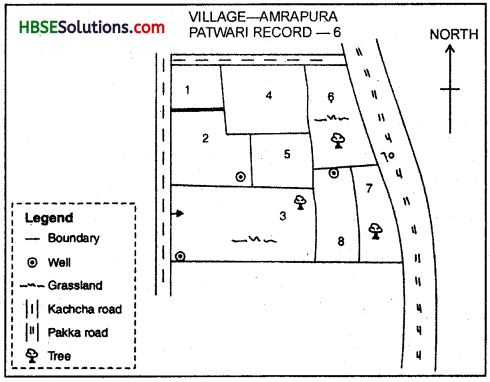
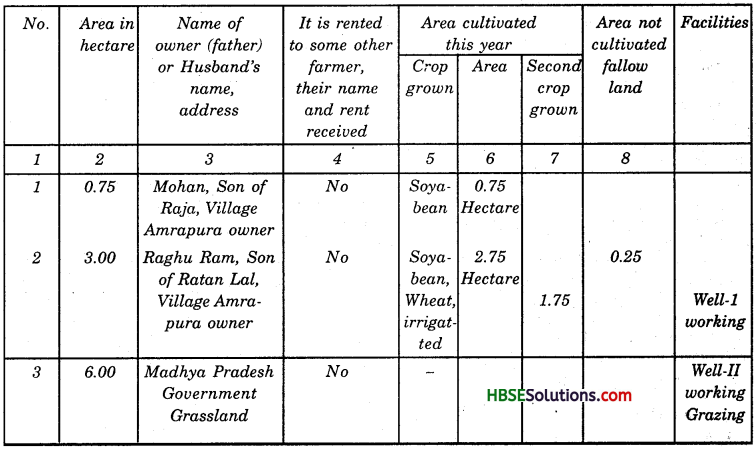
The Khasra record of the Patwari gives you information regarding the map given below. It identifies which plot of land is owned by whom. Look at both the records and the answer the questions given below regarding Mohan and Raghu’s land.
HBSE 6th Class Social Science Solutions Civics Chapter 6 Rural Administration-1
HBSE 6th Class Social Science Solutions Civics Chapter 6 Rural Administration-2
(1) Who owns the land south of Mohan’s field?
(2) Mark the common boundary between Mohan’s and Raghu’s land.
(3) Who can use field no. 3?
(4) What information can one get field no. 2 and field no. 3?
Ans.
(i) Raghu owns the land south of Mohan’s field.
(ii) Common boundary is marked with dark line.
(iii) Madhya Pradesh government can use field No 3.
(iv) The total area of field 2 is 2.75 hectare it belongs to Raghu who grows soyabean and wheat in this field. The land is not on rent and it is irrigated. Second crop is grown in 1.75 hectare. 0.2 hectare of the total area is a fallow land. There is one well in the field and it is working.

Field No. 3 belongs to Madhya Pradesh government. It is a grassland. It is not on rent. There is one well in the field and it is working. This grassland is used for grazing purposes.

EXERCISE

Question 1.
What is the work of the police?
Answer:
The work of the police is to:
(a) maintain law and order to establish peace in the society.
(b) to register case of theft, accident, injury, fights etc.
(c) to inquire, investigate and take action on the cases within its area.

Question 2.
List two things that the work of a Patwari includes.
Answer:
(a) Patwari measures land and keeps land records.
(b) He organises the collection of land revenue from the farmers and provides information to the government about the crops grown in that area.

Question 3.
What is the work of a tehsildar?
Answer:
(a) A tehsildar supervises the work of the Patwari.
(b) It hears disputes.
(c) It ensures that records are properly kept and land revenue is collected.
(d) He also sees to it that the farmers can easily obtain a copy of their record and students can obtain their caste certificates etc.

Haryana Board HBSE 6th Class Social Science Solutions Civics Chapter 6 Rural Administration

Question 4.
What issue is the poem trying to raise? Do you think this is an important issue? Why?
Answer:
The poem emphasises on the rights of a girl child. It is trying to raise the issue of inheritance of daughters and mothers in the property of their father/husband.

This is an important issue because in our country before Hindu Succession Amendment Act (2003) women can not get a share in the family’s agricultural land and after her father/ husband death the property was equally divided among her sons. This poem highlights that Dowry is not a compensation to a girl child. It should be abolished.

Question 5.
In what ways are the work of a Panchayat that you read about in the previous chapter and the work of the Patwari related to each other?
Answer:
Village Panchayat tries to solve the problem of the villagers at village level, and make it sure that the life of the people could be made prosperous. Patwari is a Government official at village level, who measures the land and collects the land revenue at village level.

The works of the Village Panchayat and Patwari are related to each other because they equally work for the welfare of the villagers. The revenue collected by Patwari is spent on welfare of the people.

Question 6.
Visit a police station and find out the work that the police have to do to prevent and maintain law and order in their area especially during festivals, public-meetings etc.?
Answer:
Police exercise following programs to prevent the crime and to maintain law and order in their areas:
1. Recruitment and deployment of Special Task Force to handle different crucial situations.
2. The police officer always keeps a vigilant eye on the criminals.
3. To ensure internal peace and justice (i.e. law and order position) these are kept open for twenty four hours a day.
4. During festivals they move with the public in civil dress, so that they can keep festivals free from apprehension of any mishappening.
5. To control the rush they make barrier and check post at various entrance.
6. Police can stop the people taking weapon inside the area/campus of the fair or festival.

Question 7.
Who is in-charge of all police stations in a district? Find out.
Answer:
The In-Charge of all police stations in district is Senior Superintendent of Police (S.S.P). The in-charge of a police station is known as S.H.O. (Station House Officer).

Haryana Board HBSE 6th Class Social Science Solutions Civics Chapter 6 Rural Administration

Question 8.
How do women benefit under new law?
Answer:
New Law: Hindu Succession (Amendment) Act, 2005 is known as New Law.
According to this law, women in India can get a share in the family’s agricultural land. Women get equal share in the property/lands.
Benefit of Law: Women can get transfer land and even purchased land. They can also take share of family’s land or property.

Question 9.
In your neighbourhood are there women who own property? How did they acquire it?
Answer:
Yes, In our neighbourhood there are women who owned their property. They acquired it with the help of their village Patwari and their brothers or sisters.

HBSE 6th Class Civics Rural Administration Important Questions and Answers

Very Short Answer Type Questions

Question 1.
What is called bund?
Answer:
The boundary that separates one land from another is called ‘bund’.

Question 2.
How does the Patwari measure the agricultural fields?
Answer:
The Patwari measures the land with the help of chain.

Question 3.
What is the work of Tehsildar?
Answer:
Tehsildar supervises the work of the Patwari and ensures that records are properly kept and land revenue is collected.

Short Answer Type Questions

Question 1.
How would have Patwari decided whether the common boundary of Mohan and Raghu Helds had been shifted?
Answer:
Patwari would have measured both Mohan’s and Raghu’s fields and compared them with the measurements on the map. If they did not match, then it was obvious that the boundaries had been changed.

Question 2.
When do you think farmer may require a copy of his land record?
Answer:
We think farmer may require a copy of his land record when:
1. he wants to sell or buy his land.
2. he wants loan from bank to dig a tubewell for his land.
3. he divides his property.

Haryana Board HBSE 6th Class Social Science Solutions Civics Chapter 6 Rural Administration

Question 3.
Mention any three works of the revenue department of the government.
Answer:
1. The revenue department of the government supervisor the work of the Patwari.
2. It ensures that records are properly kept and land revenue is collected.
3. It is the revenue department that makes the students obtain their caste certificates.
4. It also resolves the revenue deposits.

Long Answer Type Questions

Question 1.
Explain the right of women in property before and after Hindu Succession Amendment Act, 2005.
Answer:
Before:
1. Hindu women did not get a share in the family’s agricultural land.
2. After the death of the father, property was divided equally only among his sons.

After:
1. In the new law sons, daughters and their mothers can get an equal share in the land.
2. The new law will benefit a large number of women.
3. They can enjoy their independent status with equal rights.

Rural Administration Class 6 HBSE Notes

  • Nayaya Panchayat: A rural body of local administration constituted for disposal of funds, quarrels disputes of minor nature.
  • Chokidar: Chokidar in a village keeps birth and death record and also works as a messenger between the people and Gram Panchayat or any Government agency related with the welfare of the village.
  • Patwari: He is the land revenue officer at village level. He measure the land of the farmer and keeps the record.
  • Tehsildar: He is the officer at district level. He keeps a checking eyes on revenue officers.
  • Lekhpal, Kanungo or Karamchari, or Village Officer: These are the different names of the Patwari. He is known by different names in different parts of our country.
  • Khasra Number: These are the number used for land which is owned by an individual villager or village community.
  • A New Law: According to the new law, the son, daughter, and their mother can get equal parts of (shares of) the land owned by Karta of their family.
  • S.H.O: Station House Officer of a police station or a person in charge of the police station.
  • S.S.P: Senior Superintendent of Police is the highest rank of a police officer at the district level.

HBSE 6th Class Social Science Solutions Civics Chapter 6 Rural Administration Read More »

HBSE 6th Class Social Science Solutions Civics Chapter 9 Urban Livelihoods

Haryana State Board HBSE 6th Class Social Science Solutions Civics Chapter 9 Urban Livelihoods Textbook Exercise Questions and Answers.

Haryana Board 6th Class Social Science Solutions History Chapter 9 Urban Livelihoods

HBSE 6th Class Civics Urban Livelihoods Textbook Questions and Answers

Bachchu Manjhi – A Cycle-Rickshaw Puller
I come from a village in Bihar where I worked as a mason. My wife and three children live in the village. We don’t own land. In the village, I did not get masonry work regularly. The income that I earned was not enough for our family.

After I reached this city, I bought an old cycle rickshaw and paid for it in installments. This was many years ago. I come to the bus stop every morning and take the customers wherever they want to go. I work till 8.30 pm in the evening. I take rides of up to 6 kilometers in the surrounding area. Each customer gives me Rs. 5-10 per trip depending on the distance. When I’m ill I can’t do this work, so on those days, I don’t earn anything.

I stay with my friends in a rented room. They work in a nearby factory. I earn between? 80¬100 every day, out of which I spend? 50-60 on food and rent. The rest I save for my family. I visit my village two or three times a year to see my family. Though my family survives on the money I send, my wife also earns from agricultural work that she gets once in a while.

Question 1.
Why did Bachchu Manjhi come to the city?
Answer:
Bachchu Manjhi did not get regular masonry work in the village. So he came to the city to find a regular job so he could earn enough for the family.

Haryana Board HBSE 6th Class Social Science Solutions Civics Chapter 9 Urban Livelihoods

Question 2.
Why can’t Bachchu Manjhi stay with his family?
Answer:
Bachchu Manjhi could not stay with his family as he did not have any room to stay in and not enough earning for 81 the whole family. He himself stayed with his friends in a rented room.

Question 3.
Talk to a vegetable vendor or hawker and find out how do they organise their work, their way of preparing, purchasing, selling, etc.
Answer:
The vegetable vendors or hawkers organise their work in the following ways:
(а) They purchase vegetables or groceries from the wholesale market.
(b) They arrange them on the trolley cycle.
(c) They give loud calls on the roads, streets to sell their goods.
(d) Sometimes they sell their goods in weekly markets.

Question 4.
Bachchu Manjhi has to think twice before taking a day off from work?
Answer:
Bachchu Manjhi earns a small daily income out of which he saves only a very small portion. He has to send something for his family too. So, Bachchu Manjhi has to think twice before taking a day off from work.

Question 5.
Why did Harpreet and Vandana start a showroom? What do they have to do to face difficulties?
Answer:
Harpreet and Vandana started a showroom since:
1. Harpreet started working in the shop of his father and uncle after she completed her college.
2. Vandana is a dress designer. She realised that people prefer to buy readymade clothes, rather than have them stitched.
Vandana also felt the need for an attractive display of readymade products for their showroom:
1. They buy things from different places like Mumbai, Ahmedabad, Ludhiana, etc.
2. They had to put them in show cases.
3. They also had to advertise their products.

Question 6.
Talk to a shop owner in a market and find out how he plans his work. Have there been any changes in his business in the past twenty years?
Answer:
A shop owner in the market had to take a showroom on rent earlier. Now they had to purchase it. He buys things on installments and sells them on cash. There have been changes in the business in the past twenty years.
There have been changes in the business since the past.
(а) There is more competition. So, shopkeepers have to sell quality goods.
(b) They also have to give more stress on the advertisement.
(c) To attract customers, shopkeepers have to provide them with other service like after sales service, free-home delivery, etc.

Question 7.
What are the difference between those who sell on the street and those in the market?
Answer:
Those who sell things in the street buy their things from the local market. Those who sell things in the market, purchase their things in bulk. They need to adhere to government regulations and pay taxes also.

Question 8.
Why do you think small workshops and factories employ casual workers?
Answer:
Small workshops and factories employ casual workers as they do not have regular work.

Question 9.
Describe the working conditions of people like Nirmala keeping in mind the following: working hours, condition in the working place, earnings and the days of work available.
Answer:
Working conditions of people like t Nirmala are as follows:
(а) Working Hours: Workers have to work for long hours. A normal working day begins at 9 A.M. and finishes by 10 P.M., sometimes even later. They have to generally work for 6 days a week. When the work has to be done urgently, she worked on Sundays too.
(b) Conditions in the workplace: The conditions in the working are not very healthy.
(c) Earnings: They are paid only f 80 per day for eight hours and extra 40 for working late hours. They have no bargaining power.
(d) They are all casual workers as they work only for some months of the year. After this period, they have to move to other work.

Haryana Board HBSE 6th Class Social Science Solutions Civics Chapter 9 Urban Livelihoods

Question 10.
Would you say that domestic workers like housemaids are also casual workers? Why? Describe the workday of one such woman detailing the work she does in other peoples’ houses.
Answer:
Yes, the domestic workers like housemaids are also casual workers. They work as long as their employer wants them.
The working of one woman in other people’s houses:
1. She washes utensils, cleans the house, washes the clothes, cuts vegetables daily needed for meals.
2. Her work starts at 9 A.M. in the morning and finishes at 7 P.M.
3. Her wages are 100 a day.
4. She is also provided with some eatables during the day.

EXERCISE

Question 1.
Read and discuss description of the living conditions of workers who come to the labour chowk.
Most workers that we find at the labour chowk cannot afford permanent accommodation and sleep on pavements near the chowk, or they pay ₹ 6/- a night for a bed at a nearby night shelter run by the Municipal Corporation. To compensate for the lack of security, local tea and cigarette shops function as banks, moneylenders and safety lockers, all rolled into one. Most workers leave their tools at these shops for the night and safe keeping and pass on any extra money to them. The shopkeepers keep the money safety and also offer loans to labourers in need.
Source: Aman Sethi, Hindu on-line
Answer:
Labourers those who generally do not find regular work go to labour chowk. If they get any hope of source of income. At labour chowk; workers get work available at that time, but they cannot afford permanent job. Their job is for only one or two days. They spend their night on pavements or in the ‘Rein Vasera’ built by Municipal Corporation. Their daily earning is not sure. Such workers leave their tools in tea shops for safety.

Their economic position is imbalanced. They eat what they earn and spend on their families. Even they take money from money-lenders to pass their time. (Note: Everybody has different view, so you can write your own view about the life of chowk labourers, their living standard and way of earning).

Question 2.
Complete the following table and discuss how their work is different:

NamePlace of workEarningsSecurity of workBenefits receivedWorks on their own or employed
Bachchu Manjhi₹ 100 a day
Harpreet VandanaWork on their own
NirmalaNo Security
SudhaCompany₹ 30,000 p.m.

Answer:
1. Name: Bachchu Manjhi.
Place of Work: A cycle-rickshaw puller in the city bus stop.
Earning: ₹ 100/- per day.
Security of work: No
Benefits received: Saving send for expenditure of the family.
Work on their own or employed: Work on their own.

2. Name: Harpreet Vandana.
Place of Work: Readymade showroom.
Earning: Good
Security of Work: Yes
Benefits received: Increase in income.
Work on their or own or employed: Their own work.

3. Name: Nirmala
Place of Work: Garment Factory.
Earning: ₹ 80 per day + ₹ 40 overtime.
Security of Work: No
Benefits received: He gets benefit during summer season, when business is on full swing.
Work on their own or employed: She was employed.

4. Name: Sudha.
Place of Work: Company.
Earning: ₹ 30,000/- p.m.
Security of Work: Yes.
Benefits received: She receives benefits such as:
(i) Provident Fund
(ii) Medical facilities
(iii) Holidays: Sundays and also can get some annual leaves.

Their works are different. Bachchu was a rickshaw puller, Harpreet Vandana is owner of a showroom. Nirmala does work in a garment factory and Sudha is working in a company. Among them Sudha’s work is safe and secure because she has a permanent job and facilities as generally enjoyed by a government servant.

Haryana Board HBSE 6th Class Social Science Solutions Civics Chapter 9 Urban Livelihoods

Question 3.
In what ways is a permanent and regular job different from a casual job? Discuss.
Answer:

Permanent JobCasual Job
(1) An employee gets a regular salary every month.(1) An employee does not get a regular salary every month. if workers complain about their pay, or don’t work properly, they require to leave.
(2) Working Conditions are hygienic and good.(2) Working conditions may or may not be desirable.
(3) They have fixed working hours.(3) The working hours may be very long.
(4) They get other benefits such as saving for old age.(4) They do not get other benefits like permanent employees.

Question 4.
What benefits does Sudha get along with her salary?
Answer:
Sudha enjoys the following benefits with her salary:
(i) She deposits her Provident Fund as a saving for her old age.
(ii) She gets off on every Sunday, national festivals and also gets some annual leaves.
(iii) Her company provides her medical facilities.
(iv) She can get medical leave when she feels ill.

Question 5.
Fill in the following table to show the services provided by people in the markets which you visit frequently.

Names of the shops or officesNature of the services provided

Answer:

Names of the shops or officesNature of the services provided
Confectionery ShopFrom here we buy bread, butter, cheese, biscuits, etc.
Kiryana ShopRaw materials for cooking i.e, milled rice etc.
Chemist ShopTo buy medicine for ourself or others.
Electricity OfficeTo deposit electricity bill and to complaint against the supply of electricity if any. This office promises to give use regular ^electricity without power-cut.
Municipal Councellor’s OfficeProvides the facilities such as street light, cleanliness, etc.
Names of the shops or officesNature of the services provided

Haryana Board HBSE 6th Class Social Science Solutions Civics Chapter 9 Urban Livelihoods

HBSE 6th Class Civics Urban Livelihoods Important Questions and Answers

Very Short Answer Type Questions

Question 1.
Name some activities which are carried out on the streets.
Answer:
Hair-cutting, shoe-repairing, flower-selling, craft-making.

Question 2.
How was the street vending earlier looked upon by people?
Answer:
Street vending was earlier looked upon by people as an obstruction to traffic and to people walking.

Question 3.
Where does Nirmala work?
Answer:
Nirmala works as a tailor in an export garment unit.

Question 4.
Why are the casual workers asked to leave by the employers?
Answer:
Casual workers are asked to leave when they complain about their pay or working conditions.

Short Answer Type Questions

Question 1.
What suggestions have been made; so that street vendors have a place to work and that there is also a free flow of traffic to the people?
Answer:
(a) Hawking zones have been suggested for towns and cities.
(b) Mobile vendors should be allowed to move around freely.
(c) Hawkers need to be part of committees that are set up to take these and other decisions relating to them.

Question 2.
What extra benefits does Sudha get?
Answer:
Sudha gets the following extra benefits:
(i) A part of her salary is kept in a fund with the government. She will earn interest on these savings.
(ii) She gets medical facilities for her family.
(iii) She gets medical leave if she falls ill and her salary is not cut if she takes this leave.

Question 3.
Who are casual workers?
Answer:
Casual workers are required to come as and when the employer needs them. They are employed when the employer gets a big order or during certain seasons. At other times of the year they have to find some other work.

Haryana Board HBSE 6th Class Social Science Solutions Civics Chapter 9 Urban Livelihoods

Long Answer Type Questions

Question 1.
Name different categories of people who do work on daily wages.
Answer:
The people who work on daily wages are
(i) People in the labour chowk are daily wage earners who wait with their tools for people to come and take them to work.
(ii) People who work in factories and small workshops are daily wage earners. They are employed on casual basis i.e., they are required to come when there they are needed.

Question 2.
What is a Call Centre? Write about the work done in the Call Centre. Why are they set up in India?
Answer:
A Call Centre is a centralised office that deals with problems and questions that consumers/customers have regarding goods purchased and services like banking, ticket booking etc. It is a new form of employment in big cities. Call centres are generally set up as large rooms with work stations that include a computer, a telephone set, and supervisors stations. India has become a major centre not only for Indian companies but also for foreign companies.

Call Centres are set up in India because they can get people who can speak English and will work for lower wages.

Urban Livelihoods Class 6 HBSE Notes

  • Vendor: One who sells things of daily use by going door to door.
  • Urban areas: Towns and cities.
  • Business person: One who earns his livelihood by engaging himself in some business.
  • Employer: One who gives job to someone.
  • Casual worker: One who is engaged in temporary work.
  • Labour chowk: A place where daily wage labourers gather together with their tools and wait for people to come and hire them for work.
  • Call centre: It gives a new form of employment to the people of big cities. It is a centralised office that deals with problems and questions that consumers/customers have regarding goods purchased and services like banking, ticket booking, etc.
  • Hawker: One who sells things by going from one place to place asking people to buy them.

HBSE 6th Class Social Science Solutions Civics Chapter 9 Urban Livelihoods Read More »

HBSE 6th Class Social Science Solutions Civics Chapter 8 Rural Livelihoods

Haryana State Board HBSE 6th Class Social Science Solutions Civics Chapter 8 Rural Livelihoods Textbook Exercise Questions and Answers.

Haryana Board 6th Class Social Science Solutions History Chapter 8 Rural Livelihoods

HBSE 6th Class Civics Rural Livelihoods Textbook Questions and Answers

Question 1.
Based on the above diagram would you say the Thulasi earns money throughout the year?
Answer:
No. Thulasi works in the seasonal job which is agriculture she earns only during those seasons when she has worked in her fields. According to the given data, it can be important that from June to December, she earns.

Question 2.
Describe the work that Thulasi does. How is it different from the work that Raman does?
Answer:
Thulasi transplants paddy in the fields. Thulasi’s husband, is also a labourer. They don’t own any land. While Thulsi transplants, Raman sprays pesticides.

Haryana Board HBSE 6th Class Social Science Solutions Civics Chapter 8 Rural Livelihoods

Question 3.
Thulasi gets paid very little money for the work. She does, why do you think agricultural labourers like her are forced to accept low wages.
Answer:
1. Agricultural labourers are unskilled and do not have the knowledge or access to higher paid jobs.
2. They are under the debt of landlords or moneylenders who employ them on low wages.

Question 3.
In what ways would her way of earning a living have been different if Thulasi own some farm land? Discuss.
Answer:
1. If Thulasi would have owned a farm land she would have been the possessor of all the process.
2. She would have an increased income by selling all her-crop to the market.
3. This would have an impact on her livelihood.

Question 4.
What are the crops grown in your region or nearby rural are? What kinds of works do agricultural labourers do?
Answer:
Maize, Wheat and Rice is planted in the neighbourhood village.
Agricultural labourers do the following works:
(a) Ploughing fields
(b) Preparing saplings
(c) Transplanting saplings
(d) Irrigating crops
(e) Weeding
(f) Harvesting
(g) Storage of crops.

Question 5.
What work does Sekar’s family do. Why do you think Sekar does not usually employ labourers for doing farm work?
Answer:
Sekar’s family works in the field, harvests crop and does all sort of agricultural work.
Sekar might not be employing labourers for farm work to cut cost on manual labour. Money has to be given to labour for doing work.

Question 6.
Why does Sekar not go to the town market to get a better price for his paddy?
Answer:
Sekar earns very less to satisfy his needs. He cannot earn a higher income. There is very little produce lift. Some is used in loans, some so satisfy their home needs.

Question 7.
Sekar’s sister Mina had also taken a loan from the trader. She does not loan to sell her paddy to him but will pay back her loan. Write an imaginary conversation between Mina and the trader’s agent and the arguments given by each person.
Answer:
AGENT: Mina/when will you repay me loan? How long can I excuse you?
MINA : Just fifteen days more, Sir/ I will repay it as soon as I sell my paddy.
AGENT : But I have already offered you excuse for one month.
MINA : Sorry, Sir.
AGENT : Next time, I’ll not take off.

Haryana Board HBSE 6th Class Social Science Solutions Civics Chapter 8 Rural Livelihoods

Question 8.
What are the similarities between Sekar’s and Thulasi lives. Your answer could be based on the land they have, the need to work on the land that belong to others or the loans that they need and their earning.
Answer:
Both Sekar and Thulasi are agricultural labourers who accept loans (even at higher interest to meet then daily needs, they have low wage difference.
Thulasi owns no land while Sekar owns two acres of field on which he works.
Thulasi has a definite source of income paid by Ramalingam while Sekar’s income depends upon his crop produce.

Read again Sekar’s and Thulasi’s accounts. What do they say about Ramalingam, the large farmer? Together with what you have read fill in the details below.

Question i.
How much land does he have?
Answer:
20 acres.

Question ii.
What does Ramalingam do with the paddy grown in his field?
Answer:
The paddy is sold to traders in nearby towns.

Question iii.
A part from farming how else does he earn?
Answer:
His family owns a rice mill and shop selling seeds, pesticides. This given them extra substantial income.

Question 9.
Why do both Sekar’s and Aruna’s family have to borrow? What similarities and differences do you find?
Answer:
Sekar’s family had to borrow loan to as keep their produce while Aruna buys loan for the maintenance of their requirement. Sekar buys loan from an informal source of credit while Aruna busy loans from formal source of credit.

Question 10.
Have you heard of Tsunami? What is this and what damage do you think it might have done to the life of fishing families like Aruna’s.
Answer:
Do yourself.

EXERCISE

Short Answer Type Questions

Question 1.
You have probably noticed that people in Kalpattu are engaged in a variety of non-farm work. List five of these.
Answer:
(i) Making Baskets,
(ii) Making pots
(iii) Making bullocks carts
(iv) Making utensil
(v) Making bricks. .

Question 2.
List the different types of people you read about in Kalpattu who depend on farming. Who is the poorest among them and why?
Answer:
In Kalpattu, there are people who provides service such as blacksmiths, nurses, washerman, weavers, barbers, cycle repair mechanics, people whose work depends on farming are shopkeepers, traders, peasants etc.
Labour is the poorest of all sense it works only when in demand.

Question 3.
Imagine you are a member of a fishing family and you are discussing whether to take a loan from the bank for an engine. What would you say?
Answer:
If I were a member of the fishing family, I would say we must take loan from a bank or cooperative to improve the condition of our occupation because:
(a) Catamaran engine is useful because with their help, fishes can be caught in deep waters.
(b) It will help increase income, reduce time and help in overall development.

Question 4.
Poor rural labourers like Thulasi often do not have access to good medical facilities, good schools, and other resources. You have read about inequality in the first unit of this text. The difference between her and Ramalingam is one of inequality. Do you think this is a fair situation? What do you think can be done?
Discuss in class.
Answer:
Thulasi is a labourer while Ramalingam is a rich landlord.
1. Thulasi has a poor living standard, Ramalingam has a higher living standard.
2. Thulasi leads a sad life while Ramalingam leads happy life.

Haryana Board HBSE 6th Class Social Science Solutions Civics Chapter 8 Rural Livelihoods

Question 5.
What do you think the government can do to help farmers like Sekar when they get into debt? Discuss.
Answer:
Debts-trap is a common problem for farmers in India.
(i) Decrease the rate of interest at which loan is given.
(ii) Give compensation in case of a natural calamity.
(iii) Additional time can be given.
(iv) Formal sources of credit should be increase.

Question 6.
Compare the situation of Sekar and Ramalingam by filling in the following table:

SekarRamalingam
1. Land cultivated
2. Labour required
3. Loans required
4. Selling of harvest
5. Other works done by them

Answer:

SekarRamalingam
1. Land cultivated1. Owner of a little cultivated land. The crop grown is paddy1. Owner of large cultivated land. The crop grown is paddy.
2. Labour required2. During the time of harvesting required labour, otherwise manage to do the work of his own.2. Depends on labour
3. Loans required3. Yes3. No, for rice mill, he borrowed money from bank.
4. Selling of harvest4. To pay back the loan in kinds of seeds and fertilizer, he sold his paddy to the trader at price less than provinding in the market.4. He would sell his paddy in the market if its yield is higher than the consumption in his rice mill.
5. Other works done by them5. He works in Ramalingam Rice Mill5. He is the owner of Rice Mill.

HBSE 6th Class Civics Rural Livelihoods Important Questions and Answers

Very Short Answer Type Questions

Question 1.
What is the main work of the people in the village of Kalpattu?
Answer:
Paddy is the main crop that is grown in irrigated lands. Most of the families earn a living through agriculture.

Question 2.
What is the type of cultivation in Nagaland?
Answer:
Terrace farming.

Question 3.
What are catamarans?
Answer:
A catamarans is a boat with turn hull, side by side or a raft made of logs of wood or pieces of timber lashed together.

Question 4.
Who are seasonal workers?
Answer:
Most small farmers, agricultural labourers, fishing families, crafts persons in the villages are seasonal

Question 5.
What operations do farming activities involve?
Answer:
Working on farms involve operations such as preparing the lands, sowing, weeding, harvesting of crops.

Question 6.
Name the main crop grown in irrigated lands.
Answer:
Paddy.

Short Answer Questions

Question 1.
Why is agriculture a seasonal job?
Answer:
Process of agricultures take place only during some seasons. Not being able to earn money forces people in many rural areas to travel long distances in search of work. This travel or migration takes place during some seasons.

Question 2.
List the different sources of income of rural areas?
Answer:
(a) Many people in rural areas depend upon forest, animal husbandry, dairy produce, fishing, etc.
(b) Collecting mahua, tendu leave, honey to be sold to traders is an important source of additional income.
(c) Selling .milk, to cooperative is another source.

Haryana Board HBSE 6th Class Social Science Solutions Civics Chapter 8 Rural Livelihoods

Question 3.
What is the involvement coasts in crop production?
Answer:
Equipments that are related to agriculture, seeds, pesticides, fertilizers, minerals water, irrigational facilities.

Question 4.
Name the three category of farmers.
Answer:
The three categories of farmers are:
(i) Big land owners, who employ other farmers to work on their fields.
(ii) Farmers who have very small plots of land. They have to do other work, when there is a lean season on the farm. The produce is not sufficient to meet the needs of their family.
(iii) Landless peasants, who work on the fields of big land owners and are paid for the work done by them.

Question 5.
How do money-lenders and traders exploit the poor farmers and others? Give examples.
Answer:
The traders and money-lenders exploit the poor farmers and others by taking a part of their produce at a lower price, e.g., Sekar has to; sell his paddy at a lower price than the market rate. Aruna has to sell her fish catch to the trader and cannot auction it.

Long Answer Questions

Question 1.
Write about the everyday work of the village fisherman.
Answer:
Most of the fisherman live close to the sea. Their work starts at 7 o’clock in the morning, when there is lot of activity on the beach. This is the time when catamarans return with their catch and women gather to buy and sell fish.

The fisherman go in groups to the sea in catamaran. Some have engines fitted in the catamaran, so that they can go far into the sea. The money is equally divided in the group, keeping one part for the equipment. The women folk sell the fish till afternoon. In the evening the fishermen untangle and repair the nets. Next day at 2 A.M. they will set out to sea again.

Haryana Board HBSE 6th Class Social Science Solutions Civics Chapter 8 Rural Livelihoods

Rural Livelihoods Class 6 HBSE Notes

  • Blacksmith: A man engaged in making iron goods, tools, instruments, etc.
  • Villager: A citizen of India living in a village and occupied with agriculture.
  • Chakhesang Community: People of Chizami Village in Nagaland.
  • Community: The people living in one place, district, or country are combined known with this term.
  • Family: The smallest unit of society consisting of parents and their children.
  • Heterogeneous: Consisting of many different kinds of people.
  • Catamaran: Catamaran is a small boat used for catching fish.
  • Migration: The movement of people from one place to another to find jobs is termed migration.
  • Fisherman: A person engaged in the work of catching fish.

HBSE 6th Class Social Science Solutions Civics Chapter 8 Rural Livelihoods Read More »

HBSE 6th Class Social Science Solutions Geography Chapter 8 India: Climate Vegetation and Wildlife

Haryana State Board HBSE 6th Class Social Science Solutions Geography Chapter 8 India: Climate Vegetation and Wildlife Textbook Exercise Questions and Answers.

HBSE 6th Class Social Science Solutions Geography Chapter 8 India: Climate Vegetation and Wildlife

HBSE 6th Class Geography India: Climate Vegetation and Wildlife Textbook Questions and Answers

Question 1.
Answer the following questions briefly:
(а) Which winds bring rainfall in India? Why is it so important?
Answer:
South-west Monsoon winds bring rainfall to India. It is so important because agriculture mainly depends upon this rainfall.

(b) Name the different seasons in India.
Answer:
Different seasons:

  • Cold weather (winter) season.
  • Hot weather (summer) season.
  • South west monsoon (rainy) season.
  • Season of retreating monsoon.

(c) What is natural vegetation?
Answer:
Grasses, shrubs and trees which grow on their own without any interference or help from mankind constitute natural vegetation.

(d) What are different types of natural vegetation found in India?
Answer:
Different types of natural vegetation found in India are:

  • Tropical Rain Forests
  • Tropical Deciduous Forests
  • Thorny Bushes
  • Mountain Vegetation

HBSE 6th Class Social Science Solutions Geography Chapter 8 India: Climate Vegetation and Wildlife

(e) Differentiate between Evergreen Forests and Deciduous Forests.
Answer:

Evergreen ForestsDeciduous Forests
(i) Evergreen forests occur in the areas of heavy rainfall.(i) Deciduous forests occur in a large part of our country.
(ii) They always appear green as they shed their leaves at different times of the year.(ii) They shed their leaves at a particular time of the year.
(iii) These forests are called tropical rain forests.(iii) These forests are also called monsoon forests.
(iv) Important trees are mahogany, ebony rosewood.(iv) Important trees are sal, teak, peepal, neem and sheesham.
(v) Main areas where they are found in India are: Andaman and Nicobar Islands, parts of North eastern states and a narrow strips of western, slope of the western ghats.(v) They are found in Madhya Pradesh, Uttar Pradesh, Bihar, Jharkhand, Chhattisgarh, Odisha.

(i) Tropical rainforest is also called evergreen forest because many species of trees are shed their leaves at different times of the year. Therefore, they always appear green and are called evergreen forest.

Question 2.
Tick the correct answer :
(а) The world’s highest rainfall occurs in :
(i) Mumbai
(ii) Asansol
(iii) Mawsynram
Answer:
(iii) Mawsynram

(b) Mangrove forests can thrive in :
(i) Saline water
(ii) Fresh water
(iii) Polluted water
Answer:
(i) Saline water

(c) Mahogany and rosewood trees are found in:
(i) Mangrove forests
(ii) Tropical deciduous forests
(iii) Tropical evergreei, forests
Answer:
(iii) Tropical evergreei, forests

HBSE 6th Class Social Science Solutions Geography Chapter 8 India: Climate Vegetation and Wildlife

(d) Wild goat and snow leopards are found in :
(i) Himalayan region
(ii) Peninsular region
(iii) Gir forests
Answer:
(i) Himalayan region

(e) During the south west monsoon period the moisture laden winds blow from:
(i) Land to sea
(ii) Sea to land
(iii) Plateau to plains
Answer:
(ii) Sea to land

Question 3.
Fill in the blanks :

  1. Hot and dry winds known as ________ blow during the day in the summers.
  2. The state of Andhra Pradesh and Tamil Nadu receive a great amount of rainfall during the season of ________.
  3. ________ forests in Gujarat is the house of ________
  4. ________ is a well known species of mangrove forests.
  5. ________ are also called monsoon forests.

Answer:

  1. LOO or heat wave
  2. winter
  3. Gir, Hons
  4. Sundari
  5. Tropical Deciduous forests.

FOR FUN

  • Make a list of trees in your surrounding and collect the pictures of plants, animals, birds and paste them in your copy.
  • Plant a sapling near your home, nurture it and write down the changes you observe for a few months.
  • Does any migratory bird come in your locality? Try to identify that, be watchful in winter season.
  • Visit a zoo in your city or visit a nearby forest or sanctuary with your elders. Watch various types of wildlife there.

HBSE 6th Class Geography India: Climate Vegetation and Wildlife Important Questions and Answers

Very Short Answer Type Questions

Question 1.
What is the duration of cold weather season?
Answer:
The duration of winter season is from December to February.

Question 2.
Why are the temperatures quite low in northern India in winter?
Answer:
The temperatures are quite low in northern India in winter because the sun rays do not fall directly in the region.

Question 3.
What is loo?
Answer:
Hot and dry winds are called loo.

HBSE 6th Class Social Science Solutions Geography Chapter 8 India: Climate Vegetation and Wildlife

Question 4.
Why is most of the rain in India is brought by monsoon winds?
Answer:
Most of the rain in India is brought by monsoon winds because India is located in the tropical region.

Short Answer Type Questions

Question 1.
What type of forests are found in the Himalayas?
Answer:
Different types of forests are found in the Himalayas according to the altitude. The foot hills of the Himalayas are covered with sal. This is followed by evergreen forests, oaks, chestnuts and pine trees.

Question 2.
Write the characteristics of deciduous forests.
Answer:
The deciduous forests are also called broad-leaved forests. These forests shed their leaves in a particular time of a year. These trees are not tall. These forests are found in the areas of 100-200 cm rainfall.

Question 3.
Name four belts of vegetation found in India.
Answer:
The four major belts of vegetation are:

  • Tropical rain forests
  • Tropical deciduous forests
  • Desert type of vegetation or thorn forests
  • Mountainous vegetation or Himalayan forests.

Question 4.
Where do dry thorn forests occur?
Answer:
The dry thorn forests occur where very scanty rainfall, i.e, less than 50 cms is found. These areas are the arid regions of Rajasthan, Gujarat, Punjab and Haryana.

Long Answer Type Questions

Question 1.
Describe the main features of wildlife of India.
Answer:
The main features of wildlife of India are :
(a) There are thousands of species of animals and a large variety of reptiles, amphibians, mammals, birds, insects and worms which live in the forest.

(b) The tiger is our national animal.

(c) Different animals are found in different areas as per list below:

  • Gir forest in Gujarat – Asiatic Lions
  • Assam – Elephants and one homed rhinocerous.
  • Great Indian Desert – Camels
  • Rann of Kuchchh – Wild Assets.
  • Himalayan Region – Wild goats, snow leopards, bears.

(d) The peacock is our national bird.

(e) Other common birds are parrots, pigeons, mynah, geese, bulbul, ducks.

HBSE 6th Class Social Science Solutions Geography Chapter 8 India: Climate Vegetation and Wildlife

Question 2.
How are forests important for us?
Answer:
Forests are important for us because :

  • Plants release oxygen that we breathe and absorb carbon dioxide.
  • The roots of the plants bind the soil, thus, they control soil erosion.
  • Forests provide us with timber for furniture, fuel, wood, fodder, medicinal plants and herbs, lac, honey, gum, etc.
  • Forests are the natural habitat of wildlife.

India: Climate Vegetation and Wildlife Class 6 HBSE Notes

  • Weather : Weather is about day to day changes in the atmosphere. It includes changes in temperature, rainfall and sunshine etc.
  • Loo : It is a hot and dry wind that blows during, the day in Summer.
  • Climate : Climate is the average weather condition which have been measured over many years.
  • Monsoon : The word monsoon has been taken from the Arabic word ‘mausim’ which means seasons.
  • Wildlife : All the wild animals and birds found in the forests, national parks and sanctuaries.
  • Van Mahotsav : It is a special programme organized from time to time to promote people for planting more and more trees.
  • Natural vegetation : The grasses, shrubs and trees that grow on their own without human interference or help are known as natural vegetation.
  • Migratory birds : Birds that migrate to our country in the winter season every year. They arrive in December and stay till early March.

HBSE 6th Class Social Science Solutions Geography Chapter 8 India: Climate Vegetation and Wildlife Read More »