Class 6

HBSE 6th Class Social Science Solutions Civics Chapter 3 What is Government

Haryana State Board HBSE 6th Class Social Science Solutions Civics Chapter 3 What is Government Textbook Exercise Questions and Answers.

Haryana Board 6th Class Social Science Solutions History Chapter 3 What is Government

HBSE 6th Class Civics What is Government Textbook Questions and Answers

HBSE 6th Class Social Science Solutions Civics Chapter 3 What is Government-1

Question 1.
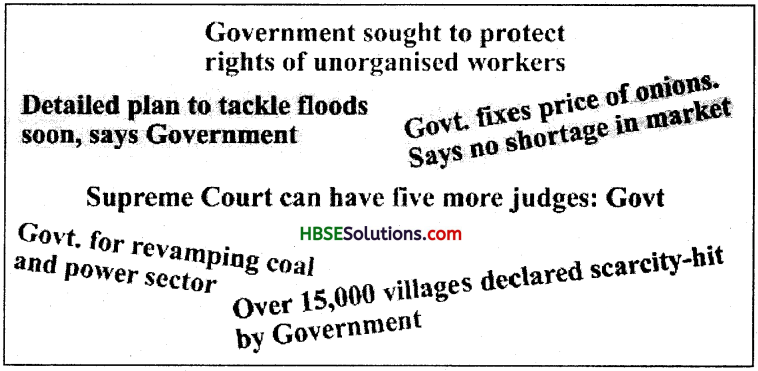
Look at the newspaper headlines above and list the different kinds of activities that the government is reported to be doing in these newspaper headlines.
1.
2.
3.
4.

  • Isn’t this a wide range of activities?
  • What do you think the government is? Discuss in class.

Answer:

  • List of the different kind of activities that the government is reported to be doing in the newspaper headlines:

1. The government protects the rights of unorganised workers.
2. It fixes prices of essential commodities when they are in short supply.
3. It tackles food.
4. It revamps coal and power sectors.
5. It declares villages scarcity hit and . provides relief.
6. It appoints judges to high courts and Supreme Court.

  • Yes, the government has a wide range of activities.

In my opinion, the government is an organisation which looks after the public maintenance systems like roads, postal and railway service. It is also responsible for maintaining peaceful relations within nation and amongst the different nations. It protects the border of the country.

Haryana Board HBSE 6th Class Social Science Solutions Civics Chapter 3 What is Government

Question 2.
Can you list three things that the government does which have not been mentioned?
Answer:
The things that the government does which has not been mentioned are:
(i) to provide sanitation and pure drinking water facility to all the citizens of the nation.
(ii) to provide free education to children of the nation.
(iii) to give employment to all people more than 18 years of age.

Question 3.
Look at the statements in the column on the left. Can you identify which level they belong to? Place tick mark against the level you consider most appropriate:

LocalStateCentral
1. The decision to maintain peaceful relations with Russia.
2. The decision on whether to have Board exam conducted in Class VIII for all government in Kolkata.
3. Introduction of two new train connections between Jammu and Bhubaneshwar.
4. The decision to get common well constructed/ excavated in a particular area of the village.
5. Decision to construct a big children’s park in Patna.
6. The decision to provide free electricity for all farmers in Haryana.
7. Introduction of a new 1000 rupee note.

Answer:

LocalStateCentral
1. The decision to maintain peaceful relations with Russia.
2. The decision on whether to have Board exam conducted in Class VIII for all government in Kolkata.
3. Introduction of two new train connections between Jammu and Bhubaneshwar.
4. The decision to get common well constructed/ excavated in a particular area of the village.
5. Decision to construct a big children’s park in Patna.
6. The decision to provide free electricity for all farmers in Haryana.
7. Introduction of a new 1000 rupee note.

Haryana Board HBSE 6th Class Social Science Solutions Civics Chapter 3 What is Government

Question 4.
Do you think it is important for people to be involved in decisions that affect them? Give two reasons for answer.
Answer:
Yes, it is important for people to be involved in decisions that affect them because:
(a) The people are affected by a rise in prices of essential commodities, so any extra-ordinary increase in prices should be consulted with the representatives of the people.

(b) If the government decides to convert a residential area to the commercial area, the representatives of the people should be consulted as it could effect the lives of the people.

Question 5.
Which type of government prefer to have in the place in which you live in? Why?
Answer:
I would like to have a democratic type of government in the places in which I live because it is a government of the people, for the people and by the people. A democratic government will be more considerate towards the needs of the people.

Question 6.
Which of the statements below is correct? Correct those sentences that you think need correction.
(a) In a monarchy the country’s citizens are allowed to elect whomever they want.
(b) In a democracy a king has an absolute powers to rule the country.
(c) In a monarchy, people can raise questions about the decisions the monarch takes.
Answer:
(a) In a monarchy, the king is chosen by the hereditary powers.
(b) In a democracy, the country is ruled by the representatives chosen by the people.
(c) In a monarchy, people can not raise questions about the decisions the monarch takes.

Haryana Board HBSE 6th Class Social Science Solutions Civics Chapter 3 What is Government

EXERCISE

Question 1.
What do you understand by the word ‘government’? List five ways in which you think the government affects your daily life.
Answer:
The Government is the name of an organisation through which, the will of the state is created, expressed and implemented.
The three main organs of the Government are:
(i) Legislative
(ii) Judiciary
(iii) Executive.

Govt, affects daily life in the following ways:
1. It takes decision to lay roads and build schools and health centers.
2. It takes action of social issues.
3. It protects the boundaries of state.
4. It makes law for the benefits of the people and implements them.
5. If there is dispute between two neighbouring states, the govt, does his best to end the cause of conflict.

Question 2.
Why do you think the Government make rules for everyone in the form of laws?
Answer:
Everyone who lives in a country must follow some rules and regulations. These laws are made by government and every citizen have to follow these laws. According to these laws, a government can function and make decision and vests with power to enforce these laws.

Govt, needs to make rules for everyone in the form of law because by doing so people can obey rule and thus the nation as a whole leads a secure life.

Question 3.
Name two essential features of a democratic government.
Answer:
Two features:
(i) Participation of people is necessity.
(ii) It acts according to the will of the people.

Haryana Board HBSE 6th Class Social Science Solutions Civics Chapter 3 What is Government

Question 4.
What was the suffrage movement? What did it accomplish?
Answer:
HBSE 6th Class Social Science Solutions Civics Chapter 3 What is Government-2
Haryana Board HBSE 6th Class Social Science Solutions Civics Chapter 3 What is Government

Suffrage Movement:
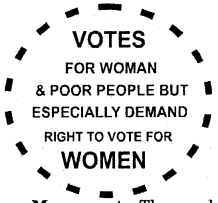
The word ‘suffrage’ means ‘right to vote’. This movement belongs to the women and poor people who have to fight for the participation in government. During the World War I, the struggle for the ‘right to vote’ got strengthened. The struggle comes to be known as ‘suffrage movement’.

Its accomplishments:
During the World War I, men were away from their house fighting in the battle field. At this time, women were called upon to do the work which were earlier done by men. Women did their best and try to manage and organise different kinds of works, People wonder to know that the women can do such work. Women began to be seen as being equally capable for doing hard work and making decision.

The people who were demanding the Right for Women and got their demand heard, they chained themselves to rallying in public places and meetings. In America, women were given right to vote in 1920 while in U.K. in 1928.

Question 5.
Gandhiji strongly believed that every adult in India should be given the right to vote. However, a few people don’t share his views. They feel that illiterate people, who are mainly poor, should not be given the right to vote. What do you think? Do you think this would be a form to discrimination? Give five points to support your view and share these with the class.
Answer:
All citizens are equal. The constitution aims at providing all equality to all its citizens.
• We have no right to discriminate any one on the basis of poverty.
• Even the illiterate people are the citizens of the nation. They should have the right to choose people who are going to be in their country.
• Our constitution provides equal voting right to all the citizens.
• We must honour dignity of every individual.

HBSE 6th Class Civics What is Government Important Questions and Answers

Very Short Answer Type Questions

Question 1.
Why does every country need a government?
Answer:
Every country needs a government to make decisions and get things like building roads and schools done.

Question 2.
List the institutions which are a part of the government. Name three of them.
Answer:
The institutions which are a part of the government are:
(1) Supreme Court
(2) Indian Railways
(3) Bharat Petroleum

Haryana Board HBSE 6th Class Social Science Solutions Civics Chapter 3 What is Government

Question 3.
What is universal adult franchise?
Answer:
‘Universal adult franchise’ means that all adults in the country are allowed to vote.

Question 4.
Why is a mark put on the finger while vote?
Answer:
A mark is put on the finger to make sure that a person casts only one vote.

Question 5.
Under what circumstances a person may approach the court?
Answer:
If a person feels that a particular law is not being followed, he/she may approach the court.

Short Answer Type Questions

Question 1.
What are the three different levels of the government?
Answer:
The three different levels of the government are:
(a) Local level: It means the government in our village, town or locality.
(b) State level: It would mean the government that covers an entire state like Haryana or Assam.
(c) National level: It refers to the government of the entire country.

Haryana Board HBSE 6th Class Social Science Solutions Civics Chapter 3 What is Government

Question 2.
What do you mean by representative democracies?
Answer:
In representative democracies, people do not choose their representatives through an election process. These representatives meet and make decisions for the entire population.

Question 3.
The earliest forms of government were not democratic.
Answer:
In the earliest form of government, men would owned property and were educated, had right to vote. This meant that women, the poor, the property less and the uneducated ones were not allowed to vote. The country was governed by the rules and regulations that these few men made.

So the earliest forms of government were not democratic as it was not ruled by all the citizens of the country.

Question 4.
What is a monarchy?
Answer:
It is a type of government in which the monarch or the king has the powers to make laws and decisions and run the government. The king does not have to explain his action or defend the decisions he takes. He may be helped by a small group of people who help the king to take decisions.

Long Answer Type Questions

Question 1.
Distinguish between democracy and monarchy.
Answer:

(a) Democracy is a government of the people, by the people and for the people. The re-presentatives of the people choose the government.(a) It is the King or Queen who has the power to make decisions and run the government.
(b) The three levels of the government-legislative, executive and judiciary are the functionaries of the government.(b) The monarch may have small group of people to discuss matters with, but the final decision making power remains with the monarch.
(c) The government has to explain its actions and defend its decisions to the people.(c) Kings and Queens do not have to explain their actions or defend the decisions they make.
(d) People may change the ruling party through elections.(d) The position of the king is hereditary.

Question 2.
What is the difference between the Federal and Unitary Governments?
Answer:
(i) In the Unitary form of Government, there is only one Central Government for the whole country while in the Federal Form; there is one Central and separate government in the provinces.
(ii) In the Federal form of Government the whole country is divided into some political units but in the Unitary form, the whole country is a single unit.
(iii) In the Unitary form, all the powers are vested in one Central Government, while there is a division of powers between the Federal and the State governments in the Federal forms.
(iv) In the Federal form of Government, mostly the Constitution is written and rigid while it is not so in the case of a Unitary State.

Haryana Board HBSE 6th Class Social Science Solutions Civics Chapter 3 What is Government

What is Government Class 6 HBSE Notes

  • Government: The system or machinery present in each country in order to make directions for the proper running of the country is called a government.
  • Laws: The rules laid down by the government for the proper functioning of the country are called laws.
  • Democracy: A system of government in which people (citizens) of the country choose their leaders to rule is called democracy.
  • Monarchy: Monarchy is the form of the government in which the King Queen or the Monarch takes decisions and makes laws for the entire country. His/Her position is hereditary too.
  • Elections: The process in which a democratic country casts its votes to choose its leaders is called elections.
  • Election Petition: If any voter or a candidate feels that the election in his constituency has not been conducted fairly, he can file an election petition against that election.
  • Representative Democracy: A form of democracy in which people do not elect the government directly but only choose their representatives, who collectively form a government is called Representative Democracy.

HBSE 6th Class Social Science Solutions Civics Chapter 3 What is Government Read More »

HBSE 6th Class Social Science Solutions Civics Chapter 2 Diversity and Discrimination

Haryana State Board HBSE 6th Class Social Science Solutions Civics Chapter 2 Diversity and Discrimination Textbook Exercise Questions and Answers.

Haryana Board 6th Class Social Science Solutions History Chapter 2 Diversity and Discrimination

HBSE 6th Class Civics Diversity and Discrimination Textbook Questions and Answers

Question 1.
Match the following statements in a way that challenges stereotypes:

(a) Two surgeons were sitting down to lunch when one of them made a call on the mobile phone.1. suffers from chronic asthma.
(b) The boy who won the drawing competition went to the dias.2. to become an astronaut which she did.
(c) One of the fastest athletes in the world.3. to speak with her daughter who had just returned from school.
(d) She was not that well-off but had a dream.4. on a wheelchair to collect his prize.

Answer:

(a) Two surgeons were sitting down to lunch when one of them made a call on the mobile phone.3. to speak with her daughter who had just returned from school.
(b) The boy who won the drawing competition went to the dias.4. on a wheelchair to collect his prize.
(c) One of the fastest athletes in the world.1. suffers from chronic asthma.
(d) She was not that well-off but had a dream.2. to become an astronaut which she did.

Haryana Board HBSE 6th Class Social Science Solutions Civics Chapter 2 Diversity and Discrimination

Question 2.
How can the stereotype that girls are a burden on their parents affect the life of a daughter? Imagine this situation and list at least five different effect that this stereotype can have on the way daughters get treated in the houses.
Answer:
The stereotype girls are a burden on their parents affect the life of a daughter in the following ways:

  • They are not given nutritious food.
  • They are not allowed to attend or join schools.
  • They are not properly cared for.
  • They have to do household work in their childhood.
  • Sometimes, they are married at an early age which is not good for their physical and mental health.

Question 3.
What does the Constitution say with regard to equality? Why do you think it is important for all people to be equal?
Answer:
The first page of the Constitution says: “Equality of status and of opportunities and to promote among them all”.
It is important for all people to be equal because this equality is a key value that unites us all. If the people are not equal; it would be detrimental for the development of our nation. Equality is important to ensure justice to one and all. If all live together and equal opportunities are given to all people, that will be the true essence of our democracy.

Question 4.
Sometimes people make prejudiced comments in our presence. We are often in a position to do anything about this because it is difficult to say something right then and there. Divide the class into groups and each group discuss what they could do in one of the following situations:

  1. A friend begins to tease a classmate because he is poor.
  2. You are watching TV with your family and – one of them makes a prejudicial comment about a particular religious community.
  3. Children in your class refuse to share their food with a particular person because they think she is dirty.
  4. Someone tells you a joke that makes fun of a community because of their accent.
  5. Some boys make remarks about girls not being able to play games as well as them.

Discuss in class what the different groups have suggested for the above situations, and also talk about the problems that can come up when raising the issue.
Answer:

  1. The classmate would be convinced that being rich or poor is not something to be laughed at.
  2. He/she would be prevented from doing this since all religions are equal before law.
  3. I would advise my classmates to be friendly with one and all.
  4. I would not get involved in the joke and later on tell him/her not to crack such jokes which cause embarrassment to a particulars community.
  5. I would explain to them through examples of Sania Mirza, Kalpana Chawla that girls are equally good in all fields.

Haryana Board HBSE 6th Class Social Science Solutions Civics Chapter 2 Diversity and Discrimination

Question 5.
Below are some statements on people living in rural and urban areas. Tick mark those that you agree with:
On Rural People
(1) More than 50% of all Indians live in villages.
(2) Villagers do not care about their health. They are full of superstitions.
(3) People in villages are backward and lazy. They do not like to work.
(4) In peak harvesting and plantation season, families spend 12 to 14 hours working in the fields.
(5) Villagers are dirty and not hygienic.

On Urban People
(1) Life in the city is easy. People here are spoilt and lazy.
(2) In cities families spend very little time with each other.
(3) People in towns only care about money, not about people.
(4) Living in a city is expensive. A large part of people’s earnings is spent on rent and transport.
(5) City people cannot be trusted, they are cunning and corrupt
Answer:

On Rural PeopleOn Urban People
(1) ✓(1) ✗
(2) ✓(2) ✓
(3) ✗(3) ✓
(4) ✓(4) ✓
(5) ✗(5) ✗

Haryana Board HBSE 6th Class Social Science Solutions Civics Chapter 2 Diversity and Discrimination

Question 6.
Can you list some of the prejudices that you have noticed around you. How do they affect the ways in which people treat each other?
Answer:
Some of the prejudices that I have noticed around are:
(a) Prejudice against caste
(b) Prejudice against colour, eating habits.
(c) Prejudice against sex.

The affect in the following ways in which people treat each other.
(a) They tease other people.
(b) They laugh at them.
(c) They use dirty language.
(d) They cast remarks upon others.
(e) They begin to abouse each other.

Question 7.
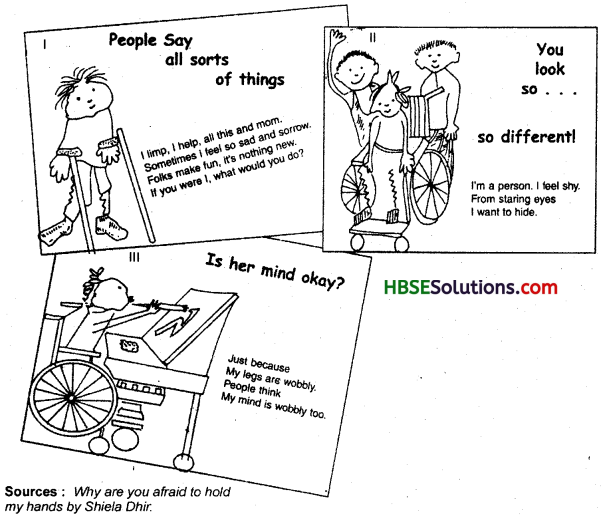
The children you see in the illustrations here were seen as ‘disabled’. This term has been changed and now the term used is ‘children with special needs’. Common stereotypes about them are given in large letters. Their own feeling and thoughts too are given.
Haryana Board HBSE 6th Class Social Science Solutions Civics Chapter 2 Diversity and Discrimination-1

  • Do you think children with special needs should be a part of regular schools or study in a separate school? Give reasons for you answer.

Answer:
Picture I: The boy is tense and sad because the people make fun of him because he is limpatic. He tries to make people understand how they would feel if they were in his place. That means such a thing could happen to anyone.
Picture II: The person feels shy because the people find him different. He wants to hide himself from the persons who stare at him.
Picture III: The child wonders why people consider her mentally weak also when she is physically weak.

I think that children with special needs should be a part of regular school and should in a separate school because we should not let them develop any complexes. They should not feel themselves disregarded.

Question 8.
What is the difference between discrimination and stereotypes?
Answer:
‘Discrimination’ is a state in which one person is discriminated from others due to some financial nardshapes or caste differences. For example: In our society; untouchables and dalits are discriminated against.
‘Stereotypes’ refers to fixing people into one image. For example: Some people are considered stingy, lazy and dirty.

Question 9.
Despite the children offering money, the cartmen refused them. Why?
Answer:
The cartmen refused the children because:
(a) They were not prepared to suffer being polluted.
(b) They were not prepared to carry passengers of the untouchable class.

Haryana Board HBSE 6th Class Social Science Solutions Civics Chapter 2 Diversity and Discrimination

HBSE 6th Class Civics Diversity and Discrimination Important Questions and Answers

Very Short Answer Type Questions

Question 1.
What are prejudices?
Answer:
Prejudices are fixed negative opinions which we make about certain people.
For example:
Village people are poor, dirty and ignorant
Or
City people are cunning and corrupt.

Question 2.
What is a Constitution?
Answer:
A Constitution is a document that lay down the rules by which the nation would function.

Question 3.
What is Mahar?
Answer:
Mahar is one of the communities which were treated as untouchables in the Bombay Presidency.

Question 4.
What is Preamble of the constitution?
Answer:
The first page of the Constitution that clearly states all Indians are entitled to equality of status and opportunity.

Question 5.
Why did Dr. Ambedkar convert to Buddhism?
Answer:
Dr. Ambedkar converted to Buddhism in his search for a religion that treated all members equally.

Haryana Board HBSE 6th Class Social Science Solutions Civics Chapter 2 Diversity and Discrimination

Short Answer Type Questions

Question 1.
What are the things about which we are prejudiced? What happens because of prejudices?
Answer:
The things about which we are prejudiced are:
(a) people’s religious beliefs
(b) the colour of their skin
(c) the region they come from
(d) the accent they speak in
(e) the clothes they wear.
Because of our prejudices, we don’t want to form friendship with those who are prejudiced against. Often, we hurt such people also.

Question 2.
Name the different terms which are used to address the low caste people.
Answer:
The different terms used to address the low caste people are:
(i) Dalit is the term used for the people who belong to the so called lower castes to address themselves. They prefer this word to untouchables. Dalit means those who have been broken. The word according to them shows how social prejudices and discrimination have broken the Dalit people.

(ii) This government refers to this group of people as Schedule Caste.

Question 3.
Give examples from everyday life when discrimination happens.
Answer:
In everyday life, discrimination happens when people act on their prejudices or stereotypes. Some examples are:
1. If you stop people from taking part in certain social activities.
2. If we stop them from living in certain neighbourhoods.
3. If we prevent them from taking water from the same well or hand pump
4. If we do not allow certain people to drink tea in the same cups or glasses as others.

Question 4.
What hardships did Mahar suffer?
Answer:
1. Mahars were poor and owned no land.
2. Children born to them also had to do the work their parents did.
3. Mahars lived in spaces outside the villages.
4. Mahars were not allowed into the village.

Haryana Board HBSE 6th Class Social Science Solutions Civics Chapter 2 Diversity and Discrimination

Long Answer Type Questions

Question 1.
What are ill-effects of stereo-types?
Answer:
The following are ill-effects:
(i) Stereotypes stop us hum looking at each person as a unique individual with his or her own special qualities and skills that are different from others.
(ii) Stereotypes fit large numbers of people into only one pattern or type.
(iii) Stereotypes affects all of us they prevent us from doing certain things that we might otherwise be good at.

Question 2.
What can be the possible reasons for discrimination in a society?
Answer:
Discrimination happens when people act on their prejudices or stereotypes.
Discrimination can take place because of several reasons some of which are:
(i) The diversity that people belong to different religions can be a source of discrimination.

(ii) Groups of people who may speak a certain language, follow a particular religion, live in specific regions etc; may be discriminated against as their customs or practices may be seen as inferior.

(iii) People may be discriminated against because of their poor economic backgrounds. They don’t carry high braved goods like other people do and they are discriminated against in schools, hospitals and offices.

(iv) Sometimes people experience discrimination because of both reasons, (a) They are poor, (b) They belong to groups whose culture is not valued.

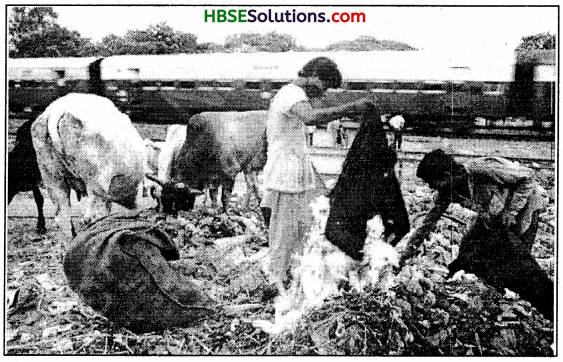
(v) People are sometimes discriminated against the kind of work. They do. This is so because certain kinds of work are more valued than others. For example: people who do the tasks of cleaning, washing cutting hair and picking garbage are the tasks which are valued less than the others.

Question 3.
How did Dalits, women and peasants fight against inequalities?
Answer:
(i) Many Dalits organised themselves to gain entry into temples.
(ii) Women demanded that they should have as much a right to education as men did.
(iii) Peasants fought to release themselves from the grasp of the money lender and the high interest they were charged.

Question 4.
What steps have been provided in the constitution of India against inequality and discrimination?
Answer:
Learning from the past experiences of inequality in Indian society, the framers of the Constitution had strong arguments against the prevalent system. They undertook the following safeguards against inequality and discrimination.

  • Everyone has equal rights and opportunities.
  • Untouchability is seen as a crime. It has been legally abolished.
  • People are free to choose any kind of work.
  • Govt, jobs are open to all people.
  • Specific steps to realise this right to equality for poor and other marginal communities.
  • Respect to diversity ensures equality.
    • Freedom to follow any religion
    • Freedom to speak their own language
    • Freedom to celebrate their festivals
    • Freedom to express oneself

Haryana Board HBSE 6th Class Social Science Solutions Civics Chapter 2 Diversity and Discrimination

Diversity and Discrimination Class 6 HBSE Notes

  • Collective Suffering: By the damage of public property, not one person but the whole community suffers collectively.
  • Stereotype: When we fix the people into one definite image but which is not often true in reality.
  • Constitution: Fundamental law and principle according to which a country is governed.
  • Constituent Assembly: An assembly of persons that frames a constitution for its country.
  • Sovereign State: A state which is free to manage its internal affairs without any influence of external authorities.
  • Begar: Bonded labour.
  • Writs: Order issued by the court.
  • Welfare State: A system in which the Government provides free social services like health and education, and helps the old, the unemployed, and the sick.
  • Fundamental Rights: Rights considered basically essential for well-being granted by the constitution of India.
  • Directive Principles of State Policy: The ideal principles which every Govt, should follow to realize the goal of a democratic society.
  • Civil Code: A set of laws concerned with the private affairs of citizens like marriage, inheritance, etc. rather than with crime.
  • Fundamental duties: These are duties essential for every citizen for their own progress, for the progress of his society, and for the well-being of the nation.

HBSE 6th Class Social Science Solutions Civics Chapter 2 Diversity and Discrimination Read More »

HBSE 6th Class Social Science Solutions Civics Chapter 1 Understanding Diversity

Haryana State Board HBSE 6th Class Social Science Solutions Civics Chapter 1 Understanding Diversity Textbook Exercise Questions and Answers.

Haryana Board 6th Class Social Science Solutions History Chapter 1 Understanding Diversity

HBSE 6th Class Civics Understanding Diversity Textbook Questions and Answers

Question 1.
Draw up a list of different festivals celebrated in your locality. Which of these celebrations are shared by members of different regional and religious communities?
Answer:
Festivals celebrated in our locality are:

  1. Id
  2. Gurupurab
  3. Ram Navami
  4. Christmas
  5. Holi
  6. Dussehra
  7. Diwali
  8. Buddha Purnima
  9. Makar Sakranti
  10. Ramzan
  11. Lohri
  12. Baishakhi
  13. Teej
  14. Rakshabandhan
  15. Mahavir Jayanti.

We are all the children of one god. All the religions (Hinduism, Sikhism, Jainism, Buddhism, Islam and Christianity) teach us tolerance, equality and humanity. So the above mentioned festivals are shared by number of people in our community (locality). The festivals including national holidays are celebrated equally by people of different regional and religious communities.

Haryana Board HBSE 6th Class Social Science Solutions Civics Chapter 1 Understanding Diversity

Question 2.
What do you think living in India with its rich heritage of diversity adds to your life?
Answer:
The people of India belong to different races and castes, and em brace different religions. The inhabitants of the India are greatly different from one another in dress, eating habits and customs. Foreign scholars have termed India as a museum of diverse religions, races, communities and cultures.

This is the only country where unity in diversity and vice-versa breathes comfortably. So we think that living in India with its rich heritage of diversity adds great experience in our life.

Question 3.
Do you think the term ‘Unity in Diversity’ is an appropriate term to describe India? What do you think Nehru is trying to say about Indian unity in the sentence quoted above from his book ‘The Discovery of India’?
Answer:
Yes, this is an appropriate term to describe India. There is diversity in religion, languages, food, clothing, etc. in India. Everybody in India feels proud to call himself. Therself an Indian. They celebrate many festivals together and people of different religions visit each other’s places of worship. They live in the same community and share each other’s joys and sorrows.

They together fought to free India from British rule. Jawaharlal Nehru, the former Prime Minister and the writer of the ‘Discovery of India’ says that the Unity of India is deeper within its fold. The Indians are known for their tolerance, acknowledgment and encouragement for diverse religions and customs.

Haryana Board HBSE 6th Class Social Science Solutions Civics Chapter 1 Understanding Diversity

Question 4.
Underline the line in the poem sung after Jallianwalla Bagh Massacre, which according to you reflects India’s essential Unity.
Don’t forget the days of blood, O friend In the midst of your happiness remember to shed tear for us
The hunter has torn away every single flower Do plant a flower in the desert garden dear friend
Having fallen to bullets we slept in Jallianwala Bagh
Do light a lamp on this lonely grave O friend The blood of Hindus and Muslims flows together today
Do soak your robe in this river of blood dear friend
Some rot in jails while others lie in their graves
Do shed a few tears for them O friend.
Answer:
It is “The blood of Hindus and Muslims flows together today”.

Question 5.
Choose another region in India and do a similar study of the historical and geographical factors that influences the diversity found there. Are these historical and geographical factors connected to each other? How?
Answer:
We choose ‘Punjab’ region in India and do a similar study of the historical and geopgraphical factors there. Punjab is one of the most fertile plain in India. It is drained five rivers. The climate of Punjab veries from time to time. Like the whole part of the country, it undergoes four climatic changes in a year. In cold season, temperature goes down while in hot season, the temperature becomes very high. This plain is covered on north side by Himalayan ranges.

People of different religions live here. Hinduism, Islam and Sikhism are the religions mostly found here. Punjab produces a huge amount of wheat, rice and sugarcane. From industrial point of view, Punjab is also very rich. Like above mentioned geographical factors, history also influence this region.

From the beginning Punjab has been a number of attack from the foreign invaders, that makes the punjabi people very hard worker and brave. From the earliest time, it remained the very important part of India. All invaders who conquered Punjab were able to conquered India and those who were defeated at frontier state could never see India Punjab is known as the gateway of India. So, we can conclude that both geographical and historical factors are connected with each other. One has deep impact on other and vice-versa.

Haryana Board HBSE 6th Class Social Science Solutions Civics Chapter 1 Understanding Diversity

HBSE 6th Class Civics Understanding Diversity Important Questions and Answers

Very Short Answer Type Questions

Question 1.
What are communal riots?
Answer:
When arson, looting, fire and killing break out between two communities due to different reasons it is called communal riots.

Question 2.
Name the European sailor who came in search of a sea route to India.
Answer:
The Portuguese discovered the sea route to India, from Europe, when Vasco da Gama landed with his ships here.

Question 3.
Why was Ladakh considered a good trade route?
Answer:
Ladakh was considered a good trade route as it has many passes through which caravans travelled to what is today called Tibet.

Question 4.
By what name is national epic of Tibet known as?
Answer:
Kesar Saga.

Haryana Board HBSE 6th Class Social Science Solutions Civics Chapter 1 Understanding Diversity

Question 5.
How did the caste system create inequality?
Answer:
In the caste system a person could not change his profession, it was not considered necessary for him to know anything more than what was needed in the profession. This created a situation of inequality.

Short Answer Type Questions

Question 1.
What is inequality ? Give one example of inequality.
Answer:
Inequality comes about when a person does not have the resources and opportunities that are available to other persons. Samir did not have the opportunity to go to school, because his parents are poor and do not have enough to eat and wear.

Question 2.
Why is only very little agriculture possible in Ladakh?
Answer:
Very little agriculture is possible in Ladakh because:
(i) the region does not receive any rain.
(ii) it is covered in snow for large part of the year-1

Question 3.
Who was Ibn Batuta ? What did he write about Kerala?
Answer:
Ibn Batuta was an Arab trader who travelled to Kerala a little less than seven hundred years ago. In a travelogue, he described the lives of Muslims. He wrote that they were a highly respected community.

Question 4.
How did people of India prove that though they had diverse culture, they were united?
Answer:
Indians fought unitedly for the freedom of the country though they were from different backgrounds. They went to jail together. They found different ways to oppose the British.

Haryana Board HBSE 6th Class Social Science Solutions Civics Chapter 1 Understanding Diversity

Long Answer Type Questions

Question 1.
How do the different cultures affect our lives?
Answer:
We are influenced by the different cultures because:
(a) We move from place to place for work and with each move our lives which are affected by different cultures that exist around us.
(b) In our own neighburhoods we live close to people from several communities.
(c) We hear stories about each other’s lives, customs and traditions and that too has an impact upon our lives.

Question 2.
Describe the Jallianwala Bagh Massacre. How does it reflect unity in diversity?
Answer:
(i) Men and women, Hindus, Sikhs and Muslims, rich and poor had gathered to peaceful protest against the British at Jallianwala Bagh on 13th April 1919.
(ii) A British General Dyer ordered his troops to open fire on a large group of these unarmed, peaceful people.
(iii) Thousands of people were killed. This shows how Indians proved that though they were different in race, culture, religion, languages and tradition; they were all united , they would do anything for India.

Haryana Board HBSE 6th Class Social Science Solutions Civics Chapter 1 Understanding Diversity

Question 3.
How can we explain diverity?
Answer:
Diversity can be explained in many ways, e.g.,
(i) Two hundred years before people travelled from one part of the world to another, in ships, on horses or camels or on foot. But after the advent of aeroplanes and trains, buses and cars people want to travel by them as journey is comfortable and takes less time.

(ii) Often people went in search of new lands or for trade. Because it took long to reach the destination, people stayed there for a long time. Sometimes people left their homes because of natural calamities, some went in search of work.

(iii) People come from villages to cities to find work. In cities it is often easy to forget how then- lives revolved around the surroundings. In villages they grow their own vegetables and grain. In the cities they depend on the market to buy things.

(iv) Sometimes when people make their homes in new places, they begin to change. Their languages, food, music and religion become a mix of old and new.

(v) Similarly people have to adapt themselves to geographical surroundings, e.g., living near the sea is very different rather living in a mountainous region.

Question 4.
Write how historical and geographical factors have influenced the life of the people in Kerala.
Answer:
Kerala is a state in south-western part of India, near the Arabian sea. It has sea on one side and hills on the other. A number of spices are grown on the hills. Spice trade was a flourishing trade. Pepper, cloves and cardamons were grown. It attracted lots of traders. Jewish and Arab traders were the first to come.

The Apostle of Christ, St. Thomas introduced Christianity to India. The Portuguese discovered the sea route to India. These historical influences led people in Kerala to practise Judaism, Islam and Christianity together with Hinduism. The fertile land and climate are suitable for growing rice and the majority of the people eat rice, fish and vegetables.

The fishing nets are called cheena-vala and utensils used for frying are called cheen-chatti and it is believed that word cheen must have come from China.

Haryana Board HBSE 6th Class Social Science Solutions Civics Chapter 1 Understanding Diversity

Understanding Diversity Class 6 HBSE Notes

  • Diversity: The variety of differences in the traits, looks, behaviour, culture, religion, language, abilities, resources, and opportunities related to different people.
  • Habitat: The geographical area in which people live and adapt their lives.
  • Resources: Anything that can be of use to the people.
  • Unity in Diversity: Oneness among people despite the diversity in traits and emotions.

HBSE 6th Class Social Science Solutions Civics Chapter 1 Understanding Diversity Read More »

HBSE 6th Class Social Science Solutions Geography Chapter 4 Maps

Haryana State Board HBSE 6th Class Social Science Solutions Geography Chapter 4 Maps Textbook Exercise Questions and Answers.

Haryana Board 6th Class Social Science Solutions Geography Chapter 4 Maps

HBSE 6th Class Geography Maps Textbook Questions and Answers

Question 1.
Answer the following questions briefly:
(а) What are the three components of a map?
Answer:
The three components of a map are distance, direction, and symbol.

(b) What are the four cardinal directions?
Answer:
The four cardinal directions are:

  • North
  • East
  • South
  • West

(c) What do you mean by the term ‘the scale of the map’?
Answer:
The scale is the ratio between the actual distance on the ground and the distances show on the map.

HBSE 6th Class Social Science Solutions Geography Chapter 4 Maps

(d) How are maps more useful than a globe?
Answer:
The maps are more useful than a globe because:

  • Maps show more details than a globe.
  • Maps are easier to carry and can be folded and put into pocket.
  • When we want to study only a part of the earth, as about a country or a state; globe can be of little help. Maps can be more useful.
  • Maps are also more useful when information about some specific field is to discussed; e.g., rainfall, forests, industries of that area.

(e) Distinguish between a map and a plan.
Answer:

MapPlan
1. We can study a part of the earth with the help of a map.1. A plan is a detail of drawing of small areas.
2. Map contains a lot of information.2. Details are given in the form of symbols.
3. All maps can be put together to make an Atlas.3. A plan can show the detail of layout of various rooms and spaces.
4. A map shows only the very important features of the area.4. It can show the length and the breadth.

(f) Which map provides detailed information?
Answer:
A thematic map provides detailed information.

(g) How do symbols help in reading maps?
Answer:
Due to the limitation of space, it is not possible to draw the map with its actual shape and size of different features such as buildings, roads, trees, railway lines or wells. So, they are shown with various symbols. So, symbols give much information and maps can be drawn easily and are simple to read.

HBSE 6th Class Social Science Solutions Geography Chapter 4 Maps

Question 2.
Tick the correct answers:
(a) Maps showing distribution of forests are:
(i) Physical map
(ii) Thematic map
(iii) Political map
Answer:
(ii) Thematic map

(b) The blue colour is used for showing:
(i) Waterbodies
(ii) Mountains
(iii) Plains
Answer:
(i) Waterbodies

(c) A compass is used :
(i) To show symbols
(ii) To find the main direction
(iii) To measure distance
Answer:
(ii) To find the main direction

(d) A scale is necessary:
(i) For a map
(ii) For a sketch
(iii) For a symbols
Answer:
(i) For a map

HBSE 6th Class Geography Maps Important Questions and Answers

Very Short Answer Type Questions

Question 1.
What are political maps?
Answer:
Maps showing cities, towns and villages, and different countries and states of the world with their boundaries are called political maps.

Question 2.
What are thematic maps?
Answer:
Maps which focus on specific information such as road maps, rainfall maps, mass showing distribution of forests, industries, etc., are known as thematic maps.

HBSE 6th Class Social Science Solutions Geography Chapter 4 Maps

Question 3.
What are cardinal points?
Answer:
Cardinal points are the four directions: North, South, East and West.

Question 4.
What is a compass?
Answer:
Compass is an instrument used to find out main directions.

Short Answer Type Questions

Question 1.
Define scale.
Answer:
Scale is the ratio between the actual distance on the ground and the distance shown on the map. For example, the distance between your home and school is 10 km; if this distance is shown by 2 cm on a map; it means 1 cm on the map will show 5 km on the ground. The scale of your drawing will be 1 cm = 5 km.

Question 2.
What are the distribution maps and why are they drawn?
Answer:
Those maps which show the distribution of important crops, minerals, industries, forests and population etc., are called distribution maps. They are drawn to show the distribution of commodities and other things on the map where actually they are found or produced.

Long Answer Type Questions

Question 1.
How are different measures of distances shown on the map? Explain two types of the maps.
Answer:
Maps are drawn to reduce scales. Scale is the ratio between the actual distance on the ground and the distance shown on the map. For example, the distance between the school and your home is 10 km. If this 10 km distance is shown by 2 cm on a map; it means 1 cm on the map represents 5 km on the ground.

On the basis of scale there can be two type of maps :
Small-scale Maps : When large areas like continents or countries are to be shown on a paper, then we use a small scale. For example 5 cm on the map shows 500 km on the ground. It is called a small-scale map.

Large-scale Maps: When a small area like your village or town is to be shown on a paper, then we use a large scale. That is 5 cm on the map shows 500 meters only on the ground. It is called a large-scale map.

HBSE 6th Class Social Science Solutions Geography Chapter 4 Maps

Maps Class 6 HBSE Notes

  • Map : A representation of the curved surface of the whole earth or part of it on a flat sheet of paper according to the chosen scale.
  • Scale : The relation between the distance on the map and the corresponding distance on the ground.
  • Sketch : A rough drawing showing only some features of an area drawn without using any scale.
  • Plan : A drawing of a very small area showing details drawn using a very large scale.
  • North Line : The vertical line with an arrow at the top marked with ‘N’ indicating the north direction.
  • Conventional symbols : The symbols used to represent various features on maps.
  • Physical Maps : Maps showing natural features of the earth such as mountains, plateaus, plains, rivers, oceans, etc. are called physical maps.
  • Small scale Map: When large areas are shown on a small map, it is called a small scale map.

HBSE 6th Class Social Science Solutions Geography Chapter 4 Maps Read More »

HBSE 6th Class Social Science Solutions Geography Chapter 3 Motions of the Earth

Haryana State Board HBSE 6th Class Social Science Solutions Geography Chapter 3 Motions of the Earth Textbook Exercise Questions and Answers.

Haryana Board 6th Class Social Science Solutions Geography Chapter 3 Motions of the Earth

HBSE 6th Class Geography Motions of the Earth Textbook Questions and Answers

Question 1.
Answer the questions briefly:
(а) What is the angle of inclination of the earth’s axis with its orbital plane?
Answer:
The angle of inclination of the earth’s axis with its orbital plane is 661/2°.

(b) Define rotation and revolution:
Answer:
Rotation : The movement of the earth with axis is called rotation.
Revolution : The movement of the earth around the sun in a fixed path or orbit is known as revolution.

(c) What is a leap year?
Answer:
The time taken by the earth to complete one revolution is 365 1/4 days. For convenience, we have 365 days in a year. We have fraction 1/4 and every fourth year we add one day to the year. The year to which one day is added has 366 days and it is called a leap year.

HBSE 6th Class Social Science Solutions Geography Chapter 3 Motions of the Earth

(d) Differentiate between the summer solstice and winter solstice.
Answer:

Summer solsticeWinter solstice
In the Northern Hemisphere the longest day and the shortest night occur on 21st June. At this time in the Southern Hemisphere it occurs the shortest day and the longest night. This position of the earth is called summer solstice.In the Northern Hemisphere the shortest day and longest night occur on 22nd December. At this time in the Southern Hemisphere it occurs the longest day and the shortest night. This position of the earth is known as winter solstice.

(e) What is an equinox?
Answer:
On 21st March and September 23rd, direct rays of the sun falls on the equator. At this position, neither of the poles is tilted towards the sun. Therefore, the entire earth experiences equal days and equal nights. This phenomenon is called an equinox.

(f) Why does the Southern Hemisphere experience Winter and Summer Solstice in different times then that of the Northern Hemisphere?
Answer:
On 21st June, the Northern Hemisphere is tilted towards the sun. The North Pole is inclined towards the sun and the places beyond the Arctic Circle experience daylight for about six months is summer in the regions north of the equator. This position is summer solstice. However, the reverse conditions prevail in the Southern Hemisphere. When it is summer in the Southern Hemisphere, it is winter in the Northern Hemisphere.

(g) Why do the poles experience about six months ‘day and six months’ night?
Answer:
When Northern Hemisphere is tilted towards the sun, the sun rays fall directly on the Tropic of Cancer. As a result, it receives more heat. The areas near the Pole receives less heat as the rays of sun are slanting. The North Pole is inclined towards the sun experience continuous day light. Since the large portion of the Northern Hemisphere is getting light from the sun, therefore it is summer in regions north of equator. Hence it experiences six-months day. In the same way it repeats in Southern Hemisphere when the sun-rays fall directly on Tropic of Capricorn and the Southern Hemisphere is tilted towards the sun. It experiences six-months day and six-months night and vice versa.

HBSE 6th Class Social Science Solutions Geography Chapter 3 Motions of the Earth

Question 2.
Tick the correct answers.
(a) The movement of the earth around the sun is known as:
(i) Rotation
(ii) Revolution
(iii) Inclination
Answer:
(ii) Revolution

(b) Direct rays of the sun fall on the equator on:
(i) 21st March
(ii) 21st June
(iii) 22nd December
Answer:
(i) 21st March

(c) Christmas is celebrated in summer in :
(i) Japan
(ii) India
(iii) Australia
Answer:
(iii) Australia

(d) Cycle of the seasons is caused due to :
(i) Rotation
(ii) Revolution
(iii) Gravitation
Answer:
(ii) Revolution

Question 3.
Fill in the blanks :

  1. A leap year has _________ number of days.
  2. The daily motion of the earth is _________.
  3. The earth travels around the sun in _________ orbit.
  4. The sun’s rays vertically on the Tropic of on 21st June.
  5. Days are shorter during _________ season.

Answer:

  1. 366
  2. rotation
  3. elliptical
  4. Cancer
  5. winter.

THINGS TO DO

Question 1.
Make a drawing to show the inclination of the earth.
Answer:
HBSE 6th Class Social Science Solutions Geography Chapter 3 Motions of the Earth img 1
Inclination of the Earth’s axis and unequal length of days and nights

HBSE 6th Class Geography Motions of the Earth Important Questions and Answers

Very Short Answer Type Questions

Question 1.
Name the two motion of the earth.
Answer:
Rotation, Revolution.

Question 2.
In which hemisphere does Australia lie?
Answer:
Australia lies in the Southern Hemisphere.

HBSE 6th Class Social Science Solutions Geography Chapter 3 Motions of the Earth

Question 3.
Why do the areas near the poles receive less heat?
Answer:
It is because the rays of the sun are slanting on the poles.

Question 5.
Name the four seasons.
Answer:
The four seasons are:

  • The Summer
  • The Winter
  • The Autumn
  • The Spring.

Short Answer Type Questions

Question 1.
Why does not the whole earth get day at the same time?
Answer:
Since the earth is spherical in nature, only half of it gets light from the sun at a time. The portion facing the sun experiences day while the other half away from the sun experiences night.

Question 2.
What would happen if the earth did not rotate?
Answer:
The portion of the earth facing the sun would always experience day, thus bringing continuous warmth to the region. The other half would remain in darkness and be freezing cold all the time. Life would not have been possible in such extreme conditions.

Question 3.
Why is it hotter when the sun- rays are vertical at a place?
Answer:
The rays of the morning sun are hottest than, the evening. This is because the rays of the sun are almost vertical at noon. They fall over a small area and hence give a greater amount of heat. The rays of the sun are slanting in the morning and in the evening. They spread over a wider area and hence give less amount of heat. That is why it is hotter when the sun rays are vertical at a place.

HBSE 6th Class Social Science Solutions Geography Chapter 3 Motions of the Earth

Long Answer Type Questions

Question 1.
Differentiate between rotation and revolution of the earth.
Answer:

RevolutionRevolution
(a) Rotation is the movement of the earth around its axis.(a) Revolution is the movement of the earth around the sun.
(b) Rotation takes place once in 24 hours.(b) Revolution takes place once in 3651/4.
(c) The earth rotates about axis on its own.(c) The earth revolves around the sun in an elliptical orbit.
(d) This motion of the earth causes day and night.(d) This motion of the earth Causes seasons.

Question 2.
Distinguish between Solstice and Equinox.
Answer:
Solstice : When the rays of the sun are falling vertically on Tropic of Cancer in Northern Hemisphere, the days are longer and nights are shorter. It receives more heat. Therefore, it is having the summer season. The day when the sun rays fall vertically on the Tropic of Cancer (21st June) is referred to as summer solstice. The day of 22nd December in South Hemisphere is known as winter solstice as the rays of the sun fall vertically on Tropic of Capricorn in Southern Hemisphere.

Equinox: On 23rd September and 21st March, the rays of the sun fall vertically on equator at noon. Both the poles receive slanting rays of the sun. 23rd September is autumn season in Northern Hemisphere. It is called autumn equinox in Northern Hemisphere. In the Southern Hemisphere it is referred to as spring equinox. It is summer in the Southern Hemisphere.

Motions of the Earth Class 6 HBSE Notes

  • Circle of Illumination : It is the circle that divides the day from night on the globe.
  • Axis of the Earth : It is an imaginary line that makes an angle of 661/2° with its orbit plane.
  • Dawn : The period of diffused light before sunrise.
  • Dusk : The period of diffused light after the sunset.
  • Revolution : Annual motion of the earth around the sun along a fixed path.
  • Rotation : The daily motion of the earth about its imaginary axis.
  • Inclination of the Earth’s axis: The earth remains tilted to one side while it revolves around the sun. This tilt is called the inclination of the earth’s axis.

HBSE 6th Class Social Science Solutions Geography Chapter 3 Motions of the Earth Read More »

HBSE 6th Class Social Science Solutions Geography Chapter 2 Globe: Latitudes and Longitudes

Haryana State Board HBSE 6th Class Social Science Solutions Geography Chapter 2 Globe: Latitudes and Longitudes Textbook Exercise Questions and Answers.

Haryana Board 6th Class Social Science Solutions Geography Chapter 2 Globe: Latitudes and Longitudes

HBSE 6th Class Geography Globe: Latitudes and Longitudes Textbook Questions and Answers

Question 1.
Answer the following questions briefly:
(а) What is the true shape of the earth?
Answer:
The true shape of the earth is a sphere flattened at the poles such a shape is called a geoid.

(b) What is a globe?
Answer:
Globe is a true model (miniature form) of the earth.

(c) What is the latitudinal value of the Tropic of Cancer?
Answer:
The latitudinal value of the Tropic of Cancer is 231/4° N.

(d) What are the three heat zones of the Earth?
Answer:
The three heat zones of the earth are :

  • Torrid zone
  • Temperate zone
  • Frigid zone.

(e) What are parallels of latitude and meridians of latitude?
Answer:
Parallels of latitude: All parallel circles from the equator up to the poles are called parallels of latitude.
Meridians of latitude : The lines of reference running from the North Pole to South Pole are called meridians of longitude.

(f) Why does the torrid zone receive maximum amount of heat?
Answer:
Torrid zone receives the maximum amount of heat because this is located between the Tropic of Cancer and the Tropic of Capricorn in 231/2° N to 23(4° S. The rays of the sun fall vertically on this region.

(g) Why is it 5.30 p.m in India and 12:00 noon in London?
Answer:
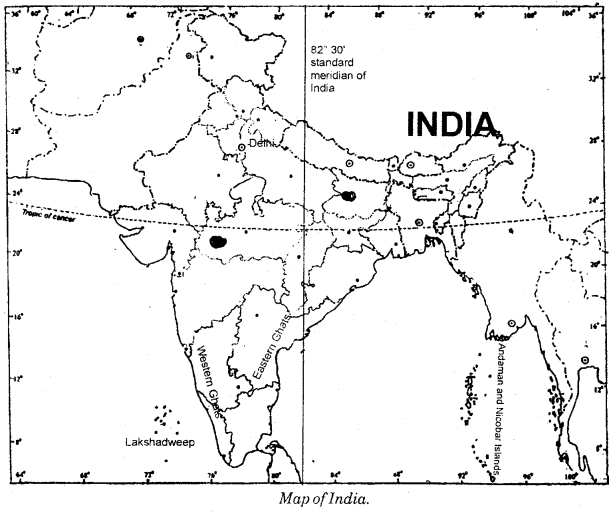
The Earth rotates about 360° in 24 hours, i.e., 1° in 4 minutes. Each degree of longitudes corresponds to a difference of four minutes. The standard meridian of India is 82° 30’E, and that of London is 0°. This means a difference of 4 minutes x 82.5 = 330= minutes = 5.5 hours. So when it is 12:00 noon in London, it is 5.30 p.m in India.

HBSE 6th Class Social Science Solutions Geography Chapter 2 Globe: Latitudes and Longitudes

Question 2.
Tick the correct answers:
(а) The value of the prime meridian is:
(i) 90°
(ii) 0°
(iii) 60°
Answer:
(ii) 0°

(b) The frigid zone lies near:
(i) the Poles
(ii) the Equator
(iii) the Tropic of Cancer
Answer:
(i) the Poles

(c) The total number of longitudes are:
(i) 360°
(ii) 180°
(iii) 90°
Answer:
(i) 360°

(d) The Antarctic circle is located in:
(i) the Northern hemisphere
(ii) the Southern hemisphere
(iii) the Eastern hemisphere
Answer:
(ii) the Southern hemisphere

(e) Grid is a network of:
(i) parallels of latitudes and meridians of longitudes
(ii) the Tropic of Cancer and the Tropic of Capricorn
(iii) the North Pole and the South Pole
Answer:
(i) parallels of latitudes and meridians of longitudes

Question 3.
Fill in the blanks:

  1. The Tropic of Capricorn is located at _________.
  2. The Standard Meridian of India is _________.
  3. The 0° Meridian is also known as _________.
  4. The distance between the longitudes decreases towards _________.
  5. The Arctic Circle is located in the _________ hemisphere.

Answer:

  1. 23 1/2° S
  2. 821/2°E
  3. Prime Meridian
  4. Poles
  5. Northern.

THINGS TO DO

Question 4.
Draw a diagram of the globe showing the earth’s axis, the Equator, Tropics of Cancer and Capricorn, Arctic Circle and Antarctic Circle.
Answer:
HBSE 6th Class Social Science Solutions Geography Chapter 2 Globe Latitudes and Longitudes IMG 1

HBSE 6th Class Geography Globe: Latitudes and Longitudes Important Questions and Answers

Very Short Answer Type Questions

Question 1.
What are the two halves of the earth known as?
Answer:
The northern half of the earth is known as northern hemisphere and the southern half of the sun is known as southern hemisphere.

Question 2.
Why is equator considered as an important reference point to locate places to the earth?
Answer:
The equator is considered as an important reference point to locate places on the earth because equator divides the earth into equal halves.

HBSE 6th Class Social Science Solutions Geography Chapter 2 Globe: Latitudes and Longitudes

Question 3.
Give reason : Torrid Zone receives the maximum heat.
Answer:
Torrid Zone receives the maximum heat because the mid-day sun is exactly overhead at least once a year on all latitudes in between the Tropic of Cancer and the Tropic of Capricorn.

Question 4.
Which imaginary line divides the earth into two halves?
Answer:
The equator divides the earth into two equal halves.

Question 5.
Where does the Temperate Zone lie?
Answer:
The Temperate Zone lies between Tropic of Cancer and Arctic Circle in Northern Hemisphere and Tropic of Capricorn and Antarctic Circle in Southern Hemisphere.

Short Answer Type Questions

Question 1.
How are meridians numbered?
Answer:
The meridian which passes through Greenwich, i.e., Prime Meridian is valued as 0° longitude and from it we count 180° eastward as well as 180° westward.

Question 2.
A day and night cricket match between India and England had started at 2 p.m in London. At what time would the match begin in India? How would you calculate?
Answer:
The match would begin in India at 7:30 p.m. India located east of Greenwich at 82°30′ E is 5 hours 30 minutes ahead of GMT. So it will be 7:30 p.m in India when it is 2:00 p.m in London.

Question 3.
What are heat zones?
Answer:
Heat zones are the different zones of the earth, where the sun’s rays fall differently, this causing different climate patterns these zones are called the Torrid Zone, the two Temperate Zones, and the two Frigid Zones. The Torrid Zone in very hot since the sun shines overhead here. The Temperate Zones maintain a moderate climate and the Frigid Zones are extremely cold.

HBSE 6th Class Social Science Solutions Geography Chapter 2 Globe: Latitudes and Longitudes

Question 4.
Write four features of globe?
Answer:

  • Globe is a true model (miniature form) of the earth.
  • Globes may be of varying size and type – big ones, which cannot be carried easily, small pocket globes, and globe- like balloons which can be inflated and are handy and carried with ease.

Long Answer Type Questions

Question 1.
What is the difference between the local time and the standard time?
Answer:
When the sun reaches the highest point in the sky, while crossing the meridian of any places it is noon (12.00). At some places watches are adjusted according to this time. It will be known as local time. Places having the same meridian of longitude have the same local time.

Standard Time : In countries with a large east-west extent, the variation in local time is very great. It creates confusion over train timings, flight timings etc. To solve this problem, the local time of a particular meridian is taken as the standard time for entire region of the country.

Question 2.
Which are the important parallels of latitude?
Answer:
Besides the equator, there are four other important parallels of latitude which have been given special names :
1. Tropic of Cancer : It is an important parallel in the Northern Hemisphere. It is an angular distance of 231/2° N (23° 30′ N) from the equator. It is important because it makes the northernmost limit of overhead sun.

2. Tropic of Capricorn : It makes the southernmost of overhead sun. Its angular distance is 23° 30′ S from the equator.

3. Arctic Circle (66V6°N) : It lies at a distance of 66°30′ N of the equator. It is also important because on this parallel we have 24 hours daylight on 21st June.

4. Antarctic Circle (66°30’S) : It is also an important parallel because on this we have 24 hours daylight on 22nd December.

Question 3.
What is Standard Time? What is the need for the Standard time?
Answer:
The local time of standard meridian of a country is called standard time. The different meridians have different local times. This is bound to create problems for people to function. For example, train time, flight schedules which cross several longitudes will be difficult to prepare. For example, There will be a difference of about 1 hour and 45 minutes in the local times Dwarka in Gujarat and Dibrugarh in Assam. To maintain uniformity in time throughout the country the standard time is needed. In India 82° 30′ E meridian is considered for the purpose of standard time. The local times as per this meridian is followed all over the country.

HBSE 6th Class Social Science Solutions Geography Chapter 2 Globe: Latitudes and Longitudes

Globe: Latitudes and Longitudes Class 6 HBSE Notes

  • Latitude : The angular distance of a place north or south of the equator.
  • Longitude : The angular distance of a place east or west of the Prime Meridian.
  • Globe : Globe is a man-made model of the earth.
  • Equator : The imaginary line of 0° latitude encircling the earth and passing the half way between the North and South Pole.
  • Tropic of Capricorn : It is the parallel of 231/2° S in Southern Hemisphere. .
  • Tropic of Cancer : It is the parallel of 231/2° N in the Northern Hemisphere.
  • Torrid Zone : The region that receives the maximum amount of heat throughout the year is Torrid Zone.
  • Prime Meridian: The longitude running through the Greenwich near London was first chosen as Prime Meridian.
  • Local Time : It is the time by the position of the sun at noon of a place.
  • Standard Time : Time fixed at the Central Meridian which is considered the Standard Time of that country.
  • Heat Zones: Heat zones are the different zones of the earth, where the sun’s rays fall differently, thus causing different climate patterns.
  • Standard Time : Standard time of a country or region is the time regarded as a standard for that place, despite the fact that there exists time difference geographically across that region.

HBSE 6th Class Social Science Solutions Geography Chapter 2 Globe: Latitudes and Longitudes Read More »

HBSE 6th Class Social Science Solutions History Chapter 6 Kingdoms, Kings and An Early Republic

Haryana State Board HBSE 6th Class Social Science Solutions History Chapter 6 Kingdoms, Kings and An Early Republic Textbook Exercise Questions and Answers.

Haryana Board 6th Class Social Science Solutions History Chapter 6 Kingdoms, Kings and An Early Republic

HBSE 6th Class History Kingdoms, Kings and An Early Republic Textbook Questions and Answers

LET’S RECALL

Question 1.
State whether true or false:

  1. Rajas who let the Ashvamedha horse pass through their lands were invited to the sacrifice.
  2. The charioteer sprinkled sacred water on the king.
  3. Archaeologists have found palaces in the settlements of the janapadas.
  4. Pots to store grain were made out of Painted Grey Ware.
  5. Many cities in Mahajanapadas were fortified.

Answer:

  1. True
  2. False
  3. False
  4. False
  5. True

HBSE 6th Class Social Science Solutions History Chapter 6 6 Kingdoms, Kings and An Early Republic

Question 2.
Fill in the chart given below with the terms:
hunter-gatherers, farmers, traders, crafts persons,herders
Those who paid the Taxes
HBSE 6th Class Social Science Solutions History Chapter 6 Kingdoms, Kings and An Early Republic-1
Answer:
HBSE 6th Class Social Science Solutions History Chapter 6 Kingdoms, Kings and An Early Republic-2

Question 3.
Who were the groups who could not participate in the assemblies of the ganas?
Answer:
(i) Women
(ii) Dasas and
(iii) Kammakaras (or so called shudras) were three groups who could not participate in the assembly of the ganas or the sangas.

LET’S DISCUSS

Question 4.
Why did the rajas of mahajanapadas build forts?
Answer:
The rajas of mahajanapads built forts because:
(a) People were afraid of attacks from other kings and needed protection.
(b) Some rulers wanted to show how rich and powerful they were.
(c) The land around the people living inside the fortified area could be controlled more easily by the king.

HBSE 6th Class Social Science Solutions History Chapter 6 6 Kingdoms, Kings and An Early Republic

Question 5.
In what ways are present day elections different from the ways in which rulers were chosen in Janapadas?
Answer:
Rulers in Janapadas:
(a) Some of the rajas were chosen by jana, the people.
(b) Around 3000 years ago, some men became recognised as rajas by performing very big sacrifices.
(c) The rulers were only of Kshatriya class.
Present Day Elections:
(а) Presently leaders are elected democratically.
(b) Their position is not hereditary and can belong to any caste or tribe.
(c) Today, each adult citizen has the right to vote and the government is decided by elections in which each citizen casts his vote.

LET’S DO

Question 6.
Find the state in which you live in the political map of India. Were there any Janapadas in your state? If yes, name them. If not, name the Janapadas that would have been the closest to your state and mention whether they were to the east, west, north or south.
HBSE 6th Class Social Science Solutions History Chapter 6 Kingdoms, Kings and An Early Republic-3
Answer:
Mark the state and then find out the janapadas in your state. For example:
The janapadas’ in the present’day Uttar Pradesh – Panchala, Kosala.

Question 7.
Find out whether any of the groups mentioned in answer 2 pay taxes today.
Answer:
The groups mentioned in answer 2 who pay taxes today are traders.

Question 8.
Find out whether the groups mentioned in answer 3 have voting rights at present.
Answer:
Today, voting rights are not decided by gender or profession. Women, kammkaras and dasas – all are entitled to vote today.

HBSE 6th Class Social Science Solutions History Chapter 6 6 Kingdoms, Kings and An Early Republic

Very Short Answer Type Questions

Question 1.
What was the ashvamedha sacrifice?
Answer:
It was a horse sacrifice, performed a ruler after the other rajas had accepted his supremacy and authority.

Question 2.
What was the role of the charioteer of king in the horse sacrifice?
Answer:
The charioteer of the king who was champion of the king in battle field, chanted tales of his glory in the sacrifice.

Question 3.
What is painted grey ware?
Answer:
Painted grey ware was a special kind of pottery, which had painted designs, usually simple lines and geometric pattern. Plates and bowls were the most common vessels made. They are extremely fine to touch, with a smooth surface. They were used on special occasions to serve food.

Question 4.
Who were ‘untouchable’?
Answer:
The ‘untouchable’ were crafts persons, hunters and gatherers as well as people who helped perform burials and cremations.

HBSE 6th Class Social Science Solutions History Chapter 6 6 Kingdoms, Kings and An Early Republic

Question 5.
What is the literal meaning of the word ‘janapadas’?
Answer:
The literal meaning of the word janapada is – where the jana set its foot and settled

Short Answer Type Questions

Question 1.
How were the varnas determined? Write about them.
Answer:
Varnas were determined on the basis of birth e.g., if one’s father and mother were Brahmins one could automatically become a Brahmin and so on. Later they classified some people as untouchables. They included crafts persons, hunters and gatherers. The priests said that the contact with these groups was polluting.

Question 2.
How were the armies maintained by the rajas?
Answer:
(i) Soldiers were paid regular salaries and maintained by the king throughout the year.
(ii) Some payments were made to the soldiers using punch marked coins.

Question 3.
Why did rajas of Mahajanapadas start collecting regular taxes?
Answer:
Rajas of Mahajanapadas started collecting taxes because the resources were needed for:
(a) building huge forts
(b) maintaining big armies.

HBSE 6th Class Social Science Solutions History Chapter 6 6 Kingdoms, Kings and An Early Republic

Question 4.
How was ‘ashvamedha’ ritual conducted?
Answer:
The ‘ashvamedha’ (horse sacrifice) was the ritual used to recognise men as ‘rajas’. A horse was left to wander freely. If it wandered into another kingdom and the king of that kingdom stopped it, they had to fight. The ‘raja’ who succeeded in the challenge was recognised as stronger. He would then perform the sacrifice in which other kings would also come.

Long Answer Type Questions

Question 1.
Explain the system of Varnas of the later Vedic period.
Answer:
The Four Varnas: The priests divided people of the ancient India (or Later Vedic Age) into four groups, called Varnas. According to them, each Varna had a different set of functions to perform.
1. The Brahmins:
The first varna was that of the brahmin. Brahmins were expected to study (and teach) the Vedas, perform sacrifice and receive gifts.

2. The Kshatriyas:
In the second place were the rulers, also known as Kshatriyas. They were expected to fight battles and protect people.

3. The Vishs or Vaishyas:
Third were the Vishs or the Vaishyas. They were excepted to be farmers, herders, and traders. Both the Kshatriyas and the Vaishyas could perform sacrifices.

4. The Shudras:
Last were the shudras, who had to serve the other three groups and could not perform any rituals. Generally, women were also grouped with the shudras. Both women and shudras were not allowed to study the Vedas.

HBSE 6th Class Social Science Solutions History Chapter 6 6 Kingdoms, Kings and An Early Republic

Question 2.
What changes took place in agriculture around this time?
Answer:
There were two significant changes in agriculture around this time:
(i) Growing use of iron plough-shares helped in yielding a better grain produce. Heavy, clayey soil could be turn better with an iron plough-share than with a wooden plough-share.
(ii) People began transplanting paddy. This meant that instead of scattering seed on the ground, from which plants would sprout, saplings were grown and then planted in the fields. Production developed due to this since many plants survived.

Question 3.
How did magadha become the most important Mahajanapada?
Answer:
Magadha became the most important Mahajanapada due to various reasons. They are:
(i) Many rivers such as the Ganga and son flowed through the Mahajanapada. This was important for transport, water supply and made the land fertile.
(ii) Elephants which lived in the forest, could be captured and trained for the army. Forests also provided wood for building houses, carts and chariots.
(iii) Iron ore mines in the region could be tapped to make strong tools and weapons.

HBSE 6th Class Social Science Solutions History Chapter 6 6 Kingdoms, Kings and An Early Republic

What Books and Burials Tell Us Class 6 HBSE Notes

  • Kingdom: A form of government in which a country is ruled by a king or a queen.
  • Republic: A form of government in which power is held by the people or a group of elected persons or an elected chief.
  • Oligarchy: An oligarchy is a government by the chosen few.
  • Ambassador: An official representing the Government of his country in a foreign country.
  • Amatyas: Ministers.
  • Barter system: Exchange of goods.
  • Janapads: Small states mainly ruled by tribals.
  • Mahajanpadas: Large kingdoms comprising many kingdoms.
  • Senapati: Chief of the army.
  • Gramika: Headman of the village.
  • Monarchy: State (kingdom) ruled by hereditary king.
  • Shreni: A group of merchants and craftsmen following the same trade.
  • Taxes: Taxes were the source of Income for any government. To perform various functions government collects money in the form of taxes i.e., Road tax, and property tax. etc.
  • Varnas: Classification of people into four groups (Brahmins, Kshatriya, Vaishya, and the Shudras) on the basis of occupation were called Varnas.
  • Ashvamedha: It means unquestioned control over an area in which the royal horse moves uninterruptedly. In the Vedic period, the king’s strength was influenced by these rituals.
  • Matrimonial alliance: A relationship based on marriage.

HBSE 6th Class Social Science Solutions History Chapter 6 Kingdoms, Kings and An Early Republic Read More »

HBSE 6th Class Social Science Solutions History Chapter 5 What Books and Burials Tell Us

Haryana State Board HBSE 6th Class Social Science Solutions History Chapter 5 What Books and Burials Tell Us Textbook Exercise Questions and Answers.

Haryana Board 6th Class Social Science Solutions History Chapter 5 What Books and Burials Tell Us

HBSE 6th Class History What Books and Burials Tell Us Textbook Questions and Answers

LET’S RECALL

Question 1.

SuktaStone boulder
ChariotsSacrifice
YajnaWell-said
DasaUsed in battles
MegalithSlave

Answer:

SuktaWell-said
ChariotsUsed in battles
YajnaSacrifice
DasaSlave
MegalithStone boulder

HBSE 6th Class Social Science Solutions History Chapter 5 What Books and Burials Tell Us

Question 2.
Complete the sentences

  1. Slaves were used for ………………. .
  2. Megaliths are found in ……………… .
  3. Stone circles or boulders on the surface were used to ………… .
  4. Port-holes were used for ……………. .
  5. People at Inaingaon ate ………………. .

Answer:

  1. various kind of work
  2. Deccan in the north, east and Kashmir
  3. cover to burial places
  4. entering the burial places
  5. fruits, cereals and meat

LET’S DISCUSS

Question 3.
In what ways are the books we read tuday different from Rig Veda?
Answer:
Rig Veda Books:
Itistheearliest Vedas composed by Aryans and has 1028 hymns (songs in praise of god), Rigveda is the main source of information about vedic culture, which gives us the information about social, religious, and economic life of the people. These vedas were composed orally and passed orally too.

Modern Books:
Today books contain doses of scientific and technical knowledge along with religious and ethical values. Knowledge is passed through various methods-visually, orally. It is written, read and dictated.

Question 4.
What kind of evidence from burials do archaeologists use to find out whether there were social differences amongst those who were buried.
Answer:
The objects found in graves were usually different and vaned. They found different types of skeleton. In Brahinagiri, one skeleton was found with numerous jewels. On the other hand, some skeletons were found only with a few pots. This shows that economic and social difference existed even in those time. While some were poor, others enjoyed luxurious life.

HBSE 6th Class Social Science Solutions History Chapter 5 What Books and Burials Tell Us

Question 5.
In what ways do you think that the life of a raja was different from that of a dasa/dasi?
Answer:

Life of a DasaLife of a Raja
1. He wiuj the slave of the tribe.1. He was the king of the tribe.
2. They were men and women captured in war.2. They were monarchial and sometimes rulers or elected kingdoms.
3. They could not perform any tasks of their choice.3. They made the slaves to do tasks of their choice.
4. He belongs to the lower section of society.4. He belong to upper section of society.
5. Life is full of difficulties.5. Life is luxurious.

LET’S DO

Question 6.
Find out whether your school library has a collection of books on religion, and list names of five books from this collection.
Answer:
The five books on religion are :
(1) Sikhs – Guru Granth Sahib
(2) Zorastrianism – Zend-ei-Avesta
(3) Islam – Quran
(4) Christians – Bible
(5) Judaism – Old Testament

Question 7.
Write down a short poem or song that you have memorised. Did you hear or read the poem or song ? How did you learn it by heart?
Answer:
आओ बच्चों तुम्हें दिखाएँ,
झाँकी हिंदुस्तान की।
इस मिट्टी से तिलक करो,
यह धरती है बलिदान की।
We heard the poem and learnt it by heart with the help of a teacher.

Question 8.
In the Rigveda, people were described in terms of the work they did and the languages they spoke. In the table below fill the names of six people you know, choosing three men and three women. For each of them mention the work they do and the languages they speak. Would you like to add else to the description?

NamesWorkLanguagesAnything else
1.
2.
3.
4.
5.
6.

Answer:

NamesWorksLanguagesAnything else
1. Teachers in my school (Female)TeachingEnglish and HindiSometimes they act the scene with the help of the children.
2. Doctors (Made) Gives medical treatmentGive medical treatmentGenerally Hindi, sometimes EnglishExamines the body part, gives medicine and sometimes a dose of injection.
3. Vegetable sellers (Male)Sells vegetableHindiUse haggling and tries to give less weight.
4. Maid-servant (Female)Does households workHindiSometimes cooks food and very often absents herself.
5. Driver (Male)Drive our carsHindiDrops us to school, takes use to any other places.
6. Sales girl in the shop (Female)Displays the goods in the shops and show them to customersHindi and EnglishGossips a lot. Tries to sell the goods as quickly as possible.

HBSE 6th Class Social Science Solutions History Chapter 5 What Books and Burials Tell Us

HBSE 6th Class History What Books and Burials Tell Us Important Questions and Answers

Very Short Answer Type Questions

Question 1.
Where is the Great Bath located?
Answer:
Mohenjadaro.

Question 2.
Name the four Vedas?
Answer:
(i) Rigveda
(ii) Samaveda
(iii) Yajurveda
(iv) Atharvaveda.

Question 3.
Name the oldest Veda when was it composed.
Answer:
The oldest Veda is the Rigveda composed about 3500 years ago.

Question 4.
Which two epics lead to later Vedic age being called as Epic age?
Answer:
(i) Ramayana
(ii) Mahabharata.

Question 5.
Name the four vamas into which Aryan society is divided?
Answer:
HBSE 6th Class Social Science Solutions History Chapter 5 What Books and Burials Tell Us-1

Question 6.
Where was the Rigveda being composed?
Answer:
Rigveda was being composed in the north-west part of subcontinent.

HBSE 6th Class Social Science Solutions History Chapter 5 What Books and Burials Tell Us

Short Answer Type Questions

Question 1.
Who composed and taught the hymns of the Rigveda? In what language is it written?
Answer:
The hymns were composed by the sages (rishis). Priest taught students to recite and memorise with great care. Most of the hymns were composed, taught and learnt by men. Few were composed by women. The Rigveda is written in vedic Sanskrit.

Question 2.
Name the two type ofburials. Write about them.
Answer:
The two type of burials are:
(i) Some megaliths can be seen on the surface, they are either surrounded by circle of stones or a single big megalith.
(ii) The other type of burial is in the cist, which are burials under ground. There were portholes to which were used as an entrance.

Question 3.
What was the wealth from the battles spent on?
Answer:
(a) Some of the wealth that was obtained was kept by leaders, some was given to the priests and the rest was distributed amongst the people.
(b) Some wealth was used for the performance of yajnas or sacrifices in which offerings were made into the fire. These were meant for gods and goddesses. Offerings could include ghee, grain, and in some cases animals.

HBSE 6th Class Social Science Solutions History Chapter 5 What Books and Burials Tell Us

Question 4.
Why people participated in wars?
Answer:
Most men took part in these wars. There was no regular army, but there were assemblies where people met and discussed matters of war and peace. They also choose leaders, who were often brave and skilful warriors.

Question 5.
What is a cist and porthole?
Answer:
When the burial places are underground, they are called ‘cist’. At some places many skeletal remains have been found in one megaliths. They were brought through the portholes, which was used as an entrance.

Question 6.
What evidence have archaeologists found that can lead us to the occupations performed by people at the Inamgaon?
Answer:
Archaeologists have found seeds of wheat, barley, rice, pulses, millets, peas and sesame. Bones of a number of animals, many bearing cut marks that show they may have been used as food, have also been found. These include cattle, buffalo, goat, sheep, dog, horse, ass, pig, sambhar, spotted deer, blackbuck, antelope, hare and mongoose, besides birds, crocodile, turtle, crab and fish. There is evidence that fruits such as ber, amla, jamun, dates and a variety of berries were collected.

HBSE 6th Class Social Science Solutions History Chapter 5 What Books and Burials Tell Us

Long Answer Type Questions

Question 1.
How was community been depicted in the Rigveda as a whole?
Answer:
Some of the words used to describe people in the Rigveda.
(a) There are two groups who are described in terms of their work-the priests, sometimes called brahmins, who performed various rituals and the rajas.

(b) Two words were used to describe the people or the community as a whole. One was the word jana, which we still use in Hindi and other languages. The other was vish. The word vaishya come from vish.

(c) Sometimes, the people who composed the hymns described themselves as Ary as and called their opponents Dasas or Dasyus.

Question 2.
How do the archaeologists find out that the skeletal remain is of a men, women or a child?
Answer:
The archaeologists can find out that:
(i) It is easy to make out the skeleton of a child from its small size. However there are no major differences in the bones of a girl and a boy.

(ii) Sometimes, people decide on the basis of what is found with the skeleton e.g. if the skeleton is found with jewellery, it is sometimes thought to be that of a woman. However there are problems. Often men also wore ornaments.

(iii) A better way of finding out the sex of a skeleton is to look at the bone structure the hipour the pertic area of the women is generally larger to enable child bearing.

HBSE 6th Class Social Science Solutions History Chapter 5 What Books and Burials Tell Us

Question 3.
What are oracles? Why did the rulers in China consult the fortunetellers? Write about the way of living of the rulers.
Answer:
Around 3500 years ago, people in China knew about writing. They wrote on animal bones. These writings were called oracle bones, because they were used to predict the future. Kings got scribes write questions on the bones – would they win battle? Would they have a good harvest? The bones were then put into the fire and they cracked because of the heat. Then fortune-tellers studied the cracks and tried to’predict the future.

The kings lived in palaces in cities. They amassed vast quantities of wealth, including large elaborately decorated bronze vessels. However, they did not know about the iron.

HBSE 6th Class Social Science Solutions History Chapter 5 What Books and Burials Tell Us

What Books and Burials Tell Us Class 6 HBSE Notes

  • Veda : The oldest books that represent the culture and ethics of Indian land.
  • Hymns : Songs sung in the praise of a god or goddess.
  • Chariot : The transport used by kings and queens or royal persons to travel from one place to another driven by horses or elephants.
  • Sacrifice : To let off something that may be of need to you.
  • Raja : (Here), the upper-class society who possessed rich luxuries.
  • Slave : (Here), men and women captured in war.
  • Burial : A site where a person is buried after his/her death.

HBSE 6th Class Social Science Solutions History Chapter 5 What Books and Burials Tell Us Read More »

HBSE 6th Class Social Science Solutions History Chapter 7 New Questions and Ideas

Haryana State Board HBSE 6th Class Social Science Solutions History Chapter 7 New Questions and Ideas Textbook Exercise Questions and Answers.

Haryana Board 6th Class Social Science Solutions History Chapter 7 New Questions and Ideas

HBSE 6th Class History New Questions and Ideas Textbook Questions and Answers

Let’s Recall

Question 1.
Describe the ways in which the Buddha tried to spread his message to the people.
Answer:
Buddha tried to spread his message of being kind and respecting the lives of people in the following ways:

  • Buddha taught the people Prakrit, which was the language of the ordinary people so that it was understood by ordinary people.
  • He also encouraged people to think for themselves rather to simply accept what he said.
  • Buddha moved from place to place to give his message to all the people.
  • Buddha himself led a simple life so that people could follow him.

Question 2.
Write whether true or false :

  • The Buddha encouraged animal sacrifices.
  • Sarnath is important because it was the place where Buddha taught for the first time.
  • The Buddha taught that Karma has no effect on our lives.
  • The Buddha attained enlightenment at Bodh Gaya.
  • Upanishadic thinkers believe that raja ‘ and brahmin were ultimately one.

Answer:

  • False
  • True
  • False
  • True
  • True

HBSE 6th Class Social Science Solutions History Chapter 7 New Questions and Ideas

Question 3.
What were the questions that upanishadic thinkers wanted to answer?
Answer:
The questions which upanishadic thinkers wanted to answer were :

  • They wanted to know about life after death.
  • They wanted to know why sacrifices should be performed.
  • They believed that there was something permanent in the universe that would last even after death. They described this as ‘atman’ or individual soul.
  • They believed that ultimately both the atman and the brahman were one.

Question 4.
What were the main teachings of the Mahavira?
Answer:
The main teachings of Mahavira were:

  • Men and women who wished to know the truth must leave their homes.
  • Men and women must follow very strictly the rules of ahimsa, i.e., not hurting or killing living beings.
  • All beings long to live. To all things life is dear.

Let’s Discuss

Question 5.
Why do you think Anagha’s mother wanted her to know the story of Buddha?
Answer:
Anagha’s mother wanted her to know about the story of the Buddha because she was going on a school trip to Varanasi. Varanasi has many places like Sarnath, which are closely related to the life of Buddha. It would have enriched her knowledge about one of the greatest teacher and preacher of ancient times.

Question 6.
Do you think it would have been easy for slaves to join the ‘sangha’ ? Give reasons for your answers.
Answer:
Yes, slaves can join ‘Sangha’. Buddhism doesn’t believe in casteism. Any person who was ready to act on Buddhist Rule can join Sangha. Slaves can only join Sanghas, when he got the permission of his master and debtors that of his creditors.

Let’s Do

Question 7.
Make a list of at least five ideas and questions mentioned in this lesson.
Choose three from the list and discuss why you think they are important even today.
Answer:
The list of five ideas and questions mention in this lesson is given below:

  • What was the languages used to compose Vedas?
  • What was Buddha trying to teach the sorrowing Kisagotami?
  • How did the beggar convince the sages to share their food?
  • What are the varnas mentioned here? Were all four varnas allowed to participate in the ashrams?
  • What does the Buddhist texts tell us?

Discussion:

  • Sanskrit was the language used to compose Vedas. She is the mother of all ancient languages.
  • He was trying to teach the sorrowing Kisagotami that death is the part of life and there is life after death.
  • The Buddhist texts tells us that the varnas and ranks system will vanish if the followers of Buddha join the order of monk.

HBSE 6th Class Social Science Solutions History Chapter 7 New Questions and Ideas

Question 8.
Find out more about men and women who renounce the world today. Where do they live, what kind of clothes do they wear, what do they eat ? Why do they renounce the world ?
Answer:
Make the chart with the help of your class teacher and hang it on the wall of your class room. You can write about any person who renounce the society, the country and the whole world. For your help some clues are given below:

Renounce: One who gives worldly pleasure. Try to find out the man/woman who does that work. Write his standard of living, where does he live and what he eats. In the end conclude that whatever they were capable to renounce the world or they are doing so.

HBSE 6th Class History New Questions and Ideas War Important Questions and Answers

Very Short Answer Type Questions

Question 1.
Who were the supporters of traders. It spread to different parts of north India Jainism? Where did it spread in India? and to Gujarat, Tamilnadu and Karnataka.
Answer:
Jainism was mainly supported by traders. It spread to different parts of north India and to Gujarat, Tamilnadu and Karnataka.

Question 2.
Who later developed the upanishadic ideas?
Answer:
Upanishadic ideas were later developed by the famous thinker Shankaracharya.

Question 3.
What are Upanishads?
Answer:
‘Upanishad’ literally means approaching and sitting near and the text of Upanishads contains conversations between teachers and students.

Question 4.
Who were the upanishadic thinkers and teachers?
Answer:
Most upanishadic thinkers and teachers were men, especially brahmins and rajas. Some women thinkers like Gargi, Who was famous for learning, also participated in debates held in the royal court. Poor people did not take part in the discussions. One such exception was Satyakama Jabala, the son of the slave mother Jabala.

Question 5.
Why did farmers find it difficult to follow the rule of Jainism?
Answer:
Farmers found it difficult to follow the rules of Jainism because they had to kill insects to protect their crops.

HBSE 6th Class Social Science Solutions History Chapter 7 New Questions and Ideas

Short Answer Type Questions

Question 1.
Where were the changes in the lives of people about 2500 years ago?
Answer:

  • Some kings in the Mahajanapadas were growing more powerful.
  • New cities were developing.
  • Life was changing in the cities as well.

Question 2.
How did Buddha become enlightened?
Answer:
When Buddha was young, he wanted to gain knowledge and for that purpose, he left the comforts of his home. He wandered for several years meeting and holding discussions with other thinkers. He, then mediated for days under a peepal tree at Bodh Gaya in Bihar. There he became enlightened.

Question 3.
What did Buddha tell why is life full of suffering and unhappiness?
Answer:
According to Buddha life is full of suffering and unhappiness because we have carings and desires. Sometimes even if we get what we want, we are not satisfied.

Question 4.
What kind of life did the followers of Mahavira have to live?
Answer:

  • The followers of Mahavira had to lead very simple lives, begging for food.
  • They had to be absolutely honest.
  • They were especially asked not to steal.
  • They had to observe celibacy.
  • Men had to give up everything, including their clothes.

Question 5.
Who could join Sangha?
Answer:

  • All men could join the Sangha.
  • Children had to take permission of their parents and slaves that of their masters.
  • The king’s workers and the debtors had to take permission of the king and the creditors respectively.
  • Women had to take the permission of their husbands.

Question 6.
Why were monasteries built?
Answer:
To begin with, both Jaina and Buddhist monks went from place to place throughout the year, teaching people about their religions. The only time they stayed in one place was during the rainy season, when it was very difficult to travel.

As time passed on, the supporters of the monks built temporary shelters for them in gardens or they lived in natural caves in hilly areas. Then, several supporters of monks and nuns and they themselves, felt the need for more permanent shelters. So, monasteries were built.

HBSE 6th Class Social Science Solutions History Chapter 7 New Questions and Ideas

Question 7.
What were the four ashrams prescribed ? How did the system of ashrams help men and women?
Answer:
The four ashrams were :

  • Brahmacharya : The early years of life when Brahmin, Kshatriya and Vaishya were supposed to lead simple life.
  • Grihastha : They had to marry and live as householders.
  • Vanaprastha : They had to live in the forest and mediate.
  • Sanyasins : They had to give up everything.

The system of ashrams allowed men to spend some part of their lives in mediation. Women had to follow the ashrams chosen by their husbands.

Long Answer Type Questions

Question 1.
Compare and contrast Buddhism and Jainism.
Answer:
Compare:

  • Both ignored the ideas of God and laid great stress upon a pure and moral life.
  • Both laid stress on the effects of good and bad deeds upon a man’s future birth and ultimate salvation.
  • Both opposed the caste system and inequalities among men.
  • Both preached Ahimsa or non-violence.
  • Both the Buddha and Mahavira were Kshatriya princess, who founded Buddhism and Jainism.
  • Both preached their religions in the simple languages of the people.

Contrast:

  • Jainism laid greatest stress upon asceticism and practised it in a very vigorous manner, whereas Buddhism discarded it and asked his followers to follow the middle path.
  • The Jains see life even in stones and plants while the Buddhists care only for men and animals who should not be injured or killed.
  • Both differ in fundamental conceptions about salvation. The Jain’s conception of soul is radically different from the Buddhist.
  • The Buddha kept silent about God, while Mahavira denied the existence of the creator.
  • Both have separate scriptures. The Jain scripture is called ‘Angas’ while the Buddhists have ‘Tripitikas’.

Question 2.
What are the basic differences between the principles of Buddhistic sects of  Mahayana and Hinayana?
Answer:

MahayanaHinayana
1. They treated Lord Buddha as a deity and worshipped his idol.1. They treated the Lord Buddha as a symbol, of idealism and purity.
2. They overstressed belief and devotion.2. They believed the religious teachings only after getting it confirmed on the basis of debate.
3. They used Sanskrit.3. Their entire literature was in Pali language.

Question 3.
What were the rules made for the Buddhist sangha?
Answer:
The rules made for the Buddhist sangha are written down in a book cabled Vinaya Pi taka. From this we know that there were separate branches for men and women. All men could join the sangha. However, children had to take the permission of their parents, women of their husbands and slaves of their masters. Men and women who joined the sangha had to lead a simple life. They meditated for most of the time and wyent to cities to beg for food during fixed hours. That is why, they were known as bhikkhus (beggars) and bhikkunis. They taught others and helped one another. They held meetings to settle any quarrels within the sangha. Most of them wrote down the teachings of Buddha and composed poems describing the life of the sangha.

New Questions and Ideas Class 6 HBSE Notes

  • Tanha : Thirst or trishna is called tanha. It is lust, to have more and more in life.
  • Prakrit: It was the language of the ordinary people. The Buddha taught his disciples and- other people through this language so that everybody could understand his message.
  • Upanishad : These are the philosophical books of the Hindus. These were part of the later Vedic texts.
  • Upanishad literally means ‘approaching and sitting near’ and the texts contain conversations between teachers and students.
  • Atman : It means soul or individual soul. It is something permanent in the universe. It would last even after the death.
  • Brahman : It means the universal soul. Individual’s soul is part of Brahma. Indian thinkers believe that ultimately, both the atman and the Brahman are one.
  • Ahimsa: The Jain rule of ahimsa means not hurting or killing living beings.
  • Viharas: The monasteries where monks lived were called Viharas.
  • Buddhism: The religion founded by the Buddha (Gautama/Siddhartha) was Buddhism.
  • Chaitya: A shrine of Buddhism is called Chaitya.
  • Jina: A person who has true knowledge or one who has gained true knowledge.

HBSE 6th Class Social Science Solutions History Chapter 7 New Questions and Ideas Read More »

HBSE 6th Class Social Science Solutions History Chapter 8 Ashoka, The Emperor Who Gave Up War

Haryana State Board HBSE 6th Class Social Science Solutions History Chapter 8 Ashoka, The Emperor Who Gave Up War Textbook Exercise Questions and Answers.

Haryana Board 6th Class Social Science Solutions History Chapter 8 Ashoka, The Emperor Who Gave Up War

HBSE 6th Class History Ashoka, The Emperor Who Gave Up War Textbook Questions and Answers

Let’s Recall

Question 1.
Make a list of the occupations of the people who lived within the Mauryan empire.
Answer:
The list of the occupations of the people who lived within Mauryan empire is given below:
Main occupations:

  • Agriculture
  • Artisans
  • Herdsmen
  • Carpenters
  • Many people employed in royal army
  • Government officials
  • Stone cutting.

Question 2.
Complete the following sentences:

  1. Officials collected _________ from the area under the direct control of the ruler.
  2. Royal princes often went to the provinces as _________.
  3. The Mauryan rulers tried to control _________ and _________ which were important for transport.
  4. People in forested regions provided the Mauryan officials with _________.

Answer:

  1. taxes
  2. Governors
  3. roads, rivers
  4. tribute.

HBSE 6th Class Social Science Solutions History Chapter 8 Ashoka, The Emperor Who Gave Up War

Question 3.
State whether true or false :

  1. Ujjain was the gateway to the north-west.
  2. Chandragupta’s ideas were written down in Arthashastra.
  3. Kalinga was the ancient name of Bengal.
  4. Most Ashokan inscription are in the Brahmi script.

Answer:

  1. False
  2. False
  3. False
  4. True

Let’s Discuss

Question 4.
What were the problems that Ashoka wanted to solve by introducing dhamma?
Answer:
The problems that Ashoka tried to solve by introducing dhamma were:

  • The different religions followed by people led to conflicts.
  • Sacrifice of animals for religion.
  • Ill-treatment given to slaves and servants.
  • Quarrels in families and amongst neighbours.

Question 5.
What were the means adopted by Ashoka to spread the message of dhamma?
Answer:

  • Ashoka appointed officials known as the dhamma mahamatta who went from place 1 to place teaching people about dhamma.
  • Ashoka got his messages inscribed on rocks and pillars, instructing his officials to read his message to those who could not read it themselves.
  • Ashoka sent messengers to spread ideas about dhamma to other lands such as Syria, Egypt, Greece and Sri Lanka.

Question 6.
Why do you think that slaves and servants were ill-treated ? Do you think the orders of the emperor would have improved their condition ? Give reasons for your answer.
Answer:
We think that the slaves and the servants were ill-treated in the society because their masters felt superior to them. The masters treated them as animals. It was because of the old ‘varna’ system. The emperor’s orders might have helped to some extent. Ashoka was a king who was loved by his subjects. Moreover his ‘dhamma’ was a realistic innovation.

HBSE 6th Class Social Science Solutions History Chapter 8 Ashoka, The Emperor Who Gave Up War

Let’s Do

Question 7.
Write a short paragraph explaining Roshan why the lions are shown on our currency notes? List at least one other object on which you see them.
Answer:
If you look at the Ashokan pillar at Samath (or a picture of it) you will find the capital of the pillar that has 4 lions sitting back to back. The lion represents the attainment ofBuddhahood. The four lions suimountiugthe capital symbolize the kingship of the Buddha and his roar over the four directions.

There is also a non-religious interpretation to the symbol, describing the four lions as the symbol of Ashoka’s rule in the four directions. Just as Buddha and his follower Ashoka , wanted to spread the message of peace and friendship, Similarly India after she gained independence wanted to spread the same message. So India adopted the emblem of 4 lions after she gained independence.

We can find this emblems on the cars of the President of India, Prime Minister and the others Indian dignitaries. It can also be seen on the s epaulette.

Question 8.
Suppose you had the power to inscribe your orders, what four commands would you like to issue?
Answer:
I would like to issue the following four commands :

  • Slavery be abolished.
  • Animal sacrifice be banned.
  • Respect and regard the others’ religions.
  • Respect the elders and love the youngsters.

HBSE 6th Class History Ashoka, The Emperor Who Gave Up War Important Questions and Answers

Very Short Answer Type Questions

Question 1.
Who was Megasthenese?
Answer:
Megasthenese was a Greek ambassador who was sent to the court of Chandragupta by the Greek ruler of West Asia named Seleucus Nikator. He left an interesting account about what he saw in the country.

Question 2.
What is a dynasty?
Answer:
When members of the same family become rulers one after another, the family is often called a dynasty.

Question 3.
Who were the dharam mahamatras?
Answer:
Dharam mahamatras were the officials appointed by Ashoka, who went from place to place to teach people about Dhamma.

Question 4.
What was unique about Maury an ruler, Ashoka?
Answer:
Maury an ruler Ashoka was the first ruler who tried to take his message to the people through inscriptions.

HBSE 6th Class Social Science Solutions History Chapter 8 Ashoka, The Emperor Who Gave Up War

Question 5.
Name the only war fought by Ashoka. WTiy did he give up warfare?
Answer:
The only war fought by Ashoka was with Kalinga. It is the ancient name of Coastal Orissa. He won the war after lots ofbloodshed. However, he was so horrified when he saw bloodshed, violence and carnage, that he decided not to fight any more wars. He is the only king in the history of the world to give up warfare after winning the battle.

Short Answer Type Questions

Question 1.
How are empires different from kingdoms?
Answer:

  • Emperors need more resources than kings because empires are larger than kingdoms, and need to be protected by big armies.
  • Empires need a larger number of officials who collect taxes.

Question 2.
How was ‘tribute’ different from regular taxes?
Answer:

  • Taxes – Taxes were collected on a regular basis.
  • Tribute – Tribute was collected as. and when it was possible from people who gave a variety of things, more or less willingly.

Question 3.
How were the provinces governed during the rule of the Mauryas?
Answer:
Each province was rules from the provincial capital such as Taxila or Ujjain. The royal princes were sent as governors, and local customs and rules were observed. There was overall control from Pataliputra.

Question 4.
Write about any three big or promi-nent .cities of the Mauryan empire. Why were these cities popular (or famous)?
Answer:

  • Pataliputra, the capital town of the Mauryan empire. It was main centre of all political activities and administration.
  • Taxila, (now-a-days in modern Pakistan) was a gateway to the northwest, including central Asia.
  • Ujjain, lay on the route from north (India) to south India. Merchants, officials and crafts persons probably lived in all the above mentioned three cities.

Long Answer Type Questions

Question 1.
Where did Megasthenes come from? What did he write bout Chandragupta – his capital, his court, the people and their occupations?
Answer:
Megasthenes was Ambassador of Seleucus Nicator, the ruler of the eastern parts of Alexander’s empire. He was sent to the court of Chandragupta Maurya.

His account: Megasthenes has written that Chandragupta’s court was very magnificient. The king lived in great pomp and show. He personally listened to the grievances of people. He had a very large army too.

According to Megasthenes, Pataliputra was a grand city surrounded by four walls. Most of the buildings were made of wood. The royal : palace was made of stone.

Most of the people were farmers who lived happily in villages. Shepherds and cowherds lived in villages, too. The artisans – weavers, carpenters, ironsmiths and potters live in towns. The trade was quite brisk.

HBSE 6th Class Social Science Solutions History Chapter 8 Ashoka, The Emperor Who Gave Up War

Question 2.
Describe the administration of Mauryan empire.
Answer:

  • The area around Pataliputra was under the direct control of the emperor. The officials were appointed to collect taxes from farmers, herders, crafts persons and traders.
  • Officials punished those who disobeyed ruler’s orders.
  • Messengers went to and fro, and spies kept a watch on the officials.
  • The emperor supervised the officials with the help of members the royal family, and senior ministers.
  • Some areas or provinces were ruled from a provincial capital such as Taxila or Ujjain.
  • In some other vast areas, Mauryas tried to control roads and rivers which were important for transport and to collect whatever resources were available as tax and tribute.

Ashoka, The Emperor Who Gave Up War Class 6 HBSE Notes

  • Provinces : A state of an empire or a part of the vast empire.
  • Dynasty : A series of ruler belonging to the same ruler-class (family).
  • Capital: A city state if an empire is known as capital of the empire.
  • Cavalry : Group of soldiers who fought in battlefield on horseback.
  • Infantry : Soldiers who fought on foot on the battlefield.
  • Dhamma Mahamatyas: Ashoka’s officers travelled around the country and persuaded the people to follow the Dhamma.
  • Edicts : Orders proclaimed by an authority decrees.
  • Dhamma : A code of morality enacted by Ashoka for his people to lead a peaceful and virtuous life.
  • Brahmi : A script used in ancient times in India.
  • Prakrit: A language spoken by the common people in ancient times.

HBSE 6th Class Social Science Solutions History Chapter 8 Ashoka, The Emperor Who Gave Up War Read More »