Class 6

HBSE 6th Class Social Science Solutions History Chapter 9 Vital Villages, Thriving Towns

Haryana State Board HBSE 6th Class Social Science Solutions History Chapter 9 Vital Villages, Thriving Towns Textbook Exercise Questions and Answers.

Haryana Board 6th Class Social Science Solutions History Chapter 9 Vital Villages, Thriving Towns

HBSE 6th Class History Vital Villages, Thriving Towns Textbook Questions and Answers

Question 1.
Fill in the blanks:

  1. ________ was a word used for large landowners in Tamil.
  2. The grama-bhojaka often got his land cultivated by the ________.
  3. Ploughmen were known as ________ in Tamil.
  4. Most grihapatis were ________ landowners.

Answer:

  1. Vellalar
  2. Slaves/hired labourers
  3. Uzhavar
  4. Smaller.

Question 2.
Describe the functions of the Grama-Bhojaka. Why do you think he was powerful?
Answer:
Functions of the Grama-Bhojaka:
The village headman was known as grama- bhojaka and he was the largest land-owner. He had slaves or hired workers to cultivate his land.

  • The king often used him to collect taxes from the village.
  • He also functioned as a judge and also as a policeman.

He was powerful because :

  • he had a close association with the king.
  • he had a strong control over the village.
  • he had the largest land which means he was quite rich and hence had financial power.

HBSE 6th Class Social Science Solutions History Chapter 9 Vital Villages, Thriving Towns

Question 3.
List the crafts person who would have been present in both villages and cities.
Answer:
Carpenters, weavers, potters, black-smiths, goldsmiths etc.

Question 4.
Choose the correct answer:
(а) Ring wells were used for:
1. bathing
2. washing clothes
3. irrigation
4. drainage.
Answer:
4. drainage.

(b) Punch marked coins were made of:
1. silver
2. gold
3. tin
4. ivory.
Answer:
1. silver

(c) Mathura was an important:
1. village
2. port
3. religious centre
4. forested area.
Answer:
3. religious centre

(d) Shrenis were associations of:
1. rulers
2. craftspersons
3. farmers
4. herders.
Answer:
2. craftspersons

Let’s discuss

Question 5.
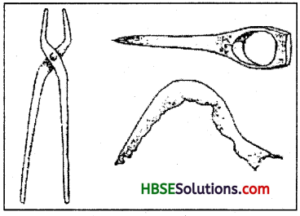
Which of the iron tool shown on page 87 your NCERT Text Book would have been important for agriculture? What would the other tools have been used for?
HBSE 6th Class Social Science Solutions History Chapter 9 Vital Villages, Thriving Towns IMG 1
Answer:
Ploughshares would have been important for agriculture. The other tools used were sickles and axes. The other tools like tongs, nails and hammers were used for carpentry and also by ironsmiths.

HBSE 6th Class Social Science Solutions History Chapter 9 Vital Villages, Thriving Towns

Question 6.
Compare the drainage system in your locality with that of the cities mentioned in the lesson.
Answer:
Similarities:

  • Both the cities and our localities have a good drainage system in each house.
  • Even today, there is hardly any cleanlines and people use them carelessely. People in ancient times used them as drains, garbage dumps and even as toilets.

Differences:
Today drainage system has been systematically planned as compared to ancient times.

Let’s Do

Question 7.
If you have seen crafts persons at work, describe what they do in a short paragraph. (Hint : how do they get the raw materials, what kind of equipment do they use, how do they work, what happens to the finished products)
Answer:

  • The craftsperson buys raw material from different parts of the city or the village.
  • He works in a part of the house, with the help of the family members.
  • He works with simple tools like looms, spindles and needles.
  • The finished product is sent either to the cities for selling or the merchants come to the houses of the craftsperson to buy goods.

Question 8.
List the functions performed by men and women who live in your city or village. In what ways are these similar to those performed by the people who lived in Mathura? In what ways are they different?
Answer:
Similarities : The people in Mathura worked as goldsmiths, blacksmiths, weavers, basket makers, garland makers, perfumers. In present times, people in cities are goldsmiths and others are present in the villages.

Differences: In present times, we can find people who work in offices, banks, schools, colleges, etc., but they were not present in those days.

HBSE 6th Class History Vital Villages, Thriving Towns Important Questions and Answers

Very Short Answer Type Questions

Question 1.
What were the Jataka tales?
Answer:
Jataka tales were the stories that were probably composed by ordinary people and then written down and preserved by Buddhist monks.

Question 2.
Why do the kings demand taxes from farmers or revenues? How does it also benefit the farmers?
Answer:
The kings demand taxes as they need money for armies, palaces and forts. Since for increasing production. The king provides money and plans irrigation works and also the labour is provided by people, the probability of quality production increases.

Question 3.
Bring out the division in Tamil region in the agricultural sector.
Answer:
Vellalar
(large landowners)

Uzhavar
0ordinary ploughmen)
↓                     ↓
Kadaisiyar adimadi
(slaves) (slave)

Question 4.
Who were grihapatis?
Answer:
Grihapatis were independent farmers with smaller lands.

HBSE 6th Class Social Science Solutions History Chapter 9 Vital Villages, Thriving Towns

Question 5.
Who were dasa Karamkaras?
Answer:
Dasa karamkaras were people who did not own land and had to earn a living working on the field owned by others.

Question 6.
What are punch marked coins?
Answer:
Punch marked coins have been given this name because the designs were punched on to the metal-silver or copper. Archaeologists have found thousands of these coins. They were in use about 500 years back.

Short Answer Type Questions

Question 1.
How can we find about the life of the people in early times? (Give three evidences)
Answer:
We can find more about the life of the people in early times from:

  • Archaeological evidences, i.e., things found after digging certain sites and old historical buildings.
  • From tales of the early people and other literary sources.
  • From sculptures: Sculptors carved scenes depicting people’s lives in towns and villages, as well as in the forest. Many of. these sculptors were used for decorating railings, pillars and gateways of buildings.

Question 2.
What are ring wells and their functions?
Answer:
In many cities, archaeologists have found rows of pots or ceramic rings arranged one top of the other. These are known as ring wells. They function as :

  • toilets
  • arains
  • garbage dumps.

Question 3.
Why can’t much be explored about common people’s lives?
Answer:

  • There are hardly any remains of places, markets or of homes of ordinary people.
  • Some are yet to be discovered by archaeologists.
  • Others made of wood, mudbrick and thatch may not have survived.

Question 4.
How do travellers play an important role in finding about cities?
Answer:

  • One way of finding about cities is from the accounts of sailors and traveller who visited them.
  • One of the most detailed accounts has been given by an unknown Greek sailor. He described all potas he visited.

Question 5.
Give reason :
(a) Mathura emerged and has been an important settlement for more than 2500 years.
OR
How can we say that Mathura is multi-functional town?
Answer:
It was important because it was located at the cross roads of two major routes of travel and trade – from the northwest to the east and from north to south. There were fortifications around the city, and several shines. Farmers and herders from adjoining areas provided food for people in the city. Mathura was also a centre where some extremely fine sculpture was produced.

HBSE 6th Class Social Science Solutions History Chapter 9 Vital Villages, Thriving Towns

Question 6.
Give evidence that Mathura was a religious centre.
Answer:
Mathura was a religious site as:

  • There were Buddhist monastries.
  • Jaina shrines.
  • It is an important centre for Krishna.

Question 7.
What archaeological evidences give us insights into the town of Mathura?
Answer:
Several inscriptions on surface such as stone slabs and statues have been found in Mathura. Generally, these are short inscriptions, recording gifts made by men (and sometimes women) to monasteries and shrines. These were made by kings and queens, officers, merchants and crafts persons who lived in the city. For instance, inscriptions from Mathura mention goldsmiths, blacksmiths, weavers, basket ; markers, garland makers, perfumers.

Question 8.
Besides the use of coins, what were the other methods to buy and sell goods? How do we know about it?
Answer:
The merchants exchanged their goods , with the goods of other merchants. We come to know about this method of exchange from a poem in the Sangam literature. The poem mentions the exchange of paddy and salt.

Question 9.
What were shrenis? How did they function?
Answer:
Many craftspersons and merchants formed associations known as shrenis. They provided training, procured raw material and distributed the finished goods. The shrenis of the merchants organised the trade. Shrenis also served as banks, where rich men and women deposited money. This was invested and part of the interest was returned or used to support religious institutions and monasteries.

Long Answer Type Questions

Question 1.
What are shrenis? What are its functions many craftspersons and merchants now formed associations known as Shrenis.
Answer:

  • These Shrenis of craftspersons provided training procured raw material and distributes the finished products.
  • The Shrenis of merchants organised the trade.
  • Shrenis also served as banks where rich men and women deposited money.

This was invested and part of the interest was returned or used to support religious institutions such as monastries.

Question 2.
What are the findings in Arikamedu?
OR
Write a short note on Arikamedu.
Answer:
Arikamedu was a coastal settlement where ships unloaded goods from distant lands. A massive brick structure, which may have been a warehouse, was found at the site. Other finds include pottery from the Mediterranean region, such as amphorae (tall double-handled jars contained liquids such as wine or oil) and stamped red-glazed pottery, known as Arretine Ware, which was named after a city in Italy. This was made by pressing wet clay into a stamped mould. There was yet another kind of pottery which was made locally, though Roman designs were used. Roman lamps, glassware and gems have also been found at the site. Small tanks have been found that were probably dyeing vats, used to dye cloth. There is plenty of evidence for the making of beads from semi-precious stones and glass.

HBSE 6th Class Social Science Solutions History Chapter 9 Vital Villages, Thriving Towns

Question 3.
How do we learn about the city of Bharuch ? Write about the port city.
Answer:
A Greek sailor has left a detailed account about all the ports that he visited. He wrote about the city of Bharuch, which he called Barygaza. He mentions :

  • The gulf was very narrow at Barygaza and was very hard to navigate for those coming from the sea.
  • Ships had to be steered in by skilful and experienced local fisherman, who were employed by the king.
  • The main imports at Barygaza were wine, copper, tin, lead, coral, topaz, cloth, gold and silver coins.
  • The main exports were plants from the Himalayas, ivory, agate, cotton, silk and perfumes.
  • Special gifts were brought by the merchants for the king, which included vessels of silver, fine wines and fine cloth.

The two things that were not in use during Harappan times were wine and coral.

Vital Villages, Thriving Towns Class 6 HBSE Notes

  • Shreni : A group of merchants and craftsmen following the same trade.
  • Punch Marked Coins: Coins that were punched by the government. They were crude in shape and made of copper.
  • Sangam : An assembly or gathering of literary persons.
  • Satraps : They were the military commander under Sakas.
  • Ring-Well: Rows of pots or ceramic rings arranged one on the top of the others, is known as ring-well.
  • Vellalar : They were big land owners in Tamil Nadu.
  • Kadaisiyar and Adimai : Landless labourers which also includes slaves were called Kadaisiyar and adimai in the Tamil region.
  • Grama-bhojaka : In northern part of India, the headman of the village is known by the name of Grama-bhojaka.
  • Dakshinapatha : Route towards the south.
  • Irrigation : To water the crops by means of canals, wells, or tanks.

HBSE 6th Class Social Science Solutions History Chapter 9 Vital Villages, Thriving Towns Read More »

HBSE 6th Class Social Science Solutions History Chapter 4 In the Earliest Cities

Haryana State Board HBSE 6th Class Social Science Solutions History Chapter 4 In the Earliest Cities Textbook Exercise Questions and Answers.

Haryana Board 6th Class Social Science Solutions History Chapter 4 In the Earliest Cities

HBSE 6th Class History In the Earliest Cities Textbook Questions and Answers

Question 1.
How do archaeologists know that cloth was used in the Harappan civilization?
Answer:
Archaeologists know that the people in the Harappan civilization use cloth because they have found pieces of cloth attached to the lid of a silver vase. They have also found spindle whorls, made of terracotta and faience. They were used to spin thread.

HBSE 6th Class Social Science Solutions History Chapter 4 In the Earliest Cities

Question 2.

CopperGujarat
GoldAfghanistan
TinRajasthan
Precious StonesKarnataka

Answer:

CopperRajasthan
GoldKarnataka
TinAfghanistan
Precious StonesGujarat

Question 3.
Why were metals, writing, the wh.ee! and the plough important for the Harappans?
Answer:
(i) Metals: Metals were important for the Harappans, because metals were used for making ornaments and seals.
(ii) Writing: They know the art of writing and their script was pictographic. They used this sign (pictographic script) to convey their idea (message).
(iii) Wheel: Wheel was used for making carts (bullock-carts, ox-carts). It was also used for disigning pottery.
(iv) Plough: Plough was used for digging the earth for turning the soil and planting seed s. Early plough were made of wood.

HBSE 6th Class Social Science Solutions History Chapter 4 In the Earliest Cities

LET’S DISCUSS

Question 4.
Make a list of all the Terracotta toys shown in. the lesson. What do you think children would have enjoyed playing with the most?
Answer:
The Terracotta toys shown in the lesson are other Terracotta toys used were dolls, puppets, marbles, whistles, jewellery articles etc. We think children would have preferred toy carts instead of toy ploughs. Girls would have enjoyed dolls and puppets the most.
HBSE 6th Class Social Science Solutions History Chapter 4 In the Earliest Cities-1
(a) Toys of dog.

HBSE 6th Class Social Science Solutions History Chapter 4 In the Earliest Cities-2
(b) A toy plough.

HBSE 6th Class Social Science Solutions History Chapter 4 In the Earliest Cities-3
(c) Toy cart.

Question 5.
Make a list of what the Harappans ate, and put a tick mark against the things you eat today.
Answer:
Harappans ate the following things:
(a) wheat
(b) barley
(c) pulses
(d) peas
(e) rice
(f) sesame
(g) linseed
(h) mustard
(i) fruits like her
We eat almost all the things mentioned in the list today.

Question 6.
Do you think that life of farmers and herders who supplied food to the Harappan cities was different from that of the farmers and herders you read about in chapter 3? Give reason for your answer.
Answer:
Some points of difference between the lives of farmers and herders who supplied food, to the Harappan cities, and those of the previous chapter:
(i) Tools:
Harappan farmers and herders used a wooden tool called plough which was used for turning the soil and planting seeds. The earlier farmers and herders used mortars and pestle for grinding grain. Their tools were also made of bone.

(ii) Irrigation: Harappan farmers and herders used irrigation for better produce while the earlier ones did not.

(iii) Storage: The Harappan farmers stored food in well-built granaries and not in clay pots, baskets, etc.

(iv) Residence:
Harappan farmers lived on the outskirts of cities, whereas there were no settled cities in the time of the farmers and herders in Chapter 3.

HBSE 6th Class Social Science Solutions History Chapter 4 In the Earliest Cities

LET’S DO

Question 7.
Describe three important buildings in your city or village. Are they located in a special part of the settlement (e.g. the centre)? What are the activities that take place in these buildings?
Answer:
The three important building in my city, Delhi, are:
(i) Rashtrapati Bhavan: It is the official residence of the President of India.
(ii) Parliament House: Here the elected representatives of the people meet and discuss all important issues regarding the country.
(iii) Supreme Court: It is the highest court of the country where all the cases are decided. The building is called the supreme court building.

Question 8.
Are there any old building in your locality? Find out how old they are and who looks after them.
Answer:
There are many old buildings near my locality. They are
(i) Red Fort
(ii) Jama Masjid
(iii) Ferozeshah Kotla.
Red Fort was constructed in the 17th century.
Jama Masjid was also constructed in the 17th century.
Ferozeshah Kotla was built in the 15th century.
The Archaeological survey of India looks after the ancient buildings

HBSE 6th Class Social Science Solutions History Chapter 4 In the Earliest Cities

HBSE 6th Class History In the Earliest Cities Important Questions and Answers

Very Short Answer Type Questions

Question 1.
What is a citadel?
Answer:
Citadel is the higher part of the city. Usually, the part to the west was smaller but higher.

Question 2.
Name some the important site of this culture.
Answer:
The important sites of this culture were Harappa and Mohenjodaro (now in Pakistan) Kalibangan and Lothal (in Rajasthan and Gujarat) respectively.

Question 3.
What was lower town?
Answer:
Lower town was part to the east of Harappan city which was larger but lower.

Question 4.
Where was cotton grown?
Answer:
It was grown at Mehrgarh about 7000 years ago.

HBSE 6th Class Social Science Solutions History Chapter 4 In the Earliest Cities

Question 5.
What was done at fire altars?
Answer:
Sacrifices were performed at fire altars.

Short Answer Type Questions

Question 1.
What do you know about the economic life of the people of Harappa Culture?
Answer:
The main occupation of the people of Indus Valley Civilization was agriculture. They grew wheat, barley and rice. Other occupations were animal rearing, the spinning and weaving of cotton and wool. Their most important industry was pottery. Jewellers made wonderful jewellery of gold, silver and stones. There were traders who carried on trade with foreign countries like Egypt and Sumer. Foodgrains were exported to foreign countries and gold, copper and tin were imported from abroad.

Question 2.
Write about the drainage system in the Harappan cities.
Answer:
Many of the cities had covered drains. They were carefully laid down in straight lines. Each drain had a gentle slope so that the water could flow through it. Very often drains in the houses were connected to those in the streets and smaller drains led into bigger ones. As the drains were covered, inspection holes were provided at intervals to clean them.

Question 3.
Write how were the fields cultivated by the farmers?
Answer:
Farming:
(i) A new tool, the plough was used to dig the earth for turning the soil and planting seeds. The plough was made of wood.
(ii) As this region does not receive heavy rainfall, some form of irrigation may have been used. This means water was stored arid supplied
to the fields when plants were growing.

Question 4.
List at least two differences between the houses of the Harappa and the earlier houses.
Answer:
In Harappa, the house were either one or two storeys high, with rooms built around a courtyard. Most house had a separate bathing area and some had wells to supply water.

Earlier house:
The archaeologists have found the remains houses Mehrgarh, a site in the fertile plain, near the Bolan Pass. Here the houses were either square or rectangular in pattern. Each house had four or more compartments, some of them may have been used for storage.

HBSE 6th Class Social Science Solutions History Chapter 4 In the Earliest Cities

Long Answer Type Questions

Question 1.
Describe the people living in the Harappan cities.
Answer:
There were mainly the following kinds of people living in Harappan Cities:
Rulers : They were people who planned the construction of special buildings in the city. They sent people to distant lands to get metal, precious stones, and other things that they wanted.
Scribes: Scribes were people who knew how to write. They prepared seals and also wrote on the other things that have not survived.
Crafts-persons: They were people who made all kinds of things. Besides, there were other people who were farmers or herders.

Question 2.
What factors indicated that Harappan culture was declining around 3900 years ago?
Answer:
The following factors indicated that Harappan culture was declining:
(а) People stopped living in many of the cities.
(b) Writing, seals and weights were no longer used.
(c) Raw materials brought from long distances became rare.
(d) The garbage was found piled up in the streets of Mohenjodaro.
(e) The drainage system broke down.
(f) The new, less impressive houses were built, even over the streets

HBSE 6th Class Social Science Solutions History Chapter 4 In the Earliest Cities

Question 3.
What were the factors responsible for the decline of the Harappan City?
Answer:
(i) Floods: Some historians say that regular floods destroyed the Indus Valley Civilization.
(ii) Epidemic: Some historians think that an epidemic might have killed that people.
(iii) Change in Climate: Some other historians say that rapidly the climate began to change and the region became dry like a desert.
(iv) Attacked by the Aryans or some other people: Historians believed that Aryans or some other people attacked the Harappan cities and destroyed them.
(v) Loss of Control: Rulers might have lost control. Consequently, people abandoned sites in Sind and Punjab and moved to newer, smaller settlements to the east and the south.

Question 4.
How was Harappa discovered?
Answer:
Nearly a hundred and fifty years ago when railway lines were laid down for the first time in Punjab, engineers found the site of Harappa in present Pakistan. They thought, it was a big mound, which was a source of ready made, high quality bricks. So they carried off thousands of bricks from the walls of old buildings of the city to build railway lines.

Then about eighty years ago, archaeologists found the site and realised that it was one of the ancient cities in the subcontinent. As this was the first city to be discovered, all other si ties from where similar buildings were found were described as Harappan. The cities developed about 4700 years ago.

HBSE 6th Class Social Science Solutions History Chapter 4 In the Earliest Cities

In the Earliest Cities Class 6 HBSE Notes

  • Civilization: That stage of man’s development when he used to live in cities and looks for more than just the satisfaction of material needs.
  • Culture: Develpoment of the body, mind and spirit by training and experience. It also includes the development of arts, science etc., in human society.
  • Citadel: Fortress for protecting a town place of refuge or safety.
  • The Harappan Culture: The culture which existed in Sindh, Punjab, Northern Rajasthan and Gujarat. It is also known as Indus Valley Civilization, after the principal river of the region.
  • Pictographs: Pictures like signs to represents letters or words.
  • Seal: A stamping tool made of clay with a design on one side.
  • Four Valley Civilizations: Indus Valley Civilization, the Egyptian Civilization. The Chinese Civilization and the Sumerian Civilization.
  • Lothal: The port from where the Harappan traders shipped their merchants.
  • The Great Public Bath: The best-known building in the Harappan citadel.
  • Granaries: Grain was stored in granaries.
  • Pillared Hall: Hall whose roof stands on pillars.
  • Dockyard: An area where ships are loaded and unloaded and place also used for repairing ships.
  • Grid System: Intersection of roads at right angles to each other.
  • Outskirts: A part of the city that is further away from its centre.
  • Decipher: It means to make out of meaning.
  • Armlets: Ornament worn in the arm known as armlets.
  • Idol: An image used for worshipping and worship is called idol worship.
  • Terracotta: Hard and reddish-brown baked clay is called Terracotta.
  • Faience: Artificially produced gum used to shape sand or powdered quartz into an object.

HBSE 6th Class Social Science Solutions History Chapter 4 In the Earliest Cities Read More »

HBSE 6th Class Social Science Solutions History Chapter 3 From Gathering to Growing Food

Haryana State Board HBSE 6th Class Social Science Solutions History Chapter 3 From Gathering to Growing Food Textbook Exercise Questions and Answers.

Haryana Board 6th Class Social Science Solutions History Chapter 3 From Gathering to Growing Food

HBSE 6th Class History From Gathering to Growing Food Textbook Questions and Answers

LET’S RECALL

Question 1.
Why do people who grow crops have to stay in the same place for a long time?
Answer:
People who grow crops have to stay at one place for a long time because the fields had to be looked after, the plants had to be watered and plants had to be protected from birds and animals so that they could grow and the seeds would ripen.

HBSE 6th Class Social Science Solutions History Chapter 3 From Gathering to Growing Food

Question 2.
Look at the table given below. If Neinuo wanted to eat rice, which are the places she should have visited.

Grain and BonesSites
Wheat, barley, sheep, goat, cattleMehrgarh (in present day-Pakistan)
Rice, fragmentary animal bonesKoldihwa (in present-day Uttar Pradesh)
Rice, cattle (hoof marks on clay surface)Mahagara (in present-day Uttar Pradesh)
Wheat and lentilGufkral (in present-day Kashmir)
Wheat and lentil, dog, cattle, sheep, goat, buffaloBurzahom (in present-day Kashmir)
Wheat, green gram, barley, buffalo, oxChirand (in present-day Bihar)
Millet, cattle, sheep, goat, pigHallur (in present-day Andhra Pradesh)
Black gram, millet, cattle, sheep, pigPaiyampalli (in present-day Andhra Pradesh)

Answer:
If Neinuo wanted to eat rice, she should have visited Koldihwa and Mahagara (both in present day are the part of Uttar Pradesh).

Question 3.
Why do archaeologists think that many people who lived in Mehrgarh were hunters to start with and that herding became more important later?
Answer:
Archaeologists think many people who lived in Mehrgarh were hunters because they have found bones of many kinds of animals from earliest levels. These included bones of wild animals such as deer and pig. In later levels they found more bones of sheep and goat and in still later levels, cattle bones are more common.

Question 4.
State whether true or false:

  1. Millets have been found at Hallur.
  2. People in Burzahom lived in rectangular houses.
  3. Chirand is a site in Kashmir.
  4. Jadeite, found in Daojali Hading may have been brought from China.

Answer:

  1. True
  2. False
  3. False
  4. True.

HBSE 6th Class Social Science Solutions History Chapter 3 From Gathering to Growing Food

LET’S DISCUSS

Question 5.
List three ways which the lives of farmers and herders would have been different from that of hunter-gatherers.
Answer:

Farmers herdersHunterers-gatherers
1. Farmers herders stay at once place because they had to lend the plants and look after the fields.The hunter had to migrate to those places where game was plentiful.
2. Farmers could much more than was needed by his family.The hunterers- gatherers collected that was needed by them.
3. They stored the surplus food or sold them in the market.They could not store food or sell them in the market.

Question 6.
Make the list of all animals mentioned in the table (Question No.2). For each one describe what they may have been used for.
Answer:
List of animals:

  1. sheep
  2. goat
  3. cattle
  4. dog
  5. buffalo
  6. ox
  7. pig.

1. sheep: meat and wool.
2. goat: milk and meat.
3. cattle: for diary and milk products.
4. dog: to look after the fields.
5. buffalo: milk giving animal.
6. ox: for ploughing the field and pulling the carts..
7. pig: for meat.

HBSE 6th Class Social Science Solutions History Chapter 3 From Gathering to Growing Food

LET’S DO

Question 7.
List the cereals that you eat.
Answer:
Some cereals eaten by us are listed below:

  1. Bajra
  2. Wheat
  3. Barley
  4. Rice
  5. Millet
  6. Maize
  7. Lentil
  8. Jowar.

Question 8.
Do you grow the cereals you have listed in answer no. 7? If yes, draw a chart to show the stages in growing them. If not, draw a chart to show how these cereals reach you from the farmers who grow them.
Answer:
The farmers grow the cereals. The various steps involve are :
(1) Ploughing the field and putting manure.
(2) Sowing the seeds.
(3) Looking after the tender plants and saving them from pests.
(4) Watering the fields when necessary.
(5) Harvesting the crop.
(6) Storing them in the sheds.
The cereals reach to the people from the farmers. The chart given below show it.

The crops are purchased by the middle man from the farmers. They bring it to the cities.

They sell them to the wholesale merchant or a retailer.

We buy it form the shops, either from the wholesale merchant or retailer.

HBSE 6th Class History From Gathering to Growing Food Important Questions and Answers

Very Short Answer Type Questions

Question 1.
Name the different conditions needed for survival of plants and animals.
Answer:
Animals and plants need different conditions grow and survive e.g.
(i) Rice requires more water than wheat and barley.
(ii) Sheep and goat can survive more easily than cattle in dry mountains environment.

Question 2.
Give one difference between domesticated animals and wild animals.
Answer:
The teeth and horns of wild animals are usually much larger than those of domesticated animals.

Question 3.
Name the first animal that was tamed.
Answer:
Dog was the first animal to be tamed.

HBSE 6th Class Social Science Solutions History Chapter 3 From Gathering to Growing Food

Question 4.
How are animals useful as a ‘store’ of food?
Answer:
Domesticated animals like cow, goat, hen if looked after carefully; provide milk, meat and eggs. Hence, animals that are reared can be used as a ‘store’ of food.

Question 5.
Define domestication.
Answer:
Domestication is the name given to the process in which people grow plants and look after animals.

Question 6.
How are tribes different from other form of societies?
Answer:
In the tribal set-up land, forests, grasslands and water are regarded as the wealth of the entire tribe and everybody shares and uses these together. There are no sharp differences between the rich and the poor.

Short Answer Type Questions

Question 1.
How did domestication take place? Name the earliest plants and animals to be domesticated.
Answer:
Domestication was a gradual process that took place in many parts of the world. It began about 12000 years ago. Some of the earliest plants to be domesticated were wheat and barley. The earliest domesticated animals include sheep and goat.

Question 2.
How did people become farmers?
Answer:
Men, women and children observed many things like:

  • the places where edible plants were found.
  • how seeds broke off stalks, fell on the ground and new plants sprouted from them.

They began looking after plants protecting them from birds and animals so that they could grow and the seeds could ripen. In this way, people became farmers.

HBSE 6th Class Social Science Solutions History Chapter 3 From Gathering to Growing Food

Question 3.
What are burials? Write about the burial in Mehrgarh.
Answer:
When people die their relatives and friends generally pay respect to them, people look after them in the belief that there is form of life after death. Burial is one such arrangement. In one kind of burial, found at Mehrgarh, the dead person was buried with goats, which was probably meant to serve as food in the next world.

Question 4.
Describe the features of pit houses found in Burzahom.
Answer:
(a) Pit-houses were dug into the ground, with steps leading into them.
(b) These houses may have provided shelter in cold weather.
(c) There were cooking houses both inside and outside the huts so that depending on weather people could cook food inside or outside the houses.

Question 5.
What types of tools were used by farmers and herders ?
Answer:
Stone tools have been found from many sites. They are often different from the Palaeolithic tools and are called ‘Neolithic’. There were tools that were polished so as to give a fine cutting edge, and mortars and pestles were used for grinding grain and other plant produce. However, Palaeolithic tools were still used for some purposes. Some tools were also made of bone.

Question 6.
Where is, Daojali Hading ? Write about the life of the people.
Answer:
Daojali Hading is a site on the hills near the Brahamputra valley, close to the routes leading to China and Myanmar. Here stone tools, including mortars and pestles have been found.

It indicated that people were probably growing grain and preparing food. They also used tools made of fossil wood (ancient wood that has hardened into stone) and pottery. Other finds include jadeite, a stone that may have been brought from China.

HBSE 6th Class Social Science Solutions History Chapter 3 From Gathering to Growing Food

Long Answer Type Questions

Question 1.
Describe the lives of people in a tribe ?
Answer:
The lives of people in a tribe can be described as follows:
(a) Members of a tribe follow occupations such as hunting, gathering, farming, herding and. fishing.
(b) Usually, women do most of the agricultural work, including preparing the ground, sowing seeds, looking after the growing plants and harvesting grain.
(c) Children often look after plants, driving away animals and birds that might eat them.
(d) Men usually lead large herds of animals in search of pasture.
(e) The cleaning of animals and milking is done by both men and women.
(f) The members of the tribe make pots, baskets, tools and huts.
(g) They also take part in singing, dancing and decorating their huts.

Question 2.
Describe the life in site of Mehrgarh.
Answer:
Mehrgarh is a site located in a fertile plain, near the Bolaun Pass, one of the most important routes into Iran. It was one of the first places where people grew barley and wheat, and reared sheep, and goat. In fact, it is one of the earliest known villages.

Archaeologists have found evidence of animal bones here on excavation. They have found remains of houses here. Most houses were square or rectangular. They usually had four or more compartments, some of which may have been used for storage. Several burial sites have also been found in Mehrgarh.

Question 3.
Describe the tools and pots and other crafts of the Neolithic times.
Answer:
Many of the stone tools are different from the earlier times, which belonged to the Palaeolithic period. The new tools are called Neolithic. They include tools that were polished to give a fine cutting edge and mortars and pestles used for grinding grains. Many kinds of earthen pots have also been found. They were sometimes decorated and used for storing things. People began using pots for cooking food like rice, wheat, lentils. They also began to weave cloth using cotton that was now grown.

HBSE 6th Class Social Science Solutions History Chapter 3 From Gathering to Growing Food

Question 4.
Make a list of all the activities performed by men and women in tribal societies.
Answer:
The activities which were performed by men and women in tribal societies were
(i) Occupation:
People followed different occupations such as hunting, gathering, farming, herding and fishing. Most of the agricultural work was done by women, including preparing the ground, sowing seeds, looking after the growing plants and harvesting grain. Men usually took the animals for grazing. Women also thresh, husk and grind grain. The cleaning and milking was done both by men and women. Both men and women made pots, baskets, tools and huts. They also took part in singing and dancing.

(ii) Leaders of the society: Some men who were old and experienced or young brave warriors or priests were leaders.

(iii) Cultural traditions: The tribes had rich and unique cultural traditions including language, music, stories and painting. They also had their own gods and goddesses.

From Gathering to Growing Food Class 6 HBSE Notes

  • Farmer: One who cultivates a land.
  • Herder: One who tends herds of cattle or a keeper of herds of animals.
  • Neolithic age: The last stage of the Stone Age.
  • Tribes: Usually two or three generations live together in small settlements or villages most families are related to one another and groups of such families form a tribe.

HBSE 6th Class Social Science Solutions History Chapter 3 From Gathering to Growing Food Read More »

HBSE 6th Class Social Science Solutions History Chapter 10 Traders, Kings and Pilgrims

Haryana State Board HBSE 6th Class Social Science Solutions History Chapter 10 Traders, Kings and Pilgrims Textbook Exercise Questions and Answers.

Haryana Board 6th Class Social Science Solutions History Chapter 10 Traders, Kings and Pilgrims

HBSE 6th Class History Traders, Kings and Pilgrims Textbook Questions and Answers

Let’s Recall

Question 1.
Match the following:

MuvendarMahayana Buddhism
Lords of the-
Dakshinapatha
Buddhacharita
AshvaghoshaSatavahana rulers
BodhisattvasChinese pilgrim
Xuan ZangCholas, Cheras and Pandyas

Answer:

MuvendarCholas, Cheras and Pandyas
Lords of the-
Dakshinapatha
Satavahana rulers
AshvaghoshaBuddhacharita
BodhisattvasMahayana Buddhism
Xuan ZangChinese pilgrim

Question 2.
Why did the kings want to control the Silk Route?
Answer:
The kings wanted to control the silk route so that they could benefit from taxes, tributes and gifts that were brought by traders travelling along the route.

HBSE 6th Class Social Science Solutions History Chapter 10 Traders, Kings and Pilgrims

Question 3.
What kinds of evidence do historians use to find out about trade and trade routes?
Answer:
The remains of the merchandise like pottery, especially bowls and plates have been found at various places. They were taken by the traders. South India was famous for gold, spices and previous stones. Traders carried these goods to Rome in ships across the sea and by land in caravans. Gold coins have been found at the trading posts.

Question 4.
What were the main features of Bhakti?
Answer:

  • Bhakti refers to a person’s devotions to his or her chosen deity.
  • Anybody, whether rich or poor, belonging to the so-called ‘high’ or ‘low’ castes, man or woman, could follow the path of Bhakti.
  • The followers of bhakti emphasised devotion and individual worship of a god or goddess, rather than the performance of elaborate sacrifices.
  • ‘Bhakti’ literally means to divided or share.
  • Bhakti suggests an intimate two-way relationship between the deity and the devotee.

Let’s discuss

Question 5.
Discuss the reasons why the Chinese pilgrims came to India.
Answer:
The Chinese pilgrims who came to India were Fa Xian, Xuan Zang, I-Qing. They were Buddhist pilgrims. They came to visit the places associated with the life of Buddha. They visited famous monastries and collected statues of Buddha.

Question 6.
Why do you think ordinary people were attracted to Bhakti?
Answer:
Ordinary people were attracted to Bhakti because it was a devotion to a particular deity, e.g., Shiva, Vishnu, etc. The people did not need to perform elaborate temple or religious ceremonies.

Let’s Do

Question 7.
List five things that you buy from the market. Which of these are made in the city / villages in which you live and which are brought by traders from other areas ?
Answer:
I buy following things from the market:

  • Food grains – grown in the villages.
  • Vegetables – in the nearby areas and also from villages.
  • Readymade garments – made in the cities.
  • Exercise notebooks and stationery goods – made in the cities.
  • Electronic toys and mobile phones – made in the city.

HBSE 6th Class Social Science Solutions History Chapter 10 Traders, Kings and Pilgrims

Question 8.
There are several major pilgrimages performed by people in India today. Find out about any one of them, and write a short description. (Hint: who can go on the pilgrimage – men, women or children? How long does it take? How do people travel? What do they take with them? What do they do when they reach the holy place? Do they bring anything back with them?)
Answer:
India is the land of religions. Hinduism, Sikhism, Islam, Buddhism, Jainism and Christianity are the main religions found in India. Major pilgrims performed by the people in India are :

  • Hajj
  • Visit to shrine place on foot
  • Rathyatra (Puri in Odisha)
  • Visit to Kailash Mansaraver etc.

Hajj : Hajj is done by the Muslim people in their holy place Mecca. Men, women and children belong to muslim sect can go to this pilgrim. From India if they go for Hajj, it will take 10-20 days for up and down. They go to Mecca by air, When they reach their holy place, they offer ‘Namaz’ there. When they come back they bring some things useful for them and gifts from Mecca for their near and dear ones.

HBSE 6th Class History Traders, Kings and Pilgrims Important Questions and Answers

Very Short Answer Type Questions

Question 1.
Name the most famous Buddhist centre of learning.
Answer:
The most famous centre of Buddhist learning was Nalanda in Bihar.

Question 2.
Why was pepper known as black gold in the Roman Empire?
Answer:
Pepper was known as black gold in the Roman Empire because it is particularly valued.

Question 3.
What does ‘Muvendar’ refer to?
Answer:
‘Muvendar’ is a Tamil word refers to three chiefs, used for the heads of three ruling families, the cholas, cheras and Pandyas.

Question 4.
What route came to be known as silk route?
Answer:
The path followed by some people for China who went to distant lands on foot, horsebacks and on camels, carrying silk with them came to be known as the Silk Route.

Question 5.
Which rulers are best-known for controlling the Silk Route?
Answer:
Kushanas are best known for controlling the Silk Route.

Question 6.
Who were Bodhisattvas?
Answer:
Bodhisattvas were persons who had attained enlightenment.

HBSE 6th Class Social Science Solutions History Chapter 10 Traders, Kings and Pilgrims

Short Answer Type Questions

Question 1.
How did the monsoon winds help the sailors across the Arabian Sea and the Bay of Bengal?
Answer:
The monsoon winds helped the sailors across the Arabian Sea and the Bay of Bengal to cross the seas more quickly. So, if they wanted to reach the western coast of the subcontinent from East Africa or Arabia, they choose to sail south-west monsoon.

Question 2.
Why were Satavahana rulers called Dakshinapathas?
Answer:
Satavahana rulers were known as Dakshinapathas (lords of the south). Literally it means the route leading to the south, which was also the name for the entire southern region. Gautamiputra Shri Satkarni sent his army to the eastern, western and southern coasts.

Question 3.
What is meant by Bodhisattvas?
Answer:
The holy persons whom the Buddhists respected are called Bodhisattvas. The Bodhisattvas were holy persons who lived on the earth before the Buddha. There are many stories about the Bodhisattvas in the Jataka tales.

Question 4.
Who was Kanishka? What religion did he preach?
Answer:
Kanishka was a Kushana king who worked hard to make his kingdom strong in North India. The Kushana came into conflict with the Chinese armies of Hun empire in the Central Asia. Kanishka was a great supporter of Buddhism. He gave money for building monasteries.

Long Answer Type Questions

Question 1.
What is meant by silk-route? What was its importance?
Answer:
Chinese rulers sent gifts of silk to rulers in Iran and west Asia and from there, the knowledge of silk spread further west. The dangerous roads along which the silk was brought was called the silk route.

The silk route was important because the kings who controlled silk route could benefit from taxes tributes and gifts that were brought by traders travelling along the route. In return, they protected the traders who passed through their kingdoms from attack by robbers.

The Kushana extended the Silk Route from Central Asia down to the seaports at the mouth of the river Indus, from where silk was shipped westwards to the Roman Empire.

Question 2.
Describe the development of Buddhism during the route of Kushanas.
Answer:
The development of Buddhism was as follows:

  • A new form of Buddhism, known as Mahayana Buddhism developed.
  • The statues of the Buddha were made. The statues were made in Mathura and in Taxila.
  • The belief in Bodhisattvas was encouraged. Bodhisattvas remained in the world to teach and help other people. The worship of Bodhisattvas became very popular.
  • Buddhism also spread to western and southern India, where dozens of caves were hollowed out of hills for monks to live in.
  • The caves were made on the orders of kings and queen, others by merchants and farmers.
  • Traders probably halted in cave monasteries during their travels.
  • Buddhism spread south eastwards to Sri Lanka, Myanmar, Thailand and other parts of South east Asia including Indonesia.

HBSE 6th Class Social Science Solutions History Chapter 10 Traders, Kings and Pilgrims

Question 3.
What was Bhakti movement? Why did it become more popular?
Answer:
Bhakti movement was a new way of worship. Bhakti means devotion to a particular deity. During the post vedic era some deities like Shiva, Vishnu and Durga became popular among the devotees. This inclination towards deities came to be known as Bhakti movement.

It became popular because in this, there was no discrimination among the worshippers or devotees. There was no difference whether one was rich or poor, high or low, man or woman. Everyone was allowed to worship the deities of his/her own choice. Bhakti movement discarded the performance of elaborated sacrifices.

Traders, Kings and Pilgrims Class 6 HBSE Notes

  • Silk Route : The trade route between China and Western Asia ran through Central Asia.
  • Pliny : A Roman historian who wrote ‘Natural History of Latin’.
  • Indo-China : Siam, Loas and Malaya represent the territories of Indo-China.
  • Muvendar : It is a ‘Tamil’ word for representing the heads of three ruling families i.e. Cheras, Cholas and Pandyas.
  • Mahayanas and Hinayans : The two prominent Buddhist sects.
  • Diagambara and Svetambara : The two prominent sects of Jainism.
  • Buddhism : Buddhism was the most popular religion in ancient India. It was founded by Gautam Buddha.
  • Bodhisattava : These were supposed to be the persons who had attained enlightenment through meditation.
  • Bhakti : Single-minded devotion to one god.
  • Pilgrim: The men and the women undertake their journey to holy places in order to praise god/goddess.

HBSE 6th Class Social Science Solutions History Chapter 10 Traders, Kings and Pilgrims Read More »

HBSE 6th Class Social Science Solutions History Chapter 2 On The Trail of the Earliest People

Haryana State Board HBSE 6th Class Social Science Solutions History Chapter 2 On The Trail of the Earliest People Textbook Exercise Questions and Answers.

Haryana Board 6th Class Social Science Solutions History Chapter 2 On The Trail of the Earliest People

HBSE 6th Class History On The Trail of the Earliest People Textbook Questions and Answers

LET’S RECALL

Question 1.
Complete the following sentences:

1. Hunter-gatherers chose to live in caves and rock shelters because ————-.
2. Grasslands developed around ————- years ago.
3. Early people painted on the ————- of caves.
4. In Hunsgi, tools were made of ————- .

Answer:

  1. they provided shelter from the rain, heat and wind
  2. 12,000
  3. walls
  4. Lime-stone.

HBSE 6th Class Social Science Solutions History Chapter 2 On The Trail of The Earliest People

Question 2.
Look at the present-day political map of the subcontinent on page 136 of the textbook. Find out the states where Bhimbetka, Hunsgi, and Kurnool are located. Would Tushar’s train have passed near any of these sites?
Answer:
Bhimbetka – Madhya Pradesh
Hunsgi – Karnataka
Kurnool – Andhra Pradesh
Thushar’s train would have passed near Bhimbetka, Hunsgi and Kurnool, since they all lie on tfie possible train route’ from Delhi to Chennai.

LET’S DISCUSS

Question 3.
Why did the hunter-gatherers travel from place to place ? In what ways are these similar to/different from the reasons for which we travel today.
Answer:
The hunter-gatherers travelled from place to place for the following reasons:
(a) If they had stayed at one place for a longtime, they would have eaten up all the available plant and animal resources. Therefore, they would have to go elsewhere in search of wood.
(b) Hunters also had to follow the movements of animals from place to place who moved in search of smaller prey or in search of grass and leaves.
(c) People also moved from season to season in search of different kinds of plants.
(d) People living on the banks of seasonal rivers would have had to move in search of water during the dry seasons.

Question 4.
What tools would you use today for cutting fruit ? What would they be made of?
Answer:
We will use knife, cutter, shilter, dagger, spoon, fork, etc., for cutting fruits.

  • They would be made of different metals like copper, bronze, iron, steel etc.

HBSE 6th Class Social Science Solutions History Chapter 2 On The Trail of The Earliest People

Question 5.
List three ways in which hunter-gatherers used fire. Would you use fire for any of these purposes today?
Answer:
Hunter-gatherers used fire for purposes like:

  • A source of light
  • A resources of cooking meat
  • A way to scare away wild animals.

Now-a-days we use fire for:

  • Cooking
  • To keep ourselves warm.

LET’S DO

Question 6.
Make two columns in your note book. In the left hand column, list the foods hunter-gatherers ate. In the right hand column, list some of the foods you eat. Do you notice any similarities/differences?
Answer:
Hunter-gatherers:
They ate meat of wild animals, caught fish and birds, gathered fruits, roots, nuts seeds, leaves and shalks and egg. Most probably they ate raw meat.

Food which we eat:
Food consists of several cereals, pulses, fruits and vegetables. It also contains meat, milk and milk products. Some of the food like vegetables can both be cooked or eaten raw.

Question 7.
List two tasks that are performed 1 by both men and women at present. List another two that are performed only by women, and two that are performed only by men. Compare your list with that of any two of your classmates. Do you notice any  similarities/differences in your lists?
Answer:
(a) Both men and women work in the offices as clerks and managers.
(b) Both men and women work in the police department.
(c) They work as pilots, doctors and engineers.
(d) Newsreaders on television and radios anchors other programmes.
Men
(a) Water transport. Mostly men row the boats or captain of the ship.
(b) Under water divers, who explore the sunk ships.
Women
(1) Nursing
Student should compare this list with others yourself.

HBSE 6th Class Social Science Solutions History Chapter 2 On The Trail of The Earliest People

HBSE 6th Class History On The Trail of The Earliest People Important Questions and Answers

Very Short Answer Type Questions

Question 1.
What is a flint?
Answer:
A flint is a hard grey stone that can produce a spark whenever it is rubbed.

Question 2.
Who are hunter gatherers?
Answer:
‘Hunter-gatherers’ is the name which comes from the way people collected food. Generally they hunted wild animals, caught fish and birds, gathered fruitsroots, nuts, seeds etc.

Question 3.
What did the immense variety of plants in a tropical land suggest?
Answer:
It meant that gathering plant produce was an extremely important means of obtaining food.

Question 4.
Where is water found?
Answer:
Water is found in lakes, streams and rivers.

Question 5.
What was fire used for?
Answer:
Fire was used to cook meat, as a source of light and to scare away animals.

Question 6.
Why did people choose to live in the Narmada valley?
Answer:
People choose the Narmada valley because water was easily available. Natural caves and rock shelters are found in the Vindhyas and Deccan plateau, close to the river.

HBSE 6th Class Social Science Solutions History Chapter 2 On The Trail of The Earliest People

Question 7.
How do we come to know about these early people?
Answer:
Archaeologists have found some of the things used by hunter-gatherers. They may have made tools of stone, wood and bone tools which could help them to survive easily.

Question 8.
What are factory sites?
Answer:
Places where stone was found and where people made tools are known as factory-sites.

Short Answer Type Questions

Question 1.
How did the hunter-gatherer used the stone-tools?
Answer:
Some of the stone tools were used to

  1. cut meat and bone
  2. scrap bark from trees and hides
  3. chop fruits and roots.
  4. Some may have been attached to handles to make spears and arrows for hunting arrows.
  5. Chop wood which was used as fire wood.
  6. Wood was also used to make huts and tools.
  7. Digging the ground to collect edible roots.
  8. Stitching clothes made of animal skin.

Question 2.
How were the cave paintings found in France? Describe the paintings.
Answer:
The cave paintings in France were discovered by four school children, more than a hundred years ago. They were made between 20,000 and’10,000 years ago. Many of these were of animals, such as wild horses, Aurochs (order wild form of cattle), bison, woolly rhinoceros and bear painted in bright colours.

These colours were made from minerals like ochre or ion ore and charcoal. They were possibly made on ceremonial occasions or for special rituals.

HBSE 6th Class Social Science Solutions History Chapter 2 On The Trail of The Earliest People

Question 3.
Write a note on Mesolithic Age.
Answer:
(a) The period when we find environmental changes, beginning about 12,000 years ago till about 10,000 years ago is called the Mesolithic (middle stone).
(b) Stone tools found during this period are generally tiny, and are called microliths.
(c) Microliths were probably stuck on to handles of bones or wood to make tools such as sows and sickles.

Question 4.
How can we say that the people know about fire? How was it used? How do we use it?
Answer:
Traces of ash have been found in the Kurnool caves in Tamil Nadu. This suggested that people knew about fire. Fire could have been used as a
(1) source of light
(2) to cook meat
(3) to scare away animals.
We use fire for cooking food.

Question 5.
How can we say that ostrich once lived in India ? Where do we find ostriches today?
Answer:
Ostrichs were found in India during the Palaeolithic period. Large quantities of ostrich shells have been found at Patne in Maharashtra. Designs were engraved on some pieces, white beads were also made out of them. They may have been used to make ornaments. Today ostriches are found in South Africa, where ostrich farms have been developed. They are used to give joy ride to the people.

Question 6.
Why were ‘hunter-gatherers’ called so?
Answer:
The ‘hunter-gatherers’ were called so because of the way in which they got their food. Generally, they hunted wild animals, caught fish and birds, gathered fruits, roots, nuts, seeds, leaves, stalks and eggs. Gathering plant produce was an extremely important means of obtaining food in a tropical land.

Question 7.
What are sites? Write about the things found at the sites.
Answer:
Sites are places where the remains of things (tools, pots, buildings etc.) were found. The things found were made, used and left behind by people. These things may have been found on the surface of the earth, buried under the earth, or sometimes even under water.

HBSE 6th Class Social Science Solutions History Chapter 2 On The Trail of The Earliest People

Long Answer Type Questions

Question 1.
What are the sites found at Hunsgi?
Answer:

  • A number of early Palaeolithic sites were found at Hunsgi.
  • At some sites, a large number of tools used for all activities were found. These were probably habitation-cum-factory sites.
  • At some other sites, tools were made.
  • Some of the sites were close to the springs.

Question 2.
Do we know how the work was distributed between men and women?
Answer:
The earliest people hunted animals and gathered plants produce, made stone tools and painted on cave walls. At present we do not know who went to hunt animals, or made stone tools or painted on the walls of the caves or gathered plant produce. It may be likely that both men and women did many work together. It is also possible that the men performed some tasks and women did some other work. Again there could have been different practices in different parts of the sub-continent.

Question 3.
How did the people learn about herding and growing of plants?
Answer:
Around 12000 years ago, there were major changes in the climate of the world, with a shift to warm conditions. In many areas, this led to the development of grasslands, this in turn led to an increase in the number of deer, antelope, goat, sheep and cattle i.e., animals that survived on grass.

People learnt herding:
Those who hunted these animals now followed them, learning about their food habits and their breeding season. It is likely that this helped people to start thinking about herding and rearing these animals themselves.

People learn to grow plants:
This was also the time when several grain bearing grasses including wheat, barley, rice etc. grow naturally in different parts of the sub-continent. Men, women and children probably collected these grains as food and learnt where they grew and when they ripened, this may have led them to think about growing plants on their own.

HBSE 6th Class Social Science Solutions History Chapter 2 On The Trail of The Earliest People

Question 4.
How were stone tools made by the people?
Answer:
There were two techniques to make tools. They are:
(i) The first is called stone on stone. Here the pebble, from which the tool was to be made (also called the core) was held in one hand. Another stone which was used as a hammer was held in the other hand. The second stone was used to strike off flakes from the first, till the required shape was obtained.

(ii) Pressure Flaking:
Here the core was placed on a firm surface. The hammer stone was used on a piece of stone or bone that was placed on the core, to remove flakes that could be 7 shaped into tools.

Question 5.
Give four reasons why hunter-gatherers moved from place to place.
Answer:
The hunter-gatherers moved from place to place:
(i) First, if they had stayed at one place for a long time, they would have eaten up all the available plants and animal resources. Therefore, they would have had to go elsewhere in search of food.

(ii) Animals move from place to place-either in search of small prey or in case of deer and wild cattle, in search of grass and leaves. That is why the hunters had to follow the animals.

(iii) Third plants and trees bear fruit in different seasons so people may have moved from season to season in search of different kinds of plants.

(iv) People, animals and plants need water to survive. Water is found in lakes, streams, and rivers. While many lakes and rivers get water throughout the year, others are seasonal. People living on their banks would have had to go in search of water during the dry seasons (summer and winter).

HBSE 6th Class Social Science Solutions History Chapter 2 On The Trail of The Earliest People

On The Trail of the Earliest People Class 6 HBSE Notes

  • Food gatherer: It means a living being that roams in search of food.
  • Food producer: It means a living being that can sow and grow food giving plants for his food.
  • Barter system: The system of exchange of articles is called the barter system.
  • Flint: Hard grey stones that can produce a spark by rubbing are called flint.
  • Old Stone Age: The period when man used crude stone tools and weapons. They even led a nomadic life called the Palaeolithic age. It is also known as Old Stone Age.
  • Mesolithic age: The transitional phase between the Palaeolithic and Neolithic ages is called the Mesolithic age.
  • Site: A site is a place where archaeological evidence is found. Habitation is the site where the people live.
  • Microliths: Microliths are very small-sized tools: which were used by people at the beginning of the Neolithic age.

HBSE 6th Class Social Science Solutions History Chapter 2 On The Trail of the Earliest People Read More »

HBSE 6th Class Social Science Solutions Geography Chapter 1 The Earth in the Solar System

Haryana State Board HBSE 6th Class Social Science Solutions Geography Chapter 1 The Earth in the Solar System Textbook Exercise Questions and Answers.

Haryana Board 6th Class Social Science Solutions Geography Chapter 1 The Earth in the Solar System

HBSE 6th Class Geography The Earth in the Solar System Textbook Questions and Answers

Question 1.
Answer the following questions briefly:
(a) How does a planet differ from a star?
Answer:

A StarA Planet
1. It has its own heat and light.1. It reflects the light of the sun.
2. There are millions of stars.2. There are only eight planets.
3. Stars are fixed.3. Planets revolve round the sun.
4. A planet is usually smaller than a star.4. Stars are very huge objects compared to a planet in general.

(b) What is meant by ‘The Solar System’?
Answer:
The solar system refers to the solar family. The sun, the eight planets, satellites and other heavenly bodies make up the solar system.

(c) Name all the planets according to their distances from the sun.
Answer:
The names of planets in order of their distance from the Sun is as follows :

  • Mercury
  • Venus
  • Earth
  • Mars
  • Jupiter
  • Saturn
  • Uranus
  • Neptune

(d) Why in the Earth called a unique planet?
Answer:
The Earth is called a unique planet in the solar system because it is the only planet that supports life.
These conditions are :

  • Suitable temperature (neither too hot nor too cold)
  • Availability of water.
  • Breathable atmosphere with life-giving oxygen and ozone layer.

HBSE 6th Class Social Science Solutions Geography Chapter 1 The Earth in the Solar System

(e) Why do we see only one side of the moon always?
Answer:
One revolution of the moon around the earth takes about 27 days. It also takes exactly the same time to complete one spin. So we can see only one side of the moon always.

(f) What is the Universe?
Answer:
The universe is the collection of millions of galaxies. It is the largest unit in which we live.

Question 2.
Tick the correct answer.
(а) The planet known as the “Earth’s Twin” is :
(i) Jupiter
(ii) Saturn
(iii) Venus
Answer:
(iii) Venus

(b) Which is the third nearest planet to the sun?
(i) Venus
(ii) Earth
(iii) Mercury
Answer:
(ii) Earth

(c) All the planets move around the sun in a:
(i) Circular path
(ii) Rectangular path
(iii) Elongated path
Answer:
(iii) Elongated path

(d) The Pole Star indicates the direction to the:
(i) South
(ii) North
(iii) East
Answer:
(ii) North

(e) Asteroids are found between the orbits of:
(i) Saturn and Jupiter
(ii) Mars and Jupiter
(iii) The Earth and Mars.
Answer:
(ii) Mars and Jupiter

HBSE 6th Class Social Science Solutions Geography Chapter 1 The Earth in the Solar System

Question 3.
Fill in the blanks:

  1. A group of ________ forming various patterns is called a ________.
  2. A huge system of stars is called ________.
  3. ________ is the closest celestial body to our earth.
  4. ________ is the third nearest planet to the sun.
  5. Planets do not have their own ________ and ________.

Answer:

  1. stars, constellation
  2. galaxy
  3. The moon
  4. The earth
  5. heat, light.

HBSE 6th Class Geography The Earth in the Solar System Important Questions and Answers

Very Short Answer Type Questions

Question 1.
Which is the largest planet?
Answer:
Jupiter is the largest planet. It is 140 times larger than our earth.

Question 2.
What is a satellite?
Answer:
A satellite is a smaller body which goes around the planet.

Question 3.
Which are the inner planets?
Answer:
Mercury, Venus, Earth and Mars are called the inner planets.

Short Answer Type Questions

Question 1.
Where does the word ‘planet’ come from? What are planets?
Answer:
The word ‘planet’ comes, from the Greek word ‘Planetai’ which means ‘wanderers’. The planets are the celestial bodies which revolve around the sufi and they do not have their own heat and light.

Question 2.
Write a note on ‘Pole Star*.
Answer:
The Pole star (North star) indicates the north direction. It always remains in the same position in the sky. We can locate the position of the Pole Star with the help of the Saptarishi.

HBSE 6th Class Social Science Solutions Geography Chapter 1 The Earth in the Solar System

Question 3.
Why is the earth called a blue planet?
Answer:
The earth is the only planet which has two-third of its area covered with water. Presence of water makes up the earth a blue planet.

Question 4.
Name the planets according to their size in the solar system.
Answer:
The names of the planets according to their size in the solar system are:

  • Jupiter
  • Saturn
  • Uranus
  • Neptune
  • Earth
  • Venus
  • Mercury
  • Mars

Question 5.
What are shooting stars?
Answer:
Meteors are known as shooting stars. At night, some stars suddenly leave their place and move away very fast like a flash having streak of light behind them very often these appear to come very near to the earth.

Question 6.
Why is there no life on the Moon?
Answer:
There is no life on the moon because the moon does not have conditions favourable for life. It has neither water nor air. It has mountains, plains and depressions on its surface.

Long Answer Type Questions

Question 1.
Distinguish between Planets and Satellites.
Answer:

PlanetsSatellites
(A) They revolve around the sun.(A) Satellites revolve around the planets.
(B) There are eight planets.(B) There are around 140 satellites.
(C) There are only natural planets.(C) They are both natural and man made satellites.
(D) They donot have their own light. They get heat and light from the sun.

Question 2.
Distinguish between comets and asteroids.
Answer:

CometsAsteroids
(A) Comets are made up of dust particles and frozen gases.(A) They are small bodies found between Mars and Jupiter.
(B) They glow when they were close to the sun.(B) They do not glow.
(C) For example: Halley’s Comet.(C) For example : Ceres.

Question 3.
What is a human-made satellite? How does it work?
Answer:
A human-made satellite is designed by scientists to gather information about the universe or for communication. For example : INSAT, IRS, EDUSAT. It is carried by a rocket and placed in the orbit around the earth.

HBSE 6th Class Social Science Solutions Geography Chapter 1 The Earth in the Solar System

Question 4.
Distinguish between Comets and Meteors.
Answer:

CometsMeteors
1. Comets have long tails behind them.1. Meteors are known as shooting stars.
2. They move around the sun but their paths are highly elongated.2. They leave their place suddenly and move away fast leaving a streak of light behind them.
3. They appear after long intervals.3. Sometimes they come very close to the Earth.

Question 5.
Why is Pluto no longer considered a planet?
Answer:
Pluto is no longer considered a planet because in a meeting of the international Astronomical Union, adecision was taken that Pluto like other celestial bodies (Ceres, 2003, UB313) discovered in recent past may be called dwarf planets.

The Earth in the Solar System Class 6 HBSE Notes

  • Universe : The vast unlimited space consisting of millions of galaxies.
  • Constellation : A group of stars forming a particular pattern or design is called constellation.
  • Satellite : Small celestial bodies revolving around a planet.
  • Solar System : The sun and the celestial bodies revolving around it.
  • Comet: Object that moves around the sun in a long elliptical orbit.
  • Light Year: The distance that light travels in a year at a speed of 3,00,000 kilometres per second.
  • Man-made Satellites: These are carried by rocket and placed in the orbit of the earth.
  • Asteroids: The tiny heavenly bodies which revolve around the sun are called asteroids.
  • Metroid: Small pieces of rock and dust that burn when they enter the earth’s atmosphere.
  • Orbit: The particular and definite elliptical path in which a planet (or satellite) always remains, is called the orbit of that planet (or satellite).

HBSE 6th Class Social Science Solutions Geography Chapter 1 The Earth in the Solar System Read More »

HBSE 6th Class Science Solutions Chapter 16 कचरा: संग्रहण एवं निपटान

Haryana State Board HBSE 6th Class Science Solutions Chapter 16 कचरा: संग्रहण एवं निपटान Textbook Exercise Questions and Answers.

Haryana Board 6th Class Science Solutions Chapter 16 कचरा: संग्रहण एवं निपटान

HBSE 6th Class Science कचरा: संग्रहण एवं निपटान InText Questions and Answers

बूझो/पहेली

प्रश्न 1.
पहेली यह जानने को उत्सुक है कि कचरा उपयोगी कैसे हो सकता है? फिर इसे फेंका ही क्यों गया? क्या इस कूड़े-कचरे में कुछ ऐसा भी है जो वास्तव में कचरा है ही नहीं?
उत्तर:
कचरे में अनेक उपयोगी चीजें भी हो सकती हैं। उपयोगी कचरे को फेंकना नहीं चाहिए। कचरे से प्लास्टिक, लोहे, कागज आदि की वस्तुओं को निकाल लेना चाहिए। इनका पुनः चक्रण करके प्रयोग में लाया जा सकता है। फलों के छिलके, सब्जियाँ आदि से कम्पोस्ट बनाया जा सकता है। अनुपयोगी कचरे का प्रयोग भराव क्षेत्र में किया जा सकता है।

प्रश्न 2.
पहेली ने अपनी नोटबुक में लिखा-सरकार ने पत्तियों को जलाना चोरी क्यों नहीं माना?
उत्तर:
पहेली ने सुझाव दिया है कि सरकार को पत्तियों को जलाना एक जुर्म मानना चाहिए और इसके खिलाफ कानून बनाना चाहिए।

HBSE 7th Class Science Solutions Chapter 15 प्रकाश

HBSE 6th Class Science कचरा: संग्रहण एवं निपटान Textbook Questions and Answers

प्रश्न 1.
निम्नलिखित के उत्तर दीजिए-
(क) लाल केंचुए किस प्रकार के कचरे को कम्पोस्ट में परिवर्तित नहीं करते?
(ख) क्या आपने अपने कम्पोस्ट-गड्ढे में लाल केंचुओं के अतिरिक्त किसी अन्य जीव को भी देखा है? यदि हाँ, तो उनका नाम जानने का प्रयास कीजिए।
उत्तर:
(क) काँच, प्लास्टिक की थैली, चूड़ियाँ, काँच के गिलास।
(ख) कभी-कभी हमें कीट, कीटाणु, मकड़ी आदि दिखाई पड़ते हैं। यहाँ अन्य सूक्ष्म जीव भी होते हैं।

प्रश्न 2.
चर्चा कीजिए-
(क) क्या कचरे का निपटान केवल सरकार का ही उत्तरदायित्व है?
(ख) क्या कचरे के निपटान से सम्बन्धित समस्याओं को कम करना सम्भव है?
उत्तर:
(क) नहीं, यह हमारा भी उत्तरदायित्व है कि हमें कचरा कम-से-कम उत्पन्न करना चाहिए। फेंकने से पहले हमें चीजों का उपयोग और पुन: उपयोग करना चाहिए।
(ख) हाँ, कचरे के निपटान से सम्बन्धित समस्याओं को कम करना सम्भव है। पुनः चक्रण योग्य सामग्री का उपयोग करके हम ऐसा कर सकते है।

प्रश्न 3.
(क) घर में बचे हुए भोजन का आप क्या करते है?
(ख) यदि आपको एवं आपके मित्रों को किसी पार्टी में प्लास्टिक की प्लेट अथवा केले के पत्ते में खाने का विकल्प दिया जाए, तो आप किसे चुनेंगे और क्यों ?
उत्तर:
(क) घर में बचे हुए भोजन को अन्य खाद्य के साथ तैयार करके इसका उपयोग करते हैं।
(ख) हम केले के पत्ते का चुनाव करेंगे क्योंकि इसमें कचरे के निपटान की कोई समस्या नहीं है।

प्रश्न 4.
(क) विभिन्न प्रकार के कागज के टुकड़े एकत्र कीजिए। पता कीजिए कि इनमें से किसका पुनःचक्रण किया जा सकता है?
(ख) लेंस की सहायता से कागजों के उन सभी टुकड़ों का प्रेक्षण कीजिए जिन्हें आपने उपरोक्त प्रश्न के लिए एकत्र किया था। क्या आप कागज की नई शीट एवं पुनः चक्रित कागज की सामग्री में कोई अन्तर देखते हैं ?
उत्तर:
(क) प्लास्टिक के कागज के अतिरिक्त अन्य सभी कागजों का पुनः चक्रण किया जा सकता है।
(ख) पुनः चक्रित कागज, कागज की नई शीट की तुलना में अधिक मोटा और भद्दा होता है।

प्रश्न 5.
(क) पैकिंग में उपयोग होने वाली विभिन्न प्रकार की वस्तुएँ एकत्र कीजिए। इनमें से प्रत्येक का किस उद्देश्य के लिए उपयोग किया था ? समूहों में चर्चा कीजिए।
(ख) एक ऐसा उदाहरण दीजिए जिसमें पैकेजिंग की मात्रा कम की जा सकती थी।
(ग) पैकेजिंग से कचरे की मात्रा किस प्रकार बढ़ जाती है, इस विषय पर एक कहानी लिखिए।
उत्तर:
(क)

  • गत्ते का बोर्ड क्रॉकरी, मिठाइयाँ।
  • काँच का कवर सजावटी सामान।
  • लकड़ी की पट्टियाँ मशीनी उपकरण।
  • धर्मोकोल शीटें-काँच का सामान।
  • प्लास्टिक बैग वस्त्र, बिस्किट, नमकीन।

(ख) वस्त्र और पोशाकें।

(ग) एक दिन गौरव को अपने मित्र अभिषेक को उसके जन्मदिन पर उपहार देना था। गौरव ने एक कमीज खरीदी जो पहले प्लास्टिक और फिर गत्ते के डिब्बे में बन्द थी। गौरव ने दुकानदार से कहकर उसे एक चमकदार कागज में लिपटवाया। वह इस पैकेट को लेकर अभिषेक के पास पहुंचा और उसे कमीज गिफ्ट की। अभिषेक ने गौरव द्वारा लाये गये पैकेट को खोला और गौरव को धन्यवाद दिया। अभिषेक ने गौरव को समझाया कि वह कमीज को बिना पैक किये भी ला सकता था क्योंकि पॉलीथिन, गत्ता एवं रंगीन कागज व्यर्थ है। यदि गौरव चाहता तो इन व्यर्थ की चीजों से बच सकता था। इससे कचरे की मात्रा में कमी आती। अभिषेक की बातों से गौरव बहुत प्रभावित हुआ।

प्रश्न 6.
क्या आपके विचार में रासायनिक उर्वरक के स्थान पर अपेक्षाकृत कम्पोस्ट का उपयोग उत्तम होता है ?
उत्तर:

  • हाँ, रासायनिक उर्वरक के स्थान पर कम्पोस्ट का प्रयोग अपेक्षाकृत उत्तम होता है।
  • कम्पोस्ट बनाने में घरेलू अपशिष्ट का भी प्रयोग हो जाता है।
  • कम्पोस्ट के उपयोग से हम धन की बचत कर सकते हैं।

HBSE 7th Class Science Solutions Chapter 15 प्रकाश

HBSE 6th Class Science कचरा: संग्रहण एवं निपटान Important Questions and Answers

वस्तुनिष्ठ प्रश्न

I. बहुविकल्पी प्रश्न : निम्नलिखित प्रश्नों में सही विकल्प का चयन कीजिए

1. वह स्थान जहाँ व्यर्थ जमीन के गड्ढ़ों में कचरा फेंका जाता है, कहलाता है-
(क) भराव क्षेत्र
(ख) उर्वर क्षेत्र
(ग) बंजर क्षेत्र
(घ) कूड़ा घर
उत्तर:
(क) भराव क्षेत्र

2. कुछ पदार्थों के विगलित और खाद में परिवर्तित होने की प्रक्रिया कहलाती है-
(क) सड़ांध
(ख) कम्पोस्टिंग
(ग) निक्षालन
(घ) इनमें से कोई नहीं।
उत्तर:
(ख) कम्पोस्टिंग

3. वर्मी कम्पोस्टिंग में प्रयुक्त होते हैं-
(क) कॉकरोच
(ख) चूहे
(ग) केचुआ
(घ) परजीवी
उत्तर:
(ग) केचुआ

4. पुनः चक्रण योग्य है-
(क) कागज
(ख) काँच की बोतल
(ग) प्लास्टिक के खिलौने
(घ) ये सभी
उत्तर:
(घ) ये सभी

HBSE 7th Class Science Solutions Chapter 15 प्रकाश

II. रिक्त स्थान : निम्नलिखित वाक्यों में रिक्त स्थान भरिए

1. ……………….. रंग के कूड़ेदान में पुन: उपयोग किए जा सकने वाले पदार्थ डालने चाहिए।
2. ……………….. रंग के कूड़ेदान में रसोई तथा अन्य पादप तथा जन्तु अपशिष्टों को डालना चाहिए।
3. लाल केंचुओं के दांत नहीं होते। इनमें एक विशेष प्रकार की संरचना ……………….. होती है।
4. कुछ प्रकार के ……………….. का पुनः चक्रण किया जा सकता है।
उत्तर:
1. नीले
2. हरे
3. गिजर्ड
4. प्लास्टिकों।

III. सुमेलन : कॉलम ‘A’ के शब्दों का मिलान कॉलम ‘B’ के शब्दों से कीजिए-

कॉलम ‘A’कॉलम ‘B’
1. कागज, प्लास्टिक(i) विगलन योग्य
2. फलों के छिलके(ii) पुन: चक्रण योग्य
3. वर्मी कम्पोस्ट(iii) भराव योग्य
4. कचरा(iv) केचुआ

उत्तर:

कॉलम ‘A’कॉलम ‘B’
1. कागज, प्लास्टिक(ii) पुन: चक्रण योग्य
2. फलों के छिलके(i) विगलन योग्य
3. वर्मी कम्पोस्ट(iv) केचुआ
4. कचरा(iii) भराव योग्य

IV. सत्य/असत्य : निम्नलिखित वाक्यों में सत्य एवं असत्य कथन छाँटिए

(i) वर्मी कम्पोस्ट बनाने में लाल केंचुओं का उपयोग किया जाता है।
(ii) केचुआ सड़ी-गली पत्तियाँ मिट्टी सहित खाते हैं।
(iii) नीले कूड़ेदान में सूखा कचरा तथा हरे कूड़ेदान में गीला कचरा डाला जाता है।
(iv) प्लास्टिक जलाने पर लाभदायक गैसें उत्पन्न करती हैं।
उत्तर:
1. सत्य
2. सत्य
3. सत्य
4. असत्य।

HBSE 7th Class Science Solutions Chapter 15 प्रकाश

अति लघु उत्तरीय प्रश्न

प्रश्न 1.
कूड़ा जिसे हम फेंक देते हैं, क्या कहलाता है?
उत्तर:
कचरा।

प्रश्न 2.
भराव क्षेत्र किसे कहते हैं?
उत्तर:
भूमि के व्यर्थ तथा निचले क्षेत्र जहाँ कूड़ा डाला जाता है, भराव क्षेत्र कहलाते हैं।

प्रश्न 3.
यदि हमारे घरों के आस-पास से कूड़ा न उठाया जाये तो क्या होगा?
उत्तर:
घर के आस-पास कूड़े के ढेर लग जायेंगे तथा वातावरण दुर्गन्धयुक्त हो जायेगा।

प्रश्न 4.
दो पुनः चक्रण योग्य व्यर्थ वस्तुओं के नाम लिखिए।
उत्तर:

  1. गत्ते के बड़े डिब्बे
  2. प्लास्टिक की बोतलें।

प्रश्न 5.
कम्पोस्टिंग किसे कहते हैं ?
उत्तर:
कुछ पदार्थों के विगलित और खाद में परिवर्तित होने की प्रक्रिया को कम्पोस्टिंग कहते हैं।

प्रश्न 6.
कूड़े एवं पत्तियों को जलाना क्यों हानिकारक होता है ?
उत्तर:
इनके जलने से हानिकारक गैसें उत्पन्न होती हैं।

प्रश्न 7.
केंचुआ भोजन को कैसे पीसता है ?
उत्तर:
केंचुआ में गिजर्ड नामक संरचना होती है जिससे यह भोजन पीसता है।

प्रश्न 8.
वर्मी कम्पोस्ट का क्या प्रयोग है ?
उत्तर;
वर्मी कम्पोस्ट को पौधों के लिए खाद के रूप में प्रयोग किया जाता है।

प्रश्न 9.
पॉलीथिन से दो हानियाँ बताइए।
उत्तर:

  1. ये नालों को रोक देती हैं।
  2. पशुओं द्वारा निगलने पर उन्हें हानि पहुँचाती हैं।

प्रश्न 10.
हमें प्लास्टिक की थैली के विकल्प के रूप में क्या चुनना चाहिए?
उत्तर:
जूट या कपड़े के बने थैले या कागज/अखबार के थैले।

HBSE 7th Class Science Solutions Chapter 15 प्रकाश

लघु उत्तरीय प्रश्न

प्रश्न 1.
पुरानी तथा फेंकी जाने वाली काँच की बोतलें, प्लास्टिक की बोतलें, नारियल की भूसी, ऊन, चादरें, बधाई कार्ड तथा अन्य अनुपयोगी वस्तुएँ एकत्र कीजिए। क्या आप फेंकने के स्थान पर इनसे कुछ उपयोगी चीजें बना सकते हैं? प्रयास कीजिए। (क्रियाकलाप)
उत्तर:

  • प्लास्टिक के बड़े डिब्बे या बोतलें काटकर पौधे उगाने के लिए।
  • प्लास्टिक एवं काँच की बोतलें पेन स्टैण्ड बनाने के लिए।
  • ऊन का प्रयोग गुड़िया बनाने के लिए।
  • रंगीन कागज का प्रयोग गुलदस्ते बनाने के लिए।

प्रश्न 2.
रिक्त स्थानों की पूर्ति कीजिए।
(क) ………….. कड़ा एकत्र करके ट्रकों द्वारा निचले खुले क्षेत्रों में जहाँ गहरे गड्ढे होते हैं, ले जाते हैं।
(ख) ………….. बहुत गर्म अथवा ठण्डे वातावरण में जीवित नहीं रह पाते हैं।
(ग) कचरे में ………….. और ………….. दोनों अवयव होते हैं।
(घ) व्यर्थ प्लास्टिक का ………….. किया जा सकता है।
उत्तर:
(क) सफाई कर्मचारी
(ख) लाल केंचुए
(ग) उपयोगी, अनुपयोगी
(घ) पुनः चक्रण।

प्रश्न 3.
सत्य तथा असत्य कथन छाँटिए
(क) हमें कम से कम कचरा निष्कासित करना चाहिए।
(ख) काँच की वस्तुओं का पुनः चक्रण नहीं किया जा सकता।
(ग) लाल केंचुए गिजर्ड द्वारा भोजन पीसते हैं।
(घ) कागज का पुनः और पुनः प्रयोग किया जा सकता है।
उत्तर:
(क) सत्य
(ख) असत्य
(ग) सत्य
(घ) सत्य।

HBSE 7th Class Science Solutions Chapter 15 प्रकाश

प्रश्न 4.
कम्पोस्ट क्या है ? यह कैसे तैयार किया जाता है? इसका एक उपयोग लिखिए।
उत्तर:
कम्पोस्ट:
रसोईघर से निकला अपशिष्ट पदार्थ, छिलके, सब्जियों, पशुओं के अपशिष्ट आदि पदार्थों को सड़ाकर तैयार किया गया पदार्थ कम्पोस्ट कहलाता है। उपरोक्त पदार्थों को जमीन में कुछ बड़े-बड़े गड्ढे खोदकर उसमें कूड़े को डालकर मिट्टी से दबा दिया जाता है। कुछ दिनों बाद कम्पोस्ट तैयार हो जाता है। कम्पोस्ट का प्रयोग खाद के रूप में पौधों के पोषण के लिए किया जाता है।

प्रश्न 5.
प्लास्टिक का प्रयोग हमारे लिए क्या समस्याएँ उत्पन्न कर रहा है ?
उत्तर:
हम अपने दैनिक जीवन में प्लास्टिक का अत्यधिक प्रयोग करते हैं। अनेक खाद्य सामग्रियाँ प्लास्टिक के बैगों में आती हैं। इसके अतिरिक्त वस्त्र, इलैक्ट्रॉनिक्स आदि सामग्री की पैकिंग, बाल्टी, बोतल, ब्रश, कंधे आदि अनेक वस्तुओं का प्रयोग करने के पश्चात् हम कचरे के रूप में फेंक देते हैं। यह कचरा नालों को बन्द कर देता है, पशु इनको खा जाते हैं। जब इन्हें खेतों में डाल दिया जाता है तो ये मृदा प्रदूषण करते हैं। इनके जलने से जहरीली गैस निकलती है।

दीर्घ उत्तरीय प्रश्न

प्रश्न 1.
विभिन्न प्रकार की अपशिष्ट वस्तुओं/कचरे को A, B, C तथा D चार ढेरियों में बाँटकर इन्हें भूमि में दबा दिया गया। 4 दिन से 4 सप्ताह के पश्चात् इनमें क्रमिक परिवर्तनों को बताइए।
ढेरी A – फल एवं सब्जी के छिलके, चाय की पत्तियाँ, अपशिष्ट भोजन
ढेरी B – समाचार पत्र, सूखी पत्तियाँ, कागज की थैलियाँ
ढेरी C – काँच की बोतल, प्लास्टिक की बोतल, चमड़े का सामान
ढेरी D – पुराने खिलौने, एल्युमिनियम रेपर, गुटखा पाउच, शैम्पू पाउच (क्रियाकलाप)
उत्तर:
सारणी कचरे की वेरियों में क्या परिवर्तन आये।

कचरे की ढेरा4 दिन बाद6 दिन बाद2 सप्ताह बाद4 सप्ताह बाद
Aकाला रंग, दुर्गन्ध नहीं, पूर्णतः विगलितथोड़ा बाकीथोड़ा बाकीपूरी तरह समाप्त
Bलगभग पूर्णतः विगलित, अभी भी दुर्गन्धयुक्तकाला रंग, कोई दुर्गन्ध नहीं, पूर्णतः विगलितपूर्णतः विगलितपूर्णतः विगलित
Cकोई परिवर्तन नहींकोई परिर्वतन नहींकोई परिवर्तन नहींकोई परिवर्तन नहीं
Dकोई परिवर्तन नहींकोई परिवर्तन नहींकोई परिवर्तन नहींकोई परिवर्तन नहीं

HBSE 7th Class Science Solutions Chapter 15 प्रकाश

प्रश्न 2.
केंचुओं से वर्मी कम्पोस्ट बनाने के लिए एक क्रियाकलाप कीजिए।
उत्तर:
क्रियाकलाप मैदान में एक गड्ढा (लगभग 30 सेमी गहरा) खोदें अथवा कोई लकड़ी का बॉक्स किसी ऐसे स्थान पर रखें जो न तो बहुत गर्म हो और न बहुत ठण्डा ।
गहरे गड्ढे अथवा बॉक्स की तली में एक जाल अथवा मुर्गा जाली बिछा दीजिए। इसकी जगह आप रेत की 1-2 सेमी मोटी परत भी बिछा सकते हैं। अब रेत के ऊपर सब्जियों अथवा फलों के अपशिष्ट बिछा दीजिए।
आप हरी पत्तियाँ, पौधों की सूखी डंडियों के टुकड़े, भूसा अथवा समाचार पत्र की 1 इंच चौड़ी पट्टियाँ काटकर उन्हें रेत अथवा जाली के ऊपर बिछा सकते हैं। कुछ जल छिड़ककर इस परत को नम बनाइए। अब इस परत पर कुछ लाल केंचुए छोड़ दीजिए। अब इन्हें जूट की बोरी, पुरानी चादर अथवा घास से हल्के से टैंक दीजिए।
HBSE 6th Class Science Solutions Chapter 16 कचरा संग्रहण एवं निपटान -1
केंचुए उपरोक्त अपशिष्ट पदार्थों को खाते हैं तथा मल उत्पन्न करते हैं। इनके मल में लाभदायक कार्बनिक पदार्थ होते हैं। 3-4 सप्ताह बाद गड्ढों का निरीक्षण करते हैं। इसमें हमें गहरे रंग की मिट्टी मिलती है। यही वर्मी कम्पोस्ट है।

प्रश्न 3.
कागज का पुन: चक्रण कैसे किया जाता है ?
उत्तर:
इसके लिए हमें पुराने समाचार-पत्रों, लिफाफे, मैगजीन, रद्दी कॉपी व किताबें एवं अन्य बेकार कागजों की आवश्यकता होती है। कागजों को छोटे-छोटे टुकड़ों में काट लिया जाता है। इन्हें एक बाल्टी या टब में रखकर जल डालिए। कागज के टुकड़ों को जल में एक दिन के लिए डूबा रहने दीजिए। अब इस भीगे कागज को काटकर गाढ़ी लुग्दी बनाइये।

अब फ्रेम पर जड़ी जाली पर गीली लुग्दी को फैलाइये। लुग्दी की परत को यथासम्भव एकसमान बनाने के लिए फ्रेम को धीरे ठोकिए। जल के बहकर निकल जाने तक प्रतीक्षा कीजिए। यदि आवश्यक हो तो फ्रेम पर पुराना कपड़ा अथवा समाचार-पत्र फैला दीजिए जिससे लुग्दी का अधिक से अधिक जल सोख लिया जाय। अब लुग्दी की इस परत को सावधानी से फ्रेम से अलग कर किसी पुराने समाचार-पत्र पर रखें समाचार-पत्र के किनारों पर कुछ भारी वस्तु रखें जिससे वे मुड़ न सकें। इसके सूखने पर हमें कागज का गत्ता प्राप्त होगा।

HBSE 7th Class Science Solutions Chapter 15 प्रकाश

प्रश्न 4.
प्लास्टिक के अति उपयोग को निम्नतम करने के लिए हम क्या कर सकते हैं तथा इसके कचरे के निपटान के लिए हमें क्या करना चाहिए ?
उत्तर;

  1. हम प्लास्टिक की थैलियों का कम से कम उपयोग करें। जहाँ तक सम्भव हो हम इनके उपयोग से बचें।
  2. दुकानदारों से कागज के थैले उपयोग करने का आग्रह करें। खरीददारी के लिए बाजार जाते समय हम घर से कपड़े अथवा जूट का थैला लेकर जायें।
  3. हम खाद्य पदार्थों के संग्रहण के लिए प्लास्टिक की थैलियों का उपयोग न करें।
  4. हम उपयोग के पश्चात् प्लास्टिक की थैलियों को इधर-उधर न फेंकें।
  5. हम प्लास्टिक की थैलियों और अन्य प्लास्टिक की वस्तुओं को कभी न जलायें।
  6. हम प्लास्टिक एवं कागज को पुनः चक्रण के लिए भेजें।
  7. घरेलू कूड़े-करकट को प्लास्टिक बैगों में भरकर न फेंकें।
  8. अपने मित्रों एवं अन्य लोगों को प्लास्टिक सम्बन्धी हानियों से अवगत करायें।

कचरा: संग्रहण एवं निपटान Class 6  HBSE Notes in Hindi

→ हम अपने घरों, विद्यालयों, दुकानों एवं कार्यालयों से प्रतिदिन अत्यधिक मात्रा में कूड़ा-कचरा बाहर फेंकते हैं।
→ हम अपने दैनिक जीवन के क्रियाकलापों में अत्यधिक कचरा उत्पन्न करते रहते हैं।
→ सफाई कर्मचारी कूड़ा एकत्र करके ट्रकों द्वारा निचले खुले क्षेत्रों में, जहाँ गहरे गड्ढे होते हैं, ले जाकर फेंकते हैं। इन निचले खुले क्षेत्रों को भराव क्षेत्र कहते हैं।
→ कचरे में उपयोगी तथा अनुपयोगी दोनों प्रकार के अवयव होते हैं। अनुपयोगी अवयव को पृथक् कर लेते हैं और फिर इसे भराव क्षेत्र में फैलाकर मिट्टी की परत से टैंक देते हैं।
→ जब यह भराव क्षेत्र पूरी तरह से भर जाता है तब प्रायः इस पर पार्क अथवा खेल का मैदान बना देते हैं। लगभग अगले 20 वर्षों तक इस पर कोई भवन निर्माण नहीं किया जाता है।
→ रसोई घर के अपशिष्ट सहित पौधों एवं जन्तु अपशिष्टों को खाद में परिवर्तित करना कम्पोस्टिंग कहलाता है।
→ रसोईघर के कचरे को कृमि अथवा लाल केंचुओं द्वारा कंपोस्ट में परिवर्तित करना वर्मी कम्पोस्टिंग कहलाता है।
→ कागज का पुनः चक्रण किया जा सकता है तथा पुनः चक्रण द्वारा बने कागज से उपयोगी वस्तुएँ बनायी जा सकती हैं। कुछ प्रकार के प्लास्टिकों का पुनः चक्रण किया जा सकता है परन्तु सभी प्रकार के प्लास्टिकों का पुनः चक्रण नहीं किया जा सकता है।
→ सभी प्रकार के प्लास्टिक गर्म करने या जलाने पर हानिकारक गैसें मुक्त करते हैं। ये गैसें अनेक स्वास्थ्य सम्बन्धी समस्याएं उत्पन्न करती हैं जिनमें फेफड़े की बीमारियाँ एवं कैंसर भी सम्मिलित हैं।
→ जब प्लास्टिक की थैलियों को पशु निगल जाते हैं तो उनकी मृत्यु भी हो सकती है। प्लास्टिक की थैलियाँ बहुधा बहकर नालों अथवा सीवर प्रणाली में पहुँच जाती हैं जिससे नाले अवरुद्ध हो जाते हैं और गन्दा पानी सड़कों पर फैलने लगता है।
→ हमें कम से कम अपशिष्ट उत्पन्न करने की आवश्यकता है। हमें अपने चारों ओर बढ़ते कचरे से निपटने के उपाय खोजने चाहिए।
→ कचरा – कुछ अपशिष्ट वस्तुएँ जिनकी हमें आवश्यकता नहीं होती और हम उन्हें फेंक देते हैं; जैसे-खाली थैली, छिलके, गत्ते, पुराने खिलौने आदि।
→ भराव क्षेत्र – जमीन का निचला क्षेत्र जिसमें कूड़े-कचरे को फेंका जाता है।
→ अपशिष्ट – ये वे वस्तुएँ है, जिन्हें हम उपयोग के बाद फेंक देते हैं।
→ कम्पोस्ट – कचरे से बनायी गई खाद जिसका उपयोग पौधों के पोषण के लिए किया जाता है।
→ वर्मी कम्पोस्टिंग – रसोईघर के कचरे से लाल केंचुओं द्वारा खाद बनाने की प्रक्रिया।
→ पुनः चक्रण – वह प्रक्रम जिसके द्वारा उपयोग की गई वस्तुओं या चीजों का पुनर्प्रयोग हेतु परिवर्तन किया जाता है।

HBSE 6th Class Science Solutions Chapter 16 कचरा: संग्रहण एवं निपटान Read More »

HBSE 6th Class Science Solutions Chapter 15 हमारे चारों ओर वायु

Haryana State Board HBSE 6th Class Science Solutions Chapter 15 हमारे चारों ओर वायु Textbook Exercise Questions and Answers.

Haryana Board 6th Class Science Solutions Chapter 15 हमारे चारों ओर वायु

HBSE 6th Class Science हमारे चारों ओर वायु InText Questions and Answers

बूझो/पहेली

प्रश्न 1.
बूझो आपसे यह पूछ रहा है कि चौराहे पर पलिसकर्मी अक्सर मुखौटा क्यों पहन लेते हैं?
उत्तर:
भीड़ भरे चौराहे पर पुलिसकर्मी मुखौटा पहनकर यातायात नियन्त्रित करता है, जिससे ईधन जलने के कारण उत्पन्न धुआँ और धूल के कण उसकी साँस में न जायें।।

प्रश्न 2.
पहेली जानना चाहती है कि अगर पारदर्शी शीशे की खिड़कियों को नियमित रूप से साफ न किया जाये तो वह धुंधली क्यों हो जाती हैं?
उत्तर:
वायु में जो धूल के कण उपस्थित होते हैं वे खिड़कियों के पारदर्शी शीशे पर जाकर चिपक जाते हैं और उन्हें धुंधला बना देते हैं।

प्रश्न 3.
बूझो जानना चाहता है कि आग लगने की घटना के समय जलती हुई वस्तु के ऊपर कम्बल लपेटने की सलाह क्यों दी जाती है?
उत्तर:
जब जलती हुई वस्तु के ऊपर कम्बल लपेटा जाता है तो वायु में उपस्थित ऑक्सीजन वस्तु तक कम्बल की वजह से नहीं पहुँच पाती है क्योंकि ऑक्सीजन वायु जलने में सहायता करती है और वायु के अभाव में वस्तु में लगी आग बुझ जाती है।

प्रश्न 4.
पहेली जानना चाहती है कि क्या ये छोटे-छोटे वायु के बुलबुले तब भी दिखाई देंगे, यदि हम वायुरोधी बोतल में रखे ठंडे किये हुये उबले हुये पानी को पुनः गर्म करके इस क्रियाकलाप को करते हैं। अगर आप इसका उत्तर नहीं जानते तो ऐसा कीजिए और देखिए।
उत्तर:
ये बुलबुले पानी में घुली हुई वायु के कारण बनते हैं। जब आप पानी गर्म करते हैं तो घुली हुई वायु बुलबुलों के रूप में बदल जाती है और बाहर आती है। यदि आप पानी को गर्म करते हैं तो पानी वाष्प में परिवर्तित हो जाता है और अन्ततः उबलने लगता है।

HBSE 7th Class Science Solutions Chapter 15 हमारे चारों ओर वायु

HBSE 6th Class Science हमारे चारों ओर वायु Textbook Questions and Answers

प्रश्न 1.
वायु के संघटक क्या हैं?
उत्तर:
वायु अनेक गैसों का मिश्रण है। वायु में मुख्यत: नाइट्रोजन, ऑक्सीजन, कार्बन डाइऑक्साइड, जल वाष्प तथा कुछ अन्य गैसें होती हैं। वायु में नाइट्रोजन तथा ऑक्सीजन की मात्रा अधिक होती है। ये गैसें वायु का 99 प्रतिशत भाग बनाती हैं। शेष 1 प्रतिशत में अन्य गैसें तथा धूलकण होते हैं।

प्रश्न 2.
वायुमण्डल की कौन-सी गैस श्वसन के लिए आवश्यक होती है?
उत्तर:
ऑक्सीजन श्वसन के लिए आवश्यक होती है।

प्रश्न 3.
आप यह कैसे सिद्ध करेंगे कि वायु ज्वलन में सहायक होती है?
उत्तर:
क्रियाकलाप यह सिद्ध करने के लिए कि वायु ज्वलन में सहायक है, दो मोमबत्ती लेते हैं। एक मोमबत्ती को एक उथले पात्र के बीच में लगाकर जला देते है और इस पात्र में थोड़ा पानी डालते हैं। अब जलती मोमबत्ती को कांच के ‘गिलास से ढंक देते हैं। हम देखते हैं कि कुछ देर बाद मोमबत्ती बुझ जाती है और कांच के गिलास के अन्दर पानी का तल बढ़ गया है। दूसरी मोमबत्ती को भी इसी प्रकार पात्र में रखकर जलाते हैं किन्तु उसे बैंकते नहीं हैं। हम देखते हैं कि मोमबत्ती लगातार जलती रहती है। इससे सिद्ध होता है कि गिलास के अन्दर वाली मोमबत्ती को कम वायु मिली और वह बुझ गई जबकि दूसरी मोमबत्ती को काफी वायु मिली और वह जलती रही।

प्रश्न 4.
आप कैसे दिखाएँगे कि वायु जल में घुली होती
उत्तर:
जब किसी बर्तन या काँच के बीकर में जल उबालने से पहले हम सावधानीपूर्वक इन पात्रों के अन्दर की तली को देखते हैं तो इस पर हमें कुछ बुलबुले दिखाई देते हैं। ये बुलबुले पानी में घुली वायु से उत्पन्न होते हैं।

प्रश्न 5.
रुई का ढेर जल में क्यों सिकुड़ जाता है?
उत्तर:
रुई का ढेर जल में सिकुड़ जाता है क्योंकि जल में इसकी सारी हवा निकल जाती है। इसकी परतें आपस में चिपक जाती हैं और ढेर सिकुड़ जाता है।

प्रश्न 6.
पृथ्वी के चारों ओर की वायु की परत ……………. कहलाती है।
उत्तर:
वायुमण्डल।

HBSE 7th Class Science Solutions Chapter 15 हमारे चारों ओर वायु

प्रश्न 7.
हरे पौधों को भोजन बनाने के लिए वायु के अवयव ………… की आवश्यकता होती है।
उत्तर:
कार्बन डाईऑक्साइड।

प्रश्न 8.
पाँच क्रियाकलापों की सूची बनाइए जो वायु की उपस्थिति के कारण सम्भव हैं।
उत्तर;
वायु की उपस्थिति के कारण निम्नलिखित क्रियाकलाप सम्भव हैं-

  • पौधों में श्वसन व प्रकाश संश्लेषण।
  • पवनचक्की का चलना।
  • पतंग का उड़ना।
  • जल चक्र।
  • वाष्पोत्सर्जन।।

प्रश्न 9.
वायुमण्डल में गैसों के आदान-प्रदान में पौधे तथा जन्तु एक-दूसरे की किस प्रकार सहायता करते हैं?
उत्तर:
सभी हरे पौधे प्रकाश संश्लेषण की क्रिया में वायुमण्डल से कार्बन डाईऑक्साइड ग्रहण करते हैं तथा ऑक्सीजन वायुमण्डल में मुक्त करते रहते हैं। पौधे एवं सभी जीव-जन्तु श्वसन क्रिया में ऑक्सीजन ग्रहण करते हैं तथा कार्बन डाईऑक्साइड निकालते हैं। ईंधन एवं अन्य पदार्थों के जलने पर भी कार्बन डाईऑक्साइड वायुमण्डल में मुक्त होती है।
इस प्रकार वायुमण्डल में गैसों का सन्तुलन बना रहता है। जन्तु व पौधे गैसों के आदान-प्रदान में एक-दूसरे की सहायता करते है।

HBSE 6th Class Science हमारे चारों ओर वायु Important Questions and Answers

I. बहुविकल्पी प्रश्न : निम्नलिखित प्रश्नों में सही विकल्प का चयन कीजिए

1. वायु बहने की दिशा बताने वाली युक्ति है-
(क) वात सूचक
(ख) दिक्सू चक
(ग) फिरकी
(घ) वायुमापी
उत्तर:
(क) वात सूचक

2. वायु में उपस्थित होती है-
(क) ऑक्सीजन
(ख) कार्बन डाईऑक्साइड
(ग) नाइट्रोजन
(घ) ये सभी
उत्तर:
(घ) ये सभी

3. कौन-कौन सी गैस वायुमण्डल का 99% भाग बनाती-
(क) ऑक्सीजन एवं कार्बन डाईऑक्साइड
(ख) ऑक्सीजन एवं नाइट्रोजन
(ग) जलवाष्प एवं ऑक्सीजन
(घ) नाइट्रोजन एवं कार्बन डाईऑक्साइड
उत्तर:
(ख) ऑक्सीजन एवं नाइट्रोजन

4. वायु प्रदूषित होती है
(क) धूल से
(ख) धुएँ से
(ग) निलम्बित कों से
(घ) इन सभी से
उत्तर:
(घ) इन सभी से

HBSE 7th Class Science Solutions Chapter 15 हमारे चारों ओर वायु

II. रिक्त स्थान : निम्नलिखित वाक्यों में रिक्त स्थान भरिए

1. हमारी पृथ्वी की सतह से कुछ किलोमीटर तक की वायु की परत ……….. कहलाती है।
2. प्रकृति में जलचक्र के लिए वायु में ………. का उपस्थित होना अनिवार्य है।
3. वायु का वह घटक जो जलने में सहायक है वह …….. कहलाता है।
4. वायु का एक बड़ा भाग ……… कहलाता है।
उत्तर:
1. वायुमण्डल
2. जलवाष्प
3. ऑक्सीजन
4. नाइट्रोजन।

III. सुमेलन : कॉलम ‘A’ के शब्दों का मिलान कॉलम ‘B’ के शब्दों से कीजिए-

कॉलम ‘A’कॉलम ‘B’
1. जलने में सहायक(क) कार्बन डाई ऑक्साइड
2. ईंधन जलने पर उत्पन्न(ख) नाइट्रोजन
3. वायु में सर्वाधिक मात्रा(ग) जलवाष्प
4. उबलते पानी से उत्पन्न(घ) ऑक्सीजन

उत्तर:

कॉलम ‘A’कॉलम ‘B’
1. जलने में सहायक(घ) ऑक्सीजन
2. ईंधन जलने पर उत्पन्न(क) कार्बन डाई ऑक्साइड
3. वायु में सर्वाधिक मात्रा(ख) नाइट्रोजन
4. उबलते पानी से उत्पन्न(ग) जलवाष्प

IV. सत्य/असत्य : निम्नलिखित वाक्यों में सत्य एवं असत्य कथन छाँटिए

(i) हमारे चारों ओर की वायु का एक छोटा अवयव कार्बन डाईऑक्साइड होता है।
(ii) धूल एवं धुआँ हमारे स्वास्थ्य के लिए लाभदायक होते हैं।
(iii) जलीय जीव जल में घुली हुई ऑक्सीजन को साँस लेने में उपयोग करते हैं।
(iv) पवन चक्की वायु की तेज गति के कारण चलती है।
उत्तर:
1. सत्य
2. असत्य
3. सत्य
4. सत्य।

HBSE 7th Class Science Solutions Chapter 15 हमारे चारों ओर वायु

अति लघु उत्तरीय प्रश्न

प्रश्न 1.
गतिशील वायु क्या कहलाती है?
उत्तर:
गतिशील वायु पवन कहलाती है।

प्रश्न 2.
फिरकी को वायु में आगे पीछे करने पर क्या होता है? (क्रियाकलाप)
उत्तर:
फिरकी घूमती है।

प्रश्न 3.
फिरकी को कौन घुमाता है? (क्रियाकलाप)
उत्तर:
फिरकी को वायु घुमाती है।।

प्रश्न 4.
खाली बोतल को उल्टा करके पानी में डुबाने पर पानी इसके अन्दर क्यों नहीं जाता? (क्रियाकलाप)
उत्तर:
क्योंकि बोतल के अन्दर हवा है जो पानी को अन्दर नहीं जाने देती।

प्रश्न 5.
बोतल को टेड़ा करके पानी में डुबाने पर क्या होता है?
उत्तर:
पानी बोतल के अन्दर जाने लगता है और वायु के बुलबुले बाहर निकलने लगते हैं।

प्रश्न 6.
वायुमण्डल क्या है?
उत्तर:
पृथ्वी की सतह के ऊपर विभिन्न गैरों का घेरा जो कई किलोमीटर तक पाया जाता है, वायुमण्डल कहलाता है।

प्रश्न 7.
पर्वतारोही जब ऊँचे पहाड़ों पर चढ़ते हैं तो एक गैस सिलेण्डर साथ ले जाते हैं। इस सिलेण्डर में कौन-सी गैस होती है? (क्रियाकलाप)
उत्तर:
ऑक्सीजन गैस होती है।

HBSE 7th Class Science Solutions Chapter 15 हमारे चारों ओर वायु

प्रश्न 8.
वायु के उस अवयव का नाम बताइए जो जलने में सहायता करता है? (क्रियाकलाप)
उत्तर:
ऑक्सीजन।

प्रश्न 9.
पौधों के लिए वायु के दो उपयोग बताइए।
उत्तर:
(i) बीजों का अंकुरण
(ii) श्वसन।

प्रश्न 10.
वायु में सर्वाधिक गैस कौन-सी होती है ?
उत्तर:
नाइट्रोजन (78%)। वायु का लगभग 4/5वाँ भाग।

प्रश्न 11.
बंद कमरे में किसी छेद से आते हुए प्रकाश में आप क्या देखते हैं? (क्रियाकलाप)
उत्तर:
धूल के कण तेजी से घूमते हुए चमकते दिखाई देते हैं।

प्रश्न 12.
पानी गर्म करने पर सबसे पहले बर्तन की तली से कुछ बुलबुले ऊपर की ओर उठते दिखाई देते हैं। ये क्या होते हैं? (क्रियाकलाप)
उत्तर:
जल में घुली हुई वायु के बुलबुले।

प्रश्न 13.
पानी को तेज गर्म किया जाए तो क्या होता है?
उत्तर:
पानी जलवाष्प में बदलने लगता है।

प्रश्न 14.
वायु के दो गुण लिखिए।
उत्तर:
(i) इसका कोई रंग नहीं होता है।
(ii) यह स्थान घेरती है।

प्रश्न 15.
कार्बन डाईऑक्साइड आग बुझाने का काम करती है, कैसे सिद्ध करेंगे?
उत्तर:
गिलास के अन्दर मोमबत्ती जलाकर।

HBSE 7th Class Science Solutions Chapter 15 हमारे चारों ओर वायु

प्रश्न 16.
हमें मुँह से साँस क्यों नहीं लेनी चाहिए ?
उत्तर:
धूल युक्त वायु हमारे फेफड़ों को नुकसान पहुँचा सकती है। नाक से साँस लेने पर धूल नासागुहा के श्लेष्म में चिपक जाती है तथा स्वच्छ वायु फेफड़ों में पहुँचती है।

प्रश्न 17.
जो जीव गहरी मिट्टी के अन्दर रहते हैं उन्हें साँस के लिए ऑक्सीजन कहाँ से प्राप्त होती है ?
उत्तर:
ऑक्सीजन मिट्टी के बीच के रन्धों से प्राप्त होती है।

प्रश्न 18.
एक साफ शीशे की खिड़की पर, जो एक खुले क्षेत्र की ओर खुलती हो, कागज की एक आयताकार पट्टी लगा दें। कुछ दिन बाद इस पट्टी को हटाएँ। क्या आप खिड़की के ढंके हुए आयताकार स्थान तथा बाकी खिड़की में कुछ अन्तर पाते हैं? (क्रियाकलाप)
उत्तर:
हाँ, कागज की आयताकार पट्टी से ढके स्थान से पट्टी हटाने पर अन्य स्थान से साफ दिखाई देता है।

लघु उत्तरीय प्रश्न

प्रश्न 1.
‘वायु में ऑक्सीजन है’ सिद्ध करने के लिए एक क्रियाकलाप कीजिए।
उत्तर:
अपने शिक्षक की उपस्थिति में दो उथले पात्रों में दो समान आकार की मोमबत्तियों को बीचों-बीच लगाइये। अब पात्रों में कुछ पानी डाल दें। अब मोमबत्तियाँ जलायें तथा चित्र के अनुसार प्रत्येक मोमबत्ती के ऊपर एक-एक गिलास उलट कर रख दें (एक गिलास दूसरे से बड़ा हो)।
HBSE 6th Class Science Solutions Chapter 15 हमारे चारों ओर वायु -1
छोटे गिलास के नीचे रखी मोमबत्ती पहले बुझती है और इसके नीचे पानी का स्तर गिलास में बढ़ जाता है। दूसरे गिलास की मोमबत्ती थोड़ी देर में बुझती है और इसके गिलास में भी पानी का स्तर बढ़ जाता है। चूंकि मोमबत्ती जलने पर ऑक्सीजन की मात्रा में कमी आती है। इससे सिद्ध होता है कि वायु में ऑक्सीजन है जो कि मोमबत्ती को जलाने में सहायक है।

प्रश्न 2.
पर्वतारोही ऊँचे पहाड़ों पर चढ़ते समय ऑक्सीजन का सिलेण्डर साथ क्यों ले जाते हैं?
उत्तर:
अधिक ऊँचाई पर जाने पर वायुमण्डल में गैसों की कमी होने लगती है। अधिक ऊँचाई पर ऑक्सीजन की उपलब्धता कम होती जाती है। ऑक्सीजन की कमी होने पर पर्वतारोही को सौंस लेने में कठिनाई होगी और ऑक्सीजन के अभाव में उसकी मौत भी हो सकती है। इसीलिए वे ऑक्सीजन के सिलेण्डर साथ ले जाते हैं ताकि वह श्वसन के लिए ऑक्सीजन प्राप्त कर सकें।

HBSE 7th Class Science Solutions Chapter 15 हमारे चारों ओर वायु

प्रश्न 3.
वायु की संरचना बताइए।
उत्तर:
वायु गैसों का मिश्रण है। इसमें नाइट्रोजन तथा ऑक्सीजन की कुल मात्रा 99% होती है। शेष 1% में कार्बन डाईऑक्साइड, कुछ अन्य गैसें, जलवाष्प तथा धूल के कण होते हैं।
HBSE 6th Class Science Solutions Chapter 15 हमारे चारों ओर वायु -2

प्रश्न 4.
वायु जल चक्र में किस प्रकार सहायता करती है?
उत्तर:
वायु के कारण ही जलवाष्प बनती है। वाष्पोत्सर्जन एवं वाष्पन के फलस्वरूप बनी जलवाष्प वायु में उड़कर ऊपर पहुँचती है जहाँ यह बादल बनाती है। बादल वायु द्वारा एक स्थान से दूसरे स्थान पर ले जाये जाते हैं और भिन्न-भिन्न स्थानों पर बरसते हैं। इससे जल चक्र चलता रहता है।

प्रश्न 5.
कारखानों में लम्बी चिमनियाँ क्यों लगायी जाती हैं?
उत्तर:
कारखानों में ऊर्जा प्राप्ति के लिए विभिन्न प्रकार के ईंधन जलाये जाते हैं। इन पदार्थों से तरह-तरह की हानिकारक गैसें उत्पन्न होती हैं। ये गैसें यदि हमारे शरीर में साँस के द्वारा प्रवेश कर जायेंगी तो शरीर को नुकसान हो सकता है। इसीलिए इन गैसों को अधिक ऊँचाई पर छोड़ने के लिए चिमनियाँ लम्बी बनाई जाती हैं।

दीर्घ उत्तरीय प्रश्न

प्रश्न 1.
यह सिद्ध करने के लिए कि मिट्टी में भी वायु होती है, एक क्रियाकलाप कीजिए। यह वायु क्यों उपयोगी है ? (क्रियाकलाप)
उत्तर:
क्रियाकलाप : एक बीकर या काँच के गिलास में सूखी मिट्टी का एक ढेला लेते हैं। इसमें पानी डालते हैं और अवलोकन करते हैं कि जैसे-जैसे मिट्टी में पानी डाला जाता है इसमें से बुलबुले निकलने लगते हैं। ये बुलबुले वायु के होते
HBSE 6th Class Science Solutions Chapter 15 हमारे चारों ओर वायु -3
जब मिट्टी के ढेले पर पानी डाला जाता है तो उसमें विद्यमान वायु विस्थापित हो जाती है जो बुलबुलों के रूप में दिखाई देती है। मिट्टी के अन्दर पाये जाने वाले जीव एवं पौध गों की जड़ें श्वसन के लिए इसी वायु का उपयोग करते हैं। मिट्टी के जीव गहरी मिट्टी में बहुत-सी माँद तथा छिद्र बना लेते हैं। इन छिद्रों के द्वारा वायु को अन्दर व बाहर जाने के लिए जगह उपलब्ध हो जाती है।

HBSE 7th Class Science Solutions Chapter 15 हमारे चारों ओर वायु

प्रश्न 2.
पवनचक्की कैसे कार्य करती है ?
उत्तर:
पवनचक्की एक ऐसी युक्ति है जो वायु द्वारा चलती है तथा विभिन्न कार्यों को करने में सहायता करती है। पवनचक्की में बहुत ऊँचाई पर बड़े-बड़े पंखे लगाये जाते हैं। इसमें यह व्यवस्था की जाती है कि जिधर से हवा बहती है इसके पंखे उसी ओर घूम जाते हैं। जब वायु का दबाव पंखों पर पड़ता है तो ये घूमने लगते हैं। पंखों के घूमने के साथ ही इसकी पुलियाँ भी घूमती हैं। इन पुलियों के घूमने से आटा चक्की, ट्यूबवैल, बिजली बनाने का डायनमो आदि चलाये जा सकते हैं।
HBSE 6th Class Science Solutions Chapter 15 हमारे चारों ओर वायु -4

हमारे चारों ओर वायु Class 6  HBSE Notes in Hindi

→ वायु प्रत्येक स्थान पर मिलती है। हम वायु को देख नहीं सकते, केवल अनुभव कर सकते हैं।
→ वायु स्थान घेरती है, इसका कोई रंग नहीं होता तथा यह पारदर्शी होती है।
→ वायु की वह परत जो पृथ्वी को घेरे हुए है, उसे वायुमण्डल कहते हैं।
→ गतिशील वायु पवन कहलाती है।
→ जल तथा मिट्टी में भी वायु उपस्थित होती है।
→ वायु नाइट्रोजन, ऑक्सीजन, कार्बन डाईऑक्साइड,
→ जलवाष्प तथा कुछ अन्य गैसों का मिश्रण है। इसमें कुछ धूल कण भी हो सकते हैं। प्रकृति में जल चक्र के लिए वायु में जलवाष्प का उपस्थित होना अनिवार्य है। ऑक्सीजन ज्वलन में सहायक तथा श्वसन के लिए आवश्यक गैस है।
→ जलीय प्राणी श्वसन के लिए जल में घुली वायु का उपयोग करते हैं। .वायु का लगभग 4/5वाँ भाग नाइटोजन घेरती है।
→ हमारे चारों ओर की वायु का एक छोटा अवयव कार्बन डाईऑक्साइड होती है। पादप एवं जन्तु श्वसन प्रक्रिया में ऑक्सीजन का उपयोग करते हैं और कार्बन डाईऑक्साइड बनाते हैं।
→ जब हम नाक द्वारा साँस लेते हैं तो हम वायु अन्दर खींचते हैं। इस वायु में धूल के कण भी हो सकते हैं। धूल के कणों को श्वसन तन्त्र में जाने से रोकने के लिए हमारी नाक में छोटे-छोटे बाल तथा श्लेष्मा उपस्थित होते है।
→ ईधन तथा पदार्थों के जलने से धुऔं भी उत्पन्न होता है।
→ धुएँ में कुछ गैसें एवं सूक्ष्म धूल कण होते हैं जो प्रायः हानिकारक होते हैं।
→ वायु से ऑक्सीजन तथा कार्बन डाईऑक्साइड के आदान प्रदान के लिए पौधे तथा जन्तु एक-दूसरे पर निर्भर रहते हैं।
→ वायु पवनचक्की को घुमाती है। पवनचक्की का उपयोग ट्यूबवैल से पानी निकालने तथा आटा-चक्की को चलाने में होता है।
→ वायु बहुत – से पौधों के बीजों तथा फूलों के परागकणों को इधर-उधर फैलाने में सहायक होती है।
→ वायुमण्डल – वायु की वह परत जो पृथ्वी को घेरे हुए है, उसे वायुमण्डल कहते हैं।
→ वायु की संरचना – वायु अनेक गैसों का मिश्रण है जिसमें नाइट्रोजन, कार्बन डाईऑक्साइड, ऑक्सीजन, जलवाष्प तथा अल्प मात्रा में अन्य गैसें होती हैं।
→ ऑक्सीजन – यह वायु का एक अवयव है। पौधे प्रकाश संश्लेषण की क्रिया में कार्बन डाईऑक्साइड ग्रहण करते हैं तथा ऑक्सीजन मुक्त करते हैं।
→ नाइट्रोजन – यह वायु का एक अवयव है। यह वायुमण्डल में सर्वाधिक मात्रा में पायी जाती है।
→ कार्बन डाईऑक्साइड – यह वायु का एक छोटा अवयव है। जन्तु श्वसन क्रिया में ऑक्सीजन ग्रहण करते हैं तथा कार्बन डाईऑक्साइड निकालते हैं।
→ धुआँ – ईधन तथा अन्य पदार्थों के जलने से विभिन्न गैसों का मिश्रण उत्पन्न होता है, इसे धुआँ कहते हैं। यह विभिन्न रंगों का हो सकता है।
→ पवन चक्की – पवनचक्की एक युक्ति है जिसमें बड़े-बड़े पंखे लगे होते हैं। वायु के प्रवाह से पंखे घूमते हैं। पवनचक्की का उपयोग कुओं से पानी निकालने, आटा चक्की को चलाने, बिजली बनाने आदि कार्यों में किया जाता है।

HBSE 6th Class Science Solutions Chapter 15 हमारे चारों ओर वायु Read More »

HBSE 6th Class Science Solutions Chapter 14 जल

Haryana State Board HBSE 6th Class Science Solutions Chapter 14 जल Textbook Exercise Questions and Answers.

Haryana Board 6th Class Science Solutions Chapter 14 जल

HBSE 6th Class Science जल InText Questions and Answers

बूझो/पहेली

प्रश्न 1.
बूझो जिज्ञासु है कि क्या हमारे देश के विभिन्न क्षेत्रों में रहने वाले लोगों को समान मात्रा में जल उपलब्ध होता है। क्या ऐसे भी क्षेत्र हैं जहाँ के लोगों को उचित मात्रा में जल नहीं मिलता है? वे अपना काम कैसे चलाते हैं?
उत्तर:
हमारे देश के विभिन्न क्षेत्रों में रहने वाले सभी लोगों को समान मात्रा में जल उपलब्ध नहीं होता है। राजस्थान जैसे क्षेत्रों में लोगों को पर्याप्त मात्रा में जल उपलब्ध नहीं होता है। वे अपना काम जल का उचित संग्रहण (भण्डारण) करक चलाते हैं।

प्रश्न 2.
बूझो चाहता है कि आप अपने जीवन में किसी ऐसे दिन की कल्पना करें जिस दिन जल की आपूर्ति टोटियों द्वारा नहीं हो रही हो। अतः आपको स्वयं बहुत दूर से जल लाना पड़ता है। तब क्या आप जल की उतनी ही मात्रा का उपयोग करेंगे जितनी अन्य दिनों में करते है?
उत्तर:
निश्चित रूप से हम ऐसे दिनों में जल की उतनी मात्रा का उपयोग नहीं करेंगे जितनी हम अन्य दिनों में करते हैं।

प्रश्न 3.
बूझो वाष्पोत्सर्जन के विषय में पढ़ता रहा है। उसने स्वयं से पूछा-एक किलोग्राम गेहूँ देने वाले, गेहूँ के पौधों से वाष्पोत्सर्जन द्वारा कितने जल की क्षति होती है? उसने पता लगाया कि यह क्षति लगभग 500 लीटर है जो कि अनुमानतः बड़े आकार की 25 बाल्टियों में भरे जल के बराबर है। क्या अब आप यह कल्पना कर सकते हैं कि वनों, फसलों तथा घास के मैदानों द्वारा कुल मिलाकर जल की कितनी मात्रा की क्षति होती है ?
उत्तर:
घास के मैदानों, फसलों एवं वनों से हजारों टन पानी की क्षति होती है।

प्रश्न 4.
पहेली ने सर्दियों में प्रातःकाल घास की पत्तियों पर ओस की बूंदें देखी हैं। क्या आपने भी कभी शीत ऋतु में प्रातःकाल पत्तियों या धातु के पृष्ठों जैसे लोहे की ग्रिल तथा दरवाजों पर इसी प्रकार की ओस की बूंदें देखी हैं ? क्या यह भी संघनन के कारण है? क्या आपने गर्मियों में भी प्रातः काल ऐसा होते देखा है?
उत्तर:

  1. हाँ, संघनन के कारण ऐसा होता है।
  2. गर्मियों में भी कभी-कभी प्रात:काल ऐसा होता है।

प्रश्न 5.
सर्दियों में प्रातःकाल धरती के पास बूझो ने कोहरा देखा है। वह विचार कर रहा है कि क्या यह भी ठंडी धरती के पास जलवाष्प का संघनन है। आप क्या सोचते हैं ?
उत्तर;
हाँ, यह भी ठण्डी धरती के पास का जलवाष्प का संघनन है।

HBSE 7th Class Science Solutions Chapter 14 जल

HBSE 6th Class Science जल Textbook Questions and Answers

प्रश्न 1.
नीचे दिये गये स्थानों की पूर्ति कीजिए
(क) जल को वाष्प में परिवर्तित करने के प्रक्रम को ………………. कहते हैं।
(ख) जलवाष्य को जल में परिवर्तित करने के प्रक्रम को ………………. कहते है।
(ग) एक वर्ष या इससे अधिक समय तक वर्षा न होना उस क्षेत्र में ………………. लाता है।
(घ) अत्यधिक वर्षा से ………………. आती है।
उत्तर:
(क) वाष्पन
(ख) संघनन
(ग) सूखा
(घ) बाढ़।

प्रश्न 2.
नीचे लिखे में से प्रत्येक का क्या यह वाष्यन अथवा संघनन के कारण से है-
(क) ठंडे जल से भरे गिलास की बाहरी सतह पर जल की बूंदों का दिखना।
(ख) गीले कपड़ों पर इस्वी करने पर भाप का ऊपर उठना।
(ग) सर्दियों में प्रातःकाल कोहरे का दिखना।
(घ) गीले कपड़े से पोंछने के बाद श्यामपट्ट कुछ समय बाद सूख जाता है।
(ङ) गर्म छड़ के ऊपर जल छिड़कने से भाप का ऊपर उठना।
उत्तर:
(क) संघनन
(ख) वाष्पन
(ग) संघनन
(घ) वाष्पन
(ङ) वाष्पन।

प्रश्न 3.
निम्नलिखित में से कौन-सा कथन सत्य हैं ?
(क) वायु में जलवाष्य केवल मानसून के समय में उपस्थित रहती हैं।
(ख) जल महासागरों, नदियों तथा झीलों से वाष्पित होकर वायु में मिलता है परन्तु भूमि से वाष्पित नहीं होता।
(ग) जल के जलवाष्प में परिवर्तन की प्रक्रिया वाष्यन कहलाती है।
(घ) जल का वाष्पन केवल सूर्य के प्रकाश में ही होता
(ङ) वायु की ऊपरी परतों में, जहाँ यह और अधिक ठण्डी होती है, जलवाष्य संघनित होकर छोटी-छोटी जलकणिकाएँ बनाती है।
उत्तर:
(क) असत्य
(खा) असत्य
(ग) सत्य
(घ) असत्य
(ङ) सत्य।

HBSE 7th Class Science Solutions Chapter 14 जल

प्रश्न 4.
मान लीजिए कि आप अपनी स्कूल यूनिफार्म को वर्षा वाले दिन शीघ्र सुखाना चाहते हैं। क्या इसे किसी अँगीठी या हीटर के पास फैलाने पर इस कार्य में सहायता मिलेगी? यदि हाँ, तो कैसे ?
उत्तर:
हाँ, गीले कपड़े को अँगीठी या हीटर के पास ले जाकर सुखाने में सहायता मिलेगी क्योंकि अंगीठी या हीटर के आस-पास अधिक गर्मी (ऊष्मा) से कपड़े से वाष्पन अधिक होगा और वह शीघ्र सूखेगा।

प्रश्न 5.
एक जल की ठंडी बोतल रेफ्रिजरेटर से निकालिए और इसें मेज पर रखिए। कुछ समय पश्चात् आप इसके चारों ओर जल की छोटी-छोटी बूंदें देखेंगे। करण बताओ?
उत्तर:
ठंडी बोतल की बाहरी सतह भी ठंडी होती है जिससे बाहरी सतह के आस-पास की वायु – ठंडी हो जाती है। ऐसा होने से वायु में उपस्थित जलवाष्प का संघनन हो जाता है और इसकी छोटी-छोटी बूंदें बोतल पर जम जाती हैं।

प्रश्न 6.
चश्मों के लेंस साफ करने के लिए लोग उस पर हूँक मारते हैं तो लेंस भीग जाते हैं। लेंस क्यों भीग जाते है? समझाइए।
उत्तर:
मुँह से निकलने वाली वायु नम होती है जो लेंसों पर संघनित हो जाती है जिससे लेंस भीग जाते हैं।

प्रश्न 7.
बादल कैसे बनते हैं ?
उत्तर:
महासागरों, नदियों एवं तालाबों से जल का लगातार वाष्पन होता रहता है। इसके अतिरिक्त पौधे भी जल का वाष्प के रूप में उत्सर्जन (वाष्पोत्सर्जन) करते हैं। यह जल वायु में मिश्रित होता रहता है। जब जलवाष्प पृथ्वी से अधिक ऊँचाई पर पहुँचती है तो यह ठंडी होने लगती है क्योंकि पृथ्वी से ऊपर की ओर जाने पर ताप कम होता जाता है। अधिक ऊँचाई पर जलवाष्प संघनित होकर धुंभा जैसा रूप बना लेती हैं जिन्हें बादल कहते हैं। जब ये बादल अधिक ठण्डे होने लगते हैं तो जल की बूंदें बनने लगती हैं और वर्षा के रूप में पृथ्वी पर पुनः आ जाती है।

प्रश्न 8.
सूखा कब पड़ता है ?
उत्तर:
यदि किसी क्षेत्र में एक वर्ष या उससे भी अधिक समय तक वर्षा न हो तो वाष्पन एवं वाष्पोत्सर्जन द्वारा मृदा से लगातार जल की हानि होती रहती है क्योंकि यह वर्षा द्वारा वापस नहीं लाया जा रहा है। इसलिए मृदा जलविहीन होने लगती है। उस क्षेत्र के तालाबों और कुओं में जल का स्तर गिर जाता है। उनमें से कुछ सूख भी जाते हैं। भौम जल की भी कमी हो जाती है। इससे सूखा पड़ सकता है।

HBSE 6th Class Science जल Important Questions and Answers

वस्तुनिष्ठ प्रश्न

I. बहुविकल्पी प्रश्न : निम्नलिखित प्रश्नों में सही विकल्प का चयन कीजिए

1. कौन सा जल पीने योग्य नहीं होता है?
(क) नदियों का
(ख) कुएँ का
(ग) झील का
(घ) समुद्र का
उत्तर:
(घ) समुद्र का

HBSE 7th Class Science Solutions Chapter 14 जल

2. पृथ्वी का कितना भाग जल से घिरा हुआ है?
(क) \(\frac{1}{3}\) भाग
(ख) \(\frac{2}{3}\) भाग
(ग) \(\frac{1}{2}\) भाग
(घ) \(\frac{5}{2}\) भाग
उत्तर:
(ख) \(\frac{2}{3}\) भाग

3. जल को धूप में रखने पर वह वाष्य के रूप में उड़ने लगता है, यह प्रक्रम कहलाता है
(क) वाष्पन
(ख) वाष्पोत्सर्जन
(ग) संघनन
(घ) निष्कासन
उत्तर:
(क) वाष्पन

4. भूमि के अन्दर पाया जाने वाला जल कहलाता है
(क) सतह जल
(ख) बंधित जल
(ग) भौम जल
(घ) इनमें से कोई नहीं
उत्तर:
(ग) भौम जल

II. रिक्त स्थान : निम्नलिखित वाक्यों में रिक्त स्थान भरिए

1. ……………….. और ……………….. के जल में बहुत से लवण घुले होते हैं जिससे जल खारा होता है।
2. ……………….. अपने साथ लवणों का बहन नहीं करती है।
3. जलवाष्य के ……………….. के कारण बादलों से जल की बूंदों का निर्माण होता है।
4. वर्षा का जल एकत्र करने को ……………….. कहते हैं।
उत्तर:
1. समुद्र, महासागरों
2. जलवाष्प
3. संघनन
4. वर्षा जल संग्रहण।

III. सुमेलन : कॉलम ‘A’ के शब्दों का मिलान कॉलम ‘B’ के शब्दों से कीजिए-

कॉलम ‘A’कॉलम ‘B’
1. वाष्पन(i) वर्षा न होना
2. अतिवृष्टि(ii) जल का जमना
3. ओला(iii) जल का गैस में बदलना
4. सूखा(iv) बाढ़ आना

उत्तर:

कॉलम ‘A’कॉलम ‘B’
1. वाष्पन(ii) जल का जमना
2. अतिवृष्टि(iv) बाढ़ आना
3. ओला(iii) जल का गैस में बदलना
4. सूखा(i) वर्षा न होना

IV. सत्य/असत्य : निम्नलिखित वाक्यों में सत्य एवं असत्य कथन छाँटिए

(i) वर्षा होना, जल चक्र के लिए अत्यंत महत्वपूर्ण कारक
(ii) वाष्पन एवं वाष्पोत्सर्जन का जल चक्र में कोई महत्व नहीं है।
(iii) जलवाष्प के संघनन के फलस्वरूप वर्षा होती है।
(iv) लम्बे समय तक वर्षा न होने के कारण सूखा पड़ने का खतरा बढ़ जाता है।
उत्तर:
1. सत्य
2. असत्य
3. सत्य
4. सत्य।

HBSE 7th Class Science Solutions Chapter 14 जल

अति लघु उत्तरीय प्रश्न

प्रश्न 1.
जल किन-किन रूपों में पाया जाता है ?
उत्तर:
तीन रूपों में बर्फ, जल तथा जलवाष्प।

प्रश्न 2.
पृथ्वी का कितना भाग जल से घिरा हुआ है ?
उत्तर:
पृथ्वी का 2/3 भाग जल से घिरा हुआ है।

प्रश्न 3.
आपको पीने के लिए जल कहाँ से प्राप्त होता है?
उत्तर:
कुंओं, नदियों एवं नलकूपों से।

प्रश्न 4.
दो प्लेटों में जल लेकर एक को धूप में तथा दूसरी को छाया में रखा जाता है। कौन सी प्लेट का जल पहले गायब होगा? (क्रियाकलाप)
उत्तर:
धूप में रखी गई प्लेट का जल पहले गायब होगा।

प्रश्न 5.
प्लेट का जल क्यों गायब हुआ? (क्रियाकलाप)
उत्तर:
सूर्य के प्रकाश से जल गर्म होकर वाष्पीकृत होता है जिससे वह गायब हो जाता है।

प्रश्न 6.
जल के वाष्पीकरण और वाष्पोत्सर्जन के लिए ऊर्जा का मुख्य स्रोत क्या होता है? (क्रियाकलाप)
उत्तर:
सूर्य का प्रकाश।

प्रश्न 7.
समुद्र एवं सागरों का पानी पीने योग्य क्यों नहीं होता है?
उत्तर:
समुद्र एवं महासागरों के पानी में अत्यधिक लवण घुले होने के कारण यह खारा होता है।

प्रश्न 8.
पौधों द्वारा जल की क्षति को क्या कहते हैं ?
उत्तर:
बाष्पोत्सर्जन।

HBSE 7th Class Science Solutions Chapter 14 जल

प्रश्न 9.
गीले कपड़ों को धूप में सुखाने पर इनका जल कहाँ गायब हो जाता है?
उत्तर:
गर्मी के कारण जल वाष्प बनकर उड़ जाता है।

प्रश्न 10.
जल कणिका किसे कहते हैं ?
उत्तर:
जलवाष्प संघनित होकर छोटी-छोटी बूंदें बना लेती हैं, इन्हें जल कणिका कहते हैं।

प्रश्न 11.
पृथ्वी पर सर्वाधिक जल कहाँ उपस्थित है ?
उत्तर:
महासागरों में।

प्रश्न 12.
यदि भारी वर्षा हो तो क्या होगा?
उत्तर:
बाढ़ आने की सम्भावना बढ़ जाएगी।

प्रश्न 13.
क्या हम जल का संरक्षण कर सकते हैं ? किसी एक विधि का नाम लिखिए।
उत्तर:
हाँ, तालाब बनाकर।

प्रश्न 14.
‘जल की बचत’ विषय पर अपने स्वयं के कुछ नारे लिखिए। (क्रियाकलाप)
उत्तर:

  1. जल ही जीवन है।
  2. जल अनमोल है।
  3. जल बचाओ, जीवन बचाओ।

लघु उत्तरीय प्रश्न

प्रश्न 1.
वर्षा जल संग्रहण की दो विधियाँ लिखिए।
उत्तर:
गौ जल संग्रहण की दो विधियाँ निम्न प्रकार हैं-
(1) छत के ऊपर वर्षा जल संग्रहण-इस विधि में भवनों की छत पर एकत्रित वर्षा के जल को भण्डारण टैंकों में पाइपों द्वारा पहुँचाया जाता है।
(2) जलाशय बनाना व्यर्थ बहते पानी को नालियों द्वारा तालाबों में एकत्र किया जा सकता है।

प्रश्न 2.
संघनन की क्रिया को दर्शाने के लिए एक क्रियाकलाप लिखिए।
उत्तर:
क्रियाकलाप-जल से आधा भरा गिलास लीजिए। गिलास को बाहर से सूखे कपड़े से पॉछिए। जल में कुछ बर्फ डालिए। एक या दो मिनट तक प्रतीक्षा कीजिए। गिलास के बाहरी पृष्ठ में होने वाले परिवर्तनों का प्रेक्षण कीजिए।
HBSE 6th Class Science Solutions Chapter 14 जल -1
चित्र : बर्फ व जल से भरे गिलास के बाहरी पृष्ठ पर प्रकट जल की बूंदें
हम देखते हैं कि गिलास की बाहरी सतह पर कुछ बूंदें एकत्र हो जाती हैं। ऐसा संघनन की क्रिया के फलस्वरूप हुआ है। बर्फ युक्त जल से गिलास के बाहर की हवा ठण्डी होकर संघनित होकर गिलास की सतह पर जम जाती है।

HBSE 7th Class Science Solutions Chapter 14 जल

प्रश्न 3.
जल के चार प्रमुख उपयोग लिखिए।
उत्तर:
जल के उपयोग-

  1. जल पीने में उपयोग होता है।
  2. जल का उपयोग, नहाने, कपड़े धोने में होता है।
  3. जल फसलों एवं पौधों की सिंचाई के लिए उपयोग होता है।
  4. बहुत से जीव जन्तु-जल के अन्दर रहते हैं।

प्रश्न 4.
धूप में फैलाने पर गीले कपड़े कैसे सूख जाते हैं?
उत्तर:
गीले कपड़ों को धूप में फैलाकर डालने से उनसे वाष्पन होने लगता है। कपड़ों में उपस्थित जल गर्मी पाकर वाष्प में बदलकर उड़ जाता है और कपड़े सूख जाते हैं।
HBSE 6th Class Science Solutions Chapter 14 जल -1HBSE 6th Class Science Solutions Chapter 14 जल -2

प्रश्न 5.
तीन क्रियाकलापों की सूची बनाइए, जिससे आप जल बचा सकते हैं। प्रत्येक क्रियाकलाप को कैसे करेंगे, इसका उल्लेख कीजिए। (क्रियाकलाप)
उत्तर:

  1. बुश करते समय हमें नल बन्द कर देना चाहिए।
  2. हमें नहाने के लिए टब के स्थान पर बाल्टी का प्रयोग करना चाहिए।
  3. नलों की टोटियों को खुला नहीं छोड़ना चाहिए।

दीर्घ उत्तरीय प्रश्न

प्रश्न 1.
किसी परिवार द्वारा एक दिन में उपयोग होने वाले जल की मात्रा का अनुमान लगाकर सारणी में लिखिए। (क्रियाकलाप)
उत्तर:
किसी परिवार द्वारा एक दिन में उपयोग होने वाले जल की मात्रा का अनुमान

क्रियाकलापउपयोग हुए जल की मात्रा
1. पीने में1/2 बाल्टी
2. ब्रुश करने में1/2 बाल्टी
3. नहाने में4 बाल्टी
4, बर्तन साफ करने में2 बाल्टी
5. कपड़े धोने में6 बाल्टी
6. शौचालय में4 बाल्टी
7. फर्श साफ करने में5 बाल्टी
8. कोई अन्य2 बाल्टी
परिवार में एक दिन में उपयोग जल की कुल मात्रा24 बाल्टी

प्रश्न 2.
जल चक्र किसे कहते हैं? आरेख बनाकर वर्णन कीजिए।
उत्तर-
जल चक्र:
जल का विभिन्न रूपों में बदलते हुए एक स्थान से अन्य स्थान पर पहुँचना तथा पुन: उसी स्थान पर लौटना जल चक्र कहलाता है। महासागर, समुद्र, नदियाँ, झीलें, तालाब आदि जल के प्रमुख स्रोत हैं। इसके अतिरिक्त जल की कुछ मात्रा मृदा में भी उपस्थित होती है। सूर्य की गर्मी से जल सतह से जलवाष्प के रूप में उड़ता है तथा पौधों द्वारा वाष्पोत्सर्जन द्वारा भी जल उड़ता है। यह जल बादलों का निर्माण करता है। बादल हवा द्वारा उड़ाकर एक स्थान से दूसरे स्थानों पर ले जाये जाते हैं। बादलों के बरसने पर जल पुन: पृथ्वी पर आ जाता है। कुछ जलवाष्प पहाड़ों पर बर्फ के रूप में गिरती है, जो पिघलकर जल बनाती है। जो नदियों में बहकर पुनः समुद्रों में पहुँच जाता है। वर्षा का कुछ जल पुनः जमीन में चला जाता है। इस प्रकार जल का चक्रण होता रहता है।

HBSE 7th Class Science Solutions Chapter 14 जल

प्रश्न 3.
जल संग्रहण क्या है ? यह क्यों आवश्यक है? जल संग्रहण की एक विधि लिखिए।
उत्तर:
जल संग्रहण : आज के समय में जल का अत्यधिक दोहन हो रहा है, जिससे पेयजल की दिन-प्रतिदिन कमी होती जा रही है, अत: जल को भविष्य के लिए बचाना अति आवश्यक है। वर्षा के जल को एकत्र करना और उसका भण्डारण करना ही वर्षा जल संग्रहण कहलाता है।

जल संग्रहण की आवश्यकता : हमारे देश में मुख्यतः मानसूनी वर्षा होती है अर्थात् वर्षभर वर्षा समान नहीं होती। वर्षा का अधिकांश जल नदियों से बहकर सागरों में चला जाता है, जो पीने योग्य नहीं रहता है। इस वर्षा जल को एकत्र करके वर्षभर सूखे की समस्या से बचा जा सकता है। जल संग्रहण करके सिंचाई की जा सकती है तथा वर्षभर पीने के पानी की व्यवस्था की जा सकती है। जल संग्रहण की विधि

छत के ऊपर वर्षा जल संग्रहण : इस विधि में भवनों की छत पर एकत्रित वर्षा के जल को भण्डारण टैंक में पाइपों द्वारा पहुँचाया जाता है। इस जल में छत पर उपस्थित मिट्टी के कण हो सकते हैं जिन्हें उपयोग करने से पहले निस्पंदित करना आवश्यक होता है।

जल Class 6 HBSE Notes in Hindi

→ जल जीवन के लिए अति आवश्यक है। जल का उपयोग केवल दैनिक कार्यों के लिए ही नहीं वरन् बहुत-सी वस्तुओं के उत्पादन के लिए भी होता है।
→ तालाब, नदी, कुएँ, झरने आदि जल के स्रोत हैं।
→ पृथ्वी का 2/3 भाग जल से घिरा हुआ है। इस जल का अधिकांश भाग समुद्रों और महासागरों में है।
→ गर्म करने पर या सूर्य की गर्मी से जल वाष्प में परिवर्तित होकर वायु में मिलता रहता है। इस प्रकार बनी जलवाष्प वायु का एक भाग बन जाती है।
→ वायु में वाष्पन और वाष्पोत्सर्जन से जलवाष्प मिलती रहती है।
→ जलवाष्प वायु में संघनित होकर छोटी-छोटी जल की बूंदें बनाती है जो बादल जैसे दिखाई देते हैं। बहुत-सी छोटी जल की बूंदें परस्पर मिलकर वर्षा, हिम अथवा ओले के रूप में गिरती हैं।
→ वर्षा का जल या बर्फ के पिघलने से बहता हुआ जल झीलों, तालाबों तथा नदियों को भर देता है। इस जल का कुछ भाग वाष्पन तथा वाष्पोत्सर्जन द्वारा वापस वायु में चला जाता है। शेष जल धीरे-धीरे भूमि के नीचे रिसता रहता है। इस जल का अधिकांश भाग हमें भूमिगत जल के रूप में उपलब्ध रहता है।
→ महासागरों तथा जलीय भागों के बीच जल के चक्रण को जल चक्र कहते हैं।
→ अत्यधिक वर्षा होने से बाढ़ आ जाती है जबकि लम्बे समय तक वर्षा न होने से सूखा पड़ सकता है।
→ पृथ्वी पर उपयोग करने योग्य जल की मात्रा सीमित है इसलिए जल के विवेकपूर्ण उपयोग की आवश्यकता है।
→ वर्षा के जल को एकत्र करना और उसका भण्डारण करके बाद में प्रयोग करना, वर्षा जल संग्रहण कहलाता है। वर्षा जल संग्रहण का मूलमंत्र यह है कि जल जहाँ गिरे वहीं एकत्र कीजिए।
→ जल वाष्प – जल का गैसीय रूप जल वाष्य कहलाता है। वाष्यन-जल का वाष्प में परिवर्तित होना वाष्पन कहलाता है।
→ संघनन – जल वाष्प के द्रव की बूंदों में बदलने की क्रिया को संघनन कहते हैं।
→ बादल – जल वाष्प वायु में संघनित होकर छोटी-छोटी जल बूंदें बनाती है जो बादल जैसी दिखाई देती है।
→ सूखा – किसी क्षेत्र में लम्बे समय तक वर्षा न होने पर सूखा पड़ सकता है।
→ वर्षा जल संग्रहण – वर्षा के जल को एकत्र करना और उसका भण्डारण करके बाद में प्रयोग करने को वर्षा जल संग्रहण कहते हैं।
→ जल चक्र – महासागरों तथा जलीय भागों के बीच जल के चक्रण को जल चक्र कहते हैं।
→ ओला – जल वाष्प का संघनन होकर पानी की बूंदें बन जाती हैं, जब ये बूंदें जमकर बर्फ की गोलियाँ बनकर जमीन पर गिरती हैं तो इन्हें ओला कहते हैं।
→ बाढ़ – अत्यधिक वर्षा से नदियों, झीलों तथा तालाबों का जल स्तर बढ़ जाता है और बाढ़ आ जाती है।
→ महासागर – जल का प्रमुख स्रोत जिसके जल में बहुत से लवण घुले होते हैं।

HBSE 6th Class Science Solutions Chapter 14 जल Read More »

HBSE 6th Class Science Solutions Chapter 13 चुंबकों द्वारा मनोरंजन

Haryana State Board HBSE 6th Class Science Solutions Chapter 13 चुंबकों द्वारा मनोरंजन Textbook Exercise Questions and Answers.

Haryana Board 6th Class Science Solutions Chapter 13 चुंबकों द्वारा मनोरंजन

HBSE 6th Class Science चुंबकों द्वारा मनोरंजन InText Questions and Answers

बूझो/पहेली

प्रश्न 1.
बूझो आपसे यह प्रश्न पूछना चाहता है। एक दर्जी कमीज में बटन टाँक रहा था। उसके हाथ से सुई फिसल कर फर्श पर गिर गई। क्या आप सुई ढूँढने में दर्जी की सहायता कर सकते हैं?
उत्तर:
हाँ, हम चुम्बक की सहायता से सुई को ढूंढ सकते हैं क्योंकि लोहे की बनी सुई चुम्बक पर चिपक जाएगी।

प्रश्न 2.
पहेली के पास आपके लिए एक समस्या है। आपको दो समान छड़ें दी गई हैं, जिन्हें देखने से प्रतीत होता है कि वे लोहे की बनी हुई हैं। उनमें से एक चुम्बक है जबकि दूसरी लोहे की साधारण छड़ है। आप कैसे ज्ञात करेंगे कि इनमें से कौन-सी छड़ चुम्बक है?
उत्तर:
लोहे की छड़ में धूव नहीं होते, अत: सभी जगह समान आकर्षण होगा। चुम्बक के दो ध्रुव होते हैं जहाँ सबसे अधिक आकर्षण होता है। इस प्रकार हम ज्ञात कर सकते है कि कौन-सी छड़ चुम्बक है।

प्रश्न 3.
आपके विद्यालय का मुख्य द्वार आपकी कक्षा से किस दिशा में स्थित है?
उत्तर:
विद्यार्थी अपने विद्यालय की स्थिति के अनुसार उत्तर लिखें।

HBSE 7th Class Science Solutions Chapter 13 चुंबकों द्वारा मनोरंजन

HBSE 6th Class Science चुंबकों द्वारा मनोरंजन Textbook Questions and Answers

प्रश्न 1.
रिक्त स्थानों की पूर्ति कीजिए
(क) कृत्रिम चुम्बक विभिन्न आकार के बनाए जाते हैं, जैसे …………………. तथा ………….।
(ख) जो पदार्थ चुम्बक की ओर आकर्षित होते हैं, वे ………… कहलाते हैं।
(ग) कागज एक …………… पदार्थ नहीं है।
(घ) प्राचीन काल में लोग दिशा ज्ञात करने के लिए …………… का टुकड़ा लटकाते थे।
(ङ) चुम्बक के सदैव ………….. ध्रुव होते हैं।
उत्तर:
(क) नाल चुम्बक, बेलनाकार चुम्बक,छड़चुम्बक।
(ख) चुम्बकीय
(ग) चुम्बकीय
(घ) चुम्बक
(ङ) दो।

प्रश्न 2.
बताइए निम्न कथन सही है अथवा गलत
(क) बेलनाकार चुम्बक में केवल एक ध्रुव होता है।
(ख) कृत्रिम चुम्बक का आविष्कार यूनान में हुआ था।
(ग) चुम्बक के समान ध्रुव एक-दूसरे को प्रतिकर्षित करते हैं।
(घ) लोहे का बुरादा छड़ चुम्बक के समीप लाने पर इसके मध्य में अधिक चिपकता है।
(ङ) छड़ चुम्बक सदैव उत्तर-दक्षिण दिशा को दर्शाता है।
(च) किसी स्थान पर पूर्व-पश्चिम दिशा ज्ञात करने के लिए कम्पास का उपयोग किया जा सकता है।
(छ) रबड़ एक चुम्बकीय पदार्थ है।
उत्तर:
(क) गलत
(खा) गलत
(ग) सही
(घ) गलत
(ङ) सही
(च) सही
(छ) गलत।

प्रश्न 3.
यह देखा गया है कि पेंसिल छीलक (शार्पनर) यद्यपि प्लास्टिक का बना होता है, फिर भी यह चुम्बक के दोनों ध्रुवों से चिपकता है। उस पदार्थ का नाम बताइए जिसका उपयोग इसके किसी भाग के बनाने में किया गया है।
उत्तर:
पेंसिल छीलक में ब्लेड लोहे का बना होता है और जब वह चुम्बक के सम्पर्क में आता है तो लोहा चुम्बक से चिपक जाता है।

प्रश्न 4.
एक चुम्बक के एक ध्रुव को दूसरे चुम्बक के ध्रुव के समीप लाने की विभिन्न स्थितियाँ कॉलम 1 में दर्शाई गई हैं। कॉलम 2 में प्रत्येक स्थिति के परिणाम को दर्शाया गया है। रिक्त स्थानों की पूर्ति कीजिए-

कॉलम – 1कॉलम – 2
N – N_
N – _आकर्षण
S – N_
_ – Sप्रतिकर्षण

उत्तर:

कॉलम-1कॉलम-2
N – Nप्रतिकर्षण
N – Sआकर्षण
S – Nआकर्षण
S – Sप्रतिकर्षण

HBSE 7th Class Science Solutions Chapter 13 चुंबकों द्वारा मनोरंजन

प्रश्न 5.
चुम्बक के कोई दो गुण लिखिए।
उत्तर:
चम्बक के गुण:
1. चुम्बक लोहा, निकिल, कोबाल्ट जैसे कुछ पदार्थों को आकर्षित करता है।
2. चुम्बक को स्वतंत्रतापूर्वक लटकाने पर यह सदैव उत्तर-दक्षिण दिशा में रुकता है।

प्रश्न 6.
छड़ चुम्बक के ध्रुव कहाँ स्थित होते हैं?
उत्तर:
छड़ चुम्बक के ध्रुव उसके दोनों सिरों के नजदीक

प्रश्न 7.
छड़ चुम्बक पर धुवों की पहचान का कोई चिह्न नहीं है। आप कैसे ज्ञात करोगे कि किस सिरे के समीप उत्तरी ध्रुव स्थित है?
उत्तर:
छड़ चुम्बक के बीचों-बीच एक धागा बांधकर इसे लटकाने पर यह उत्तर-दक्षिण दिशा में ठहरता है। जो सिरा उत्तर में ठहरता है वह उत्तरी ध्रुव तथा जो सिरा दक्षिण की ओर होता है वह दक्षिणी ध्रुव कहलाता है।

प्रश्न 8.
आपको एक लोहे की पत्ती दी गई है। आप इसे चुम्बक कैसे बनाएँगे?
उत्तर:
सबसे पहले लोहे की पत्ती को मेज पर रखते हैं। अब एक छड़ चुम्बक का कोई एक ध्रुव लोहे की पत्ती के एक सिरे पर रखिए। चुम्बक को बिना हटाए इसे पत्ती के दूसरे सिरे तक ले जाइए। इस प्रक्रिया को लगभग 30-40 बार दोहराइए। इस प्रकार लोहे की पत्ती को चुम्बक बनाया जा सकता है।
HBSE 6th Class Science Solutions Chapter 13 चुंबकों द्वारा मनोरंजन -1

प्रश्न 9.
दिशा निर्धारण में कम्पास का किस प्रकार प्रयोग होता है?
उत्तर:
कम्पास की सुई सदैव उत्तर-दक्षिण दिशा में ठहरती है। सुई नोंक वाला सिरा उत्तर की ओर तथा इसके पीछे का सिरा दक्षिण दिशा बताता है। उत्तर-दक्षिण दिशाओं को जानकर पूर्व-पश्चिम दिशाओं का ज्ञान किया जा सकता है।

प्रश्न 10.
पानी के टब में तैरती एक खिलौना नाव के समीप विभिन्न दिशाओं से एक चुम्बक लाया गया। प्रत्येक स्थिति में प्रेक्षित प्रभाव कॉलम 1 में तथा सम्भावित कारण कॉलम 2 में दिये गये हैं। कॉलम 1 में दिये गये कथनों का मिलान कॉलम 2 में दिये गये कथनों से कीजिए।

कॉलम – 1कॉलम – 2
1. नाव चुम्बक की ओर आकर्षित हो जाती है।(क) नाव में चुम्बक लगा है जिसका उत्तरी धूव, नाव के अग्र भाग की ओर है।
2. नाव चुम्बक से प्रभावित नहीं होती।(ख) नाव में चुम्बक लगा है जिसका दक्षिणी ध्रुव, नाव के अग्र भाग की ओर है।
3. यदि चुम्बक का उत्तरी ध्रुव नाव के अग्र भाग के समीप लाया जाता है तो नाव चुम्बक के समीप आती है।(ग) नाव की लम्बाई के अनुदिश एक छोटा चुम्बक लगाया गया है।
4. जब उत्तरी ध्रुव नाव के अन भाग के समीप लाया जाता है तो नाव चुम्बक से दूर चली जाती है।(घ) नाव चुम्बकीय पदार्थ से निर्मित है।
5. नाव बिना दिशा बदले तैरती है।(ङ) नाव अचुम्बकीय पदार्थ से निर्मित है।

उत्तर:

कॉलम – 1कॉलम – 2
1. नाव चुम्बक की ओर आकर्षित हो जाती है।(घ) नाव चुम्बकीय पदार्थ से निर्मित है।
2. नाव चुम्बक से प्रभावित नहीं होती।(ङ) नाव अचुम्बकीय पदार्थ से निर्मित है।
3. यदि चुम्बक का उत्तरी ध्रुव नाव के अग्र भाग के समीप लाया जाता है तो नाव चुम्बक के समीप आती है।(ख) नाव में चुम्बक लगा है जिसका दक्षिणी ध्रुव, नाव के अग्र भाग की ओर है।
4. जब उत्तरी ध्रुव नाव के अन भाग के समीप लाया जाता है तो नाव चुम्बक से दूर चली जाती है।(क) नाव में चुम्बक लगा है जिसका उत्तरी धूव, नाव के अग्र भाग की ओर है।
5. नाव बिना दिशा बदले तैरती है।(ग) नाव की लम्बाई के अनुदिश एक छोटा चुम्बक लगाया गया है।

HBSE 7th Class Science Solutions Chapter 13 चुंबकों द्वारा मनोरंजन

HBSE 6th Class Science चुंबकों द्वारा मनोरंजन Important Questions and Answers

वस्तुनिष्ठ प्रश्न

I. बहुविकल्पी प्रश्न : निम्नलिखित प्रश्नों में सही विकल्प का चयन कीजिए

1. लोहे की वस्तुओं को अपनी ओर खींचने वाले पत्थर को क्या नाम दिया गया?
(क) मेग्नस
(ख) मेग्नेटाइट
(ग) हेमेटाइट
(घ) पाइराइट
(घ) पादार
उत्तर:
(ख) मेग्नेटाइट

2. वे पदार्थ जो चुम्बक की ओर आकर्षित होते हैं, कहलाते हैं-
(क) चुम्बकीय पदार्थ
(ख) अचुम्बकीय पदार्थ
(ग) प्रतिकर्षी पदार्थ
(घ) आकर्षी पदार्थ
उत्तर:
(क) चुम्बकीय पदार्थ

3. चुम्बक के ध्रुव होते हैं-
(क) एक
(ख) दो
(ग) तीन
(घ) चार
उत्तर:
(ख) दो

4. चुम्बक अपना गुण खो देता है-
(क) गर्म करने पर
(ख) पीटने पर
(ग) ऊँचाई से गिराने पर
(घ) ये सभी
उत्तर:
(घ) ये सभी

HBSE 7th Class Science Solutions Chapter 13 चुंबकों द्वारा मनोरंजन

II. रिक्त स्थान : निम्नलिखित वाक्यों में रिक्त स्थान भरिए

1. लोहे के टुकड़े से चुम्बक बनाने की विधि का अविष्कार हुआ, इन्हें …………….. कहते हैं।
2. जो पदार्थ चुम्बक की ओर आकर्षित नहीं होते, वे …………….. कहलाते हैं।
3. चुम्बक के …………….. इसके सिरों के नजदीक होते हैं।
4. …………….. सामान्यतः काँच के ढक्कन वाली एक छोटी डिब्बी होती है।
उत्तर:
1. कृत्रिक चुम्बक
2. अचुम्बकीय
3. ध्रुव
4. कंपास।

III. सुमेलन : कॉलम ‘A’ के शब्दों का मिलान कॉलम ‘B’ के शब्दों से कीजिए

कॉलम ‘A’कॉलम ‘B’
1. मैग्नस(i) पत्थर का नाम
2. मेग्नीशिया(ii) एक स्थान का नाम
3. मेग्नेटाइट(iii) गड़रिया का नाम
4. दिक्सूची(iv) कंपास का नाम

उत्तर:

कॉलम ‘A’कॉलम ‘B’
1. मैग्नस(iii) गड़रिया का नाम
2. मेग्नीशिया(ii) एक स्थान का नाम
3. मेग्नेटाइट(i) पत्थर का नाम
4. दिक्सूची(iv) कंपास का नाम

HBSE 7th Class Science Solutions Chapter 13 चुंबकों द्वारा मनोरंजन

IV. सत्य/असत्य : निम्नलिखित वाक्यों में सत्य एवं असत्य कधन छोटिए

(i) निकिल, कोबाल्ट एवं लोहा चुम्बकीय पदार्थ हैं।
(ii) छड़ चुम्बक को बीच से धागे द्वारा स्वतंत्र लटकाने पर इसके सिरे पूर्व-परिचम की ओर ठहरते हैं।
(iii) चुम्बक के दो ध्रुव तथा दक्षिणी ध्रुव होते हैं।
(iv) दो चुम्बकों के विपरीत ध्रुवों में आकर्षण होता है।
उत्तर:
1. सत्य
2. असत्य
3, सत्य
4. सत्य।

अति लघु उत्तरीय प्रश्न

प्रश्न 1.
कबाड़ के ढेर से लोहे के टुकड़ों का चयन किसके द्वारा किया जा सकता है।
उत्तर:
चुम्बक द्वारा।

प्रश्न 2.
चुम्बक किस प्रकार की वस्तुओं को अपनी ओर खीचती हैं? (क्रियाकलाप)
उत्तर:
लोहा, निकिल और कोबाल्ट से बनी वस्तुओं को।

प्रश्न 3.
चुम्बक के प्रभाव वाले किसी सेल का नाम बताइए। (क्रियाकलाप)
उत्तर:
पेपर क्लिप को हवा में लटकाना।

प्रश्न 4.
एक प्राकृतिक चुम्बक का नाम लिखिए।
उत्तर:
मैग्नेटाइट एक प्राकृतिक चुम्बक है।

प्रश्न 5.
मेग्नस छड़ी के सिरे पर क्या लगा होता है? (क्रियाकलाप)
उत्तर:
चुम्बक।

HBSE 7th Class Science Solutions Chapter 13 चुंबकों द्वारा मनोरंजन

प्रश्न 6.
छड़ चुम्बक का वह सिरा जो लटकाने पर उत्तर की ओर ठहरता है, क्या कहलाता है?
उत्तर:
उत्तरी धूव।

प्रश्न 7.
ऐसे पदार्थ जो चुम्बक से आकर्षित नहीं होते हैं, क्या कहलाते हैं?
उत्तर:
अनुचुम्बकीय पदार्थ ।

प्रश्न 8.
ऐसे पदार्थ जो चुम्बक की ओर आकर्षित होते हैं, क्या कहलाते हैं?
उत्तर:
चुम्बकीय पदार्थ।

प्रश्न 9.
चुम्बक की खोज किसने की?
उत्तर:
मैग्नस ने।

प्रश्न 10.
क्या होता है जब छड़ चुम्बक को लोहे के बुरादे से होकर निकाला जाता है? (क्रियाकलाप)
उत्तर:
छड़ चुम्बक के दोनों सिरों पर लोहे का बुरादा समान रूप से चिपक जाता है।

प्रश्न 11.
दो ऐसे उपकरणों का नाम लिखिए जिनमें ‘चुम्बक पाया जाता है?
उत्तर:
(i) विद्युत घंटी
(ii) क्रेन।

प्रश्न 12.
पिन धारक में चुम्बक का क्या कार्य है?
उत्तर:
पिने पिन धारक के मुंह पर आ जाती हैं जिससे इन्हें उठाने में सरलता होती है।

प्रश्न 13.
कृत्रिम चुम्बक किस पदार्थ से बनाए जाते हैं?
उत्तर:
लोहे से।

HBSE 7th Class Science Solutions Chapter 13 चुंबकों द्वारा मनोरंजन

प्रश्न 14.
मिट्टी चुम्बकीय पदार्थ है या अनुचुम्बकीय ?
उत्तर:
अनुचुम्बकीय।

प्रश्न 15.
क्या होता है यदि चुम्बक को गर्म किया जाए या हथौड़े से पीटा जाए?
उत्तर:
चुम्बक अपना गुण खो देता है।

लघु उत्तरीय प्रश्न

प्रश्न 1.
रेखांकित शब्दों को वाक्य के अनुसार शुद्ध कीजिए
(क) कागज एक चुम्बकीय पदार्थ है।
(ख) एनास्टिक एक चुम्बकीय पदार्थ है।
(ग) कृत्रिम चुम्बक का आविष्कार इंग्लैण्ड में हुआ।
(घ) चुम्बक का एक धुव होता है।
उत्तर:
(क) अनुचुम्बकीय
(ख) लोहा
(ग) यूनान
(घ) दो।

प्रश्न 2.
एक सरल कम्पास बनाने के लिए एक क्रियाकलाप लिखिए। (क्रियाकलाप)
उत्तर:
क्रियाकलाप:
छड़ चुम्बक के उपयोग से लोहे की सुई को चुम्बकित कीजिए। अब इसे किसी छोटी कॉर्क अथवा फोम के टुकड़े में निविष्ट कीजिए। इसे पानी से भरे प्याले अथवा टब में तैराइए। यह सुनिश्चित कीजिए कि सुई पानी को न छुए। अब आपकी कम्पास कार्य करने के लिए तैयार है। तैरती कॉर्क पर लगी सुई की दिशा नोट कीजिए। सुई लगी कॉर्क को विभिन्न दिशाओं में घुमाइए। जब बिना घुमाए कॉर्क तैरने लगे तो सुई की दिशा पुनः नोट कीजिए। कॉर्क का घूमना बंद होने पर सुई सदैव एक ही दिशा दर्शाती
HBSE 6th Class Science Solutions Chapter 13 चुंबकों द्वारा मनोरंजन -2

HBSE 7th Class Science Solutions Chapter 13 चुंबकों द्वारा मनोरंजन

प्रश्न 3.
(a) आप रेत से लोहे के बुरादे को किस प्रकार अलग करेंगे।
(b) कुछ स्थानों का भ्रमण कर चुम्बक की सहायता से विभिन्न स्थानों की मिट्टी में लोहे की वस्तुओं (पिन, नट-बोल्ट, कील, लोहे का बुरादा) की संख्या की तुलना कीजिए। (क्रियाकलाप)
उत्तर:
(a) मिश्रण से होकर बार-बार चुम्बक गुजार ने पर लोहे का बुरादा चुम्बक से चिपक जाता है।
(b)

स्थानलोहे की वस्तुओं की संख्या
1. अपने घर के सामने कीथोड़ी सी वस्तुएं, पिन, नट, कील
2. कार मैकेनिक की दुकान के सामने की मिट्टीबहुत सी वस्तुएं, लोहे का बुरादा, कील, नट, बोल्ट आदि।
3. खेत की मिट्टीबिल्कुल नहीं

प्रश्न 4.
एक कागज की शीट पर लोहे का बुरादा फैलाइए। इस शीट के ऊपर एक छड़ चुम्बक रखिए। आप क्या देखते है? क्या लोहे का बुरादा चुम्बक के सभी स्थानों पर एक समान रूप से चिपकता है? क्या आप चुम्बक के किसी भाग में किसी अन्य भाग से अधिक लोहे का बुरादा चिपका हुआ देखते हैं ?
उत्तर:
HBSE 6th Class Science Solutions Chapter 13 चुंबकों द्वारा मनोरंजन -3
1. चुम्बक लोहे के बुरादे को अपनी ओर खींचती है।
2. बुरादा चुम्बक पर समान रूप से नहीं चिपकता।
3. चुम्बक के सिरों पर बुरादा अधिक चिपकता है।

प्रश्न 5.
चुम्बकों का रख-रखाव कैसे किया जाता है?
उत्तर:
चुम्बकों को कभी भी पीटना या गर्म नहीं करना चाहिए। इससे चुम्बक अपना चुम्बकत्व खो देती है।
छड़ चुम्बकों को सुरक्षित रखने के लिए उनके जोड़ों के असमान ध्रुवों को पास-पास रखा जाना चाहिए। इन चुम्बकों को लकड़ी के टुकड़ों HBSE 6th Class Science Solutions Chapter 13 चुंबकों द्वारा मनोरंजन -4

प्रश्न 6.
कम्पास क्या होता है? इसका चित्र बनाइए।
उत्तर:
कम्पास (दिक्सूचक) काँच के ढक्कन वाली एक छोटी डिब्बी होती है जिसमें एक चुम्बकीय सुई अपनी धुरी पर स्वतंत्रतापूर्वक घूमती है। यह सुई सदैव उत्तर-दक्षिण दिशा में ठहरती है। इसकी नोंक उत्तर दिशा को तथा पीछे की ओर का भाग दक्षिण दिशा को दर्शाता है। इसका प्रयोग दिशा का ज्ञान करने के लिए किया जाता है।
HBSE 6th Class Science Solutions Chapter 13 चुंबकों द्वारा मनोरंजन -5

HBSE 7th Class Science Solutions Chapter 13 चुंबकों द्वारा मनोरंजन

प्रश्न 7.
चुम्बक का प्रभाव दाने के लिए एक क्रियाकलाप कीजिए। (क्रियाकलाप)
उत्तर:
क्रियाकलाप:
प्लास्टिक अथवा कागज का एक प्याला लीजिए। इसे एक स्टैंड पर शिकंजे (क्लैम्प) की सहायता से कस दीजिए। जैसा कि चित्र में दर्शाया गया है। प्याले के अंदर एक चुम्बक रखिए तथा इसे कागज से ढंक दीजिए, जिससे कि चुम्बक दिखाई न दे। लोहे के बने एक क्लिप को एक धागे से बाँधिए। धागे के दूसरे सिरे को स्टैण्ड के आधार के साथ बाँध दीजिए। (ध्यान रखें, धागे की लम्बाई को पर्याप्त छोटा रखना यहाँ एक युक्ति है।) क्लिप को प्याले के आधार के समीप लाइए। क्लिप बिना किसी सहारे के एक पतंग की भाँति हवा में रुका रहता है।
HBSE 6th Class Science Solutions Chapter 13 चुंबकों द्वारा मनोरंजन -6

प्रश्न 8.
एक कम्पास का उपयोग करके, अपने कमरे की खिड़की तथा अपने घर या अपनी कक्षा के प्रवेश द्वार के खुलने की दिशा ज्ञात कीजिए। (क्रियाकलाप)
उत्तर:
कम्पास का उपयोग करके हमने ज्ञात किया कि हमारे कमरे की खिड़की और हमारे घर का प्रवेश द्वार उत्तर दिशा की ओर खुलते हैं जबकि हमारी कक्षा का प्रवेश द्वार दक्षिण दिशा में खलता है।

HBSE 7th Class Science Solutions Chapter 13 चुंबकों द्वारा मनोरंजन

प्रश्न 9.
समान माप के दो एक जैसे छड़ चुम्बकों को एक-दसरे के ऊपर इस प्रकार रखने का प्रयत्न कीजिए कि एक चुम्बक का उत्तरी ध्रुव दूसरे के उत्तरी ध्रुव पर हो। अवलोकन कीजिए क्या होता है और अपने प्रेक्षणों को अपनी नोटबुक में लिखिए। (क्रियाकलाप)
उत्तर:
जब हम समान माप के दो एक जैसे छड़ चुम्बकों को एक-दूसरे के ऊपर इस प्रकार रखते हैं कि एक चुम्बक का उत्तरी ध्रुव दुसरे चुम्बक के उत्तरी ध्रुव पर हो तो दोनों चम्बक एक-दूसरे से प्रतिकर्षित होते हैं। दो असमान धूव प्रतिकर्षित होते हैं तथा दो समान ध्रुव आकर्षित होते हैं। यह चुम्बक का गुण है।

प्रश्न 10.
बढ़ई के काम करते समय फर्श पर बहुत-सा लकड़ी का छीलन फैल जाता है तथा कुछ लोहे की कीलें एवं पेंच भी इनके साथ मिल जाते हैं। हाथों से ढूंढने में उसका बहुमूल्य समय नष्ट किये बिना आप कीलों तथा पेंचों को बुरादे तथा छीलन से पृथक् करने में उसकी सहायता कैसे करेंगे? (क्रियाकलाप)
उत्तर:
यदि बढ़ई चुम्बक का उपयोग करेगा तो लोहे के बने कील एवं पेंच चुम्बक से चिपक जायेंगे।

प्रश्न 11.
आप एक बुद्धिमान गुड़िया बना सकते हैं, जो अपनी पसंद का वस्तुएं चुनती है। एक गुड़िया लाजिए तथा इसके हाथ में एक छोटा चुम्बक बांध दीजिए। इस हाथ को दस्ताने से छुपा दीजिए, जिससे कि चुम्बक दिखाई न दे। अब आपकी बुद्धिमान गुड़िया तैयार है। अपने मित्रों से विभिन्न प्रकार की वस्तुएँ गुड़िया के हाथ के पास लाने को कहिए। वस्तु के पदार्थ की जानकारी से आप पहले ही यह बता सकते हो कि गुड़िया इस वस्तु को पकड़ेगी या नहीं। (क्रियाकलाप)
उत्तर:
जब हम एक छोटा चुम्बक गुड़िया के दस्ताने में छिपा देते हैं तो वह स्वाभाविक रूप से लोहे, कोबाल्ट या निकिल से बनी वस्तुओं को अपनी ओर खींचती है। वास्तव में यह मजेदार खेल है।

HBSE 7th Class Science Solutions Chapter 13 चुंबकों द्वारा मनोरंजन

दीर्घ उत्तरीय प्रश्न

प्रश्न 1.
मान लीजिए आप मेग्नस की भाँति मेग्नस छड़ी बनाकर भ्रमण पर निकले हैं। चुम्बक द्वारा आकर्षित होने वाली वस्तुओं की सूची बनाइए। (क्रियाकलाप)
उत्तर:
सारणी : चुम्बक द्वारा आकर्षित होने वाली वस्तुओं का पता लगाना

वस्तु का नामपदार्थ जिसकी वस्तु बनी है (कपड़ा/प्लास्टिक/एल्युमिनियम/ लकड़ी/काँच/लोहा/ अन्य कोई)मैग्नस छड़ी/चुम्बक द्वारा आकर्षित (हाँ/नही)
1. लोहे की गेंदलोहाहाँ
2. स्केलप्लास्टिकनहीं
3. जूताचमड़ानहीं
4. कीललोहाहाँ
5. चाकूलोहाहाँ
6. कुर्सीलकड़ीनहीं
7. चॉकचॉकनहीं
8. डस्टरलकड़ीनहीं
9. केंचीलोहाहाँ
10. मृर्तिनिकिलहाँ

प्रश्न 2.
“स्वतन्त्रतापूर्वक लटका चुम्बक सदैव एक ही दिशा में आकर रुकता है।” एक क्रियाकलाप द्वारा समझाइए।
उत्तर:
क्रियाकलाप:
एक छड़ चुम्बक लेते हैं। इसके एक सिरे पर पहचान के लिए एक चिन्ह बना देते हैं। अब एक धागे को चुम्बक के मध्य बिन्दु से बाँधते हैं जिससे कि इसे एक लकड़ी के स्टैण्ड पर चित्रानुसार लटकाया जा सके। यह सुनिश्चित कर लेना चाहिए कि चुम्बक प्रत्येक दिशा में स्वतन्त्रतापूर्वक घूम सके। इसे विराम अवस्था में आने देते हैं।
HBSE 6th Class Science Solutions Chapter 13 चुंबकों द्वारा मनोरंजन -7
चुम्बक की विराम अवस्था में इसके दोनों सिरों की स्थिति दर्शाने के लिए धरती पर दो बिन्दु चिन्हित कीजिए। इन बिन्दुओं को एक रेखा से मिलाइए। यह रेखा उस दिशा को दर्शाती है, जिस दिशा में चुम्बक अपनी विरामावस्था की स्थिति में आकर रुकता है। अब चुम्बक के एक सिरे को आराम से धक्का देकर घुमाइए तथा इसे विरामावस्था में आने दीजिए। विरामावस्था में इसके सिरों की स्थिति को दोबारा चिन्हित कीजिए। हम देखते हैं कि चुम्बक पुन: अपनी पहली स्थिति में आकर ही रुकता है। चुम्बक को एक दूसरी दिशा में घुमाइए तथा इसके विराम में आने की दिशा नोट कीजिए।

चुम्बक पुनः अपनी पुरानी स्थिति में आकर रुकता है। इससे स्पष्ट है कि स्वतंत्रतापूर्वक लटका चुम्बक सदैव एक ही दिशा में आकर रुकता है।

HBSE 7th Class Science Solutions Chapter 13 चुंबकों द्वारा मनोरंजन

प्रश्न 3.
क्या चुम्बक के असमान धुव आकर्षित होते हैं और समान धुव प्रतिकर्षित होते हैं। इसे समझाने के लिए एक खेल-खेल में क्रियाकलाप कीजिए।
उत्तर:
क्रियाकलाप दो छोटी खिलौना कारें लीजिए तथा उन पर A एवं B अंकित कीजिए। प्रत्येक कार के ऊपर लम्बाई के अनुदिश रबड़ बैण्ड से एक चुम्बक लगाइए। कार A में चुम्बक का उत्तरी ध्रुव अग्रभाग की ओर रखिए। कार B में चुम्बक विपरीत दिशा में रखिए। अब दोनों कारों को एक-दूसरे के समीप रखिए। आकर्षण एवं प्रतिकर्षण के प्रेक्षण निम्न तालिका में प्रस्तुत हैं।
HBSE 6th Class Science Solutions Chapter 13 चुंबकों द्वारा मनोरंजन -8

तालिका

कारों की स्थितिकारें कैसे चलती हैं? एक-दूसरे की ओर/एक-दूसरे से दूर/बिल्कुल नहीं
1. कार A का अग्र भाग कार B के अग्र भाग की ओरएक-दूसरे से दूर
2. कार A क पश्च भाग कार B के अग्र भाग की ओरएक-दूसरे की ओर
3. कार A को कार B के पीछे रखने परएक-दूसरे की ओर
4 कार B का पश्च भाग कार A के पश्च भाग की ओरएक-दूसरे से दूर

चुंबकों द्वारा मनोरंजन Class 6 HBSE Notes in Hindi

→ प्राकृतिक चुम्बक प्राचीन यूनान में मेग्नस नामक एक गड़रिये द्वारा खोजा गया।
→ मैग्नेटाइट एक प्राकृतिक चुम्बक है।
→ ऐसे पदार्थ जो लोहे से बनी वस्तुओं को अपनी ओर आकर्षित करते हैं, चुम्बक कहलाते हैं।
→ ऐसे पदार्थ जो चुम्बक की ओर आकर्षित होते हैं, चुम्बकीय पदार्थ कहलाते हैं। जैसे-लोहा, निकिल एवं कोबाल्ट।
→ ऐसे पदार्थ जो चुम्बक की ओर आकर्षित नहीं होते हैं, अनुचुम्बकीय पदार्थ कहलाते हैं।
→ चुम्बक के दो ध्रुव होते हैं-उत्तरी ध्रुव तथा दक्षिणी ध्रुव। स्वतंत्रतापूर्वक लटकाने पर चुम्बक सदैव उत्तर-दक्षिण दिशा में आकर रुकता है।
→ चुम्बक का उपयोग दिशा-निर्धारण के लिए होता है। चुम्बक के उत्तर-दक्षिण में ठहरने के कारण एक युक्ति का विकास किया गया। यह युक्ति कम्पास कहलाती है।
→ कम्पास सामान्यतः कांच के ढक्कन वाली एक छोटी डिब्बी होती है जिसमें एक चुम्बकीय सुई डिब्बी के अन्दर लगी होती है। यह अपने अक्ष पर स्वतंत्रतापूर्वक घूम सकती है। विरामावस्था में सुई का तीर वाला सिरा उत्तर की ओर तथा पिछला भाग दक्षिण की ओर ठहरता है।
→ दो चुम्बकों के असमान ध्रुव एक-दूसरे को आकर्षित करते हैं जबकि समान ध्रुवों में परस्पर प्रतिकर्षण होता है।
→ यदि चुम्बक को गर्म किया जाए व हथौड़े से पीटा जाए या ऊँचाई से गिराया जाए तो वह अपने गुण खो देता है।
→ चुम्बक – जिन पदार्थों में लोहे से बनी वस्तुओं को आकर्षित करने का गुण पाया जाता है, चुम्बक कहलाते हैं।
→ मैग्नेटाइट – एक प्राकृतिक चुम्बक जिसमें लोहा होता है।
→ उत्तरी ध्रुव – चुम्बक का उत्तर दिशा की ओर निर्देशित होने वाला सिरा उत्तरी ध्रुव कहलाता है।
→ दक्षिणी धूव – चुम्बक का दक्षिण दिशा की ओर निर्देशित होने वाला सिरा दक्षिणी ध्रुव कहलाता है।
→ कम्पास (द्विक्सूचक) – यह एक उपकरण है जो दिशा का निर्धारण करता है। इसमें लगी सुई सदैव उत्तर-दक्षिण दिशा में ठहरती है।

HBSE 6th Class Science Solutions Chapter 13 चुंबकों द्वारा मनोरंजन Read More »