Class 7

HBSE 7th Class Social Science Solutions SST Haryana Board

Haryana Board HBSE 7th Class Social Science Solutions

HBSE 7th Class Social Science Solutions in English Medium

Haryana Board HBSE 7th Class Social Science Solutions Geography: Our Environment

Haryana Board HBSE 7th Class Social Science Solutions History: Our Pasts – II

Haryana Board HBSE 7th Class Social Science Solutions Civics: Social and Political Life – II

HBSE 7th Class Social Science Solutions in Hindi Medium

HBSE Class 7 Social Science History: Our Pasts – II (इतिहास – हमारे अतीत – II)

HBSE Class 7 Social Science Geography: Our Environment (भूगोल – हमारा पर्यावरण)

HBSE Class 7 Social Science Civics: Social and Political Life – II (नागरिक शास्त्र – सामाजिक एवं राजनीतिक जीवन – II)

HBSE 7th Class Social Science Solutions SST Haryana Board Read More »

HBSE 7th Class Science Solutions Haryana Board

Haryana Board HBSE 7th Class Science Solutions

HBSE 7th Class Science Solutions in English Medium

HBSE 7th Class Science Solutions in Hindi Medium

HBSE 7th Class Science Solutions Haryana Board Read More »

HBSE 7th Class English Solutions Honeycomb & An Alien Hand Haryana Board

HBSE 7th Class English Solutions Honeycomb & An Alien Hand Haryana Board Read More »

HBSE 7th Class Hindi Solutions Vasant Bhag 2 Haryana Board

Haryana Board HBSE 7th Class Hindi Solutions वसंत भाग 2

HBSE 7th Class Hindi Vyakaran व्याकरण

HBSE 7th Class Hindi Rachana रचना

HBSE 7th Class Hindi Solutions Vasant Bhag 2 Haryana Board Read More »

HBSE 7th Class Maths Solutions Haryana Board

Haryana Board HBSE 7th Class Maths Solutions

HBSE 7th Class Maths Solutions in English Medium

HBSE 7th Class Maths Chapter 1 Integers

HBSE 7th Class Maths Chapter 2 Fractions and Decimals

HBSE 7th Class Maths Chapter 3 Data Handling

HBSE 7th Class Maths Chapter 4 Simple Equations

HBSE 7th Class Maths Chapter 5 Lines and Angles

HBSE 7th Class Maths Chapter 6 The Triangles and Its Properties

HBSE 7th Class Maths Chapter 7 Congruence of Triangles

HBSE 7th Class Maths Chapter 8 Comparing Quantities

HBSE 7th Class Maths Chapter 9 Rational Numbers

HBSE 7th Class Maths Chapter 10 Practical Geometry

HBSE 7th Class Maths Chapter 11 Perimeter and Area

HBSE 7th Class Maths Chapter 12 Algebraic Expressions

HBSE 7th Class Maths Chapter 13 Exponents and Powers

HBSE 7th Class Maths Chapter 14 Symmetry

HBSE 7th Class Maths Chapter 15 Visualising Solid Shapes

HBSE 7th Class Maths Solutions in Hindi Medium

HBSE 7th Class Maths Chapter 1 पूर्णांक

  • Chapter 1 पूर्णांक InText Questions
  • Chapter 1 पूर्णांक Ex 1.1
  • Chapter 1 पूर्णांक Ex 1.2
  • Chapter 1 पूर्णांक Ex 1.3
  • Chapter 1 पूर्णांक Ex 1.4

HBSE 7th Class Maths Chapter 2 भिन्न एवं दशमलव

  • Chapter 2 भिन्न एवं दशमलव InText Questions
  • Chapter 2 भिन्न एवं दशमलव Ex 2.1
  • Chapter 2 भिन्न एवं दशमलव Ex 2.2
  • Chapter 2 भिन्न एवं दशमलव Ex 2.3
  • Chapter 2 भिन्न एवं दशमलव Ex 2.4
  • Chapter 2 भिन्न एवं दशमलव Ex 2.5
  • Chapter 2 भिन्न एवं दशमलव Ex 2.6
  • Chapter 2 भिन्न एवं दशमलव Ex 2.7

HBSE 7th Class Maths Chapter 3 आँकड़ो का प्रबंधन

  • Chapter 3 आँकड़ो का प्रबंधन InText Questions
  • Chapter 3 आँकड़ो का प्रबंधन Ex 3.1
  • Chapter 3 आँकड़ो का प्रबंधन Ex 3.2
  • Chapter 3 आँकड़ो का प्रबंधन Ex 3.3
  • Chapter 3 आँकड़ो का प्रबंधन Ex 3.4

HBSE 7th Class Maths Chapter 4 सरल समीकरण

  • Chapter 4 सरल समीकरण InText Questions
  • Chapter 4 सरल समीकरण Ex 4.1
  • Chapter 4 सरल समीकरण Ex 4.2
  • Chapter 4 सरल समीकरण Ex 4.3
  • Chapter 4 सरल समीकरण Ex 4.4

HBSE 7th Class Maths Chapter 5 रेखा एवं कोण

  • Chapter 5 रेखा एवं कोण InText Questions
  • Chapter 5 रेखा एवं कोण Ex 5.1
  • Chapter 5 रेखा एवं कोण Ex 5.2

HBSE 7th Class Maths Chapter 6 त्रिभुज और उसके गुण

  • Chapter 6 त्रिभुज और उसके गुण InText Questions
  • Chapter 6 त्रिभुज और उसके गुण Ex 6.1
  • Chapter 6 त्रिभुज और उसके गुण Ex 6.2
  • Chapter 6 त्रिभुज और उसके गुण Ex 6.3
  • Chapter 6 त्रिभुज और उसके गुण Ex 6.4
  • Chapter 6 त्रिभुज और उसके गुण Ex 6.5

HBSE 7th Class Maths Chapter 7 त्रिभुजों की सर्वांगसमता

  • Chapter 7 त्रिभुजों की सर्वांगसमता InText Questions
  • Chapter 7 त्रिभुजों की सर्वांगसमता Ex 7.1
  • Chapter 7 त्रिभुजों की सर्वांगसमता Ex 7.2

HBSE 7th Class Maths Chapter 8 राशियों की तुलना

  • Chapter 8 राशियों की तुलना InText Questions
  • Chapter 8 राशियों की तुलना Ex 8.1
  • Chapter 8 राशियों की तुलना Ex 8.2
  • Chapter 8 राशियों की तुलना Ex 8.3

HBSE 7th Class Maths Chapter 9 परिमेय संख्याएँ

  • Chapter 9 परिमेय संख्याएँ InText Questions
  • Chapter 9 परिमेय संख्याएँ Ex 9.1
  • Chapter 9 परिमेय संख्याएँ Ex 9.2

HBSE 7th Class Maths Chapter 10 प्रायोगिक ज्यामिती

  • Chapter 10 प्रायोगिक ज्यामिती InText Questions
  • Chapter 10 प्रायोगिक ज्यामिती Ex 10.1
  • Chapter 10 प्रायोगिक ज्यामिती Ex 10.2
  • Chapter 10 प्रायोगिक ज्यामिती Ex 10.3
  • Chapter 10 प्रायोगिक ज्यामिती Ex 10.4
  • Chapter 10 प्रायोगिक ज्यामिती Ex 10.5

HBSE 7th Class Maths Chapter 11 परिमाप और क्षेत्रफल

  • Chapter 11 परिमाप और क्षेत्रफल InText Questions
  • Chapter 11 परिमाप और क्षेत्रफल Ex 11.1
  • Chapter 11 परिमाप और क्षेत्रफल Ex 11.2
  • Chapter 11 परिमाप और क्षेत्रफल Ex 11.3
  • Chapter 11 परिमाप और क्षेत्रफल Ex 11.4

HBSE 7th Class Maths Chapter 12 बीजीय व्यंजक

  • Chapter 12 बीजीय व्यंजक InText Questions
  • Chapter 12 बीजीय व्यंजक Ex 12.1
  • Chapter 12 बीजीय व्यंजक Ex 12.2
  • Chapter 12 बीजीय व्यंजक Ex 12.3
  • Chapter 12 बीजीय व्यंजक Ex 12.4

HBSE 7th Class Maths Chapter 13 घातांक और घात

  • Chapter 13 घातांक और घात InText Questions
  • Chapter 13 घातांक और घात Ex 13.1
  • Chapter 13 घातांक और घात Ex 13.2
  • Chapter 13 घातांक और घात Ex 13.3

HBSE 7th Class Maths Chapter 14 सममिति

  • Chapter 14 सममिति InText Questions
  • Chapter 14 सममिति Ex 14.1
  • Chapter 14 सममिति Ex 14.2
  • Chapter 14 सममिति Ex 14.3

HBSE 7th Class Maths Chapter 15 ठोस आकारों का चित्रण

  • Chapter 15 ठोस आकारों का चित्रण InText Questions
  • Chapter 15 ठोस आकारों का चित्रण Ex 15.1
  • Chapter 15 ठोस आकारों का चित्रण Ex 15.2
  • Chapter 15 ठोस आकारों का चित्रण Ex 15.3
  • Chapter 15 ठोस आकारों का चित्रण Ex 15.4

HBSE 7th Class Maths Solutions Haryana Board Read More »

HBSE 7th Class Sanskrit Solutions Ruchira Bhag 2 Haryana Board

HBSE 7th Class Sanskrit Solutions Ruchira Bhag 2 Haryana Board Read More »

HBSE 7th Class Social Science Solutions History Chapter 3 The Delhi Sultans

Haryana State Board HBSE 7th Class Social Science Solutions History Chapter 3 The Delhi Sultans Textbook Exercise Questions and Answers.

Haryana Board 7th Class Social Science Solutions History Chapter 3 The Delhi Sultans

HBSE 7th Class History The Delhi Sultans Years Textbook Questions and Answers

LET’S RECALL

Question 1.
Which ruler first established his or her capital at Delhi?
Answer:
Tomara Rajputs established his capital at Delhi.

Question 2.
What was the language of administration under the Delhi Sultans?
Answer:
The language of administration under the Delhi Sultans was Persian.

Question 3.
In whose reign did the sultanate reach its farthest extent?
Answer:
Under the reign of Ala-ud-din-Khilji, the sultanate reached its farthest extent.

HBSE 7th Class Social Science Solutions History Chapter 3 The Delhi Sultans

Question 4.
From which country did Ibn Batuta travel to India?
Answer:
Ibn Batuta travelled to India from Morocco (Africa).

LET’S UNDERSTAND

Question 5.
According to the ‘Circle of Justice’ why was it important for military commander to keep the interest of peasantry in mind?
Answer:
According to the Circle of Justice it was important for military commander to keep the interest of peasantry in mind, because each commander got the salary from the Iqta he got. They could not collect more revenue than the fixed by the govt. Accountant were appointed by the state to check the amount of revenue collected by them (rhuqtis).

Question 6.
What is meant by the ‘Internal’ and external frontier of the Sultanate?
Answer:
Internal Frontier of the Sultanate: By this term we mean that the Sultanate aimed at consolidating the hinterland of the garrison town.
External Frontier of the Sultanate: It aims at the military expeditions of the Sultanate in Southern India started during the reign of Ala-ud-din Khilji and culminated with Muhammad Tughlaq.

Question 7.
What were the steps taken to ensure that muqtis performed their duties? Why do you think they may have wanted to defy the orders to sultans?
Answer:
Following steps were taken to ensure that muqtis performed their duties:
1. They were not awarded Iqta for throughout their life.
2. They were appointed for a very short tenure.
3. They were transferred from one Iqta to another Iqta.

They wanted to defy the order, because there were number of restrictions on them. At any time they could be transfer. Moreover accountants were appointed by the state to check the amount collected by him. Care was also taken that muqtis collected only the taxes prescribed by the state.

Question 8.
What was the impact of Mongols invasion on Delhi Sultanate?
Answer:
The Mongols under the Genghis Khan invaded Transwiana in north-east Iran in 1219 and then on Delhi. Mongols attacks increased on Delhi during the reign of Ala- ud-din Khilji.
Impact:
1. Jt paved the way for the disintegration of Delhi Sultanate.
2. It forced the two rulers (Ala-ud-din Khilji and Muhammad Tughluq) to mobilise a large standing army in Delhi which passed a huge administrative challenge.

HBSE 7th Class Social Science Solutions History Chapter 3 The Delhi Sultans

LET’S DISCUSS

Question 9.
Do you think the authors of tawarikh would provide information about the lives of ordinary men and women? I do not think.
Answer:
The authors of tawarikh provided information about the lives of ordinary men and women. They often wrote their histories for Sultans in the hope of rich awards. He mainly lived in Delhi and hardly ever visited a village.

Question 10.
Raziyya Sultan was unique in the history of the Delhi Sultanate. Do you think women leaders are accepted more readily today?
Answer:
Yes, today women leaders are accepted more readily today. For example, Indira Gandhi became a successful and lover Prime Minister of India.

Question 11.
Why were the Delhi Sultans interested in cutting down forests? Does deforestation occur for the same reason?
Answer:
The Sultans of Delhi wanted to extend cultivation so that they could collect more land revenue. Hence, they ordered the cutting of forests. Today, forests are cut for the extension of agriculture and establishment of industrial units.

LET’S DO

Question 12.
Find out whether there are any buildings built by the Delhi Sultans in your area. Are there any other buildings in your area that were built between the twelfth and fifteenth centuries? Describe some of these buildings and draw sketches of them.
Answer:
Try yourself with the help of your class-teacher.

Question 13.
Do you think the circle of justice is an appropriate term to describe the relationship between the king and his subjects?
Answer:
Yes, I think the circle of justice is an appropriate term to describe the relationship between the king and his subjects.

HBSE 7th Class Social Science Solutions History Chapter 3 The Delhi Sultans

Question 14.
Express Minhaj’s ideas in your own words. Do you think Raziyya shared these ideas? Why do you think it was so difficult for a woman to be a ruler?
Answer:
1. According to Minhaj, God has created a social order in which woman is subordinate to man. Therefore, a woman like Raziyya does not have right to rule. It is totally against the ideal social order created by God.
2. I think Raziyya did not share these ideas.
3. It was very difficult for a woman to be a ruler because of her belonging to a subordinate gender, according to the social set up at that time.

Question 15.
But how complete and effective was its control over such a vast territory?
Answer:
Thp Sultanate did not have complete and much effective control over such a vast territory, except under the rule of Alauddin Khalji.

Question 16.
(i) Compare figures 2, 3, 4 and 5. What similarities and differences do you notice amongst the mosques?
Answer:
Similarities:
(a) Every mosque has a big entrance door
(b) Every mosque’s entrance door is extended to both sides in the corridors
(c) Domes are made over the entrance and corridor.

Differences:
(a) The designs around the entrance door become complex and intricate from fig. 2 to fig. 5.
(b) The small window over the entrance door can be seen only in three mosques in figs. 3, 4, 5. But fig. 3 show three such windows. Whereas figs. 4 and 5 shows only single window over the entrance
(c) There is a boundary around the dome over the entrance door in fig. 5. This is not seen in any other figure.

Question 17.
(i) Can you think of any reason why a slave would be better than a son?
Answer:
A well brought up slave always serves better than the son in the old days of master.

(ii) Why do you think Barani criticised the Sultan?
Answer:
The Sultan Muhammad Tughluq appointed lower-caste or base-born people to the higher administrative post by ignoring the nobles. That is why, Barani criticised Sultan.

Question 18.
Describe the ways in which the chieftains arranged for their, defence.
Answer:
(a) The chieftains fortified themselves in mountains, in rocky, uneven and rugged places as well as in bamboo groves.
(b) The bamboo grove forest served as ramparts, inside which people lived with their cattle and their crops
(c) Also rain water was collected to fulfil water needs
(d) The bamboo remained unaffected by fire and was very hard to cut. This made it a suitable and most defensive place to live in.

IMAGINE

Question 19.
You are a peasant in Alauddin Khalji’s or Muhammad Tughluq’s reign and you cannot pay the taxes demanded by the Sultan. What will you do?
Answer:
(a) If I were a peasant in Alauddin Khalji’s reign. I would try to save my life because I might have captured by Sultan’s men and would be severely punished.
(b) If I were a peasant in Muhammad Tughluq’s reign I would join the rebel against the sultan.

HBSE 7th Class Social Science Solutions History Chapter 3 The Delhi Sultans

HBSE 7th Class History The Delhi Sultans Important Questions and Answers

Very Short Answer Type Questions

Question 1.
Who lived in Delhi before Delhi Sulans occupied it?
Answer:
Many rich Jaina merchants lived in the city of Delhi before Delhi Sultans occupied it.

Question 2.
Name the coin that was in circulation in Delhi.
Answer:
Dehliwal was the name of coin that was in the circulation in Delhi.

Question 3.
Name the cities built by Delhi Sultans in Delhi.
Answer:
Delhi-i-Kuhna, Siri and Jahanpanah were the names of various cities built by Delhi Sultans in Delhi.

Question 4.
What is the main source of information about Delhi Sultanate?
Answer:
The main source of information about Delhi Sultanate in “histories” tarikh (singular) or tawarikh (plural) written in Persian.

Question 5.
Who wrote tawarikh?
Answer:
The authors of tawarikh were learned men: Secretaries, administrators, poets and courtiers.

Question 6.
Why did Iltutmish favour bandagan?
Answer:
Bandagan were special slaves purchased for military service. Hence, Iltutmish favoured them.

Short Answer Type Questions

Question 1.
What is meant by the following terms: namaz, imam, khutba, qibla?
Answer:
namaz: prayers; imam: leader of muslims at the time of prayer; khutba: sermon delivered by imam during the Friday prayer; qibla: facing towards Mecca while praying.

Question 2.
What was iqta?
Answer:
Iqta was the land governed by military commanders, as it was granted to them by Sultans in the place of cash salary for their services.

HBSE 7th Class Social Science Solutions History Chapter 3 The Delhi Sultans

Question 3.
Which regional states came up at about. 1526 AD in Indian subcontinent?
Answer:
At about 1526 AD, Delhi Sultanate had declined. The regional states that rose to the power in thq subcontinent were Jaunpur, Bengal, Malwa, Gujarat’ Rajasthan, etc.

Question 4.
Why did the early Delhi Sultans favoured their special slaves purchased for military service?
Answer:
The early Delhi Sultans favoured their special slaves purchased for military service because:
1. They were carefully trained to man some of the most important political offices in the kingdom.
2. They were totally dependent upon their master, the Sultan could trust and rely upon them.

Question 5.
How was the control over muqtis maintained during the reigns of Alauddin Khilji and Muhammad Tughluq?
Answer:
The control over muqtis was maintained because:
(a) Their office was not inheritable.
(b) They were assigned iqtas for a short period of time before being shifted.

Question 6.
What were the three types of taxes collected under Delhi Sultanate?
Answer:
The three types of taxes collected
under Delhi Sultanate were as follows:
(а) On cultivation called Kharaj and amounting to about 50 percent of the peasant’s produce.
(b) On cattle
(c) On houses.

Long Answer Type Questions

Question 1.
How did Ala-ud-din Khilji and Muhammad Tughluq deal differently with administrative challenges posed by Mangol attacks on the Delhi Sultanate?
Answer:

Ala-ud-din KhiljiMuhammad Tughluq
(i) (a) Delhi was attacked twice.

(b) Alauddin Khilji raised a large standing army.

(i) (a) Sultanate was attacked in early years of his reign.

(b) The Mongol army was defeated.

(ii) Constructed a new garrison town named Giri for his soldiers.(ii) The oldest of the foul! cities of Delhi (Delhi-i-Kuhna) was emptied of its residents and soldies garrisoned there.
(iii) The soldiers were fed through the produce collected as tax from lands between the Ganga and Yamuna.(iii) Produce from the same area was collected as tax to feed the army. Additional taxes were also lived.
(iv) The soldiers were paid in cash rather than Iqtas. To stop the merchants from raising the prices Alauddin controlled the prices of goods in Delhi.(iv) He paid cash salaries to soldiers. He used a ‘token’ currency However, this currency was ch. ap and people did not trust these coins.

Question 2.
Ala-ud-din wanted to became second Alexander and conquer the world. What steps did he take to achieve his aim? How far did he succeed?
Answer:
Khiljis established their empire in 1290 A.D. on the ruins of the kingdom of the Slave Sultans. Jalal-ud-din-Khilji was the first king of this dynasty He was succeeded by Ala-ud-din-Khilji in 1296 A.D. He was very ambitious. He wanted to become a second Alexander and like him to conquer the world.

Steps taken to achieve the aims:
1. Ala-ud-din tried to win loyalty of his nobles and curb their power.
2. He tried to conquer the Deccan and Rajasthan.
3. He tried to force the Mongols to withdraw.

In order to achieve his aim he needed a large army which meant, vast sum of money so, he had to think ways and means of getting more revenue for which he took the following steps:
(1) He raised the lamp taxes on the wealthier people of the tioab.
(2) He kept a strict watch on the revenue which the nobles got from their land and did not allow them to keep anything which was not their due.
(3) He controlled the prices of goods also so that no one could make large profits and everyone could afford to pay the price demanded.
(4) He made it clear that he would deal severely with anyone who showed signs of disloyalty.
(5) He ordered a new assessment of the cultivated land and the revenue. By doing so he was able to record the amount of revenue collected by various persons and thus kept a control on it.

HBSE 7th Class Social Science Solutions History Chapter 3 The Delhi Sultans

Question 4.
What were the causes of the downfall of Delhi Sultanate?
Answer:
Causes of the downfall of Delhi Sultanate:
1. They were despotic by nature.
2. The Sultans Delhi Sultanate ruled India by sword.
3. The Hindus were not happy during their rule. They were even made to pay Jazia.
4. Most of the Sultans were pleasure-loving and weak rulers.
5. The army was not well-organisd and was ill-disciplined.
6. There was no definite law of succession.

MAP WORK

Question 1.
On an outline map of India show Alauddin Khalji’s campaign into South India.
Answer:
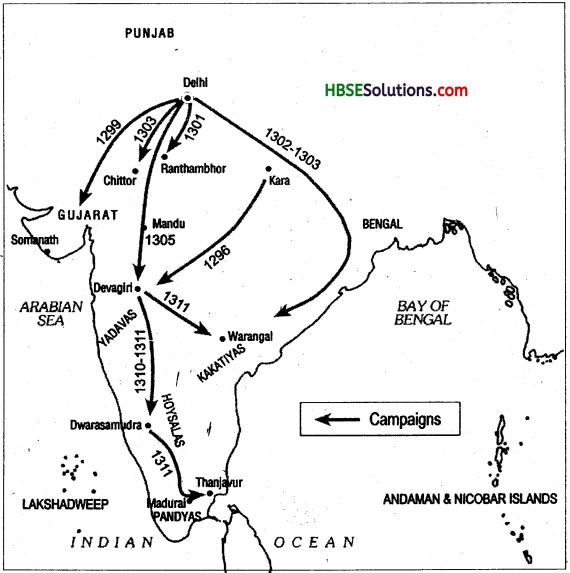
HBSE 7th Class Social Science Solutions History Chapter 3 The Delhi Sultans-1


The Delhi Sultans Class 7 HBSE Notes

  • Birthright: Privileges claimed on account of birth.
  • Gender distinctions: Social and biological differences between women and men.
  • Hinterland: The lands adjacent to a city or port that supply it with goods and services.
  • Garrison Town: A fortified settlement with soldiers.
  • Client: Someone who is under the protection of another, a dependent or hanger on.
  • Siydati: A form of salutation in which the person converned had to kneel down and touch the ground with his forehead.
  • Ulemas: Scholars of Islamic learning who were generally orthodox in their outlook.
  • Iqtas: The grant of revenue from a village or a piece of land.
  • Patwari: The officer who kept the land revenue record.
  • Paibos: It was a Persian custom of kissing the feet of the Sultan (king).
  • Sikandar-i-Sahi: The title adopted by Alla-ud-din Khilji.
  • Jagir: A piece of land given to officials of the kingdom.
  • Kharaj: The tax on cultivation was known as Kharaj.
  • Bandagn: The early Delhi Sultans especially Iltutmish favoured their slaves purchased for military service. These slaves were known as bandagm in Persian.
HBSE 7th Class Social Science Solutions History Chapter 3 The Delhi Sultans Read More »

HBSE 7th Class Social Science Solutions History Chapter 7 Tribes, Nomads and Settled Communities

Haryana State Board HBSE 7th Class Social Science Solutions History Chapter 7 Tribes, Nomads and Settled Communities Textbook Exercise Questions and Answers.

Haryana Board 7th Class Social Science Solutions History Chapter 7 Tribes, Nomads and Settled Communities

HBSE 7th Class History Tribes, Nomads and Settled Communities Textbook Questions and Answers

IMAGINE

Question 1.
You are a member of a nomadic community that shifts residence every three months. How would this change your life?
Answer:
Shifting residence every three months would change our style of living frequently.

  • We would have to shift our belongings every now and then and we would not hatfe any settled life.
  • We would not be able to practise any settled occupation.

LETS RECALL

Question 1.
Match the following:

GarhKhel
TandaChaurasi
LabourerCaravan
ClanGarha Katanga
Sib SinghAhom State
DurgawatiPaik

Answer:

GarhChaurasi
TandaCaravan
LabourerPaik
ClanKhel
Sib SinghAhom state
DurgawatiGarha Katanga

Question 2.
Fill in the blanks:
(a) The new castes emerging with in varnas were called ………….. .
(b) ……….. were historical works written by the Ahom.
(c) The ……….. mentions that Garha Katanga had 70,000 villages.
(d) As tribal states became bigger and stronger, they gave land grants to ………… and ………….. .
Answer:
(a) jatis
(b) Buranjis
(c) Akbamama
(d) temples, Brahmanas.

Question 3.
State whether true or false:
(а) Tribal societies had rich oral traditions.
(b) There were no tribal communities in the north-western part of the subcontinent.
(c) The Chaurasi in Gond states contained several cities.
(d) The Bhils lived in the north-eastern part of sub continent.
Answer:
(a) True
(b) Flase
(c) Flase
(d) Flase.

LETS UNDERSTAND

Question 4.
What kinds of exchanges took place between nomadic pastoralists and settled agriculturists?
Answer:
The nojnadic pastoralists exchanged wool, ghee, etc. with settled agriculturists for grain, cloth, utensils and other products.

Question 5.
How was the administration of Ahom state organised?
Answer:
The following were the ways in which the administration of Ahom state was organised.
(a) The Ahom state depended upon forced labour. Those forced to work for the state were called paiks.
(b) A census of the population was taken. Each village had to send a number of paiks by rotation.
(c) People from heavily populated areas . were shifted to less populated areas.
(d) Ahom clans were thus broken up.
(e) By the first-half of the seventeenth century, the administration became quite centralised.
(f) Almost all adult males severed in the army during war.
(g) Ahom society was divided into clans or Khels.

Question 6.
What changes took place in Varna-based society?
Answer:
The following changes took place in uama-based society:
(i) Smaller castes or Jatis emerged within varnas.
(ii) Many tribes and social groups were taken into caste-based society and given status of jatis.
(iii) Specialised artisans. such as smiths, carpenters and masons were also recognised as separate jatis by the Brahmanas.
(iv) Jatis rather than varna became the basis for organising society.
(v) Among the Kshatriyas, new Rajput clans became powerful by the eleventh and twelth centuries.

HBSE 7th Class Social Science Solutions History Chapter 7 Tribes, Nomads and Settled Communities

Question 7.
How did tribal societies change after being organised into a state?
Answer:
The emergence of large states changed the nature of tribal society.
(A) The Gond Society:
(i) The basically equal society of Gond gradually got divided into unequal social classes.
(ii) Brahmanas received land grants from the Gond rajas and became more influential.
(iii) The Gond chiefs now wished to be recognised as Rajputs.

(B) The Ahom Society:
(i) Ahom society became very sophisticated.
(ii) Poets and scholars were given land grants.
(iii) Theatre was Encouraged.
(iv) Important works of Sanskrit were translated into local language.
(v) Historical works, known as banjaras were also written first in the Ahom language and then in Assamese.

LET’S DISCUSS

Question 8.
Were the banjaras important for the economy?
Answer:
The banjaras were the important for the economy. They were the most important trader-nomads.
(i) Sultan Alauddin Khilji used the banjaras to transport grain to the city markets.
(ii) Banjaras carried grain on their bullocks from different areas and sold it in towns.
(iii) Banjaras transported food grain for the Mughal towns. They transported food grain for the Mughal army during military campaigns.

Question 9.
In what ways was the history of the Gonds different from that of the Ahoms? Were there any similarities?
Answer:
History of Gonds was different from Ahom in the following ways:

GondsAhoms
(i) Gonds lived in Gondwana.(i) Ahoms lived in Brahmaputra valley.
(ii) Gonds practised shifting culti-vation.(ii) Ahoms did not practise shifting cultivation.
(iii) Gonda kingdoms were large.(iii) Ahom kingdom was small.
(iv) Gond kingdoms were divided into grahs.(iv) Ahoms built a ‘ large state.
(v) Gonds did not use fire arms.(v) Ahoms used fire arms for the first time in the history of the subcontinent.

LET’S DO

Question 10.
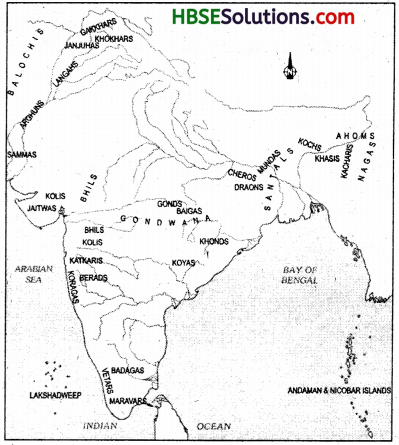
Plot the location of the tribes mentioned in this chapter on a map. For any two, discuss whether their mode of livelihood was suited to the geography and environment of the area where they lived.
Answer:
HBSE 7th Class Social Science Solutions History Chapter 7 Tribes, Nomads and Settled Communities-1
(A) Tribe of Bhils: The large tribe of Bhils was spread across western and central India. Many of them because settled agriculturists and some even zamindars. They remained hunter gatherers.
(B) Kolis, Beards lived in Maharashtra highlands and Karnataka.

Question 11.
Find out about present day government policies towards tribal populations and organise a discussion about thdse.
Answer:
(i) Government has reserved some seats in State Assemblies and in Lok Sabha.
(ii) Some seats have been reserved in state and central government jobs.
(iii) Some economic and educational facilities are provided to tribal population.
(iv) Economic, agricultural and industrial development is being provided them for quick growth and development.
(v) Their culture, religion, customs are not being disturbed. In short very good and progressive policies are being followed towards tribal population.

Question 12.
Find out more about present day nomadic pastoral groups in the subcontinent. What animals do they keep? Which are the areas frequented by the groups?
Answer:
(i) There are several present day nomadic pastoral groups in the subcontinent. They keep sheep, goat, cows, camels, horses, etc. Many tribals obtained their livelihood from forests, agriculture, hunting and gathering also.

(ii) Most often they combined their economic activities to make full use of the natural resources of the area in which they lived.

(iii) Some tribes are still nomadic and move from one place to another.

(iv) A tribal nomadic group controlled land and pastures jointly and divide these amongst households according to its own rules.

(v) Usually they are living in different forests, hills, deserts and places difficult to reach the sub-continent.

(vi) The Nagas are living in Nagalands. The Ahoms are still living in Assam. The Cheros are living in Jharkhand. The Mundas and Samtals are living in Orissa, Bengal, Bihar and Jharkhand. Kolis are living in Maharashtra highlands and Karnataka. The Banjaras are living in Rajasthan. The Gonds are living in a vast forest region still called Gondwana.

HBSE 7th Class Social Science Solutions History Chapter 7 Tribes, Nomads and Settled Communities

HBSE 7th Class History Tribes, Nomads and Settled Communities Important Questions and Answers

Very Short Answer Type Questions

Question 1.
Name a Himalayan tribe.
Answer:
The Himalayan shepherd tribe is Gaddi.

Question 2.
Tribes of which areas adopted Islam as their religion.
Ans.
Many tribes of Punjab, Sind and the North-West Frontier adopted Islam as their religion.

Question 3.
What was the name of the son of Rani Durgawati?
Answer:
The name of the son of Rani Durgawati was Bir Narain.

Question 4.
Which Mughal general attacked Garh Katanga?
Answer:
Asaf Khan attacked Garba Katanga.

Question 5.
Which Mughal general attacked Ahoms?
Answer:
Mir Jumla attacked Ahoms.

Question 6.
Which Gond king assumed title of Sangram Shah?
Answer:
Aman Das, the Gond raja of Garha Katanga assumed the title of Sangram Shah.

Question 7.
How was Ahom society divided?
Answer:
Ahom society was divided into clans or khels.

HBSE 7th Class Social Science Solutions History Chapter 7 Tribes, Nomads and Settled Communities

Short Answer Type Questions

Question 1.
How is shifting cultivation practiced?
Answer:
Trees and bushes in a forest area are first cut and burnt. The crop is sown in the ashes. When this land loses its fertility an other plot of land is cleared and planted in the same way.

Question 2.
How can you say that Garh Katanga is a rich estate?
Answer:
Garha Katanga was rich estate. It earned much wealth by trapping and exporting wild elephants to other kingdoms. When the Mughals defeated the Gonds, they captured a huge booty of precious coins and elephants. They annexed part of the kingdom and granted the rest of Chandra Shah.

Question 3.
Who were paiks? To which region did they belong to?
Answer:
The Ahom state depended upon forced labour. Those forced to work for the state are called paiks.

Question 4.
Ahom State was very sophisticated. Explain.
Answer:
Ahom society was very sophisticated. Poets and scholars were given land grants. Theatre was encouraged. Important works of Sanskrit were translated into local language.

Question 5.
How was the rule, under Durgawati Rani?
Answer:
Dalpat died early. Rani Durgawati was very capable and started ruling on behalf of her five year old son, Bir Narain. Under her, the kingdom becaihe even more extensive. In 1565, the Mughal forces under Asaf Khan attacked Garha Katanga. A strong resistance was put up by Durgawati. She was defeated and preferred to die rather than surrender.

Long Answer Type Questions

Question 1.
Give an account of the life style of tribal people.
Answer:
(a) Members of tribal groups were united by friendship or kingship bonds.
(b) Many tribes obtained their livelihood from agriculture. Others were hunter gatherers or herderers.
(c) Most often they combined these activities to make full use of the natural resources in the area they lived.
(d) A tribal group controlled land and pastures jointly and divided these amongst household according to its own rules.

Question 2.
Illustrate the tribal rule of present-day Bihar and Jharkhand.
Answer:
In many areas of present-day Bihar and Jharkhand, Chero chiefdoms had emerged by the 12th century. Raja Man
Singh, Akbar’s famous general attacked and defeated the Cheros in 1591.
The Hundas and Santals were among the other important tribes that lived in this region and also in Orissa and Bengal.

HBSE 7th Class Social Science Solutions History Chapter 7 Tribes, Nomads and Settled Communities

Question 3.
Write a short note on Banjaras.
Answer:
(a) The Banjaras were the most important trade nomads.
(b) They moved through caravans called tandas.
(c) They were used by Sultan Alauddin Khilji to transport grains to the city market.
(d) Banjaras carried grains on their bullocks from different areas and sold it in towns.
(e) They transported it for the Mughal Army during Military campaign.

Tribes, Nomads and Settled Communities Class 7 HBSE Notes

  • Pastoralism: The system which is related with the care and domestication of grazing animals.
  • Polygamous: Practising system of having many wives.
  • Nomads: Wanderer members of those group of people are called nomads who move from place to place in search of food items.
  • Assimilation: To become adjusted.
  • Aristocracy: Government run by nobles are known as aristocracy.
  • Itinerant groups: Wandering tribes are known as itinerant groups.
  • Swayamvara: Women were allowed to choose their husbands df their own choice.
  • Jauhar: Practice of mass sacrifice by women to save their honour and chastity.
  • Adivasi: The primitive people living in a particular area are called Adivasis.
  • The Gonds are the largest tribe in Central India.
  • Gondwana: The region of-central India is known as Gondavana due to the concentration of the Gonds in that area.

HBSE 7th Class Social Science Solutions History Chapter 7 Tribes, Nomads and Settled Communities Read More »

HBSE 7th Class Social Science Solutions History Chapter 6 Towns, Traders and Craftpersons

Haryana State Board HBSE 7th Class Social Science Solutions History Chapter 6 Towns, Traders and Craftpersons Textbook Exercise Questions and Answers.

Haryana Board 7th Class Social Science Solutions History Chapter 6 Towns, Traders and Craftpersons

HBSE 7th Class History Towns, Traders and Craftpersons Textbook Questions and Answers

LET S RECALL

Question 1.
Fill in the blanks:

  1. The Rajarajeshvara temple was built in
  2. Ajmer iff associated with the Sufi saint
  3. Hampi was the capital of the Empire.
  4. The Dutch established a settlement at in Andhra Pradesh.

Answer:

  1. Thanjavur (Tamil Nadu)
  2. Muinuddin Chishti
  3. Vijayanagara
  4. Masulipatnam

HBSE 7th Class Social Science Solutions History Chapter 6 Towns, Traders and Craftpersons

Question 2.
State whether true or false:

  1. We know the name of the architect of the Rajarajeshvara temple from an inscription.
  2. Merchants preferred to travel individually rather than in caravans.
  3. Kabul was a major centre for trade in elephants.
  4. Surat was an important trading port on the Bay of Bengal.

Answer:

  1. True
  2. False
  3. False
  4. False

Question 3.
How was water supplied to the city of Thanjavur?
Answer:
Water was supplied from wells and tanks to the city of Thanjavur.

Question 4.
Who lived in the “Black Town” in cities such as Madras?
Answer:
Merchants and artisans (such as weavers) or craftspersons along with the white rulers (European traders) lived in the cities like Madras during the British rule.

LET’S UNDERSTAND

Question 5.
Why do you think towns grew around temples?
Answer:
(i) Temple towns represented a very important pattern of urbanisation, the process by which cities develop.
(ii) Temples were often central to the economy and society.
(iii) Rulers built temples to demonstrate their devotion to various dieties. They also endowed temples with grants of land and money to carry out elaborate rituals, feed pilgrims and priest and celebrate festivals.
(iv) Pilgrims who flocked to the temples also made donations.
(v) Temple authorities used their wealth to finance trade and banking.
(vi) Generally, a large number of priests, workers, artisans, traders etc. settled near the temple to cater to the needs and those of the pilgrims.
For example: Billasvamin and Somnath in Gujarat.

Question 6.
How important were craftspersons for the building and maintenance of temples?
Answer:
(i) Craftspersons were very important for building and maintenance of temples.
(ii) For instance the Panchalas or Vishwakarama community, consisting of goldsmith, bronzesmith, blacksmiths, masons are carpenters were essential to the building of temples.
(iii) The craftsmen also played an important role in the construction of big buildings for pilgrims, used to visit temples as visitors or tourists and also in construction of tanks and reservoirs, attacked to temples.
(iv) The craftspersons of Bidar were so fapied for their inlay work in copper and silver that it came to be called Bidri.
(v) Weavers such as the Saliyar or Kaikkolars emerged as prosperous communities, making donations to temples.

HBSE 7th Class Social Science Solutions History Chapter 6 Towns, Traders and Craftpersons

Question 7.
Why did people from distant lands visit Surat?
Answer:
1. Surat was the most important medieval port on the west coast of Indian subcontinent.
2. It was the emporium of western trade during the Mughal period.
3. Surat was the gateway for trade with west Asia via the Gulf of Ormuz.
4. Surat has also been called the gate of Mecca, because many pilgrim ships get sail from here.
5. There were also several retail and wholesale shops selling cotton textiles.
6. Surat was famous for the textiles with gold lace borders (zari).
Due to all such reasons many people from distant lands visited Surat.

Question 8.
In what ways craft production in cities like Calcutta different from that in cities like Thanjavur?
Answer:

Craft Production in ThanjavurCraft Production in Calcutta
1. Craftspersons were free to be as much creative as they could be.1. Craftspersons had to produce what was demanded by the East India Company.
2. Craftpersons used to live near temple. They always get buyers of their products.2. The craftspersons were force to live in the “Black Towns”. The only buyer of their products was the East India Company.
3. There was no system pf advances.3. There existed system of advances, which meant that they have to weave cloths which were already promised to European agents.
4. Weavers had the freedom of selling their own cloths or weaving by their own patterns.4. Weavers no longer had liberty of selling their own cloths or weaving by their own patterns.
5. They didn’t have to reproduce same designs.5. They had to reproduce the designs supplied to them by the company agents.

LET’S DISCUSS

Question 9.
Compare any one of the cities described in the chapter with a town or a village with which you are familiar. Do you notice any similarities or differences?

HampiAjmer
1. Hampi is located in the Krishna, Tungabhadra basin, which formed the nucleus of the Vijay Nagar Empire, founded in 1336.1. Ajmer is in Rajasthan. It was the capital of the Chauhan kings in the twelfth century. Later, Ajmer became the suba headquarters under the Mughals.
2. The magnificent ruins at Hampi reveal a well fortified city. The architecture of Hampi was distinctive.
The buildings in the royal complex had splendid arches, domes and pillared halls with niches for building sculptures.
2. Ajmer remained a famous pilgirmage centre for the Hindus. There is a holy water tank at Puskar near Ajmer. There is a world wide famous temple of the Brahmaji.
3. Temples were the hub of cultural activities and devadasis (temple dancers) performed before the deity, royalty and masses in the many pillared halls in the virupaksha temple, known today as Navaratri in the south, was one of the most important festivals celebrated at Hampi.3. Ajmer also provides an excellent example of religious co-existence, Khwaja Muinud- din Chishti, the celebrated sufi-saint who settled there in the twelfth century attracted devotees from all creeds.

Question 10.
What were the problems encountered by merchants? Do you think some of these problems persist today?
Answer:
Some of the problems faced by the merchants were as under:

  • They had to travel through forests and there was always the fear of robbers. Therefore, pierchants travelled in caravans.
  • Merchants such as Mulla Abdul Ghafur and Indian Virji Vora, who owned a large number of ships were subdued by the East India Company ships. Then, they have to work as agents of the company instead of running their own business.
  • Yes, such problems do exist today.

HBSE 7th Class History Towns, Traders and Craftpersons Important Questions and Answers

Very Short Answer Type Questions

Question 1.
Give the capital of Cholas.
Answer:
Thanjavur.

Question 2.
Who built Rajarajeshwara temple?
Answer:
King Rajaraja Chola.

Question 3.
What type of a town is Thanjavur?
Answer:
Temple town.

Question 4.
Name an alloy of copper and tin.
Answer:
Bronze.

Question 5.
What is the capital of the Chauhan kings in the 12th century?
Answer:
Ajmer.

Question 6.
Give two groups of weavers that emerged as prosperous communities.
Answer:
Saliyar, Kaikkolars.

HBSE 7th Class Social Science Solutions History Chapter 6 Towns, Traders and Craftpersons

Short Answer Type Questions

Question 1.
Name the trading groups in Masulipatnam.
Answer:
The Golconda nobles, Persian merchants, Telugu Komati Chettis and European traders were the trading groups in Masulipatnam.

Question 2.
What was the ‘system of advances’?.
Answer:
The system of advances was a system under which craftspersons like weavers were given advance payments so that they had to weave cloths for European agents only.

Question 3.
What were the main features of medieval towns?
Answer:
The main features of medieval towns were as under:
(a) The towns probably emerged from large villages.
(b) Towns had mandapika (or mandi of later times) to which nearby villages brought their produce to sell.
(c) Towns also had market streets calle hatta lined with shops.
(d) There were streets for different kinds of artisans such as potters, oil pressers, sugar makers, toddy makers, smiths, stone masons, etc.

Question 4.
How was the architecture of Hampi distinctive?
Answer:
Due to following reasons, the architecture of Hampi was distinctive:
(a) The building in the royal complex had splendid arches, domes and pillared halls with niches for holding sculptures.
(b) There were well planned orchards and pleasure gardens with sculptural motifs such as lotus and corbels.
(c) The Wall of Hampi fort was constructed without using mortar or cement. The technique of wedging bricks together by interlocking was used.

Long Answer Type Questions

Question 1.
Why did Masulipatnam port decline?
Answer:
(a) The Dutch and English companies had settled in Masulipatnam.
(b) But the Qutab Shahi rulers of Golconda exerted their influence on the trade and settlement in the port city of Masulipatnam.
(c) After Mughal occupation of Golconda, Mughal Governor Mir Jurnla who was also a merchant, began to play off the Dutch and English against each other.
(d) Due to this the European Companies looked for alternative and hence, they developed the port city of Madras.
(e) Thus, Masulipatnam lost both its merchants and prosperity and declined.

Question 2.
How was the Indian textile business affected when the European Companies entered in it?
Answer:
The Indian textile business was affected when the European Companies entered it in the following ways:
(i) The demand of Indian textiles increased manifolds.
(ii) This led to a great expansion of the crafts of spinning, weaving, bleaching, dyeing, etc.
(iii) The employment opportunities also increased.
(iv) Indian textile designs became increasingly refined.
(v) But due to the system of advances, the independent craftspersons declined.
(vi) Indian traders, weavers and merchants had to live in “Black Towns” whereas “White” people lived in superior residencies of Fort St. George in Madras or Fort St. William in Calcutta.

HBSE 7th Class Social Science Solutions History Chapter 6 Towns, Traders and Craftpersons

Question 3.
What were the causes of decline of Surat as a commercial town?
Answer:
(i) From 17th century onwards the 1 town of Surat began to decline in the commercial activities.
(ii) The main cause was loss of markets and productivity because of the decline of the Mughal Empire.
(iii) Sea routes were controlled by Portuguese.
(iv) The newly built Bombay port gve tough English competition to the port of Surat.
(v) East India Company shifted its headquarters to Bombay in 1668.

Question 4.
Describe the rise of Bombay, Calcutta and Madras as trading towns.
Answer:
(i) Bombay, Calcutta, and Madras rose as nodal cities.
(ii) Crafts and commerce underwent major changes as merchants and artisans (such as weavers) were moved into the Black Towns established by the European Companies within these new cities.
(iii) The blacks or native traders and craftspersons were confined here.
(iv) The ‘White’ rulers occupied the superior residencies of Fort St. George in Madras or Fort St. William in Calcutta.

Towns, Traders and Craftspersons Class 7 HBSE Notes

  • Hinterland: A piece of land beyond the coast is known as a hinterland.
  • Administrative Town: It is a town from where the administrative functions are carried on.
  • Temple Town: It is a town with prominent temples or temples.
  • Commercial Town: It is a town where the sale and purchase of commodities take place.
  • Pilgrimage Towns: Places, where people go for pilgrimage, are called pilgrimage towns.
  • Chintz: A type of cotton cloth with a printed design on it is called Chintz.
  • Black Town: That part of town where artisans and merchants of Indian origin used to live was called Black Town.
  • Emporium: A place where goods from diverse production centers are bought and sold is called an emporium.
  • Hundi: It is a note recording a deposit made by a person. The amount deposited can be claimed in another place by presenting the record of the deposit.
  • Factor: An official merchant of the East India Company is called a factor.
  • Sthapatis: Sculptors who made bronze idols and tall ornamental bell metal lamps are called Sthapatis.

HBSE 7th Class Social Science Solutions History Chapter 6 Towns, Traders and Craftpersons Read More »