Class 7

HBSE 7th Class Social Science Solutions History Chapter 5 Rulers and Buildings

Haryana State Board HBSE 7th Class Social Science Solutions History Chapter 5 Rulers and Buildings Textbook Exercise Questions and Answers.

Haryana Board 7th Class Social Science Solutions History Chapter 5 Rulers and Buildings

HBSE 7th Class History Rulers and Buildings Textbook Questions and Answers

LET’S RECALL

Question 1.
How is the ‘Trabeate’ principle of architecture, different from the ‘arcuate’?
Answer:
‘Trabeate’ principle of architecture is different from the ‘arcuate’ principle in the following way:
(a) In ‘trabeate’ principle, a horizontal beam is placed across two vertical columns and roofs, doors and windows were made.
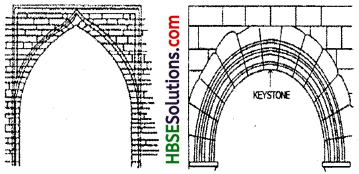
HBSE 7th Class Social Science Solutions History Chapter 5 Rulers and Buildings-1
(b) In ‘acruate’ style of architecture, the weight of the superstructure above the door and window was carried by arch.

HBSE 7th Class Social Science Solutions History Chapter 5 Rulers and Buildings

Question 2.
What is Shikhara?
Answer:
Shikhara is the pyramid structure on the central shrine of the temple.

Question 3.
What is Pietra Dura?
Answer:
Pietra Dura is the inlays that depicted the legendary Greek God Orpheus playing the lute. They are coloured, hard stones placed in depressions carved into marble or sandstone creating beautiful ornate pattern.

Question 4.
What was the element of a Mughal Chahar Bagh garden?
Answer:
The elements of a Mughal Chahar Bagh (garden).

  • They were placed with in rectangular walled enclosures.
  • They were divided into quarter by artificial channels.
  • Divided into four equal quarters.
  • Symmetry in the four divisions.

LET’S UNDERSTAND

Question 5.
How did a temple communicate the importance of a king?
Answer:
Temples were also meant to demonstrate the power, wealth and devotion and parton by the ruler.
(a) The names of the ruler and the god were similar, for example:
Rajarajeshvara temple was built by the king Rajarajadeva for the worship of his god, Rajarajeshvaram.
(b) Temple was the miniature model of the world ruled by the king and his allies.
(c) The other lesser dieties in the temple were gods and goddesses of the allies and subordinates of the ruler.

Question 6.
An inscription in Shahjahan’s diwan-i-khas in Delhi stated: “If there is Paradise on Earth; it is here, it is here, it is here.” How was this image created?
Answer:
Diwan-i-khas was designed in such a way that different elements of Mughal architecture were fused together in a grand harmonious synthesis. It was carefully planned. This image was created as a result of his marvellous architectural skill. It was created by provided all the possible facilities to the subjects (people) by the king.

HBSE 7th Class Social Science Solutions History Chapter 5 Rulers and Buildings

Question 7.
How did the Mughal Court suggest that everyone-the rich and the poor, the powerful and the weak received justice equally from the emperor.
Answer:
(a) Behind emperor’s throne were a series of pietra dura inlays that depicted the legendary Greek God Orpheus playing the lute.
(b) It was believed the Orpheus’s music could calm ferocious beasts until they co¬existed together peaceably.
(c) This image communicated that the king’s justice would treat high and the low as equal which create a world where all could live together in harmony.

Question 8.
What role did the Yamuna play in the layout of the Mughal city at Shahjahanabad?
Answer:
The river Yamuna played a crucial role in the layout of the Mughal city at Shahjahanabad in the following ways:
(a) The imperial place commanded the river front. Only specially favoured noble were given access to the river.
(b) Ordinary people had to construct their home in the city away from the river.
(c) Taj Mahal was also constructed on the left edge of this river.
(d) In Agra at Taj Mahal, white marble mausoleum was place on terrace by the edge of the river as the garden was to its south.

LET’S DISCUSS

Question 9.
The rich and the powerful construct large houses today. In what ways were constructions of kings and their courtriers different in the past.
Answer:
The constructions of the kings and their courtiers in the past were different from the construction of large houses by the rich and the powerful.
The constructions of the kings and their courtiers had the safety and security as their major consideration. The houses of the kings and their coutriers had big courtyards, thick walls and huge walls. This constructions were generally surrounded by water bodies.
Today, the constructions of the rich and the powerful are quite different. They have less open areas and meet mainly individual requirements.

Question 10.
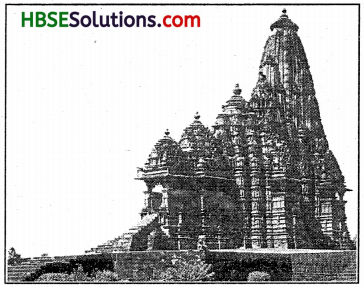
Look at picture. How could that building be constructed faster today?
Answer:
HBSE 7th Class Social Science Solutions History Chapter 5 Rulers and Buildings-2
The building could be constructed faster today with the help of latest tools and advanced skills.

LET’S DO

Question 11.
Find out whether there is a statue of or a memorial to a great person in your village or town. Why was it placed there? What purpose does it serve?
Answer:
Try to find out any memorial surrounding you and write a note on it:
Why it was established?
Where it was situated?
Who was the founder?
What is its significance?

Question 12.
Visit and describe any park or garden in your neighbourhood. In what ways is it similar to or different from the gardens of the Mughals?
Answer:
Discuss it with your class teacher in the class room. (Hint: Throw light on Chahar Bhagh and its significance)

HBSE 7th Class Social Science Solutions History Chapter 5 Rulers and Buildings

HBSE 7th Class History Rulers and Buildings Important Questions and Answers

Very Short Answer Type Questions

Question 1.
What are ‘tombs’ referred to?
Answer:
Tombs are safe, protected and grandiose places of rest in this world and the next.

Question 2.
Which style of construction was used in the construction of temples, mosques, tombs attacked to large- stepped wells, between the seventh and tenth century?
Answer:
‘Trabeate’ style of construction was used in the construction of temples, mosque, tombs between seventh and tenth century.

Question 3.
What were the temples and mosques meant to demonstrate?
Answer:
The temples and mosques were meant to demonstrate the power, wealth and prayer.

Question 4.
Why did the king Rajarajesh- wara take the god’s name?
Answer:
The king took the god’s name because it was auspicious and he wanted to appear like a god.

Question 5.
What was qibla?
Answer:
The pedestal on which Shahjhan’s throne was placed was frequently described as the qibla.

Question 6.
What was special about the city of Agra?
Answer:
Agra city was special because nobility had constructed their homes in the city on the banks of the river Yamuna.

HBSE 7th Class Social Science Solutions History Chapter 5 Rulers and Buildings

Short Answer Type Questions

Question 1.
How did Shahjahan adapt the river front garden while laying out the Taj Mahal?
Answer:
While laying out the Taj Mahal, Shahjahan adapted the river-front garden. The white marble mausoleum was placed on a terrace by the edge of the river and the garden was to its south. Shahjahan developed this architectural form as a means to control the access that nobles had jto’the river.

Question 2.
Who were given access to the river-front by Shahjahan?
Answer:
In the city of Shahjahanabad, the imperial palace constructed the river front. Only specially favoured nobles like his eldest son Dara Shukoh were given access to the river. All others had to construct their homes in the city away from river Yamuna.

Question 3.
What were the special features of Humayun’s tomb?
Answer:
The special features of Humayun’s tomb were:
(a) The central towering dome and the tall gateway known as pishtaq became important aspects of Mughal architecture. This tomb structure was first visible in Humayun’s tomb.
(b) The tomb was placed in the centre of a huge Chahar Bagh and built in the tradition known as ‘eight paradises’ a central hall surrounded by eight rooms
(c) The building was constructed with red sandstone, edge with white marble.

Question 4.
How did the Pandaya king Shrimara Shrivallabh loot the temples when he invaded Sri Lanka and defeated the king?
Answer:
Shrimara Shrivallabh removed all the valuables from the temple like the status of the Buddha made entirely of gold in the jewel places and the golden images in the various monastries.

HBSE 7th Class Social Science Solutions History Chapter 5 Rulers and Buildings

Long Answer Type Questions

Question 1.
What was the significance of temples, mosques and tanks?
Answer:
Temples and mosques were the places of worship. They were beautifully constructed.

  • They demonstrated the power, wealth and devotion of the patron.
  • The name of the ruler and the god were very similar. For example: Rajarajeshvara temple was built by Jong Rajarajadeva for the worship of his God, Rajarajeshvaram. Through the rituals of worship in temple one God, Rajarajeshvaram.
  • The kings constructed the largest of the temples.
  • The temple was a miniature model of the world.
  • They worshipped their dieties together in the royal temples as if they brought the just rule of the Gods on earth.

Question 2.
Explain the beginning of the reign of Shahjahan at Agra.
Answer:
In the beginning of his reign, Shahjahan’s capital was at Agra. It is a city where the nobility had constructed their homes on the banks of the river Yamuna. They were set in the midst of formal gardens constructed in the Chahar Bagh format. The Chahar Bagh garden was also desribd the river front garden. In this the dwelling was not located in the middle of the Chahar Bagh at its edge, close to the bank of the river.

Shahjahan took the river front garden in the layout of the Taj Mahal. It was the grandest architectural accomplishment of his reign. Here the white marble mausoleum was placed on a terrace by the edge of the river and garden was to its south.

Question 3.
Who all were involved in the construction of Qutab Minar? Describe the main architectural styles adopted.
Answer:
The Qutab Minar is five storeys high. The first floor was constructed by Qutabuddin Aybak and the ret by Iltutmish around 1229. Over the years it was damaged by lighting and earthquakes and repaired by Alauddin. Khilji, Muhammad Tughluq, Firuz Shah Tughluq and Ibrahim Lodhi. Architectural Styles of Qutab Minar

  • Qutab Minar has a pattern under the balcony by the small arches and geometrical designs.
  • It has two banks of inscriptions under the balcony.
  • The surface of the minar is curved and angular. Placing an inscription on such a surface required great precision. Only the most skilled craftsperson could perform this task.

HBSE 7th Class Social Science Solutions History Chapter 5 Rulers and Buildings

Rulers and Buildings Class 7 HBSE Notes

  • Superstructure: The part of a building above the ground floor.
  • Pietra Dura: Coloured, hard stones placed in depressions carved into marble or sandstone creating beautiful, ornate patterns.
  • Gopuram: The gateway of the temple.
  • Shikhara: A spire-like structure over the central shrine of a temple.
  • Mandapa: A structure set up or constructed in front of the main shrine.

HBSE 7th Class Social Science Solutions History Chapter 5 Rulers and Buildings Read More »
HBSE 7th Class Social Science Solutions History Chapter 4 The Mughal Empire

Haryana State Board HBSE 7th Class Social Science Solutions History Chapter 4 The Mughal Empire Textbook Exercise Questions and Answers.

Haryana Board 7th Class Social Science Solutions History Chapter 4 The Mughal Empire

HBSE 7th Class History The Mughal Empire Textbook Questions and Answers

LET’S RECALL

Question 1.
Match the following:

MansabMarwar
MongolGovernor
Sisodiya RajputUzbeg
Rathore RajputMewar
Nur JahanRank
SubedarJahangir

Answer:

MansabRank
MongolUzbeg
Sisodiya RajputMewar
Rathore RajputMarvyar
Nur JahanJahangir
SubedarGovernor

Question 2.
Fill in the blanks:
(a) The capital of Mirza Hakim, Akbar’s half-brother, was …………………. .
(b) The five Deccan Sultanate were Berar, Khandesh, Ahmednagar ……………. and ……….. .
(c) If zat determined a mansabdar’s rank and salary, sewar indicated his ………….. .
(d) Abul Fazal, Akbar’s friend and counseller, helped him frame the idea of ……………. so that he could govern a society composed for many religions, çultures and castes.
Answer:
(a) Kabul
(b) Bijapur, Golconda
(c) Number of horses maintained
(d) Administration.

HBSE 7th Class Social Science Solutions History Chapter 4 The Mughal Empire

Question 3.
What were the central provinces under the control of Mughals?
Answer:
Gujarat and Madhya Pradesh were the central provinces under the control of Mughals.

Question 4.
What was the relationship between the mansabdar and the Jagir?
Answer:
• Mansabdars were the persons who joined the Mughal service.
• Jagirs were the salaries received by the mansabdar as revenue assignments.
• Mansabdars depended on jagirs for their livelihood.
• Mansabdar died not actually reside in or administer their jagir. They had only right to the revenue of their assignments which were collected by the servants while they serve in other part of the country.

LETS UNDERSTAND

Question 5.
What was the role of Zamindars in Mughal administration?
Answer:

  • Zamindars were all intermediaries whether they were local headmen of villages or a powerful chieftains.
  • They collected taxes from peasants and deposited them with the treasury.
  • Sometimes, they revolted against Mughal authority. Their revolts changed the stability of the Mughal empire from the end of the 17th century.

Question 6.
How were the debates with the religious scholars iiiiportant in the formation of Akbar’s ideas on government?
Answer:
The debates with the religious scholars were important in the formation of Akbar’s ideas on government:

  • Their teachings created divisions and disharmony amongst the subjects.
  • Akbar followed the idea of Sulh-i-Kul (Universal peace and tranquility).
  • This idea did not discriminate between people of various castes and focused on a system of ethics such as peace, justice and honesty.
  • Abul Fazal helped him in forming a vision governance around the idea of Sulh-i-Kul.

Question 7.
Why did the Mughal underline their Timurid and not their Mughal descent?
Answer:
Mughal underlined their Timurid and not their Mughal descent because:
(а) They were proud of their Timurid ancestry who had captured Delhi in 1398.
(b) They celebrated their genealogy pictorially each ruler getting a picture mode of Timur and himself.
(c) Genghis knows memory was associated with the massacre of innumerable people. So Mughals did not like to be called Mughal.

HBSE 7th Class Social Science Solutions History Chapter 4 The Mughal Empire

LETS DISCUSS

Question 8.
How important was the income from land revenue to the stability of the Mughal Empire?
Answer:
The income from land revenue was important to the stability of the Mughal Empire because:
(a) The land revenue system before Akbar was lawful.
(b) The land revenue was important because with this the king could pay the salary of his soldiers, do welfare work.
(c) The land revenue was important to meet the administrative expenses.

Question 9.
Why was it important for Mughal to reAjmit Mansabdars from diverse bac/kgf^und and not just Turains and Iranis?
Answer:
It -was important for Mughal to recruit Mansabdars from diverse background and not just ,Turanis and Iranis because:
(i) Mughal empire expanded to encompass different regions. It was- important for the Mughals to recruit diverse bodies of people in order to make people comfortable with them.
(ii) They included Indian, Muslims, Afghans, Rajputs, Marathas and other groups.

Question 10.
Like the Mughal Empire, India today is also made up of many social and cultural units. Does this pose a challenge to national integration?
Answer:
No the cultural and social diversity of India today does not pose a challenge to national integration because today we have a democratic, republic government appointed by the common people of the land through elections.

Question 11.
Peasants were vital for the economy of the Mughal Empire. Do you think that they are as important today? Has the gap in the income between the rich and the poor in India changed a great deal from the period of the Mughals?
Answer:
Yes, they are also important for today’s economy.
Yes, the gap in the income between the rich and poor in India changed a great deal from the period of great Mughals.

LET’S DO

Question 12.
The Mughal Empire left its impact on the different regions of the subcontinent in a variety of ways. Find out if it had any impact in the city/ village region in which you live.
Answer:
The impact of the message ‘Sulh- i-kul’ (universal peace), we can still find in the cities/village/region arounds.

Question 13.
Do you think this painting suggests that the Mughals claimed kingship as a birthright?
Answer:
As this painting portraits the hierarchy of the Mughal emperors right from Timur to Aurangzeb, it depicts that the Mughals claimed kingship as a birthright.

HBSE 7th Class Social Science Solutions History Chapter 4 The Mughal Empire

Question 14.
(i) How was Humanyun’s relationship with Safavid Iran different from Akbar’s?
Answer:
(a) Humayun took refuge in the court of Safavid Iran when he was dogged out of the subcontinent by Sher Shah Suri. Therefore, he had friendly relations with Iran.
(b) On the other hand, Akbar seized Qandahar from Safavid Iranian rulers. Therfore, he was at war with them.

(ii) Did the annexation of Golconda and Bijapur in Aurangzeb’s reign end hostilities in the Deccan?
Answer:
No, in the spite of the annexation of Golconda and Bijapur, Aurangzeb faced unending disturbance in Deccan as Marathas started guerrilla warfare against him. Ultimately, he had to personally manage campaigns in Deccan from 1698 onwards.

Question 15.
Which do you think is a fairer division of inheritance: primogeniture or coparcenary?
Answer:
According to me, coparcenary is the fairer division of inheritance as it is based on the principle of equality.

Question 16.
(i) What was the consequence of this insult (of Shivaji by Aurangzeb)?
Answer:
When Aurangzeb insulted Shivaji, when later came to accept Mughal authority, Shivaji escaped from prison and began great guerrilla warfare in Deccan against Mughals.

(ii) Would this have meant more expenditure for the state?
Answer:
Yes, the increase in number of mansabdar with higher zat rankings would have led to more expenditure for the State.

Question 17.
Can you identify the Jesuit priests in this picture?
Answer:
Two persons sitting on the upper left side in the picture wearing black robes are the Jesuit priests.

HBSE 7th Class History The Mughal Empire Important Questions and Answers

Very Short Answer Type Questions

Question 1.
Who were Mughals?
Answer:
Mughals were the inhabitants of Central Asia and descendants of Mongols of Mongolia.

Question 2.
Why did Akbar choose Fatehpur Sikri to be his capital?
Answer:
Akbar chose Fatehpur Sikri to be his capital because this was where the Sufi Saint Salim Chishti lived and he had great respect for him.

Question 3.
Who offered to help Babur against the Lodhis?
Answer:
Rajput Prince Rana Sanga of Mewar offered to help Babur against Lodhis.

HBSE 7th Class Social Science Solutions History Chapter 4 The Mughal Empire

Question 4.
When and where Babar – defeated Lodhis army?
Answer:
Babar defeated the Lodhis army in 1526 on the historic battle of Panipat.

Question 5.
What were the two early problems faced by Humayun?
Answer:
(i) His own brother were hostile to him.
(ii) He faced the rebellions in Malwa and; Gujarat in the very beginning.

Question 6.
Why Shahjahan’s period is known as Golden Age?
Answer:
Shahjahan’s period is often known, as Golden Age because of the buildings and the architectural activities.

Short Answer Type Questions

Question 1.
Give two instances of the Mughal marriages with the Rajputs.
Answer:
(a) The mother of Jahangir was a Kachhwaha princess, daughter of the Rajput ruler, of Amber (Modern day Jaipur).
(b) The mother of Shahjahan was a Rathore princess, daughter of the Rajput ruler of Marwar (Jodhpur).

Question 2.
How could Mughals extend their influence over many kings and chieftains? Was this possible all the time?
Answer:
Mughals could extend their influence over many kings and chieftains by keeping a careful balance between defeating but not humiliating their opponents.

Question 3.
What were the main features of Sulh-i-kul?
Answer:
(a) The idea of Sulh-i-kul was introduced by Akbar, the Great.
(b) Sulh-i-kul meant universal peace.
(c) Sulh-i-kul was based on the idea of tolerance which did not differentiate between the people of different religions in Akbar’s realm.
(d) This system focused on a system of ethics, justice which were universally applicable.

Question 4.
What did Akbar realise when he had discussion with people of different faiths?
Answer:
On his discussion, with different faiths, Akbar realised that religious scholars: who emphasised ritual and dogma were often bigots. Their teachings created divisions and disharmony amongst his subjects.

Long Answer Type Questions

Question 1.
Who was Akbar’s revenue minister? Comment on the revenue system introduced by him.
Answer:
Akbar’s revenue rriinister was Todar Mai. The main feajAibesof the revenue system introduced by him were as follows:
(a) Todar Mai carried out a careful survey
(b) Tax was fixed on each crop in cash.
(c) Each province was divided into revenue circles with its own schedule of revenue; rates for individual crops.
(d) This revenue system was known as zabt.
(e) This system was prevalent in those areas where Mughal administrators could survey the land and keep careful accounts.
(f) This system was not possible in provinces such as Gujarat and Bengal.

HBSE 7th Class Social Science Solutions History Chapter 4 The Mughal Empire

Question 2.
Write about the main administrative policies of Akbar.
Answer:
The third-volume of Akbarnama Ain-i-Akbari contains a detailed account of Akbar’s administration. The main features were:
(a) The empire was divided into provinces called subas: governed by a subedar
who carried out both political and military functions.
(b) Each province also had a financial officer or diwan.
(c) The subedar was supported by other officers such as the military paymaster, the minister in change of religious and charitable patronage, military commander and the town police commander.
(d) Akbar gave utmost importance to the idea of tolerance.
Ce) After his discussion with people like Ulama, Brahmanas and priests etc., he decided to introduce idea of Sulh-i-kul, universal peace.

MAP TIME

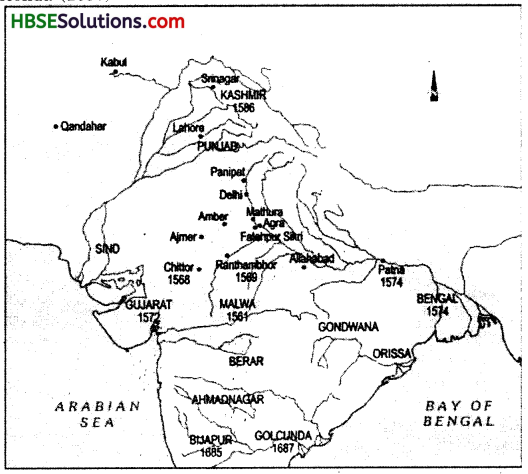
On the given river map, mark the following areas of military campaigns under Akbar and Aurangzed.
(i) Malwa (1561)
(ii) Gujarat (1572)
(iii) Bengal (1574)
(iv) Bijapur (1685)
Answer:
HBSE 7th Class Social Science Solutions History Chapter 4 The Mughal Empire-1

The Mughal Empire Class 7 HBSE Notes

  • Genealogy: History of generations of one’s family in sequence.
  • Confederacy: A group of state (or a union of state) for mutual support.,
  • Regent: A person appointed to govern on the behalf of the samrat (king).
  • Jazia: A tax paid by the non-Muslims.
  • Zabt: Each province during Mughals was divided into revenue circles with its own schedule of revenue rates for individual crops. This revenue system was called as Zabt.
  • Suba: The empire was divided into provinces. These provinces were called subas.
  • Subedar: Subedar was the person who carried both political and military functions.
  • Diwan: The financial officer of a suba was called as Diwan.
  • Sulh-i-kul: Literally Sulh-i-Kul means universal peace. It is the idea of tolerance where there is no discrimination between people of different religions in the realm of Akbar.
  • Primogeniture: It is a rule of inheritance in which the eldest son is the heir to the throne of his emperor father.
  • Bigot: A bigot is an individual who is intolerant of another person’s religious belief or
  • Dogma: It is a statement or an interpretation declared as authoritative with the expectation that it would be followed without question.

HBSE 7th Class Social Science Solutions History Chapter 4 The Mughal Empire Read More »

HBSE 7th Class Social Science Solutions Geography Chapter 4 Air

Haryana State Board HBSE 7th Class Social Science Solutions Geography Chapter 4 Air Textbook Exercise Questions and Answers.

Haryana Board 7th Class Social Science Solutions Geography Chapter 4 Air

HBSE 7th Class Geography Air Textbook Questions and Answers

Question 1.
Answer the following questions:
(i) What is the atmosphere?
Answer:
A huge blanket of air that surrounds the earth is called the atmosphere.

(ii) Which two gases make the bulk of the atmosphere?
Answer:
Two gases that make the bulk of the atmosphere are nitrogen and oxygen.

(iii) Which gas creates greenhouse effect in the atmosphere?
Answer:
Carbon dioxide gas.creates greenhouse effect in the atmosphere.

(iv) What is weather?
Answer:
Weather is the sum total of atmospheric conditions of si specific place, at a specific time regarding temperature, humidity, air pressure, clouds, winds etc.

(v) Name three types of rainfall.
Answer:
Three types of rainfall are:
(a) Convectional rainfall
(b) Orographic rainfall
(c) Cyclonic or Frontal rainfall.

(vi) What is air pressure?
Answer:
Air has weight and exerts pressure. Hence, air pressure is an impact which occurs due to air weight.

HBSE 7th Class Social Science Solutions Geography Chapter 4 Air

Question 2.
Tick the correct answer:
(i) Which of the following gases protects us from harmful sun rays?
(a) Carbon dioxide
(b) Nitrogen
(c) Ozone
Answer:
(c) Ozone

(ii) The most important layer of the atmosphere is :
(a) troposphere
(b) thermosphere
(c) mesosphere
Answer:
(a) troposphere

(iii) Which of the following layers of the atmosphere is free from clouds?
(a) Troposphere
(b) Stratosphere
(c) Mesosphere
Answer:
(b) Stratosphere

(iv) As we go up the layers of the atmosphere, the pressure ________.
(a) increases
(b) decreases
(c) remains the same
Answer:
(b) decreases

(v) When precipitation comes down to the earth in the liquid form, it is called ________.
(a) cloud
(b) rain
(c) snow
Answer:
(b) rain

HBSE 7th Class Social Science Solutions Geography Chapter 4 Air

Question 3.
Match the following :

(i) Trade winds(a) Incoming solar energy
(ii) Loo(b) Seasonal wind
(iii) Monsoon(c) Hotizontal movement of Air
(iv) Wind(d) Layer of ozone gas
(e) Permanent wind
(f) Local wind

Answer:

(i) Trade winds(e) Permanent wind
(ii) Loo(f) Local wind
(iii) Monsoon(b) Seasonal wind
(iv) Wind(c) Hotizontal movement of Air

Question 4.
Give reasons:
(i) Wet clothes take longer time to dry on a humid day.
Answer:
On a humid day, evaporation from wet clothes takes place slowly in the atmosphere due to low temperature. Hence wet clothes take longer time to dry on a humid day.

(ii) Amount of insolation decreases from equator towards poles.
Answer:
Insolation comes through vertical rays on equator. As we go iip from equator towards poles, the sun rays become slanting. The slanting rays take up more space, the degree of hotness is felt less. Hence the amount of insolation decreases from equator towards poles.

HBSE 7th Class Geography Air Important Questions and Answers

Very Short Answer Type Questions

Question 1.
What is atomosphere?
Answer:
The huge blanket of air by which our earth is surrounded is called atmosphere.

Question 2.
Which two gases are found in the atmosphere in abundance?
Answer:

  • Nitrogen
  • Oxygen.

Question 3.
Name the gases which are found in the atmosphere in lesser quantities?
Answer:

  • Carbon dioxide
  • Helium
  • Ozone
  • Argona
  • Hydrogen.

HBSE 7th Class Social Science Solutions Geography Chapter 4 Air

Question 4.
Write the percentages of different gases found in the atmosphere.
Answer:

  • Nitrogen : 71%
  • Oxygen : 21%
  • Carbon dioxide : 0.3%
  • Argon : 0.93%
  • All others : 0.04%.

Question 5.
Why is stratosphere the most ideal for flying aeroplanes?
Answer:
Stratosphere is almost free from clouds and associated weather phenomenon, making conditions most ideal for flying aeroplanes.

Question 6.
What is weather?
Answer:
Hour-to-hour, day-to-day condition of the atomosphere is called weather.

Short Answer Type Questions

Question 1.
Why is atmosphere essential for human beings?
Answer:

  • It provides us the air we breathe.
  • It protects as from the harmful rays of the sun.
  • It makes the temperature of the earth liveable.

Question 2.
Why is carbon dioxide called a greenhouse gas?
Answer:
Carbon dioxide traps the heat radiated from the earth arid creates a greenhouse effect. Therefore, it is called a greenhouse gas.

Question 3.
What is global warming?
Answer:
The quantity of carbon dioxide increases due to factory smoke or car funies and the heat retained increase the temperature of the earth. This called as global warming.

Question 4.
How is ozone gas important to us?
Answer:
Ozone gas forms a protective layer around the earth it absorbs the harmful ultraviolet radiations of the sun.

HBSE 7th Class Social Science Solutions Geography Chapter 4 Air

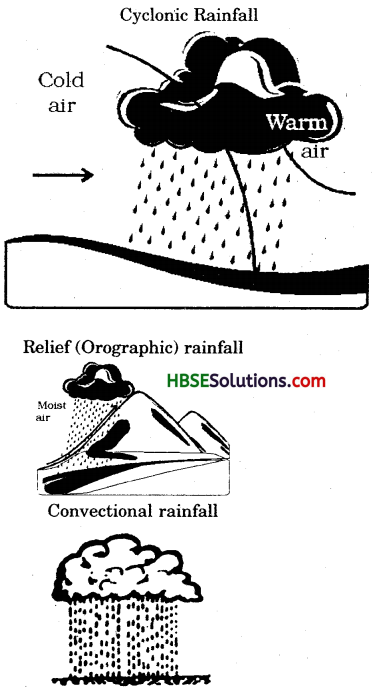
Question 5.
Draw diagrams to show (i) Cyclonic rainfall
(ii) Relief rainfall
(iii) Convectional rainfall.
Answer:
HBSE 7th Class Social Science Solutions Geography Chapter 4 Air 1

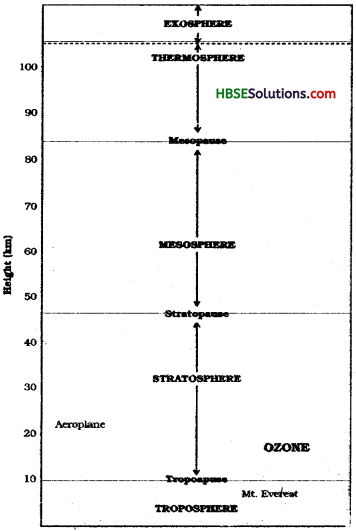
Question 6.
Draw a diagram showing the layers of atmosphere.
Answer:
HBSE 7th Class Social Science Solutions Geography Chapter 4 Air 2

Long Answer Type Questions

Question 1.
Explain about different layers of atmosphere.
Answer:
There are five different layers of atmosphere :

  • Troposphere
  • Stratosphere
  • Mesosphere
  • Thermosphere
  • Exosphere

Answer:
(i) Troposphere:
Height : Its average height is about 13 km.
Activities : This is the most important layer of the atmosphere. The air we breathe exists here. All weather phenomena like rainfall, fog and hailstorm occur in this layer.
Upper limit: Tropopause.
Temperature : Not beyond 45°C.

(ii) Stratosphere:
Height: It extends upto a height of 50 km.
Activities: This layer is almost free from clouds and associated weather phenomenon making conditions more ideal for flying aeroplanes. It has the ozone layer which protects us from the harmful affect of rays.
Upper limit: Stratopause.
Temperature : The temperature here keeps on rising.

(iii) Mesosphere:
Height : This is the third layer of the atmosphere. It lies above the height of 80 km.
Activities : Meteorites burn up in this layer on entering the space.
Upper limit: Mesopause.

(iv) Thermosphere : Height: 80-400 km.
Its upper limit satropause
Temperature: The temperature is rising.

HBSE 7th Class Social Science Solutions Geography Chapter 4 Air

Question 2.
Name the various gases in the atmosphere and their functions or uses.
Answer:
Nitrogen and oxygen are two gases which make up the bulk of the atmosphere. Carbon dioxide, helium, ozone, argon and hydrogen are found in lesser quantities. Apart from these gases, tiny dust particles are also present in the air.

Their functions and uses are as follows:

  • Nitrogen is the most plentiful gas in the air. When we inhale, we take some amount of nitrogen into our lungs and exhale it. But plants need nitrogen for their survival.
  • Oxygen is the second most plentiful gas in the air. Humans and animals take oxygen from the air as they breathe.
  • Carbon dioxide is another important gas. Green plants use carbon dioxide to make their food and release energy.

Question 3.
Which is the greenhouse gas and what affect does it have?
Answer:
(i) Carbon dixoide-released in the atmosphere creates a greenhouse effect by trapping the heat radiated from the earth. It is therefore called a green house gas and without it the earth would have been too cold to live in. However, when the level in the atmosphere increases due to factory smoke or car fumes, the heat retained increases the temperature of the earth. This is called global warming.

(ii) This rise in temperature causes the snow in the coldest parts of the world to melt.

(iii) As a result, the sea level rises, causing floods in the coastal areas.

(iv) There may be drastic changes in the climate of a place leading to extinction of some plants and animals.

Air Class 7 HBSE Notes

  • Atmosphere : Thick blanket of air around the earth.
  • Ozone : This thin layer of atmosphere which acts as a filter and absorbs ultra violet radiation.
  • Smog: Combination of smoke and fog.
  • Stratosphere : Above troposphere it is a cold but clean layer of air.
  • Periodic Winds : Winds changing their direction periodically with change in the season.
  • Loo : Hot and dry wind that blows over the plains.
  • Evaporation : Change of liquid state of water into water vapour.
  • Wind : Horizontally moving air near the surface of the earth is called a wind.
  • Lapse Rate : The rate at which temperature decreases with altitude is called lapse rate.
  • Radiation : Reflection of solar energy by clouds and particles are called radiation.
  • Molecule : Smallest particles of a substance in free state.
  • Humidity : The amount of water vapour present in the air.
  • Insolation : The amount of solar radiations coming down to the earth.
  • Terrestrial. Radiation : The heat given off by the earth.

HBSE 7th Class Social Science Solutions Geography Chapter 4 Air Read More »

HBSE 7th Class Social Science Solutions Geography Chapter 5 Water

Haryana State Board HBSE 7th Class Social Science Solutions Geography Chapter 5 Water Textbook Exercise Questions and Answers.

Haryana Board 7th Class Social Science Solutions Geography Chapter 5 Water

HBSE 7th Class Geography Water Textbook Questions and Answers

Question 1.
Answer the following questions:
(i) What is precipitation?
Answer:
When the water vapour cools, it condenses and forms clouds. From there it may fall On the land or sea or rain, snow sleet. This is called precipitation.

(ii) What is the water cycle?
Answer:
The process by which water continually changes its form and circulates between oceans, atmosphere and land is known as the water cycle.

(iii) What are the factors affecting the height of the waves?
Answer:
The factors affecting the height of the waves are:

  • Winds
  • Earthquakes, volcanic eruption and landslides on the bottom of the ocean.

(iv) Which factors effect the movement of waves?
Answer:
The factors which effect the movement of waves are :

  • Temperature
  • Winds
  • Gravitational pull of the sun
  • The earth
  • The moon
  • The warm and cold currents.

HBSE 7th Class Social Science Solutions Geography Chapter 5 Water

(v) What are tides and how are they caused?
Answer:
Tides are the rhythmic rise and fall of ocean water that occurs twice in a day. The strong gravitational pull exerted by the sun and the moon on the earth’s surface causes the tides.

(vi) What are ocean currents?
Answer:
Ocean currents are streams of water that flow constantly on the ocean surface in definite directions are called ocean currents.

Question 2.
Give reasons:
(i) Ocean water is salty.
Answer:
The water of the ocean is salty or saline as it contains large amount of dissolved salts. Most of the salt is sodium chloride or the common table salt.

(ii) The quality of water is deterior-ating.
Answer:
The quality of water is deteriorating day by day because of pollution of the rivers and also due to global warming, the fresh water stored in the ice caps is melting because of rising temperature. The water cycle is therefore disturbed and fresh water available for drinking is decreasing day by day.

Question 3.
Tick (√) the correct answer :
(i) The process by which water continually changes in its form and circulates between oceans, atmosphere and land.
(a) Water cycle
(b) Tides
(с) Ocean currents
Answer:
(a) Water cycle

(ii) Generally the warm ocean currents originate near ________.
(a) Poles
(b) Equator
(c) None of these
Answer:
(b) Equator

(iii) The rhythmic rise and fall of ocean water twice in a day is called ________.
(a) Tide
(b) Ocean current
(c) Wave
Answer:
(a) Tide

HBSE 7th Class Social Science Solutions Geography Chapter 5 Water

Question 4.
Match the following :

(i) Caspian sea(a) Largest lake
(ii) Tide(b) Periodic rise and fall of water
(iii) Tsunami(c) Strong seismic waves
(iv) Ocean currents(d) Streams of water moving along definite path
(e) Water cycle

Answer:
(i) (c)
(ii) (a)
(iii) (b)
(iv) (a)

Question 5.
For Fun :
Be a Detective
(i) The name of one river is hidden in each of the sentences below. Spot it.
Example : Mandra, Vijayalakshmi and Surinder are my best friends.
Answer:
Ravi.
(a) The snake charmer’s bustee, stables where horses are housed, and the piles of wood, all caught fire accidentally. (Hint: Another name for River Brahmaputra) Answer:
Teesta.

(b) The conference manager put pad, material for reading and a pencil for each participant. (Hint: A distributary on the Ganga-Brahmaputra delta)
Answer:
Padma.

(c) Either jealousy or anger cause a person’s fall (Hint: Name of a juicy fruit!)
Answer:
Orange.

(d) Bhavani germinated the seeds in a pot (Hint: Look for her in West Africa)

(e) “I am a zonal champion now” declared the excited atheletic. (Hint: The river that has he biggest basin in the world)
Answer:
Amazon.

(f) The tiffin box rolled down and all the food fell in dusty potholes. (Hint: Rises in India and journeys through Pakistan)
Answer:
Indus.

(g) Malini leaned against the pole when she felt that she was going to faint. (Hint: Her delta in Egypt is famous)
Answer:
Nile.

(h) Samantha mesmerised everybody with her magic tricks. (Hint: London is situated on her estuary)
Answer:
Thames.

(i) “In this neighbourhood, please don’t yell! Owners of these houses like to have peace”. Warned my father when we moved into our new flat”. (Hint: colour!)
Answer:
Yellow.

(j) ‘Write the following words, Marc!’ “On”, “go”, “in” said the teacher to the little boy in KG Class. (Hint: Rhymes with ‘bongo’)
Answer:
Congo.

Now make some morer on your own and ask your classmates to spot the hidden name. You can do this with any name: that of a lake, mountains, trees, fruits, school items etc.
Carry on Detective

HBSE 7th Class Social Science Solutions Geography Chapter 5 Water

(ii) With the help of an atlas, draw each river which you discoverd in For fun (t), on an outline map of the world.
Answer:
(a) Teesta
(b) Padma
(c) Orange
(d) Niger
(e) Amazon
(f) Indus
(g) Nile
(h) Thames
(i) Yellow
(j) Congo

HBSE 7th Class Geography Water Important Questions and Answers

Very Short Answer Type Questions

Question 1.
What causes evaporation of water?
Answer:
The sun’s heat causes evaporation of water vapour.

Question 2.
Name the major sources of fresh water.
Answer:
Rivers, ponds, springs, glaciers.

Question 3.
Which salt is mainly found in the ocean water?
Answer:
Much of the salt found in the sea-water is sodium chloride or the common tablesalt.

Question 4.
Give reason : Swimmers can float in Dead Sea.
Answer:
Swimmers can float in Dead sea because it increases salt content and makes it dense.

Question 5.
What are the different ways in which movements of ocean water can be classified.
Answer:
The movements in the ocean water can be classified as : (a) waves, (b) tides, (c) currents.

HBSE 7th Class Social Science Solutions Geography Chapter 5 Water

Question 6.
What is the importance of World Water Day?
Answer:
The need to conserve water is reinforced in different ways on World Water Day.

Question 7.
What are waves?
Answer:
When the water on the surface of the ocean rises and falls alternatively, they are called waves.

Short Answer Type Questions

Question 1.
What are the spring tides? When do they occur?
Answer:
High magnitude tides are called spring tides. These tides occur on the full moon and new moon nights when the sun, the moon and the earth are in the same line.

Question 2.
What are neap tides? When do they occur?
Answer:
Low magnitude tides are called neap tides. These tides occur when the moon is in its first and last quarter, and the ocean water get drawn in mutually perpendicular directions by the gravitational pull of the sun and the earth resulting in low tides.

Question 3.
Where do the warm and cold ocean currents originate?
Answer:

  • The warm ocean currents originate near the equator and move towards the poles.
  • The cold currents originate near polar or higher latitudes and move towards tropical or lower latitudes.

Long Answer Type Questions

Question 1.
Distinguish between Wave and Tide.
Answer:

WavesTides
(i) Waves are up and down movement of ocean water due to pushing action of wind.(i) Tides are up and down movement of ocean water due to gravitational pull of the sun and moon.
(ii) Waves occur 24 hours a day.(ii) Tides occur twice a day early in the morning and late at night.
(iii) Waves are not useful. Infact, violent waves can bring destruction.(iii) Tides are very useful.

Question 2.
Is all the water on earth available to us?
Answer:
No, all the water on earth is not available to us. Only 2.8% water is fresh, which we can utilize to fulfill our needs. Rest 97.2% water is saline.

Question 3.
If there is more water than land on this earth, why do so many countries face water scarcity?
Answer:

  • About 97.2% water is saline.
  • Only 2.8% water is fresh which can be utilised by the human beings.
  • Uneven distribution of water also leads to water scarcity.
  • Careless use and wastage of water by human beings is the main cause of water scarcity.

HBSE 7th Class Social Science Solutions Geography Chapter 5 Water

Question 4.
Write the effects of ocean currents.
Answer:

  • The ocean current influences the temperature conditions of the area. Warm currents bring about warm temperatures over the land surface.
  • The areas where the warm and cold currents meet provide the best fishing grounds in the world.
  • The areas where warm and cold currents meet also experience foggy weather making it difficult to navigate.

Water Class 7 HBSE Notes

  • Terraium : It is an artificial enclosure for keeping small house plants.
  • Hydrosphere : Part of the earth’s surface covered with water.
  • Tide : The regular rise and fall in seawater is called tide.
  • High Tide : The regular rise of seawater is called high tide.
  • Low Tide : The fall of seawater is called low tide.
  • Ground Water : When the rainwater is soaked by the ground is called groundwater.
  • Hydrological Cycle : The continuous circulation of water among the hydrosphere, atmosphere, and lithosphere is called the hydrological cycle. Actually the cycle is of a very complex nature with a number of sub-cycles.
  • Glacier : The moving mass of ice is known as glaciers.
  • Salinity : Amount of salt in grams present in 1000 grams of seawater.
  • Water Cycle : The movement of water from the sea to air and back to the sea.
  • Water Conservation : The protection, preservation, and careful use of the water.
  • Winds : The undulation on the surface of the water caused by wind blowing oversea.
  • Evaporation : The process by which the water changes into water vapour and enters into the atmosphere.
  • Condensation : The change of water vapour into droplets of water or snow is called condensation.
  • Precipitation : The condensation of water vapour in the form of water droplets or ice crystals and falling on the earth’s surface.

HBSE 7th Class Social Science Solutions Geography Chapter 5 Water Read More »

HBSE 7th Class Social Science Solutions Geography Chapter 6 Natural Vegetation and Wild Life

Haryana State Board HBSE 7th Class Social Science Solutions Geography Chapter 6 Natural Vegetation and Wild Life Textbook Exercise Questions and Answers.

Haryana Board 7th Class Social Science Solutions Geography Chapter 6 Natural Vegetation and Wild Life

HBSE 7th Class Geography Natural Vegetation and Wild Life Textbook Questions and Answers

Question 1.
Answer the following questions:
(i) Which are the two factors on which the growth of vegetation mostly depends?
Answer:
The growth of vegetation mostly depends on the following two factors:

  • Temperature
  • Moisture

(ii) Which are the three broad categories of natural vegetation?
Answer:
Three broad categories of natural vegetation are as follow:

  • Forests
  • Grasslands
  • Thorny shrubs.

(iii) Name the two hardwood trees commonly found in tropical evergreen forests.
Answer:
The two hardwood trees commonly found in tropical evergreen forests are:

  • Rosewood
  • Ebony
  • Mahogany (Any two)

(iv) In which part of the world, tropical deciduous forest is found?
Answer:
Tropical deciduous forests are found in the large part of India, northern Australia and in Central America. Teak, sal, neem and shisham are the main trees of these forests.
HBSE 7th Class Social Science Solutions Geography Chapter 6 Natural Vegetation and Wild Life 1

(v) In which cliiftatic condition, citrus fruits are cultivated?
Answer:
Hot dry summer and rainy mild winter season is good for the cultivation of citrus fruits.

(vi) Mention the uses of coniferous forests.
Answer:

  • The wood of trees found in these forests is very soft which is used to make match box and packing boxes.
  • The wood is very useful for making pulp.
  • The wood is used for making news print.
  • Tree helps to control soil erosion.
  • Trees provide shelter to our wildlife.

(vii) In which part of the world seasonal grassland is found?
Answer:
The world seasonal grassland is found in is found in the mid-latitudinal zones and in the interior parts of the continents.

HBSE 7th Class Social Science Solutions Geography Chapter 6 Natural Vegetation and Wild Life

Question 2.
Tick the correct answer :
(i) Mosses and Lichens are found in :
(a) Desertic vegetation
(b) Tropical evergreen forest
(c) Tundra vegetation
Answer:
(c) Tundra vegetation

(ii) Thorny bushes are found in :
(a) Hot and humid tropical climate
(b) Hot and dry desertic climate
(c) Cold polar climate
Answer:
(b) Hot and dry desertic climate

(iii) In tropical evergreen forest, one of the common animals is :
(a) Monkey
(b) Giraffe
(c) Camel
Answer:
(a) Monkey

(iv) One important variety of coniferous forest is :
(a) Rosewood
(b) Pine
(c) Teak
Answer:
(b) Pine

(v) Steppe grassland is found in :
(a) S. Africa
(b) Australia
(c) Central
Answer:
(c) Central

Question 3.
Match the following :

(i) Walrus(a) Soft wood tree
(ii) Cedar(b) An animal of tropical deciduous forest
(iii) Olives(c) A polar animal
(iv) Elephant(d) Temperate grassland in Australia
(v) Campos(e) Throny Shrubs
(vi) Downs(f) A citrus fruit
(g) Tropical grassland of Brazil

Answer:

(i) Walrus(c) A polar animal
(ii) Cedar(a) Soft wood tree
(iii) Olives(f) A citrus fruit
(iv) Elephant(b) An animal of tropical deciduous forest
(v) Campos(g) Tropical grassland of Brazil
(vi) Downs(d) Temperate grassland in Australia

Question 4.
Give reasons:
(i) The animals in polar region have thick fur and thick skin.
(ii) Tropical deciduous trees shed their leaves in the dry season.
(iii) The type and thinkness of vegetation changes from place to place.
Answer:
(i) The animals in polar region have thick fur and thick skin to protect themselves from the cold climatic conditions.
(ii) Tropical deciduous trees shed their leaves in the dry season to conserve water.
(iii) The type and thickness of vegetation changes from place to place because of the variation in temperature and moisture.

HBSE 7th Class Social Science Solutions Geography Chapter 6 Natural Vegetation and Wild Life

Question 5.
Activity:
(i) Collect pictures and photographs of forests and grasslands of different parts of world. Write one sentence below each picture.
(ii) Make a college of rainforest grassland and coniferous forests.
Answer:
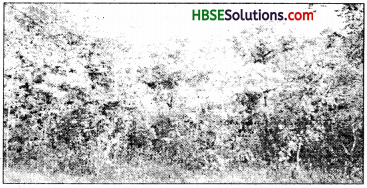
(i) (A)
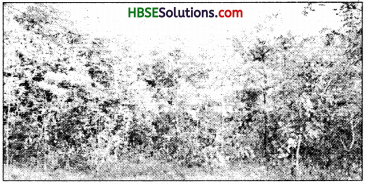
HBSE 7th Class Social Science Solutions Geography Chapter 6 Natural Vegetation and Wild Life 2
Tropical evergreen forests occur in the regions near the equator and close to the Tropics.

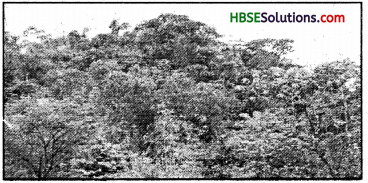
(B)
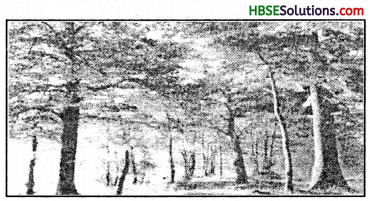
HBSE 7th Class Social Science Solutions Geography Chapter 6 Natural Vegetation and Wild Life 3
Tropical deciduous forests are the monsoon forests which experience seasonal changes.

(C)
HBSE 7th Class Social Science Solutions Geography Chapter 6 Natural Vegetation and Wild Life 4
Temperate evergreen forests comprise both hard and soft wood trees like oak, pine, eucalyptus etc.

(D)
HBSE 7th Class Social Science Solutions Geography Chapter 6 Natural Vegetation and Wild Life 5
The trees of temperate deciduous forests shed their leaves in dry seasons.

(E)
HBSE 7th Class Social Science Solutions Geography Chapter 6 Natural Vegetation and Wild Life 6
Mediterranean vegetation is mostly found in the areas around the Mediterranean sea in Europe, Africa and Asia. Coniferous (Taiga) forests are found in the higher latitudes (50°-70°) of Northern hemisphere. Tropical grassland grows in the areas of moderate to low amount of rainfall.
HBSE 7th Class Social Science Solutions Geography Chapter 6 Natural Vegetation and Wild Life 7

Question 6.
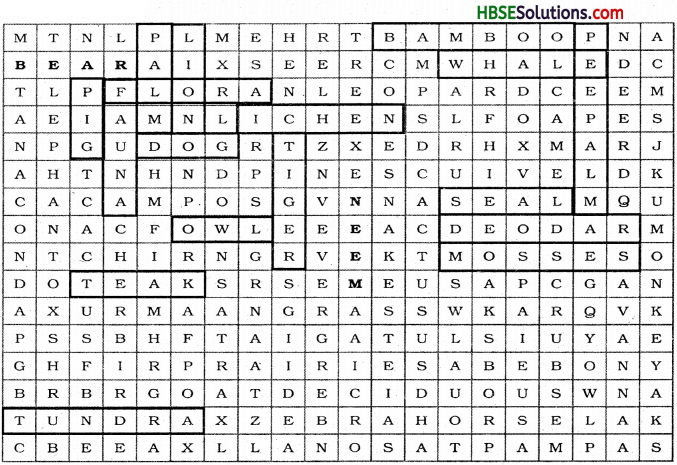
For Fun
HBSE 7th Class Social Science Solutions Geography Chapter 6 Natural Vegetation and Wild Life 8
Answer:
Horizontally : Bamboo, Bear, Whale, Flora, Lichen, Hen, Pine, Seal, Fowl, Chir, Masses, Grass, Taiga, Praire, Fir, Ebony, Goat, Deciduous, Tundra, Zebra, Horse, Lianos, Pampas.

Vertically : Shrub, Ox, Pig, Cactus, Fauna, Lion, Downs, Tiger, Neem, Oak, Camel, Peepal, Oak, Deer, Savanaa, Yak.

HBSE 7th Class Geography Natural Vegetation and Wild Life Important Questions and Answers

Very Short Answer Type Questions

Question 1.
Why do the trees in tropical evergreen forests do not shed their leaves altogether?
Answer:
The trees in tropical evergreen forests do not shed their leaves’ altogether because there is no particular dry season.

Question 2.
Where are tropical deciduous forests found?
Answer:
Tropical deciduous forests are found in the large part of India, northern Australia, and in Central America.

Question 3.
What type of trees are found at higher latitudes?
Answer:
Temperate deciduous forests are found at higher latitudes.

Question 4.
What is the use of wood of coniferous trees?
Answer:
The wood of coniferous trees is used for manufacturing pulp which is used for manufacturing paper and newsprint.

Question 5.
What is the extent of tropical grasslands?
Answer:
The tropical grasslands occur on either side of the equator and extend till the Tropics.

HBSE 7th Class Social Science Solutions Geography Chapter 6 Natural Vegetation and Wild Life

Question 6.
What kind of grass is found in temperate grasslands?
Answer:
Short and nutritious grass is found in temperate grasslands.

Question 7.
Why is vegetation cover scarce in thorny bushes?
Answer:
Vegetation cover is scarce in thorny bushes because of scanty rain and scorching heat.

Short Answer Type Questions

Question 1.
What are the factors on which growth of vegetation depends?
Answer:
Following are the factors on which growth of vegetation depends :

  • The change in height affects the character of vegetations. With the change in height, the climate changes and that changes natural vegetation.
  • The growth of vegetation also depends on temperature and moisture.
  • The growth of vegetation also depends on factors like slope and thickness of soil.

Question 2.
What are three categories of natural vegetation?
Answer:
The three categories of natural vegetations are :

  • Forests : Forests grow where temperature and rainfall are plentiful to support a tree cover. The forests can be (i) dense forests, (ii) open forests.
  • Grasslands : Grasslands include tropical and temperate grasslands. They grow in the region of moderate rain.
  • Shrubs : Thorny shrubs and scrubs grow in the dry region.

Question 3.
Write a short note on temperate grasslands.
Answer:
Tropical grasslands occur oft either side of the equator and extend till the tropics. This vegetation grows in the areas of moderate’ to low amount of rainfall. The grass can grow very tall, about 3 to 4 metres in height. Savannah grasslands of Africa are of this type. Common animals found here are elephants, zebras, giraffes, deer and leopards.

Question 4.
Write three major features of tropical evergreen forests.
Answer:
Major features of tropical evergreen forests are:
These forests are so dense that thick canopies are developed which do not allow the sunlight to penetrate inside the forest. As there is no particular dry season, the trees do not shed their leaves altogether. This keeps the forest evergreen. Hardwood trees such as rosewood, ebony and mahogany are found here.

Question 5.
Where is Tundra type of vegetation found? Why?
Answer:
Tundra type of vegetation includes mosses, lichens and very small shrubs. The main polar areas of Tundra type of vegetation are Europe, Asia and North America. This is found in polar regions. They grow during the very short summer. This is so because polar regions are extremely cold and the growth of natural vegetation is very limited here.

HBSE 7th Class Social Science Solutions Geography Chapter 6 Natural Vegetation and Wild Life

Question 6.
What are the main features of Highlands vegetation?
Answer:
The temperature falls with the rise in the height as in the mountainous area. The factors behind the variety in the types of vegetation in highlands are the climatic changes occurring in the higher altitude.

A succession of the vegetation from the tropical to alpine types in mountains can be notice. Generally, at the foothills, there is belt of deciduous trees. The pine forests are well grown at the height between 1500 metres to 2000 metres.

Long Answer Type Questions

Question 1.
Write a note on the various’ types of grasslands.
Answer:
The various types of grasslands are:

  • Tropical grasslands
  • Temperate grasslands
  • Thorny bushes

1. Tropical grasslands : This type of vegetation grows in the areas of moderate to low amount of rainfall. The grass here can grow very tall, about to 4 metres in height. Savannah grasslands of Africa are of this type. Common animals found here are elephants, zebras, giraffes, deer, leopards etc.

2. Temperate grasslands : This type of vegetation is found in the mid-latitudinal zones and in the interior part of the continents. Grass here is usually short and nutritious. Common animals found in this region are wild buffaloes, bisons, antilopes etc.

3. Thorny bushes : These are found in the dry desert like regions. Tropical deserts are located on the western margins of the continents, which are characterised by such vegetation. Vegetation in the polar regions is also limited. Only mosses, lichens and very small shrubs are found here. It grows during the very short summer. This is called Tundra type of vegetation. Polar animals have thick fur and thick skin which protect them from the cold climate conditions, for example, seal, walruses, musk-oxen, Arctic owl, etc.

Natural Vegetation and Wild Life Class 7 HBSE Notes

  • Evergreen Vegetation : Forest with trees retaining the leaf cover across the year.
  • Natural Vegetation : Original land cover of forest vegetation.
  • Coniferous Trees : The forest in which trees have conical leaves and they don’t shed their leaves all at a time.
  • Wildlife Sanctuary : An area, set aside for preserving its natural vegetation, natural beauty, wildlife etc.
  • Biodiversity : Different species on the earth.
  • Biome : A vast ecosystem with its group of plants and animals is recognised as biome.
  • Eco-system : A system which comprises the physical environment and the’organisms with live therein.
  • Food Chain : Food chain is the transfer of energy from one organism to another in ecological system.
  • Food Web : It is complicated network of several food chains.
  • Herbivores : Animals of those categories which lives on grass and plants.
  • Carnivores : The animals which kill small animals for their food.
  • Habitat: The physical environment in which the animals normally live.
  • Forests : Extensive area covered with trees.
  • Vegetation : The assemblage of plant species living in association with each other in a given environmental framework is known as vegetation.
  • Fauna : Species of animals.
  • Flora : Plants of a particular region.
  • Conservation : Protection, preservation, and efficient utilization of resources gifted by nature.

HBSE 7th Class Social Science Solutions Geography Chapter 6 Natural Vegetation and Wild Life Read More »

HBSE 7th Class Social Science Solutions Geography Chapter 3 Our Changing Earth

Haryana State Board HBSE 7th Class Social Science Solutions Geography Chapter 3 Our Changing Earth Textbook Exercise Questions and Answers.

Haryana Board 7th Class Social Science Solutions Geography Chapter 3 Our Changing Earth

HBSE 7th Class Geography Our Changing Earth Textbook Questions and Answers

I. Answer the following questions:

Question 1.
Why do plates move?
Answer:
1. The lithosphere is broken into a number of plates known as Lithosphere plates.
2. These plates move around slowly a few millimeters each year.
3. It is because of the movement of molten magma inside the earth.

Question 2.
What are endogenic and exogenic forces?
Answer:
The earth movements are divided on the basis of the forces which causes them. The forces which act in the interior of the earth are called endogenic forces and the forces that work on the surface of earth are called exogenic forces.

Question 3.
What is erosion?
Answer:
Erosion is the wearing away of the landscape by different agents like water, wind and ice.

Question 4.
How are flood plains formed?
Answer:
During floods, layers of fine soil and other material called sediments are deposited on the river bank. This leads to the formation of a flat fertile flood plains.

Question 5.
What are sand dunes?
Answer:
An active agent of erosion and deposition in the desert is wind. When the wind blows, it lifts and transports sand from one place to another. When it stops blowing, the sand falls and gets deposited in hill-like structure called sand-dunes.

HBSE 7th Class Social Science Solutions Geography Chapter 3 Our Changing Earth

Question 6.
How are beaches formed?
Answer:
The sea-waves deposit sediments, beaches.

Question 7.
What are ox-bow lakes?
Answer:
An ox-bow lake is a cut-off lake formed due to cut-off of a meander loop.

Question 2.
Tick (✓) the correct answer.
(i) Which is not an erosional feature of sea waves?
(a) Cliff
(b) Beach
(c) Sea cave
Answer:
(b) Beach

(ii) The depositional feature of a glacier is :
(a) Flood plain
(b) Beach
(c) Moraine
Answer:
(c) Moraine

(iii) Which is caused by the sudden movements of the earth?
(a) Volcano
(b) Folding
(c) Flood plain
Answer:
(a) Volcano

(iv) Mushroom rocks are found in :
(a) Deserts
(b) River valleys
(c) Glaciers
Answer:
(a) Deserts

(v) Ox bow lakes are found in :
(a) Glaciers
(b) River valleys
(c) Deserts
Answer:
(b) River valleys

Question 3.
Match the following :

(i) Glacier(a) Sea shore
(ii) Meanders(b) River of Ice
(iii) Beach(c) Rivers
(iv) Sand dunes(d) Vibrations of earth
(v) Waterfall(e) Hard bed rock
(vi) Earthquake(f) Deserts

Answer:
(i) (c)
(ii) (b)
(iii) (a)
(iv) (f)
(v) (d)
(vi) (e)

Question 4.
Give reasons :
(i) Some rocks have shape of a mushroom.
Answer:
In deserts you can see the rocks in the shape of mushroom, commonly known as mushroom rocks because winds erode the lower sections of the rock more than the upper part. Therefore, such rocks have a narrower base and a wider top.

(ii) Flood plains are very fertile.
Answer:
At times the river overflows its banks this leads to the flooding of the neighbouring areas. As it floods, it deposits layer of fine soil and other material called sediments along its banks.

(iii) Sea caves are turned into stack.
Answer:
As the cavities of the sea caves become bigger and bigger only the roof of the caves remain thus forming arches. Erosion of sea arch breaks the roof and only walls are left. These wall like features are called stacks.

(iv) Buildings collapse due to earthquake.
Answer:
Buildings collapse because of the movement in tectonic plates under the surface of the earth which send out vibrations in all the direction causing an effect to anything built on the crust.

HBSE 7th Class Social Science Solutions Geography Chapter 3 Our Changing Earth

Question 5.
Activity:
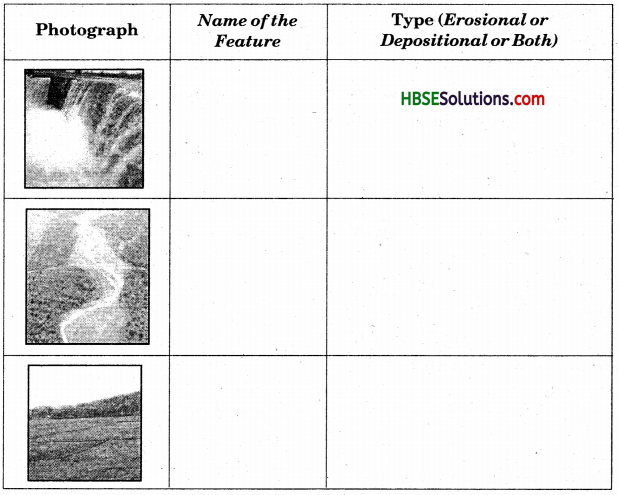
Observe the photographs given below. These are various features made by a river. Identify them and also tell whether they are erosional or depositional or landforms formed by both.
HBSE 7th Class Social Science Solutions Geography Chapter 3 Our Changing Earth 1
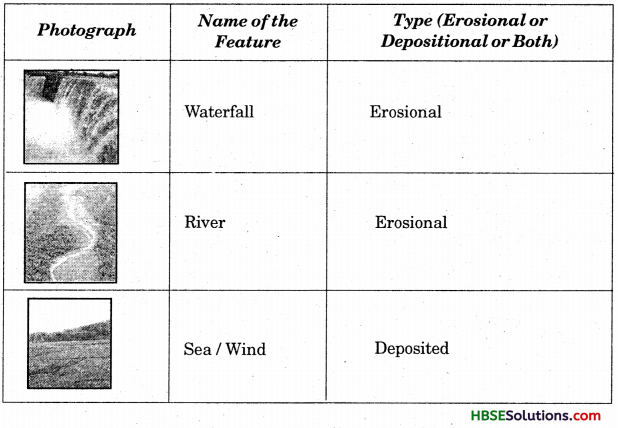
Answer:
HBSE 7th Class Social Science Solutions Geography Chapter 3 Our Changing Earth 2

Question 6.
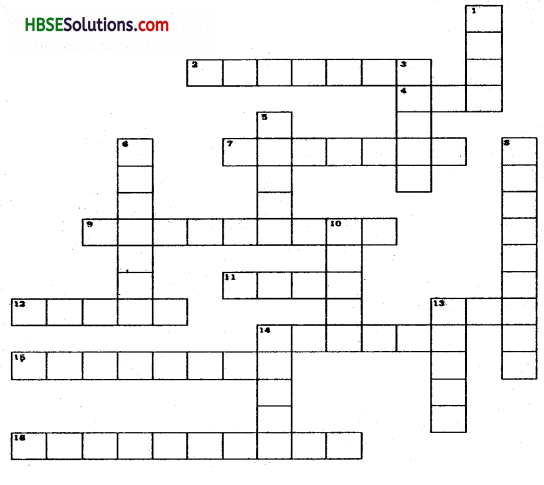
Solve the crossword puzzle with the help of clues given.
HBSE 7th Class Social Science Solutions Geography Chapter 3 Our Changing Earth 3
Answer:

AcrossDown
2. Look like bend of river1. Rise and fall of water caused by friction of wind on water surfaces.
4. Solid form of water3. Flow of water in channel.
7. Moving mass of ice5. Steep perpendicular face of rock along sea coast.
9. Sudden descent of water in bed of river6. Debris of boulder and coarse material carried by glacier.
11. Natural cavity of weak rocks formed by action of waves.8. Crescent shaped lake formed by river meander
12. Embankment on river that keeps rivers in its channel.10. Fine sand deposited by action of wind.
13. Large body of sea water.13. Isolated mass of rising steep rock near coastline.
14. Dry area where sand dunes are formed.14. Alluvial tacts of land at mouth of river formed by river deposits.
15. Small hill of sand piled by action of winds
16. Flat plain formed by river deposits during time of flood.

Across:
2. Meander
4. Ice
7. Glacier
11. Cave
12. Cliff
13. Sea,
14. Desert
15. Sand-dune
16. Flood Plain.

Down:
1. Wave
3. River
5. Cliff
6. Hollows
8. Ox Bow Lake
10. Dunes
13. Beach
14. Delta.

HBSE 7th Class Geography Our Changing Earth Important Questions and Answers

Very Short Answer Type Questions

Question 1.
What are lithospheric plates?
Answer:
The lithosphere is broken into a number of plates known as the lithospheric plates.

Question 2.
What causes changes on the surface of the earth?
Answer:
The movement of the lithospheric plates causes changes on the surface of the earth.

Question 3.
What is a volcano?
Answer:
A volcano is a vent (opening) in the earth’s crust through which molten material erupts suddenly.

Question 4.
When does weathering and erosion take place?
Answer:
Weathering and erosion takes place everywhere and at all the time.

Question 5.
What are dunes?
Answer:
Wind-blowing materials deposited in deserts are known as dunes.

Question 6.
Who are mineralogists?
Answer:
The scientists who study minerals are called mineralogists.

HBSE 7th Class Social Science Solutions Geography Chapter 3 Our Changing Earth

Question 7.
Name five rivers of the world which form a delta.
Answer:
Nile, Zaire, Ganga-Brahmaputra, Amazon, Murray—Darling.

Question 8.
Name four coastal landforms.
Answer:
Sea caves, sea arches, stacks, sea cliff.

Short Answer Type Questions

Question 1.
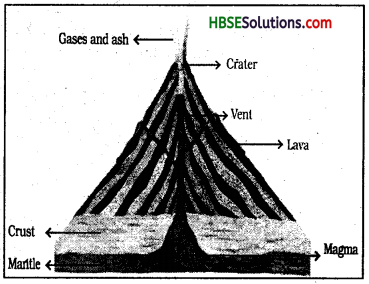
Draw a well-labelled diagram of a volcano.
Answer:
HBSE 7th Class Social Science Solutions Geography Chapter 3 Our Changing Earth 4

Question 2.
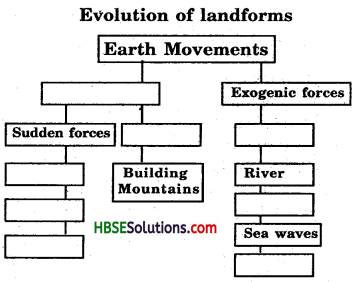
Complete the flow-chart given below:
Evolution of landforms
HBSE 7th Class Social Science Solutions Geography Chapter 3 Our Changing Earth 5
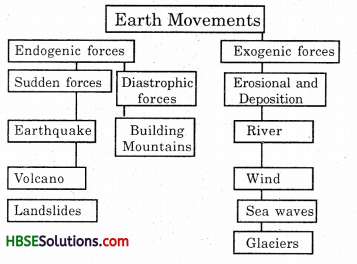
Answer:
Evolution of landforms
HBSE 7th Class Social Science Solutions Geography Chapter 3 Our Changing Earth 6

Question 3.
How is an earthquake measured?
Answer:
An earthquake is measured with a machine called seismography. The magnitude of the earthquake is measured on a Richter Scale. The following table explains the intensity of earthquake.

Magnitude (Richter Scale)Affect
(a) 2.0 or lesscan be felt only a little
(b) Over 5.0can cause damage from things falling
(c) 6.0 or highervery strong
(d) 7.0 or highermajor earthquake

Question 4.
How do glaciers help in the formation of lakes?
Answer:
Glaciers erode the landscape by bulldozing soil and stones to expose the solid rock below. Glaciers carve out deep hollows. As the ice melts, they even get gilled up with water and become filled up with water and become beautiful lakes in the mountains.

Question 5.
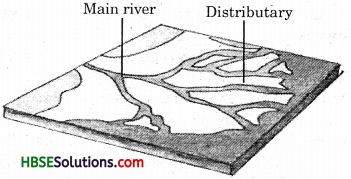
Draw’ a diagram of a delta and mark its (a) main river (b) Distributary.
Answer:
HBSE 7th Class Social Science Solutions Geography Chapter 3 Our Changing Earth 7

Question 6.
Define river load.
Answer:
The agents of wind, running water, glaciers and sea waves are constantly engaged in eroding rocks and many land surfaces. The minerals in rocks are also dissolved in water. These rock pieces, organic materials and dissolved minerals are called river load.

HBSE 7th Class Social Science Solutions Geography Chapter 3 Our Changing Earth

Question 7.
Give an account of earthquake preparedness.
Answer:
Earthquakes cannot be accurately predicted. However, we can minimise the impact if we are-prepared before hand.
During an earthquake, we should:

  • Take a shelter under a kitchen counter, table or desk against an inside corner or wall.
  • Stay away from fire places, areas around chimneys, windows that shelter including mirrors and picture frames.
  • Spread awareness amongst our friends and family members.

Long Answer Type Questions

Question 1.
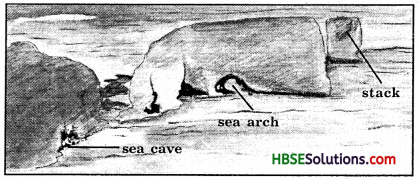
(а) sea cave
(b) sea arch
(c) sea cliff
(d) stack.
Answer:
HBSE 7th Class Social Science Solutions Geography Chapter 3 Our Changing Earth 8
(a) Sea waves continuously strike at the rocks. Cracks develop. Over time they become larger and wider. Thus, hollow like caves are formed on the rocks. They are called sea caves.

(b) As the cavities of the sea cave, become bigger and bigger, only the roof of the cave remain, thus, forming sea arches.

(c) The steepy rocky coast rising almost vertically above sea water is called sea cliff.

(d) Erosion of sea arch breaks the roof and only walls are left. These wall like failures are called stacks.

Question 2.
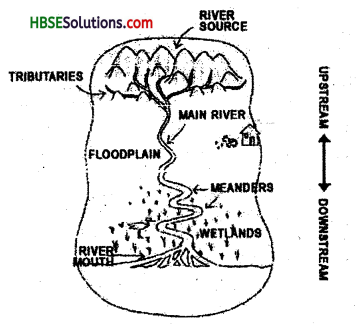
Write about the work of a river. Explain with the help of a diagram.
Answer:
The following points explain the work of a river:
(a) The running water in the river erodes the landscape.

(b) When the river tumbles at steep angle over very hard rocks or down a deep valley side it forms a waterfall.

(c) While entering the plain the river twists and turn and forms large bends which are known as meanders.

(d) Due to continuous erosion and deposition along the sides of the meander, the ends of the meander loop come closer and closer.

(e) In the due source of time, the meander loop cuts-off from the river and forms a cut-off lake; which is also called ox-bow lake.
HBSE 7th Class Social Science Solutions Geography Chapter 3 Our Changing Earth 9
(f) Sometimes, the river overflows its banks causing flood in the neighbouring areas.

(g) As it floods, it deposits layers of fire, soil and other material called sediments along its banks.

(h) The fertile flood plain is formed. The raised banks are called leeves.

(i) As the river approaches the sea, the speed of the flowing water decreases and the river which begins to break up into several streams known as distributaries.

(j) As river becomes very slow and it begins to deposit its load.

(k) The collection of sediments from all the mouths formed a delta, which is a triangular landmass.

Our Changing Earth Class 7 HBSE Notes

  • Weathering : Weathering is the breaking up of the rocks on the earth’s surface.
  • Erosion : Erosion is the wearing away of the landscape by different agents like water, wind etc.
  • Meanders : Large bends formed by twisting and turning of the river while entering the plain are called meanders.
  • Ox-bow Lake : An ox-bow lake is a cut-off lake formed due to the cut-off of a meander loop.
  • Leeves : The raised banks are called leaves.
  • Glacial Moraines : The materials carried by the glacier such as rocks big and small, sand and silt get deposited, these deposits from glacial moraines.
  • Waterfall : When the river tumbles at a steep angle over very hard rocks or down a steep valley side forms a waterfall.

HBSE 7th Class Social Science Solutions Geography Chapter 3 Our Changing Earth Read More »

HBSE 7th Class Social Science Solutions Geography Chapter 2 Inside Our Earth

Haryana State Board HBSE 7th Class Social Science Solutions Geography Chapter 2 Inside Our Earth Textbook Exercise Questions and Answers.

Haryana Board 7th Class Social Science Solutions Geography Chapter 2 Inside Our Earth

HBSE 7th Class Geography Inside Our Earth Textbook Questions and Answers

I. Answer the following questions:

Question 1.
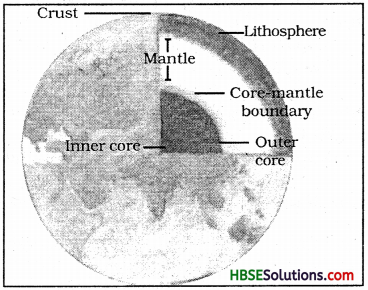
What are the three layers of the earth?
Answer:
HBSE 7th Class Social Science Solutions Geography Chapter 2 Inside Our Earth 1
(1) Crust:

  • The upper most layer of the earth’s surface is called crust.
  • It is the thinnest of all layers.
  • It is about 35 km. on the continental masses and 5 km. on the ocean floors.
  • The main mineral constituents of the continental masses are silica, aluminium and sial.

(2) Mantle:

  • Just beneath the crust is the mantle which extends upto 2900 km. below the crust.
  • The oceanic crust and mantle consists of silica and magnesium. Thus, Sima.

(3) Core:

  • The innermost layer is the core of radius 3500 km.
  • It is made up of nickel and ferrous, i.e., nife.

Question 2.
What is a rock?
Answer:
Any natural mass of mineral material that makes up the earth’s crust is called a rock. The earth’s crust is made up of various types of rocks. Rocks can be of different sizes, textures, shape, colour etc.

Question 3.
Name three types of rocks.
Answer:
Three types of rocks are as follows:

  • Igneous Rocks
  • Sedimentary Rocks
  • Metamorphic Rocks.

HBSE 7th Class Social Science Solutions Geography Chapter 2 Inside Our Earth

Question 4.
How are extrusive and intrusive rocks formed?
Answer:
→ Extrusive Rocks : When the molten lava comes on the earth’s surface, it rapidly cools down and becomes solid. Rocks formed in such a way on the crust are called extrusive igneous rocks. Example : basalt.

→ Intrusive Igneous Rocks : Sometimes the molten magma cools down deep inside the earth’s crust. Solid rocks so formed are called intrusive igneous rocks. Example: granite.

Question 5.
What do you mean by a rock cycle?
Answer:
One type of rock changes into another type under certain conditions in a cyclic manner. This process of transformation of the rock from form one to another is known as rock cycle.
Example:
(a) When the molten magma cools, it solidifies to become igneous rock. These igneous rocks are broken down into small particles that are transported and deposited to form sedimentary rocks.

(b) When the igneous and sedimentary rocks are subject to heat and pressure, they change to metamorphic rocks.

Question 6.
What are the uses of rocks?
Answer:
Rocks are very useful to us :

  • The hard rocks are used for making roads, houses and buildings.
  • We use stones for playing games such as pitthoo (seven stones).
  • Hop scotch (stapu / kit-kat) and five stones (gitti).
  • Rocks are made up,of different minerals which are important to mankind, e.g., coal, natural gas and petroleum.
  • Rocks are also used in industries – aluminium, gold, uranium, etc., in medicines, fertilisers etc.

Question 7.
What are metamorphic rocks?
Answer:
The igneous and metamorphic rocks are subjected to heat and pressure they change into metamorphic rocks, e.g., clay changes into slate and limestone changes into marble.

Question 2.
Tick the correct answer:
(i) The rock which is made up of molten magma is:
(a) Igneous
(b) Sedimentary
(c) Metamorphic
Answer:
(a) Igneous.

(ii) The innermost layer of the earth is:
(a) Crust
(b) Core
(c) Mantle
Answer:
(b) Core.

(iii) Gold, petroleum and coal are the examples of:
(a) Rocks
(b) Minerals
(c) Fossils
Answer:
(b) Minerals.

(iv) Rocks which contain fossils are :
(a) Sedimentary Rocks
(b) Metamorphic Rocks
(c) Igneous Rocks
Answer:
(a) Sedimentary Rocks.

(v) The thinnest layer of the earth
(a) Crust
(b) Mantle
(c) Core
Answer:
(a) Crust.

HBSE 7th Class Social Science Solutions Geography Chapter 2 Inside Our Earth

Question 3.
Match the following :

(i) Core(a) Earth’s surface
(ii) Minerals(b) Used for roads and buildings
(iii) Rocks(c) Made of silicon and alumina
(iv) Clay(d) Has definite chemical composition
(v) Sial(e) Innermost layer
(f) Changes into slate
(g) Process of transformation of the rock

Answer:
(i) (e)
(ii) (d)
(iii) (b)
(iv) (f)
(v) (c)

Question 4.
Give reasons :
(i) We cannot go to the centre of the earth.
(ii) Sedimentary rocks are formed from sediments.
(iii) Limestone is changed into marble.
Answer:
(i) We cannot go to the centre of the earth because the central core has very high temperature and pressure.

(ii) Sedimentary rocks are formed from sediments. Rocks roll down, crack and hit each other and are broken down into small fragments. These smaller parts are called sediments. These sediments are transported and deposits by wind, water, etc. These loose sediments then are compressed and hardened to form layers of rocks. These types of rocks are sedimentary rocks.

(iii) Limestone is changed into marble : Limetsone is a sedimentary rocks which due to excessive heat and pressure changes into marble after thousands of years and forms a metamorphic rock.

Question 5.
For fun :
(i) What are the minerals most commonly used in the following objects?
(ii) Identify some more objects made up of different minerals.
HBSE 7th Class Social Science Solutions Geography Chapter 2 Inside Our Earth 2
Answer:
These are made up of:

  • Iron, stainless steel
  • Brass and iron
  • Gold and pearl
  • Copper/Aluminium.

HBSE 7th Class Geography Inside Our Earth Important Questions and Answers

Very Short Answer Type Questions

Question 1.
Why is the earth called a dynamic planet?
Answer:
The earth is called a dynamic planet because it is constantly undergoing changes inside and outside.

Question 2.
What is lava?
Answer:
Lava is fiery red molten magma coming out from the interior of the earth on its surface.

Question 3.
Name the constituents of the oceanic crust.
Answer:
Silica and Magnesium.

HBSE 7th Class Social Science Solutions Geography Chapter 2 Inside Our Earth

Question 4.
What is ‘nife’?
Answer:
‘Nife’ is the name given to the core of the earth which mainly constitutes nickel and iron.

Question 5.
What happens when igneous and sedimentary rocks go under heat and pressure?
Answer:
They changes into metamorphic rocks.

Question 6.
What is the thinkess of the outer layer of the earth?
Answer:
The thickness of the outer layer of the earth is 60 km.

Question 7.
What is volcano?
Answer:
When magma from deep below forces its way up to earth’s surface, it is called volcano.

Question 8.
Which rocks are called primary or parent rocks?
Answer:
Igneous rocks are called primary or parent rocks.

Short Answer Type Questions

Question 1.
Distinguish between igneous and metamorphic rocks.
Answer:

IgneousMetamorphic
(i) When the molten magma cools, it becomes solid and thus forms an igneous rock.(i) Igneous rocks and sedimentary rocks can change into metamorphic rocks under great heat and pressure.
(ii) Igneous rocks are pure mineral rich rock with pure metal content, example granite and basalt.(ii) These are a mixture of igneous as well as sedimentary rocks, clay changes into slate; limestone into marble.

Question 2.
Why are igneous rocks called primary or basic rocks?
Answer:
Our earth contains a hot molten material having high temperature and pressure deep below its lithosphere. On cooling and solidification of the matter igneous rocks are formed. They make up about two-thirds of the earth’s crust. Therefore, they are called basic or primary rocks.

Question 3.
Formation of rocks is a slow process. Why?
Answer:
Formation of rocks , is a slow process because:

  • Climate breaks the parent rocks into many smaller pieces.
  • Topography or elevation helps in weathering of the rocks.
  • Plants and animals organism help in weathering of rocks.

For all these processes, time factor plays a major role.

Question 4.
What do the words igneous, sedimentary and metamorphic mean.
Answer:

  • The word Igneous drives from Latin word Ignis meaning Fire.
  • The word sedimentary is derived from a Latin sediments meaning settle down.
  • The word metamorphic derives from a Greek word metamorphise meaning change of form.

HBSE 7th Class Social Science Solutions Geography Chapter 2 Inside Our Earth

Question 5.
Give two examples of each of the following :
(а) Igneous rocks
(b) Sedimentary rocks
(c) Metamorphic rocks.
Answer:
(a) Land and zinc
(b) Coal and limestone
(c) Graphite and marble:

Long Answer Type Questions

Question 1.
How are different kinds of rocks formed?
Answer:
(i) Igneous rocks : When the molten magma cools, it becomes solid. Rocks formed in this way are called igneous rocks. They are also called primary rocks. They are of two types- intrusive rocks and extrusive rocks.
(a) Extrusive rocks : When molten lava comes on the earth’s surface, it rapidly cools down and becomes solid. Rocks formed in this way on the crust are called extrusive igneous rocks. For example, basalt.

(b) Intrusive rocks : Sometimes the molten magma cools down deep inside the earth’s crust. Solid rocks so formed are called intrusive igneous rocks. Since they cool down slowly they form large grains. For example, granite.

(ii) Sedimentary rocks : Small fragments of rocks are called sediments. These sediments are transported and deposited by wind, water, etc. These loose sediments are compressed and hardened to form sedimentary rocks. For example, sandstone is made from grains of sand.

(iii) Metamorphic rocks : When igneous and sedimentary rocks are subjected to great heat and pressure they changes into metamorphic rocks. For example,k clay changes into slate and limestone into marble.

Question 2.
Distinguish between rocks and minerals.
Answer:

RocksMinerals
(i) Rock is an aggregate of minerals.(i) Minerals contain ore and have atomic structure.
(ii) A rock is a natural solid material forming the earth’s crust.(ii) A mineral is a natural inorganic compound formed in the rocks.
(iii) Rocks are mainly of three types :(iii) There are about 2000 types of minerals.
(iv) A rock does not have a definite chemical composition.(iv) Minerals have a definite chemical composition.

Question 3.
Distinguish between crust and core.
Answer:

CrustCore
(i) It is the upper most layer of the earth’s surface.(i) It is the inner most layer of the earth’s surface.
(ii) The main mineral constituents are silica and alumina that is, SIAL.(ii) The main mineral constituents are nickel and ferrous that is NIFE.
(iii) The density of crust is only 1.5 km.(iii) The density of core is only 5.1 km.
(iv) The crust is about 35 km. on continental masses and only 5 km. on the ocean floors.(iv) The core has a radius of 3500 km.
(v) The temperature doesn’t rise more than 50° or 55°C.(v) The temperature is much higher and have pressure.

HBSE 7th Class Social Science Solutions Geography Chapter 2 Inside Our Earth

Question 4.
Distinguish between mantle and core.
Answer:

MantleCore
(i) It is the middle or centric layer of the earth just beneath the crust.(i) It is the inner most layer of the earth.
(ii) The mantle comprises of mineral constituents like silica and magnesium that is SIMA.(ii) The main mineral constituents are nickel and furrous that is NIFE.
(iii) The mantle has a density of 3.5 km.(iii) The core has a density of 5.1 km.

Inside Our Earth Class 7 HBSE Notes

  • Core : The innermost layer of the earth.
  • Crust: The topmost layer of the earth.
  • Mantle : The layer of the earth that lies beneath the crust.
  • Fossils : The remains of the dead plants and animals trapped in the layers of rocks are called fossils.
  • Tectonic Activities : It is activities that affect the large-scale processes of the earth.
  • Igneous rocks : Rocks which are formed by the solidification of magma are called igneous rocks.
  • Sedimentary Rocks : The rocks which are formed by sediments laid down usually on the seafloor or lakes are known as sedimentary rocks.
  • Metamorphic Rocks : The rocks which are formed due to changes in igneous and metamorphic rocks under great heat and pressure.
  • Graphite : A soft substance used for manufacturing pencils and crucibles.
  • Rock Cycle : Movement of rocks in cyclic order whereby they are recycled and again formed

HBSE 7th Class Social Science Solutions Geography Chapter 2 Inside Our Earth Read More »

HBSE 7th Class Social Science Solutions History Chapter 2 New Kings and Kingdoms

Haryana State Board HBSE 7th Class Social Science Solutions History Chapter 2 New Kings and Kingdoms Textbook Exercise Questions and Answers.

Haryana Board 7th Class Social Science Solutions History Chapter 2 New Kings and Kingdoms

HBSE 7th Class History New Kings and Kingdoms Years Textbook Questions and Answers

Question 1.
Match the following:

Gurjara-PratiharasWestern Deccan
RashtrakutasGujarat and Rajasthan
PalasBengal
CholasTamil Nadu

Answer:

Gurjara-PratiharasGujarat and Rajasthan
RashtrakutasWestern Deccan
PalasBengal
CholasTamil Nadu

HBSE 7th Class Social Science Solutions History Chapter 2 New Kings and Kingdoms

Question 2.
Who were the parties involved in the tripartite struggle?
Answer:
Palas-Rashtrakutas and Pratiharas were the parties involved in the tripartite struggle.

Question 3.
What were the qualifications necessary to become a ‘member of a committee of Sabha in the Chola empire?
Answer:
Qualifications necessary to become a member of a committee of the Sabha in the Chola Empire:
(a) Prominent Brahamanas landlords.
(b) His name must have been selected when a young boy picks up the ticket of the eligible members from each committee.

Question 4.
What were the two major cities under the control of the Chahamanas ?
Answer:
Delhi and Ajmer were the two major cities under the control of the Chahamanas.

LET’S UNDERSTAND

Question 5.
How did the Rashtrakutas become powerful?
Answer:
(a) In the mid-8th century, Dantidurga, a Rashtrakuta chief, killed his Chalukyan king.
(b) He also performed hirany,a-garbha ritual, after which he was thought to have taken “rebirth” as a Kshatriya.
(c) Thus, he established the Rashtrakuta dynasty in Deccan.

Question 6.
What did the new dynasty do to gain acceptance?
Answer:
The new dynasties performed holy rituals with the help of Brahmanas in order to gain acceptance. For example, hiranya- garbha ritual performed by low caste Dantidurga the Rashtrakuta chief.

Question 7.
What kind of irrigation works were developed in the Tamil Nadu?
Answer:
The following kinds of irrigation works developed in the Tamil Nadu:
(a) In the delta regions canals were constructed to carry water to the fields.
(b) In some areas, well were dug.
(c) In other places, huge tanks were constructed to collect rainwater.

Question 8.
What were the activities associated with Chola temples?
Answer:
The activities associated with the temples were:
(a) Chola temples were the nuclei of settlement which grew around them.
(b) Temples were the centre of the craft production.
(c) Temples were endowed with the land of the rulers as well as by others. The produce of the land went to maintain all the specialist who worked at the temple.
(d) Temples were not only the places of worship, they were the hub of social, culture and economic life.

HBSE 7th Class Social Science Solutions History Chapter 2 New Kings and Kingdoms

LET’S DISCUSS

Question 9.
Look at map once more and find out whether there were any kingdoms in the state in which you life.
HBSE 7th Class Social Science Solutions History Chapter 2 New Kings and Kingdoms-1
Answer:
I am living in Delhi and it was ruled by Chauhanas dynasty between 11th and 12th century. Their most famous ruler was Prithviraja Chauhan.

LET’S DO

Question 11.
Compare the temple shown in this chapter with any present-day temple in your neighbourhood, highlighting any similarities and differences that you notice.
Answer:
Try in the classroom with the help of your teacher
(Hint: Write the salient features of the temples discussed in this chapter and compare with the temple of your locality.)

Question 12.
Find out more about taxes that are collected at present. Are these in cash, kind or labour services?
Answer:
Land tax, property tax, water tax, tax on electricity, tax on buying and selling are the examples of the taxes collected at present. They are paid in cash.

Question 13.
Locate the Gujara- Pratiharas, Rashtrakutas, Palas, Cholas and Chahamanas (Chauhans). Can you identify the present day states over which they exercised control?
Answer:
The following table shows the present-day states over which they exercised Control:
Table

Question 14.
Do you think being born as a Kshatriya was important in order to become a ruler during this period?
Answer:
No, it was not important to be born as a Kshatriya in order to become a ruler during this period. This is because any lower caste person could oyer throw rulers and become king by performing rituals with the help of Brahmanas. For example, Dantidurga, a Rashtrakuta chief became king by killing Chalukya ruler and by performing ritual.

HBSE 7th Class Social Science Solutions History Chapter 2 New Kings and Kingdoms

Question 15.
(i) Are any such taxes (as Vetti, Kadamai etc.) collected today?
Answer:
Only a few of such taxes are collected today. For example, land revenue.

(ii) In what ways was this form of administration different from the present-day system?
Answer:
In the present-day administrative system, there are no such kings who claim high sounding titles and share power with Samantas, peasants, traders and Brahmanas. Today, we live in a democratic, republic administrative system in which the ruler is elected by the general people who is the first servant of public.

Question 16.
See if you can find some of the areas mentioned in the inscription of Map 1. Other rulers made similar claims as well. Why do you think they made these claims?
Answer:
The other rulers, who made such claims, also wanted to be presented as valiant, victorious warriors.

Question 17.
List all the possible sources of irrigation mentioned in the inscription, and discuss how these might have been used.
Answer:
(a) The possible sources of irrigation mentioned in the inscription are: waterland, wells, canals, ditches, rivers, siltladen land, tanks, fishponds and deep lakes.

(b) These irrigation sources might have been used to water small and large tracts of land as per their suitability of providing amount of water to that track of land.

Question 18.
(i) Look at Map 1 and suggest reasons why these rulers wanted to control Kanauj and the Ganga valley.
Answer:
(a) Kanauj lied on the bank of river Ganga. ft was the most fertile land as the irrigation water was readily available from river Ganga.
(b) It also enjoyed the most central position in the sub-continent
(c) Also control of river waters resulted in the navigation which was most essential for inland and international trades.

(ii) Look at Map 1 again and discuss why the Chaha-manas may have wanted to expand their territories.
Answer:
(a) The dynasty of Chahamanas enjoyed the central position in the subcontinent. It, therefore may have wanted to expand its territories in all the directions.

(b) It also must have enjoyed enormous resources needed for the expansion of territories, as their domain lied in the fertile land irrigated by the waters of Yamuna and Ganga rivers.

(c) Therefore, it must have been the wealthiest of all the neighbouring dynasties. And a wealthy king can only think of wedging a war against its neighbours.

HBSE 7th Class Social Science Solutions History Chapter 2 New Kings and Kingdoms

Question 19.
How did the Cholas rise to power?
Answer:
(a) Vijayalaya, a Chola chief from Uraiyur captured the Kaveri delta from a Samanta (subordinate) of Pallava king.
(b) He gradually conquered neighbour-ing regions and thus established Chola kingdom by defeating Pallava and Pandya kings.
(c) The Chola kingdom was consolidated under Rajaraja I and his son Rajendra I.

Question 20.
How as the administration organised?
Answer:
The Chola administration was organised in the village councils and Nadu, groups of peasant villages. Nadu worked under the supervision of Central Chola government, which was controlled by Chola kings.

Question 21.
(i) Do you think women participated in these assemblies? In your view are lotteried useful in choosing members of committees?
Answer:
(a) No, I don’t think women participated in these assemblies.
(b) Lottery system is often use in choosing members of committees. But in my view, elections are the best way to do so.

(ii) Were there any Brahmanas in this hamlet?
Answer:
No, there were no Brahmanas in this hamlet.

(iii) Describe all the activities that were taking place in the village.
Answer:
These activities were as under:
(i) Little chickens wee moving around.
(ii) Dark children, who wore black iron bracelets, were prancing about
(iii) Babies of females labourers were sleeping in the shades of marudu (Arjuna) trees
(iv) Pulaiya women were singing as they were husking paddy.

(iv) Why do you think temple inscriptions ignore these activities?
Answer:
The temple inscriptions ignored these activities because:
(a) These activities were of low caste or outcaste people
(b) Brahmanas, always wanted to praise their partons through temple inscription and they always showed down the low caste people.

Question 22.
In what ways was this system different from those prevalent in the Indian subcontinent?
Answer:
People were not recuited through examination in the administrative system of Indian subcontinent. The Samantas associations of peasants, traders and artisans were generally given administrative responsibilities in Indian subcontinent. Imagine

HBSE 7th Class Social Science Solutions History Chapter 2 New Kings and Kingdoms

Question 23.
You are present in an election for a sabha. Describe what you see and hear.
Answer:
(a) In a sabha election, there are various voices which are put down when the nominations for the election are announced.
(b) The paper is distributed for the names of candidates to be written on it.
(c) A young boy is called upon and asked to take out one slip from the box, in which all slips, with the names of candidates were put in.
(d) The name of the selected candidate is announced and everyone congratulates him.

HBSE 7th Class History New Kings and Kingdoms Important Questions and Answers

Very Short Answer Type Questions

Question 1.
Who was Kalhana?
Answer:
Kalhana was a Kashmiri historian of 12th century. He composed a long Sanskrit poem on rulers of Kashmir.

Question 2.
Who wrote a Kitab-al-Hind?
Answer:
The Arabic scholar Al-Biruni wrote the Kitab-al-Hind. He consulted Sanskrit scholars to prepare this account.

Question 3.
Who built the town of Thanjavur?
Answer:
The Chola chief Vijayalaya built the town of Thanjavur and a temple for goddess Nishumbhasudini there.

Question 4.
Which famous inscription gives details of Chola administration?
Answer:
The inscription from Uttaramerur, in Chingleput district, Tamil Nadu, gives details of Chola administration.

HBSE 7th Class Social Science Solutions History Chapter 2 New Kings and Kingdoms

Short Answer Type Questions

Question 1.
Give the high sounding titles of medieval rulers.
Answer:
The medieval rulers claimed the titles such as Maharaja-adhiraja (great king, over lord of kings), tribhuvan-chakravartin (lord of the three worlds and so on).

Question 2.
Who was Sultan Mahmud of Ghazni?
Answer:
Mahmud of Ghazni was an Afghani ruler who raided the subcontinent temples, including Somnath, Gujarat, during early 11th century.

Question 3.
Who was Rajendra I?
Answer:
Rajendra I was a great Chola ruler, son of Rajendra I expanded Chola rule in Ganga Valley, Sri Lanka and countries of southeast Asia.

Question 4.
From where were resources collected in medieval states of subcontinent?
Answer:
The medieval states of subcontinent collected resources from:
(a) the producers: peasant, cattle-keepers and artisans.
(b) land revenue.
(c) taxes from traders and merchants.

HBSE 7th Class Social Science Solutions History Chapter 2 New Kings and Kingdoms

Question 5.
How did Kalhana write the history of rulers of Kashmir?
Answer:
Kalhana used a variety of sources, including inscriptions, documents, eyewitness accounts and earlier histories to write his account.

Long Answer Type Questions

Question 1.
How did the Cholas rise to power?
Answer:
(a) Vijayalaya a Chola chief from Uraiyur, captured the Kaveri delta from the Muttaraiyar (Samanta of Pallava king) in the middle of the 19th century.
(b) He gradually conquered neighbouring regions and thus established Chola kingdom by defeating Pallava and Pandya kings.
(c) The Chola kingdom was consolidated under Rajaraja I and his son Rajendra I.

Map Time

Question 1.
On the outline map of India, show the following areas of the Chola kingdom:
(i) Madurai
(ii) Thanjavur
(iii) Gangaikonda Cholapuram
(iv) Kanchi
Answer:
HBSE 7th Class Social Science Solutions History Chapter 2 New Kings and Kingdoms-2

HBSE 7th Class Social Science Solutions History Chapter 2 New Kings and Kingdoms

New Kings and Kingdoms Class 7 HBSE Notes

  • Dynasty: A succession of rulers in .one line of descent.
  • Tripartite struggle: Struggle for supremacy among Palas; Pratihars and Rashtrakutas are known as the tripartite struggle.
  • Feudatories: Feudal states were known as Feudatories.
  • Kingdom: A union of states.
  • Revenue: The tax traders had to pay to their lords.
  • Samanthas: The subordinates of kings or overlords who used to brin£ gifts for their kings or overloads.
  • Sabha: The assembly of Brahmanas.

HBSE 7th Class Social Science Solutions History Chapter 2 New Kings and Kingdoms Read More »
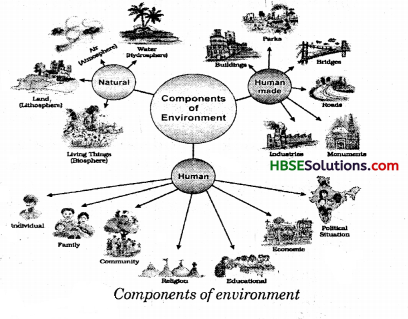
HBSE 7th Class Social Science Solutions History Chapter 1 Tracing Changes Through a Thousand Years

Haryana State Board HBSE 7th Class Social Science Solutions History Chapter 1 Tracing Changes Through a Thousand Years Textbook Exercise Questions and Answers.

Haryana Board 7th Class Social Science Solutions History Chapter 1 Tracing Changes Through a Thousand Years

HBSE 7th Class History Tracing Changes Through a Thousand Years Textbook Questions and Answers

LET’S RECALL

Question 1.
Who was considered a ‘foreigner’ in the past?
Answer:
In the medieval period the term ‘foreigner’ was used for any stranger who appeared, say in a given village, someone who was not a part of the society or culture.

Question 2.
State whether True or False:

  1. We do not find inscriptions for the period after 700.
  2. The Marathas asserted their political importance during this period.
  3. Forest dwellers were sometimes pushed out of their lands with the spread of agriculture settlements.
  4. Sultan Ghiyasuddin Balban controlled Assam, Manipur and Kashmir.

Answer:

  1. False
  2. True
  3. False
  4. False.

HBSE 7th Class Social Science Solutions History Chapter 1 Tracing Changes Through a Thousand Years

Question 3.
Fill in the blanks:

  1. Archives are places where ………… are kept.
  2. ………….. was a fourteenth century chronicles.
  3. ………….. , ………….. , ………….. , ………….. and ………….. were some of the new crops introduced into the sub-continent during this period.

Answer:

  1. documents and manuscripts.
  2. Ziyauddin Barani.
  3. Potatoes, corn, chilli, tea, coffee.

Question 4.
List some of the technological changes associated with this period.
Answer:
This period saw the technological changes which are given below:
1. Use of Persian wheel for irrigation.
2. Use of spinning wheel in weaving.
3. Use of firearms in combat made also appearance.

Question 5.
What were some of the major religious developments during this period?
Answer:
Some of the major religious developments during this period were:
(a) The worship of new deities
(b) The construction of temples by royalty.
(c) Growing importance of Brahmanas, the priests, as dominant groups in society.
(d) Brahmanas’ importance grew due to their knowledge of Sanskrit language. They were patronized by the Emperors.
(e) The idea of Bhakti emerged among people. The merchants and migrants brought with them the teachings of Quran, the holy book of Muslims.

LET’S UNDERSTAND

Question 6.
In what ways has the meaning of the term ‘Hindustan changed over the centuries’?
Answer:
The meaning of term ‘Hindustan’ has changed over the centuries in the following manner:
(a) In the 13th century, Minhaj-i-Siraj used the term ‘Hindustan’. For him the term meant the areas of Punjab, Haryana and the land between Ganga and Yamuna rivers. He used this term in a political sense that were a part of the dominions of the Delhi Sultan.

(b) In the sixteenth century poet Babur used the term to describe the geography, the fauna and the culture of the subcontinent.

(c) The poet Amir Khusrau used the term in the fourteenth century in the similar way as Babur in the sixteenth century.

(d) The term ‘Hindustan’ did not carry the political and national meaning as the term ‘India’ is used today.

HBSE 7th Class Social Science Solutions History Chapter 1 Tracing Changes Through a Thousand Years

Question 7.
How were the affairs of Jatis regulated?
Answer:
The ways in Which the affairs of jatis were regulated were as follows:
1. Jati framed their own rules and regulations to manage the conduct of their members.
2. Jati Panchayat or the assembly of elders enforced these regulations.
3. Jatis also followed the rules of their villages.

Question 8.
What does the term pan- regional empire mean?
Answer:
The term ‘pan-regional empire’ refers to an empire spanning over diverse regions. The empires of Chola, Kalsi, Tughlaqs and Mughals were’the examples of pan- regional empire.

LET’S DISCUSS

Question 9.
What are the difficulties historians face in using manuscripts.
Answer:
(a) Manuscripts were handwritten. They used palm-leaves as paper for writing. Some are written in Shikaste (illegible) script.

(b) Since the handwriting was not always clear, the scribes made small changes in words or sentences while copying manuscripts. Over the centuries, the changes grew until the manuscripts of the same text became very different fjrom the original.

(c) Historians interpreted the facts as per the manuscripts which they got.

Question 10.
How do historians divide the past into period? Do they face any problem in doing this?
Answer:
(i) Historians divide the past into periods on the basis of economic and social factors to characterise the major elements of different moments of the past.

(ii) Historians face many problems while dividing the past into periods as there was a good amount of technological development in the “medieval” period, which can be called as ‘modern’ in the contemporary context. But still the period is called “medieval” and not “modern”. On the other hand, modern past is followed by the “medieval” past.

LET’S DO

Question 11.
Compare either Map I or Map II with the present day map of the subcontinent; listing as many similarities and differences that you can find.
HBSE 7th Class Social Science Solutions History Chapter 1 Tracing Changes Through a Thousand Years-1
Map 1

HBSE 7th Class Social Science Solutions History Chapter 1 Tracing Changes Through a Thousand Years-2
Map 2

(A) Map 1

  • Map I was made in 1154CE by geographer al-Idrisi.
  • This presents a detail of the Indian subcontinent from his larger map of the world.
  • In this map, South India was at that place where North India is at present and Sri Lanka is the Island at the top.
  • Place names are marked in Arabic as Kanauj in Uttar Pradesh has been spelt as Qanauj.
  • Present day map of the subcontinent is more clear. It has been made to scale and it clearly shows direction.

(B) Map 2
This map was made by French cartographer in 1720s.
In this map-

  • Coastal areas are surprisingly detailed.
  • Method of providing information was different.
  • The technique of cartography differed

Question 12.
Find out where records are kept in your village or city. Who writes these records? Is there an archive? Who manages it? What kinds of documents are stored there? Who are the people who use it?
Answer:

  • In villages, records are kept in the Panchayat Ghar. In cities, records are kept in the office of municipal committee or municipal corporation or an archive.
  • The records are written and maintained by Sarpanch in villages. In cities these records are written by clerks.
  • Rare manuscripts, government records and valuable books etc. are stored there.
  • Scholars, researchers and government officials use them.

Question 13.
Look at the areas in the interior of the subcontinent on Map 2 of the textbook. Are they as detailed as those on the coast? Follow the course of the River Ganga and see how it is shown. Why do you think there is a difference in the level of detail and accuracy between the coastal and inland areas in this map.
Answer:
(a) No the areas in the interior of the subcontinent on Map 2 are not as detailed 1 as those on the coast.
(b) The European sailors and merchants who used this map, did not go to the inland places of the subcontinent as such as they interacted with the coastal areas
(c) Therefore, the level of detail and accuracy of coastal areas is better than the inland areas in the map.

Question 14.
Can you think of any other words whose meanings change in different contexts?
Answer:
The other word whose meaning change in different contexts is as under:
Jana:
1. Initially it was used to address people or group of people.
2. Later on it was used to denote land.

HBSE 7th Class Social Science Solutions History Chapter 1 Tracing Changes Through a Thousand Years

Question 15.
When was paper more expensive and easily available in the thirteenth or the fourteenth century?
Answer:
Paper was more expensive during thirteenth century and easily available in the fourteenth century.

Question 16.
Of the technological, economic, social and cultural changes described in this section, which do you; think were most significant in the town – or village in which you live?
Answer:
Students do youself.
(Hint: Technological changes did not have much impact on village or town life. But social cultural and economic changes had greater impact on our village life.)

Question 17.
(i) Why do you think rulers made such claims?
Answer:
Rulers wanted to show of, be popular and mighty by claming to have; control over distant territorises.

(ii) Make a list of languages mentioned by Amir Khusrau. Prepare another list of the names of language spoken today in the regions he s mentioned. Underline name that are; similar and circle those that are different. Did you notice that the names by which languages are known have\changed over time?
Answer:

RegionLanguages at the time of Amir KhusrauPresent day languages
SindhSindhiPunjabi + Urdu
LahoreLahoriPunjabi + Urdu
KashmirKashmiriKashmiri
South KarnatakaDvarsamudriKannadal
Andhra PradeshTelanganiTelugu
GujaratGuiaratiGujarati
Tamil NaduMabariTamill
BengalGauriBengali
Eastern U.P.AwadhiLakhnuavi
DelhiHindawiHindi

Yes, there are significant changes in the spoken languages at different regions over time.

(iii) What was the duration of rule of the Khalji and Mughal dynasties?
Answer:
(a) Khalji dynasty ruled from 1290 to 1320.
(b) Mughal dynasty ruled from 1526 to 1857.

Question 18.
(i) Find out whether and for how long your state was part of these pan-reginal empires.
Answer:
Students do yourself.

(ii) Do you remember what Amir Khusrau had to say regarding Sanskrit, knowledge and Brahmanas?
Answer:
Amir Khusrau said that Sanskrit did not belong to any region. It was an old language and common people did not know it. Only the Brahmanas spoke it.

Question 19.
You are a historian. Choose one of the themes mentioned in this chapter, such as economic, social or political, history and discuss why you think it would be interesting to find out the history of that theme.
Answer:
Political theme would be interesting to explore in the historical context. Some of the reasons why to explore it, are as under:
(a) Political theme in history introduces us to our past rulers, their families, administrations, wars and battles.
(b) It also lead us to know about the various ruling practices such as, rule by group of people (republic) or monarchy etc.
(c) It imparts the knowledge about relations with neighbouring countries etc.

HBSE 7th Class Social Science Solutions History Chapter 1 Tracing Changes Through a Thousand Years

HBSE 7th Class History Tracing Changes Through a Thousand Years Important Questions and Answers

Very Short Answer Type Questions

Question 1.
How was paper used?
Answer:
The paper was used to write holy texts, chronicles of rulers, letters and techniques of saints, petitions and judicial records, accounts and taxes.

Question 2.
Which group of people became important during medieval period?
Answer:
The Rajputs became important during medieval period.

Short Answer Type Questions

Question 1.
Why is India called the land of many names?
Answer:
• India was named Aryavarta because this country being the abode of Aryans.
• India was named Bharat after the name of King Bharat.
• The name Hindustan and Indus were derived from Sindhu, the Vedic name of the great river of north-west.
• The Romans modified the name as Indus.
Hence India is called the land of many names.

Question 2.
What does ‘time’ mean by historians? How is the study of ‘time’ convenient for historians?
Answer:
‘Time’ for historians doesn’t mean just a passing of hours, days or years. It also reflects changes in social and economic organization, in the persistence and transformation of ideas and beliefs.

The study of ‘time’ is important because it helps historians to divide the past into large segments. The historians study the different aspects of the specific period and then assess the comparative progress and their effect on society.

HBSE 7th Class Social Science Solutions History Chapter 1 Tracing Changes Through a Thousand Years

Question 3.
How were the views of Shia Muslims and Sunni Muslims different from each other?
Answer:
Shia Muslims believed that Prophet Muhammad’s son-in-law, Ali was the legitimate leader of the Muslim Community. Shunni Muslims accepted the authority of the’ early leaders (Khalifas) of the community, and the succeeding Khalifas.

Question 4.
How has the medieval period helped in the development of the Indian history.?
Answer:
Medieval period has been helpful in the development of Indian history because:
(i) In this period, many modern languages which we speak now developed during this period.
(ii) Some of the food items we eat and the clothes we wear became popular during this period.
(iii) The history of our current religious faiths (such as Islam, Sikhism etc.) can be traced back to this period.

Long Answer Type Questions

Question 1.
What wee the main features of jatis, during medieval period?
Answer:
(a) During medieval period, people were grouped into jatis or sub-castes and ranked on the basis of their backgrounds and occupations.
(b) Ranks were not fixed permanently, and varied according to the power, influence and resources controlled by members of jati.
(c) The status of the same jati could vary from area to area.

Question 2.
What were the problems of peasants during medieval period?
Answer:
During the medieval period, peasants had following problems:
(a) They were influenced by various forces such as – regional markets, chieftains, priests, monasteries and temples.
(b) They became part of large, complex societies and were required to pay taxes and offer goods and services to local lords.
(c) Some peasants possessed more productive land, other also kept cattle while some of them did artisanal work with agricultural activities during the lean season.

HBSE 7th Class Social Science Solutions History Chapter 1 Tracing Changes Through a Thousand Years

Tracing Changes Through a Thousand Years Class 7 HBSE Notes

  • Cartographer: A person who draws maps.
  • Archive: A place where documents and manuscripts are stored.
  • Habitat: It refers to the environment of a region and the social and economic lifestyle of its residents.
  • Patron: An influential, wealthy individual who supports another person man artiste.
  • Manuscript: Handwritten accounts of contemporary events.
  • Inscription: Document inscribed on some hard permanent material (generally some stone or metal) in the forms of letters or other conventional signs for the purpose of conveying some information.
  • Caliph: A title of the head of the Muslim Community, literally meaning the successor of the ‘vice regent’.
  • Feudalism: A political and economic system that came, into western Europe during the ‘Dark Age’.
  • Chronicles: Accounts of historical events given by various writers.
  • Biography: The written account of a person’s life by another writer.
  • Auto-biography: A written account of a person’s life by the same person.

HBSE 7th Class Social Science Solutions History Chapter 1 Tracing Changes Through a Thousand Years Read More »
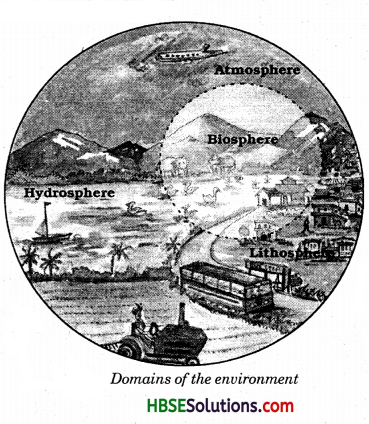
HBSE 7th Class Social Science Solutions Geography Chapter 1 Environment

Haryana State Board HBSE 7th Class Social Science Solutions Geography Chapter 1 Environment Textbook Exercise Questions and Answers.

Haryana Board 7th Class Social Science Solutions Geography Chapter 1 Environment

HBSE 7th Class Geography Environment Textbook Questions and Answers

Question 1.
Answer the following questions:
(i) What is an ecosystem?
Answer:
An ecosystem is a system that is formed by the interaction of all living organisms with each other and with the physical and chemical factors of the environment in which they live. These are all linked by the transfer of energy and material.

(ii) What do you mean by natural environment?
Answer:
Land, water, air, plants, and animals comprise the natural environment.

(iii) What are the major components of the environment?
Answer:
The major components of the environment are:

  • Natural Environment
  • Human Environment
  • Human-made Environment.

Natural Environment: Natural environment refers to both the biotic and abiotic conditions which us existing on the earth.
Biotic refers to the living elements, e.g., plants and animals.
Abiotic refers to the non-living elements, e.g., rocks, air, and water.
Human Environment : It reveals the activities, creations and interactions among human beings e.g., buildings, parks etc.
HBSE 7th Class Social Science Solutions Geography Chapter 1 Environment 1

Human-made Environment: Human-made environment refers to the buildings, parks, bridges, rocks, industries which are made by humans.

(iv) Give four examples of human- made environment.
Answer:
Four examples of human-made environments are : Buildings, Parks, Bridges, Rocks.

(v) What is lithosphere?
Answer:
Lithosphere is the solid crust or hard top layer of the earth. It is made up of rocks and minerals and covered with a thin layer of soil.

(vi) What are the two major components of biotic environment?
Answer:
Plants and animals are the two major components of biotic enviornment.

(vii) What is biosphere?
Answer:
Plants and animals kingdom together make the biosphere. It is a narrow zone of the earth where the land, water and air interact with each other to support life.

HBSE 7th Class Social Science Solutions Geography Chapter 1 Environment

Question 2.
Tick the correct answers:
(i) Which is not d natural ecosystem?
(a) Desert
(b) Aquarium
(c) Forest
Answer:
(b) Aquarium

(ii) Which is not a component of human environment?
(a) Land
(b) Religion
(c) Community
Answer:
(a) Land

(iii) What is a human made environment?
(a) Mountain
(b) Sea
(c) Road
Answer:
(c) Road

(iv) Which is threat to environment?
(a) Growing plant
(b) Growing population
(c) Growing crops.
Answer:
(b) Growing population

Question 3.
Match the following :

(i) Biosphere(a) blanket of air which surrounds the earth
(ii) Atmosphere(b) domain of water
(iii) Hydrosphere(c) our surroundings
(iv) Environment(d) narrow zone where land, water and air interact

Answer:
(i) (d)
(ii) (a)
(iii) (b)
(iv) (c)

Question 4.
Give Reasons:
(i) Man modifies his environment.
Answer:
Man modifies his environment to meet various needs. For example, he clears forests for obtaining land, for agriculture and for making shelter. He even extracts minerals from the earth for making various things. He construct dams for producing electricity. These are some of the ways in which man modifies his environment.

(ii) Plants and animals depend on each other.
Answer:
Animals whether they are carnivores or herbivores, ultimately depend on plants for their food. Also, plants provide fresh oxygen to animals to breathe in. These keep the environment clean and provide shelter to a number of animals. On the other hand, animals provide carbon dioxide which plants use for making their food. Dead and decaying matter of animals provide nutrients to plants to help them grow.

Intext Questions

Question 1.
Look at your surroundings. Make a list of uses that the land in your neighbourhood is being put to.
Answer:

  • Roads
  • Industries
  • Diary Farming
  • Bakery
  • Schools
  • Banks
  • Residential Buildings

Question 2.
Where does the water you use in your homes and school come from? Make a list of different uses of water in our daily life. Have you seen anyone wasting water? How?
Answer:
The water that are provided in our houses and schools. It is for comes from Delhi Jal Board.

  • Drinking
  • Food preparation
  • Bathing
  • Cleaning house
  • Washing clothes
  • Industrial use
  • Sanitation.

Yes, most of the people waste water. For example, they leave the tap open while soaping hands or brushing their teeth. They even leave tap opened when they are busy Somewhere.

HBSE 7th Class Social Science Solutions Geography Chapter 1 Environment

ACTIVITY:
Imagine an ideal environment where you would love to live. Draw the picture of your ideal environment.
Answer:
An ideal environment where I would love to live, would comprise of

  • Green plants and trees
  • Pollution-free environment
  • Clean roads
  • Water availability

Students are expected to draw on their own.

HBSE 7th Class Geography Environment Important Questions and Answers

Very Short Answer Type Questions

Question 1.
What is an environment?
Answer:
All things (place, people, nature, etc.) that surround us together constitute our environment.

Question 2.
Why is our environment changing?
Answer:
Our environment is changing due to the global warming. This was caused due to pollution caused by the waste dumps, vehicles etc.

Question 3.
What are the two types of environment?
Answer:
The two types of enviomment are:

  • Natural environment
  • Human made environment.

Question 4.
What is meant by natural enviornment?
Answer:
All those things which are existing naturally around us are together called natural environment.

Short Answer Type Questions

Question 1.
Which two types of conditions make our natural environment? Give examples.
Answer:
The two types of conditions that constitute our natural environment are :

  • Biotic conditions : All living organisms i.e. plants and animals.
  • Abiotic conditions : All naturally existing non-living things e.g. water, air, soil, minerals, etc.

Question 2.
What do you mean by human environment?
Answer:
Human environment refers to all those activities, creatibns and interactions among human beings.

HBSE 7th Class Social Science Solutions Geography Chapter 1 Environment

Question 3.
What are the components of environment?
Answer:
Following are the components of environment:

  • Natural environment,
  • Human-made environment,
  • Activities and interactions of human beings.

Question 4.
Give examples of natural components of environment.
Answer:
Land (lithosphere), air (atmosphere), water (hydrosphere) and living things (biosphere) are examples of the natural components of environment.

Question 5.
Give examples of man-made components of environment.
Answer:
Buildings, parks, bridges, roads, industries, monuments, etc. are examples of man-made components of environment.

Long Answer Type Questions

Question 1.
Why should we protect our environment?
Answer:
We should protect our environment because:

  • Environment is our basic life support system. It provides the air we breath, water to drink, the food to eat and the land to live.
  • It provides us natural resources like wood, fuel and minerals.
  • Many parts of environment have already been badly damaged by overuse resources like forests, pastures and farms.
  • Most of the human activities affect the environment in one way or the other.
  • If we continue to do so the damage will be irrepairable and the consequences will be very serious.

Question 2.
What are the different domains of the environment?
Answer:
The different domains of environment are:

  • Lithosphere
  • Atmosphere
  • Hydrosphere
  • Biosphere

(а) Lithosphere : The lithosphere is composed of rocks. The major components of rocks are minerals. Lithosphere even provides the foundation of terrestrial life where water and air are held close to the surface.

(b) Atmosphere : The earth has an oxygen consists of rich blanket of air around it. The atmosphere is a mixture of various gases such as oxygen, nitrogen, carbon dioxide, argon, neon etc. Atmosphere also continues to sustain life different forms.

(c) Hydrosphere : Oceans were the first cradle of life on earth. It refers to various water bodies such as rivers, lakes, seas, oceans etc. that exist on the earth.

(d) Biosphere : Biosphere or the living world is composed of plant and animal kingdom. It is a narrow zone of the earth where land, water and air interact with each other to support life.
HBSE 7th Class Social Science Solutions Geography Chapter 1 Environment 2

Environment Class 7 HBSE Notes

  • Environment: Environment is our basic life support system. The place, people, thing and nature that surround any living organism is called environment.
  • Biotic : It refers to the world of living organisms, such as plants and animals.
  • Abiotic : It refers to the world of non-living elements such as land.
  • Lithosphere : Lithosphere is the solid crust or the hard top layers of the earth.
  • Hydrosphere : It refers to the water bodies like rivers, lakes, seas, oceans etc. on the earth.
  • Atmosphere : It is the thin layer of air that surrounds the earth.
  • Ecosystem : It is a system formed by the interaction of all living organisms with each other and with the physical and chemical factors of the environment in which they live. These are all linked by transfer of energy and material.
  • Barter System : A trade in which goods are exchanged without the use of money.

HBSE 7th Class Social Science Solutions Geography Chapter 1 Environment Read More »