Author name: Bhagya

HBSE 8th Class Science Solutions Chapter 9 Reproduction in Animals

Haryana State Board HBSE 8th Class Science Solutions Chapter 9 Reproduction in Animals Textbook Exercise Questions and Answers.

Haryana Board 8th Class Science Solutions Chapter 9 Reproduction in Animals

HBSE 8th Class Science Reproduction in Animals Textbook Questions and Answers

Question 1.
Explain the importance of reproduction in organisms.
Answer:
Reproduction is very important for the organisms. The organisms reproduce to produce young ones like them. It carries on their generation. If reproduction does not take place, no living being would survive on earth. Secondly, specials characters of an organism are carried over to its next generation through reproduction only.

Question 2.
Describe the process of fertilization in human beings,
Answer:
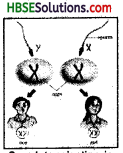
Human beings reproduce sexually. In human beings fertilization takes place internally i.e. inside female body. Males eject sperms inside females body. Sperms and ovum fuse to form the fertilized egg called zygote. During this process the nucleus of the sperm fuses with the nucleus of the ovum thus forming a single nucleus.
Thus zygote is formed with a single nucleus, this completes the process of fertilization.

HBSE 8th Class Science Solutions Chapter 9 Reproduction in Animals

Question 3.
Choose the most appropriate answer:
(a) Internal fertilisation occurs:
(i) in female body
(ii) outside female body.
(iii) in male body.
(iv) outside male body.
Answer:
(a) In female body

(b) A tadpole develops into an adult frog by the process of:
(i) fertilization
(ii) metamorphosis.
(iii) embedding
(iv) budding.
Answer:
(b) metamorphosis

(c) The number of nuclei present in a zygote is:
(i) none
(ii) one
(iii) two
(iv) four
Answer:
(c)two.

Question 4.
Indicate whether the following sentences as True (T) or False (F):
(a) Oviparous animals give birth to young ones. ( )
(b) Each sperm is a single cell. ( )
(c) External fertilisation take place in frog. ( )
(d) A new human individual developed from a cell called gamete. ( )
(e) Egg laid after fertilisation is made up of a single cell. ( )
(f) Amoeba reproduces by budding. ( )
(g) Fertilisation is necessary even in asexual reproduction. ( )
(h) Binary fission is a method of asexual reproduction. ( )
(i) A zygote is formed as a result of fertilisation. ( )
(j) An embryo is made up of a single cell.( )
Answer:
(a) False
(b) True
(c) True
(d) False
(e) True
(f) False
(g) False
(h) True
(i) True
(j) False.

Question 5.
Give two differences between a zygote and a foetus?
Answer:
(i) Zygote is made up of a single cell while foetus is made up of many cells.
(ii) Zygote does not have well developed limbs, foetus has well developed and identifiable limbs.
(iii) Zygote is formed by the fertilization of sperms and ovum, foetus is formed by the repeated divisions of the zygote .

Question 6.
Define asexual reproduction. Describe the two methods of asexual reproduction in animals.
Answer:
Asexual reproduction is that type of reproduction in which only single parent is involved. Asexual reproduction takes place by different methods like budding, binary fission etc. Let us discuss these two methods:
(i) Budding:
This type of reproduction takes place in Hydra and Bacteria. A part of the organism starts bulging out. Slowly it grows and develops into a separate individual.

(ii) Binary fission:
In this type of reproduction, a single organism gets divided into two. This type of reproduction takes place in Amoeba. The nucleus of the Amoeba gets divided into two followed by division of their bodies, each part getting one nucleus and developing into separate individual.

HBSE 8th Class Science Solutions Chapter 9 Reproduction in Animals

Question 7.
In which female reproductive organ does the embryo get embedded?
Answer:
Uterus.

Question 8.
What is metamorphosis? Give examples.
Answer:
Drastic changes which take place during the development of an animal is called metamorphosis. Animals like frog, butterfly undergo metamorphosis.

Question 9.
Differentiate between internal fertilisation and external fertilisation.
Answer:
Internal fertilisation takes place inside the body of the female while the external fertilisation takes place outside the body of the female.
In case of internal fertilisation sperms are ejaculated in female’s body by the male. In external fertilisation sperms are discharged in I open.

Question 10.
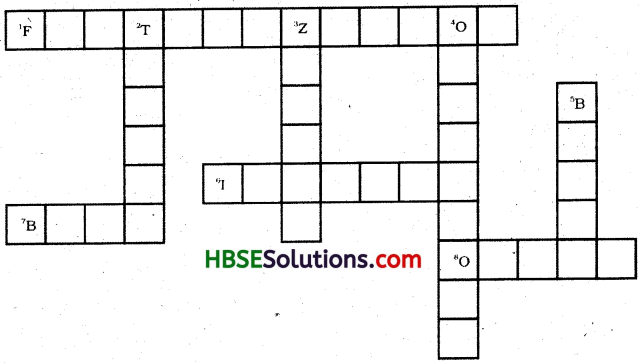
Complete the cross-word puzzle using the hints given below.
Across:
1. The process of the fusion of the gametes.
6. The type of fertilization in hen.
7. The term used for bulges observed on the sides of the body of Hydra.
8. Eggs are produced here.

Down:
2. Sperms are produced in these male reproductive organs.
3. Another term for the fertilized egg.
4. These animals lay eggs.
5. A type of fission in amobea.
HBSE 8th Class Science Solutions Chapter 9 Reproduction in Animals-1
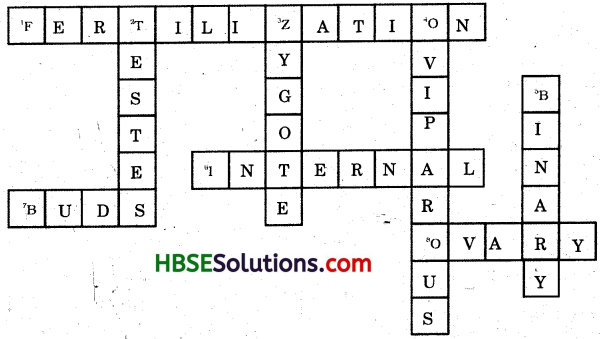
Answer:
HBSE 8th Class Science Solutions Chapter 9 Reproduction in Animals-2

Extended Learning – Activities And Projects

1. Visit a poultry farm. Talk to the manager of the farm and try to find out the answers to the following:
(a) What are layers and broilers in a poultry farm?
(b) Do hens lay unfertilised eggs?
(c) How can you obtain fertilised and unfertilised eggs?
(d) Are the eggs that we get in the stores fertilised or unfertilised?
(e) Can you consume fertilised eggs?
(f) Is there any difference in the nutritional value of the fertilised and unfertilised eggs?
Answer:
For self attempt.

2. Observe live hydra yourself and learn how they reproduce by doing the following activity:
During the summer months collect water weeds from ponds or ditches along with the pond water and put them in a glass jar. After a day or so you may see several hydra clinging to the sides of the jar.

Hydra is transparent, jelly-like and with tentacles. It clings to the jar with the base of its body. If the jar is shaken, the hydra will contract instantly into a small blob, at the same time drawing its tentacles in.

Now take out few hydras from the jar and put them on a watch glass. Using a hand lens or a binocular or dissection microscope, observe the changes that are taking place in their body. Note down your observations.
Answer:
For self attempts.

3. The eggs we get from the market are generally the unfertilized ones. In case you wish to observe a developing chick embryo, get a fertilized egg from the poultry or hatchery which has been incubated for 36 hours or more. You may then be.able to see a white disc-like structure on the yolk. This is the developing embryo. Sometimes if the heart and blood vessels have developed you may even see a red spot.
Answer:
For self attempt.

HBSE 8th Class Science Solutions Chapter 9 Reproduction in Animals

4. Talk to a doctor. Find out how twinning: occurs. Look for any twins in your neighbourhood, or among your Mends. Find out ifthe twins are identical or non-identical. Also find out why identical twins are always of the same sex? If you know of any story about twins, write it in your own words.
You could visit the following website for information on twins: www.keepkidshealthy.com/twins/ expecting_twins.html.
For more information , on animal reproduction, you can vjsit:

  • www.Saburchill.com/chapters/ chap0031.html
  • healthhowstuffworks.com/human- reproduction.htm
  • www.teenshealth.org/teen/sexual_health

Answer:
For self attempt.

HBSE 8th Class Science Reproduction in Animals Important Questions and Answers

Very Short Answer Type Questions

Question 1.
Name different modes of reproduction.
Answer:
Sexual reproduction and asexual reproduction.

Question 2.
Define sexual reproduction.
Answer:
When male and female organisms are involved in reproduction, it is called sexual reproduction.

Question 3.
Define asexual reproduction.
Answer:
When only single parent involved, reproduction is called asexual reproduction.

Question 4.
What is another name for ovum or sperm?
Answer:
Gametfe.

Question 5.
What is fertilization?
Answer:
When male and female gametes fuse, it is called fertilization.

Question 6.
What is formed when male and female gametes fuse?
Answer:
Zygote.

HBSE 8th Class Science Solutions Chapter 9 Reproduction in Animals

Question 7.
Name female reproductory organs.
Answer:
Ovaries, oviduct, uterus.

Question 8.
Name male reproductory organs.
Answer:
Testes, sperm ducts and penis.

Question 9.
Name the female gamete produced by ovaries.
Answer:
Ova.

Question 10.
Which male organ produce male gamete?
Answer:
Testes.

Question 11.
Name male gamete produced by testes.
Answer:
Sperms.

Question 12.
Name the hind of fertilization *hich take, pUce inside fem.le. body.
Answer:
Internal fertilization.

Question 13.
What kind of fertilization takes place in humans?
Answer:
Internal fertilization.

Question 14.
What type of fertilization takes place in frogs?
Answer:
External fertilization.

Question 15.
What does a zygote develop into?
Answer:
Embryo.

HBSE 8th Class Science Solutions Chapter 9 Reproduction in Animals

Question 16.
Where does an embryo grow in case of internal fertilization?
Answer:
In uterus.

Question 17.
What does an embryo grow into?
Answer:
Foetus.

Question 18.
Where does an embryo grow in case of external fertilization?
Answer:
Out side in open.

Question 19.
What are the animals called, who give birth directly to young one?
Answer:
Viviparous animals.

Question 20.
Give at least two examples of viviparous animals.
Answer:
Humans and cows.

Question 21.
What are the animals called, who lay eggs first?
Answer:
Oviparous animals.

Question 22.
Give any two examples of oviparous animals.
Answer:
Hen, Frog.

Question 23.
How many developing stages an egg of a frag undergoes to become an adult?
Answer:
Three: Egg, Tadpole, larvae, adult.

Question 24.
What do we call the sudden and extreme changes taking place during the development of an animal?
Answer:
Metamorphosis.

Question 25.
Name any two methods of asexual reproduction.
Answer:
Budding and Binary fission.

HBSE 8th Class Science Solutions Chapter 9 Reproduction in Animals

Question 26.
Name any animal undergoing budding for reproduction.
Answer:
Hydra.

Question 27.
Name tuny animal undergoing Binary fission to reproduce,
Answer:
Amoeba.

Short Answer Type Questions

Question 1.
What is reproduction? Why is it important?
Answer:
Reproduction is giving birth to organisms of same kind. Reproduction is important to continue life on earth and to maintain different special characters of different species.

Question 2.
What are different modes of reproduction?
Answer:
Reproduction takes place by two methods. In one method a single parent is involved in the process of reproduction. This is called asexual reproduction. In second method both male and female i.e. both parents are involved in the process of reproduction. This kind of reproduction is called sexual reproduction.

Question 3.
What are the names of male reproductory organs in human beings?
Answer:
In human beings male reproductory organs are a pair of testes, sperm ducts and a penis. Testes are responsible for producing male gametes called sperms. They are transported to the sperm ducts and through the penis, they are ejaculated in female body.

Question 4.
Explain the reproductory organs of female in human beings.
Answer:
In human beings the female reproductoiy organs are a pair of ovaries, oviducts or fallopian tubes and the uterus. Ovaries are responsible to produce female gamete called ova, which fertilize with male sperm in female fallopian tube and travels to uterus for its development into embryo and the foetus.

Question 5.
Describe the human male and female gametes.
Answer:
In human beings the males produce the gamete called sperms. Sperms are very small in size. They have a head with a middle piece which end into a tail. It is a single cell. Similarly, female gamete ova is produced by ovaries. Every ova is a single cell and one matured ova is released by one ovary every month.

HBSE 8th Class Science Solutions Chapter 9 Reproduction in Animals

Question 6.
What is fertilisation?
Answer:
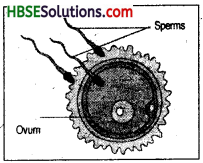
When a male and a female gamete come in contact with each other they fuse. The male sperm enters the female ova and the nucleus of the sperm fuses with nucleus of the ova and results into a single nucleus. This whole process is called fertilization. In short fertilisation is the fusion of male and female gametes.
HBSE 8th Class Science Solutions Chapter 9 Reproduction in Animals-3

Question 7.
Explain how external fertilization takes place?
Answer:
In this case the females lay eggs in slow moving streams. The males also release sperms on this cluster of eggs. The sperms move in water with the help of tail and when come in contact with egg, they get fertilized.

Question 8.
How is an embryo formed put of a zygote?
Answer:
Zygote is a single cell formed by the fusion of male and female gametes. It undergoes repeated numbers of division to form a lot of many cells, so that the limbs and other parts can be developed. Thus a single zygote gets divided to form an embryo.

Question 9.
How is an embryo formed in case of hens?
Answer:
In hens zygote divides many times and reaches the oviduct. During this a protective outer coating is formed around the embryo. The complete embryo develops inside this protective shell. This embryo is laid by the hen along with the shell as an egg. This egg finally hatches after ‘ three weeks to produce chick.

Question 10.
What is budding?
Answer:
Budding is an asexual method of reproduction in animals. It needs only a single parent to reproduce. The body of the animal starts developing a small bulging structure called bud which slowly grows and have itself disconnected from the parent animal and becomes a separate individual. This is called budding. Animals like hydra reproduce through budding.

Question 11.
What do you mean by binary fission?
Answer:
Binary fission is a method of asexual reproduction. In this method the body of the animal divides into two halves. The nucleus of the body divides into two and this is followed by the division of the whole body. So, two organisms get produced with separate nuclei. Animals like Amoeba reproduce by this method.

HBSE 8th Class Science Solutions Chapter 9 Reproduction in Animals

Question 12.
What is cloning?
Answer:
Cloning is a method of producing an identical organism, a body part or only a cell. The produced organism or cell is completely identical to its original organism or cell. This method has been used many times in animals to produce identical clones.

Long Answer Type Questions

Question 1.
What do you mean by reproduction? Write about different modes of reproduction.
Answer:
Reproduction is the process of producing young ones of the same kind. Reproduction is a very important process. It is the only means of keeping the life on the earth.
There are two modes of reproduction:
(i) Sexual Reproduction:
Reproduction process in which a male and a female parents are involved is called sexual reproduction. In this process both parents produce gametes which fertilize to produce a zygote, which further develops into a baby. Human beings, cows, dogs etc. reproduce sexually.

(ii) Asexual Reproduction:
When a single parent is responsible for producing a young one, it is called asexual reproduction. Budding, fragmentation, spore formation Binary fission etc. are different methods of asexual reproduction. Microorganisms like Hydra, Amoeba, bacteria etc. reproduce asexually.

Question 2.
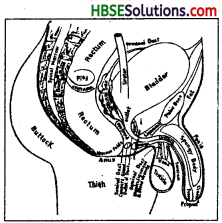
Draw and describe the male reproductive organs in humans.
Answer:
Male reproductive organs consist of a pair of testes, sperm ducts and penis. Testes are responsible for producing male gamete called sperm. Sperm is very small in size. It has a head, a middle piece and a tail. Sperms travel through sperm ducts and penis, and are released in female body for fertilization.
HBSE 8th Class Science Solutions Chapter 9 Reproduction in Animals-4

Question 3.
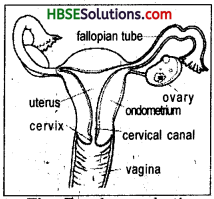
Draw and explain the Female Reproductive organs in human.
Answer:
Female reproductive organs consist of a pair of ovaries, oviduct or fallopian tubes and uterus.
HBSE 8th Class Science Solutions Chapter 9 Reproduction in Animals-5
Ovaries produce the female gamete called Ova. Every month an ovary produces an ovum. The ovum and sperm fertilize inside fallopian tubes and the fertilized zygote travels to the uterus and attach with its wall to develop into the foetus.

Question 4.
What is fertilization? How does it take place?
Answer:
Fertilization is the process by which the male and female gametes fuse to form the zygote. The sperms from a male are transferred into the female body. They swim to the fallopian tubes with help of their tails and one of them enters the ovum to fertilize. When the sperm enters the ovum, the nucleus of both the gametes fuse with each other to form the fertilized zygote.

The fertilized egg is called zygote. This zygote develops into foetus by repeated cell division. When the fertilization takes in the body of female, it is called internal fertilization. But many animals release their gametes into water and fertilization takes place outside the body of female, then the fertilization is called the external fertilization.

HBSE 8th Class Science Solutions Chapter 9 Reproduction in Animals

Question 5.
What is asexusal reproduction? Describe different methods of asexual reproduction.
Answer:
The reproduction in which only a single parent is involved is called asexual reproduction. This type of reproduction takes place mostly in microoganisms. Following are the methods of asexual reproduction:
(i) Budding:
This type of reproduction takes place in Hydra. The body of the hydra starts developing small bulges. These bulges are called buds. These buds grow in size and finally get detached from its body and become a separate individual.

(ii) Binary Fission:
This type of reproduction takes place in Amoeba. The body of the organism divides into two. The nucleus of the organism divides into two and then the body of Amoeba divides, each part getting each nucleus and thus becoming two separate individuals.

Reproduction in Animals Class 8 HBSE Notes

1. Each living being reproduce to give birth to young ones exactly like them.
2. The process by which young ones are produced is called reproduction.
3. Reproduction is of two types: Sexual reproduction and asexual reproduction.
4. When a male and a female gamete fuse to give birth to a young ones, then it is called sexual reproduction.
5. When a single parent is involved in reproduction, then it is called asexual reproduction.
6. Reproductive organs in males and females are different. In females the reproductive organs are ovaries oviducts and uterus. In males the reproductive organs are a pair of testes, sperm ducts and penis.
7. Ovaries produce female gamete called ovum and male gamete called sperms are produced by testes.
8. Ovum and sperm fuse to form egg called Zygote. The process of fusion of ovum and sperm is called fertilization.
9. Fertilization is of two types: When it takes place inside the females body, then it is called internal fertilization, but when ovum and sperms fuse out side the body, it is called external fertilization.
10. Embryo is formed from the zygote by repeated divisions, which grows in the uterus of the female in case of internal fertilization. Embryo grows into foetus when it gets well developed limbs.
11. When animals give birth to a young one it is called a viviparous animals e.g. man, cow etc. When animals lay eggs, they are called oviparous animals e.g. hen, butterfly, etc.
12. In asexual reproduction organisms reproduce by budding binary fission, fragmentation etc.

HBSE 8th Class Science Solutions Chapter 9 Reproduction in Animals Read More »

HBSE 8th Class Science Solutions Chapter 8 Cell Structure and Functions

Haryana State Board HBSE 8th Class Science Solutions Chapter 8 Cell Structure and Functions Textbook Exercise Questions and Answers.

Haryana Board 8th Class Science Solutions Chapter 8 Cell Structure and Functions

HBSE 8th Class Science Cell Structure and Functions Textbook Questions and Answers

Question 1.
Indicate whether the following statements are True (T) or False (F).
(а) Unicellular organisms have one-celled body. (T/F)
(б) Muscle cells are branched structures. (T/F)
(c) The basic living structure of an organism is an organ. (T/F)
(d) Amoeba has irregular shape. (T/F)
Answer:
(a) True
(b) True
(c) False
(d) True

Question 2.
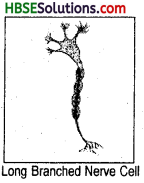
Make a sketch of the human nerve cell. What function do nerve cells performs?
Answer:
Functions of human nerve cell:
(i) Nerve cells receive messages from different parts of body.
(ii) They further transfer these message to brain and brain further send commands for functioning Long Branched Nerve Cell of different organs.
HBSE 8th Class Science Solutions Chapter 8 Cell Structure and Functions-1
(iii) They coordinate functioning of different organs of body.

HBSE 8th Class Science Solutions Chapter 8 Cell Structure and Functions

Question 3.
Write short notes on the following:
(а) Cytoplasm
(b) Nucleus of a cell.
Answer:
(a) Cytoplasm:
Cytoplasm is a jelly like substance which is present between the cell membrane and the nucleus. Various other organelles of cells are present in the cytoplasm. Cytoplasm is made up of chemical substances like carbohydrates, proteins and water. These chemical substances are present in cells of all types and sizes.

(b) Nucleus of a cell:
Nucleus is the master of the cell. It commands all the functioning of the cell. It is generally located in the centre of the cell and is spherical in structure. A membrane called nuclear membrane separates it from cytoplasm. It contains the genetic material (DNA, RNA) in it. This porous membrane allows the transfer of material in the nucleus and cytoplasm. Nucleus contains a dense body called nucleolus which actually contain chromosomes the genetic material.

Question 4.
Which part of the cell contains organelles?
Answer:
Cytoplasm.

Question 5.
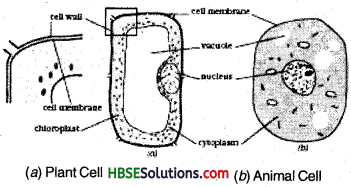
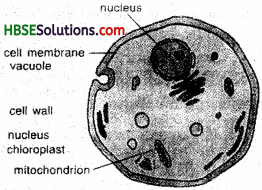
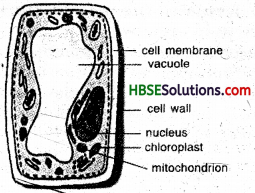
Make sketches of animals and plant cells. State three differences between them. Answer:

Plant CellAnimal Cell
1. Plant cell has a rigid cell wall.1. Cell wall is absent.
2. Plant cell has chloroplasts.2. Chloroplasts are absent.
3. Plant cell lacks centrosomes.3. Centrosomes are present.

HBSE 8th Class Science Solutions Chapter 8 Cell Structure and Functions-2

Question 6.
State a difference between eukaryotes and prokaryotes.
Answer:
Prokaryotes do not have a well designed nuclear membrane, while Eukaryotes have a well designed nuclear membrane.

Question 7.
Where are chromosomes found in a cell? State their function.
Answer:
Chromosomes are found in the nucleus of a cell. Their function is to carry characteristic features of parent cells to the daughter cell i.e. from parent to offsprongs.

Question 8.
‘Cells are the basic structural units of living organism’. Explain.
Answer:
Cells are the basic structural units of living organisms because lot of cells unit to form and many tissues form an organ. And organs combine to form a complete body, so cell is the basic structural unit of an organism. All basic function for the survival of an organism take peace inside cells so they are the basic functional units of a living being.

Question 9.
Explain why chloroplasts are found only in plant cells?
Answer:
Chloroplasts are only found in plant cells because they are required for the food making process of plants called photosynthesis.

Question 10.
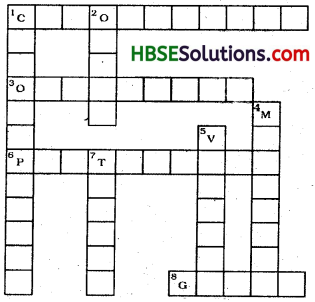
Complete the following crossword with the help of clues given below:
Across
1. This is necessary for photosynthesis.
3. Term for component present in the cytoplasm.
6. The living substance in the cell.
8. Unit of inheritance present on the chromosomes.

Down
1. Green plastids.
2. Formed by collection of tissues.
4. It separates the contents of the cell from the surrounding medium.
5. Empty space in the cytoplasm.
7. A group of cells.
HBSE 8th Class Science Solutions Chapter 8 Cell Structure and Functions-3
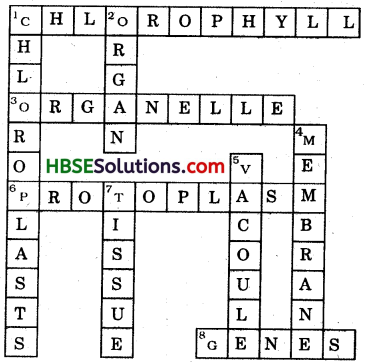
Answer:
HBSE 8th Class Science Solutions Chapter 8 Cell Structure and Functions-4

Extended Learning – Activities And Projects

1. Visit a laboratory for senior secondary students in your school or in a neightbouring school. Learn about the functioning of a microscope in the laboratory. Also observe how a slide is observed under the microscope,
Answer:
For self attempt.

2. Talk to the senior biology teacher in your school or a neighbouring school. Find out if there are diseases which are passed on from parents to the offspring. Find out how these are carried and also if these diseases can be treated. For this you can also visit a doctor.
Answer:
There are certain diseases which are passed on from parent to the offspring. Diseases like diabites, heart diseases, certain skin diseases like leukoderma, etc. are genetic diseases.

3. Visit an agriculture extension centre in your area. Find out about genetically modified (GM) crops. Prepare a short speech for your class on this topic. You may visit www.usc.ernet.in / currsci / sep2520Ql/ 655.pdf
Answer:
For self attempt.

4. Find out about Bt cotton from an agriculture expert (or from envfor.nic.in/ division/csnrv/btcotton/b gnote.pdf). Prepare a short note on its advantages / disadvantages.
For more on cell, visit: www.enchantedlearning.com/subjects/ plants/ cell/
Answer:
For self attempt.

HBSE 8th Class Science Solutions Chapter 8 Cell Structure and Functions

HBSE 8th Class Science Cell Structure and Functions Important Questions and Answers

Very Short Answer Type Questions

Question 1.
Define a cell.
Answer:
A cell is the basic structural and functional unit of living things.

Question 2.
Who discovered cell?
Answer:
Robert Hooke.

Question 3.
Name three important parts of cell.
Answer:
(i) Cell membrane
(ii) Cytoplasm
(iii) Nucleus

Question 4.
In which cells, cell wall is present?
Answer:
In plant cells.

Question 5.
Give three examples of unicellular organisms.
Answer:
Amoeba, Paramecium, Chlamydomonas.

Question 6.
Where are chromosomes present in a cell?
Answer:
Nucleus.

Question 7.
Name the cell part that has tiny holes.
Answer:
Cell Membrane

HBSE 8th Class Science Solutions Chapter 8 Cell Structure and Functions

Question 8.
Which cell organelle is found only in animal cell?
Answer:
Centrosome.

Question 9.
Name the cells organelle which is found only in plant cell.
Answer:
Plastids.

Question 10.
How do cells increase in numbers?
Answer:
By cell division.

Question 11.
Which organelle is called the ppwer house of the cell?
Answer:
Mitochondria.

Question 12.
Which organelle is called suicidal bags of the cell?
Answer:
Lysosomes.

Question 13.
What does mitochondria do?
Answer:
It prepares food for plants.

Question 14.
What does chromosomes do?
Answer:
Transfer chracters from one generation to another generation.

Question 15.
What does ribosomes do?
Answer:
They help in synthesis of proteins.

Question 16.
Name plastids found in plant cells.
Answer:
Chloroplasts, Leucoplast and chromoplast.

Question 17.
What is the unit of measuring the size of the cell?
Answer:
Microns.

Question 18.
Name the longest cell.
Answer:
Nerve cell in animal.

HBSE 8th Class Science Solutions Chapter 8 Cell Structure and Functions

Question 19.
Name the heaviest animal cell.
Answer:
Ostrich Egg.

Question 20.
Name the largest plant cell.
Answer:
Acetabulum.

Question 21.
Name the smallest plant cell.
Answer:
Bacteria.

Short Answer Type Questions

Question 1.
Why cells are called building blocks of life?
Answer:
Cells like bricks of a building are basic structural units of living organisms. Buildings differ from each other, organism also differ from each other. Both are basic unit of structure. So, they are called building blocks of life.

Question 2.
Why are the mitochondria known as the power housd of the cell?
Answer:
They are rod shaped and very minute. They are concerned with the release of energy from food during respiration. Because of this, they are often referred to as the power house of the cell.

Question 3.
What are the cell organelles? What are their functions?
Answer:
Cell organelles are small active living structures found in cytoplasm of cell. Each organelle has different structure and performs different function for cell. They are endoplasmic reticulum, Plastides, Mitochondria, Ribosomes, Golgi bodies, Centrosomes, Lysosomes, Vacoules.

HBSE 8th Class Science Solutions Chapter 8 Cell Structure and Functions

Question 4.
What is meant by protoplasm?
Answer:
The cytoplasm surrounded by the cell membrane and enclosing the nucleus together constitute the protoplasm. Protoplasm in other words, includes the cell membrance, the nucleus and the Cytoplasm.

Question 5.
Name four elements which form major part of protoplasm?
Answer:
Ninety nine percent of protoplasm by its weight is made up of four elements. Namely; Carbon, Hydrogen, Nitrogen and Oxygen. It also contains other elements such as H20, Carbohydrates, fats, proteins and mineral acids. Both elements and compounds in unique combination provide living nature to the protoplasm.

Question 6.
Why cells could not be observed before 17th century?
Answer:
The main reason was that the size of the majority of the cells are too small to be invisible to the unaided eye and at that time microscope was not discovered. So, the cell could not be observed before 17th century.

Question 7.
Why Hooke had to take thin slices of cork?
Answer:
The cork was solid and the details of cork could not seen in solid state. So he made thin slices to see the details of the cork. He saw space in cork slice which appeared like honey comb, called these compartments as cells.

Question 8.
What do you know about cell shape?
Answer:
Cells are of diverse shapes. Some cells are like Amoeba and white blood cells of our blood. They continuously change their shape. Most cells, however, maintain a constant shape all through their existence.

Question 9.
Write about size variation of the cells.
Answer:
Cells vary in their size. The smallest known cell is bacteria measuring about 0.5 micrometre. Nerve cell is up to 1 metre long. The heaviest cell is of ostrich and acetabulum is the largest unicellular algae which is about 10 cm long. Majority of cells in plants and animals range from 20 to 30 microns in diameter.

Question 10.
Write a short note on cell numbers.
Answer:
Cells are of two types depending upon their number. Some cells exist single in number. The organism consisting of a single cell are called unicellular organisms. The organisms which consist of two or more than two cells are called multicellular organisms. Human body consists of more than a trillion of cells. Amoeba,Paramecium etc. are unicellular organisms.

Question 11.
What is nucleolus?
Answer:
Nucleolus is a small spherical dense body present in the nucleus. It is only visible, with a microscope of a higher magnification.

HBSE 8th Class Science Solutions Chapter 8 Cell Structure and Functions

Long Answer Type Questions

Question 1.
How do you differentiate protoplasm from cytoplasm?
Answer:
Protoplasm:
The cytoplasm surrounded by the cell membrane and enclosing the nucleus together constitute the protoplasm. In other words the cell membrane, the cytoplasm and the nucleus constitute pr’otoplasm.

Cytoplasm:
It is jelly like substance occupied most of the inside of the cell. It occupies the space between the cell membrane and the nucleus. All the life functions take place in the cytoplasm. It contains many important tiny structures called the organelles, which performs the various life functions.

Question 2.
Write the functions of cell organelles.
Answer:
(i) Mitochondria: It performs the function of respiration provide the cell with energy.
(ii) Endoplasmic-reticulum: It is a network of membrane, it provides large surface area for life function to take place.
(iii) Chloroplasts: These are green in colour, contain green pigment chlorophyll which help in food manufacturing in plants.
(iv) Golgi complex: These collect and distribute substances made in the cell. Synthesis and secretions of many materials.
(v) Lysosomes: Certain enzymes which help in breaking down or destroying various unwanted materials of cell.
(vi) Centrioles and centrosome: It helps in cell division in animal cells.
(vii) Ribosomes: They help in protein synthesis.
(viii) Vacoules: These are generally stored inside clear space in the cytoplasm.
In animal cells they are very small. In plant cells they are large and greater in number.

HBSE 8th Class Science Solutions Chapter 8 Cell Structure and Functions

Question 3.
Differentiate between the plant cell and the animal cell.
Answer:

Animal CellPlant Cell
(i) Cell wall is absent.(i) A rigid cell wall is present.
(ii) Chloroplasts are absent.(ii) Chloroplasts are present.
(iii) Centrosome is present near the nucleus.(iii) Centrosome is absent.
HBSE 8th Class Science Solutions Chapter 8 Cell Structure and Functions-5HBSE 8th Class Science Solutions Chapter 8 Cell Structure and Functions-6

Cell Structure and Functions Class 8 HBSE Notes

1. All organisms are made of small basic structural and functional units.
2. These smallest functional units are called cells.
3. Robert Hooke observed a cell for the first time in 1665.
4. Cells can be defined as the basic structural and functional unit of life.
5. Cells are of different size and shape.
6. Living Organisms made up of a single cell are called unicellular organisms.
7. All unicellular organisms are microscopic organism e.g. Amoeba, Paramecium etc. i.e. they cannot be seen with naked eyes.
8. Some cells can be seen with naked eyes without any aid e.g. egg of a hen.
9. In unicellular organisms, the single cell perform all the function necessary for living.
10. A cell has different parts. These small parts of the cell are called organelles.
11. A cell is made up of cell membrane, which contains all the organelles in it.
12. All cell organellies are contained in cytoplasm.
13. In the centre of the cytoplasm nucleus is situated, which is the brain of the cell.
14. Mitochondria, Endoplasmic reticulum, chloroplasts, golgi complex, lysosomes, centrioles, and ribosomes are other cell organelles.
15. Cells which don’t have a well organized nuleus are called the karyotic cells. In these cells the nucleus lacks the nuclear membrane.
16. The cells of plants are a bit different from that of animals.
17. In animals, cell wall, chloroplast, chromosomes, vacoules are absent, while they are present in plant cells.
18. Green leaves have a special organelle called chlorophyll i.e. the Green plastids (chloroplasts) which helps in the process of photosynthesis.
19. Different colours of plastids give different colours to plants.

HBSE 8th Class Science Solutions Chapter 8 Cell Structure and Functions Read More »

HBSE 8th Class Science Solutions Chapter 7 Conservation of Plants and Animals

Haryana State Board HBSE 8th Class Science Solutions Chapter 7 Conservation of Plants and Animals Textbook Exercise Questions and Answers.

Haryana Board 8th Class Science Solutions Chapter 7 Conservation of Plants and Animals

HBSE 8th Class Science Conservation of Plants and Animals Textbook Questions and Answers

Question 1.
Fill in the blanks:
(a) A place where animals are protected in their natural habitat is called ………….. .
(b) Species found only in a particular area is known as ………….. .
(c) Migratory birds fly to far away places because of …………. changes.
Answer:
(a) wildlife sanetuary
(b) Endemic species
(c) climate.

Question 2.
Differentiate between the following:
(a) Wildlife sanctuary and biosphere reserve.
(b) Zoo and wildlife sanctuary.
(c) Endangered and extinct species.
(d) Flora and fauna.
Answer:
(a) Wildlife sanctuary is a place where wild animals are protected and preserved. Here poaching or capturing any animal is strictly prohibited. Biosphere reserves are the protecting areas meant for only conservation of biodiversity i.e. animals and plants and even the microorganisms. It also helps to maintain the culture of that area. It contains many wildlife sancturies, national parks.

(b) Zoos are smaller places having some animals protected for the public view, while wildlife sancturies protect and conserve wild animals in their natural habitats. They are spread in vast areas.

(c) Endangered species are those species which are at the verge of extinction and which are required to be protected and conserved, while extinct species are those which no more exist on the earth.

(d) Flora is the term used for wide variety of plants while fauna is used to refer to all the varieties of animals.

HBSE 8th Class Science Solutions Chapter 7 Conservation of Plants and Animals

Question 3.
Discuss the effects of deforestation on the following:
(a) Wild animals
(b) Environment
(c) Villages (Rural areas)
(d) Cities (Urban areas).
(e) Earth
(f) The next generation.
Answer:
(a) Wild animals:
When forests are cut, they leave many wild animals unsheltered. Their habitat is snatched away from them and they are left to die without their natural shelter.

(b) Environment:
Environment is adversely effected by deforestation as ecological balance is disturbed. Carbondioxide is not absorbed by plants and it gets accumulated to cause global warming.

(c) Villages (Rural areas):
Villages are depended upon forests to large extent. They are closely related to forests. Some adjoining villages have to face the wrath of wild animals as unhabitated animals run to nearby villages and cause danger to them. Morever they are devoid of other benefits like fruits, fuel, wood etc. they get from forests.

(d) Cities (Urban areas):
Cities are not directly effected by the cutting of forests because they are away from forests. But changes in climate effect cities. Calamities like flood and droughts do not spare cities.

(e) Earth:
Earth is the worst effected by deforestation. Its fertile land gets converted into deserts and its temperature rises. Its environment and climate changes.

(f) The Next generation:
The next generation will not be able to see many beautiful and attractive flora and fauna. They will not get a clean and cool environment. They will have to breath poisonous gases and have to live in jungles of concrete.

Question 4.
What will happen if:
(a) we go on cutting trees.
(b) the habitat of an animal is disturbed.
(c) the’top layer of soil is exposed.
Answer:
(a) We go on cutting trees:
If we go on cutting trees, the earth will loose its top fertile soil and get converted to desert. The ecological balance will get disturbed and floods and droughts will become more frequent. Many animals will loose their shelter and there will be a scarcity of things like fruits, paper, etc. we get from forests.

(b) When the habitat of an animal is disturbed, it becomes unprotected and unconserved. It becomes prone to extinction and if not conserved and protected, it will stop to exist anymore on the earth.

(c) When the top layer of the soil is exposed, the humus is lost and fertile soil gets converted into dry sand particles. It is called desertification.

Question 5.
Answer in brief:
(а) Why should we conserve biodiversity?
(b) Protected forests are also not completely safe for wild animals. Why?
(c) Some tribes depend on the jungle. How?
(d) What are the causes and consequences of deforestation?
(e) What is Red Data Book?
(f) What do you understand by the term migration?
Answer:
(a) We should conserve biodiversity to save it from becoming extinct.

(b) Protected forests are also not completely safe for wild animals because the poachers have found access in these areas an,d still kill the wild animals inside these protected areas.

(c) Some tribes are totally dependent on forests for their food, shelter, clothes and other requirements.

(d) Causes of the deforestation are growing urbanization and industrialization. Consequences are the desertification and natural calamities. It has also rendered many species of plants and animals unprotected and unconserved.

(e) Red Data Book is the record book and source book of all the endangered animals and plants. Different record books are maintained for endangered animals and endangered plants.

(f) The term migration means the phenomenon of periodical movement of a species of brids from its owu habitat to some other habitat due to changes in climate. It is for the purpose of breeding and other specific purposes.

Question 6.
In order to meet the ever- increasing demand in factories and for shelter, trees are being continually cut. Is it justified to cut trees for such projects? Discuss this in your class and prepare a brief report.
Answer:
It is not justified to cut forests for any project. We not only cut forests, we snatch away shelters from many plants, animals and birds. They also disturb the ecological balances and cause many natural calamities. So, we should preserve and protect our forests.

HBSE 8th Class Science Solutions Chapter 7 Conservation of Plants and Animals

Question 7.
How can you contribute to the maintenance of green wealth of your locality? Make a list of actions to be taken byyou.
Answer:
We can grow new plants in our locality. Take turns to water them and take care of them. The existing plants should be properly nourished. All the residents should be taught about the coming dangers due to deforestation like global warming etc. They should be encouraged to help in the maintenance of green wealth of our locality.

Question 8.
Explain how deforestation lead to reduced rainfall.
Answer:
Deforestation leads to reduce rainfall because plants are the main agents to maintain the water cycle in the environment. Plants will not absorb water from the soil and will not evaporate water from their leaves to form clouds. If clouds will not be formed then how can we expect rainfall.

Question 9.
Find out about national parks in your state. Identify and show their location on the outlipe map of India.
Answer:
For self attempt.

Question 10.
Why should paper be saved? Prepare a list of the ways by which you can save paper.
Answer:
Paper is manufactured by using, pulps of tree bark. If we will keep on cutting forests indiscriminately, then where will we get pulp from. We should save paper to protect our trees, because paper can be recycled to make- new paper. We should not throw papers here and there. Newspapers, old books, notebooks and other papers should be collected and sold to kabadiwala, so that he can further supply it for recycling.

Question 11.
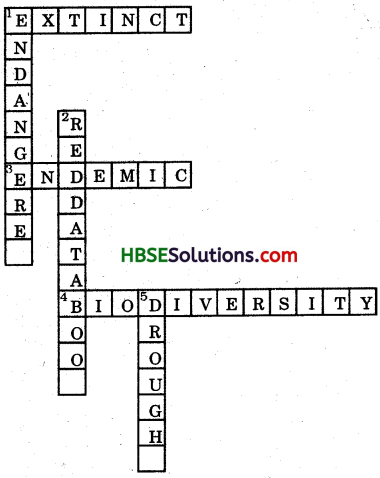
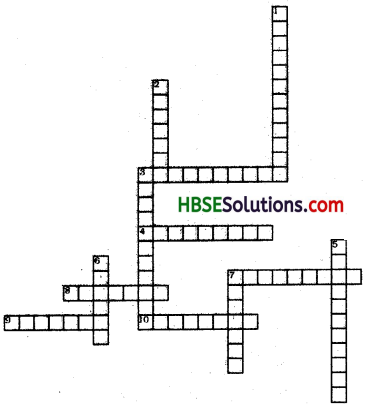
Complete the word puzzle:
Down .
1. Species on the verge of extinction.
2. A book carrying information about endangered species.
5. Consequence of deforestation.
Across
1. Species which have vanished.
3. Species found only in a particular habitat.
4. Variety and variability of a plant, animal and microorganisms.

HBSE 8th Class Science Solutions Chapter 7 Conservation of Plants and Animals-1
Answer:
HBSE 8th Class Science Solutions Chapter 7 Conservation of Plants and Animals-2

Extended Learning – Activities And Projects

1. Plant at least five different plants in your locality during this academic year and ensure their maintenance till they grow.
Answer:
For self attempt.

2. Promise yourself that this year you will gift at least 5 plants to your friends and relatives on their achievements, or on occasions like birthdays. Ask your friends to take proper care of these plants and encourage them to gift plants to their friends on such occasions. At the end of the year count the plants that have been gifted through this chain.
Answer:
For self attempt.

3. It is justified to prevent tribals from staying in the core area of the forest? Discuss the matter in your class and note down the points for and against the motion in your notebook.
Answer:
It is not justifiable in my Qpinin to prevent triabls from the core area of a forest. It is their natural habitat. They are not any threats to animals and plants as their life is centred around plants and animals. They don’t destroy forest or kill animals unnecessarily. Forest for them is an important as for other animals and plants.

4. Study the biodiversity of a park nearby. Prepare a detailed report with photographs and sketches of the flora and fauna.
Answer:
For self attempt.

HBSE 8th Class Science Solutions Chapter 7 Conservation of Plants and Animals

5. Make a list of the new information you have gathered from this chapter. Which information did you find the most interesting and why?
Answer:
(i) We have learnt how deforestation is destoryed biodiversity.
(ii) We have learnt about the actual meaning ofbiodiversity.
(iii) We have also gathered new information about extinct and endangerous animals.
(iv) We did not know anything about Red Data Book-but know we have learnt about it through this lesson.

6. Make a list of various uses of papers. Obseve currency notes carefully. Do you find any difference between a currency paper and paper of your notebook? Find out where currency paper is made.
Answer:
Paper is very useful for us.
(i) Our book and notebooks are all made up of paper.
(ii) Most of our currency is made up of paper.
(iii) All legal information and other important information are encoded on papers.
(iv) Paper is used to make bags, containers, package materials, etc. The paper used to make currency is stiffer than the normal paper and is transparent to some extent.

7. Karnataka Government had launched “Project Elephant” to save Asian elephants in the state. Find out about this and other such campaigns launched to protect threatened species.
Answer:
For self attempt.

Activities

Activity No. 7.1

Add more causes of deforestation to your list and classify them into natural and man-made.
Answer:
Natural causes of deforestation:
(i) lightning fires.

Man-made causes of deforestation:
(i) animal grazing.
(ii) Wood for fuel making houses.
(iii) Wood for manufacuring of paper.

Activity No. 7.2

Animal life is also affected by deforestation. How? List the points and discuss them in your class. ,
Answer:
(i) Animals loose their shelter as trees are out.
(ii) There is shortage of food for animals due to deforestation.
(iii) Animals become easy prey to hunters and bigger animals.
(iv) Food chains are disturbed.
(v) Animals have to bear the bad effects of natural calamities.

Activity No. 7.4

List the factors disturbing the biodiversity of your area. Some of these factors and human activities may disturb the biodiversity unknowingly. List these . human activities. How can these be checked? Discuss in your class and write a brief report in or notebook.
Answer:
Main factor affecting biodiversity of an area is cutting of trees and using the forest land for construction and industrialization. Excessive rains or droughts also offer the biodiversity of an area. Certain human activities which give rise to polluting end products also disturb the biodiversity unknowningly. When plants and animals do get clean environment they either fall ill or die, thus disturbance in biodiversity.

Activity No. 7.7

Visit a nearby zoo. Observe the conditions provided to the animals. Were they suitable for the animals? Can animals live in artificial setting instead of their natural habitats? In your opinion, will the animals be confortable in a zoo or in their natural habitat?
Answer:
Conditions provided in a zoo can never be compared with the natural habitat. The condition in a zoo are not exactly suitable for animals, although it is tried best to provide best living conditions to the animals in a zoo. But in my opinion animals be most comfortable in their natural habitat.

HBSE 8th Class Science Solutions Chapter 7 Conservation of Plants and Animals

HBSE 8th Class Science Conservation of Plants and Animals Important Questions and Answers

Very Short Answer Type Questions

Question 1.
What is cutting of forests called?
Answer:
Deforestations

Question 2.
Write any one cause of deforestation.
Answer:
Industrialization.

Question 3.
Name any one natural cause of deforestation.
Answer:
Forest fires.

Question 4.
Write any one consequence of deforestation.
Answer:
Increasing temperature of earth.

Question 5.
What is the process of conversion qf fertile soil into sand called?
Answer:
Desertification.

Question 6.
What are places where wild animals are protected called?
Answer:
Wildlife sanctuary.

Question 7.
What is the part of earth, which supports the biodiversity called?
Answer:
Biosphere reserve.

Question 8.
Name two wildlife sanctuaries hosted by Panchmarhi biosphere reserve.
Answer:
Bori and Panchmarhi.

HBSE 8th Class Science Solutions Chapter 7 Conservation of Plants and Animals

Question 9.
What do you mean by Flora?
Answer:
All plants found in a particular area.

Question 10.
What do you mean by Fauna?
Answer:
All animals in a particular area.

Question 11.
What are species found only in a restricted area called?
Answer:
Endemic species.

Question 12.
Name any fauna of Panchmarhi Biosphere,reserve.
Answer:
Bison.

Question 13.
Name any three endangered species protected in our wildlife sanctuaries.
Answer:
Black buck, white eyed buck, golden cat.

Question 14.
What do National Parks preserve?
Answer:
Flora, fauna, landscape and historical objects.

HBSE 8th Class Science Solutions Chapter 7 Conservation of Plants and Animals

Question 15.
Which is the first Reserve Forest of India?
Answer:
Satpura National Park.

Question 16.
Which prehistoric evidences of human life are found in Satpura National Park?
Answer:
Rock shelters of primitive humans.

Question 17.
When was Project Tiger launched?
Answer:
1st April, 1973.

Question 18.
What are the animals facing the danger of extinction are called?
Answer:
Endangered animals.

Question 19.
Name any one extinct animal.
Answer:
Dinosaurs.

Question 20.
Name the record book having records of all endangered animals and plants.
Answer:
Red Data Book.

Question 21.
Name some migratory birds.
Answer:
Surkhab, Bar Headed Goose, Great Cormorant.

HBSE 8th Class Science Solutions Chapter 7 Conservation of Plants and Animals

Question 22.
How many times a paper can be recycled?
Answer:
5-7 times.

Question 23.
What do we call the restocking the plants by growing new plants?
Answer:
Reforestation.

Question 24.
What is plantation of new plants called?
Answer:
Afforestation.

Question 25.
What is the revised Forest Policy of 1952 called?
Answer:
Forest Act, 1980.

Short Answer Type Questions

Question 1.
What do you mean by deforestation?
Answer:
Indiscriminate cutting of forests for urbanization and industrialization is called deforestation. In simple words, deforestation means to clear the forests and use the land for other purposes.

HBSE 8th Class Science Solutions Chapter 7 Conservation of Plants and Animals

Question 2.
Write some natural causes of deforestation.
Answer:
Natural causes of deforestation are those causes which are not initiated by human beings. Natural phenomenon like lightening on forests cause major forest fires, which can bum a large area of forests. Forest fires due to intense heat cause spontaneous combustion and bums a vast area of forest. Similarly, floods and severe droughts also cause damage to forests.

Question 3.
Write a few consequences of deforestation.
Answer:
Deforestation. has dangerous consequences which prove fatal for wildlife and human life. It gives rise to severe droughts and floods. It converts the fertile land into desert. It increases the temperature of the earth which causes melting of polar ice and glaciers. Many important species of plants, animals and birds become extinct and other stands at the verge of extinction.

Question 4.
How deforestation reduces rainfall?
Answer:
Deforestation disturbs the water cycle and reduces the rainfall. Increased amount of carbondioxide in environment increases the temperature of the earth. Which means there is less amount of water left on the earth. This reduces the evaporation of the water to form clouds thus reduced rainfall.

Question 5.
What do you mean by biodiversity?
Answer:
Biological diversity means the variety of living things existing on earth and their inter-relationship, as well as their relationship with the environment. In other words, variety of plants, animals and microorganisms generally found in an area is called its biodiversity.

Question 6.
What do you mean by endemic species?
Answer:
Species of animals and plants which are only found in a particular geographical area is called endemic species. These plants and animals cannot be found in any other geographical area e.g., wild mango arid gaint squirrel is endemic species of Panchmarhi.

Question 7.
What do you mean by wildlife sanctuaries?
Answer:
Wildlife sanctuaries are the protected areas where wild animals are protected and conserved. The wild animals are provided with their natural habitat. Their poaching and capturing is strictly prohibited m these protected areas.

Question 8.
What is a National Park?
Answer:
National Park is the protected vast area which conserves animals, plants, landscapes and even the historical objects. They are very large areas and can even protect whole sets of ecosystems in them. India has many such National Parks like Satpura National Park, Kaziranga National Park, etc.

HBSE 8th Class Science Solutions Chapter 7 Conservation of Plants and Animals

Question 9.
What are the endangered and extinct animals?
Answer:
Endangered animals are those which are facing the danger to their existence. They are threatened to stop existing on the earth, if not saved. The extinct animals are those which do not exist any more on the earth e.g. Dinosaurs.

Question 10.
What is ecosystem?
Answer:
An ecosystem comprises of all the plants, animals, microorganisms in a particular area alongwith its non-living components like climate, soil, river, deltas etc.

Question 11.
What do you know about Project Tiger?
Answer:
Project Tiger was launched by Gqf*rtnment of India on 1st April, 1973 to enusre the maintenance of a viable populati on of tigers in our country. Tigers are one of the endangered species, so to preserve it Project Tiger was launched.

Question 12.
Why do birds migrate?
Answer:
Birds migrate from one place to another due to change in climate and for specific purposes like breeding etc. When weather in their natural habitat becomes cold they migrate to other lands covering long distances to lay eggs.

Question 13.
How does recycling of paper help preserving trees?
Answer:
Paper is made from the bark of trees. If used paper is recycled to make new papers, it means we do not have to cut more trees. So, recycling paper means protecting trees.

Question 14.
What do you mean by Habitat?
Answer:
Each species can live in particular environment according to their characteristics. So, the natural surroundings of a plant or animal species where they can grow, reproduce and live comfortably are called habitats, e.g. a lion can live in jungle, but not in a city. So jungle is the habitat of the lion.

Long Answer Type Questions

Question 1.
What is Deforestation? Write its causes.
Answer:
Deforestation means indiscriminate cutting of trees in forest. Forest lands are cleared to be used for urbanisation and industrialization.
Following are different causes of deforestation:
(i) Forest land is used for urbanization. As population is growing, so is growing the need for houses. So more and more land is required.
(ii) With growing population, industries are also growing. So the cleared land is used to set-up factories and industries.
(iii) Wood of forest is used for making furniture, doors, windows of buildings etc.
(iv) Wood is cut to use as fuel for cooking.
(v) Some natural causes like forest fires etc. also cause destruction of forests.

HBSE 8th Class Science Solutions Chapter 7 Conservation of Plants and Animals

Question 2.
What are the consequences of deforestation? Explain.
Answer:
Deforestation has dire consequences. Following are the consequences of deforestation:
(i) Deforestation snatches away the natural habitat of many animals, plants and birds. It puts many species in endangered zone and many get extinct.
(ii) Deforestation causes natural calamities like floods, drought etc.
(iii) Reduced rainfall and increase in earth’s temperature has caused problems like Global warming.
(iv) Increased amount of carbondioxide and other gases pollute environment.
(v) Oxygen level is decreased as well as the water level.
(vi) Fertile top layer of soil gets converted into desert.

Question 3.
What is done for the conservation of wildlife?
Answer:
Various measures are taken to conserve wildlife. Reserved and protected areas like Biosphere reserve, Wildlife sanctuaries and National parks are formed.

Biosphere Reserves are the areas which support biodiversity and culture of the reserved area. Biosphere Reserve is a vast area which contains many other protected areas.

Wildlife Sanctuaries are the areas where wild animals are conserved and protected. It is the area which is restricted and activities like killing of animals and capturing of animals are strictly prohibited.

National Parks: National Parks are meant to protect and preserve flora, fauna, landscapes and historical objects of an area. They not only protect the living organisms, but also the non-living things of that particular area.

Question 4.
What do you mean by Endemic Species? Write about any three species endemic to India.
Answer:
Species of animals and plants comfined to certain specific geographical areas are called endemic species. Following are the three species of animals endemic to India.
(i) Lion-tailed macaque:
This animal got his name from its tail which is 25 cm in length and has a tuft at the end like that of lion’s which is black in colour. It is endemic to south-west India an is one of the most threatened primates.

(ii) Asiatic lion:
Asiatic lion is now endemic to Gir National Patk only as it is believed that the last remnants of this species are found in Gir National Park in Gujarat only.

(iii) Nilgiri ibex:
These stocky goats possessing short coarse fur and a bristly main are endemic to Nilgiri Hills and the Southern postion of the Western Ghats range in Tamil Nadu and Kerela. It is actually called Nilgiri Thar and Nilgiri ibex is its local name.

Question 5.
What is migration and why animals migrate?
Answer:
Movements of animals in large number from one place to another place to escape unfavourable conditions is called migration. Animals migrate for specific purposes. When the purpose is solved, they usually come back to their endemic area.

Migration can be due to unfavourable environmental conditions, eg. The Arctic Tern migrate to Antarctic to spend its winlers. Some birds of colder regions migrate to Asiatic countries during winters. This type of migration is called seasonal migration which occur in many species of insects, birds, marine mammals and herbivorous mammals.

Migration is also done for better food or water availability in other regions due to temperature and other climatic conditions.
Some species of animals and birds also migrate for the purpose of reproduction e.g. fresh watereeds go to saltwaters from freshwater to lay eggs.

HBSE 8th Class Science Solutions Chapter 7 Conservation of Plants and Animals

Question 6.
What is poaching? How is it done by anti social elements and for what purpose?
Answer:
Illegal hunting of animals is called poaching. Anti-social element some time create a nexus with the forest staff for poaching; They hunt the animals for selling their skin, horn, fur and hides.

All valuable parts of these animals are used for various purposes and are sold at very high prices.
Uses for ornaments: The bones and other parts like trunks of elephants etc. are used to make ornaments.
Uses in medicines: The horns and bones of some animals like rhinoceros and tigers are used to prepare some traditional medicine specially in Asian countries.
For wall hanging and clothings: The skin, fur and hides are used for the clothing. Mufflers, coats, jackets, skirts etc. are made using leather and fur of the animals like cats, minks, bears foe fur, skin of alligators and snakes and deer and cattle are killed for leather.

Question 7.
Write a short note op migratory birds.
Answer:
Migratory birds are those birds which migrate from their natural habitat to far off areas for breeding. When the natural habitat o.f these birds become very cold, they fly off to distant lands to lay eggs, as climate there is suitable for their breding. They always fly to a specific area every year at a specific period. They migrate in groups to escape the inhospitable climate of their natural habitat.

Birds like Surkhab fly to India from Malyasia. Other birds like Bar Headed Goose, Great Cormorant etc. are also migratory birds.

Question 8.
Recycling of paper helps to protect forest and environment. Explain.
Answer:
Paper is made from trees. Innumerable trees are cut to manufacture paper. If we recycle used paper, we will not have to cut trees to manufacture new paper. Each paper can be recycled 5-7 times and can be used. If we do not throw paper here or there and collect it to be sold to the Kabadiwala, we sire saving our green wealth. It will also save the chemicals used to prepare paper and also the energy used for preparing it. The wastage mid garbage produced during this process will also be reduced and environment will remain clean.

Question 9.
How can we save CHIT green wealth?
Answer:
Our forests are our wealth. We should not destory them but conserve them. To conserve our forests, first of all we should stop cutting them. We should plant as many plants as we cut, so that the number of trees remain unchanged. People should be made aware of the bad effects of deforestation and they should be made familiar with the advantages of the trees for us. Community plantation programmes should be encouraged. Students should be encouraged to plant one plant every year. Plantation of trees is not sufficient. They need proper look after too. So, the tree we plant, should be nourished and taken care of.

Conservation of Plants and Animals Class 8 HBSE Notes

1. A vast variety of plants and animals exist on earth.
2. Deforestation is a threat to the survival of these plants and animals as major varieties of plants and animals are present in forests.
3. Indiscriminate cutting of forests is called deforestation. Land cleared by deforestation is used for other purposes too.
4. Trees cut from these forests are used to make furnitures, papers, houses and is also used as . fuel.
5. Deforestation causes floods, droughts, infertility of soil and many other natural calamities.
6. Soil looses humous due to deforestation and becomes sand, thus deforestation converts a fertile land into a desert and it is called desertification.
7. We should conserve our forests by planting more and more trees which is called afforestation. For conservation of animals; wildlife sancturies and hational parks are formed. They give shelter to our wildlife and help to preserve our endangered species of plants and animals.
8. Variety pf life existing on earth and their inter-relation is called biodiversity. In other words biodiversity is variety of plants and animals and microorganisms generally found in a specific area. Such life is supported by the area called Biosphere.
9. Species ofplants and animals exclusively found in a restricted area are called Endemic species. They are not found in any other geographical area.
10. These species which are at the verge of extinction are called endangered species.
11. Red Data Book contains a record of the endangered species.

HBSE 8th Class Science Solutions Chapter 7 Conservation of Plants and Animals Read More »

HBSE 8th Class Science Solutions Chapter 6 Combustion and Flame

Haryana State Board HBSE 8th Class Science Solutions Chapter 6 Combustion and Flame Textbook Exercise Questions and Answers.

Haryana Board 8th Class Science Solutions Chapter 6 Combustion and Flame

HBSE 8th Class Science Combustion and Flame Textbook Questions and Answers

Question 1.
List conditions under which combustion can take place.
Answer:
Following conditions are necessary for combustion:
(i) The substance should be combustible.
(ii) It should have low ignition temperature.
(iii) There should be proper supply of air.

Question 2.
Fill in the blanks:
(a) Burning of wood and coal causes …………. of air.
(b) A liquid fuel, used in homes is …………. .
(c) Fuel must be heated to its before it …………. starts burning.
(d) Fire produced by oil cannot be controlled by …………. .
Answer:
(a) pollution
(b) Kerosene
(c) ignition temperature
(d) water.

Question 3.
Explain how the use of CNG in automobiles has reduced pollution in our cities.
Answer:
CNG has replaced petrol and diesel as fuel in automobiles because petrol and diesel produced a lot of unbumt carbon particles and emitted carbondioxide and nitrogen oxides and sulphur dioxide. These all gases are poisonous gases and cause various environmental hazards. But CNG is safe because it produces these substances in very small amounts thus reducing pollution in cities.

HBSE 8th Class Science Solutions Chapter 6 Combustion and Flame

Question 4.
Compare LPG and wood as fuels.
Answer:

LPGWood
It has more calorific value i.e. 55000 kJ/kg. It is smoke free fuel.It has less calorific value i.e. 17000 to 22000.
It is easy to transport.It gives out lot of smoke which is quite dangerous.
It is easily stored in cylinders.It is difficult to transport wood.
It does not cause any environment problem.It is difficult to store as it needs of space to store. It is cut so lead to deforestation thus gives rise to many natural and environmental problem.

Question 5.
Give reasons:
(a) Water is not used to control the fire involving electrical equipment.
(b) LPG is a better domestic fuel than wood.
(c) Paper by itself catches fire easily whereas a piece of paper wrapped around an aluminium pipe does not. .
Answer:
(a) Water is a conductor of electricity, so it can easily conduct electric current and causes danger of electric shocks.
(b) LPG is a better domestic fuel than wood because unlike wood it does not produce smoke and is comparatively easy to transport.
(c) Paper by itself catches fire easily because it has low ignition temperature but when wrapped around an aluminium pipe its

Question 6.
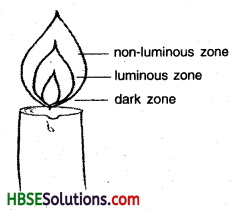
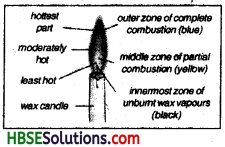
Make a labelled diagram of a candle flame.
Answer:
HBSE 8th Class Science Solutions Chapter 6 Combustion and Flame-1
Different Zones of Candle flame

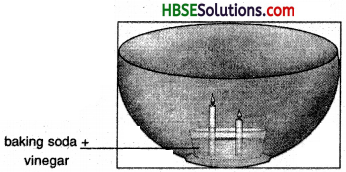
Observe the foaming reaction. What happens to the candles? Why? In what order?
HBSE 8th Class Science Solutions Chapter 6 Combustion and Flame-2
Answer:
The candles get extinguished. The smaller candle with get extinguisher first because thfe supply of oxygen is cut of due to foam; The smaller candle will come in effect of foam earlier than the longer one and thus stop burning prior to the longer candle.

Activity

Combustible and Non-combustible Substances

MaterialConmbustibleNon-combustible
Wood
Paper
Iron nails
Kerosene oil
Stone piece
Straw
Charcoal
Matchsticks
Glass

HBSE 8th Class Science Combustion and Flame Important Questions and Answers

Very Short Answer Type Questions

Question 1.
Why do we need fuel?
Answer:
We need fuel to generate energy.

Question 2.
Name any three fuels.
Answer:
Coal, wood, LPG, kerosene, petrol.

Question 3.
What is produced during combustion?
Answer:
Heat and light.

Question 4.
In what forms light is given during combustion?
Answer:
In form of flame or glow.

Question 5.
How does charcoal burn?
Answer:
It burns with glow.

Question 6.
How does a candle burn?
Answer:
It burns with flame.

HBSE 8th Class Science Solutions Chapter 6 Combustion and Flame

Question 7.
Name two objects which burn without flame.
Answer:
Coal and charcoal.

Question 8.
Name two objects which burn with flame.
Answer:
LPG and candle.

Question 9.
Name any three combustible substances.
Answer:
Wood, coal, LPG.

Question 10.
What is necessary for substances to burn?
Answer:
Air.

Question 11.
How does sun produces heat although it does not have air?
Answer:
It produces heat by nuclear reactions.

Question 12.
In addition to air, what else is a necessary condition for a substance to burn?
Answer:
Low ignition temperature.

Question 13.
What are the substances with very low ignition temperature called?
Answer:
Inflammable substances.

Question 14.
Name some inflammable substances.
Answer:
Alcohol, petrol, LPG., etc.

HBSE 8th Class Science Solutions Chapter 6 Combustion and Flame

Question 15.
What substances are used to extinguish fire?
Answer:
Water, sand, fire extinguishers.

Question 16.
What should we use to extinguish fire in case of electric short circuit?
Answer:
Sand or soil.

Question 17.
Name different types of fire extinguishers.
Answer:
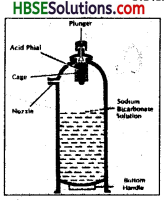
(i) Soda-acid fire extinguishers
(ii) Hydrocarbon fire extinguisher.

Question 18.
Name different types of combustions.
Answer:
Rapid combustion, Spontaneous combustion and explosions.

Question 19.
Name different zones of a flame.
Answer:
Outer non-luminous zone, luminous zone and dark zone.

Question 20.
Which zone of a flame has highest temperature?
Answer:
Non-luminous zone.

Question 21.
Name two properties of an ideal fuel.
Answer:
High calorific value and low cost.

Question 22.
Is there any ideal fuel?
Answer:
No ideal fuel exist.

Question 23.
What is smoke?
Answer:
Smoke is unburnt carbon particles.

Question 24.
Which diseases do incomplete combustion cause?
Answer:
Respiratory and skin diseases.

HBSE 8th Class Science Solutions Chapter 6 Combustion and Flame

Question 25.
What is supposed to be the cause of global warming?
Answer:
Increasing amount of carbon dioxide.

Question 26.
What is the rise in temperature of the environment of earth called?
Answer:
Global warming.

Question 27.
What does global warming lead to?
Answer:
Global warming leads to melting of polar glaciers.

Question 28.
Which chemicals give rise to acid rains?
Answer:
Sulphur dioxide and nitrogen oxides.

Question 29.
Which fuel is being used in automobiles in place of petrol and diesel?
Answer:
CNG.

Question 30.
Does CNG produce poisonous substances on burning?
Answer:
In very small amounts.

Short Answer Type Questions

Question 1.
Define combustion.
Answer:
A chemical process in which a substance reacts with oxygen to give off heat is called combustion. Burning of substances to get heat is called combustion.

Question 2.
What is produced when a combustible substance burns?
Answer:
When a combustible substance burns it produces heat and light. Light is in the form of glow or flame. Some combustible substances do not
burn in a flame, they simply glow.

Question 3.
How will you prove that air is necessary for burning?
Answer:
Burn a candle. Now put a beaker inverted on it. You will see the flame will flicker and then it will extinguish. As the inverted beaker has cut off the oxygen supply, the flame is extinguished. This proves air is necessary for burning.

Question 4.
What do you mean by ignition temperature?
Answer:
The lowest temperature at which a substance catches fire is called its ignition temperature. This is the temperature which has to be there, if the substance has to burn, below it the object will not catch fire.

Question 5.
What are inflammable substances?
Answer:
Some substances have very low ignition temperature and they catch fire very easily. Suflj substances are called inflammable substances. Petrol, alcohol, LPG etc. are the inflammable substances.

HBSE 8th Class Science Solutions Chapter 6 Combustion and Flame

Question 6.
Write three things necessary for fire to produce?
Answer:
Three conditions necessary to produce fire are following:
(i) Presence of oxygen i.e, air.
(ii) Ignition temperature.
(iii) Presence of combustible substances.

Question 7.
What can be done to put the fire off?
Answer:
To put off the fire one of the conditions necessary for burning should be removed or controlled. If we cut off the supply of air, fire will be extinguished or we can bring the ignition temperature down to blow off the fire.

Question 8.
Why can’t water control the fire due to oils?
Answer:
Water cannot put off fire due to oils because water is lighter than oil. It settles down the oil particles and cannot bring the ignition temperature of the substance down, thus cannot control the fire.

Question 9.
What should be done to control fire due to oils?
Answer:
In case of fire due to oils, water is not useful as it is lighter than oil and settles down below the oil particles. In such cases, sand or soil should be used. They cut off the supply of air to the fire and it is put off.

Question 10.
How does carbondioxide help in putting off fire?
Answer:
Carbondioxide covers the surface of the burning substance and does not allow the oxygen to reach the substance. In absence of oxygen the fire gets put off.

Question 11.
What is rapid combustion?
Answer:
When gases bum quickly to produce heat and light it is called rapid combustion. This process takes place rapidly and takes less time.

Question 12.
What is spontaneous combustion?
Answer:
When an object catches fire on its own without any apparant cause, it is called spontaneous combustion. In this type of combustion the object suddenly bursts into flame. For example, phosphorus catches fire in air.

Question 13.
Write the properties of an ideal fuel.
Answer:
An ideal fuel has following qualities:
(i) It has high calorific value.
(ii) It has low ignition temperature.
(iii) It is cheap and easily available.
(iv) It can be easily transported.

Question 14.
Write some harmful effects of burning fuel.
Answer:
Burning fuel can cause following ill effects:
(i) Unbumt carbon particles of these fuels can cause respiratory and skin diseases.
(ii) Smoke emitted by these fuels cause pollution and many diseases.
(iii) Poisonous gases like carbondioxide, carbonmonoxide and sulphurdioxide etc. pollute the air.

HBSE 8th Class Science Solutions Chapter 6 Combustion and Flame

Long Answer Type Questions

Question 1.
Explain the conditions necessary for cpmbustion.
Answer:
Combustion is burning of substances. For combustion of substances following conditions are necessary: .
(i) Air:
Substances only bum in sufficient supply of air i.e. oxygen. If the supply of air is hindered the object will not bum. In case of a burning object, if air is hindered, it will stop burning. This fact is used in extinguishing the fires.

(ii) Ignition Temperature:
Ignition temperature is the minimum temperature at which a substance starts burning. Those substances which have low ignition temperature can bum easily, while those which have high ignition temperature need more heating and burn late.

(iii) Presence of combustible substance:
If a substance is not combustible, it will not catch fire at all, so to produce fire it is necessary to have a combustible substance.

Question 2.
Describe the working of soda-acid fire extinguisher.
Answer:
Soda-acid fire extinguisher is based on the cooling the temperature of the burning object. This type of fire extinguisher contains sulphuric acid and sodium bicarbonate. When the extinguisher becomes functional, the sulphuric acid reacts with sodium bicarbonate to produce carbondioxide. Carbondioxide when released, cuts off the supply of oxygen and water is released to bring down the ignition temperature of the burning object. In this way fire is controlled.

Question 3.
What are different types of combustion?
Answer:
Combustion is of three types:
(i) Rapid combustion: When gases bum rapidly to produce heat and light it is called rapid combustion.
(ii) Spontaneous combustion: When any material like phosphorus bums on its own without any apparant cause, it is called spontaneous combustion.
HBSE 8th Class Science Solutions Chapter 6 Combustion and Flame-3

(iii) Explosion:
When combustion takes place with sudden release of heat and light and a large amount of gas in form of bang, it is called explosion as in case of crackers and bombs.

HBSE 8th Class Science Solutions Chapter 6 Combustion and Flame

Question 4.
Explain various harmful effects of burning fuels.
Answer:
Fuels are very useful for us. But there are certain disadvantages of burning fuels.
(i) Fuels like wood, coal, petroleum etc. which are carbon fuels generally release unbumt carbon particles which are quite harmful. They cause various respiratory and skin diseases.

(ii) In most of the cases carbondioxide is released during burning of fuels. This carbondioxide is released in environment. Carbondioxide is an identified cause of increasing temperature of the earth, which is called global warming.

(iii) Incomplete combustion of fuels release many poisonous gases like carbonmonoxide. in the environment. These poisonous gases create air pollution, such air if inhaled can be fatal.

(iv) Combustion of coal and diesel generates sulphurdioxide. It is a corrosive gas and it causes suffocation.

(v) Burning of petrol releases nitrogen oxides. These oxides of nitrogen and sulphurdioxide combine with rain water to cause acid rains.

Question 5.
Describe the various zones of a candle flame.
Answer:
The candle flame has three different zones. These zones can be distinguished on the basis of their colour.
(i) The outer zone:
It is blue in colour and it has very high temperature. It is the hottest zone of the flame. In this zones the wax vapours bum completely due to availability of enough oxygen, in turn carbondioxide and water vapours are produced.

(ii) The middle zone:
In this zone the flame bums with yellow colour and the wax vapours start burning here. The yellowish colour of the flame is due to the burning of carbon particles. These carbon particles are produced due te incomplete burning of the wax vapours due to less suppy of oxygen. Carbonmonoxide is also produced along the carbon particles. This zone is luminious but with low temperature.

(iii) The inner zone:
This zone appears black in colour as no combustion of wax vapour take place in this zone due to no supply of oxygen in this zone. It is the coolest zone of the flame having unbumt wax vapour.
HBSE 8th Class Science Solutions Chapter 6 Combustion and Flame-4

Combustion and Flame Class 8 HBSE Notes

1. All substances which catch fire/bum in air are called combustible substances.
2. Wood, paper, petrol, L.P.G., charcoal etc. are some examples of combustible substances.
3. During combustion heat and light is emitted. The light is emitted in the form of flame.
4. All combustible substances do not burn with flame, for example coal does not bum with flame, while wood, paper, candle, L.P.G., etc. bum with a flame.
5. There are two main things required by a substance to become combustible. These are: low ignition temperature and air.
6. Ignition temperature is the lowest temperature at which a combustible substance can easily catch fire. Inflammable substances have very low ignition temperature.
7. If any of the above condition is removed,’fire can be extinguished. Either we bring ignition temperature below minimum or we cut off the supply of air.
8. Water, sand are mostly used to bring fire under control.
9. There are three main zones of a flame. The outermost zone has the highest temperature while the inner zone has unbumt carbon particles.
10. Fuel is a substance which is used to give energy and heat. Ideal fuel has low ignition temperature and readily available. It is cheap and has high calorific value. It is free from pollution.
11. But no fuel is an ideal fuel.
12. Fuels are not same in their efficiency and cost.
13. Calorific value of fuels is expressed in units of kilojouls per kg.
14. Combustion of an inflammable substance should be complete because incomplete combustion produce unburnt carbon particle which can cause serious environmental hazards like acid rain, global warming and poisonous gases causing dangerous diseases in living beings.
15. Global warming the most alarming environmental problem is being created due to increased amount of carbondioxide in air.
16. Acidic rain is caused due to the oxides of nitrogen and sulphur released in environment due to burning of coal, diesel and petrol.

HBSE 8th Class Science Solutions Chapter 6 Combustion and Flame Read More »

HBSE 8th Class Science Solutions Chapter 5 Coal and Petroleum

Haryana State Board HBSE 8th Class Science Solutions Chapter 5 Coal and Petroleum Textbook Exercise Questions and Answers.

Haryana Board 8th Class Science Solutions Chapter 5 Coal and Petroleum

HBSE 8th Class Science Coal and Petroleum Textbook Questions and Answers

Question 1.
What are the advantages of using GNG and LPG as fuels?
Answer:
CNG – Compressed Natural Gas and LPG – Liquefied Petroleum Gas are easy to handle and use. It is easy to transport them and moreover they are free from any types of pollution on usage.

Question 2.
Name the petroleum product used for surfacing of roads?
Answer:
Bitumen or coaltar is used for surfacing of roads.

Question 3.
Describe how coal is formed from dead vegetation. What is this process called?
Answer:
Millions of years ago many dead animals and plants got trapped under the layers of earth. They got compressed and the temperature under the earth started raising due to hfgh pressure and temperature, the dead plants and animals got converted into coal. This process is called carbonization.

HBSE 8th Class Science Solutions Chapter 5 Coal and Petroleum

Question 4.
Fill in the blanks:
(а) Fossil fuels are ………. , …………. and …………. .
(b) On destructive distillation of coal …………. , …………. and …………. are obtained.
(c) Process of separation of different constituents from petroleum is called …………. .
(d) Least polluting fuel for vehicle is …………. .
Answer:
(a) coal, petroleum and natural gas
(b) coke, coal-tar and coal gas
(c) refining
(d) CNG.

Question 5.
Tick True/Ffdse against the following statements:
(а) Fossil fuels can be made in the laboratory. (T/F)
(b) CNG is more polluting fuel than petrol. (T/F)
(c) Coke is almost pure form of carbon. (T/F)
(d) Coal-tar is a mixture of various substances. (T/F)
(e) Kerosene is not a fossil fuel. (T/F)
Answer:
(a) False
(b) False
(c) True
(d) True
(e) False.

Question 6.
Explain why fossil fuels are exhaustible natural resources?
Answer:
Fossil fuels are exhaustible natural resources because they are made by the decomposition of the dead remains of living organisms. It is present in limited quantity beneath the earth, thus it will come to an end by human usage.

Question 7.
Describe characteristics and uses of coke.
Answer:
Coke is obtained by burning of coal in absence of oxygen. The process is called destructive distillation. Coke is used to manufacture steel. Coke is used in the extraction of many metals.

Question 8.
Explain the process of formation of petroleum.
Answer:
Petroleum is a fossil fuel. It is formed beneath the earth by decomposition of the dead bodies of the living organisms hurried beneath the earth. Due to some natural calamities like earthquake or volcano, innumerable living organisms (Plants and animals) got hurried beneath the earth. Due to heat and pressure, they started getting decomposed and got converted into liquid and gas form. In this way Petroleum oil and petroleum gas are formed.

Question 9.
The following Table shows the total power shortage in India from 1991-1997. Show the data in the form of a graph. Plot shortage percentage for the year on the Y- axis and the year on the X-axis.

YearShortage %
1. 19917.9
2. 19927.8
3. 19938.3
4. 19947.4
5. 19957.1
6. 19969.2
7. 199711.5

Answer:
HBSE 8th Class Science Solutions Chapter 5 Coal and Petroleum-1

Extended Learning – Activities And Projects

Get an outline map of India. Mark the places in the map where coal, petroleum and natural gas are found. Show the places where petroleum refineries are situated.
Answer:
For self attempt.

2. Choose any five families of your neighbourhood. Enquire whether their energy consumption (coal, gas, electricity, petrol, kerosene) has increased or decreased in the last five years. Enquire also about the measures they adopt to conserve energy.
Answer:
For self attempt.

HBSE 8th Class Science Solutions Chapter 5 Coal and Petroleum

3. Find out the location of major thermal power plants in India. What could be the reasonsi for their being located at those places?
For more information visit:

  • www.energyquest.ca.gov/story/chapter08.html
  • en.wikipedia.org/ wiki/ Non-renewable_resources
  • http://www.eiadoe.gov/kids/energyfacts/ sources/non-renewable/oil.html

Answer:
For self attempt.

HBSE 8th Class Science Coal and Petroleum Important Questions and Answers

Very Short Answer Type Questions

Question 1.
From where we find all the materials we use in our daily life?
Answer:
We get all these materials from natural resources as well as from man-made resources.

Question 2.
How many kinds of natural resources are there on the basis of availability of materials?
Answer:
On the basis of availability of materials, natural resources are oftwo types: Inexhaustible and exhaustible.

Question 3.
What are inexhaustible natural resources?
Answer:
Inexhaustible natural resources are those resources which cannot be finished by human activities.

Question 4.
Give two examples Pf Inexhaustible natural resources.
Answer:
Sunlight and air.

Question 5.
What are exhaustible natural resources?
Answer:
Exhaustible natural resources are those resources which are present in limited quantity and can get finished by hurt!an activities.

Question 6.
Give two examples of exhaustible natural resources.
Answer:
Petroleum, wildlife.

HBSE 8th Class Science Solutions Chapter 5 Coal and Petroleum

Question 7.
What are fossil fuels?
Answer:
Those fuels which got formed by the decomposition of the dead remains of living organisms for a long period of time are called fossil fuels.

Question 8.
Give tWo examples .of fossil fuel.
Answer:
Petroleum, coal.

Question 9.
What is coal?
Answer:
Coal is an exhaustible natural fossil fuel which is as hard as stone and is of black colour.

Question 10.
Write any two uses of coal.
Answer:
Coal is used as fuel to cook food. Coal is used as fuel to run trains.

Question 11.
What does coal mainly consist of?
Answer:
Coal mainly consists of carbon.

Question 12.
What is cabonization?
Answer:
Slow process of conversion of dead remains of living organisms into coal is called carbonization.

Question 13.
Which gas is released when coal ishumt?
Answer:
Carbondioxide.

Question 14.
To which process coal is put to get some useful products?
Answer:
Destructive distillation.

HBSE 8th Class Science Solutions Chapter 5 Coal and Petroleum

Question 15.
What is destructive distillation?
Answer:
Burning of coal in absence of oxygen to get coke and; other useful products is called destructive distillation.

Question 16.
What is the pure form of carbon?
Answer:
Coke.

Question 17.
What is coal-tar?
Answer:
Coal-tar is a black liquid that is produced during destructive distillation of coal.

Question 18.
Which petroleum product is used for metalling the roads in place of coal-tar?
Answer:
Bitumen.

Question 19.
What is used as fuel in light vehicles?
Answer:
Petrol.

Question 20.
What is used as fuel in heavy vehicles?
Answer:
Diesel.

Question 21.
Where was petroleum formed?
Answer:
Petroleum was formed under the sea.

Question 22.
Which conditions under the sea formed petroleum?
Answer:
Absence of air, high temperature and high pressure.

HBSE 8th Class Science Solutions Chapter 5 Coal and Petroleum

Question 23.
Where was the first oil well digged?
Answer:
Pennsylvania, U.S.A. in year 1859.

Question 24.
Name some places of India where oil is found.
Answer:
Assam, Gujarat, Bombay High, River basins of Godawari and Kaveri.

Question 25.
Which constituents are separated from-petroleum during its refining?
Answer:
Petroleum gas, petrol, diesel, lubricating oil, paraffin wax etc.

Question 26.
What is the full form of L.P.G.?
Answer:
Liquefied Petroleum Gas,

Question 27.
What is the use of L.P.G.?
Answer:
L.P.G. is used as fuel in home and in vehicles.

Question 28.
What is the use of Paraffin wax?
Answer:
Used in ointments, candles, vaseline, etc.

Question 29.
What are petrochemicals?
Answer:
Various useful constituents obtained from petroleum are called petrochemicals.

Question 30.
What is full form of C.N.G.?
Answer:
Compressed Natural Gas.

HBSE 8th Class Science Solutions Chapter 5 Coal and Petroleum

Question 31.
What are the uses of C.N.G.?
Answer:
C.N.G. is used as pollution free fuel for vehicles and in power generation.

Question 32.
Where in India is C.N.G. found?
Answer:
Tripura, Jaisalmer, Offshore of Mumbai and in Krishna Godawari Delta.

Question 33.
Can coal, petroleum and natural gas be prepared in laboratory?
Answer:
No.

Short Answer Type Questions

Question 1.
In how many types can we classify our resources?
Answer:
We can classify out natural resources in two types:
(i) Man-made resources
(ii) Natural resources.
Natural resources can further be classified in two types on the basis of the availability of resources: Exhaustible and inexhaustible resources.

Question 2.
What do you mean by Inexhaustible natural resources?
Answer:
These are the resources which are present in nature in unlimited amount and can never get finished by human activities. Air, sunlight, soil etc. are examples of inexhaustible natural resources.

Question 3.
What do you mean by exhaustible natural resources?
Answer:
Exhaustible natural resources are those resources which are present in nature in limited amounts and can get finished by human activities. Petroleum, Natural Gas, Coal etc. are exhaustible natural resources.

Question 4.
What do you mean by fossil fuels?
Answer:
Fuels which were formed by the dead remains of the living organisms by process which took thousands of year to complete are called fossil fuels. Petroleum, coal, natural gas are the fossil fuels which got formed under the sea and earth respectively, when they got hurried under the sea and earth.

HBSE 8th Class Science Solutions Chapter 5 Coal and Petroleum

Question 5.
What is coal and write its uses?
Answer:
Coal is a black stone like substance. It is formed by the dead remains of the living organisms.
(i) Coal is used as fuel to cook food.
(ii) It is used to run trains, as it is burnt to generate steam in engine.
(iii) It is used in thermal power plants to produce electricity.
(iv) Coal is also used as fuel in different industries.

Question 6.
How was coal formed?
Answer:
Millions of years ago dense forests of earth got hurried under the soil due to volcanoes and earthquakes. More deposits of soil compressed the hurried dead bodies. As they became deeper temperature started rising. This started converting dead bodies into coal.

Question 7.
What is coke? How is it useful to us?
Answer:
Coke is a hard porous black substance. It is obtained by destructive distillation of coke. It is almost pure form of carbon.
(i) Coke is used to manufacture steel.
(ii) It is used in extraction of many metals.

Question 8.
What is coal-tar? How is it useful to us?
Answer:
Black liquid obtained during destructive distillation of coal is coal-tar. It is thick and smells unpleasant. It is a mixture of hundreds of substances. Substances obtained from coal-tar are used to manufacture synthetic dyes, drugs, explosives, perfumes, plastics, paints, roofing materials, photographic materials, etc.

Question 9.
What do you mean by petroleum?
Answer:
Petroleum is a fossil fuel obtained from the dead remains of organisms living in sea. Petroleum is a dark oily liquid having unpleasant . odour. It has various useful constituents which are separated from it by process of fractional distillation at petroleum refineries.

Question 10.
How was petroleum lormed?
Answer:
Millions of years ago, sea organisms died and their dead bodies got settled at the bottom of the sea. Slowly they got covered by sand and clay. Absence of air, high temperature and high pressure for years, converted these bodies into petroleum oil and natural gas.

Question 11.
Name any three constituents obtained from refining petroleum and their uses.
Answer:
(i) L.P.G.: It is used as domestic fuel and fuel for vehicles.
(ii) Petrol: It is used as fuel for light vehicles, aviation fuel and used in drycleaning of fabric.
(iii) Kerosene: It is used as fuel for stoves, lamps an d for jet aircrafts.

Question 12.
What is diesel? How is it different from petrol?
Answer:
Diesel is one of the constituents obtained by the refining or fractional distillation of petroleum. It is mainly used as the fuel for vehicles as petrol is used. But it is different from petrol, as it is used as fuel for heavy vehicles like trucks, lories, etc. while petrol is used as fuel in light vehicles like cars, scooters, etc.

Question 13.
What is CNG?
Answer:
GNG is Compressed Natural Gas which is a fossil fuel and is formed along petroleum oil. It is used as the pollution free fuel for transport vehicles. It is more convinient to use as its transportation is easy and it can be directly burnt.

HBSE 8th Class Science Solutions Chapter 5 Coal and Petroleum

Long Answer Type Questions

Question 1.
Classify various materials we use in our lives.
Answer:
All the materials we use can be broadly classified into two groups:
(a) Natural Resources
(b) Man-made Resources.
(a) Natural resources are those resources which are present in our nature, gifted by God. They can be freely used. Soil, air, sunlight, water, wildlife, etc. are some natural resources.
(b) Man-made resources are those resources which are formed by various efforts of man and are artificial. Plastics, fibres, electricity, etc. are all artificial resources.

On availability of materials natural materials can further be classified as:
(i) Inexhaustible Natural Resources:
Those resources which are present in unlimited quantity and will never get exhausted by human activities. Sunlight, air, soil, etc. are some inexhaustible natural resources.

(ii) Exhaustible Natural Resources:
Those resources which are available in limited amount and will get finished by human activities. Petroleum, coal, wildlife, forests, etc. are some examples of exhaustible natural resources.

Question 2.
What is coal and how was it formed? Explain.
Answer:
Coal is a fossil fuel which is as hard as a stone. It is black in colour and is mainly used as fuel. As coal is a fossil fuel, it was formed by the dead remains of the plants. Millions of years ago vegetation in forests got trapped under soil layers due to earthquakes and volcanic erruptions. More soil layers got deposited on it and it went deeper and deeper beneath the earth.

This raised the temperature and pressure beneath the soil. This initiated the process of burning these dead remains. Slowly all the vegetations got converted into coal which is a rich form of carbon. This whole process is also called carbonization.

Question 3.
How was petroleum formed? What is refining of petroleum?
Answer:
Petroleum is a fossil fuel which got formed by the dead remains of the sea-animals. These animals slowly got trapped under soil and clay and more deposits were formed with time. Due to depth, the temperature and pressure raised and over the years they got converted into petroleum oil. Since oil is lighter than water, it did not get mix with water and got raised to the superficial rocks, which did not allow it to pass through them. To obtain petroleum, we have to dig wells to perforate the top rocks and pump up the petroleum oil.

The petroleum oil we get from these wells is a mixture of variuos other useful substances. Petroleum oil is, thus, refined to separate these useful by-products in petroleum refineries.

HBSE 8th Class Science Solutions Chapter 5 Coal and Petroleum

Question 4.
Name different constituents of petroleum and write their uses.
Answer:
Following are various constituents of petroleum oil obtained during fractional distillation in oil refineries:
(i) Liquefied Petroleum Gas (L.P.G.): It is primarily used as domestic fuel. Now it is used as fuel in vehicles and industry.
(ii) Petrol: It is a black liquid used as fuel in light vehicles like scooters, cars, etc. It is also used as aviation fuel and used for dry cleaning of fabrics.
(iii) Kerosene: It is used as fuel in stoves, lamps and jet aircrafts.
(iv) Diesel: It is used as fuel for heavy vehicles and in electric generators.
(v) Lubricating oil: It, is used to lubricate metal parts and machines.
(vi) Paraffin wax: It is used in ointments’, vaselines and in candles.
(vii) Bitumen: It is used in paints and is used in road-surfacing in place of coal-tar.

Question 5.
Write a note on Natural Gas.
Answer:
Natural gas is one of the most important forms of fossil fuel. The reason being that it is very easy to transport through pipes and cylinders. Natural gas is extracted and stored under very high pressure. As it is kept compressed under high pressure, it is called .

Compressed Natural Gas or CNG. The great advantage of CNG is that it does not cause pollution on usage as in case of other petrochemicals like petrol and diesel. Secondly, it can be directly burnt in homes and factories for cooking and other purposes. Natural gas is also used as the fuel for many manufacturing units of chemicals and fertilizers.

Question 6.
Why is it necessary to use coal and petroleum economically?
Answer:
There are two main reasons for which economical use of fossil fuels is necessary.
(i) Fossil fuels are exhaustible sources. If they are used indiscriminately, they will be exhausted, as they are present in nature in limited amount. It takes millions of years to form fossil fuels, so it is not possible to make new fossil fuels artificially.

(ii) Secondly, fossil fuels specially coke, petrol, diesel, etc. generate polluting gases on burning. Coke is almost carbon and produces carbondioxide on binning, whieh pollutes our environment. These polluting emissions have given rise to dangers of global warming and air pollution. So, their limited and economic use can control pollution and give better environment to live in.

Question 7.
Write some ways in which we can conserve fossil fuels.
Answer:
Economic and controlled consumption of fossil fuel can help conserving our natural resources. Following ways and measures can conserve owr resources:
(i) Vehicles shcaiM be driven at eeaastant and moderate speed.
(ii) Engines should he switched off at traffic lights or other temporary halts.
(iii) Proper and regular maintenance of vehicles.
(iv) Vehicle pooling can reduce number of vehicles plying on road thus less consumption of fuel.
(v) At home gas stoves should he cleaned properly and burners should not he left boring unnecessarily.
(vi) Pressure cookers should be preferred to pans. If pans are being used, they should he properly covered and their bottoms should not have deposits of burnt oil.
(vii) Small pans and burners should be used and pulses etc. should be dipped in water before cooking them.

HBSE 8th Class Science Solutions Chapter 5 Coal and Petroleum

Coal and Petroleum Class 8 HBSE Notes

1. We get various materials from various sources. These sources cam be natural or man-made. Natural resources are like air, water, soil, minerals, etc.
2. Natural resources are of two types according to their availability
(a) Inexhaustible
(b) Exhaustible.
3. Inexhaustible resources are those which are unlimited and are not supposed to come to an end by human use e.g. air is in exhaustible resource.
4. Exhaustible resourcs are those resources which are present in limited quantity and which can come to an end by human use e.g. forests, coal, petroleum, wildlife and natural gas, minerals, etc.
5. Coal, petroleum, natural gas etc. are called fossil fuels because they are formed by the decomposition of the dead bodies of plants and animals.
6. These fossil fuels are used by humans for their various energy requirements.
7. Coal was formed under the earth about 300 million years ago. The de forests of the earth got hurried under soil due to earthquakes and volcanic erruptions. The compressed under the layers of soil. Rising temperature under the earth converted these dead bodies into coal. Coal mainly consists of carbon.
8. The whole process of conversion of dead bodies of plants and animals into coal is called carbonization.
9. Heating of coal in absence oT cur to form coke is called destructive distillation. Destructive distillation is the process which produces various petroleum products like coaltar, coal-gas, etc.
10. Petroleum is refined to get various by-products like petrol, petroleum gas, paraffin wax, diesel, lubricating oil, etc.
11. All these resources of energy are present in limited quantity. It was a long process which took place to convert dead bodies of living beiqgs to get converted into petroleum products. So they will get exhausted if used indiscriminately.

HBSE 8th Class Science Solutions Chapter 5 Coal and Petroleum Read More »

HBSE 8th Class Science Solutions Chapter 4 Materials: Metals and Non-Metals

Haryana State Board HBSE 8th Class Science Solutions Chapter 4 Materials: Metals and Non-Metals Textbook Exercise Questions and Answers.

Haryana Board 8th Class Science Solutions Chapter 4 Materials: Metals and Non-Metals

HBSE 8th Class Science Materials: Metals and Non-Metals Textbook Questions and Answers

Question 1.
Which of the following can be beaten into thin sheets?
(a) Zinc
(b) Phosphorus
(c) Sulphur
(d) Oxygen
Answer:
(a) Zinc.

Question 2.
Which of the following statements is correct?
(a) All metals are ductile.
(b) All non-metals are ductile.
(c) Generally, metals are ductile.
(d) Some non-metals are ductile.
Answer:
(a) All metals are ductile. ✗
(b) All non-metals are ductile. ✗
(c) Generally, metals are ductile. ✓
(d) Some non-metals are ductile. ✗.

HBSE 8th Class Science Solutions Chapter 4 Materials: Metals and Non-Metals

Question 3.
Fill in the blanks:
(a) Phosphorus is very ……….. non-metal.
(b) Metals are ……….. conductor of heat and ………….. .
(c) Iron is ………….. reactive than copper.
(d) Metals react with acids to produce ………….. gas.
Answer:
(a) reactive
(b) good, electricity
(c) less
(d) hydrogen.

Question 4.
Mark ‘T’ if the statement is true and ‘F’ if it is false:
(a) Generally, non-metals react with acids. ( )
(b) Sodium is a very reactive metal. ( )
(c) Copper displaces zinc from zinc sulphate solution. ( )
(d) Carbon can be drawn into wires. ( )
Answer:
(a) False
(b) True
(c) False
(d) False.

Question 5.
Some properties are listed in the following table. Distinguish between metals and non-metals on the basis of their properties.

PropertiesMetalsNon-metals
1. Appearance
2. Hardness
3. Malleability
4. Ductility
5. Heat Conduction
6. Conduction of Electricity

Answer:

PropertiesMetalsNon-metals
1. Appearancelustrousnon-lustrous
2. Hardnesshard except sodiumgenerally soft except
3. Malleabilityand potassiumdiamond
4. Ductilitygenerally malleablenon-malleable
5. Heat Conductiongenerally ductilenon-ductile
6. Conduction of Electricitygood conductorspoor conductors

Question 6.
Give reasons for the following:
(a) Aluminium foils are used to wrap food items.
(b) Immersion rods are made up of metallic substances.
(c) Copper cannot displace zinc from its salt solution.
(d) Sodium and potassium are stored in kerosene.
Answer:
(a) Aluminium foils are used to wrap food items because aluminium can be beaten in sheets to form these thin wrapping sheets and it is soft and it does not react with food items.

(b) Immersion rods are made up of metallic substances because metals are good conductors of heat and electricity. They get hot very soon on passage of current and warm the water.

(c) Copper cannot displace zinc from its salt solution because copper is less reactive than zinc. A less reactive metal cannot displace a more reactive metal from its solution.

(d) Sodium and Potassium are stored in kerosene because they are very reactive and quickly react in air.

HBSE 8th Class Science Solutions Chapter 4 Materials: Metals and Non-Metals

Question 7.
Can you store acidic lemon pickles in an aluminium utensils? Explain.
Answer:
No, we cannot store acidic lemon pickles in aluminium utensils because aluminium is a metal. Metals readily react with acids to produce hydrogen gas. So, when the aluminium metal comes in contact with acidic lemon pickles, it would react to release hydrogen, which would spoil the food and render it unfit to consume.

Question 8.
In the following table some substances are given in Column I. In Column II some uses are given. Match the items in Column I with those in Column II.

Column IColumn II
(i) Gold(a) Thermometers
(ii) Iron(b) Electric wire
(iii) Aluminium(c) Wrapping food
(iv) Carbon(d) Jewellery
(v) Copper(e) Machinery
(vi) Mercury(f) Fuel

Answer:

Column IColumn II
(i) Gold(d) Jewellery
(ii) Iron(e) Machinery
(iii) Aluminium(c) Wrapping food
(iv) Carbon(f) Fuel
(v) Copper(b) Electric wire
(vi) Mercury(a) Thermometers

Question 9.
What happens when:
(i) Dilute sulphuric acid is poured on a copper plate?
(ii) Iron nails are placed in copper sulphate solution?
Write word equations of the reactions involved.
Answer:
(i) When sulphuric acid is poured on copper plate the acid present in sulphuric acid reacts with copper to form copper sulphate and hydrogen. The copper plate gets eroded from place.
Sulphuric Acid + Copper → Copper Sulphate + Hydrogen
(ii) When iron nails are placed in copper sulphate solution the iron being more reactive will replace copper in its salt solution,
(Ferrous Sulphate) → Iron + Copper Sulphate → Iron Sulphate + Copper
The solution will turn light green.

Question 10.
Saloni took a piece of burning charcoal and collected the gas evolved in a test tube.
(i) How will she find the nature of the gas?
(ii) Write down equations of all the reactions taking place in this process.
Answer:
(i) She will test it with litmus paper to check the acidic or basic nature of gas. If red litmus turns blue, it is basic in nature. If blue litmus turns red, it is acidic in nature.

(ii) Sulphur dioxide (SO2) + Water (H2O) → Sulphurous acid (H2SO3).

HBSE 8th Class Science Solutions Chapter 4 Materials: Metals and Non-Metals

Question 11.
One day Reeta went to a Jeweller’s shop with her mother. Her mother gave old gold jewellery to the goldsmith to polish. Next day when they brought the jewellery back they found that there was a loss in its weight. Can you suggest a reason for the loss in weight?
Answer:
When gold is washed in acidic solution, it being a metal reacts with acid and forms the hydrogen gas with some metallic oxides. This causes the loss of gold in form of gold oxides. This looses the weight of gold.

Activity.

No. 4.1. Malleability Of Materials

Object/ MaterialChange in Shape (Flattens/Breaks into pieces)
Iron nailflattens
Coal piecebreak into pieces
Aluminium wireflatten
Pencil leadbreaks into pieces

No. 4.3. Electrical Conductivity Of Materials

MaterialsGood Conductor / Poor Conductor
Iron rod / nailGood conductor
SulphurPoor conductor
Coal piecePoor conductor
Copper wireGood conductor

Extended Learning – Activities And Projects

Question 1.
Prepare Index Cards for any four metals and non-metals. The card should have information like name of metal/non-metal; its physical properties, chemical properties and uses.
Answer:
1. Name of metal: Copper
Physical properties:
(i) It is hard
(ii) It is ductile.
(iii) It is good conductor of heat and electricity.

Chemical Properties:
(i) Copper reacts with moist air to form greenish coating.
(ii) It oxide is basic in nature.
(iii) It reacts with acids to produce hydrogen gas.
(iv) It displaces iron from iron sulphate solution.

Uses:
Copper is used to make electrical wires, base of cooking utensils, etc.

Non-metals:

2. Name of non-metal: Coal
Physical properties:
(i) It is not ductile.
(ii) It is not malleable.
(iii) It is hot sonorous and does not shine. It is soft.
(iv) It is poor conductor of electricity

Chemical Properties:
(i) It produces oxides of carbon when burnt
(ii) It’s oxide are acidic in nature.
(iii) It does not take part in replacement reaction.

3. Name of Non-metal: Sulphur
Physical properties:
(i) It is neithre ductile nor malleable.
(ii) It is soft and dull.
(iii) It is poor conductor of heat and electricity.

Chemical properties:
(i) It reacts with oxygen to produce sulphur dioxide.
(ii) It reacts with water to form sulphurous acid H2SO4 which is acidic in nature.
(iii) Metals are heated to mould them.
(iv) Gold is preferred to prepare jewellary because it is less reactive ductile and is a costly metal.

4. Name of Metal: Iron
Physical properites:
1. malleable
2. non-ductile
3. sonorous
4. hard
5. good conductor of heat and current.

Chemical properties:
1. React with oxygen to form rust.
2. React with water.
3. React with acids to form hydrogen gasi
4. React with sodium hydroxide to produce hydrogen gas.

Uses:
Used to make machines, tools, door, etc.

Question 2.
Visit a blacksmith and observe how metals are moulded.
Answer:
For self attempt.

Question 3.
Suggest an experiment to compare the conductivity of electricity by iron, copper, aluminium and zinc. Perform the experiment and prepare a short report on the results.
Answer:
For self attempt.

Question 4.
Find out the locations of the deposits of iron, aluminium and zinc in India. Mark these in an outline map of India. In which form are the deposits found? Discuss in the class.
Answer:
For self attempt.

HBSE 8th Class Science Solutions Chapter 4 Materials: Metals and Non-Metals

Question 5.
Discuss with your parents / neighbours / goldsmiths why gold is preferred for making jewellery.
Answer:
For self attempt.

Question 6.
Visit the following websites and enjoy the quiz on metals and non-metals.

  • chemistry.about.com /library/weekly/ bl05030a.htm
  • chemistry.about.com / od / testsquizzes / Chemistry_Tests_Quizzes.htm.
  • www.syvum.com / cgi / online / mult.cgi / squizzes / science / metals.tdf?0
  • www.gcsescience.com / q / quesemet.html
  • www.corrosionsource.com / handbook / periodic / metals.htm
    Answer:
    For self attempt.

HBSE 8th Class Science Materials: Metals and Non-Metals Important Questions and Answers

Very Short Answer Type Questions

Question 1.
What is meant by malleability of a metal?
Answer:
The property by virtue of which a metal can be hammered into thin sheets is called malleability.

Question 2.
What is meant by ductility of metals?
Answer:
Ductility of metals means that they can be drawn into very thin wires.

Question 3.
Name two metals which are both malleable and ductile.
Answer:
Gold and silver.

Question 4.
Are non-metals malleable and ductile?
Answer:
No.

Question 5.
Name a metal which exists in liquid state.
Answer:
Mercury.

Question 6.
Name the hardest substance in the world.
Answer:
Diamond.

Question 7.
Which metal is the best conductor of electricity?
Answer:
Silver.

Question 8.
Identify the most reactive and the least reactive metal amongst the following:
Al, K, Cu, Au.
Answer:
K is the most reactive while Au is the least reactive metal.

Question 9.
Name the metal which is stored in kerosene oil.

HBSE 8th Class Science Solutions Chapter 4 Materials: Metals and Non-Metals
Answer:
Sodium is stored in kerosene oil.

Question 10.
Which metal foil is used in packing of some medicine tablets?
Answer:
Aluminium.

Question 11.
Which metal foil is used for decorating sweets?
Answer:
Silver.

Question 12.
Name a non-metal which is good conductor of heat.
Answer:
Graphite.

Question 13.
Why do gold and silver exist in free state?
Answer:
Gold and silver exist in free state because they are less reactive.

Question 14.
What would happen to the iron railings in open, when not painted?
Answer:
They will be rusted.

Question 15.
Why electric wires are made of copper?
Answer:
Electric wires are made of copper because it is good conductor of electricity.

Question 16.
Iron nails are kept dipped in blue copper sulphate solution and solution gets changed into light green colour. Why?
Answer:
This happens because iron displaces copper to form Ferrous Sulphate which is light green in colour.

Question 17.
Explain why silver does not displace hydrogen from dil HCl?
Answer:
Silver is less reactive than hydrogen, so it does not displace hydrogen from dil HCl.

Question 18.
When does red litmus paper turn blue?
Answer:
When red litmus paper comes in contact with basic solution.

Question 19.
When does a blue litmus paper turn red?
Answer:
Blue litmus paper turns red when it comes in contact with acidic solution.

Question 20.
What happens when sulphur dioxide gets dissolved in water?
Answer:
Sulphurous acid is formed:
SO2 + H2O → H2SO3

Question 21.
Oxides of non-metals are generally of which nature?
Answer:
Oxides of non-metals are generally of acidic nature.

Question 22.
What happens when sodium comes in contact with water?
Answer:
Sodium catches fire and heat is released.

Question 23.
How do non-metals react with water?
Answer:
Non-metals do not react with water.

HBSE 8th Class Science Solutions Chapter 4 Materials: Metals and Non-Metals

Question 24.
How do non-metals generally react with acids?
Answer:
Non-metals generally do not react with acids.

Question 25.
Which gas is emitted when metals react with acids?
Answer:
Hydrogen gas.

Question 26.
Write any use of non-metal.
Answer:
Non-metals are used in crackers.

Question 27.
Write any use of metals.
Answer:
Metals are used to make all means of transportation.

Question 28.
What is a displacement reaction?
Answer:
Reaction in which a more reactive metal displaces the less reactive metal from its compound in aqueous solution is called displacement reaction.

Short Answer Type Questions

Question 1.
Write any three physical characteristics of metals.
Answer:
(i) Metals can be hammered to make sheets so they are malleable.
(ii) Metals can be drawned into very thin wires, that means metals are ductile.
(ii) Metals are good conductors of heat and electricity.

Question 2.
Write any three physical characteristics of non-metals.
Answer:
(i) Non-metals are non-ductile and non- malleable.
(ii) Non-metals are non-sonorous.
(iii) Non-metals are poor conductors of heat and electricity.

Question 3.
What do you mean by sonorous materials?
Answer:
Materials which make a sound when they are hit hard with some other material are called sonorous materials. All metals except the soft ones are sonorous, while all non-metals are non-sonorous.

Question 4.
How do metals and non-metals react with oxygen?
Answer:
Metals react with oxygen to form oxides generally. These oxides are alkaline.
\(\begin{array}{ccc}
2 \mathrm{Mg} & +\mathrm{O}_{2} \rightarrow & 2 \mathrm{MgO} \\
\text { Magnesium } & \text { Oxygen } & \text { Magnesium oxide }
\end{array}\)
Non-metals also react with oxygen to form oxides but these oxides are acidic in nature.
\(\begin{array}{cc}
\mathrm{C} & \mathrm{O}_{2} \\
\text { Carbon } & \text { Oxygen }
\end{array} \quad \rightarrow \quad \mathrm{CO}_{2}\)

Question 5.
A copper coin is kept immersed in a solution of silver nitrate for some time. What will happen to the coin and the colour of the solution?
Answer:
Copper is more reactive than silver. Therefore, when a copper coin is kept immersed in a solution of silver nitrate, it will displace silver from silver nitrate solution and a solution of copper nitrate will be formed.
Thus, the copper coin will dissolve in the solution and the colour of the solution will change from colourless to blue.

HBSE 8th Class Science Solutions Chapter 4 Materials: Metals and Non-Metals

Question 6.
Explain why zinc metal can displace copper from copper sulphate solution but copper cannot displace zinc from zinc sulphate solution.
Answer:
Zinc metal is more reactive than copper. Therefore, it can displace copper from CuS04. Cu is less reactive than Zn, therefore, cannot replace Zn from ZnS04.

Zn + CuSO4 → ZnSO4 + Cu

Question 7.
State any three reasons for counting sulphur amongst the non-metals.
Answer:
Sulphur is a non-metal because:
(i) It is neither malleable nor ductile.
(ii) It does not conduct heat and electricity.
(iii) It combines with oxygen to form acidic oxide.

Question 8.
Non-metals do not react with water. How does this fact is utilized to store very reactive non-metals?
Answer:
Non-metals do not react with water. This quality is quite helpful in protecting some highly reactive non-metals which quickly react in air. Phosphorus is very reactive non-metal. It immediately catches fire when exposed to air. To prevent this, it is stored in water.

Question 9.
What is an element?
Answer:
Element is the smallest unit of any material. It cannot be broken further by cooling, heating or by electrolysis e.g. sulphur, iron, carbon etc.

Question 10.
Compare the physical properties of metals and non-metals.
Answer:

MetalsNon-metals
1. Metals are good conductors of heat and electricity.1. Non-metals are poor conductors of heat and electricity.
2. Metals are malleable and ductile.2. Non-metals are neither malleable nor ductile.
3. Metals are lustrous and can be polished.3. Non-metals are usually non-lustrous and cannot be polished.
4. Metals are solid except mercury.4. Non-metals can exist in all states.
5. Metals have generally high melting points and boiling points.5. Non-metals generally have low melting points and boiling points.

Question 11.
Compare the chemical properties of metals and non-metals.
Answer:

MetalsNon-metals
1. Metals react with oxygen to produce oxides which are alkaline in nature.Non-metals react with oxygen to produce oxides which are basic in nature.
2. Metals react with water differently to produce oxides and hydroxides.Non-metals do not react with water.
3. Metals react with acids to produce hydrogen gas.Non-metals most of times do notreact with acids.
4. More reactive metals displace the less reactive metals from their compounds in an aqueous solution.Non-metals do not show any such action.

Question 12.
In which state do metals occur inside the earth’s crust?
Answer:
Metals occur in different states inside the earth’s crust depending upon their reactivity. Some metals occur in elemental state or in the form of compounds. Reactive metals generally are found in compound. Highly unreactive metals occur in free state while the less reactive metals can either be found in combined state or infree state.

HBSE 8th Class Science Solutions Chapter 4 Materials: Metals and Non-Metals

Question 13.
What do you mean by Malleability of metals.
Answer:
The physical property of metals by virtue of which metals can be beatan into thin sheet is called malleability. Most of the metals are malleable. Aluminium is beaten into aluminium foil for wrapping food and silver is also beaten to make silver foils to decorate sweets.

Question 14.
What do you mean by ductility?
Answer:
The physical property by virtue of which metals can be drawn into thin wires is called ductility. Metals which are good conductors of electricity are mostly drawn into wire to be used in electrical cables. Gold and silver are the most ductile metal. Wires of copper, aluminium and tungsten are used to make electricity cables and tungsten is used to make filaments of bulbs. Aluminium wires are also widely used to make electrical wires.

Question 15.
What is an alloy? Describe any one alloy.
Answer:
Mixture of two or more than two metals to get desired qualities is called an alloy. Stainless steel is an alloy of iron, chromium and nickel. It is used to make utensils, surgical & instruments and many other decorative items. Stainless stell is hard and do not rust.

Long Answer Type Questions

Question 1.
Write a short note on displacement reaction of metals.
Answer:
A more reactive metal displaces a less reactive metal from its compound in an aqueous solution. This is called displacement reaction. For example, when some iron nails are dipped in copper sulphate solution, the iron being more reactive displaces copper from its solution and form ferrous sulphate solution of light green colour.
HBSE 8th Class Science Solutions Chapter 4 Materials Metals and Non-Metals-1
Similarly, magnesium and zinc also displaces copper from its compound.
HBSE 8th Class Science Solutions Chapter 4 Materials Metals and Non-Metals-2

Question 2.
How will you prove the nature of rust or the ash obtained from burning magnesium ribbon?
Answer:
This can be easily proved in laboratory. Take some rust and dissolve it in water (a few drops). Now take a red litmus paper and dip the litmus paper in solution. We will see that the red litmus paper turns blue.

When the red litmus paper turns blue it means solution is basic in nature. So the rust is basic in nature. We can similarly check the nature of ash obtained by burning a magnesium ribbon. It will also turn red litmus paper blue proving its basic nature.

HBSE 8th Class Science Solutions Chapter 4 Materials: Metals and Non-Metals

Question 3.
How do different metals react with water?
Answer:
Different metals react differently with water, hydrogen being a common end product.
Sodium metal reacts vigorously with water to form sodium hydroxide and hydrogen gas.
HBSE 8th Class Science Solutions Chapter 4 Materials Metals and Non-Metals-3
Magnesium only reacts with hot boiling water to form magnesium oxide and hydrogen.
HBSE 8th Class Science Solutions Chapter 4 Materials Metals and Non-Metals-4
Red hot iron reacts with steam to form iron oxide and hydrogen copper. Silver and nickel do
not react with water.

Question 4.
What are the different uses of metals?
Answer:
Metals are very useful to us. Some of the uses of common metals are following:
(а) Copper and aluminium metals are used to make electric wires. This is because copper and aluminium are good conductors of electricity.
(b) Copper, aluminium and iron metals are used for making utensils and other domestic things. These metals are also used to make various factory equipments. This is because, all these metals are good conductors of heat.
(c) Iron is used to make heavy machinery and is also used in construction of buildings because it is very heavy and strong.
(d) Thin foils of aluminium are used in packaging food materials and medicines etc.
(e) The liquid metal mercury is used in thermometers.
(f) Gold and silver metals are used to make jewellery.
(g) Sodium, titanium and zirconium metals are used in atomic energy and space projects.

Question 5.
What are the different uses of non-metals?
Answer:
Following are the uses of non-metals:
(a) Oxygen is used by plants and animals for respiration. Oxygen also supports the process of combustion in factories, houses, aeroplanes
and missiles.
(b) Compounds of nitrogen provide nutrients to soil and plants. Fertilizers made by using nitrogen are extensively used in agricultural practices.
(c) Chlorine is used to disinfect the drinking water as it has the ability to kill germs.
(d) Sulphur is also used as germicide, it is also used as an antiseptic fcr skin treatment (in ointments).
(e) Non-metals are used in crackers.

Question 6.
What is corrosion? How does it affect different metals?
Answer:
Corrosion is defined as attack of atmospheric gases and moisture on the surfaces of metal making them deformed and weak. If iron is left in open for a period of time, it slowly gets deposits of brown flakes on it, which is called rusting of iron. It is undesirable because it makes the iron weak and eat it up slowly with passage of time. Similarly silver objects become black in colour and loose their lustree as silver reacts with hydrogen sulphide gas of air. Slowly the copper vessels also get coated with greenish layer of copper carborate. It is formed due to reaction of copper with carbondioxide of air and water vapour also present in air.
HBSE 8th Class Science Solutions Chapter 4 Materials Metals and Non-Metals-5

Question 7.
Write composition, properties and uses of following alloys: Steel, Stainless Steel, Brass and Duralumin
Answer:

AlloyCompositionPropertiesUses
SteelIron and CarbonStrongNails, screws, railway lining, bridges, machinery, ships etc. are made up of steel.
Stainless SteelIron, Chromium and nickelStrong, rust proof, hard and shiningUses for making utensil, cutlery and surgical instruments.
BrassCopper and ZincDuctile, malleable resists corrosion can easily be castedUse for making screws, nuts, bolts,
DuralumiumAluminium, copper maganese and magnesiumLight,Used to make automobile parts, pressure cookers and aircrafts etc.

HBSE 8th Class Science Solutions Chapter 4 Materials: Metals and Non-Metals

Materials: Metals and Non-Metals Class 8 HBSE Notes

1. All metals and non-metals have some physical and chemical properties which differentiate them from each other.
2. Properties related to appearance and structure are called physical properties while how they react with other metals and non-metals are called their chemical properties.
3. Metals are shiny in appearance. This property of metals is called lustre.
4. Metals are generally hard. Sodium and potassium are soft. All metals mostly exist in solid state except murcury which is a liquid at room temperature.
5. Metals can be beaten with hamrqer and can be beaten into sheets. This physical property of metals is called malleability. Most of the metals are malleable.
6. Metals can be drawn into wires, they are thus ductile . Gold, tungsten are highly ductile metals.
7. Metals are good conductors of heat and electricity. That is why metals are used to make electric wires and most of the cooking utensils are made of metals. Silver is the best conductor of electricity.
8. Metals make sound, when they are hit hard with other object. This property makes them sonorous.
9. Non-metals do not shine and break-up when hit hard with hammer.
10. Non-metals cannot be beaten into sheets.
11. Non-metals cannot be drawn into wires.
12. They do not make any sound when hit with other objects.
13. Non-metals are bad conductors of heat and electricity.
14. Metals and non-metals react with oxygen to form oxides. Metal oxides are alkaline and oxides of non-metals are acidic in nature.
15. Metals react with water at different rates to form oxides and hydrogen gas. Non-metals do not react with water except sodium and magnesium.
16. Non-metals generally do not react with acids but metals react to produce hydrogen gas.
17. A more reactive metal displaces the less reactive metal from its compound in aqueous solution.
18. Metals and non-metals are very useful to us. They are used for different purposes.
19. All the materials can be divided into metals, non-metals and metalloids on the basis of above discussed physical mid chemical properties. Metalloids are those materials which possess the qualities of both metals and non-metals.

HBSE 8th Class Science Solutions Chapter 4 Materials: Metals and Non-Metals Read More »

HBSE 8th Class Science Solutions Chapter 3 Synthetic Fibres and Plastics

Haryana State Board HBSE 8th Class Science Solutions Chapter 3 Synthetic Fibres and Plastics Textbook Exercise Questions and Answers.

Haryana Board 8th Class Science Solutions Chapter 3 Synthetic Fibres and Plastics

HBSE 8th Class Science Synthetic Fibres and Plastics Textbook Questions and Answers

Question 1.
Explain why some fibres are called synthetic?
Answer:
Some fibres are called synthetic because they do not occur naturally and are made by man using petrochemicals.

Question 2.
Mark (✓) the correct answer:

Rayon is different from synthetic fibre because
(i) it has a silk like appearance
(ii) it is obtained from wood pulp
(iii) its fibres can also be woven like those of natural fibres.
Answer:
(ii) it is obtained from wood pulp. ✓

Question 3.
Fill in the blank with appropriate words:
(i) Synthetic fibres are also called ……………. or ……………. fibres.
(ii) Synthetic fibres are synthesised from raw material called ……………. .
(iii) Like synthetic fibres, plastic is also a ……………. .
Answer:
(i) man-made or artificial fibres
(ii) petrochemicals
(iii) polymer.

HBSE 8th Class Science Solutions Chapter 3 Synthetic Fibres and Plastics

Question 4.
Give examples which indicate that nylon fibres are very strong.
Answer:
Nylon fibres are very strong, thus they are used to prepare ropes for mountaineering. They are also used to prepare parachutes.

Question 5.
Explain why plastic containers are favoured for storing food.
Answer:
Advantanges of storing foods in plastic containers are:
(a) the plastics do not react with the food stored in them.
(b) the plastics are light weight and are strong.
(c) they are easy to handle and safe.

Question 6.
Explain the difference between the thermoplastic and thermosetting plastics.
Answer:
Differences between thermoplastic and thermosetting plastics:
(i) Thermoplastics can be mtelted on heating but thermosetting plastics Cannot be melted.
(ii) Thermoplastics can be reshaped as many times as desired but thermosetting plastics cannot.
(iii) Thermoplastics can be bent but thermosetting plastics cannot be bent.
(iv) Thermoplastics are good conductors of heat, thermosetting plastics are bad conductors of heat.

Question 7.
Explain why the following are made of thermosetting plastics:
(a) Saucepan handles
(b) Electric plugs/switches/plug boards.
Answer:
(a) The handles of saucepan are made of thermosetting plastic because it is a bad conductor of heat and do not get heated up while cooking. So it becomes easy to handle the utensil while cooking.
(b) Electric plugs/ switches and plug boards are made up of thermosetting plastic because it is a bad conductor of electricity. It does not allow the electric current to pass through it, thus safe in using in electric appliances.

Question 8.
Categorise the materials of the following products into ‘can be recycled’ and ‘cannot be recycled’.
Telephone instruments, toys, cooker handles, carry bags, ball point pens, plastic bowls, electric wire covering, plastic chairs, electrical switches.
Answer:
Can be Recycled: Toys, carry bags, plastic bowls, ball point pen, plastic chairs, electric wire covering.
Cannot be Recycled: Cooker handles, electric switches, telephone instruments.

Question 9.
Rana wants to buy shirts for summer. Should he buy cotton shirts or shirts made from synthetic material? Advise Rana, giving your reason.
Answer:
Cotton clothes are preferred to synthetic clothes in summers because cotton is a bad conductor of heat. It does not allow the outer heat to enter in our body, thus protects body from heat. It also has more capacity to hold moisture than the synthetic clothes. So, it retains
the sweat of the body and keeps it cool. So, Rana should buy shirts made upof cotton.

Question 10.
Give examples to show that plastics are noncorrosive in nature?
Answer:
Following examples show that plastics are non-corrosive in nature:
(i) They are used to store chemicals in laboratories.
(ii) They are used to store all types of food, as it does not react to materials stored in it.
(iii) It does not even react with air and water.

HBSE 8th Class Science Solutions Chapter 3 Synthetic Fibres and Plastics

Question 11.
Should theiiandle and bristles of a tooth brush be made of the same material? Explain your answer.
Answer:
No, the handle and bristles of a tooth brush should not be made of the same material because the bristles should be soft and the handle should be hard. So the bristles should be made up of soft material so that it does not harm the gums. The handles should be made up of hard material so that it can give firm grip.

Question 12.
‘Avoid plastics as far as possible,’ Comments on this advice.
Answer:
Plastics are harmful for our environment. Some of the plastics cannot be recycled, so they cannot be used again and thus cannot be finally disposed off. They thus, should be avoided as far as possible.

Question 13.
Match the terms of column I correctly with the phrases given in column II:

Column IColumn II
(ii) Polyester(a) Prepared by using wood pulp
(ii) Teflon(b) Used for making parachutes and stockings
(iii) Rayon(c) Used to make non-stick cookwares
(iv) Nylon(d) Fabrics do not wrinkle easily

Answer:

Column IColumn II
(ii) Polyester(d) Fabrics do not wrinkle easily.
(ii) Teflon(c) Used to make non-stick cookwares.
(iii) Rayon(a) Prepared by using wood pulp.
(iv) Nylon(b) Used for making parachutes and stockings.

Question 14.
‘Manufacturing synthetic fibres is actually helping conservation of forests’. Comment.
Answer:
Manufacturing synthetic fibres is actually helping conservation of forests because it does not require cfutting plants and hunting animals to get the natural fibres. The synthetic fibres are made up of chemicals and these chemicals are not available in forests.

Question 15.
Describe an activity to show that thermoplastic is a poor conductor of electricity.
Answer:
Observe all the electric wires of your house from a distance. You can take an electric wire which is not carrying current. Open the main wire you will see three/two small wires in the main wire and will see that they have covering of red, green and yellow plastic covering. This proves that the thermoplastics are bad conductors of electricity.

HBSE 8th Class Science Solutions Chapter 3 Synthetic Fibres and Plastics

Extended Learning – Activities And Projects

1. Have you heard of the campaign: “Say No To Plastics”. Coin a few ihore slogans of this kind. There are certain governmental and non-governmental organisations who educate general public on how to make a wise use of plastics and develop environment friendly habits. Find, out organisations in your area which are . carrying out awareness programmes. If there is none, form one. .
Answer:
For self attempt. .

2. Organise a debate in the school. The children may be given an option to rule play as manufacturers of synthetic fabrics or those of fabrics from natural sources. They ican then debate on the topic “My Fabric is Superior.”
Answer:
For self attempt.

3. Visit five families in your Neighbourhood and enquire about the kind of clothes they use, the reason for their choice and advantages of using them in term: of cost, durability and maintenance. Make a short report and submit it to your teacher.
Answer:
For self attempt.

4. Devise an activity to show that organic waste is biodegradable while plastic is not.
Answer:
Take some organe peels or peels of any fruit or vegetable. Now take any broken object of plastic.
Take two flower pots. In one pot dig a small pit and throw peels and cover it with mud. In second pot put the plastic and cover it with mud. Observe them after 5-10 day, and you will see that the peels have started decomposing and nothing has happened to plastic toy.

5. If you wish to know more about fibres and plastics and the products made from them, you may explore the following web sites:
• http://www.pslc.ws/macrog/index.htm
• http://www.edugreenteri.res.in/ exploresolwaste/types/htm
• http://www.nationalgeographic.com/ resouces/ngo/eduction/plastics
• http://www.packagingtoday.com/
• http://www.bbc.co.uk/schools.gcsebitesize/ design/textiles/fibresrev/html/

HBSE 8th Class Science Synthetic Fibres and Plastics Important Questions and Answers

Very Short Answer Type Questions

Question 1.
Why do we wear clothes?
Answer:
We wear clothes to get protected from heat, cold and other outer conditions.

Question 2.
How many types of fibres are there?
Answer:
There are two types of fibres: Natural fibre and Synthetic fibres.

Question 3.
What are natural fibres?
Answer:
Fibres obtained from animals and plants are called natural fibres.

Question 4.
What are synthetic fibres?
Answer:
Fibres made of chemicals by the man are called synthetic fibres.

Question 5.
Name some natural fibres.
Answer:
Silk, wpol, cotton, jute, etc.

HBSE 8th Class Science Solutions Chapter 3 Synthetic Fibres and Plastics

Question 6.
Name some synthetic fibres.
Answer:
Nylon, rayon, polyester, Acrylic.

Question 7.
What are polymers?
Answer:
Polymers are small jinits which combindfo make a synthetic fibre.

Question 8.
Name one natural polymer.
Answer:
Cellulose is a polyiper of cotton.

Question 9.
Which synthetic fibre is called synthetic silk?
Answer:
Rayon.

Question 10.
Which country discovered silk for the first time?
Answer:
China.

Question 11.
Which raw material is used to make rayon?
Answer:
Wood pulp.

Question 12.
Which raw material is used to make Nylon?
Answer:
Coal, water and air.

Question 13.
Name few items made from nylon.
Answer:
Socks, ropes, tents, sleeping bags, parachutes, etc.

Question 14.
Which is the strongest synthetic fibre?
Answer:
Nylon.

Question 15.
Which synthetic fibre can be stronger than a steel wire?
Answer:
Wire made of nylon.

Question 16.
Name a synthetic fibre which works like wool.
Answer:
Acrylic.

Question 17.
What happens when synthetic fibre is burnt?
Answer:
It starts melting.

Question 18.
What are petrochemicals?
Answer:
Petrochemicals are raw materials processed to make synthetic fibres.

HBSE 8th Class Science Solutions Chapter 3 Synthetic Fibres and Plastics

Question 19.
Name a few properties of plastics.
Answer:
They can be moulded, recycled, reused and melted.

Question 20.
What use polythene is put to?
Answer:
Polythene is used to make carry bags.

Question 21.
What do we call the plastics which can be remoulded again and again?
Answer:
Thermoplastics.

Question 22.
What do we call the plastics, which cannot be remoulded and reused?
Answer:
Thermosetting plastics.

Question 23.
Why electric switches and plugs are made of plastics?
Answer:
They are resistant to electricity.

Question 24.
Which material is used to make non-stick utensils?
Answer:
Teflon.

Question 25.
Which material is used to make the handles of the cookware?
Answer:
Melamine.

Question 26.
What makes plastic a wonder material?
Answer:
Lightness, strength, durability and non-reactiveness.

Short Answer Type Questions

Question 1.
Distinguish between Natural fibre and Synthetic fibre.
Answer:
Natural fibres are obtained from natural resources like plants and animals e.g., cotton, jute, etc. are obtained from plants. Silk and wool are obtained from animals. Synthetic fibres are made from synthetic materials, like petrochemicals, e.g. Nylon, Terelene, acrylic etc.

Question 2.
Why silk is so costly?
Answer:
Silk is a natural fibre obtained from silk moth. It takes a lot of time and efforts to make silk. So, it costs high.

Question 3.
What is Polyester?
Answer:
Polyester is the word coined by joining ‘poly’ and ‘ester’. This synthetic fibre is made by joining many ester units. Ester is a chemical which causes smell in fruits.

Question 4.
What makes acrylic more popular than pure wool?
Answer:
Acrylic is a synthetic fibre. It resembles wool in looks and in qualities. Wool is expensive becuse it is obtained from natural sources but acrylic is cheaper and is available in vibrant colours. It is more durable than wool.

HBSE 8th Class Science Solutions Chapter 3 Synthetic Fibres and Plastics

Question 5.
What is the main disadvantage of synthetic fibre?
Answer:
Synthetic fibres are good conductors of heat. They melt when heated. This causes a great danger for the user. In case the fibre catches fire while working in the kitchen, it will stick to the user’s body and will cause great damage to skin.

Question 6.
Which fibre will you prefer to get your raincoat stitched? Why?
Answer:
We will prefer synthetic fibre for getting our raincoat stitched because it will not absorb much amount of water and dispell it saving us from rain water. It will also dryup soon later.

Question 7.
How can polythene carry bags be harmful for animals?
Answer:
Polythene carry bags are thrown here and there after using them. Stray cattle consume them. In this case, it can choke the respiratory system and damage their stomach. It can even cause their death.

Question 8.
What are thermoplastics? Explain with examples.
Answer:
Those plastics which can melt on heating and which can be reshaped on moulding again and again are called thermoplastics P.V.C., Polythene are examples of thermoplastics. Toys, containers, car grills, combs etc. are made with thermoplastics.

Question 9.
What are thermosetting plastics?
Answer:
Thermosetting plastics are those plastics, which can be only moulded for once. They cannot be reshaped or reused because they do not get softened op heating. Bakelite, melamine etc. are examples of thermosetting plastics.

Question 10.
What are biodegradable and non-biodegradable materials?
Answer:
Biodegradable substances are those substances which can be decomposed by bacteria and other natural processes. Those substances which cannot be decomposed are called non-biodegradable substances. Plastics are non-biodegradable.

Long Answer Type Questions

Question 1.
Distinguish between natural fibres and synthetic fibres.
Answer:

Natural FibreSynthetic Fibre
1. They are obtained from natural sources like plants and animals.1. Synthetic fibres are made from chemicals called petrochemicals.
2. Natural fibres are costly.2. Synthetic fibres are cheaper.
3. Natural fibres are heavy in weight and have less tensile strength.3. Synthetic fibres are light in weight and are strong fibres.
4. They absorb more amount of water and retain it for longer period.4. Synthetic fibres absorb less amount of water and get dried up soon.
5. They are good conductors of heat except cotton and jute.5. All fibres are good conductors of heat.

Question 2.
Name different artificial fibres and write their uses.
Answer:
Following are the main synthetic fibres:
(i) Rayon:
It is also called the artificial silk as it has great lustre and is fight in weight. It is obtained by the chemical treatment of wood pulp. It can be woven like silk and dyed in different colours. It is used as dress material. Mixed with cotton, it is used to make curtains, bedsheets etc. It is mixed with wool to make beautiful carpets.

(ii) Nylon:
It is the strongest fibre. It is made by coal, water and air. It is elastic in nature and fight in weight. It is lustrous and thus ideal for making dresses. It is also used to make stockings, seat belts, ropes, tents, toothbrushes, sleeping bags, curtains and parachutes, etc.

(iii) Polyester:
It is made up of multiple units of ‘esters’. The clothings made of this fibre do not get wrinkled easily. It is always crisp and easily washable. PET is also derived from polyester which ip turn is used to make containers, utensils, films, wires etc.

(iv) Acrylic: Acrylic is just like wool and is used to make sweaters and suit lengths.

HBSE 8th Class Science Solutions Chapter 3 Synthetic Fibres and Plastics

Question 3.
Describe the characteristic features of the synthetic fibres.
Answer:
Synthetic fibres are made from chemical substances. Their qualities are quite different from those of natural fibres. Following are the characteristic features of the synthetic fibres:
1. Raw material: All synthetic fibres are made from chemicals. They are prepared by a number of processes using raw materials of petroleum family called petrochemicals.

2. Strength: Synthetic fibres are quite strong. Nylon is the strongest known fibre.

3. Durability: Synthetic fibres are quite durable. They do not wither easily. They are so strong and durable that ropes and parachutes etc. are made by using synthetic fibres.

4. Soak less water: Synthetic fibres absorb small quantities of water and loose it quick, so they dry up very soon.

5. Availability and cost: Synthetic fibres are less expensive and readily available. That makes it a popular dress material.

Question 4.
What are plastics? How many types of plastics are available? Explain.
Answer:
Plastics are synthetic materials which can be moulded to give any desirable shape. Plastics are two types:
Thermoplastics: Those plasties which can be melted and reshaped again and again to give any shape on heating are called thermoplastics. Thermoplastics can be reused as many times as desirable e.g. PVC and polythene.

Thermosetting Plastics are those plastics which can be melted on heating mid cannot be reshaped again and again. Melamine, Bakelite etc. are examples of thermosetting plastics.

Question 5.
Write the characteristic features of plastics.
Answer:
Plastic is a wonder material. Following characteristic features make it a common and popular choice:
(i) Plastics are light in weight so they are easy to handle and manage.
(ii) Plastics are strong and durable so they are used to make buckets, mugs, ropes, etc.
(iii) Plastics are non-reactive as they do not get corroded when they come in contact with other materials or substances. This property make them perfect for storing food items and chemicals.
(iv) Plastics are poor conductors of electricity. They do not allow the electric current to pass through them easily. They are, therefore, used to make coverings of electric wires and other electric appliances.

Question 6.
Write advantages and disadvantages of synthetic fabrics.
Answer:
Following are the advantages of synthetic fabrics:
(a) Most of the synthetic fibres are wrinkle resistant. They do not get wrinkled easily. They easily retain their original shape, if they get wrinkled. So it is convenient to wash and wear.
(b) Synthetic fibres are strong so they can take up heavy loads easily. They have got high tensile strength, which enables them to carry weights.
(e) They have great elasticity. They can be easily streched.
(d) Synthetic fibres are generally soft, so they are used to make variety of clothes and clothing materials.

Disadvantages:
(a) Synthetic fibres cannot absorb moisture. This makes them unsuitable to be warm during summers. When our body sweatsv This make body sticky and irritates the skin
(b) They are dangerous to be worn near fire or heat, as they easily catch fire and is unfit to he worn.
(c) They cannot be easily ironed as they melt very easily.

HBSE 8th Class Science Solutions Chapter 3 Synthetic Fibres and Plastics

Question 7.
How disposal of plastic is a problem? Explain.
Answer:
Plastic is wonderful synthetic material which is very useful. But biggest disadvantage of plastic is its disposal. Plastic is a non- biodegradable subtance, which do not get decomposed on its own by other microorganisms. So, accumulation of plastic is causing great danger for environment in the following ways:
(i) We throw plastics openly on roadsides and streets. This provide home to many disease causing germs.
(ii) Plastics if burned in the soil create more problem. They cannot be decomposed and prevents the water from seeping into the soil. This affects the plants adversLy. Water gets accumulated on the soil and cause muddy pubbles.
(iii) Buring the plasties produce toxic gases alongwith smoke which cause air pollution. Such an air is unfit for consumption and give birth to many respiratory problems in animals.
(iv) Plastic waste when dumped in water, cause water pollution. Aquatic animals consume these toxic plastics and die. It can also cause reproductive problems in aquotic animals.

Synthetic Fibres and Plastics Class 8 HBSE Notes

1. All the clothes we wear are made up of fabrics. Fabrics in turn are made up of fibres. Fibres can be of two types: natural fibre and manmade or synthetic fibres.
2. Natural fibres are those fibres which we get from plants and animals e.g. cotton, wool, silk, jute, etc.
3. Artificial or synthetic fibres are made up of the chemical substances by processing in factories and mills.
4. A synthetic fibre is chain of small units, woven together to form a long chain. These chemical substances or this chain of small units is called a polymer. All synthetic fhbrics are made up of these repeating units called polymers.
5. Rayon, Nylon, polyester etc. are examples of the manmade fibres.
6. These synthetic fibres are used for many other purposes, except making clothes. Nylon is a very strong fibre. It is used to make parachutes, socks, ropes, toothbrushes, sleeping bags and other drappery accessories.
7. Synthetic fibres are stronger than natural fibres. They absorb lesser amount of water than, the natural fibres. That is why raincoats etc. are made up of the synthetic fibres. They get dry! very soon and need less care and maintenance.
8. Plastics are synthetic materials which are used for many purposes. We can see objects made up of plastics all around us.
9. Plastics are also made up of polymers. Plastics can be moulded, melted and recycled. But all plastics are hot same.
10. Plastics are of two types: Plastics which can be melted, reshaped, bent easily are known as thermoplastics. The plastics which cannot be melted or reshaped are called thermosetting plastics.
11. Thermoplastics are used to make toys, combs, containers, etc. P.V.C. is an example of thermoplastic.
12. Thermosetting plastics are poor conductors of heat and are resistant to electricity. So they are used to make handles of utensils, electric plugs and switches, etc.
13. Plastics are very useful for us in every sphere of life. But they do have their disadvantages too.
Plastics are non-biodegrada,ble, so we cannot get rid of waste plastic easily. It is causing threat to our environment.
14. Environment friendly habbits like Reduce, Reuse, Recycle and Recovery of plastics can help in saving Environment.

HBSE 8th Class Science Solutions Chapter 3 Synthetic Fibres and Plastics Read More »

HBSE 8th Class Science Solutions Chapter 2 Micro Orgmisms: Friends and Foe

Haryana State Board HBSE 8th Class Science Solutions Chapter 2 Micro Orgmisms: Friends and Foe Textbook Exercise Questions and Answers.

Haryana Board 8th Class Science Solutions Chapter 2 Micro Orgmisms: Friends and Foe

HBSE 8th Class Science Micro Orgmisms: Friends and Foe Textbook Questions and Answers

Question 1.
Fill in the blanks:
(a) Microorganisms can be seen with the help of a ……….. .
(b) Blue green algae fix ………….. directly from air to enhance fertility of soil.
(c) Alcohol is produced with the help of ………….. .
(d) Cholera is caused by ……………… .
Answer:
(a) microscope
(b) atmospheric nitrogen
(c) yeast
(d) bacteria.

Question 2.
Tick the correct answer:
(a) Yeast is used in the production of:
(i) sugar
(ii) alcohol
(iii) hydrochloric acid
(iv) oxygen
Answer:
(ii) alcohol

(b) The following is an antibiotic:
(i) Sodium bicarbonate
(ii) Streptomycin
(iii) Alcohol
(iv) Yeast
Answer:
(ii) Streptomycin

HBSE 8th Class Science Solutions Chapter 2 Micro Orgmisms : Friends and Foe

(c) Carrier of malaria-causiiig protozoan is:
(i) female Anopheles mosquito
(ii) cockroach
(iii) housefly
(iv) butterfly
Answer:
(i) female Anopheles mosquito

(d) The most common carrier of communicable diseases is:
(i) ant
(ii) housefly
(iii) dragonfly
(iv) spider
Answer:
(ii) housefly

(e) The bread or idli dough rises because of:
(i) heat
(ii) grinding
(iii) growth of yeast cells
(iv) kneading
Answer:
(iii) growth of yeast cells

(f) The process of conversion of sugar into alcohol is called:
(i) nitrogen fixation
(ii) moulding
(iii) fermentation
(iv) infection
Answer:
(iii) fermentation

Question 3.
Match the organisms in Column I with their action in Column II.

Column IColumn II
(i) Bacteria(a) Nitrogen fixation
(ii) Rhizobium(b) Setting of curd
(iii) Lactobacillus(c) Baking of bread
(iv) Yeast(d) Causes Malaria
(v) A protozoan(e) Causing Cholera
(vi) A Virus(f) Causing AIDS
(g) Producing antibodies

Answer:

Column IColumn II
(i) Bacteria(e) Causing Cholera
(ii) Rhizobium(a) Nitrogen fixation
(iii) Lactobacillus(b) Setting of curd
(iv) Yeast(c) Baking of bread
(v) A protozoan(d) Causes Malaria
(vi) A Virus(f) Causing AIDS

HBSE 8th Class Science Solutions Chapter 2 Micro Orgmisms : Friends and Foe

Question 4.
Can microorganisms be seen with the naked eye? If not, how can they be seen?
Answer:
Some organisms are very small in size. They are so small that they cannot be seen with naked eyes. A microscope has to be used to see these organisms. Therefore, they are called microorganisms.

Question 5.
What are the major groups of microorganisms?
Answer:
Microorganisms can mainly be divided into five groups:
(i) Bacteria
(ii) fungi
(iii) protozoa
(iv) algae,
(v) virus.

Question 6.
Name the microorganisms which can fix atmospheric nitrogen in the soil.
Answer:
Bacteria like Rhizobium, Azotobacter, Blue green algae like Anabaena and Nostoc can fix atmospheric nitrogen in soil.

Question 7.
Write 10 lines on the usefulness of microorganisms in our lives.
Answer:
Microorganisms are very useful to us.
They help us in following ways:
(i) Microorganisms help us in food sector. They are used for curdling of milk, preparation of bread, cake, etc.
(ii) Microorganisms are used to produce alcohol at large scale.
(iii) They are also used to produce wine.
(iv) Yeast is used to prepare vinegar.
(v) They are also used as preservatives for food items.
(vi) Used to make different medicines, especially the antibiotics.
(vii) Microorganisms are used to prepare vaccines for various disease.
(viii) Useful for agriculture sector, as they enhance the fertility of soil by fixing the biological nitrogen.
(ix) They work as natural cleansers, as they decompose the dead bodies of plants and animals.
(x) Microorganisms prepare manures by decomposing dead bodies of plants and animals.

Question 8.
Write a short paragraph on the harms caused by microorganisms.
Answer:
Microorganisms can prove very harmful to us, as they cause a number of human and animal diseases. Diseases in humans like common cold, tuberculosis, measles, chiken pox, Polio, Cholera, Typhoid, Hepatitis B, Malaria, etc. are caused by microorganisms. Some serious deseases like Anthrax is also caused in animals by the microbes. Microbes grow on food products and render them unfit for consumption.

Consumption of such food causes food poisoning. Microbes also spoil clothings and leather products. Microbes also cause diseases of plants like blights in potatoes, sugarcanes, oranges etc. They also reduce the yield.

HBSE 8th Class Science Solutions Chapter 2 Micro Orgmisms : Friends and Foe

Question 9.
What are antibiotics? What precautions must be taken while taking antibiotics?
Answer:
Medicines taken to kill or stop the growth of harmful or disease causing microbes in human body are called antibiotics. Antibiotics are very useful as only antibiotics can save us from many microbial infections and diseases. Antibiotics are made from fungi and bacteria. Alexander Fleming discovered the first antibiotic called Penicillin in 1929. Now-a-days a number of antibiotics are used to cure a variety of human and animal diseases. Streptomycin, Tetracycline, Erythromycin etc. are some commonly used antibiotics.

Antibiotics should only be taken when adviced by a qualified physician. Antibiotics should only be taken when needed otherwise, they become less effective for future use.

Extended Learning – Activities And Projects

1. Pull out a gram or bean plant from the field. Observe its roots. You will find round structures called root nodules on the roots. Draw a diagram of the root and show the root nodules.
Answer:
Do it yourself.

2. Collect the labels from the bottles of jams and jellies. Write down the list of contents printed on the labels.
Answer:
Ingredients: Sugar, Mixed fruit pulp, Gelling Agent (E440), And acidity regulator (E330). Permitted synthetic food colour (E122) and added artificial flavours. Contains permitted class-II Preservatives (E211, E224).

3. Visit a doctor. Find out why antibiotics should not be overused. Preapare a short report.
Answer:
Antibiotics should not be overused because they reduce of power of immunity.
(i) Regular or frequent use make the drug ineffective when needed in future.
(ii) They kill beneficial bacteria in our body.
So, antibiotics should only be consumed when prescribed by doctore only.

4. Project:
Requirement – 2 text tubes, marker pen, sugar, yeast powder, 2 ballons and lime water.
HBSE 8th Class Science Solutions Chapter 2 Micro Orgmisms Friends and Foe-1
Take two test tubes and mark them A and B. Champ these tubes in a stand and fill them with water leaving some space at the top. Put two spoonfuls of sugar in each of the test tubes. Add a spoonful of yeast to test tube B. Inflate the two balloons incompletely Now tie the balloons on the mouths of each test tube. Keep them in a warm place, away from sunlight. Watch the setup every day for next 3-4 days. Record you observations and think of an explanation.

Now take another test tube filled V4 with lime water. Remove the balloon from test tube B in such a manner that gas inside the balloon does not escape. Fill the balloon on the test tube and shake well. Observe and explain.
Answer:
The balloon in test tube B will get inflated because process of fermentation has taken place in test tube B due to yeast bacteria and carbondioxide gas produce during this process has inflated the balloon. Now the balloon will get a little deflated as gas in consumed by the lime water and the lime water will turn milky.

5. For more information, visit the following websites.

  • www.microorgan.isms
  • www.biology4kids.com/files/micro_main html

HBSE 8th Class Science Solutions Chapter 2 Micro Orgmisms : Friends and Foe

HBSE 8th Class Science Microorganisms: Friend and Foe Important Questions and Answers

Very Short Answer Type Questions

Question 1.
Define microorganisms.
Answer:
Very small organisms around us which cannot be seen with naked eyes are called microorganisms.

Question 2.
Where are microorganisms found?
Answer:
Microorganisms are found everywhere. In air, water and in the body of other organisms.

Question 3.
Name the groups in which microorganisms can be divided.
Answer:
Bacteria, fungi, protozoa, some algae and viruses.

Question 4.
Which common diseases do viruses cause?
Answer:
Viruses cause diseases like common cold, flu and most of the coughs.

Question 5.
Which serious diseases are caused by viruses?
Answer:
Diseases like polio and chicken pox.

Question 6.
Name diseases caused by protozoans.
Answer:
Dysentery and malaria are caused by protozoans.

Question 7.
Name any two algae.
Answer:
Chlamydomonas and spirogyra.

Question 8.
Name any two protozoa.
Answer:
Amoeba and paramecium.

HBSE 8th Class Science Solutions Chapter 2 Micro Orgmisms : Friends and Foe

Question 9.
Name any two fungi.
Answer:
Rhizopus and Aspergillus.

Question 10.
Name unicellular microbes.
Answer:
Bacteria and protozoa.

Question 11.
Name multicellular microbes.
Answer:
Algae and fungi.

Question 12.
Which bacteria is responsible for the curdling of milk?
Answer:
Lactobacillus.

Question 13.
Which bacteria is used to produce alcohol?
Answer:
Yeast.

Question 14.
What do you mean by fermentation?
Answer:
Conversion of sugar into alcohol using yeast is palled fermentation.

Question 15.
Who discovered the process of fermentation?
Answer:
Louis Pasteur.

Question 16.
What are antibiotics?
Answer:
Medicines used to kill or stop the growth of diseases causing microorganisms inside human body are called antibiotics.

Question 17.
Who discovered the first antibiotic?
Answer:
Alexander Fleming.

Question 18.
Which antibiotic did Alexander Fleming discover?
Answer:
Penicillin.

HBSE 8th Class Science Solutions Chapter 2 Micro Orgmisms : Friends and Foe

Question 19.
Which microorganism is not affected by antibiotics?
Answer:
Viruses.

Question 20.
Name certain diseases which can be prevented by vaccination.
Answer:
Cholera, tuberculosis, small pox, hepatitis, polio, etc.

Question 21.
Name microorganisms which can fix atmospheric nitrogen.
Answer:
Bacteria and blue green algae.

Question 22.
Name one free living bacteria and one blue green algae who fix nitrogen using oxygen from atmosphere.
Answer:
Azotobacter, Anabaena.

Question 23.
What are pathogens?
Answer:
Disease causing microorganisms are called pathogens.

Question 24.
What are communicable diseases?
Answer:
Diseases which spread with physical contacts are called communicable diseases.

Question 25.
Name an insect which is a common carrier of microbial diseases.
Answer:
Housefly.

Question 26.
Name the carrier of dengue virus.
Answer:
Female Aedes mosquito.

Question 27.
Where do mosquitoes breed?
Answer:
Mosquitoes breed in stagnant water and damp places.

Short Answer Type Questions

Question 1.
What are the major group of the microorganisms?
Answer:
Major groups of microorganisms are:
(i) Bacteria: They are non-green single celled microorganisms.
(ii) Fungi: They are long thread like unicellular as well as multicellular microorganisms.
(iii) Algae: Aquatic* photosynthetic organisms commonly called sea weeds.
(iv) Protozoan: They are unicellular organisms.
(v) Virus: They are non-cellular microbes which only get active inside a living cell.

HBSE 8th Class Science Solutions Chapter 2 Micro Orgmisms : Friends and Foe

Question 2.
Describe various types of bacteria with examples.
Answer:
On the basis of their shape, the bacteria are divided into three types:
(i) Bacillus or rod shaped: Long rod shaped bacteria like Bacillus, Pseudomonas, Lactobacillus.
(ii) Cocus or round shaped: Streptococus, Sarcinaltc. are round shaped bacteria.
(iii) Spirillum or spiral: Comma shaped bacteria, they can also be spiral rods e.g. Camphilovector, Triponema.

Question 3.
State some beneficial effects of bacteria.
Answer:
Bacteria are very useful to us. Some of the beneficial effects of bacteria are as follows:
(i) Bacteria is helpful in agriculture as it fixes the atmospheric nitrogen in soil.
(ii) Products like vinegar, alcohol, curd etc. are obtained.
(iii) It decomposes the dead bodies of plants and animals.
(iv) Valuable medicines like antibiotics are obtained by bacteria.

Question 4.
Mention important uses of fungi,
Answer:
(i) Some fungi are eaten raw as food such as mushrooms.
(ii) Yeast being rich in amino acids and proteins are an important source of food for man and his farm animals.
(iii) Yeast is also used in the preparation of products like wine and bears from fruit juices or barley. It brings about fermentation of sugars into alcohols and carbondioxide.

Question 5.
Write the harmful effects of Bacteria.
Answer:
Bacteria cause a number of diseases in humans and animals. Diseases like cholera, pneumonia, tuberculosis are caused by bacteria. It also causes food poisoning as it makes the food unfit to consume. It spoils leather and clothings.

Question 6.
Write the harmful effects of fungi and algae.
Answer:
Some fungi causes damages or diseases. Smuts and rusts are fungi that damage the crops. Ring-warm and atheletes food diseases are caused by fungi. Amanite mushrooms contain poisonous substance. Algae are great nuisance as they spoil the drinking water. Excess growth of algae also blocks the movement of water in channels.

Question 7.
Write the diseases caused by protozoa.
Answer:
Several protozoa cause diseases in man and other animals. Antaemoeba Histolytica causes amoebic dysentry in man. Dangerous plasmodium causes malaria and dengue. Trypanosoma, causes sleeping sickness in man, cattle, pigs and horses.

Question 8.
Describe the main characteristics of viruses in brief.
Answer:
(i) They do not possess any cell wall or cell membrane.
(ii) They can only multiply in the bodies of living beings.
(iii) They cause many diseases.
(iv) Antibiotics do not have any affect on viruses.

HBSE 8th Class Science Solutions Chapter 2 Micro Orgmisms : Friends and Foe

Question 9.
What are vaccines?
Answer:
A vaccine consists of antigens of mild strains of pathogens of a particular disease. Vaccine when injected into the blood stream stimulates white blood cells to produce antibodies. These antibodies act against the antigens and neutralise their toxins or destroy them.

Question 10.
How does microorganisms enter into our body?
Answer:
Microorganisms enter into our body:
(i) through the air we breathe.
(ii) through the water we drink.
(iii) through direct contact with infected person.
(iv) by the use of polluted water or food.

Question 11.
What are viruses?
Answer:
Viruses are microscopic organisms. These are the smallest organisms. They may be rod-shaped, polygonal, spherical or even cubical. There are four types of viruses: Plant viruses, Insect viruses, Bacterial viruses and mammalian viruses.

Long Answer Type Questions

Question 1.
What do you understand by microorganisms? Describe their different forms.
Answer:
Different living organisms present around us which cannot be seen with naked eyes are called microorganisms. They are present in soil, water and air. Microorganisms can be divided into five groups:
(i) Bacteria are the non-green single celled microscopic organisms. They have a rigid cell wall. It has a nuclear material. They are the simple most common form of life on earth. They have different shapes and sizes.

(ii) Algae are aquatic, photosynthetic organisms. In simple terms they are called sea weeds. They range in size, colour. Algae are of green, blue, red and blue^green colours.

(iii) Fungi are plants not having chloroplast but a cell wall. They are both unicellular and multicellular. Moulds, mushrooms etc. are fungi.

(iv) Protozoa are one celled living things. They range from 2 to 200 microns. Amoeba, Paramecium, Euglena and Plasmodium etc. are protozoas.

(v) Viruses are the non-cellular microbes. They are smaller than bacteria and multiply only inside a living cell.

Question 2.
Write a short note on Bacteria.
Answer:Bacteria are non-green single celled microscopic organisms. They have a rigid cell wall. They have a nuclear material. They are simple most common form of life on earth. They occur singly but are seen in chain of cells. They are of different shapes such as rod shaped, spiral, cork screw and comma shaped.
HBSE 8th Class Science Solutions Chapter 2 Micro Orgmisms Friends and Foe-2
Bacteria are harmful for us, but some bacteria are quite useful. The most disadvantageous aspect of bacteria is their disease causing tendency. Various serious diseases like Tuberculosis, cholera, typhoid etc. are caused by bacteria. Bacteria are useftd as they are used to prepare vaccines and antibiotics. They decompose waste material and fix the atmospheric nitrogen into soil to enhance its fertility. Bacteria are also used to manufacture vinegar, acetic-acid, curd and cheese etc.

Question 3.
What are fungi? How are they useful or harmful to us?
Answer:
Fungi are microorganisms which exist in unicellular as well as multicellular forms. Some of the fungus like mushroom, yeast etc. can be seen with naked eyes. They have long thread like structures called hyphae. Fungus can reproduce sexually as well as asexually. Fungi are both harmful and useful. Smuts, crusts and ringworm etc. cause many diseases in humans as well as in animals and plants.

They are useful as they are used as food in many parts of world. Mushrooms are the mostly used food around the word. Yeast is used to make alcohol, breads, bhathuras, idlis, dosas etc. Penicillium is used to make penicillin an antibiotics.

HBSE 8th Class Science Solutions Chapter 2 Micro Orgmisms : Friends and Foe

Question 4.
What do you know about Protozoa?
Answer:
Protozoa are single celled living things. The size ranges from 2 microns to 200 microns.
HBSE 8th Class Science Solutions Chapter 2 Micro Orgmisms Friends and Foe-3
Amoeba, Paramesium, Euglena, Plasmodium etc. are examples of Protozoa. Protozoa are the part of animal kingdom because they do not have chlorophyll.

They are oval, elongated and spherical in shape. Protozoa cause diseases like malaria and dengue. Protozoa like Entamoeba Histolytica causes amoebic dysentery in man. Trypanosoma causes sleeping sickness in man and cattle. Protozoa are useful as they form an important link in acquatic food chain. They decompose organic matters to convert them in useful soil nutrients.

Question 5.
What are food preservatives? Explain some common preservatives.
Answer:
Chemicals used to check or stop the growth of harmful microorganisms in food are called preservatives. These preservatives keep the edibles protected from the invasion of microorganisms which can spoil the food.
Some commonly found preservatives are:
Salt: Common salt is used to preserve meat, fish, amla, raw mangoes, tamarind, etc.

Sugar preserves jam, jellies, squashes and other sweet drinks. Sugar reduces the moisture and checks the growth of microorganisms.

Oil: Edible oils are used as preservatives in vegetables and pickles. Oil does not allow the moisture to surface thus preventing the growth of harmful bacteria.

Vinegar preserves vegetables, fruits, fish, meat and pickles.
Other processes like pasteurization etc. also preserve the milk and other liquids.

Question 6.
How can we detect the spoilage in food?
Answer:
Following indications help us an detecting the spoilage in food:
(a) Odour:
When food gives out smell, it is the indication that the bacteria has spoiled the food. Food gives out repulsive smell when bacteria breaks the proteins found in food. This is called Putrefaction.
HBSE 8th Class Science Solutions Chapter 2 Micro Orgmisms Friends and Foe-4

(b) Discoluration:
Growth of microbes on food results in discolouration of food black. Moulds on breads, blue green moulds on citrus fruits and cheese cause the change in the original colour of the food. Any small discolouration indicates that the food has been spoiled and is unfit for consumption.

(c) Souring:
Sometimes the cooked food starts tasting sour. It is due to the production of acids by the action of certain bacteria. Milk starts tasting sour if not preserved properly, same is the case with curries and gravies of some vegetables.

(d) Sliminess:
Sometimes the food became slimy. It is also due to action of certain bacteria thread like slimes are also caused due to moulds.

(e) Gas formation:
Due to action of bacteria gases like carbondioxide are produced. They also spoil the food by making it swell or become spongy.

Microorganisms: Friend and Foe Class 8 HBSE Notes

1. Many living organisms exist around us in water, soil and air. They are so small that they cannot be seen with naked eyes. These tiny organisms are called microorganisms or microbes.
2. Microorganism can live in any kind of extreme environment like hot, cold, humid, icecold, saline water, desert or hot soil.
3. Microorganisms have wide variety of structural forms. They can be from unicellular to multicellular organisms.
4. Microorganisms are classified as bacteria, fungi, protozoa, algae and viruses.
5. Viruses are different from other microorganisms, yet referred to as the microorganism.
6. These microorganisms are helpful economically. They are also used to make many medicines.
7. These microorganisms can be very harmful too as they cause many diseases. Such microbes are called pathogens.
8. Microorganisms are used to enhance the fertility of the soil as they trap the biological nitrogen and fix them in the soil, which in turn is used by plants.
9. Microorganisms work on the dead bodies of the plants and animals to decompose them. They, thus, work as the natural cleansers of the environment.
10. Some microorganisms destroy our food by growing on it. The food infected by these microorganisms become unfit to consume. If consumed it can cause food poisoning.
11. Some special microbes reside in the nodules of the leguminous plants which fix the biological nitrogen from air into soil. The nitrates and nitrites present in soil are further converted into nitrogen gas and released in atmosphere. This whole cycle is called the nitrogen cycle.

HBSE 8th Class Science Solutions Chapter 2 Micro Orgmisms: Friends and Foe Read More »

HBSE 8th Class Science Solutions Chapter 1 Crop Production and Management

Haryana State Board HBSE 8th Class Science Solutions Chapter 1 Crop Production and Management Textbook Exercise Questions and Answers.

Haryana Board 8th Class Science Solutions Chapter 1 Crop Production and Management

HBSE 8th Class Science Crop Production and Management Textbook Questions and Answers

Question 1.
Select the correct word from the following list and fill in the blanks:
Float, water, crop, nutrients, preparation
(a) The same kind of plants grown and cultivated on a large scale at a place is called …………… .
(b) The first step before growing crops is …………… of the soil.
(c) Damaged seeds would …………… on top of the water.
(d) For growing of crop, sufficient sunlight and …………… and …………… from the soil are essential.
Answer:
(a) Crop
(b) preparation
(c) float
(d) water, nutrients.

Question 2.
Match items in column ‘A’ with those in column ‘B’:

(A)(B)
(i) Kharif crops(a) Food for cattle
(ii) Rabi crops(b) Urea and super phosphate
(iii) Chemical fertilisers(c) Animal excreta, cow dung, urine and plant waste
(iv) Organic manure(d) Wheat, gram, pea
(e) Paddy and maize

Answer:

(A)(B)
(i) Kharif crops(e) Paddy and maize
(ii) Rabi crops(d) Wheat, gram, pea
(iii) Chemical fertilisers(b) Urea and super phosphate
(iv) Organic manure(c) Animal excreta, cow dung, urine and plant waste

Question 3.
Give two examples of each:
(a) Kharif Crop
(b) Rabi Crop
Answer:
(a) Paddy and maize
(b) Wheat and gram

HBSE 8th Class Science Solutions Chapter 1 Crop Production and Management

Question 4.
Write a paragraph in your own words on each of’the following:
(a) Preparation of soil (b) Sowing (c) Weeding (d) Threshing.
Answer:
(a) Preparation of Soil:
Soil is prepared to sow the seeds. It is tilled to loosen the soil particles for better absorption of water and manures. Loosening of soil particles add humus and nutrition to the soil for better crops. Tilling of soil is done by using ploughs which are pulled by bulls. Tractor driven cultivators are also used to till the soil.

(b) Sowing:
Sowing means implanting the seeds in the prepared soil. Seeds are first selected. Better and healthy breeds of seeds are selected. They are then sowed in the fields with the help of seed drills and funnel shaped tools. The funnel, has a long body on one end of which is placed in soil. Seeds are put in the funnel and seeds go into the soil through long pipe which is carried over in the field with help of ploughs, the lower end pierces through the soil, spreading the seeds. Some seeds are simply spread through the field by hand. Some saplings are planted directly in the field manually.

(c) Weeding:
Unwanted plants growing along the crop are called the weeds. These weeds absorb the nutrients from the soil which are ment for the crops. They are, therefore, removed from the fields. Weeds are either removed manually or by mechanical tools. Certain chemicals are also used to kill the unwanted plants growing in the crops.

(d) Threshing:
Separation of grains from the chaff is called threshing. Seeds are removed from the chaff by threshers. When the crop is harvested, it is cut alongwith the stalks. They are then separated and the grains are removed. This whole process takes place with the help of a huge machine called combine.

Question 5.
Explain how fertilisers are different from manure.
Answer:
Differences between fertilizers and manure:
(i) Fertilisers are chemical substances, while the manures are the organic substances.
(ii) Fertilisers are prepared in the factories while the manures are prepared in fields.
(iii) Fertilisers don’t provide any humus to soil while manures provide a lot of humus.
(iv) Fertilisers are rich in plant nutrients will manures are less rich in plant nutrients.

Question 6.
What is irrigation? Describe two methods of irrigation which conserve water.
Answer:
Watering the crops in the fields is called irrigation. Irrigation is done at different intervals. Irrigation should be done in a way in which water does not get wasted, two such methods which conserve water are:
(i) Sprinklers:
Sprinklers work like fountains. Long perpendicular pipes have holes at regular distances, when water is supplied, it comes out of these holes and spray water in field. These holes have rotating nozzles which sprinkle water in all directions. Limited outflow of water, controls wastage of water.

(ii) Drip System:
This system allows the water to flow drop by drop at the roots of the plants. It contains a main pipe which have further lateral pipes containing small nozzles for the outflow of the water. Nozzles are such placed that they throw water at the roots of the plants, which saves water from flowing around uselessly.

Question 7.
If wheat is sown in kharif season, what would happen? Discuss.
Answer:
If wheat are grown in Kharif season, they would not grow as they do not need ihuch water to grow. The seeds would get destroyed in excess water due to rainy season.

Question 8.
Explain how soil get affected by the continuous plantation of crops in a field.
Answer:
Continuous plantation of crops drains off the nutrients of the soil. It leaves the land unfertile and unable to bear crop. It does not give any time to the soil to replenish the absorbed nutrients by the crops, thus unable to sustain any further healthy and good crop.

HBSE 8th Class Science Solutions Chapter 1 Crop Production and Management

Question 9.
What are weeds V How can we control them?
Answer:
Weeds are the unwanted plants growing along crops. They share the nutrients meant for plants and thus are harmful. We can control weeds with the help of chemicals called weedicides. Weeds are the unwanted plants growing along the main crops. They are either removed manually or by chemicals. Weedicides are sprayed in the fields to kill the unwanted plants. These weedicides do not affect the main crop. Weeds are removed or killed during their vegetative phase before flowering or bearing seeds.

Question 10.
Arrange the following boxes in proper order to make a flow chart of sugarcane crop production:
HBSE 8th Class Science Solutions Chapter 1 Crop Production and Management-1
Answer:
HBSE 8th Class Science Solutions Chapter 1 Crop Production and Management-2

Question 11.
Complete the following word puzzle with the help of clues given below:
HBSE 8th Class Science Solutions Chapter 1 Crop Production and Management-3

Down
1. Providing water to the crops.
2. Crop grains have to be kept for a long time in proper conditions.
5. Certain plants of the same kind grown on a large scale.

Across
3. A machine used for cutting the taatured crops.
4. A rabi crop that is also one of the pulses.
6. A process of separating the grain from chaff.
Answer:
HBSE 8th Class Science Solutions Chapter 1 Crop Production and Management-4

Activity 1.3

FoodSources
1. MilkCow, Buffalo, She-goat, She-camel
2. Cereals grainsPlants like wheat, rice
3. MeatGoat, Cow, Hen, Fish
4. VegetablesPlants like brinjal, potatoes, tomatoes, etc.

Extended Learning – Activity And Projects

Question 1.
Sow some seeds in the soil and arrange to water them by drip irrigation. Observe daily.
(i) Do you think it can save water?
(ii) Note the changes in the seed.
Answer:
(i) Yes, drip irrigation saves water as it doe not allow the water to flow on sides and get wasted.
(ii) Seeds slowly get germinated.

Question 2.
Collect different types of seeds and put them in small bags. Attach these bags in a herbarium file and label them.
Answer:
Do it yourself.

HBSE 8th Class Science Solutions Chapter 1 Crop Production and Management

Question 3.
Collect new agricultural machine pictures and paste in a file with their names and uses.
Answer:
Tractor to drew ploughs and carriage combines for threshing.
Plough for tilling soil.
Winnowing machine for removing chaff.

4. Project Work: Visit a farm, nursery or a garden nearby. Gather information about:
(i) importance of seed selection
(ii) method of irrigation
(iii) effect of extreme cold and extreme hot wather on the plants
(iv) effect of continuous rain on the plants
(v) fertilisers / manure used.
Answer:
(i) Good seed give good crops.
(ii) Traditional and modern
(a) Traditional: Moat, Chain pumps, Dhekli and Rahat
(b) Modern: Drip irrigation and Sprinklers.
(iii) Extreme cold and heat destroy the crops.
HBSE 8th Class Science Solutions Chapter 1 Crop Production and Management-5
(iv) → Continuous rain get plants decomposedand waer logged in fields.
→ Minerals and fertilisers get flown away.
→ Top fertile layers get destroyed.
(v) Enhance the productivity of soil.

For more information, visit:

  • www.krishiworld.com / html / balanced fertiliser.htm.
  • www.ikis.com / links / ap.cultivation.html.

HBSE 8th Class Science Crop Production and Management Important Questions and Answers

Very Short Answer Type Questions

Question 1.
Why do every living organism need food?
Answer:
Every living organism needs food to grow and perform various other activities and body functions.

Question 2.
Where do we get our food from?
Answer:
We get our food from plants and animals.

Question 3.
What is agriculture?
Answer:
Growing and managing crops is called agriculture.

Question 4.
What is crop?
Answer:
When same type of plants are grown at a large scale, it is called crop.

Question 5.
Name the factors controlling crop production.
Answer:
Soil, water, sunlight and air.

Question 6.
What are the rainy season crops called?
Answer:
Kharif crops.

HBSE 8th Class Science Solutions Chapter 1 Crop Production and Management

Question 7.
What are the summer season crops called?
Answer:
Zayed crops.

Question 8.
What are the winter season crops called?
Answer:
Rabi crops.

Question 9.
Name any three Kharif crops.
Answer:
Paddy, maize, cotton.

Question 10.
Name any three Rabi crops.
Answer:
Wheat, gram, mustard.

Question 11.
Name any three Zayed crops.
Answer:
Moong, musk melon, bitter gourd.

Question 12.
What is tilling?
Answer:
Tilling is the loosening and turning of the soil.

Question 13.
What are crumbs?
Answer:
Crumbs are big pieces of soil present in fields, which require tilling.

Question 14.
Which agricultural tools are Used for tilling?
Answer:
Plough, hoe and cultivators.

Question 15.
Name tools used for sowing.
Answer:
Funnel shaped pipe with plough and seed drill.

Q. 16.
What is transplantation of seeds?
Answer:
Small saplings of plants are directly plantedj in fields. This is called transplantation.

HBSE 8th Class Science Solutions Chapter 1 Crop Production and Management

Question 17.
What are fertilizers and manures?
Answer:
Manures and fertilizers are the substances added to soil to enhance its fertility and nutrients.

Question 18.
Which manure is called organic manure?
Answer:
Manure obtained from the dead bodies of plants and animals.

Question 19.
Name any two important fertilizers.
Answer:
Urea, NPK (Nitrogen, Phosphorus, Potassium).

Question 20.
What is a fallow?
Answer:
An uncultivated field between two croppings is called a fallow.

Question 21.
Write sources of irrigation.
Answer:
Wells, tubewells, ponds, lakes, rivers, dams and canals.

Question 22.
What is harvesting?
Answer:
Cutting of the crop after it is mature is called harvesting.

Question 23.
What is threshing?
Answer:
Separating seeds from the chaff is called threshing.

Short Answer Type Questions

Question 1.
What do you mean by agriculture?
Answer:
The term agriculture is derived from the Latin words ‘Ager’ which means field and ‘culture’ which means cultivation. Thus, cultivation in fields means agriculture.

Question 2.
Write the names of various agricultural practices undertaken to produce a crop.
Answer:
Following agricultural practices are performed to produce the crop:
1. Soil preparation
2. Sowing
3. Adding manure and fertilizers
4. Irrigation
5. Protection from weeds
6. Harvesting
7. Storage.

HBSE 8th Class Science Solutions Chapter 1 Crop Production and Management

Question 3.
How many categories of crops are sown in India based on the seasons?
Answer:
Three categories of crops are sown in India based on the seasons:
(i) Kharif crops are sown during rains.
(ii) Rabi crops are sown during winters, and
(iii) Zayed crops are grown during summers.

Question 4.
Why is the $oil turned and loosened before seeds are sown?
Answer:
The soil is turned and loosened during the process of ploughing. The ploughing loosens the soil particles and turn the soil of upper
HBSE 8th Class Science Solutions Chapter 1 Crop Production and Management-6
surface. This allows the nutrients from the dead organism to be released back in the soil and better penetration and absorption of nutrients by plant roots.

Question 5.
What are manures and fertilizers?
Answer:
Manures and fertilizers are used to enhance the productivity and fertility of the field. Manure is made of waste products of animals and plants. Fertilizers are chemicals rich in nitrogen, potassium.

Question 6.
What is the role of water in production of crops?
Answer:
Water is essential for all plants. Crops should get enough water at different stages of their growth. Different crops require different amount of water in the field. The wheat crop requires moderate amount of water at the time of sowing, flowering and ripening of crop.
Therefore, corps should be irrigated properly according to their needs.

Question 7.
What are the different methods of irrigation?
Answer:
Different methods of irrigation are adopted according to the requirement of soil and size of the field. Some common methods of water supply are through small channels, which get water from tubewells and canals, lift irrigation, sprinkler, dripping irrigation, etc.
HBSE 8th Class Science Solutions Chapter 1 Crop Production and Management-7

Question 8.
Define weeding. What tools are used for weeding?
Answer:
Weeds are unwanted and undesirable plants which grow alongwith the crop plants in the field. They grow rapidly than the crop plants and cause harm to them. It is, therefore, essential to remove weeds at proper time. The process of removing the weed plants is called weeding. It is done either by hand or by khurpi. It is also done by spraying chemicals or weedicides.

Question 9.
What is humus? How is it formed?
Answer:
Humus is a kind of soil rich in nutrients. It is formed by the microbial action on dead decaying bodies and leaves. It is generally formed on those spots where-there are dense layers of trees. The soil below it becomes dark having more number of pathogenic bacteria.

Question 10.
What are pesticides?
Answer:
The chemicals which are used to protect crops from the organisms called pests are known as pesticides. They are used to kill eggs and larvae of insects who could cause harm to the crops. Pesticides are sprayed in the fields by different methods at different intervals.

HBSE 8th Class Science Solutions Chapter 1 Crop Production and Management

Question 11.
What safety measures are to be taken in handling pesticides and weedicides?
Answer:
Insecticides and pesticides are highly poisonous chemicals. They kill the pests. They can harm the humans also. So, certain precautionary measures should be taken while spraying pesticides and weedicides.

They should be kept away from the reach of children.
They should not be inhaled while spraying. Gloves and mouth covers should be used while spraying them.
Hands should be washed properly after their use.

Question 12.
Distinguish between pesticides and weedicides?
Answer:
Weeds are controlled by using certain chemicals called weedicides. These chemicals do not cause any damage to the crop.
Pesticides are the chemicals which are used to kill the pests growing on the crops. They kill the eggs and larvae of the insects.

Question 13.
Explain the process of harvesting?
Answer:
The removal of crop after maturity is called harvesting. The harvesting is done manually with the help of ordinary sickles in crops like wheat, paddy and maize. Even tractor driven machines are also used for harvesting wheat and paddy. Fruits and vegetables are plucked manually.

Question 14.
Explain the process of threshing,
Answer:
The crops need to be threshed to separate grains from the chaff. The mechanical harvesters help in both threshing and separating the grains. The small farmers thresh their crops by spreading the crops on the ground and walking of animals over it. Now-a-days threshing is done by threshing machines driven by tractors or electric motors, which separate grain from chaffs.

Question 15.
What factors influence the crop production?
Answer:
The factors that influence the crop production are as follow:
(i) “Soil: It is the upper layer of earth’s crust. It is the natural medium which supports plant growth.
(ii) Water: Plants require water during various stages of their growth and development such as germination, flowering, ripening, etc.
(iii) Air: Air is essential for breathing and photosynthesis.
(iv) Sunlight: It is essential for plants as a major promotion factor for photosynthesis, germination and flowering.

Question 16.
Suggest ways for the improvement of crops.
Answer:
Following ways should be adopted to improve the crops:
(i) Use of improved seeds.
(ii) Improve fertility of soil.
(iii) Protection against pests and weeds.
(iv) Better transport and storage facility.
(v) Introduction of high yielding varieties of seeds.

HBSE 8th Class Science Solutions Chapter 1 Crop Production and Management

Long Answer Type Questions

Question 1.
What are some basic principles of crop production?
Answer:
There are certain conditions which are very important for causing the good crop yield. Good and right kind of soil, seeds, water and protection of crops from weeds and pests as well as the use of proper implements and practices- all go to determine the quality and reliability of crop yield.

A field or farm needs to be managed properly in order to get better yield. Farmers, therefore, must observe some important things which are listed below:
(i) The crop field should be open so that sunlight and air are abundantly available.
(ii) The field should be protected from stray cattle and tresspass which may destroy the crop.
(iii) The soil should be loosened and turned before sowing so that the plant roots can penetrate into it easily and are well ventilated. The latter helps in holding the plant firmly. Root and tuber crop plants need loosened soil for proper growth of the plant product.
(iv) The right amount of water should be available neither too less nor too in excess.
(v) The soil should contain sufficient nutrients for the growth of the plants.
(vi) The unwanted plants such as weeds should be removed from the soil. These weeds compete with the main plants and deprive them of their nourishment.

Question 2.
What is the use of soil for the plants?
Answer:
Soil plays an important role in agriculture in following ways:
(i) Soil fix up the plant in the soil. It holds the roots firmly and anchor the plant.
(ii) Soil has the power of retaining the water which helps the absorption by plants. It also contains minerals etc. which provides food nutrients to the plants.
(iii) It also provides space for living to useful animals such as earthworms which turn up soil and make it fertile.
(iv) Soil holds air in its gaps. This air is used by the plant for its respiration as well as for the respiration of the useful plants and bactria.

Question 3.
How are pests controlled in a crop field?
Answer:
Pests are the organisms smaller bugs which damage the crop plants in the field, during transportation, in the godowns. The common pests are birds, rats and other rodents, some animals, insects and micro-organisms belonging to different groups. They are harmful as they destroy the crop. Pests like locusts, beetles, red spiders, aphids, etc. can be controlled by three methods.
(i) Chemical control: The use of pesticides like DDT, malathion, BHC and aldrin. These chemicals are quick and effective way of controlling the growth of the pests.
(ii) Biological control: One insect feeds von other insect. In this method harmless insects are introduced in the field which will be harmful for insects and other pests.
(iii) Growing pests resistant varieties: Breeding crop varieties which are resistant to pests is a very effective and common method of pest control.

Question 4.
Why do we irrigate our crops? Explain.
Answer:
Water is required by the plants for the following activities:
(i) The seeds sown in the soil absorb water for various activities related to germination, such as activation of phenul, radicle and embryonal axis.
(ii) Water is essential for softening of soil particles so that the roots may penetrate deeply into the soil easily.
(iii) The mineral salts, manure particles, etc. dissolve in water and make the dilute solution. It is easily absorbed by the root hair.
(iv) Water is essential to maintain the turgidity of the cells and to keep them inactive form.
(v) Water is evaporated from the soil as well as from the aerial parts of the plants. Irrigation is essential to fill up the loss of water.
(vi) For the preparation of food by the plants through the process of photosynthesis, water is very essential.

Question 5.
Why an earthworm is called a friend of a farmer?
Answer:
Before sowing seeds every farmer prepares his soil for sowing. He digs the soil. He does tilling with help of tractors and ploughs. This all is done to loosen the soil particles so that air .and nutrients can be easily absorbed. Earthworm is an organism which lives under the soil and make burrows for itself. This burrowing action loosens the soil for better penetration of roots of the crops.
HBSE 8th Class Science Solutions Chapter 1 Crop Production and Management-8
It create channels through the field which improves the physical properties of the soil. The burrowing action of earthworm improves soil structure, helps in formation of humus mix and till the soil and increase the supply of nutrients of the plants.

HBSE 8th Class Science Solutions Chapter 1 Crop Production and Management

Question 6.
Write a short note of thresting and winnowing.
Answer:
When a farmer cut his crops, he has to separate the grains from the crop it is done in two ways. Manually and with machines.
HBSE 8th Class Science Solutions Chapter 1 Crop Production and Management-9
The separation of seed from the crops by beating out the seeds (grain) from the crop is called threshing. It is done manually or by using threshers with combines.

After separating the grain from the harvested crop, it is required to separate grain from chaff. This process is done by winnowing. The grains are thrown from the height in the direction of air. The air carries away the lighter chaff or dried stems and leaves and the heavier grains drop down in form of a heap. This whole process is called winnowing.

HBSE 8th Class Science Solutions Chapter 1 Crop Production and Management

Crop Production and Management Class 8 HBSE Notes

1. All living beings need food to live and perform various other activity.
2. We get food from plants and animals. The plant food is grown in fields making use of various processes. This is called agriculture.
3. All plants of same types grown together are called crops. Different types of crops are grown in the fields e.g. cereals (wheat, paddy rices) fruits and vegetables, etc.
4. Based on seasons many crops are grown. Rainy season crops are called Kharif. Winter crops are called Rabi and Summer crops are called Zayed crops.
5. To grow a crop a number of activities has to be performed. These are called agricultural practices. These agricultural practices include: soil preparation, sowing, adding manure and fertilizers, irrigation, protection from weeds, harvesting, storage, etc.
6. Preparation of soil includes loosening soil. This is called tilling or ploughing. Plough, cultivator and hoe are used as tools.
7. Sowing means putting the seeds in the loosened ground to grow.
8. For a healthy and good crop manure and fertilizers are added to the crop. These are chemicals which enhance the crop production.
9. When we grow crop in the field it takes all the nutrition away from the soil. This nutrition is – required for the next crop. The soil is replenished with nutrition by these fertilizers and manures. Crop-rotation is another method of replenishing nutrition in soil.
10. Crops are watered sufficiently by canals, drips and rainwater. This is called irrigation of crops. Irrigation is the most important process of crop production.
11. Undesirable plants growing among the crops are removed manually or by machines. These unwanted plants are called weeds, chemicals used to kill weeds are Called weedicides.
12. Sometimes some small animals start eating the crops. These are called pests. Special chemicals
are sprayed on the crops to kill the pests. These chemicals are called pesticides.
13. After the crops are ready, they are harvested. Grains are separated from the chaff. This process is called threshing. Threshers are used to do this process.
14. The harvested grains are then Stored in huge stores, after they are properly dried in sun. These stores kre called granaries.
15. We also get our food from animals. For this purpose some useful animals are domesticated
and reared. This is called Animal Husbandry. Animals like cows, buffaloes, goats, hens etc. are domesticated for food.

HBSE 8th Class Science Solutions Chapter 1 Crop Production and Management Read More »

HBSE 7th Class Science Solutions Chapter 9 Soil

Haryana State Board HBSE 7th Class Science Solutions Chapter 9 Soil Textbook Exercise Questions and Answers.

Haryana Board 7th Class Science Solutions Chapter 9 Soil

HBSE 7th Class Science Soil Textbook Questions and Answers

Tick the most suitable answer in questions 1 and 2.

Question 1.
In addition to the rock particles, the soil contains:
(i) air and water,
(ii) water and plants
(iii) minerals, organic matter, air and water
(iv) water, air and plants.
Answer:
(iii) minerals, organic matter, air and water.

Question 2.
The water holding capacity is the highest in:
(i) sandy soil
(ii) clayey soil
(iii) loamy soil
(iv) mixture of sand and loam
Answer:
(iii) loamy soil.

HBSE 7th Class Science Solutions Chapter 9 Soil

Question 3.
Match the items in column I with those in column II:

Column IColumn II
(i) A home for living organisms(a) Large particles
(ii) Upper layer of the soil(b) All kinds of soil
(iii) Sandy soil(c) Dark in colour
(iv) Middle layer of the soil(d) Small particles and packed tight
(v) Clayey soil(e) Lesser amount of humus

Answer:

Column IColumn II
(i) A home for living organisms(b) All kinds of soil
(ii) Upper layer of the soil(c) Dark in colour
(iii) Sandy soil(a) Large particles
(iv) Middle layer of the soil(e) Lesser amount of humus
(v) Clayey soil(d) Small particles and packed tight

Question 4.
Explain how soil is formed.
Answer:
Soil has been formed from parent rock material over millions of years. The process by which soil formation takes place is called weathering. Weathering is a very slow and gradual process during which parent rock material breaks down into fine particles.

The agents which bring about weathering are many. These are described below:
1. Temperature changes:
Rocks expand when heated and contract when cooled. The hot sun causes the surface layers of rocks to expand more than the layers deeper down. These changes cause the rock surface to break apart.

2. Frost:
Rainwater may become trapped in small crevices of the parent rock. In winter, this water freezes to ice. The ice expands producing a lateral pressure, causing the crevices in the rocks to further open up.

3. Water:
Continual movement of rain and river water, in liquid form, causes breaking down of rock particles into finer particles through their abrasive effect.

4. Wind:
Wind blowing across a rock surface also has a abrasive effect on the rocks. Minute rock particles are carried away by the blowing wind and deposited elsewhere.

Question 5.
How is clayey soil useful for crops?
Answer:
Clayey soils are very useful for crops, because these soils:
(i) contain humus, providing fertility to the soil
(ii) hold sufficient water due to the presence of smaller particles, and
(iii) contain enough air due to the presence of some large particles alsy.

Question 6.
List the differences between clayey soil and sandy soil.
Answer:
Clayey soil:
Clayey soil contains more than 50% of clay particles. Since the clay particles are very small in size, they are very tightly packed and do not allow water to drain out easily. It is poorly aerated because the tightly bound clay particles leave little space in between to trap air. Clayey soil is very sticky and thus tilling the soil is very difficult. However, it is rich in minerals which makes it suitable for plant growth. Due to the great binding capacity of its particles, clayey soil is used for making toys and pots.

Sandy soil:
Sandy soil contains about 60% of sand particles with small amounts of silt and clay. It is very porous and its water holding capacity is very low as all the water easily runs down through the large pores. This type of soil is, therefore, not good for the growth of plants. It is found mainly in the deserts.

HBSE 7th Class Science Solutions Chapter 9 Soil

Question 7.
Sketch the cross section of soil and label the various layers.
Answer:
HBSE 7th Class Science Solutions Chapter 9 Soil-1 Soil profile

Question 8.
Razia conducted an experiment in the field related to the rate of percolation. She observed that it took 40 min for 200 mL of water to percolate through the soil sample. Calculate the rate of percolation.
Answer:
Formula: Percolation rate
\((\mathrm{mL} / \mathrm{min})=\frac{\text { amount of water }}{\text { percolation time }(\mathrm{min})}\)
= \(\frac{200 \mathrm{~mL}}{40 \mathrm{~min}}\)
= 5 mL /min.

Question 9.
Explain how soil erosion could be prevented.
Answer:
Prevention of soil erosion can be brought about by controlling the factors which cause soil erosion. The methods would, thus, be as follows:
1. Deforestation should be stopped. Rather, trees should be planted (afforestation). Afforestation should be undertaken not only in areas already cut, but additional areas should be brought under plantation.

2. To reduce the effect of strong winds in the fields, the boundaries of the fields should be planted with trees in two to three rows.

3. To maintain the soil in its natural condition, it is advisable to grow different crops. Crops rotation, as it is called, helps to maintain the fertility of the soil. The water-holding capacity of the soil is also maintained by this method.

4. Proper drainage and irrigation arrangements should be made in the fields.

5. On the sloping areas in hills, strip cropping should be practised, thereby reducing the steepness of the slopes and checking soil erosion.

HBSE 7th Class Science Solutions Chapter 9 Soil

Question 10.
Solve the following crossword puzzle with the clues given:
HBSE 7th Class Science Solutions Chapter 9 Soil-2
Across:
2. Plantation prevents it.
5. Use should be banned to avoid soil pollution.
6. Type of soil used for making pottery.
7. Living organism in the soil.

Down:
1. In desert soil erosion occurs through.
3. Clay and loam are suitable for cereals like.
4. This type of soil can hold very little water.
5. Collective name for layers of soil.
Answer:
HBSE 7th Class Science Solutions Chapter 9 Soil-3

Extended Learning – Activities And Projects

Question 1.
Boojho would like to know the difference between raw and baked soil? Investigate how the soil from which matkas are made is different from the soil used to make status.
Answer:
Do yourself. Take help your teacher.

Question 2.
Paheli is worried. She could see a brick kiln from her house. Bricks were being made there. There was so much smoke coming out of the kiln. She was told that the best quality of clay is required for making pottery, statues and bricks. She has seen truck loads of bricks being taken away for construction of buildings. At this rate, she fears, no soil will be left. Are her fears justified? Discuss this problem with your parents, teachers and other experts of your area and prepare a report.
Answer:
Do yourself.

Question 3.
Try to find out the moisture content of a soil sample. One method is given here.
Activity: Take lOOg soil. (Take help from any shopkeepers to weigh the soil). Place it on a newspaper in the sun and allow it to dry for two hours. This activity is best done in the afternoon. Take care that the soil does not spill outside the newspaper. After drying it, weigh the soil again. The difference in the weight of the soil before and after drying gives you the amount of moisture contained in 100 g of soil. This is called the percentage moisture content.
Suppose your sample of soil loses 10 g on drying. Then
Percent of moisture in soil
= \(\frac{\text { wt. of moisture }(\mathrm{g})}{\text { Original wt. of soil sample }(\mathrm{g})} \times 100\)
In this example
Percent of moisture in soil
= \(\frac{10 \times 100}{100}=10 \%\)
Answer:
Do yourself.

HBSE 7th Class Science Soil Important Questions and Answers

Very Short Answer Type Questions

Question 1.
Define soil.
Answer:
Soil is uppermost layer of earth’s crust, in which plants grow.

Question 2.
Define weathering.
Answer:
Soil is formed from the parent rock material by a very slow and gradual process called weathering.

Question 3.
What is humus?
Answer:The rotting dead matter in the soil is called humus.

Question 4.
Where do plants grow?
Answer:
Plants grow in the soil.

Question 5.
Where does food that helps to sustain and grow, come from?
Answer:
Plants.

Question 6.
How old is our earth?
Answer:
Our earth came into existence about 4.5 billion years ago.

Question 7.
Name the part of the environment which supports life.
Answer:
1. Lithosphire
2. Hydrosphere
3. Atmosphere.

HBSE 7th Class Science Solutions Chapter 9 Soil

Question 8.
Give one term for the following,
“Removal of top soil by air and water.”
Answer:
Soil erosion,

Question 9.
What do you understand by the term soil conservation?
Answer:
Prevention of soil erosion is called soil conservation.

Question 10.
What is soil pollution?
Answer:
When the structure and properties of the soil are changed by adding unwanted and harmful substances, it is called as soil pollution.

Question 11.
Name two soil pollutions.
Answer:
(i) Insecticides and herbicides
(ii) Industrial wastes like plastic, chemicals, flyash, leather etc.

Question 12.
How soil erosion takes place?
Answer:
When the over grazing or cutting of trees take place the top soil becomes soft and loose which is easily blown by wind and water.

Question 13.
How is soil formed?
Answer:
Soil is formed by cracking of rocks due to contraction and expansion by cooling and heating effect.

Question 14.
What is mineral?
Answer:
Minerals are the non-renewable natural resources.

Question 15.
Name four animals that live in the soil.
Answer:
Bacteria, Earthworm, Snakes, Rats, Ants.

Question 16.
What do you understand by deforestation?
Answer:
When the trees of the forest are cleared to convert the forest land into formland is called deforestation.

HBSE 7th Class Science Solutions Chapter 9 Soil

Question 17.
State two major problems caused by excessive deforestation.
Answer:
(i) Due to excessive deforestation there is less rain.
(ii) Soil erosion takes place.

Question 18.
Name the materials present in fertile soil.
Answer:
Fertile soil contains nitrates, phosphates, water soluble salts and carbonic acids.

Question 19.
What is crumb?
Answer:
The main skeleton of a fertile soil is called crumb.

Question 20.
What, is the function of air in soil?
Answer:
(i) Air helps, 1:he plants present in the soil in respiration.
(ii) It helps in making soil soft and light in weight.

Question 21.
Which soil horizon is rich in humus?
Answer:
The uppermost layer is called the A- horizon is rich in humus.

Question 22.
Which type of soil is best suited for growth of plants?
Answer:
Loamy soil.

Question 23.
Name the different types of particles present in soil.
Answer:
Soil consists of soil particles, humus (organic matter), water, air and living organisms.

Question 24.
What is strip, cropping?
Answer:
Strip cropping means the planting of crops in rows or strips to check flow of water.

Question 25.
What are loams?
Answer:
Soils having mixtures of different sized particles are called loams or loam soils.

Short Answer Type Questions

Question 1.
What are the components of soil?
Answer:
Some of the main components of soil are as follows:
(i) Humus
(ii) Minerals
(iii) Water
(iv) Air and
(v) Micro organisms 7 bacteria, fungi, insects, larvae and many other organisms.

HBSE 7th Class Science Solutions Chapter 9 Soil

Question 2.
Write the importance of Humus.
Answer:
Humus is very important for the proper growth of the plants. It helps in growing plants in the following ways:
(i) It makes the soil fertile.
(ii) It allows the roots of plants to penetrate in the soil easily.
(iii) Water and air can pass into it easily,
(iv) It retains water for a longer period.
(v) It binds the soil particles.

Question 3.
What is meant by term wehtherifig?
Answer:
The cooling and heating of rocks cause cracking. They bring about further breaking. This process of breaking the parent rock into fine particles is called weathering.

Question 4.
Describe the harmful effects of deforestation.
Answer:
Deforestation causes the following harmful effects:
(i) Soil erosion will take place.
(ii) There will be draught due to which famine will occur. .
(iii) There will be less rain.
(iv) There will be excess amount of CO, due to which Green House effect will take place. It may cause flood in-the rivers.

Question 5.
Why biosphere supports life?
Answer:
Biosphere has all those requirements such as air, water, minerals, sunlight etc. which are essential for the survival of living things.

Question 6.
What are natural resources?
Answer:
Natural resources are those which are provided by nature to support life. Such as water, air, minerals, sunlight and various life forms.

Question 7.
What is soil erosion?
Answer:
The top soil being soft and light is carried away easily by wind and water, the natural agents. This process of removal of soil is called soil erosion.

Question 8.
Distinguish between residual and transported soils.
Answer:
Residual soils are those in which the whole process of soil formation, i.e., weathering and development of soil profile occurs at the same place. In these soils, the soil is formed at the place where the parent rock is present.

Transported soils are those where the v weathered soil particles are taken away to other places. This is done by several agents.

HBSE 7th Class Science Solutions Chapter 9 Soil

Question 9.
State any four major advantages of forests.
Answer:
Forest is a natural renewable resource which is advantageous in the following ways:
(i) It creates a suitable environment for rain.
(ii) It helps in controlling the soil erosion.
(iii) It absorbs excess rain water as subsoil water.
(iv) It provides the home to variety of animals.

Question 10.
What is the importance of soil organisms?
Answer:
A number of organisms such as earthworms, bacteria, fungi and round- worms are found in the soil.
Soil organisms are important because of various uses:
1. As you know, earthworms burrow the soil, swallow it and make it loose and soft.
2. Micro-organisms cause the decomposition’ of dead plants and animals, and release the minerals back of the soil. The minerals can again be absorbed by the plant roots. Mineral cycling goes on in this manner.
3. Some bacteria are able to fix nitrogen in association with roots of legume plants like pea and gram.

Long Answer Type Questions

Question 1.
How is soil important to us? Explain.
Answer:
Our mother Earth is blessed with immense land resource. It is valuable to man for food production. It is also a basic part of wildlife habitats and recreational resources. Various soil organisms like earthworms, bacteria, insects and mammals use this as a natural habitat. Plants obtain water and minerals through this land resource. Plant sources of many medicinal drugs exist here. Wood fibres, fruits, rubber, oils, dyes and various other economic products which the man uses, are all dependent on this land. The very existence of mankind is greatly influenced by this land resource.

Question 2.
Describe the factors which cause soil erosion.
Answer:
Soil erosion is the removal of topsoil. This is brought about by wind and water or rain. There are several factors which allow water and wind to cause soil erosion. Some of these factors are:
(i) Deforestation:
Cutting down of trees and excessive farming are practices that destroy vegetation and expose land to the action of wind and water. Water runs off the soil surface with great speed and carries the soil particles into rivers which get chocked with silt resulting in floods. This problem assumes alarming proportions on hills.

(ii) Overgrazing:
Overgrazing by animals also destroys vegetation making land barren. The top soil on barren land can then be eroded by water and wind.

(iii) Poor methods of farming:
Tilling or ploughing loosens the soil which can then be easily eroded by wind and water. Due to excessive farming the layer of humus gets depleted and water holding capacity of the soil also reduces. The topsoil thus dries up and can be carried away by wind and water.

(iv) Forest fires, too, lead to soil erosion. After fire, the soil is exposed to two main factors causing erosion, namely wind and water.

Question 3.
Write short notes on the importance of the following:
(а) Soil, (b) Forests, (c) Soil organisms, (d) Overgrazing, (e) Earthworms.
Answer:
(a) Soil:
(i) Soil provides shelter to several micro-organism and some macro- organisms.
(ii) All the plants grow in it.
(iii) It acts as store-house of minerals.
(iv) It acts as raw material for building bricks, mortar, pottery, pulp for paper industry is. obtained from plants grown in the soil.
(v) It acts as water storage.
(vi) It provides employment.

(b) Forests: Forests are very useful to man-kind in the following ways:
(i) It maintains the balance of gases in the atmosphere.
(ii) It causes rain.
(iii) It provides the shelter to the wild animals.
(iv) It provides the valuable things like timber, honey, bee wax, lac, medicines.

(c) Soil Organisms:
Various micro organisms live in the soil which make the soil porous, soft and airy. They make soil fertile. They convfert manure into simple form which can be used by plants of the forest.

(d) Overgrazing:
When the cattle , eat grass of l^rge area, it is called as overgrazing. This process makes the soil plain which can be used for industrialisation and urbanisation.

(e) Earthworm:
Earthworms are the friends of the farmer. They eat dead organicv substances along with the soil and convert them into simple soluble forms which make the soil fertile and soft.

HBSE 7th Class Science Solutions Chapter 9 Soil

Question 4.
Describe the composition of soil.
Answer:
Composition of soil varies from place to place. It depends on the type of rock from which it is formed. However, all soils contain the following components:
(i) Rock particles: Tiny particles of soil derived from the parent rock.
(ii) Humus: Humus consists of decaying remains of plants and animals.
(iii) Living organisms: Soil contains a large number of micro-organisms like bacteria, algae, fungi and protozoa. Many small animals like insects, earthworms, spiders, scorpions, centipedes and millipedes are found in the soil. Burrowing animals like rats, moles, rabbits and guinea pigs make tunnels in the soil.
(iv) Water: Water is present in pores between soil particles and helps the plants in their growth.
(v) Air: Air is also present in the soil pores and is essential for the survival of living organisms present in the soil.

Question 5.
What is soil pollution? What are the major sources of soil pollution?
Answer:
Any substance that adversely affects the, productivity of soil is called a soil pollutant. Contamination of soil with pollutants like insecticides, artificial fertilizers and industrial wastes is called soil pollution. The major sources of soil pollution are:
(i) Pollutants like acids washed off from the atmosphere (acid rain).
(ii) Pesticides and herbicides sprayed in fields.
(iii) Excessive use of artificial fertilizers.
(iv) Solid wastes like garbage, trash, ash, building material, plastic bottles and cans.

Soil Class 7 HBSE Notes

1. Soil is the uppermost layer of earth’s crust, in which plants grow.
2. Soil is formed from the parent rock material by a very slow and gradual process called weathering. A number of agents temperature changes, frost, water, wind and living organisms – are involved in the weathering of rocks.
3. Six types of soil are mainly found in India – Red soil, black soil, alluvial soil, desert soil, mountain soil and laterite soil. Humus content is maximum in mountain soil. Black soils are rich for growing cotton and sugarcane while alluvial soil is suitable for wheat and rice.

Types of soilOccurrenceCharacteristics
1. Red soilInterior regions of Kerala and .Tamil Nadu, Southern Karnataka, Andhra Pradesh, Orissa, Eastern Madhya Pradesh.(i) Red colour due to the presence of iron oxide.

(ii) Poor in humus but can be made fertile by adding manure or fertilizers.

2. Black soilMaharashtra, parts of Andhra Pradesh, Madhya Pradesh and Gujarat.(i) Rich in iron and magnesium, derived from basaltic rocks.

(ii)Soil is clayey, contains dead organic matter and water ideal for growing cotton and sugarcane.

3. Alluvial soilPlains of Haryana, Punjab, Uttar Pradesh, Bihar, West Bengal, Coastal Orissa and Andhra Pradesh.(i) Loamy in texture with plenty of humus.

(ii)Very fertile; good for crops like wheat and rice.

4. Desert soilRajasthan and some parts of Gujarat.(i) Soil sandy and porous, cannot hold much water.

(ii) If irrigated, crops can be grown.

5. Mountain soilHimalayan region and north-east India.Of all the soil types, humus content is maximum in this type and, thus, it is very fertile.
6. Laterite soilFound in regions with heavy rains; parts of Tamil Nadu, Andhra Pradesh, Orissa and Assam.(i) Soil rich in nutrients.

(ii) Good for plantation of tea, coffee and coconut.

4. There are three main layers or horizons in the soil profile – A-horizon (top soil), B horizon (subsoil) and C-horizon (parent rock).
5. Soil consists of soil particles, humus (organic matter), water, air and living organisms.
6. Soil particles, depending on size, consist of clay (below 0.002 mm), silt (0.002 to 0.02 mm), sand (0.02 to 2.0 mm) and gravel (above 2.0 mm).
7. A soil containing a mixture of sand, silt and clay is called a loamy soil. It is the best soil for plant growth.
8. Soil is an important natural resource. It provides us food, clothing, shelter, medicines,
rubber, dyes and a number of other useful products. Besides man, it provides shelter to wildlife and different soil organisms.
9. Wind and rain bring about loss of the top soil (soil erosion). Deforestation, over grazing and poor farming methods have accelerated the process of soil erosion.
10. Prevention of soil erosion (soil conservation) can be brought about by growing plants (afforestation), crop rotation, prevention of overgrazing maintaining proper drainage, and growing crops in rows or strips in the hills (strip-cropping).

HBSE 7th Class Science Solutions Chapter 9 Soil Read More »