Author name: Bhagya

HBSE 7th Class Science Solutions Chapter 8 Winds, Storms and Cyclones

Haryana State Board HBSE 7th Class Science Solutions Chapter 8 Winds, Storms and Cyclones Textbook Exercise Questions and Answers.

Haryana Board 7th Class Science Solutions Chapter 8 Winds, Storms and Cyclones

HBSE 7th Class Science Winds, Storms and Cyclones Textbook Questions and Answers

Question 1.
Fill the missing word in the blank spaces in the following statements:
(a) Wind is …………… air.
(b) Winds are generated due to …………… heating on the earth.
(c) Near the earth’s surface air rises up whereas …………… air comes down.
(d) Air moves from a region of …………… pressure to a region of …………… pressure.
Answer:
(a) moving
(b) uneven
(c) warm, cooler
(d) high, low.

Question 2.
Suggest two methods to find out wind direction at a given place.
Answer:
(i) Take a piece of a paper in your hand. Let it fall from your hand. It will blow in the direction in which wind is blowing.
(ii) You can use a wind vane (a device helps us to make accurate measurements of wind direction) to find out the direction of wind.

HBSE 7th Class Science Solutions Chapter 8 Winds, Storms and Cyclones

Question 3.
State two experiences that made you think that air exerts pressure (other than those given in the text).
Answer:
(i) Balloons and balls can be used only when they are inflated with air.
(ii) Compressed air is used in the brake system for stopping trains.

Question 4.
You want to buy a house. Would you like to buy a house having windows but no ventilators? Explain your answer.
Answer:
No. A house which has no ventilators is not a healthy house to live in. The air circulation is not there in such a house and hence it has no fresh air.

Question 5.
Explain why holes are made in hanging banners and hoardings.
Answer:
Air exerts pressure. It is due to this pressure banners and hoardings flutter when the wind is blowing. Holes are made in the banners and hoardings as wind pass through that holes and they does not become loose and fall down.

Question 6.
How will you help your neighbours in case cyclone approaches your village/town?
Answer:
(i) A cyclone forecast and warning service.
(ii) Rapid communication of warnings to the Government agencies, the ports, fishermen, ships and to the general public.
(iii) Construction of cyclone shelters in the cyclone prone areas, and Administrative arrangements for moving people fast to safer places.

Question 7.
What planning is required in advance to deal with the situation created by a cylone?
Answer:
In order to deal with cyclone, it is important to follow the following points:
(i) listening carefully to warnings being transmitted on TV and radio.
(ii) moving to safer places or taking adequate steps to ensure safety at home.
(iii) keeping an emergency kit ready.
(iv) storing food in water-proof bags.
(v) not venturing into sea.
(vi) keeping all the emergency numbers handy.

Question 8.
Which one of the following place is unlikely to be affected by a cyclone?
(i) Chennai
(ii) Mangalore
(iii) Amritsar
(iv) Puri
Answer:
(iv) Puri.

Question 9.
Which of the statements given below is correct?
(i) In winter the winds flow from the land to the ocean.
(ii) In summer the winds flow from the land towards the ocean.
(iii) A cyclone is formed by a very high pressure system with very high speed winds revolving around it.
(iv) The coastline of India is not vulnerable to cyclones.
Answer:
(i) In winter the winds flow from the land to the ocean.

HBSE 7th Class Science Solutions Chapter 8 Winds, Storms and Cyclones

Extended Learning – Activities And Projects

Question 1.
You can perform the Activity 8.5. in the chapter at home slight differently at home. Use two plastic bottles of the same size. Stretch one balloon on the neck of each bottle. Keep one bottle in the sun and the other in the shade. Record your observations. Compare these observations and the result with those of Activity 8.5.
Answer:
Do yourself.

Question 2.
You can make your own anemometer. Collect the following items:
4 small paper cups (used ice-cream cups), 2 strips of cardboard (20cm long and 2cm wide), gum, stapler, a sketch pen and a sharpened pencil with eraser at one end.
Take a scale; draw crosses on the cardboard strips as shown in the Fig. 8.4. This will give you the centres of the strips.
HBSE 7th Class Science Solutions Chapter 8 Winds, Storms and Cyclones-1
Finding centre of the strips
HBSE 7th Class Science Solutions Chapter 8 Winds, Storms and Cyclones-2
A model of an anemometer
Fix the strips at the centre, putting one over the other so that they make a plus (+) sign. Now fix the cups at the ends of the strips. Colour the outer surface of one cup with a marker or a sketch pen. All the 4 cups should face in the same direction.

Push a pin through the center of the strips and attach the strips and the cups to the eraser of the pencil. Check that the strips rotate freely when you blow on the cups. Your anemometer is ready. Counting the number of rotations per minute will give you an estimate of the speed of the wind. To observe the changes in the wind speed, use it at different places and different times of the day.

If you do not have a pencil with attached eraser you can use the tip of a ball pen. The only condition is that the strips should rotate freely.
Remember that this anemometer will indicate only speed changes. It will not give you the actual wind speed.
Answer:
Do yourself.

Question 3.
Collect articles and photographs from newspapers and magazines about storms and cyclones. Make a story on the basis of what you learnt in this Chapter and the matter collected by you.
Answer:
Do yourself.

Question 4.
Suppose you are a member of a committee, which is responsible for creating development plan of a coastal state. Prepare a short speech indicating the measures to be taken to reduce the suffering of the people caused by cyclones.
Answer:
Do yourself.

Question 5.
Interview eyewitness to collect the actual experience of people affected by a cyclone.
Answer:
Do yourself.

Question 6.
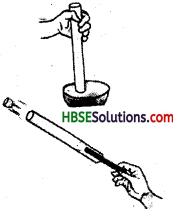
Take an aluminium tube about 15 cm long and 1 to 1.5 cm in diameter. Cut slice of a medium sized potato about 2 cm thick. Insert the tube in the slice, press it, and rotate it 2-3 times. Remove the tube. You will find a piece of potato fixed in the tube like a piston head.

Repeat the same process with the other end of the tube. Now you have the tube with both ends closed by potato pieces with an air column in between.
HBSE 7th Class Science Solutions Chapter 8 Winds, Storms and Cyclones-3
Take a pencil with one end unsharpened. Place this end at one of the pieces of potato. Press it suddenly to push the potato piece in the tube. Observe what happens. The activity shows rather dramatically how increased air pressure can push things.
Caution: When you perform this activity, make sure that nobody is standing in front of i e tube.
Answer:
Do yourself.

HBSE 7th Class Science Solutions Chapter 8 Winds, Storms and Cyclones

HBSE 7th Class Science Winds, Storms and Cyclones Important Questions and Answers

Very Short Answer Type Questions

Question 1.
What is a wind?
Answer:
The moving air is called wind.

Question 2.
Define the term ‘cycle’.
Answer:
It is an event or phenomenon which repeats itself after sometime.

Question 3.
Define term ‘evaporation’.
Answer:
The process of changing water from its liquid form to its vapour is known as evaporation.

Question 4.
Is evaporation a slow process or fast process?
Answer:
Evaporation is a slow process.

Question 5.
Name two processes through which water vapour add continuously into the air.
Answer:
The two processes are:
(i) Evaporation
(ii) Condensation.

Question 6.
Define condensation.
Answer:
The process of conversion of water vapours into liquid form of water is called condensation.

Question 7.
Define water cycle.
Answer:
The water in its vapour form goes into air by evaporation and transpiration forms cloud and, then comes back to the surface of the earth through the process of condensation and precipitation. This process is called ‘water cycle’.

Question 8.
At what speed wind becomes (i) gentle breeze, (ii) storm?
Answer:
When the wind blows gently, it is called a breeze. But, when it blows very fast it causes storm.

HBSE 7th Class Science Solutions Chapter 8 Winds, Storms and Cyclones

Question 9.
What is sea breeze?
Answer:
In coastal areas, during the day, the cool air blows from sea towards the land called sea breeze.

Question 10.
What is land breeze?
Answer:
In coastal areas, during the night, the cool air blows from land to sea called the land breeze.

Question 11.
What is tornadoes?
Answer:
In our country tornadoes are not very frequent. A tornado is a dark funnel shaped cloud that reaches from the sky to the ground.

Question 12.
What is ‘hurricane’?
Answer:
The ‘hurricane’ is the term used for storm in America and West Indies.

Question 13.
What is the eye of hurricane?
Answer:
The region of chimney like low pressure around which warm water vapour spirals is called the eye of hurricane.

Question 14.
What is Beaufort Scale?
Answer:
The number and name of.a wind is determined by the speed at which it flows on an internationally accepted scale, called Beaufort scale.

Question 15.
Name two properties of air.
Answer:
(i) Air occupies space
(ii) It has mass.

Question 16.
Write two importances of air in agriculture.
Answer:
(i) Air helps rotate wind-mill which is used to draw water from tube-wells.
(ii) Air helps in dispersion of seeds and pollen grains of flowers of several plants.

Question 17.
How are high building protected from lightning?
Answer:
High buildings are protected from lightning by fixing lightning conductor on the building.

Question 18.
What is the cause of atmospheric electricity?
Answer:
Atmospheric electricity is due to ionisation of air by the ultraviolet rays of sunlight.

HBSE 7th Class Science Solutions Chapter 8 Winds, Storms and Cyclones

Question 19.
Is our body a conductor?
Answer:
Yes, our body is a good conductor of electricity.

Question 20.
What damage can lightning do?
Answer:
Lightning damage the high buildings and the trees on which it strikes. The buildings and trees can be set on fire by lightning. It can do a high loss of life and property.

Question 21.
Why do chimneys made of steel not require lightning conductor?
Answer:
Steel is a good conductor of electricity. Due to this reason steel chimneys do not require lightning conductor. They themselves pass the discharge to the earth.

Question 22.
Why is it advised not to take shelter under a tree during lightning?
Answer:
We should not stand under a tree during lightning, due to the danger of the lightening, because it can destroy the trees and can set it on fire.

Question 23.
Which gas is produced in air during lightning that absorbs ultraviolet radiation present in sunlight?
Answer:
During lightning ozone (oz) gas is produced due to higher temperature which absorbs ultraviolet radiation. It is dangerous for the living being.

Question 24.
Name the arrangement used for the protection of buildings against damage from lightning.
Answer:
To protect buildings from damage by lightning, a good lightning conductor is used. This is done by installing a lightning conductor on the buildings.

HBSE 7th Class Science Solutions Chapter 8 Winds, Storms and Cyclones

Short Answer Type Questions

Question 1.
How is rain caused?
Answer:
Water, on land, is present in different sources, e.g., sea, river, pond, lake, etc. The water from all these sources change into vapour form due to sun’s heat and goes up into the air. This change of water into vapour form is called evaporation. The water vapour, when reaches high up in the air, cools down and forms clouds. This cooling down of water vapour to form clouds is called condensation. On cooling, the water vapour changes to water droplets. These group together farm clouds. When the droplets become very heavy they fall down as rain.

Question 2.
What is water cycle? What does it indicate?
Answer:
Evaporation of water from oceans, ponds, rivers, lakes and from roads and streets to form cloud by condensation at higher altitude. When clouds rain, the rain water flows into the seas and oceans through rivers and streams. Some water percolates into the soil to form underground water. It comes again out in the form of spring and well. This is called water cycle.

Because of water cycle, the amount of water on the earth remains more or less the same. The water cycle also indicates that all the water in world is on the move all the time.

Question 3.
How does water cycle help in maintaining global climate?
Answer:
Water cycle plays an important role in the world climate. Oceans absorb vast quantities of heat and help in global warming. By absorbing heat water evaporates and on condensation releases heat. This absorption and releasing of heat in the form of energy drives weather pattern in the short term and regulate the climate for long time.

Question 4.
How is storm caused?
Answer:
When the wind blows gently, it is called a breeze. But, when it blows very fast it causes storm. Storm may be defined as something taking place in the weather of a violent nature. At sea, a storm may be a strong wind or gale. On land, a storm usually means a weather situation marked by heavy rain and often with strong winds, lightning and thunder.

HBSE 7th Class Science Solutions Chapter 8 Winds, Storms and Cyclones

Question 5.
How a thunderstorm becomes a cyclone?
Answer:
Water requires heat when it changes from liquid to vapour state. Before cloud formation water takes up heat from the atmosphere to change into vapour. When water vapour changes back to liquid form as raindrops, this heat is released to the atmosphere. The heat released to the atmosphere warms the air around. The air tends to rise and causes a drop in pressure. More air rushes to the centre of the storm. This cycle is repeated. The chain of events ends with the formation of a very low pressure system with very high speed winds revolving around it. It is this weather condition that we call a cyclone.

Question 6.
How is lightning useful in nature?
Answer:
Lightning is useful in nature because during lightning intense heat and high temperature are produced. As a result, nitrogen combines with oxygen to form its oxides. These oxides of nitrogen further get dissolved in water to form a dilute solution of nitric acid that comes to the ground with rain. This is how nature provides nitrogenous compounds to plants that are important for their growth.

Question 7.
How is ozone layer useful for us?
Answer:
During lightning, a part of oxygen gets converted to ozone. Ozone provides protection against harmful ultraviolet radiations of the sun that cannot reach the earth’s surface.

Question 8.
What are the precautions to be taken against a storm is accompanied by lighting?
Answer:
If a storm is accompanied by lightning, we must take the following precautions:
(i) Do not take shelter under an isolated tree. If you are in a forest take shelter under a small tree. Do not lie on the ground.
(ii) Do not take shelter under an umbrella with a metallic end.
(iii) Do not sit near a window. Open garages, storage sheds, metal sheds are not safe places to take shelter.
(iv) A car or a bus is a safe place to take shelter.
(v) It you are in water, get out and go inside a building.

Question 9.
Why is it advisable to switch off TV sets during lightning?
Answer:
Lightning in the sky also effects radio and TV transmission in our radio and TV sets during lightning and thunder is due to this reason. TV antina and dish antina has fixed on tall buildings are especially prove to lightning strikes. So it is advisable to stop our TV set during lightning to save them from damage.

Question 10.
What is a lightning conductor? Why is it fixed on the top of high tall buildings?
Answer:
A lightning conductor is a long flat thick strips of copper with sharp point or spikes. The lower end of it is connected to copper plate deep into the earth. It is fixed on the top of the building because the thundering electricity comes in the contact first and the building will not be damaged.

HBSE 7th Class Science Solutions Chapter 8 Winds, Storms and Cyclones

Question 11.
How are lightning and thunder caused?
Answer:
When two oppositively charged clouds are near each other, the air between them becomes good conductor because charges begin, to move in air very speedily. The presence of electric charges in very large quantities in the air causes to appear as steaks of lightning and thunder.

Question 12.
When do we say that lightning has struck on the earth?
Answer:
Sometimes the direction of the wind changes; then the clouds move and the charges in the clouds are discharged into the earth when it happens, then it is said that lightning has struck on the earth.

Question 13.
Why should we not stand under a tree during a thunderstorm?
Answer:
We should not stand under a tree during a thunderstorm due to the danger of the lightning because it can destroy the tree, and can set it on fire.

Question 14.
What are tornadoes?
Answer:
In our country tornadoes are not very frequent. A tornado is a dark funnel shaped cloud that reaches from the sky to the ground. Most of the tornadoes are weak. A violent tornado can travel at speeds of about 300 km/h. Tornadoes may form within cyclones.

Question 15.
Write short note on ‘lightning conductor’.
Answer:
A lightning conductor is made up of long, thick metal rod having sharp spikes at its upper end. The spikes pointing towards the sky are fixed at the highest points of the building. The lower end of the metal rod is connected to a large copper or aluminium plate which is hurried deep inside the earth which is called earthing.

When a highly charged cloud passes over a tall building, it induces an opposite charge on the spikes. This charge quickly flows to the earth through the copper rod. Hence, the lightning discharge is prevented and the building is saved from damage.

Question 16.
Explain how lightning takes place?
Answer:
Normally air is a bad conductor of electricity. However, when two clouds having huge amount of positive and negative state charges approach each other, the air becomes a good conductor of electricity.

Thus the electrons from the negatively charged cloud push their way through air so as to reach the positively charged cloud. In doing so the air gets white hot and hence a dazzling bluish white streak of light is formed which is called lightning.

Question 17.
What precautions should be taken to provide protection against lightning?
Answer:
Precautions should be taken to provide protection against lightning:
Answer:
(i) Lightning conductor provides us a simple means to protect against damage due to lightning property and life.
(ii) When lightning strikes, it provide a path to the entire charge through it to the earth.
(iii) We should not stand under, I tree during a thunderstorms due to the air of lightning, because it destroys trees set it on fire.
(iv) Lightning conductor should be installed on large buildings and tall chimneys of factories.

HBSE 7th Class Science Solutions Chapter 8 Winds, Storms and Cyclones

Long Answer Type Questions

Question 1.
Describe water cycle in nature.
Answer:
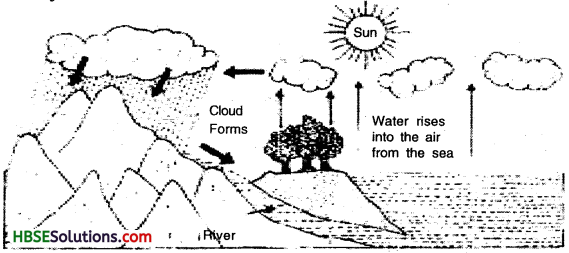
Water constantly moves from the earth to the air and back again.
The constant circulation of water is known as the water cycle.
HBSE 7th Class Science Solutions Chapter 8 Winds, Storms and Cyclones-4
The water in seas, rivers, lakes, ponds or streams evaporates because of the heat of the sun.

Plants also give out large amounts of water from their leaves. The water vapour rises up. The air higher up in the atmosphere is cooler. This cools the water vapour and it condenses to form tiny drops of water on dust particles. These drops of water together form clouds. As the clouds get cooled further, the water drops become bigger and heavier. When they become too heavy, they fall to the earth as rain. The rain water enters the seas, rivers, lakes, ponds and streams and then evaporates again. Thus the water cycle in nature goes on.

Question 2.
Explain destructions caused by cyclones.
Answer:
Cyclones can be very destructive. Strong winds push water towards the shore even ;f the storm is hundreds of kilometres away. These are the first indications of an approaching cyclone. The water waves produced by the wind are so powerful that a person cannot overcome them.

The low pressure in the eye lifts water surface in the centre. The rising water may be as high as 3-12 metres. It appears like a water wall moving towards the shore. As a result the seawater enters the low-lying coastal areas, causing severe loss of life and property. It also reduces the fertility of the soil.

Continuous heavy rainfall may further worsen the flood situation. High speed winds accompanying a Cyclone can damage houses, telephones and other communication systems, trees, etc; causing tremendous loss of life and property.

Question 3.
What is lightning? How does ligthning takes place in the clouds?
Answer:
When the air gets white hot and hence a dazzling bluish white streck of light is framed, is called lightning. Normally air is a bad conductor of electricity. However, when two clouds having J e amount of positive and negative charges a proach each other, the air becomes a good conductor of electricity.

Thus the electrons from the negatively charged cloud push their way through air so as to reach to the positively charged cloud. In doing so air gets white hot and hence a dazzling bluish white hot and hence a dazzling bluish white streak of light is formed, which is called lightning. Because of this intense heat produced, the air suddenly expands and sends out huge pressure waves. These waves produced thunder.

HBSE 7th Class Science Solutions Chapter 8 Winds, Storms and Cyclones

Question 4.
How does lightning takes place between the clouds?
Answer:
Normally air is a bad conductor of electricity. However when few clouds having huge amount of positive and negative static charges approach each other, the air becomes a good conductor of electricity.

Thus the electrons from the negatively charged cloud push their way through air. So as to reach to the positively charged cloud. In doing so the air gets white hot and hence a dazzling bluish white streak of light is formed which is called lightning. Because of this intence heat produced, the air suddenly expands and sends out huge pressure causes. These waves produce thunder.

Winds, Storms and Cyclones Class 7 HBSE Notes

  1. Air around us exerts pressure.
  2. Air expands on heating and contracts on cooling.
  3. Warm air rises up, whereas comparatively cooler air tends to sink towards the earth’s surface.
  4. As warm air rises, air pressure at that place is reduced and the cooler air moves to that place.
  5. The moving air is called wind.
  6. Uneven heating on the earth is the main cause of wind movements.
  7. Winds carrying water vapour bring rain.
  8. Thunderstorms develop in hot, humid tropical areas like India very frequently. The rising temperatures produce strong upward rising winds. These winds carry water droplets upwards, where they freeze, and fall down again.
  9. The swift movement of the falling water droplets alongwith the rising air create lightning and sound. It is this event that we call a thunderstorm.
  10. A cyclone is a storm in which the wind blows at a speed of about 300 km per hour. Cyclones develop over oceans but never close to the equator. They never originate from the land mass but may penetrate the margins of continents.
  11. A cyclone is known by different names in different parts of the world. It is called a ‘hurricane’ in the
  12. American continent. In Philippines and Japan its called a ‘typhoon’ and in Australia its called ‘willywillies’.
  13. It has become easier to monitor cyclones with the help of advance technology like satellites and radars.
  14. Self-help is the best help. Therefore, it is better to plan in advance and be ready with defence against any approaching cyclone.

HBSE 7th Class Science Solutions Chapter 8 Winds, Storms and Cyclones Read More »

HBSE 7th Class Science Solutions Chapter 7 Weather, Climate and Adaptations of Animals to Climate

Haryana State Board HBSE 7th Class Science Solutions Chapter 7 Weather, Climate and Adaptations of Animals to Climate Textbook Exercise Questions and Answers.

Haryana Board 7th Class Science Solutions Chapter 7 Weather, Climate and Adaptations of Animals to Climate

HBSE 7th Class Science Weather, Climate and Adaptations of Animals to Climate Textbook Questions and Answers

Question 1.
Name the elements that determine the weather of a place.
Answer:
The temperature, humidity, rainfall, wind-seed, etc. are called the elements of the weather, that determine the weather of a place.

Question 2.
When are the maximum and minimum temperature likely to occur during the day?
Answer:
The maximum temperature of the day occurs generally in the afternoon while the minimum temperature occurs generally in the early morning.

Question 3.
Fill in the blanks:
(i) The average weather taken over a long time is called ………… .
(ii) A place receives very little rainfall and the temperature is high throughout the year, the climate of that place will be………….. and ………….. .
(iii) The two regions of the earth extreme climatic conditions are …………… and ……………. .
Answer:
(i) the climate of the place
(ii) hot, dry
(iii) polar, tropical

Question 4.
Indicate the type of climate of the following areas:
(a) Jammu and Kashmir
(b) Kerla
(c) Rajasthan
(d) North-East India.
Answer:
(a) Jammu and Kashmir – moderately hot and moderately wet climate
(b) Kerala – very hot and wet climate
(c) Rajasthan – hot and dry climate
(d) North-east India – The north eastern India receives rain for a major part of the year. Therefore, we can say that the climate of the north-east is wet.

HBSE 7th Class Science Solutions Chapter 7 Weather, Climate and Adaptations of Animals to Climate

Question 5.
Which of the two changes frequently, weather or climate?
Answer:
Weather.

Question 6.
Following are some of the characteristics of animals:
(i) Diets heavy on fruits
(ii) White fur
(iii) Need to migrate
(iv) Loud Voice
(v) Sticky pads on feet
(vi) Layer of fat under skin
(vii) Wide and large paws
(viii) Bright colours
(ix) Strong tails
(x) Long and large beak
For each characteristic indicate whether it is adaptation for tropical rainforests or polar regions. Do yQU think that some of these characteristics can be adaptations for both the regions?
Answer:
(i) Diets heavy on fruits – tropical rainforests
(ii) White fur – polar regions
(iii) Need to migrate – pblar regions
(iv) Loud Voice – tropical rainforests
(v) Sticky pads, on feet – tropical rainforests
(vi) Layer of fat under skin – polar regions
(vii) Wide and large paws – polar Regions
(viii) Bright colours – tropical rainforests
(ix) Strong tails – tropical regions
(x) Long and large beak – tropical rainforests.

Question 7.
The tropical rainforests has a large population of animals. Explain why it is so?
Answer:
The tropical region has generally a hot climate because of its location around the equator. Even in the coldest month the temperature is generally higher than about 15°C. During hot summers, the temperature may cross 40°C. Days and nights are almost equal in length throughout the year. These regions get plenty of rainfall.

An important feature of this region is the tropical rainforests. Tropical rainforests are found in Western Ghats and Assam in India, South East Asia, Central America and Central Africa. Because of continuous warmth and rain, this region support wide variety of plants and animals. The major types of animals living in the rainforests are monkeys, apes, gorillas, lions, tigers,, elephants, leopards, lizards, snakes, birds and insects.

Question 8.
Explain, jirith examples, why we find animals of certain kind living in particular climatic conditions?
Answer:
Animals are adapted to survive in the conditions in which they live. Animals living in very cold and hot climate must possess special features to protect themselves against the extreme cold or heat.

Penguins are found in cold regions. They have a feathery coat as well as a layer of fat under the feathery coat. The coat covers their bodies right down to their legs. These adaptations keep the body warm.

Polar bear Eire found in the Arctic region where it is very cold. They have a thick layer of fur Emd a lot of fat in their bodies to keep them warm. Their soles are covered with fur to keep them warm. The white fur also helps the polar bears to blend with the snowy surroundings so that they are detected by the prey.!

Question 9.
How do elephant living in the tropical! rainforest adapt itself
Answer:
It has adapted to the conditions of rainforests in many remarkable ways. Trunks uses it as a nose because of which it has a strong sense of smell. The trunk is also used by it for picking up food. Moreover, its tusks are modified teeth. These can tear the bark of trees that elephant loves to eat. So, the elephant is able to handle the competition for food rather well. Large ears of the elephant help it to hear even very soft sounds. They also help the elephant to keep cool in the hot and humid climate of the rainforest.

Choose the correct option which answers the following questions (Question 10-12).

Question 10.
A carnivore with stripes on its body moves very fast while catching its prey. It is likely to be found in:
(i) polar regions
(ii) deserts
(iii) oceans
(iv) tropical rainforests
Answer:
(iv) tropical rainforests

HBSE 7th Class Science Solutions Chapter 7 Weather, Climate and Adaptations of Animals to Climate

Question 11.
Which features adapt polar bears to live in extremely cold climate?
(i) A white fur, fat below skin, keen sense of smell.
(ii) Thin skin, large eyes, a white fur.
(iii) A long tail, strong claws, white large paws.
(iv) White ‘body, paws for swimming, gills for respiration.
Answer:
(i) A white fur, fat below skin, keen sense of smell.

Question 12.
Which option best describes a tropical region?
(i) hot and humid
(ii) moderate temperature, heavy rainfall
(iii) cold and humid
(iv) hot and dry
Answer:
(i) hot and humid

Extended Learning – Projects And Activities

Question 1.
Collect weather reports of seven successive days in the winter months (Preferably December). Collect similar reports for the summer months (Preferably June). Now prepare a Table for sunrise and sunset times as shown:

JuneDecember
DateSunriseSunsetDateSunriseSunset

Try to answer the following questions:

  • Is there any difference in the time of sunrise during summer and winter?
  • When do you find that the sun rises earlier?
  • Do you also find any difference in the time of sunset during the month of June and December?
  • When are the days longer?
  • When are the nights longer?
  • Why are the days sometimes longer and sometimes shorter?
  • Plot the length of the day against the days chosen in June and December. (Instructions for plotting graphs are given in Chapter 13).
    Answer:
    Do yourself.

HBSE 7th Class Science Solutions Chapter 7 Weather, Climate and Adaptations of Animals to Climate

Question 2.
Collect information about the Indian Meteorological Department. If possible visit its website: htt/www.imd.gov.in.
Write a brief report about the things this department does.
Answer:
Do yourself.

HBSE 7th Class Science Weather, Climate and Adaptations of Animals to Climate Important Questions and Answers

Very Short Answer Type Questions

Question 1.
What is raingauge?
Answer:
Rainfall is measured by an instrument called the rainguage. It is basically a measuring cylinder with a funnel on top to collect rainwater.

Question 2.
Define weather.
Answer:
The day-to-day condition of the atmosphere at,’a place with respect to the temperature, humidity, rainfall, wind speed, etc., is called the weather of that place.

Question 3.
Who prepares the weather reports?
Answer:
The weather reports are prepared by the Materological Department of the Government. This department collects data on temperature, wind etc., and makes the weather prediction.

Question 4.
Define climate.
Answer:
The average weather pattern taken over a long time, say 25 years, is called the climate of the place.

Question 5.
Why do some places have hotter climate than others?
Answer:
The places nearer to the equator are usually hotter. This is because the sun’s rays are more concentrated near the equator than they are farther North or South.

Question 6.
Give two examples of animals found in cold climates.
Answer:
(i) Penguins
(ii) Polar bear.

Question 7.
Give two examples of animals found in hot and humid climate.
Answer:
(i) Red-eyed frog
(ii) Beard ape.

Question 8.
Name three desert animals.
Answer:
(i) Camel
(ii) Snake
(iii) Lizard.

HBSE 7th Class Science Solutions Chapter 7 Weather, Climate and Adaptations of Animals to Climate

Question 9.
Can a polar bear live happily on land?
Answer:
No, it lives where the land is fully covered with snow.

Question 10.
Where do the elephant live?
Answer:
Elephant lives in forest.

Question 11.
Where does penguin live?
Answer:
Penguin lives in very cold places.

Question 12.
Define adaptation.
Answer:
The particular features of an organism that makes it suited to a particular climate is called adaptation.

Question 13.
What do you understand by ‘summer sleep’?
Answer:
Animals like frog, crocodiles and alligators live in mud during the summer months. This is called the ‘summer sleep’.

Question 14.
What do you understand by hibernation?
Answer:
During winter, some animals like bears, bats, snakes, lizards, frogs and squirrels go to sleep. This is called the winter sleep or hibernation.

Question 15.
Where do the following animals live?
(i) Monkeys
(ii) Snakes
(iii) Rabbit
(iv) Fish.
Answer:
(i) On land and trees
(ii) On land and water
(iii) On land
(iv) In water.

Question 16.
Name three animals which are active during night;
Answer:
(i) Bat
(ii) Owl
(iii) Cockroach.

HBSE 7th Class Science Solutions Chapter 7 Weather, Climate and Adaptations of Animals to Climate

Question 17.
What is the difference between climate of Kashmir and Kerala?
Answer:
Kerala is very hot and wet in comparison to Kashmir, which has a moderately hot and moderately wet.

Question 18.
Name two countries where polar regions are found?
Answer:
(i) Canada
(ii) Sweden.

Question 19.
Name two countries where the tropical rainforests are found?
Answer:
(i) India
(ii) Malaysia.

Question 20.
Name a migratory bird.
Answer:
Siberian crane.

Short Answer Type Questions

Question 1.
Why do desert animals have thick skin?
Answer:
Animals living in hot places, such as snakes, desert rats and lizards are not able to get sufficient water. So these animals have a thick skin, which prevents evaporation. Since they do not sweat, they can survive| without water for a longer time.

Question 2.
How is camel adapted live in/ desert?
Answer:
Camel lives in desert. It has long legs which help it to lift its body above the ground. Thus camel is able to avoid direct contact with the hot ground. The camel drinks water 50 litre or above in one time and store it in its body. So it lives without water for longer time. Its skin is also thick which prevents transpiration of ‘ water. Thus camel is suited to live in desert.

Question 3.
How cold place animals protect themselves from cold?
Answer:
The animals which live in cold places like waives seals, and penguins have thick skin which protects them from cold. They also have thick ,fur.

Question 4.
How fishes are adapted to live in water?
Answer:
Fishes are best suited to live in water. They have boat like structure which help them in swimming in water. They have gills from which they get oxygen and food. The body of fishes contain different types of fins which help them from swimming in water. Fishes shape tapers which provide least resistance in swimming water.

Question 5.
Why do polar bears have white fur?
Answer:
Polars bears have white fur so that they are not easily visible in the snowy white background. It protects them from their predators. It also helps them in catching their prey. To protect them from extreme cold, they have two this layers of fur. They also live a er of fair under their skin.

Question 6.
Differentiate between weather and climate.
Answer:

ClimateWeather
The average weather pattern taken over a long time, say 25 years, is called the climate of the place.The day-to-day condition Of the atmosphere at a place with respect to the temperature, humidity, rainfall, wind-speed, etc; is called the weather at that place.

Question 7.
Give some examples of sea water animals.
Answer:
Almost all types of animals live in sea water. Most of the sea water animals are actively swimming animals like fishes and whales. Animals like corals, star fish, and urchin live at the bottom of the sea.s

Question 8.
Write the factors which the climate of a region depend.
Answer:
The climate of a region depends on:
(i) The presence or absence of water (rainfall).
(ii) Amount of sunshine it gets.
(iii) The ability to transfer water to the atmosphere (evaporation), and
(iv) The place whether it is a hilly or a plain region.

Question 9.
Mention the adaptive features of the animals found n cold climates.
Answer:
The animals found in cold climates have a thick layer of fat under the skin. This gives them nourishment in winter. They also have thick coat of fur on their body which helps the stay warm. The examples of animals 6 in cold regions are reindeer, arctic fox, polar bear, etc.

Question 10.
Mention the adaptations in hot and dry climates.
Answer:
Animals living in hot and dry places usually have following adaptations:
(i) Short shiny fur to reflect the sun’s rays.
(ii) Keep the body cool through sweating and panting.
(iii) To avoid the strong sun, they feed in the morning or evening and hide behind rocks and in burrows during the day.
Examples: Camel, Ostrich and Snail.

HBSE 7th Class Science Solutions Chapter 7 Weather, Climate and Adaptations of Animals to Climate

Long Answer Type Questions

Question 1.
The Earth is the only planet on which life is exists, why? Explain.
Answer:
The Earth is not the only planet revolving around the Sun. There are eight other planets that revolve Ground tfye Sun. But Earth is the only planet on which life exists. A number of factors are responsible for it. These are:
(i) Distance of Earth from the Sun; this is sufficient to keep the temperature’ on the surface of Earth at an average of 30°C; life can exist at this temperature.
(ii) The layer of carboh dioxide and watervapour which surrounds Earth prevents too much heat from leaving Earth into space; otherwise the temperature of Earth would be -30°C.
(iii) The layer of Zone which surrounds Earth does not allow ultraviolet rays to reach Earth from the sun, other wise living onganisns will die.

Question 2.
Describe the adaptive features of camel.
Answer:
The camel is the animal that thrives on the best in such hpt climate. It is also called the ship of the desert. The camel is called so because of the following adaptations it has:
(i) Thick skin that prevents water loss through perspiration or evaporation.
(ii) Humps (one or two) present in the body. These are the storehouse of fat. The camel uses this fat when food is scarce.
(iii) Pouches in the body to store water. This enables the camei to go without water for many days.
(iv) Pads of skin under the feet that act like cushions and enable the camel to walk easily in the sand without sinking.
(v) Long curly eyelashes preventing the entry of sand into eyes and thick eyebrows to protect eyes from sun. The plants and animals living in cold regions also have certain features. These are different from those possessed by plants and animals living in hot regions.

Question 3.
Defind adaptation. Mention various adaptations in terrestrial animals.
Answer:
Climate influences living organisms directly. Hence, they develop certain traits that help them to thrive well in that particular climate. This is called adaptation.

The animals that live on land are called terrestrial animals. These animals have different types of habits and ways of living. The terrestrial animals may be runners (cursorial habit), burrowers and diggers (fossorial habit), climbers (scansorial or arboreal habit) and fliers (aerial habit). Accordingly, these animals have different types of adaptations, as described below.
A. Modification of foot: Terrestrial animals have different types of foot for locomotion.
(i) Pentadactily: Terrestial animals have pentadactyl (five digits) foo; bearing claws for walking and running. Pentadactyl foot are of following three types:
(а) Plantigrade: In this type of foot, the entire palm and sole rest on the ground e.g. bear, baboon, raccoon.
(b) Digitigrade: In this case, animals perform walking and running on the digits e.g. dogs, cat, hyaena.
(c) Unguligrade: In this case, animals perform walking and running on the tips of digits covered with modified nail called hoof. The distal toe bones (unguals) are depressed or flattened, e.g. pig, horse, donkey, rhinoceros.

(ii) Bipedality: Some terrestrial animals have two footed or bipedal mode of locomotion, which spares forelimbs for other types of jobs. e.g. human beings.

B. Modification of body and head:
(i) The fast moving animals like horse, dog, etc. have streamlined body to reduce the resistance offered by the air.
(ii) In burrowing and digging animals, the head and snout are tapering. e.g. snakes, shrew, mole.

C. Modification for respiration:
The majority of terrestrial animals are lung breathers. They have lungs for respiration, e.g. Frog, lizards, all mammals.

D. Protective adaptations:
Many terrestrial animals are able to modify their form, appearance, structure or behaviour to escape predation or to increase the chances of capturing the prey. For example frog can change its body colour to match the back ground.

HBSE 7th Class Science Solutions Chapter 7 Weather, Climate and Adaptations of Animals to Climate

Question 4.
Mention various adaptations in aquatic animals.
Answer:
A large number of animals live in aquatic habitat. They include both fresh water and marine (sea water) forms. Several invt ibrates such as prawn, Octopus, some insects are aquatic or semi aquatic. A number of vertebrates such as fishes, whales, dolphins are well adapted to aquatic mode of life. They have following adaptation for aquatic mode of life.
(i) Body contour: They have streamlined laterally compressed body to reduce friction. This allows swift passage in water while swimming.
(ii) Swimming organs: The fishes have fins and whales possess flippers which help them in swimming. Frogs and ducks have webbed feet for swimming.
(iii) Protective covering: The body of fishes is covered with scales and that of frog with a mucilaginous covering, which protect them from decaying effect of water.
(iv) Gills: Fishes have special breathing organs called gills, which use dissolved oxygen of water.
(v) Swim bladder or Air bladder:
Certain fishes (bony fishes) have swim bladder or air bladder. It is filled with air and maintain buoyancy.

Weather, Climate and Adaptations of Animals to Climate Class 7  HBSE Notes

1. The day-to-day condition of the atmosphere at a place with respect to the temperature, humidity, rainfall, wind-speed, etc.; is called the weather at that place.
2. The temperature, humidity and other factors are called the elements of the weather. The weather of a place charges day after day and week after week.
3. The maximum temperature of the day occurs generally in the afternoon while the minimum temperature occurs in the early morning.
4. The times of sunrise and sunset also change during the year.
5. All the changes in the weather are driven by the sun.
6. The average weather pattern taken over a long time, say 25 years, is called the climate of the place.
7. The tropical and the polar regions are the two regions of the earth, which have severe climate conditions. .
8. Animals are adapted to the conditions in which they live.
9. The polar regions are very cold throughout the year. The sun does not set for six months in a year and in the other six months it does not rise.
10. Animals in the polar region are adapted to the extremely cold climate by having some special characteristics such as white fur, strong sense of smell, a layer of fat under the skin, wide and large paws for swimming and walking etc.
11. Migration is another means to escape the harsh, cold conditions.
12. Because of the hospitable climatic conditions, huge populations of plants and animals are found in the tropical rainforests.
13. Animals in the tropical rainforests are adapted such that they eat different kinds of food to overcome the competition for food and shelter.
14. Some adaptations of animals living in the tropical rainforests include living on the trees, development of strong tails, long and large beaks, bright colours, sharp patterns, loud voice, diet of fruits, sensitive hearing, sharp eyesight, thick skin, ability to camouflage in order to protect themselves from predators etc.

HBSE 7th Class Science Solutions Chapter 7 Weather, Climate and Adaptations of Animals to Climate Read More »

HBSE 7th Class Science Solutions Chapter 6 Physical and Chemical Changes

Haryana State Board HBSE 7th Class Science Solutions Chapter 6 Physical and Chemical Changes Textbook Exercise Questions and Answers.

Haryana Board 7th Class Science Solutions Chapter 6 Physical and Chemical Changes

HBSE 7th Class Science Physical and Chemical Changes Textbook Questions and Answers

Question 1.
Classify the changes involved in the following processes as physical or chemical changes.
(a) Photosynthesis
(b) Dissolving sugar in water
(c) Burning of coal
(d) Melting of wax
(e) Beating aluminium to make aluminium foil
(f) Digestion of food.
Answer:
Physical Change (b), (d), (e)
Chemical Change (a), (c), (f)

Question 2.
State whether the following statements are true or false. In case a statement is false, write the corrected statement in your notebook.
(a) Cutting a log of wood into pieces is a chemical change.
(b) Formation of manure from leaves is a physical change.
(c) Iron pipes coated with zinc do not get rusted easily.
(d) Iron and rust are the same substances.
(e) Condensation of steam is not a chemical change.
Answer:
(a) False
(b) False
(c) True
(d) True
(e) True.

HBSE 7th Class Science Solutions Chapter 6 Physical and Chemical Changes

Question 3.
Fill the blanks in the following statements:
(a) When carbon dioxide is passed through lime water, it turns milky due to the formation of ………….. .
(b) The chemical name of baking soda is ……………… .
(c) Two methods by which rusting of iron can be prevented are …………. and …………. .
(d) Changes in which only …………. properties of a substance change are called physical changes.
(e) Changes in which new substances are formed are called …………. changes.
Answer:
(a) Calcium carbonate
(b) Sodium hydrogen carbonate
(c) Coating, galvanization
(d) Physical
(e) Chemical.

Question 4.
When baking soda is mixed with lemon juice, bubbles are formed with the evolution of a gas. What type of change is it? Explain.
Answer:
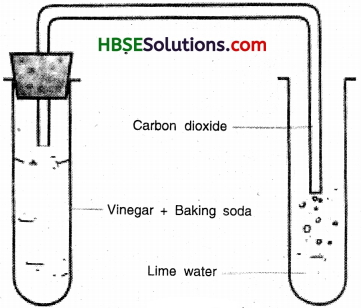
When baking soda is mixed with lemon juice, bubbles are formed with the evolution of a gas carbon dioxide.
lemon juice + baking soda → carbon dioxide + lime water
Since, a change in which one or more new substance are formed is called a chemical change, therefore this is a chemical change.
HBSE 7th Class Science Solutions Chapter 6 Physical and Chemical Changes-1

Question 5.
When a caùdie burns, both physical and chemical changes take place. Identify these changes. Give another example of a familiar process in which both the chemical and physical changes take place.
Answer:
Physical Change → Melting of ware
Chemical Change → Burning of candle

Question 6.
How would you show that setting of curd is a chemical change?
Answer:
The conversion of milk into curd, i.e., setting of curd is a permanent as well as irreversible and lead to the production of a new substance. The new substance, curd is formed has different composition and properties from the milk. Hence, setting of curd is a chemical change.

Question 7.
Explain why burning of wood is cutting it into small pieces are considered as two different types of a changes.
Answer:
Burning of wood is a chemical change because, in addition to new products burning is always accompanied by production of heat.
Cutting of wood into small pieces is a physical change because, pieces of wood underwent changes in size and no new substance is formed.

Question 8.
Describe how crystals of copper sulphate are prepared.
Answer:
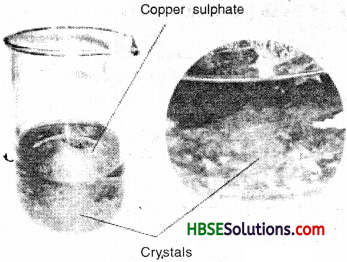
Take a cup full of water in a beaker and add a few drops of dilute sulphuric acid. Heat the water. When it starts boiling add copper sulphate powder slowly while stirring continuously. Continue adding copper sulphate powder till no more powder can be dissolved. Filter the solution. Allow it to cool. Do not disturb the solution when it is cooling. Look at the solution after some time. Now, you can see the crystals of copper sulphate.
HBSE 7th Class Science Solutions Chapter 6 Physical and Chemical Changes-2

Question 9.
Explain how painting of an iron gate prevents it from rusting.
Answer:
The process of rusting can be represented by the following equation:
Iron (Fe) + Oxygen (O2 from the air) + Water (H2O) → rust (iron oxide Fe2O3).

For rusting the presence of both oxygen and water (or water vapour) is essential. In fact, if the content of moisture in air is high, which means if it is more humid, rusting becomes faster. So, prevent iron gate from coming in contact with oxygen, or water, or both. One simple way is to apply a coat of paint or grease. In fact, these coats should be applied regularly to prevent rusting.

HBSE 7th Class Science Solutions Chapter 6 Physical and Chemical Changes

Question 10.
Explain why rusting of iron objects is faster in coastal areas than in deserts.
Answer:
The water of coastal areas contain many salts. The salt water makes the process of rust formation faster. Thus, rusting of iron objects is faster in coastal areas than deserts.

Question 11.
The gas we use in the kitchen is called liquified petroleum gas (LPG). In the cylinder it exist as a liquid. When it comes out from the cylinder it becomes a gas (Change – A) then it burns (Change – B). The following statements pertain to these changes. Choose the correct one.
(i) Process – A is a chemical change
(ii) Process – B is a chemical change.
(iii) Both processes A and B are chemical changes.
(iv) None of these processes is a chemical change.
Answer:
(iii) Both process A and B are chemical changes.

Question 12.
Anaerobic bacteria digest animal waste and produce biogas (Change – A). The biogas is then burnt as fuel (Change – B). The following statements pertain to these changes. Choose the correct one.
(i) Process – A is a chemical change,
(ii) Process – B is a chemical change.
(iii) Both process A and B are chemical changes.
(iv) None of these processes is a chemical change.
Answer:
(iii) Both process A and B are chemical changes.

Extended Learning – Activities And Projects

Question 1.
Take three glass bottles with wide mouths. Label them A, B and C. Fill about half of bottle A with ordinary tap water. Fill bottle B with water which has been boiled for several minutes, to the same level as in A. In bottle C, take the same boiled water and of the same amount as in other bottles. In each bottle put a few similar iron nails so that they are completely under water. Add a teaspoonful of cooking oil of the water in bottle C so that it forms a film on its surface. Put the bottles away for a few days. Take out nails from each bottle and observe them. Explain your observations.
Answer:
Do yourself.

Question 2.
Prepare crystals of alum.
Answer:
Do yourself.

Question 3.
Collect information about the types of fuels used for cooking in your area. Discuss with your teachers/parents/others which fuels are less polluting and why.
Answer:
Do yourself.

HBSE 7th Class Science Solutions Chapter 6 Physical and Chemical Changes

HBSE 7th Class Science Physical and Chemical Changes Important Questions and Answers

Very Short Answer Type Questions

Question 1.
What is a physical change?
Answer:
Change in which no new product is formed.

Question 2.
What is a chemical change?
Answer:
A change in which a new substance with different properties is formed.

Question 3.
Which of the following substance contains only one kind of atoms?
copper, iron, iron sulphide, sulphur, oxygen gas, water, air and hydrogen gas.
Answer:
The following contains only one kind of atoms:
Copper, Iron, Sulphur, Oxygen gas, Hydrogen gas.

Question 4.
Which of the following substances are compounds and which are elements?
Magnesium oxide, Mercuric oxide, Carbon, Nitrogen, Potassium permagnate, Sodium carbonate.
Answer:
Elements: Carbon, nitrogen.
Compounds: Magnesium oxide, mercuric oxide, potassium permanganate, Sodium carbonate.

Question 5.
Write the symbol of the following elements:
Aluminium, calcium, chlorine, cobalt, iodine and mercury.
Answer:
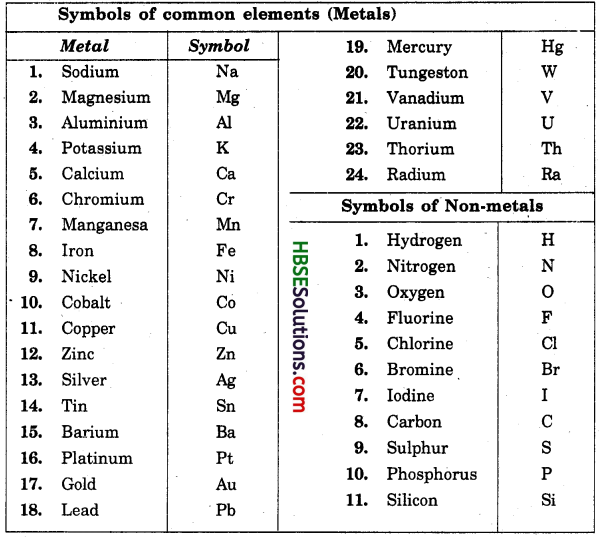
Al, Ca, Cl, Co, I, Hg.

Question 6.
Ne is the symbol of neon. What else does it represent?
Answer:
This symbol represent one atom of Neon.

HBSE 7th Class Science Solutions Chapter 6 Physical and Chemical Changes

Question 7.
Which elements are represented by the following symbols?
Na, K, P, Pb, Ca, Zn, Br, Sn.
Answer:
Sodium, Potassium, Phosphorus, Calcium, Zinc, Bromine, Tin.

Question 8.
Name four Elements which occur in gaseous form.
Answer:
Oxygen, Nitrogen, Hydrogen and Argon.

Question 9.
When some one open a bottle of perfumes, you smell it from a distance why it is so?
Answer:
It is due to the property of gases that their molecules diffuse (move) easily in the air.

Question 10.
What is crystallisation?
Answer:
The process of separation of pure crystals of a substance from its hot and supersaturated (concentrated) solution on cooling is called
crystallisation.

Question 11.
Define chemical reaction.
Answer:
The process in which the originally present substances change into new substances is called a chemical reaction.

Question 12.
What is matter?
Answer:
Anything which occupies space and has weight is called matter. Example: Air, Water, Wood, Stone, etc.

Question 13.
What are solids?
Answer:
Any materials which has a definite shape and definite volume, at room temperature is called solid.

Question 14.
What are liquids?
Answer:
Any substance which has a definite volume but no definite shape and has one free surface is called liquids: Milk, Water, Fruit juice, Alcohol etc.

Question 15.
Name two elements that are abundantly found in air.
Answer:
The two elements that are found abundantly in air are Nitrogen element and Oxygen element.

Question 16.
Choose the elements from the following substances: Marble, Mercury, Air, Carbon.
Answer:
Mercury and Carbon are elements.

HBSE 7th Class Science Solutions Chapter 6 Physical and Chemical Changes

Question 17.
What is the difference between 2N and N?
Answer:
2N represent 2 atoms of nitrogen and N represent 1 molecule of nitrogen.

Question 18.
Which of the following contains only one kind of atoms?
Copper, Iron sulphide, Sulphur, Oxygen gas, Water, Air and Hydrogen gas.
Answer:
Copper, Iron, Sulphur, Oxygen gas, Hydrogen gas.

Question 19.
Which of the following substances are compounds and which are elements?
Magnesium oxide, nitrogen, potassium permanganate, sodium carbonate.
Answer:
Compounds: Magnesium oxide, Potassium permanganate, Sodium carbonate.
Elements: Nitrogen.

Question 20.
Write down the chemical symbols of the following elements: Potassium, Calcium, Phosphorus, Nitrogen, Sulphur.
Answer:
K, Ca, P4, N and Sg.

Question 21.
Write the names of the elements having the following symbols: C, Br, P, Al, Si.
Answer:
Carbon, Bromine, Phosphorus, Aluminium and Silicon.

Question 22.
A given substance ‘X’ has definite shape, fixed volume, is in comprissible and non-diffusing. What is the physical state of the substance ‘X’?
Answer:
The substance ‘X’ is solid state.

Question 23.
Write the names of the elements which compose a molecule of water.
Answer:
Hydrogen and Oxygen.

HBSE 7th Class Science Solutions Chapter 6 Physical and Chemical Changes

Question 24.
Name the three most abundant elements on the earth’s crust.
Answer:
Iron, Aluminium and Silicon.

Question 25.
Give the chemical formulae of the following:
(i) Calcium hydroxide
(ii) Copper oxide
(iii) Iron chloride
(iv) Zinc nitrate
(v) Silver sulphate
(vi) Lead carbonate
(vii) Potassium phosphate
(viii) Sodium hydroxide
(ix) Hydrochloric acid
(x) Zince hydroxide.
Answer:
(i) Ca(OH)2
(ii) CuO
(iii) FeCl2
(iv) Zn (NO3)2
(v) Ag2SO4
(vi) PbCO3
(vii) K3PO4
(viii) NaOH
(ix) HCl
(x) Zn(OH)2.

HBSE 7th Class Science Solutions Chapter 6 Physical and Chemical Changes

Question 26.
Define reactents.
Answer:
The original substances that take part in a chemical reaction are called the reactants,

Question 27.
Define products.
Answer:
The substances that form as a result of chemical reaction are called the products.

Question 28.
Define chemical combination reaction.
Answer:
When two or more elements or compounds react chemically to form only one new product, then the reaction which takes place is called chemical combination.

Question 30.
Define chemical displacement reaction.
Answer:
When a more reactive element displaces a less reactive elements from its aqueous salt solution, the reaction which takes place is called chemical displacement.

Question 31.
What kind of chemical reaction takes place when a mixture of iron fillings are heated with sulphur?
Answer:
Chemical combination reaction.

Short Answer Type Questions

Question 1.
Formation of clouds is a physical change. Explain.
Answer:
Formation of clouds is a physical change. Clouds are formed by condensation of water vapours present in the atmosphere. When rainwater goes back on the earth no new product is formed. Therefore, it is a physical change.

Question 2.
Explosion of a cracker is a chemical change. Explain.
Answer:
When we burn a cracker, it exploide. Heat, light and smoke comes out after explosion. Many new products are formed. So, it is a chemical change.

HBSE 7th Class Science Solutions Chapter 6 Physical and Chemical Changes

Question 3.
Most physical changes are reversible. Give reasons with two examples.
Answer:
All physical changes are reversible. Because in physical changes, no new product is formed. They can be reversed easily.
Examples:
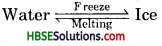
(i) Dissolving of sugar in water is a physical change and we get back sugar and water easily.
(ii) Formation of ice from water. In melting of ice, we can get water back.
HBSE 7th Class Science Solutions Chapter 6 Physical and Chemical Changes-3

Question 4.
Identify the type of change and state whether energy is evolved or absorbed in each one of the following:
Burning of a candle, lighting of a bulb, preparation of food by green plants, Volcanic eruption.
Answer:
(i) Burning of a candle: Chemical change, energy evolved.
(ii) Lighting of a bulb: Physical change, energy evolved.
(iii) Preparation of food by green plants: Chemical change, energy absorbed.
(iv) Volcanic eruption: Chemical change, energy evolved.

Question 5.
What is a chemical formula? What information does it provide?
Answer:
Chemical formula is a shorthand method of using symbols to represent the composition of a compound. Using it, we can get the following informations:
(i) Constituting name of the elements present in the compound, e.g., water has the formula H20. It shows that water is made up .. of two elements, hydrogen and oxygen.
(ii) Atoms present in each element, e.g.,
(iii) The composition of compound and the formula H2O shows that in a molecule of molecular weight of the compound, this compound two atoms of hydrogen and one atom of oxygen are present.

Question 6.
What are the differences between chemical and physical changes?
Answer:
Differences between chemical and physical changes:

Chemical changePhysical change
1. A new substance is formed.1. No new substance is formed.
2. It is a permanent change.2. It is a temporary change.
3. The composition of new substances changes.3. No change in the composition of change takes place.
4. It is irreversible.4. It is reversible.
5. Heat/light evolved or absorbed during change.5. No heat light evolved or absorbed or may be evolved or absorbed.

Question 7.
How is common salt obtained from sea water?
Answer:
In the coastal regions of India, especially in the Rann of Kutch in Gujarat and some parts of Tamil Nadu, the sea water is collected in shallow pits. It is then allowed to evaporate in the sun. As the water evaporates, the salt solution becomes supersaturated. This supersaturated solution cannot hold the excess salt. Thus, it separates out in form of salt crystals. These salt crystals are collected. They are redissolved in water and the solution is filtered to remove insoluble impurities. The clear solution is again evaporated so as to obtain the crystals of pure salt.

Question 8.
What is crystallisation? To what purpose is it put?
Answer:
The process of separation of pure crystals of a substance from its hot and supersaturated (concentrated) solution on cooling is called Crystallisation.

The process of crystallisation is employed for the separation of a pure water soluble substance from its mixture. For example, if there is a mixture of alum and common salt, the pure alum crystals can be separated by the process of crystallisation.

HBSE 7th Class Science Solutions Chapter 6 Physical and Chemical Changes

Question 9.
What is the significance of an equation?
Answer:
Significance of an equation:
(i) It tells us which substance reacted and which substances are produced.
(ii) It tells us the quantities of each of the reactants and each of the products.

Question 10.
Give four examples of a physical change.
Answer:
(i) Formation of dew.
(ii) Evaporation of water.
(iii) Melting of wax.
(iv) Making of ice-cream.

Question 11.
Give four examples of a chemical change.
Answer:
(i) Photosynthesis by plants.
(ii) Clotting of blood.
(iii) Curdling of milk.
(iv) Burning of candle.

Question 12.
State four characteristics of physical change.
Answer:
(i) It is temporary.
(ii) It is reversible.
(iii) No new substance is produced.
(iv) No change in the chemical properties.

Question 13.
State four characteristics of chemical change.
Answer:
(i) It is permanent.
(ii) It is irreversible.
(iii) New substance is produced.
(iv) Changes in the chemical properties due to the formation of new substances.

Question 14.
What happens when an iron blade of a knife is dipped in copper sulphate solution? What kind of chemical reaction takes place?
Answer:
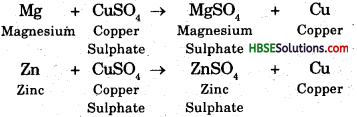
When an iron blade of a knife is dipped in copper sulphate solution iron blade is coated with reddish deposit of copper. Thus, we can say that iron (more reactive element), displaces copper (less reactive element), from its aqueous copper sulphate solution. Chemical displacement reaction is takes place.

Question 15.
Why do the molecules in a liquid tend to stay together and give a condensed form?
Answer:
In a liquid, the molecular motion are not great enough to over come the force of attraction between molecules. That is why the molecules tend to stay together and give a condensed form.

Question 16.
On a hot summer day the cycle tubes burst suddenly. Explain why?
Answer:
The cycle tubes are filled with air. On a hot summer day, the temperature of the atmosphere is high. When cycle runs on the road, the friction between the cycle wheel and the path produces heat which raises the temperature of the air in the cycle tubes. On heating the air expands and exerts pressure in the inside of the tubes. Due to the pressure, the cycle burst suddenly on a hot summer day.

HBSE 7th Class Science Solutions Chapter 6 Physical and Chemical Changes

Question 17.
Why can the same substance exist in all the three states, that is, solid liquid and gas?
Answer:
The space between the molecules, the force of attraction between the molecules, and the amount of movement of the molecules of a substance can be changed by changing the pressure and temperature of the substance. So depending on the pressure and temperature, the same substance can exist in all the three states i.e., Solid, liquid and gaseous. For example under normal pressure water exists as a solid in the form of ice at a temperature of 0°C or below. It exists as a liquid in the form of water at the room temperature and as a gas in the form of steam at 100°C or above.

Question 18.
Write some important properties of an element.
Answer:
Properties of an element are:
(i) An element is made up of some kinds of atoms.
(ii) An element cannot be Broken up into much simpler substances,
(iii) An element can be represented by a chemical symbol.

Question 19.
What are the important characteristics of a compound?
Answer:
(i) Chemical compound is made up of two or more elements combined chemically.
(ii) They have fixed formula or composition.
(iii) They have fixed melting point (M.P.) and boiling point (B.P.).
(iv) Energy is either evolved or absorbed during formation of a compound.
(v) Properties of constituent elements are different from its compound, e.g., properties of water (H2O) are different from properties of hydrogen and oxygen.

Question 20.
What does the formula CO2 represent?
Answer:
Molecular formula CO2 represents:
(i) the name of the compound carbon dioxide.
(ii) carbon dioxide is made up of two kinds of elements – carbon and oxygen.
(iii) one molecule of carbon dioxide has one atom of carbon and 2 atoms of oxygen.
(iv) the molecular mass of carbon dioxide is 12 + 2 x 16 = 44 gram.

Question 21.
How is salt obtained from sea-water?
Answer:
The seas are great sources of salts. A litre of a water contains about 35 grams of salts. Sodium chloride is the main salt. The sea-water is trapped in shallow called lagoons and is allowed to evaporate in sunlight to white solid crystal of salts. These crystals are processed and packed to send the markets.

Question 22.
Give three reasons for supporting that water is a compound and not a mixture.
Answer:
Water is considered a compound due to the following reasons:
(i) Water cannot be separated into its constituents, hydrogen and oxygen, by the physical process.
(ii) The properties of water are entirely different from those of its constituents hydrogen and oxygen.
(iii) Water contains hydrogen and oxygen combined together in a fixed proportions of 1:8 by weight.

Question 23.
Explain why solution of salt in water is considered a mixture and not a compound. Give three reasons.
Answer:
Salt solution is considered a mixture due to the following reasons:
(i) Salt solution can be separated into salt and water by the physical process.
(ii) Salt solution, shows the properties of both its constituents salt as well as water.
(iii) The composition of salt solution is variable i.e., the percentage of salt and water in different salt solutions are different.

HBSE 7th Class Science Solutions Chapter 6 Physical and Chemical Changes

Question 24.
What information do we get from a chemical equation?
Answer:
The informations obtained from a chemical equation are:
(i) Name of the substance (elements or compound) taking part in reaction, i.e., reactants and products.
(ii) The number of atoms and molecules of different substances.
(iii) The conditions under which the reaction takes place or taking part in reaction, for example:
N2 + 3H2 → 2NH3
It represents 1 molecule of nitrogen combines with 3 molecules of hydrogen to form 2 molecules of ammonia.

Question 25.
“In a chemical reaction, there is only a rearrangement of the atoms of the reactants.” Explain this statement giving an example.
Answer:
In a chemical reaction, there is only a x’e. angement of the atoms of the reactants because when a chemical reaction occurs new products are formed. These products have same kind and number of atoms as are present in reactants. They are only rearrange to give new substances. For example, in a reaction between iron and sulphur to give iron sulphide the number of atoms of iron and sulphur are identical on both sides of the equation.
Fe + S → FeS (On heating)

Question 26.
What is done to make a chemical equation more informative?
Answer:
To make a chemical equation more informative it should be balanced and conditions of the reaction should be written above the arrow. For example,
HBSE 7th Class Science Solutions Chapter 6 Physical and Chemical Changes-4
It shows that 2 molecules of water on electrolysis break up into 2 molecules of hydrogen and 1 molecule of oxygen.

Question 27.
What do you understand by reactants and products?
Answer:
Reactants: Substances taking part in a reaction are called reactants. They are written on the left side of the chemical equation.
Products: Substances produced in a reaction are called products. They are written on the right side of the equation.
Example:
HBSE 7th Class Science Solutions Chapter 6 Physical and Chemical Changes-5

Long Answer Type Questions

Question 1.
What does a chemical formula represent?
Answer:
Significance of chemical formula:
(i) It represents the name of the substance.
(ii) It represents one molecule of the substance.
(iii) It gives the names of all the elements present in the molecule.
(iv) It represents the mass of one molecule.

As an example of the formula of H2SO4:
(i) Represents sulphuric acid.
(ii) Represent one molecule of sulphuric acid.
(iii) Tells that sulphuric acid contains three elements:
hydrogen, sulphur, and oxygen.
(iv) Tells that one molecule of sulphuric acid contains two atoms of hydrogen; 1 atom of sulphur and 4 atoms of oxygen.

HBSE 7th Class Science Solutions Chapter 6 Physical and Chemical Changes

Question 2.
What do you understand by the following terms? Give examples.
(i) Endothermic chemical change
(ii) Exothermic chemical change.
Answer:
(i) Endothermic chemical change: When a chemical change takes place with the absorption of heat energy, then the change is said to be endothermic. .
Examples: Heating of mercuric oxide to form mercury and oxygen. Heating of calcium carbonate to form calcium oxide and carbon dioxide.

(ii) Exothermic chemical change: When a chemical change takes place with the liberation of heat energy, the change is said to be exothermic.
Examples: Candle on burning liberates heat and light energy. Respiration is an exothermic change.

Question 3.
What is a compound? How does it differ from a mixture?
Answer:
A compound consists of two or more elements, joined together in a fixed ratio by chemical bonds. For example, water formed from hydrogen and oxygen, sodium chloride formed from sodium and chlorine, sugar formed from carbon, hydrogen and oxygen, nitre formed from potassium, nitrogen and oxygen are all compound.
Difference between compounds and mixtures:

CompoundMixture
(i) A compound consists of only tne kind of chemical substance.(i) A mixture consists of two or more chemically different substances.
(ii) The components of a compound cannot be separated by a simple means.(ii) The composition of mixture can be separated easily by simple means.
(iii) Heat, light or electricity is absorbed or evolved during its formation.(iii) Its formation is not accompanied by absorption or evolution of heat, light or electricity.
(iv) Compound has definite formula.(iv) Mixture do not have definite formula.
(v) Compounds have definite M.P. and B.P. Compound is always homogeneous(v) Mixture do not have fixed M.P. and B.P.

Question 4.
What is the difference between a balanced and unbalanced chemical equations? Explain with an example.
Answer:
Difference between a balanced and unbalanced chemical equations:
In unbalanced chemical equations, the number of each element atoms do not same. As for example:
Mg + O2 → MgO.
This is not a balanced equation because the number of Mg atom and oxygen atoms are not same on both the sides, Le., reactants and product sides. On the other hand, in a balanced chemical equation the number of each atoms of each elements on both sides should be equal. As for example:
2Mg + O2 → 2MgO.
In this balanced chemical equation the number of magnesium atoms and oxygen atoms in the left hand side are equal to the right hand side of the equation. So it is a balanced chemical equations.
(i) A mixture consists of two or more chemically different substances.
(ii) The composition of mixture can be separated easily by simple means.
(iii) Its formation is not accompanied by absorption or evolution of heat, light or electricity.
(iv) Mixture do not have definite formula.
(v) Mixture do not have fixed M.P. and B.P.
(vi) Mixture can be homogeneous and heterogenous.

Question 5.
Balance the following equations:
(i) Fe + O2 → Fe2O3
(ii) H2O + H2 → O2
(iii) Mg + O2 → MgO
(iv) Al + O2 → Al2O3
(v) Fe + HCl → FeCl3 + H2
(vi) Cu + O2 → CuO
(vii) Hg + O2 → HgO
(viii) Zn + HCl → ZnCl2 + H2
(xi) Al + HCl → AlCl3 + H2
(x) N2 + H2 → NH3
Answer:
(i) 4Fe + 3O2 → 2Fe2O3
(ii) 2H2O → 2H2 + O2
(iii) 2Mg + O2 → 2MgO
(iv) 4Al + 3O2 → 2Al2O3
(v) 2Fe + 6HCl → 2FeCl3 + 3H2
(vi) 2Cu + O2 → 2CuO
(vii) 2Hg + O2 → 2HgO
(viii) Zn + 2HCl → ZnCl2 + H2
(xi) 2Al + 6HCl → 2AlCl3 + 3H2
(x) N2 + 3H2 → 2NH3

HBSE 7th Class Science Solutions Chapter 6 Physical and Chemical Changes

Physical and Chemical Changes Class 7  HBSE Notes

1. Properties such as shape, size, colour and state of a substance are called its physical properties.
2. A change in which a substance undergoes a change in its physical properties is called a physical change. A physical change generally reversible.
3. A change in which one or more new substances are formed is called a chemical change. A chemical change is also called a chemical reaction.
Some common examples of chemical change:
1. Burning of wood or charcoal.
2. Burning of Candle.
3. Decomposition of water into hydrogen and oxygen.
4. Formation of water from hydrogen and oxygen.
5. Digestion of food.
6. Curdling of milk.
7. Formation of biogas (Crobar gas).
8. Burning of petrol or diesel.
9. Smoking of cigarette.
10. Drying of paint.
11. Rusting of iron.
12. Ripening of fruit.
13. Baking of cake.
14. Photosynthesis by plants.
15. Formation of wine.

Some Common Examples of Physical Changes:
1. Formation of dew.
2. Evaporation of water.
3. Crystallisation of sugar from its solution.
4. Ringing of an electric bell.
5. Breaking of glass pane.
6. Making of ice-cream.
7. A rock rolling down a hill.
8. Bending of glass tube by heating.
9. Melting of wax.
10. Sublimation of camphor.

4. If you leave a piece of iron in the open for some time, it acquires a film of brownish substance. This substance is called rust and the process is called rusting.
5. Any pure substance which cannot be broken into two or more pure substances by any chemical means is called an element.
6. The smallest unit of an element, which takes part in a chemical reaction is called an atom.
7. The smallest unit of a pure substance, which always exists independently and can retain physical and chemical properties of that substance, is called a molecule.
8. A metal is an element which is generally malleable, ductile and a good conductor of heat and electricity. About 80% of the elements are metals.
9. Non-metals are bad conductors of heat and electricity. They are neither malleable nor ductile. Non-rr Hals are generally soft.
10. When the molecule of a substance contains two or more atoms of different elements, combined together in a definite ratio, then it is said to be a molecule of a compound.
Symbols of common elements (Metals)
HBSE 7th Class Science Solutions Chapter 6 Physical and Chemical Changes-6
11. When one or more substances (elements or compounds) undergo a chemical change, with the absorption or release of energy, so as to form one or more new products, then the change taking place collectively is called chemical combination.
12. When two or more elements or compounds react chemically to form only one new product, then the reaction which takes place is called chemical combination.
13. When a single chemical compound decomposes on heating or by some other kind of energy, so as to form two or more new substances (elements or compounds), then the chemical reaction which takes place is called chemical decomposition.
14. When a more reactive element displaces a less reactive element from its aqueous salt solution, the reaction which takes place is called chemical displacement.
15. When an acid solution reacts with a base or metal carbonate, so as to form a salt, then the reaction is called neutralisation reaction.
16. The process of separation of pure crystals of a substance from its hot and supersaturated (concentrated) solution on cooling is called crystallisation.

HBSE 7th Class Science Solutions Chapter 6 Physical and Chemical Changes Read More »

HBSE 7th Class Science Solutions Chapter 5 Acids, Bases and Salts

Haryana State Board HBSE 7th Class Science Solutions Chapter 5 Acids, Bases and Salts Textbook Exercise Questions and Answers.

Haryana Board 7th Class Science Solutions Chapter 5 Acids, Bases and Salts

HBSE 7th Class Science Acids, Bases and Salts Textbook Questions and Answers

Question 1.
State differences between acids and bases.
Answer:

AcidsBases
1. A substance which dissolves in water to give hydrogen ions as the only positively charged ions is called an acid.1. A substance which react with acids to form salt and water as only products is called a base.
2. They have a sour taste.2. These have a better taste.
3. They turn blue litmus red.3. Bases turn red litmus blue.

Question 2.
Ammonia is found is many household products, such as window cleaners. It turns red litmus blue, what is its nature?
Answer:
Basic.

HBSE 7th Class Science Solutions Chapter 5 Acids, Bases and Salts

Question 3.
Name the source from which litmus solution is obtained. What is the use of this solution?
Answer:
Litmus solution is extracted from lichens. It has a mauve (purple) colour in distilled water. When added to an acidic solution, it turns red and when added to a basic solution, it turns blue. It is available in the form of a solution, or in the form of strips of paper.

Question 4.
Is the distilled water acidic/basic/ neutral? How would you verify it?
Answer:
The distilled water is neutral. Put a drop of the distilled water on a strip of the red litmus paper with the help of a droper. We observe that colour of the litmus paper as not change.

The solutions which do not change the colour of either red or blue litmus are known as neutral solutions. These substances are neither acidic nor basic.

Question 5.
Describe the proeess of neutralization with the help of an example.
Answer:
The process due to! which an acid completely reacts with a base to form salt and water as the only products is called neutralization.
Acid + Base → Salt + Water
Example: Hydrochloric add (HCl) + Sodium hydroxide (NaOH)
Sodium chloride (NaCl) + Water (H2O)

Question 6.
Make “T” if the statement is true and ‘F’ if it is false.
(i) Nitric acid turn red litmus blue.
(ii) Sodium hydroxide turns blue litmus red.
(iii) Sodium hydroxide and hydrochloric acid neutralise each other and form salt and water.
(iv) Indicator is a substance which shows different colours in acidic and basic solutions.
(v) Tooth decay is caused by the presence of a base.
Answer:
(i) Flase
(ii) Flase
(iii) True
(iv) True
(v) True.

Question 7.
Dorji has a few bottles of soft drink in his restaurant. But unfortunately, these are not labelled. He has to serve the drinks on the demand of customers. One customer wants acidic drink, another wants basic and third one wants neutral drink; How will Dorji decide which drink is to be served to whom?
Answer:
Do yourself.

Question 8.
Explain why?
(a) An antacid tablet is taken when you suffer from acidity.
(b) Calamane solution is applied on the skin when an ant bites.
(c) Factory waste is neutralised before disposing it into the water bodies.
Answer:
(a) Our stomach contains hydrochloric acid. It help us to digest food. But too much of acid in the stomach causes indigestion. Sometimes indigestion is painful. To relieve indigestion, we take an antacid such as milk of magnesia, which contains magnesium hydroxide. It neutralises the effect of excessive acid.

(b) The sting of an ant contains formic acid. When an ant bites, it injects the acidic liquid into the skin. The effect of the sting can be neutralised by rubbing moist baking soda (sodium hydrogen carbonate) or calamine solution, which contains Zinc carbonate.

(c) The wastes of many factories contain acids. If they are allowed to flow into the water bodies, the acids will kill fish and other organisms. The factory wastes are, therefore, neutralised by adding basic substances.

Question 9.
Three liquids are given to you. One is hydrochloric acid, another is sodium hydroxide and third is a sugar solution. How will you Identify them? You have only turmeric indicator.
Answer:
Do yourself.

Question 10.
Blue litmus paper is dipped in a solution. It remains blue. What is the nature of the solution? Explain.
Answer:
The nature of the solution is neutral, because the solutions which do not change the colour of either red or blue litmus are known as neutral solution. These substances are neither acidic nor basic.

Question 11.
Consider the following statements:
(a) Acids and bases both change colour of all indicators.
(b) If an indicator gives a colour change with an acid, it does not give a change with a base.
(c) If an indicator changes colour with a base, it does not change colour with an acid.
(d) Change of colour in an acid and a base depends on the type of the indicator. Which of these statements are correct?
(i) All four
(ii) a and b
(iii) b and c
(iv) only d
Answer:
(ii) a and b.

HBSE 7th Class Science Solutions Chapter 5 Acids, Bases and Salts

Extended Learning – Activities And Projects

Question 1.
Using the knowledge of acids and bases, write a secret message with the help of baking soda and beet’root. Explain how it works.
(Hint: Prepare baking soda solution in water. Use this solution to write the message on a sheet of white paper with a cotton bud. Rub a slice of fresh beet root over the message.)
Answer:
Do yourself.

Question 2.
Prepare red cabbage juice by boiling a piece of red cabbage in water. Use it as an indicator and test the acidic and’ basic solutions with it. Present your observations in the form of a Table.
Answer:
Do yourself.

Question 3.
Bring the soil sample of your area, find out if it is acidic, basic or neutral. Discuss with farmers if they treat the soil in any manner.
Answer:
Do yourself.

Question 4.
Visit a doctor. Find out the medicines be prescribes to treat acidity. Ask him how acidity can be prevented.
Answer:
Do yourself.

HBSE 7th Class Science Solutions Chapter 5 Acids, Bases and Salts

HBSE 7th Class Science Acids, Bases and Salts Important Questions and Answers

Very Short Answer Type Questions

Question 1.
What is an acid Id
Answer:
A substance which dissolves in water to give hydrogen ions as the only positively charged ions’fs called an acid.

Question 2.
What are mineral acids? Give, three examples.
Answer:
The acids which are prepared from the minerals of the Earth are called mineral acids.
Examples: Sulphuric acid, Nitric acid, Hydrochloric acid.

Question 3.
What are organic acids? Give three examples.
Answer:
Organic acids are found in plant and animal products, for examples, oxalic acids, citric acid, acetic acid, etc.

Question 4.
A solution turns red litmus solution blue. Is the solution acidic or basic in nature?
Answer:
Basic.

Question 5.
Give two examples each of (i) Strong bases (ii) Weak bases.
Answer:
(i) Strong bases: Sodium hydroxide, potassium hydroxide.
(ii) Weak bases: Copper hydroxide, zinc hydroxide. .

Question 6.
What do you understand by the term “neutral substance?”
Answer:
The substances which do not bring about any change in the colour of common indicators are called neutral substances.

Question 7.
Name the acids present in:
(i) Vinegar
(ii) Lemon juice
Answer:
(i) Acetic acid (CH3COOH)
(ii) Citric acid.

HBSE 7th Class Science Solutions Chapter 5 Acids, Bases and Salts

Question 8.
Write the names of three mineral acids.
Answer:
(i) Sulphuric acid (H2SO4)
(ii) Nitric acid (HNO3) and
(iii)Hydrochloric acid (HCl) are mineral acids.

Question 9.
Which of the following are oxides?
H2O, CO, Co, NO, CO2 , NaOH
Answer:
Oxides: H2O, CO, NO and CO2.

Question 10.
From the following list select metallic oxide and non-metallic oxides: CaO, Fe2O3, N2O5, CO2, Na2O, SO2.
Answer:
(i) Metallic oxide: CaO, Fe2O3 and Na2O.
(ii) Non-metallic oxide: N2O5, CO2 and SO2.

Question 11.
What are indicators?
Answer:
The complex, naturally occurring substances, which change their colour on coming in contact with other substances are called indicators. Turmeric, litmus, china rose etc. are some indicators.

Question 12.
Name two neutral liquids.
Answer:
(i) Alcohol
(ii) Ether.

Question 13.
Name two neutral gases.
Answer:
(i) Hydrogen, (ii) Oxygen.

Question 14.
Name two neutral solids.
Answer:
(i) Common Salt
(ii) Sugar.

Question 15.
What do you understand by term concentrated acid?
Answer:
The acids which contain very little or no amount of water are called concentrated acids.

HBSE 7th Class Science Solutions Chapter 5 Acids, Bases and Salts

Question 16.
What are dilute acids?
Answer:
The acids which contain a large amount of water (or solutions of acids in water) are called dilute acids.

Question 17.
Name the kind of substance formed when an acid reacts with a base.
Answer:
Neutralised.

Question 18.
What is missing in the following equation?
Fat + ……. → Soap + Glycerol
Answer:
Fat + NaOH → Soap + Glyceral
Thus NaOH missing from the equation.

Question 19.
An element combines with oxygen to form an oxide. This oxide dissolves in water. This aqueous solution changes blue litmus to red. Write:
(i) The nature of element (metal or non-metal)
(ii) The general name of the oxide.
Answer:
(i) The element is non-metal.
(ii) General name of the oxide non-metallic oxide.

Question 20.
What happens when a non-metal oxide is dissolved in water?
Answer:
When a non-metal oxide is dissolved in water, it forms acids. Examples:
(i) CO2 + HO2 → H2CO3 (Carbonic acid).
(ii) SO2 + HO2 → H2SO3(Sulphuric acid).

Question 21.
State one characteristics, property of all acids.
Answer:
All acids contain replaceable hydrogen.

Question 22.
Name the gas obtained when a metal carbonate reacts with an acid.
Answer:
When a metal carbonate reacts with an acid, carbon dioxide gas is envolved. Example:
HBSE 7th Class Science Solutions Chapter 5 Acids, Bases and Salts-1

Question 23.
Write equations for the action of water on:
(i) MgO
(ii) Calcium oxide.
Answer:
(i) MgO + H2O → Mg(OH)2 (Magnesium hydroxide)
(ii) CaO + H2O → Ca(OH)2(Calcium hydroxide)

Question 24.
What are mineral acids? Give two examples.
Answer:
Mineral acids are those acids which are obtained from the earth. Examples, Sulphuric acid, Nitric acid.

Question 25.
Name the three salts which are commonly lised at home..
Answer:
Three, salts commonly used at home are:
(i) Sodium chloride
(ii)Sodium carbonate
(iii) Sodium hydrogen carbonate.

HBSE 7th Class Science Solutions Chapter 5 Acids, Bases and Salts

Question 26.
Give the chemical formula of slaked lime
Answer:
Chemical formula of slaked lime is Ca(OH)2

Question 27.
Name one/compound of calcium which is used for bleaching cloth.
Answer:
Bleaching powder.

Question 28.
What is the formula of sulphuric acid?
Answer:
The formula of sulphuric acid is H2SO4.

Question 29.
A solution turns red litmus paper blue. What does this indicate about the chemical nature of the solution?
Answer:
The chemical nature of the solution is acidic.

Question 30.
What do you understand by anhydrous salt?
Answer:
Hydrated salts loose their water of crystallisation upon heating. They love their shape and colour also and becomes powered. They are called anhydrous salts.

Question 31.
Name two normal salts.
Answer:
(i) Sodium Chloride (NaCl)
(ii) Potassium nitrate (KNO3).

Question 32.
Name two basic sdlts.
Answer:
(i) Calcium hydrdgen chloride [Ca(OH)Cl]
(ii) Magnesium hydroxy chloride [Mg(OH)Cl] etc.

Question 33.
Write the balanced chemical equations for the reaction that takes place when zinc, magnesium and sodium react with dilute hydrochloric acid.
Answer:
Reaction of hydrochloric acid (dil.) with Zn, Mg, and Na:
(i) Zn + 2HCl → ZnCl2 + H2
(ii) Mg + 2HCl → MgCl2 + H2
(iii) 2Na + 2HCl → 2NaCl + H2

Question 34.
Write two uses of slaked lime.
Answer:
Uses of slaked lime:
(i) It is used in manufacture of bleaching powder.
(ii) It is used as an important building materials

Question 35.
Complete the following equations:
(i) CO2 + H2O → ……………..
(ii) CO2 + 2Na0H → …………….. + ……………..
(iii) SO2 + H2O → ……………..
(iv) MgO + H2SO4 → …………….. + ……………..
(v) CaC03 + 2HCl → …………….. + ……………..
(vi) Na2O + H2O → ……………..
(vii) 2NaOH + H2SO4 → …………….. + ……………..
(viii) NaOH + HNO3 → …………….. + ……………..
(ix) CaO + H2SO4 → …………….. + ……………..
(x) MgO + 2HCl → ……………..
Answer:
(i) CO2 + H2O → H2CO3 (carbonic acid)
(ii) CO2 + 2Na0H → Na2CO3 + H2O (sodium carbonate)
(iii) SO2 + H2O → H2SO3 (suiphurous acid)
(iv) MgO + H2SO4 → MgSO4 + H2O (magnesium sulphate)
(v) CaC03 + 2HCl → CaCl2 + H2O + CO2 (Calcium Chloride)
(vi) Na2O + H2O → 2Na0H (sodium hydroxide)
(vii) 2NaOH + H2SO4 → Na2SO4 + H2O (sodium suphate)
(viii) NaOH + HNO3 → NaNO3 + H2O (sodiùm nitrate)
(ix) CaO + H2SO4 → CaSO4 + H2O (calcium sulphate)
(x) MgO + 2HCl → MgCl2 +H2O

HBSE 7th Class Science Solutions Chapter 5 Acids, Bases and Salts

Short Answer Type Questions

Question 1.
How can you test the presence of an acid in any substance?
Answer:
Acid can be tested in any substance by the following methods:
(i) Take a drop of the dilute solution of the substance on the tips of your tongue. If tastes sour, it is acidic.
(ii) Dip a blue litmus paper in the solution. If ‘ the colour of the litmus paper turns red, the solution is acidic.

Question 2.
What are organic acids? Give two examples.
Answer:
Soured milk, Lemon, Green mangoes and Karvanda are sour testing. All of them contain some naturally occuring acids. Such acids are also found in humans and plants materials. They are known as organic acids. The acids such as lactic acid, citric acid, tartaric acid and acetic acid are naturally occuring and known as organic acid.

Question 3.
What are the uses of mineral acids in industry?
Answer:
Use of’mineral acids in industry:
(i) Concentration sulphuric acid, nitric acid and hydrochloric acid are used in a large number of metallurgical operations, manufacture of fertilizers and preparations of large number of industrial chemicals.
(ii) Hydrochloric acid is used for removing the deposits from inside the boilers. This process is known as de-scaling.

Question 4.
What are indicators? Name two acid-base indicators.
Answer:
The substances which are used to identify whether a substance is an acid or base is called indicators. For example, litmus solutions give red colour with acids and blue colour with bases. Therefore, litmus is used as indicators. Substances which give different colours with acid and base are called acid-base indicators, for examples. Methyl orange, phenolphthalein.

Question 5.
What are acid salts? Give two examples.
Answer:
The salts which dissolves water to produce a solution, which behaves like an acid is called an acid salt.
Examples: Sodium hydrogen carbonate (NaHCO3), Potassium hydorgen carbonate (KHCO3), Sodium hydrogen sulphate etc.

Question 6.
How is potash alum prepared?
Answer:
A mixture of potassium sulphate and aluminium sulphate is dissolved in water and then the solution is concentrated. Potash alum is formed. It separates out as crystals.

Question 7.
Why are sodium bicarbonate and lemon juice used during indigestion?
Answer:
Sodium bicarbonate neutralizes the acidity in the stomach. Hence, it is used during indigestion. Lemon contains acid. It reacts with undigested food and softens it. Thus, lemon is also used in indigestion.

Question 8.
Why are brass vessels coated with tin or kalai?
Answer:
When brass vessels are used to cook food with tamarind or lemon juice, the acids present in it reacts with brass metal and corrode it. The kalai layer protects this vessels from the action of acids. Due to this reason brass vessels are coated with tin.

HBSE 7th Class Science Solutions Chapter 5 Acids, Bases and Salts

Question 9.
What is salt? Name any salts and give thier formulae.
Answer:
A substance formed by the neutralisation of an acid with a base is called salt.
Examples:
(i) Potassium nitrate (KNO3)
(ii) Sodiun: nitrate (NaNO3)
(iii) Calcium carbonate (CaCO3)
(iv) Zinc sulphate (ZnSO4)
(v) Copper sulphate (CuSO4).

Question 10.
Define an acid. Give three properties of acids.
Answer:
An acid is a substance which when dissolved in water gives hydrogen ions. Examples: H2SO4, HNO3 and HCl etc.
Properties of acids:
(i) They have a sour taste
(ii) They turn blue litmus solution red.
(iii) They have replaceable hydrogen ion.

Question 11.
What are bases? Mention three properties of alkalies.
Answer:
The substance which react with acids to form salt and water only are called bases. Examples: Cu(OH)2, Fe(OH)3, Pb(OH)2 etc.
Properties of alkalies:
(i) They tarn red litmus paper blue
(ii) They have a better taste.
(iii) They turn methyl orange from pink to yellow.

Question 12.
What are the uses of sodium bicarbonate?
Answer:
Uses of sodium bicarbonate:
(i) It is used in medicines to neutralise the acidity in the stomach.
(ii) It is used as backing power.
(iii) It is used in fire extinguisher.

Question 13.
What are the uses of common salt?
Answer:
Uses of common salt:
(i) It is an essential constituents of our diet.
(ii) It is used in the manufacture of soap.
(iii) It is used for glazing pottery. .
(iv) It is a starting material for the manufacture of chlorine, hydrochloric acid, washing soda and sodium hydroxide.
(v) It is used as food preservatives.
(vi) It turns freezing mixture with ice.

Question 14.
Give five uses of potassium nitrate.
Answer:
Uses of potassium nitrate:
(i) It is used in the manufacture of gun powder.
(ii) It is used in making fire works.
(iii) It is used in refrigeration.
(iv) It is used as fertilizers.
(v) It is used in glass industry.

Question 15.
Which acids is called ‘the king of the acids’? Give its uses.
Answer:
Sulphuric acid (H2SO4) is called “the king of the acids”.
Uses of sulphuric acid:
(i) It is used in the manufacture of detergents.
(ii) It is used as a dehydrating agent.
(iii) It is used in storage batteries.
(iv) It is used in petrol refining.
(v) It is used in textile, paper and leather industry.
(vi) It is used in fertilizers industry for the manufacture of ammonium sulphate and superphosphate of lime.

HBSE 7th Class Science Solutions Chapter 5 Acids, Bases and Salts

Question 16.
Explain with the help of chemical equations how the following acids are formed?
Carbonic acids, Sulphurous acid, Phosphoric acid.
Answer:
(i) Carbonic acid is prepared by dissolving carbon dioxide in water.
CO2 + H2O → H2CO3 (Carbonic acid)

(ii) Sulphurous acid is formed by dissolving sulphur dioxide in water.
SO2 + H2O → H2SO3 (Sulphurous acid)

(iii) Phosphoric acid is prepared by dissolving phosphorus pentaoxide in hot water.
P2O5 + 3H20 → 2H3PO4 (Phosphoric acid)

Acids, Bases and Salts Class 7 HBSE Notes

1. Curd, lemon juice, orange juice and vinegar taste sour. These substances taste sour because they contain acids. The chemical nature of such substances is acidic. The word acid comes from the Latin word acere which means sour. The acids in these substances are natural acids.
2. A substance which produces hydrogen (H+) ions when dissolved in water is called an acid. This definition was given by Arrhenius, a Swedish Chemist in 1912.
3. The acids which are prepared from the minerals of the Earth are called mineral acids.
Examples of Mineral Acids

Name of AcidFormula
Sulphuric acidH2SO4
Nitric acidHNO4
Hydrochloric acidHCl
Phosphoric acidH3PO4

4. The acids which dissolve in water to give a large number of positively charged hydrogen ions are called strong acids.
Examples of Strong Acids : Sulphuric acid, nitric acid, hydrochloric acid and phosphoric acid are examples of strong acids.
5. The acids which dissolve in water to give a small number of positively charged hydrogen ions are called weak acids.
Examples of Weak Acids : Carbonic acid, acetic acid, sulphurous acid, formic acid, etc., are examples of weak acids. In fact, most of the organic acid are weak acids.
6. The acids which contain very little or no amount of water are called concentrated acids.
7. The acids which contain a large amount of water (or solutions of acids in water) are called dilute acids.
8. General Physical Properties of Acids
(i) They have a sour taste.
(ii) They turn blue litmus solution red.
(iii) They turn methyl orange solution pink.
(iv) They do not affect phenolphthalein solution.
(v) Strong acids have a corrosive action on skin. They cause painful blisters.
(vi) Most of the acids are soluble in water.
(vii) Acids solutions are conductors of electricity.
9. Uses of Acids

AcidsUses
(i) Sulphuric acid• manufacturing fertilizers, drugs, detergents, paints, plastic and artificial silk.

• in strong batteries.

• in paper, textile and leather industries.

• as dehydrating agent.

(ii) Hydrochloric acid• purifying metals and common selt.

• making glucose, glue

• bleaching textiles

(iii) Nitric acid• extracting metals from ores brass, etc.

• making designs on copper,

• manufacturing explosives, fertilizers, perfumes, medicines and plastic.

(iv) Citric acid• in food preservation

• preparing effervescent salts.

10. The substances which react with acids to form salt and water as only products are called bases. All oxides of metals are bases. All hydroxides of metals are bases.
11. All bases which are soluble in water are called alkalis.
12. Strong bases completely dissociate in aqueous solution. For example, sodium hydroxide (NaOH), potassium hydroxide (KOH), etc.
13. They undergo partial dissociation in aqueous solution. For example, copper hydroxide Cu(OH)2, Zinc hydroxide Zn(OH)2, etc.
14. The bases show the following properties:
(i) These have a bitter taste.
(ii) Bases neither have colour nor small. Only Ammonium hydroxide (NH4OH) has a pungent smell.
(iii) The basic solutions are soapy to touch, i.e., if little amount of sodium hydroxide is rubbed on fingers, it would give a feeling as if soap has been applied on the fingers.
(iv) Bases turn red litmus blue.
(v) Bases contain hydroxide ions e.g., Sodium hydroxide is represented as NaOH, calcium hydroxide is represented as Ca(OH)2, etc., where OH is the hydroxy group.
(vi) Bases react with acids to give salt and water.
15. Uses of Bases

BasesUses
(i) Calcium Hydroxide (slaked lime)• manufacturing of bleaching powder, fungicides, plasters, etc.

• neutralising soil acidity.

• water softening agent.

• antidote for acid poisoning.

(ii) Ammonium Hydroxide• removing grease from

• clothes and from window panes.

• reagent in laboratory.

(iii) Magnesium Hdroxide• antacid to neutralize stomach acidity.

16. Special type of substances are used to test whether a substance is acidic or basic. These substances are known as indicators. Turmeric, litmus, china, rose, petals (Gudhal), etc., are some of the naturally occurring indicators.
17. The reaction between an acid and a’base-is known as neutralisation. Salt and water are produced in this process with the evolution of heat.
Acid + Base → Salt + Water (Heat is evolved)
The following reaction is an example :
Hydrochloric acid (HCl) + Sodium hydroxide (NaOH) → Sodium chloride (NaCl) + Water (H2O)

HBSE 7th Class Science Solutions Chapter 5 Acids, Bases and Salts Read More »

HBSE 7th Class Science Solutions Chapter 4 Heat

Haryana State Board HBSE 7th Class Science Solutions Chapter 4 Heat Textbook Exercise Questions and Answers.

Haryana Board 7th Class Science Solutions Chapter 4 Heat

HBSE 7th Class Science Heat Textbook Questions and Answers

Question 1.
State similarities and differences between the laboratory thermometer and the clinical thermometer.
Answer:
Laboratory Thermometer: While performing experiments involving the measurement of temperature in the laboratory, a mercury thermometer is used. It is a thermometer having graduations marked on the Celsius scale from 0°C to 100°C.
HBSE 7th Class Science Solutions Chapter 4 Heat-1
The difference between the lower and upper fixed points is called range of the thermometer. The range of a mercury thermometer is 100°C. A mercury thermometer having graduations from 0°C to 100°C is shown in figure 4.8.

Clinical Thermometer:
To measure the temperature of a person running fever, doctor uses a thermometer known as Clinicdl Thermometer. It is a specially designed mercury thermometer and is used in the clinics and hospitals by doctors to measure human body temperature.
HBSE 7th Class Science Solutions Chapter 4 Heat-2
In construction, it differs from laboratory thermometers, in the sense that a kink or constriction is provided in the stem just above the bulb. Because of this kink, mercury doesn’t fall back into the bulb when clinical thermometer is taken out of the mouth of a patient to know the temperature. A jerk is given to the thermometer so that it is set again for measuring human body temperature. The temperature interval marked on the clinical thermometers ranges from 35°C to 43°C.

HBSE 7th Class Science Solutions Chapter 4 Heat

Question 2.
Give two examples each of conductors and insulators of heat.
Answer:
Conductors: aluminium, iron
Insulators: plastic, wood

Question 3.
Fill in the blanks:
(a) The hotness of an object is, is determined by its …………… .
(b) Temperature of boiling water cannot be measured by a …………… thermometer.
(c) Temperature is measured in degree ……………. .
(d) No medium is required for transfer of heat by the process of ………….. .
(e) A cold steel spoon is dipped in a cup of hot milk. It transfers heat to its other end by the process of …………. .
(f) Clothes of …………… colours absorb heat better than clothes of light colours.
Answer:
(a) Touching
(b) Clinical
(c) Celsius
(d) Radiation
(e) Conduction
(f) Dark

Question 4.
Match the following:

(i) Land breeze blows during(a) summer
(ii) Sea breeze blows during(b) winter
(iii) Dark coloured clothes are preferred during(c) day
(iv) Light coloured clothes are preferred during(d) night

Answer:

(i) Land breeze blows during(d) night
(ii) Sea breeze blows during(c) day
(iii) Dark coloured clothes are preferred during(b) winter
(iv) Light coloured clothes are preferred during(a) summer

Question 5.
Discuss why wearing more layers of clothing of during winter keeps us warmer tljian wearing just one thick piece of clothing?
Answer:
More layers of clothing keep us warm in winters as they have a lot of space between them. This space gets filled up with air. As air is a bad conductor, it does not allow the body heat to escape out.

Question 6.
Look at Fig. 4.10. Mark where the heat is being transferred by conduction, by convection and by radiation.
Answer:
HBSE 7th Class Science Solutions Chapter 4 Heat-3

Question 7.
In places of hot climate it is advised that the outer walls of houses be painted white. Explain.
Answer:
In places of hot climate it is advised that the outer wail of houses be painted white because white colour do not radiate heat easily.

Question 8.
One litre of water at 30°C is mixed with one litre of water at 50°C. The temperature of the mixture will he:
(a) 80°C
(b) More than 50°C but less than 80°C
(d) 20°C
(d) Between 30°C and 50°C
Answer:
(b) More than 50°C but less than 80°C

HBSE 7th Class Science Solutions Chapter 4 Heat

Question 9.
An iron ball at 40°C is dropped in a mug containing water at 40°C. The heat will:
(a) Flows from iron ball to water.
(b) Not flow from iron ball to water or from water to iron ball.
(c) Flows from water to iron ball.
(d) Increase the temperature of both.
Answer:
(a) flows from iron ball to water.

Question 10.
A wooden spoon is dipped in a cup of ice-cream. Its other end:
(a) Becomes cold by the process of conduction.
(b) Becomes cold by the process of convection.
(c) Becomes cold by the process of radiation.
(d) Does not become cold.
Answer:
(d) does not become cold.

Question 11.
Stainless steel pans are usually provided with copper bottoms. The reason for this could be that:
(a) Copper bottom makes the pan more durable.
(b) Such pans appear colourful.
(c) Copper is a better conductor of heat than the stainless steel.
(d) Copper is easier to clean than the stainless steel.
Answer:
(c) Copper is a better conductor of heat than the stainless steel.

Extended Learning – Activities And Projects

Question 1.
Go to a doctor or your nearest health centre. Observe the doctor taking temperature of patients. Enquire:
(a) Why he/she dips the thermometer in a liquid before use.
(b) Why the thermometer is kept under the tongue.
(c) Whether the body temperature can be measured by keeping the thermometer at some place other than mouth.
(d) Whether the temperature of different parts of the body is the same or different. You can add m.ore questions which come to your mind.
Answer:
Do yourself. You can take help of your family doctor.

Question 2.
Go to a veterinary doctor (a doctor who treats animals). Discuss and find out the normal temperature of domestic animals and birds.
Answer:
Do yourself.

Question 3.
Wrap a thin paper strip tightly around an iron rod. Try to burn the paper with candle while rotating the iron rod continuously. Does it burn? Explain your observation.
Answer:
Do yourself.

HBSE 7th Class Science Solutions Chapter 4 Heat

Question 4.
Take two similar transparent glass bottles having wide mouths. Put a few crystals of potassium permaganate or pour a few drops of ink in one bottle. Fill this bottle with hot water. Fill the other bottle with cold water. Cover the cold water bottle with a thick piece of paper such as a postcard. Press the postard firmly with one hand and hold the bottle with the other hand. Invert the bottle and place it on top of the hot water bottle. Hold both the bottles firmly. Ask some other person to pull the postcard. Observe what happens. Explain.
Answer:
Do yourself.

HBSE 7th Class Science Heat Important Questions and Answers

Very Short Answer Type Questions

Question 1.
What is heat?
Answer:
The energy transferred from one body to another body due to a temperature difference between them is called heat.

Question 2.
Define temperature.
Answer:
Temperature is the degree of hotness or coldness of a body.

Question 3.
Define thermometer.
Answer:
A device used for measuring the temperature of different objects is called a thermometer.

Question 4.
Hot water bottles are used for fermentations. Explain why?
Answer:
Hot water bottles are used for fermentation as the water does not cool quickly due to its large specific heat capacity.

Question 5.
When equal amount of air, iron and oil are heated from 15°C to 25°C. List them in the order of increasing expansion.
Answer:
Iron, oil, air.

Question 6.
Name any four substances which expand on heating.
Answer:
Aluminium, steel, iron and copper.

Question 7.
Name any two substances which have negligible changes in length on heating.
Answer:
Pyrex glass, Invar.

Question 8.
Name two substances which contract on heating?
Answer:
Ice, Bismuth.

HBSE 7th Class Science Solutions Chapter 4 Heat

Question 9.
Do all liquids expand when heated or is there any exception?
Answer:
Yes, below 4°C when heated, water contract in stead of expanding.

Question 10.
Which substances has the highest heat capacity?
Answer:
Water.

Question 11.
What is the temperature of a normal human being on the Celsius scale?
Answer:
The temperature of a normal human being on the Celsius scale is 37°C.

Question 12.
Name the thermometer used for measuring the temperature of the human body.
Answer:
The thermometer used to measure the temperature of a human body is called clinical thermometer.

Question 13.
Define convection.
Answer:
The phenomenon due to which particles of a medium actually move to the source of heat energy and then move away from it after absorbing heat energy is called convection.

Question 14.
Why is convection not possible in solids?
Answer:
The molecules of a solid are held strongly due to intermolecular forces. As these molecules cannot travel to the source of heat energy, convection is not possible in case of solids.

Question 15.
What is ventilation?
Answer:
The process by which impure and warm air inside a room is continuously replaced by fresh air from outside is called ventilation.

Question 16.
What do you understand from the term lower standard point?
Answer:
The 0°C correspondence to the temperature of pure melting ice and is called the lower standard point.

Question 17.
What do you understand by upper standard point?
Answer:
100°C corresponds to the temperature of pure boiling water and is called the upper standard point.

Question 18.
Define conduction.
Answer:
The process of transmission of heat energy in solids without the actual movement of particles from their position is called conduction.

HBSE 7th Class Science Solutions Chapter 4 Heat

Question 19.
Give two examples to show that heat caused biological changes.
Answer:
(i) Conversion of ‘gur’ into alcohol.
(ii) Conversion of milk into curd.

Question 20.
Why is ice wrapped in gunny bags?
Answer:
Gunny bags have a number of fine pores, filled with air. Air being a bad conductor of heat does not allow the external heat to go in and melts the ice.

Question 21.
Why is tea generally served in China clay cups and plates?
Answer:
Because the China clay is bad conductor of heat and checks the heat conduction from the tea to the surroundings and thus keeps the tea hot.

Question 22.
By which of the processes (conduction, convection, radiation), it is not possible to transfer heat?
(i) In a vacuum
(ii) Through the solid material.
Answer:
(i) Conduction and convection
(ii) Convection and radiations.

Question 23.
Why do we use cooking utensils made of metals and alloys?
Answer:
Metals and alloys are good conductors of heat so that the heat from the flame is conducted to the food inside quickly and efficiently.

Question 24.
Is medium necessary for the transference of heat by radiations?
Answer:
No, medium is not necessary for the transference of heat by radiation.

Question 25.
Why do we feel warm while standing beside a burning furnace?
Answer:
When we stand beside a burning furnace, we feel warms, because of the heat radiation coming from the furnace.

Question 26.
Firemen wear helmets made from brass polished from outside. Why?
Answer:
Brass polished helmets reflects most of the heat and absorbs only a very little part of it when they fight against a fire.

HBSE 7th Class Science Solutions Chapter 4 Heat

Question 27.
When does the conduction of heat stop in two bodies in contact?
Answer:
The conduction of heat stops in two bodies in contact when both attain the same (equal) temperature. In this position they have no temperature difference.

Question 28.
Why is the handle of a press made of ebonite or wood?
Answer:
The handle of press is made of ebonite or wood, because ebonite and wood are bad conductors of heat. So the heat does not reach in our body.

Question 29.
Define radiation.
Answer:
The transfer of heat energy from a hot body to a cold body directly, without heating the space in between the two bodies is called radiation.

Question 30.
Define insulators.
Answer:
The materials which do not allow heat to pass through them easily are poor conductors of heat such as plastic and wood. Poor conductors are known as insulators.

Question 31.
What is thermos flask?
Answer:
Thermos flask is a device in which heat losses due to conduction, convention and radiation are minimised.

HBSE 7th Class Science Solutions Chapter 4 Heat

Short Answer Type Questions

Question 1.
The cooking utensils are made of metals like aluminium or copper while their handles are made of wood. Why?
Answer:
The cooking utensils are made of metals like aluminium or copper because these metals are good conductors of heat so they help in the transfer of heat.

The handles of cooking utensils are made up of bad conductors such as wood, plastic etc. As the handles made of bad conductors do not get heated up while cooking, we can hold them easily.

Question 2.
Kites and eagles fly without flapping their wings. Why?
Answer:
During the day, hot air surrounding the land gradually rises up and a convection air current develops. Kites and eagles move along this rising current without flapping the wings to fly high up in the sky.

Question 3.
Why do the birds puff up their feathers in winter?
Answer:
The birds puff up their feathers in winter, because in doing so they trap large amount of air, which in turn acts as an insulator and does not allow their body heat to flow out.

Question 4.
Explain briefly the formation of air currents.
Answer:
In coastal areas, during the day, the cool air blows from sea towmrds the land called sea breeze. During the night, the cool air blows from land to sea called the land breeze. This happens because of convection air currents. At night, land cools down much faster than sea. So, sea is warmer than land and the air current blows from land to sea. During the day, land is hotter than sea. As a result, the air rises up and cold air from sea blows towards the land to take its place.

Question 5.
Cement or concrete floors are made in pieces with metals or glass strips in between. Give reasons.
Answer:
It is done to allow for the expansion in summer and contraction in winter. If cement or concrete floors are made out in one continuous pieces. It would develop crackes due to contraction and expansion.

Question 6.
Room heaters have shiny reflectors. Why?
Answer:
Room heaters have shiny reflectors as the shiny surface absorbs very little heat. They reflect all the heat which makes the room heaters more effective.

HBSE 7th Class Science Solutions Chapter 4 Heat

Question 7.
Why is the handle of a pressure cooker covered with thick plastic?
Answer:
The handle of a pressure cooker covered with thick plastic, because plastic is a bad conductor of heat. Hence, the heat from the hot cooker does not flow to the handle, with the result that we can hold easily.

Question 8.
The desert sand is very hot in the day and very cool at night. Why?
Answer:
The desert sand has low specific heat capacity. So sand gets very hot in day time. During the night sand cools more quickly due to cold air which moves towards the sea.

Question 9.
Why is the handle of a metallic kettle covered with strips of cane?
Answer:
Cane strips is bad conductor of heat. Therefore, it cannot get heated when water is boiled in kettle. Therefore, the handle of a metallic kettle is covered with cane strips.

Question 10.
Why does the handle of an iron made of ebonite or wood?
Answer:
Ebonite or wood is a bad conductor of heat. Therefore, the heat from the iron is not conducted to the hand.

Question 11.
How does a blanket keep you warm in a cold night, even though it is not a source of heat?
Answer:
The blanket is made of wool, which is a bad conductor of heat. It has fine pores in which air is trapped which is also a bad conductor of heat. They do not allow heat to escape from our body to the surroundings. Therefore, the blanket keeps our body warm in winter.

Question 12.
Why are cloudy nights warmer than the clear nights?
Answer:
Cloudy nights are warmer than clear nights due to the fact that the heat which is radiated by the earth is again reflected back by the clouds. While on the other hand this phenomenon is not possible when the night is clear.

Question 13.
How are had conductors of heat useful in our daily life?
Answer:
Bad conductors are used for holding hot utensils in the kitchen. Bricks and mud which are bad conductors are used in building houses, especially in the ruler. regions. They keep houses warm in winter and cool in summer. The feathres of birds, hair and fur of animals keep them warm in winter, as they are bad conductor of heat.

Question 14.
Why do we wear woolen clothes in winter?
Answer:
Woolen clothes have fine pores filled with air. Wool and air are bad conductors of heat They do not allow heat of our bodies to escape out. Therefore woolen cloth keep the body warm in winter. And for the same reason we wear woolen cloth in winter.

HBSE 7th Class Science Solutions Chapter 4 Heat

Long Answer Type Questions

Question 1.
Describe briefly the process of conduction.
Answer:
Heat travels through solids by conduction only. The process of transmission of heat energy in solids without the actual movement of particles from their position is called conduction. Conduction takes place under the following conditions:
(i) A material medium that is compact.
(ii) No movement of any particle in the medium.
Thus, solids transmit heat though conduction. When a solid substance is heated, the particles that become hot start vibrating and pass on the excess energy to the neighbouring particles. This process continues till the whole body is heated. However during such an energy transfer, a particle does not change its position. Hence, heat is carried without the bodily movement of the particles.

There are some solids which allow the heat to pass through them. Such substances are called the conductors. Almost all metals such as iron, copper, silver, aluminium etc. are good conductors. The substances which do not allow the heat to pass through them are called the insulators. Wood, plastic, wool, clay etc. are bad conductors.

Question 2.
Write an experiment to prove that heat radiations can travel through vacuum.
Answer:
Take a flat bottomed flask. In the mouth of the flask fix a rubber stopper having two holes. Pass a thermometer through one hole and a glass tube with stopper through the other hole.
HBSE 7th Class Science Solutions Chapter 4 Heat-4
Remove air from the flask, by connecting to a vacuum pump. Record the temperature from the thermometer. Place the flask in bright sunlight or in front of an electric heater. It is observed that the thermometer records a rise in temperature. Thus, the experiment proves that transference of heat by radiaton requires no medium.

Question 3.
Explain the working of a thermos flask.
Answer:
Thermos flask is a special kind of flask for keeping liquids. It prevents loss or gain of heat by any of the three methods. It keeps liquid warm or cold for a long time. It was invented by Sir James Dewan in 1893.

It consists of a double-walled glass-cylinder. A vacuum is created in the space between the double walls. The two inner surfaces of glass walls are silvered. The flask is placed on a spring within a non-conduction cylindrical case to protect it from jerks and breakages. The gaps between flask and outer casing is packed with felt pads. The mouth of the flask is finally closed with a cork.
HBSE 7th Class Science Solutions Chapter 4 Heat-5
Since the container is made of glass which is a bad conductor of heat and therefore, the loss or gain of heat due to conduction is prevented. As there is vacuum between the double walls, it prevents transmission of heat by convection. Due to silvering of the inner surfaces, the heat loss by radiation is prevented. The cork and the felt pads also help to preserve the heat inside the flask. So, the hot liquids like tea, coffee, etc. remain hot and cold liquids like water, juice, etc. remain cold for a long time.

HBSE 7th Class Science Solutions Chapter 4 Heat

Question 4.
Write five applications of radiation.
Answer:
Applications of radiation:
(i) The base of cooking utensils is painted black so that it can absorb more heat and hence cooking is done fast.
(ii) Dark clothes are worn in winters as they absorb more heat from the sunlight and keep our body warm.
(iii) White clothes are worn in summer as they absorb very little heat and keep us cool.
(iv) Room-heaters have shiny reflectors as the shiny surface absorbs very little heat. They reflect all the heat which makes the room- heaters more effective.
(v) Crockeries are polished and painted white from outside so that they do not radiate heat easily.

Question 5.
Describe the process of radiation. How is it different from conduction and convection?
Answer:
Radiation is a process of transmission of heat in which heat energy travels in straight lines from hotter to cooler regions without the help of any intervening medium. It means that this process is different from the other two as it does not need any medium like conduction or convection. Radiation can take place in a vaccum. For example, heat from the sun reaches us through the outer space (vacuum) by means of radiation in the form of electromagnetic waves.

Differefnbe between radiation, conduction and convection:

RadiationConduction and convection
1. No medium is needed.1. A medium is needed.
2. Heat energy is transferred in the form of electromagnetic waves.2. In conduction, heat energy is transferred from particle to particle but in convection heat energy is transferred by the transfer of metres.
3. It is a fast mode of heat transfer.3. It is a slow mode of heat transfer.
4. Medium (if any) is no heated.4. Medium is heated.

HBSE 7th Class Science Solutions Chapter 4 Heat

Heat Class 7  HBSE Notes

  • Our sense of touch is not always a reliable guide to the degree of hotness of an object.
  • Heat: Heat is a form of energy which produces in us sensation of warmth. It causes hotness or coldness sensation in our body.
  • Temperature: Temperature tells how hot a body is? Temperature of a body is the degree of hotness or coldness of the body.
  • Heat flows in the direction of fall of temperature. Heat can be converted to other forms of energy like sound, light, mechanical energy etc. Other forms of energy can also be converted to heat energy.
  • Effects of heat:
    (i) The object becomes hot.
    (ii) The object may expand in size.
    (iii) The object may change in state.
    (iv) Heat can speed up chemical reaction.
  • Temperature is measured by a device called thermometer.
  • The thermometer that measure our body temperature is called a clinical thermometer. The range of this thermometer is from 35°C to 42°C. For other purposes, we use the laboratory thermometers. The range of these thermometers is usually from 10°C to 110°c.
  • The laboratory thermometer used in laboratories. It is called Celsius thermometer. It has one hundred markings on it.
  • The melting point of pure ice is called lower standard point. Its value is 0°C.
  • The boiling point of pure water is called upper standard point. Its value is 100°C.
  • Transfer of heat: Heat flows from one body to another body by temperature difference. The flow of heat is from higher temperature to lower temperature. There are three different ways of heat transfer: conduction, convention and radiations.
  • Conduction of heat: The process in which heat is handed over from one particle to another in the direction of fall of temperature without the actual movement of the particles of the medium is called conduction.
    HBSE 7th Class Science Solutions Chapter 4 Heat-6
  • Good conductor of heat: The materials which allow heat to pass through them easily, are called good conductor of heat. For example, silver, copper, aluminium, mercury etc. are good conductors of heat.
  • Bad conductor of heat: The materials which do not easily allow heat to pass through them are called bad conductors of heat or insulators. Wood, plastics, mud, cork, cotton, ebonite, asbestos, most gases and liquids are bed conductor of heat.
  • Convention of heat: Convention is a process by which heat is transferred from one part of a substance to another part through the actual movement of its constituents particles (atoms or molecules). Only liquids and gases convert heat. A solid cannot do so because solids do not flow like liquids or gases do.
  • Radiation of heat: The process by which heat travels from one body to another without the intervention of any material medium is known as radiation.
    All hot objects transfer heat by radiation. Radiation does not require either a conducting medium or a convecting fluid. The sun transfers heat in all directions through the process of radiation. The radiations absorbed or emitted by a body depends upon the colour of the body.
    HBSE 7th Class Science Solutions Chapter 4 Heat-7
  • Thermos Flask (Vacuum Flask): Thermos flask is used to keep things warm and cold. It consists of a double walled glass flask, having vacuum between the walls, kept inside metallic case with the cork supporters.
    The outer and inner surfaces of the glass flask are highly silvered. The mouth of flask is fitted with air tight cork.
    HBSE 7th Class Science Solutions Chapter 4 Heat-8
  • The vacuum between the two walls of the flask prevents heat transfer by conduction or convection.
  • The silver coating of the walls of the vessels reflects back heat radiations. Thus heat by radiation can neither enter inside the flask nor go out of the flask.
  • The air-tight cork, which is a bad conductor of heat prevents any loss of heat by conduction or convection.
  • Some heat may be transferred by conduction through thin glass walls at the neck and the poorly conducting cork.
  • The total transfer of heat is very-very small, thus hot or cold liquid kept inside will keep its temperature for a long time.

HBSE 7th Class Science Solutions Chapter 4 Heat Read More »

HBSE 7th Class Science Solutions Chapter 3 Fibre to Fabric

Haryana State Board HBSE 7th Class Science Solutions Chapter 3 Fibre to Fabric Textbook Exercise Questions and Answers.

Haryana Board 7th Class Science Solutions Chapter 3 Fibre to Fabric

HBSE 7th Class Science Fibre to Fabric Textbook Questions and Answers

Question 1.
You must be familiar with the following nursery rhymes:
(i) Baa baa black sheep, have you any wool
(ii) Mary had a little lamb, whose fleece was white as snow
Answer the following:
(a) Which parts of the black sheep have wool?
(b) What is meant by the white fleece of the lamb?
Answer:
(a) The Hair (fleece) of the black sheep have wool.
(b) The white fleece is the v/hite hair of the lamb.

Question 2.
The silkworm is (a) a caterpiller, (b) a Larva. Choose the correct option.
(i) a
(ii) b
(iii) both a and b
(iv) neither a nor b.
Answer:
(iii) both a and b.

Question 3.
Which of the following does not yield wool?
(i) Yak
(ii) Camel
(iii) Goat
(iv) Woolly dog.
Answer:
(iv) Woolly Dog.

Question 4.
What is meant by the following terms?
(i) Reasing
(ii) Shearing
(iii) Sericulture
Answer:
(i) The fleece of the sheep alongwith a thin layer of skin is removed from its body. This process is called shearing.
(ii) Silk fibres are also animal fibres. Silkworms spin the ‘silk fibres’.
(iii) The rearing of silkworms for obtaining silk is called sericulture.

HBSE 7th Class Science Solutions Chapter 3 Fibre to Fabric

Question 5.
Given below is a sequence of steps in the processing of wool. Which are the missing steps? Add them.
Shearing, ………………. , sorting, ………………. , ………………. , ………………. , ………………. .
Answer:
Shearing, scouring, sorting, drying, dying, spinning, weaving.

Question 6.
Make sketches of the two stages in the life history of the silk moth which are directly related to the production of silk.
Answer:
HBSE 7th Class Science Solutions Chapter 3 Fibre to Fabric-1
(a) Female silkworm moth with eggs
HBSE 7th Class Science Solutions Chapter 3 Fibre to Fabric-2

Question 7.
Out of the following, which are the two terms related to silk production? Sericulture, Floriculture, Moriculture, Apiculture, Silviculture
Hints:
(i) Silk production involves cultivation of mulberry leaves and rearing silkworms.
(ii) Scientific name of mulberry is Morus alba.
Answer:
Sericulture, Moriculture.

Question 8.
Match the words of column I with those given in column II.

Column IColumn II
1. Scouring(a) Yields silk fibres
2. Mulberry leaves(b) Wool yielding animal
3. Yak(c) Food of silk worm
4. Cocoon(d) Reeling
(e) Cleaning sheared skin

Answer:

Column IColumn II
1. Scouring(e) Cleaning sheared skin
2. Mulberry leaves(c) Food of silk worm
3. Yak(b) Wool yielding animal
4. Cocoon(a) Yields silk fibres

Question 9.
Given below is a crossword puzzle based on this lesson. Use hints to fill in the blank spaces with letters that complete the words.
HBSE 7th Class Science Solutions Chapter 3 Fibre to Fabric-3
Answer:
HBSE 7th Class Science Solutions Chapter 3 Fibre to Fabric-4

Extended Learning-Activities And Projects

Question 1.
Paheli wants to know the maximum length of continuous silk thread that can be obtained from a cocoon.
Answer:
Do yourself. Take help to your teacher.

Question 2.
Boojho wants to know why caterpillars need to shed their skin when they grow bigger but we humans do not.
Answer:
Do yourself.

Question 3.
Boojho wants to know why caterpillars should not be collected with bare hands.
Answer:
Do yourself.

HBSE 7th Class Science Solutions Chapter 3 Fibre to Fabric

Question 4.
Paheli wanted to buy a silk frock and went to the market with her mother. There they found that the artificial (synthetic) silk was much cheaper and wanted to know why Do you know why? Find out.
Answer:
Do yourself.

Question 5.
Someone told Paheli that an animal called ‘Vicuna’ also gives wooljl Can you tell her where this animal is found? Look for this in a dictionary or an encyclopaedia.
Answer:
Do yourself.

Question 6.
When handloom and textile exhibitions are held, certain stalls display real moths of various varieties of silk and their life histories. Try and visit these stalls with elders or teachers and see these moths and stages of their life history.
Answer:
Do yourself.

Question 7.
Look for eggs of any moth or butterfly in your garden or park or any other place full of plants. They look like tiny specks (dots) laid in a cluster on the leaves. Pull out the leaves containing eggs and-place them in a cardboard box. Take some leaves of the same plant or another plant of the same variety, chop them and put them in the box. Eggs will hatch into caterpillars, which are busy eating day and night. Add leaves everyday for them to feed upon. Sometimes you may be able to collect the caterpillars. But be careful. Use a paper napkin or a paper to hold a caterpillar.
Observe everyday. Note the
(i) number of days taken for eggs to hatch
(ii) number of days taken to reach the cocoon stage and
(iii) to complete life cycle. Record your observations in your notebook.
Answer:
Do yourself.

HBSE 7th Class Science Fibre to Fabric Important Questions and Answers

Very Short Answer Type Questions

Question 1.
Name the sources of obtaining fibres.
Answer:
The sources of obtaining fibres are plants and animals.

Question 2.
Name some wool yielding animals.
Answer:
Some wool yielding animals are: sheep, angora goat, goat, yak, camel, llama, alpaca.

Question 3.
What is shearing?
Answer:
The fleece (hair) of the sheep alongwith a thin layer of skin is removed from its body. This process is called shearing.

HBSE 7th Class Science Solutions Chapter 3 Fibre to Fabric

Question 4.
From where do we get wool and silk fibres?
Answer:
Wool and silk fibres are obtained from animals. Wool is obtained from hair of animals ; as sheep hairs and silk fibtes are obtained from silk worm.

Question 5.
What is wool?
Answer:
Wool is the common name of applied to soft curly fibres obtained chiefly from the fleece of domesticated sheep.

Question 6.
What determines the fineness of wool?
Answer:
The number of crimps per centimetre determines the fineness of wool fibre.

Question 7.
Name two breeds of sheep which has finest fleece?
Answer:
Two breeds of sheep which has finest fleece are: merino and Karakul.

Question 8.
Name two systems used in the processing of wool.
Answer:
Two system used in the processing of wool are:
1. Woollen system
2. Worsted system.

Question 9.
Name two substance removed from row wool, before manufacturing yam.
Answer:
Two substance removed from raw wool, before manufacturing yarn are:
1. Yolk
2. Suint.

Question 10.
What is woolmark?
Answer:
Woolmark is the mark of standardisation given to woollen yarns and woollen products. This mark has been instituted by International Wool Secretariat (I.W.S.) located in North Yorkshire (U.K.).

Question 11.
What are the uses of wool?
Answer:
Wool is used for making fabrics, shawls, blankets, carpets, felt and upholstery.

Question 12.
Write the properties of wool fibre.
Answer:
Wool fibre is considerably resilient, has high tensile strength, light weight and is heat insulator.

Question 13.
Name the domesticated moth whose larva produces silk.
Answer:
Silk is obtained from the cocoon of the pupa of mulberry silk moth.

Question 14.
Name the plant on which silk larva feeds.
Answer:
Silk larva feeds on the leaves of mulberry tree.

Question 15.
Name the person responsible for the discovery of silk.
Answer:
Silk was discovered by Xi-Ling-Shi, the bride of Chinese emperor Huang Di, in about 3000 B.C.

Question 16.
Name the strongest variety of silk.State whether the variety you have named is wild silk or domesticated silk.
Answer:
The strongest variety of silk is “Muga”. It is the variety of wild silk.

HBSE 7th Class Science Solutions Chapter 3 Fibre to Fabric

Question 17.
Name the different varieties of processed silk.
Answer:
Organize, Gepe, Tram and Thrown Singles are different, varieties of processed silk.

Question 18.
Give uses of silk, other than for making dresses.
Answer:
Other than for making dresses, silk is used for items such as parachutes, bicycle tyres, bullet proof vests and non-absorbable sutures in surgery.

Question 19.
What is sericulture?
Answer:
The science of raising silkworms, so as to obtain silk cocoons, is called sericulture.

Question 20.
Where are sheep reared in India?
Answer:
In India sheep are reared in Sub-Himalyan region which has a cooler climate.

Question 21.
Differentiate between staple fibres and filament fibres.
Answer:
The fibres like cotton, jute, and wool are short in length. Silk however, is the longest natural fibre. The short fibres are known as the stable fibres, where as long fibres are known as the filament fibres.

Question 22.
Name some Indian breeds of sheep.
Answer:
Some Indian breeds of sheep are Lohi, Rampur bushair, Nali, Bakharwal, Marwari, and Patanwadi.

Question 23.
What is reeling of silk?
Answer:
A pile of cocoons is used for obtaining silk fibres. This process is called reeling of silk.

Short Answer Type Questions

Question 1.
Differentiate between woollen yarn and worsted yam.
Answer:
The woolen yarn is made from the woolen fibres of mixed lenghts. These fibres are, carded and spun to form a woolen yarn. The articles made from this yarn do not have smooth finished surface.

In the worsted yarn, only the long fibres are used. They are formed into smooth compact strands and are then spun to form woolen yarn. The articles made from these have smooth finished surface.

HBSE 7th Class Science Solutions Chapter 3 Fibre to Fabric

Question 2.
What do you mean by the term ‘weighting of sillf’?
Answer:
Silk when unwound from the cocoon is covered with a sticky substance. This has to be removed by washing process. As a result, silk loses about 20% of its weight. To make up for this loss some manufactures dip silk in metallic salt solution. This is known as weighting of the silk. This silk is weaker than pure silk. It than not be cleaned properly. This silk is of substandard quality and hence, deceives the buyers.

Question 3.
What is raw silk? How is it produced?
Answer:
After brushing, filaments from four to eight cocoons are joined and twisted. They are then combined with a number of other similarly twisted filaments, to make a thread that is wound on a reel. The thread is called raw silk.

It usually consists of 48 individual silk fibres. When each cocoon is unwound, it is replaced by another cocoon.Unlike the threads spun from other natural fibres, such as cotton or wool, the silk thread is made of extremely long fibres.

Question 4.
Name and describe any two types of silk threads used in the making of silk cloth.
Answer:
Two types of silk threads used in the making of silk cloth are:
1. Organzine:
Organzine thread is made by giving raw silk thread a preliminary twist in one direction and then twisting two or more of these threads in the opposite direction at rate of about 4 turns / cm.
2. Crepe: Crepe is similar to organzine, but it twisted to much greater extent, usually, 16 to 32 turns / cm.

Question 5.
Why do the wool fibres have greater bulk as compared to other fibres?
Answer:
The scales and crimps in the wool fibre make it possible to spin and felt the fleece. They help the individual wool fibres “grab” each other so that they stay together. Because of the crimp, wool fabrics have a greater bulk; than other textiles. They can retain lot of air and hence wool fabrics are good insulators of heat. The heat insulation also works boths ways.

Question 6.
Name the some breeds of sheep reared in our country. Also, indicate the quality and texture of the fibres obtained from them.
Answer:
Some Indian breeds of sheep:
Answer:

Name of breedQuality of woolState where found
1. LohiGood quality woolRajasthan, Punjab
2. Rampur bushairBrown fleeceUttar Pradesh, Himachal
3. NaliCarpet woolRajasthan, Haryana, Punjab
4. BakharwalFor woollen shawlsJammu and Kashmir
5. MarwariCoarse woolGujarat
6. PatanwadiFor hosieryGujarat

Question 7.
Write short note on ‘wool production’.
Answer:
Australia is the world’s largest producer of raw wool and contributes 29% of total world supply. Other leading producers of wool are former Soviet Republics, New Zealand, China, Argentina, South Africa and Uruguay. In India sheep are reared in Sub-Himalayan regions which has a cooler climate. The sheep which are reared in Rajasthan have poor quality of wool and are mainly reared for meat.

Long Answer Type Questions

Question 1.
What is raw silk? How is it produced?
Answer:
After brushing, filaments from four to eight cocoons are joined and twisted. They are then combined with a number of other similarly twisted filaments, to make a thread that is wound oft a reel. The thread is called raw silk. It usually consists of 48 individual silk fibres. When each cocoon is unwound, it is replaced by another cocoon. Unlike the threads spun from other natural fibres, such as cotton or wool, the silk thread is made of extremely long fibres. About 5,500 cocoons are required to produced 1 kg of raw silk.

HBSE 7th Class Science Solutions Chapter 3 Fibre to Fabric

Question 2.
What is sericulture? Explain in brief.
Answer:
The silk is obtained from cocoon. When the complete cocoon is formed, they are collected. The pupa inside the cocoon is killed by treating the cocoons with boiling water. This hot water not only kills the cocoons but also dissolves the sticky substance that holds the cocoon filaments in place. The cocoons are, thereafter, dried and brushed. This removes the outer portion that is made of coarse filaments.

The thread is then unwound from the cocoons and is wound on a reel. The thread is called the raw silk. It generally consists of 48 individual silk fibres. The silk filaments are unwound from cocoon in a manufacturing plant known as filature. The silk thread is made up of extremely long fibres. About 5,500 silkworms are needed to produce 1 kg of raw silk. The breeding and management of silk moths for producing silk is known as sericulture.

Question 3.
Explain briefly the process of wool manufacturing.
Answer:
In order to make different articles, the raw wool is processed which starts with sorting of the fibres. The fibres are sorted on the basis of length, fineness, etc. The sorting is followed by cleaning 6f the fibres. Using a suitable detergent, the fibres are cleaned from lanolin (an oily substance) and suint (the dried perspiration of sheep). The cleaned wool fibres are then dried and disentangled. Thereafter, they are drawn into a straight continuous thread. This process is called cerding. The kind of yarns that are produced may be woollen yarn or worsted yarn.

For the production oi wooiien yarn, the web is split into fine thin strands, by a process called roving. It is then spun into woollen yarn. Woollen fabric such as tweed is woven from woollen yarn. It is a bulky fabric in which short woollen fibres are arranged randomly. It does not have smooth surface.

For the production of worsted yam, the web is processed by the machines that (i) straighten the fibres (ii) make them parallel (iii) remove all the short fibres. The resultant woolen strand is then condensed by passing it through several machines, until a very thin strand of worsted roving is obtained. It is then spun to a smooth yarn.

Question 4.
What are the uses of wool? What is woolmark?
Answer:
Wool is used for making fabrics, shawls, blankets, carpets, felt (compressed wool) and upholstery. Wool felt is used to cover piano hammers. It is also used to absorb noise in heavy machinery and stereo speakers.

Shoddy is made from the used wool. To make shoddy, the existing wool fabric is cut into small pieces and then carddd. The carded wool is then respun into yarn. Such a yarn is inferior to the fresh wool and is used for making cheap woollen garments and blankets.

Woolmark:
Wool is marketed worldwide by the International Wool Secretariat (IWS), which is based in Ilkley, North Yorkshise (U.K.). The “Woolmark” instituted by IWS indicates that garments bearing this sign are made from pure new wool, that has not been used previously in any process.

HBSE 7th Class Science Solutions Chapter 3 Fibre to Fabric

Fibre to Fabric Class 7  HBSE Notes

  • Wool comes from sheep, goat, yak and some other animals. These wool- yielding animals bear hair (fleece) on their body.
  • The hairy skin of the sheep has two types of fibres that form its fleece : (i) the coarse beard hair, and (ii) the fine soft under hair close to the skin.
  • The wool which is used for knitting sweaters or for weaving shawls is the finished product of a long process.
  • Sheep hair is sheared off from the body, scoured, sorted, dried, dyed, spun and woven to yield wool.
  • The hairs of camel, llama and alpaca are also processed to yield wool.
  • The wool may be classified as Virgin, Hogg or pulled depending upon its quality.
  • In wool production, Australia and New Zealand produce two-thirds of the world’s supply.
  • Woolmark is the mark of standardisation given to pure and new wool.
  • Silk fibres are also animal fibres. Silkworms spin the ‘silk fibres’. The rearing of silkworms for obtaining silk is called sericulture.
  • The female silk moth lays eggs, from which hatch larvae which are called caterpillars or silkworms.
  • During their life cycle, the worms spin cocoons of silk fibres.
  • Silk fibres are made of a protein.
  • Tassar silk, mooga silk, kosa silk, etc., are obtained from cocoons spun by different types of moths.
  • The most common silk moth is the mulberry silk moth. The silk fibre from the cocoon of this moth is soft, lustrous and elastic and can be dyed in beautiful colours.
  • Sericulture is a very old occupation in India. India produces plenty of silk on a commercial scale.
  • A pile of cocoons is used for obtaining silk fibres. This process is called reeling of silk. The cocoons are kept under the sun or boiled or exposed to steam. The silk fibres separate out. The process of taking out threads from the cocoon for use as silk is called reeling the silk.

HBSE 7th Class Science Solutions Chapter 3 Fibre to Fabric Read More »

HBSE 7th Class Science Solutions Chapter 2 Nutrition in Animals

Haryana State Board HBSE 7th Class Science Solutions Chapter 2 Nutrition in Animals Textbook Exercise Questions and Answers.

Haryana Board 7th Class Science Solutions Chapter 2 Nutrition in Animals

HBSE 7th Class Science Nutrition in Animals Textbook Questions and Answers

Question 1.
Fill in the blanks:
(a) The main steps of digestion in humans are …………… , …………… , …………… , …………… , and …………… .
(b) The largest gland in these human body is …………… .
(c) The stomach releases hydrochloric acid and …………. juices which act on food.
(d) The inner wall of the small intestine has many finger-like outgrowths called …………… .
(e) Amoeba digests its food in the …………… .
Answer:
(a) ingestion, digestion, absorption, assimilation, egestion
(b) liver
(c) digestive
(d) villi
(e) food vacuole.

Question 2.
Mark T if the statement is true and F if it is false:
(а) Digestion of starch starts in the stomach.
(b) The tongue helps in mixing food with saliva.
(c) The gall bladder temporarily stores bile.
(d) The ruminants bring back swallowed grass into their mouth and chew it for some time.
Answer:
(a) False
(b) True
(c) False and
(d) True.

Question 3.
Tick (✓) mark the correct answer in each of the following:
(a) Fat is completely digested in the:
(i) stomach
(ii) mouth
(iii) small intestine
(iv) large intestine.
Answer:
(iii) small intestine.

(b) Water from the undigested food is absorbed mainly in the:
(i) Stomach
(ii) food pipe
(iii) small intestine
(iv) large intestine.
Answer:
(iv) large intestine.

HBSE 7th Class Science Solutions Chapter 2 Nutrition in Animals

Question 4.
Match the items of column I with those given in column II:

Column IColumn II
Food ComponentsProduct (s) of Digestion
(i) Carbohydrates(a) Fatty acids and glycerol
(ii) Proteins(b) Sugar
(iii) Fats(c) Amino acids

Answer:

Column IColumn II
Food ComponentsProduct (s) of Digestion
(i) Carbohydrates(b) Sugar
(ii) Proteins(c) Amino acids
(iii) Fats(a) Fatty acids and glycerol

Question 5.
What are Villi? What is their location and function?
Answer:
Villi are the finger like structures which are the form of internal layer. They are situated in the stomach.
Functions:
(i) Villi provides space for food.
(ii) Digestive juice is secreted out from the digestive glands present in the Villi in the embedded form.
(iii) The food is grinded by the contraction and expansion of Villi.

Question 6.
Where is the bile produced? Which component of the food does it digest?
Answer:
The liver secretes bile juice that is stored in a sac called the gall bladder. The bile plays an important role in the digestion of fats.

Question 7.
Name the type of carbohydrate that can be digested by ruminants but not by humans. Give the reason also.
Answer:
The grass is rich in cellulose, a type of carbohydrate. Many animals, including humans, cannot digest cellulose. The cellulose can be digested by ruminants but not by humans because they have a large sac-like structure between the small intestine and large intestine. The cellulose of the food is digested here by the action of certain bacteria which are not present in humans.

Question 8.
Why do we get instant energy from glucose?
Answer:
We get instant energy from glucose, because in the cells, glucose breaks down with the help of oxygen into carbon dioxide and water and energy is released.

Question 9.
Which part of the digestive canal is involved in:
(i) absorption of food
(ii) chewing of food
(iii) killing of bacteria
(iv) complete digestion of food
(v) formation of faeces.
Answer:
(i) small intestine
(ii) buccal cavity
(iii) stomach
(iv) small intestine
(v) large intestine.

Question 10.
Write one similarity and one difference between the nutrition in Amoeba and human beings.
Answer:
Similarity: In both, the process of digestion involves ingestion, digestion, absorption, assimilation and egestion.
Difference: In Amoeba, the enzymes secreted by the call cytoplasm digest the ingested food.
In man, there are special organs for the digestion of food. The food passes through the alimentary canal. Here several digestive enzymes are secreted. These enzymes break the complex food materials into simpler ones.

Question 11.
Match the items of column 1 with suitable items in column II:

Column IColumn II
(a) Salivary gland(i) Bile juice secretion
(b) Stomach(ii)Storage of undigested food
(c) Liver(iii) Saliva secretion
(d) Rectum(iv) Acid release
(e) Small intestine(v)Digestion is completed
(f) Large intestine(vi)Absorption of water

Answer:

Column IColumn II
(a) Salivary gland(iii) Saliva secretion
(b) Stomach(iv) Acid release
(c) Liver(i) Bile juice secretion
(d) Rectum(vii) Release of faeces
(e) Small intestine(v)Digestion is completed
(f) Large intestine(vi)Absorption of water

HBSE 7th Class Science Solutions Chapter 2 Nutrition in Animals

Question 12.
Label following figure of the digestive system.
HBSE 7th Class Science Solutions Chapter 2 Nutrition in Animals-1
Answer:
HBSE 7th Class Science Solutions Chapter 2 Nutrition in Animals-2

Question 13.
Can we survive only on raw, leafy vegetables/grass? Discuss.
Answer:
No, we cannot survive only on raw, leafy vegetables/grass, Discuss of this topic in your class and ask to your teacher.

Extended Learning Activities And Project

Question 1.
Visit a doctor and find out:
(i) Under what conditions does a patient need to be on a drip of glucose?
(ii) Till when does a patient need to be given glucose?
(iii) How does glucose help the patient recover?
Write the answers in your notebook.
Answer:
Do yourself. Consult your family doctor and ask these Questions.

Question 2.
Find out what Vitamins are and get the following information.
(i) Why are Vitamins necessary in the diet?
(ii) Which fruits or vegetables should be eaten regularly to get Vitamins?
Write a one-page note on the information collected by you. You may take help of a doctor, a dietician, your teacher or any other person, or any other source.
Answer:
You have learnt about vitamins in class VI (chapter 2 – components of food).

Question 3.
Collect data from your friends, neighbours and classmates to find out about “milk teeth”. Tabulate your data. One way of doing it is given below:

S. NoAge at which first tooth fellAge at Which last tooth fellNo. of teeth lostNo. of teeth replaced
1.

2.

3.

4

5.

Find out from at least twenty children and find the average age at which children lose the milk teeth. You may take help of your friends.
Answer:
Do yourself. Take help to your classmates and friends.

HBSE 7th Class Science Nutrition in Animals Important Questions and Answers

Very Short Answer Type Questions

Question 1.
Name the body parts that capture food in Hydra, Amoeba.
Answer:
Hydra-tentacles, Amoeba-Pseudopodia.

Question 2.
Name the important parts of the digestive system of human body.
Answer:
(i) Mouth with buccal cavity
(ii) Oesophagus
(iii) Stomach
(iv) Duodenum
(v) Small intestine
(vi) Large intestine
(vii) Anus.

Question 3.
Name three parts in which digestion takes place in the digestive system of human body.
Answer:
(i) Buccal cavity
(ii) Stomach
(iii) Small intestine with duodenum.

Question 4.
In which part of the digestive system absorption of water takes place?
Answer:
Absorption of water takes place in large intestine.

HBSE 7th Class Science Solutions Chapter 2 Nutrition in Animals

Question 5.
What are Villi?
Answer:
Villi are the finger like folds in the inner walls of stomach.

Question 6.
What is the fuel for energy production in cells?
Answer:
Carbohydrates acts as the fuel for energy.

Question 7.
Name Five steps in the process of nutrition.
Answer:
1. Ingestion
2. digestion
3. absorption
4. assimilation and
5. egestion.

Question 8.
In which part of the alimentary canal
(a) absorption of water takes place
(b) assimilation of digested food occurs?
Answer:
(a) Large intestine
(b) Small intestine.

Question 9.
In which two parts of man does much of the digestion take place?
Answer:
In stomach and small intestine much of the digestion take place.

Question 10.
What are pseudopodia?
Answer:
Amoeba constantly changes its shape and position. It pushes out one, or more finger-like projections, called pseudopodia or false feet for movement and capture of food.

Question 11.
Name the organ of the digestive system where digestion of food of all types takes place.
Answer:
Small Intestine.

Question 12.
Is the large intestine really large?
Answer:
No. The large intestine is wider and shorter than small intestine. It is about 1.5 metre in length.

Question 13.
Where does digestion start in humans?
Answer:
In humans, digestion starts in stomach.

HBSE 7th Class Science Solutions Chapter 2 Nutrition in Animals

Question 14.
Name the largest gland in the human body.
Answer:
Liver is the largest gland in the human body.

Question 15.
Name three ruminant animals.
Answer:
1. Cow
2. Buffalo and
3. Horse.

Question 16.
Define ruminants.
Answer:
Herbivores like cow, buffalo etc. first swallow the food without chewing it. After some time, they bring back the swallowed food to their mouth from the pouch of the stomach. Then they again grind the food well and swallow it. It is called chewing of the cud. These animals are known as ruminants.

Question 17.
What are incisors?
Answer:
Incisors are the flat front teeth. These have a sharp straight edge that help us to cut food and hence, they are also called cutting teeth. There are four incisors in each jaw.

Question 18.
What are canines?
Answer:
Canines are the pointed teeth present on either side of the incisors. These help us to tear the food and hence, they are called the tearing teeth. There are two such teeth in each jaw.

Question 19.
Define ingestion.
Answer:
Ingestion is the process by which food is taken by the organisms.

Question 20.
Define digestion.
Answer:
Digestion is the process of breaking down complex food molecules into similar molecules and is brought about with the help of special molecules called enzymes.

Question 21.
Define egestion.
Answer:
Egestion is the process by which undigested food is removed from the body.

Question 22.
Define absorption.
Answer:
The process by which the digested food molecules are taken up (or absorbed) by the intestine wall and sent to the circulatory system is called absorption.

Question 23.
What is assimilation?
Answer:
Assimilation is a process of conversion of absorbed food into body. For example, in man and other higher animals, the blood carries the food to different parts of the body for incorporation into cell components.

Question 24.
What is gall bladder?
Answer:
The liver secretes juices which help in digestion and are stored in a small bag called the gall bladder.

HBSE 7th Class Science Solutions Chapter 2 Nutrition in Animals

Question 25.
In which part of the digestive system and assimilation of food takes place?
Answer:
In human digestive system. Digestion takes place in buccal cavity, stomach and small intestine. Assimilation takes place in small intestine.

Question 26.
Write two functions of Villi.
Answer:
(i) Villi provides space for food.
(ii) Digestive juice is secreted out from the digestive glands present in the villi in the embedded form.

Question 27.
What is the function of oesophagus?
Answer:
No digestion takes place here. It only helps in pushing the food into stomach.

Question 28.
What is amylase?
Answer:
Saliva contains an enzyme called amylase. Amylase acts on starch and changes it into a sugar (called maltose).

Question 29.
Name the two processes of respiration.
Answer:
Inhalation and exhalation are the two processes of respiration.

Question 30.
Name the cells that carry water and food in the body of a green plant.
Answer:
Cells of Xylem vessels.

Short Answer Type Questions

Question 1.
How do the different animals procure food?
Answer:
Different organisms procure different methods. There are special structures in each organism for taking in food, for example, frog uses its sticky tongue to catch the prey. Butterfly has probosces (special mouth parts) to suck nectar from flowers. The housefly also lives on liquid food. It also has feeding tube to suck the liquid food. A spider spins a web to catch small insects. Human beings use hands to put their food in the mouth.

HBSE 7th Class Science Solutions Chapter 2 Nutrition in Animals

Question 2.
What are the stages in the process of Nutrition?
Answer:
The food taken into the body by an animal is processed further to derive nutrients from it. There are five stages in the processing of food in an animal.
These include:
(i) Ingestion
(ii) Digestion
(iii) Absorption
(iv) Assimilation
(v) Egestion.

Question 3.
“What do you understand by digestive enzymes?” How does amylase affect starch?
Answer:
Digestive enzymes are the special proteins secreted out in gastric glands, small intestine and in pancreas. Specific enzyme helps in digestion of specific food item.

Amylase is the enzyme secreted in the pancreatic juice which converts carbohydrates (Polysaccharides) starch into Maltose sugar (Disaccharides).

Question 4.
How does nutrition occur in amoeba?
Answer:Amoeba
constantly changes its shape and position. It pushes out one, or more finger-like projections, called pseudopodia or false feet for movement and capture of food.

Amoeba feeds on some microscopic organisms. When it senses food, it pushes out pseudopodia around the food particle and engulfs it. The food becomes trapped in a food vacuole. Digestive juices are secreted into the food vacuole. They act on the food and break it down into simpler substances. The absorbed substances are used for growth, maintenance and multiplication. The undigested residue of the food is expelled outside by the Vacuole.

Question 5.
How does nutrition occur in paramecium?
Answer:
In paramecium, the food is ingested with the help of small hair-like structures present on the cell membrane. These are called the cilia. The food passes to oral groove from the cell membrane and then enters the mouth. From the mouth the food is taken inside the main body, where the food vacuole helps in its digestion with the help of enzymes. The undigested food is excreted with the help of contrectile vacuole.

Question 6.
Differentiate between absorption apd assimilation.
Answer:
Absorption:
It is a process by which digested food gets absorbed. The soluble food materials pass through the wall of digestive tract and reach the circulatory system or body fluid of an organism. In human beings and in other higher organisms, absorption takes place in the small intestine.

Assimilation:
It is a process of conversion of absorbed food into body. For example, in man and other higher animals the blood carries the food of different parts of the body for incorporation into cell components.

Question 7.
Write short note on small intestine.
Answer:
Small intestine is a long coiled tube. It also secretes a juice and digestion of all types of food is carried out here. As a result of digestion, food is converted into simple form, and glucose, amino acid and fatty acides etc. are formed. These end products are ready for absorption. Small intestine also absorbs the digested food and passes it on to the blood system. Thus, the nutrients are carried to all parts of the body.

Question 8.
What happens to the digested food in our bodies?
Answer:
Our body requires energy to carry out the various activities of life. We get this energy from the food we eat. This happens during respiration. The food which we eat is digested in the alimentary canal. But the alimentary canal alone does not require food. It must go to all parts of the body. The digested food is absorbed by the small intestine and passed on to the blood. Through the blood, the absorbed food is carried to all parts of the body.

HBSE 7th Class Science Solutions Chapter 2 Nutrition in Animals

Question 9.
Why is the process of excretion important for living organisms?
Answer:
In all the living beings the metabolic activities take palce within the body for getting energy. The remaining part of the food is called as the waste material which are harmful to the body. So to become healthy and for proper functioning it is essential to pass these wastes from the body.

Question 10.
What are the main organs of the digestive system in our body?
Answer:
The process of digestion starts in the mouth. From the mouth, the food passes through a food canal (called alimentary canal).
Alimentary canal is a long, muscular and coiled tube, it starts from the mouth and ends at anus.
The different organs of the alimentary canal are as follows:
1. Mouth and mouth cavity.
2. Oesophagus (gullet or food pipe)
3. Stomach.
4. Small intestine.
5. Large intestine.
6. Anus.

Associated with the alimentary canal are some glands. These are:
1. Salivary glands
2. Liver
3. Pancreas.
The alimentary canal along with the associated glands is called the digestive system.

Question 11.
Write the functions of tongue.
Answer:
Tongue, a muscular organ, is also important for eating and performs several functions:
(i) It helps in mixing the chewed food with saliva
(ii) Swallowing the food
(iii) The tongue tastes, as it has sense organs called the taste buds.
These buds distinguish four basic tastes-salty, sour, sweet and bitter. In addition, it helps us to speak.

Question 12.
What are salivary glands?
Answer:
There are three pairs of salivary glands in our mouth. A watery material called saliva is secreted by these glands. Saliva helps in the digestion of food. Saliva contains an enzyme called amylase (also called ptyalin). Amylase acts on starch and changes it into a sugar (called maltose). The sugar is sweet and soluble in water.

Question 13.
What is meant by excretion? Explain its need for the sustenance of the individual.
Answer:
Excretion is the passing out of the metabolic wastes from the body through special organs known as excretory organs. The excretory matter, if it is present in the body, will disturb the metabolic activities going on in different parts of the body and also become hurdle in the circulation. It will disturb metabolic activity in body. So it is necessary to excrete out all the metabolic wastes from the body.

HBSE 7th Class Science Solutions Chapter 2 Nutrition in Animals

Long Answer Type Questions

Question 1.
Name the different types of teeth in an adult man and state their functions. Also give a labelled diagram of different types of teeth.
Answer:
There are four main kinds of teeth in humans-incisors, canines, premolars and molars.

The front four teeth in each jaw are the incisors. They are flat and help in biting the food. On either side of the incisors are the canines. These are sharp and two in number in each jaw. They are meant for tearing the food. The premolars and molars are meant for grinding and crushing the food. Premolars are behind the canines, two in number on either side in each jaw.

Molars are behipd the preiholars. In an adult, they are six in number in each jaw, three each on either side of the premolars. In young people there are 8 molars in all. The second set of 4 molars appears at the age of eighteen or even later. These are called the wisdom teeth. Each jaw in an adult has 16 teeth, or 32 teeth in all.
HBSE 7th Class Science Solutions Chapter 2 Nutrition in Animals-3

Question 2.
Describe briefly the different stages involved in the process of nutrition.
Answer:
The different stages involved in the process of nutrition are:
1. Ingestion:
It is a process of taking in food. It differs from animal to animal, for example, frog uses its tongue to catch its prey, human beings hold food with hands and put it into their mouth, etc.

2. Digestion:
It is a process of breakdown of complex food materials such as carbohydrates, fats, proteins etc, into simpler forms. It is both a mechanical and a chemical process.

3. Absorption:
It is a process by which digested food gets absorbed. The soluble food materials pass through the wall of digestive tract and reach the circulatory system or body fluid of an organism. In human beings and in other higher organisms, absorption takes place in the small intestine.

4. Assimilation:
It is process of conversion of absorbed food into body. For example, in man and other higher animals, the blood carries the food to different parts of the body for incorporation into cell components.

5. Egestion:
It is the process by which the undigested food is eliminated from the body. In man and other organisms, it is carried out through the anus.

Question 3.
Name the things which help in physical and chemical digestion.
Answer:
The things which help in physical digestion are as follows:
(а) Tongue and Teeth: They masticate and chew the food. The tongue helps in this process.
(b) Villi of Stomach: By peristeltic movement villi help in mixing the digestive juices with the food.

The things which help in chemical digestion are as follows:
(а) Saliva: It contains ptyalin which convert carbohydrates of food into maltose sugar.
(b) Hydrochloric acid: It provides the acidic medium to the food.
Gastric Juice: It contains pepsin enzyme which converts protein into peptone.

(c) Pancreatic juice: It contains three enzymes.
Trypsin: Which converts peptone into amino acid.
Amylopsin: Which converts maltose sugar into sugar.
Stepsin or lypase: It converts fat into fatty acid and glycol.

(d) Intestinal juice: Which converts the remaining part of food into soluble form.

HBSE 7th Class Science Solutions Chapter 2 Nutrition in Animals

Question 4.
‘Excretion is a process to eliminate waste by products from the body’. Justify the statement.
Answer:
In all the living beings the biochemical reactions go on continuously which are commonly named as metabolism. It is of two types i.e., anabolism and catabolism. During anabolism the simple compounds combine together to form complex compounds while in catabolism the complex compounds are oxidised and convert into simple compounds and energy. These by products are waste and harmful substances. They are to be expelled out from the body.

If these wastes remain inside the body they will combine together to form other compounds which may be poisonous or more harmful to the body. They may become hurdle to the activities and also may cause death. So the catabolic by products should be passed out from the body. These products are called excretory matter and the organs through which they are expelled, are called excretory organs and the process is called as excretion.

Question 5.
What are the various components of blood? Give their functions.
Answer:
The various components along with their functions are as follows:
Blood Plasma: It is the liquid of the blood which carries food materials, water and other excretory matter to all parts of the body.
Corpuscles:
They are of the three following types:
1. Red Blood Corpuscles (R.B.C.): They carry oxygen to all cells of all parts of the body.
2. White Blood Corpuscles (W.B.C.): They are uninucleated and amoeboid in shape. They light against the disease germs.
3. Blood Platelets: They are spindle shaped and help in clotting the wounds.

Nutrition in Animals Class 7  HBSE Notes

  • Animal nutrition includes nutrient requirement, mode of intake of food and its utilisation in the body.
  • Digestion is the process of breaking down complex food molecules into simpler molecules and is brought about with the help of special molecules called enzymes.
  • The human digestive system consists of the alimentary canal and secretory glands. It consists of the (i) buccal cavity, (ii) oesophagus, (iii) stomach, (iv) small intestine, (v) large intestine ending in rectum, and (vi) anus.
    → The main digestive glands which secrete digestive juices are (i) the salivary glands, (ii) the liver and (iii) the pancreas. The stomach wall and the wall of the small intestine also secrete digestive juices.
  • Different organisms possess different structures for procuring food.
  • Digestion is a complex process involving: (i) ingestion, (ii) digestion, (iii) absorption, (iv) assimilation and (v) egestion.
  • Digestion of carbohydrates, like starch, begins in the buccal cavity. The digestion of protein starts in the stomach. The bile secreted from the liver, the pancreatic juice from the pancreas and the digestive juice from the intestinal wall complete the digestion of all components of food in the small intestine. The digested food is absorbed in the blood vessels in the small intestine.
  • The absorbed substances are transported to different parts of the body. Water and some salts are absorbed from the undigested food in the large intestine.
  • The undigested and unabsorbed residues are expelled out of the body as faeces through the anus.
  • The grazing animals like cows, buffaloes and deer quickly swallow the grass and store it in a separate part of the stomach called rumen. Here the food gets partially digested and is called cud. But later the cud returns to the mouth in small lumps and the animal chews it. This process is called rumination and these animals are called ruminants.
  • Amoeba feeds on some microscopic organisms. When it senses food, it pushes out pseudopodia around the food particle and engulfs it. The food becomes trapped in a food vacuole.

HBSE 7th Class Science Solutions Chapter 2 Nutrition in Animals Read More »

HBSE 7th Class Science Solutions Chapter 1 Nutrition in Plants

Haryana State Board HBSE 7th Class Science Solutions Chapter 1 Nutrition in Plants Textbook Exercise Questions and Answers.

Haryana Board 7th Class Science Solutions Chapter 1 Nutrition in Plants

HBSE 7th Class Science Nutrition in Plants Textbook Questions and Answers

Question 1.
Why do organisms need to take food?
Answer:
Food is needed by all living organisms for four main purposes:
(i) An important function of food is to help a living organism to grow, if enough food is not given or it is not of the right kind, growth will not be sufficient or healthy.
(ii) Second important function of food is to provide energy. We need energy for doing physical work. We use more energy when we run than when we walk and less energy when we sleep. Energy is given by hidden materials present in our food.
(iii) Food is also needed by living beings for replacement and repairing their damaged body parts.
(iv) Food gives us resistance against diseases and protects us from infections.

Question 2.
Distinguish between a parasite and a saprotroph.
Answer:
Parasite:
The mode of nutrition in organisms which derive their food from the body of some other living organism is called parasite nutrition. Such organism are called parasite. Examples of parasites are Tapeworm, Roundworm, Malarial parasite, Cuscutta, Puccinia (a fungus) etc.

Saprotroph:
The mode of nutrition in organisms which derive their food from the dead and decaying organic matter is called saprotroph nutrition and such organisms are called saprotroph. Examples of saprotrophs’^ire Mushrooms, Yeast and Bacteria.

HBSE 7th Class Science Solutions Chapter 1 Nutrition in Plants

Question 3.
How would you test the presence of starch in leaves?
Answer:
Starch Test:
(i) Take the green leaf to be tested.
(ii) Boil it in water for 5 minutes.
(iii) Keep it in the 60% angle amyle alcohol at 60°C till it becomes colourless.
(iv) Take the colourless leaf out from alcohol and wash it with cold water.
(v)Pour few drops of dilute Iodine solution on the leaf. The leaf becomes very blue with the solution which proves the presence of starch in the leaf.

Question 4.
Give a brief description of the process of synthesis of food in green plants.
Answer:
The process by which the green plants synthesize their own food in the presence of Sunlight and chlorophyll by taking carbon dioxide from the atmosphere and water from the soil is known as photosynthesis. The process of photosynthesis can be summarised as given below:
HBSE 7th Class Science Solutions Chapter 1 Nutrition in Plants-1
Green plants require four things to prepare their own food. These are:
1. Carbon dioxide, absorbed from the atmosphere through stomata present on the leaf surface.
2. Water, absorbed from the soil, through the root system.
3. Chlorophyll, present in the leaf.
4. Light, coming from the sun.
During photosynthesis, food is synthesized.
Oxygen is released in the process.

Question 5.
Show with the help of a sketch that the plants are the ultimate source of food.
Answer:
HBSE 7th Class Science Solutions Chapter 1 Nutrition in Plants-2

Question 6.
Fill in the blanks:
(a) Green plants are called ………….. since they synthesise their own food.
(b) The food synthesised by the plants isstared as …………… .
(c) In photosynthesis solar energy is captured by the pigment called …………… .
(d) During photosynthesis plants take in ………. and release ……………. .
Answer:
(a) autotrophs
(b) solar enetgy
(c) chlorophyll
(d) carbon dioxide, oxygen.

Question 7.
Name the following:
(i) A parasite plant with yellow, slender, tubular stem.
(ii) A plant that has both* autotrophic and heterotrophic mode of nutrition.
(iii) The pores through which leaves exchange gases.
Answer:
(i) Cuscuta (Amarbet)
(ii) Pitcher plant
(iii) Stomata

HBSE 7th Class Science Solutions Chapter 1 Nutrition in Plants

Question 8.
Tick the correct answer:
(a) Amarbel is an example of:
(i) Autotroph
(ii) Parasite
(iii) Saprotroph
(iv) Host.
Answer:
(iii) Parasite.

(b) The plant which traps arid feeds on insects is:
(i) Cuscuta
(ii) China rose
(iii) Pitcher plant
(iv) Rose.
Answer:
(iii) Pitcher plant.

Question 9.
Match the items given in column I with those in Column II:

Column IColumn II
(a) Chlorophyll(i) Bacteria
(b) Nitrogen(ii) Heterotrophs
(c) Amarbel(iii) Pitcher plant
(d) Animals(iv) Leaf
(e) Insects(v) Parasite

Answer:

Column IColumn II
(a) Chlorophyll(iv) Leaf
(b) Nitrogen(i) Bacteria
(c) Amarbel(v) Parasite
(d) Animals(ii) Heterotrophs
(e) Insects(iii) Pitcher plant

Question 10.
Mark ‘T’ if two Statement is true and ‘F’ if it is False.
(i) Carbon dioxide is released during photosynthesis.
(ii) Plants which synthesise their food themselves are called saprotrophs.
(iii) The product of photosynthesis is not a protein.
(iv) Solar energy is converted into chemical energy during photosynthesis.
Answer:
(i) False
(ii) False
(iii) False
(iv) True.

Question 11.
Choose the correct option from the following:
Which part of the plant gets carbon dioxide from the air for photosynthesis?
(i) Root hair
(ii) Stomata
(iii) Leaf veins
(iv) Sepals.
Answer:
(ii) Stomata.

Question 12.
Choose the correct option from the; following:
Plants take carbon dioxide from the atmosphere mainly through their:
(i) Roots
(ii) Stem
(iii) Flowers
(iv) Leaves.
Answer:
(iv) Leaves.

Extended Learning – Activities and Projects

Question 1.
Project
Take a potted plant with broad leaves. Take a strip of black paper and cut out a small square in its centre. Cover a part of a leaf with this paper
and secure it the occurrence of photosynthesis
HBSE 7th Class Science Solutions Chapter 1 Nutrition in Plants-3
with paper clips. Keep the plant in the sunlight for 2-5 days. Observe the difference in the colour of the covered and the uncovered portions on the leaf. Perform iodine test on leaf. Did the two parts show any difference in results? Remove the strip and expose the covered part to the sunlight for 2-3 days and do the iodine test again. Describe your observations.
Answer:
Do yourself.

HBSE 7th Class Science Solutions Chapter 1 Nutrition in Plants

Question 2.
Visit a green house if there is one near your place. Observe how they raise plants. Find out how they regulate the light, water and carbon dioxide.
Answer:
Do yourself. Take the help of your teacher.

Question 3.
Try growing a sweet potato just in water. Describe your experiment and observations.
Answer:
Do yourself. Take the help of your teacher.

HBSE 7th Class Science Nutrition in Plants Important Questions and Answers

Very Short Answer Type Questions

Question 1.
Why do all living organisms need food?
Answer:
All living organisms need food for getting energy for doing physical work.

Question 2.
Define the term Nutrition.
Answer:
The process of taking or consuming and utilising food is called nutrition.

Question 3.
Define Photosynthesis?
Answer:
The process by which the green plants prepare food using carbon dioxide and water in the presence of chlorophyll and light is called photosynthesis.

Question 4.
Mention the role of chlorophyll in photosynthesis.
Answer:
The leaves have a green pigment called chlorophyll. It helps leaves to capture the energy of the sunlight. Without chlorophyll, photosynthesis will not tajte place.

Question 5.
Plants make food from water and carbon dioxide. What else is needed?
Answer:
Chlorophyll and sunlight are also needed to the plant for photosynthesis.

Question 6.
What would happen if there are no green plants on the earth?
Answer:
In the absence of green plants there will not be any living being.

Question 7.
What is the purpose of starch test?
Answer:
The confirmation of the presence of starch in the green plants also confirms that photosynthesis has taken place in the plant.

Question 8.
Name three Carnivorous animals.
Answer:
(a) Lion
(b) Tiger
(c) Leopard.

HBSE 7th Class Science Solutions Chapter 1 Nutrition in Plants

Question 9.
Name three Omnivorous animals.
Answer:
(a) Dog
(b) Cat
(c) Crow.

Question 10.
Name three Herbivorous animals.
Answer:
(a) Rabbit
(b) Deer
(c) Cow.

Question 11.
Name two Insectivorous plants.
Answer:
(a) Aldrovenda
(b) Sundew.

Question 12.
Write chemical reaction that takes place during photosynthesis.
Answer:
HBSE 7th Class Science Solutions Chapter 1 Nutrition in Plants-4
Question 13.
Which are the raw materials required for photosynthesis?
Answer:
The process of photosynthesis requires four raw materials:
1. Carbon dioxide
2. Water,
3. Chlorophyll
4, Light.

Question 14.
Why are green plants called autotrophs?
Answer:
Green plants can prepare their own food using inorganic substances from the environment. Hence they are called autotrophs.

Question 15.
What are heterotrophs?
Answer:
Human beings and other animals depend on plants for food. They cannot make their own food. They are called the heterotrophs.

HBSE 7th Class Science Solutions Chapter 1 Nutrition in Plants

Question 16.
What is the mode of nutrition in plants different from that of the animals?
Answer:
In plants the nutrition is autotrophic type in which anabolism takes place. While in animal, they are heterotrophs where catabolism takes place.

Short Answer Type Questions

Question 1.
‘All animals depend upon plants for food’. Justify the statement.
Answer:
Green parts of the plants have the ability to prepare their own food which is stored in their various parts. All the animals do not have such property. So they depend on plants for their food directly or indirectly.

Question 2.
Differentiate between autotrophic and heterotrophic nutrition.
Answer:

Autotrophic NutritionHeterotrophic Nutrition
1. This type of nutrition occurs in green plants.1. This type of nutrition is found in all living beings except green plants.
2. It prepares its own food.2. It depends on plants directly or indirectly.
3. They prepare food in presence of sunlight.3. They have no such condition.
4. They require carbon dioxide and water along with chlorophyll.4. They receive prepared food.
5. Oxygen evolves during this process.5. Only carbon dioxide is evolved during the use of food.

Question 3.
Differentiate between carnivores, Herbivores and Omnivores.
Answer:
Carnivores: Animals like lion, tiger, snake and leopard that depend on other animals for their food are called carnivores.
Herbivores: Animals like cow, goat, horse, sheep, deer and elephant that depend on plants for their food are called herbivores.
Omnivores: Omnivores are those which depend on both plants and animals for food, e.g. man, pig, hen, bear, crow etc.

Question 4.
Differentiate between saprophytes and epiphytes.
Answer:
Saprophytes: These are the organisms that depend upon dead and decaying matter for food e.g., Monotropa (a bacteria) etc. These grow during or after the rainy season.
Epiphytes: These grow on the trees but only for support. They possess green leaves and can prepare their own food by absorbing moisture from the atmosphere. They have special roots called the aerial roots for this purpose e.g. orchids.

HBSE 7th Class Science Solutions Chapter 1 Nutrition in Plants

Question 5.
What do you understand by parasite, saprophyte and symbiosis? Give one example for each.
Answer:
Parasites: Such living organisms are those which depend on other living beings for their food. They may also depend on host not only for food but also for shelter too. e.g., Lice, Leech, Bed bug.
Saprophytes: Such organisms are those which take the dead and decayed organic substances in the form of their food e.g., kite.
Symbiosis: It is the phenomenon in which two plants live together in such a way that both are beneficial for each other, e.g., Rhizobium bacteria live in the nodules of Leguminous plants.

Question 6.
Some plants are both parasite and saprophyte. Explain with examples.
Answer:
There are some plants which survive like parasite as well as saprophyte. For example, Lichen. In lichen algae which is green in colour and lives on the upper side of the plant in the sun and prepares its own food during photosynthesis. The lower part of lichen in fungus which is saprophyte in nature. Both live together in it.

Long Answer Type Questions

Question 1.
Describe an experiment to prove that chlorophyll is necessary for photosynthesis.
Answer:
1. Pluck one or two leaves from Croton and Coleus plant in the evening so that they have synthesised starch.
2. Make an outline sketch of the leaf to mark green and non-green areas of the leaf.
3. Boil the leaf in alcohol over a water bath till the chlorophyll and other pigments are washed out.
HBSE 7th Class Science Solutions Chapter 1 Nutrition in Plants-5
4. Now keep the leaf in a petridish and add sufficient amount of iodine solution over the leaf.
Only the green portion of the leaves turn blue-black showing the presence of starch in that region, As the green portion contained chlorophyll it could photosynthesise thereby forming starch. The non-green portion of the leaf does not have chlorophyll, which is essential for phtosynthesis.

Question 2.
Describe the factors affecting the process of photosynthesis.
Answer:
Factors affecting the process of Photosynthesis:
1. Light: It is essential for the process of photosynthesis. An increase in the intensity of light increases the rate of photosynthesis.
2. Carbon dioxide: It is the source of carbon for the synthesis of organic compounds formed in, the plant.
3. Water: It is also very important for the process of photosynthesis. Lack of water decreases the rate of photosynthesis.
4. Temperature: The optimum temperature required by most of the plants for photosynthesis is 350°C.
5. Chlorophyll: It is indispensable for the process of photosynthesis. Photosynthesis does not occur in the plants that lack chlorophyll.

HBSE 7th Class Science Solutions Chapter 1 Nutrition in Plants

Question 3.
Describe an experiment to prove that light is necessary for photosynthesis.
Answer:
1. Destarch the leaves of a potted plant by placing them in total darkness for about 24-48 hours.
2. Cover tightly one of the leaves with a leaf clasp or a strip of black paper on both the surface of the leaf. Use clips or cellotape to fix the black paper.
3. Put the experimental set up in sunlight for a few hours.
HBSE 7th Class Science Solutions Chapter 1 Nutrition in Plants-6
4. After that pluck the leaf that was covered with black paper or leaf clasp.
5. Test the leaf for the presence of starch by boiling it in alcohol over a water bath and then putting iodine solution over it.
The part of the leaf that was covered with black paper or leaf clasp did not get sunlight and thus no photosynthesis could occur in that region, hence, starch was not formed.
The part of the leaf that was exposed to sunlight could photosynthesise and so starch was formed in that region of leaf. This shows that light is essential for the process of photosynthesis.

Nutrition in Plants Class 7  HBSE Notes

1. Carbohydrates, proteins, fats, vitamins and minerals are components of food. These components of food are necessary for our body and are called nutrients.
2. Nutrition is the mode of taking food by an organism and its utilization by the body.
3. The mode of nutrition in which organisms make food themselves from simple substances is called autotrophic (auto = self; trophos = nourishment) nutrition. Green plants are autotrophs.
4. Animals and most other organisms take in ready-made food prepared by the plants. They are called heterotrophs (heteros = other).
5. (a) The process by which green plants prepare their own food is called photosynthesis.
HBSE 7th Class Science Solutions Chapter 1 Nutrition in Plants-7
(b) Photosynthesis can be summarized as follows:
HBSE 7th Class Science Solutions Chapter 1 Nutrition in Plants-8
(c) Photosynthesis takes place mostly in green leaves which contain green pigment, Chlorophyll inside Chloroplasts.
(d) Gaseous exchange in the leaves takes place through tiny pores called stomata
6. The mode of nutrition in organisms which derive their food from the dead and decaying organic matter is called saprophytic nutrition and such organisms are called
saprophytes.
7. The mode of nutrition in organisms which derive their food from the body of some other living organism is called parasitic nutrition. Such organisms are called parasites and other organism, from wlWh the food is derived by the parasite, is called the host.
HBSE 7th Class Science Solutions Chapter 1 Nutrition in Plants-9
8. In,sect,ivores are the green plants growing in marshy areas. They obtain their nutrition partly from the soil and atmosphere and partly from the insects, e.g,, pitcher plant, venus fly-trap, sundew plant and bladderwort.
9. Some organisms live together and share shelter and nutrients. This is called symbiotic relationship. For example, certain fungi live in the roots of trees. The tree provides nutrients to the fungus and, in return, receives help from it to take up water and nutrients from the soil. This association is very important for the tree.
10. In a lichen, algal and fungal partners live together and both are mutually beneficial. Algal component of a lichen is autotrophic. It provides food material to the fungal component in the lichen. In return, the fungus (heterotroph) provides shelter, water and minerals to the alga.
HBSE 7th Class Science Solutions Chapter 1 Nutrition in Plants-10

HBSE 7th Class Science Solutions Chapter 1 Nutrition in Plants Read More »

HBSE 6th Class Science Solutions Chapter 9 The Living Organisms and their Surroundings

Haryana State Board HBSE 6th Class Science Solutions Chapter 9 The Living Organisms and their Surroundings Textbook Exercise Questions and Answers.

Haryana Board 6th Class Science Solutions Chapter 9 The Living Organisms and their Surroundings

HBSE 6th Class Science The Living Organisms and their Surroundings Textbook Questions and Answers

Exercises

Question 1.
What is a habitat?
Answer:
The place where organisms live is called a habitat. When they live in water, it is known as an aquatic habitat or when they live on land it is known as land or terrestrial habitat. Habitat mean a dwelling place or home. Similar animals and plants may share the same habitat.

Question 2.
How are cactus adapted to survive in a desert?
Answer:
Desert plants lose very little water through transpirations. Cactus is a desert plant. The leaves of cactus plant are modified into spines. This helps in reducing loss of water through transpiration. The leaf like structure in a cactus is infact, its stem. Photosynthesis in cactus is usually carried out by the stems. Its stem is also covered with a thick waft cuticle/layer which helps to retain water. The root of cactus plant go very deep into the soil to absorb water. In this way we can say that cactus plant adapted to survive in the desert.

HBSE 6th Class Science Solutions Chapter 9 The Living Organisms and their Surroundings

Question 3.
Fill up the blanks:
(a) The presence of specific features which enable a plant or an animal to live in a particular habitate, is called …………… .
(b) The habitats of the plants and animals that live, on land are called …………. habitat.
(e) The habitats of plants and animals that live in water are called ………… habitat.
(d) Soil, water and air are the ………… factors of a habitat.
(e) Changes in our surroundings that make us respond to them,, are called …………… .
Answer:
(a) Adaptation
(b) Terrestrial
(c) Aquatic
(d) Abiotic
(e) Stumuli.

Question 4.
Which of the things in the following list are non-living?
Plough, Mushroom, Sewing Machine, Radio, Boat, Water hyacinth, Earthworm.
Answer:
The non-living things are Plough, Sewing Machine, Radio, Boat.

Question 5.
Give an example of a non-living thing. Which shows any two characteristics of living things.
Answer:
Clouds in the sky. They show two living characteristics:
(i) They grow in size.
(ii) They move from one place to another place.

Question 6.
Which of the non-living things listed below, were once part of a living thing:
Butter, leather, soil, wool, electric bulb, cooking oil, salt, apple, rubber.
Answer:
Butter, leather, wool, cooking oil, apple.

Question 7.
List the common characteristic of the living things.
Answer:
Characteristics of the living things are as follows:
(i) All living things need food.
(ii) All living things show growth.
(iii) All living things respire.
(iv) They respond to stumuli.
(v) They excrete.
(vi) All living things reproduce.
(vii) They show movement;

Question 8.
Explain why speed is important for survival in the grasslands for animals that live there.
Answer:
There are few trees or places for animals to hide in the grassland habitats. The animals like lion or tiger prey other animals such as deer. The deer have very fast running speed to help them to run away from the predator’s speed is important for their survival in grassland habitats.

HBSE 6th Class Science The Living Organisms and their Surroundings Important Questions and Answers

Very Short Answer Type Questions

Question 1.
Name two xerophytic plants.
Answer:
(i) Cactus
(ii) Zizyphus (her)
(iii) Babool.

Question 2.
Give two examples of hydrophyte.
Answer:
(i) Lotus
(ii) Water lily.

Question 3.
Give names of two terrestrial plants.
Answer:
(i) Neem
(ii) Mango.

HBSE 6th Class Science Solutions Chapter 9 The Living Organisms and their Surroundings

Question 4.
Write the names of two animals which have different kinds of cover on their bodies?
Answer:
(i) Fish
(ii) Snakes.

Question 5.
What is the food of fishes?
Answer:
Micro plants and aquatic insects.

Question 6
Name one animal which lives in water as well as on land.
Answer:
Frog.

Question 7.
Give two examples of noctural animals.
Answer:
(i) Bat
(ii) Owl
(iii) Cockroach

Question 8.
Define habitat.
Answer:
The place where a plant or an animal lives in its own kind of home.

Question 9.
Where will you find the birds?
Answer:
On the branches of trees.

Question 10.
Name three desert animals.
Answer:
(i) Camel
(ii) Snake
(iii) Lizard.

Question 11.
What are the aquatic organisms?
Answer:
The plants and animals which can live only in water.

Question 12.
List two living organisms in a pond.
Answer:
(i) Frog
(ii) Fish.

HBSE 6th Class Science Solutions Chapter 9 The Living Organisms and their Surroundings

Question 13.
Name three non-living things in a pond.
Answer:
(i) Water
(ii) Mud
(iii) Air.

Question 14.
Which is a special terrestrial habitat?
Answer:
Mountain is a special terrestrial habitat where temperature is very low and land is covered with snow.

Question 15.
What type of plants are found at higher altitude?
Answer:
At higher altitude plant species like grasses, mosses, and lichens generally grow.

Question 16.
What are biotic components?
Answer:
Plants and animals are biotic components.

Question 17.
What are abiotic components?
Answer:
Water, air, heat, light and soil are abiotic components.

Question 18.
Why are plants called autotrophs?
Answer:
Plants prepare their own food by the process of photosynthesis. So they are called autotrophs.

Question 19.
Name one animal which does not have eyes.
Answer:
Amblyopsis.

Question 20.
Name two animals which have reduced eyes.
Answer:
(i) Proteus and (it) Cave-dewelling fish.

Question 21.
Name one adaptation of a desert plant.
Answer:
Leaves and stem become thick and store water.

Question 22.
Where does penguin live?
Answer:
Penguin lives in very cold places.

HBSE 6th Class Science Solutions Chapter 9 The Living Organisms and their Surroundings

Question 23.
Where do we get w ater?
Answer:
We get water from ponds, lakes, rivers and oceans.

Question 24.
Name two animals found at the bottom of the sea.
Answer:
Corals, star fish and urchins.

Question 25.
Why is carbon dioxide necessary for plants?
Answer:
Carbon dioxide is essential for preparing their food.

Question 26.
What is one harmful effect of moving air?
Answer:
It transports harmful bacteria and spores of disease-causing fungi.

Question 27.
How are animals and plants related?
Answer:
They are related through food chain.

Question 28.
How does soil help plants?
Answer:
Soil provides solid support to plants for their growth.

Short Answer Type Questions

Question 1.
What do you mean by noctural animals?
Answer:
Those animals which remain active during night and feed during night but take rest during day time are known as noctural animals. Examples bat, owl etc.

Question 2.
What do you mean by diurnal animals.
Answer:
Those animals which remain active during day time and rest at night are known as diurnal animals. Examples: Birds, Man etc.

HBSE 6th Class Science Solutions Chapter 9 The Living Organisms and their Surroundings

Question 3.
Differentiate between terrestrial and aquatic organisms.
Answer:
Table 1

Question 4.
Differentiate between autotrophs and heterotrophs.
Answer:
Table 2

Question 5.
How do plants obtain their food?
Answer:
Plants prepare their own food by the process of photosynthesis, with the help of carbon dioxide, water and presence of sunlight. They obtain water and minerals from the soil by their roots.

Question 6.
Give examples of water and terrestrial habitats.
Answer:
Ponds, river, lakes and oceans are examples of aquatic habitats and water is a medium Forest is an example of terrestrial habitat. Deserts, tea garden and mountains are also terrestrial habitats.

Question 7.
How can you say that mountain is a special terrestrial habitat?
Answer:
Mountain is a special terrestrial habitat because at mountain tempera-ture is very low and most of the areas are covered by snow. Plants like grasses, mosses and lichens generally grow there. Animals like snow-bear, water fowl and musk deer are found in this habitat. Therefore, we can say that mountain is a special terrestrial habitat.

Question 8.
What are the biotic components?
Answer:
Plants and animals are part of biotic components. In addition, there are small organisms like bacteria and fungi in the habitat, which cannot be seen with naked eyes. These are called micro-organisms. They are also a part of biotic components of different habitat.

HBSE 6th Class Science Solutions Chapter 9 The Living Organisms and their Surroundings

Question 9.
Name abiotic components.
Answer:
Soil, water and stones are non-living. They are abiotic components. Air, heat, light are also a part of abiotic components.

Question 10.
How do plants prepare their own food?
Answer:
Plants prepare their own food. They use water, carbon dioxide, and sunlight to prepare their own food by the process of photosynthesis, so they are called autotrophs. During this process, they release energy.

Question 11.
Light is necessary for plants and animals. Why?
Answer:
Plants and animals cannot survive without light. Plants prepare their own food in the presence of sunlight and animals get food from plants. They totally depend on plants for their food. So sunlight is essential for the survival of the biotic components. In the absence of light, plants becomes weak and delicate and their leaves become yellow. Plants cannot produce fruits and flowers.

Question 12.
What are the characteristics of xerophytes?
Answer:
The plants which grow in hot and dry places are called xerophytes. They have long and extensive roots, which goes deep in the soil in search of water. Leaves and stems of some plants become thick and store water. For example: Agane and opentia, their stems and leaves have thick cuticle layer, to prevent extensive loss of water by transpiration as in zinziphus (Ber) leaves also reduced and divided into small segments.

Question 13.
Why do desert animals have thick skin?
Answer:
Animals living in hot places, such as snakes, desert rats and lizards are not able to get sufficient water. So these animals have a thick skin, which prevents evaporation. Since they do not sweat, they can survive without water for a longer time.

Question 14.
How is camel adapted to live in desert?
Answer:
Camel lives in desert. It has long legs which help it to lift its body above the ground. Thus camel is able to avoid direct contact with the hot ground. The camel drinks water 50 litre or above in one time and store it in its body. So it lives without water for longer time. Its skin is also thick which prevents transpiration of water. Thus camel is suited to live in desert.

HBSE 6th Class Science Solutions Chapter 9 The Living Organisms and their Surroundings

Question 15.
Define hydrophytes.
Answer:
Plant like hydrilla, water lily, water hyacinth and lotus grow in fresh water. Water growing plants may be submerged or partially submerged, floating and rooted in muddy soil. These plants are called hydrophytes.

Question 16.
What adaptations are found in hydrophytes?
Answer:
Hydrophytic plants are best suited to water by the presence of air storage parts in the stem and petioles to give buoyancy to plants for floating. Some rooted aquatic plants have the roots fixed in muddy water. In some plants, the floating leaves have waxy coating on the upper surface of the leaves and air cavity. For example lotus, water lily etc.

Question 17.
How fishes are adapted to live in water?
Answer:
Fishes are best suited to live in water. They have boat-like structure which help them in swimming in water. They have gills from which they get oxygen and food. The body of fishes contain different types of fins which help them for swimming in water. Fishes shape tapers which provide least resistance in swimming water.

Question 18.
How is soil important for plants?
Answer:
Top soil is most important for growing plants. Most of the organic matters, minerals, air and water are present in this layer. Water and air are very important for the growth of plants. Plant’s roots get oxygen for respiration. In this way, we can say that soil is important for plants.

Question 19.
How ddes air affect biotic components?
Answer:
Air is essential for the survival of plants and animals. Air contains oxygen and carbon dioxide. Animals cannot live without oxygen and plants cannot live without carbon dioxide. In the form of wind, air also affects plants and animals. Strong wind may break the branches of trees and uproot them. Some diseases caused by fungi and bacteria are spread by air.

Question 20.
How do plants balance oxygen and carbon dioxide in the atmosphere.
Answer:
Plants balance the oxygen and carbon dioxide ratio in the atmosphere. Plants release oxygen in the atmosphere during the process of photosynthesis and carbon dioxide released by animals is used by plants during the process of photo-synthesis for preparing their own food. In this way, plants maintain balance of oxygen and carbon dioxide in atmosphere.

Question 21.
Distinguish between aquatic and terrestrial habitate.
Answer:
The place where organisms live is called habitat. When they live in water, it is known as water or aquatic habitat. Water is a medium for aquatic habitat. When they live on land, it is known as land or terrestrial habitat and land is a medium for terrestrial habitat. Pond, oceans, rivers and lakes are examples of aquatic habitats and forests, deserts, tea gardens and orchards etc. are example of land habitats.

Question 22.
Explain, why is light essential for plants?
Answer:
Plants prepare their own food with the help of sunlight. Plants cannot survive without sunlight. All animals depend for their food on plants directly or indirectly. Indoor plants become weak without light. Their colour becomes yellow. They should shifted in the sunlight for sometime.

HBSE 6th Class Science Solutions Chapter 9 The Living Organisms and their Surroundings

Long Answer Type Questions

Question 1.
How are biotic components related to abiotic components?
Answer:
Biotic components such as plants, animals and microorganisms, are influenced by abiotic components such as water, air, light, oxygen and temperature in different ways. Green plants prepare their own food and animals depend on plants for their food directly or indirectly. They provide shelter to animals. Thus all the organisms are related through food chain.

After death and decay of plants and animals, they are decomposed into simple minerals in the soil. These minerals are again used by plants through the roots. It shows that organisms do not live in isolation. They live in the company of other organisms and share common surroundings. Thus we see that all biotic components and the abiotic components such as air, water, light and soil are interrelated and interdependent on each other in the habitat.

Question 2.
How is fish adapted for aquatic life?
Answer:
(i) The body of a fish is spindle- shaped and streamlined which allows least resistance while moving in water.
(ii) The body is laterally compressed with a pointed head, body and’h tail.
(iii) The body is provided with the waterproof covering of scales.
(iv) Body is slimy because of mucous coating to reduce water tension.
(v) Fins are present for movement and swimming.

Question 3.
How is camel adapted to survive in a desert?
Answer:
Camel is adapted to live in a desert because of its following special features:
(i) A camel has long legs which help to keep its body away from the hot sand in the desert.
(ii) A camel can drink large amount of water when it is available and store it in the body.
(iii) A camel’s body is adapted to save water in the dry desert. A camel passes small amount of urine, its dung is dry and it does not sweat. Since a camel loses very little water from its body, it can live for many days without drinking water.
(iv) A camel’s hump has ‘fat’ stored in it. In case of emergency, a camel break down stored fat to obtain water.
(v) A camel has large and flat feet which help it to walk easily on soft sand by preventing it from sinking into the sand.

HBSE 6th Class Science Solutions Chapter 9 The Living Organisms and their Surroundings

The Living Organisms and their Surroundings Class 6  HBSE Notes

  • Habitat is a place where living organisms live.
  • When plants and animals live in water, it is called aquatic habitat and when they live on land is called terrestrial or land habitat.
  • Habitat comprises of two components that is biotic components which include living organisms such as plants, animals and micro-organisms and abiotic components which are non-living such as air, water, light and soil.
  • Plants prepare their own food through the process of photosynthesis. Animals depend on plants for their food directly or indirectly.
  • Abiotic components such as air, light, water, soil and temperature affect the distribution of plants and animals.
  • These biotic and abiotic components are inter-related and inter-dependent on each other.
  • Light is necessary for all living organisms. They cannot survive without light. Plants prepare their own food in the presence of sunlight by the process of photo-synthesis. All animals depend for their food on plants.
  • Light also affects animals. Animals live in caves and burrows have very much reduced eyes. Amblyopsis, a cave dwelling fish, do not have eyes. Some animals such as bats and owls are active during night. These are called noctural animals.
  • Temperature’s effects differ in different habitats. Different plants and animals find different temperature habitat. They suit themselves to adopt some modifications.
  • The area where rain fall is very low, is called desert and plants growing there are called xerophyts. They have a long and extensive system. Their leaves are reduced. Camels live in, desert.
  • Some animals live in very cold places. Yak and polar bear and penguins etc. lives in very cold places.
  • The plants growing in water may be submerged or partially submerged. These plants are called hydrophytes. Plants are best suited to water by the presence of air storage parts in the stem and petioles to give a buoyancy to plant for floating. Such as water lily and Water Hyacinth etc.
  • In ocean and sea water habitats, we observe phytoplanktons which include all floating plants such as algae and sea weeds. Large number of animals such as corals, star fish and urchins live in sea bottom. They adopt to live in water.
  • Soil is another important abiotic factor which provides support to plants. Many animals live in soils. Soil contains air and water.
  • Air is also very important abiotic factor. Plants and animals cannot survive without air.
  • Biotic components such as plants, animals and microorganisms are influenced by abiotic factors or physical factors such as air, light and temperature in different ways.

HBSE 6th Class Science Solutions Chapter 9 The Living Organisms and their Surroundings Read More »

HBSE 6th Class Science Solutions Chapter 10 Motion and Measurement of Distances

Haryana State Board HBSE 6th Class Science Solutions Chapter 10 Motion and Measurement of Distances Textbook Exercise Questions and Answers.

Haryana Board 6th Class Science Solutions Chapter 10 Motion and Measurement of Distances

HBSE 6th Class Science Motion and Measurement of Distances Textbook Questions and Answers

Exercises

Question 1.
Give two examples each of modes of transport used on land, water and air.
Answer:
Modes of transport used are:
(i) Land: Buses, railways, cars etc.
(ii) Water: Boats, ships.
(iii) Air: Air planes, gas balloons, etc.

Question 2.
Fill in the blanks:
(i) One metre is ………….. cm.
(ii) Five kilometres is ………….. m.
(iii) Motion of a child on a swing is ……………. .
(iv) Motion of a needle of a swing machine is ………….. .
(v) Motion of a wheel of a bicycle is …………… .
Answer:
(i) 100
(ii) 5000
(iii) oscillatory motion
(iv) oscillatory motion
(v) circular motion.

HBSE 6th Class Science Solutions Chapter 10 Motion and Measurement of Distances

Question 3.
Why can a pace or a foot step not be used as a standard unit of length?
Answer:
The pace or foot step has different lengths for different persons. So they cannot be used as a standard unit of length.

Question 4.
Arrange the following lengths in their increasing magnitude:
1 metre, 1 centimetre, 1 kilometre, 1 millimetre.
Answer:
1 millimetre > 1 centimetre > 1 metre > kilometre.

Question 5.
The height of a person is 1.65 m. Express it into cm and mm.
Answer:
(i) 165 centimetre
(ii) 1650 millimetre.

Question 6.
The distance between Radha’s home and her school is 3250 m. Express this distance into kilometre.
Answer:
3.250 kilometre.

Question 7.
While measuring the length of a knitting needle, the reading of the scale at one end is 3.0 cm and at the other end is 33.1 cm. What is the length of needle?
Answer:
Length of needle = 33.1 cm
(-) 03.0 cm
= 30.1 m

Question 8.
Write the similarity and dissimilarity between the motion of a bicycle and a ceiling fan that has been switched on.
Answer:
The motion of a bicycle and a ceiling fan are in circular motion. Thus both show similar motion. But the ceiling fan moves without changing its position while the bicycle moves with changing its position with time. This shows dissimilarities between two motions.

Question 9.
Why could you not use an elastic measuring tape to measure distance? What would be some of the problems you would meet in telling someone about a distance you measured with an elastic tape?
Answer:
We should not use elastic measuring tape to measure distance because the length of the measuring tape will increase when we pull or stretch the tape for measuring the length. The length may increase or decrease due to its elasticity. So we cannot measure the correct length by elastic measuring tape. The length measured by this tape either will be more or less depending on the elasticity of tape.

Question 10.
Give two examples of periodic motion.
Answer:
Examples of periodic motion:
(i) Motion of a pendulum.
(ii) Motion of a branch of a tree.
(iii) Motion of a child on a swing.

HBSE 6th Class Science Solutions Chapter 10 Motion and Measurement of Distances

HBSE 6th Class Science Motion and Measurement of Distances Important Questions and Answers

Very Short Answer Type Questions

Question 1.
Give one example where your estimate about the length of an object may be wrong.
Answer:
To measure the length of a table with stretched palm.

Question 2.
Give two examples of measurements that you make in your daily life.
Answer:
(i) To measure the length of cloth before sewing.
(ii) To measure the weight of vegetables before buying.

Question 3.
Name the S.I. unit of length.
Answer:
Metre (m).

Question 4.
Name the unit of length which should be used to express the thickness of a coin?
Answer:
Millimetre (mm).

Question 5.
What is measurement?
Answer:
The comparison of an unknown quantity with a standard known quantity is known as measurement.

Question 6.
Define unit.
Answer:
A quantity adopted as a standard of measurements of a physical quantity is called a unit.

Question 7.
What is a year?
Answer:
Time taken by the earth to revolve around the sun is called a year.

Question 8.
Name two devices used to measure length.
Answer:
(i) Metre scale
(ii) Screw gauge.

HBSE 6th Class Science Solutions Chapter 10 Motion and Measurement of Distances

Question 9.
If you are sitting in a moving bus, you are at rest or in motion?
Answer:
We are in motion.

Question 10.
Is your class room at rest or in motion?
Answer:
The class room is at rest.

Question 11.
Is the hour is hand of a wall- clock at rest or in motion?
Answer:
Hour’s hand of the wall-dock is in motion.

Question 12.
What type of motion do the vehicles on a straight road perform?
Answer:
The vehicle motion is linear.

Question 13.
What type of motion do the wheels of a bicycle perform?
Answer:
Circular motion.

Question 14.
Give two examples of periodic motion.
Answer:
(i) Rotation of the earth on its axis.
(ii) Moon moves around the sun.

Question 15.
Give one example of an object changing their speed while in motion.
Answer:
Wind changes the speed of man while running with open umbrella.

Question 16.
Name two types of motion.
Answer:
(i) Circular motion
(ii) Oscillatory motion.

HBSE 6th Class Science Solutions Chapter 10 Motion and Measurement of Distances

Question 17.
Give two examples of rectilinear motion.
Answer:
(i) A bullet fired from a rifle.
(ii) A boy sliding down a slope.

Question 18.
Give two examples of rotational motion.
Answer:
(i) The motion of blades of a ceiling fan.
(ii) Seconds hand in a clock.

Question 19.
What is motion?
Answer:
A body is said to be in motion when it changes its position with time.

Question 20.
Give two examples of linear motion.
Answer:
(i) Motion of bus in a straight line.
(ii) Motion of bullet.

Question 21.
Give an example of objects which move in a line.
Answer:
Falling of a ball freely.

Question 22.
Give an example of objects which move in a circle.
Answer:
Spinning wheel, blades of fan.

Question 23.
Give an example 9f objects which move to and fro.
Answer:
Pendulum of a wall clock.

Question 24.
Define translatory motion.
Answer:
Wheel of a car.

Question 25.
Give one example of rotatory motion.
Answer:
Spinning of a top, spinning wheel’s.

HBSE 6th Class Science Solutions Chapter 10 Motion and Measurement of Distances

Short Answer Type Questions

Question 1.
State two precautions which you should take while using a metre-scale to measure the length of an object.
Answer:
(i) The scale should be placed along the length to measure. It should be very close to the objects to be measured.
(ii) Eye must be kept vertical above the end point of the object or point where the measurement is taken.

Question 2.
How do you measure the circumference of a one-rupee coin?
Answer:
To measure the circumference of coin wrap the thread around the coin. The length of the thread can be measured with the help of a metre scale.

Question 3.
Describe a method you would use to measure the thickness of a thin wire with the help of a metre scale.
Answer:
Wrap say 25 turns of thin wire around a pencil and see that the wrap should be very close to one another. The wire would form a coil. With the help of meter scale, measure the length of wire and divide it by total number of turns. It will be the thick-ness of a thin wire.

Question 4.
Write three rules which should be observed while writing symbols for S.I. units.
Answer:
Rules to be observed while writing S.I. units and their symbols:
(i) Symbols for units of quantities are to be written with a small letter. For example: symbol of Metre-m.
(ii) Symbol of unit named after a scientist is to be written in capital letters. Examples: Symbol for Kelvin-K.
(iii) Symbols for units are not to be followed by full stop. For example: Symbol for metre is m (and not m.)

Question 5.
Define circular motion.
Answer:
When the object moves along a circular track around a fixed axis. It is said to be in circular motion. Examples: Spinning top and spinning wheel.

Question 6.
Define oscillatory motion.
Answer:
A to and fro motion about its mean position is known as oscillatory motion.

HBSE 6th Class Science Solutions Chapter 10 Motion and Measurement of Distances

Question 7.
Give some examples of oscillatory motion.
Answer:
Motion of a pendulum, motion of swing etc.

Question 8.
Give an example of objects for each of the following:
1. Object which moves in a line.
2. Object which moves in a circle.
3. Object which has a periodic motion.
Answer:
1. Light comes from the sun.
2. Movement of marry go around.
3. Motion of earth around the sun in one year.

Long Answer Type Questions

Question 1.
What is meant by a standard unit of measurement? Why is it necessary to have standard units of measurement? Name the SI unit of length. Write its symbol.
Answer:
Standard unit of measurement: A unit of measurement which has a fixed value which does not change from person to person or place to place, is called a standard unit of measurement.

It is necessary to have standard units of measurements for the sake of uniformity in measurements.
S.I. unit of length is metre. Its symbol of metre is m.

Question 2.
State the precautions which should be taken while using a metre scale to measure the length of an object (like a post card).
Answer:
Precautions to be taken while using a scale:
1. The scale should be placed parallel to the side of the object being measured. It should also be in a touch with the object being measured.
In Fig. 10.18(a) the scale is placed parallel to the side AB of the card which is to be measured. So, this is the correct placement of scale. This will give the correct reading for the length of card. From Fig. 10.18(a) we can see that the correct value of the length of card is 4.2 cm.

In Fig. 10.18(6), however, the scale is not exactly parallel to the side AB of the card being measured. So, it is a wrong placement of the scale. In this case the scale will give a wrong reading for the length of card (which will be greater than the actual length). For example, in Fig. 10.18(6), the scale shows a reading of 4.3 cm for the length of card, which is wrong.

2. While reading the scale, the eye must be placed vertically above the scale mark being read. If the eye is not vertically above the scale mark being read, then the reading becomes wrong.

In Fig. 10.19, the correct position of eye for reading the scale mark on the right side end of the card is at ‘A’ which is vertically above the scale mark being read. So, in Fig. 10.19, the correct reading of length of card from position A is 4.2 cm.

If we read the scale by keeping our eye somewhat towards left side at position B, then the scale reading appears to be 4.3 cm. And if the eye is kept at position C on the right side, then the scale reading appears to be 4.1 cm. The scale readings of 4.3 cm and 4.1 cm taken by keeping eye at positions B and C are wrong.

3. If the scale has a damaged zero mark or broken left end, measure the length of ah object starting from 1 cm mark of scale and then subtract 1 cm from the reading taken at the right end to get the actual length of object.

Question 3.
What is meant by: (a) circular motion and (b) rotational motion? Give two examples of circular motion and two examples of rotational motion.
Answer:
(a) Circular motion:
When an object moves along a circular path, it is called circular motion.
Examples:
(i) The movement of moon around the earth.
(ii) The move of earth around the sun:

(b) Rotational motion:
When an object turns (or spins) about a fixed axis, it is called rotational motion.
Examples:
(i) The motion of a spinning top.
(ii) The spinning of earth on its axis.

HBSE 6th Class Science Solutions Chapter 10 Motion and Measurement of Distances

Question 4.
When an object is said to be in motion? Explain with the help of an example. State any four types of motion.
Answer:
An object is said to be in motion when its position changes with time. For example, when the position of a car changes with time, we say that car is moving or that the car is in motion. In Fig. 10.20, we see a car at position A in front of a house and tree at a particular urne. After 5 seconds we see the saine car at position B this quit far away from the house. This means that the position of this car is changing with time. So, we say that this car is in motion.
Four types of motion are:
(i) Rectilinear motion
(ii) Circular motion
(iii) Rotational motion and
(iv) Periodic motion.
(i) Rectilinear motion: Motion in a straight line is called rectilinear motion.
(ii) Circular motion: When an object moves along a circular path is called circular motion.
(iii) Rotational motion: When an object turns (or spins) about a fixed axis, it is called rotational motion.
(iv) Periodic motion: The motion which repeats itself after regular intetvals of time, is called periodic motion.

Question 5.
Give a method to measure the length of a pencil.
Answer:
To measure the length of a pencil, we choose a metre scale which should be placed along its length. In Fig. 10.21, zero mark on the scale coincides with the one end of the pencil and the reading coinciding with the other end of the pencil is taken. Since the ruler has some thickness, we may make an error if the eye is not correctly placed. The eye is to be placed exactly above the point where the measurement is to be taken as shown in Fig. 10.21 from the position A. The other end of the pencil coincides with 8.5 cm mark. The length of the pencil is 8.5 cm.

Motion and Measurement of Distances Class 6  HBSE Notes

  • Different modes of transport are used to go from one place to another.
  • In ancient times, people used length of a foot, the width of a finger and the distance of a step etc. as units of measurements. This caused confusion and a need to develop a uniform system of measurement arose.
  • Now we use international system of unit (S.I. unit). This is accepted all over the world. 7.
  • Metre is the unit of length in S.I, unit.
  • Motion is the change in the position of an object. Motion may be rectilineal’, circular, rotational or
  • periodic. gs
  • Need of standard units: In ancient times, people used foot, arm, stretched palm as units of lengths. These methods were not satisfactory, because length of arm, foot and stretched palm vary from person to person. However if there are different units of length in the different parts of the world, it is very inconvenient for the exchange of scientific informations. Thus the need of standard units were felt. The unit which people agree to use as a basic unit for measurements, becomes a standard unit for that group of people for the sake of uniformity. Scientists all over the world have accepted following the standard unit for measuring length.
  • The standard unit of length is metre. Its sub units are:
    10 mm = 1 cm, 100 cm = 1 metre,
    1000 m = 1 km, 3 x 10<sup>8</sup> m = 1 light year.
  • Measurements of length: In the S.I. system, the length is measured in unit metre (m). It is defined as the distance at 0°C between two lines drawn on a platinum irridium rod kept in the international bureau of weights and measure at screws near Paris. The following table shows the units of length and their relations to metre:
Unit of lengthSymbolValue in metre
1. Decimetredm0.1 or 10-1 m
2. Centimetrecm0.01 or 10-2 m
3. Millimetremm0.001 or 10-3 m
4. Micro-metrepm0.000001 or HHm.
  • Rules for measuring length correctly:
    → Fig. 10.1 shows the correct position of the scale:
    HBSE 6th Class Science Solutions Chapter 10 Motion and Measurement of Distances-1
    → To measure the length of the block. It is necessary to place the scale along the length you want to measure more than the actual length.
    → The eye must be placed directly above the points you are reading otherwise there will be an error due to parallex. The magnitude of the error is minimum when the scale is next to the point. The error increases as the distance of scale from the object increases.
    → While measuring the length of an object, if one end of that lies somewhere between few mm marks of the scale. If it is more than 1/2 mm, count it 1 mm or if less than 1/2, neglect it.
    → If the zero mark of the scale is damaged or edge of scale is not smooth, then start measuring from another mark. The difference between two marks gives its correct length.
    → To minimise the error due to wrong marking on the measuring scale, measure the length several times, using different parts of the measuring scale and take average to get nearest correct length.
  • Measuring the length of a curved line: To measure the length of a curved line, we can use a thread or a divider from the geometry box.
    → Use a thread to measure the length of curved line AB (Fig. 11.4). Put a knot on the thread near one of its end and place this knot on point A. Now with the help of thumb and finger place a small portion of thread along the line. Now move the thumb which is towards the point A little further so that it takes the position of other thumbs next portion of the line. Repeat this process till last end point B is reached.
    → Now, stretched the thread along a metre scale and measure the length between the knot and the mark on the thread. This gives the length of the curved line.
  • Motion is a state in which an object is steady or is at rest and the other object is moving. Motion may be rectilinear, circular, rotational or periodic.
  • Periodic motion: Motion of a pendulum or motion of a branch of tree are examples of periodic motion. In such type of motion an object repeats its motion after a fixed interval of time.

HBSE 6th Class Science Solutions Chapter 10 Motion and Measurement of Distances Read More »