Author name: Bhagya

HBSE 6th Class Science Solutions Chapter 11 Light Shadows and Reflection

Haryana State Board HBSE 6th Class Science Solutions Chapter 11 Light Shadows and Reflection Textbook Exercise Questions and Answers.

Haryana Board 6th Class Science Solutions Chapter 11 Light Shadows and Reflection

HBSE 6th Class Science Light Shadows and Reflection Textbook Questions and Answers

Exercises

Question 1.
Rearrange the boxes given below to make a sentence that helps us understand opaque objects.
HBSE 6th Class Science Solutions Chapter 11 Light Shadows and Reflection-1
Answer:

OPAQUEOBJECTSMAKE              SHADOWS

Question 2.
Classify the objects or materials given below as opaque, transparent or translucent and luminous or non-luminous:
Air, water, a piece of rock, a sheet of aluminium, a mirror, a wooden board, a sheet of polythene, a CD, smoke, a sheet of plane glass, fog, a piece of red hot iron, an umbrella, a lighted fluorescent tube, a wall, a sheet of carbon paper, a flame of a gas burner, a sheet of card board, a lighted torch, a sheet of cellophone, a mix mesh, kerosene stone, sun, firefly, moon.
Answer:
(i) Opaque things: A piece of rock, a sheet of aluminum, a mirror, a wooden board, a wall, a sheet xrd board.
(ii) Transparent things: Air, water, a sheet of plane glass.
(iii) Translucent things: A sheet of polythene, a CD, smoke, fog, a sheet of carbon paper, a sheet of cellphone.
(iv) Luminous things: A piece of red hot iron, a lighted fluorescent tube, the flame of a gas burner, a lighted torch, sun, fixfly, moon.
(v) Non-luminous things: An umbrella, a wire mesh, kerosene stove.

HBSE 6th Class Science Solutions Chapter 11 Light Shadows and Reflection

Question 3.
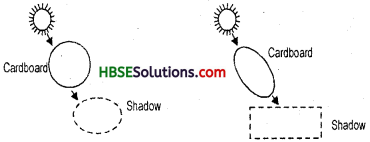
Can you think of creating a shape that would give a circular shadow if held in one way and a rectangular shadow if held in another way?
Answer:
Yes, we can think of creating a shape that would give a circular shadow if held in one way and a rectmigular shadow if held in another way. If we held a round card board in front of source of light, it will create a round shadow on the ground and if we turn it at some other position, then it creats a rectangular shadow.
HBSE 6th Class Science Solutions Chapter 11 Light Shadows and Reflection-2

Question 4.
In a completely dark room, if you hold up a mirror in front of you, will you see a right-left inverted image of yourself in the mirror?
Answer:
In a completely dark room, we cannot see our right-left inverted image in the mirror, because there is no mrce of light and we only can see our image in the mirror, when light is reflected from the mirror.

HBSE 6th Class Science Light Shadows and Reflection Important Questions and Answers

Very Short Answer Type Questions

Question 1.
Does the flame of a gas stove emit light?
Answer:
Yes, a gas stove flame emits light.

Question 2.
Give one example of a living thing which emits light.
Answer:
Firefly (Jugnu) is a living source of light.

Question 3.
Give the names of four different sources of light.
Answer:
Sources of light are: Sun, stars, firefly, electric bulb etc.

Question 4.
How does light travel from one point to the other?
Answer:
Light travels from one point to other in straight line.

Question 5.
What is the shape of the shadow?
Answer:
It is similar to the object which forms shadow.

HBSE 6th Class Science Solutions Chapter 11 Light Shadows and Reflection

Question 6.
How are shadows formed?
Answer:
Light coming from the source of light falling on the objects obstructed by the objects and does not go ahead. So a shadow is formed.

Question 7.
Are the edges of shadow sharp and distinct?
Answer:
Yes, the edges of the shadow are sharp and distinct.

Question 8.
Does the direction of shadow change during the day?
Answer:
Yes, the direction of shadow changes because the position of the sun changes during the day.

Question 9.
Does, the length of shadow change from season to season?
Answer:
Yes. The length of shadow changes from season to season.

Question 10.
What is a shadow?
Answer:
A dark patch formed behind an opaque object when it is placed in the path of light is called a shadow.

Question 11.
What is umbra?
Answer:
A region of total darkness is called umbra. No ray of light enters this region.

Question 12.
Define penumbra.
Answer:
A region of partial darkness which surrounds the umbra is called penumbra, some light rays reach this region.

Question 13.
What do we call a body that shines of its own?
Answer:
Luminous body.

Question 14.
Name one transparent and one opaque body.
Answer:
Trasparent air, glass, stone, wood (opaque).

HBSE 6th Class Science Solutions Chapter 11 Light Shadows and Reflection

Question 15.
What do we call a substance through which light can pass?
Answer:
Transparent substances.

Question 16.
Define opaque substance?
Answer:
The substance through which no light can pass.

Question 17.
Name two translucent substances.
Answer:
Glazed paper, oil paper.

Question 18.
Name two opaque substances.
Answer:
Ordinary paper, rubber sheet.

Question 19.
Name two cold sources of light.
Answer:
Firefly, tube light.

Question 20.
Define reflection of light.
Answer:
When a beam of light is incident on a smooth surface, apart of it os scattered back into the same medium, it is called reflection.

Short Answer Type Questions

Question 1.
Name any four artificial sources to scattering of fight. The air around the objects of light. allows this scattered fight to pass through it and
Answer:
1. Candle,
2. the oil jaino
3. tube
4. toren
5.electric bulb.

Question 2.
Why do objects in a room become transparent, translucent and opaque objects: visible even if sunlight does not enter it?
Answer:
The objects in a room become visible even if the sunlight dose not enter the room, due to scattering of light. The air around the objects allows this scattered light to pass through it and we can see the objects.

HBSE 6th Class Science Solutions Chapter 11 Light Shadows and Reflection

Question 3.
Classify the following into transparent, translucent and opaque objects: Wax, spectacle, a heap of salt, stone, dense smoke, wood, skin, balloon, rubber, membrane of tabla, blood, milk.
Answer:
Answer:
Transparent objects: Membrane of tabla, spectacles. Translucent objects: Dense smoke, blood, wax, balloon. Opaque objects: Stone, wood, rubber, milk

Question 4.
How will you convert a transparent glass sheet into a translucent sheet. Suggest any two ways.
Answer:
(i) By covering one side by butter paper.
(ii) By covering one side by thin sheet of plastics.

Question 5.
State the difference between umbra and penumbra.
Answer:

UmbraPenumbra
When we switch a torch in a dark room and place a ball in front of the torch, the shadow forms two parts. The central circular path is quite dark and this region is called umbra.The dark circular path is surrounded by a less dark portion. This shadow part is called penumbra.

Question 6.
Define regular reflection.
Answer:
When a beam of light falls on a smooth and polished surface, then regular reflection takes place. The smooth surface gives a clear image due to regular reflection. Example: Reflection from a plane mirror.

Question 7.
State laws of reflection.
Answer:
Laws of reflection:
(i) The angle of incidents is equal to the angle of reflection.
(ii) The incident ray, reflected ray and the normal are in the same plane.

Question 8.
Name the features of the image formed by a plane mirror.
Answer:
(i) The image formed by a plane mirror is as far behind the mirror as the object is in front of it.
(ii) It is exactly the same size and shape.
(iii) Image is virtual.
(iv) It is erect but laterally inverted.

HBSE 6th Class Science Solutions Chapter 11 Light Shadows and Reflection

Question 9.
Give two effects of light on plants.
Answer:
(i) Plants use light energy to prepare their own food.
(ii) The tips or short apex of a photogenic plant moves towards it. Light acts as a stimulus to plants.

Question 10.
State two differences between transparent and translucent objects.
Answer:

Transparent objectsTranslucent objects
1. They allow light to pass through them easily.1. It allows a part of light to pass through it.
2. Objects can be seen easily through them.2. Objects through them can only be seen dimly.

Question 11.
Distinguish between regular and irregular reflection.
Answer:

Regular reflectionIrregular reflection
1. It takes place on a smooth and polished surface.1. It takes place on a rough surface.
2. The image is formed after reflection.2. No image is formed after reflection.
3. Light is reflected back in a definite direction into the same medium3. Light is scattered back into the same medium in all directions.

Question 12.
What is lateral inversion?
Answer:
When we look in a plane mirror, we see the image of the objects placed in front of it. The left of the qbject becomes right of the image and the right of the objects becomes left of the image. This is called lateral inversion.

Question 13.
Why is firefly considered to be a cold source of light?
Answer:
The energy of some chemical reactions within the firefly is released not as heat but as light hence it is called a cold source of light.

Question 14.
Does the length of a shadow change during the day?
Answer:
Yes, the length of a shadow changes during a day. It is longer in the morning. After that it begins to decrease and it is shortest at 12.00 noon. Then begins to increase in length again.

HBSE 6th Class Science Solutions Chapter 11 Light Shadows and Reflection

Question 15.
Under what special circumstances, light does not travel in straight line?
Answer:
If the size of the object in the path of light is very small (0.0001 cm/less) light bends at the edge of the object. Thus in such case, light does not travel in straight line.

Question 16.
What would be the shape of an object so that it will cast no shadows on the ground in the light of sun?
Answer:
An object casts no shadow (or very little shadow) on the ground in sunlight when it is either transparent or it is at such a height from the earth that the umbra does not reach the surface of the earth. .

Question 17.
Why is your shadow longest at sunrise and shortest at noon?
Answer:
In the morning at the time of sunrise and in the evening at the time of sunset light rays falling on the earth are not straight. They are inclined. This is why our shadow at this time both (morning and evening) is the longest. At noon the sun is just over above our head and sun-rays fall vertically on the earth. Due to the vertical sun-rays, our shadow formed at noon is the shortest.

Question 18.
What does an object do when light falls on it?
Answer:
It may allow to pass the light through or it may completely cut the light from passing through by absorbing the light or it may scatter the light incident on it.

Question 19.
Why is silvered glass used as a mirror?
Answer:
The silvered glass has a smooth surface and the smoothness helps in forming clear image. Silvering makes it shiny and the shiny surface helps in reducing the absorption.

HBSE 6th Class Science Solutions Chapter 11 Light Shadows and Reflection

Long Answer Type Questions

Question 1.
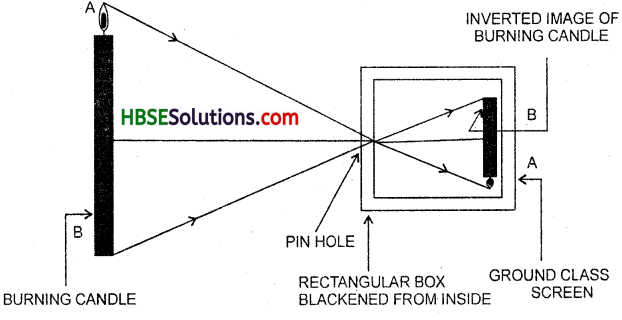
Define the structure and working of a pin-hole camera.
Answer:
Pin-hole camera: It is a simple application of the rectilinear propagation of light.
Construction:
It consists of a rectangular card board box, such that its one side is made of ground glass screen, the side opposite to ground glass has a hole in the middle, whose size is equal to the pin-head of a common pin. The box is blackened from inside, so as to absorb any light falling on its walls.

Working:
(1) Consider a lighted candle AB, in front of pin-hole camera. The rays starting from points of candles, travel in all directions.
(2) A ray of light starting from point ‘A’ along with AH after passing through the pin-hole falls on ground glass screen at point ‘A’.
Similarly another ray starting from point ‘B’ along with BH after passing through the pin-hole will fall on ground glass screen at point ‘Bj
(3) A1B1 is the image of AB. The image formed here is turned upside down, because light travels in straight line.
HBSE 6th Class Science Solutions Chapter 11 Light Shadows and Reflection-3

HBSE 6th Class Science Solutions Chapter 11 Light Shadows and Reflection

Light Shadows and Reflection Class 6  HBSE Notes

  • Light is an invisible energy which causes in us a sensation of vision. Though it cannot be seen, it unables us to see things.
  • An object which emits light is called a source of light. Sources of light are natural as well as artificial. Sun is the main and brightest source of light. Stars, and jugnu (glow worm) and some fish also emit light.
  • Artificial sources of light are man-made sources such as candles, lantern, gas lamps and electric bulbs. Bodies are visible only by ’ the light they send to our eyes. They may be luminous and non-luminous sources.
  • Light travels in a straight line, which is called rectilinear propagation of light. It explains the formation of the image of an object in a pin-hole camera.
  • When light falls on an object, three things can happen:
    → It is almost completely transmitted through the object.
    → Only one part of it may be transmitted and the rest is absorbed or spread out.
    → It may not be allow’ed to pass through at all. On this basis, we can classify the materials into three categories.
  • Transparent materials, which allow light to pass through them and through which we can see clearly are known as transparent materials. Examples: Air, water, glass etc.
  • Translucent materials: Substances through which light can pass partially and through which we cannot see clearly are called translucent materials. Examples: Wax paper, butter paper, greased paper etc.
  • Opaque materials: Substances which do not allow light to pass through them are called opaque substances. We cannot see through them wood, stone etc.
  • In the presence of light, opaque objects act as obstacles to propagate light and form in shadows behind them in the form of umbra and penumbra. The region of space where light from the source does not reach and hence the darkest region is called umbra.
  • The region where the light does not reach from all parts of the source is called penumbra.
  • When light falls on a smooth surface, they change their direction in a well defined manner, called regular reflection.
  • There are two laws of reflection:
    → Angle ofincidence is equal to angle of reflection.
    → Incident ray, reflected ray and the normal all lie in the same plane.
  • In a plane mirror, the reflected rays appears to come from some objects kept behind the mirror. This is called a virtual image. A real image can be obtained on a screen.
  • Luminous objects. Objects which emit light their own are called luminous objects. Sun, stars, firefly, burning candle, electric bulb and gas lamps are examples of luminous objects. One lumin is the luminous flux of that source whose illuminating power is 1/4rc candela. The brightness is the property measured in units called foot candles. The modern unit now is lux. 1 Foot candle = 10.76 lux.
  • Light travels in straight lines:
    → Take three pieces of a card board. Use supports to make them stand vertically on the table.
    → Make holes A, B, C in each of them such that the holes are in one straight line.
    → Now place a candle near hole A at the same height as the hole in the card board.
    → Now see from C. You will notice that the flame of the candle is visible. Now displace one of the card boards from its position so that the holes are no longer in a straight line. The flame is not visible.
    This activity shows that light from the candle travels in a straight line from the candle to the eyes.
  • Formation of shadows: Shadows are formed when light is obstructed by objects. An opaque object casts a dark shadow, translucent casts a weak shadow and transparent objects cast no shadows.
    A shadow of the object is formed in the direction opposite to the side of the source of light. Take a wooden stick about half a metre long. Fix one end of it in open ground where there are no trees and buildings near it. Look its shadow in the morning and mark its points of shadow. Note the direction of sun with respect to the stick. It is formed opposite to the direction of sun.
    Again look at the shadow at about 11 a.m. and then about 2 p.m. At 11 a.m. the shadow formed is on the same side and about 2 p.m. shadow is formed in a direction opposite to that seen in the morning.
  • Conclusion:
    → A shadow of an object is formed in the direction opposite to the side of the source of light.
    → Shadow moves according to the movement of sources of light or objects.
    → The length of shadow changes with time.
  • Reflection of light: When a beam of light strikes on a plane surface a part of it is turned back into the same direction, it is called reflection.
  • On a polished surface, regular reflection takes place and on rough surface irregular reflection takes place.
  • Lateral inversion: When we look in a plane mirror, we see the image of the objects placed in front of it. The left of the objects become right and right of the objects become left of the image. Left hand side appears right handside in the image. This is called lateral inversion.

HBSE 6th Class Science Solutions Chapter 11 Light Shadows and Reflection Read More »

HBSE 6th Class Science Solutions Chapter 16 Garbage In, Garbage Out

Haryana State Board HBSE 6th Class Science Solutions Chapter 16 Garbage In, Garbage Out Textbook Exercise Questions and Answers.

Haryana Board 6th Class Science Solutions Chapter 16 Garbage In, Garbage Out

Exercises

Question 1.
(a) Which kind of garbage is not converted into compost by the red-worms?
(b) Have you seen any other organisms, besides red worm, in your pit, if yes, try to find out their names. Draw pictures of these.
Answer:
(a) Garbage such as pieces of cloth, polythene bags, broken glass, aluminium wrappers, nails, old shoes and broken toys etc. not into compest by red warms.
(b) Yes, there are other organisms in a pit of compesting such as bacteria and some fungi which decompose the biodegradable wastes.

HBSE 6th Class Science Solutions Chapter 16 Garbage In, Garbage Out

Question 2.
Discuss:
(a) Is garbage disposal the responsibility only of the government?
(b) Is it possible to reduce the problems relating to disposal of garbage?
Answer:
(a) No, the garbage disposal is our responsibility also. Because clear air, water and locality helps us to make healthy. So every citizen should care for waste disposal. We should not throw wastes carelessly. We should use less and reuse them and recycle the wastes. We should collect garbage carefully in dustbins and should save environment to pollute. It is our duty to keep our environment healthy and clean.

(b) Problems related to garbage disposed can be reduced easily, if we think carefully for disposal of wastes. We should collect, our kitchen or shop garbage in separate bags and dispose of in municipal dustbin. We should not throw any waste materials in the gali or on road. Everyone of us should use separate dust bins. Industry should use effluent plants for their waste disposal. Organic and agricultural wastes should be used for composting garbage should be properly discarded into landfill.
If we properly follow these action then disposal problem can be reduced.

Question 3.
(a) What do you do with the leftover food at home?
(b) If you and your friends are given the choice of eating in a plastic plate or a banana leaf platter at a party, which one would you prefer and why?
Answer:
(a) The left over food in our home is known as kitchen wastes. It comes in group—I category, which wastes are biodegradable by micro-organisms into useful products. Left over food at home is dumped into compost pits with other wastes such as rag, papers, and peels of vegetables which converted into manure after some days and used as food for plants.

(b) In a party I and my friend choose to eat in a banana leaf platter, due to the following reasons:
Banana leaf platter is an agricultural waste and it can be converted into compost after use. Compost is a manure, which is used by plants and crops for getting necessary nutrients. By using banana platter we also save our environment and surroundings to become pollute. Which is helpful for our health and healthy environment.

Question 4.
(a) Collect pieces of different kinds of paper. Find out which of these can be recycled?
(b) With the help of a lense look at the pieces of paper you collected for the above question. Do you see any difference in the materials of recycled paper and a new sheet ofpaper?
Answer:
(a) Pieces of newspapers, magezines, used envelops, note books, shiny plastic coated papers and shiny paper which are waxy in nature. From all these types of papers, plastic coated paper and shiny paper, could not be recycled. But paper pieces like newspapers, used envelops, notebooks, maga-zines, etc. cam be recycled and be converted into useful products, which are harmless for our society.

(b) When we see the recycled paper with the help of lense, we find that there is no great difference between them. The recycled paper quantity decrease upto some levels and there are roughness in recycled paper. This type of paper can be used for making carrybags and other packing materials.

Question 5.
(a) Collect different kinds of packaging materials. What was the purpose for which each one was used? Discuss in groups.
(b) Give an example in which packing could have been reduced?
(c) Write a story on how packing increases amount of garbage?
Answer:
(a) Collect different types of packaging materials such as, plastic cords, plastic bags, strips, jute bags and cords, clothes strips and any packaging materials from your locality and market shops. Discuss with your class mate in groups, in which each packaging materials used and write in your notebook.

(b) The shopkeepers should buy large amount of goods like nuts or coffee. By doing so they reduce the waste and packaging materials. They should buy goods in bulk and bigger quantities in a single box pakage. For exaple we can buy the large package of sugar, rice, cereals, tooth-pestes and detergents, etc. This type of shopping will reduce the wastages.

(c) Packing increases the amount of garbages. Every good or things are sold in small packets of plastic materials which are thrown out after use. This increases the garbage. Plastic bags, cans, aluminium foils and many other packaging materials are used and thrownout after use. These packaging materials increase garbage. Soft drinks, tooth-pastes and many other goods now-a-days are sold in plastic cans and aluminium cans.

Now-a-days every thing/goods such as ghee, refined, soaps, detergents, cereals and all eatable goods are sold in small packets. This increases the garbage upto a large extent. In this way we can say that packaging materials increases the amount of garbage.

HBSE 6th Class Science Solutions Chapter 16 Garbage In, Garbage Out

Question 6.
Do you think it is better to use compost instead of chemical fertilizers? Why?
Answer:
We think that compost is better to use instead of chemical fertilisers because compost provides much nutrients to crop plants. It is easily absorbed by plant roots. Compost is cheaper than chemical fertilisers. It increases the fertility of the soil. On the other hand chemical fertilisers do not get decomposed by natural methods and they increase water and soil pollution. Chemical fertilizers are easily solunle in water. By leaching they reache the underground water and pollute water.
Therefore, we can say that compost is better use instead of chemical fertilisers.

HBSE 6th Class Science Garbage In Garbage Out Important Questions and Answers

Very Short Answer Type Questions

Question 1.
Name any two garbage.
Answer:
Plastic bags and cans/tins.

Question 2.
Define garbage.
Answer:
Any materials which is discarded by us or which is of no use for us is called garbage.

Question 3.
What is landfill?
Answer:
A low lying open area in which garbage is thrown.

Question 4.
Are all garbage harmful to us?
Answer:
No, all garbage not harmful to us.

Question 5.
What type of garbage are used for composting?
Answer:
Garbage of our kitchen like fruits & vegetable peels, egg cells, waste food and tea leaves are used for composting.

Question 6.
Name some garbage which are not used as composting.
Answer:
Garbage, like, polythene bags, broken glass, aluminium wrappers and old shoes are not used for composting.

Question 7.
Define composting.
Answer:
The rotting and conversion of some materials into manure is called, ‘composting’.

Question 8.
Which type of dustbin is used for collecting garbage which is used again?
Answer:
Blue colour dustbin.

HBSE 6th Class Science Solutions Chapter 16 Garbage In, Garbage Out

Question 9.
What type of garbage is collecting in green colour dustbin?
Answer:
Materials such as kitchen and other plant or animal wastes.

Question 10.
Should we bum the dried leaves?
Answer:
No, we should not bum the dried leaves.

Question 11.
Define ‘Vermicomposting’.
Answer:
The method of preparing compost with the help of redworms is called ‘Vermicomposting’.

Question 12.
What type of food red worm need?
Answer:
Red worms need food like, vegetable and fruits wastes, coffee and tea remains.

Question 13.
Which type of wastes is not used as red worm food?
Answer:
Wastes such as salt containing pickels, oil, vinegar, meat and milk should not be used as redworm food.

Question 14.
How redworms grind the food?
Answer:
Red worms do not have teeth for grinding food. They have a structure called gizzards for grinding their food.

Question 15.
What is the suitable season for the survival of red worms?
Answer:
They need normal temperature, not very hot nor very cold. They also need moisture around them.

Question 16.
What is ‘Papier mache’?
Answer:
It is a paste made of clay and paper and some rice husk.

Question 17.
Name few things we use that are made of plastics.
Answer:
Toys, shoes, bags, pens, combs and tooth brushes, etc. are few things that we use in daily life made of plastics.

Question 18.
How plastics are harmful for our health?
Answer:
Burning of plastics give out harmful gases, which may cause many health problems including cancer in humans.

Question 19.
How plastic bags are harmful for stray animals?
Answer:
Stray animals look for food in these bags, they end up swallowing these, sometimes they die due to this.

HBSE 6th Class Science Solutions Chapter 16 Garbage In, Garbage Out

Question 20.
What are the problems we face. When plastic bags thrown away on roads?
Answer:
When we throw away plastic bags on roads or other places, they get into drain and sewer system. As a result drain get choked and water spills on the road.

Question 21.
Name one method by which we minimise garbage.
Answer:
We make a minimum use of plastic bags. We reuse the bags whenever it is possible to do so without any adverse affects.

Question 22.
What do you know about wastes?
Answer:
Wastes are the useless and unwanted materials discarded by humans.

Question 23.
Define domestic wastes.
Answer:
Domestic wastes include sewage, kitchen wastes, and garbage, etc.

Question 24.
What is incineration?
Answer:
The process of burning of wastes in a large furnace is called incineration.

Question 25.
Define vermieulture.
Answer:
The process of getting manure from biodegradable wastes by adding earthworms to the compost, is called vermieulture.

Short Answer Type Questions

Question 1.
How many types wastes can be divided?
Answer:
On the basis of physical, chemical and biological characteristic wastes can be divided into the following categories:
(a) Biodegradable wastes: Wastes which comprise of materials which has the ability to break down sofely and quickly by micro-organisms for example, dead and decaying remains of plants and animals, faecal remains water etc.

(b) Non-biodegadable wastes: Which do not breakdown into simple and harmless products by natural agents like bacteria and fungi are called non- biodegadable wastes. For example, metallic oxides, murcury, lead, DDT and radioactive wastes.

HBSE 6th Class Science Solutions Chapter 16 Garbage In, Garbage Out

Question 2.
Define municipal wastes.
Answer:
Municipal wastes referred as garbage, etc. Municipal wastes is a combina-tion of wastes. They are papers, food wastes, plastics, metals, ash, glass, and others.

Question 3.
What are biodegradable wastes?
Answer:
Biodegradable wastes comprise of material which has the ability to break down safely and quickly by microorganisms. These originate from natural organic sources animals and plant based products.

Question 4.
Define the term domestic wastes.
Answer:
Human beings discard many things in our day to day life activities. They are considered as domestic wastes. Domestic wastes are:
(i) Sewage
(ii) kitchen wastes
(iii) garbage
(iv) others.
Human excreta and wastes from bathroom and kitchen come in category of sewage. Vegetables, fruits and other food wates are kitchen wastes whereas papers, rags, hairs, and house dust come in garbage category and plastic bags and rubber things are come in other categorties.

Question 5.
Burning of lianes are harmful to us. Explain.
Answer:
Garbage heaps of dried leaves are burnt most of the time. Farmers too often burn the husk dried leaves and part of crop plants in their fields. Burning of these, produces smoke and gases that are harmful to our health.

Question 6.
How earthworms are called farmers’ friends?
Answer:
Earthworms are farmers friends because they help to increase the fertility of the soil. They eat dust and make soil fertile. They are used to prepare vermicopot, which gives many nutrients to soil and ultimately to crop plants. So they are called farmers’ friend.

HBSE 6th Class Science Solutions Chapter 16 Garbage In, Garbage Out

Question 7.
How do you prepare vermicompost?
Answer:
Vermicompost is prepared by the help of redworms. A pit of 30 cm deep is dug and a comfortable home is made for the redworms in it. Spray a thick layer of sand in it, stalk of plants’ husk or green leaves spread over the sand layer. Sprinkle some water to make this layer wet. Now put some redworms in this pit. Cover it with a sheet of cloth over the pit. Redworms eat fruits wastes’ coffee and tea remains. They grind their food. They eat equal to their weight. After 3/4 weaks soil like material is seen in the pit. This is vermicompost. Remove it from the pit and use after dried in sunlight.

Question 8.
Define recycling of paper.
Answer:
Collect old newspapers, magazines, used envelops, note-books and other papers and take a frame fitted with a net. Tear the paper into small pieces, put them in a tub and pour water over it. Let the paper remain submerged in water for a day. Make a thick paste of paper by pounding it.

Now spread the wet pastes on the wire mesh fixed to the frame. Put it gently to make the thickness of layer of paste as uniform as possible. Wait till waste drains off. Now remove the layer of paste from the frame, spread it on a sheet of newspaper by putting some weights so that these do not curl up. Thus recycled paper is prepared.

Question 9.
What is meant by the spoilage of landscape
Answer:
Spoilage of landscape is directly related to the improper waste management specially solid waste. The solid wastes may be slag heaps from mines, in paper mills, sugar mills, fertilizers and our household. They make our surrounding unhygenic. These spoils the landscape and destroy greenary of some areas. Soil becomes toxic in nature wastes accumulated places often becomes home of rats, house flies, mosquitoes and bacteria. These things destroy the beauty and usefulness of the place.

Question 10.
What are the health problems faced by the rag-pickers?
Answer:
Rag-pickers manually separate non- biodegradable wastes from the heap of garbage in the cities. These people are always exposed to biomedical wates like tape worms, liver flube eggs, sharp materials, broken glass, used syringes, needles etc. which can harm them to a great extent.

Some of the occupational hazards associated with these wastes handling are infectious of different types like skin and eye and respiratory, intestinal. Some diseases also result due to bites of animals. Exposer to dust and can result in cancer. Exposer to toxic agents is usually followed by its absorption and entry into the blood cancer.

Question 11.
List the various steps practiced in waste management.
Answer:
Various steps practiced in waste management are broadly divided into four steps:
(i) collection of wastes
(ii) segregation of waste
(iii) reduction and resource recovery
(iv) treatment and disposal.

HBSE 6th Class Science Solutions Chapter 16 Garbage In, Garbage Out

Question 12.
How does a landfill basically works?
Answer:
The basic working of a landfill involves three steps:
(i) Deposit the refuse.
(ii) Compact it with buldozers.
(iii) Cover the garbage with at least 6 inches deep of soil after each day operation and with a final cover of 2 feet when the area is full.

Question 13.
What should be taken into consideration while selecting a landfills?
Answer:
While selecting a landfill the following points must be considered:
(i) Land requirements and its cost: The quantity of solid wastes, degree of compaction to be obtained, ratio of compacted wastes to the cover materials and depth of the fill determine the area of land and hence its cost.

(ii) Accessibility: The place where the disposal of wastes is to be done should be located either centrally or near the source generation. Also the landfill should be downward from the community.

(iii) Cover material: A sanitary landfill requires at least 15 cm cover of thick compacted soil at the end of each day work.

(iv) Climate: The frequency of rainfall, the velocity and direction of prevailing wind, and our all temperature time relationship are the factors to be considered for a particular site.

(v) Tropography: Any tropography may be used for the site of a landfill. However different site will pose special operational and design problems.

Question 14.
What are composting? What are its benefits?
Answer:
Composting is defined as the decomposition if heterogeneous matter in a mixed microbial population in the moist, warm and aerobic environment. The micro-organisms convert organic waste into humus which has a significant value for crops. The end product is called compost. It consists of nutrients and minerals like n, p, k and other trace elements.

Compost has the following benefits:
(i) It increases the fertility of the soil, rich in nutrients.
(ii) It also contains trace elements like copper, manganese and molybdenum etc. essential for growth of plants.
(iii) It improves the texture of the soil and increases the water absorption capacity of the soil.

Question 15.
Write short notes on:
(i) Incineration
(ii) Bio-methanation.
Answer:
(i) Incineration:
Incineration is the process of burning of wastes in a large furnance. It reduces the volume of waste by 20 to 30% of original volume and makes the products stable. It helps to eliminate any infectious organisms which may be present while reducing the volumes of wastes to be disposed of. If wastes is not segregated properly, incineration produces toxic ash and its leakage can pollute pond water.

(ii) Bio-methanation:
In this method organic matter like vegetable wastes, crop residues and animal excreta like cow-dung are decomposed in the absence of air and presence of water to produce biogas which is rich in methane. Biogas can be used to produce electricity, to cook to light streetlamps. It is pollution free method of dispoal of organic wastes in which leftover and slurry can be used as a manure.

HBSE 6th Class Science Solutions Chapter 16 Garbage In, Garbage Out

Long Answer Type Questions

Question 1.
What can we do to minimise overuse of plastics and deal with garbage?
Answer:
(i) We make a minimum use of plastic bags. We re-use the bags wherever it is possible to do so without any adverse effects.
(ii) We insist shopkeepers use proper bags. We carry a cloth or jute bags when we go out for shopping.
(iii) We do not use plastic bags to store eatables.
(iv) We do not throw plastic bags here and there, after use.
(v) We never burn plastic bags and other plastic materials.
(vi) We do not put garbage in plastic bags and throw it away.
(vii) We use vermicompacting at home and dead with other kitchen wastes carefully.
(viii) We recycle papers.
(ix) We use both sides of paper to write. We use a slate for rough work. We use blank sheet of papers left in our note-books for roughworks.
(x) We make our family friends and others to follow proper practices for disposing different kinds of wastes.
The most important point to know and think about is that—more garbage we generate, more difficult it will be to get rid of it.

Question 2.
What we can do to manage waste?
Answer:
The following are some of the things we can do to manage waste:
(i) Throwing garbage in the correct bin.
(ii) Segregating household garbage into biodegradable and non-biodegradable.
(iii) Reducing the use of plastics.
(iv) Using materials that can be recycled.
(v) Buying things with least amount of packaging to avoid generation of waste.

HBSE 6th Class Science Solutions Chapter 16 Garbage In, Garbage Out

Garbage In Garbage Out Class 6  HBSE Notes

  • Landfill is an area where the garbage collected from a city or town is dumped.
  • Converting plant and animal wastes including that from kitchen, into manure, is called composting.
  • The method of making compost from kitchen garbage using red warms is called vermicomposting.
  • Paper can be recycled to get useful products.
  • Plastic cannot be converted into less harmful substances by the process of composting.
  • We need to generate less wastes and find ways of dealing with the increasing amount of garbage in our surroundings.
  • Wastes may be soiid wastes. Industrial wastes, Biomedical wastes, Agricultural wastes commercial wastes and radioactive wastes.
  • Wastes are harmful but all are not for example soil is a waste when it is discarded from our homes.
  • Proper disposal of wastes must, ensure that it does not pose a threat to people and the environment.
  • Domestic wastes are sewage, kitchen wastes, Garbage and others.
  • Sewage wastes can be divided into three categories: (i) Natural wastes (ii) Road traffic wastes and (iii) Behavioural wastes.
  • Industrial wastes are from manufacturing industry, nuclear reactor, metallur-gical mining, textile, food processing, petroleum and other industries.
  • Commercial wastes are generated in shops, restaurants, hotels, institutions, etc. A large quantities of plastic packing bottles, cans and clothings are discarded by these places.
  • Commercial wastes may be of the following types: (i) Budding waste, (ii) Restaurants and shope waste, (iii) Wastes from printing.
  • Bio-medical wastes generated by medical institutions and hospitals even day. It includes discarded cotton, bandages, plasters, syringes, medicines, saline bottles, hot water bags, and needles, tissues, bloods, fresh x- ray films etc.
  • Agricultural wastes are farm animal waste fertilisers, pesticides, insecticides, fungicides, herbicides and rodenticides.
  • Wastes may be biodegradable and non- biodegradable. It may be toxic and non-toxic.
  • Bio-array use of some organisms to know the biological effects of a sustance or factor.

HBSE 6th Class Science Solutions Chapter 16 Garbage In, Garbage Out Read More »

HBSE 6th Class Science Solutions Chapter 15 Air Around Us

Haryana State Board HBSE 6th Class Science Solutions Chapter 15 Air Around Us Textbook Exercise Questions and Answers.

Haryana Board 6th Class Science Solutions Chapter 15 Air Around Us

Exercises

Question 1.
What is the composition of air?
Answer:
The major components of air are:
(i) Nitrogen (78%)
(ii) Oxygen (21%)
(iii) Noble gases (0.9%)
(iv) Carbon dioxide (00.3%)
(iv) Other gases, dust particles and water vapours (0.01%) by volume.

HBSE 6th Class Science Solutions Chapter 15 Air Around Us

Question 2.
Which gas in the atmosphere is essential for respiration?
Answer:
Oxygen gas in the atmosphere is essential for respiration.

Question 3.
How will you prove that air supports burning?
Answer:
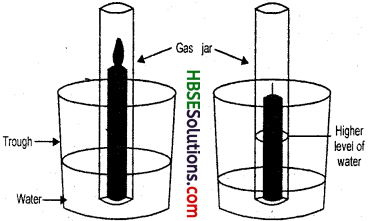
Take two plastic bottles and remove their base with the help of a sharp knife. Take two candles and coverthese two burning candles with the plastic bottles. After some time, candles stop burning and water level rises up in the plastic bottles.

Now make several holes in one plastic bottle and cover the lighting candle with this bottle. We see that candle burns continuously. This candle gets air from different holes and burns continuously till it is completely finished. This activity shows that air supports burning.
HBSE 6th Class Science Solutions Chapter 15 Air Around Us-1

Question 4.
How will you show that air is dissolved in water?
Answer:
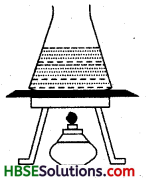
Take some water in a beaker and heat it slowly on a tripod stand with gas burner. We see that tiny bubbles are sticking on it. These
bubbles are mainly of oxygen gas present in air, i which is dissolved in water. When we heat water, the air dissolved in water escapes out in the form of bubbles.
This shows that air is dissolved in water.
HBSE 6th Class Science Solutions Chapter 15 Air Around Us-2

Question 5.
Why does cotton lump get sunk T in water?
Answer:
Cotton lump contains air in it. There are various spaces in which air is filled. When cotton lump is put into water, air present in the vacant space dissolved in water and cotton lump sank.

Question 6.
The layer of air around the earth is known as
Answer:
The layer of air around the earth is known as atmosphere.

Question 7.
The component of air used by green plants to make their food is
Answer:
Carbon dioxide is needed by green 1 plants to make their food.

Question 8.
List five activities that are possible due to presence of air.
Answer:
Activities that are possible due to presence of air are as follows:
(i) Windmill.
(ii) Movements of sailing yachts.
(iii) Flying of aeroplanes, birds, etc.
(iv) Dispersal of seeds.
(v) Watercycle.

Question 9.
How do plants and animals help each other in the exchange of gases in the atmosphere?
Answer:
Plants and animals help each other in exchange of gases. They are interdependent on each other. All the animals require oxygen for their survival. It helps breaking down digested food in the body and release energy. This process is called respiration. During respiration, carbon dioxide gas is produced.

Plants consume this carbon dioxide gas for preparing their own food and release oxygen. They also use some oxygen for respiration. This oxygen gas is used for animals in their respiration process. In this way, plants and animals help each other in the exchange of gases in the atmosphere.

HBSE 6th Class Science Solutions Chapter 15 Air Around Us

HBSE 6th Class Science Air around us Important Questions and Answers

Very Short Answer Type Questions

Question 1.
Where do we get air?
Answer:
We get air from the atmosphere.

Question 2.
What is the use of air pressure?
Answer:
Air pressure is used in pumps.

Question 3.
The cover of air around the earth is called
Answer:
Atmosphere.

Question 4.
Air occupies and
Answer:
Space, mass.

Question 5
forms the earth atmosphere.
Answer:
Air.

Question 6.
What gases are found in the air?
Answer:
Air contains nitrogen, oxygen, carbon dioxide and inert gases and water vapours.

Question 7.
Which gas forms the largest part of the air?
Answer:
Nitrogen.

Question 8.
What part of the air is oxygen?
Answer:
Oxygen is l/5th part of the air.

Question 9.
What is the use of nitrogen in air?
Answer:
Nitrogen slows down the process of combustion.

Question 10.
State one biological importance of air dissolved in water.
Answer:
Dissolved air helps aquatic animals for breathing.

HBSE 6th Class Science Solutions Chapter 15 Air Around Us

Question 11.
During photosynthesis, which gas is consumed?
Answer:
Carbon dioxide gas.

Question 12.
Which gas is released during photosynthesis?
Answer:
Oxygen gas.

Question 13.
Which gas is helpful for combustion?
Answer:
Oxygen gas.

Question 14.
When do plants release oxygen?
Answer:
Plants release oxygen during photosynthesis.

Question 15.
Name two variable components of air.
Answer:
(i) Nitrogen
(ii) Oyxgen.

Question 16.
Name two objects which are inflated by air.
Answer:
(i) Cycle tyre
(ii) Balloons.

Question 17.
Give the percentage composition of nitrogen and oxygen by volume in air.
Answer:
Nitrogen – 70% and oxygen – 21%.

Question 18.
Name two inert gases present in the air.
Answer:
(i) Argon
(ii) Neon.

Question 19.
Why do we need extra oxygen supply at high altitude?
Answer:
Because at high altitude air is thin.

HBSE 6th Class Science Solutions Chapter 15 Air Around Us

Question 20.
Excepting oxygen and nitrogen, name two other gases present in the air.
Answer:
(i) Carbon dioxide
(ii) Argon.

Question 21.
Which component of the air is used in fire extinguishers?
Answer:
Carbon dioxide gas.

Question 22.
State one way in which air enters the air.
Answer:
Through respiration.

Question 23.
Why do we call neon and argon as inert gases?
Answer:
Because they do not react with any ; other element or compound in ordinary conditions.

Question 24.
Name two gases which can – damage historical monuments.
Answer:
(i) Nitrogen dioxide
(ii) Sulphur dioxide.

Question 25.
What is called wind?
Answer:
The moving air is called wind.

Question 26.
Name two properties of air.
Answer:
(i) Air occupies space
(ii) It has mass.

Question 27.
Write two importances of air in agriculture.
Answer:
(i) Air helps rotate wind-mill which is used to draw water from tube-wells.
(ii) Air helps in dispersion of seeds and ; pollen grains of flowers of several plants.

Question 28.
Give one important use of .! nitrogen.
Answer:
Nitrogen is used in the manufacture of fertilizers.

Question 29.
Name two major gases of air.
Answer:
Two major gases of air are:
(i) Nitrogen
(ii) Oxygen.

HBSE 6th Class Science Solutions Chapter 15 Air Around Us

Short Answer Type Questions

Question 1.
Write the names of four main constituents of air.
Answer:
(i) Nitrogen
(ii) Oxygen
(iii) Carbon dioxide
(iv) Water vapours.

Question 2.
What are the uses of oxygen present in air?
Answer:
Uses of oxygen:
(i) Animals use oxygen for breathing and respiration.
(ii) Aquatic animals and plants use oxygen for breathing.
(iii) Mountaineers inhale oxygen at heights where air is thin.
(iv) Pure oxygen is used for artificial breathing in hospitals.
(v) Oxygen is used in oxy-acetylene torch for welding and cutting purposes.
(vi) Liquid oxygen is used as rocket fuels.

Question 3.
How can you show that air contains carbon dioxide?
Answer:
Take some lime water in a watch glass and keep it for a few hours in open air. A white crust is formed on the upper surface of the lime water. Lime water turns milky due to the presence of carbon dioxide in the air. This shows that air contains carbon dioxide.

Question 4.
Show that one-fifth volume of air is oxygen.
Answer:
Take a glass trough. Fill it about half with water. Add a few drops of ink to make the water coloured. Fix a candle on a solid iron rectangular block and place the block in water. Take a glass cylinder and mark it into five equal parts by passing a thin strip of paper at equal distance on its outer surface. Light the candle and invert the glass cylinder over it.

The flame of candle starts burning, then becomes and finally stops burning. Coloured water rises up in the glass cylinder and is filled one fifth with water. Thus one fifth of air is used in burning. Hence one fifth volume of air is oxygen.

HBSE 6th Class Science Solutions Chapter 15 Air Around Us

Question 5.
How will you show that air contains water vapour?
Answer:
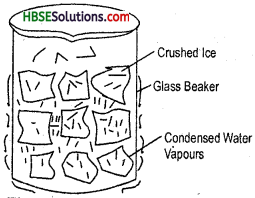
Put some ice blocks in a glass tumbler and keep it in the open air. Drops of water appear on the outer surface of glass tumbler after a few minutes. Air in contact with the tumbler gets cooled and the water vapour present in it condenses to give drops of water.
HBSE 6th Class Science Solutions Chapter 15 Air Around Us-3
Thus we can see that water is present in air in the form of its vapours.

Question 6.
Explain why air is considered a mixture.
Answer:
Air is considered a mixture because:
(i) The composition of air varies from place to place and at depths and heights.
(ii) The constituents of air such as oxygen, nitrogen, carbon dioxide, water vapours etc. can be separated by simple physical methods.
(iii) The properties of air are the average of its constituents.
(iv) No energy is evolved or absorbed when various components of air (gases) are mixed to obtain air.

Question 7.
Mention five uses of air.
Answer:
Uses of air:
(i) Air is used by humans for respiration.
(ii) Air is necessary for burning.
(iii) Air is used for inflating the tyres of vehicles.
(iv) Balloons and balls can be used only when they are inflated with air.
(v) Compressed air is used in the break system for stopping trains.

Question 8.
How will you show that air is present in a lump of soil?
Answer:
Take a lump of dry soil in a beaker or glass tumbler. Adding water to it, we see that bubbles come out from the soil. This shows that soil contains air.

Question 9.
What will happen if the amount of oxygen in the air is increased?
Answer:
If the amount of oxygen in the air is increased, the burning of thing will not stop and fire will spread into large area which will be dangerous to humans and for the nature.

Question 10.
Why is nitrogen important for living organisms?
Answer:
Nitrogen in air is used for manufacturing food by the nitrogen fixation of atmospheric nitrogen into nitrates which mixes with the soil and plants absorb these as their food. So it is necessary and important for living organisms.

Question 11.
How can we see upto a long distance after it rains?
Answer:
When it rains, the dust in the atmosphere settles down to the ground. This is why we can see upto a long distance just after rain.

Question 12.
How do you know that solid particles are floating in air?
Answer:
Choose a sunny room in your home, now close all the doors and windows to make the room dark. Now open the window/door facing the sun just a little in such a way that it allows sunlight to enter the room only through a slit.

Now look the incoming sunlight slants carefully. We see some tiny shining particles moving rapidly in the slanting beam of sunlight. This shows that air contains dust particles.

HBSE 6th Class Science Solutions Chapter 15 Air Around Us

Question 13.
Describe the process by which oxygen is naturally produced.
Answer:
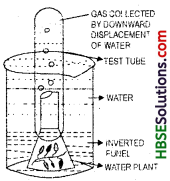
Oxygen is naturally produced by the process of photosynthesis. Fill a beaker to about 3/4th with pond water and put a small plant in it. Cover it with a funnel. In this beaker now add a pinch of sodium bicarbonate.

Invert a test tube filled with water on the stem of funnel so that air bubbles get in the test tube.
HBSE 6th Class Science Solutions Chapter 15 Air Around Us-4
Now put the apparatus in sunlight and observe after sometime. You will see that some gas has been collected in the test tube. Let half the test tube be collected with this gas. Now remove the test tube by putting thumb at the mouth of the test tube. Bring a splinter in the test tube. Splinters burn rapidly which show that it is oxygen gas.

Question 14.
What is liquid air? How can it be made?
Answer:
When air is cooled under reduced pressure, it is convert into liquid form. This air is called liquid air. Air is cooled under reduced air changes into liquid form.

Question 15.
What would happen if plants stop taking carbon dioxide?
Answer:
Plants prepare their own food with the help of carbon dioxide. They take carbon dioxide from the atmosphere and consume all the carbon dioxide released by animals through the process of respiration.

If plants stop taking carbon dioxide from the atmosphere, the amount of carbon dioxide increases in the atmosphere and the temperature of atmosphere will increase due to green house effect. Due to this, glacier will melt and there will be flooding on the earth. The nature living organisms will die.

Question 16.
Why do divers and mountaineers carry oxygen cylinders with them?
Answer:
Divers and mountaineers carry oxygen cylinders with them because at higher altitude and in oceans, the amount of air/oxygen is very thin. Therefore breathing becomes very difficult.

The divers and mountainears inhale oxygen from these cylinders so that they can breate easily. Therefore, they carry oxygen cylinders with them.

Long Answer Type Questions

Question 1.
Point out different uses of air.
Answer:
Uses of various constituents of air:
1. Uses of Nitrogen:
(i) It helps to slow down the process of combustion.
(ii) It dilutes the concentration of air.
(iii) On a very large scale nitrogen is used for the manufacturer of ammonia, which is used to make fertilizers and nitric acid.
(iv) Due to inertness nitrogen is used to produce a blanketing atmosphere during the processing of food to prevent oxidation which causes food to spoil and affects the natural taste.
(v) Nitrogen is used with argon for filling electric lamps.
(vi) Nitrogen is used for making explosive such as TNT and nitro cellulose.

2. Uses of Oxygen:
(i) Without oxygen, animal life is not possible. It is used for breathing and respiration.
(ii) Mountaineers inhale oxygen at heights, where oxygen is thin, from the cylinders they carry on their backs.
(iii) Fish and other aquatic animals use dissolved oxygen for breathing and respiration.
(iv) It is used in hospitals in many diseases for artificial respiration.
(v) Oxygen with acetylene is used as oxy- acetylene torch as welding and cuttings.
(vi) Liquid oxygen is used as rocket fuels.

3. Uses of Carbon dioxide:
(i) Carbon dioxide is used by plants for making their food.
(ii) Carbon dioxide is used in fire extinguishers.
(iii) It is used in soft drinks such as campa and limca.
(iv) Alcoholic beverages such as bear contains carbon dioxide.

4. Uses of Inert gases:
(i) Inert gas argon is filled in bulbs for the protection of filament of the bulb.
(ii) Helium is used to obtain low temperature.
(iii) Neon is used in special electric bulbs called neon-signs.
(iv) Radon gas is used in the treatment of cancer.

Instead of is used in inflating vehicle tyres, such as cars, scooters and motor-cycles. It is used in compressed form for digging, mining and breaking stones in machines. It is used in drying process for agricultural products such as grains, pulses etc. Air current makes the wind-mill to rotate. Wind-mill is used to draw water from the wells and tube-wells. Air is used for sailing gliders and aircrafts. It also helps in dispersal of seeds.

HBSE 6th Class Science Solutions Chapter 15 Air Around Us

Air around us Class 6  HBSE Notes

  • Air is found everywhere. When air is in motion, it is called wind.
  • We cannot see air but we can feel it.
  • Air occupies space. It is present in water and soil.
  • Air is a mixture of oxygen, nitrogen, carbon dioxide, argon and few other gases, water vapours and dust particles.
  • Oxygen is necessary for burning and breathing.
  • The cover of air surrounding the earth is known as atmosphere.
  • Atmosphere is essential for the life on the earth.
  • Aquatic animals use dissolved oxygen/air in water for respiration.
  • Plants use carbon dioxide to produce their food and release oxygen.
  • The plants and animals are inter dependent for gaseous exchange.
  • Air is useful in many ways. It is used for inflating tyres, balloons, and for winnowing.
  • Air is also used in several musical instruments.
  • Without oxygen, animal life is not possible. Mountaineers inhale oxygen at height, where air is thin from the cyclinders of oxygen.
  • Oxygen is a supporter of combustion. Ice presence increases the burning process.
  • Plants and animals exchange air and are interdependent on each other.

HBSE 6th Class Science Solutions Chapter 15 Air Around Us Read More »

HBSE 6th Class Science Solutions Chapter 14 Water

Haryana State Board HBSE 6th Class Science Solutions Chapter 14 Water Textbook Exercise Questions and Answers.

Haryana Board 6th Class Science Solutions Chapter 14 Water

Exercises

Question 1.
Fill up the blanks in the following:
(a) The process of changing of water into its vapour is called ……………. .
(b) The process of changing water vapour into water is called …………… .
(c) No rainfall for a year or more may lead to ………….. in that region.
(d) Excessive rain may cause …………. .
Answer:
(a) Evaporation
(b) Condensation
(c) Drought
(d) Flood.

Question 2.
State for each of the following whether it is due to evaporation or condensation.
(a) Water drops appear on the outer surface of a glass containing cold water.
(b) Steam rising from wet clothes while they are ironed.
(c) Fog appearing on a cold winter morning.
(d) Black board dries up after wiping it.
(e) Steam rising from a hot girdle when water is sprinkled on it.
Answer:
(a) Condensation
(b) Evaporation
(c) Condensation
(d) Evaporation
(e) Evaporation.

Question 3.
Which of the following statements are “true”?
(a) Water vapour is present in air only during the monsoon.
(b) Water evaporates into air from oceans, rivers, and lakes but not from the soil. water level would lower down. It will result into drought.
(c) The process of water changing into its vapours, is ailed evaporation.
(d) The evaporation of water takes place only in sunlight.
(e) Water vapour condenses to form tiny droplets of water in the upper layers of air where it is cooler.
Answer:
(c) True
(d) True
(e) True.

Question 4.
Suppose you want to dry your school uniform quickly. Would spreading it near an anghiti or heater help? If yes, how?
Answer:
Yes, if we want to dry our school uniform quickly, we should spread our clothes near a anghiti or heater. Because near anghithi or heater, temperature is more, which helps water evaporation from the clothes and they dry quickly.

HBSE 6th Class Science Solutions Chapter 14 Water

Question 5.
Take out a cooled bottle of water from refrigerator and keep it on a table. After some time you notice a puddle of water around it. Why?
Answer:
When we keep a bottle of water taking out from refrigerator we notice some puddles of water around it. This is because the water-vapour near the surrounding atmosphere, condenses and deposites around the cooled water bottle. Water vapour always remains in the atmosphere.

Question 6.
To clean their spectacles, people often breathe out on glasses to make them wet. Explain why the glasses beomes wet?
Answer:
When we breathe on the spectacles, water vapours comes out from our breathe, and they condenses into water droplets when they come in contact of glass, because the glasses are cooler than the water vapours. So the glasses becomes wet, due to water puddles.

Question 7.
How does clouds formed?
Answer:
The water vapours that goes into air rises up along with air. As the air moves up, it gets cooler and cooler. At sufficient heights, air becomes so cool that the water vapour present in it condenses to form tiny drops of water called droplets. These droplets are very small, much smaller than even a grain of sand. These droplets are so small that lakhs of them together would form a drop of water.

These tiny droplets remain suspended in the air and moves along with it. When these water droplets in the air come closers they may combine to form slightly bigger droplets. In this way their sizes may become larger. Once the size of the droplets become larger than a definite size, they appear to us as clouds.

Question 8.
When does a drought occur?
Answer:
If it does not rain in a region for a year or more. The soil continues to lose water by evaporation and transpiration. Since it is not being brought back by rain, the soil becomes dry. The water level of water in ponds and wells of the region goes down and some of them may even dry up. The ground water may also become scarce. This may lead to drought.

HBSE 6th Class Science Water Important Questions and Answers

Very Short Answer Type Questions

Question 1.
Define the term ‘cycle’.
Answer:
It is an event or phenomenon which repeats itself after sometime.

Question 2.
Name some activities in our daily life where we use water.
Answer:
We use water in our daily life in various activities such as: drinking, bathing and washing of clothes.

Question 3.
What is the main source of water?
Answer:
Oceans are the main source of water.

Question 4.
Define the term ‘evaporation’.
Answer:
The process of changing water from its liquid form to its vapour is known as evaporation.

HBSE 6th Class Science Solutions Chapter 14 Water

Question 5.
Is evaporation a slow process or fast process?
Answer:
Evaporation is a slow process.

Question 6.
What is transpiration?
Answer:
Plants lost their excess water through their leaves into the air in the vapour form. This process is called transpiration.

Question 7.
Name two processes through which water vapour add conti-nuously into the air.
Answer:
The two processes are:
(i) Evaporation
(ii) Condensation.

Question 8.
Define condensation.
Answer:
The process of conversion of water vapours into liquid form of water is called ; condensation.

Question 9.
What is fog?
Answer:
The fog in winter is due to condensation of water vapour in air near the , surface of the earth.

Question 10.
What is precipitation?
Answer:
When water drops come together in the air becomes heavy and begin to fall, Falling of water drops is called precipitation.

Question 11.
How is snow or hails formed?
Answer:
When water droplets freeze in the air and begin to fall is called hails or snow.

Question 12.
Define water cycle.
Answer:
The water in its vapour form goes to air by evaporation and transpiration forms cloud and then comes back to the surface of the earth through the process of condensation and precipitation. This process is called water cycle.

Question 13.
Name three states of water.
Answer:
The three states of water are:
(i) liquid
(ii) solid
(iii) gaseous state.

HBSE 6th Class Science Solutions Chapter 14 Water

Question 14.
What is the importance of convertibility of water from one state to another state?
Answer:
The easy convertibility of water from one state to another state makes its availability in all parts of the earth and throughout the year.

Question 15.
What is the percentage of water that is available for our use?
Answer:
Only a tiny fraction about 0.01% of total water is used by human beings.

Question 16.
What would happen if we do not water plants?
Answer:
Water is essential for plants for their food preparation. So the plants will die without water.

Question 17.
List two sources of water on the earth.
Answer:
(i) Underground water
(ii) surface water.

Question 18.
Where do we get water for our daily use?
Answer:
We get water from well, rivers and ponds.

Question 19.
During melting of ice, the temperature of the system changes/remains unchanged.
Answer:
Remains unchanged.

Question 20.
List the sources of water on the earth.
Answer:
Sources of water on the earth are: Rivers, ponds, lakes, well, spring and rain water.

Question 21.
Write the chemical formula of water.
Answer:
H2O.

Question 22.
Name two sources of natural water.
Answer:
(i) River water
(ii) Lake water.

Question 23.
Name two solid forms of water.
Answer:
Snow, hails and frost.

Question 24.
Name universal solvent.
Answer:
Water is a universal solvent.

HBSE 6th Class Science Solutions Chapter 14 Water

Question 25.
What is saline water?
Answer:
A sample of water contains more than 2% dissolved salts are called saline water.

Question 26.
Name the process by which saline water is made potable.
Answer:
Desalination process.

Question 27.
What do we use water for?
Answer:
We use water for drinking, bathing and cleaning purposes.

Question 28.
Give two uses of water in your home.
Answer:
(i) Cooking of food
(ii) Cleaning of utensils.

Question 29.
What is the use of water in agriculture?
Answer:
In agriculture, water is required to produce grains.

Question 30.
From where do we get fresh water supply?
Answer:
The ultimate source of fresh water supply is oceans.

Question 31.
Who supplies water to lakes and ponds?
Answer:
Oceans supply water to lakes and ponds.

Question 32.
What will happen if we do not water the plants in the pot?
Answer:
Water is essential for plants, for the preparation of their food. Without water, the plants will die.

Question 33.
List the sources of water for your daily use.
Answer:
We get water for daily use from wells, lakes, rivers, ponds and streams.

Question 34.
List the sources of water on the earth.
Answer:
Sources of water on the earth are: Rivers, lakes, ponds, well, spring, sea water, rain water and ocean water.

Question 35.
List the salts that can be obtained from the sea.
Answer:
Common salt, sodium bromide, magnesium chloride and potassium iodide.

Question 36.
Explain the term ‘salinity’.
Answer:
The rain water dissolves large amounts of salts, and it becomes salty. This is called salinity of water.

Question 37.
Write two uses of water in plants.
Answer:
(i) They use water in photosynthesis.
(ii) Water is essential for germination of seeds.

HBSE 6th Class Science Solutions Chapter 14 Water

Question 38.
Name two sources of natural water.
Answer:
River water, lake water and stream water.

Question 39.
Name two solid states of water.
Answer:
(i) Snow
(ii) Ice
(iii) Frost.

Question 40.
What is saline water?
Answer:
A sample of natural water which contains more than 2% of dissolved salts, especially common salt is called saline water.

Short Answer Type Questions

Question 1.
How do fish and aquatic plants survive in water?
Answer:
Fish and aquatic plants needs oxygen to survive. Oxygen is slightly soluble in water. They get this dissolved oxygen for their survival.

Question 2.
How are clouds formed?
Answer:
Water vapours being lighter, rise up in the atmosphere. At the upper layer, they are condensed into tiny water droplets and form clouds. These clouds while falling down cause rains.

Question 3.
Give four physical properties of water.
Answer:
Physical properties of water:
1. It is a colourless liquid.
2. It freezes at 0°C and boils at 100°C.
3. Bad conductor of electricity.
4. It has a maximum density ofll cm3 at 4°C.

Question 4.
Define water cycle.
Answer:
Evaporation of water from oceans, ponds, rivers and lakes and from roads and streets to form cloud by condensation at higher altitude. When clouds rain, the rain water flows into the seas and oceans through rivers and streams. Some water percolates into the soil to form underground water. It comes again out in the form of spring and well. This is called water cycle.

Question 5.
Water is called a universal solvent. Give reasons.
Answer:
Water is called universal solvent because it dissolves any things in it. Many things dissolve in water as the time passes. So it is called universal solvent.

Question 6.
State different uses of water.
Answer:
Uses of water:
(i) We use water for drinking, bathing, cooking and cleaning of clothes.
(ii) Water is used in agriculture to produce food.
(iii) It is used in industries for carrying out various activities.
(iv) It is used for making electricity from flowing water.
(v) In thermal power stations, water is used to rotate generators through steam to produce electricity.
(vi) In railways, it is used to move railway engines. In factories, it is used in boilers to produce hot water and steam for running machines.

HBSE 6th Class Science Solutions Chapter 14 Water

Question 7.
What are the different sources of water?
Answer:
Different sources of water are:
(i) Oceans
(ii) Seawater
(iii) Rivers
(iv) Lakes
(v) Streams
(vi) Well and dam water.

Question 8.
Write importance of water for sustaining life.
Answer:
Importance of water:
(i) Water is used by the organisms to transport soluble food materials to the cells.
(ii) It carries waste materials produced within the cells which are excreted out by the living beings.
(iii) It carries oxygenated red bloods to cells and tissues ofliving beings and brings back carbon dioxide produced during respiration and excreted out from the body.
(iv) Plants use enormous water during photosynthesis.
(v) It maintains body temperature.
(vi) Water is essential for germination of seeds.

Question 9.
How does rain water become saline?
Answer:
Water is a universal solvent, because it dissolves a large number of substances. When rain falls, it dissolves common salts and many other substances and minerals present on the earth. The rain water passes through different layers of earth, rocks, dissolves large amount of salt and other minerals. Thus it becomes salty.

Question 10.
How will you show the presence of water in air? .
Answer:
Take some pieces of ice in a beaker and keep it for sometime. After some time, we will observe that small water drops are formed on the cold outer surface wall of the beaker. These water drops are formed by the condensation of those water vapours which were present in air around beaker. This shows that water is present in air.

Question 11.
What are natural calamities?
Answer:
The conditions of floodings and drought ai’e called natural calamities.

Question 12.
What are the factors responsible for flooding?
Answer:
There are many factors for flooding like intensity and duration of rainfall, soil condition and presence of plants or trees on the grounds.

Question 13.
Give some uses of water in our houses.
Answer:
We use water in our houses for “many purposes; we need it for drinking, bathing, washing our clothes. We also use water for cooking, cleaning of utensils, watering of plants and other everyday activities.

Question 14.
How is water essential for plants?
Answer:
Water is essential for agriculture to produce grains; It is also required for growing plants that gives us fibres of cotton and jute. Water is required for the growth and in the process of photosynthesis for preparing their food. Germination of seeds requires water.

Question 15.
Who supplies water to rivers, lakes, ponds and wells?
Answer:
Oceans and seas are major sources of water on the earth. The water cycle fully depends upon oceans and seas. Rain is possible only due to water cycle and supplies water to rivers and ponds etc. Indirectly, ocean supplies water to these resources.

HBSE 6th Class Science Solutions Chapter 14 Water

Question 16.
Define ground water.
Answer:
‘The ground water is actually rain water which mainly comes from seepage of water accumulated under the ground. Rain water percolates into the soil and reaches under the ground where water quantity increases and air decreases. This reserve water under the ground is called ground water.

Question 17.
We should use ground water judiciously. Why?
Answer:
If large quantity of ground water is taken out for various purposes, the water level goes down. Thus there will be shortage of water and it is not possible if we continuously use this water. So we should use ground water very carefully.

Question 18.
How are lakes and ponds formed?
Answer:
Lakes and ponds are small reservoirs of water. These are created by collection of rain water in low lying areas. Seepage from the ground water reserves also adds to the water in lakes and ponds.

Question 19.
What will happen if there is no rain at all?
Answer:
Rain is an important source of natural water. If there is no rain, the soil will lose its water by evaporation and become dry. Water will also be lost through transpiration process of plants. Rivers, ponds and wells will dry and the water level would lower down. All this will affect animals, humans and wild plants. If it continues for one or tw o years in continuation, it results into drought.

Long Answer Type Questions

Question 1.
What do you mean by water cycle in nature?
Answer:
Water constantly moves from the earth to the air and back again. The constant circulation of water is known as the water cycle.

The water in seas, rivers, lakes, ponds „r streams evaporates because of the heat of the sun. Plants also give out large amounts of water from their leaves. The water vapour rises up. The air higher’ up in the atmosphere is cooler. This cools the water vapour and it condenses to form tiny drops of water on dust particles. These drops of water together form clouds. As the clouds get cooled further, the water drops become bigger and heavier. When they become too heavy, they fall to the earth as rain.

The rain water enters the seas, rivers, lakes, ponds and streams and then evaporates again. Thus the water cycle in nature goes on.

HBSE 6th Class Science Solutions Chapter 14 Water

Question 2.
How can we conserve the precious water?
Answer:
Water can be conserved by the following methods:
(i) We should use water very judiciously.
(ii) We should not waste water during its consumption.
(iii) We should not use drinking water in garden for watering plants.
(iv) We should not throw waste products into water resources.
(v) Water is used through pipes and spraying in agriculture.
(vi) Industrial wastes and effluents should not be released into rivers.
(vii) Ground water should be used when necessary. Leakage of taps should be stopped. In this way, we conserve water.

Water Class 6  HBSE Notes

  • Water is essential for all living beings. Water is essential for sustaining life. Water vapour is always present in the air.
  • Evaporation of water changes it from its liquid to gaseous state. Evaporation is a slow process.
  • Evaporation of water is a continuous process that takes places at all places.
  • Large amount of water evaporates into air from oceans, rivers, lakes, ponds and other water bodies and also from the soil.
  • Plants release water vapours into air by the process of transpiration.
  • The process of conversion of water vapour into liquid water is called condensation. Water vapours condense to form tiny droplets of water in the upper layers of air where it is cooler.
  • Clouds appear in the sky when water droplets in air become larger than certain size.
  • Falling of water drops from the clouds is called precipitation.
  • The process of evaporation, transpiration, condensation, precipitation of water and its down hill flow to the oceans constitute the water cycle.
  • Cycling of water between oceans and land ensures availability of water for all living organisms on the earth.
  • Water exists in three states, that is solid, liquid and gaseous.
  • Lakes, ground water and ice caps are some sources of water. Well water and spring water are examples of ground water.
  • Water is a universal solvent, because it dissolves a large number of substances.
  • Ocean water is highly saline. This water is harmful for agricultural purpose, animals and for human use.
  • Pure water is colourless, odourless and tasteless liquid. Water becomes tasty due to dissolving of some gases such as C02 in it.
  • Water dissolves oxygen gas due to which aquatic plants and animals respire. Presence of dissolved carbon dioxide is a source of food for aquatic plants.
  • Water cycle helps in replenishing water sources and maintaining global weather.
  • Evaporation of water from sea and other water bodies forms clouds at higher altitude. Clouds give rains and rain water flows back into the sea in the form of streams and rivers. Some rain water percolates through the soil to form underground water. This underground water comes up again and rushes out in the form of springs or is drained out as well water. This is called water cycle.
  • There are two main natural sources of water: (i) Underground water, (ii) Surface water. Underground water is free from impurities.
  • It is mainly of two types: (i) Well water, (ii) Spring water.
  • Surface water is present on the surface of the earth. It is of three types: (i) rain water, (ii) river and lake water, (iii) sea water.
  • Water is precious. It is one of the most wonderful gifts of nature.
  • The total amount of water on the earth remains same but its distribution in different regions is different.
  • We need water for various purposes, like drinking, bathing, washing our clothes, for cooking food, cleaning of utensils, watering of plants and other everyday activities.
  • Water is required in agriculture to produce grains. It is also necessary for growing plants that gives us fibres and jute. Fibres are used for making clothes.
  • Oceans and seas contain most of the water on the earth.
  • Oceans and sea water is not fit for drinking and for agriculture purposes due to large amount of salt in it.
  • Snow is another source of water. Snowmelts slowly and this water flpws down in the form of streafhs and rivers. Streams and rivers are another source of water.
  • Most of the water which human beings use for drinking, washing and farming comes from rivers and streams.
  • Water below the ground is known as underground water. This is mainly rain water that comes from seepage of water accumulated under the ground. The level below the ground where air is very less and only water is present is called water table.
  • Lakes and ponds are small reservoirs of water. These are created by collection of rain water in low laying areas.
  • Rain is a very important source of water for us. All resources of water are fed mainly by rains.
  • If it does not rain for one or two years, soil will lose its water by evaporation and become dry. Rivers, ponds and lakes will dry and the
  • The results of drought may be that no crops, food and fodder will decrease and humans and animals will die.
  • In case of heavy rains, water level increases and flood occurs. Due to lack of air in soil due to heavy rains animals suh as earthworm, rats and snakes come out from the soil. Due to heavy rains, crops are also destroyed.
  • Conditions of flood and drought are called natural calamties.
  • Conservation of water is essential for sustaining life on the earth. Due to increasing population and increasing industrialisation and urbanisation, water requirements are also increasing.

HBSE 6th Class Science Solutions Chapter 14 Water Read More »

HBSE 6th Class Science Solutions Chapter 13 Fun with Magnets

Haryana State Board HBSE 6th Class Science Solutions Chapter 13 Fun with Magnets Textbook Exercise Questions and Answers.

Haryana Board 6th Class Science Solutions Chapter 13 Fun with Magnets

HBSE 6th Class Science Fun with Magnets Textbook Questions and Answers

Exercises

Question 1.
Fill in the blanks in the following:
(i) Artificial magnets are made in different shapes such as ………… and ………… .
(ii) The materials which are attracted towards magnet are called ………… .
(iii) ………… is not a magnetic material.
(iv) In olden days, sailors used to find direction suspending a piece of ………… .
(v) A magnet always has ………… poles.
Answer:
(i) bar magnet, horse-shoe magnet and round, shaped magnet
(ii) magnetic materials
(iii) leather
(iv) suspended magnet.

Question 2.
State whether the following statements are true or false:
(i) A cylindrical magnet has only one pole.
(ii) Artificial magnets were discovered in Greece.
(iii) Similar poles of a magnet repel each other.
(iv) Maximum iron filings stick in the middle of a bar magnets when it is brought near them.
(v) Bar magnets always point towards North-South direction.
(vi) A compass can be used to find East-West directions at any place.
(vii) Rubber is a magnetic material.
Answer:
(i) False
(ii) True
(iii) True
(iv) False
(v) True
(vi) False
(vii) False.

HBSE 6th Class Science Solutions Chapter 13 Fun with Magnets

Question 3.
It was observed that a pencil sharpener gets attracted by both the poles of a magnet, although its body is made of plastic. Name a material that might have been used to make some part of it.
Answer:
A pencil sharpner is made up of iron metals-which is attracted towards the magnet. To some parts of it are made of iron/cobalt; which are magnetic materials.

Question 4. Column I show different positions in which one pole of a magnet is placed ner that of the other. Column II indicates the resulting action between them for each situation. Fill in the blanks:

Column IColumn II
N—N………..
N—SAttraction
S—N………..
S—SRepulsion

Answer:

Column IColumn II
N—NRepulsion
N—SAttraction
S—NAttraction
S—SRepulsion

Question 5.
Write any two properties of a magnet.
Answer:
Properties of a magnet:
1. A magnet attracts magnetic materials such as iron, cobalt and nickel towards it.
2. When a magnet is suspended freely, it stands always in North-South direction.
3. Magnetic influence can pass through a screen of cloth, plastic and papers.

Question 6.
Where are poles of a bar magnet located?
Answer:
A freely suspended magnet always:omes to rest in one direction i.e., North-South direction.
HBSE 6th Class Science Solutions Chapter 13 Fun with Magnets-1
The end pint of themagnet pointing towards north is called north pole and end pointing towards south is called south pole. Thus we an see that a magnet has two poles:
(i) North-pole
(ii) South-pole.
North and South poles are marked on the magnet.

Question 7.
A bar magnet has no markings to indicate its pole. How would you find out near which end is its north pole located?
Answer:
We take a bar m agnet and tied it with a thread in the middle. Now it is suspended freely tied the thread in a stand. We find that bar magnets stay in North-South directions.
HBSE 6th Class Science Solutions Chapter 13 Fun with Magnets-2
The pole which is towards north is called north pole of the bar magnet. Thus we can find the poles of a magnet.

Question 8.
You are given an iron strip. How will you make it into a magnet?
Answer:
Method of making an iron strip , a magnet: Take the iron strip and place it on the table. Strike it with one pole of a bar magnet in one direction. When you reach the other end of the iron stick, leave the magnet and bring the same pole back to the starting end of the iron stick. Strike again in the same direction. Repeat this process about 30-40 times. Check whether the iron piece has now become a magnet. If not, continue the process for some more time. Remember that the pole and the direction of the magnet is not to be changed. In this way, an iron stick can be converted into a magnet. (See Fig. 13.3.)
HBSE 6th Class Science Solutions Chapter 13 Fun with Magnets-3

Question 9.
How is a compass used to find directions?
Answer:
A compass is made on the property of a magnet, staying in north-south direction. This is a small glass case containing a magnetised needle pivoted on a nail. The needle can rotate freely. Whenever it is kept, its needle always rests in north-south direction, (See Fig. 13.4.)

Normally the north pole of the needle is painted red or some other indication is given to identify north and south poles. So using this needle, north and south can be identified.

HBSE 6th Class Science Solutions Chapter 13 Fun with Magnets

Question 10.
A magnet was brought from different directions towards a toy boat that has been floating in water in a tub. Affect observed in each case is stated in column I. Possible reasons for the observed affects are mentioned in column II. Match the statements given in column I with those in column II.

Column IColumn II
(A) Boat gets attracted towards magnet.(a) Boat is fitted with a magnet with north pole toward its head
(B) Boat is’not affected by the magnet.(b) Boat is fitted.with a magnet with south pole towards its head
(C) Boat moves towards the magnet if(c) Boat has a small megnet fixed along its north pole of the magnet is brought length. near its head.
(D) Boat moves away from the magnet when north pole is brought near its boat.(d) Boat is made of magnetic material.
(E) Boat floats without changing its attraction.(e) Boat is made up non-magnetic material.

Answer:
(A)-(d).
(B)—(c).
(C)—(b)
(D)—(a),
(E)—e).

HBSE 6th Class Science Fun with Magnets Important Questions and Answers

Very Short Answer Type Questions

Question 1.
Name two places where magnets are used in your daily life.
Answer:
(1) Refrigerators
(2) Small pencil box.

Question 2.
Why do chess pieces stick to metallic card board?
Answer:
Because chess pieces are fitted with magnets.

Question 3.
What was the name of Greek shephered?
Answer:
His name was Magnes.

Question 4.
Magnetic ludo is not displaced with movement of vehicle. Why?
Answer:
Because the ludo is fitted with magnet.

Question 5.
From what materials magnets are made of?
Answer:
Magnets are made of from magnetic materials. .

Question 6.
Name two magnetic materials.
Answer:
(i) Iron
(ii) Cobalt.

HBSE 6th Class Science Solutions Chapter 13 Fun with Magnets

Question 7.
Which, from the following objects, are attracted towards magnet?
Iron ball, plastic scale, wood stick, glass strip, pins.
Answer:
Iron ball and pins are attracted towards magnet.

Question 8.
What are non-magnetic materials?
Answer:
Materials which do not attract towards magnets are called non-magnetic materials.

Question 9.
Name some non-magnetic materials.
Answer:
Leather, plastic, cloth and paper etc.

Question 10.
What is a magnet?
Answer:
A magnet is an object which attracts pieces of iron, cobalt and nickel.

Question 11.
What happens when the north pole of a magnet ip brought near the north pole of a freely suspended magnet?
Answer:
They repel each other.

Question 12.
What happens when the north pole of a magnet is brought near the south pole of a freely suspended magnet?
Answer:
They attract each other

Question 18.
Can we have an isolated north pole or south pole?
Answer:
We cannot have an isolated north pole or south pole. They always exist in opposite direction.

Question 14.
Which iron is used for making a permanent magnet?
Answer:
Hard steel and alloys.

Question 15.
Which iron is used for making a temporary magnet?
Answer:
Soft iron.

Question 16.
Why are artificial magnets preferred to natural magnets?
Answer:
Artificial magnets are very strong in comparison with natural magnets.

Question 17.
In which direction does a freely suspended bar magnet come to rest?
Answer:
North-South direction.

HBSE 6th Class Science Solutions Chapter 13 Fun with Magnets

Question 18.
Why does a magnetic needle get deflected when placed near a current carrying conductor?
Answer:
Due to magnetic field produced by current.

Question 19.
A bar magnet attracts iron fillings more strongly at two ends. What are these ends points called?
Answer:
These end points of the bar magnet are called its poles.

Question 20.
Name two devices where electromagnets are used?
Answer:
Electric bell and loud-speaker.

Question 21.
What type of magnet is used in an electric bell?
Answer:
U-shaped magnet is used in an electric bell.

Question 22.
What is the instrument in which directive property of a magnet is used?
Answer:
Mariner’s compass.

Question 23.
What is a temporary magnet?
Answer:
A magnet which retains its properties of magnet for a short time period is called temporary magnet.

Question 24.
How is a magnet demagnetised?
Answer:
(i) By heating
(ii) by hammering the magnet violently.

Question 25.
Two like poles of magnets are brought near each other. Will they attract or repel each other?
Answer:
They will repel each other.

Question 26.
What is a natural magnet?
Answer:
A natural magnet is a naturally occuring ore of iron which has attractive and directive property.

Question 27.
Can we have a magnet with a single pole?
Answer:
No, because unlike poles of equal strength exist together.

Question 28.
What is a sure test of magnetism?
Answer:
Repulsion is a sure test of magnetb.m.

HBSE 6th Class Science Solutions Chapter 13 Fun with Magnets

Short Answer Type Questions

Question 1.
What is the difference between a temporary magnet and a permanent magnet?
Answer:

Temporary magnetPermanent magnet
1.It loses its magnetic power as soon as the source of magnetism removed.1. It remains magnet even after the source of magnetism is removed.
2. It is made from soft iron.2. It is made from steel.
3. In it the domain point in the same direction only for short time interval.3. In it the domains point in the same direction permanently.

Question 2.
Give two applications of electromagnets.
Answer:
(i) They are used in cranes to lift heavy loads of scrap iron and iron sheets.
(ii) They are used to separate magnetic substances from non-magnetic substances.

Question 3.
What are the properties of a magnet?
Answer:
There are two main properties of a magnet:
(i) Attractive property.
(ii) Directive property.

Question 4.
Define attractive and directive property of a magnet.
Answer:
(i) Directive property: On suspanding a bar magnet freely with a thread we find that at rest it always points towards north- south direction.
(ii) Attractive property: Magnet has the property to attract iron, cobalt and nickel towards it. These substances are called magnetic substances.

Question 5.
How will you distinguish two identical bars of iron as a permanent magnet and an ordinary piece of iron?
Answer:
To identify the real magnet bring a third magnet near each end of the identical bars. In case of ordinary bar, both its end should be attracted towards magnet. But in case of a permanent magnet, one of its ends would be repelled.

Question 6.
What is the difference between the magnetic properties of soft iron and steel?
Answer:

Magnetic properties of soft ironMagnetic properties of steel
1. It gets strongly magnetised when magnetised by induction,1. Steel is feebly magnetised when magnetised by induction.
2. Soft iron can be demagnetised very easily, hence electromagnets are made of soft iron.2. Steel cannot be demagnetised easily, hence permanent magnets are always made of steels.

Question 7.
Explain that induction precedes attraction.
Answer:
When iron piece is brought near a magnet, the iron is first temporarily magnetised by induction. Thus being two opposite poles, there is attraction. The iron piece first converts into a magnet having opposite poles, near its magnetised pole. Thus induction precedes attraction.

Question 8.
What is the difference between an electromagnet and a magnet?
Answer:
A magnet is a natural magnet with fixed magnetic effects. It is obtained from nature in the form of mineral. An electromagnet is a soft iron piece which shows magnetic effects only when eletric current is passed through it. Its magnetic effects can be increased or decreased by increasing electric current through conducting wire round the core.

Question 9.
What is a magnetic compass? What are its uses?
Answer:
A magnetic compass is a device which has a magnetic needle which is free to move on a pivot at the centre of a round box. It is used by sailors and navigators to find the directions. The compass needle is free to rotate and aligns in the north-south direction. Its free end that points north is marked red. (See Fig. 13.4.).

HBSE 6th Class Science Solutions Chapter 13 Fun with Magnets

Long Answer Type Questions

Question 1.
What is a compass? Describe the construction of a compass with the help of a labelled sketch. How is a compass used to find directions?
Answer:
The compass is an instrument to find the directions of a place. The compass has a tiny magnet in the form of a needle which can rotate freely on a pivot (or pin). The pivoted magnetic needle of the compass is enclosed in a small brass box having a glass top. The compass has a circular dial with various directions marked on it. The needle of compass always conies to rest along the north-south directions. The north pole of compass needle is painted with different colour to distinguish it from the south pole.

In order to find the directions at a place, the compass is kept on a flat surface at that place. The needle of compass will soon come to rest along the north-south direction. The compass is then rotated until the painted end of needle is towards N (North) mark on the dial and the other end of needle is towards S (South) mark on the dial. We can now find any direction by looking at the dial of the compass.

Fun with Magnets Class 6  HBSE Notes

  • Some materials such as magnetite show magnetic properties. These are called natural magnets.
  • Magnet attracts some materials such as iron, cobalt, nickel. Such materials are called magnetic materials.
  • The materials such as paper, cloth, leather etc. which are not attracted towards magnets are called non-magnetic materials.
  • Magnetic attraction is maximum near the ends of the magnet. These ends are called magnetic poles.
  • When suspended freely, a magnet always aligns in N—S direction.
  • When suspended freely one pole of the magnet always points towards North. This is known as North pole.
  • The other pole which points towrds South, is known as South pole.
  • Opposite poles of two magnets attract each other whereas there is repulsion between similar poles.
  • Magnetic influence can pass through screens of some substances like cloth, plastic, paper, glass etc.
  • While travelling on the sea or air, a magnet can be used to find the directions. In olden days sailors used this property of magnet for finding directions when they were at sea.
  • Compass is a small glass case, containing a magnetised pivoted on a nail. The needle can rotate freely.
  • Wherever it is kept its needle always rests in North-South direction.
  • On heating, or hammering magnetic property is destroyed.
  • To keep it safe, store bar magnets in pairs with unlike poles together, separated by a bit of wood and two pieces of soft iron across the ends. For horse-shoe magnet, keep one iron piece across the poles.

HBSE 6th Class Science Solutions Chapter 13 Fun with Magnets Read More »

HBSE 6th Class Science Solutions Chapter 12 Electricity and Circuits

Haryana State Board HBSE 6th Class Science Solutions Chapter 12 Electricity and Circuits Textbook Exercise Questions and Answers.

Haryana Board 6th Class Science Solutions Chapter 12 Electricity and Circuits

HBSE 6th Class Science Electricity and Circuits Textbook Questions and Answers

Exercises

Question 1.
Fill in the blanks:
(a) A device that is used to break an electric circuit is called ………… .
(b) An electric cell has …………. terminals.
Answer:
(a) switch
(b) two.

Question 2.
Make ‘true’ or ‘false’ for following statements:
(a) Electric current can flow through metals.
(b) Instead of metal wires, a jute string can be used to make a circuit.
(c) Electric current can pass through thermocol.
Answer:
(a) True
(b) False
(c) False.

HBSE 6th Class Science Solutions Chapter 12 Electricity and Circuits

Question 3.
Explain why the bulb not glow in the arrangement shown in Fig. 12.1.
Answer:
The bulb would not glow in the arrangement shown in figure because the one end of tester/screw driver is made up of plastic which does not allow the electric current of flow through it.
HBSE 6th Class Science Solutions Chapter 12 Electricity and Circuits-1

Question 4.
Complete the drawing in Fig 12.2. to indicate where the tree ends of the two wires should be joined to make the bulbs glow.
HBSE 6th Class Science Solutions Chapter 12 Electricity and Circuits-2

Question 5.
What is the purpose of using an electric switch? Name some electrical gadgets that have switches built into them.
Answer:
An electrical switch is used to open the circuit or to close the circuit due to which electrical gadgets start or stop. Electrical switch is used in many electrical gadgets such as: Television, Washing machine, Electrical mixy, Toaster, Heaters, Press, Tube-light, Electrical bulb, Torch, etc.

Question 6.
Would the bulb glow after completing the circuit shown in Fig. 12.13 if instead of safety pin we use an eraser?
Answer:
No, since eraser is an insulator so it does not allow the current to pass. Hence, the bulb will not glow.

Question 7.
Would the bulbs glow in the circuit in Fig. 12.5.
HBSE 6th Class Science Solutions Chapter 12 Electricity and Circuits-3
Answer:
No, the bulb will not light up. Because on one terminal, woolen thread is used instead of metal wires. Woollen thread is insulator in which no current flows. So the bulb will not light up.

Question 8.
Using your “conduction tester” on an object is was found that the bulb begins to glow is that a conductor or an insulator? Explain.
Answer:
HBSE 6th Class Science Solutions Chapter 12 Electricity and Circuits-4
The bulb lights up, when we use “conductor tester”, because the material we use is conductor. The material is made up of metals which are conductors of electricity. Therefore the bulb lights up. The circuit completes due to flow of electricity through metal materials. (See Fig. 12.6.)

Question 9.
Why should an electrician use rubber gloves while repairing an electric switch at your home? Explain.
Answer:
Our body is good conductor of electricity and rubber in insulator. During repairing work if the body comes in contact with current carrying wire then there will not be any accident as rubber does not allow the passage of current though it. Hence electrician uses rubber gloves while repairing an electric switch.

Question 10.
The handles of the tools like screwdrivers and pliers used by electricians for the repair work usually have plastic or rubber covers on them. Can you explain why?
Answer:
Plastic or rubber is an insulator which does not allow electric current to pass through it. The handles of the tools like screwdrivers and pliers used by electricians have covering of plastic or rubber, so that electric current may not pass through these tools to the body of the electrician to harm him.

HBSE 6th Class Science Solutions Chapter 12 Electricity and Circuits

HBSE 6th Class Science Electricity and Circuits Important Questions and Answers

Very Short Answer Type Questions

Question 1.
Define electricity.
Answer:
Electricity is one of the most useful forms of energy.

Question 2.
Name two devices which work on electricity?
Answer:
(i) Toaster
(ii) Television.

Question 3.
From where is electricity supplied to our home?
Answer:
Electricity is supplied to our home from power station.

Question 4.
When electricity supply fails at night, from where do we get electricity?
Answer:
When electric supply fails at night, we get electricity from torch.

Question 5.
What supplies electricity to torch bulb?
Answer:
Electric cell supplies electricity to torch bulb.

Question 6.
What is an electric cell?
Answer:
It is a source of electricity.

Question 7.
Name two devices in which we use electric cell?
Answer:
(i) Alarm clock
(ii) Camera.

Question 8.
What type of terminals does an electric cell contain?
Answer:
Two types of terminals:
(i) Positive terminals (+) and (ii) Negative terminals (-).

Question 9.
Define battery.
Answer:
When two or more cells are joined together, we call it a battery.

HBSE 6th Class Science Solutions Chapter 12 Electricity and Circuits

Question 10.
How does an electric cell produce electricity?
Answer:
An electric cell produces electricity from chemicals stored inside it.

Question 11.
When does the electric bulb light up?
Answer:
Electric bulb lights up when the bulb and the connecting wire form a complete path which starts from one terminal of the electric cell and ends at the other terminal.

Question 12.
If there is any gap in the path, will the bulb light up?
Answer:
The bulb will not light up.

Question 13.
Define an electric circuit.
Answer:
The complete path from one terminal of the electric cell through the bulb and back to the other terminal of electric cell is called, a circuit.

Question 14.
In which direction does electric current flow in a circuit?
Answer:
Electric current flows in a circuit from positive terminal to negative terminal.

Question 15.
What is a fused bulb?
Answer:
When the filament is broken in a bulb, it is called the fused bulb.

Question 16.
What is an electric switch?
Answer:
A switch is a simple device that either breaks or completes the circuit.

Question 17.
Define an open circuit.
Answer:
When there is a gap between two terminals, it is called open circuit.

Question 18.
What is a closed circuit?
Answer:
A circuit where there is no gap between two terminals is called a closed circuit.

Question 19.
Define conductors.
Answer:
The materials through which electric current can flow are called conductors.

Question 20.
What are insulators?
Answer:
The materials through which the electric current cannot flow are called insulators.

Question 21.
Name two materials which are condutors.
Answer:
(i) Aluminium
(ii) Copper.

Question 22.
Name two insulators.
Answer:
(i) Rubber
(ii) Plastics.

HBSE 6th Class Science Solutions Chapter 12 Electricity and Circuits

Question 23.
Can we use rubber/jute instead of metal wires to connect circuit?
Answer:
No, we cannot use rubber/jute to connect circuit wires.

Question 24.
Name two metals which can be used to connect wires.
Answer:
(i) Copper
(ii) Aluminium.

Short Answer Type Questions

Question 1.
Classify the following into conductors and insulators:
Metal, Rubber, Plastic, Wood, Glass, Iron nail, Gold foil.
Answer:
(a) Conductors: Metals, iron nails, gold foil.
(b) Insulators: Rubber, plastic, wood, glass.

Question 2.
Why are copper and aluminium metals used for making wires?
Answer:
Copper and aluminium are metals. They are good conductors of electricity and electric current can flow through them. So they are used for making electric wires.

Question 3.
Name two insulators and two conductors.
Answer:
Insulators:
(i) Plastic
(ii) Rubber.

Conductors:
(i) Iron
(ii) Copper.

Question 4.
Name some devices in which electric cell is used.
Answer:
We use electric cell in many devices; such as alarm clock, wrist-watch, transistor, calculator, camera, lighter etc.

Question 5.
Define an electric cell.
Answer:
An electric cell contains a cylindrical pot covered by a thick paper sheet. Inside the a pot, there are some chemicals stored and a carbon rod in the middle covered by metal cap at its top. There are two terminals: (+) positive and (-) negative terminals in the cell. The (-) negative mark is negative terminal of the cell. Both terminals are on the same side. (See Fig. 12.7.)

Question 6.
Define a battery.
Answer:
When two or more electric cells are joined in such a way that positive terminal of one cell is joined by negative terminal of another cell, we call it a battery. (See Fig. 12.8.)

HBSE 6th Class Science Solutions Chapter 12 Electricity and Circuits

Question 7.
How does an electric cell produce electricity?
Answer:
Electricity is-produced by electric cell from chemicals stored inside it. When the chemicals of the cell are used up, it stops producing electricity.

Question 8.
What is an electric bulb? Explain.
Answer:
An electric bUlb contains tiny wire inside a glass cover, called filament. The filament is supported by two thick wires. One of the thick wires is connected to the metal case around the base of the bulb and other is connected to the metal tip of the base. The base and metal tip are two terminals of the bulb. The two terminals do not touch each other. (See Fig. 12.9.)

Question 9.
When does the bulb light up?
Answer:
The bulb light up only when the bulb and the wire complete, the path which starts at one terminal of the electric cell and ends at the other terminal. If there is any gap in the path, the bulb does not light up. It also does not light up if the path starts and returns to the same terminal of the electric cell. (See Fig. 12.10.)

Question 10.
Define an electric circuit.
Answer:
The complete path from one terminal of the electric cell through the bulb and back to the other terminal of the electric cell is called a circuit. As soon as the path from one terminal of the electric cell to the other terminal is complete, an electric current starts flowing through the circuit and the bulb starts glowing.

Question 11.
How does electric current flow in an electric cell?
Answer:
The electric current flows from the positive terminal of the electric cell to its negative terminal as shown in the figure below:
In the bulb, the current enters through one of its terminals, flows through the filament inside the bulb and comes out through the other terminal of the bulb. The bulb lights up.

Question 12.
What is a fused bulb?
Answer:
If the filament is broken, the circuit is not complete and hence the current cannot flow. The bulb with broken filament is called a fused bulb.

Long Answer Type Questions

Question 1.
Draw a labelled sketch of a torch. Give its various parts and working.
Answer:
Parts of a torch:
(a) A metallic or plastic casing
(b) Torch bulb
(c) Glass reflector
(d) Metal switch contacts
(e), Slide switch
(f) Two or three dry dells according to size of the cell
(g) Metal spring attached to slide switch
(h) Lamp contact.
HBSE 6th Class Science Solutions Chapter 12 Electricity and Circuits-5

Working of torch:
Electric current flows in the closed circuit. When slide switch is slided forward, cell contact is complete with the bulb, circuit is now closed. Electric current starts from one terminal of the electric cell and comes back to the other terminal of the electric cell. Bulb glows and starts emitting light.

HBSE 6th Class Science Solutions Chapter 12 Electricity and Circuits

Question 2.
Describe an electric bulb.
Answer:
It consists of a tiny coiled wire, supported by two thick wires making a V-shape. This tiny coiled wire is called filament. The’ two thick wires making this v-shape are called supporting wires. The lower end of one of these wires is connected to the metal casing at the side of the bulb. The lower end of the second wire is connected to the metal top at the base and the metal casting at its lower end act as terminals of the bulb. The space in between the terminals of the bulb is filled with sealing wax. This prevents the terminals from making contact with one another.

Where the electric current passes through the filament of the bulb through the terminals, it gets white hot and produce light
HBSE 6th Class Science Solutions Chapter 12 Electricity and Circuits-6
(a) Torch bulb
(b) Inside a torch bulb

Question 3.
What is electric circuit? How many types of electric circuit are there? Define them. Draw a diagram to show the closed Circuit for switch, bulb and dry cell.
Answer:
Electric circuit:
The complete path of flow of electricity from one terminal of the cell to its other terminal through various electrical components is called an electric circuit.

There are two types of electric circuit: (a) Open electric circuit, (b) Closed electric circuit.

(a) Open electric circuit:
The circuit in which electrical contact at any point is broken is called open electric circuit.

(b) Closed electric circuit:
The circuit in which electric current flows from one terminal of a cell or battery to the other is called a closed circuit.
HBSE 6th Class Science Solutions Chapter 12 Electricity and Circuits-7

Question 4.
Does supply of electricity have two-way path?
Answer:
Yes . There are always two wires coming from the electric power house. One of the wires brings the current and is called live wire. The current coming through live wire passes through an electric appliance (such as a bulb, fan, etc.) and then flows out through another wire to power house. The wire which carries away the current to power house is called neutral wire.

These days there is a third wire, which is commonly called earth wire. This wire is attached to the metallic bodies of the electric appliances. It is a kind of safety wire which protects us from electric shocks and electric fires.

Electricity and Circuits Class 6  HBSE Notes

  • Electricity is the most useful forms of energy. We use many devices which work on electricity such as heater, washing machine, T.V., tube-light, etc.
  • Electric cell is a source of electricity. It has two terminals: (i) Positive terminal and negative terminal.
  • Electric cell produces electricity from the chemicals stored inside it.
  • A bulb has two terminals. The complete path from one terminal of the electric cell through the bulb and back to the other terminal of electric cell is called a circuit.
  • When there is a complete circuit from one terminal of the electric cell to the other, electric current flows through the circuit.
  • The electric current flows from the positive terminal of the electric cell to its negative terminal.
  • Switch is a simple device that either breaks the circuit or completes it to stop or start the flow of current.
  • Materials through which the electric current can flow are called conductors;
  • Materials through which the electric current cannot flow are called insulators.
  • Electric cells are used in many devices such as an alarm clock, wrist-watch, transistor and camera etc.
  • When two electric cells are jointed together, we call it a battery.
  • In an electric bulb there is a thin wire, called filament and two thick wires.
  • Electric circuit: The complete path from one terminal of the electric cell through the bulb and back to other terminal of electric cell, is called a circuit.
  • Electric switch: A switch is a simple device that either breaks the circuit or completes it.
  • Conductors and insulators are equally important for us.
  • Our body is a good conductor of electricity. Therefore be careful when you handle an electrical appliance.

HBSE 6th Class Science Solutions Chapter 12 Electricity and Circuits Read More »

HBSE 8th Class Social Science Solutions History Chapter 9 Women, Caste and Reform

Haryana State Board HBSE 8th Class Social Science Solutions History Chapter 9 Women, Caste and Reform Textbook Exercise Questions and Answers.

Haryana Board 8th Class Social Science Solutions History Chapter 9 Women, Caste and Reform

HBSE 8th Class History Women, Caste and Reform Textbook Questions and Answers

LETS IMAGINE

Imagine you are a teacher in the school set-all throughout her life as she was told to be a docile, submissive and obedient person even in times her rights were barred.

Another Muslim girl explained how they were the target of conservative critics teasing them time and again urging them and their families to drop them for school. These pessimists had an inferior eye and negativity for the poor little girls.

However, some aspirational girls decided to cope up with the loss and faced the heartbreaking insult with a calm mind and soul to get better returns in future. They had told me that they readily wanted to adopt the Western mind-set up by Rokeya Hossain. There are 20 girls in your charge. Write an account of the discussions that might have taken place on any one day in the school.
Answer:
I am a women in once of Begum Rokeya Sakhawat Hossain and a teacher at the Calcutta Primary School. Being a teacher, I understand that it is my solemn responsibility to dispel the darkness in my students’ lives and hence decided to gather all views about the same. One of the girls described me the challenges she has faced keeping intact with the values, culture and heritage of India.

Some also embraced my efforts on women reform leaving me overwhelmed. I was filled with ecstatic joy to hear that few bright students wanted to make it to the pinnacle by becoming doctors, nurses, teachers and intelligent home makers. I was impressed by the view that we could even write successful women’s stories.

HBSE 8th Class Social Science Solutions History Chapter 9 Women, Caste and Reform

LETS DISCUSS

Question 1.
What social ideas did the following people support?
(i) Rammohan Roy
(ii) Dayanand Saraswati
(iii) Veerasalingam Pantalu
(iv) Jyotirao Phule
(v) Pandita Ramabai
(vi) Periyar
(vii) MumtazAli
(viii) Ishwarchandra Vidyasagar
Answer:
(i) Social ideas supported by Raja Rammohan Roy:

  • Raja Rammohan Roy focused his attention towards removing the evil practice of Sati.
  • He preached in favour of widow remarriage.
  • He worked to secure a place of honour for women in the Hindu society. He demanded for them the right of inheritance to property.
  • To ensure a place of respect for women, he condemned the practice of polygamy.
  • He also supported the study of English literature.

(ii) Social ideas supported by Dayanand Saraswati:

  • Dayanand supported widow re-marriage.
  • He condemned Sati system.
  • He opposed the practice of child marriage.
  • He supported education of girls.
  • He founded AryaSamaj which worked for the uplift and emancipation of women.

(iii) Social ideas supported by Veersalingam Pantalu:
He supported widow remarriage and formed an association in the Telugu speaking areas of the Madras Presidency.

(iv) Social ideas supported by Jyoti Rao Phule:

  • Jyoti Rao Phule supported education for girls. He and his wife opened five schools for girls in and around Pima in 1848.
  • Jyoti Rao Phule argued that Brahmans were not superior, just because they were Aryans. He supported the idea that land belonged to indigenous people, the so called low castes.

(v) Social ideas supported by Pandita Ramabai:

  • Pandita Ramabai worked for the upliftment of women’s status in society.
  • She wrote a book about the miserable lives of upper-caste Hindu women.
  • She founded a widow’s home at Puna to provide shelter to widows who had been treated badly by their husbands’ relatives. Here, women were trained so that they could support themselves economically.

(vi) Social ideas supported by Periyar:

  • Periyar supported the idea that untouchables were the true upholders of an original Tamil and Dravidian culture which had been subjugated by Brahmins.
  • He was of the view that untouchable had to free themselves from all religions in order to achieve social inequality.
  • He did not support the authority of Brahmins over lower castes and the domination of men over women. Hence he was a critic of Hindi scriptures which supported these ideas.

(vii) Social ideas supported by Mumtaj Ali:

  • Mumtaj Ali supported women’s education. She, alongwith other reformers reinterpreted verses from Koran to support for women’s education.
  • Women were encouraged to read about religion and domestic management in language they could understand.

(viii) Social ideas supported by Ishwar Chander Vidyasagar:

  • He carried a crusade for widow’s remarriage. He also tried to legalise widow’s remarriage.
  • He raised his voice against child marriage.
  • He opposed polygamy.
  • He opened girls school which he ran at his own expense. Orthodox families criticised saying that after receiving western education, girls would not be able to perform their duties as mother and wives.

Question 2.
State whether true or false:
(a) When the British captured Bengal they framed many laws to regulate the rules regarding marriage, adoption, inheritance of property etc.
(b) Social reformers had to discard the ancient texts in order to argue for reform in social practices.
(c) Reformers get full support from all sections of the people of the country.
(d) The Child Marriage Restraint Act was passed in 1829.
Answer:
(a) True
(b) True
(c) False
(d) False.

Question 3.
How did the knowledge of ancient texts help the reformers promote new laws?
Answer:
The reformers worked for improving the status of women in the society using the knowledge of ancient texts. For example:
(i) Raja Ram Mohan Roy studied Hindu religious books and through his writings in Sanskrit, Persian and other languages emphasised that widow-burning had no sanction in ancient text. He cited verses from ancient texts to show that existing evil practices were against early traditions.
(ii) Ishwar Chander Vidyasagar used ancient text to suggest that widows could remarry.
(iii) Swami Dayanand quoted from Vedas that many social evils of today had no religious sanctions.
(iv) Mumtaz Ali reinterpreted verses from Koran to condemn the illiteracy among women and advocated for their education.

HBSE 8th Class Social Science Solutions History Chapter 9 Women, Caste and Reform

Question 4.
What were the different reasons people have for not sending girls to school?
Answer:
The people did not want to send girls to school because:
(i) They feared that schools would take girls away from home, prevent them from doing their domestic duties.
(ii) They believed that girls should stay away from public places. They feared that passing through public places would have a corrupting influence on them.

Question 5.
Why were Christian missionaries attacked by many people in the country? Would some people have supported them too? If so, for what reasons?
Answer:
(i) Christian missionaries were attacked by many people in the country because they did not like the activities of missionaries. Many Hindu nationalists felt that Hindu women were adopting western ways of living and that this would corrupt Hindu culture and erode family values.

(ii) Some people had supported them too for reasons such as:

  • Christian missionaries began setting up schools for tribal groups and lower caste children. These children were equipped with some resources to make their way into a changing world.
  • Christian missionaries supported women’s freedom and social equality. They condemned Sati system.

Question 6.
In the British period, what new opportunities opened up for people who came from castes that were regarded as “low”?
Answer:
The new opportunities opened up for people in lower castes:
(i) Raja Ram Mohan Roy through his writings was critical of caste-system.
(ii) The Prarthna Samaj adhered to the tradition of Bhakti that believed in spiritual equality of all castes.
(iii) Many reformers of this period violated caste taboos on food and touch.
(iv) Christian missionaries began setting up schools for tribal groups and lower castes children.
(v) The poor from villages and small towns, many of them from low castes, began moving to cities where there was demand for new labour.

Question 7.
How did Jyoti Rao the reformer justify their criticism of caste inequality in society?
Answer:
(a) Jyoti Rao opposed the idea that Brahmins were superiors, just because they were Aryans. He argued that Aryans were foreigners, who came from outside the subcontinent, and defeated and subjugated the true children of the country those who had lived here before coming of the Aryans.

(b) He said that the “upper” castes had no right to their land and powers in fact, the land belonged to indigenous people, the so-called low-castes.

(c) He proposed that Shudras and AtiShudras should unite to challenge caste discrimination.
(d) He wrote a book named Gulamgiri meaning slavery.

Question 8.
Why did Phule dedicate his book Gulamgiri to the American movement to free slaves?
Answer:
Phule dedicated his book ‘Gulamgiri’ to the American movement to free slaves because he wanted to establish a link between the conditions of the lower castes in India and the black slaves in America. As ten years before he wrote his book in 1873, the American Civil War had been fought leading to the end of slavery in America.

Question 9.
What did Ambedkar want to achieve through the temple entry movement?
Answer:
Temple Entry movement was started by Ambedkar in 1927 because Brahmin priests were outraged when the Dalits used water from the temple tank. Through three temple entry movements between 1927 and 1935, he wanted to make everyone see the power of caste prejudices within society.

Question 10.
Why were Jyoti Rao Phule and Ramaswamy Naicker critical of the national movement? Did their criticism help the national struggle in any way?
Answer:
(i) Jyoti Rao Phule was critical of the anti-colonial nationalism that was preached by upper-castes leaders. He wanted Indians to know that the unity between high and low in entire country was only way they could progress.

Ramaswami Naicker also became critical of the national movement when as a member of the Congress he attended a feast organised by the nationalists. He found the seating arrangement followed caste distinctions. He founded the Self Respect Movement for untouchables.

(ii) Their assertions helped national struggles as they continued beyond the colonial period and are still going over the yeasrs. Their ideas were respected at many places people united for a stronger national movement. The forceful speeches, writings and movements of lower-caste leaders did lead to rethinking and some self-criticism among upper-caste nationalist leaders.

HBSE 8th Class Social Science Solutions History Chapter 9 Women, Caste and Reform

HBSE 8th Class History Women, Caste and Reform Important Questions and Answers

Very Short Answer Type Questions

Question 1.
Who is called ‘Sati’?
Answer:
A widow chooses her death by burning herself on the funeral pyre of her husband is called ‘Sati’.

Question 2.
Write the name of some social evils directly related with the Indian women of 19th century.
Answer:
1. Sati
2. Social inequality or injustice,
3. Illiteracy
4. Child-marriage
5. Dowry
6. No right to parent property
7. Polygamy
8. Easy divorce
9. Veil-system
10. Easy divorce etc.

Question 3.
Who were Aryans according to Phule?
Answer:
According to Phule, Aryans were foreigners, who came from outside the subcontinent, and defeated and subjugated the true children of the country.

Question 4.
Whom did Phule dedicate the book ‘Gulamgiri’?
Answer:
Phule dedicated his book to all those Americans who had fought to free slaves, thus establishing a link between the conditions of the “lower” castes in India and the black slave in America.

Question 5.
Whom did Periyar criticise?
Answer:
Periyar was an outspoken critic of Hindu scriptures, especially the Codes of Manu, the ancient law given and the Bhagawad Gita and the Ramayana.

Question 6.
What were the demands of the Indian Social Conference formed under Mahadev Govind Ranade in 1887?
Answer:
The Indian Social Conference was formed by Mahadev Govind Ranade in 1887. Its demands were as under: .
1. Abolition of caste system.
2. Intercaste marriages.
3. Raising the marriageable age.
4. Widow remarriage.
5. Women’s education.
6. Setting of religious disputes by the Panchayats.
7. Discouragement of polygamy.

HBSE 8th Class Social Science Solutions History Chapter 9 Women, Caste and Reform

Question 7.
Name any two reformers of sought India who dedicated their lives for the upliftment of women and oppressed castes.
Answer:
1. Mahatma Jyotiba Phule who played a leading role in the spread of women education, particularly of the oppressed castes.
2. Kandukuri Veersalingam who poineered the cause of widow remarriage and women education in Andhra Pradesh.

Question 8.
Who was the founder of Arya Samaj? Give an account of any social and religious reforms made by this institution.
Answer:
Swami Dayanand was the founder of Arya Samaj. The social and religious reforms made by Arya Samaj were as under:
(i) This institution raised voice against caste system.
(ii) It opposed sati system, child marriage and infanticide.
(iii) It gave permission for widow remarriage and laid emphasis on women education.

Short Answer Type Questions

Question 1.
Write nearly five lines about some of the progressive ideas.of Raja Rammohun Roy.
Answer:
1. Raja Rammohun Roy opposed ‘sati’ system and urged the British government to pass an act against this evil. He got success in his effort in 1829.
2. Roy favoured widow remarriage.
3. He was keen to spread the knowledge of Western education in the country and bring about greater freedom and equality for w men.
4. Raja Rammohun Roy published some newspapers and wrote about the way women were forced to bear the burden of domestic work, confined to the home and the kitchen, and not allowed to move out and became educated.

Question 2.
Dicuss the work and contribution of Ishwar Chandra Vidyasagar for the upliftment of women.
Answer:

  • Ishwar Chandra Vidyasagar is rememered for his contribution to the upliftment of India’s oppressed or miserable women.
  • He did a lot for the education of women. Besides, doing a lot for education he also waged a long struggle for widow remarriage.
  • It was due to his efforts the Hindu Widow Remarriage Act, 1856 was passed which allowed the widows to remarriage.
  • Ishwar Chandra also protested against child marriage and polygamy. He had also opposed the sati system and promoted the education of girls and started first a school for them.

Question 3.
What is meant by the loss of caste status?
Answer:
Those people who laboured to keep cities and villages clean or worked at jobs that upper castes considered “polluting”, they were considered to have a loss of caste status.

HBSE 8th Class Social Science Solutions History Chapter 9 Women, Caste and Reform

Question 4.
Name any five social reformers in India.
Answer:

  1. Raja Rammohan Roy
  2. Ishwar- chandra Vidyasagar
  3. Swami Dayanand Saraswati
  4. Jyotirao Phule and
  5. E.V. Ramaswamy Naicker (Periyar).

Question 4.
Why was the curriculum not the same for both boys and girls? Which school provided first the same kind of learning for the two?
Answer:
(i) Initially, the people believed that the curriculum for girls should be easier than that for boys.
(ii) The Hindu Mahila Vidyalaya was one of the first institutions to provide girls with the kind of learning that was usual for boys at that time.

Question 5.
When was the Child Marriage Restraint Act passed? What were its provisions?
Answer:
1. The Child Marriage Restraint Act was passed in 1929.
2. According to the Act, no man below the age of 18 and woman below the age of 16 could marry.

Question 6.
Name any five women social reformers of 18th and 19th centuries in India.
Answer:

  1. Begum Rokeya Sakhawat
  2. Tarabai Shinde
  3. Pandita Ramabai
  4. Rashsundari Debi
  5. Begum of Bhopal.

Question 7.
When was the law regarding widow remarriage passed? Who suggested this view initially?
Answer:
1. This law was passed in 1856 that permits widow remarriage.
2. The famous social reformers Ishwar- chandra Vidyasagar used the ancient texts to suggest that widows could remarry. His suggestion was adopted by British officials and they made a law in this regard.

Question 8.
Name any three Muslim social reformers who emphasized on women’s education.
Answer:
1. Mumtaz Ali
2. Begum Rokeya Sakhawat Hossain.

Long Answer Type Questions

Question 1.
What were the demands of the Indian Social Conference formed under Govind Ranade in 1887?
Or
Examine the contribution of Mahadev Govind Ranade to social reforms.
Answer:
He founded the Indian Social Conference in 1887. This Conference aimed at:
1. Intercaste marriages and raising the marriageable age.
2. Advocated abolition of caste system.
3. Tried for widow remarriage.
4. Women education.
5. Discouragement to polygamy.
6. Improvement in the conditions of the outcastes.
7. Settlement of all religious disputes between the Hindus and Muslims by Panchayats.

Question 2.
Mention two factors which contributed to the rise of the social reforms movements in India.
Answer:
1. The Caste System and Untou- chability:
In the Indian society the caste system was a big evil. The people of high castes used to exploit and hate the people of low castes. This evil gave rise to certain economic, political and social imbalances in the Indian social life which caused much harm to the society.

2. Deplorable condition of Women:
In those days women in Indian society suffered a lot because of many social evils like the customs of Sati, purdah system, the child marriage, illiteracy etc. The widows were not allowed to remarry at any cost.

Question 3.
Write three advantages that the beginning of the Press had on Indian society.
Answer:
1. It made Indians aware of need for reforming their religious and social evils.
2. It spread knowledge and revolutionary ideas among the people.
3. It became the means for spreading nationalist feelings and mobilising public opinion for the freedom struggle.

Question 4.
Evaluate the impact of reform movements of the 19th century towards, the emancipation of women.
Answer:
1. Raja Ram Mohan Roy and the Brahmo Samaj understood the importance of women’s education and gave it strong support. They also supported widow remarriage and opposed the sati system.

2. Devendra Nath Thakur established Tatvabhodhini Sabha in 1839 and advocated the causes of widow remarriage, abolition of polygamy and promotion of women’s education.

3. Ishwar Chandra Vidyasagar dedicated himself for the cause of the emancipation of women. It was due to his efforts that legal obstacles to the marriage of widows were removed through a law in 1856. He played a leading role in promoting education of girls. He started and helped the setting up of a number of schools for girls.

HBSE 8th Class Social Science Solutions History Chapter 9 Women, Caste and Reform

Question 5.
What is meant by Aligarh Movement? What was its contribution?
Answer:
Sayyid Ahmed Khan established the Mohammedan Anglo Oriental College at Aligarh in 1875 which later developed into the Aligarh Muslim University. It was because of this, that the movment started by Sir Sayyid is known as the Aligarh Movement.
Contribution of the Aligarh Movement:
(i) The Aligarh Muslim University became one of the most important breeding grounds of new trends in the political, social and cultural life of the Muslims.
(ii) It awakened the Muslims and soon Aligarh became the centre for religious and cultural revival of the Muslim community.
(iii) Sir Sayyid also tried to reform the social abuses in the Muslim community.
(iv) He condemned the purdah system and easy divorce.

Question 6.
Explain the impact of the social religious reform movements of the 19th century on Indian society.
Answer:
1. The sati system was abolished through legislation by Lord Bentick (1829).
2. Widow remarriage was legalized in 1856.
3. The caste system became a bit liberal and untouchability also got reduced.
4. The child marriage was prohibited by law in 1872.
5. Many educational institutions were established for educating the masses.

Question 7.
What was done by Raja Rammohun Roy for changing the lives of widows?
Or
“Rammohun Roy was particularly moved by the problems widows faced in their lives.” Discuss the statement.
Answer:
Raja Rammohun Roy and his efforts to changing the lives of widows:
1. Raja Rammohun Roy was particularly moved by the problems widow faced in their lives. He began a campaign against the practice of sati.

2. Rammohun Roy was well versed in Sanskrit, Persian and several other Indian and European languages. He tried to show through his writings that the practice of widow burning had no sanction in ancient texts.

3. Raja Rammohun Roy approaches many British officials, who had also begun to criticise Indian traditions and customs. They were therefore more than willing to listen to Rammohun who has reputed to be a learned man. Govemer General Wiliiam Bentick was convinced with the ideas of Rammohun Roy. Therefore, in 1829 an Act was passed and sati was banned.

Question 8.
Write an essay on the topic “Women wrote about women” during the social I reform movement period of India.
Answer:
1. Works of Muslim women for (or about) women:
From the early twentieth century, Muslim women like the Begums of Bhopal played a notable role in promoting education among women. They founded a primary school for girls at Aligarh. Another remarkable woman, Begum Rokeya Sakhawat Hossain started school for Muslim girls in Patna and Calcutta. She was a fearless critic of conservative ideas, arguing that religious leaders of every faith accorded an inferior place to women.

2. Work of Tarabai Shinde:
By the 1880s, Indian women began to enter universities. Some of them trained to be doctors, some became teachers. Many women began to write and publish their critical views on the place of women in society. Tarabai Shinde, a woman educated at home at Poona, published a book, Stripurushtulna, (A comparison between Women and Men), criticising the social differences between men and women.

3. Literary work of Pandita Ramabai:
Pandita Ramabai, a great scholar of Sanskrit, felt that Hinduism was oppressive towards women, and wrote a book about the miserable lives of upper-caste Hindu women. She founded a widows’ home at Poona to provide shelter to widows who had been treated badly by their husbands’ relatives. Here women were trained so that they could support themselves economically.

Question 9.
With reference to “Women wrote about women” discuss the impacts of women awakening on the following:
(a) The orthodox of the Indian society.
(b) Impact on other women.
(c) Impact on national leaders like J.L. Nehru and Subhash Chandra Bose.
Answer:
(a) Impact on Orthodox:
It is an accepted fact that women awakening and works as writers all these alarmed the orthodox. For instance, many Hindu nationalists felt that Hindu women were adopting Western ways and that this would corrupt Hindu culture and erode family values. Orthodox Muslims were also worried about the impact of these changes.

(b) Impact on other women:
By the end of the nineteenth century, women themselves were actively working for reform. They wrote books, edited magazines, founded schools and training centres, and set up women’s associations. From the early twentieth century, they formed political pressure groups to push through laws for female suffrage (the right to vote) and better health care and education for women. Some of them joined various kinds of nationalist and socialist movements from the 1920s.

(c) Impact on leaders like J.L. Nehru and Subhash Chandra Bose:
In the twentieth century, leaders such as Jawaharlal Nehru and Subhash Chandra Bose lent their support to demands for greater equality and freedom for women. Nationalist leaders promised that there would be full suffrage for all men and women after independence. However, till then they asked women to concentrate on the anti-British struggles.

HBSE 8th Class Social Science Solutions History Chapter 9 Women, Caste and Reform

Question 10.
What were the conditions of women and children in Indian society around two hundred years ago?
Answer:
(a) There was a system of child marriage. Most children were married off at an early age.
(b) Both Hindu and Muslim men could marry more than one wife.
(c) Widows were praised if they choose death by burning themselves on the funeral pyre of their husbands.
(d) Women’s rights to property were also restricted.
(e) Most women had virtually no access to education. People generally believed that if a woman was educated, she would become a widow.

Question 11.
How were people divided along lines of caste?
Answer:
(a) They were divided into Brahmans, Kshatriyas, Vaishyas and Shudras.
(b) Brahmans and Kshatriyas considered themselves as upper casts.
(c) Traders and moneylenders were referred to as Vaishyas.
(d) At the lowest level, there were Shudras.

Women, Caste and Reform Class 8  HBSE Notes

  • Infanticide: The practice of killing unwanted babies.
  • Untouchables: One of the lowest castes.
  • Polygamy: The practice of having more than one wife at the same time.
  • Sati System: Burning of widows alongwith their dead husbands.
  • Dowry System: The practice of giving valuable articles/or/and cash to girl’s and the boy’s family at the time of their marriage.
  • Divorce: The practice of leaving one’s partner after marriage.
  • Untouchability: Practice of looking down upon a certain section of people to the extent of not even touching them.
  • Upper Castes: Brahmans, Kshatriyas, and Vaishyas were considered the upper castes by the Hindus, in ancient India.
  • Shudras: The people of the lowest caste were considered Shudras in ancient, medieval India and even before 26th January 1950. They were considered earlier untouchables also.
  • Conservative groups: Orthodox religious or social groups.
  • Gulamgiri: Slavery.

HBSE 8th Class Social Science Solutions History Chapter 9 Women, Caste and Reform Read More »

HBSE 8th Class Social Science Solutions History Chapter 10 The Changing World of Visual Arts

Haryana State Board HBSE 8th Class Social Science Solutions History Chapter 10 The Changing World of Visual Arts Textbook Exercise Questions and Answers.

Haryana Board 8th Class Social Science Solutions History Chapter 10 The Changing World of Visual Arts

HBSE 8th Class History The Changing World of Visual Arts Textbook Questions and Answers

LET′S IMAGINE

Imagine you are a painter living in early twentieth-century India trying to develop a national style of paintings. What elements discussed in the chapter will form part of that style of painting. What elements discussed in the chapter will form part of that style? Explain your choice.
Answer:
The elements of paintings of my choice related with a national style of painting will be:
1. National flag
2. National symbols.
3. National Animals and National Birds
4. Some freedom fighters and National Birds
5. Some topics from Epics-Mahabharata, Shrimadbhagwad Geeta, Ramayana.
6. Some topics related with Buddha’s life and Buddhism.
7. Some topics related with Vardhman Mahavir and J ainism.
8. All sikh gurus.
9. Some sufi saints.
10. Some socio-religious reformers.
11. Some framers of Indian Constitution
12. Historical buildings, historical temples, forts, tombs, remain, sculptures, scenes from village temples, wells, tanks, streams, greenuy lakes, gardens etc.

HBSE 8th Class Social Science Solutions History Chapter 10 The Changing World of Visual Arts

LET′S RECALL

Question 1.
Fill in the blanks:
(a) The art form which observed carefully and tried to capture exactly what the eye saw is called ………….. .
(b) The style of painting which showed Indian landscape as a quaint, unexplored land is called ………….. .
(c) Paintings which showed the social lives of Europeans in India are called …………….. .
(d) Paintings which depicted scenes from British imperial history and their victories are called …………… .

Answer:
(a) the idea of realism
(b) the picturesque
(c) evocative picturesque
(d) evocative picturesque landscapes.

Question 2.
Point out which of the following were brought in with British art:
(a) Oil painting
(b) miniatures
(c) life-size portrait painting
(d) use of perspective
(e) mural art.
Answer:
(a) Oil Painting: It was brought in with the British art. It is technique with which Indian artists were not familiar.

(b) Miniatures: The technique already prevailed in India. Indian tradition of painting in India Indian tradition of painting portraits in miniature.

(c) Life-size portrait painting: It became popular during the British rule. Colonial portraits were life-size images that looked life-like and realX This new style of portraiture also served as an ideal means of displaying the lavish life style, wealth and status that the empire generated.

(d) Use of perspective: This technique also became more popular during the colonial rule. It was a technique of art of drawing solid objects in their natural appearance and relation.

(e) Mural art: It means a wall painting. It was a traditional style of art which already prevailed in India.

Question 3.
Describe in your own words one painting from this chapter which suggests that the British were more powerful than Indian. How does the artist depict this nation?
Answer:
The adjoining pictures:
(i) by Thomas Daniell and the picture
(ii) by Thomas William Daniell suggest that the British were more powerful than India.
HBSE 8th Class Social Science Solutions History Chapter 10 The Changing World of Visual Arts-1
(a) The picture:
(i) shows the remains of an ancient civilisations tl ruins. It suggests that as if this decaying civilisation would change and modernise only through British government.
(b) The picture
(ii) represents the image of British rule bringing modern civilisation
HBSE 8th Class Social Science Solutions History Chapter 10 The Changing World of Visual Arts-2
to India in the numerous pictures of the late-eitheenth century Calcutta. The picture (i) seeks to represent the traditional life of India pre-modern, changeless and motionless. However, the picture (ii) shows the modernising influence of British rule, by emphasising a picture of dramatic change.

Question 4
Why did the scroll painters and potters come to Kalighat? Why did they begin to paint new themes?
Answer:
1. Meaning of scroll painting:
Painting on a long roll of paper that could be rolled up, is called scroll painting. In the nineteenth century a new world of popular art developed in many of the cities of India.

2. Cause of coming:
(a) In Bengal, around the pilgrimage centre of the temple of Kalighat, local village scroll painters (called patuas) and potters (called kumors in eastern India and kumhars in north India) began developing a new style of art. They moved from the surrounding villages into Calcutta in the early nineteenth century. This was a time when the city was expanding as a commercial and administrative centre.

(b) The British colonial offices were coming up in new huge buildings and roads were being build, markets were being established. The city appeared as a place of opportunity where people could come to make a new living. Village artists too come and settled in the city in the hope of new patrons and new buyers of their art.

3. Old themes of the painters:
Before the nineteenth century, the village patuas and kumors had worked on mythological themes and produced images of gods and goddesses. On shifting to Kalighat, they continued to paint these religious images. Traditionally, the figures in scroll painting looked flat, not rounded. Now Kalighat painters began to use shading to give them a rounded form, to make the images look three-dimensional. Yet the images were not realistic and lifelike. In fact, what is specially to be noted in these early Kalighat paintings is the use of a bold, deliberately non-realistic style, where the figures emerge large and powerful, with a minimum of lines, detail and colours.

4. New trend within Kalighat artists:
(i) After the 1840s, we see a mew trend within the Kalighat artists. Living in a society where values, tastes, social norms and customs were undergoing rapid changes, Kalighat artists responded to the world around, and produced paintings on social and political themes.

(ii) Many of the late-nineteenth century Kalighat paintings depict social life under British rule. Often the artists mocked at the changes they saw around, ridiculing the new tastes of those who spoke in English and adopted Western habits, dressed like sahibs, smoked cigarettes, or sat on chairs.

(iii) They made fun of the westernized baboo, criticised the corrupt priests, and warned against women moving out of their homes. They often expressed the anger of common people against the rich, and the fear many people had about dramatic changes of social norms.

HBSE 8th Class Social Science Solutions History Chapter 10 The Changing World of Visual Arts

Question 5
Why can we think of Raja Ravi Varna’s paintings as national?
Answer:
Raja Ravi Vanna of Travancore (Kerala):
(1) A brief introduction: Raja Ravi Varma was one of the first artists who tried to create a style that was both modem and national. Ravi Varma belonged to the family of the Maharajas of Travancore in Kerala, and was addressed as Raja.

(2) Varma painted themes from Indian mythology: He mastered the Western art of oil painting and realistic life study, but painted themes from Indian mythology. He dramatized on canvas, scene after scene from the Ramayana and Mahabharata, drawing on the theatrical performances of mythological stories that he witnessed during his tour of the Bombay Presidency.

(3) Varma’s tone and the artistic work: From the 1880s, Ravi Varma’s mythological paintings became the rage among Indian princes and art collectors, who filled their palace galleries with his works.

(4) Prepared a team of artists:
Responding to the huge popular appeal of such paintings, Ravi Varma decided to set up a picture production team and printing press on the outskirts of Bombay. Here colour prints of his religious paintings were mass produced. Even the poor could now buy these cheap prints.

LET’S DISCUSS

Question 6.
In what way did the British history paintings in India refect the attitudes of imperial conquerors?
Answer:
(1) The British history paintings in India reflect the attitudes of imperial conquerors:
No doubt the English were imperialists in India. Their attitudes was of the imperial conquerors and rulers. They considered themselves superior to the Indians on every field. The entire British history of paintings in India is a living proof of it. It reflects their attitude of colonial and imperial conquests.

(2) Painting history by the British:
(a) One category of imperial art of the British called “history painting”. This tradition sought to dramatise and recreate various episodes of British imperial history, and enjoyed great prestige and popularity during the late eighteenth and early nineteenth centuries.

(b) British victories in India served as rich material for history painters in Britain. These painters drew on firsthand sketches and accounts of travellers to depict for the British public a favourable image of British actions in India.

(c) These paintings once again celebrated the British: their power, their victories, their supremacy. One of the first of these history paintings was produced by Francis Hayman in 1762 and placed on public display in the Vauxhall Gardens in London.

(d) The British had just defeated Sirajuddaulah in the famous Battle of Plassey and installed Mir Jafar as the Nawab of Murshidabad. It was a victory won through conspiracy and the traitor Mir Jafar was awarded the title of Nawab.

(e) In the painting by Hayman this act of aggression and conquest is not depicted. It shows Lord Clive being welcomed by Mir Jafar and his troops after the Battle of Plassey.

Question 7.
Why did you think some artists wanted to develop a national style of art.
Answer:
I think some artists wanted to develop a national style of art due to following reasons:
(i) Tow’ards the end of the nineteenth century, a stronger convention was establish between art and nationalism. Many painters now tried to develop a style that could be considered both modern and Indian.

(ii) There was a huge popular appeal of mythological stories paintings, related with different scenes from the Mahabharata including (Shrimadbhagwata Geeta).

(iii) Some Bengali painters and artists felt that a genuine Indian style of painting had to draw inspiration from non-Western art and tradition and they tried to capture the spiritual essence of the East. So they broke away from the convention of oil painting and the realistic style and toward for inspiration to medieval Indian traditions of miniature painting and the ancient art of mural painting in the Ajanta caves.

(iv) There were some Indian artists and painters who felt that artists had to explore real life instead of illustrating ancient books and look for inspiration from living folk art and tribal designs of different regions of India rather than’ ancient or medieval art forms. They accepted the challenge of the western artists who had been depicting the Indians as inferior.

(v) Some great nationalists notice the higher position provided to the British flag (the Union Jack) and felt their sentiments hurted. They wanted to paintings of Indian freedom fighters, great historical heroes, reformers and symbols directly related with India. A large number of local painters produced a vast number of images of local plants and animals, historical buildings and monuments, festivals, processions, traders %nd crafts etc.

Question 8.
Why did some artists produce cheap popular prints? What influence would such prints have had on the minds of people who looked at them?
Answer:
(i) The artists produced cheap popular prints so that even the poor could buy them.
(ii) Such prints would have had a positive influence on the minds of people who looked at them. Colour prints of their religious paintings became mass products. The poor people could also buy these cheap prints.

HBSE 8th Class Social Science Solutions History Chapter 10 The Changing World of Visual Arts

LET’S DO

Question 9.
Look at any tradition of art in your locality. Find out how its has changed in the last 50 years. You may check who supports the artists, and who looks at their art. Remember to examine the changes in styles and themes.
Answer:
(i) I have looked at woHd famous Madhubani paintings of my locality.
(ii) Today artists make modern art with hidden themes. It requires lots of imagination. Such paintings need to be understood. While before 50 years, artists used to prepare mythological paintings, scenaries, portraits, etc. which did not require such imagination.
(iii) The central and the state governments support the artists. Sita Devi is a world famous painter.
(iv) Generally, the rich people looks af their art.

HBSE 8th Class History The Changing World of Visual Arts Important Questions and Answers

Very Short Answer Type Questions

Question 1.
Who became the Nawab of Arcot in 1775?
Answer:
Mohammad Ali Khan.

Question 2.
Who were Tilly Kettle and George Willison?
Answer:
Tilly kettle and George Willison were two visiting European artists in India in 1770.

Question 3.
What was the idea of realism?
Answer:
The idea of realism was a belief that artists had to observe carefully and deict faithfully what the eye saw when the artist produced was expected to look real and life like.

Question 4.
How did the European artists depict India in their paintings?
Answer:
The European artists perceived India as a quaint land.

Question 5.
Why did the European portrait painters come to India?
Answer:
The European portrait painters came to India with the hope of getting the contract for making the portraits of European officials and Indian rulers.

Question 6.
What was the image of Indians depicted in the European Paintings?
Answer:
The image of Indian depicted in the European painting was that of inferior people as the servants of the Europeans in the European paintings.

Question 7.
What was Gothic architectural style?
Answer:
In Gothic architecture, the new buildings established by the new imperial rulers had pointed round arches and elongated structures on pillars.

Question 8.
Name the forms of imperial art.
Answer:
(a) Picturesque painting
(b) Portrait painting
(c) History painting.

HBSE 8th Class Social Science Solutions History Chapter 10 The Changing World of Visual Arts

Question 9.
Why did a large number of European portrait painters come to India?
Answer:
Since portrait painting became popular, many European portrait painters came to India in search of profitable commissions.

Question 10.
Name any famous European portrait painters who came to India.
Answer:
Johann Zoffany was one of the most famour visiting European painters.

Question 11.
When did Zoffany come to India?
Answer:
He came to India in the mid-1780s for five years.

Question 12.
How did colonial rule change the world of visual arts?
Answer:
The colonial rule introduced several new art forms sytles, materials and techniques which were creatively adapted by Indian artists for local patrons and markets.

Question 13.
What do the ruins of buildings show?
Answer:
The buildings are reminders of past glory, remains of an ancient civilisation that was now in ruins.

Short Answer Type Questions

Question 1.
What was company painting? Why did the East India Company officials eagerly collect these paintings?
Answer:
(a) Company paintings were those paintings by local painters that covered images of local plants and animals, historical buildings and monuments, festivals and processions, trades and crafts, castes and communities.

(b) British officials wanted images so that they could understand India, remember their life in India and depict India to the Western World.

Question 2.
Why did the court painters start producing paintings for the East India Company officials?
Answer:
The court painters started producing paintings, for the East India Company officials because many of the local courts declined in the eighteenth century with the establishment of British power, these courts lost their power and wealth. They could no longer maintain painters and pay them to paint for the court.

Question 3.
What did Raja Ravi Verma do to popularise his work?
Answer:
Raja Ravi Verma set-up a picture production team and printing press on the outskirts of Bombay. In this printing press, the colour prints of his religious paintings were produced on large scale. Now these cheap prints and paintings were easily accessible to the poor also.

Question 4.
“The artists, Daniells (Thomas and his nephew William) contrasted the image of traditional India with that of life under British rule.” Explain briefly the statement.
Answer:
(a) It is a historical fact that the image of British rule bringing modern civilization to India is powerfully emphasized in the numerous pictures of late-eighteenth century Calcutta drawn by the Daniells.
(b) In these drawings, we find the making of a new Calcutta, with wide avenues, majestic European style buildings and new modes of
transport. There is life and activity on the roads, there is drama and excitement.
(c) Daniells contrasted the image of tranditional India with that of life under British rule.
(d) Their works represented the traditional life of India as pre-modern, changeless and motionless, typified by faqirs, cows and boats sailing on the river.
(e) These pictures also show modernising influence of British rule.

Question 5.
Why did some of the Indian Nawabs begin commissioning imposing oil portraits by European painters? What was done by the Nawab of Arcot, Muhammad Ali Khan in this regard.
Answer:
Some of the Indian Nawabs, began commissioning imposing oil portraits by European artists because they hoped to socialise with the British and adopted their styles and taste.

Nawabs of Arcot, Muhammad Ali Khan hoped to socialise with the British and adopt their styles and taste. After a war with the British in the 1770s Muhammad Ali Khan became a dependent prisoner of the East India Company. But he nonetheless commissioned two visiting European, artists, Tilly Kettle and George Williamson to paint his portraits and gifted these paintings to the King of England and the Directors of the East India Company. The Nawabs had lost political power but the portraits allowed him to look at himself a royal figure.

HBSE 8th Class Social Science Solutions History Chapter 10 The Changing World of Visual Arts

Question 6.
What were Company Paintings?
Answer:
Local painters produced a vast number of images of local plants and animals, historical buildings and monuments, festivals and procession, trades and crafts, castes and communities. These pictures were enthusiastically collected by the East India Company officials. These paintings were called company paintings.

Long Answer Type Questions

Question 1.
What were the ‘New Forms of Imperial Art’ brought by European Artists?
Answer:
From the eighteenth century a stream of European artists came to India along with the British traders and rulers. The artists brought with them new styles and new conventions of painting. These pictures helped shape Western perceptions of India.

With the new idea of realism, what the artist produced was expected to look real and life like. The technique of oil painting was introduced which enabled artists of produce images that looked real. The European artists seemed to emphasise the superimity of Britain: its culture; its people and power. The different forms of imperial art were: picturesque landscape painting, portraits of authority, history painting etc.

Question 2.
Write a description of “Portrait of Authority” in colonial Indians.
Answer:

  • The rich and the powerful, both British and Indian, wanted to see themselves on canvas. Colonial portraits were life size images that looked life like and real.
  • The size of the paintings itself projected the importance of the persons who commissioned these portraits this new style of portraiture also served as an ideal means of displaying the lavish lifestyle, wealth and status that the empire generated.
  • As portrait painting became popular, many European portrait painters came to India in search of profitable commission.
  • The Indians are shown as submissive, as inferior, as serving their white masters, while the Britishers were shown as superior and imperious.
  • Indians are never at the centre of such paintings, they usually occupy a shadowy background.

Question 3.
What happened to the Indian Court artists? How did the painters (who earlier painted miniatures) at Indian princely courts react to the new tradition of imperial art?
Answer:
Some of the Indian artists worked as painters in the courts of Indian princes. They were also encouraged to absorb the tastes and artistic styles of the British.

With the establishment of British power many of the local courts last their influence and wealth. They could no longer support painters and pay them to paint for the court. It become difficult for the artists to earn a living. Many of them turned to the British.

The local painters started producing a number of images of local plants and animals, historical buildings and monuments, festivals and processions, trades and crafts, castes and communities. These pictures were eagerly collected by the East India Company officials and come to be known as company paintings.

Question 4.
Describe the main influences on modern Indian art.
Answer:
Main influences on Modern Indian Art:
(a) The local kings and princes patronized the Indian art after that it came under the dominion of the colonial rule. As a result, India was generally influenced the European Colonialism.
(b) Following the Mughal and Rajasthan traditions, a few princely courts in Rajasthan and the Punjab Hills patronised the Indian art.
(c) The discovery of ancient and medieval art hidden coves, palaces and temples gave impetus to the art in India.
(d) The spread of Western culture gave rise to urban culture. Cities like Calcutta, Bombay and Madras became the centres of art.
(e) The foreign rule alsainfluenced the Indian art because the foreigners dominated the cultural life on account of their political and economic domination.
(f) The excavations of Mohanjodaro and Harappa, the Ajanta and Ellora caves stimulated the Indian artists.
(g) There arose nationalism in the Indian artists. So the Indian artists wanted to discover the rich cultural heritage of India in the ancient past.

HBSE 8th Class Social Science Solutions History Chapter 10 The Changing World of Visual Arts

The Changing World of Visual Arts Class 8 HBSE Notes

  • Works of Art: Painting and sculpture etc. are called works of art.
  • Convention: An accepted norm or style.
  • Engraving: A picture printed onto paper from a piece of wood or metal into which the design or drawing has been cut.
  • Portraiture: The art of making portraits.
  • Commission: To formally choose someone to do a special piece of work.
  • Residents: Those British officers who were posted by the company in Indian princely courts to control the affairs of the state undermining the power of the ruler.
  • History Painting: A category of imperial art.
  • Mural: A wall painting.
  • Perspective: The way that objects appear similar when they are further away and the way parallel lines appear to meet each other at a point in the distance.
  • Company Painting: The pictures eagerly collected by the British East India Company officials came to be known as company paintings.
  • Scroll Painting: Paintings on a long roll of paper that could be rolled up.
  • Patras: Scroll painters were called kumors or kumkars or Parajapatis.
  • Life Study: Study of human figures from living models who pose for the artists.
  • Patronized: Protected.
  • Heritage: Ancestral, inherited.
  • Themes: Subjects, topic.
  • Agony: Pain trouble.
  • Art nouveau: New art.
  • Mythology: Religious tradition

HBSE 8th Class Social Science Solutions History Chapter 10 The Changing World of Visual Arts Read More »

HBSE 8th Class Social Science Solutions History Chapter 11 The Making of the National Movement: 1870s-1947

Haryana State Board HBSE 8th Class Social Science Solutions History Chapter 11 The Making of the National Movement: 1870s-1947 Textbook Exercise Questions and Answers.

Haryana Board 8th Class Social Science Solutions History Chapter 11 The Making of the National Movement: 1870s-1947

HBSE 8th Class History The Making of the National Movement: 1870s-1947 Textbook Questions and Answers

LET’S IMAGINE

Imagine that you are involved in the Indian national movement. Based on your reading of this chapter, briefly discuss your preferred methods of struggle and your vision of a free India.
Answer:
I would have preferred the Gandhian methods of struggle:
(i) Satyagraha
(ii) Non-cooperation
(iii) Non-violence .
(iv) Disobedience of British goods and jobs.

My vision of free India would have been:
(i) India would be federal, secular, liberal, socialistic country.
(ii) The society of India free from rigidity of caste-system.
(iii) Democratic system in the country.
(iv) Promotion of globalisation and liberalisation should be the aim.
(v) No benefit to SC/ST or OBC in education. Merit should be awarded honestly.
(vi) Common national welfare should be promoted.

LETS RECALL

Question 1.
Why were people dissatisfied with British rule in the 1870s and 1880s?
Answer:
The people were dissatisfied with British rule in the 1870s and 1880s because:
(а) they thought that the British were exercising control over the resources of India and the lives of its people.
(b) the Arms Act which was passed in 1878, disallowing Indians from possessing arms.
(c) Vernacular Press Act was also enacted in an effort to silence those who were critical of the government. The Act allowed the government to confiscate the assets of newspapers including their printing presses if the newspapers published anything that was objectionable.

Question 2.
Who did the Indian National Congress wish to speak for?
Answer:
The Indian National Congress wished to speak for the good of all countrymen. As through a newspaper report, we come to know that Badruddin Tyabji said that the Congress is composed of the representatives of all the different comunities of India.

HBSE 8th Class Social Science Solutions History Chapter 11 The Making of the National Movement: 1870s-1947

Question 3.
What economic impact did the First World War have on India?
Answer:
The First World War (1914-1918 A.D.) had the following economic impact on India:
1. Rise in defence expenditure: The First World War altered the economic and political situation in India. It led to a huge rise in the defence expenditure of the Government of India.
2. Heavy Taxes: The government in turn increased taxes on individual incomes and business profits.
3. Rise in Prices: Increased military expenditure and the demands for war supplies led to a steep rise in prices which created great difficulties for the common people.
4. Profits to Businessmen: On the other hand, businessmen group reaped fabulous profits from the war.
5. Rise of Industries: The war created demand for industrial goods and caused a decline of imports from other countries into India.
6. Fast Development: Indian industries expanded during the war, and Indian business groups began to demand greater opportunities for development.

Question 4.
What did the Muslim League resolution of 1940 ask for?
Answer:
In 1940, the Muslim League resolution “Independent States” for Muslims in the North-Western and Eastern areas of the country. The resolution did not mention partition for Pakistan.

LETS DISCUSS

Question 5.
Who were the moderates? How did they propose to struggle against British rule?
Answer:
Moderates were the leaders of the Congress who presented their demands to the British in a moderate way and they wanted gradual reforms. They aimed at better and friendly association with the British. The moderates included leaders like Surendranath Banerjee, Pherozeshah Mehta and Gopal Krishna Gokhale.

Proposed methods to struggle against the British Government:
(а) The demands were presented to the British through petitions, meetings, speeches and resolutions.
(b) Their whole attitude was of reconciliation and not confrontation.
(c) They would do nothing which would offend the British rulers.

Question 6.
How was the politics of the radicals within the Congress different from that of the moderates?
Answer:
The politics of the radicals within the Congress was different from that of the moderates in the following ways:

The Politics of the RadicalsThe Politics of the Moderates
1. They explored more radical objectives and methods.1. They were modera-tes in their objectives and methods
2. They criticised the moderates for their politics of prayers and emphasised the importance of self-reliance and constructive work.2. They were doing politics of prayers.
3. They argued that people must fight for swaraj.3. They wanted to make the govern-ment aware of the feelings of Indians.
4. They did not believe on the good intentions of the government.4. They felt that the British had respect for the ideals of freedom and justice and so they would accept the just demands of Indians.

Question 7.
Discuss the various forms that the Non-Cooperation Movement took in different parts of India. How did the people understand Gandhiji?
Answer:
I. The Non-Cooperation Movement gained momentum differently in different parts of India:
(a) In Kheda, Gujarat, Patidar peasants organised non-violent campaigns against the high land revenue demand of the British.
(b) In coastal Andhra and interior Tamil Nadu, liquor shops were picketed.
(c) In the Guntur district of Andhra Pradesh, tribals and poor peasants staged a number of “Forests Satyagrahas”, sometimes sending their cattle into forests without paying grazing fee.
(d) In Sind, (now in Pakistan), Muslim traders and peasants were very enthusiastic about the Khilafat call.
(e) In Bengal, the Khilafat-Non-Cooperation alliance gave enormous communal unity and strength to the national movement.
(f) In Punjab, the Akali agitation of the Sikhs sought to remove corrupt mahants supported by the British from their gurudwaras.
(g) In Assam, tea garden labourers, shouting “Gandhi Maharaj Ki Jai” demanded a big increase in their wages.

II. The way in which people understood Mahatma Gandhi:
Gandhiji was thought of by people as a messiah. Peasants were hopeful that Gandhiji wished to build their fight against zamindars. For instance, at the end of a powerful movement, peasants of Pratapgarh in the United Provinces managed to stop illegal eviction of tenants but they felt it was Gandhiji who had won this demand for them.

Question 8.
Why did Gandhiji chose to break the salt law?
Answer:
According to salt law, the state had a monopoly on the manufacture and sale of salt. Mahatma Gandhi thought that it was sinful to tax salt since it was such an essential item of our food.

Question 9.
Discuss those developments of the 1937-47 period that led to the creation of Pakistan.
Answer:
(i) The provincial elections of 1937 seemed to have convinced the Muslim League that Muslims were a minority, and they would always have to play second fiddle in any democractic structure.
(ii) The Congress’s failure to mobilise the Muslim masses in the 1930s allowed the League to widen its social support.
(iii) In 1945, the talks between the Congress, the League and the British was failed because the League, saw itself the sole spokesperson of India’s Muslims.
(iv) The League success in the seats reserved for Muslims in the elections of 1946 was spectacular.
(v) Muslim League persisted with its demand for Pakistan.
(vi) Three-member mission sent by British cabinet suggested that India should remain united with autonomy for Muslim- majority areas.
(vii) However, the Congress and the Muslim League did not agree to the specific details.
All the above factors led to the creation of Pakistan.

Question 10.
Find out how the National movement was organised in your city, district, area of state. Who participated in it and who led it? What did the movements in your area achieve?
Answer:
1. Out state, Bihar was an important part of India’s struggle for independence. In particular, wealthy and educated people organised the national movement.

2. Generally, all sections of the society participated in the movement. Even in the beginning of the movement, Babu Kunwar Singh of Rajput Royal house of Jagdishpur and his army as well as countless other persons from Bihar contributed to the India’s First War of Independence.

3. The movement was led by many outstanding leaders like Babu Kunwar Singh, Swami Sahajanand Saraswati, Desh Ratna Dr. Rajendra Prasad, Bihar Kesari Sri Krishna Sinha, Bihar Bibhuti Anugrah Narayan Sinha, Mulana Mazharul Haque, Loknayak Jayprakash Narayan, Satyendra Narayan Sinha, Yogendra Shukla and many others. Khudiram Bose, Upendra Narayan Jha “Azad” and Prafulla Chaki were also active in revolutionary movement in Bihar.

4. In India’s struggle for independence the “Champaran Satyagraha” marks a very important stage. This marked Gandhiji’s entry into the India’s struggle for freedom. Local leader, Raj Kumar Shukla drew the attention of Mahatma Gandhi to the plight of the peasants suffering under an oppressive system established by European indigo planters. Ultimately, the system was abolished. Gandhi became the mass leader only after the Champaran Satyagraha.

She presided over the annual session of Indian National Congress at Kanpur (1925). She had leading role in Salt Satyagraha and consecutive struggles. She was President of National Women’s Conference for many years and the trained many volunteers who took up women’s cause. She was the first woman to be appointed in 1947 as the Governor of United Province.

HBSE 8th Class Social Science Solutions History Chapter 11 The Making of the National Movement: 1870s-1947

Question 11.
Find out more about the life and work of any two participants or leaders of the National Movement and write a short essay about them. You may choose a person not mentioned in this chapter.
Answer:
(i) Kunwar Singh: Babu Veer Kunwar Singh (1777-1858) was zamindar of Jagdhishpur near Arrah in the state of Bihar. At the age of 80 years, during India’s first War of Independence (1857-58), he assumed command of the soldiers who had revolted at Danapur on 5 July, 1857. Two days later, he occupied Arrah which was relieved by Major Eyre on 3rd August. He recorded victories in many battles. In his last battle which was fought on 23 April, 1858 near Jagdishpur, Kunwar Singh had a Victory over the force led by Captain Le Grand. On 26 April, 1858 he died in his village.

(ii) Sarojini Naidu: Sarojini Naidu (Feb. 13, 1879 to March 2, 1949), ‘the Nightingale of India’ was a distinguished poet, renowned freedom fighter and one of the great orators of her time. In 1898, she got married to Govindarajulu Naidu, a doctor by profession.

HBSE 8th Class History The Making of the National Movement: 1870s-1947 Important Questions and Answers

Very Short Answer Type Questions

Question 1.
What was the provision of Ilbert Bill?
Answer:
Ilbert Bill provided for the trial of British or European persons by Indians, and sought equality between British and Indian Judges in the country.

Question 2.
How did the moderate leaders develop public awareness about the unjust nature of British rule?
Answer:
The moderate leaders developed public awareness about the unjust nature of British rule by newspapers, articles.

Question 3.
What was the purpose of Swadeshi Movement?
Answer:
The purpose of Swadeshi Movement was to oppose British rule and encourage the ideas of self help, swadeshi enterprise, national education and use of Indian languages.

Question 4.
What were the two demands of Muslim League?
Answer:
(a) The League supported the partition of Bengal.
(b) The League demanded separate electorate for Muslims.

Question 5.
Why did Gandhiji give a call for a Satyagraha against the Rowlatt Act?
Answer:
Gandhiji gave a call for a Satyagraha against the Rowlatt Act as the act curbed fundamental rights such as the freedom of expression and strengthed police powers.

Question 6.
How did Rabindranath Tagore express his pain and anger for Jallianwala Bagh Massacre?
Answer:
Rabindranath Tagore expressed his pain and anger of the country by renouncing his knighthood.

Question 7.
Name the two leaders of the Khilafat agitation.
Answer:
Mohammad Ali, Shaukat Ali.

HBSE 8th Class Social Science Solutions History Chapter 11 The Making of the National Movement: 1870s-1947

Question 8.
Why did Mahatma Gandhi call off the Non-Cooperation Movement?
Answer:
Mahatma Gandhi called off the Non Cooperation Movement, in February 1922 because a crowd of peasants set fire to a police station in Chauri-Chaura.

Question 9.
Why did the peasants set fire to police station in Chauri-Chaura?
Answer:
The peasants set fire to police station in Chauri-Chaura because the police had fired on their peaceful demonstration.

Question 10.
What is the importance of 26 January, 1930?
Answer:
The Congress resolved to fight for Purna Swaraj in 1929 under the presidentship of Jawaharlal Nehru. Hence “Independence Day” was observed on 26 January, 1930.

Question 11.
What was the slogan of Quit India movement?
Answer:
“Do or Die”.

Question 12.
Who announced ‘Direct Action Day’ and when?
Answer:
Muslim League announced “Direct Action Day” on 16 August, 1946.

Short Answer Type Questions

Question 1.
What was the idea behind working of‘Pooma Sarvajanik Sabha?’
Answer:
The idea behind working of “Poorna Sarvajanik Sabha” was that people should be sovereign—a modern consciousness and a key feature of nationalism. They believed that people should be empowered to take decisions regarding their affairs.

Question 2.
Write a short note on the Lucknow Pact.
Answer:
The Lucknow Pact (1916): The Lucknow Pact of December 1916 was an understanding between the Congress and the Muslim League (controlled by the U.P. based “Young Party”) whereby the Congress accepted separate electorates. The pact provided a joint political platform for the moderates, extremists and the Muslim League.

Question 3.
Explain the term ‘Khilafat Agitation’.
Answer:
Khilafat Agitation was the agitation against a harsh peace treaty to be imposed in 1920 on the Ottoman emperor who was the spiritual head of the Islamic world, i.e.,the Khalifa.

Question 4.
What was the Rowlatt Act?
Answer:
The Rowlatt Act was the Act passed by the British government in 1919 which curbed fundamental rights such as the freedom of expression and strengthened police powers.

Question 5.
How did Khilafat-Non Cooperation alliance work?
Answer:
1. The Muslim leaders and brothers Mohammad Ali and Saukat Ali discussed the Khilafat issue with Gandhi and wished to initiate a full-fledged Non-Cooperation Movement.
2. Gandhiji supported their call and urged the Congress to campaign against Punjab wrongs, the Khilafat wrong and demand swaraj.

HBSE 8th Class Social Science Solutions History Chapter 11 The Making of the National Movement: 1870s-1947

Long Answer Type Questions

Question 1.
Why is the period of the Indian freedom struggle from 1885 to 1905 described as the moderate phase?
Answer:
The period from 1885-1905 is described as the moderate phase.
1. From 1885-1905, Congress was a liberal organisation. Its leaders were mostly middle-class educated persons.
2. They had faith in British love for justice.
3. Through constitutional methods they wanted to go for reform in the political and administrative spheres ‘gradually.’
4. They put the demands of the people before the government through prayers, meetings, speeches and resolutions.
Due to their moderate policies, the early nationalists were called the moderates or middle pathists.

Question 2.
What were the reasons for the growth of nationalism in India?
Answer:
The factors that led to the growth of nationalism in India were:
1. Western scholars like Max Mueller and William Jones translated the Vedas, the Upanishads and other works of Indian literature into English. The works of the Theosophical Society, the Brahmo Samaj, the Arya Samaj and the Itamakrishna Mission awoke a feeling of pride in Indians. It made them realise that they were in no way inferior to the Europeans.

2. The educated Indian leaders who were exposed to Western ideas of democracy and nationalism learnt of, and were inspired by, the freedom struggles that had taken place in countries like America and France.

3. The rail and road networks and the post and telegraph systems established by the British helped to unite the Indians.

4. The regional press was able to reach a far greater audience with its revolutionary ideas than the English language press. Balgangadhar Tilak, Bankim Chandra Chatterjee, Rabindranath Tagore inspired people with their fiery writings.

5. The Ilbert Bill aimed at establishing equality between Indian arid English judges in Indian courts. The English community and other Europeans in India reacted harshly, declaring that even the most highly educated Indians were unfit to try Europeans.

HBSE 8th Class Social Science Solutions History Chapter 11 The Making of the National Movement: 1870s-1947

Question 3.
What political impact did the Fiijst World War have on India?
Answer:
The First World War had the following political impact on India:
1. The First World War led to a huge rise in the defence expenditure which in turn, increased taxes on individual incomes and business profits. This agitated the people.

2. Increased military expenditure and the demands of war supplies led to a sharp rise in prices which created great difficulties for the common people.

3. The war created a demand for industrial goods such as jute bags, cloth, etc. So, Indian industries expanded during the war and Indian business groups began to demand greater opportunities for development.

4. A large number of Indian soldiers were sent to serve abroad. Many returned after the war with an understanding that the British were exploiting the peoples of Asia and Africa and with a desire to oppose colonial rule in India:

5. As a result of Russian Revolution in 1917, the ideas of socialism circulated widely and inspired Indian nationalists.

Question 4.
Why did the League ask for an autonomous arrangement for the Muslim of the sub-continent?
Answer:
This had the following reasons:
1. From the late 1930s, the League began viewing the Muslims as a separate nation from the Hindus.
2. It may have been influenced by the history of tension between some Hindu and Muslim groups in the 1920s and 1930s.
3. The provincial elections of 1937 convinced the League that Muslim were a minority and they would always have to play second fiddle in any democratic structure.
4. It feared that Muslims may even go unrepresented.
5. The Congress’ rejection of the League’s desire to form a joint Congress-League government in the United Provinces in 1937 also annoyed the League.

The Making of the National Movement: 1870s-1947 Class 8 HBSE Notes

  • Sovereign: The capacity to act independently without outside interference.
  • Publicist: Someone who publicises an idea by circulating information, writing reports, speaking at meetings.
  • Repeal: To undo law, to officially end the validity of something such as a law.
  • Revolutionary Violence: The use of violence to make a radical change within society.
  • Council: An appointed or elected body of people with an administrative, advisory or representative function.
  • Knighthood: An honour granted by the British Crown for exceptional personal achievement or public service.
  • Picket: People protesting outside a building or shop to prevent others from entering.
  • Mahants: Religious functionaries of Sikh Gurudwaras.
  • Illegal Eviction: Forcible and unlawful throwing out of tenants from the land they rent.
  • Provincial Autonomy: Capacity of the provinces to make relatively independent decisions while remaining within a federation.
  • General Constituencies: Election districts with no reservations for any religious or other community.

HBSE 8th Class Social Science Solutions History Chapter 11 The Making of the National Movement: 1870s-1947 Read More »

HBSE 8th Class Social Science Solutions History Chapter 12 India After Independence

Haryana State Board HBSE 8th Class Social Science Solutions History Chapter 12 India After Independence Textbook Exercise Questions and Answers.

Haryana Board 8th Class Social Science Solutions History Chapter 12 India After Independence

HBSE 8th Class History India After Independence Textbook Questions and Answers

LET’S IMAGINE

You are witness to an argument between an Adivasi and a person who is opposed to the reservation of seats and jobs. What might be the arguments you heard each of them put forward? Act out the conversation.
Answer:
The argument of a person who is opposed to the reservation:
1. Reservation is against the spirit of equality.
2. It checks the chances of admission of more intelligent students in educational institutions.
3. Reservation is a sort of punishment for present generation of general category, who is not responsible for their miserable socio-economic backwardness.
4. Reservation will provide lesser intelligent s teachers, doctors, officials and India will go back or will remain backward country in the era of global competition.

Arguments of Adivasi:
1. We are the real inhabitants of this country.
2. We have been exploited since generations by peoples of plains or outsiders-especially merchants, money-lenders, kind-mafia, foreign- companies, exploiters or greedy employers.
3. We have been kept backward in the field of education, health services, latest knowledge etc.
4. We will progress quickly with the help of reservation. Due to reservation we will have more effective voice in legislature and in the parliament of the country. We will be in a better form to compel the authorities of the country to listen our grievances.

HBSE 8th Class Social Science Solutions History Chapter 12 India After Independence

LETS RECALL

Question 1.
Name three problems that the newly independent nation of India faced.
Answer:
Three problems that the newly independent nation of India faced were:
(A) As a result of partition, eight million refugees had come into the country from what was now Pakistan. These people had to be found homes and jobs.

(B) Second, was the problem of the princely states, almost 500 of them, each ruled by a Maharaja or a Nawab, each of them had to be persuaded to join the new nation.

(C) In the longer term, the new nation had to adopt a political system that would best serve the hopes and expectations of its population.

Question 2.
What was the role of the Planning Commission?
Answer:
1. The role of the Planning Commission was to help design and execute suitable policies for economic development.

2. Both the State and the private sector would play important and complementary roles in increasing production and generating jobs. So, the role of the Commission was to define that which industries should be initiated by the state and which by the market, how to achieve a balance between the different regions and states.

3. Ultimately, lifting India and Indians out of poverty and building a modern technical and industrial base were the main objectives of the Planning Commission.

Question 3.
Fill in the blanks:

  1. Subjects that were placed on the Union List were …………. , …………. and ………….. .
  2. Subjects on the Concurrent List were …………. and …………. .
  3. Economic Planning by which both the state and private sector played a role in the development was called a …………. model.
  4. The death of ……………. sparked off such violent protests that the government was forced to give into the demand for the linguistic state of Andhra.

Answer:

  1. taxes, defence, foreign affairs.
  2. forests, agriculture.
  3. mixed economy.
  4. Potti Sriramulu.

Question 4.
State whether true or false:

  1. At independence, the majority of Indians lived in villages.
  2. The Constituent Assembly was made up of members of the Congress Party.
  3. In the first national election, only men were allowed to vote.
  4. The Second Five Year Plan focused on the development of heavy industry.

Answer:

  1. True
  2. False
  3. False
  4. True.

LET’S DISCUSS

Question 5.
What did Dr. Ambedkar mean when he said that “In politics we will have equality, and in social and economic life we will have inequality”?
Answer:
Dr. B.R. Ambedkar, chairman of the Drafting Committee pointed out that political equality would have to be accompanied by social and economic equality. He meant that introducing one man one vote will lead to political equality, however, in our social and economic structure continue to deny the principle of one man one value.

Question 6.
After Independence, why was there a reluctance to divide the country on linguistic lines?
Answer:
There was a reluctance to divide the country on linguistic lines because:
(а) India had been divided on the basis of religion. Despite the wishes and efforts of Mahatma Gandhi, freedom had to come not to one nation but to two. More than one million people had been killed in riots between Hindus and Muslims. And the country could not afford further divisions on the basis of language.

(b) Both Prime Minister Nehru and Deputy Prime Minister Vallabhbhai Patel were against the creation of linguistic states. They believed that it was time to keep India strong and united.

Question 7.
Give one reason why English continued to be used in India after Independence.
Answer:
English continued to be used in India after Independence because:
(а) Though Hindi was chosen as the national language, the use of Hindi was not accepted by the other regions, especially the south.
(b) The leaders felt the need for a common language that would link people of different regions.

Question 8.
How was the economic development of India visualised in the early decades after Independence?
Answer:
(1) In 1950, the government set up a Planning Commission to help design and execute suitable policies for economic development.
(2) The main stress in the First Five Year Plan (1951-1956) was on agricultural development.
(3) The Second Five Year Plan was formulated in 1956. This focused strongly on the development of heavy industries such as iron and steel, and on the building of large dams.
(4) After independence, a number of steps were taken by the government to make the balanced growth of all regions of country.
(5) The development of regions or states have not been same due to multiple kinds of variations and diversities, ethnic divisions, social customs, cultural patterns and religions.

LETS DO

Question 9.
Who was Mira Behn? Find out more about her life and her ideas.
Answer:
Mira Behn was a follower of Mahatma Gandhi. She was greatly impressed by the ideals, philosophy and ways of working of Gandhiji.

Mira Behn worked against caste discri-mination, untouchability, in favour of human equality and rights. She emphasized the development of agriculture, cottage industries and education. Mira Behn emphasized on studying nature’s balance, and develop our lives within her laws, as if we are to survive as a physical healthy and morally decent species.

Question 10.
Find out more about the language divisions in Pakistan that led to the creation of new nation of Bangladesh. How did Bangladesh achieve independence from Pakistan?
Answer:
(1) There are many languages spoken and used in Pakistan. Urdu, Persian, Punjabi, Bangla, Pashto, English, Sindhi etc. are main among them.
(2) After Partition of India on 14th August, 1947, there were two main geographical divisions of Pakistan-West Pakistan (today’s Pakistan) and East Pakistan (today’s Bangladesh).
(3) Bangladesh (East Pakistan) broke up from Pakistan and emerged as independent Bangladesh in 1971 after a bloody war. India helped the people of Bangladesh to achieve their freedom.

HBSE 8th Class Social Science Solutions History Chapter 12 India After Independence

HBSE 8th Class History India After Independence Important Questions and Answers

Very Short Answer Type Questions

Question 1.
When did the Indian Constitution come into effect?
Answer:
Indian Constitution came into effect on 26 January, 1950.

Question 2.
What is universal adult franchise?
Answer:
All Indians above the age of 18 would be allowed to vote in state and national elections.

Question 3.
Why was universal adult franchise a revolutionary step?
Answer:
Universal adult franchise was a revolutionary step for never before had Indians been allowed to chase their own leaders.

Question 4.
What does equality before law mean?
Answer:
Equality before law means that law grants equality to all citizens regardless of their caste or religious affiliation.

Question 5.
Why was Prime Minister Nehru against the creation of linguistic states?
Answer:
Prime Minister Nehru was against the creation of linguistic states because he believed that disruptionist tendencies had come to the fore and to check them, the nation had to be strong and united.

Question 6.
How did Potti Sriramulu die?
Answer:
Potti Sriramulu died fasting for a separate state for Telugu speakers.

Question 7.
When and how was the bilingual state of Bombay divided?
Answer:
In 1960, the bilingual state of Bombay was divided into separate states for Marathi and Gujarati speakers.

Question 8.
How was the state of Punjab divided in 1966?
Answer:
Answer:The state of Punjab was divided into Punjab and Haryana in 1966, the former for the Punjabi speakers (who were mostly Sikhs), the latter for the rest (who spoke not Punjabi but versions of Haryanvi or Hindi).

Question 9.
What was the focus of the Second Five Year Plan?
Answer:
The focus of the Second Five Year Plan was on the development of heavy industries such as iron and steel and on the building of large dams.

Question 10.
Which subjects were included under the Union List?
Answer:
The subjects such as taxes, defence and foreign affairs which are the sole responsibility of the centre would be included under Union List.

Short Answer Type Questions

Question 1.
What was the status given to Princely States by Indian Independence Act, 1947?
Answer:
The Indian Independence Act, 1947 (which had given independence to India) gave all Indian Princely States (their number was nearly 562) independence with the freedom to join India or Pakistan or to declare themselves complete independent as a sovereign state.

Question 2.
How was the right to vote granted in United Kingdom and the United States?
Answer:
The right to vote was granted in United Kingdom and the United States in stages. First only men of property had the vote. Then, men who were educated were also added on. Working class men got the vote only after long struggle. Finally, after a bitter struggle of their own, American and British women were granted the vote.

Question 3.
How did the new state of Andhra come into being?
Answer:
Potti Sriramulu went on a hunger strike demanding the formation of Andhra state to protect the interests of Telugu speakers. However, he died on 15 December 1952, fifty- eight days into his fast. The news of the passing away of Sriramulu engulfed entire Andhra in chaos. The protests were so widespread and intense that the central government was forced to give into the demand. Thus, on 1 October, 1953, the new state of Andhra came into being, which subsequently became Andhra Pradesh.

Question 4.
What was “mixed economy” model?
Answer:
The “mixed economy” model was that both the state and the private sector would play important and complementary roles in increasing production and generating jobs. What, specifically, these roles were to be which industries should be initiated by the state and which by the market, how to achieve a balance between the different regions and states was to be defined by the Planning Commission.

Question 5.
What was the reactions of the different people towards the focus on industries during Second Five Year Plan?
Answer:
The focus on heavy industries had many strong supporters, but also some vocal critics. Some felt that it had put inadequate emphasis on agriculture. Others argued that it had neglec¬ted primary education. Still others believed that it had not taken account of the environmental implications of economic policies.

Long Answer Type Questions

Question 1.
How was it difficult to maintain unity and development go together when India became independent in 1947?
Answer:
When India became independent in 1947, there were different divisions between high castes and low castes, between the majority Hindu community and Indians who practised different faiths. There was problem of maintaining unity among vast diversities. Moreover, the new independent nation had to lift its masses out of poverty by increasing the productivity of agriculture and by promoting new, job-creating industries.

It was difficult to maintain unity and development go hand-in-hand. If the divisions between different sections of India were not heated, they could result in violent and costly conflicts-high castes fighting with low castes, Hindus with Muslims and so on. At the same time, if the fruits of economic development did not reach the broad masses of population, it could create fresh division.

HBSE 8th Class Social Science Solutions History Chapter 12 India After Independence

Question 2.
What were the salient features of the Indian Constitution?
Answer:
(A) Universal Adult Franchise: All Indians above the age of 18 would be allowed to vote in state and national elections regardless of gender, class or education.

(B) The constitution granted equality before the law to all citizens regardless of their caste or religious affiliation. Under the new constitution, people of all religions could have the same rights as Hindus the same opportunities as regards jobs in the government or private sector.

(C) It offered special priviliges for the poorest and the most disadvantaged Indians. The untouchables, the advasis or Scheduled Tribes were granted reservation in seats and jobs.

Question 3.
The Constitution of India guarantees equality to all Indians. But after so many years of independence, deep divisions still persist in India. Do you agree? Why?
Answer:
Yes, despite constitutional guarantees, deep divisions persist.
1. The untouchables or, as they are now referred to, the Dalits face violence and discrimination. In many parts of rural India, they are not allowed access to water sources, temples, parks and other public places.

2. Despite the secular ideals enshrined, in the Constitution, there have been clashes between different religious groups in many states.

3. Some groups of Indians have benefited a great deal from economic development. They live in large house, dine in expensive restaurant, and their children go to expensive private schools. At the same time many others continue to live below the poverty line.

Source-Based Questions

I. Read the source given and answer the following questions.

Nehru On The Five Year Plans
Prime Minister Jawaharlal Nehru was a great supporter of the planning process. He explained the ideals andpurposes of planning in a series of letters he wrote to the chief ministers of the different states. In a letter of 22 December, 1952, he said that: …… behind the First Five Year Plan lies the conception of India’s unity and of a mighty co-operative effort of all the peoples of India,… We have to remember always that it is not merely the governmental machinery that counts in all this, but even more so the enthusiasm and co-operation of the people.

Our people must have the sensation of partnership in a mighty enterprise, of being fellow-travellers towards the next goal that they and we have set before us. The Plan may be, and has to be, based on the calculations of economists, statisticians and the like, but figures and statistics, very important as they are, do not give life to the scheme. That breath of life comes in other ways, and it is for us now to make this Plan, which is enshrined in cold print, something living, vital and dynamic, which captures the imagination of the people.

Question 1.
How did Nehruji express his ideals and purposes of planning?
Answer:
Nehruji expressed his ideals and purposes of planning in a series of letters he wrote to the chief ministers of different states.

HBSE 8th Class Social Science Solutions History Chapter 12 India After Independence

Question 2.
What importance was laid by Nehruji to the First Five Year Plan?
Answer:
Behind the First Five Year Plan lies the conception of India’s unity and of a mighty co-operative effort of all the people of India.

Question 3.
What did Nehruji expect from the people of India?
Answer:
Nehruji wanted Indians to work with enthusiasm and full cooperation with each other.

Picture-Based Questions

Question 1.
Look at the following picture and answer the questions:
HBSE 8th Class Social Science Solutions History Chapter 12 India After Independence-1
(A) At which dam is work going on in the picture?
Answer:
The work is going on at Gandhi Sagar Dam.

(B) On which river is it built?
Answer:
It is built on the Chambal river.

(C) In which state is the river located?
Answer:
The river is located in Madhya Pradesh.

(D) When was the dam completed?
Answer:
The dam was completed in 1960.

Question 2.
Look at the picture and answer the following questions:
HBSE 8th Class Social Science Solutions History Chapter 12 India After Independence-2
(A) Who is the great leader shown with Jawaharlal Nehru in the picture?
Answer:
Krishna Menon is the great leader shown with Jawaharlal Nehru in the picture.

(B) What special work did he do at the United Nations?
Answer:
He led the Indian delegation to the UN between 1952 and 1962 and argued for a policy of non-alignment.

India After Independence Class 8 HBSE Notes

  • Franchise: The right to vote.
  • Linguistic: Relating to language.
  • State: Concerned with the government.
  • Princely States: States which were ruled by Indian rulers under the overall control of the British.
  • Monarchial System: A system in which a King or Queen reigns over a country.
  • Drafting Committee: Constituent Assembly formed the Preamble Committee from its members only.
  • Union List: Only centre can make laws on all subjects of it.
  • State List: State has the power to make laws on all subjects of it.
  • Concurrent List: State and Centre both can make laws on the subjects given in it.

HBSE 8th Class Social Science Solutions History Chapter 12 India After Independence Read More »