Author name: Prasanna

HBSE 8th Class Science Solutions Chapter 17 Stars and the Solar System

Haryana State Board HBSE 8th Class Science Solutions Chapter 17 Stars and the Solar System Textbook Exercise Questions and Answers.

Haryana Board 8th Class Science Solutions Chapter 17 Stars and the Solar System

HBSE 8th Class Science Stars and the Solar System Textbook Questions and Answers

Question 1.
Which of the following is NOT a member of the solar system?
(a) An asteroid
(b) A satellite
(c) A constellation
(d) A comet
Answer:
(c) A constellation

Question 2.
Which of the following is NOT a planet of the sun?
(a) Sirius
(b) Mercury
(c) Saturn
(d) Earth
Answer:
(a) Sirius

Question 3.
Phases of the moon occur because:
(a) we can see only that part of the moon which reflects light towards us.
(b) our distance from the moon keeps changing.
(c) the shadow of the Earth covers only a part of the moon’s surface.
(d) the thickness of the moon’s atmosphere is not constant.
Answer:
(c) the shadow of the Earth covers only a part of the moon’s surface.

HBSE 8th Class Science Solutions Chapter 17 Stars and the Solar System

Question 4.
Fill in the blanks :
(a) The planet which is farthest from the Sun is __________.
(b) The planet which appears reddish in colour is __________.
(c) A group of stars that appear to form a pattern in the sky is known as a __________.
(d) A celestial body that revolves around a planet is known as __________.
(e) Shooting stars are actually not __________.
(f) Asteroids are found between the orbits of __________ and __________.
Answer:
(a) Neptune
(b) Mars
(c) constellation
(d) Satellite
(e) Meteors
(f) Mars and Jupiter.

Question 5.
Mark the following statements as true (T) or false (F) :
(а) Pole star is a member of the solar system. ( )
(b) Mercury is the smallest planet of the solar system ( )
(c) Uranus is the farthest planet in our solar system. ( )
(d) INSAT is an artificial satellite. ( )
(e) There are nine planets in our solar system. ( )
(f) Constellation Orion can be seen only with the telescope. ( )
Answer:
(a) False
(b) False
(c) False
(d) True
(c) False
(f) False

Question 6.
Match items in Column A with one or more items of Column B :

AB
(i) Inner planets(a) Saturn
(ii) Outer planets(b) Pole star
(iii) Constellation(c) Great Bear
(iv) Satellite of the Earth(d) Moon
(e) Earth
(f) Orion
(g) Mars

Answer:

AB
(i) Inner planets(g) Mars, (e) Earth
(ii) Outer planets(a) Saturn
(iii) Constellation(c) Great Bear, (f) Orion
(iv) Satellite of the Earth(d) Moon

Question 7.
In which part of the sky can you find Venus if it is visible as an evening star?
Answer:
In western sky.

Question 8.
Name the largest planet of the solar system.
Answer:
Jupiter.

HBSE 8th Class Science Solutions Chapter 17 Stars and the Solar System

Question 9.
What is a constellation? Name any two constellations.
Answer:
A group of stars in a recognizible shape is called a constillation. Orion and the Great Bear are constellations.

Question 10.
Draw sketches to show the relative positions of prominent stars in (i) Ursa Major and (ii) Orion.
Answer:
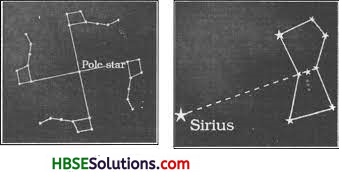
HBSE 8th Class Science Solutions Chapter 17 Stars and the Solar System 1

Question 11.
Name two objects other than planets which are members of the solar system.
Answer:
Meteors and Asteroids.

Question 12.
Explain how you can locate the Pole Star with the help of Ursa Major.
Answer:
Pole star is situated at the end of the Ursa Major. If a straight line starting from the last two stars is extended towards the north direction, it will lead to the Pole Star.

Question 13.
Do all the stars in the sky move? Explain.
Answer:
All the stars in the sky do not move, but they appear to move from east to west. This is actually due to rotation of earth on its axis. Earth moves from west to east. So it appears as the stars are rising from east and as the day dawns they sets in the west.

Question 14.
Why is the distance between stars expressed in light years? What do you understand by the statement that a star is eight light years away from the earth?
Answer:
Stars are away from the earth millions of kilometres away. It is not convenient to express such a large distance in the units of km. So the distance of stars from the earth is expressed in time taken by light to travel in one year. Eight light years mean time taken by light to travel in eight years.

Question 15.
Boojho made the following sketch (figure) of the solar system. Is the sketch correct? If not, correct it.
Answer:
No, the sketch is incorrect. The following sketch is correct.
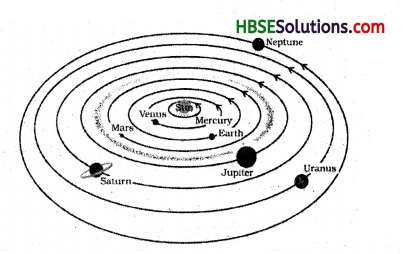
HBSE 8th Class Science Solutions Chapter 17 Stars and the Solar System 2

Extended Learning – Activities and Projects

Question 1.
If possible, visit a planetarium. There are planetariums in many cities. In a planetarium you can see the motion of the stars, constellations and planets on a large dome.
Answer:
For self attempt.

Question 2.
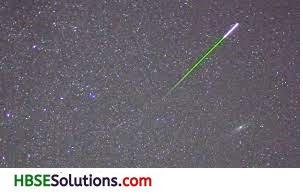
On a moonless night observe the sky for a few hours. Look out for a meteor, which appears as a streak of light. September-November is a good time for observing meteors.
Answer:
For self attempt.

Question 3.
Learn to identify the planets visible to the naked eye and some prominent constellations such as Great Bear (Saptarshi) and Orion. Also try to locate the Pole Star and the star Sirius.
Answer:
For self attempt.

Question 4.
Select a convenient place on the roof of your house or in some playground from where you can watch sunrise clearly. Remember that you will have to do this activity for a few months. So, choose the place carefully. On a sheet of chart paper draw the outline of the eastern horizon indicating big trees, poles, etc. Mark the outline of the sheet so that you can place it in the same position every time. After every two weeks, note the position from where the Sun rises and mark this on your chart paper (Fig.). Also note the date of your observation. Repeat this for a few months. It is advisable that you start observations in the month of November or May.
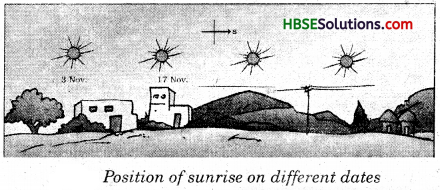
HBSE 8th Class Science Solutions Chapter 17 Stars and the Solar System 3
Does the Sun always rise from the same direction? Discuss your observations with you teacher, parents and elderly people in your family or in the neighbourhood.
Answer:
For self attempt.

Question 5.
Form a group of studens. Prepare a model of the solar system showing the planets, and their relative sizes. For this take a large chart paper. Make spheres representing different planets according in their relative size (Use Table). You may use newspaper, clay or plasticine to make spheres. You can cover these spheres with paper of different colours. Exhibit your model in the class.

Name of PlanetApproximate radius (assuming Earth as 1 unit)Approximate distance from the Sun (Assuming distance of the Earth as 1 unit)Period of revolutionPeriod of rotation
Mercury0.400.3988 days59 days
Venus0.950.72225 days243 days
Earth1.001.00365.25 days24 hours
Mars0.551.50687 days 24 hours37 min
Jupiter11.005.2012 years 9 hours55 min
Saturn9.009.5029.46 years10.66 hours
Uranus4.0019.2084 years17.2 hours
Neptune3.9030.00165 years16.1 hours

Answer:
For self attempt.

Question 6.
Try to make a scale model of the solar system showing distances of the planets from the Sun (Use Table 17.1). Did you face any difficulty? Explain it.
Answer:
For self attempt.

HBSE 8th Class Science Solutions Chapter 17 Stars and the Solar System

Question 7.
Solve the following riddle and try to make similar riddles yourself:
My first is in VAN but not in PAN
My second is in EARTH and also in HEAVEN
My third is in ONE and not in TWO
My fourth is in BUN and also in FUN
My last is in STAR but not in RADAR
I am a planet that moves round the Sun.
You can read more on the following websites:
→ http://www.nineplanets.org
→ http://www.kidsastronomy.com
→ http://www.solarsystem.nasa.gov/planets
→ http://aa.usno.navy.mil/fazz/does/moon- phases.html
Answer:
For self attempt.

HBSE 7th Class Science Stars and the Solar System Important Questions and Answers

Very Short Answer Type Questions

Question 1.
Name any three celestial bodies.
Answer:
Stars, Satellite, Planets.

Question 2.
Name the planets of solar system which cannot be seen by naked eye?
Answer:
Neptune and Pluto.

Question 3.
Name the force which makes planets move around the sun.
Answer:
Gravitational force.

Question 4.
Which has higher density : Earth or Sun?
Answer:
Earth.

Question 5.
Name the planet narest to earth.
Answer:
Mars is nearest to earth.

Question 6.
Write the names of any two constellation.
Answer:
Great Bear and Orion.

Question 7.
A group of stars visible in winter season look like a cluster of twinkling gems.
Answer:
Pleiades constellation.

Question 8.
In which season of the year are the constellations scorpio and orion visible in the Northern Hemisphere?
Answer:
Orion – Winters.
Scorpio – Summers.

Question 9.
Define star.
Answer:
Stars are the heavenly bodies that are extremely hot and have light of their own.

Question 10.
Name the star which is nearest to the earth.
Answer:
Alpha Centuari.

Question 11.
Write the names of two planets which are closer to the sun than the earth.
Answer:
Mercury and Venus.

Question 12.
Name the planet nearst to the sun.
Answer:
Mercury.

Question 13.
Name the planet farthest from the sun.
Answer:
Neptune.

Question 14.
Which planet of the solar system is the hotest?
Answer:
Mercury.

Question 15.
Name the planet of the solar system Which is nearer to the Sun and Venus.
Answer:
Mercury.

HBSE 8th Class Science Solutions Chapter 17 Stars and the Solar System

Question 16.
Which planet in the solar system is nearest to the earth?
Answer:
Venus.

Question 17.
Name the planet, where there is no carbon dioxide.
Answer:
Mercury.

Question 18.
Name the planets, which has no moon?
Answer:
Mercury and Venus.

Question 19.
Give any two applications of remote sensing.
Answer:
(i) Preparing waste land maps.
(ii) Survey for ground water and mineral resources.

Question 20.
A constellation having seven prominent stars, is visible during the winter. Name the constellation.
Answer:
Orion.

Question 21.
A belt of assorted debris, which failed to assemble into a planet, is located between the orbits of two planets in the solar system. Name these two planets.
Answer:
Mars and Jupiter.

Question 22.
Which planet has rings around it?
Answer:
Saturn.

Question 23.
Name largest asteroid.
Answer:
Ceres.

Question 24.
Why do meteors shine?
Answer:
On entering earth’s atmosphere, meteors become hot and bum due to friction of earths atmosphere and start to shine.

Question 25.
What are meteorites?
Answer:
Big pieces of rock material which do not bum completely in atmosphere of earth, fall on its surface. These are called meteorites.

Question 26.
How are comets formed?
Answer:
When the path of objects near the edge of solar system is disturbed to push them near to sun, comets are formed.

Question 27.
After how much time Halley’s comet is seen?
Answer:
After every 76 years.

Question 28.
Why does pole star appear to be stationary?
Answer:
Pole star lies on the axis of rotation of earth and appears stationary when viewed from any part of earth.

HBSE 8th Class Science Solutions Chapter 17 Stars and the Solar System

Question 29.
What does the colour of a star signify?
Answer:
Colour of a star signifies its temperature.

Question 30.
Define a satellite.
Answer:
A satellite is a solid heavenly small sized body revolving round a planet.

Short Answer Type Questions

Question 1.
Distinguish between stars and planets.
Answer:

StarPlanet
(i) Star has its own light.(i) Planet does not have its own light.
(ii) Star seems to move from east to west in the sky.(ii) Planet moves around a star called sun.
(iii) Stars are very big and gaseous in nature.(iii) Plants are comparatively small but appear big because they are nearer to earth.

Question 2.
Explain the importance of stars for the people in ancient times.
Answer:
In ancient times when there were no compass, night sky was very useful in finding the direction. As pole star remains fix in the sky in north, it indicated north direction. As the stars change their position with time, it has been possible to find the time with relative position of stars.

Question 3.
How is the pole star located in the sky? Why is it so special?
Answer:
The earth rotates on its axis from west to east, therefore, the stars appear to move in opposite direction, i.e. east to west. But pole star lies on the axis of rotation of earth which is fixed, Therefore, pole star also seems to be fixed in the sky. It is always in north direction and is very useful for finding direction.

Question 4.
Distinguish between star and shooting star.
Answer:

StarShooting star
(i) It has its own light.(i) It produces light when it becomes hot after entering in earth’s atmosphere.
(ii) Star is a gaseous body.(ii) It is not a star at all and is made of rocky material.
(iii) Has a very long life.(iii) Lasts only for a very short time.

Question 5.
What is a meteor? Why does it last for a very short time?
Answer:
Meteors are the heavenly bodies made of rocky material which enter earth’s atmosphere. When they travel through air they become hot and burn because of friction. Due to this, these rocky pieces melt and vaporises very fast and do not last long.

Question 6.
Distinguish between natural and artificial satellites.
Answer:
Natural satellites are far away from planets. They are comparatively larger in size and are present naturally. Artificial satellites are sent from earth with specific requirements. Their distanc, size and mass are lesser than the natural satellite.

Question 7.
What is solar system? Name the planets situated between the sun and the earth?
Answer:
The solar system consists of the sun, eight planets; and their satellites and other heavenly bodies like meteors, comets and asteroids. The sun is the centre of the solar system and all the planets revolve around the sun in elliptical paths called orbits. The planets situated between the sun and the earth are Mercury and Venus.

Question 8.
What are the phases of the Moon?
Answer:
Moon has no light of its own. It reflects light of the Sun falling on it. On new moon day, moon is between the sun and the earth and no reflected light from it reaches the earth. We cannot see moon on that day. The visible moon increases every day till fifteenth day from the new moon day, the full phase of the moon is visible.
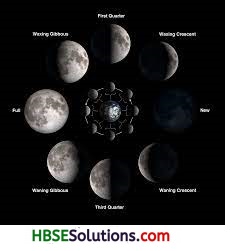
HBSE 8th Class Science Solutions Chapter 17 Stars and the Solar System 4
Positions of the Moon in its orbit and its corresponding phases
So, the waxing and waning of moon periodically as it revolves around the earth is called phases of moon.

Question 9.
Why moon cannot be used as a communication satellite?
Answer:
Moon is a natural satellite of the earth but it cannot be used as a communication satellite because :

  • It is very far away from earth.
  • Its time period 27.3 days is too large.
  • It has neither equitorial orbit nor polar orbit which makes a satellite useful for different purposes.

HBSE 8th Class Science Solutions Chapter 17 Stars and the Solar System

Question 10.
What are constellations? Name some easily recognizible constellations in the sky.
Answer:
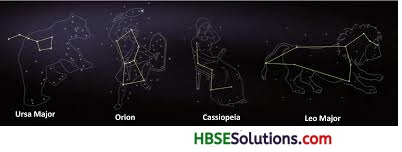
Group of stars forming a recognizible shape is called a constellation. These group of stars are identified in different shapes. Constellations do not change their shape. They also appear to move from east to west as other stars appear to. Some major constellations are Ursa Major, Ursa Minor, Orion, Cassiopeia etc. Some of them are visible during summers while some are visible during winters.

Question 11.
What are various types of motions associated with the planet earth?
Answer:
The earth has four types of motion. These are :
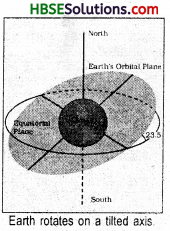
HBSE 8th Class Science Solutions Chapter 17 Stars and the Solar System 5
(i) The earth’s daily rotation on its axis.
(ii) The earth’s annual revolution around the sun.
(iii) The earth’s precession (conical motion of earth’s axis).
(iv) As a part of solar system, the earth’s motion in space along with the sun.

Question 12.
Explain the constellation Ursa Major.
Answer:
Ursa Major is one of the most famous constellation. We can see this constellation during summers. It is also called the Great Bear or the Saptarishi. There are seven prominently shining stars in this constellation which are arranged in shape of a question mark. At the tail of this constellation lies the Pole Star.
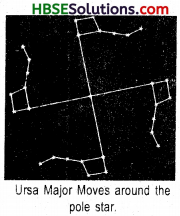
HBSE 8th Class Science Solutions Chapter 17 Stars and the Solar System 6

Question 13.
Describe the constellation also called the hunt.
Answer:
A well known constellation named Orion is also called the hunter. This constellation can be seen in the late evenings of winter. It has seven or eight brightly shining stars arranged in shape recognized with hunter. The brightest star in the sky Sirius is located at the extended line from the tail of this constellation.

Question 14.
What are asteroids?
Answer:
Asteroids are the small objects which revolve around the sun in a large gap between the orbits of Mars and Jupiter. These are quite large in their number and are considered as the part of our solar system. Each asteroid has its own orbit.

Question 15.
What are comets?
Answer:
Comets are the part of our solar system which revolve around the sun in highly elliptical orbits. It appears with a bright head and a long tail. The length of the tail grows in size as it approaches the sun. The tail is always directed away from sun.

Question 16.
What are various superstitions connected with appearance of comets?
Answer:
They are considered to be the messangers of destruction and disasters. They are supposed to bring wars,epidemics and flood with them. So, their appearance is considered as unauspicious.

HBSE 8th Class Science Solutions Chapter 17 Stars and the Solar System

Question 17.
List five uses of artificial satellites.
Answer:

  • Weather forecasting.
  • Radio and television transmission.
  • Long distance communication.
  • Locating mineral resources.
  • Gathering information about our space.

Long Answer Type Questions

Question 1.
Explain celestial sphere.
Answer:
The large imaginary sphere on which all the heavenly bodies like stars, planets and satellites seems to lie is known as celestial sphere. Since we are on the earth, the earth appears stationary to us. When we look at the sky, the various objects in the sky like the stars and the moon appear to be moving round the earth. In other words, the celestial sphere appears to be moving from east to west round the earth. This apparent motion of the celestial sphere from east to west is actually due to the daily rotation of the earth from west to east. Since the earth rotates from west to east, the celestial sphere appears to rotate in the opposite direction, from east to west.

Question 2.
What are constellations? Explain. Name some prominent constellations with their Indian names.
Answer:
The groups of stars which seem to be arranged in the sky in beautiful patterns and recogniseable shapes are known as constellations. With each constellation, the ancient astronomers assigned the name of an object which it appears to resemble. There are 88 constellations into which the whole of the sky has been divided. In Indian astronomy, the constellations are known as Nakshatras.

Some prominent constellations with their Indian names are given below :
(i) Ursa Major or Saptarishi.
(ii) Ursa Minor or Laghu Saptarishi
(iii) Orion or Mriga or Vyadha
(iv) Tarus or Vrashba
(v) Scorpio or Vrishchika.
HBSE 8th Class Science Solutions Chapter 17 Stars and the Solar System 7

Question 3.
What is pole star? What is specific j about its position in the sky?
Answer:
There is only one star in the sky which appears stationary to an observer on earth. This star is named as pole star (Polaris) or Dhruvtara in India. This star appears stationary because, i it lies in the direction of the axis of the Earth about which the earth rotates. Any point on or j along the axis of a rotating body appears to be stationary. So, the pole star that lies along the direction of the axis of rotation of the earth, always sppears to be stationary.

Question 4.
What are artificial satellites? Explain their usage.
Answer:
Man made objects orbitting in outer space around the earth or any other planet are called artificial satellites of earth or that particular planet. The satellite like INSAT 3E or Kalpana Chawla I are examples of artificial satellites. Artificial satellites have many practical applications that effect our lives in many ways, i Long distance transmission of television programmes, communication through telephones and internet could be possible because of them. Artificial satellites are also used for research, defence and remote sensing. Remote sensing means collecting information from a distance. Information is collected regarding weather, agriculture, land and ocean features including movement of fish.
HBSE 8th Class Science Solutions Chapter 17 Stars and the Solar System 9

 Stars and the Solar System Class 8 HBSE Notes

  • We can see many celestial bodies in a clear night sky.
  • Stars are one of the celestial bodies which emit light of their own.
  • Sun is also one of the stars which emits light and is a great source of heat. It is the closest star which is the centre of our solar system.
  • Stars are many light years away from the earth and thus look very small from earth.
  • Stars appear to travel from east to west.
  • Pole star is the most shining star in the night sky. The pole star appears to.be stationary. It is situated near axis of rotation of earth and is thus helpful in finding direction.
  • A group of stars, appearing in different shapes are called constellations. Their shapes resemble different objects and thus are named after the names of the objects.
  • Other improtant parts of night sky are the planets. Planets are those celestial bodies, which revolve around sun.
  • Our solar system consists of eight planets revolving around sun. It also consists of many other celestial bodies like asteroids, comets and meteors.
  • Comets are the celestial bodies that revolve in highly elliptical orbits around sun.
  • Bright streak of light in a night sky are commonly called shooting stars or meteors.
  • A celestial body revolving around another celestial body is called a satellite.
  • Artificially sent bodies in space, which revolve around earth or any other planet or a natural satellite is called an artificial satellite
  • Jupiter is the largest planet while Venus is brightest planet in the night sky.
  • Moon is the natural satellite of the earth. Moon appears in different phases. The phases of Moon occur because we can see only that part of the moon which reflects light towards us.

HBSE 8th Class Science Solutions Chapter 17 Stars and the Solar System Read More »
HBSE 8th Class Science Solutions Chapter 18 Pollution of Air and Water

Haryana State Board HBSE 8th Class Science Solutions Chapter 18 Pollution of Air and Water Textbook Exercise Questions and Answers.

Haryana Board 8th Class Science Solutions Chapter 18 Pollution of Air and Water

HBSE 8th Class Science Pollution of Air and Water Textbook Questions and Answers

Question 1.
What are the different ways in which water gets contaminated?
Answer:
Water gets contaminated by the following ways:

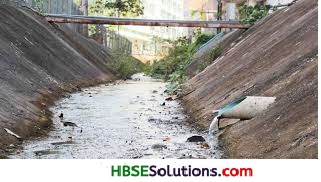
  • Water gets contaminated when sewage is disposed off in rivers.
  • Chemicals which are harmful and poisonous are thrown in water resources by various industrial units.
  • Harmful chemicals used in agricultural process gets mixed with ground water making it unfit for consumption.
  • Breeding of microorganisms in water make water polluted.

Question 2.
At an individual level, how can you help reduce air pollution?
Answer:
We can plant tree to reduce the level of carbon dioxide. We can get our vehicles serviced well to reduce uncomplete consumption of fuels. We can also reduce air pollution by saying no to crackers during Diwali celebrations.

Haryana Board 8th Class Science Solutions Chapter 18 Pollution of Air and Water

Question 3.
Clear, transparent water is always fit for drinking. Comment.
Answer:
Water which is clear and through which we can see is fit for consumption because this type of water is free from pollutants. Transparent water means no microorganisms and no dust particles.

Question 4.
You are a member of the municipal body of your town.
Make a list of measures that would help your town to ensure the supply of clean water to all its residents.
Answer:

  • To get clean water in every household, it is necessary that water reaching houses should be treated water. Water is treated in sewage plants, to make it free from physical, chemical and biological impurities.
  • Strict laws should be enforced on industrial units, which dispose polluted water in water resources.
  • Open defecation in water resources by slum dwellers should be strictly prohibited.
  • Chlorine tablets should be distributed for purification of water during rainy season.
  • People should be made aware and motivated to keep water resources clean.

Question 5.
Explain the differences between pure air and polluted air.
Answer:
Pure air is free from harmful gases which can be poisonous in nature. Pure air has balanced quantity of all its constituent gases and it is free from other germs. This type of air is fit for breathing. On the other hand polluted air has poisonous gases and other suspended impurities like dust and smoke. It is unfit for consumption.

Question 6.
Explain circumstances leading to acid rain. How does acid rain affect us?
Answer:
Acid rain is caused due to mixing of poisonous gases with rain. When our industrial units emit poisonous gases like sulphur dioxide and nitrogen dioxide, these gases react with moisture present in air and form nitric acid and sulphuric acid. These acids fall on the earth with rain making rain water acidic and harmful.

Acid rain causes the corrosion of buildings and make food grains, fruits and vegetables on which it fall, unfit for consumption.

Question 7.
Which of the following is not a greenhouse gas?
(a) Carbon dioxide
(b) Sulphur dioxide
(c) Methane
(d) Nitrogen
Answer:
Sulphur dioxide.

Haryana Board 8th Class Science Solutions Chapter 18 Pollution of Air and Water

Question 8.
Describe the ‘Green House Effect’ in your own words.
Answer:
Green house effect means warming the environment. When the rays of sun reach earth, some of the heat is absorbed by the earth. Rest of it is reflected back by the earth. Some of the heat is trapped by the environment of the earth. This causes warming of the environment, which is necessary for the sustaining life. This trapping of the heat is called green house effect.

Question 9.
Prepare a brief speech on global warming. You have to deliver the speech in your class.
Answer:
Continuous increase in the temperature of the earth is called global warming. It it caused by the pollution of air, excessive heat trapped by the green house gases, because the amount of green house gases has increased in the environment. Global warming is a threating phenomenon because we may have to face dire consequences due to Global warming.

Question 10.
Describe the threat to the beauty of the Taj Mahal.
Answer:
Increasing air pollution has posed a threat to the beauty of the Taj Mahal. Excessive poisonous gases and smoke has started to discolour the white marble of the Taj Mahal. Acid rains due to increasing air pollution has started to corrode the marble, thus making Taj Mahal loose its beauty.

Question 11.
Why does the increased level of nutrients in the water affect the survival of aquatic organisms?
Answer:
Addition of nutrients in water flourishes the growth of microorganisms like algae. When these microorganisms die, they become food of bacteria. When bacteria become active, they consume a lot of oxygen present in water. Decrease in oxygen in water, becomes trouble for other aquatic animals and they start dying due to insufficient amount of oxygen to breath.

Extended Learning – Activities and Projects

Question 1.
In some cities, a pollution check has been made compulsory for vehicles. Visit a petrol pump in order to learn about the process of conducting a pollution check. You may systematically record your findings in the following areas:
(i) Average number of vehicles checked per month.
(ii) Time taken to check each vehicle.
(iii) Pollutants checked for.
(iv) The process of testing.
(v) Permissible levels of emission of various gases.
(vi) Measures taken if the emitted gases are above the permissible limits.
(vii) How frequently is a pollution check required?
Answer:
For self attempt.

Haryana Board 8th Class Science Solutions Chapter 18 Pollution of Air and Water

Question 2.
Conduct a survey in your school to investigate various environment related activities that have been undertaken. The class can divide itself into two groups, with each group looking at a different area. For example, one group can find out whether there is an environment club in the school. What are its objectives? What is its calendar of events? How can you become a member?
If your school does not have such a club, you can even think of starting one along with a few of your friends.
Answer:
For self attempt.

Question 3.
Organise a field visit to a river in or around your town with the help of your teachers. Observations followed by discussion could focus on:
(i) The history of the river.
(ii) Cultural traditions.
(iii) Role of the river in meeting the town’s water needs.
(iv) Pollution concerns.
(v) Sources of pollution.
(vi) Effects of pollution on the people living by the riverside as well as those living far away.
Answer:
For self attempt.

Question 4.
Find out with the help of your teachers and the internet (if possible), whether there are any international agreements to control global warming. Which are the gases covered under these agreements?
(i) www.edugreen.teri.res.in/explore/air/ air.htm
(ii) www.edugreen.teri.res.in/explore/water/ pollu.htm
(iii) www.cpcb.nic.in/citizen’s%Charter/ default_citizen’s.html
(iv) coe.mse.ac.in/kidswater.asp
(v) coe.mse.ac.in/kidsair.asp
Answer:
For self attempt.

HBSE 7th Class Science Pollution of Air and Water Important Questions and Answers

Very Short Answer Type Questions

Question 1.
What is a pollutant?
Answer:
Pollutant is an undesired and harmful substance.

Question 2.
What is air pollution?
Answer:
Addition of pollutants to air is called air pollution.

Question 3.
Name any two air pollutants.
Answer:
Smoke and sulphur dioxide.

Question 4.
Name any two natural pollutants.
Answer:
Forest fire and erruption in volcanoes.

Haryana Board 8th Class Science Solutions Chapter 18 Pollution of Air and Water

Question 5.
What is smog?
Answer:
Mixture of smoke and moisture is called smog.

Question 6.
Name two chemicals causing acid rains.
Answer:
Sulphur dioxide and nitrogen dioxide.

Question 7.
Which gas is responsible for depletion of ozone layer?
Answer:
Chlorofluorocarbon.

Question 8.
Where CFC is used?
Answer:
CFC is used for refrigeration.

Question 9.
What effect does acid rain has on building?
Answer:
It corrodes the buildings.

Question 10.
Name any two green house gases.
Answer:
Methane and carbon dioxide.

Question 11.
Which phenomenon causes global warming?
Answer:
Green house effect.

Question 12.
Write any one harmful effect of global warming.
Answer:
It can cause flood by melting glaciers.

Question 13.
Which is the main constituent gas of air?
Answer:
Nitrogen about 78%.

Question 14.
What is the percentage of oxygen in air?
Answer:
21%.

Question 15.
Which industry is the main source of gaseous pollutants like sulphur dioxide and nitrogen dioxide?
Answer:
Petroleum refineries.

Haryana Board 8th Class Science Solutions Chapter 18 Pollution of Air and Water

Question 16.
From what does the ozone layer – protect us?
Answer:
Ozone layer protects us from ultraviolet rays of sun.

Question 17.
What reduces the visibility in air?
Answer:
Small suspended particles emitted by automobiles using diesel as fuel.

Question 18.
Which refinery is producing pollutants near the Taj Mahal?
Answer:
Mathura oil refinery.

Question 19.
What is Marble cancer?
Answer:
Corrosion of marble due to acid rain is called marble cancer.

Question 20.
Which fuel is being used as the pollution free fuel?
Answer:
CNG and LPG.

Question 21.
What is trapping of radiations of sun by the atmosphere of the earth, called?
Answer:
Green house effect.

Question 22.
Which gas is mainly the green house gas?
Answer:
Carbon dioxide.

Question 23.
Which substances pollute water?
Answer:
Sewage, toxic chemicals, silt etc.

Question 24.
Name the Indian river which is considered as one of the ten most polluted rivers in world?
Answer:
Ganga.

Question 25.
What pollutes Ganga?
Answer:
Untreated sewage, dead bodies, garbage etc.

Question 26.
What is the plan, implemented to save Ganga, called?
Answer:
Ganga Action Plan.

Question 27.
Which chemicals released in water leads to toxicity in animals and plants?
Answer:
Arsenic, lead and fluorides.

Question 28.
What do you mean by potable water?
Answer:
Water which is suitable for drinking is called potable water.

Question 29.
Which chemical is used to purify water?
Answer:
Chlorine.

Question 30.
Which physical qualities should we look for in drinking water?
Answer:
Clearness, transparency and odour.

Haryana Board 8th Class Science Solutions Chapter 18 Pollution of Air and Water

Short Answer Type Questions

Question 1.
Describe what is pollution.
Answer:
Pollution can be described as addition of unwanted and undesired harmful substances in any natural resource. Addition of these substances spoil the natural resources and make them unfit for consumption by men and other living beings. Air pollution, water pollution, soil pollution etc. are various types of pollutions.

Question 2.
Describe air pollution.
Answer:
Addition of poisonous and harmful substances in air is called air pollution. Air gets polluted when poisonous gases like sulphur dioxide, nitrogen dioxide and other oxides of nitrate get mixed up in air. It is also polluted by smoke emitted by industries using coal and also the smoke emitted by vehicles.

Question 3.
Write any three causes of air pollution.
Answer:
Following are various causes of air pollution:

  • Smoke emitted due to fires in forests.
  • Poisonous gases expelled the various industries.
  • Poisonous gases emitted by vehicles using petroleum fuels.

Question 4.
What is smog? How is it produced?
Answer:
In winters, we can see a fog like dark layer in the mornings and nights. It reduces the visibility. This is called smog. Smog means fog plus smoke. It is formed due to combination of oxides of mitrates with fog. Various vehicles and industries produce smoke and the nitrates. Thus smog is formed.

Question 5.
What is ozone? How is it helpful for our environment?
Answer:
Ozone is a gas which is very helpful for environment of our earth. It forms a protective layer around the atmosphere of earth. It does not allow the ultraviolet rays of the sun from reaching the earth. U.V. rays can cause great damage to our earth. So, ozone is of great help for our earth.

Question 6.
What is ozone hole or depletion of ozone layer?
Answer:
A gas named ozone forms a protective layer around the atmosphere of the earth. It protects the earth from the ultra-violet rays of the sun. But some chemicals used in refrigeration causes damage to this layer. CFCs cause tearing away of this layer. This is called depletion of ozone layer. At some points, this layer is depleted completely and holes are created. These holes are called ozone holes.

Question 7.
What are the harmful effects of air pollution?
Answer:
Air pollution cause many diseases in human beings. Respiratory diseases are commonly caused by air pollution. It causes harm to our building and monuments. It reduces visibility as smog and causes many serious accidents.

Question 8.
How is acid rain caused?
Answer:
When rain water becomes acidic in nature, it is called the acid rain. Different industries produce pollutants like sulphur dioxide and nitrogen dioxide. These gases react with moisture and produce sulphuric acid and nitric acid. These acids fall on earth along with rain and this is called acidic rain.

Haryana Board 8th Class Science Solutions Chapter 18 Pollution of Air and Water

Question 9.
What steps has. Honourable Supreme Court taken to save the Taj Mahal from air pollution?
Answer:
The Supreme Court has given orders that cleaner fuel be used in the near about areas of the Taj Mahal. Fuels like CNG and LPG are considered clean fuel. Moreover petrol should be free from lead. This is called unleaded petrol. Only unleaded petrol can be used in areas near the Taj Mahal.

Question 10.
What is the Green House effect?
Answer:
The sun sends its rays to the earth. Some of these rays are absorbed by the earth and some radiations are reflected back by the earth. Thes reflected radiations are not allowed to leave earth’s atmosphere completely. Some of these radiations are trapped by the earth’s atmosphere and this is called the green house effect.

Question 11.
What is global warming? How is it caused?
Answer:
Increasing temperature of the earth is called global warming. The radiation of the sun, reaching the earth is not being consumed. This is due to the deforestation. The level of CO2 has increased and thus global warming has also increased. CO2 is absorbed by the plants for photosynthesis. So reduced number of plants increases the amount of carbon dioxide in the environment, this causes accumulation of carbondioxide and increases temperature.

Question 12.
How does water get polluted?
Answer:
Water gets polluted when unwanted and harmful chemical substances are added to the water. Untreated sewer and garbage is also added to water resources to pollute water. All these chemicals make water unfit for usage.

Long Answer Type Questions

Question 1.
What is air pollution? How is it caused?
Answer:
When poisonous gases, dirt and smoke get added in the water it pollutes the air and it is called air pollution. Following factors are responsible for air pollution.
(i) Industrial Emissions : Various dangerous and poisonous gases emitted by different industries cause air pollution. Industries using coal and other petroleum products as fuel emit poisonous gases like sulphur dioxide and nitrogen dioxide. These gases further react with moisture present in environment and form their respective acids. These acids along with rain water cause acid rains.

(ii) Vehicles : Unburnt carbon particles emitted by vehicles due to incomplete combustion cause severe air pollution. It contains gases like carbodioxide and carbon monoxide which is highly poisonous. Unburnt carbon particles emitted as smoke also cause phenomenon like smog which reduce visibility besides causing air pollution.

(iii) Natural Pollutant: Natural pollutants like forest fire, volcanic erruption, dust storms etc. also cause air pollution to some extent.

(iv) Other activities of Man : Besides above described causes many other human activities also add to air pollution. Using fuels like cow dung, coal, wood etc. at home for domestic use also pollute the air. Agricultural practices like burning chaff after cultivation etc. also pollute the air. A lot of air pollution is caused due to burning of crackers on Diwali and other celebrations.

Haryana Board 8th Class Science Solutions Chapter 18 Pollution of Air and Water

Question 2.
How is water pollution caused?
Answer:
Water pollution is caused by many factors. These pollutants are described below :
(i) Industrial discharges: Various harmful and poisonous chemicals are discharged by various industries directly into water bodies. These chemicals when added in water, spoil it and render it unfit for consumption by living beings.

(ii) Domestic discharges : Sewage from homes are collected and disposed off in rivers nearby. This untreated sewage is one of the prominent causes of water, pollution.

(iii) Religious Rituals : Various religious rituals of different religions also add to certain extent to the water pollution.
Haryana Board 8th Class Science Solutions Chapter 18 Pollution of Air and Water 1
Dispersion of dead bodies or remains of dead bodies in rivers is causing pollution of water. Various other materials are also dispersed in water after performing some rituals. These also make water dirty.

(iv) Other Human activities : Apart from above cited reasons, water is also polluted due to certain other human activities. People wash their clothes on banks of rivers. They take their livestock to rivers for their bathing. They throw their wastage in water bodies and sometimes defecate in open at the banks of rivers. This makes water polluted and unfit for human consumption.

Question 3.
What measures should be taken to control air pollution and water pollution?
Answer:
Air pollution and water pollution are causing a great threat for the human civilization. We should seriously work to control them. Following measures can help us in controlling air and water pollution :
(i) All industrial units should use cleaner fuels and should not release their harmful 4 emission directly into air or water.

(ii) All industrial units throwing their harmful waste products in water, should install treatment or purification plants in their premises so that only treated and purified waste should be released in water bodies.

(iii) All the sewages of cities and villages should treated to destroy harmful physical, chemical and biological impurities before releasing it in water resources.

(iv) All vehicles should use pollution free fuels like CNG, LPG and unleaded petrol. Vehicles should be serviced well to avoid incomplete combustion of fuel.

(v) Smokeless fuels should be provided for domestic usage.

(vi) Electrical crematoriums should be made in all cities as well as in villages.

Question 4.
What are the various harmful effects of air and water pollution?
Answer:
(i) Air and water pollution are both dangerous for human health. They cause various diseases, which are the result of harmful emissions and discharges in air and water. Water brone diseases like Cholera, Typhoid, Infections, etc. are caused. Air pollution causes various respiratory diseases like asthma, allergies and lung cancer etc.

(ii) These pollutions also cause troubles for animals. Water pollution destroy the aquatic life as it causes deficiency of oxygen in water causing death of aquatic animals.

(iii) Various environmental problems like global warming are result of air pollution. Due to increase in level of carbon dioxide, the radiations of sun are not allowed to leave our environment. They get trapped in our environment and temperature of earth gets increased. This is called global warming.

(iv) Fresh and consumable water is getting reduced day by day as water resources are getting polluted very rapidly.

(v) Phenomena like smog, marble-cancer etc. are causing threat to our property and life.

Haryana Board 8th Class Science Solutions Chapter 18 Pollution of Air and Water

Pollution of Air and Water Class 8 HBSE Notes

  • Addition of unwanted and poisonous substances in air or water is called their respective pollutions.
  • Air and water pollution has increased in recent past with industrialization and urbanization.
  • Air is a mixture of gases mainly the nitrogen, oxygen and carbon dioxide when any of the harmful gases increase in its percentage, it makes the air polluted.
  • Emission of smoke in industries, smoke due to forest fires and smoke emitted by vehicles pollutes the air.
  • Smoke, dust of harmful gases emitted during volcanic erruptions, or forest fires or due to dust storms etc. are called the natural air pollutents.
  • Unburnt fuel of the vehicles is one of main cause of air pollution.
  • Air pollution can give rise to different ailments in human beings. Oxides of nitrogen can cause asthma, cough and wheezing. It can even cause cancer of lungs.
  • Pollutants like sulphur dioxide, nitrogen oxide are emitted by industries.
  • Gases used in refregeration also cause depletion of ozone layer, which cause further environmental problems like global warming.
  • Non-living objects are also effected by air pollution. Discolouring of white marble of Taj Mahal is an example.
  • Deforestation is one of the main cause of air pollution because less amount of carbon dioxide is absorbed by the plants and its amount increases in atmosphere resulting in global warming.
  • Addition of undesirable substances like sewage, harmful chemicals etc. to the water cause water pollution.
    Polluted water becomes unfit for consumption.
  • Water is purified before consuming it.

HBSE 8th Class Science Solutions Chapter 18 Pollution of Air and Water Read More »

HBSE 7th Class Science Solutions Chapter 10 Respiration in Organisms

Haryana State Board HBSE 7th Class Science Solutions Chapter 10 Respiration in Organisms Textbook Exercise Questions and Answers.

Haryana Board 7th Class Science Solutions Chapter 10 Respiration in Organisms

HBSE 7th Class Science Respiration in Organisms Textbook Questions and Answers

Question 1.
Why does an athlete breathe faster and deeper than usual after finishing the race?
Answer:
During the race, the athlete has to run very fast. The demand for energy at that time increases, which increase the demand for more supply of oxygen, so, athlete has to breathe faster and deep to inhale more oxygen.

Question 2.
List the similarities and differences between aerobic and anaerobic respiration.
Answer:
Differences between aerobic and anaerobic respiration :

Aerobic RespirationAnaerobic Respiration
1. It occurs in the presence of oxygen.1. It occurs in absence of oxygen.
2. Food molecules are broken down into water and carbon dioxide.2. Food molecules are broken down into ethyl alcohol and carbon dioxide.
3. Large amount of energy is released.3. Small amount of energy is released.

Similarities : (Both aerobic and anaerobic respiration produce energy and give out carbon dioxide.

HBSE 7th Class Science Solutions Chapter 10 Respiration in Organisms

Question 3.
Why do we often sneeze when we inhale, a lot of dust-laden air?
Answer:
We sneeze to get rid of the unwanted particles like dust etc from our body. It allows only clean and dust free air to enter our body.

Question 4.
Take three test tubes. Fill 3/4th of each tube with water. Label them A, B and C. Keep a snail in test tube A; a water plant in test tube B and in C, keep snail and plant both. Which test tube will have highest concentration of CO2?
Answer:
There will be highest concentration of CO2 in tube A.

Question 5.
Tick the correct answer :
(a) In cockroaches air enters the body through :
(i) Lungs
(ii) Gills
(iii) Spiracles
(iv) Skin
Answer:
(iii) Spiracles

(b) During heavy exercise, we get cramps in the legs due to the accumulation of :
(i) carbon dioxide
(ii) lactic acid
(iii) alcohol
(iv) water
Answer:
(ii) lactic acid

(c) Normal range of breathing rate per minute in an average adult person at rest is :
(i) 9-12
(ii) 15-18
(iii) 21-24
(iv) 30-33
Answer:
(ii) 15-18

(d) During exhalation, the ribs :
(i) move outwards
(ii) move downwards
(iii) move upwards
(iv) do not move at all
Answer:
(ii) move downwards.

HBSE 7th Class Science Solutions Chapter 10 Respiration in Organisms

Question 6.
Match the items in column I with those in column II.

Column IColumn II
(a) Yeast(i) Earthworm
(b) Diaphragm(ii) Gills
(c) Skin(iii) Alcohol
(d) Leaves(iv) Chest cavity
(e) Fish(v) Stomata
(f) Frog(vi) lungs and skin
(vii) trachea

Answer:
(a) (iii)
(b) (iv)
(c) (i)
(d) (v)
(e) (ii)
(f) (vi).

Question 7.
Make ‘T’ if the statement is true and ‘f if it is false.
(i) During heavy exercise the breathing rate of a person slows down. (T/F)
(ii) Plants carry out photosynthesis only during the day and respiration only at night. (T/F)
(iii) Frogs breathe through their skins as well as their lungs. (T/F)
(iv) The fishes have lungs for respiration. (T/F)
(v) The size of the chest cavity increases during inhalation. (T/F)
Answer:
(i) False
(ii) False
(iii) True
(iv) False
(v) True.

Question 9.
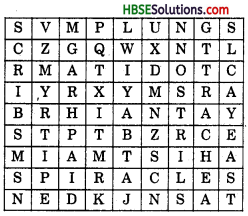
Given below is a square of letters in which are hidden different words related to respiration in organisms. These words may be present in any direction – upwards, downwards, or along the diagonals. Find the words for your respiratory system. Clues about those words are given below the square.
HBSE 7th Class Science Solutions Chapter 10 Respiration in Organisms 1
(i) The air tubes of insects.
(ii) Skeletal structures surrounding chest cavity.
(iii) Muscular floor of chest cavity.
(iv) Tiny pores on the surface of leaf.
(v) Small openings on the sides of the body of an insect.
(vi) The respiratory organs of human beings.
(vii) The openings through which we inhale.
(viii) An anaerobic organism.
(ix) An organism with tracheal system.
Answer:
(i) Trachea
(ii) Ribs
(iii) Diaphragm
(iv) stomata
(v) spiracles
(vi) lungs
(vii) nostrils
(viii) yeast
(ix) ant.

Question 10.
The mountaineers carry oxygen with them because :
(a) At an altitude of more than 5 km there is no air.
(b) The amount of air available to a person is less than that available on the ground.
(c) The temperature of air is higher than that on the ground.
(d) The pressure of air is higher than that on the grow.
Answer:
(b) The amount of air available to a person is less than that available on the ground.

HBSE 7th Class Science Solutions Chapter 10 Respiration in Organisms

Extended Learning – Activities and Projects

Question 1.
Observe fish in an aquarium. You will find flap like structures on both sides of their heads. These are flaps which cover the gills. These flaps open and close alternately. On the basis of these observations, explain the process of respiration in the fish.
Answer:
Do yourself. Take help your teacher.

Question 2.
Visit a local doctor. Learn about the harmful effects of smoking. You can also collect material on this topic from other sources. You can seek help of your teacher or parents. Find out the percentage of people of your area w ho smoke. If you have a smoker in your family, confront him with the material that you have collected.
Answer:
Do yourself.

Question 3.
Visit a doctor. Find out about artificial respiration. Ask the doctor:
(a) When does a person need artificial respiration?
(b) Does the person need to be kept on artificial respiration temporarily or permanently?
(c) From where can the person get supply of oxygen for artificial respiration?
Answer:
Do yourself.

Question 4.
Measure the breathing rate of the members of your family and some of your friends. Investigate :
(a) If the breathing rate of children is different from that of adults.
(b) If the breathing rate of males is different from that of females.
If there is a difference in any of these cases, try to find the reason.
Answer:
Do yourself.

HBSE 7th Class Science Respiration in Organisms Important Questions and Answers

Very Short Answer Type Questions

Question 1.
What is respiration?
Answer:
Respiration is a process of taking oxygen into the cells to break down simple food materials to release energy.

Question 2.
What is breathing?
Answer:
Breathing is inhaling oxygen and exhaling carbon dioxide.

Question 3.
Where does cellular respiration take place?
Answer:
Cellular respiration takes place inside the cells of the body.

HBSE 7th Class Science Solutions Chapter 10 Respiration in Organisms

Question 4.
What is aerobic respiration?
Answer:
Process of respiration taking place in the presence of oxygen is called aerobic respiration.

Question 5.
What is anaerobic respiration?
Answer:
Process of respiration without the presence of oxygen is called anaerobic respiration.

Question 6.
Does the process of anaerobic respiration take place in human body?
Answer:
Yes, during heavy physical activities, when supply of oxygen is not sufficient, anaerobic respiration takes place in the muscle cells.

Question 7.
What is diaphragm?
Answer:
Diaphragm is a large muscular sheet which forms the floor of the chest cavity.

Question 8.
Name the main respiratory organs in mammals.
Answer:
Lungs are the main respiratory organs in the mammals.

Question 9.
Name the main respiratory organs in insects.
Answer:
Spiracles and tracheae are the main respiratory organs in insects.

Question 10.
Name the respiratory organs in the fish.
Answer:
Gills are the respiratory organs in the fish.

Question 11.
How does earthworm respirate?
Answer:
Earthworm respires through its moist skin.

Question 12.
Where does exchange of gases take place in plants?
Answer:
In plants the exchange of gases takes place through tiny openings called stomata on the leaves.

Short Answer Type Questions

Question 1.
Differentiate between breathing and respiration.
Answer:
Breathing and respiration have following differences:

Question 2.
How does aerobic respiration takes place?
Answer:
In aerobic respiration oxygen is taken into the cells. The food is broken down into simple food materials and energy is released. Carbon dioxide and water is also released.
Gulcose \(\frac{\text { presence of }}{\text { Oxygen }}\) Carbon dioxide + water + energy

HBSE 7th Class Science Solutions Chapter 10 Respiration in Organisms

Question 3.
What is breathing rate? How is it counted and what is the breathing rate in an adult at the position of rest?
Answer:
Breathing rate is the number of times a person breathes in a minute. To count the breathing rate, we have to count an inhalation and an exhalation as one. Breathing rate in an adult at rest is 15-18 times in a minute.

Question 4.
How is air pushed out during exhalation?
Answer:
During exhalation the ribs move downwards and inwards. The diaphragm moves up and chest cavity gets contracted and air is thrown out.

Question 5.
How do insects breathe?
Answer:
Insects have small openings on the outside of their bodies. These openings are called spiracles, which are connected to the air pipes called tracheae. In tracheae the exchange of gases take place.

Question 6.
How are frogs peculiar in their way of breathing?
Answer:
Frogs breathe differently in water and differently on land. They use their moist skin to breathe in water. They use lungs to breathe on land.

Question 7.
How do plants respirate?
Answer:
Plants also take in oxygen and give out carbon dioxide for respiration. They have small openings called stomata on the surface of there leaves. Exchange of gases take place through these openings.

Long Answer Type Questions

Question 1.
Explain the process of respiration.
Answer:
In respiration, there is a gaseous exchange between the organism and the environment. The process of respiration can be divided in two parts. Breathing and cellular respiration.

Breathing or external respiration: Oxygen is inhaled and Carbon dioxide is exhaled during breathing. This process takes place out side the cells and, thus is called external breathing.

Cellular respiration or internal respiration : This is a biochemical process which takes place inside the cells of the body. In this process food i.e. glucose is broken into simpler forms. Energy is released during this process which is used by body to perform various functions. Carbon dioxide and water is also released. The Carbon dioxide is expelled out during breathing.
Food + Oxygen → Carbon dioxide + Water + Energy.

HBSE 7th Class Science Solutions Chapter 10 Respiration in Organisms

Question 2.
Explain the process of respiration in plants.
Answer:
In plants the process of respiration leads to the release of energy. It is a cellular process in which molecules of glucose break down in the presence of oxygen to release energy along with water and carbon dioxide. Exchange of gases take place through small openings on the surface of the leaves. These are called stomata. Lower plants lack the organs of breathing. In such plants gaseous exchange occurs due to simple process of diffusion. The rate of exchange of gases in plants is not as fast as in animals.

Respiration in Organisms Class 7 HBSE Notes

  • Respiration is a process of taking oxygen into the cells in order to break down simple food materials to release energy and eliminate waste products.
  • Breathing is inhaling oxygen and exhaling carbon dioxide.
  • Breathing takes place out side the cells.
  • Cellular respiration takes place inside the cells.
  • Inside the Cells the food is broken into water and carbon dioxide. This is called cellular respiration. This process releases a lot of energy.
  • When the process of respiration takes place in the presence of oxygen, it is called aerobic respiration.
  • When the process of respiration takes place in the absence of oxygen, it is called anaerobic respiration.
  • Human beings have a fully developed respiratory system.
  • Nostrils inhale oxygen, which reaches the lungs through the nasal cavity.
  • Lungs are organs, where the exchange of gases takes place. Carbon dioxide is expelled out and oxygen is consumed for cellular respiration.
  • Smaller animals like cockroaches have structures called spiracles, for breathing. Earthworms breathe through their skin and fish have gills for respiration.
  • In both plants and animals, mitochondria is the site of respiration.

HBSE 7th Class Science Solutions Chapter 10 Respiration in Organisms Read More »

HBSE 7th Class Science Solutions Chapter 11 Transportation in Animals and Plants

Haryana State Board HBSE 7th Class Science Solutions Chapter 11 Transportation in Animals and Plants Textbook Exercise Questions and Answers.

Haryana Board 7th Class Science Solutions Chapter 11 Transportation in Animals and Plants

HBSE 7th Class Science Transportation in Animals and Plants Textbook Questions and Answers

Question 1.
Match structures given in column I with functions given in column II.

Column-IColumn-II
(i) Stomata(a) Absorption of Water
(ii) Xylem(b) Transpiration
(iii) Root hairs(c) Transport of food
(iv) Phloem(d) Transport of water
(e) Synthesis of carbohydrates

Answer:
(i) (b)
(ii) (d)
(iii) (a)
(iv) (c)

Question 2.
Fill in the blanks :
(i) The blood from the heart is transported to all parts of the body by the __________.
(ii) Haemoglobin is present in __________ cells.
(iii) Arteries and veins are joined by a network of __________.
(iv) The rhythmic expansion and contraction of the heart is called __________.
(v) The main excretory product in human beings is __________.
(vi) Sweat contains water and __________.
(vii) Kidneys eliminate the waste materials in the liquid form called __________.
(viii) Water reaches great heights in the trees because of suction pull caused by __________.
Answer:
(i) Arteries
(ii) Red Blood Cells
(iii) Capillaries
(iv) Heart beat
(v) Urine
(vi) Urea
(vii) Urine
(viii) Transpiration

HBSE 7th Class Science Solutions Chapter 11 Transportation in Animals and Plants

Question 3.
Choose the correct options:
(а) In plants, water is transported through :
(i) Xylem
(ii) Phloem
(iii) Stomata
(iv) Root hair
Answer:
(i) Xylem

(b) Water absorption through roots can be increased by keeping the plants :
(i) in the shade
(ii) in dim light
(iii) under the fan
(iv) covered with a polythene bag.
Answer:
(iii) under the fan

Question 4.
Why is transport of materials necessary in a plant or an animal? Explain.
Answer:
Transport of materials is necessary in plant or animal because due to it the nutrients are made available to all the parts of the body. If the transport of necessary nutrients does not take place in the body, the body will not be able to survive. So, the circulation of nutrients takes place in the whole body through the process of transportation.

Question 5.
What will happen if there are no platelets in the blood?
Answer:
The blood platelets are responsible for the clotting of the blood. When some injury occurs blood starts flowing. But it clots on its own due to the blood platelets. If there are no platelets in the blood, the blood will not be able to clot and keep on flowing through a wound or injury. This can prove fatal for the organisms as no blood will remain in the body.

Question 6.
What are stomate? Give two functions of stomata.
Answer:
There are small openings on the lower surface of the leaves and stems. These pores are called stomata. These opening are covered with guard cells. Two functions of stomata are:

  • It helps in the transpiration of water i.e. the loss of excess water from the plant.
  • Loss of water from the stomata creates an upward pull i.e a suction pull which helps in absorption of water to great height in tall trees.

HBSE 7th Class Science Solutions Chapter 11 Transportation in Animals and Plants

Question 7.
Does transpiration serve any useful function in the plants? Explain.
Answer:
Transpiration is an important function in plants. It serves the following purposes:

  • It helps to enhance the absorption of water by creating a suction pull.
  • It helps the plant in getting rid of the excess water.
  • It produces a cooling effect on the plant which prevents the heat of the sun light from damaging plants.
  • It helps in transport of water and minerals to leaves and leaves use the water for the process of photosynthesis.

Question 8.
What are the components of blood?
Answer:
There are four components of the blood.

  • Plasma is the liquid part of the blood which is yellowish in colour and contains 90 percent water. It contains food, enzymes, wastes and proteins etc.
  • Red blood cells (R.B.Cs) are disc shaped cells containing red coloured pigment called haemoglobin in it. Haemoglobin helps in transportation of oxygen.
  • White blood cells (W.B.Cs) are the fighting cells, which protect us against bacteria and foreign material causing infections
  • Platelets help in clotting of the blood.

Question 9.
Why is blood needed by all the parts of a body?
Answer:
Blood is needed by all parts of the body because, it contains the digested food in it. It supplies the digested food to various parts of the body and provide essential energy to them. This energy helps the body to perform various functions and activities.

Question 10.
What makes the blood look red?
Answer:
A red coloured pigment called haemoglobin gives the blood its red colour. This pigment helps in carrying oxygen to various part of the body by blood.

Question 11.
Describe the function of the heart.
Answer:
The heart functions in the following way:
The right auricle and ventricle receives blood with carbon dioxide from all the parts of the body. The collected blood is then pumped to the lungs for the purification. In lungs the exchange of gases take place and purified blood is sent back to the left auricle. It pumps it to the left ventricle, which in turn pumps off the purified blood to all the parts of the body through arteries.

Question 12.
Why is it necessary to excrete waste products?
Answer:
The build up of waste and poisonous products in our body is always harmful. The waste products like urea etc. are toxic. When such toxic materials are not removed from the body, they get mixed with blood and can damage the cells of the body, thus proving fatal. It is, therefore, necessary to remove such poisonous waste materials from our body.

HBSE 7th Class Science Solutions Chapter 11 Transportation in Animals and Plants

Question 13.
Draw a diagram of the human excretory system and label the various parts.
Answer:
Do it yourself.

Extended Learning – Activities and Projects

Question 1.
Find out about blood groups and their importance.
Answer:
Do it yourself.

Question 2.
When a person suffers from chest pain, the doctor immediately takes an ECG. Visit a doctor and get information about ECG. You may even look up an encyclopaedia or the internet.
Answer:
Do it yourself.

HBSE 7th Class Science Transportation in Animals and Plants Important Questions and Answers

Very Short Answer Type Questions

Question 1.
What is circulatory system?
Answer:
Circulatory system is that system which transport nutrients to various parts of the body.

Question 2.
What makes the blood red?
Answer:
A red pigment called haemoglobin makes the colour of the blood red.

Question 3.
Name various kinds of cells present in blood.
Answer:
Blood has liquid part called plasma which has Red Blood Cells, white blood cells and platelets in it.

Question 4.
What role does the red pigment haemoglobin play in our body?
Answer:
Haemoglobin gets bound with the oxygen and supplies oxygen to various parts of the body. Oxygen is essential for respiration.

Question 5.
Why platelets are important for humans?
Answer:
Platelets are very important because they cause clotting of the blood. Without platelets blood will flow from the wounds unstopped and cause death.

Question 6.
What is pulse?
Answer:
Number of times the heart beats in a minute is called pulse. In resting position pulse rate of a normal human is 72-80 beats/min.

HBSE 7th Class Science Solutions Chapter 11 Transportation in Animals and Plants

Question 7.
What is the main difference between an artery and a vein?
Answer:
Artery carries purified blood i.e. blood carrying oxygen and vein carries blood rich in carbon dioxide.

Question 8.
What is transpiration?
Answer:
Transpiration is the loss of excess water from the leaves through the small pores called stomata.

Question 9.
What is excretion?
Answer:
Excretion is the process of throwing out the unwanted and waste products from the body.

Question 10.
What is dialysis?
Answer:
Dialysis is a process of separating small molecules from the large molecules using a semipermeable membrane.

Short Answer Type Questions

Question 1.
Explain briefly how the following are transported in plants.
(a) Water and mineral
(b) Food
Answer:
(a) Water and minerals are transported through the vascular tissues called xylem. Roots absorbs water from the soil and xylem transport it leaves prepare food by photosynthesis and this food is transported from leaves to different part by phloem.

(b) Food is transported in plants through vascular tissue called phloem.

Question 2.
What is transpiration? How is it different from translocation?
Answer:
Transpiration is the process of loosing excess water from the plants through small pores present on leaves called stomata. While the process of transportation of food through phloem is called translocation. Phloem transfer glucose from leaves to other parts of the plant while transpiration is evaporation of water to the environment.

Question 3.
List the factors affecting transpiration.
Answer:
Following factors affect transpiration in plants :
(i) Sunlight : Bright sunlight fastens the process of transpiration. No transpiration takes place during night.

(ii) Temperature : High temperature increases the rate of-transpiration while low temperature lowers the rate of transpiration.

(iii) Wind : Blowing wind increases the transpiration as water vapours are quickly removed from the leaves.

(iv) Humidity: Humid day lessens the rate of transpiration.

HBSE 7th Class Science Solutions Chapter 11 Transportation in Animals and Plants

Question 4.
How does transportation occur in lower animals?
Answer:
The transportation occurs in lower animals through diffusion. The nutrients circulate in the body of lower animals by the flow of cytoplasm. In some multicellular aquatic plants transportation takes place by water which circulates the nutrients through their bodies.

Question 5.
What is stethoscope? What are its main parts?
Answer:
Stethoscope is an instruments used to measure the heart beat by the doctors. It has three parts :

  • a chest piece that is sensitive to heart beats.
  • two ear pieces.
  • a tube joining the chest piece and ear pieces.

Question 6.
Write a short note on heart beat and pulse?
Answer:
Number of times a heart beats in a minute is called pulse. It can be felt by feeling the pressure of movement of blood through the artery at our wrist and by feeling the thumping of heart in our chest. It increases with physical activities. In children it varies from 90 to 100 times per minute and in adults from 70-72 beats per minute.

Question 7.
Mention the functions of the blood.
Answer:
Blood performs the following functions

  • It transports nutrients to various parts of body.
  • It carries oxygenated blood to different parts of the body.
  • It collects deoxygenated blood from various parts of the blood and takes it to lungs for purification.
  • It maintains the body temperature.
  • White blood cells fight against the infections and protect us from diseases.

Question 8.
Name various organs of excretion in humans.
Answer:
Various organs of excretion in humans are :

  • Lungs – for exchange of gases.
  • Skin – for sweating.
  • Large intestine – for excretion faeces.
  • Kidneys – for excretion urine.
  • Liver – for excretion excess sugar.

Question 9.
What is the importance of sweating?
Answer:
Sweat is water, salt and urea eliminated by skin in liquid form. The sweat is secreted by the sweat glands. Sweat is important in expelling the wastes like urea and salt from the body, It keeps the body cool and maintain the body temperature.

HBSE 7th Class Science Solutions Chapter 11 Transportation in Animals and Plants

Question 10.
Explain the process of dialysis in brief.
Answer:
Process of Dialysis is used to remove the waste from the body of those people, whose kidneys are not working. Dialyses machine help in removing the waste. A tube of the machine is connected to patients blood. Blood is purified in a semipermeable membrane inside the machine and purified blood is sent back to the body.

Long Answer Type Questions

Question 1.
Explain the circulatory system in Human beings.
Answer:
The Human circulatory system consists of mainly three parts : (i) Heart, 2. Blood vessels, 3. Blood.
1. The Heart: Heart is the pumping organ present in our body. It pumps blood to all the parts of the body. It equals a clenched fist in its size. It is located in the chest cavity on the left side. It is made up of muscles and protected by a cardial membrane called paracardium. It has four chamber – two upper chambers called Auricles and two lower chambers called Ventricles. Blood is received by auricles and pumped by ventricles. The contraction and relaxations of these chambers is called the heart beat.

2. Blood vessels : Arteries, veins and capillaries are three types of blood vessels. Arteries carry oxygenated blood while veins collect deoxygenated blood. All arteries and veins are interconnected through the network of capillaries.

3. Blood : It is red coloured fluid carrying digested food to all the parts of the body and waste products to the excretory system. It has fluid portion called plasma. Plasma has Red blood cells, White blood cells and platelets in it. Red colour of the blood is due to the red pigment called haemoglobin in it. White blood cells fight against infections and platelets cause clotting of the blood.

Question 2.
Explain the Excretory System of human beings.
Answer:
Human Excretory System consists of following organs:

  • A pair of Kidneys
  • Ureters
  • Urinary bladder
  • Urethra.

→  Kidneys : Kidneys are bean shaped structures, located on each side of the backbone above the waist. Kidneys have a number of coiled tubes like structures called nephrons. Nephron consists of a Bowman’s Capsule. It is a cup like structure having a network of blood capillaries. Nephron has a long tubule surrounded by renal capillaries. Nephrons filter the excess of water salt, urea from the blood passing through it. This waste in liquid form is called urine.

→ Ureters : Ureters are long tubes passing urine formed in the kidneys to the urinary bladder. Both kidneys send a ureter to the urinary bladder.

→ Urinary bladder : Urinary bladder is an elastic sac like structure which collects the urine from ureters. Urine remains stored in it until excreted.

→ Urethra : Urethra is the opening through which the urine is passed out of the body.

Question 3.
Explain the process of transport of substances in plants.
Answer:
In plants water and minerals is transported to the leaves and other parts and similarly food is transported from leaves to all the parts of the plant.

Transport of material in plants take place through vascular tissues. There are two types of vascular tissues in plants called xylem and phloem. Xylem forms a continuous network of channels. This connects roots to the leaves through stems and through branches. This network is used to supply water and minerals to the various parts of the body. The roots absorb water from the soil and transport it to leaves and branches through xylem. This is called ascent of sap. Similarly a network of channels use to transport the food prepared by the leaves to the other parts of the plants is called phloem. This process is called translocation.

HBSE 7th Class Science Solutions Chapter 11 Transportation in Animals and Plants

Transportation in Animals and Plants Class 7 HBSE Notes

  • Every organism needs food and water to survive.
  • Food and water is supplied to all parts of the bodies of the organisms by the transportation of these substances.
  • Transportation of materials in human body is conducted by the circulatory system.
  • Circulatory system in human beings consists of three organs : Blood, Blood vessels and Heart.
  • Blood is the liquid which carries the digested food to various parts of the body.
  • Blood contains liquid portion called plasma, Red blood cells, white blood cells and platelets.
  • Red blood cells carry a red pigment called hemoglobin. Hemoglobin gives red colour to the blood and is responsible for carrying oxygen to all parts of body.
  • White blood cells fight against the infections in our body.
  • Platelets cause clotting blood.
  • Blood vessels are of two types : Arteries carrying oxygenated blood to all parts of the body and veins collect deoxygenated blood from various parts of the body and take it to heart.
  • Arteries and veins are interconnected with thin tubes called capillaries.
  • In plants, vascular tissues are responsible for transporting food, water and minerals to the various parts of the plant.
  • Xylem carries absorbed water and mineral to all parts of plant, while phloem carries food from leaves to the rest of the plant.
  • After the process a digestion our body produces some waste products – these wastes are thrown out of the body and this is called excretion.
  • In humans, kidneys are the main excretory organs.
  • In plants excess water is thrown out by transpiration.
    Transpiration is the process of loosing excess water by evaporation through small opening on the surface of leaves called stomata.
  • Dialysis is conducted to remove waste from humans body with damaged kidneys.

HBSE 7th Class Science Solutions Chapter 11 Transportation in Animals and Plants Read More »

HBSE 7th Class Science Solutions Chapter 12 Reproduction in Plants

Haryana State Board HBSE 7th Class Science Solutions Chapter 12 Reproduction in Plants Textbook Exercise Questions and Answers.

Haryana Board 7th Class Science Solutions Chapter 12 Reproduction in Plants

HBSE 7th Class Science Reproduction in Plants Textbook Questions and Answers

Question 1.
Fill in the blanks :
(a) Production of new individuals from the vegetative part of parent is called _________.
(b) A flower may have either male or female reproductive parts. Such a flower is called _________.
(c) The transfer of pollen grains from the anther to the stigma of the same or of another flower of the same kind is known as _________.
(d) The fusion of male and female gametes is termed as _________.
(e) Seed dispersal takes place by means of _________ and _________.
Answer:
(a) vegetative reproduction,
(b) bisexual flower
(c) pollination
(d) fertilization,
(e) wind, water, insects.

Question 2.
Describe the different methods of asexual reproduction. Give examples.
Answer:
Different methods of asexual reproduction are :
(a) Binary fission : This process takes place in unicellular organisms. Parent cell elongates and get divided into two identical daughter cells. Each daughter cell grows into an independent adult, e.g. in case of bacteria.

(b) Endospore formation : In this method a spore wall is formed around a bacterial cell to form an endospore. This endospore germinates to form an active bacterium under favourable conditions.

(c) Fragmentation : This occurs mainly in Algae. Body of the organism breaks up into two parts. Then each part grows into a new filament thus forming two organisms from a single one.

(d) Spore formation : The spores are tiny, spherical unicellular structures protected by a thick wall. The spores are stored in a hard outer covering and this is called sporangia. Under favourable conditions the hard cover breaks and spores spread for germination.

(e) Budding : In yeast, new organisms are produced by the bud formation from the parent organism. After growing to full size, the bud gets detached and form a new independent individual.

(f) Vegetative reproduction : When vegetative part of a plant like stems, leaves and root etc. give rise to new ones, it is called vegetative reproduction.

HBSE 7th Class Science Solutions Chapter 12 Reproduction in Plants

Question 3.
Explain what do you understand by sexual reproduction?
Answer:
Sexual reproduction means involvement of two parents in the process of reproduction. It is found mainly in higher plants. Male gamete and female gamete fuse to form a zygote. These zygotes develop into individuals which are not identical. Offspring inherit the characteristics of both the parents. In sexual reproduction both parents survive after the process of reproduction.

Question 4.
State the main differences between asexual and sexual reproduction.
Answer:

Asexual reproductionSexual reproduction
(a) Only one parent plant is involved.(a) Both male and female parent are involved.
(b) Occurs in unisexual plants.(b) Occurs in bisexual plants.
(c) Occurs in lower plants.(c) Occur in higher plants.
(d) Reproductive organs are not present.(d) Fully developed reproductive parts are present.
(e) In most of the methods the original parent disappears.(e) Original parents remain alive after the process of reproduction.
(f) Processes like gamete formation or fertilization is not seen.(f) Fertilization of gametes give rise to zygote.
(g) Characteristics of only one parent is inherited.(g) Characteristics of both parents are inherited.
(h) No need of seeds.(h) Seeds are used to get new plants of a flower.

Question 5.
Sketch the reproductive parts of a flower.
Answer:
HBSE 7th Class Science Solutions Chapter 12 Reproduction in Plants 1

Question 6.
Explain the difference between self-pollination and cross-pollination.
Answer:

Self-pollinationCross-pollination
(a) Pollen grains are transferred to the stigma of the same flower.(а) Pollen grains are carried to stigma of another flower from one flower.
(b) Occurs in bisexual plants having anther and stigma maturing at same time.(b) Occurs in bisexual flowers having anther and stigma maturing at different times.
(c) It takes place in plants like wheat peas etc.(c) It takes place in plants like lady finger, tomato, brinjal etc.

Question 7.
How does the process of fertilization take place in flowers?
Answer:
When the pollen grain reaches the stigma of a same flower, it starts growing out in pollen tube of the stigma. This tube continues to grow inside the style till it reaches the ovule. Male cells are released in the ovule for the fertilization with female cells and thus the zygote is formed. After this process of fertilization, the ovary develops into fruit and ovule into seeds.

Question 8.
Describe the various ways by which seeds are dispersed.
Answer:
Following are the ways in which the seeds get dispersed:
(i) Some light seeds like that of Madar, which are hairy, dry and small are carried away by the wind to different places. Some seeds having winged structure e.g. that of Maple and Drumstick are also dispersed by air.

(ii) Spiny seeds and fruits like that of Xanthium and Gokhru, the seeds stick to the clothes of passers-bye and animals. These seeds are carried away by these agents to different places.

(iii) In some cases having heavy seeds like that of Coconut, water acts as the dispersing agents.

(iv) Some seeds are diprersed when the fruit bursts like in case of Balsam and castor.

HBSE 7th Class Science Solutions Chapter 12 Reproduction in Plants

Question 9.
Match the items in Column I with those of Column II :

Column IColumn II
(a) Bud(i) Maple
(b) eyes(ii) Spirogyra
(c) fragmentation(iii) Yeast
(d) Wings(iv) Bread mould
(e) Spores(v) Potato
(vi) Rose

Answer:
(a) (iii)
(b) (v)
(c) (ii)
(d) (i)
(e) (iv)

Question 10.
Tick (✓) the correct answer :
(a) The reproductive part of a plant is the :
(i) Leaf
(ii) Stem
(iii) Root
(iv) Flower
Answer:
(iv) Flower

(b) The process of fusion of the male and the female gametes is called :
(i) fertilization
(ii) Pollination
(iii) reproduction
(iv) seed formation
Answer:
(i) fertilization

(c) Mature ovary forms the:
(i) Seed
(ii) Stamen
(iii) Pistil
(iv) Fruit
Answer:
(iv) Fruit

(d) A spore producing plant is :
(i) Rose
(ii) Bread mould
(iii) Potato
(iv) Ginger
Answer:
(ii) Bread mould

(e) Bryophyllum can reproduce by its :
(i) Stem
(ii) Leaves
(iii) Roots
(iv) Flower
Answer:
(ii) Leaves

Extended Learning-Activities and Projects

Question 1.
Make your own cactus garden by collecting pieces cut from different kinds of cacti. Grow the variety in one single flat container or in separate pots.
Answer:
Do it yourself.

Question 2.
Visit a fruit market and collect as many local fruits as possible. If many fruits are not available, you can collect tomatoes and cucumbers (these are fruits, though we use them as vegetables). Make drawings of the different fruits. Split the fruits and examine the seeds within. Look for any special characteristics in the fruits and their seeds.
Answer:
Do it yourself.

HBSE 7th Class Science Solutions Chapter 12 Reproduction in Plants

Question 3.
Think of ten different fruit-bearing plants. Remember that many vegetables are also fruits of the plants. Discuss with your teacher, parents, farmers, fruit growers and agricultural experts (if available nearby) and find out the manner of their dispersal. Present your data in the form of a table as shown below :

S. NoName of fruit bearing plantAgent through which seeds are dispersedPart of or seed which helps in dispersal
1.
2.
3.

Answer:
Do it yourself.

Question 4.
Suppose there is one member of a particular kind of organism in a culture dish, which doubles itself in one hour through asexual reproduction. Work out the number of members of that kind of organism which will be present in the culture dish after ten hours. Such a colony of individuals arising from one parent is called a “clone”.
Answer:
Do it yourself.

HBSE 7th Class Science Reproduction in Plants Important Questions and Answers

Very Short Answer Type Questions

Question 1.
What do you understand by the term reproduction?
Answer:
Reproduction is the process by which the living organisms produce more of their ownkind.

Question 2.
Name the methods by which plants reproduce.
Answer:
Plants reproduce in two ways :

  • Asexual reproduction
  • Sexual reproduction.

Question 3.
What is pollination?
Answer:
Pollination is a process in which pollen grains get transferred from anther to the stigma of the‘flower.

Question 4.
Name different methods of asexual reproduction.
Answer:
Various methods of asexual reproduction are :

  • Binary fission
  • Endospore formation
  • Fragmentation
  • spore formation
  • Budding
  • Vegetative reproduction.

Question 5.
What do you mean by the term fertilization?
Answer:
Fertilization is a process in which fusion of male and female gametes takes place to produce the zygote.

Question 6.
What is vegetative reproduction?
Answer:
It is the simplest method of reproduction in plants. In this method the vegetative parts like stem, roots and leaves produce new ones.

HBSE 7th Class Science Solutions Chapter 12 Reproduction in Plants

Question 7.
What is the advantage of the vegetative reproduction?
Answer:
The vegetative reproduction occurs very fast and easily. So quick reproduction is possible.

Question 8.
What is difference between unisexual and bisexual flowers?
Answer:
Unisexual flower has either a male or female reproductive part and bisexual flower has both of them.

Question 9.
Write any one advantage of seed dispersal.
Answer:
It prevents the plants from competing for sunlight, water and minerals.

Question 10.
Where are the male and female gametes found?
Answer:
The male gametes are found inside the pollen grains and the ovule contains the female gametes.

Short Answer Type Questions

Question 1.
What is reproduction? Name various methods of reproduction in plants.
Answer:
Reproduction is the process by which the living organisms produce more of their ownkind. Plants reproduce by two methods asexual and sexual. Asexual reproduction means the birth of new ones by single parent only. Sexual reproductions means involvement of two parents in the process.

Question 2.
List the different methods of asexual reproduction. In which type of plants does asexual reproduction occur?
Answer:
Asexual reproduction occurs in lower form of plants, where they do not have any reproductive part. It occurs through following methods.

  • Binary fission
  • Budding
  • Endospore formation
  • Spore formation
  • Fragmentation
  • Vegetative reproduction.

Question 3.
What is pollination? How is it brought about?
Answer:
The transfer of pollen grains from anther to stigma of a flower is called pollination. Pollination is brought about by many agents like water, air, animals and insects. Pollen grains are carried by these agents from anther of one flower to the stigma of another flower of same kind.

Question 4.
What do you mean by cross-pollination and self-pollination?
Answer:
Transfer of pollens occur in two ways. When pollen grains ate transferred to stigma of the same flower, it is called self pollination. When transfer of pollen grains take place from anther of one flower to the stigma of another flower of same kind, it is called cross pollination.

HBSE 7th Class Science Solutions Chapter 12 Reproduction in Plants

Question 5.
Write a short note on vegetative propagation.
Answer:
Vegetative reproduction! means the birth of new ones from the vegetative parts of the plant like leaves, stem, roots and buds. This is an asexual type of reproduction. Eyes on potato, buds sprouting on the leaves of bryophyllum, new plant growing out of cactus’ stem etc are examples of vegetative reproduction.

Question 6.
Write atleast three advantages of vegetative propagation methods.
Answer:
Following are the advantages of vegetative propagation:

  • It is a fast method of reproduction.
  • Plants produced by vegetative propagation have same features as that of parent plant.
  • Plants produced by vegetative reproduction bear flowers and fruits earlier than the plants grown out of seeds.

Long Answer Type Questions

Question 1.
What is Asexual reproduction? Explain various methods of asexual reproduction.
Answer:
Asexual reproduction means obtaining new plants from one parent without seeds. Various methods of asexual reproduction are as follows :

Different methods of asexual reproduction are :
(a) Binary fission : This process takes place in unicellular organisms. Parent cell elongates and get divided into two identical daughter cells. Each daughter cell grows into an independent adult, e.g. in case of bacteria.

(b) Endospore formation : In this method a spore wall is formed around a bacterial cell to form an endospore. This endospore germinates to form an active bacterium under favourable conditions.

(c) Fragmentation : This occurs mainly in Algae. Body of the organism breaks up into two parts. Then each part grows into a new filament thus forming two organisms from a single one.

(d) Spore formation : The spores are tiny, spherical unicellular structures protected by a thick wall. The spores are stored in a hard outer covering and this is called sporangia. Under favourable conditions the hard cover breaks and spores spread for germination.

(e) Budding : In yeast, new organisms are produced by the bud formation from the parent organism. After growing to full size, the bud gets detached and form a new independent individual.

(f) Vegetative reproduction : When vegetative part of a plant like stems, leaves and root etc. give rise to new ones, it is called vegetative reproduction.

Question 2.
What is vegetative reproduction ? Describe vegetative reproduction in different parts of the plant.
Answer:
Vegetative reproduction means growing of off springs from the vegetative parts of the plant like roots, stems, and leaves.
(i) Vegetative propagation by roots : Thick roots of sweet potato, dahlia or asparagus give rise to new ones, inside the soil only.

(ii) Vegetative propagation by stems : In certain plants like potato, ginger, sugarcane etc, new plants grow from the stems of these plants. In potatoes these are small ‘eyes’ on the swollen stem. These eyes germinate to give rise to new plants. Ginger and turmeric also give rise to new plants rom the small buds growing on their swollen stems.

(iii) Vegetative reproduction by leaves : In plants like Bryophyllum Small plantlets grow from the margins of the leaves. These plantlets when detached from the leaf and grown develops into an independent plant.

Question 3.
Explain Sexual Reproduction in plants.
Answer:
Sexual reproduction occurs in plants having well developed reproductive parts in them. Flowers are the reproductive parts of the plant. Flowers can be unisexual i.e. having only male or female reproductive parts, and Bisexual i.e. having both male and female reproductive parts.

Female reproductive part of the flower i.e. the pistil form female ovules and male reproductive parts i.e. Androecium give rise to male gametes. When male and female gametes fuse in the ovary of the flower the process of fertilisation takes place. Male gametes are carried to the female flowers far away by agents like wind, water, insects and animals. This is called pollination. After fertilization the ovary of the flower becomes pulpy and juicy to form fruits. The ovules become the seeds.

HBSE 7th Class Science Solutions Chapter 12 Reproduction in Plants

Reproduction in Plants Class 7 HBSE Notes

  • Reproduction is the process by which all the living organisms produce more of their own kind.
  • The reproduction in plants occur by two methods : asexual reproduction and sexual reproduction.
  • Asexual reproduction is reproduction without seeds involving only single parent.
  • Asexual reproduction occurs in lower forms of the plants.
  • Various methods of asexual reproduction are : Binary fission, fragmentation, Endospore formation, spore formation, Budding and vegetative reproduction.
  • Binary fission is division of elongated parent cell into two daughter cell. It mostly occurs in bacteria. Some bacteria reproduce by endospore formation.
  • Fragmentation is splitting up of filaments of algae in two or more than two parts, which develop into complete organism.
  • Spores are formed in fungi, spores along with outer hard covering are called sporangium. Sporangium burst to release spores.
  • Bud is a small bulb like projection, which comes out of yeast cell. It grows and detach from the parent cell to form a new yeast cell.
  • Vegetative propagation is the birth of new ones from the vegatative parts of the plant like leaves, roots, stems etc.
  • Sexual reproduction is the reproduction by seeds involving both male and female plants.
  • Male and female gametes fuse to form zygote which grows into a developed new plant.
  • Ovaries of the plant develop into fruit after fertilization and ovules becomes seeds.
  • Male pollen grains are transferred from one flower to another and this is called pollination.
  • When pollen grain of same flower are transferred from anther to stigma of same flower, it is called self-pollination.
  • When pollens of a flower are transferred to stigma of another flower of same kind, it is called cross-pollination.

HBSE 7th Class Science Solutions Chapter 12 Reproduction in Plants Read More »

HBSE 7th Class Science Solutions Chapter 13 Motion and Time

Haryana State Board HBSE 7th Class Science Solutions Chapter 13 Motion and Time Textbook Exercise Questions and Answers.

Haryana Board 7th Class Science Solutions Chapter 13 Motion and Time

HBSE 7th Class Science Motion and Time Textbook Questions and Answers

Question 1.
Classify the following as motion along a straight line, circular or oscillatory motion :
(i) Motion of your hands while running.
(ii) Motion of a horse pulling a cart on a straight road.
(iii) Motion of a child in a merry go round.
(iv) Motion of a child on a see-saw.
(v) Motion of the hammer of an electric bed.
(vi) Motion of a train on a straight bridge.
Answer:
(i) Oscillatory
(ii) along a straight, line
(iii) circular
(iv) oscillatory
(v) oscillatory
(vi) along a straight line.

Question 2.
Which of the following is not correct?
(i) The basic unit of time is second.
(ii) Every object moves with a constant speed.
(iii) Distance between two cities are measured in kilometres.
(iv) The time period of a given pendulum is not constant.
(v) The speed of a train is expressed in m/h.
Answer:
(ii), (iv) (v).

Question 3.
A simple pendulum takes 32 s to complete 20 oscillations. What is the time period of the pendulum?
Answer:
Time period of a pendulum is time taken to complete 1 oscillation
Time taken to complete = 32 s.
20 oscillations
Time taken to complete = \(\frac { 32 }{ 20 }\)s.
1 oscillation
= 1.6 s.
∴ Time period of pendulum is 1.6 seconds.

HBSE 7th Class Science Solutions Chapter 13 Motion and Time

Question 4.
The distance between two stations is 240 km. A train takes 4 hours to cover this distance. Calculate the speed of the train.
Answer:
Distance = 240 km.
Time taken = 4 hr.
Speed = \(\frac { Distance covered }{time taken }\)
= \(\frac { 240 }{ 4 }\) \(\frac { km }{ h }\)
= 60 km/h.
Speed of the train is 60 km/h.

Question 5.
The odometer of a car reads 57321.0 km when the clock shows the time 08:30 AM. What is the distance moved by the car, if at 08:50 AM, the odometer reading has changed to 57336.0 km? Calculate the speed of the car in km/min during this time. Express the speed in km/ h also.
Answer:
Distance = 57336.0 km – 57321 km = 15 Km
Time = 8.50 Am. – 8.30 Aim. = 20 min
Speed = \(\frac { Distance }{ time }\) = \(\frac { 15 }{ 20 }\) km/m
= 0.75 km/m. = 45 km/h

Question 6.
Salma takes 15 minutes from her house to reach her school on a bicycle. If the bicycle has a speed of 2 m/s. Calculate the distance between her house and’the school.
Answer:
Time taken = 15 min
Speed = 2 m/s.
Distance = Speed x time
= 15 x 2
= 30 m.
So, distance between Salma’s School and her house is 30 metre.

Question 7.
Show the shape of the distance-time graph for the motion in the following cases :
(i) A car moving with a constant speed.
(ii) A car parked on a side road.
Answer:
HBSE 7th Class Science Solutions Chapter 13 Motion and Time 1

Question 8.
Which of the following relations is correct?
(i) Speed = Distance x Time
(ii) Speed = \(\frac { Distance }{ Time }\)
(iii) Speed = \(\frac { Time }{ Distance }\)
(iv) Speed = \(\frac { 1 }{ Distance x Time }\)
Answer:
(ii) Speed = \(\frac { Distance }{ Time }\) is correct.

Question 9.
The basic unit of speed is :
(i) km/min
(ii) m/min
(iii) km/h
(iv) m/s
Answer:
(iv) m/s

HBSE 7th Class Science Solutions Chapter 13 Motion and Time

Question 10.
A car moves with a speed of 40 km/h for 15 minutes and then with a speed of 60 km/h for the next 15 minutes. The total distance covered by the car is :
(i) 100 km
(ii) 25 km
(iii) 15 km
(iv) 10 km
Answer:
(ii) 25 km

Question 11.
Suppose, the two photographs shown in Fig. 13.1 and Fig. 13.2, had been taken at an interval of 10 seconds. If a distance of 100 metres is shown by 1 cm in these photographs. Calculate the speed of the blue car.
Answer:
0.1 cm/s or 10 m/s.

Question 12.
Fig. 13.16 shows the distance-time graph for the motion of two vehicles A and B. Which one of them is moving faster?
HBSE 7th Class Science Solutions Chapter 13 Motion and Time 2
Answer:
‘A’ car is moving faster.

Question 13.
Which of the following distance-time graphs shows a truck moving with speed which is not constant?
HBSE 7th Class Science Solutions Chapter 13 Motion and Time 3
Answer:
HBSE 7th Class Science Solutions Chapter 13 Motion and Time 4

Extend Learning – Activities and Projects

Question 1.
You can make your own sundial and use it to mark the time of the day at your place. First of all find the latitude of your city with the help of an atlas. Cut out a triangular piece of a cardboard such that its one angle is equal to the latitude of your place and the angle opposite to it is a right angle. Fix this piece, called gnomon, vertically along a diameter of a circular board a shown in Fig. 13.4. One way to fix the gnomon could be to make a groove along a diameter on the circular board.

Next, select an open space, which receives sunlight for most of the day, Mark a line on the ground along the North-South direction. Place the sundial in the sun as shown in Fig. 13.4 Mark the position of the tip of the shadow of the gnomon on the circular board as early in the day as possible, say 8:00 AM. Mark the position of the tip of the shadow every hour throughout the day. Draw lines to connect each point marked by you with the centre of the base of the gnomon as shown in Fig. 13.4. Extend the lines on the circular board up to its periphery. You can use „ this sundial to read the time of the day at your place. Remember that the gnomon should always be placed in the North- South direction as shown in Fig. 13.4.
HBSE 7th Class Science Solutions Chapter 13 Motion and Time 5
Answer:
Do it yourself.

Question 2.
Collect information about time-measuring devices that were used in the ancientitimes in different partrs of the world. Prepare a brief write up on each one of them. The write up may include the name of the device, the place of its origin, the period when it was used, the unit in which the time was measured by it and a drawing or a photograph of the device, if available.
Answer:
Do it yourself

Question 3.
Make a model of a sand clock which can measure a time interval of 2 minutes (Fig. 13.5).
HBSE 7th Class Science Solutions Chapter 13 Motion and Time 6
Answer:
Do it yourself

Question 4.
You can perform an interesting activity when you visit a park to ride a swing. You will require a watch. Make the swing oscillate without anyone sitting on it. Find its time period in the same way as you did for the pendulum. Make sure that there are no jerks in the motion of the swing. Ask one of your friends to sit on the swing. Push it once and let it swing naturally. Again measure its time period. Repeat the activity with different persons sitting on the swing. Compare the time period of the swing measured in different cases. What conclusions do you draw from this activity?
Answer:
Do it yourself.

HBSE 7th Class Science Motion and Time Important Questions and Answers

Very Short Answer Type Questions

Question 1.
What is motion?
Answer:
Motion is the change in the position of a body with respect to time and its surroundings.

Question 2.
What is uniform motion?
Answer:
When a body covers equal distance in equal intervals of time, the motion is called uniform motion.

Question 3.
What is speed?
Answer:
Speed is the distance covered by a body in a unit time.

HBSE 7th Class Science Solutions Chapter 13 Motion and Time

Question 4.
Write one way in which people used to measure time in early days?
Answer:
People used to measure time with the help of Sundials.

Question 5.
What is the use of stop-watch?
Answer:
Stop-watch is used to measure exact time in case of athletic events as it can be stopped and started any moment.

Question 6.
What is a pendulum?
Answer:
A pendulum is a small non-magnetic ball like body, suspended by a light string.

Question 7.
What is a uniform motion?
Answer:
Motion of a body along a straight line covering equal distances in equal intervals of time is called a uniform motion.

Question 8.
What are the units of measuring speed?
Answer:
Speed is measured in metre per second (m/s) or kilometre per hour (km/h).

Short Answer Type Questions

Question 1.
Distinguish between uniform and non-uniform motion.
Answer:
Uniform motion is the equal distances covered in equal intervals of time. It means body moves with a constant speed. Non-uniform motion is the unequal distances covered in equal intervals of time. It means the body moves with unconstant speed.

Question 2.
How can we make a pendulum of our own? What is the time period of a pendulum?
Answer:
We can make a pendulum by susptending a metal ball with a cotton thread. The other end of the thread can be tied to some support. The time taken by a pendulum to complete its to and fro movement i.e. one oscillation is called the time period of the pendulum.

Question 3.
How can we determine the motion made by any body to be uniform or non-uniform with the help of a distance – time graph?
Answer:
If the distance – time graph obtained shows a straight line, the motion of the body is said to be uniform and if we obtain a curved line on a distance time graph that means the body is undertaking non-uniform motion. Thus a distance time graph helps in determining the uniform or non-uniform speed of the body.

Question 4.
A train is running at a speed of 50 km/h. How long will it take to cover a distance of 250 km.?
Answer:
Speed = 50 km/h
Distance = 250 km.
Time = ?
S = \(\frac { d }{ t }\)
50 = \(\frac { 250 }{ t }\)
∴ t = \(\frac { 250 }{ 50 }\) hr = 5 hr.

HBSE 7th Class Science Solutions Chapter 13 Motion and Time

Question 5.
Shatabdi Express takes 6 hours to reach Lucknow, at a speed of 60 km/h. Find the distance it travels.
Answer:
Time = 6 hr.
Speed = 60 km/h
Distance = Speed x time
= 60 x 6 = 360 km
∴ Shatabdi travels 360 km at a speed of 60 km/h in 6 hr.

Question 6.
A car travels a distance of 200 km at the speed of 50 km/h. Calculate the time taken to cover the distance.
Answer:
Distance = 200 km
Speed = 50 km/h
Time = \(\frac { Distance }{ Speed }\) = \(\frac { 200 }{ 50 }\) = 4h
Car will take 4 h to cover the distance.

Long Answer Type Questions

Question 1.
Given below is a table showing time taken by a car to travel various distances. What do you infer from this data?

Time (S)Distance (M)
00
110
220
330
440
550

Answer:
We see that the car covers the distance of first 10 m in 1 sec. It again covers the distance of 10 m in another time of 1 sec i.e. 2-1 = 1 sec. So, we find that the car covers every 10 m in each 1 sec. It means that the car is covering equal distance in equal interval of time. When a body covers equal distance in equal intervals of time, it is said to be in a uniform motion. So, this data shows that the car is moving with a constant speed.

Question 2.
Describe various methods used to measure time in earlier times?
Answer:
There were no electronic watches in earlier times. Measuring time was a little bid difficult. The earliest method of measuring time was based on the position of the Sun. The Sundials were used for this purpose. Time was measured by the shadow casted by the changing position of the Sun from day to night. Chinese made a water clock 6000 years ago. Sand Clock was also used to measure time. Sand Clock was used by Romans. The time taken by sand to fall into the lower chamber from the upper chamber was considered to be the unit of measuring time. The discovery of pendulum helped in determining the exact time before the electronic watches were invented.

Question 3.
What is a pendulum? How does it help in determing time?
Answer:
Pendulum is a simple device which shows periodic motion. A simple pendulum consists of a non-magnetic metal ball called bob. This bob is suspended with help of a string. The open end of the string is tied to a support. Bob of the pendulum is held at a side and released. It starts moving in a to and fro motion. This is called an oscillatory motion. The time taken by the pendulum to complete one oscillation is called time period. This time period is always same with a pendulum having same length. Time period changes with the change in the length of the string. The string of the pendulum is adjusted to the length, that it completes one oscillation in second and it keeps on moving the clock giving us time.

Motion and Time Class 7 HBSE Notes

  • Motion is the change in the position of an object with respect to its surroundings.
  • Motion can be of many types. It can be along a straight line, circular, oscillatory.
  • Motion can be uniform or non-uniform motion.
  • Uniform motion means equal distance covered in equal intervals of time. It means a constant motion.
  • Non-uniform motion means unequal distance covered in equal intervals of time.
  • Distance moved by an object in unit time is called its speed.
  • Basic unit of measuring speed is (m/s) meter / second.
  • Time is measured in respect to the periodic motions.
  • Pendulum was the first device to measure time exactly.
  • In earlier days time Was measured by various objects like sundials, sand clocks, water clocks, etc.
  • With the discovery of pendulum, devices to measure exact time were invented.
  • Now-a-days various devices like stop-watch and other electronic devices are used to measure time intervals smaller than even a second.
  • Distance time graph gives us an idea about the motion of the object. Straight-line obtained on this graph depicts constant motion, while non-constant motion is depicted by various shapes on the graph.

HBSE 7th Class Science Solutions Chapter 13 Motion and Time Read More »

HBSE 7th Class Science Solutions Chapter 14 Electric Current and its Effects

Haryana State Board HBSE 7th Class Science Solutions Chapter 14 Electric Current and its Effects Textbook Exercise Questions and Answers.

Haryana Board 7th Class Science Solutions Chapter 14 Electric Current and its Effects

HBSE 7th Class Science Electric Current and its Effects Textbook Questions and Answers

Question 1.
Draw in your notebook the symbols to represent the following components of electrical circuits: Connecting wires, Switch in the ‘OFF’ position. Bulb, Cell, Switch in the ‘ON’ position, and Battery.
Answer:
Draw in your notebook the symbols to represent the following components of electrical circuits :
Connecting wires — —
Switch in off position — —
Bulb — —
Cell — —
Switch in ‘on’ position — —
Battery — —

Question 2.
Draw the circuit diagram to represent the circuit shown in Fig. 14.1.
Answer:
HBSE 7th Class Science Solutions Chapter 14 Electric Current and its Effects 1

Question 3.
Fig 14.2 shows four cells fixed on a board. Draw lines to indicate how you will connect their terminals with wires to make a battery of four cells.
Answer:
HBSE 7th Class Science Solutions Chapter 14 Electric Current and its Effects 2

Question 4.
The bulb in the circuit shown in Fig 14.3 does not glow. Can you identify the problem? Make necessary changes in the circuit to make the bulbs glow.
Answer:
The problem in this circuit is that of the battery. The cells have not been arranged in right series. The correct circuit is like this.
HBSE 7th Class Science Solutions Chapter 14 Electric Current and its Effects 3

Question 5.
Name any two effects of electric current.
Answer:
Electric current has following effects:

  • Electric current can give rise to heating and lighting.
  • Electric current can make a straight conductor a temporary magnet.

HBSE 7th Class Science Solutions Chapter 14 Electric Current and its Effects

Question 6.
When the current is switched on through a wire, a compass needle kept nearby gets deflected from its north-south position. Explain.
Answer:
When current is passed through the wire, it deflects the compass near it from its north-south position behaving like a magnet. This is called magnetic effect of the current. As we know that needle of the compass is made up of a thin magnet, when this needle comes in contact with another magnet the like poles of the magnet repell each other and opposite poles attract each other. So the deflection is seen in the needle. In this case the wire behaves like a magnet and cause deflection in needle of the compass.

Question 7.
Will the compass needle show deflection when the switch in the circuit shown by Fig. 14.4 is closed?
HBSE 7th Class Science Solutions Chapter 14 Electric Current and its Effects 4
Answer:
No, because there is no source of electric current in this circuit i.e. there is no battery.

Question 8.
Fill in the blanks:
(a) Longer line in the symbol for a cell represents its _______ terminal.
(b) The combination of two or more cells is called a _______.
(c) When current is switched on in a room-heater, its _______.
(d) The safety device based on the heating effect of electric current is called a _______.
Answer:
(a) Positive
(b) Battery
(c) Element becomes red hot and emit heat
(d) Fuse.

HBSE 7th Class Science Solutions Chapter 14 Electric Current and its Effects

Question 9.
Mark ‘T’ if the statement true and ‘F’ if it is false.
(a) To make a battery of two cells, the negative terminal of one cell is connected to the negative terminal of the other cell.
(b) When the electric current through the fuse exceeds a certain limit, the fuse wire melts and breaks.
(c) An electromagnet does not attract a piece of iron.
(d) An electric bell has an electromagnet.
Answer:
(a) F
(b) T
(c) F
(d) T

Question 10.
Do you think an electromagnet can be used for separating plastic bags from a garbage heap? Explain.
Answer:
No, the plastic bags do not get attracted by the magnet, so they cannot be separated by an electromagnet. Plastic bags are not magnetic materials, only magnetic materials like iron can be attracted by the magnet.

Question 11.
An electrician is carrying out some repairs in your house. He wants to replace a fuse by a piece of a wire. Would you agree? Give reasons for your response.
Answer:
No, we would not agree to allow to replace the fuse by a wire. Wires in the fuses are of specific metting points. So we should always use ISI marked fuses in our houses to save short circuits.

Question 12.
Zubeda made an electric circuit using a cell holder shown in Fig. 14.4, a switch and a bulb. When she put the switch in the ‘ON’ position, the bulb did not glow. Help Zubeda in identifying the possible defects in the circuit.
Answer:
It is important to put the cells in right series. The positive terminal of the cell should be connected with negative terminal of the second cell. The switch should be closed properly and bulb should not be fused. If Zubeda will check these then the bulb will certainly glow.

Question 13.
In the circuit shown in Fig. 14.5
(i) Would any of the bulb glow when the switch is in the ‘OFF’ position?
(ii) What will be the order in which the bulbs A, B and C will glow when the switch is moved to the ‘ON’ position?
HBSE 7th Class Science Solutions Chapter 14 Electric Current and its Effects 5
Answer:
(i) No, bulb will glow.

(ii) The bulb A will glow first, follow by B bulb and then C, because A bulb comes first in the path of electric current flowing from positive terminal towards the negative terminal of the battery.

Extended Learning-Activities and Projects

Question 1.
Set up the circuit shown in Fig. 14.6 again. Move the key to ‘ON’ position and watch carefully in which direction the compass needle gets deflected. Switch ‘OFF’ the current. Now keeping rest of the circuit intact, reverse the connections at the terminal of the cell. Again switch ‘on’ the current. Note the direction in which the needle gets deflected. Think of an explanation.
Answer:
Do it yourself.

Question 2.
Make four electromagnets with 20, 40, 60 and 80 turns. Connect them one by one to a battery of 2 cells. Bring the electromagnet near a box of pins. Count the number of pins attracted by it. Compare the strengths of the electromagnets.
Answer:
Do it yourself.

HBSE 7th Class Science Electric Current and its Effects Important Questions and Answers

Very Short Answer Type Questions

Question 1.
What is electric current?
Answer:
Flow of electrons is called electric current.

Question 2.
What is conventaional current?
Answer:
The current flowing the positive end of the conducting wire towards the negative end is called conventaional current.

HBSE 7th Class Science Solutions Chapter 14 Electric Current and its Effects

Question 3.
What are the different sources of current in an electric circuit?
Answer:
Cell or a battery are the sources of elctric current in an electric circuit.

Question 4.
What role does a switch plays in an electric circuit?
Answer:
The switch regulates the flow of electric current. It allows the current to pass when it is in ‘ON’ position.

Question 5.
Write the symbols of the following : Switch (open).
Switch closed and a cell.
Answer:
HBSE 7th Class Science Solutions Chapter 14 Electric Current and its Effects 6

Question 6.
What is an open electric circuit?
Answer:
An electric circuit having the switch in ‘off position is called open electric circuit.

Question 7.
What is a closed electric circuit?
Answer:
An electric circuit having the switch in ‘on’ position is called a closed circuit or a complete circuit.

Question 8.
Which effect of the electric current enables the room heater to heat the room?
Answer:
The heating and lighting effect of the electric current enables the room heater to heat the room.

Question 9.
What is a fuse?
Answer:
It is a safety device used to avoid damages from short circuits and over loading in electric appliances.

Question 10.
Which effect of the electric current is used in Electric bells?
Answer:
The magnetic effect of the electric current is used in electric bells to make the sound.

Short Answer Type Questions

Question 1.
What is an electric current and electric circuit?
Answer:
Flow of electrons is called electric current. The path through which the electric current passes is called an electric circuit.

Question 2.
What are the components of the electric circuit? Name different components of the electric circuit and draw their symbols.
Answer:
Various elelments connected in the electric circuit are called components of the electric circuit. Following are some components of electric circuit and their symbols :
HBSE 7th Class Science Solutions Chapter 14 Electric Current and its Effects 7

Question 3.
What is a cell and what is a battery?
Answer:
Cell and battery are both the sources of electric current in an electric circuit. A cell has two terminals – +ve terminal and – ve terminal. A combination of two or more than two cells is called a battery. Battery is formed by joining a positive terminal of a cell to the negative terminal of other cell.

HBSE 7th Class Science Solutions Chapter 14 Electric Current and its Effects

Question 4.
What is an electric fuse? Explain its working.
Answer:
A fuse is a safety device used in household circuit to prevent damage to electric appliances due to overload and short circuit. It is the weakest part in the electric circuit. It melts and breaks the circuits when the problem arises in the circuit due to short circuiting, overloading or fluctuations of current in power supply system.

Question 5.
What is short circuit and overloaded circuit?
Answer:
Short circuit occurs when live wire and neutral wire come in direct contact. The short circuit occurs either due to melting of plastic insulation or connection of live wire with the earth wire. An overload circuit is the one through which more current passes than it can bear.

Question 6.
What is an M. C. B.?
Answer:
M.C.B. is miniature circuit breaker. This is a safety device like a fuse. It is used instead of or in addition to fuses, in household circuits. It is a switch that automatically switches off a current when it exceeds the specified maximum limit.

Question 7.
Write any three applications of the electromagnets.
Answer:
Fallowing are the applications of the electromagnets :

  • Electromagnets are used to separate scrap iron from other metallic scraps.
  • Used in electric motors of washing machines, fans, air conditioners etc.
  • Used for preparing strong magnets.

Long Answer Type Questions

Question 1.
Explain the construction and working of an electric bell with help of a labelled diagram.
Answer:
An electric bell consists of an electromagnet, Armature, contact spring, Hammer and gong.
Electromagnet: It consists of a U-shaped soft iron rod having insulated copper wire wounded on it. One end of wire is connected to terminal T and other to the brass stud.

Armature: is a soft iron rod, suspended to brass stud. It faces the poles of the electromagnet.

Contact spring is attached to the armature and to a silver-cadmium alloy contact point. Spring is made up of steel.

Contact screw adjustment: It is a brass pillar having a brass screw passing through it. The tip of the screw is made up of silver cadmium alloy. Pillar is connected to T2 with a copper wire.

Hammer and Gong : Hammer is made up of steel and is attached to the armature. Gong is made up of brass, and the hammer strikes the gong to make the sound.

Working : When electric current passes through T1 and T2, current passes from the battery to electromagnet, then to the contact screw and to T2 completing the circuit. Electromagnet pulls the armature towards itself, the contact spring gets under tension, hammer strikes against gong thus making the sound. The whole process stops, when current stops flowing.
HBSE 7th Class Science Solutions Chapter 14 Electric Current and its Effects 8

Electric Current and its Effects Class 7 HBSE Notes

  • Flow of electrons is called electric current.
  • The path in which the electric current flows is called an electric circuit.
  • Conventially the current is said to flow from positive end of the conducting wire to the negative end of the conducting wire.
  • There are many components which are attached to the path of the electric current. These are called the elements of the electric circuit,
  • Elements like cell, battery, switch, bulb, connecting wires are represented by different symbols.
  • Cell and battery are the sources of the electric current in a circuit. Battery is the combination of two or more than two cells.
  • A circuit is said to be complete or closed when the switch regulating the flow of the current is in ‘on’ position when the switch is in ‘off’ position the circuit is called open.
  • Flow of the electric current causes certain effects like heating and lighting and electromagnetism.
  • The electric appliances like room heaters, gysers, rods etc. give out heat due to heating effect.
  • When electric current passes through a magnetic substance like iron, it behaves like a temporary magnet.
  • Electric bell works on this principle.
  • Hans Christian Oersted found out the relation between electricity and magnetism.
  • A fuse is a safety device used in the household circuits to prevent damage to electric appliances due to overload or short circuits.

HBSE 7th Class Science Solutions Chapter 14 Electric Current and its Effects Read More »

HBSE 7th Class Science Solutions Chapter 15 Light

Haryana State Board HBSE 7th Class Science Solutions Chapter 15 Light Textbook Exercise Questions and Answers.

Haryana Board 7th Class Science Solutions Chapter 15 Light

HBSE 7th Class Science Light Textbook Questions and Answers

Question 1.
Fill in the blanks :
(a) An image that cannot be obtained on a screen is called _________.
(b) Image formed by a convex _________ is always virtual and smaller in size.
(c) An image formed by a _________ mirror is always of the same size as that of the object.
(d) An image which can be obtained on a screen is called a _________ image.
(e) An image formed by a concave _________ cannot be obtained on a screen.
Answer:
(a) virtual image
(b) mirror
(c) plane
(d) real
(e) lens.

Question 2.
Mark ‘T’ if the statement is true and ‘F’ if it is false :
(a) We can obtain an enlarged and erect image by a convex mirror.
(b) A concave lens always form a virtual image.
(c) We can obtain a real, enlarged and inverted image by a concave mirror.
(d) A real image cannot be obtained on a screen.
(e) A concave mirror always form a real image.
Answer:
(a) F
(b) T
(c) T
(d) F
(e) F

Question 3.
Match the items given in Column I with one Or more items of Column II.

Column IColumn II
(a) A plane mirror(i) Used as a magnifying glass.
(b) A convex mirror(ii) Can form image of objects spread over a large area.
(c) A convex lens(iii) Used by dentists to see enlarged image.
(d) A concave mirror(iv) The image is always inverted and magnified.
(e) A Concave lens(v) The image is erect and of the same size as the object.
(vi) The image is erect and smaller in size than the object.

Answer:
(a) (v)
(b) (ii)
(c) (i)
(d) (iii)
(e) (vi)

Question 4.
State the characteristics of the image formed by a plane mirror.
Answer:

  • Plane mirror forms an erect image.
  • It forms a virtual image.
  • Size of the image is same as that of the object.
  • Image gets formed at the same distance behind the mirror as the object stands infornt of it.
  • Image formed is a laterally inverted image, i.e. right hand side of the object seems to be the left hand side and vice-versa.

HBSE 7th Class Science Solutions Chapter 15 Light

Question 5.
Find out the letters of English alphabet or any other language known to you in which the image formed in a place mirror appears exactly like the letter itself. Discuss your findings.
Answer:
Letters like A, H, I, M, O, T, U, V, W etc appear same when seen through a plane mirror.

Question 6.
What is a virtual image? Give one situation where a virtual image is formed.
Answer:
The image which cannot be taken on a screen is called a virtual image. When some object is placed very close to the concave mirror we do not get any image of that object on the white screen placed behind the mirror. Such image is called a virtual image.

Question 7.
State two differences between a convex and a concave lens.
Answer:

Convex lensConcave lens
(i) Convex lens can form both real and virtual images.(i) Concave lens always form a virtual image.
(ii) It can form magnified image.(ii) Image is always diminished in size.

Question 8.
Give one use each of a concave and a convex mirror.
Answer:

  • Use of Concave mirror: Concave mirror is used by dentists to- examine the teeth.
  • Use of Convex mirror: Convex mirror is used as side view mirror in vehicles.

Question 9.
Which type of mirror can form a real image?
Answer:
Concave mirror can form a real image.

Question 10.
Which type of lens forms always a virtual image?
Answer:
Convex lens always form a virtual image.

Choose the correct option in questions 11-13

Question 11.
A virtual image larger than the object can be produced by a _________.
(i) concave lens
(ii) concave mirror
(iii) convex mirror
(iv) plane mirror
Answer:
(iii) convex mirror

Question 12.
David is observing his image in a plane mirror. The distance between the mirror and his image is 4 m. If he moves 1 m towards the mirror, then the distance between David and his image will be _________.
(i) 3 m
(ii) 5 m
(iii) 6 m
(iv) 8 m
Answer:
(i) 3 m

Question 13.
The rear view mirror of a car is a plane mirror. A driver is reversing his car at a speed of 2 m/s. The driver sees in his rear view mirror the image of a truck parked behind his car. The speed at which the image of the truck appears to approach the driver will be _________.
(i) 1m/s
(ii) 2m/s
(iii) 4mls
(iv) 8m/s
Answer:
(iii) 4mls

Extended Learning-Activities and Projects

Question 1.
Play with a mirror Write your name with a sketch pen on a thin sheet of paper, polythene or glass.
HBSE 7th Class Science Solutions Chapter 15 Light 1
Read your name on the sheet while standing in front of a plane mirror. Now look at your image in the mirror.
Answer:
Do it yourself.

Question 2.
A burning candle in water
Take a shoe box, open on one side. Place a small lighted candle in it. Place a clear glass sheet (roughly 25 cm x 25 cm) infront of this candle (fig. 15.1). Try to locate the image of the candle behind the glass sheet. Place a glass of water as its position. Ask your friends to look at the image of the candle through the sheet of glass. Ensure that candle is not visible to your friends. Your friends will be surprised to see the candle burning in water. Try to explain the reason.
Answer:
Do it yourself.

HBSE 7th Class Science Solutions Chapter 15 Light

Question 3.
Make a rainbow’.
Try to make your own rainbow. You can try this project in the morning of in the evening. Stand with your back towards the sun. Take a hosepipe or a water pipe used in the garden. Make a find spray in front of you. Your can see different colours of rainbow in the spray.
Answer:
Do it yourself.

Question 4.
Visit a laughing gallery in some science centre or a science park or a village mela. You will find some large mirrors there. You can see your distorted and funny images in these mirrors. Try to find out the kind of mirrors used there.
Answer:
Do it yourself.

Question 5.
Visit a nearby hospital. You can also visit the clinic of an ENT specialist, or a dentist. Request the doctor to show you the mirrors used for examining ear, nose,
throat and teeth. Can you recognise the kind of mirror used in these instruments?
Answer:
Do it yourseld.

Question 6.
Role play
Here is a game that a group of children can play. One child will be chosen to act as object and another will act as the image of the object. The object and the image will sit opposite to each other. The object will make movements, such as raising a hand, touching an ear, etc. The image will have to make the correct movement following the movement of the object. The rest of the group will watch the movements of the image. If the image fails to make the correct movement, she/he will be retired. Another child will take her/his place and the game will continue. A scoring scheme can be introduced. The group that scores the maximum will be declared the winner.
Answer:
Do it yourself.

HBSE 7th Class Science Light Important Questions and Answers

Very Short Answer Type Questions

Question 1.
What do you mean by rectilinear propagation of light?
Answer:
Rectilinear propagation of light means that beam of a light always travels in a straight line.

Question 2.
How can we change the direction of the light?
Answer:
We can change the direction of the light by the phenomenon called reflection.

Question 3.
What do you mean by reflection of light?
Answer:
When a ray of light falls on the surface of any mirror, it bounces back in the same medium. This is called reflection of light.

Question 4.
What is a mirror?
Answer:
Any polished or shining surface is called a mirror.

HBSE 7th Class Science Solutions Chapter 15 Light

Question 5.
What do you mean by a real image?
Answer:
Image which can be obtained on a screen is called a real image.

Question 6.
What do you mean by a virtual image?
Answer:
Image which cannot be obtained on a screen is called a virtual image.

Question 7.
What is a convex mirror?
Answer:
A mirror which reflects the light from its inner polished side.

Question 8.
What is a concave mirror?
Answer:
A mirror, which reflects light from its outer polished surface.

Question 9.
What kind of image is formed by a plane mirror?
Answer:
It forms an erect, virtual and image of same size as that of the object.

Question 10.
What kind of image is formed by a concave mirror?
Answer:
It can form both real and virtual, erect or inverted image.

Question 11.
What kind of image is formed when an object is placed very close to the concave mirror?
Answer:
A virtual erect and a magnified image will be formed.

Question 12.
What kind of image is formed by a convex mirror?
Answer:
Convex mirror forms an erect, virtual and diminished image.

Question 13.
What kind of image is formed by a concave lens?
Answer:
An erect, virtual and diminished image is formed by a concave lens.

Question 14.
What happens when a beam of light enters a prism?
Answer:
The beam of light splits into seven colours.

Question 15.
What do you mean by lateral inversion?
Answer:
When right hand side of an object appears as the left hand side and vice-versa.

Short Answer Type Questions

Question 1.
What is a virtual image? Give one example of virtual image.
Answer:
Virtual image : It is an image which cannot be obtained on a screen. It is formed when the reflected rays appears to meet each other but actually do not meet in reality. It is always erect. Image formed by a plane mirror is a virtual image.

Question 2.
What is real image of an object?
Answer:
Real image is formed when two or more reflected rays actually meet. This image can be obtained on a screen. It is always inverted. Pin-hole camera forms a real image.

Question 3.
Give two uses of concave mirror.
Answer:

  • It is used as a reflector in search-light and head-lights of the automobiles.
  • It is used as a shaving mirror.

HBSE 7th Class Science Solutions Chapter 15 Light

Question 4.
Give two uses of convex mirror.
Answer:

  • It is used in the cars and scooters to get the rear view to see the traffic coming from behind.
  • It is used as reflectors in street lamps so as to diverse the light over a large area.

Question 5.
What do you mean by reflection of light?
Answer:
When a beam of light is incident on a plane surface a part of it is scattered back into the same medium. The scattering back of light into the same medium is called reflection.

Question 6.
Why is silvered glass used as a mirror?
Answer:
The silvered glass has a smooth surface and the smoothness helps in forming a clear image. Silvering makes it shiny and the shiny surface helps in reducing the absorption.

Question 7.
A man walks towards a plane mirror. At what rate will his image move if :
(a) the mirror is stationary,
(b) the mirror moves towards the man.
Answer:
(a) If the mirror is stationary the image moves at the same rate as the man.
(b) When the mirror moves towards the man the image moves at twice the rate of the mirror.

Question 8.
State four characteristics of the image formed by a plane mirror.
Answer:

  • The image formed is as far behind the mirror as the object.
  • It is exactly of same shape and size.
  • It is erect but laterally inverted.
  • It is virtual.

Question 9.
Distinguish between a real image and a virtual image.
Answer:
Difference between a real and virtual image :

Real ImageVirtual Image
1. It is formed by actual intersection of rays.1. It is formed when rays appear to intersect.
2. It can be taken on a screen.2. It cannot be taken on a screen.
3. It is always inverted.3. It is always erect.

Question 10.
Distinguish between a concave mirror and convex mirror.
Answer:

Concave mirrorConvex
1. It reflects light from its inner shining surface.1. It reflects light from its outer shining surface.
2. It can form both real and virtual image.2. It always forms a virtual image.
3. It can form both erect and inverted image.3. It always forms an erect image.
4. It can form a magnified image.4. It always forms a diminished image.

Long Answer Type Questions

Question 1.
How would you ascertain that a given mirror is a (a) Plane mirror, (b) Concave mirror, (c) Convex mirror without touching their surface?
Answer:
Hold the given mirror in the hand near your face, see the image. If the image is upright of the same size and does not change in size by moving the mirror, then the mirror is a plane mirror.

It the image is upright, larger and becomes inverted on moving the mirror away from your face, then the given mirror is a concave mirror. If the image is upright, smaller than your face and remains upright on moving the mirror away from your face, then the given mirror is the convex mirror. In this way one can ascertain the kind of mirror, without touching its surface.

HBSE 7th Class Science Solutions Chapter 15 Light

Light Class 7 HBSE Notes

1. Light is an invisible energy which casue the sensation of sight.

2. Any object that gives out light is called the source of light e.g. Sun, firefly, candle etc.

3. Sun, moon, stars etc are called natural sources of light.

4. Candle, bulb etc are called man-made sources of light.

5. Light always travels in a straight line, this property of light is called the rectilinear propagation of light.

6. When light falls on a plane mirror, it falls back. This property of turning back of light is called in the same medium is called reflection of light.

7. There are two laws of reflection :
(i) The incident ray the normal at the point of incidence and the reflected ray lie in the same plane.
(ii) The angle of reflection is equal to the angle of incidence.

8. Any polished and shining surface is called a mirror.

9. Mirrors are of two types : concave mirror and convex mirror.

10. Concave mirror form a real and inverted image of the object.

11. Convex mirror always forms a virtual erect and small image.

12. Real image is one which can be obtained on a screen.

13. Virtual image is one, which cannot be obtained on a screen.

14. Lenses are also used to form images. Lenses are used to make spectacles, microscopes, magnifying glasses and telescopes etc.

15. Lenses are of two types. Concave lens and convex lens.

16. Concave lens is also called diverging lens, because it diverge the light falling on it. Convex lens is called the converging lens because it converges the light falling on it.

17. Concave lens forms, virtual erect and diminished image.

18. Convex lens can form both real and virtual images depending upon the position of the object. It magnifies the objects, when they are placed very near the lens.

19. White light splits into seven colours when it enters a prism.

20. This phenomenon is called dispersion of light.

HBSE 7th Class Science Solutions Chapter 15 Light Read More »

HBSE 7th Class Science Solutions Chapter 16 Water: A Precious Resource

Haryana State Board HBSE 7th Class Science Solutions Chapter 16 Water: A Precious Resource Textbook Exercise Questions and Answers.

Haryana Board 7th Class Science Solutions Chapter 16 Water: A Precious Resource

HBSE 7th Class Science Water: A Precious Resource Textbook Questions and Answers

Question 1.
Mark ‘T” if the statement is true and ‘F’ if it is false:
(a) The freshwater stored in the ground is much more than that present in the rivers and lakes of the world. (T/F)
(b) Water shortage is a problem faced only by people living in rural areas. (T/F)
(c) Water from rivers is the only source for irrigation in the fields. (T/F)
(d) Rain is the ultimate source of water. (T/F)
Answer:
(a) T, (b) F, (c) F, (d) T.

Question 2.
Explain How gropndwater is recharged?
Answer:
The ground water get recharged through the process of infiltration. Infiltration means seeping in water from rivers and lakes into the empty spaces and crack deep below the ground.

Question 3.
There are ten tubewells in a lane of fifty houses. What could be the long term impact on the water table?
Answer:
The effect on the water table depends on the replenishment of the underground water. As only five families will share a tubewell, the water used for daily domestic purpose will not effect the water table as such. But if there is acute shortage of rains the water used by the families will not replenished and water table will fall down.

Question 4.
You have been asked to maintain a garden. How will you minimise the use of water?
Answer:
The water is used to water the plants in a garden. To minimise the wastage of water we will use the technique of drip irrigation, which directly throws water at the base of plants. I will Check the leakages in the water papers. I will arrange small pits for rain water harvesting, The collected rain water will be used for watering loiter.

HBSE 7th Class Science Solutions Chapter 16 Water: A Precious Resource

Question 5.
Explain the factors responsible for the depletion of water table.
Answer:
Various factors are responsible for the depletion of water table
(i) Increased Population : Increase in the human population has increased the demand for water. As the number of humans will keep on increasing, the consumption of water will also increase. Sources of water remain limited but consumption keeps on increasing causing great fall in, water table.

(ii) Increasing industries : All industries need water. Inlith increase in human population, the number of industries has also increased; so has increased the consumption of water mainly from ground. This has caused depletion of ground water.

(iii) Agricultural activities : India is a country whose economy depends on the agriculture. With time the land used for cultivation has increased. Therefore, the consumption of water for agricultural purpose has increased. Rains are the main source of water for irrigation. But irregular rain fall has increased the dependence of farmers on the ground water. This has increased the depletion of ground water.

(iv) Lack of water conservation techniques : Main source of/water on earth and for the underground water is the rain. The water of the rain, if conserved can increase the water level. But this is not done due to the lack of rain water harvesting techniques and other water conservation techniques.

Question 6.
Fill in the blanks with the appropriate answers :
(a) People obtain groundwater through _______ and _______ .
(b) Three forms of water are _______, _______ and _______ .
(c) The water bearing layer of the earth is _______.
(d) The process of water seewage into the ground is called _______.
Answer:
(a) wells and handpumps
(b) solid, liquid and vapour
(c) aquifer
(d) infiltration

Question 7.
Which one of the following is not responsible for water shortage?
(i) Rapid growth of industries.
(ii) Increasing population.
(iii) Heavy rainfall.
(iv) Mismanagement of water resources.
Answer:
(iii) Heavy rainfall.

Question 8.
Choose the correct option. The total water
(i) in the lakes and rivers of the world remains constant.
(ii) under the ground remains constant.
(iii) in the seas and oceans of the world remains constant.
(iv) of the world remain constant.
Answer:
(iii) in the seas and oceans of the world remains constant.

HBSE 7th Class Science Solutions Chapter 16 Water: A Precious Resource

Question 9.
Make a sketch showing groundwater and water tube. Label it.
Answer:
HBSE 7th Class Science Solutions Chapter 16 Water A Precious Resource 1

Question 10.
Explain how ground water is recharged.
Answer:
The ground water get recharged through the process of infiltration. Infiltration means seeping in water from rivers and lakes into the empty spaces and crack deep below the ground.

Extended Learning-Activities and Projects

Question 1.
Role play
You are a water detective in your school. You have a team of six members. Survey the campus and make a note of the following:
(a) Total number of taps
(b) Number of taps leaking
(c) Amount of water wasted due to leakage
(d) Reasons of leakage
(e) Corrective measures taken
Answer:
Do it yourself.

Question 2.
Groundwater pumped out
Try to find out if there are any hand pumps in your neighbourhood. Go to the owner or the users of a few of these and find out the depth at which they struck water? If there are any differences, think of the probable reason. Write a brief report and discuss it in your class. If possible, visit a place where boring is going on to install a hand pump. Watch the process and find out the depth of the water table at that place. .
Answer:
Do it yourself.

Question 3.
Catching rainwater – Traditional methods
Form groups of 4 to 5 students in the class and prepare a report on the various traditional ways of water harvesting.
Answer:
Do it yourself.

HBSE 7th Class Science Solutions Chapter 16 Water: A Precious Resource

Question 4.
Conservation of water
Carry out a compaign to conserve water at home and in the school. Design posters to remind others of the importance of water resources.
Answer:
Do it yourself.

Question 5.
Create a logo
Hold a competition to create a logo or a symbol depicting water scarcity.
Answer:
Do it yourself.

HBSE 7th Class Science Water: A Precious Resource Important Questions and Answers

Very Short Answer Type Questions

Question 1.
When do we celebrate water day?
Answer:
We celebrate water day on 22nd March every year.

Question 2.
How much minimum water is required by an individual for his daily requirements?
Answer:
According to survey of United Nations every individual require 50 litres of water every day.

Question 3.
What is the main source of water on the earth?
Answer:
Rain is the main source of water on the earth.

Question 4.
Name the main sources of the natural water.
Answer:
Main source of natural water on earth are two : Surface water and underground water.

Question 5.
What are the sources of surface water?
Answer:
Rain water, River and lake water and sea water are the three sources of surface water on earth.

HBSE 7th Class Science Solutions Chapter 16 Water: A Precious Resource

Question 6.
What do you mean by underground water?
Answer:
Water from rain and other sources of surface water seeps inside the earth to fill the empty spaces and crack. It is called underground water.

Question 7.
What do you mean by infiltration?
Answer:
The process of seeping of water into the empty spaces of the ground is called infiltration.

Question 8.
What do you understand by aquifer?
Answer:
Aquifer is the underground water bearing layer of the earth, which is below the water table.

Question 9.
What are main sources of underground water?
Answer:
Main sources of underground water are springs, tubewells, wells, handpumps etc.

HBSE 7th Class Science Solutions Chapter 16 Water: A Precious Resource

Question 10.
What is depletion of water table?
Answer:
Falling level of water at the water table is called depletion of water table.

Question 11.
Name the factors affecting the depletion of water table.
Answer:
Increase in human population, increasing industries and increasing agricultural activities are cause of depletion of water table.

Question 12.
What is water management?
Answer:
Minimum wastage of water is called water management.

Question 13.
What is drip irrigation?
Answer:
It is a technique using narrow tubings to water plants directly at their base without wasting water.

Question 14.
What symplasm in plants show scarcity of water?
Answer:
Wilting and drying.

Question 15.
How can we utilize the rain water?
Answer:
We can store rainwater with help of rain water harvesting techniques.

Short Answer Type Questions

Question 1.
What is the role of water in sustaining life on earth?
Answer:
Water is very important in sustaining life on earth. All the metabolic functions of living beings cannot be ‘performed without water. It provides habital to several animals and plants. So no living organism can survive without water.

Question 2.
What is surface water? What are its source?
Answer:
The water present on the surface of the earth is called the surface water. It can be obtained from rain water, water from rivers and lakes sea water contains maximum surface water.

Question 3.
What is underground water and how can it be obtained?
Answer:
A part of rain water gets percolated into the ground and collect to form a water table. This water is called underground water. Underground water can be obtained from springs, wells and tubewells. Handpumps are also means of obtaining underground water.

Question 4.
What is conservation of water? How can we conserve water.
Answer:
Conservation of water is the wise and fundicious use if, water by us. We can conserve water of harvesting rain water, minimising the wastage of water in houses and industries, using conservation techniques like drip irrigation in agriculture etc. can conserve our fresh water resources.

HBSE 7th Class Science Solutions Chapter 16 Water: A Precious Resource

Question 5.
What do you mean by rainwater harvesting?
Answer:
Collecting and conserving the rain water from the roof tops of the buildings is called rain water harvesting. Water from the roof tops of the houses, industries etc. is collected. It is used directly or allowed to seep into the soil instead of allowing it to flow down. It helps in raising the water table.

Question 6.
What are water-wise habits?
Answer:
Following are the water-wise habits:

  • brushing teeth shaving, etc with taps turned off while not using water.
  • moking floor instead of washing.
  • using small cisterns in toilets.
  • using a bucket and mug to take bath instead of bathing under a shower.
  • using harvested rain water.

Long Answer Type Questions

Question 1.
List main sources of water explaining each one briefly.
Answer:
There are mainly two sources of natural water.
(i) Surface water : The water which is present on the surface of earth is called the surface water.
It is of three types :

  • Rain water : Rain water is the main source of water on the earth. It is the purest form of natural water.
  • River and Lake water : The water is rivers and lakes came from rain and melting of snow.
  • Sea water : Water from rivers, lakes and streams flow into the sea. Sea water cannot be consumed because it contains various soluble salts.

(ii) Underground Water : A part of rain water predates into the soil and gets collected there. It is called underground water. It can be obtained from the following :

  • Spring Water : Some times the water that is collected above the rocks exert pressure. Consequently it comes out from any opening in the earth. It is called spring water.
  • Well Water : Water collected inside the earth is called water table. Wells are dug to obtain water, borings are made to instal a hand pump or a tube well.

Question 2.
List the cause and effects of water scarcity.
Answer:
Cause of water scarcity : Following reasons cause the scarcity of fresh water on earth :
(а) Uneven Distribution of water :
There is uneven rainfall on the earth. Some places receive planty of rainfall while others do not receive any rain. Almost about half of the earths land area does not get sufficient rain.

(b) Lack of conservation facilities : Most of the rain water goes waste as it cannot be absorbed in the earth. It runs into other resources like sea, rivers etc. This water otherwise can be percolated into the soil and raise water table. Constructing small reservoirs, artificial lakes and other storage facilities can increase the water table.

(c) Pollution of water : Considerable amount of consignable water gets polluted due to human and industrial activities. This water if not polluted, can be consumed by human beings.

Effects following are the effects of water scarcity :

  • acute shortage of water.
  • drying up of pumps and lakes.
  • failure of crops thus shortage of food.
  • death of man and cattle.

Water: A Precious Resource Class 7 HBSE Notes

  • Water is a vital natural resource.
  • Main sources of natural water are surface water and underground water.
  • Rain is the main source of water on the earth.
  • Rainwater river and lake water and seawater are the sources of surface water.
  • Springwater tubewells hand pumps are the means of obtaining under groundwater.
  • level of water under the ground is called water table.
  • Infiltration is the seeping of rainwater into the soil.
  • Infiltration increases the water table.
  • Excess usage of groundwater depletes the water table.
  • Rainwater harvesting, drip irrigation etc. helps in conserving water.
  • Increase in population, increase in industries, etc. Cause scarcity of water.
  • Security of water can snatch away the greenry from the earth.

HBSE 7th Class Science Solutions Chapter 16 Water: A Precious Resource Read More »

HBSE 7th Class Science Solutions Chapter 17 Forests: Our Lifeline

Haryana State Board HBSE 7th Class Science Solutions Chapter 17 Forests: Our Lifeline Textbook Exercise Questions and Answers.

Haryana Board 7th Class Science Solutions Chapter 17 Forests: Our Lifeline

HBSE 7th Class Science Forests: Our Lifeline Textbook Questions and Answers

Question 1.
Explain how animals dwelling in the forest help it grow and regenerate.
Answer:
Animals help in growing and regenerating forests in many ways. Animals work as the cleaning agents in the forest micro-organisms work on the dead bodies of plants and animals and degenerate them. This also renourishes the soil of the forest with the nutrients broken by the micro-organisms. Animals also help in dispersing the seeds of various plants and help in their pollination. This helps in growing a number of plants, which serve as a food for a number of herbivorous animals. Herbivores helps the carnivores to grow as they serve as food for them. Thus, the flora and fauna grows the in forests.

Question 2.
Explain how forest prevent floods.
Answer:
Forests can absorb a lot of water. The roots of the trees absorb the water and prevent it from flowing away. This helps in preventing floods.

Question 3.
What are decomposers? Name any two of them. What do they do in the forest?
Answer:
Decomposers are the organisms which feed on the dead bodies of the plants and animals. They clean the forests of the decaying dead bodies and replensish the nutrient back to the forest soil e.g. beetles and grubs.

HBSE 7th Class Science Solutions Chapter 17 Forests: Our Lifeline

Question 4.
Explain the role of forest in maintaining the balance between oxygen and carbon dioxide in the atmosphere.
Answer:
Plants release Oxygen in the atmosphere during the process called photosynthesis. This oxygen is inhaled by the animals living in the forest for their respirations. During respiration, they release carbon dioxide, which is absorbed by plants. In this way the O2 – CO2 cycle goes on in the forest.

Question 5.
Explain why there is no waste in a forest.
Answer:
There is no waste in the forest because decomposers convert all the dead bodies of the plants and animals into the humus. Humus gets added to the soil and no waste is remained.

Question 6.
List five products we get from forests?
Answer:
Products we get from forests:

  • We get wood from forests which is used for many purposes like making furniture, paper etc.
  • We get medicines from forest.
  • We get fodder for our animals from forest.
  • We get gum, wax etc.

Question 7.
Fill in the blanks :
(a) The insects, butterflies, honeybees and birds help flowering plants in __________.
(b) A forest is a purifier of __________ and __________.
(c) Herbs form the __________ layer in the forest.
(d) The decaying leaves and animals droppings in a forest enrich the __________.
Answer:
(a) pollination
(b) water and air
(c) lowest layer
(d) soil as humus.

Question 8.
Why should we worry about the conditions and issues related to forests far from us?
Answer:
We should be worried about deforestation, as it would lead to floods, increase in earth’s temperature, depriving animals of their habitats and soil erosion.

Question 9.
Explain why there is a need of variety of animals and plants in a forest.
Answer:
Animals and plants sustain the forest life CO2 – O2 cycle goes on in the forest due to animals and plants. Animals convert the dead plants and animals into humus and increase the fertility of soil. All food cycles and food webs need variety of plants and animals.

HBSE 7th Class Science Solutions Chapter 17 Forests: Our Lifeline

Question 10.
In Fig. the artist had forgotten to put the labels and directions on the arrows. Mark the directions on the arrows and label the diagram using the following labels :
clouds, rain, atmosphere, carbon dioxide, oxygen, plants, animals, soil, roots, water table.
HBSE 7th Class Science Solutions Chapter 17 Forests Our Lifeline 1
Answer:
(See. Fig.)

Question 11.
Which of the following is not a forest product?
(i) Gum
(ii) Plywood
(iii) Sealing wax
(iv) Kerosene
Answer:
(iv) Kerosene

Question 12.
Which of the following statements is not correct?
(i) Forests protect the soil from erosion.
(ii) Plants and animals in a forest are not depedent on one another.
(iii) Forests influesce the climate and water cycle.
(iv) Soil helps forest to grow and regenerate.
Answer:
(ii) Plants and animals in a forest are not depedent on one another.

Question 13.
Micro-organisms act upon the dead plants to produce
(i) sand
(ii) mushrooms
(iii) humus
(iv) wood
Answer:
(iii) humus

Extended Learning-Activities and Projects

Question 1.
The Department of Environment is to decide whether some portion of a forest in your area could be cleared for a housing complex. Write a letter to the department explaining your point of view as a concerned citizen.
Answer:
Do it yourself.

Question 2.
Visit a forest. Here is a list of points that would make your visit more fruitful.
(а) Make sure that you have permission to go into the forest.
(b) Make sure that you can find your way around. Get a map and go along with some one who is familiar with the area.
(c) Keep a record of the things you see and do. Observations make the visit interesting. Sketches and photographs are useful.
(d) You may record bird calls.
(e) Collect different kinds of seeds or hard fruits like nuts.
(f) Try to recognise various types of trees, shrubs, herbs, etc. Make lists of plants from different places in the forest and of diferent layers. You may . not be able to name all the plants, but it is worth recording and seeing where they grow. Make a record of approximate heights of plants, crown shape, bark texture, lea size, and flower colour.
(g) Learn to recognise the animal’s droppings.
(h) Interview the forest officials and the people of surrounding villages and other visitors.
Answer:
Do it yourself.

HBSE 7th Class Science Forests: Our Lifeline Important Questions and Answers

Very Short Answer Type Questions

Question 1.
Write three things we get from forests.
Answer:
Wood, gum and medicine

Question 2.
What is a forest?
Answer:
Forest is a place hosting a number of plants and animals.

Question 3.
Which plants constitute canopy in forests?
Answer:
Tall and giant trees.

HBSE 7th Class Science Solutions Chapter 17 Forests: Our Lifeline

Question 4.
Which plants constitute the understoreys in forest?
Answer:
Shrubs, tall grasses and small trees.

Question 5.
What is the basic unit of any food chain?
Answer:
Plants.

Question 6.
Draw any simple food chain going on in the forest.
Answer:
Grass → insects → frog snake → eagle.

Question 7.
What is Humus?
Answer:
Humus is a dark coloured substance which is formed from the dead bodies of plants and animals.

Question 8.
What are decomposers?
Answer:
The micro-organisms which decompose the dead bodies of the plants and animals are called decomposers.

Question 9.
Who helps in the dispersal of seeds of plants in the forest?
Answer:
Animals and wind helps in dispersal of seed.

Question 10.
How does forest help in preventing floods?
Answer:
Forests absorb the rain water in the soil and prevent the floods.

Question 11.
Why the noise pollution is less in the areas situated near the forests?
Answer:
Forest absorb the noise and prevent noise pollution.

Question 12.
What is deforestation?
Answer:
Cutting and destroying the forest is called deforestation.

HBSE 7th Class Science Solutions Chapter 17 Forests: Our Lifeline

Question 13.
What are the effects of deforestation?
Answer:
Floods, rising temperature, scarcity of food and wood and disturbed food chains are the results of deforestation.

Question 14.
How can we preserve our forest wealth?
Answer:
We can preserve our forest wealth by planting more and more trees.

Question 15.
What do you mean by afforestation?
Answer:
Planting more trees is called afforestation.

Short Answer Type Questions

Question 1.
Write any four products we get from forests.
Answer:

  • We get wood from the forests.
  • We get medicinal plants from the forests.
  • We get gum and paper from the forests.
  • We get food from forests in form of plants and animals.

Question 2.
What kind of flora is found in the forest?
Answer:
We can find wide variety of plants in the forest. We can find huge and giant trees. We can find small trees and shrubs. Various small plants like shrubs and grasses are also found in the forest.

Question 3.
What is a food chain?
Answer:
All the living components of the forest depend upon each other for their food. This interdependence of one organism on other for food is called a food chain.

Question 4.
What do you mean by micro-organisms?
Answer:
Micro-organisms as the name suggest are very small organisms. These organisms are so small that they cannot be seen with naked eyes. They can be seen under a microscope only e.gt bacteria, yeast etc.

Question 5.
What are decomposers?
Answer:
Decomposers are the micro-organisms which feed on the dead bodies of the plants and animals. They convert the dead bodies of these plants and animals into fertile humus.

Question 6.
How forests help in bringing rain?
Answer:
Trees absorbs water from the soil through their roots. They then release the excess of water through the process of transpiration in the form of water vapours. These water vapours form clouds and clouds bring rain.

Long Answer Type Questions

Question 1.
List the utility of forests.
Answer:
Forests are indispensible for us. They play an important role in our lives and in our environment.
Following are the importance of the forests:
(i) Forests give us a number of products which are very useful for us. They provide us wood. Wood is used to make furniture, house, toys, sports and fuel. Forests give us many medicinal plants. They give us gum, wax, catechu fruits, fodder and many more things.

(ii) Forests help in causing rains.

(iii) Forests maintain the temperature of the earth.

(iv) Forests maintain the O2 – CO2 cycle going on in the environment.

(v) Forests maintain the water-cycle going on in the environment.

(vi) Forests prevent many climate disaters like flood and draughts.

(vii) Forest provide shelter to a lot of wild life.

HBSE 7th Class Science Solutions Chapter 17 Forests: Our Lifeline

Question 2.
How forest sustain various variety of animals?
Answer:
Forests have different types of animals in it. Herbivores, Carnivores and Scvengers etc. Forest provide all the conditions necessary for their living. They get their food in the forest itself. The herbivores get their food in the form of plants. Carnivores eat the herbivores and systain their lives. Scavengers live on the dead bodies of all these animals and plants. Various invisible micro-organisms also live in forest. These micro-organisms are called decomposers. They convert the dead remains of animals and plants into the fertile humus.

Question 3.
What is the importance of scavengers and decomposers in the forests?
Answer:
A number of animals and plants live in forests. When they die, no body cremate their dead bodies. They keep on lying there. Scavengers like vultures, eagles etc. eat their dead bodies. They eat the flesh and other soft orgAnswer: The rest of the dead bodies are broken down by various micro-organisms called decomposers. They decompose the dead bodies of animals and plants into a dark substance called humus which is very nutritious for the soil. If scavengers and decomposers do not eat the dead bodies of animals and plants, the forest would become a big store of dead bodies and unfit for any wild life. This would disturb the whole environmental balance.

Forests: Our Lifeline Class 7 HBSE Notes

  • A major part of our land is covered with forest.
  • Forests are very important renewable resource.
  • Forest help in maintaining the CO2-O2 cycle in our environment.
  • They serve as a habitat to a number of plants and animals.
  • Forests are indispensible for human life.
  • A lot of variety of small and big plants can be found in forests.
  • Different species of animals and birds live in the forest.
  • All the biotic and abiotic components of the forest are interrelated with each other.
  • All these components serve as complementary to each other.
  • Forests save the soil erosion and maintain the water table beneath the soil.
  • They cause the rains and maintain the water cycle.

HBSE 7th Class Science Solutions Chapter 17 Forests: Our Lifeline Read More »