Author name: Prasanna

HBSE 6th Class English Solutions Honeysuckle Poem 5 Where Do All the Teachers Go

Haryana State Board HBSE 6th Class English Solutions Honeysuckle Poem 5 Where Do All the Teachers Go Textbook Exercise Questions and Answers.

Haryana Board 6th Class English Solutions Honeysuckle Poem 5 Where Do All the Teachers Go

HBSE 6th Class English Where Do All the Teachers Go Textbook Questions and Answers

Question 1.
(i) Why does the poet want to know where the teachers go at four o’clock?
Answer:
The poet thinks that the teachers are superhuman beings. They are not only ideals for the students but are models for society. Therefore, he wants to make sure where the teachers go when the school closes. Some people go to restaurants, bars, clubs or cinemas after their duty hours.

(ii) What are the things normal people do that the poet talks about?
Answer:
Normal people live in nuclear families in rented houses. They do nothing at home. They simply watch TV and scratch their noses.

(iii) What does he imagine about:
(а) where teachers live?
(b) what they do at home?
(c) the people with whom they live?
(d) their activities when they were children in school?
Answer:
He imagines that
(a) teachers live in their joint families
(b) they wash their clothes at home
(c) they live with their parents
(d) they sometimes wrote incorrect spellings.
They sometimes wrote in correct spellings. They chewed chocolates in the class and were punished. They lost their hymn books and left their vegetables here and there. They wrote rubbish on their desks and wore dirty jeans.

HBSE 6th Class English Solutions Honeysuckle Poem 5 Where Do All the Teachers Go

(iv) Why does the poet wonder if teachers also do things that other people do?
Answer:
The poet considers the teachers as special persons. They are ideals in their minds, speech and actions. Therefore, the poet wonders if teachers also do things that other people do.

(v) How does the poet plan to find out? What will he do once he finds out?
Answer:
The poet plans to follow a teacher when he goes home after school hours. He will secretly find out his activities. He would put those activities in a poem.

Question 2.
What do you think these phrases from the poem mean?
1. punished in the corner
2. leave their greens
Answer:
1. The students who make spelling mistakes or eat chocolates in the classroom are made to stand in the corners.
2. ‘Leave their greens’ means ‘ leave their vegetables here and there.’

HBSE 6th Class English Where Do All the Teachers Go Important Questions and Answers

Question 1.
What does the poet want to know?
Answer:
The poet wants to know how the teachers lead their lives outside the school.

Question 2.
How does a small student think of his/her teacher?
Answer:
A small student thinks of his/her teacher as special. He is an ideal for students and a model for the society. He is a super-human being.

Question 3.
Explain ‘Do they live with other people?’
Answer:
The teachers are educated people. They live in their joint families. They keep their aged parents with them. They do not mix up with illiterate and uncultured people.

HBSE 6th Class English Solutions Honeysuckle Poem 5 Where Do All the Teachers Go

Question 4.
Why does the small boy want to write a poem on the private lives of teachers?
Answer:
The small boy thinks that teachers lead an ideal life. So he wants to write a poem. The students will read the poem and become ideal students.

Question 5.
Why does the student want to follow a teacher back home?
Answer:
After the school hours, the teachers are in leisurely mood. They talk freely and act freely. The student wants to note down their ways of living at home. Therefore, he wants to follow a teacher back home.

Question 6.
What is the idea of the poet?
Answer:
The idea of the poet is to write on the private lives of teachers what a small child feels is really very special and ideal for him.

Question 7.
How do you think a small child will perceive his/her teacher as?
Answer:
A little small child is tender and inno-cent. For him, his teacher is a very special being who introduces him to the way of life. It is difficult to imagine them as simple people who lead the same lives as them. So for him, they are models.

Question 8.
The poet has followed a unique rhythmic pattern with only the second and fourth line rhyming. From the peom, find out the rhyming words for the following :
(a) clock
(b) TV
(c) dads
(d) mistakes
(e) greens
(f) do
Answer:
(a) socks
(b) me
(c) bad
(d) flakes
(e) jeans
(f) you

HBSE 6th Class English Solutions Honeysuckle Poem 5 Where Do All the Teachers Go

Where Do All the Teachers Go Poem Stanzas for Comprehension

Question 1.
Do they wear pyjamas
And do they watch TV?
And do they pick their noses
The same as you and me?
Questions :
(i) What do the people wear at home?
(ii) What do you and I do?
(iii) Give the rhyming words from the above stanza.
Answers:
(i) The people wear pyjamas at home.
(ii) You and I pick our noses.
(iii) TV…..me.

Question 2.
Did they ever, never spell right Did they ever make mistakes? Were they punished in the corner If they pinched the chocolate flakes?
Questions :
(i) Who does ‘they’ here refer to?
(ii) When are the students generally punished?
(iii) Give the rhyming words from the stanza.
Answers:
(i) ‘They’ here refers to the teachers when they were students.
(ii) The students are generally punished when they eat chocolates in the class room.
(iii) mistakes – flakes.

HBSE 6th Class English Solutions Honeysuckle Poem 5 Where Do All the Teachers Go

Where Do All the Teachers Go Poem Translation in Hindi

Where do ………….. their socks?
सभी अध्यापक कहाँ चले जाते हैं
जब चार बजते हैं?
क्या वे घरों में रहते हैं
और क्या वे अपनी कपड़े धोते हैं?
Word-Meanings-When it is 4 o’clockafter the schnol hours, छुट्टी के बाद। Socks (here)clothes, कपड़े।
Do they …………… and me?
क्या वे पायजामे पहनते हैं
और क्या वे टी.वी. देखते हैं?
और क्या वे अपने नाक खुजलाते चढ़ाते हैं
जिस प्रकार तुम और मैं करते हैं?
Word-Meanings-Watch-view, दे खाना।
Pick-clean, साफ करना। The same as-exactly like, बिल्कुल उसी तरह।

Do they ………….. ever bad?
क्या वे दूसरे लोगों के साथ रहते हैं
क्या उनकी माताएँ और पिता होते हैं
(उनके साथ रहते हैं)?
और क्या कभी वे भी बच्चे होते थे
और क्या कभी वे शरारती होते थे?
Word-Meanings-Mums-grandmother,
mothers, aunts etc., माँ, चाची, बुआ, दादी आदि। Dads-
father, uncles, grandfather etc., पिता, चाचा, ताऊ, दादा
आदि। Ever-at any time, कभी। Bad-naughty, शरारती।
Did they ………….. chocolate flakes?
क्या वे कभी ठीक हिडजे लिखते थे या सदा गलत लिखते थे
क्या वे कभी गलतियाँ करते थे?
क्या उनको कोने में (खड़ा कर के) सजा मिलती थी
यदि (कक्षा में) चॉकलेट खाते थे?

Word-Meanings-Right-Correct, सही। Mistakes-errors, गलतियाँ। Pinched-munched, चबाते थे। Flakes-layers, परत।

Did they ………………. read to you.
क्या कभी उन्होंने अपनी स्रोत पुस्तिकाएँ खोई थीं
क्या उन्होंने कभी अपना लंच बॉक्स (या सब्जी छोड़ दी थी) कहीं छोड़ दिया था?
क्या उन्होंने डेस्क के ऊपर घसीट काटी थी (कुछ शब्द खोद दिए थे)
क्या उन्होंने पुरानी गंदी जीन पहनी थी?
मैं आज एक अध्यापक के पीछे-पीछे घर जाऊँगा
मैं पता लगाऊँगा कि वे क्या करते हैं
तब मैं उस पर एक कविता लिखूँगा
जिसे वे तुम्हें पढ़कर सुना सकेंगे।

Word-Meanings-Hymn-song of praise to God, भजन। Scribble-scrawl, घसीट कर लिखना।

Where Do All the Teachers Go Poem Summary in English

The poet wants to gather the following information about the teachers :

  1. Where do they go after the school?
  2. Do they live in houses and do the washing?
  3. Do they wear home dresses and watch TV?
  4. Do they pick their noses like others?
  5. Do they live with their parents? Were they bad children in their school days?
  6. Did they spell right or ever make mistakes?
  7. Were they ever punished for eating chocolates?
  8. Did they ever lose their prayer books or tiffins?
  9. Did they write their names on their desks or wear dirty jeans?

The poet will find out what the teachers do and write a poem. The teachers will read the poem to the students.

HBSE 6th Class English Solutions Honeysuckle Poem 5 Where Do All the Teachers Go

Where Do All the Teachers Go Poem Summary in Hindi

कवि, अध्यापकों के विषय में अधोलिखित जानकारी प्राप्त करना चाहता है :

  1. वे छुट्टी के बाद कहाँ जाते हैं?
  2. क्या वे घरों में रहते हैं और धुलाई का काम करते हैं?
  3. क्या वे साधारण वस्त्र पहनते हैं और टी. वी. देखते हैं?
  4. क्या वे दूसरों की तरह ही नाक साफ करते (खुजाते) हैं?
  5. क्या वे संयुक्त परिवार में रहते हैं? क्या वे विद्यार्थी जीवन में शरारती रहे हैं?
  6. क्या वे सदा सही रहे हैं या उन्होंने कभी गलतियाँ की हैं?
  7. क्या कभी (कक्षा में) चॉकलेट चुराने (खाने) के कारण उन्हें दंड मिला है?
  8. क्या कभी उनकी धार्मिक पुस्तक या लंच बॉक्स खोया गया है?
  9. क्या उन्होंने अपने डेस्कों पर कभी कुछ खोदा है या जीन के गंदे कपड़े पहने हैं?

कवि यह खोजेगा कि अध्यापक क्या करते हैं और एक कविता लिखेगा। अध्यापक उस कविता को विद्यार्थियों को सुनाऐंगे।

HBSE 6th Class English Solutions Honeysuckle Poem 5 Where Do All the Teachers Go Read More »

HBSE 6th Class English Solutions Honeysuckle Poem 4 Beauty

Haryana State Board HBSE 6th Class English Solutions Honeysuckle Poem 4 Beauty Textbook Exercise Questions and Answers.

Haryana Board 6th Class English Solutions Honeysuckle Poem 4 Beauty

HBSE 6th Class English Beauty Textbook Questions and Answers

Question 1.
The poet says “Beauty is heard in ………… ” Can you hear beauty? Add a sound that you think is beautiful to the sounds the poet thinks are beautiful.
The poet, Keats, said :
Heard melodies are sweet,
But those unheard are sweeter.
What do you think this means? Have you ever ‘heard’ a song in your head, long after the song was sung or played?
Answer:
Beauty can be heard, where we hear something very enchanted that attracts us towards it. It may be a melodious song or a spiritual extract that is real seamless beauty. The paraphrase by Keats means that the things or the melodies that are heard are very sweet but those unheard and are just imagined are even sweeter only because of their very sweet essence.
Yes, a song resounds in one’s mind when it is really loved or pondered upon.

Question 2.
Read the first and second stanzas of the poem again. Note the following phrases:
Corn growing, people working or dancing, wind sighing, rain falling, a singer chanting.
These could be written as :
→ corn that is growing
→ people who are working or dancing
Can you rewrite the other phrases like this? Why do you think the poet uses shorter phrases.
Answer:
→ wind which is sighing
→ rain which is falling
→ a singer who is chanting.
The poet uses shorter phrases in order to ereate and maintain rhyme scheme. The poet creates a unified aesthetic essence in this way which appeals the readers.

HBSE 6th Class English Solutions Honeysuckle Poem 4 Beauty

Question 3.
Find pictures of beautiful things you have seen or heard of.
Answer:
Collect yourself.

Question 4.
Write a paragraph about beauty. Use your own ideas along with the ideas in the poem. (You may discuss your ideas with your partner).
Answer:
Someone has rightly quoted, “Beauty is a joy forever.” We can really perceive beauty as the most admirable thing. But it is not just a nine days wonder, it actually is immortal. And if it is really true, it can remain in hearts forever. However, there is a common notion to see looks as the only and only criteria for judging beauty. This is actually the result of our stereotyped emotions towards the other person. Aesop had also said, “Appearances are deceiving.” A beautiful mind is the replace of good deeds and thoughts. When one is caring, gentle, mild and kind, he/ she in himself/herself can be considered beautiful. So beauty is the ultimate mix of heart, mind and soul.

HBSE 6th Class English Beauty Important Questions and Answers

Question 1.
Contrast how a villager and a city dweller would find beauty.
Answer:
A villager who has limited resources and few desires may find beauty in his work and family. He may find beauty in anything that gives him peace, love and care. Sowing, reaping and collecting crops might be beautiful for him.

For a city dweller who is in want of housing luxuries and other unnecessary services, finds beauty in artificial things, lighting, decorations etc.

Question 2.
Can wind sigh? If not, why does the poet say that the wind sigh?
Answer:
Wind cannot sigh but the poet has personified wind. In the night, the wind’s effect slows down and hence the word has been used.

Beauty Poem Stanzas for Comprehension

Question 1.
Beauty is seen In the sunlight.
The trees, the birds,
Corn growing and people working
Or dancing for their harvest.
Questions :
(i) What can we see in sunlight?
(ii) Who dance for their harvest?
(iii) For whom is the sunlight beautiful?
Answers:
(i) We can see beauty in sunlight.
(ii) The people who reap the corn dance for their harvest.
(iii) The sunlight is beautiful for those who live in cold regions.

Question 2.
Beauty is heard In the night,
Wind sighing, rain falling,
Or a singer chanting Anything in earnest.
Questions:
(i) When is the beauty heard?
(ii) Which singer looks beautiful?
(iii) Which objects of nature are beautiful?
Answers:
(i) Beauty is heard in the night.
(ii) The singer who chants the tunes earnestly is beautiful.
(iii) the sighing wind and the rainfall are beautiful.

HBSE 6th Class English Solutions Honeysuckle Poem 4 Beauty

Question 3.
Beauty is in yourself.
Good deeds, happy thoughts That repeat themselves In your dreams,
In your work,
And even in your rest.
Questions:
(i) Where does beauty lie?
(ii) Which thoughts repeat themselves in one’s dreams?
(iii) Does beauty lie only in words, deeds and thoughts?
Answers :
(i) Beauty lies in one’s own self.
(ii) Happy thoughts repeat themselves in one’s dreams.
(iii) No, beauty also lies in rest.

Beauty Poem Translation in Hindi

Beauty is …………… their harvest.
सुंदरता को सूर्य की रोशनी ( धूप) में, वृक्षों में, पक्षियों में, लहलहाते फसलों में और अपनी फसलों के लिए काम करने या नाचने वाले लोगों (के दिलों) में देख सकते हैं।

Word-Meanings-Beauty-charm, which appeals, to the eyes, सुंदरता। Sunlight -sun shine, धूप। Corn-grain, अनाज। Harvest-crops, फसलें। Beauty is ………….. earnest.
सुंदरता को हम रात में, हवा की सांय-सांय की आवाज में, गिरती हुई वर्षा में या मस्ती में गाते हुए किसी गायक की धुन में सुन सकते हैं।

Word-Meanings-Sighing-there) soughing, सांय-सांय। Chanting-singing musically, लय से गाना। In Earnest-seriously, eagerly, गंभीरता से, उत्सुकता से। Beauty is in …………… your rest.
सुंदरता तुम्हारे अंदर है। अच्छे कार्यों में, आपके स्वप्नों में बार-बार दोहराए जाने वाले प्रसन्न विचारों में, तुम्हारे काम में तथा तुम्हारे विश्राम में भी (सुंदरता पाई जाती है)।

Word-Meanings-Deeds-actions, कार्य। Thoughts-ideas, विचार। Dreams-visions, fancies during sleep, स्वप्न। Even-also, भी। Restrepose, विश्राम।

HBSE 6th Class English Solutions Honeysuckle Poem 4 Beauty

Beauty Poem Summary in English

Beauty can be seen in sunlight, trees, birds, crops, and working people. It can be heard in wind, rain, or a singer’s song. Beauty also lies in one’s words, thoughts or actions.

Beauty Poem Summary in Hindi

सुंदरता को धूप, वृक्षों, पक्षियों, फसल तथा श्रमिकों में देखा जा सकता है। इसे वायु, वर्षा या किसी गायक के गीत में सुना जा सकता है। सुंदरता हमारे शब्दों, विचारों तथा कार्यों में भी रहती है।

HBSE 6th Class English Solutions Honeysuckle Poem 4 Beauty Read More »

HBSE 6th Class English Solutions Honeysuckle Poem 3 The Quarrel

Haryana State Board HBSE 6th Class English Solutions Honeysuckle Poem 3 The Quarrel Textbook Exercise Questions and Answers.

Haryana Board 6th Class English Solutions Honeysuckle Poem 3 The Quarrel

HBSE 6th Class English The Quarrel Textbook Questions and Answers

Question 1.
With your partner try to guess the meaning of the underlined phrases.
(i) And somehow we fell out
(ii) The afternoon turned black.
Answer:
(i) They started quarrelling without a valid reason.
(ii) They spoiled their afternoon due to bitterness in their hearts.

Question 2.
Read these lines from the poem :
(i) One thing led to another
(ii) The start of it was slight
(iii) The end of it was strong
(iv) The afternoon turned black
(v) Thumped me on the back.
Discuss with your partner what these lines mean.
Answer:
(i) One argument gave rise to another argument.
(ii) There was no genuine reason behind the quarrel.
(iii) The quarrel ripened into hatred (bitterness)
(iv) It spoiled their afternoon.
(v) Patted her on the back, (stroked her back)

HBSE 6th Class English Solutions Honeysuckle Poem 3 The Quarrel

Question 3.
Describe a recent quarrel that you have had with your brother, sister or Mend- How did it start? What did you quarrel about? How did it end?
Answer:
Last week, I had a quarrel with my friend. I thought he had stolen my purse. I called him a thief. He called me a robber. We had a heated quarrel. We did not speak to each other since then. Luckily, I found my purse at home yesterday. I realised my folly. I rang up to my friend. I said sorry to him. I went to his house. We had tea at his house. The quarrel ended peacefully.

HBSE 6th Class English The Quarrel Important Questions and Answers

Question 1.
Define a quarrel.
Answer:
A quarrel is a violent exchange of words or complaints against somebody or his actions. It usually results in break of friendly relations. It is the initial stage of fight. Quarrels generally have short-term effects.

Question 2.
What was the possible cause of the quarrel in the poem?
Answer:
The quarrel started on some minor issue. The brother said he was right. The sister thought him in the wrong. Neither was ready to withdraw. It was simply a matter of ego.

Question 3.
Who has an upper hand in the poem?
Answer:
The brother has an upper hand in the poem. He says something wrong but he is not ready to accept it. He has caused the quarrel. Good sense prevailed upon him in the evening. He accepted his folly. He offered himself for the compromise. He brought about an end to bitterness.

Question 4.
How can we call this poem a riddle?
Answer:
The following words show that this poem is a riddle :
He said he was right
I knew he was wrong
and
I was in the wrong
So he was in the right.

HBSE 6th Class English Solutions Honeysuckle Poem 3 The Quarrel

Question 5.
What might be the causes behind the quarrel?
Answer:
Since the narrator’s brother has an upper hand in the quarrel i.e., he has caused the quarrel, therefore, he might have made a mistake. Either he would have taken his sister’s things without due permission or might have disturbed in her work.

Question 6.
Why does the narrator say that her brother is in the right at last?
Or
Why does the narrator feel that even after committing a mistake, her brother is right?
Answer:
The narrator feels that her brother is in the right at last as he had admitted the mistake he had committed. Also, by talking to her sister and making a start, he is mending his ways. He has apologized and said sorry. In this way, he is right as he is asking for forgiveness.

Question 7.
“We hated one another
The afternoon turned black.”
What emotions can be seen in the above paraphrase?
Answer:
Sour emotions of hatred can be seen in the above paraphrase.

Question 8.
What is the irony in the poem?
Answer:
The narrator first says that her brother is wrong and then says that he is right. She contradicts her own statement.

The Quarrel Poem Stanzas for Comprehension

Question 1.
I quarrelled with my brother
I don’t know what about,
One thing led to another
And somehow we fell out.
Questions:
(i) Between whom did the quarrel take place?
(ii) What was the quarrel about?
(iii) Give the rhyming words in the above stanza.
Answers:
(i) The quarrel took place between a brother and a sister.
(ii) The quarrel was about some issue not known to either of them.
(iii) brother-another about-out.

HBSE 6th Class English Solutions Honeysuckle Poem 3 The Quarrel

Question 2.
The start of it was slight,
The end of it was strong,
He said he was right,
I knew he was wrong !
Questions :
(i) How was the start of the quarrel?
(ii) How was the end of the quarrel?
(iii) How did the brother and the sister differ?
Answers :
(i) The start of the quarrel was petty.
(ii) The end of the quarrel was strong.
(iii) The brother said he was right. The sister, on the other hand knew that her brother was wrong.

Question 3.
We hated one another.
The afternoon turned black.
Then suddenly my brother
Thumped me on the back Questions :
(i) How long’did the brother and the sister hate each other?
(ii) What did the brother do all of a sudden?
(iii) Give the rhyming words in the above stranza.
Answers :
(i) The brother and the sister hated each other the whole afternoon.
(ii) The brother patted his sister’s back all of a sudden.
(iii) another-brother, black-back.

Question 4.
And said, ‘Oh, come along !
We can’t go on all night
I was in the wrong.
So he was in the right.
Questions :
(i) Who is the speaker in the above stanza?
(ii) What did he accept?
(iii) Was he still in the wrong?
Answers :
(i) The poetess’s brother is the speaker in the above stanza.
(ii) He accepted that he was in the wrong.
(iii) No, he was not still in the wrong. He accepted that he was wrong. Therefore he was right.

The Quarrel Poem Translation in Hindi

I quarrelled ………….. was wrong !
मैं अपने भाई से झगड़ पड़ी
मुझे पता नहीं किस बारे में,
एक बात में से दूसरी पैदा हो गई
और किसी तरह से हम झगड़ने लगे।
झगड़े की शुरुआत हल्की-सी थी,
इस का अंत भारी-गंभीर हो गया
वह कहता गया कि वह ठीक है
मुझे पता था कि वह गलत है।

Word-Meanings-What about-on what issue, किस बारे में। Fell out-started quarrelling, झगड़ने लगे। Slight-petty, तुच्छ।

We hated ………….. the right.
हम एक दूसरे से नफरत करने लगे,
दोपहर बाद का समय नीरस हो गया
फिर, अचानक मेरे भाई ने
मुझे पीठ के ऊपर थपथपाया
और कहा, ‘अरी, आइए !
इस प्रकार हम रात नहीं बिता सकते हैं
मैं गलत (गलती पर) था
इसलिए वह सही था।

Word-Meanings-One another- (here) each other, एक दूसरे से। Turned black-was spoilt, ब्रिगड़ गई, काली पड़ गई (घृणा का रंग काला होता है)। Suddenly-abruptly, unexpectedly, एकाएक। Thumped-banged, gave a heavy blow, जोर से चपेटा मारा।

HBSE 6th Class English Solutions Honeysuckle Poem 3 The Quarrel

The Quarrel Poem Summary in English

The poetess quarrelled with her brother over some petty thing. He called it right but she called it wrong. Their quarrel turned into hatred. The bitterness lasted for a short time. Then the brother patted her on the back. He realised his mistake. (He said that he was wrong). Then he was right.

The Quarrel Poem Summary in Hindi

कवयित्री, किसी छोटी-सी बात पर अपने भाई से झगड़ी। वह उस बात को सही कह रहा था परंतु वह उसी बात को गलत कह रही थी। उनका झगड़ा, घृणा में बदल गया। थोड़ी देर तक दोनों में कटुता रही। फिर भाई ने बहन की पीठ थपथपाई। उसने अपनी गलती स्वीकार की। (उसने कहा कि वह गलत था।) तब वह सही कह रहा था।

HBSE 6th Class English Solutions Honeysuckle Poem 3 The Quarrel Read More »

HBSE 6th Class English Solutions Honeysuckle Poem 2 The Kite

Haryana State Board HBSE 6th Class English Solutions Honeysuckle Poem 2 The Kite Textbook Exercise Questions and Answers.

Haryana Board 6th Class English Solutions Honeysuckle Poem 2 The Kite

HBSE 6th Class English The Kite Textbook Questions and Answers

Question 1.
What is the difference between a house and a home? Discuss it with your partner. Then read the poem.
Answer:
Read the summary of the poem.

Question 2.
List out the action words in the poem.
dive, dip, snaps ………….
…………. …………. …………. ………….
Find out the meanings of these words.
Answer:
dive, dip, snaps, soars, rides/climbs, pulls, rests, falls, wind, blows, flaps.
Meanings:
Dive – to plunge
Dip – to bend.
Snap – to crack
Soars – flies
Rides – climbs
Pulls – gives a jerk
Rests – stops flying
Falls – comes down
Wind – to roll
Blows – sends out current of air.
Flaps – flutters.

HBSE 6th Class English Solutions Honeysuckle Poem 2 The Kite

Question 3.
Read these lines from the poems
Then soars like a
ship With only a sail
The movement of the tailless kite is compared to a ship with a sail. This is called a simile. Can you suggest what or who the following actions may be compared to?
He runs like __________
He eats like __________
She sings like __________
It shines like __________
It flies like __________
Answer:
He runs like a hare
He eats like a goat (glutton)
She sings like a nightingale It shines like sun (mirror)
It flies like an aeroplane.

Question 4.
Try to make a kite with your friends. Collect the things required such as colour paper/newspaper, thread, glue, a thin stick that can be bent. After making the kite see if you can fly it.
Answer:
(For self-attempt class-room activity)

HBSE 6th Class English The Kite Important Questions and Answers

Question 1.
Which things will you collect while making a kite?
Answer:
We shall collect the following things while making a kite:

  • colour paper/newspaper.
  • thread
  • gum or glue
  • a thin stick that can be bent.

Question 2.
Where do the people generally fly kites?
Answer:
The people generally fly kites in parks, fields, on the roofs or in the grounds of public buildings.

Question 3.
When does the kite become ragged?
Answer:
The kite becomes ragged when it is caught in the trees. Then it flutters its wings helplessly. Sometimes it is torn while it pulls at the string.

HBSE 6th Class English Solutions Honeysuckle Poem 2 The Kite

Question 4.
How can you say that the kite depends on wind’s mercy?
Answer:
The kite plays many tricks when the wind blows. It rises higher and higher. It pulls the strings to get free. It becomes motionless when the wind falls. In this way, the kite depends on wind’s mercy.

Question 5.
When does the kite become a raggeder thing?
Answer:
The kite becomes a raggeder thing when it is stuck in the top of a tree. Then it is of no use as its gets torn and does not keep flying as always.

Question 6.
How does the kite appears in the sky?
Answer:
The kite appears bright and beautiful in the sky.

Question 7.
How can you say that wind plays an important role in the way in which kites fly?
Answer:
When there is a great desirable flow of wind, then the kite flows higher and higher. It soars in the sky. If there is such a flow of wind, then it climbs to the crest. But it does not soar and comes to rest when there is no wind.

Question 8.
What has the kite been compared to? Why?
Answer:
The kite has been compared to a ship. Just like a ship streams away, due to the current of water similarly a kite soars high in the sky due to current of air.

Question 9.
Who is the poet of ‘The Kite’?
Answer:
Harry Behn.

Question 10.
Make Sentences
Use these words in the sentences of yours own :
(i) bright
(ii) breeze
(iii) dive
(iv) ship
(v) flaps
Answer:
(i) bright : The whole house looked bright on the day of Diwali.
(ii) breeze: The weather report predicted breeze from the eastern front.
(iii) dive : Dive into the deep water and start swimming.
(iv) ship : The people cheered the crew of the ship when they left.
(v) flaps : Be careful of mud flaps beside the river.

HBSE 6th Class English Solutions Honeysuckle Poem 2 The Kite

The Kite Poem Stanzas for Comprehension

Question 1.
How bright on the blue
Is a kite when it’s new !
With a dive and dip
It snaps its tail
Then soars like a ship
With only a sail Questions :
(i) How does the new kite look?
(ii) How does it snap its tail?
(iii) How does the kite soar?
Answers :
(i) The new kite looks bright.
(ii) It snaps its tail with a dive and a dip.
(iii) The kite soars like a ship with a single sail.

Question 2.
As over tides
Of wind it rides,
Climbs to the crest
Of a gust and pulls,
Then seems to rest
As wind falls.
Questions:
(i) What does the kite ride?
(ii) When does the kite pull?
(iii) When does the kite seem to rest?
Answers:
(i) The kite rides over the tides of wind.
(ii) The kite pulls when it climbs to the top of the stormy wind.
(iii) The kite seems to rest as the wind falls or fails.

Question 3.
When string goes slack
You wind it back
And run until
A new breeze blows
And its wings
fill And up it goes !
Questions:
(i) When do you wind the kite hack?
(ii) How long do you run?
(iii) When does the kite go up?
Answers:
(i) We wind the kite back when the thread becomes loose.
(ii) We run until the mild wind starts blowing again.
(iii) The kite goes up when its wings catch (are filled by) the soft wind.

HBSE 6th Class English Solutions Honeysuckle Poem 2 The Kite

Question 4.
How bright on the blue
Is a kite when it’s new !
But a raggeder thing
You never will see
When it flaps on a string
In the top of a tree.
Questions:
(i) Does the kite always look bright?
(ii) What does the kite do when it is caught in the tree?
(iii) Give the rhyming words in the above stanza.
Answers:
(i) No Sometimes the kite looks rough (ragged).

(ii) The kite pulls on a string when it is caught in the tree.

(iii) The rhyming words in the above stanza are :

  • blew-new
  • thing-string
  • see-tree.

The Kite Poem Translation in Hindi

How bright ………….. wind falls.
जब पतंग नया होता है तो आकाश में कितना चमकीला लगता है। यह गोता लगाते और झुकते समय अपनी दुम को फड़फड़ाता है। फिर वह एक पतवार वाली जलपोत की तरह सरकता है। ज्यों ही हवा के ज्वार पर वह सवार होता है तो हवा के शिखर पर चढ़कर झटके मारता है। हवा के बंद होते ही वह विश्राम करता हुआ दिखाई पड़ता है।

Word-Meaning-Bright-shining, चमकीला। Blue-sky, आकाश। Dive-to plunge, गोता लगाना। Dips-(here) bends, झुकना। Snaps-cracks, चटकाना। Soars-sails, उड़ना, ऊपर की तरफ उठना। Sail-canvas to catch wind, पाल। Tides- periodical rise and fall of sea, ज्वार भाटा। Cresttop, चोटी। Gust-stormy wind, हवा का झोंका।

When string goes ………….. top of a tree.
जब डोरी ढ़ीली हो जाती है तो तुम उसे वापिस लपेट लेते हो। उस समय तक दौड़ते रहते हो जब तक दोबारा हवा नहीं चलती और इस की पंख (हवा से) भर जाती हैं और यह ऊपर उड़ (उठ) जाता है। जब पतंग नया होता है तो आकाश में कितना चमकीला लगता है। परंतु उससे भद्दी और कोई चीज तुम कभी नहीं देखोगे जब यह पेड़ की चोटी में अटक जाता है और अपनी डोरी के ऊपर फड़फड़ाता है।

Word-Meanings-String-thread, धागा। Slack-loose, ढीला। Wind-roll, लपेटना। Breeze-gentle wind, मंदी हवा। Raggeder-more rough, अधिक भद्दी। Flaps-flutters, फड़फड़ाना।

HBSE 6th Class English Solutions Honeysuckle Poem 2 The Kite

The Kite Poem Summary in English

A new kite looks bright in the sky. It dives, dips, and flutters its tail. It soars high in the sky when the wind blows. It rests when the wind stops blowing. It is to be pulled if the string becomes loose. It looks rough when it is caught on the top of a tree.

The Kite Poem Summary in Hindi

नया पतंग, आकाश में चमकीला दिखाई पड़ता है। यह गोता लगाता है और अपनी दुम फड़फड़ाता है। जब हवा चलती है तो यह आकाश में काफी ऊँचा उड़ जाता है। यह उस समय विश्राम करता है जब हवा चलना बंद कर देती है। यदि डोरी ढ़ीली हो जाए तो इसे खींचना पड़ता है। यह उस समय भद्दा लगता है जब यह पेड़ की चोटी के ऊपर अटक जाता है।

HBSE 6th Class English Solutions Honeysuckle Poem 2 The Kite Read More »

HBSE 8th Class Science Solutions Chapter 11 Force and Pressure

Haryana State Board HBSE 8th Class Science Solutions Chapter 11 Force and Pressure Textbook Exercise Questions and Answers.

Haryana Board 8th Class Science Solutions Chapter 11 Force and Pressure

HBSE 8th Class Science Force and Pressure Textbook Questions and Answers

Question 1.
Give two examples each of situations in which you push or pull to change the state of motion of objects.
Answer:
(i) We push the door to open it.
(ii) We pull the desk to change its position.

Question 2.
Give two examples of situations in which applied force causes a change in the shape of an object.
Answer:
When we apply force on clay with our fingers, its shape gets changed, when we press balloon with our hands, its shape get changed.

HBSE 8th Class Science Solutions Chapter 11 Force and Pressure

Question 3.
Fill in the blanks in the following statements :
(a) To draw water from a well we have to _________ at the rope.
(b) A charged body _________ an uncharged body towards it.
(c) To move a loaded trolley we have to _________ it.
(d) The north pole of a magnet _________ the north pole of another magnet.
Answer:
(a) pull
(b) attracts
(c) push it
(d) repels.

Question 4.
An archer stretches her bow while taking aim at the target. She then releases the arrow, which begins to move towards the target. Based on this information fill up the gaps in the following statements using the followiong terms:
muscular, contact, non-contact, gravity, friction, shape, attraction
(a) To stretch the bow, the archer applies a force that causes a change in its _________
(b) The force applied by the archer to stretch the bow is an example of _________ force.
(c) The type offeree responsible for a change in the state of motion of the arrow is an example of a _________ force.
(d) While the arrow moves towards its target, the forces acting on it are due to _________ and that due to _________ of air.
Answer:
(a) shape
(b) muscular
(c) contact
(d) gravity and friction.

Question 5.
In the following situations identify the agent exerting a force and the object on which it acts. State the effect of the force in each case.
(a) Squeezing a piece of lemon between the fingers to extract its juice.
(b) Taking out paste from a toothpaste tube.
(c) A load suspended from a spring while its other end is on a hook fixed to a wall.
(d) An athlete making a high jump to clear the bar at a certain height.
Answer:
(a) Agent are fingers, object is lemon, effect of force can be observable in form of lemon juice being expelled by squeezing.

(b) Agent is hand of the person squeezing the tube, object is toothpaste tube and effect of the force can be observed’ as the paste coming out of the tube.

(c) Agent is the load suspended, object is the spring and effect can be seen in the form of elongation of spring on suspension of load.

Question 6.
A blacksmith hammers a hot piece of iron while making a tool. How does the force due to hammering affect the piece of iron?
Answer:
The force due to hammering causes the change in the shape of the iron and iron can be moulded in the shape of the required tool.

HBSE 8th Class Science Solutions Chapter 11 Force and Pressure

Question 7.
An inflated balloon was pressed against a wall after it has been rubbed with a piece of synthetic cloth. It was found that the balloon sticks to the wall. What force might be responsible for, the attraction between the balloon and the wall?
Answer:
Electrostatic force.

Question 8.
Name the forces acting on a plastic bucket containing water held above ground level in your hand. Discuss why the forces acting on the bucket do not bring a change in its state of motion.
Answer:
Forces acting on the plastic bucket are the muscular force and gravitational force. The forces do not bring the change in its state of motion because they are acting in opposite direction with equal magnitude. The effect of the gravitational force will pull it down if the muscular force will grow weak. The body will feel the stretch of gravitational force and will have to bend” to cancel the magnitude of gravitational force.

Question 9.
A rocket has been fired upwards to launch a satellite in its orbit. Name the two forces acting on the rocket immediately after leaving the launching pad.
Answer:
Gravitational force and frictional force.

Question 10.
When we press the bulb of a dropper with its nozzle kept in water, air in the dropper is seen to escape in the form of bubbles. Once we release the pressure on the bulb, water gets filled in the dropper.
The rise of water in the dropper is due to
(a) pressure of water
(b) gravity of the earth
(c) shape of rubber bulb
(d) atmospheric pressure
Answer:
(d) atmospheric pressure.

Extended Learning – Activities and Projects

Question 1.
Make a 50 cm x 50 cm bed of dry sand about 10 cm in thickness. Make sure that its top surface is levelled. Take a wooden or a plastic stool. Cut two strips of graph paper each with a width of 1 cm. Paste them vertically on any leg of the stool-one at the bottom and the other from the top. Now gently put the stool on the sand bed with its legs resting on the and Increase the size of sand bed if required. Now put a load, say a school bag full of books, on the seat of the stool. Mark the level of sand on the graph strip. This would give you the depth, if any, to which the legs of stool sink in sand. Next, turn the stool upside down so that now it rests on its seat on the sand bed. Note the depth to which the stool sinks now. Next, put the same load on the stool and note the depth to which it sinks in the sand. Compare the pressure exerted by the stool in the two situations.
Answer:
For self attempt.

Question 2.
Take a tumbler and fill it with water. Cover the mouth of the tumbler with a thick card similar to that of a postcard Hold the tumbler with one hand while keeping the card pressed to its mouth with your other hand. Turn the tumbler upside down while keeping the card pressed to its mouth. Make sure that the tumbler is held vertical.
HBSE 8th Class Science Solutions Chapter 11 Force and Pressure 3
Gently remove the hand pressing the card. What do you observe? Does the card get detached allowing the water to spill? With a little practice you will find that the card continues to hold water in the tumbler even after it is not supported by your hand. Also try this activity by using a piece of cloth to hold the tumbler in an upside down position.
Answer:
For self attempt.

Question 3.
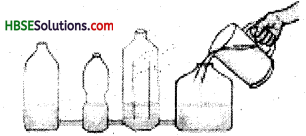
Take 4-5 plastic bottles of different shapes and sizes. Join them together with small pieces of glass or rubber tube as shown in Fig. Keep this arrangement on a level surface. Now pour water in any one of the bottles.
HBSE 8th Class Science Solutions Chapter 11 Force and Pressure 4

Note whether the bottle in which water is poured gets filled first or all the bottle in which water is poured gets filled first or all the bottles get filled up simultaneously. Note the level of water in all the bottles from time to time. Try to explain your observations.
For more information on force and pressure visit:
→ www.glenbrook.kl2 .il.us/gbssci/phys/class/ newtlauws/u212a,html
→ www.hatesville.kl2.in.us/physics/phyNet/ Mechanics/Newton2/Pressure .html
→ www.kids.earth.nasa.gov/archive/ air_pressure/
Answer:
For self attempt.

Activities

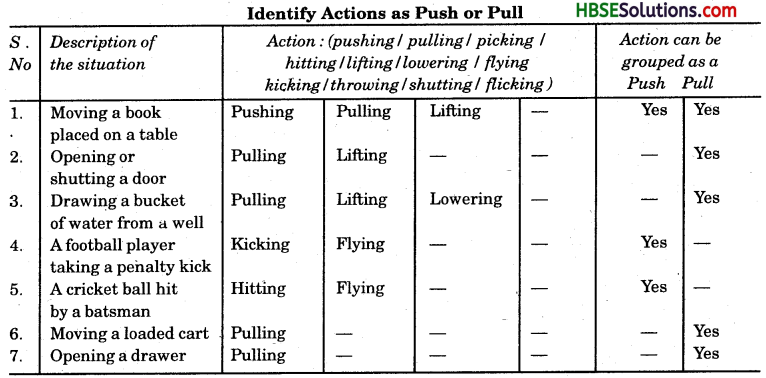
Activity No. 11.1
HBSE 8th Class Science Solutions Chapter 11 Force and Pressure 1

Activity No. 11.5
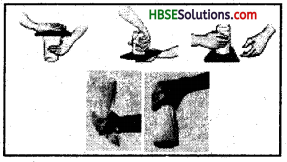
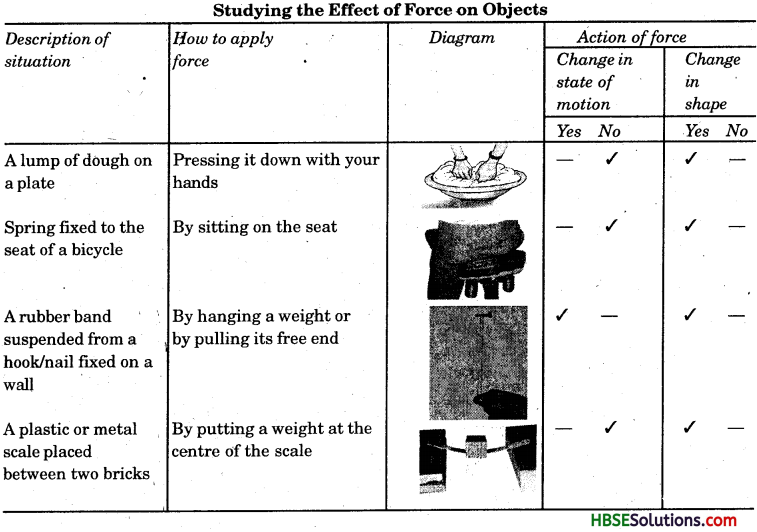
Studying the Effect of Force on Objects
HBSE 8th Class Science Solutions Chapter 11 Force and Pressure 2

Very Short Answer Type Questions

Question 1.
Define force.
Answer:
Any push or pull is called force.

Question 2.
When does a body move?
Answer:
A body moves when force is applied.

Question 3.
What is the first requirement to put force into play?
Answer:
Interaction between two objects.

Question 4.
Give any example of push.
Answer:
Pushing a table to wall.

HBSE 8th Class Science Solutions Chapter 11 Force and Pressure

Question 5.
Give an example of pull.
Answer:
Pulling the door to shut.

Question 6.
When force is applied on the object in the same direction of motion, what happens?
Answer:
The speed will increase.

Question 7.
What will happen when force is applied in the direction opposite to the movement of object?
Answer:
The speed will decrease.

Question 8.
How is the strength of a force expressed?
Answer:
In magnitude.

Question 9.
What effect does force put of state of motion?
Answer:
The speed of the object may change.

Question 10.
What is the state of motion of an object?
Answer:
The speed and direction of an object is called state of motion.

Question 11.
Does the force change the direction of the moving object?
Answer:
Yes.

Question 12.
Does the force change the shape of the object?
Answer:
Yes.

Question 13.
What is the contact force?
Answer:
Force which comes in action when objects are in contact.

Question 14.
What is the muscular force?
Answer:
Force resulting due to action of muscles.

Question 15.
Give examples of muscular force.
Answer:
Bending, moving, kicking etc.

Question 16.
What kind of force is the muscular force?
Answer:
Contact force.

Question 17.
What is friction?
Answer:
Force acting equal and opposite to the moving object is friction.

Question 18.
What kind oi force is the friction?
Answer:
Contact force.

Question 19.
Give example of friction force.
Answer:
Stopping of a rolling ball.

HBSE 8th Class Science Solutions Chapter 11 Force and Pressure

Question 20.
Which force stops the moving striker on a carrom board?
Answer:
Friction.

Question 21.
Why does the soal of our shoes get torn away by walking?
Answer:
Due to friction between soal and road.

Question 22.
What are non-contact forces?
Answer:
Forces acting jrom distance without forming contact.

Question 23.
What is magnetic force?
Answer:
Force exerted by a magnet is called magnetic force.

Question 24.
What happens when similar poles of magnets come in contact?
Answer:
They repel each other.

Question 25.
What happens when opposite poles of magnets come in contact?
Answer:
They attract each other.

Question 26.
What is the electrostatic force?
Answer:
Force exerted by the charged bodies is called electrostatic force.

Question 27.
When a comb rubbed against hair is brought near the small pieces of paper, the paper attaches to the comb which force has attracted papers?
Answer:
Electrostatic force.

Question 28.
What kind of forces are magnetic force and electrostatic force?
Answer:
Non-contact forces.

Short Answer Type Questions

Question 1.
How do we feel force in our daily life?
Answer:
Many big or small actions make us feel the force. We have to push or pull many objects daily. A moving ball stops on its own, the ball changes the direction of its motion, when hits with a bat. We churn curd to make lassi and many other actions.

Question 2.
What is force? Define with example.
Answer:
Force is the pull or push of the objects. Actions like pushing, pulling, bending, running, lifting etc. are the examples of force. Moving or stopping or changing shape and direction of motion of objects are the various actions showing force in play.

Question 3.
What happens when two people push an object from same direction?
Answer:
When two people push or pull something together in same direction, the force applied by them get added and the action becomes easy.

HBSE 8th Class Science Solutions Chapter 11 Force and Pressure

Question 4.
How can force change the state of motion?
Answer:
Force can change the state of motion by changing the direction of the motion and by changing the speed of the motion. Force in the direction of the motion increases the speed and force in opposite direction decreases the speed.

Question 5.
What is the state of motion?
Answer:
State of motion of an object is its speed and its direction. State erf zero motion means state of rest. An object can be in two positions one at rest or at motion. Any change in this position can be the change in the state of motion.

Question 6.
What is muscular force? Why is it a contact force?
Answer:
The force exerted by the action of the muscles is called muscular force. Muscular activities like running, bending, walking etc. produce muscular force. Muscular force is a contact force because it is applied only when it is in contact with an object.

Question 7.
What is force of Motion? How does it arise?
Answer:
Force of friction is force opposite and equal to the force of moving body. Force of friction arises when there is a contact between two surfaces and some movement takes place in them. Force of friction is a contact force as it only arises when two surfaces come in contact with each other.

Question 8.
Why does a moving ball gradually come to rest?
Answer:
A moving bail comes to rest on its own due to force of friction. When ball moves on the ground, their surfaces come in contact to each other. The ball and the ground exert equal and opposite force on each other, which gradually brings the moving ball to a stop.

Question 9.
What is electrostatic force? What kind of a force is it?
Answer:
Electrostatic force is exerted by a charged body on another charged or uncharged body. For this it is not necessary for the two bodies to be in contact with each other. This force is applicable from a distance so it is a non-contact force.

HBSE 8th Class Science Solutions Chapter 11 Force and Pressure

Question 10.
What is pressure? What is the relation of pressure with area on which it is applied?
Answer:
Force exerted on per unit area is called pressure. Pressure is related with area on which it is applied. When the area is increased the pressure exerted is less. But when the area on which pressure is exerted is decrease the pressure increases. So we conclude that pressure increases with decrease in area.

Long Answer Type Questions

Question 1.
How will you prove that pressure of liquids decrease with increase in height ^ of its column?
Answer:
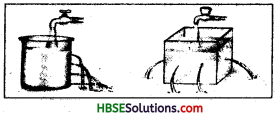
For this to be proven take aplastic
HBSE 8th Class Science Solutions Chapter 11 Force and Pressure 5
container. Take a pin and make holes in the container in horizontal line from bottom to middle of the container. Now put water in the container and observe, you will see the water will come out with maximum pressure while the hole at the top will have the minimum pressure of water.

Question 2.
What changes are caused dud to application of farce on object?
Answer:
Force when applied on an object cause many changes on the object. Following changes occur due to application of force:
(i) Force change the state of motion : Force can change the state of motion of the object. It can increase or decrease the speed of the moving object. It can change the direction of the moving object.

(ii) Force can change the shape of the object: Force can change the shape of the object on which it is applied. When force is applied on some object, it always have some effect on the shape of the object. The change in the object is some time visible and some time, it is pot visible, but change in shape of the object is always accompanied by application of force.

Question 3.
What are the contact forces? Explain different forces which are contact forces.
Answer:
Contact forces are the forces which come in play when two objects come in contact with each other. Following forces are the contact forces :
(i) Muscular Force : The force which is exerted due to action of muscles is called muscular force. Actions like bending, running, moving etc. are examples of muscular forces. It is a contact force because it comes in play when it comes in contact of the object.

(ii) Friction: Equal and opposite force being exerted on an object when its surface comes in contact with other surface. It is also a contact force because it is exerted when two surfaces come in contact with each other Halting of a moving ball on its own is an example of force of friction.

Question 4.
What are the non-contact forces? Explain different non-contact forces.
Answer:
Non-contact forces are those forces, which can be exerted from a distance without establishing a contact. Following forces are the non-contact forces :
(i) Magnetic force : Force exerted by a magnet on another magnet or magnetic substance like iron is called magnetic force. Like poles of a magnet repel each other and opposite poles of a magnet attract each other.

(ii) Electrostatic Force: Force exerted by a charged body on other charged body or uncharged body is called electrostatic force. If we rub a comb with our hair and bring it near some small bits of paper, it will attract the bits of paper towards itself. This is electrostatic force which acts without making a direct contact with other charged or uncharged object.

(iii) Force of Gravity : Earth pulls every freely falling object towards its centre. This force exerted by earth is called force of gravity. This is also a non-contact force as it acts from a distance.

HBSE 8th Class Science Solutions Chapter 11 Force and Pressure

Force and Pressure Class 8 HBSE Notes

  • Every push or pull is called force.
  • Force comes into action when an object interacts with other object.
  • Forces when implied in same direction add to each other, but when applied in opposite directions, they cancel each other. Equal forces applied in opposite direction results in net zero force.
  • Force has magnitude and direction.
  • Force can bring many changes in body on which it is applied.
  • Force can change the speed of the moving body. Force in same direction of motion can increase the speed and in opposite direction can decrease the speed.
  • Force can change the direction of the object in motion or at rest.
  • Force can change theshapeof theobject. Force when applied on an object is always accompanied by change’in its shape.
  • Two objects when come in contact with each other, they apply force on each other, this is called contact force. Muscular force, friction force etc. are examples of contact force.
  • Force acting opposite to the direction of motion of a moving object is called force of friction.
  • Force that acts from a distance is called a non-contact force, Magnetic force, electrostatic force and gravitational force are examples of non-contact force.
  • Force exerted per unit area is called pressure.
  • Liquids and gases also exert pressure in all directions.
  • Pressure exerted by air is called atmospheric pressure.

HBSE 8th Class Science Solutions Chapter 11 Force and Pressure Read More »

HBSE 8th Class Science Solutions Chapter 12 Friction

Haryana State Board HBSE 8th Class Science Solutions Chapter 12 Friction Textbook Exercise Questions and Answers.

Haryana Board 8th Class Science Solutions Chapter 12 Friction

HBSE 8th Class Science Friction Textbook Questions and Answers

Question 1.
Fill in the blanks :
(a) Friction opposes the __________ between the surfaces in contact with each other.
(b) Friction depends on the __________ of surfaces.
(c) Friction produces __________.
(d) Sprinkling of powder on the carom board __________ friction.
(e) Sliding friction is __________ than the static friction.
Answer:
(a) relative motion
(b) nature
(c) heat
(d) reduces
(e) less.

Question 2.
Four children were asked to arrange forces due to rolling, static and sliding frictions in a decreasing order. Their arrangement are given below. Choose the correct arrangement:
(a) rolling, static, sliding
(b) rolling, sliding, static
(c) static, sliding, rolling
(d) sliding, static, rolling
Answer:
(c) static, sliding, rolling.

Question 3.
Alida runs her toy ear on dry marble floor, wet marble floor, newspaper and towel spread on the floor. The force of friction acting on the car on different surfaces in increasing order will be
(a) wet marble floor, dry marble floor, newspaper and towel.
(b) newspaper, towel, dry marble floor, wet marble floor.
(c) towel, newspaper, dry marble floor, wet marble floor.
(d) wet marble floor, dry marble floor, towel, newspaper.
Answer:
(a) wet marble floor, dry marble floor, newspaper and towel.

HBSE 8th Class Science Solutions Chapter 12 Friction

Question 4.
Suppose your writing desk is tilted a little. A book kept on it starts sliding down. Show the direction of frictional force acting on it.
Answer:
Frictional force is acting opposite to the movement of book i.e. upwards.

Question 5.
You spill a bucket of soapy water on a marble floor accidently. Would it make it easier or more difficult for you to walk on the floor? Why?
Answer:
It is difficult to walk on a soapy floor because layer of soap makes floor smooth. The coating of soap reduces the friction and the foot cannot make a proper grip on the floor and it starts getting to slip on the floor.

Question 6.
Explain why sportsmen use shoes with spikes.
Answer:
Sportsmen use shoes with spike to increase the friction so, that their shoes do not slip while they run or play.

Question 7.
Iqbal has to push a lighter box and Seema has to push a similar heavier box on the same floor. Who will have to apply a larger force and why?
Answer:
Seema will experience more frictional force because heavy object will be pressed hard against the opposite surface and produces more friction.

Question 8.
Explain why sliding friction less than static friction.
Answer:
Sliding friction is always less than static friction because two sliding objects find less time to get interlocked against, each others, irregularities of surfaces so they get less friction.

HBSE 8th Class Science Solutions Chapter 12 Friction

Question 9.
Give examples to show that friction is both a friend and a foe.
Answer:
Friction is a friend because :

  • It allows us to walk comfortably on ground.
  • It allows us to grip and catch different objects.
  • Things don’t move from their places because of friction.
  • Speeds of moving objects can be minimized or stopped by friction only.

Friction is foe because :

  • It causes wear and tear in objects of our daily use and machines we use.
  • Regular maintenance of objects moving against each other (machines and tools) wastes a lot of useful money.
  • It makes the movement of heavy objects very difficult.
  • It does not allow the regular free movement of substances.

Question 10.
Explain why objects moving in fluids must have special shapes.
Answer:
Objects moving in fluids must have a special shape called steamlined shape. Streamlined shape is that shape which overcomes the friction of fluid. They have pointed fronts with little broader middle portion which gets tapered at the back.

Extended Learning – Activities and Projects

Question 1.
What role does friction play in the sport of your choice? Collect some pictures of that sport in action where friction is either supporting it or opposing it. Display these pictures with proper captions on the bulletin board of your classroom.
Answer:
For self attempt.

Question 2.
Imagine that friction suddenly vanishes. How would life be affected. List ten such situations.
Answer:
For self attempt.

Question 3.
Visit a shop which sells sports shoes. Observe the soles of shoes meant for various sports. Describe your observations.
Answer:
For self attempt.

Question 4.
A toy to play with :
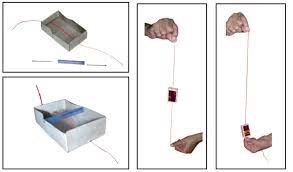
Take an empty match box. Take out its tray. Cut a used refill of a ball pen of the same width as the tray as shown in the figure below. Fix the refill with two pins on the top of the tray as shown in Fig. Make two holes on the opposite sides of the tray. Make sure that the holes are large enough to allow a thread to pass through them easily. Take a thread about a metre long and pass it through the holes as shown. Fix beads at the two ends of the thread so that it does not come out. Insert the tray in the outer cover of the matchbox.
Suspend the match box by the thread. Leave the thread loose. The match box will start falling down due to gravity. Tighten the thread now and observe what happens.
Explain your observation. Can you relate it to friction?
HBSE 8th Class Science Solutions Chapter 12 Friction 1
Answer:
For self attempt.

HBSE 7th Class Science Friction Important Questions and Answers

Very Short Answer Type Questions

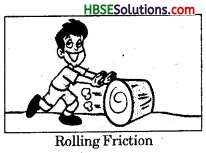
Question 1.
What is friction?
Answer:
Force acting equal and opposite to the relative motion of two objects in contact.

Question 2.
What does the friction depend upon?
Answer:
Nature of object.

Question 3.
Which surface produces more friction?
Answer:
Rough.

HBSE 8th Class Science Solutions Chapter 12 Friction

Question 4.
Which surface produces less friction?
Answer:
Smooth.

Question 5.
In which direction does friction work?
Answer:
Opposite to the motion.

Question 6.
What causes-friction between two surfaces?
Answer:
Irregularities of two surfaces.

Question 7.
What happens between irregularities of two surfaces in contact which produce friction?
Answer:
Irregularities get interlocked.

Question 8.
Which surface has large number of irregularities to cause friction?
Answer:
Rough surface.

Question 9.
Between flat and sliding surfaces which surface will cause less friction?
Answer:
Sliding surface.

Question 10.
What causes chalk to write on black board?
Answer:
Friction.

Question 11.
What does friction do to soles of our shoes?
Answer:
It causes wear and tear in soles.

Question 12.
What causes a matchstick to catch fire, when rubbed on rough surface?
Answer:
Friction.

Question 13.
What does friction produce?
Answer:
Heat.

Question 14.
What are things like oils, creams and grease called?
Answer:
Lubricants.

Question 15.
How are the shoes made to counter the friction and make better grip?
Answer:
They have grooves on their soles.

Question 16.
How are athletes and other sports shoes are designed to reduce friction?
Answer:
There soles have nails fixed on them.

HBSE 8th Class Science Solutions Chapter 12 Friction

Question 17.
What is done to the tyres of the vehicles to reduce the friction?
Answer:
They are treaded.

Question 18.
What is used in cycle brakes to increase friction?
Answer:
Brake pads.

Question 19.
What does the kabaddi players use to increase friction of their hands to grip their opponents?
Answer:
They rub their hands with soil.

Question 20.
What do we use on carrom board to reduce friction?
Answer:
Talcum powder.

Question 21.
What do we use on the hinges of the door to make door move smoothly?
Answer:
Machine oil/ Oil.

Question 22.
What is avoided between two surfaces to make movement smooth?
Answer:
Interlocking of irregularities.

Question 23.
What is used to reduce friction in machines, where lubrication are not advisable?
Answer:
Oil cushion.

Question 24.
Can we eliminate friction completely?
Answer:
No.

Question 25.
What is used to make heavy luggages move easily?
Answer:
Wheels are attached to their base.

Question 26.
Which friction is applicable when wheels are used to carry heavy weights?
Answer:
Rolling friction.

Question 27.
Among Static, Sliding and Rolling friction which is the smallest?
Answer:
Rolling friction.

Question 28.
How sliding is replaced by rolling in machines?
Answer:
By using ball bearings.

Question 29.
Name any machine, where ball bearing is used to reduce friction.
Answer:
Ceiling fan.

HBSE 8th Class Science Solutions Chapter 12 Friction

Question 30.
What is frictional force exerted by liquids called?
Answer:
Drag.

Question 31.
What does frictional force on an object in a fluid depend on?
Answer:
On its speed with respect to the fluid and its shape.

Question 32.
What is the special shape given to objects moving in fluid called?
Answer:
Streamlined shape.

Question 33.
Give three examples of streamlined objects.
Answer:
Ships, boats, aeroplanes.

Question 34.
How is the shape of the body of a fish which helps it in moving in water?
Answer:
It has streamlined shape.

Question 35.
When does rolling friction come in play?
Answer:
When a body rolls on other body.

Short Answer Type Questions

Question 1.
What is friction?
Answer:
Friction is a force which comes in play when two -bodies move on each other. Friction works in opposite direction to the direction of the movement of objects.

Question 2.
What causes friction?
Answer:
Friction occurs when two bodies move on each other. Each surface has some irregularities on it. When two such objects move on each other their irregularities get interlocked and friction arises.

Question 3.
How does the nature of surface effect friction?
Answer:
Nature of the surface plays major role in production of friction. The rough surface produces more friction than the smooth surface. The rough surface has more irregularities on it than the smooth surface, so more force is required to overcome the friction caused by irregularities.

Question 4.
What is a spring balance? How does it work?
Answer:
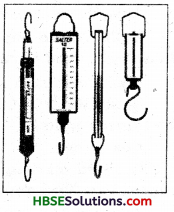
Spring balance is a device which is used to measure the force acting on a body. It consists of a coiled spring, which is attached to pointer and scale. When some object is hung with it the spring stretches and pointer points to the graduated scale to give the measurement of the force.
HBSE 8th Class Science Solutions Chapter 12 Friction 2

Question 5.
Which friction is less static friction or sliding friction? Why?
Answer:
Sliding friction is lesser than static friction, because in sliding friction the relative motion between two surfaces is less opposed by friction as the irregularities of the two surfaces in contact do not get enough time to interlock with each other which makes the motion easy.

HBSE 8th Class Science Solutions Chapter 12 Friction

Question 6.
What would happen, if the floor we walk on, does not produce any friction?
Answer:
If there is no friction on the floor, we would not be able to stand or walk on the floor, because it is the friction which unables us to stand or walk on the surface. The grooves of our feet or shoes get locked into the irregularities of the floor and makes us stand. If friction is not there, then we would simply slip on the floor.

Question 7.
What helps us write with a pen or pencil?
Answer:
It is the friction between the hand and pen or pencil which causes us write with pen. The grooves on our fingers make a grip on the pen’s irregularities and we are able to write.

Question 8.
Why is it difficult to move an object from its static position?
Answer:
When an object is in its static position, it has better hold of the surface on which it is placed. The irregularities of the surface are interlocked properly and more force is needed to overcome the friction offered by interlocking surfaces. So it is difficult to move the object from its position of rest.

Question 9.
Why do we rub our hands in winter when we feel cold?
Answer:
We rub our hands to make them warm, when we feel cold. Rubbing hands against each other cause friction between them. Friction produces heat, this heat makes us warm. We can feel the warmth by touching our hands on our face.

Question 10.
Why do we need to decrease friction?
Answer:
Friction is an evil which causes a lot of wear and tear in objects coming under its effects. It causes a lot of wear in machine parts which rub against each other, it erodes the surfaces and destroy their symmetries. So, we lubricate surfaces to decrease the friction.

Question 11.
How can we increase friction?
Answer:
We need to increase friction of surfaces to control the movement. Friction can be increased by increasing the irregularities of the surfaces in contact. We use spikes in the shoes of the athletes so that they can lock better in the irregularities of the ground to make better grip.

Question 12.
How can we decrease friction?
Answer:
Friction can be decreased by rolling, sliding and lubricating the surfaces in contact. We use ball bearings, wheels and lubricants like oils, grease, cream etc. to decrease the friction. Rolling, sliding and lubricating decrease the irregularities of the surfaces and make them smooth.

Question 13.
What is drag?
Answer:
Drag is the frictional force exerted by fluids. Liquids and gases are collectively called fluids. So the friction caused due to movement of objects in liquids and in air medium is called a drag.

Long Answer Type Questions

Question 1.
What is friction? How do friction arise? Explain.
Answer:
Equal and opposite force exerted by relative motion between two surfaces is called friction. Friction is always exerted in opposite direction to the force exerted. Friction acts between two surfaces. It is caused due to the movement of these two surfaces in contact. Every surface has some irregularities on it. When two surfaces come in contact, these irregularities get locked with each other. When objects are moved, the friction arises in the opposite direction of the movement.

Question 2.
What factors effect the force of friction? Explain.
Answer:
Force of friction depends upon the nature of the surfaces in contact and the force with which these two surfaces are pressed against each other. Nature of the surface on which an object moves, effects the force of friction. Rough surfaces produce more friction, while smooth surfaces produce less friction. Rough surfaces have more irregularities on them so they produce more friction. Smooth surfaces allow easy movement as they have less irregularities and the interlocking of irregularities with other surface is less as compared to the rough surfaces, so they produce less friction.

Secondly, force of friction depends upon how hardly two surfaces are pressed against each other. If two surfaces are pressed hard against each other, then the friction produced will be more.

HBSE 8th Class Science Solutions Chapter 12 Friction

Question 3.
How many types of frictions do you know about? Explain.
Answer:
Friction is of different types : Static friction, sliding friction and rolling friction.
Static friction is one which is produced between two surfaces in contact with each at the position of rest. This friction is more powerful than others. It is most difficult to overcome the static friction at this positions, the irregularities are most effectively pressed against each other. This type of friction needs a lot of energy to overcome.

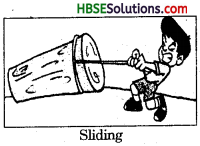
Sliding friction: arises when two objects in contact are in motion. It is lesser than static friction. This friction is lesser because the irregularities of both surfaces do not get enough time to get locked with each other as an object is already in motion.
HBSE 8th Class Science Solutions Chapter 12 Friction 3

Rolling friction: comes in effect when two bodies are rolling on each other. Rolling movement of both objects don’t allow the locking of irregularities, thus it is the smallest friction of all they three types. Drag is the frictional force which is exerted by the fluids on the bodies moving in it. This friction needs a lot of energy to overcome so, bodies of such objects which move in fluids are streamlined to counter the friction offered by fluids.
HBSE 8th Class Science Solutions Chapter 12 Friction 4

Question 4.
What is fluid friction and on what factors does fluid friction depend?
Answer:
Friction exerted by fluids is called fluid friction. Bodies moving in air and liquids bear friction caused by air and liquid. Air and liquids are collectively called fluids. Fluid friction is also called Drag.Drag depends upon the speed of the object with respect to fluid, nature of the fluid and the shape of the object. Slow moving objects face more friction and heavy fluids offer more friction. Objects with pointed front, face less friction. All objects moving in fluids have streamlined shape so as to minimise the friction exerted by fluids.

Streamlined objects have narrow front, broader middle portion and which tapers at the back. All living organisms moving in air and water have streamlined shapes. Birds, fish etc. have streamlined body. So, Aeroplanes, boats, ships etc are designed according to birds and fish, so that they have to face less friction and has to spend less energy to overcome the friction.

Question 5.
prove with the help of an experiment that smoothness of surface reduces friction.
Answer:
Take a pencil or pen. Now put it on a table. Slightly push the pencil and see how much distance it covers, mark the point where the pencil stops after covering the distance. Now take some.cream or oil. Make a small coating of oil on the table or spread polythene on the table if possible. Now again take the pencil and put it at the same initial point. Now push the pencil slightly and let it stop on its own as done earlier. Now mark the point where the pencil stops. See the difference in the distance. In second attempt the pencil has covered more distance. This means it had to face less friction in second attempt. It proves that smoothness of the surface reduces friction.

Question 6.
Why and how do we increase friction?
Answer:
We increase friction deliberately to control the movements and motion of the objects. We also increase the friction for better grip and hold. Friction can be increased by making surfaces coarse and pressing two surfaces harder. Coarse surface has more irregularities to grip irregularities of other surface better, thus making the things come to a halt and give a better grip if object is stationary. We use brake pads in vehicles. When brake pads are pressed by pressing the lever, it gets pressed against the tyres and arrest the movement of the tyres and with this the vehicle comes to stop.

Pens are provided with ridges at the point where we hold them for writing, so that the friction between fingers and pen becomes more and a better grip can be made to write fluently. Pens without ridges get slipped out from our hands easily.

HBSE 8th Class Science Solutions Chapter 12 Friction

Question 7.
Why and how do we decrease friction?
Answer:
We decrease friction to save the objects from wear and tear. Friction causes wear and tear on the surfaces of the objects. It causes damage to the objects specially machines and machine parts. So, we apply a film of oil or grease between the surfaces in contact, so that it produces less friction and it causes no damage to the parts. Oils, grease etc. are called lubricants, which are used to make surfaces smooth and minimise friction. In most of the cases rolling of objects is used to reduce friction. Ball bearings are used in cycles, vehicles and machines because it reduces friction. Wheels are used to move heavy objects because wheels roll on the ground thus reducing friction and this makes the dragging of heavy objects easy. Tyres carry heavy and loaded trucks on them, as they produce less friction and need lesser energy to move them.

Friction Class 8 HBSE Notes

1. Friction is the force equal and opposite to the relative motion between two surfaces in contact.

2. Force of friction acts on both the surfaces in contact.

3. There are many factors which affect friction :

  • It depends on the nature of surface.
  • It depends on smoothness of surface.
  • It depends on the hardness with which two surfaces in contact are pressed against each other.

4. Friction has no relation with area exposed to force of friction.

5. Friction is static, when it opposes the force applied on the body.

6. When two surfaces slide on each other, sliding friction comes into play.

7. Sliding friction is less than the static friction.

8. Friction is an evil which causes a lot of wear and tear on the surfaces of the objects due to opposite forces in action.

9. Wear and tear is more in case of static friction and less in case of sliding friction.

10. Friction is an evil but a necessary evil. No body would have been able to walk on the floor, if friction was not in play :

11. When two surfaces roll on each other the rolling friction is applied, for example in case of wheels under attache-cases. Rolling reduces the friction and movement becomes easy and smooth.

12. Fluids also exert force of friction and reduce the speed. To avoid friction due to fluid, bodies of objects moving in fluids have pointed and streamlined fronts and bodies.

13. Aeroplanes and ships etc. have streamlined bodies to overcome the friction caused by air and liquids.

HBSE 8th Class Science Solutions Chapter 12 Friction Read More »

HBSE 8th Class Science Solutions Chapter 13 Sound

Haryana State Board HBSE 8th Class Science Solutions Chapter 13 Sound Textbook Exercise Questions and Answers.

Haryana Board 8th Class Science Solutions Chapter 13 Sound

HBSE 8th Class Science Sound Textbook Questions and Answers

Question 1.
Choose the correct answer: Sound can travel through:
(a) gases only
(b) solids only
(c) liquids only
(d) solids, liquids and gases.
Answer:
(d) solids, liquids and gases.

Question 2.
Voice of which of the following is likely to have minimum frequency?
(a) Baby girl
(b) Baby boy
(c) A man
(d) A woman
Answer:
(a) Baby girl.

Question 3.
In the following statements, tick ‘T’ against those which are true and ‘F’ against those which are false :
(a) Sound cannot travel in vacuum. (T / F)
(b) The number of oscillations per second of a vibrating object is called its time period. (T / F)
(c) If the amplitude of vibration is large, sound is feeble. (T / F)
(d) For human ears, the audible range is 20 Hz to 20,000 Hz. (T / F)
(e) The lower the frequency of vibration, the higher is the pitch. (T / F)
(f) Unwanted or unpleasant sound is termed as music. (T / F)
(g) Noise pollution may cause partial hearing impairment. (T / F)
Answer:
(a) True
(b) False
(c) False
(d) True
(e) False
(f) True
(g) True.

HBSE 8th Class Science Solutions Chapter 13 Sound

Question 4.
Fill in the blanks with suitable words :
(a) Time taken by an object to complete one oscillation is called ________.
(b) Loudness is determined by the ________ of vibration.
(c) The unit of frequency is ________.
(d) Unwanted sound is called ________.
(e) Shrillness of a sound is determined by the ________ of vibration.
Answer:
(a) time period
(b) amplitude
(c) hertz
(d) noise
(e) frequency.

Question 5.
A pendulum oscillates 40 times in 4 seconds. Find its time period and frequency.
Answer:
Time taken by pendulum to complete 40 oscillations = 4 seconds
Time taken by pendulum
to complete 1 oscillation = \(\frac { 4 }{ 40 }\)
= \(\frac { 1 }{ 10 }\)
= 0.1 sec.
Time period of pendulum = 0.1 sec.
Frequency of pendulum
= \(\frac { 40 }{ 4 }\) \(\frac { oscillation }{ time }\)
= 10 Hz.

Question 6.
The sound from a mosquito is produced when it vibrates its wings at an average rate of 500 vibrations per second. What is the time period of the vibration?
Answer:
Time taken to complete
500 vibrations = 1 second
Time taken to complete
1 vibration = \(\frac { 1 }{ 500 }\) = 0.002
Time period of vibration = 0.002 second.

Question 7.
Identify the part which vibrates to produce sound in the following instruments:
(a) Dholak
(b) Sitar
(c) Flute.
Answer:
(a) Stretched membrane
(b) Strings
(c) air column.

Question 8.
What is the difference between noise and music? Can music become noise sometimes?
Answer:
Noise is the sound which is unpleasant for our ears. Excessive or unwanted sounds are called noise. Music is the sound which is pleasant for our ears and has soothing effect. Music sometimes can become noise when it crosses the bearable range of sound for our ears.

Question 9.
List sources of noise pollution in your surroundings.
Answer:
There are various sources which cause sound pollution in our surroundings like : Honking of horns, loud sounds of machines in factories, loud musics in parties and marriages, loud sound of T. V. or radio, loud sounds of domestic electronic appliances like mixer grinder etc. are some sources of noise in our environment.

HBSE 8th Class Science Solutions Chapter 13 Sound

Question 10.
Explain in what way noise pollution is harmful to humans?
Answer:

  • Noise pollution can cause temporary or permanent deafening.
  • It can cause many health related problems like high blood pressure
  • It can cause mental illness due to lack of sleep.

Question 11.
Your parents are going to buy a house. They have been offered one on the roadside and another three lanes away from the roadside. Which house would you suggest your parents should buy? Explain your answer.
Answer:
I would suggest my parents to buy house three lanes away from the roadside because area away from the roadside have less traffic and thus less noise pollution. This would safe guard our health and peace of mind.

Question 12.
Sketch larynx and explain its function in your own words.
Answer:
Larynx is also called the voice box. As the name suggests, it causes (sound) voice in humans. It has vocal cords, which have air column vibrating in them, which cause sound in humans.
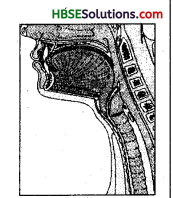
HBSE 8th Class Science Solutions Chapter 13 Sound 1

Question 13.
Lightening and thunder take place in the sky at the same time and at the same distance from us. Lightening is seen earlier and thunder is heard later. Can you explain?
Answer:
Lightening and thundering take place simultaneously but we see light earlier than thunder because light travels faster than sound, so it reaches us before the sound does.

Extended Learning – Activities and Projects

Question 1.
Visit the music room of your school. You may also visit musicians in your locality. Make a list of musical instruments. Note down the parts of these instruments that vibrate to produce sound.
Answer:
For self attempt.

Question 2.
If you play a musical instrument, bring it to the class and demostrate how you play it.
Answer:
For self attempt.

Question 3.
Prepare a list of famous Indian musicians and the instruments they play.
Answer:
For self attempt.

Question 4.
Take a long thread. Place your hands over your ears and get some one to place this thread round your head and hands. Ask her to make the thread taut and hold its ends in the hand. Now ask her to draw her finger and thumb tightly along the thread (in figure). Can you hear a rolling sound like that of a thunder ? Now repeat the activity while another friend stands near both of you. Can he hear any sound.
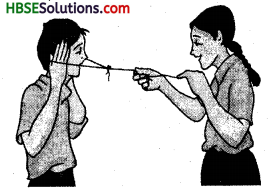
HBSE 8th Class Science Solutions Chapter 13 Sound 3
Answer:
For self attempt.

Question 5.
Make two toy telephones. Use them as shown in Fig. Make sure that the two srtings are taut and touch each other. Let one of you speak. Can the remaining three persons hear? See how many more friends you can engage in this way. Explain your observations.
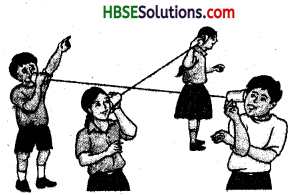
HBSE 8th Class Science Solutions Chapter 13 Sound 2
Answer:
For self attempt.

Question 6.
Identify the sources of noise pollution in your locality. Discuss with your parents, Mends wad neighbours. Suggest how to control noise pollution. Prepare a brief report and present it in the class.
You can read more on the related topics on the following websites:
→ www.physicsclassroom .com/Class/sound/soundtoc.html
→ health.howstuffworks.com/hearing.htm
→ www.jaltarang.com for jaltarang
→ www.tempro/com/articles/hearing.html
→ www.cartage.org.lb/en/themes/sciences/ physics/mainpage.htm
Answer:
For self attempt

HBSE 7th Class Science Sound Important Questions and Answers

Very Short Answer Type Questions

Question 1.
What produces sound?
Answer:
Vibrations in body produce sound.

Question 2.
Can sound be produced from a body which does not vibrate?
Answer:
No.

Question 3.
Why can’t we see the vibrations in most of the cases when sound is produced?
Answer:
Their amplitude is very small.

Question 4.
Name any wind musical instrument.
Answer:
Flute.

Question 5.
What is the sound producing organ in humans called?
Answer:
Larynx.

HBSE 8th Class Science Solutions Chapter 13 Sound

Question 6.
What is another name for larynx?
Answer:
Voice box.

Question 7.
What are the two cords stretched across the voice box called?
Answer:
Vocal cords.

Question 8.
What vibrates in larynx to produce sound?
Answer:
Vocal cords.

Question 9.
What decides the type of voice in human?
Answer:
Tightness of vocal cords.

Question 10.
How much long the vocal cords are in men?
Answer:
20 mm.

Question 11.
What is the length of vocal cords in women?
Answer:
15 mm.

Question 12.
Through which medium can sound travel?
Answer:
Solids, liquid and gaseous medium.

Question 13.
Can sound travel through vacuum?
Answer:
No.

Question 14.
Which organs in human receive sound waves? .
Answer:
Ears.

Question 15.
What is the outer stretched part of the ear called?
Answer:
Ear drum.

Question 16.
What vibrates the ear drum?
Answer:
Sound vibrations.

Question 17.
What is the to and fro motion of objects called?
Answer:
Oscillatory motion.

HBSE 8th Class Science Solutions Chapter 13 Sound

Question 18.
What is the frequency of oscillation?
Answer:
Number of oscillations per second is called frequency of oscillation.

Question 19.
What is the unit of frequency?
Answer:
Hertz (Hz).

Question 20.
What does a frequency of 1 Hz means?
Answer:
One oscillation in one second.

Question 21.
What are the two important properties of a sound?
Answer:
Amplitude and frequency.

Question 22.
What is the maximum distance travelled by a vibrating body on either side of its mean position called?
Answer:
Amplitude.

Question 23.
What is the time taken to complete one oscillation called?
Answer:
Time period.

Question 24.
How does amplitude effect the loudness of vibration?
Answer:
Higher the amplitude, louder is the voice.

Question 25.
Why the sound of a baby is feeble?
Answer:
Because its amplitude is small

Question 26.
What controls the shrillness of a sound?
Answer:
Frequency.

Question 27.
What is the range of audible sound for human ear?
Answer:
From 20 to 20,000 Hz.

Question 28.
What are the sounds above 20,000 ‘ Hz called?
Answer:
Ultrasound.

Question 29.
Name any use of ultrasound?
Answer:
Ultrasound is used to detect many medical problems in human.

Question 30.
What is the unpleasant and unwanted sound called?
Answer:
Noise.

Question 31.
What are the pleasant and soothing sounds called?
Answer:
Music.

Question 32.
What is the unit of loudness?
Answer:
Decibel (dB).

HBSE 8th Class Science Solutions Chapter 13 Sound

Question 33.
What is the loudness of a normal conversation?
Answer:
60 dB.

Question 34.
Name any ill effect of noise pollution.
Answer:
It can cause temporary deafness.

Question 35.
Write any one measure to control noise pollution.
Answer:
Planting trees along roadsides.

Short Answer Type Questions

Question 1.
How is sound produced?
Answer:
Sound is produced by the vibrating bodies. When a body vibrates it produces sound.

Question 2.
What is the importance of sound in our life?
Answer:
Our life depends on sound for every action. Sound enables us to communicate with each other. Without sound nobody would know what other communicate or wants to express.

Question 3.
What are the musical instruments?
Answer:
Musical instruments are the devices which produce various sounds which are pleasant for our ears and produce soothing effects. The sound produced by these instruments is called music.

Question 4.
How do the musical instruments produce sound?
Answer:
Musical instruments have strings the stretched membranes attached or fixed on them . Some instruments have slits to let air pass through them, the strings are plucked and membranes are struck to produce sound. On plucking or striking they start vibrating, and the whole instrument starts vibrating with them, which produces the music.

Question 5.
Describe the organ in human that produces sound.
Answer:
In humans the sound producing organ is the voice box. It is also called the larynx. In larynx there are two vocal cords stretched across, leaving a slit for the air to pass through them.

Question 6.
How does the larynx produce sound?
Answer:
Larynx has two vocal cords stretched across it. They are stretched in a way that they leave a slit for passage of air. When air is pumped in slit by the lungs, the vocal cords start vibrating, thus producing the sound.

Question 7.
What distinguishes the sounds produced by different human beings from each other?
Answer:
Vocal cords in humans are the sound producing parts. When they are vibrated they produce sound. They are held by the muscles and the tightness with which they are held determines the quality of sound. The length of the vocal cords also determines the quality of voice.

HBSE 8th Class Science Solutions Chapter 13 Sound

Question 8.
How is the sound propagated?
Answer:
The sound reaches from one source to another through various mediums. It always needs a medium to travel, it cannot propagate through vacuum. Sound travels through air, solid and liquid.

Question 9.
How is it possible for whales and dolphins to communicate in water?
Answer:
Whales and dolphins live under water. They produce sound to communicate with each other. As sound can travels through air, solid and liquid-all the mediums, it is travelled from one source to another in water too, so dolphins and whales can communicate.

Question 10.
How do human hear the sounds?
Answer:
Humans hear various sounds through ears. Ears have a stretched structure called eardrum. When ears receive sound, it enters down the earcanal and reach eardrum. Vibrations of sound vibrates the eardrum and it sends vibrations to inner ear from which vibrations are sent to brain for interpretation of sound.

Question 11.
Why is it advised, not to put a sharp or pointed thing in our ear?
Answer:
It is advised not to put sharp or pointed things in the ear because it can damage the eardrum. Eardrum is a stretched membrane which is delicate. If the sharp or pointed thing would touch the eardrum, it would damage the eardrum and cause deafness.

Question 12.
What is oscillatory motion?
Answer:
The to and fro motion of the object is called vibration. This motion is the movement in both direction from its mean position- This motion in either side of the object from its mean position is called the oscillatory motion.
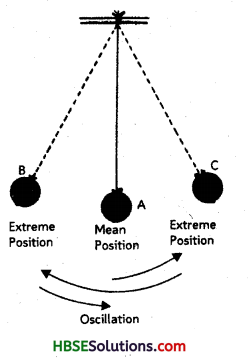
HBSE 8th Class Science Solutions Chapter 13 Sound 4

Question 13.
What is frequency of a motion?
Answer:
The number of to and for movement or number of oscillations per second is called the frequency of a motion. Frequency is expressed in Hertz. It is symbolized as Hz.

Question 14.
How does frequency effect the quality of sound?
Answer:
The frequency determines the shrillness of the sound. Shrillness is also called the pitch of sound. The pitch of the sound is higher if it has high frequency and the pitch is low if the frequency is less.

Question 15.
What controls the quality of voice in humans?
Answer:
Amplitude and frequency of vibrations control voice in human beings. If amplitude is high the loudness of sound will also be high, if frequency is high the shrillness or pitch will be high in voice.

Question 16.
Describe the properties of voice in men.
Answer:
Men have high amplitude of vibrations so their voice is loud and they have low frequency so-they have less shrillness in their voice.

HBSE 8th Class Science Solutions Chapter 13 Sound

Question 17.
Describe the properties of voice in women.
Answer:
Women have high frequency of sound waves, so they have high pitched voice it means they have high shrillness in their voice. On the other hand they have low amplitude so they have less loudness in their voice.

Question 18.
Describe the audible range of fequencies for human beings.
Answer:
Human beings cannot hear sounds below 20 Hz that means sounds with less than 20 vibrations per second cannot be heard by human beings. On the other hand sounds with frequency more than 20 KHZ also cannot be heard by human beings. 20 KHz means 20,000 vibrations per second. Therefore, roughly the audible range of sounds for human beings vary between 20 Hz to 20 KHz.

Question 19.
What are ultrasounds? How are they useful to us?
Answer:
Sounds with frequency of above than 20 KHz are called ultrasound. Ultrasounds cannot be heard by human beings, but they are very useful for human beings. Ultrasounds are used in field of medicine to detect the disorders inside the body of human beings. They are also useful in industries. They are used to detect the flaws and cracks in metallic structures.

Question 20.
What is noise?
Answer:
Noise is the unwanted and unpleasant sounds reaching our ears. They cause disturbance and are harmful. Noise is the sound which crosses the limit of audible loudness for us. Normally sounds at 80 dB of loudness becomes painful to bear and is called noise.

Question 21.
Give any five sources of noise in your surroundings.
Answer:
Five sources of noise in our environment are :

  • Noise made by traffic.
  • Noise created by electrical appliances used at home like coolers, mixer grinder etc.
  • Loud sounds of T.V., Radio etc.
  • Noise created by loud music in marriages and religious functions.
  • Noise created by construction works in neighbourhood.

Question 22.
What do you mean by hearing impairment? How is it caused?
Answer:
Hearing impairment means disability to hear. It is caused by diseases of ear, injury of ear or due to degeneration of hearing mechanism with growing age. Hearing impairment can be overcome by using hearing aids if impairment is not permanent.

Question 23.
How can hearing impairment be overcome or avoided?
Answer:
Hearing impairment can be avoided by avoiding noise or avoiding the usage of sharp of pointed objects inside ear, We should avoid any ear injury. In case of hearing impairment which is temporary hearing aids help in overcoming it or using other aids like sign language etc.

Question 24.
What is noise pollution?
Answer:
Presence of excessive or unwanted sounds in the environment, which cause discomfort for us is called noise pollution. Excessive sounds are produced by honking of horns, loud speakers, crackers, machines etc.

Question 25.
How can noise pollution be controlled?
Answer:
Noise pollution can be controlled by controlling their sources. Blowing of horns should be avoided in residential areas, near schools or hospitals. Using loudspeakers etc. should also be avoided in these areas. T.V., radio etc should be played at low volume. Trees should be planted along the roadside to create a buffer zone to absorb excessive sounds on roads.

Long Answer Type Questions

Question 1.
How is sound produced? How does it travel from one place to another?
Answer:
Sound is produced by the vibrations of the body. Only vibrating bodies produce sound. Those bodies which produce vibrations produce sound but when they stop vibrating they also stop producing sound.
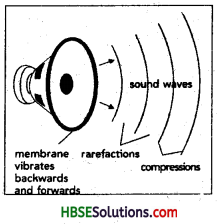
HBSE 8th Class Science Solutions Chapter 13 Sound 5Sound reaches from one source to another. It travels from one point to another through some medium. Sound waves can travel through air, liquid and even through solids. What we hear one another, that sound travels through air medium. But we can bear some body talking in next room too, that means sound waves have crossed wall to reach us. Dolphins and whales communicate in water.

HBSE 8th Class Science Solutions Chapter 13 Sound

Question 2.
Explain hew many types of musical instruments are there? Hew die they make sound?
Answer:
Musical instruments are differentiated on the basis of their vibrating parts, Some musical instruments have sretched membranes Which produce vibrations to make sound. Second type of musical instruments have stretched strings, which vibrate to produce sound. In third v type of instruments the wind column is used to ’ produce sound.

Instruments like hands, drums, mridangam etc, have stretched leather membrane which is struck with hands or stick to produce sounds. In instruments like guitar, sitar, veena, violin etc,, strings are struck with fingers or rubber with other instruments produce musical sounds. Instruments like mouth-organ, sehnai, flute etc, use air column to produce sounds.

Question 3.
What is nuisa? Haw is noise pollution created?
Answer:
Noise is the unwanted and unpleasant sounds around us in our environment. When these noises become huge, it creates noise pollution. Different, loud and shrill sounds discharged in environment cause noise pollution. Honking horns of vehicles on road, loud music of T-Vs and Radios, loud music in marriages and parties, noise of machines in factories, domestic electrical appliances like mixer grinder, construction work in neighbourhood, etc. are the ‘ various sources of noise polluiton in our environment.

Question 4.
What are the ill-effects of noise pollution? How can we control noise pollution?
Answer:
Noise pollution has many bad effects on our body and health. Our health and mental peace are adversely affected by noise pollution. Noise pollution becomes the root cause of many mental disorders like anxiety, depression etc. Besides mental disorders, physical disorders like hypertension, skin diseases, lack of sleep etc. are also caused by noise pollution. It is more harmfid for students and sick people.

For controlling noise pollution, honking of horns from vehicles should he banned near residential areas, schools and hospitals. T.Vs. and Radios should be played at low volume. Loudspeakers should not be allowed during sleeping hours. Trees and plants should be extensively planted along the road sides to create a buffer zone. Trees absorb noise and help in controlling noise pollution.

Sound Class 8 HBSE Notes

1. We hear different sounds in our daily life.

2. Sound is produced by the vibrating bodies. Only vibration can produce sound. Vibrations are to and fro movements of any object and this to and fro movements produce different sounds we have.

3. When the vibrations start, we hear sound, but when vibrations stop, the sound is not heard anymore.

4. Different musical instruments produce sound only due to the vibrations made by them, when they are beaten or plucked by us.

5. It is not only the vibrations of the strings or the stretched membranes of the musical instruments that produce sound, but it is the vibration of the whole instruments that produce sound.

6. In human beings it is the vibrations of the voice box or the larynx that causes the sound. Air passing through the vocal cords attached to larynx cause vibrations of the vocal cords, which enables us to produce sound.

7. It is the tightness of the vocal cords that make sounds different from each other in different human beings. The length of the vocal cords are different in men, women and children, so their voice is also different from each other.

8. Sound cannot pass from one source to another in vacuum. Sound needs medium to travel. Air, liquid, solid are the medium through which sound can travel from one source to another.

9. In human beings sound is produced by voice box, and received by hearing organs-ears. Receiving sound is called hearing. Our ear is so designed that it receives the vibrations and interpret it as sound.

10. The maximum distance a vibrating body travels from its means position is called amplitude of vibration.

11. The time taken to complete one oscillation (to and fro movement) is called the time period.

12. The number of oscillation per second is called the frequency of vibration. Frequency is expressed in Hertz (Hz).

13. Higher the frequency of vibration, higher is the pitch or shrilners of the sound.

14. High amplitude of vibration produces loud sound.

15. Unpleasant or unwanted sounds are called noises.

HBSE 8th Class Science Solutions Chapter 13 Sound Read More »

HBSE 8th Class Science Solutions Chapter 14 Chemical Effects of Electric Current

Haryana State Board HBSE 8th Class Science Solutions Chapter 14 Chemical Effects of Electric Current Textbook Exercise Questions and Answers.

Haryana Board 8th Class Science Solutions Chapter 14 Chemical Effects of Electric Current

HBSE 8th Class Science Chemical Effects of Electric Current Textbook Questions and Answers

Question 1.
Fill in the blanks:
(а) Most liquids that conduct electricity are solutions of __________ and __________.
(b) The passage of an electric current through a solution causes __________ effect.
(c) If you pass current through copper sulphate solution, copper gets deposited on the plate connected to the __________ terminal of the battery.
(d) The process of depositing a layer of any desired metal on another metafile object, by means of electricity, is called __________.
Answer:
(a) acids and bases
(b) chemical
(c) negative
(d) electroplating

Question 2.
When the free ends of a tester are dipped into a solution, the magnetic needle shows deflection, dan yon explain the
Answer:
Yes, the solution is a good conductor of electricity. The reason is that tote solution is a good conductor of electricity, so the needle get deflected.

Question 3.
Name three liquids, which when tested in the manner shown in figure, may cause the magnetic needle to direct.
Answer:
Tap water, lime water, vinegar.
HBSE 8th Class Science Solutions Chapter 14 Chemical Effects of Electric Current 1

Question 4.
The bulb does not glow in the setup shewn in figure. List the possible reasons. Explain your answer.
Answer:
If the bulb does not glow it may be because of some reasons like the bulb may be fused. Replaced with a new bulb, if it still does not glow, it shows that the connection of wires may be loose. After tightening connetions if still the bulb does not glow, then it is for sure that the solution does not conduct electric current.
HBSE 8th Class Science Solutions Chapter 14 Chemical Effects of Electric Current 2

Question 5.
A tester is used to check the conduction of electricity through two liquids, labeled A and B. It is found that the bulb of the tester glows brightly for liquid A while it glows very dimly for liquid B. You would conclude that
(i) liquid A is a better conductor than liquid B.
(ii) liquid Bis a better conductor than liquid
(iii) both liquids are equally conducting.
(iv) conducting properties of liquid cannot be compared in this manner.
Answer:
(ii) liquid A is a better conductor than liquid B.

HBSE 8th Class Science Solutions Chapter 14 Chemical Effects of Electric Current

Question 6.
Does pure water conduct electricity? If not, what can we do to make it conducting?
Answer:
Some salt can be added to it to make it a conductor.

Question 7.
In case of fire, before the firemen use the water hoses, they shut off the main electrical supply for the area. Explain why they do this.
Answer:
Water is a good conductor of electric current. So, the firemen shut off the electric supply before spraying water to save themselves and other people from electrocution.

Question 8.
A child staying in the coastal region tests the drinking water and also the seawater with his tester. He finds that the compass needle deflects more in the case of seawater. Can you explain the reason?
Answer:
Drinking water has been processed and purified before supplying it to the houses. Many salts and minerals have been removed from it, so it has decreased its conductivity. On the other hand the sea water is rich in salts, and other acids and basic substances, that is why it is a better conductor of electricity and deflects the needle more than the purified drinking water.
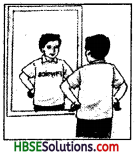
Question 9.
Is it safe for the electrician to carry out electrical repairs outdoors during heavy downpour? Explain.
Answer:
No, it is highly dangerous to carry on electric repairs in water, as water is a good conductor of electricity. It can cause electrocution.

Question 10.
Paheli had heard that rainwater is as good as distilled water. So she collected some rainwater in a clean glass tumbler and tested it using a tester. To her surprise she found that the compass needle showed deflection. What could be the reasons?
Answer:
While it rains, the raindrops get mixed with the suspended particles of the air. So, they do not remain pure. It becomes the mixture of salts and other impurities thus shows conduction of electricity.

Question 11.
Prepare a list of objects around you that are electroplated.
Answer:
Following objects around us are electroplated, rims of cycles, door handles, taps, showers, metallic pens, artificial jewellery, utensils, metallic almirahs, buckles of clothes and belts etc.

Question 12.
The process that you saw in Activity 14.7 is used for purification of copper. A thin plate of pure copper and a thick rod of impure copper are used as electrodes. Copper from impure rod is sought to be transfered to the thin copper plate. Which electrode should be attached to the positive terminal of the battery and why?
Answer:
The impure copper rod should be attached to the positive terminal because the free copper will get drawn towards the negative terminal to be get deposted, so the copper from impure rod will get collected in the pure copper plate.

Extended Learning – Activities and Projects

Question 1.
Test the conduction of electricity through various fruits and vegetables. Display your result in a tabular form.
Answer:
For self attempt.

Question 2.
Repeat the Activity 14.7 with a zinc plate in place of the copper plate connected to the negative terminal of the battery. Now replace zinc plate with some other metallic object and again repeat the activity. Which metal gets deposited over which other metal? Discuss your findings with your friends.
Answer:
For self attempt.

Question 3.
Find out if there is a commercial electroplating unit in your town. What objects are electroplated there and for what purpose? (The process of electroplating in a commercial unit is much more complex than what we did in Activity 14.7). Find out how they dispose off the chemicals they discard.
Answer:
For self attempt.

HBSE 8th Class Science Solutions Chapter 14 Chemical Effects of Electric Current

Question 4.
Imagine that you are an ‘entrepreneur’ and have been provided a loan by a bank to set up a small electroplating unit. What object you would like to electroplate and for what purpose? (Look up the meaning of‘entrepreneur’ in a dictionary).
Answer:
For self attempt.

Question 5.
Find out the health concerns associated with chromium electroplating. How are people trying to resolve them?
Answer:
For self attempt.

Question 6.
You can make a fun pen for yourself. Take a conducting metal plate and spread a moist paste of Potassium Iodide and starch. Connect the plate to a battery as shown in Fig. 14.11. Now using the free end of the wire, write a few letters on the paste. What do you see?
HBSE 8th Class Science Solutions Chapter 14 Chemical Effects of Electric Current 3
For more information on this topic visit:
www.tutorvista.com/content/physies/phys- ics-iv/thermalchemical-currents/chemical-ef- fects-current.php
www.physchem.co.za/Redox/ Electrolysis.htm
electronics .howstuffworks.com/3 ed ,htm
Answer:
For self attempt.

HBSE 7th Class Science Chemical Effects of Electric Current Important Questions and Answers

Very Short Answer Type Questions

Question 1.
What is electric current?
Answer:
Flow of electrons is called current.

Question 2.
How can we check current?
Answer:
By using a tester.

Question 3.
What are conductors?
Answer:
Substances which allow the electric current to pass through them are called conductors.

Question 4.
What are insulators?
Answer:
Substances which do not allow electric current to pass through them are called insulators.

Question 5.
Name any conductor.
Answer:
Copper.

Question 6.
Name any insulator.
Answer:
Plsatic.

HBSE 8th Class Science Solutions Chapter 14 Chemical Effects of Electric Current

Question 7.
Are liquids conductor of electricity?
Answer:
Yes, some liquids are conductors of electricity.

Question 8.
Name any liquid conductor.
Answer:
Tap water.

Question 9.
Can distilled water conduct electricity?
Answer:
No.

Question 10.
How can distilled water be made conductor of electricity?
Answer:
By adding some salt to it.

Question 11.
How can we check magnetic effects of electric current?
Answer:
By using magnetic compass.

Question 12.
How does magnetic compass show magnetic effect?
Answer:
By deflection.

Question 13.
What makes most of the liquids good conductors of electricity?
Answer:
Acids, bases and salts.

Question 14.
Name any two liquids except water which conduct electricity.
Answer:
Vinegar and lemon juice.

Question 15.
What is an electric circuit?
Answer:
Path of the flow of electric current is called electric circuit.

Question 16.
What in a electric circuit shows that current is passing through it?
Answer:
Glowing bulb.

Question 17.
Will a bulb glow when circuit is completed in an insulating solution?
Answer:
No.

Question 18.
Which effect of electric current causes the bulb, to glow?
Answer:
Heating effect.

HBSE 8th Class Science Solutions Chapter 14 Chemical Effects of Electric Current

Question 19.
What glows in a bulb?
Answer:
Filament

Question 20.
What is LED?
Answer:
LED is like a bulb which even glows at low or a small current.

Question 21.
What is full form of LED?
Answer:
Light Emitting Diode.

Question 22.
What are the better sources of light than bulbs and tubes?
Answer:
C.F.L.

Question 23.
What is used in CFLs?
Answer:
Mercury.

Question 24.
What other object can be used in place of bulbs to see the flow of electric current?
Answer:
Magnetic Compass.

Question 25.
What are the metal rods dipped in liquids to which cells are attached called?
Answer:
Electrodes.

Question 26.
What are the bubbles seen near electrodes after passing current through a conducting solution?
Answer:
Hydrogen and Oxygen gas.

Question 27.
When we pass current through a conducting solution of water, which gas bubbles will appear near positively charged electrode?
Answer:
Oxygen.

Question 28.
Which gas will accumulate near negative electrode when electric current is passed through a conducting solution of water?
Answer:
Hydrogen.

Question 29.
Name any chemical effect of electric current.
Answer:
Electroplating.

Question 30.
What is electroplating?
Answer:
Coating of a desired metal oft other metallic surface using electric current is Called electroplating.

HBSE 8th Class Science Solutions Chapter 14 Chemical Effects of Electric Current

Question 31.
To which terminal of the battery the metal meant for electroplating is attached?
Answer:
Negative terminal.

Question 32.
Which metal is plated on handlebars of cycles and rims of wheels?
Answer:
Chromium.

Question 33.
Which metal is plated on the iron to protect it from mist and corrosion, which is used in building bridges? .
Answer:
line.

Question 34.
Is air an insulator or conductor?
Answer:
Insulator.

Question 35.
In which direction does current flow?
Answer:
Current flows from negative terminal to the positive terminal.

Short Answer Type Questions

Question 1.
What is an electric Current?
Answer:
Plow of electrons is called electric current. Negatively charged electrons flow from negative terminal to the positive terminal and this is called electric current and the path through which it flows is called electric circuit.

Question 2.
What is a tester?
Answer:
Tester is an instrument which is Used to check the flow of electric current. It is attached to the terminal of the electric circuit, if the bulb attached to tester glows, it confirms the passage of current.

Question 3.
What are conductors?
Answer:
Substances which allow the electric current to pass through them are called conductors. Substances through which electric current passes easily are called good conductors and substances through which current passes partially or in small quantity they are called bad conductors. Substances like copper, iron, aluminium etc. are called conductors.

Question 4.
What are insulators?
Answer:
Substances which do not allow the electric current to pass through them are called insulators. Electric current do not pass through them and do not show any effect of electric current. Substances like wood, plastic, rubber* distilled water etc. are insulators.

Question 5.
Can electric current pass through liquids? Explain.
Or
Are liquids Conductor or insulator? Explain.
Answer:
Some liquids allow the electric current to pass through them and some liquids do not allow the electric current to pass through them. Mostly liquid conductors are solutions of acids, bases and salts. Liquids free from acids, bases and salts are insulators e.g. mineral water is pure form of water it is an insulator. Lemon juice vinegar are conductors.

HBSE 8th Class Science Solutions Chapter 14 Chemical Effects of Electric Current

Question 6.
You are given a solution containing lemon juice and salt.
You are told to check whether it is a conductor or insulator. How will you show it diagrammatically.
Answer:
HBSE 8th Class Science Solutions Chapter 14 Chemical Effects of Electric Current 4

Question 7.
You are given distilled water. Check if it is a conductor or insulator?
Answer:
Distilled water is taken in a Plastic container. The free ends of the tester are dipped in the container. After waiting for a few miniutes we will find that the bulb does not glow. It confirms that distilled water does not allow electric current to pass through it so it is an insulator.

Question 8.
What is magnetic effect of current?
Answer:
When current is passed through a coil it behaves like a strong permanent magnet. The strength of the magnet depends upon the current through the wire and number of turns of the coil. This coil will continue to behave like a magnet still the current passes through it.
HBSE 8th Class Science Solutions Chapter 14 Chemical Effects of Electric Current 5

Question 9.
Draw an electric circuit showing different components like a battery, conducting wire, bulb and free ends dipped in conducting solution.
Answer:
HBSE 8th Class Science Solutions Chapter 14 Chemical Effects of Electric Current 6

Question 10.
What is LED, why is it a most preferable source of light?
Answer:
LED means Light Emitting Diode. Ordinary bulbs do not glow when current is small. They need large supply of current to emit light. So, they consume more current, they thus prove to be costly. On the other hand LED can glow even at very small supply of electricity and consume small current. Thus it is economical.
HBSE 8th Class Science Solutions Chapter 14 Chemical Effects of Electric Current 7

Question 11.
Why does a bulb glow when electric current passes through it?
Answer:
When electric current passes through a bulb, the filament of the bulb starts heating up. This is called heating effect of current. The filament gets heated up to such a high temperature that it starts glowing.

Question 12.
How can we prove conduction of substances when current is very small and the bulb does not glow?
Answer:
When current passing through a conductor is very small, the bulb does not glow. In such case we use magnetic compass to know the conduction of current. Electric current has magnetic effect which deflects the magnetic compass proving that current is flowing around the compass.

Question 13.
Why do we need magnetic compass to test the conduction of electric current?
Answer:
Sometimes when we make to flow current through a conductor, the bulb does not glow. This is because the electric current flowing through conductor is so small, that the filament of the bulb does not get heated up to the temperature where it starts glowing. So, in case of small current we need magnetic compass to test the conduction. juice is mixed in distilled water it becomes conductor of electricity.

HBSE 8th Class Science Solutions Chapter 14 Chemical Effects of Electric Current

Long Answer Type Questions

Question 1.
What happens when we add a pinch of salt or some lemon juice in distilled water to test its conduction of electric current?
Answer:
Distilled water does not allow the electric current to pass through it. But when we add some salt or the lemon juice to it, it starts conducting electric current and shows deflection of magnetic compass because salts and acids are conductors of electric current when salt or lemon juice is mixed in distilled water it becomes conductor of electricity.
HBSE 8th Class Science Solutions Chapter 14 Chemical Effects of Electric Current 8

Question 2.
Why is it not advisable to touch any electrical appliance with wet hands?
Answer:
It is not advisable to touch electrical appliances with wet hands because it can send electric shock in our body. Water is conductor of electric current. It easily allows electric current to pass through it, so when we will touch the switch or electrical appliance with wet hands the water will alow the current to pass through it and electric current will reach our body giving us shocks. This can sometimes prove very dangerous even fatal.

Question 3.
What is Electroplating? How does it take place?
Answer:
Electroplating is the process of coating a desired metal on an undesired metal surface using electric current.
HBSE 8th Class Science Solutions Chapter 14 Chemical Effects of Electric Current 9
Metallic plate and the substance requiring coating are dipped in conducting solution with conducting wires. The object to be coated is attached to the negative terminal. When electric current is passed through the solution, the compounds of the conducting solution start breaking and free metallic particles get deposited on the object at negative terminal of battery. In this way we can get a coating of desired metal on any object by preparing suitable conducting solution and using suitable electrodes.

Question 4.
What are the advantages of electroplating?
Answer:
Electroplating has many advantages.

  • It is used to coat metal surfaces with desired metal coatings.
  • It saves metal surfaces from rusting
  • It saves corrosion of surfaces of metals.
  • Coating of chromium on metals give lustre to objects.
  • Cheap metals like iron, aluminium etc. can be coated with costly metals like silver, gold etc. to give them rich look as in case of artificial jewellery.
  • It can make reactive metals like iron etc. less reactive and they can be used for storing food items etc.

HBSE 8th Class Science Solutions Chapter 14 Chemical Effects of Electric Current

Question 5.
Show experimentally that a current carrying wire behaves like a magnet.
Answer:
As in figure shown below, a wire is fixed along the edge of a table. Place a magnetic compass near the wire. Connect the two ends of the wire to a battery cell. There is a deflection in the magnetic compass. Place the compass at different points on the table at varying distances from the wire. Observe the deflection in each case. We guess from this activity that a current carrying wire behaves like a magnet. When the current is stopped, the associated megnatic property also vanishes.
HBSE 8th Class Science Solutions Chapter 14 Chemical Effects of Electric Current 10

Question 6.
How can you prepare an electric pen?
Answer:
Take a filter paper and soak it into potassiumiodide and starch solution. Spread it on a metal sheet. Now join two connecting wires to the terminals of battery. Attach the wire
HBSE 8th Class Science Solutions Chapter 14 Chemical Effects of Electric Current 11
connected at positive end to plate. Now write on the sheet the wire attached to negative terminal. Wherever you will write blue coloured inck will appear. This happen due to electrolysis of potassium iodide solution which produces iodine. Iodine on reaction with starch produce ink of blue colour.

Chemical Effects of Electric Current Class 8 HBSE Notes

  • Flow of electrons is called current.
  • Those objects which allow the current to pass though them are called conductors.
  • Those objects which do not allow the current to pass through them are called insulators.
  • Objects like copper, aluminium etc. and almost all metals are good conductors of electricity.
  • Objects like wood, plastic, rubber etc. do not allow electricity to pass through totem and are – thus bad conductors of electricity and are thus called insulators.
  • liquids like’vinegar, lemon juice, tap water etc. are conductors of electricity and distilled water is an insulator. Salted distilled water becomes a conductor.
  • Electric current has many chemical effects.
  • Electric current when passed through a conducting solution causes different changes in it, these are called chemical changes.
  • It may evolve gas after breaking the chemical solution into different elements. Chemical effects depend upon the conducting solution and the electrodes used.
  • Electrodes are the rods of different metals immersed in conducting solution to complete the circuit and cause the flow of electrons.
  • Electric current when passed through a conducting solution can cause electroplating.
  • Electroplating is the process of depositing a layer of any suitable metal on another metal.

HBSE 8th Class Science Solutions Chapter 14 Chemical Effects of Electric Current Read More »

HBSE 8th Class Science Solutions Chapter 15 Some Natural Phenomena

Haryana State Board HBSE 8th Class Science Solutions Chapter 15 Some Natural Phenomena Textbook Exercise Questions and Answers.

Haryana Board 8th Class Science Solutions Chapter 15 Some Natural Phenomena

HBSE 8th Class Science Some Natural Phenomena Textbook Questions and Answers

Question 1.
Which of the following cannot be charged easily by friction?
(a) A plastic scale
(b) A copper rod
(c) An inflated balloon
(d) A woollen cloth.
Answer:
(b) A copper rod

Question 2.
When a glass rod is rubbed with a piece of silk cloth the rod
(a) and the cloth both acquire positive charge.
(b) becomes positively charged while the cloth has a negative charge.
(c) and the cloth both acquire negative charge.
(d) becomes negatively charged while the cloth has a positive charge.
Answer:
(b) becomes positively charged while the cloth has a negative charge.

Question 3.
Write T against true and F against false in the following statements:
(а) Like charges attract each other. (T/F)
(b) A charged glass rod attract a charged plastic straw. (T/F)
(c) Lightning conductor cannot protect a building from lightning. (T/F)
(d) Earthquakes can be predicted in advance. (T/F)
Answer:
(a) False
(b) True
(c) False
(d) False

HBSE 8th Class Science Solutions Chapter 15 Some Natural Phenomena

Question 4.
Sometime, a crackling sound is heard while taking off sweater during winters. Explain.
Answer:
This occurs due to electric discharge between sweater and body. Some energy is always released with electric discharge, which in this case is released in form of a cracking sound.

Question 5.
Explain why a charged body loses its charge if we touch it with our hand.
Answer:
When we touch a charged body, it loses its charge, due to process of earthing. Our body is good conductor of electricity and transfers the charges to the earth.

Question 6.
Name the scale on which the destructive energy of an earthquake is measured. An earthquake measures 3 on this scale. Would it be recorded by a seismograph? Is it likely to cause much damage?
Answer:
Destructive energy of an earthquake is measured in Ricther Scale. Yes, it will be recorded in this scale. Earthquake with megnitude of 3 on Richter Scale is not much destructive.

Question 7.
Suggest three measures to protect ourselves from lightning.
Answer:
Three measure to stay protected from lightning are:

  • Stay indore or under covered area.
  • Don’t take bath during lightning.
  • We should not use T.V. or phone during lighning.

Question 8.
Explain why a charged balloon is repelled by another charged balloon whereas an uncharged balloon is attracted by another charged balloon?
Answer:
A charged balloon is atracted by another charged balloon because both carry same charge like charge always repel each other. While the uncharged balloon is attracted by charged balloon due to unlike charged.

Question 9.
Describe with the help of a diagram an instrument which can be used to detect a charged body.
Answer:
An electroscope can be used to detect if a body is charged or not. When the metal strips repel each other proves that the body is charged as repulsion is the sure test to detect if a body carries charge or not.
HBSE 8th Class Science Solutions Chapter 15 Some Natural Phenomena 1

Question 10.
List three states in India where earthquakes are more likely to strike.
Answer:
Kashmir, Punjab and Gujarat are more prone to earthquake.

HBSE 8th Class Science Solutions Chapter 15 Some Natural Phenomena

Question 11.
Suppose you are outside your home and an earthquake strikes. What precaution would you take to protect yourself?
Answer:
We will take following precautions :

  • We will try to move to an open space.
  • If we are driving, we will slow down the vehicle and move slowly away from that area.
  • We will not take shelter under trees or buildings.

Question 12.
The weather department has predicted that a thunderstorm is likely to occur on a certain day. Suppose you have to go out on that day. Would you carry an umbrella? Explain.
Answer:
No, we will not take an umbrella, as this will increase the risk of lighting because wide objects are more prone to lightning strike.

Extended Learning – Activities and Projects

Question 1.
Open a water tap. Adjust the flow so that it forms a thin stream. Charge a refill. Bring it near the water stream. Observe what happens. Write a short report on the activity.
Answer:
For self attempt.

Question 2.
Make your own charge detector. Take a paper strip roughly 10 cm x 3 cm. Give it a shape as shown in Fig. 15.15. Balance it On a needle. Bring a charged body near it. Observe what happens. Write a brief report, explaining its working.
Answer:
For self attempt.
HBSE 8th Class Science Solutions Chapter 15 Some Natural Phenomena 1a

Question 3.
This activity should be performed at night. Go to a room where there is a fluorescent tube light. Charge a balloon. Switch off the tube light so that the room is completely dark. Bring the charged balloon near the tubelight. You should see a faint glow. Move the balloon along the length of the tube and observe how glow changes.
Caution: Do not touch the metal parts of the tube or the wires connecting the tube with the mains.
Answer:
For self Attempt.

Question 4.
Find out if there is an organisation in your area which provides relief to those suffering from natural disaster. Enquire about the type of help they render to the victims of earthquakes. Prepare a brief report on the problems of the earthquake victims.
For more information on these topics, visit:
→ science.howstuffworks.com/lightning.htm
→ science.howstuffworks.com/ earthquake .htm
→ www enchantedlearning.com/subjects/ astronomy/planets/ earth/continents.shtml
Answer:
For self attempt.

HBSE 7th Class Science Some Natural Phenomena Important Questions and Answers

Very Short Answer Type Questions

Question 1.
Name any three natural phenomena.
Answer:
Earthquakes, cyclones, lightning.

Question 2.
According to ancient Greeks who invented thunderbolts?
Answer:
Goddess of Wisdom Minerva.

Question 3.
What are the sparks seen in sky during thunderstorms?
Answer:
Lightning.

HBSE 8th Class Science Solutions Chapter 15 Some Natural Phenomena

Question 4.
Which resin did Greeks knew, produced sparks on rubbing continuously?
Answer:
Amber.

Question 5.
What happens when we rub a plastic scale with our hair?
Answer:
It gets charged.

Question 6.
What happens when charged plastic scale is brought close to bits of paper?
Answer:
Papers get attracted towared scale.

Question 7.
What happens when we rub an inflated balloon and let it free near a wall?
Answer:
Balloon gets attached to the wall.

Question 8.
How many types of charges are gained by rubbing objects?
Answer:
Two.

Question 9.
Name the charges bodies acquire on rubbing.
Answer:
Positive charge and negative charge.

Question 10.
What happens when similar charged bodies are brought close?
Answer:
They repel each other.

Question 11.
What happens when two different charged bodies are brought close?
Answer:
They attract each other.

Question 12.
What will happen when a charged glass rod is brought close to a charged straw?
Answer:
They will attract each other.

Question 13.
What will happen when a charged pen refil is brought close to a charged balloon?
Answer:
They attract each other.

Question 14.
Which charge is conventionally called a positive charge?
Answer:
Charge on a charged glass rod.

Question 15.
A charged glass rod attracts a charged straw. What is the charge on the charged straw?
Answer:
Negative charge.

HBSE 8th Class Science Solutions Chapter 15 Some Natural Phenomena

Question 16.
What is the electric charge generated by rubbing called?
Answer:
Static electricity.

Question 17.
What is the static electricity?
Answer:
Charges which are produced by rubbing and are not movable are called static electricity.

Question 18.
How is electric charges different from static charges?
Answer:
Electric charges can flow but static charges cannot move.

Question 19.
What is used to transfer electrical charges from one body to another?
Answer:
Metallic conductors.

Question 20.
What is the transfer of charges from one body to earth is called?
Answer:
Earthing.

Question 21.
What provision is made in buildings to prevent electrocution?
Answer:
Earthing of wires is done.

Question 22.
How a huge energy is produced during thunderstorm?
Answer:
By repulsion of negative charges from clouds and positive charges from ground.

Question 23.
What is the process of meeting of negative charges from clouds with positive charges from ground to release huge energy called?
Answer:
Electric discharge.

Question 24.
Which place is safe during thunderstorms and lightning?
Answer:
Covered vehicles and buildings.

Question 25.
What should be considered as alert signs to get a safe place during thunderstroms?
Answer:
Hearing thunder without lightning.

Question 26.
Is sitting on a motor-cycle safe during lightning?
Answer:
No.

Question 27.
Where should one take shelter in open during lightning?
Answer:
Under small trees.

Question 28.
Is it safe to use wired phones during lightning?
Answer:
No.

HBSE 8th Class Science Solutions Chapter 15 Some Natural Phenomena

Question 29.
Can a lightning victim electrocute another person?
Answer:
No.

Question 30.
What harms can lightning cause in a lightning victim?
Answer:
Loss of memory, loss of hearing or sight, broken bones etc.

Question 31.
What is the device used to save multistoryed buildings from lightning.
Answer:
Lightning rod.

Question 32.
Where is the lightning rod attached to protect the building from lightning?
Answer:
On the top of the building.

Question 33.
One end of the lightning rod is left loose in the air, where is the other end fixed or attached?
Answer:
Other end of the rod is attached to the ground.

Question 34.
Which fish can give electrical shock?
Answer:
Electrical eel.

Question 35.
What is the capacity of producing electric current in an electrical eel?
Answer:
650 volts.

Short Answer Type Questions

Question 1.
How can charging take place by rubbing?
Answer:
When a plastic comb is rubbed with hair it starts attracting small pieces of paper. Similarly, when two straws are rubbed with polythene and are brought close they repel each Other. Rubbing charges the comb and straws by loading charges on comb and straws, The polythene and hair against which straws and combs are charged also get charged.

Question 2.
How many types of charges do things acquire on rubbing?
Answer:
Charges acquired by objects are of two types named positive charge and negative charge. Charge acquired by a glass rubbed with silk is called positive charge and the charge acquired by the silk is called the negative charge.

Question 3.
How are negative and positive charges related to each other?
Answer:
Positive charges repel each other and negative charges repel each other. In other words similar charges repel each other. On the other hand negative charge is attracted by positive charges or in simple words opposite charges attract each other.
HBSE 8th Class Science Solutions Chapter 15 Some Natural Phenomena 2

Question 4.
What is static electricity? How is it different from electric current?
Answer:
The electrical charges acquired by bodies on rubbing are called static electricity. These charges are called static because, they cannot move. This is the difference static electricity and electrical current has. Electrical current can move or flow but static electricity cannot move or flow.

Question 5.
What is electrical discharge?
Answer:
Transfer of charges from a body is called electrical discharge. If we touch a charged object, the charge gets transferred to the earth through our body. We say that the object is discharged. This is also called earthing. Electrical discharge can take place between any two conducting bodies.

Question 6.
How electrical discharge takes place in clouds?
Answer:
During thunderstorms the negative charges get accumulated near the clouds and positive charges accumulate near ground. When these negative and positive charges meet, electrical discharge takes place between clouds and grounds. It produces huge amount of energy which is released as lightning and thunder.

Question 7.
How do clouds get charged during thunderstorms?
Answer:
During thunderstorm there is a vigorous movement of air current in upward and downward direction i.e. in opposite direction. This is similar to rubbing of objects, this vigorous movements of water droplets in clouds cause charging of the clouds.

HBSE 8th Class Science Solutions Chapter 15 Some Natural Phenomena

Question 8.
How does lightning strike during thunderstroms?
Answer:
During thunderstorms, the opposite charged clouds and ground come in contact and electrical discharged takes place between clouds and ground and huge energy is released as lightning. This is called lightning strike. Electrical discharge can take place between clouds and ground, clouds and human body, clouds and building etc.

Question 9.
How can we protect ourselves from lightning during thunderstorm when we are out of our home?
Answer:
Following precautions should be used when we are out during thunderstorm:

  • We should not stay in open vehicles or places.
  • Should not carry unbrella.
  • Should not take shelter under tall trees or under poles etc.
  • If shelter has to be taken, then it should be taken under smaller trees.

Question 10.
What precautions should we take to secure ourselves from lightning stroke during thunderstorm when we are in our homes?
Answer:
Following precautions should be taken while in house :

  • We should not use wired phone.
  • Electrical appliances should be plugged off.
  • Should not bathe in running water.

Question 11.
Why is it advised to take shelter under smaller trees while in open during thunderstorms?
Answer:
During thunderstorms, we should take shelter under smaller trees because electrical discharge can easily take place with tall trees, so they are easy targets of lightning. While smaller trees are not in reach of lightning often.

Question 12.
How does a lightning rod protect a building from lightning?
Answer:
Lightning rods are installed on the top of the buildings. One end of the rod is left in open and the other one is connected to the earth.When lightning strikes the building, the charges are directly transferred to earth by the rod, this is called earthing. Earthing thus saves the buildings from lightning strike.

Question 13.
Why the Electric Eel is so called?
Answer:
Eel found in South America emits electric discharge from its body. It can produce electric current of 650 volts. It emits discharge to attack its enemies, to give shock to the prey. It can also give shock to human beings too. As these Eels produce electric discharge, they are called electric Eels.

Question 14.
What is an earthquake? How is it measured?
Answer:
Sudden trembling and shaking of the earth is called an earthquake. Due to sudden movements in the uppermost layer of the earth, the earth starts trembling, this movement of earth is called an earthquake. The magnitude of the earthquake is measured through an instrument called seismograph and it is measured on Richter scale.

Long Answer Type Questions

Question 1.
What is static electricity? How many kinds of charges are there?
Answer:
The electrical charge produced due to rubbing of objects is called static electricity. This charge cannot move as the electric current moves. These types of charges are produced only when objects are rubbed. When we rub an inflated balloon with our hair and let it loose, it attaches to wall. This proves that balloon has been charged. Similarly when a glass rod is rubbed with silk, it gets charged.

Charges are of two types : Negative charges and positive charges. Conventionally charge acquired by a glass rod is called positive charges and the charges acquired by the silk with which glass rod is rubbed aquires a negative charge. Similarly charged bodies repel each other and oppositely charged bodies attract each ether.

Question 2.
What is earthing? How is it useful?
Answer:
Transfer of charges to earth through conducting bodies is called earthing. In buildings wiring is done to do earthing when we touch the electric current, it enters the earth through our bodies. The bodies of the living beings including humans are good conductors of electricity. So, they easily acquire charges and transfer them to the earth, if they are in contact of the earth. This is called earthing.

Earthing is very useful as it protects us from electrocution. It prevents electric shocks as it transfers current to the earth. Earthing also saves building from lightning.

HBSE 8th Class Science Solutions Chapter 15 Some Natural Phenomena

Question 3.
How does lightning take place during a thunderstorm?
Answer:
Lightning during thunderstorm takes place due to a phenomenon known as electric discharge. Electric discharge means interaction between oppositely charged objects. During thunderstorms vigorous upward and downward movement of air particles take place. This causes charging of water droplets accumulate in clouds and positive charge accumulates near ground. When these positive charges and negative charges meet a huge amount of energy is released in form of thunder and lightning. This whole process is called electrical discharge.

Question 4.
How can we save ourselves from lightning?
Or
What precautionary measures should be taken to save ourselves from lightning?
Answer:
Lightning gives a warning before appearing. Huge thunder without light is a warning. We should look for a safe place. No place in open is safe.

  • One should rush to take shelter in building or house.
  • One should not come out of the covered vehicle if on the road.
  • One should not keep sitting on open vehicles like scooters, bikes etc.
  • One should not take shelter under large and tall trees as they are easy target for electrical discharge.
  • One should take shelter under smaller trees while in open as they are not easy target of lightning.
  • If in open and no tree or shelter nearabout, one should sit with head folded under arms and embedded between the legs. One should not lie down in open.
  • We should plug out all the electrical appliances during lightning.
  • We should not use wired telephones during lightning, while mobiles and cordless phones are safe.
  • One should not take ones bath during lightning.

Question 5.
What is a lightning rod? How is it used?
Answer:
Lightning rod is a device which is used to save tall buildings from lightning. Tall buildings are easy target to lightning as there can be easy electrical discharge with clouds. Lightning rod is a rod having three spikes on its top and a long earthing- wire to be attached to the earth. The end with spikes is left in open and other end is attached to earth. Lightning rod is fitted on the top of the buildings. During thunderstorm, when electrical discharge takes place between clouds and the building, the lightning rod acquires the charges and transfers them to the earth through its embedded end and saves the buildings from the strike of the lightning.

Question 6.
What is an earthquake? How does it occur?
Answer:
Sudden shaking and trembling of the earth is called earthquake. It occurs due to disturbance deep inside the upper layer of the earth. Earthquake is a natural phenomenon, which can be very devastating depending upon its intensity and magnitude.

The uppermost layer of the earth is not made up of a single flat surface. It is made up of different fragments, called seismic plates. These plates are joined with each other at different points. These plates are always in a continuous motion. Sometimes due to collision of these plates or upward or downward motion of these plates earth starts shaking. This is called an earthquake. The areas falling between these plates are the areas which are the most vulnerable areas for earthquakes. These are called fault zones or in simple language danger zones.

Question 7.
What is a seismograph? How does it work?
Answer:
Seismograph is an instrument which is used to record the intensity of the earthquake. Seismograph has a long rod suspended, with a pen attached to it. A paper is placed under the pen. When an earthquake strikes, the rod starts vibrating. The pen also starts vibrating and paper starts moving under the pen recording the movement of the pen. Scientists further study the seismic waves recorded by pen and make estimates about the intensity of the earthquake. This graph also gives the idea about the energy involved in the earthquake. This idea helps in determining the destructive power of the earthquake.
HBSE 8th Class Science Solutions Chapter 15 Some Natural Phenomena 3

Some Natural Phenomena Class 8 HBSE Notes

  • Natural phenomena like lightning, earthquakes etc. always made people fearful. People had many superstitions regarding these phenomena. They related these phenomenon to wrath and pleasures of Gods.
  • Greeks knew that sparks like that of lightning also Occur when amber is rubbed with fur.
  • Rubbing the objects with other objects can cause charging like rubbing a plastic scale with hair can charge the scale.
  • Similar charged bodies repel each other while oppositely Charged bodies attract each other.
  • Charges are of two types : negative and positive.
  • Charges on a charged glass rod is said to be positive and other kind of charges are called negative charges.
  • Opposite charges attract each other and similar charges repel each other.
  • Charges which are generated due to rubbing are called static electricity. Static electricity means where charges do not move as in electric current.
  • Charges can be transferred from one body to another. Charges can be transferred from a charged body to earth and this is called earthing.
  • Lightning during rain is due to release of huge energy during electric discharge.
  • Lightning can be dangerous, but we can secure ourselves by using precautions.
  • Lightning rods can protect tall building from lightning as tall objects are easy target for lightning.
  • Earthquake is another natural phenomena which can prove disastrous.
  • Earthquakes take place due to disturbance in upper crusts of the earth.

HBSE 8th Class Science Solutions Chapter 15 Some Natural Phenomena Read More »

HBSE 8th Class Science Solutions Chapter 16 Light

Haryana State Board HBSE 8th Class Science Solutions Chapter 16 Light Textbook Exercise Questions and Answers.

Haryana Board 8th Class Science Solutions Chapter 16 Light

HBSE 8th Class Science Light Textbook Questions and Answers

Question 1.
Suppose you are in a dark room. Can you see objects in the room? Can you see objects outside the room? Explain.
Answer:
We cannot see objects in the room because it is a dark room. No light is reflected from the surfaces of the object, so we are not able to see them. But outside the room, the objects can reflect light thus enabling us to see the objects.

Question 2.
Differentiate between regular and diffused reflection. Does diffused reflection mean the failure of the laws of reflection?
Answer:
Following are the differences between a regular reflection and diffused reflection :
Regular Reflection:
(i) It takes place on a smooth surface.
(ii) It has all the reflected rays in parallel.
(iii) Reflected rays are in one direction.
HBSE 8th Class Science Solutions Chapter 16 Light 1

Diffused Reflection:
(i) It takes place on a rough surface.
(ii) Reflected rays are not parallel.
(iii) Reflected rays are scattered in different directions.
Diffused reflection is not due to failure of laws of reflection.
HBSE 8th Class Science Solutions Chapter 16 Light 2

Question 3.
Mention against each of the following whether regular or diffused reflection will take place when a beam of light strikes. Justify your answer in each case.
(a) Polished wooden table
(b) Chalk powder
(c) Cardboard surface
(d) Marble stone with water spread over it
(e) Mirror
(f) Piece of paper
Answer:
(a) A polished wooden table will have regular reflection because its surface is smooth.
(b) A chalk powder will ‘get the diffused reflection because chalk particles are not smooth.
(c) Cardbord surface has minute irregularities on it, so it will have a diffused reflection.
(d) Marble stone with water spread over it will have regular reflection if water is stable but if waves are formed then diffused reflection will take place.
(e) A mirror will reflect light regularly due to its smooth surface.
(f) A piece of paper will have irregular reflection due to minute irregularities on it.

HBSE 8th Class Science Solutions Chapter 16 Light

Question 4.
State the laws of reflection.
Answer:
Following are the laws of reflection:
(i) Incident ray, reflected ray and normal drawn at the point of incidence to the reflecting surface always lie in the same plane.
(ii) Angle of incidence is always equal to angle of reflection.

Question 5.
Describe an activity to show that the incident rays, the reflected ray and the normal at the point of incidence lie in the same plane.
Answer:
Take a plane mirror and make it stand with help of block on a plane sheet as shown in figure. Now draw an incident line on it AB. Now see in the mirror and mark the points on the paper, where you feel the line is travelling after
HBSE 8th Class Science Solutions Chapter 16 Light 3
getting reflected from the mirror (P1 and P2). Now remove the mirror and mark it as OS and Join the points to make the reflected ray. You will see that, it joins the point of incidence, proving that incident ray is the reflected ray (BC).

Question 6.
Fill in the blanks in the following:
(a) A person 1 m in front of a plane mirror seems to _________ be m away from his image.
(b) If you touch your _________ ear with right hand in front of a plane mirror it will be seen in the mirror that your right ear is touched with .
(c) The size of the pupil becomes _________ when you see in dim light.
(d) Night birds have _________ cones than rods in their eyes.
Answer:
(a) 2 m
(b) left, left
(c) increase
(d) lesser.

Choose the correct option in the Question 7-8.

Question 7.
Angle of incidence is equal to the angle of reflection:
(i) Always
(ii) Sometimes
(iii) Under special conditions
(iv) Never
Answer:
(i) Always.

Question 8.
Image formed by a plane mirror is:
(a) virtual, behind the mirror and enlarged
(b) virtual, behind the mirror and of the same size as the object
(c) teal at the surface of the mirror and enlarged
(d) real, behind the mirror and of the same size as the object.
Answer:
(b) virtual, behind the mirror and of the same size as the object.

HBSE 8th Class Science Solutions Chapter 16 Light

Question 9.
Describe the construction of kaleidoscope.
Answer:
Kaleidoscope is made of three strips of plane mirrors. Three strips of plane mirrors of about 15 cm. length and 4 cm. width are taken and arranged as in a prism i.e. in a triangular form.
HBSE 8th Class Science Solutions Chapter 16 Light 4
They are fixed to each other with thick sheet of paper and enclosed in a tube or in a circular carboard. One end of the tube is covered with a round cardboard disc having a hole in the centre. From the opposite open end some pieces of broken bangles or broken coloured glass are put inside the tube. This open end is also closed. When we see inside this tube through the hole in the circular cardboard; we see different patterns of coloured bangle inside it.

Question 10.
Draw a labeled sketch of human eye.
Answer:
HBSE 8th Class Science Solutions Chapter 16 Light 5

Question 11.
Gurmit wanted to perform Activity 16.8 using a laser torch. Her teacher advised her not to do so. Can you explain the basis of the teacher’s advise ?
Answer:
Teacher has advised her to because laser light is harmful for eyes and can cause some permanent damage to eyes when throw directly in eyes.

Question 12.
Explain how you can take care of your eyes?
Answer:
Following precautionary measures can be taken to take care of our eyes:

  • We should always wash our eyes with plane cold water atleast three times a day.
  • We should not touch our eyes with dirty hands.
  • We should never rub our eyes.
  • We should not look at Sun directly.
  • We should read book, watch T.V., read from black board from a suitable distance.
  • Consult an eye specialist if have any irritation, redness in our eyes.

Question 13.
What is the angle of incidence of a ray if the incident and reflected rays is at an angle of 90° to the incident ray?
Answer:
The angle of incidence of the ray will be 45°.

Question 14.
How many images of a candle will be formed if it is placed between two parallel plane mirrors separated by 40 cm?
Answer:
Infinite images will be formed.

Question 15.
Two mirrors meet at right angles. A ray of light is incident on one at an angle of 30° as shown in the figure. Draw the reflected ray from the second mirror.
HBSE 8th Class Science Solutions Chapter 16 Light 6
Answer:
HBSE 8th Class Science Solutions Chapter 16 Light 7

Question 16.
Bhoojo stands at A just on the side of a plane mirror as shown in figure. Can he see himself in the mirror ? Also can he see image of objects situated at P, Q and R?
HBSE 8th Class Science Solutions Chapter 16 Light 8
Answer:
Bhoojo can’t see himself. He can see the images of objects at P and Q.

Question 17.
(a) Find out the position of the image of an object situated at A in the plane mirror, (figure)
(b) Can Paheii at B see this image?
(c) Can Bhoojho at C see this image?
(d) When Paheii moves from B to C, where does the image of A move?
HBSE 8th Class Science Solutions Chapter 16 Light 9
Answer:
(a) Image will be formed at ‘A’.
(b) Yes, Paheii at B can see the image.
(c) No, Boojho can’t see the image at C.
(d) The image will disappear at Paheii moves from B to C.

Extended Learning – Activities and Projects

Question 1.
Make your own mirror. Take a glass strip or glass slab. Clean it and put it on a white sheet of paper. See yourself in the glass. Next put the glass slab on a black sheet of paper. Again look into the glass. In which case do you see yourself better and why?
Answer:
For self attempt.

Question 2.
Make friends with some visually challenged students. Enquire from them how they read and write. Also find out how they are able to recognise objects, hurdles and currency notes.
Answer:
For self attempt.

Question 3.
Meet an eye specialist. Get your eye sight checked and discuss how to take care of your eyes.
Answer:
For self attempt.

Question 4.
Survery your neighbourhood. Find out how many children below the age of 12 years use spectacles. Find out from their parents what, in their view, could be the reason for the weak eyesight of’ their children.
You can read more on this topic on the following websites :
→ www.glenbrook.k 1 2.il.us/gbssci/phys/ mmedia/optics/ifpm.html
→ www.glenbrook.k 1 2 il.us/gbssci/phys/elass/ refln/u131b.html
Answer:
For self attempt.

HBSE 7th Class Science Light Important Questions and Answers

Very Short Answer Type Questions

Question 1.
What is sense of sight?
Answer:
The sense which enables us to see object around us is called sense of sight.

Question 2.
What are the sight organs in animals?
Answer:
Eyes.

Question 3.
What is a mirror?
Answer:
Smooth and shiny surface is called a mirror.

Question 4.
What is reflection?
Answer:
Throwing back the incident light by a plane surface is called reflection.

Question 5.
What kind of surfaces reflect light?
Answer:
All surfaces reflect light.

HBSE 8th Class Science Solutions Chapter 16 Light

Question 6.
What is incident ray?
Answer:
Beam of light falling on reflecting surface is called incident ray.

Question 7.
What is reflecting ray?
Answer:
Beam of light reflected back by the reflecting surface is called reflected ray.

Question 8.
What is angle of incidence?
Answer:
Angle formed between the incident ray and normal is called angle of incident.

Question 9.
What is angle of reflection?
Answer:
Angle formed between the reflecting ray and normal is called angle of reflection.

Question 19.
State second law of reflection.
Answer:
Angle of incidence and angle of reflection are always same.

Question 11.
What kind of image is formed by a plane mirror?
Answer:
Virtual and erect image.

Question 12.
Where is the image formed by the mirror?
Answer:
Behind the mirror.

Question 13.
What is the size of the image formed?
Answer:
Same as that on the object infront of the mirror.

Question 14.
At what distance is the image formed behind the plane mirror?
Answer:
At the same distance, as is the object infront of the mirror.

Question 15.
What is the phenomenon called where left side appears to be right and vice- versa in a plane mirror?
Answer:
Lateral inversion.

Question 16.
Which surface shows regular reflection?
Answer:
Smooth surface.

Question 17.
Which surface shews diffused reflection?
Answer:
Rough surface.

Question 18.
What kind of reflection will take place from a polished leather shoes top?
Answer:
Regular reflection.

Question 19.
What kind of reflection will take place from the cover of your note-hook?
Answer:
Diffused reflection.

HBSE 8th Class Science Solutions Chapter 16 Light

Question 20.
In what kind of reflection does reflected rays go parallelled to each other?
Answer:
Regular reflection.

Question 21.
In what kind of reflection, reflected rays move scattered?
Answer:
In diffused reflection.

Question 22.
floes Moon has its own light?
Answer:
No.

Question 23.
How does moon shine?
Answer:
It reflected light emitted by the Sun.

Question 24.
Name some objects which have light of their own.
Answer:
Sun, fire, flame of candle etc.

Question 25.
What are objects called, which have light of their own?
Answer:
Luminous objects.

Question 26.
How many mirror strips are used to make a Kaleidoscope?
Answer:
Three.

Question 27.
Is white light a pure white light?
Answer:
No.

Question 28.
How many colours constitute a white beam?
Answer:
Seven.

Question 29.
What is the splitting of white light into its constituent colours called?
Answer:
Dispersion.

Question 30.
What is the shape of human eye?
Answer:
It is roughly spherical in shape.

Short Answer Type Questions

Question 1.
What is reflection of light?
Answer:
When a beam of light falls on a surface, it is thrown back by the surface in a different direction in the same medium. This is called reflection of light. Every surface can reflect. The falling beam of light is called incident ray and beam bouncing back is called the reflected ray.

Question 2.
How do we see various objects?
Answer:
We see various objects due to reflection. As we know all surfaces reflect light, when light falls on any object, it reflects the light. The reflected light reaches our eyes and we are enabled to see the objects.

Question 3.
Write the laws of reflection?
Answer:
There are two laws of reflection :
(i) The ray of incidence, ray of reflection and normal drawn at the point of incidence to the reflecting surface lie in the same plane.

(ii) The angle of reflection and angle of incidence are always equal.
HBSE 8th Class Science Solutions Chapter 16 Light 10

Question 4.
What do you mean by following.
(i) Incident ray
(ii) Reflected ray
Answer:
Incident ray : The light ray that strikes any surface is called incident ray.
Reflected ray : The light ray which is thrown away from the surface after reflection in a different direction, is called reflected ray.

Question 5.
What do you mean by angle of incidence and angle of reflection?
Answer:
The angle formed between the incident ray and the normal is called the angle of incidence. The angle of reflection is the angle formed between the reflected ray and the normal. Both these angles are always equal in size.

HBSE 8th Class Science Solutions Chapter 16 Light

Question 6.
What is a mirror? What kind of image is formed in a mirror?
Answer:
Any smooth and shining surface can act as mirror. Mirror is a smooth surface which is polished from its back and can form the image of the object which is placed in front of it. The image formed by a mirror is a virtual and erect image and is of same size as that of the object infront of it.

Question 7.
What is dispersion of light?
Answer:
A beam of white light consists of seven colours. When a beam of white light passes through a prism, it splits into its seven constituent colours. The splitting of white light into its seven constituent colours is called dispersion of light.
HBSE 8th Class Science Solutions Chapter 16 Light 11

Question 8.
How many kind of nerve endings are there in our eyes?
Answer:
There are two types of nerve endings in our eyes. The first type of nerve endings are called cones. Cones are sensitive to bright light and other type of nerve endings are called rods. Rods are sensitive to dim light cones are also sensitive to colours.

Question 9.
How do eye muscle adjust themselves to see the near and distant objects?
Or
What is called the accomodation of eyes?
Answer:
The muscles of the eye contract in order to see near objects. When they contract the lens becomes thicker. When the eye has to see a distant object the muscles expand or relax. This makes the lens thinner. This is called accommodation.

Question 10.
What is the cause of dispersion?
Answer:
Different colours of light bend by different angles of refraction. When light enters the glass prism or a drop of water, different colours bend at different angles and become separated to show phenomenon of dispersion.

Question 11.
How do ciliary muscles affect the functioning of eye?
Answer:
Ciliary muscles can contract and relax. Because of this they can change the thickness of eye lens which also changes its focal length. With change in focal length eye lens can make image of near by objects and also far away objects. So power of accommodation of eye is due to the function of the ciliary muscle.

Question 12.
What is a yellow spot in eyes?
Answer:
Yellow spot or macula is a small area, facing the eye lens. It has high concentration of light sensitive nerve endings or cones. The rest of the retina has lesser cones and more number of cells called rods. It is the spot where brightest vision is formed and colour version is formed.

Question 13.
What is the blind spot?
Answer:
It is a region below the yellow spot, where no light sensitive nerve endings are present. It is an area of no vision.

HBSE 8th Class Science Solutions Chapter 16 Light

Question 14.
What is Myopia or short sightedness?
Answer:
This is a type of eye defect, in which person can see nearer objects clearly but cannot see the far off objects. This defect is due to thickness of eye lens. Ciliary muscles do not relax enough to make lens thin enough to see distant objects.

Question 15.
What is Hypermetropia or long sightedness?
Answer:
This is a type of an eye defect, in which the person can see far off objects clearly, but cannot see the nearer objects. This defect is due to thinness of the eye lens. The ciliary muscle do not contract enough to make the lens see nearer objects.
HBSE 8th Class Science Solutions Chapter 16 Light 12

Question 16.
What is cataract? How can it be corrected?
Answer:
During old age, the eye sight becomes blurred. It happens because the lens of the eye becomes opaque and milky. When the vision becomes cloudy the person is said to have cataract. It is possible to treat this temporary loss of vision by removing the opaque lens and, a new artificial lens is inserted by minor and simpe operation.

Question 17.
Write any three safety measures to protect our eyes.
Answer:

  • We should not rub our eyes.
  • We should wash our eyes many times a day.
  • We should not look at sun or other powerful lights directly.

Question 18.
What is Braille system?
Answer:
Braille is based on code of one to six dots which are raised. Each dot has a position. These dots make up letters of alphabet, number and all other things done in print. Any language can be read through the codes of the braille by touching the dots.

Long Answer Type Questions

Question 1.
What is reflection of light? State laws of reflection.
Answer:
Reflection of light is throwing back of light by any object. When a beam of light falls on some surface, the surface throws that beam away in different direction. This is called reflection of light. Following are the laws of reflection:
HBSE 8th Class Science Solutions Chapter 16 Light 13
(a) When a ray of light falls on a reflecting surface, it is reflected in such a way that the angle of incidence is equal to the angle of reflection i.e. ∠i = ∠r.

(b) The incident ray, the normal and the reflected ray, all lie in the same plane.

Question 2.
What are the characteristics of image formed with a plane mirror?
Answer:
Plane mirror is a shiny, polished surface. When any object is placed in front of the mirror, an image is formed. Following are the characteristics of the image formed by a plane mirror:

  • Image formed on a plane mirror cannot be taken on a screen, such image is called a virtual image.
  • Image formed on a plane mirror is erect.
  • It is laterally inverted i.e. left hand of the object appears as the right hand.
  • Image formed is as far behind as the object is in front of it.

Question 3.
What are the uses of a plane mirror?
Answer:

  • We use a plane mirror to see our reflections in it, at our homes.
  • Plane mirrors are used to reflect light on a particular object.
  • Plane mirrors are used for signalling by scouts and army.
  • They are used to form multiple images in show windows.
  • Plane mirror is used to reflect sun rays in appliances like solar cooker etc.
  • Toys like Kaleidoscope are made on the concept of multiple reflection. Navy use periscopes based on concept of multiple reflection for spying in sea.

Question 4.
Describe how does human eye work?
Answer:
The light reflected by objects enter our eyes through cornea. That is why cornea is called window to the world. Lens focuses the image of the object on the retina. Retina converts these optical images into optical pulses. These optical pulses are then sent to brain through optical nerves. The amount of light entering the eye through cornea is controlled by Iris. It expands when light is bright and thus enables the pupil to enter controlled amount of light to enter the eye. In dark it contracts and increases the size of pupil to allow more light to enter the eye.

The retina forms a small and inverted image of the object. The brain interprets it and forms the erect and correct sized image.

HBSE 8th Class Science Solutions Chapter 16 Light

Question 5.
Write various measures to save our eyes.
Answer:
Eyes are a precious gift of God. We should take proper care of our eyes and protect them from injury. Following measures should be taken for healthy eyes :

  • We should wash our eyes with cold water everyday and wipe them with clean and soft cloth.
  • We should never rub our eyes. If some particle enters our eyes, we should wash our eyes with cold water.
  • We should always read in proper light.
  • In case of any injury or other problems related to eyes, we should avoid self medication and immediately consult an eye specialist.

Question 6.
What is blindness? How many types of blindness do we know about?
Answer:
A person is said to be blind or visually impaired when he or she is imable to see. Blindness is of two types:
Curable Blindness : When cornea becomes opaque or the lens becomes opaque the sight of the person becomes decreased. This is called a temporary or curable blindness. In this case the person is operated upon and sight is resorted. An artificial lens is inserted in place of opaque lens and the opaque cornea is replaced with a healthy donated cornea.

Permanent Blindness : In this type of blindness image formed by cornea is not transferred to brain and this type of blindness cannot be cured.

Pollution of Air and Water Class 8 HBSE Notes

  • We see all the things around us only due to sense of sight.
  • Eyes are our organs of sight, which enables us to see objects around us.
  • It is the light which enables our eyes to see the objects. Without light our eyes cannot sense anything.
  • Any polished or shiny surface acts as a mirror. It can change the direction of light.
  • Light is reflected from all the surfaces.
  • When a beam of light falls on a surface, it throws back the light to same medium. This phenomenon is called reflection of light.
  • The beam of light falling on the plane surface is called the incident ray.
  • The beam of light thrown back by the reflecting surface is called the reflected ray.
  • The line drawn between the point where the incident ray and reflected ray meet is called the normal.
  • The angle between the normal and the incident ray is called angle of incidence.
  • The angle between the normal and the reflected ray is called the angle of reflection.
  • The angle of incidence and the angle of reflection are equal.
  • Incident ray, reflected ray and the normal drawn at the point of incidence to reflecting surface lie in the same plane.
  • Above two points are called laws of reflection.
  • Light falling on a smooth surface is reflected regularly.
  • Irregular or diffused reflection takes place on rough surface.
  • In mirror the right appears as left and left as right. This is called lateral inversion.
  • Two mirrors inclined to each other at different angles, give multiple images.
  • White light consists of seven colours called spectrum.
  • Splitting of white light into its constituting seven colours is callled dispersion.
  • Our eyes have different parts which perform different functions to enable us to see the objects.
  • Visually challenged persons can read and write using Braille system.

HBSE 8th Class Science Solutions Chapter 16 Light Read More »