Author name: Prasanna

HBSE 7th Class Science Solutions Chapter 18 Wastewater Story

Haryana State Board HBSE 7th Class Science Solutions Chapter 18 Wastewater Story Textbook Exercise Questions and Answers.

Haryana Board 7th Class Science Solutions Chapter 18 Wastewater Story

HBSE 7th Class Science Wastewater Story Textbook Questions and Answers

Question 1.
Fill in the blanks :
(a) Cleaning of water is a process of removing _________.
(b) Wastewater released by houses is called _________.
(c) Dried _________ is used as manure.
(d) Drains get blocked by _________ and _________.
Answer:
(a) pollutants
(b) sewage
(c) sludge
(d) chemicals, kitchenwaste.

Question 2.
What is sewage? Explain why it is harmful to discharge untreated sewage into rivers or seas.
Answer:
Sewage is a liquid containing wastes disposed off by household, industrial and agricultural, activities in water. It is dangerous to release untreated sewage in water because it can pollute the whole source of water. Sewage contain harmful substances and disease causing organisms. It is therefore, dangerous and unsafe to release untreated sewage in water.

Question 3.
Why should oils and fats be not realeased in the drain? Explain.
Answer:
Oils and fats should not be released in, the drains because they harden the soil in the pipes and block them. Fats get clogged in the holes of the soil in the drain and block it. It does not allow the wastewater to flow and thus the whole sewer system is blocked.

HBSE 7th Class Science Solutions Chapter 18 Wastewater Story

Question 4.
Describe the steps involved in getting clarified water from wastewater.
Answer:
Water is treated physically, chemically and biologically in wastewater treatment plant.
Following Steps are involved in the purification of water:
(i) At first stage all the physical impurities like stones, rags, napkins, plastic bags, cans, packets etc. are removed. It is done by passing the water through bar screens.

(ii) Then water is taken to grit and sand removal tank where impurities are removed by sedimentation.

(iii) Solids impurities and faeces etc. are collected from the bottom of the water. These solid impurities collected are called sludge. Water is cleared of floatable solids like oil and grease.

(iv) Clarified water is cleared of other impurities by aerator. All disease causing bacteria are removed by chlorination and water is released in various water bodies.

Question 5.
What is sludge? Explain how it is treated.
Answer:
Sludge is the collected solid waste from the wastewater during the treatment in water treatment plant. Sludge is decomposed in a separate tank by the anaerobic bacteria. Activated sludge is used as manure.

Question 6.
Untreated human excreta is a health hazard. Explain.
Answer:
Untreated excreta can cause a lot of health related problems. It pollutes soil, water and air. The polluted water contain disease causing bacteria, which can spread epidemics like cholera, meningities etc.

Question 7.
Name two chemicals used to disinfect water.
Answer:
Chlorine and ozone are the chemical used to clean the wastewater.

Question 8.
Explain the function of bar screens in a wastewater treatment plant.
Answer:
Bar screens clear the wastewater of all the physical impurities. Large waste objects like napkins, plastics, can sticks, rags etc. are, removed from the wastewater through the bar screens.

HBSE 7th Class Science Solutions Chapter 18 Wastewater Story

Question 9.
Explain the relationship between sanitation and disease.
Answer:
Sanitation and disease are related each other. It sanitation is there no disease will occur, but if the sanitation is not there various types of diseases will occur and spread. So sanitation should be kept to avoid diseases.

Question 10.
Outline your role as an active citizen in relation to sanitation.
Answer:
As active citizen we should take care of our personal and environmental sanitation. We should make people around us, aware of the benefits of sanitation we should help the municipal corporations and gram panchayats to cover all the open drains and remove the unhygenic and disease causing substances thrown in’open.

Question 11
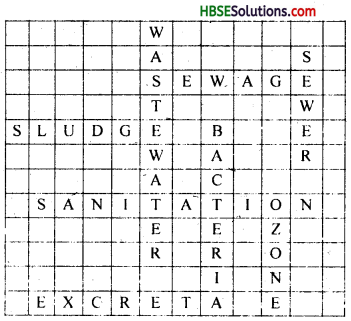
Here is a crossword puzzle : “Good luck !
HBSE 7th Class Science Solutions Chapter 18 Wastewater Story 1
Across:
3. Liquid waste products
4. Solid waste extracted in sewage treatment
6. A word related to hygiene
8. Waste matter discharged from human body

Down:
1. Used water
2. A pipe carrying sewage
5. Micro-organisms which causes cholera
7. A chemical to disinfect water
Answer:
HBSE 7th Class Science Solutions Chapter 18 Wastewater Story 2

Question 12.
Study the following statements about ozone:
(a) It is essential for breathing of living organisms.
(b) It is used to disinfect water.
(c) It absorbs ultraviolet rays.
(d) Its- proportion in air is about 3%.
Which of these statements are correct?
(i) (a), (b) and (c)
(ii) (b) and (c)
(iii) (a) and (d)
(iv) All four
Answer:
(b) and (c)

Extended Learning – Activities and projects

Question 1.
Construct a crossword puzzle of your own using the keywords.
Answer:
Do it yourself.

Question 2.
Then and now; Talk to your grand parents and other elderly people in the neighbourhood. Find out the sewage disposal systems available to them. You can also write letters to people living in far off places to get more information. Prepare a brief-report, on the information you collected.
Answer:
Do it yourself.

Question 3.
Visit a sewage treatment,plant.
It-could be as exciting and enriching as a visit to a zoo, a museum, or a park. To guide your observation here are a few suggestions.
Record in your notepad :
Place _________ Date _________ Time Name of the official at the plant _________ Guide/Teacher _________.
(a) The location of the sewage plant.
(b) Treatment capacity.
(c) The purpose of screening as the initial process.
(d) How is air bubbled through the aeration tank?
(e) How safe is the water at the end of the treatment? How is it tested?
(f) Where is the water discharged after treatment?
(g) What happens to the plant during heavy rains?
(h) Is biogas consumed within the plant or sold to other consumers?
(i) What happens to the treatment sludge?
(j) Is there any special effort to protect nearby houses from the plant?
(k) Other observations.
Answer:
Do it yourself.

HBSE 7th Class Science Wastewater Story Important Questions and Answers

Very Short Answer Type Questions

Question 1.
Write different sources of wastewater?
Answer:
Household activities, industrial activities and agricultural activities.

Question 2.
Name certain organic impurities in the wastewater.
Answer:
Animal waste, Human faeces, oil and urine, fruits and vegetables.

Question 3.
Write certain Inorganic impurities in, the wastewater.
Answer:
Metals, phosphates and nitrates.

HBSE 7th Class Science Solutions Chapter 18 Wastewater Story

Question 4.
Name certain disease causing micro-organism.
Answer:
Bacterias, Viruses etc.

Question 5.
Which process removes the solids like faeces and other substances from the wastewater?
Answer:
Grit and sand removal tank.

Question 6.
Which instrument is used to remove floatable solids from the wastewater?
Answer:
A skimmer is used to remove floatable impurities.

Question 7.
Who decomposes the sludge?
Answer:
Anaerobic bacteria decompose the sludge.

Question 8.
What helps to clean the clarified water?
Answer:
Aerobic bacteria helps to clean the clarified water.

Question 9.
Why is ozone and chlorine used?
Answer:
Ozone and Chlorine is used to kill the bacteria etc. present in the clarified water.

Short Answer Type Questions

Question 1.
How is water’polluted?
Answer:
Water is used for various’purposes in homes, industries and agriculture. When water is used for cleaning, bathing, washing, dying etc. it pollutes the water. Unwanted waste materials and chemicals etc. get added in the water and this wastes the water.

Question 2.
How “bar screen” and ‘grit and sand removal tank’ help in clarification of water?
Answer:
When wastewater is passed through bar screens it separates big and large objects like plastics, bags, sticks, can, napkins etc. In grit and sand removal tank other solid impurities like pebbless and etc. are removed.

HBSE 7th Class Science Solutions Chapter 18 Wastewater Story

Question 3.
How is sludge treated?
Answer:
Sludge is the solid impurities separated from the sewage. It is removed and treated in a separate tank with anaerobic bacteria. During this process biogas is produced which is used to produce electricity. Dried sludge is used as manure.

Question 4.
What are the problem arising due to open drains and other unsanitary conditions?
Answer:
Open drains and unsanitary conditions produce bad smell. It becomes an idle place of breeding for mosquitoes, files and other harmful insects. These insects spread many harmful diseases and other health hazards.

Question 5.
How the kitchen waste blocks the drains?
Answer:
Kitchen waste like oils and fats clogs the pores in soil and reduce the Alteration process. It also blocks the pipes by hardening the pipes. Wastes like tealeaves solid food remains, cotton etc. also choke the pipes and slows down flow of oxygen. This slows down the decomposition process by the aerobic bacteria.

HBSE 7th Class Science Solutions Chapter 18 Wastewater Story

Long Answer Type Questions

Question 1.
How defection in open cause health hazards?
Answer:
Due to lack of proper sewage disposal system a large amount of people in India defecates in open. They use riverbeds, railway lines, fields and drains for this purpose. These excreta dries down and percolate, in soil with rain water. It pollutes the ground water. Excreate along river bed pollutes the river water. In this way water on the ground and under the ground get polluted. This polluted water contains the micro-organisms of various communicable diseases like cholera, typhoid, hepatilis and meningiti it is dysentry etc.

Wastewater Story Class 7 HBSE Notes

  • Water is a precious natural resource.
  • We cannot imagine our lives without water.
  • We waste a lot of water daily in various household and industrial activities Such water is called wastewater.
  • The wastewater produced during household activities, industrial activities, and various agricultural processes is also called sewage.
  • Sewage is the liquid waste that can cause various diseases and environmental hazards if not managed.
  • Sewage is collected from its sources and treated to destroy its harmful constituent to clean it.
  • It is made usable in treatment plants and disposed of in various sources of water.
  • Drainage systems should be covered to avoid communicable diseases.
  • We should not throw waste in the open and should not defecate in open.
  • Low-cost disposal methods can be adopted in areas where a proper sewer system is not available.

HBSE 7th Class Science Solutions Chapter 18 Wastewater Story Read More »

HBSE 6th Class Science Solutions Chapter 8 Body Movements

Haryana State Board HBSE 6th Class Science Solutions Chapter 8 Body Movements Textbook Exercise Questions and Answers.

Haryana Board 6th Class Science Solutions Chapter 8 Body Movements

HBSE 6th Class Science Body Movements Textbook Questions and Answers

Exercises

Question 1.
Fill in the blanks:
(a) Joints of the bones help in the ________ of the body.
(b) A combination of bones and cartilage form the ________ of the body.
(c) The bones at the elbow are joined by a ________ joint.
(d) The contraction of the ________ pulls the bones during movement.
Answer:
(a) movement
(b) skeletal
(c) balls socket
(d) muscles

Question 2.
Indicate true (T) and false (F) among the following sentences :
(a) The movement and locomotion of all animals is exactly the same.
(b) The cartilage is harder than bones.
(c) The finger bones move in one plane.
(d) The forearm has two bones.
(e) The cockroach have an exoskeleton.
Answer:
(a) False
(b) False
(c) True
(d) True
(e) True.

HBSE 6th Class Science Solutions Chapter 8 Body Movements

Question 3.
Match the items in column I with appropriate items of column II.

Column IColumn II
(i) Upper jaw(a) have fins on the body.
(ii) Fish(b) has an outer skeleton.
(iii) Ribs(c) can fly in the air.
(iv) Snail(d) as an immovable joint.
(v) Cockroach(e) protect the heart.
(f) shows very slow movement
(g) have a streamlined body.

Answer:
(i) (d)
(ii) (g)
(iii) (e)
(iv) (f)
(v) (c)

Question 4.
Answer the following:
(a) What is a ball and socket joint?
(b) Which of the skull bones are movable?
(c) Why can our elbow not move backward?
Answer:
(a) The round end of one bone fits into the hollow space of the other bone. Such a kind of joint allows movements in all directions. Such joints are called ball and socket joints.
Example : Joints between the upper arms and the shoulders; the thigh and hip joints.

(b) The facial bones of our skull comprises upper and lower jaw; in which lower jaws is movable.

(c) Our elbows have hinge joint. These joints allow movement only in one plane only like a door hinge and not more than 180 degrees.

HBSE 6th Class Science Body Movements Important Questions and Answers

Very Short Answer Type Questions

Question 1.
Define tissues.
Answer:
A group of similar cells to perform special functions are called tissues.

Question 2.
What is an organ?
Answer:
Different kinds of tissues group together to perform special function is called an organ.

Question 3.
Define organ system.
Answer:
A large number of related organs group together to form an organ system.
Cells → Tissues → Organs → Organ system → Human body.

Question 4.
Give two examples of organs.
Answer:
Heart, oesophagus.

Question 5.
Name two tissues.
Answer:
Muscles tissue, Nervous tissue.

HBSE 6th Class Science Solutions Chapter 8 Body Movements

Question 6.
Name any three sense organs of our body.
Answer:
Eyes, ears and nose.

Question 7.
What are the organs of respiration in man?
Answer:
Nostrils, trachea, bronchi, lungs and muscles.

Question 8.
Why do animals move?
Answer:
Animals move from one place to another in search of food, mate and to defend themselves from enemies.

Question 9.
Where do the following animals live?
Whale, elephant and frog
Answer:
Water, forest, water.

Question 10.
Give the names of two vertebrate animals.
Answer:

  • Man
  • Horse.

Question 11.
Name two major groups of animals.
Answer:

  • Vertebrate
  • Non-vertebrate.

Question 12.
What is the function of hair in our nose?
Answer:
They prevent dust and smoke particles from entering enter our body.

Question 13.
Name the organs connected by food pipe.
Answer:
Larynx.

Question 14.
Name the pumping organ in our body.
Answer:
Heart.

Question 15.
Give the full form of RBC.
Answer:
Red blood corpuscles.

HBSE 6th Class Science Solutions Chapter 8 Body Movements

Question 16.
Name two single-celled animals.
Answer:
Amoeba, Paramecium.

Question 17.
Define the term “cell”.
Answer:
Structural and functional unit of life is called cell.

Question 18.
What is the normal rate of heart beat?
Answer:
70-72 beats per minute.

Question 19.
What are external organs?
Answer:
The organs which can be seen from outside are called external organs.

Question 20.
Name three external organs.
Answer:
Hand, leg and mouth.

Question 21.
How many organ systems do we have?
Answer:
We have ten organ systems.

Question 22.
What is our skeleton made up of?
Answer:
Our skeleton is made of bones and cartilage.

Question 23.
What is the main function of our skeleton system?
Answer:
It gives support to the body and protects the inner organs.

Question 24.
What are bones and cartilages?
Answer:
The hard structures are bones and cartilages are comparatively soft and elastic.

Question 25.
How many vertebrae are found in our back bone?
Answer:
The back bone is composed of 33 small ring-like vertebrae joined end to end.

Question 26.
What are the regions of a backbone?
Answer:
Back-bone has five regions. From the top they are neck, chest, belly, hip and tail.

Question 27.
Which bone forms the shoulder bone?
Answer:
Shoulder bone is formed by the collar bone and the shoulder blade.

Question 28.
Our forearm has bones.
Answer:
Two.

HBSE 6th Class Science Solutions Chapter 8 Body Movements

Question 29.
How are bones joined together?
Answer:
Bones are held together at joints by strong cords called ligaments.

Question 30.
What are hinge joints?
Answer:
These joints allow movement only in one plane not more than 180 degrees.,

Question 31.
How do muscles move the bones?
Answer:
The muscles move the bones by contraction.

Question 32.
Define movement.
Answer:
When organisms move their body parts without changing their position.

Question 33.
What is locomotion?
Answer:
When animals move from one place to another place. This kind of movement is called locomotion.

Question 34.
How do fishes move?
Answer:
They move with the help of tail fins and anal fins.

Question 35.
How does a cockroach move?
Answer:
Cockroach has distinct muscles attached with skeletal process. These muscles move the body.

Short Answer Type Questions

Question 1.
Define tissue, organ and organ system.
Answer:
→ Tissue : A group of similar cells to perform special functions. These group of cells are called tissues.

→ Organ: Groups of different kinds of tissues which perform special functions are called organs. Each organ of the body has a different structure.

→ Organ system: A large number of related organs together form an organ system. Cells → organ → organ system human body.

Question 2.
Give two examples of each : tissues and organs.
Answer:

  • Tissues : Muscles tissues, Nerve tissues.
  • Organ : Heart, stomach.

Question 3.
Why do animals move?
Answer:
Animals move from one place to another place due to the following reasons:

  • In search of food
  • In search of mate and to protect from enemies.

Question 4.
What is the function of our brain?
Answer:
Brain controls our body activity. It is also the centre of memory and learning.

Question 5.
How does a cockroach move?
Answer:
Cockroach also walks and climbs on the wall and flies in the air. It has three pairs of joined legs attached to the breast region. These help in walking. It has distinct muscles in the breast region which move the wings during flight.

Question 6.
Are nails and hairs organs?
Answer:
No, our hairs and nails have important uses. They are produced by the skin, but they are not organs. Because as they grow, they become dead. They can be cut without pain or bleeding.

HBSE 6th Class Science Solutions Chapter 8 Body Movements

Question 7.
Define movement in snakes.
Answer:
Locomotion in snakes is like swimming on land. They make many loops at the sides. It is mainly the forward thrust to move forward. They also hitch the skin and body alternately dragging the ventral scales on the ground. Some snakes can swim well in water.

Question 8.
Define skeletal system.
Answer:
Our skeletal system is made up of many bones and cartilages. The bones are hard and cartilages are soft and elastic. It gives support to the body It protects internal organs. Together with muscles it gives shapes to our body. Narrow bone produces red blood cells and some white blood cells.

Question 9.
What are chest bones?
Answer:
Chest is a cone-shaped cage. It encloses the hearts and the lungs. At the back are the vertebrae 12 pairs of ribs curve round .the sides. Ribs are attached to the sides of each vertebrae. Ten of them are also attached by cartilage to the breast bone at the front. Two ribs are free. The ribs are joined in such a way that they allow the needed movement of the chest during breathing.

Question 10.
Define the bones present in our hand.
Answer:
The hand comprises the upper arm, fore-arm, wrist, palm and lingers. The upper arm has one long bone, and fore-arm has two long bones. Wrist is made up of several small bones. The palm is composed of fine slightly longer bones. There are three small bones in each finger.

Question 11.
What is the correct sitting postures?
Answer:
In correct position, one should sit straight and relaxed. One should not bend in front or lean backwards. The fore-arm should be at the same level. The feet should be in rest on the floor. Lower leg should be erect making a right angle at the knee.

Question 12.
Define the following:
(a) Fixed joints, (b) Ball and socket joints,
Answer:
(a) Fixed joints: Some attachments do not allow movements. They are fixed joints. Joint of cranium is a fixed joint.

(b) Ball and socket joints : The rounded end of one bone fits into the hollow space of the other bone. Such a kind of joint allows movements in all directions. Examples : The joints between the upper arm and shoulder, the thigh and the hip joint.

Question 13.
What are bone joints and from what are they joint?
Answer:
The place where two bones or more than two bones meet together is called a joint. There are various kinds of joints. They are held together at joints by strong cords called ligaments.

Question 14.
What is locomotion? Where is it found?
Answer:
Animals move from one place to another for various purposes. This kind of movement is called locomotion. Locomotion is found only in animals. Locomotion helps them in search of food and shelter. It also helps them escape from their enemies.

HBSE 6th Class Science Solutions Chapter 8 Body Movements

Question 15.
Answer the following questions:
(a) What is an organ system?
(b) Which of the skull bones are movable?
(c) Which of the external organs are supported by cartilages?
(d) Draw and label the bones of the leg.
Answer:
(a) When several organs group together as a team to carry out a major activity, such a set of organs is called an organ system.

(b) The facial bones comprise the upper and lower jaws and a few other bones. The bones of lower jaw are movable.

(c) The back bone and its 24 vertebrae are joined by cartilages. Thus it forms a hollow bony tube. Nose, ear and various joints are joined by cartilage.

Long Answer Type Questions

Question 1.
Define the locomotion in snail.
Answer:
The body of a snail is covered with a hard and flexible shell. It has an opening with a lid. Through the opening of the shell, a strong muscular foot and head comes out. The foot is a part of its belly. When it starts moving, the wavy motion of the foot can be seen. The movement is very slow.

Question 2.
How does an earthworm move?
Answer:
The body of a mature earthworm seems to be made of many rings joined end to end. From the paler under surface of the body a large number of minute bristles project out. The bristles are connected with muscles at their bases.

The bristles help to get a good grip on the ground. There are muscles in the body wall which help to extend and shorten the body. During movement, the earthworm first extends the front part of the body, keeping the rear fixed to the ground. Then it fixes the front end and releases the rear end. Thereafter it shortens the body and pulls the rear end forward. The earthworm follows this process repeatedly to move ahead. On a slippery surface, its movement is affected due to the loss of the grip on the surface.

Body Movements Class 6 HBSE Notes

  • The various kinds of animals differ in shape, size and habitat. Therefore their body parts and their working also vary widely.
  • The human body have many parts which have definite functions. They are called organs.
  • Both external and internal (parts) organs are made of many cells and tissues, but every organ works as a single unit.
  • The organs group together as a team to perform a major activity. A set of such organs forms an organ system.
  • There are ten organ systems which in coordination with one another perform all the life activities.
  • Hard structures such as bones and cartilages form the skeletal system of man. It gives the frame and shape to the body and help in movement. It protects internal organs and bones also form red blood cells and some white blood cells.
  • The skeletal comprises of the skull, the back bone, ribs and the breast bone.
  • The skeletal also includes the shoulder and hip bones and bones of hands and legs.
  • Two bones are joined by tough cords called ligaments. The bones are joined to muscles by cord-like tendons.
  • The bones are moved by alternate contractions and relaxations of two sets of muscles.
  • The bone joints are of various kinds on the nature of joints and directions of movement they allow.
  • Strong muscles and light bones work together to help the birds fly by flapping their wings. The fishes swim by forming loops alternately on two sides of the body. The tail pushes them forward and the vertebrates and muscles attached to them work for it. Similarly the snakes crawl on the ground by alternately looping sideways. A large no. of vertebrae and associated muscles push the body forward. The ventral scales also help in the process.
  • The body and legs of insects have hard jointed coverings forming an exoskeleton. The muscles of the breast connected with three pairs of legs and two pairs of wings help the cockroach to walk and fly.
  • The snails are moved by the muscular foot. The hard unjointed shell has no relation to the foot.
  • The earthworm moves by alternate extension and contraction of the body effected by the muscles. The minute movable bristles help in gripping the ground.

HBSE 6th Class Science Solutions Chapter 8 Body Movements Read More »

HBSE 6th Class Science Solutions Chapter 7 Getting to Know Plants

Haryana State Board HBSE 6th Class Science Solutions Chapter 7 Getting to Know Plants Textbook Exercise Questions and Answers.

Haryana Board 6th Class Science Solutions Chapter 7 Getting to Know Plants

HBSE 6th Class Science Getting to Know Plants Textbook Questions and Answers

Exercises

Question 1.
Correct the following statements and rewrite them in your notebook.
(a) Stem absorbs water and minerals from the soil.
(b) Leaves hold the plant upright.
(c) Roots conduct water to the leaves.
(d) The number of petals and sepals in a flower is always equal.
(e) If the sepals of a flower are joined together, its petals are joined to the petals.
(f) If the petals of a flower are joined together then the pistil is joined to the petal.
Answer:
(a) Root absorbs water and minerals from the soil.
(b) Stem hold the plant upright.
(c) Stem conduct water to the leaves.
(d) The number of sepals and petals in a flower are equal.
(e) If the sepals of a flower are joined together its petals not joined together.
(f) If the petals of a flower joined together, its pistil not joined together.

Question 2.
Draw (a) a leaf, (b) a tap root and (c) a flower.
Answer:
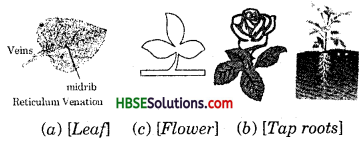
HBSE 6th Class Science Solutions Chapter 7 Getting to Know Plants 1

Question 3.
Can you find a plant in your house or in your neighbourhood. Which has long but a weak stem? Write its name. In which category would you classify it?
Answer:
The plant found in our house is money plant, which has weak and long stem. Such type of stem need support and they are called climbers. Guard plant and grapevine also have climber stems.

HBSE 6th Class Science Solutions Chapter 7 Getting to Know Plants

Question 4.
What are the function of a stem in a plant?
Answer:
Functions of a stem in a plant:

  • It forms a link between the roots and the other parts of a plant.
  • It provides path for the conduction of water and minerals absorbed by roots to different parts of the plant.
  • It bears leaf in such a way that they get maximum sunlight and support them.
  • It upholds the plant upright.
  • It bears the flowering parts of the plants.

Question 5.
Which of the following leaves have reticulate venation?
Wheat, Tulsi, Grass, Dhania, China rose, Maize.
Answer:
Tulsi, Dhania, China rose.

Question 6.
If a plant has fibrous root, what type of venation do its leaves likey to have?
Answer:
Parallel venation.

Question 7.
If a plant has leaves with reticulate venation, what kind of roots will it have?
Answer:
The root of plants will be tap root.

Question 8.
Is it possible for you to recognize the leaves without seeing them? How?
Answer:
Yes, we can recognize the leaves without seeing. We can recognize leaves by touching or by smelling.
Examples: Sugarcane, Bananas, Maize, Tulsi, Podina, Dhania etc.

Question 9.
Write the names of the parts of a flower:
Answer:
Parts of a flower : (i) Sepals (ii) Petals (iii) Stamens (iv) Pistil

Question 10.
Which of the following plants have you seen? Off those you have you have seen, which one have flowers.
Answer:
Do it your self.

Question 11.
Name the part of the plant which produces its food. Name this process.
Answer:
Leaf, produces their own food. The process of producing food by leaves is called photosynthesis.

Question 12.
In which part of a flower you likely to find the ovary?
Answer:
The ovary is found in pistil part of a flower.

HBSE 6th Class Science Solutions Chapter 7 Getting to Know Plants

Question 13.
Name two flowers each with joined and separated sepals.
Answer:
(a) Flowers with joined sepals are (i) sunflower, (ii) cotton.

(b) Flowers with separate sepals: (i)Rose, (ii) Mustard plant.

Question 14.
Names the parts of the plant which are hidden in this grid. Search for them by going up and down or even diagonally forward as well as backward. Have fun,
Answer:
Do it your self.

HBSE 6th Class Science Getting to Know Plants Important Questions and Answers

Very Short Answer Type Questions

Question 1.
What are herbs?
Answer:
Small and non woody plants are called herbs.

Question 2.
Name any two herbs.
Answer:
Wheat, balsam.

Question 3.
Define shrubs.
Answer:
Medium sized plants within branches starting just above the ground.

Question 4.
Name any three shrubs.
Answer:
Heena, lemon and bougainvillea.

Question 5.
Define trees.
Answer:
Woody plants having a large single stem, which grows for some distance from the ground.

Question 6.
Give examples of three trees.
Answer:
Neem, Mango, Coconut.

Question 7.
What are non-flowering plants?
Answer:
The plants which do not bear flowers.

Question 8.
Give two examples of non-flowering plants.
Answer:
Algae, moss, fern.

HBSE 6th Class Science Solutions Chapter 7 Getting to Know Plants

Question 9.
Name two climbers.
Answer:
Money plant, bean stalk.

Question 10.
What are creepers?
Answer:
Plants which need support to stand up are called creepers.

Question 11.
What is conduction?
Answer:
The process through which water travels through stem to other parts of the plants.

Question 12.
What is leaf venation?
Answer:
The design made by veins in a leaf is called leaf venation.

Question 13.
What is node?
Answer:
The part of stem where branches and leaf attached are called nodes.

Question 14.
Define internode.
Answer:
The part of stem between two nodes is called internodes.

Question 15.
Define alternate arrangement of leaves.
Answer:
When one leaf is attached to each node, it is called alternate arrangement.

Question 16.
What is opposite arrangement of leaves?
Answer:
When two leaves arise at each node, it is called opposite arrangement.

Question 17.
What is whorled arrangement?
Answer:
When several leaves are arranged is at a node, it is called whorled arrangement.

Question 18.
Name some plants which have aerial roots.
Answer:
Sugarcane, banyan tree and money plant.

Question 19.
How many root systems are found in plants?
Answer:
Two types:

  • Tap root system
  • Fibrous root system.

Question 20.
Define tap root system.
Answer:
When a plant has a main root and smaller ones come out from it.

Question 21.
What are lateral roots?
Answer:
Smaller roots which come from tap root.

HBSE 6th Class Science Solutions Chapter 7 Getting to Know Plants

Question 22.
Name two roots that we eat as food.
Answer:
Radish, Sweet potato.

Question 23.
Name two underground stems.
Answer:
Potato, yams.

Question 24.
Name one plant which stores food in their leaves.
Answer:
Onion.

Question 25.
Which part of a flower makes fruit?
Answer:
Pistil.

Question 26.
Name the parts of a flower.
Answer:
Sepals, petals, stamen and pistil.

Question 27.
Name any three parts of the leaf.
Answer:
Three parts of the leaves are : (i) Lamina (ii) Midrib (iii) Petiole.

Question 28.
Leaves are …………. in colour.
Answer:
Leaves are green in colour.

Question 29.
Leaves prepare their food by a process called ………..
Answer:
Photosynthesis.

Question 30.
What type of response does not plant touch-me-not show on touching?
Answer:
When we touch the plant of touch- me-not, it folds its leaves quickly. It shows stimuli towards touch.

Question 31.
Name two animals with heterotrophic mode of nutrition.
Answer:

  • Cow
  • camel
  • buffalo.

Question 32.
Which part of the leaf helps in exchange of gases?
Answer:
The lower part of leaf contains many minute pores, which are called stomata. These stomata help in exchange of gases.

HBSE 6th Class Science Solutions Chapter 7 Getting to Know Plants

Question 33.
List one common feature of the living and non-living objects.
Answer:
Living and non-living both have mass, shape and occupy space.

Question 34.
Name any two waste products of plants.
Answer:

  • Latex
  • Gum.

Question 35.
List one characteristic of living things.
Answer:
Living things reproduce.

Question 36.
Why do animals need food?
Answer:
Animals need food for growth and getting energy for doing various activities.

Question 37.
What is a cell?
Answer:
Structural and functional unit of life is called cell.

Question 38.
What is nutrition?
Answer:
The process of taking food is generally called nutrition.

Question 39.
What is respiration?
Answer:
The process of taking oxygen and giving out carbon dioxide from the body is called respiration.

Question 40.
Define excretion.
Answer:
Removal of harmful and poisonous substances from the body with the body organs is called excretion.

Question 41.
What is the food of fishes?
Answer:
Fishes feed on micro-organism and aquatic insects.

Question 42.
What is the food of frog?
Answer:
Small insects.

HBSE 6th Class Science Solutions Chapter 7 Getting to Know Plants

Question 43.
Represent photosynthesis by a chemical equation.
Answer:
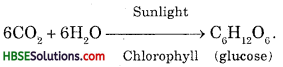
HBSE 6th Class Science Solutions Chapter 7 Getting to Know Plants 2

Question 44.
Name one organism whose body consists of only one cell.
Answer:
Amoeba.

Question 45.
What are autotrophs?
Answer:
Living organisms (green plants) that prepare their own food.

Question 46.
What are heterotrophs?
Answer:
Living organisms (non-green plants and animals) that cannot prepare their own food.

Question 47.
Define respiration.
Answer:
Respiration is the process by which living organisms make energy.

Question 48.
What is stimulus?
Answer:
A change that produces a reaction in an organism.

Question 49.
Where do we get energy for doing work?
Answer:
We get energy from the food we take.

Question 50.
How do plants get their food?
Answer:
Plants get their food from the soil with the help of roots.

Question 51.
What happens when CO2 is passed in lime water?
Answer:
Lime water turns milky.

Question 52.
Why do fish come on the surface in an aquarium?
Answer:
They come to take air.

Question 53.
Why is it necessary to remove waste materials from the body?
Answer:
Since some materials may be poisonous and harmful to the organism.

Question 54.
How does amoeba remove wastes from its body?
Answer:
Amoeba removes wastes through body surface.

HBSE 6th Class Science Solutions Chapter 7 Getting to Know Plants

Question 55.
How do plants remove their waste products?
Answer:
They remove their wastes in the form of latex and gum.

Question 56.
What is the process of removal of wastes by plants called?
Answer:
The process of removal of wastes in plants is called secretion.

Question 57.
How does a rose plant reproduce?
Answer:
Rose plant reproduces by cutting.

Short Answer Type Questions

Question 1.
Write a note of the need of plant classification.
Answer:
There are a great variation of plants in their size, shape and structure. So it is essential to classify plants for the ease of their study.

Question 2.
Differentiate between herb, shrub and trees.
Answer:
→ Herbs : Plants with soft stem and small in size. Examples: Tulsi, bean, gram etc.

HBSE 6th Class Science Solutions Chapter 7 Getting to Know Plants 3

→ Shrubs :Bushy plants, medium in size and much branched. Examples : Rose, china rose, cotton and sunflower.

HBSE 6th Class Science Solutions Chapter 7 Getting to Know Plants 3a

→ Trees : Large, branched, wood plants. Examples: Peepal, neem, banyan etc.

HBSE 6th Class Science Solutions Chapter 7 Getting to Know Plants 3b

Question 3.
What are the functions of leaves?
Answer:
Leaves are known as food factories of plants. They prepare their own food in their green parts using chlorophyll, water and carbon dioxide in the presence of sunlight. This process is called photosynthesis.

Question 4.
Name different parts of a leaf.
Answer:
Normally leaves are flat and green. The main parts of a leaf are:

  • leaf lamina
  • midrib
  • tip
  • petiole
  • veins

Question 5.
Differentiate between flowering plants and non flowering plants.
Answer:

Flowering plantsNon-Flowering plants
The plants which have roots, stem and leaves, flower and fruits are known as floweringThe plants which do not have definite roots, stem, leaves and flowers are known as non-flowering plants.
Examples : Mango, guava, grapes, papaya, banana, jamun etc.Examples : Fern, moss, algae etc.

Question 6.
Why does the stem of cactus plant not have leaves?
Answer:
The cactus plant does not have leaves. Its green stem functions as the leaf. Leaves of this plant are modified into spines, which reduce the loss of water for living in dry areas.

HBSE 6th Class Science Solutions Chapter 7 Getting to Know Plants

Question 7.
What is the main function of root?
Answer:
Root performs the following functions:

  • It fixes the plant in the soil.
  • It absorbs water and minerals from the soil for the other parts of the plants.
  • It holds the soil firmly, thus prevents soil erosion.

Question 8.
What are the main functions of stem?
Answer:
Functions of stem:

  • It forms a link between the roots and other parts of a plant.
  • It provides path for the conduction of water and minerals absorbed by roots to different parts of the plant.
  • It upholds the plant upright.
  • It beau’s leaves in such a way that they get maximum sunlight.
  • It bears the floral parts of the plants.

Question 9.
Name the important parts of a flowering plant.
Answer:
The main parts of a flowering plant are:

  • Root
  • Stem
  • Leaf
  • Branches
  • Flower
  • Fruits.

Question 10.
Define supporting roots with examples.
Answer:
In some plants, a number of rope – like roots arisefrom the horizontal branches of the tree. They grow downwards and penetrate the soil acting as pillars to support the main stem and heavy branches of the tree. These roots are called prop roots. These roots are found in banyan tree, sugarcane, screwpine and maize.

Question 11.
Mention some modified roots and stems which we eat.
Answer:
Radish, carrot, potato, sweet potato, beet etc., plant roots storage food, which we eat. In some plants like ginger, onion, potato etc. stems grow underground and store food materials.

Question 12.
What imparts green colour to a leaf?
Answer:
We know that most of the leaves are green in colour. The green colour of leaves is due to a green pigment present in them. This green pigment is called chlorophyll.

HBSE 6th Class Science Solutions Chapter 7 Getting to Know Plants

Question 13.
Write three modifications each of stems and leaves.
Answer:
Modifications of roots:

  • Storage roots
  • Supporting roots
  • Breathing roots.

Modification of stems:

  • Storage of food
  • support
  • protection.

Question 14.
What is a fruit? How does it differ from a seed?
Answer:
After fertilization, the ovary of the flower swells up and forms the fruits, like mango, apple, orange etc. The seeds contain a store of food, usually starch. Embryo surrounded by a hard wall with embryo inside is called the seed.

Question 15.
What happens if a green plant does not get sunlight?
Answer:
If a green plant does not get sunlight, it cannot prepare its own food by the process of photosynthesis, and plants and animals will die.

Question 16.
All living organisms need food. Why?
Answer:
All living organisms need food for v’ growth, repair and replacement of worn out cells in the body and energy to perform vital activities. Food provides energy. To perform variety of A activities, animals need food. Plants get. water and minerals from soil through root hairs to their different parts of plants. Green plants prepare their own food with the help of carbon dioxide, water, chlorophyll and sunlight. The process is known as photosynthesis.

Question 17.
Distinguish between locomotion and movement in animals.
Answer:
Difference between locomotion and movement in animals:

MovementLocomotion
All human beings and animals move from one place to another for food and protection from enemies. For example, birds fly and travel long distances and fish continuously move on water.The bodily movement involving change of place in animals is called locomotion. Animals use wings (birds), limbs (Horse, cow, buffalo), fins (fish) for locomotion.

Question 18.
Why are the green plants called autotrophs?
Answer:
Green plants are called autotrophs because they prepare their own food. Green plants utilize carbon dioxide from air, water, mineral from soil and sunlight to prepare their own food in the form of carbohydrate or simple sugar. This process of preparing food is called photosynthesis.

Question 19.
List some common features of living and non-living things.
Answer:

  • All livings and non-living things have mass-shape and they occupy space.
  • They are made up of structural units.
  • The structural units of living and non-living things are cells and particles respectively.

Question 20.
What do you understand by a life span of a living thing?
Answer:
Different organisms have different life spans. The period for which a living being lives is called life span. Animal growth may not occur throughout the life span. Growth in animals is limited and plants and trees grow for a long period. Growth in plants and animals is influenced by several factors.

HBSE 6th Class Science Solutions Chapter 7 Getting to Know Plants

Question 21.
List the three differences between living and non-living objects.
Answer:

LivingsNon-livings
1. Living things grow.1. They do not grow.
2. Reproduce to give birth to new one.2. They do not reproduce.
3. Living thing shows movements and locomotion.3. They do not show movement and locomotion.
4. They respond to stimuli.4. They do not respond to stimuli.

Question 22.
Give three differences between animals and plants.
Answer:
Difference between animals and plants:

AnimalsPlants
1. Animals move from one place to another.1. Plants do not move from one place to another.
2. Animals do not make their own food. So they are heterotropbs.2. Plants are autotrophs because they prepare their own food.
3. Growth in animals is limited and definite up to a certain age.3. Plant growth is unlimited and indefinite.

Question 23.
State the character on the basis of which animals are divided into two categories.
Answer:
Animals which have a bony skeleton with a back bone are called vertebrates and animals which do not have a long skeleton and a back bone are called invertebrates.

Question 24.
Define excretion.
Answer:
The process of removal of some harmful and poisonous substances from the body is called excretion. In humans, the excretory products are removed from the body in the form of urine and urea.

Question 25.
What do you mean by growth?
Answer:
An increase in size, shape and body mass of an organism is termed as growth. It is an irreversible change in a living organism. The growth in animals is limited and in plants, growth is unlimited and continues till the last stage of life.

Question 26.
What is the difference between the growth of living and non-living?
Answer:
The growth in living beings is internal and irreversible. It is due to multiplication of cells and tissues. The growth in non-living is external and reversible. It is caused due to deposition of particle from outside.

Question 27.
What do you understand by the term ‘nutrition’?
Answer:
All living things depend upon food to survive. The food is the source of energy. The energy is necessory for performing various life activities. Taking of food is called nutrition.

HBSE 6th Class Science Solutions Chapter 7 Getting to Know Plants

Question 28.
What is respiration?
Answer:
Respiration is an anabolic activity during which air rich in oxygen is taken into the cell and air rich in CO2 is given out from the cells. The oxygen is used in the oxidation of food which gives us energy.

Question 29.
Define stimulus and response.
Answer:
Any change in our surroundings is a stimulus and any reactions performed by an organism to that stimulus is response. For example the watering of mouth by seeing a tasty food. To leave the road on the left on hearing the sound of a horn. The movement of stem or flower in the direction of sunlight. These characteristics of living forms show responsiveness.

Question 30.
What is cell? What is the difference between unicellular and multicellular organism?
Answer:
The structural and functional unit of life is celled cell. Each cell has a living substance, the protoplasm. Single celled animal is called unicellular and many called organism is called multicellular organism. Example : Amoeba and cow etc.

HBSE 6th Class Science Solutions Chapter 7 Getting to Know Plants

Question 31.
Differentiate between autotrophs and heterotrophs?
Answer:
Those organisms which prepare their own food, are called autotrophs. For example : only green plants. Those organisms which cannot prepare their own food and depend upon plants or other animals for their food are called heterotrophs. For example : Man, Bacteria, Fungi, etc.

Question 32.
In what way does the intake of food help living things?
Answer:
Living things perform many activities like, playing, running, etc. The energy is required for all activities of living things. This energy is obtained from the food they take. Thus food gives living things energy. It also helps living beings in repairing the body parts. Food also protects t living things from infections and diseases.

Long Answer Type Questions

Question 1.
Draw a labelled diagram of a plant showing its various parts.
Answer:
The various parts of a plant are shown on the diagram given below:
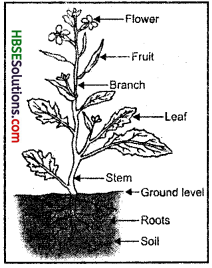
HBSE 6th Class Science Solutions Chapter 7 Getting to Know Plants 4

Question 2.
What is a leaf? Draw the labelled diagram of a leaf. What are the functions of the leaves of a plant?
Answer:
Leaf: The leaf is a thin, broad, flat and green part of a plant which is attached to the stem (or branch).

The leaves of plants have three main functions:
(i) The leaves make food for the plant by photosynthesis.
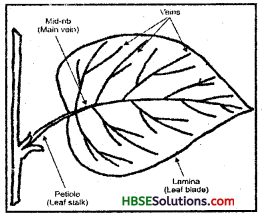
HBSE 6th Class Science Solutions Chapter 7 Getting to Know Plants 5

(ii) The leaves get rid of excess water from the plant through transpiration.

(iii) The leaves carry out the process of respiration in plants.

Getting to Know Plants Class 6 HBSE Notes

  • Plants are usually grouped in herbs, shrubs and trees on the basis of their height, stem and branches.
    Stem conducts water upwards, bears leaves, buds and flowers.
  • Leaves have variety of shapes, size and other characteristics.
  • The pattern of veins on the leaves is called venation. It can be reticulate or parallel.
  • Leaves are attached to the stem at places called nodes. The part of stem between two nodes is called internode.
  • The arrangement of leaves at the node is alternate, opposite or whorled.
  • Leaves release water vapour by the process of transpiration. They prepare food by the process of photosynthesis from carbon dioxide, water, chlorophyll and sunlight.
  • Roots are underground part of the plants. They absorb water and minerals from the soil and hold the soil firmly to keep a plant upright.
  • Roots are mainly of two types : Tap root and fibrous root.
  • Plants having leaves with reticulate venation have tap root and parallel, venation plants leaves have fibrous root.
  • Stem conducts water from the roots to the leaves and food from the leaves to the roots.
  • All plants do not have colourful flowers. The parts of flowers are usually present in rings.
  • The various whorls are sepals, petals, stamen and pistil. Number of sepals, petals, stamen’s and pistils are different in different flowers.

HBSE 6th Class Science Solutions Chapter 7 Getting to Know Plants Read More »

HBSE 6th Class Science Solutions Chapter 6 Changes Around Us

Haryana State Board HBSE 6th Class Science Solutions Chapter 6 Changes Around Us Textbook Exercise Questions and Answers.

Haryana Board 6th Class Science Solutions Chapter 6 Changes Around Us

HBSE 6th Class Science Changes Around Us Textbook Questions and Answers

Exercises

Question 1.
To walk through a waterlogged area, you usually shorten the length of your dress by folding it. Can this change be reversed?
Answer:
Yes, this change can be reversed.

Question 2.
You accidently dropped your favourate toy and broke it. This is a change, you did not want. Can this change be reversed?
Answer:
No, this change can not be reversed.

Question 3.
Somethings are listed in the following table. For each change write in blank column. Whether the change can be reversed or not.

S. No. ChangeCan be reversed (Yes/No)
1. The sawing of a piece of wood
2. The melting of ice candy.
3. Dissolving sugar in water.
4. The cooking of food.
5. The ripening of a mango.
6. Souring of milk.

Answer:
(1) Can be reversed; Yes.
(2) No.
(3) Yes.
(4) No.
(5) No.
(6) No.

Question 4.
A drawing sheet changes when you draw a picture on it. Can you reverse this change?
Answer:
No, we cannot reverse this change.

Question 5.
Give examples to explain the difference between changes that can or cannot be reversed.
Answer:
A change that can be reversed is called a reversed change. For example, blowing of a balloon, making aeroplane from a piece of paper by folding it and making ball from a dough etc. changes can be reversed. A change that cannot be reversed is called irreversible change. For example: Ripening of fruits, burning of paper and cooking of food, etc. cannot be reversed.

HBSE 6th Class Science Solutions Chapter 6 Changes Around Us

Question 6.
A thick coating of a paste of plaster of paris (POP) is applied over the bandage on a fractured bone. It becomes hard on drying to keep the fractured bone immobilised. Can the change in POP be reversed.
Answer:
No, the change cannot be reversed.

Question 7.
A bag of cement lying in the open gets wet due to rain during the night. The next day the sunshines brightly. Do you think the changes, which have occured in the cement, could be reversed?
Answer:
No, the change cannot be reversed.

HBSE 6th Class Science Changes Around Us Important Questions and Answers

Very Short Answer Type Questions

Question 1.
What type of change is of climate change?
Answer:
Periodic change.

Question 2.
Can deforestation be considered as a reversible change?
Answer:
No, it is not a reversible change.

Question 3.
Can you obtain wood from saw dust?
Answer:
No, we cannot reverse this change.

Question 5.
Give examples to explain the difference between changes that can or cannot be reversed.
Answer:

  • Heart beat
  • Phases of moon
  • Swinging of the pendulum of a clock
  • high and low tide in sea every day.

Question 6.
Pickling of mango is a desirable change. How?
Answer:
Pickling of mango is always a desirable change, because we pickle mango according to our taste and desire.

Question 7.
Give an example of natural change.
Answer:
Germination of seed.

HBSE 6th Class Science Solutions Chapter 6 Changes Around Us

Question 8.
Give an example of irreversible change.
Answer:
Burning of paper.

Question 9.
What is a physical change?
Answer:
Change in which no new product is formed.

Question 10.
What is a chemical change?
Answer:
A change in which a new substance with different properties is formed.

Question 11.
Mention two undesirable change.
Answer:

  • Breaking of glass ware
  • flooding of rivers.

Question 12.
Give four examples of desirable change.
Answer:

  • Turning of milk into curd
  • Formation of manure from animal dung
  • Cleaning of utensils
  • Change of season.

Question 13.
What is pasteurisation?
Answer:
Heating and cooking of milk is known as pasteurisation.

Question 14.
State two advantages of non¬periodic change.
Answer:

  • Growth of plants and animals and boiling of milk.
  • Washing of cloth are some advantages of non-periodic change.

Question 15.
What is solution?
Answer:
When salt is added in water, it dissolves in water to form solution which has properties that mixed to form it.

HBSE 6th Class Science Solutions Chapter 6 Changes Around Us

Short Answer Type Questions

Question 1.
Can deforestation be considered as a reversible change?
Answer:
Deforestation is not a reversible change because it cannot take place in reverse direction. Forest cannot be grown quickly.

Question 2.
Give four examples of non-periodic change.
Answer:

  • Occurring of earthquake
  • Falling of ripening fruits from tree
  • Landslides
  • Train accident.

Question 3.
Is burning always a desirable change?
Answer:
Burning is always not a desirable change. It causes pollution, which is not a desirable change. Burning of house is not a desirable change, because they are harmful to us.

Question 4.
What is the advantage of pasteurising milk?
Answer:
Milk is an essential commodity. Some harmful bacteria spoil it after some time. In pasteurisation, microbes are killed and milk is prevented from spoiling for several days and can be stored without refrigeration.

Question 5.
Explosion of a cracker is a chemical change. Explain.
Answer:
When we burn a cracker, it exploide. Heat, light and smoke comes out after explosion. Many new products are formed. So it is a chemical change.

HBSE 6th Class Science Solutions Chapter 6 Changes Around Us

Question 6.
Most physical changes are reversible. Give reasons with two examples.
Answer:
All physical changes are reversible. Because in physical changes, no new product is formed. They can be reversed easily.
Examples:
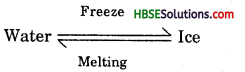
(i) Dissolving of sugar in water is a physical change and we get back sugar and water easily.

(ii) Formation of ice from water. In melting of ice, we can get water back.
HBSE 6th Class Science Solutions Chapter 6 Changes Around Us 1

Question 7.
Identify the type of change and state whether energy is evolved or absorbed in each one of the following:
Burning of a candle, lighting of a bulb, preparation of food by green plants, volcanic eruption.
Answer:

  • Burning of a candle : Chemical change, energy evolved.
  • Lighting of a bulb : Physical change, energy evolved.
  • Preparation of food by green plants: Chemical change, energy absorbed.
  • Volcanic eruption: Chemical change, energy evolved.

Question 8.
Define the term ‘interaction’.
Answer:
When two or more substances act on each other, as a result a change may take place. This is called interaction.

Question 9.
What are the differences between chemical and physical changes?
Answer:
Difference between chemical and physical changes:

Chemical changePhysical change
1. A new substance is formed.1. No new substance is formed.
2. It is a permanent change.2. It is a temporary change.
3. The composition of new substances changes.3. No change in the composition of change takes place.
4. It is irreversible.4. It is reversible.
5. Heat/light evolved or absorbed during change.5. No heat light evolved or absorbed or may be evolved or absorbed.

Question 10.
Name two similarities between the various objects in your surroundings.
Answer:

  • Each object occupies space indicated by its size and shape.
  • Objects are made up of materials and some are made up of combination of materials.
  • The structural units of objects are called cells and molecules respectively.

HBSE 6th Class Science Solutions Chapter 6 Changes Around Us

Question 11.
How do you group the objects into two main categories?
Answer:
Objects can be grouped on the basis of shape, size and colour. Objects can be categorised into living and non-living objects.

  • Living objects such as plants and animals.
  • Non-living objects such as stone, table, chair, etc.

Living organisms show movement, respiration, excretion, breathinbg, nutrition, reproduction and sensitivity towards heat, light, sound and touch etc.

Question 12.
Why do animals and plants respire?
Answer:
All living things perform various kinds of activities. Animals move and run around. You go to school and play. For these activities energy is required. This energy living beings obtain through the process of respiration. The oxygen is used to produce energy from the food which organisms consume. Oxygen burns the food and release energy. This energy is utilised for various activities. This can be represented as follows :
HBSE 6th Class Science Solutions Chapter 6 Changes Around Us 2

Question 13.
How is the process of photosynthesis in plants helpful to the animals?
Answer:
Plants prepare their own food by the process of photosynthesis in green leaves and plants. They prepare food in green leaves in presence of sunlight with the help of carbon dioxide and water. The food prepared by plants, all animals depend for their food on plants. In this way, photosynthesis is helpful to animals.

Long Answer Type Questions

Question 1.
State the reason for each of the following :
(i) Ripening of a fruit is a chemical change.
(ii) Rotation of fan is a periodic change.
(iii) Cooked food is stored in refrigerator.
(iv) Iron sheet is coated with tin before making a can.
Answer:
(i) Ripening of fruits is a chemical change because after ripening, a new product with different properties is formed.

(ii) The rotation of fan is a periodic change, because the change occurs after a fixed interval of time.

(iii) Cooked food is spoiled by bacteria and microbes. To prevent food from spoiling, it is stored in refrigerator, where microbes are killed due to low temperature.

(iv) Iron sheet is coated with tin before making can, because tin coated sheets do not rust. It prevents iron sheet from rusting.

Question 2.
When is a change said to have taken place in a material? Explain with the help of an example.
Answer:
We have many things around us. All these things have certain properties such as state (solid, liquid or gas), position, shape, size, colour, temperature, composition and structure, etc. When one or more properties of a thing become different, we say that it has changed or a change has taken place. Changes involve different kinds of alternations in the things around us. When a change takes place, there may be a change in the state, position, shape,, size, colour, temperature, composition or structure of the material of the object. When ice melts, it forms water. Ice is a solid, whereas water is a liquid. So, the melting of ice involves a change in state (form solid to liquid state).

HBSE 6th Class Science Solutions Chapter 6 Changes Around Us

Question 3.
What is meant by reversible changes and irreversible changes? Explain with examples.
Answer:
Reversible change: A change which can be reversed to form the original substance is called a reversible change.
Example:
When we heat ice, it melts to form liquid water. A change from solid to liquid takes place during the melting of ice. Now, if we cool the water by keeping in the freezer of a refrigerator, it again changes into solid ice. So, the change from ice to water, by heating, has been reversed by cooling. Thus, the melting of ice to form water is reversible change.

Irreversible change : A change which cannot be reversed to form the original substance or substances is called irreversible change.

Example : If we burn a piece of paper, it changes into ash and smoke. Now, we cannot combine the ash and smoke to form the original piece of paper. So, the burning of paper is a change which cannot be reversed. Therefore, the burning of paper is an irreversible change.

Question 4.
Explain why, the burning of paper is said to be an irreversible change whereas the boiling of water is known as reversible change.
Answer:
If we burn a piece of paper, it changes into ash and smoke. Now, we cannot combine the ash and smoke to form the original piece of paper. So, the burning of paper is a change which cannot be reversed. Hence, the burning of paper is an irreversible change. When we boil water by heating, then it changes into steam. Now, if we cool the steam, then water is formed again. So, the changing of water into steam has been reversed by cooling. Thus, the boiling of water is a reversible change.

Changes Around Us Class 6 HBSE Notes

1. We can bring about a change in a substance by heating, applying forces or by mixing it with something else.

2. When a solid mix with water to form a solution and we can say that the solid has dissolved,

3. Different solids dissolve to different degrees in the same amount of water. On heating, amount of solid that can dissolve increases.

4. A change can be physical or chemical. In chemical change, a new product is formed. A physical change can reverse.

5. Slow changes : The changes that takes place over a long period of time, like hours, days, months and years is called slow change. Example : Change during growth and formation of manure.

6. Desirable changes : Changes which are useful to us such as formation of curd from milk and formation of manure from cow dung.

7. Undesirable changes: The changes which are not useful to us are called undesirable changes. Examples : Breaking of glass tumbler and spoiling of food stuffs.

8. Fast changes : Those changes which occur within a short time interval. Example : Burning of a matchstick.

9. Periodic change : A change which occurs during a definite time interval is called periodic change. Examples : Heart beat, phases of moon etc.

10. Non-periodic change: A change which does not repeat again and again after a regular interval of time. Examples : Earthquake and train accidents.

11. Reversible change : If a change can be reversed, it is called reversible change; stretching of rubber band.

12. Irreversible change : A change which cannot be reversed. Example : Burning of paper, etc.

13. Physical change : It is a temporary change in which no new substance is formed. Example : Switching of electric heater. Dissolution of sugar in water.

14. Chemical change: It is a permanent change in which an entirely hew substance is formed with different properties. It is an irreversible change.
Example: Cooking of food and formation of curd from milk.

15. There are a variety of objects found in the surroundings. The objects have a variety of shapes and size. Shape and size of each object indicate the space it occupies.

16. Objects observed around us in spite of variety in shape and size are made up of matter. Some are categorised as living while others are non-living.

17. All living things need food to carry out various activities. Food provides energy for various functions.

18. Green plants prepare their own food by using water and minerals (from soil) carbon dioxide (from air) and sunlight with the help of green pigments. Unlike plants, animals take food in the form of plants/animal products.

19. The living things may be autotrophs or heterotrophs depending upon their mode of feedings.

20. Animals do breathing and respiration. In plant respiration involves direct exchanges of gases between air and cells. Non-living objects do not carry out respirations.

21. Respiration is a process which involves exchanges of gases like oxygen and carbon dioxide.

22. All living things remove wastes like carbon dioxide, water and other salts. Animals remove wastes through excretory organs.

HBSE 6th Class Science Solutions Chapter 6 Changes Around Us

23. Plants secrete wastes as gum, resin, latex. Non-living objects like stone, chair etc. do not remove wastes.

24. When living things increase in size utilizing energy, it is called growth. They grow for a certain period called life span and show growth for a limiting period.

25. Plants keeps growing throughout their lives. Some trees grow for hundred of years. Non-living things do not show the process of growth.

26. Living things show response to stimuli through factors like water, light, gravity, touch etc; while non-living things do not show such mechanism of responding to stimuli.

27. All living organisms produce their own kind, as mango will produce mango, cat will produce cat and man will produce man.

28. Reproduction in living organisms is multiplication of organism and non-living organism like stone and chair do not reproduce.

29. Living organisms show movements and locomotion. All living being are made up of basic functional units called cells.

HBSE 6th Class Science Solutions Chapter 6 Changes Around Us Read More »

HBSE 6th Class Science Solutions Chapter 5 Separation of Substances

Haryana State Board HBSE 6th Class Science Solutions Chapter 5 Separation of Substances Textbook Exercise Questions and Answers.

Haryana Board 6th Class Science Solutions Chapter 5 Separation of Substances

HBSE 6th Class Science Separation of Substances Textbook Questions and Answers

Exercises

Question 1.
Why do we need to separate different substances present in a mixture? Give two examples.
Answer:
We need to separate different substances present in a mixture due to the following purposes:

  • To remove the unuseful or harmful components for example removing tea leaves after making tea.
  • To obtain the useful components – for getting wheat or rice grains after separating.
  • To remove impurities for getting a pure sample. For example obtaining sugar crystals from jaggery (Gur) or salt from sea water.

Examples:

  • Tea leaves age separated from liquid with a strainer while preparing tea.
  • Grain is separated from stalks, while harvesting.

Question 2.
What is winnowing? Where is it used?
Answer:
The process of separating lighter and heavier particles from a mixture is called winnowing. In this process/method heavier particles of grains are separated from lighter particles of husk. The husk particles are carried away by wind and separate heap away from that of the heavier particles of grains of wheat is formed. This method is used by farmers in fields as well as at a flour mill (atta chakki).

Question 3.
How will you separate husk or dirt particles from pulses before cooking?
Answer:
The husk particles or dust particles are separated from pulses by the method of hand picking. Since the undesired particles are present in small quantities and the total amount of pulses to be separated is generally not very- very large. So they are separated by hand picking before cooking the pulses.

HBSE 6th Class Science Solutions Chapter 5 Separation of Substances

Question 4.
What is sieving? Where it is used?
Answer:
Sieving is a method used to separate the components of a mixture which are of different size. The undesirable particles in the form of husk remain on the seive and fine particles of flour pass through the holes of the sieve. Sieving flour before consuming is not a good practice, because during sieving husk remains on the seive, which provides us roughage which is useful for our body.

Question 5.
How will you seperate sand and water from their mixture?
Answer:
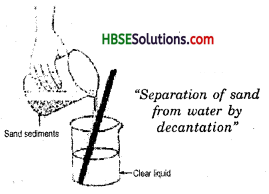
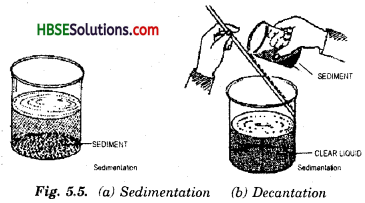
A mixture of sand and water can be separated by decantation method. Take a glass tumbler half filled with the given sample of water. Stir the water thoroughly. Now keep the tumbler undisturbed for sometime. We must see that sand being heavier than water has settled down at the bottom of the tumbler. This process is sedimentation. Now pour the. clear water into another tumbler, without disturbing the layer of sand and with the help of a glass rod. This process is decantation. In this way, mixture of sand and water can be separated.
HBSE 6th Class Science Solutions Chapter 5 Separation of Substances 1

Question 6.
Is it possible to separate sugar mixed with wheat flour? If yes, how will you do it?
Answer:
Yes, it is possible to separate sugar mixed with wheat flour. The mixture of sugar & wheat flour can be separated by sieving. The wheat fine particles separates by strainer and sugar particles being bigger in size remains on the strainer. Thus sugar can be separated from the mixture of sugar and wheat flour.

Question 7.
How would you obtain clear water from a sample of muddy water?
Answer:
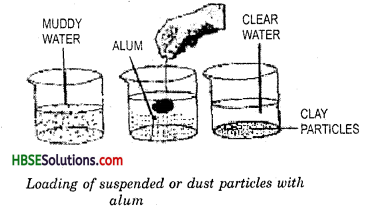
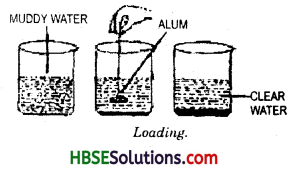
We can separate clear water from muddy water by loading process. Take a beaker half filled with muddy water and take a piece of alum. Tie the alum piece by a cotton thread.
HBSE 6th Class Science Solutions Chapter 5 Separation of Substances 2
Now dip the alum in water and move it slowly in a circular path for about one minute. Remove the alum and keep the beaker undisturbed for a few minutes. We find that dust particles that are responsible for making the water muddy settle down readily. Alum dissolves in water very easily. The fine dust particles get loaded and become heavier and settle down at the bottom of the beaker. The clear water may be decanted. This activity combines two methods loading and decantation.

HBSE 6th Class Science Solutions Chapter 5 Separation of Substances

Question 8.
Fill up the blanks :
(a) The method, of separating seeds of paddy from its stalk is called ________.
(b) When milk is poured onto a piece of cloth the cream(malai) is left behind on it. This process of separating cream from milk is an example of ________.
(c) Salt is obtained from sea water by the process of ________.
(d) Impurities settled at the bottom when muddy water was kept over night in a bucket. The clear water was then poured of from the top. The process of separation used in this example is called ________
Answer:
(a) Winnowing
(b) filtration
(c) Evaporation
(d) Decantation.

Question 9.
True or False?
(a) A mixture of milk and water can be separated by filtration.
(b) A mixture of powdered salt and sugar can be separated by the proces of winnowing.
(c) Separation of sugar from tea can be done with filtration.
(d) Grain and husk can be separated with ‘ the process of decantation.
Answer:
(a) False
(b) False
(c) False
(d)True.

Question 10.
Lemonade is prepared by mixing lemon juice and sugar in water. You wish j to ice to cool it. Should you add ice to the lemonade before or after dissolving sugar? In which cash would it be possible to dissolve more sugar?
Answer:
We should add ice in lemonade after dissolving sugar in it, because sugar dissolve more before adding ice. It would be possible to dissolve more sugar before adding ice in the lemonade, because it dissolve more into hot than in cold.

HBSE 6th Class Science Separation of Substances Important Questions and Answers

Very Short Answer Type Questions

Question 1.
What is a pure substance?
Answer:
A pure substance is one that consists of a single element or compound.

Question 2.
How will you separate a mixture of iron fillings and sulphur powder?
Answer:
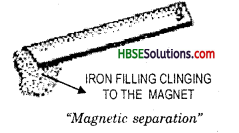
The mixture can be separated by using a magnet. The iron fillings are picked out by the magnet and sulphur powder remains behind.

Question 3.
Name the method used to separate butter from milk.
Answer:
Centrifugation/churning method.

HBSE 6th Class Science Solutions Chapter 5 Separation of Substances

Question 4.
Name two materials used as filters.
Answer:

  • Cotton cloth
  • Filter paper.

Question 5.
Which method will you use to separate blue vitriol (Neela thotha) from its solution?
Answer:
Crystalization method.

Question 6.
What is meant by the term ‘mixture’?
Answer:
A mixture is a substance made up of two or more elements or compounds, physically mixed in any ratio.

Question 7.
Give three examples of mixture.
Answer:
Tea, milk and air.

Question 8.
Write two properties of mixtures.
Answer:

  • Ratio of constituents is not fixed.
  • Does not have definite m.p. or b.p.

Question 9.
Name the process of obtaining ; iron from waste materials.
Answer:
Magnetic separation.

Question 10.
How can you obtain distilled water?
Answer:
By distillation process.

Question 11.
Name the process to separate two immiscible liquids.
Answer:
Decantation process by separating funnel.

Question 12.
Name a gaseous mixture.
Answer:
Air.

HBSE 6th Class Science Solutions Chapter 5 Separation of Substances

Question 13.
Name three mixtures found in nature.
Answer:

  • Sea water/pond water/lake water.
  • Air

Question 14.
What is winnowing?
Answer:
It is the process of separation of grains from husk and hay with the help of wind.

Question 15.
What is centrifugation?
Answer:
It is a method of separating suspended solid particles from a liquid.

Question 16.
Name the method of separating two immiscible liquids.
Answer:
Decantation or By separating funnel.

Question 17.
What is sublimation?
Answer:
It is a process in which a solid gets converted into its gaseous state.

Question 18.
What is loading?
Answer:
The process of setling down solid particles quickly.

Question 19.
What is churning?
Answer:
Churning is a method of making butter.

Short Answer Type Questions

Question 1.
What is a mixture? Give two examples.
Answer:
A mixture is a substance made up of two or more elements or compounds, when physically mixed in any ratio.
(i) Gun powder (ii) Salt in water.

Question 2.
How will you prepare a big crystal of sugar from powdered sugar?
Answer:
Prepare sugar solution in hot water and allow it to cool. Filter the solution. Now hang a crystal of sugar with the help of a thread and a glass rod leave the solution undisturbed for four days. Now we see that crystals slowly begin to grow on the crystal.

HBSE 6th Class Science Solutions Chapter 5 Separation of Substances

Question 3.
How is common salt obtained from sea water?
Answer:
Sea water is run into shadow ponds and allowed to evaporate to dryness in hot sun. Water evaporates and solid common salt is left behind. The salt is then collected in heaps.

Question 4.
How will you separate a mixture of sulphur in water?
Answer:
Take the mixture of water and sulphur in a beaker. Pour the mixture on the filter paper with the help of a glass rod so that the liquid stands below the edge of the cone. The residue that remains on the filter paper is sulphur. Now dry it to get sulphur and water is collected in beaker.

Question 5.
How will you separate a mixture of naphthalene and salt?
Answer:
Naphthalene and salt mixture can be separated by the process of sublimation. Naphthalene sublimates and is collected on inverted keep and salt remains behind in the dish.

Question 6.
What do you mean by decantation? What are its uses?
Answer:
Decantation is a process by which we can remove a liquid without disturbing the solid settled down in the bottom.
Uses: This method can be used to separate a mixture of

  • sand and water
  • mixture of two liquids – water and oil.

HBSE 6th Class Science Solutions Chapter 5 Separation of Substances

Question 7.
How will you separate a mixture of water and kerosene oil?
Answer:
Mixture of kerosene oil and water can be separated by using separating funnel. Take the mixture in separating funnel and allow it to stand for some time. After sometime, two different layers form. Kerosene oil being lighter forms upper layer and water forms lower layer. By opening the stop cock, we obtain water and kerosene remains on the funnel.
HBSE 6th Class Science Solutions Chapter 5 Separation of Substances 3

Question 8.
What do you mean by distillation? How can you separate a mixture of alcohol and water?
Answer:
Distillation is the process in which liquid is heated to get vapours and then cooling the various to get back liquids. It is used to separate a mixture the components of which have different boiling points.
HBSE 6th Class Science Solutions Chapter 5 Separation of Substances 4
The mixture of alcohol and water is taken in a round bottom flask. Alcohol boiling point 80°C, evaporates first on heating as compared to water with boiling point 100°C. Now alcohol vapours are condensed by cooling in a separate container. It gets converted back to alcohol liquid and water remains in flask.

Question 9.
How will you separate a mixture of iron dust and sulphur powder?
Answer:
A mixture of iron dust and sulphur can be separated by the magnetic separation method. Iron dust is attracted towards the magnet and separated in a container and sulphur remains behind in the container.
HBSE 6th Class Science Solutions Chapter 5 Separation of Substances 5

Question 10.
How will you separate a mixture of iodine and sand?
Answer:
A mixture of iodine and sand can be separated by sublimation. The mixture is taken into a china dish and covered with inverted funnel. A cotton plug prevents the vapours from escaping into atmosphere. On heating, iodine sublime and collected on the cool inner surface of funnel. Sand is left behind in the disc.
HBSE 6th Class Science Solutions Chapter 5 Separation of Substances 6

Long Answer Type Questions

Question 1.
How will you separate a mixture of iron fillings, common salt, sand and sulphur?
Answer:
Iron fillings are separated from the mixture by using a magnet. The remaining mixture of salt,-sand and sulphur is stirred with water when salt is dissolved in it. On filtration salt solution is obtained as a filtrate and the residue contains sand and sulphur.

Sand and sulphur mixture is shaken with carbon disulphide, when sulphur dissolves in it but sand remains undissolved. On filtration, sand is obtained as residue and sulphur as filtrate. On evaporating the filtrate carbon disulphide is removed and sulphur is obtained.

HBSE 6th Class Science Solutions Chapter 5 Separation of Substances

Question 2.
How you will purify common salt obtained from sea water?
Answer:
The lumps of impure common salt obtained from sea water, are crushed to get powdered salt. The powdered common salt is dissolved in water to prepare a solution. The solution of common salt is filtered to remove insoluble impurities.

The clear solution of common salt is evaporated by heating to remove some of the water to obtain a concentrated solution. The hot concentrated solution of common salt is allowed to cool. On cooling, the hot solution crystallises and crystals of pure common salt are obtained.

Separation of Substances Class 6 HBSE Note

1. We use some materials like sugar, common salt, water, milk as such in our daily life. In many materials, we have to separate the useful components from the unwanted or sometimes harmful components before we can use them. For example we peel off the skins of mangoes and bananas before using them.

2. Pure substances : A pure substance is one that consists of a single element or compound. All its constituents have similar properties. Examples are copper, iron, water, common salt, sugar etc.

3. Mixtures : A mixture contains two or more types of constituents which are present in any ratio. For example, air around us contains many gases such as nitrogen, oxygen, carbon dioxide and dust particles. Thus air is a mixture. Sea water, pond and river water are also mixtures. Gun powder and brass are other examples of mixtures.

4. Need for separation : We know that a mixture contains two or more components. We want to be very sure about the purity of the food we take in. Even the water we drink should be pure. We can say that we carry out the separation of substances with the following purposes:

  • To remove the un-useful or harmful component.
  • To obtain the useful component.
  • To remove impurities for getting a pure sample.

5. Principle of separation : Different materials have different properties and we can use these property differences to separate mixtures. The components of a mixture can be separated by one method or by a combination of various methods.

6. Method of separation : Often, in mixtures, we are able to see the different components present. There are several methods used for separating the constituents of a mixture. The choice of the method used depends upon the nature or the properties of the constituents. Some common methods for the separation of the components of a mixture are as follows :

7. Hand Picking: This method is use for separating small particles of dust, stone, husk etc. from the grains of wheat, rice and pulses etc. Since these unwanted components are present in small quantities and total amount of grains to be separated is not very-very large, so they are separated by hand picking.
HBSE 6th Class Science Solutions Chapter 5 Separation of Substances 7

8. Sieving: Sieving of wheat flour (atta) is a common practice. Sieving a wheat flour through a sieve allows fine particles of the flour to pass through the holes of the sieve while the bigger husk particles remain on the sieve.
HBSE 6th Class Science Solutions Chapter 5 Separation of Substances 8
Sieving is used when two components of a mixture have different sizes. Sand can be separated from stone by seiving.

9. Winnowing : This method of separation is commonly used to separate lighter particles from heavier grains of wheat.
HBSE 6th Class Science Solutions Chapter 5 Separation of Substances 9
In this method, the wheat grains containing husk are allowed to fall down from some height while the wind is blowing. Since husk is lighter than grains, it gets carried away by wind and heaps of grains and husk are formed separately.

10. Sedimentation and decantation : This method of separation is used for a mixture consisting of an insoluble solid and a liquid. The process of settling down of heavier insoluble particles in a mixture of water and insoluble substances is called sedimentation (Fig 5.5). The process of transferring the clear liquid (after sedimentation) without disturbing the sedimentation insoluble heavy particles is called decantation. Fig. 5.5. (6).
HBSE 6th Class Science Solutions Chapter 5 Separation of Substances 10
Decantation can also be used for separating two immiscible liquids such as oil and mixture. Oil and water do not mix with each other and form separate layers. They can also be separated by using separating funnel.
HBSE 6th Class Science Solutions Chapter 5 Separation of Substances 11

11. Loading : In rainy season we get muddy water from wells, taps or other sources of drinking water. This muddy water can be made clear by loading. If a piece of alum, tied
HBSE 6th Class Science Solutions Chapter 5 Separation of Substances 12
with a thread, is swirrled in such a water, then after some time the water becomes clear on standing. (Fig 5.7) The water becomes clear because the mud particles get loaded by the alum particles and become heavy and settle down at the bottom of the container and water can be decanted for further use.

HBSE 6th Class Science Solutions Chapter 5 Separation of Substances

12. Filtration : Filtration is used to separate solid impurities from a liquid. In our homes, tea is filtered to separate tea leaves and shikanji (lemo-nade) is filtered to separate the seeds of the lemon.

13. Evaporation : The process of separating any salt from its solution by removing water is called evaporation. This process is largely used to obtain common salt from sea water. When sea water is allowed to stand in shallow pits, water slowly turns into water vapours by absorbing the heat of the sun, leaving behind solid salt.

14. Magnetic separation : This process of separation is used when one of the components in the mixture is iron. For example a mixture of iron fillings and sand can 5.10. “Magnetic, separation”
HBSE 6th Class Science Solutions Chapter 5 Separation of Substances 13
be separated by moving a magnet in the mixture. The Magnet picks out only iron fillings from the sand. This process is called magnetic separation (Fig 5.10)

15. Churning: This process is used to separate cream from milk. When milk is churned for some time, the lighter cream particles float on its surface from where they can be separated. Churning can be done by hand or by using a mixi. (Fig 5.11.)

16. When one method of separation is not sufficient to separate the different substances present in a mixture, we use more than one methods. (See Fig 5.13) For example if we have a mixture of salt, water and sand and we want to separate all the three substances, we use two methods-decantation and evaporation.

HBSE 6th Class Science Solutions Chapter 5 Separation of Substances Read More »

HBSE 6th Class Science Solutions Chapter 4 Sorting Materials Into Groups

Haryana State Board HBSE 6th Class Science Solutions Chapter 4 Sorting Materials Into Groups Textbook Exercise Questions and Answers.

Haryana Board 6th Class Science Solutions Chapter 4 Sorting Materials Into Groups

HBSE 6th Class Science Sorting Materials Into Groups Textbook Questions and Answers

Exercises

Question 1.
Name five objects which can be made from wood.
Answer:
Objects which can be made from wood are:

  • Chair
  • Table
  • Desk
  • Double bed
  • Stool
  • Almirah.

Question 2.
Select those objects from the following which shine :
Glass bowl, plastic toy, steel spoon, cotton shirt.
Answer:
Glass bowl, steel spoon.

HBSE 6th Class Science Solutions Chapter 4 Sorting Materials Into Groups

Question 3.
Match the following things with the materials from which they are made :

ThingsMaterials
(i) BookGlass
(ii) TumblerWood
(iii) ChairPaper
(iv) ToyLeather
(v) ShoesPlastic.

Answer:
(i) paper
(ii) glass
(iii) wood
(iv) plastics
(v) leather.

Question 4.
State whether the statements given below are true or false :
(i) Stone is transparent, while glass is opaque.
(ii) A note book has lustre while eraser does not.
(iii) Chalk dissolves in water.
(iv) A piece of wood floats on water.
(v) Sugar does not dissolve in water.
(vi) Oil mixes with water.
(vii) Sand settles down in water.
(viii) Vinegar dissolves in water.
Answer:
(i) False
(ii) False
(iii) True
(iv) True
(v) False
(vi) False
(vii) True
(viii) True.

Question 5.
Given below are the names of some objects and materials :
Water, basket ball, orange, sugar, globe, apple and earthen pitcher
Group them as :
(a) Round shaped and other shape.
(b) Eatables and non-etables.
Answer:
Round-shaped object Other-shaped objects

  • Basket ball
  • Water
  • Orange
  • Sugar
  • Globe
  • Apple
  • Earthen pitcher.

HBSE 6th Class Science Solutions Chapter 4 Sorting Materials Into Groups

Question 6.
List all items known to you that float on water. Check and see if they will float on a oil or kerosene.
Answer:

  • Dried leaves
  • paper
  • wax
  • ice
  • oil.

All these materials floats on water and they sink in oil and float on kerosene.

Question 7.
Find the odd one out from the following:
(a) Chair, Bed, Table, Baby, Cup-board.
(b) Rose, Jasmine, Boat, Marigold, Lotus.
(c) Aluminium, Iron, Copper, Silver, Sand.
(d) Sugar, Salt, Sand, Milk, Milk powder.
Answer:
(a) Baby
(b) Boat
(c) Sand
(d) Milk

HBSE 6th Class Science Sorting Materials into Groups Important Questions and Answers

Very Short Answer Type Questions

Question 1.
What do you mean by classification?
Answer:
The process of grouping things on the basis of some common properties is called classification.

Question 2.
How groupings of things are made?
Answer:
Goupings of things are done according to some similarities, necessities, and convenience to make it easier to work with them.

Question 3.
Name three things made from glass.
Answer:
Bowl, bottle, jug, katori.

Question 4.
Name two materials which are soluble in water.
Answer:

  • Salt
  • sugar.

Question 5.
Name five objects which are made from transparent materials.
Answer:

  • Glass bowl
  • Glass bottles
  • Window pan
  • Looking glass
  • Pen.

HBSE 6th Class Science Solutions Chapter 4 Sorting Materials Into Groups

Question 6.
List three liquids which are transparent.
Answer:

  • Water
  • Spirit
  • Benzene.

Question 7.
List five objects which are made from opaque materials.
Answer:

  • Table
  • Chair
  • Door
  • Bed
  • Black board.

Question 8.
What is common between salt and sand?
Answer:
Mass.

Question 9.
Name three bad conductors of heat.
Answer:

  • Wood
  • Rubber
  • Paper.

Question 10.
Name three good conductors of heat.
Answer:
Aluminium, copper and iron.

Question 11.
Name five magnetic objects.
Answer:
Eraser, Pins, Iron nails, Scissors and steel spoon.

Question 12.
Name two objects made from plastics.
Answer:

  • Mug
  • Toys.

Question 13.
Name two substances which are insoluble in water.
Answer:

  • Chalk
  • Plaster.

Question 14.
Name four metals which are used in our daily life.
Answer:

  • Aluminium
  • Copper
  • Brass
  • Iron.

Question 15.
Write two properties of metals.
Answer:

  • They look shining in appearance.
  • Metals are good conductors of heat.

HBSE 6th Class Science Solutions Chapter 4 Sorting Materials Into Groups

Question 16.
Name three liquids which are immiscible in water.
Answer:

  • Mustard oil
  • Glycerine
  • Coconut oil.

Question 17.
Name three materials which float in water.
Answer:

  • Wax
  • wood
  • ice.

Question 18.
Name three things which are non-magnetic.
Answer:

  • Rubber
  • Chalk
  • Plastics
  • Wood.

Question 19.
How can materials be grouped?
Answer:
Materials can be grouped on the basis of similarities and differences in their properties.

Question 20.
Name some combustible materials.
Answer:
Wood, paper and cotton.

Question 21.
Which are translucent materials?
Answer:
The materials through which things are only partially visible are called translucent materials.

Short Answer Type Questions

Question 1.
What are objects made of?
Answer:

  • An object can be made from different materials. For example, your shoes can be made of canvas, leather, rubber or plastics.
  • Different objects can be made from the same material. For example, flower vase, window panes, glass jar, fish aquarium are made from the same material.
  • An object or a thing can be made using more than one material. For example, idli is made of rice, urad dal, salt and water.

Question 2.
Mention three properties of materials.
Answer:
Three important properties of materials are described below :

  • Physical State : All materials can be classified as solid, liquid and gas. We cannot see gases but we can feel their presence.
  • Appearance : Any material can be described in terms of its colour, lustre, texture or hardness.
  • Solubility : All materials can be soluble or insoluble in water. For example, sugar is soluble in water but sand is insoluble in water. Liquid and gases may also be soluble or insoluble in water.

HBSE 6th Class Science Solutions Chapter 4 Sorting Materials Into Groups

Question 3.
Write three common characteristics of materials.
Answer:

  • All materials can be felt by one or more of our senses.
  • All materials occupy space.
  • All materials possess mass.

Question 4.
Why are handles of utensils made from wood or plastics?
Answer:
The handles of utensils are made from wood or plastics because utensils are good conductors of heat and wood and plastics are bad conductors of heat. They do not allow the heat transmission through them. So the handles of utensils are made from wood or plastics so that we do not burn our hands while handling these utensils when they are hot.

Question 5.
Name two gases which are soluble and two gases which are insoluble. What is the importance of gases dissolved in water?
Answer:
→ Gases which are soluble in water: Oxygen and Carbon dioxide.

→ Gases which are insoluble in water: Hydrogen, Nitrogen.
The oxygen dissolved in water helps aquatic plants and animals. Carbon dioxide dissolved in water helps the plants living in water for photosynthesis.

Question 6.
X, Y and Z are three types of materials. The materials X and Y can break into pieces easily when hit with an object but material Z does not break easily. The material X is used in the windows of bathrooms in our house whereas material Y is used in the windows of our drawing room. The material Z is used in making doors and almirahs in our house.
(a) What do you think material X could be? What is the general name of materials liheX?
(b) What could material Y be? Write the general name of materials like Y.
(c) What could material Z be? What is the general name of material like Z?
Answer:
(a) Ground glass : Translucent materials
(b) Clear glass: Transparent materials
(c) Wood : Opaque Materials.

Question 7.
Why cotton floats on water?
Answer:
Cotton has large number of pores in it. The air gets trapped in it thereby reducing its density (by increasing the volume of cotton by air). Therefore cotton floats on water. But when these pores get filled with water it starts sinking.

Question 8.
A few things have been grouped as follows. Identify the property common to all things in each group.
Group – I : Glass, Cup, Bucket, Mug, Jug
Group – II : Man, Cow, Camel
Group – III : Copper, Iron, Silver, Gold
Answer:
Group – I: Containers – all are made of plastic/steel.
Group – II: Living beings-all are mammals.
Group – III : All are metals.

Question 9.
Which among kerosene and glycerine is miscible in water? How will you find out?
Answer:
Glycerine is miscible in water.
Take some water in two test tubes. Put a few drops of glycerine into one test tube and a few drops of kerosene into the other. Shake them well. Glycerine mixes with water and cannot be seen separately. Kerosene does not mix with water. It can be seen as a separate layer on the top of water.

Question 10.
Give an activity to observe flow of heat in metal and wood.
Answer:
Take a cup and fill it partly with hot water. Place two spoons in it – one made of aluminium and the other made of wood. After a minute, touch the upper top of each spoon. You will observe that the aluminium spoon is hotter than the wooden spoon. This is because heat can flow quickly through aluminium but not so in wood.

HBSE 6th Class Science Solutions Chapter 4 Sorting Materials Into Groups

Long Answer Type Questions

Question 1.
What are the advantages of classification/grouping things or materials?
Answer:
The advantages of classification/ grouping of things or materials are as under:

  • Classification helps to understand similarities and dissimilarities among the objects.
  • Classification helps location of things. It is only because of classification that you are able to locate a book that you need out of thousands in your school library.
  • Classification of objects helps their identification.
  • Classification makes study of different objects easy and more meaningful. Rather than studying each object separately, we can study just one out of each class of different objects and generalize our results for the class as a whole.
  • Classification helps us to know the material of which the object is formed.

Question 2.
List the characteristics of solids, liquids and gases and give an example of each.
Answer:
Solids : All solids have the following characteristics :

  • They have a definite shape and volume.
  • They cannot be compressed easily.
  • The particles they are made of are packed very tightly.

Examples : Gold and wood.
Liquids : All liquids have the following characteristics:

  • They have a definite volume but no definite shape. They take the shape of the container they are poured in.
  • They can be compressed more easily than solids.
  • The particles they are made up of are not so tightly packed as in solids.

Examples : Water and alcohol.
Gases : All gases have the following characteristics:

  • They have no definite shape or volume.
  • They can be compressed very easily.
  • The particles they are made up of are packed loosely.

Examples : Oxygen and Carbon dioxide.

Question 3.
Discuss important properties of matter. (Any five)
Answer:
Some important properties of matter are discussed below:

  • Appearance: Materials (or matter) can be classified on the basis of their appearance. Different materials have different appearances.
  • Lustre : Materials can be classified on the basis of their lustre. Some shine a lot whereas others are quite dull.
  • Texture : Different materials feel different when touched, so they have different textures.
  • State: Most materials can be placed into one of the three groups : Solid, liquid or gas.
  • Solubility in water: Some substances are soluble in water, others are insoluble. Miscible liquids mix with each other, immiscible liquids do not.

HBSE 6th Class Science Solutions Chapter 4 Sorting Materials Into Groups

Sorting Materials into Groups Class 6 HBSE Notes

1. There is a large variety of things around us, some of familiar furniture may be chairs, tables, almirah, utensils, books, clothes, toys, television, refrigerator and other household items.

2. Different things can be used for making different types of materials.

3. Different types of materials have different properties such as appearance, solubility, transparency, conductivity and behaviour towards magnets etc.

4. Things can be grouped on the basis of their properties of materials from which they are made. Similar things are arranged together for convenience.

5. Materials which have lustre are called metals. Iron, copper, aluminium and gold are some examples of metals. Thus metals have a lustre and are called lustrous materials.

6. The surface of a material could be smooth or rough. Such as a stone feels rough on touching and metal surfaces are smooth to touch.

7. Materials may be hard or soft. Materials which are difficult to press are called hard and which can be pressed easily are called soft.

8. Substances which dissolve in water are called soluble and which remain the same are called insoluble.

9. Those liquids which mix well with water are said to be miscible and others which do not mix well are known as immiscible in water.

10. Some gases are soluble in water such as oxygen gas which dissolves in water is very important for the survival of aquatic animals.

11. Some materials like sand, sugar and salt sink in water and such materials like wax and oils float on water.

12. Materials may be transparent, opaque and translucent. Materials through which things can be seen are called transparent and materials through which you things are not able to see are called opaque and materials through which things are only partially visible; are called translucent.

13. Those materials/substances which allow the transmission of heat through them are called conductors of heat, which do not allow heat to pass through them are called non-conductors or poor conductors.

14. All metals are conductors of heat. Wood, plastics and a piece of cotton are examples of non-conductors. Gases are poor conductors of heat.

15. Some materials which burn on direct flame in the presence of air, are called combustible materials.

16. Materials which get strongly attracted towards the magnet are called magnetic materials. Our earth itself is a huge magnet. Magnetic materials find many uses in electronic devices.

17. Things are grouped together on the basis of properties of materials from which they are made.

18. The tendency of substances to intermix is called diffusion.

HBSE 6th Class Science Solutions Chapter 4 Sorting Materials Into Groups Read More »

HBSE 6th Class Science Solutions Chapter 3 Fibre to Fabric

Haryana State Board HBSE 6th Class Science Solutions Chapter 3 Fibre to Fabric Textbook Exercise Questions and Answers.

Haryana Board 6th Class Science Solutions Chapter 3 Fibre to Fabric

HBSE 6th Class Science Fibre to Fabric Textbook Questions and Answers

Exercises

Question 1.
Classify the following fibres as natural or synthetic:
Nylon, wool, cotton, silk, polyester, jute.
Answer:

  • Natural fibres : Wool, cotton, silk, jute.
  • Synthetic fibres : Nylon, polyester.

Question 2.
State whether the following statements are true or false :
(a) Yarn is made from fibres.
(b) Spinning is a process of making fibres.
(c) Jute is the outer covering of coconut.
(d) The process of removingseed from cotton is called ginning.
(e) Weaving ofyaf’n make a piece of fabric.
(f) Silk fibre is obtained from the stem of plants.
(g) Polyester is a natural fibre.
Answer:
(a) True
(b) True
(c) False
(d) True
(e) True
(f) False
(g) False

HBSE 6th Class Science Solutions Chapter 3 Fibre to Fabric

Question 3.
Fill in the blanks :
(a) Plant fibres are obtained from ________ and ________.
(b) Animal fibres are ________ and ________.
Answer:
(a) Cotton, jute
(b) Wool, silk.

Question 4.
From which part of plant cotton and jute are obtained?
Answer:
Cotton fibres are obtained from cotton seeds. They are hairs of cotton seeds. Jute fibres are obtained from the stem of jute plants by retting process.

Question 5.
Name two items that are made from coconut fibres.
Answer:

  • Ropes
  • Coir in mattress.

Question 6.
Explain the process of making yarn from fibres.
Answer:
The process of making yam from fibres is called spinning. In this process fibres from a mass of cotton wool are drawn out and twisted. This brings the fibres together to form a yarn.

A simple device used for spinning is a hand spindle also called takli and charkha. Spinning of yarn on a large scale is done with the help of spinning machine. After spinning yams are used for making fabrics.

HBSE 6th Class Science Fibre to Fabric Important Questions and Answers

Very Short Answer Type Questions

Question 1.
Name some fibres obtained from natural sources (Plants/animals).
Answer:
Cotton, silk, wool and jute fibres are obtained from natural sources.

Question 2.
Name two fibres obtained from man-made materials.
Answer:
Nylon and polyester.

Question 3.
Which type of clothes absorb water quickly?
Answer:
Cotton clothes absorb water quickly.

HBSE 6th Class Science Solutions Chapter 3 Fibre to Fabric

Question 4.
Which type of clothes bum quickly?
Answer:
Nylon and polyester clothes bum quickly.

Question 5.
From where do we get wool and silk?
Answer:
We get wool from animal hairs (sheep) and silk from silk worm.

Question 6.
From which time cotton has been used in India?
Answer:
In India cotton has been used since 1800 B.C.

Question 7.
Where is cotton grown in India?
Answer:
In India cotton crops are grown in Maharashtra, Gujarat, Punjab, Rajasthan, Tamilnadu and Madhya Pradesh.

Question 8.
In which climate are cotton crops grown?
Answer:
Cotton crop needs warm climate.

Question 9.
Write two uses of cotton.
Answer:

  • Manufacture of textiles.
  • As absorbent in hospitals.

Question 10.
Where do we get jute?
Answer:
Jute is obtained from stem of jute plants in the form of patsun.

Question 11.
How are jute fibres used?
Answer:
Jute fibres are used for making gunny bags, carpets and curtains.

Question 12.
Why did primitive life need no cloth?
Answer:
Because they lived mostly to tropics where the climate was warm.

Question 13.
Why are cotton and woollen fibres rough?
Answer:
Cotton and woollen fibres are rough because they have many folds and uneven surface on it.

Question 14.
Why are nylon and polyester fibres smooth?
Answer:
Nylon and polyester fibres are smooth because they have long plain, fine structure.

HBSE 6th Class Science Solutions Chapter 3 Fibre to Fabric

Question 15.
Why are fibres twisted?
Answer:
By twisting fibres, they become strong and their cohesion power increases.

Question 16.
Name some natural and man-made cloth materials.
Answer:
Natural cloth materials are : cotton, wool, silk and jute etc.
Man-made cloth materials are: rayon, nylon and polyesters etc.

Short Answer Type Questions

Question 1.
From where do we get materials used for making clothes?
Answer:
We get materials used for making clothes from natural sources such as cotton, jute, silk and wool from plants and animals and from man-made/artificial sources such as nylon, polyester and rayon etc.

Question 2.
Where do the plants have fibres in their body?
Answer:
Plants have fibres in their body in different parts. For examples; cotton and mango have fibres on their seeds, coconut on its fruits, jute on its stem and banana tree on its leaf.

Question 3.
From where do we get wool and silk fibres?
Answer:
Wool and silk fibres are obtained from animals. Wool is obtained from hair of animals; as sheep hairs and silk fibres are obtained from silk worm.

Question 4.
Where are cotton crops grown?
Answer:
Cotton crops are grown in black soil, which is best for of cultivation of cotton crops. It is planted early in the spring season. It needs warm climate. Its plant grows steadily and soon becomes brushes of 3 to 5 feet height.

HBSE 6th Class Science Solutions Chapter 3 Fibre to Fabric

Question 5.
What are the various uses of cotton?
Answer:
Cotton is used as follows :

  • Cotton or cotton in combination with other fibres is used in manufacture of textiles.
  • Cleaned cotton is used as absorbent in hospitals.
  • Unspun cotton is used as fillers in mattresses, pillows and quilts.
  • It is used as raw materials for manufacture of rayon and paper industry.

Question 6.
Where and when is jute cultivated?
Answer:
Jute is cultivated in alluvial soils in the delta region of rivers like Ganga and Brahmaputra. In India jute is mainly grown in West Bengal, Bihar and Assam. It is cultivated during rainy season.

Question 7.
How was clothing developed?
Answer:
Cloth making was developed in three stages: (i) First stage was making cloth from plant fibres, (ii) Second stage was the beginning the use of animal fibres and the third stage began with man-made fibres in 19th century.

Question 8.
Why do we wear clothes?
Answer:
We wear clothes due to the following reasons:

  • They protect against wind and weather.
  • They protect against injury.
  • They maintain body heat.

Question 9.
Why is it necessary to make yarn from fabrics for making clothes?
Answer:
Cotton, wool and silk fibres are suitable for making yarn. For making yarn, fibres are twisted. Twisting of fibres into yarn increases the cohesion (togetherness) and strength of fibres.

Long Answer Type Questions

Question 1.
How do we obtain jute fibres from jute plants?
Answer:
On complete maturation of plants, fibres on its stem becomes very hard. The cut plants are grouped at different places in the field for a few days when most of the leaves fall down. The plants now are tied in small bundles and these bundles made to sink in stagnant water of pond for a few days when the gummy spin rots out to separate fibres. The process is called retting. Fibre is extracted from the retted jute by hand, with jerk and pulls. The dry fibres are then tied together in small bundles. They are pale yellow jn colour with 6 to 8 feet length and quite strong with silky lustre. They can easily be spun into fabrics.

HBSE 6th Class Science Solutions Chapter 3 Fibre to Fabric

Question 2.
Give a brief account of the journey of jute from its cultivation to making the fibre.
Answer:
(i) Jute is grown in alluvial soil in the delta region of the Ganga and Brahmaputra rivers.

(ii) Jute is cultivated during the rainy season. It bears yellow flowers in 3-4 months.

(iii) Jute plants are usually cut at the flowering state. A good quality fibre is obtained from plants cut at the flowering state. Jute obtained from a matured plant is harder.

(iv) After the dry leaves haven fallen, the bundles of dry plants are kept in a pond for a few days. During this period, the gummy skin rots out to separate the fibres. This process is called retting.

(v) The jute fibre is obtained from the retted jute by hand.

Fibre to Fabric Class 6 HBSE Notes

  • We know that clothes we wear come from fibres. Clothes protect us from adverse weather condition.
  • Materials used for making clothes are obtained from natural as well as man-made sources.
  • Natural clothing materials includes cotton, wool, silk and jute.
  • Man-made clothing materials are rayon, nylon and polyester etc.
  • Different clothing materials have different properties. Cotton and wool are rough while rayon, silk, nylon and polyester are smooth to touch.
  • All cloth materials are made up of long, narrow, thin structures called fibres. All the plants have fibres in their body structure.
  • Cotton and mango have fibre in their seed, coconut in their fruits and jute in its stem and banana tree on its leaf.
  • Cotton fibres are obtained from the seeds of cotton plant and jute fibres are obtained from the stem of jute plant by the process of retting.
  • The process of pulled out cotton seeds from cotton is called ginning.
  • Cotton fibres are used in manufacturing of textiles, as adsorbent in hospitals, as fillers in mattresses, pillows and quilts and raw materials for rayon.
  • Jute fibres are obtained from the stem of plant called “patsun”. Its separation from stem is called retting.
  • They are 6-8 feet length. It is used for making gunny bags, potato/sacks, carpets, curtains and ropes etc.
  • Man-made fibres combined with other animal and plant fibres are used for making clothes for improved strength, wearing ability and other qualities.
  • Clothes are necessary because they protect us from wind and weather, injury and maintains body heat.
  • Clothes are made from threads and threads in turn are spun from fibres. Cotton, wool, silk and nylon are composed of very fine hair-like structures called fibres.
  • Coconut fibres are used for making ropes or as coir mattresses. Soft and long fibres like cotton and wool are suitable to make yarn. Fibres cannot be used for making clothes directly.

HBSE 6th Class Science Solutions Chapter 3 Fibre to Fabric Read More »

HBSE 6th Class Science Solutions Chapter 2 Components of Food

Haryana State Board HBSE 6th Class Science Solutions Chapter 2 Components of Food Textbook Exercise Questions and Answers.

Haryana Board 6th Class Science Solutions Chapter 2 Components of Food

HBSE 6th Class Science Components of Food Textbook Questions and Answers

Exercises

Question 1.
Name the major nutrients in our food.
Answer:
The major nutrients in our food are:

  • Carbohydrates
  • Proteins
  • Fats
  • Vitamins
  • Minerals
  • Dietary fibres and water.

Question 2.
Name the following :
(a) The nutrients which mainly gives energy to our body.
(b) The nutrients that are needed for the growth and maintenance of our body.
(c) A vitamin required for maintaining good eye sight.
(d) A mineral that is required for keeping our bones healthy.
Answer:
(a) Carbohydrates and fats,
(b) Proteins
(c) Vitamins ‘A’
(d) Calcium.

Question 3.
Name two food each rich in :
(a) Fats
(b) Starch
(c) Dietary fibre
(d) Proteins.
Answer:
(a) (i) Butter, (ii) Ghee, (iii) Soyabean.
(b) (i) Rice (cooked), (ii) Dal (cooked), (iii) Peanuts.
(c) Whole grains and pulses. Fresh fruits.
(d) Milk, fish, cheese and eggs.

Question 4.
Tick (✓) the statements that are correct.
(a) By eating rice alone, we can fulfill nutritional requirement of our body. ( )
(b) Deficiency diseases can be prevented by eating a balanced diet. ( )
(c) Balance diet for the body should contain a variety of food items. ( )
(d) Meat alone is sufficient to provide all nutrients to the body. ( )
Answer:
(a) Not correct
(b) correct
(c) correct
(d) not correct.

HBSE 6th Class Science Solutions Chapter 2 Components of Food

Question 5.
Fill in the blanks :
(a) _________ is caused by deficiency of vitamin D.
(b) Deficiency of _________ causes a disease known as beri-beri.
(c) Deficiency of vitamin C causes a disease known as _________.
(d) Night blindness is caused due to deficiency of _________ in our food.
Answer:
(a) Rickets
(b) Vitamin B
(c) Scurvy
(d) Vitamin ‘A’.

HBSE 6th Class Science Components of Food Important Questions and Answers

Very Short Answer Type Questions

Question 1.
What are the essential nutrients for our body?
Answer:
Carbohydrates, proteins and fats, vitamins and minerals are essential nutrients.

Question 2.
Name any three sources of carbohydrates.
Answer:
Cereals – Sugar and sweet potato.

Question 3.
Name the disease caused due to lack of vitamin A.
Answer:
Night blindness.

Question 4.
Name two sources of animal proteins.
Answer:
Egg and milk.

Question 5.
Write two sources of plant protein.
Answer:
Pulses and beans.

Question 6.
Same mass of which nutrient gives more energy – Fats or carbohydrate?
Answer:
Fats.

Question 7.
Name two foods rich in dietary fibres.
Answer:

  • cabbage
  • spinach.

Question 8.
Name three foods rich in oil and fats.
Answer:
Butter, ghee, vegetable oils.

HBSE 6th Class Science Solutions Chapter 2 Components of Food

Question 9.
Name two protein-rich foods.
Answer:
Meat and milk.

Question 10.
Which food is needed for strong bones and teeth?
Answer:
Milk, fish, oils and eggs.

Question 11.
Which food is needed to prevent constipation?
Answer:
Juicy fruits and fresh vegetables.

Question 12.
Name the type of food which makes a balanced diet?
Answer:

  • Energy-providing
  • Growth- promoting
  • protective food.

Question 13.
What are protective foods?
Answer:
Foods which help in protection of body from disease like – minerals and vitamins.

Question 14.
Name three sources of fats.
Answer:
Coconut, ghee and groundnut.

Question 15.
What is the importance of proper food selection?
Answer:
By selecting food properly, we can have nutritious diet in less price.

Question 16.
What are the sources of vitamin ‘D’?
Answer:
Milk, butter, egg and fish liver.

Question 17.
What is the causal factor of scurvy?
Answer:
It is caused by the deficiency of vitamin C.

Question 18.
What is the main cause of obesity?
Answer:
Excess eating of fried food is the main cause of obesity.

Question 19.
What are harmful effects of obesity?
Answer:
It causes heart disease, high blood pressure and diabetes.

Question 20.
Name four important minerals present in our body.
Answer:
Calcium, sodium, potassium and iron.
Calcium and phosphorus.

Question 21.
Name the disease caused by the deficiency of proteins and carbohydrates in children.
Answer:
Kwashiorkar and Marasmus.

Question 22.
Which disease is caused by the deficiency of vitamin B2?
Answer:
Retarded growth, Pellegra.

HBSE 6th Class Science Solutions Chapter 2 Components of Food

Question 23.
Name the disease caused by the deficiency of iron.
Answer:
Anaemia.

Question 24.
Name the disease caused by the deficiency of phosphorus.
Answer:
Body weakness and bad bones and teeth.

Question 25.
Chapatis of wheat flour or maida?
Answer:
Chapatis of wheat flour give us more nutrients.

Question 26.
Vegetables and fruits with peels or without peels?
Answer:
Vegetables and fruits with peels give us more nutrients.

Question 27.
Dalia or noodles?
Answer:
Dalia gives us more nutrients.

Question 28.
Fruit juice or created spot drinks?
Answer:
Fruits juice gives us more nutrients.

Short Answer Type Questions

Question 1.
What are the symptoms of vitamin ‘C’ deficiency?
Answer:
Symptoms of vitamin ‘C’ deficiency are :
(i) Skin on the gums begins to crack and bleed.
(ii) Wounds in the body take a longer time to heal.
(iii) Cough and cold are caused due to its deficiency.

VitaminsMinerals
1. They are a special group of compounds.1. These are special groups of inorganic compounds.
2. These are needed by our body in a very small quantity.2. These are needed in small amounts.
3. They perform specific functions.3. Each mineral is necessary for the growt hand development of the body.
4. They help in keeping our eyes, bones, teeth and gums healthy.4. They help in maintaining a good health.

Question 2.
What is the difference between vitamins and minerals?
Answer:
Difference between vitamins and minerals :

Question 3.
What is a balanced diet?
Answer:
A diet containing all the essential requirements in right proportion, necessary for the growth and development of the body. These are carbohydrates, fats, proteins, vitamins and minerals. Sufficient amount of water and roughage should also be present.

Question 4.
What are protective foods? Give two examples.
Answer:
Those foods which help in the protection of body against diseases like vitamins and minerals.

Question 5.
Name the different components of food.
Answer:
The main components of foods are : Carbohydrates, fats, proteins, vitamins and minerals. Roughage and water are also needed in proper quantity.

HBSE 6th Class Science Solutions Chapter 2 Components of Food

Question 6.
List the functions of food.
Answer:
Functions of foods are:

  • To provide energy to do work.
  • To help in repairing of injured body part and growth.
  • To protect the body from infections and disease.

Question 7.
What is the importance of fats in our body?
Answer:
Fats are important for our body in the following ways:

  • They are used as fuels in the absence of carbohydrates.
  • Fats protect the internal organs from the external shocks.

Question 8.
Why is water essential for our life?
Answer:
Water is very essential for our body in the following ways :

  • It acts as medium for body reactions and functions.
  • It helps in transport of substances in the different parts of the body.
  • It helps in digestion of food.
  • It helps in removal of waste from the begins.
  • It helps in maintaining the body tempture constant.

Question 9.
Why are vitamins and minerals called protective food?
Answer:
Minerals are chemical compounds needed in small quantities for proper growth and function of the body. Vitamins are also very important for proper functioning of the body organs. They protect our body from many diseases and infections. So they are called protective foods.

Question 10.
What is roughage? How is it important for the body?
Answer:
The part of food containing cellulose which is undigestible in nature acts as roughage. It helps in removing all the undigested food, stored in the digestive tracts, outside the body.

Question 11.
What is malnutrition? What are its harmful effects?
Answer:
Malnutrition is caused by deficiency of one or more nutrients in our diet. Protein deficiency causes kwashiorkar in which swelling in body occurs. Protein and carbohydrate deficiency cause marasmus in which leaves body parts leaning and person becomes thin.

Question 12.
What are the causal factors for scurvy and rickets?
Answer:
Scurvy is caused by the deficiency of vitamin ‘C’. In this disease, gums and nose start bleeding. The body bleeds inside. Rickets is caused by the deficiency of vitamin D. In this disease, bones become soft and bend.

Question 13.
Explain the following with suitable examples:
(i) Obesity, (ii) Hypervitaminosis, (iii) Anaemia.
Answer:
(i) Obesity : It is caused by excess eating of fried foods. Fats and carbohydrates are stored in our body and cause obesity. In it too much fats are deposited in the body which is very harmful.

(ii) Hypervitaminosis : It is caused due to excess of vitamin ‘D’. In hypervita-minosis the foot becomes like elephant and becomes very thick.

(iii) Anaemia : It is caused by the deficiency of iron. It is needed for the formation of red-blood cells in our blood. Therefore by the deficiency of iron our body becomes yellow. In this disease, there is a loss of appetite, nails becomes white, swelling appears on our hands and feet and other body parts.

HBSE 6th Class Science Solutions Chapter 2 Components of Food

Question 14.
What is the importance of carbohydrates in our body?
Answer:
Carbohydrates act as fuels in our body. It is the only nutrient which combusts frequently and produce energy. Our body use this energy in performing various body functions.

Question 15.
What is meant by P.E.M.? Name the disease caused by P.E.M.
Answer:
The elaborated form of P.E.M. is protein energy malnutrition. The diseases caused by P.E.M. are: (i) Kwashiorkar and (ii) Marasmus.

Question 16.
Explain the importance of proteins in the human body.
Answer:
Protein contains sufficient quantity of amino-acids to maintain a normal functioning of our body. It is required for growth and repairs in our body. It helps in building the new tissues. They also account for the tough fibrous nature of hair and nails. They are parts of our body and help in proper functioning of our body. It can also burn to provide energy in the time of emergency.

Question 17.
How would you test the presence of the following in the given food?
(a) Starch (b) Vitamin C.
Answer:
(a) Test for starch : The material is dissolved in water. To this solution, add some drops of iodine solution. If it turns blue, it shows the presence of starch.

(b) Test for vitamin C : The material is dissolved in water and add some drops of iodine solution in it. Now with the help of a dropper put drop by drop into the blue coloured iodine solution. If the blue colour disappears and brown colour appears, it shows the presence of vitamin C.

Question 18.
What happens when we eat lots of fried food?
Answer:
Fried foods such as noodles, pizza, burgers, potato wafers, chocolate, candies, ice-creams and soft drinks all are harmful to us if we take these in excess and regularly. These fast foods lack in minerals and vitamins. They cause obesity. They increase body weight.

Question 19.
Why do we have to drink lots of water?
Answer:
Water is required to perform several different functions. Our blood is mostly water. In dehydration, blood becomes thicker. Water helps in digestion. It dissolves waste products of the body and these could be removed through urine.

Long Answer Type Questions

Question 1.
What are vitamins? Write the sources of vitamin A, B, C and D. Name the disease caused due to the deficiency of these vitamins.
Answer:
Vitamins are a special group of compounds which are needed by our body only in very small quantities. They do not provide any energy to us, but they are essential components of our diet as they perform specific functions in our body. Some vitamins are water-soluble and some are fat-soluble. Vitamin ‘A’ is a fat-soluble vitamin. Its good sources are fish oil, milk, milk products and carrots. Its deficiency causes night blindness.

Vitamin ‘B’ is water-soluble. It is found in wheat, rice, yeast extract, liver and kidney. Lack of vitamin ‘B’ causes beri-beri.

Vitamin ‘C’ is water-soluble. It is found in citrus fruits, (orange, lemon, lime) and in many fresh vegetables. Lack of vitamin C causes scurvy.

Vitamin ‘D’ is fat soluble. It is found in fish oil, eggs, milk and milk products. Its deficiency causes rickets.

HBSE 6th Class Science Solutions Chapter 2 Components of Food

Question 2.
What are the sources and importance of the following minerals:
(a) Calcium, (b) Magnesium, (c) Potassium, (d) Zinc.
Answer:
(a) The main sources of calcium minerals are : Milk, cheese, eggs and green vegetables. It is also found in flour and breads. It helps in formation of bone, teeth and blood clotting. It also helps in muscles activity.

(b) Magnesium is found in cheese and green vegetables. It is found in whole meal bread, milk and fish. It helps in energy transfer and muscles activity. Magnesium is also helpful in bone and teeth formation. It works with calcium and vitamin C.

(c) Potassium is found in meats, fruits and vegetables. It is also found in milk, eggs, cheese, beef and potatoes. Its main function is to maintain balance in blood and tissues fluid. It also helps in nerve impulse conduction.

(d) Zinc is mainly found in onions, liver and green vegetables. Its importance in our diet is that it is an important part of hormone insulin.

Components of Food Class 6 HBSE Notes

1. We get energy from the food we eat. It gives us energy to work and play. It helps us to grow.

2. Food helps us in repairing or replacing damaged cells and tissues. It also protects our body from diseases and infections.

3. Food is an absolute necessity for sustaining body functions.

4. Food has many components; such as carbohydrate, fats, proteins, minerals and vitamins. All these are called nutrients.

5. Water and roughage are also necessary for our diet. They play a vital role in our diet.

6. On the basis of functions, they perform, the components of food may be classified as:

  • Energy-giving food: carbohydrates and fats.
  • Body-building food : proteins.
  • Protective food: vitamins and minerals.
  • Roughage and water: roughage helps in digestive system and water’ is essential for the body.

7. Carbohydrate is the main source of energy in our body. Proteins help in repairing of tissues, body building and many other functions.

8. Minerals and vitamins are very essential for our body. They are required in minor quantities for proper growth and body functions.

9. Vitamins are protective foods which are necessary for the well being of the body. They are needed in small quantities for carrying out various biological functions.

10. We should take a balanced diet means which contains all nutrients, such as carbohydrate, fats, proteins, vitamins and minerals in proper proportion. No single food can provide all the nutrients.

11. Over eating is also not good for a person, as he becomes fat and obese. Obesity may cause many diseases.

12. Sources of carbohydrates in our diet are; cereals grains such as corn and sorgham, peas, beans, sugarcane, sugar beet and many fruits such as banana, mango, melons and vegetables.

13. Many processed foods are rich in carbohydrates including breads. Pizzas, burgers, jams and jelleys, dried fruits, sugar and jaggery are also carbohy-drates.

14. Fats are obtained either from animals or from plants. Butter and ghee are obtained from animals. Groundnut oil, soyabean oil and mustard oil are derived from plants. Fats give more energy than carbohydrates.

15. Protein is obtained from animals and from plants both. Milk, fish, meat, ghee and eggs are main sources of animal proteins. Pulses and beans are sources of plant proteins.

16. Children suffering from protein—deficiency have light brown hair, oldman like face, always hungry and have distended stomach.

17. Proper amount of vitamins helps our body to function normally. Lack of vitamin A causes deficiency disease such as night blindness. Deficiency of vitamin B causes beri-beri and deficiency of vitamin ‘C’ causes scurvy.

18. Fibres and roughage is mainly given by plant foods: grains flour, cereals, potatoes, fresh fruits and raw and cooked vegetables provide roughages in our food.

19. If a person does not get adequate food or his/ her diet does not contain all the nutrients, he becomes weak and said to be suffering from malnutrition. Enough food without enough protein causes rickets.

20. Food may be vegetarian/non-vegetarian, balanced or unbalanced, simple or spicy, nourishing or junk food. Deep-fried and roasted foods usually loose their nutritive value.

HBSE 6th Class Science Solutions Chapter 2 Components of Food Read More »

HBSE 6th Class Science Solutions Chapter 1 Food: Where does it Come From

Haryana State Board HBSE 6th Class Science Solutions Chapter 1 Food: Where does it Come From Textbook Exercise Questions and Answers.

Haryana Board 6th Class Science Solutions Chapter 1 Food: Where does it Come From

HBSE 6th Class Science Food: Where does it Come From Textbook Questions and Answers

Exercises

Question 1.
Do you find that all living beings need the same kind of food?
Answer:
No, we know that different organisms eat different kinds of food. For example: animals such as buffallow and cow eat grass, oil cake, hay, grain and leaf. Rat eats grains and leftovers. Lion and tiger eat other animals. Human being eats bread, rice, fruits and vegetables. House lizards eat small insects and crow eats meat and other food items. In this way we can say that different organisms eat different kinds of food.

Question 2.
Name five plants and their parts that we eat.
Answer:

Names of the plantsParts that we eat
1. Mustard plantSeeds, (spices) oil and leaf.
2. BrinjalFruits
3. CarrotRoots
4. LotusStem and Leaf.
5. RadishLeafs and roots.

Question 3.
Match the items given in column ‘A’ with that in column ‘B’.

Column AColumn B
1. Milk, curd, paneer, gheeeat other animals.
2 .Spinach, cauliflower, carroteat plants and plants products.
3. Lions & tigersare vegetables
4. Herbivorousare all animals products.

Answer:

  • Milk, curd, paneer, ghee : are all animal products.
  • Spinach, cauliflower carrot : are vegetables.
  • Lions and tigers : eat other animals.
  • Herbovorous : eat plants and plant products.

HBSE 6th Class Science Solutions Chapter 1 Food : Where Does It Come From

Question 4.
Fill up the blanks with the words given:
Herbivore, plant, milk, sugarcane, carnivore
(a) Tiger is a ________ because it eats only meat.
(b) Deer eats only plant products and so, is called ________.
(c) Parrot eats only ________ products.
(d) The ________ that we drink usually comes from cows, buffaloes and goats is an animal products.
(e) We get sugar from ________.
Answer:
(a) Carnivore
(b) herbivore
(c) plant
(d) milk
(e) sugarcane.

Things To Think About

Question 1.
Answer the following questions:
(a) Does every one around us get enough food to eat? Why?
(b) Write three ways how to avoid wastage of food?
Answer:
(a) Everyone around us does not get enough food to eat, because in our country many people are very poor. Due to lack of money, they do not get sufficient food to eat. High population growth is another factor and our country does not produce enough food for large number of people.

(b) Wastage of food can be prevented by the following methods :

  • Food should be kept in close containers to protect it from germs, flies and insects.
  • Fruits and vegetables should be washed properly before preparing food or before eating.
  • Heating prevents food from spoiling. Many food items can be preserved simply by drying them in the sun.
  • Food should be kept in ice box or refrigerators to prevent them from bacterial attack.
  • Fruits and vegetables are made into jams and jelleys and pickels.

HBSE 6th Class Science Food: Where does it Come From Important Questions and Answers

Very Short Answer Type Questions

Question 1.
If a person does not get food, how does he feel?
Answer:
If a person does not get food, he feels weak and tired.

Question 2.
Why do all living beings need food?
Answer:
All living beings need food for getting energy for doing physical work.

Question 3.
If we do not eat food for one day, what will happen?
Answer:
Our ability for doing physical work will go down.

Question 4.
Do all living beings eat same type of food?
Answer:
No, all living beings eat different types of foods.

HBSE 6th Class Science Solutions Chapter 1 Food : Where Does It Come From

Question 5.
Which types of foods are eaten by buffalo and cow?
Answer:
They eat grass, oil cake, hay, grain and leaf.

Question 6.
Name three animals which eat only plants.
Answer:

  • Cow
  • Deer
  • Goat.

Question 7.
Name three animals which eat both plants and animals.
Answer:

  • Man
  • Dog
  • Crow.

Question 8.
Name three animals which eat only other animals.
Answer:

  • Tiger
  • King-fisher
  • Vulture.

Question 9.
What is the food of a house lizard?
Answer:
A house lizard eats houseflies, mosquitoes and other insects.

Question 10.
What is the food of a cat?
Answer:
A cat eats small animals, birds, milk, fish and rat etc.

Question 11.
What are those animals called which eat plants and their products only?
Answer:
They are called herbivorous.

Question 12.
Which food items provide us energy?
Answer:
Carbohydrate and fats.

Question 13.
Name two body-building foods.
Answer:

  • Milk
  • Pulses.

HBSE 6th Class Science Solutions Chapter 1 Food : Where Does It Come From

Question 14.
What do carnivorous animals eat?
Answer:
Carnivorous animals eat other animals.

Question 15.
Name three food products we obtain from animals.
Answer:

  • Milk
  • egg
  • meat.

Question 16.
Name three animals that provide us food.
Answer:

  • Cow
  • buffalo
  • goat.

Question 17.
Where do we get honey?
Answer:
We get honey from honey-bees, which is collected from juice of flowers.

Question 18.
Which animals provide us milk and eggs?
Answer:

  • Cow and buffalo
  • hen.

Question 19.
Write down the names of some edible parts of the plants.
Answer:
Stem, roots and leaves.

Question 20.
Why do we take cooked food?
Answer:
Cooked food can easily be consumed and absorbed by our body.

Question 21.
Name two plants which provide us grains.
Answer:

  • Rice
  • wheat

Question 22.
Name two oil-yielding plants.
Answer:

  • Mustard
  • sunflower.

Question 23.
Name three fruit plants.
Answer:

  • Mango tree
  • papaya
  • grapes.

Question 24.
Which type of food eaten by Tamilnadu people?
Answer:
Idli, dosa, sambar and coconut oil.

Question 25.
Which type of food eaten by U.P. people?
Answer:
Chapati, pulses, rice, parantha and vegetables and fruits.

Short Answer Type Questions

Question 1.
What are the different food products obtained from animals?
Answer:
Different food products obtained from animals are milk, egg, honey eat butter, honey, ghee, etc.

Question 2.
Name the animals which provide us milk, egg, meat, honey and fats.
Answer:
We get milk from cow, buffalo, goat and sheep. Eggs are provided to us from hens. Honey is obtained from honey-bees. Meat provided to us from cock, hen, deer, rabbit and buffalo etc. They also provide us fats such as pigs.

Question 3.
From which plants we obtained grains, pulses, oils and fruits? Name two each plants.
Answer:

  • Grains : We obtain from rice, wheat and maize, etc.
  • Pulses : We get from urad, moong, masoor and gram. etc.
  • Oils: Oil yielding plants are mustard, sunflower etc.
  • Fruits: Mango, orange, lichi and guava etc.

HBSE 6th Class Science Solutions Chapter 1 Food : Where Does It Come From

Question 4.
Name the plants from which we obtained vegetables?
Answer:
We obtain vegetables from carrot, radish, cauliflower, brinjal, cabbage and mustard plants. We obtained vegetables from their roots, stems leaves and fruits.

Question 5.
How is ghee prepared from cow milk?
Answer:
Cow milk is heated and curd is mixed in it. It is then centrifuged to obtain cream. Cream is converted to butter and after heating and filtering we obtain ghee.

Question 6.
Name six plant products which are useful to man.
Answer:
The products of plants which are useful to man are food : such as grains, pulses, oils, fruits and vegetables. We also get different type of spices from plants. We get wood, wax, lakh, silk and fibres from plants. There are so many products which are useful to mankind.

Question 7.
Name some animal products which are useful to man.
Answer:
We obtain many products from , animals. We obtain milk, eggs and meat from different animals. Many animals provide skin and ^ bones which we use in making shoes and fertilizers. Animal wastes are used as manures for improving ‘ soil fertility. They also provide us wool.

Question 8.
Why does our body need nutritious food?
Answer:
The nutritious food protects our body from many diseases and helps in building our body parts. It also helps in digestion and keep our body healthy.

Question 9.
What are the essential nutrients of our body?
Answer:
The essential nutrients of our body are:

  • Carbohydrates
  • Proteins
  • fats
  • vitamins
  • minerals.

Question 10.
Why do we need carbohydrate?
Answer:
Carbohydrates such as wheat, rice, sugar and potato give us energy. We need energy for doing physical work. This energy is obtained . from carbohydrates. So it is necessary to take carbohydrates in our diet.

Question 11.
Which important mineral does milk give us? Why is it useful?
Answer:
Milk provides us an important mineral; proteins. It is necessary for the building of our ‘ body. Children’s growth and development depends upon proteins. Proteins also help in digestion. Protein also helps in the repairing of our body parts.

Long Answer Type Questions

Question 1.
Write five steps to avoid wastage of food.
Answer:
Steps to avoid wastage of food :

  • All concerned must ensure that at every stage of food production, it does not get wasted, spoiled or eaten away by birds, rats and insects.
  • During storage it must be protected from spoilage or from being eaten away by rodents and insects.
  • While taking our meals ensure that we take only that much quantity of food which we can eat. Nothing should be left in the plate.
  • We should eat only that much food which is good for us. Excess intake of food causes obesity.
  • We should eat food which is easily available in the region and is seasonal.

Question 2.
What food materials come from animals?
Answer:
Food obtained from animals includes meat, fish, milk, eggs and honey.

  • Meat: We get meat from animals such as goat (mutton) and chicken.
  • Fish: Many kinds of fish are eaten. Fishes may be fresh water or sea water fish. The quality of food of both types of fish is good.
  • Milk : We get milk from animals such as cow, goat and buffalo. Milk is used to make products such as cottage cheese (paneer), cheese, butter, cufds and ghee.
  • Eggs : We get eggs from birds such as hen, goose and duck.
  • Honey : We get honey from the hive of. honey bees. Honey bees prepare honey using nectar from flowers.

HBSE 6th Class Science Solutions Chapter 1 Food : Where Does It Come From

Food: Where does it Come From Class 6 HBSE Notes

1. Food : All living things need energy to do work; they get this energy from the food they eat.

2. Food produces energy which is required to perform various functions to sustain life. It helps us in repairing or replacing damaged cells and tissues.

3. It makes necessary materials for growth and development and reproduction. It also protects our body from disease and infections.

4. Nutrients: All the elements of food such as carbohydrate, fats, proteins, minerals and water and vitamins are essential for maintaining the life process in human
beings, so they are also called nutrients. The amount of various nutrients are different in different foods.

5. Foods are classified on the basis of their action:

  • Energy-giving foods (Carbohydrates and fats): Wheat, rice, sugar, potato, oil, ghee, butter, etc.
  • Body-building food : (Proteins) : It provides to the body which helps in growth, development, repair and maintenance; milk, pulses, eggs, meat.
  • Protective food: This kind of food protects us from some diseases. We get these from fruits, green vegetables and other vegetables.

6. (a) Carbohydrate-rich food : Wheat, rice, potato, sugar, etc.
(b) Protein-rich food: Egg, milk, meat, fish, pulses etc.
(c) Fat-rich food : Oil, ghee, butter, groundnut etc.
(d) Vitamin-containing food: Fruits, green leafy vegetables.
(e) Mineral-containing food: Meat, fish, egg, pulses, etc.

7. On the basis of food habits, animals are divided into three major divisions :
(a) Herbivorous animals : Animals which eat plants or plant products only are called herbivorous animals. Example : Buffalo, cow etc. .

(b) Carnivorous animals : Animals which eat animals that eat plants. Example: Lizard, tiger, frog, vulture etc.

(c) Omnivorous animals : Animals which eat both animals and plants are called omnivorous. Example : Man, crow, dog, cat, etc.

8. There is a variety in the kind of food consumed even within a state.

9. We should grow more food.

10. All of us should use easily and cheaply available food in the region.

11. The food that we produce should not get spoiled or eaten away by animals.

12. Meat, egg, and milk are obtained from animals. There are many such animals that provide us with food.

13. Plants prepare their own food through the process of photosynthesis and all animals depend on their food directly or indirectly from plants.

14. Water constitutes 70% of our body weight and is an important constituent of all body cells.

15. Roughage: Fibrous indigestible materials present in food are termed roughage.

HBSE 6th Class Science Solutions Chapter 1 Food: Where does it Come From Read More »

HBSE 8th Class Social Science Solutions History Chapter 8 Civilising the Native, Educating the Nation

Haryana State Board HBSE 8th Class Social Science Solutions History Chapter 8 Civilising the Native, Educating the Nation Textbook Exercise Questions and Answers.

Haryana Board 8th Class Social Science Solutions History Chapter 8 Civilising the Native, Educating the Nation

HBSE 8th Class History Civilising the Native, Educating the Nation Textbook Questions and Answers

LET’S IMAGINE

Question 1.
Imagine you were a witness to a debate between Mahatma Gandhi and Macaulay on English education. Write a page on the dialogues you heard.
Answer:
Macaulay emphasized India is an uncivilised country. No branch of Eastern knowledge could be compared to what England had produced. He stressed the need for English education.

Mahatma Gandhi, however, said that colonial education created a sense of inferiority in the minds of IndiAnswer: He said that there was poison in this education. Macaulay argued that the knowledge of English would allow Indians to read some of the finest literature the world had produced.

Mahatma Gandhi emphasized that Indian languages ought to be the medium of teaching. Mahatma Gandhi also felt that Education in English crippled Indians, distanced them from their own social surroundings.

Macaulay urged that the British government in India should stop wasting public money in promoting oriental learning for it was of no practical use.
Mahatma Gandhi focussed on practical knowledge and experience. People should know how to operate different things rather than studying only, from books.

LET’S RECALL

Question 1.
Match the following:

(i) William Jones(a) promotion of English education
(ii) Rabindranath Tagore(b) respect for ancient cultures
(iii) Thomas Macaulay(c) gurus
(iv) Mahatma Gandhi(d) learning in natural environment
(v) Pathshalas(e) critical of English education

Answer:

(i) William Jones(b) respect for ancient cultures
(ii) Rabindranath Tagore(d) learning in natural environment
(iii) Thomas Macaulay(a) promotiono of English education
(iv) Mahatma Gandhi(e) critical of English education
(v) Pathshalas(c) gurus

Question 2.
State whether True or False:
(a) James Mill was a severe critic of the Orientalists.
(b) The 1854 Despatch on education was in favour of English being introduced as a medium of higher education in India.
(c) Mahatma Gandhi thought that promotion of literacy was the most important aim of education.
(d) Rabindranath Tagore felt that children ought to be subjected to strict discipline.
Answer:
(a) True
(b) True
(c) False
(d) False

HBSE 8th Class Social Science Solutions History Chapter 8 Civilising the Native, Educating the Nation

LET’S DISCUSS

Question 3.
Why did William Jones feel the need to study Indian history, philosophy and law?
Answer:
William Jones felt the need to study Indian history, philosophy and law due to the following reasons :

  • He had a deep respect for ancient cultures both of India and the West.
  • He felt that India had attained its glory in the ancient past but had subsequently declined.
  • He thought that in order to understand India, it was necessary to discover the sacred and legal texts that were produced in the ancient period.
  • William Jones went about discovering ancient texts, understanding their meaning, translating them, and making their finding known to other.

Question 4.
Why did James Mill and Thomas Macaulay think that European education was essential in India?
Answer:
James Mill thought that European education was essential in India because :

  • The knowledge of the East was full of errors and unscientific thoughts.
  • The aim of education should not only be to teach the poetry and sacred literature of the Orient.
  • The education should provide useful and practical knowledge to the students.

Thomas Macaulay urged that:

  • Oriental learning was of no practical use.
  • The English Education was better because it would allow Indians to read some of the finest literature of the world. It would also make them aware about the development in Western Science and philosophy.

Question 5.
Why did Mahatma Gandhi want to teach children handicrafts?
Answer:
Mahatma Gandhi wanted to teach children handicrafts because he thought:

  • Western education focused on reading and writing rather than oral knowledge.
  • Education ought to develop a person’s mind and soul. Simple learning to read and write by itself did not count as education.
  • If people are allowed to work with hands, learn a craft and know how different things operated, this would develop their mind and their capacity to understand.

Question 6.
Wiry did Mahatma Gandhi think that English education had enslaved Indians?
Answer:
Mahatma Gandhi thought that English education had enslaved Indians because:

  • It made them see Western civilisation as superior, and destroyed the pride they had in their own culture.
  • Charmed by the West and after getting western education, they began admiring British rule.
  • It had poisoned their minds and soul.

LET’S DO

Question 7.
Find out from your grandparents about what they studied in school.
Answer:
For self study.

Question 8.
Find nut about the history of your school or any other school in the area you live.
Answer:
Self study. Contact your school Principal/ Headmaster or record keeper of the school history.

HBSE 8th Class History Civilising the Native, Educating the Nation Important Questions and Answers

Very Short Answer Type Questions

Question 1.
Why did William Jones arrive in Calcutta?
Answer:
William Jones arrived in Calcutta as he had an appointment as a junior judge of the Supreme Court that the Company had set-up.

Question 2.
Why was a madrasa set-up in Calcutta in 1781?
Answer:
A madrasa was set-up in Calcutta in 1781 to promote the study of Arabic, Persian and Islamic law.

HBSE 8th Class Social Science Solutions History Chapter 8 Civilising the Native, Educating the Nation

Question 3.
When and by whom was Wood’s Despatch issued?
Answer:
Wood’s Despatch was issued in 1854 by Charles Wood, the president of the Board of Counil of Company.

Question 4.
Who started Shantiniketan and when?
Answer:
Rabindranath Tagore started Shantiniketan in 1901.

Question 5.
Why did Tagore decide to set-up his school 100 kilometers away from Calcutta?
Answer:
Tagore decided to set-up his school 100 kilometers away from Calcutta because he was of the view that creative learning could be encouraged only within a natural environment.

Question 6.
Why was the East India Company opposed to missionary activities in India until 1813?
Answer:
It feared that missionary activities would provoke reaction amongst the local population and make them suspicious of British presence in India.

Question 7.
Why did Mahatma Gandhi feel that English education made Indians strangers in their own lands?
Answer:
Mahatma Gandhi felt so because English education distanced from their social surroundings. Speaking a foreign tongue, despising local culture, the English Educated did not know as to how relate to the masses.

Question 8.
What were seen as “temples of darkness” after the English Education Act of 1835?
Answer:
Oriental institution like the Calcutta Madrasa and Benaras Sanskrit College.

Question 9.
What do you mean by “Wood’s Despatch”?
Answer:
In 1854, the Court of Directors of the East India Company in London sent an educational despatch to the Governor-General in India. Since the Despatch was issued by Charles Wood, it was called Wood’s Despatch.

Short Answer Type Questions

Question 1.
Write the features of education under Pathshalas.
Answer:
The main features of education under Pathshalas were:

  • The pathshalas followed a flexible system of education.
  • There were no formal schools.
  • Classes were held in open space.
  • There were no roll call registers, no annual examinations and no regular time-table.
  • Teaching was oral and the Guru decided what to teach.
  • The Guru taught according to the needs of his students.

HBSE 8th Class Social Science Solutions History Chapter 8 Civilising the Native, Educating the Nation

Question 2.
Write four drawbacks of modem education.
Answer:
Drawbacks:

  • The British succeeded in some extent to create Indians with European tastes.
  • The status of the English-educated persons differed from those who were taught in the Vernaculars.
  • It neglected the education of the girls.
  • The Indians who received modern education gradually began to blindly follow the European ideas, thought and literature.

Question 3.
What were differences between Tagore’s and Mahatma Gandhi’s idea about education?
Answer:
Gandhiji was highly critical of western civilisation and the worship of machines and technology. Tagore wanted to combine elements of modem western civilisation with what he saw as the best within Indian tradition. He emphasised the need to teach science and technology at Shantiniketan along with art, music and dance.

Question 4.
What was Tagore’s motive behind setting up of Shantiniketan?
Answer:

  • Tagore wanted to set-up a school where the child was happy, where he could be free and creative.
  • Tagore felt that childhood ought to be a time of self-learning, outside the rigid and restricting discipline of the schooling system set-up by the British.
  • He set-up his school 100 kilometres away from Calcutta as he thought that creative learning could be encouraged only within a natural environment.

Question 5.
Why did many British officials begin to criticise the Orientalist vision of learning?
Answer:

  • They said that knowledge of the East was full of errors and unscientific thought.
  • Eastern literature was non-serious and light-hearted.

So, they argued that it was wrong on the part of the British to spend so much effort in encouraging the study of Arabic and Sanskrit language and literature.

Question 6.
How, according to Macaulay, could teaching of English be a way of civilising people?
Answer:

  • He felt that knowledge of English would allow Indians to read some of the finest literature the world had produced.
  • It would make them aware of the developments in western science and philosophy.

Long Answer Type Questions

Question 1.
What were the differences between Orientalists and Anglicists?
Answer:
(a) The Orientalists had a sound knowledge of the language and culture of Asia They favoured the development of Sanskrit and Persian languages in India The Anglicists emphasised upon English language to be the medium of instruction in the educational institutions.

(b) The Orientalists wanted to set-up such educational institutions that encouraged the study of ancient Indian texts. They had respect for the ancientic culture of India. Anglicists wanted to acquaint the Indians with the advancements of science and technology blooming in the. West.

(c) William Jones and Thomas Colebrooke were Orientalists who together translated many Sanskrit and Persian texts into English, set-up the Asiatic Society of Bengal and started a journal Asiatic Researches. James Mill and Thomas Macaulay were the main supporters of English as well as scientific knowledge. Raja Ram Mohan Roy also favoured the western education through English medium.

HBSE 8th Class Social Science Solutions History Chapter 8 Civilising the Native, Educating the Nation

Question 2.
What were the main recommen-dations of the Wood’s Despatch?
Answer:

  • The main aim of governments education policy would be teaching of modem education.
  • English language would be the medium of instruction in higher classes.
  • An Education Department was to be established in every province.
  • At least one government school should be opened in every area.
  • Grant-in aid was to be provided to affiliated private schools.
  • The Indian natives should be given training in their mother-tongue also.

Question 3.
State the main features of Wood’s Despatch in 1854.
Answer:

  • It emphasised the practical benefits of a system of European learning as opposed to oriental knowledge.
  • It said that European learning would enable Indians to recognise the advantages that flow from the expansion of trade and commerce.
  • European ways of life would change their tastes and desires and create a demand for British goods for Indians.
  • European learning would improve the moral character of Indians.
  • The literature of the East was not only full of grave errors, it could not instill in people a sense of duty and a commitment to work.

Question 4.
What was the impact of Wood’s Despatch on education system of India?
Answer:

  • Education departments of the government were set up to extend control over all matters regarding education.
  • Steps were taken to establish a system of university education.
  • In 1857, in spite of Sepoys Revolt, universities were being established in Calcutta, Madras and Bombay.
  • Attempts were also made to bring about changes within the system of school education.

Civilising the Native, Educating the Nation Class 8 HBSE Notes

  • Linguist: Someone who knows and studies several languages.
  • Madrasa: An Arabic word for a place of learnings any type of school or college.
  • Orientalists: Those with a scholarly knowledge of the language and culture of Asia.
  • Munshi : A person who can read, write and teach Persian.
  • Vernacular: A term generally used to refer to a local language or dialect as distinct from what is seen as the standard language. In colonial countries like India, the British used the term to mark the difference between the local languages of everyday use and English the language of the imperial masters.

HBSE 8th Class Social Science Solutions History Chapter 8 Civilising the Native, Educating the Nation Read More »