Author name: Prasanna

HBSE 8th Class Social Science Solutions History Chapter 7 Weavers, Iron Smelters and Factory Owners

Haryana State Board HBSE 8th Class Social Science Solutions History Chapter 7 Weavers, Iron Smelters and Factory Owners Textbook Exercise Questions and Answers.

Haryana Board 8th Class Social Science Solutions History Chapter 7 Weavers, Iron Smelters and Factory Owners

HBSE 8th Class History Weavers, Iron Smelters and Factory Owners Textbook Questions and Answers

LETS IMAGINE

Imagine you are a textile weaver in late- nineteenth-century India. Textiles produced in Indian factories are flooding the market. How would you have adjusted to the situation?
Answer:
I would have contacted the agents of different European companies and had bargained. I would have produced fine quality of textile and worked very hard in my working unit. I would have requested to my local merchants to increase the supply of the textiles.

LETS RECALL

Question 1.
What kinds of cloth had a large market in Europe?
Answer:

  • European traders preferred fine cotton cloth from India carried by Arab merchants in Mosul in present-day Iraq.
  • The Portuguese took back cotton textiles called ‘calico’ to Europe.
  • Europeans also ordered printed cotton cloth called ‘chintz’.
  • From the 1680’s there started a craze for printed cotton textiles in England and Europe mainly for their exquisite floral designs, fine texture and relative cheapness.
  • Rich people of England including the Queen herself wore clothes of Indian fabric.

Question 2.
What is Jamdani?
Answer:
Jamdani is a fine muslin on which decorative motifs are woven on the loom, typically in grey and white.

Question 3.
What is bandanna?
Answer:
The word ‘bandanna’ refers to any brightly coloured and printed scarf for the neck or head.

Question 4.
Who are the Agarias?
Answer:
Agaria is a community of iron smelters who specialized in the field of craft.

HBSE 8th Class Social Science Solutions History Chapter 8 Civilising the Native, Educating the Nation

Question 5.
Fill in the blanks :
(a) The word chintz comes from the word
(b) Tipu’s sword was made of steel.
(c) India’s textile exports declined in the century.
Answer:
(a) Chhint
(b) Wootz
(c) eighteenth

LETS DISCUSS

Question 6.
How do the names of different textiles tell us about their histories?
Answer:
There are various examples of names of textiles derived from different languages. The English word Chintz is derived from Chhint, a Hindi word. Originally the term bandanna derived from the word ‘bandhna’ (Hindi for tying). The widespread use of such words shows how popular Indian textiles had become in different parts of the world.

Question 7.
Why did the wool and silk producers in England protest against import of Indian textiles in the early eighteenth century?
Answer:
Worried by the popularity of Indian textiles, wool and silk makers in England began protesting against the import of Indian cotton textiles. In 1720, the British government enacted a legislation banning the use of printed cotton textiles too.

Question 8.
How did the development of cotton industries in Britain affect textile producers in India?
Answer:
(a) Indian textiles now had to compete with British textiles in the European and American markets.
(b) Exporting textiles to England also became increasingly difficult since very high duties were imposed on Indian textiles imported to Britain.

Question 9.
Why did the Indian iron smelting decline in the nineteenth century?
Answer:

  • The new forest laws led to the decline of craft of iron smelting.
  • When the colonial government prevented people from entering the reserved forests, the iron smelters could not find wood for charcoal.
  • Even when they were granted access, the iron smelters had to pay a very high tax to the forest department for every furnace used. This reduced their income.
  • Moreover, iron and steel was being imported from Britain.

Question 10.
What problems did Indian textile industry face during its development?
Answer:

  • Indian textiles now had to compete with British textiles in European and American markets.
  • Exporting textiles to England also became increasingly difficult since very high duties were imposed on Indian textiles imported to Britain.
  • European companies had stopped buying Indian goods and their agents no longer gave out advances to weavers to secure supplies.
  • By 1830s, two-thirds of all the cotton clothes worn by Indians were made of clothes produced in Britain.

HBSE 8th Class Social Science Solutions History Chapter 8 Civilising the Native, Educating the Nation

Question 11.
What helped TISCO expand steel production during First World War?
Answer:

  • Steel produced in Britain now had to meet the demands of war in Europe. So imports of British steel into India declined.
  • The Indian Railways turned TISCO for supply of rails.
  • As the war dragged on for several years, TISCO had to produce shells and carriage wheels for the war.
  • By 1919, the colonial government was buying 90% of the steel manufactured by TISCO.

LETS DO

Question 12.
Find out about the history of any craft around the area you live. You may wish to know about the community of craftsmen, the changes in the techniques they use and the market they supply. How have these changed in the past 50 years?
Answer:
Not from examination point of view. Do it yourself,

Question 13.
On a map of India, locate the centres of different crafts today. Find out when they came up.
Answer:
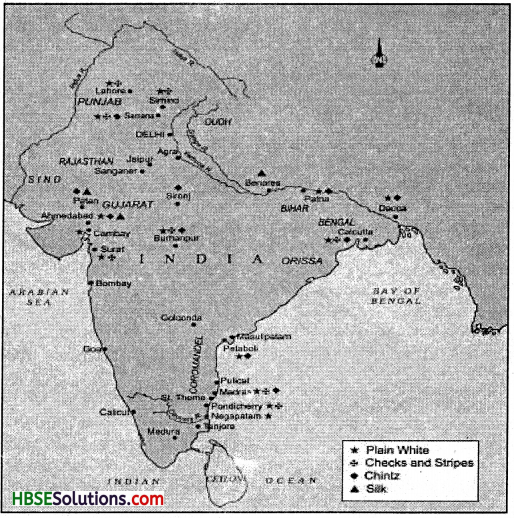
HBSE 8th Class Social Science Solutions History Chapter 7 Weavers, Iron Smelters and Factory Owners 1

HBSE 8th Class History Weavers, Iron Smelters and Factory Owners Important Questions and Answers

Very Short Answer Type Questions

Question 1.
Give the general name for all cotton textiles.
Answer:
Calico.

Question 2.
Which two industries were crucial for the industrial revolution in the modern world ?
Answer:

  • Textile industry
  • Iron and Steel industry.

Question 3.
Who invented the spinning jenny?
Answer:
John Kaye.

Question 4.
Who invented the steam engine?
Answer:
Richard Awkright.

Question 5.
Name the foremost textile centre in the 18th century.
Answer:
Dacca, Eastern Bengal, present day Bangladesh.

HBSE 8th Class Social Science Solutions History Chapter 8 Civilising the Native, Educating the Nation

Question 6.
When was India the world’s largest producer of cotton textile?
Answer:
Around 1750, before the British conquered Bengal.

Question 7.
What is the name given to a dyer?
Answer:
Rangrez.

Question 8.
What is Chintz?
Answer:
Chintz is a printed cotton cloth with small and colourful flowery designs.

Question 9.
When was the charkha adopted as the centre of flag of INC?
Answer:
In 1931.

Question 10.
Where and when was the first cotton mill set-up in India?
Answer:
Bombay, 1854.

Question 11.
Give the anglicised version of the word-Ukku.
Answer:
Wootz.

Short Answer Type Questions

Question 1.
Why is “muslin” named so?
Answer:
European traders first encountered fine cotton doth from India carried by Arab merchants in Masul in present-day Iraq. So they began referring to all finely woven textiles as “muslin” a word acquired wide currency.

Question 2.
Why was there a craze for chintz in England?
Answer:
From the 1680s there started a craze for printed Indian cotton textiles mainly for their exquisite floral designs, fine texture and relative cheapness.

Question 3.
Define Jamdani.
Answer:
Jamdani is a fine muslin on which decorative motifs are woven on the looms, typically in grey and white.

Question 4.
What is spinning jenny? How was its useful?
Answer:
A spinning jemmy is a machine by which a single worker could operate several spindles on to which thread was spun. When the wheel was turned all the spindles rotated. This increased productivity of traditional spindles.

Question 5.
Who were the weavers?
Answer:
Weavers often belonged to the community that specialized in weaving whose skills were passed «en from one generation to another.
Example : Tanti weavers, Bengali; Devangs of South Indiaetc.

HBSE 8th Class Social Science Solutions History Chapter 8 Civilising the Native, Educating the Nation

Question 6.
“Exporting textiles to England also became increasingly difficult.” Give reason.
Answer:
Exporting textiles to England also became increasingly difficult since very high duties were imposed on Indian textiles imported to Britain.

Question 7.
Mention the occupation of weavers and spinners who lost their livelihood.
Answer:
Many weavers became agricultural labourers. Some migrated to cities in search of work and yet others went out to work in African and South American plantations. Some of these handloom weavers started work in the new, cotton mills.

Question 8.
Define smelting.
Answer:
The process of obtaining a metal from rock (or soil) by heating it to a very high temperature.

Question 9.
What was the use of Bellows?
Answer:
Women worked with bellows, pumping air that kept Use charcoal burning.

Question 10.
What was the aim of Dorabji Tata and Charles Weld travelling in Chattisgarh?
Answer:
Charles Weld, an American geologist and Dorabji Tata, the eldest son of Jamshedji Tata, were travelling in Chattisgarh in search of non ore deposits spending months on a costly venture looking for sources of good iron ere.

Question 11.
“Despite being the finest ere, Rajhara hills was not the Tatas choice.” Why?
Answer:
Rajahara hills was a dry region and due to the necessity of water for running a factory, Tatas had to continue their search for a more suitable place to set-up their factory.

Question 12.
How dad ffiaropeaa companies make enormous profits out of Indian textiles during 18th century ?
Answer:
European trading companies – the Dutch, the French and the English pm-chased cotton and silk textiles in India by importing silver.

Question 13.
Why was the sword of Tipu Sultan so special ?
Answer:
This sword had an incredibly hard and sharp edge that could easily rip through the opponent’s armour. This quality of the sword came from a special type of high carbon Steel called Wootz.

Question 14.
How were the furnaces built in villages of lndia?
Answer:
(a) The fin-nances were most often built of day and sun-dried bricks.
(b) The smelting was dane by men while women worked the bellows, pumping air .that kept the charcoal burning.

Question 15.
When was steam engine invented and by whom? What was its impact?
Answer:
(a) Steam engine was invented in 1786 by Richard Arkwright.
(b) Cloth could now be woven in immense quantities and cheaply too.

Question 16.
Name some communities who were famous for weaving.
Answer:
(a) The tanti weavers of Bengal
(b) the julahas or momin weavers of north India
(c) sale and kaikollar and devanges of south India are some of the communities famous for weaving

HBSE 8th Class Social Science Solutions History Chapter 8 Civilising the Native, Educating the Nation

Long Answer Type Questions

Question 1.
How does word “bandanna” reveal history and present day textile world?
Answer:
The word bandanna now refers to any brightly coloured and printed scraf for the neck or head. Originally, the (term derived from the word “bandhna” (Hindi for tying) and referred to a variety of brightly coloured clothes produced through a method of tying and dyeing. It was a cloth that was produced as it was seamed together.

Question 2.
What technological innovations were made during eighteenth century? Why?
Answer:
Competition with Indian textiles also led to a search for technological innovations in England. In 1764, Spinning Jenny was invented by John Kaye which increased the productivity of traditional spindles. In 1786, the invention of the steam engine by Richard Awkright revolutionised cotton textile in many ways. These helped cloth get woven in immense quantities and cheaply too.

Question 3.
Explain in detail the process of production of handloom weaving.
Answer:
(а) Spinning : Using charkhas and taklis, fibres could be spun by women. The thread was spun on the charkha and rolled on the takli.

(b) Weaving: After spinning, weaving was done by men from a thread to a cloth/ fabric.

(c) Dyeing: For obtaining coloured textiles, the thread was dyed by the dyer known as rangrez.

(d) Printing : For obtaining printed cloth, the weavers needed the help of specialist block printers called Chhipigars. However, dyeing and printing were optional tasks.

Question 4.
“Even after extreme failures, handloom weaving did not completely die in India.” Why?
Answer:
Handloom weaving did not die in India because:
(a) Some types of clothes could not be supplied by the machine such as saris with intricate borders or fabrics with traditionally woven patterns.
(b) These had a wide demand by both the rich and middle class people.
(c) They also met the demands of poor as coarse cloth was not produced by textile manufacturers in Britain.

Question 5.
How did charkha become an important part of national movement?
Answer:
In the late nineteenth century, Mahatma Gandhi urged people to boycott imported textiles and use hand-spun and hand- woven clothes. These were, spun using a charkha. Khadi gradually became a symbol of nationalism during the National Movement. In this case, the charkha was the traditional spinning instrument that came to represent India and it was put at the centre of the tricolour flag of the Indian National Congress adopted in 1931.

Question 6.
Which were the major centres of weaving in the late 18th century India?
Answer:
The textile production was concentrated in the following four regions in the early 18th century :
(i) Bengal was one of the most important centrs. Located along the numerous rivers in the delta, the production centres in Bengal could easily transport goods to distant places.

(ii) Dacca in Eastern Bengal was the foremost textile centre in the 18th century. It was famous for its mulmul and jamdani weaving.

(iii) A cluster of cotton weaving centres was along the coromandel coast stretching from Madras to northern Andhra Pradesh.

(iv) On the western coast, there were important weaving centres in Gujarat.

HBSE 8th Class Social Science Solutions History Chapter 8 Civilising the Native, Educating the Nation

Question 7.
What were the various stages of textile production in India?
Answer:
(a) The first stage of production was spinning which was mostly done by women. The thread was spun on the charkha and rolled on the takli.

(b) Then thread was woven into cloth by the weaver which was generally done by men.

(c) For coloured textiles, the thread was dyed by the dyer.

(d) For printed cloth, the weavers needed the help of specialist block printers.

Question 8.
What were the effect of the decline of Indian textiles in the 19th century?
Answer:
(a) By the beginning of the 19th century, english-made cotton textiles successfully ousted Indian goods from their traditional markets in Africa, America and Europe.

(b) Thousands of weavers in India became jobless. Bengal weavers were the worst hit.

(c) English and European companies stopped buying Indian goods and giving advances to weavers to secure supplies.

(d) By the 1830s, British cotton cloth flooded Indian markets. Infact, by the 1880s two-thirds of all the cotton clothes worn by Indians were made of cloth produced in British.

Picture Based Questions

Question I.
Look at the given pictures and answer the questions that follow:
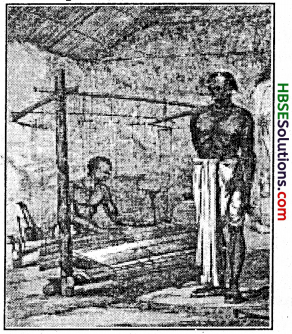
HBSE 8th Class Social Science Solutions History Chapter 7 Weavers, Iron Smelters and Factory Owners 2
Question 1.
What are the Tanti weavers doing?
Answer:
The tanti weavers here at work in the pit loom.

Question 2.
Where might they hail from?
Answer:
They might hail from Bengal.

Question II.
Look at the given pictures and answer the questions that follow:
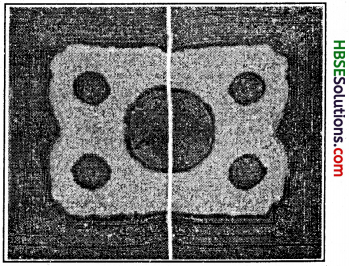
HBSE 8th Class Social Science Solutions History Chapter 7 Weavers, Iron Smelters and Factory Owners 3

Question 1.
What pattern is shown?
Answer:
Bandanna.

Question 2.
Where is it mainly produced?
Answer:
Rajasthan, Gujarat.

Question 3.
Why does the line separate two patterns?
Answer:
This is because two tie and dye patterns are seamed together with gold thread embroidery.

HBSE 8th Class Social Science Solutions History Chapter 8 Civilising the Native, Educating the Nation

Weavers, Iron Smelters and Factory Owners Class 8 HBSE Notes

  • Spinning Jenny: A machine by which a single worker could operate several spindles on to which thread was spun. When the wheel was turned all the spindles rotated.
  • Aurang : A Persian term for a warehouse – a place where goods are collected before being sold, also refers to a workshop.
  • Smelting : The process of obtaining a metal from rock (or soil) by heating it to a very high temperature, or of melting objects made from metal in order to use the metal to make something new.
  • Bellows: A device or equipment that can pump air.
  • Slag heaps: The waste left when smelting a metal.
  • Warehouse: A place where goods are collected before being sold.
HBSE 8th Class Social Science Solutions History Chapter 7 Weavers, Iron Smelters and Factory Owners Read More »

HBSE 8th Class Social Science Solutions History Chapter 6 Colonialism and the City: The Story of an Imperial Capital

Haryana State Board HBSE 8th Class Social Science Solutions History Chapter 6 Colonialism and the City: The Story of an Imperial Capital Textbook Exercise Questions and Answers.

Haryana Board 8th Class Social Science Solutions History Chapter 6 Colonialism and the City: The Story of an Imperial Capital

HBSE 8th Class History Colonialism and the City: The Story of an Imperial Capital Textbook Questions and Answers

LETS RECALL

Question 1.
State whether true or false :
(a) In the Western world, modern cities grew with industrialisation.
(b) Surat and Machlipatnam developed in the nineteenth century.
(c) In the twentieth century, the majority of Indians lived in cities.
(d) After 1857 no worship was allowed in the Jama Masjid for five years.
(e) More money was spent on cleaning Old Delhi than New Delhi.
Answer:
(a) True
(b) False
(c) False
(d) True
(c) False.

Question 2.
Fill in the blanks:
(a) The first structure to successfully use the dome was called the __________.
(b) The two architects who designed New Delhi and Shahjahanabad were __________ and __________.
(c) The British saw overcrowded spaces as __________.
(d) In 1888 an extension scheme called the __________ was devised.
Answer:
(a) minar
(b) Edward Lutyens, Henry Baker
(c) black areas
(d) Lahore Gate Improvement Scheme

HBSE 8th Class Social Science Solutions History Chapter 6 Colonialism and the City: The Story of an Imperial Capital

Question 3.
Identify three differences in the city design of New Delhi and Shahjahanabad.
Answer:

ShahjahanabadNew Delhi
(a) Shahjahanabad (begun in 1639) was constructed as a fort palace complex and the city adjoining it.(a) New Delhi was built by the British in twentieth century on a modern planning and pattern.
(b) There were 14 gates of entry into the city. Some of them still stand are: Lahori Gate, Delhi Gate, Ajmeri Gate, Kashmiri Gate. The main streets of Chandni Chowk and Faiz Bazaar were broad enough for royal processions to pass. There were densely packed mohallas and several dozen bazaars. Jama Masjid was among the largest and grandest mosques in India.(b) New Delhi was a very clean city. The new city had broad roads, big bungalows and many gardens. It had improved drainage system.

New Delhi represents a sense of law and order in contrast to the chaos of Old Delhi.

(c) Shahjahanabad was confined to the walls built by Shah Jahan. The old culture was based on Urdu.(c) The area around Red Fort was cleared in New Delhi. The culture of Urdu was replaced by Punjabi culture.

Question 4.
Who lived in the “White” areas in cities such as Madras?
Answer:
British and Europeans lived in the “White” areas in cities (Bombay and Calcutta also) such as Madras (now Chennai).

LETS DISCUSS

Question 5.
What is meant by de-urbanisation?
Answer:
Decline and decay of the cities is called deurbanisation. For example, in the late eighteenth century, many towns manufacturing specialised goods declined due to a drop in the demand for what they produced. Also, earlier centres of regional power collapsed when local rulers were defeated by the British and new centres of administration emerged.

Question 6.
Why did the British choose to hold a grand Durbar in Delhi although it was not the capital?
Answer:
Following causes were responsible to choose by the British to hold a grand Durbar in Delhi although it was not the capital of the British India:
(a) The British were fully aware of the symbolic importance of Delhi. During the Revolt of 1857, the British had realised that the Mughal emperor was still important to the people and they saw him as their leader. It was, therefore, important to celebrate British power with pomp and show in the city, the Mughal emperors had earlier ruled.

(b) In 1911, when King George V was crowned in England, a Durbar was held in Delhi to celebrate the occasion. The decision to shift the capital of India from Calcutta to Delhi was announced at this Durbar.

HBSE 8th Class Social Science Solutions History Chapter 6 Colonialism and the City: The Story of an Imperial Capital

Question 7.
How did the Old City of Delhi change under British rule?
Answer:

  • Delhi was captured by the British in 1803 after defeating the Marathas. The modern city of Delhi developed after 1911, when it became the capital of British India. .
  • When the British recaptured Delhi in September 1857, they ravaged and plundered the whole city.
  • The area around the Red Fort was, completely cleared for security purpose.
  • The gardens of the royal palace were shut down.
  • Several places were razed and barracks were built in their place for the British troops to stay.
  • The Zinat-al-Masjid was converted into a bakery.
  • One-third of the monuments in Delhi were demolished and the canals were filled up.
  • Railway tracks were laid down, and thus, the city expanded beyond the huge walls.

Question 8.
How did the partition affect life in Delhi?
Answer:
The following changes could be seen in Delhi after Partition:
(i) As a result of Partition of India in 1947, there was a mass transfer of people from both India and Pakistan. It resulted in an increase in population of Delhi, change of job and culture of the city and its people.

(ii) The riots followed the partition, thousands of people in Delhi were killed, their homes looted and burned.

(iii) The refugees who came from Pakistan occupied the empty houses of Shahjahanabad. Many refugees came to Delhi from Punjab.

(iv) As most of the migrants were from Punjab, the Urdu based culture of Delhi was replaced by the new culture of Punjab and other native places of migrants.

(v) New shops and stalls were set-up to meet the demands. New colonies of Lajpat Nagar and Tilak Nagar were formed at this time.

(vi) Old Delhi also witnessed the extinction of Havelis.

HBSE 8th Class Social Science Solutions History Chapter 6 Colonialism and the City: The Story of an Imperial Capital

LETS DO

Question 9.
Find out the history of the town you live in or any town nearby. Check when and how it grew, and how it has changed over the years. You could look at the history of the bazaars, the buildings, cultural institutions and settlements.
Answer:
I am Shivaji Dhawle. I am living in Mumbai (previously called Bombay). I am giving the brief history and stages of its development below:

Architecture in Bombay:
(а) Joining of islands: Bombay was initially seven islands. As the population grew, the island were joined to create more space and the gradually changed into one big city. Bombay was the commercial capital of colonial India. As the premier part on the western coast it was the centre of international trade.

(b) As Bombay’s economy grew, from the mid¬nineteenth century there was a need to expand railways and shipping and develop the administrative structure. Many new buildings, were constructed at this time. These buildings reflected the culture and confidence of the rulers.

(c) As a trade centre : By the end of the nineteenth century, half the imports and exports of India passed through Bombay. One important item of this trade was opium that the East India Company exported to China. Indian merchants and middlemen supplied and participated in this trade and they helped integrate.

(d) Bombay’s economy directly to Malwa, Rajasthan and Sind where opium was grown. This collaboration with the Company was profitable and led to the growth of an Indian capitalist class. Bombay’s capitalists came from diverse communities such as Parsi, Marwari, Konkani Muslim, Gujarati Bania, Bohra, Jew and Armenian.

(e) Style of Architecture of Buildings : The architectural style was usually European. This importation of European styles reflected the imperial vision in several ways. First, it expressed the British desire to create a familiar landscape in an alien country, and thus to feel at home in the colony. Second, the British felt that European styles would best symbolise their superiority, authority and power.

(f) Initially, these buildings were at odds with the traditional Indian buildings. Gradually, Indians too got used to European architecture and made it their own. The British in turn adapted some Indian styles to suit their needs.

(g) For public buildings three broad architectural styles were used. Two of these were direct imports from fashions prevalent in England. The first was called neo-classical or the new classical. Its characteristics included construction of geometrical structures fronted with lofty pillars. It was derived from a style that was originally typical of buildings in ancient Rome.

(h) Another style that was extensively used was the neo-Gothic, characterised by high-pitched roofs, pointed arches and detailed decoration. The Gothic style had its roots in buildings, especially churches, build in northern Europe during the medieval period. Indians gave money for some of these buildings. The University Hall was made with money donated by Sir Cowasjee Jehangir, a rich Parsi merchant.

(i) Towards the beginning of the twentieth century, a new hybrid architectural style developed which combined the Indian with the European. This was called Indo-Saracenic. “Indo” was shorthand for Hindu and “Saracen” was a term European used to designate Muslim.

(j) In the more “Indian” localities of Bombay traditional styles of decoration and building predominated. The lack of space in the city and crowding led to a type of building unique to Bombay, the chawl, the multi-storeyed single-room apartments with long open corridors built around a courtyard. v.
Or
I am S. Karunanidhi. I am living at Chennai (previously called Madras). A brief history of it and stages of development are given below:
(a) Coming of the English on East Coast: The Company had first set up its trading activities in the well-established port of Surat on the west coast. Subsequently the search for textiles brought British merchants to the east coast.

(b) Purchase of land for city of Madras: In 1639 they constructed a trading post in Madraspatam. This settlement was locally known as Chenapattanam. The Company had purchased the right of settlement from the local Telugu lords, the Nayaks of Kalahasti, who were eager to support trading activity in the region.

(c) Fortification of Madras and its results: Rivalry (1746-63) with the French East India Company led the British to fortify Madras and give their representatives increased political and administrative functions. With the defeat of the French in 1761, Madras become more secure and began to grow into an important commercial town. It was here that the superiority of the British and the subordinate position of the Indian merchants was most apparent.

(d) White Towns within Madras : Fort St. George became the nucleus of the White Town where most of the Europeans lived. Walls and bastions made this a distinct enclave. Colour and religion determined who was allowed to live within the fort. The Company did not permit any marriages with IndiAnswer: Other than the English, the Dutch and Portuguese were allowed to stay here because they were European and ChristiAnswer: The administrative and the judicial systems also favoured the white population. Despite being few in number the Europeans were the rulers and the development of Madras followed the needs and convenience of the minority whites in the town.

(e) Black Towns within Madras : The Black Town developed outside the Fort. It was laid out in straight lines, a characteristic of colonial towns. It was, however, demolished in the mid-1700s and the area was cleared for a security zone around the Fort. A new Black Town developed further to the north. This housed weavers, artisans, middlemen and interpreters who played a vital role in the Company’s trade.

(f) Collection of taxtation and information : For a long while they were suspicious of census operations and believed that enquiries were being conducted to impose new taxes. Upper-caste people were also unwilling to give any information regarding the women of their household. Women were supposed to remain secluded within the interior of the household and not subjected to public gaze or public enquiry.

(g) Wrong information of census officials by the hawkers and small traders: Census officials also found that people were claiming identities that they associated with higher status. For instance there were people in towns who were hawkers and went selling small articles during some seasons, while in other seasons they earned their livelihood through manual labour. Such people often told the census enumerators that they were traders, not labourers, for they regarded trade as a more respectable activity.

(h) Wrong information regarding death and illness: Similarly, the figures of mortality and disease were difficult to collect, for all deaths were not registered, and illness was not always reported, nor treated by licensed doctors. How then could cases of illness or death be accurately calculated?

HBSE 8th Class Social Science Solutions History Chapter 6 Colonialism and the City: The Story of an Imperial Capital

Question 10.
Make a list of at least ten occupations in the city, town or village to which you belong, and find out how long they have existed. What does this tell you about the change within this area?
Answer:
List of ten occupations of a village or town:

  • Agriculture
  • Carpentry
  • Jewellery-making
  • Teaching
  • Medicine and surgery
  • Rearing of animals
  • Blacksmith
  • Trade
  • Textile-designing
  • Interior- decoration.

(а) Agriculture : Agriculture is the oldest occupation in the villages. The farming methods have been changed from traditional to modern. The new and improved irrigation methods, use of manures, fertilizers have been introduced.

(b) Wood-work : The latest tools, implements and machines are being used which has improved the standard of living of carpenters.

(c) Jewellery-making: Though the people have been using jewellery since ancient times, there have been drastic changes in the designs of jewellery.

(d) Teaching: The latest methods of teaching with the use of computers, CDs are being used.

(e) Medicine and surgery : Though, the patients are being treated since old, there have been advancements in this field which has reduced the death rate.

(f) Rearing of animals : The dairy farms have been developed which have electric- fittings for cattle provide them facilities.

(g) Blacksmith : With the help of latest technology, all types of grills, windows, iron-rods are being prepared, according to the needs of customers.

(h) Trade : Traders are using greater use of services like banking, transport and modern methods of business management.

(i) Textile-designing: From the traditional methods of weaving and spinning the latest methods of machine looms have increased both the quantity and quality of textile.

(j) Interior-decoration : This is the emerging field in the area of occupations. The houses are designed in still manner taking care of safety measures.

LETS IMAGINE

Imagine that you are a young man living in Shahjahanabad in 1700. Based on the description of the area in this chapter write an account of your activities during one day of your life.
Answer:
I am directed to suppose and to do the writing work as instructed in the activity work – Let’s imagine. I am a youngman of twenty years, living in Shahjahanabad in 1700.
1. Aurangzeb is our Emperor. Shahjahanabad is the capital town of the Mughal empire. It is also a trade centre.

2. I used to go to Jama Masjid daily to offer my prayer to Allah, at least two times a day. I had to go to colourful world of poetry and dance alone because it was allowed only by men. Women are not allowed to visit colourful world of poetry and dance. I had to avoid celebrations and processions because generally these led to serious conflicts. I generally enjoy Urdu/ Persian culture and poetry and participated in local festivals. I used to go five times daily to offer Namaz in Jama Masjid.

As a resident of the old city, we use to get fresh drinking water to our homes. There is an excellent drainage system also. I live in a haveli, which housed many families.

HBSE 8th Class History Colonialism and the City: The Story of an Imperial Capital Important Questions and Answers

Very Short Answer Type Questions

Question 1.
How did the famous poet Ghalib describe the ransacking of Delhi in 1857 ?
Answer:
Ghalib said “when the angry lions (the British) entered the town, they killed the helpless and burned houses. Hordes, of men and women, commoners and noblemen, poured out of Delhi from the three gates and took shelters in small communities and tombs outside the city.”

Question 2.
What is an imperial capital?
Answer:
Political centre (or capital) used as a central point of political activities, administration and control by any imperial power (or country) is called imperial capital. For example, (Approx, from 1757 to 1911) Calcutta was imperial capital of British India. Delhi was made imperial capital after the Royal Durbar of 1911.

HBSE 8th Class Social Science Solutions History Chapter 6 Colonialism and the City: The Story of an Imperial Capital

Question 3.
What happened to the Delhi College in 1877?
Answer:
The Delhi College was turned into a school and shut down in 1877.

Question 4.
When was the decision to shift the capital of India from Calcutta to Delhi announced?
Answer:
The decision to shift the capital of India from Calcutta to Delhi was announced in 1911.

Question 5.
Why did the importance of Machli- patnam decline in the 17th century?
Answer:
Machlipatnam developed as an important town in the 17th century. Its importance declined by the.late 18th century as trade shifted to the new British ports of Bom bay, Madras and Calcutta.

Question 6.
What were ‘Havelis’?
Answer:
The grand mansions where the Mughal aristocracy lived in the seventeenth and eighteenth centuries were called Havelis.

Question 7.
Why did ‘Havelis’ begin to decline?
Answer:
Many of the Mughal amirs were unable to maintain.

Question 8.
Name the three presidency cities of India.
Answer:
Calcutta, Bombay and Madras.

Question 9.
When did the British gain control of Delhi?
Answer:
The Britsh gained control of Delhi in 1803 after defeating the Marathas.

Question 10.
When was Delhi made the Capital of India?
Answer:
In 1911.

Question 11.
Why were the western walls of Shahjahanabad broken in 1870s?
Answer:
To establish the railway and to allow the city of expand beyond the walls.

Question 12.
What was the design of streets in the Lahore Gate improvement scheme?
Answer:
The streets followed the grid pattern and were of identical width, size and character.

Question 13.
When was the Delhi improvement trust set-up?
Answer:
In 1936.

HBSE 8th Class Social Science Solutions History Chapter 6 Colonialism and the City: The Story of an Imperial Capital

Question 14.
What did the British do to make Delhi forget the Mughal past?
Answer:
They completely cleaned the area around the fort – Gardens, pavilions, mosques were either demolished or used for other purpose.

Short Answer Type Questions

Question 1.
What steps were taken by British so that Delhi forgets its Mughal Past?
Answer:
The following steps were taken by the British so that Delhi forgets its Mughal Past:
(a) The area around the Fort was completely cleared of gardens, pavilions and mosques.
(b) Mosques were either destroyed or put to other uses. For instance, the Zinat- al-Masjid was converted into a bakery.
(c) No worship was allowed in Jama Masjid for five years.

Question 2.
How many ‘Delhis’ were there before New Delhi? What were its features related with common political role and geographical location?
Answer:
(a) Delhi has been a capital for more than a 1000 years, although with some gaps.

(b) As many as 14 capital cities were founded in a small area of about 60 square miles on the left bank of the river Jamuna (or Yamuna).

(c) The remaining of all other capital may be seen on a visit to modern city state of Delhi.

(d) The most splendid capital of all was built by the great Mughal Emperor Shah Jahan. Shahjahanabad was constructed in 1639. It consisted of a fort-palace (Red Fort) complex and the city adjoining.

Question 3.
Write three positive features of Shahjahanabad or Old Delhi.
Answer:
Shahjahanabad was the most splendid capital whose construction began in 1639. Its positive features were :
(а) The main streets of Chandni Chowk and Faiz Bazaar were broad enough for royal processions to pass.

(b) It was also an important centre of Sufi culture. It had several dargahs, khanqahs and idgahs.

(c) Open squares, winding lanes, quiet cul- de-sacs and water channels were the pride of Delhi’s residents. No wonder the poet Mir Taqi Mir said, “The streets of Delhi aren’t mere streets : they are like the album of a painter.”

Question 4.
What were the negative features of living-style in Old Delhi?
Answer:
The following were the negative features of living-style in Old Delhi :
(a) Old Delhi was no ideal city and its delights were enjoyed only by some. There were sharp division between rich and poor.

(b) Havelis or mansions were interspersed with the far more numerous mud houses for the poor.

(c) The colourful world of poetry and dance was usually enjoyed only by men.

(d) Celebrations and processions often led to serious conflicts.

Question 5.
What was the idea behind the extension scheme called the Lahore Gate Improvement Scheme ?
Answer:
Lahore Gate improvement scheme was planned by Robert Clarke which pMnned:

  • To draw residents away from the Old City to a new type of market square around which shops would be built.
  • Streets in this redevelopment strictly followed the grid pattern, and were of identical width, size and character.
  • Land was divided into regular areas for the construction of neighbourhoods.

HBSE 8th Class Social Science Solutions History Chapter 6 Colonialism and the City: The Story of an Imperial Capital

Long Answer Type Questions

Question 1.
What were the features of the new urban centres built by the British?
Answer:

  • Many of the new urban centres like Calcutta and Madras developed around forts.
  • The new cities had broad roads and large and imposing public buildings like government offices, public libraries, museum and town halls.
  • Most of the British in India lived outside the old walled town where the Indians lived. The areas where the
  • Indians lived were generally crowded and conditions were often unhygienic.
  • The part of the city where the British lived was generally divided into the civil lines and the military cantonment.

Question 2.
What were the main features of the colonial bungalow?
Answer:

  • It was a large single-storeyed structure with a pitched-roof, and usually set in one or two areas of open ground.
  • It had separate living and dining rooms and bedrooms.
  • It had a wide veranda running in the front, and sometimes on three sides.
  • Kitchens, stables and servants quarters were in separate apace from the main house.
  • The house was run by dozens of servants.
  • The women of the household often sat on the verandas to supervise tailors or other tradesmen.

Question 3.
Discuss the features of new buildings made by the British in New Delhi.
Answer:
(i) The features of these buildings were borrowed from different periods of India’s imperial history. But, the overall look of these government buildings was like classical Greece.

(ii) The central dome of the Viceroy’s palace was copied from the Buddhist Stupa at Sanchi.

(iii) The red sandstones and carved screens of Jalis were borrowed from Mughal architecture.

(iv) The assert the British importance, the Viceroy’s palace was built at a place higher than that of Shah Jahan’s Jama Masjid.

HBSE 8th Class Social Science Solutions History Chapter 6 Colonialism and the City: The Story of an Imperial Capital

Question 4.
Discuss the features of colonial bungalow.
Answer:

  • These bungalows were meant for one nuclear family.
  • The colonial bungalow was a large single storeyed structure usually set in one or two acres of open ground.
  • It had separate living rooms, diningrooms and bedrooms.
  • It had a wide veranda running in the front and sometimes on three sides.
  • Kitchens, stables and servant’s quarters were in a separate space from the main house.

Source-Based Questions

Source 1
“Dillijo ek shahr tha alam mein intikhab… ”
By 1739, Delhi had been sacked by Nadir Shah and plundered many times. Expressing the sorrow of those who witnessed the decline of the city, the eighteenth-century Urdu poet Mir Taqi Mir, said :

Dilli jo ek shahr tha alam mein intikhab,… Ham rahnewale hain usi ujre dayar ke (7 belong to the same ruined territory of Delhi, which was once a supreme city in the world)

Read the source given above and answer the following questions:
Question 1.
Who was Nadir Shah ? Who was the Mughal ruler when he plundered Delhi?
Answer:
Nadir Shah was an invader, who attacked India and its capital Delhi in 1739. He plundered Hindustan and Delhi for many days. At that time Mohammad Shah was the Mughal ruler.

Question 2.
How did the poet express his sorrow about the imperial capital of India?
Answer:
Poet Mir Taqi Mir said that we are living in the decayed, destroyed and declined city of India. No doubt once Delhi was a supreme city in the world, but it had been changed in ruins by Nadir Shah in 1739.

Source 2
“There was once a city of this name”
Ghalib lamented the changes that were occurring and wrote sadly about the past that was lost. He wrote :
What can I write? The life of Delhi depends on the Fort, Chandni Chowk, the daily gatherings at the Jamuna Bridge and the Annual Gulfaroshan. When all these … things are no longer there, how can Delhi live? Yes, there was once a city of this name in the dominions of India.

Read the source given above and answer the following questions:
Question 1.
What changes are talked about in the source above?
Answer:
The changes in the life of Delhi are talked about in the source.

Question 2.
Who has lamented such changes?
Answer:
Ghalib.

Question 3.
What is Gulfaroshan?
Answer:
A festival of flowers.

HBSE 8th Class Social Science Solutions History Chapter 6 Colonialism and the City: The Story of an Imperial Capital

Question 4.
What tilings could no longer be seen in Delhi?
Answer:
The things like Chandni Chowk, the daily gatherings at the Jamuna Bridge, and the Annual Gulfaroshan could no longer be seen in Delhi.

Source 3
The vision of New Delhi This is how Viceroy Hardinge explained the choice of Delhi as capital :
The change would strike the imagination of the people of India …. and would be accepted by all as the assertion of an unfaltering determination to maintain British rule in India.
The architect Herbert Baker believed :
The New Capital must be the sculptural monument of the good government and unity which India, for the first time in its history, has enjoyed under British rule. British rule in India is not a mere veneer of government and culture. It is a new civilisation in growth, a blend of the best elements of East and West….
It is to this great fact that the architec-ture of Delhi should bear testimony.
(2 October 1912)
Read the source given above and answer the following questions:

Question 1.
Who believed that the choice of New Delhi as capital was a determin¬ation to maintain British rule in India?
Answer:
Viceroy Hardinge.

Question 2.
Who was architect of New Delhi?
Answer:
Herbert Baker.

Question 3.
Write the good points that the architect of New Delhi believed about it.
Answer:
(a) The New Delhi must be the creator of monument of the good government, i.e. the British Government in India.

(b) India would feel united as a nation, for the first time under the British rule.

Colonialism and the City: The Story of an Imperial Capital Class 8 HBSE Notes

  • Presidency: For administrative purposes, colonial India was divided into three “Presidencies” (Bombay, Madras and Bengal), which developed from the East India Company’s “factories” (tradingposts) at Surat, Madras and Calcutta.
  • Urbanisation : The process by which more and more people begin to reside in towns and cities.
  • Dargah : The tomb of a Sufi saint.
  • Khanqah : A sufi lodge, often used as a rest house for travellers and a place where people come to discuss spiritual matters, get the blessings of saints, and hear sufi music.
  • Idgah : An open prayer place of Muslims primarily meant for Id prayers.
  • Cul-de-sac : Street with a dead end.
  • Gulfaroshan : A festival of flowers.
  • Renaissance: Literally, rebirth of art and learning. It is a term often used to describe a time when there is a great creative activity.
  • Amir : A nobleman.

HBSE 8th Class Social Science Solutions History Chapter 6 Colonialism and the City: The Story of an Imperial Capital Read More »

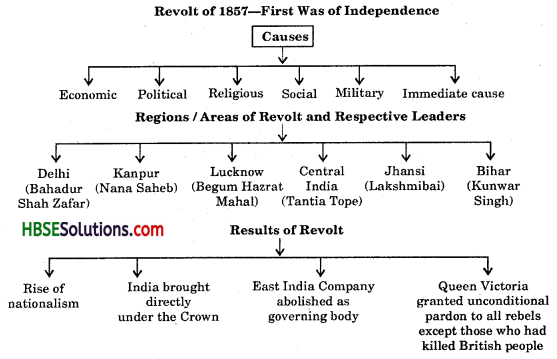
HBSE 8th Class Social Science Solutions History Chapter 5 When People Rebel 1857 and After

Haryana State Board HBSE 8th Class Social Science Solutions History Chapter 5 When People Rebel 1857 and After Textbook Exercise Questions and Answers.

Haryana Board 8th Class Social Science Solutions History Chapter 5 When People Rebel 1857 and After

HBSE 8th Class History When People Rebel 1857 and After Textbook Questions and Answers

LETS RECALL

Question 1.
What was the demand of Rani Lakshmibai of Jhansi that was refused by the British?
Answer:
The demand of Rani Lakshmibai of Jhansi that was refused by the British was that she wanted the Company to recognize her adopted son as the heir to the kingdom after the death of her husband.

Question 2.
What did the British do to protect the interests of those who converted to Christianity?
Answer:
Following were the steps that the British did to protect the interest of those who converted to Christianity:

After 1830, the Company allowed Christian missionaries to function freely in its domain and even own land and property.
In 1850, a new law was passed to make conversion to Christianity easier.

Question 3.
What objections did the sepoys have to the new cartridges that they were asked to use?
Answer:
The sepoys had raised the following objections when they were asked to use new cartridges:
(i) The cartridges used for new rifles were greased with the fat of cows and pigs. It is a great insult to the regions of Indian sepoys the Hindus as well as the Muslims.

(ii) It appeared to the Indian soldiers that the great aim of the English was to turn all the sepoys into Christians, and they had therefore introduced the cartridge in order to bring this about, since both Mohammedans and Hindus would be defied by using it.

HBSE 8th Class Social Science Solutions History Chapter 5 When People Rebel 1857 and After

Question 4.
How did the last Mughal emperor live the last years of his life?
Answer:
The last Mughal Emperor Bahadur Shah II (or Bahadur Shah Zafar) lived a miserable life in his last time. When the British captured Delhi in September 1857 A.D., Bahadur Shah left Lucknow, from there he continued his fight against the British. At last his sons along with some other rebels were captured by the English. His two sons and a grandson were shot dead before his old eyes. Their dead bodies were hanged at the Khooni Darwaja, Delhi to create terror among the rebels. Bahadur Shah himself was deported to Rangoon where he died in 1862 A.D. His last words were “Zafar was really unfortunate for he could not get six feet grave in the street of his beloved country.”

LETS DISCUSS

Question 5.
What could be the reasons for the confidence of the British rulers about their position in India before May 1857?
Answer:
The reasons for the confidence of the British rulers about their position in India before May 1857 were :
(i) The Indian nawabs had gradually lost their power, authority and honour.

(ii) The British Governor-Generals posted their residents in several courts, the freedom of the rulers reduced, their armed forces disbanded and their revenue and territories taken away stage by stage.

(iii) The Company was confident of its military powers.

(iv) In 1856, Governor-General Canning decided that Bahadur Shah Zafar would be the last Mughal king and after his death none of his descendent would be recognised as king. They would just be called prince.

Question 6.
What impact did Bahadur Shah Zafar’s support to the rebellion have in the people and the ruling families?
Answer:
Bahadur Shah Zafar’s decision to bless the rebellion changed the entire situation and it had the following impacts:
(i) People felt inspired and enthused. It gave them courage, hope and confidence to act.

(ii) Regiment after regiment mutinied and took off to join other troop at nodal points like Delhi, Kanpur and Lucknow.

(iii) Nana Saheb, the adopted son of the late Peshwa Baji Rao gathered armed forces and expelled the British garrision from the city. He declared himself that he was agovemor under Emperor Bahadur Shah Zafar.

(iv) Biijis Qadr, the son of the deposed Nawab Wajid Ali Shah was made the new Nawab in Lucknow. He too acknowledged the suzerainty of Bahadur Shah Zafar.

Question 7.
How did the British succeed in securing the submission of the rebel landowners of Awadh?
Answer:
(i) The victories against the British had earlier encouraged rebellion, the defeat of rebel forces including landowners of Awadh encouraged desertions.

(ii) The British also tried their best to win back the loyalties of the people. They announced rewards for those who would remain faithful to them.

(iii) Then they crushed the revolt with a heavy hand.

(iv) The British military generals also tried to recapture those places which once felt to the rulers.

HBSE 8th Class Social Science Solutions History Chapter 5 When People Rebel 1857 and After

Question 8.
In what ways did the British change their policies as a result of the rebellion of 1857?
Answer:
The British had regained control of the country by the end of 1859, but they could not carry on ruling the land with the same policies any more. Following were the changes introduced by the British as a result of the rebellion of 1857:
(i) The British Parliament passed a new act in 1858 and transferred the powers of the East India Company to the British Crown in order to ensure a more responsible management of Indian affairs.

(ii) A member of the British Cabinet was appointed Secretary of State for India and made responsible for all matters related to the governance of India.

(iii) All ruling chief’s of the country were assured that their territory would never be annexed in future. They were allowed to pass on their kingdoms to their heirs, including adopted sons. However, they were made to acknowledge the British Queen as their sovereign paramount.

(iv) It was decided that the proportion of Indian soldiers in the army would be reduced and the number of European soldiers would be increased. It was also decided that instead of recruiting soldiers from Awadh, Bihar, Central India and South India, more soldiers would be recruited from among the Gurkhas, Sikhs and PathAnswer:

(v) The land and property of Muslims was confiscated on a large scale and they were treated with suspicion and hostility. The British decided to respect the customary religions and social practices of the people in India.

(vi) Policies were made to protect landlords and zamindars and give them security of rights over their.

LETS DO

Question 9.
Find out stories and songs remembered by people in your area or your family about San Sattavan ki Ladaai. What memories do people cherish about the great uprising?
Answer:
(i) There are several stories about the brave works of some people during San Sattavan ki Ladaai.
“There was a Courtesan in Kanpur. He was linked to a Hindu Military Subedar who rebelled in 1857. When during the course of the revolt, the rebel Subedar fell to the bullets of the British, the Courtesan Azizun Nisa mobilised women to form a band of troops. She represented this band as its military Commander and participated in the war of independence with full vigour alongwith Begam Hazrat Mahal and Tantia Tope.”

(ii) Many of our eleder say that they came to know from their grandfather about the Hindu- Muslim unity during the war of independence of 1857. There was a Hindu priest, who did not allow even Hindu from lower castes to enter the temple premises. But, during the fight of 1857 several Muslim rebel soldiers found their shelter in his temple. He personally took care of these soldiers. He told that service to the motherland was superior to every thing. Even today people cherish about this incident in our area.

Question 10.
Find out more about Rani Lakshmibai of Jhansi. In what ways would she have been an unusual woman for her times?
Answer:
Rani Lakshnjibai of Jhansi : The Raja of Jhansi had been originally a vassal of the Peshwa. After the defeat of Baji Rao II, Lord Hastings in 1818 had concluded a treaty with the Raja on terms of‘subordinate co-operation’.

After the death of the Raja in 1835, the company recognised a grand-uncle, Raghunath Rao to succeed to the throne. After his death, his successor Gangadhar Rao was recognised as the ruler in 1838. But he died in November 1853 without leaving a male heir and the state was declared annexed by Lord Dalhousie. The claims of the adopted son were disregarded. So the Queen of Jhansi Rani Lakshmibai joined to revolt to protest against the annexation of Jhansi by the English.

When the Rani joined the revolt, General Sir Huge Rose attacked Jhansi in March 1858, but the brave Rani Lakshmibai kept the British General unnerved for quite sometime. When she found that she could not able to hold the English for a long time she appealed to Tantya Tope for help, which brought Tantya Tope rushing to Jhansi. But by the time he reached Jhansi her troops were severely defeated by the British on the banks of the river Betwa. Now the Rani had to hold on to her fortress above. The British also knew it would be difficult for them to enter into the fortress.

So the British resorted to deceit and treachery and bribed the guards to open the gates of the fortress. Even then the British was unable to capture the Rani who slipped out of the fort and reached Kalpi. Here she was joined by Tantya Tope the great general of Nana Sahib, who fled to Kalpi. Now the Rani of Jhansi and the great General Tantya Tope joined together and fought many wars with the British. While fighting they had to leave Kalpi. So they fell upon Gwalior with lightening speed and captured it. The ruler of Gwalior Jayaji Rao Sindhia was a dependent ruler of the British Company who was paying lots of tribute and he was also very loyal to the Company. Now the Company had the responsibility to protect their independent, i.e., the ruler of Gwalior.

A fierce battle was fought between the British and the revolutionaries under Rani Lakshmibai and Tantya Tope from June 11-18, 1858 A.D. Even though the Rani and Tantya Tope were able Generals, their personal valour was not at all a good match the resources at the command of the British. Gwalior was recaptured by the British in June 18,1858. The Rani of Jhansi died fighting clad in soldier’s uniform on the ramparts of the fort. Tantya Tope escaped southward. In April 1859 he was captured by one of the Sindhia’s feudatory, who handed him over to the British to be hanged on April 18, 1859.

Sir Huge Rose paid a tribute to the valour of Rani Lakshmibai by saying, “Lakshmibai was the bravest and the best of military leaders of the rebels.”

HBSE 8th Class Social Science Solutions History Chapter 5 When People Rebel 1857 and After

LETS IMAGINE

Imagine you are a British officer in Awadh during the rebellion. What would you do to keep your plans of fighting the rebels a top secret?
Answer:
I would have used a code word Kamal (Lotus) to convey about my future plans. I knew that Kamal was being used by the rebellion, just to create confusion in the minds of the Indians.

I used to wear Indian dress of the area. I would keep a large number of troops, judging their loyalty. I would have asked the Muslim soldiers to take an oath of Holy Quran of loyalty to the British and same oath by the Hindu soldiers, telling them to put their hands on Holy Bhagwat Gita.

I would have used all four tactics of Sam, Dam, Dand and Bhed to loyalty among the rebels of the Awadh. I would have send some loyal females to know future plan of the higher British officers.

The following table explains in brief the 1857 revolt in short:
HBSE 8th Class Social Science Solutions History Chapter 5 When People Rebel 1857 and After 1

HBSE 8th Class History When People Rebel 1857 and After Important Questions and Answers

Very Short Answer Type Questions

Question 1.
Why were the Indian sepoys in the employ of the Company were discontent with Company?
Answer:
The Indian sepoys in the employ of the Company were discontent because :
(a) They were unhappy about their pay, allowances and conditions of services.
(b) Some of the new rules violated their religious sensibilities and beliefs.

Question 2.
What was the law passed by the Company in 1856?
Answer:
In 1856, the Company passed a new law which stated that every new person who took up employment in the Company’s army had to agree to serve overseas if required.

Question 3.
How did the anger of the peasants quickly spread among the sepoys?
Answer:
The anger of the peasants quickly spread among the sepoys because many of them were peasants and had families living in the villages.

Question 4.
Why was Mangal Pandey hanged to death?
Answer:
Mangal Pandey was hanged to death for attacking the officers in Barrackpore.

Question 5.
How did the Revolt of 1857 affect the position of the East India Company?
Answer:
The Company’s rule in India was abolished and the British Government began to rule their Indian empire directly.

HBSE 8th Class Social Science Solutions History Chapter 5 When People Rebel 1857 and After

Question 6.
What was the most responsible cause for the failure of the revolt against the British rule?
Answer:
The infighting and jealousy among the rulers was the most responsible cause for the failure of the revolt against the British rule.

Question 7.
Who was Mangal Pandey?
Answer:
Mangal Pandey was a brave soldier of the British military cantt. at Barrackpore. He was the first person who refused the loading of the new rifles with greased cartridges. Due to the reason he was killed by the Britisher.

Question 8.
On what ground was Awadh annexed.
Answer:
It was said that the territory Was misgoverned and the British rule was needed to ensure proper administration.

Question 9.
What was the impact of the British land policies on the sepoy?
Answer:
The sepoys were angry because many of them were peasants and had families in the villages.

Question 10.
Below are given the names of some rebel leaders. Name the place where they headed the rebellion. Ahmadullah Khan, Kunwar Singh, Bakht Khan.
Answer:
Ahmadullah Khan – Lucknow
Kunwar Singh – Bihar
Bakht Khan – Delhi

Question 11.
What major change was observed in ruling Indian territory after the revolt of 1857?
Answer:
After the revolt of 1857, the British Governement undertook direct responsibility for ruling India.

Short Answer Type Questions

Question 1.
What plan did the company make to bring and end to the Mughal dynasty?
Answer:
(i) In 1849, Dalhousie announced that after the death of Bahadur Shah, the family of the king will have to leave the Red Fort.

(ii) In 1856, Canning decided that Bahadur Shah Zafar would be the last king. After his death none of his descendants would be recognised as king.

Question 2.
‘1857 Revolt was not a Sepoy Mutiny’. Comment.
Answer:
The sepoys had played an active role in 1857 revolt and they were the first to revolt against the rule of the East India Company. Still it cannot be called a sepoy mutiny since the revolt was not confined to them. Several other sections of the society had also taken part in the revolt.

Question 3.
How was the Revolt of 1857 suppressed by the British?
Answer:
The Revolt of 1857 was suppressed by the British through many inhuman brutalities. Many rebels were hanged. Others were tied to the mouth of cannons and blown off. Several villages were razed and harvests destroyed by British army.

HBSE 8th Class Social Science Solutions History Chapter 5 When People Rebel 1857 and After

Question 4.
Why did the emerging middle class not support the rebels?
Answer:
The following were the reasons why the emerging middle class did not support the rebels :
(a) The middle class had emerged as a result of the British rule in India. It was their belief that only the British Government could modernise India after bringing social reforms in the society.

(b) The middle class was aware of its petty positions in the old type of kingdoms. The royal class always used to keep them oppressed. Hence this class did not take any interest in the revolt.

(c) The middle class was not sound economically and financially. The lack of sufficient resources made them keep away from the battle fields of the revolt.

Question 5.
What were the reforms made in the British army after the Revolt of 1857?
Answer:
Reforms in the Army:
(a) There was a feeling that the Indian Army had been mainly responsible for the revolt, so it was thoroughly reorganised and built up on the policy of division and counterpoise.

(b) The British reduced the strength of the Indian sepoys and fixed up the ratio as two sepoys to one European soldier.

(c) The discipline in the army was improved. The Company army was dissolved and all the army men became the servants of the Crown directly.

Long Answer Type Questions

Question 1.
How did the Company plan to bring the Mughal dynasty to an end?
Answer:
The Company took the following steps to bring the Mughal dynasty to an end :
(i) The name of the Mughal king was removed from the coins minted by the Company.

(ii) In 1849, Governor General Dalhousie announced that after the death of Bahadur Shah Zafar, the family of the king would be shifted out of the Red Fort and given another place in Delhi to reside in.

(iii) In 1856, Governor General Canning decided that Bahadur Shah Zafar would be last Mughal king and after his death none of his descendents would be recognised as kings-they would just be called prines.

Question 2.
What were the main causes of failure of the Revolt of 1857?
Answer:
The main causes that were responsible for the failure of Revolt of 1857 were :
(а) The revolt was not widespread. Sindh, Rajputana, Kashmir, East Bengal and most of the Punjab did not take part in it.

(b) The Sikh, Rajput and Gorkha battalions remained loyal and helped the British to suppress the revolt.

(c) There was no unity and common ideals among the revolutionaries. The Hindus wanted to set up a Maratha rule while the Muslims wanted to revive the Mughal kingdom.

(d) The revolutionaries had no common plan of action.

(e) The British could gather immense resources and weapons to suppress the sheer bravery and courage of the sepoys.

(f) The revolt broke out prematurely with incomplete preparations.

(g) The British adopted the policy of‘Divide and Rile’ and prevented most of the Indian rulers to join together for a common cause.

HBSE 8th Class Social Science Solutions History Chapter 5 When People Rebel 1857 and After

Question 3.
What reforms were made by the British in the Indian society? How did Indians see these laws?
Answer:
1. (i) Laws were passed to stop the practice of sati and to encourage the remarriage of windows,
(ii) English-language education was actively promoted
(iii) The Company allowed Christian missionaries to function freely in its domain and even own land and property
(iv) Laws were passed for easy conversion to Christianity. Those who converted to Christianity could now inherit ancestral property.

2. Many people felt that British were destroying their religions, social customs and traditional ways of life.

MAP TIME

Question 1.
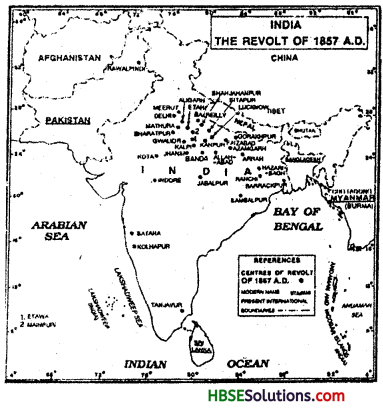
On an outline map of India show the main centres of the Revolt of 1857.
Answer:
HBSE 8th Class Social Science Solutions History Chapter 5 When People Rebel 1857 and After 2

When People Rebel 1857 and After Class 8 HBSE Notes

  • Mutiny : When soliders as a group disobey their officers in the army.
  • Firangis-Foreigners : The term reflects an attitude of contempt.
  • Cartridge : Case containing bullets.
  • Infantry : Soldiers who fight on foot.
  • Sepoy : An Indian soldier in the Company army.
  • Taluqdars: Petty landowners.
  • Jihad : Holy war (or crusade) by Muslim religious leaders.
  • Polygamy : System of having more than one wife.

HBSE 8th Class Social Science Solutions History Chapter 5 When People Rebel 1857 and After Read More »

HBSE 8th Class Social Science Solutions History Chapter 4 Tribals, Dikus and the Vision of a Golden Age

Haryana State Board HBSE 8th Class Social Science Solutions History Chapter 4 Tribals, Dikus and the Vision of a Golden Age Textbook Exercise Questions and Answers.

Haryana Board 8th Class Social Science Solutions History Chapter 4 Tribals, Dikus and the Vision of a Golden Age

HBSE 8th Class History Tribals, Dikus and the Vision of a Golden Age Textbook Questions and Answers

LETS RECALL

Question 1.
Fill in the blanks :
(a) The British described the tribal people as __________.
(b) The method of sowing seeds in jhum cultivation in India is known as __________.
(c) The tribal chiefs got __________ titles in central India under the British land settlements.
(d) Tribals went to work in the __________ of Assam and the in Bihar.
Answer:
(a) wild nomads, shifting cultivators.
(b) shifting cultivation.
(c) Sirdars (leaders).
(d) tea gardens, indigo plantations.

Question 2.
State whether true or false:
(a) Jhum cultivators plough the land and sow seeds.
(b) Cocoons were bought from the Santhals and sold by the traders at five times the I purchase.
(c) Birsa urged his followers to purify themselves, give up drinking liquor and stop believing in witchcraft and sorcery.
(d) The British wanted to preserve the tribal way of life.
Answer:
(a) True
(b) True
(c) True
(d) False.

HBSE 8th Class Social Science Solutions History Chapter 4 Tribals, Dikus and the Vision of a Golden Age

LETS DISCUSS

Question 3.
What problems did shifting cultivators face under British rule?
Answer:
The problems faced by shifting cultivators under British rule were:

  • They had to give up their traditional way of life.
  • They had to practise settled plough cultivation which was not easy.
  • They had to face the scarcity of water and the dry soil. Their land was measured, the rights of each individual to that land were defined.
  • The revenue demand for the state was fixed.

Question 4.
How did the powers of tribal chiefs change under colonial rule?
Answer:
Following were the changes in the powers of tribal chiefs under colonial rule :
(i) They were allowed to keep their land titles over a cluster of villages and rent out lands, but they lost much of their administrative power and were forced to follow laws made by British officials in India.

(ii) They also had to pay tribute to the British.

(iii) They had to discipline the tribal groups on behalf of the British.

(iv) They were unable to fulfil their traditional functions.

Question 5.
What accounts for the anger of the tribals against the dikus?
Answer:
Many factors, policies and treatments of the British officials, self merchants, traders and dishonest moneylenders accounted for the anger of the tribals against the dikus : ‘
(i) As the British took over large tracts of land cultivated by the tribals in order to grow cash crops such as poppy, jute and indigo, the landless tribals were forced to become labourers. They had to work at a very low wages.

(ii) They were badly exploited by crafty and dishonest moneylenders. The rate of interest on the loans on illiterate tribals varied from 50% to unbelievable 500%.

(iii) In fact, moneylenders and other introducers acted as agents of the tribals were brought with in the influence and the control of colonial economy.

Question 6.
What was Birsa’s vision of a golden age ? Why do you think such a vision appealed to the people of the region?
Answer:
(1) Birsa’s vision of a golden age was:

  • When the Mundas had been free of the oppression of dikus.
  • When the ancestral right of the community would be restored.

(2) They saw themselves as the descendents of the original settlers of the region, fighting for their land, reminding people of the need to win back their kingdom. I think such a vision appealed to the people of the region because it reminded them of a golden age in the past when Mundas lived a good life, constructed embankments, tapped natural springs, planted trees and orchards, practised cultivation to earn their living. They could now again live a life of brothers and relatives.

Question 7.
Choose any tribal group living in India today. Find out about their customs and way of life.
Answer:
The Santhal Rebellion: The Santhals migrated from Birbhun, Bankura, Hazaribagh and Rohtas to settle in present day Jharkhand. They considered themselves to be the natural owners of the land.

Causes of the Rebellion:

  • The introduction of the Permanent Settlement in 1793 changes all this.
  • Some moneylenders also made their presence feel.
  • Santhals resented the activities of the missionaries and looked upon them as encroachers.

Events : On the 30 June, 1855, a large number of Santhals assembled in a field in the Bhagnadihi village of Santhal Parganas. They declared themselves free and took oath under the leadership of Sidhu Murmu and Kanhu Murmu to fight unto the last against the British rulers as well as their agents. The Santhal struggle, however, did not come to an end in vain. It had a long lasting impact.

HBSE 8th Class Social Science Solutions History Chapter 4 Tribals, Dikus and the Vision of a Golden Age

LETS IMAGINE

Question 8.
Imagine you are a jhum cultivator living in a forest village in the nineteenth century. You have just been told that the land you were born on no longer belongs to you. In a meeting with British officials you try to explain the kinds of problems you face. What would you say?
Answer:
We will try to explain the British officials the following kinds of problems:
(i) We are lovers of nature and natural surroundings.

(ii) We subsist on forest and on the local resources. If you will take away our natural right on the forest, water and the land we will be unable to procure our basic needs. Our economic activities like hunting, food gathering, fishing, cattle breeding, axes cultivation and plough cultivation will be disturbed.

HBSE 8th Class History Tribals, Dikus and the Vision of a Golden Age Important Questions and Answers

Very Short Answer Type Questions

Question 1.
What kind of miraculous powers was Birsa believed to have?
Answer:
Birsa believed to have miraculous powers, he could cure all diseases and multiply grains.

Question 2.
Who were called dikus?
Answer:
The outsiders were called dikus by the tribes.

Question 3.
Who were the Khonds?
Answer:
The Khonds were a community living in the forests of Orissa.

Question 4.
When did the local weavers and leather workers turned to the Khonds?
Answer:
The local weavers and leather workers turned to the Khonds when they needed supplies of Kusum and Palash flowers to colour their clothes and leather.

Question 5.
How did the forest people obtain things that they did not produce in the forests?
Answer:
They mostly exhanged goods to fulfil their need of things they did not produce.

Question 6.
Why did the tribal groups become dependent on traders and moneylenders?
Answer:
The tribal groups became dependent on traders and moneylenders because they often needed to buy and sell in order to be able to get the goods that were not produced with in the locality.

Question 7.
Why were the land settlements introduced by the British?
Answer:
The British introduced land settlements-that is they measured the land, defined the rights of each individual to the land and fixed the revenue demand for the state.

HBSE 8th Class Social Science Solutions History Chapter 4 Tribals, Dikus and the Vision of a Golden Age

Question 8.
Where were the shifting cultivators found?
Answer:
Shifting cultivators were found in the hilly and forested tracts of north-east and Central India.

Short Answer Type Questions

Question 1.
For the tribals, market and commerce often meant debt and poverty. Do you agree?
Answer:
Tribal groups needed to buy and sell goods in order to be able to get the goods that were not produced within the locality. Traders came around with things for sale, and sold the goods at high prices. Moneylenders gave loans with which the tribals met their cash needs, according to what they earned. But the interest charged on the loans was usually very high. So for the tribals, market and commerce often met debt and poverty.

Question 2.
Why were forest villages established?
Answer:
Forest villages were established to ensure a regular supply of cheap labour. Colonial officials had decided that they would give jhum cultivators small patches of land in the forests and allow them to cultivate these on the condition that those who lived in the village would have to provide labour to the Forest Department and look after the forests.

Question 3.
What was the trading relationship between the Santhals and the silk traders?
Answer:
The traders dealing in silk sent in their agents who gave loans to the tribal people called Santhals and collected the cocoons. The growers were paid?13,?” 4 for a thousand cocoons. These were then exported to Burdwan or Gaya where they were sold at five times the price. Many tribal groups saw the market and the traders as their main enemies.

Question 4.
What steps were taken by Birsa to reform tribal society?
Answer:
Birsa’s movement was aimed at reforming tribal society.

  • He urged the Mundas to give up drinking liquor.
  • He asked them to clean their villages.
  • He asked them to stop believing in witchcraft and sorcery.
  • He also turned against missionaries and Hindu landlords. He saw them as outside forces that were ruining the Munda way of life.

Question 5.
How did the Birsa Movement spread?
Answer:

  • In 1895, Birsa urged the followers to recover their glorious past and this attracted people towards the movement.
  • After being released in 1897, he began touring the villages to gather support.
  • He used traditional symbols and language to rouse people, urging them to destroy “Ravane” (dikus and the Europeans) and establishing a kingdom under his leadership.

Question 6.
What actions were taken by the followers of Birsa Movement against the British?
Answer:

  • Birsa’s followers began targeting the symbols of diku and European power.
  • They attacked police stations and churches.
  • They raided the property of money-lenders and zamindars.
  • They raised the white flag as a symbol of Birsa Raj.

Long Answer Type Questions

Question 1.
From where did the forest people get their supplies of rice and other grains?
Answer:
The following were the ways in which the forest people got their supplies of rice and other grains :

  • They exchanged goods – getting what they needed in return for their valuable forest produces.
  • Sometimes, they bought goods with the small amount of earnings they had.
  • Some of them did odd jobs in the villages, carrying loads or building roads.
  • Some others laboured in the fields of peasants and farmers.
  • When supplies of forest produce shrank, tribal people had to increasingly wander around in search of work as labourers.

Question 2.
How did the tribal groups live in the nineteenth century?
Answer:
1. Some were Jhum cultivators :
(a) Jhum cultivation was done on small patches of land, mostly in forests. They burnt the vegetation in the land to clear it for cultivation.
→ They spread the ash of burnt vegetation, which contained potash, to fertilise the soil. They cultivated on that soil and once the crop was ready and harvested, they moved to another field.

2. Some were hunters and gatherers : Some tribal groups, for example, the Khonds lived by hunting animals and gathering forest produce. The local weavers and leather workers turned to the Khonds when they needed supplies of kusum and palash flowers to colour their clothes and leather.

3. Some herded animals : Many tribal groups like pastoralists lived by herding and rearing animals. When the grass in one place was exhausted, they moved to another area.

4. Some took to settled cultivation : Many tribal groups had begun settling down even before the nineteenth century and cultivating their fields in one place year after year, instead of moving from place-to-place.

HBSE 8th Class Social Science Solutions History Chapter 4 Tribals, Dikus and the Vision of a Golden Age

Question 3.
In what ways was the Birsa movement important?
Answer:
This movement was important in the following two ways:
(i) It forced the colonial government to intorduce land laws in favour of the tribal people so that the dikus could not easily take over tribal lands.

(ii) It showed once again that the tribal people had the capacity to protest against injustice. They were able to express their anger against the exploitative and oppressive colonial rule.

Tribals, Dikus and the Vision of a Golden Age Class 8 HBSE Notes

  • Fallow : A field left uncultivated for a while so that soil recovers its fertililty.
  • Sal: A tree of Indian forests.
  • Mahua : A flower that is eaten or used to make alcohol.
  • Bewar: A term used in Madhya Pradesh for shifting cultivation.
  • Sleeper: The horizontal planks of wood on which railway lines are laid.
  • Vaishnav : Worshippers of Vishnu.
  • Mundas : A tribal group that lived in the Chhotanagpur region of Jharkhand
  • Jhum: Shifting cultivation.
  • Begar : Forced labour.
  • Ulugan : Movement by the Mundas.
  • Dikus: Outsiders.

HBSE 8th Class Social Science Solutions History Chapter 4 Tribals, Dikus and the Vision of a Golden Age Read More »

HBSE 8th Class Social Science Solutions History Chapter 3 Ruling the Countryside

Haryana State Board HBSE 8th Class Social Science Solutions History Chapter 3 Ruling the Countryside Textbook Exercise Questions and Answers.

Haryana Board 8th Class Social Science Solutions History Chapter 3 Ruling the Countryside

HBSE 8th Class History Ruling the Countryside Textbook Questions and Answers

LET’S RECALL

Question 1.
Match the following:

(i) ryotvillage
(ii) mahalpeasant
(iii) nijcultivation on ryot’s land
(iv) ryothicultivation on planter’s own land

Answer:

(i) ryotpeasant
(ii) mahalvillage
(iii) nijcultivation on planter’s own land
(iv) ryothicultivation on ryot’s land

Question 2.
Fill in the blanks:
(a) Growers of wood in Europe saw __________ as a crop which would provide competition to their earnings.
(b) The demand for indigo increased in late-eighteenth century because of __________.
(c) The international demand for indigo was affected by the discovery of __________.
(d) The Champaran Movement was against __________.
Answer:
(a) woad
(b) industrial revolution,
(c) woad
(d) indigo planters.

LETS DISCUSS

Question 3.
Describe the main features of the Permanent Settlement.
Answer:
The main features of the Permanent Settlement were :

  • The rajas and taluqdars were recognised as zamindars.
  • They were asked to collect rent from the peasants and pay revenue to the Company. The amount to be paid was fixed permanently.
  • It encouraged the zamindars to invest in improving the land.
  • Since the revenue demand of the state would not be increased the zamindar would benefit from increased production from the land.
  • If any of them failed to fulfil these conditions, he was ousted from his land and the government did not hesitate in putting his zamindari to auction.

HBSE 8th Class Social Science Solutions History Chapter 3 Ruling the Countryside

Question 4.
How was the Mahalwari system different from the permanent Settlement?
Answer:

Permanent SettlementMahalwari Settlement
1. Permanent Settlement was introduced in Bihar and Bengal.1. The system of Mahalwari was introduced in western part of Gangetic Valley, North-West Province, parts of Central India and the Punjab.
2. It was introduced in 1793.2. It came into effect in 1822.
3. The amount to be paid as land revenue was fixed. The government could not enhance the land revenue.3. The amount of land revenue was revised periodically. The government could revise the revenue.
4. The zamindar had the charge of collecting the revenue.4. The charge of collecting the revenue and paying it to the Company was given to the village headman.

For the government Mahalwari ssytem was an improvement over the Permanent settlement.

Question 5.
Give two problems which arose with the new Munro system of fixing revenue.
Answer:
The problems created by the Munro system of fixing revenues were :
(i) Driven by the desire to increase the income from land, revenue officials (Captain Alexander Read and Thomas Munro) fixed too high a revenue demand. Peasants were unable to pay, ryots fled the countryside, and villagers became deserted in several areas.

(ii) Optimistic officials had imagined that the new system would transform the peasants into rich enterprising farmers. But this did not happen.

Question 6.
Why were ryots reluctant to grow indigo?
Answer:
Ryots were reluctant to grow indigo because:
(a) The indigo system was intensely oppressive.

(b) Indigo could be cultivated only on fertile lands, and these were all already densely populated.

(c) Peasants who were initially tempted by the loans soon realised how harsh the system was. The price they got for the indigo they produced was very low and the cycle of loans never ended.

(d) The planters usually insisted that indigo be cultivated on the best soils in which peasants preferred to cultivate rice.

(e) Indigo had deep roots and it exhausted the soil rapidly. After an indigo harvest the land could not be sown with rice.

Question 7.
What were the circumstances which led to the evenual collapse of indigo production in Bengal?
Answer:
(i) In March 1859, thousands of ryots in Bengal refused to grow indigo. As the rebellion spread, ryots refused to pay rents to the planters and attacked indigo factories armed with swords and spears, bows and arrows.

(ii) Ryotes swore they would no longer take advances to sow indigo nor be bullied by the planter’s lathiyals.

(iii) The government set-up the Indigo Commission to enquire into the system of indigo production. The Commission held the planters guilty and criticised them for the corecive methods they used with indigo cultivators.

(iv) The Indigo Commission declared that indigo production was not profitable for ryots. The Commission asked the ryots to fulfil their existing contracts but also told them that they could refuse to produce indigo in future.

HBSE 8th Class Social Science Solutions History Chapter 3 Ruling the Countryside

LETS DO

Question 8.
Find out more about the Champaran Movement and Mahatma Gandhi’s role in it.
Answer:
When the indigo production collapsed in Bengal, the European planters of indigo shifted their operations to Bihar. When Mahatma Gandhi returned from South Africa, a peasant from Bihar persuaded him to visit Champaran and see the plight of the indigo cultivators there.

Role of Mahatma Gandhi : Mahatma Gandhi’s visit in 1917 marked the beginning of the Champaran movement against the indigo planters. The European planters oppressed the peasants. Gandhiji reached Champaran in 1917 to witness the miserable conditions of the peasants. The district officials ordered him to leave Champaran but he refused to comply the orders and started the Satyagraha.

Question 9.
Look into the history of either tea or coffee plantations in India. See how the life of workers in these plantations was similar to or different from that of workers in indigo plantations.
Answer:
For self-study.

LETS IMAGINE

Imagine a conversation between a planter and a peasant who is being forced to grow indigo. What reasons would the planter give to persuade the peasant ? What problems would the peasant point out ? Enact their conversation.
Answer:
Hints : (i) Why are you forcing me to sign the contract?

(ii) Contract should be done on mutual terms and conditions. These should be useful to peasant also. I should get enough amount of money as a salary for my labour and for the work of my other family members.

(iii) I require a reasonably good house to live in. There should be a hospital for the workers. All medical facilities should be provided to the labourers. There should be a school, where my children could go to take education. My duty hours should be fixed. On every Saturday should be paid my salary as well as extra allowances for my work.

Land tax should be charged from Zamindars directly. Otherwise, I am not willing to sow indigo. If you or your agent agree with my terms I will work only for one or two crops. For next period new and more favourable terms and conditions should be settled. The cost of production should be decided and settled with mutual consultation.

HBSE 8th Class History Ruling the Countryside Important Questions and Answers

Very Short Answer Type Questions

Question 1.
What did the Company have to do as Diwan?
Answer:
As Diwan, the Company became the chief financial administrator of the territory under its control. Now it had to think of administering the land and organising its revenue resources.

Question 2.
When and where was the Permanent Settlement intorduced?
Answer:
Permanent Settlement was mainly introduced in the province of Bengal in 1793.

Question 3.
What were the consequences of 1770 famine in Bengal?
Answer:
In the terrible famine of 1770, ten million people were killed in Bengal. About one- third of the population was wiped out.

Question 4.
How could the zamindar benefit from Permanent Settlement?
Answer:
The revenue was kept fixed under Permanent Settlement. Since the revenue demand of the state would not be increased, the zsamindar would benefit from increased production from the land.

HBSE 8th Class Social Science Solutions History Chapter 3 Ruling the Countryside

Question 5.
Why did the Company try to expand the cultivation of opium and indigo?
Answer:
The Company tried to expand the cultivation of opium and indigo as the British realised that the countryside could not only yield revenue; it could also grow the crops that Europe requires.

Question 6.
Why did European cloth manu-facturers have to depend on woad?
Answer:
European cloth manufacturers had to depend on woad because only small amounts of Indian indigo reached the European market and its price was very high.

Question 7.
Why did cloth dyers prefer indigo to woad as dye?
Answer:
Cloth dyers preferred indigo as a dye because indigo produced a rich colour whereas the dye from woad was pale and dull.

Question 8.
Who were Nabobs?
Answer:
In the 18th century the East India Company had given this name to its officials because they were following the life-style of the Indian customary.

Question 9.
From where was indigo produced?
Answer:
The rich blue colour or indigo was produced from a plant called indigo.

Question 10.
Who introduced mahalwari settlement?
Answer:
Holt Mackenzie.

Question 11.
Where was the Kalamkari print created?
Answer:
Kalamkari print was produced by the weavers in Andhra Pradesh.

Question 12.
Where was indigo cultivation initiated in India?
Answer:
In Bengal province.

HBSE 8th Class Social Science Solutions History Chapter 3 Ruling the Countryside

Question 13.
What was the impact of indigo cultivation on the soil?
Answer:
Indigo plants had deep roots and it exhausted the soil. After indigo harvest, the land could not be sown with rice.

Question 14.
Why was the Indigo Commission appointed?
Answer:
The Indigo Commission was appointed to enquire into the system of indigo production.

Short Answer Type Questions

Question 1.
Comment on the report of the Indigo Commission.
Answer:

  • The Commission held the planters guilty of oppressive methods used against the cultivators.
  • It declared that indigo production was not profitable for ryots.
  • It asked the ryots to fulfil their existing contracts but refuse to grow indigo in future.

Question 2.
What problems were faced by Bengal economy?
Answer:
The problems that were faced by the Bengal economy were as under:

  • Artisans were deserting villages since they were being forced to sell their goods to the Company at low prices.
  • Peasants were unable to pay the dues that were being demanded from them.
  • Artisanal production was in decline and agricultural cultivation showed signs of collapse.

Question 3.
Why did the cultivator find the system of Permanent Settlement oppressive?
Answer:
The cultivator found the system of Permanent Settlement oppressive because the rent he paid to the zamindar was high and his right on the land was insecure. To pay the rent he had to often take a loan from the money-lender, and when he failed to pay the rent he was evicted from the land he had cultivated for generations.

Question 4.
Why were the planters reluctant to expand the area under nij cultivation?
Answer:
The planters were reluctant to expand the area under nij cultivation as:
(a) Nij cultivation on large scale required many ploughs and bullocks. A planter with 1000 bighas would need 2000 ploughs. Investing on purchase and maintenance of ploughs was a big problem.

(b) The supplies could not be easily got from the peasants since their ploughs and bullocks were busy on their rice fields, exactly at the time that the indigo plants needed them.

HBSE 8th Class Social Science Solutions History Chapter 3 Ruling the Countryside

Question 5.
What were the actions taken by the peasants under the indigo rebellion of 1859-60?
Answer:
The actions taken by the peasants under indigo rebellion of 1859-60 were:

  • Thousands of peasants refused to sow indigo on their land.
  • The cultivators attacked the indigo factories.
  • The ‘gomasthas’ or agents of the planters were beaten up in many places.
  • The peasants also socially boycotted Indian workers working in European- owned plantations.

Question 6.
Why did the demand of indigo increase by the end of the eighteenth century?
Answer:

  • This was because, by this time Britain began to industrialise.
  • In Britain, cotton production expanded dramatically.
  • This created an enormous new demand for cloth dyes.

That was why, the demand of indigo increased by the end of the eighteenth century.

Question 7.
Name two problems created by the Permanent Settlement.
Answer:

  • Zamindars were now not interested in the improvement of land.
  • The revenue was very high. So many zamindars were unable to pay this revenue. Thus, their zamindaris were sold off.

Long Answer Type Questions

Question 1.
Discuss how did the British East India Company becomes the Diwan?
Answer:
In order to maintain the expenses of both the administrative bodies and the army, it was necessary for the British to increase their financial resources. Apart from trade, the British now focused their attention on different sources of revenue.

During the governorship of Lord Clive in 1765, the Mughal Emperor, Shah Alam II granted the Diwani of Bengal, Bihar and Orissa to the East India Company. In return, the Company was to make an annual payment of ₹ 26 lakh to him.

Question 2.
What were the three major systems of land revenue followed by the British? Write the salient features of each.
Answer:
The three major systems of land revenue followed by the British were:

  • Permanent Settlement of Bengal
  • Ryotwari System
  • Mahalwari System

1. Permanent Settlement of Bengal:

  • The zamindars were recognized as the owners or proprietors of the land.
  • The zamindars could sell their lands and were also given the rights to transfer them, .
  • The cultivators became tenants of the zamindars.
  • The zamindars gave the government almost l/10th of the revenue collected by them from the cultivators.
  • The revenue to be paid by the zamindars was fixed on a permanent basis,

(2) Ryotwari System : This system was introduced in parts of Madras and Bombay Presidencies. This system had the following features :

  • The cultivators became the landowners.
  • The land revenue assessment was made after the careful survey of the fields.
  • The cultivators themselves deposited the land revenue.

(3) Mahalwari System: This system derives its name from the word Mahal which means a village or an estate.
The salient features of the system were :

  • Collector went from village-to-village, inspecting the land, measuring the fields, and recording the customs and rights of different groups.
  • The revenue was revised periodically and was not fixed,
  • The village headman was responsible for collecting the revenue.

HBSE 8th Class Social Science Solutions History Chapter 3 Ruling the Countryside

Question 3.
Discuss how the British people looked indigo cultivation as an opportunity.
Answer:

  • With a remarkable growth in indigo trade, commercial agents and officials of the Company began investing in indigo production.
  • Many officials resigned from the Company job and looked after their indigo business.
  • Those who had no money to produce indigo could get loans from the Company and the banks.

Picture-Based Questions

Question 1.
Look at the picture and answer the following questions :
HBSE 8th Class Social Science Solutions History Chapter 3 Ruling the Countryside 1

(i) What is shown in the picture?
Answer:
A weekly market in Murshidabad in Bengal.

(ii) When were these markets badly affected?
Answer:
These markets were badly affected during economic crisis. .

Question 2.
Look at the following picture and answer the questions that follow :
HBSE 8th Class Social Science Solutions History Chapter 3 Ruling the Countryside 2
(i) What is shown in the picture?
Answer:
The Slave Revolt in St. Domingue, August 1791.

(ii) What did the African slaves do when they rose in rebellion in 1791?
Answer:
They burnt the plantations and killed their rich planters.

(iii) When did France abolish slavery?
Answer:
France abolished slavery in 1792.

HBSE 8th Class Social Science Solutions History Chapter 3 Ruling the Countryside

Ruling the Countryside Class 8 HBSE Notes

  • Mahal s In British revenue records mahal is a revenue estate which may be a village or a group of villages.
  • Plantation: A large farm operated by a planter employing various forms of forced labour. Plantations are associated with the production of coffee, sugarcane, tobacco, tea and cotton.
  • Bigha: A unit of measurement of land. Before British rule, the size of this area varied. In Bengal, the British standardised it to about one-third of an acre.
  • Permanent Settlement: It was a system of revenue collection introduced in Bengal and Bihar by Cornwallis in 1793.
  • Ryotwari System : The system of land revenue which was introduced in Madras and Bombay Presidencies.
    Slave s A person who is owned by someone else, i.e., the slave owner.
  • Civil Servants: Officials recruited for the administration of the territories and affairs of the English East India Company in India.
  • Taluqdar : Taluqdar literally means “one who holds a taluq or a connection”.
  • Jotedars : In some areas, village headmen were known as Jotedars. They were rich peasants having acquired vast area of land.
  • Vat: A fermenting or storage vessel.

HBSE 8th Class Social Science Solutions History Chapter 3 Ruling the Countryside Read More »

HBSE 8th Class Social Science Solutions History Chapter 2 From Trade to Territory: The Company Establishes Power

Haryana State Board HBSE 8th Class Social Science Solutions History Chapter 2 From Trade to Territory: The Company Establishes Power Textbook Exercise Questions and Answers.

Haryana Board 8th Class Social Science Solutions History Chapter 2 From Trade to Territory: The Company Establishes Power

HBSE 8th Class History From Trade to Territory: The Company Establishes Power Textbook Questions and Answers

Question 1.
Match the following:

(i) Diwani(a) Tipu Sultan
(ii) “Tiger of Mysore”(b) Right to collect land revenue
(iii) Faujdari adalat(c) Sepoy
(iv) Rani Chinnamma(d) Criminal court
(v) Sipahi(e) Led an anti-British movement in Kitoor

Answer:
(i) (b)
(ii) (a)
(iii) (d)
(iv) (e)
(v) (c)

Question 2.
Fill in the blanks :
(a) The British conquest of Bengal began with the Battle of _________.
(b) Haidar Mi and Tipu Sultan were the rulers of _________.
(c) Dalhoiisie implemented the Doctrine of _________.
(d) Maratha kingdoms were located mainly in the _________.
Answer:
(a) Piassey
(b) Mysore
(c) Lapse
(d) north

HBSE 8th Class Social Science Solutions History Chapter 2 From Trade to Territory: The Company Establishes Power

Question 3.
State whether true or false:
(a) The Mughal empire became stronger in the eighteenth century.
(b) The English East India Company was the only European Company that traded with India.
(c) Maharaja Ranjit Singh was the ruler of Punjab.
(d) The British did not introduce administrative changes in the territories they conquered.
Answer:
(a) False
(b) False
(c) True
(d) False

LETS DISCUSS

Question 4.
What attracted European trading companies to India?
Answer:
There was a great demand of Indian goods in European countries such as cotton and silk. Pepper, cloves, cardamom and cinnamon too were in great demand. These dungs could be purchased at low priees in India and could be sold at very high prices. Hence European trading companies came to India to gain profits.

Question 5.
What were the areas of conflict between the Nawabs of Bengal and the East India Company?
Answer:
Following were the areas of conflict between the Bengal nawabs and the East India Company:
1. (i) The nawabs refused to grant concessions to die Company.
(ii) They demanded large tributes for the Company’s right to trade.
(iii) They denied Company the right for mint coins stopped it from extending its fortification.
(iv) The nawabs accused the Company of not paying taxes and writing disrespectful letters.

2. On the other hand, the Company also accused the nawabs in the following ways:
(i) The local officials of the Nawab were 1 ruining the trade of the Company by making unjust demands.
(ii) The Company had to pay excessive duties.
(iii) The Company is not permitted to enlarge settlement and rebuild its forts.

Question 6.
How did the assumption of Diwani benefit the East India Company?
Answer:
The assumption of Diwani benefited the East India Company in the following ways:

  • The Diwani allowed the Company to use vast revenue resources of Bengal.
  • The outflow of gold and silver which the Company imported to buy goods in India was stopped.
  • The revenue from Bengal now could be used to purchase cotton and silk textiles in India, maintain
  • Company troops and meet the cost of building the Company fort and offices at Calcutta.

Question 7.
Explain the system of “subsidiary alliance”.
Answer:
The following were the features of . system of Subsidiary Alliance given by Lord Wellesley:
(a) The Indian rulers accepting the Subsidiary Alliance would neither enter into alliance with any other power, nor would they declare war against any power without the permission of English.

(b) The Indian rulers accepting this system were to agree to the stationing of the British contingent force for whose maintenance they would pay a subsidy.

(c) He would allow a British resident to stay in his state.

(d) He would not employ any Europeans other than the English and if there was already any, he would dismiss them.

(e) In return for acknowledging the British company as the paramount power, the company undertook to protect him from the external dangers and internal disorders.

HBSE 8th Class Social Science Solutions History Chapter 2 From Trade to Territory: The Company Establishes Power

Question 8.
In what way was the administration of the Company different from that of Indian rulers?
Answer:
(i) The British territories were broadly divided into administrative units called Presidencies. There were three Presidencies-Bengal, Madras and Bombay. The supreme head of the administration was the Governor- General.

(ii) From 1773, each district was to have two courts – a criminal court (faujdari adalat) and a civil court (diwani adalat). Muslims and Hindu Pandits interpreted Indian laws for the European district collectors who presided over civil courts. The criminal courts were still under a qazi and mufti but under the supervision of the collectors.

(iii) In 1775, eleven Pandits were asked to compile a digest of Hindu laws.

(iv) By 1778, a code of Muslim laws also compiled for the benefit of European judges.

(v) Under the Regulating Act of 1773, a new Supreme Cotut was established. A court of appeal—the Sadar Nizamat Adalat was also set-up at Calcutta.

(vi) The main role of the collector in Indian district was to collect revenue and taxes and maintain law mid order in Ms district with the help of judges, police officers and darogas.

Question 9.
Describe the changes that occurred in the composition of the Company’s army.
Answer:
The following were the changes that occurred in the composition of the Company’s army:
(i) The English Company though recruited Indian soldiers in the army but they were never allowed to acquire any higher post.

(ii) The cavalry dominated the army and the Mughafstate did not feel the need to have a large professionally trained infantry. The English Company’s soldiers were however armed with muskets and match* locks.

(iii) The infantry regiments became more important under the British Company.

(iv) The soldiers of the Company were subjected to European style of training.

LETS DO

Question 10.
After the British conquest of Bengal, Calcutta grew from a small village to a big city, find out about toe culture, architecture and toe life of Europeansand Indians of toe city during toe colonial period.
Answer:
The main features of Calcutta city during the colonial period were os follows:
(i) Calcutta from 1750 to 1805 s The work of planning of Calcutta wot carried by different Governor-Generals. After toe Battle of Plassey Civil lines area wore developed.

(ii) Planning of Calcutta after Lord Wellesley. After Wellesleys departure, the work of town planning was carried on by Lottery Committee (1817) with the help of the government.

(iii) Role of Health and Town Planning of Calcutta t The threat of epidemics gave a further impetus to town planning.

(iv) Change in Attitude of Government for Hanning : Densely built up areas were seen as insanitary since they obstructed direct sunlight and circulation of air.

Question 11.
Collect pictures, stories, poems and information about any of the following-the Rani of dhansi, Mahadji Sindhia, Haidar All, Maharaja Ranjit Singh, Lord Dalheusie or any other contemporary ruler of your region.
Answer:
Do yourself.

HBSE 8th Class History From Trade to Territory: The Company Establishes Power Important Questions and Answers

Very Short Answer Type Questions

Question 1.
What is Chauto?
Answer:
It is a tax levied by the Marathas from the areas outside their domain, equal to one- fourth ofthe revenue paid to the Mughal Empire.

Question 2.
Why could Delhi no longer function as an effective centre?
Answer:
Delhi could no longer function as an effective centre because powerful regional kingdoms emerged in various parts of India.

Question 3.
What was written in toe charter from toe Queen Elizabeth to toe East India Company in 1600?
Answer:
The charter from toe Queen Elizabeth to the East India Company in 1600 granted to Company the sole right to hade with the East.

HBSE 8th Class Social Science Solutions History Chapter 2 From Trade to Territory: The Company Establishes Power

Question 4.
How had the Portuguese reach toe western coast of India by toe time the first English ships sailed down toe west coast of Africa?
Answer:
The Portuguese had reached the western coast of India because the royal charter could not prevent other European powers from entering the Eastern markets.

Question 3.
When and where was toe first English factory set-up?
Answer:
The charter from toe Queen Elizabeth to the East India Company in 1600 granted to Company the sole right to trade with the East.

Question 4.
How had the Portuguese reach toe western coast of India by toe time the first English ships sailed down toe west coast of Africa?
Answer:
The Portuguese had reached the western coast of India because the royal charter could not prevent other European powers from entering the Eastern markets.

Question 5.
When and where was toe first English factory set-up?
Answer:
The first English factory was set-up on the banks of river Hugli in 1651.

Question 6.
What farman did the Company ask from the Mughal emperor Aurangzeb?
Answer:
The Company persuaded the Mughal Emperor Aurangzeb to issue a farman granting the Company the right to trade duty free.

Question 7.
What three things Sirajuddaulah ask the Company to do?
Answer:
Sirajuddaulah asked the Company to:

  • stop meddling in the political affairs of his dominion
  • stop fortification
  • pay the revenues.

Question 8.
What was the main reason for the defeat of the Nawab Sirajuddaulah?
Answer:
The main reason for the defeat of the Nawab was that Mir Jafar, one of Sirajuddaulah’s commanders and Mir Jafar’s officers never fought the battle.

HBSE 8th Class Social Science Solutions History Chapter 2 From Trade to Territory: The Company Establishes Power

Question 9.
Name the Nawabs of Bengal who asserted their power and autonomy against the Mughals.
Answer:

  • Murshid Quil Khan
  • Alivardi Khan
  • Sirajuddaulah.

Question 10.
Which Nawab of Bengal was defeated in the Battle of Plassey?
Answer:
Sirajuddaulah.

Question 11.
What happened after Tipu Sultan’s death?
Answer:
After Tipu Sultan’s death :

  • Mysore was placed under the former ruling dynasty of the Wodeyars.
  • A subsidiary alliance was imposed on the state.

Question 12.
What did the new policy of ‘paramountcy’ state?
Answer:
The new policy of “paramountcy” stated that authority of Company was paramount or supreme, hence its power was greater than that of Indian states.

Question 13.
Who was Rayanna?
Answer:
Rayanna was a poor chowkidar of Sangoli in Kitoor who revolted against the British.

Question 14.
Name the Governor-General who brought the Doctrine of Lapse.
Answer:
Lord Dalhousie.

Question 15.
Name any four Kingdoms annexed under the Doctrine of Lapse.
Answer:

  • Satara
  • Sambalpur
  • Udaipur
  • Nagpur
  • Jhansi.

Question 16.
How many Presidencies were there in the British India? Name them.
Answer:
There were three Presidencies:

  • Bengal
  • Madras
  • Bombay.

Question 17.
Who was the first Governor- General of India?
Answer:
Warren Hastings.

Question 18.
Who was the last powerful Mughal ruler?
Answer:
Aurangzeb.

Question 19.
How did the Mughal empire become weak?
Answer:
After Aurangzeb’s death, many Mughal governors began establishing their own regional kingdoms. This weakened Mughal empire.

Question 20.
When and where was the East India Company established?
Answer:
The East India Company was established in 1600, in England.

HBSE 8th Class Social Science Solutions History Chapter 2 From Trade to Territory: The Company Establishes Power

Question 21.
What did the Charter mean?
Answer:
The Charter meant that no other trading group in England could compete with the East India Company.

Question 22.
Which western power came first to India.?
Answer:
Portuguese.

Question 23.
Who discovered the sea route to India and when?
Answer:
Portuguese explorer Vasco da Gama discovered the sea route to India in 1498.

Question 24.
Through which route the British came to India?
Answer:
The British came to India through the Cape of Good Hope (South of Africa).

Question 25.
When was the Supreme Court established?
Answer:
The Supreme Court was established in 1773 under the provisions of Regulating Act.

Question 26.
Which new technology aided the Company to become a territorial colonial power?
Answer:
New steam technology.

Short Answer Type Questions

Question 1.
How was the charter issued to the East India Company by Queen Elizabeth I in 1600 advantageous for the Company?
Answer:
The charter issued by Queen Elizabeth I in 1600 was advantageous for the Company because :

  • No other trading group in England could Compete with the East India Company.
  • With this charter the Company could venture across the oceans, looking for new lands from which it could buy goods at cheap price, and carry them back to Europe to sell at higher prices.

Question 2.
What type of relationship existed between the trading companies through the seventeenth and eighteenth centimes?
Answer:
The relationship that existed between the trading companies was that of rivalry and harsh competition. The only way the trading companies could flourish was by eliminating the rival competitors. Trade was carried on with arms and trading posts were protected through fortification.

Question 3.
Why were the British furious with Tipu Sultan?
Answer:
The British got furious with Tipu Sultan because :
(a) In 1785, Tipu Sultan stopped the export of sandalwood, pepper and cardamom through the ports of his kingdom and disallowed local merchants from trading with Company.

(b) He also established a close relationship with the French in India and modernised his army with their help.
The British saw him as ambitious, arrogant and dangerous and become furious.

Question 4.
How did Tipu Sultan come to be known as the ‘Tiger of Mysore’?
Answer:
Once Tipu Sultan went hunting in the forest with a French friend, he came face-to-face with a tiger. His guns did not work and his dagger fell to the ground. He battled with the tiger unarmed until he managed to reach down and pick up the dagger. Finally, he was able to kill the tiger in the battle. After this he came to be known as the Tiger of Mysore’.

Question 5.
What was the new system of justice established in 1772?
Answer:
A new system of justice was established in 1772. Each district was to have two courts-a criminal court and a civil court. Muslims and Hindu Pandits interpreted Indian laws for the European district collectors who presided over civil courts. The criminal courts were still under a qazi and mufti but under the supervision of the collectors.

HBSE 8th Class Social Science Solutions History Chapter 2 From Trade to Territory: The Company Establishes Power

Question 6.
Why did the European Companies conflict with each other?
Answer:

  • They were trade competitors.
  • They only way the trading Companies could flourish, was by eliminating rival competitors.
  • The urge to secure markets, therefore, led to fierce battles between the trading Companies.

Question 7.
How did the farman issued by Aurangzeb cause loss of revenue for Bengal?
Answer:

  • Aurangzeb’s farman had granted the Company the right to trade without paying duties.
  • But the Company officials who were carrying individual trade also refused to pay duty.

This caused enormous loss of revenue for Bengal.

Question 8.
What was the main reason that Sirajddaulah lost the Battle of Plassey to the British?
Answer:

  • One of the main reasons for the defeat of the Nawab was that the forces led by Mir Zafar, one of the Sirajuddaulah’s commanders, never fought the battle.
  • Clive has managed to secure his support by promising to make him Nawab after crushing Sirajuddaulah.

Question 9.
What facilities did the Company get through the Royal Charter?
Answer:
With this Charter :

  • The Company could venture across the oceAnswer:
  • The Company could look for new lands from which it could collect revenues.
  • The Company could buy goods at cheap price and carry them back to Europe to sell at higher prices.

Long Answer Type Questions

Question 1.
Why did the authority of the Central Government decline after the death of Aurangzeb?
Answer:
After the death of Aurangzeb, the authority of the Central Government or Mughal administration began to decline. Following were the main causes:
→ The Mughal Emperors who came to the throne after the death of Aurangzeb were inefficient in the matters of administration.

→ Degeneration of the Mughal nobility also weakened the empire. The nobles fought to capture the office of the wazir to promote the interests of their relatives and followers.

→ Aurangzeb’s long warfare in the Deccan caused chaos and confusion in the north. It gave rise in revolts and led to the downfall of the empire.

→ Prolonged warfare of Aurangzeb caused loss of men, money and prestige of the empire. Thus he faced financial crises too.

→ The revolts of the Jats, the Sikhs, the Rajputs and the Marathas caused disintegration of the Mughal Empire.

Question 2.
How did the annexation of the Indian states by the British affect the economic life of the common people?
Answer:
The annexation of the Indian states by the British affected the economic life of the common people in the following ways:
(i) The annexation of the Indian states abolished the administrative machinery of each state. It turned out all those persons who had been parts of the administrative system.

(ii) The scope of the Indians to get high jobs in the administrative system was restricted. All this created unemployment in the higher class of society.

(iii) The learned people who worked for the state and received its patronage lost their jobs and the lands gtranted to them by the old rulers were taken away.

(iv) A number of soldiers of the armies of the Indian rulers were also thrown out of employment after their states had been conquered or had entered into a Subsidiary Alliance with the British.

(v) Many craftsmen who depended on state patronage were also ruined.

HBSE 8th Class Social Science Solutions History Chapter 2 From Trade to Territory: The Company Establishes Power

Question 3.
Discuss the Anglo-Maratha wars?
Answer:
(i) The first Anglo-Maratha war ended in 1782 with the Salbai treaty without any result.

(ii) The second war (1803-05) resulted in the British gaining Orissa and the territories north of the Yamuna river including Agra and Delhi.

(iii) The third Anglo-Maratha war (1817-19) ended the Maratha might. The Peshwa was sent to Bithur with a pension.

Question 4.
Why did the British want to secure its north-west frontier? What did it do?
Answer:
(i) The British had devloped a fear that Russia might expand across Asia and enter India from the north-west.

(ii) This was because, the Company focused on north-west region and fought wars with Afghanistan, Sindh and Punjab.

Question 5.
Discuss the reason that led to fierce battles between the European trading Companies in India.
Answer:
(i) The European Companies were interested in buying the same things.

(ii) The fine qualities of Indian silk and cotton had a big market in Europe. Pepper, cloves, cardamom and cinnamon too were in great demand.

(iii) Competition amongst the European companies increased the cost of these goods that reduced the profit-margin.
The only way to retain profit was to eliminate the rivals. Thus, the urge to secure market led to fierce battles between European trading Companies in India.

From Trade to Territory: The Company Establishes Power Class 8 HBSE Notes

  • Mercantile : A business enterprise that makes profit primarily through trade, buying goods cheap and selling them at higher prices.
  • Farman : A royal edict, a royal order.
  • Puppet: Literally, a toy that you can move with strings. The term is used disapprovingly to refer to a person who is controlled by someone else.
  • Injunction: Instruction.
  • Subservience: Submissiveness.
  • Confederacy: Alliance.
  • Qazi : Ajudge.
  • Mufti : A jurist of the Muslim community responsible for expounding the law that the qazi would administer.
  • Impeachment: A trial by the House of Lords in England
  • Dharmashastras: Sanskrit texts prescribing social rules and codes of behaviour, composed from 500 BCE onward.
  • Sawar : Men on horses.
  • Musket: A heavy gun used by infantry soldiers.
  • Matchlock: An early type of gun in which the powder was ignited by match.

HBSE 8th Class Social Science Solutions History Chapter 2 From Trade to Territory: The Company Establishes Power Read More »

HBSE 8th Class Social Science Solutions History Chapter 1 How, When and Where

Haryana State Board HBSE 8th Class Social Science Solutions History Chapter 1 How, When and Where Textbook Exercise Questions and Answers.

Haryana Board 8th Class Social Science Solutions History Chapter 1 How, When and Where

HBSE 8th Class History How, When and Where Textbook Questions and Answers

LET’S RECALL

Question 1.
State whether true or false :
(a) James Mill divided Indian history into three periods: Hindu, Muslim, and Christian.
(b) Official documents help us understand what the people of the country think.
(c) The British thought surveys were important for effective administration.
Answer:
(a) False
(b) False
(c) True.

LETS DISCUSS

Question 2.
What is the problem with the periodisation of Indian history that James Mill offers?
Answer:
(a) James Mill divided history on the basis of religion of the rulers of the times. However, a variety of faiths existed simultaneously in these periods.

(b) Mill, through his periodisation suggested that British rule could civilize India. He was of opinion that the British should conquer all the territories in India to ensure the enlightenment as if India was not capable of progress without British help.

Question 3.
Why did the British preserve documents?
Answer:
The British preserved official documents because they liked to have permanent record of every instruction, plan, policy, agreement. They believed that things could be properly studied and debated once we had such records.

Question 4.
How will the information historians get from old newspapers be different from that found in police reports?
Answer:
Usually the newspaper reports are not biased. These reports explain the fact as it was. Most of the times, these do not try to manipulate the event. These represent the true story of the event with every detail. On the other hand, the official reports are usually biased. These are written as per the will of the senior officials. These reports may carry the biased view of the reporting police officer. Thus if the historians are based only on the police reports, they may become misguided.

HBSE 8th Class Social Science Solutions History Chapter 1 How, When and Where

LETS DO

Question 5.
Can you think of examples of surveys in your world today? Think about how toy companies get information about what young people enjoy playing with or how the government finds out about the number of the students, their bio-data and a brief history of their lives.
Answer:
Yes, there are many examples of surveys in world today. The administrative, botanical and market surveys help to know about the needs and aspirations of the people. The government finds out about the information of employees through the records and reports of school authorities.

HBSE 8th Class History How, When and Where Important Questions and Answers

Very Short Answer Type Questions

Question 1.
Are official records a good source for writing colonial history? Why?
Answer:
No. This is because, most of the time, the writers of these records were biased.

Question 2.
Why do we divide history into different periods.
Answer:
We divide history into different periods to capture the characteristics of a time, its central features as they appear before us.

Question 3.
Name any four British Governor- Generals in India.
Answer:

  • Warren Hastings
  • Lord Wellesley
  • William Bentick
  • Lord Dalhousie.

Question 4.
How far are dates important for study of history?
Answer:
Dates are important for study of history as we focus on a particular set of events as important. If the focus of our study changes, we begin to look at new issues and a new set of dates gains significance.

Question 5.
Why is the study of history divided into chapters?
Answer:
We divide the study of history into chapters because to tell some events or story in chronological order makes sense. It is also to give each chapter some coherence.

HBSE 8th Class Social Science Solutions History Chapter 1 How, When and Where

Question 6.
According to Mill’s telling of history, who ruled India before the British came to India?
Answer:
According to Mill’s telling of history, Hindu and Muslim despots ruled the country.

Question 7.
In what parts have historians divided Indian history?
Answer:
Historians have divided Indian history into three parts—‘ancient’, ‘medieval’ and ‘modern’.

Question 8.
What is colonisation?
Answer:
When the subjugation of one country by another leads to political, economic, social and cultural changes in such a way to give the control to the supreme country, it is called colonisation.

Short Answer Type Questions

Question 1.
What is history? How has the study of history evolved over time?
Answer:
History is the study of changing patterns in society. It tells us about how things were in the past and how they have changed over the years. Over the years, history has developed and evolved. Ancient history revolved about the dates on which rulers were crowned or battles were fought. Now, history has become the study of common people, their lives and also about new ideas.

Question 2.
Write any two issues that modern day historians like to write.
Answer:

  • They like to write on how people earned their livelihood.
  • They like to write on what people produced and ate.

Question 3.
How did the British colonise Indian territories?
Answer:
The British colonised Indian territories by:

  • establishing control over the economy and society.
  • collecting revenue to meet all their expenses.
  • buying the goods they wanted at low prices.
  • producing crops they needed for export.

Question 4.
What were the kinds of surveys the British conducted in the early nineteenth century?
Answer:
By the early nineteeth century, the British conducted following surveys :

  • Revenue surveys were conducted in the villages to know about the topography, the soil quality, the flora and the fauna, the local histories and the cropping pattern.
  • Census operations were held to know the detailed records of the number of people, religions and occupations.
  • Botanical surveys, archaeological surveys, anthropological surveys, forests surveys etc.

HBSE 8th Class Social Science Solutions History Chapter 1 How, When and Where

Question 5.
What were the purposes of surveys?
Answer:
Revenue surveys were conducted by the British to know the topography, the soil quality, the flora, the fauna, the local histories, the cropping pattern and many other things. They all helped them in proper administration.

Question 6.
What do the official records of the British tell us?
Answer:
The official records tell us:

  • What the British officials thought.
  • What they were interested in.
  • What they wished to preserve for posterity.

Long Answer Type Questions

Question 1.
Mill justified the British rule in India. How is it clear through his periodisation of history? What were the drawbacks in his classification?
Answer:
James Mill divided history of India into three periods – Hindu, Muslim and British. He advocated that:

  • All Asian societies were at a lower level of civilisation than Europe.
  • During the reign of Hindus and Muslim rulers, the social life in India was domi-nated by cast taboos, religious intolerance and superstitious practices.
  • India was not able to progress without British help.

There were drawbacks in his classification because:

  • It ignored the significant historical developments in the society, economy or culture.
  • This division ignored the rich diversity of the sub-continent.

Question 2.
What are the important sources of studying a history?
Answer:
Historians use different types of sources to study about history. They are as follows:
(a) Official records: The official records of the British administration are an important source of historical events. The records of plan, instruction, policy, agreements were kept in a written form. With the spread of printing, multiple copies of these records were printed.

(b) Surveys: The different types of surveys (like population, botanical, zoological, archaeological, anthropological, forest surveys), have been conducted from time- to-time. The survey reports help to know about the people of the past.

(c) Other sources: These sources include:

  • Personal diaries.
  • Accounts of pilgrims and travellers.
  • Autobiographies of important people.
  • Newspapers.
  • Stories, poems and novels.

Source-Based Questions

Reports to the Home Department;
In 1946 the colonial government in India was trying to put down a mutiny that broke out on the ships of the Royal Indian Navy. Here is a sample of the kind of reports the Home Department got from the different dockyards:

→ Bombay: Arrangements have been made for the Army to takeover ships and establish¬ment. Royal Navy ships are remaining outside the harbour.

→ Karachi : 301 mutineers are under arrest and a few more strongly suspected are to be arrested … All establishments … are under military guard.

→ Vizagapatnam : The position is completely under control and no violence has occurred. Military guards have been placed on ships and establishments. No further trouble is expected except that a few men may refuse to work.

Read the source given above and answer the following questions :
Question 1.
Where did the mutiny break out?
Answer:
The mutiny broke out on the ships of the Royal Indian Navy.

Question 2.
What arrangements were made at Bombay dockyard?
Answer:
Arrangements were made for the army to take over ships and establishment.

HBSE 8th Class Social Science Solutions History Chapter 1 How, When and Where

Question 3.
Where the position was under control and no violence had occured?
Answer:
Vizagapatnam.

Question 4.
Who had submitted the report?
Answer:
Director of Intelligence, HQ India Command Situation.

Picture-Based Questions

Question I.
Look at the picture and answer the following questions.
HBSE 8th Class Social Science Solutions History Chapter 1 How When and Where 1

Question 1.
What event Is shown in the picture?
Answer:
The rebels of 1857.

Question 2.
Where are such images found?
Answer:
Such images are found in several illustrated books produced bythe British after the 1857 rebellion.

How, When and Where Class 8 HBSE Notes

  • Historians : Those scholars who study different sources related with past and prepare details. They also study causes and effects of different events, revolutions, movements and different aspects of life.
  • Advertisement: The public announcement in newspaper, legal notice.
  • Chronology : The science or method of computing dates.
  • Topography : The detailed description on a map.
  • Calligraphist: A person who is specialised in the art of beautiful writing.
  • Governor-General: Administrative head of the British rule in India.
  • Taboos: Something that explains ‘Do Nots’.
  • Tehsildar : A local administrative officer that kept record of revenue during the British rule in India.

HBSE 8th Class Social Science Solutions History Chapter 1 How, When and Where Read More »

HBSE 8th Class Social Science Solutions Geography Chapter 6 Human Resource

Haryana State Board HBSE 8th Class Social Science Solutions Geography Chapter 6 Human Resource Textbook Exercise Questions and Answers.

Haryana Board 8th Class Social Science Solutions Geography Chapter 6 Human Resource

HBSE 8th Class Geography Human Resource Textbook Questions and Answers

Question 1.
Look at Fig. 6.1 and find out the continents which have the population:
(a) Only 5 percent
(b) Only 13 percent
(c) Only 1 percent
(d) Only 12 percent
Answer:
(a) North America
(b) Africa
(c) Oceania (Australia)
(d) Europe
HBSE 8th Class Social Science Solutions Geography Chapter 6 Human Resource 1

Question 2.
Look at Fig. 6.2. below and find out of these countries how many are in Asia. Colour them on world map.
HBSE 8th Class Social Science Solutions Geography Chapter 6 Human Resource 2
Answer:
The countries in Asia are : China, India, Indonesia, Pakistan, Bangladesh and Japan.

EXERCISES

Question 1.
Answer the following questions:
(i) Why are people considered a resource?
(ii) What are the causes for the uneven distribution of population in the world?
(iii) The world population has grown very rapidly. Why?
(iv) Discuss the role of any two factors influencing population change.
(v) What is meant by population composition?
(vi) What are population pyramids? How do they help in understanding about the population of a country?
Answer:
(i) People are considered a resource because it is the people who work on the natural resources of a country to produce wealth and raise standard of living.

(ii) Causes for the uneven distribution of population
(a) Geographical Factors:
→ Topography : People always prefer to live on plains rather than mountains and plateaus because these areas are suitable for farming, manufacturing and service activities. The Ganga plains are the most densely populated areas of the world while mountains like Andes, Alps and Himalayas are sparsely populated.

→ Climate: People usually avoid extreme climates that are very hot or very cold like Sahara desert, Polar regions of Russia, Canada and Antarctica.

→ Soil: Fertile soils provide suitable land for agriculture. Fertile plains such as Ganga and Brahmaputra in India, Hwang-Ho, Chang Jiang in China and the Nile in Egypt are densely populated.

→ Water: People prefer to live in the areas where fresh water is easily available. The river valleys of the world are densely populated while deserts have sparse population.

→ Minerals : Area with mineral deposits are more populated. Diamond mines of South Africa and discovery of oil in the Middle East lead to setting of people in 1 these areas.

HBSE 8th Class Social Science Solutions Geography Chapter 6 Human Resource

(b) Socio-cultural and economic Factors
→ Social: Areas of better housing, education and health facilities are more densely populated e.g., Pune.

→ Cultural : Places with religion or cultured significance attract people. Varanasi, Jerusalem and Vatican City are some examples.

→ Economic : Industrial areas provide employment apportunities. Large number of people are attracted to these areas. Osaka in Japan and Mumbai in India are two densely populated areas.

(iii) The world population has grown very rapidly because of:
(а) Decrease in death rate due to :

  • Increase food supplies
  • Better medical facilities

(b) Birth rate still very high.

(iv) Population change refers to change in the number of people living during a specified period of time. Main factors influencing population change are:

  • The difference between the birth rate and death rate (natural growth rate) is the main cause of population change.
  • Migrations also bring about population change. Migration refers to the movement of people in and out of an area. People may move within a country or between countries.

(v) The different characteristics of a population in terms of age, sex, literacy level, health conditon, occupation and income level together form the composition of the population.

(vi) The distribution of various age groups in the population is shown by the age structure and male-female ratio diagram. This is called population pyramid.

The shape of the population pyramid of a country reveals two major details about the people age-group and sex-ratio. It also tells us how many dependents are there in a country.

Question 2.
Tick the correct answer:
(i) Which does the term population distribution refer to?
(a) How population in a specified Area changes over time.
(b) The number of people who die in relation to the number of people born in a specified area.
(c) The way in which people are spread across a given area.
Answer:
(c) The way in which people are spread across a given area.

(ii) Which are the three main factors that cause population change?
(a) Births, deaths and marriage
(b) Births, deaths and migration
(c) Births, deaths and life expectancy
Answer:
(b) Births, deaths and migration.

(iii) In 1999, the world population reached ________.
(а) 1 billion
(b) 3 billion
(c) 6 billion
Answer:
(c) 6 billion.

HBSE 8th Class Social Science Solutions Geography Chapter 6 Human Resource

(iv) What is a population pyramid?
(a) a geographical presentation of the age, sex composition of a population.
(b) When the population density of an area is so high that people live in tall buildings.
(c) Pattern of population distribution in large urban areas.
Answer:
(c) 6 billion

Question 3.
Complete the sentences below using some of the following words.
sparsely, favourable, fallow, artificial, fertile, natural, extreme, densely
When people are attracted to an area it becomes ________ populated. Factors that influence this include ________ climate, good supplies of ________ resources and ________ land.
Answer:
densely, favourable, natural, fertile.

ACTIVITY

Question 4.
Discuss the characteristics of a society with “too many under 15s” and one with “too few under 15’s”.
Hint : need for schools, pension schemes, teachers, toys, wheel chairs, labour, supply, hospitals.
Answer:
People of different age groups have different requirements. If a society has too many under 15s; it will require more teachers, toys, schools as per the needs of children. Labour supply will be less.

If a society has too few under 15s, it implies it has more adult population which will require more pension schemes, hospitals, wheel chairs Labour supply will be more.

HBSE 8th Class Geography Human Resource Important Questions and Answers

Very Short Answer Type Questions

Question 1.
When did the Ministry of Human Resource Development establish? What was its aim?
Answer:
The Ministry of Human Resource Development was established in 1985. Its main aim was to improve people’s skills.

Question 2.
What do you understand by the pattern of population distribution?
Answer:
The way in which people are spread across the earth surface is known as the pattern of population distribution.

Question 3.
Which are the most crowded areas of the world?
Answer:

  • South and South-East Asia
  • Europe
  • North-Eastern North America.

HBSE 8th Class Social Science Solutions Geography Chapter 6 Human Resource

Short Answer Type Questions

Question 1.
Sixty percent of the world’s population stay in just 10 countries. Name any eight of them.
Answer:

  • China
  • India
  • USA
  • Indonesia
  • Brazil
  • Pakistan
  • Bangladesh
  • Russia
  • Nigeria
  • Japan.

Question 2.
What is the average density of population of the world? Which part of the world- have the highest density of population?
Answer:
The average density of population of the world is 45 persons per sq km. South central Asia has the highest density of population.

Question 3.
In the early 1970s, the world population was 3 billion. In 1999, the population doubled to 6 billion. What were the factors responsible for this growth?
Answer:
Factors responsible for this population growth were :

  • Better food supplies
  • Better medicines and
  • Reduced Death Rate
  • Number of births medical facilities remained fairly high.

Question 4.
Does emigration and immigration affect the population size of a country? Give example in support of your answer.
Answer:
Emigration and immigration do affect the population size of a country. Example: the population of United States of America and Austrilia increased due to immigration while Sudan has experienced a loss in population due to emigration.

HBSE 8th Class Social Science Solutions Geography Chapter 6 Human Resource

Long Answer Type Questions

Question 1.
Explain how social, cultural and economise factors affect the distribution of population?
Answer:
Social factors: Area of better housing, education and health facilities are more densely populated, e.g., Pune, Bangalore, Chandigarh. Cultural factors : Places of religious or cultural signifi cance attract people. For example, Varanasi, Jerusalem and Vatican city.
Economic factors: Industrial areas provide employment opportunities, thus, attract large number of people. For example, Osaka, Mumbai.

Question 2.
Until the 1300s, the world’s population grew steadily but slowly. Give reasons.
Answer:

  • Large number of babies were born, but they died early too.
  • Lack of proper health facilities.
  • Sufficient food was not available to masses.
  • Farmers were not able to produce enough to meet the food requirements of all the people.

Question 3.
What is the general trend of international and internal (within a nation) migration?
Answer:

  • The general trend of international migration is from less developed nations to the more developed nations in search of better employment opportunities.
  • Within a nation, people move from the rural to urban areas in search of employment education and health facilities.

Question 4.
How does the population pyramid of a country in which both birth and death rates are high look? What do you conclude from such pyramid?
Answer:
The population pyramid of a country in which both birth and death rates are high, is broad at the base and rapidly narrows towards the top. This is because, although many children are born, a large percentage of them die in their infancy, relatively few become adults and there are very few old people.

Question 5.
How do soil and water affect the distribution of population?
Answer:
→ Soil: Fertile soil provides suitable land for agriculture. Fertile plains such as Ganga and Brahmaputra in India, the Nile in Egypt are densely populated.

→ Water : People prefer to live in the areas where sufficient amount of fresh water is available. The river valleys of the world are densely populated while deserts are sparsely populated.

HBSE 8th Class Social Science Solutions Geography Chapter 6 Human Resource

Question 6.
How to topography and climate affect distribution of population?
Answer:
→ Topography : People prefer to live on plains rather than mountains and plateaus because plains are suitable for farming, manufacturing, transportation, etc. The Hwang Ho plains are densely populated while mountains like Andes, Alps, Himalayas are sparsely populated.

→ Climate : Regions of very hot and very cold climate like Sahara desert, Antarctica are sparsely populated.

Picture Based Questions

Look at the population pyramid shown in the adjoining picture. Answer the questions that follow:
HBSE 8th Class Social Science Solutions Geography Chapter 6 Human Resource 3

Question 1.
To which country does it belong to?
Answer:
It belongs to Kenya.

Question 2.
Why is it broad at the base?
Answer:
This is broad at the base because many children are born.

Question 3.
Why does the population pyramid rapidly narrows towards the top
Answer:
The population pyramid rapidly narrows towards the top because though many children are born, a large percentage of them die in their infancy, relatively few become adults and there are very few old people.

Human Resource Class 8 HBSE Notes

  • Human Resources: All human beings engaged in some useful activities represent the human resources.
  • Pattern of Population Distribution: The way in which people are spread across the earth’s surface is known as the pattern of population distribution.
  • Population Density : Population density is the number of people living in a unit area of the earth’s surface.
  • Population Change : The population change refers to change in the number of people during a specific time.
  • Migration : Migration is the movement of people in and out of an area.
  • Life Expectancy: It is the number of years that an average person can expect to live.
  • Birth Rate : The number of live births per 1000 people.
  • Death Rate : The number of deaths per 1,000 people.

HBSE 8th Class Social Science Solutions Geography Chapter 6 Human Resource Read More »

HBSE 8th Class Social Science Solutions Geography Chapter 5 Industries

Haryana State Board HBSE 8th Class Social Science Solutions Geography Chapter 5 Industries Textbook Exercise Questions and Answers.

Haryana Board 8th Class Social Science Solutions Geography Chapter 5 Industries

HBSE 8th Class Geography Industries Textbook Questions and Answers

ACTIVITY

Question 1.
Give some examples of agro based industries.
Answer:
Food processing, vegetable oil, cotton textile, dairy products and leather industries.

Question 2.
Find out the inputs, outputs and processes involved in the manufacture of a leather shoe.
Answer:
Inputs : Raw materials like leather, labour, cost of land, transport, infrastructure.
Processes : Activities to convert hide into tough leather, spinning, printing.
Outputs : Leather shoes.

HBSE 8th Class Social Science Solutions Geography Chapter 5 Industries

Question 3.
Trace the journey of your shirt from a cotton field to your wardrobe.
Answer:
The shirt which we use is made up of cotton. Cotton is grown in the fields. Cotton buds are plucked and cotton is separated. Cotton seeds also separated and then it is processed for spinning. It is done by hand dr looms. Now machines are used which are run by power. After spinning the weaving process starts and cotton cloth is ready for making shirt which is used by us. In this process power, labour and capital in big amount is used.

Question 4.
What inputs in quantity are required to manufacture one tonne of steel?
Answer:
It requires 8 tonne of coal, 4 tonnes of iron ore and one tonne of lime stone.

LET’S DO

Question 5.
On the outline map of India locate the places that supply raw material to TISCO.
HBSE 8th Class Social Science Solutions Geography Chapter 5 Industries 1a
Answer:
The raw material with their source required for TISCO:

  • Iron-ore : From Orissa and Chhattisgarh.
  • Limestone, dolomite and manganese from Orissa and Chhattisgarh.
  • Water is supplied from Kharkai and Subarnrekha rivers.

Question 6.
On the outline map of the world mark the places which provide raw material to cotton textile industry of Osaka.
HBSE 8th Class Social Science Solutions Geography Chapter 5 Industries 1b
Answer:
The main raw material of cotton textile industry is cotton. For Osaka textile industry cotton is imported from India, USA and Egypt.

Question 7.
Bangalore has some important public sectors and research institutions. Find out the full forms of the organisations listed below
BEL, BHEL, HAL, NAL, DRDO, ISRO, ITI, nSc, NCBS, and UAS.
Answer:
BEL – Bharat Electrical Ltd.
BHEL – Bharat Heavy Electrical Limited.
HAL – Hindustan Aeronautics Ltd.
NAL – National Aeronautics Ltd.
DRDO – Defence Reaserch and Development Organisation
ISRO – Indian Space Research Organisation
ITI – Industrial Training Institute
IISc – Indian Institute Of Science
NCBS – National Centre for Biological Science
UAS – University Administration and Services
BEL, BHEL, HAL, NAL, DRDO, ISRO, ITI, nSc, NCBS, and UAS.

Question 8.
Collect different types of cloth pieces from the tailor’s shop and classify them under cotton, silk, synthetic and woollen. Find out the raw materials used in their manufacturing.
Answer:

  • Cotton – From agriculture
  • Silk – Silk worm
  • Synthetic – Petroleum products
  • Woollen – Sheep

HBSE 8th Class Social Science Solutions Geography Chapter 5 Industries

EXERCISES

Question 1.
Answer the following questions.
(i) What is meant by the term ‘industry’?
Answer:
Industry refers to an economic activity that is concerned with production of goods, extracton of minerals and provision of services.

(ii) What are the main factors which influence the location of an industry ?
Answer:
The factors affecting the location of an industry are the availability of raw material, land, water, labour, capital, transport and market.

(iii) Which industry is often referred to as the backbone of modem industry and why?
Answer:
Iron and steel is often referred as the backbone of modem industry. Almost everything we use is either made of iron or steel or has been made with tools or machines of this metal. Ships, trains, tracks are made largely with steel. Oil wells are drilled with steel machinery. Steel pipelines transport oil. Minerals are mined with steel equipment. Farm machines are mostly steel. Large buildings have steel framework.

(iv) Why cotton textile industry expanded rapidly in Mumbai ?
Answer:
The warm, moist climate, port for importing machinery, availability of raw material and skilled labour resulted in rapid expansion of cotton textile industry in Mumbai.

(v) What are the similarities between information technology (IT) industry in Bangalore and California?
Answer:

BangaloreCalifornia
1. Bangalore is located in Deccan plateau of India.1. Silicon Valley is a part of Santa Clara Valley in California.
2. The city is known for mild climate throughout the year.2. The area has temperate climate.
3. Bangalore has the largest number of IT. colleges and software companies.3. Close to some of the advanced scientific and technological centres of the world.
4. It is considered dust- free city.4. Pleasant climate with attractive and a clean environment.
5. It is located close to major roads and airports.5. It is also close to major roads and airports.
6. Good access to market and skilled workforce.6. Good access to market and skilled workforce.

Question 2.
Tick the correct answer:
(i) Silicon Valley is located in
(a) Bangalore
(b) California
(c) Ahmedabad
Answer:
(b) California.

(ii) Which one of the following industries is known as sunrise industry?
(a) Iron and steel industry
(b) Cotton textile
(c) Information technology
Answer:
(c) Information technology.

(iii) Which one of the following is a ‘natural fibre’?
(a) Nylon
(b) Jute
(c) Acrylic
Answer:
(b) Jute.

Question 3.
Distinguish between the following:
(i) Agro-based and mineral-based industry.
(ii) Public sector and joint sector industry.
Answer:
(i)

Agro-Based IndustryMineral-Based Industry
1. Agro-based industries use plant and animal based products as their raw materials.1. Mineral based industries are primary industries that use mineral ores as their raw material.
2. Food processing, vegetable oil are examples of agro- based industries.2. Iron made from iron-ore is a product of mineral

(ii)

Public Sector IndustryJoint Sector Industry
1. Public Sector industries are owned and operated by government.1. Joint sector industries are owned and operated by state and a group of individuals.
2. Example : Hindustan Aeronautics Ltd., Steel Authority of India Ltd.2. Example : Maruti Udyog Ltd.

HBSE 8th Class Social Science Solutions Geography Chapter 5 Industries

Question 4.
Give two examples of the following in the space provided.
(i) Raw materials: __________ and __________
(ii) End products : __________ and __________
(iii) Tertiary activities : __________ and __________
(iv) Agro-based industries: __________ and __________
(v) Cotton industries : __________ and __________
(vi) Co-operatives : __________ and __________
Answer:
(i) Iron ore, cotton.
(ii) Baskets, Handicrafts.
(iii) Commerce, Banking.
(iv) Food processing, Vegetable oil.
(v) Basket weaving, Pottery
(vi) Amul, Mother Dairy.

ACTIVITY

Question 5.
Activity
How to identify a location for establishing an industry?
Divide your class into groups. Each group is a Board of Directors faced with the problem of choosing a suitable site for an iron and steel plant Developen Dweep. A team of technical experts have submitted a report with notes and a map. The team considered access to iron-ore, coal, water and limestone as well as the main market, sources of labour and port facilities. The team has suggested two sites, X and Y. The Board of Directors have to take the final decision of where to locate the steel plant.

  • Read the report submitted by the team.
  • Study the map to find out the distances of the resources from each site.
  • Give each resource a “weight” from 1 to 10, according to its importance. The greater the ‘pull’ of the factor on the industry, the higher the, weight from 1 to 10.
  • Complete the table.
  • The site with the lowest total should be the most satisfactory site.
  • Remember each group of directors can decide differently.

REPORT

Factors/Resources affecting the location of a proposed Iron and Steel Plant on Developen Dweep.
Iron-ore : This is a very large deposit of low grade iron-ore. Long distance transportation of the ore would be uneconomic.
HBSE 8th Class Social Science Solutions Geography Chapter 5 Industries 1
→ Coal : The only coalfield contains rich deposits of high grade coal. Transportation of the coal is by railway, which is relatively cheap.

→ Limestone : This is widely available over the island, but the purest deposits are in the Chuna Mountains.

→ Water: Both the tributaries of river Neel carry sufficient water to supply a large iron and steel plant in all seasons. The sea water, because of its high salt content is unsuitable.

→ Market : It is expected that the chief market for the plant’s products will be the engineering works of Rajdhanipur. Transport costs for the products mainly small steel bars and light steel plates would be relatively low.

→ Labour Supply : This will have to be recruited mainly from the unskilled workers in the 3 fishing villages of Hii, Rah and Sing. It is expected that most workers will commute daily from their present homes.

→ Port Facilities : These are at present minimal. There is a good, deep natural harbour at port Paschimpur developed to import metal alloys.
HBSE 8th Class Social Science Solutions Geography Chapter 5 Industries 2
the larger the pull, the higher the weighting.

HBSE 8th Class Geography Industries Important Questions and Answers

Very Short Answer Type Questions

Question 1.
On what bases industries can be classified?
Answer:
Industries can be classified on the following bases : (a) raw materials, (b) size, (c) ownership.

Question 2.
Classify the industries on the basis of ownership.
Answer:
Private sector, state owned or public sectors, joint sector and co-operative sector.

HBSE 8th Class Social Science Solutions Geography Chapter 5 Industries

Question 3.
Name the major industrial regions of the world.
Answer:

  • Eastern North America
  • Western and Central Europe
  • Eastern Europe
  • Eastern Asia.

Question 4.
Why do industrial accidents or disaster occur?
Answer:
Industrial accidents occur mainly due to technical failure or irresponsibile handling of hazardous material.

Short Answer Type Questions

Question 1.
Explain how products of mineral based industries feed other industries.
Answer:
Iron made from iron-ore is the product of mineral based industry. This is used as raw material for the manufacture of various products such as heavy machinery, building materials and railway coaches.

Question 2.
What is the difference between private sector and public sector industries?
Answer:
Private sector industries are owned and operated by individuals or a group of individuals. Public sector industries are owned and operated by the government.

Question 3.
Write the difference between joint sector and co-operative sector industries.
Answer:
1. Joint sector industries are owned and operated by the state and individuals or a group of individuals.
2. Cooperative sector industries are owned and operated by the producers or suppliers of raw materials, workers or both.

Question 4.
Name the major industrial regions of India.
Answer:

  • Mumbai Pune Cluster
  • Bangalore Tamil Nadu region
  • Hugli region
  • Ahmedabad Baroda region
  • Chottanagpur Industrial belt
  • Visakhapatnam Guntur belt,
  • Gurgaon Delhi Meerut region
  • Kollam Thiruvananthapuram region.

Question 5.
What was the cause of industrial diaster which occurred in Bhopal on December 3,1984?
Answer:
The industrial disaster in Bhopal on 3 December, 1984 occurred due to the leakage of high poisonous Methyl Isocynate (MIC) gas alongwith Hydrogen Cyanide and other reactive products.

HBSE 8th Class Social Science Solutions Geography Chapter 5 Industries

Long Answer Type Questions

Question 1.
Why was Sakchi (Jamshedpur) chosen to set up the steel plant TISCO? Give reason.
Answer:
Sakchi was chosen to set-up steel plant (TISCO) for various reasons:

  • It was close to the iron-ore, coal and manganese deposits. TISCO gets coal from Jharia coalfields and iron-ore, limestone, dolomite and manganese from Orissa and Chhattisgarh.
  • The Kharkai and Subarnarekha rivers ensured suffficient water supply.
  • Kolkata provided a large market.
  • Government initiatives provided adequate capital for its later development.

Question 2.
Describe the locational advantages of Pittsburgh Steel City in the United States America.
Answer:
Locational advantages of Pittsburgh steel city :

  • Coal is available locally.
  • Iron-ore comes from the iron mines at Minnesota about 1500 km from Pittsburgh.
  • The world’s best route: the famous Great Lakes waterway is available for shipping ore cheaply
  • Train carry the ore from the Great Lakes to the Pittsburgh area.
  • The Ohio, the Monogahela and Allegheny rivers provide adequate water supply.

Question 3.
Describe the favourable locational factors that were responsible for the development of the textile industry in Ahmedabad.
Answer:

  • Ahmedabad is situated in the heart of a cotton growing area. This ensures easy availability of raw material.
  • The humid climate is ideal for spinning and weaving.
  • The flat terrain is suitable for the establishment of the mills.
  • The densely populated states of Gujarat and Maharashtra provide both skilled and semiskilled labour
  • There are well developed road and railway network.
  • Nearby Mumbai port facilities import of machinery and export of cotton textiles.

Question 4.
‘Ahmedabad’ is situated in the heart of a cotton growing area’. Write its advantages.
Answer:

  • Location of Ahmedabad ensures easy availability of raw material.
  • The humid climate there is ideal for textile processes.
  • The plain area and easy availability of land helps establish mills.
  • Gujarat and Maharashtra provide for skilled and semi-skilled labour.
  • Easy access to market is provided through transportation by well-developed roads and railway network.

HBSE 8th Class Social Science Solutions Geography Chapter 5 Industries

MAP-TIME

On an outline map of the world, mark 5 major iron-ore producing areas.
Answer:
HBSE 8th Class Social Science Solutions Geography Chapter 5 Industries 3Industries Class 8 HBSE Notes

  • Industry: It is an economic activity that is concerned with the production of goods, extraction of minerals, or provision of services.
  • Agro-Based Industries: These industries use plant and animal-based products as their raw material. For Example, Food processing, and cotton textile industries.
  • Mineral Based Industries : These industries use mineral ores as their raw materials. For example, Iron-Steel Industry,
  • Marine Based Industries: These industries use products from seas and oceans as raw materials. For example, Industries are processing seafood.
  • Forest Based Industries: These industries utilize forest produce as raw materials. For Example, Industries associated with pulp and paper, pharmaceuticals.
  • Small Scale Industries : They use a lesser amount of capital and technology.
  • Large Scale Industries: They are industries that use larger capital and technology to produce large volumes of products.
  • Private Sector Industries: These industries are owned and operated by individuals or a group of individuals.
  • Joint Sector Industries: These are owned and operated by the state and individuals or a group of individuals. For example, Maruti Udyog Ltd.
  • Co-operative Sector Industries: These industries are owned and co-operated by producers suppliers, workers, or both. For example, Amul, Mother Dairy.
  • IT Industry: It deals in the storage, processing, and distribution of information.

HBSE 8th Class Social Science Solutions Geography Chapter 5 Industries Read More »

HBSE 8th Class Social Science Solutions Geography Chapter 4 Agriculture

Haryana State Board HBSE 8th Class Social Science Solutions Geography Chapter 4 Agriculture Textbook Exercise Questions and Answers.

Haryana Board 8th Class Social Science Solutions Geography Chapter 4 Agriculture

HBSE 8th Class Geography Agriculture Textbook Questions and Answers

EXERCISES

Question 1.
Answer the following questions:
(i) What is agriculture?
Answer:
The science and art of cultivation of the soil, raising crops, and rearing livestock are called agriculture. It is a primary activity and one of the oldest occupations known to humans.

(ii) Name the factors influencing agriculture.
Answer:
The factors influencing agriculture are:
(a) Climate
(b) Soil
(c) Relief
(d) Other factors like availability of irrigation facilities, size of landholdings, transport facilities, nearness of market etc.

(iii) What is shifting cultivation? What are its disadvantages?
Answer:
Shifting cultivation is the process of agriculture where a small area of a forest is cleared by cutting down all the trees and the area is burned. The ashes are mixed with soil to make it more fertile and the land is used for growing crops. After a couple of years, when the land becomes less fertile, it is abandoned.

The disadvantages of shifting cultivation are:
(а) It has led to deforestation and loss of natural vegetation.
(b) It leads to soil erosion and soil loss.

(iv) What is plantation agriculture?
Answer:
Plantation agriculture is a type of commercial farming practised on farms called estates to grown a single crop like tea, coffee, sugarcane, rubber, banana etc. The plantations are managed like industrial units.

(v) Name the fibre crops and name the climatic conditions required for their growth.
Answer:
The fibre crops are : Cotton, Jute
Climatic conditions for their growth are:
Cotton :
(а) High temperature of about 27°C during the growing period.
(b) Rainfall of about 60 cm to 100 cm in frequent showers.
(c) Fertile, well drained soil.
(d) Dry, clear and sunny weather during the ripening of the cotton bolls.

Jute:
(а) Warm and wet climate.
(b) Alluvial soil, well-drained.
(c) Heavy rainfall.

Question 2.
Tick (✓) the correct answer:
(i) Horticulture means:
(a) growing of fruits and vegetables
(b) primitive farming
(c) growing of wheat
Answer:
(a) growing of fruits and vegetables.

(ii) Golden fibre refers to :
(a) tea
(b) cotton
(c) jute
(c) jute.
Answer:
(c) jute.

(iii) Leading producers of coffee _________.
(a) Brazil
(b) India
(c) Russia
Answer:
(a) Brazil.

HBSE 8th Class Social Science Solutions Geography Chapter 4 Agriculture

Question 3.
Give reasons :
(i) In India agriculture is a primary activity.
Answer:
About 75 percent of India’s population lives in villages and depend directly or indirectly on agriculture. It provides food for human beings and raw materials for agro-based industries.

(ii) Different crops are grown in different regions.
Answer:
Different crops are grown in different regions because the different climatic conditions and favourable soil are required for different crops which is found in different regions.

Question 4.
Distinguish between the followings:
(i) Primary activities and tertiary activities.
(ii) Subsistence farming and intensive farming.
Answer:
(i)

Primary ActivitiesTertiary Activities
Primary activities include all those connected with extraction and production of natural resources.Tertiary activities are the activities which provide support to primary and secondary sectors through services.
For example: Agriculture, fishing, mining etc.For example: Transport, trade, banking, insurance advertising.

(ii)

Subsistence FarmingIntensive Farming
(a) This is mainly practised to meet the needs of the farmer’s family.(a) The farmer tries to get the maximum possible output from a small plot of land. It is practised in densely populated countries in the monsoon region.
(b) The farmer uses primitive methods to produce a variety of crops.(b) The farmer uses simple tools and abundant human labour.
(c) All types of manure and a little of chemical fertilizers are used.(c) This is mostly done on fertile soil.

Question 5.
Activity :
(i) Collect seeds of wheat, rice, jowar, bajra, ragi, maize, oilseeds and pulses available in the market. Bring them to the class and find out in which type of soil they grow.
Answer:

  • Wheat: It grows good in well-drained loamy soil. Black soil provides excellent quality grain.
  • Rice : It grows well in alluvial clayey soil which can retain water.
  • Jowar, Bajra, Ragi : These can be grown in less fertile and sandy soil.
  • Maize : It requires well-drained, deep and fertile soil.
  • Oilseeds: Groundnuts are grown in alluvial soil and in black soil. Mustard requires alluvial soil.
  • Pulses : They are grown in less fertile alluvial soil and red soil.

(ii) Find out the difference between the life style of farmers in the USA and India on the basis of pictures collected from magazines, books and newspapers and the internet.
Answer:
The following points will clear the difference between the life style of farmers in USA and India.

Life Style of Farmers In USA:

  • Farmers have large size of farms ranging between 100-300 hectares.
  • They use high dose of fertilizers.
  • They use modern techniques and machines like harvesters in agriculture.
  • They generally live in farm houses.
  • They use high quality seeds and take adequate measures to control pests and improve soil fertility.
  • They are generally educated. They work like businessmen and maintain proper accounts of expenditure and income.
  • They sell their produce in big markets and export to other countries also.

Life Style of Farmers In India:

  • The farmers generally do not have farms more than 1.5 hectares in area.
  • They generally hire big machines for farming or work with small machines.
  • They are not aware of the properties of soil and lack soil testing facilities.
  • The farmers lack storage facilities and sell produce in the nearby markets (mandis).
  • They are not educated and cannot keep account of farm activities.
  • They live in kuchcha houses in villages.
  • All the members of family are engaged in agricultural activities.

HBSE 8th Class Social Science Solutions Geography Chapter 4 Agriculture

Question 6.
FOR FUN
Solve the crossword puzzle with the help of given clues:
HBSE 8th Class Social Science Solutions Geography Chapter 4 Agriculture 1
Across :
1. Crop that needs well drained fertile soils, moderate temperatures and lots of sunshine (5).
2. Increasing production through use of HYV seeds, chemical fertilisers and pesticides (5,10).
4. USA, Canada, Russia, Australia are major producers of this crops (5)
10. Type of farming to meet family needs (11)
13. Rearing of animals for sale (9)
14. Growing grapes for wines (11)

Down:
1. Coarse grains are also called (7)
3. Cultivation involving slash and burn (8)
5. Growing of crops, fruits and vegetables (11)
6. Tea, coffee, sugarcane and rubber are grown in (11)
7. Requires 210 frost-free days for growth (6).
8. Growing of flowers (12)
9. Also called ‘Golden Fibre’ (4)
11. Also known as paddy (4)
12. Activity concerned with extraction of natural resources (7)
Answer:
Across :
1. MAIZE
2. GREEN REVOLUTION
4. WHEAT
10. SUBSISTENCE
13. LIVESTOCK
14. VITICULTURE

Down :
1. MILLETS
3. SHIFTING
5. AGRICULTURE
6. PLANTATIONS
7. COTTON
8. HORTICULTURE
9. JUTE
11. RICE
12. PRIMARY

HBSE 8th Class Geography Agriculture Important Questions and Answers

Very Short Answer Type Questions

Question 1.
What are the two essentials for agricultural activity?
Answer:
Favourable topography of soil, climate.

Question 2.
Name three secondary activities.
Answer:
Manufacturing of steel, baking of bread, weaving of cloth.

Question 3.
What is arable land?
Answer:
The land on which the crops are grown is known as arable land.

Question 4.
What is organic farming?
Answer:
In this type of farming, organic manure and natural pesticides are used instead of chemicals.

HBSE 8th Class Social Science Solutions Geography Chapter 4 Agriculture

Question 5.
What types of farming are included in commercial farming?
Answer:
Commercial farming includes commercial grain farming, mixed farming and plantation agriculture.

Question 6.
What is done in mixed farming?
Answer:
In mixed farming the land is used for growing food and fodder crops and rearing livestock.

Short Answer Type Questions

Question 1.
What climatic conditions are required for the cultivation of cotton?
Answer:

  • high temperature.
  • light rainfall
  • two hundred and ten frost-free days.
  • bright sunshine.

Question 2.
What are different types of fibre crops?
Answer:
Fibre Crops : Fibre is a material produced from vegetables, animals, minerals and chemicals. Vegetables fibres are procured from seeds, stems, leaves and fruit cases. Animal fibres are produced from insects like silkworms, from animals like sheep, goats, yaks, llamas, rabbits, reindeers and camels. Minerals fibres, like glass, are made from silica sand. Synthetic fibres are obtained from chemical treatment of natural cellulose, made of wood pulp. Two important sources of vegetable fibre are cotton and jute.

Long Answer Type Questions

Question 1.
Describe the regions where commercial grain farming is practised.
Answer:
(a) Commercial grain farming is practised in the temperate grasslands of North America, Europe and Asia.
(b) These regions are sparsely populated with large farms sprading over hundreds of hectares.
(c) Due to severe winters only a single crop can be grown.

Question 2.
Write a short note on millets.
Answer:

  • Millets are also known as coarse grains and can be grown on less fertile and sandy soils.
  • It is a hardy crop that needs low rainfall and high to moderate temperature and adequate rainfall.
  • Millets are grown in India, Nigeria, China and Niger.

Question 3.
Write the geographical conditions required for the cultivation of tea.
Answer:

  • Tea requires cool climate and well distributed high rainfall throughout the year for the growth of its tender leaves.
  • It needs well-drained loamy soils and gentle slopes.
  • Large number of labour is required to pick the leaves.

HBSE 8th Class Social Science Solutions Geography Chapter 4 Agriculture

Agriculture Class 8 HBSE Notes

  • Agriculture : The science and art of cultivation on the soil, raising crops and rearing livestock.
  • Sericulture : Commerical rearing of silk worms.
  • Pisciculture : Breeding of fish in specially constructed tanks and ponds.
  • Viticulture : Cultivation of grapes.
  • Horticulture : Growing vegetables, flowers and fruits for commerical use.
  • Subsistence Farming: This is the type of farming carried out by a farmer to satisfy the needs of his family alone.
  • Nomadic Farming: Nomadic farming refers to the practice of farming in which herdsmen move from one place to another, with their families and their livestocks.
  • Commercial Farming: The crops are grown and animals are reared to sell in the market.
  • Mixed Farming: In mixed farming, livestocks are reared along with the farming of food and fodder crops.
  • Agricultural Development: Agricultural development refers to the increase in farm production in order to meet the demands of a growing population.

HBSE 8th Class Social Science Solutions Geography Chapter 4 Agriculture Read More »