Author name: Prasanna

HBSE 10th Class English Solutions First Flight Chapter 3 Two Stories about Flying

Haryana State Board HBSE 10th Class English Solutions First Flight Chapter 3 Two Stories about Flying Textbook Exercise Questions and Answers.

Haryana Board 10th Class English Solutions First Flight Chapter 3 Two Stories about Flying

HBSE 10th Class English Two Stories about Flying Textbook Questions and Answers


Part I: His First Flight

Thinking about the Text

I. Answer these questions in a few words or a couple of sentences each.

Before You Read

1. A young seagull is afraid to fly. How does he conquer his fear? (एक छोटा सीगल पक्षी उड़ान भरने से डर रहा है। वह अपने भय पर कैसे विजय प्राप्त करता है ?)
Answer:
The seagull is very hungry. He thinks if he does not fly, he will remain hungry. So he conquers his fear of flying. Finally he is able to fly.
(सीगल पक्षी बहुत भूखा है। वह सोचता है कि यदि उसने उड़ना नहीं सीखा तो वह भूखा ही रह जाएगा। इसलिए वह अपनी उड़ान के प्रति भय पर विजय हासिल कर लेता है। अंततः वह उड़ान भरने में सफल हो जाता है।)

Thinking about the Text

1. Why was the young seagull afraid to fly? Do you think all young birds are afraid to make their first flight, or are some birds more timid than others ? Do you think a human baby also finds it a challenge to take its first steps ?
(छोटा सीगल पक्षी उड़ान भरने से क्यों डर रहा था? आपके विचार में क्या सभी छोटे पक्षी अपनी पहली उड़ान भरने से डरते हैं, या कुछ पक्षी दूसरों की अपेक्षा अधिक कमजोर होते हैं? आपके विचार में क्या एक बच्चा भी अपने पहले कदमों को एक चुनौती मानता है ?)
Answer:
The young seagull was afraid to fly. When he tried to flap his wings, he was seized with fear. The birds take care of their young ones. But a time comes when the young bird has to fly on its own. All young birds are afraid to fly for the first time. Same is the case with human babies. When a baby learns to walk, it is afraid to take its first steps.

(छोटा सीगल पक्षी उड़ान भरने से डर रहा था। जब उसने अपने पंख फड़फड़ाने का प्रयास किया, तो वह डर से भर गया। पक्षी अपने छोटे बच्चों की देखभाल करते हैं। लेकिन एक समय वह भी आता है जब पक्षी को स्वयं उड़ान भरनी पड़ती है। सभी छोटे पक्षी पहली बार उड़ान भरते हुए डरते हैं। यही मामला बच्चों के साथ है। जब एक शिशु चलना सीखता है, तो वह अपने पहले कदम उठाने से डरता है।)

HBSE 10th Class English Solutions First Flight Chapter 3 Two Stories about Flying

2. “The sight of the food maddened him.” What does this suggest ? What compelled the young seagull to finally fly ?
(“भोजन के दृश्य ने उसे पागल बना दिया” इससे क्या पता चलता है ? किस चीज ने छोटे सीगल को अंततः उड़ने के लिए बाध्य कर दिया ?)
Answer:
The seagull did not want to fly. But in order to get food, he had to fly. He was very hungry. The sight of food that made the seagull risk flying for the first time.
(सीगल उड़ना नहीं चाहता था। लेकिन भोजन प्राप्त करने के लिए उसे उड़ना पड़ा। वह बहुत भूखा था। भोजन के दृश्य ने सीगल को अपनी पहली उड़ान भरने का जोखिम उठाने के लिए बाध्य कर दिया।)

3. “They were beckoning to him, calling shrilly.” Why did the seagull’s father and mother threaten him and cajole him to fly ?
(“वे उसे तेज आवाज में चिल्लाकर पुकार रहे थे” सीगल के पिता और माता ने उसे चेतावनी क्यों दी और उसे उड़ान भरने के लिए क्यों फुसलाया ?)
Answer:
The seagull’s father and mother wanted that the seagull should learn to fly. They wanted to make him fight his fear. So they threatened him and cajoled him to fly because if he did not fly, he would starve to death.
(सीगल के पिता और माता चाहते थे कि वह उड़ना सीख जाए। वे चाहते थे कि वह अपने डर को दूर भगा दे। इसलिए उन्होंने उसे चेतावनी दी और खुशामद भी की कि वह उड़ान भरें क्योंकि यदि वह उड़ान न भरता तो वह भूखा मर जाता।)

4. Have you ever had a similar experience, where your parents encouraged you to do something that you were too scared to try ? Discuss this in pairs or groups.
(क्या आपके साथ भी कभी ऐसा हुआ है, जहाँ आपके माता-पिता ने उस काम को करने के लिए आपका हौसला बढ़ाया हो जिसे करने से आप डर रहे थे ? समूह बनाकर इस पर चर्चा करो।)
Answer:
Yes, I had a similar experience. My parents wanted me to learn cycling. They purchased a bicycle for me. My father made me sit on the saddle and slowly moved it. I was very nervous. I feared that I would fall down. I wavered this way or that and then fell down. But my parents encouraged me. I got up and after three or four attempts, I was able to control the bicycle. (To be discussed in groups).
(हाँ, मेरा भी एक ऐसा ही अनुभव रहा है। मेरे माता-पिता चाहते थे कि मैं साइकिल सीखू। उन्होंने मेरे लिए एक साइकिल खरीद ली। मेरे पिता ने मुझे गद्दी पर बिठा दिया और उसे धीरे-धीरे चला रहा था। मैं बहुत घबराया हुआ था। मुझे डर था कि मैं नीचे गिर जाऊँगा। मैं इधर-उधर डगमगाया और तब नीचे गिर गया। लेकिन मेरे माता-पिता ने मेरा हौंसला बढ़ाया। मैं उठ खड़ा हुआ और तीन चार प्रयासों के बाद मैं साइकिल को नियंत्रित करने में सफल हो गया था।)

5. In the case of a bird flying, it seems a natural act, and a foregone conclusion that it should succeed. In the examples you have given in answer to the previous question, was your success guaranteed, or was it important for you to try, regardless of a possibility of failure ?
(पक्षी के उड़ान भरने के मामले में, यह तो एक प्राकृतिक कार्य था जिसमें पक्षी को सफलता मिलनी ही थी। लेकिन जो उदाहरण आपने इससे पहले प्रश्न के उत्तर के लिए दिया है, क्या उससे आपकी सफलता पक्की थी, या आपके लिए असफलता की परवाह किए बिना निरंतर प्रयास करते रहना महत्त्वपूर्ण था?)
Answer:
It is said that success comes to those who don’t lose heart. My success was not guaranteed. It only depended on my determination. Simply wishing would not have taught me cycling. It was more important for me to try and try. Success comes to those who are determined.
(कहा जाता है कि सफलता उन्हीं को मिलती है जो हिम्मत नहीं हारते हैं। मेरी सफलता यकीनी नहीं थी। यह केवल मेरी इच्छा शक्ति पर निर्भर करती थी। केवल चाहने मात्र से मैं साइकिल चलाना नहीं सीख सकता था। बार-बार प्रयास करना मेरे लिए अधिक महत्त्वपूर्ण था। सफलता उन्हीं को मिलती है जिनके इरादे मजबूत होते हैं।)

Speaking

We have just read about the first flight of a young seagull. Your teacher will now divide the class into groups. Each group will work on one of the following topics. Prepare a presentation with your group members and then present it to the entire class.

• Progression of Models of Airplanes
• Progression of Models of Motorcars
• Birds and Their Wing Span :
• Migratory Birds-Tracing Their Flights
Answer:
Meant only for class level. The students should attempt it under the teacher’s supervision and guidance.

Writing

Write a short composition on your initial attempts at learning a skill. You could describe the challenges of learning to ride a bicycle or learning to swim. Make it as humorous as possible.
Answer:
When I Learnt to Ride a Bicycle :

My school was about five miles from my home. I had to go to school on foot. It was a long way and I was often late. So my father bought a bicycle for me. I was very glad. But when the time came to learning cycling, I was very nervous. My father took me to a ground. There he taught me how to ride the bicycle. He made me sit on the saddle. He placed my hands on the handle bars. Then he told me to control the bicycle and push it ahead with the pedals. I tried very hard but the cycle would not move. After a few attempts I was able to move it. But I could not control it. As a result, I had hardly gone five yards when I lost the balance and fell down. I was on the ground and the bicycle was on me. A few onlookers started laughing. I was red in the face. But my father encouraged me. The next time I went twenty yards before falling. After about ten trials, I was able to control the bicycle and move it slowly though I was very awkward in my motions. However, with the encouragement given by my father, I soon learnt it perfectly well.
I was thrilled when I first went to school on my own new bicycle.

HBSE 10th Class English Solutions First Flight Chapter 3 Two Stories about Flying

Part II: The Black Aeroplane

Before You Read

1. A pilot is lost in storm clouds. Does he arrive safe ? Who helps him ? (एक पायलट तूफानी बादलों में भटक जाता है। क्या वह सुरक्षित वापिस आता है ? उसकी मदद कौन करता है ?)
Answer:
Yes, he arrives safe. The pilot of another strange plane helps him to take out of the cloud storm safe. None knew who the pilot of the other plane was and where the plane was.
(हाँ, वह सुरक्षित वापस लौट आता है। एक अन्य विचित्र जहाज का पायलट तूफानी बादलों से बाहर निकलने में उसकी मदद करता है। कोई नहीं जानता था कि दूसरे जहाज का पायलट कौन था और वह जहाज कहाँ था।)

Thinking about the Text

1. “I’ll take the risk.” What is the risk ? Why does the narrator take it ? [B.S.E.H. 2018 (Set-B)] (“मैं जोखिम उठाऊँगा।” यह जोखिम क्या है? वर्णनकर्ता जोखिम क्यों उठाता है ?)
Answer:
The author wanted to get home to be present at the breakfast table. He wanted to fly the old Dakota aeroplane though the storm clouds. So he took the risk of flying straight into the storm cloud.
(लेखक नाश्ते की मेज पर उपस्थित होने के लिए घर पहुँचना चाहता था। वह अपने पुराने डाकोटा जहाज को तूफानी बादलों के बीच से उड़ाना चाहता था। इसलिए उसने जहाज को तूफानी बादलों के बीच से उड़ाने का जोखिम लेने का निर्णय लिया।)

2. Describe the narrator’s experience as he flew the aeroplane into the storm. [B.S.E.H. 2019 (Set-C)] (वर्णनकर्ता के अनुभव का वर्णन कीजिए जब वह तूफान के बीच से अपने जहाज को उड़ाता है।)
Answer:
The narrator flew his aeroplane through the storm cloud. Suddenly, he found that there was blackness around him inside the clouds. He could see nothing. The aeroplane jumped and twisted in the air. The compass did not work. The radio also went out of order. He was lost in the storm. Then he saw another aeroplane. It had no light on its wings. But it guided him ahead. Then it went out of sight. But the author was safe. The black clouds were behind him.
(वर्णनकर्ता ने तूफानी बादलों के बीच से अपना जहाज उड़ाया। अचानक ही उसने पाया कि बादलों में उसके चारों ओर अँधेरा था। वह कुछ भी नहीं देख सकता था। जहाज हवा में उछला और डगमगाने लगा। दिशासूचक यंत्र काम नहीं कर रहा था। रेडियो भी खराब हो चुका था। वह तूफान में खो चुका था। तब उसने दूसरा जहाज देखा। उसके पंखों पर लाइटें नहीं लगी थीं। लेकिन उसने आगे चलकर उसका मार्गदर्शन किया। तब वह आँखों से ओझल हो गया। लेकिन अब लेखक सुरक्षित था। वह काले बादलों से बाहर आ चुका था।) .

3. Why does the narrator say, “I landed and was not sorry to walk away from the old Dakota…” ?
(वर्णनकर्ता क्यों कहता है, “मैं नीचे उतरा और मुझे ओल्ड डाकोटा के पास से पैदल चलकर आने का अफसोस नहीं था”?)
Answer:
The author had landed safely. He was not sorry to walk away from the old Dakota because it had saved his life. He had come safely out of the storm cloud though it seemed impossible.
(लेखक सुरक्षित रूप से नीचे उतर चुका था। उसे ओल्ड डाकोटा जहाज के पास से पैदल चलकर जाने का अफसोस नहीं था क्योंकि उसने उसका जीवन बचा लिया था। वह तूफानी बादलों से सुरक्षित बाहर आ चुका था यद्यपि ऐसा असंभव लगता था।)

4. What made the woman in the control centre look at the narrator strangely ? (नियंत्रण केंद्र में उपस्थित महिला ने वर्णनकर्ता की ओर हैरानी के साथ क्यों देखा?)[B.S.E.H. March, 2019 (Set-D)]
Answer:
After landing, the narrator asked about the mysterious aeroplane that had guided him through the dark clouds. But no such aeroplane had been seen on the radar. The lady did not come into contact with that aeroplane. So she was startled when the narrator asked questions about that aeroplane.
(नीचे उतरने के बाद, वर्णनकर्ता ने उस रहस्यमयी जहाज के बारे में पूछा जोकि काले बादलों में उसका मार्गदर्शन करके उसे बाहर लाया था। लेकिन ऐसा कोई भी जहाज राडार पर नहीं देखा गया था। वह महिला उस जहाज के संपर्क में नहीं आई थी। इसलिए जब वर्णनकर्ता ने उस जहाज के बारे में सवाल पूछा तो वह चौंक गई।)

5. Who do you think helped the narrator to reach safely? Discuss this among yourselves and give reasons for your answer.
(आपके विचार में सुरक्षित पहुँचने में किसने वर्णनकर्ता की सहायता की? इस बात पर स्वयं के बीच चर्चा करें और अपने उत्तर के पक्ष में कारण दीजिए।)
Answer:
I think God helped the narrator. He employed some supernatural power to help the narrator to reach safely. Otherwise how could he fly safely through those dark clouds? Various things suggest this. For example, the appearance of the mysterious aeroplane at that particular time; how it knew the narrator was in trouble; how the pilot of the mysterious plane could guide him; where it disappeared; why the control tower had no such contact, etc.
(मेरे विचार में भगवान ने वर्णनकर्ता की सहायता की थी। उसने किसी दैविक शक्ति को वर्णनकर्ता की सहायता के लिए भेजा था ताकि वह सुरक्षित रूप से जमीन पर उतर सके। वरना वह उन काले बादलों के बीच से कैसे सुरक्षित उड़ सकता था? कई बातें इसका समर्थन करती हैं। उदाहरणस्वरूप; उस विशेष समय पर रहस्यमयी जहाज की उपस्थिति, उसको कैसे पता था कि वर्णनकर्ता मुसीबत में है, रहस्यमयी जहाज का पायलट उसका मार्गदर्शन कैसे कर सकता था, वह कहाँ अदृश्य हो गया, नियंत्रण कक्ष का उसके साथ संपर्क क्यों नहीं था, इत्यादि।)

Thinking about Language

I. Study the sentences given below :

(a) They looked like black mountains.
(b) Inside the clouds, everything was suddenly black.
(c). In the black clouds near me, I saw another aeroplane.
(d) The strange black aeroplane was there.

The word black’ in sentences (a) and (c) refers to the very darkest colour. But in (b) and (d) (here) it means without light/with no light. ‘Black’ has a variety of meanings in different contexts.

For example:
(a) ‘I prefer black tea’ means ‘I prefer tea without milk”.
(b) ‘With increasing pollution the future of the world is black’ means ‘With increasing pollution the . future of the world is very depressing/without hope’.

Now, try to guess the meanings of the word ‘black’in the sentences given below. Check the meanings in the dictionary and find out whether you have guessed right.

1. Go and have a bath; your hands and face are absolutely black.
2. The taxi-driver gave Ratan a black look as he crossed the road when the traffic light was green.
3. The bombardment of Hiroshima is one of the blackest crimes against humanity.
4. Very few people enjoy Harold Pinter’s black comedy.
5. Sometimes shopkeepers store essential goods to create false scarcity and then sell these in black.
6. Villagers had beaten the criminal black and blue.
Answer:
1. black refers to black colour
2. black refers to angry look
3. black means here a very horrible crime .
4. black here means “grim’ (not pleasing)
5. black here means charging more
6. black and blue means severely

II. Look at these sentences taken from the lesson you have just read :

(a) I was flying my old Dakota aeroplane.
(b) The young seagull had been afraid to fly with them. In the first sentence the author was controlling an aircraft in the air. Another example is : Children are flying kites. In the second sentence the seagull was afraid to move through the air, using its wings.

Match the phrases given under Column A with their meanings given under Column B:
A — B
1. Fly a flag – Move quickly/suddenly
2. Fly into rage – Be successful
3. Fly along – Display a flag on a long pole
4. Fly high – Escape from a place
5. Fly the coop – Become suddenly very angry
Answer:
A — B
1. Fly a flag – Display a flag on a long pole
2. Fly into rage – Become suddenly very angry
3. Fly along – Move quickly/suddenly
4. Fly high – Be successful
5. Fly the coop – Escape from a place

III. We know that the word “fly’ (of birds/insects) means to move through air using wings. Tick the words which have the same or nearly the same meaning.

HBSE 10th Class English Solutions First Flight Chapter 3 Two Stories about Flying 1 HBSE 10th Class English Solutions First Flight Chapter 3 Two Stories about Flying 2

Answer:
The following words have the same or nearly the same meaning of ‘move through air using wings’:
HBSE 10th Class English Solutions First Flight Chapter 3 Two Stories about Flying 2

Writing

Have you ever been alone or away from home during a thunderstorm ? Narrate your experience in a paragraph.
Answer:
When I was Caught in a Thunderstorm

Once I had an experience of a natural upheaval. I went to Himachal Pradesh to meet my uncle who lives at Joginder Nagar. I was in a car along with my father, my younger brother, my sister and mother. My father was driving the car. After crossing Kullu, the weather suddenly changed. Strong winds started blowing. There were dark clouds in the sky. Soon a thunderstorm began to blow. The velocity of the wind was very rapid. There was no shelter in sight for many miles. My father stopped the car on one side of a hill under a big tree. But it appeared as if the tree itself would be uprooted. The car seemed to be shaking in the storm. It was not safe to keep sitting in the car. So we came out. Luckily we found a small cave-type hollow in the hill. We took refuge in the hollow.

Then it started raining. The rain, the hails and the wind lashed against the car. It was getting dark. It was clear that we could not remain in the cave for the whole night. Luckily, after two hours, the thunderstorm stopped. We came out and resumed our journey. After going for a few miles, we spotted a hotel. We took rest there for the night. The next morning we resumed our journey for Joginder Nagar.

HBSE 10th Class English Two Stories about Flying Important Questions and Answers

Part I: His First Flight

Very Short Answer Type Questions

Question 1.
For how long had the seagull been alone?
Answer:
The seagull had been alone for twenty-four hours.

Question 2.
Why did the seagull not go with the rest of his family ?
Answer:
He did not go because he was afraid to fly.

Question 3.
Why was the seagull afraid to fly?
Answer:
He was afraid to fly because he felt that his wings could not support him.

Question 4.
What were the ways the seagull had thought of to join his family?
Answer:
He thought of joining his family by jumping and by walking up to them.

Question 5.
Why did the seagull dived towards his mother?
Answer:
The seagull dived towards his mother because he wanted the fish in his mother’s beak.

Question 6.
He stood at the edge of the ledge on one leg and closed his eyes. Why?
Answer:
He wanted to get the attention of his family.

Question 7.
Who included the seagull’s family except him ?
Answer:
There were five members in his family except him his father, mother, two brothers and a sister.

Question 8.
For how long time had the seagull been alone ?
Answer:
He had been alone for the last twenty four hours.

Question 9.
How was the seagull feeling ?
Answer:
He was feeling very hungry.

HBSE 10th Class English Solutions First Flight Chapter 3 Two Stories about Flying

Question 10.
What sight maddened the young seagull ?
Answer:
The sight of food maddened him.

Short Answer Type Questions

Question 1.
Did the seagull think the sea was like land ? Pick out the words that suggest this.
(क्या सीगल पक्षी ने ऐसा सोचा कि सागर धरती की तरह है ? वे शब्द चुनिए जो यह बताते हैं।)
Answer:
Yes, the seagull thought that the sea was like land. He called it the green flooring. When he had learnt how to fly, he flew for sometime. Then he came down and stood on the sea surface thinking it to be like land: But his legs sank into the sea. ‘Dropped his legs to stand on’, ‘sank into’ and ‘screamed with fright’ are the words that suggest this.

(हाँ, सीगल पक्षी ने सोचा था कि सागर धरती की तरह है। उसने इसे हरा फर्श कहा। जब उसने उड़ना सीख लिया तो वह कुछ समय तक उड़ता रहा। तब वह नीचे आया और सागर की सतह को ज़मीन की तरह का समझकर उस पर खड़ा हुआ। मगर उसकी टाँगें सागर में डूब गईं। ‘खड़े होने के लिए टाँगें सीधी की’, ‘धंस गई’ और ‘डर से चिल्लाया’ वे शब्द हैं जो यह बताते हैं।)

Question 2.
When did the seagull’s flight begin ? (सीगल पक्षी की उड़ान कब आरंभ हुई ?)
Answer:
The seagull was very hungry. When he saw his mother bringing food in her beak, he dived towards her. But he fell from the brink of the ledge. He screamed with fear. But his fear lasted only for a moment. The next moment, he felt that his wings spread outwards. He was flying now. Now he screamed with joy.

(सीगल पक्षी बहुत भूखा था। जब उसे अपनी माँ को चोंच में भोजन लाते देखा तो उसने उसकी तरफ छलाँग लगाई। मगर वह शिखाफलक के किनारे से गिर गया। वह डर के मारे चिल्लाया। मगर उसका डर केवल एक क्षण का था। अगले क्षण उसने अपने पंखों को बाहर की ओर फैलते महसूस किया। अब वह उड़ रहा था। अब वह खुशी से चिल्लाया।)

Question 3.
Where did the seagull’s flight end ? (सीगल पक्षी की उड़ान कहाँ समाप्त हुई ?)
Answer:
The seagull was very happy as he had learnt how to fly. He kept flying for sometime. His parents, brothers and sister flew around him. Then they landed on the sea surface. The seagull also came down. When he tried to land, his legs sank into the sea. He cried with fear again. But then his belly touched the water. He did not drown. He started floating on the surface of the sea. Thus his first flight ended.

(सीगल पक्षी बहुत खुश था क्योंकि उसने उड़ना सीख लिया था। वह कुछ देर तक उड़ता रहा। उसके माता-पिता, भाई एवं बहन उसके आसपास उड़ने लगे। फिर वे सागर की सतह पर उतर गए। सीगल पक्षी भी नीचे आ गया। जब उसने सतह पर उतरने का प्रयास किया तो उसकी टाँगें सागर में धंस गई। वह फिर डर से चिल्लाया। मगर तब उसका पेट पानी से छुआ। वह नहीं डूबा। उसने सागर की सतह पर तैरना आरंभ कर दिया। इस प्रकार, उसकी पहली उड़ान खत्म हुई।)

Question 4.
When did the seagull get over his fear of the water ? (सीगल पक्षी ने पानी के डर से कैसे छुटकारा पाया ?)
Answer:
After flying for some time, the seagull saw that his parents and brothers and sister were sitting on the surface of the sea. He came down and landed on it. But his legs sank into it. He cried with fear. However, his belly touched the surface and he did not drown. Now the seagull got over his fear of the water.

(कुछ समय तक उड़ने के बाद सीगल पक्षी ने देखा कि उसके माता-पिता, भाई एवं बहन सागर की सतह पर बैठे हुए थे। वह नीचे आया और इस पर उतरा। मगर उसकी टाँगें इसमें डूब गईं। वह डर से चिल्लाया। लेकिन उसके पेट ने सतह को स्पर्श किया और वह नहीं डूबा। अब सीगल पक्षी ने पानी के अपने भय पर काबू पा लिया था।)

HBSE 10th Class English Solutions First Flight Chapter 3 Two Stories about Flying

Question 5.
Do you sympathise with the seagull ? Give reasons. (क्या आपको सीगल पक्षी से सहानुभूति है ? कारण दीजिए।)
Answer:
Yes, we sympathise with the seagull. He is a very young bird. He has not yet learnt how to fly. His parents want that he should fly. They encourage him. But he is afraid of falling. His parents starve him for twenty-four hours. In the end, however, the seagull learns how to fly.

(हाँ, हमें सीगल पक्षी से सहानुभूति है। वह बहुत छोटा पक्षी है। उसने अभी उड़ना नहीं सीखा है। उसके माता-पिता चाहते हैं कि वह उड़े। वे उसे प्रोत्साहित करते हैं। मगर उसे गिरने से डर लगता है। उसके माता-पिता उसे चौबीस घंटे तक भूखा रखते हैं। अंत में, लेकिन, सीगल पक्षी उड़ना सीख जाता है।)

Question 6.
How did the seagull express his excitement when he saw his mother bringing food for him ?
(जब सीगल पक्षी ने अपनी माँ को उसके लिए भोजन लाते देखा तो उसने अपनी उत्तेजना को कैसे व्यक्त किया ?)
Answer:
The seagull saw his mother bringing food for him. He screamed with joy. He leaned out eagerly. He tapped rock with his feet and tried to get nearer to her as she flew towards him.

(सीगल पक्षी ने अपनी माँ को अपने लिए भोजन लाते देखा। वह खुशी से चिल्लाया। वह उत्सुकता से आगे झुका। उसने चट्टान पर पाँव पटके और जब वह उसके पास आई तो उसने जितना अधिक पास हो सके, होने का प्रयास किया।)

Question 7.
How did the young seagull’s parents teach him the art of flying ? (युवा सीगल के माता-पिता ने उसे उड़ने की कला किस प्रकार सिखाई ?)
Answer:
The seagull’s parents encouraged him to fly. But he was too afraid to fly. Then they kept him hungry for twenty-four hours. Even then the seagull did not fly. Then they thought that experience would teach him. So they made him fall from the ledge. Now when he fell, he felt his wings spread and started flying.
(सीगल पक्षी के माता-पिता ने उसे उड़ने के लिए प्रोत्साहित किया। मगर वह इतना भयभीत था कि उड़ नहीं सकता था। तब उन्होंने उसे चौबीस घंटे के लिए भूखा रखा। फिर भी सीगल पक्षी नहीं उड़ा। तब उन्होंने सोचा कि अनुभव उसे सिखाएगा। इसलिए उन्होंने उसे शिखाफलक से गिरने पर मजबूर किया। अब, जब वह गिरा तो उसने अपने पंख फैले हुए अनुभव किए और उड़ना आरंभ कर दिया।)

Essay Type Question

Question 1.
Compare and contrast the young seagull in the beginning and at the end of the lesson. You can use the words given in the following box.
frightened
coward
terrified
desperate
afraid
impatient
confident
joyous
triumphant
amused
(कहानी के आरंभ एवं अंत के युवा सीगल की तुलना करो। आप नीचे दिए गए बॉक्स में से शब्दों का प्रयोग कर सकते हैं)
डरा हुआ
डरपोक
भयभीत
निराश
भयभीत
अधीर
विश्वस्त
प्रसन्न
विजयी .
प्रसन्न
Answer:
In the beginning, the seagull is a coward. He lacks confidence. The time has come when he should fly. His parents try to teach him how to fly. But he is too afraid to fly. He refuses to fly. His parents leave him alone on the ledge. They threaten him that he would starve. His brothers and sister make fun of him. They call · him a coward. Even then the seagull does not fly. However, he falls from the rock when he tries to get the fish from his mother. The next moment he flaps his wings and starts flying. Now he is full of confidence crying with joy. He flies higher and higher. He is no longer afraid. He overcomes his fear of the water also. He finds that he can float on the surface of the sea. His family members praise him and give him pieces of fish to eat. In this way, there is difference in the behaviour of the seagull at the beginning and end of the story.

(आरंभ में सीगल कायर है। उसमें विश्वास की कमी है। समय आ गया है जब उसे उड़ना चाहिए। उसके माता-पिता उसे उड़ना सिखाने का प्रयत्न करते हैं। मगर वह इतना भयभीत है कि उड़ता नहीं। वह उड़ने से इंकार कर देता है। उसके माता-पिता उसे शिखाफलक पर अकेला छोड़ देते हैं। उसे धमकी देते हैं कि वह भूखा मरेगा। उसके भाई एवं बहन उसका मजाक उड़ाते हैं। वे उसे कायर कहते हैं। फिर भी सीगल पक्षी नहीं उड़ता। लेकिन जब वह अपनी माँ से मछली लेने का प्रयत्न करता है तो वह चट्टान से गिर जाता है। अगले क्षण वह अपने पंख फड़फड़ाता है और उड़ना आरंभ कर देता है। अब वह विश्वास से भर गया है। वह खुशी से चिल्लाने लगता है। वह और अधिक ऊँचे उड़ता है। अब वह भयभीत नहीं है। वह पानी के अपने डर पर भी काबू पा लेता है। वह देखता है कि सागर की सतह पर तैर सकता है। उसके परिवार के लोग उसकी तारीफ करते हैं और उसे मछली के टुकड़े खाने के लिए देते हैं। इस प्रकार सीगल पक्षी के व्यवहार में कहानी के आरंभ एवं अंत में अंतर है।)

HBSE 10th Class English Solutions First Flight Chapter 3 Two Stories about Flying

Question 2.
Describe the methods used by the seagull family to help the young seagull overcome his fear and fly.
(उन तरीकों का वर्णन करो जो सीगल पक्षी के परिवार ने उसे उड़ने के बारे में डर पर काबू पाने में सहायता देने के लिए प्रयोग किए।)
Or Write the story of the chapter ‘His First Flight’.
(प्राठ ‘His First Flight’ की कहानी का वर्णन करें।)
Answer:
This story is about a young seagull. The time had come when he should fly like his parents and brothers and sister. But he was afraid to fly. His parents tried their best to teach him how to fly. But he refused to fly. They left him alone on his ledge. They threatened him that he would starve. Even then he was too afraid to fly. His brothers and sister made fun of him. They laughed at his cowardice. At last, his mother thought of a plan. She took a piece of fish in her beak and flew towards him. She came near him but did not land on the ledge. The young seagull was very hungry. He came to the brink of the ledge. In order to get food, he dived at the fish. But he fell from the rock. He became terrified. But it was only for a moment. The next moment, he flapped his wings and started flying. In this way, his mother was able to make him fly.

(यह कहानी एक युवा सीगल पक्षी के बारे में है। वह समय आ गया है जब उसे अपने माता-पिता, भाइयों एवं बहन की तरह उड़ना चाहिए। मगर उसे उड़ने से डर लगता है। उसके माता-पिता ने उसे उड़ना सिखाने का बहुत प्रयत्न किया। मगर उसने उड़ने से इंकार कर दिया। वे उसे उसकी शिखाफलक पर अकेला छोड़ गए। उन्होंने उसे धमकी दी कि वह वहाँ भूख से मरेगा। फिर भी वह उड़ने से बहुत डरता था। उसके भाइयों एवं बहन ने उसका मजाक उड़ाया। वे उसकी कायरता पर हँसे। आखिर उसकी माँ को एक योजना सूझी। उसने अपनी चोंच में मछली का एक टुकड़ा लिया और उसकी तरफ उड़कर आई। वह उसके पास आई मगर वह शिखाफलक पर नहीं उतरी। युवा सीगल बहुत भूखा था। वह शिखाफलक के किनारे तक आया। भोजन प्राप्त करने के लिए वह मछली की तरफ कूदा। मगर वह चट्टान से गिर गया। वह भयभीत हो गया। मगर ऐसा केवल एक क्षण के लिए हुआ। अगले क्षण उसने अपने पंख फड़फड़ाए एवं उड़ना आरंभ कर दिया। इस प्रकार उसकी माँ उसे उड़ाने में सफल हो गई।)

HBSE 10th Class English Solutions First Flight Chapter 3 Two Stories about Flying

Question 3.
What message does the story ‘His First Flight’ convey?
(कहानी ‘His First Flight’ क्या संदेश देती है ?)
Answer:
This is an imaginary story. The story conveys the message that we learn by taking courage and not by sitting idle. A young seagull is fed lovingly by his parents. But when the time comes for him to fly, he feels afraid. His parents try many tricks to teach him to fly. But he is so afraid that he refuses to fly. At last, his mother hits upon a plan. She tempts him with food in her beak. But she only flies near his ledge and does not land there. In order to get food, the hungry seagull comes to the edge of the rock and falls from it. At first he is terrified but then he opens his wings and starts flying. He is happy to note that he did not fall in the sea. In this way, the young seagull makes the first flight of his life when he takes courage.

(यह एक काल्पनिक कहानी है। कहानी यह संदेश व्यक्त करती है कि हम साहस करने से सीखते हैं न कि सुस्त बैठकर। एक युवा सीगल पक्षी को उसके माता-पिता प्यार से भोजन करवाते हैं। मगर जब उसके उड़ने का समय आता है तो उसे डर लगता है। उसके माता-पिता उसे उड़ना सिखाने के लिए कई तरीकों का प्रयोग करते हैं। मगर वह इतना भयभीत है कि वह उड़ने से इंकार कर देता है। आखिर उसकी माँ को एक योजना सूझती है। वह अपनी चोंच में भोजन लेकर उसे लुभाती है। मगर वह केवल उसके शिखाफलक के पास उड़ती है और वहाँ उतरती नहीं है। भोजन प्राप्त करने के लिए भूखा सीगल पक्षी चट्टान के किनारे के पास आता है और वहाँ से गिर जाता है। पहले तो वह डरता है मगर फिर वह अपने पंख फैलाता है एवं उड़ना आरंभ कर देता है। उसे यह देखकर प्रसन्नता होती है कि वह सागर में नहीं गिरता। इस प्रकार युवा सीगल जब हिम्मत करता है तो अपनी पहली उड़ान को पूरा करता है।)

Question 4.
When did the seagull’s flight begin and where did it end?
(सीगल पक्षी की उड़ान कब आरंभ हुई एवं यह कहाँ समाप्त हुई ?)
Or
Describe how the young seagull made his maiden flight.
(वर्णन कीजिए कि सीगल ने अपनी पहली उड़ान कैसे भरी ?)
Answer:
The seagull was very hungry. When he saw his mother bringing food in her beak, he dived towards her. But he fell from the brink of the ledge. He screamed with fear. But his fear lasted only for a moment. The next moment, he felt that his wings spread outwards. He was flying now. Now he screamed with joy. The seagull was very happy as he had learnt how to fly. He kept flying for some time. His parents, brothers and sister flew around him. Then they landed on the sea surface. The seagull also came down. When he tried to land, his legs sank into the sea. He cried with fear again. But then his belly touched the water. He did not drown. He started floating on the surface of the sea. Thus the seagull made the first flight of his life.

(सीगल पक्षी बहुत भूखा था। जब उसने अपनी माँ को चोंच में भोजन लाते देखा, तो उसने उसकी तरफ छलाँग लगाई। मगर वह शिखाफलक के किनारे से गिर गया। वह डर के मारे चिल्लाया। मगर उसका डर केवल एक ही क्षण का था। अगले क्षण उसने अपने पंखों को बाहर की ओर फैलते महसूस किया। अब वह उड़ रहा था। अब वह खुशी से चिल्लाया। सीगल पक्षी बहुत प्रसन्न था क्योंकि उसने उड़ना सीख लिया था। वह कुछ देर तक उड़ता रहा। उसके माता-पिता, भाई एवं बहन उसके आसपास उड़े। फिर वे सागर की सतह पर उतर गए। सीगल पक्षी भी नीचे आया। जब उसने उतरने का प्रयत्न किया तो उसकी टाँगें सागर में धंस गईं।

वह फिर डर से चिल्लाया। मगर तब उसका पेट पानी से छुआ। वह नहीं डूबा। उसने सागर की सतह पर तैरना आरंभ कर दिया। इस प्रकार सीगल पक्षी ने अपने जीवन की प्रथम उड़ान भरी।)

Question 5.
What happened after the seagull had learnt how to fly ? (जब सीगल पक्षी ने उड़ना सीख लिया तो क्या हुआ ?)
Answer:
The seagull came to the brink of the ledge in order to get the fish from his mother. But his mother remained in the air, a little away from the ledge. The seagull dived at the fish. But he fell from the rock into the space. He cried with fear. But this fear lasted only a moment. The next moment, he flapped his wings. He was surprised to find that he was flying. He screamed with joy. He soared higher and higher. His parents flew around him. They praised him for learning how to fly. Then his parents, brothers and sister landed on the sea. They beckoned the young seagull to come to them. The seagull dropped his legs and came down on the surface of the sea. He had thought that the surface of the sea was green flooring. But his legs started sinking into the water. He again screamed with fear. However, his belly touched the water and he did not drown. He started floating on the water. His family members were also happy. They gave him pieces of a fish to eat.

HBSE 10th Class English Solutions First Flight Chapter 3 Two Stories about Flying

(सीगल पक्षी अपनी माँ से मछली प्राप्त करने के लिए शिखाफलक के किनारे तक आया। मगर उसकी माँ शिखाफलक से कुछ दूर हवा में रही। सीगल मछली पर कूदा। मगर वह चट्टान से हवा में गिर गया। वह डर के मारे चिल्लाया। मगर यह डर केवल एक क्षण तक रहा। अगले क्षण उसने अपने पंख फड़फड़ाए। उसे यह देखकर हैरानी हुई कि वह उड़ रहा था। वह खुशी से चिल्लाया। वह और अधिक ऊँचा उठा। उसके माता-पिता उसके आसपास उड़े। उन्होंने उसकी उड़ना सीखने के लिए तारीफ की। तब उसके माता-पिता, भाई एवं बहन सागर के ऊपर उतर गए। उन्होंने युवा सीगल को उनके पास आने का इशारा किया। सीगल ने अपनी टाँगें नीचे की और सागर की सतह पर आया। उसने सोचा था कि सागर की सतह एक हरा फर्श है। मगर उसकी टाँगें पानी में डूबने लगीं। वह फिर डर से चिल्लाया। लेकिन उसके पेट ने पानी को छुआ एवं वह डूबा नहीं। उसने पानी पर तैरना आरंभ कर दिया। उसके परिवार के सदस्य भी प्रसन्न हो गए। उन्होंने उसे खाने के लिए एक मछली के टुकड़े दिए।)

Multiple Choice Questions

Question 1.
Who was there on the ledge with the young seagull for the last twenty four hours ?
(A) his two brothers
(B) his sister
(C) his parents
(D) he was alone
Answer:
(D) he was alone

Question 2.
How did the young seagull feel to fly ?
(A) afraid
(B) enjoyed
(C) willing
(D) all of the above
Answer:
(A) afraid

Question 3.
There was a great expanse of …. stretched down beneath.
(A) land
(B) rocks
(C) sky
(D) sea
Answer:
(D) sea

Question 4.
What were the young seagull’s parents doing to him ?
(A) calling to him shrilly
(B) upbraiding him
(C) threatening him
(D) all of the above
Answer:
(D) all of the above

HBSE 10th Class English Solutions First Flight Chapter 3 Two Stories about Flying

Question 5.
Nobody had come near the young seagull for the last :
(A) ten hours
(B) twelve hours
(C) twenty hours
(D) twenty-four hours
Answer:
(D) twenty-four hours

Question 6.
His parents were perfecting his brothers and sisters in the art of ………………. (A) flying
(B) hunting
(C) swimming
(D) chirping
Answer:
(A) flying

Question 7.
Only one family member was looking at the young seagull. It was his :
(A) father
(B) mother
(C) brother
(D) sister
Answer:
(B) mother

HBSE 10th Class English Solutions First Flight Chapter 3 Two Stories about Flying

Question 8.
Whom did the young seagull beg to bring him some food ?
(A) his father
(B) his mother
(C) his brothers
(D) his sister
Answer:
(B) his mother

Question 9.
The young seagull dived at the fish maddened by …..
(A) hunger
(B) heat
(C) tiredness
(D) sleep
Answer:
(A) hunger

Question 10.
How did the young seagull fall into the air ?
(A) upward
(B) downward
(C) both (A) and (B)
(D) none of the above
Answer:
(C) both (A) and (B)

Question 11.
What were the young seagull’s brothers and sister doing around him ?
(A) curveting
(B) banking
(C) soaring
(D) all of the above
Answer:
(D) all of the above

HBSE 10th Class English Solutions First Flight Chapter 3 Two Stories about Flying

Question 12.
Of what colour vast sea did the young seagull see beneath him ?
(A) blue
(B) green
(C) white
(D) brown
Answer:
(B) green

Question 13.
The seagull dived towards his mother because :
(A) a strong wind pushed him
(B) he wanted to fly
(C) he wanted the fish in his mother’s beak
(D) he wanted to reach his mother
Answer:
(C) he wanted the fish in his mother’s beak

Question 14.
He stood at the edge of the ledge on one leg and closed his eyes because :
(A) he was feeling sleepy
(B) it was a natural habit of seagulls
(C) he wanted to get the attention of
(D) he was afraid of the sea his family
Answer:
(C) he wanted to get the attention of his family

Question 15.
The young seagull was afraid to fly because :
(A) he had hurt his wings
(B) his wings were not as well developed as those of his brothers and sister
(C) he felt that his wings could not support him
(D) he was not confident
Answer:
(C) he felt that his wings could not support him

HBSE 10th Class English Solutions First Flight Chapter 3 Two Stories about Flying

Question 16.
Who is the author of the lesson ‘His First Flight ?
(A) Fredrick Forsyth
(B) Cynthia Moss
(C) Liam O’Flaherty
(D) Jayanta Mahapatra
Answer:
(C) Liam O’Flaherty

Question 17.
Was the young seagull successful in making his first fly?
(A) yes
(B) no
(C) may be
(D) not known
Answer:
(A) yes

Two Stories about Flying Important Passages For Comprehension

PASSAGE 1

The young seagull was alone on his ledge. His two brothers and his sister had already flown away the day before. He had been afraid to fly with them. Somehow when he had taken a little run forward to the brink of the ledge and attempted to flap his wings he became afraid. The great expanse of sea stretched down beneath, and it was such a long way down-miles down. He felt certain that his wings would never support him, so he bent his head and ran away back to the little hole under the ledge where he slept at night.

Word-meanings : Brink = edge (किनारा); attempted = tried (प्रयत्न किया); expanse = stretch (फैलाव)।

Questions:

(a) How many brothers and sisters did the young seagull have?
(b) Why had he not gone with them?
(c) What happened when he ran to the brink of the ledge?
(d) What was he certain about?
(e) Find in the passage a word which means ‘edge’.
Answers :
(a) He had two brothers and one sister.
(b) He had not gone with them because he was afraid to fly.
(c) When he ran to the brink of the ledge and attempted to flap his wings he became afraid.
(d) He was certain that his wings would never support him.
(e) brink.

HBSE 10th Class English Solutions First Flight Chapter 3 Two Stories about Flying

PASSAGE 2

That was twenty-four hours ago. Since then nobody had come near him. The day before, all day long, he had watched his parents flying about with his brothers and sister, perfecting them in the art of flight, teaching them how to skim the waves and how to dive for fish. He had, in fact, seen his older brother catch his first herring and devour it, standing on a rock, while his parents circled around raising a proud cackle. And all the morning the whole family had walked about on the big plateau midway down the opposite cliff taunting him with his cowardice.

Word-meanings : Watched = saw (देखा); skim=touch lightly (हल्के से छूना); cackle = cawing (काँय काँय); taunting = mocking (व्यंग्य करना , ठाणे करना) |

Questions :
(a) Name the chapter and its author.
(b) What two lessons had his parents taught the day before ?
(c) Why did his parents circle around his elder brother ?
(d) What had he seen his brother do ?
(e) Find a word from the passage which means ‘to swallow’.
Answers :
(a) ‘His First Flight’: Liam O’Flaherty.
(b) (i) how to skim the waves, (ii) how to dive for fish.
(c) to show their pride at his ability.
(d) He had seen his brother catch and eat his first fish.
(e) The word is ‘devour’.

PASSAGE 3

He stepped slowly out to the brink on the ledge, and standing on one leg with the other leg hidden under his wing, he closed one eye, then the other, and pretended to be falling asleep. Still they took no notice of him. He saw his two brothers and his sister lying on the plateau dozing with their heads sunk into their necks. His father was preening the feathers on his white back. Only his mother was looking at him. She was standing on a little high hump on the plateau, her white breast thrust forward. Now and again, she tore at a piece of fish that lay at her feet and then scrapped each side of her beak on the rock. The sight of the food maddened him. How he loved to tear food that way, scrapping his beak now and again to whet it.

Word-meanings : Brink=edge (किराना); pretended =made a show (दिखावा करना); preening = dressing (सँवारना); plateau = level stretch of land on a mountain (पठारा); scrapped = rubbed (रगड़ा)

Questions :

(a) What did the seagull pretend ?
(b) What were his two brothers and sister doing ?
(c) What was his father doing ?
(d) What maddened him ?
(e) Find a word or a phrase in the passage that means “paid no attention’. Answers :
(a) The seagull pretended to be asleep.
(b) His two brothers and sister were dozing.
(c) His father was preening his feathers.
(d) The sight of food maddened him.
(e) ‘took no notice’.

PASSAGE 4

He waited a moment in surprise, wondering why she did not come nearer, and then maddened by hunger, he dived at the fish. With a loud scream he fell outwards and downwards into space. Then a monstrous terror seized him and his heart stood still. He could hear nothing. But it only lasted a minute. The next moment he felt his wings spread outwards. The wind rushed against his breast feathers, then under his stomach, and against his wings.

HBSE 10th Class English Solutions First Flight Chapter 3 Two Stories about Flying

Word-meanings : Screamed=cried (चिल्लाया); monstrous = very big (बहुत बड़ा); stomach=belly (पेट) |

Questions :

(a) Name the lesson and its author.
(b) Why did ‘he’ wait a moment in surprise ?
(c) What happened when he dived at the fish ?
(d) What did he feel about his wings ?
(e) Which word in the passage means “extreme fear’.
Answers :
(a) Lesson : ‘His First Flight, Author : ‘Liam O’Flaherty’.
(b) He wondered why his mother did not come nearer to supply him food.
(c) He fell outwards and downwards into the space.
(d) He felt his wings spread outwards.
(e) The word is ‘terror’.

PASSAGE 5

His parents and his brothers and sister had landed on this green flooring ahead of him. They were beckoning to him, calling shrilly. He dropped his legs to stand on the green sea. His legs sank into it. He screamed with fright and attempted to rise again flapping his wings. But he was tired and weak with hunger and he could not rise, exhausted by the strange exercise. His feet sank into the green sea, and then his belly touched it and he sank no farther. He was floating on it, and around him his family was screaming, praising him and their beaks were offering him scraps of dog-fish.

Word-meanings : Beckoning = calling (पुकारना); fright = terror (भय); exhausted = tired (थका हुआ); floating = swimming (तैरना); scraps = pieces (टुकड़े)

HBSE 10th Class English Solutions First Flight Chapter 3 Two Stories about Flying

Questions :

(a) What has been called the green flooring ?
(b) What had the seagull’s parents and brothers and sister done?
(c) Why did he scream with fright?
(d) Did the seagull drown in the sea ?
(e) Find words from the passage which mean the same as : (i) terror (ii) tired.
Answers :
(a) The green sea has been called the green flooring.
(b) They had landed on the sea surface.
(c) He screamed with fright because his legs sank into the sea.
(d) No, he did not drown in the sea.
(e) (i) Fright (ii) exhausted.

PASSAGES FOR PRACTICE (UNSOLVED)

PASSAGE 6

He felt certain that his wings would never support him; so he bent his head and ran away back to the little hole under the ledge where he slept at night. Even when each of his brothers and his little sister, whose wings were far shorter than his own, ran to the brink, flapped their wings, and flew away, he failed to muster up courage to take that plunge which appeared to him so desperate. His father and mother had come around calling to him shrilly, upbraiding him, threatening to let him starve on his ledge unless he flew away.

Word-meanings : Flapped = hutlered (फड़फड़ाना); upbraiding = scolding (डाँटना) i

Questions :

(a) Name the chapter.
(b) Name the author
(c) How did the seagull’s brothers and sister fly away ?
(d) What did his parents tell him ?
(e) Find a word from the passage which means “scolding/reproaching’.

PASSAGE 7

“Ga, ga, ga,” he cried begging her to bring him some food. “Gaw-col-ah,” she screamed back derisively. But he kept calling plaintively, and after a minute or so he uttered a joyful scream. His mother had picked up a piece of the fish and was flying across to him with it. He leaned out eagerly, tapping the rock with his feet, trying to get nearer to her as she flew across. But when she was just opposite to him, she halted, her wings motionless, the piece of fish in her beak almost within reach of his beak. He waited a moment in surprise, wondering why she did not come nearer, and then maddened by hunger, he dived at the fish.

Word-meanings : Derisively = scornfully (दुःख से); plaintively = sadly (उदासी से); halted = stopped (रुका); dived = jumped (छलाँग लगाई)।

Questions :

(a) Name the chapter this passage has been taken from.
(b) Who screamed back derisively ?
(c) What had his mother picked up?
(d) Maddened by hunger, what did the seagull do ?
(e) Find words from the passage which mean the same as: (i) stopped (ii) jumped.

Part II: The Black Aeroplane

Very Short Answer Type Questions

Question 1.
Why was the pilot happy ? Give two reasons.
Answer:
He was happy because he was flying up above the sleeping countryside. Secondly, he was going to be with his family.

Question 2.
Why did the pilot call the Paris Control Room the first time ?
Answer:
He called the Paris Control Room to guide him on his way to England.

Question 3.
What was the advice of the Paris Control ?
Answer:
The Paris Control advised him to turn twelve degrees west.

Question 4.
How many fuel tanks were there in the plane? How much fuel was left ?
Answer:
There were two fuel tanks in the plane. There was fuel for five or ten minutes only.

HBSE 10th Class English Solutions First Flight Chapter 3 Two Stories about Flying

Question 5.
What did the pilot encounter 150 kilometers from Paris?
Answer:
He encountered big stormy clouds 150 kilometers from Paris.

Question 6.
Why did the pilot fly straight into the storm instead of returning to Paris ?
Answer:
He did not return to Paris because he wanted to get home.

Question 7.
Did Paris control hear the pilot the second time he called ? Why?
Answer:
The Paris Control did not hear him because his radio had gone dead.

Question 8.
Which plane was the narrator flying ?
Answer:
He was flying the old Dakota plane DS088.

Question 9.
Which country was the narrator flying his plane over ?
Answer:
He was flying his plane over France.

Question 10.
What type of a story is the ‘Black Aeroplane ?
Answer:
It is a mysterious story.

Short Answer Type Questions

Question 1.
Describe the black clouds from the point of view of the pilot. (पायलट के दृष्टिकोण से काले बादलों का वर्णन करो।)
Answer:
The writer was going from France to England. He was flying his Dakota aeroplane. When he had gone 150 kilometers from France, he saw storm clouds. They were huge. They looked like black mountains standing in front of him across the sky.
(लेखक फ्रांस से इंग्लैंड जा रहा था। वह अपना डाकोटा हवाई जहाज़ उड़ा रहा था। जब वह फ्रांस से 150 किलोमीटर जा चुका था, तो उसने तूफानी बादल देखे। वे बहुत बड़े थे। वे आकाश में उसके सामने खड़े काले पहाड़ प्रतीत होते थे।)

Question 2.
Recount the experience of the pilot of the Dakota inside the black clouds. (काले बादलों में डाकोटा के पायलट के अनुभव का वर्णन करो।)
Answer:
The pilot found that everything was black inside the clouds. It was impossible to see anything outside the aeroplane. The old aeroplane rolled and jumped in the air. The compass and other instruments stopped working. Suddenly his radio also went dead.
(पायलट ने देखा कि बादलों के अंदर हर वस्तु काली थी। हवाई जहाज़ के बाहर कुछ भी देखना असंभव था। पुराना जहाज़ हवा में लुढ़क एवं कूद रहा था। दिशा-सूचक यंत्र एवं अन्य यंत्रों ने काम करना बंद कर दिया। अचानक उसका रेडियो भी खराब हो गया।)

Question 3.
How did the black aeroplane rescue the first pilot ? (काले हवाई जहाज ने पहले पायलट को कैसे बचाया ?)
Answer:
The pilot of the black aeroplane waved his hand. He gestured the first pilot to follow him. The writer followed him. He followed the black plane for half an hour. Suddenly, his plane was out of the clouds. He could see the lights of the airport and landed his aeroplane. In this way, the black aeroplane rescued the first pilot.
(काले हवाई जहाज़ के पायलट ने अपना हाथ हिलाया। उसने पहले पायलट को अपने पीछे आने का इशारा किया। लेखक ने उसका पीछा किया। उसने काले जहाज़ का आधे घंटे तक पीछा किया। अचानक उसका जहाज़ बादलों से बाहर था। वह हवाई अड्डे की रोशनियाँ देख सकता था और उसने जहाज़ को नीचे उतार दिया। इस प्रकार काले जहाज़ ने पहले पायलट को बचाया।)

Question 4.
Was the pilot of the Dakota able to meet the pilot of the black aeroplane ? (क्या डाकोटा का पायलट काले हवाई जहाज के पायलट को मिलने में सफल हुआ ?)
Answer:
No, he was not able to meet the pilot of the black aeroplane. When he was going to land his plane, he looked behind him. But the black plane was not there. The sky was empty. The woman at the control centre told him that no other planes were flying on that stormy night.
(नहीं, वह काले हवाई जहाज़ के पायलट को मिलने में सफल नहीं हुआ। जब वह उसका जहाज़ उतार रहा था उसने मुड़कर देखा। मगर काला हवाई जहाज़ वहाँ नहीं था। आकाश खाली था। नियंत्रण केंद्र की स्त्री ने उसे बताया कि उस तूफानी रात में कोई अन्य जहाज़ नहीं उड़ रहे थे।)

Question 5.
Why did the writer feel frightened once again ? (लेखक एक बार फिर से क्यों भयभीत हो गया ?) .
Answer:
The pilot of the black plane waved to the writer to follow him. The writer flew his plane behind him for half an hour. He found that there was fuel in his aeroplane for five or ten minutes more. So he felt frightened once again. ..
(काले जहाज के पायलट ने लेखक को इशारा किया कि वह उसका अनुसरण करे। लेखक आधे घंटे तक अपने जहाज को उसके पीछे उड़ाता रहा। उसने महसूस किया कि जहाज में पाँच से दस मिनट के लिए ही ईंधन है। इसलिए वह फिर से भयभीत हो गया।)

Essay Type Questions

Question 1.
The author asks a question at the end, “Who was the pilot on the strange black aeroplane ?” Try to answer this question.
(लेखक अंत में एक प्रश्न पूछता है, “उस अजीब काले वायुयान में पायलट कौन था ?” इस प्रश्न का उत्तर देने का प्रयत्न कीजिए।
Answer:
‘The BlackAeroplane’ is an interesting story. The writer is a pilot. One day, he was returning from France in his Dakota aeroplane. He was going to England. Suddenly, he saw huge storm clouds on his way.

He had not much fuel in his plane. So he could not fly around the clouds. He took a risk and entered the clouds. His compass and other instruments failed. His radio also went out of order. The writer’s life was in danger. Suddenly, he saw a black aeroplane near him. The pilot of the plane gestured him to follow him. The writer followed him and landed his plane safely. But when he looked back, he did not find the black aeroplane anywhere. The woman at the control tower told him that there had been no other plane that night. Then who saved the writer’s life? Who was the pilot of the black aeroplane ? The writer had no answer to these questions. Thus it is a mysterious story.

(‘The BlackAeroplane’ एक रोचक कहानी है। लेखक एक पायलट है। एक दिन वह अपने डाकोटा जहाज़ में फ्रांस से लौट . रहा था। वह इंग्लैंड जा रहा था। अचानक उसने अपने रास्ते में बड़े-बड़े तूफानी बादल देखे। उसके जहाज़ में अधिक ईंधन नहीं था। इसलिए वह बादलों के इर्द-गिर्द से नहीं उड़ सकता था। उसने खतरा मोल लिया और बादलों में प्रवेश कर लिया। उसका दिशा-सूचक यंत्र एवं अन्य यंत्र बंद हो गए। उसका रेडियो भी खराब हो गया। लेखक का जीवन खतरे में था। अचानक उसने अपने नज़दीक एक काला हवाई जहाज़ देखा। जहाज़ के पायलट ने उसे इशारा किया कि वह उसके पीछे आए। लेखक ने उसका पीछा किया एवं जहाज़ को सुरक्षात्मक रूप से नीचे उतार लिया। मगर जब उसने मुड़कर पीछे देखा तो उसे काला हवाई जहाज़ कहीं भी नज़र नहीं आया। कंट्रोल टॉवर की स्त्री ने उसे बताया कि उस रात वहाँ पर कोई भी अन्य जहाज़ नहीं था। तो फिर लेखक की जान किसने बचाई ? काले जहाज़ का पायलट कौन था ? लेखक के पास इन प्रश्नों का उत्तर नहीं था। इस प्रकार, यह एक रहस्यात्मक कथा है।)

HBSE 10th Class English Solutions First Flight Chapter 3 Two Stories about Flying

Question 2.
Describe the flight of the pilot before he encountered dark clouds.
(काले बादलों से सामना होने से पहले पायलट की उड़ान का वर्णन करो।)
Answer:
The writer of this story is a pilot. One night he was flying his old Dakota aeroplane over France. It was a starry night. He was going to England. He hoped to spend his holiday with his family. It was an easy journey and he was in a joyful mood. He looked at his watch. It was one thirty in the morning. Through – his wireless, he contacted the Paris Control. They told him to turn twelve degrees west. He did as he was advised to do. He was 150 kilometres from Paris. Suddenly the writer saw huge black clouds before him. It was not possible to fly up and over the clouds. He had not much fuel with him. So it was not possible to fly around the big mountains of clouds to the right or left. He decided to take the risk and flew his aeroplane straight into the clouds.

(इस कहानी का लेखक एक पायलट है। एक दिन वह अपना पुराना डाकोटा हवाई जहाज़ फ्रांस के ऊपर उड़ा रहा था। यह एक तारों-भरी रात थी। वह इंग्लैंड जा रहा था। उसे अपनी छुट्टियाँ अपने परिवार के साथ बिताने की आशा थी। यात्रा आसान थी एवं वह प्रसन्नचित्त था। उसने अपनी घड़ी देखी। सुबह के एक बजकर तीस मिनट हुए थे। उसने अपने बेतार से पेरिस कंट्रोल से संपर्क किया। उन्होंने उसे बारह डिग्री पश्चिम में मुड़ने को कहा। उसे जैसा कहा गया उसने वैसा ही किया। वह पेरिस से 150 किलोमीटर दूर आ गया था। अचानक लेखक ने अपने सामने बड़े-बड़े बादल देखे। बादलों के ऊपर से उड़ान भरना संभव नहीं था। उसके पास अधिक ईंधन नहीं था। इसलिए बादलों के बड़े पहाड़ों के गिर्द दाएँ या बाएँ से जाना संभव नहीं था। उसने खतरा मोल लेने का फैसला किया और अपने जहाज़ को उड़ाकर सीधे बादलों में ले गया।)

Question 3.
How was the writer rescued ? (लेखक को कैसे बचाया गया ?)
Answer:
The writer flew his aeroplane into the big dark clouds. As he entered the clouds, everything suddenly went black. He found that his compass had ceased to work. He tried to contact the Paris Control for directions. But he was shocked to find that his radio had also stopped working. Suddenly, the writer saw a black aeroplane near him. He could also see the pilot in it. The pilot waved the writer to follow him. He followed the black aeroplane like an obedient child. Now it was half an hour since the writer had been following the black aeroplane. He was worried because the fuel in his plane could last only five or ten minutes. But just then the black aeroplane started to go down and the writer followed it. Suddenly the writer was out of the clouds. He could see the lights of the runway of the airport. The writer landed his Dakota aeroplane. In this way, he was rescued.

(लेखक अपने जहाज़ को उड़ाकर बड़े काले बादलों के बीच ले गया। जब वह बादलों में घुसा तो हर वस्तु अचानक काली हो गई। उसने देखा कि उसके दिशा-सूचक यंत्र ने काम करना बंद कर दिया था। उसने निर्देशों के लिए पेरिस कंट्रोल को संपर्क करने का प्रयत्न किया। मगर उसे यह देखकर धक्का लगा कि उसके रेडियो ने भी काम करना बंद कर दिया था। अचानक, लेखक ने अपने पास एक काला हवाई जहाज़ देखा। वह उसके अंदर के पायलट को भी देख सकता था। पायलट ने लेखक को अपने पीछे-पीछे आने का इशारा किया। वह काले जहाज़ के पीछे-पीछे एक आज्ञाकारी बच्चे की तरह गया। अब उसे काले जहाज़ का पीछा करते आधा घंटा हो गया था। उसे चिंता हो गई, क्योंकि उसके जहाज़ में केवल पाँच या दस मिनट का ईंधन ही रह गया था। मगर तभी काले जहाज़ ने नीचे जाना आरंभ किया और लेखक ने उसका पीछा किया। अचानक लेखक बादलों से बाहर था। वह हवाई अड्डे की पट्टी की रोशनियों को देख सकता था। लेखक ने अपना डाकोटा जहाज़ उतारा। इस प्रकार वह बच गया।)

Multiple Choice Questions

Question 1.
What was coming up in the east behind the pilot ?
(A) the moon
(B) the sun
(C) the stars
(D) all of the above
Answer:
(A) the moon

Question 2.
Which plane was the author flying ?
(A) Dakota
(B) Boing-47
(C) Mig-29
(D) none of the above
Answer:
(A) Dakota

Question 3.
Which country was the pilot flying over ?
(A) England
(B) France
(C) India
(D) Italy
Answer:
(B) France

Question 4.
Which country did the pilot belong to ?
(A) England
(B) France
(C) India
(D) Italy
Answer:
(A) England

Question 5.
What happened when the pilot had covered a distance of 150 kilometres from Paris ?
(A) he saw another plane
(B) a strong wind began to blow
(C) a heavy rain began to fall
(D) there were storm clouds all around
Answer:
(D) there were storm clouds all around

Question 6.
Inside the clouds how was everything ?
(A) green
(B) fresh
(C) black
(D) all of the above
Answer:
(C) black

Question 7.
What happened as the plane entered the storm clouds ?
(A) the aeroplane jumped and twisted in the air
(B) the compass was dead
(C) the other instruments were suddenly dead
(D) all of the above
Answer:
(D) all of the above

Question 8.
When the author’s plane was caught in the storm who came to help him?
(A) another aeroplane
(B) a helicopter
(C) a god
(D) all of the above
Answer:
(A) another aeroplane

Question 9.
How did the author follow the strange aeroplane ?
(A) like a disciplined soldier
(B) like an obedient boy
(C) like a mischievous boy
(D) all of the above
Answer:
(B) like an obedient boy

HBSE 10th Class English Solutions First Flight Chapter 3 Two Stories about Flying

Question 10.
What made the pilot frighten again while following the strange aeroplane ?
(A) the density of the storm
(B) the technical problem in the engine
(C) the shortage of fuel
(D) all of the above
Answer:
(C) the shortage of fuel

Question 11.
What did the pilot notice when he was safe at the airport ?
(A) the other plane was still in the sky
(B) the sky was empty
(C) the other plane was following him
(D) none of the above
Answer:
(B) the sky was empty

Question 12.
What was the advice of Paris control ?
(A) turn to twelve degree east
(B) turn to twelve degree west
(C) turn to twelve degree south
(D) turn to twelve degree north
Answer:
(B) turn to twelve degree west

Question 13.
How many fuel tanks were there in the plane DS 088 ?
(A) one
(B) two
(C) three
(D) four
Answer:
(B) two

Question 14.
Did Paris Control hear the pilot the second time he called ?
(A) yes
(B) no
(C) may be
(D) not know
Answer:
(B) no

Question 15.
Who is the author of the lesson ‘The Black Aeroplane’?
(A) Cynthia Moss
(B) Frederick Forsyth
(C) Kofi Annan
(D) Liam O’Flaherty
Answer:
(B) Frederick Forsyth

The Black Aeroplane Important Passages For Comprehension

PASSAGE 1

The moon was coming up in the east, behind me, and stars were shining in the clear sky above me. There wasn’t a cloud in the sky. I was happy to be alone high up above the sleeping countryside. I was flying my old Dakota aeroplane over France back to England. I was dreaming of my holiday and looking forward to being with my family. I looked at my watch : one thirty in the morning.

I should call Paris Control soon,’ I thought. As I looked down past the nose of the aeroplane, I saw the lights of a big city in front of me. I switched on the radio and said, “Paris Control, Dakota DS 088 here. Can you hear me ? I’m on my way to England. Over.”

The voice from the radio answered me immediately: “DS 088, I can hear you. You ought to turn twelve degrees west now, DS 088. Over.”

Word-meanings : Countryside = rural area ( ग्रामीण क्षेत्र); looking forward to = waiting eagerly (उस्तुकदा से इतजारा करना ); immediately = at once (एकदम )

Questions :
(a) What did the writer see when he looked down past the nose of the aeroplane?
(b) What did he do to talk to Paris Control?
(c) What plane was the writer flying?
(d) Where was he going?
(e) What advice did he get from Paris Control?
Answers :
(a) He saw the lights of a big city in front of him.
(b) He switched on the radio to talk to the Paris control.
(c) The writer was flying Dakota DS 088.
(d) He was going to England.
(e) He got advice to turn twelve degrees west.

HBSE 10th Class English Solutions First Flight Chapter 3 Two Stories about Flying

PASSAGE 2

I checked the map and the compass, switched over to my second and last fuel tank, and turned the Dakota twelve degrees west towards England.

“I’ll be in time for breakfast,’ I thought. A good big English breakfast! Everything was going well-it was an easy flight.

Paris was about 150 kilometres behind me when I saw the clouds. Storm clouds. They were huge. They looked like black mountains standing in front of me across the sky. I knew I could not fly up and over them, and I did not have enough fuel to fly around them to the north or south.

“I ought to go back to Paris,” I thought, but I wanted to get home. I wanted that breakfast.
I’ll take the risk,’ I thought, and flew that old Dakota straight into the storm.

Word-meanings : Compass = instrument for telling direction (दिशा सूचकयंत्र); fuel = petrol, diesel etc. (ईंधन ); huge = big (बड़े ); risk = danger (खतरा)

Questions :

(a) Where did the writer turn his aeroplane ?
(b) What did he think about his breakfast ?
(c) When did he see the clouds ?
(d) How did the clouds look ?
(e) Find words from the passage which mean the same as:
(1) big, (ii) danger.
Answers :
(a) The writer turned his aeroplane twelve degrees west towards England.
(b) He thought that he would be in time for breakfast.
(c) He saw the clouds when he was about 150 kilometres from Paris.
(d) The clouds looked like huge mountains.
(e) (i) huge, (ii) risk.

PASSAGE 3

Inside the clouds, everything was suddenly black. It was impossible to see anything outside the aeroplane. The old aeroplane jumped and twisted in the air. I looked at the compass. I couldn’t believe my eyes : the compass was turning round and round and round. It was dead. It would not work! The other instruments were suddenly dead, too. I tried the radio.
“Paris control ? Paris control ? Can you hear me ?”
There was no answer. The radio was dead too. I had no radio, no compass, and I could not see where I was. I was lost in the storm.

Word-meanings : Suddenly = at once (एकदम); twisted = rolled (हिलना); instruments = machines (यंत्र)

Questions :

(a) Name the chapter these lines have been taken from.
(b) How was the scene inside the clouds ?
(c) How did the old aeroplane behave ?
(d) What happened to the compass and other instruments ?
(e) Why did the writer not receive a reply from the Paris Control ?
Answers :
(a) These lines have been taken from the chapter ‘The Black Aeroplane’.
(b) Inside the clouds, everything was suddenly black.
(c) The old aeroplane jumped and twisted in the air.
(d) The compass and other instruments went dead.
(e) He did not receive a reply because his radio was dead.

PASSAGE 4

“Paris Control? Paris Control? Can you hear me?”
There was no answer. The radio was dead too. I had no radio, no compass, and I could not see where I was. I was lost in the storm. Then, in the black clouds quite near me, I saw another aeroplane. It had no lights on its wings, but I could see it flying next to me through the storm. I could see the pilot’s face-turned towards me. I was very glad to see another person. He lifted one hand and waved.

“Follow mę,” he was saying. “Follow me.” “He knows that I am lost,” I thought. “He’s trying to help me.”
He turned his aeroplane slowly to the north, in front of my Dakota, so that it would be easier for me to follow him. I was very happy to go behind the strange aeroplane like an obedient child.

Word-meanings : Compass = instrument for telling direction (दिशा सूचक यंत्र ); follow = come after (पीछा करना); obedient = one who obeys the orders (आज्ञाकारी )

Questions :
(a) How do you know that the pilot was completely lost in the storm?
(b) Where did the writer see the another plane?
(c) According to the writer, why was the another plane there?
(d) What did the pilot of Dakota do when the other pilot gave him a signal?
(e) Which word in the passage means the same as “an instrument used to know the direction ?
Answers :
(a) The pilot had no radio, no compass and he could not see where he was.
(b) He saw the another plane in the black cloud just near him.
(c) According to the writer, the another plane was there to help him.
(d) The pilot of Dakota followed the other plane like an obedient boy.
(e) ‘Compass’.

HBSE 10th Class English Solutions First Flight Chapter 3 Two Stories about Flying

PASSAGE 5

He turned his aeroplane slowly to the north, in front of my Dakota, so that it would be easier for me to follow him. I was very happy to go behind the strange aeroplane like an obedient child.
After half an hour the strange black aeroplane was still there in front of me in the clouds. Now there was only enough fuel in the old Dakota’s last tank to fly for five or ten minutes more. I was starting to feel frightened again. But then he started to go down and I followed through the storm. [B.S.E.H. 2020 (Set-C)]

Word-meanings : Obedient = one who obeys the orders (आज्ञाकारी); frightened = terrified (भयभीत); followed = chased (पीछा किया ) |

Questions :

(a) Name the chapter and its author.
(b) What did the other pilot do and why?
(c) How did the narrator follow the strange aeroplane ?
(d) Why did the narrator feel terrified again ? (e) What is the noun form of “obedient” ?
Answers :
(a) Chapter : ‘The Black Aeroplane’.
Author : Frederick Forsyth’.
(b). He turned his aeroplane slowly to the porth because it was easier to follow the other aeroplane by the Dakota aeroplane’s Pilot.
(c) He followed the strange aeroplane like an obedient child.
(d) The narrator felt terrified again because there was only enough fuel in plane’s tank to fly for five or ten minutes more.
(e) “Obedience”.

PASSAGES FOR PRACTICE (UNSOLVED)

PASSAGE 6

Then, in the black clouds quite near me, I saw another aeroplane. It had no lights on its wings, but I could see it flying next to me through the storm. I could see the pilot’s face turned towards me. I was very glad to see another person. He lifted one hand and waved.
“Follow me,” he was saying. “Follow me.”
‘He knows that I am lost,’ I thought. “He’s trying to help me.’ He turned his aeroplane slowly to the north, in front of my Dakota, so that it would be easier for me to follow him. I was very happy to go behind the strange aeroplane like an obedient child.

Word-meanings : Glad = happy (प्रसन्न); waved = shook (हिलाया); follow = come after (पीछा करना ); obedient = one who obeys (आज्ञाकारी)

Questions :
(a) Name the chapter this passage has been taken from.
(b) What did the writer see?
(c) What did the pilot of the black aeroplane do?
(d) What did the writer think?
(e) What was the writer happy to do?

PASSAGE 7

After half an hour the strange black aeroplane was still there in front of me in the clouds. Now there was only enough fuel in the old Dakota’s last tank to fly for five or ten minutes more. I was starting to feel frightened again. But then he started to go down and I followed through the storm.
Suddenly I came out of the clouds and saw two long straight lines of lights in front of me. It was a runway! An airport ! I was safe ! I turned to look for my friend in the black aeroplane, but the sky was empty. There was nothing there. The black aeroplane was gone. I could not see it anywhere.

Word-meanings : Frightened = terrified (भयभीत); followed = chased (पीछा किया); run away = a strip of land at the airport (हवाई हड्डे की पट्टी)

Two Stories about Flying Summary

His First Flight Introduction in English

This is an imaginary story. The story conveys the message that one learns by taking courage and not by sitting idle. A young seagull is fed lovingly by his parents. But when the time comes for him to fly, he feels afraid. His parents try many tricks to teach him to fly. But he is so afraid that he refuses to fly. At last, his mother hits upon a plan. She tempts him with food in her beak. But she only flies near his ledge but does not land there. In order to get food, the hungry seagull comes to the edge of the rock and falls from it. At first he is terrified but then he opens his wings and starts flying. He is happy to note that he did not fall in the sea. În this way, the young seagull learns how to fly.

His First Flight Summary in English

This is an imaginary story of a young seagull. The time had come when he must learn how to fly. His two brothers and a little sister had learnt how to fly by emulating their parents. They had simply run to brink of the ledge, flapped their wings and flown a way. But when the young seagull came to the brink and tried to fly in the air, he became afraid. He felt sure that if he tried to fly, he would fall into the sea below. So he ran back to his hole on the ledge.

The seagull’s parents came to take him along with them. But he refused to fly. They threatened that he would starve on the ledge. But the bird was too afraid to move. Twenty four hours passed. The seagull had not eaten anything. He began to feel very hungry. He saw his mother sitting on a plateau. She was eating a fish. This sight only increased his hunger. He requested his mother to bring him some food. The mother looked at him derisively. But then she picked up a piece of fish and flew towards him.

The mother did not come to him. She halted her wings and became motionless. The seagull wondered why she was not coming near him. He could not bear it any longer. He was maddened by hunger. He dived at fish. He could not reach his mother but fell from the ledge downwards into space. He was filled with fear and cried. But this fear lasted only a minute. He spread his wings and tried to fly. Suddenly he found that he was flying. He cried with joy and started flying higher and higher. His parents, brothers and sister flew around him and screamed with joy.

After some time, the seagull’s parents, brothers and sister landed on the sea. They asked him to come there. The seagull thought that it was green flooring. He dropped his legs to stand on the green sea. His legs sank into it and he cried with fear. But his belly touched the water and he did not drown. He began to float on the sea. His family members praised him and gave him pieces of fish to eat. Thus the seagull had made his first flight.

HBSE 10th Class English Solutions First Flight Chapter 3 Two Stories about Flying

His First Flight Introduction in Hindi

(यह एक काल्पनिक कहानी है। कहानी यह संदेश देती है कि कोई व्यक्ति साहस के साथ ही कुछ करना सीखता है न कि निकम्मा बैठे रहने से। एक छोटे सीगल पक्षी को उसके माता-पिता के द्वारा लाड़-प्यार के साथ भोजन खिलाया जाता है। लेकिन जब उसके लिए उड़ान भरने का समय आता है तो वह डर जाता है। उसके माता-पिता उसे उड़ना सिखाने के लिए बहुत-सी चालें चलते हैं। लेकिन वह इतना भयभीत है कि उड़ान भरने से मना कर देता है। अंत में, उसकी माँ को एक योजना सूझी। वह अपनी चोंच में भोजन लेकर उसे ललचाती है। लेकिन वह केवल उसकी चट्टान तक ही उड़ान भरती है, लेकिन वहाँ नीचे नहीं उतरती है। भूखा सीगल पक्षी भोजन प्राप्त करने के लिए चट्टान के सिरे तक आता है और उससे नीचे गिर जाता है। पहले तो वह भयभीत हो जाता है लेकिन तब वह अपने पंख फैलाता है और उड़ना शुरु कर देता है। वह यह देखकर बड़ा प्रसन्न होता है कि अब वह समुद्र में नीचे नहीं गिर रहा था। इस प्रकार से छोटा सीगल पक्षी उड़ना सीखता है।)

His First Flight Summary in Hindi

यह एक शिशु सीगल पक्षी की काल्पनिक कहानी है। वह समय आ गया था जब उसे अवश्य ही उड़ना सीखना था। उसके दो भाइयों एवं छोटी-सी बहन ने अपने माता-पिता की नकल करके उड़ना सीख लिया था। वे केवल शिखाफलक के किनारे तक पहुँचे थे, अपने पंख फड़फड़ाए और उड़ गए थे। मगर जब बच्चा सीगल पक्षी किनारे तक आया एवं हवा में उड़ने का प्रयास किया, वह डर गया। उसे विश्वास था कि अगर उसने उड़ने का प्रयत्न किया तो वह नीचे सागर में गिर जाएगा। इसलिए वह भागकर शिखाफलक पर अपने छिद्र में चला गया।

सीगल पक्षी के माता-पिता उसे अपने साथ लेने आए। मगर उसने उड़ने से इंकार कर दिया। उन्होंने धमकी दी कि वह शिखाफलक पर भूखा मर जाएगा। मगर पक्षी इतना भयभीत था कि वह उड़ा नहीं। चौबीस घंटे बीत गए। सीगल पक्षी ने कुछ नहीं खाया था। उसे बहुत भूख लगनी आरंभ हो गई। उसने अपनी माँ को एक पठार पर बैठे देखा। वह एक मछली खा रही थी। इस दृश्य ने केवल उसकी भूख को और बढ़ा दिया। उसने अपनी माँ से उसके लिए कुछ भोजन लाने की प्रार्थना की। माँ ने उसकी ओर निंदात्मक तरीके से देखा। मगर तब उसने मछली का एक टुकड़ा उठाया एवं उसकी तरफ उड़कर आई।

माँ उस तक नहीं आई। उसने अपने पंख रोक दिए एवं गतिहीन बन गई। सीगल पक्षी को हैरानी हुई कि वह उसके पास क्यों नहीं आ रही थी। वह और अधिक सहन नहीं कर सका। वह भूख से पागल हो गया। उसने मछली पर छलांग लगाई। वह अपनी माँ तक नहीं पहुँच सका, मगर वह शिखाफलक से नीचे हवा में गिर गया। वह भयभीत हो गया एवं चिल्लाया। मगर यह भय केवल एक मिनट तक रहा। उसने अपने पंख फैलाए एवं उड़ने का प्रयत्न किया। अचानक उसने देखा कि वह उड़ रहा था। वह खुशी से चिल्लाया और अधिक ऊँचा उड़ना आरंभ कर दिया। उसके माता-पिता, भाई एवं बहन उसके चारों ओर उड़े और खुशी से चिल्लाए।

कुछ देर के बाद, सीगल के माता-पिता, भाई और बहन समुद्र की सतह पर उतर गए। उन्होंने उसे वहाँ आने के लिए कहा। सीगल ने सोचा था कि यह एक हरा फर्श है। उसने हरे समुद्र पर खड़े होने के लिए अपनी टाँगें नीचे कीं। उसकी टाँगें इसमें डूब गईं और वह डर के मारे चिल्लाया। परंतु उसके पेट ने पानी को छुआ और वह डूबा नहीं। उसने समुद्र में तैरना आरंभ कर दिया। उसके परिवार के सदस्यों ने उसकी प्रशंसा की और उसे मछली के टुकड़े खाने के लिए दिए। इस प्रकार सीगल ने अपनी पहली उड़ान भर ली थी।

His First Flight Word-Meanings

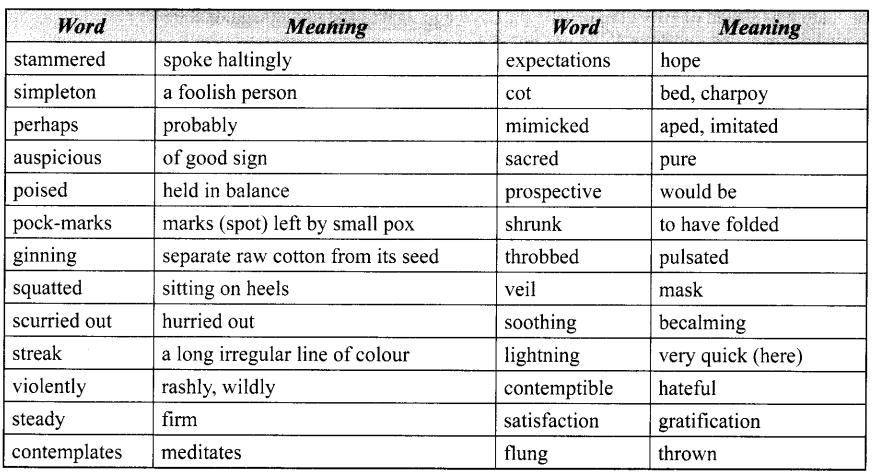
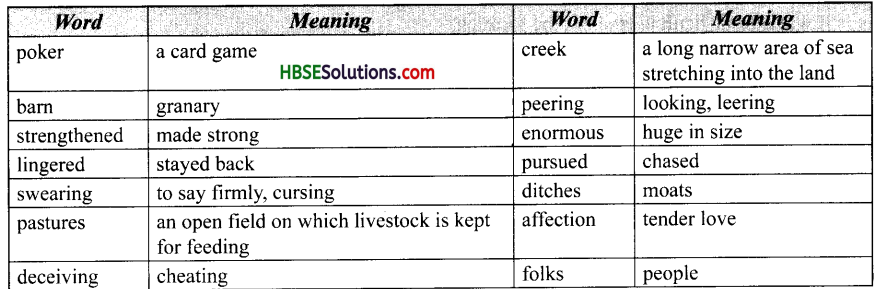
[PAGE 32] : Seagullsa sea bird (समुद्री पक्षी); ledge=a part of arock that is jutting out (शिखाफलक); brink= edge (किनारा); flap = move (फड़फड़ाना); expanse = stretch (फैलाव); beneath = under (के नीचे); muster = gather (इकट्ठा करना); courage = boldness (साहस); desperate = full of disappointment (निराशापूर्ण)।

[PAGE 33] : Shrilly = in a sharp voice (तीखी आवाज़ में); upbraiding = rebuking (डाँटना); watched = saw (देखा); perfecting = making perfect (पूर्ण करना); skim = touch lightly (हल्के-से छूना); herring = fish (मछली); devour = eat (खाना); cackle = sound of a bird (पक्षी की आवाज़); plateau = level stretch on a mountain (पठार); cliff = hill (पहाड़ी); taunting = mocking (व्यंग्य करना); cowardice = lack of courage (कायरता); ascending = rising (उठना); blazing = burning (जलना)।

[PAGE 34] : Pretended = made a show (दिखावा किया); dozing = sleeping (ऊँघना); preening = dressing (सँवारना); hump = raised rock (उठी हुई चट्टान); scrapped =rubbed (रगड़ना); whet = sharpen (तीखा करना); screamed = cried (चिल्लाया); derisively = scornfully (निंदा से); plaintively = sadly (उदासी से); uttered = spoke (बोला); leaned = bent forward (आगे झुका)।

[PAGE 35] : Dived = jumped (कूदा); scream = cry (चीख); swoop = fly (उड़ना); swish = soft sound (हल्की आवाज़); monstrous = very big (बहुत बड़ा); stomach = belly (पेट); soaring = flying (उड़ना); gradually = slowly (धीरे-धीरे); curveting = jumping (कूदना); commended = praised (तारीफ करना); shrieking = crying (चिल्लाना); vast= big (बड़ा); ridges = small waves (छोटी लहरें); beckoning = calling (पुकारना); fright= fear (डर); exhausted = tired (थका हुआ)।

[PAGE 36] : Belly = stomach (पेट); floating = swimming (तैरना) praising = admiring (तारीफ करना); scraps = pieces (टुकड़े)।

His First Flight Translation in Hindi

पढ़ने से पहले आरंभिक काल से ही मनुष्य का आसमान पर विजय प्राप्त करना एक स्वप्न रहा है। यहाँ उड़ान भरने से संबंधित दो कहानियाँ दी गई हैं।

[PAGE 32] : बच्चा सीगल पक्षी अपनी शिखाफलक पर अकेला था। उसके दो भाई एवं उसकी बहन एक दिन पहले ही उड़ गए थे। वह उनके साथ उड़ने से डरता था। किसी रूप में जब वह थोड़ा-सा दौड़कर शिखाफलक के किनारे तक आया था और उसने अपने पंख फड़फड़ाने का प्रयत्न किया था तो वह डर गया था। सागर का महान् विस्तार उसके सामने फैला हुआ था और नीचे की तरफ कितना लंबा रास्ता था मीलों नीचे। उसे पक्के तौर पर ऐसा लगा कि उसके पंख कभी उसे सहारा नहीं देंगे, इसलिए उसने अपना सिर झुकाया और शिखाफलक के नीचे छोटे-से छेद में आ गया जहाँ वह रात को सोया था। यहाँ तक कि जब उसके दोनों भाइयों एवं उसकी बहन ने, जिनके पंख उसके पंखों से छोटे थे अपने पंख फड़फड़ाए एवं उड़ गए, तो भी वह उस साहसिक कदम को उठाने की हिम्मत नहीं जुटा पाया जो उसे बहुत अधिक निराशाजनक लगता था। उसके माता एवं पिता उसके पास आ गए थे और उसे चीख-चीखकर पुकार रहे थे, उसे डाँट रहे थे,

[PAGE 33] : उसे भूखा रखने की धमकी दे रहे थे, अगर वह नहीं उड़ेगा तो। मगर वह किसी भी हालत में हिल नहीं सका। ऐसा चौबीस घंटे पहले हुआ था। तब से उसके पास कोई नहीं आया था। उससे पहले दिन, सारा दिन अपने माता-पिता को उसके भाइयों एवं बहनों के साथ उड़ते, और उन्हें उड़ने की कला में पारंगत करते हुए तथा यह सिखाते हुए कि कैसे लहरों को हल्के-से . छूना है और मछलियों के लिए डुबकी लगानी है, वास्तव में उसने अपने बड़े भाई को अपनी पहली मछली पकड़ते एवं उसे एक चट्टान पर खड़े होकर खाते देखा था जबकि उसके माता-पिता आसपास चक्कर काटते हुए गर्व से चिल्ला रहे थे और सारी प्रातः पूरा परिवार सामने की पहाड़ी के बीच के पठार पर चलता रहा था और उसकी कायरता के लिए उसे चिढ़ाता रहा था।

अब सूर्य आकाश में चढ़ रहा था और उसको तेज रोशनी से चमका रहा था जोकि दक्षिण की तरफ था। उसे गर्मी महसूस हुई क्योंकि उसने पिछली रात से कुछ नहीं खाया था।

वह धीरे-धीरे शिखाफलक के किनारे तक आ गया और एक टाँग पर खड़े होकर तथा दूसरी टाँग को अपने पंख के नीचे छुपाकर उसने सोए हुए होने का ढोंग किया।

PAGE 34] : फिर भी उन्होंने उसकी तरफ कोई ध्यान नहीं दिया। उसने अपने दोनों भाइयों एवं बहन को पठार पर लेटे हुए तथा अपने सिर को अपनी गर्दन में छिपाकर ऊँघते देखा। उसका पिता अपनी सफेद गर्दन के ऊपर वाले पंखों को साफ कर रहा था। केवल उसकी माता ही उसकी ओर देख रही थी। वह पठार के ऊपर एक छोटे-से टीले पर खड़ी थी और उसकी सफेद छाती आगे को बढ़ी हुई थी। थोड़ी-थोड़ी देर बाद वह उस मछली के टुकड़े जो उसके कदमों के पास था, उसे नोचकर खाती थी और फिर वह अपनी चोंच के दोनों सिरों को बारी-बारी से चट्टान पर रगड़ती थी। भोजन को देखकर वह पागल हो उठा। उसे उस तरह से नोच-नोचकर भोजन खाना और अपनी चोंच को तेज करने के लिए उसे पत्थर पर रगड़ना उसे बहुत अच्छा लगता था।
“गा, गा, गा,” वह चिल्लाया एवं उससे प्रार्थना की कि वह उसके लिए कुछ भोजन लाए। “गा-कोल-आह” वह निंदाजनक ढंग से वापिस चिल्लाई। मगर वह उदासी से चिल्लाता रहा और लगभग एक मिनट के बाद उसने प्रसन्नता से चीख मारी। उसकी माँ ने मछली का एक टुकड़ा उठा लिया था और उसे लेकर उसकी तरफ उड़कर आ रही थी।

[PAGE 35] : वह उत्सुकता से चट्टान पर पाँव पटकता हुआ आगे की ओर झुका और जबकि वह उड़ रही थी, उसकी तरफ और निकट आने का प्रयास किया। मगर जब वह बिल्कुल उसके सामने थी, वह रुक गई। उसके पंख गतिहीन हो गए और उसकी चोंच में मछली का टुकड़ा लगभग उसकी (बच्चे की) चोंच की पहुँच में था। उसने हैरानी से एक क्षण इंतजार किया, उसे हैरानी हो रही थी कि वह नजदीक क्यों नहीं आ रही थी और फिर भूख से पागल हो वह मछली पर झपटा। एक जोरदार चीख के साथ वह आगे एवं नीचे खाली स्थान में गिरा। तब बहुत बड़े डर ने उसे जकड़ लिया एवं उसका दिल थम गया। वह कुछ नहीं सुन सकता था।

मगर ऐसा केवल एक मिनट के लिए हुआ। अगले क्षण उसने अपने पंखों को बाहर की ओर फैलते हुए महसूस किया। हवा उसके छाती के पंखों से टकराई, तब उसके पेट के नीचे एवं फिर उसके पंखों से। वह अपने पंखों के सिरों को हवा को काटते महसूस कर सकता था। अब एकदम सीधा नहीं गिर रहा था। वह धीरे-धीरे नीचे एवं बाहर की ओर उड़ रहा था। अब वह भयभीत नहीं था। वह केवल थोड़ा-सा भौचक्का महसूस कर रहा था। तब उसने अपने पंखों को एक बार फड़फड़ाया और वह ऊँचा उठा। “गा-गा-गा-गा-गा-गा-गा-कोल-आह” कहती हुई उसकी माँ उसके पास से तेजी से निकल गई, जबकि उसके पंख तेज़ आवाज़ पैदा कर रहे थे। उसने अपनी माँ का जवाब एक अन्य चीख से दिया। तब उसका पिता चीखता हुआ उसके ऊपर उड़ा। उसने अपने दो भाइयों और अपनी बहन को उछल-कूद करते हुए बिना पंख हिलाए उड़ते हुए तथा डुबकी लगाते हुए अपने इर्द-गिर्द उड़ते हुए देखा।

फिर वह पूरी तरह से भूल गया कि वह कभी भी उड़ने में असमर्थ था और उसने स्वयं की गोता लगाने, मँडराने और तिरछा उड़ने के लिए तारीफ की और खुशी से चीखने लगा।

HBSE 10th Class English Solutions First Flight Chapter 3 Two Stories about Flying

अब वह सागर के निकट था और सीधे उसके ऊपर उड़ रहा था, बिना किसी झिझक के वह सागर के ऊपर था। उसने अपने नीचे विशाल हरा सागर देखा जिसके ऊपर छोटी-छोटी लहरें हिल रही थी और उसने अपनी चोंच को एक तरफ हिलाया और खुशी से काँय-काँय करने लगा।

उसके माता-पिता एवं उसके भाई एवं बहन सागर के हरे फर्श पर उससे पहले ही बैठ गए थे। वे तेज़ आवाजें करते हुए उसे बुला रहे थे। उसने हरे सागर पर खड़े होने के लिए अपनी टाँगें सीधी कीं। उसकी टाँगे सागर में धंस गईं। वह डर से चिल्लाया एवं अपने पंखों को फड़फड़ाते हुए फिर से उठने की कोशिश की। मगर वह थका हुआ था और भूख से कमज़ोर था और इस अजीब व्यायाम के कारण अत्यधिक थका होने के कारण वह उठ न पाया।

[PAGE 36] : उसके पाँव हरे सागर में धंस गए तब उसका पेट इसको छुआ और वह और अधिक नहीं डूबा। वह इसके ऊपर तैर रहा था और उसके आसपास उसका परिवार आवाजें कर रहा था, उसकी तारीफ कर रहा था और उनकी चोंचें उसे छोटी शार्क मछली के टुकड़े प्रस्तुत कर रहीं थीं। उसने अपनी पहली उड़ान भर ली थी।

The Black Aeroplane Summary

The Black Aeroplane Introduction in English

This is a mysterious story. The writer was flying his Dakota aeroplane. Suddenly he was caught in a big cloud. His compass, radio and other instruments failed. There was not much fuel in the plane. Suddenly he saw a black aeroplane near him. The pilot of the black aeroplane guided the writer and he was able to land his plane safely. But he was greatly surprised when the woman at the control centre told him that there had been no other plane except the writer’s Dakota on the sky that night.

The Black Aeroplane Summary in English

The writer of this story is a pilot. One night he was flying his old Dakota aeroplane over France. It was a starry night. He was going to England. He hoped to spend his holiday with his family. It was an easy journey and he was in a joyful mood. He looked at his watch. It was one thirty in the morning. Through his wireless, he contacted the Paris control. They told him to turn twelve degrees west. He did as he was advised to do. He was 150 kilometres from Paris.

Suddenly the writer saw huge black clouds before him. It was not possible to fly up and over the clouds. He had not much fuel with him. So it was not possible to fly around the big mountains of clouds to the right or left. He decided to take the risk and flew his aeroplane straight into the clouds. As he entered the clouds, everything suddenly went black. He found that his compass had ceased to work. He tried to contact the Paris Control for directions. But he was shocked to find that his radio had also stopped working.

Suddenly, the writer saw a black aeroplane near him. He could also see the pilot in it. The pilot waved the writer to follow him. He followed the black airplane like an obedient child. Now it was half an hour since the writer had been following the black aeroplane. He was worried because the fuel in his plane could last only five or ten minutes. But just then the black aeroplane started to go down and the writer followed it.

Suddenly, the writer was out of the clouds. He could see the lights of the runway of the airport. He turned to look at the black aeroplane. But he could not find it anywhere. The sky was empty. The writer landed his Dakota aeroplane. He went to the control centre and asked a woman there who that other pilot was ? The woman looked at the writer strangely. Then she laughed and said that no other planes were flying in such a stormy night. She told him and his plane was the only one that she could see on the radar.

The Black Aeroplane Introduction in Hindi

(यह एक रहस्यात्मक कथा है। लेखक अपना डाकोटा हवाई जहाज़ उड़ा रहा था। अचानक वह एक बहुत बड़े बादल में फँस गया। उसका दिशा-सूचक यंत्र, रेडियो एवं अन्य यंत्र बेकार हो गए। उसके जहाज़ में अधिक ईंधन भी नहीं था। अचानक उसने अपने नज़दीक एक काला जहाज़ देखा। काले जहाज़ के पायलट ने लेखक का पथ-प्रदर्शन किया और वह अपने जहाज़ को सुरक्षात्मक रूप से उतारने में सफल हो गया। मगर तब उसे बहुत अधिक हैरानी हुई जब नियंत्रण केंद्र की स्त्री ने उसे बताया कि उस रात आकाश पर लेखक के डाकोटा के अतिरिक्त कोई अन्य जहाज़ नहीं था।)

HBSE 10th Class English Solutions First Flight Chapter 3 Two Stories about Flying

The Black Aeroplane Summary in Hindi

इस कहानी का लेखक एक पायलट है। एक रात वह अपना पुराना डाकोटा जहाज़ फ्रांस के ऊपर उड़ा रहा था। यह तारों भरी रात थी। वह इंग्लैंड जा रहा था। उसे अपनी अपने परिवार के साथ छुट्टियाँ बिताने की आशा थी। यह एक आसान यात्रा थी एवं वह प्रसन्नचित्त था। उसने अपनी घड़ी को देखा। सुबह के एक बजकर तीस मिनट हुए थे। उसने बेतार के द्वारा पेरिस कंट्रोल को संपर्क किया। उन्होंने उसे बारह डिग्री पश्चिम को मुड़ने की सलाह दी। उसे जो करने की सलाह दी गई, उसने वैसा ही किया। वह पेरिस से 150 किलोमीटर दूर था।

अचानक लेखक ने अपने सामने बड़े-बड़े बादल देखे। बादलों के ऊपर से जहाज़ को उड़ाना संभव नहीं था। उसके पास अधिक ईंधन नहीं था। इसलिए बादलों के बड़े-बड़े पहाड़ों के बाएँ या दाएँ से जहाज़ को उड़ाकर ले जाना संभव नहीं था। उसने खतरा मोल लेने का फैसला किया और जहाज़ को सीधा बादलों के बीच ले गया। जब वह बादलों में घुसा तो हर चीज एकदम काली हो गई। उसने देखा कि उसके दिशा-सूचक यंत्र ने काम करना बंद कर दिया। उसने निर्देशों के लिए पेरिस कंट्रोल से संपर्क करने का प्रयत्न किया। मगर उसे यह देखकर सदमा लगा कि उसके रेडियो ने भी काम करना बंद कर दिया था।

अचानक लेखक ने अपने पास एक काला हवाई जहाज़ देखा। वह उसके अंदर के पायलट को देख सकता था। पायलट ने लेखक को अपने पीछे-पीछे आने का इशारा किया। उसने काले हवाई जहाज़ का पीछा एक आज्ञाकारी बच्चे की तरह किया। अब लेखक को काले हवाई जहाज़ के पीछे चलते हुए आधा घंटा हो गया था। उसे चिंता हो गई क्योंकि उसके जहाज़ का ईंधन केवल पाँच या दस मिनट का ही और था। मगर तभी काले जहाज़ ने नीचे जाना आरंभ किया और लेखक ने उसका पीछा किया।

अचानक लेखक बादलों के बाहर था। वह हवाई जहाज़ की पट्टी को देख सकता था। वह काले जहाज़ को देखने के लिए मुड़ा। मगर उसे वह कहीं नज़र नहीं आया। आकाश खाली था। लेखक ने अपना डाकोटा जहाज़ उतारा । वह नियंत्रण कक्ष पर गया और वहाँ की स्त्री से पूछा कि अन्य पायलट कौन था? स्त्री ने लेखक को अजीब ढंग से देखा। तब वह हँसी और उसने कहा वैसी तूफानी रात में कोई भी अन्य जहाज़ नहीं उड़ रहे थे। उसने लेखक को बताया कि उसे राडार पर केवल उसी का जहाज़ नज़र आया था।

The Black Aeroplane Word-Meanings

[PAGE 37] : Looking forward to = waiting eagerly (उत्सुकता से इंतजार करना); immediately = at once (एकदम); compass = Instrument for telling direction (दिशा-सूचक यंत्र); huge = big (बड़े); risk = danger (खतरा); twisted = shook (हिला)।

[PAGE 38] : Instruments = machines (यंत्र); waved = shook (हिलाया); follow = come after (पीछे-पीछे आना); obedient = one who obeys the orders (आज्ञाकारी)।

[PAGE 39] : Fuel = petrol, diesel etc. (ईंधन); frightened = terrified (भयभीत); runway = the narrow strip the plane lands on or takes off from (हवाई अड्डे की पट्टी); strangely = in a strange manner (अजीब ढंग से); arrive = reach (पहुँचना)।

The Black Aeroplane Translation in Hindi

[PAGE 37] : चाँद पूर्व में मेरे पीछे उग रहा था और तारे आकाश में मेरे ऊपर चमक रहे थे। आकाश में एक भी बादल नहीं था। मैं सोते हुए देहाती इलाके से काफी ऊपर होने पर प्रसन्न था। मैं अपना पुराना डाकोटा जहाज़ फ्रांस के ऊपर वापिस इंग्लैंड को जाता हुआ उड़ा रहा था। मैं अपनी छुट्टी का सपना ले रहा था और अपने परिवार से मिलने का इंतजार कर रहा था, मैंने अपनी घड़ी को देखा : सुबह के एक बजकर तीस मिनट।

“मैं शीघ्र ही पेरिस के कंट्रोल से बात करूँगा,” मैंने सोचा।

जब मैंने जहाज़ के नाक से परे नीचे को देखा, तो मैंने अपने सामने एक बड़े शहर की रोशनियाँ देखीं। मैंने रेडियो चालू कर दिया और कहा, “पेरिस कंट्रोल, डाकोटा डी०एस० 088 यहाँ। क्या आप मेरी आवाज सुन सकते हैं; मैं इंग्लैंड के रास्ते पर हूँ ओवर।”

रेडियो में से आवाज ने फौरन मुझे उत्तर दिया; “डी०एस० 088, मैं तुम्हें सुन सकता हूँ। अब तुम्हें बारह डिग्री पश्चिम में मुड़ जाना चाहिए, डी०एस० 088 ओवर।”

मैंने नक्शे एवं दिशा-सूचक यंत्र की जाँच की और अपने दूसरे एवं आखिरी ईंधन के टैंक को चालू किया और अपने डाकोटा को बारह डिग्री पश्चिम में इंग्लैंड की ओर मोड़ दिया।

“मैं नाश्ते के लिए समय पर पहुँच जाऊँगा,” मैंने सोचा। एक बड़ा, अच्छा अंग्रेज़ी नाश्ता! हर काम ठीक हो रहा था। यह एक आसान उड़ान थी।
जब मैंने बादल देखे तो पेरिस 150 किलोमीटर मेरे पीछे था। तूफानी बादल। वे बहुत बड़े थे। वे मेरे सामने आकाश में खड़े काले पहाड़ लगते थे। मैं जानता था कि मैं उनके ऊपर से जहाज़ को नहीं उड़ा सकता था, और मेरे पास इतना ईंधन नहीं था कि मैं उत्तर या दक्षिण में उनके गिर्द से जहाज़ को ले जाऊँ।

“मुझे वापिस पेरिस चला जाना चाहिए,” मैंने सोचा, मगर मैं घर जाना चाहता था। मैं नाश्ता करना चाहता था। “मैं खतरा मोल लूंगा”, मैंने सोचा और पुराने डाकोटा को सीधे तूफान में डाल दिया।
बादलों के अंदर हर चीज़ अचानक काली हो गई। जहाज़ के बाहर की किसी भी चीज़ को देखना असंभव था। पुराना जहाज़ हवा में उछला एवं बल खाने लगा। मैंने दिशा-सूचक यंत्र को देखा।

(PAGE 38] : मैं अपनी आँखों पर विश्वास नहीं कर सका : दिशा-सूचक गोल-गोल घूमे जा रहा था। यह बंद हो गया था। यह काम नहीं कर रहा था ! बाकी के यंत्र भी अचानक ठप्प हो गए। मैंने रेडियो चालू करने का प्रयत्न किया।
“पेरिस कंट्रोल ? पेरिस कंट्रोल ? क्या तुम मुझे सुन सकते हो ?”.

कोई उत्तर नहीं मिला। रेडियो भी ठप्प हो गया था। मेरा रेडियो और दिशा-सूचक यंत्र ठप्प हो गए थे और मैं नहीं देख सकता था कि मैं कहाँ था, मैं तूफान में खो गया था। तब काले बादलों में, मेरे बहुत नज़दीक मैंने एक अन्य जहाज़ को देखा। इसके पंखों पर कोई रोशनी नहीं थी, मगर मैं तूफान के बीच में से इसे अपने नज़दीक उड़ता देख सकता था। मैं पायलट के चेहरे को मेरी तरफ मुड़ा हुआ देख सकता था। मैं अन्य व्यक्ति को देखकर बहुत प्रसन्न हुआ। उसने एक हाथ उठाया और उसे हिलाया।

“मेरे पीछे आओ”, वह कह रहा था। “मेरे पीछे आओ।”
“वह जानता है कि मैं भटक गया हूँ,” मैंने सोचा। “वह मेरी सहायता करने का प्रयत्न कर रहा है।”
उसने अपना जहाज़ धीरे-से मेरे डाकोटा के सामने उत्तर की तरफ मोड़ लिया ताकि मेरे लिए उसका पीछा करना आसान हो जाए। मुझे एक आज्ञाकारी बच्चे की तरह उस अजीब जहाज़ के पीछे-पीछे जाने में बड़ी प्रसन्नता हुई।
आधे घंटे के बाद वह अजीब काला हवाई जहाज़ अभी भी मेरे सामने बादलों में था।

[PAGE 39] : अब डाकोटा के आखिरी ईंधन के टैंक में केवल पाँच या दस मिनट तक और उड़ने के लिए ईंधन था। मैंने फिर से डरा हुआ महसूस करना आरंभ कर दिया था। मगर तब उसने नीचे जाना आरंभ कर दिया और मैंने तूफान के अंदर से उसका पीछा किया।

अचानक मैं बादलों से निकल आया और मैंने अपने सामने रोशनियों की दो लंबी कतारें देखीं। यह हवाई पट्टी थी। हवाई अड्डा! मैं काले हवाई जहाज़ वाले अपने मित्र को देखने मुड़ा, मगर आकाश खाली था। वहाँ कुछ भी नहीं था। काला हवाई जहाज़ जा चुका था। मुझे ये कहीं भी नज़र नहीं आ रहा था।

मैंने जहाज़ को नीचे उतारा और मुझे नियंत्रण मीनार के पास पुराने डाकोटा से उतरकर जाने का अफसोस नहीं था। मैं गया और नियंत्रण केंद्र में एक स्त्री से पूछा कि मैं कहाँ था एवं दूसरा पायलट कौन था। मैं उसका धन्यवाद करना चाहता था।
उसने मेरी तरफ अजीब ढंग-से देखा और फिर हँसने लगी।

HBSE 10th Class English Solutions First Flight Chapter 3 Two Stories about Flying

“अन्य हवाई जहाज़ ? वहाँ ऊपर तूफान में ? आज रात कोई अन्य जहाज़ नहीं उड़ रहे थे। राडार पर मैं केवल आपका जहाज़ देख सकती थी।”
तो वहाँ पर बिना दिशा-सूचक यंत्र या रेडियो और मेरे टैंकों में अधिक ईंधन के बिना, वहाँ सुरक्षित पहुँचने में मेरी सहायता किसने की थी ? तूफान में, बिना रोशनियों के उड़ता हुआ उस अज़ीब काले जहाज़ का पायलट कौन था ?

HBSE 10th Class English Solutions First Flight Chapter 3 Two Stories about Flying Read More »

HBSE 10th Class English Solutions First Flight Chapter 2 Nelson Mandela: Long Walk to Freedom

Haryana State Board HBSE 10th Class English Solutions First Flight Chapter 2 Nelson Mandela: Long Walk to Freedom Textbook Exercise Questions and Answers.

Haryana Board 10th Class English Solutions First Flight Chapter 2 Nelson Mandela: Long Walk to Freedom

HBSE 10th Class English Nelson Mandela: Long Walk to Freedom Textbook Questions and Answers

Before You Read

1. “Apartheid’ is a political system that separates people according to their race. Can you say which of the three countries named below had such a political system until very recently ?
(i) United States of America, (ii) South Africa, (iii) Australia.
Answer:
(ii) South Africa.

2. Have you heard of Nelson Mandela ? Mandela, and his African National Congress, spent a lifetime fighting against apartheid. Mandela had to spend thirty years in prison. Finally, democratic elections were held in South Africa in 1994, and Mandela became the first black President of a new nation.
In this extract from his autobiography, Long Walk to Freedom, Mandela speaks about a historic occasion, “the inauguration’. Can you guess what the occasion might be ? Check your guess with this news item (from the BBC) of 10 May 1994.

Mandela Becomes South Africa’s First Black President :

Nelson Mandela has become South Africa’s first Black President after more than three centuries of white rule. Mr Mandela’s African National Congress (ANC) party won 252 of the 400 seats in this first democratic elections of South Africa’s history. The inauguration ceremony took place in the Union Buildings amphitheatre in Pretoria today, attended by politicians and dignitaries from more than 140 countries around the world. “Never, never again will this beautiful land experience the oppression of one by another,” said Nelson Mandela in his address. … Jubilant scenes on the streets of Pretoria followed the ceremony with blacks, whites and coloureds celebrating together… More than 100,000 South African men, women and children of all races sang and danced with joy.

Answer:
The occasion is the swearing in ceremony of Nelson Mandela as the President of South Africa. He was the first black president of South Africa after more than three centuries of white rule.

HBSE 10th Class English Solutions First Flight Chapter 2 Nelson Mandela: Long Walk to Freedom

Activity

In Column A are some expressions you will find in the text. Make a guess and match each expression with an appropriate meaning from Column B.

A

B

(i) A rainbow gathering of different colours and nations– A great ability (almost unimaginable) to remain unchanged by suffering (not losing hope, goodness or courage)
(ii) The seat of white supremacy– A half-secret life, like a life lived in the fading light between sunset and darkness
(iii) Be overwhelmed with a sense of –   kindness, pity, historyA sign of human feeling (goodness, justice, etc.)
(iv) Resilience that defies the imaginationA beautiful coming together of various peoples, like the colours in a rainbow
(v) A glimmer of humanity– The centre of racial superiority
(vi) A twilight existenceFeel deeply emotional, remembering and understanding all the past events that have led up to the moment

Answer:

AB
(i) A rainbow gathering of different colours and nations-A beautiful coming together of various peoples, like the colours in a rainbow
(ii) The seat of white supremacy The centre of racial superiority
(iii) Be overwhelmed with a sense of –   kindness, pity, historyFeel deeply emotional, remembering and understanding all the past events that have led up to the moment
(iv) Resilience that defies the imagination– A great ability (almost unimaginable) to remain unchanged by suffering (not losing hope, goodness or courage)
(v) A glimmer of humanity-A sign of human feeling (goodness, justice, etc.)
(vi) A twilight existence 

– A half-secret life, like a life lived in the fading light between sunset and darkness

Oral Comprehension Check (Pages 18-19)

1. Where did the ceremonies take place ? Can you name any public buildings in India that are made of sandstone ?
(उत्सव कहाँ मनाया गया ? क्या आप भारत में बलुआ पत्थर से बने किसी सार्वजनिक भवन का नाम बता सकते हो ?)
Answer:
The ceremonies took place in the sandstone amphitheatre formed by the Union Buildings in Pretoria. In India, the Red Fort, Jama Masjid and Parliament House are some of the public buildings made of sandstone.

(उत्सव प्रिटोरिया में (बलुआ पत्थर से बनी) यूनियन बिल्डिंग में बनी रंगशाला में मनाया गया। भारत में लाल किला, जामा मस्जिद और संसद भवन बलुआ पत्थर से बने कुछ सार्वजनिक भवन हैं।)

2. Can you say how 10 May is an “autumn day’ in South Africa ?
(क्या आप बता सकते हो कि 10 मई को दक्षिण अफ्रीका में एक पतझड़ दिवस क्यों कहते हैं ?)
Answer:
Because of weather it was a pleasant day. Secondly, it was pleasant because on that day there was the dawn of liberty for the blacks after more than 300 years of white rule.
(मौसम के लिहाज से वह एक सुखद दिन था। दूसरे वह दिन इसलिए भी सुखद था क्योंकि उस दिन अश्वेत लोगों के लिए लगभग 300 वर्षों के श्वेत शासन के पश्चात् स्वतंत्रता का नया सूर्योदय हो रहा था।)

3. At the beginning of his speech, Mandela mentions “an extraordinary human disaster”. What does he mean by this ? What is the “glorious … human achievement” he speaks of at the end ?
(अपने भाषण के आरंभ में मंडेला “एक असाधारण मानवीय आपदा” का जिक्र करते हैं? इससे उनका क्या अभिप्राय है ? ‘शानदार ……… मानवीय प्राप्ति’ क्या है जिसके बारे में वे अंत में बताते हैं ?)
Answer:
The human disaster was the repression of the blacks by the white rulers. This rule lasted for a long time. The “glorious…human achievement” that he refers to is getting political independence from the white rule by the black natives.
(यह मानवीय आपदा थी, गोरे शासकों के द्वारा काली चमड़ी वाले लोगों का दमन। यह शासन एक लंबे समय तक चला। ‘शानदार-मानवीय प्राप्ति’ जिसका वे जिक्र करते हैं वह है वहाँ के काले निवासियों को गोरे लोगों के शासन से राजनीतिक स्वतंत्रता हासिल होना।)

4. What does Mandela thank the international leaders for ?
(मडेला किस लिए अंतर्राष्ट्रीय नेताओं का धन्यवाद करते हैं ?)
Answer:
He thanks the international leaders for having come to grace the occasion of the inauguration of the black government. It is a common victory for justice, for peace and for human dignity.
(वे अश्वेत सरकार के उद्घाटन समारोह में शामिल होकर अवसर की शान बढ़ाने के लिए उनका धन्यवाद करते हैं। यह न्याय, शांति और मानवीय गरिमा के लिए एक सांझी विजय है।)

5. What ideals does he set out for the future of South Africa ?
(वे दक्षिण अफ्रीका के भविष्य के लिए कौन-से आदर्श तय करते हैं ?)
Answer:
He sets out the ideals of liberating his people from the bondage of poverty, deprivation, suffering, gender and other discrimination.
(वे अपने लोगों को गरीबी, वंचित किया जाना, पीड़ा, लैंगिक तथा अन्य सभी प्रकार के भेदभावों से मुक्ति दिलाने के आदर्श तय करते हैं।)

HBSE 10th Class English Solutions First Flight Chapter 2 Nelson Mandela: Long Walk to Freedom

Oral Comprehension Check (Page 21)

1. What do the military generals do ? How has their attitude changed, and why?
(सेना के जनरल क्या करते हैं? उनका दृष्टिकोण कैसे बदला है, और क्यों ?) [Sample Paper March, 2019]
Answer:
At the ceremony the military generals come and salute Mandela. Their behaviour has changed. In the past they would have arrested Nelson Mandela instead of saluting him.
(उत्सव में सेना के जनरल आकर मंडेला को सलाम करते हैं। उनका व्यवहार बदल गया है। बीते समय में वे उसे सलाम करने की अपेक्षा गिरफ्तार कर लेते थे।)

2. Why were two national anthems sung ?
(दो राष्ट्रगान क्यों गाए गए ?)
Answer:
There were two different national anthems in South Africa for the white and the black communities. That is why two national anthems were sung.
(दक्षिण अफ्रीका में गोरे और काले दोनों समुदायों के लिए अलग-अलग राष्ट्रगान थे। इसीलिए दो राष्ट्रगान गाए गए।)

3. How does Mandela describe the systems of government in his country (i) in the first decade, and (ii) in the final decade, of the twentieth century ?
(मडेला अपने देश में सरकार की व्यवस्था का वर्णन कैसे करते हैं, (1) बीसवीं सदी के, प्रारंभिक दशक में (ii) और बीसवीं सदी के, आखिरी दशक में ?)
Answer:
(i) In the first decade of the twentieth century, the political system in South Africa was based on apartheid. That was a period of repression and racial discrimination.
(ii) In the last decade of the twentieth century, there was a remarkable change. The old system was replaced with a system based on equality and freedom for all.
(i) बीसवीं सदी के प्रारंभिक दशक में, दक्षिण अफ्रीका में राजनीतिक व्यवस्था रंगभेद पर आधारित थी। वह दमन और जातीय भेदभाव वाला समय था।
(ii) बीसवीं सदी के अंतिम दशक में, एक बहुत बड़ा परिवर्तन आ गया था। पुरानी व्यवस्था के स्थान पर समानता और सभी के लिए स्वतंत्रता पर आधारित व्यवस्था ने स्थान ले लिया था।)

4. What does courage mean to Mandela ?
(मडेला के लिए साहस का क्या अर्थ है ?)
Answer:
According to Mandela courage does not mean absence of fear but the triumph over it.
(मंडेला के लिए साहस का अर्थ भय की अनुपस्थिति नहीं है बल्कि भय पर विजय हासिल करना है।)

5. Which does he think is natural, to love or to hate ?
(मंडेला के अनुसार कौन-सी बात स्वाभाविक है प्यार करना या घृणा करना ?)
Answer:
He thinks that it is natural to love. Love comes naturally to human heart..
(उसके अनुसार प्यार करना स्वाभाविक है। मनुष्य के हृदय में प्यार स्वाभाविक रूप से आता है।)

Oral Comprehension Check (Page 24)

1. What ‘twin obligations’ does Mandela mention ?
(मडेला किन ‘दोहरे उत्तरदायित्वों की बात करते हैं ?)
Answer:
Mandela says that every citizen has twin obligations. The first obligation is to his family, his parents, his.wife and children. The second obligations is to his people, his community and his country.
(मंडेला कहते हैं कि प्रत्येक इंसान के दोहरे उत्तरदायित्व होते हैं। पहला उत्तरदायित्व उसके परिवार, उसके माता-पिता, उसकी पत्नी और बच्चों के प्रति होता है। दूसरा उत्तरदायित्व उसके लोगों, उसके समुदाय तथा उसके देश के प्रति होता है।)

2. What did being free mean to Mandela as a boy, and as a student ? How does he contrast these “transitory freedoms” with “the basic and honourable freedoms” ?
(मंडेला का एक बच्चे की तरह और एक विद्यार्थी की तरह स्वतंत्र होने से क्या भाव था ? वह किस प्रकार से इन दोनों ‘अस्थायी स्वतंत्रताओं’ का ‘मौलिक और सम्मानजनक स्वतंत्रताओं के साथ विरोधाभास प्रकट करता है ?)
Answer:
As a boy, being free meant to Mandela being free to wander in the fields near his hut, to swim, to run through the village. As a student it meant to be free to stay out at night, to read what he pleased and to go where he chose. However, these were the transitory freedoms’. The “basic and honourable freedoms” were the freedoms for the people to live their lives with dignity and self-respect.
(एक बच्चे की तरह स्वतंत्र होने से मंडेला का भाव अपनी झोंपड़ी के पास स्थित खेतों में घूमने, तैराकी करने और गाँव के बीच से भागने की स्वतंत्रता से था। एक विद्यार्थी के रूप में स्वतंत्रता का उसके लिए अर्थ था रात्रि को घर से बाहर रहने की स्वतंत्रता, अपनी पसंद की पुस्तकें पढ़ने की स्वतंत्रता और अपनी पसंद के स्थानों पर जाने की स्वतंत्रता से था। हालाँकि ये सभी ‘अस्थायी स्वतंत्रताएँ थी। ‘मौलिक और सम्मानजनक स्वतंत्रताएँ’ लोगों के लिए अपना जीवन गरिमा और आत्मसम्मान के साथ जीने की स्वतंत्रताएँ थीं।)

3. Does Mandela think the oppressor is free ? Why/Why not?
(क्या मंडेला के विचार में दमन करने वाला स्वतंत्र है ? क्यों/क्यों नहीं ?) .
Answer:
Mandela thinks that a person who takes away another man’s freedom is a prisoner of hatred. In this sense, the oppressor, like the oppressed, is not free.
(मंडेला के विचार में दूसरे आदमी की स्वतंत्रता का हरण करने वाला व्यक्ति घृणा का बंदी होता है। इस प्रकार से दमन करने वाला व्यक्ति, शोषित व्यक्ति की तरह स्वतंत्र नहीं होता है।)

Thinking about the Text

1. Why did such a large number of international leaders attend the inauguration ? What did it signify the triumph of ?
(इतनी अधिक संख्या में अंतर्राष्ट्रीय नेता उद्घाटन समारोह में उपस्थित क्यों हुए ? यह किस विजय की ओर संकेत कर रहा है ?) ‘
Answer:
A large number of international leaders attended the inauguration to pay their respects. It signified the triumph of human freedom and democracy. It also signified the importance of political independence.

(बहुत अधिक संख्या में अंतर्राष्ट्रीय नेता अपना सम्मान प्रकट करने के लिए उद्घाटन समारोह में उपस्थित हुए। यह मानवीय स्वतंत्रता और लोकतंत्र की विजय के महत्त्व की ओर संकेत करता है। यह राजनीतिक स्वतंत्रता के महत्त्व की ओर भी संकेत करता है।)

HBSE 10th Class English Solutions First Flight Chapter 2 Nelson Mandela: Long Walk to Freedom

2. What does Mandela mean when he says he is “simply the sum of all those African patriots” who had gone before him ?
(मंडेला का यह कहने से क्या भाव है, “वह सामान्य रूप से उन सभी अफ्रीकन देशभक्तों का समावेश है” जो उससे पहले जा चुके थे ?)
Answer:
Mandela means to say that he has the blood of African patriots in him. He has taken inspiration from them. Like them he also underwent difficulty and tortures in his struggle against slavery.
(मंडेला का यह कहने से भाव है कि उसमें अफ्रीकन देशभक्तों का खून है। उसने उनसे प्रेरणा हासिल की है। उनकी तरह उसने भी दासता के खिलाफ संघर्ष में कठिनाई और उत्पीड़नों को सहन किया है।)

3. Would you agree that the “depths of oppression” create “heights of character” ? How does Mandela illustrate this ? Can you add your own examples to this argument ?
(क्या आप इस बात से सहमत होंगे कि “दमन की गहराइयाँ” “चरित्र की ऊँचाइयाँ” पैदा करती हैं। मंडेला इस बात की व्याख्या कैसे करते हैं? क्या इस तर्क में आप अपने स्वयं के उदाहरण भी शामिल कर सकते हैं ?)
Answer:
It is said that difficulties try a man. The more a man suffers, the more determined he becomes to succeed. Mandela underwent decades of oppression and brutality. But these things only made him stronger and more determined. In India we have examples of leaders like Gandhiji, Nehru, Sardar Patel. etc. Their sufferings only made them stronger to fight against the British.
(कहा जाता है कि कठिनाइयाँ आदमी की परीक्षा लेती हैं। कोई आदमी जितना अधिक कष्ट उठाता है, वह सफलता हासिल करने के लिए उतना ही अधिक दृढ़-निश्चयी हो जाता है। मंडेला ने दशकों तक यातना और अत्याचार सहन किया है, परंतु केवल यही चीजें उसे मज़बूत और दृढ़-निश्चयी बनाती हैं। भारत में हमारे सामने गाँधी जी, नेहरू, सरदार पटेल जैसे अनेक नेताओं के उदाहरण हैं। उनके कष्टों ने उन्हें अंग्रेजी राज के खिलाफ लड़ने के लिए केवल मजबूती प्रदान की है।)

4. How did Mandela’s understanding of freedom change with age and experience ?
(आयु और अनुभव के साथ-साथ मंडेला की स्वतंत्रता की अवधारणा में कैसे परिवर्तन आया ?)
Answer:
At first Mandela thought of personal freedom only. He wanted to be free to do whatever he liked and go wherever he liked. But as he grew up, he found that his countrymen were also not free. Now he understood the real meaning of freedom. He decided to fight for the freedom of his people also.
(सर्वप्रथम तो मंडेला केवल व्यक्तिगत स्वतंत्रता के विषय में सोचते थे। वे केवल अपनी पसंद का काम करने और अपनी पसंद के स्थान पर जाने की स्वतंत्रता के बारे में सोचते थे। लेकिन जब वे बड़े हुए तो उन्होंने पाया कि उनके देशवासी भी स्वतंत्र नहीं थे। अब उसने स्वतंत्रता का असली अर्थ समझ लिया था। उसने अपने लोगों की स्वतंत्रता के लिए भी लड़ने का निर्णय ले लिया।)

5. How did Mandela’s ‘hunger for freedom’ change his life ?
(‘स्वतंत्रता की भूख’ ने मंडेला के जीवन को कैसे बदल दिया ?)
Answer:
Mandela’s hunger for freedom changed his life. He decided to fight for freedom. He believed that freedom was his birthright. Now he worked day and night for it. He suffered greatly but his determination did not wave. He was made homeless. He was put into prison. But he remained stuck to his resolution.

Mandela’s ‘hunger for freedom’ changed him into a great man, a statesman, and a visionary. He worked day and night for it. He underwent physical and mental tortures for obtaining freedom for his own people.

(स्वतंत्रता की भूख ने मंडेला के जीवन को बदल दिया। उसने स्वतंत्रता के लिए लड़ने का निर्णय लिया। वे मानते थे कि स्वतंत्रता उनका जन्मसिद्ध अधिकार है। अब वे दिन-रात इसके लिए काम कर रहे थे। उन्होंने बहुत अधिक कष्ट उठाए परंतु उनका इरादा नहीं बदला। उन्हें बेघर कर दिया गया। उन्हें जेल में डाल दिया गया। लेकिन वे अपने इरादे पर अडिग रहे।

‘स्वतंत्रता की भूख’ ने मंडेला को एक महान् आदमी, एक राजनेता और एक दार्शनिक में बदल दिया। उसने दिन-रात इसके लिए कार्य किया। उन्हें अपने लोगों के लिए स्वतंत्रता हासिल करने के लिए शारीरिक और मानसिक कष्ट उठाने पड़े।)

Thinking about Language

I. There are nouns in the text (formation, government, which are formed from the corresponding verbs (form, govern) by suffixing-(at) ion or ment. There may be a change in the spelling of some verb noun pairs : such as rebel, rebellion; constitute, constitution.

1. Make a list of such pairs of nouns and verbs in the text.

NounVerb
rebellionrebel
constitutionconstitute

Answer:

NounVerb
inaugurationinaugurate
installationInstall
contributioncontribute
formationform

2. Read the paragraph below. Fill in the blanks with the noun forms of the verbs in brackets.
Martin Luther King’s ……………. (contribute) to our history as an outstanding leader began when he came to the ……………. (assist) of Rosa Parks, a seamstress who refused to give up her seat on a bus to a white passenger. In those days American Blacks were confined to positions of second class citizenship by restrictive laws and customs. To break these laws would mean ………….. (subjugate) and …………….. (humiliate) by the police and the legal system. Beatings,
…… (imprison) and sometimes death awaited those who defied the System. Martin Luther King’s tactics of protest involved non-violent. …………….(resist) to racial injustice.
Answer:
contribution
assistance
subjugation
humiliation
imprisonment
resistance

HBSE 10th Class English Solutions First Flight Chapter 2 Nelson Mandela: Long Walk to Freedom

II.. Using the Definite Article with Names

You know that the definite article ‘the’ is not normally used before proper nouns. Nor do proper nouns usually occur in the plural. (We do not say: *The Nelson Mandela, or Nelson Mandelas.) But now look at this sentence from the text : …the decades of oppression and brutality … produced the Oliver Tambos, the Walter Sisulus, …of our time.
Used in this way with the and/or in the plural, a proper noun carries a special meaning. For example, what do you think the names above mean?

Choose the right answer :

(a) for example Oliver Tambo, Walter Sisulu. …
(b) many other men like Oliver Tambo, Walter Sisulu …/ many men of their type or kind, whose names may not be as well known.
Did you choose option (b) ? Then you have the right answer !

Here are some more examples of the used with proper names. Try to say what these sentences mean. (You may consult a dictionary if you wish. Look at the entry for “the”.)

1. Mr Singh regularly invites the Amitabh Bachchans and the Shah Rukh Khans to his parties.
2. Many people think that Madhuri Dixit is the Madhubala of our times.
3. History is not only the story of the Alexanders, the Napoleons and the Hitlers, but of ordinary people as well.
Answer:
1. This means that Mr Singh regularly invites famous film stars, that is, pecple like Amitabh : Bachchan and Shah Rukh Khan to his parties.
2. It means Madhuri Dixit is like Madhubala in her looks as well in her acting abilities.
3. The writer means to say that history is not only the story of great persons like Alexander, Napoleon and Hitler. Ordinary persons are also part of history.

III. Idiomatic Expressions

Match the italicised phrases in Column A with the phrase nearest in meaning in Column B. (Hint: First look for the sentence in the text in which the phrase in Column A occurs.)

AB
1. I was not unmindful of the
fact
(i) had not forgotten; was aware of the fact
(ii) was not careful about the fact
(iii) forgot or was not aware of the fact
2. when my comrades and I
were pushed to our limits
(i) pushed by the guards to the wall
(ii) took more than our share of beatings
(iii) felt that we could not endure the suffering any longer
3. to reassure me and keep
me going
(i) make me go on walking
(ii) help me continue to live in hope in this very difficult
situation
(iii) make me remain without complaining
4. the basic and honourable
freedoms of … earning my keep….
(i) earning enough money to live on
(ii) keeping what I earned
(iii) getting a good salary.

Answer:

AB
1. I was not unmindful of the
fact
(i) had not forgotten; was aware of the fact
2. when my comrades and I
were pushed to our limits
(iii) felt that we could not endure the suffering any longer
3. to reassure me and keep
me going
(iii) make me remain without complaining
4. the basic and honourable
freedoms of … earning my keep….
(i) earning enough money to live on

I. Look at the following sentence from the story :

Speaking

In groups, discuss the issues suggested in the box below. Then prepare a speech of about two minutes on the following topic. (First make notes for your speech in writing.)
True liberty is freedom from poverty, deprivation and all forms of discrimination.

• causes of poverty and means of overcoming it
• discrimination based on gender, religion, class, etc.
• constitutionally guaranteed human rights
Answer:
For discussion at class level. There are three topics in the question. One is full solved for the students. Notes have been given for the other two topics. The students may develop into a speech as an exercise.

Causes of Poverty and Means of Overcoming It

NOTES

Causes: Lack of employment – no means of livelihood – no work available – large families – illiteracy – ignorance – superstitious beliefs – dependence on others, etc.
Means of overcoming the poverty : Search for work – seek government help – manual work – small families – avoiding superstitions – developing the habit of working hard.

SPEECH

Respected Principal, worthy teachers and my dear friends:
Today, the topic of my speech before you is the “Causes of Poverty and Means of Overcoming It.” We all know that poverty is a curse. There are many causes of poverty in our country. The major reason is lack of employment. In India we do not have job opportunities for everyone. As a result a large number of people are out of jobs. They have to face poverty. Apart form jobs, other means of livelihood are also not enough. The farmers have to remain unemployed for about six months in a year. During this period, no work is available to them. This leads to their poverty. Even manual work is not available in sufficient quantity. Our growing population is also responsible for poverty. We have superstitious beliefs. We believe that there must be at least one son in a family. In the hope of getting a son, we go on adding to the population of India. As a result, there cannot be job opportunities for all of them.

We can take a number of steps to overcome poverty. First of all, the government should adopt measures which ensure that there are enough job opportunities in India. There should be work for farmers when they are unemployed for six months in a year. More and more factories should be set up and developmental works should be taken up. The growing population should be checked. People should be educated so that they do not have superstitious beliefs. If we all work together, we can remove poverty from our country.

*Discrimination Based on Gender, Religion, Class, etc.

NOTES

Historical and cultural reasons – male dominated society – division of work – women were given the job of looking after the household Dmen fought and worked for the safety of the communities – as a result, women were treated as weaker sex – religious beliefs – superstitious beliefs – more importance to son in a family, etc.

* Constitutionally Guaranteed Human Rights.

NOTES
Indian constitution guarantees equal rights to every Indian — no discrimination on the basis of religion, caste, colour, etc.— right to speech, liberty, etc. – provision of many acts against mental or physical torture of any one — law against child labour – punishment for treating fellow human beings unfairly – still human rights are violated – children can be seen working in factories – the government should tackle these violations firmly.

HBSE 10th Class English Solutions First Flight Chapter 2 Nelson Mandela: Long Walk to Freedom

Writing

1. Looking at Contrasts

Nelson Mandela’s writing is marked by balance : many sentences have two parts in balance.
Use the following phrases to complete the sentences given below.
(i) they can be taught to love.
(ii) I was born free.
(iii) but the triumph over it.
(iv) but he who conquers that fear.
(v) ‘to create such heights of character.

1. It requires such depths of oppression …..
2. Courage was not the absence of fear ….
3. The brave man is not he who does not feel afraid .
4. If people can learn to hate ………………
5. I was not born with a hunger to be free …………..
Answer:
1. It requires such depths of oppression to create such heights of character.
2. Courage was not the absence of fear but the triumph over it.
3. The brave man is not he who does not feel afraid, but he who conquers that fear.
4. If people can learn to hate, they can be taught to love.
5. I was not born with a hunger to be free, I was born free.

II. This text repeatedly contrasts the past with the present or the future. We can use coordinated clauses to contrast two views, for emphasis or effect.

Given below are sentences carrying one part of the contrast. Find in the text the second part of the contrast, and complete each item. Identify the words which signal the contrast. This has been done for you in the first item.

1. For decades the Union Buildings had been the seat of white supremacy, and now ….
2. Only moments before, the highest generals of the South African defence force and police ……………… saluted me and pledged their loyalty. … not so many years before they would not have saluted ……..
3. Although that day neither group knew the lyrics of the anthem … they would soon……………….
4. My country is rich in the minerals and gems that lie beneath its soil……………………………….
5. The Air Show was not only a display of pinpoint precision and military force, but…………
6. It was this desire for the freedom of my people … that transformed ……………… into a bold one, that drove …………………. to become a criminal, that turned …… into a man without a home.
Answer:
1. …… it was the site of a rainbow gathering of different colours and nations …..
2. …… they would not have saluted but arrested me.
3. …… neither group knew the lyrics of the anthem they once despised …..
4. …… I have always known that its greatest wealth is its people, finer and truer than the purest diamonds.
5. …. a demonstration of the military loyalty to democracy, to a new government……
6. …. a frightened young man ….. a law-abiding attorney to become a criminal, that turned a family loving husband into a man without a home.

III. Expressing Your Opinion

Do you think there is colour prejudice in our own country ? Discuss this with your friend and write a paragraph of about 100 to 150 words about this. You have the option of making your paragraph a humorous one. (Read the short verse given below.)

When you were born you were pink
When you grew up you became white
When you are in the sun you are red
When you are sick you are yellow
When you are angry you are purple
When you are shocked you are grey.
And you have the cheek to call me ‘coloured’.
Answer:
Colour Prejudice in the Country

There is no colour prejudice in our country as it is practiced in the West. We do not discriminate on the basis of colour. We have very dark as well as very fair people in our country. There is no discrimination in the matter of education, jobs, etc. Even in personal life, there is no discrimination. However, there is a subtle sense of discrimination that we prefer girls of whitish complexion as our wives or beloveds. In this matter the girls who are very fair in colour think themselves a bit superior to those with dark skins, at least in the matter of beauty.

HBSE 10th Class English Solutions First Flight Chapter 2 Nelson Mandela: Long Walk to Freedom

HBSE 10th Class English Nelson Mandela: Long Walk to Freedom Important Questions and Answers

Very Short Answer Type Questions

Question 1.
What inauguration does Mandela talk about in this lesson ?
Answer:
He talks about the inauguration of the new government’s oath taking ceremony in South Africa.

Question 2.
What is ‘Apartheid’ ?
Answer:
Apartheid is a system that separates people according to their race.

Question 3.
In which city of South Africa did the inauguration ceremony take place ?
Answer:
This ceremony took place in Pretoria.

Question 4.
Who was Zenani ?
Answer:
She was Nelson Mandela’s daughter.

Question 5.
What responsibility was conferred on Mr de Klerk ?
Answer:
He was appointed the second deputy president of South Africa. Q.6. Who was appointed the first deputy president of South Africa ? Ans. Thabo Mbeki was appointed the first deputy president of South Africa. Q.7. How many national anthems were sung in the inauguration ceremony ? Ans. On that occasion two national anthems were sung. Q.8. What comes naturally to the human heart? Ans. Love comes naturally to the human heart.

Question 9.
What does Nelson Mandela feel hungry for ?
Answer:
Nelson Mandela feels hungry for freedom.

Short Answer Type Questions

Question 1.
Who attended the freedom ceremony of South Africa ? (दक्षिण अफ्रीका के स्वतंत्रता समारोह में कौन उपस्थित हुआ था ?)
Answer:
The freedom ceremony of South Africa was attended by the politicians and dignitaries from more than 140 countries of the world.
(दक्षिण अफ्रीका के स्वतंत्रता समारोह में विश्व के 140 से भी अधिक देशों के राजनीतिज्ञों और नेताओं ने हिस्सा लिया था।)

Question 2.
Why is Mandela unable to pay for the sacrifices of his people ? (मंडेला अपने लोगों के बलिदानों का भुगतान करने में असमर्थ क्यों है ?)
Answer:
Mandela is unable to pay for the sacrifices of his people. In this struggle thousands of South African sacrificed their lives. They had to suffer a lot. Since the sufferers are not there to see this glorious day. Mandela is unable to pay for their sacrifices for the day.
(मंडेला अपने लोगों के बलिदानों का भुगतान करने में असमर्थ है। इस संघर्ष में हजारों दक्षिण अफ्रीकियों ने अपने जीवन का बलिदान किया। उन्हें बहुत अधिक कष्ट उठाने पड़े। क्योंकि कष्ट उठाने वाले लोग इस शानदार दिवस को देखने के लिए जीवित नहीं हैं। मंडेला उस दिन उन लोगों के बलिदानों का मूल्य चुकाने में असमर्थ है।).

Question 3.
What did Nelson Mandela pledge when he was sworn in as President? . (जब नेल्सन मंडेला को राष्ट्रपति पद की शपथ दिलाई गई तो उन्होंने क्या प्रतिज्ञा की थी ?)
Answer:
When Nelson Mandela was sworn in as President, he pledged to obey and upheld the constitution. He also pledged to devote himself to the well-being of the republic and its people.
(जब नेल्सन मंडेला को राष्ट्रपति पद की शपथ दिलाई गई, उसने संविधान का पालन करने और उसे बनाए रखने की शपथ ली थी। उसने स्वयं को लोकतंत्र और उसके लोगों की भलाई के कार्यों के लिए स्वयं को समर्पित करने की शपथ ली थी।)

HBSE 10th Class English Solutions First Flight Chapter 2 Nelson Mandela: Long Walk to Freedom

Question 4.
How does Mandela compare the oppressor with the oppressed ? (मंडेला उत्पीड़क की उत्पीड़ित के साथ कैसे तुलना करते हैं ?)
Answer:
Mandela says that there is not much difference between the oppressor and the oppressed. Both of them need to be liberated, one from the chains of hatred and the other from the chains of the body.
(मंडेला कहते हैं कि उत्पीड़क और उत्पीड़ित में बहुत अधिक अंतर नहीं है। उन दोनों को स्वतंत्र होने की जरूरत है, एक को घृणा की जंजीरों से और दूसरे को शारीरिक जंजीरों से।)

Question 5.
What harm has been caused by the policy of apartheid ? (रंग-भेद की नीति के द्वारा क्या क्षति पहुँचाई गई है ?)
Answer:
The policy of apartheid has caused a dead loss to the natives of South Africa. It spread the poison of hatred among the people. It created a deep and lasting wound. The natives had to work together for years to get rid of this wound.
(रंग-भेद की नीति ने दक्षिण अफ्रीका के लोगों को अत्यधिक क्षति पहुँचाई है। इसने लोगों के बीच में नफरत का जहर घोल दिया। इसने एक गहरा और स्थायी घाव पैदा कर दिया। इस घाव से छुटकारा पाने के लिए लोगों को इकट्ठे मिलकर वर्षों तक काम करना पड़ा।)

Question 6.
Why does Mandela address the freedom as ‘New born liberty’ ? (मंडेला स्वतंत्रता को “नवजात स्वतंत्रता” कहकर क्यों संबोधित करते हैं ?)
Answer:
Mandela addresses this freedom as ‘New born liberty’. It is because the people had to face a terrible disaster of racial hatred. This disaster lasted for a long time. It took many lives. Now they are free from all such things. So he calls this freedom as ‘New born liberty’.
(मंडेला इस स्वतंत्रता को ‘नवजात स्वतंत्रता’ कहते हैं। ऐसा इसलिए है क्योंकि लोगों को जातीय घृणा की एक भयंकर तबाही का सामना करना पड़ा था। यह तबाही काफी लंबे समय तक चली थी। इसने अनेकों जानें ले लीं। अब वे ऐसी सभी चीजों से मुक्त हैं। इसलिए वे इस स्वतंत्रता को ‘नवजात स्वतंत्रता’ कहकर संबोधित करते हैं।)

Essay Type Question

Question 1.
How does Nelson Mandela describe the scene of the inauguration ? (नेल्सन मंडेला उद्घाटन समारोह के दृश्य का कैसे वर्णन करते हैं ?)
Answer:
Nelson Mandela says that the inauguration took place on 10th May. The day was bright and clear. A huge gathering of international leaders had assembled in Pretoria to mark the end of white supremacy. The ceremony took place in a big open building in Pretoria. When the ceremony began, Mr de Klerk was sworn in as second deputy president. Then Mr Thabo Mbeki was sworn in as first deputy president. Then it was Nelson Mandela’s turn. He was sworn in as the President of South Africa. He pledged to obey and uphold the Constitution. He dedicated himself to the well-being of his people. After the ceremony, there was a spectacular show by Jets, Defence and Police Force. The show symbolized the military’s loyalty to democracy.
(नेल्सन मंडेला कहते हैं कि उद्घाटन समारोह 10 मई को हुआ था। दिन चमकदार और साफ था। श्वेत प्रभुत्व का अंत करने वाले अवसर पर बहुत बड़ी संख्या में अंतर्राष्ट्रीय नेताओं की भीड़ प्रिटोरिया में एकत्रित हुई थी। समारोह प्रिटोरिया में एक बड़े खुले भवन में हुआ था। जब समारोह शुरू हुआ तो श्री डी क्लर्क को दूसरे उप-राष्ट्रपति के रूप में शपथ दिलाई गई। फिर श्री थबो म्बेकी को प्रथम उप-राष्ट्रपति की शपथ दिलाई गई। इसके बाद नेल्सन मंडेला की बारी थी। उन्हें दक्षिण अफ्रीका के राष्ट्रपति की शपथ दिलाई गई। उसने संविधान का पालन करने और उसे बनाए रखने की शपथ ली। उसने स्वयं को अपने लोगों की भलाई के लिए समर्पित कर दिया। समारोह के पश्चात् हवाई जहाज़ों, रक्षा बलों और पुलिस बलों ने एक भव्य प्रदर्शन दिखाया। यह प्रदर्शन लोकतंत्र के प्रति सेना की स्वामीभक्ति का प्रतीक था।)

Question 2.
Nelson Mandela says that on the day of inauguration he was overwhelmed with a sense of history. What did he recall on that day?
(नेल्सन मंडेला कहते हैं कि उद्घाटन वाले दिन वे एक ऐतिहासिक भावना के ओतप्रोत थे ? वह उस दिन किन बातों को याद करते हैं ?)
Answer:
On that important occasion, Mandela recalls history. He remembers how a system of racial domination was created against the black people in their own land. It was the most inhumane system. The policy of apartheid created a deep and lasting wound in the country and his people. Nelson Mandela feels glad that the cruel system has been overturned. He promised that in the new system recognition would be given to the rights and freedoms of all people regardless of the colour of their skin. Mandela remembers all those leaders who sacrificed their lives to end the era of oppression. He pays homage to great leaders like Oliver Tambo, Walter Sisulu, Chief Luthuli, Yusuf Dadoo, etc. They were men of uncommon courage and wisdom. Such people are the greatest wealth of his country.
(उस महत्त्वपूर्ण अवसर पर नेल्सन मंडेला इतिहास को याद करते हैं। उन्हें याद आता है कि किस प्रकार उनके अपने ही देश के काले लोगों के खिलाफ एक जातीय प्रभुत्व वाली प्रणाली का निर्माण किया गया था। यह बहुत-ही अमानवीय प्रणाली थी। रंगभेद की नीति ने देश और उसके लोगों को एक गहरा और स्थायी घाव दिया था। नेल्सन मंडेला को प्रसन्नता है कि वह निर्दयी प्रणाली बदल दी गई है। उन्होंने वचन दिया कि नई व्यवस्था में सभी लोगों को उनकी चमड़ी के रंग के भेदभाव के बिना उनके अधिकारों
और स्वतंत्रताओं को मान्यता प्रदान की जाएगी। मंडेला उन सभी नेताओं को याद करते हैं जिन्होंने दमन के युग को समाप्त करने के लिए बलिदान दिए। उसने ओलिवर टैंबोज़, वॉल्टर सिसुलु, चीफ लिथूली, यूसुफ डाडू इत्यादि जैसे नेताओं को श्रद्धांजलि दी। वे सभी असाधारण साहस और बुद्धि वाले व्यक्ति थे। ऐसे लोग देश की सबसे महान् धरोहर हैं।)

HBSE 10th Class English Solutions First Flight Chapter 2 Nelson Mandela: Long Walk to Freedom

Question 3.
What does Nelson Mandela say about courage, love and hate ? (नेल्सन मंडेला साहस, प्रेम और घृणा के बारे में क्या कहते हैं ?)
Answer:
In his speech Nelson Mandela says that the great leaders of his country taught him the lesson of fearlessness. They sacrificed their lives for the sake of their country. These leaders taught him that courage was not the absence of fear, but the triumph over it. The brave man is not he who does not feel afraid, but he who conquers that fear. According to the author, no one is born hating others because of colour or religion.
Love is the emotion which comes to man naturally. If we can learn to hate, we can learn to love also. Love comes naturally to the human heart. This is what we should do. We should learn to love.

(अपने भाषण में नेल्सन मंडेला कहते हैं कि उसके देश के महान नेताओं ने उसे निडरता का पाठ पढ़ाया है। उन्होंने अपने देश की खातिर अपने जीवन का बलिदान कर दिया। इन नेताओं ने उसे सिखाया कि साहस का अर्थ भय का न होना नहीं है, बल्कि इस पर विजय पाना है। बहादुर आदमी वह नहीं होता जो डरता नहीं है, बल्कि वह होता है जो उस डर को जीत लेता है। लेखक के अनुसार कोई भी व्यक्ति दूसरे के प्रति रंग और धर्म के आधार पर घृणा लेकर पैदा नहीं होता। प्यार एक ऐसी भावना है जो व्यक्ति में स्वाभाविक रूप से आ जाती है। यदि हम घृणा करना सीख सकते हैं, तो हम प्यार करना भी सीख सकते हैं। मनुष्य के हृदय में प्यार स्वाभाविक रूप से आता है। हमें यही करना चाहिए। हमें प्यार करना सीखना चाहिए।)

Question 4.
What two obligations does the author talk about ? How does he feel about them ? (लेखक किन दो उत्तरदायित्वों की बात करता है? वह उनके बारे में क्या महसूस करता है ?) Or .
What were two obligations that Mandela described in this lesson ? What was the reason that he was not able to fulfil those obligations ?
(इस पाठ में मडेला ने किन दो उत्तरदायित्वों की बात की थी? इन उत्तरदायित्वों को वह किन कारणों से पूरा नहीं कर पाया था?)
Answer:
The author talks about twin obligations. The first is the obligation to his family, to his parents, to his wife and children. The second is the obligation to his people,
people, his community and his country. H says that in a civil society each one of us should fulfill these two obligations. He regrets that during the era of oppression no one in South Africa could fulfill these obligations. Any person who tried to live like a human being, was punished. Nelson Mandela was isolated from his family as well as society. So he could not fulfill these obligations. In the beginning, Nelson Mandela put his family above the countrymen. But later he devoted his life to the freedom of his people from slavery. He wishes that everyone in South Africa should fulfill these twin obligations.
(लेखक अपने दो उत्तरदायित्वों की बात करता है। पहला उत्तरदायित्व उसके परिवार, उसके माता-पिता, उसकी पत्नी और बच्चों के प्रति है। दूसरा उत्तरदायित्व उसके लोगों, उसके समुदाय और उसके देश के प्रति है। वे कहते हैं कि एक सभ्य समाज में हम में से प्रत्येक को इन उत्तरदायित्वों को पूरा करना चाहिए। वे खेद प्रकट करते हैं कि दमन के काल में दक्षिण अफ्रीका में किसी ने भी इन उत्तरदायित्वों को पूरा नहीं किया। कोई भी व्यक्ति जो मनुष्य की तरह जीना चाहता था, उसे दंड दिया जाता था। नेल्सन मंडेला को उसके परिवार के साथ-साथ समाज से भी अलग कर दिया गया था। इसलिए वे इन उत्तरदायित्वों को पूरा नहीं कर सके। आरंभ में तो नेल्सन मंडेला अपने परिवार को अपने देशवासियों से ऊपर मानते थे लेकिन बाद में उन्होंने अपना जीवन अपने लोगों को दासता से मुक्ति दिलाने के लिए समर्पित कर दिया। वे चाहते हैं कि दक्षिण अफ्रीका में प्रत्येक व्यक्ति इन दोहरे उत्तरदायित्वों को पूरा करे।)

Question 5.
How did the author feel about freedom as a boy and as a student? (लेखक एक बच्चे और एक विद्यार्थी के रूप में स्वतंत्रता का क्या अर्थ लेते हैं ?)
Answer:
As a boy, being free meant to Mandela being free to wander in the fields near his hut, to swim, to run through the village. As a student it meant to be free to stay out at night, to read what he pleased to read and to go where he chose. However, these were the “transitory freedoms’. The basic and honourable freedoms’ were the freedoms for the people to live their lives with dignity and self-respect. He says that he was born free. But as he grew up, he realized that his freedom was an illusion. He began to hunger for freedom when it was denied to him. He wanted that his people should also be free.
(बच्चे के रूप में, स्वतंत्रता से मंडेला का अर्थ था अपनी झोंपड़ी के पास स्थित खेतों में घूमना, तैराकी करने और गाँव के बीच से दौड़ने की स्वतंत्रता। विद्यार्थी के रूप में स्वतंत्रता का अर्थ था, रात के समय घर से बाहर रहना, अपनी पसंद की किताबें पढ़ना और अपनी पसंद के स्थान पर जाना। हालाँकि ये ‘अस्थायी स्वतंत्रताएँ’ थीं। आधारभूत और सम्मानजनक स्वतंत्रताएँ लोगों को अपना जीवन गरिमा और आत्मसम्मान के साथ जीने की थीं। वे कहते हैं कि वे स्वतंत्र पैदा हुए थे। लेकिन जब वे बड़े हुए, उन्होंने महसूस किया कि उनकी स्वतंत्रता एक भ्रम थी। जब उसे स्वतंत्रता देने से इंकार किया गया तो इसके लिए उसकी भूख बढ़ गई। वे चाहते थे कि उसके लोग भी स्वतंत्र हो जाएँ।)

Question 6.
What tribute does Nelson pay to the black people who fought for freedom, justice and equality for all the people of South Africa ?
(नेल्सन मंडेला उन अश्वेत लोगों को क्या श्रद्धांजलि देते हैं जो दक्षिण अफ्रीका के सभी लोगों की स्वतंत्रता, न्याय और समानता के लिए लड़े ?)
Answer:
Nelson Mandela says that many great leaders sacrificed their lives for the sake of racial equality in South Africa. The freedom and equal rights to the blacks have come through the sacrifices of hundreds of his people. He thinks that he is the sum of all those African patriots. He feels sad that he won’t be able to thank them. He says that the policy of apartheid greatly wounded his people. It would take many years to heal those wounds. But suffering had one good result. It produced great leaders like Oliver Tambo, Walter Sisulu, Chief Luthuli,Yusuf Dadoo, Robert Sobukwe, etc. They were men of great courage, wisdom and patience. They underwent great suffering for the sake of their people. From them the author learned the true meaning of bravery. He learned that bravery does not mean the absence of fear but conquering of fear.
(नेल्सन मंडेला कहते हैं कि दक्षिण अफ्रीका में जातीय समानता स्थापित करने के लिए बहुत-से नेताओं ने अपने जीवन न्योछावर कर दिए। अश्वेत लोगों को मिली स्वतंत्रता और समान अधिकार उसके सैकड़ों लोगों के बलिदानों के बाद प्राप्त हुए हैं। वे सोचते हैं कि उनमें उन सभी अफ्रीकी देशभक्तों का समावेश है। वे उदासी महसूस करते हैं कि वे उनका धन्यवाद करने में भी असमर्थ हैं। वे कहते हैं कि रंग-भेद की नीति ने उसके लोगों को बहुत अधिक जख्मी किया था। उन घावों को ठीक करने में बहुत-से साल लग जाएँगे। लेकिन इस कष्ट का एक अच्छा परिणाम भी निकला है। इसने ओलिवर टोंबो, वॉल्टर सिसुलु, चीफ लिथूली, यूसुफ डाडू, रॉबर्ट सोबुक्वे जैसे महान् नेताओं को पैदा किया। वे महान् साहस, बुद्धि और धैर्य वाले व्यक्ति थे। उन्होंने अपने लोगों की खातिर अत्यधिक पीड़ा सहन की। लेखक ने उनसे ही बहादुरी का महान् सबक सीखा। उन्होंने सीखा कि बहादुरी का अर्थ भय की अनुपस्थिति नहीं है बल्कि भय पर विजय पाना बहादुरी है।)

Multiple Choice Questions

Question 1.
According to Mandela what comes naturally?
(A) love
(B) hate
(C) courage
(D) fear
Answer:
(A) love

Question 2.
According to Mandela what is courage ?
(A) absence of fear
(B) presence of courage
(C) victory over the sense of fear all of the above
Answer:
(C) victory over the sense of fear

HBSE 10th Class English Solutions First Flight Chapter 2 Nelson Mandela: Long Walk to Freedom

Question 3.
What ceremonies were held on 10th May ?
(A) the marriage anniversary of Nelson Mandela
(B) the inauguration of a democratic government in South Africa
(C) the birthday celebration of Mandela’s daughter
(D) None of the above
Answer:
(B) the inauguration of a democratic government in South Africa

Question 4.
Where did the ceremonies take place ?
(A) Pritoria
(B) Johansberg
(C) New Delhi
(D) London
Answer:
(A) Pritoria

Question 5.
According to Nelson Mandela the greater wealth of South Africa is :
(A) minerals
(B) germs
(C) diamonds
(D) people
Answer:
(D) people .

Question 6.
Of the following who fought against ‘Apartheid’ ?
(A) Oliver Tambo
(B) Walter Sisulu
(C) Chief Luthuli
(D) all of the above
Answer:
(D) all of the above

Question 7.
According to Mandela which obligation does man have to complete ?
(A) obligation to family
(B) obligation to country
(C) both (A) and (B)
(D) none of the above
Answer:
(C) both (A) and (B)

Question 8.
What does Nelson Mandela feel a hunger for ?
(A) freedom
(B) wealth
(C) fame
(D) power
Answer:
(A) freedom

Question 9.
How did Mandela suffer when he raised voice against Apartheid ?
(A) he was isolated from his family
(B) he was forced to live like a monk
(C) he was a homeless person
(D) all of the above
Answer:
(D) all of the above

Question 10.
What changed Mandela’s life?
(A) hunger for power
(B) hunger for money
(C) hunger for family
(D) hunger for freedom
Answer:
(D) hunger for freedom

HBSE 10th Class English Solutions First Flight Chapter 2 Nelson Mandela: Long Walk to Freedom

Question 11.
Which one is an aspect of freedom as a boy in Mandela’s views ?
(A) freedom to run in the fields near his mother’s hut
(B) freedom to swim in the clear stream
(C) ride the backs of snow-moving bulls
(D) all of the above
Answer:
(D) all of the above

Question 12.
Which organisation did Mandela join ?
(A) African National Leaders
(B) African National Congress
(C) African National People
(D) none of the above
Answer:
(B) African National Congress

Question 13.
How many national anthems were sung on the occasion of inauguration ?
(A) one
(B) two
(C) three
(D) four
Answer:
(B) two

Question 14.
Who was appointed the second deputy president of South Africa ?
(A) Mr de Klerk
(B) Thabo Mbeki
(C) Nelson Mandela
(D) Oliver Tambo
Answer:
(A) Mr de Klerk

Question 15.
Who was appointed the first deputy president of South Africa ?
(A) Mr de Klerk
(B) Thabo Mbeki
(C) Nelson Mandela
(D) Oliver Tambo
Answer:
(B) Thabo Mbeki

Question 16.
Who was appointed the President of South Africa ?
(A) Mr de Klerk
(B) Thabo Mbeki
(C) Nelson Mandela
(D) Oliver Tambo
Answer:
(C) Nelson Mandela

Question 17.
Which type of a government was installed in South Africa under the leadership of Nelson Mandela ?
(A) democratic
(B) non-racial
(C) both (A) and (B)
(D) none of the above
Answer:
(C) both (A) and (B)

Question 18.
On what day was the inauguration taking place ?
(A) 10th May
(B) 11th May
(C) 12th May
(D) 20th May
Answer:
(A) 10th May

HBSE 10th Class English Solutions First Flight Chapter 2 Nelson Mandela: Long Walk to Freedom

Nelson Mandela: Long Walk to Freedom Important Passages for Comprehension

Read the following passages and answer the questions that follow :

PASSAGE 1

TENTH May dawned bright and clear. For the past few days I had been pleasantly besieged by dignitaries and world leaders who were coming to pay their respects before the inauguration. The inauguration would be the largest gathering ever of international leaders on South African soil.

The ceremonies took place in the lovely sandstone amphitheatre formed by the Union Buildings in Pretoria. For decades this had been the seat of white supremacy, and now it was the site of a rainbow gathering of different colours and nations for the installation of South Africa’s first democratic, non-racial government.

Word-meanings : Dawned = happened/came out (घटित हुआ); besieged = surrounded (घेर लिया); decade = a period of ten years (दशक); supremacy = dominance (प्रभूत्व); installation = setting up (स्थापना करना) |

Questions :
(a) Why had the author been surrounded by the world leaders ?
(b) On what day was the inauguration taking place ?
(c) Where was the inauguration taking place?
(d) What was new about the government going to be installed ?
(e) Find a word from the passage which means ‘dominance’.
Answers :
(a) The author had been surrounded by them for their paying respects to him before his taking oath as the President.
(b) It was taking place on 10th May.
(c) It was taking place in a lovely sandstone amphitheatre.
(d) It was South Africa’s first democratic, non-racial government.
(e) ‘Supremacy’.

PASSAGE 2

A few moments later we all lifted our eyes in awe as a spectacular array of South African jets, helicopters and troop carriers roared in perfect formation over the Union Buildings. It was not only a display of pinpoint precision and military force, but a demonstration of the military’s loyalty to democracy, to a new government that had been freely and fairly elected. Only moments before, the highest generals of the South African defence force and police, their chests bedecked with ribbons and medals from days gone by, saluted me and pledged their loyalty. I was not unmindful of the fact that not so many years before they would not have saluted but arrested me. Finally a chevron of Impala jets left a smoke trail of the black, red. green, blue and gold of the new South African flag.

Word-meanings : Spectacular = attractive (आकर्षक ); array = display (अलंकृतकरना); display = show (प्रदर्शन करना); precision = accuracy (सटीकता); demonstration = show (प्रदर्शन करना)।

Questions :
(a) On what occasion was there such a display of jets, helicopters, troop.carriers, etc. ?
(b) What did the highest generals do ?
(c) What thought came to the author’s mind when the generals saluted him ?
(d) What did the smoke trail of Impala jets symbolise ?
(e) Find a word from the passage which means “accuracy’.
Answers :
(a) The occasion was the installation of a new government in South Africa.
(b) They saluted the author as the new President to be sworn in.
(c) He thought that a few years earlier they would have arrested him.
(d) It symbolised the new national flag of South Africa.
(e) ‘Precision’.

PASSAGE 3

On the day of the inauguration, I was overwhelmed with a sense of history. In the first decade of the twentieth century, a few years after the bitter Anglo-Boer war and before my own birth, the white-skinned peoples of South Africa patched up their differences and erected a system of racial domination against the dark-skinned peoples of their own land. The structure they created formed the basis of one of the harshest, most inhumane, societies the world has ever known. Now, in the last decade of the twentieth century, and my own eighth decade as a man, that system had been overturned forever and replaced by one that recognised the rights and freedoms of all peoples, regardless of the colour of their skin.

Word-meanings : Overwhelmed = overflowed (गढ़ गढ़ होना); inhumane = pityless (दया रहिता) |

Questions :
(a) What was the author overwhelmed with ?
(b) What kind of system did the white-skinned people of South Africa create ? (c) What was basis did that system form ?
(d) When and what happened to that system?
(e) What did the new system recognize ?
Answers :
(a) The author was overwhelmed with a sense of history.
(b) They created a system of racial domination against the dark-skinned people of their own land.
(c) That systems formed the basis of one of the harshest, most inhumane, societies in the world.
(d) In the last decade of twentieth century when the writer was in his eighth decade that system had been overturned and replaced by a new system.
(e) The new system recognised the rights and freedoms of all people, regardless of the colour of :, their skin.

PASSAGE 4

That day had come about through the unimaginable sacrifices of thousands of my people, people whose suffering and courage can never be counted or repaid. I felt that day, as I have on so many other days, that I was simply the sum of all those African patriots who had gone before me. That long and noble line ended and now began again with me. I was pained that I was not able to thank them and that they were not able to see what their sacrifices had wrought.

Word-meanings : Unimaginable = that which cannot be imagined (जिसकी कल्पना न की जा सके); wrought = created (किया )

Questions :
(a) What day does the author refer to ?
(b) How had that come about?
(c) What did the author feel on that day ?
(d) Why was the author pained ?
(e) Find a word from the passage which means ‘created’.
Answers :
(a) The author refers to the day of the installation of the new government in South Africa.
(b) The day had about through sacrifices of thousands of people.
(c) He felt that he was the sum o. all those African patriots who had gone before him.
(d) He was pained that he was not able to thank those who had sacrificed their lives.
(e) Wrought.

HBSE 10th Class English Solutions First Flight Chapter 2 Nelson Mandela: Long Walk to Freedom

PASSAGE 5

The policy of apartheid created a deep and lasting wound in my country and my people. All of us will spend many years, if not generations, recovering from that profound hurt. But the decades of oppression and brutality had another, unintended, effect, and that was that it produced the Oliver Tambos, the Walter Sisulus, the Chief Luthulis, the Yusuf Dadoos, the Bram Fischers, the Robert Sobukwes of our time-men of such extraordinary courage, wisdom and generosity that their like may never be known again. Perhaps it requires such depths of oppression to create such heights of character. My country is rich in the minerals and gems that lie beneath its soil, but I have always known that its greatest wealth is its people, finer and truer than the purest diamonds.

Word-meanings : Profound = deep (गहरा ); brutality = cruelty (अत्याचार); gems = diamond (हीरे)

Questions :
(a) Name the chapter.
(b) What is the greatest wealth of the narrator’s country ?
(c) What does the author say about the great men mentioned in this passage ?
(d) What did the policy of apartheid create ?
(e) Find out a word similar in meaning to ‘deep’.
Answers :
(a) The name of the chapter is ‘Long Walk to Freedom’.
(b) According to the author, the greatest wealth of a country is its people.
(c) He says that they are all men of courage and wisdom.
(d) It created a deep and lasting wound in the people of South Africa.
(e) Profound

PASSAGE 6

It is from these comrades in the struggle that I learned the meaning of courage. Time and again, I have seen men and women risk and give their lives for an idea. I have seen men stand up to attacks and torture without breaking, showing a strength and resilience that defies the imagination. I learned that courage was not the absence of fear, but the triumph over it. The brave man is not he who does not feel afraid, but he who conquers that fear.

No one is born hating another person because of the colour of his skin, or his background, or his religion. People must learn to hate, and if they can learn to hate, they can be taught to love, for love comes more naturally to the human heart than its opposite. Even in the grimmest times in prison, when my comrades and I were pushed to our limits, I would see a glimmer of humanity in one of the guards, perhaps just for a second, but it was enough to reassure me and keep me going. Man’s goodness is a flame that can be hidden but never extinguished.

Word-meanings : Defies = resist openly (खुला विरधा करना ); triumph = victory (जीत); grimmest = saddest (सबसे उदास); extinguished = put out (बुझाना)।

Questions :
(a) What did the author learn from his comrades?
(b) How did these people react to attacks and tortures ?
(c) Who is a brave man, according to the author ?
(d) Who can be taught to love ?
(e) Find a word from the passage which means “shine’.
Answers :
(a) He learned the meaning of courage.
(b) They faced the attacks and tortures bravely.
(c) According to the author the brave man is not he who ders not feel afraid, but he who conquers that fear.
(d) Persons who know to hate can be taught to love.
(e) ‘Glimmer’.

PASSAGE 7

I knew that the oppressor must be liberated just as surely as the oppressed. A man who takes away another man’s freedom is a prisoner of hatred; he is locked behind the bars of prejudice and narrow mindedness. I am not truly free if I am taking away someone else’s freedom, just as surely as I am not free when my freedom is taken from me. The oppressed and the oppressor alike are robbed of their humanity.

Word-meanings : Oppressor = One who oppresses others (दमनकारी ); oppressed = a victim of oppression (दमन का शिकार ); bars = rods (छाडे); prejudice = preformed notions (पूर्वाग्रह ).

Questions :
(a) What according to the writer, has to be done to the oppressor as well as the oppressed?
(b) How is the oppressor a prisoner according to the author?
(c) What robs the oppressor and the oppressed of their humanity?
(d) Find a word from the passage which means ‘strong dislike without any good reason’.
(e) Name the chapter and the author.
Answers :
(a) They both must be liberated of hatred.
(b) According to the author the oppressor is a prisoner of hatred. He is locked behind the bars of prejudice and narrow mindedness.
(c) Hatred robs the both of their humanity.
(d) prejudice
(e) Chapter : Long Walk to Freedom
Author : Nelson Mandela.

Nelson Mandela: Long Walk to Freedom Summary in English

Nelson Mandela: Long Walk to Freedom Introduction in English

This extract has been taken from the autobiography of Nelson Mandela ‘Long Walk to Freedom’. In this extract Mandela speaks about a historic occasion, the inauguration”. It was the occasion when a new democratic government free from all types of bounds was going to take over the reign of South Africa under the leadership of Nelson Mandela. For the establishment of this type of government Mandela had to suffer a lot. He stayed about thirty years in prison for this cause. This lesson tells us how he had to undergo difficult situations to seize the monster of ‘Apartheid’ policy in South Africa.

Nelson Mandela: Long Walk to Freedom Summary in English

This essay has been taken from the autobiography of Nelson Mandela, ‘Long Walk to Freedom’. Nelson Mandela is a South African leader. He greatly struggled for freedom to his people. He struggled against the racial discrimination between the whites and the blacks. In this essay, Nelson Mandela speaks about a historic occasion when he was sworn as the President of South Africa.

It was the 10th May. The day was bright and clear. A huge gathering of international leaders had assembled in Pretoria to mark the end of White supremacy. Nelson Mandela calls this occasion ‘the inauguration’. It was the inauguration of the first democratic non-racial government in South Africa.

The ceremony took place in a big open building in Pretoria. On that day, Mandela’s daughter Zenani was also with him. When the ceremony began, Mr de Klerk was sworn in as second deputy president. Then Mr Thabo Mbeki was sworn in as first deputy president. Then it was Nelson Mandela’s turn. He was sworn in as the President of South Africa. He pledged to obey and uphold the Constitution. He dedicated himself to the well-being of his people.

In his speech, Mandela spoke of the newborn liberty. He thanked the international guests gathered there. He said that they had come there to be with his countrymen in the common victory for justice, peace and human dignity. Mandela pledged himself to liberate his people from poverty, suffering and discrimination.

HBSE 10th Class English Solutions First Flight Chapter 2 Nelson Mandela: Long Walk to Freedom

After the ceremony, there was a spectacular show by Jets, Defence and Police Force. South African jets and helicopters flew over the Union Buildings. The show symbolised the military’s loyalty to democracy.

In the end V-shaped Impala jets left with a smoke trail of the black, red, green, blue and gold of the new South Africa flag. Then the highest military generals saluted him. After that two national anthems were played. These formed the old national anthems of the Republic.

On that important occasion, Mandela recalls history. He remembers how a system of racial domination was created against the black people in their own land. It was the most inhumane system. The white people had built a system of superiority over the blacks. The black people were not given even their basic freedom. The policy of apartheid created a deep and lasting wound in the country and his people. Nelson Mandela feels glad that the cruel system has been overturned. He promised that in the new system recognition would be given to the rights and freedoms of all people regardless of the colour of their skin.

Mandela remembers all those leaders who sacrificed their lives to end the era of oppression. He pays homage to great leaders like Oliver Tambo, Walter Sisulu, Chief Luthuli, Yusuf Dadoo, etc. They were men of uncommon courage and wisdom. Such people are the greatest wealth of his country. These leaders taught him that courage was not the absence of fear, but the triumph over it. The brave man is not he who does not feel afraid, but he who conquers that fear.

According to the author, no one is born hating others because of colour or religion. If we can learn to hate, we can learn to love also. Love comes naturally to the human heart. This is what we should do. We should learn to love.

The author talks about twin obligations-obligation to his family, to his parents, to his wife and children; and he has an obligation to his people, his community, his country. He says that in a civil society each one of us should fulfil these two obligations. He regrets that during the era of oppression no one in South Africa could fulfil these obligations.

He says that he was born free. But as he grew up, he realized that his freedom was an illusion. He began to hunger for freedom when it was denied to him. Soon he found that others like him were also not free. He joined the African National Congress. He wanted that.his people should also be free.

Now, he promises that each one of his people would get an environment where he would fulfill the twin obligations. He pledges to provide freedom to his people to live with dignity and self-respect without any fear.

Nelson Mandela: Long Walk to Freedom Summary in Hindi

Nelson Mandela: Long Walk to Freedom Introduction in Hindi

अवसर के विषय में बोलते हैं जिसका नाम है ‘उद्घाटन’ । यह वह अवसर था जब नेल्सन मंडेला के नेतृत्व में सभी प्रकार के बंधनों से मुक्त एक नई लोकतांत्रिक सरकार दक्षिण अफ्रीका के शासन की बागडोर सँभालने जा रही थी। इस प्रकार की सरकार की स्थापना के लिए मंडेला को बहुत अधिक कष्ट उठाने पड़े। इसके लिए वह लगभग तीस साल तक जेल में रहा। यह अध्याय हमें इसके बारे में बताता है कि दक्षिण अफ्रीका में ‘रंग-भेद’ की नीति के दैत्य पर अंकुश लगाने के लिए उसे किस प्रकार से कठिन परिस्थितियों से गुजरना पड़ा।)

Nelson Mandela: Long Walk to Freedom Summary in Hindi

यह लेख नेल्सन मंडेला की आत्मकथा ‘लोंग वॉक टु फ्रीडम’ से लिया गया है। नेल्सन मंडेला एक दक्षिण अफ्रीकन नेता है। उन्होंने अपने लोगों की आजादी के लिए बहुत संघर्ष किया। उन्होंने गोरों और कालों के बीच नस्लवादी भेदभाव के खिलाफ संघर्ष किया। इस लेख में, नेल्सन मंडेला उस ऐतिहासिक घटना के बारे में बताते हैं जब उन्होंने दक्षिण अफ्रीका के राष्ट्रपति के रूप में शपथ ग्रहण की थी।

यह दस मई का दिन था। दिन साफ और चमकीला था। श्वेत प्रभुत्व का अंत करने वाले अवसर पर बहुत बड़ी संख्या में अंतर्राष्ट्रीय नेताओं की भीड़ प्रिटोरिया में एकत्रित हुई थी। नेल्सन मंडेला इस अवसर को ‘उद्घाटन’ कहता है। यह दक्षिण अफ्रीका में पहली प्रजातांत्रिक गैर-नस्लवादी सरकार की शुरुआत थी।

समारोह प्रिटोरिया में एक बहुत बड़े और खुले भवन में हुआ। उस दिन मंडेला की पुत्री ज़िनानी भी उसके साथ थी। जब समारोह आरंभ हुआ, श्री डी क्लर्क को दूसरे उप-राष्ट्रपति की शपथ दिलाई गई। फिर श्री थबो म्बेकी को पहले उप-राष्ट्रपति की शपथ दिलाई गई। उसके बाद नेल्सन मंडेला की बारी थी। उसे दक्षिण अफ्रीका के राष्ट्रपति की शपथ दिलाई गई। उसने संविधान का पालन करने और उसकी रक्षा करने की शपथ ली। उसने स्वयं को अपने लोगों की भलाई के प्रति समर्पित किया।

अपने भाषण में मंडेला ने नई उत्पन्न हुई आजादी का जिक्र किया। उसने वहाँ पर उपस्थित सभी अंतर्राष्ट्रीय नेताओं का धन्यवाद किया। उसने कहा कि वे न्याय, शान्ति और मानवीय सम्मान की साँझी जीत में उसके देशवासियों के साथ शामिल होने के लिए आए हैं। मंडेला ने अपने देशवासियों को गरीबी, कष्टों और भेदभाव से आजादी दिलाने की शपथ ली।

समारोह के बाद हवाईजहाजों, सेना और पुलिस ने एक शानदार करतब दिखाया। दक्षिण अफ्रीका के जेट विमान और हेलीकॉप्टर यूनियन भवनों के ऊपर से उड़े। इस करतब ने सेना की प्रजातंत्र के प्रति अपनी वफादारी को दर्शाया।

अंत में वी के आकार में इंपाला जेट विमानों ने दक्षिण अफ्रीका के नए झंडे के लिए काले, लाल, हरे, नीले और सुनहरी रंगों का धुआँ छोड़ा। तब सेना के उच्चतम सेनापतियों ने उसे सलामी दी। उसके बाद दो राष्ट्रीय गीत बजाए गए। ये उस प्रजातंत्र के दो पुराने राष्ट्रीय गीत थे।

उस महत्त्वपूर्ण अवसर पर मंडेला इतिहास को याद करता है। उसे याद आता है कि किस प्रकार काले लोगों के खिलाफ उनके अपने ही देश में रंग भेद-भाव की नीति लागू की गई थी। यह बहुत ही अमानवीय प्रणाली थी। गोरे लोगों ने कालों पर प्रभुत्व की प्रणाली विकसित की थी। काले लोगों को उनकी आधारभूत आजादी भी नहीं दी जाती थी। रंगभेद की नीति ने देश और इसके लोगों को बहुत गहरा घाव दिया। नेल्सन मंडेला को इस बात की खुशी है कि अब यह क्रूर प्रणाली समाप्त हो गई है। उसने वायदा किया कि सब लोगों को, उनकी त्वचा के रंग के आधार पर भेदभाव किए बिना उनको अधिकार और आजादी प्रदान की जाएगी।

मंडेला उन सब नेताओं को याद करता है जिन्होंने दमन के युग को समाप्त करने के लिए बलिदान दिए। वह ओलिवर कैंबो, वॉल्टर सिसुलु, चीफ लिथूली, यूसुफ डाडू जैसे नेताओं को श्रद्धांजलि देता है। वे असाधारण साहस और बुद्धिमत्ता के लोग थे। ऐसे लोग देश की सबसे महान धरोहर हैं। इन नेताओं ने उसे सिखाया कि साहस का अर्थ डर का न होना नहीं है, बल्कि इस पर काबू पाना है। बहादुर व्यक्ति वह नहीं है जो डरता नहीं, अपितु वह है जो डर को जीत लेता है।

HBSE 10th Class English Solutions First Flight Chapter 2 Nelson Mandela: Long Walk to Freedom

लेखक के अनुसार, कोई भी व्यक्ति किसी दूसरे को जन्म से ही रंग या धर्म के आधार पर नफरत नहीं करता। अगर हम नफरत करना सीख सकते हैं तो हम प्यार करना भी सीख सकते हैं। प्यार मानवीय हृदय में स्वाभाविक रूप से आता है। हमें ऐसा ही करना चाहिए। हमें प्यार करना सीखना चाहिए।

लेखक अपने दोहरे दायित्वों की बात करता है-अपने परिवार, अपने माता-पिता, अपनी पत्नी और अपने बच्चों के प्रति दायित्व, और उसका अपने लोगों, अपने समुदाय और अपने देश के प्रति भी दायित्व है। वह कहता है कि एक सभ्य समाज में हर व्यक्ति को इन दो दायित्वों को निभाना है। उसे इस बात का अफसोस है कि दमन के युग के दौरान दक्षिण अफ्रीका में कोई भी व्यक्ति इन दायित्वों को निभा नहीं पाया।

वह कहता है कि वह स्वतंत्र पैदा हुआ था। मगर जब वह बड़ा हुआ तो उसने महसूस किया कि उसकी आजादी एक भ्रम थी। जब उसे स्वतंत्रता देने से इन्कार किया गया तो इसके लिए उसकी भूख बढ़ गई। शीघ्र ही उसने देखा कि उसकी तरह अन्य कई लोग भी आजाद नहीं थे। वह अफ्रीकन नेशनल कांग्रेस में शामिल हो गया। वह चाहता था कि उसके लोग भी आजाद हो जाएँ।

अब वह वायदा करता है कि उसके लोगों में से हर एक को ऐसा वातावरण मिलेगा जहाँ वह अपने दोहरे दायित्वों को पूरा कर सकेगा। वह शपथ लेता है कि वह अपने लोगों को शान और आत्म-सम्मान के साथ बिना भय के रहने की आजादी प्रदान करेगा।

Nelson Mandela: Long Walk to Freedom Translation in Hindi

(PAGE 17] : दस मई की सुबह चमकदार और साफ थी। पिछले कुछ दिनों से मैं सुखद रूप से उच्च पद वाले लोगों और विश्व के नेताओं से घिरा हुआ था जो उद्घाटन समारोह से पूर्व अपना सम्मान प्रकट करने आ रहे थे। यह उद्घाटन समारोह दक्षिण अफ्रीका की धरती पर अंतर्राष्ट्रीय स्तर के नेताओं का सबसे बड़ा जमावड़ा था।

समारोह बलुआ पत्थर से बनी सुंदर रंगभूमि में हुआ जिसका निर्माण प्रिटोरिया में यूनियन भवनों द्वारा किया गया था। दशकों तक यह श्वेत लोगों की प्रभुसत्ता का सिंहासन रहा था लेकिन अब यह दक्षिण अफ्रीका की पहली रंगभेद रहित सरकार के राज्याभिषेक का स्थल था जिसमें इंद्रधनुष के सभी रंगों और सभी राष्ट्रों का समावेश था।
पतझड़ के उस सुंदर दिन मेरी बेटी ज़िनानी मेरे साथ थी। मंच पर सबसे पहले श्री डी क्लर्क को द्वितीय उप-राष्ट्रपति के रूप में शपथ दिलाई गई।

PAGE 18] : तब थबो म्बेकी को प्रथम उप-राष्ट्रपति के रूप में शपथ दिलाई गई। तब मेरी बारी थी, मैंने संविधान की रक्षा करने और उसका पालन करने की शपथ ली तथा गणतंत्र की रक्षा करने तथा इसके लोगों के प्रति स्वयं को समर्पित करने की शपथ ली। एकत्रित अतिथियों तथा देख रहे संसार को मैंने कहा : आज हम सब यहाँ अपनी उपस्थिति के द्वारा ……….. नवजात स्वतंत्रता को आशा और सम्मान प्रदान कर रहे हैं। एक असाधारण मानवीय आपदा के अनुभव से बाहर निकलकर जोकि बहुत लंबा चला, एक ऐसे समाज का निर्माण होना चाहिए। जिस पर सारी मानवता को गर्व होगा।

बहुत समय पहले की बात नहीं है जब हमें मुजरिम समझा जाता था लेकिन आज हमें अपनी ही धरती पर संसार के राष्ट्रों की अगवानी करने का विशेषाधिकार प्राप्त हो रहा है। हम अपने सभी सम्मानित अंतर्राष्ट्रीय अतिथियों का स्वागत करते हैं कि वे हमारे देश के लोगों के साथ मिलकर उस चीज पर अपना अधिकार लेने आए हैं जो अंततः न्याय, शांति और मानव सम्मान के लिए एक साँझी विजय है।

हमने अंततः अपनी राजनीतिक मुक्ति को प्राप्त कर लिया है। हम अपने सभी लोगों को लंबे समय से चली आ रही गरीबी, उत्पीड़न, लिंग-भेद और अन्य सभी प्रकार के भेदभावों के बंधनों से मुक्ति दिलाने की प्रतिज्ञा करते हैं।
फिर दुबारा कभी भी ऐसा नहीं होगा कि हमारी यह सुंदर भूमि एक व्यक्ति द्वारा दूसरे के दमन के अनुभव का एहसास करें। – इतनी शानदार मानवीय सफलता के ऊपर कभी भी सूर्यास्त नहीं होगा। आओ स्वतंत्रता का शासन होने दें। भगवान अफ्रीका को आशीर्वाद दे!

[PAGE 19] : कुछ ही पल के पश्चात् हम सभी ने विस्मय के साथ अपनी आँखें ऊपर की ओर उठा लीं जब दक्षिण अफ्रीका के जेट विमानों, हेलीकॉप्टरों और सैनिक यानों का एक भव्य समायोजन एक पूरे तालमेल के साथ यूनियन भवनों के ऊपर से गुजरा। यह केवल एक सही एवं उचित सैनिक ताकत का दिखावा नहीं था परंतु यह प्रजातंत्र, एक नई सरकार जो स्वतंत्र और निष्पक्ष रूप से चुनी गई थी, के प्रति सेना की स्वामीभक्ति का प्रदर्शन था। केवल कुछ ही क्षण पहले दक्षिण अफ्रीका के सुरक्षा बलों और पुलिस के उच्चतम जरनैलों (अधिकारियों) जिनके वक्षस्थल बीते दिनों के रिबनों और तमगों से अलंकृत हो रखे थे, ने मुझे सलाम किया और अपनी वफादारी की शपथ ली। मुझे यह बात अभी भी नहीं भूली थी कि इस बात को ज्यादा समय नहीं हुआ था जब उन्होंने मुझे सलाम करने की अपेक्षा गिरफ्तार कर लिया था। अंत में इंपाला जेट विमानों की एक ‘V’ अक्षर के आकार वाली रचना धुएँ की एक पूँछ-सी छोड़ती हुई निकल गई जो नए दक्षिण अफ्रीकी झंडे के काले, लाल, हरे, नीले और सुनहरी रंग धारण किए हुए थे।

HBSE 10th Class English Solutions First Flight Chapter 2 Nelson Mandela: Long Walk to Freedom

वह दिन मेरे लिए एक प्रतीक बन गया क्योंकि उस दिन दो राष्ट्रगीत गाए गए। गोरों का अफ्रीकी स्वप्न वाला राष्ट्रगान ‘Nkosi Sikelel-iAfrica’ और कालों का राष्ट्रगान ‘Die Stem’ गणतंत्र का पुराना राष्ट्रगान । यद्यपि उस दिन दोनों में से किसी को भी उस गीत के स्वरों का ज्ञान नहीं था जिसे वे लंबे अरसे से घृणा करते चले आ रहे थे, उन्हें शीघ्र ही इसके शब्द जुबानी याद हो जाएँगे।

उद्घाटन समारोह के दिन, मैं एक ऐतिहासिक भावना से ओतप्रोत था। बीसवीं सदी के पहले दशक में, भीषण ऐंग्लो-बोअर युद्ध के पश्चात् और मेरे जन्म से भी पहले, दक्षिण अफ्रीका के गोरे लोगों ने अपने आपसी मतभेदों को समाप्त कर दिया था और अपने ही देश के काली चमड़ी वाले लोगों के खिलाफ जातीय प्रभुत्व की एक प्रणाली स्थापित कर ली थी। जो ढाँचा उन्होंने बनाया था उसने सबसे अधिक क्रूर और अमानवीय समाज के निर्माण की आधारशिला रखी, जिससे कि संसार अब तक अनभिज्ञ था।

अब बीसवीं सदी के अंतिम दशक में, और मनुष्य के रूप में मेरे आठवें दशक में वह प्रणाली हमेशा के लिए बदल गई है और उसका स्थान उस प्रणाली ने ले लिया है जो सभी लोगों के अधिकारों और स्वतंत्रता को मान्यता प्रदान करती है, उनकी चमड़ी के रंग के आधार पर भेदभाव किए बिना।

[PAGE 20] : वह दिन मेरे हजारों लोगों के अकल्पनीय बलिदानों के परिणामस्वरूप आया था। वे लोग जिनकी पीड़ा और बलिदान की कभी गणना और पुनर्भुगतान नहीं किया जा सकता है। उस दिन मुझे लगा, जैसा कि मुझे अन्य दिनों में भी लगा है कि मैं उन सभी अफ्रीकी देश-भक्तों का समावेश हूँ जो मुझसे पहले हो चुके थे। वह लंबी और श्रेष्ठ पंक्ति समाप्त हो चुकी थी और अब मेरे साथ पुनः आरंभ हुई थी। मुझे पीड़ा हो रही थी कि मैं उनका धन्यवाद नहीं कर सकता था और वे यह नहीं देख सकते थे कि उनके बलिदानों ने क्या कर दिखाया था।

रंग-भेद की नीति ने मेरे देश और लोगों को एक बहुत ही गहरा और स्थायी घाव पहुँचाया था। हम सभी को उस गहरे घाव से उबरने में यदि अनेक पीढ़ियाँ नहीं तो अनेक वर्ष अवश्य ही लग जाएँगे। लेकिन जुल्म और दमन के अनेक दशकों ने एक अन्य अवांछित प्रभाव डाला और वह था कि इसने ओलिवर टैंबो, वॉल्टर सिसुलु, चीफ लिथूली, यूसुफ डाडू, ड्रम फिशर्ज, रॉबर्ट सोबुकवेज़ जैसे व्यक्ति पैदा कर दिए ऐसे असाधारण साहस, बुद्धि और उदारता वाले व्यक्ति कि उनके जैसा व्यक्ति शायद फिर कभी दिखाई नहीं दे पाएगा।

[PAGE 21] :शायद इतने ऊँचे चरित्र को प्राप्त करने के लिए इतने गहरे दमन की ही आवश्यकता होती है। मेरा देश खनिज और जमीन के नीचे दबे हीरे जवाहरातों में बहुत संपन्न है लेकिन मैंने तो हमेशा यही माना है कि इसका सबसे बड़ा धन इसके लोग हैं जोकि शुद्धतम हीरों से भी अधिक बढ़िया और सच्चे हैं।

संघर्ष के दौरान इन्हीं साथियों से ही मैंने साहस का अर्थ सीखा है। मैंने अनेकों बार पुरुषों और स्त्रियों को जोखिम उठाते हुए और एक आदर्श के लिए अपने जीवन का बलिदान करते हुए देखा है। मैंने लोगों को आक्रमणों का सामना करते हुए, ऐसा उत्साह और शक्ति दिखाते हुए देखा है जिसकी कभी कल्पना भी नहीं की जा सकती है। मैंने सीखा कि साहस का अर्थ भय की अनुपस्थिति नहीं होता है बल्कि भय पर विजय प्राप्त करना होता है। बहादुर व्यक्ति वह नहीं होता है जो डरता नहीं है बल्कि वह होता है जो डर पर विजय प्राप्त कर लेता है।

कोई भी व्यक्ति किसी दूसरे को चमड़ी के रंग के आधार पर, उसकी पृष्ठभूमि अथवा उसके धर्म के आधार पर घृणा करने के भाव के साथ पैदा नहीं होता है। लोगों को घृणा करना सीखना होता है, और यदि वे घृणा करना सीख जाते हैं, तो उन्हें प्यार करना भी सिखाया जा सकता है क्योंकि प्यार करना सिखाया जाना घृणा करने से कहीं अधिक स्वाभाविक है। यहाँ तक कि जेल में रहते समय अत्यंत उदासी भरे अवसरों पर जब मुझे और मेरे साथियों को हमारी सहनशक्ति की सीमा तक धकेल दिया जाता था तो मुझे पहरेदारों में से एक पहरेदार में मानवता की झलक दिखाई पड़ जाती थी। चाहे एक पल के लिए ही, लेकिन यह मुझे तसल्ली देने के लिए और मुझे चलाए रखने के लिए काफी होती थी। मानव की अच्छाई एक ऐसी ज्वाला है जिसे छुपाया तो जा सकता है लेकिन वह कभी बुझ नहीं सकती है।

जीवन में, प्रत्येक आदमी के दो उत्तरदायित्व होते हैं- अपने परिवार, माता-पिता, पत्नी और बच्चों के प्रति उत्तरदायित्व और उसका अपने लोगों अपने समुदाय और अपने देश के लिए उत्तरदायित्व।

[PAGE 22] : एक सभ्य और मानवीय समाज में प्रत्येक व्यक्ति अपने झुकावों और सामर्थ्य के अनुसार अपने उत्तरदायित्वों को पूरा कर सकता है। लेकिन दक्षिण अफ्रीका जैसे एक देश में मेरे जैसे जन्म और रंग वाले व्यक्ति के लिए इन दोनों उत्तरदायित्वों को पूरा कर पाना असंभव सा लगता था। दक्षिण अफ्रीका में यदि एक रंगीन चमड़ी वाला आदमी एक इंसान की तरह जीने का प्रयास करता था तो उसे सजा दी जाती थी और उसे अलग-थलग कर दिया जाता था। दक्षिण अफ्रीका में जो व्यक्ति भी लोगों के प्रति अपने कर्तव्य को पूर्ण करना चाहता था तो उसको यकीनी रूप से उसके परिवार तथा घर से जुदा कर दिया जाता था और उसे अलग से रहकर जीवन बिताने को मजबूर कर दिया जाता था और उसका जीवन धुंधला-सा गुप्त जीवन या विद्रोह भरा जीवन होता था। आरंभिक दिनों में मैंने अपने लोगों को अपने परिवार से अधिक महत्त्व देने का चयन नहीं किया था, लेकिन अपने लोगों की सेवा करने के प्रयास में मैंने पाया कि मैं एक पुत्र, भाई, पिता और पति के रूप में अपने उत्तरदायित्व को पूरा करने मे एक बाधा महसूस कर रहा हूँ।

मैं स्वतंत्र होने की भूख लेकर पैदा नहीं हुआ था। मैं स्वतंत्र पैदा हुआ था-सभी प्रकार से स्वतंत्र, जितने ढंग भी मैं जानता था। मैं अपनी माता की झोंपड़ी के पास स्थित खेतों में दौड़ लगाने के लिए स्वतंत्र था, अपने गाँव के बीच में से बहने वाली स्वच्छ नदी में तैरने के लिए स्वतंत्र था, सितारों की छाया में बैठकर मक्के के दाने भूनने को स्वतंत्र था और धीरे-धीरे चलने वाले बैलों की पीठ पर बैठकर सवारी करने को स्वतंत्र था। जब तक मैंने अपने पिता की आज्ञा का पालन किया और अपने कबीले की परंपराओं का निर्वहन किया, तो मुझे मानवीय अथवा भगवान के किसी कानून से कोई समस्या पैदा नहीं हुई।

मुझे केवल तब पता चला जब मैंने पढ़ना सीखा कि मेरी बचपन की स्वतंत्रता केवल एक भ्रम थी। जब मैं बड़ा हुआ तो मैंने पाया कि मेरी स्वतंत्रता तो पहले ही छीन ली गई है, और मैंने इसके लिए भूख का अहसास करना शुरू कर दिया। पहले तो एक विद्यार्थी की तरह मैं केवल स्वयं के लिए स्वतंत्रता चाहता था। इस तरह की अस्थायी स्वतंत्रताएँ; जैसे रात को बाहर ठहरने की स्वतंत्रता, अपनी मर्जी के अनुसार किताबें पढ़ने और अपनी पसंद के स्थान पर जाने की स्वतंत्रता। बाद में मैं जोहंसबर्ग में एक नवयुवक के रूप में मौलिक और सम्मानदायक जैसी आजादियों की इच्छा करने लगा जैसे अपनी क्षमताओं तक पहुँचने की स्वतंत्रता, धन कमाने की स्वतंत्रता, शादी करने और परिवार बनाने की स्वतंत्रता-ऐसी स्वतंत्रता कि कानून के अनुसार जीवन व्यतीत करते हुए कोई उसके जीवन में बाधा न डाले।

लेकिन तब धीरे-धीरे मैंने देखा कि केवल मैं ही स्वतंत्रता से वंचित नहीं है बल्कि मेरे भाई और बहनें भी स्वतंत्र नहीं हैं। मैंने देखा कि केवल मेरी स्वतंत्रता को ही सीमित नहीं किया गया है, बल्कि मेरे जैसे दिखने वाले प्रत्येक व्यक्ति की स्वतंत्रता को सीमित कर दिया था। ऐसा तब हुआ जब मैं अफ्रीकी नेशनल कांग्रेस में शामिल हुआ तथा तब जब मेरी आजादी की भूख अपने लोगों की आजादी के लिए और भी बड़ी भूख बन गई।

[PAGE23]:यह मेरें लोगों की स्वतंत्रता के लिए इच्छा थी ताकि वे अपना जीवन गरिमा और आत्म-सम्मान के साथ जी सकें जो मेरे जीवन में प्रबल रूप से भर गई, जिसने कि एक भयभीत नवयुवक को एक बहादुर आदमी बना दिया, जिसने कानून का पालन करने वाले एक वकील को मुजरिम बना दिया, जिसने अपने परिवार से प्यार करने वाले एक पति को बेघर बना दिया, जिसने जिंदगी से प्यार करने वाले एक इंसान को भिक्षुक बना दिया। मैं अपने साथ वाले किसी भी आदमी से ज्यादा भला या ज्यादा आत्मत्यागी नहीं हूँ किंतु मैंने देखा कि मैं इन थोड़ी-थोड़ी-सी और सीमित स्वतंत्रताओं का भी आनंद नहीं ले सकता था जिनकी मुझे इज़ाज़त दी गई थी, जब मुझे पता चला कि मेरे लोग स्वतंत्र नहीं थे। स्वतंत्रता के टुकड़े नहीं किए जा सकते हैं। मेरे किसी एक आदमी पर पड़ी बेड़ियाँ सभी लोगों पर पड़ी बेड़ियों के समान थीं। .

मैं जानता था कि दमन करने वाले को मुक्त करने की उतनी ही जरूरत होती है जितनी की दमन सहने वाले को होती है। एक आदमी जो किसी दूसरे की स्वतंत्रता का हनन करता है वह घृणा का बंदी होता है। वह पूर्वाग्रह और संकीर्णता की सलाखों के पीछे बंदी बना रहता है। मैं सही अर्थों में स्वतंत्र नहीं हूँ यदि मैं किसी दूसरे आदमी की स्वतंत्रता का हनन करता हूँ, बिल्कुल उसी प्रकार से जैसे जब कोई मेरी स्वतंत्रता का हनन कर लेता है। शोषित और शोषक दोनों एक समान रूप से अपनी मानवता से वंचित हो जाते हैं।

Nelson Mandela: Long Walk to Freedom Word-Meanings in Hindi

[PAGE 16] : Apartheid=policy of racial discrimination (जातीय भेद-भाव की नीति); extract=piece(अंश); autobiography = life story (biography) of a person written by himself (आत्मकथा); inauguration = opening ceremony (उद्घाटन); amphitheatre = large open theatre (खुला स्टेडियम); dignitaries = eminent. persons (प्रसिद्ध लोग); oppression = repression/torture (दमन/यातना); jubilant-joyful/happy (प्रसन्न)।

[PAGE 17] : Dawned = happened/came out (घटित हुआ); besieged = surrounded (घेर लिया); decade = a period of ten years (दशक); supremacy = dominance (प्रभुत्व); installation = setting up (स्थापना करना); non-racial= not based on race (गैर-जातीय); podium = stage (रंगमंच)।

HBSE 10th Class English Solutions First Flight Chapter 2 Nelson Mandela: Long Walk to Freedom

[PAGE 18] : Pledged = took a vow (शपथ लेना); uphold = to keep up (कायम रखना); well-being = state of welfare (भलाई); confer = to bestow (प्रदान करना); glory = grace (शान); disaster = catastrophe (विपत्ति); outlaws = those who do not follow laws (कानून का पालन न करने वाले); rare = very uncommon (असाधारण); privilege=special right (विशेषाधिकार); distinguished = very special (विशेष/प्रसिद्ध); possession = control (नियंत्रण); victory = triumph (जीत); emancipation = freedom (स्वतंत्रता); liberate = free (स्वतंत्र); bondage= slavery (दासता); deprivation = denial of one’s benefits (अधिकारों से वंचित होना); gender = sex (लिंग); discrimination = biased dealing (भेदभावपूर्ण व्यवहार)।

[PAGE 19] : Awe = respect mingled with fear (आदरयुक्त भय); spectacular = attractive (आकर्षक); array = display (अलंकृत करना); display = show (प्रदर्शन करना); pinpoint= specific (विशेष); precision = accuracy (सटीकता); demonstration = show (प्रदर्शन नजारा); loyalty = faithfulness (वफादारी); bedecked =decorated (सुसज्जित); unmindful =, oblivious of (अचेत/असावधान/भुलक्कड़); chevron = V-pattern (‘V’ के आकार का); trail = line/ pathरिखा/रास्ता); symbolised = sign of (प्रतीक होना); anthem = patriotic song (देशभक्ति गीत/गान); vision = show (दृश्य); lyrics = songs (गति/लय/ताल); despised = hated (नफरत करता था); overwhelmed = overflowed (गद्गद् होना/भावातिरेक); patched up = finished(समाप्त किया); erected = built (बनाया); racial domination = control due to race (जातीय आधार पर प्रभुत्व); harshest = strictest (कठोरतम); inhumane = pityless/Infriendly (दयारहित/शत्रुतापूर्ण)।

[PAGE 20] : Unimaginable = that which cannot be imagined (जिसकी कल्पना न की जा सके); wrought = done (किया); profound = deep (गहरा); brutality = cruelty (अत्याचार); unintended = not thought of (न सोचा गया/अवांछित) extraordinary = uncommon (असाधारण)।

[PAGE 21]: Generosity = large-heartedness (FAQIT EGYTIT); minerals = elements taken out of the earth (खनिज); gems = diamonds (हीरे); torture = to make one suffer (यातना देना); resilience = flexibility (लचीलापन); defies = resist openly (खुला विरोध करना/अवज्ञा करना); triumph = victory (जीत); conquers = gets victory (जीतना); grimmest = saddest (सबसे उदास); glimmer = shine (चमक); humanity = human qualities (मानवता); extinguished = put out (बुझाना); obligations = duties (कर्तव्य); humane = kind (दयालु)।

[PAGE 22] : Inclinations = tendencies/instincts (प्रवृत्तियाँ/झुकाव); attempted = tried (प्रयत्न किया); isolated = made lonely (अकेला बनाया); inevitably = unavoidably (अवश्य ही/अपरिहार्य); ripped = taken away (ले गया); twilight existence = last years of life (जीवन के अंतिम वर्ष); rebellion = revolt/opposition (विद्रोह); roast mealies = bake maize corns (मक्का भूनना); abided = obeyed (कहना मानना); illusion=a false image (भ्रम); transitory = temporary (अस्थायी); yearned = wished for (इच्छा करना); potential = natural ability (स्वाभाविक योग्यता); earning = income (आय); obstructed = hindered (रोकना); curtailed = reduced (कम किया)।

[PAGE 23] : Dignity = respect (सम्मान/शान); animated = gave life (जीवन दिया); transformed = changed (बदल दिया); frightened = afraid (भयभीत); law-abiding = obeying rules (नियमों का पालन करना); attorney= lawyer (achtet); criminal = one who commits crimes (3743Teft); monk = religious mendicant (FEL); virtuous = full of virtues (नेक); oppressor = one who oppresses others (दमनकारी); oppressed = a victim of oppression (दमन का शिकार); bars = rods (छड़ें); prejudice = preformed notions (पूर्वाग्रह)।

HBSE 10th Class English Solutions First Flight Chapter 2 Nelson Mandela: Long Walk to Freedom Read More »

HBSE 10th Class English Solutions First Flight Chapter 1 A Letter to God

Haryana State Board HBSE 10th Class English Solutions First Flight Chapter 1 A Letter to God Textbook Exercise Questions and Answers.

Haryana Board 10th Class English Solutions First Flight Chapter 1 A Letter to God

HBSE 10th Class English A Letter to God Textbook Questions and Answers

Before You Read

They say faith can move mountains. But what should we put our faith in ? This is the question this story delicately poses.

Lencho is a farmer who writes a letter to God when his crops are ruined, asking for a hundred pesos. Does Lencho’s letter reach God ? Does God send him the money ? Think what your answers to these questions would be, and guess how the story continues, before you begin to read it.
Answer:
Lencho’s letter does not reach God. God does not live at any specific place. He is everywhere. But he is also affected by man’s deep faith in Him. Lencho’s prayer reaches him and he fulfils Lencho’s wish through the employees of the post offices.

Activity

1. One of the cheapest ways to send money to someone is through the post office. Have you ever sent or received money in this way ? Here’s what you have to do. (As you read the instructions, discuss with your teacher in class the meanings of these words: counter, counter clerk, appropriate, acknowledgement, counterfoil, record. Consult a dictionary if necessary. Are there words corresponding to these English words in your languages ?)

HBSE 10th Class English Solutions First Flight Chapter 1 A Letter to God 1

Answer:
For discussion at class level.

2. Fill out the Money Order form given below using the clues that follow the form.
HBSE 10th Class English Solutions First Flight Chapter 1 A Letter to God 2

  • Think about who you will send the money to, and how much. You might want to send money for a magazine subscription, or to a relative or a friend.
  • Or you may fill out the form with yourself as sender and your partner as receiver. Use a part of your pocket money, and submit the form at the nearest post office to see how it’s done. See how your partner enjoys getting money by post!
  • Notice that the form has three parts–the Money Order form, the part for official use and the Acknowledgement. What would you write in the ‘Space for Communication”?

HBSE 10th Class English Solutions First Flight Chapter 1 A Letter to God

Now complete the following statements.

(i) In addition to the sender, the form has to be signed by the ………………………………..
(ii) The ‘Acknowledgement’ section of the form is sent back by the post office to the …………………. after the ……………………………… signs it.
(iii) The ‘Space for Communication’ section is used for ………
(iv) The form has six sections. The sender needs to fill out ……………………………… sections and the receiver……………..
Answer:
HBSE 10th Class English Solutions First Flight Chapter 1 A Letter to God 3

Answer:
(i) receiver, (ii) sender, receiver, (iii) writing messages, etc., (iv) first, fourth and sixth; third.

Oral Comprehension Check (Page 5)

1. What did Lencho hope for ?
(लैंचो किस बारे में आशावान था ?)
Answer:
Lencho hoped that it would rain soon and his crop of corn would be saved. (लैंचो को आशा थी कि जल्दी ही वर्षा होगी और उसकी मक्के की फसल बच जाएगी।)

2. Why did Lencho say the raindrops were like “new coins’ ?
(लैंचो वर्षा की बूंदों को ‘नए सिक्के’ क्यों कहता है ?)
Answer:
He said this because his crop needed rain to be a good harvest. Good harvest was like money to him. So when it rained he saw the raindrops in the form of ‘new coins’.
(उसने ऐसा इसलिए कहा क्योंकि उसकी अच्छी फसल के लिए वर्षा की बहुत आवश्यकता थी। अच्छी फसल उसके लिए धन के समान थी। अतः जब वर्षा हुई तो उसने वर्षा की बूंदों को ‘नए सिक्कों’ के रूप में देखा।)

3. How did the rain change ? What happened to Lencho’s fields? (वर्षा कैसे बदली? लैंचो के खेतों का क्या हुआ ?)
Answer:
The rain changed into a hailstorm. Hails fell on the house, the garden, the hillside, the cornfield and the whole valley. The hails destroyed Lencho’s crop completely. . (वर्षा ओलों के एक तूफान में परिवर्तित हो गई। घर के ऊपर, बगीचे में, पहाड़ी के आस-पास, मक्के के खेत में और पूरी घाटी में ओलों की वर्षा हुई। ओलों ने लैंचो की फसल को पूर्णतया नष्ट कर दिया।)

4. What were Lencho’s feelings when the hail stopped ? (जब ओलों की वर्षा रुकी तो लैंचो के मन में क्या विचार थे ?)
Answer:
Lencho felt completely broken. The hail had left nothing. He felt that he would have no corn that year and his family would go hungry that year.
(लैंचो पूर्ण रूप से टूट चुका था। ओलों ने कुछ भी नहीं छोड़ा था। वह सोच रहा था कि उस वर्ष उसकी मक्के की फसल · बिल्कुल भी नहीं होगी और उस वर्ष उसका परिवार भूखा रहेगा।)

Oral Comprehension Check (Page 6)

1. Who or what did Lencho have faith in ? What did he do?
(लैंचो का किसमें विश्वास था ? उसने क्या किया ?)
Answer:
Lencho had great faith in God. He felt that God would help him. So he wrote a letter to God for money.
(लैंचो का भगवान में बहुत अधिक विश्वास था। उसे लगता था कि भगवान उसकी मदद करेंगे। इसलिए उसने धन के लिए भगवान को पत्र लिखा।)

HBSE 10th Class English Solutions First Flight Chapter 1 A Letter to God

2. Who read the letter ? (पत्र किसने पढ़ा ?)
Answer:
The postmaster read Lencho’s letter to God.
(डाकपाल ने लैंचो के भगवान के नाम पत्र को पढ़ा।)

3. What did the postmaster do then ?
(तब डाकपाल ने क्या किया ?)
Answer:
The postmaster decided that Lencho’s faith in God must not be shaken. He collected about seventy pesos and sent the money to Lencho.
(डाकपाल ने निर्णय लिया कि भगवान में लैंचो के विश्वास को डगमगाने नहीं देना चाहिए। उसने लगभग सत्तर पीसोज एकत्र किए और धन लैंचो को भेज दिया।)

Oral Comprehension Check (Page 7)

1. Was Lencho surprised to find a letter for him with money in it ?
(क्या लैंची धन के साथ अपने लिए एक पत्र पाकर हैरान था ?)
Answer:
No, Lencho was not surprised to find a letter for him with money in it. It was because he had great faith in God. He was sure that God would help him.
(नहीं, लैंचो धन के साथ अपने लिए एक पत्र पाकर हैरान नहीं था। ऐसा इसलिए था क्योंकि उसका भगवान में बहुत अधिक विश्वास था। उसे यकीन था कि भगवान अवश्य ही उसकी मदद करेंगे।)

2. What made him angry?
(उसे क्रोध क्यों आया. ?)
Answer:
Lencho had requested God to send him one hundred pesos. But he found only seventy pesos in the letter. He thought that the post office employees had taken his thirty pesos. This made him angry.
(लैंचो ने भगवान से प्रार्थना की थी कि उसे एक सौ पीसोज भेज दे। लेकिन पत्र में उसे केवल सत्तर पीसोज ही मिले थे। उसने सोचा कि उसके तीस पीसोज डाकघर के कर्मचारियों ने ले लिए थे। इससे वह क्रोधित हो गया।)

Thinking about the Text

Question 1.
Who does Lencho have complete faith in ? Which sentences in the story tell you this ?
(लैंचो का किसमें पूर्ण विश्वास है ? कहानी में कौन-से वाक्य आपको इसके बारे में बताते हैं ?)
Answer:
Lencho has complete faith in God. The sentences which tell us about his faith are : “All through the night, Lencho thought only of his one hope : the help of God, whose eyes … see everything, even what is deep in one’s conscience.” .
(लैंचो का भगवान में पूर्ण विश्वास है। जो वाक्य उसके विश्वास के बारे में बताते हैं वे हैं : “सारी रात से लैंचो अपनी केवल मात्र एक ही आशा के बारे में सोचता रहा; भगवान की मदद, जिसकी नजरें सब कुछ देखती हैं, यहाँ तक कि किसी के मन की गहराइयों में क्या छुपा है उसे भी।”)

Question 2.
Why does the postmaster send money to Lencho ? Why does he sign the letter God’ ?
(डाकपाल लैंचो को धन क्यों भेजता है? वह पत्र पर ‘भगवान’ के हस्ताक्षर क्यों करता है ?)
Answer:
The postmaster is moved by Lencho’s unfailing faith in God. He doesn’t want to shatter his faith. In order to keep Lencho’s faith intact, he signs the letter ‘God’.
(डाकपाल लैंचो के भगवान के प्रति अटूट प्यार से बहुत प्रभावित हुआ। वह उसके विश्वास को भंग नहीं करना चाहता था। अतः भगवान में लैंचो के विश्वास की रक्षा करने के लिए वह पत्र पर भगवान के हस्ताक्षर करता है।)

Question 3.
Did Lencho try to find out who had sent the money to him ? Why/Why not?
(क्या लैंचो ने यह पता लगाने का प्रयास किया कि उसे धन किसने भेजा था ? क्यों/क्यों नहीं ?)
Answer:
Lencho had complete faith in God. He requested God for money and got it. So he assumed that God had sent the money. So, he didn’t bother about the sender.
(लैंचो का भगवान में पूर्ण विश्वास था। उसने भगवान से धन के लिए प्रार्थना की और धन प्राप्त कर लिया। इसलिए उसने मान लिया कि धन भगवान ने ही भेजा था। इसलिए वह धन भेजने वाले को लेकर चिंतित नहीं था।)

Question 4.
Who does Lencho think has taken the rest of the money ? What is the irony in the situation ? (Remember that the irony of a situation is an unexpected aspect of it. An ironic situation is strange or amusing because it is the opposite of what is expected.)
(लैंचो के विचार में शेष धन किसने ले लिया है ? स्थिति की विडंबना क्या है (याद रखें कि स्थिति की विडंबना एक अप्रत्याशित पहलू को कहते हैं। एक विडंबनापूर्ण स्थिति विचित्र और रोमांचकारी होती है, क्योंकि यह प्रत्याशित के बिल्कुल विपरीत होती है ?)
Answer:
Lencho requests God for one hundred pesos. But he gets only seventy pesos. He believes that God cannot commit an error. So he thinks that the rest of the money has been kept by the post office officials. The irony in the situation is that the post office officials take pity on Lencho and contribute money to be sent to him. Yet Lencho calls them a bunch of crooks’.
(लैंचो भगवान से एक सौ पीसोज के लिए प्रार्थना करता है। लेकिन उसे केवल सत्तर पीसोज मिलते हैं। वह मानता है कि भगवान गलती नहीं कर सकता। इसलिए वह सोचता है कि शेष धन डाकघर के कर्मचारियों के द्वारा रख लिया गया है। इस स्थिति की विडंबना यह है कि डाकघर के कर्मचारी लैंचो पर दया करके उसे भेजा जाने वाला धन इकट्ठा करते हैं। फिर भी लैंचो उन्हें ‘भ्रष्ट लोगों की टोली’ कहकर संबोधित करता है।)

Question 5.
Are there people like Lencho in the real world ? What kind of a person would you say he is ? You may select appropriate words from the box to answer the question.

greedy
naive
stupid
ungrateful
selfish
comical
unquestioning

(क्या लैंचो जैसे लोग वास्तविक संसार में पाए जाते हैं ? आपके विचार में वह किस किस्म का आदमी है ? आप प्रश्न का उत्तर देने के लिए नीचे बने खाने में उपयुक्त शब्द चुन सकते हैं।)

लालची
धूर्त
मूर्ख
कृतघ्न
स्वार्थी
मजाकिया
तर्क रहित ।
Answer:
There are people in the world who have complete faith in God. But Lencho is very simple-minded. . He thinks that God has sent him money through the post office. In the modern world, there are few no people like Lencho who write letters to God and think that the letter will reach Him.
(संसार में ऐसे लोग तो हैं जो भगवान पर पूर्ण विश्वास रखते हैं। लेकिन लैंचो बहुत ही सरल हृदय वाला है। वह सोचता है कि भगवान ने उसे धन डाकघर के कर्मचारियों के माध्यम से भेजा है। आधुनिक संसार में, लैंचो जैसे लोग नहीं पाए जाते हैं जो भगवान को पत्र लिखते हैं और सोचते हैं कि पत्र भगवान को मिल जाएगा।)

Question 6.
There are two kinds of conflict in the story: between humans and nature, and between humans themselves. How are these conflicts illustrated ?
(कहानी में दो प्रकार के द्वंद्व दिए गए हैं; मनुष्य और प्रकृति के बीच तथा मनुष्यों के स्वयं अपने बीच। इन द्वंदों पर कैसे प्रकाश डाला गया है ?)
Answer:
The conflict between the humans and nature is illustrated in the form of hailstorm which destroys Lencho’s crop. The other conflict is illustrated by Ļencho’s belief that the post office employees are a bunch of crooks. He thinks that the employees have taken a part of the money sent by God to him.
(मनुष्यों और प्रकृति के बीच द्वंद्व को ओलौ के तूफान रूप में दर्शाया गया है जोकि लैंचो की फसल को तबाह कर देता है। दूसरे द्वंद्व का वर्णन लैंचो के उस विचार में प्रकाशित होता है कि डाकघर के कर्मचारी भ्रष्ट लोगों की एक टोली है। वह सोचता है कि इन कर्मचारियों ने भगवान द्वारा उसे भेजे गए धन के एक भाग को अपने पास रख लिया है।)

HBSE 10th Class English Solutions First Flight Chapter 1 A Letter to God

Thinking about Language

I. Look at the following sentence from the story :

Suddenly a strong wind began to blow and along with the rain very large hailstones began to fall. ‘Hailstones’ are small balls of ice that fall like rain. A storm in which hailstones fall is a ‘hailstorm’. You know that a storm is bad weather with strong winds, rain, thunder and lightning There are different names in different parts of the world for storms, depending on their nature. Can you match the names in the box with their descriptions below, and fill in the blanks ? You may use a dictionary to help you.

gale, whirlwind, cyclone,
hurricane, tornado, typhoon

1. A violent tropical storm in which strong winds move in a circle : ___ c ___
2. An extremely strong wind : _a_
3. A violent tropical storm with very strong winds : __P__
4. A violent storm whose centre is a cloud in the shape of a funnel: ___n___ 5. A violent storm with very strong winds, especially in the western Atlantic Ocean: _____r ____
6. A very strong wind that moves very fast in a spinning movement and causes a lot of damage : ____l____
Answer:

  1. cyclone,
  2. gale,
  3. typhoon,
  4. tornado,
  5. hurricane,
  6. whirlwind.

II. Notice how the word “hope’ is used in these sentences from the story:

(a) I hope it (the hailstorm) passes quickly.
(b) There was a single hope: help from God. In the first example, “hope is a verb which means you wish for something to happen. In the second example it is a noun meaning a chance for something to happen.

Match the sentences in Column A with the meanings of ‘hope’ in Column B.

AB
1. Will you get the subjects you want to study in college? I hope so.a feeling that something good will probably happen
2. I hope you don’t mind my saying this, but I don’t like the way you are arguing.thinking that this would happen (It may or may not have happened.)
3. This discovery will give new hope to HIV/AIDS sufferers.stopped believing that this good thing would happen
4. We were hoping against hope that the judges would not notice our mistakes.wanting something to happen (and thinking it quite possible)
5. I called early in the hope of speaking to her before she went to school.showing concern that what you say should not offend or disturb the other person: a way of being polite
6. Just when everybody had given up hope, the fishermen came back, seven days after the cyclone.wishing for something to happen, although this is very unlikely

Answer:

AB
1. Will you get the subjects you want to study in college? I hope so.a feeling that something good will probably happen
2. I hope you don’t mind my saying this, but I don’t like the way you are arguing.thinking that this would happen (It may or may not have happened.)
3. This discovery will give new hope to HIV/AIDS sufferers.showing concern that what you say should not offend or disturb the other person: a way of being polite
4. We were hoping against hope that the judges would not notice our mistakes.wishing for something to happen, although this is very unlikely
5. I called early in the hope of speaking to her before she went to school.wanting something to happen (and thinking it quite possible)
6. Just when everybody had given up hope, the fishermen came back, seven days after the cyclone.stopped believing that this good thing would happen

III. Relative Clauses

Look at these sentences :

(a) All morning Lencho-who knew his fields intimately-looked at the sky.
(b) The woman, who was preparing supper, replied, “Yes, God willing.”

The italicised parts of the sentences give us more information about Lencho and the woman. We call them relative clauses. Notice that they begin with a relative pronoun who. Other common relative pronouns are whom, whose, and which.

The relative clauses in (a) and (b) above are called non-defining, because we already know the identity of the person they describe. Lencho is a particular person, and there is a particular woman he speaks to. We don’t need the information in the relative clause to pick these people out from a larger set.

A non-defining relative clause usually has a comma in front of it and a comma after it (some writers use a dash (-) instead, as in the story). If the relative clause comes at the end, we just put a full stop.

Join the sentences given below using who, whom, whose, which, as suggested.

  1. I often go to Mumbai. Mumbai is the commercial capital of India. (which)
  2. My mother is going to host a TV show on cooking. She cooks very well. (who)
  3. These sportspersons are going to meet the President. Their performance has been excellent.(whose)
  4. Lencho prayed to God. His eyes see into our minds. (whose)
  5. This man cheated me. I trusted him. (whom)

Sometimes the relative pronoun in a relative clause remains ‘hidden’. For example, look at the first sentence of the story :
(a) The house-the only one in the entire valley-sat on the crest of a low hill.
We can rewrite this sentence as :
(b) The house-which was the only one in the entire valley,sat on the crest of a low hill.
In (a), the relative pronoun which and the verb was are not present
Answer:

  1. I often go to Mumbai which is the commercial capital of India.
  2. My mother, who cooks very well, is going to host a TV show on cooking.
  3. These sportspersons whose performance has been excellent are going to meet the President.
  4. Lencho prayed to God whose eyes see into our minds.
  5. This man whom I trusted cheated me.

IV. Using Negatives for Emphasis

We know that sentences with words such as no, not or nothing show the absence of something, or contradict something. For example :
(a) This year we will have no corn. (Corn will be absent)
(b) The hail has left nothing. (Absence of a crop)
(c) These aren’t raindrops falling from the sky, they are new coins.
(Contradicts the common idea of what the drops of water falling from the sky are)
But sometimes negative words are used just to emphasise an idea. Look at these sentences from the story :
(d) Lencho…had done nothing else but see the sky towards the north-east. (He had done only this)
(e) The man went out for no other reàson than to have the pleasure of feeling the rain on his body. (He had only this reason)
(f) Lencho showed not the slightest surprise on seeing the money. (He showed no surprise x`at all)
Now look back at example (c). Notice that the contradiction in fact serves to emphasise the value or usefulness of the rain to the farmer.

Find sentences in the story with negative words, which express the following ideas emphatically.

1. The trees lost all their leaves.
2. The letter was addressed to God Himself.
3. The postman saw this address for the first time in his career.
Answer:
1. Not a leaf remained on the trees.
2. It was nothing less than a letter to God.
3. Never in his career as a postman had he known that address.

V. Metaphors
The word metaphor comes from a Greek word meaning transfer’. Metaphors compare two things or ideas : a quality or feature of one thing is transferred to another thing. Some common metaphors are

  • the leg of the table : The leg supports our body. So the object that supports a table is described as a leg.
  • the heart of the city : The heart is an important organ in the centre of our body. So this word is used to describe the central area of a city.

In pairs, find metaphors from the story to complete the table below. Try to say what qualities are being compared. One has been done for you.

ObjectMetaphorQuality or Feature Compared
CloudHuge mountains of cloudsThe mass or ‘hugeness’ of mountains
Raindrops
Hailstones
Locusts
An epidemic (a disease) that spreads very rapidly and leaves many people dead
An ox of a man

Answer:

ObjectMetaphorQuality or Feature Compared
CloudHuge mountains of cloudsThe mass or ‘hugeness’ of mountains
RaindropsCoins, new silver coinsCrop and its being very good
Hailstonesfrozen pearlsdestruction of the crop
LocustsA plagueAn epidemic (a disease) that spreads very rapidly and leaves many people dead
LenchoAn ox of a man

Speaking

Have you ever been in great difficulty, and felt that only a miracle could help you ? How was your problem solved ? Speak about this in class with your teacher.
Answer:
For discussion at the class level.

Listening

Listen to the letter (given under ‘In This Lesson’) read out by your teacher/on the audio tape. As you listen fill in the table given below.

The writer apologises (says sorry) because
The writer has sent this to the reader
The writer sent it in the month of
The reason for not writing earlier
Sarah goes to
Who is writing to whom?
Where and when were they last together?

Answer:
Mainly to be attempted at class level with the help of the teacher. The appropriate answers are given below :

The writer apologises (says sorry) becauseshe has not written to Arti for a very long time.
The writer has sent this to the reader a birthday card.
The writer sent it in the month ofSeptember, 2005.
The reason for not writing earlier was that the writer was shifting from Bangalore to Kanpur.
Sarah goes to a primary school called “Little Feet’.
Who is writing to whom? Jaya is writing to Arti.
Where and when were they last together? They were at Bangalore.

Writing

Lencho suffered first due to drought and then by floods. Our country is also facing such situations in the recent years. There is flood and there is drought. There is a need to save water through water harvesting. Design a poster for your area on how to save water during summer and when it is available in excess.
Answer:
HBSE 10th Class English Solutions First Flight Chapter 1 A Letter to God 4

HBSE 10th Class English A Letter to God Important Questions and Answers

Very Short Answer Type Questions

Question 1.
Where was ‘the house’ located ?
Answer:
“The House’ was located on the top of a low hill.

HBSE 10th Class English Solutions First Flight Chapter 1 A Letter to God

Question 2.
Why do you think it is called ‘the house and not ‘a house’?
Answer:
It is called ‘the house and not ‘a house’ because it was the only house in the entire valley.

Question 3.
Why did Lencho keep gazing at the sky ?
Answer:
Lencho kept gazing at the sky because he wished for rain.

Question 4.
How did Lencho feel when it started raining ?
Answer:
Lencho felt very happy.

Question 5.
What was the effect of the rain on the crops ?
Answer:
His crops were destroyed because of the rain and the storm.

Question 6.
Lencho had only one hope. What was it?
Answer:
Lencho’s only hope was help from God.

Question 7.
Who was Lencho?
Answer:
Lencho was a hard-working farmer.

Question 8.
What had Lencho been doing throughout the morning ?
Answer:
He had been looking at the clouds in the north-east throughout the morning.

Question 9.
What does Lencho call the rain-drops ?
Answer:
He calls the big rain-drops ten cent pesos and the small rain-drops five cent pesos.

Question 10.
How did Lencho’s field look after the hails had rained ?
Answer:
The field looked as if covered with salt.

Question 11.
What was the effect of the hail storm on the valley ?
Answer:
No crop or vegetation was left in the entire valley.

Question 12.
Who did Lencho write a letter to ?
Answer:
Lencho wrote a letter to God.

Question 13.
How much money did Lencho receive from God ?
Answer:
He received only seventy pesos from God.

Question 14.
How did Lencho feel when he counted the money in the envelope ?
Answer:
He got angry after counting the money in the envelope.

Question 15.
Who does Lencho blame for the loss of thirty pesos in the envelope ?
Answer:
He blames the post-office employees for this loss.

Question 16.
What does Lencho call the post-office employees ? Or How did Lencho describe the post-office employees ?
Answer:
He calls them “a bunch of crooks.”

HBSE 10th Class English Solutions First Flight Chapter 1 A Letter to God

Short Answer Type Questions

Question 1.
“Now we’re really going to get some water, woman.” Is Lencho sure that it is going to rain ? Give a reason for your answer.
(“अब हमें सचमुच बरसात प्राप्त होने जा रही है, औरत” क्या लैंचो को विश्वास है कि बरसात होने वाली है। अपने उत्तर के लिए कारण बताओ।)
Answer:
Yes, Lencho is sure that it is going to rain. He needs rain for his crops. He has been gazing at the sky since morning. He has perhaps seen some signs of coming rain. True to his prediction, it soon starts raining.
(हाँ, लैंचो को विश्वास है कि बरसात होने वाली है। उसे अपनी फसलों के लिए बरसात की आवश्यकता है। वह सुबह से आकाश को देखे जा रहा है। शायद उसने आने वाली बरसात के चिह्न देखे हैं। उसकी भविष्यवाणी सच्ची होती है और शीघ्र ही बरसात होने लगती है।)

Question 2.
What are the rain drops compared to and why? (बरसात की बूंदों की तुलना किससे और क्यों की गई है ?)
Answer:
It starts raining. Lencho is very happy. He compares the big drops of rain to ten-cent pieces and the little ones to five-cent pieces. Lencho needs rain for good harvest. If he has good crops, he will get money. That is why he compares the rain drops to coins.
(बरसात होने लगती है। लैंचो बहुत प्रसन्न है। वह बरसात की बड़ी बूंदों की तुलना दस सैंट के सिक्कों से करता है और छोटी बूंदों की तुलना पाँच सैंट के सिक्कों से करता है। लैंचो को अच्छी फसल के लिए बरसात की जरूरत है। अगर उसकी फसल अच्छी होगी तो उसे पैसा मिलेगा। इसलिए वह बरसात की बूंदों की तुलना सिक्कों से करता है।)

Question 3.
Did the letter reach God ? Why did the postmaster sent a reply to Lencho?
(क्या पत्र भगवान तक पहुँचा ? पोस्टमास्टर ने उसका उत्तर क्यों दिया ?)
Answer:
No, the letter did not reach God. The postman saw the letter addressed to God. He took the letter to the postmaster. The postmaster did not want to shake Lencho’s faith in God. So he sent a reply to Lencho. He sent seventy pesos to him.
(नहीं, पत्र भगवान तक नहीं पहुंचा। डाकिए ने भगवान को संबोधित पत्र देखा। वह पत्र को पोस्टमास्टर के पास ले गया। पोस्टमास्टर लैंचो की भगवान में आस्था को हिलाना नहीं चाहता था। इसलिए उसने लैंचों को उत्तर दिया। उसने उसे सत्तर पीसोस भेजे।)

Question 4.
Why was Lencho angry when he received the letter ?
(जब लैंचो को पत्र मिला तो वह नाराज क्यों हो गया ?)
Answer:
Lencho had asked God to send him a hundred pesos. But when he opened the envelope he found only seventy pesos in it. He thought that the post-office employees had taken the rest of the money. So he became angry when he received the letter.
(लैंचो ने भगवान से कहा था कि वह उसे एक सौ पीसोस भेजें। मगर जब उसने लिफाफा खोला तो उसमें केवल सत्तर पीसोस थे। उसने सोचा कि डाकघर के कर्मचारियों ने बाकी के पैसे ले लिए होंगे। इसलिए जब उसे पत्र मिला तो वह नाराज हो गया।)

Question 5.
Lencho describes the post office employees as “a bunch of crooks.”
(i) Were they a bunch of crooks ?
(ii) How would you describe them ?
(लैंचो डाकघर के कर्मचारियों को ‘ठगों की टोली’ कहता है।) (i) क्या वे ठगों की टोली थे ?
(iii) आप उनका वर्णन कैसे करेंगे ?
Answer:
Lencho thought that the post office employees had cheated him. So he calls them “a bunch of crooks.” But they were not crooks. They were kind persons. They wanted to help Lencho. So they collected seventy pesos and sent the money to Lencho by mail.
(लैंचो ने सोचा कि डाकघर के कर्मचारियों ने उसे धोखा दिया है। इसलिए वह उन्हें ‘ठगों की टोली’ कहता है। मगर वे ठग नहीं थे। वे दयालु व्यक्ति थे। वे लैंचो की सहायता करना चाहते थे। इसलिए उन्होंने सत्तर पीसोस इकट्ठे किए और वह पैसा लैंचो को डाक से भेजा।)

Essay Type Question

Question 1.
Why did Lencho write a letter to God ? Who received the letter and what did he do?
Or
(लैंचो ने भगवान को पत्र क्यों लिखा? पत्र किसे मिला और उसने क्या किया?)
Why did Lencho write a letter to God? Did he get any help? If yes, by whom?
(लैंचो ने भगवान को पत्र क्यों लिखा? क्या उसे कोई सहायता मिली? यदि हाँ, तो किससे?)
Answer:
Lencho was a hard-working farmer. He was expecting a good harvest. But unfortunately, a hailstorm came and destroyed his crop completely. Now he had nothing to support the family. He had no money to purchase the seed for sowing. But he had a firm faith in God. He believed that God would help him. He was a simple man. He wrote a letter to God. He asked God to send him a hundred pesos. He wanted this money in order to sow seed again and to live until the next harvest season.
Lencho went to the town and posted the letter. At the post-office, a postman took out the letter from the letter box. He read the address on it and had a good laugh. He showed the letter to the postmaster. The postmaster was greatly impressed by the faith of Lencho. He did not want to shake Lencho’s faith in God. He collected money from his employees. He put this money into an envelope and addressed it to Lencho.
(लैंचो एक मेहनती किसान था। उसे अच्छी फसल की आशा थी। मगर दुर्भाग्यवश, ओलों का तूफान आया और उसकी फसल को पूरी तरह नष्ट कर गया। अब उसके पास परिवार को सहारा देने को कुछ नहीं था। उसके पास बिजाई के लिए बीज खरीदने के पैसे नहीं थे। मगर उसे भगवान में पक्का विश्वास था। उसका विश्वास था कि भगवान उसकी सहायता करेंगे। वह एक सादा व्यक्ति था। उसने भगवान को एक पत्र लिखा। उसने भगवान से कहा कि वह उसे सौ पीसोस भेजें। उसे यह पैसा बीज बोने और अगली फसल तक जीवित रहने के लिए चाहिए था।

लैंचो शहर गया और उसने पत्र डाक में डाल दिया। डाकघर में एक डाकिए ने लैटर बॉक्स से पत्र निकाला। उसने इस पर लिखा पता पढ़ा और बहुत हँसा। उसने पत्र पोस्टमास्टर को दिखाया। पोस्टमास्टर लैंचो की आस्था से बहुत प्रभावित हुआ। वह इस आस्था को डिगाना नहीं चाहता था। उसने अपने कर्मचारियों से धन इकट्ठा किया। उसने इस पैसे को एक लिफाफे में डाला और उस पर लैंचो का पता लिख दिया।)

Question 2.
(i) What did the postmaster need to answer the letter ? How did he collect it ?
(पोस्टमास्टर को लैंचो के पत्र का उत्तर देने के लिए किस चीज की आवश्यकता थी ? उसने इसे कैसे इकट्ठा किया?)
(ii) How did Lencho react to the help?
(लैंचो ने सहायता मिलने पर क्या प्रतिक्रिया की?) Or
Why and how did the postmaster and post office employees help Lencho ? What was Lencho’s reaction ?
(पोस्टमास्टर और डाकघर के कर्मचारियों ने लैंचो की सहायता क्यों और कैसे की? लैंचो की क्या प्रतिक्रिया थी?
Answer:
(i) Lencho’s crop had been destroyed. He needed God’s help. So he wrote a letter to God. He posted the letter. At the post-office a postman took the letter out of the letter box. He laughed on reading the address. He showed the letter to the postmaster. The postmaster also laughed. But he praised Lencho’s firm faith in God. He did not want to shake this faith. He was very kind. He decided to help Lencho. He and the post-office employees collected some money. The postmaster gave a part of his salary. They put the money into an envelope and addressed it to Lencho.
(ii) The next Sunday Lencho came to the post-office. He asked if there was any letter for him. The postman gave him the envelope. Lencho opened the letter. He found that the money was less than what he had requested for. He thought that God could not have made a mistake. He wrote another letter to God. He asked God to send him the rest of the money. But he should not send it through the mail as the post-office employees were a bunch of crooks.
(i) (लैंचो की फसल नष्ट हो गई थी। उसे भगवान की सहायता की आवश्यकता थी। इसलिए उसने भगवान को पत्र लिखा। उसने पत्र को डाक में डाला। डाकघर में एक डाकिए ने लैटर बॉक्स से पत्र निकाला। वह पता पढ़कर हँसने लगा। उसने पत्र पोस्टमास्टर को दिखाया। पोस्टमास्टर भी हँसा। मगर उसने लैंचो की भगवान में दृढ़ आस्था के लिए तारीफ की। वह इस आस्था को डिगाना नहीं चाहता था। वह एक दयालु व्यक्ति था। उसने लैंचो की सहायता करने का फैसला किया। उसने एवं डाकघर के कर्मचारियों ने कुछ पैसा इकट्ठा किया। पोस्टमास्टर ने अपने वेतन का कुछ भाग दिया। उन्होंने पैसे को लिफाफे में डाला और इस पर लैंचो का पता लिख दिया।
(ii) अगले रविवार को लैंचो डाकघर में आया। उसने पूछा कि क्या उसके लिए कोई पत्र आया है। डाकिए ने उसे लिफाफा दे दिया। लैंचो ने पत्र खोला। उसने देखा कि राशि उस द्वारा माँगी गई राशि से कम है। उसने सोचा कि भगवान तो गलती नहीं कर सकते। उसने भगवान को दूसरा पत्र लिखा। उसने भगवान से कहा कि वह उसे बाकी की राशि भी भेज दें। मगर वह इसे डाक से न भेजें क्योंकि डाकघर के कर्मचारी ठगों का टोला हैं।)

HBSE 10th Class English Solutions First Flight Chapter 1 A Letter to God

Question 3.
How do you think the postmaster felt when he received Lencho’s second letter ? What do you think he did ?
(आपके विचार से जब पोस्टमास्टर को पत्र मिला तो उसने कैसा महसूस किया ? आपके विचार में उसने क्या किया ?)
Answer:
When Lencho opened the letter, he found only seventy pesos in it. He thought that God could not make a mistake. Perhaps the post office employees had cheated him. He wrote another letter to God. He wrote that the post office employees were a bunch of crooks. The story does not tell us what the post master felt when he received the second letter. Perhaps he felt shocked. It is possible that he realized that sometimes even good intentions are misunderstood. I think he met Lencho and explained everything to him. He told him that the post-office employees were not a bunch of crooks. In fact, they were kind and helpful. They had collected money to help him.
(जब लैंचो ने पत्र खोला तो उसे उसमें केवल सत्तर पीसोस मिले। उसने सोचा कि भगवान गलती नहीं कर सकते। शायद डाकघर के कर्मचारियों ने उसे धोखा दिया था। उसने भगवान को एक और पत्र लिखा। उसने लिखा कि डाकघर के कर्मचारी ठगों की टोली है। कहानी हमें यह नहीं बताती कि जब पोस्टमास्टर को दूसरा पत्र मिला तो उसे क्या महसूस हुआ। शायद उसे धक्का लगा। यह संभव है कि उसने महसूस किया कि कभी-कभी अच्छे इरादों को भी गलत समझा जाता है। मैं सोचता हूँ कि वह लैंचो से मिला और उसे सारी बात समझाई। उसने उसे बताया कि डाकघर के कर्मचारी ठगों की टोली नहीं हैं। वास्तव में वह दयालु एवं सहायक थे। उन्होंने उसकी सहायता करने के लिए पैसा इकट्ठा किया था।)

Question 4.
Write the story of Lencho’s faith in God.
(लैंचो की भगवान में आस्था की कहानी लिखो।)
Write a brief summary of the story ‘A Letter to God’. (“ए लैटर टु गॉड” कहानी का संक्षिप्त सार लिखिए।)
Answer:
Lencho was a simple farmer. He was very hard-working. But one year, his harvest was completely destroyed by the hailstorm. He had firm faith in God. He wrote a letter to God asking for a hundred pesos. The postmaster saw the letter. He decided to help Lencho. He collected money from his employees. He gave some part of his own salary also. But the money was less than what Lencho had asked for. The postmaster put the money into an en Lencho. Next Sunday Lencho came to collect his letter. When he counted the money he became angry. He wrote another letter to God. He asked God to send him the rest of money. But he asked God not to send the money through the mail as the employees of the post-office were a bunch of crooks.
(लैंचो एक सादा किसान था। वह बहुत मेहनती था। मगर एक साल उसकी फसल ओलावृष्टि से पूरी तरह नष्ट हो गई। उसे भगवान में पक्का विश्वास था। उसने भगवान को एक पत्र लिखा और सौ पीसोस की माँग की। पोस्टमास्टर ने उस पत्र को देखा। उसने लैंचो की सहायता करने का फैसला किया। उसने अपने कर्मचारियों से धन इकट्ठा किया। उसने अपने वेतन का कुछ भाग भी दिया। मगर यह राशि उसके द्वारा माँगी गई राशि से कम थी। पोस्टमास्टर ने पैसे को एक लिफाफे में डाला और उस पर लैंचो का पता लिख दिया। अगले रविवार लैंचो पत्र लेने आया। जब उसने पैसे गिने तो उसे गुस्सा आ गया। उसने भगवान को एक और पत्र लिखा। उसने भगवान से कहा कि वह बाकी की राशि भी भेज दें। मगर उसने भगवान से कहा कि वह राशि डाक से न भेजें क्योंकि डाकघर के कर्मचारी ठगों का टोला हैं।)

Question 5.
Lencho described the post-office employees as a ‘bunch of crooks’. Were they really a bunch of crooks ? How would you describe them ?
(लैंचो ने डाकघर के कर्मचारियों का वर्णन “एक ठगों का टोला” के रूप में किया। क्या वे सचमुच ठगों का टोला थे ? आप उनका वर्णन कैसे करेंगे ?)
Answer:
A crook is a person who cheats others. He earns his living by dishonest means. Lencho requested God for a hundred pesos. He received a letter in mail. When he opened it he found seventy pesos in it. He thought that the post-office employees had taken the rest of thirty pesos. So he called them a bunch of crooks. But in fact, they were kind and generous people. They did not want to shake Lencho’s faith in God. So they raised money to help him. But they could not raise a hundred pesos. So they put seventy pesos in an envelope and addressed it to Lencho. The post-office employees were good people. They did an act of kindness and charity. It was wrong for Lencho to call them a bunch of crooks.
(धूर्त व्यक्ति वह होता है जो दूसरों को ठगता है। वह अपनी आजीविका गैर-ईमानदार कार्यों से कमाता है। लैंचो ने भगवान से सौ पीसोस की प्रार्थना की थी। उसे डाक से पत्र मिला। जब उसने इसे खोला तो उसे इसमें सत्तर पीसोस मिले। उसने सोचा कि डाकघर के कर्मचारियों ने बाकी के तीस पीसोस निकाल लिए होंगे। इसलिए उसने उन्हें ‘ठगों का टोला’ कहा। मगर वास्तव में वे दयालु एवं परोपकारी लोग थे। वे लैंचो के भगवान में विश्वास को डिगाना नहीं चाहते थे। इसलिए उन्होंने उसकी सहायता करने के लिए पैसा इकट्ठा किया। मगर वे सौ पीसोस इकट्ठे नहीं कर पाए। इसलिए उन्होंने सत्तर पीसोस एक लिफाफे में डाले और उस पर लैंचो का पता लिखा। डाकघर के कर्मचारी अच्छे लोग थे। उन्होंने दया एवं उपकार का कार्य किया। लैंचो का उन्हें ठगों का टोला कहना गलत था।)

Question 6.
Why did Lencho need God’s help? (लैंचो को भगवान की सहायता की जरूरत क्यों थी ?)
Answer:
Lencho was a simple farmer. He was very hard-working. His crops had always been good. One year, he wished that there should be some rain so that his crop would be better. Lencho was sure that the rain would come. In the evening it started raining. But soon the rain changed into a hailstorm. The hails fell on the house, the garden, the hillside and the corn-field. The field looked white as if it had been covered with salt. No leaves were left on the trees. The flowers were gone from the plants. Lencho’s crop was completely destroyed. His heart was filled with sorrow. But he had faith in God. He was sure that God would help him. He wanted God’s help for sowing seed and for living until the next harvest.
(लैंचो एक सादा किसान था। वह बहुत मेहनती था। उसकी फसल सदा अच्छी होती थी। एक साल उसने कामना की कि कुछ वर्षा हो जाए ताकि उसकी फसल बेहतर हो। लैंचो को विश्वास था कि वर्षा होगी। शाम को बरसात होनी आरंभ हो गई। मगर यह बरसात शीघ्र ही ओलों के तूफान में बदल गई। ओले घर, बाग, पहाड़ी और अनाज के खेत पर गिरे। खेत इस प्रकार सफेद लगता था जैसे यह नमक से ढक गया हो। वृक्षों पर पत्ते नहीं रहे। पौधों के फूल खत्म हो गए। लैंचो की फसल पूरी तरह नष्ट हो गई। उसका दिल उदासी से भर गया। मगर उसे भगवान में विश्वास था। उसे विश्वास था कि भगवान उसकी सहायता करेंगे। उसे भगवान की सहायता की आवश्यकता बीज बोने एवं अगली फसल तक जीवित रहने के लिए थी।)

Multiple Choice Questions

Question 1.
Lencho’s house was situated :
(A) in a town
(B) in a village
(C) on the top of a low hill
(D) at the bottom of a low hill
Answer:
(C) on the top of a low hill

HBSE 10th Class English Solutions First Flight Chapter 1 A Letter to God

Question 2.
What did the earth need ?
(A) downpour
(B) fertilizers
(C) pesticides
(D) tilling by a tractor
Answer:
(A) downpour

Question 3.
What has Lencho been doing throughout the morning ?
(A) sleeping in the bed
(B) working in the field
(C) playing with his children
(D) looking towards the sky in the northeast
Answer:
(D) looking towards the sky in the northeast

Question 4.
What happened at meal time ?
(A) dark clouds appeared
(B) small drops of rain began to fall
(C) big drops of rain began to fall
(D) strong winds began to blow
Answer:
(C) big drops of rain began to fall

Question 5.
“Now we’re really going to get some water, woman.” Who is this woman?
(A) Lencho’s wife
(B) Lencho’s sister
(C) Lencho’s neighbour
(D) none of the three
Answer:
(A) Lencho’s wife

Question 6.
What were Lencho’s older boys doing?
(A) playing near the house
(B) working in the field
(C) having their dinner
(D) sleeping inside the house
Answer:
(B) working in the field

Question 7.
What does Lencho call the rain drops ?
(A) very beautiful pearls
(B) new gold coins
(C) new coins
(D) new silver coins
Answer:
(C) new coins

Question 8.
‘These truly did resemble new silver coins.’ What are these.?
(A) rain drops
(B) hailstones
(C) cornfield
(D) flowers in the cornfield
Answer:
(B) hailstones

Question 9.
Lencho’s boys ran out to collect the frozen pearls. These ‘frozen pearls’ were :
(A) hailstones
(B) silver coins
(C) corn flowers
(D) rain drops
Answer:
(A) hailstones

Question 10.
What was Lencho’s occupation ?
(A) cutting wood
(B) farming
(C) looking after cows
(D) tending sheep
Answer:
(B) farming

Question 11.
What destroyed Lencho’s field completely ?
(A) heavy rain
(B) hailstones
(C) a plague of locusts
(D) wild animals
Answer:
(B) hailstones

Question 12.
What was Lencho’s only hope ?
(A) a bag of corn in his barn
(B) help from God
(C) help from his family
(D) a bag of coins in his room
Answer:
(B) help from God

Question 13.
Lencho wrote a letter to :
(A) the postman
(B) the postmaster
(C) God
(D) his relatives
Answer:
(C) God

Question 14.
Lencho asked God to send him :
(A) one hundred pesos
(B) foodgrains
(C) seventy pesos
(D) 1000 pesos
Answer:
(A) one hundred pesos

Question 15.
The postman saw the address on the envelope and went to the postmaster ………
(A) very seriously
(B) confused
(C) jokingly
(D) laughing heartily
Answer:
(D) laughing heartily

Question 16.
Who was a fat amiable fellow ?
(A) the postmaster
(B) the postman
(C) Lencho
(D) Lencho’s son
Answer:
(A) the postmaster

HBSE 10th Class English Solutions First Flight Chapter 1 A Letter to God

A Letter to God Important Passages for Comprehension

Read the following passages and answer the questions that follow :

PASSAGE 1

The field was white, as if covered with salt. Not a leaf remained on the trees. The corn was totally destroyed. The flowers were gone from the plants. Lencho’s soul was filled with sadness. When the storm had passed, he stood in the middle of the field and said to his sons “A plague of locusts would have left more than this. The hail has left nothing. This year we will have no com.”

Word-meanings : Remain = be still present (शेष रहना); plague = cause of disaster (एक बीमारी/विपत्ति); Locust = locust (टिड्डी)।

Questions :
(a) What had made Lencho’s field white?
(b) What had happened to the trees and plants?
(c) What filled Lencho with sadness?
(d) What did Lencho say to his sons after the storm had stopped?
(e) Name the chapter and the author.
Answers :
(a) The hailstones had made Lencho’s field white.
(b) Not a leaf remained on the trees and Flowers were gone from the plants. (c) The corn was totally destroyed by the hailstones. So he was filled with sadness.
(d) A plague of locusts would have left more than this. The hail has left nothing. This year we will have no corn.
(e) Chapter : A Letter to God, Author : G.L. Fuentes.

PASSAGE 2

But in the hearts of all who lived in that solitary house in the middle of the valley, there was a single hope: help from God.
“Don’t be so upset, even though this seems like a total loss. Remember, no one dies of hunger.”
Word-meanings : Solitary = lonely (अकेला); middle = centre (मध्य); upset = disturbed (परेशान)

Questions :
(a) What was their only hope ?
(b) Who said, “Don’t be upset…….. ?”
(c) What loss had they suffered ?
(d) Who was Lencho ?
(e) Write the meanings of : (i) solitary (ii) upset.
Answers :
(a) Their only hope was that God would help them.
(b) These words were spoken by Lencho.
(c) They had suffered the loss of their crop.
(d) Lencho was a hard working farmer.
(e) (i) lonely (ii) disturbed.

PASSAGE 3

All through the night, Lencho thought only of his one hope : the help of God, whose eyes, as he had been instructed, see everything, even what is deep in one’s conscience. Lencho was an ox of a man, working like an animal in the fields, but still he knew how to write. The following Sunday, at daybreak, he began to write a letter which he himself would carry to town and place in the mail. It was nothing less than a letter to God.

Word-meanings : Conscience = soul (आत्मा); an ox of a man = hard-working man (मेहनती व्याक्ति); at daybreak = in the early morning (सूर्योदय के समय); place = to put (डालना) I

Questions :
(a) What kind of a man was Lencho ?
(b) To whom did he write a letter?
(c) Why did he write the letter ?
(d) What is the meaning of the expression ‘an ox of a man’?
(e) Why did he go to town?
Answers :
(a) Lencho was a hard-working man.
(b) He wrote a letter to God.
(c) He wrote the letter because he wanted help from God.
(d) This means “a hard-working man”.
(e) He went to town to post the letter to God.

PASSAGE 4

One of the employees, who was a postman and also helped at the post office, went to his boss laughing heartily and showed him the letter to God. Never in his career as a postman had he known that address. The postmaster — a fat, amiable fellow – also broke out laughing, but almost immediately he turned serious and, tapping the letter on his desk, commented. “What faith! I wish I had the faith of the man who wrote this letter. Starting up a correspondence with God!”

Word-meanings : Career = profession (धंधा ); amiable = kind (दयालु ); broke out = started (आरंभ किया); immediately = at once (फौरन ) ||

Questions :
(a) Name the chapter and the author this passage has been taken from.
(b) What had the postman never known ?
(c) What kind of a fellow was the postmaster ?
(d) What made the postmaster serious ?
(e) What do you understand by :(i) career (i) amiable.
Answers :
(a) This passage has been taken from the chapter ‘A Letter to God’ written by G.L. Fuentes.
(b) The postman had never known such a strange address.
(c) The postmaster was a fat and amiable man.
(d) The writer’s faith in God made the postmaster serious.
(e) (i) profession (ii) kind and good natured.

HBSE 10th Class English Solutions First Flight Chapter 1 A Letter to God

PASSAGE 5

But suddenly a strong wind began to blow and alongwith the rain very large hailstones began to fall. These truly did resemble new silver coins. The boys, exposing themselves to the rain, ran out to collect the frozen pearls.
“It’s really getting bad now”, exclaimed the man. “I hope it passes quickly.” It did not pass quickly. For an hour the hail rained on the house, the garden, the hillside, the corn field, on the whole valley. The field was white, as if covered with salt.

Word-meanings : Suddenly = at once (अचानक); resemble = look similar to (शक्ल का मिलना ); quick = done with speed (जल्दी से ).

Questions :
(a) Name the chapter.
(b) What did the hailstones look like?
(c) What happened all at once ?
(d) What did Lencho hope for ?
(e) Find a word from the passage similar in meaning to ‘frozen pearls’.
Answers :
(a) The name of the chapter is ‘A Letter to God’.
(b) The hailstones looked like new silver coins.
(c) All at once a strong wind began to blow.
(d) Lencho hoped that the raining of hailstones would stop soon.
(e) Hailstones.

PASSAGE 6

“God: Of the money that I asked for, only seventy pesos reached me. Send me the rest, Since I need it very much. But don’t send it to me through the mail, because the post-office employees are a bunch of crooks. Lencho.”

Word-meanings : Mail = post (डाक); bunch = group (समूह टोला ); crooks = rogues, cheats (ठग) !

Questions :
(a) How much money had Lencho asked for ?
(b) How much money did he ask God to send more ?
(c) Why did he ask God not to send the money through the mail ?
(d) Were the post-office employees really a bunch of crooks ?
(e) What do you understand by : (i) bunch (ii) crooks ?
Answers :
(a) Lencho had asked God for one hundred pesos.
(b) He asked God to send him thirty pesos more.
(c) He thought that the post-office employees had taken away thirty pesos. So he asked God not to send money through the mail.
(d) No, they were not a bunch of crooks.
(e) (i) group (ii) rogues.

PASSAGE 7

It was during the meal that, just as Lencho had predicted, big drops of rain began to fall. In the north-east huge mountains of clouds could be seen approaching. The air was fresh and sweet. The man went out for no other reason than to have the pleasure of feeling the rain on his body.

Word-meanings : Predicted = told before hand (भविष्यवाणी करना); huge = big (विशाल); approaching = coming (आते हुए); pleasure = joy (खुशी)।

Questions :
(a) What had Lencho predicted ?
(b) What happened at meal time ?
(c) What was the change in weather ?
(d) Why did Lencho go out ?
(e) Name the lesson and its author.
Answers :
(a) Lencho had predicted about the rain.
(b) At the meal time, big drops of rain began to fall.
(c) Huge clouds were approaching from the north-east. The air became fresh and sweet.
(d) Lencho went out to have the pleasure of feeling the rain on his body.
(e) Lesson : ‘A Letter to God’
Author : G.L. Fuentes

HBSE 10th Class English Solutions First Flight Chapter 1 A Letter to God

PASSAGES FOR PRACTICE (UNSOLVED)

PASSAGE 8

Lencho showed not the slightest surprise on seeing the money; such was his confidence—but he became angry when he counted the money. God could not have made a mistake, nor could he have denied Lencho what he had requested.
Immediately, Lencho went up to the window to ask for paper and ink. On the public writing-table, he started to write with much wrinkling of his brow, caused by the effort he had to make to express his ideas. When he finished, he went to the window to buy a stamp which he licked and then affixed to the envelope with a blow of his fist.

Word-meanings : Slightest = least (जरा सी भी); surprise = wonder (हैरानी); confidence = surety (विश्वास); denied = refused (मना किया , इंकार किया); immediately = at once (फौरन ); brow = forehead (माथा ); express = to show (व्यक्त करना); affix = to put (लगाना)।

Questions :
(a) Why did Lencho not show the slightest surprise on seeing the money ?
(b) Why did he become angry?
(c) Where did Lencho go immediately to ask for paper and ink ?
(d) Whom did he start to write the letter ?
(e) Give the meaning of the following words : (i) Confidence, (ii) Denied.

PASSAGE 9

All through the night, Lencho thought only of his one hope : the help of God, whose eyes, as he had been instructed, see everything, even what is deep in one’s conscience.

Word-meanings : Instructed = taught (सिखाया ); conscience = soul (अन्तरात्मा )

Questions :
(a) Why was Lencho in trouble?
(b) What was Lencho’s only hope ?
(c) What had he learnt about God ?
(d) Name the chapter this passage has been taken from.
(e) What do you understand by : (i) instructed (ii) conscience ?

A Letter to God Summary in English

A Letter to God Introduction in English

Lencho was a farmer. He was very hard-working. But his crop was destroyed in a hailstorm. He had a firm faith in God. He thought that God would help him. So he wrote a letter to God. He asked God to send him money. At the post-office, the postmaster read that letter. He and the postmen of the post-office decided to help Lencho. They collected some money and put it into an envelope. The next Sunday, Lencho came to ask whether there was any letter for him. The postmaster gave him that envelope. When Lencho opened the envelop he found the money. But it was less than what he had requested for. He wrote another letter to God. He asked God to send him the rest of the money. But he asked God not to send it by post because the post-office employees were a bunch of crooks.

A Letter to God Summary in English

Lencho was a hard-working farmer. He was expecting a good harvest. But unfortunately, a hailstorm came and destroyed his crop completely. Lencho became sad. But he had firm faith in God. He thought that God would help him. He was a very simple man. He wrote a letter to God. In the letter he asked God to send him one hundred pesos. Then he went to the post-office and put the letter into the mail-box.

The postman took the letter out of the letter-box. He saw the address on it and laughed. Then he went to the postmaster and showed him that strange letter. The postmaster also laughed when he saw the letter addressed to God. But when he read the letter, he became serious. He praised this man who had great faith in God. He decided to help him. He asked the employees of the post-office to give money. He gave a part of his own salary. But they were able to collect only a little more than half the money requested for by Lencho. The postmaster put the money in an envelope and addressed it to Lencho. The next Sunday, Lencho came again to the post-office. He asked if there was any letter for him. The postmaster took out the letter and gave it to Lencho. Lencho was not surprised on seeing the money. But when he counted the money, he became angry. He thought that God could not have made the mistake. He took paper and ink and wrote another letter to God. Then he put the letter into the letter-box.

After Lencho had gone, the postmaster and the employees read the letter. Lencho had complained to God that he had received only seventy pesos. He asked God to send him the rest of the money also. But he asked God not to send the money through the mail. He wrote that the post-office employees were a bunch of crooks.

HBSE 10th Class English Solutions First Flight Chapter 1 A Letter to God

A Letter to God Summary in Hindi

A Letter to God Introduction in Hindi

(लैंचो एक किसान था। वह बहुत मेहनती था। मगर उसकी फसल ओलों के तूफान में नष्ट हो गई थी। उसे भगवान में पक्का विश्वास था। उसने सोचा कि ईश्वर उसकी सहायता करेंगे। इसलिए उसने भगवान को एक पत्र लिखा। उसने भगवान से कहा कि वह उसे पैसा भेजें। डाकघर में पोस्टमास्टर ने वह पत्र पढ़ा। उसने एवं डाकघर के डाकियों ने लैंचों की सहायता करने का फैसला किया। उन्होंने कुछ पैसा इकट्ठा करके एक लिफाफे में डाल दिया। अगले रविवार लैंचो डाकखाने गया और पूछा कि क्या उसके लिए कोई पत्र है। पोस्टमास्टर ने उसे वह लिफाफा दे दिया। जब लैंचो ने वह लिफाफा खोला तो उसमें पैसा था। मगर यह उस राशि से कम था जितनी उसने माँगी थी। उसने भगवान को दूसरा पत्र लिखा कि वह बाकी का पैसा भेजें। मगर उसने भगवान को कहा कि वह पैसा डाक से न भेजें क्योंकि डाकघर के कर्मचारी तो ठगों का एक टोला हैं।)

A Letter to God Summary in Hindi

लैंचो एक मेहनती किसान था। उसे अच्छी फसल होने की आशा थी। परंतु दुर्भाग्य से ओलों का तूफान आया और उसकी फसल को पूर्णतः समाप्त कर गया। लैंचो उदास हो गया। परंतु उसका भगवान में पक्का विश्वास था। उसने सोचा कि भगवान उसकी सहायता करेंगे। वह एक बहुत साधारण आदमी था। उसने भगवान् को एक पत्र लिखा। पत्र में उसने ईश्वर से एक सौ पीसोस भेजने के लिए कहा। तब वह डाकघर गया और पत्र को डाक-पेटी में डाल दिया।

डाकिए ने पत्र को पत्र-पेटी से निकाला। वह इस पर पता देखकर हँसा। तब वह पोस्टमास्टर के पास गया और उसको वह विचित्र पत्र दिखाया। पत्र पर भगवान् का पता देखकर पोस्टमास्टर भी हँसा। परंतु जब उसने पत्र पढ़ा तो वह गंभीर हो गया। उसने डाकघर के कर्मचारियों से पैसे देने को कहा। उसने अपने वेतन का भी एक हिस्सा दिया। परंतु वह लैंचो द्वारा माँगी गई धनराशि के आधी से कुछ अधिक इकट्ठा कर सके। पोस्टमास्टर ने पैसा एक लिफाफे में रखा और लैंचो का पता लिख दिया। अगले रविवार लैंचो फिर डाकघर आया। उसने पूछा कि क्या उसके नाम कोई पत्र आया है। पोस्टमास्टर ने पत्र निकाला और लैंचो को दे दिया। लैंचो को पैसा देखकर कोई आश्चर्य नहीं हुआ। परंतु जब उसने पैसे गिने तो वह गुस्सा हुआ। उसने सोचा कि भगवान गलती नहीं कर सकता। उसने कागज और स्याही उठाई और भगवान को दूसरा पत्र लिखा। तब उसने पत्र पत्र-पेटी में डाल दिया।

लैंचो के चले जाने के बाद पोस्टमास्टर और कर्मचारियों ने पत्र पढ़ा। लैंचो ने भगवान से शिकायत की थी कि उसे केवल सत्तर पीसोस ही प्राप्त हुए। उसने ईश्वर को शेष पैसे भी भेजने को कहा। परंतु उसने भगवान को पैसा डाक द्वारा नहीं भेजने को कहा। उसने लिखा कि डाकघर के कर्मचारी ठगों का एक टोला हैं।

A Letter to God Translation in Hindi

[PAGE 3] : वह घर-जो सारी घाटी में अकेला ही था एक छोटी पहाड़ी की चोटी पर स्थित था। इस ऊँचाई से व्यक्ति नदी और पके हुए अनाज के खेत देख सकता था, जो ऐसे फूलों से भरे हुए थे जो हमेशा अच्छी फसल की आशा बँधाते थे। धरती को यदि जरूरत थी तो केवल बौछार या कम-से-कम धीमी वर्षा की। सारी प्रातः लैंचो-जो अपने खेतों को अच्छी तरह से जानता था-ने उत्तर-पूर्व आकाश की ओर देखने के सिवाय और कुछ नहीं किया था।

“प्रिय, अब वास्तव में हमें कुछ पानी मिलेगा।”
महिला, जो भोजन बना रही थी, ने उत्तर दिया, “हाँ, यदि भगवान ने चाहा।” बड़े लड़के खेत में काम कर रहे थे, जबकि छोटे लड़के घर के पास खेल रहे थे। तब महिला ने उन सबको आवाज दी, “भोजन के लिए आओ…………” खाने के दौरान, जैसा कि लैंचो ने भविष्यवाणी की थी, बरसात की बड़ी-बड़ी बूंदें गिरने लगीं।

[PAGE 4] : उत्तर-पूर्व में बड़े-बड़े पहाड़ जैसे बादल आते हुए दिखाई दिए। हवा में ताजगी और भीनी सुगंध थी। वह व्यक्ति (लैंचो) बाहर चला गया। इसका कारण वर्षा के आनंद को अपने शरीर पर अनुभव करने के सिवाय कुछ नहीं था, और जब वह लौटकर आया तो उसने चिल्लाकर कहा, “यह आकाश से गिरती हुई बरसात की बूंदें नहीं हैं, ये तो नए सिक्के हैं। बड़ी बूंदें दस सेंट के सिक्के हैं और छोटी पाँच सेंट के।” .

एक संतुष्ट भाव से उसने अपने पके अनाज से भरे खेतों को वर्षा की चादर से ढका हुआ देखा। परंतु अचानक तेज हवा चलने लगी और बरसात के साथ बहुत बड़े-बड़े ओले गिरने लगे। यह सचमुच नए चाँदी के सिक्कों के समान प्रतीत होते थे। लड़के उन जमे हुए मोतियों को इकट्ठा करने के लिए वर्षा में भागने लगे।

“अब वास्तव में बुरा हो रहा है,” लैंचो ने कहा। “मुझे आशा है कि ओले गिरने शीघ्र ही बंद हो जाएँगे।” ओले जल्दी नहीं रुके। एक घंटे तक ओले मकान, बाग, पहाड़ी, अनाज के खेत और पूरी घाटी पर बरसते रहे। पूरा खेत सफेद हो गया, मानो नमक से ढक गया हो।

वृक्षों पर एक भी पत्ता नहीं रहा था। अनाज पूरी तरह नष्ट हो गया। पौधों से फूल झड़ गए। लैंचो की आत्मा उदासी से भर गई। जब तूफान रुक गया तो वह अपने खेतों के बीच में खड़ा हुआ और अपने बेटों से कहा :
“एक टिड्डी-दल के प्रहार के बाद भी इससे अधिक बच गया होता………ओलों ने कुछ भी नहीं छोड़ा, इस साल हमें अनाज नहीं मिलेगा।”

[PAGE 5] : वह रात बहुत दुःख भरी थी। “हमारी सारी मेहनत बेकार गई।” “कोई नहीं जो हमारी सहायता करे।” “इस वर्ष हमें भूखा रहना पड़ेगा।” परंतु उन सबके दिलों में, जो घाटी के मध्य उस अकेले मकान में रहते थे, केवल एक ही आशा थी : भगवान से सहायता। “इतना परेशान मत हो, यद्यपि ऐसा प्रतीत होता है कि यह सर्वनाश है। याद रखो, भूख से कोई नहीं मरता।” “कहते तो ऐसा ही हैं, भूख से कोई नहीं मरता।”

सारी रात लैंचो अपनी एकमात्र आशा के बारे में सोचता रहा। भगवान से सहायता, जिसकी आँखें, जैसा कि उसे शिक्षा दी गई थी, सब कुछ देखती हैं, यहाँ तक कि व्यक्ति के गहरे अंतःकरण को भी।

लैंचो मनुष्य होते हुए भी एक बैल था (अर्थात् मेहनती था), जो खेतों में एक पशु की तरह काम करता था, लेकिन फिर भी वह लिखना जानता था। अगले रविवार को सवेरे वह एक पत्र लिखने लगा, जिसे वह स्वयं शहर जाकर डाक में डालेया। यह भगवान के नाम एक पत्र से कम नहीं था।

“भगवान,” उसने लिखा, “यदि आपने मेरी सहायता न की, तो मुझे और मेरे परिवार को इस वर्ष भूखा रहना पड़ेगा। मुझे अपने खेत में दोबारा बीज बोने के लिए तथा अगली फसल आने तक गुजारा करने के लिए सौ पीसोस चाहिएँ, क्योंकि ओलों के तूफान…..।”
लिफाफे पर उसने लिखा, “भगवान के नाम”। पत्र को लिफाफे में डाला और दुःखी-सा शहर चला गया। डाकघर में उसने लिफाफे पर टिकट लगाया और उसे लैटर बॉक्स में डाल दिया।

एक कर्मचारी जो डाकिया था और डाकघर के कार्य में भी सहायता करता था, अपने अफसर के पास हँसता हुआ गया और उसे भगवान के नाम लिखा पत्र दिखाया। अपने पोस्टमैन के रूप में सारे सेवाकाल में उसने कभी ऐसा पता नहीं देखा था। डाकपाल एक मोटा हँसमुख व्यक्ति था, वह भी जोर से हँसने लगा।

[PAGE 8] : परंतु शीघ्र ही वह गंभीर हो गया, और पत्र को अपने मेज पर थपथपाते हुए बोला :
“क्या विश्वास है काश! मेरे में भी उस आदमी जैसा विश्वास होता, जिसने यह पत्र लिखा है जो भगवान से पत्र-व्यवहार कर रहा है।”

अतः लेखक का भगवान में विश्वास न डिगाने के लिए, डाकपाल के मन में विचार आया। पत्र का उत्तर दो। परंतु जब उसने इसे खोला तो यह स्पष्ट था कि इसका उत्तर देने के लिए सद्भावना, कागज और स्याही के अतिरिक्त कुछ और भी चाहिए, मगर वह अपने इरादे पर अडिग रहा। उसने अपने कर्मचारियों से धन माँगा, उसने स्वयं अपने वेतन का एक भाग दिया, और अपने अनेक मित्रों को भी पुण्य के नाम पर कुछ देने के लिए मजबूर किया।
उसके लिए सौ पीसोस इकट्ठे करना असंभव था, अतः वह उस किसान को आधी राशि से कुछ अधिक भेज सका। उसने पैसे एक लिफाफे में डाले, एक पत्र पर हस्ताक्षर के रूप में एक शब्द “भगवान” लिखकर लिफाफे को बंद किया और उस पर लैंचो का पता लिखा।

अगले रविवार को यह पूछने के लिए कि क्या उसका कोई पत्र आया है, लैंचो समय से कछ पहले ही आ गया। डाकिए ने स्वयं उसे वह पत्र दिया, जबकि डाकपाल, ऐसे व्यक्ति की संतुष्टि को महसूस करते हुए जिसने कोई भला कार्य किया है दफ्तर के दरवाजे से झाँक रहा था।

पत्र में धन देखकर लैंचो को बिल्कुल आश्चर्य न हुआ, उसका विश्वास इतना अडिग था-परंतु जब उसने पैसे गिने तो वह नाराज हुआ………भगवान गलती नहीं कर सकते थे, और न ही जो लैंचो ने माँगा था उसे देने से इंकार कर सकते थे।
फौरन लैंचो खिड़की पर कागज और स्याही माँगने गया। जन-साधारण के लिए लिखने की मेज पर बैठकर, वह पत्र लिखने लगा। अपने विचारों को व्यक्त करने के लिए उसे जो प्रयत्न करना पड़ रहा था उसके कारण उसके माथे पर बल पड़ गए। जब उसने पत्र समाप्त किया, वह खिड़की पर टिकट खरीदने गया, जिसे उसने थूक लगाई और मुक्का मारकर लिफाफे पर चिपका दिया।

HBSE 10th Class English Solutions First Flight Chapter 1 A Letter to God

(PAGE 7] : ज्यों ही उसने पत्र लैटर बॉक्स में डाला, पोस्टमास्टर इसे खोलने के लिए गया। इसमें लिखा था : “भगवान! मैंने जितनी राशि के लिए कहा था, उसमें से केवल सत्तर पीसोस ही मेरे पास पहँचे हैं। मुझे बाकी की राशि भी भेजो क्योंकि मुझे इसकी बहुत अधिक जरूरत है। परंतु यह मुझे डाक द्वारा मत भेजना क्योंकि डाकघर के कर्मचारी तो ठगों का टोला हैं। लैंचो।”

A Letter to God Word-Meanings in Hindi

[PAGE 3] : Entire = complete (पूर्ण); crest = top of a hill (शिखर/चोटी); harvest = season’s yield of crop (फसल); downpour = heavy rain (मूसलाधार वर्षा); throughout = all through (लगातार); intimately = thoroughly (पूरी तरह से)।

[PAGE 4] : Predict = say in advance (भविष्यवाणी करना); expression = aspect of face (भाव); regarded = looked closely (ध्यान से देखा); draped = dressed/covered (ढका हुआ); curtain = cover (आवरण); hailstones = frozen rain (ओले); resemble = be similar (शक्ल का मिलना); exposing = leaving uncovered (खुला/उघाड़ा छोड़ देना); frozen = frozen (जमे हुए); pearls = pearls (मोती); remain = be still present (शेष रहना); plague = cause of disaster (एक बीमारी/ विपत्ति); locust = locust (टिड्डी)।

[PAGE 5] : Solitary = lonely (अकेला); upset= worried / troubled (चिंतित/परेशान); instruct=teach/inform (सिखाना/बताना); conscience = moral sense of right / wrong (अंतरात्मा); still = even to this / that time (अभी भी); boss = person in authority (अफसर); career = profession (व्यवसाय); amiable = kind-hearted (दयालु-हृदय)।

[PAGE6] : Tap = give light, quick blows (थपथपाना); comment=remark (टिप्पणी करना); correspondence = exchange of letters (पत्र-व्यवहार); shake = weaken (हिलाना/कमजोर करना); goodwill friendly feeling (सद्भावना); stuck = remained determined (दृढ़-निश्चय); resolution = determination (पक्का इरादा); salary= pay, emoluments (वेतन); obliged = compelled (मजबूर होना); charity = benefaction (दया/उदारता); contain = have within itself (में होना/रखना); signature = signature (हस्ताक्षर); handed = gave (दिया); experiencing = feeling (महसूस करना); contentment = satisfaction (संतुष्टि); perform = do (करना); deed = act (कार्य); slightest = very little (बहुत कम); confidence = faith (विश्वास); deny = say no/refuse (इंकार करना); wrinkling = have wrinkles (झुर्रियाँ होना); brow = (here) forehead (माथा); caused = (here) made (बनाया); effort = attempt (प्रयत्न); express = show by words (व्यक्त करना); lick = pass the tongue over / under (चाटना); affix = fix / fasten (लगाना)।

[PAGE 7] : Blow = hard stroke with fist, etc. (प्रहार); since = because (क्योंकि); mail = post (डाक); bunch = gang | group (समूह); crook = rogue / swindler (ठग या धोखेबाज)।

HBSE 10th Class English Solutions First Flight Chapter 1 A Letter to God Read More »

HBSE 8th Class Hindi Solutions Vasant Chapter 18 टोपी

Haryana State Board HBSE 8th Class Hindi Solutions Vasant Chapter 18 टोपी Textbook Exercise Questions and Answers.

Haryana Board 8th Class Hindi Solutions Vasant Chapter 18 टोपी

HBSE 8th Class Hindi टोपी Textbook Questions and Answers

कहानी से

प्रश्न 1.
गवरइया और गवरा के बीच किस बात पर बहस हुई और गवरइया को अपनी इच्छा पूरी करने का अवसर कैसे मिला?
उत्तर:
गवरइया और गवरा के बीच आदमी के कपड़े पहनने को लेकर बहस हो रही थी। गवरइया को आदमी द्वारा रंग-बिरंगे कपड़े पहनना अच्छा लग रहा था जबकि गवरा का कहना था कि कपड़ा पहन लेने के बाद आदमी और बदसूरत लगने लगता है। उसका यह भी कहना था कि कपड़े पहन लेने के बाद आदमी की कुदरती खूबसूरती ढंक जाती है।

गवरइया का मन टोपी पहनने को करता था। एक दिन घूरे पर चुगते-चुगते उसे रुई का एक फाहा मिल गया। इसी से उसकी टोपी बनने की इच्छा पूरी होने का अवसर मिल गया।

प्रश्न 2.
गवरइया और गवरे की बहस के तर्कों को एकत्र करें और उन्हें संवाद के रूप में लिखें।
उत्तर:
गवरइया – आदमी को देखते हो? कैसे रंग-बिरंगे कपड़े पहनता है। कितना फबता है उन पर कपड़ा।
गवरा – खाक फबता है! कपड़ा पहन लेने के बाद बाद तो आदमी और बदसूरत लगने लगता है।
गवरइया – लगता है आज तुम लटजीरा चुग आए हो?
गवरा – कपड़ा पहन लेने से आदमी की कुदरती खूबसूरती ढंक जाती है।
गवरइया – कपड़े केवल अच्छा लगने के लिए ही नहीं, मौसम की मार से बचने के लिए भी पहनता है आदमी।
गवरा – कपड़ा पहनते ही पहनने वाले की औकात पता चल जाती है। आदमी-आदमी की हैसियत में भेद हो जाता है।
गवरइया – मेरा मन भी टोपी पहनने का करता है।
गवरा – टोपी तू पाएगी कहाँ से?टोपी तो आदमी का राजा पहनता है। मेरी मान तू इस , चक्कर में पड़ ही मत।

HBSE 8th Class Hindi Solutions Vasant Chapter 18 टोपी

प्रश्न 3.
टोपी बनवाने के लिए गवरइया किस किस के पास गई? टोपी बनने तक के एक-एक कार्य को लिखें।
उत्तर:
टोपी बनवाने के लिए गवरइया सबसे पहले धुनिया के पास गई। उससे रुई धुनवा कर वह उसे लेकर कोरी के पास जा पहुंची। उसे कोरी से कतवा लिया। कते सूत को लेकर वह बुनकर के पास गई। उस कते सूत से उसने बुनकर से कपड़ा बुनवाया। कपड़े को लेकर वह दर्जी के पास गई। उसने उस कपड़े से दो सुंदर सी टोपियाँ सिल दीं। एक टोपी अपने पास रखकर दूसरी टोपी गवरइया को दे दी। इस प्रकार गवरइया की टोपी तैयार हो गई।

प्रश्न 4.
गवरइया की टोपी पर दर्जी ने पाँच फुदने क्यों -जड़ दिए?
उत्तर:
गवरइया की टोपी पर दर्जी ने खुश होकर अपनी ओर से पाँच फुदने भी जड़ दिए। इससे टोपी बहुत सुंदर लगने लगी।

लेख से आगे

1. किसी कारीगर से बातचीत कीजिए और परिश्रम का उचित मूल्य नहीं मिलने पर उसकी प्रतिक्रिया क्या होगी? ज्ञात कीजिए और लिखिए।
उत्तर:
यदि कारीगर को उसके परिश्रम का उचित मूल्य न मिले तो वह बेमन से काम करता है। यदि वह मोची को जूते की. मरम्मत का उचित मूल्य नहीं देंगे तो जूते में कोई-न-कोई कमी उभर आती है और वह पैर में चुभती रहती है। कारीगर को काम का पूरा पैसा मिलना ही चाहिए तभी वह फुर्ती के साथ काम करता है।

2. गवरइया की इच्छा पूर्ति का क्रम घूरे पर रुई के मिल जाने से प्रारंभ होता है। उसके बाद वह क्रमशः एक-एक कर कई कारीगरों के पास जाती है और उसकी टोपी तैयार होती है। आप भी अपनी कोई इच्छा चुन लीजिए। उसकी पूर्ति के लिए योजना और कार्य-विवरण तैयार कीजिए।
उत्तर:
मेरे मन में भी एक इच्छा उत्पन्न हुई कि मैं घर के बने पकौड़े खाऊँ।
इसके लिए मैं सब्जीवाले के पास गया। उससे गोभी और आलू खरीदकर लाया। घर में तेल था पर बेसन नहीं था। दुकानदार से बेसन खरीदकर लाया। अब मैंने गोभी-आलू को भली प्रकार धोकर साफ किया और सही आकार में काटा।

इतना काम हो जाने पर मैंने माँ को पुकारा और पकौड़े बनाने का अनुरोध किया। माँ ने गैस जलाकर कढ़ाई में तेल चढ़ा दिया। बेसन का घोल बनाकर आलू-गोभी मिला दिए। उसने मेरे और अपने लिए खूब मात्रा में पकौड़े तल लिए। अब मेरी इच्छा पूरी हुई।

3. गवरइया के स्वभाव से यह प्रमाणित होता है कि कार्य की सफलता के लिए उत्साह आवश्यक है। सफलता के लिए उत्साह की आवश्यकता क्यों पड़ती है, तर्क सहित लिखिए।
उत्तर:
किसी भी काम में सफलता के लिए उत्साह की बहुत आवश्यकता होती है। बिना उत्साह के कोई काम सफल नहीं होता। उत्साह से मन में काम के प्रति चाव पैदा होता है। उत्साह ही हमें कार्य में प्रवृत्त करता है। उत्साह से ही हमें ऊर्जा प्राप्त होती है। उत्साह के अभाव में निराशा उत्पन्न हो जाती है।

HBSE 8th Class Hindi Solutions Vasant Chapter 18 टोपी

अनुमान और कल्पना

1. टोपी पहनकर गवरइया राजा को दिखाने क्यों पहुँची जबकि उसकी बहस गवरा से हुई और वह गवरा के मुंह से अपनी बड़ाई सुन चुकी थी। लेकिन राजा से उसकी कोई बहस हुई ही नहीं थी। फिर भी वह राजा को चुनौती देने को पहुँची। कारण का अनुमान लगाइए।
उत्तर:
गवरइया को तो राजा को नीचा दिखाना था। गवरा ने कहा था कि टोपी तो आदमियों का राजा पहनता है। टोपी उछलते देर नहीं लगती। यही कारण था कि वह फुदनेदार टोपी पहनकर वह राजा से मुकाबला करते उसके महल के कंगूरे पर जा पहुंची। वह यह जताना चाहती थी कि उसकी टोपी राजा की टोपी से बेहतर है। वह राजा पर यह व्यंग्य भी करना चाहती थी कि कारीगरों से बेगार कराना ठीक नहीं है।

2. यदि राजा के राज्य के सभी कारीगर अपने-अपने श्रम का उचित मूल्य प्राप्त कर रहे होते तब गवरइया के साथ उन कारीगरों का व्यवहार कैसा होता?
उत्तर:
यदि राजा के राज्य के सभी कारीगर अपने-अपने श्रम का उचित मूल्य प्राप्त कर रहे होते तो तब गवरइया अपनी सुंदर टोपी दिखाकर राजा को चिढ़ाने नहीं जाती। कारीगर भी अपने श्रम का उचित मूल्य पाकर राजा का काम भी पूरा मन लगाकर करते। तब राजा को किसी प्रकार की शिकायत करने का मौका नहीं आता।

3. चारों कारीगर राजा के लिए काम कर रहे थे। एक रजाई बना रहा था। दूसरा अचकन के लिए सूत कात रहा था। तीसरा बागा बुन रहा था चौथा राजा की सातवीं रानी की दसवीं संतान के लिए झब्बे सिल रहा था। उन चारों ने राजा का काम रोककर गवरड्या का काम क्यों किया?
उत्तर:
यद्यपि चारों कारीगर राजा के लिए विभिन्न कार्य कर रहे थे, पर उन सभी ने राजा का काम रोककर पहले गवरइया का काम किया।

इसका कारण यह था कि राजा का काम बेगार था। उससे उन्हें कुछ नहीं मिलने वाला था। जब गवरइया के काम करने पर प्रत्येक को उसका आधा हिस्सा मिला। इतना पाकर सभी उत्साहित हो गए।

HBSE 8th Class Hindi Solutions Vasant Chapter 18 टोपी

लेख से आगे

1. गाँव की बोली में कई शब्दों का उच्चारण अलग होता है। उनकी वर्तनी भी बदल जाती है। जैसे गवरड्या गौरैया का ग्रामीण उच्चारण है। उच्चारण के अनुसार इस शब्द की वर्तनी लिखी गई है। कुंदना, फुलगेंदा का बदला हुआ रूप है। कहानी में अनेक शब्द हैं जो ग्रामीण उच्चारण में लिखे गए हैं, जैसे-मुलुक-मुल्क, खमा-क्षमा, मजूरी-मजदूरी, मल्लार-मल्हार इत्यादि। आप क्षेत्रीय या गाँव की बोली में उपयोग होने वाले कुछ ऐसे शब्दों को खोजिए और उनका मूल रूप लिखिए, जैसे-टेम-टाइम, टेसन/टिसन-स्टेशन।
उत्तर:
सिरापा – सिर से पाँव तक
अपन – अपना
गफश – गफ्स
इत्ते – इतने
चाम – चमड़ा
पखने – पंख
जुरती – जुटना
पाखी – पक्षी.
हुलस – उल्लास
टहलुओं – सेवकों

2. मुहावरों के प्रयोग से भाषा आकर्षक बनती है। मुहावरे वाक्य के अंग होकर प्रयुक्त होते हैं। इनका अक्षरशः अर्थ नहीं बल्कि लाक्षणिक अर्थ लिया जाता है। पाठ में अनेक मुहावरे आए हैं। टोपी को लेकर तीन मुहावरे हैं; जैसे-कितनों को टोपी पहनानी पड़ती है। शेष मुहावरों को खोजिए और उनका अर्थ ज्ञात करने का प्रयास कीजिए।
उत्तर:
1. आँखों में चमक आना = अंदर की खुशी झलकना। नौकरी मिलते ही राकेश की आँखों में चमक आ गई।
2. ओझल हो जाना = गायब हो जाना। सिपाही को देखते ही चोर आँखों से ओझल हो गया।
3. टोपी उछलना = बेइज्जती होना। भरी सभा में मेरी टोपी उछल गई और तुम चुप रहे।
4. लगुए-भगुए होना = साथ चलकर लाभ उठाने वाले। तुम इन लगुए-भगुओं से बचकर रहना वरना बहुत किरकिरी हो जाएगी।
5. माथे का पसीना पोंछना – घबराहट दिखाई देना। वह इतना घबरा गया है कि माथे का पसीना पोछ रहा है।
6. ठंडी ह भरना = पछताना। मुझे नौकरी छोड़कर ठंडी आह भरनी पड़ रही है।
7. राग अलापना – अपनी बात कहते रहना। तुम एक ही राग अलापते जा रहे हो, कुछ मेरी भी सुनो।
8. आँख में उँगली डालकर देखना – साफ-साफ देखना। यह स्थिति आँख में उँगली डालकर देखने से ही पता चलेगी।

HBSE 8th Class Hindi टोपी Important Questions and Answers

प्रश्न 1.
धुनिया कैसा था?उसकी दशा कैसी थी? उसने गवरइया को क्या कहकर भगाना चाहा?
उत्तर:
धुनिया बेचारा बूढ़ा था। जाड़े का मौसम था। उसकी दशा खराब थी। उसके तन पर वर्षों पुरानी तार-तार हो चुकी एक मिर्जई पड़ी हुई थी। वह काँपते हुए बोला, “तू जाती है कि नहीं! देखती नहीं, अभी मुझे राजा जी के लिए रजाई बनानी है। एक तो यहाँ का राजा ऐसा है जो चाम का दाम चलाता है। ऊपर से तू आ गई फोकट की रुई धुनवाने।” यह कहकर उसने गवरइया को भगाना चाहा।

प्रश्न 2.
कोरी की अवस्था कैसी थी?उसने क्या कहकर गवरड्या का काम करने से मना कर दिया?
उत्तर:
कोरी की कमर झुकी हुई थी। उसने बदन पर धन्जी-धजी हो चुका एक धुस्सा डाल रखा था। वह बड़ी अनिच्छा से बोला, “तुम लोग यहाँ से भागते हो कि नहीं। देखते नहीं, अभी मुझे राजा जी के अचकन के लिए सूत कातने हैं। मुझे फुर्सत नहीं है मुफ्त में मल्लार गाने की।” यह कहकर उसने गवरइया का काम करने से मना कर दिया।

HBSE 8th Class Hindi Solutions Vasant Chapter 18 टोपी

प्रश्न 3.
बुनकर ने क्या बहाना बनाया था?
उत्तर:
बुनकर बहाना बनाते हुए बोला-“हटते हो कि नहीं यहाँ से! देखते नहीं, अभी मुझे राजा जी के लिए बागा बुनना है। अभी थोड़ी देर बाद ही राजा जी के कारिंदे हाजिर हो जाएंगे। साव करे भाव तो चबाव करे चाकर।” इतना कहकर बुनकर अपने काम में मशगूल हो गया।

प्रश्न 4.
वर्जी ने गवरइया का काम किस प्रकार किया?
उत्तर:
दर्जी मुंहमांगी मजूरी मिलने पर टोपी बनाने को तैयार हो गया। ‘कच्च-कच्च’ उसकी कैंची चल उठी और चूहे की तरह ‘सरं-सरं’ उसकी सूई कपड़े के भीतर-बाहर होने लगी। बड़े मनोयोग से उसने दो टोपियाँ सिल दीं। खुश होकर दर्जी ने अपनी ओर से एक टोपी पर पाँच {दने भी जड़ दिए। कँदनेवाली टोपी पहनकर तो गवरइया जैसे आगे में न रही। डेढ़ टाँगों पर ही लगी नाचने, फुदक-फुदककर लगी गवरा को दिखाने, “देख मेरी टोपी सबसे निराली…पाँच फुदनेवाली।”

प्रश्न 5.
जब गवरइया महल के कंगूरे पर बैठी तब राजा क्या करवा रहा था?
उत्तर:
उस वक्त राजा अपने चौबारे पर टहलुओं से खुली धूप में फुलेल की मालिश करवा रहा था। राजा उस वक्त अधनंगा बदन और नंगे सिर था। एक टहलुआ सिर पर चंपी कर रहा था, तो दूसरा हाथ-पाँव की उँगलियाँ फोड़ रहा था, तो तीसरा पीठ पर मुक्की मार रहा था तो चौथा पिंडली पर गुदी काढ़ रहा था।

प्रश्न 6.
इस कहानी से क्या शिक्षा मिलती है?
उत्तर:
इस कहानी से यह शिक्षा मिलती है

  • यदि उत्साहपूर्वक कोई काम किया जाए तो उसमें अवश्य सफलता मिलती है।
  • किसी से अपना काम बेगार में नहीं करवाना चाहिए। पूरी मजदूरी चुकानी चाहिए।

टोपी गद्यांशों पर आधारित अर्थग्रहण संबंधी प्रश्न

1. “कपड़े पहन लेने के बाद आदमी की कुदरती खूबसूरती बँक जो जाती है।” गवरा बोला, “अब तू ही सोच! अभी तो तेरी सुघड़ काया का एक-एक कटाव मेरे सामने है, रोंवें-0वें की रंगत मेरी आँखों में चमक रही है। अब अगर तू मानुस की तरह खुद को सरापा ढंक ले तो तेरी सारी खूबसूरती ओझल हो जाएगी कि नहीं?”
“कपड़े केवल अच्छा लगने के लिए नहीं, गवरइया बोली, “मौसम की मार से बचने के लिए भी पहनता है आदमी।”
प्रश्न:
1. बातचीत किस-किसके मध्य हो रही है?
2. गवरा ने कपड़े न पहनने के पक्ष में क्या-क्या तर्क दिए?
3. गवरइया ने कपड़े पहनने के पक्ष में क्या कहा?
उत्तर:
1. यह बातचीत गवरइया और गवरा के बीच हो रही है।
2. गवरा कपड़े पहनने न पहनने के पक्ष में ये तर्क देता है

  • इससे कुदरती सुंदरता ढंक जाती है।
  • इससे सुघड़ काया दिखाई नहीं देती।

3. गवरइया कपड़े पहनने के पक्ष में यह कहती है कि कपड़े केवल अच्छा लगने के लिए ही नहीं पहने जाते, अपितु इनको पहनकर आदमी मौसम की मार से भी बच जाता है।

HBSE 8th Class Hindi Solutions Vasant Chapter 18 टोपी

2. “टोपी तू पाएगी कहाँ से?” गवरा बोला, “टोपी तो आदमियों का राजा पहनता है। जानती है, एक टोपी के लिए कितनों का टाट उलट जाता है। जरा-सी चूक हुई नहीं कि टोपी उछलते देर नहीं लगती। अपनी टोपी सलामत रहे, – इसी फिकर में कितनों को टोपी पहनानी पड़ती है। ..मेरी मान तो तू इस चक्कर में पड़ ही मत।”

गवरा था तनिक समझदार, इसलिए शक्की। जबकि गवरइया थी जिद्दी और धुन की पक्की। ठान लिया सो ठान लिया, उसको ही जीवन का लक्ष्य मान लिया। कहा गया है-जहाँ चाह, वहीं राह। मामूल के मुताबिक अगले दिन दोनों घूरे पर चुगने निकले। चुगते-चुगते उसे रुई का एक फाहा मिला। “मिल गया… मिल गया… मिल गया…” गवरइया मारे खुशी के घूरे पर लोटने लगी।
प्रश्न:
1. गवरइया ने क्या इच्छा प्रकट की थी?
2. गवरा ने क्या कहकर गवरइया को हतोत्साहित किया?
3. गवरा और गवरइया के स्वभाव में क्या अंतर था?
4. गवरइया की इच्छा की पूर्ति का क्या साधन मिल गया?
उत्तर:
1. गवरइया ने टोपी पहनने की इच्छा प्रकट की थी।
2. गवरा ने यह कहकर गवरइया को टोपी पहनने के प्रति हतोत्साहित किया

  • टोपी तो आदमियों का राजा ही पहनता है।
  • टोपी के लिए कितनों का टाट उल्ट जाता है।
  • टोपी बड़ी जल्दी उछल जाती है।
  • टोपी के लिए दूसरों की खुशामद करनी पड़ती है।

3. गवरा समझदार और शक्की था जबकि गवरइया जिद्दी और धुन की पक्की थी।
4. एक दिन गवरइया को घूरे पर चुगते-चुगते रुई का फाहा मिल गया। इसी रुई के फाहे से उसकी टोपी बन गई।

टोपी Summary in Hindi

टोपी पाठ का सार

एक गवरइया (गौरैया) और एक गवरा (नर गौरैया) थे। दोनों एक-दूसरे को बहुत चाहते थे। एक दिन दोनों में मनुष्य के द्वारा कपड़े पहनने पर बहस छिड़ गई। गवइया कपड़ों को सुंदरता और मौसम की मार से बचने का साधन मानती थी जबकि गवरा इसका विरोध कर रहा था। उसके अनुसार कपड़ों से सुघड़ काया दिखाई नहीं देती और मौसम की मार को झेलने की ताकत भी चली जाती है। गवरइया को आदमी के सिर की टोपी भा गई। उसने टोपी पाने की जिद ठान ली। अगले दिन गवरइया को रुई का फाहा मिल गया तो वह खुश हो उठी। यह उसे टोपी का जुगाड़ प्रतीत हुआ। वह रुई का फाहा लेकर एक धुनाई के पास चली गई और रुई के फाते का धुनने की प्रार्थना करने लगी।

HBSE 8th Class Hindi Solutions Vasant Chapter 18 टोपी

धुनिया ने कहा कि उसे राजा के लिए रजाई बनानी है, मैं मुफ्त में रुई नहीं धुनता। इस पर गवरइया ने कहा कि तुम रुई का आधा हिस्सा ले लेना। यह प्रस्ताव सुनकर धुनिया तुरंत तैयार हो गया। उसने रुई धुन दी तथा आधी रुई ले ली। फिर गवरा-गवरइया एक कोरी के पास धुनी रुई से सूत कतवाने के लिए गए। उसने भी राजा की अचकन के लिए सूत कातने की बात कही। गवरइया ने उसे भी उसे आधा सूत अपने पास रख लेने का प्रस्ताव दिया। वह भी मान गया।

उसने काफी महीन और लच्छेदार सूत कात दिया। इसी शर्त पर उन्होंने बुनकर कपड़ा भी बुनवा लिया। उसने भी आधा कपड़ा अपने पास रख लिया। अब गवरइया कपड़े को लेकर दर्जी के पास पहुँची। दर्जी ने पहले तो कहा कि वह राजा के नवजात बेटे के छब्बे सिलने में व्यस्त है, पर गवरइया ने उसे भी एक टोपी अपने पास रखने का लालच दिया। उसने मन से दो टोपियाँ सिल दी। खुश होकर उसने एक टोपी पर पाँच फुदने भी जड़ दिए। टोपी पहनकर गवरइया नाचने-फुदकने लगी।

अब अपनी टोपी की शान राजा को दिखाने चल दी। वह राजा के महल के कंगूरे पर जा बैठी, उस समय राजा अपने सेवकों से मालिश करवा रहा था। वह नंगे सिर था। गवरइया कंगूरे पर से ही चिल्लाई-“मेरे सिर पर टोपी, राजा के सिर पर टोपी नहीं…..” यह सुनकर राजा ने दोनों हाथों से सिर को ढंक लिया।

उसकी आज्ञा पर एक सिपाही ने गुलेल से गवरइया की टोपी नीचे गिरा दी। टोपी की खूबसूरती देखकर राजा दंग रह गया। अब वह इस टोपी के बनाने वाले की खोज में जुट गया। दर्जी, कोरी, धुनिया सभी को बुलाया गया। धुनिया ने कारण बताते हुए कहा कि गवरइया ने जिस-जिससे काम करवाया, आधा हिस्सा दिया। आपके यहाँ से कुछ भी नहीं मिलता। तमाम बेगार करवाने, सख्ती से लगान वसूलने के बावजूद राजा का खजाना खाली ही रहता था। राजा ने कहा-गवरइया की टोपी को वापस कर दो। गवरइया टोपी पहनकर चली गई। उसने राजा को डरपोक बताया।

टोपी शब्दार्थ

भिनसार – प्रात:काल, सवेरा (morning)। खोते – घोंसले (nest)। झुटपुटा – सवेरे या शाम का समय जब प्रकाश इतना कम हो कि कोई चीज साफ दिखाई न दे, वह समय जब कुछ-कुछ अँधेरा और कुछ-कुछ उजाला हो। लटजीरा = चिचड़ा, एक पौधा (Dimlight aplant)। सरापा – सिर से पाँव तक पहना जाने वाला वस्त्र (Total Cover cloths)। सकत – शक्ति, सामर्थ्य (power)। लफड़ा – उलझन, झंझट (Trouble)। फकत – केवल (only)। अपनः – अपना (own)। फिकर – चिंता, फिक्र (worry)। मत नहीं। मामूल – वह बात जो रोज की जाए, हमेशा की तरह (Daily) कपड़ा बुनते हुए जुलाहे जिससे बाने का सूत फेंकते हैं (Ainstrument)। गफश = गफ्स, घना बुना हुआ। दबीज – मोटा, मजबूर: (hick)। बेगार = बिना मजदूरी का काम (Labour without payment)। मूजी = दृष्ट (Cruelhi फँदने – सत, ऊन आदि का फल या गुच्छा (Cotton)। हुलस – उल्लास, खुशी (Happiness)। इत्ते-सारे – इतने सारे (Too much)। टहलुआ नौकर (servant)। फुलेल = खुशबूदार तेल (scented)। (वनेदार – गुच्छेदार (flowery)। फवगुद्दी = एक छोटी चिड़िया, गौरैया (A bird)। घूरे – कूड़े-करकट का ढेर। चिहाकर = चौंककर, चकित होकर (surprised)। मनुहार = मनाना (flattery)। चाम • त्वचा, चमड़ा (skin)। फोकट = मूल्यरहित, मुफ्त (Free)। उजरत – मजदूरी, मेहनत का बदला, पारिश्रमिक। मल्लार – मल्हार, संगीत का एक राग (a song)। मुलुक – मुल्क, देश (country)। लगुए-भगुए = पीछे चलने वाला (follower), मेल-जोल का व्यक्ति। मशगूल = व्यस्त (busy)। सेंत-मेंत का काम = वह काम जिसके लिए कुछ देना न पड़ा हो (without profit). बिना लाभा पखने – पंख (feather)। खमा – क्षमा (forgiveness)। नायाब – बहुमूल्य, बेशकीमती (valuable)। हुनरमंद. कुशल, गुणी कारीगर (expert)। मानिंद = जैसा, अनुरूप, सरीखा। नफासत = सज्जा, सजा-सँवरा (beautiful)। जुरती – जुटना, एकत्र होना, प्राप्त होना (collected)। पाखी – पक्षी, चिड़िया (bird)। लशकरी – पलटन, सेना (force)। लवाजिमा – यात्रा आदि में साथ रहने वाला सामान। नगीना – सुंदर (beautiful)। अकबकाना = भौंचक्का होना, घबराना (surprised)।

HBSE 8th Class Hindi Solutions Vasant Chapter 18 टोपी Read More »

HBSE 8th Class Hindi Solutions Vasant Chapter 17 बाज और साँप

Haryana State Board HBSE 8th Class Hindi Solutions Vasant Chapter 17 बाज और साँप Textbook Exercise Questions and Answers.

Haryana Board 8th Class Hindi Solutions Vasant Chapter 17 बाज और साँप

HBSE 8th Class Hindi बाज और साँप Textbook Questions and Answers

शीर्षक और नायक

प्रश्न 1.
लेखक ने इस कहानी का शीर्षक कहानी के दो पात्रों के आधार पर रखा है। लेखक ने इस कहानी के लिए बाज और साँप को ही क्यों चुना होगा? क्या यही कहानी किसी और पात्रों द्वारा भी कही जा सकती है? आपस में चर्चा कीजिए।
उत्तर:
लेखक ने इस कहानी का शीर्षक कहानी के दो नायकों ‘बाज और साँप’ के आधार पर रखा है। लेखक ने इस कहानी के लिए बाज और साँप को ही निम्नलिखित कारणों से चुना होगा

  • दोनों एक-दूसरे के शत्रु हैं।
  • बाज जहाँ साहस-वीरता का प्रतीक है, वहीं साँप आलस्य एवं कायरता का प्रतीक है।
  • लेखक इन दो विरोधी भावों का संघर्ष दिखाकर साहसपूर्ण जीवन को प्रतिष्ठित करना चाहता था। किन्हीं अन्य नायक-नायिका की संभावना की चर्चा विद्यार्थी आपस में करें।

कहानी से

प्रश्न 1.
घायल होने के बाद भी बाज़ ने यह क्यों कहा, “मुझे कोई शिकायत नहीं है?” विचार प्रकट कीजिए।
उतर:
घायल होने के बाद भी बाज ने यह कहा कि ‘मुझे कोई शिकायत नहीं है।’ उसने ऐसा इसलिए कहा क्योंकि उसने अपनी जिंदगी को भरपूर भोगा। जब तक उसके शरीर में ताकत रही तब तक ऐसा कोई सुख नहीं बचा जिसने उसने न भोगा हो। वह अपने जीवन से पूर्णतः संतुष्ट था।

HBSE 8th Class Hindi Solutions Vasant Chapter 16 पानी की कहानी

प्रश्न 2.
बाज जिंदगी भर आकाश में ही उड़ता रहा, फिर घायल होने के बाद भी वह उड़ना क्यों चाहता था?
उत्तर:
बाज जिंदगी भर आकाश में उड़ता रहा, उसने आकाश की असीम ऊँचाइयों को अपने पंखों से नापा। बाज साहसी था। अत: कायर की मौत नहीं मरना चाहता था। वह अंतिम क्षण तक संघर्ष करना चाहता था। वह मरने से पहले अंतिम बार आकाश में उड़ लेना चाहता था। अत: उसने इसके लिए एक अतिम प्रयास किया, भले ही वह असफल हो गया।

प्रश्न 3.
साँप उड़ने की इच्छा को मूर्खतापूर्ण मानता था। फिर भी उसने उड़ने की कोशिश क्यों की?
उत्तर:
साँप उड़ने की इच्छा को मूर्खतापूर्ण मानता था। उसके लिए उड़ने और रेंगने में कोई अंतर न था। पर जब उसने बाज के मन में आकाश में उड़ने के लिए तड़प देखी तब साँप को भी लगा कि इस आकाश के रहस्य का पता लगाना ही चाहिए। तब उसने भी आकास में एक बार उड़ने की कोशिश करने का निश्चय किया।

प्रश्न 4.
बाज के लिए लहरों ने गीत क्यों गाया था?
उत्तर:
बाज के लिए लहरों ने गीत इसलिए गाया था क्योंकि वे बाज के साहसी, बीस्ता एवं स्वतंत्रता-प्रिय रूप को सलाम करना चाहती थीं। वे बाज के जीवन को अन्य लोगों के लिए प्रेरक के रूप में स्थापित करना चाहती थीं। वे बाज के जीवन को अमर मानती थीं।

प्रश्न 5.
घायल बाज को देखकर सांप खुश क्यों हुआ होगा?
उत्तर:
साँप का शत्रु बाज है। बाज साँप को खा जाता है। जब बाज घायल हो गया तब साँप का खुश होना स्वाभाविक था क्योंकि उसका शत्रु मरने वाला था।

कहाची से आगे

प्रश्न 1.
कहानी में से वे पंकिायाँ चुनकर लिखिए जिनसे स्थावता को प्रेरणा मिलती हो।
उत्तर :
“यदि तुम्हें स्वतंत्रता इतनी प्यारी है तो इस चट्टान के किनारे से ऊपर क्यों नहीं उड़ जाने की कोशिश करते। हो सकता है कि तुम्हारे पैरों में अभी इतनी ताकत बाकी हो कि तुम आकाश में उड़ सको। कोशिश करने में क्या हर्ज है?”

प्रश्न 2.
लहरों का गीत सुनने के बाद साँप ने क्या सोचा होगा? क्या उसने फिर से उड़ने की कोशिश की होगी? अपनी कल्पना से आगे की कहानी पूरी कीजिए।
उत्तर :
लहरों का गीत सुनने के बाद माँप ने यह सोचा होगा कि उसके शत्रु बाज का जीवन व्यर्थ नहीं था। पर उसने फिर से उड़ने की कोशिश नहीं की होगी क्योंकि पहले प्रयास में ही उसे कटु अनुभव हो चुका था। वह तो मरते-मरते बचा था। वह दुबारा अपनी जान को जोखिम में नहीं डाल सकता था।

प्रश्न 3.
क्या पक्षियों को उड़ते समय सचमुच आनंद का अनुभव होता होगा या स्वाभाविक कार्य में आनंद का अनुभव होता ही नहीं ? विचार प्रकट कीजिए।
उत्तर :
हाँ, पक्षियों को उड़ते समय सचमुच आनंद का अनुभव होता होगा। वे अपनी उड़ान में किसी भी प्रकार की बाधा सहन नहीं करते। वे उड़ने में आनंद की अनुभूति करते हैं। स्वाभाविक कार्य में भी आनंद का अनुभव होता है। इसके विपरीत थोपे गए अस्वाभाविक कार्य में आनंद का अनुभव नहीं होता।

प्रश्न 4.
मानव ने भी हमेशा पक्षियों की तरह उड़ने की इच्छा मन में रखी है। मनुष्य की इस इच्छा का परिणाम क्या हुआ? आज मनुष्य उड़ने की इच्छा किन साधनों से पूरी करता है?
उत्तर :
मनुष्य ने भी पक्षियों की तरह उड़ने की इच्छा अपने मन में संजो कर रखी है। उसकी इच्छा का परिणाम यह हुआ कि उसने हवाई जहाज का आविष्कार कर दिखाया। आज मनुष्य अपने उड़ने की इच्छा की पूर्ति हवाई जहाज, हेलीकॉप्टर आदि से करता है।

अनुमान और कल्पना

यदि इस कहानी के पात्र बाज और साँप न होकर कोई और होते तब कहानी कैसी होती ? अपनी कल्पना से लिखिए।
विद्यार्थी स्वयं करें।

भाषा की बात

1. कहानी में से अपनी पसंद के पाँच मुहावरे चुनकर उनका वाक्यों में प्रयोग कीजिए।
उत्तर:
मुहावरे :

  1. हिम्मत बाँधना-पुलिस के आने पर ही घर के लोगों की हिम्मत बँधी।
  2. अंतिम साँस गिवना-रोगी अस्पताल के बिस्तर पर अंतिम साँसें गिन रहा है।
  3. मन में आशा जागना-संत की बातें सुनकर मेरे मन में आशा जाग गई।
  4. कसर बाकी न रखना-तुम्हारा काम पूरा करने में मैं कोई कसर बाकी न रखूगा।
  5. प्राण हथेली पर रखकर घूमना-वीर पुरुष अपने प्राण हथेली पर रखकर घूमते हैं।

2. ‘आरामदेह’ शब्द में ‘देह’ प्रत्यय है। ‘देह’ ‘देने वाला’ के अर्थ में प्रयुक्त होता है। देने वाला के अर्थ में ‘द’, ‘पद’, ‘दाता’, ‘दाई’ आदि का प्रयोग भी होता है, जैसे-सुखद. सुखदाता, सुखदाई, सुखप्रद। उपर्युक्त समानार्थी प्रत्ययों को लेकर दो-दो शब्द बनाइए।
उत्तर:

  • द – सुखद, दुखद
  • दाता – अन्नदाता धनदात.
  • आई – दुखदाई, कष्टदाई
  • देह – आरामदेह, कष्टदेह

HBSE 8th Class Hindi बाज और साँप Important Questions and Answers

प्रश्न 1.
जहाँ साँप रहता था, वहाँ कैसा प्राकृतिक दृश्य था?
उत्तर:
समुद्र के किनारे ऊँचे पर्वत की अंधेरी गुफा में एक साँप रहता था। समुद्र की तूफ़ानी लहरें धूप में चमकती, झिलमिलाती और दिनभर पर्वत की चट्टानों से टकराती रहती थीं। पर्वत की अंधेरी घाटियों में एक नदी भी बहती थी। अपने रास्ते पर बिखरे पत्थरों को तोड़ती, शोर मचाती हुई यह नदी बड़े जोर से समुद्र की ओर लपकती जाती थी। जिस जगह पर नदी और का मिलाप होता था, वहाँ लहरें दूध के झाग-सी सफ़ेद दिखाई देती थीं।

प्रश्न 2.
गुफा में बैठा साँप क्या देखता रहता था? वह मन ही मन खुश क्यों होता था?
उत्तर:
अपनी गुफा में बैठा हुआ साँप सब कुछ देखा करता–लहरों का गर्जन, आकाश में छिपती हुई पहाड़ियाँ, टेढ़ी-मेढ़ी बल खाती हुई नदी की गुस्से से भरी आवाजें। वह मन ही मन खुश होता था कि इस गर्जन-तर्जन के होते हुए भी वह सुखी और सुरक्षित है। कोई उसे दुख नहीं दे सकता। सबसे अलग, सबसे दूर, वह अपनी गुफा का स्वामी है। न किसी से लेना, न किसी को देना। दुनिया की भाग-दौड़, छीना-झपटी से वह दूर है। साँप के लिए यही सबसे बड़ा सुख था।

प्रश्न 3.
चट्टान की खोखल में बैठा साँप क्या सोचता रहा? फिर उसने क्या प्रयास किया और उसका क्या परिणाम हुआ?
उत्तर:
चट्टान की खोखल में बैठा हुआ साँप बड़ी देर तक बाज की मृत्यु और आकाश के लिए उसके प्रेम के विषय में सोचता रहा-
“आकाश की असीम शून्यता में क्या ऐसा आकर्षण छिपा है, जिसके लिए बाज ने अपने प्राण गंवा दिए? वह खुद तो मर गया लेकिन मेरे दिल का चैन अपने साथ ले गया। न जाने आकाश में क्या खजाना रखा है? एक बार तो मैं भी वहाँ जाकर उसके रहस्य का पता लगाऊँगा, चाहे कुछ देर के लिए ही हो। कम-से-कम उस आकाश का स्वाद तो चख लूँगा।”

यह कहकर साँप ने अपने शरीर को सिकोड़ा और आगे रेंगकर अपने को आकाश की शून्यता में छोड़ दिया। धूप में क्षण भर के लिए साँप का शरीर बिजली की लकीर-सा चमक गया। किंतु जिसने जीवन भर रेंगना सीखा था, वह भला क्या उड़ पाता? नीचे छोटी-छोटी चट्टानों पर धप्प से साँप जा गिरा। ईश्वर की कृपा से बेचारा बच गया, नहीं तो मरने में क्या कसर बाकी रही थी।

प्रश्न 4.
बाज के मरने के बाद साँप के आश्चर्य का ठिकाना क्यों न रहा? किसका गीत गूंज रहा था?
उत्तर:
साँप के आश्चर्य का ठिकाना तब नहीं रहा जब उसने सुना, चट्टानों के नीचे से एक मधुर, रहस्यमय गीत की आवाज उठ रही है। पहले उसे अपने कानों पर विश्वास नहीं हुआ। कितु कुछ देर बाद गीत के स्वर अधिक साफ सुनाई देने लगे। वह अपनी गुफा से बाहर आया और चट्टान से नीचे झाँकने लगा। सूरज की सुनहरी किरणों में समुद्र का नीला जल झिलमिला रहा था। चट्टानों को भिगोती हुई समुद्र की लहरों में गीत के स्वर फूट रहे थे। लहरों का यह गीत दूर-दूर तक गूंज रहा था।
साँप ने सुना, लहरें मधुर स्वर में गा रही हैं।

प्रश्न 5.
बाज ने मरने से पूर्व एक बार क्या प्रयास किया? उसका क्या परिणाम निकला?
उत्तर:
याज में एक नई आशा जग उठी। वह दूने उत्साह से अपने पायल शरीर को घसीटता हुआ चट्टान के किनारे तक खींच लाया। खुले आकाश को देखकर उसकी आँखें चमक उठीं। उसने एक गहरी, लंबी साँस ली और अपने पंख फैलाकर हवा में कूद पड़ा।

किंतु उसके टूटे पंखों में इतनी शक्ति नहीं थी कि उसके शरीर का बोझ संभाल सकें। पत्थर-सा उसका शरीर लुढ़कता हुआ नदी में जा गिरा। एक लहर ने उठकर उसके पंखों पर जमे खून को धो दिया, उसके थके-मांदे शरीर को सफेद फेन से ढक दिया, फिर अपनी गोद में समेटकर उसे अपने साथ सागर की ओर ले चली।

बाज और साँप गद्यांशों पर आधारित अर्थग्रहण संबंधी प्रश्न

1. एक दिन एकाएक आकाश में उड़ता हुआ खून से लथपथ एक बाज साँप की उस गुफा में आ गिरा। उसकी धरती पर कितने ही जख्मों के निशान थे, पंख खून से सने थे और वह अधमरा-सा जोर-शोर से हाँफ रहा था। ज़मीन पर गिरते ही उसने एक दर्द भरी चीख मारी और पंखों को फड़फड़ाता हुआ धरती पर लोटने लगा। डर से साँप अपने कोने में सिकुड़ गया। किंतु दूसरे ही क्षण उसने भाँप लिया कि बाज जीवन की अंतिम साँसें गिन रहा है और उससे डरना बेकार है। यह सोचकर उसकी हिम्मत बँधी और वह रेंगता हुआ उस घायल पक्षी के पास जा पहुँचा। उसकी तरफ कुछ देर तक देखता रहा, फिर मन ही मन खुश होता हुआ बोला-“क्यों भाई, इतनी जल्दी मरने की तैयारी कर ली?”
प्रश्न:
1. एकाएक क्या हुआ?
2. गिरने वाले की क्या दशा थी?
3. साँप की क्या हालत हुई?
4. साँप बाज से क्या बोला?
उत्तर :
1. एक दिन एकाएक आकाश में उड़ता हुआ बाज घायलावस्था में साँप की गुफा में आ गिरा।
2. बाज के शरीर पर जख्मों के निशान थे, पंख खून से सने थे और वह अधमरा होकर हाँफ रहा था।
3. बाज को देखकर पहले तो साँप अपने कोने में सिकुड़ गया, किंतु दूसरे ही क्षण उसने समझ लिया कि अंतिम साँस गिनते इस बाज से डरना व्यर्थ है। अत: उसमें हिम्मत का संचार हुआ।
4. साँप रेंगता हुआ घायल बाज के पास पहुँचा और मन ही मन खुश होते हुए बोला-क्यों भाई, इतनी जल्दी मरने की तैयारी कर ली।

2. “सो उड़ने का यही आनंद है-भर पाया मैं तो! पक्षी भी कितने मूर्ख हैं। धरती के सुख से अनजान रहकर आकाश की ऊँचाइयों को नापना चाहते थे। किंतु अब मैंने जान लिया कि आकाश में कुछ नहीं रखा। केवल ढेर-सी रोशनी के सिवा वहाँ कुछ भी नहीं, शरीर को सँभालने के लिए कोई स्थान नहीं, कोई सहारा नहीं। फिर वे पक्षी किस बूते पर इतनी डींगें हाँकते हैं, किसलिए धरती के प्राणियों को इतना छोटा समझते हैं। अब मैं कभी धोखा नहीं खाऊँगा, मैंने आकाश देख लिया और खूब देख लिया। बाज तो बड़ी-बड़ी बातें बनाता था, आकाश के गण गाते थकता नहीं था। उसी की बातों में आकर मैं आकाश में कूदा था। ईश्वर भला करे, मरते-मरते बच गया। अब तो मेरी यह बात और भी पक्की हो गई है कि अपनी खोखल से बड़ा सुख और कहीं नहीं है। धरती पर रेंग लेता हूँ, मेरे लिए यह बहुत कुछ है। मुझे आकाश की स्वच्छंदता से क्या लेना-देना ? न वहाँ छत है, न दीवारें हैं, न रेंगने के लिए जमीन है। मेरा तो सिर चकराने लगता है। विल काँप-काँप जाता है। अपने प्राणों को खतरे में डालना कहाँ की चतुराई है?”
प्रश्न :
1. ‘सो उड़ने का यही आनंद है-भर पाया मैं तो!’-यह किसने, किससे कहा?
2. साँप ने क्या बात जान ली थी?
3. साँप ने क्या निश्चय प्रकट किया?
4. साँप के लिए सुख की बात क्या है?
उत्तर:
1. यह बात साँप ने अन्य उड़ने वाले पक्षियों को लक्ष्य करके कही थी।
2. साँप ने यह बात जान ली थी कि इस आकाश में कुछ भी नहीं रखा है। वहाँ रोशनी के सिवाय कुछ भी नहीं है। वहाँ तो शरीर को सँभालने तक के लिए कोई स्थान या सहारा तक नहीं
3. साँप ने यह निश्चय प्रकट किया कि अब मैं आकाश के नाम पर कोई धोखा नहीं खाऊँगा। बाज इसके बारे में बड़ी-बड़ी बातें करता था, पर वास्तविकता इसके उलट है।
4. साँप के लिए यही सुख की बात है कि वह अपनी खोखल में रहे, धरती पर रेंग ले।

बाज और साँप Summary in Hindi

बाज और साँप पाठ का सार

समुद्र के किनारे एक ऊँचे पर्वत की अँधेरी गुफा में एक साँप रहता था। पर्वत की अँधेरे घाटियों में एक नदी भी बहती थी। अपनी गुफा में बैठा साँप सब कुछ देखा करता था। नदी की गरजती लहरों के मध्य भी वह स्वयं को सुखी और सुरक्षित मानता था। वह सबसे अलग था। एक दिन आकाश में उड़ता हुआ खून से लथपथ एक बाज उस साँप की गुफा में आ गिरा।

वह अधमरी अवस्था में था। वह पंखों को फड़फड़ाता धरती पर लोटने लगा। डर के मारे साँप अपने कोने में सिकुड़ गया। पर जब उसने सोचा बाज तो मरने ही वाला है अत: उससे डरना व्यर्थ है। यह सोचकर उसकी हिम्मत बँधी और वह रेंगता हुआ घायल पक्षी के पास जा पहुँचा।

उसने मन में खुश होते हुए बाज से पूछा-“इतनी जल्दी मरने की तैयारी कर ली?” बाज ने आह भरकर कहा-“मेरी आखिरी घड़ी आ पहुँची है लेकिन मुझे कोई शिकायत नहीं है। मैंने जिंदगी का सब सुख भोग लिया है। तुम्हारा यह दुर्भाग्य है कि तुम जिंदगी भर आकाश में उड़ने का आनंद कभी नहीं उठा पाओगे?” साँप बोला-“आकाश में रखा ही क्या है। क्या मैं इस आकाश में रेंग सकता हूँ? मेरे लिए तो गुफा ही भली।”

अचानक बाज ने अपना झुका हुआ सिर ऊपर उठाया। चट्टान की दरारों से पानी गुफा में टपक रहा था। गुफा में भयानक दुर्गध फैली थी। बाज के मुँह से एक करुण चीख फूट पड़ी-“काश, मैं सिर्फ एक बार आकाश में उड़ पाता।” साँप ने बाज से कहा-तुम इस चट्टान के किनारे से ऊपर क्यों नहीं उड़ जाने की कोशिश करते। हो सकता है तुम्हारे पैरों में इतनी ताकत बाकी हो कि तुम आकाश में उड़ सको। बाज में आशा जाग गई। वह अपने घायल शरीर को चट्टान के किनारे तक खींच लाया। वह अपने पंख फैलाकर हवा में कूद पड़ा। वह नदी में जा गिरा। समुद्र की लहर ने उसके जमे खून को धो दिया, सफेद फेन ने उसके शरीर को ढक दिया।

फिर लहर उसे सागर की ओर ले चली। धीरे-धीरे बाज आँखों से ओझल हो गया। साँप बड़ी देर तक बाज की मृत्यु और आकाश के लिए उसके प्रेम के विषय में सोचता रहा। फिर साँप ने अपने शरीर को सिकोड़ा और आगे रेंगकर अपने को आकाश की शून्यता में छोड़ दिया। छोटी चट्टानों पर धम्म से साँप जा गिरा। ईश्वर की कृपा से वह बच गया। साँप हँसते हुए कहने लगा-“यदि उड़ने का यह आनंद है तो मैं भर पाया। पक्षी भी कितने मूर्ख हैं। आकाश में कुछ नहीं रखा।

वहाँ शरीर को संभालने के लिए कोई स्थान नहीं है। पक्षी तो डींगें हाँकते रहते हैं। भला मुझे आकाश की स्वच्छंदता से क्या लेना-देना। अपने प्राणों को खतरे में डालना कहाँ की चतुराई है ? बाज तो बड़ा अभागा था जिसने आकाश की आजादी को प्राप्त करने में अपने प्राणों की बाजी लगा दी।” तभी उसने लहरों का स्वर सुना। मानो वे कह रही थीं-हमारा गीत उन साहसी लोगों के लिए है जो अपने प्राणों को हथेली पर रखे हुए घूमते हैं। वे बाज को निडर बताते हुए उसके साहसी जीवन का गुणगान कर रही थीं।

बाज और साँप शब्दार्थ

पर्वत – पहाड़ (Mountain), गर्जन – तेज आवाज़ (Roar), सुरक्षित = बचाव (Safe), जख्म – घाव (Wounds), दुर्गंध – बदबू (Bad smell), वियोग = अलगाव (Departure), व्याकुल = बेचैन (Restless), शक्ति = ताकत (Power), ओझल – गायब (Disappear), असीम – सीमारहित (endless), शून्यता = खालीपन (emptiness), स्वच्छंदता – खुलापन (Freeness), रहस्यमय – रहस्य भरा (Mysterious), साहस = हिम्मत (Courage), वीरता – बहादुरी (Bravery)।

HBSE 8th Class Hindi Solutions Vasant Chapter 17 बाज और साँप Read More »

HBSE 8th Class Hindi Solutions Vasant Chapter 16 पानी की कहानी

Haryana State Board HBSE 8th Class Hindi Solutions Vasant Chapter 16 पानी की कहानी Textbook Exercise Questions and Answers.

Haryana Board 8th Class Hindi Solutions Vasant Chapter 16 पानी की कहानी

HBSE 8th Class Hindi पानी की कहानी Textbook Questions and Answers

पाठ से

प्रश्न 1.
लेखक को ओस की बूँद कहाँ मिली?
उत्तर:
लेखक को ओस की बूंद एक बेर की झाड़ी पर से मिली। वह झाड़ी पर से उसके हाथ पर आ गई थी। वह ओस की बूंद उसकी कलाई पर से सरककर उसकी हथेली पर आ गई थी।

प्रश्न 2.
ओस की बूँद क्रोध और घृणा से क्यों काँप उठी?
उत्तर:
ओस की बूँद पेड़ की प्रवृत्ति बताते हुए क्रोध और घृणा से काँप उठी थी। उसके अनुसार ये पेड़ बड़े निर्दयी होते हैं। वे असंख्य जल-कणों को बलपूर्वक पृथ्वी में से खींच लेते हैं। कुछ को तो वे एकदम खा जाते हैं और अधिकांश को सब कुछ छीनकर बाहर निकाल देते हैं।

प्रश्न 3.
हाइड्रोजन और ऑक्सीजन को पानी ने अपना पूर्वज पुरखा क्यों कहा?
उत्तर:
हाइड्रोजन और ऑक्सीजन को पानी ने अपना पूर्वज इसलिए कहा क्योंकि उसका जन्म इन्हीं की रासायनिक क्रिया के परिणामस्वरूप हुआ है। उन्होंने आपस में मिलकर अपना प्रत्यक्ष अस्तित्व गवा दिया और पानी को जन्म दिया।

प्रश्न 4.
‘पानी की कहानी’ के आधार पर पानी के जन्म और जीवन-यात्रा का वर्णन अपने शब्दों में कीजिए।
उत्तर:
पानी का जन्म हाइड्रोजन और ऑक्सीजन की रासायनिक क्रिया के परिणामस्वरूप होता है। उनका अस्तित्व मिटकर ही पानी बनता है। पहले पानी की बूंद भाप के रूप में पृथ्वी के चारों ओर घूमती है। फिर वह ठोस बर्फ का रूप ले लेती है। तब उसका रूप बहुत छोटा हो जाता है। फिर समुद्र में गर्म जलधारा से भेंट होने पर वह पिघल कर पानी बन जाती है।

HBSE 8th Class Hindi Solutions Vasant Chapter 16 पानी की कहानी

प्रश्न 5.
कहानी के अंत और आरंभ के हिस्से को स्वयं से पढ़कर देखिए और बताइए कि ओस की बूंद लेखक को आपबीती सुनाते हुए किसकी प्रतीक्षा कर रही थी?
उत्तर:
विद्यार्थी कहानी के अंत और आरंभ के हिस्से को स्वयं पढ़ें।
ओस की बूँद सूर्य के निकलने की प्रतीक्षा कर रही थी।

पाठ से आगे

1. जलचक्र के विषय में जानकारी प्राप्त कीजिए और पानी की कहानी से तुलना करके देखिए कि लेखक ने पानी की कहानी में कौन-कौन-सी बातें विस्तार से बताई हैं।
उत्तर:
जल का वर्षा द्वारा पृथ्वी पर आना तथा महासागरों से जल वाष्प के रूप में पुनः वायुमंडल में पहुंचना जलचक्र कहलाता है। यह चक्र निरंतर चलता रहता है और पृथ्वी पर जल की मात्रा को स्थिर बनाए रखता है। ‘पानी की कहानी’ में मुख्यतः जल के विभिन्न रूपों की चर्चा की गई है जिन में हैं ठोस (बर्फ), द्रव (पानी) तथा गैस (भाप)।

2. “पानी की कहानी” पाठ में ओस की बूंद अपनी कहानी स्वयं सुना रही है और लेखक केवल श्रोता है। इस आत्मकथात्मक शैली में आप भी किसी वस्तु का चुनाव करके कहानी लिखें।
उत्तर:
विद्यार्थी स्वयं करें।

3, समुद्र के तट पर बसे नगरों में अधिक ठंड और गरमी क्यों नहीं पड़ती?
उत्तर:
समुद्रतटीय इलाकों में जल की उपस्थिति दिन में तापमान को अधिक बढ़ने नहीं देती तथा रात में तापमान को अधिक गिरने नहीं देती अत: यहाँ का तापमान सदैव सुहावना बना रहता है। कोलकाता में दिसंबर के आखिर में भी लोग कुर्ता-पायजामें में सैर करते दिखाई पड़ते हैं।

4. पेड़ के भीतर फव्वारा नहीं होता, तब पेड़ की जड़ों से पत्ते तक पानी कैसे पहुँचता है? इस क्रिया को वनस्पति शास्त्र में क्या कहते हैं? क्या इस क्रिया को जानने के लिए कोई आसान प्रयोग है? जानकारी प्राप्त कीजिए।
उत्तर:
विज्ञान की पुस्तक से विद्यार्थी स्वयं यह जानकारी जुटाएँ।

HBSE 8th Class Hindi Solutions Vasant Chapter 16 पानी की कहानी

अनुमान और कल्पना

1. पानी की कहानी में लेखक ने कल्पना और वैज्ञानिक तथ्य का आधार लेकर ओस की बूंद की यात्रा का वर्णन किया है। ओस की बूंद अनेक अवस्थाओं में सूर्य मंडल, पृथ्वी, वायु, समुद्र, ज्वालामुखी, बादल, नवी और नल से होते हुए पेड़ के पत्ते तक की यात्रा करती है। इस कहानी की भाँति आप भी लोहे अथवा प्लास्टिक की कहानी लिखने का प्रयास कीजिए।
उत्तर:
विद्यार्थी लोहे या प्लास्टिक की कहानी लिखने का प्रयास करें।

2. अन्य पदार्थों के समान जल की भी तीन अवस्थाएँ होती हैं। अन्य पदार्थों से जल की इन अवस्थाओं में एक विशेष अंतर यह होता है कि जल की तरल अवस्था की तुलना में ठोस अवस्था (बर्फ) हल्की होती है। इसका कारण ज्ञात कीजिए।
उत्तर:
जल की तरल अवस्था से ठोस अवस्था (बर्फ) हल्की होती है क्योंकि इसका घनत्व कम होता है। अत: यह तैरती भी है।

3. पाठ के साथ केवल पढ़ने के लिए दी गई पठन-सामग्री ‘हम पृथ्वी की संतान!’ का सहयोग लेकर पर्यावरण संकट पर एक लेख लिखें।
उत्तर:
विद्यार्थी ‘पर्यावरण संकट’ पर एक लेख लिखें।

भाषा की बात

1. किसी भी क्रिया को संपन्न अथवा पूरा करने में जो भी संज्ञा आदि शब्द संलग्न होते हैं, वे अपनी अलग-अलग प्रकार की भूमिकाओं के अनुसार अलग-अलग कारकों में वाक्य में दिखाई पड़ते हैं। जैसे – “वह हाथों से शिकार जकड़ लेती थी।
उत्तर:
जकड़ना क्रिया तभी संपन्न हो पाएगी जब कोई व्यक्ति (वह) जकड़ने वाला हो, कोई वस्तु (शिकार) हो जिसे जकड़ा जाए। इन भूमिकाओं की प्रकृति अलग-अलग है। व्याकरण में ये भूमिकाएँ कारकों के अलग-अलग भेदों जैसे-कर्ता, कर्म, करण आदि से स्पष्ट होती हैं।

अपनी पाठ्यपुस्तक से इस प्रकार के पाँच और उदाहरण खोजकर लिखिए और उन्हें भलीभांति परिभाषित कीजिए।
उत्तर:
विद्यार्थी पाठ्यपुस्तक से ऐसे पाँच उदाहरण खोजकर लिखें।
अन्य उदाहरण:

  • राम हाथ से रस्सी को पकड़ता था।
  • मैंने मित्र को एक पत्र पेन से लिखा था।
  • वह चाकू से सेब को काटकर खाता है।
  • गीता कलम से सुंदर लेख लिखती है।

HBSE 8th Class Hindi Solutions Vasant Chapter 16 पानी की कहानी

HBSE 8th Class Hindi पानी की कहानी Important Questions and Answers

प्रश्न 1.
पेड़ों के बारे में बूंद ने क्या कहा?
उत्तर:
पेड़ों के बारे में बूंद बोली-“वह जो पेड़ तुम देखते हो म! वह ऊपर ही इतना बड़ा नहीं है. पृथ्वी में भी लगभग इतना ही बड़ा है। उसकी बड़ी जड़ें, छोटी जड़ें और जड़ों के रोएँ हैं। वे रोएँ बड़े निर्दयी होते हैं। मुझ जैसे असंख्य जल-कणों को वे बलपूर्वक पृथ्वी में से खींच लेते हैं। कुछ को तो पेड़ एकदम खा जाते हैं और अधिकांश का सब कुछ छीनकर उन्हें बाहर निकाल देते हैं।”

प्रश्न 2.
बूंद कितने दिनों तक साँसत भोगती रही?
उत्तर:
बूंद लगभग तीन दिन तक यह साँसत भोगती रही। वह पत्तों के नन्हें-नन्हें छेदों से होकर जैसे-तैसे जान बचाकर भागी। उसने सोचा था कि पत्ते पर पहुंचते ही उड़ जाएगी। परंतु, बाहर निकलने पर ज्ञात हुआ कि रात होने वाली थी और सूर्य, जो हमें उड़ने की शक्ति देता है, जा चुका है, और वायुमंडल में इतने जल कण उड़ रहे हैं कि उसके लिए वहाँ स्थान नहीं है, तो वह अपने भाग्य पर भरोसा कर पत्तों पर ही सिकुड़ी पड़ी रही। अभी जब उसने लेखक को देखा तो जान में जान आई और रक्षा पाने के लिए उसके हाथ पर कूद पड़ी।

HBSE 8th Class Hindi Solutions Vasant Chapter 16 पानी की कहानी

केवल पढ़ने के लिए

हम पृथ्वी की संतान! प्रदूषण के महासंकट से निपटने के लिए विश्वभर के राष्ट्रों की एक बैठक 5 जून 1972 को स्टॉकहोम (स्वीडन) में हुई थी। इस अवसर पर तत्कालीन प्रधानमंत्री स्व. श्रीमति इंदिरा गाँधी ने अपने अभिभाषण में ‘माता भूमि पुत्रोदह पृथिव्याः” का संदेश दिया था। इस दिवस की स्मृति में ही प्रत्येक वर्ष 5 जून को हम ‘पर्यावरण दिवस’ मनाते हैं। सन् 1992 में रियो डि जेनेरो (ब्राजील) में एक पृथ्वी सम्मेलन आयोजित किया गया जिसका उद्देश्य यही था – ‘पृथ्वी को बचाओ।’

प्रकृति एक विशाल पारिस्थितिकी तंत्र है जिसमें दो प्रकार के प्रमुख घटक शामिल है-जैविक और अजैविक। जैव मंडल का निर्माण भूमि, गगन, अनिल (वायु), अनल (अग्नि), जल नामक पंच तत्त्वों से होता है जिसमें हम छोटे-बड़े एवं जैव-अजैव विविधताओं के बीच रहते आये हैं। इसमें पेड़, पौधों एवं प्राणियों का निश्चित सामंजस्य और सहअस्तित्व का संबंध है जिसे समन्वयात्मक रूप में पर्यावरण के विभिन्न अवयव कहते हैं। पर्यावरण शब्द ‘परि’ और ‘आवरण’ इन दो शब्दों के योग से बना है। परि और आवरण का सम्यक अर्थ है-वह आवरण जो हमें चारों ओर से ढके हुए है, आवृत किये हुए है।

प्रकृति और मानव के बीच का मधुर सामंजस्य बढ़ती जनसंख्या एवं उपभोगी प्रवृत्ति के कारण घोर संकट में है। यह असंतुलन प्रकृति के विरुद्ध तीसरे विश्वयुद्ध के समान है। विश्वभर में वनों का विनाश, अवैध एवं असंगत उत्खनन, कोयला, पेट्रोल, डीजल के उपयोग में अप्रत्याशित अभिवृद्धि और कल कारखानों के विकास के नाम पर विस्तार आदि ने मानव सभ्यता को महाविनाश के कगार पर ला खड़ा कर दिया है। विश्व की प्रसिद्ध नदियाँ जैसे गंगा, यमुना, नर्मदा, राइन, सीन, मास, टेम्स जैसी नदियाँ भयानक प्रदूषित हो चुकी हैं। इनके निकट बसे लोगों का जीवन दूभर हो गया है।

पृथ्वी के ऊपर वायुमंडल के स्ट्रेटोस्फियर में ओजोन गैस की एक मोटी परत है। यह धरती के जीवन की रक्षा कवच है जिससे सूर्य से आने वाली हानिकारक किरणें रोक ली जाती हैं। किन्तु पृथ्वी के ऊपर जहरीली गैसों के बादल बढ़ते जाने के कारण सूर्य की अनावश्यक किरणें बाह्य अंतरिक्ष में परावर्तित नहीं हो पातीं। जिसके कारण पृथ्वी का तापमान (ग्लोबल वार्मिग) बढ़ता जा रहा है।

इससे छोटे-बड़े सभी द्वीप समूहों एवं महाद्वीपों के तटीय क्षेत्रों के डूब जाने का खतरा बढ़ गया है। इसे ग्रीन हाउस प्रभाव कहते हैं। यही स्थिति रही तो मुम्बई जैसे महानगर प्रलय की गोद में समा सकते हैं। पृथ्वी पर बढ़ते तापमान के कारण विश्व सभ्यता को अमृत एवं पोषक जल प्रदान करने वाले ग्लेशियर या तो लुप्त हो गये हैं या लुप्त होने की ओर बढ़ते जा रहे हैं। अमृतवाहिनी गंगा अपने उद्गम गंगोत्री के मूल स्थान से कई किलोमीटर पीछे खिसक चुकी है।

प्राकृतिक आपदाओं में बढ़ोतरी के कारण लाखों लोग शरणार्थी बन चुके हैं। विशेषकर अपने भारत में ही बाँधों, कारखानों, हाइड्रोपावर स्टेशनों के बनने के कारण लाखों वनवासी भाई-बहन बेघर होकर शरणार्थी बने हैं।

पर्यावरण के प्रति गहरी संवेदनशीलता प्राचीन काल से ही मिलती है। अथर्ववेद में लिखा है – ‘माता भूमिः पुत्रोदह पृथिव्याः’ अर्थात् भूमि माता है। हम पृथ्वी के पुत्र हैं। एक जगह यह भी विनय किया गया है। कि ‘हे पवित्र करने वाली भूमि! हम कोई ऐसा काम न करें जिससे तेरे हृदय को आघात पहुंचे। हृदय को आघात पहुंचाने को अर्थ है पृथ्वी के परिस्थितिकी तंत्रों अर्थात् पर्यावरण के साथ क्रूर छेड़छाड़ न करना। हमें प्राकृतिक संसाधनों के अप्राकृतिक एवं बेतहाशा दोहम से बचना होगा।

आज आवश्यकता इस बात की है कि विश्व के तमाम राष्ट्र जलवायु परिवर्तन के गंभीर खतरे को लेकर आपसी मतभेद भुला दें और अपनी-अपनी जिम्मेदारी ईमानदारीपूर्वक निभायें, ताकि समय रहते सर्वनाश से उबरा जा सके। विश्वविनाश से निपटने के लिए सामूहिक एवं व्यक्तिगत प्रयासों की जरूरत है। इस दिशा में अनेक आंदोलन हो रहे हैं। अरण्य रोदन के बदले अरण्य संरक्षण की बात हो रही है। सचमुच हमें आत्मरक्षा के लिए पृथ्वी की रक्षा करनी होगी, ‘भूमि माता है और हम पृथ्वी की संतान’ इस कथन को चरितार्थ करना होगा।

HBSE 8th Class Hindi Solutions Vasant Chapter 16 पानी की कहानी

पानी की कहानी गद्यांशों पर आधारित अर्थग्रहण संबंधी प्रश्न

1. मैं आगे बढ़ा ही था कि बेर की झाड़ी पर से मोती-सी एक बूँद मेरे हाथ पर आ पड़ी। मेरे आश्चर्य का ठिकाना न रहा, जब मैंने देखा कि ओस की बूँद मेरी कलाई पर से सरककर हथेली पर आ गई। मेरी दृष्टि पड़ते ही वह ठहर गई। थोड़ी देर में मुझे सितार के तारों की-सी झंकार सुनाई देने लगी। मैंने सोचा कि कोई बजा रहा होगा। चारों ओर देखा। कोई नहीं। फिर अनुभव हुआ कि यह स्वर मेरी हथेली से निकल रहा है। ध्यान से देखने पर मालूम हुआ कि बूंद के दो कण हो गए हैं और वे दोनों हिल-हिलकर यह स्वर उत्पन्न कर रहे हैं मानो बोल रहे हों।
प्रश्न:
1. लेखक के हाथ पर कब, क्या आ पड़ी?
2. लेखक को कब आश्चर्य हुआ?
3. लेखक को क्या सुनाई देने लगा? उसने क्या सोचा?
4. ध्यान से देखने पर क्या मालूम हुआ?
उत्तर:
1. जब लेखक आगे बढ़ रहा था तब की झाड़ी पर से मोती की एक बूंद उसके हाथ पर आ पड़ी: .
2. उसके आश्चर्य का ठिकाना तब न रहा जब उसने देखा कि ओस की बूँद उसकी कलाई पर से सरक कर हथली पर आ गई है।
3. थोड़ी देर में लेखक को सितार के तारों की-सी झंकार सुनाई देने लगी। तब उसने सोचा कि कोई जजा रहा होगा।
4. ध्यान से देखने पर उसे मालूम हुआ कि बूंद के दो कण हो गए हैं और वे ही हिल-हिलकर स्वर उत्पन्न कर रहे हैं।

2. मैं और गहराई की खोज में किनारों से दूर गई तो मैंने एक ऐसी वस्तु देखी कि मैं चौंक पड़ी। अब तक समुद्र में अंधेरा था, सूर्य का प्रकाश कुछ ही भीतर तक पहुँच पाता था और बल लगाकर देखने के कारण मेरे नेत्र दुखने लगे थे। मैं सोच रही थी कि यहाँ पर जीवों को कैसे दिखाई पड़ता होगा कि सामने ऐसा जीव दिखाई पड़ा मानो कोई लालटेन लिए घूम रहा हो। यह एक अत्यंत सुंदर मछली थी। इसके शरीर से एक प्रकार की चमक निकलती थी जो इसे मार्ग दिखलाती थी। इसका प्रकाश देखकर कितनी छोटी-छोटी अनजान मछलियाँ इसके पास आ जाती थीं और यह जब भूखी होती थी तो पेट भर उनका भोजन करती थी।
प्रश्न:
1. किनारों से दूर जाने पर बूंद क्यों चौंक पड़ी?
2. उस समय समुद्र में कैसा दृश्य था?
3. उसे सामने क्या दिखाई पड़ा?
4. प्रकाश का क्या प्रभाव पड़ता था?
उत्तर:
1. किनारों से दूर जाने पर बूंद ने एक ऐसी विचित्र वस्तु देखी कि वह चौंक पड़ी।
2. उस समय समुद्र में अँधेरा था। सूर्य का प्रकाश कुछ ही भीतर तक पहुँच पाता था। उस अंधकार में आँखें भी दुखने लगी थीं।
3. बूंद को सामने एक ऐसा जीव दिखाई पड़ा मानो वह कोई लालटेन लिए हुए घूम रहा हो। वह एक सुंदर मछली थी। उसके शरीर से एक प्रकार की चमक निकल रही थी।
4. उस मछली के शरीर के प्रकाश को देखकर कितनी अन्य छोटी-छोटी मछलियाँ उसके पास आ जाती थीं। जब वह भूखी होती थी तब वह इनका पेट भर भोजन करती थी।

HBSE 8th Class Hindi Solutions Vasant Chapter 16 पानी की कहानी

पानी की कहानी Summary in Hindi

पानी की कहानी पाठ का सार

लेखक आगे बढ़ा ही था कि बेर की झाड़ी पर से मोती-सी एक बूंद उसके हाथ पर आ पड़ी। बंद के दो कण हो गए थे और वे दोनों हिल-हिलकर स्वर उत्पन्न कर रहे थे। ओस की बूंद प्रसन्नता से बोली-मैं ओस हूँ। लोग मुझे पानी कहते हैं, जल भी कहते हैं। मैं बेर के पेड़ से आई हूँ। लेखक ने उसे झूठी कहा क्योंकि कहीं बेर के पेड़ से भी पानी का फव्वारा निकलता है? पानी ने अपनी कहानी सुनाई-पृथ्वी से असंख्य जलकणों को पेड़ बलपूर्वक खींच लेते हैं कुछ को तो पेड़ एकदम खा जाते हैं और अधिकांश का सब कुछ छीनकर उन्हें बाहर निकाल देते हैं।

पेड़ों को बड़ा करने में जल बिंदुओं ने अपने प्राण नष्ट किए हैं। बूँद बोली कि मैं भूमि के खनिजों को अपने शरीर में घुलाकर आनंद से फिर रही थी कि दुर्भाग्यवश एक रोएँ से मेरा शरीर छू गया। मैं रोएँ में खींच ली गई। मुझे एक कोठरी में बंद कर दिया गया। कोई मुझे पीछे से धक्का दे रहा था।

एक और बूंद मेरा हाथ पकड़कर ऊपर खींच रही थी। उसने अपनी कहानी सुनाई-मेरे पुरखे हद्रजन (हाइड्रोजन) और ओषजन (ऑक्सीजन) नामक दो गैसें सूर्यमंडल में लपटों के रूप में विद्यमान थे। मेरे पुरखे बड़ी प्रसन्नता से सूर्य के धरातल पर नाचते रहते थे। एक दिन एक प्रचंड प्रकाश पिंड सूर्य की ओर बढ़ रहा था।

उसकी भीषण आकर्षण शक्ति के कारण सूर्य का एक भाग टूटकर. उसके पीछे चला गया। सूर्य से टूटा हुआ भाग इतना भारी खिंचाव सँभाल न सका और कई टुकड़ों में टूट गया। उन्हीं में एक टुकड़ा हमारी पृथ्वी है। प्रारंभ में यह एक बड़ा आग का गोला थी। फिर यह ग्रह ठंडा होता चला गया। अरबों वर्ष पहले हाइड्रोजन और ऑक्सीजन की रासायनिक क्रिया के परिणामस्वरूप जल बना। उसके चारों ओर असंख्य साथी बर्फ बने पड़े थे।

तो उनका सौंदर्य निखर उठता था। तब बड़े आनंद का समय था। यह समय लाखों वर्ष तक चला। फिर बूंद बोली-मैं कई मास तक समुद्र में इधर-उधर घूमती रही। फिर एक दिन गर्म धारा से भेंट हो गईं। फलतः मैं पिघल गई और पानी बनकर समुद्र में मिल गई। पहले-पहल मुझे समुद्र का खारापन बिलकुल नहीं भाया। अब सहन होने लगा है। फिर मैंने गहरे में जाना शुरू किया। मार्ग में विचित्र जीव देखे। सामने एक ऐसा जीव दिखाई पड़ा मानो कोई लालटेन लिए हुए घूम रहा हो। यह एक अत्यंत सुंदर मछली थी। इसके शरीर से एक प्रकार की चमक निकल रही थी। वहाँ का सब दृश्य देखने में मुझे कई वर्ष लगे। मेरे ऊपर पानी की कोई तीन मील मोटी तह थी अतः ऊपर लौटना संभव न था।

मैं अपने दूसरे भाइयों के पीछे-पीछे चट्टान में घुस गई। हम एक ऐसे स्थान पर पहुंचे जहाँ ठोस वस्तु का नाम भी न था। बड़ी-बड़ी चट्टानें लाल-पीली पड़ी थीं। फिर एक ऐसा स्थान आया जहाँ पृथ्वी का गर्भ रह-रहकर हिल रहा था। एक बड़े जोर का धड़ाका हुआ और हम बड़ी तेजी से बाहर फेंक दिए गए। हम ऊंचे आकाश में उड़ चले।

हमें पता चला कि पृथ्वी फट गई है और उसमें धुआँ, रेत, पिघली धातुएँ तथा लपटें निकल रही हैं। यह दृश्य बहुत ही शानदार था। लोग उसे ज्वालामुखी कहते हैं। बहुत से भाप जल-कणों के मिलने के कारण हम भारी हो चले थे और नीचे झुक गए और एक दिन बूंद बनकर नीचे कूद पड़े। हम लोग इधर-उधर बिखर गए।

मेरी इच्छा बहुत दिनों से समतल भूमि देखने की थी। इसलिए मैं एक छोटी धारा में मिल गई। बहते-बहते में एक दिन एक नगर के पास पहुंची। मुझे एक मोटे नल में खींच लिया गया। मैं कई दिनों तक नल-नल घूमती रही। मैं एक ऐसे स्थान पर पहुंची जहाँ नल टूटा हुआ था। मैं तुरंत उसमें से निकल भागी और पृथ्वी में समा गई। अंदर-ही-अंदर घूमते-घूमते मैं इस बेर के पेड़ के पास पहुंची। सूर्य निकल आया था। वह बोली-अब मैं तुम्हारे पास नहीं ठहर सकती। तुम मुझे रोककर नहीं रख सकते। वह ओस की बूंद आँखों से ओझल हो गई।

HBSE 8th Class Hindi Solutions Vasant Chapter 16 पानी की कहानी

पानी की कहानी शब्दार्थ

आश्चर्य – हैरानी (Surprise), दृष्टि – नजर (Sight), स्वर – आवाज (Sound), अविश्वास – भरोसा न होना (not belief), बलपूर्वक – ताकत के साथ (forcefully), घृणा = नफ़रत (hatred), प्रयत्न = कोशिश (Effort), शक्ति – ताकत (Power), परिपूर्ण – पूरी तरह भरी (Fully), विद्यमान = मौजूद (Present), प्रचंड – तेज (bold, powerful), अस्तित्व – मौजूदगी (Existence), सौंदर्य – सुंदरता (Beauty), उत्सुकता – जानने की इच्छा (Eagerness), दीर्घजीवी – लंबे समय तक जीवित रहने वाला (Long live), विचित्र = अनोखे (Strange), नेत्र – आँखें (Eyes), चेष्टा – कोशिश (Efforts), ज्वालामुखी (Volcano), ओझल – गायब (Disappear).

HBSE 8th Class Hindi Solutions Vasant Chapter 16 पानी की कहानी Read More »

HBSE 8th Class Hindi Solutions Vasant Chapter 15 सूरदास के पद

Haryana State Board HBSE 8th Class Hindi Solutions Vasant Chapter 15 सूरदास के पद Textbook Exercise Questions and Answers.

Haryana Board 8th Class Hindi Solutions Vasant Chapter 15 सूरदास के पद

HBSE 8th Class Hindi सूरदास के पद Textbook Questions and Answers

पदों से

प्रश्न 1.
बालक श्रीकृष्ण किस लोभ के कारण दूध पीने के लिए तैयार हुए?
उत्तर:
बालक श्रीकृष्ण इस लोभ के कारण दूध पीने के लिए तैयार हुए कि उनके बालों की चोटी भी भाई बलदेव के समान लंबी और मोटी हो जाएगी। वह भी नागिन के समान लहराने लगेगी।

प्रश्न 2.
श्रीकृष्ण अपनी चोटी के विषय में क्या-क्या सोच रहे थे?
उत्तर:
श्रीकृष्ण अपनी चोटी के विषय में यह सोच रहे थे कि उनकी चोटी भी लंबी और मोटी हो जाएगी। वह भी नागिन के समान लहराती दिखाई देने लगेगी।

प्रश्न 3.
दूध की तुलना में श्रीकृष्ण कौन-से खाद्य पदार्थ को अधिक पसंद करते हैं?
उत्तर:
दूध की तुलना में श्रीकृष्ण माखन-रोटी को अधिक पसंद करते हैं।

HBSE 8th Class Hindi Solutions Vasant Chapter 15 सूरदास के पद

प्रश्न 4.
‘तैं ही पूत अनोखा जायौ’-पंक्तियों में गबालन के मन के कौन-से भाव मुखरित हो रहे हैं?
उत्तर:
इस पंक्ति में ग्वालन के मन में ईर्ष्या भाव और उपालभ के भाव मुखरित हो रहे हैं। वह माता यशोदा को उलाहने भरे स्वर में यह बात कह रही है।

प्रश्न 5.
मक्खन चुराते और खाते समय श्रीकृष्णा थोड़ा-सा मक्खन बिखरा क्यों देते हैं?
उत्तर:
मक्खन चुराते और खाते समय श्रीकृष्ण थोड़ा-सा मक्खन बिखरा देते हैं क्योंकि वे इसे अपने सखाओं को देते हैं और वह जल्दबाजी में गिर जाता है।

प्रश्न 6.
दोनों पदों में से आपको कौन-सा पद अधिक अच्छा लगा और क्यों?
उत्तर:
दोनों पदों में हमें पहला पद अधिक अच्छा लगा क्योंकि इसमें वात्सल्य रस का अच्छा परिपाक हुआ है। इसमें बाल कृष्ण की बाल-सुलभ चेष्टाओं का मनोहारी चित्रण हुआ है।

अनुमान और कल्पना

प्रश्न 1.
दूसरे पद को पढ़कर बताइए कि आपके अनुसार उस समय श्रीकृष्ण की उम्र क्या रही होगी?
उत्तर:
दूसरे पद को पढ़कर लगता है कि उस समय श्रीकृष्ण की उम्र लगभग 8-9 वर्ष रही होगी। इतनी उम्र का बालक ही चारपाई पर चढ़कर छींके से मक्खन उतार सकता है।

प्रश्न 2.
ऐसा हुआ हो कभी कि माँ के मना करने पर भी घर में उपलब्ध किसी स्वादिष्ट वस्तु को आपने चुपके-चुपके थोड़ा बहुत खा लिया हो। चोरी पकड़े जाने पर ‘कोई बहाना भी बनाया हो। अपनी आप बीती की तुलना श्रीकृष्ण की बाल लीला से कीजिए।
उत्तर:
एक बार मैं घर रखी मिठाई चुपके से खा रहा था कि माँ आ गई और मेरी चोरी पकड़ी गई। मैंने बहाना बनाया कि मैं तो बस चखकर देख रहा था कि यह खराब तो नहीं हुई। श्रीकृष्ण तो माखन चुराकर भाग ही जाते थे। कभी कोई गोपी पकड़ भी लेती थी।

प्रश्न 3.
किसी ऐसी घटना के विषय में लिखिए जब किसी ने आपकी शिकायत की हो और फिर आपके किसी अभिभावक (माता-पिता, बड़ा भाई-बहिन इत्यादि) ने भआपसे उत्तर माँगा हो।
उत्सर:
एक बार मैंने पड़ोसी के बच्चे को साइकिल से गिरा दिया। उसके घुटने में चोट लग गई। उसकी माँ शिकायत लेकर हमारे घर आई तो मेरे मम्मी-पापा ने डटकर मेरी ‘क्लास’ ली।

मुझे उसके सामने ही खूब बुरा-भला कहा गया। मुझसे साइकिल छीन लेने की धमकी भी दी गई।

HBSE 8th Class Hindi Solutions Vasant Chapter 15 सूरदास के पद

भाषा की बात

प्रश्न 1.
श्रीकृष्ण गोपियों का माखन चुरा-चुराकर -खाते थे इसलिए उन्हें माखन चुरानेवाला भी कहा गया है। इसके लिए एक शब्द दीजिए।
उत्तर:
माखनचोर।

प्रश्न 2.
श्रीकृष्ण के लिए पाँच पर्यायवाची शब्द लिखिए।
उत्तर:
पीतांबर, माधव, नंदलला, गोवर्धनधारी, यशोदापुत्र।

प्रश्न 3.
कुछ शब्न परस्पर मिलते-जुलते अर्थ वाले होते हैं उन्हें पर्यायवाची कहते हैं और कुछ विपरीत अर्थ वाले भी समानार्थी शब्द पर्यायवाची कहे जाते हैं और विपरीतार्थक शब्द विलोम, जैसे:
पर्यायवाची:
चंद्रमा – शशि, इंदु, राका
मधुका – भ्रमर, भौंरा, मधुप
सूर्य – रवि, भानु, दिनकर

विपरीतार्थक:
दिन – रात
श्वेत – श्याम
शीत – उष्ण

पाठ से दोनों प्रकार के शब्दों को खोज कर लिखिए।
उत्तर:
मिलते-जुलते अर्थवाले शब्द:
काढ़त-गुहत
चोटी-बेनी

विलोम अर्थवाले शब्द:
लंबी x छोटी
हानि x लाभ
बढ़ेगी x घटेगी
तेरो x मेरो
दिवस x रात

HBSE 8th Class Hindi Solutions Vasant Chapter 15 सूरदास के पद

सूरदास के पद पदों की सप्रसंग व्याख्या

1. मैया, कबहिं बढ़ेगी चोटी?
कितनी बार मोहिं दूध पियत भई, यह अजहूँ है छोटी।
तू जो कहति बल की बेनी ज्यौं, है है लॉबी-मोटी।
काढ़त-गुहत न्हवावत जैहै, नागिनी सी भुइँ लोटी।
काचौ दूध पियावति पचि-पचि, देति न माखन-रोटी।
सूरज चिरजीवी दोउ भैया, हरि-हलधर की जोटी।

शब्दार्थ:
कबहिं – कब (When), अजहूँ – अभी तक (Till now), बल = बलदेव (Brother of Krishna), बेनी – चोटी (a braid of hair), नागिन – साँपिन (Snake), काचौ = कच्चा (not boiled), पचि-पचि = कोशिश करके भी (with effort), जोटी = जोड़ी (Pair)|

‘प्रसंग:
प्रस्तुत पद हमारी पाठ्यपुस्तक वसंत भाग-3 में संकलित ‘सूरदास के पद’ से अवतरित है। बाल कृष्ण को दूध पिलाने के लिए उसे चोटी बढ़ने का लालच देती है लेकिन बालक को नहीं लगता कि चोटी कुछ बढ़ी है।

व्याख्या:
बाल कृष्ण अपनी माँ से पूछते हैं कि मैया मेरी चोटी कब बढ़ेगी? मैं कितने समय से दूध पी रहा हूँ यह अभी भी छोटी की छोटी ही है। हे माँ! तू तो कहती थी कि तेरी चोटी भी भाई बलदेव की भाँति लंबी मोटी हो जाएगी। इसे काढ़ते समय, Dथते समय, नहाते समय यह नागिन के समान लोटती दिखाई देगी। इस चोटी का लालच देकर तू मुझे कच्चा दूध पिलाती है। बहुत पचने पर अर्थात् आग्रह करने पर भी माखन-रोटी नहीं देती, जबकि मैं माखन-रोटी ही खाना चाहता हूँ।
कवि सूरदास कहते हैं कि हरि (कृष्ण) और बलदेव की जोड़ी चिरंजीव रहे।

विशेष:

  1. बाल सुलभ चेष्टाओं का मनोहारी अंकन हुआ है।
  2. वात्सल्य रस का परिपाक है।
  3. ब्रजभाषा का प्रयोग है।
  4. ‘नागिन-सी’ में उपमा अलंकार है।

2. ते लाल मेरौ माखन खायौ।
दुपहर दिवस जानि घर सूनो ढूंढि, ढंढोरि आप ही आयौ।
खोलि किवारि, पैठि मंदिर में, दूध दही सब सखनि खवायौ।
ऊखल चढ़ि, सीके को लीन्हों, अनभावत भुइँ मैं ढरकायो।
दिन प्रति हानि होति गोरस की यह ढोटा कौनै ढंग लायौ।
सूर स्याम कौं हटकि न राखै, तूं ही पूत अनोखौ जायौ।

शब्दार्थ:
दिवस = दिन (Day), पैठि – बैठकर; घुसकर (enter), काढ़ि – निकालकर (draw), ढरकायौ – लुढ़का दिया flow), हटकि – ताकत से (forcibly), पूत = बेटा (son), जायौ – पैदा किया (gave birth)|

प्रसंग:
प्रस्तुत पद कृष्ण भक्त कवि सूरदास द्वारा रचित है। बालक कृष्ण ने अपने सखाओं के साथ एक गोपी के घर में घुसकर उसका माखन खा लिया। वह इसकी शिकायत लेकर माता यशोदा के पास आती है।

व्याख्या:
गोपी माता यशोदा को उलाहने भरे स्वर में कहती है-तेरे लाल (कृष्ण) ने मेरा माखन खा लिया है। दुपहर के समय दिन में घर को सूना जानकर, ढूंढ-ढाँढ कर आप ही घर में घुस आया। उसने घर के किवाड़ खोलकर सभी सखाओं (दोस्तों) को भी दूध-दही-माखन खिलाया। यद्यपि माखन छींके पर रखा हुआ था, पर कृष्ण अखल पर चढ़ गया और उसने कुछ माखन तो खाया और कुछ लुढ़का दिया अर्थात् फैला दिया। इस प्रकार दिन-प्रतिदिन गोरस (दूध) की हानि हो रही है, यह शैतान बालक अनोखे करतब कर रहा है। माता यशोदा! क्या तूने किसी अनोखे बेटे को जन्म दिया है जो उसे तनिक भी हड़का कर नहीं रखती।

विशेष:

  1. उपालंभ का प्रयोग है।
  2. ब्रजभाषा अपनाई गई है।

HBSE 8th Class Hindi Solutions Vasant Chapter 15 सूरदास के पद

सूरदास के पद Summary in Hindi

सूरदास के पद पाठ का सार

जीवन-परिचय:
महाकवि सूरदास के जन्मस्थान एवं काल के बारे में अनेक मत हैं। अधिकांश साहित्यकारों का मत है कि 1478 ई. में महाकवि सूरदास का जन्म आगरा और मथुरा के बीच स्थित रूनकता नामक गाँव में हुआ था। अन्य कुछ लोग वल्लभगढ़ के निकट सीही नामक ग्राम को उनका जन्मस्थान बताते हैं। सूरदास ने अपने विषय में कहीं कुछ नहीं लिखा है। कहा जाता है सूरदास जन्मांध थे; किंतु उनके पदों में रूप-रंग का अद्भुत वर्णन तथा कृष्ण के जीवन की विविध लीलाओं का सूक्ष्म चित्रण देखकर इस बात पर सहसा विश्वास नहीं होता।

प्रसिद्ध है कि वे जब गऊघाट पर रहते थे तब एक दिन महाप्रभु वल्लभाचार्य से उनकी भेंट हुई। सूर ने अपना एक भजन बड़ी तन्मयता से गाकर महाप्रभु को सुनाया, जिसे सुनकर वे बहुत प्रभावित हुए। उन्होंने सूरदास को अपना शिष्य बना लिया। वल्लभाचार्य के आदेश से ही सूरदास ने कृष्ण-लीला का गान किया। उनके अनुरोध पर ही सूरदास श्रीनाथ के मंदिर में आकर भजन-कीर्तन करने लगे। वे निकट के गाँव पारसोली में रहते थे। वहीं से नित्यप्रति श्रीनाथजी के मंदिर में आकर भजन गाते और चले जाते। उन्होंने मृत्युकाल तक इस नियम का पालन किया। 1583 ई. में पारसोली में ही उनका देहांत हुआ।

रचनाएँ:
भक्त सूरदास द्वारा रचित तीन काव्य-ग्रंथ मिलते हैं-(1) सूरसागर, (2) सूर सारावली, (3) साहित्य-लहरी। इनमें ‘सूरसागर’ ही उनकी कीर्ति का अक्षय भंडार है। ‘श्रीमद्भागवत’ के आधार पर रचे गए इस ग्रंथ में रचे गए पदों की संख्या सवा लाख बताई जाती है किंतु अब लगभग 5 हजार पद ही उपलब्ध हैं। ‘सूर सारावली’ में वृहत् होली गीत के रूप में रचित 1107 पद हैं। इसमें आद्यांत एक ही छंद का प्रयोग है। ‘साहित्य लहरी’ में रस, अलंकार, नायिका-भेद को प्रतिपादित करने वाले 118 पद हैं।

साहित्यिक विशेषताएँ:
सूरदास वात्सल्य, प्रेम और सौंदर्य के अमर कवि हैं। उनके काव्य के मुख्य विषय हैं-विनय और आत्मनिवेदन, बाल-वर्णन, गोपी-कला, मुरली-माधुरी और गोपी विरह।।

श्रृंगार वर्णन:
सूर का श्रृंगार वर्णन बड़ा सुंदर बन पड़ा है। उनका संयोग शृंगार वर्णन भी आकर्षक रूप लिए हुए है। राधा-कृष्ण के प्रथम मिलन का वर्णन करते हुए सूर ने लिखा है
“बूझत स्याम कौन तु गौरी।”

HBSE 8th Class Hindi Solutions Vasant Chapter 15 सूरदास के पद Read More »

HBSE 8th Class Hindi Solutions Vasant Chapter 14 अकबरी लोटा

Haryana State Board HBSE 8th Class Hindi Solutions Vasant Chapter 14 अकबरी लोटा Textbook Exercise Questions and Answers.

Haryana Board 8th Class Hindi Solutions Vasant Chapter 14 अकबरी लोटा

HBSE 8th Class Hindi अकबरी लोटा Textbook Questions and Answers

कहानी की बात

प्रश्न 1.
“लाला ने लोटा ले लिया, बोले कुछ नहीं, अपनी पत्नी का अदब मानते थे।”
लाला झाऊलाल को बेढंगा लोटा बिलकुल पसंद नहीं था। फिर भी उन्होंने चुपचाप लोटा ले लिया। आपके विचार से वे चुप क्यों रहे ? अपने विचार लिखिए।
उत्तर:
लाला झाऊलाल की पत्नी ने उन्हें उस लोटे में पानी दिया जिसे वे बिलकुल पसंद नहीं करते थे। इसके बावजूद वे कुछ बोले नहीं, चुपचाप वह लोटा ले लिया।
हमारे विचार से इसका कारण यह था

  • वे पत्नी का अदब मानते थे।
  • कानून निकालने पर पत्नी और कुछ बुरा कर सकती थी।
  • उस समय वे चिंताग्रस्त अवस्था में थे अतः उन्होंने कुछ न कहकर चुप रहना ही बेहतर समझा।

प्रश्न 2.
“लाला झाऊलाल ने फौरन दो और दो जोड़कर स्थिति को समझ लिया।”
आपके विचार से लाला झाऊलाल ने कौन-कौन-सी बातें समझ ली होंगी?
उत्तर:
लोटा गिरने पर गली में मचे शोर को सनकर लाला झाऊलाल दौड़कर नीचे उतरे। उनके आँगन में भीड़ घुस आई थी। लाला झाऊलाल एक चतुर व्यक्ति थे। उन्होंने लोटे के पानी से भीगे अंग्रेज को देखा, उसे अपना पैर सहलाते देखा तो सारी स्थिति को भाँप गए। उन्होंने समस्या का आगा-पीछा सब सोच-विचार लिया। उन्होंने समझ लिया कि अब चुप रहना ही बेहतर है वर्ना समस्या और उग्र हो जाएगी।

प्रश्न 3.
अंग्रेज के सामने बिलवासी जी ने झाऊलाल को पहचानने तक से क्यों इंकार कर दिया था? आपके विचार से बिलवासी जी ऐसा अजीब व्यवहार क्यों कर रहे थे? स्पष्ट कीजिए।
उत्तर:
जब अंग्रेज ने झाऊलाल की ओर इशारा करते हुए बिलवासी मिश्र से पूछा कि क्या आप इस शख्स को जानते हैं तब बिलवासी ने उन्हें पहनानने से साफ इंकार कर दिया था। हमारे विचार से बिलवासी जी ऐसा अजीब व्यवहार करके अंग्रेज की सहानुभूति पाने का प्रयास कर रहे थे। झाऊलाल को पहचानकर वे उनकी मुसीबत को और नहीं बढ़ाना चाहते थे। वे एक तीर से दो निशाने कर रहे थे। इसमें वे सफल भी रहे।

HBSE 8th Class Hindi Solutions Vasant Chapter 14 अकबरी लोटा

प्रश्न 4.
बिलवासी जी ने रुपयों का प्रबंध कहाँ से किया था ? लिखिए।
उत्तर:
बिलवासी जी ने रुपयों का प्रबंध अपनी पत्नी के संदूक से चोरी करके निकाल कर किया था। यद्यपि चाबी उसकी पत्नी की सोने की चेन में बँधी रहती थी, पर उन्होंने चुपचाप उसे उतार कर ताली से संदूक खोल लिया था और रुपए निकाल लिए थे। बाद में वे रुपए चुपचाप वहीं रख भी दिए।

प्रश्न 5.
आपके विचार से अंग्रेज ने वह पुराना लोटा क्यों खरीद लिया? आपस में चर्चा करके वास्तविक कारण की खोज कीजिए और लिखिए।
उत्तर:
अंग्रेज पुरानी ऐतिहासिक महत्त्व की चीजें खरीदने के शौकीन होते हैं। उस अंग्रेज का एक पड़ोसी मेजर डगलस पुरानी चीजों में उससे बाजी मारने का दावा करता रहता था। उसने एक दिन एक जहाँगीरी अंडा दिखाकर कहा था कि वह इसे दिल्ली से 300 रुपए में लाया है। वह अंग्रेज इसका बदला देना चाहता था। अत: उसने 500 रुपए देकर अकबरी लोटा खरीद लिया। वास्तव में वह लोटा अकबरी था ही नहीं, बिलवासी ने उसे मूर्ख बनाया था। इस लोटे को दिखाकर वह मेजर डगलस को नीचा दिखाना चाहता था।

अनुमान और कल्पना

प्रश्न 1.
“इस भेव को मेरे सिवाए मेरा ईश्वर ही जानता है। आप उसी से पूछ लीजिए। मैं नहीं बताऊँगा।”
बिलवासी जी ने यह बात किसे और क्यों कही ? लिखिए।
उत्तर:
बिलवासी ने यह बात लाला झाकलाल को इसलिए कही क्योंकि उन्होंने बिलवासी जी से यह पूछा था कि जब आपके पास रुपए थे ही नहीं तब आप 250 रुपए घर से कैसे ले आए।
बिलवासी इस रहस्य को उनके सामने खोलना नहीं चाहते थे।

प्रश्न 2.
“उस दिन रात्रि में बिलवासी जी को देर तक नींद नहीं आई।”
समस्या झाऊलाल की थी और नींद बिलवासी की उड़ी तो क्यों ? लिखिए
उत्तर:
बिलवासी जी अपनी पत्नी के सो जाने की प्रतीक्षा कर रहे थे ताकि वे सोई पत्नी के गले से सोने की वह सिगड़ी निकाल सकें, जिसमें एक ताली बँधी हुई थी। वे ताला खोलकर पत्नी के रूपयों को उसके संदूक में वैसे ही चुपचाप रख देना चाहते थे जैसे वे निकाले थे। यहाँ समस्या झाऊलाल की नहीं बिलवासी की थी।

HBSE 8th Class Hindi Solutions Vasant Chapter 14 अकबरी लोटा

प्रश्न 3.
“लेकिन मुझे इसी जिंदगी में चाहिए।”
“अजी इसी सप्ताह में ले लेना।”
“सप्ताह से आपका तात्पर्य सात दिन से है या सात वर्ष से ?
झाऊलाल और उनकी पत्नी के बीच की इस बातचीत से पता चलता है। लिखिए।
उत्तर :
झाऊलाल और उनकी पत्नी के बीच इस बातचीत से ये बातें मालूम होती हैं

  • पत्नी को अपने पति के वायदे पर विश्वास न था।
  • पत्नी अपने पति की टालू प्रवृत्ति से भलीभांति परिचित थी।
  • पत्नी पति पर हावी थी।
  • वह तर्कशील थी।

क्या होता यदि

1. अंग्रेज लोटा न खरीदता ?
2. यदि अंग्रेज पुलिस को बुला लेता?
3. जब बिलवासी अपनी पत्नी के गले से चाबी निकाल रहे थे, तभी उनकी पत्नी जाग जाती?
उत्तर:
1. यदि लोटा अंग्रेज न खरीदता तो झाऊलाल को अचानक 500 रुपए की प्राप्ति नहीं होती।
2. झाऊलाल के लिए एक मुसीबत खड़ी हो जाती।
3. तब बिलवासी मिश्र की पोल खुल जाती और उन्हें पत्नी के सम्मुख शर्मिंदा होना पड़ता।

पता कीजिए

1. “अपने वेग में उल्का को लजाता हुआ वह आँखों से ओझल हो गया।”
उल्का क्या होती है ? उल्का और ग्रहों में कौन-कौन-सी समानताएँ और अंतर होते हैं ?
उत्तर:
उल्का आकाश में आग का गोला होती है। उल्का चमकती और आग के समान प्रतीत होती है। उल्का और ग्रह दोनों ही आकाशीय पिंड हैं। ये दोनों ही एक समान पदार्थों से बने हैं। उल्का तेज चमक के साथ पृथ्वी की ओर नीचे जाकर जल जाती है। ग्रह अपनी जगह स्थिर रहकर सूर्य की परिक्रमा करते हैं।

2. “इस कहानी में आपने दो चीजों के बारे में मजेदार कहानियाँ पढ़ी-अकबरी लोटे की कहानी और जहाँगीरी अंडे की कहानी।”
आपके विचार से ये कहानियाँ सच्ची हैं या काल्पनिक?
उत्तर:
हमारे विचार से ये कहानियाँ काल्पनिक हैं।

3. अपने घर या कक्षा की किसी पुरानी चीज के बारे में ऐसी ही कोई मजेदार कहानी बनाइए।
उत्तर:
यह काम विद्यार्थी स्वयं करें।

4. बिलवासी जी ने जिस तरीके से रुपयों का प्रबंध किया, वह सही था या गलत ?
उत्तर:
नैतिक दृष्टि से तो वह तरीका गलत था क्योंकि किसी अनजान व्यक्ति को मूर्ख बनाया गया था। पर उन्होंने अपनी समझ बुद्धि से समस्या का समाधान खोज निकाला था।

HBSE 8th Class Hindi Solutions Vasant Chapter 14 अकबरी लोटा

भाषा की बात

1. इस कहानी में लेखक ने जगह-जगह पर सीधी-सी बात कहने के बजाय रोचक मुहावरों, उदाहरणों आदि के द्वारा कहकर अपनी बात को और अधिक मजेदार/रोचक बना दिया है। कहानी में से वे वाक्य चुनकर लिखिए जो आपको सबसे अधिक मजेदार लगे।
उत्तर:
रोचक वाक्य

  • ढाई सौ रुपए तो एक साथ आँख सेंकने के लिए भी न मिलते थे।
  • अब जो एक काम पड़ा तो चारों खाने चित्त हो रहे।
  • उनकी स्त्री उन्हें डामनफांसी न कर देगी-केवल जरा-सा हँस देगी।
  • कुछ ऐसी गढ़न थी उस लोटे की कि उसका बाप डमरू, माँ चिलम रही हो।

2. इस कहानी में लेखक ने अनेक मुहावरों का प्रयोग किया है। कहानी में से पांच मुहावरे चुनकर उनका प्रयोग करते हुए वाक्य लिखिए।
उत्तर:

  • आँख सेंकना-इतने रुपयों में भला क्या आँख सिकेगी?
  • चारों खानों चित होना-मैं ऐसा मजा चखाऊँगा कि चारों खानों चित हो जाओगे।
  • डींगें सुनना-तुम्हारी डींगें सुनते-सुनते मेरे कान पक गए
  • कान पक जाना-तुम्हारी शेखी भरी बातें सुनकर मेरे कान पक गए हैं।
  • चैन की नींद सोना-मैं इस समस्या का हल करके ही चैन की नींद सो पाऊँगा।

HBSE 8th Class Hindi अकबरी लोटा Important Questions and Answers

प्रश्न 1.
पं. बिलवासी मिश्र कहाँ आते दिखाई पड़े? उन्होंने आते ही क्या किया? उन्होंने अंग्रेज के साथ किस प्रकार सहानुभूति प्रकट की?
उत्तर:
पं. बिलवासी मित्र भीड़ को चीरते हुए आँगन में आते दिखाई पड़े। उन्होंने आते ही पहला काम यह किया कि उस अंग्रेज को छोड़कर और जितने आदमी आँगन में घुस आए थे, सबको बाहर निकाल दिया। फिर आँगन में कुर्सी रखकर उन्होंने साहब से कहा-“आपके पैर में शायद कुछ चोट आ गई है। अब आप ।आराम से कुर्सी पर बैठ जाइए।”

साहब बिलवासी जी को धन्यवाद देते हुए बैठ गए और लाला झाऊलाल की ओर इशारा करके बोले-“आप इस शख्स को जानते हैं ?”
“बिलकुल नहीं। और मैं ऐसे आदमी को जानना भी नहीं चाहता, जो निरीह राह चलतों पर लोटे के वार करे।”

HBSE 8th Class Hindi Solutions Vasant Chapter 14 अकबरी लोटा

प्रश्न 2.
समय बीतते देखकर लाला झाऊलाल ने अपनी विपदा किसे सुनाई? उसने क्या उत्तर दिया?
उत्तर:
चार दिन बीतने के बाद पाँचवें दिन घबराकर लाला झाऊलाल ने पं. बिलवासी मिश्र को अपनी विपदा सुनाई। संयोग कुछ ऐसा बिगडा था कि बिलवासी जी भी उस समय बिलकुल खुक्ख थे। उन्होंने कहा-” मेरे पास हैं तो नहीं, पर मैं कहीं से मांग-जाँचकर लाने की कोशिश करूँगा और अगर मिल गए तो कल शाम को तुमसे मकान पर मिलूँगा।”

प्रश्न 3.
लाला जी ने नापसंद लोटे को पत्नी से क्यों ले लिया? उन्होंने क्या बात सोची?
उत्तर:
लाला ने लोटा ले लिया, बोले कुछ नहीं, अपनी पत्नी का अदब मानते थे। मानना ही चाहिए। इसी को सभ्यता कहते हैं। जो पति अपनी पत्नी का न हुआ, वह पति कैसा? फिर उन्होंने यह भी सोचा कि लोटे में पानी दे, तब भी गनीमत है, अभी अगर यूँ कर देता हूँ तो बाल्टी में भोजन मिलेगा। तब क्या करना बाकी रह जाएगा?

अकबरी लोटा गद्यांशों पर आधारित अर्थग्रहण संबंधी प्रश्न

1. लाला झाऊलाल को खाने-पीने की कमी नहीं थी। काशी के ठठेरी बाज़ार में मकान था। नीचे की दुकानों से एक सौ रुपए मासिक के करीब किराया उतर आता था। अच्छा खाते थे, अच्छा पहनते. थे, पर ढाई सौ रुपए तो एक साथ आँख सेंकने के लिए भी न मिलते थे।

इसलिए जब उनकी पत्नी ने एक दिन एकाएक ढाई सौ रुपए की मांग पेश की, तब उनका जी एक बार ज़ोर से सनसनाया और फिर बैठ गया। उनकी यह दशा देखकर पत्नी ने कहा-“डरिए मत, आप देने में असमर्थ हों, तो मैं अपने भाई से माँग लूँ?”
प्रश्न :
1. लाला झाऊलाल की आर्थिक स्थिति कैसी थी?
2. उन्हें 250 रुपए की आवश्यकता क्यों पड़ गई?
3. रुपए की माँग सुनकर उनकी क्या दशा हुई?
4. उनकी दशा देखकर पत्नी ने क्या ताना मारा?
उत्तर:
1. लाला झाऊलाल एक अच्छे खाते-पीते व्यक्ति थे। काशी के ठठेरी बाजार में उनका मकान था और मकान के नीचे दुकानें थी जिनसे 100 रुपए मासिक किराया आ जाता था। वे अच्छा खाते थे, अच्छा पहनते थे।
2. एक दिन उनकी पत्नी ने अचानक उनके सामने 250 रुपए की माँग पेश कर दी। इसी की पूर्ति के लिए उन्हें 250 रुपए की आवश्यकता थी।
3. अचानक इतने रुपयों की माँग सुनकर उनका जी सनसना गया और फिर बैठ गया।
4. उनकी घबराहट की दशा देखकर पत्नी ने ताना मारा-डरिए ।मत, आप देने में असमर्थ हों, तो मैं अपने भाई से माँग लूँ।

2. लाला झाऊलाल ने देखा कि इस भीड़ में प्रधान पात्र एक अंग्रेज है, जो नखशिख से भीगा हुआ है और जो अपने एक पैर को हाथ से सहलाता हुआ दूसरे पैर पर नाच रहा है। उसी के पास अपराधी लोटे को भी देखकर लाला झाऊलाल जी ने फौरन दो और दो जोड़कर स्थिति को समझ लिया।

गिरने के पूर्व लोटा एक दुकान के सायबान से टकराया। वहाँ टकराकर उस दुकान पर खड़े उस अंग्रेज को उसने सांगोपांग स्नान कराया और फिर उसी के बूट पर आ गिरा। उस अंग्रेज को जब मालूम हुआ कि लाला झाऊलाल ही उस लोटे के मालिक हैं, तब उसने केवल एक काम किया। अपने मुँह को खोलकर खुला छोड़ दिया। लाला झाऊलाल को आज ही यह मालूम हुआ कि अंग्रेजी भाषा में गालियों का ऐसा प्रकांड कोष है।
प्रश्न :
1. लाला झाऊलाल ने क्या देखा ?
2. लाला झाऊलाल ने क्या समझ लिया ?
3. लोटे के गिरने के बाद क्या हुआ?
4. लाला झाऊलाल को क्या मालूम हुआ ?
उत्तर:
1. लाला झाऊलाल ने देखा कि भीड़ में एक अंग्रेज सिर से नाखून तक भीगा हुआ है तथा अपने हाथ से अपने पैर को सहला रहा है। वह दूसरे पैर पर नाच रहा था।
2. लाला झाऊलाल ने सारे दृश्य को देखकर पूरी स्थिति को भली प्रकार समझ लिया।
3. लोटा ऊपर से गिरकर पहले दुकान के सायबान से टकराया, फिर उसने अंग्रेज को पूर्ण स्नान कराया, बाद में उसके बूट पर जा गिरा।
4. अंग्रेज लोटे के मालिक लाला झाऊलाल को मुँह खोलकर गालियाँ दे रहा था। उन्हें सुनकर उन्हें मालूम हुआ कि अंग्रेजी भाषा में भी गालियों का इतना प्रचंड खजाना है।

HBSE 8th Class Hindi Solutions Vasant Chapter 14 अकबरी लोटा

3. “जी, जनाब। सोलहवीं शताब्दी की बात है। बादशाह हुमायूँ शेरशाह से हारकर भागा था और सिंध के रेगिस्तान में मारा-मारा फिर रहा था। एक अवसर पर प्यास से उसकी जान निकल रही थी। उस समय एक ब्राह्मण ने इसी लोटे से पानी पिलाकर उसकी जान बचाई थी। हुमायूँ के बाद अकबर ने उस ब्राह्मण का पता लगाकर उससे इस लोटे को ले लिया और इसके बदले में उसे इसी प्रकार के दस सोने के लोटे प्रदान किए। यह लोटा सम्राट अकबर को बहुत प्यारा था। इसी से इसका नाम अकबरी लोटा पड़ा। वह बराबर इसी से वजू करता था। सन् 57 तक इसके शाही घराने में रहने का पता है। पर इसके बाद लापता हो गया। कलकत्ता के म्यूजियम में इसका प्लास्टर का मॉडल रखा हुआ है। पता नहीं यह लोटा इस आदमी के पास कैसे आया? म्यूजियम वालों को पता चले, तो फैंसी दाम देकर खरीद ले जाएँ।
प्रश्न :
1. 16वीं शताब्दी में क्या हुआ था?
2. हुमायूँ की जान कैसे बची थी?
3. बाद में लोटा किसके पास पहुंचा और वहाँ कब तक रहा?
4. बाद में इस लोटे का क्या हुआ?
उत्तर :
1. 16वीं शताब्दी में बादशाह हुमायूँ शेरशाह से हारकर सिंध के रेगिस्तान में मारा-मारा फिर रहा था।
2. हुमायूँ की प्यास से जान निकल रही थी कि एक ब्राह्मण ने इस लोटे से पानी पिलाकर उसकी जान बचाई थी।
3. बाद में हुमायूँ के बेटे अकबर ने उस ब्राह्मण का पता लगाया। उसे सोने के दस लोटे देकर इस लोटे को ले लिया। वह इसी लोटे से वजू (मुसलमानों में हाथ-पैर धोने की क्रिया) करता था। सन् 57 तक यह लोटा उसके पास रहा।
4. बाद में यह लोटा शाही घराने से गायब हो गया। कलकत्ता (कोलकाता) के म्यूजियम में इसका प्लास्टर का मॉडल रखा हुआ है। म्यूजियम वाले इसे तलाश रहे हैं।

अकबरी लोटा Summary in Hindi

अकबरी लोटा पाठ का सार

लाला झाऊलाल अच्छे खाते-पीते व्यक्ति थे। काशी के ठठेरी बाजार में उनका मकान था। नीचे की दुकानों से 100 रुपए मासिक किराया आ जाता था। एक दिन उनकी पत्नी ने अचानक 250 रुपए माँग लिए। साथ ही धमकी भी दे दी कि यदि आप न दे सकें तो मैं अपने भाई से ले लूँगी। लाला झाऊलाल को पत्नी का अपने भाई से रुपए लेना अपमानजनक लगा। उन्होंने एक सप्ताह में रुपए दे देने का वादा कर दिया। जब चार दिन ऐसे ही बीत गए तो उन्हें रुपयों के प्रबंध की चिंता सताने लगी।

पाँचवें दिन उन्होंने पं. बिलवासी मिश्र को अपनी बिपदा सुनाई। वे बोले-“मेरे पास हैं तो नहीं, पर मैं कहीं से मांग-जाँचकर लाने की कोशिश करूँगा और कल शाम को तुमसे मकान पर मिलूंगा।” आज हफ्ते का अंतिम दिन था। लाला झाऊलाल इसी उधेड़-बुन में छत पर टहल रहे थे। नौकर को पानी के लिए आवाज देने पर पत्नी पानी लेकर आई, पर वह गिलास लाना भूल गई। वह एक बेढंगी सूरत वाले लोटे में पानी लाई थी। लाला झाऊलाल को यह लोटा सदा से नापसंद था। लाला अपना गुस्सा पीकर पानी पीने लगे, अभी वे एक-दो बूट ही पी पाए होंगे कि उनके हाथ से लोटा छूट गया। तिमजिले मकान से पानी से भरा लोटा नीचे एक अंग्रेज के पैर पर जा गिरा।

वह पैर को हाथ से सहला ही रहा था कि वहाँ पं. बिलवासी मिश्र आ प्रकट हुए। उन्होंने अपने ढंग से स्थिति को संभालने की कोशिश की। उन्होंने अंग्रेज को आराम से एक कुर्सी पर बिठाया। अंग्रेज गाली बक रहा था। बिलवासी मिश्र ने अंग्रेज को पुलिस में रिपोर्ट दर्ज कराने की सलाह दी। जब वह चलने को तैयार हो गया तो बिलवासी मिश्र ने एक चालाकी चली। उन्होंने उस लोटे को 50 रुपए में खरीदने की इच्छा जताई। साहब ने इस रद्दी लोटे के 50 रुपए अधिक बताए। पूछने पर बिलवासी मिश्र ने कहा-“यह एक ऐतिहासिक लोटा है। मुझे पूरा विश्वास है कि यह प्रसिद्ध अकबरी लोटा है। इसकी तलाश में संसार भर के म्यूजियम परेशान हैं।”

यह बात सुनकर अंग्रेज हैरान रह गया। बिलवासी मिश्र ने उसकी जिज्ञासा को बढ़ाते हुए कहा-16वीं शताब्दी की बात है। हुमायूँ की प्यास एक ब्राह्मण ने इसी लोटे से बुझाई थी। बाद में अकबर ने दस सोने के लोटे देकर इसे ब्राह्मण से प्राप्त कर लिया। वह इसी लोटे से वजू करता था। सन् 57 तक यह लोटा शाही घराने में रहा, फिर लापता हो गया। इस विवरण ने अंग्रेज के मन में लोटे को पाने की इच्छा जागृत कर दी। अंग्रेज को पुरानी ऐतिहासिक चीजों के संग्रह का शौक था।

HBSE 8th Class Hindi Solutions Vasant Chapter 14 अकबरी लोटा

वह उस समय भी कुछ पुरानी मूर्तियाँ खरीद रहा था। उसने लोटे को खरीदने पर अपना हक जताया। बिलवासी और अंग्रेज में लोटे की कीमत पर शर्त लग गई। बिलवासी ने 250 रुपए के नोट लाला झाऊलाल के आगे फेंक दिए तो अंग्रेज ने 500 रुपए का प्रस्ताव रखा। आखिर में लोटा अंग्रेज को मिल गया। अब अंग्रेज को संतोष हुआ कि वह मेजर डगलस के जहाँगीरी अंडे का अच्छा जवाब दे सकेगा।

मेजर डगलस इस जहाँगीरी अंडे को पारसाल दिल्ली में एक मुसलमान सज्जन से 300 रुपए में खरीदकर ले गए थे। अंग्रेज रुपए देकर झाऊलाल से 500 रुपए में लोटा लेकर चला गया। लाला झाऊलाल की समस्या का हल हो चुका था। उनका चेहरा प्रसन्न था। बिलवासी तुरंत घर लौट आए क्योंकि वे चुपके से पत्नी की संदूक का ताला खोलकर 250 रुपए निकाल कर लाए थे। घर लौटकर उन्होंने अपने रुपए वहीं ठिकाने पर रखकर चैन की साँस ली।

अकबरी लोटा शब्दार्थ

असमर्थ – समर्थ (योग्य) न होना (Incapable), प्रतिष्ठा = इज्जत (Respect), साख = इज्जत (Prestige), विपदा – मुसीबत (Trouble), बेढंगी = टेढ़ा-मेढ़ा (Shapeless), ओझल = गायब (Disappear), आकर्षण = खिंचाव (Attraction), काशीवास का संदेश = मौत की खबर (Death News), सांगोपांग = पूरे शरीर सहित (With Full body), कोष • खजाना (Treasure), डेंजरस – खतरनाक (Dangerous), ल्यूनाटिक = पागल (Mad), क्रिमिनल – मुजरिम (Criminal), इजाज़त = अनुमति (Permission), लापता – गायब (Lost), संग्रह = एकत्रित करना (Collection), बिल्लौर – काँच (Glass), अंतर्धान – गायब (Disappear)।

HBSE 8th Class Hindi Solutions Vasant Chapter 14 अकबरी लोटा Read More »

HBSE 8th Class Hindi Solutions Vasant Chapter 13 जहाँ पहिया हैं

Haryana State Board HBSE 8th Class Hindi Solutions Vasant Chapter 13 जहाँ पहिया हैं Textbook Exercise Questions and Answers.

Haryana Board 8th Class Hindi Solutions Vasant Chapter 13 जहाँ पहिया हैं

HBSE 8th Class Hindi जहाँ पहिया हैं Textbook Questions and Answers

जंजीरें

“….उन जंजीरों को तोड़ने का, जिनमें वे जकड़े हुए हैं, कोई-न-कोई तरीका लोग निकाल ही लेते हैं…”
1. आपके विचार से लेखक ‘जंजीरों’ द्वारा किन समस्याओं की ओर इशारा कर रहा है?
2. क्या आप लेखक की इस बात से सहमत हैं? अपने उत्तर का कारण भी बताओ।
उत्तर:
1. हमारे विचार से लेखक जंजीरों द्वारा उन सामाजिक समस्याओं की ओर इशारा कर रहा है जो हमें आगे बढ़ने से रोकती हैं। ये एक प्रकार की रूढ़ियाँ हैं।
2 हाँ, हम लेखक की बात से सहमत हैं। जब लोगों में इच्छाशक्ति जागृत हो जाती है तब वे बंधनों से मुक्ति का कोई-न-कोई तरीका अवश्य खोज लेते हैं।

पहिया

प्रश्न 1.
‘साइकिल आंदोलन’ से पुडुकोट्टई की महिलाओं के जीवन में कौन-कौन-से बदलाव आए हैं?
उत्तर:
‘साइकिल आंदोलन’ से पुडुकोट्टई की महिलाओं के जीवन में निम्नलिखित बदलाव आए हैं

  • उनमें आत्मविश्वास का संचार हुआ है।
  • उनकी पुरुषों पर निर्भरता घटी है।
  • अब वे अपने दैनिक कार्य अधिक सुगमता से संपन्न करने लगी हैं।
  • इससे उनकी आय में भी वृद्धि हुई है।
  • वे अपने उत्पाद ज्यादा स्थानों तक बेच आती हैं।
  • आराम करने के लिए ज्यादा समय मिल जाता है। इस प्रकार उनका जीवन ही बदल गया है।

प्रश्न 2.
शुरुआत में पुरुषों ने इस आंदोलन का विरोध किया, परंतु आर. साइकल्स के मालिक ने इसका समर्थन किया, क्यों?
उत्तर:
शुरुआत में स्त्रियों द्वारा साइकिल चलाने के आंदोलन का पुरुषों ने डटकर विरोध किया। उन्होंने महिलाओं पर फब्तियाँ भी की।

इससे हटकर आर, साइकिल्स के मालिक ने स्त्रियों द्वारा साइकिल चलाने के आंदोलन का भरपूर समर्थन किया। इसका कारण यह था कि उस अकेले डीलर के यहाँ लेडीज साइकिल की बिक्री में साल भर के अंदर 350 प्रतिशत की वृद्धि जो हुई थी। उसकी भरपूर आय हो रही थी। अत: उसे तो समर्थन करना ही था।

प्रश्न 3.
प्रारंभ में इस आंदोलन को चलाने में कौन-कौन-सी बाधा आई?
उत्तर:
प्रारंभ में इस आंदोलन को चलाने में ये बाधाएँ आई

  • पुडुकोट्टई के मुख्य इलाकों में रूढ़िवादी मुस्लिम महिलाएँ थीं। उन्होंने इसे हतोत्साहित किया।
  • प्रारंभ में पुरुष वर्ग को महिलाओं का साइकिल चलाना अच्छा न लगा। पुरुष उन पर फब्तियाँ कसते थे।
  • साइकिल चलाने का प्रशिक्षण देने वालों का अभाव था। बाद में प्रशिक्षण शिविर लगाए गए।

HBSE 8th Class Hindi Solutions Vasant Chapter 13 जहाँ पहिया हैं

शीर्षक की बात

प्रश्न 1.
आपके विचार से लेखक ने इस पाठ का नाम ‘जहाँ पहिया है’ क्यों रखा होगा?.
उत्तर:
साइकिल में दो पहिए होते हैं। साइकिल इन पहियों से चलकर कहीं भी पहुँच जाती है। जहाँ पहिया है’ वहाँ तक चालक की पहुंच है। इसी भावना को इस पाठ में व्यक्त किया गया है। अतः शीर्षक उचित है।

प्रश्न 2.
अपने मन से इस पाठ का कोई दूसरा शीर्षक सुझाइए। अपने दिए हुए शीर्षक के पक्ष में तर्क दीजिए।
उत्तर:
हमारे मन से इस पाठ का अन्य शीर्षक यह हो सकता है-
‘महिला साइकिल आंदोलन’
पाठ में साइकिल चलाने को एक आंदोलन के रूप में प्रस्तुत किया गया है। अतः यह शीर्षक भी उचित है। यह आंदोलन महिलाओं को आजादी से संबंधित है। अत: उनको शीर्षक में स्थान देना उचित है।

समझने की बात

“लोगों के लिए यह समझना बड़ा कठिन है कि ग्रामीण औरतों के लिए यह कितनी बड़ी चीज़ है। उनके लिए तो यह हवाई जहाज उड़ाने जैसी बड़ी उपलब्धि है।”
1. साइकिल चलाना ग्रामीण महिलाओं के लिए इतना महत्त्वपूर्ण क्यों है? समूह बनाकर चर्चा कीजिए।
“पुडुकोट्टई पहुँचने से पहले मैंने इस विनम्न सवारी के बारे में इस तरह सोचा ही नहीं था।”

2. साइकिल को विनम्र सवारी क्यों कहा गया है?
उत्तर:
1. विद्यार्थी समूह बनाकर चर्चा करें।
2. साइकिल को विनम्र सवारी इसलिए कहा गया है कि यह किसी से लड़ती-झगड़ती नहीं। पैडल मारते ही चुपचाप विनम्रता से चलने लगती है।

HBSE 8th Class Hindi Solutions Vasant Chapter 13 जहाँ पहिया हैं

साइकिल

1. फातिमा ने कहा, “…मैं किराए पर साइकिल लेती हूँ ताकि मैं आजादी और खुशहाली का अनुभव कर सकूँ।”
साइकिल चलाने से फातिमा और पुड्डुकोट्टई की महिलाओं को ‘आजादी’ का अनुभव क्यों होता होगा?
उत्तर:
साइकिल चलाने से पुडुकोट्टई की महिलाओं को आजादी का अनुभव इसलिए होता होगा क्योंकि इससे उनकी पुरुषों पर निर्भरता लगभग समाप्त हो गई है। अब वे अपना स्वतंत्र जीवन जीती हैं। ”

कल्पना से

1. पुडुकोट्टई में कोई महिला अगर चुनाव लड़ती तो अपना पार्टी-चिह्न क्या बनाती और क्यों?
2. अगर दुनिया के सभी पहिये हड़ताल कर दें तो फिर क्या होगा?
3. “1992 में अंतर्राष्ट्रीय महिला दिवस के बाद अब यह जिला कभी भी पहले जैसा नहीं हो सकता।” इस कथन का अभिप्राय स्पष्ट कीजिए।
4. मान लीजिए आप एक संवाददाता हैं। आपको 8 मार्च 1992 के दिन पुडुकोट्टई में हुई घटना का समाचार तैयार करना है। पाठ में दी गई सूचनाओं और अपनी कल्पना से एक समाचार तैयार करो।
5. इस पाठ के अंत में दी गई कविता पिता के बाद पढ़िए। क्या उस कविता में और फातिमा की बात में कोई संबंध हो सकता है? अपने विचार लिखिए।
उत्तर:
1. पुडुकोट्टई की महिला चुनाव लड़तीं तो वे अपना पार्टी-चिह्न ‘साइकिल’ को ही बनाती, क्योंकि यही उनकी आजादी का प्रतीक चिह्न है।

2. दुनिया का सारा आवागमन रुक जाएगा।

3. अब उस जिले में महिलाओं की स्थिति पहली जैसी नहीं रहेगी। अब वे तरक्की के रास्ते पर बढ़ निकली हैं।

4. महिला जगत में क्रांति 8 मार्च, 1992, पुडुकोट्टई (तमिलनाडु)। इस क्षेत्र में 1500 महिलाओं ने साइकिल चलाने का प्रशिक्षण प्राप्त कर एक नई क्रांति का सूत्रपात किया है। इससे उनमें असीम आत्मविश्वास की लहर देखी गई है। अब वे आजादी का अहसास कर रही हैं।

5. अगले पृष्ठ पर दी गई कविता और फातिमा की बात में काफी संबंध है। दोनों में स्त्रियों की आजादी का अहसास प्रकट होता है। अब स्त्रियाँ भी आजादी और खुशहाली का अनुभव कर रही हैं। कविता में बताया गया है कि वे पिता के उत्तराधिकार को संभालने में पूरी तरह से सक्षम हैं।

HBSE 8th Class Hindi Solutions Vasant Chapter 13 जहाँ पहिया हैं

भाषा की बात

उपसर्गों और प्रत्ययों के बारे में आप जान चुके हैं। इस पाठ में आए उपसर्गयुक्त शब्दों को छौटिए। उनके मूल शब्द भी लिखिए। आपकी सहायता के लिए इस पाठ में प्रयुक्त कुछ उपसर्ग और प्रत्यय इस प्रकार हैं-अभि, प्र, अनु, परि, वि (उपसर्ग), इक, वाला, ता, ना।
पाठ में प्रयुक्त उपसर्गयुक्त शब्द :

अभिअभिव्यक्ति
प्रप्रदान
अनुअनुभव
परिपरिवहन
विविशेष

अन्य शब्द – विरोध प्रशिक्षण आत्मसम्मान पाठ में आए प्रत्यययुक्त शब्द:

इकआर्थिक (अर्थ + इक)
वालासाइकिलवाला
तामूर्खता (मूर्ख + ता)
नापढ़ना

अन्य शब्द :

  1. गतिशीलता (ता)
  2. खुशहाली (ई)
  3. केंद्रित (इत)
  4. सामाजिक (इक)

HBSE 8th Class Hindi जहाँ पहिया हैं Important Questions and Answers

प्रश्न 1.
साइकिल चलाने से स्त्रियों को क्या लाभ पहुँचा है?
उत्तर:
साइकिल चलाने के बहुत निश्चित आर्थिक निहितार्थ हैं। इससे आय में वृद्धि हुई है। यहाँ की कुछ महिलाएँ अगल-बगल के गाँवों में कृषि संबंधी अथवा अन्य उत्पाद बेच आती हैं। साइकिल की वजह से बसों के इंतजार में व्यय होने वाला उनका समय बच जाता है। खराब परिवहन व्यवस्था वाले स्थानों के लिए तो यह बहुत महत्त्वपूर्ण है। दूसरे, इससे इन्हें इतना समय मिल जाता है कि ये लोग अपने सामान बेचने पर ज्यादा ध्यान केंद्रित कर पाती हैं। तीसरे, इससे ये और अधिक इलाकों में जा पाती हैं। अंतिम बात यह है कि अगर वे चाहें तो इससे उन्हें आराम करने | का काफी समय मिल सकता है।

जिन छोटे महिला उत्पादकों को बसों का इंतजार करना पड़ता था, बस स्टॉप तक पहुंचने के लिए भी पिता, माई, पति या बेटों पर निर्भर रहना पड़ता था वे अपना सामान बेचने के लिए कुछ गिने-चुने गाँवों तक ही जा पाती थीं। कुछ को पैदल ही चलना पड़ता था। जिनके पास साइकिल नहीं है वे अब भी पैदल ही जाती हैं। फिर उन्हें बच्चों की देखभाल के लिए या पीने का पानी लाने जैसे घरेलू कामों के लिए भी जल्दी ही भागकर घर पहुँचना पड़ता था। अब जिनके पास साइकिलें हैं वे सारा काम बिना किसी दिक्कत के कर लेती हैं।

केवल पढ़ने के लिए

पिता के बाद:

लड़कियाँ खिलखिलाती हैं तेज धूप में,
लड़कियाँ खिलखिलाती हैं तेज बारिश में,
लड़कियाँ हँसती हैं हर मौसम में।
लड़कियाँ पिता के बाद सँभालती हैं
पिता के पिता से मिली दुकान,
लड़कियाँ वारिस हैं पिता की।
लड़कियों ने समेट लिया
माँ को पिता के बाद,
लड़कियाँ होती हैं माँ।
दुकान पर बैठ लड़कियाँ
सुनती हैं पूर्वजों की प्रतिध्वनियाँ,
उदास गीतों में वे ढूँढ लेती हैं जीवन राग,
धूप में, बारिश में,
हर मौसम में खिलखिलाती हैं लड़कियाँ।

HBSE 8th Class Hindi Solutions Vasant Chapter 13 जहाँ पहिया हैं

जहाँ पहिया हैं गद्यांशों पर आधारित अर्थग्रहण संबंधी प्रश्न

1. भारत के सर्वाधिक गरीब जिलों में से एक है पुडुकोइई। पिछले दिनों यहाँ की ग्रामीण महिलाओं ने अपनी स्वाधीनता, आजादी और गतिशीलता को अभिव्यक्त करने के लिए प्रतीक के रूप में साइकिल को चुना है। उनमें से अधिकांश नवसाक्षर थीं। अगर हम दस वर्ष से कम उम्र की लड़कियों को अलग कर दें तो इसका अर्थ यह होगा कि यहाँ ग्रामीण महिलाओं के एक-चौथाई हिस्से ने साइकिल चलाना सीख लिया है और इन महिलाओं में से 70 हजार से भी अधिक महिलाओं ने ‘प्रवर्शन एवं प्रतियोगिता’ जैसे सार्वजनिक कार्यक्रमों में बड़े गर्व के साथ अपने नए कौशल का प्रदर्शन किया और अभी भी उनमें साइकिल चलाने की इच्छा जारी है। वहाँ इसके लिए कई ‘प्रशिक्षण शिविर’ चल रहे हैं।
प्रश्न:
1. इस गद्यांश में किस इलाके का उल्लेख हुआ है?
2. ग्रामीण महिलाओं ने साइकिल को क्यों चुना?
3. कितनी महिलाओं ने साइकिल चलाना सीख लिया है?
4. इन महिलाओं ने क्या कर दिखाया है?
उत्तर:
1. इस गद्यांश में तमिलनाडु के एक गरीब जिले पुडुकोट्टई का उल्लेख हुआ है।
2. यहाँ की ग्रामीण महिलाओं ने साइकिल को अपनी स्वाधीनता, आजादी और गतिशीलता की अभिव्यक्ति के प्रतीक के रूप में चुना।
3. इस क्षेत्र की ग्रामीण महिलाओं के एक-चौथाई हिस्से ने साइकिल चलाना सीख लिया है।
4. यहाँ की 70 हजार से अधिक महिलाओं ने प्रदर्शन एवं प्रतियोगिता’ में अपने कौशल का प्रदर्शन किया।

2. इस जिले में साइकिल की धूम मची हुई है। इसकी प्रशंसकों में हैं-महिला खेतिहर मजदूर, पत्थर खदानों में मज़दूरी करने वाली औरतें और गांवों में काम करने वाली नसै। बालवाड़ी और आँगनवाड़ी कार्यकर्ता, बेशकीमती पत्थरों को तराशने में लगी औरतें और स्कूल की अध्यापिकाएँ भी साइकिल का जमकर इस्तेमाल कर रही हैं। ग्राम सेविकाएँ और दोपहर का भोजन पहुंचाने वाली औरतें भी पीछे नहीं हैं। सबसे बड़ी संख्या उन लोगों की है जो अभी नवसाक्षर हुई हैं। जिस किसी नवसाक्षर अथवा नई-नई साइकिल चलाने वाली महिला से मैंने बातचीत की, उसने साइकिल चलाने और अपनी व्यक्तिगत आजादी के बीच एक सीधा संबंध बताया।
प्रश्न:
1. इस जिले में किसकी धूम मची है?
2. साइकिल का प्रयोग कौन-कौन कर रही हैं?
3. नवसाक्षर महिला ने लेखक को क्या बताया?
उत्तरः
1. इस सिले में साइकिल चलाने की धूम मची है।
2. साइकिल का प्रयोग ये कर रही हैं

  • खेतिहर महिला मजदूर
  • पत्थर की खदानों में काम करने वाली औरतें
  • गाँव की नसें
  • बालवाड़ी और आँगनवाड़ी की कार्यकर्ता
  • पत्थर तराशने वाली स्त्रियाँ
  • अध्यापिकाएँ

3. एक नवसाक्षर महिला ने लेखक को बताया कि साइकिल चलाने का उसकी व्यक्तिगत आजादी के साथ सीधा संबंध है।

3. साइकिल प्रशिक्षण शिविर देखना एक असाधारण अनुभव है। किलाकुरुचि गाँव में सभी साइकिल सीखने वाली महिलाएं रविवार को इकट्ठी हुई थीं। साइकिल चलाने के आंदोलन के समर्थन में ऐसे आवेग देखकर कोई भी हैरान हुए बिना नहीं रह सकता। उन्हें इसे सीखना ही है। साइकिल ने उन्हें पुरुषों द्वारा थोपे गए दायरे के अंदर रोजमर्रा की घिसी-पिटी चर्चा से बाहर निकलने का रास्ता दिखाया। ये नव-साइकिल चालक गाने भी गाती हैं। उन गानों में साइकिल चलाने को प्रोत्साहन दिया गया है। इनमें से एक गाने की पंक्ति का भाव है-‘ओ बहिना, आ सीखें साइकिल, घूमें समय के पहिए संग।
प्रश्न:
1. क्या एक असाधारण अनुभव है?
2. साइकिल ने महिलाओं को कौन-सा रास्ता दिखाया है?
3. गानों में क्या दिया गया है?
उत्तर:
1. ग्रामीण इलाके में साइकिल प्रशिक्षण शिविर देखना एक असाधारण अनुभव है।
2. साइकिल चलाने ने महिलाओं को पुरुषों द्वारा थोपे गए दायरे से बाहर निकलने का रास्ता दिखाया है। अब वे घिसी-पिटी दिनचर्या से बाहर निकल रही हैं।
3. नव साइकिल चालक गाने भी गाती हैं। उन गानों में साइकिल चलाने को प्रोत्साहन दिया गया है।

HBSE 8th Class Hindi Solutions Vasant Chapter 13 जहाँ पहिया हैं

जहाँ पहिया हैं Summary in Hindi

जहाँ पहिया हैं पाठ का सार

तमिलनाडु में एक ग्रामीण इलाका है-पुडुकोट्टई। यहाँ की महिलाओं ने साइकिल चलाने को एक सामाजिक आंदोलन का रूप दे दिया है। पुडकोट्टई जिले की हजारों नवसाक्षर ग्रामीण महिलाओं के लिए साइकिल चलाना आम बात है। इन महिलाओं ने अपनी स्वाधीनता और गतिशीलता की अभिव्यक्ति के लिए प्रतीक के रूप में साइकिल को चुना है। यहाँ की ग्रामीण महिलाओं के एक-चौथाई हिस्से ने साइकिल चलाना सीख लिया है।

इसे सिखाने के लिए कई प्रशिक्षण शिविर भी चल रहे हैं। इस इलाके की अत्यंत रूढ़िवादी पृष्ठभूमि से आई युवा मुस्लिम लड़कियाँ भी सड़कों पर साइकिलों पर जाती दिखाई दे जाती हैं। जमिला बीवी का कहना है कि यह मेरा अधिकार है। अब हम कहीं भी जा सकते हैं। अब हमें बस का इंतजार नहीं करना पडता। पहले लोग हम पर फब्तियां कसते थे। अब इस जिले में साइकिल की धूम मची हुई है। इसके प्रशंसकों में खेतिहर महिला मजदूर, पत्थर खदानों में काम करने वाली औरतें, गाँवों में काम करने वाली नसें हैं। बालवाड़ी और आँगनवाड़ी के कार्यकर्ता, ग्रामसेविकाएँ, दोपहर का भोजन पहुँचाने वाली औरतें भी साइकिल का भरपूर प्रयोग कर रही हैं।

साइकिल आंदोलन ने महिलाओं को बहुत आत्मविश्वास प्रदान किया है। अब उनकी पुरुषों पर निर्भरता घटी है। कई औरतें तो चार किलोमीटर की दूरी तय कर साइकिल पर पानी भर लाती हैं. साथ में उनके बच्चे भी होते हैं। अब धीरे-धीरे साइकिल चलाने को सामाजिक स्वीकृति मिल गई है। अब तो महिलाएं साइकिल चलाते हुए गाना भी गाती हैं। 1992 में अंतर्राष्ट्रीय महिला दिवस के बाद साइकिल पर सवार होकर 1500 महिलाओं ने तूफान ला दिया।

यहाँ के एक डीलर आर. साइकिल्स की बिक्री साल भर के अंदर 350 प्रतिशत बढ़ गई। यह आंकड़ा भी उसने बड़ी सतर्कता के साथ बताया क्योंकि उसे लगा कि पूछने वाला विक्री कर विभाग का कोई आदमी है।

साइकिल चलाने के अनेक आर्थिक लाभ थे। इससे उनकी आय में वृद्धि हुई, कृषि संबंधी उत्पाद बेचना सरल हो गया, समय की बचत हुई, बसों पर निर्भरता घट गई। इससे ज्यादा इलाके में जाया जा सकता है, आराम करने के लिए काफी समय मिल जाता है। साइकिल प्रशिक्षण से महिलाओं के अंदर आत्मसम्मान की भावना पैदा हुई है। साइकिल उन्हें आजादी और खुशहाली का अहसास कराती है। साइकिल आजादी की प्रतीक बन गई। ग्रामीण महिलाओं के लिए तो हवाई जहाज उड़ाने जैसी बड़ी उपलब्धि है।

HBSE 8th Class Hindi Solutions Vasant Chapter 13 जहाँ पहिया हैं

जहाँ पहिया हैं शब्दार्थ

सामाजिक – समाज संबंधी (Social), व्यक्त – प्रकट (Express), सर्वाधिक – सबसे अधिक (Mast), प्रतीक – चिह्न (Symbol), नवसाक्षर = नई-नई पढ़ी-लिखी (Newly literate), प्रशिक्षण शिविर – ट्रेनिंग कैंप (Training camp), बेशकीमती – बहुमूल्य (Valuable), आत्मविश्वास – अपने ऊपर भरोसा (Self confidence), निर्भरता – दूसरे पर आधारित होना (Dependency), प्रहार – हमला (Blow), आवेग – जोश (Zeal), सतर्कता – सावधानी (Alertness), आर्थिक – धन संबंधी (Financial), उपलब्धि – प्राप्ति (Achievement)

HBSE 8th Class Hindi Solutions Vasant Chapter 13 जहाँ पहिया हैं Read More »

HBSE 8th Class Hindi Solutions Vasant Chapter 12 सुदामा चरित

Haryana State Board HBSE 8th Class Hindi Solutions Vasant Chapter 12 सुदामा चरित Textbook Exercise Questions and Answers.

Haryana Board 8th Class Hindi Solutions Vasant Chapter 12 सुदामा चरित

HBSE 8th Class Hindi सुदामा चरित Textbook Questions and Answers

कविता से

प्रश्न 1.
सुदामा की वीनवशा वेखकर श्रीकृष्ण की क्या मनोदशा हुई? अपने शब्दों में लिखिए।
उत्तर:
जब श्रीकृष्ण ने अपने बालसखा सुदामा को दीनदशा में देखा तो वे व्याकुल हो गए। सुदामा के पैरों में काँटों के जाल लगे हुए थे। कृष्ण अपने मित्र की दुर्दशा देखकर रोने लगे। उनकी आँखों से इतने आँसू निकले कि सुदामा के पैर धुल गए।

प्रश्न 2.
“पानी परात को हाथ छुऔ नहि, नैनन के जल सों पग योए।” पंक्ति में वर्णित भाव का वर्णन अपने शब्दों में कीजिए।
उत्तर:
अतिथि के चरण धोने के लिए पानी मँगाया जाता है। सुदामा के पैर भी धूल में सने थे तथा उनमें काँटे लगे थे। उन्हें धोने के लिए परात में पानी मैंगवाया गया। कृष्णा अपने मित्र की धुरी दशा को देखकर इतने व्याकुल हुए कि उनकी आँखों से आंसू निकल आए। वे इतने भावुक हो गए कि उनकी अश्रुधारा ने ही सुदामा के चरणों को धो दिया। उन्होंने परात के पानी को हुआ तक नहीं। इसकी आवश्यकता ही नहीं रह गई थी।

प्रश्न 3.
“चोरी की बान में हौ जू प्रवीने।”
(क) उपर्युक्त पंक्ति कौन, किससे कह रहा है?
(ख) इस कथम की पृष्ठभूमि स्पष्ट कीजिए।
(ग) इस उपालंभ (शिकायत) के पीछे कौन-सी पौराणिक कथा है?
उत्तर:
(क) उपर्युक्त पंक्ति कृष्ण सुदामा से कह रहे हैं।

(ख) सुदामा की पत्नी ने कृष्ण को मेंट के लिए थोड़े से चावल भिजवाए थे। सुदामा संकोचवश उन्हें कृष्ण को दे नहीं पा रहे थे। कृष्ण इसे चोरी की प्रवृत्ति बता रहे थे।

(ग) इस उपालंभ के पीछे यह पौराणिक कथा है कृष्ण और सुदामा गुरु संदीपन के आश्रम में पढ़ते थे। जब वे लकड़ी एकत्रित करने के लिए वन में जाते थे तब गुरुमाता उन्हें खाने के लिए चने देती थीं। सुदामा चालाकी से कृष्ण के हिस्से के चने भी स्वयं खा जाते थे। कृष्ण उसी चोरी की प्रवृत्ति की ओर संकेत कर रहे हैं।

HBSE 8th Class Hindi Solutions Vasant Chapter 12 सुदामा चरित

प्रश्न 4.
द्वारका से खाली हाथ लौटते समय सुदामा मार्ग में क्या-क्या सोचते जा रहे थे? वह कृष्ण के व्यवहार से क्यों खीझ रहे बे? सुदामा के मन की बुविधा को अपने शब्दों में प्रकट कीजिए।
उत्तर:
द्वारका से खाली हाथ लौटते समय सुदामा मार्ग में यह सोचते जा रहे थे

1. क्या कृष्ण का प्रसन्ता प्रकट करना, उठकर मिलना, आदर देना, यह सब दिखावटी था ?

2. अरे, यह कृष्ण मुझे क्या देता, वह तो कभी स्वयं घर-घर दही माँगता फिरता था।

3. मैं तो आ ही नहीं रहा था, यह तो उसने (पत्नी ने) जबरदस्ती भेजा। अब धन एकत्र कर ले। सुदामा कृष्ण के व्यवहार से इसलिए खीझ रहे थे क्योंकि उन्होंने विदा करते समय कुछ भी नहीं दिया था। सुदामा को लग रहा था कि उनका आना व्यर्थ ही गया। वे माँगे हुए चावल भी हाथ से निकल गए अर्थात् जो अपनी जेब में था, वह भी गवा आए।

प्रश्न 5.
अपने गाँव लौटकर जब सुदामा अपनी झोंपड़ी नहीं खोज पाए तो उनके मन में क्या-क्या विचार आए? कविता के आधार पर स्पष्ट कीजिए।
उत्तर:
जब सुदामा द्वारका से अपने गाँव लौटे तो वहाँ वे अपनी झोंपड़ी नहीं खोज पाए, क्योंकि उसके स्थान पर कृष्ण के कारीगरों ने भव्य भवन बना दिया था। सुदामा के मन में यह ख्याल आया कि कहीं भूलकर वे पुनः द्वारका ही तो नहीं आ गए हैं।

HBSE 8th Class Hindi Solutions Vasant Chapter 12 सुदामा चरित

प्रश्न 6.
निर्धनता के बाद मिलनेवाली संपन्नता का चित्रण कविता की अंतिम पंक्तियों में वर्णित है। उसे अपने शब्दों में लिखिए।
उत्तर :
कविता की अंतिम चार पंक्तियों में मृदामा की निर्धनता के बाद मिली संपन्नता का चित्रण हुआ है। पहले तो सुदामा के पास घास-फूस की टूटी-सी झोपड़ी थी और अब कृष्ण की कृपा से स्वर्ण-महल रहने को मिल गए।
सुदामा पहले नंगे पैर रहते थे. अब द्वार पर हाथी खाई रहते हैं।
पहले कठोर भूमि पर सोना पड़ता था, अब बिस्तर प्राप्त है।
निर्धनता के दिनों में खाने के लिए समां चावल तक नहीं मिलते थे अब खाने को मेवे मिल हैं।

कविता से आगे

1. द्रुपद और द्रोणाचार्य भी सहपाठी थे इनकी मित्रता और शत्रुता की कथा महाभारत से खोजकर सुदामा के कथानक से तुलना कीजिए।
उत्तर:
दुपद और द्रोणाचार्य भी सहपाठी व द्रुपद राजा पर द्रोणाचार्य गरीब ही बने रहे।

2. उच्च पद पर पहुँचकर या अधिक समृल होकर व्यक्ति अपने निर्धन माता-पिता, भाई-बशुओं से नज़र ५. जे लग जाता है, ऐसे लोगों के लिए ‘सुदामा चारत’ कैसी चुनौती खड़ी करता है ? लिखिए।
उत्तर:
ऐसे लोगों के लिए ‘सुदामा चरित’ बहुत बड़ी चुनौती खड़ा करता है। हमें धन-दौलत पाकर अपने निर्धन माता-पिता या भाई-बंधुओं को भुला नहीं देना चाहिए। हमें उनका सम्मान करना चाहिए तथा आर्थिक मदद करनी चाहिए।

अनुमान और कल्पना

1. अनुमान कीजिए यदि आपका कोई अभिन्न मित्र आपसे बहुत वर्षों बाद मिलने आए तो आप को कैसा अनुभव होगा?
उत्तर:
यदि हमारा कोई अभिन्न मित्र हमसे मिलने बहुत वर्षों बाद आए तो हमें बहुत प्रसन्नता होगी। हम उससे बड़े उत्साहपूर्वक मिलेंगे, उसका आदर-सत्कार करेंगे। उसे अपने साथ ठहरने का निमंत्रण देंगे। विदा के समय उसे उपहार भी देंगे। शीघ्र ही पुन: मिलने को वचन भी देंगे।

2. कहि रहीम संपति सगे, बनत बहुत बहु रीति।
विपति कसौटी जे कसे तेई साँचे मीत।।
इस दोहे में रहीम ने सच्चे मित्र की पहचान बताई है। इस दोहे से ‘सुदामा चरित’ की समानता किस प्रकार दिखती है, लिखिए।
उत्तर:
इस दोहे में बताया गया है कि धन-दौलत के लिए तो अनेक लोग मित्र बन जाते हैं पर जो विपत्ति की कसौटी पर खरा उतरता है, वही मच्चा मित्र होता है। ‘सुदामा चरित’ में कृष्ण सुदामा की विपत्ति के समय मदद करके मित्रता की कसौटी पर खरे उतरते हैं।

भाषा की बात

“पानी परात को हाथ छुयो नहि, नैनन के जल सो पग धोए”
उत्तर:
ऊपर लिखी गई पंक्ति को ध्यान से पदिए। इसमें बात को बहुत अधिक बढ़ा-चढ़ाकर चित्रित किया गया है। जब किसी बात को इतना बड़ा-चढ़ाकर प्रस्तुत किया जाता है तो वहाँ पर अतिशयोक्ति अलंकार होता है। आप भी कविता में से एक अतिशयोक्ति अलंकार का उदाहरण छौटए।

कविता से अतिशयोक्ति अलंकार का एक उदाहरण :
कै वह टूटी-सी छानी हुती, कहँ कंचन के अब धाम सुहावत

एक अन्य उदाहरण:
हनुमान की पूँछ में लगन न पाई आग। लंका सिगरी जल गई, गए निसाचर भाग।।

HBSE 8th Class Hindi Solutions Vasant Chapter 12 सुदामा चरित

कुछ करने को

1. इस कविता को एकांकी में बदलिए और उसका अभिनय कीजिए।
2. कविता में के उचित सस्वर वाचन का अभ्यास कीजिए।
3. ‘मित्रता’ संबंधी दोहों का संकलन कीजिए।
उत्तर:
ये तीनों काम विद्यार्थी स्वयं करें।

HBSE 8th Class Hindi सुदामा चरित Important Questions and Answers

प्रश्न 1.
‘पानी परात को हाथ छुयो नहि, नैनन के जल सों पग धोए’ पंक्ति में कृष्ण की किन चारित्रिक विशेषताओं को उजागर किया गया है?
उत्तर:
इस पंक्ति में कृष्ण की करुणा भावना, परदुखकारता तथा भावुक दशा को उजागर किया गया है। कृष्ण अपने बाल सखा की दुर्दशा को सहन नहीं कर पाए थे। वे उनकी दशा के लिए स्वयं को भी दोषी मान रहे थे।

प्रश्न 2.
अपने गाँव लौटने पर सुदामा के भ्रमित होने का कारण क्या था?
उत्तर:
जब सुदामा अपने गाँव से गए थे तब वहाँ उनकी टूटी-फूटी झोपड़ी खड़ी थी, पर जब वे द्वारका से लौटे तो उन्हें वह झोपड़ी कहीं भी दिखाई नहीं दी। उसके स्थान पर विशाल महल खड़ा था। पूरे गाँव की दशा बदली हुई थी। इस स्थिति को देखकर सुदामा को भ्रम हुआ कि वह कहीं मार्ग भूलकर पुन: द्वारका ही तो नहीं आ गया है क्योंकि वहाँ तो द्वारका जैसा ही दृश्य उपस्थित

प्रश्न 3.
सुदामा ने कभी श्रीकृष्ण को दया का सागर कहा है तो कभी उनके प्रति खीझ का भाव प्रकट किया है। इन दो भिन्न प्रतिक्रियाओं के पीछे क्या कारण था?
उत्तर:
जब कृष्ण ने सुदामा का भाव-विहल होकर स्वागत किया था तब सुदामा को लगा था कि श्रीकृष्ण तो दया के सागर लेकिन जब कृष्ण ने सुदामा को खाली हाथ ही विदा कर दिया तब उनके मन में कृष्ण के प्रति खीझ का भाव उत्पन्न हो गया।

HBSE 8th Class Hindi Solutions Vasant Chapter 12 सुदामा चरित

प्रश्न 4.
सुदामा श्रीकृष्ण को पोटली क्यों नहीं दे रहे था?
उत्तर:
उस पोटली में केवल एक मुट्ठी चावल बँधे थे। अपने धनी मित्र कृष्ण को यह तुच्छ भेंट देने में सुदामा को बहुत संकोच हो रहा था। यही कारण था कि उन्होंने पोटली को बगल में दबा रखा था. पर कृष्ण की नज़र उस पर पड़ ही गई।

सुदामा चरित काव्यांशों की सप्रसंग व्याख्या

1. सीस पगा न झगा तन में, प्रभु! जाने को आहि बसै केहि ग्रामा।
योती फटी-सी लटी दुपटी, अरु पाँय उपानह को नहिं सामा।।
द्वार खड़ो द्विज दुर्बल एक, रह्यो चकिसो वसुधा अभिरामा।
पूछत दीनदयाल को धाम, बतावत आपनो नाम सुदामा।।

शब्दार्थ :
सीस – सिर (Head), पगा – पगड़ी (Turban), झगा – कुरता (Kurta), तन – शरीर (Body), ग्रामा = गाँव (Willage), पाय = पैर (Feet), उपानह – जूती (Shoes), द्वार = दरवाजा (Door), द्विज – ब्राह्मण (Brahmin), दुर्बल = कमजोर (Weak), चकिसी – हैरान-सा (Surprised), वसुधा = धरती (Earth), अभिरामा – सुंदर (Beautiful).

प्रसंग:
प्रस्तुत काव्यांश नरोत्तमदास द्वारा रचित काव्य ‘सुदामा चरित’ से अवतरित है। श्रीकृष्ण के बचपन के मित्र सुदामा अपनी पत्नी के आग्रह पर कुछ आर्थिक सहायता पाने की आशा में उनकी नगरी द्वारका पैदल जा पहुंचे। वे उनके महल के सम्मुख खड़े थे, तब द्वारपाल ने महल के अंदर जाकर श्रीकृष्ण को बताया

व्याख्या:
हे प्रभु! बाहर महल के द्वार पर एक गरीब-सा व्यक्ति खड़ा हुआ है। उसके सिर पर न तो पगड़ी है और न शरीर पर कोई कुर्ता है। पता नहीं वह किस गाँव से चलकर यहाँ तक आया है। उसने फटी-सी छोटी-सी धोती पहन रखी है, उसके पैरों में जूतियां तक नहीं हैं। दरवाजे पर खड़ा वह गरीब कमजोर-सा ब्राह्मण हैरान होकर पृथ्वी और महल के सौंदर्य को निहार रहा है। वह चकित सी अवस्था में है। वह दीनदयाल अर्थात् आपका निवास स्थान पूछ रहा है और अपना नाम सुदामा बता रहा है।
इस प्रकार द्वारपाल ने सुदामा की दीन दशा का यथार्थं अंकन कृष्ण के सम्मुख कर दिया।

विशेष :

  1. सुदामा की निर्धनावस्था का ज्ञान होता है।
  2. चित्रात्मक शैली का प्रयोग किया गया है।
  3. ‘द्विज दुर्बल’ में अनुप्रास अलंकार का प्रयोग है।
  4. ब्रजभाषा का प्रयोग है।
  5. सवैया छंद अपनाया गया है।

HBSE 8th Class Hindi Solutions Vasant Chapter 12 सुदामा चरित

2. ऐसे बेहाल बिवाइन सों, पग कंटक जाल लगे पुनि जोए।
हाय! महादुख पायो सखा, तुम आए इतै न कितै दिन खोए।
देखि सुदामा की दीन दसा, करुना करिकै करुनानिधि रोए।
पानी परात को हाथ छुयो नहि, नैनन के जल सा पग धोए।

शब्दार्थ :
बेहाल – बुरहाल (Bad condition), पग – पैर (Feet), कंटक – काँटे (Thorns), सखा – मित्र (Friend), दीन बसा – बुरी दशा (Bad condition), नैनन – आँखों (Eyes).

प्रसंग:
प्रस्तुत सवैया नरोत्तमदास द्वारा रचित ‘सुदामा चरित’ से अवतरित है। जब कृष्ण को पता चला कि द्वार पर उनके बचपन के सखा सुदामा खड़े हैं तब वे दौड़े गए और उन्हें आदर सहित अंदर लिवा लाए। कृष्ण अपने मित्र सुदामा की दुर्दशा देखकर बहुत दुखी हुए।

व्याख्या:
श्रीकृष्ण ने सुदामा के पैरों की ओर नजर डाली तो देखा कि उनके पैरों में काँटों के जाल लगे हुए हैं। सुदामा नंगे पैर थे। उनके पैरों में बिवाइयाँ फटी हुई थीं। उनका हाल बेहाल था। कृष्ण ने अत्यंत व्याकुल होकर कहा-हे मित्र! तुमने इतना महादुख पाया। तुम इतने दिन तक यहाँ क्यों नहीं चले आए। क्यों इतना कष्ट भोगते रहे? सुदामा की बुरी हालत देखकर करुणा के निधान श्रीकृष्ण रोने लगे। उन्होंने सुदामा के पैरों को धोने के लिए परात में पानी मँगाया, पर उस पानी को उन्होंने छुआ तक नहीं। अपने नेत्रों से बहने वाले आँसुओं के जल से ही उन्होंने मित्र सुदामा के पैर धो दिए, अर्थात् कृष्ण की आँखों से निकली अश्रुधारा से मित्र सुदामा के पैर धुल गए।

विशेष :

  1. कृष्ण के करुणानिधान रूप का वर्णन हुआ है।
  2. अनेक स्थलों पर अनुप्रास अलंकार की छटा है। जैसे बेहाल विवाइन, दीन दसा, करुना करिकै करुनानिधि, पानी परात आदि में।
  3. अंतिम पंक्ति में अतिशयोक्ति अलंकार का प्रयोग है क्योंकि बात को बढ़ा-चढ़ा कर कहा गया है।
  4. ब्रज भाषा का प्रयोग है।
  5. सवैया छंद है।
  6. मार्मिकता का समावेश है।

3. कछु भाभी हमको दियो, सो तुम काहे न देता
चाँपि पोटरी काँख में, रहे कहो केहि हेतु॥
आगे चना गुरुमातु दए ते, लए तुम चाबि हमें नहिं दीने।
स्याम कयो मुसकाय सुवामा सों, “चोरी की बान में हौ जू प्रवीने॥
पोटरि काँख में चाँपि रहे तुम, खोलत नाहिं सुधा रस भीने।
पाछिलि बानि अजौ न तजो तुम, तैसई भाभी के तंदुल कीन्हें।”

शब्दार्थ :
कछु = कुछ (Something), काहे – क्यों (Why), चापि – दबाकर (To hide), कांख = बगल (Armpit), बान – भादत (Tendency), प्रवीने – प्रवीण, कुशल (Expert). सुधारस – अमृतरस (Nectar), पाछिलि – पिछली (PreviOus), बानि – आदत (Habit), तंदुल – चावल (Rice).

प्रसंग:
प्रस्तुत पंक्तियाँ कवि नरोत्तमदास द्वारा रचित काव्य ‘सुदामा चरित’ से अवतरित हैं। कृष्ण के मित्र सुदामा द्वारका जा पहुंचते हैं। वहाँ कृष्ण उनका काफी सम्मान करते हैं। वे मित्र को अपने बराबर बिठाते हैं। इसके पश्चात् कृष्ण हँसी-ठिठोली के मूड में आ जाते हैं।

व्याख्या:
कृष्ण सुदामा से पूछते हैं-हमारी भाभी ने हमारे लिए जो उपहार भिजवाया है, उसे तुम मुझे देते क्यों नहीं हो? उपहार की पोटली को तुम बगल में दबाए हुए हो। भला तुम ऐसा क्यों कर रहे हो?

कृष्ण अपने मित्र सुदामा को संदीपन गुरु के आश्रम की बात का स्मरण कराते हुए कहते हैं कि जब हम-तुम साथ-साथ पढ़ते थे, तब भी गुरुमाता ने हम दोनों के लिए चने चबाने को दिए थे। तुम सारे चने स्वयं चबा गए थे और मुझे मेरे हिस्से के चने भी नहीं दिए थे। कृष्ण ने मुस्कराकर कहा कि लगता है कि चोरी की तुम्हारी पुरानी आदत अभी तक नहीं गई है, तुम इस कला में प्रवीण हो। तुम अभी-भी चावलों की पोटली को बगल में अपने लिए ही दबा रहे हो। अमृत से सने इन चावलों को खोलते क्यों नहीं हो? तुम्हारी पिछली आदत अभी तक गई नहीं है। तुम भाभी के भेजे चावलों के साथ भी वैसा ही व्यवहार कर रहे हो।

विशेष :

  1. इन पंक्तियों में कृष्ण की हास्य-वृत्ति और सुदामा का संकोच अभिव्यक्त हो रहा है।
  2. ब्रजभाषा का प्रयोग है।

HBSE 8th Class Hindi Solutions Vasant Chapter 12 सुदामा चरित

4. वह पुलकनि, वह उठि मिलनि, वह आवर की बात।
वह पठवनि गोपाल की, कछू न जानी जात।।
कहा भयो जो अब भयो हरि को राज-समाज।
घर-घर कर ओड़त फिरे, तनक वही के काज।
हाँ आवत नहीं हुतौ, वाही पठयो डेलि॥
अब कहिहाँ समुझाय कै, बहु धन घरौ सकेलि।।

शब्दार्थ :
पुलकनि = प्रसन्नता (Happiness), आदर – सम्मान (Respect), पठवनि – विदाई (Departure), कर ओड़त फिरे – हाथ फैलाता फिरता था (To beg), तनक – थोड़ा (Small), काज – लिए (For), बहुधन घरो सकेलि = इकट्ठा करो, संभालकर रखो।

प्रसंग:
प्रस्तुत काव्य-पक्तियाँ नरोत्तमदास द्वारा रचित काव्य ‘सुदामा-चरित’ से अवतरित हैं। कृष्ण ने सुदामा का आदर-सत्कार तो बहुत किया, पर विदाई के समय खाली हाथ ही लौटा दिया। सुदामा कृष्ण के इस व्यवहार से खिन्न थे। वे रास्ते में सोचते जा रहे थे:

व्याख्या:
जब मैं कृष्ण के यहाँ पहुंचा था तब तो उन्होंने बड़ी प्रसन्नता दिखाई थी, वे उठकर गले मिले थे और मुझे बहुत आदर दिया था। पर विदाई के अवसर पर इस तरह खाली हाथ भिजवाने की बात कुछ समझ नहीं आती। वास्तव में कृष्ण ने सुदामा को उनके दो मुद्री चावल खाते ही दो लोकों की संपदा दे डाली थी जिससे सुदामा बिल्कुल अनजान थे।

सुदामा कृष्ण के बचपन का स्मरण करके सोचते हैं कि यह वही कृष्ण है जो थोड़े से दही माँगने के लिए घर-घर हाथ फैलाता फिरता था, मला वह मुझे क्या देगा? मैं तो पहले ही इस माखनचोर को जानता था पर उसकी पत्नी ने ही जिद करके भेजा था। अब जाकर उससे कहूँगा बहुत धन मिल गया है अब इसे संभालकर रखो। वास्तव में सुदामा बहुत खिन्न थे क्योंकि वे यहाँ आना नहीं चाहते थे। अब हालत यह थी कि जो चावल वे माँग कर लाए थे वह भी कृष्ण ने ले लिए थे। बदले में खाली हाथ वापसी हुई।

विशेष:

  1. सुदामा की खीझ प्रकट हुई है। वे कृष्ण के प्रेम के वास्तविक रूप को समझ नहीं पाए।
  2. ‘घर-घर’ में पुनरुक्तिप्रकाश अलंकार है।
  3. ‘धन धरौ’ में अनुप्रास अलंकार है।
  4. अजभाषा का प्रयोग है।

5. वैसोई राज समाज बने, गज-बाजि घने मन संभ्रम छायो।
कैधों पर्यो कहूँ मारग भूलि, कि फेरि के मैं अब द्वारका आयो॥
भौन बिलोकिबे को मन लोचत, सोचत ही सब गाँव मझायो।
पूँछत पाँडे फिरे सब सों पर, झोपरी को कहूँ खोज न पायो।

शब्दार्थ :
वैसोई – वैसा ही (Like that), गज = हाथी (Elephant), बाजि – घोड़ा (Horse), संभ्रम – शंका, घबराहट (Doubt), कैयो – या तो, अथवा (Or), मारग – मार्ग, रास्ता (Path), भौन = भवन (Palace), बिलोकिबे को – देखने को (To see), लोचत – लालायित (Very eager), गाँव मझायो – गाँव भर छान मारा (Wandered in Village), झोंपरी = झोपड़ी (Hut)

प्रसंग:
प्रस्तुत सवैया कवि नरोत्तमदास द्वारा रचित काव्य ‘सुदामा चरित’ से अवतरित है। अपने मित्र कृष्ण से भेंट करके सुदामा खाली हाथ अपने गाँव-घर लौट आते हैं। कृष्ण ने प्रत्यक्षतः तो सुदामा को कुछ नहीं दिया पर वास्तव में उन्होंने सुदामा का अपार संपदा दे दी थी जिसे देखकर सुदामा चकरा गए।

व्याख्या:
सुदामा ने अपने गांव में जाकर देखा कि वहाँ द्वारका जैसा ही ठाठ-बाट है, वैसा ही राज-समाज है। वहाँ उसी प्रकार के हाथी-घोड़े थे, जैसे द्वारका में थे। इससे उनके मन में भ्रम छा गया। सुदामा को लग रहा था कि वे भूलकर फिर से द्वारका ही लौट आए हैं। वे शायद रास्ता भूल गए हैं। वहाँ भी द्वारका जैसे भव्य महल बने हुए थे। सुदामा के मन में उन भवनों को देखने का तालच आ रहा था। यही सोचकर वह गाँव के बीच में चला गया। वहाँ जाकर सुदामा पांडे ने सभी से पूछा पर वे अपनी झोपड़ी को खोज नहीं पाए।

वास्तव में उनकी झोंपड़ी के स्थान पर श्रीकृष्ण के प्रताप से भव्य महल दिखाई दे रहे थे। उनका पूरा गाँव ही अलौकिक आभा से चकाचौंध हो रहा था, जिनके कारण सुदामा भ्रमित हो रहे थे। श्रीकृष्ण ने उनकी अप्रत्यक्ष रूप से सहायता की थी।

विशेष:

  1. सच्चा मित्र गुप्त रूप से सहायता करता है और कृष्ण ने भी ऐसा ही किया था।
  2. ब्रजभाषा का प्रयोग है।
  3. सवैया छंद अपनाया गया है।

6. के वह टूटी-सी छानी हती, कह कंचन के अब धाम सुहावत।
के पग में पनही न हती, कहँ लै गजराजहु ठाढ़े महावत।
भूमि कठोर पै रात कटै, कह कोमल सेज पर नींद न आवत।
कै जुरतों नहिं कोदो-सवाँ, कहँ प्रभु के परताप ते दाख न भावत॥

शब्दार्थ :
छानी – टूटा-फूटा छप्पर (Hut). कंचन – सोना (Gold), धाम – बड़ा घर (Big house), पग – पैर (Feet), पनही – जूती (Shoes), गजराजहु = हाथी (Elephant), कोदो-सवाँ – सस्ते चावल (Rice), परताप = प्रताप (Kind), दाख = मुनक्का, किशमिश (Dry Fruit).

प्रसंग:
प्रस्तुत सवैया नरोत्तमदास द्वारा रचित काव्य ‘सुदामा चरित’ से लिया गया है। कृष्ण की कृपा से सुदामा की गरीबी मिट गई। अब उन्हें खाने-पीने, रहने की सुविधाएं भरपूर मात्रा में प्राप्त होने लगी। उनकी परिवर्तित दशा का वर्णन इस सवैये में हुआ है।

व्याख्या:
कवि बताता है कि कहाँ तो सुदामा के पास टूटी-फूटी-सी फूस की झोपड़ी थी और कहाँ अब स्वर्ण-महल सुशोभित हो रहे हैं। पहले तो सुदामा के पैरों में जूतियां तक नहीं होती थीं और कहाँ अब उनके महल के द्वार पर महावत के साथ हाथी खड़े रहते हैं अर्थात् सवारी के साधन उपलब्ध हैं, पैदल चलना ही नहीं पड़ता।

पहले कठोर धरती पर रात काटनी पड़ती थी, कहाँ अब सुकोमल सेज पर नींद नहीं आती है कहाँ पहले तो यह हालत थी कि उन्हें खाने के लिए घटियां किस्म के चावल भी उपलब्ध नहीं थे और कहाँ अब प्रभु के प्रताप से उन्हें खाने को दाख (किशमिश-मुनक्का) उपलब्ध हैं। फिर भी वे अच्छे नहीं लगते।

विशेष:

  1. कृष्ण की कृपा से सुदामा की दशा में चमत्कारी परिवर्तन लक्षित होता है।
  2. ब्रजभाषा का प्रयोग है।

HBSE 8th Class Hindi Solutions Vasant Chapter 12 सुदामा चरित

सुदामा चरित Summary in Hindi

सुदामा चरित पाठ का सार

‘सुदामा चरित’ नरोत्तमदास द्वारा रचित अत्यंत प्रसिद्ध काव्य है। श्रीकृष्ण और सुदामा संदीपन गुरु के आश्रम में सहपाठी रहे थे। कृष्ण तो आगे चलकर द्वारकाधीश बन गए, पर सुदामा की आर्थिक दशा अत्यंत खराब रही। यहाँ तक कि उन्हें खाने-पीने की चीतों तक का अभाव झेलना पड़ रहा था। इस विपन्नावस्था से उबरने के लिए सुदामा की पत्नी ने कहा कि जाकर अपने मित्र कृष्ण से मदद क्यों नहीं मांगते? सुदामा को भारी संकोच हो रहा था, पर पत्नी के बहुत आग्रह पर वे तैयार हो गए। पत्नी ने भेंट स्वरूप कृष्ण को देने के लिए कुछ चावल पोटली में बाँधकर दे दिए।

सुदामा पैदल चलते-चलते द्वारका तक जा पहुँचे। उनके नंगे पैरों में काँटे लगे थे। पहनने को पूरे वस्त्र तक न थे। जब द्वार पर उन्होंने कृष्ण (दीनदयाल) का धाम पूछा तो द्वारपाल को बहुत आश्चर्य हुआ। द्वारपाल ने उसे गरीब, ब्राह्मण की दीन दशा का वर्णन कृष्ण के सम्मुख कर कहा और बताया कि वह अपना नाम सुदामा बता रहा है। यह सुनते ही कृष्ण सारा कामकाज छोड़कर सुदामा को लेने जा पहुंचे। वे सुदामा की दुर्दशा देखकर अत्यंत व्याकुल हुए। उन्होंने अपने अश्रुजल से उनके पैरों को धोकर स्वागत-सम्मान किया।

फिर वे हंसी-ठिठोली की मुद्रा में आ गए और पूछने लगे कि भाभी ने जो भेंट मेरे लिए भिजवाई है, उसे तुम देते क्यों नहीं हो। उसे अभी तक तुमने बगल में ही दबा रखा है। लगता है अभी तक तुम्हारी बचपन की चोरी की आदत गई नहीं है। तब भी तुम गुरुमाता द्वारा दिए गए मेरे हिस्से के चने भी चबा जाते थे।

सुदामा काफी समय तक द्वारका में ठहरने के बाद अपने घर लौटे तो कृष्ण ने प्रत्यक्ष रूप से उन्हें कुछ नहीं दिया। इस दशा से सुदामा खीझ रहे थे। उन्हें लगता था कि यह कृष्ण तो कभी थोड़ा-सा दही पाने के लिए हाथ फैलाया करता था, भला यह मुझे क्या देगा?

गाँव-घर लौटकर सुदामा आश्चर्यचकित हो गए। कृष्ण ने उनके पूरे गाँव तथा उनके घर की दशा परिवर्तित कर दी थी। अब तो वहाँ भी द्वारका जैसा वैभव झलकता था। यह सब काम कृष्ण ने गुप्त रीति से किया था। पहले तो सुदामा को कुछ भ्रम हुआ पर शीघ्र ही वे नई जिंदगी में रम गए। अब उन्हें राजसी ठाठ भोगने को मिल रहे थे, गरीबी का कहीं नामोनिशान तक न था।

HBSE 8th Class Hindi Solutions Vasant Chapter 12 सुदामा चरित Read More »