Author name: Bhagya

HBSE 8th Class Maths Solutions Chapter 15 Introduction to Graphs Ex 15.2

Haryana State Board HBSE 8th Class Maths Solutions Chapter 15 Introduction to Graphs Ex 15.2 Textbook Exercise Questions and Answers.

Haryana Board 8th Class Maths Solutions Chapter 15 Introduction to Graphs Exercise 15.2

Question 1.
Plot the following points on a graph sheet. Verify if they lie on a line
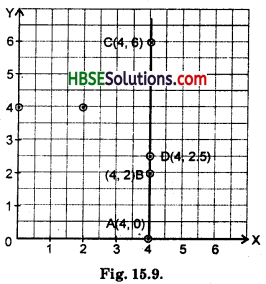
(a) A(4, 0), B(4, 2), C(4, 6), D(4, 2.5)
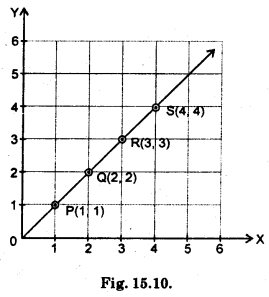
(b) P(1, 1), Q(2, 2), R(3, 3), S(4, 4)
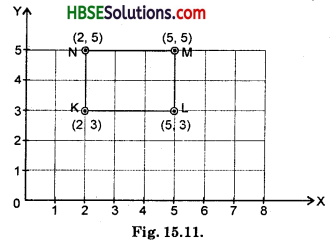
(c) K(2, 3), L(5, 3), M(5, 5), N(2, 5).
Solution:
(i) (a)
HBSE 8th Class Maths Solutions Chapter 15 Introduction to Graphs Ex 15.2 1
These points A, B, C and D lie on a line. The line is parallel to Y-axis.
(b)
HBSE 8th Class Maths Solutions Chapter 15 Introduction to Graphs Ex 15.2 2
These points P, Q, R and S lie on a line. The line is a straight line passing through the origin.
(c)
HBSE 8th Class Maths Solutions Chapter 15 Introduction to Graphs Ex 15.2 3
These do not lie on a line. They form a rectangle.

Question 2.
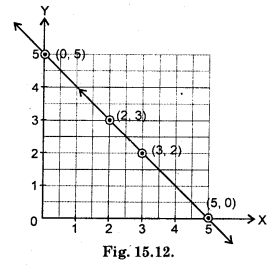
Draw the line passing through (2, 3) and (3, 2). Find the coordinates of the points at which this line meets the x-axis and y-axis.
Solution:
HBSE 8th Class Maths Solutions Chapter 15 Introduction to Graphs Ex 15.2 4
∴ Coordinates of the points at which this line meets the x-axis and y-axis are (5, 0) and (0, 5).

HBSE 8th Class Maths Solutions Chapter 15 Introduction to Graphs Ex 15.2

Question 3.
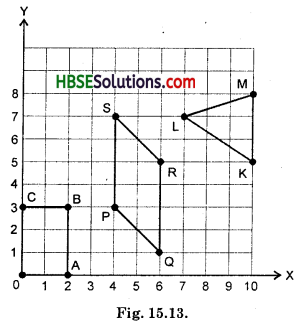
Write the coordinates of the vertices of each of these adjoining figures.
HBSE 8th Class Maths Solutions Chapter 15 Introduction to Graphs Ex 15.2 5
Solution:
Co-ordinates of the vertices of rectangle OABC are :
A(2, 0), B(2, 3), C(0, 3) and O(0, 0)
Coordinates of the vertices of parallelogram PQRS are :
P(4, 3), Q(6, 1), R(6, 5) and S(4, 7)
Coordinates of the vertices of △LMK are :
L(7, 7), M(10, 8) and K(10, 5).

HBSE 8th Class Maths Solutions Chapter 15 Introduction to Graphs Ex 15.2

Question 4.
State whether True or False. Correct that are false.
(i) A point whose x-coordinate is zero and y-coordinate is non-zero will lie on the y-axis.
(ii) A point whose y-coordinate is zero and x-coordinate is 5 will lie on y-axis.
(iii) The coordinates of the origin are (0, 0).
Solution:
(i) True.
(ii) False. A point whose y-coordinate is zero and x-coordinate is 5 will lie on x-axis.
(iii) True.

HBSE 8th Class Maths Solutions Chapter 15 Introduction to Graphs Ex 15.2 Read More »

HBSE 8th Class Maths Solutions Chapter 15 Introduction to Graphs Ex 15.1

Haryana State Board HBSE 8th Class Maths Solutions Chapter 15 Introduction to Graphs Ex 15.1 Textbook Exercise Questions and Answers.

Haryana Board 8th Class Maths Solutions Chapter 15 Introduction to Graphs Exercise 15.1

Question 1.
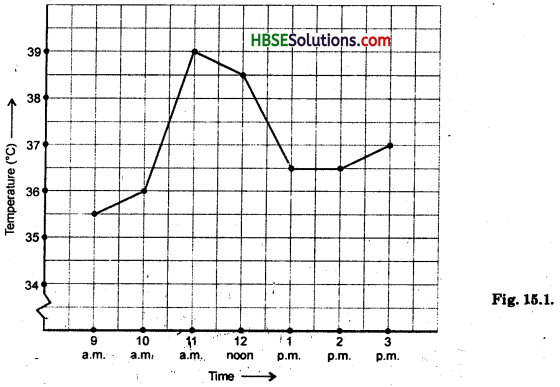
The following graph shows the temperature of a patient in a hospital, recorded every hour.
HBSE 8th Class Maths Solutions Chapter 15 Introduction to Graphs Ex 15.1 1
(a) What was the patient’s temperature at 1 p.m. ?
(b) When was the patient’s temperature 38.5°C ?
(c) The patient’s temperature was the same two times during the period given. What were these two times ?
(d) What was the temperature at 1.30 p.m. ? How did you arrive at your answer ?
(e) During which periods did the patients temperature showed an upward trend ?
Solution:
(a) The Patient’s temperature at 1 p.m. was 36.5°C.
(b) 12 noon.
(c) 1 p.m. and 2 p.m.
(d) The temperature at 1.30 p.m. was 36.5°. We observe the graph and finds that one fine indicates 30 minutes. So, taking a fine after 1 p.m. on X-axis move upward parallel to Y-axis where the line intersect the given line graph. It is obviously 36.5°C.
(e) 9 a.m. to 11 a.m.

Question 2.
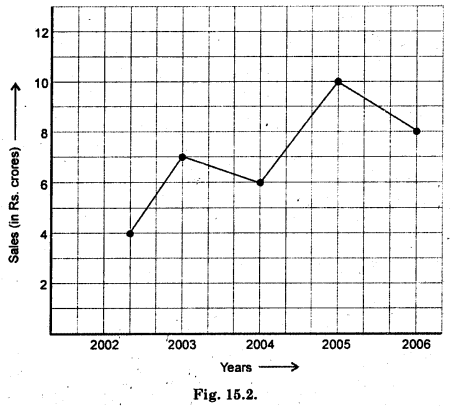
The following line graph shows the yearly sales figures for a manufacturing company.
(a) What were the sales in (i) 2002 (ii) 2006 ?
(b) What were the sales in (i) 2003 (ii) 2005 ?
(c) Compute the difference between the sales in 2002 and 2006.
(d) In which year was there the greatest difference between the sales as compared to its previous year ?
HBSE 8th Class Maths Solutions Chapter 15 Introduction to Graphs Ex 15.1 2
Solution:
(a) (i) Sales in 2002 = 4 crores
(ii) Sales, in 2006 = 8 crores
(b) (i) Sales in 2003 = 7 crores
(ii) Sales in 2005 = 10 crores
(c) The difference between the sales in 2002 and 2006 = 8 – 4 = 4 crores.
(d) The greatest difference between the sales as compared to its previous year in 2004 – 2005.

HBSE 8th Class Maths Solutions Chapter 15 Introduction to Graphs Ex 15.1

Question 3.
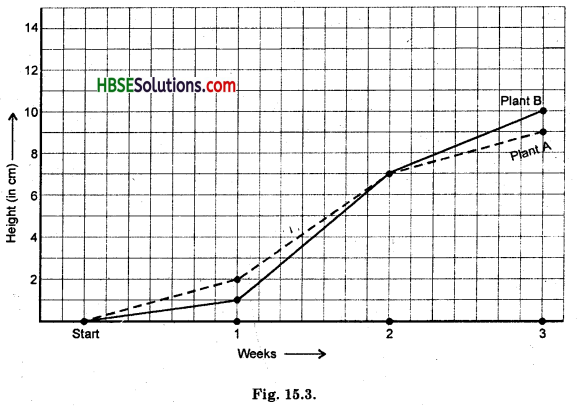
For an experiment in Botany, two different plants, plant A and plant B were grown under similar laboratory conditions. Their heights were measured at the end of each week for 3 weeks. The results are shown by the following graph.
HBSE 8th Class Maths Solutions Chapter 15 Introduction to Graphs Ex 15.1 3
(a) How high was Plant A after (i) 2 weeks (ii) 3 weeks ?
(b) How high was Plant B after (i) 2 weeks (ii) 3 weeks ?
(c) How much did Plant A grow during the 3rd week ?
(d) How much did Plant B grow from the end of the 2nd week to the end of the 3rd week ?
(e) During which week did Plant A grow most ?
(f) During which week did Plant B grow least ?
(g) Were the two plants of the same height during any week shown here ? Specify.
Solution:
(a) (i) Height of Plant A after 2 weeks = 7 cm
(ii) Height of Plant A after 3 weeks = 9 cm
(b) (i) Height of Plant B after 2 weeks = 7 cm
(ii) Height of Plant B after 3 weeks = 10 cm
(c) The Plant A grows during the 3rd week = 9 – 7 = 2 cm.
(d) The Plant B grows from the end of the 2nd week to the end of the 3rd week
= 10 cm – 7 cm = 3 cm.
(e) 2nd week.
(f) First week.
(g) Yes, the two plants have same height in the end of 2nd week.

Question 4.
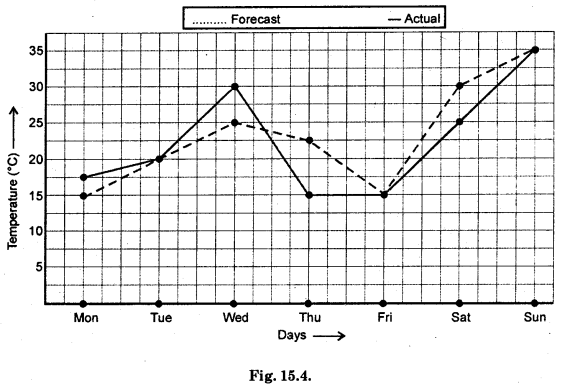
The following graph shows the temperature forecast and the actual temperature for each day of a week.
(a) On which days was the forecast temperature the same as the actual temperature ?
(b) What was the maximum forecast temperature during the week ?
(c) What was the minimum actual temperature during the week ?
(d) On which day did the actual temperature differ the most from the forecast temperature ?
HBSE 8th Class Maths Solutions Chapter 15 Introduction to Graphs Ex 15.1 4
Solution:
(a) Tuesday, Friday and Sunday.
(b) Sunday (35°C).
(c) 15°C.
(d) Thursday = 22.5°C – 15°C = 7.5°C.

HBSE 8th Class Maths Solutions Chapter 15 Introduction to Graphs Ex 15.1

Question 5.
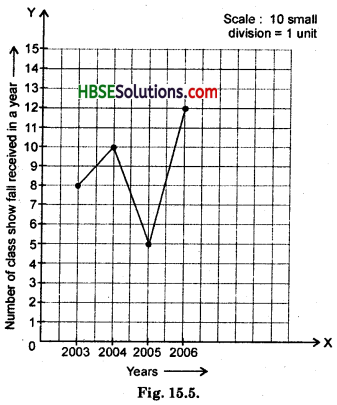
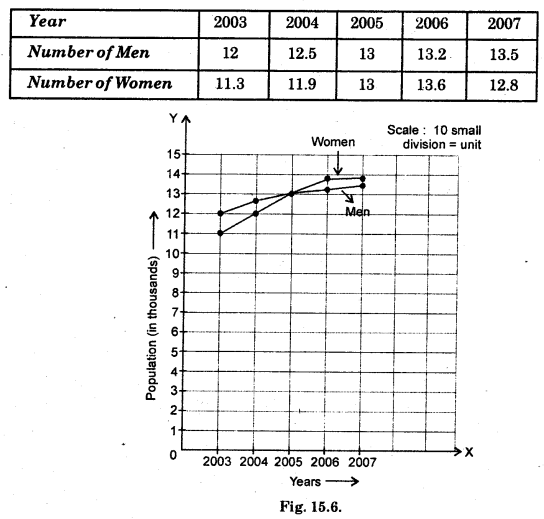
Use the tables below to draw linear graphs :
(a) The number of days a hill side city received snow in different years.
HBSE 8th Class Maths Solutions Chapter 15 Introduction to Graphs Ex 15.1 5
(b) Population (in thousands) of men and women in a village in different years.
HBSE 8th Class Maths Solutions Chapter 15 Introduction to Graphs Ex 15.1 6
Solution:
(a) Show fall received in different days during the years in a hill side city.
HBSE 8th Class Maths Solutions Chapter 15 Introduction to Graphs Ex 15.1 7
HBSE 8th Class Maths Solutions Chapter 15 Introduction to Graphs Ex 15.1 8
(b) Population in village (in thousands)
HBSE 8th Class Maths Solutions Chapter 15 Introduction to Graphs Ex 15.1 9

Question 6.
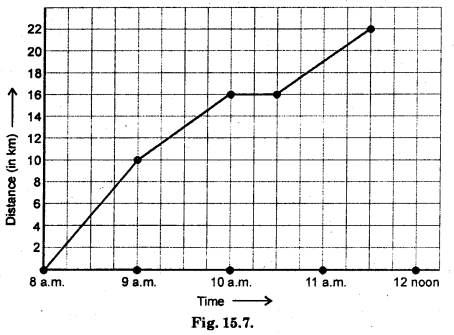
A courier-person cycles from a town to a neighbouring suburban area to deliver a parcel to a merchant. His distance from the town at different times is shown by the following graph :
(a) What is the scale taken for the time axis ?
(b) How much time did the person take for the travel ?
(c) How far is the place of the merchant from the town ?
(d) Did the person stop on his way ? Explain.
(e) During which period did he ride fastest ?
HBSE 8th Class Maths Solutions Chapter 15 Introduction to Graphs Ex 15.1 10
Solution:
(a) 4 small division = 1 hour
Let the 4 small division = 1 cm
∴ 1 cm = 1 hour
(b) 3 hour 30 minutes or 3.30 hour
(c) 22 km
(d) Yes, he stops between 10 a.m. to 10.30 a.m. because the distance is not changing with the change in time. In other words, we can say that the person is at rest. Hence, if a body remains at rest the graph of its motion is a straight line parallel to time-axis i.e. x-axis.
(e) Between 8 a.m. to 9 a.m.

HBSE 8th Class Maths Solutions Chapter 15 Introduction to Graphs Ex 15.1

Question 7.
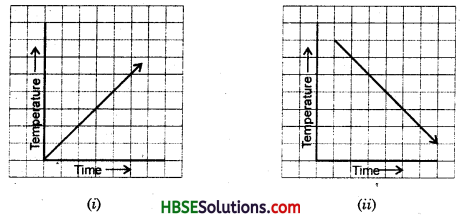
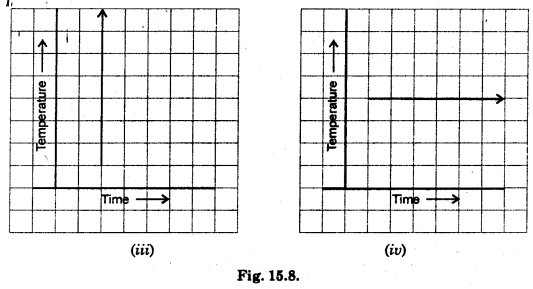
Can there be a time-temperature graph as follows ? Justify your answer.
HBSE 8th Class Maths Solutions Chapter 15 Introduction to Graphs Ex 15.1 11
HBSE 8th Class Maths Solutions Chapter 15 Introduction to Graphs Ex 15.1 12
Solution:
(i) Yes, it may be a time-temperature graph because with change in time temperature may increase for example, during day time in summer.
(ii) Yes, it may be possible that with change in time temperature may fall uniformaly. For example, during night in winter.
(iii) No, it can not be a time-temperature graph. Here, temperature is changing without any change of time, which is impossible.
(iv) No, temperature cannot be constant with change in time. However, it may be possible for a short span of time.

HBSE 8th Class Maths Solutions Chapter 15 Introduction to Graphs Ex 15.1 Read More »

HBSE 8th Class Maths Solutions Chapter 14 Factorization InText Questions

Haryana State Board HBSE 8th Class Maths Solutions Chapter 14 Factorization InText Questions and Answers.

Haryana Board 8th Class Maths Solutions Chapter 14 Factorization InText Questions

Try These (Page 219)

Question 1.
Factorise :
(i) 12x + 36
(ii) 22y – 33z
(iii) 14 pq + 35 pqr
Solution:
(i) 12x + 36 = 12(x + 3)
(ii) 22y – 33z = 11 (2y + 3z)
(iii) 14 pq + 35pqr = 7pq (2 + 5r)

HBSE 8th Class Maths Solutions Chapter 14 Factorization InText Questions

Try These (Page 225)

Question 1.
Divide:
(i) 24xy2z3 by 6yz2
(ii) 63a2b4c6 by 7a2b2c2
Solution:
(i) 24xy2z3 + 6yz2
= \(\frac{4 \times 6 \times x \times y \times y \times z \times z^{2}}{6 \times y \times z^{2}}\)
= 4 × x × y × z
= 4xyz

(ii) 63a2b4c6 ÷ 7a2b2c3
= \(\frac{7 \times 9 \times a^{2} \times b^{2} \times b^{2} \times c^{3} \times c^{2}}{7 \times a^{2} \times b^{2} \times c^{3}}\)
= 9 x b2 x c3 = 9b2c3

HBSE 8th Class Maths Solutions Chapter 14 Factorization InText Questions Read More »

HBSE 8th Class Maths Solutions Chapter 14 Factorization Ex 14.4

Haryana State Board HBSE 8th Class Maths Solutions Chapter 14 Factorization Ex 14.4 Textbook Exercise Questions and Answers.

Haryana Board 8th Class Maths Solutions Chapter 14 Factorization Exercise 14.4

Find the correct the errors in the following matematical statements :
1. 4(x – 5) = 4x – 5
2. x(3x + 2) = 3x2 + 2
3. 2x + 3y = 5xy
4. x + 2x + 3x = 5x
5. 5y + 2y + y – 7y = 0
6. 3x + 2x = 5x2
7. (2x)2 + 4(2x) + 7 = 2x2 + 8x + 7
8. (2x)2 + 5x = 4x + 5x = 9x
9. (3x + 2)2 = 3x2 + 6x + 4
10. Substituting x = -3 in
(a ) x2 + 5x + 4 gives (-3)2 + 5(-3) + 4 =
9 + 2 + 4 = 15
(b) x2 – 5x + 4 gives (-3)2 – 5(-3) + 4 =
9 – 15 + 4 = -2
(c) x2 + 5x gives (-3)2 + 5(-3) = – 9 – 15 = -24
11. (y – 3)2 = y2 – 9
12. (z + 5)2 = z2 + 25
13. (2a + 3b) (a – b) = 2a2 – 3b2
14. (a + 4) (a + 2) = a2 + 8
15. (a – 4) (a – 2) = a2 – 8
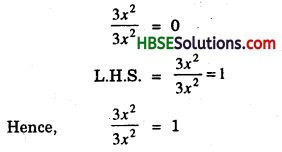
16. \(\frac{3 x^{2}}{3 x^{2}}\) = 0
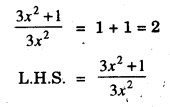
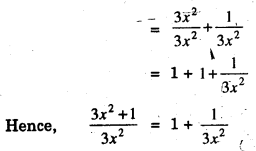
17. \(\frac{3 x^{2}+1}{3 x^{2}}\) = 1 + 1 = 2
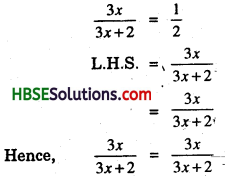
18. \(\frac{3 x}{3 x+2}\) = \(\frac{1}{2}\)
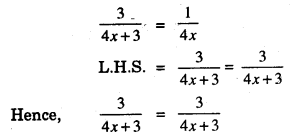
19. \(\frac{3}{4 x+3}\) = \(\frac{1}{4x}\)
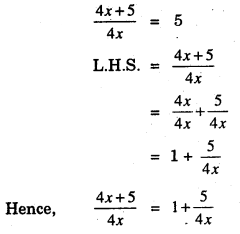
20. \(\frac{4 x+5}{4 x}\) = 5
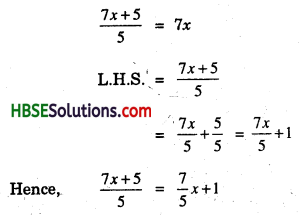
21. \(\frac{7 x+5}{5}\) = 7x.
Solution:
4(x – 5) = 4x – 5
L.H.S. = 4(x – 5)
= 4x – 20
Hence, 4(x – 5) = 4x – 20

2. x(3x + 2) = 3x2 + 2
L.H.S. = x(3x + 2)
= 3x2 + 2x .
Hence, x(3x + 2) = 3x2 + 2x

3. 2x + 3y = 5x
L.H.S. = 2x + 3y
Hence, 2x + 3y = 2x + 3y or 3y + 2x

HBSE 8th Class Maths Solutions Chapter 14 Factorization Ex 14.4

4. x + 2x + 3x = 5x
L.H.S. = x + 2x + 3x
= 6x
Hence, x + 2x + 3x = 6x

5. 5y + 2y + y – 7y = 0
L.H.S. = 5y + 2y + y – 7y
= 7y – 7y + y
= y
Hence, 5y + 2y + y – 7y = y

6. 3x + 2x = 5x2
L.H.S. = 3x + 2x = 5x
Hence, 3x + 2x = 5x

7. (2x)2 + 4 (2x) + 7 = 2x2 + 8x + 7
L.H.S: = (2x)2 + 4 (2x) + 7
= 4x2 + 8x + 7
Hence,
(2x)2 + 4(2x) + 7 = 4x2 + 8x + 7

HBSE 8th Class Maths Solutions Chapter 14 Factorization Ex 14.4

8. (2x)2 + (5x) = 4x + 5x = 9x
L.H.S. = (2x)2 + (5x)
= 4x2 + 5x
Hence, (2x)2 + (5x) = 4x2 + 5x

9. (3x + 2)2 = 3x2 + 6x + 4
L.H.S. = (3x + 2)2
= (3x)2 + 2 × 3x × 2 + (2)2
[∵ (a + b)2 = a2 + 2ab + b2]
= 9x2 + 12x + 4
Hence, (3x + 2)2 = 9x2 + 12x + 4

10 (a). If x = -3
x2 + 5x + 4 gives (-3)2 + 5 (-3) + 4
= 9 + 2 + 4 = 15
L.H.S. = x2 + 5x + 4
= (-3)2 + 5 × (-3) + 4
= 9 + (-15) + 4
= 13 – 15 = -2
Hence, x2 + 5x + 4 = -2

(b) If x = -3
x2 – 5x + 4 = (-3)2 + 5 (-3) + 4
= 9 + 15 + 4 = 28

(c) If x = -3
x2 + 5x = =(-3)2 + 5(-3)
= 9 + (-15)
= 9 – 15 = -6

HBSE 8th Class Maths Solutions Chapter 14 Factorization Ex 14.4

11. (y – 3)2 = y2 – 9
= y2 – 2 × y × 3 + (3)2
[∵ (a – b)2 = a2 – 2ab + b2]
= y2 – 6y + 9
Hence, (y – 3)2 = y2 – 6y + 9

12. (z + 5)2 = z2 + 25
L.H.S. = (z + 5)2
= (z)2 + 2 × z × 5 + (5)2
= z2 + 10z + 25
Hence, (z + 5)2 = z2 + 10z + 25

13. (2a + 3b) (a – b) = 2a2 – 3b2
L.H.S. = (2a + 3b) (a – b)
= 2a2 – 2ab + 3ab – 3b2
= 2a2 – ab – 3b2
Hence, (2a + 3b) (a – b) = 2a2 + ab – 3b2.

14. (a + 4)(a + 2) = a2 + 8
(a + 4)(a + 2) = a2 + 8
L.H.S. = (a + 4)(a + 2)
= a2 + 2a + 4a + 8
= a2 + 6a + 8
Hence, (a + 4) (a + 2) = a2 + 6a + 8

HBSE 8th Class Maths Solutions Chapter 14 Factorization Ex 14.4

15. (a – 4)(a – 2) = a2 – 8
L.H.S. = (a – 4)(a – 2)
= a2 – 2a – 4a + 8
= a2 – 6a + 8
Hence, (a – 4) (a – 2) = a2 – 6a + 8.

16.
HBSE 8th Class Maths Solutions Chapter 14 Factorization Ex 14.4 1

17.
HBSE 8th Class Maths Solutions Chapter 14 Factorization Ex 14.4 2
HBSE 8th Class Maths Solutions Chapter 14 Factorization Ex 14.4 3

18.
HBSE 8th Class Maths Solutions Chapter 14 Factorization Ex 14.4 4

19.
HBSE 8th Class Maths Solutions Chapter 14 Factorization Ex 14.4 5

20.
HBSE 8th Class Maths Solutions Chapter 14 Factorization Ex 14.4 6

HBSE 8th Class Maths Solutions Chapter 14 Factorization Ex 14.4

21.
HBSE 8th Class Maths Solutions Chapter 14 Factorization Ex 14.4 7

HBSE 8th Class Maths Solutions Chapter 14 Factorization Ex 14.4 Read More »

HBSE 8th Class Maths Solutions Chapter 14 Factorization Ex 14.3

Haryana State Board HBSE 8th Class Maths Solutions Chapter 14 Factorization Ex 14.3 Textbook Exercise Questions and Answers.

Haryana Board 8th Class Maths Solutions Chapter 14 Factorization Exercise 14.3

Question 1.
Carry out the following-divisions :
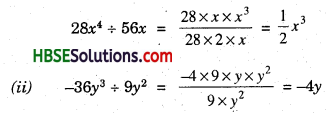
(i) 28x4 ÷ 56x
(ii) -36y3 ÷ 9y2
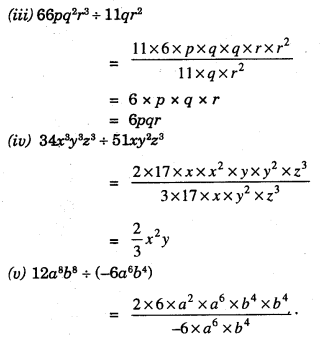
(iii) 66pq2r3 ÷ 11qr2
(iv) 34x3y3z2 ÷ 51xy2z3
(v) 12a8b8 ÷ (-6a6b4)
Solution:
HBSE 8th Class Maths Solutions Chapter 14 Factorization Ex 14.3 1
HBSE 8th Class Maths Solutions Chapter 14 Factorization Ex 14.3 2

Question 2.
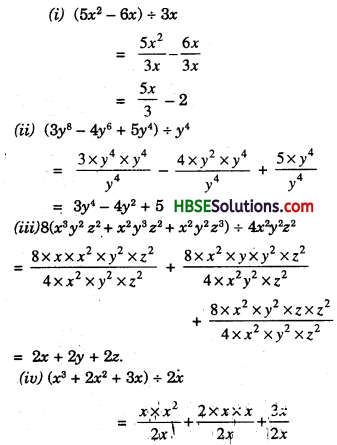
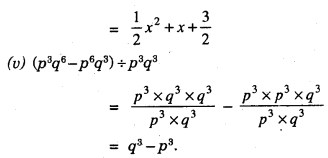
Divide the given polynomial by the given monomial.
(i) (5x2 – 6x) ÷ 3x
(ii) (3y8 – 4y6 + 5y4), y4
(iii) 8 (x4y2z2 + x2y3z2 + x2y2z2)
(iv) 9x2y2(3z – 24) ÷ 27xy(z – 8)
(v) 96abc(3a – 12) (5b – 30) ÷ 144 (a – 4) (b – 6)
Solution:
HBSE 8th Class Maths Solutions Chapter 14 Factorization Ex 14.3 3
HBSE 8th Class Maths Solutions Chapter 14 Factorization Ex 14.3 4

HBSE 8th Class Maths Solutions Chapter 14 Factorization Ex 14.3

Question 3.
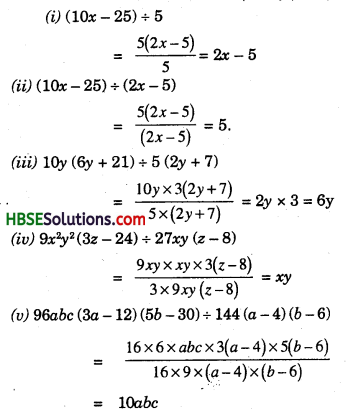
Work out the following divisions :
(i) (10x – 25) ÷ 5
(ii) (10x – 25) ÷ (2x – 5)
(iii) 10y(6y + 21) ÷ 5(2y + 7)
(iv) 9x2y2(3z – 24) ÷ 27xy (z – 8)
(v) 96abc (3a -12) (5b – 30) ÷ 144 (a – 4) (b – 6)
Solution:
HBSE 8th Class Maths Solutions Chapter 14 Factorization Ex 14.3 5

Question 4.
Divide as directed :
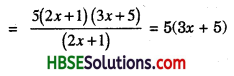
(i) 5(2x + 1) (3x + 5) ÷ (2x + 1)
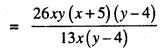
(ii) 26xy (x + 5) (y – 4) ÷ 13x (y – 4)
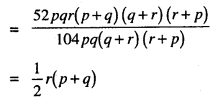
(iii) 52pqr (p + q) (q + r) (q + p) ÷ 104pq (q + r) (r + p)
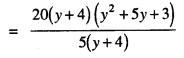
(iv) 20 (y + 4) (y2 + 5y + 3) ÷ 5(y + 4)
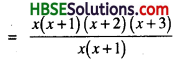
(v) x(x + 1) (x + 2) (x + 3) ÷ x(x + 1)
Solution:
(i) 5(2x + 1) (3x + 5) ÷ (2x + 1)
HBSE 8th Class Maths Solutions Chapter 14 Factorization Ex 14.3 6
(ii) 26xy (x + 5) (y – 4) ÷ 13x (y – 4)
HBSE 8th Class Maths Solutions Chapter 14 Factorization Ex 14.3 7
(iii) 52pqr (p + q) (q + r) (r + p) ÷ 104pq (q + r) (r + p)
HBSE 8th Class Maths Solutions Chapter 14 Factorization Ex 14.3 8
= 4(y2 + 5y + 3)
(iv) 20 (y + 4) (y2 + 5y + 3) ÷ 5 (y + 4)
HBSE 8th Class Maths Solutions Chapter 14 Factorization Ex 14.3 16
(v) x(x + 1) (x + 2) (x + 3) ÷ x(x + 1)
HBSE 8th Class Maths Solutions Chapter 14 Factorization Ex 14.3 9
= (x + 2) (x + 3)

HBSE 8th Class Maths Solutions Chapter 14 Factorization Ex 14.3

Question 5.
Factorise the expression and divide them as directed :
(i) (y2 + 7y + 10) ÷ (y + 5)
(ii) (m2 – 14m – 32) ÷ (m + 2)
(iii) (5p2 – 25p + 20) ÷ (p – 1)
(iv) 4yz (z2 + 6z – 16) ÷ 2y (z + 8)
(v) 5pq(p2 – q2) ÷ 2p(p + q)
(vi) 12xy(9x2 – 16y2) ÷ 4xy(3x + 4y)
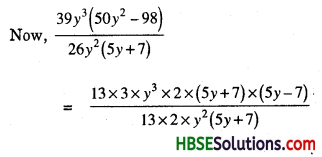
(vii) 39y3(50y2 – 98) ÷ 26y2(5y + 7)
Solution:
(i) (y2 + 7y + 10) , (y + 5)
y2 + 7x + 10 = y2 + 5 + 2 + 10
= (y + 5) + 2(y + 5)
= (y + 5) (y + 2)

(ii) (m2 – 14m – 32) ÷ (m + 2)
m2 – 14m – 32 = m2 – 16m + 2m – 32
= m (m – 16) + 2 (m – 16)
= (m – 16) (m + 2)
HBSE 8th Class Maths Solutions Chapter 14 Factorization Ex 14.3 10

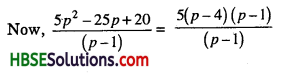
(iii) (5p2 – 25p + 20) ÷ (p – 1)
5p2 – 25p + 20 = 5p2 – 20p – 5p + 20
= 5p (p – 4) – 5(p – 4)
= (p – 4) (5p – 5)
= (p – 4) × 5(p – 1)
= 5 (p – 4) (p – 1)
HBSE 8th Class Maths Solutions Chapter 14 Factorization Ex 14.3 11
= 5 (p – 4)

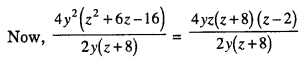
(iv) 4yz(z2 + 6z – 16) ÷ 2y (z + 8)
z2 + 6z – 16 = z2 + 8z – 2z – 16
= z(z + 8) – 2 (2 + 8)
= (z + 8) (z – 2)
HBSE 8th Class Maths Solutions Chapter 14 Factorization Ex 14.3 12
= 2z(z – 2)

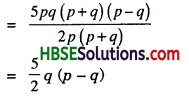
(v) 5pq(p2 – q2) ÷ 2p(p + q)
HBSE 8th Class Maths Solutions Chapter 14 Factorization Ex 14.3 13

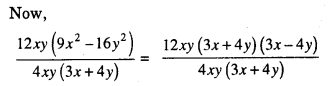
(vi) 12xy (9x2 – 16y2) + 4xy (3x + 4y)
9x2 – 16y2 = (3x)2 – (4y)2
= (3x + 4y) (3x – 4y)
HBSE 8th Class Maths Solutions Chapter 14 Factorization Ex 14.3 14
= 3(3x – 4y)

(vii) 39y3(50y2 – 98) + 26y2(5y + 7)
50y2 – 98 = 2(25y2 – 49)
= 2(5y)2 – (7)2]
= 2(5y + 7) (5y – 7)
HBSE 8th Class Maths Solutions Chapter 14 Factorization Ex 14.3 15
= 3y(5y – 7)

HBSE 8th Class Maths Solutions Chapter 14 Factorization Ex 14.3 Read More »

HBSE 8th Class Maths Solutions Chapter 14 Factorization Ex 14.2

Haryana State Board HBSE 8th Class Maths Solutions Chapter 14 Factorization Ex 14.2 Textbook Exercise Questions and Answers.

Haryana Board 8th Class Maths Solutions Chapter 14 Factorization Exercise 14.2

Question 1.
Factorise the following expressions :
(i) a2 + 8a + 16
(ii) p2 – 10p + 25
(iii) 25m2 + 30m + 9
(iv) 49 y2 + 84yz + 36z2
(v) 4x2 – 8x + 4
(vi) 121b2 – 88bc + 16c2
(vii) (l + m)2 – 4lm
[HintExpand (l + m)2 First]
(viii) a4 + 2a2b2 + b4
Solution:
(i) a2 + 8a + 16
= a2 + 4a + 4a + 16
= a (a + 4) + 4 (a + 4)
= (a + 4) (a + 4)

(ii) p2 – 10p + 25
= p2 – 5p – 5p + 25
= p(p – b) – 5(p – 5)
= (p – 5)(p – b)

(iii) 25m2 + 30m + 9
= 25m2 + 15m + 15m + 9
= 5m (5m + 3) + 3 (5m + 3)
= (5m + 3) (5m + 3)

(iv) 49y2 + 84yz + 36z2
= 49y2 + 42yz + 42yz + 36z2
= 7y (7y + 6z) + 6z (7y + 6z)
= (7y + 6z) (7y + 6z)

(v) 4x2 – 8x + 4
= 4x2 – 4x – 4x + 4
= 4x (x – 1) – 4(x – 1)
= (x – 1) (4x – 4)

(vi) 121b2 – 88bc + 16c2
= 121b2 – 44bc – 44bc +16c2
= 11b (11b – 4c) – 4c(11b – 4c)
= (11b – 4c) (11b – 4c)

(vii) (l + m)2 – 4lm
= l2 + 2lm + m2 – 4lm
= l2 – 2lm + m2
= l2 – lm – lm + m2
= l (l – m) – m(l – m)
= (l – m)(l – m)

(viii) a4 + 2a2b2 + b4
= a4 + a2b2 + a2b2 + b4
= a2(a2 + b2) + b2(a2 + b2)
= (a2 + b2) (a2 + b2)

HBSE 8th Class Maths Solutions Chapter 14 Factorization Ex 14.2

Question 2 .
Factorise;
(i) 4p2 – 9q2
(ii) 63a2 -112b2
(iii) 49x2 – 36
(iv) 16x5 – 144x3
(v) (l + m)2 (l – m)2
(vi) 9x2y2 – 16
(vii) (x2 – 2xy + y2)
(viii) 25a2 – 4b2 + 28bc – 49c2
Solution:
(i) ∵ a2 – b2 = (a + b)(a – b)
∴ 4p2 – 9q2 = (2p)2 – (3q)2
= (2p + 3q) (2p – 3q)2

(ii) 63a2 – 112b2 = 7(9a2 – 16b2)
= 7[(3a)2 – (4b)2]
= 7[(3a + 4b) (3a – 4b)]
= 7 (3a + 4b) (3a – 4b)

(iii) 49x2 – 36 = (7x)2 – (6)2
= (7x + 6) (7x – 6)

(iv) 16x5 – 144x3 = x (16x4 – 144x2)
= x [(4x2)2 – (12x)2]
= x [(4x2 + 12x) (4x2 – 12x)]
= x (4x2 + 12x) (4x2 – 12x)

(v) (l + m)2 -(l – m)2
= [{(l + m) + (l – m)} – {(l + m) – (l – m)}]
= [{l + m + l – m}{l + m – l + m}]
= 2l × 2m = 4lm

(vi) 9x2y2 – 16 = (3xy)2 – (4)2
= (3xy + 4) (3xy – 4)

(vii) (x2 – 2xy + y2) – z2
= (x – y)2 – z2
= (x – y + z) (x – y – z)

(viii) 25a2 – 4b2 + 28bc – 49c2
= 25a2 – (4b2 – 28bc + 49c2)
= (5a)2 – [(26)2– 2 x 2b x 7c + (7c)2]
= (5a)2 – (2b – 7c)2
= [(5a) (2b – 7c)] [(5a) – (2b – 7c)]
= (5a + 2b – 7c) (5a – 2b + 7c)

HBSE 8th Class Maths Solutions Chapter 14 Factorization Ex 14.2

Question 3.
Factorise the expressions:
(i) ax2 + 6x
(ii) 7p2 + 21q2
(iii) 2x3 + 2xy2 + 2xz2
(iv) am2 + bm2 + bn2 + an2
(v) (lm + l) + m + 1
(vi) y(y + z) + 9 (y + z)
(vii) 5y2 – 20y – 8z + 2yz
(viii) 10ab + 4a + 5b + 2
(ix) 6xy – 4y + 6 – 9x
Solution:
(i) ax2 + bx = x (ax + b)
(ii) 7p2 + 21q2 = 7(p2 + 3q2)
(iii) 2x3 + 2xy2 + 2xz2 = 2x(x2 + y2 + z2)

(iv) am2 + 6m2 + bn2 + an2
= m2(a + b) + n2(b + a)
= m2(a + b) + n2(a + b)
= (a + b) (m2 + n2)

(v) (lm + l) + m + 1
= l(m + 1) + 1 (m + 1)
= (m + 1) (l + 1)

(vi) y(y + z) + 9(y + z)
= (y + z)(y + 9)

(vii) 5y2 – 20y – 8z + 2yz
= 5y2 – 20y + 2yz – 8z
= 5y (y – 4) + 2z (y – 4)
= (y – 4) (5y + 2z)

(viii) 10ab + 4a + 5b + 2
= 2a (5b + 2) + 1(5b + 2)
= (5b + 2) (2a + 1)

(ix) 6xy – 4y + 6 – 9x
= 6xy – 4y – 9x + 6
= 2y (3x – 2) – 3(3x – 2)
= (3x – 2) (2y – 3).

HBSE 8th Class Maths Solutions Chapter 14 Factorization Ex 14.2

Question 4.
Factorise :
(i) a4 – b4
(ii) p4 – 81
(iii) x4 – (y + z)4
(iv) x4 – (x – z)4
(v) a4 – 2a2b2 + b4
Solution:
(i) a4 – b4 = (a2)2 – (b2)2
= (a2 + b2) (a2 – b2)

(ii) p4 – 81 = (p2)2 – (9)2
= (p2 + 9) (p2 – 9)

(iii) x4 – (y + z)4
= (x2)2 – [(y + z)2]2
= [x2 + (y + z)2] [x2 – (y + z)2]
= (x2 + y2 + 2yz + z2) [(x2 – (y2 + 2yz + z2)]
= (x2 + y2 + z2 + 2yz) (x2 – y2 – z2 – 2yz)

(iv) x4 – (x – z)4
= (x2)2 – [(x – z)2]2
= [x2 + (x – z)2] [x2 – (x – z)2]
= (x2 + x2 – 2xz + z2) [x2(x2 – 2xz + z)2]
= (2x2 + z2 – 2xz) (x2 – x2 + 2xz – z2)
= (2x2 + z2 – 2xz) (2xz – z2)

(v) a4 – 2a2b2 + b4 = (a2)2 – 2a2b2 + (b2)2
= (a2 – b2)2
= (a2 – b2) (a2 – b2)
= (a + b) (a – b) (a + b) (a – b)
= (a + b)2 (a – b)2

Question 5.
Factorise the following expressions:
(i) p2 + 6p + 8
(ii) q2 – 10q + 21
(iii) p2 + 6p – 16
Solution:
(i) p2 + 6p + 8
= p2 + 2 × p × 3 + 9 – 1
= p2 + 2 × p × 3 + (3)2 – 1
= (p + 3)2 – 1
[∵ a2 + 2ab + b2 = (a + b)2]
= (p + 3)2 – (1)2
[∵ a2 – b2 = (a + b) (a – b)]
= (p + 3 + 1)(p + 3 – 1)
= (p + 4) (p + 2)

HBSE 8th Class Maths Solutions Chapter 14 Factorization Ex 14.2

(ii) q2 – 10q + 21
= q2 – 2 × q × 5+ (5)2 – 4
= (q – 5)2 – (2)2
[∵ a2 – 2ab + b2 = (a – b)2 ]
= (q – 5 + 2) × (q – 5 – 2)
[∵ a2 – b2 = (a + b) (a – b)
= (q – 3)(q – 7)

(iii) p2 + 6p – 16
= p2 + 2 × p × 3 + (3)2 – 25
= (p + 3)2 – (5)2
= (p + 3 + 5)(p + 3 – 5)
= (p + 8)(p – 2)

HBSE 8th Class Maths Solutions Chapter 14 Factorization Ex 14.2 Read More »

HBSE 8th Class Maths Solutions Chapter 14 Factorization Ex 14.1

Haryana State Board HBSE 8th Class Maths Solutions Chapter 14 Factorization Ex 14.1 Textbook Exercise Questions and Answers.

Haryana Board 8th Class Maths Solutions Chapter 14 Factorization Exercise 14.1

Question 1.
Find the common factors of the given terms:
(i) 12x, 36
(ii) 2y, 22xy
(iii) 14pq, 28 p2q2
(iv) 2x, 3x2, 4
(v) 6abc, 24 ab2, 12a2b
(vi) 16x3, -4x2, 32x
(vii) 10pq, 20qr, 30rp
(viii) 3x2y3, 10x3y2, 6x2y2z
Solution:
(i) 12x = 2 × 2 × 3 × x
36 = 2 × 2 × 3 × 3
∴ Highest common factor, HCF = 2 × 2 × 3 = 12

(ii) 2y = 2 × y
22xy = 2 × 11 × x × y
∴ HCF = 2 × y = 2y

(iii) 14pq = 2 × 7 × p x q
28 p2q2 = 2 × 2 × 7 × p × p × q × q
∴ HCF = 2 × 7 × p × q = 14 pq

HBSE 8th Class Maths Solutions Chapter 14 Factorization Ex 14.1

(iv) 2x = 2 × x
3x2 = 3 × x × x
4 = 2 × 2
∴ HCF = 1

(v) 6abc = 2 × 3 × a × b × c
24 ab2 = 2 × 2 × 2 × 3 × a × b × b
12a2b = 2 × 2 × 3 × a × a × b
∴ HCF = 2 × 3 × a × b
= 6ab

(vi) 16x3 = 2 × 2 × 2 × 2 × x × x × x
-4x2 = (-2) × 2 × x
32x = 2 × 2 × 2 × 2 × 2 × x
∴ HCF = 2 × 2 × x
= 4x

(vii) 10pq = 2 × 5 × p × q
20qr = 2 × 2 × 5 × q × r
30rp = 2 × 3 × 5 × r × p
∴ HCF = 2 × 5
= 10

HBSE 8th Class Maths Solutions Chapter 14 Factorization Ex 14.1

(viii) 3x2y3 = 3 × x × x × y × y × y
10 x3 y22 = 2 × 5 × x × x × x y × y
6x2y2z = 2 × 3 × x × x × y × y × z
∴ HCF = x × x × y × y
= x2y2

Question 2.
Factorise the following ex-pressions
(i) 7x – 42
(ii) 6p – 12q
(iii) 7a2 + 14a
(iv) -16z + 20z3
(v) 20l2m + 30alm
(vi) 5x2y – 15xy2
(vii) 10a2 – 15b2 + 20c2
(viii) -4a2 + 4ab – 4ca
(ix) x2yz + xy2z + xyz2
(x) ax2y + bxy2 + cxyz
Solution:
(i) 7a – 42 = 7(x – 6)
(ii) 6p – 12q = 6 (p – 2q)
(iii) 7a2 + 14a = 7a (a + 2)
(iv) -16z + 20z3 = 42 (-4z + 5z2)
= 4z (5z2 – 4z)
(v) 20l2m + 30alm = 10lm (2l + 3a)
(vi) 5x2y – 15xy2 = 5xy (x – 3y)
(vii) 10a2 – 15b2 + 20c2 = 5 (2a2 – 3b2 + 4c2)
(viii) -4a2 + 4ab – 4ca = 4a(-a + b – c)
(ix) x2yz + xy2z + xyz2 = xyz (x + y + z)
(x) ax2y + bxy2 + cxyz = xy (ax + by + cz)

HBSE 8th Class Maths Solutions Chapter 14 Factorization Ex 14.1

Question 3.
Factorise:
(i) x2 + xy + 8x + 8y
(ii) 15xy – 6x + 5y – 2
(iii) ax + bx – ay – by
(iv) 15pq + 15 + 9q + 25p
(v) z – 7 + 7xy – xyz
Solution:
(i) x2 + xy + 8x + By
= x (x + y) + 8 (x + y)
= (x + y)(x + 8)

(ii) 15xy – 6x + 5y – 2
= 3x (5y – 2) + 1 (5y – 2)
= (5y – 2) (3x + 1)

(iii) ax + bx – ay – by
= x(a + b) – y (a + b)
= (a + b) (x – y)

(iv) 15pq + 15 + 9q + 25p
= 15pq + 9q + 25p + 15
= 3q + (5p + 3) + 5 (5p + 3)
= (5p + 3) (3q + 5)

(v) z – 7 + 7xy – xyz
= z – 7 – xyz + 7xy
= 1 (z – 7) – xy (z – 7)
= (z – 7)(1 – xy)

HBSE 8th Class Maths Solutions Chapter 14 Factorization Ex 14.1 Read More »

HBSE 8th Class Maths Solutions Chapter 13 Direct and Inverse Proportions InText Questions

Haryana State Board HBSE 8th Class Maths Solutions Chapter 13 Direct and Inverse Proportions InText Questions and Answers.

Haryana Board 8th Class Maths Solutions Chapter 13 Direct and Inverse Proportions InText Questions

Try These (Page 204)

Question 1.
Observe the following tables and find if x and y are directly proportional.
HBSE 8th Class Maths Solutions Chapter 13 Direct and Inverse Proportions InText Questions 1
Solution:
\(\frac{x}{y}\) = \(\frac{x_{1}}{y_{1}}\) = \(\frac{x_{2}}{y_{2}}\) ………..
HBSE 8th Class Maths Solutions Chapter 13 Direct and Inverse Proportions InText Questions 2

Question 2.
Principal = Rs. 1000, Rate = 8% per annum. Fill in the following table and find which type of interest (simple or compound) changes in direct proportion with time period.
HBSE 8th Class Maths Solutions Chapter 13 Direct and Inverse Proportions InText Questions 3
Solution:
HBSE 8th Class Maths Solutions Chapter 13 Direct and Inverse Proportions InText Questions 4

HBSE 8th Class Maths Solutions Chapter 13 Direct and Inverse Proportions InText Questions

Try These (Page 211)

Question 3.
Observe the following tables and find which pair of variables (here x and y) are in inverse proportion.
HBSE 8th Class Maths Solutions Chapter 13 Direct and Inverse Proportions InText Questions 5
Solution:
(i) Two quantities are said to vary inversely if the increase in one quantity causes the decrease in the other quantity.
In this case if y1, y2 are the values of y corresponding to the values x1, x2 of x respectively then
x1y1 = x2y2
\(\frac{x_{1}}{x_{2}}\) = \(\frac{y_{1}}{y_{2}}\)
x × y = x1y1 = x2y2 = ………
x × y ≠ 50 × 5 ≠ 40 × 6 ≠ 30 × 7 ≠ 20 × 8
Hence, table (i) is not inversely proportional.

(ii) x × y = x1 × y1 = x2 × y2
= x3 × y3…………
= 100 × 60 = 200 × 30
= 300 × 20 = 400 × 15
= 600 = 6000 = 6000 = 6000
Hence table (ii) is inversely proportional.

HBSE 8th Class Maths Solutions Chapter 13 Direct and Inverse Proportions InText Questions

(iii) x × y = x1y1= x2 × y2 = x3 × y3 = ……..
= 90 × 10 = 60 × 15
= 45 × 20 = 30 × 25
= 20 × 30 = 5 × 35
= 900 = 900 = 900 ≠ 750
≠ 600 ≠ 175
Hence, in table (iii) 90, 10; 60, 15; 45, 20 are inversely proportion but other are not inversely proportional.

HBSE 8th Class Maths Solutions Chapter 13 Direct and Inverse Proportions InText Questions Read More »

HBSE 8th Class Maths Solutions Chapter 13 Direct and Inverse Proportions Ex 13.2

Haryana State Board HBSE 8th Class Maths Solutions Chapter 13 Direct and Inverse Proportions Ex 13.2 Textbook Exercise Questions and Answers.

Haryana Board 8th Class Maths Solutions Chapter 13 Direct and Inverse Proportions Exercise 13.2

Question 1.
Which of the following are in inverse proportion ?
(i) The number of workers on a job and the time to complete the job.
(ii) The time taken for a journey and the distance travelled in a uniform speed.
(iii) Area of cultivated land and the crop harvested.
(iv) The time taken,for a fixed journey and the speed of the vehicle.
(v) The population of a country and the area of land per person.
Answer:
Two quantities are said to vary inversely proportional if the increase (or decrease) in one quantity causes the decrease (or increase) in the other quantity.
Hence,
(i) is inverse proportional.
(ii) is direct proportional.
(iii) is inverse proportional.
(iv) is inverse pooportional.
(v) is inverse proportional.

Question 2.
In a Television game show, the prize money of Rs. 1,00,000 is to be divided equally amongst the winners. Complete the following table and find whether the prize money given to an individual winner is directly or inversely proportional to the number of winners ?
HBSE 8th Class Maths Solutions Chapter 13 Direct and Inverse Proportions Ex 13.2 1
Solution:
If xy = K, then x and y are said to vary inversely.
xy = x1y1 = x2y2 = x3y3 = ….
= 1 × 1,00,000
= 2 × 50,000 = 1,00,000
or \(\frac{x_{1}}{x_{2}}\) = \(\frac{y_{1}}{y_{2}}\)
⇒ \(\frac{1}{4}\) = \(\frac{x}{1,00,000}\)
⇒ 4x = 1,00,000
∴ x = \(\frac{1,00,000}{4}\) = 25000
Similarly, y = 20000, z = 12500
a = 10000, b = 6000.

HBSE 8th Class Maths Solutions Chapter 13 Direct and Inverse Proportions Ex 13.2

Question 3.
Rehman is making a wheel using spokes. He wants to fix equal spokes in such a way that the angles between any pair of consecutive spokes are equal. Help him by completing the following table :
HBSE 8th Class Maths Solutions Chapter 13 Direct and Inverse Proportions Ex 13.2 2
HBSE 8th Class Maths Solutions Chapter 13 Direct and Inverse Proportions Ex 13.2 3
(i) Are the number of spokes and the angles formed between the pairs of consecutive spokes in inverse proportion ?
(ii) Calculate the angle between a pair of consecutive spokes on a wheel with 15 spokes.
(iii) How many spokes would be needed, if the angle between a pair of consecutive spokes is 40° ?
Solution:
In inversely proportional,
HBSE 8th Class Maths Solutions Chapter 13 Direct and Inverse Proportions Ex 13.2 4
(i) Since, number of spokes are increases and angle between a pair of consecutive spokes are decreases. Hence it is inversely proportional.
(ii) \(\frac{4}{15}\) = \(\frac{a}{90}\) ⇒ a = \(\frac{4 \times 90}{15}\) = 24°
⇒ Angle = 24°
(iii) \(\frac{4}{x}\) = \(\frac{40}{90}\) ⇒ 40 × x = 4 × 90
x = \(\frac{4 \times 90}{40}\) = 9
No. of spokes = 9.

Question 4.
If a box of sweets is divided among 24 children, they will get 5 sweets each. How many would each get, if the number of the children is reduced by 4 ?
Solution:
Let each get sweets = x
HBSE 8th Class Maths Solutions Chapter 13 Direct and Inverse Proportions Ex 13.2 5
Now, \(\frac{5}{x}\) = \(\frac{20}{24}\)
⇒ 20x = 5 × 24
⇒ x = \(\frac{5 \times 24}{20}\) = 6
Hence required each get sweets = 6.

HBSE 8th Class Maths Solutions Chapter 13 Direct and Inverse Proportions Ex 13.2

Question 5.
A farmer has enough food to feed 20 animals in his cattle for 6 days. How long would the food last if there were 10 more animals in his cattle ?
Solution:
Let the No. of days = x
HBSE 8th Class Maths Solutions Chapter 13 Direct and Inverse Proportions Ex 13.2 6
Now, \(\frac{20}{30}\) = \(\frac{x}{6}\)
⇒ 30 × x = 20 × 6
⇒ x = \(\frac{20 \times 6}{30}\) = 4
Hence required days = 4.

Question 6.
A contractor estimates that 3 persons could rewire Jasminder’s house in 4 days. If, he uses 4 persons instead of three, how long should they take to complete the job ?
Solution:
Let the days = x
HBSE 8th Class Maths Solutions Chapter 13 Direct and Inverse Proportions Ex 13.2 7
Now, \(\frac{3}{4}\) = \(\frac{x}{4}\)
⇒ 4 × x = 3 × 4
⇒ x = \(\frac{3 \times 4}{4}\) = 3 days
Hence, required days = 3.

HBSE 8th Class Maths Solutions Chapter 13 Direct and Inverse Proportions Ex 13.2

Question 7.
A batch of bottles were packed in 25 boxes with 12 bottles in each box. If the same batch is packed using 20 bottles in each box, how many boxes would be filled ?
HBSE 8th Class Maths Solutions Chapter 13 Direct and Inverse Proportions Ex 13.2 8
Solution:
Let the no. of boxes = x
HBSE 8th Class Maths Solutions Chapter 13 Direct and Inverse Proportions Ex 13.2 9
Now, \(\frac{25}{x}\) = \(\frac{20}{12}\)
⇒ 20 × x = 25 × 12
⇒ x = \(\frac{25 \times 12}{20}\) = 15 boxes
Hence, required boxes = 15.

Question 8.
A factory requires 42 machines to produce a given number of articles in 63 days. How many machines would be required to produce the same number of articles in 54 days ?
Solution:
Let the number of machines = x
HBSE 8th Class Maths Solutions Chapter 13 Direct and Inverse Proportions Ex 13.2 10
Now, \(\frac{42}{x}\) = \(\frac{54}{63}\)
⇒ 54 × x = 42 × 63
⇒ x = \(\frac{42 \times 63}{54}\) = 49
Hence, the required machines = 49.

HBSE 8th Class Maths Solutions Chapter 13 Direct and Inverse Proportions Ex 13.2

Question 9.
A car takes 2 hours to reach a destination by travelling at the speed of 60 km/h. How long will it take when the car travels at the speed of 80 km/h ?
Solution:
Let the time = x
HBSE 8th Class Maths Solutions Chapter 13 Direct and Inverse Proportions Ex 13.2 11
Now, \(\frac{2}{x}\) = \(\frac{80}{60}\)
⇒ 80 × x = 2 × 60
⇒ x = \(\frac{2 \times 60}{80}\) = 1.5 hours
Hence required time = 1.5 hours.

Question 10.
Two persons could fit new windows in a house in 3 days.
(i) One of the persons fell ill before the work started. How long would the job take now ?
(ii) How many persons would be needed to fit the window in one day ?
Solution:
(i) Let the no. of days = x
HBSE 8th Class Maths Solutions Chapter 13 Direct and Inverse Proportions Ex 13.2 12
Now, \(\frac{2}{1}\) = \(\frac{x}{3}\)
⇒ 1 × x = 2 × 3
⇒ x = 6 days
Hence required days = 6.

(ii) Let the no. of person = y
HBSE 8th Class Maths Solutions Chapter 13 Direct and Inverse Proportions Ex 13.2 13
Now, \(\frac{2}{x}\) = \(\frac{1}{3}\)
⇒ x × 1 = 2 × 3 = 6 persons
Hence required persons = 6.

HBSE 8th Class Maths Solutions Chapter 13 Direct and Inverse Proportions Ex 13.2

Question 11.
A school has 8 periods a day each of 45 minutes duration. How long would each period be, if the school has 9 periods a day, assuming the number of school hours to be the same ?
Solution:
Let the no. of duration = x
HBSE 8th Class Maths Solutions Chapter 13 Direct and Inverse Proportions Ex 13.2 14
Now, \(\frac{45}{x}\) = \(\frac{9}{8}\)
⇒ 9 × x = 8 × 45
⇒ x = \(\frac{8 \times 45}{9}\) = 40
Hence, requied time duration = 40 minutes.

HBSE 8th Class Maths Solutions Chapter 13 Direct and Inverse Proportions Ex 13.2 Read More »

HBSE 8th Class Maths Solutions Chapter 13 Direct and Inverse Proportions Ex 13.1

Haryana State Board HBSE 8th Class Maths Solutions Chapter 13 Direct and Inverse Proportions Ex 13.1 Textbook Exercise Questions and Answers.

Haryana Board 8th Class Maths Solutions Chapter 13 Direct and Inverse Proportions Exercise 13.1

Question 1.
Following are the car parking charges near a railway station upto
4 hours — Rs. 60
8 hours — Rs. 100
12 hours — Rs. 140
24 hours — Rs. 180
HBSE 8th Class Maths Solutions Chapter 13 Direct and Inverse Proportions Ex 13.1 1
Check if the parking charges are direct proportion to the parking time.
Solution:
Suppose the parking time of car is x hours and its charges in Rs. is y.
HBSE 8th Class Maths Solutions Chapter 13 Direct and Inverse Proportions Ex 13.1 2
If x and y are direct proportion, then
HBSE 8th Class Maths Solutions Chapter 13 Direct and Inverse Proportions Ex 13.1 3
HBSE 8th Class Maths Solutions Chapter 13 Direct and Inverse Proportions Ex 13.1 4

Question 2.
A mixture of paint is prepared by mixing 1 part of red pigments with 8 parts of base. In the following table, find the parts of base that need to be added.
HBSE 8th Class Maths Solutions Chapter 13 Direct and Inverse Proportions Ex 13.1 5
Solution:
Let the parts of red pigment = x and
part of base = y.
∴ \(\frac{x}{y}\) = \(\frac{1}{8}\)
\(\frac{x}{y}\) = \(\frac{1}{32}\) = \(\frac{4}{32}\) = \(\frac{7}{56}\) = \(\frac{12}{96}\) = \(\frac{20}{160}\)
HBSE 8th Class Maths Solutions Chapter 13 Direct and Inverse Proportions Ex 13.1 6

HBSE 8th Class Maths Solutions Chapter 13 Direct and Inverse Proportions Ex 13.1

Question 3.
In Question 2 above, if 1 part of a red pigment requires 75 mL of base, how much red pigment should we mix with 1800 mL of base ?
Solution:
Let red pigment = x
HBSE 8th Class Maths Solutions Chapter 13 Direct and Inverse Proportions Ex 13.1 7
∴ \(\frac{1}{75}\) = \(\frac{x}{1800}\)
⇒ x × 75 = 1 × 1800
⇒ x = \(\frac{1800}{75}\)
∴ x = 24
Hence required red pigment = 24.

Question 4.
A machine in a soft drink factory fills 840 bottles in six hours. How many bottles will in fill in five hours ?
Solution:
Let the no. of bottles = x
Number of time and number of bottles vary directly.
HBSE 8th Class Maths Solutions Chapter 13 Direct and Inverse Proportions Ex 13.1 8
Now, \(\frac{6}{840}\) = \(\frac{5}{x}\)
⇒ 6 × x = 5 × 840
⇒ x = \(\frac{5×840}{6}\)
⇒ x = 700
Hence, required bottles = 700.

HBSE 8th Class Maths Solutions Chapter 13 Direct and Inverse Proportions Ex 13.1

Question 5.
A photograph of a bacteria enlarged 50,000 times attains a length of 5 cm as shown in the diagram. What is the actual length of the bacteria ? If the photograph is enlarged 20,000 times only, what would be enlarged length ?
HBSE 8th Class Maths Solutions Chapter 13 Direct and Inverse Proportions Ex 13.1 9
Solution:
Let the length of bacteria = x. Length of bacteria and enlarged times of bacteria vary directly.
HBSE 8th Class Maths Solutions Chapter 13 Direct and Inverse Proportions Ex 13.1 10
Now, \(\frac{50,000}{5}\) = \(\frac{20,000}{x}\)
⇒ 50,000 × x = 5 × 20,000
⇒ x = \(\frac{5×20,000}{50,000}\)
⇒ x = 2
∴ Enlarged length = 2 cm
and Actual length, x1 = \(\frac{2}{20,000}\)
= \(\frac{1}{10,000}\) = 0.0001 cm.

Question 6.
In a model of a ship, the mast is 9 cm high, while the mast of the actual ship is 12 m high. If the length of the ship is 28 m, how long is the model ship ?
HBSE 8th Class Maths Solutions Chapter 13 Direct and Inverse Proportions Ex 13.1 11
Solution:
Try Yourself.

HBSE 8th Class Maths Solutions Chapter 13 Direct and Inverse Proportions Ex 13.1

Question 7.
Suppose 2 kg of sugar contains 9 × 10⁶ crystals. How many sugar crystals are there in
(i) 5 kg of sugar ?
(ii) 1.2 kg of sugar ?
Solution:
Let 5 kg of sugar contains = x crystals
and 1.2 kg of sugar contains = y crystals.
Sugar and crystals vary directly.
HBSE 8th Class Maths Solutions Chapter 13 Direct and Inverse Proportions Ex 13.1 12
Now, (i) \(\frac{2}{9 \times 10^{6}}\) = \(\frac{5}{x}\)
⇒ 2 × x = 5 × 9 × 10
⇒ x = \(\frac{5 \times 9 \times 10 \times 10^{5}}{2}\)
⇒ x = 225 × 105
= 2.25 × 10⁷
∴ 5 kg of sugar contains 2.25 × 10⁷ crystals.

(ii) \(\frac{2}{9 \times 10^{6}}\) = \(\frac{1.2}{y}\)
⇒ 2 × y = 1.2 × 9 × 106
⇒ y = \(\frac{1.2 \times 9 \times 10 \times 10^{5}}{2}\)
= 54 × 106
= 5.4 × 10⁶
∴ 1.2 kg of sugar contains 5.4 × 10⁶ crystals.

Question 8.
Rashmi has a road map with a scale of 1 cm representing 18 km. She drives on a road for 72 km. What would be her distance covered in the map ?
Solution:
Let the distance covered in the map = x.
Map with a scale and distance covered in the map vary directly.
HBSE 8th Class Maths Solutions Chapter 13 Direct and Inverse Proportions Ex 13.1 13
Now, \(\frac{1}{18}\) = \(\frac{x}{72}\)
⇒ 18 × x = 72 × 1
⇒ x = \(\frac{72}{18}\) = 4
Hence required distance covered in the map = 4 cm.

HBSE 8th Class Maths Solutions Chapter 13 Direct and Inverse Proportions Ex 13.1

Question 9.
A 5 m 60 cm high vertical pole casts a shadow 3 m 20 cm long. Find at the same time
(i) the length of the shadow cast by another pole 10 m 50 cm high,
(ii) the height of a pole which casts a shadow 5 m long.
Solution:
Let the length of shadow = x
and the height of a pole = y
Length of the shadow and height of pole vary directly.
HBSE 8th Class Maths Solutions Chapter 13 Direct and Inverse Proportions Ex 13.1 14
Now, (i) \(\frac{5.60}{3.20}\) = \(\frac{10.50}{x}\)
⇒ 5.60 × x = 3.20 × 10.50
⇒ x = \(\frac{3.20 \times 10.50}{5.60}\) = 6 m
Hence required length of shadow 6m.

(ii) \(\frac{5.60}{3.20}\) = \(\frac{y}{5}\)
⇒ 3.20 × y = 5.60 × 5
⇒ y = \(\frac{5.60 \times 5}{3.20}\) = 8.75
Hence required height of pole = 8.75 m or 8 m 75 cm.

Question 10.
A loaded truck travels 14 km in 25 minutes. If the speed remains the same, how far can it travel in 5 hours ?
Solution:
60 minutes = 1 hour
∴ 25 minutes = \(\frac{1}{60}\) × 25 = \(\frac{5}{12}\) hour
Let distance of travelling truck = x
Distance of travelling truck and time vary directly.
HBSE 8th Class Maths Solutions Chapter 13 Direct and Inverse Proportions Ex 13.1 15
Now, \(\frac{14}{5 / 12}\) = \(\frac{x}{5}\)
⇒ \(\frac{5}{12}\) × x = 14 × 5
⇒ x = \(\frac{14 \times 5}{5 / 12}\) = \(\frac{14 \times 5 \times 12}{5}\)
⇒ x = 168 km
Hence distance of travelling truck = 168 km.

HBSE 8th Class Maths Solutions Chapter 13 Direct and Inverse Proportions Ex 13.1 Read More »