Author name: Bhagya

HBSE 8th Class Maths Solutions Chapter 12 Exponents and Powers InText Questions

Haryana State Board HBSE 8th Class Maths Solutions Chapter 12 Exponents and Powers InText Questions and Answers.

Haryana Board 8th Class Maths Solutions Chapter 12 Exponents and Powers InText Questions

Try These (Page 194)

Question 1.
Find the multiplicative inverse of the following :
(i) 2-4
(ii) 10-5
(iii) 7-2
(iv) 5-3
(v) 10-100
Solution:
(i) ∵ a-m = \(\frac{1}{a^{m}}\)
where m is a positive integer and a-m is the multiplicative inverse of am.
∴ Multiplicative inverse of 2-4 = \(\frac{1}{2^{4}}\)

(ii) Similarly, multiplicative inverse of 10-5 = \(\frac{1}{10^{5}}\)
(iii) Multiplicative inverse of 7-2 = \(\frac{1}{7^{2}}\)
(iv) Multiplicative inverse of 5-3 = \(\frac{1}{5^{3}}\)
(v) Multiplicative inverse of 10-100 = \(\frac{1}{10^{100}}\)

Question 2.
Expand the following numbers using exponents:
(i) 1025.63
(ii) 1256.249.
Solution:
(i) We learnt how to write numbers like 1025 in expanded form using exponents as 1 × 10³ + 0 × 102 + 2 × 101 + 5 × 100.
Similarly we have
1025.63 = 1 × 1000 + 0 × 100 + 2 × 10 + 5 × 1 + \(\frac{6}{10}\) + \(\frac{3}{100}\)
= 1 × 10³ + 0 × 102 + 2 × 101 + 5 + 6 × 10⁻¹ + 3 × 10⁻².

(ii) 1256.249 = 1 × 1000 + 2 × 100 + 5 × 10 + 6 × 1 + \(\frac{2}{10}\) + \(\frac{4}{100}\) + \(\frac{9}{1000}\)
= 1 × 10³ + 2 × 10² + 5 × 101 + 6 × 100 + 2 × 10⁻¹ + 4 × 10⁻² + 9 × 10⁻³.

HBSE 8th Class Maths Solutions Chapter 12 Exponents and Powers InText Questions

Try These (Page 195)

Question 1.
Simplify and write in exponential form :
(i) (-2)-3 × (-2)-4
(ii) p3 × p-10
(iii) 32 × 3-5 × 36.
Solution:
Since, am × an = am+n
(i) (-2)-3 × (-2)-4 = (-2)(-3)+(4)
= (-2)-7

(ii) p3 × p-10 = (p)3+(-10)
= p-7

(iii) 32 × 3-5 × 36 = (3)2+(-5)+6
= (3)8-5 = 33.

Try These (Page 199)

Question 1.
Write the following numbers in standard form :
(ii) 0.000000564
(ii) 0.0000021
(iii) 21600000
(iv) 15240000.
Solution:
(i) 0.000000564
= \(\frac{564}{1000000000}\) = \(\frac{5.64 \times 100}{10^{9}}\)
= 5.64 × 102 × 10-9
= 5.64 × 10⁻⁷.

(ii) 0.0000021 = \(\frac{21}{10000000}\) = \(\frac{2.1 \times 10}{10^{7}}\)
= 2.1 × 101 × 10-7
= 2.1 × 10⁻⁶

(iii) 21600000 = 2.16 × 10⁷
(iv) 15240000 = 1.524 × 10⁷.

HBSE 8th Class Maths Solutions Chapter 12 Exponents and Powers InText Questions

Question 2.
Write all the facts given in the standard form.
Solution:
(i) Decimal is moved 7 places to the right.
(ii) Decimal is moved 6 places to the right.
(iii) Decimal is moved 7 places to the left.
(iv) Decimal is moved 7 places to the left.
We conclude the above number can be written in the form K × 10n where n is some integer and K is a terminating decimal lying between 1 and 10, i.e.,
1 ≤ K< 10.
That is the fact of standard form.

HBSE 8th Class Maths Solutions Chapter 12 Exponents and Powers InText Questions Read More »

HBSE 8th Class Maths Solutions Chapter 12 Exponents and Powers Ex 12.2

Haryana State Board HBSE 8th Class Maths Solutions Chapter 12 Exponents and Powers Ex 12.2 Textbook Exercise Questions and Answers.

Haryana Board 8th Class Maths Solutions Chapter 12 Exponents and Powers Exercise 12.2

Question 1.
Express the following numbers in standard form :
(i) 0.0000000000085
(ii) 0.00000000000942
(iii) 6020000000000000
(iv) 0.00000000837
(v) 31860000000.
Solution:
(i) 0.0000000000085
= \(\frac{85}{10000000000000}\)
= \(\frac{8.5 \times 10}{10^{13}}\)
= 8.5 × 101 × 10-13
= 8.5 × 10⁻¹²

(ii) 0.00000000000942
= \(\frac{942}{100000000000000}\)
= \(\frac{9.42 \times 100}{10^{14}}\)
= 9.42 × 102 × 10-14
= 9.42 × 10⁻¹²

(iii) 6020000000000000 = 6.02 × 10¹⁵
(iv) 0.00000000837
= \(\frac{837}{100000000000}\)
= \(\frac{8.37 \times 100}{10^{11}}\)
= 8.37 × 10-12 × 10-11
= 8.37 × 10⁻⁹

(v) 31860000000 = 3.186 × 10¹⁰.

HBSE 8th Class Maths Solutions Chapter 12 Exponents and Powers Ex 12.2

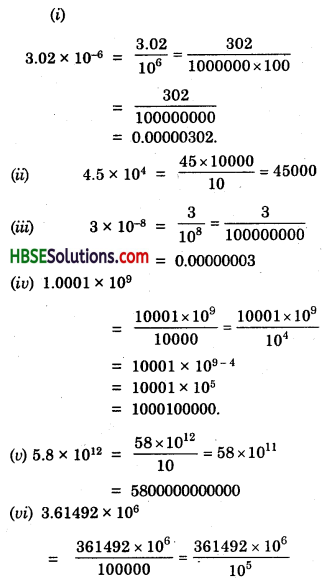
Question 2.
Express the fallowing number in usual form :
(i) 3.02 × 10⁻⁶
(ii) 4.5 × 10⁴
(iii) 3 × 10⁻⁸
(iv) 1.0001 × 10⁹
(v) 5.8 × 10¹²
(vi) 3.61492 × 10⁶.
Solution:
HBSE 8th Class Maths Solutions Chapter 12 Exponents and Powers Ex 12.2 1
= 361492 × 106-5
= 361492 × 10 = 3614920.

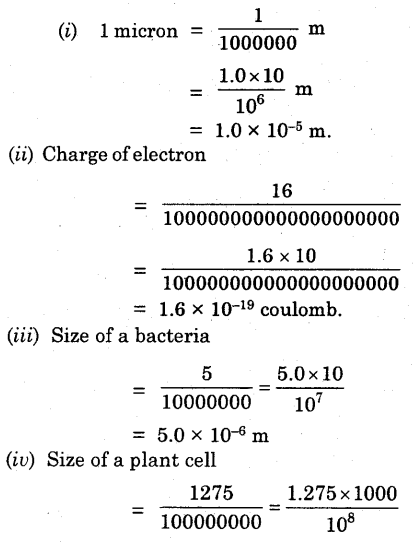
Question 3.
Express the number appearing in the following statements in standard form :
(i) 1 micron is equal to \(\frac{1}{1000000}\) m.
(ii) Charge of an electron is 0.000,000,000,000,000,000,16coulom b.
(iii) Size of a bacteria is 0.0000005 m.
(iv) Size of a plant cell is 0.00001275 m.
(v) Thickness of a thick paper is 0.07 mm.
Solution:
HBSE 8th Class Maths Solutions Chapter 12 Exponents and Powers Ex 12.2 2
= 1.275 × 10³-8
= 1.275 × 10⁻⁵ m.
(v) Thickness of a thick paper
= \(\frac{7}{100}\) = \(\frac{7.0 \times 10}{10^{2}}\)
= 7.0 × 101-2
= 7.0 × 10⁻¹ mm.

HBSE 8th Class Maths Solutions Chapter 12 Exponents and Powers Ex 12.2

Question 4.
In a stack there are 5 books each of thickness 20 mm and 5 paper sheets each of thickness 0.016 mm. What is the total thickness of the stack.
Solution:
Total thickness of stack
= 20 m + 0.016
= 20.016
= \(\frac{20016}{1000}\) = \(\frac{2.0016×1000}{1000}\)
= \(\frac{2.0016 \times 10^{4}}{10^{3}}\)
= 2.0016 × 10.

HBSE 8th Class Maths Solutions Chapter 12 Exponents and Powers Ex 12.2 Read More »
HBSE 8th Class Maths Solutions Chapter 12 Exponents and Powers Ex 12.1

Haryana State Board HBSE 8th Class Maths Solutions Chapter 12 Exponents and Powers Ex 12.1 Textbook Exercise Questions and Answers.

Haryana Board 8th Class Maths Solutions Chapter 12 Exponents and Powers Exercise 12.1

Question 1.
Evaluate :
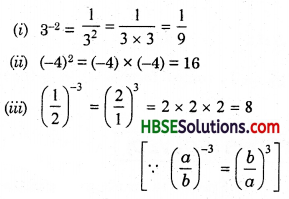
(i) 3-2
(ii) (-4)-2
(iii) \(\left(\frac{1}{2}\right)^{-5}\)
Solution:
HBSE 8th Class Maths Solutions Chapter 12 Exponents and Powers Ex 12.1 1

Question 2.
Simplify and express the result in power notation with positive exponent.
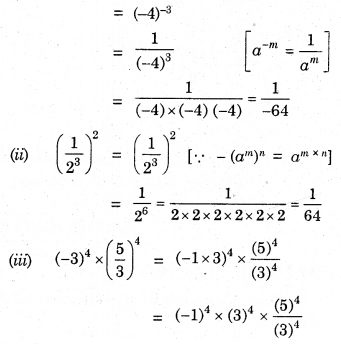
(i) (-4)5, (-4)6
(ii) \(\left(\frac{1}{2^{3}}\right)^{2}\)
(iii) (-3)4 × \(\left(\frac{5}{3}\right)^{4}\)
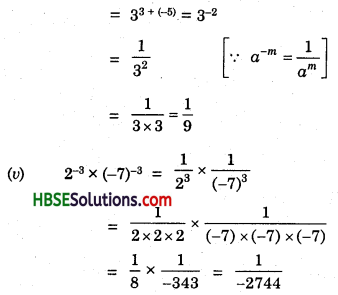
(iv) (3-7 ÷ 3-10) × 3-5
(v) 2-5 × (-7)-3.
Solution:
(i) ∵ am ÷ an = am-n
∴ (-4)5 ÷ (-4)8 = (-4)5-8
HBSE 8th Class Maths Solutions Chapter 12 Exponents and Powers Ex 12.1 2
= +1 × 54 = 54
= 5 × 5 × 5 × 5
= 625.

(iv) ∵ am ÷ an = am-n
and am × an = am+n
∴ (3-7 ÷ 3-10) × 3-5 = 3-7-(-10) × 3-5
= 3-7+10 × 3-5
= 33 × 3-5
HBSE 8th Class Maths Solutions Chapter 12 Exponents and Powers Ex 12.1 3

HBSE 8th Class Maths Solutions Chapter 12 Exponents and Powers Ex 12.1

Question 3.
Find the value of :
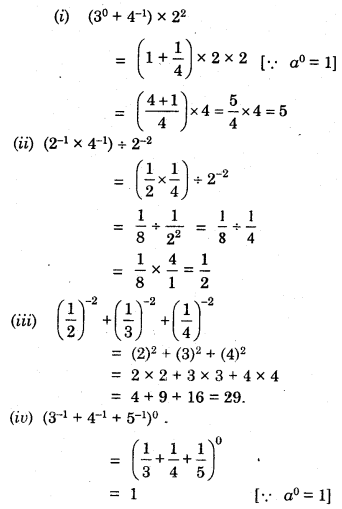
(i) (30 + 4-1) × 22
(ii) (2-1 × 4-1), 2-2
(iii) \(\left(\frac{1}{2}\right)^{-2}\) + \(\left(\frac{1}{3}\right)^{-2}\) + \(\left(\frac{1}{4}\right)^{-2}\)
(iv) (3-1 + 4-1 + 5-1)0
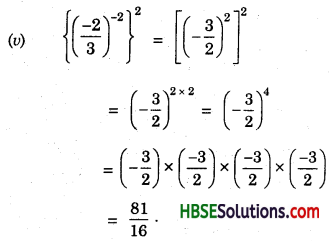
(v) \(\left\{\left(\frac{-2}{3}\right)^{-2}\right\}^{2}\)
Solution:
HBSE 8th Class Maths Solutions Chapter 12 Exponents and Powers Ex 12.1 4
HBSE 8th Class Maths Solutions Chapter 12 Exponents and Powers Ex 12.1 5

Question 4.
Evaluate:
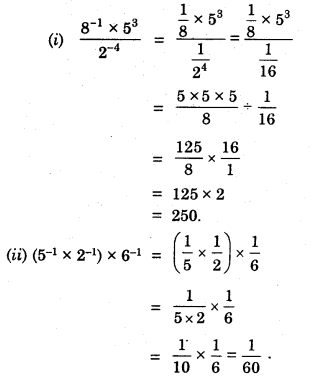
(i) \(\frac{8^{-1} \times 5^{3}}{2^{-4}}\)
(ii) (5-1 × 2-1) × 6-1
Solution:
HBSE 8th Class Maths Solutions Chapter 12 Exponents and Powers Ex 12.1 6

HBSE 8th Class Maths Solutions Chapter 12 Exponents and Powers Ex 12.1

Question 5.
Find the value of m for which 5m ÷ 5-3 = 55
Solution:
∵ am ÷ am = am-n
∴ 5m ÷ 5-3 = 55
or 5m-(-3) = 55
or 5m+3 = 55 [∵ am = an]
or m + 3 = 5 [∵ m = n]
or m = 5 – 3
∴ m = 2

Question 6.
Evaluate:
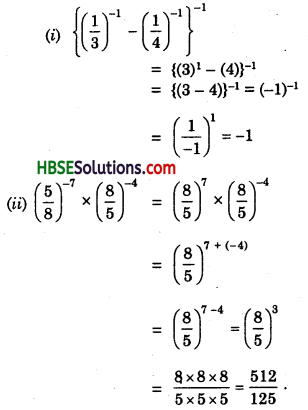
(i) \(\left\{\left(\frac{1}{3}\right)^{-1}-\left(\frac{1}{4}\right)^{-1}\right\}^{-1}\)
(ii) \(\left(\frac{5}{8}\right)^{-7} \times\left(\frac{8}{5}\right)^{-4}\)
Solution:
HBSE 8th Class Maths Solutions Chapter 12 Exponents and Powers Ex 12.1 7

HBSE 8th Class Maths Solutions Chapter 12 Exponents and Powers Ex 12.1

Question 7.
Simplify:
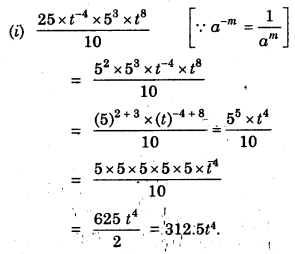
(i) \(\frac{25 \times t^{-4}}{5^{-3} \times 10 \times t^{-8}}\) (t ≠ 0)
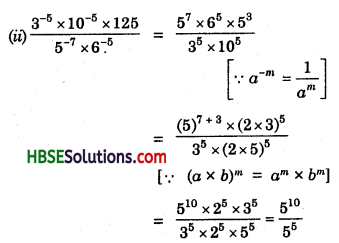
(ii) \(\frac{3^{-5} \times 10^{-5} \times 125}{5^{-7} \times 6^{-5}}\)
Solution:
HBSE 8th Class Maths Solutions Chapter 12 Exponents and Powers Ex 12.1 8
HBSE 8th Class Maths Solutions Chapter 12 Exponents and Powers Ex 12.1 9
= 510-5 = 55
= 5 × 5 × 5 × 5 × 5
= 3125.

HBSE 8th Class Maths Solutions Chapter 12 Exponents and Powers Ex 12.1 Read More »

HBSE 8th Class Maths Solutions Chapter 11 Mensuration InText Questions

Haryana State Board HBSE 8th Class Maths Solutions Chapter 11 Mensuration InText Questions and Answers.

Haryana Board 8th Class Maths Solutions Chapter 11 Mensuration InText Questions

Try These (Page 170)

Question 1.
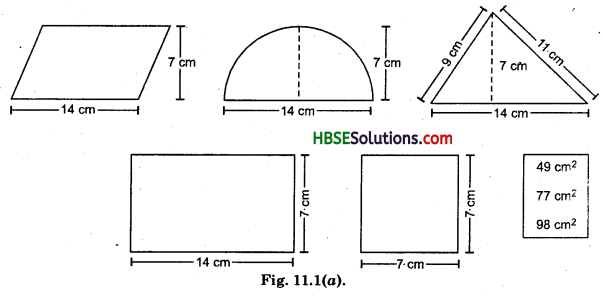
(a) Match the following figures with their respective areas in the box :
HBSE 8th Class Maths Solutions Chapter 11 Mensuration InText Questions 1
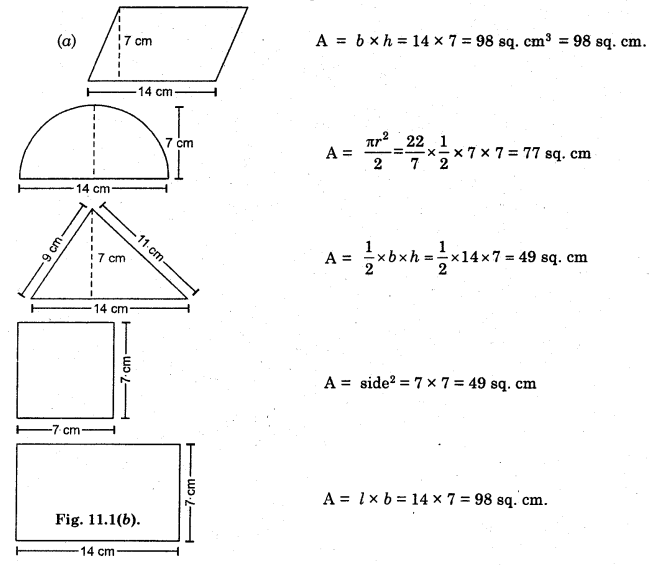
(b) Write the perimeter of each shape.
Solution:
HBSE 8th Class Maths Solutions Chapter 11 Mensuration InText Questions 2
(b) (i) Perimter of parallelogram = 2(a + b) = 2(14 + b)
(ii) Perimeter of semicircle = \(\frac{2 \pi r}{2}\) = πr = \(\frac{22}{7}\) × 7 = 2 cm.
(iii) Perimeter of triangle = 14 + 11 + 9 = 34 cm.
(iv) Perimeter of square = 4 × side = 4 × 7 = 28 cm.
(v) Perimeter of rectangle = 2(l + b) = 2(14 + 7) = 2 × 21 = 42 cm.

Try These (Page 172)

Question 1.
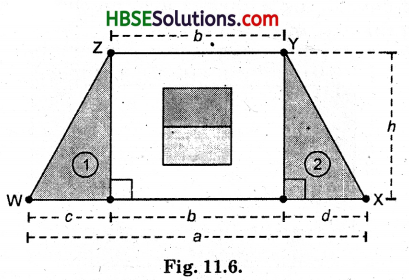
Nazma’s sister also has a trapezium shaped plot. Divide it into three parts as shown (Fig. 11.6). Show that the area of trapezium WXYZ = h \(\frac{(a+b)}{2}\)
Solution:
HBSE 8th Class Maths Solutions Chapter 11 Mensuration InText Questions 3
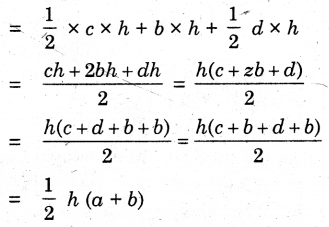
Area of trapezium = Area of △(l) + Area of rectangle + Area of △(2)
HBSE 8th Class Maths Solutions Chapter 11 Mensuration InText Questions 4
Hence, area of trapezium = \(\frac{1}{2}\) h (a + b).
Hence verified

HBSE 8th Class Maths Solutions Chapter 11 Mensuration InText Questions

Question 2.
If h = 10 cm, c = 6 cm, 6 = 12 cm, d = 4 cm, find the values of each of its parts separately and add to find the area WXYZ. Verify it by putting the values of h, a and b in the expression \(\frac{h(a+b)}{2}\)
Solution:
∵ Area of trapezium
= \(\frac{1}{2}\)h(a + b) = \(\frac{1}{2}\) × h(c + d + 2b)
= \(\frac{1}{2}\) × 10(6 + 4 + 2 × 12)
= \(\frac{1}{2}\) × 10(10 + 24)
= \(\frac{1}{2}\) × 10 × 34 = 170 cm2

Try These (Page 173)

Question 1.
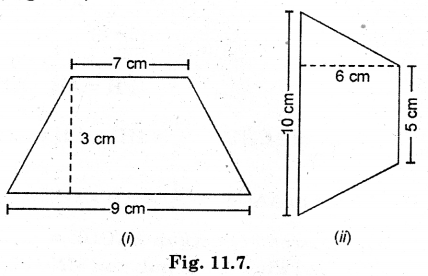
Find the area of the following trapeziums (Fig. 11.7).
HBSE 8th Class Maths Solutions Chapter 11 Mensuration InText Questions 5
Solution:
(i) Area of trapezium
= \(\frac{1}{2}\) h (a + b)= \(\frac{1}{2}\) × 3 (9 + 7)
= \(\frac{1}{2}\) × 3 × 16 = 24 cm3.

(ii) Area of trapezium= \(\frac{1}{2}\)h(a + b)
= \(\frac{1}{2}\) × 6 × (10 + 5)
= \(\frac{1}{2}\) × 6 × 15
= 45 cm3

HBSE 8th Class Maths Solutions Chapter 11 Mensuration InText Questions

Try These (Page 174)

Question 1.
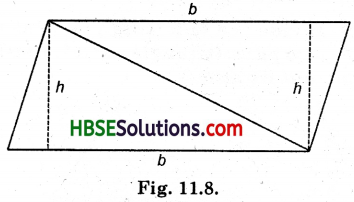
We know that parallelogram is also a quadrilateral. Let us also split such a quadrilateral into two triangles, find their areas and hence that of the parallelogram. Does this agree with the formula that you know already ? (Fig. 11.8)
HBSE 8th Class Maths Solutions Chapter 11 Mensuration InText Questions 6
Solution: Area of parallelogram= a × h
L.H.S. = Area of parallelogram
= Area 6f triangle (l) + Area of triangle (2)
= \(\frac{1}{2}\) × b ×h + \(\frac{1}{2}\) × b × h
= \(\frac{b h+b h}{2}\) = \(\frac{2(b h)}{2}\)
= b × h
= R.H.S.
Hence verified.

Try These (Page 175)

Question 1.
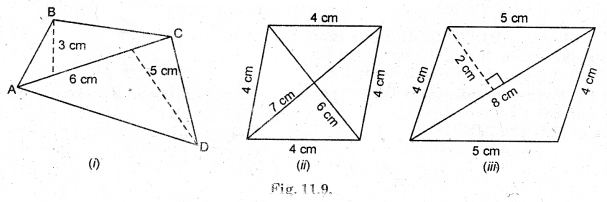
Find the area of these quadrilaterals (Fig. 11.9).
HBSE 8th Class Maths Solutions Chapter 11 Mensuration InText Questions 7
Solution:
(i) Area of quadrilateral ABCD = Area of △ABC + Area of △ACD
= \(\frac{1}{2}\) × AC × 3 + \(\frac{1}{2}\) × AC × 5
= \(\frac{1}{2}\) × 6 × 3 + \(\frac{1}{2}\) × 6 × 5
= 9 + 15 = 24 cm2

(ii) Area of rhombus
= \(\frac{1}{2}\) × d1 × d2 = \(\frac{1}{2}\) × 7 × 6
= 21 cm2

(iii) Area of parallelogram
= 2 × Area of triangle
= 2 × \(\frac{1}{2}\) × 8 × 2 = 16 cm2.

HBSE 8th Class Maths Solutions Chapter 11 Mensuration InText Questions

Try These (Page 176)

Question 1.
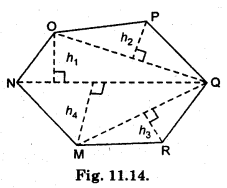
(i) Divide the following polygons (Fig. 11.19) into parts (triangles and trapezium) to find out its area.
HBSE 8th Class Maths Solutions Chapter 11 Mensuration InText Questions 8
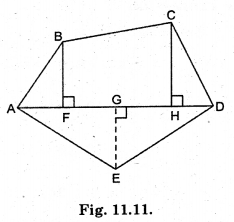
(ii) Polygon ABODE is divided into parts as shown in (Fig. 11.11). Find its area if AD = 8 cm, AH = 6 cm, AG = 4 cm, AF = 3 cm and perpendiculars BF = 2 cm, OH = 3 cm, EG = 2.5 cm.
Area of polygon ABCDE = Area of DAFB + …..
Area of △AFB = \(\frac{1}{2}\) × AF × BF
= \(\frac{1}{2}\) × 3 × 2 = …
HBSE 8th Class Maths Solutions Chapter 11 Mensuration InText Questions 9
Area of trapezium FBCH
= FH × \(\frac{(\mathrm{BF}+\mathrm{CH})}{2}\)
= 3 × \(\frac{(\mathrm{2}+\mathrm{3})}{2}\)
[FH = AH – AF]
Area of △CHD = \(\frac{1}{2}\) × HD × CH = ………..
Area of △ADE = \(\frac{1}{2}\) × AD × GE = ……………..
So, the area of polygon ABODE = ………..

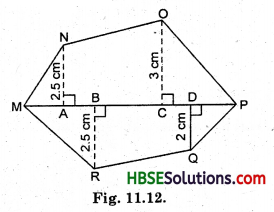
(iii) Find the area of polygon MNOPQR (Fig. 11.12) if MP = 9 cm, MD = 7 cm, MO = 6 cm, MB = 4 cm, MA = 2 cm.
HBSE 8th Class Maths Solutions Chapter 11 Mensuration InText Questions 10
NA, OC, QD and RB are perpendiculars to diagonal MP.
Solution:
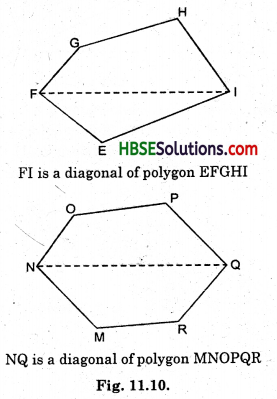
(i) (a)
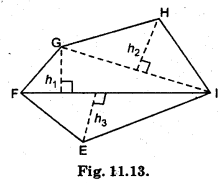
HBSE 8th Class Maths Solutions Chapter 11 Mensuration InText Questions 11
Area of polygon EFGHI
= Area of DFGI + Area of DGHI + Area of DEFI
= \(\frac{1}{2}\) FI × h1 + \(\frac{1}{2}\) GI × h2 + \(\frac{1}{2}\) FI × h3.

(b) HBSE 8th Class Maths Solutions Chapter 11 Mensuration InText Questions 12
Area of polygon MNOPQR
= Area of △NOQ + Area of △OQP + Area of △MRQ + Area of △MNQ
= \(\frac{1}{2}\) NQ × h1 + \(\frac{1}{2}\) OQ × h2 + \(\frac{1}{2}\) MQ × h3 + \(\frac{1}{2}\) NQ × h4

(ii) Area of polygon ABODE = Area of △AFB + Area of trapezium FBCH + Area of △CHD + Area of △ADE
= \(\frac{1}{2}\) × AF × BF + \(\frac{1}{2}\) (BF + CH) × FH + \(\frac{1}{2}\) × HD × CH + \(\frac{1}{2}\) × AD × EG
= \(\frac{1}{2}\) × 3 × 2 + \(\frac{1}{2}\)(2 + 3) × 3 + \(\frac{1}{2}\) × 2 × 3 + \(\frac{1}{2}\) × 8 × 2.5
[where, FH = AH – FH = 6-3 = 3 cm, HD = AD – AH = 8 – 6 = 2 cm]
= 3 + \(\frac{1}{2}\) + 3 + 10.0
= \(\frac{16}{1}\) + \(\frac{15}{2}\) = \(\frac{32+15}{2}\)
= \(\frac{47}{2}\) = 23.5 cm2.

(iii) Area of polygon MNOPQR
= ar △AMN + ar trapezium ANOC + ar △COP + ar △MBR + ar, trapezium BDQR + ar △DPQ
= \(\frac{1}{2}\) × MA × AN + \(\frac{1}{2}\) (AN + CO) × AC + \(\frac{1}{2}\) × CP × CO + \(\frac{1}{2}\) × MB × BR + \(\frac{1}{2}\) × (BR + DQ) × BD + \(\frac{1}{2}\) × DP × QD
= \(\frac{1}{2}\) × 2 × 2.5 + \(\frac{1}{2}\) (2.5 + 3) × 4 + \(\frac{1}{2}\) × 3 × 3 + \(\frac{1}{2}\) × 4 × 2.5 + \(\frac{1}{2}\) × (2.5 + 2) × 3 + \(\frac{1}{2}\) × 2 × 2
where, AC = MC – MA
= 6 – 2 = 4 cm
CP = MP – MC
= 9 – 6 = 3 cm
BD = MD – MB
= 7 – 4 = 3 cm
DP = MP – MD
= 9 – 7 = 2 cm
∴ Area of polygon MNOPQR
= 2.5 + 11 + \(\frac{9}{2}\) + 5 + \(\frac{13.5}{2}\) + 2
= 2.5 + 11 + 4.5 + 5 + 6.25 + 2
= 31.25 cm2.

HBSE 8th Class Maths Solutions Chapter 11 Mensuration InText Questions

Try These (Page 181)

Question 1.
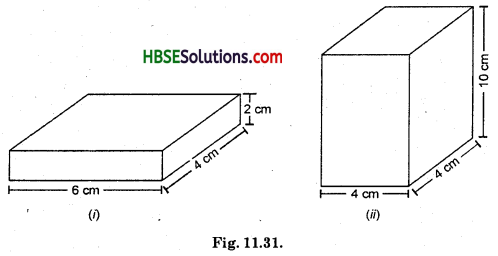
Find the total surface area of the following cuboids (Fig. 11.30).
HBSE 8th Class Maths Solutions Chapter 11 Mensuration InText Questions 13
Solution:
(i) Total surface area of Cuboid = 2 (lb + bh + hl)
= 2(6 × 4 + 4 × 2 + 2 × 6)
= 2(24 + 8 + 12)
= 2 × 44 = 88 cm2

(ii)Total surface area of cuboid = 2 (lb + bh + hl)
= 2(10 × 4 + 4 × 4 + 4 × 10)
= 2(40 + 16 + 40)
= 2 × 96 = 192 cm2.

Try These (Page 182)

Question 1.
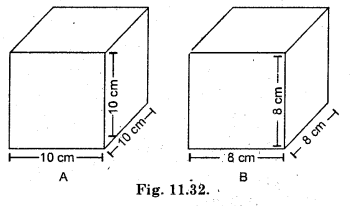
Find the surface area of cube A and lateral surface area of cube B (Fig. 11.32).
HBSE 8th Class Maths Solutions Chapter 11 Mensuration InText Questions 14
Solution:
(A) Total surface area of cube, = 6l2 = 6 × (10)2
= 6 × 100 = 600 cm2
(B) Lateral surface area of cube
= 4 × (side)2 = 4l2
= 4 × (8)2 = 4 × 64
= 256 cm2.

HBSE 8th Class Maths Solutions Chapter 11 Mensuration InText Questions

Try These (Page 184)

Question 1.
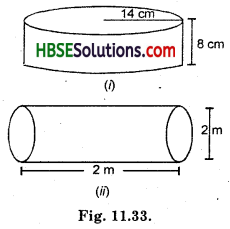
Find total surface area of the following cylinders (Fig. 11.33).
HBSE 8th Class Maths Solutions Chapter 11 Mensuration InText Questions 15
Solution:
(i) Total surface area of cylinder
= 2πr (r + h) [where r = 14, h = 8]
= 2 × \(\frac{22}{7}\) × 14(14 + 8)
= 2 × 22 × 2 × 22 = 1936 cm2.

(ii) Total surface area of cylinder
= 2πr (r + h) = 2 × \(\frac{22}{7}\) × 1(1 + 2)
[∵ d = 2, r = \(\frac{d}{2}\)
where r = 1 m, h = 2 m]
= 2 × \(\frac{22}{7}\) × 1 × 3
= \(\frac{132}{7}\)
= 18.86 m2

Try These (Page 188)

Question 1.
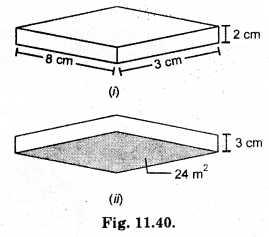
Find the volume of the following cuboids (Fig. 11.40).
HBSE 8th Class Maths Solutions Chapter 11 Mensuration InText Questions 16
Solution:
(i) l = 8 cm, b = 3 cm, h = 2 cm
Volume of cuboid = l × b × h
= 8 × 3 × 2 = 48 cm3

(ii) l × b = 24 m2 and h = 3 cm
Volume of cuboid = l × b × h
= 24 × 3 = 72 cm3.

HBSE 8th Class Maths Solutions Chapter 11 Mensuration InText Questions

Try These (Page 189)

Question 1.
Find the volume of the following cubes:
(a) with a side 4 cm
(b) with a side 1.5 m.
Solution:
Volume of cube
= l3 = (4 cm)3
= 4 × 4 × 4 = 64 cm3

(ii) Volume of cube
= l3 = (1.5 cm)3
= 1.5 × 1.5 × 1.5
= 3.375 cm3.

Try These (Page 189)

Question 1.
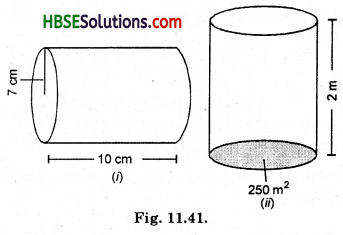
Find the volume of the following cylinders :
HBSE 8th Class Maths Solutions Chapter 11 Mensuration InText Questions 17
Solution:
(i) Volume of cylinder = πr2h
= \(\frac{22}{7}\) × (7)2 × 10
= \(\frac{22}{7}\) × 7 × 7 × 10
= 1540 cm3.

(ii)Volume of cylinder
= Area of base ×height
= πr2 × h
= 250 m2 × 2 m
= 500 m3.

HBSE 8th Class Maths Solutions Chapter 11 Mensuration InText Questions Read More »

HBSE 8th Class Maths Solutions Chapter 11 Mensuration Ex 11.4

Haryana State Board HBSE 8th Class Maths Solutions Chapter 11 Mensuration Ex 11.4 Textbook Exercise Questions and Answers.

Haryana Board 8th Class Maths Solutions Chapter 11 Mensuration Exercise 11.4

Question 1.
Given a cylindrical tank, in which situation will you find surface area and in which situation volume.
(a) To find how much it can hold.
(b) Number of cement bags required to plaster it.
(c) To find the number of smaller tanks that can be filled with water from it.
HBSE 8th Class Maths Solutions Chapter 11 Mensuration Ex 11.4 1
Solution:
(a) Volume of cylinder
= Area of base × height.
(b) Total surface area of cylinder = 2πr (r + h).
(c) Volume of cylinder = πr2h.

Question 2.
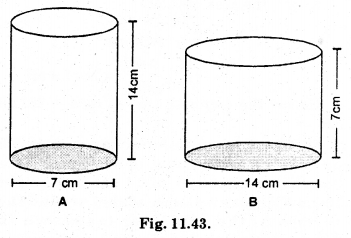
Diameter of cylinder A is 7 cm, and the height is 14 cm. Diameter of cylinder B is 14 cm and height is 7 cm. Without doing any calculations can you suggest whose volume is greater ? Verify it by finding the volume of both the cylinders. Check whether the cylinder with greater volume also has greater surface area ?
HBSE 8th Class Maths Solutions Chapter 11 Mensuration Ex 11.4 2
Solution:
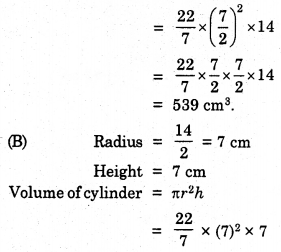
(A) Radius = \(\frac{d}{2}\) = \(\frac{7}{2}\) cm
Height = 14 cm
Volume of cylinder = πr2h
HBSE 8th Class Maths Solutions Chapter 11 Mensuration Ex 11.4 3
= \(\frac{22}{7}\) × 7 × 7 × 7
= 1078 cm3.

(A) Curved surface area of cylinder = 2πrh
= 2 × \(\frac{22}{7}\) × \(\frac{7}{2}\) × 14
= 308 cm2

(B) Curved surface area of cylinder
= 2πrh
= 2 × \(\frac{22}{7}\) × 7 × 7
= 308 cm2
Hence the volume of cylinder (B) is greater than cylinder (A)
and surface area of cylinder (A) and (B) are equal.
If radius is greater, then volume of cylinder is greater.

HBSE 8th Class Maths Solutions Chapter 11 Mensuration Ex 11.4

Question 3.
Find the height of a cuboid whose base area is 180 cm2 and volume is 900 cm3?
Solution:
Volume of cuboid = l × b × h
Base area = l × b = 180 cm2
Volume of cuboid = 180 × h
900 cm3 = 180 × h
\(\frac{900}{180}\) = h
5 cm = h
∴ Height = 5 cm.

Question 4.
A cuboid is of dimensions 60 cm × 54 cm × 30 cm. How many small cubes with side 6 cm can be placed in the given cuboid ?
Solution:
Volume of cuboid
= 60 × 54 × 30
= 97200 cm2
Volume of cube (6 cm)3 = 216 cm3
Number of small cubes
= \(\frac{97200}{216}\) = 450 cubes.

HBSE 8th Class Maths Solutions Chapter 11 Mensuration Ex 11.4

Question 5.
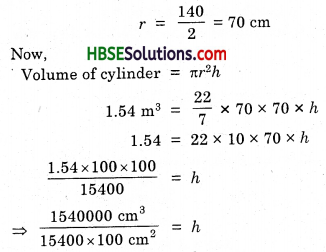
Find the height of the cylinder whose volume is 1.54 m3 and diameter of the base is 140 cm ?
Solution:
Volume of cylinder = 1.54 m3
Diameter of cylinder = 140 m
HBSE 8th Class Maths Solutions Chapter 11 Mensuration Ex 11.4 4
1 = h
Hence, height of cylinder = 1 m or 100 cm.

Question 6.
A milk tank is in the form of cylinder whose radius is 1.5 m and length is 7 m. Find the quantity of milk in litres that can be stored in the tank ?
Solution:
Radius = 1.5 m
Height = 7 m
Volume of cylinder = πr2h
= \(\frac{22}{7}\) × 1.5 × 1.5 × 7
= 49.5 cm3
We know that
1 m3 = 1000 litres
Hence 49.5 m3 = 1000 × 49.5 m3
= 49500 litres
Hence, the required quantity of milk in litres in tank = 49500 litres.

HBSE 8th Class Maths Solutions Chapter 11 Mensuration Ex 11.4

Question 7.
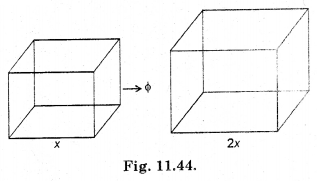
If each edge of a cube is doubled,
(a) how many times will its surface area increase ?
(b) how many times will its volume increase ?
Solution:
HBSE 8th Class Maths Solutions Chapter 11 Mensuration Ex 11.4 4

HBSE 8th Class Maths Solutions Chapter 11 Mensuration Ex 11.4 5

HBSE 8th Class Maths Solutions Chapter 11 Mensuration Ex 11.4 6
(a) Let the edge of a cube = x
If each edge of a cube is doubled then edge
= 2x
If l = x
Now, surface area of cube
= 6 × (x)2
= 6x2
If l = 2x, then surface area of cube
= 6 × (2x)2
= 6 × 4x2
= 24x2.
6x2 × 3 = 24x2
Hence, three times will its surface area increase.

(b) If l = x,
Volume of cube = (l)3 = x3
If l = 2x,
Volume of cube = (2x)3 = 8x3
x3 × 8 = 8x3
Hence, eight times will its volume increase.

HBSE 8th Class Maths Solutions Chapter 11 Mensuration Ex 11.4

Question 8.
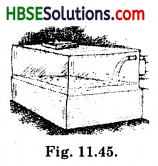
Water is pouring into a cuboidal reservoir at the rate of 60 litres per minute. If the volume of reservoir is 108 m3, find the number of hours it will take to fill the reservoir.
HBSE 8th Class Maths Solutions Chapter 11 Mensuration Ex 11.4 6
Solution:
Volume of cuboidal reservoir = 108 m3
Volume of cuboidal reservoir in litres
= 108 m3 = 108 × 1000 litres
(∵ 1 cm3 = 1000 l)
= 108000 litres
Since water is pouring into a cuboidal reservoir at the rate of 60 litres per minute.
Hence no. of the times take to fill the water
= \(\frac{10800}{60}\) = 1800 minutes
= \(\frac{10800}{60}\) = 30 hours.

HBSE 8th Class Maths Solutions Chapter 11 Mensuration Ex 11.4 Read More »

HBSE 8th Class Maths Solutions Chapter 11 Mensuration Ex 11.3

Haryana State Board HBSE 8th Class Maths Solutions Chapter 11 Mensuration Ex 11.3 Textbook Exercise Questions and Answers.

Haryana Board 8th Class Maths Solutions Chapter 11 Mensuration Exercise 11.3

Question 1.
There are two cuboidal boxes as shown in the adjoining figure. Which box requires the lesser amount of material to make ?
HBSE 8th Class Maths Solutions Chapter 11 Mensuration Ex 11.3 1
Solution:
(a) Length = 60 cm
Breadth = 40 cm
Height = 50 cm
Total surface area of cuboidal boxes
= 2 (lb + bh + hl)
= 2 × (60 × 40 + 40 × 50 + 50 × 60)
= 2 × (240 + 200 + 300
= 2 × (740) = 1480 cm2.

(b) l = b = h = 50 cm
Total surface area of cuboidal boxes = 6l2
= 6 × (50)2 = 6 × 2500
= 15000 cm2
Hence (a) box requires the lesser amount of material to make.

Question 2.
A suitcase with measures 80 cm × 48 cm × 24 cm is to be covered with a tarpaulin cloth. How many metres of tarpaulin of width 96 cm is required to cover 100 such suitcases ?
Solution:
Total surface area of cuboidal suitcase
= 2 (lb + bh + hl)
= 2(80 × 48 + 48 × 24 + 24 × 80)
= 2 × (3840 + 1152 + 1920)
= 2 × 6912
= 13824 cm2.

HBSE 8th Class Maths Solutions Chapter 11 Mensuration Ex 11.3

Question 3.
Find the side of a cube whose surface area is 600 cm2.
Solution:
The total surface area of cube = 6l2
600 cm2 = 6l2
\(\frac{600}{6}\) = l2
100 = l2
\(\sqrt {100}\) = l
10 = l
Hence the required side of a cube = 10 cm.

Question 4.
Rukhsar painted the outside of the cabinet of measure 1 m × 2 m × 1.5 m. How much surface area did she cover if she painted all except the bottom of the cabinet.
HBSE 8th Class Maths Solutions Chapter 11 Mensuration Ex 11.3 2
Solution:
l = 2 m, b = 1 m, h = 1.5 m
Lateral surface area of cuboidal cabinet
= 2 (l + b) × h
= 2(2 + 1) × 1.5
= 2 × 3 × 1.5 = 9 m2
Hence, required surface area covered = 9 m2.

HBSE 8th Class Maths Solutions Chapter 11 Mensuration Ex 11.3

Question 5.
Daniel is painting the walls and ceiling of a cuboidal hall with length, breadth and height of 15 m, 10 m and 7 m respectively. From each can of paint 100 m2 of area is painted. How many cans of paint will ‘she need to paint the room ?
Solution:
l = 15 m, b = 10 m, h = 7 m
Lateral surface area of cuboidal classrom
= 2 (l + b) × h
= 2(15 + 10) × 7
= 2 × 25 × 7 = 350 m2
Area of ceiling = l × b
= 15 × 10 = 150 m2
Hence, the total area of painted wall and ceiling
= 350+ 150 = 500 m2
Since each can of paint covers 100 m2 of area
Hence 500 m2 of area needed can = \(\frac{500}{100}\) = 5
Hence, the required 5 cans of paint cover 500 m2.

Question 6.
Describe how the two figures at the right are alike and how they are different. Which box surface area ?
HBSE 8th Class Maths Solutions Chapter 11 Mensuration Ex 11.3 3
Solution:
Lateral surface area of cylinder
= 2 × \(\frac{22}{7}\) × \(\frac{7}{22}\) × 7
[where = 7 cm
∴ r = \(\frac{7}{2}\) cm
h = 7 cm]
= 154 cm2
Lateral surface area of cube
= 4l2 [where l = side = 7 cm]
= 4 × (7)2
= 4 × 49 = 196 cm2
Hence cubical box has larger lateral surface area.

HBSE 8th Class Maths Solutions Chapter 11 Mensuration Ex 11.3

Question 7.
A closed cylindrical tank of radius 7 m and height 3 m is made from a sheet of metal. How much sheet of metal is required ?
HBSE 8th Class Maths Solutions Chapter 11 Mensuration Ex 11.3 4
Solution:
Total surface area of cylindrical tank
= 2πr (r + h)
= 2 × \(\frac{22}{7}\) × 7 (7 + 3)
= 2 × 22 × 10 = 440 m2
Hence, the required metal sheet = 440 m2.

Question 8.
The lateral surface area of a hollow cylinder is 4224 cm2. It is cut along its height and formed a rectangular sheet of width 33 cm. Find the perimeter of rectangular sheet ?
Solution:
Width of rectangular sheet = 33 cm
Hence, height of cylinder = 33 cm
The lateral surface area = 2πrh
4224 = 2 × \(\frac{22}{7}\) × r × h
4224 = 2 × \(\frac{22}{7}\) × r × 33
\(\frac{4224 \times 7}{2 \times 22 \times 33}\) = r
20.36 = r
∴ Radius = 20.36
d = 2 × 20.36 = 40.72 cm
Now l = 40.72 and b = 33 cm
Hence, perimeter of rectangular sheet
= 2(l + b)
= 2 × (40.72 + 33)
= 2 × 73.22 = 147.44 cm.

HBSE 8th Class Maths Solutions Chapter 11 Mensuration Ex 11.3

Question 9.
A road roller takes 750 complete revolutions to move once over to level a road. Find the area of the road if the diameter of a road roller is 84 cm and length is 1 m.
HBSE 8th Class Maths Solutions Chapter 11 Mensuration Ex 11.3 5
Solution:
Diameter of road roller = 84 cm
∴ r = \(\frac{84}{2}\) = 2 cm
l = h = 1 m = 100 cm
Total surface area of road roller = 2πr(r + h)
= 2 × \(\frac{22}{7}\) × 42 × (42 + 100)
= 2 × 22 × 6 × 142
= 37488 cm2
Hence, the area of road
= 37488 × 750
= 28116000 cm2
\(\frac{28116000}{100×100}\) = 2811.6 m2
Hence, the required area of road = 2811.6 m2.

Question 10.
A company packages its milk powder in cylindrical container whose base has a diameter of 14 cm and height 20 cm. Company places a label around the surface of the container (as shown in figure). If the label is placed 2 cm from top and bottom, what is the area of the label ?
HBSE 8th Class Maths Solutions Chapter 11 Mensuration Ex 11.3 6
Solution:
r = \(\frac{d}{2}\) = \(\frac{14}{2}\) = 7 cm
h = 20 cm
Top and bottom height = 2 + 2 = 4m
Hence required height of cylindrical powdered milk
= 20 – 4 = 16 cm
Lateral surface area of cylindrical powdered milk
= 2πrh = 2 × \(\frac{22}{7}\) × 7 × 16
= 2 × 22 × 16 = 704 cm2
Hence the required area of label = 704 cm2.

HBSE 8th Class Maths Solutions Chapter 11 Mensuration Ex 11.3 Read More »

HBSE 8th Class Maths Solutions Chapter 11 Mensuration Ex 11.2

Haryana State Board HBSE 8th Class Maths Solutions Chapter 11 Mensuration Ex 11.2 Textbook Exercise Questions and Answers.

Haryana Board 8th Class Maths Solutions Chapter 11 Mensuration Exercise 11.2

Question 1.
The shape of the top surface of a table is a trapezium. Find its area if its parallel sides are 1 m and 1.2 m and perpendicular distance between them is 0.8 m.
HBSE 8th Class Maths Solutions Chapter 11 Mensuration Ex 11.2 1
Solution:
Area of trapezium shape
= \(\frac{1}{2}\)(b1 + b2) × h
= \(\frac{1}{2}\)(1.2 + 1) × 0.8 2
= \(\frac{1}{2}\) × 2.2 × 0.8 = 0.88 m2.

Question 2.
The area of a trapezium is 34 cm2 and the length of one of the parallel sides is 10 cm and its height is 4 cm. Find the length of the other parallel side.
Solution:
Area of trapezium
= \(\frac{1}{2}\)(b1 + b2) × h
34 = \(\frac{1}{2}\)(10.4 + b2) × 4
34 = (10.4 + b2) × 2
34 = 20.8 + 2b2
34 – 20.8 = 2b2
13.2 = 2b2
\(\frac{13.2}{2}\) = b2
6.1 = b2
Hence another parallel side = 6.6 cm.

HBSE 8th Class Maths Solutions Chapter 11 Mensuration Ex 11.2

Question 3.
Length of the fence of a trapezium shaped field ABCD is 120 m. If BC = 48 m, CD = 17 m and AD = 40 m, find the area of this field. Side AB is perpendicular to the parallel sides AD and BC.
HBSE 8th Class Maths Solutions Chapter 11 Mensuration Ex 11.2 2
Solution:
Perimeter of ABCD
= AB + BC + CD + 40
120 = AB + 48+ 17 + 40
= AB + 105
or 120 – 105 = AB
or 15 = AB
∴ AB = 15 cm
HBSE 8th Class Maths Solutions Chapter 11 Mensuration Ex 11.2 3
Area of trapezium ABCD
= \(\frac{1}{2}\)(b1 + b2) × k
= \(\frac{1}{2}\) × (48 + 40) × 15
= \(\frac{1}{2}\) × 88 × 15 = 660 m2.

Question 4.
The diagonal of a quadrilateral shaped field is 24 m and the perpendiculars dropped on it from the remaining opposite vertices are 8 m and 13 m. Find the area of the field.
HBSE 8th Class Maths Solutions Chapter 11 Mensuration Ex 11.2 4
Solution:
Area of quadrilatral ABCD
= Area of ABC + Area of ADC
= \(\frac{1}{2}\) × AC × OD + \(\frac{1}{2}\) × AC × BP
= \(\frac{1}{2}\) × 24 × 13 + \(\frac{1}{2}\) × 24 × 8 2 2
= 12 × 13 + 12 × 8 = 12(13 + 8)
= 12 × 21 = 252 m2.
HBSE 8th Class Maths Solutions Chapter 11 Mensuration Ex 11.2 5

HBSE 8th Class Maths Solutions Chapter 11 Mensuration Ex 11.2

Question 5.
The diagonals of a rhombus are 7.5 cm and 12 cm. Find its area.
Solution:
Area of rhombus = \(\frac{1}{2}\) × d1 × d2
= \(\frac{1}{2}\) × 7.5 × 12
= 7.5 × 6 = 45.0
= 45 cm2.
HBSE 8th Class Maths Solutions Chapter 11 Mensuration Ex 11.2 15

Question 6.
Find the area of a rhombus whose side is 6 cm and whose altitude is 4 cm. If one of its diagonals is 8 cm long, find the length of the other diagonal.
Solution:
Area of DADO = \(\frac{1}{2}\) × AO × OD
= \(\frac{1}{2}\) × 4 × 4 = 8 cm2
Hence, Area of 4 triangle = 4 × 8 = 32 cm2
HBSE 8th Class Maths Solutions Chapter 11 Mensuration Ex 11.2 16
Now, Area of trapezium = \(\frac{1}{2}\) × d1 × d2
32 cm2 = \(\frac{1}{2}\) × 8 × d2
32 cm2 = 4d2
\(\frac{32 \mathrm{~cm}^{2}}{4 \mathrm{~cm}}\)= d2
8 cm = d2
Hence, the length of other diagonal = 8 cm.

HBSE 8th Class Maths Solutions Chapter 11 Mensuration Ex 11.2

Question 7.
The floor of a building consists of 3000 tiles which are rhombus shaped and each of its diagonals are 45 cm and 30 cm in length. Find the total cost of polishing the floor, if the cost per m2 is Rs. 4.
Solution:
Area of rhombus of each tiles
= \(\frac{1}{2}\) × d1 × d2
= \(\frac{1}{2}\) × 45 × 30
= 675 cm2
HBSE 8th Class Maths Solutions Chapter 11 Mensuration Ex 11.2 6
Area of 3000 tiles = 3000 × 675
= \(\frac{2025000 \mathrm{~cm}^{2}}{100 \mathrm{~cm} \times 100 \mathrm{~cm}}\)
= 202.5 m2
Thecost of 3000 tiles = 202.5 × 4
= Rs. 810.0
= Rs.810.

Question 8.
Mohan wants to buy a trapezium shaped field. Its side along the river is parallel to and twice the side along the road. If the area of this Held is 10500 m2 and the perpendicular distance between the two parallel sides is 100 m, find the length of the side along the river.
HBSE 8th Class Maths Solutions Chapter 11 Mensuration Ex 11.2 7
Solution:
Let the one side = x m = b1
and other side = 2x m = b2
HBSE 8th Class Maths Solutions Chapter 11 Mensuration Ex 11.2 8
Area of trapezium = \(\frac{1}{2}\)(b1 + b2) × h
= \(\frac{1}{2}\)(x + 2x) × 100
= \(\frac{1}{2}\) × 3x + 100
or 10500m2 = 150x
or \(\frac{10500}{150}\) = x
70 = x
∴ x = 70 cm
Hence One side = 70 cm
and Another parallel side = 2 × 70 = 140 m.

HBSE 8th Class Maths Solutions Chapter 11 Mensuration Ex 11.2

Question 9.
Top surface of a raised platform is in the shape of a regular octagon as shown in the figure. Find the area of the octagonal surface.
HBSE 8th Class Maths Solutions Chapter 11 Mensuration Ex 11.2 9
Solution:
Area of another trapezium
= \(\frac{1}{2}\)(d1 + d2) × h
= \(\frac{1}{2}\)(11 + 5) × 4
= \(\frac{1}{2}\) × 16 × 4 = 32 m2
Area of rectangle
= l × b = 11 m × 5 m = 5m2
HBSE 8th Class Maths Solutions Chapter 11 Mensuration Ex 11.2 10
= \(\frac{1}{2}\)(d1 + d2) × h
= \(\frac{1}{2}\)(11 + 5) × 4 = 32 m2
∴ Area of the octagonal surface = Area of one trapezium + Rectangle + Area of another trapezium
= 32 m2 + 55 m2 + 32 m2 =119 m2.

Question 10.
There is a pentagonal shaped park as shown in the figure.
HBSE 8th Class Maths Solutions Chapter 11 Mensuration Ex 11.2 11
For finding its area Jyoti and Kavita divided it in two different ways.
Find the area of this park using both ways. Can you suggest some other way of finding its area ?
Solution:
Jyoti’ diagram :
= \(\frac{1}{2}\)(b1 + b2) + h
= \(\frac{1}{2}\)(15 + 30) × 7.5
= \(\frac{1}{2}\) × 45 × 7.5
= 168.75 cm2
HBSE 8th Class Maths Solutions Chapter 11 Mensuration Ex 11.2 12
Hence, Area of two trapezium
= 2 × 168.75 = 237.50 cm2
Kavita’s diagram:
= Area of Kavita’s diagram
= \(\frac{1}{2}\) × 15 × 15 + (15)2
[∵ 30 – 15 = 15]
= \(\frac{225}{2}\) + \(\frac{225}{1}\) = \(\frac{225+50}{2}\)
= \(\frac{675}{2}\)
= 337.5 cm2
HBSE 8th Class Maths Solutions Chapter 11 Mensuration Ex 11.2 13

HBSE 8th Class Maths Solutions Chapter 11 Mensuration Ex 11.2

Question 11.
Diagram of the adjacent picture frame has outer dimensions = 24 cm × 28 cm and inner dimensions 16 cm × 20 cm. Find the area of each section of the frame, if the width of each section is same.
Solution:
Area of outer frame
= l × b
= 28 × 24
= 672 cm2
HBSE 8th Class Maths Solutions Chapter 11 Mensuration Ex 11.2 14
Area of inner frame
= l × b = 16 × 20 = 320 cm2
Hence, area of remaining frame
= 672 – 320 = 352 cm2
Now, area of each section
= \(\frac{352}{4}\) = 88 cm2

HBSE 8th Class Maths Solutions Chapter 11 Mensuration Ex 11.2 Read More »

HBSE 8th Class Maths Solutions Chapter 11 Mensuration Ex 11.1

Haryana State Board HBSE 8th Class Maths Solutions Chapter 11 Mensuration Ex 11.1 Textbook Exercise Questions and Answers.

Haryana Board 8th Class Maths Solutions Chapter 11 Mensuration Exercise 11.1

Question 1.
A square and a rectangular field with measurements as given in the figure have the same perimeter. Which field has a larger area ?
HBSE 8th Class Maths Solutions Chapter 11 Mensuration Ex 11.1 1
Solution:
(a) Perimeter of square
= 4 × side
= 4 × 60 = 240 m

(b) Perimeter of rectangle = 2 (l + b)
240 m = 2(80 + b)
\(\frac{240}{2}\) = 80 + b
120 = 80 + b
120 – 80 = b
40 = b
∴ b = 40 m
∴ Area of square = (side)2 = (60)2
60 × 60 = 3600 m2
and area of rectangle = l × b = 80 m × 40 m
= 3200 m2
Hence square field is larger than rectangle.

HBSE 8th Class Maths Solutions Chapter 11 Mensuration Ex 11.1

Question 2.
Mrs. Kaushik has a square plot with the measurement as shown in the figure. She wants to construct a house in the middle of the plot. A garden is developed around the house. Find the total cost of developing a garden around the house at the rate of Rs. 55 per m2.
HBSE 8th Class Maths Solutions Chapter 11 Mensuration Ex 11.1 2

Solution:
Area of garden
= Area of square plot – Area of middle plot (Rectangular plot)
= (side)2 – (l × b)
= (25)2 – (20 × 15)
= 625 – 300 = 325 m2
Hence the total cost of developing garden
= 325 m2 × Rs. 55 = Rs. 17875.

Question 3.
The shape of a garden is rectangular in the middle and semi-circular at the ends as shown in the diagram. Find the area and the perimeter of this garden (Length of rectangle is 20 – (3.5 + 3.5) metres].
HBSE 8th Class Maths Solutions Chapter 11 Mensuration Ex 11.1 3
Solution:
Length of rectangle
= 20 – (3.5 + 3.5)
= 20 – 7 = 13 m
Breadth of rectangle = 7 m
Radius of semi-circle = 3.5 cm
Two semicircle = one circle
Hence perimeter (or circumference) of circle
= 2pr = 2 × \(\frac{22}{7}\) × 3.5 = 22 cm
Perimeter of rectangle
= 2 (l + b)
= 2 × (13 + 7)
= 2 × 20 = 40 cm
Hence, perimeter of this garden
=(22 cm + 40 cm) = 62 cm
Now, area of rectangle
= l × b = 13 × 7 = 91 cm2
Area of circle (two semicircle)
= πr2 = \(\frac{22}{7}\) × 3.5 × 3.5
= 38.5 cm2
Hence, area of garden
= 38.5 cm2 + 91 cm2
= 129.5 cm2.

HBSE 8th Class Maths Solutions Chapter 11 Mensuration Ex 11.1

Question 4.
A flooring tile has the shape of a parallelogram whose base is 24 cm and the corresponding height is 10 cm. How many such tiles are required to cover a floor of area 1080 m2 ? (If required you can split the tiles in whatever way you want to fill up the corners).
Solution:
Area of parallelogram tiles
= base × height
= b × h
= 24 × 10 = 240 cm2
Area of parallelogram
= 1080 m2
= 1080 × 100 × 100 × cm2
= 10800000cm2
∴ Number of tiles
= \(\frac{Area of floor}{7}\)
= \(\frac{10800000}{240}\) = 45000.

HBSE 8th Class Maths Solutions Chapter 11 Mensuration Ex 11.1

Question 5.
An ant is moving around a few food
HBSE 8th Class Maths Solutions Chapter 11 Mensuration Ex 11.1 4
Solution:
(a) Circumference (perimeter) of semicircle
= \(\frac{2 \pi r}{2}\) = \(\frac{2 \times 22 \times 1.4}{2 \times 7}\)
(d = 2.8 cm, r = 1.4 cm)
= 4.4 cm
Perimeter = 4.4 cm + 2.8 cm = 7.2 cm.

(b) Circumference of semicircle + Perimeter of square
= 4.4 cm + 1.5 cm + 2.8 cm + 1.5 cm
= 10.2 cm.

(c) Circumference of semicircle + Perimeter of triangle
= 4.4 cm + 2 cm + 2 cm
= 8.4 cm
Hence (b) food piece would the ant have to take a longer round.

HBSE 8th Class Maths Solutions Chapter 11 Mensuration Ex 11.1 Read More »
HBSE 8th Class Maths Solutions Chapter 10 Visualizing Solid Shapes InText Questions

Haryana State Board HBSE 8th Class Maths Solutions Chapter 10 Visualizing Solid Shapes InText Questions and Answers.

Haryana Board 8th Class Maths Solutions Chapter 10 Visualizing Solid Shapes InText Questions

Do This (Page 153-154)

Question 1.
Match the following :
HBSE 8th Class Maths Solutions Chapter 10 Visualizing Solid Shapes InText Questions 1
HBSE 8th Class Maths Solutions Chapter 10 Visualizing Solid Shapes InText Questions 2
Solution:
HBSE 8th Class Maths Solutions Chapter 10 Visualizing Solid Shapes InText Questions 3
HBSE 8th Class Maths Solutions Chapter 10 Visualizing Solid Shapes InText Questions 4

Do This (Page 154-155)

Question 1.
Match the following pictures (objects) with their shapes :
HBSE 8th Class Maths Solutions Chapter 10 Visualizing Solid Shapes InText Questions 5
Solution:
HBSE 8th Class Maths Solutions Chapter 10 Visualizing Solid Shapes InText Questions 6

HBSE 8th Class Maths Solutions Chapter 10 Visualizing Solid Shapes InText Questions

Do This (Page 156)

Question 1.
Observe different things around you from different positions. Discuss with your friends their various views.
Solution:
HBSE 8th Class Maths Solutions Chapter 10 Visualizing Solid Shapes InText Questions 7

Do This (Page 162-163)

Question 1.
Look at the following map of a city :
HBSE 8th Class Maths Solutions Chapter 10 Visualizing Solid Shapes InText Questions 8
(a) Colour the map as follows: Blue-water, Red-fire station, Orange-Library, Yellow-schools, Green-Parks, Pink-Community Centre, Purple-Hospital, Brown-Cemetry.
(b) Mark a Green X’ at the intersection of 2nd street and Danim street. A black ‘Y’ where the river meets the third street. A red ‘Z’at the intersection of main street and 1st street.
(c) In magenta colour, draw a short street route from the college to the lake.
Solution:
Try yourself.

HBSE 8th Class Maths Solutions Chapter 10 Visualizing Solid Shapes InText Questions

Question 2.
Draw a map of the route from your house to your school showing important landmarks.
Solution:
Try yourself.

Do This (Page 165)

Question 1.
Tabulate the number of faces, edges and vertices for the following polyhedrons : (Here ‘V’ stands for number of vertices. ‘F’ stands for number of faces and ‘E’ stands for number of edges).
HBSE 8th Class Maths Solutions Chapter 10 Visualizing Solid Shapes InText Questions 9
Solution:
HBSE 8th Class Maths Solutions Chapter 10 Visualizing Solid Shapes InText Questions 10

HBSE 8th Class Maths Solutions Chapter 10 Visualizing Solid Shapes InText Questions Read More »
HBSE 8th Class Maths Solutions Chapter 10 Visualizing Solid Shapes Ex 10.3

Haryana State Board HBSE 8th Class Maths Solutions Chapter 10 Visualizing Solid Shapes Ex 10.3 Textbook Exercise Questions and Answers.

Haryana Board 8th Class Maths Solutions Chapter 10 Visualizing Solid Shapes Exercise 10.3

Question 1.
Can a polyhedron have for its faces
(i) 3 triangles ?
(ii) 4 triangles ?
(iii) a square and four triangles ?
Answer:
Since, each of solids (3-D) is made up of polygonal regions which are called its faces; these faces meet at edges which are line segments; and the edges meet at vertices which are points. Such solids are called polyhedron. Hence prisms and pyramids are polyhedron, but triangle and square are 2-D figures. So (i), (ii) and (iii) cannot polyhedron.

Question 2.
Is it possible to have a polyhedron with any given number of faces ?
[Hint: Think of a pyramid]
Answer:
A pyramid is a solid whose base is a plane rectilinear figure whose side faces are triangles having a common vertex, called the vertex of the pyramid.

A pyramid is a polyhedron whose base is a polygon (of any number of sides) and whose lateral faces are triangles with a common vertex. If we join all the corners of a polygon to a point not in its plane, we get a model for pyramid.

HBSE 8th Class Maths Solutions Chapter 10 Visualizing Solid Shapes Ex 10.3

Question 3.
Which are prisms among the following :
HBSE 8th Class Maths Solutions Chapter 10 Visualizing Solid Shapes Ex 10.3 1
Answer:
A solid whose two faces are parallel plane polygons and the side faces are rectangles is called a prism.
Hence (iii) A table weight is prism.

Question 4.
(i) How are prisms and cylinders alike ?
(ii) How are pyramids and cones alike ?
Answer:
(i) A triangular prism is made up of two parallel end faces each one of which is a triangle and three lateral faces each one of which is a rectangle. A right circular cylinder has two plane ends. Each plane end is circular in shape. These two circular regions are congruent and parallel to each other. Hence, prisms and cylinders are alike.

(ii) A pyramid is a polyhedron whose base is a polygon and whose lateral faces are triangles with a common vertex. A triangular pyramid has a triangle as,it base. A right circular cone has a plane end which is circular in shape. This end is called the base of the cone. Hence pyramids and cone are alike.

HBSE 8th Class Maths Solutions Chapter 10 Visualizing Solid Shapes Ex 10.3

Question 5.
Is a square prism same as a cube ? Explain.
Answer:
A square prism is made up of two parallel end-faces each one of which is a triangle and three lateral faces each one of which is a square. In a cube, its faces are congruent, regular polygons. Vertices are formed by the same number of faces. Thus a square prism and cube has a square of it base. Clearly their bases are square. Hence square prism and cube are same.

Question 6.
Verify Euler’s formula for these solids.
HBSE 8th Class Maths Solutions Chapter 10 Visualizing Solid Shapes Ex 10.3 2
Solution:
Since, F + V = E or F + V- E = 2
This relationship is called Euler’s formula.
Where, F = Number of faces
V = Number of vertices
E = Number of edges.
(i) F = 7, V = 10, E = 15
From Euler’s formula,
F + V – E = 2 .
L.H.S. = 7 + 10 – 15
= 17 – 15 = 2, R.H.S.
Hence, verified the Euler’s formula.

(ii) F = 5, V = 5, E = 8
∴ F + V – E = 2
L.H.S. = 5 + 5 – 8
= 10 – 8 = 2 R.H.S.
Hence verified the Euler’s formula.

HBSE 8th Class Maths Solutions Chapter 10 Visualizing Solid Shapes Ex 10.3

Question 7.
Using Euler’s formula find the unknown.
HBSE 8th Class Maths Solutions Chapter 10 Visualizing Solid Shapes Ex 10.3 3
Solution:
∵ F + V – E = 2
(i) F = 2 + E – V
= 2 + 12 – 6 = 14 – 6 = 8

(ii) V = 2 + E – F
= 2 + 9 – 5 = 11 – 5 = 6

(iii) E = F + V – 2
= 20 + 12 – 2
= 32 – 2 = 30

Question 8.
Can a polyhedron have 10 faces, 20 edges and 15 vertices ?
Solution:
For any polyhedron,
F + V – E = 2
Hence, L.H.S. = 10 + 15 – 20
= 25 – 20 = 5
Hence L.H.S. ≠ R.H.S.
This is not verified from Euler’s formula.

HBSE 8th Class Maths Solutions Chapter 10 Visualizing Solid Shapes Ex 10.3 Read More »