Author name: Bhagya

HBSE 6th Class Sanskrit Solutions Ruchira Chapter 5 वृक्षाः

Haryana State Board HBSE 6th Class Sanskrit Solutions Ruchira Chapter 5 वृक्षाः Textbook Exercise Questions and Answers.

Haryana Board 6th Class Sanskrit Solutions रुचिरा Chapter 5 वृक्षाः

अभ्यासः

प्रश्न 1.
वचनानुसारं रिक्तस्थानानि पूरयत-
एकवचनम् – द्विवचनम् – बहुवचनम्
यथा- वनम् – वने – वनानि
………….. – जले – …………..
बिम्बम् – ………….. – …………..

यथा- वृक्षम् – वृक्षौ – वृक्षान्
………….. – ………….. – पवनान्
………….. – जनौ – …………..
उत्तरम्:
जलम् – जले – जलानि
बिम्बम् – बिम्बे – बिम्बानि
पवनम् – पवनौ – पवनान
जनम् – जनौ – जनान्

प्रश्न 2.
कोष्ठकेषु प्रदत्तशब्देषु उपयुक्तविभक्तिं योजयित्वा रिक्तस्थानानि पूरयत-
यथा- अहं रोटिकां खादामि। (रोटिका)
(क) त्वं ……………… पिबसि। (जल)
(ख) छात्रः ……………… पश्यति। (दूरदर्शन)
(ग) वृक्षाः …………… पिबन्ति। (पवन)
(घ) ताः …………….. लिखन्ति। (कथा)
(ङ) आवाम् …………… गच्छावः। (जन्तुशाला)
उत्तरम्:
(क) जलं
(ख) दूरदर्शनं
(ग) पवनं
(घ) कथां
(ङ) जन्तुशाला।

HBSE 6th Class Sanskrit Solutions Ruchira Chapter 5 वृक्षाः

प्रश्न 3.
अधोलिखितेषु वाक्येषु कर्तृपदानि चिनुत
(क) वृक्षाः नभः शिरस्सु वहन्ति।
(ख) विहगाः वृक्षेषु कूजन्ति।
(ग) पयोदर्पणे वृक्षाः स्वप्रतिबिम्बं पश्यन्ति।
(घ) कृषकः अन्नानि उत्पादयति।
(ङ) सरोवरे मत्स्याः सन्ति ।
उत्तरम्:
(क) वृक्षाः
(ख) विहगाः
(ग) वृक्षाः
(घ) कृषकः
(ङ) मत्स्याः।

प्रश्न 4.
प्रश्नानामुत्तराणि लिखत-
(क) वृक्षाः कैः पातालं स्पशन्ति ?
(ख) वृक्षाः किं रचयन्ति ?
(ग) विहगाः कुत्र आसीनाः ?
(घ) कौतुकेन वृक्षाः किं पश्यन्ति?
उत्तरम्:
(क) वृक्षाः पादैः पातालं स्पृशन्ति।
(ख) वृक्षाः वनं रचयन्ति।
(ग) विहगाः शाखादोलासीनाः।
(घ) कौतुकेन वृक्षाः स्वप्रतिबिम्बं पश्यन्ति।

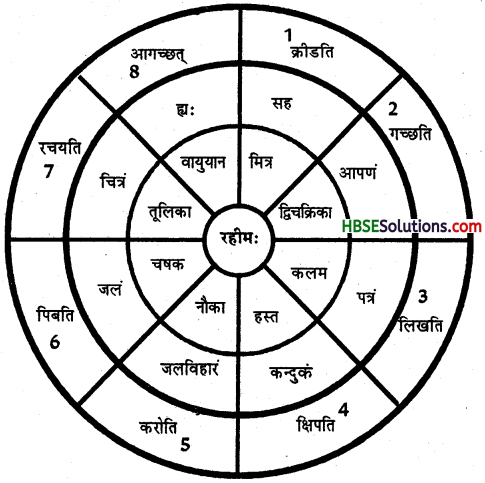
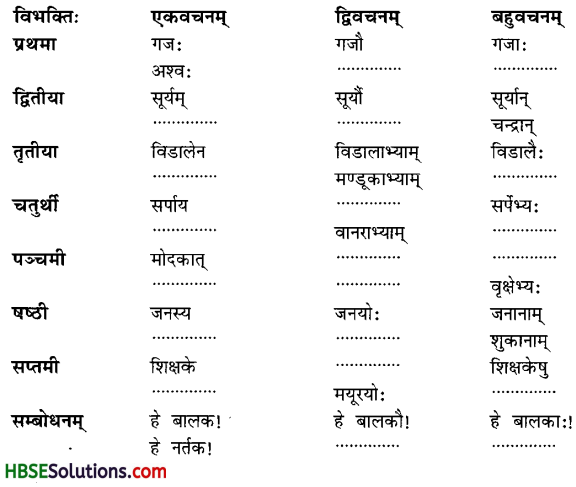
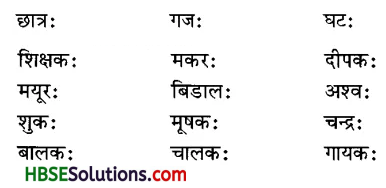
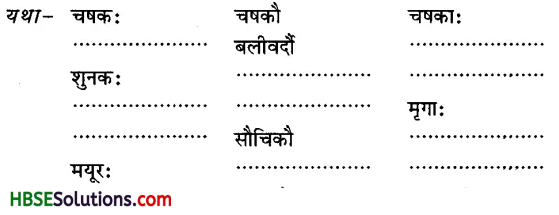
प्रश्न 5.
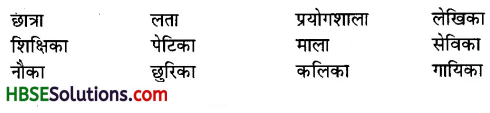
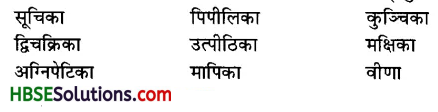
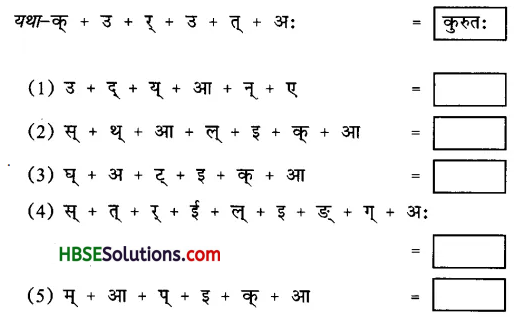
HBSE 6th Class Sanskrit Solutions Ruchira Chapter 5 वृक्षाः-1
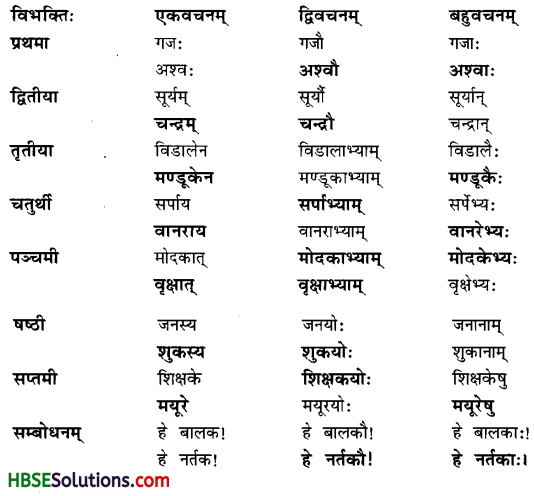
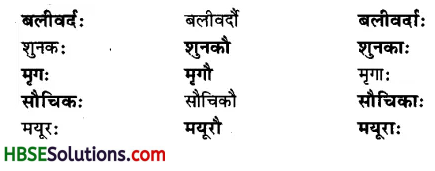
उत्तरम्:
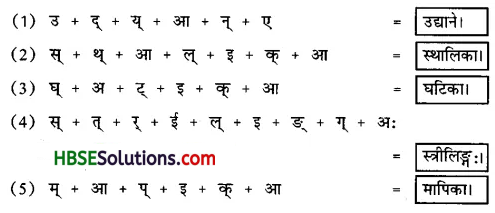
HBSE 6th Class Sanskrit Solutions Ruchira Chapter 5 वृक्षाः-2

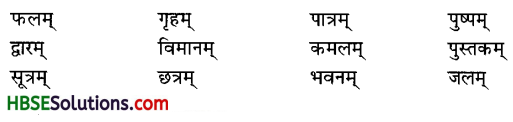
HBSE 6th Class Sanskrit Solutions Ruchira Chapter 5 वृक्षाः

प्रश्न 6.
भिन्नप्रकृतिकं पदं चिनुत
(क) गङ्गा, लता, यमुना, नर्मदा।
(ख) उद्यानम्, कुसुमम्, फलम्, चित्रम्।
(ग) लेखनी, तूलिका, चटका, पाठशाला।
(घ) आम्रम्, कदलीफलम्, मोदकम्, नारङ्गम्।
उत्तरम्:
(क) लता
(ख) चित्रम्
(ग) चटका
(घ) मोदकम्।

HBSE 6th Class Sanskrit Solutions Ruchira Chapter 5 वृक्षाः Read More »

HBSE 6th Class Sanskrit Solutions Ruchira Chapter 4 विद्यालयः

Haryana State Board HBSE 6th Class Sanskrit Solutions Ruchira Chapter 4 विद्यालयः Textbook Exercise Questions and Answers.

Haryana Board 6th Class Sanskrit Solutions रुचिरा Chapter 4 विद्यालयः

अभ्यासः

प्रश्न 1.
उच्चारणं कुरुत
अहम्, आवाम्, वयम्, माम्, आवाम्, अस्मान्, मम्, आवयोः, अस्माकम्, त्वम्, युवाम्, यूयम्, त्वाम् युवाम्, युष्मान्, तव, युवयोः, युष्माकम्।।
उत्तरम्:
छात्र स्वयं प्रयास करें।

प्रश्न 2.
निर्देशानुसारं परिवर्तनं कुरुतयथा-
अहं पठामि। (बहुवचने) – वयं पठामः।
(क) अहं नृत्यामि। – (बहुवचने) – ……………….
(ख) त्वं पठसि। – (बहुवचने) – ………………….
(ग) युवां क्रीडथः। – (एकवचने) – …………………
(घ) आवां गच्छावः। – (बहुवचने) – ………………
(ङ) अस्माकं पुस्तकानि। – (एकवचने) – …………….
(च) तव गृहम्। – (द्विवचने) – ………………..
उत्तरम्:
(क) वयं नृत्यामः
(ख) यूयं पठथ
(ग) त्वं क्रीडसि
(घ) वयं गच्छामः
(ङ) मम पुसतकम्
(च) युवयोः गृहे

HBSE 6th Class Sanskrit Solutions Ruchira Chapter 4 विद्यालयः

प्रश्न 3.
कोष्ठकात् उचितं शब्दं चित्वा रिक्तस्थानानि पूरयत-
(क) ……………………………. पठामि। (वयम्/अहम्) |
(ख) …………………………. गच्छथः। (युवाम्/यूयम्)
(ग) एतत् ……………………………. पुस्तकम्। (माम/मम)
(घ) ………………… क्रीडनकानि। (युष्मान्/युष्माकम्)
(ट) ………………………. छात्रे स्वः। (वयम/आवाम)
(च) एषा ………………… लेखनी। (तव/त्वाम) |
उत्तरम्:
(क) अहम्
(ख) युवाम्
(ग) मम
(घ) युष्माकम्
(ङ) आवाम
(च) तव

प्रश्न 4.
क्रियापदैः वाक्यानि पूरयत
पठसि, धावामः, गच्छावः, क्रीडथः, लिखामि, पश्यथ
यथा- अहं पठामि।
उत्तरम्:
(क) त्वं
(ख) आवां
(ग) यूयं
(घ) अहं
(ङ) युवां
(च) वयं
उत्तरम्:
(क) पठसि
(ख) गच्छावः
(ग) पश्चथ
(घ) लिखामि
(ङ) क्रीडथः
(च) धावामः

HBSE 6th Class Sanskrit Solutions Ruchira Chapter 4 विद्यालयः

प्रश्न 5.
उचितपदैः वाक्यनिर्माणं कुरुत-
मम, तव, आवयोः, युवयोः, अस्माकम्, युष्माकम्

यथा- एषा मम पुस्तिका।
(क) एतत् …………………………… गृहम्।
(ख) ………………….. मैत्री दृढा।
(ग) एषः ………………………….. विद्यालयः।
(घ) एषा ……………………… अध्यापिका।
(ङ) भारतम् ………………………. देशः।
(च) एतानि ………………………. पुस्तकानि।
उत्तरम् :
(क) तव
(ख) आवयोः
(ग) मम
(घ) युवयोः
(ङ) अस्माकम्
(च) युष्माकम्।

प्रश्न 6.
एकवचनपदस्य बहुवचनपदं, बहुवचनपदस्य एकवचनपदं च लिखत-
यथा- एषः – एते
(क) सः – ……………..
(ख) ताः – ……………..
(ग) एताः – ……………..
(घ) त्वम् – ……………..
(ङ) अस्माकम् – ……………..
(च) तव – ……………..
(छ) एतानि – ……………..
उत्तरम्:
(क) ते
(ख) सा
(ग) एषा
(घ) यूयम्
(ङ) मम
(च) युष्माकम्
(छ) एतत्।

HBSE 6th Class Sanskrit Solutions Ruchira Chapter 4 विद्यालयः

प्रश्न 7.
(क) वार्तालापे रिक्तस्थानानि पूरयत
यथा- प्रियंवदा – शकुन्तले! त्वं किं करोषि?
शकुन्तला – प्रियंवदे! ………… नृत्यामि, ………….. किं करोषि?
प्रियंवदा – शकुन्तले! …………. गायामि। किं …………. न गायसि?
शकुन्तला – प्रियंवदे! ………….. न गायामि। …………… तु नृत्यामि।
प्रियंवदा – शकुन्तले! किं …………….. माता नृत्यति।
शकुन्तला – आम्, …………. माता अपि नृत्यति।
प्रियंवदा – साधु, …………. चलावः।
उत्तरम् :
अहं, त्वं, अहं, त्वं, अहं, अहं, तव, मम, आवाम्।

(ख) उपयुक्तेन अर्थेन सह योजयत-
शब्दः – अर्थ
सा – तुम दोनों का
तानि – तुम सब
अस्माकम् – मेरा
यूयम् – वह (स्त्रीलिङ्ग)
आवाम् – तुम्हारा
मम – वे (नपुंसकलिङ्ग)
युवयोः – हम दोनों
तव – हमारा
उत्तरम्:
सा – वह (स्त्रीलिङ्ग)
तानि – वे नपुंसकलिङ्ग
अस्माकम् – हमारा
यूयम् – तुम सब
आषाम् – हम दोनों
मम – मेरा
युवयो: – तुम दोनों का
तव – तुम्हारा।

HBSE 6th Class Sanskrit Solutions Ruchira Chapter 4 विद्यालयः Read More »

HBSE 6th Class Sanskrit Solutions Ruchira Chapter 3 शब्द परिचयः 3

Haryana State Board HBSE 6th Class Sanskrit Solutions Ruchira Chapter 3 शब्द परिचयः 3 Textbook Exercise Questions and Answers.

Haryana Board 6th Class Sanskrit Solutions रुचिरा Chapter 3 शब्द परिचयः 3

अभ्यासः

प्रश्न 1.
(क) उच्चारणं कुरुत।
(उच्चारण करें)
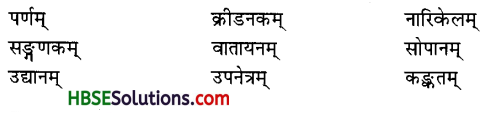
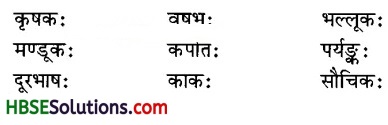
HBSE 6th Class Sanskrit Solutions Ruchira Chapter 3 शब्द परिचयः 3-1

(ख) चित्राणि दृष्ट्वा पदानि उच्चारयत।
(चित्र देखकर पदों का उच्चारण करें। चित्र पाठ्यपुस्तक में देखें।)
HBSE 6th Class Sanskrit Solutions Ruchira Chapter 3 शब्द परिचयः 3-2

प्रश्न 2.
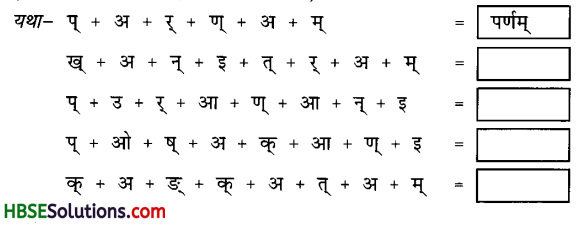
(क) वर्णसंयोजनं कृत्वा पदं कोष्ठके लिखत
(वर्ण संयोजन करके पद कोष्ठक में लिखें)
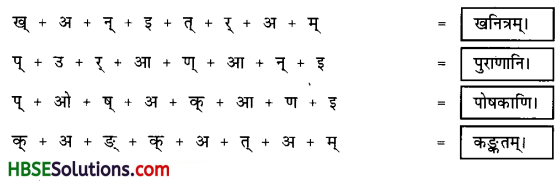
HBSE 6th Class Sanskrit Solutions Ruchira Chapter 3 शब्द परिचयः 3-3
उत्तर:
HBSE 6th Class Sanskrit Solutions Ruchira Chapter 3 शब्द परिचयः 3-4

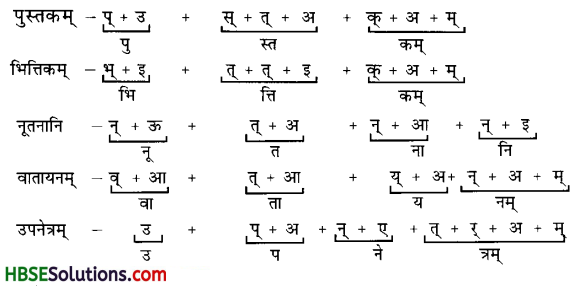
(ख) अधोलिखितानां पदानां वर्णविच्छेदं कुरुत
(अधोलिखित पदों का वर्णविच्छेद करें)
यथा- व्यजनम् = व् + य् + अ + ज् + अ + न् + अ + म्
पुस्तकम् = ……………….
भित्तिकम् = ………………
नूतनानि = ……………..
वातायनम् = ………….
उपनेत्रम्
उत्तर:

HBSE 6th Class Sanskrit Solutions Ruchira Chapter 3 शब्द परिचयः 3-5

HBSE 6th Class Sanskrit Solutions Ruchira Chapter 3 शब्द परिचयः 3

प्रश्न 3.
चित्राणि दृष्ट्वा संस्कृतपदानि लिखत
(चित्र देखकर संस्कृत पद लिखें। चित्र पाठ्यपुस्तक में देखें।)
(1)………….
(2) ………….
(3) ………….
(4)………….
(5) ………….
(6)………….
उत्तर:
(1) आम्रम्
(2) पत्रम्
(3) वायुचक्रम्
(4) करवस्त्रम्
(5) सूत्रम्
(6) छत्रम्

प्रश्न 4.
चित्रं दृष्ट्वा उत्तरं लिखत
(चित्र को देखकर उत्तर लिखें। चित्र पाठ्यपुस्तक में देखें।)
यथा- किं पतति?
मयूरौ किं कुरुतः?
एते के स्त?
बालिकाः किं कुर्वन्ति?
कानि विकसन्ति?
उत्तर:
(1) आनं पतति।
(2) मयूरौ नृत्यतः।
(3) एते क्रीडनके स्तः।
(4) बालिकाः (पुस्तकानि) पठन्ति।
(5) पुष्पाणि विकसन्ति।

प्रश्न 5.
निर्देशानुसारं वाक्यानि रचयत
(निर्देश के अनुसार वाक्य-रचना करें)

यथा-एतत् पतति। (बहुवचने) – एतानि पतन्ति।
(क) एते पणे स्तः। (बहुवचने) – ………………………
(ख) मयूरः नृत्यति। (बहुवचने) – ………………………
(ग) एतानि यानानि। (द्विवचने) – ………………………
(घ) छात्रे लिखतः। (बहुवचने) – ………………………
(ङ) नारिकेलं पतति। (द्विवचने) – ………………………
उत्तर:
(क) एतानि पर्णानि सन्ति।
(ख) मयूराः नृत्यन्ति।
(ग) एते याने।
(घ) छात्राः लिखन्ति।
(ङ) नारिकेले पततः।

HBSE 6th Class Sanskrit Solutions Ruchira Chapter 3 शब्द परिचयः 3

प्रश्न 6.
उचितपदानि संयोज्य वाक्यानि रचयत
(उचित पदों का मेल करके वाक्य रचना करें)

(क) कोकिले — विकसति
(ख) पवनः — नृत्यन्ति
(ग) पुष्पम् — उत्पतति
(घ) खगः — वहति
(ङ) मयूराः — गर्जन्ति
(च) सिंहाः — कूजतः
उत्तर:
(क) कोकिले कूजतः।
(ख) पवन: वहति।
(ग) पुष्पम् विकसति।
(घ) खगः उत्पतति।
(ङ) मयूराः नृत्यन्ति।
(च) सिंहा: गर्जन्ति।

बहुविकल्पीयप्रश्नाः

अधोलिखितेषु विकल्पेषु समुचितम् उत्तरं चित्वा लिखत
(निम्नलिखित विकल्पों में से उचित उत्तर चुनकर लिखें।)

1. अकारान्त-नपुंसकलिङ्गः कः?
(क) सूत्रम्
(ख) दीपकः
(ग) छात्रा
(घ) तुला।
उत्तर:
(क) सूत्रम्

2. अकारान्त-नपुंसकलिङ्गः कः?
(क) दूरभाषम्
(ख) छत्रम्
(ग) छुरिका
(घ) रजकः
उत्तर:
(ख) छत्रम्

3. अकारान्त-नपुंसकलिङ्गः कः?
(क) पेटिका
(ख) जवनिका
(ग) वाधम्
(घ) अश्वः
उत्तर:
(ग) वाधम्

HBSE 6th Class Sanskrit Solutions Ruchira Chapter 3 शब्द परिचयः 3

4. अकारान्त-नपुंसकलिङ्गः कः?
(क) मापिका
(ख) मण्डूकः
(ग) काकः
(घ) कङ्कतम्।
उत्तर:
(घ) कङ्कतम्।

5. अकारान्त-नपुंसकलिङ्गः कः?
(क) नीडम्
(ख) पाकशाला
(ग) कृषकाः
(घ) गजः।
उत्तर:
(क) नीडम्

6. अकारान्त-नपुंसकलिङ्गः कः?
(क) घटः
(ख) पात्रम्
(ग) अजा
(घ) मकरः।
उत्तर:
(ख) पात्रम्

7. अकारान्त-नपुंसकलिङ्गः कः?
(क) मुकुटम्
(ख) शुकाः
(ग) दीपकाः
(घ) नकुलः।
उत्तर:
(क) मुकुटम्

HBSE 6th Class Sanskrit Solutions Ruchira Chapter 3 शब्द परिचयः 3

8. अकारान्त-नपुंसकलिङ्गः कः?
(क) चन्द्रः
(ख) पञ्जरम्
(ग) तालाः
(घ) लता।
उत्तर:
(ख) पञ्जरम्

9. अकारान्त-नपुंसकलिङ्गः कः?
(क) उपनेत्रम्
(ख) सूर्यः
(ग) कुञ्चिका
(घ) परिचरिका
उत्तर:
(क) उपनेत्रम्

HBSE 6th Class Sanskrit Solutions Ruchira Chapter 3 शब्द परिचयः 3 Read More »

HBSE 6th Class Sanskrit Solutions Ruchira Chapter 2 शब्द परिचयः 2

Haryana State Board HBSE 6th Class Sanskrit Solutions Ruchira Chapter 2 शब्द परिचयः 2 Textbook Exercise Questions and Answers.

Haryana Board 6th Class Sanskrit Solutions रुचिरा Chapter 2 शब्द परिचयः 2

अभ्यासः

प्रश्न 1.
उच्चारणं कुरुत।
(उच्चारण करो)
HBSE 6th Class Sanskrit Solutions Ruchira Chapter 2 शब्द परिचयः 2-1

(ख) चित्राणि दृष्ट्वा पदानि उच्चारयत।
(चित्रों को देखकर पदों का उच्चारण करें। चित्र पाठ्यपुस्तक में देखें।)

प्रश्न 2.
(क) वर्णसंयोजनं कृत्वा पदं कोष्ठके लिखत
(वर्णसंयोजन करके पद को कोष्ठक में लिखें)
.HBSE 6th Class Sanskrit Solutions Ruchira Chapter 2 शब्द परिचयः 2-3
उत्तर:
HBSE 6th Class Sanskrit Solutions Ruchira Chapter 2 शब्द परिचयः 2-4

(ख) पदानां वर्णविच्छेदं प्रदर्शयत
(पदों का वर्णविच्छेद दर्शाएँ)
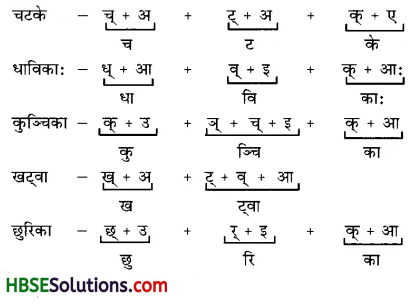
यथा- कोकिले = क् + ओ + क् + इ + ल् + ए
HBSE 6th Class Sanskrit Solutions Ruchira Chapter 2 शब्द परिचयः 2-5
(1) चटके = ………….
(2) धाविकाः = …………..
(3) कुञ्चिका = …………..
(4) खट्वा = …………
(5) छुरिका = ……………
उत्तर:
HBSE 6th Class Sanskrit Solutions Ruchira Chapter 2 शब्द परिचयः 2-6

HBSE 6th Class Sanskrit Solutions Ruchira Chapter 2 शब्द परिचयः 2

प्रश्न 3.
चित्रं दृष्ट्वा संस्कृतपदं लिखत
(चित्र देखकर संस्कृत-पद लिखें। चित्र पाठ्यपुस्तक में देखें।)
1. …………
2. ………..
3. …………
4. ……………
5. …………
6. ………….
उत्तर:
(1) उत्पीठिका
(2) पेटिका
(3) नौका
(4) चटका
(5) महिला
(6) मापिका

प्रश्न 4.
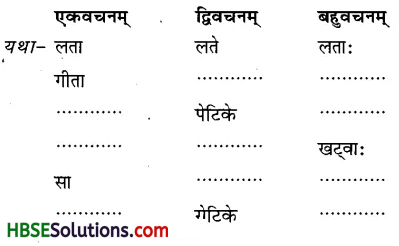
वचनानुसारं रिक्तस्थानानि पूरयत
(वचन के अनुसार रिक्तस्थानों की पूर्ति करें)

HBSE 6th Class Sanskrit Solutions Ruchira Chapter 2 शब्द परिचयः 2-7
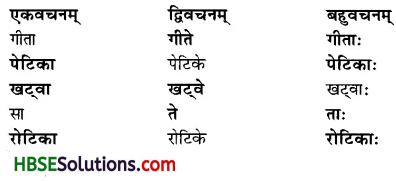
उत्तर:
HBSE 6th Class Sanskrit Solutions Ruchira Chapter 2 शब्द परिचयः 2-8

प्रश्न 5.
कोष्ठकात् उचितं शब्दं चित्वा वाक्यं पूरयत-
(कोष्ठक से उचित शब्द चुनकर वाक्य की पूर्ति करें)
यथा-बालिका पठति। (बालिका/बालिकाः)
(क) ………………. चरतः। (अजा/अजे)
(ख) ……………………… सन्ति। (द्विचक्रिके/द्विचक्रिकाः )
(ग) …………………….. चलति। (नौके/नौका)
(घ) ……………………… अस्ति। (सूचिके/सूचिका)
(ङ) ………………उत्पतन्ति। (मक्षिकाः/मक्षिके)
उत्तर:
(क) अजे चरतः।
(ख) द्विचक्रिकाः सन्ति।
(ग) नौका चलति।
(घ) सूचिका अस्ति।
(ङ) मक्षिकाः उत्पतन्ति।

HBSE 6th Class Sanskrit Solutions Ruchira Chapter 2 शब्द परिचयः 2

प्रश्न 6.
सा, ते, ताः इत्येतेभ्यः उचितं सर्वनामपदं चित्वा रिक्तस्थानानि पूरयत
(सा, ते, ताः-इनमें उचित सर्वनाम पद का चयन करके रिक्त स्थानों की पूर्ति करें)

यथा- लता अस्ति। – सा अस्ति ।
(क) महिलाः धावन्ति। – ………… धावन्ति ।
(ख) सुधा वदति। – …………. वदति।
(ग) जंवनिके दोलतः। – ……….दोलतः।
(घ) पिपीलिकाः चलन्ति। – …………. चलन्ति ।
(ङ) चटके कूजतः। – …………. कूजतः।
उत्तर:
(क) ता: धावन्ति।
(ख) सा वदति।
(ग) ते दोलतः।
(घ) ता: चलन्ति।
(ङ) ते कूजतः।

प्रश्न 7.
मञ्जूषातः कर्तृपदं चित्वा रिक्तस्थानानि पूरयत
(मंजूषा से कर्तृपद का चयन करके रिक्तस्थानपूर्ति करें)

लेखिका बालकः सिंहाः त्रिचक्रिका पुष्पमालाः

(क) ………….. सन्ति ।
(ख) …………. पश्यति।
(ग) …….. लिखति।
(घ) ……… गर्जन्ति।
(ङ) ……….. चलति।
उत्तर:
(क) पुष्पमालाः – सन्ति।
(ख) बालकः – पश्यति।
(ग) लेखिका – लिखति।
(घ) सिंहाः – गर्जन्ति।
(ङ) त्रिचक्रिका – चलति।

प्रश्न 8.
मञ्जूषातः कर्तृपदानुसारं क्रियापदं चित्वा रिक्तस्थानानि पूरयत
(मंजूषा से कर्तृपद के अनुसार क्रियापद चुनकर रिक्तस्थानपूर्ति करें)

गायतः नृत्यति लिखन्ति पश्यन्ति विहरतः

(क) सौम्या …………..
(ख) चटके …………..
(ग) बालिके …………..
(घ) छात्राः …………..
(ङ) जनाः …………..
उत्तर:
(क) सौम्या – नृत्यति।
(ख) चटके – विहरतः।
(ग) बालिके – गायतः।
(घ) छात्राः – लिखन्ति।
(ङ) जनाः – पश्यन्ति।

HBSE Class 6th Sanskrit Chapter 2 शब्द परिचयः 2 Additional Important Questions and Answers

प्रश्न 1.
अधोलिखितानां बहुवचनरूपाणि लिखत। (निम्नलिखित के बहुवचन रूप लिखें।)
(क) लता ……………………….. |
(ख) बाला ………………..
(ग) माला ………………..।
(घ) नौका ……………….
(ङ) दोला ……………।
उत्तर:
(क) लता – लताः ।
(ख) बाला – बाला:
(ग) माला – मालाः।
(घ) नौका – नौका:
(ङ) दोला – दोला:।

HBSE 6th Class Sanskrit Solutions Ruchira Chapter 2 शब्द परिचयः 2

प्रश्न 2.
अधोलिखितानां स्त्रीलिङ्गरूपाणि लिखत।
(निम्नलिखित के स्त्रीलिङ्ग रूप लिखें।)

(क) अजः …………..
(ख) वृद्धः ……………..
(ग) बालः ……………
(घ) छात्रः …………..
(ङ) चटक: ……………
उत्तर:
(क) अजः – अजा।
(ख) वृद्धः – वृद्धा।
(ग) बालः – बाला।
(घ) छात्रः – छात्रा।
(ङ) चटकः – चटका।

बहुविकल्पीयप्रश्नाः

अधोलिखितेषु विकल्पेषु समुचितम् उत्तरं चित्वा लिखत
(निम्नलिखित विकल्पों में से उचित उत्तर चुनकर लिखें।)

1. आकारान्त-स्त्रीलिङ्गः कः?
(क) वृद्धा
(ख) रामः
(ग) फलम्
(घ) नदी।
उत्तर:
(क) वृद्धा

2. आकारान्त-स्त्रीलिङ्गः कः?
(क) बालः
(ख) उत्पीठिका
(ग) मतिः
(घ) जलम्।
उत्तर:
(ख) उत्पीठिका

3. आकारान्त-स्त्रीलिङ्गः कः?
(क) रामाः
(ख) साधवः
(ग) तुला
(घ) बालकौ।
उत्तर:
(ग) तुला

HBSE 6th Class Sanskrit Solutions Ruchira Chapter 2 शब्द परिचयः 2

4. आकारान्त-स्त्रीलिङ्गः कः?
(क) छत्रे
(ख) पुस्तकम्
(ग) पुष्पाणि
(घ) मापिका।
उत्तर:
(घ) मापिका।

5. आकारान्त-स्त्रीलिङ्गः कः?
(क) दोला
(ख) वारिणि
(ग) शिक्षकाः
(घ) मयूराः।
उत्तर:
(क) दोला

6. आकारान्त-स्त्रीलिङ्गः कः?
(क) तालम्
(ख) छुरिका
(ग) ताला:
(घ) कमलानि।
उत्तर:
(ख) छुरिका

7. आकारान्त-स्त्रीलिङ्गः कः?
(क) पर्णानि
(ख) चक्राणि
(ग) जवनिका
(घ) कारयाने।
उत्तर:
(ग) जवनिका

HBSE 6th Class Sanskrit Solutions Ruchira Chapter 2 शब्द परिचयः 2

8. आकारान्त-स्त्रीलिङ्गः कः?
(क) केशवः
(ख) वानरः
(ग) गजा:
(घ) वीणा।
उत्तर:
(घ) वीणा।

9. आकारान्त-स्त्रीलिङ्गः कः?
(क) अजा
(ख) जलपात्रम्
(ग) मुकुटानि
(घ) वाद्यम्।
उत्तर:
(क) अजा

HBSE 6th Class Sanskrit Solutions Ruchira Chapter 2 शब्द परिचयः 2 Read More »

HBSE 6th Class Sanskrit Solutions Ruchira Chapter 1 शब्द परिचयः 1

Haryana State Board HBSE 6th Class Sanskrit Solutions Ruchira Chapter 1 शब्द परिचयः 1 Textbook Exercise Questions and Answers.

Haryana Board 6th Class Sanskrit Solutions रुचिरा Chapter 1 शब्द परिचयः 1

अभ्यासः

प्रश्न 1.
(क) उच्चारणं कुरुत।
(उच्चारण करें)
HBSE 6th Class Sanskrit Solutions Chapter 1 शब्द परिचयः 1-1

(ख) चित्राणि दृष्ट्वा पदानि उच्चारयत।
(चित्रों को देखकर पदों का उच्चारण करें। चित्र पाठ्यपुस्तक में पृष्ठ 4 पर देखें।)
HBSE 6th Class Sanskrit Solutions Chapter 1 शब्द परिचयः 1-2

प्रश्न 2.
(क) वर्णसंयोजनेन पदं लिखत
(वर्ण संयोजन के द्वारा पद लिखें)
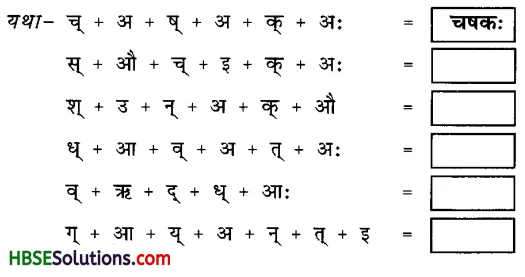
HBSE 6th Class Sanskrit Solutions Chapter 1 शब्द परिचयः 1-3
उत्तर:
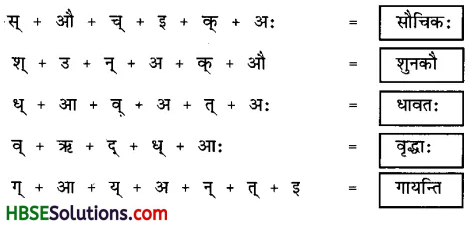
HBSE 6th Class Sanskrit Solutions Chapter 1 शब्द परिचयः 1-4

HBSE 6th Class Sanskrit Solutions Ruchira Chapter 1 शब्द परिचयः 1

(ख) पदानां वर्णविच्छेदं प्रदर्शयत
(पदों का वर्णविच्छेद दर्शायें)

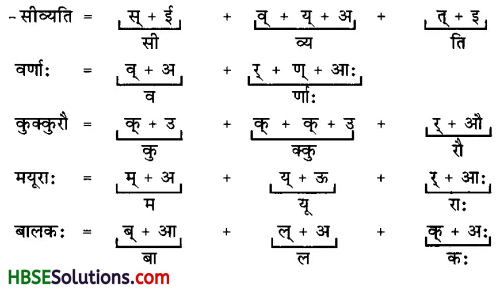
सीव्यति = …………..
वर्णाः = …………
कुक्कुरौ = ……………….
मयूराः = ……………
बालकः = ………….
उत्तर:
HBSE 6th Class Sanskrit Solutions Chapter 1 शब्द परिचयः 1-6

प्रश्न 3.
उदाहरणं दृष्ट्वा रिक्तस्थानानि पूरयत
(उदाहरण को देखकर रिक्तस्थानों की पूर्ति करें)
HBSE 6th Class Sanskrit Solutions Chapter 1 शब्द परिचयः 1-7
उत्तर:
HBSE 6th Class Sanskrit Solutions Chapter 1 शब्द परिचयः 1-8

प्रश्न 4.
चित्राणि दृष्ट्वा संस्कृतपदानि लिखत
(चित्रों को देखकर संस्कृत के शब्द लिखो। चित्र पाठ्यपुस्तक में देखें।)
(1) …………..
(2) …………..
(3) ……………
(4) ……………
(5) …………..
(6) ……………
उत्तर:
(1) गजः
(2) काकः
(3) चन्द्रः
(4) ताल:
(5) ऋक्षः
(6) मार्जारः

HBSE 6th Class Sanskrit Solutions Ruchira Chapter 1 शब्द परिचयः 1

प्रश्न 5.
चित्रं दृष्ट्वा उत्तरं लिखत
(चित्र देखकर उत्तर लिखें। चित्र पाठ्यपुस्तक में देखें।)
यथा- बालकः किं करोति?
बालकः पठति।
अश्वौ किं कुरुतः?
…………(1)……………
कुक्कुराः किं कुर्वन्ति?
………..(2)…………..
छात्रौ किं कुरुतः?
…………(3)……………
कृषकः किं करोति?
………….(4)…….
गजौ किं कुरुतः?
………..(5)………….
उत्तर:
(1) अश्वौ धावतः।
(2) कुक्कुराः बुक्कन्ति।
(3) छात्रौ तिष्ठतः।
(4) कृषकः क्षेत्रं कर्षति।
(5) गजौ चलतः।

प्रश्न 6.
पदानि संयोज्य वाक्यानि रचयत
(पदों को जोड़कर वाक्य-रचना करें)
(i) गजाः — नृत्यन्ति
(ii) सिंहौ — गायति
(iii) गायकः — पठतः
(iv) बालको — चलन्ति
(v) मयूराः — गर्जतः
उत्तर:
(i) गजाः – चलन्ति।
(ii) सिंहौ – गर्जतः।
(iii) गायकः – गायति।
(iv) बालकौ – पठतः।
(v) मयूराः – नृत्यन्ति।

प्रश्न 7.
मञ्जूषातः पदं चित्वा रिक्तस्थानानि पूरयत
(मंजूषा से पद को चुनकर रिक्तस्थानों की पूर्ति करें)

नृत्यन्ति गर्जतः धावति चलतः फलन्ति खादति

(क) मयूराः ……………………….।
(ख) गजौ …………………………।
(ग) वृक्षाः …………
(घ) सिंहौ ……………
(ङ) वानरः
(च) अश्वः …….
उत्तर:
(क) मयूराः – नृत्यन्ति।
(ख) गजौ – चलतः।
(ग) वृक्षाः – फलन्ति।
(घ) सिंहौ – गर्जतः।
(ङ) वानरः – खादति।
(च) अश्वः – धावति।

प्रश्न 8.
सः, तौ, ते इत्येतेभ्यः उचितं सर्वनामपदं चित्वा रिक्तस्थानानि पूरयत
(सः, तौ, ते–इनमें से उचित सर्वनामपद का चयन करके रिक्तस्थानों की पूर्ति करें)
यथा-अश्वः धावति। – सः धावति।
(क) गजाः चलन्ति। – …………… चलन्ति।
(ख) छात्रौ पठतः। – …………… पठतः।
(ग) वानराः क्रीडन्ति। – …………… क्रीडन्ति।
(घ) गायकः गायति। – …………… गायति।
(ङ) मयूराः नृत्यन्ति। – …………… नृत्यन्ति।
उत्तर:
(क) ते चलन्ति।
(ख) तौ पठतः।
(ग) ते क्रीडन्ति।
(घ) सः गायति।
(ङ) ते नृत्यन्ति।

ध्यातव्यम्
(क) संस्कृते त्रीणि लिङ्गानि भवन्ति पुंल्लिङ्ग, स्त्रीलिङ्गं, नपुंसकलिङ्गञ्च ।
(ख) संस्कृते त्रयः पुरुषाः भवन्ति–प्रथमपुरुषः, मध्यमपुरुषः, उत्तमपुरुषश्च ।
(ग) संस्कृते त्रीणि वचनानि भवन्ति एकवचनं, द्विवचनं, बहुवचनञ्च ।

HBSE 6th Class Sanskrit Solutions Ruchira Chapter 1 शब्द परिचयः 1

ध्यान करें —

(क) संस्कृत में तीन लिङ्ग होते हैं
(1) पुंल्लिङ्ग
(2) स्त्रीलिङ्ग तथा
(3) नपुंसकलिङ्ग।

(ख) संस्कृत में तीन पुरुष होते हैं
(1) प्रथमपुरुष
(2) मध्यमपुरुष तथा
(3) उत्तमपुरुष ।

(ग) संस्कृत में तीन वचन होते हैं
(1) एकवचन
(2) द्विवचन तथा
(3) बहुवचन।

नोट —

(क) दूरस्थ वस्तु को बताने के लिए तद् (= वह That) शब्द का प्रयोग किया जाता है। यथा
सः बालकः।
तौ शुकौ।
ते गजाः ।

(ख) निकटस्थ वस्तु को बताने के लिए एतद् (= यह This) शब्द का प्रयोग किया जाता है। यथा
एषः पिकः।
एतौ मयूरौ। एते
वानराः।

HBSE 6th Class Sanskrit Chapter 1 शब्द परिचयः 1 Additional Important Questions and Answers

प्रश्न 1.
अधोलिखितानाम् एकवचनरूपाणि लिखत।
(निम्नलिखित के एकवचन रूप लिखें।)
(क) गजाः
(ख) शशकाः
(ग) देवाः
(घ) शुकाः
(ङ) बालकाः
(च) सर्पाः
(च) सर्पः।
उत्तर:
(क) गजः
(ख) शशक:
(ग) देवः
(घ) शुकः
(ङ) बालक:
(च) सर्पाः।

HBSE 6th Class Sanskrit Solutions Ruchira Chapter 1 शब्द परिचयः 1

प्रश्न 2.
अधोलिखितानां बहुवचनरूपाणि लिखत। (निम्नलिखित के बहुवचन रूप लिखें।)
(क) बालः पठति।
(ख) सिंहः गर्जति।
(ग) वानरः धावति।
(घ) पिकः कूजति।
(ङ) गजः चलति।
उत्तर:
(क) बालाः पठन्ति।
(ख) सिंहाः गर्जन्ति।
(ग) वानराः धावन्ति।
(घ) पिकाः कूजन्ति।
(ङ) गजाः चलन्ति।

बहुविकल्पीयप्रश्नाः

अधोलिखितेषु विकल्पेषु समुचितम् उत्तरं चित्वा लिखत
(निम्नलिखित विकल्पों में से उचित उत्तर चुनकर लिखें।)

1. पुल्लिङ्गः कः?
(क) घटः
(ख) नदी
(ग) वृद्धा
(घ) फलम्।
उत्तर:
(क) घटः

2. पुंल्लिङ्गः कः?
(क) वाद्यम्
(ख) अश्वः
(ग) मुकुटानि
(घ) वीणा।
उत्तर:
(ख) अश्वः

HBSE 6th Class Sanskrit Solutions Ruchira Chapter 1 शब्द परिचयः 1

3. पुंल्लिङ्गः कः?
(क) कारयानम्
(ख) जवनिका
(ग) दीपकः
(घ) छुरिका।
उत्तर:
(ग) दीपकः

4. पुंल्लिङ्गः कः?
(क) दोला
(ख) घटिका
(ग) तालम्
(घ) नकुलः
उत्तर:
(घ) नकुलः

5. पुंल्लिङ्गः कः?
(क) वृषभः
(ख) छुरिका
(ग) ककृतम्
(घ) भवनम्।
उत्तर:
(क) वृषभः

6. पुंल्लिङ्गः कः?
(क) सूचिका
(ख) चटका
(ग) क्रीडनकम्
(घ) तालः
उत्तर:
(घ) तालः

7. पुल्लिङ्गः कः?
(क) नीडम्
(ख) कमलानि
(ग) वृद्धः
(घ) पेटिकाः।
उत्तर:
(ग) वृद्धः

HBSE 6th Class Sanskrit Solutions Ruchira Chapter 1 शब्द परिचयः 1

8. पुल्लिङ्गः कः?
(क) वीणा
(ख) करवस्त्रम्
(ग) मक्षिका
(घ) सौचिकः।
उत्तर:
(घ) सौचिकः।

9. पुंल्लिङ्गः कः?
(क) बिडाल:
(ख) उत्पीठिका
(ग) फलम्
(घ) वृक्षम्।
उत्तर:
(क) बिडाल:

HBSE 6th Class Sanskrit Solutions Ruchira Chapter 1 शब्द परिचयः 1 Read More »

HBSE 8th Class Maths Solutions Chapter 16 Playing with Numbers InText Questions

Haryana State Board HBSE 8th Class Maths Solutions Chapter 16 Playing with Numbers InText Questions and Answers.

Haryana Board 8th Class Maths Solutions Chapter 16 Playing with Numbers InText Questions

Try These (Page 250)

Question 1.
Write the following numbers in generalised form :
(i) 25
(ii) 73
(iii) 129
(iv) 302.
Solution:
(i) 25 = 2 × 10 + 5
[∵ ab = 10 × a + b where a and b are tens and ones place digits]
(ii) 73 = 7 × 10 + 3 ∵ ab = 10 × a + b]
(iii) 129 = 1 × 100 + 2 × 10 + 1 × 9
[∵ abc = 100 × a + 10 × b + 1 × c where a, b, c are hundreds, tens and ones place digits]
(iv) 302 = 100 × 3 + 0 × 10 + 1 × 2.

Question 2.
Write the following in the usual form :
(i) 10 × 5 + 6
(ii) 100 × 7 + 10 × 1 + 8
(iii) 100 × a + 10 × c + b.
Solution:
(i) 10 × 5 + 6 = 50 + 6 = 56
(ii) 100 × 7 + 10 × 1 + 8 = 700 + 10 + 8 = 718
(iii) 100 × a + 10 × c + b = 100a + 10c + b.

HBSE 8th Class Maths Solutions Chapter 16 Playing with Numbers InText Questions

Try These (Page 251)

Question 1.
Check what the result would have been if Sundaram had chosen the numbers shown below :
1. 27
2. 39
3. 64
4. 17
Solution:
HBSE 8th Class Maths Solutions Chapter 16 Playing with Numbers InText Questions 1

Conclusion : It is obvious from the above games with numbers that remainder is zero in each cases if we follow the procedure explained above. Quotient is always (a + b) i.e. 2 + 7 = 9 and so on.

Question 2.
Check what the result would have been if Sundaram had chosen the numbers shown below :
1. 17
2. 21
3. 96
4. 37.
Solution:
HBSE 8th Class Maths Solutions Chapter 16 Playing with Numbers InText Questions 2
Hence, we observe that the quotient in each cases is either (a – b) or (b – a) according as a > b or a

HBSE 8th Class Maths Solutions Chapter 16 Playing with Numbers InText Questions

Try These (Page 252)

Question 1.
Check what the result would have been if Minakshi had chosen the numbers shown below. In each case keep a record of the quotient obtained at the end.
1. 132
2. 469
3. 737
4. 901.
Solution:
1. Let the Minakshi had chosen the 3-digit number 132. So she got:
Reversed number : 231
Difference : 231 – 132 = 99
Division by 99 : 99 ÷ 99 = 1, with no remainder
Hence, Quotient = 1, Remainder = 0

2. Here,
Original number : 469
Difference : 964 – 469 = 495
Reversed number : 964
Division (by 99) : 495 ÷ 99 = 5
∴ Quotient = 5, Remainder = 0 (i.e. No remainder).

3. Here
Original number : 737
Reversed number : 737
Difference : 737 – 737 = 0
Division (by 99) : 0 ÷ 99 = 0 with no remainder
Hence, Quotient = 0, Remainder = 0

4. Here
Original number : 901
Reversed number : 109
Difference : 901 – 109 = 792
Division (by 99) : 792 ÷ 109 = 0 with no remainder
Hence, Quotient = 8, Remainder = 0
Conclusion : Hence, the resulting number is divisible by 99 in each cases and the quotient obtained is [(c – a) or (a – c)]. So, the remainder is zero.

Try These (Page 253)

Question 1.
Check what the result, would have been if Sundaram had chosen the numbers shown below :
1. 417
2. 632
3. 117
4. 937
Solution:
1. Original dumber
= 417 [It is in the form abc]
The number obtained by changing the digits like (cab)
= 741
and the other number in the form (bca) = 174
[Here, a = 4, b = 1 and c = 7]
Now add them up :
HBSE 8th Class Maths Solutions Chapter 16 Playing with Numbers InText Questions 3
Then, we divide the resulting number 1332 by 37
∴ 1332 ÷ 37 = 36, with no remainder.
Hence, the number is divisible by 37 and remainder is 0.

2. Here, abc = 632
[∵ a = 6, b = 3 and c = 2]
cab = 263
and bca = 326
Add them up :
HBSE 8th Class Maths Solutions Chapter 16 Playing with Numbers InText Questions 4
Divide the number by 37.
1221 ÷ 37 = 33, with no remainder.
∴ The number so obtained is divisible by 37.
Thus, Quotient = 33, Remainder = 0.

3. Here, abc =117
[Here a = 1, b = 1 and c = 7] c
ab = 711
and bca = 171
Add them up :
HBSE 8th Class Maths Solutions Chapter 16 Playing with Numbers InText Questions 5
Divide the number by 37.
999 ÷ 37 = 27, with no remainder.
∴ The resulting number is divisible by 37.
Thus, Quotient = 27, Remainder = 0.

4. We have abc = 937
[Here a = 9, b = 3 and c = 7]
cab = 793
and bca = 379
Add them up:
HBSE 8th Class Maths Solutions Chapter 16 Playing with Numbers InText Questions 6
Divide the number so obtained by 37.
2109 + 37 = 57, with no remainder.
∴ The resulting number is divisible by 37. Thus, Quotient = 57, Remainder = 0.

HBSE 8th Class Maths Solutions Chapter 16 Playing with Numbers InText Questions

Try These (Page 255)

Question 1.
Write a 2-digit number ab and the number obtained by reversing its digits i.e., ba. Find their sum. Let the sum be a 3¬digit number dad
i.e. ab + ba = dad
(10a + b) + (10b + a) = dad
11(a + b) = dad
(i) The sum a + b can not exceed 18 (why) ?
(ii) Is dad a multiple of 11 ?
(iii) Is dad less than 198 ?
(iv) Write all the 3-digit num bers which are multiples of 11 upto 198.
Find the values of a and d.
Solution:
Let a 2-diglt number be 87.
Then, the number obtained by reversing it will be 78.
Sum of these two numbers i.e. ab + ba = 87 + 78 = 165
165 is a 3-digit number.
Sum of digits = a + 6 = 8 + 7 = 15 which is less than 18.

(i) Take the maximum value of 2-digit number which is 99.
Even then, ab + ba = 99 + 99 = 198
So, a + b = \(\frac{198}{11}\) = 18
[∵ 11(a + b) = dad]
Thus, a + b can not exceed 18.
(ii) Yes, it is a multiple of 11.
(iii) Yes, it is less than 198.
(iv) 3-digits numbers which are multiples of 11 are :
11 × 10 = 110 Here, dad = 110, ∴ d = 1 or 0, a = 1
11 × 11 = 121; dad = 121 a = 2, d = 1
11 × 12 = 132; a = 3, d = 1 or 2
11 × 13 = 143; a = 4, d = 1 or 3
11 × 14 = 154; a = 4, d = 1 or 4
11 × 15 = 165; a = 6, d = 1 or 5
11 × 16 = 176; a = 7, d = 1 or 6

Try These (Page 257)

Question 1.
If the division N + 5 leaves a remainder of 3, what might be the ones digit of N ?
Answer:
The one’s digit, when divided by 5, must leave a remainder of 3. So the one’s digit must be either 3 or 8.

HBSE 8th Class Maths Solutions Chapter 16 Playing with Numbers InText Questions

Question 2.
If the division N + 5 leaves a remainder of 1, what might be the one’s digit of N ?
Answer:
The one’s digit when divided by 5, must leave a remainder 1.
∴ The one’s digit must be either 1 or 6.

Question 3.
If the division N + 5 leaves a remainder of 4, what might be the one’s digit of N ?
Answer:
The one’s digit must be either 4 or 9.
For example,
HBSE 8th Class Maths Solutions Chapter 16 Playing with Numbers InText Questions 7

HBSE 8th Class Maths Solutions Chapter 16 Playing with Numbers InText Questions

Try These (Page 257-258)

Question 1.
If the division N + 2 leaves a remainder of 1, what might be the one’s digit of N ?
Answer:
N is odd; so ;its one’s digit is odd. Therefore, the one’s digit must be 1, 3, 5, 7 or 9.

Question 2.
If the division N + 2 leaves a remainder (t.e., zero remainder), what might be the one’s digit of N ?
Answer:
The one’s digit of N must be 0, 2, 4, 6 or 8 i.e. an even number.

HBSE 8th Class Maths Solutions Chapter 16 Playing with Numbers InText Questions

Question 3.
Supose that the division N + 5 leaves a remainder of 4, and the division N + 2 leaves a remainder of 1. What must be the one’s digit of N ?
Answer:
∵ N ÷ 5 leaves a remainder 4.
∴ One’s digit of N should be 4 or 9.
Now, N ÷ 2 leaves a remainder of 1
∴ One’s digit of N are 1, 3, 5, 7, 9.
9 is a common digit in both the cases.
∴ One’s, digit of N must be 9.

Try These (Page 259)

Question 1.
Check the divisibility of the following numbers by 9 :
1. 108
2. 616
3. 294
4. 432
5. 927.
Solution:
(1) The sum of the digits of 108 is 1 + 0 + 8 = 9
So, this number is divisible by 9 because the sum of its digits is divisible by 9.

(2) The sum of the digits of 616 is 6 + 1 + 6 = 13
∵ 13 is not divisible by 9,
∴ Thus no. is also not divisible by 9.

(3) The sum of the digits of 294 is 2 + 9 + 4 = 15
∵ 15 is not divisible by 9.
∴ 294 is not divisible by 9.

(4) The sum of the digits 432 is 4 + 3 + 2 = 9.
∵ Sum of the digits i.e. 9 is divisible by 9.
∴ 432 is divisible by 9.

(5) The sum of the digits of 927 is 9 + 2 + 7 = 18
So, this number is divisible by 9 because sum of the digits i.e. 18 is divisible by 9.

HBSE 8th Class Maths Solutions Chapter 16 Playing with Numbers InText Questions

Think, Discuss and Write (Page 259)

Question 1.
You have seen that a number 450 is divisible by 10. It is also divisible by 2 and 5 which are factors of 10. Similarly, a number 135 is divisible 9. It is also divisible by 3 which is a factor of 9.
Can you say that if a number is divisible by any number m, then it will also be divisible by each of the factors of m ?
Solution:
Yes, if a number is divisible by any number m, then it will also be divisible by each of the factors of m.
e.g., 42 is divisible by 21
Factors of 21 are 1, 3, 7
∴ 42 is also divisible by 1, 3, or 7.

Question 2.
(i) Write a 3-digit number abc as 100a + 10b + c
= 99a + 11b + (a – b + c)
= 11(9a + b) (a – b + c)
If the number abc is divisible by 11, then wliat can you say about (a – b + c) ?
Is it necessary that (a + c – b) she old be divisible by 11 ?
(ii) Write a 4-digit number abed us 1000a + 100b + 10c + d
= (1001a + 99b + 11c) – (a – b + c – d)
= 11(91a + 9b + c) + [(b + d) – (a + c)]
If the number abed is divisible by 11, then what can you say about [(b + d) – (a + c)]?
(iii) From (i) and (ii) above, can you say that a number will be divisible by 11 if the difference between the sum of digits at its odd places and that of digits at the even places is divisible by 11 ?
Solution:
(i) abc – 100a + 10b + c
= 100 × 1 + 10 × 2 + 1 [Here a = 1, b = 2 and c = 1]
= 99 × 1 + (11 × 2) + (1 – 2 + 1)
= 11(9 × 1 + 2) + (1 – 2 + 1)
It is clear from above example that the value of (a – b + c) must be zero if the number abc is divisible by 11.

(ii) Let the number be abcd = 9537. [Here a = 9, b = 5, c = 3 and d = 7]
9537 = 1000 × 9 + 100 × 5 + 10 × 3 + 7
= (1001 × 9 + 99 × 5 + 11 × 3) – (9 – 5 + 3 + 7)
= 11(91 × 9 + 9 × 5 + 3) + [(5 + 7) – (9 + 3)]
So, the value of [(b + d) – (a + c)] = 0 if abcd is divisible by 11.

(iii) Yes, it is true.

HBSE 8th Class Maths Solutions Chapter 16 Playing with Numbers InText Questions

Try These (Page 260)

Question 1.
Check the divisibility of the following numbers by 3.
1. 108
2. 616
3. 294
4. 432
5. 927.
Solution:
(1) The sum of the digits of 108 is 1 + 0 + 8 = 9
∵ 9 is divisible by 3.
∴ 108 is divisible by 3 [If the sum of the digits is divisible by 3 then the number is also divisible by 3].

(2) The sum of the digits of 616 is 6 + 1 + 6
= 13
Since 13 is not divisible by 3.
Therefore, 616 is not divisible by 3.

(3) The sum of the digits of 294 is 2 + 9 + 4
= 15
∵ 15 is divisible by 3.
∴ The number 294 is divisible by 3.

(4) The sum of the digits 432 is 4 + 3 + 2 = 9.
∵ 9 is divisible by 3.
∴ 432 is divisible by 3.

(5) The sum of the digits of 927 is 9 + 2 + 7
= 18
∵ 18 is divisible by 3.
∴ 927 is divisible by 3.

HBSE 8th Class Maths Solutions Chapter 16 Playing with Numbers InText Questions Read More »

HBSE 8th Class Maths Solutions Chapter 16 Playing with Numbers Ex 16.2

Haryana State Board HBSE 8th Class Maths Solutions Chapter 16 Playing with Numbers Ex 16.2 Textbook Exercise Questions and Answers.

Haryana Board 8th Class Maths Solutions Chapter 16 Playing with Numbers Exercise 16.2

Question 1.
If 21y5 is a multiple of 9, where y is: a digit, what is the value of y ?
Solution:
Since 21y5 is a multiple of 9.
i.e. 21y5 is divisible by 9.
Therefore, 2 + 1 + y + 5 = (8 + y) must be a multiple of 9. i.e. (8 + y) should be divisible by 9.
This is possible when 8 + y = 9 or 18
⇒ 8 + y = 9 or 8 + y = 18
y = 1 or y = 10
But, since x is a digit, therefore y = 10 is not possible.
Thus y = 1.

Question 2.
If 31z5 is a multiple of 9, where z is a digit, what is the value of z ?
You will find that there are two answers for the last problem. Why is this so ?
Solution:
Since 31z5 is divisible by 9.
∴ 3 + 1 + z + 5 = a multiples of 9.
9 + z = 9, 18 or 27
⇒ 9 + z = 9 9 + z = 18
⇒ z = 0 z = 9
9 + z = 27
z = 21
which is not a one digit number.
∴ The values of z are (0 or 9).
There are two values of z as the sum of digits is a multiple of 9. So, it may be 9, 18, 27 … any one of them.

HBSE 8th Class Maths Solutions Chapter 16 Playing with Numbers Ex 16.2

Question 3.
If 24x is a multiple of 3, where x is a digit, what is the value of x ?
[Hint: Since 24x is a multiple of 3, its sum of digits 6 + x is a multiple of 3; so 6 + x is one of these numbers : 0, 3, 6, 9, 12, 15, 18, … . But since a: is a digit, it can only be that 6 + x = 6 or 9 or 12 or 15. Therefore, x = 0 or 3 or 6 or 9. Thus, x can have any of four different values.]
Solution:
We have 24x is a multiple of 3.
∴ 2 + 4 + x = 6 + x
is a multiple of 3.
∴ 6 + x = 0, 3, 6, 9, 12, 15, …
But, x is a digit.
∴ It can only be that
6 + x = 6 or 9, 12 or 15
∴ x = 0, 3, 6 or 9.

Question 4.
If 31z5 is a multiple of 3, where z is a digit, what might be the values of z ?
Solution:
Since 31z5 is a multiple of 3.
∴ The sum of the digits (3 + 1 + z + 5) is a multiple of 3.
So, 9 + z is one of these numbers :
0, 3, 6, 9, 12, …
9 + z = 9 ⇒ z = 1
[Values less than 9 gives negative result]
9 + z = 12 ⇒ z = 3
9 + 2= 15 ⇒ z = 6
9 + z = 18 ⇒ z = 9
9 + z = 21 ⇒ z = 12
which is not a one digit number.
∴ The values of z are 1, 3, 6 or 9.

HBSE 8th Class Maths Solutions Chapter 16 Playing with Numbers Ex 16.2 Read More »

HBSE 8th Class Maths Solutions Chapter 16 Playing with Numbers Ex 16.1

Haryana State Board HBSE 8th Class Maths Solutions Chapter 16 Playing with Numbers Ex 16.1 Textbook Exercise Questions and Answers.

Haryana Board 8th Class Maths Solutions Chapter 16 Playing with Numbers Exercise 16.1

Question 1.
Find the values of the letters in each of the following and give reasons for the steps involved.
HBSE 8th Class Maths Solutions Chapter 16 Playing with Numbers Ex 16.1 1
Solution:
1. We have
HBSE 8th Class Maths Solutions Chapter 16 Playing with Numbers Ex 16.1 2
Study the addition in the ones column: from A + 5, we get ‘2’ that is, a number whose ones digit is 2.
Thus, A should be 7. So the puzzle can be solved as shown below :
HBSE 8th Class Maths Solutions Chapter 16 Playing with Numbers Ex 16.1 3
That is, B = 6.

2. We have
HBSE 8th Class Maths Solutions Chapter 16 Playing with Numbers Ex 16.1 4
Here, A + 8 = 3 (a number whose ones digit is 3)
∴ ‘A’ should be 5.
Now,
HBSE 8th Class Maths Solutions Chapter 16 Playing with Numbers Ex 16.1 5
Thus, A = 5, B = 4 and C = 1.

3. We have
HBSE 8th Class Maths Solutions Chapter 16 Playing with Numbers Ex 16.1 6
Since the ones digit of, A × A = A, so, it must be 6, because since produce of a number and A is 9.
i.e. 1 × A = 9 ⇒ A = 9
but A = 9 does not satisfies.
So, A = 6
Now,
HBSE 8th Class Maths Solutions Chapter 16 Playing with Numbers Ex 16.1 7

HBSE 8th Class Maths Solutions Chapter 16 Playing with Numbers Ex 16.1

4. We have
HBSE 8th Class Maths Solutions Chapter 16 Playing with Numbers Ex 16.1 8
Addition in ones column :
Here, B + 7 is A’ that is a number whose ones digit is ‘A’.
Let us put the values of ‘B’ starting from 0.
If B = 0, then A = 7 ∴ 7 + 6 ≠ 6
If B = 1, then A = 8 ∴ 8 + 3 ≠ 6
If B = 2, then A = 9 ∴ 9 + 3 ≠ 6
If B = 5, then A = 2 ∴ (2 + 3) + 1 = 6
HBSE 8th Class Maths Solutions Chapter 16 Playing with Numbers Ex 16.1 9
So, B = 5 and A = 2 satisfies the given condition.

5. We have
HBSE 8th Class Maths Solutions Chapter 16 Playing with Numbers Ex 16.1 10
Since the ones digit of B × 3 is B, it must be B = 0 or B = 5.
Now look at A.
HBSE 8th Class Maths Solutions Chapter 16 Playing with Numbers Ex 16.1 11
So, B = 0 and A = 5 and C = 1.

6. We have
HBSE 8th Class Maths Solutions Chapter 16 Playing with Numbers Ex 16.1 12
Since the ones digit of B × 5 is B
∴ B must be 0 or 5
Now, look at A.
Use hits and trial method :
HBSE 8th Class Maths Solutions Chapter 16 Playing with Numbers Ex 16.1 13
∴ A = 7, B = 5 and C = 3.

HBSE 8th Class Maths Solutions Chapter 16 Playing with Numbers Ex 16.1

7. We have
HBSE 8th Class Maths Solutions Chapter 16 Playing with Numbers Ex 16.1 14
Since the ones digit of B × 6 is 6.
∴ Possible values of B are 0, 4, 6 and 8.
Now, look at A.
So, the value of BBB may be 444,666 or 888. [000 is not possible]
∴ 666 ÷ 6 = 111
which is a 3-digits number.
888 ÷ 6 = 148
which is a 3-digits number.
444 ÷ 6 = 74
which is a 2-digits number.
HBSE 8th Class Maths Solutions Chapter 16 Playing with Numbers Ex 16.1 15
Thus, B = 4 and A = 7.

8. We have
HBSE 8th Class Maths Solutions Chapter 16 Playing with Numbers Ex 16.1 16
If you study the addition in the ones column i.e. (1 + B), you get ‘0’.
∴ B should be 9.
Thus, A must be 7.
HBSE 8th Class Maths Solutions Chapter 16 Playing with Numbers Ex 16.1 17
Thus, B = 9 and A = 7.

9. We have
HBSE 8th Class Maths Solutions Chapter 16 Playing with Numbers Ex 16.1 18
If you study the addition in the ones column i.e. (B + 1) then you get ‘8’.
∴ ‘B’ should be 7 and A should be 4.
HBSE 8th Class Maths Solutions Chapter 16 Playing with Numbers Ex 16.1 19
So, the given condition is satisfied.
Hence, B = 7 and A = 4.

HBSE 8th Class Maths Solutions Chapter 16 Playing with Numbers Ex 16.1

10. We have
HBSE 8th Class Maths Solutions Chapter 16 Playing with Numbers Ex 16.1 20
Since addition of ones column gives the value 9.
∴ A + B should be (1, 8) or (8, 1).
Now, let us apply hits and trial method.
If A = 1 and B = 8, then
HBSE 8th Class Maths Solutions Chapter 16 Playing with Numbers Ex 16.1 21
If A = 8 and B = 1, then
HBSE 8th Class Maths Solutions Chapter 16 Playing with Numbers Ex 16.1 22
Thus, A = 8 and B = 1 satisfies the given condition.

HBSE 8th Class Maths Solutions Chapter 16 Playing with Numbers Ex 16.1 Read More »

HBSE 8th Class Maths Solutions Chapter 15 Introduction to Graphs InText Questions

Haryana State Board HBSE 8th Class Maths Solutions Chapter 15 Introduction to Graphs InText Questions and Answers.

Haryana Board 8th Class Maths Solutions Chapter 15 Introduction to Graphs InText Questions

Try These (Page 244)

Question 1.
The following table gives the quantity of petrol and its cost:
HBSE 8th Class Maths Solutions Chapter 15 Introduction to Graphs InText Questions 1
Plot a graph to show the data.
Also, use the graph to find how much petrol can be purchased for Rs. 800.
Solution:
(i) Let us take a suitable scale on both the axes (Fig. 15.14).
HBSE 8th Class Maths Solutions Chapter 15 Introduction to Graphs InText Questions 2
(ii) Mark number of litres along the horizontal axis.
(iii) Mark cost of petrol along the vertical axis.
(iv) Plot the points : (10, 500), (15, 750), (20, 1000), (25, 1250).
(v) Join the points.
If we observe that graph and drop perpendiculars from 800. The point is Q. We draw perpendicular from this point on X-axis. The required value is 16 litre.

HBSE 8th Class Maths Solutions Chapter 15 Introduction to Graphs InText Questions

Try These (Page 245)

Question 1.
A bank gives 10% Simple Interest (S.I.) on deposits by senior citizens. Draw a graph to illustrate the relation between the sum deposited and simple interest earned. Find from your graph
(a) the annual interest obtainable for an investment of Rs. 250.
(b) the investment one has to make to get an annual simple interest of Rs. 70.
Is this, a case of direct variation ? Justify your answer.
Solution:
HBSE 8th Class Maths Solutions Chapter 15 Introduction to Graphs InText Questions 3
Steps to follow :
1. Find the quantities to be plotted as Deposit and S.I.
2. Decide the quantities to be taken on x-axis and on y-axis.
3. Choose a scale.
4. Plot points.
5. Join the points.
We get a table of values
HBSE 8th Class Maths Solutions Chapter 15 Introduction to Graphs InText Questions 4
(i) Scale : 1 unit = Rs. 100 on horizontal axis; 1 unit = Rs. 10 on vertical axis.
(ii) Mark Deposits along horizontal axis.
(iii) Mark Simple Interest along vertical axis.
(iv) Plot the points : (100, 10), (200, 20), (300, 30), (500, 50) etc.
(v) Join the points. We get a graph that is a line (Fig 15.15).
HBSE 8th Class Maths Solutions Chapter 15 Introduction to Graphs InText Questions 5
(a) Corresponding to Rs. 250 on horizontal axis, we get the interest to be Rs. 25 on the vertical axis.
(b) Corresponding to Rs. 70 on the vertical axis, we get the sum to be Rs. 700 on the horizontal axis.
Yes, this is a case of direct variation. More you deposit more you earn interest. Also, the graph is a straight line which indicates that the two quantities Simple Interest and amount deposited are in direct variation.

HBSE 8th Class Maths Solutions Chapter 15 Introduction to Graphs InText Questions Read More »

HBSE 8th Class Maths Solutions Chapter 15 Introduction to Graphs Ex 15.3

Haryana State Board HBSE 8th Class Maths Solutions Chapter 15 Introduction to Graphs Ex 15.3 Textbook Exercise Questions and Answers.

Haryana Board 8th Class Maths Solutions Chapter 15 Introduction to Graphs Exercise 15.3

Question 1.
Draw the graphs for the following tables of values, with suitable scales on the axes.
(a) Cost of apples
HBSE 8th Class Maths Solutions Chapter 15 Introduction to Graphs Ex 15.3 1
(b) Distance travelled by a car
HBSE 8th Class Maths Solutions Chapter 15 Introduction to Graphs Ex 15.3 2
(i) How much distance did the car cover during the period 7.30 a.m. to 8 a.m. ?
(ii) What was the time when the car had covered a distance of 100 km since it’s start ?
(c) Interest on deposits for a year
HBSE 8th Class Maths Solutions Chapter 15 Introduction to Graphs Ex 15.3 3
(i) Does the graph pass through the origin ?
(ii) Use the graph to find the interest on Rs. 2500 for a year.
(iii) To get an interest of Rs. 280 per year, how much money should be deposited ?
Solution:
(a)
HBSE 8th Class Maths Solutions Chapter 15 Introduction to Graphs Ex 15.3 4
Scale : Horizontal: 1 unit = 1 apple
Vertical: 1 unit = Rs. 5
Here, 10 small division = 1 unit
Steps to follow :
(i) Mark no. of apples along horizontal axis.
(ii) Mark cost (in Rs.) along vertical axis.
(iii) Plot the points as shown in graph.
(iv) Join the points (1, 5), (2, 10), (3, 15), (4, 20) and (5, 25).

HBSE 8th Class Maths Solutions Chapter 15 Introduction to Graphs Ex 15.3

(b)
HBSE 8th Class Maths Solutions Chapter 15 Introduction to Graphs Ex 15.3 5
HBSE 8th Class Maths Solutions Chapter 15 Introduction to Graphs Ex 15.3 6
Scale : 2 units = 1 hour (Horizontal line)
1 unit = 40 km (Vertical line)
(i) Corresponding to 7.30 a.m. on horizontal axis, we get the distance 100 km on vertical axis.
So, distance covered by car during 7.30 a.m. and 8 a.m. = 120 – 100 = 20 km.
(ii) 7.30 a.m.

(c)
HBSE 8th Class Maths Solutions Chapter 15 Introduction to Graphs Ex 15.3 7
Scale :
Horizontal : 1 unit = Rs. 80
Vertical: 1 unit = Rs. 1000
Hence, 10 small division = 1 unit.
Steps Of follow :
(i) Mark simple interest (in Rs.) along horizontal axis.
(ii) Mark deposite (in Rs.) along vertical axis
(iii) Plot the points as showin in graph.
(iv) Joint the points (80, 1000), (160, 2000), (240, 3000), (320, 4000), (400, 5000)

HBSE 8th Class Maths Solutions Chapter 15 Introduction to Graphs Ex 15.3

Question 2.
Draw a graph for the following :
(i)
HBSE 8th Class Maths Solutions Chapter 15 Introduction to Graphs Ex 15.3 8
Is it a linear graph ?
(ii)
HBSE 8th Class Maths Solutions Chapter 15 Introduction to Graphs Ex 15.3 9
Is it a linear graph ?
Solution:
HBSE 8th Class Maths Solutions Chapter 15 Introduction to Graphs Ex 15.3 10
Scale : 1 unit on horizontal line = 1 cm
1 unit on vertical line = 4 cm
Since graph is not a straight line.
∴ It is not a linear graph.
(ii)
HBSE 8th Class Maths Solutions Chapter 15 Introduction to Graphs Ex 15.3 11
Scale : 1 unit on X-axis = 1 cm
1 unit on Y-axis = 4 cm2

HBSE 8th Class Maths Solutions Chapter 15 Introduction to Graphs Ex 15.3 Read More »