Author name: Prasanna

HBSE 6th Class Maths Solutions Chapter 3 Playing With Numbers Ex 3.5

Haryana State Board HBSE 6th Class Maths Solutions Chapter 3 Playing With Numbers Ex 3.5 Textbook Exercise Questions and Answers.

Haryana Board 6th Class Maths Solutions Chapter 3 Playing With Numbers Exercise 3.5

Question 1.
Which of the following state¬ments are true ?
(a) If a number is divisible by 3, it must be divisible by 9.
(b) If a num ber is divisible is 9, it must be divisible by 3.
(c) A number is divisible by 18, if it is divisible by both 3 and 6.
(d) If a number is divisible by 9 and 10 both, then it must be divisible by 90.
(e) If two numbers are co-primes, at least one of them must be prime.
(f) All that numbers divisible by 4 must also be divisible by 8.
(g) All that numbers divisible by 8 must also be divisible by 4.
(h) The sum of two consecutive odd numbers is divisible by 4.
(i) If a number exactly divides two numbers separately, it must exactly divide their sum.
(j) If a number exactly divides the sum of two numbers, it must exactly divide the two numbers separately.
Solution:
(a) F, (b) T, (c) T, (d) T, (e) F, (/) F, (g) T, (h) T, (i) T, (/) F.

Question 2.
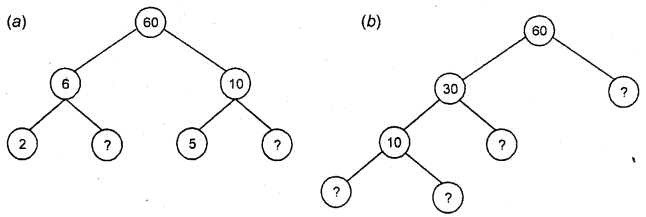
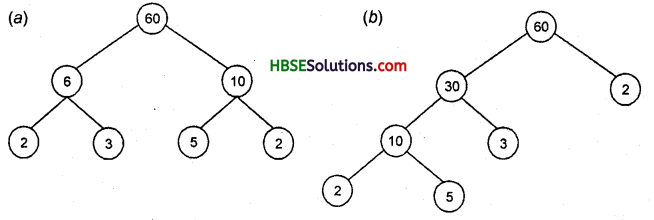
Here are two different factor trees for 60. Write the missing numbers.
HBSE 6th Class Maths Solutions Chapter 3 Playing With Numbers Ex 3.5 (1)
Solution:
HBSE 6th Class Maths Solutions Chapter 3 Playing With Numbers Ex 3.5 (2)

HBSE 6th Class Maths Solutions Chapter 3 Playing With Numbers Ex 3.5

Question 3.
Which factors are not included in the prime factorisation of a composite number ?
Solution:
Let us consider any composite number say 12.
12 = 1 x 12
= 2 x 6
= 3 x 4
and
HBSE 6th Class Maths Solutions Chapter 3 Playing With Numbers Ex 3.5 (3)
∴ Factors of 12 are : 1, 2, 3, 4, 6, 12.
Prime factorisation of 12 = 2 x 2 x 3
We clearly see that composite factors 4, 6, 12 are not included in the prime factorisation of a composite number.
Hence, composite factors are not included in the prime factorisation of a composite number.

Question 4.
Write the greatest four-digit number and express it into the form of prime factorisation.
Solution:
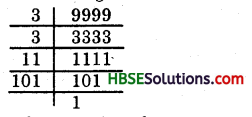
Greatest 4-digit number is 9999.
HBSE 6th Class Maths Solutions Chapter 3 Playing With Numbers Ex 3.5 (4)
∴ Prime factorisation of 9999
= 3 x 3 x 11 x 101

HBSE 6th Class Maths Solutions Chapter 3 Playing With Numbers Ex 3.5

Question 5.
Write the smallest five-digit number and express it into the form of prime factorisation.
Solution:
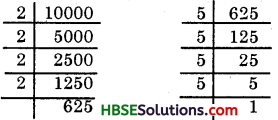
Smallest 5-digit number is 10000
HBSE 6th Class Maths Solutions Chapter 3 Playing With Numbers Ex 3.5 (5)
∴ Prime factorisation of 10000
= 2 x 2 x 2 x 2 x 5 x 5 x 5 x 5.

Question 6.
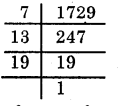
Find all the prime factors of 1729 and arrange them in ascending order. Now state the relation, if any, between two consecutive prime factors.
Solution:
HBSE 6th Class Maths Solutions Chapter 3 Playing With Numbers Ex 3.5 6
∴ Prime factors of 1729 are 7, 13, 19
Difference between two consecutive prime factors is 6.

Question 7.
The product of three consecutive numbers is always divisible by 6. Explain this statement with the help of some examples.
Solution:
(i) Let us take three consecutive numbers 5, 6, 7.
Their product = 5 x 6 x 7 = 210 which is divisible by 6.
(ii) Let us take three consecutive numbers 9, 10, 11.
Their product = 9 x 10 x 11 = 990 which is divisible by 6.
(iii) Let us take three consecutive numbers 23, 24, 25.
Their product = 23 x 24 x 25 = 13800 which is divisible by 6.
(iv) Let us take three consecutive numbers 2, 3, 4.
Their product = 2 x 3 x 4 = 24 which indivisible by 6.

Question 8.
In which of the following expressions, prime factorisation has been done :
(a) 24 = 2 x 3 x 4
(b) 56 = 1 x 7 x 2 x 2 x 2
(c) 70 = 2 x 5 x 7
(d) 54 = 2 x 3 x 9.
Solution:
(c) 70 = 2 x 5 x 7.
In this expression prime factorisation has been done.
(b) 56 = 1 x 7 x 2 x 2 x 2 In this expression prime factorisation has been done.

HBSE 6th Class Maths Solutions Chapter 3 Playing With Numbers Ex 3.5

Question 9.
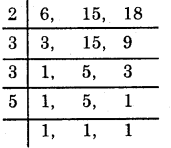
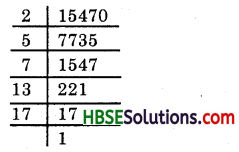
Write the prime factorisation of 15470.
HBSE 6th Class Maths Solutions Chapter 3 Playing With Numbers Ex 3.5 7
∴ Prime factorisation of 15470
= 2 x 5 x 7 x 13 x 17.

Question 10.
Determine if 25110 is divisible by 45.
Solution:
∵ The unit’s digit of 25110 is 0,
∴ 25110 is divisible by 5.
Sum of the digits = 2 + 5+ l + l + 0 = 9 which is divisible by 9.
∴ 25110 is divisible by 9.
Now, 5 and 9 are co-prime numbers.
∴ 25110 is divisible by their product 5 x 9 = 45.

Question 11.
18 is divisible by both 2 and 3. It is also divisible by 2 x 3 = 6. Similarly, a number is divisible by both 4 and 6. Can we say that the number must also be divisible by 4 x 6 = 24 ? If not, give an example to justify your answer.
Solution:
No, because 4 and 6 are not co-primes.
e.g. (i) 36 is divisible by both 4 and 6. But it is not divisible by 24.
(ii) 12 is divisible by both 4 and 6 but 12 is not divisible by 24.

HBSE 6th Class Maths Solutions Chapter 3 Playing With Numbers Ex 3.5

Question 12.
I am the smallest number having four different prime factors. Can you find me ?
Solution:
The smallest four different prime factors are 2, 3, 5, 7.
Hence, the smallest number, having four different prime factors = 2 x 3 x 5 x 7 = 210.

HBSE 6th Class Maths Solutions Chapter 3 Playing With Numbers Ex 3.5 Read More »

HBSE 6th Class Maths Solutions Chapter 3 Playing With Numbers Ex 3.4

Haryana State Board HBSE 6th Class Maths Solutions Chapter 3 Playing With Numbers Ex 3.4 Textbook Exercise Questions and Answers.

Haryana Board 6th Class Maths Solutions Chapter 3 Playing With Numbers Exercise 3.4

Question 1.
Find the common factor of:
(a) 20 and 28
(b) 15 and 25
(c) 35 and 50
(d) 56 and 120.
Solution:
(a) 20 = 1 × 20
=2 × 10
=4 × 5

28 = 1 × 28
= 2 × 14
= 4 × 7
∴ Factors of 20 are : 1, 2, 4, 5, 10, 20.
∴ Factors of 28 are : 1, 2, 4, 7, 14, 28.

Hence, common factors of 20 and 28 are: 1, 2, 4.

HBSE 6th Class Maths Solutions Chapter 3 Playing With Numbers Ex 3.4

(b) 15 = 1 × 15
= 3 × 5
25 = 1 × 25
= 5 × 5
∴ Factors of 15 are: 1, 3, 5, 15.
Factors of 25 are: 1, 5, 25.
Hence, common factors of 15 and 25 are: 1, 5 .

(c) 35 = 1 × 35
= 5 × 7

50 = 1 × 50
= 2 × 25
= 5 × 10
∴ Factors of 35 are: 1, 5, 7, 35.
Factors 50 are : 1, 2, 5, 10, 25, 50.
Hence, common factors of 35 and 50 are: 1, 5.

(d)
56 = 1 × 56
= 2 × 28
= 4 × 14
= 7 × 8

120 = 1 × 120
= 2 × 60
= 3 × 40
= 4 × 30
= 5 × 24

= 6 × 20
= 8 × 15
= 10 × 12
∴ Factors of 56 are : 1, 2, 4, 7, 8, 14, 28, 56.
Factors of 120 are : 1, 2, 3, 4, 5, 6, 8, 10, 12, 15, 20, 24, 30, 40, 60, 120.
Hence, common factors of 56 and 120 are : 1, 2, 4, 8.

HBSE 6th Class Maths Solutions Chapter 3 Playing With Numbers Ex 3.4

Question 2.
Find the common factors of:
(a) 4, 8 and 12 (b) 5, 15 and 25.
Solution:
4 = 1 × 4
= 2 × 2

8 = 1 × 8
= 2 × 4

12,= 1 × 12
= 2 × 6
= 3 × 4

∴ Factors of 4 are : 1, 2, 4.
Factors of 8 are : 1, 2, 4, 8.
Factors of 12 are : 1, 2, 3, 4, 6, 12.
Hence, common factors of 4, 8 and 12 are : 1, 2, 4.

(b)
5 = 1 × 5

15 = 1 × 15
= 3 × 5
25 = 1 × 25
= 5 × 5

∴ Factors of 5 are : 1, 5.
Factors of 15 are : 1, 3, 5, 15.
Factors of 25 are : 1, 5, 25.
Hence, common factors of 5, 15 and 25 are : 1, 5.

Question 3.
Find first three common multiples of:
(a) 6 and 8 (b) 12 and 18.
Solution:
(a) Multiples of 6 are ; 6, 12, 18, 24, 30, 36, 42, 48, 54, 60, 66, 72,……
Multiples of 8 are : 8, 16, 24, 32, 40, 48, 56, 64, 72, 80,
Hence, first three common multiples of 6 and 8 are : 24, 48, 72,………

HBSE 6th Class Maths Solutions Chapter 3 Playing With Numbers Ex 3.4

(b) Multiples of 12 are : 12, 24, 36, 48, 60,
72, 84, 96, 108, 120,
Multiples of 18 are : 18, 36, 54, 72, 90, 108, 126, 144, 162,180, ……….
Hence, first three multiples of 12 and 18 are : 36, 72, 108…….

Question 4.
Write all the numbers less than 100 which are common multiples of 3 and 4.
Solution:
Multiples of 3 less than 100 are : 3, 6, 9, 12, 15, 18, 21, 24, 27, 30, 33, 36, 39, 42, 45, 48, 51, 54, 57, 60, 63, 66, 69, 72, 75, 78, 81, 84, 87, 90, 93, 96, 99.
Multiples of 4 less than 100 dre : 4, 8, 12, 16, 20, 24, 28, 32, 36, 40, 44, 48, 52, 56, 60, 64, 68, 72, 76, 80, 84, 88, 92, 96.
Henee, common multiples of 3 and 4 less than 100 are : 12, 24, 36, 48, 60, 72, 84, 96.

Question 5.
Which of the following numbers are co-prime :
(a) 18 and 35
(b) 15 and 37
(c) 30 and 415
(d) 17 and 68
(e) 216 and 215
(f) 81 and 16.
Solution:
(a) 18 = 1 × 18
=2 × 9
= 3 × 6

35 = 1 × 35
=5 × 7

∴ Factors of 18 are : 1, 2, 3, 6, 9, 18.
Factors of 35 are : 1, 5, 7, 35.
∵ Common factor of 18 and 35 is 1 only. Hence, 18 and 35 are co-primes.

(b) 15 = 1 × 15 37 = 1 × 37
= 3 x 5
∴ Factors of 15 are : 1, 3, 5, 15.
Factors of 37 are : 1, 37.
∵ Common factor of 15 and 37 is 1 only.
Hence, 15 and 37 are co-prime.

HBSE 6th Class Maths Solutions Chapter 3 Playing With Numbers Ex 3.4

(c) 30 = 1 × 30
= 2 × 15
= 3 × 10
= 5 × 6

415 = 1 × 415
= 5 × 83

∴ Factors of 30 are : 1, 2, 3, 5, 6, 10, 15, 30.
Factors of 415 are : 1, 5, 83, 415.
∵ Common factor of 30 and 415 are 1, 5.
Hence, 30 and 415 are not co-prime.

(d) 17 = 1 × 17

68 = 1 × 68
= 2 × 34
= 4 × 17
∴ Factors of 17 are : 1, 17.
Factors of 68 are : 1, 2, 4, 17, 34, 68.
∵ Common factor of 17 and 68 are : 1, 17.
Hence, 17 and 68 are not co-prime.

(e) 216 = 1 × 216
= 3 × 72
= 4 × 54
= 6 × 36
= 8 × 27
= 9 × 24
= 12 × 18

215 = 1 × 215
= 5 × 43
∴ Factors of 216 are : 1, 3, 4, 6, 8, 9, 12,
18, 24, 27, 36, 54, 72, 216.
Factors of 215 are : 1, 5, 43, 215.
∵ Common factor of 216 and 215 is 1 only. Henoa 216 and 215 are co-prime.

(f) 81 = 1 × 81
= 3 × 27
=9 × 9

16 = 1 × 16
=2 × 8
=4 × 4

∴ Factors of 81 are : 1, 3, 9, 27, 81.
Factors of 16 are : 1, 2, 4, 8, 16.
∵ Common factor of 81 and 16 is 1 only.
Hence, 81 and 16 are co-prime.

HBSE 6th Class Maths Solutions Chapter 3 Playing With Numbers Ex 3.4

Question 6.
A number is divisible by both 5 and 12. By which other number will that number always be divisible ?
Solution:
∵ 5 and 12 are co-prime.
∴ A number divisible by bpth 5 and 12 will always be divisible by their product i.e. 5 × 12 = 60.

Question 7.
A number is divisible by 12. By what other numbers will that number be divisible ?
Solution:
12 = 1 × 12
= 2 × 6
= 3 × 4
Factors of 12 other than 12 are : 1, 2, 3, 4, 6.
Hence, if a number is divisible by 12, it will also be divisible by 1, 2, 3, 4 and 6.

HBSE 6th Class Maths Solutions Chapter 3 Playing With Numbers Ex 3.4 Read More »

HBSE 6th Class Maths Solutions Chapter 3 Playing With Numbers Ex 3.3

Haryana State Board HBSE 6th Class Maths Solutions Chapter 3 Playing With Numbers Ex 3.3 Textbook Exercise Questions and Answers.

Haryana Board 6th Class Maths Solutions Chapter 3 Playing With Numbers Exercise 3.3

Question 1.
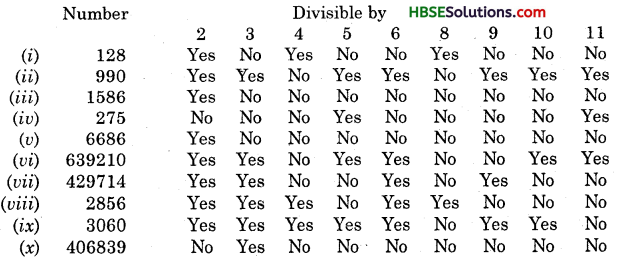
Using divisibility tests, determine which of the following numbers are divisible by 2; by 3; by 4; by 5; by 6; by 8; by 9; by 10; by 11 (say yes or no) :
(i) 128 (ii) 990 (ii) 1586 (iv) 275 (iv) 6686
(vi) 639210 (vii) 429714 (viii) 2856 (ix) (x) 40GS39
Solution:
HBSE 6th Class Maths Solutions Chapter 3 Playing With Numbers Ex 3.3 1

HBSE 6th Class Maths Solutions Chapter 3 Playing With Numbers Ex 3.3

Question 2.
Using divisibility tests, deter¬mine which of the following numbers are divible by 4 ; by 8 :
(a) 572 (b) 726352
(c) 5500 (d) 6000
(e) ^2159 (f) 14560
(g) 21084 (h) 31795072
(i) 1700 (j) 2150
Solution:
(a) 572, since the number formed by the last two digits is divisible by 4, hence it is divisible by 4; 572, since the nurtiber formed by the last three digits is not divisible by 8, hence it is not divisible by 8.
(b) 726352, since the number formed by the last two digits is divisible by 4, hence it is divisible by 4.
726352, since the number formed by the last three digits is divisible by 8, hence it is divisible by 8.
(c) 5500, since the number formed by the last two digits are divisible by 4, hence it is divisible by 4.
5500, since the number formed by the last three digits are not divisible by 8, hence it is not divisible by 8.
(d) 6000, since the number formed by the last two digits are divisible by 4, hence it is divisible by 4.
6000, since the number formed by the last three digits are divisible by 8, hence it is divisible by 8.
(e) 12159, since the number formed by the last two digits are not divisible by 4, hence it is not divisible by 4.
12159, since the number formed by the last three digits are not divisible by 8, hence it is not divisible by 8. .
(f) 14560, since the number formed by the last twp digits are divisible by 4, hence it is divisible by 4.
14560, since the number formed by the last three digits are divisible by 8, hence it is divisible by 8.
(g) 21084, since the number formed by the last two digits are divisible by 4, hence it is divisible by 4.
21084, since the number formed by the last three digits are not divisible by 8, hence it is not divisible by 8.
(h) 31795072, since the number formed by the last two digits are divisible by 4, hence it is divisible by 4.
31795072, since the number formed by the last three digits are divisible by 8, hence it is divisible by 8.
(i) 1700, since the number formed by the last two digits are divisible by 4, hence it is divisible by 4.
1700, since the number formed by the last three digits are not divisible by 8, hence it is not divisible by 8.
(j) 2150, since the number formed by the last two digits are not divisible by 4, hence it is not divisible by 4.
2150, since the number formed by the last three digits are not divisible by 8, hence it is not divisible by 8.

Question 3.
Using divisibility tests, deter¬mine which of the following numbers are
(a) 297144
(b) 1258
(c) 4335
(d) 61233
(e) 901352
(f) 438750
(g) 1790184
(h) 12583
(i) 17852.
(j) 639210
Solution:
(a) 297144, since last digit is 4,
∴ It is divisible by 2.
Sum of the digits = 2 + 9 + 7 + 1 + 4 + 4 = 27, which is a multiple of 3,
∴ It is divisible by 3.
Since 297144 is divisible by both 2 and 3, hence it is divisible by 6.

HBSE 6th Class Maths Solutions Chapter 3 Playing With Numbers Ex 3.3

(b) 1258, since last digit is 8, It is divisi-ble by 2. Sum of the digits =1 + 2 + 5 + 8 = 16, which
is not a multiple of 3, .∴ It is not divisible by 3.
Hence, 1258 is not divisible by 6.

(c) 4335, since last digit is 5,
∴ It is not divisible by 2.
Hence, 4335 is not divisible by 6.

(d) 61233, since last digit is 3,
∴ It is not divisible by 2.
Hence, 61233 is not divisible by 6.

(e) 901352, since last digit is 2,
∴ It is divisi-ble by 2.
Sum of the digits = 9 + 0 + 1 + 3 + 5 + 2 = 20,
which is not a multiple of 3,
∴ It is not divisible by 3.
Hence, 901352 is not divisible by 6.

(f) 438750, since last digit is 0,
∴ It is divisi¬ble by 2.
Sum of the digits = 4 + 3 + 8 + 7 + 5 + 0 = 27, which is a multiple of 3,
∴ It is divisible by 3. Since, 438750 is divisible by both 2 and 3,
hence it is divisible by 6.

(g) 1790184, since last digit is 4,
∴ It is divisible by 2.
Sum of the digits = 1 + 7 + 9 + 0 + 1 + 8 + 4 = 30, which is a multiple of 3,
∴ It is divisible by 3.
Since, 1790184 is divisible by both 2 and 3, hence it is divisible by 6.

(h) 12583, since last digit is 3,
∴ It is not divisible by 2.
Hence, 12583 is not divisible by 6.

(i) 639210, since last digit is 0,
∴ It is divisible by 2.
Sum of the digits = 6 + 3 + 9 + 2 + 1 + 0 = 21, which is a multiple of 3,
∴ It is divisible by 3.
Since 639210 is divisible by both 2 and 3, hence it is divisible by 6.

HBSE 6th Class Maths Solutions Chapter 3 Playing With Numbers Ex 3.3

(j) 17852, since last digit is 2,
∴ It is divisible by 2.
Sum of the digits = 1 + 7 + 8 + 5 + 2 = 23, which is not a multiple of 3,
∴ It is not divisible by 3.
Hence, 17852 is not divisible by 6.

Question 4.
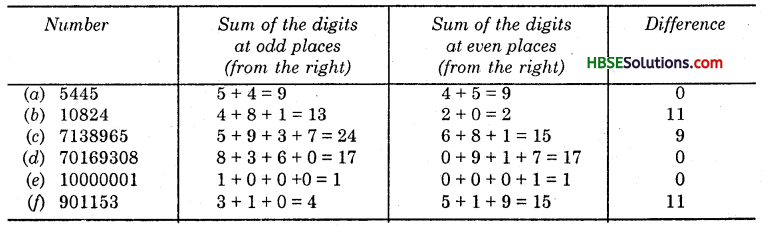
Using divisibility tests, determine which of the following numbers are divisible by 11.
(a) 5545 (b) 10824 (c) 7138965 (d) 70169308 (e) 10000001 if) 901153.
Solution:
HBSE 6th Class Maths Solutions Chapter 3 Playing With Numbers Ex 3.3 2
We observe that in each case except in (Hi), the difference is either 0 or divisible by 11. Hence, 5445, 10824,70169308, 10000001, 901153 are all divisible by 11, but 7138965 is not divisible by 11.

Question 5.
Write the (a) smallest digit, (6) largest digit in the blank space of each of the following numbers so that the number is divisible by 3 :
(a) ……………….. 6724, (b) 4765 …………….. 2.
Solution:
(a) 2 + 6 + 7 + 2 + 4 = 21, which is a multiple of 3.
8 + 6 + 7 + 2 + 4 = 27, which is a multiple of 3.
Hence, (a) smallest digit is 2 and (b) largest dig^ is 8.
(b) 4 + 7 + 6 + 5 + 0 + 2 = 24, which is a multiple of 3.
4 + 7 + 6 + 5 + 9 + 2 = 33, which is a multiple of 3.
Hence, (a) smallest digit is 0 and (b) largest digit is 9.

HBSE 6th Class Maths Solutions Chapter 3 Playing With Numbers Ex 3.3

Question 6.
Write digit in the blank space of each of the following numbers so that the number is divisible by 11 :
(a) 92 ………….. 389 (6) 8……… 9484.
Solution:
HBSE 6th Class Maths Solutions Chapter 3 Playing With Numbers Ex 3.3 3

HBSE 6th Class Maths Solutions Chapter 3 Playing With Numbers Ex 3.3 Read More »

HBSE 6th Class Maths Solutions Chapter 3 Playing With Numbers Ex 3.1

Haryana State Board HBSE 6th Class Maths Solutions Chapter 3 Playing With Numbers Ex 3.1 Textbook Exercise Questions and Answers.

Haryana Board 6th Class Maths Solutions Chapter 3 Playing With Numbers Exercise 3.1

Question 1.
Write all the factors of the following numbers :
(a) 24 (b) 15 (c) 21
(d) 27 (e) 12 (f) 20
(g) 18 (h) 23 (i) 36
Solution:
(a) 24 = 1 x 24
= 2 x 12
= 3 x 8
= 4 x 6
∴ All the factors of 24 are 1, 2, 3, 4, 6, 8, 12, 24.

HBSE 6th Class Maths Solutions Chapter 3 Playing With Numbers Ex 3.1

(b) 15 = 1 x 15
= 3 x 5
∴ All the factors of 15 are 1, 3, 5, 15. Ans.

(c) 21 = 1 x 21
= 3 x 7
∴ All the factors of 21 are 1, 3, 7, 21. Ans.

(d) 27 = 1 x 27
= 3 x 9
∴ All the factors of 27 are 1, 3, 9, 27. Ans.

(e) 12 = 1 x 12
= 2 x 6
= 3 x 4
∴ All the factors of 12 are 1, 2, 3, 4, 6, 12.

(f) 20 = 1 x 20
= 2 x 10 = 4 x 5
∴ All the factors of 20 are 1, 2, 4, 5, 10, 20.

(g) 18 = 1 x 18
= 2 x 9 = 3 x 6
∴ All the factors of 18 are 1, 2, 3, 6, 9, 18.

(h) 23 = 1 x 23
∴ All the factors of 23 are 1, 23.

(i) 36 = 1 x 36
= 2 x 18 = 3 x 12 = 4 x 9 = 6 x 6
∴ All the factors of 36 are 1, 2, 3, 4, 6, 9, 12, 18, 36.

Question 2.
Write the first five multiples of:
(a) 5 (b) 8 (c) 9
Solution:
(a) The required multiples of 5 are :
5 x 1 = 5
5 x 2 = 10
5 x 3 = 15
5 x 4 = 20
5 x 5 = 25.
i.e., 5, 10, 15, 20 and 25

HBSE 6th Class Maths Solutions Chapter 3 Playing With Numbers Ex 3.1

(b) The required multiples of 8 are :
8 x 1 = 8
8 x 2 = 16
8 x 3 = 24
8 x 4 = 32
8 x 5 = 40.
i.e., 8, 16, 24, 32 and 40

(c) The required multiples of 9 are :
9 x 1 = 9
9 x 2 = 18
9 x 3 = 27
9 x 4 = 36
9 x 5 = 45.
i.e., 9, 18, 27, 36 and 45.

Question 3.
Match the items in column 1 with the items in column 2 :
Column 1 — Column 2
(i) 35 — (a) Multiple of 8
(ii) 15 — (b) Multiple of 7
(iii) 16 — (c) Multiple of 70
(iv) 20 — (d) Factor of 30
(v) 25 — (e) Factor of 50
(f) Factor of 20
Solution:
(i) – (b) Multiple of 7
(ii) – (d) Factor of 30
(iii) – (a) Multiple of 8
(iv) – (f) Factor of 20
(v) – (e) Factor of 50

HBSE 6th Class Maths Solutions Chapter 3 Playing With Numbers Ex 3.1

Question 4.
Find all the multiples of 9 upto 100.
Solution:
9 x 1 = 9
9 x 2 = 18
9 x 3 = 27
9 x 4 = 36
9 x 5 = 45
9 x 6 = 54
9 x 7 = 63
9 x 8 = 72
9 x 9 = 81
9 x 10 = 90
9 x 11 = 99.
Hence all the multiples of 9 upto 100 are 9, 18, 27, 36, 45, 54, 63, 72, 81, 90 and 99.

HBSE 6th Class Maths Solutions Chapter 3 Playing With Numbers Ex 3.1 Read More »

HBSE 6th Class Maths Solutions Chapter 3 Playing With Numbers Ex 3.2

Haryana State Board HBSE 6th Class Maths Solutions Chapter 3 Playing With Numbers Ex 3.2 Textbook Exercise Questions and Answers.

Haryana Board 6th Class Maths Solutions Chapter 3 Playing With Numbers Exercise 3.2

Question 1.
What is the sum of any two (a) odd numbers and (b) even numbers ?
Solution:
(a) The sum of any two odd numbers is even and
(b) Sum of any two even numbers is also even.

Question 2.
State whether the following statements are true of false :
(a) The sum of three odd numbers is even.
(b) The sum of t wo odd numbers and one even number is even.
(c) The product of three odd numbers is odd.
(d) If an even number is divided by 2, the quotient is always odd.
(e) All prime num bers are odd.
(f) Prime numbers do not. have any factors.
(g) Sum of two prime numbers is always even.
(h) 2 is the only even prime number.
(i) All even numbers are composite numbers.
(j) The product of two even numbers is always even.
Solution:
(a) F (b) T (c) T (d) F (e) F (f) F (g) F (h) T (i) F (j) T.

HBSE 6th Class Maths Solutions Chapter 3 Playing With Numbers Ex 3.2

Question 3.
The numbers 13 and 31 are prime numbers. Both these numbers have same digits 1 and 3. Find such pairs of prime numbers upto 100.
Solution:
17 and 71; 37 and 73; 79 and 97 are such pairs of prime numbers upto 100.

Question 4.
Write down separately the prime and composite numbers less that 20.
Solution:
HBSE 6th Class Maths Solutions Chapter 3 Playing With Numbers Ex 3.2 1
Prime numbers less than 20 are: 2, 3, 5, 7, 11, 13, 17, 19.
Composite numbers less than 20 are: 4, 6, 8, 9, 10, 12, 14, 15, 16, 18.

Question 5.
What is the greatest prime number between 1 and 10 ?
Solution:
HBSE 6th Class Maths Solutions Chapter 3 Playing With Numbers Ex 3.2 2
7 is the greatest prime number between 1 and 10.

Question 6.
Express the following as the sum of two odd primes :
(a) 44
(b) 36
(c) 24
(d) 18
Solution:
(a) 44 = 13 + 31 = 3 + 41
(b) 36 = 13 + 23 = 5 + 31
(c) 24 = 11 + 13 = 5 + 19
(d) 18 = 5 + 13 = 7 + 11.

HBSE 6th Class Maths Solutions Chapter 3 Playing With Numbers Ex 3.2


Question 7.
Give three pairs of prime numbers whose difference is 2.
[Remark : Two prime numbers whose difference is 2 are called twin primes].
Solution:
(i) (3, 5) (ii) (5, 7) (iii) (11, 13).

Question 8.
Which of the following numbers are prime ?
(a) 23
(b) 51
(c) 37
(d) 26.
Solution:
23 and 37 are prime numbers.

Question 9.
Write seven consecutive com¬posite numbers less than 100- so that there is no prime number between them.
Solution:
90, 91, 92, 93, 94, 95 and 96.

Question 10.
Express each of the following numbers as the sum of three odd primes:
(a) 21
(b) 31
(c) 53
(d) 61.
Solution:
(a) 21 = 3 + 5 + 13
(b) 31 = 3 + 5 + 23
(c) 53 = 3 + 7 + 43
(d) 61 = 3 + 5 + 53 = 7 + 13 + 41

HBSE 6th Class Maths Solutions Chapter 3 Playing With Numbers Ex 3.2

Question 11.
Write five pairs of prime numbers below 20 whose sum is divisible by 5.
Solution:
(i) 2 + 3 = 5
(ii) 3 + 7 = 10
(iii) 2 + 13 = 15
(iv) 3 + 17 = 20
(v) 7 + 13 = 20.

Question 12.
Fill in the blanks in the following:
(a) A number which has only two factors is called a ……………
(b) A number which has more than two factors is called a ……………
(c) 1 is neither …………… nor ……………
(d) The smallest prime number is ……………
(e) The smallest composite number is ……………
(f) The smallest even number is ……………
Solution:
(a) Prime number
(b) Composite number.
(c) Prime, Composite
(d) 2
(e) 4
(f) 2.

HBSE 6th Class Maths Solutions Chapter 3 Playing With Numbers Ex 3.2 Read More »

HBSE 6th Class Maths Solutions Chapter 2 Whole Numbers Ex 2.3

Haryana State Board HBSE 6th Class Maths Solutions Chapter 2 Whole Numbers Ex 2.3 Textbook Exercise Questions and Answers.

Haryana Board 6th Class Maths Solutions Chapter 2 Whole Numbers Exercise 2.3

Question 1.
Which of the following will not represent zero:
(a) a + 0
(b) 0 x 0
(c) \(\frac{0}{2}\)
(d) \(\frac{10-10}{2}\)
Solution:
(a) 1 + 0 = 1
(b) 0 x 0 = 0
(c) \(\frac{0}{2}\) = 0
(d) \(\frac{10-10}{2}\) = \(\frac{0}{2}\) = 0
∴ (a) will not represent zero.

Question 2.
If the product of two whole numbers is zero, can we say that one or both of them will be zero ? Justify through e × amples.
Solution:
One of them is zero i.e., 0 × 2 = 0
Both of them are zero i.e., 0 × 0 = 0.

HBSE 6th Class Maths Solutions Chapter 2 Whole Numbers Ex 2.3

Question 3.
If the product of two whole numbers is 1, can we say that one or both of them will be 1 ? Justify through an e × ample.
Solution:
Both of them will be one i.ef,
1 × 1 = 1.

Question 4.
Find by distributivity method :
(a) 728 × 101
(e) 824 × 25
(e) 504 × 35.
(b) 5437 × 1001
(d) 4275 × 125
Solution:
(a) 728 × 101
728 × (100 + 1)
= 728 × 100 + 728
= 72800 + 728
= 73528

HBSE 6th Class Maths Solutions Chapter 2 Whole Numbers Ex 2.3

(b) 5437 × 1001
5437 × (1000 + 1)
= 5437000 + 5437
= 5442437

(c) 824 x 25 = 824 x \(\frac{100}{4}\)
\(\frac{824}{4}\) x 100 = 20600

(d) 4275 × 125
= 4275 × (100 + 25)
= 427500 + 4275 × 25
= 427500 + 106875
= 534375

(e) 504 × 35
= (500 + 4) × 35
= 500 × 35 + 4 × 35
= 17500 + 140
= 17640

HBSE 6th Class Maths Solutions Chapter 2 Whole Numbers Ex 2.3 Read More »

HBSE 6th Class Maths Solutions Chapter 2 Whole Numbers Ex 2.2

Haryana State Board HBSE 6th Class Maths Solutions Chapter 2 Whole Numbers Ex 2.2 Textbook Exercise Questions and Answers.

Haryana Board 6th Class Maths Solutions Chapter 2 Whole Numbers Exercise 2.2

Question 1.
Find the sum by suitable rearrangement :
(a) 837 + 208 + 363
(b) 1962 + 453 + 1538 + 647.
Solution:
(a) 837 + 208 + 363
= (837 + 363) + 208 = 1200 + 208 = 1408
(b) 1962 + 453 + 1538 + 647
= (1962 + 1538) + (453 + 647) = 3500 + 1100 = 4600

Question 2.
Find the product by a suitable rearrangement :
(a) 2 × 1768 × 50
(b) 4 × 166 × 25
(c) 8 × 291 × 125
(d) 625 × 279 × 16
(e) 285 × 5 × 60
(f) 125 × 40 × 8 × 25.
Solution:
(a) 2 × 1768 × 50
= (2 × 50) × 1768 = 100 × 1768 = 176800
(b) 4 × 166 × 25
= (4 × 25) × 166 = 100 × 166 = 16600
(c) 8 × 291 × 125
= (8 × 125) × 291 = 1000 × 291 = 291000
(d) 625 × 279 × 16
= (625 × 16) × 279 = 10000 × 279 ‘ = 2790000
(e) 285 × 5 × 60
= 285 × (5 × 60)
= 285 × 300 = 85500
(f) 125 × 40 × 8 × 25
= (125 × 8) × (40 × 25)
= 1000 × 1000 = 1000000

HBSE 6th Class Maths Solutions Chapter 2 Whole Numbers Ex 2.2

Question 3.
Find the value of the following :
(a) 297 × 17 + 297 × 3
(b) 54279 × 92 + 8 × 54279
(c) 81265 × 169 – 81265 × 69
(d) 3845 × 5 × 782 + 769 × 25 × 218.
Solution:
(a) 297 × 17 + 297 × 3
= 297 × (17 + 3)
= 297 × 20 = 5940 Ans.
(b) 54279 × 92 + 8 × 54279
= 54279 × (92 + 8)
= 54279 × 100 = 5427900
(c) 81265 × 169 – 81265 × 69
= 81265 (169 – 69)
= 81265 × 100 = 8126500
(d) 3845 × 5 × 782 + 769 × 25 × 218
= (769 × 5) × 5 × 782 + 769 × 25 × 218
= 769 × (5 × 5) × 782 + 769 × 25 × 218
= 769 × 25 × 782 + 769 × 25 × 218
= 769 × 25 × (782 + 218)
= 769 × 25 × 1000 = 19225000

Question 4.
Find the product, using suitable properties :
(a) 738 × 103
(b) 854 × 102
(c) 258 × 1008
(d) 1005 × 168.
Solution:
(a) 738 × 103
= 738 × (100 + 3)
= 738 × 100 + 738 × 3
= 73800 + 2214
= 76014

(b) 854 × 102 = 854 × (100 + 2)
= 854 × 100 + 854 × 2
= 85400 + 1708
= 87108.

(c) 258 × 1008
= 258 × (1000 + 8)
= 258 × 1000 + 258 × 8
= 258000 + 2064
= 260064.

HBSE 6th Class Maths Solutions Chapter 2 Whole Numbers Ex 2.2

(d) 1005 × 168 = (1000 + 5) × 168
= 1000 × 168 + 5 × 168
= 168000 + 840
= 168840.

Question 5.
A ta × i-driver filled his car petrol tank with 40 litres of petrol on Monday. The ne × t day, he filled the tank with 50 litres of petrol. If the petrol costs Rs. 44 per litre, how much did he spend in all on petrol ?
Solution:
Method-1:
Cost of 40 litres of petrol
= Rs. 44 × 40
= Rs. 1760
Cost of 50 litres of petrol
= Rs. 44 × 50
= Rs. 2200
∴ Total cost = Rs. (1760 + 2200)
= Rs. 3960.

Method-2 :
Petrol purchased on Monday = 40 litres
Petrol purchased on ne × t day = 50 litres
Total petrol purchased
= (40 + 50) l = 90 l
∴ Total cost = Rs. 44 × 90
= Rs. 3960.

Question 6.
A vendor supplies 32 litres of milk to a hotel in the morning and 68 litres of milk in the evening. If the milk costs Rs. 15 per litre, how much money is due to the vendor per day ?
Solution:
Milk supplied in the morning = 32 litres
Milk supplied in the evening Milk supplied in one day = 68 litres
∴ Milk supplied in one day = (32 + 68)l = 100 l
Hence, total cost of milk per day = Rs. 15 × 100 = Rs. 1500

HBSE 6th Class Maths Solutions Chapter 2 Whole Numbers Ex 2.2

Question 7.
Match the following :
(i) 425 × 136 = 425 × (6 + 30 + 100) — (a) Commutativity under multiplication.
(ii) 2 × 49 × 50 = 2 × 50 × 49 — (b) Commutativity under addition.
(Hi) 80 + 2005 + 20 = 80 + 20 + 2005 — (c) Distributivity of multiplication over addition.
Solution:
(i)—(c),
(ii)—(a),
(iii)—(b).

HBSE 6th Class Maths Solutions Chapter 2 Whole Numbers Ex 2.2 Read More »

HBSE 6th Class Maths Solutions Chapter 2 Whole Numbers Ex 2.1

Haryana State Board HBSE 6th Class Maths Solutions Chapter 2 Whole Numbers Ex 2.1 Textbook Exercise Questions and Answers.

Haryana Board 6th Class Maths Solutions Chapter 2 Whole Numbers Exercise 2.1

Question 1.
Write the next three natural numbers after 10,999.
Solution:
After 10,999 next three natural numbers are :
10,999 + 1 = 11,000
11,000 + 1 = 11,001
and 11,001 + 1 = 11,002.

Question 2.
Write the three whole numbers occurring just before 10,001.
Solution:
Before 10,001 three whole numbers are :
10,001 – 1 = 10,000
10,000 – 1 = 9,999
and 9,999 – 1 = 9,998.

HBSE 6th Class Maths Solutions Chapter 2 Whole Numbers Ex 2.1

Question 3.
Which is the smallest whole number ?
Solution:
Zero is the smallest whole number.

Question 4.
How many whole numbers are there between 32 and 53 ?
Solution:
There are 20 whole numbers between 32 and 53.

Question 5.
Write the successor of:
(a) 24,40,701
(b) 1,00,199
(c) 10,99,999
(d) 23,45,670.
Solution:
(a) Successor of 24,40,701 is 24,40,701 + 1 = 24,40,702.
(b) Successor of 1,00,199 is 1,00,199 + 1 = 1,00,200.
(c) Successor of 10,99,999 is 10,99,999 + 1 = 11,00,000.
(d) Successor of 23,45,670 is 23,45,670 + 1 = 23,45,671.

Question 6.
Write the predecessor of:
(a) 94
(b) 10,000
(c) 2,08,090
(d) 76,54,321.
Solution:
(a) Predecessor of 94 is 94 – 1 = 93.
(b) Predecessor of 10,000 is 10,000 – 1 = 9,999.
(c) Predecessor of 2,08,090 is 2,08,090 – 1 = 2,08,089.
(d) Predecessor of 76,54,321 is 76,54,321 – 1 = 76,54,320.

HBSE 6th Class Maths Solutions Chapter 2 Whole Numbers Ex 2.1

Question 7.
In each of the following pairs of numbers, state which whole number is on the left of the other number on the number line. Also write them with the appropriate sign (>, <) between them.
(a) 530, 503
(b) 370, 307
(c) 98765, 56789
(d) 9830415, 10023001.
Solution: (a) 503 is on the left to 530.
∴ 503 < 530 or 530 > 503.
(b) 307 is on the left to 370.
∴ 307 < 370 or 370 > 307. ,
(c) 56789 is on the left to 98765.
∴ 56789 < 98765 or 98765 > 56789.
(d) 9830415 is on the left to 10023001.
∴ 9830415 < 10023001 or 10023001 > 9830415.

Question 8.
Which of the following state¬ments are true (T) and which are false (F)?
(a) Zero is the smallest natural number.
(b) 400 is the predecessor of 399.
(c) Zero is the smallest whole number.
(d) 600 is the successor of 599.
(e) All natural numbers are whole numbers.
(f) All whole numbers are natural numbers.
(g) The predecessor of a two digit number is never a single digit number.
(h) One is the smallest whole number.
(i) The natural number 1 has no predecessor.
(j) The whole number 1 has no predecessor.
(k) The whole number 13 lies between 11 and 12.
(l) The whole number ‘0’ has no predecessor.
(m) The successor of a two-digit number is always a two-digit number.
Solution:
(a) F,
(b) F,
(c) T,
(d) T,
(e) T,
(f) F,
(g) F,
(h) F,
(i) T,
(j) F,
(k) F,
(l) T,
(m) F.

HBSE 6th Class Maths Solutions Chapter 2 Whole Numbers Ex 2.1 Read More »

HBSE 6th Class Maths Solutions Chapter 1 Knowing Our Numbers Ex 1.3

Haryana State Board HBSE 6th Class Maths Solutions Chapter 1 Knowing Our Numbers Ex 1.3 Textbook Exercise Questions and Answers.

Haryana Board 6th Class Maths Solutions Chapter 1 Knowing Our Numbers Exercise 1.3

Question 1.
Estimate :
(a) 730 + 998
(b) 796-314
(c) 12,904 + 2,888
(d) 28,292 – 21,496.
Solution:
(a) We find 998 > 730.
Round off to hundreds
HBSE 6th Class Maths Solutions Chapter 1 Knowing Our Numbers Ex 1.3 1
Actual answer = 730 + 998 = 1728
1728 is rounded to 1700.

HBSE 6th Class Maths Solutions Chapter 1 Knowing Our Numbers Ex 1.3

(b) To begin with, we round off to hundreds
HBSE 6th Class Maths Solutions Chapter 1 Knowing Our Numbers Ex 1.3 2
Actual answer = 796 – 314 = 482
482 is rounded to 500.

(c) We find 12,904 > 2,888
Round off to thousands
12,904 is rounded to 13,000
+2,888 is rounded to 3,000
∴ Estimated sum = 16,000
Actual answer = 12,904 + 2,888 = 15,792

(d) To begin with, we round off to thousands
28,292 is rounded to 28,000
-21,496 is rouned to 21,000
∴ Estimated difference = 7,000
Actual answer = 28,292 – 21496
= 6,796

Question 2.
Give a rough estimate (by round off to nearest hundreds) and also a closer estimate (by’rounding off to nearest tens):
(a) 439 + 334 + 4,317
(b) 1,08,734- 47,599
(c) 8,325 – 491
(d) 4,89,348 – 48,365.
Make four more of such examples.
Solution:
To begin with, we round off to thousands.
439 rounds to 0
334 rounds to 0
and 4,317 rounds to 4,000
Rough estimated sum= 0 + 0 + 4,000
= 4,000
This is not a reasonable estimate.
Actual sum = 439 + 334 + 4,317 = 5,090.
To get a closer estimate, let us try rounding off each number to hundreds.
HBSE 6th Class Maths Solutions Chapter 1 Knowing Our Numbers Ex 1.3 3

HBSE 6th Class Maths Solutions Chapter 1 Knowing Our Numbers Ex 1.3

(b) To begin with, we round off to ten thousands.
HBSE 6th Class Maths Solutions Chapter 1 Knowing Our Numbers Ex 1.3 4
Actual difference = 1,08,734 – 47,599 = 61135
To get a closer estimate, let us try rounding off each number to hundreds.
HBSE 6th Class Maths Solutions Chapter 1 Knowing Our Numbers Ex 1.3 5

(c) To begin with, we round off to hundreds
HBSE 6th Class Maths Solutions Chapter 1 Knowing Our Numbers Ex 1.3 6
Actual difference = 8,325 – 491 = 7,834
To get a closer estimate let us try rounding off each number to tens.
HBSE 6th Class Maths Solutions Chapter 1 Knowing Our Numbers Ex 1.3 7
This is a better and more meaningful estimate.

HBSE 6th Class Maths Solutions Chapter 1 Knowing Our Numbers Ex 1.3

(d) To begin with, we round off to ten thousands
HBSE 6th Class Maths Solutions Chapter 1 Knowing Our Numbers Ex 1.3 8
Actual difference = 4,89,348 – 48,365
= 4,40,983
To get a closer estimate, let us try rounding off each number to thousands.
HBSE 6th Class Maths Solutions Chapter 1 Knowing Our Numbers Ex 1.3 9

HBSE 6th Class Maths Solutions Chapter 1 Knowing Our Numbers Ex 1.3 Read More »

HBSE 6th Class Maths Solutions Chapter 1 Knowing Our Numbers Ex 1.2

Haryana State Board HBSE 6th Class Maths Solutions Chapter 1 Knowing Our Numbers Ex 1.2 Textbook Exercise Questions and Answers.

Haryana Board 6th Class Maths Solutions Chapter 1 Knowing Our Numbers Exercise 1.2

Question 1.
A book exhibition was held for four days in a school. The number of tickets sold at the counter on the first, second, third and final days was respectively 1094, 1812, 2050 and 2751. Find the total number of tickets sold on all the four days.
Solution:
HBSE 6th Class Maths Solutions Chapter 1 Knowing Our Numbers Ex 1.2 1

Question 2.
Shekhar is a famous cricket player. He has so far scored 6980 runs in test matches. He wishes to complete 10,000 runs. How many more runs does he need ?
Solution:
HBSE 6th Class Maths Solutions Chapter 1 Knowing Our Numbers Ex 1.2 2

HBSE 6th Class Maths Solutions Chapter 1 Knowing Our Numbers Ex 1.2

Question 3.
In an election, the successful candidate registered 5,77,500 votes and his nearest rival secured 3,48,700 votes. By what margin did the successful candidate win the election?
Solution:
HBSE 6th Class Maths Solutions Chapter 1 Knowing Our Numbers Ex 1.2 3

Question 4.
Kirti bookstore sold books worth Rs. 2,85,891 in the first week of June. The bookstore sold books worth Rs. 4,00,768 in the second week of the month. How much was the sale for the two weeks together ? In which week was the sale greater and by how much ?
Solution:
HBSE 6th Class Maths Solutions Chapter 1 Knowing Our Numbers Ex 1.2 4

Question 5.
Find the difference between the greatest and the least numbers that can be written using the digits 6, 2, 7, 4, 3 each only once.
Solution:
HBSE 6th Class Maths Solutions Chapter 1 Knowing Our Numbers Ex 1.2 5

HBSE 6th Class Maths Solutions Chapter 1 Knowing Our Numbers Ex 1.2

Question 6.
A machine, on an average, manufactures 2,825 screws a day. How many screws did it produce in the month of January 2006 ?
Solution:
Number of screws produced in one day = 2,825
Number of screws produced in 31 days = 2,825 x 31 = 87,575 Ans.
HBSE 6th Class Maths Solutions Chapter 1 Knowing Our Numbers Ex 1.2 6

Question 7.
A merchant had Rs. 78,592 with him. He placed an order for purchasing 40 radio sets at Rs. 1,200 each. How much money will remain with him after the purchase ?
Answer:
Cost of one radio set = 1,200
Cost of 39 radio sets = Rs. 1,200 x 40
HBSE 6th Class Maths Solutions Chapter 1 Knowing Our Numbers Ex 1.2 7

Question 8.
A student multiplied 7236 by 65 instead of multiplying by 56. How much was his answer greater than the correct answer ?
Solution:
HBSE 6th Class Maths Solutions Chapter 1 Knowing Our Numbers Ex 1.2 8

Question 9.
To stitch a shirt 2 m 15 cm cloth is needed. Out of 40 m cloth, how many shirts can be stitched and how much cloth will remain ?
Solution:
Cloth needed to stitch one shirt = 2 m 15 cm = 215 cm
Total length of cloth = 40 m = 4,000 cm.
Now,
HBSE 6th Class Maths Solutions Chapter 1 Knowing Our Numbers Ex 1.2 9
Hence, 18 shirts can be stitched and 130 cm = 1 m 30 cm cloth will remain.

HBSE 6th Class Maths Solutions Chapter 1 Knowing Our Numbers Ex 1.2

Question 10.
Medicine is packed in boxes, each such box weighing 4 kg 500 g. How many such boxes can be loaded in a van which cannot carry beyond 800 kg ?
Solution:
800 kg = 800 x 1000 = 8,00,000 g
4 kg 500 g = 4 x 1000 + 500 = 4,500 g
HBSE 6th Class Maths Solutions Chapter 1 Knowing Our Numbers Ex 1.2 10
Hence, 177 boxes can be loaded in the van.

Question 11.
The distance between the school and the house of a student is 1 km 875 m. Everyday she walks both ways between her school and home. Find the total distance covered by her in five days.
Solution:
Distance between the school and the house
= 1km 875 m
= 1 x 1000 + 875
= 1,875 m
Both ways distance
= 2x 1,875 m = 3,750 m

∴ Total distance covered by her in five days = 5 x 3,750 m
= 18,750 m
= 18 km 750 m
Now.
HBSE 6th Class Maths Solutions Chapter 1 Knowing Our Numbers Ex 1.2 11

Question 12.
A vessel has 4 litres and 500 ml 6f curd. In how many glasses, each of 25 ml capacity, can it be filled ?
Solution:
Total volume of curd = 4l and 500 ml
= 4 x 1000 + 500
= 4,500 ml
Capacity of one glass = 25 ml
Now,
HBSE 6th Class Maths Solutions Chapter 1 Knowing Our Numbers Ex 1.2 12
Hence, total number of glasses = 180.

HBSE 6th Class Maths Solutions Chapter 1 Knowing Our Numbers Ex 1.2 Read More »