Author name: Prasanna

HBSE 6th Class Maths Solutions Chapter 1 Knowing Our Numbers InText Questions

Haryana State Board HBSE 6th Class Maths Solutions Chapter 1 Knowing Our Numbers InText Questions and Answers.

Haryana Board 6th Class Maths Solutions Chapter 1 Knowing Our Numbers InText Questions

Try These (Page 2)

Question 1.
Can you instantly find the greatest number in each row and also which is the smallest number ?
1. 387, 4972, 18, 59785, 750
2. 1473,89423, 100, 5000, 310
3. 1834, 75284, 111, 2333, 450
4. 2853,7691,9999, 12002, 1245
Answer:
1. G-59785, S-18.
2. G-89423, S- 100.
3. G-75284, S–111.
4. G-12002, S-124.

HBSE 6th Class Maths Solutions Chapter 1 Knowing Our Numbers InText Questions

Try These (Page 3)

Question 1.
Find the greatest and the smallest number :
(a) 4536, 4892, 4370, 4452.
(b) 15623, 15073, 15189, 15800.
(c) 25286, 25245, 25270, 25210.
(d) 6895, 23787, 24569, 24659.
Answer:
1. G-4892, S-4370.
2. G-15800, S-15073.
3. G-25286, S-25210.
4. G-24659, S-6895.

Try These (Page 3-4)

Question 1.
Use the given digits without repetition and make the greatest and smallest four-digit numbers.
(a) 2, 8, 7, 4 (b) 9, 7, 4, 1
(c) 4, 7, 5, 0 (d) 1, 7, 6, 2,
(e) 5, 4,0,3.
Answer:
(a) G-8742, S-2478.
(b) G-9741, S-1479.
(c) G-7540, S-4057.
(d) G-7621, S-1267.
(e) G-5430, S-3045.

Question 2.
Now make the greatest and the smallest four-digit numbers by using any one digit twice.
(a) 3,8,7
(b) 9, 0, 5
(c) 0,4,9
(d) 8, 5, 1
Answer:
(a) G-8873, S-3378.
(b) G-9950, S-5009.
(c) G-9940, S-4009.
(d) G-8851, S-1158.

Question 3.
Make the greatest and the smallest four-digit numbers using any four different digits, with condition as given
(a) Digit 7 is always at one’s place.
Greatest 9867
Smallest 1027
(b) Digit 4 is always at ten’s place.
Greatest 9847
Smallest 1042
(c) Digit 9 is always at hundred’s place.
Greatest 8976
Smallest 1902
(d) Digit 1 is always at thousand’s place.
Greatest 1987
Smallest 1023

HBSE 6th Class Maths Solutions Chapter 1 Knowing Our Numbers InText Questions

Question 4.
Take two digits, say 2 and 3. From them make four-digit npmbers, using both the digits equal number of times.
(a) Which is the largest number ?
(b) Which is the smallest number ?
(c) How many different numbers can you make in all ?
Answer:
(a) Largest number : 3322
(b) Smallest number : 2233
(c) Different numbers : 3322, 3232, 3223, 2323, 2332, 2233 i.e. 6 in all.

Try These (Page 6)

Question 1.
Arrange the following numbers in ascending order :
(a) 847, 9754, 8320, 571
(b) 9801, 25751, 36501, 38802
Answer:
(a) 571, 847, 8320, 9754
(b) 9801, 25751, 36501, 38802.

Question 2.
Arrange the following numbers in descending order;
(a) 5000, 7500, 85400, 7861
(b) 1971, 45321, 88715, 92547
Answer:
(a) 85400, 7861, 7500, 5000
(b) 92547, 88715, 45321, 1971.

Try These (Page 8)

Question 1.
Read and expand the following numbers :
(i) 50000 (ii) 41000 (iii) 47300 (iv) 57630
(v) 29485 (vi) 29085 (vii) 20085 (iv) 20005.
Answer:

NumberNumber NameExpansion
(i) 50,000fifty thousand5 x 10,000
(ii) 41,000fourty one thousand4 x> 10,000 + 1 x 1000
(iii) 47,300fourty seven thousand three hundred4 x 10,000 + 7 x 1000 + 3 x 100
(iv) 57,630fifty seven thousand six hundred thirty5 x 10,000 + 7 x 1000 + 6 x 100 + 3 x 10
(v) 29,485twenty nine thousand four hundred eighty five2 x 10,000 + 9 x 1000 + 4x 100 + 8 x 10 + 5
(vi) 29,085twenty nine thousand eighty five2 x 10,000 + 9 x 1000 + 8 x 10 + 5          .
(vii) 20,085twenty thousand eighty-five2x 10,000 + 8x 10 + 5
(viii) 20,005twenty thousand five2 x 10,000 + 5

HBSE 6th Class Maths Solutions Chapter 1 Knowing Our Numbers InText Questions

Try These (Page 9)

Question 1.
Read and expand the following numbers :
(i) 4,57,928 (ii) 4,07,928 (iii) 4,00,829 (iv) 4,00,029
Answer:

NumberNumber NameExpansion
(i) 4,57,928four lakh, fifty-seven thousand nine hundred twenty-eight4 x 1,00,000 + 5 x 10,000 + 7 x 1000 + 9 x 100

+ 2 x 10 + 8

(ii) 4,07,928fourty lakh, seven thousand nine hundred twenty-eight4 x 1,00,000 + 7 x 1000 + 9 x 100 + 2 x 10 + 8
(iii) 4,00,829four lakh eight hundred twenty nine4 x 1,00,000 + 8 x 100 + 2 x 10 + 9
(iv) 4,00,029four lakh, twenty-nine4 x 1,00,000 + 2 x 10 + 9

Try These (Page 10)

Question 1.
What is 10 – 1 = ?
Answer:
9.

Question 2.
What is 100 -.1 = ?
Answer:
99.

Question 3.
What is 10,000 – 1 – ?
Answer:
9999.

Question 4.
What is 1,00,000 – 1 = ?
Answer:
99999.

Question 5.
What is 1,00,00,000 – 1 = ?
Answer:
9999999.

Try These (Page 14)

Question 1.
You have the following digits 4, 5, 6, 0, 7 and 8. Using them make 5 numbers each with 6 digits.
(a) Put commas for ease of reading.
(b) Arrange them in ascending and descending order.
Answer:
(a) 8,76,540; 7,86,540; 6,87,540; 5,78,640; 4,58,760
(b) Ascending order : 4,58,760; 5,78,640; 6,87,540; 7,86,540; 8,76,540
Descending order : 8,76,540; 7,86,540; 6,87,540; 5,78,640; 4,58,760

HBSE 6th Class Maths Solutions Chapter 1 Knowing Our Numbers InText Questions

Question 2.
Take the digits 4, 5, 6, 7, 8 and 9. Make any 3 numbers each with 8 digits. Put commas for ease of reading.
Answer:
4,56,78,469; 5,64,78,965; 6,45,87,695.

Question 3.
From the digits 3, 0 and 4 make 5 numbers each with 6 digits. Use commas.
Answer:
3,04,034; 4,03,403; 3,40,430; 3,03,404; 3,34,400.

Try These (Page 16)

Question 1.
How many centimetres make a kilometre ?
Answer:
1 kilometre (km)
= 1000 x 100 centimetres (cm)
= 1,00,000 cm.

Question 2.
How many milligrams make one kilogram ?
Answer:
1 kilogram
= 1000 x 1000 milligrams (mg)
= 10,00,000 milligrams (mg)

Question 3.
A box of medicine tablets contains 2,00,000 tablets each weighing 20 mg. What is the total weight of all the tablets in the box in grams ? in kilo¬grams ?
Answer:
Total weight of all the tablets
= 20 x 2,00,000 mg
= 40,00,000 mg
= 4,000 g (∵ 1000 mg = 1 g)
= 4kg (∵ 1000 g= lkg)

Kilo shows 1000 times greater,
Milli shows 1000 times smaller,
Centi shows 100 times smaller.

Try These (Page 17)

Question 1.
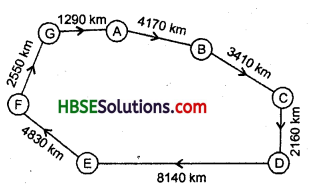
A bus started its journey and reached different places with a speed of 60 km/hr. The journey is shown below :
(i) Find the total distance covered by the bus from A to D.
(ii) Find the total distance covered by the bus from D to G.
HBSE 6th Class Maths Solutions Chapter 1 Knowing Our Numbers InText Questions 1
(iii) Find the total distance covered by the bus if it starts from A and returns back to A.
(iv) Can you find the difference of distances from C to D and D to E.
(v) Find out the time taken by bus to reach.
(a) AtoB
(b) C to D
(c) E to G
(d) Total journey.
Solution:
(i) Total distance covered by the bus from A to D
= 4170 km + 3410 km + 2160 km
= 9,740 km.

(ii) Total distance covered by the bus from D to G
= 8140 km + 4830 km + 2550 km
= 15,520 km.

HBSE 6th Class Maths Solutions Chapter 1 Knowing Our Numbers InText Questions

(iii) Total distance covered by the bus
= 9740 km + 15520 km + 1290 km = 26,550 km

(iv) Difference of distances from C to D and D to E
= 8140 km – 2160 km = 5980 km.

(v) (a) A to B = 4170 km, 4170 + 60 = 69% Hrs
(b) C to D = 2160 km,
2160 H- 60 = 36 Hrs
(c) E to G = 4830 km + 2550 km, 7380 + 60 = 123 Hrs
(d) Total journey
= 4170 + 3410 + 2160 + 8140 + 4830 + 2550 + 1290
= 26550 km = 442 1/2 Hrs.

Question 2.

ThingsPriceRaman.s shop The sales during the last year
(i) ApplesRs. 40/- kg2457 kg
(ii) OrangesRs. 30/- kg3004 kg
(iii) CombsRs. 3 for one22760
(iv) Tooth brushesRs. 10 for one25367
(u) PencilsRe 1 for one38530
(vi) Note-booksRs. 6 for one40002
(vii) Soap cakesRs. 8 for one20005

(a) Can you find the total weight of apples and oranges Raman sold last year ?
(b) Can you find the total money Raman got by selling apples ?
(c) Can you find the total money Raman got by selling apples and oranges together ?
(d) Make a table showing how much money Raman received from selling each item. Arrange the entries of amount of money received in decreasing order. Find the item which brought him the highest amount. How much is this amount ?
Solution:
(a) Wt. of apples = 2457 kg
Wt. of oranges = 3004 kg
.’. Total weight = 2457 kg + 3004 kg
= 5461 kg.
(b) Total money got by selling apples = Rs. 40 x 2457
= Rs. 98280.

(c) Total money got by selling apples and oranges together
= Rs. 40 x 2457 + Rs. 30 x 3004 = Rs. 98280 + Rs. 90120 = Rs. 188400.

(d)

ThingsPriceSaleAmount
(i)ApplesRs. 40/- kg2457 kgRs. 40 x 2457 = Rs. 98,280
(ii)OrangesRs. 30/– kg3004 kgRs. 30 x 3004 = Rs. 90,120
(iii)CombsRs. 3 for one22760Rs. 3 x 22760 = Rs. 68,280
(iv)Tooth-brushesRs. 10 for one25367Rs. 10 x 25367 = Rs. 2,53,670
(v)PencilsRe 1 for one38530Rs. 1 x 38530 = Rs. Rs. 38,530
(vi)Note-booksRs. 6 for one40002Rs. 6 x 40002 = Rs. 2,40,012
(vii)Soap cakesRs. 8 for one20005Rs. 8 x 20005 = Rs. 1,60,040

Arranging the entries of amount of money in decreasing order :
Rs. 2,53,670; Rs. 2,40,012; Rs. 1,60,040; Rs. 98,280; Rs. 90,120; Rs. 68,280; Rs. 38,530.
Tooth brushes brought him the highest amount which is Rs. 2,53,670.

HBSE 6th Class Maths Solutions Chapter 1 Knowing Our Numbers InText Questions

Try These (Page 23)

Question 1.
Round these numbers to the nearest tens.
28,32,52,41, 39,48,64,59,99,215,1453, 2936
Answer:
(i) 28 is rounded off to 30, correct to the nearest tens.
(ii) 32 is rounded off to 30, correct to the nearest tens.
(iii) 52 is rounded off to 50, correct to the nearest tens.
(iv) 41 is rounded off to 40, correct to the nearest tens.
(v) 39 is rounded off to 40, correct to the nearest tens.
(vi) 48 is rounded off to 50, correct to the nearest tens.
(vii) 64 is rounded off to 60, correct to the nearest tens.
(viii) 59 is rounded off to 60, correct to the nearest tens.
(ix) 99 is rounded off to 100, correct to the nearest tens.
(x) 215 is rounded off to 220, correct to the nearest tens.
(xi) 1453 is rounded off to 1450, correct to the nearest tens.
(xii) 2936 is rounded off to 2940, correct to the nearest tens.

(b) Estimating to the nearest hundreds: Check if the following rounding off to 100
is correct or not. Correct those which are wrong.
(i) 841→ 800 correct
(ii) 9537 → 9500 correct
(iii) 49730 → 49700 correct
(iv) 2546 → 2500 correct
(v) 286 → 300 correct
(vi) 5750 → 5800 correct
(vii) 168 → 200 correct
(viii) 149 → 100 correct
(ix) 9870 → 9800 wrong
→ 9900 correct.

(c) Rounding off to nearest thousands :
Check the following rounding offs. Correct those which are wrong.
(0 2,573 → 3,000 correct
(ii) ‘ 53,552 → 53,000 wrong
→ 54,000 correct
(iii) 6,404 → 6,000 correct
(iv) 65,437 → 65,000 correct
(v) 7,805 → 7,000 → wrong
→ 8,000 correct
(vi) 3,499 → 4,000 wrong
→ 3,000 correct.

Try These (Page 24)

Question 1.
Round off the given numbers to the nearest tens, hundreds and thousands.

Given NumberApproximated to NearestRounded form
(i)            75847Tens75850
(ii)           75847Hundreds75800
(iii)          75847Thousands76000
(iv)          75847Ten thousands80000

Note : There are no rigid rules when you want to estimate the outcotnes on numbers. The procedure depends on the degree of accuracy required, how quickly the estimate is needed and most importantly, how sensible the guessed answer would be.

Try These (Page 28)

Question 1.
Estimate the following products :
(i) 87 x 313
(ii) 9×795
(iii) 898 x 785
(iv) 958 x 387.
Solution:
(i) We try approximating 87 to 90 arid 313 to 300. We get the product 90 x 300 = 27,000 is a quick as well as good estimate of the product.
(ii) We try approximating 9 to 10 and 795 to 800. We get the product 10 x 800 = 8,000 is a quick as well as good estimate of the product.
(iii) We try approximating 898 to 900 and 785 to 800. We get the product 900 x 800 =
7,20,0 is a quick as well as good estimate of the product.
(iv) We try approximating 958 to 1,000 and 387 to 400. We get the product 1,000 x 400 = 4,00,000 is a quick as well as good estimate of the product.

HBSE 6th Class Maths Solutions Chapter 1 Knowing Our Numbers InText Questions

Try These (Page 29)

Question 1.
Write the expressions for each of the following using brackets :
(a) Four multiplied by the sum of nine and two.
(b) Divide difference of eighteen and six by four. ,
(c) Forty five divided by three times of the sum of three and two.
Answer:
(a) 4 x (9 + 2),
(b) (18 – 6) + 4,
(c) 45 ÷ 3(3 + 2).

Question 2.
Write 3 different situations for (5 + 8) x 6.
Answer:
(a) 1st situation: Sohani and Reeta work for 6 days; Sohani works 5 hours a day and Reeta 8 hours a day. How many hours do both of them work in a day ?
(b) Ilnd situation : Suman bought 5 note-books from the market and the cost was Rs. 6 per note-book. Her sister Seema also- bought 8 note-books of the same type. Find the total money they paid.
(c) Illrd situation : Ram covered a
distance of 5 km in one hour and Shyam covered a distance of 8 km in one hour. How much distance did they cover in 6 hours ?

Question 3.
Write 5 such situations for the following where brackets would be necessary.
Answer:
(a) 7 (8 – 3) is 7 times (8 – 3) and so the answer is 7 x 5 = 35.
(b) (7 + 2) (10 – 3) is (9) (7) or 9 x 7 = 63.
(c) 5 (10 – 3) is 5 times (10 – 3) and so the answer is 5 x 7 = 35.
(d) (7 – 2) (10 + 3) is (5) (13) or 5 x 13 = 65.
(e) 18 (5 – 2) is 18 times (5 – 2) and so the answer is 18 x 3 = 54.

Try These (Page 29-30)

1. 7 x (100 + 9)
7 x 100 + 7.x 9 700 + 63 = 763

2.  102 x 103 = (100 + 2) x (100 + 3)
= 100 x 100 + 2 x 100 + 100 x 3 + 2 x 3
= 10,000 + 200 + 300 + 6
= 10,000 + 500 + 6
= 10,506.

3. 17 x 109 = (10 + 7) x (100 + 9)
= 10 x 100 + 7 x 100 + 10 x 9 + 7 x 9
= 1000 + 700 + 90 + 63
= 17790 + 63
= 1853.

HBSE 6th Class Maths Solutions Chapter 1 Knowing Our Numbers InText Questions

Try These (Page 32)

Question 1.
Write in Roman Numerals :
1. 73
2. 92.
Solution:
1. 73 = 70 +3 = (50+ 20)+ 3 = LXX + III = LXXIII
2. 92 = 90 + 2 = (100 – 10) + 2 = XC + II = XCII.

HBSE 6th Class Maths Solutions Chapter 1 Knowing Our Numbers InText Questions Read More »

HBSE 6th Class Maths Solutions Chapter 4 Basic Geometrical Ideas Ex 4.1

Haryana State Board HBSE 6th Class Maths Solutions Chapter 4 Basic Geometrical Ideas Ex 4.1 Textbook Exercise Questions and Answers.

Haryana Board 6th Class Maths Solutions Chapter 4 Basic Geometrical Ideas Exercise 4.1

Question 1.
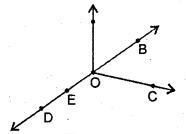
Use the figure to name
(a) 5 points
(b) a line
(c) 4 rays
(d) 5 line segments.
Solution:
(a) 5 points are O, B, C, D and E.
(b) A line is \(\) or \(\).
(c) 4 rays are \(\) and \(\).
(d) 5 line segments are \(\overline{\mathrm{OB}}, \overline{\mathrm{OC}}, \overline{\mathrm{OF}}, \overline{\mathrm{OD}},\overline{\mathrm{DE}}\).
HBSE 6th Class Maths Solutions Chapter 4 Basic Geometrical Ideas Ex 4.1 1

HBSE 6th Class Maths Solutions Chapter 4 Basic Geometrical Ideas Ex 4.1

Question 2.
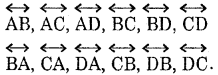
Name the line given in all possible (twelve) ways, choosing only two letters at a time from the four given.
Solution:
Possible twelve names are as follows:
HBSE 6th Class Maths Solutions Chapter 4 Basic Geometrical Ideas Ex 4.1 2
HBSE 6th Class Maths Solutions Chapter 4 Basic Geometrical Ideas Ex 4.1 3

Question 3.
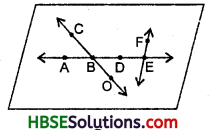
Name :
(a) Line containing point E.
(b) Line passing through A.
(c) Line on which 0 lies.
(d) Two pairs of intersecting lines.
HBSE 6th Class Maths Solutions Chapter 4 Basic Geometrical Ideas Ex 4.1 4
Solution:
(a) Line containing point E is \(\overleftrightarrow{\mathrm{EF}}\)
(b) Line passing through A is \(\overleftrightarrow{\mathrm{AE}}\).
(c) Line on which O lies is \(\overleftrightarrow{\mathrm{OC}}\)
(d) Two pairs of intersecting lines are : \(\stackrel{\leftrightarrow}{\mathrm{AE}}, \overleftrightarrow{\mathrm{OC}}\) and \(\stackrel{\leftrightarrow}{\mathrm{AE}}, \overleftrightarrow{\mathrm{EF}}\)

Question 4.
How many lines can pass through :
(a) one given point ?
(b) two given points ?
Solution:
(a) Infinite number of lines can pass through one given point.
(b) Only one line can pass through two given points.

HBSE 6th Class Maths Solutions Chapter 4 Basic Geometrical Ideas Ex 4.1

Question 5.
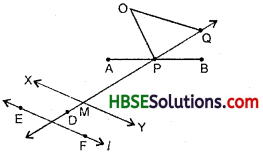
Draw a rough figure and label suitably in each of the following cases :
(a) Point P lies on \(\overline{A B}\) .
(b) XY and PQ intersect at M.
(c) Line l contains E and F but not D.
(d) OP and OQ meet at O.
Solution:
HBSE 6th Class Maths Solutions Chapter 4 Basic Geometrical Ideas Ex 4.1 5

Question 6.
Consider the following figure of line MN. Say whether following state¬ments are true or false in context of given figure.
(a) Q, M, O, N, P are points on the line MN.
(b) M, O, N are points on a line segment . \(\overline{M N}\).
(c) M and N are end points of line segment \(\overline{M N}\).
(d) 0 and N are end points of line segment \(\overline{OP}\).
(e) M is one of the end points of line segment \(\overline{QO}\).
(f) M is point on ray \(\overrightarrow{OP}\).
(g) Ray \(\overrightarrow{OP}\) is different from ray \(\overrightarrow{QP}\).
(h) Ray \(\overrightarrow{OP}\) is same as ray \(\overrightarrow{OM}\).
(i) Ray \(\overrightarrow{OM}\) is not opposite to ray \(\overrightarrow{OP}\).
(j) 0 is not an initial point of \(\overrightarrow{OP}\).
(k) N is the initial point of \(\overrightarrow{NP}\) and \(\overrightarrow{N M}\).
Solution:
(a) True,
(b) True,
(c) True,
(d) False,
(e) False,
(f) False,
(g) False,
(h) True,
(i) False,
(j) False,
(k) True.

HBSE 6th Class Maths Solutions Chapter 4 Basic Geometrical Ideas Ex 4.1 Read More »
HBSE 6th Class Maths Solutions Chapter 2 Whole Numbers InText Questions

Haryana State Board HBSE 6th Class Maths Solutions Chapter 2 Whole Numbers InText Questions and Answers.

Haryana Board 6th Class Maths Solutions Chapter 2 Whole Numbers InText Questions

Try These (Page 34)

Question 1.
Write the predecessor and successor of : 19; 1,997; 12,000; 49; 1,00,000; 24,40,701; 1,00,199; 2,08,090.
Answer:

NumberPredecessorSuccessor
191820
1,9971,9961,998
12,00011,99912,001
494850
1,00,00099,9991,00,001
24,40,70124,40,70024,40,702
1,00,1991,00,1981,00,200
2,08,0902,08,0892,08,091

Question 2.
Is there any natural number that has no predecessor ?
Answer:
Yes, 1 has no predecessor.

HBSE 6th Class Maths Solutions Chapter 2 Whole Numbers InText Questions

Question 3.
Is there any natural number which has no successor ?
Is there a last natural number ?
Answer:
No, every natural number has a successor.
No, there is no last natural number.

Try These (Page 35)

Question 1.
Are all natural numbers also whole numbers ?
Answer:
Yes, all natural numbers are also whole numbers.

Question 2.
Are all whole numbers also natural numbers ?
Answer:
No, ‘0’ is a whole number but not a natural number.

Question 3.
Which is the smallest whole number ?
Answer:
‘0’ is the smallest whole number.

Question 4.
Which is the greatest whole number ?
Answer:
There is no greatest whole number.

HBSE 6th Class Maths Solutions Chapter 2 Whole Numbers InText Questions

Try These (Page 37)

Question 1.
Find 4 +5; 2 +6; 3 +5; 1 + 6 using the number line.
Answer:
(a) 4 + 5
HBSE 6th Class Maths Solutions Chapter 2 Whole Numbers InText Questions 1
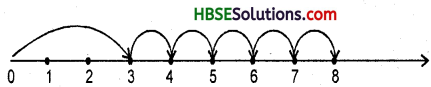
The point at the tip of the arrow is 4. Start at 4.
Since, we add 5 to this number so we make 5 jumps to the right; from 4 to 5, 5 to 6, 6 to 7, 7 to 8 and 8 to 9 as shown above in Fig. The tip of the last arrow in the fifth jump is at 9.
∴ The sum of 4 and 5 is 9 i.e. 4 + 5 = 9.

(b) 2 + 6
HBSE 6th Class Maths Solutions Chapter 2 Whole Numbers InText Questions 2
The point at the tip of the arrow is 2. Start at 2.
Since we add 6 to this number so we make 6 jumps to the right; from 2 to 3, 3 to 4, 4 to 5, 5 to 6, 6 to 7 and 7 to 8 as shown above in Fig. 2.2. The tip of the last arrow in the sixth jump is at 8.
∴ The sum of 2 and 6 is 8 i.e., 2 + 6 = 8.

(c) 3 + 5
HBSE 6th Class Maths Solutions Chapter 2 Whole Numbers InText Questions 3
The point at the tip of the arrow is 3. Start at 3. Since we add 5 to this number so we make 5 jumps to the right; from 3 to 4, 4 to 5, 5 to 6, 6 to 7 and 7 to 8 as shown above in Fig. 2.3. The tip of the last arrow in the fifth jump is at 8.
∴ The sum of 3 and 5 is 8 i.e., 3 + 5 = 8.

(d) 1 + 6
HBSE 6th Class Maths Solutions Chapter 2 Whole Numbers InText Questions 4
The point at the tip of the arrow is 1. Start at 1. Since we add 6 to this number so we make 6 jumps to the right; from 1 to 2, 2 to 3, 3 to 4, 4 to 5, 5 to 6 and 6 to 7 as shown in Fig. 2.4 above. The tip of the last arrow in the sixth jump is at 7.
∴ The sum of 1 and 6 is 7 i.e., 1 + 6 = 7.

Try These (Page 37)

Question 1.
Find 8-3; 6-2; 9-6 using the number line.
Answer:
(a) 8-3.
HBSE 6th Class Maths Solutions Chapter 2 Whole Numbers InText Questions 5
The point at the tip of the arrow is 8. Start from 8. Since 3 is being subtracted, so move towards left with 1 jump of 1 unit. Make 3 such jumps. We reach at the point 5.
∴ We get 8 – 3 = 5.

HBSE 6th Class Maths Solutions Chapter 2 Whole Numbers InText Questions

(b) 6 – 2
HBSE 6th Class Maths Solutions Chapter 2 Whole Numbers InText Questions 6
The point at the tip of the arrow is 6. Start from 6. Since 2 is being subtracted, so move towards left with 1 jump of 1 unit. Make 2 such jumps. We reach at the point 4.
∴ We get 6-2 = 4.

(c) 9-6.
HBSE 6th Class Maths Solutions Chapter 2 Whole Numbers InText Questions 7
The point at the tip of the arrow is 9. Start from 9. Since 6 is being subtracted, so move
towards left with 1 jump of 1 unit. Make 6 such jumps. We reach at the point 3.
∴ We get 9 – 6 = 3.

Try These (Page 37)

Question 1.
Find 2 x 6; 3 x 3; 4 x 2 using number line.
Answer:
(a) Let us find 2 x 6.
HBSE 6th Class Maths Solutions Chapter 2 Whole Numbers InText Questions 8
Start from ‘0’, move 2 units at a time to the right. Make 6 such moves. We reach at 12. So, we say 2 × 6 = 12.

(b) 3 x 3.
HBSE 6th Class Maths Solutions Chapter 2 Whole Numbers InText Questions 9
Start from ‘0’, move 3 units at a time to the right. Make such 3 moves, we reach at 9. So, we say 3 × 3 = 9.

(c) 4 × 2.
HBSE 6th Class Maths Solutions Chapter 2 Whole Numbers InText Questions 10
Start from ‘0’, move 4 units at a time to the right. Make such 2 moves, we reach at 8. So, we say 4 x 2 = 8.

Try These (Page 45)

Question 1.
(i) 7 + 18 + 13 (ii) 16 + 12 + 4.
Solution:
(i) 7 + 18 + 13 = (7 + 13) + 18
= 20 + 18 = 38
(ii) 16 + 12 + 4 = (16 + 4) + 12
= 20 + 12 = 32.

Question 2.
(i) 25 × 8358 × 4
(ii) 625 × 3759 × 8.
Solution:
(i) 25 × 8358 × 4
= (25 × 4) × 8358
= 100 × 8358
= 835800

(ii) 625 × 3759 × 8
= (625 × 8) × 3759
= 5000 × 3759
= 18795000

Question 3.
(i) (16 ÷ 4) ÷ 2 and 16 ÷ (4 ÷ 2)
(ii) (28 ÷ 14) ÷ 2 and 28 ÷ (14 ÷ 2).
Solution:
(i)( 16 ÷ 4) ÷ 2= 4 ÷ 2 = 2
and 16 ÷ (4 ÷ 2) = 16 ÷ 2 = 8
.-. (16 ÷ 4) ÷ 2 ≠ 16 ÷ (4 ÷ 2)
(ii) (28 + 14) ÷ 2 = 2 ÷ 2 = 1
and 28 ÷ (14 ÷ 2) = 28 ÷ 7 = 4
.-. (28 ÷ 14) ÷ 2 ≠ 28 + (14 ÷ 2)
Hence there is no associative property for division.

HBSE 6th Class Maths Solutions Chapter 2 Whole Numbers InText Questions

Try These (Page 48)

Question 1.
(i) 15 × 68
(ii) 17 × 23
(iii) 69 × 78 + 22 × 69.
Solution:
(i) 15 × 68 = 15 × (60 + 8)
= 15 × 60+ 15 × 8 = 900 + 120 = 1020
(ii) 17 × 23 = 17 × (20 + 3)
= 17 × 20 + 17 × 3 = 340 + 51 = 391
(iii) 69 × 78 + 22 × 69
= (78 + 22) × 69 = 100 × 69 = 6900

HBSE 6th Class Maths Solutions Chapter 2 Whole Numbers InText Questions Read More »

HBSE 6th Class Maths Solutions Chapter 4 Basic Geometrical Ideas Ex 4.6

Haryana State Board HBSE 6th Class Maths Solutions Chapter 4 Basic Geometrical Ideas Ex 4.6 Textbook Exercise Questions and Answers.

Haryana Board 6th Class Maths Solutions Chapter 4 Basic Geometrical Ideas Exercise 4.6

Question 1.
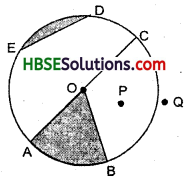
From Fig., identify
(a) the centre of the circle
(b) three radii
(c) a diameter
(d) a chord
HBSE 6th Class Maths Solutions Chapter 4 Basic Geometrical Ideas Ex 4.6 1
(e) two points in the interior
(f) a point in the exterior
(g) a sector
(h) a segment.
Solution:
(a) Point O is the centre of the circle.
(b) Line segments \(\overline{\mathrm{OA}}, \overline{\mathrm{OB}}\) and \(\overline{\mathrm{OP}}\) are three radii of the circle.
(c) Line segment \(\overline{\mathrm{AC}}\) is a diameter of the circle.
(d) Line segment \(\overline{\mathrm{ED}}\) is a chord of the circle.
(e) Points 0 and P are in the interior of the circle.
(f) Point Q is in the exterior of the circle.
(g) The shaded portion OAB is a sector of the circle.
(h) The shaded part of chord ED is a segment.

HBSE 6th Class Maths Solutions Chapter 4 Basic Geometrical Ideas Ex 4.6

Question 2.
(a) Is every diameter of a circle also a chord ?
(b) Is every chord of a circle also a diameter ?
Solution:
(a) Yes, every diameter of a circle is also a chord of the circle.
(b) No, every chord of a circle is not a diameter of the circle.

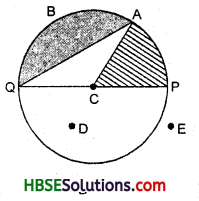
Question 3.
Draw any circle and mark
(a) its centre
(b) a radius
(c) a diameter
(d) a sector
(e) a segment
(f) a point in its interior
(g) a point, in its exterior
(h) an arc.
Solution:
(a) Point C is the centre of the circle.
(b) Line segment \(\overline{\mathrm{CP}}\) is its radius.
HBSE 6th Class Maths Solutions Chapter 4 Basic Geometrical Ideas Ex 4.6 2
(c) Line segment \(\overline{\mathrm{QCP}}\) is its diameter.
(d.) The shaded region ACP is a sector.
(e) The dark-shaded region ABQ is a segment.
(f) Point D is in the interior of the circle.
(g) Point E is in the exterior of the circle.
(h) \(\overparen{Q B A}\) is an arc of the circle.

HBSE 6th Class Maths Solutions Chapter 4 Basic Geometrical Ideas Ex 4.6

Question 4.
Say true or false :
(a) Two diameters of a circle will necessarily intersect,
(b) The centre of a circle is always in its interior.
Solution:
(a) True, (b) True.

HBSE 6th Class Maths Solutions Chapter 4 Basic Geometrical Ideas Ex 4.6 Read More »

HBSE 6th Class Maths Solutions Chapter 4 Basic Geometrical Ideas Ex 4.5

Haryana State Board HBSE 6th Class Maths Solutions Chapter 4 Basic Geometrical Ideas Ex 4.5 Textbook Exercise Questions and Answers.

Haryana Board 6th Class Maths Solutions Chapter 4 Basic Geometrical Ideas Exercise 4.5

Question 1.
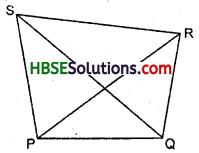
Draw a rough sketch of a quadri-lateral PQRS. Draw its diagonals. Name them. Is the meeting point of the diagonals in the interior or exterior of the quadrilateral ?
Solution:
Two diagonals are PR and QS. The meeting point of the diagonals is in the interior of the quadrilateral.
HBSE 6th Class Maths Solutions Chapter 4 Basic Geometrical Ideas Ex 4.5 1

HBSE 6th Class Maths Solutions Chapter 4 Basic Geometrical Ideas Ex 4.5

Question 2.
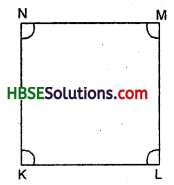
Draw a rough sketch of a quadri-lateral KLMN. State :
(i) two pairs of opposite sides.
(ii) two pairs of opposite angles.
(Hi) two pairs of adjacent sides.
(iv) two pairs of adjacent angles.
Solution:
(i) Two pairs of opposite sides are : KL, MN and LM, KN. .
(ii) Two pairs of opposite angles are : ∠K, ∠M and ∠L, ∠N.
HBSE 6th Class Maths Solutions Chapter 4 Basic Geometrical Ideas Ex 4.5 2
(iii) Two pairs of adjacent sides are : KL, LM and LM, MN.
(iv) Two pairs of adjacent angles are: ∠K, ∠L and ∠L, ∠M.

HBSE 6th Class Maths Solutions Chapter 4 Basic Geometrical Ideas Ex 4.5

Question 3.
Investigate: Use strips and fasten to make a triangle and a quadri-lateral. Try to push inward at any one vertex of the triangle. Do the same to the quadrilateral. Is the triangle dis-torted ? Is the quadrilateral distorted ? Is the triangle rigid ? Why is it that structures like electric towers make use of triangular shapes and not quadri-laterals ?
Solution:
No, triangle is not distorted. Yes, quadrilateral is distorted. Yes, the triangle is rigid. Because triangular shape is not affected.

HBSE 6th Class Maths Solutions Chapter 4 Basic Geometrical Ideas Ex 4.5 Read More »

HBSE 6th Class Maths Solutions Chapter 4 Basic Geometrical Ideas Ex 4.4

Haryana State Board HBSE 6th Class Maths Solutions Chapter 4 Basic Geometrical Ideas Ex 4.4 Textbook Exercise Questions and Answers.

Haryana Board 6th Class Maths Solutions Chapter 4 Basic Geometrical Ideas Exercise 4.4

HBSE 6th Class Maths Solutions Chapter 4 Basic Geometrical Ideas Ex 4.4

Question 1.
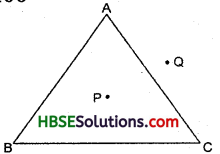
Draw a rough sketch of a triangle ABC. Mark a point P in its interior and a point Q in its exterior. Is the point A in its interior or in its exterior ?
Solution:
Point A is neither in the interior nor in the exterior of the triangle, but it is on the ΔABC.
HBSE 6th Class Maths Solutions Chapter 4 Basic Geometrical Ideas Ex 4.4 1

Question 2.
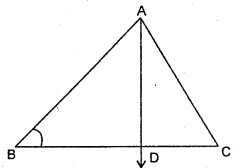
Identify three triangles in Fig. Write the names of seven angles. Write the names of six line segments. Which two triangles have ∠B as common ?
Solution:
HBSE 6th Class Maths Solutions Chapter 4 Basic Geometrical Ideas Ex 4.4 2
In Fig., three triangles are, ΔABC, ΔABD and ΔACD.
Seven angles are : ∠BAD, ∠ADB, ∠ABD, ∠DAC, ∠ACD, ∠ADC and ∠BAC.
Six line-segments are : AB, BC, CA, AD, BD and CD.
ΔABD and ΔABC have ∠B as common.

HBSE 6th Class Maths Solutions Chapter 4 Basic Geometrical Ideas Ex 4.4 Read More »

HBSE 6th Class Maths Solutions Chapter 4 Basic Geometrical Ideas Ex 4.3

Haryana State Board HBSE 6th Class Maths Solutions Chapter 4 Basic Geometrical Ideas Ex 4.3 Textbook Exercise Questions and Answers.

Haryana Board 6th Class Maths Solutions Chapter 4 Basic Geometrical Ideas Exercise 4.3

Question 1.
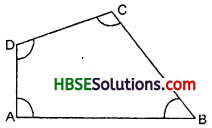
Name the angles in the given fig.
HBSE 6th Class Maths Solutions Chapter 4 Basic Geometrical Ideas Ex 4.3 1
Solution:
(i) ∠ABC
(ii) ∠BCD.
(iii) ∠CDA.
(iv) ∠DAB

HBSE 6th Class Maths Solutions Chapter 4 Basic Geometrical Ideas Ex 4.3

Question 2.
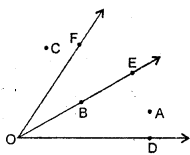
In the given Fig. , name the point(s)
HBSE 6th Class Maths Solutions Chapter 4 Basic Geometrical Ideas Ex 4.3 2
(а) In the interior of ∠DOE.
(b) In the exterior of ∠EOF.
(c) On ∠EOF.
Solution:
(a) Point A is in the interior of ∠DOE.
(b) Point C and A are in the exterior of ∠EOF.
(c) Point B is on ∠EOF

HBSE 6th Class Maths Solutions Chapter 4 Basic Geometrical Ideas Ex 4.3

Question 3.
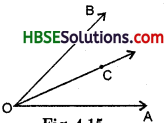
Draw rough diagrams of two angles such that they have
(а) One point in common.
(b) Two points in common.
(c) Three points in common.
(d) Four points in common.
(e) One ray in common.
HBSE 6th Class Maths Solutions Chapter 4 Basic Geometrical Ideas Ex 4.3 3
Solution:
(a) O is common to both the angles ∠AOC and ∠BOC.
(b), (c), (d) are not possible.
(e) \(\overrightarrow{\mathrm{OC}}\) is one ray common to both angles ∠AOB and ∠BOC.

HBSE 6th Class Maths Solutions Chapter 4 Basic Geometrical Ideas Ex 4.3 Read More »

HBSE 6th Class Maths Solutions Chapter 4 Basic Geometrical Ideas Ex 4.2

Haryana State Board HBSE 6th Class Maths Solutions Chapter 4 Basic Geometrical Ideas Ex 4.2 Textbook Exercise Questions and Answers.

Haryana Board 6th Class Maths Solutions Chapter 4 Basic Geometrical Ideas Exercise 4.2

Question 1.
Classify the following curves as (i) open or (ii) closed.
HBSE 6th Class Maths Solutions Chapter 4 Basic Geometrical Ideas Ex 4.2 1
Solution:
Curves (a) and (c) are open curves and (b), (d) and (e) are closed curves.

Question 2.
Draw rough diagrams to illustrate the following :
(a) Open curve (b) Closed curve.
Solution:
HBSE 6th Class Maths Solutions Chapter 4 Basic Geometrical Ideas Ex 4.2 2

Question 3.
Draw any polygon and shade its terior.
Solution:
HBSE 6th Class Maths Solutions Chapter 4 Basic Geometrical Ideas Ex 4.2 3

HBSE 6th Class Maths Solutions Chapter 4 Basic Geometrical Ideas Ex 4.2

Question 4.
Consider the given Fig., and answer the questions :
HBSE 6th Class Maths Solutions Chapter 4 Basic Geometrical Ideas Ex 4.2 4
(a) Is it a curve ?
(b) Is it closed. ?
(c) Is it a polygon ?
Solution:
(a) Yes, it is a curve.
(b) Yes, it is closed.
(c) Yes, it is a polygon.

Question 5.
Illustrate, if possible, each of the following with a rough diagram :
(a) A closed curve that is not a polygon.
(b) An open curve made up entirely of line segments.
(c) A polygon with two sides.
HBSE 6th Class Maths Solutions Chapter 4 Basic Geometrical Ideas Ex 4.2 5
Solution:
(c) A polygon with two sides is not possible

HBSE 6th Class Maths Solutions Chapter 4 Basic Geometrical Ideas Ex 4.2 Read More »

HBSE 6th Class Maths Solutions Chapter 3 Playing With Numbers Ex 3.7

Haryana State Board HBSE 6th Class Maths Solutions Chapter 3 Playing With Numbers Ex 3.7 Textbook Exercise Questions and Answers.

Haryana Board 6th Class Maths Solutions Chapter 3 Playing With Numbers Exercise 3.7

Question 1.
Renu purchases two bags of fertiliser of weights 75 kg and 69 kg. Find the maximum value of weight which can measure the weight of fertiliser exact number of times.
Solution:
Maximum value of weight which can measure exact number of times will be the H.C.F. of 75 and 69.
HBSE 6th Class Maths Solutions Chapter 3 Playing With Numbers Ex 3.7 1
∴ H.C.F. of 75 and 69 is 3:
Hence, maximum value of the required wt. = 3 kg

Question 2.
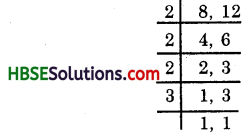
Three boys step off together from the same spot. Their steps measure 63 cm, 70 cm and 77 cm respectively. What is the minimum distance each should cover so that all can cover the distance in complete steps ?
Solution:
The required minimum distance each should walk must be a least common multiple of the measures of their steps.
Thus, we find the L.C.M. of 63, 70, 77.
HBSE 6th Class Maths Solutions Chapter 3 Playing With Numbers Ex 3.7 2
∴ L.C.M. of 63, 70, 77 = 7 × 2 × 5 × 3 × 3 × 11 = 6930.
Hence, the required minimum distance is 6930 cm.

HBSE 6th Class Maths Solutions Chapter 3 Playing With Numbers Ex 3.7

Question 3.
The length, breadth and height of a room are 825 cm, 675 cm and 450 cm respectively. Find the longest tape which can measure the three dimensions of the room exactly.
Solution:
The longest tape which can measure the three dimensions of the room exactly will be the H.C.F. of 825, 675, 450.
HBSE 6th Class Maths Solutions Chapter 3 Playing With Numbers Ex 3.7 3
∴ H.C.F. of 825, 675, 450 is 75.
Hence, the required longest tape will be 75 cm.

Question 4.
Determine the smallest 3-digit number which is exactly divisible by 6, 8 and 12.
Solution:
HBSE 6th Class Maths Solutions Chapter 3 Playing With Numbers Ex 3.7 4
∴ L.C.M. of 6, 8, 12= 2 × 2 × 3 × 2 = 24
Now, the smallest 3-digit number = 100
HBSE 6th Class Maths Solutions Chapter 3 Playing With Numbers Ex 3.7 5
24 – 4 = 20
Hence, the required number
= 100 + 20 = 120

Question 5.
Determine the largest 3-digit number exactly divisible by 8,10 and 12.
Solution:
HBSE 6th Class Maths Solutions Chapter 3 Playing With Numbers Ex 3.7 6
∴ L.C.M. of 8, 10, 12
=2 × 2 × 2 × 3 × 5 = 120
Now, largest 3-digit number = 999
HBSE 6th Class Maths Solutions Chapter 3 Playing With Numbers Ex 3.7 7
Hence, the required number
= 999 – 39
= 960.

HBSE 6th Class Maths Solutions Chapter 3 Playing With Numbers Ex 3.7

Question 6.
The traffic lights at three different road crossings change after every 48 seconds, 72 seconds and 108 seconds respectively. If they change simultaneously at 7 A.M., at what time they will change simultaneously again?
Solution:
48 sec, 72 sec, 108 sec.
HBSE 6th Class Maths Solutions Chapter 3 Playing With Numbers Ex 3.7 8
∴ L.C.M. of 48, 72, 108
= 2 × 2 × 2 × 3 × 3 × 2 × 3
= 432 sec. = 7 min. 12 sec.
They will change simultaneously after 7 min. 12 sec
i.e., at 7 hr. 7 min. 12 sec. A.M.

Question 7.
Three tankers contain 403 litres, .434 litres and 465 litres of diesel respectively. Find the maximum capacity of a container that can measure the diesel of three containers exact number of times.
Solution:
The maximum capacity of a container will be the
H.C.F. of 403, 434, 465.
HBSE 6th Class Maths Solutions Chapter 3 Playing With Numbers Ex 3.7 9
∴ H.C.F. of 403, 434, 465 is 31.
Hence, maximum capacity of the required container = 31 litres. Ans.

Question 8.
Find the least number which when divided by 6, 15 and 18 leave remainder 5 in each case.
Solution:
We first find the L.C.M. of 6, 15 and 18 as follows :
HBSE 6th Class Maths Solutions Chapter 3 Playing With Numbers Ex 3.7 10
∴ L.C.M. of 6, 15, 18 = 2 × 3 × 3 × 5 = 90
∴ 90 is the least number which when divided by the given numbers will leave remainder ‘0’ in each case. But we need the least number that leaves remainder 5 in each case.
Hence, the required number = 90 + 5 = 95.

HBSE 6th Class Maths Solutions Chapter 3 Playing With Numbers Ex 3.7

Question 9.
Find the smallest four-digit number which is divisible by 18,24 and 32.
Solution:
We first find the L.C.M. of 18, 24, 32
HBSE 6th Class Maths Solutions Chapter 3 Playing With Numbers Ex 3.7 11
∴ L.C.M. of 18, 24, 32 .
= 2 × 2 × 2 × 2 × 3 × 3 × 2
= 288
Now, the smallest 4-digit number = 1000
HBSE 6th Class Maths Solutions Chapter 3 Playing With Numbers Ex 3.7 12
288 – 136 = 152
Hence, the required number
= 1000 + 1.52= 1152

HBSE 6th Class Maths Solutions Chapter 3 Playing With Numbers Ex 3.7

Question 10.
Find the L.C.M. of the following numbers in which one number is always a multiple of 3 :
(a) 9 and 4
(b) 12 and 5
(c) 6 and. 5
(d) 15 and 4.
Observe a common property in the obtained L.C.M. Is L.C.M. the product of two numbers in each case ? Is L.C.M. always a multiple of 3 ?
Solution:
HBSE 6th Class Maths Solutions Chapter 3 Playing With Numbers Ex 3.7 13
(a) L.C.M.of 9 and 4 = 2 × 2 × 3 × 3 = 36
= 9 × 4
(b) L.C.M. of 12 and 5 = 2 × 2 × 3 × 5
60 = 12 × 5
(c) LC.M. of 6 and 5 = 2 × 3 × 5 = 30 = 6 × 5
(d) L.C.M.of 15 and 4 = 2 × 2 × 3 × 5 = 60 = 15 × 4
Yes, L.C.M. is equal to the product of two numbers in each case.
Yes, L.C.M. is always a multiple of 3.

HBSE 6th Class Maths Solutions Chapter 3 Playing With Numbers Ex 3.7 Read More »
HBSE 6th Class Maths Solutions Chapter 3 Playing With Numbers Ex 3.6

Haryana State Board HBSE 6th Class Maths Solutions Chapter 3 Playing With Numbers Ex 3.6 Textbook Exercise Questions and Answers.

Haryana Board 6th Class Maths Solutions Chapter 3 Playing With Numbers Exercise 3.6

Question 1.
Find the H.C.F of the following numbers:
(a) 18, 48
(b) 30, 42
(c) 18, 60
(d) 27, 63
(e) 36, 84
(f) 34, 102
(g) 70, 105, 175
(h) 91, 112, 49
(i) 18, 54, 81
(j) 12, 45, 75.
Solution:
(a)
HBSE 6th Class Maths Solutions Chapter 3 Playing With Numbers Ex 3.6 1
HBSE 6th Class Maths Solutions Chapter 3 Playing With Numbers Ex 3.6 2

HBSE 6th Class Maths Solutions Chapter 3 Playing With Numbers Ex 3.6

Question 2.
What is the H.C.F. of two consecutive :
(a) numbers ? .
(b) even numbers ?
(c) odd numbers ?
Solution:
(a) H.C.F. of two consecutive numbers is 1.
(b) H.C.F. of two consecutive even numbers is 2.
(c) H.C.F. of two consecutive odd numbers is 1.

HBSE 6th Class Maths Solutions Chapter 3 Playing With Numbers Ex 3.6

Question 3.
H.C.F. of co-prime numbers 4 and 15 was found as follows : Factorisation : 4 = 2×2 and 15 = 3 × 5, since there is no common prime factor, so H.C.F. of 4 and 15 is 0. Is the answer correct ? If not, what is the correct H.C.F. ?
Solution:
No, the correct H.C.F. is 1.

HBSE 6th Class Maths Solutions Chapter 3 Playing With Numbers Ex 3.6 Read More »