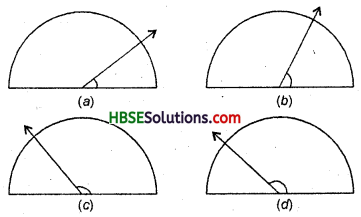
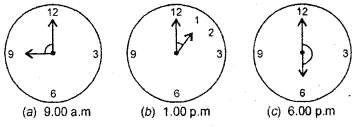
Author name: Prasanna

HBSE 6th Class Maths Solutions Chapter 5 Understanding Elementary Shapes Ex 5.5

Haryana State Board HBSE 6th Class Maths Solutions Chapter 5 Understanding Elementary Shapes Ex 5.5 Textbook Exercise Questions and Answers.

Haryana Board 6th Class Maths Solutions Chapter 5 Understanding Elementary Shapes Exercise 5.5

Question 1.
Which of the following are models for perpendicular lines :
(a) The adjacent edges of a table top.
(b) The lines of a railway track.
(c) The line segments forming the letter U.
(d) The letter C.
Solution:
(a) The adjacent edges of a table and
(c) The line segments forming the letter ‘L’.

HBSE 6th Class Maths Solutions Chapter 5 Understanding Elementary Shapes Ex 5.5

Question 2.
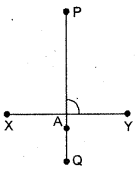
Let \(\overline{\mathrm{PQ}}\) be the perpendicular to the line segment \(\overline{\mathrm{XY}}\). Let \(\overline{\mathrm{PQ}}\) and \(\overline{\mathrm{XY}}\) intersect in the point A.
(a) How is the point A placed in \(\overline{\mathrm{XY}}\) ?
(b) What is the mea¬sure of ∠PAY ?
HBSE 6th Class Maths Solutions Chapter 5 Understanding Elementary Shapes Ex 5.5 1
Solution:
(a) Point A lies between X and Y.
(b) Measure of ∠PAY = 90°.

Question 3.
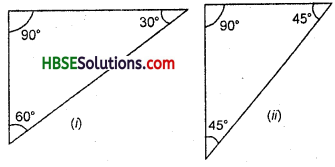
There are two “set squares” in your box.
What are the measures of the angles that are formed at their corners ? Do they have any angle measure that is common?
Solution:
HBSE 6th Class Maths Solutions Chapter 5 Understanding Elementary Shapes Ex 5.5 2
(i) 90°, 60° and 30°,
(ii) 90°, 45° and 45°, common angle = 90°.

HBSE 6th Class Maths Solutions Chapter 5 Understanding Elementary Shapes Ex 5.5

Question 4.
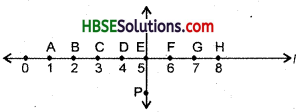
Study the diagram. The line T is perpendicular to line im\
(a) Is CE = EG ?
(b) Does PE bisect CG ?
(c) Identify any two line segments for which PE is the perpendicular bisector.
(d) Are these true ?
(i) AC > FG, (ii) CD = GH, (Hi) BC < EH.
HBSE 6th Class Maths Solutions Chapter 5 Understanding Elementary Shapes Ex 5.5 3
Solution:
(a) Yes, CE = EG. .
(b) Yes, PE bisects CG.
(c) PE is the perpendicular bisector of DF and BH.
(d) (i) T, (ii) T, (Hi) T.

HBSE 6th Class Maths Solutions Chapter 5 Understanding Elementary Shapes Ex 5.5 Read More »

HBSE 6th Class Maths Solutions Chapter 5 Understanding Elementary Shapes Ex 5.6

Haryana State Board HBSE 6th Class Maths Solutions Chapter 5 Understanding Elementary Shapes Ex 5.6 Textbook Exercise Questions and Answers.

Haryana Board 6th Class Maths Solutions Chapter 5 Understanding Elementary Shapes Exercise 5.6

Question 1.
Name the types of following triangles :
(a) Triangle with lengths of sides 7 cm, 8 cm and. 9 cm.
(b) ΔABC with AB = 8.7 cm, AC = 7 cm arid BC = 6 cm.
(c) ΔPQR such that PQ = QR = PR = 5 cm.
(d) ΔDEF with m ∠D = 90°.
(e) ΔXYZ with m∠Y = 90° and XY = YZ.
(f) ΔLMN with m ∠L = 30°, m ∠M = 70° and m ∠N = 80°.
Solution:
(a) Scalene triangle.
(b) Scalene triangle.
(c) Equilateral triangle.
(d) Right-angled triangle.
(e) Isosceles right-angled triangle.
(f) Acute-angled triangle.

HBSE 6th Class Maths Solutions Chapter 5 Understanding Elementary Shapes Ex 5.6

Question 2.
Match :

Measures of TriangleType of Triangle
(i)      3 sides of equal length
(ii)   2 sides of equal length
(iii) All sides are of different length
(iv)      3 acute angles
(v)      1 right angle
(vi)      1 obtuse angle
(vii)      1 right angle with two sides of equal length
(a)    Scalene
(b)    Isosceles right-angled
(c)    Obtuse-angled
(d)     Right-angled
(e)   Equilateral
(f) Acute-angled
(g) Isosceles

Solution:
(i) → (e),
(ii) →(g),
(iii) → (a),
(iv) → (f),
(v) → (d),
(vi) → (c),
(vii) → (b).

Question 3.
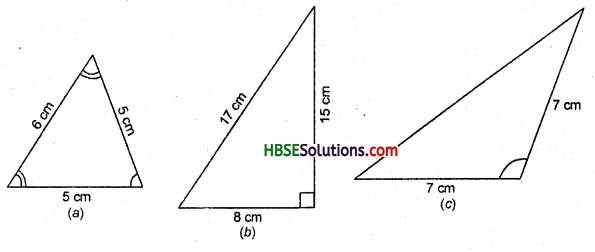
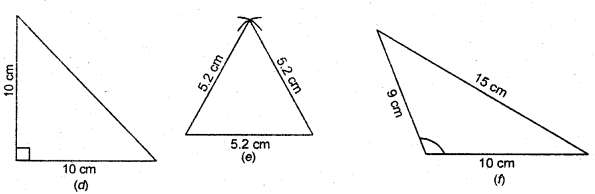
Name each of the following triangles in two different ways : (You may judge the nature of the angle by observation).
HBSE 6th Class Maths Solutions Chapter 5 Understanding Elementary Shapes Ex 5.6 1
HBSE 6th Class Maths Solutions Chapter 5 Understanding Elementary Shapes Ex 5.6 2
Solution:
(a) Isosceles, Acute-angled.
(b) Scalene, Right-angled.
(c) Isosceles, Obtuse-angled.
(d) Isosceles, Right-angled.
(e) Equilateral, Acute-angled.
(f) Scalene, Obtuse-angled.

HBSE 6th Class Maths Solutions Chapter 5 Understanding Elementary Shapes Ex 5.6

Question 4.
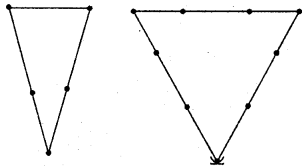
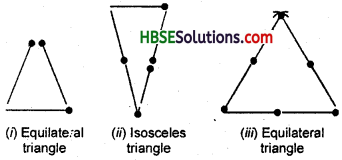
Try to construct triangles using matchsticks. Some are shown here. Can you make a triangle with
HBSE 6th Class Maths Solutions Chapter 5 Understanding Elementary Shapes Ex 5.6 3
(a) 3 matchsticks ?
(b) 4 matchsticks ?
(c) 5 matchsticks ?
(d) 6 matchsticks ?
(Remember, you have to use all the available matchsticks in each case)
Name the type of triangle in each case.
Solution:
(a) Yes, we can make an equilateral triangle with 3 matchsticks. [Fig. (i)]
(b) No, we cannot make a triangle with 4 matchsticks.
(c) Yes, we can make an isosceles triangle with 5 matchsticks. [Fig. (ii)]
(d) Yes, we can make an equilateral triangle with 6 matchsticks. [Fig. (iii)]
HBSE 6th Class Maths Solutions Chapter 5 Understanding Elementary Shapes Ex 5.6 4

HBSE 6th Class Maths Solutions Chapter 5 Understanding Elementary Shapes Ex 5.6 Read More »

HBSE 6th Class Maths Solutions Chapter 5 Understanding Elementary Shapes Ex 5.7

Haryana State Board HBSE 6th Class Maths Solutions Chapter 5 Understanding Elementary Shapes Ex 5.7 Textbook Exercise Questions and Answers.

Haryana Board 6th Class Maths Solutions Chapter 5 Understanding Elementary Shapes Exercise 5.7

Question 1.
Say True or False :
(a) Eachangleofarectangleisarightangle.
(b) The opposite sides of a rectangle are equal in length.
(c) The diagonals of a square are perpendicular to one another.
(d) All the sides of a rhombus are of equal length.
(e) All the sides of a parallelogram are of equal length.
(f) The opposite sides of a trapezium are parallel.
Solution:
(a) True,
(b) True,
(c) True,
(d) True,
(e) False,
(f) False.

HBSE 6th Class Maths Solutions Chapter 5 Understanding Elementary Shapes Ex 5.7

Question 2.
Give reasons for the following :
(а) A square can be thought of as a special rectangle.
(b) A rectangle can be thought of as a special parallelogram.
(c) A square can be thought of as a special rhombus.
(d) Squares, rectangles, parallelograms are all quadrilaterals.
(e) Square is also a parallelogram.
Solution:
(a) All the properties of a rectangle are there in a square.
(b) All the properties of a || gm are there in a rectangle.
(c) All the properties of a rhombus are there in a square.
(d) All are four-sided closed plane figures.
(e) All the properties of a || gm are there in a square.

HBSE 6th Class Maths Solutions Chapter 5 Understanding Elementary Shapes Ex 5.7

Question 3.
A figure is said to be regular if its sides are equal in length and angles are equal in measure. Can you identify the regular quadrilateral ?
Solution:
A square is a regular quadrilateral.

HBSE 6th Class Maths Solutions Chapter 5 Understanding Elementary Shapes Ex 5.7 Read More »

HBSE 6th Class Maths Solutions Chapter 5 Understanding Elementary Shapes Ex 5.8

Haryana State Board HBSE 6th Class Maths Solutions Chapter 5 Understanding Elementary Shapes Ex 5.8 Textbook Exercise Questions and Answers.

Haryana Board 6th Class Maths Solutions Chapter 5 Understanding Elementary Shapes Exercise 5.8

Question 1.
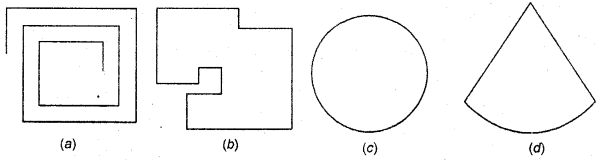
Examine whether the following are polygons. If any one among them is not, say why.
HBSE 6th Class Maths Solutions Chapter 5 Understanding Elementary Shapes Ex 5.8 1
Solution:
(a) Not a polygon, since it is not closed.
(a) Yes, it is a polygon.
(b) Not a polygon, since it is not closed by line segments.
(c) Not a polygon, since it is not closed by line segments.

HBSE 6th Class Maths Solutions Chapter 5 Understanding Elementary Shapes Ex 5.8

Question 2.
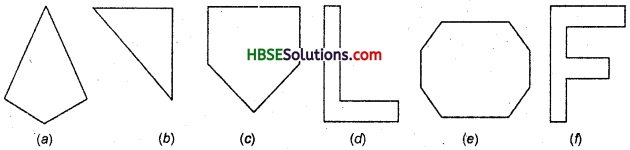
Name each polygon:
HBSE 6th Class Maths Solutions Chapter 5 Understanding Elementary Shapes Ex 5.8 2
Solution:
(a) Quadrilateral,
(b) Triangle,
(c) Pentagon,
(d) Hexagon,
(e) Octagon,
(f) Decagon.

Question 3.
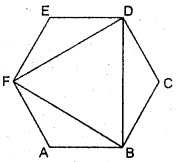
Draw a rough sketch of a regular hexagon. Connecting any three of its vertices, draw a triangle.
Identify the type of the triangle you have drawn.
HBSE 6th Class Maths Solutions Chapter 5 Understanding Elementary Shapes Ex 5.8 3
Solution:
Equilateral triangle BDF.

Question 4.
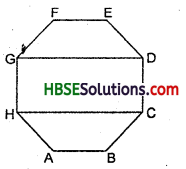
Draw a rough sketch of a regular octagon. (Use squared paper if you wish). Draw a rectangle by joining exactly four of the vertices of the octagon.
Solution:
Quadrilateral CDGH is the required rectangle.
HBSE 6th Class Maths Solutions Chapter 5 Understanding Elementary Shapes Ex 5.8 4

HBSE 6th Class Maths Solutions Chapter 5 Understanding Elementary Shapes Ex 5.8

Question 5.
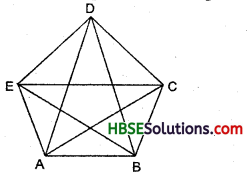
A diagonal is a line segment that joins any two vertices of the polygon and is not a side of the polygon. Draw a rough sketch of a pentagon and draw its diagonals.
Solution:
\(\overline{\mathrm{AC}}, \overline{\mathrm{AD}}, \overline{\mathrm{BD}}, \overline{\mathrm{BE}}\) and \(\overline{\mathrm{CE}}\) are the required five diagonals of pentagon ABCDE.
HBSE 6th Class Maths Solutions Chapter 5 Understanding Elementary Shapes Ex 5.8 5

HBSE 6th Class Maths Solutions Chapter 5 Understanding Elementary Shapes Ex 5.8 Read More »

HBSE 6th Class Maths Solutions Chapter 5 Understanding Elementary Shapes Ex 5.9

Haryana State Board HBSE 6th Class Maths Solutions Chapter 5 Understanding Elementary Shapes Ex 5.9 Textbook Exercise Questions and Answers.

Haryana Board 6th Class Maths Solutions Chapter 5 Understanding Elementary Shapes Exercise 5.9

Question 1.
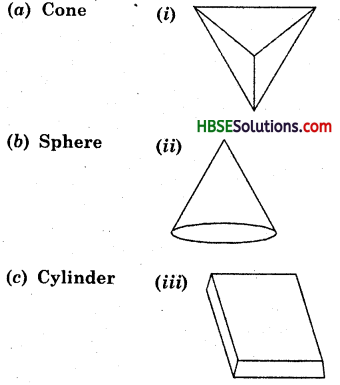
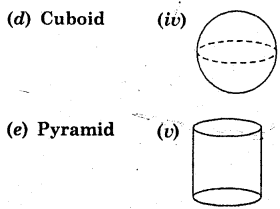
Match the following :
HBSE 6th Class Maths Solutions Chapter 5 Understanding Elementary Shapes Ex 5.9 1
HBSE 6th Class Maths Solutions Chapter 5 Understanding Elementary Shapes Ex 5.9 2
Solution:
(a) (ii),
(b) (iv),
(c) (v),
(d) (iii),
(e) (i).

HBSE 6th Class Maths Solutions Chapter 5 Understanding Elementary Shapes Ex 5.9

Question 2.
What shape is :
(a) Your instruments box ?
(b) A brick ?
(c) A matchbox ?
(d) A road-roller ?
(e) A sweet laddu ?
Solution:
(a) Cuboid,
(b) Cuboid,
(c) Cuboid,
(d) Cylinder,
(e) Sphere.

HBSE 6th Class Maths Solutions Chapter 5 Understanding Elementary Shapes Ex 5.9 Read More »

HBSE 6th Class Maths Solutions Chapter 5 Understanding Elementary Shapes Ex 5.3

Haryana State Board HBSE 6th Class Maths Solutions Chapter 5 Understanding Elementary Shapes Ex 5.3 Textbook Exercise Questions and Answers.

Haryana Board 6th Class Maths Solutions Chapter 5 Understanding Elementary Shapes Exercise 5.3

Question 1.
Match the following :
(i) Straight angle
(ii) Right angle
(iii) Acute angle
(iv) Obtuse angle
(v) Reflex angle
Solution:
(i) (c),
(ii) -(d),
(iii)- (a)
(iv) – (e),
(v) – (b)

HBSE 6th Class Maths Solutions Chapter 5 Understanding Elementary Shapes Ex 5.3

Question 2.
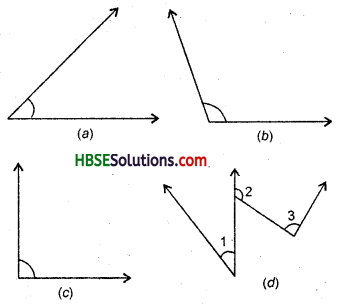
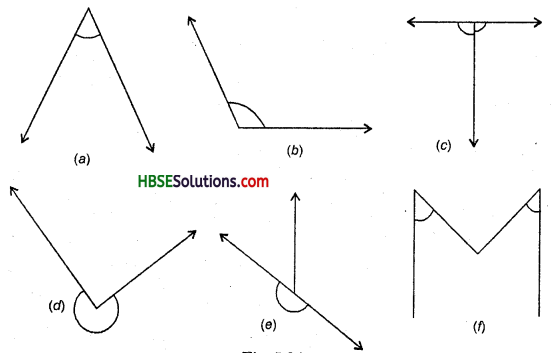
Classify each one of the following angles as right, straight, acute, obtuse or reflex.
HBSE 6th Class Maths Solutions Chapter 5 Understanding Elementary Shapes Ex 5.3 1
Solution:
(a) Acute angle
(b) Obtuse angle
(c) Right angles
(d) Reflex angle
(e) Straight angle
(f) Acute angles.

HBSE 6th Class Maths Solutions Chapter 5 Understanding Elementary Shapes Ex 5.3 Read More »

HBSE 6th Class Maths Solutions Chapter 5 Understanding Elementary Shapes Ex 5.2

Haryana State Board HBSE 6th Class Maths Solutions Chapter 5 Understanding Elementary Shapes Ex 5.2 Textbook Exercise Questions and Answers.

Haryana Board 6th Class Maths Solutions Chapter 5 Understanding Elementary Shapes Exercise 5.2

Question 1.
What fraction of a revolution clockwise does the hour hand of a clock turn through, when it goes from
(a) 3 to 9
(b) 4 to 7
(c) 7 to 10
(d) 12 to 9
(e) 1 to 10
(f) 6 to 3.
Solution:
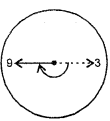
(a) 3 to 9 :
\(\frac{1}{2}\) of a revolution.
HBSE 6th Class Maths Solutions Chapter 5 Understanding Elementary Shapes Ex 5.2 1

HBSE 6th Class Maths Solutions Chapter 5 Understanding Elementary Shapes Ex 5.2

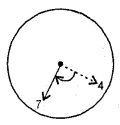
(b) 4 to 7 :
\(\frac{1}{4}\) of a revolution.
HBSE 6th Class Maths Solutions Chapter 5 Understanding Elementary Shapes Ex 5.2 2

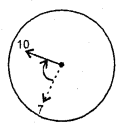
(c) 7 to 10 :
\(\frac{1}{4}\) of a revolution.
HBSE 6th Class Maths Solutions Chapter 5 Understanding Elementary Shapes Ex 5.2 3

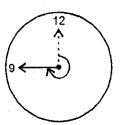
(d) 12 to 9 :
\(\frac{3}{4}\) of a revolution.
HBSE 6th Class Maths Solutions Chapter 5 Understanding Elementary Shapes Ex 5.2 4

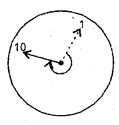
(e) 1 to 10 :
\(\frac{3}{4}\) of a revolution.
HBSE 6th Class Maths Solutions Chapter 5 Understanding Elementary Shapes Ex 5.2 5

(f) 6 to 3 :
\(\frac{3}{4}\) of a revolution.
HBSE 6th Class Maths Solutions Chapter 5 Understanding Elementary Shapes Ex 5.2 6

Question 2.
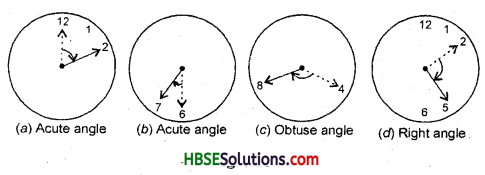
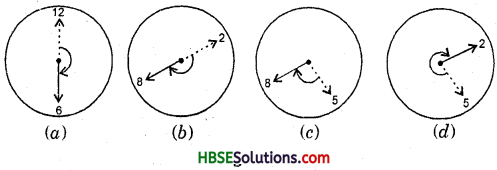
Where will the hand of a clock stop if it
(a) Starts at 12 and makes 1/2 of revolution, clockwise ?
(b) Starts at 2 and makes 1/2 of a revolution, clockwise ?
(c) Starts at 5 and makes 1/4 of a revolution, clockwise ?
(id) Starts at 5 and makes 3/4 of a revolution, clockwise ?
Sol. (a) The hand of the clock will stop at 6 in this case. [See Fig. (a)]
(b) The hand of the clock will stop at 8 in this case. [See Fig. (b)]
(c) The hand of the clock will stop at 8 in this case. [See Fig. (c)]
(d) The hand of the clock will stop at 2 in this case. [See Fig. (d)]

HBSE 6th Class Maths Solutions Chapter 5 Understanding Elementary Shapes Ex 5.2 7

HBSE 6th Class Maths Solutions Chapter 5 Understanding Elementary Shapes Ex 5.2

Question 3.
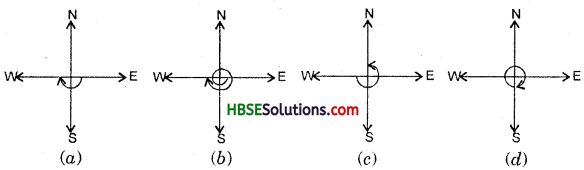
Which direction will you face if you start facing
(a) east and make \(\frac{1}{2}\) of a revolution clockwise ?
(b) east and make 1\(\frac{1}{2}\) revolution clockwise ?
(c) west and make \(\frac{3}{4}\) revolution anti-clockwise ?
(d) south and make one full revolution?
(Should we specify clockwise or anti-clockwise for this last question ? Why not ?)
Solution:
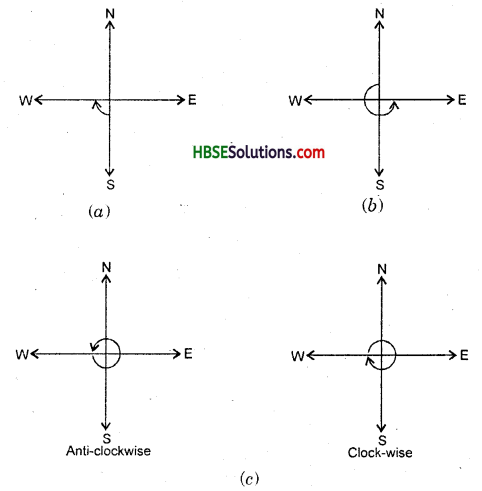
(a) In this case, you will face west direction. [See Fig. (a)]
(b) In this case,, also you will face west direction. [See Fig. (h)]
(c) In this case, you will face north direction. [See Fig. (c)]
(d) In this case, you will face south direction. [See Fig. (d)]
HBSE 6th Class Maths Solutions Chapter 5 Understanding Elementary Shapes Ex 5.2 8
(Not necessary, since it is always a complete angle.)

Question 4.
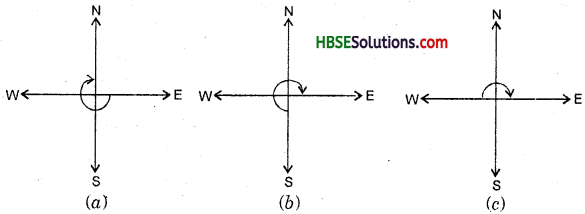
What part of revolution have you turned through if you stand facing :
(a) east and turn clockwise to face north?
(b) south and turn clockwise to face east?
(c) west and turn clockwise to face east?
Solution:
(a) In this case, you have turned 3/4 of a revolution. [See Fig. (a)]
(b) In this case, you have turned 3/4 of a revolution. [See Fig. (b)]
(c) In this case, you have turned 1/2 of a revolution. [See Fig. (c)]
HBSE 6th Class Maths Solutions Chapter 5 Understanding Elementary Shapes Ex 5.2 9

Question 5.
Find the number of right angles through by the hour-hand of a clock when it goes from:
(a) 3 to 6
(b) 2 to 8
(c) 5 to 11
(d) 10 to 1
(e) 12 to 9
(f) 12 to 6.
Solution:
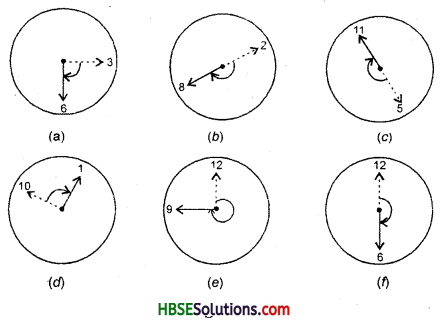
(a) 3 to 6 : In this case, the hour hand turns through 1 right angle. [See Fig.(a)]
(b) 2 to 8 : In this case, the hour hand turns 2 right angles. [See Fig. (h)]
(c) 5 to 11 : In this case the hour hand turns through 2 right angles. [See Fig.(c)]
(d) 10 to 1 : In this case the hour hand turns through 1 right angle.[See Fig.(d)]
(e) 12 to 9 : In this case the hour hand turns through 3 right angles.[See Fig.(e)]
(f) 12 to 6 : In this case the hour hand turns through 2 right angles.[See Fig. (f)]

HBSE 6th Class Maths Solutions Chapter 5 Understanding Elementary Shapes Ex 5.2 10

HBSE 6th Class Maths Solutions Chapter 5 Understanding Elementary Shapes Ex 5.2

Question 6.
How many right angles do you make if you start facing :
(a) south and turn clockwise to west.
(b) north and turn anti-clockwise to east.
(c) west and turn to west.
(d) south and turn to north.
Solution:
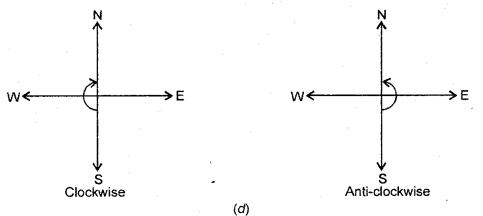
(a) 1 right angle in this case. [See Fig. (a)]
(b) 3 right angles in this case. [See Fig. (b)]
(c)
HBSE 6th Class Maths Solutions Chapter 5 Understanding Elementary Shapes Ex 5.2 11
4 right angles in both cases, clockwise as well as anti-clockwise direction. [See Fig. 5.20(c)]

(d)
HBSE 6th Class Maths Solutions Chapter 5 Understanding Elementary Shapes Ex 5.2 12
2 right angles in both the cases, clockwise as well as anti-clockwise. [See Fig.(d)]

HBSE 6th Class Maths Solutions Chapter 5 Understanding Elementary Shapes Ex 5.2

Question 7.
Where will the hour hand of a clock stop if it starts
(а) from 6 and, turns through 1 right angle.
(b) from 8 and turns through 2 right angles.
(c) from 10 and turns through 3 right angles.
(d) from 7 and turns through 2 straight angles.
Solution:
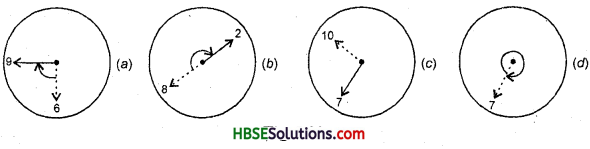
(a) In this case, the hour-hand will stop at 9. [See Fig. (a)]
(b) In this case, the hour hand will stop at 2. [See Fig. (5)]
(c) In this case, the hour hand will stop at 7. [See Fig. (c)]
(d) In this case, the hour hand will stop at 7. [See Fig. (d)]
HBSE 6th Class Maths Solutions Chapter 5 Understanding Elementary Shapes Ex 5.2 13

HBSE 6th Class Maths Solutions Chapter 5 Understanding Elementary Shapes Ex 5.2 Read More »

HBSE 6th Class Maths Solutions Chapter 5 Understanding Elementary Shapes Ex 5.1

Haryana State Board HBSE 6th Class Maths Solutions Chapter 5 Understanding Elementary Shapes Ex 5.1 Textbook Exercise Questions and Answers.

Haryana Board 6th Class Maths Solutions Chapter 5 Understanding Elementary Shapes Exercise 5.1

Question 1.
What is the disadvantage in comparing line segments by mere observation ?
Solution:
In comparing line segments by mere observation, we cannot always be sure about the usual judgement. For example, look at A the following segments :
The difference in lengths between these two may not be obvious. Actually in this figure \(\overline{\mathrm{AB}}\) and \(\overline{\mathrm{PQ}}\) have the same lengths. This is not quite obvious.
HBSE 6th Class Maths Solutions Chapter 5 Understanding Elementary Shapes Ex 5.1 1

Question 2.
Why is it better to use a divider with a ruler, while measuring the length of a linesegment ? ‘
Solution:
It is better to use a divider and a ruler, while measuring the length of a line segment, because by this method we can find the exact length of a line segment.

HBSE 6th Class Maths Solutions Chapter 5 Understanding Elementary Shapes Ex 5.1

Question 3.
Draw a line segment, say \(\overline{\mathrm{AB}}\). Take any point C lying in between A and B. Measure the lengths of AB, BC and AC. Is AC = AB + BC ? [Note: If A, B, C are any three points on a line such that AC + CB = AB, then we can be sure that C lies between A and B.]
Solution:
On measuring, we find that
AB = 5 cm
BC = 2 cm
and AC = 3 cm
AB + BC = 5 cm + 2 cm = 7 cm
∴ AC ≠ AB + BC
HBSE 6th Class Maths Solutions Chapter 5 Understanding Elementary Shapes Ex 5.1 2
But AC + CB = 3 cm + 2 cm
= 5 cm = AB.
Thus, AC + CB = AB.

Question 4.
If A, B, C are three points on a line such that AB = 5 cm, BC = 3 cm and AC = 8 cm, which one of them lies between the other two ?
Solution:
AB = 5 cm
BC = 3cm
and AC = 8 cm
HBSE 6th Class Maths Solutions Chapter 5 Understanding Elementary Shapes Ex 5.1 3
AB + BC = 5 cm + 3 cm
= 8 cm = AC
AB + BC = AC
∴ B lies between A and C.

HBSE 6th Class Maths Solutions Chapter 5 Understanding Elementary Shapes Ex 5.1

Question 5.
Verify whether D is the mid-point of AG.
Solution:
AD = 4 – 1 = 3 units
DG = 7 – 4 = 3 units
∵ AD = DG
HBSE 6th Class Maths Solutions Chapter 5 Understanding Elementary Shapes Ex 5.1 4
⇒ D is the mid-point of AG.

Question 6.
If B is the mid-point of \(\overline{\mathrm{AC}}\) and C is the mid-point of \(\overline{\mathrm{BD}}\) , where A, B, C, D lie on a straight line, say why AB = CD ?
Solution:
B is the mid-point of \(\overline{\mathrm{AC}}\)
⇒ AB = BC ………… (i)
and C is the mid-point of \(\overline{\mathrm{BD}}\)
⇒ BC = CD …(ii)
HBSE 6th Class Maths Solutions Chapter 5 Understanding Elementary Shapes Ex 5.1 5
Comparing (i) and (ii), we get AB = CD.

Question 7.
Draw five triangles and measure their sides. Check in each case if the sum of two sides is ever less than the third side.
Solution:
(i) AB = BC = AC = 3 cm
HBSE 6th Class Maths Solutions Chapter 5 Understanding Elementary Shapes Ex 5.1 6

AB + BC = 3 cm + 3 cm = 6 cm
∴ AB + BC > AC
BC + AC = 3 cm + 3 cm = 6 cm
∴ BC + AC > AB
AC + AB = 3 cm + 3 cm = 6 cm
∴ AC + AB > BC.

HBSE 6th Class Maths Solutions Chapter 5 Understanding Elementary Shapes Ex 5.1

(ii) AB = AC = 3.5 cm
and BC = 3 cm
HBSE 6th Class Maths Solutions Chapter 5 Understanding Elementary Shapes Ex 5.1 7
AB + BC = 3.5 cm + 3 cm
= 6.5 cm
∴ AB + BC > AC
BC + AC = 3 cm + 3.5 cm
= 6.5 cm
∴ BC + AC > AB
AC + AB = 3.5 cm + 3.5 cm
= 7 cm .
∴ AC + AB > BC.

(iii) Scalene Triangle :
AB = 2.5 cm, BC = 4 cm
AC = 3.5 cm

AB + BC = 2.5 cm + 4 cm = 6.5 cm
∴ AB + BC > AC
BC + AC = 4 cm + 3.5 cm = 7.5 cm
∴ BC + AC > AB
AC + AB = 3.5 cm + 2.5 cm = 6 cm
∴ AC + AB > BC.
HBSE 6th Class Maths Solutions Chapter 5 Understanding Elementary Shapes Ex 5.1 8

(iv) AB = 4 cm, BC = 3 cm, AC = 5 cm
AB + BC = 4 cm + 3 cm = 7 cm
AB + BC > AC
BC + AC = 3 cm + 5 cm = 8 cm
BC + AC > AB
AC + AB = 5 cm + 4 cm = 9 cm
AC + AB > BC.
HBSE 6th Class Maths Solutions Chapter 5 Understanding Elementary Shapes Ex 5.1 9

HBSE 6th Class Maths Solutions Chapter 5 Understanding Elementary Shapes Ex 5.1

(v) AB = 2.5 cm
BC = 3 cm
AC = 5 cm
AB + BC = 2.5 cm + 3 cm = 5.5 cm AB + BC > AC
BC + AC = 3 cm + 5 cm = 8 cm BC + AC > AB
AC + AB = 5 cm + 2.5 cm = 7.5 cm
HBSE 6th Class Maths Solutions Chapter 5 Understanding Elementary Shapes Ex 5.1 10
AC + AB > BC.

HBSE 6th Class Maths Solutions Chapter 5 Understanding Elementary Shapes Ex 5.1 Read More »
HBSE 6th Class Maths Solutions Chapter 3 Playing With Numbers InText Questions

Haryana State Board HBSE 6th Class Maths Solutions Chapter 3 Playing With Numbers InText Questions and Answers.

Haryana Board 6th Class Maths Solutions Chapter 3 Playing With Numbers InText Questions

Try These (Page 58)

Question 1.
Find the possible factors of 45, 30, 36
(i) 45 = 1 × 45
= 3 × 15
= 5 × 9
= 9 × 5
= 15 × 3
= 45 × 1
∴ 1, 3, 5, 9, 15, 45 are all factors of 45.

(ii) 30 = 1 × 30
= 2 × 15
= 3 × 10
= 5 × 6
= 6 × 5
= 10 × 3
= 15 × 2
= 30 × 1
∴ 1, 2, 3, 5, 6, 10, 15, 30 are all factors of 30.

HBSE 6th Class Maths Solutions Chapter 3 Playing With Numbers InText Questions

(iii) 36 = 1 × 36
= 2 × 18
= 3 × 12
= 4 × 9
= 6 × 6
∴ 1, 2, 3, 4, 6, 9, 12, 18, 36 are all factors of 36.

Try These (Page 71)

Question 1.
(i) Find the common factors of: (a) 8, 20, (6) 9, 15
Solution:
(a) Factors of 8 :
8 = 1 × 8
= 2 × 4
∴ Factors of 8 are : 1, 2, 4, 8.

Factors of 20 :
20 = 1 × 20
= 2 x 10
= 4 x 5
∴ Factors of 20 are : 1, 2, 4, 5, 10, 20.
Hence, common factors of 8 and 20 are : 1, 2, 4.

(b) Factors of 9 :
9 = 1 × 9
= 3 × 3
∴ Factors of 9 are : 1, 3, 9.

HBSE 6th Class Maths Solutions Chapter 3 Playing With Numbers InText Questions

Factors of 15 :
15 = 1 × 15
= 3 × 5
∴ Factor’s of 15 are : 1, 3, 5, 15.
Hence, common factors of 9 and 15 are : 1, 3.

Try These 

Question 1.
Are (i) 7 and 15, (ii) 12 and 49, (iii) 18 and 23 co-prime numbers ?
Solution:
(i) Factors of 7 = 1 × 7
Factors of 7 are : 1, 7.
Factors of 15 = 1 × 15
Factors of 15 are : 1, 3, 5, 15.
= 3 × 5
∴ Common factor of 7 and 15 is 1 only.
Hence, 7 and 15 are co-prime numbers.

(ii) Factors of 12 :
12 = 1x 12
= 2 × 6
= 3 × 4
∴ Factors of 12 are : 1, 2, 3, 4, 6, 12.

Factors of 49 :
49 = 1 x 49
= 7 × 7
∴ Factors of 49 are : 1, 7, 49.
∴ Common factor of 12 and 49 is 1 only.
Hence, 12 and 49 are co-prime numbers.

(iii) Factors of 18 :
18 = 1x 18
= 2 × 9
= 3 × 6
Factors of 18 are : 1, 2, 3, 6, 9, 18.
Factors of 23 = 1 × 23 .
Factors of 23 are : 1, 23.
∴ Common factor of 18 and 23 is only 1.
Hence, 18 and 23 are co-prime numbers.

Try These

Question 1.
Find the common factors of: (a) . 8, 12, 20, (b) 9, 15, 21.
Solution:
(a) 8 = 1 × 8
= 2 x 4

12 = 1 × 12
= 2 × 6
= 3 × 4

20 = 1 × 20
= 2 × 10
= 4 × 5
Factors of 8 are : 1, 2, 4, 8.
Factors of 12 are : 1, 2, 3, 4, 6, 12.
Factors of 20 are : 1, 2, 4, 5, 10, 20.
∴ Common factors of 8, 12, 20 are : 1, 2, 4.

(b) 9 = 1 × 9
= 3 × 3

15 = 1 × 15
= 3 × 5

21 = 1 × 21
= 3 × 7

Factors of 9 are : 1, 3, 9.
Factors of 15 are : 1, 3, 5, 15.
Factors of 21 are : 1, 3, 7, 21.
∴ Common factors of 9, 15, 21 are : 1, 3.

HBSE 6th Class Maths Solutions Chapter 3 Playing With Numbers InText Questions

Question 5.
Find the common multiples of:
(a) 4 and 6,
(b) 3, 5 and 6.
Solution:
(a) Multiples of 4 are 4, 8, 12, 16, 20, 24, …………….
Multiples of 6 are 6,12,18,24, 30, 36……….
We observe that 12, 24, 36, are multiples of both 4 and 6.
They are called the common multiples of 4 and 6.

(b) Multiples of 3 are : 3, 6, 9, 12, 15; 18, 21, 24, 27, 30,…………….
Multiples of 5 are : 5, 10, 15, 20, 25, 30, 35, 40, …………….
Multiples of 6 are : 6, 12, 18, 24, 30, 36, 42, 48,…………….
∴ Common multiples of 3, 5 and 6 are 30, 60, 90,…………….

Try These (Page 75)

Question 1.
Write the prime factorisations of (i) 16, (ii) 28, (iii) 38.
Solution:
(i) 16 = 2 × 8
= 2 × 2 × 4
= 2 × 2 × 2 × 2
HBSE 6th Class Maths Solutions Chapter 3 Playing With Numbers InText Questions 1

16 = 4 × 4
= 2 × 2 × 4
= 2 × 2 × 2 × 2
In all the above factorisations of 16, we ultimately arrive at only one factorisation 2 × 2 × 2 × 2. In this factorisation the only factor 2 is a prime number. Such a factorisation of a number is called a prime factorisation.
Prime Factorisation Property or The Fundamental Theorem of Arithmetic : “Every number greater than 1 has exactly one prime factorisation.”

(ii) 28 = 2 × 14
= 2 × 2 × 7
HBSE 6th Class Maths Solutions Chapter 3 Playing With Numbers InText Questions 2
In this factorisation the only factors 2 and 7 are prime numbers.
The prime factorisation of 28 is 2 × 2 × 7.

(iii) 38 = 2 × 19
HBSE 6th Class Maths Solutions Chapter 3 Playing With Numbers InText Questions 3
Here 2 and 19 are both prime numbers
Prime factorisation of 38 is 2 × 19.

HBSE 6th Class Maths Solutions Chapter 3 Playing With Numbers InText Questions

Try These (Page 76)

Question 1.
Write the prime factorisations of (a) 8, (b) 12.
Solution:
(a) HBSE 6th Class Maths Solutions Chapter 3 Playing With Numbers InText Questions 4

∴ Prime factorisation of 8 is 2 × 2 × 2.

(b)
HBSE 6th Class Maths Solutions Chapter 3 Playing With Numbers InText Questions 5
∴ Prime factorisation of 12 is 2 × 2 × 3.

(c)
HBSE 6th Class Maths Solutions Chapter 3 Playing With Numbers InText Questions 6
∴ Prime factorisation of 12 is 3 × 2 × 2.

Try These (Page 78)

Question 1.
Find the H.C.F. of
(i) 24 and 36
(ii) 15, 25 and 30
(iii) 8 and, 12
(iv) 12, 16 and 28.
Solution:
(i) 24 = 1 × 24
= 2 × 12 .
= 3 × 8
= 4 × 6

36 = 1 × 36
= 2 × 18
= 3 × 12
= 4 × 9
= 6 × 6
Factors of 24 are 1, 2, 3, 4, 6, 8, 12, 24 Factors of 36 are 1, 2, 3, 4, 6, 9, 12, 18, 36
Common factors of 24 and 36 are 1, 2, 3, 4, 6, 12.
Hence, H.C.F. of 24 and 36 is 12.

Another Method :
HBSE 6th Class Maths Solutions Chapter 3 Playing With Numbers InText Questions 7
Hence, H.C.F. of 24 and 36 is 12.

HBSE 6th Class Maths Solutions Chapter 3 Playing With Numbers InText Questions

(ii) 15 = 1 × 15
= 3 × 5

25 = 1 × 25
= 5 × 5

30 = 1 × 30
= 2 × 15
= 3 × 10
= 5 × 6

∴ Factors of 15 are 1, 3, 5, 15
Factors of 25 are 1, 5, 25
Factors of 30 are 1, 2, 3, 5, 6, 10, 15, 30
Common factors of 15, 25 and 30 are 1, 5
Hence H.C.F. of 15, 25 and 30 is 5.

Another Method :
HBSE 6th Class Maths Solutions Chapter 3 Playing With Numbers InText Questions 8
Hence H.C.F. of 15, 25 and 30 is 5.

(iii) 8 = 1 × 8
= 2 × 4

12 = 1 × 12
= 2 × 6
= 3 × 4
∴ Factors of 8 are 1, 2, 4, 8
Factors of 12 are 1, 2, 3, 4, 6, 12
Common factors of 8 and 12 are 1, 2, 4
Hence, H.C.F. of 8 and 12 is 4.

Another Method :
HBSE 6th Class Maths Solutions Chapter 3 Playing With Numbers InText Questions 9
Hence, H.C.F. of 8 and 12 is 4.

(iv) 12 = 1 × 12
= 2 × 6
= 3 × 4

16 = 1 × 16
= 2 × 8
= 4 × 4

28 = 1 × 28
= 2 × 14
= 4 × 7

∴ Factors of 12 are 1, 2, 3, 4, 6, 12
Factors of 16 are 1, 2, 4, 8, 16
Factors of 28 are 1, 2, 4, 7, 14, 28
Common factors of 12, 16 and 28 are 1, 2, 4 .
Hence, H.C.F. of 12, 16 and 28 is 4.

Another Method :
HBSE 6th Class Maths Solutions Chapter 3 Playing With Numbers InText Questions 10
Hence, H.C.F. of 12, 16 and 28 is 4.

Try These (Page 58)

Question 1.
What will be the LCM of: (i) 8 and 12 ? (ii) 4 and 9 ? (iii) 6 and 9 ?
Solution:
(i) Multiples of 8 are : 8, 16, 24, 32, 40, 48, …………..
Multiples of 12 are : 12, 24, 36, 48, 60, 72, ………………
Common multiples of 8 and 12 are : 24, 48, ………………
L.C.M. of 8 and 12 is 24.

Another Method:
HBSE 6th Class Maths Solutions Chapter 3 Playing With Numbers InText Questions 11

(ii) Multiples of 4 are : 4, 8, 12, 16, 20,24, 28, 32, 36, ………………….
Multiples of 9 are : 9, 18, 27, 36, 45, 54, 63, 72, ………………….
Common multiples of 4 and 9 are : 36, 72, ………………….
∴ L.C.M. of 4 and 9 is 36.

HBSE 6th Class Maths Solutions Chapter 3 Playing With Numbers InText Questions

Another method :
HBSE 6th Class Maths Solutions Chapter 3 Playing With Numbers InText Questions 12
∴ L.C.M. of 4 and 9 = 2 × 2 × 3 × 3 = 36.

(iii) Multiples of 6 are : 6, 12, 18, 24, 30, 36 , ………………..
Multiples of 9 are : 9, 18, 27, 36, 45, 54, ………………..
Common multiples of 6 and 9 are : 18, 36, ………………..

L.C.M. of 8 and 12 = 2 × 2 × 2 × 3 = 24.

(iii) Multiples of 4 are : 4, 8, 12, 16, 20, 24, 28, 32, 36,
Multiples of 9 are : 9, 18, 27, 36, 45, 54, 63, 72f
Common multiples of 4 and 9 are : 36, 72,

∴ L.C.M. of 6 and 9 = 18.

Another method :
HBSE 6th Class Maths Solutions Chapter 3 Playing With Numbers InText Questions 13
∴ L.C.M. of 6 and 9 = = 2 × 3 × 3 = 18.

HBSE 6th Class Maths Solutions Chapter 3 Playing With Numbers InText Questions Read More »
HBSE 6th Class Maths Solutions Chapter 4 Basic Geometrical Ideas InText Questions

Haryana State Board HBSE 6th Class Maths Solutions Chapter 4 Basic Geometrical Ideas InText Questions and Answers.

Haryana Board 6th Class Maths Solutions Chapter 4 Basic Geometrical Ideas InText Questions

Try These (Page 86)

Question 1.
With a sharp tip of the pencil mark four points on a paper and name them by the letters A, C, P, H. Try to name these points in different ways. One such way could be this.
HBSE 6th Class Maths Solutions Chapter 4 Basic Geometrical Ideas InText Questions 1
Solution:
Other different ways could be :
HBSE 6th Class Maths Solutions Chapter 4 Basic Geometrical Ideas InText Questions 2

HBSE 6th Class Maths Solutions Chapter 4 Basic Geometrical Ideas InText Questions

Try These (Page 87)

Question 1.
Name the line segments in Fig. 4.2. Is A the end point of each line segment ?
Solution:
In Fig., there are two line segments namely \(\overline{\mathrm{AB}}\) and \(\overline{\mathrm{AC}}\). Yes, A is the end point of each line segment.
HBSE 6th Class Maths Solutions Chapter 4 Basic Geometrical Ideas InText Questions 3

Try These (Page 91)

Question 1.
(i) Name the rays given in this picture.
(ii) Is T a starting point of each of these rays ?
HBSE 6th Class Maths Solutions Chapter 4 Basic Geometrical Ideas InText Questions 4
Solution:
(i) In the given Fig. there are three rays, \(\overrightarrow{\mathrm{TA}}, \overrightarrow{\mathrm{TB}}\), and \(\overrightarrow{\mathrm{NB}}\).
(ii) No, T is not the starting point of each of these rays. T is the starting point of two rays \(\overrightarrow{\mathrm{TA}}\) and \(\overrightarrow{\mathrm{TB}}\).

HBSE 6th Class Maths Solutions Chapter 4 Basic Geometrical Ideas InText Questions Read More »