Author name: Prasanna

HBSE 6th Class Maths Solutions Chapter 14 Practical Geometry Intext Questions

Haryana State Board HBSE 6th Class Maths Solutions Chapter 14 Practical Geometry Ex 14.5 Textbook Exercise Questions and Answers.

Haryana Board 6th Class Maths Solutions Chapter 14 Practical Geometry Exercise

14.5

TRY THESE :

Question 1.
In step 2 above, what would happen if we take the length of radius to
be smaller than half the length of \(\overline{\mathrm{AB}}\) ?
Solution:
If we take the radius to be smaller than half of the length of \(\overline{\mathrm{AB}}\), the arcs will not intersect each other at two points C and D.

HBSE 6th Class Maths Solutions Chapter 14 Practical Geometry Intext Questions

TRY THIS (Page 380) :

Question 1.
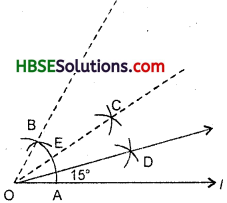
How will you construct a 15° angle ?
Solution:
Construct of angle an 30° as shown earlier.
Now bisect this angle. We get ∠AOD = 15° [Fig.],
HBSE 6th Class Maths Solutions Chapter 14 Practical Geometry Intext Questions 1

TRY THESE (Page 381) :

Question 1.
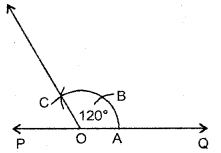
How will you. construct a 150° angle ?
Solution:
Construct an angle of 120° as shown earlier.
Now ∠POQ = Straight angle – 180°
∠QOC = 120°
∠POC = 180° – 120° = 60°
HBSE 6th Class Maths Solutions Chapter 14 Practical Geometry Intext Questions 2
Bisect ∠POC to get ∠COD = 30°
Thus, ∠QOD = ∠QOC + ∠COD = 120° + 30° = 150° which is the required angle.

HBSE 6th Class Maths Solutions Chapter 14 Practical Geometry Intext Questions

TRY THESE
Question.
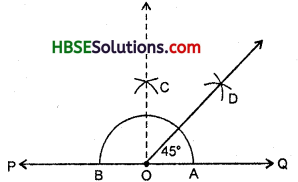
How will you construct a 45° angle ?
Solution:
Construct ∠QOC = 90° as shown earlier. Raw \(\overrightarrow{\mathrm{OD}}\) as the bisector of ∠QOC.
Thus, ∠QOD = 45° is the required angle.
HBSE 6th Class Maths Solutions Chapter 14 Practical Geometry Intext Questions 3

HBSE 6th Class Maths Solutions Chapter 14 Practical Geometry Intext Questions Read More »

HBSE 6th Class Maths Solutions Chapter 14 Practical Geometry Ex 14.6

Haryana State Board HBSE 6th Class Maths Solutions Chapter 14 Practical Geometry Ex 14.6 Textbook Exercise Questions and Answers.

Haryana Board 6th Class Maths Solutions Chapter 14 Practical Geometry Exercise

14.6

Question 1.
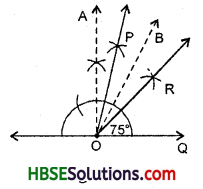
Draw ∠POQ measures 75° and find its line of symmetry.
Solution:
steps of Construction :
(i) Construct ∠QOA = 90° and ∠QOB = 60° as shown above.
HBSE 6th Class Maths Solutions Chapter 14 Practical Geometry Ex 14.6 1
(ii) Draw \(\overrightarrow{\mathrm{OP}}\) as the bisector of ∠AOB.
(iii) Thus, ∠POQ is the required angle of measure 75°.
(iv) Draw \(\overrightarrow{\mathrm{OR}}\) as the bisector of ∠POQ which is the required line of symmetry.

HBSE 6th Class Maths Solutions Chapter 14 Practical Geometry Ex 14.6

Question 2.
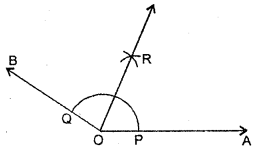
Draw an angle of measure 147° and construct its bisector.
Solution:
Steps of Construction :
(i) Draw a ray \(\overrightarrow{\mathrm{OA}}\).
(ii) With the help of protector construct ∠AOB = 147°.
HBSE 6th Class Maths Solutions Chapter 14 Practical Geometry Ex 14.6 2
(iii) With centre ‘O’ and a convient radius, draw an arc which intersects
the arms \(\overrightarrow{\mathrm{OA}}\) and \(\overrightarrow{\mathrm{OB}}\) at P and Q respectively.
(iv) With P as centre and radius more than half of PQ, draw an arc.
(v) With Q as centre and with the same radius, draw an other arc which intersects the previous arc at R.
(vi) Join OR and produce it. Thus, \(\overrightarrow{\mathrm{OR}}\) is the required bisector of ∠AOB.

Question 3.
Draw a right-angle and construct its bisector.
Solution:
Steps of Construction :
(i) Draw a line PQ and take a point ‘0’ on it.
(ii) With ‘O’ as centre and a convient radius, draw an arc which intersects PQ at A and B.
which intersect each other at C.
(iv) Join OC. Thus, ∠COQ is the required right-angle.
(v) With B and E as centres and radius
more than half of BE, draw two arcs which intersect each other at the point D.
HBSE 6th Class Maths Solutions Chapter 14 Practical Geometry Ex 14.6 3
(vi) Join OD. Thus, \(\overrightarrow{\mathrm{OD}}\) is the required bisector of ∠COQ.

HBSE 6th Class Maths Solutions Chapter 14 Practical Geometry Ex 14.6

Question 4.
Draw an angle of measure 153° and divide it into four equal parts.
Solution:
Steps of Construction :
(i) Draw a ray \(\overrightarrow{\mathrm{OA}}\) .
(ii) At 0, with the help of a protector, construct ∠AOB = 153°.
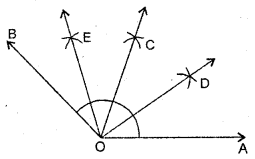
(iii) Draw \(\overrightarrow{\mathrm{OC}}\) as the bisector of ∠AOB.
(iv) Again, draw \(\overrightarrow{\mathrm{OD}}\) as the bisector of ∠AOC.
(v) Again, draw \(\overrightarrow{\mathrm{OE}}\) as the bisector of ∠BOC.
HBSE 6th Class Maths Solutions Chapter 14 Practical Geometry Ex 14.6 7
Thus \(\overrightarrow{\mathrm{OD}}\), \(\overrightarrow{\mathrm{OC}}\) and \(\overrightarrow{\mathrm{OE}}\) divide ∠AOB into four equal parts.

Question 5.
Construct with ruler and compasses angles of following measures:
(a) 60°,
(b) 30°,
(c) 90°,
(d) 120°,
(e) 450,
(f) 135°.
Solution:
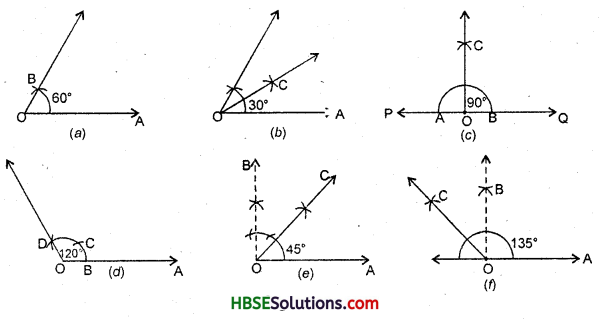
HBSE 6th Class Maths Solutions Chapter 14 Practical Geometry Ex 14.6 4
(a) ∠AOB = 60° (b) ∠AOC = 30°
(c) ∠QOC = 90° (d) ∠AOD = 120°
(e) ∠AOC = 45° (/) ∠AOC = 135°.

HBSE 6th Class Maths Solutions Chapter 14 Practical Geometry Ex 14.6

Question 6.
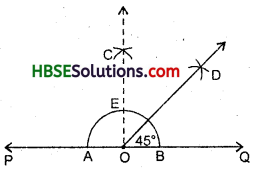
Draw an angle of measure 45° and bisect it. What is the measure of each angle you obtain ?
Solution:
Steps of Construction :
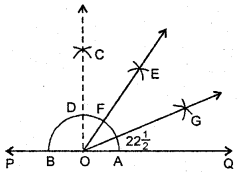
(i) Draw a line PQ and take a point ‘O’ on it.
(ii) With ‘O’ as centre and a convient radius, draw an arc which intersects PQ at two points A and B.
HBSE 6th Class Maths Solutions Chapter 14 Practical Geometry Ex 14.6 5
(iii) With A and B as centres and radius more than half of AB, draw two arcs which intersect each other at C.
(iv) Join OC. Then ∠COQ is an angle of 90°.
(v) Draw \(\overrightarrow{\mathrm{OE}}\) as the bisector of ∠COE. Thus, ∠QOE = 45°.
(vi) Now, draw OG as the bisector of ∠QOE. Thus, ∠QOG = ∠EOG = 22\(\frac{1}{2}\)°

Question 7.
Draw an angle of measure 135° and bisect it. What is the measure of each angle you obtain ?
Solution:
Steps of Construction :
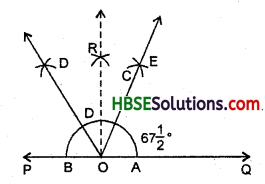
(i) Draw a line PQ and take a point ‘O’ on it.
(ii) With ‘O’ as centre and a convient radius, draw an arc which intersects PQ at A.and B.
HBSE 6th Class Maths Solutions Chapter 14 Practical Geometry Ex 14.6 6
(iii) With A and B as centres and radius more than half of AB, draw two arcs which intersect each other at R.
(iv) Join OR. Then, ∠QOR = ∠POR = 90°.
(v) Draw \(\overrightarrow{\mathrm{OD}}\) as the bisector of ∠POR. Then, ∠QOD is the required angle of 135°.
(vi) Now, draw \(\overrightarrow{\mathrm{OE}}\) as the bisector of ∠QOD. Thus, ∠QOE = ∠DOE = 67\(\frac{1}{2}\)°

HBSE 6th Class Maths Solutions Chapter 14 Practical Geometry Ex 14.6 Read More »

HBSE 6th Class Maths Solutions Chapter 14 Practical Geometry Ex 14.5

Haryana State Board HBSE 6th Class Maths Solutions Chapter 14 Practical Geometry Ex 14.5 Textbook Exercise Questions and Answers.

Haryana Board 6th Class Maths Solutions Chapter 14 Practical Geometry Exercise

14.5

Question 1.
Draw AB of length 7.3 cm and find its axis of symmetry.
Solution:
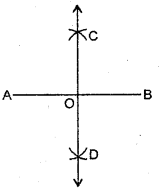
Axis of symmetry of line segment \(\overline{\mathrm{AB}}\) will be the perpendicular bisector of \(\overline{\mathrm{AB}}\). So, draw the perpendicular bisector of \(\overline{\mathrm{AB}}\).
(i) Draw a line segment \(\overline{\mathrm{AB}}\) = 7.3 cm.
(ii) With A and B as centres and radius more than half of \(\overline{\mathrm{AB}}\), draw two arcs which intersect each other at C and D.
(iii) Join CD. Then CD is the axis of symmetry of the line segment \(\overline{\mathrm{AB}}\).
HBSE 6th Class Maths Solutions Chapter 14 Practical Geometry Ex 14.5 1

HBSE 6th Class Maths Solutions Chapter 14 Practical Geometry Ex 14.5

Question 2.
Draw a line segment of length 9.5 cm and construct its perpendicular bisector.
Solution:
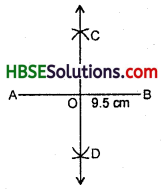
(i) Draw a line segment \(\overline{\mathrm{AB}}\) = 9.5 cm.
(ii) With A and B as centres and radius more than half of \(\overline{\mathrm{AB}}\), draw two arcs which intersect each other at C and D.
(iii) Join CD. Then CD is the perpendi-cular bisector of \(\overline{\mathrm{AB}}\).
HBSE 6th Class Maths Solutions Chapter 14 Practical Geometry Ex 14.5 2

Question 3.
Draw the perpendicular bisector of \(\overline{\mathrm{XY}}\) whose length is 10.3 cm.
(a) Take any point P on the bisector drawn. Examine whether \(\overline{P X}=\) = \(\overline{P Y}\).
(b) If M is the mid-point of \(\overline{\mathrm{XY}}\). What can you say about the lengths of \(\overline{MX}\) and \(\overline{\mathrm{XY}}\).
Solution:
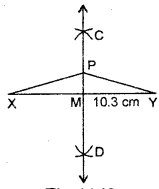
(i) Draw a line segment \(\overline{\mathrm{XY}}\) = 10.3 cm.
(ii) With X and Y as centres and radius more than half of \(\overline{\mathrm{XY}}\), draw two arcs which cut each other at C and D.
(iii) Join CD. Then, CD is the required perpendicular bisector of \(\overline{\mathrm{XY}}\).
(a) Take any point P on the bisector drawn.
With the help of divider we can check that \(\overline{P X}=\) = \(\overline{P Y}\).
(b) If M is the mid-point of \(\overline{\mathrm{XY}}\), then \(\overline{MX}\) = \(\frac{1}{2}\) \(\overline{\mathrm{XY}}\)
HBSE 6th Class Maths Solutions Chapter 14 Practical Geometry Ex 14.5 3

HBSE 6th Class Maths Solutions Chapter 14 Practical Geometry Ex 14.5

Question 4.
Draw a line segment of length 12.8 cm. Using compasses, divide it into four equal points. Verify by actual measurement.
Solution:
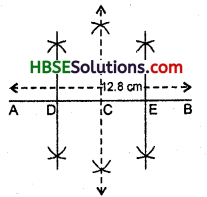
(i) Draw a line segment AB = 12.8 cm.
(ii) Draw the perpendicular bisector of
\(\overline{\mathrm{AB}}\) which cuts it at C. Thus, C is the midpoint of \(\overline{\mathrm{AB}}\).
(iii) Draw the perpendicular bisector of \(\overline{\mathrm{AC}}\) which cuts it at D. Thus, D is the mid-point of \(\overline{\mathrm{AC}}\).
(iv) Again, draw the perpendicular bisector of \(\overline{\mathrm{CB}}\) which cuts it at E. Thus, E is the mid-point of \(\overline{\mathrm{CB}}\).
HBSE 6th Class Maths Solutions Chapter 14 Practical Geometry Ex 14.5 4
(v) Now, points D, C and E divide the line segment \(\overline{\mathrm{AB}}\) into four equal parts.
(vi) By actual measurement, we find that \(\overline{\mathrm{AD}}=\overline{\mathrm{DC}}=\overline{\mathrm{CE}}=\overline{\mathrm{EB}}=3.2 \mathrm{~cm}\)

Question 5.
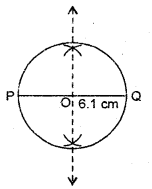
With \(\overline{\mathrm{PQ}}\) of length 6.1 cm as diameter draw a circle.
Solution:
(i) Draw a line segment \(\overline{\mathrm{PQ}}\) =6.1 cm.
(ii) Draw the per¬pendicular bisector of PQ which cuts it at O. Thus, O is the mid-point of \(\overline{\mathrm{PQ}}\).
(iii) With 0 as centre and OP or OQ as radius, draws a circle where diameter is the line segment \(\overline{\mathrm{PQ}}\).
HBSE 6th Class Maths Solutions Chapter 14 Practical Geometry Ex 14.5 5

HBSE 6th Class Maths Solutions Chapter 14 Practical Geometry Ex 14.5

Question 6.
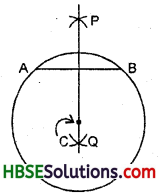
Draw a circle with centre C and radius 3.4 cm. Draw any chord \(\overline{\mathrm{AB}}\). Construct the perpendicular bisector of \(\overline{\mathrm{AB}}\) and examine if it passes through C.
Solution:
(i) Draw a circle Fig. with centre C and radius 3.4 cm.
(ii) Draw any chord \(\overline{\mathrm{AB}}\).
(iii) With A and B as centres and radius more than half of \(\overline{\mathrm{AB}}\), draw two arcs which cut each other at P and Q.
(iv) Join \(\overline{\mathrm{PQ}}\). Then, PQ is the perpendicular bisector of \(\overline{\mathrm{AB}}\).
(v) Clearly, this perpendicular bisector of \(\overline{\mathrm{AB}}\) passes through the centre C of the circle.
HBSE 6th Class Maths Solutions Chapter 14 Practical Geometry Ex 14.5 6

Question 7.
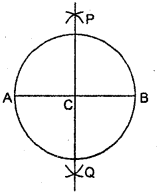
Repeat Question 6, if AB happens to be a diameter.
Solution:
(i) Draw a circle with centre C and radius 3.4 cm.
(ii) Draw its diameter \(\overline{\mathrm{AB}}\).
(iii) With A and B as centres and radius more than half of \(\overline{\mathrm{AB}}\), draw two arcs which cut each other at P arid Q.
(iv) Join \(\overline{\mathrm{PQ}}\). Then PQ is the perpendi¬cular bisector of \(\overline{\mathrm{AB}}\).
(v) Clearly, this perpendicular bisector of \(\overline{\mathrm{AB}}\) passes through the centre C of the circle.
HBSE 6th Class Maths Solutions Chapter 14 Practical Geometry Ex 14.5 7

Question 8.
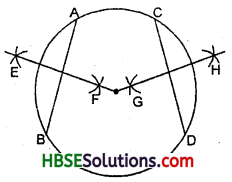
Draw a circle of radius 4 cm. Draw any two of its chords. Construct the per-pendicular bisectors of these chords. Where do they meet ?
Solution:
(i) Draw a circle with centre 0 and radius 4 cm.
(ii) Draw any two chords \(\overline{\mathrm{AB}}\) and \(\overline{\mathrm{CD}}\) of this circle.
(iii) With A and B as centres and radius more that half of \(\overline{\mathrm{AB}}\), draw two arcs which cut each other at E and F.
(iv) Join EF. Thus, EF is the perpendi-cular bisector of chord \(\overline{\mathrm{AB}}\).
(v) Similarly, draw GH the perpendicular bisector of chord \(\overline{\mathrm{CD}}\) .
(vi) These two perpendicular bisectors meet at 0, the centre of the circle.
HBSE 6th Class Maths Solutions Chapter 14 Practical Geometry Ex 14.5 8

HBSE 6th Class Maths Solutions Chapter 14 Practical Geometry Ex 14.5

Question 9.
Draw any angle with vertex O. Take a point A on one of its arms and B on another such that OA = OB. Draw
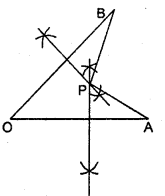
the perpendicular bisector of \(\overrightarrow{\mathrm{OA}}\) and \(\overline{\mathrm{OB}}\). Let them meet at P. Is \(\overline{\mathrm{PA}}=\overline{\mathrm{PB}}\) ?
Solution:
(i) Draw any angle with vertex 0.
(ii) Take a point A on one of its arms and B on another such that \(\overline{\mathrm{OA}}=\overline{\mathrm{OB}}\).
(iii) Draw perpen¬dicular bisectors of \(\overline{\mathrm{OA}}\) and \(\overline{\mathrm{OB}}\).
(iv) Let them meet at P. Join PA and PB.
(v) With the help of divider we can check that \(\overline{\mathrm{PA}}=\overline{\mathrm{PB}}\).
HBSE 6th Class Maths Solutions Chapter 14 Practical Geometry Ex 14.5 9

HBSE 6th Class Maths Solutions Chapter 14 Practical Geometry Ex 14.5 Read More »

HBSE 6th Class Maths Solutions Chapter 14 Practical Geometry Ex 14.4

Haryana State Board HBSE 6th Class Maths Solutions Chapter 14 Practical Geometry Ex 14.4 Textbook Exercise Questions and Answers.

Haryana Board 6th Class Maths Solutions Chapter 14 Practical Geometry Exercise

14.4

Question 1.
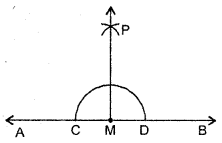
Draw any line \(\overleftrightarrow{\mathrm{AB}}\) . Make any point M on it. Through M draw a
perpendicular to \(\overleftrightarrow{\mathrm{AB}}\) . (Use Ruler and compasses).
Solution:
(i.) With M as centre and a convenient radius, draw an arc intersecting the line \(\overleftrightarrow{\mathrm{AB}}\) at two points C and D.
HBSE 6th Class Maths Solutions Chapter 14 Practical Geometry Ex 14.4 1
(ii) With C and D as centres and a radius greater than MC, draw two arcs, which cut each other at P.
(iii) Join PM. Then PM is perpendicular to AB through the point M [Fig.].

HBSE 6th Class Maths Solutions Chapter 14 Practical Geometry Ex 14.4

Question 2.
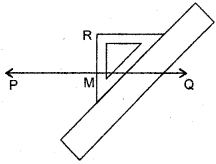
Draw any line \(\overleftrightarrow{\mathrm{PQ}}\) . Take any point R not on it. Through R draw a perpendicular to \(\overleftrightarrow{\mathrm{PQ}}\) (Use Ruler and set-square).
Soution:
(i) Place a set-square on \(\overleftrightarrow{\mathrm{PQ}}\) such that one arm of its right-angle aligns along \(\overleftrightarrow{\mathrm{PQ}}\) .
(ii) Place a ruler along the edge opposite to the right-angle of the set- P square.
HBSE 6th Class Maths Solutions Chapter 14 Practical Geometry Ex 14.4 2
(iii) Hold the ruler fixed. Slide the set square along the ruler till the point R touches the other arm of the set-square.
(iv) Join RM along the edge through R meeting \(\overleftrightarrow{\mathrm{PQ}}\) at M. Then, RM ⊥ PQ.

HBSE 6th Class Maths Solutions Chapter 14 Practical Geometry Ex 14.4

Question 3.
Draw a line T and a point X on it. Through X, draw a line \(\overleftrightarrow{\mathrm{XY}}\) perpendi¬cular to Z. Now, draw a perpendicular to \(\overleftrightarrow{\mathrm{XY}}\) at Y. (Use ruler and compasses).
Solution:
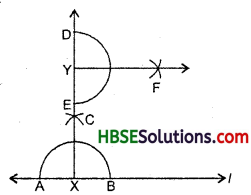
(i) Draw a line ‘l’ and take point X on it.
(ii) With X as centre and a convenient radius, draw an arc intersecting the line ‘l’ at two points A and B.
(iii) With A and B as centres and a radius greater than XA, draw two arcs, which cut each other at C.
(iv) Join XC and produce it to Y. Then XY is perpendicular to l.
HBSE 6th Class Maths Solutions Chapter 14 Practical Geometry Ex 14.4 3
(v) With D as centre and a convenient radius, draw an arc intersecting XY at two points C and D.
(vi) With C and D as centres and a radius greater than YD, draw two arcs, which cut each other at F.
(vii) Join YF, then YF is perpendicular to XY at Y.

HBSE 6th Class Maths Solutions Chapter 14 Practical Geometry Ex 14.4 Read More »
HBSE 6th Class Maths Solutions Chapter 14 Practical Geometry Ex 14.3

Haryana State Board HBSE 6th Class Maths Solutions Chapter 14 Practical Geometry Ex 14.3 Textbook Exercise Questions and Answers.

Haryana Board 6th Class Maths Solutions Chapter 14 Practical Geometry Exercise

14.3

Question 1.
Draw any line segment \(\overline{\mathrm{PQ}}\). Without measuring \(\overline{\mathrm{PQ}}\) construct a copy of \(\overline{\mathrm{PQ}}\).
Solution:
(i) Given \(\overline{\mathrm{PQ}}\) whose length is not known.
HBSE 6th Class Maths Solutions Chapter 14 Practical Geometry Ex 14.3 1
(ii) Fix the compasses pointer on P and the pencil end on Q. The opening of the instru-ment now gives the length of \(\overline{\mathrm{PQ}}\).
(iii) Draw any line ‘l’. Choose a point A on ‘l’. Without changing the compasses setting, place the pointer on A.
(iv) Strike an arc that cuts ‘l’ at a point, say, B. Now \(\overline{\mathrm{AB}}\) is a copy of \(\overline{\mathrm{PQ}}\).

HBSE 6th Class Maths Solutions Chapter 14 Practical Geometry Ex 14.3

Question 2.
Given some line segment \(\overline{\mathrm{AB}}\), whose length you do not know, construct \(\overline{\mathrm{PQ}}\) such that the length of \(\overline{\mathrm{PQ}}\) is twice that of \(\overline{\mathrm{AB}}\).
Solution:
(i) Given \(\overline{\mathrm{AB}}\) whose length is not known.
HBSE 6th Class Maths Solutions Chapter 14 Practical Geometry Ex 14.3 2
(ii) Fix the compasses pointer on A and the pencils end on B. The opening instru¬ment now gives the length of \(\overline{\mathrm{AB}}\).
(iii) Draw any line ‘l’. Choose a point P on ‘l’. Without changing the compasses setting, place the pointer on P.
(iv) Strike an arc that cuts ‘l’ at a point R.
(v) Now, place the pointer on R and without changing the compasses setting, strike another arc that cuts ‘l’ at a point Q,
(vi) Thus, \(\overline{\mathrm{PQ}}\) is the required line segment whose length is twice that of AB.

HBSE 6th Class Maths Solutions Chapter 14 Practical Geometry Ex 14.3 Read More »
HBSE 6th Class Maths Solutions Chapter 14 Practical Geometry Ex 14.2

Haryana State Board HBSE 6th Class Maths Solutions Chapter 14 Practical Geometry Ex 14.2 Textbook Exercise Questions and Answers.

Haryana Board 6th Class Maths Solutions Chapter 14 Practical Geometry Exercise

14.2

Question 1.
Draw a line segment of length 7.3 cm, using a ruler.
Solution:
Step 1. Place the zero mark of the ruler at a point A.
Step 2. Mark a point B at a distance of 7.3 cm from A and join AB.
Step 3. \(\overline{\mathbf{A B}}\) is the required line-segment of length 7.3 cm.
HBSE 6th Class Maths Solutions Chapter 14 Practical Geometry Ex 14.2 1

HBSE 6th Class Maths Solutions Chapter 14 Practical Geometry Ex 14.2

Question 2.
Construct a line segment of length 5.6 cm using ruler and compasses.
Solution:
(i) Draw a line’7’. Mark a point a on this line.
(ii) Place the compasses pointer on zero mark of the ruler. Open it to place the pencil point upto the 5.6 cm mark.

(iii) Without changing the opening of the compasses, place the pointer on A and swing an arc to cut 7’ at B.
(iv) \(\overline{\mathbf{A B}}\) is a line segment of the required length.

Question 3.
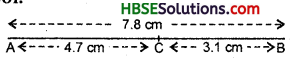
Construct \(\overline{\mathbf{A B}}\) of length 7.8 cm. From this cut off \(\overline{\mathbf{A C}}\) of length 4.7 cm. Measure \(\overline{\mathbf{B C}}\) .
Solution:
HBSE 6th Class Maths Solutions Chapter 14 Practical Geometry Ex 14.2 3
(i) Place the zero mark of the ruler at A.
(ii) Mark a point B at a distance 7.8 cm from A.
(iii) Again, mark a point C at a distnae 4,7 cm from A.
(iv) By measuring \(\overline{\mathbf{B C}}\) , we find that BC = 3.1 cm = (7.8 – 4.7) cm.

HBSE 6th Class Maths Solutions Chapter 14 Practical Geometry Ex 14.2

Question 4.
Given AB of length 3.9 cm, construct \(\overline{\mathbf{PQ}}\) such that the length of PQ is twice that of \(\overline{\mathbf{A B}}\) . Verify by measurement.
Solution:
HBSE 6th Class Maths Solutions Chapter 14 Practical Geometry Ex 14.2 4
(i) Draw a line ‘l’.
(ii) Construct \(\overline{\mathbf{PX}}\) such that length of \(\overline{\mathbf{PX}}\) = length of \(\overline{\mathbf{A B}}\) .
(iii) Then cut of \(\overline{\mathbf{XQ}}\) such that \(\overline{\mathbf{XQ}}\) also has the length of \(\overline{\mathbf{A B}}\) .
(iv) Thus, the length of \(\overline{\mathbf{PX}}\) and the length of \(\overline{\mathbf{XQ}}\) added together make twice the length of \(\overline{\mathbf{A B}}\) .
(v) Verification : By measurement we find that
PQ = 7.8 cm = 3.9 cm + 3.9 cm
= \(\overline{\mathbf{A B}}\) + \(\overline{\mathbf{A B}}\) = 2 x \(\overline{\mathbf{A B}}\) .

Question 5.
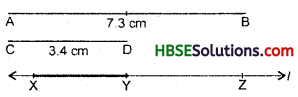
Given \(\overline{\mathbf{A B}}\) of length 7.3 cm and
\(\overline{\mathbf{C D}}\) of length 3.4 cm, construct a line
segment \(\overline{\mathbf{X Y}}\) such that the length of
\(\overline{\mathbf{X Y}}\) = the difference between the lengths
of \(\overline{\mathbf{A B}}\) and \(\overline{\mathbf{C D}}\) . Verify by measurement.
Solution:
HBSE 6th Class Maths Solutions Chapter 14 Practical Geometry Ex 14.2 5
(i) Draw a line 7’ and take a point X on it.
(ii) Construct \(\overline{\mathbf{XZ}}\) such that length of \(\overline{\mathbf{XZ}}\) = length of \(\overline{\mathbf{A B}}\) = 7.3 cm.
(iii) Then cut off \(\overline{\mathbf{ZY}}\) = length of \(\overline{\mathbf{CD}}\) = 3.4 cm.
(iv) Thus, the length of \(\overline{\mathbf{XY}}\) = length of \(\overline{\mathbf{A B}}\) – length of \(\overline{\mathbf{CD}}\) .
(v) Verification : By measurement, we find that length of \(\overline{\mathbf{XY}}\) = 3.9 cm = 7.3 – 3.4 cm = \(\overline{\mathbf{A B}}\) – \(\overline{\mathbf{CD}}\) .

HBSE 6th Class Maths Solutions Chapter 14 Practical Geometry Ex 14.2 Read More »

HBSE 6th Class Maths Solutions Chapter 14 Practical Geometry Ex 14.1

Haryana State Board HBSE 6th Class Maths Solutions Chapter 14 Practical Geometry Ex 14.1 Textbook Exercise Questions and Answers.

Haryana Board 6th Class Maths Solutions Chapter 14 Practical Geometry Exercise

14.1

Question 1.
Draw a circle of radius 3.2 cm.
Solution:
Steps of construction :
(i) Open the compasses for the required radius 3.2 cm.
(ii) Mark a point ‘0’ with a sharp pencil where we want the centre of the circle to be.
(iii) Place the pointer of the compasses on 0.
(iv) Turn the compasses slowly to draw the circle.
HBSE 6th Class Maths Solutions Chapter 14 Practical Geometry Ex 14.1 1

Question 2.
With the same circle O, draw two circles of radii 4 cm and 2.5 cm.
Solution:
Steps of construction :
(i) Mark a point ‘O’ with a sharp pencil where we want the centre of the circle.
(ii) Open the compasses 4 cm.
HBSE 6th Class Maths Solutions Chapter 14 Practical Geometry Ex 14.1 2
(iii) Place the pointer of the compasses on O.
(iv) Turn the compasses slowly to draw the circle.
(v) Again open the compasses 2.5 cm
and place the pointer of the compasses at O. Turn the compasses slowly to draw the second circle.

HBSE 6th Class Maths Solutions Chapter 14 Practical Geometry Ex 14.1

Question 3.
Draw a circle and any two of its diameters. If you join the ends of these diameters, what is the figure obtained ? What figure is obtained if the diameters are perpendicular to each other ? How do you check you answer ?
Solution:
(i) By joining the ends of two diameters, we get a rectangle. By measuring, we find
AB = CD = 3 cm,
BC = AD = 2 cm
HBSE 6th Class Maths Solutions Chapter 14 Practical Geometry Ex 14.1 3
i.e., pair of opposite sides are equal.
∠A = ∠B = ∠C = ∠D = 90°
i.e., each angle is equal to 90°. Hence, ABCD is a rectangle, [see Fig.]

(ii) If the diameters are perpendicular to each other, then by joining the ends of two diameters, we get a square.
HBSE 6th Class Maths Solutions Chapter 14 Practical Geometry Ex 14.1 4
By measuring, we find that
AB = BC = CD = AD = 2.5 cm
i.e., four sides are equal.
∠A = ∠B = ∠C = ∠D = 90°
i.e., each angle is a right-angle. Hence, ABCD is a square [Fig.]

Question 4.
Draw any circle and mark points A, B and C such that:
(a) A is on the circle.
(b) B is in the interior o the circle.
(c) C is in the exterior of the circle.
Solution:
(i) Mark a point‘O’with sharp pencil where we want centre of the circle.
(ii) Place the poin-ter of the compasses at ‘O’, then move the compasses slowly to draw a circle. In Fig.
(a) Point A is on the circle.
(b) Point B 1 is in the interior of the circle.
(c) Point C is in the exterior of the circle.

HBSE 6th Class Maths Solutions Chapter 14 Practical Geometry Ex 14.1 5

HBSE 6th Class Maths Solutions Chapter 14 Practical Geometry Ex 14.1

Question 5.
Let A, B be the centres of two circles of equal radii, draw them so that each one of them passes through the centre of the other. Let them intersect at C and D. Examine whether \(\overline{\mathbf{A B}}\) and \(\overline{\mathbf{CD}}\) are at right angles.
Solution:
Draw two circles of equal radii taking A and B as their centres such that each one.
of them passes through the centre of the other. Let them intersect at C and D. Join AB and CD. [Fig.]
Yes. \(\overline{\mathbf{A B}}\) and \(\overline{\mathbf{CD}}\) are at right angles, because ∠BOC = 90°.
HBSE 6th Class Maths Solutions Chapter 14 Practical Geometry Ex 14.1 6

HBSE 6th Class Maths Solutions Chapter 14 Practical Geometry Ex 14.1 Read More »
HBSE 6th Class Maths Solutions Chapter 13 Symmetry Intext Questions

Haryana State Board HBSE 6th Class Maths Solutions Chapter 13 Symmetry Intext Questions and Answers.

Haryana Board 6th Class Maths Solutions Chapter 13 Symmetry Intext Questions

TRY THIS (Page 346) :

Question.
You have two set squares in your ‘mathematical instrument box’. Are they symmetric ?
Solution:
HBSE 6th Class Maths Solutions Chapter 13 Symmetry Intext Questions 1
The two set squares are not symmetrical.

TRY THIS (Page 348):

Form as many shapes as you can by combining two or more set squares. Draw them on squared paper and note their lines of symmetry.
Solution:
Lines l1 l2, l3 l4, and l5 are the lines of symmetry respectively in Fig. (i), (ii), (iii), (iv) and (v).
HBSE 6th Class Maths Solutions Chapter 13 Symmetry Intext Questions 2

HBSE 6th Class Maths Solutions Chapter 13 Symmetry Ex 13.2

TRY THESE (Page 356):

Question.
If you are 100 cm in front of a mirror, where does your image appear to be ? If you move towards the mirror, how does your image move ?
Solution:
Your image will appear at 100 cm behind the mirror.
(∵ Image is as far behind the mirror as the object is in front of it). If you move towards the mirror, it will move nearer and nearer.

HBSE 6th Class Maths Solutions Chapter 13 Symmetry Intext Questions Read More »
HBSE 6th Class Maths Solutions Chapter 13 Symmetry Ex 13.2

Haryana State Board HBSE 6th Class Maths Solutions Chapter 13 Symmetry Ex 13.2 Textbook Exercise Questions and Answers.

Haryana Board 6th Class Maths Solutions Chapter 13 Symmetry Exercise

13.2

Question 1.
Find the lines of symmetry for each of the following shapes.
HBSE 6th Class Maths Solutions Chapter 13 Symmetry Ex 13.2 1
Solution:
HBSE 6th Class Maths Solutions Chapter 13 Symmetry Ex 13.2 2

Question 2.
Copy the triangle in each of the following figures, on squares paper. In each case draw the line(s) of symmetry if any and identify the type of triangle. (Some of you may like to trace the figures and try paper-folding first.)
HBSE 6th Class Maths Solutions Chapter 13 Symmetry Ex 13.2 3
Solution:
HBSE 6th Class Maths Solutions Chapter 13 Symmetry Ex 13.2 4

HBSE 6th Class Maths Solutions Chapter 13 Symmetry Ex 13.2

Question 3.
Complete the following table :
HBSE 6th Class Maths Solutions Chapter 13 Symmetry Ex 13.2 5
Solution:
HBSE 6th Class Maths Solutions Chapter 13 Symmetry Ex 13.2 6
HBSE 6th Class Maths Solutions Chapter 13 Symmetry Ex 13.2 7

Question 4.
Can you draw a triangle which has
(a) exactly one line of symmetry ?
(b) exactly two lines of symmetry ?
(c) exactly three lines of symmetry ?
(d) no lines of symmetry ?
Sketch a rough figure in each case.
Solution:
(a) An isosceles triangle has exactly one line of symmetry.
(b) We cannot draw a triangle which has exactly two lines of symmetry.
HBSE 6th Class Maths Solutions Chapter 13 Symmetry Ex 13.2 8
(c) An equilateral triangle has exactly three lines of symmetry.
(d) A scalene triangle has no lines of symmetry.

Question 5.
On a squared paper-sketch the following :
[Hint: It will help if you first draw the lines of symmetry and then complete the figures.]
(a) A triangle with a horizontal line of symmetry but no vertical line of symmetry.
(b) A quadrilateral with both horizontal and vertical lines of symmetry.
(c) A quadrilateral with a horizontal line of symmetry but no vertical line of symmetry.
(d) A hexagon with exactly two lines of symmetry.
(e) A hexagon with six lines of symmetry.
Solution:
(a) An isosceles triangle has one line of symmetry. [Fig. (i)]
(b) A rectangle has two lines of symmetry. [Fig. (ii)]
(c) A trapezium has one line of symmetry. [Fig. (iii)]
(d) In Fig.(iv), a hexagon has exactly two lines of symmetry.
(e) A regular hexagon has six lines of symmetry. [Fig. (v)]
HBSE 6th Class Maths Solutions Chapter 13 Symmetry Ex 13.2 9

HBSE 6th Class Maths Solutions Chapter 13 Symmetry Ex 13.2

Question 6.
Trace each figure and draw the lines of symmetry, if any :
HBSE 6th Class Maths Solutions Chapter 13 Symmetry Ex 13.2 10
Solution:
HBSE 6th Class Maths Solutions Chapter 13 Symmetry Ex 13.2 11
HBSE 6th Class Maths Solutions Chapter 13 Symmetry Ex 13.2 12

Question 7.
Consider the English alphabet A to Z. List among them the letters which have
(a) vertical lines of symmetry, (like A)
(b) horizontal lines of symmetry, (like B)
(c) no line of symmetry (like Q)
Solution:
(a) Letters having vertical lines of symmetry are :
A, H, M, 0, T, U, V, W, X.
Cb) Letters having horizontal lines of symmetry are:
B, D, E, H, I, K, 0, X.
(c) Letters having no line of symmetry are :
C, F, G, J, L, N, P, Q, R, S, Y, Z.

Question 8.
Given here are figures of a few folded sheets and designs drawn about the fold. In each case, draw a rough diagram of the complete figure that would be seen when the design is cut off.
HBSE 6th Class Maths Solutions Chapter 13 Symmetry Ex 13.2 13
Solution:
HBSE 6th Class Maths Solutions Chapter 13 Symmetry Ex 13.2 14

HBSE 6th Class Maths Solutions Chapter 13 Symmetry Ex 13.2 Read More »
HBSE 6th Class Maths Solutions Chapter 13 Symmetry Ex 13.3

Haryana State Board HBSE 6th Class Maths Solutions Chapter 13 Symmetry Ex 13.3 Textbook Exercise Questions and Answers.

Haryana Board 6th Class Maths Solutions Chapter 13 Symmetry Exercise

13.3

Question 1.
Find the number of lines of symmetry in each of the following shapes : How will you check your answers ?
HBSE 6th Class Maths Solutions Chapter 13 Symmetry Ex 13.3 1
Solution:
HBSE 6th Class Maths Solutions Chapter 13 Symmetry Ex 13.3 2

Question 2.
Copy the following drawing on a squared paper. Complete each one of them such that the resulting figure has the two dotted lines as two lines of symmetry :
HBSE 6th Class Maths Solutions Chapter 13 Symmetry Ex 13.3 3
How did you go about completing the picture?
Solution:
HBSE 6th Class Maths Solutions Chapter 13 Symmetry Ex 13.3 4

HBSE 6th Class Maths Solutions Chapter 13 Symmetry Ex 13.3

Question 3.
In each figure below, a letter of the alphabet is shown along with a vertical line. Take the mirror image of the letter in the given line. Find which letters A look the same after reflection (i.ewhich letters look i\ the same in the image), and which do not. Can you guess why ?
HBSE 6th Class Maths Solutions Chapter 13 Symmetry Ex 13.3 5

Try for O, E, M, N, P, H, L, T, S, V, X.
HBSE 6th Class Maths Solutions Chapter 13 Symmetry Ex 13.3 6
Solution:
A, O, M, H, T, V and X look the same after reflection.
Because these letters are symmetrical.
B, E, N, P, L and S do not look the same after reflection.
Because these letters are not symmetrical.

HBSE 6th Class Maths Solutions Chapter 13 Symmetry Ex 13.3 Read More »