Author name: Bhagya

HBSE 8th Class Maths Solutions Chapter 5 Data Handling InText Questions

Haryana State Board HBSE 8th Class Maths Solutions Chapter 5 Data Handling InText Questions and Answers.

Haryana Board 8th Class Maths Solutions Chapter 5 Data Handling InText Questions

Think, Discuss and Write (Page 71)

Question 1.
If we change the position of any of the bars of a bar graph, would it change the information being conveyed? Why?
Answer:
Yes, It would change the information being conveyed because bar represents information for particular year, subject etc. If you change or shift the position of bar it would convey different meaning.

Try These (Page 71)

Question 1.
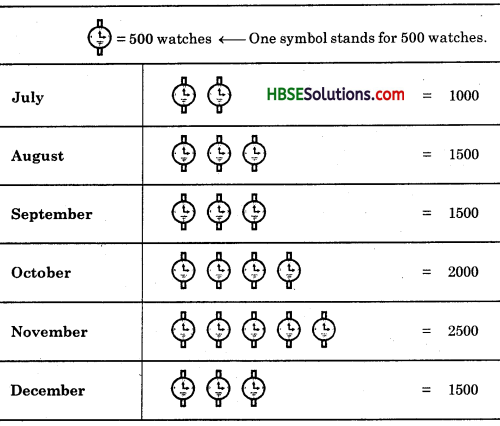
Draw an appropriate graph to represent the given information :
HBSE 8th Class Maths Solutions Chapter 5 Data Handling InText Questions 1
Solution:
A Pictograph :
HBSE 8th Class Maths Solutions Chapter 5 Data Handling InText Questions 2

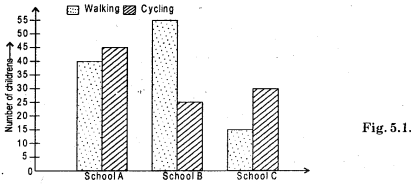
Question 2.
HBSE 8th Class Maths Solutions Chapter 5 Data Handling InText Questions 3
Solution:
Double bar graph
HBSE 8th Class Maths Solutions Chapter 5 Data Handling InText Questions 4

HBSE 8th Class Maths Solutions Chapter 5 Data Handling InText Questions

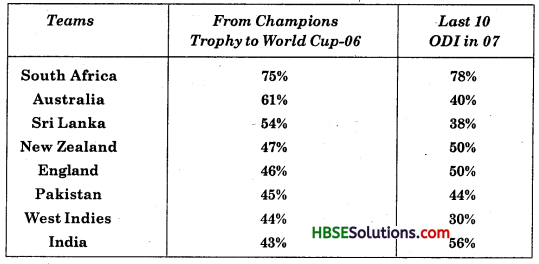
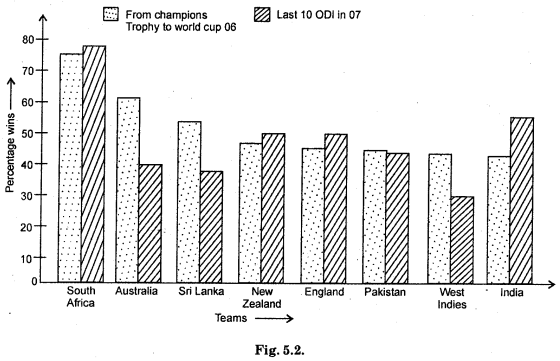
Question 3.
Percentage wins in ODI by 8 top cricket teams :
HBSE 8th Class Maths Solutions Chapter 5 Data Handling InText Questions 5
Solution:
Double bar graph :
HBSE 8th Class Maths Solutions Chapter 5 Data Handling InText Questions 6

Try These (Page 72)

Question 1.
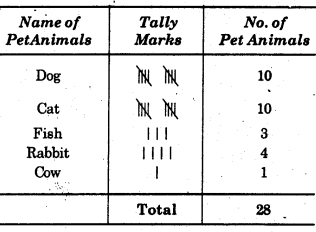
A group of Students were asked to say which animal they would like most to have as a pet. The results are given below :
dog, cat, cat, fish, cat, rabbit, dog, cat, rabbit, dog, cat, dog, dog, dog, cat, cow, fish, rabbit, dog, cat, dog, cat, cat, dog, rabbit, cat, fish, dog.
Make a frequency distribution table for the same.
Solution:
HBSE 8th Class Maths Solutions Chapter 5 Data Handling InText Questions 7

Try These (Page 73)

Question 1.
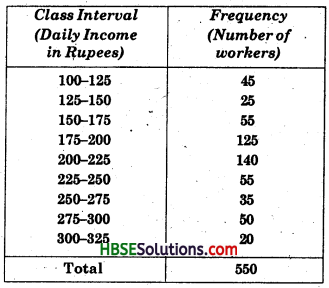
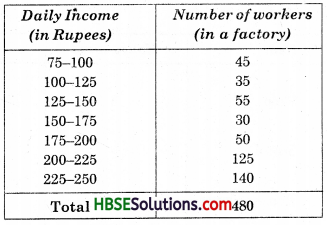
Study the following frequency distribution table and answer the questions given below:
Frequency Distribution of Daily Income of 550 workers of a factory
HBSE 8th Class Maths Solutions Chapter 5 Data Handling InText Questions 8
(i) What is the size of the class intervals ?
(ii) Which class has the highest frequency ?
(iii) Which class has the lowest frequency ?
(iv) What is the upper limit of the class interval 250-275 ?
(v) Which two classes have the same frequency ?
Solution:
(i) Size of the class intervals = 25
(ii) 200—225.
(iii) 300—325
(iv) 275
(v) 150—175 and 225 250.

HBSE 8th Class Maths Solutions Chapter 5 Data Handling InText Questions

Question 2.
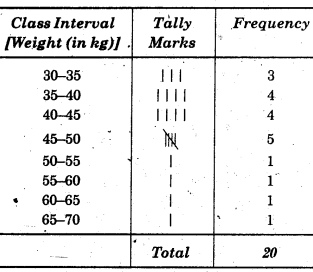
Construct a frequency distribution table for the data on weights (in kg) of 20 students of a class using intervals 30—35, 36—40 and so on.
40, 38, 33, 48, 60, 53, 31, 46, 34, 36, 49, 41, 55, 49, 65, 42, 44, 47, 38, 39.
Solution:
HBSE 8th Class Maths Solutions Chapter 5 Data Handling InText Questions 9

Try These (Page 75-76)

Question 1.
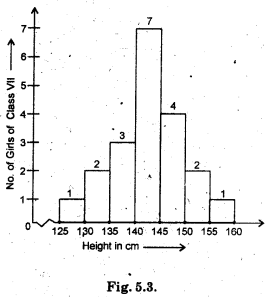
Observe the histogram (Fig. 5.3) and answer the questions given below :
HBSE 8th Class Maths Solutions Chapter 5 Data Handling InText Questions 10
(i) What information is being given by the histogram ?
(ii) Which group contains maximum girls ?
(iii) How many girls have a height of 145 cms and more ?
(iv) If we divide-ihe girls into the following three categories, how many would there be in each?
150 cm and more — Group A
140 cm to less than 150 cm—Group B
Less than 140 cm — Group C
Solution:
(i) Height (in cm) of number of girls of class VII.
(ii) (140 – 145) contains maximum girls.
(iii) No. of girls have height 145 cms and more = 4 + 2 + 1 = 7.
(iv) 150 cm and more —Group A —3 girls 140 cm to less than 150—Group B—11 girls Less than 140 cm—Group C —6 girls.

Try These (Page 78)

Question 1.
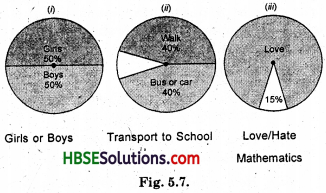
Each of the following pie charts (Fig. 5.7) gives you a different piece of information about your class. Find the fraction of the circle representing each of these Information.
HBSE 8th Class Maths Solutions Chapter 5 Data Handling InText Questions 11
Solution:
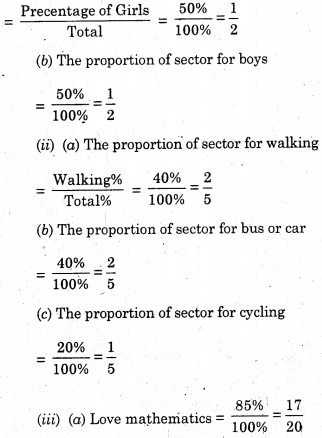
(i) (a) The proportion of sector for girls
HBSE 8th Class Maths Solutions Chapter 5 Data Handling InText Questions 12
(b) Love Hindi = \(\frac{15 \%}{100 \%}\) = \(\frac{3}{20}\)

HBSE 8th Class Maths Solutions Chapter 5 Data Handling InText Questions

Question 2.
Answer the following questions based on the pie chart given (Fig. 5.8).
HBSE 8th Class Maths Solutions Chapter 5 Data Handling InText Questions 13
(i) Which type of programmes are viewed the most ?
(ii) Which two types of programmes have number of viewers equal to those watching sports channels ?
Solution:
(i) Entertainment.
(ii) (News and Information Channels together have equal number of viewers to those watching sports channels.

Try These (Page 81)

Question 1.
Draw a pie chart of the data given below.
The time spent by a child during a day.
Sleep—8 hours
School—6 hours
Homework—4 hours
Play—4 hours
Others—2 hours
Solution:
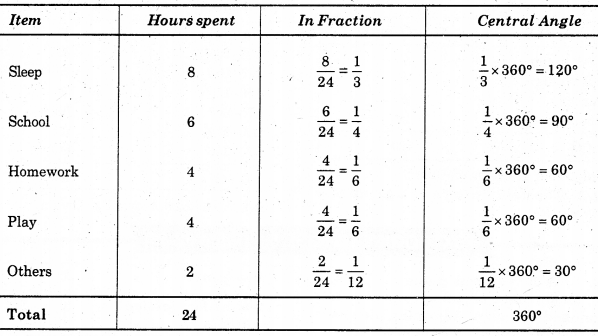
HBSE 8th Class Maths Solutions Chapter 5 Data Handling InText Questions 14
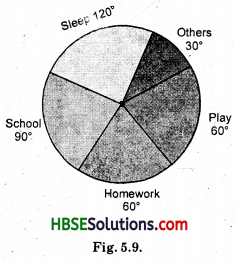
Now, we make the pie chart as under :
HBSE 8th Class Maths Solutions Chapter 5 Data Handling InText Questions 15

Think, Discuss and Write (Page 81)

Which form of graph would be appropriate to display the following data ?
Question 1.
Production of food grains of a state.
HBSE 8th Class Maths Solutions Chapter 5 Data Handling InText Questions 16
Solution:
A bar graph or pie chart.

HBSE 8th Class Maths Solutions Chapter 5 Data Handling InText Questions

Question 2.
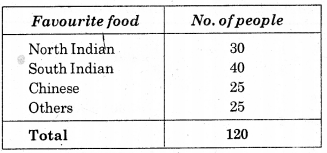
Choice of food for a group of people.
HBSE 8th Class Maths Solutions Chapter 5 Data Handling InText Questions 17
Solution:
A bar graph or pie chart.

Question 3.
The daily income of a group of a factory workers.
HBSE 8th Class Maths Solutions Chapter 5 Data Handling InText Questions 18
Solution:
A Histogram or a Bar Graph.

Try These (Page 83-84)

Question 1.
If you try to start a scooter, what are the possible outcomes ?
Answer:
Possible outcomes are either a scooter will start or do not start.

HBSE 8th Class Maths Solutions Chapter 5 Data Handling InText Questions

Question 2.
When a die is thrown, what are the six possible outcomes ?
Answer:
Six possible outcomesare 1, 2, 3, 4, 5 or 6.

Question 3.
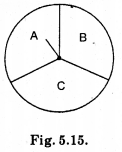
When you spin the wheel shown, what are the possible out-comes ? (Fig. 5.15) List them.
(Outcome here means the sector at which the pointer stops).
HBSE 8th Class Maths Solutions Chapter 5 Data Handling InText Questions 19
Answer:
Possible outcomes are pointer will stop at A, B or C.

Question 4.
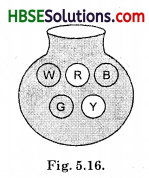
You have a bag with five identical balls of different colours and you are to puli out (draw) a ball without looking at it; list the outcomes you would get (Fig. 5.16).
HBSE 8th Class Maths Solutions Chapter 5 Data Handling InText Questions 20
Answer:
Possible outcomes are : Red ball, White ball, Blue ball, Green ball or Yellow ball.
So, five outcomes are possible,

HBSE 8th Class Maths Solutions Chapter 5 Data Handling InText Questions

Think, Discuss and Write (Page 84)

Question 1.
In throwing a die :
(i) Does the first player have a greater chance of getting a six ?
(ii) Would the player who played after him have a lesser chance of getting a six ?
(iii) Suppose the second player got a six. Does it mean that the third player would not have a chance of getting a six ?
Solution:
(i) No,
(ii) No and
(iii) No.
Reason : You cannot control the result.
Throwing a die is random experiment.

Try These (Page 86)

Question 1.
Suppose you spin the wheel:
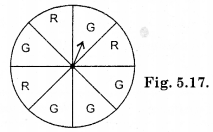
(i) List the number of outcomes of getting a green sector and not getting a green sector on this wheel (Fig. 5.17).
HBSE 8th Class Maths Solutions Chapter 5 Data Handling InText Questions 21
(ii) Find, the probability of getting a green sector.
(iii) Find the probability of not getting a green sector.
Solution:
(i) Total number of outcomes = 8
Number of outcomes of getting a green sector = 5 (Green sectors).
Number of outcomes of do not getting a green sector = 3 (Red sectors).

(ii) Probability of getting a green sector = \(\frac{Number of outcomes that make the event}{Total number of outcomes of the experiment}\)
= \(\frac{5}{8}\)

(iii) Probability of not getting a green sector = \(\frac{5}{8}\)

HBSE 8th Class Maths Solutions Chapter 5 Data Handling InText Questions Read More »

HBSE 8th Class Maths Solutions Chapter 5 Data Handling Ex 5.3

Haryana State Board HBSE 8th Class Maths Solutions Chapter 5 Data Handling Ex 5.3 Textbook Exercise Questions and Answers.

Haryana Board 8th Class Maths Solutions Chapter 5 Data Handling Exercise 5.3

Question 1.
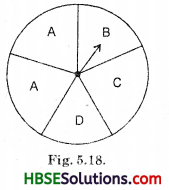
List the outcomes you can see in these experiments.
(a) Spinning a wheel
(b) Tossing two coins together.
HBSE 8th Class Maths Solutions Chapter 5 Data Handling Ex 5.3 1
Solution:
(a) Outcomes you can see in Spinning a wheel are : A, B, C, D and A.
(b) Possible outcomes are : (HH), (HT). (TT) and(TH).

Question 2.
When a die is thrown, list outcomes of an event of getting
(i) (a) a prime number
(b) not a prime number
(ii) (a) a number greater than 5
(b) a number not greater than 5.
Solution:
(i) (a) A prime number : 2 3, 5.
(b) Not a prime number : 4, 6.
(ii) (a) a number greater that 5 is 6.
(b) a number not greater than 5 are : 1, 2, 3 and 4.

HBSE 8th Class Maths Solutions Chapter 5 Data Handling Ex 5.3

Question 3.
Find the :
(a) Probability of the pointer stopping on Din (Question 1-(a)).
(b) Probability of getting an ace from a well shuffled deck of 52 playing cards ?
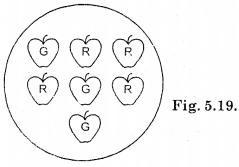
(c) Probability of getting a red apple. (See Fig. 5.19).
HBSE 8th Class Maths Solutions Chapter 5 Data Handling Ex 5.3 2
Solution:
(a) Number of possible outcomes for pointer stopping on D = 1.
Total number of outcomes of the experiment = 5.
∴ P(the pointer stopping on D) = \(\frac{1}{5}\)

(b) Total no. of aces = 4
Total number of outcomes = 52
∴ P (an ace) = \(\frac{4}{52}\) = \(\frac{1}{13}\)

(c) Number of Red apples = 4
Total number of outcomes (apples) = 7
∴ P (getting a red apple) = \(\frac{4}{7}\)

Question 4.
Numbers of 1 to 10 are written on ten separate slips (one number of one slip), kept in a box and mixed well. One slip is chosen from the box without looking into it. What is the probability of:
(i) getting a number 6 ?
(ii) getting a number less than 6 ?
(iii) getting a number greater than 6 ?
(iv) getting a 1-digit number ?
Solution:
(i) Number of slip written 6 on it = 1
Total number of outcomes (slips) = 10
∴ P (getting a number 6) = \(\frac{1}{10}\)

(ii) Numbers less than 6 are : 1, 2, 3, 4, 5 = 5
Total number of slips (outcomes) = 10
∴ P(getting a number less than 6) = \(\frac{5}{10}\) = \(\frac{1}{2}\)

(iii) Numbers greater than 6 are : 7, 8, 9, 10 = 4
∴ P(getting a number greater than 6) = \(\frac{4}{10}\) = \(\frac{2}{5}\)

(iv) One digit numbers are : 1,2, 3, 4, 5, 6, 7, 8 and 9 = 9.
Total number of outcomes =10
∴ P(1-digit number) = \(\frac{9}{10}\)

HBSE 8th Class Maths Solutions Chapter 5 Data Handling Ex 5.3

Question 5.
If you have a spinning wheel, with 3 green sectors, 1 blue sector and 1 red sector, what is the probability of getting a green sector ? What is the probability of getting a non blue sector ?
Solution:
Total number of outcomes (sectors) of the experiment = 3 + 1 + 1 = 5.
Number of green sector = 3
Number of non blue sector
= 3 green + 1 red 4
∴ P(getting a green sector) = \(\frac{3}{5}\)
P(getting a non blue sector) = \(\frac{4}{5}\)

HBSE 8th Class Maths Solutions Chapter 5 Data Handling Ex 5.3

Question 6.
Find the probabilities of the events given in Question 2.
Solution:
(i) (a) P(a prime number) = \(\frac{3}{6}\) = \(\frac{1}{2}\)
(b) P(not a prime number) = \(\frac{2}{6}\) = \(\frac{1}{3}\)
(ii) (a) P(a number greater than 5) = \(\frac{1}{6}\)
(b) P(a number not greater than 5) = \(\frac{4}{6}\) = \(\frac{2}{3}\)

HBSE 8th Class Maths Solutions Chapter 5 Data Handling Ex 5.3 Read More »

HBSE 8th Class Maths Solutions Chapter 5 Data Handling Ex 5.2

Haryana State Board HBSE 8th Class Maths Solutions Chapter 5 Data Handling Ex 5.2 Textbook Exercise Questions and Answers.

Haryana Board 8th Class Maths Solutions Chapter 5 Data Handling Exercise 5.2

Question 1.
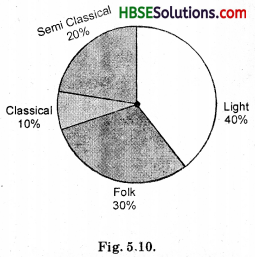
A survey was made to find the I type of music that a certain group of young people liked in a city. Adjoining pie chart shows the findings of this survey.
From this pie chart answer the following:
(i) If 20 people liked classical music, how many young people were surveyed ?
HBSE 8th Class Maths Solutions Chapter 5 Data Handling Ex 5.2 1
(ii) Which type of music is liked by the maximum number of people ?
(iii) If a cassette company were to make 1000 CD’s, how many of each type would they make ?
Solution:
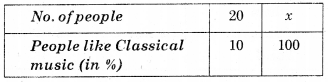
(i) No. of people liked classical music = 20.
Percentage of people liked classical music = 10%.
HBSE 8th Class Maths Solutions Chapter 5 Data Handling Ex 5.2 2
This is in direct variation
\(\frac{20}{10}\) = \(\frac{x}{100}\)
⇒ 10x = 20 × 100
⇒ x = \(\frac{2000}{10}\) = 200 people.
Aliter : If 10% = 20 people 20
then 100% = \(\frac{20}{10 \%}\) × 100%
= 200 people.

(ii) Light music.
(iii)No. of semi classical CD’s
= 20% of 1000 = \(\frac{20}{100}\) × 1000 = 200
No. of classical music CD’s
= 10% of 1000 = \(\frac{10}{100}\) × 1000 = 100
No. of Folk music CD’s
= \(\frac{30}{100}\) × 1000 = 300
No. of light music CD’s 40
= \(\frac{40}{100}\) × 1000 = 400.

HBSE 8th Class Maths Solutions Chapter 5 Data Handling Ex 5.2

Question 2.
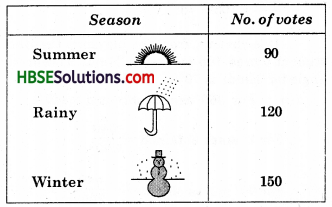
A group of 360 people were asked to vote for their favourite season from the three seasons rainy, winter and summer.
(i) Which season got the most votes ?
(ii) Find the central angle of each sector.
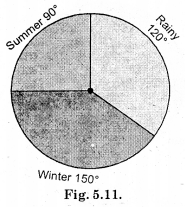
(iii) Draw a pie chart to show this information.
HBSE 8th Class Maths Solutions Chapter 5 Data Handling Ex 5.2 3
Solution:
(i) Winter.
(ii) Central angle = \(\frac{Value of Item}{Total value}\) 360°
∴ Central angle for Summer season
= \(\frac{90}{360}\) × 360° = 90°
Central angle for Rainy season
= \(\frac{120}{360}\) × 360° = 120°
and Central angle for Winter season
= \(\frac{150}{360}\) × 360° = 150°
HBSE 8th Class Maths Solutions Chapter 5 Data Handling Ex 5.2 4

Question 3.
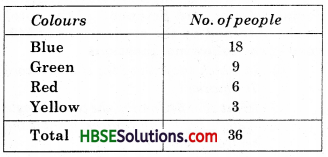
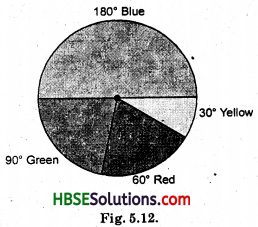
Draw a pie chart showing the following information. The table shows the colours preferred by a group of people.
HBSE 8th Class Maths Solutions Chapter 5 Data Handling Ex 5.2 5
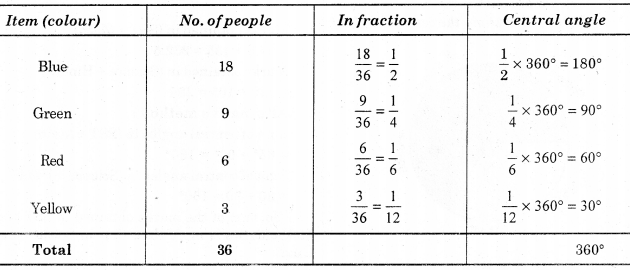
Find the proportion of each sector. For example, Blue is \(\frac{18}{360}\) = \(\frac{1}{2}\); Green is \(\frac{9}{36}\) = \(\frac{1}{4}\) and so on. Use this to find the corresponding angles.
Solution:
HBSE 8th Class Maths Solutions Chapter 5 Data Handling Ex 5.2 6
Now, we make the pie chart as-shown below musing protractor, compasses and ruler.
HBSE 8th Class Maths Solutions Chapter 5 Data Handling Ex 5.2 7

HBSE 8th Class Maths Solutions Chapter 5 Data Handling Ex 5.2

Question 4.
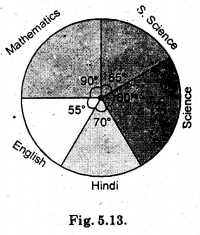
The adjoining pie chart gives the marks scored in an examination by a student in Hindi, English, Mathematics, Social Science and Science. If the total marks obtained by the students were 540, answer the following questions :
(i) In which subject did the student score 105 marks ?
[Hint: For 540 marks, the central angle = 360°. So, for 105 marks, what is the central angle ?]
(ii) How many more marks were obtained by the student in Mathematics than in Hindi ?
(iii) Examine whether the sum of the marks obtained m Social Science and Mathematics is more than that in Science and Hindi.
[Hint: Just study the central angles.]
HBSE 8th Class Maths Solutions Chapter 5 Data Handling Ex 5.2 8
Solution:
(i) For 540 marks, the central angle = 360°
So, for I mark, the central angle = \(\frac{360^{\circ}}{540}\)
So, for 105 marks, the central angle = \(\frac{360^{\circ}}{540}\) × 108 = 70°
∴ It is obvious, from the pie chart that the student scored 105 marks, in ‘Hindi’ as central angle for ‘Hindi’ is 70°.

(ii) ∵ For 360° marks obtained = 540
∴ For 1° mark obtained = \(\frac{540}{360^{\circ}}\)
For 90° marks obtained = \(\frac{540}{360^{\circ}}\) × 90°
∴ Marks obtained in Mathematics = 135
Marks obtained in Hindi = 105
Difference in marks = 135 – 105 = 30

(iii) Marks obtained in Social Science
= \(\frac{Total marks}{Total central angle}\) × central angle of an Item
= \(\frac{540}{360^{\circ}}\) × 65° = 97.5
Marks obtained in Science
= \(\frac{540}{360^{\circ}}\) × 80° = 120
Marks obtained in (SST + Math)
= 97.5 + 135 = 232.5
Marks obtained in (Science + Hindi)
= 120 + 105 = 225
Alternative method:
Sum of central angles in (SST + Math)
= 65° + 90° = 155°
Sum of central angles in (Science + Hindi)
= 80 + 70 = 150°
So, sum of the marks obtained in SST and Mathematics is more than that in Science and Hindi.

HBSE 8th Class Maths Solutions Chapter 5 Data Handling Ex 5.2

Question 5.
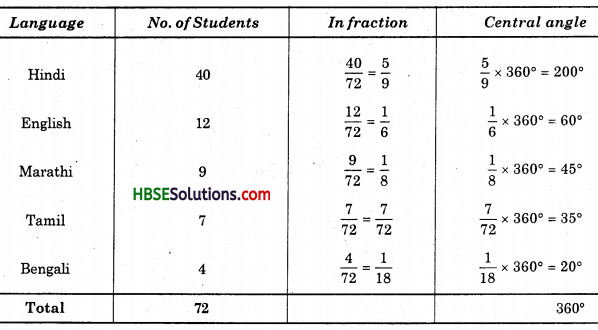
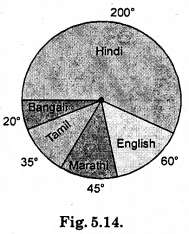
The number of students in a hostel, speaking different languages is given below. Display the data in a pie chart.
HBSE 8th Class Maths Solutions Chapter 5 Data Handling Ex 5.2 9
Solution:
HBSE 8th Class Maths Solutions Chapter 5 Data Handling Ex 5.2 10
Now, we make the pie chart as shown below
HBSE 8th Class Maths Solutions Chapter 5 Data Handling Ex 5.2 11

HBSE 8th Class Maths Solutions Chapter 5 Data Handling Ex 5.2 Read More »

HBSE 8th Class Maths Solutions Chapter 5 Data Handling Ex 5.1

Haryana State Board HBSE 8th Class Maths Solutions Chapter 5 Data Handling Ex 5.1 Textbook Exercise Questions and Answers.

Haryana Board 8th Class Maths Solutions Chapter 5 Data Handling Exercise 5.1

Question 1.
For which of these would you use a histogram to show the data ?
(a) The number of letters for different areas in a postman’s bag.
(b) The height of competitors in an athletics meet.
(c) The number of cassettes produced by 5 companies.
(d) The number of passenger boarding trains from 7:00 am to 7:00 pm at a station.
Give reasons for each.
Solution:
(a) Different areas A, B, C has a certain number of letters. So, there is no class interval exist. Thus, it is better to represent the data by a bar graph than by a histogram.
(b) Height of competitors lies between a certain range. So, class interval exist.
Therefore, we use a histogram to represent the data.
(c) There is no class interval. There is a name of five companies. So, we cant show the data by a histogram.
(d) Class intervals like 7 am – 9 am, 9 am – 11 am etc. are necessary to show the number of passengers boarding to trains during that time intervals.
So, a histogram is suitable representation of data.

Question 2.
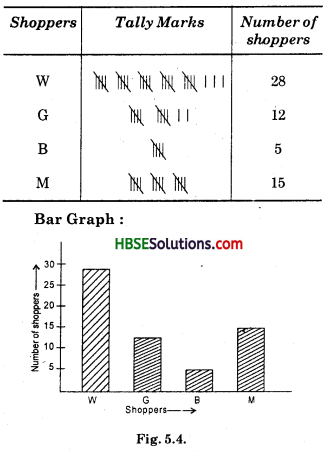
The shoppers who come to a departmental store are marked as : man (M), woman (W), boy (B) or girl (G). The following list gives the shoppers who came during the first hour in the morning :
WWWGBWWMGGMMWWWWG B MWB GGMWWMMWWWMWBWG MWWWWGWMMWWMWGWMGW M M B G G W.
Make a frequency distribution table using tally marks. Draw a bar graph to illustrate it.
Solution:
Frequency Distribution Table :
HBSE 8th Class Maths Solutions Chapter 5 Data Handling Ex 5.1 1

HBSE 8th Class Maths Solutions Chapter 5 Data Handling Ex 5.1

Question 3.
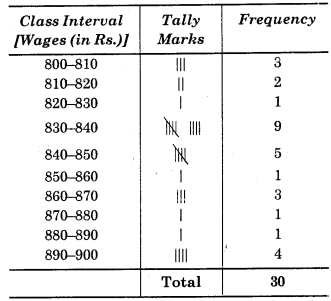
The weekly wages (in Rs.) of 30 workers in a factory are:
830, 835, 890, 810, 835, 836, 869, 845, 898, 890, 820, 860, 832, 833, 855, 845, 804, 808, 812, 840, 885, 835, 835, 836, 878, 840, 868, 890, 806, 840.
Using tally marks make a frequency table with intervals as 800-810, 810-820 and so on.
Solution:
HBSE 8th Class Maths Solutions Chapter 5 Data Handling Ex 5.1 2

Question 4.
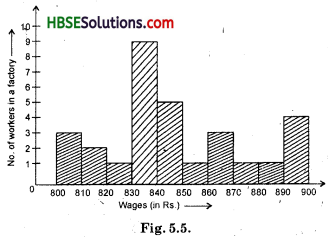
Draw a histogram for the frequency table made for the data in Question 3, and answer the following questions :
(i) Which group has the maximum number of workers ?
(ii) How many workers earn Rs. 850 and more ?
(iii) How many workers earn less than Rs. 850?
Solution:
HBSE 8th Class Maths Solutions Chapter 5 Data Handling Ex 5.1 3
(i) Group (830—840) has maximum number of workers.
(ii) No. of workers whose earning Rs. 850 and more = 1 + 3 + 1 + 1 + 4=10
(iii) No. of workers whose earning is less than 850 = 3 + 2 + 1 + 9 + 5 = 20.

HBSE 8th Class Maths Solutions Chapter 5 Data Handling Ex 5.1

Question 5.
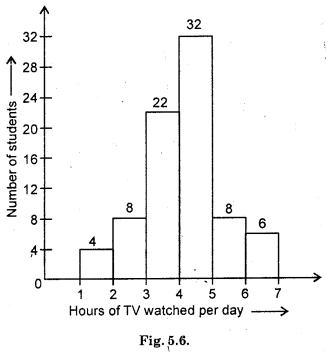
The number of hours for which students of a particular class watched television during holidays is shown through the given graph.
Answer the following:
(i) For how many hours did the maximum number of students watch TV ?
(ii) How many students watched TV for less than 4 hours ?
(iii) How many students spent more than 5 hours in watching TV ?
HBSE 8th Class Maths Solutions Chapter 5 Data Handling Ex 5.1 4
Solution:
(i) Maximum number of students watched TV = (4 – 5) hours.
(ii) No. of students watched TV less than 4 hours = 4 + 8 + 32 = 44 hours.
(iii) Students spent more than 5 hours in watching TV = 8 + 6 = 14 hours.

HBSE 8th Class Maths Solutions Chapter 5 Data Handling Ex 5.1 Read More »

HBSE 8th Class Maths Solutions Chapter 4 Practical Geometry Ex 4.5

Haryana State Board HBSE 8th Class Maths Solutions Chapter 4 Practical Geometry Ex 4.5 Textbook Exercise Questions and Answers.

Haryana Board 8th Class Maths Solutions Chapter 4 Practical Geometry Exercise 4.5

Question 1.
Draw the following :
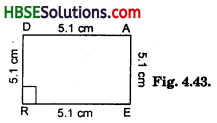
1. The square READ with RE = 5.1 cm.
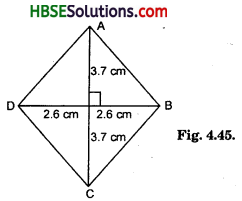
2. A rhombus whose diagonals are 5.2 cm and 6.4 cm long.
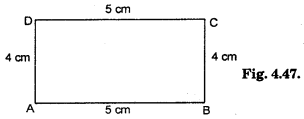
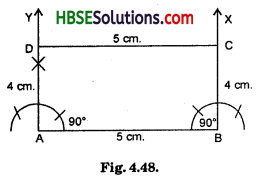
3. A rectangle with adjacent sides of lengths 5 cm and 4 cm.
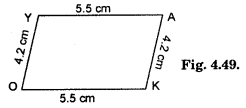
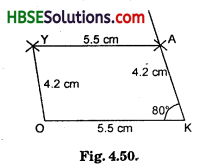
4. A parallelogram OKAY where OK = 5.5 cm and KA = 4.2 cm.
Solution:
(1) Rough Sketch:
HBSE 8th Class Maths Solutions Chapter 4 Practical Geometry Ex 4.5 1
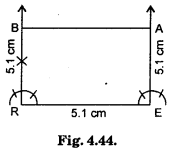
Steps of Construction:
(i) Draw RE = 5.1 cm.
(ii) Make ∠YRE = 90° and ∠REX = 90°
(iii) Cut off DR = AE = 5.1 cm.
(iv) Join DA.
(v) DEAR is a required square.
HBSE 8th Class Maths Solutions Chapter 4 Practical Geometry Ex 4.5 2

(2) Rough Sketch:
HBSE 8th Class Maths Solutions Chapter 4 Practical Geometry Ex 4.5 3
Theory : Diagonals of a rhombus bisect each other at 90°
i.e., OA = OC = \(\frac{6.4}{2}\) = 3.7 cm and OD = OB = \(\frac{5.2}{2}\) = 2.6 cm
∠AOB = 90°
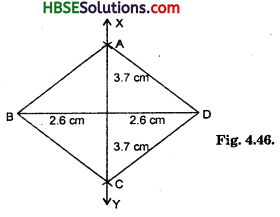
Steps of Construction :
(i) Draw BD = 5.2 cm.
(ii) Draw perpendicular bisector XY of BD.
(iii) Cut off OA = OC = 3.7 cm on the opposite side of DB.
HBSE 8th Class Maths Solutions Chapter 4 Practical Geometry Ex 4.5 4
(iv) Join AB, AD, CD and BC.
(v) ABCD is a required rhomus.

HBSE 8th Class Maths Solutions Chapter 4 Practical Geometry Ex 4.5

(3) Rough Sketch :
HBSE 8th Class Maths Solutions Chapter 4 Practical Geometry Ex 4.5 5
Theory : A rectangle has equal opposite sides and each angles are 90°.
i.e. AB = DC = 5 cm DA = CB = 4 cm
∠A = ∠B = ∠C = ∠D = 90°
Steps of Construction :
(i) Draw a line segment AB = 5 cm.
(ii) Construct ∠A = ∠B = 90°.
(iii) Cut off AD = BC = 4 cm.
(iv) Join DC.
(v) You have a required rectangle ABCD.
HBSE 8th Class Maths Solutions Chapter 4 Practical Geometry Ex 4.5 6

4. Theory: Opposite sides of a parallelogram are equal and sum of a adjacent angle is 180°.
HBSE 8th Class Maths Solutions Chapter 4 Practical Geometry Ex 4.5 7
i.e. OK = YA = 4.2 c.m. and OY = KA = 4.2 cm.
Steps of Construction :
(i) Draw OK = 5.5 cm
(ii) Let ∠K = 80°, so construct ∠OKX = 80°
(iii) Cut of FKA = 4.2 cm in KX.
(iv) Let the point be A.
HBSE 8th Class Maths Solutions Chapter 4 Practical Geometry Ex 4.5 8
(v) Draw arcs of 5.5 cm and 4.2 cm with centre as A and O respectively.
Note : You may take one angle of any measurement.

HBSE 8th Class Maths Solutions Chapter 4 Practical Geometry Ex 4.5 Read More »

HBSE 8th Class Maths Solutions Chapter 4 Practical Geometry Ex 4.4

Haryana State Board HBSE 8th Class Maths Solutions Chapter 4 Practical Geometry Ex 4.4 Textbook Exercise Questions and Answers.

Haryana Board 8th Class Maths Solutions Chapter 4 Practical Geometry Exercise 4.4

Question 1.
Construct the following quadrilaterals :
(i) Quadrilateral
DEAR
DE = 4 cm
EA = 5 cm
AR = 4.5 cm
∠E = 60°
∠A = 90°
(ii) Quadrilateral
TRUE
TR = 3.5 cm
RU = 3 cm
UE = 4 cm
∠R = 75°
∠U = 120°
Solution:
Rough Sketch :
HBSE 8th Class Maths Solutions Chapter 4 Practical Geometry Ex 4.4 1
Steps of Construction :
(i) Draw EA = 5 cm.
(ii) Make ∠DEA = 60° and ∠EAR = 90°.
HBSE 8th Class Maths Solutions Chapter 4 Practical Geometry Ex 4.4 2
(iii) Cut off RA = 4.5 cm and DE = 4 cm.
(iv) Join DR.
(v) DEAR is the required quadrilateral.

HBSE 8th Class Maths Solutions Chapter 4 Practical Geometry Ex 4.4

(ii) Rough Sketch
HBSE 8th Class Maths Solutions Chapter 4 Practical Geometry Ex 4.4 3
Steps of Construction :
(i) Draw RU = 3 cm.
(ii) Construct ∠XRU = 75° and ∠RUY = 120°.
(iii) Cut off RT = 3.5 cm and UE = 4 cm.
(iv) Join TE.
(v) TRUE is the required quadrilateral.

HBSE 8th Class Maths Solutions Chapter 4 Practical Geometry Ex 4.4 Read More »
HBSE 8th Class Maths Solutions Chapter 4 Practical Geometry Ex 4.3

Haryana State Board HBSE 8th Class Maths Solutions Chapter 4 Practical Geometry Ex 4.3 Textbook Exercise Questions and Answers.

Haryana Board 8th Class Maths Solutions Chapter 4 Practical Geometry Exercise 4.3

Question 1.
Construct the following quadrilaterals :
(i) Quadrilateral
MORE
MO = 6 cm
OR = 4.5 cm
∠M = 60°
∠O = 105°
∠R = 105°
(ii) Quadrilateral
PLAN
PL = 4 cm
LA = 6.5 cm
∠P = 90°
∠A= 110°
∠N = 85°
(iii) Parallel
HEAR
HE = 5 cm
EA = 6 cm
∠R = 85°
(iv) Quadrilateral
PLAN
OK = 7 cm
KA = 5 cm
Solution:
(i) Rough Sketch:
HBSE 8th Class Maths Solutions Chapter 4 Practical Geometry Ex 4.3 1
Steps of Construction :
(i) Take a line segment MO = 6 cm.
(ii) Construct ∠MOR = 105° and cut off OR = 4.5 cm.
(iii) At R construct ∠ORX = 105°.
(iv) Now, construct ∠OMY = 60°.
(v) Let MY intersect RX at E.
(vi) Thus, MORE is the required quadrilateral.
HBSE 8th Class Maths Solutions Chapter 4 Practical Geometry Ex 4.3 2

HBSE 8th Class Maths Solutions Chapter 4 Practical Geometry Ex 4.3

(ii) Rough Sketch:
HBSE 8th Class Maths Solutions Chapter 4 Practical Geometry Ex 4.3 3
Steps of Construction :
(i) Draw a line segment PL = 4 cm.
(ii) Construct ∠P = 90°, ∠L = 85° and cut off ∠A = 6.5 cm in ∠X.
(iii) Construct ∠YPL = 90°
(iv) PY intersect AZ at N.
(v) PLAN is required quadrilateral.
HBSE 8th Class Maths Solutions Chapter 4 Practical Geometry Ex 4.3 4

(iii) Rough Sketch:
HBSE 8th Class Maths Solutions Chapter 4 Practical Geometry Ex 4.3 5
Steps of Construction :
(i) Take HE = 5 cm.
(ii) Draw ∠HEA = 85° and cut off EA = 6 cm in EX.
(iii) ∠H = 108° – 85° = 95°
HBSE 8th Class Maths Solutions Chapter 4 Practical Geometry Ex 4.3 6
(iv) Construct ∠EHY = 95° and cut off HR = 6 cm.
(v) Join HR and RA.
(vi) We have a parallelogram HEAR.

HBSE 8th Class Maths Solutions Chapter 4 Practical Geometry Ex 4.3

(iv) Rough Sketch:
HBSE 8th Class Maths Solutions Chapter 4 Practical Geometry Ex 4.3 7
We know that each angle of rectangle is 90° and opposite sides are equal.
Steps of Construction :
(i) Draw a line segment OK = 7 cm.
(ii) Construct ∠OKX = 90° and cut off KA = 5 cm.
HBSE 8th Class Maths Solutions Chapter 4 Practical Geometry Ex 4.3 8
(iii) Also, construct ∠KOZ = 90° and cut off OY = 5 cm.
(iv) Join OY and AY.
(v) OKAY is the required rectangle.

HBSE 8th Class Maths Solutions Chapter 4 Practical Geometry Ex 4.3 Read More »
HBSE 8th Class Maths Solutions Chapter 4 Practical Geometry Ex 4.2

Haryana State Board HBSE 8th Class Maths Solutions Chapter 4 Practical Geometry Ex 4.2 Textbook Exercise Questions and Answers.

Haryana Board 8th Class Maths Solutions Chapter 4 Practical Geometry Exercise 4.2

Question 1.
Construct the following quadrilaterals :
(i) Quadrilateral
LIFT
LI = 4 cm
IF = 3 cm
TL = 2.5 cm
LF = 4.5 cm
IT = 4 cm
(ii) Quadrilateral
GOLD
OL = 7.5 cm
GL = 6 cm
GD = 6 cm
LD = 5 cm
OD = 10 cm
(iii) Rhombus BEND
BN = 5.6 cm, DE = 6.5 cm
HBSE 8th Class Maths Solutions Chapter 4 Practical Geometry Ex 4.2 1
Solution:
(i) Rough sketch:
You will observe that the measurements of all the sides of △LFI are given. So, draw △LFI first.
Steps of Construction :
(i) Take a line segment LF = 4.5 cm.
(ii) With centre as L and F cut off arcs of radii 4 cm and 3 cm respectively.
HBSE 8th Class Maths Solutions Chapter 4 Practical Geometry Ex 4.2 2
(iii) You will get △LFI.
(iv) Now, with L and I as centre cut off arcs of length TL = 2.5 cm and TI = 4 cm.
(v) Join TI, TL and TF.
(vi) You will get the required quadrilateral.

HBSE 8th Class Maths Solutions Chapter 4 Practical Geometry Ex 4.2

(ii) Rough Sketch:
Here, GL = 6 cm, GD = 6 cm and LD = 5 cm.
So, you can draw a △GLD quite easily.
HBSE 8th Class Maths Solutions Chapter 4 Practical Geometry Ex 4.2 3
Steps of Construction :
(i) Take a line segment GL = 6 cm.
(ii) Cut off GD = 6 cm and LD = 5 cm.
(ui) Join GD and LD.
(iv) You will obtain a △GLD.
(v) Now, with L and D as centre cut off two arcs of length 7.5 cm and 10 cm respectively to obtain a point O.
(vi) Join OL, OD and OG.
(vii) You will get a quadrilateral GOLD.
HBSE 8th Class Maths Solutions Chapter 4 Practical Geometry Ex 4.2 4

HBSE 8th Class Maths Solutions Chapter 4 Practical Geometry Ex 4.2

(iii) Rough Sketch:
HBSE 8th Class Maths Solutions Chapter 4 Practical Geometry Ex 4.2 5
OB = ON = \(\frac{5.6}{2}\) = 2.8 cm
∠BOD = ∠BOE = ∠EON = ∠BOD = 90°
[Diagonals of a Rhombus bisect each other at 90°]
Steps of Construction :
(i) Draw DE = 6.5 cm.
HBSE 8th Class Maths Solutions Chapter 4 Practical Geometry Ex 4.2 6
(ii) Draw perpendicular bisector XY of DE
HBSE 8th Class Maths Solutions Chapter 4 Practical Geometry Ex 4.2 7
(iii) Cut off an arc of OB = 2.8 cm with O as centre and ON = 2.8 cm on the line XY as indicated.
(iv) Join BD, BE, EN and DN.
(v) You will get the required rhombus BEND
HBSE 8th Class Maths Solutions Chapter 4 Practical Geometry Ex 4.2 8

HBSE 8th Class Maths Solutions Chapter 4 Practical Geometry Ex 4.2 Read More »
HBSE 8th Class Maths Solutions Chapter 4 Practical Geometry Ex 4.1

Haryana State Board HBSE 8th Class Maths Solutions Chapter 4 Practical Geometry Ex 4.1 Textbook Exercise Questions and Answers.

Haryana Board 8th Class Maths Solutions Chapter 4 Practical Geometry Exercise 4.1

Question 1.
Construct the following quadrilaterals :
(i) Quadrilateral
ABCD
AB = 4.5 cm
BC = 5.5 cm
CD = 4 cm
AD = 6 cm
AC = 7 cm
(ii) Quadrilateral
JUMP
JU = 3.5 cm
UM = 4 cm
MP = 5 cm
PJ = 4.5 cm
PU = 6.5 cm
(iii) Parallelogram
MORE
OR = 6 cm
RE = 4.5 cm
EO = 7.5 cm
(iv) Rhombus
BEST
BE = 4.5 cm
ET = 6 cm
Solution:
(i) Rough sketch
HBSE 8th Class Maths Solutions Chapter 4 Practical Geometry Ex 4.1 1
Steps of Construction :
(a) Take a line segment AC = 7 cm.
(b) Draw an arc of radius AB = 4.5 cm taking A as centre.
HBSE 8th Class Maths Solutions Chapter 4 Practical Geometry Ex 4.1 2
(c) Draw another arc of radius 5.5 cm taking C as centre.
(d) Let these two arc intersect at B.
(e) You have a triangle, ABC.
(f) Repeat your construction to obtain △ADC taking AD = 6 cm and DC = 4 cm.
(g) You will obtain a quadrilateral ABCD
HBSE 8th Class Maths Solutions Chapter 4 Practical Geometry Ex 4.1 3

(ii) Rough sketch
HBSE 8th Class Maths Solutions Chapter 4 Practical Geometry Ex 4.1 4
Steps of Construction :
HBSE 8th Class Maths Solutions Chapter 4 Practical Geometry Ex 4.1 5
(a) Draw a line segment PU = 4 cm.
(b) Taking P as centre cut off an arc of radius 4.5 cm.
(c) Taking U as centre cut off another arc of radius 3.5 cm.
(d) Let these two arcs intersect at J.
(e) Join PJ and UJ.
(f) Similarly, obtain the point M on the opposite side of diagonal PU.
(g) Hence, you have a required quadrilateral JUMP Fig. 4.10.

HBSE 8th Class Maths Solutions Chapter 4 Practical Geometry Ex 4.1

(iii) Rough Sketch:
Here, OR = ME = 6 cm
and ER = MO = 4.5 cm.
[Opposite sides of a llgm are equal]
HBSE 8th Class Maths Solutions Chapter 4 Practical Geometry Ex 4.1 6
Steps of Construction :
(i) Cut off EM = 6 cm.
(ii) Now, cut off an arc of radius 4.5 cm.
(iii) Let the point of intersection of these two arcs be CM.
HBSE 8th Class Maths Solutions Chapter 4 Practical Geometry Ex 4.1 7
(iv) Join EM and MO.
(v) You have a AEMO.
(vi) Similarly, obtain △EOR with arc lengths ER = 4.5 cm and OR = 6 cm.
(vii) You will obtain a parallelogram MORE.

(iv) Rough Sketch :
Here, BE = BT = ST = ES = 4.5 cm
[All sides of rhombus are equal]
Steps of Construction :
(a) Draw ET = 6 cm.
(b) Cut off two arcs EB = BT = 4.5 cm. taking E and T as centre.
(c) Similarly, on the opposite side of ET take two arcs of equal length.
(d) You will obtain a rhombus BEST [Fig. 4.13]
HBSE 8th Class Maths Solutions Chapter 4 Practical Geometry Ex 4.1 8

HBSE 8th Class Maths Solutions Chapter 4 Practical Geometry Ex 4.1 Read More »
HBSE 8th Class Maths Solutions Chapter 4 Practical Geometry InText Questions

Haryana State Board HBSE 8th Class Maths Solutions Chapter 4 Practical Geometry InText Questions and Answers.

Haryana Board 8th Class Maths Solutions Chapter 4 Practical Geometry InText Questions

Think, Discuss and Write (Page-58)

Question 1.
Arshad has five measurements of a quadrilateral ABCD. These are AB = 5 cm, ∠A = 50°, AC = 4 cm, BD = 5 cm and AD = 6 cm. Can he construct a unique quadrilateral? Give reasons for your answer.
Solution:
No, he cannot construct a quadrilateral because side BC or DC are not given. Although five measurements are given yet they are not sufficient to construct a quadrilateral.

Think, Discuss and Write (Page-60)

Question 1.
(i) We saw that 5 measurements of a quadrilateral can determine a quadrilateral uniquely. Do you think any five measurements of the quadrilateral can do this?
(ii) Can you draw a parallelogram BATS where BA = 5 cm, AT = 6 cm and AS = 6.5 cm? Why?
(iii) Can you draw a rhombus ZEAL where ZE = 3.5 cm, diagonal EL = 5 cm? Why?
(iv) A student attempted to draw a quadrilateral PLAY where PL = 3 cm, LA = 4 cm, AY = 4.5 cm, PY = 2 cm and LY = 6 cm, but could not draw it. What is the reason?
[Hint: Discuss it using a rogh sketch.]
Solution:
HBSE 8th Class Maths Solutions Chapter 4 Practical Geometry InText Questions 1
(i) No, It should be in a specific manner.
(ii) Yes, because opposite sides of a parallelogram are equal.
∴ BA = ST = 5 cm.
AT = BS = 6 cm.
and one diagonal AS = 6.5 is given
(iii) Yes, because all sides of a rhombus are equal.
HBSE 8th Class Maths Solutions Chapter 4 Practical Geometry InText Questions 2
HBSE 8th Class Maths Solutions Chapter 4 Practical Geometry InText Questions 3
(iv) PL + PY = 2 + 3 = 5 cm.
YL = 6 cm. ,
∴ PL + PY < YL
Sum of two sides in a A must be greater than the 3rd side.

HBSE 8th Class Maths Solutions Chapter 4 Practical Geometry InText Questions

Think, Discuss and Write (Page-62)

Question 1.
In the above example 2 (NCERT) , can we draw the quadrilateral by drawing △ABD first and then find the fourth point C?
Solution:
1. No, because the length of AB is not given.
HBSE 8th Class Maths Solutions Chapter 4 Practical Geometry InText Questions 4

Question 2.
Can you construct a quadrilateral PQRS with PQ = 3 cm, RS = 3cm, PS = 7.5 cm, PR = 8 cm and SQ = 4cm? Justify your answer.
Solution:
No, because sum of two sides in a △ must be greater than the 3rd side
In △ SPR
Here, PS + SR = 7.5 cm + 3 cm = 10.5cm.
and PR = 8 cm.
So, PS + SR > PR
But In △PQR, PQ + QR = 3 + 4 = 7 cm.
and PR = 8 cm.
∴ PQ + QR < PR.

HBSE 8th Class Maths Solutions Chapter 4 Practical Geometry InText Questions

Think, Discuss and Write (Page-64)

Question 1.
1. Can you construct the above quadrilateral MIST if we have 100° at M instead of 75°?
2. Can you construct the quadrilateral PLAN if PL m 6 cm, ∠A = 9.5 cm, ∠P = 75°, ∠L = 150° and ∠A = 140°? (Hint: Recall angle-sum property).
3. In a parallelogram, the lengths of adjacent sides are known. Do we still need measures of the angles to construct as in the example above ?
Solution:
1. Sum of all angles of a quadrilateral 100° + 105° + 120° + x = 360°
⇒ 325° + x = 360°
⇒ x = 360° – 325 ° = 35°.
∴ Quadrilateral MIST is possible to construct.
HBSE 8th Class Maths Solutions Chapter 4 Practical Geometry InText Questions 5

2. ∠P + ∠L + ∠A = 365°
75° + 150° + 140° = 365°
Sum of four angles in a quadrilateral is 360°.
∴ Quadrilateral is not possible to construct.

3. No, it is not required to have the measure of angles because opposite sides of a parallelogram are equal.
If AB = BC .
then, AB = DC, BC = AD.
HBSE 8th Class Maths Solutions Chapter 4 Practical Geometry InText Questions 6

Think, Discuss and Write (Page-66)

Question 1.
1. In the example 4 (NCERT), we first drew BC. Instead, what could have been be the other starting points ?
2. We used some five measurements to draw quadrilaterals so far. Can there be different sets of five measurements (other than seen so far) to draw a quadrilateral ?
The following problems may help you in answering the question :
(i) Quadrilateral ABCD with AB = 5 cm, BC = 5.5 cm, CD = 4 cm, AD = 6 cm and ∠B = 80°.
(ii) Quadrilateral PQRS with PQ = 4.5 cm, ∠P = 70°, ∠Q = 100°, ∠R = 80° and ∠S = 110°.
Solution:
You can start with drawing CD = 6.5 cm and make ∠C = 80° and cut off BC = 5 cm and then make ∠B = 105°.
(2) (i) Rough Sketch :
HBSE 8th Class Maths Solutions Chapter 4 Practical Geometry InText Questions 7
We can construct a quadrilateral ABCD with four sides and one angle.

(ii) Rough Sketch :
HBSE 8th Class Maths Solutions Chapter 4 Practical Geometry InText Questions 8
Here, at least one side RQ or PS in required. So, data is in sufficient.
You may construct if
(i) Two angles and two sides, e.g. if ∠A = 90, ∠B = 80, AD = 6 cm BC = 5 cm.
(ii) Four angle and two sides e.g. PQ = 4.5 cm, ∠P = 65°, ∠Q = 110°,
∠QR = 4.7 cm, ∠R = 115°.

HBSE 8th Class Maths Solutions Chapter 4 Practical Geometry InText Questions

Think, Discuss and Write (Page-67)

Question 1.
1. How will you construct a rectangle PQRS if you know only the lengths PQ and QR?
2. Construct the kite EASY if AY = 8 cm, EY = 4 cm and SY = 6 cm (Fig.). Which properties of the kite did you use in the process?
HBSE 8th Class Maths Solutions Chapter 4 Practical Geometry InText Questions 9
Solution:
HBSE 8th Class Maths Solutions Chapter 4 Practical Geometry InText Questions 10
1. We know that opposite sides of a rectangle are equal and each angle is 90°.
∴ If PQ and QR are given, then we have PQ = RS and QR = PS
∠P = ∠Q = ∠R = ∠S = 90°.
Which is sufficient to construct a rectangle PQRS

(2) Rough Sketch:
HBSE 8th Class Maths Solutions Chapter 4 Practical Geometry InText Questions 11
A kite has two isosceles triangles with common base.
i.e. EY = EA and YS = AS.
Steps of Construction:
(i) Draw YA = 8 cm
(ii) Take arcs of 4 cm with centre as Y and A respectively.
(iii) Let these arcs intersect at E.
(iv) Similarly, on the opposite side of YA take two arcs YS = SA = 6 cm and obtain the point S.
(v) Join EY, EA, YS and AS.
(vi) You have a required kite EASY.
Second Method : You can draw perpendicular bisector of YA and cut off EY = 4 cm and YS = 6 cm.
HBSE 8th Class Maths Solutions Chapter 4 Practical Geometry InText Questions 12

HBSE 8th Class Maths Solutions Chapter 4 Practical Geometry InText Questions Read More »