Author name: Bhagya

HBSE 8th Class Maths Solutions Chapter 8 Comparing Quantities Ex 8.2

Haryana State Board HBSE 8th Class Maths Solutions Chapter 8 Comparing Quantities Ex 8.2 Textbook Exercise Questions and Answers.

Haryana Board 8th Class Maths Solutions Chapter 8 Comparing Quantities Exercise 8.2

Question 1.
A man got a 10% increase in his salary. If his new salary is Rs. 1,54,000, find his original salary.
Solution:
10% increase in salary means
If previous salary is Rs. 100, increased salary = Rs. 110
If new salary is Rs. 110, original salary is Rs. 100
New salary is Rs. 1,54,000, original salary is = \(\frac{100}{110}\) × 154000 = 1,40,000
Original salary = Rs. 1,40,000.

Question 2.
On Sunday 845 people went to the Zoo. On Monday only 169 people went. What is the percent decrease in the people visiting the Zoo on Monday.
Solution:
On Sunday Zoo visitor = 845 persons
On Monday Zoo visitor = 169 persons
Decrease in people visiting Zoo on Monday
= 845 – 169 = 676
Percent decrease on Monday
= \(\frac{Decrease}{Visitor on Sunday}\) × 100
= \(\frac{676}{845}\) × 100 = 80%

HBSE 8th Class Maths Solutions Chapter 8 Comparing Quantities Ex 8.2

Question 3.
A shopkeeper buys 80 articles for Rs. 2,400 and sells them for a profit of 16%. Find the selling price of one article.
Solution:
C.P. of all 80 articles = Rs. 2400
16% profit means if C.P. is Rs. 100, S.P. is Rs. 116
Therefore, if C.P. is Rs. 2400,
S P = \(\frac{116}{100}\) × 2400 = 2784
S.P. of 80 articles = Rs. 2784
∴ S.P. of one article = Rs. 34.80.

Question 4.
The cost of an article was Rs. 15,500. Rs. 450 were spent on its repairs. If it is sold for a profit of 15%, find the selling price of the article.
Solution:
C.P. of article = Rs. 15500
Charge on its repairing = Rs. 450
So, new C.P. = Rs. 15500 + Rs. 450
= 15950
At profit of 15% is sold
So, S.P. = 115% of C.P,
= \(\frac{115}{100}\) × 15950
= 18342.50
∴ S.P. = Rs. 18342.50.

HBSE 8th Class Maths Solutions Chapter 8 Comparing Quantities Ex 8.2

Question 5.
A VCR and TV were bought for Rs. 8,000 each. The shopkeeper made a loss of 4% on the VCR and a profit of 8% on the TV. Find the gain or loss percent on the whole transaction.
Solution:
C.P. ofT.V. = Rs. 8000
C.P. of VCR = Rs. 8000
4% loss on VCR means
If C.P. is Rs. 100, S.P. is Rs. 96
So, if C.P. is 8000, S.P. will be
= \(\frac{96}{100}\) × 8000 = 7680
∴ S.P. of VCR = Rs. 7680
8% profit on TV means
If C.P. is Rs. 100, S.P. is Rs. 108
So if C.P. is Rs. 8000, S.P. will be
\(\frac{108}{100}\) × 8000 = 8640
∴ S.P. of T.V. = Rs. 8640
Overall C.P. of TV and VCR
= 8000 + 8000 = 16,000
Overall S.P. of TV and VCR
= 7680 + 8640 = 16320
∵ Overall S.P. > Overall C.P.
⇒ Profit of Rs. (16320 – 16000)
= Rs. 320.
Question 6.
During a sale, a shop offered a discount of 10% on the marked prices of all the items. What would a customer have to pay for a pair of jeans marked at Rs. 1450 and two shirts marked at Rs. 850 each ?
Solution:
10% discount on marked price (M.P.)
⇒ Article of M.P. Rs. 100, has S.P. = Rs. 90
So, if article of M.P. Rs. 1450 has S.P.
= Rs.\(\frac{90}{100}\) × 1450
= Rs. 1305
and if the article of M.P. 1700 has S.P.
= Rs. \(\frac{90}{100}\) × 1700 = Rs. 1530
Two shirts M.P. = 850 × 2 = Rs. 1700
So customer have to pay for Jeans and two shirts
= Rs. 1305 + Rs. 1530 = Rs. 2835.

HBSE 8th Class Maths Solutions Chapter 8 Comparing Quantities Ex 8.2

Question 7.
A milkman sold two of his buffaloes for Rs. 20,000 each. On one he made a gain of 5% and on the other a loss of 10%. Find his overall gain or loss.
[Hint: Find C.P. of each]
Solution:
S.P. of each buffalo = Rs. 20000
5% gain means
⇒ a profit of Rs. 5 on C.P. of Rs. 100
⇒ If S.P. is of Rs. 105, C.P. is Rs. 100
∴ If S.P. is Rs. 20,000
C.P. = Rs. \(\frac{100}{105}\) × 20,000 = 19048
∴ C.P. of one of buffalo = Rs. 19048
10% loss on other buffalo means
If S.P. is 90, C.P. is Rs.. 100
So, if S.P. is Rs. 20,000,
C.P. = Rs. \(\frac{100}{90}\) × 20,000
= Rs. 22222
∴ C.P. of other buffalo = Rs. 22222
∴ Overall S.P. = Rs. 20,000 + Rs. 20000
= Rs. 40,000
Overall C.P. = Rs. 19048 + Rs. 22222
= Rs. 41270
∵ Overall S.P. > Overall C.P.
⇒ Profit of Rs. (41270 – 40000) = Rs. 1270
∴ Net profit = Rs. 1270.
Question 8.
The price of a TV is Rs. 13,000. The sales tax charged on it is at the rate of 12%. Find the amount that Vinod will have to pay if he buys it.
Solution:
Price of TV = Rs. 13,000
Sale tax charge = 12%
∴ Sale tax on T.V.= 12% of Rs. 13,000
= Rs. \(\frac{12}{100}\) × 13000
= Rs. 1560
∴ Amound paid by Vinod for TV
= Rs. 13000 + Rs. 1560
= Rs. 14560.

HBSE 8th Class Maths Solutions Chapter 8 Comparing Quantities Ex 8.2

Question 9.
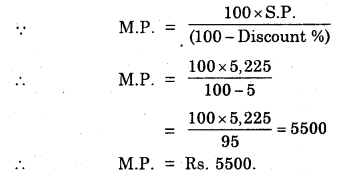
Arun bought a pair of skates of a sale where the discount given was 20%. If the amount he pays is Rs. 1,600, find the marked price.
Solution:
20% discount means
For M.P. of Rs. 100, S.P.
= Rs. (100 – 20) = Rs. 80
So, if S.P. = Rs. 80, M.P. is Rs. 100
If S.P. = Rs. 1600, M.P. will be Rs. \(\frac{100}{80}\) × 1600
= 2000.
M.P. of skates Rs. 2000.

Question 10.
I purchased a hair-dryer for Rs. 5,400 including 8% VAT. Find the price before VAT was added.
Solution:
8% VAT included means.
Rs. 8 is added to original price of Rs. 100
⇒ If including VAT price is Rs. 108, original price = Rs. 100
So including VAT price is Rs. 5400, original price
= RS \(\frac{100}{108}\) × 5400
= Rs. 5000
∴ Price before VAT = Rs. 5000.

HBSE 8th Class Maths Solutions Chapter 8 Comparing Quantities Ex 8.2 Read More »

HBSE 8th Class Maths Solutions Chapter 8 Comparing Quantities Ex 8.1

Haryana State Board HBSE 8th Class Maths Solutions Chapter 8 Comparing Quantities Ex 8.1 Textbook Exercise Questions and Answers.

Haryana Board 8th Class Maths Solutions Chapter 8 Comparing Quantities Exercise 8.1

Question 1.
Find the ratio of the following :
(a) Speed of a cycle 15 km per hour to the speed of scooter 30 km per hour.
(b) 5 m to 10 km.
(c) 50 paise to Rs. 5.
Solution:
(a) Ratio of speed of cycle to speed of scooter = 15 : 30 = 1 : 2

(b) Ratio of 5 m to 10 km
⇒ Ratio of 5 m to 100000 m = 5 : 100000 = 1 : 20000

(c) Ratio of 50 paise to Rs. 5
⇒ Ratio of 50 paise to 500 paise
= 50 : 500 = 1 : 10.

Question 2.
Convert the following ratios to percentages.
(а) 3 : 4
(b) 2 : 3
Solution:
(a) Ratio = 3 : 4
Fraction = \(\frac{3}{4}\)
Percentage = \(\frac{3 \times 25}{4 \times 25}\) = \(\frac{75}{100}\) = 75%

(b) Ratio = 2 : 3
Fraction = \(\frac{2}{3}\)
Percentage = \(\frac{2}{3} \times \frac{100}{100}\) = \(\frac{200}{3} \times \frac{1}{100}\)
= 66\(\frac{2}{3}\)%.

HBSE 8th Class Maths Solutions Chapter 8 Comparing Quantities Ex 8.1

Question 3.
72% of 25 students are good in mathematics. How many are not good in mathematics ?
Solution:
Total percent good in mathematics and not good in mathematics = 100
72 + percentage of student not good in mathematics = 100
∴ Percentage of students not good in mathematics = 100 – 72 = 28
So number of students hot good in mathematics = 28% of 25
= \(\frac{28}{100}\) × 25 = 7 students.

Question 4.
A football team won 10 matches out of the total number of matches they played. If their win percentage was 40, then how many matches did they play in all ?
Solution:
Let the total number of matches played by football team be x their win was 40%.
So, 40% of x = 10
\(\frac{40}{100}\) × x = 10
x = \(\frac{10 \times 100}{40}\) = 25
Number of played matches = 25.

HBSE 8th Class Maths Solutions Chapter 8 Comparing Quantities Ex 8.1

Question 5.
If Chameli had Rs. 600 left after spending 75% of her money, how much did she have in the beginning ?
Solution:
Let she had Rs. x in the beginning
Chameli spent 75% of her money.
So she left 100 – 75 = 25% of her moriey.
So, 25% of x = Rs. 600
\(\frac{25}{100}\) × x = 600
x = \(\frac{600 \times 100}{25}\) = 2400
Chameli had Rs. 2400 in the beginning.

Question 6.
If 60% people in a city like cricket, 30% like football and the remaining like other games, then what percent of the people like other games ? If the total number of people are .50 lakh, find the exact number who like each type of game.
Solution:
Total percent = 100
60% people like cricket
30% people like football
remaining like other game
So 100 – (60 + 30) = 10% like other game.
Total no. of people = 50 lakh
No. of people like cricket
= 60% of 50 lakh
= \(\frac{60}{100}\) × 50 lakh = 30 lakh
No. of people like football
= 30% of 50 lakh on
= \(\frac{30}{100}\) × 50 lakh = 15 lakh
No. of people like other game
= 10% of 50 .lakh
= \(\frac{10}{100}\) × 50 lakh = 5 lakh.

HBSE 8th Class Maths Solutions Chapter 8 Comparing Quantities Ex 8.1 Read More »

HBSE 8th Class Maths Solutions Chapter 7 Cube and Cube Roots Ex 7.2

Haryana State Board HBSE 8th Class Maths Solutions Chapter 7 Cube and Cube Roots Ex 7.2 Textbook Exercise Questions and Answers.

Haryana Board 8th Class Maths Solutions Chapter 7 Cube and Cube Roots Exercise 7.2

Question 1.
Find the cube root of each of the following numbers by prime factorisation method s
(i) 64
(ii) 512
(iii) 10648
(iv) 27000
(v) 15625
(vi) 13824
(vii) 110592
(viii) 46656
(ix) 175616
(x) 91125.
Solution:
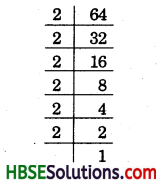
(i) 64 = \(\underline{2 \times 2 \times 2}\) × \(\underline{2 \times 2 \times 2}\)
HBSE 8th Class Maths Solutions Chapter 7 Cube and Cube Roots Ex 7.2 1
= 23 × 23
= 2 × 2
∴ \(\sqrt[3]{64}\) = 4

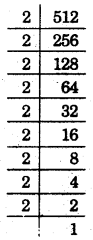
(ii) 512 = \(\underline{2 \times 2 \times 2}\) × \(\underline{2 \times 2 \times 2}\) × \(\underline{2 \times 2 \times 2}\)
HBSE 8th Class Maths Solutions Chapter 7 Cube and Cube Roots Ex 7.2 2
= 23 × 23 × 23
= 2 × 2 × 2
∴ \(\sqrt[3]{512}\) = 8

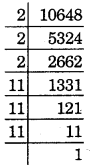
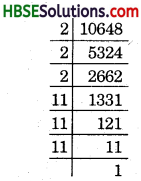
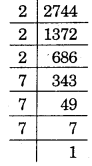
(iii) 10648 = \(\underline{2 \times 2 \times 2}\) × \(\underline{11 \times 11 \times 11}\)
HBSE 8th Class Maths Solutions Chapter 7 Cube and Cube Roots Ex 7.2 3
= 23 × 113
= 2 × 11
∴ \(\sqrt[3]{10648}\) = 22

HBSE 8th Class Maths Solutions Chapter 7 Cube and Cube Roots Ex 7.2

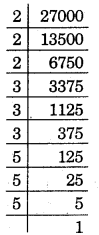
(iv) 27000 = 2 × 2 × 2 × 3 × 3 × 3 × 5 × 5 × 5
HBSE 8th Class Maths Solutions Chapter 7 Cube and Cube Roots Ex 7.2 4
= 23 × 33 × 53
∴ \(\sqrt[3]{27000}\) = 2 × 3 × 5
= 30

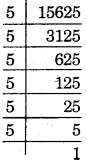
(v) 15625 = 5 × 5 × 5 × 5 × 5 × 5
HBSE 8th Class Maths Solutions Chapter 7 Cube and Cube Roots Ex 7.2 5
= 53 × 53
= 5 × 5
∴ \(\sqrt[3]{15625}\) = 25

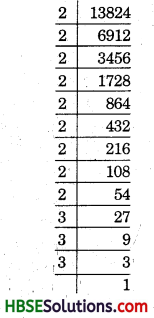
(vi) 13824 = \(\underline{2 \times 2 \times 2}\) × \(\underline{2 \times 2 \times 2}\) ×  \(\underline{2 \times 2 \times 2}\) × \(\underline{3 \times 3 \times 3}\)
HBSE 8th Class Maths Solutions Chapter 7 Cube and Cube Roots Ex 7.2 6
= 23 × 23 × 23 × 33
= 2 × 2 × 2 × 3
∴ \(\sqrt[3]{13824}\) = 24

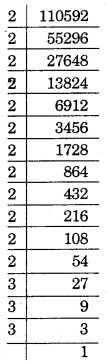
(vii) 110592 = \(\underline{2 \times 2 \times 2}\) × \(\underline{2 \times 2 \times 2}\) ×  \(\underline{2 \times 2 \times 2}\) × \(\underline{2 \times 2 \times 2}\) × \(\underline{3 \times 3 \times 3}\)
HBSE 8th Class Maths Solutions Chapter 7 Cube and Cube Roots Ex 7.2 7
= 23 × 23 × 23 × 23 × 33
= 2 × 2 × 2 × 2 × 3
∴ \(\sqrt[3]{110592}\) = 48

HBSE 8th Class Maths Solutions Chapter 7 Cube and Cube Roots Ex 7.2

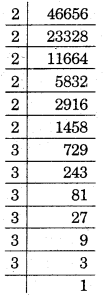
(viii) 46656 = \(\underline{2 \times 2 \times 2}\) × \(\underline{2 \times 2 \times 2}\) × \(\underline{3 \times 3 \times 3}\) × \(\underline{3 \times 3 \times 3}\)
HBSE 8th Class Maths Solutions Chapter 7 Cube and Cube Roots Ex 7.2 8
= 23 × 23 × 33 × 33
= 2 × 2 × 3 × 3
∴ \(\sqrt[3]{46656}\) = 36

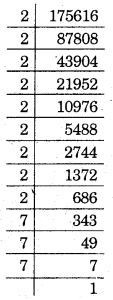
(ix) 175616 = \(\underline{2 \times 2 \times 2}\) × \(\underline{2 \times 2 \times 2}\) × \(\underline{2 \times 2 \times 2}\) × \(\underline{7 \times 7 \times 7}\)
HBSE 8th Class Maths Solutions Chapter 7 Cube and Cube Roots Ex 7.2 9
= 23 × 23 × 23 × 73
= 2 × 2 × 2 × 7
∴ \(\sqrt[3]{175616}\) = 56

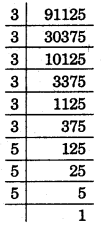
(x) 91125 = \(\underline{3 \times 3 \times 3}\) × \(\underline{3 \times 3 \times 3}\) × \(\underline{5 \times 5 \times 5}\)
HBSE 8th Class Maths Solutions Chapter 7 Cube and Cube Roots Ex 7.2 10
= 33 × 33 × 53
= 3 × 3 × 5
∴ \(\sqrt[3]{91125}\) = 45

HBSE 8th Class Maths Solutions Chapter 7 Cube and Cube Roots Ex 7.2

Question 2.
State true or false.
(i) Cube of any odd number is even
(ii) A perfect cube does not end with two zeros
(iii) If square of a number ends with 5, then its cube ends with 25.
(iv) There is no perfect cube which ends with 8.
(v) The cube of a two digit number may be a three digit number.
(vi) The cube of a two digit number may have seven or more digits.
(vii) The cube of a single digit number may be a single digit number.
Solution:
(i) False,
(ii) True,
(iii) True,
(iv) False,
(v) False,
(vi) False,
(vii) True

Question 3.
You ar told that 1,331 is a perfect cube. Can you guess without factorisation what is its cube root? Similarly, guess the cube roots of 4913, 12167, 32768.
Solution:
The given number is 1331
Step 1. From groups of three starting from the rightmost digit of 1331 is 1331.In this case one group 331 has three digits whereas 1 has only two digits.

Step 2. Take 331.
The digit 1 is at its one’s place.
We take the one’s place of the required cube root as 1.

Step 3. Take the other group is 1.
Cube of 1 is 1 and cube of 2 is 8.1 lies between 0 and 8.
The smaller number among 1 and 2 is 1. The one’s place of 1 is 1 itself. Take 1 as ten’s place of the cube root of 1331.
Thus, \(\sqrt[3]{1331}\) = 11

HBSE 8th Class Maths Solutions Chapter 7 Cube and Cube Roots Ex 7.2

Similarly, 4913
Step 1. 4913
Step 2. Take 913
The digit 3 is at its one’s place we take the one’s place of the required cube root as (3 × 3 × 3 = 27)7.

Step 3. Take the other group is 4. Cube of 1 is 1 and cube of 2 is 8. 4 lies between 1 and 8.
The smaller number among 1 and 2 is 1. The one’s place of 1 is 1 itself. Take 1 as ten’s place of the cube root of 4913.
Thus, \(\sqrt[3]{4913}\) = 17

Similarly, 12167
Step 1. 12167
Step 2. 7 × 7 × 7 = 343 i.e. one’s place is 3
Step 3. 12, 2 × 2 × 2 = 8 and 3 × 3 × 3 = 27 8 < 12 < 27
The smaller number among 2 and 3 is 2. The one’s place of 2 is 2 itself. Take 2 as tens place of the cube root of 12167.
Thus, \(\sqrt[3]{12167}\) = 23

Similarly, 32768
Step 1. 32768
Step 2. 8 × 8 × 8 = 512
i.e. one’s place is 2
Step 3. 32, 3 × 3 × 3 = 27
4 × 4 × 4 = 64
The smaller number along 3 and 4 is 3. The one’s place of 3 is 3 itself. Take 3 as ten’s place of the cube root 32768.
Thus \(\sqrt[3]{32768}\) = 32

HBSE 8th Class Maths Solutions Chapter 7 Cube and Cube Roots Ex 7.2 Read More »

HBSE 8th Class Maths Solutions Chapter 7 Cube and Cube Roots Ex 7.1

Haryana State Board HBSE 8th Class Maths Solutions Chapter 7 Cube and Cube Roots Ex 7.1 Textbook Exercise Questions and Answers.

Haryana Board 8th Class Maths Solutions Chapter 7 Cube and Cube Roots Exercise 7.1

Question 1.
Which of the following numbers are not perfect cubes:
(i) 216
(ii) 128
(iii) 1000
(iv) 100
(v) 46656.
Solution:
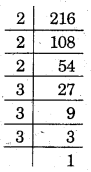
(i) 216 = \(\underline{2 \times 2 \times 2}\) × \(\underline{3 \times 3 \times 3}\)
HBSE 8th Class Maths Solutions Chapter 7 Cube and Cube Roots Ex 7.1 1
= 23 × 32
= (2 × 3)3
= (6)3
Which is a perfect cube.

(ii) 128 = \(\underline{2 \times 2 \times 2}\) × \(\underline{2 \times 2 \times 2}\) × 2
HBSE 8th Class Maths Solutions Chapter 7 Cube and Cube Roots Ex 7.1 2
= 23 × 23 × 2
∴ 2 does not appear in a group of three.
Hence, 128 is not a percent cube.

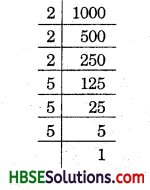
(iii) 1000 = 2 × 2 × 2 × 5 × 5 × 5
HBSE 8th Class Maths Solutions Chapter 7 Cube and Cube Roots Ex 7.1 3
= 2 × 5
= 10
Which is a perfect cube.

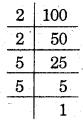
(iv) 100 = 2 × 2 × 5 × 5
HBSE 8th Class Maths Solutions Chapter 7 Cube and Cube Roots Ex 7.1 4
Prime factor of 100 is
2 × 2 × 5 × 5
So, 100 is not a perfect cube.

HBSE 8th Class Maths Solutions Chapter 7 Cube and Cube Roots Ex 7.1

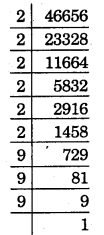
(v) 46656 = 2 × 2 × 2 × 2 × 2 × 2 × 9 × 9 × 9
HBSE 8th Class Maths Solutions Chapter 7 Cube and Cube Roots Ex 7.1 5
= 2 × 2 × 9
= 36
Which is a perfect cube.

Question 2.
Find the smallest number by which each of the following number must be multified to obtain a perfect cube.
(i) 243
(ii) 256
(iii) 72
(iv) 675
(v) 100.
Solution:
(i) 243 = 3 × 3 × 3 × 3 × 3
The prime factor 3 × 3 = 9 does not appear in a group of three. Therefore 243 is not a perfect cube. To make it a cube, we need one more 3.
In that case,
243 × 3 = \(\underline{3 \times 3 \times 3}\) × \(\underline{3 \times 3 \times 3}\)
= 729,
which is a perfect cube.
Hence the required smallest number by which 243 should be multiplied to make a perfect is 3.

(ii) 256 = \(\underline{2 \times 2 \times 2}\) × \(\underline{2 \times 2 \times 2}\) × 2 × 2
The prime factor 2 × 2 = 4 does not appear in a group of three. Therefore 256 is not a perfect cube. To make it cube, we need one more 2., In that case,
256 × 2 = \(\underline{2 \times 2 \times 2}\) × \(\underline{2 \times 2 \times 2}\) × \(\underline{2 \times 2 \times 2}\)
= 512
Hence the required smallest number by which 256 should be multiplied to make a perfect cube is 2.

(iii) 72 = \(\underline{2 \times 2 \times 2}\) × \(\underline{3 \times 3}\)
The prime factor 3 does not appear in a group of three. Therefore 72 is not a perfect cube. To make it a cube, we need one more 3. In that case
72 = \(\underline{2 \times 2 \times 2}\) × \(\underline{3 \times 3 \times 3}\)
or, 72 × 3
= 216,
which is a perfect cube.
Hence, the required smallest number by which 72 should be multiplied to make a perfect cube is 3.

HBSE 8th Class Maths Solutions Chapter 7 Cube and Cube Roots Ex 7.1

(iv) 675 = \(\underline{3 \times 3 \times 3}\) × 5 × 5
The prime factor 5 does not appear in a group of three. Therefore 675 is not a perfect cube. To make it a cube, we need one more 5. In that case
675 × 5 = \(\underline{3 \times 3 \times 3}\) × \(\underline{5 \times 5 \times 5}\)
= 3375.
which is a perfect cube.
Hence, the required smallest number by which 675 should be multiplied to make a perfect cube is 5.

(v) 100 = \(\underline{2 \times 2}\) × \(\underline{5 \times 5}\)
The prime factor 2 and 5 do not appear in a group of three. Therefore 100 is not a perfect cube. To make it a cube, we need one more 2 and 5 respectively. In that case
100 × 10 = \(\underline{2 \times 2 \times 2}\) × \(\underline{5 \times 5 \times 5}\)
= 1000,
which is a perfect cube. Hence the required smallest number by which 100 should be multiplied to make a perfect cube is (2 × 5) = 10.

Question 3.
Find the smallest whole number by which each of the following numbers must be divided to obtain a perfect cube :
(i) 81
(ii) 128
(iii) 135
(iv) 192
(v) 704
Solution:
(i) 81 = \(\underline{3 \times 3 \times 3}\) × 3
The prime factor 3 does not appear in a group of three. So 81 is not a perfect cube. In the factorisation 3 appears only one time. So if we divide 81 by 3, then the prime factorisation of the quotient will not contain 3.
81 ÷ 3 = 3 × 3 × 3
Further the perfect cube in that case is 81 , 3 = 27. Hence the smallest whole number by which 81 should be divided to make it perfect cube is 3.

(ii) 128 = \(\underline{2 \times 2 \times 2}\) × \(\underline{2 \times 2 \times 2}\) × 2
The prime factor 2 does not appear in a group of three. So 128 is not a perfect cube. In the factorisation 2 appear only one time. So if we divide 128 by 2, then the prime factorisation of the quotient will not contain 2
128 ÷ 2 = \(\underline{2 \times 2 \times 2}\) × \(\underline{2 \times 2 \times 2}\)
Further the perfect cube in that case is
128 ÷ 2 = 64.
Hence the smallest whole number by which 128 should be divided to make it perfect cube is 2.

HBSE 8th Class Maths Solutions Chapter 7 Cube and Cube Roots Ex 7.1

(iii) 135 = \(\underline{3 \times 3 \times 3}\) × 5
The prime Factor 5 × 5 = 25 does not appear in a group of three. So, 135 is not a Perfect Cube. In the factorisation 5 appears only one times. So if we divide 135 by 5, then the prime factorisation of the quotient will not contain 5.
135 ÷ 5 = 3 × 3 × 3
Further then perfect cube in that case is
135 ÷ 5 = 27
Hence the smallest whole number by which 135 should be divided to make it perfect cube is 5.

(iv) 192 = \(\underline{2 \times 2 \times 2}\) × \(\underline{2 \times 2 \times 2}\) × 3
The prime factor 3 does not appear in a group of three, so, 192 is not a perfect cube. In the factorisation 3 appears only one times. So, if we divide 192 by 3, then the prime factorisation of the quotient will not contain 3.
192 ÷ 3 = \(\underline{2 \times 2 \times 2}\) × \(\underline{2 \times 2 \times 2}\)
Further the perfect cube in that case is
(192 ÷ 3 = 64)
Hence, the smallest whole numbers by which 192 should be divided to make it perfect cube is 3.

(v) 704 = \(\underline{2 \times 2 \times 2}\) × \(\underline{2 \times 2 \times 2}\) × 11
The prime factor 11 does not appear in a group of three. So 704 is not a perfect cube. In the factorisation 11 appears only one time. So if we divide 704 by 11, then the prime factorisation of the quotient will not contain 11.
704 ÷ 11 = \(\underline{2 \times 2 \times 2}\) × \(\underline{2 \times 2 \times 2}\)
Further the perfect cube in that case is
704 ÷ 11 = 64.
Hence the smallest whole number by which 704 should be divided to make it perfect cube is 11.

HBSE 8th Class Maths Solutions Chapter 7 Cube and Cube Roots Ex 7.1

Question 4.
Parikshit makes a cuboid of plasticine of sides 5 cm, 2 cm, 5 cm. How many such cuboides will he need to form a cube?
Solution:
Parikshit’s cuboid = l × b × h
= 5 cm × 2 cm × 5cm
Now Parikshit’s volume of cube
= 5 cm × 5 cm × 25 cm
= 5 cm × 5 cm × 5 cm
The prime of factor of cuboid, 5 does not appear in a group of three. 50 cm3 is not a perfect cube. To make it cube, we need one more 5 cm. In that case,
Volume of cube = 5 cm × 5 cm × 5 cm
= 125 cm2
Hence the required smallest number by which 25 cm2 should be multiplied to make a perfect cube is 5 cm.

HBSE 8th Class Maths Solutions Chapter 7 Cube and Cube Roots Ex 7.1 Read More »

HBSE 8th Class Maths Solutions Chapter 7 Cube and Cube Roots InText Questions

Haryana State Board HBSE 8th Class Maths Solutions Chapter 7 Cube and Cube Roots InText Questions and Answers.

Haryana Board 8th Class Maths Solutions Chapter 7 Cube and Cube Roots InText Questions

Try These (Page 111)

Question 1.
Find the one’s digit of the cube of each of the following numbers :
(i) 3331
(ii) 8888
(iii) 149
(iv) 1005
(v) 1024
(vi) 77
(vii) 5022
(viii) 53
Solution:
We know, that the cube of a number ending in,
(a) 0, 1, 4, 5, 6 and 9 ends in 0, 1, 4, 5, 6 and 9 respectively.
(b) 2 ends in 8 and vice-versa.
(c) 3 or 7 ends in 7 or 3 respectively.
(i) ∵ 3331 ends in 1, therefore, its cube ends in 1.
Hence, the required unit’s digit of the cube is 1.

(ii) ∵ 8888 ends in 8, therefore, its cube ends in 2.
Hence, the required unit’s digit of the cube is 2.

(iii) ∵ 149 ends in 9, therefore, its cube ends is 9.
Hence, the required unit’s digit of the cube is 9.

(iv) ∵ 1005 ends in 5, therefore, its cube ends is 5.
Hence, the required unit’s digits of the cube is 5.

(v) ∵ 1024 ends is 4, therefore, its cube ends is 4.
Hence, the required unit’s digit of the cube is 4

(vi) ∵ 77 ends is 7, therefore, its cube ends is 3.
Hence, the required unit’s digits of the cube is 3.

(vii) ∵ 5022 ends is 2, therefore, its cube . ends is 8.
Hence, the required unit’s digits of the cube is 8.

(viii) ∵ 53 ends is 3, therefore, its cube ends is 7.
Hence, the required unit’s digits of the cube is 7.

HBSE 8th Class Maths Solutions Chapter 7 Cube and Cube Roots InText Questions

Question 2.
Express the following numbers as the sum of odd numbers using the above pattern ?
(a) 63
(b) 83
(c) 73
Solution:
Observe the following pattern of sums of odd numbers :
1 = 1 = 13
3 + 5 = 8 = 23
7 + 9 + 11 = 27 = 33
13 + 15 + 17 + 19 = 64 = 43
21 + 23 + 25 + 27 + 29 = 125 = 53
31 + 33 + 35 + 37 + 39 + 41 = 216 = 63
— — — — — — = 343 = 73
— — — — — — = 512 = 83
— — — — — — = 729 = 93
— — — — — — = 1000 = 103
According to above pattern, we have
(a) 63 = 31 + 33 +35 + 37 + 39 + 41
= 216
(b) 83 = 57 + 59 + 61 + 63 + 65 + 67 + 69+71
= 512
(c) 73 = 43 + 45 + 47 + 49 + 51 + 53 + 55
= 343

Question 3.
Consider the following pattern.
23 – 13 = 1 + 2 × 1 × 3
33 – 23 = 1 + 3 × 2 × 3
43 – 33 = 1 + 4 × 3 × 3
Using the above pattern, find the value of the following:
(i) 73 – 62
(ii) 123 – 113
(iii) 203 – 193
(iv) 513 – 503
Solution:
(i) 73 – 62 = 1 + 7 × 6 × 3
= 1 + 126 = 127

(ii) 123 – 113 = 1 + 12 × 11 × 3
= 1 + 396 = 397

(iii) 203 – 193 = 1 + 20 × 19 × 3
= 1 + 1140= 1141

(iv) 513 – 503 = 1 + 51 × 50 × 3
= 1 + 7650 = 7651

HBSE 8th Class Maths Solutions Chapter 7 Cube and Cube Roots InText Questions

Try These (Page 112)

Question 1.
Which of the following are perfect cubes ?
1. 400
2. 3375
3. 8000
4. 15625
5. 9000
6. 6859
7. 2025
8. 10648
Solution:
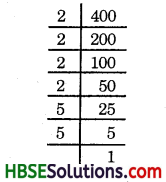
1. 400 = 2 × 2 × 2 × 2 × 5 × 5
Prime factorisation of 400 is
HBSE 8th Class Maths Solutions Chapter 7 Cube and Cube Roots InText Questions 1
2 × 2 × 2 × 2 × 5 × 5
So, 400 is not a perfect cube.

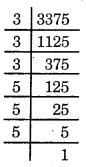
2. 3375 = \(\underline{3 \times 3 \times 3}\) × \(\underline{5 \times 5 \times 5}\)
HBSE 8th Class Maths Solutions Chapter 7 Cube and Cube Roots InText Questions 2
= 33 × 53
= (3 × 5)3
= (15)3
which is a perfect cube.

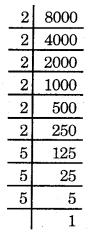
3. 8000 = \(\underline{2 \times 2 \times 2}\) × \(\underline{2 \times 2 \times 2}\)
HBSE 8th Class Maths Solutions Chapter 7 Cube and Cube Roots InText Questions 3
= 23 × 23 × 53
= (2 × 2 × 5)3
= (20)3
which is a perfect cube.

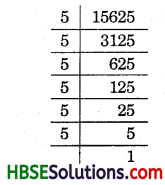
4. 15625 = \(\underline{5 \times 5 \times 5}\) × \(\underline{5 \times 5 \times 5}\)
HBSE 8th Class Maths Solutions Chapter 7 Cube and Cube Roots InText Questions 4
= 53 × 33
= (5 × 5)3
= (25)3
which is a perfect cube.

HBSE 8th Class Maths Solutions Chapter 7 Cube and Cube Roots InText Questions

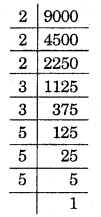
5. 9000 = 2 × 2 × 2 × 3 × 3 × 5 × 5 × 5
HBSE 8th Class Maths Solutions Chapter 7 Cube and Cube Roots InText Questions 5
Prime factorisation of 9000 is
2 × 2 × 2 × 3 × 3 × 5 × 5 × 5
So, 9000 is not a perfect cube.

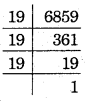
6. 6859 = 19 × 19 × 19
HBSE 8th Class Maths Solutions Chapter 7 Cube and Cube Roots InText Questions 6
Prime factorisation of 6859
19 × 19 × 19
So, 6859 is a perfect cube.

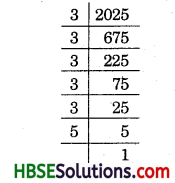
7. 2025 = 3 × 3 × 3 × 3 × 5 × 5
HBSE 8th Class Maths Solutions Chapter 7 Cube and Cube Roots InText Questions 7
Prime factorisation of 2025 is
3 × 3 × 3 × 3 × 5 × 5
So, 2025 is not a perfect cube.

HBSE 8th Class Maths Solutions Chapter 7 Cube and Cube Roots InText Questions

8. 10648 = \(\underline{2 \times 2 \times 2}\) × \(\underline{11 \times 11 \times 11}\)
HBSE 8th Class Maths Solutions Chapter 7 Cube and Cube Roots InText Questions 8
= 23 × 113
= (2 × 11)3
= (22)3
which is a perfect Cube.

HBSE 8th Class Maths Solutions Chapter 7 Cube and Cube Roots InText Questions Read More »

HBSE 8th Class Maths Solutions Chapter 6 Square and Square Roots Ex 6.4

Haryana State Board HBSE 8th Class Maths Solutions Chapter 6 Square and Square Roots Ex 6.4 Textbook Exercise Questions and Answers.

Haryana Board 8th Class Maths Solutions Chapter 6 Square and Square Roots Exercise 6.4

Question 1.
Find the square root of each of the following numbers by Division method :
(i) 2304
(ii) 4489
(iii) 3481
(iv) 529
(v) 3249
(vi) 1369
(vii) 5776
(viii) 7921
(ix) 576
(x) 1024
(xi) 3136
(xii) 900
Solution:
HBSE 8th Class Maths Solutions Chapter 6 Square and Square Roots Ex 6.4 1
HBSE 8th Class Maths Solutions Chapter 6 Square and Square Roots Ex 6.4 2
HBSE 8th Class Maths Solutions Chapter 6 Square and Square Roots Ex 6.4 3

HBSE 8th Class Maths Solutions Chapter 6 Square and Square Roots Ex 6.4

Question 2.
Find the number of digits in the square root of each of the following numbers (without any calculation).
(i) 64
(ii) 144
(iii) 4489
(iv) 27225
(v) 390625.
Solution:
(i) 64, Here n = 2 (even)
Number of digits in the square root of 64
= \(\frac{n}{2}\) = \(\frac{2}{2}\) = 1

(ii) Here, n = 3 (odd)
No. of digits in the square root of 144
= \(\frac{n+1}{2}\) = \(\frac{3+1}{2}\) = 2

(iii) 4489, Here n = 4 (even)
∴ No. of digits in the square root of 4489
= \(\frac{n}{2}\) = \(\frac{4}{2}\) = 2

(iv) 27225, Here n = 5 (odd)
No. of digits in the square root of 27225 = n+1 5+1
= \(\frac{n+1}{2}\) = \(\frac{5+1}{2}\) = 3

(v) 390625, Here n = 6 (even)
∴ The number of digits in the square root of
390625 = \(\frac{n}{2}\) = \(\frac{6}{2}\) = 3

Question 3.
Find the square root of the following decimal numbers :
(i) 2.56
(ii) 7.29
(iii) 51.84
(iv) 42.25
(v) 31.36
Solution:
HBSE 8th Class Maths Solutions Chapter 6 Square and Square Roots Ex 6.4 4
HBSE 8th Class Maths Solutions Chapter 6 Square and Square Roots Ex 6.4 5

HBSE 8th Class Maths Solutions Chapter 6 Square and Square Roots Ex 6.4

Question 4.
Find the least number which must be subtracted from each of the following numbers so as to get a perfect square. Also find the square root of the perfect square so obtained.
(i) 402
(ii) 1989
(iii) 3250
(iv) 825
(v) 4000.
Solution:
(i) HBSE 8th Class Maths Solutions Chapter 6 Square and Square Roots Ex 6.4 6
We get remainder 2. It shows that 202 is less than 402 by 2.
Thus, the number to be subtracted so as to make it a perfect a square is 2.
∴ Required perfect square
= 402 – 2 = 400
and \(\sqrt {400}\) = 20

(ii) HBSE 8th Class Maths Solutions Chapter 6 Square and Square Roots Ex 6.4 7
We get remainder 53. It shows that 442 is less than 1989 by 53.
Thus, the number to be subtracted so as to make it a perfect square is 3.
∴ Required perfect square
= 1989 – 53 = 1936
and \(\sqrt {1936}\) = 44.

(iii) We get the remainder 1.
It shows that 572 is less than 3250 by 1.
Thus, the number to be subtracted so as to make 3250 a perfect square is 1.
HBSE 8th Class Maths Solutions Chapter 6 Square and Square Roots Ex 6.4 8
∴ Required number
= 3250 – 1 = 3249
and \(\sqrt {3249}\) = 57

(iv) We get the remainder 41.
It shows that 282 is less than 825 by 41.
Thus, the smallest number that should be subtracted to make it a perfect square is 41.
HBSE 8th Class Maths Solutions Chapter 6 Square and Square Roots Ex 6.4 9
∴ Required number = 825 – 41 = 784
and \(\sqrt {784}\) = 28

(v) Since remainder 31.
∴ The smallest number that should be subtracted to make it a perfect square is 31.
HBSE 8th Class Maths Solutions Chapter 6 Square and Square Roots Ex 6.4 10
and Required number
= 4000 – 31
= 3969
and \(\sqrt {3669}\) = 63.

HBSE 8th Class Maths Solutions Chapter 6 Square and Square Roots Ex 6.4

Question 5.
Find the least number which must be added to each of the following numbers so as to get a perfect square. Also find the square root of the perfect square so obtained.
(i) 525
(ii) 1750
(iii) 252
(iv) 1825
(v) 6412.
Solution:
(i) Since remainderis 41.
∴ 222 < 525
HBSE 8th Class Maths Solutions Chapter 6 Square and Square Roots Ex 6.4 11
Next perfect square number is 232 = 529
Hence, the number to be added is
232 – 525 = 529 – 525 = 4
∴ The required no. = 525 + 4 = 529
and \(\sqrt {529}\) = 23

(ii) It is clear by long division method of \(\sqrt {1750}\) that remainder is 69.
HBSE 8th Class Maths Solutions Chapter 6 Square and Square Roots Ex 6.4 12
It shows that 412 < 1750
Next perfect square is 422
= 1764
Hence, the number to be added is 422 – 1750
= 1764 – 1750 = 14.
∴ Required number
= 1750 + 14 = 1764
and \(\sqrt {1764}\) = 42

(iii) ∵ Remainder = 27
∴ 152 < 252 < 162.
HBSE 8th Class Maths Solutions Chapter 6 Square and Square Roots Ex 6.4 13
Hence, the required number to be added to make it a perfect square
= 162 – 252
= 256 – 252 = 4
and \(\sqrt {256}\) = 16.

(iv) ∵ Remainder = 61
HBSE 8th Class Maths Solutions Chapter 6 Square and Square Roots Ex 6.4 14
∴ 422 < 1825 < 432
432 = 1849
Hence, the required number to be added to make it a perfect square
= 432 – 1825
= 1849 – 1825 = 24
∴ \(\sqrt {1849}\) = 43.

(v) Since remainder = 12.
HBSE 8th Class Maths Solutions Chapter 6 Square and Square Roots Ex 6.4 15
∴ 802 < 6412 < 812
∴ Required no. to be added to make it a perfect square is
812 – 6412 = 6561 – 6412
= 149
∴ \(\sqrt {6561}\) = 81.

Question 6.
Find the length of the side of a square whose area is 441 m2.
Solution:
HBSE 8th Class Maths Solutions Chapter 6 Square and Square Roots Ex 6.4 16
Let the side of square be x.
then, area of a square = x2
∴ x2 = 441
⇒ x = \(\sqrt {441}\)
= 21 m.

HBSE 8th Class Maths Solutions Chapter 6 Square and Square Roots Ex 6.4

Question 7.
In a right triangle ABC, ∠B = 90°.
(а) If AB = 6cm, BC = 8cm, findAC.
(б) If AC = 13 cm, BC = 5 cm, find AB.
Solution:
(i) Using Pythagoras theorem
HBSE 8th Class Maths Solutions Chapter 6 Square and Square Roots Ex 6.4 17
AC2 = AB2 + BC2
= 62 + 82
= 36 + 64
= 100
⇒ AC = \(\sqrt {100}\)
= 10 cm

(ii) AC = 13 cm
BC = 5 cm
AC2 = AB2 + BC2
(Using Pythagoras theorem)
HBSE 8th Class Maths Solutions Chapter 6 Square and Square Roots Ex 6.4 18
(13)2 = x2 + (5)2
⇒ 169 = x2 + 25
⇒ 169 – 25 = x2
⇒ 144 = x2
⇒ x = \(\sqrt {144}\) = 12 cm

Question 8.
A gardener has 1000 plants. He wants to plant these in such a way that the number of rows and the number of columns remain same. Find the minimum number of plants he needs more for this.
Solution:
By prime factorisation, we get
1000 = 2 × \(\underline{2 \times 2}\) × 5 × \(\underline{5 \times 5}\)
We see that 2 and 5 are still unpaired.
HBSE 8th Class Maths Solutions Chapter 6 Square and Square Roots Ex 6.4 19
∴ We have to multiply 1000 by 2 × 5 i.e., 10 to make it a perfect square.
Required number of plants
∴ 1000 × 10 = 10000
Thus, he needed 10 more plants.

HBSE 8th Class Maths Solutions Chapter 6 Square and Square Roots Ex 6.4

Question 9.
There are 500 children in a school. For a P.T. drill they have to stand in such a manner that the number of rows is equal to number of columns. How many children would be left out in this arrangement ?
Solution:
By prime factorisation, we get
HBSE 8th Class Maths Solutions Chapter 6 Square and Square Roots Ex 6.4 20
500 = \(\underline{2 \times 2}\) × \(\underline{5 \times 5}\) × 5
Since 5 is not in pair.
∴ 5 children would be left out in this arrangement.

HBSE 8th Class Maths Solutions Chapter 6 Square and Square Roots Ex 6.4 Read More »

HBSE 8th Class Maths Solutions Chapter 6 Square and Square Roots Ex 6.3

Haryana State Board HBSE 8th Class Maths Solutions Chapter 6 Square and Square Roots Ex 6.3 Textbook Exercise Questions and Answers.

Haryana Board 8th Class Maths Solutions Chapter 6 Square and Square Roots Exercise 6.3

Question 1.
What could be the possible ‘one’s’ digits of the square root of each of the following numbers ?
(i) 9801
(ii) 99856
(iii) 998001
(iv) 657666025
Solution:
(i) 98012 = 9801 × 9801
Possible one’s digits =1 [∵ 1 × 1 = 1]

(ii) 998562 = 99856 × 99856
Possible one’s digits =6 [∵ 6 × 6 = 36]

(iii) 9980012 = 998001 × 998001
∴ Possible one’s digits = 1

(iv) 6576660252 = 657666025 × 657666025
∴ Possible one’s placed digit = 5 [∵ 5 × 5 = 25]

Question 2.
Without doing any calculation, fin#the numbers which are surely not perfect squares.
(i) 153
(ii) 257
(iii) 408
(iv) 441
Solution:
(i) 153, (ii) 257 and (iii) 408 are surely not perfect squares.
[∵ The numbers end with 2, 3, 7, or 8 can never be a perfect square.]

HBSE 8th Class Maths Solutions Chapter 6 Square and Square Roots Ex 6.3

Question 3.
Find the square roots of 100 and 169 by the method of repeated subtraction.
Solution:
For \(\sqrt {100}\)
(i) 100 – 1 = 99
(ii) 99 – 3 = 96
(iii) 96 – 5 = 91
(iv) 91 – 7 = 84
(v) 84 – 9 = 75
(vi) 75 – 11 = 64
(vii) 64 – 13 = 51
(viii) 51 – 15 = 36
(ix) 36 – 17 = 19
(x) 19 – 19 = 0

For \(\sqrt {169}\)
(i) 169 – 1 = 168
(ii) 168 – 3 = 165
……………………….
………………………..
……………………….
………………………..
……………………….
……………………….
………………………
(xiii) 23 – 23 = 0
From 100 and 169 we have subtracted successive odd numbers starting from 1 and obtain 0 at 10th and 13th step.
∴ \(\sqrt {100}\) = 10
and \(\sqrt {169}\) = 13

Question 4.
Find the square roots of the follow¬ing numbers by the Prime Factorisation Method.
(i) 729
(ii) 400
(iii) 1764
(iv) 4096
(v) 7744
(vi) 9604
(vii) 5929
(viii) 9216
(ix) 529
(x) 8100.
Solution:
HBSE 8th Class Maths Solutions Chapter 6 Square and Square Roots Ex 6.3 1
HBSE 8th Class Maths Solutions Chapter 6 Square and Square Roots Ex 6.3 2
HBSE 8th Class Maths Solutions Chapter 6 Square and Square Roots Ex 6.3 3
HBSE 8th Class Maths Solutions Chapter 6 Square and Square Roots Ex 6.3 4
HBSE 8th Class Maths Solutions Chapter 6 Square and Square Roots Ex 6.3 5
HBSE 8th Class Maths Solutions Chapter 6 Square and Square Roots Ex 6.3 6

HBSE 8th Class Maths Solutions Chapter 6 Square and Square Roots Ex 6.3

Question 5.
For each of the following numbers, find the smallest whole number by which it should be multiplied so as to get a perfect square number. Also find the square root of the square number so obtained.
(i) 252
(ii) 180
(iii) 1008
(iv) 2028
(v) 1458
(vi) 768
Solution:
By prime factorisation, we get
252 = \(\underline{2 \times 2}\) × \(\underline{3 \times 3}\) × 7
HBSE 8th Class Maths Solutions Chapter 6 Square and Square Roots Ex 6.3 7
We see that in prime factorisation of 252, there exists a number 7 which is unpaired.
Hence, we will have to multiply 252 by 7 to make a pair of 7.
∴ 252 × 7 = \(\underline{2 \times 2}\) × \(\underline{3 \times 3}\) × \(\underline{7 \times 7}\)
\(\sqrt {1764}\) = 2 × 3 × 7
= 42.

(ii) By prime factorisation, we get
180 = \(\underline{2 \times 2}\) × \(\underline{3 \times 3}\) × 5
HBSE 8th Class Maths Solutions Chapter 6 Square and Square Roots Ex 6.3 8
The number 5 is unpaired.
∴ The smallest number by which 180 should be multiplied to make it a perfect square is 5.
Now,
180 × 5 = \(\underline{2 \times 2}\) × \(\underline{3 \times 3}\) × \(\underline{5 \times 5}\)
∴ 900 = \(\underline{2 \times 2}\) × \(\underline{3 \times 3}\) × \(\underline{5 \times 5}\)
∴ \(\sqrt {900}\) = 2 × 3 × 5 = 30.

(iii) 1008 = \(\underline{2 \times 2}\) × \(\underline{2 \times 2}\) × \(\underline{3 \times 3}\) × 7.
Here, 7 is unpaired
∴ We should multiply 1008 by to make it a perfect square.
HBSE 8th Class Maths Solutions Chapter 6 Square and Square Roots Ex 6.3 9
Now,
1008 × 7 = \(\underline{2 \times 2}\) × \(\underline{2 \times 2}\) × \(\underline{3 \times 3}\) × \(\underline{7 \times 7}\)
⇒ 1056 = 2 × 2 × 2 × 2 × 3 × 3 × 7 × 7
or \(\sqrt {1056}\) = 2 × 2 × 3 × 7
= 84.

(iv) 2028 = \(\underline{2 \times 2}\) × 3 × \(\underline{13 \times 13}\)
We see that the number 3 is unpaired.
HBSE 8th Class Maths Solutions Chapter 6 Square and Square Roots Ex 6.3 10
∴ We should multiply 2028 by 3 to make it a perfect square.
Now,
2028 × 3 =\(\underline{2 \times 2}\) × \(\underline{3 \times 3}\) × \(\underline{13 \times 13}\)
Thus, 2084 = 2 × 2 × 3 × 3 × 13 × 3
∴ \(\sqrt {2084}\) = 2 × 3 × 13 = 78

(v) 1458 = 2 × \(\underline{3 \times 3}\) × \(\underline{3 \times 3}\) × \(\underline{3 \times 3}\).
HBSE 8th Class Maths Solutions Chapter 6 Square and Square Roots Ex 6.3 11
Since a number 2 is unpaired.
So, smallest number by which 1458 should be multiplied is 2.
∴ Required number
= 1458 × 2
= 2916
Thus,
2916 = \(\underline{2 \times 2}\) × \(\underline{3 \times 3}\) × \(\underline{3 \times 3}\) × \(\underline{3 \times 3}\)
\(\sqrt {2916}\) = 2 × 3 × 3 × 3 = 54

(vi) By prime factorisation, we get
768 = \(\underline{2 \times 2}\) × \(\underline{2 \times 2}\) × \(\underline{2 \times 2}\) × \(\underline{2 \times 2}\) × \(\underline{3 \times 3}\)

HBSE 8th Class Maths Solutions Chapter 6 Square and Square Roots Ex 6.3 12
Since a number 3 is unpaired.
∴ We should multiply 768 by 3 to make it a perfect square .
Now,
768 × 3 = \(\underline{2 \times 2}\) × \(\underline{2 \times 2}\) × \(\underline{2 \times 2}\) × \(\underline{2 \times 2}\) × \(\underline{3 \times 3}\)
⇒ \(\sqrt {2304}\) = 2 × 2 × 2 × 2 × 3 = 48.

HBSE 8th Class Maths Solutions Chapter 6 Square and Square Roots Ex 6.3

Question 6.
For each of the following numbers, find the smallest whole number by which it should be divided so as to get a perfect square. Also find the square root of the square number so obtained.
(i) 252
(ii) 2925
(iii) 396
(iv) 2645
(v) 2800
(vi) 1620
Solution:
(i) We have,
252 = \(\underline{2 \times 2}\) × \(\underline{3 \times 3}\) × 7 (by prime factorisation)
HBSE 8th Class Maths Solutions Chapter 6 Square and Square Roots Ex 6.3 13
If we divide 252 by 7 then
252 ÷ 7 = 36 = 2 × 2 × 3 × 3
which is a perfect square.
Thus, the required smallest number is 7
and \(\sqrt {36}\) = 2 × 3 = 6

(ii) We have
2925 = \(\underline{5 \times 5}\) × \(\underline{3 \times 3}\) × 13
HBSE 8th Class Maths Solutions Chapter 6 Square and Square Roots Ex 6.3 14
Since a number 13 is unpaired.
We should multiply 768 by 3 to make it a perfect square .
∴ 2925 ÷ 13 = 225
= \(\underline{5 \times 5}\) × \(\underline{3 \times 3}\)
which is a perfect square.
∴ The required smallest number is 13.
And \(\sqrt {225}\) = \(\sqrt{5 \times 5 \times 3 \times 3}\)
= 5 × 3 = 15

(iii) By prime factorisation, we get
396 = \(\underline{2 \times 2}\) × \(\underline{3 \times 3}\) × 11
HBSE 8th Class Maths Solutions Chapter 6 Square and Square Roots Ex 6.3 15
If we divide 396 by 11, then
396 ÷ 11 = 36 = 2 × 2 × 3 × 3
which is a perfect square.
∴ The required smallest number is 11.
And, \(\sqrt {36}\) = 2 × 3 = 6

(iv) 2645 = 5 × \(\underline{23 \times 23}\)
HBSE 8th Class Maths Solutions Chapter 6 Square and Square Roots Ex 6.3 16
Since a number 5 is a unpaired.
So, we should divide 2645 by 5.
2645 ÷ 5 = 529 = 23 × 23
which is a perfect square.
∴ The required smallest number = 5
and \(\sqrt {529}\) = 23.

(v) By prime factorisation, we get
2800 = \(\underline{2 \times 2}\) × \(\underline{2 \times 2}\) × \(\underline{5 \times 5}\) × 7
HBSE 8th Class Maths Solutions Chapter 6 Square and Square Roots Ex 6.3 17
If we divide 2800 by 7, then
2800 ÷ 7 = 400
= \(\underline{2 \times 2}\) × \(\underline{2 \times 2}\) × \(\underline{5 \times 5}\)
which is a perfect square.
Therefore, the required smallest number 7.
And, \(\sqrt {400}\) = 2 × 2 × 5 = 20

(vi) By prime factorisation, we get
1620 = \(\underline{2 \times 2}\) × \(\underline{3 \times 3}\) × \(\underline{3 \times 3}\) × 5
HBSE 8th Class Maths Solutions Chapter 6 Square and Square Roots Ex 6.3 18
Since a number 5 is unpaired.
∴ We should divide 1620 by 5.
1620 ÷ 5 = 324
= \(\underline{2 \times 2}\) × \(\underline{3 \times 3}\) × \(\underline{3 \times 3}\)
which is a perfect square.
Thus, \(\sqrt {324}\) = 2 × 3 × 3 = 18.

HBSE 8th Class Maths Solutions Chapter 6 Square and Square Roots Ex 6.3

Question 7.
The students of Class VIII of a school donated Rs. 2401 in all, for Prime Minister’s National Relief Fund. Each student donated as many rupees as the number of students-in the class. Find the number of students in the class.
Solution:
Let the number of students in the class VIII be x.
Then, the rupees donated by each students will be Rs. x.
According to the given condition of the question :
HBSE 8th Class Maths Solutions Chapter 6 Square and Square Roots Ex 6.3 19
x × x = 2401
⇒ x2 = 2401
⇒ x = \(\sqrt{2401}\)
= \(\sqrt{7 \times 7 \times 7 \times 7}\)
= 7 × 7
Hence, the number of students in the class is 49.

Question 8.
2025 plants are to be planted in a garden in such a way that each row contains as many plants as the number of rows. Find the number of rows and the number of plants in each row.
Solution:
Let the no. of plants contains in each row be x.
Then, the no. of rows will be also x.
∴ According to the given condition of the question
HBSE 8th Class Maths Solutions Chapter 6 Square and Square Roots Ex 6.3 20
Thus, x × x = 2025
⇒ x2 = 2025
⇒ x2 = 52 × 32 × 32
⇒ x2 = (5 × 3 × 3)2
⇒ x2 = 452
x = 45.
∴ The number of rows and the number of plants in each row is 45.

HBSE 8th Class Maths Solutions Chapter 6 Square and Square Roots Ex 6.3

Question 9.
Find the smallest square number that is divisible by each of the number 4, 9 and 10.
Solution:
This has to be done in three steps.
HBSE 8th Class Maths Solutions Chapter 6 Square and Square Roots Ex 6.3 21
Step 1. First of all find the LCM of the numbers 4,9 and 10.
LCM of 4, 9 and 10 = 180
Step 2. Then, find the prime factorisation of the LCM so obtained i.e., 180.
180 = \(\underline{2 \times 2}\) × \(\underline{3 \times 3}\) × 5
Step 3. Now, multiply the number 180 by 5 to make it a perfect square.
HBSE 8th Class Maths Solutions Chapter 6 Square and Square Roots Ex 6.3 22
⇒ 180 × 5 = \(\underline{2 \times 2}\) × \(\underline{3 \times 3}\) × \(\underline{5 \times 5}\)
⇒ 900 = \(\underline{2 \times 2}\) × \(\underline{3 \times 3}\) × \(\underline{5 \times 5}\)
Now, 900 is obviously a perfect square.
So, the required square number is 900.

Question 10.
Find the smallest square number that is divisible by each of the number 8, 15 and 20.
Solution:
Follow the same procedure as explained in the solution of Question (9)
LCM of 8, 15 and 20 = 120
HBSE 8th Class Maths Solutions Chapter 6 Square and Square Roots Ex 6.3 23
Prime factorisation of 120 = \(\underline{2 \times 2}\) × 2 × 3 × 5
We see that 2, 3 and 5 are not in pair.
HBSE 8th Class Maths Solutions Chapter 6 Square and Square Roots Ex 6.3 24
Therefore, 120 should be multiplied by 2 × 3 × 5 i.e., 30 in order to get a perfect square.
Hence, the required square number is
120 × 30 = 3600.

HBSE 8th Class Maths Solutions Chapter 6 Square and Square Roots Ex 6.3 Read More »

HBSE 8th Class Maths Solutions Chapter 6 Square and Square Roots Ex 6.2

Haryana State Board HBSE 8th Class Maths Solutions Chapter 6 Square and Square Roots Ex 6.2 Textbook Exercise Questions and Answers.

Haryana Board 8th Class Maths Solutions Chapter 6 Square and Square Roots Exercise 6.2

Question 1.
Find the square of the following numbers :
(i) 32
(ii) 35
(iii) 86
(iv) 93
(v) 71
(vi) 46.
Solution:
(i) 322 = (30 + 2)2
= (30 + 2) (30 + 2)
= 30(30 + 2) + 2(30 + 2)
= 900 + 60 + 60 + 4 = 1024.

(ii) 352 = (3 × 4) hundreds + 25
= 12 × 100 + 25 = 1225

(iii) 862 = (80 + 6)2
= (80+ 6) (80+ 6)
= 80(80 + 6) + 6(80 + 6)
= 6400 + 480 + 480 + 36
= 7396

(iv) 932 = (90 + 3)2
= (90 + 3) (90 + 3)
= (90)2 + 90 × 3 + 3 × 90 + (3)2
= 8100 + 270 + 270 + 9
= 8649

HBSE 8th Class Maths Solutions Chapter 6 Square and Square Roots Ex 6.2

(v) 712 = (70 + 1)2
= (70)2 + 2 × 70 × 1 + (1)2
[Using (a + b)2 = a2 + 2ab + b2]
= 4900 + 140 + 1 = 5041

(vi) 462 = (40 + 6)2
= (40)2 + 2 × 40 × 6 + (6)2
= 1600 + 480 + 36 = 2116.

Question 2.
Write a Pythagorean triplet whose one member is
(i) 6
(ii) 14
(iii) 16
(iv) 18.
Solution:
We have Pythagorean triplet (2m, m2 – 1, m2 + 1); where m > 1 (natural number).
Let us try one by one. .
Now, we take . .
m2 – 1 = 6 ⇒ m2 = 6 + 1 = 7
⇒ m = \(\sqrt {7}\) (not an integer)
m2 + 1 = 6 ⇒ m2 = 5
⇒ m = \(\sqrt {5}\) (not an integer)
2m = 6
⇒ m = \(\frac{6}{2}\) = 3 (is an integer)
Thus, m2 – 1 = 32 – 1 = 9 – 1 = 8
and m2 + 1 = 32 + 1 = 9 + 1 = 10
Therefore, the required triplet is (6, 8, 10).

(ii) m2 – 1 = 14
or m2 = 15
Then the value of m will not be an integer So, we try to take
m2 + 1 = 14
or m2 = 14 – 1 = 13
or m = \(\sqrt {13}\)
which is also not an integer.
So, take 2m = 14
⇒ m = 7.
Thus, m2 – 1 = 72 – 1 = 49 – 1 = 48
and m2 + 1 = 72 + 1 = 49 + 1 = 50
∴ The required triplet is (14, 48, 50).

HBSE 8th Class Maths Solutions Chapter 6 Square and Square Roots Ex 6.2

(iii) Let m2 – 1 = 16
⇒ m2 = 17
or m = \(\sqrt {17}\)
which is not an integer
m2 + 1 = 16
⇒ m2 = 15
⇒ m = \(\sqrt {15}\) (not an integer)
and 2m = 16
⇒ m = 8.
Here, the value of m is an integer.
∴ m2 – 1 = 82 – 1 = 64 – 1 = 63
and m2+ 1 = 82 + 1 = 64 + 1 = 65
Therefore, the required triplet is (16, 63, 65)

(iv) Let m2 – 1 = 18
⇒ m2 = 19
or m = \(\sqrt {19}\)
which is not an integer
Now, take m2 + 1 = 18
⇒ m2 = 17
or m = \(\sqrt {17}\)
which is also not an integer
So, let us take 2m = 18
⇒ m = 9 which is an integer.
∴ The required triplet is (18, 92 – 1, 92 + 1)
i.e., (18, 80, 81)

HBSE 8th Class Maths Solutions Chapter 6 Square and Square Roots Ex 6.2 Read More »

HBSE 8th Class Maths Solutions Chapter 6 Square and Square Roots Ex 6.1

Haryana State Board HBSE 8th Class Maths Solutions Chapter 6 Square and Square Roots Ex 6.1 Textbook Exercise Questions and Answers.

Haryana Board 8th Class Maths Solutions Chapter 6 Square and Square Roots Exercise 6.1

Question 1.
What will be the unit digit of the squares of the following numbers ?
(i) 81
(ii) 272
(iii) 799
(iv) 3853
(v) 1234
(vi) 26387
(vii) 52698
(viii) 99880
(ix) 12796
(x) 55555.
Solution:
(i) The unit digit of 812 = 1 [∵ 12 = 1]
(ii) The unit digit of 2722 = 4 [∵ 22 = 4]
(iii) The unit digit of 7992 = 1 [∵ 92 = 81]
(iv) The unit digit of 38532 = 9 [∵ 32 = 9]
(v) The unit digit of 12342 = 6 [∵ 42 = 16]
(vi) The unit digit of 263872 = 9 [∵ 72 = 49]
(vii) The unit digit of 526982 = 4 [∵ 82 = 64]
(viii) The unit digit of 998802 = 0 [∵ 02 = 0]
(ix) The unit digit of 127962 = 6 [∵ 62 = 36]
(x) The unit digit of 555552 = 5 [∵ 52 = 25]

Question 2.
The following numbers are obviously not perfect squares. Give reason.
(i) 1057
(ii) 23453
(iii) 7928
(iv) 222222
(v) 64000
(vi) 89722
(vii) 222000
(viii) 505050.
Solution:
(i) 1057 is not a perfect square.
[∵ Perfect square never end with 2, 3, 7 or 8 at unit’s place]
(ii) 23453 is not a perfect square because the number end with 3.
(iii) Since 7928 end with 8. So, it is not a perfect square.
(iv) Since 222222 end with 2. So, it is not a perfect square.
(v) 64000 because it do not have even number of zeros at the end.
(vi) 89722 is not a perfect square.
[∵ Perfect square never end with 2, 3, 7 or 8]
(vii) 222000 is not a perfect square as the number of zeros in the end is 3 (odd number).
(viii) 505050 is not a perfect square because number of zeros in the ends is 1 (odd number).

HBSE 8th Class Maths Solutions Chapter 6 Square and Square Roots Ex 6.1

Question 3.
The squares of which of the following would be odd numbers ?
(i) 431
(ii) 2826
(iii) 7779
(iv) 82004.
Solution:
(i) 431 and (ii) 7779.
Because squares of odd number are always
odd.

Question 4.
Observe the following pattern and find the missing digits.
112 = 121
1012 = 10201
10012 = 1002001
1000012 = 1………….. 2 …………….. 1
100000012 = ………………..
Solution:
1000012 = 10000200001
and 100000012 = 100000020000001
[Using pattern given in the question]

HBSE 8th Class Maths Solutions Chapter 6 Square and Square Roots Ex 6.1

Question 5.
Observe the following pattern and supply the missing numbers.
112 = 121
1012 = 10201
101012 = 102030201
10101012 = ………………..
………………..2 = 10203040504030201
Solution:
10101012 = 1020304030201
and 1010101012 = 10203040504030201
[Using pattern given in the question]

Question 6.
Using the given pattern, find the missing numbers.
12 + 22 + 22 = 32
22 + 32 + 62 = 72
32 + 42 + 122 = 132
42 + 52 + _2 = 212
52 + _2 + 302 = 312
62 + 72 + _2 = _2
To find pattern : Third number is related to first and second number. How ?
Fourth number is related to third number. How ?
Solution:
42 + 52 + 202 = 212
52 + 62 + 302 = 312
and 62 + 72 + 422 = 432
∵ 1 × 2 = 2, 2 + 1 = 3
2 × 3 = 6, 6 + 1 = 7
3 × 4 = 12, 12 + 1 = 13
…………………………….
and so on.

HBSE 8th Class Maths Solutions Chapter 6 Square and Square Roots Ex 6.1

Question 7.
Without adding, find the sum.
(i) 1 + 3 + 5 + 7 + 9
(ii) 1 + 3 + 5 + 7 + 9 + 11 + 13 + 15 + 17 + 19
(iii) 1 + 3 + 5 + 7 + 9 + 11 + 13 + 15 + 17 + 19 + 21 + 23.
Solution:
(i) 1 + 3 + 5 + 7 + 9
[Sum of first five odd numbers]
= 52 = 25.

(ii) 1 + 3 + 5 + 7 + 9 + 11 + 13 + 15 + 17 + 19 [Sum of first ten odd numbers]
= 102 = 100.

(iii) 1 + 3 + 5 + 7 + 9 + 11 + 13 + 15 + 17 + 19 + 21 + 23
= 122 = 144.
[Sum of first twelve odd numbers]

Question 8.
(i) Express 49 as the sum of 7 odd numbers.
(ii) Express 121 as the sum of ii odd numbers.
Solution:
(i) 49 = (7)2
= Sum of first 7 odd numbers
= 1 + 3 + 5 + 7 + 9 + 11 + 13

(ii) Similarly,
121 = (11)2
= 1 + 3 + 5 + 7 + 9 + 11 + 13 + 15 + 17 + 19 + 21

HBSE 8th Class Maths Solutions Chapter 6 Square and Square Roots Ex 6.1

Question 9.
How many numbers lie between squares of the following numbers ?
(i) 12 and 13
(ii) 25 and 26
(iii) 99 and 100.
Solution:
(i) Here, n = 12 and n + 1 = 13
∴ 2n numbers non perfect square numbers lie between square of n2 and (n + 1)2
Thus, 2 × 12 = 24
such numbers lie between 122 and 132.

(ii) Similarly,
2 × 25 = 50
numbers lie between 252 and 262.
2 × 99 = 198

and (iii) 2 × 99 = 198
numbers lie between 992 and 1002.

HBSE 8th Class Maths Solutions Chapter 6 Square and Square Roots Ex 6.1 Read More »

HBSE 8th Class Maths Solutions Chapter 6 Square and Square Roots InText Questions

Haryana State Board HBSE 8th Class Maths Solutions Chapter 6 Square and Square Roots InText Questions and Answers.

Haryana Board 8th Class Maths Solutions Chapter 6 Square and Square Roots InText Questions

Try These (Page 90)

Question 1.
Find the perfect square numbers between
(i) 30 and 40
(ii) 50 and 60.
Solution:
(i) The perfect square number between 30 and 40 is 36. [∵ 62 = 36]
(ii) There is no perfect square number between 50 and 60.

Try These (Page 90-91)

Question 1.
Can we say whether the following numbers are perfect squares ? How do we know ?
(i) 1057
(ii) 23453
(iii) 7928
(iv) 222222
(v) 1069
(vi) 2061
Write five numbers which you can decide by looking at their one’s digit that they are not square numbers.
Solution:
(i) 1057 can not be a perfect square because the digit in the one’s place is 7.
(ii) 23453 is not a perfect square.
[∵ The digit end with 3]
(iii) 7928 is not a perfect square.
[∵ The digit end with 8]
(iv) 222222 is not a perfect square.
[∵ The digit end with 2]
(v) 1069 may be a perfect square.
[For perfect square the digits in the one’s place must be 0, 1, 4, 5, 6 or 9]
(vi) 2061 may be a perfect square.

HBSE 8th Class Maths Solutions Chapter 6 Square and Square Roots InText Questions

Question 2.
Write five numbers which you cannot decide just by looking at their unit’s digit (or one’s place) whether they are square numbers or not.
Solution:
Five numbers which is not a perfect square are 223, 237, 25968, 7727 and 8888.

Try These (Page 91)

Question 1.
Which of 1232, 772, 822, 1612, 1092 would end with digit 1 ?
Solution:
If a number has 1 or 9 in the unit’s place, the it’s square ends in 1.
∴ 1612 = 161 × 161 and 109
= 109 × 109
are the two numbers whose unit’s place ends in 1 and 9 respectively.

HBSE 8th Class Maths Solutions Chapter 6 Square and Square Roots InText Questions

Question 2.
Which of the following numbers would have digit 6 at unit place.
(ii) 192
(ii) 242
(iii) 262
(iv) 362
(v) 342
Solution:
(ii) 242
(iii) 262
(iv) 362 and
(v) 342 would have digit 6 at unit place.
[∵ One’s place should be either 4 or 6]

Try These (Page 92)

Question 1.
What will be the “one’s digit” in the square of the following numbers ?
(i) 1234
(ii) 26387
(iii) 52698
(iv) 99880
(v) 21222
(vi) 9106.
Solution:
(i) 6 [∵ 42 = 16]
(ii) 9 [∵ 72 = 49]
(iii) 4 [∵ 82 = 64]
(iv) 0 [∵ 02 = 0]
(v) 4 [∵ 22 = 4]
(vi) 6 [∵ 62 = 6]

HBSE 8th Class Maths Solutions Chapter 6 Square and Square Roots InText Questions

Question 2.
The square of which of the following numbers would be an odd number/an even number ? Why ?
(i) 727
(ii) 158
(iii) 269
(iv) 1980.
Solution:
(i) 727, odd number.
(ii) 158, even number.
(iii) 269, odd number.
(iv) 1980, even number.
[∵ Squares of even numbers are always even and squares of odd numbers are.always odd]

Question 3.
What will be the number of zeros in the square of the following numbers ?
(i) 60
(ii) 400.
Solution:
(i) Two zeros
(ii) Four zeros.

HBSE 8th Class Maths Solutions Chapter 6 Square and Square Roots InText Questions

Try These (Page 94)

Question 1.
How many natural numbers lie between 92 and 102? Between 112 and 122?
Solution:
Total numbers of natural number between 92 and 102.
2n = 2 × 9 = 18
Here, n = 9
Similarly, total number of natural numbers between
112 and 122 = 2n
= 2 × 11 = 22.

Question 2.
How many non square numbers lie between the following pairs of numbers ?
(i) 1002 and 1012
(ii) 902 and 912
(iii) 10002 and 10012.
Solution:
(i) Non square numbers between 1002 and 1012
= 2n, where n smallest number.
= 2 × 100 = 200

(ii) Non square numbers between 902 and 912
= 2n = 2 × 90= 180 [∵ = 90]

(iii) Non square numbers between 10002 and 10012
= 2n = 2 × 1000 [∵ n = 1000]
= 2000.

HBSE 8th Class Maths Solutions Chapter 6 Square and Square Roots InText Questions

Try These (Page 94)

Question 1.
Find whether each of the following numbers is a perfect square or not ?
(i) 121
(ii) 55
(iii) 81
(iv) 49
(v) 69.
Solution:
(i) 121 – 1 = 120
120 – 3 = 117
117 – 5 = 112
……………………
……………………
and so on.
We will get the result is zero in the end after 11 steps.
So, 121 is a perfect square.
[Do the same calculations as explained in part (i)]
(ii) 55 is not a perfect square,
(iii) 81 is perfect square.
(iv) 49 is a perfect square.
(v) 69 is not a perfect square.

Try These (Page 95)

Question 1.
Express the following as the sum of two consecutive integers.
(i) 212
(ii) 132
(iii) 112
(iv) 192
Solution:
(i) 212 = 441
= [\(\frac{21^{2}-1}{2}\) + \(\frac{21^{2}+1}{2}\)]
= 220 + 221

(ii) 132 = 169
= [\(\frac{13^{2}-1}{2}\) + \(\frac{13^{2}+1}{2}\)]
[n2 = \(\frac{n^{2}-1}{2}\) + \(\frac{n^{2}+1}{2}\)]
= \(\frac{169-1}{2}\) + \(\frac{169+1}{2}\) = 81 + 82

(iii) Similarly, 112 = 121 = 60 + 61.
192 = 361 = 180 + 181.

HBSE 8th Class Maths Solutions Chapter 6 Square and Square Roots InText Questions

Question 2.
Do you think the reverse is also t rue, i.e., is the sum of any two consecutive positive integers is perfect square of a number ? Give example to support your answer.
Solution:
No, the reverse is not true
4 + 5 = 9 = 32
but 6 + 7 = 13
is not a perfect square.

Try These (Page 95)

Question 1.
Write the square, making use of the above pattern.
(i) 1111112
(ii) 11111112
Solution:
(i) 1111112 = 12345654321
[∵ 12 = 1, 112 = 121, 1112 = 12321 and so on]
(ii) 11111112 = 1234567654321
[Follow the same pattern]

HBSE 8th Class Maths Solutions Chapter 6 Square and Square Roots InText Questions

Question 2.
Can you find the square of the following numbers using the above pattern ?
(i) 66666672
(ii) 666666672.
Solution:
(i) 66666672 = 44444448888889
(ii) 666666672 = 4444444488888889
Observe the following pattern :
72 = 49
672 = 4489
6672 = 444889
66672 = 44448889
………………………….
………………………….

Try These (Page 97)

Question 1.
Find the squares of the following numbers containing 5 in unit’s place.
(i) 15
(ii) 95
(iii) 105
(iv) 205.
Solution:
(i) 152 = (1 × 2) hundreds + 25,
= 2 × 100 + 25 = 225
(ii) 952 [∵ (a5)2 = a(a + 1) hundred + 25,
where (a5) is a number with unit digit as 5]
= (9 × 10) hundreds + 25
= 9000 + 25 = 9025
(iii) (105)2 = (10 × 11) × 100 + 25
= 11025
(iv) (205)2 = (20 × 21) × 100 + 25
= 42025

HBSE 8th Class Maths Solutions Chapter 6 Square and Square Roots InText Questions

Try These (Page 99)

Question 1.
(i) 112 = 121. What is the square root of 121 ?
(ii) 142 = 196. What is the square root of 196?
Solution:
(i) Since 112 = 121
∴ Square root of 121 = 11

(ii) Since 142 = 196
∴ Square root of 196 = 14.

Try These (Page 100)

Question 1.
By repeated subtraction of odd numbers starting from 1, find whether the following numbers are perfect squares or not ? If the number is a perfect square then
find its square root.
(i) 121
(ii) 55
(iii) 36
(iv) 49
(v) 90.
Solution:
(i) 121 – 1 = 120 120 – 3 = 117
117 – 5 = 112 112 – 7 = 105
105 – 9 = 96 96 – 11 = 85
85 – 13 = 72 72 – 15 = 57
57 – 17 = 40 40 – 19 = 21
21 – 21 = 0
We observe that the number 121 reduced to zero after subtracting 11 consecutive odd numbers starting from 1. Thus, 121 is a perfect square.
∴ 121 = 112 ⇒ \(\sqrt {121}\) = 11

(ii) 55 – 1 = 54 54 – 3 = 51
51 – 5 = 46 46 – 7 = 39
39 – 9 = 30 30 – 11 = 19
19 – 13 = 6
Here the no. do not reduced to zero. So, 55 is not a perfect square.

(iii) 36 – 1 = 35 35 – 3 = 32
32 – 5 = 27 27 – 7 = 20
20 – 9 = 11 11 – 11 = 0
We obtained 0 at 6th step
∴ 36 = 62 (It is a perfect square)
or \(\sqrt {36}\) = 6

(iv) 49 – 1 = 48 48 – 3 = 45
45 – 5 = 40 40 – 7 = 33
33 – 9 = 24 24 – 11 = 13
13 – 13 = 0
We have subtracted successive odd numbers starting from 1 and obtained 0 at 7th step.
∴ 49 = 72 ⇒ \(\sqrt {49}\) = 7 .
This is a perfect square.

(v) 90 – 1 = 89 89 – 3 = 86
86 – 5 = 81 81 – 7 = 74
74 – 9 = 65 65 – 11 = 54
54 – 13 = 41 41 – 17 = 24
24 – 19 = 5
∵ We do not obtain zero in the end.
∴ 90 is not a perfect square.

HBSE 8th Class Maths Solutions Chapter 6 Square and Square Roots InText Questions

Try These (Page 105)

Question 1.
Without calculating square roots, find the number of digits in the square root of the following numbers :
(i) 25600
(ii) 100000000
(iii) 36864
Solution:
(i) 25600
Here, the number of digits (n) = 5 (odd)
∴ The number of digits in the square roots of 25600
= \(\frac{(n+1)}{2}\) = \(\frac{(5+1)}{2}\) = 3

(ii) 100000000
Here, the number of digits (n) = 9 (odd)
∴ The number of digits in the square roots of the number
= \(\frac{(n+1)}{2}\) = \(\frac{(9+1)}{2}\) = 5
∴ The number of digits in the square of the number
= \(\frac{(n+1)}{2}\) = \(\frac{(5+1)}{2}\) = \(\frac{(6)}{2}\) = 3

Try These (Page 107)

Question 1.
Estimate the value of the following to the nearest whole number :
(i) \(\sqrt {80}\)
(ii) \(\sqrt {1000}\)
(iii) \(\sqrt {350}\)
(iv) \(\sqrt {500}\)
Solution:
(i) We know that
80 < 81 < 100
and \(\sqrt {81}\) = 9 and \(\sqrt {100}\) = 10
But 9 < \(\sqrt {80}\) < 10
Now, \(\sqrt {80}\) is much closer to 92 = 81
then 102 = 100
So, \(\sqrt {80}\) is approximately 9.

(ii) We know that
100 < 1000 < 10000
and \(\sqrt {100}\) = 10
\(\sqrt {1000}\) = 100
So, 10 < \(\sqrt {1000}\) < 10
But still we are not very close to square number.
We know that 312 = 961
and 322 = 1024
But 1024 is much closer to 1000 than 961.
So, \(\sqrt {1000}\) = 32 (approximately).

(iii) We know that
100 < 350 < 400
and \(\sqrt {100}\) = 10
\(\sqrt {400}\) = 20
So, 10 < \(\sqrt {350}\) < 20
But still you are not very close to the square number.
We know that 182 = 324 and 192 = 361
∴ 18 < \(\sqrt {350}\) < 19
and 350 is much closer to 361 than to 324
So, \(\sqrt {350}\) is approximately equal to 19.

HBSE 8th Class Maths Solutions Chapter 6 Square and Square Roots InText Questions

(iv) We know that
100 < 500 < 625
and < \(\sqrt {100}\) =10
< \(\sqrt {625}\) = 25
So, 10 < \(\sqrt {500}\) < 25
But we are still not very close to the square number.
We know that
222 = 484 and 232 = 529
∴ 2 < \(\sqrt {500}\) < 23
But 500 is closer to 484 than to 529.
Hence, < \(\sqrt {500}\) is approximately equal to 22.

HBSE 8th Class Maths Solutions Chapter 6 Square and Square Roots InText Questions Read More »