Class 10

HBSE 10th Class English Solutions First Flight Poem 3 A Tiger in the Zoo

Haryana State Board HBSE 10th Class English Solutions First Flight Poem 3 A Tiger in the Zoo Textbook Exercise Questions and Answers.

Haryana Board 10th Class English Solutions First Flight Poem 3 A Tiger in the Zoo

HBSE 10th Class English A Tiger in the Zoo Textbook Questions and Answers

Thinking about the Poem

1. Read the poem again and work in pairs or groups to do the following tasks.
(i) Find the words that describe the movements and actions of the tiger in the cage and in the wild. Arrange them in two columns.
(ii) Find the words that describe the two places, and arrange them in two columns.
Now try to share ideas about how the poet uses words and images to contrast the two situations.
Answer:
table

(i) Movements and actions of Tiger in the cage | Movements and actions of Tiger in the wild Stalking
Lurking Hearing
Snarling Staring
Baring his white fangs Ignoring
Sliding, Terrorising
A Tiger in the Zoo
359

(ii)
Places in the cage Few steps of his cage Concrete cell
, Places in the wild Long grass Water hole Houses at the jungle’s edge
Locked
Behind bars
Village

HBSE 10th Class English Solutions First Flight Poem 3 A Tiger in the Zoo

2. Notice the use of a word repeated in lines such as these:
(i) On pads of velvet quiet,
In his quiet rage.
(ii) And stares with his brilliant eyes
At the brilliant stars.
What do you think is the effect of this repetition?
Answer:
Repetition is a poetic device used by the poet in order to enhance the beauty of the poem.
‘Velvet quiet’ refers to the quiet velvet pads of the tiger’s paws. He can only walk around the limited space in the cage. The use of quiet rage’symbolises the anger and ferocity of the tiger. He wants to run out into the forest and hunt a deer, but his rage is quiet because he is caged and can not come out in the open. The use of ‘quiet’ has brought immense beauty to the poem. Similarly, the use of “brilliant for the tiger’s eyes as well as the stars also bring out the magnificence of these lines.

3. Read the following two poems – one about a tiger and the other about a panther. Then discuss:
Are zoos necessary for the protection or conservation of some species of animals? Are they useful for educating the public? Are there alternatives to zoos?

The Tiger
The tiger behind the bars of his cage growls,
The tiger behind the bars of his cage snarls,
The tiger behind the bars of his cage roars.
Then he thinks.
It would be nice not to be behind bars all
The time
Because they spoil my view
I wish I were wild, not on show.
But if I were wild, hunters might shoot me,
But if I were wild, food might poison me,
But if I were wild, water might drown me.
Then he stops thinking
And…
The tiger behind the bars of his cage growls,
The tiger behind the bars of his cage snarls,
The tiger behind the bars of his cage roars.
– PETER NIBLETT

The Panther

His vision, from the constantly passing bars,
has grown so weary that it cannot hold
anything else. It seems to him there are
a thousand bars; and behind the bars, no world.
As he paces in cramped circles, over and over,
the movement of his powerful soft strides
is like a ritual dance around a centre
in which a mighty will stand paralysed.
Only at times, the curtain of the pupils
lifts, quietly. An image enters in,
rushes down through the tensed, arrested muscles,
plunges into the heart and is gone.
– RAINER MARIA RILKE
Answer:
To some extent, zoos are necessary for the protection or conservation of some species of
animals. In the forest, they might be hunted down, poisoned by some wild food, or could be drowned in water. But, a zoo is not the correct alternative to a forest. In a zoo, an animal feels caged and bound. They cannot roam freely as in the wild. Only due to this reason, wildlife sanctuaries and national parks have been made in order to conserve several endangered species. These places provide protection as well as natural surroundings to these species. They can roam freely in their habitats and are safe too. The public can visit these parks and get educated about the animals and their lifestyles. The parks and sanctuaries are run using a strict set of rules, the most prominent being the ban on hunting. If animals roam in the open, visitors would not be able to feed them and would not misbehave or try to play with them as they are under strict supervision. Such incidents have been recorded in zoos where people irritate and tease the animals. Hence, a wildlife sanctuary is a good alternative for animals to be safe as well as free to move in their natural surroundings. Yes, they are quite useful for educating the public. The public may get proper information about them.

HBSE 10th Class English Solutions First Flight Poem 3 A Tiger in the Zoo

4. Take a point of view for or against zoos, or even consider both points of view and write a couple of paragraphs or speak about this topic for a couple of minutes in class.
Answer:
Hints:
• Teaches about the importance of nature.
• Provides recreation to the visitors.
• Scientists do study about wild animals.
• Saves from danger of extinction.

On the hints given above, the students may develop their views accordingly.

HBSE 10th Class English A Tiger in the Zoo Important Questions and Answers

I. Short Answer Type Questions (20-30 words & 2 marks each)

Question 1.
Enlist some of the activities of the tiger, as described in the poem.
Answer:
Some of the activities of the tiger are – walking along the cage, hearing the patrolling of cars, ignoring visitors and staring at the brilliant stars of the sky.

Question 2.
Why does the tiger express his anger quietly?
Answer:
The tiger expresses his anger quietly, because he is helpless. He can do nothing from behind the bars. He is no longer independent in the cage the way he was in the forest.

Question 3.
How does the tiger terrify the villagers?
Answer:
The tiger growls at the villagers who pass through that way. He also shows his white sharp teeth and ferocious claws to the villagers to terrify them.

Question 4.
Why does the tiger not take much interest in the visitors?
Answer:
The tiger is imprisoned in the cage. He feels uncomfortable and is in a rage. He wants to enjoy freedom. That is why the tiger does not take much interest in the visitors.

Question 5.
Why are the eyes of the tiger said to be brilliant? What is common between the tiger’s eyes and the stars?
Answer:
The eyes of the tiger shine brightly in the darkness of night. That is why they are said to be brilliant. And it is this brilliance that is common between the tiger’s eyes and the stars.

II. Short Answer Type Questions (40-50 words & 3 marks each)

Question 1.
Is living in the wild safe for tigers these days?
Answer:
It is ideal for tigers to live in the wild. But looking at today’s jungles where poachers are always on the hunt of innocent animals, frequent forest fires caused by men are on the rise, it is becoming less viable for wildlife to thrive in natural habitat.

Question 2.
How does the tiger hunt in his natural habitat, i.e., jungle?
Answer:
The ferocious tiger roams freely in his natural habitat. He is wary of catching his prey. He waits for his prey lurking invisibly in the shadow of trees. He slides through the long grass stealthily and unnoticed. He comes to the water hole where he can hunt his favourite prey, i.e., plump deer.

HBSE 10th Class English Solutions First Flight Poem 3 A Tiger in the Zoo

Question 3.
Why should the tiger snarl around houses at the edge of the forest?
Answer:
The tiger should snarl around houses at the edge of the forest so that the villagers do not disturb the peace of the forest and they do not kill the wild animals to fulfil their selfish motive.

Question 4.
What message does the poet want to convey through the poem, ‘A Tiger in the Zoo’?
Answer:
All creatures of the earth, i.e., human beings, animals, etc., want freedom. It is quite unwise and cruel to keep the wild animals in the zoo. They feel angry, and irritated there. So, their freedom should not be caged. The tiger should be allowed to live only in forests not in cages.

Question 5.
How does the poet make a contrast between the tiger in the cage with tiger in the forest?
Answer:
The poet makes a very beautiful contrast between the tiger in the cage with tiger in the forest.
In the cage, the tiger is not free. He is quite angry and irritated. While the tiger in the forest remains free and lives with ease. The tiger walks in the tall grass and hunts the deer that passes by the water hole.

III. Long Answer Type Questions (100-120 words & 5 marks each)

Question 1.
Love for freedom is the natural instinct of every living being. Comment.
Answer:
It is absolutely true that love for freedom is the natural instinct of every living being. Everyone prefers to live without restrictions and tends to deny any kind of confinement. Likewise, the caged tiger also longed for freedom. He was so fed up that he even ignored the visitors who would always be awestruck looking at him. He took to and fro steps inside the cage as if looking for an opportunity to escape the captivity. God has made all living beings equal and therefore the animals too have the right to freedom. They are not supposed to be caged. It is their right to enjoy their natural habitat in the wild. Hence, humans should not cage them out of sheer selfishness and respect them as well.

Question 2.
Do you agree that wild animals should be caged? Comment with reference to the poem.
Answer:
Wild animals should not be caged at any cost. This is a well-known fact that tiger is a royal species. They are on the verge of extinction. In ancient times, tigers moved around freely in the forests. But today, they are caged and left in the zoo for the entertainment of people. In fact, they are not meant for confinement only. The result is that their offsprings also do not learn how to hunt, when they are caged. Caging wild animals also leads to disturbance of ecological balance. So, wild animals should be left free. They belong to the forest. Cages are not meant for any wild animal, specially a tiger.

Question 3.
“Captivity is the greatest curse one suffers from. No creature likes to stay behind the bars.” Discuss with reference to the poem, ‘A Tiger in the Zoo’.
Answer:
Since the evolution of human civilization on the earth, we have been finding that man has tried to exploit others for his own benefit. The weak have been enslaved and made to bow before the master. A bird also does not want to live in a caged nest but wants to live and sing freely under the sky. Leslie Norris, the poet has depicted the irony of the situation for the tiger. A ferocious animal like tiger has to satisfy itself by moving in the closed bars. His strength is behind the bars where instead of terrorising, he himself is being terrorised.

Question 4.
But he’s locked in concrete cell, His strength behind bars, Stalking the length of his cage, Ignoring visitors. On the basis of the given passage, explain how the tiger looks like from the outside of the cage. What does the poet want to convey through this?
Answer:
The poet, Neslie Norris has given a vivid description of a tiger in the zoo. In the zoo, the tiger can’t lead his natural life. He remains helpless there. He remains locked in a cage, i.e., a concrete cell. His strength is locked behind bars. The tiger moves slowly and quietly along the length of the cage. He walks to and fro in utter helplessness. The tiger also ignores the visitors because he considers them devoid of feelings. Nobody tries to help him come out of the cage. He is under the strict surveillance of the curator. Actually, this is not the natural habitat of the tiger in which he is living. He is really helpless in the cage and draws pity for his condition. Through this, the poet wants to convey that everybody loves freedom whether it is a human being or an animal. Nobody wants to lead the life of bondage and slavery. God has made all living beings free. So their right to freedom must not be snatched at any cost.

Reference To Context

Read the extracts given below and answer the questions that follow:

1. He stalks in his vivid stripes
The few steps of his cage,
On pads of velvet quiet,
In his quiet rage.

Paraphrase: The poet has given a vivid description of the tiger. The tiger is confined in the zoo and roams in the cage. The stripes are visible on his skin. He walks quietly on the pads of velvet in his cage without showing his anger.

Choose the correct option:

(a) What does the tiger do in his cell?
(i) Hunts
(ii) Hides
(iii) Stalks
(iv) None of these
Answer:
(iii) Stalks

(b) How is the cage?
(i) It is very small.
(ii) It is very big.
(iii) Both (i) and (ii)
(iv) None of these
Answer:
(i) It is very small.

(c) The tiger stalks in his vivid
(i) zoo
(ii) cage
(iii) stripes
(iv) None of these
Answer:
(iii) stripes

HBSE 10th Class English Solutions First Flight Poem 3 A Tiger in the Zoo

(d) Why can one not hear the footsteps of tiger?
(i) Because the tiger has no feet.
(ii) Because he has very soft feet.
(iii) Because there is problem in his feet.
(iv) None of these
Answer:
(ii) Because he has very soft feet.

(e) What does the tiger do to control his anger?
(i) The tiger does nothing.
(ii) The tiger barks violently.
(iii) The tiger walks quietly in the limited area of his cage.
(iv) Both (ii) and (iii)
Answer:
(iii) The tiger walks quietly in the limited area of his cage.

2. He should be lurking in shadow,
Sliding through long grass
Near the water hole
Where plump deer pass.

Paraphrase: According to the poet, had this tiger been free, he would have hid himself behind the long grass near the waterbodies and could have easily caught a deer in order to have its prey. But the tiger is not in a position to do so, because he is entrapped in a cage.

Choose the correct option:

(a) How should the tiger walk through the grass?
(i) Sliding through long grass
(ii) Jumping through long grass
(iii) Walking through bushes
(iv) Both (ii) and (iii)
Answer:
(i) Sliding through long grass

(b) Who passes by the water hole?
(i) Tiger
(ii) Rabbit
(iii) Langur
(iv) The plump deer
Answer:
(iv) The plump deer

(c) The tiger lurks in shadow to wait for his
(i) friend
(ii) prey
(iii) mother
(iv) none of these
Answer:
(ii) prey

(d) What is the rhyming scheme of the above stanza?
(i) aabb
(ii) abab
(iii) abcb
(iv) none of these
Answer:
(iii) abcb

HBSE 10th Class English Solutions First Flight Poem 3 A Tiger in the Zoo

(e) Had the tiger been free what would he have done?
(i) He would have hid himself behind the long grass.
(ii) He would have done nothing.
(iii) He would have attacked on the animals of the forest.
(iv) Both (ii) and (iii)
Answer:
(i) He would have hid himself behind the long grass.

3. He should be snarling around houses
At the jungle’s edge,
Baring his white fangs, his claws,
Terrorising the village!

Paraphrase: The poet says that if the tiger would have been free, he would have roamed around freely. The tiger would have been snarling around houses on the outskirts of the jungles. He would terrorise the village people with his sharp teeth and claws.

Choose the correct option:

(a) Whom does the tiger terrorise?
(i) The zoo people
(ii) The town people
(iii) The villagers
(iv) All of these
Answer:
(iii) The villagers

(b) How will the tiger terrorise the people?
(i) With sharp teeth and claws
(ii) With his nails
(iii) By roaring
(iv) By attacking upon them
(i) He would have hid himself behind the long grass.
Answer:
(i) With sharp teeth and claws

(c) The tiger should be snarling around the
(i) forests
(ii) zoos
(iii) houses
(iv) fields
Answer:
(iii) houses

(d) How would the village people feel?
(i) They would be scared.
(ii)They would be in panic.
(iii) They would feel happy.
(iv) They would be sad.
Answer:
(ii)They would be in panic.

(e) What are the ‘white fangs’ referred to?
(i) Claws
(ii) Jaws
(iii) Teeth
(iv) Nails
Answer:
(iii) Teeth

4. But he’s locked in a concrete cell,
His strength behind bars,
Stalking the length of his cage,
Ignoring visitors.

Paraphrase: The tiger is inside the cage. He is confined in a concrete cell. His strength and ferociousness is also hidden behind the bars. He is stalked in the cage. The tiger is locked in
the cage, so he does not pay heed to the visitors.

Choose the correct option:

(a) Where is the tiger locked?
(i) Concrete cell
(ii) In the house of a hunter
(iii) In the forest
(iv) None of these
Answer:
(i) Concrete cell

(b) What is found behind the bars of cage here?
(i) Criminals
(ii) Children
(iii) Tiger’s strength
(iv) None of these
Answer:
(iii) Tiger’s strength

HBSE 10th Class English Solutions First Flight Poem 3 A Tiger in the Zoo

(c) The tiger is stalked in the
(i) cage
(ii) wall
(iii) waterfall
(iv) none of these
Answer:
(i) cage

(d) Along with the tiger what is also behind bars?
(i) Tiger’s ferociousness
(ii) Tiger’s nature
(iii) Tiger’s weaknesses
(iv) None of these
Answer:
(i) Tiger’s ferociousness

(e) Whom does the tiger ignore?
(i) Friends
(ii) Relatives
(iii) Visitors
(iv) All of these
Answer:
(iii) Visitors

5. He hears the last voice at night,
The patrolling cars,
And stares with his brilliant eyes
At the brilliant stars.

Paraphrase: The tiger hears the sounds of the patrolling cars at night. He gazes at the shining stars with his eyes. It shows that the tiger is sad and he is confined in the cage.

Choose the correct option:

(a) With which eyes does the tiger stare?
(i) Tired
(ii) Sleepy
(iii) Ferocious
(iv) Brilliant
Answer:
(iv) Brilliant

(b) Where is the tiger staring at?
(i) Stars in the sky
(ii) Walls of the cage
(iii) Television screen
(iv) Visitors
Answer:
(i) Stars in the sky

(c) The tiger hears the voice of the
(i) animals
(ii) trains
(iii) human beings
(iv) patrolling cars
Answer:
(iv) patrolling cars

(d) How is the mood of the tiger?
(i) Happy
(ii) Sad
(iii) Nostalgic
(iv) None of these
Answer:
(ii) Sad

HBSE 10th Class English Solutions First Flight Poem 3 A Tiger in the Zoo

(e) What is the rhyming scheme of the above stanza?
(i) aabb
(ii) abab
(iii) abcb
(iv) none of these
Answer:
(iii) abcb

A Tiger in the Zoo Summary

A Tiger in the Zoo Introduction

About the Poet

  • George Leslie Norris (May 21, 1921 – April 6, 2006), was a famous poet and short story writer. He was born in Merthyr Tydfil, South Wales. He is considered one of the most important Welsh writers of the post-war period.
  • Norris published his first poem in 1938. By 1943, he published his first book of poetry. His first collection of poetry was Finding
  • Gold that was published in 1967. By 1980, Norris published three volumes in the Phoenix Living Poets.
  • The Loud Winder, Sliding, The Girl from Cardigan, Holy Places, etc., are some of his important works.
  • He was bestowed with Cholmondeley Poetry Prize, the Katherine Mansfield Memorial Award, the AML Award for poetry and many more awards. He was also a Fellow of the Royal Society of Literature and the Welsh Academy.
  • Leslie died on April 6, 2006 in Provo.

Central Idea of the Poem

The poem ‘A Tiger in the Zoo’ deals with the feelings of a tiger inside the cage. He is not free to move freely as he is restricted to its boundaries. The animals, like tiger is meant to roam in the open terrorising the village with his paws and roars. He never harms anyone until provoked. He yearns to get out of the cage while watching the stars at night. The tiger values his freedom like humans do and we should not earn out livelihood at the expense of the freedom of animals.

A Tiger in the Zoo Summary

DO In the poem, ‘A Tiger in the Zoo’, the poet has presented a contrast between a tiger when it is in its natural habitat and when it is imprisoned in a zoo. The poet sees a tiger in a zoo on a starry night. The tiger moves slowly up and down in his cage. He is full of anger. The poet says that the tiger should have been in the jungle. He should have been lurking quietly in the shadows near some water hole, and waiting for a plump deer to pass that way. But he is locked in a concrete cell. He does not take cognizance of the visitors and is looking at the brilliant stars with his brilliant eyes. Now he is content with merely looking at the stars. He is no longer free to move in his natural habitat and look at the brilliant stars from there.

HBSE 10th Class English Solutions First Flight Poem 3 A Tiger in the Zoo

Poem at a Glance

The tiger is not free to roam.
It is confined to a caged habitat in a zoo.
There are dark spots on the skin of a tiger. It is visible from a distance.
The tiger walks quietly with his velvety soft feet.
But in the forest, the tiger terrorises the villagers by opening his white fangs, long teeth and the claws.
But the tiger has no intention of terrorising the villagers.
A lot of visitors come to see him in the zoo but he does not like the stares of the visitors.
He does not take much cognizance of the visitors.
Now, the tiger limits his movements only to the caged habitat.
Late night, he hears the noise of the patrolling cars moving around the zoo.
The tiger looks at the shining stars in the night.
He just watches the shining stars standing in the caged habitat.

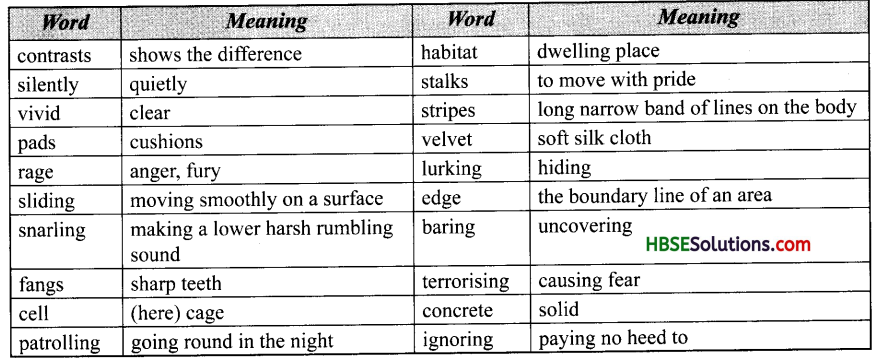
A Tiger in the Zoo Word-Meanings

HBSE 10th Class English Solutions First Flight Poem 3 A Tiger in the Zoo 1

HBSE 10th Class English Solutions First Flight Poem 3 A Tiger in the Zoo Read More »

HBSE 10th Class English Solutions First Flight Poem 2 Fire and Ice

Haryana State Board HBSE 10th Class English Solutions First Flight Poem 2 Fire and Ice Textbook Exercise Questions and Answers.

Haryana Board 10th Class English Solutions First Flight Poem 2 Fire and Ice

HBSE 10th Class English Fire and Ice Textbook Questions and Answers

Thinking about the Poem

1. There are many ideas about how the world will ‘end’. Do you think the world will end some day? Have you ever thought what would happen if the sun got so hot that it ‘burst’, or grew colder and colder?
Answer:
The poet has presented two ideas about the end of this world. Nothing is permanent in this world and everything will perish one day. If the sun gets too hot, each and everything will turn into ashes. And, on the contrary, if the sun grows colder and colder, life from the universe will vanish. Nothing will remain in this world as the Sun is the source of life.

2. For Frost, what do ‘fire’ and `ice’ stand for? Here are some ideas:

greed
avarice
cruelty
lust
conflict
fury
intolerance
rigidity
insensitivity
coldness
indifference
hatred.
Answer:
“Fire’ stands for greed, avarice, lust, conflict and fury.
‘Ice’stands for cruelty, insensitivity, coldness, indifference and hatred.

HBSE 10th Class English Solutions First Flight Poem 2 Fire and Ice

3. What is the rhyme scheme of the poem? How does it help in bringing out the contrasting ideas in the poem?
Answer:
The rhyme scheme of the poem is as follows:
1st stanza: a b a a
2nd stanza: a b a b a

The contrasting ideas of ‘fire’ and `ice’are presented using this rhyme scheme. He mentions that both fire and ice are probable ends of this world. While he talks about how fire represents desire and can, therefore, be a cause of the end of the world, he also mentions ice in the poem to symbolise that the coldness and indifference towards one another will also be enough to end the world. In the second stanza, he says that he knows enough of hate in the world to be sure that even destruction through ice would be sufficient to bring about the end of the world.

HBSE 10th Class English Fire and Ice Important Questions and Answers

I. Short Answer Type Questions (20-30 words & 2 marks each)

Question 1.
Which underlying idea is represented in the poem ‘Fire and Ice’?
Answer:
The poet compares fire to ‘desire’and ice to ‘hatred’. Both of these are surging exponentially. If we don’t keep a check on their rapid growth, the world will perish. Therefore, we must control our desires and hatred.

Question 2.
Why did the poet say about the world perishing twice?
Answer:
The poet said about the world perishing twice because, at first if some parts of the world are left out of apocalypse through fire, the remaining parts would definitely be destroyed by ice.

Question 3.
How is ice sufficient to bring destruction?
Answer:
In the poem, ‘ice’ denotes hatred. It does not matter what type of hatred it is. There is much hatred in this world. It will certainly destroy.

II. Short Answer Type Questions (40-50 words & 3 marks each)

Question 1.
What do ‘fire’ and `ice’ stand for and what is the general opinion regarding the world?
Answer:
Fire stands for fury, hatred, anger, cruelty; ice stands for insensitivity, coldness and intolerance. In general, it is the opinion of some people that fire will destroy the world while some say that ice will destroy it.

HBSE 10th Class English Solutions First Flight Poem 2 Fire and Ice

Question 2.
What does the poet say regarding the end of the world?
Answer:
It is a universal truth that everything has a beginning and it will certainly come to an end. Either ‘fire’ or ‘ice’may cause the end of the world. Some day the existing world will certainly end.

III. Long Answer Type Questions (100-120 words & 5 marks each)

Question 1.
Why does the poet say he is in favour of fire ending the world?
Answer:
In this poem, the poet has used an analogy between fire and greed. In his opinion, the nature of fire is just like that of desire, greed, lust or avarice. The more we try to satisfy these, the more they grow. They spread like fire spreading throughout a forest and embracing trees, animals in its agony and leaving nothing but the ash. Likewise, the never-ending desires of humans pose a danger to this world. It can be seen from the past trends. The forest cover has been shrinking. Since the inception of Industrial Revolution, many animal species have become extinct and some are in endangered category. All this happened and is still happening because of human’s never satisfying greed. The poet could visualise the ramifications of uncontrolled desires and this is why he is in favour of fire ending the world.

Question 2.
How can ice end the world?
Answer:
The word ‘ice’ is a metaphor representing cruelty, hate, coldness, unkind nature and rigidity. Time has seen it all, how a feeling of hatred in one person spreads to thousands of them, wiping out an entire generation or a community, e.g., Hitler’s hatred for a particular faith inspired him for his infamous atrocities. There had been wars to become the ultimate superpower and the intention to carry out such cowardly acts was based on unkind nature of an individual.
So, considering all this in mind, the poet referred ice as a way of ending this world.

Question 3.
Is it possible to avoid the end of the world? How can we prevent the fire and ice to carry out the ending of this world? Answer:
Yes, it is possible to avoid the apocalypse. If we humans are responsible for the catasrophe so far, we also have the capability to deter. To save this world from fire and ice, we must act upon our necessities and not desires. We must go for inner engineering to know, observe, analyse and learn the ways this nature works. Moral education should be inculcated at a young age, knowledge about feeling of being content should be imparted, to control the feelings of anger, lust, hatred, we must practise meditation. All these little steps will produce a large return towards the benefit of
humankind and thus deter our world from evils.

Question 4.
Some say the world will end in
fire some say in ice.
From what I’ve tasted of desire
I hold with those who favour fire.
On the basis of the given passage, explain how will the world end? Substantiate.
Answer:
Through the given passage, the poet wants to convey two things about the world. According to some people, the world will end in fire. But some people also opine that the world will end in ice. Both of these are the contradictory opinions. But one similar thing between them is that both of them would destroy everything in the world. In the poem, fire stands for desire and ice stands for hatred.

So, the poet gives a clear message to us that nothing is eternal in this world. Everything will perish either in fire or ice. Hatred and desire will end this world. This fire of passions and desire will lead the end of the world. Cold reasoning and hate will lead this world to destruction. But the poet is with those who think that fire of passions and desires will lead to the destruction of this world.

HBSE 10th Class English Solutions First Flight Poem 2 Fire and Ice

Reference To Context

Read the extracts given below and answer the questions that follow:

1. Some say the world will end in fire
Some say in ice.
From what I’ve tasted of desire
I hold with those who favour fire.

Paraphrase: The poet expresses that the world would end in two ways – either by ice or by fire. It is the opinion of some people that the world would end in fire. It denotes that fiery desires and passion will lead to the destruction of the world. On the other hand, some people opine that the world would end in ice. Hatred, jealousy etc. will lead to the destruction of this world.

Choose the correct option:

(a) Who are ‘some’ in the given stanze?
(i) Aliens
(ii) Martians
(iii) Humans
(iv) All of these
Answer:
(iii) Humans

(b) What does ‘fire’ here symbolise?
(i) Hatred
(ii) Desire
(iii) Satisfaction
(iv) None of these
Answer:
(ii) Desire

(c) The world would end in either of ways.
(i) one
(ii) two
(iii) three
(iv) none of these
Answer:
(ii) two

(d) What does the poet compare fire and ice with?
(i) Constructive features of human emotions
(ii) Destructive features of human emotions
(iii) Both (i) and (ii)
(iv) Neither (i) nor (ii)
Answer:
(ii) Destructive features of human emotions

(e) What is the rhyming scheme of the given extract?
(i) aaab
(ii) abab
(iii) aabb
(iv) abaa
Answer:
(iv) abaa

2. But if it had to perish twice,
I think I know enough of hate
To say that for destruction ice
Is also great
And would suffice

Paraphrase: If this world has to perish twice, ice would be stronger or more effective in doing this work. Hatred will lead towards the destruction of this world. Ice is sufficient enough to cause the destruction of this world.

Choose the correct option:

(a) What would be more effective in the end of this world?
(i) Fire
(ii) Ice
(iii) Fury
(iv) Intolerance
Answer:
(ii) Ice

HBSE 10th Class English Solutions First Flight Poem 2 Fire and Ice

(b) What poetic device has the poet used in the line, “To say that for destruction, ice is also great”?
(i) Imagery
(ii) Alliteration
(iii) Oxymoron
(iv) Metaphor
Answer:
(i) Imagery

(c) _______ is also good for destruction.
(i) Belief
(ii) Ice
(iii) Honesty
(iv) None of these
Answer:
(ii) Ice

(d) What would be a better option to end the earth?
(i) Ice
(ii) Fire
(iii) Both (i) and (ii)
(iv) None of these
Answer:
(iii) Both (i) and (ii)

(e) What would be the consequences if we don’t control our emotions?
(i) It will lead us on the verge of destruction.
(ii) It will lead us on the verge of death.
(iii) It will lead to chaos.
(iv) None of these
Answer:
(i) It will lead us on the verge of destruction.

Fire and Ice Summary

Fire and Ice Introduction

Central Idea of the Poem

It is a universal truth that nothing is permanent in this world. On the one hand, some people think that the world will end in fire while on the other hand, some people think that the world will end in ice. The poet equates the fire with desire and ice with hate. As the ice destroys the world melting slowly, in the same way hatred will also destroy the world. Because greed, hatred, strife, intolerance, etc., bring much destruction to the society. So, human beings should live peacefully.

Fire and Ice Summary

‘Fire and Ice’ is a short poem by Robert Frost. In this poem, the poet refers to two predictions of how the world will end. Some say it will end in fire whereas others say it will end in ice. According to the poet, ‘fire’ stands for desire, greed, avarice or lust. The more you try to satisfy them, the more they grow. There is no end to it. They spread rapidly like fire and engulf your whole life. One becomes selfish and sometimes cruel too. On the other hand, ‘ice’ according to the poet, stands for hatred, coldness and rigidity. One becomes insensitive and indifferent towards the feelings of others. The poet says that both fire and ice are growing with such a rapid pace that the world would soon perish either way, in fire or in ice.

Poem at a Glance

  • It is the perception of poet that the world will certainly come to an end.
  • This world will end either in fire or in ice.
  • Fire has been compared to human emotion of desire or passions.
  • Ice has been compared to hate.
  • Fire or ice can destroy the world once but hatred can destroy it twice.
  • So, we should try to live peacefully in this world.

HBSE 10th Class English Solutions First Flight Poem 2 Fire and Ice

Fire and Ice Word-Meanings

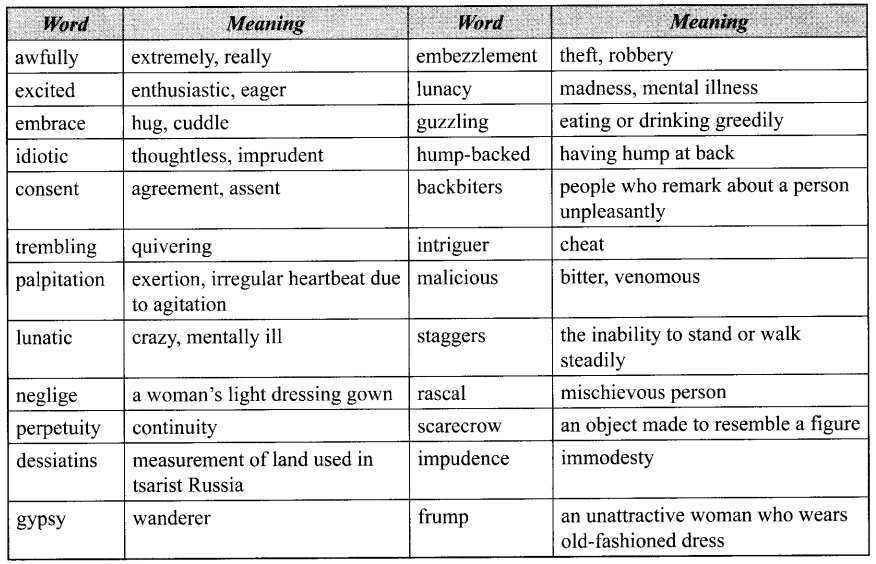
HBSE 10th Class English Solutions First Flight Poem 2 Fire and Ice 1 HBSE 10th Class English Solutions First Flight Poem 2 Fire and Ice 2

HBSE 10th Class English Solutions First Flight Poem 2 Fire and Ice Read More »

HBSE 10th Class English Narrating (Story Writing)

Haryana State Board HBSE 10th Class English Solutions Narrating (Story Writing) Exercise Questions and Answers.

Haryana Board 10th Class English Narrating (Story Writing)

Narrating (Stories)

1. The Lion And The Mouse
Or
Do Good, Have Good

Outline: A lion asleep ……………… a mouse jumps on his body ……………… lion awakens ……………… loses temper ……………… catches mouse ……………… mouse frightened ……………… requested ……………… kind ……………… might help some day ……………… lion caught in net ……………… mouse bites with teeth ……………… set free ……………… Moral.

Once there was a lion in the jungle. He was sleeping. A mouse lived nearby. It came out of its hole. It began to jump over the lion. The lion woke up. He caught the mouse. The mouse begged for mercy. The lion took pity on it. He let it go.

One day a hunter came into the jungle. He cast his net. The same lion was caught in it. He began to roar. The mouse heard his roar. It came out. It cut the net. The lion was free. He thanked the mouse.

Moral: Do good, have good.

HBSE 10th Class English Narrating (Story Writing)

2. The Hare And The Tortoise
Or
Slow And Steady Wins The Race
Or
Pride Hath A Fall

Outline: A hare ……………… laughs at a tortoise. slow speed ……………… they agree to run a race. hare runs fast. ……………… goes much ahead ……………… sleeps on the way. ……………… the tortoise moves on ……………… wins the race ……………… Moral.

Once there was a hare. He lived in a jungle. There was a tortoise also. They became friends. One day the hare laughed at the tortoise. He said that the tortoise was very slow. The tortoise could not bear the insult. He asked the hare to run a race.

A goal was fixed. The race began. The hare ran fast. He came much ahead. He thought of taking rest. He fell asleep. The tortoise moved slowly. But he went on. He did not stop. He passed by the hare. The hare was sleeping. The tortoise reached the goal.
After some time, the hare woke up. He ran fast. But the tortoise had won the race.

Moral: Slow and steady wins the race.

3. The Wolf And The Lamb
Or
Might Is Right

Outline : A wolf at a river ……………… drinking water ……………… see a lamb ……………… lamb is drinking lower down ……………… wishes to eat lamb ……………… makes lamb excuses ……………… kills the lamb and ate it up ……………… Moral.

Once there was a wolf. He felt thirsty. He went to a river. He started drinking water. He saw a lamb. It was also drinking water. It was lower down. The wolf’s mouth watered. He wanted to eat the lamb. He said to the lamb, “Why are you making the water muddy?” The lamb replied, “Sir, the water is flowing from you to me. How can I make it muddy ?”

Now the wolf said, “Why did you abuse me last year?” The lamb replied, “I was not even bom then.” At this the wolf again said, “Then it must be your mother.” Saying this he killed the lamb. Then he ate it up.

Moral: Might is right.

4. Two Friends And The Bear
Or
A Friend In Need Is A Friend Indeed

Outline : Two friends ……………… pass through a jungle ……………… they saw a bear. ……………… one climbes up a tree ……………… the other lies down ……………… the bear smells him ……………… goes away ……………… the first friend asks what the bear said ……………… Beware of a false friend ……………… Moral.

Mohan and Sohan were two friends. Mohan was a good friend. But Sohan was selfish. One day they passed through a jungle. They saw a bear. They were afraid. Sohan at once climbed up a tree. He did not care for Mohan. Mohan lay down on the ground. He held his breath. The bear came and smelt him. He thought that Mohan was dead. He went away. Sohan came down. He went to Mohan and asked, “What did the bear say in your ear?” Mohan replied, “The bear asked me to beware of false friends.”

Moral: Beware of selfish friends.

HBSE 10th Class English Narrating (Story Writing)

5. The Hidden Treasure

Or
No Pains, No Gains

Outline : An old farmer ……………… three sons ……………… idle ……………… always quarrelling ……………… father dying ……………… calls his sons ……………… tells them that there is a treasure in the field ……………… dies ……………… the sons dig the field ……………… there is no treasure ……………… they sow the seed ……………… rich harvest ……………… Moral.

Once there was an old farmer. He had three sons. They were idle. They did nothing. They were always quarrelling. One day the farmer fell ill. He knew that his death was near. He called his sons. He said, “There is a treasure in our field. Dig it out after my death.” Then the farmer died.

The sons went to the field. They dug the whole field. But there was no treasure. A wise man advised them to sow wheat. They sowed wheat. They had a good crop. They learnt the value of hard work. They began to work hard.

Moral: No pains, no gains.

6. Honesty Is The Best Policy
Or
God Mercury And The Woodcutter

Outline : Once a woodcutter ……………… cutting a tree ……………… axe fell into the water. ……………… God appeared ……………… golden axe ……………… woodcutter refused. ……………… silver axe ……………… then iron axe ……………… god pleased. ……………… Moral.

Once there was a poor woodcutter. One day he was cutting a tree on the bank of a river. His axe fell into the water. He was sad. God Mercury appeared. He asked the woodcutter why he was sad. The woodcutter said that his axe had fallen into the water. God Mercury dived. He brought out a golden axe. But the woodcutter said, “This is not mine.” The God dived again. He brought out a silver axe. But the woodcutter said again, “This is not mine.”

At last the God brought an iron axe. The woodcutter was happy. He said, “This axe is mine.” The God was pleased at his honesty. He gave him all the three axes.

Moral: Honesty is the best policy.

7. The Dove And The Bee
Or
One Good Turn Deserves Another
Or
Do Good, Have Good

Outline : A bee falls into the water ……………… a dove helps it. ……………… throws a leaf into the water ……………… the bee gets on it ……………… it flies away ……………… some days pass ……………… a hunter comes ……………… he aims at the dove ……………… the bee sees ……………… it stings the hunter ……………… the bee is saved ……………… Moral.

Once there was a bee. It felt thirsty. It went to the river. It fell into the river. It was about to die. A dove saw it. She plucked a leaf. She threw the leaf into the water. The bee got on to it. Its life was saved. It flew away.

Some days passed. A hunter came. He saw the dove. He aimed at the dove. The bee saw all this. It stung the hunter. His gun fell down. The dove flew away. She thanked the bee.

Moral: Do good, have good.

HBSE 10th Class English Narrating (Story Writing)

8. United We Stand. Divided We Fall
Or
Union Is Strength

Outline : An oldfarmer ……………… his sons always quarrel ……………… sends for them ……………… gives them a bundle
of sticks to break ……………… sons unable to do so ……………… asks them to untie the bundle ……………… sticks broken one by
one ……………… Moral.

There was a farmer. He had four sons. They always quarrelled with one another. The farmer was very sad. He advised them not to quarrel. But in vain.

One day the farmer fell ill. He knew that his end was near. He called his sons. He gave them a bundle of sticks. He asked them to break it. But they failed to do so. Then the bundle was untied. The farmer asked his sons to break the sticks one by one. Each son broke the sticks. The father said, “Be united like the bundle. If you are united, none will harm you.” The sons leamt a lesson. They never quarrelled again.

Moral: Union is strength.

9. The Fox And The Crow
Or
Beware of Flatterers

Outline : A hungryfox ……………… sees a crow with a piece ofcheese wants to have it ……………… praises the crow ……………… the piece of cheese falls down ……………… eats it up ……………… goes away ……………… Moral.

Once there was a fox. He was very hungry. He went here and there in search of food. But he did not get food anywhere. At last he reached a garden. There he saw a crow in the tree. The crow had a piece of cheese in his beak.

The fox was very clever. He began to praise the crow. He said, “Dear crow ! You are very beautiful. Your voice is very sweet. Please sing me a song.” The crow was taken in. He opened the beak to sing. The piece of cheese fell down. The fox ate it up and went away.

Moral: Beware of flatterers.

10. The Shepherd Boy And The Wolf

Outline : A shepherd boy ……………… habit, of telling lies ……………… grazes sheep ……………… decides to make fun of villagers ……………… cries, wolf wolf ……………… villagers come ……………… one day a wolfreally comes ……………… cries ……………… but nobody comes ……………… Moral.

Once there was a shepherd boy. He grazed his sheep outside the village. There was a forest nearby. One day the shepherd boy was grazing his sheep. He thought of making fun of the villagers. He started shouting, “Wolf ! Wolf ! Come and save me.” The villagers came running. There was no wolf. The boy laughed at them. He said that it was a joke. The villagers were angry. They went away.

One day a wolf really came there. The shepherd boy cried for help. But the villagers thought that he was joking. They did not come. The wolf killed many sheep. It wounded the boy. The boy leamt a lesson. He never told a lie again.

Moral: Never tell a lie.

HBSE 10th Class English Narrating (Story Writing)

11. The Greedy Dog
Or
Greed Is A Curse

Outline : A dog. ……………… was very hungry ……………… in search of food ……………… reaches a shop ……………… steals a piece of meat. ……………… goes to a river ……………… reflection ……………… barks ……………… .piece of meat falls into water ……………… Moral.

A dog was very hungry. He went here and there. But he did not find food anywhere. He stole a piece of meat from a meat shop. He wanted to eat it alone. So he went to the jungle.

There was a river on the way. When he went on the bridge, he saw his own reflection in the water. He thought that it was another dog. That dog also had a piece of meat. This dog was greedy to get that piece also. So he barked at him. His own piece of meat fell into the water. He was very sad. But it was too late.

Moral: Greed is a curse.

12. The Fox And The Goat

Outline : The fox ……………. thisty in search of good …………….. reaches a shop steals a piece of meat …………….. goes to a river …………… reflection …………….. barks …………. piece of meat falls into water ……………….. Moral.

Once there was a fox. He was thirsty. He went to a well. He tried to drink water. By chance he fell into the well. He was sad.

A goat came there. She looked into the well. The fox said to her, “The water is cold and sweet.Please come in.” The foolish goat believed him. She jumped into the well. The fox climbed up the goat. He came out of the well. The goat died there.

Moral: Look before you leap.

13. The Cap Seller And The Monkeys

Outline : A cap seller. ……………… going to a village ……………… a bundle of caps in his hands ……………… falls asleep under a tree ……………… monkeys on the tree ……………… they take away his caps ……………… the cap seller wakes up ……………… throws down his cap ……………… the monkeys do the same ……………… Moral.

Once there was a cap seller. He had a bundle of caps. He was going to a village. There was a forest on the way. It was very hot. He wanted to take rest. He lay under a tree. He fell asleep.

There were some monkeys on the tree. They came down. They took away all his caps. The cap seller woke up. He found his caps missing. He looked up. He saw the monkeys. The caps were on their heads. The cap seller thought of apian. He threw down his cap. The monkeys also threw down their caps. The cap seller got his caps. He went away.

Moral: Do not give up hope in difficulty.

14. The Hen That Laid Golden Eggs
Or
Greed Is A Curse

Outline : A farmer. ……………… had a wonderful hen ……………… laid a golden egg daily ……………… greedy ……………… wanted to have all the eggs ……………… killed the hen ……………… felt sorry ……………… Moral.

Once there was a farmer. He had a wonderful hen. It laid one golden egg daily. The farmer soon became rich. The farmer was greedy. He thought there were many eggs in the hen. He wanted to get all the eggs at once. He thought of a plan. He killed the hen. But there was no egg inside it. The farmer became sad. But it was too late. He had lost his hen.

Moral: Greed is a curse.

15. The Tailor And The Elephant

Outline : An elephant. ……………… goes to the river daily ……………… a tailor’s shop ……………… the elephant and the tailor became friends ……………… one day tailor pricks elephant’s trunk ……………… elephant spoils his clothes ……………… Moral.

Once there was an elephant. He went to the river daily. He took bath in the river. There was a tailor’s shop on the way. The tailor gave bananas to the elephant daily. They became friends.

One day, the tailor was angry. The elephant came. The tailor did not welcome him. The elephant put his trunk into the shop. The tailor pricked his trunk with a needle. The elephant was angry. But he went away.

The elephant went to the river. He filled his trunk with dirty water. He came back. He threw the dirty water into the shop. Tailor’s new clothes were spoiled. The tailor was sad.

Moral: Tit for tat.

HBSE 10th Class English Narrating (Story Writing)

16. The Thirsty Crow
Or
Where There Is A Will, There Is A Way

Outline : A hot day of summer ……………… a crow was very thirsty ……………… in search of water ……………… saw a pitcher ……………… water was low ……………… .put pebbles in the pitcher ……………… water came up ……………… drank it ……………… flew away ……………… Moral.

It was sumiper. It was very hot. A crow was thirsty. He flew here and there in search of water. But he did not find water anywhere. He reached a garden.

The crow saw a pitcher of water. But the water was very low. His beak could not reach it. He saw some pebbles near the pitcher. The crow thought of a plan. He picked the pebbles one by one. He put them into the pitcher. The water rose up. He drank the water and flew away.

Moral: Where there is a will, there is a way.

HBSE 10th Class English Narrating (Story Writing)

17. The Fox And The Grapes
Or
The Grapes Are Sour

Outline : A fox hungry ……………… sees some grapes ……………… tries to get them ……………… fails to do so ……………… says
that grapes are sour ……………… Moral.

Once there was a fox. He was very hungry. He went here and there in search of food. But he did not get food anywhere. At last he reached a garden. There he saw ripe grapes. His mouth watered. He wanted to eat them.

The grapes were very high. The fox jumped again and again. But he could not get at them. Soon he was tired. He went away saying. “These grapes are sour. I shall not eat them.”

Moral: The grapes are sour.

18. Bad Company

Outline: A boy ……………… bad company ……………… father ……………… reform ……………… buy ……………… good apples ……………… asks the boy to place one bad apple ……………… all apples ……………… rotten ……………… the boy learns the lesson ……………… moral.

A rich man had only one son. He loved him very much. But the boy fell into a bad company. He remained away from home. He did not obey his father. The father thought of a plan. One day the father brought home some apples. The apples were very fine. He also brought a rotten apple. He asked his son to put the rotton apple with the fine apples. After a couple of days, the father asked the son to bring the apples.

The son brought the apples : when he took them out of the basket all the apples were rotten. At this, the father told his son that one rotten apple had spoiled all the fine apples. In the same way, the company of bad boys will spoil you. The son learnt a lesson.

Moral: Better alone than in a bad company. Or Avoid bad company.

HBSE 10th Class English Narrating (Story Writing) Read More »

HBSE 10th Class English Solutions First Flight Poem 1 Dust of Snow

Haryana State Board HBSE 10th Class English Solutions First Flight Poem 1 Dust of Snow Textbook Exercise Questions and Answers.

Haryana Board 10th Class English Solutions First Flight Poem 1 Dust of Snow

HBSE 10th Class English Dust of Snow Textbook Questions and Answers

Thinking about the Poem

1. What is a “dust of snow”? What does the poet say has changed his mood? How has the poet’s mood changed?
Answer:
A “dust of snow” means particles of snow. The poet’s mood changed because of shaking down of something from the hemlock tree. He was holding the day in regret when this dust of snow fell on him and this simple little thing brought him some joy.

2. How does Frost present nature in this poem? The following questions may help you to think of an answer.
(i) What are the birds that are usually named in poems? Do you think a crow is often mentioned in poems? What images come to your mind when you think of a crow?
(ii) Again, what is “a hemlock tree”? Why doesn’t the poet write about a more ‘beautiful tree such as a maple, or an oak, or a pine?
(iii) What do the “crow’ and ‘hemlock’ represent – joy or sorrow? What does the dust of snow that the crow shakes off a hemlock tree stand for?
Answer:
(i) In poems, usually birds like nightingales and sparrows are mentioned. Frost has presented nature in quite an unconventional manner. The poet has used a crow in this poem. A crow is usually not mentioned in poems. A crow is usually considered to be dark, black and foreboding. That is why other poets usually mention singing nightingales or beautiful white doves in their poems.
(ii) A hemlock tree is a poisonous tree with small white flowers. The poet has not written about a more beautiful tree such as a maple, or oak, or pine because these trees symbolise beauty and happiness. Frost wanted to symbolise the feelings of sadness, despondency and regretfulness, that is why he has used a hemlock tree.
(iii) The crow and the hemlock tree represent sorrow and grief. The dust of snow that is shaken off by the crow stands for joy that Frost experiences. He has, therefore, used an unconventional tree and bird in order to contrast them with joy in the form of snow.

HBSE 9th Class English Solutions First Flight Poem 1 Dust of Snow

3. Have there been times when you felt depressed or hopeless? Have you experienced a similar moment that changed your mood that day?
Answer:
Several times I felt depressed or hopeless. One day, one of my classmates told me that I had got only 40 marks in English out of 80. At that time, I felt depressed and dejected. But after an hour, the result was announced and I got 75 out of 80. The English teacher also congratulated me on my success, and after this, I felt relaxed and happy.

HBSE 10th Class English Dust of Snow Important Questions and Answers

I. Short Answer Type Questions (20-30 words & 2 marks each)

Question 1.
What is the underlying message for us in our hectic life with reference to the poem, ‘Dust of Snow’?
Answer:
The underlying message for us in our hectic life is that we should enjoy nature more often and should have a positive attitude even towards simple acts because they can lead to the learning of greater lessons of enjoying life.

Question 2.
Why does the poet say that he had saved some part of the day he had rued?
Answer:
In the morning, the poet was sad and listless. He thought that the entire day would go waste. But, the falling of dust of snow on him changed his mood suddenly. It brought a ray of hope in him. This way he felt that he had saved some part of the day.

II. Short Answer Type Questions (40-50 words & 3 marks each)

Question 1.
Why did the poet use poetically uncommon bird and tree?
Answer:
The poet appears to be in a depressive and sorrowful mood. In this kind of state, one can not look at the beautiful things which nature has to offer, only gloomy and miserable thoughts strike in one’s mind. Therefore, the poet has used the poetically uncommon bird and tree which reflect his depressed state of mind.

Question 2.
Does the poet present a bright and pleasant side of nature in the poem?
Answer:
No, the poet does not present a bright and pleasant side of nature in the poem. He presented the situation as a dull and depressive cold day. The fall of fine dust of snow does bring a sudden change in the mood of the poet by uplifting his spirits and refreshing his mind.

Question 3.
What message does the poet want to convey through the poem ‘Dust of Snow’?
Answer:
The poet conveys that sadness, hopelessness and disappointment do come into the life of mankind. It makes them feel dejected and depressed. But there is always happiness behind sadness. If sadness comes, happiness is bound to come in our life. As the poet was sad and low in spirits in the morning but the falling of dust of snow on him brought a sudden change in his mood. So, we should not get disheartened in any circumstance.

III. Long Answer Type Questions (100-120 words & 5 marks each)

Question 1.
No matter how ordinary or unimportant an incident may be, it’s the reaction or the response that matters. Taking inspiration from the poet’s reaction write how inherent values can be picked up and learnt. Mention any two lessons for students like you that could be useful.
Answer:
Yes, response matters a lot. Inherent values can be picked up by adopting a positive attitude towards nature, because nature is a great teacher. Each little thing in nature can teach us some important lessons at times and even a small flake of snow has its own significance. We should not judge anything by its appearance. Although crow and hemlock tree are considered as bad omen but even then they can bring cheerfulness in uplifting poet’s mood. So nothing is useless in nature. Nature is very beautiful. One should live one’s present cheerfully.

Question 2.
Robert Frost opens before us a new world in which at times evil doer by chance do a good act before us. Discuss the philosophy of life with reference to the poem ‘Dust of Snow’.
Answer:
Robert Frost opened a different world before us through the poem ‘Dust of Snow’. It gives us a philosophy of life that at times when we are completely dejected and in bad mood, we get surprised. In fact, it also depicts his philosophy of life through which he passed. In the poem, ‘Dust of Snow’ the poet is wandering in a dejected mood. The whole mood changes when bad omen of crow is shown. Snow falls from the hemlock tree and mood of the poet changes. So evil is released by good luck.

HBSE 9th Class English Solutions First Flight Poem 1 Dust of Snow

Question 3.
In life, people feel sad and frustrated. It is his thinking that things will never change.
But suddenly change occurs in his life and his sadness is converted into happiness.
Discuss it on the basis of the poem, ‘Dust of Snow’.
Answer:
Life is full of miseries. The circumstances in life never remain the same. They keep on changing with the passage of time. So far the poem is concerned, the poet is in sad and frustrated mood. At the beginning of the day, he feels sad. He feels that his entire day has been wasted. But, it does not happen. The falling of the fine dust of snow on him brings a sudden change in his mood. He realises that all is not lost. Although he has lost the most part of the day. The change of landscape has changed his mood. His spirits are not listless. The sudden change has changed his heart and mood. So, we should not be sad and disappointed.
Life is a cycle. Happiness and sorrow are its two wheels.

Question 4.
Has given my heart
A change of mood
And saved some part
of a day I had rued.
What type of change in the mood does the poet talk about? Discuss it with reference to the given passage.
Answer:
The famous poet, Robert Frost has given a vivid description about the change of his mood. The arrival of a crow and its sitting on the hemlock tree is not a very big incident. It is a very ordinary incident. The poet has used symbolism here. Here crow denotes an ‘ill omen’ and hemlock tree symbolises ‘Poison’. But these things create a deep impression on the mind of the poet. According to the poet, this is a dull and disappointing day and it is not good for him.

But the falling of flakes and dust of snow on him are good or welcome signs for the poet. This phenomenon has suddenly changed the mood of the poet. His mood is now better and spirits are highly enthusiastic. He realises that the whole day has not gone waste. The moment the snow falls on him is the most happiest moment of the day. They lift up his mood and also gladden his heart. Ultimately, he realises that at least some part of the day has been spent happily. Now the moment of disappointment has changed into a happier one.

Reference To Context

Read the extracts given below and answer the questions that follow:

1. The way a crow
Shook down on me
The dust of snow
From a hemlock tree

Paraphrase: The poet was walking by a hemlock tree in the morning hour. He was perhaps in a bad mood. Hemlock tree is considered to be a poisonous tree. As he was walking, a crow threw some dust of snow on him. The “crow’ and ‘hemlock tree’ denote “sadness’ and ‘gloom’. The poet thought that day was not good for him.

Choose the correct option:

(a) Which tree is covered with snow?
(i) Acacia
(ii) Hemlock
(iii) Areca palm
(iv) None of these
Answer:
(ii) Hemlock

(b) Which bird shook down the tree?
(i) Sparrow
(ii) Ostrich
(iii) Crow
(iv) None of these
Answer:
(iii) Crow

(c) The crow was on a …………………. tree.
(i) hemlock
(ii) palm
(iii) coconut
(iv) mango
Answer:
(i) hemlock

HBSE 9th Class English Solutions First Flight Poem 1 Dust of Snow

(d) What is the rhyme scheme of the given extract?
(i) abab
(ii) cdcd
(iii) abcd
(iv) Free Verse
Anwer:
(i) abab

(e) What does “Dust of Snow” represent?
(i) The cool weather
(ii) The healing power of nature
(iii) The nature of mankind
(iv) The particles of snow
Answer:
(ii) The healing power of nature

2. Has given my heart
A change of mood
And saved some part
Of a day I had rued.

Paraphrase: The falling of the snow on the poet’s head made his mood upbeat. Till now, he had spent his day in a bad mood but now his mood had changed and also saved some part of the day. The poet here emphasises that inauspicious things can also bring joy and happiness to us.

Choose the correct option:

(a) What did lift the mood of the poet instantly?
(i) Falling of the snow on his head
(ii) Falling of the leaves of trees on his head
(iii) Drizzling on his body
(iv) All of these
Answer:
(i) Falling of the snow on his head

(b) What does the poet talk about here?
(i) Change of his mood
(ii) Change of his nature
(iii) Change of his habits
(iv) All of these
Answer:
(i) Change of his mood

HBSE 9th Class English Solutions First Flight Poem 1 Dust of Snow

(c) The poet saved same part of the ……………… being rued.
(i) night
(ii) day
(iii) life
(iv) all of these
Answer:
(ii) day

(d) What can inauspicious things even bring too?
(i) Only sadness
(ii) Joy and happiness
(iii) Nothing
(iv) Our past memories
Answer:
(ii) Joy and happiness

(e) What does the poet suggest through this?
(i) Dust of snow is very useful.
(ii) Crow is an insignificant bird.
(iii) Hemlock tree has a lot of importance.
(iv) Small things can bring big changes in life.
Answer:
(iv) Small things can bring big changes in life.

Dust of Snow Summary

Dust of Snow Introduction

About the Poet

Robert Frost was born on March 26, 1874 in San Francisco, California, to journalist William Prescott Frost, Jr., and Isabelle Moodie. His mother was a Scottish immigrant, and his father descended from Nicholas Frost of Tiverton, Devon, England, who had sailed to New Hampshire in 1634 on the Wolfrana. Frost was a descendant of Samuel Appleton, one of the early settlers of Ipswich, Massachusetts, and Rev. George Phillips, one of the early settlers of Watertown, Massachusetts. His notable works are A Boy’s Will, North of Boston, etc. Frost’s father was a teacher and later an editor of the San Francisco Evening Bulletin (which later merged with The San Francisco Examiner), and an unsuccessful candidate for city tax collector. After his death on May 5, 1885, the family moved across the country to Lawrence, Massachusetts, under the patronage of Robert’s grandfather William Frost, Sr., who was an overseer at a New England mill. Frost graduated from Lawrence High School in 1892. Frost’s mother joined the Swedenborgian church and had him baptized in it, but he left it as an adult. Although known for his later association with rural life, Frost grew up in the city, and he published his first poem in his high school’s magazine. He attended Dartmouth College for two months, long enough to be accepted into the Theta Delta Chi fraternity. Frost returned home to teach and to work at various jobs, including helping his mother teach her class of unruly boys, delivering newspapers, and working in a factory maintaining carbon arc lamps. He did not enjoy these jobs, feeling his true calling was poetry. Frost was honoured frequently during his lifetime, receiving four of his Pulitzer Prizes for Poetry for his book “New Hampshire’. He became one of America’s rare “public literary figures, almost an artistic institution.” He was awarded the Congressional Gold Medal in 1960 for his poetic works. On July 22, 1961, Frost was named poet laureate of Vermont. He died on January 29, 1963 at the age of 88 in Boston.

Central Idea of the Poem

Through this poem, the poet conveys that worst time often comes in the life of mankind. But a little good thing can change the entire course of action. The crow, dust and the hemlock tree symbolise bad things which make the people believe that something wrong is bound to happen. The poet is in quite disappointed mood. When he comes out of his home to wander in the snow, a crow shakes and snow falls on him. It makes him quite happy. So, the poet conveys that one should hope for the best even in the worst situation.

Dust of Snow Summary

The short poem by Robert Frost throws light upon the unimaginable healing power of nature and tiny things. From a bad mood to ill-health, there is nothing that can’t be cured by nature. The poet was experiencing one such bad day when a crow’s movement near a hemlock tree dusted snow upon him. The soft and cold touch of snow changes the poet’s mood from despondency to happiness. He starts feeling soothed and refreshed. In this way, a simple moment proves to be very significant and saves the rest of the day of the poet from being wasted and held in regret. The black crow is a symbol of death and fear.

Since the crow is not associated with goodness, it is ironic that in this poem, it is doing a good deed by shaking off the snow. The poet uses the elements of the fearsome crow and poisonous hemlock tree to do something good – shake the white, pure snow off the branches.

The poem, “Dust of Snow’ reiterates that the little things in life can make huge changes in our future. It also shows that if we can take the hard times of life in stride, eventually something will happen to change our situation into happier times. The simple things we do for others can make all the difference. Just think about those random acts of kindness we do and how much they brighten our day and sometimes change our future.

HBSE 9th Class English Solutions First Flight Poem 1 Dust of Snow

Poem at a Glance

On a winter day, the poet was quite upset and sitting under the hemlock tree.
Suddenly, a crow alighted on the hemlock tree.
The snowflakes fell down on the poet while he was sitting under the tree.
The falling of snowflakes on the poet made a tremendous effect on him.
Now, he was feeling refreshed.
It changed the mood of the poet and also his mental state.
A little thing saved the entire day of the poet.

Dust of Snow Word-Meanings

HBSE 10th Class English Solutions First Flight Poem 1 Dust of Snow 1 HBSE 10th Class English Solutions First Flight Poem 1 Dust of Snow 2

HBSE 10th Class English Solutions First Flight Poem 1 Dust of Snow Read More »

HBSE 10th Class English Paragraph Writing

Haryana State Board HBSE 10th Class English Solutions Paragraph Writing Exercise Questions and Answers.

Haryana Board 10th Class English Paragraph Writing

1. How I Spent My Last Sunday

Last Sunday we went out on a picnic. We went to Badkhal Lake. This lake is situated near Faridabad. This is a natural lake among rocks. It is very deep and wide. The Haryana government has developed the lake and the area around it into a fine picnic spot. 1 went to the lake with my friends. There is facility of boating. We took three boats and did a lot of boating on the lake. One of my friends had a good camera with him. He took our snaps in various poses. There is a very good restaurant on the bank of this lake. This is run by the tourist department of Haryana. In the afternoon we took our meals in the restaurant. Then we took rest on the lawns. A friend of mine sang songs. I sang a gazal. After sometime we took a walk around the lake. In the evening we came back. I will never forget that pleasant Sunday.

HBSE 10th Class English Paragraph Writing

2. Recent Floods In Our State

Last year, the monsoon in Haryana was in a great fury. It rained continuously and heavily for fifteen days. This caused floods everywhere in Haryana. Many villages were affected by these floods. The standing crops were drowned in water. Many mud-houses fell down. The condition was not much better in the cities. The road and railway traffic was disrupted. Trees were uprooted. In many villages people passed their time on house tops or on the trees. Many people died of hunger. A great number of cattle died. Water diseases spread everywhere. The Government rushed help to the people caught in the floods. The army was called to help the civil officers. Food packets were dropped by aeroplanes also. Many people were taken to safe places. But the sight of the flood was unbearable.

3. Price Hike

Price hike or rising prices are the terms used to denote rise in prices of goods and services. Price hike is a common phenomenon and happens in most economies. For the common man, a hike in prices is always a matter of some concern. In an economy like India the concern is even bigger because a big part of our population is below poverty line and near to poverty line. For the common man, a price hike in one particular commodity can affect his entire budget and cut into his savings. In our country prices of vegetables are most vulnerable. Sometimes the prices of onions and tomatoes sour so high that people are stunned. There are many factors behind the price hike. In some cases the false shortage of commodities created by the black market traders cause the price hike. This type of hike creates panic among the people. Thus the government must take stem actions against the people involved in black market trading.

4. My First Visit To A Big City

I live in a small town. But last month I visited Delhi. It is the capital of India. It is a very big city. I was wonder-struck to see the life in this big city. There is big rush in Delhi. People are rushing from here to there all the day. The rush and traffic increase at about 9 A.M. When people go to offices, schools and colleges. There is again a great rush at about six in the evening when people come home from offices. I saw big buildings in Delhi. The railway station and the bus stand are big and crowded. There are a number of cinema houses in Delhi. While loitering on the road, 1 felt thirsty. I looked for a tap or a hand pump but 1 found none. 1 was surprised to find that even drinking water is sold there. I visited the Parliament House, the Zoo, the Red Fort and the Birla Mandir. I heaved a sigh of relief when I returned to the calm and peaceful atmosphere of my small tow n.

5. My Visit To A Hill Station

Last year, I visited Mussourie. I and two of my friends went together. Mussourie is a beautiful hill station. It is surrounded by tall and majestic hills. From Dehradun, Mussourie is only one hour away by bus. The way to Mussourie from Dehradun is very steep. At night one can see the beautiful and shining city of Mussourie from Dehradun. In the same way, from Mussourie one can see below the lights of Dehradun at night. There are a number of beauty spots in and around Mussourie.

Thousands of tourists visit this hill station from India and the other countries. We stayed at Mussourie for a week. We went to see the Kempti Falls. We had a beautiful glimpse of the Himalayas from Lai Tibba hill. We enjoyed a ride in the rope-way trollies at gunhill. We visited Dhanllti also. The lake at Mussourie is small but beautiful. We did some shopping at the Chinese market. The memory of my visit to Mussourie will always remain fresh in my mind.

HBSE 10th Class English Paragraph Writing

6. A Visit To A Historical Place

Last year, I went to Agra with one of my friends. We saw many buildings there. We went to see the Red Fort and the buildings at Fatehpur Sikri. But I was charmed by the beauty of the Taj Mahal. We saw the Taj in a full moon night. This glorious building was shining beautifully. Inside the Taj, there are graves of Shah Jahan and his queen Mumataz Mahal. Shah Jahan built this great building in the memory of his queen. When he died, he was also buried in the Taj. This grand building stands on the bank of the river Yamuna. The marble for the Taj Mahal was brought from Rajasthan. Every year a great number of tourists from all over the world come to see the Taj Mahal. The Agra City itself is not beautiful. The streets of the old city are narrow and dirty. But Agra is world famous because of the Taj Mahal.

7. My Visit To An International Trade Fair

Every year, an International Trade Fair is held at Delhi. Last year I also visited the International Trade Fair. It was held at the Pragati Maidan in New Delhi. I went with our school tour. We made our entry from Gate No. 1 and went inside. There was a lot of rush. Thousands of people and school and college students had come to visit this trade fair. Nearly all the states of India had set up their pavilions. These pavilions highlighted the industrial development achieved by each state. Apart from the industrial and technical progress, these pavilions gave a glimpse of the cultural life of these states. Many countries of the world also took part in it. They had put their stalls in a big building called ‘The Hall of Nations’. The main attractions of the fair was electronic goods.

HBSE 10th Class English Paragraph Writing

8. How A Stranger Helped You

Last week, I was travelling in a train. I was going to New Delhi to see my sister. At a station I got down to buy a water bottle. But the train started to move before its time. I ran fastly to catch the train. Suddenly, I fell down and got hurt badly. One of the passengers saw me. He came to me and helped me in boarding the train. He took me to my seat. He gave me some water. He cleaned my wounds with his own handkerchief. Then he got some medicines and bandages from the nearby passengers. He gave me some tablets and put bandages on my wounds. He also helped me to reach at my sisters home. He was a very kind man. I will never forget him. Now, I have also decided to help others in their problems.

9. My Visit To A Zoo

Last Sunday, I happened to visit Delhi. There I went to see the Zoo. I went there with my uncle. The zoo in Delhi is one of the biggest zoo in Asia. It is situated near the Old Fort. As we entered the zoo, first of all, we saw birds. There were many kinds of birds. Some of them were very beautiful and rare. In the beginning there were water birds and then other kinds of birds. We saw ducks, geese, swans, parrots, cranes, herons, peacocks and many other birds. Then we saw the wild beasts. We saw lions, tigers, rhinos, bears and wolves. We enjoyed an elephant ride also. In a big pond there were hippos also. Their big mouths were fearful to look at. There is a separate enclosure for snakes. Some of these snakes looked fearful. We also saw huge crocodiles and alligators. We came back in the evening.

10. Role Of Newspapers

Reading of newspapers has become a habit for most of the people. Newspapers have a very important place in our life. A good newspaper is very useful for society. It satisfies the tastes of all kinds of people. A newspaper gives us latest news about the national and international events. For businessmen, there are advertisements. There is a sports page for the lovers of sports. The unemployed people can look for vacancies. There are matrimonial columns for the unmarried people. A good newspaper is a watch-dog of democracy. It fights against the injustice of the government. It informs people about what is happening in the society. A good newspaper is a source of entertainment also. Its Sunday edition carries articles and stories. Thus newspapers have become an important part of our life.

HBSE 10th Class English Paragraph Writing

11. Torrential Rains In My Village

This year there were heavy rains in many parts of North India. There were torrential rains in our village and the surrounding areas. At first, people welcome rains. They got relief from the scorching heat of the summer. But soon the rains became a source of trouble. It continued raining for ten days. The people of the village faced a lot of difficulty. The streets of the village were full of water. As these are kutcha streets, they became muddy and slippery. There was a flood in the nearby ri ver. The flood water entered the village also. The standing crops were destroyed. A number of kutcha houses collapsed due to flood and continuous torrential rains. Many cattle died. The normal life was disrupted. Our village was cut off from the other villages or cities because the roads were washed away. After ten days, the rains stopped. But still it took many days for life to return normally.

12. When I Caught A Pick-Pocket

Last week, I went to Delhi to meet my uncle. In the evening we went to the Connaught Place. Suddenly a man cried that his pocket had been picked. Someone had taken out his purse from his back pocket. I saw that a man was running away. There was no doubt that he was the pick-pocket. I ran after him. It was a time of traffic rush. It was not easy to run after him on the busy roads of New Delhi. But I did not lose courage. At one point, he seemed to have been lost in the traffic. But I spotted him again because of his red shirt. At last 1 caught him near Palika Bazar. In the mean time a few other persons had gathered there. The pick-pocket took out a knife to strike me. But the crowd which had gathered there over-powered him and handed him over to the police. The man whose pocket had been picked also came there. He thanked me greatly when I returned his purse to him.

13. Travelling On The Roof Of A Crowded Bus

One day I was to go to Assandh from Kamal. It was very urgent for me to reach Assandh before 10 a.m. I reached Kamal bus stand at 8 a.m. There was a great rash at the bus stand. No bus had left for Assandh for the last thirty minutes. There was no sign of bus for my destination. I could do nothing but wait. After a long wait ultimately a private bus came. The conductor announced to board for Assandh. A big crowd rushed to board the bus. Everybody was in a hurry. I did try my best but in vain. The bus was almost packed. Not a single person could get in now. I was helpless. Then the conductor asked the passengers to sit on the roof of the bus. Soon the roof was also full. I made my mind to follow the crowd. I also climbed up the roof of the bus. The bus started for Assandh at 9 a.m. It was a frightening experience for me to travel on the roof of the bus but I thanked God when I reached Assandh and got down the bus.

14. When I Was Punished By My Teacher

I will never forget the day when I was punished by my teacher. It was the period of English. Our English teacher Sh. Ved Parkash Khanna was teaching us. The chapter was boring. I thought of having some fun. I made a paper aeroplane. When the teacher turned his back to write on he black-board, I flew the aeroplane. I wanted to send it to my friend sitting in the last row. But due to wind, the paper aeroplane flew towards the teacher. It settled on his bald head. All the boys of the class roared with laughter. The teacher became red with anger. From the comer of his eye, he had seen me flying the paper aeroplane. He took his stick and beat me. I felt pain but I tolerated it. It was my mistake. So I felt sorry and asked the teacher to forgive me. The teacher forgave me but I felt pained as I had been beaten before my class-fellows.

HBSE 10th Class English Paragraph Writing

15. How I Felt When I Reached The Examination Hall Late

On 1st March, I set out of my house for taking my examination. It was the paper of English on that day. I went to the bus stand to catch the local bus. But due to rain, the local buses were not running on that day. I took a three-wheeler and asked the driver to rush me to the examination centre. But unluckily, a tyre of the three¬wheeler got burst on the way. I was worried as the time for the examination was drawing near. Luckily, I saw one of my friends going on a cycle. I asked him to give me a lift. He agreed, and I sat behind him on the bicycle. But the examination centre was far away. He tried his best but 1 reached the examination hall half an hour late. The examination had already started. Tears came into my eyes. But the Superintendent was a kind man. He told me not to worry and admitted me to the examination hall. His kind words gave me courage and I started writing my answers. I fared well in the examination. I will always remain indebted to that kind superintendent.

16. Watching A Cricket Match On T.V. Screen

Cricket has become a very popular game in our country. I am also fond of cricket. Recently 1 watched the one day cricket match between India and Pakistan for the World Cup. I remained sitting before the T.V. set for the whole day, watching the match. It is joyful to watch a cricket match on the T.V. screen. Three of my friends also came to my house. We four friends watched the cricket match together. It is a pleasure to see a cricket match alongwith our friends. We can gossip while watching the game. We can share our joy when Indian team plays well. The match between Pakistan and India was very interesting. India won the match by their superior batting and bowling. Dhoni, Sachin Tendulkar and Gautam Gambhir batted well. But it was the bowling of Harbhajan and Shri Kant which brought us victory.

17. How I Helped The Victims Of An Accident

Last Sunday there was an accident in our city. A bus collided with a truck. Six bus passengers died at once. More than twenty passengers were wounded. Ten of them were in a serious condition. I was passing by that area when the accident occurred. 1 at once decided to help the injured passengers. I stopped the taxis and rickshaws and requested them to take the passengers to the hospital. In a few minutes all the ten seriously wounded passengers were taken to the hospital. The doctors at once attended to them. But five of these passengers immediately needed blood transfusion. Unluckily the blood was not available in the hospital. So I rushed to my college. 1 talked to my friends and told them about the accident. Within a few minutes seven boys agreed to donate blood. We all rushed to the hospital. We told the doctors to take our blood. Our blood was given to the seriously injured passengers and their lives were saved.

18. ‘Telephone : A Nuisance’

In today’s world demand of telephone as well as mobile phone is souring day-by-day. It has taken place of calenders, clocks, dictionary, etc. Apart from all its advantages, it has many disadvantages. The children these days are becoming addicted to mobile phones. They are getting serious brain disorders and personality disorders. It has started harming their health as they are becoming lazy. Their physical growth is hampered because they are stuck to mobile phones all the time. Sometimes while walking on the roads, people are used to talking on phone. They forget about road signals and meet serious accidents. It has harmed the social fabric of the society also. If there are five members in a family sitting in their drawing room, they have little time to talk to one another. Each one of them is busy with the mobile phone using facebook or twitter account. Thus telephone has become a nuisance to the modem society.

HBSE 10th Class English Paragraph Writing

19. Corruption In Public Life

Corruption has become very common these days. This evil is spread in all fields of life. Taking and giving of bribes is a common thing now. Nobody feels any shame about it. In today’s life nothing can be done without bribes. In government offices, the clerks as well as officers openly demand bribes. We have become immoral. We are running after money all the time. This desire for more and more money has made us corrupt. But there is an urgent need to fight against corruption. We should neither demand nor give bribes. This is not only a legal crime but also a crime against morality. The government has made anti-comlption laws. But only laws cannot do anything. We must change our own character. We must fight against corruption. We should boycott those persons who are corrupt. They should be put to shame. Only then we can check the growing corruption.

20. My Experience At An Nss Camp

Last year, I attended an NSS Camp at village Kashipur. This camp was organised by the NSS unit of our school. The aim of the camp was to educate the villagers about cleanliness and adult education. The duration of the camp was fifteen days. We found that the villagers were illiterate. We taught them how to read and write. We met the Zamindar of the village. His name was Shibu Babu. We asked him to work for the welfare of the villagers. We taught the villagers how to keep their streets neat and clean. We went into the houses of
many persons. We also met Gafur. He was a very poor villager. But he was a kind man. He offered us tea. We enjoyed our NSS camp greatly. Time passed very fast. At last the camp came to end and we returned to our homes.

21. Helping The Flood Affected People

Last year, there were wide-spread floods in Haryana. Many areas were completely submerged in water. A great number of people became homeless. Their crops and houses were destroyed. There was a huge loss of life and property. Many water-borne disease were spread. However, many good people helped the victims of floods. A number of organizations came to the help of the flood affected people. A number of camps were organised. Here, people were given free food, shelter and medicines. Some teams of doctors went from village to village and distributed free medicines. Some people were trapped in their village. The government dropped food packets to them from helicopters. Some marooned people were saved with the help of boats.

HBSE 10th Class English Paragraph Writing

22. When I Celebrated My Birthday

Last month, I celebrated my 16th birthday. It was celebrated with pomp and show. The big drawing room of our house was decorated beautifully. My father had invited all his close friends. I had invited all my class- fellows. Many families from our colony were invited. The birthday cake was big and beautifully made. Sixteen candles were put on it. These candles showed that it was my sixteenth birthday. I touched the feet of my parents and received their blessings. Then I blew out the sixteen candles one by one. All the guests shouted with joy, “Happy birthday to you.” Then I cut the birthday cake and distributed its small pieces among the guests. I got beautiful presents from my near and dear ones. My father had arranged an orchestra for this purpose. It presented very good programme of music. In the end, the guests were given a dinner. I will never forget my sixteenth birthday.

23. The Morning Scene In A Village

Life in a village is calm and peaceful. The morning scene in a village is very different from that in a city. In the village, the atmosphere is very peaceful. There is no noise or sound. The air is pure and fresh. Birds are chirping in the trees. Last week I went to one of my friends who lives in a village. I spent the night with him. In the morning, we went out for a walk. It was a pleasant experience. The farmers and labourers were going to work in the fields in the early morning. The sight of the crops waving in the wind gave me a lot of pleasure. We went to the river that lies beyond the village. In the morning light, the water of the river looked clean and sparkling. Some persons were taking bath in the river. We also took off our clothes and jumped into the river. The cool and fresh water refreshed our bodies and minds. Indeed the morning scene in a village is very pleasant.

24. A Visit To Rajghat

Rajghat is a great monument of Modem India. It is a sacred place. It is the place where the body of Mahatma Gandhi, Father of the Nation, was cremated. It is situated in Delhi on the banks of the Jamuna. It has become a place of pilgrimage. I went to see it along with my school friends. We went along a stony path that led us to the inner gates. Then we reached the Samadhi of Mahatma Gandhi. It is a mound covered with black stone slab. On the slab, the word “Hey Ram” are carved. These were the last words uttered by the Mahatma. We saw a variety of flowers all around and an air of peace appeared to be prevailing all over the place. We paid our homage to the great soul. This place is visited by all the foreign dignitaries who come to India. It is a place of utmost sanctity.

HBSE 10th Class English Paragraph Writing

25. A Science Fair

Last week a science fair was organized in our school. It was organized by the Science Club of our school. The students and the teachers had worked hard for the fair. The fair was held in the big hall of the school. The District Education Officer inaugurated the Science Fair. The aim of the fair was to show the progress of our country in the field of science. Secondly, it aimed at creating interest for science among the students. In the fair, more than 12 items were on display. Most of these were working models. The model of the steam engine was wonderful. Then there were charts which showed how an atomic chain reaction takes place. The model of the space rocket was fascinating. The students who ran the different stalls, explained things with confidence. Apart from the students, people from the city also visited the fair. They were impressed by it. The District Education Officer appreciated the work done by the students and the teachers.

26. An Ideal Citizen

The greatness of a country depends on the quality of its citizens. An ideal citizen fights for his rights. But he first performs his duties and then demands his rights. An ideal citizen knows the value of his vote. Therefore, he votes for the most deserving candidate no matter to which party he belongs. An ideal citizen is broad-minded. He does not hate the people belonging to the other castes or religions. An ideal citizen follows the path of reason. He is not a slave to old customs and traditions. He is ready to adopt the good wherever he finds it and give up the evil wherever it may be. An ideal citizen always keeps hjmself away from evil. Because he does no wrong, he is fearless and always holds his head high. An ideal citizen is law-abiding and has respect for the rights of his fellow-citizens. He is hard working and earns his living only through honest means. It is on such ideal citizens that the future of a country depends.

HBSE 10th Class English Paragraph Writing

27. Knowledge Is Power

Gone are the days when might was right. There is no doubt that a man who is physically strong and whose purse is full, commands power over others. But the power of knowledge is greater. A man of knowledge can overcome even wealthy persons.

Knowledge enables man to discriminate between right and wrong, between good and bad. It enables man to face dangers and difficulties with courage and confidence. It gives him mental, moral and spiritual advancement. In the past man lived in caves in the jungles. He was afraid of animals. But as he gained knowledge, he gained mastery over nature. He gained mastery over wild beasts. Today he can control the forces of nature. He has landed on the moon. Nothing remains unknown to him. He has become a great scientist, a noble artist and a mighty creator of things. Advancement of civilization and culture would be impossible without knowledge, Thus, knowledge is power.

28. My Favqurite Teacher

I read in S.D. High School, Ferozpur. There are twenty teachers in my school. They are very good and hard working. I like them all. But Sh. Bharat Bhushan is my favourite teacher. He teaches us English. He is an M.A.B.Ed. He is about forty years old. He is active and good looking. He is quite healthy. He has black hair and bright eyes. He is Very popular in the school. All the students love him. He also loves the students. He teaches in a good way. He has good habits. He gets up early in the morning. He wears simple but clean clothes. He is polite to all. He is very hard working. He is very regular. He is never late. He is an ideal teacher. He helps the poor students. He has written many books also. He is a good speaker. I love my teacher. May he live long !

29. Mahatma Gandhi

Mahatma Gandhi was a great son of India. He was a great leader. He was bom on 2nd October, 1869. His mother was a gentle lady. His father was the Diwan of a state. He passed his matriculation examination. He went to England for higher studies. He passed law. He became a barrister. Then he came back to India. Mahatma Gandhi went to South Africa. He worked for the good of the Indians living there. Then he came back to India. He fought for our freedom. He went to jail many times. He got India freed. India became free in 1947. People called him Bapu with love. He loved truth. He worked for the poor people and the Harijans. He was assassinated on 30th January, 1948. Mahatma Gandhi was a great Indian. We can never forget him.

HBSE 10th Class English Paragraph Writing

30. Claboad Accident

In March last year, I was going to Delhi. The bus was going very fast. Near Bahadurgarh, the driver saw a boy crossing the road. In order to save the boy, he turned to the left. But as the bus was very fast, he could not control it. He struck against a way side tree and turned turtle. I thought that my end had come. There were cries of men, women and children. But it was a miracle that no life was lost. Some of the passengers received minor injuries. Luckily, I escaped without any injury. All the passengers came out of the upside down bus. There was a doctor among the passengers. He had some medicines with him. He gave first aid to the injured passengers. After about one hour, we boarded another bus and resumed our journey, I thanked God for saving me and others.

31 .Road Safety

Today in India our roads have become much overloaded by vehicles. While being on the road, road safety is very necessary. Today road accidents are the leading cause of deaths in India. Thousands of people lose their lives in road accidents every year in our country. If road users are well aware of road safety rules, the number of deaths in road accidents can be reduced. Everyone should learn the road traffic and safety rules at a very early age to perform safer behaviours in the later life. Everyone going on the road, especially drivers, must be to the left and let other vehicles pass on the opposition direction to the right.

Drivers should be in slow speed while bending or turning on the roads. People should take extra precaution while going on the over-crowded roads. Bikers or people using two wheel vehicles must wear helmets of superior quality. Speed of the vehicles should be within the speed limits and slow especially in the areas of school, hospital, colony etc. Every vehicle on the road should maintain the right distance among them \o avoid accidents. Everyone using road should be well aware of the road signs and must follow traffic rules. All the road safety rules and regulations must be in mind while travelling.

32. Road Safety Rules For Children

According to the statistics it is found that there are most of the road accidents in which children are involved, so they are at high risk than other age group people. Children are children, no one can be sure about what they will do next at home or other crowded places especially road during traffic situation. They must be taught some of the basic road safety rules. Parents should teach their children to be extra attentive and look left and right before crossing the road. They should always cross the roads by holding hands of their elders or friends.

When they are walking on foot on the road they should walk only on the footpath. They should never run on the road. They need to be more cautious on the road without getting distracted by anything. They should be taught to only cross the roads at crossroads after seeing traffic signals for pedestrians. They must be aware of the meaning of colours-red means stop, green means go and yellow means also stop or be ready to stop or start. Children should be taught not to play on the road. They should not use earphones or other music listening instruments while riding bicycles on the road. Parents should follow all the road safety rules and traffic rules while driving vehicles to establish good examples in front of their children as they are first example in the lives of their kids.

HBSE 10th Class English Paragraph Writing

33. A Hot Summer Day

It was the day of 25th May. The sky was all clear. The sun rose very brightly. From the very morning the sun started showering fire. It was very hot that day. There was no sign of air any where. Unfortunately the electricity supply failed due to high temperature. There was burning heat that day. Human beings, animals and birds-all seemed restless. All were searching for shade. The streets looked deserted. Everyone was praying God for a shower of rain. But it seemed that God was with the sun. It was evening by then. The sun set. But even after the sun set there was heat in the atmosphere. At about 9p.m. a cool breeze started blowing. It was a blessing for everyone. It was a hard hot summer day.

34. Birthday Party

Last Sunday, I attended a birthday party of my friend Somesh. He arranged his birthday party in the hotel ‘The Palm’. The scene of the party was very beautiful. Our all friends were wearing new clothes. Somesh was looking very smart. I wished him for his birthday and gave a birthday present to him. When he cut the cake all of us sang a birthday song for him. Then we had some refreshment. The musicians played a party song and requested to all friends to come for dance. One of our friends gave a beautiful performance of his dance. Then we went for dinner. The food was very tasty. Before leaving I wished my friend again. I reached home at 10.00 pm. It was a great day for me.

HBSE 10th Class English Paragraph Writing Read More »

HBSE 10th Class English Reading Comprehension Unseen Passages

Haryana State Board HBSE 10th Class English Solutions Reading Comprehension Unseen Passages Exercise Questions and Answers.

Haryana Board 10th Class English Reading Comprehension Unseen Passages

What is Comprehension?
Comprehension का अर्थ है किसी बात को अच्छी प्रकार समझना। Comprehension के पैराग्राफ के नीचे दिए गए प्रश्न इस बात को परखने के लिए होते हैं कि आपने उस पैराग्राफ को कितनी अच्छी तरह से समझा है।

इस प्रश्न के उत्तर में छात्र प्रायः दो गलतियाँ करते हैं :
(a) वे पैराग्राफ को अच्छी तरह पढ़ते नहीं हैं और
(b) वे प्रश्नों का उत्तर अपनी भाषा में नहीं देते। वे प्रश्नों के उत्तर बिना भाषा बदले Passage में से नकल कर लेते हैं, चाहे वे ठीक या सही न भी बैठे।

Comprehension का प्रश्न हल करते समय निम्नलिखित कुछ नियमों को ध्यान में रखें :
1. Passage को ध्यान से पढ़ो और उसे अच्छी प्रकार समझो। अगर कुछ शब्दों के सही अर्थ आपको पता नहीं लग रहे तो भी ध्यान से पढ़ने पर Passage का भाव आपको समझ आ जाएगा।
2. पूरे Passage का भाव या main idea समझो और देखो कि लेखक क्या कहना चाहता है।
3. अब सभी प्रश्नों को ध्यान से पढ़ो और समझो कि उनमें क्या पूछा गया है।
4. अब Passage में जहाँ-जहाँ इन प्रश्नों के उत्तर हैं, वहाँ निशान लगा लो।
5. अब इन प्रश्नों के उत्तर उत्तरपुस्तिका में अपनी भाषा में लिख दीजिए।
6. प्रत्येक प्रश्न का उत्तर उसी Tense में दो जिस Tense में यह पूछा गया है अर्थात यदि प्रश्न में do लगा होता है तो उत्तर verb की Ist form में देते हैं। यदि प्रश्न में does लगा होता है तो उत्तर verb की Ist form + s/es के साथ देते हैं और यदि प्रश्न में did लगा होता है तो उत्तर verb की 2nd form में देते हैं।
7. प्रश्नों के उत्तर सटीक (Tothe point) होने चाहिएँ। जो कुछ पूछा गया है, केवल उसी का उत्तर दो। व्यर्थ की बातें मत लिखें।
8. यदि Passage का शीर्षक देने को कहा गया हो तो शीर्षक संक्षिप्त होना चाहिए और उस Passage के theme पर आधारित होना चाहिए।
9. उत्तर लिखते समय लिखाई का विशेष ध्यान रखें तथा cutting और overwriting न करें।
10. सभी प्रश्नों के उत्तर क्रमानुसार दें।

HBSE 10th Class English Reading Comprehension Unseen Passages

Comprehension With Question Answer

Some Solved Examples

Read the following passages and answer the questions given at the end of each :

PASSAGE 1

There is no doubt that wine is a curse. Gandhiji said that wine destroys both the body and the soul. Drinking is the mother of many evils. It is injurious to health. Alcohol shortens the life of those who drink much. Its most disastrous effect is on kidneys, liver, heart and nervous system.

Drinking wine gives rise to many crimes. Some criminals make, spurious wine. Many deaths are caused by drinking such wine. It makes a man brute. It ruins mans family life. A drunkard is not able to devote time, to his children and family. As a result his children go astray in life. He spends most of his money on wine as a result his children are deprived of proper food, education, clothes etc. There are often quarrels between the drunk husband and his wife. This has bad effect on the minds of the growing children.

The government should enforce prohibition. There should be a ban on granting licenses for opening wine shops. There should be check on drinking.

Questions:
(a) Why does the narrator call drinking wine a curse?
(b) What is the view of Gandhiji in this regard?
(c) How does drinking give rise to many crimes?
(d) What ruins man’s family life and how?
(e) What should the government do?
(f) Find word from the passage which means ‘not genuine/false/fake’
Answers:
(a) The narrator calls drinking wine a curse because it destroys both the body and the soul.
(b) In Gandhiji’s view wine destroys both the body and the soul.
(c) Some criminals make spurious wine. Many deaths are caused by drinking such wine.
(d) A drunkard is not able to devote time, to his children and family. As a result his children go astray in life.
(e) The government should enforce prohibition.
(f) Spurious.

HBSE 10th Class English Reading Comprehension Unseen Passages

PASSAGE 2

Subhash Chandra Bose was a great leader of India. He was bom on 23rd January, 1896. People called him ‘Netaji’ because he led them to the right path. He went to jail many times. Soon he found out that more efforts should be made to make India free. The British power was getting weakened in the second world war. He thought of striking it from all sides. One day, he escaped from Kolkata in the guise of a Pathan and went to Germany. From there, he went to Japan. He organized the Indian National Army that fought many battles against the British armies. He said to his countrymen, ‘Give me blood and I will give you freedom’. At this appeal, hundreds of Indians abroad gave their all for the good of India. It was a bad day for India when Netaji died in an air crash. We shall always remember him as the greatest fighter for the freedom of India.
Questions:
(a) Who was Subhash Chandra Bose and when was he bom?
(b) How was Subhash Chandra Bose addressed by people? Why?
(c) Where did he escape and how?
(d) What did he do to fight against British armies?
(e) What slogan did he give to his countrymen?
(f) What was the response of people at his call?
Answers:
(a) Subhash Chandra Bose was a great leader of India. He was bom on 23rd January, 1896.
(b) People called him ‘Netaji’ because he led them to the right path..
(c) He escaped from Kolkata in the guise of a pathan.
(d) He organized the Indian National Army to fight against British armies.
(e) ‘Give me blood and I will give you freedom’
(f) At his appeal, hundreds of Indians abroad gave their all for the good of India.

HBSE 10th Class English Reading Comprehension Unseen Passages

PASSAGE 3

AIIMS admitted 150 patients with alcohol-related liver failure from 2011 to 2015. Of this, the study said, 96 died within 10 days despite all possible medical intervention.
Follow – up of the rest of the patients who were discharged when their condition got stable revealed that nearly 20% died within three to four months and another 20% in a year.

‘Once you have got acute-on chronic liver failure due to alcohol, survival is rare. Transplant, the only life-saving treatment option, is not possible immediately because three months of abstinence from alcohol is required’ said Dr Shalimar, associate professor of gastroenterology at AIIMS.

There is no medicine for alcoholism. ‘Abstinence is the only way to prevent liver failure and deaths caused by that. The government needs to create awareness to prevent excessive drinking’

A recent survey published in Global Heart, a reputed medical journal, showed alcohol use has gone up from 16.1% to 25.6% among urban dwellers in Delhi in the past 20 years. The increase in alcohol use in rural areas in the corresponding period is nearly four times – from 8% to 33.2% – the survey found.

‘We admitted 427 patients with acute – on chronic liver failure from 2011 to 2015 at the hospital. Of this, a maximum 150 (40.8%) cases were alcohol-related, followed by hepatitis B virus infection (71, 19.3%), hepatitis E (45,12.2%), autoimmune hepatitis flare – up (17,4.6%), antituberculosis drugs (16, 4.3%) and hepatitis A (2,0.5%). In 67 patients (18.2%), the cause of acute liver failure couldn’t be ascertained’ he said.

The AIIMS doctor added alcohol-related liver failure cases have poorer prognosis, ‘Most of them required ventilator supports, their blood was thinner and brain damage was higher too’, he added. Dr. S.K. Sarin, director of the Institute of Liver and Biliary Sciences (ILBS), said most alcoholics are calorie – deprived, ‘Most infections cause leaky bowel. But in case of alcoholics, this problem is severe. Due to this, bacteria easily get into liver from the small intestine, thus aggravating organ failure status, he added.
He, however, stressed the need to create awareness about harmful effects of binge drinking.
Questions :
(a) What happens to the patients who go to AIIMS with alcohol-related liver failure ?
(b) What is the best treatment for patients suffering from acute on chronic liver failure due to alcohol ?
(c) What is the best way to prevent liver failure and death due to alcohol ?
(d) In which areas of India is the use of alcohol increasing more rapidly ?
(e) What is the effect of binge drinking ?
Answers:
(a) 96 patients out of 150 patients died within 10 days.
(b) Liver transplant is the best treatment for patients suffering from acute or chronic liver failure.
(c) Abstinence is the only way to prevent liver failure and death due to alcohol.
(d) In rural areas of India the use of alcohol is increasing more rapidly.
(e) Due to binge drinking the organs of the body get infection and their working fail.

HBSE 10th Class English Reading Comprehension Unseen Passages

PASSAGE 4

Every civilization has its periods of progress and fall. Many civilizations of the world, like the Babylon and the Greece were once very high. But today Babylon has disappeared and the Greeks are just a pale shadow of their ancient selves. India too had its period of ascendancy. There was a time when India was called ‘A sparrow of Gold’. Our periods of history like the Gupta or the reign of Ashoka were glorious.

But then came the downfall of India. Our country committed a mistake. We grew rich but not powerful. We had wealth, but no power to protect that wealth. As a result a number of invaders attacked us, looted us and then left. But some rulers came to stay, like the Muslims. They exploited the country.

The coming of the British added to our woes and finished us. They took away whatever wealth was left in the country. We were at zero level economically when they left India. At present we are again rich and one of the top economies of the world. We are also powerful, no country can attack and loot us so easily now.
Questions:
(a) What do you know about the civilization of Babylon?
(b) What was the fate of the civilization of Greece?
(c) What was India’s position in ancient times?
(d) What mistake contributed to the downfall of India?
(e) What do you know about Muslim invaders from the passage?
(f) Who added to our woes and how?
Answers:
(a) Once, the Babylon was a very high civilization but today it has disappeared.
(b) The Greece was once a very high civilization but today they are just a pale shadow of their ancient.
(c) There was a time when India was called ‘A sparrow of Gold’.
(d) Our country committed a mistake. We grew rich but not powerful. We had wealth, but no power to protect that wealth. As a result a number of invaders attacked us, looted us and then left.
(e) The Muslim invaders stayed in India and exploited the country.
(f) The British added to our woes and finished us. They took away whatever wealth was left in the country.

PASSAGE 5

A young man was getting ready to graduate from college. For many months he had admired a beautiful sports car in a dealer’s showroom. Knowing his father could well afford it, he told him all that he wanted. As Graduation Day approached, the young man awaited signs that his father had purchased the car. Finally, on the morning of his graduation, his father called him into his private study. His father told him how proud he was to have such a fine son, and told him how much he loved him. He handed his son a beautiful wrapped gift box. Curious but somewhat disappointed, the young man opened the box and found a lovely, leather-bound Bible with the young man’s name embossed in gold. Having been angry, he raised his voice to his father and said, ‘with all your money, you give me a Bible ?’ and stormed out of the house, leaving the Bible.

Many years passed and the young man was very successful in business. He had beautiful home and wonderful family. He realized that his father was very old, and hence he should have gone to him. He had not seen him since the graduation day. Before he could make arrangements, he received a telegram telling him his father had passed away, and willed all of his possessions to his son. He needed to come home immediately and take care of things.

When he arrived at his father’s house, sudden sadness and reverence filled his heart. He began to search through his father’s important papers and saw the still new Bible, just as he had left it years ago. With tears he opened the Bible and began to turn the pages. And as he did, a car key dropped from the back of the Bible. It had a tag with the dealer’s name, the same dealer who had the sports car he had desired. On the tag was the date of his graduation, and the words ‘ PAID IN FULL’.

How many times do we miss spirit’s blessings and answers to our prayers because they do not arrive exactly as we have expected ?
Questions :
(a) What did the young man want from his father ?
(b) Why did his father call the young man in his private study ?
(c) What was the reaction of the young man to see the present ?
(d) After many years, what did the young man realize ?
(e) Find word from the passage which means raised design
Answers:
(a) The young man wanted a beautiful sports car from his father.
(b) His father called the young man in his private study to give him a beautiful wrapped gift box.
(c) The young man was very much angry to see the present.
(d) After many years, the young man realized that his father was very old and he should have gone to him.
(d) Embossed.

HBSE 10th Class English Reading Comprehension Unseen Passages

PASSAGE 6

Language is a wonderful gift given to man. No animal possesses this gift, but they have their own way of expressing themselves. When a rabbit sees an enemy, it runs away into its hole. Its tail, which is white, bobs up and down as it runs. The other rabbits see it and they run too. They know that there is a danger. When a cobra is angry, it raises its hood and makes itself look fierce. This warns other animals. When a bee has found some food, it goes back to the hive. It cannot tell the other bees where the food is by speaking to them, but it does a kind of dance in the air. Some animals say things by making sounds. A dog barks when a stranger comes near.
Questions :
(a) What is a wonderful gift to man?
(b) How does a rabbit express itself in case of danger?
(c) What does cobra do when it is angry?
(d) How does a bee inform about the presence of food?
(e) How does a dog communicate?
(f) Use the word possess in your own sentence.
Answers:
(a) Language is a wonderful gift to man.
(b) When a rabbit sees an enemy, it runs away into its hole by bobbing up and down its tail as it runs.
(c) When a cobra is angry it raises its hood and makes itself look fierce.
(d) A bee does a kind of dance to tell the other bees where the food is.
(e) A dog communicates by barking.
(f) My uncle possesses great communication skills.

PASSAGE 7

Democracy is a government of the people, by the people and for the people. It aims at the welfare of all people and not that of one person or a group of persons. When India became free in 1947, our great leaders decided to have a democratic form of Government in India. The Indian Constitution gives equal rights to every citizen. Every person in India has the right to equal opportunities. We have freedom of speech, and the right to property, our fundamental rights are meant for ensuring equality between every individual.

Over the past years, there have been many setbacks to our democracy. The declaration of emergency in 1975 was the biggest attack on it. There are many other challenges to face as a nation. There is corruption in the country. No body thinks in terms of the nation. People like to think in terms of region, religion, race, caste and language. People have no tolerance for others religion, race, caste and language. Even political parties seek vote in the name of religion, race, caste, area and language. All these factors make the country weak. We should work unitedly.
Questions :
(a) What is the definition of democracy?
(b) What is its aim?
(c) What are the different fundamental rights given in the Constitution?
(d) What was the biggest setback to Indian democracy?
(e) What factors make the country weak?
(f) What should we do to make it strong?
Answers:
(a) Democracy is a government of the people, by the people and for the people.
(b) It aims at the welfare of all people and not that of one person or a group of persons.
(c) Every person in India has the right to equal opportunities. We have freedom of speech and the right to property.
(d) The declaration of emergency in 1975 was the biggest setback to Indian democracy.
(e) Factors of corruption, region, religion, caste, area, race and language make the country weak.
(f) We should work unitedly to make it strong.

HBSE 10th Class English Reading Comprehension Unseen Passages

PASSAGE 8

Drug addiction is a major social evil of modem times. It has transcended all barriers of caste, colour creed and sex. It is a problem that is eating into the vitals of society. In the beginning, a person takes a drug out of curiosity. There are some who take drugs simply for the thrill it gives them. The tragedy is that once a person gets used to taking any kind of intoxicating drug it becomes addiction. His body develops dependence on the drug. He has to steadily increase the dose. Even if at any point of his life, he realizes his folly, it becomes extremely difficult for him to give up drugs.

It is like being in the clutches of a monster. It is pathetic to see a drag addict, when he does not get his usual dose. His whole body writhes in pain which drives him to madness. Besides, taking drugs is expensive. Therefore, it drives drug addicts to stealing, committing petty crimes and other antisocial activities. It is not surprising that drug addicts become antisocial elements. Drugs completely destroy their mental faculties to think clearly and to rationalize.
Questions :
(a) What harm is the evil of drug addiction doing to our society ?
(b) Why does a person take drugs in the beginning ?
(c) When does drug-taking become addiction ?
(d) What happens when a drug addict does not get his usual dose ?
(e) Which word in the passage means to stop or quit ?
Answers:
(a) The evil of drug addiction is eating into the vitals of society.
(b) In the beginning a person takes drugs simply for the thrill it gives him.
(c) Once a person gets used to taking any kind of intoxicating dmg it becomes addiction.
(d) When a drug addict does not get his usual dose, his whole body writhes in pain which drives him to madness.
(e) to give up.

PASSAGE 9

God created universe in the image of paradise. And there is no doubt. Once the world was very beautiful and could be called heaven. There were clean and sparkling rivers. There were dense jungles. In those jungles there was wildlife in abundance. The air was fresh and pure. But all this has changed. Man has polluted the whole world.

The world today faces a great danger. It is the danger of environmental pollution. During the last few years there has been reckless cutting of trees all over the world. Also, there has been fast industrialization of every country. Big factories emit millions of tons of smoke every day. Then there has been great increase in the number of trucks, buses, cars and scooters. These emit poisonous gases that pollute the atmosphere.
Questions :
(a) How was the world (universe) created by God?
(b) What type of world was in earlier times?
(c) What was the condition of forests, rivers, wildlife and air at that time?
(d) Who is responsible for polluting the world?
(e) How has the increase in the number of factories contributed to environmental pollution?
(f) Why is not the increasing number of vehicles good for atmosphere?
Answers:
(a) God created world (universe) in the image of paradise.
(b) In the earlier times the world was very beautiful and could be called heaven.
(c) There were clean and sparkling rivers. There were dense jungles. In those jungles there was wildlife in abundance. The air was fresh and pure.
(d) Man is responsible for polluting the world.
(e) Big factories emit millions of tons of smoke every day.
(f) These.emit poisonous gases that pollute the atmosphere.

HBSE 10th Class English Reading Comprehension Unseen Passages

PASSAGE 10

A fuel is a material that is burned in order to get heat and light and also to generate power. The process of burning is a chemical reaction. A material combines with oxygen from the air and gives off energy. The energy is given off in the form of heat and light. Fuels can also be classified as solid; liquid and gaseous. Wood was one of the first fuels used by man. It was the easiest to get and the cheapest. After wood started becoming scarce, it was replaced by coal.

Coal contains a high percentage of carbon. Carbon is the most important ingredient in most fuels. Fuels with a high percentage of carbon bum evenly and with a hot flame. The most important liquid fuels come from petroleum. However petroleum reserves are becoming exhausted with the passage of time.
Questions:
(a) Why is the fuel burned?
(b) What is the process of burning called?
(c) In which form is the energy released?
(d) How has fuel been classified?
(e) What does coal contain?
(f) Which liquid fuel is mentioned in the passage?
Answers:
(a) The fuel is burned in order to get heat and light and also to generate power.
(b) The process of burning is called a chemical reaction.
(c) The energy is released in the form of heat and light.
(d) Fuel has been classified as solid, liquid and gaseous.
(e) Coal contains a high percentage of carbon.
(f) Liquid fuel petroleum is mentioned in the passage.

PASSAGE 11

Just by the use of colours you can balance your diet. All you need to do is to pay a little attention to the food you eat. Nutrition experts strongly recommend adding colours to your diet. Sweets and candy bars are generally colourful, but remember they do not contain natural colours and hence are not healthy. The key solution is a variety of naturally coloured foods. The deeper the colour, the greater the benefits. Getting more colours in your diet doesnt mean you have to drastically change your current eating habits.

Have a glass of 100% juice in the morning. Keep a mix of dried fruits on hand for a quick snack. Grab an apple or banana on your way out. Include at least two vegetables in your dinner. Get into the habit of starting your dinner with a salad. Eat fruit for dessert. Always add greens to sandwiches.

Most red fruits and vegetables contain an antioxidant, which offers protection against ultraviolet rays and Cancer and helps to prevent urinary tract infections and diseases related to the circulatory system. Green vegetables not only look great but also possess excellent antioxidant properties that protect your eyes by keeping the retina in good condition and reduce the risk of cancerous tumours.

Orange and yellow group contain beta – carotene, an antioxidant that improves cell communication and thereby helps to stop the spread of cancer. Blue and purple group not only adds an element of tranquility and richness to your plate, but also has an influence on the pineal gland (the third eye) and the nervous system. White group contains sulphur compounds that protect DNA and also contain flavonoids, the antioxidants that protect cell membranes.

Therefore, the more colourful your diet is (all natural colours, of course), the better equipped your immune system is to cope with diseases.
Questions :
(a) Why are sweets and candy bars not healthy ?
(b) How do antioxidants help us ?
(c) How do green vegetables help us ?
(d) What improves our immune system to cope with diseases ?
(e) Find word from the passage which means greatly
Answers:
(a) Sweets and candy bars are not healthy because they do not contain natural colours.
(b) Antioxidants help us in protecting against ultraviolet rays and cancer and help to protect urinary tract infections.
(c) Green vegetables possess excellent oxidant properties that protect our eyes by keeping the retina in good condition and reduce the risk of cancerous tumours.
(d) A diet full of natural colours improves our immune system to cope with diseases.
(e) Richness.

PASSAGE 12

Junk food is a term describing food that is perceived to be unhealthy or having poor nutritional value, according to Food Standard Agency. The term is believed to have been coined by Michael Jacobson, Director of the Centre for Science in the public interest, in 1972. The term has since become common usage.

Junk food typically contains high level of fat, salt or sugar and numerous food additives such as monosodium glutamate and tartrazine; at the same time it is lacking in proteins, vitamins and fibre, among others. It is popular with suppliers because it is relatively cheap to manufacture, has a long shelf life and may not require refrigeration. It is popular with and has lots of consumers because it is easy to purchase, requires little or no preparation, convenient to consume and lots of flavours. Consumption of junk food is associated with obesity, heart disease, Type 2 diabetes and dental cavities. There is also concern about the targeting of the marketing at children.

What constitutes a junk food may be confusing and according to critics, includes elements of class snobbery and moral judgement. For example, fast food such as hamburgers and French fries supplied by companies such as McDonalds KFC and Pizza Hut are often perceived as junk foods whereas same meals supplied by more upmarket outlets such as Pizza Express or Nandos are not despite often having the same or worse nutritional content. Other food such as Foie Gras, roast potatoes and bread are not considered junk food despite having limited nutritional content. Similarly, breakfast cereals are often regarded as healthy but may have high level of sugar, salt and fat. Many critics believe that junk food is not harmful when consumed as part of a balanced diet and some believe that the term should not be used at all.
Questions :
(a) How is junk food perceived ?
(b) What does junk food typically contain ?
(c) With what is junk food associated ?
(d) When, according to many critics, is junk food not harmful ?
(e) Find out a word in the passage which is similar in meaning to seen ?
Answers:
(a) Junk food is perceived to be unhealthy or having poor nutritional value.
(b) Junk food typically contains high level of fat, salt or sugar and numerous food additives such as monosodium glutamate and tartrazine.
(c) Junk food is associated with obesity, heart disease, Type 2 diabetes and dental cavities.
(d) Many critics believe that junk food is not harmful when consumed as part of a balanced diet.
(e) Perceived.

HBSE 10th Class English Reading Comprehension Unseen Passages

PASSAGE 13

Polythene shopping bags and wrappers are potential threat to urban environment. Once you have discarded them after use, you do not lose your link with them. They return to you in a variety of ways, though you do not realize it. For example, they choke your drains and provide breeding facilities to deadly germs. A recent study has shown that about 250 tonnes of plastic wastes come out of various colonies of major cities alone every day. This disrupts the sewer system, the essential arteries of city life. These plastic wastes choke the land mass and clog the pores of the wetlands.

Unfortunately, even the villages and small towns are not free from this danger. Millions of people returning to their hometowns everyday carry their shopping in colourful bags. This pleases their family and children, who after preserving them for a time, dispose them in wells, rivers, tanks and drains. Many throw them off into the fields. They do it with a sense of pride, to show off. When their neighbours see that their men from the cities regularly bring them those good things of life, they are impressed.

In Delhi, the worst offenders are the upper – income groups of the so – called posh colonies. Though educated, the residents of these affluent areas are unaware of the damage done by the plastic bags. Nearly a million children in Delhi schools carry their lunch boxes in plastic bags. They callously throw them away and cause unhealthy environment.
Questions:
(a) When do we throw away our polythene shopping bags ?
(b) What are the essential arteries of city life ?
(c) What do the villagers want to convey to their neighbours by throwing the plastic bags into the fields?
(d) How do the school children pollute the environment ?
(e) Which word in the passage means thrown away ?
Answers:
(a) After use we throw away our polythene shopping bags.
(b) The sewer system is the essential arteries of city life.
(c) They do it with a sense of pride, to show off.
(d) The school children carry their lunch boxes in plastic bags. They callously throw them away and cause unhealthy environment.
(e) Discharged.

PASSAGE 14

Living on the earth is rather like being at the bottom of a sea hundreds of miles deep. Without the atmosphere there would be no people or animals, birds or fishes, trees or plants. There would be no weather, winds or rain. And there would be no blue sky, no rosy sunsets or dawns. Fire would be impossible without air, for burning is the union of oxygen with whatever is burned. Nor would there be any noise, which is the vibration of air-waves against our ear drums.

By day the atmosphere serves as a great sun-shade. It protects the earth from the full force of the sun by absorbing most of its harmful radiation. But for the atmosphere the daytime temperature would rise to 230 degrees F : hotter than boiling water. By night, the air acts like a giant greenhouse. It imprisons the heat collected during the day, and prevents it from spreading into space. Otherwise the temperature at night would plunge to -300 degrees F : far colder than we could stand.

Finally the atmosphere catches and bums up, by friction, practically all the million meteors that fall each day from outer space into the earths field of gravity. If all these meteors actually landed here, the earths surface would be pitted and dented like the face of the moon, which has no atmosphere to stop them.
Questions:
(a) What is living on the earth like?
(b) For which creatures is atmosphere needed ?
(c) What are the other purposes for which atmosphere is needed ?
(id) Why is atmosphere needed for noise ?
(e) How does atmosphere serve as great sunshade ?
(f) How does atmosphere save earth from the impact of the meteor?
Answers: .
(a) Living on the earth is like being at the bottom of a sea hundreds of miles deep.
(b) Atmosphere is needed for people, animals, birds, fishes, trees or plants.
(c) Atmosphere is also needed for winds, rain, fire burning etc.
(d) Because without atmosphere there would not be any noise, which is the vibration of air-waves against our ear drums.
(e) It protects the earth from the full force of the sun by absorbing most of its harmful radiation.
(f) The atmosphere catches and bum up, by friction, practically all the million meteors that fall each day from the outer space into the earths field of gravity.

HBSE 10th Class English Reading Comprehension Unseen Passages

PASSAGE 15

It is widely acknowledged that education contributes significantly to economic development. The developed world understood much earlier the fact that individuals with proper education have an edge over their non-educated or half- educated counterparts. In terms of literacy, Indias achievements as compared to several Asian countries are disappointing. According to economists, the poor performance of India on the literacy field has affected the countrys economic development.

India has launched an ambitious project, Sarva Shiksha Abhiyan, to provide primary education to all children. One of the major aims of the government has been to reduce the large number of drop-outs from the schools because it affects the economic development.

Various studies by different economists have shown that investment in education promotes economic growth. In any field, illiterate workers are unskilled and untrained; their general health is very poor. Literacy as well as education can create more productive labour force having enhanced knowledge and skills which ultimately tend to boost productivity both quantitatively and qualitatively.

Literacy among common people is also necessary for political stability in any country. Literacy increases the thinking power and understanding of the good or bad. When the people are literate, they can easily see through the cunningness of corrupt political leaders, thereby lessening the possibility of their being shortchanged by the latter. Furthermore, educated folks tend to show a greater tendency towards fruitfully associating themselves with the establishment. With the increased participation rate of both men and women in local selfgovernance institutions, people can avail the opportunity to improve their local economic factors such as roads, electricity, etc.
Questions:
(a) What is the widely acknowledge fact about education ?
(b) What did the developed world understand about the importance of education ?
(c) What is the ambitious project launched by our government ?
(d) How does investment in education promote growth ?
(e) Find word from the passage which means accepted ?
Answers:
(a) It is widely acknowledged that education contributes significantly to economic development.
(b) The developed world understood much earlier the fact that individuals with proper education have an edge over their non-educated or half-educated counterparts.
(c) India has launched an ambitious project, Sarva Shiksha Abhiyan, to provide primary education to all children.
(d) ‘Literacy as well as education can create more productive labour force having enhanced knowledge and skills which ultimately tend to boost productivity both quantitatively and qualitatively.
(e) Acknowledged.

PASSAGE 16

Sarojini Naidu was educated in her early years under her fathers own care. He wanted her to become a great mathematician or scientist but she loved to dream and write poems. She was hardly eleven when she wrote her first poem. At thirteen she wrote a long poem in the manner of famous English poets.

After her matriculation .in India she went to England for higher education. In London she met Sir Edmund Gosse – a distinguished man of letters. He was impressed by her knowledge and intelligence. He was surprised to see that she had written poems in flawless English but felt disappointed to find that they had nothing of the east in them. They were all about English sights. From this day onwards, she devoted herself in writing verses about India.
Questions:
(a) Under whose care did Sarojini Naidu receive her education?
(b) What did Sarojinis father want to make her?
(c) At what age did Sarojini Naidu write the poem?
(d) At what age Sarojini Naidu write a long poem?
(e) What did Edmund Gosse find in her poems?
(f) What did she ultimately decide to write?
Answers:
(a) Sarojini Naidu received her education under the care of her father.
(b) He wanted her to become a great mathematician or scientist.
(c) Sarojini Naidu wrote the poem at the age of eleven.
(d) She wrote a long poem at the age of thirteen.
(e) Edmund Gosse found that there was nothing of the east in her poems.
(f) She ultimately devoted herself in writing verses about India.

HBSE 10th Class English Reading Comprehension Unseen Passages

PASSAGE 17

Trees give shade for the benefit of others, while they themselves stand in the sun and endure the scorching heat; they produce the fruit by which others profit. The character of a good man is like that of trees. What is the use of this perishable body, if it is not used for the benefit of the mankind ? Sandalwood – the more it is rubbed, the more scent does it yield. Sugarcane – the more it is peeled and cut into pieces, the more juice does it produce.

Gold – the more it is burnt, the more brightly it shines. The men who are noble at heart do not lose their qualities even by losing their lives. What matters whether men praise them or not ? What difference does it make whether riches abide with them or not? What does it signify whether they die at this moment or whether their lives are prolonged ? Happen what may, those who tread in the right path will not set foot in any other. Life itself is unprofitable to a man who does not live for others. To live for the mere sake of living ones life is to live the life of dogs or crows. Those who lay down their lives for the sake of humanity will assuredly live forever in the world of bliss.
Questions:
(a) What do trees do for us ?
(b) Why is a good man compared with gold ?
(c) What lessons do trees teach us ?
(d) What makes life profitable for a person ?
(e) What should be the ideals of a good man ?
Answers:
(a) Trees give us shade, fruit and wood.
(b) A good man is compared with gold because he never lose his good qualities even by losing his life.
(c) Trees teach us the lesson of laying down our life for the sake of humanity.
(d) Living for the welfare of others makes life profitable for a person.
(e) Living for the welfare of others should be the ideals for a good man.

PASSAGE 18

There are several reasons for a headache. Physical, emotional and mental factors, anxiety and tension are some of them. Sometimes, headache can be a signal of an underlying disease. More than medicines, Yoga therapy suits all needs. Yoga is a comprehensive mode of culturing the body and the mind. Yoga can cure some tough headaches. It includes breathing asanas, pranayamas, meditation and devotional sessions.

Yogasanas, especially the ones imitating the natural postures of animals have great tranquilizing effect without using common drugs. Pranayam checks random agitations in Pranic (energy) flows in Pranamayakosa, and stabilizes nervous system. Dhyana and Samadhi relax the mind. It changes the attitude of the sufferer from headache.
Questions:
(a) What are some of the reasons for a headache?
(b) What is the headache sometimes a signal of?
(c) What is Yoga?
(d) Which approach of Yoga is used to cure tough headaches ?
(e) What are the constituents of this approach ?
(f) What are the advantages of Dhyana and Samadhi?
Answers:
(a) There are physical, emotional and mental reasons for a headache.
(b) Sometimes the headache is a signal of an underlying disease.
(c) Yoga is a comprehensive mode of culturing the body and the mind.
(d) Integrated Approach of yoga is used to cure tough headaches.
(e) The constituents of this approach are breathing asanas, pranayamas, meditation and devotional sessions.
(f) Dhyana and Samadhi relax the mind.

HBSE 10th Class English Reading Comprehension Unseen Passages

PASSAGE 19

Money has become a kind of God in the modem times. The modem generation is becoming more and more money-minded. We have become materialistic. It is true that money is very important in our life. In order to remain alive we must have money.

However, money is not everything. There are many things which cannot be bought with money. There are many things which are far more precious than money. The innocent smile on the face of a child, first love in the eyes of a young man or girl or the look of gratitude on the face of an old person whom you have helped- these are things no one can buy, however rich he may be.

When we spend money, we think of its gain. But there are certain fields in which the gains are in term of mental satisfaction. It means that money is not everything. Always remember that money is made for man and man is not made for money.

Thus we see that there are many things which are more important than money. They are honesty, service, belief in God and helping the poor. The most important wealth is the peace of mind. The man who has it is really rich.
Questions:
(a) What is modem mans attitude towards money?
(b) Is it true that money is very important in mans life?
(c) Can every thing in life be bought with money?
(d) What other gain instead of monetary gain does the narrator talk about in the passage?
(e) Who is really rich?
(f) What should one always remember regarding money?
Answers:
(a) The modem generation is becoming more and more money-minded.
(b) Yes, is it true that money is very important in mans life.
(c) No, everything in life cant be bought with money.
(d) There are many things which are more important than money. They are honesty, service, belief in God and helping the poor.
(e) The man who has peace of mind is really rich.
(f) One should always remember that money is made for man and man is not made for money.

PASSAGE 20

Gum Gobind Singh, the last of ten Sikh Gums, was a great son of India. He led India to sublime heights of glory. He brought about moral resurgence and created order out of disorderly social condition. He was a multifaceted personality. He was a poet, soldier, statesman, leader and a tme socialist-all in one. He put life into the dying social order by giving it a wholly new outlook. He was a practical socialist who founded a social order based on fraternity, equality and love. In him were combined the spiritual vision, unmatched organizing capacity and a gift of politic intuition and insight. Such a rare combination of qualities would inspire the most downtrodden people to look forward to an optimistic future.
Questions:
(a) Who was Gum Gobind Singh ?
(b) What are the rare contribution of Gum Gobind Singh to India ?
(c) Why does the author call him a multifaceted personality ?
(d) Why has he been called a practical socialist ?
(e) What qualities of Gum Gobind Singh inspired the most downtrodden people to look forward to an optimistic future ?
Answers:
(a) Gum Gobind Singh was the last of ten Sikh Gums and a great son of India.
(b) He led India to great heights of glory by bringing moral resurgence and creating order out of disorderly social condition.
(c) He was a poet, soldier, statesman, leader and a tme socialist.
(d) He has been called a practical socialist because he founded a social order based on fraternity, equality and love.
(e) Spiritual vision, unmatched organizing capacity and a gift of politic intuition and insight.

PASSAGE 21

Do not study for too long at a stretch, so long as the mind acts with ease, it may be allowed to continue working, but if we find that it moves slowly and extra efforts are needed to keep the attention fixed, it is far better to break off and take a walk or some other recreation than plodding on until one feels completely exhausted. To continue forcing the mind to work is likely to lead to injurious results and may end in nervous breakdown. Violent exercise which may cause bodily harm and weariness, is not what is wanted, for with a tired body, a little mental peace is possible. Useful exercise as a change for study should give energy, not exhaust it.
Questions :
(a) What advice does the author give regarding study ?
(b) What danger is there in working with a tired mind ?
(c) What advice does the writer give regarding exercise ?
(d) When should one stop studying ?
(e) Give a suitable title to the passage.
Answers:
(a) The author gives advice to not do study for too long at a stretch.
(b) It is likely to lead to injurious results like nervous breakdown.
(c) The,writer says that violent exercise which may cause harm to body and weariness is not advised.
(d) When the mind moves slowly and extra efforts are needed for concentration, then one should stop studying.
(e) Benefits of Exercise

HBSE 10th Class English Reading Comprehension Unseen Passages

PASSAGE 22

Indeed the path Florence had chosen was full of difficulties. It was almost an unimaginable thing in those days for a woman of means to live a life of independence, but the particular profession for which she had trained herself was a disreputable one. The nurses in those days were noted for their immoral conduct. They could hardly be trusted to carry out the simple medical duties. No wonder, therefore, that Florences parents did not like their daughter should take up that profession. Florence, however, did not see eye to eye with them. She felt wretched. Her sadness increased. She was always sad.
Questions:
(a) What was unimaginable thing in those days for a woman ?
(b) What profession had Florence chosen ?
(c) Why were her parents opposed to her profession ?
(d) What effect did her parents opposition have on her nature ?
(e) Give a suitable title to the passage.
Answers:
(a) In those days it was unimaginable for a woman to lead a life of independence.
(b) Florence had chosen the profession of nursing.
(c) Because the nurses were noted for their immoral conduct.
(d) She felt wretched and her sadness increased.
(e) Nursing and Florence

PASSAGE 23

For a student, walking is preferable to all other exercises. The advantage of this mode of exercise is that it is simple. The apparatus is at hand complete. Y ou need not wait for the importation of machinery. It is in the open air that the lungs can at once receive the pure air of heaven and the eyes gaze upon hill and dale, upon trees and flowers, upon the objects animate and inanimate. The very objects of sight and sound cheer the mind and raise the spirit.

Another advantage of walking is that you can have a friend to walk with an unbend the mind by pleasant conversation. Try once the method of walking with a friend regularly for a few weeks and you will be surprised at the marvellous results. On those afternoons, when study is not required, be sure to take long walks and lay up health for days to come.
Questions:
(a) What is the preferable exercise for the students ?
(b) What is the first advantage of walking according to the writer ?
(c) What is advantage of walking in the open air ?
id) How is it beneficiary to have a walk with a friend ?
(e) Does the writer recommend walk during the afternoons and if yes, why ?
Answers:
(a) Walking is the preferable exercise for the students.
(b) According to the writer, the first advantage of walking is that it is simple.
(c) The advantage of walking in the open air is that our lungs get pure air of heaven.
(d) We can have pleasant conversation with the unbend mind.
(e) Yes, we can lay up our health for days to come by walking during the afternoons.

PASSAGE 24

Trees give shade for the benefit of others, while they themselves stand in the sun and endure the scorching heat. They produce fruit which others eat. The character of a good man is like that of trees. What is the use of this perishable body if it is not used for the benefit of mankind. The more sandalwood is rubbed, the more scent it gives. The more sugarcane is peeled and cut into pieces, the more juice it produces. The more gold is burst, the more brightly it shines. Noble people do not lose their qualities even by losing their lives. Come what may, those who tread on the right path will not set foot on any other. Life itself is unprofitable for a man who does not live for others. To live for the sake of living one’s life is to live a worthless life.
Questions:
(a) What do the trees do for us ?
(b) What is the correct use of human body ?
(c) What is the result of rubbing of sandalwood ?
(d) How can more juice be obtained from sugarcane ?
(e) What enhances the brightness of gold ?
Answers:
(a) Trees give us shade, fruit and wood.
(b) The human body should be used for the benefit of the mankind.
(c) The more it is rubbed, the more scent it gives.
(d) To obtain more juice from sugarcane, it should be peeled and cut into pieces.
(e) Burning enhances the brightness of gold.

HBSE 10th Class English Reading Comprehension Unseen Passages

PASSAGE 25

One of the most difficult things in life is to find a way of behaviour that is not dictated by circumstances. Circumstances and people dictate or force you to behave in a certain way. The way that you conduct yourself, the way you eat, the way you talk, your moral, your ethical behaviour depends on where you find yourself and so your behaviour is constantly varying, constantly changing. This is so when you speak to your father, your mother or to your servant-your voice, your words, are quite different. The ways ofbehaviour are controlled by environmental influences, and by analysing behaviour you can almost predict what people will do and will not do.
Questions:
(a) What is one of the most difficult things in life ?
(b) How do circumstances affect people ?
(c) Why is ones behaviour constantly changing ?
(d) What changes are made while talking to different people ?
(e) Give a suitable title to the passage.
Answers:
(a) One of the most difficult things in life is to find a way of behaviour that is not dictated by circumstances.
(b) Circumstances dictate or force people to behave in a certain way.
(c) Ones behaviour constantly changing because of constant change in circumstances.
(d) Different voice and different words are used while talking to different people.
(e) Influence of circumstances in life

Comprehension With Multiple Choice Questions

Some Solved Examples

Read the following passages and answer the questions by choosing the right option :

PASSAGE 1

Proper food is the basic requirement of health. Health does not mean absence of disease; it rather means the presence of energy and vitality. Most of the food we eat daily does not contain essential nutrients needed for the preservation of health and prevention of disease. There are various kinds of foods. Protective foods are essential for prevention of disease and are needed both by the healthy and the sick. They are rich in proteins, vitamins and minerals. Energy giving foods are rich in carbohydrates, and are needed by those who are engaged in hard physical labour. Body building foods are rich in proteins. Diet of growing children, adolescents and nursing mothers should contain sufficient quantity of protein for growth and for repair and maintenance of body tissues.

Questions:
1. The basic requirement of health is:
(A) medicines
(B) proper food
(C) new clothes
(D) air conditioned houses
Answer:
(B) proper food

2. The real meaning of health is:
(A) absence of disease
(B) a fat body
(C) presence of vitality and energy
(D) sharp memory
Answer:
(C) presence of vitality and energy

3. Which food is needed both for the healthy and sick?
(A) fast food
(B) junked food
(C) protective food
(D) boiled food without fats
Answer:
(C) protective food

4. What are body building foods rich in?
(A) vitamins
(B) fats proteins minerals
(C) proteins
(D) minerals
Answer:
(C) proteins

5. What is the main function of food ?
(A) providing taste
(B) to quench our hunger
(C) repair and maintenance of body tissue
(D) providing us time to rest and enjoy
Answer:
(C) repair and maintenance of body tissue

HBSE 10th Class English Reading Comprehension Unseen Passages

PASSAGE 2

Health of the citizens is the responsibility of the state. For this purpose the state sets up health services, health centres, hospitals, maternity and child welfare centres. But all this has only a curative value. Diseases are located and cured. But the public is hardly educated in hygienic living. Prevention is better than cure. More attention should be paid towards the prevention of diseases than is being done.

The preventive measures include vaccination, inoculation and above all instructing and educating the public in hygienic living. The school can play an important role in instructing the parents and the pupils in healthy living. Through a programme of health instructions the pupils can have scientific knowledge about the body and its functioning, the principles of hygienic living, the advantage of healthful habits and the means of preventing diseases. Health instruction is so important that it should form an integral part of school education.

Questions:
1. Whose responsibility is the health of the citizens ?
(A) self
(B) state
(C) UNO
(D) WHO
Answer;
(B) state

2. Which one is not the disease preventive measure ?
(A) vaccination
(B) inoculation
(C) providing jobs to citizen
(D) educating people about hygienic living
Answer:
(C) providing jobs to citizen

3. What should be an integral part of school education ?
(A) technical education
(B) moral education
(C) craft education
(D) health education
Answer:
(D) health education

4. What is public hardly educated in ?
(A) technical education
(B) fats protiens minerals
(C) medical education
(D) providing us time to rest and enjoy
Answer:
(B) hygienic living conditions

5. On what should more attention be paid ?
(A) employment
(B) to quench our hunger
(C) holding fairs
(D) prevention of disease
Answer:
(D) prevention of disease

HBSE 10th Class English Reading Comprehension Unseen Passages

PASSAGE 3

The great advantage of early rising is the good start it gives us to our day’s work. The early riser has done a large amount of hard work before other men have got out of bed. In the early morning the mind is fresh, and there are few sounds or other distractions, so the work done at that time is generally well done. In many cases the early riser also finds time to take some exercise in the fresh morning air, and this exercise supplies him with a fund of energy that will last until the evening.

By begining so early, he knows that he has plenty of time to do thoroughly all the work he can be expected to do, and is not tempted to hurry over any part of it. All his work being finished in good time, he has a long interval of rest in the evening before the timely hour when he goes to bed. He gets to sleep several hours before midnight, at the time when sleep is most refreshing, and after a sound night’s rest rises, early next morning in good health and spirits for the labours of a new day.

Questions:
1. How is early rising different from other hours of the day?
(A) there are few sounds and other distractions
(B) dull and boring
(C) polluted air
(D) stormy weather
Answer:
(A) there are few sounds and other distractions

2. Who finds time to take exercise in the fresh morning air?
(A) a late riser
(B) an early riser
(C) a sick person
(D) an office going fellow
Answer:
(B) an early riser

3. At what time sleep is most refreshing?
(A) during day
(B) after midnight
(C) early in the morning
(D) before midnight
Answer:
(D) before midnight

4. What gives a good start to our day’s work?
(A) early rising
(B) late rising
(C) good health
(D) richness of a person
Answer:
(A) early rising

5. What provides us energy?
(A) richness of a person
(B) exercise early in the morning
(C) good health
(D) good diet
Answer:
(B) exercise early in the morning

HBSE 10th Class English Reading Comprehension Unseen Passages Read More »

HBSE 10th Class English Grammar Figure of Speech

Haryana State Board HBSE 10th Class English Solutions Grammar Figure of Speech Exercise Questions and Answers.

Haryana Board 9th Class English Grammar Figure of Speech

Figure of Speech

A figure of speech is a word or phrase that has a meaning something different than its literal meaning. It can be a metaphor or a simile that is designed to further explain a concept.

(‘A figure of speech’ कोई ऐसा शब्द या शब्द समूह होता है जिसका अभिप्राय उसके शाब्दिक अर्थ से भिन्न होता है।)

I. Metaphor

Metaphor is a figure of speech in which a word or phrase is applied to an object or action to which it is not literally applicable.

A metaphor is a figure of speech that refers, for rhetorical effect, to one thing by mentioning another thing.

(किसी एक चीज में आलंकारिक प्रभाव पैदा करने के लिए जब किसी दूसरी चीज का उदाहरण प्रस्तुत किया जाता है।) जैसे-
Lencho was an ox of a man.

यहाँ पर इस पंक्ति का अर्थ यह नहीं है कि Lencho एक बैल जैसी शक्ल वाला आदमी था, बल्कि इसका अर्थ यह है कि वह एक परिश्रमी आदमी था।

Metaphor is a figure of speech in which a similarity between two dissimilar objects has been suggested but not clearly stated with the help of ‘as’ or ‘like.’

(रूपक कथन का एक अंग होता है जिसमें दो असमान तत्त्वों के बीच में समानता का भाव पैदा किया जाता है, लेकिन इसमें यह समानता का भाव as ; जैसे like की तरह का प्रयोग करके नहीं किया जाता।)

HBSE 10th Class English Grammar Figure of Speech

Example 1

1. He has a heart of stone, (it means that he is a hard hearted person)
2. Huge mountains of clouds appeared before him. (very big)
3. There was a sea of sorrow in his life, (deep sadness)
4. My brother was boiling mad. (very angry)
5. The assignment was a breeze, (not difficult)
6. Her voice is music to his ears, (pleasing)
7. The skies of the future began to darken, (the coming time was going to be difficult)
8. It is going to be clear skies from now. (the coming time was going to be easy)
9. It is raining cats and dogs, (raining heavily)
10. All that glitters is not gold, (illusions)

Example 2

1. He left the job with a broken heart, (sad mood)
2. His monkey mind is always full of new ideas, (mischievous)
3. You live by the words, you die by the words, (keeping promises)
4. Kisses are the flowers of love in bloom, (comparison of kisses to a flower of love)
5. Her eyes were fireflies, (eyes glitter like fire flies-very beautiful)
6. I was lost in a sea of nameless faces, (a big unknown crowd)
7. The promise between us was a delicate flower, (very sensitive)
8. She cut him down with her words, (defeated)
9. Words are the weapons with which we wound, (hard spoken words)
10. My heart swelled with a sea of tears, (weeping bitterly)

Elements Of Metaphor

A metaphor can be analyzed into two elements.
(Metaphor को दो तत्त्वों में बाँटा जा सकता है।)

(a) Tenor: The subject to which the metaphoric word is applied.
(जिस कर्ता कारक के लिए रूपक शब्द का प्रयोग किया जाता है।)
जैसे-
“O My love’s a red, red rose.”
में My love

(b) Vehicle : The metaphoric word itself.
(स्वयं में metaphoric word)
जैसे उपरोक्त उदाहरण में “rose”.

Types of Metaphor:

1. Mixed Metaphor : The use of two or more diversel incongruous metaphoric vehicles in the same expression creats a mixed metaphor.
(दो भिन्न या असंगत metaphoric vehicles का एक ही भाव में प्रयोग किया जाना)
जैसे-
(i) Girding up his lions, the chairman ploughed through the mountainous agenda.
(ii) To take arms against a sea of troubles.
(ii) If we can hit that bull’s-eye then the rest of the dominoes will fall like a house of cards.

2. Compound or loose metaphor : It is a type of metaphor that catches the mind with several points of similarity.
(यह इस प्रकार का metaphor है जो कई प्रकार की समानताओं से मन को बाँधता है।)
He has the wild stag’s foot.

यह Phrase : grace, speed और daring के भाव को पैदा करती है।

3. Dead metaphor :
A metaphor which is so commonly used that we don’t find any discrepancy or difference between the vehicle and tenor. Such metaphor loses its metaphorical beauty and freshness.

HBSE 10th Class English Grammar Figure of Speech

Dead metaphor of metaphoric word (vehicle) का उसके subject (tenor) से भेद करना कठिन होता है।
e.g.
(i) the heart of the matter
(ii) the legs of a table
(iii) to grasp a concept
(iv) to gather what you have understood.

4. Implicit metaphor :
A metaphor in which tenor (i.e. the subject) is not stated but is implied by the verbal context. In this type only vehicle (metaphoric word) is stated. 57 4101 metaphoric word af subject (i.e. tenor) नहीं दिया होता केवल metaphoric word (vehicle) ही दिया होता है।
e.g.,
(i) Shut your trap!
इस वाक्य में listener का मुँह अस्पष्ट tenor (कर्ता) है।

(ii) That seed was too frail to survive the storm of its sorrows.
उपरोक्त उदाहरण में “seed” एक अवर्णित tenor (मनुष्य) के लिए एक vehicle (metaphoric word) है।

5. Metonymy metaphor :
The term (vehicle) for one thing is applied to another with which it has become closely associated in experience.
(जब एक रूपक शब्द (vehicle) का प्रयोग बिल्कुल उसी जैसी किसी अन्य चीज के साथ किया जाता है।)
e.g.,
(i) “the crown” is used for the king.
(ii) “Hollywood” is used for the film industry.
(iii) “I have read all of milton” milton mean all the writings of milton.
(iv) “doublet and hose ought to show itself courageous (males) to petticoat (females).

6. Synecdoche metaphor :
A part of something is used to signify the whole or the whole is used to signify apart.
(जब एक भाग का प्रयोग पूरे को प्रदर्शित करने के लिए या पूरे का प्रयोग एक भाग को प्रदर्शित करने के लिए किया जाता है।)
e.g.,
(i) “ten hand”-for ten workers.
(ii) “blind mouths”-for corrupt and greedy clergy used by milton in Lycidas.
(iii) “a hundred sails”-for ships

7. Submerged metaphor :
In which the metaphorical word (vehicle) is implied or indicated by one aspect.
जिसमें रूपक शब्द (vehicle) एक पहलू के द्वारा व्यक्त किया जाता है।
e.g.,
my winged thought
उपरोक्त उदाहरण में श्रोतागण पक्षी के बारे में सोचते हैं।

8. Implied metaphor :
It is not clearly stated or obvious that compares two things by using adjectives that commonly describe one thing but are used to describe another comparing the two.
(इसमें विशेषणों का प्रयोग एक वस्तु को स्पष्ट करने के लिए किया जाता है लेकिन दूसरी वस्तु की तुलना भी कर दी जाती है।)
e.g.,
(i)”Golden baked skin”.
उपरोक्त उदाहरण में बेकरी वस्तुओं की तुलना skin से की गई है।
(ii) “green blades of nausea”.
(iii) leafy golden sunset.

9. Absolute metaphor :
Absolute metaphor denotes a figure or a concept that cannot be reduced to or replaced with sorely conceptual thought and language.
(एक ऐसा भाव जिसका अवमूल्यन नहीं किया जा सकता।)
e.g.,
“light-for truth
“seafaring – for human existence

HBSE 10th Class English Grammar Figure of Speech

* Personification : Personification is a figure related to metaphor in which an inanimate object or an abstract concept is spoken of as though it were endowed with life or with human feelings.
Milton wrote in paradise lost.

“Sky lowered, and muttering thunder, some sad drops Wept at completing of the mortal sin.”
उपरोक्त वाक्य में निर्जीव तत्त्वों जैसे बादल, गर्जन, बूंदों को सजीव करके दिखाया गया है।

“Little sorrows sit and weep.’-William Blake
“Confusion now hath made his masterpiece.’-William Shakespeare

Exercise 1

State the type of metaphor
1. “Are you a man or a mouse”
2. I have read all of Shakespeare.
3. the sceptre
4. “wheels”
5. He has the wild stag’s foot.
6. leafy golden sunset.
7. To grasp a concept.
8. Shut your trap! ’
9. “Hollywood”
10. To take arms against a sea of troubles.
Answers:
1. dead metaphor
2. metonymy metaphor
3. metonymy metaphor
4. synecdoche metaphor
5. compound metaphor
6. implied metaphor
7. dead metaphor
8. implicit metaphor
9. metonymy metaphor
10. mixed metaphor

II. Simile

Simile is a stated comparison between two different things that have certain qualities in common.

Example 1

1. Her words were as dull as a dirt.
2. Our soldiers are as brave as lions.
3. He is as cunning as a fox.
4. His cheeks are red like a rose.
5. The water well was as dry as a bone.
6. He is as funny as a monkey.
7. O my Luve’s like a red red rose.
8. He is a big as an elephant.
9. The gathering is as silent as the grave.
10. They fight like cats and dogs.

Example 2

1. The truth was like a bad taste on his tongue.
2. The handshake felt like warm laundry.
3. She is as wise as an owl.
4. The clouds were like ice-cream castles in the sky.
5. When he reached the top of the hill, he felt as strong as a steel gate.
6. Her hair was a soft as a spider web.
7. The man held the blanket like a memory.
8. The river flows like a stream of glass.
9. The town square was buzzing like a beehive.
10. The flowers were as soft as thoughts of budding love.
In making comparison of two things when the words ‘like ’or ‘as’ are used, it means the simile device is used in that sentence.

Difference between ‘Simile’ and ‘Metaphor’.
Simile : Similarity is suggested with the help of ‘ as’ or ‘ like’.
‘as’ और ‘like’ का प्रयोग करके समानता का भाव पैदा किया जाता है।
जैसे
“O My love’s like a red, red rose.”

Metaphor : Similarity between two dissimilar object is suggested without using ‘as’ or ‘like’.
रूपक : बिना ‘as’ or like’ के प्रयोग के दो असमान तत्त्वों के बीच में समानता का भाव पैदा किया जाता है। जैसे-
“O My love’s a red, red rose.”

HBSE 10th Class English Grammar Figure of Speech

III. Rhyme Scheme

A rhyme scheme is the pattern of rhymes at the end of each line of a poem or song. It is usually referred to by using letters to indicate which lines rhymes.
(किसी कविता या गीत की प्रत्येक पंक्ति के अंत में एक जैसी लय वाले शब्दों का प्रयोग किया जाना Rhyme Scheme है।)

Example
Twinkle, twinkle little star 1. (a)
How I wonder what you are 2. (a)
Up above the world so high 3. (b)
Like a diamond in the sky. 4. (b)

यहाँ पर Line और Line 2 के अंत में star और are एक जैसी लय प्रस्तुत करते हैं, अतः इनकी rhyme scheme aa है। जबकि Line 3 और Line 4 में high और sky Line 1 और Line 2 से भिन्न लय प्रकट करते हैं, अतः इनकी rhyme scheme bb है।

इसी प्रकार से

Twinkle, twinkle little star 5. (a)
How I wonder what you are 6. (a)
When the blazing sun is gone. 7. (c)
When the nothing shines upon 8. (c)
Then you show your little light 9. (d)
Twinkle, twinkle all the night 10. (d)
Twinkje, twinkle little star 11. (a)
How I wonder what you are 12. (a)
अतः इस poem की rhyme scheme aa bb aa cc dd aa है।

HBSE 10th Class English Grammar Figure of Speech

Types of Rhyme Scheme:

1. Alternate rhyme : It is also known as ab ab rhyme.
The way a crow (a)
Shook down on me (b)
The dust of snow (a)
From a hemlock tree (b)

2. Ballade : It contains three stanzas with rhyme scheme of ab abb cbc be be.
3. Monorhyme : It is a poem in which every line uses the same rhyme scheme.
4. Couplet: It contains two line stanzas with a a, bb, c c, d d, rhyme scheme.

Belinda lived in a little white house (a)
With a little black kitten and a little grey mouse (a)
And a little yellow dog and a little red wagon (b)
And a realio, trulio, little pet dragon (b)
………
Now the name of the little black kitten was ink (c)
And the little grey mouse she called him blink (c)
And the little yellow dog was sharp as mustard (d)
But the dragon was a coward, and she called him custard (d)
अतः poem ‘The Tale of custard the Dragon’ एक Couplet है।

HBSE 10th Class English Grammar Figure of Speech Read More »

HBSE 10th Class English Solutions First Flight Chapter 11 The Proposal

Haryana State Board HBSE 10th Class English Solutions First Flight Chapter 11 The Proposal Textbook Exercise Questions and Answers.

Haryana Board 10th Class English Solutions First Flight Chapter 11 The Proposal

HBSE 10th Class English The Proposal Textbook Questions and Answers

Before You Read 

Activity

1. The word ‘proposal has several meanings. Can you guess what sort of proposal the play is about?
(i) a suggestion, plan or scheme for doing something
(ii) an offer for a possible plan or action
(iii) the act of asking someone’s hand in marriage
Answer:
(iii) The act of asking someone’s hand in marriage

2. Do you think Indian and Russian weddings have any customs in common? With the help of a partner, fill in the table below.

Customs similar to Indian onesCustoms different from Indian ones

Answer:

Customs similar to Indian onesCustoms different from Indian ones
1. ReceptionNo fight by the groom to get bride
2. Ring ceremonyNo need to answer any question
3. Organising contestsNo stealing of bride’s shoes
4. Wedding lasts for two days

HBSE 10th Class English Solutions First Flight Chapter 11 The Proposal

Thinking about the Play

1. What does Chubukov at first suspect that Lomov has come for? Is he sincere when he later says “And I’ve always loved you, my angel, as if you were my own son”? Find reasons for your answer from the play.
Answer:
Chubukov suspects that Lomov has come to borrow money. He is not at all sincere when he says so. He has decided that he will not give Lomov any money if he tries borrowing from him. If he had truly meant what he has said, then he would not have thought of not giving him money. He said so only because Lomov had come with the proposal to marry his daughter.

2. Chubukov says of Natalya: “… as if she won’t consent! She’s in love; egad, she’s like a lovesick cat…” Would you agree? Find reasons for your answer.
Answer:
Chubukov thought that Lomov was a very suitable candidate for his daughter. He had been waiting for this proposal for a long time. When Lomov expressed his doubt regarding Natalya’s consent to the proposal, Chubukov immediately told him that she was in love with him. However, this was not true. Natalya did not seem to be in love with Lomov at any point in the play. It seemed that she was more attached to her land, meadows and dogs than to Lomov. Their argument of trivial matters suggests that neither Lomov nor Natalya was in love with each other.

3. (i) Find all the words and expressions in the play that the characters use to speak about each other, and the accusations and insults they hurl at each other. (For example, Lomov in the end calls Chubukov an intriguer; but earlier, Chubukov has himself called Lomov a “malicious, doublefaced intriguer.” Again, Lomov begins by describing Natalya as “an excellent housekeeper, not bad-looking, well educated.”)
Answer:
(i) Lomov calls Chubukov – Intriguer, grabber
(ii) Lomov calls Natalya – Well educated, an excellent housekeeper, not bad-looking
(iii) Natalya calls Lomov – the rascal, monster
(iv) Chubukov calls Lomov – My precious

(ii) Then think of five adjectives or adjectival expressions of your own to describe each
character in the play.
Answer:
Chubukov – cunning, mean, insensible
Lomov – weak, frail, stupid, simpleton
Natalya – immature, foolish, parsimonious, miserly, mingy

(iii) Can you now imagine what these characters will quarrel about next?
Answer:
From the play, it is clear that they quarrel over petty matters and will do so even later on.

Thinking about Language

I. 1. This play has been translated into English from the Russian original. Are there any expressions or ways of speaking that strike you as more Russian than English? For example, would an adult man be addressed by an older man as my darling or my treasure in an English play?

1. Read through the play carefully, and find expressions that you think are not used in contemporary English, and contrast these with idiomatic modern English expressions that also occur in the play.
Answer:
Expressions not used in contemporary English

  1. “my darling”; “my beauty”, “my precious”“my angel” (In this play, an older man is addressing to an adult man)
  2. “…and so on…” (It is used to complete a sentence)
  3. “…and all that sort of thing.”
  4. “the scarecrow”; “the stuffed sausage”; “the wizen-faced frump” (derogatory remarks to insult each other)

Modern English expressions

  • “Madam”, “my heart; “honoured Natalya Stepanovna” (used by Lomov for Natalya)
  • “Honoured Stepan Stepanovitch” (used by Lomov for Chubukov)
  • “My dear fellow” (Chubukov addressing Lomov)
  • “malicious, double-faced intriguer”; “fool” (Chubukov insulting Lomov)

2. Look up the following words in a dictionary and find out how to pronounce them. Pay attention to how many syllables there are in each word, and find out which syllable is stressed, or said more forcefully.

palpitations
interfere
implore
thoroughbred
pedigree
principle
evidence
misfortune
malicious
embezzlement
architect
neighbours
accustomed
temporary
behaviour
documents
Answer:
Do it yourself.

HBSE 10th Class English Solutions First Flight Chapter 11 The Proposal

3. Look up the following phrases in a dictionary to find out their meaning, and then use each in a sentence of your own.
(i) You may take it that
(ii) He seems to be coming round
(iii) My foot’s gone to sleep
Answer:
(i) You may take it that I am lying, but in fact it will help you in the long run.
(ii) He seems to be coming round after the trauma of his father’s death.
(iii) After the three hour long yoga session, my foot’s gone to sleep.

II. Reported Speech

A sentence in reported speech consists of two parts: a reporting clause, which contains the reporting verb, and the reported clause. Look at the following sentences.

(a) “I went to visit my grandma last week,” said Mamta.
(b) Mamta said that she had gone to visit her grandma the previous week.

In sentence (a), we have Mamta’s exact words. This is an example of direct speech. In sentence (b), someone is reporting what Mamta said. This is called indirect speech or reported speech. A sentence in reported speech is made up of two parts — a reporting clause and a reported clause.

In sentence (b), Mamta said is the reporting clause containing the reporting verb said. The other clause — that she had gone to visit her grandma last week — is the reported clause.
Notice that in sentence (b) we put the reporting clause first. This is done to show that we are not speaking directly, but reporting someone else’s words. The tense of the verb also changes; past tense (went) becomes past perfect (had gone).

Here are some pairs of sentences in direct and reported speech. Read them carefully, and do the task that follows:

1. (i) LOMOV : Honoured Stepan Stepanovitch, do you think I may count on her
consent? (Direct Speech)
(ii) Lomov asked Stepan Stepanovitch respectfully if he thought he might count on her
consent. (Reported Speech)
2. (i) LOMOV : I’m getting a noise in my ears from excitement. (Direct Speech)
(ii) Lomov said that he was getting a noise in his ears from excitement. (Reported Speech)
3. (i) NATALYA : Why haven’t you been here for such a long time? (Direct Speech)
(ii) Natalya Stepanovna asked why he hadn’t been there for such a long time. (Reported Speech)
4. (i) CHUBUKOV : What’s the matter? (Direct Speech)
(ii) Chubukov asked him what the matter was. (Reported Speech)
5. (i) NATALYA : My mowers will be there this very day! (Direct Speech)
(ii) Natalya Stepanovna declared that her mowers would be there that very day. (Reported Speech)

You must have noticed that when we report someone’s exact words, we have to make some changes in the sentence structure. In the following sentences fill in the blanks to list the changes that have occurred in the above pairs of sentences. One has been done for you.

1. To report a question, we use the reporting verb…………….asked……………. (as in Sentence Set 1).
2. To report a statement, we use the reporting verb
3. The adverb of place here changes to
4. When the verb in direct speech is in the present tense, the verb in reported speech is in the…………….tense (as in Sentence Set 3).
5. If the verb in direct speech is in the present continuous tense, the verb in reported speech changes to ……………. tense. For example, changes to was getting.
6. When the sentence in direct speech contains a word denoting respect, we add the adverb ……………. in the reporting clause (as in Sentence Set 1).
7. The pronouns I, me, our and mine, which are used in the first person in direct speech, change according to the subject or object of the reporting verb such as ……………., ………………. or ………….. in reported speech.
Answer:
1. To report a question, we use the reporting verb asked.
2. To report a statement, we use the reporting verb declared.
3. The adverb of place here changes to there.
4. When the verb in direct speech is in the present tense, the verb in reported speech is in the past tense.
5. If the verb in direct speech is in the present continuous tense, the verb in reported speech changes to past continuous tense. For example, am getting changes to was getting.
6. When the sentence in direct speech contains a word denoting respect, we add the adverb respectfully in the reporting clause.
7. The pronouns I, me, our and mine, which are used in the first person in direct speech, change according to the subject or object of the reporting verb such as he/she, him/her, their or his/her in reported speech.

III. Here is an excerpt from an article from the Times of India dated 27 August 2006.
Rewrite it, changing the sentences in direct speech into reported speech. Leave the other sentences unchanged.

“Why do you want to know my age? If people know I am so old, I won’t get work!” laughs 90-year-old A. K. Hangal, one of Hindi cinema’s most famous character actors. For his age, he is rather energetic. “What’s the secret?” we ask. “My intake of everything is in small quantities. And I walk a lot,” he replies. “I joined the industry when people retire. I was in my 40s. So I don’t miss being called a star. I am still respected and given work, when actors of my age are living in poverty and without work. I don’t have any complaints,” he says, adding, “but yes, I have always been underpaid.” Recipient of the Padma Bhushan, Hangal never hankered after money or materialistic gains. “No doubt I am content today, but money is important. I was a fool not to understand the value of money earlier,” he regrets.
Answer:
90-year-old A.K. Hangal, one of Hindi cinema’s most famous character actors, asked why we wanted to know his age. If people knew he was that old, he would not get work. For his age, he is rather energetic. We asked him what the secret was. He replied that his intake of everything was in small quantities and he walked a lot. He said that he had joined the industry when people retired. He had been in his 40s. So he did not miss being called a star. He was still respected and given work, when actors of his age were living in poverty and without work. He said he did not have any complaints, adding that he had always been underpaid. Recipient of the Padma Bhushan, Hangal never hankered after money or materialistic gains. He said that no doubt he was content at present, but money was important. He said regretfully that he was a fool not to understand the value of money before.

Speaking and Writing

1. Anger Management: As adults, one important thing to learn is how to manage our temper. Some of us tend to get angry quickly, while others remain calm. Can you think of three ill-effects that result from anger? Note them down. Suggest ways to avoid losing your temper in such situations. Are there any benefits from anger?
Answer:
Anger is a basic human emotion. It is usually experienced as an unpleasant feeling. When it gets out of control, it can lead to numerous problems, like ill-effects to health, tension, accidents, etc.

  • Anger can result in domestic violence.
  • It affects rational thinking. Hence, it leads to wrong decisions.
  • It reduces emotional feelings and causes physiological arousal.

Tips to prevent Anger

Certainly, there is no benefit from anger. Following tips can be helpful.

  • Meditation
  • Sense of discipline
  • Improve your analytical capacity
  • Be sociable
  • Be tolerant

HBSE 10th Class English Solutions First Flight Chapter 11 The Proposal

2. In pairs, prepare a script based on the given excerpt from The Home and the World by Rabindranath Tagore. You may write five exchanges between the characters with other directions such as movements on stage and way of speaking, etc.

One afternoon, when I happened to be specially busy, word came to my office room that Bimala had sent for me. I was startled.
“Who did you say had sent for me?” I asked the messenger.
“The Rani Mother”.
“The Bara Rani?”
“No, sir, the Chota Rani Mother.”

The Chota Rani! It seemed a century since I had been sent for by her. I kept them all waiting there, and went off into the inner apartments. When I stepped into our room I had another shock of surprise to find Bimala there with a distinct suggestion of being dressed up. The room, which from persistent neglect, had latterly acquired an air of having grown absentminded, had regained something of its old order this afternoon. I stood there silently, looking enquiringly at Bimala.

She flushed a little and the fingers of her right hand toyed for a time with the bangles on her left arm. Then she abruptly broke the silence. “Look here! Is it right that ours should be the only market in all Bengal which allows foreign goods?”

“What, then, would be the right thing to do?” I’asked.
“Order them to be cleared out!”
“But the goods are not mine.”
“Is not the market yours?”
“It is much more theirs who use it for trade.”
“Let them trade in Indian goods, then.”
“Nothing would please me better. But suppose they do not?”
“Nonsense! How dare they be so insolent? Are you not…”
“I am very busy this afternoon and cannot stop to argue it out. But I must refuse to tyrannise.”
“It would not be tyranny for selfish gain, but for the sake of the country.”
“To tyrannise for the country is to tyrannise over the country. But that I am afraid you will never understand.” With this I came away.
Answer:
Sahib is sitting in his office room. It is afternoon. He seems to be very busy. All of a sudden, a messenger comes to him and says that Bimla had sent a message for him. Hearing this, he gets surprised.

Sahib asked the messenger suddenly. “Who did you had sent for me? The messenger speaks hesitatingly that the Rani Mother has sent me. Sahib tells Bara Rani? Messenger says, no, the Chota Rani Mother.

It seems that the Chota Rani had been sent for by her since ages. When the messenger entered the room, he gets surprised and asks Bimla to get dressed. The room was not properly arranged. The messenger stood there silently and enquired about Bimla.

Bimla flushed a little and the fingers of her right hand toyed with the bangles on her left arm. She broke the silence and told that it should be the only market in Bengal which allows foreign goods.

Sahib asked, “What would be the right thing to do?” The Rani Sahib ordered them to be cleared out. Sahib told that goods do not belong to him. It seems to be the trade done by the English merchants. But, let them sell Indian goods. Sahib does not approve it. He advocates for the traders. He seems a bit confused how to convey his thoughts to Rani Mother. He can’t stop selling foreign goods in Bengal. The Rani advocates for the country. But Sahib thinks it would be selfish to drive away the traders though he prefers ‘Swadeshi goods. Sahib fails to communicate and convey his feelings. Above all, he was busy and had no time to discuss over the matter for a long time. Taking an excuse he left the place, immediately.

3. In groups, discuss the qualities one should look for in a marriage partner. You might consider the following points.
Personal qualities
– Appearance or looks
– Attitudes and beliefs
– Sense of humour

Value system
– Compassion and kindness
– Tolerance, ambition
– Attitude to money and wealth

Education and professional background
Answer:
Marriage partner should be co-operative, compassionate, tolerant and kind. She should have
sense of humour. Education also plays a significant role. She should be professional, rational and active. Money and wealth also should be taken into consideration. Honesty and integrity, respect and affection, etc. should be there.

4. Are there parts of the play that remind you offilm scenes from romantic comedies? Discuss this in groups, and recount to the rest of the class episodes similar to those in the play.
Answer:
Do it yourself.

HBSE 10th Class English Solutions First Flight Chapter 11 The Proposal

HBSE 10th Class English The Proposal Important Questions and Answers

Short Answer Type Questions (20-30 words & 2 marks each)

Question 1.
What was Chubukov’s reaction when Lomov told him the reason of his coming home?
Answer:
Lomov visited Chubukov to ask for her daughter’s hand for marriage. Listening that, Chubukov became overwhelmed with joy. He embraced and kissed Lomov and told him that he had expected that to happen. He further told Lomov that he had always loved him as his own son.

Question 2.
Why did Lomov want to marry Natalya despite knowing that Natalya was not his real love?
Answer:
Though Natalya was not Lomov’s real love, he still wanted to marry her. It was so because he was already at a critical age of 35 and wanted to lead a quiet and regular life. Moreover, he would never get married if he kept looking for an ideal love and also Natalya was beautiful and educated.

Question 3.
Who is Lomov and why does he visit Chubukov?
Answer:
Lomov is a landowner in Russia. He is about thirty-five years old which is a critical age for marriage. He visits Chubukov’s house in his best dress to put his proposal for Natalya. But Chubukov thought that he had come here to borrow money.

Question 4.
What did Lomov say to Nataya and Chubukov to prove that he is the rightful owner of Meadows?
Answer:
Lomov told Nataya and Chubukov that his aunt’s grandmother had given the Meadows for free use of Chubukov’s grandfather’s peasants on temporary basis. That is why he is the rightful owner of Meadows.

Short Answer Type Questions (40-50 words & 3 marks each)

Question 1.
Was Lomov a quarrelsome person?
Answer:
Yes, Lomov was a quarrelsome person. He came to Chubukov’s house to ask Natalya’s hand for marriage but started arguing about the meadow. Later, he kept on proving that his dog Squeezer was better than Chubukov’s dog Guess. During all this, he did not care of his health and his proposal of getting married to Natalya.

Question 2.
How was Natalya not convinced that Oxen Meadows were owned by Lomov?
Answer:
When Lomov said that his Oxen Meadows touched Natalya’s birchwoods, a verbal duel started between them. Natalya asserted that they owned Oxen Meadows for nearly 300 years. It was ridiculous if somebody else claimed it to be his own. Natalya’s father, Chubukov also joined the quarrel.

Question 3.
Why did the marriage proposal remain unmade during Lomov’s first visit?
Answer:
The proposal of Lomov remained unmade during his visit to Chubukov’s house as he was very nervous. He did not understand how to put forward his proposal of marriage. But, somehow he told about it to Natalya’s father. When Natalya came, they began to quarrel on a piece of land. He got very much excited and left the room, cursing and threatening the old
man and his daughter. In this chaos, he forgot everything about his proposal.

Question 4.
What happened when Lomov was thought to be almost dead?
Answer:
Lomov had come with the proposal of marrying Natalya. When he fell unconscious in an armchair, both the father and the daughter got worried. Natalya started crying thinking Lomov to be dead. Chubukov called for a doctor and he threatned to shoot himself or cut his throat. When Lomov became conscious, Chubukov grabbed the opportunity to bless them for a happy married life.

Question 5.
What was the matter of controversy about dogs?
Answer:
Natalya claims that Squeezer, her dog, is better than Guess, who is the dog of Lomov. He claims that Guess is a first rate dog. Each one wants to dominate the other on dog. Lomov says that Squeezer is overshot. His lower jaw is shorter than the upper. But Natalya says that Guess is very old and ugly. This was the only matter of controversy. 6. What do you learn about Natalya from the play, “The Proposal?? Ans. Natalya is the only daughter of the landowner, Chubukov. She was very possessive about her land. She was a short-tempered lady. She used to quarrel with anyone even on petty matters. She always pinpointed the amount of help she had offered to her neighbours. She did not want to give a part of it to anyone.

HBSE 10th Class English Solutions First Flight Chapter 11 The Proposal

Essay Type Question

Question 1.
Justify the title of the play ‘The Proposal’.
Answer:
The title of the play ‘The Proposal is very appropriate.A thirty-five year old bachelor, Lomov wants
to propose Natalya for marriage. He goes to her house with the same purpose. Being confused, he doesn’t propose at once. He beats about the bush. He talks irrelevantly. As Natalya doesn’t know that he has come to propose her, she thinks that he has come to claim Oxen Meadows as his own. She starts quarrelling. This results in one after another quarrel. After Chubukov’s interference, Natalya comes to know that he has come to propose her. Then atonce she forgets the issue of fighting. Then the proposal is made and accepted. Finally, they getengaged. Thus, it can be said that the title of the play is quite apt.

Question 2.
‘Discussions and disputes seldom solve a problem’. Describe the dispute between Natalya and Lomov over the dogs and their superiority.
Answer:
Natalya and Lomov had a hot discussion over the superiority of their dogs – Squeezer and Guess. Lomov was aware of the fact that despite many qualities, Guess had two major defects, i.e., the dog was old and short in the muzzle. Lomov was proud of his dog’s pure breed and its well sprung ribs. It was also a good hunter. On the other hand, Natalya’s Squeezer was a bad hunter. Natalya pointed out that her dog Squeezer was better than Guess. She remarked that Guess was old, ugly and a worn out cab horse. She also called Guess a lame dog. Though Lomov had come there to propose Natalya as he wanted to marry her, they involved themselves in silly arguments – that also over petty issues. Their main purpose was sidelined in the dispute. But such petty arguments should never come in the way of matrimony. Rather it is the attribute of tolerance and acceptance that paves the way to good relationship.

Question 3.
What are the main points of pleading between Chubukov and Lomov over Oxen Meadows?
Answer:
On hearing about quarrel between Natalya and Lomov, Chubukov comes at the spot.
Immediately Natalya asks her father about the ownership of Oxen Meadows. Chubukov too pleaded that these were the properties of theirs. But Lomov denied their ownership. He pointed out that it was his aunt’s grandmother who gave the meadows to the peasants of Chubukov’s grandfather on the pretext that they would prepare bricks for his aunt. 4. Neighbours must have a cordial relationship which Lomov and Natalya do not have.

Question 4.
Describe the first fight between them.
Answer:
Lomov and Natalya were next-door neighbours. One day, Lomov came to Natalya to propose
her. Natalya, who didn’t know that he had come to propose her, thought that he had come to claim Oxen Meadows as his own. When Chubukov, Natalya’s father, interfered with them and also pleaded that the Oxen Meadows were the properties of Chubukov, the fight aggravated. For a few moments, Lomov’s real purpose was overshadowed by that issue and he continued the bias that meadows belonged to his aunt’s grandmother who gave them to the peasants of Chubukov’s grandfather on the condition that they would prepare bricks for her. So how it would be considered as Natalya’s property. Though both Lomov and Chubukov, Natalya’s father, were very rich landlords, they quarrelled over a tiny piece of land, called, “Oxen Meadows. But that was not the end of quarrel. Natalya didn’t agree with Lomov’s explanation. Instead, she offered to make a present of it to Lomov who, in turn, rejected the suggestion. And the quarrel continued endlessly. Such first meeting of Lomov and Natalya had in itself seeds of things (quarrels over petty issues)
to be expected in their married life.

Question 5.
Natalya and Lomov lose their temper on trivial issues. It shows their poor skills at anger management. Suggest some ways that help you in maintaining cordial relationship with people around you.
Answer:
Anger is a basic human emotion. Someone controls over anger but someone gets outburst
within a very short span of time. Angry people even lose their temper on trivial issues. But anger should be controlled. It always leads to destruction. In the play, Natalya and Lomov lose their temper on petty issues. It could somehow be controlled by them. Some ways that help us in maintaining cordial relationships with people around us are:

  • good behaviour
  • etiquette
  • manners
  • give due respect to others
  • be co-operative
  • patience

Question 6.
“In the first place, I’m already 35-a critical age, so to speak. In the second place, I ought to lead a quiet and regular life. I suffer from palpitations. I’m excitable and always in my right eyebrow. But the very worst of all is the way I sleep.” On the basis of the passage given what does the author want to say through this?
Answer:
Through this passage, the author wants to highlight the physical features and mental state of Lomov. This is conversation between Lomov and Chubukov. Lomov was a funny man. He was physically weak but economically sound. He was a rich bachelor and he wanted to marry Natalya. He was 35 years old. He wanted to lead a quiet and regular life. But the worst things about him was the way he slept. He always suffered from palpitations. Sometimes he got upset. His tips also trembled with fear. At this critical age, be would never get married if he kept looking for an ideal life. So, the only intention of Lomov was to get married at any cost because he was just on verge of expiry of marriage. After getting married he wanted to lead a quiet and regular life.

Question 7.
“Don’t excite yourself, my precious one. Allow me, your Guess certainly has his good points. He’s purebred, firm on his feet, has well spring ribs, and all that. But, my dear man, if you want to know the truth, that dog has two defects he is old and he’s short in the muzzle.” In the given passage, what has been discussed here?
Answer:
Through this passage, the author has discussed the merits and defects of Guess, the dog.
Chubukov tells that Guess has numerous merits. He has certainly some good points. His bred is pure. He has very firm or strong feet on which he can stand at stretch. He has well-spring ribs. But that is not the reality of the dog. There are two defects in dog. The dog is short and old in the muzzle. So, Chubukov asks Lomov not to excite himself. Guess is loyal and obedient to his master. He keeps a strict vigil on his master’s house. His master also likes him and takes proper care of the dog. This way Guess is a the good and loyal servant to his master. Except a few defects, Guess is a fit and fine.

HBSE 10th Class English Solutions First Flight Chapter 11 The Proposal

Reference To Context

Read the extracts given below and answer the questions that follow:

1. CHUBUKOV : [aside] He’s come to borrow money. Shan’t give him any!
[aloud] What is it, my beauty?
LOMOV : You see, Honoured Stepanitch… I beg pardon Stepan Honouritch… I
mean, I’m awfully excited, as you will please notice… In short, you alone can help me, though I don’t deserve it, of course… and haven’t any right to count on your assistance….

Choose the correct option:

(a) What does Lomov need?
(i) Money
(ii) Help
(iii) Property
(iv) All of these
Answer:
(ii) Help

(b) Who has been referred to as ‘beauty’in the above extract?
(i) Lomov
(ii) Money
(iii) Natalya
(iv) None of these
Answer:
(iii) Natalya

(c) Lomov stutters while speaking to Chubukov because he is awfully.
(i) sad
(ii) excited
(iii) depressed
(iv) none of these
Answer:
(ii) excited

(d) Who does not rely on anyone’s assistance?
(i) Lomov
(ii) Chubukov
(iii) Natalya
(iv) Stepanitch
Answer:
(i) Lomov

(e) Find out a word from the passage similar in meaning to ‘support.’
(i) contradict
(ii) oppose
(iii) helpless
(iv) assistance
Answer:
(iv) assistance

2. I’ve been hoping for it for a long time. It’s been my continual desire. [Sheds a tear] And I’ve always loved you, my angel, as if you were my own son. May God give you both – His help and His love and so on, and so much hope… What am I behaving in this idiotic way for? I’m off my balance with joy, absolutely off my balance! Oh, with all my soul… I’ll go and call Natalya, and all that.

Choose the correct option:

(a) For how long has Chubukov been hoping?
(i) For 1 minute
(ii) For a long time
(iii) For 1 hour
(iv) None of these
Answer:
(ii) For a long time

(b) Who considers himself behaving in an idiotic way?
(i) Lomov
(ii) Natalya
(iii) Chubukov
(iv) None of these
Answer:
(iii) Chubukov

(c) Natalya getting married to Lomov has been Chubukov’s continual
(i) dejection
(ii) desire
(iii) inspiration
(iv) none of these
Answer:
(ii) desire

HBSE 10th Class English Solutions First Flight Chapter 11 The Proposal

(d) Who is referred to as “angle’ here?
(i) Chubukov
(ii) Lomov
(iii) Natalya
(iv) Stepanitch
Answer:
(ii) Lomov

(e) Find out a word from the passage opposite in meaning to “despair.’
(i) decide
(ii) reject
(iii) hope
(iv) degrade
Answer:
(iii) hope

3. Natalya Stepanovna is an excellent housekeeper, not bad-looking, well-educated. What more
do I want? But I’m getting a noise in my ears from excitement. [Drinks] And it’s impossible for me not to marry. In the first place, I’m already 35 — a critical age, so to speak. In the second place, I ought to lead a quiet and regular life. I suffer from palpitations, I’m excitable and always getting awfully upset; at this very moment my lips are trembling, and there’s a twitch in my right eyebrow. But the very worst of all is the way I sleep. I no sooner get into bed and begin to go off, when suddenly something in my left side gives a pull, and I can feel it in my shoulder and head… I jump up like a lunatic, walk about a bit and lie down again, but as soon as I begin to get off to sleep there’s another pull! And this may happen twenty times…

Choose the correct option:

(a) Who is Natalya Stepanovna?
(i) An excellent orator
(ii) An excellent housekeeper
(iii) A good scholar
(iv) A good sportswoman
Answer:
(ii) An excellent housekeeper

(b) How old is Lomov?
(i) Twenty-five years old
(ii) Thirty years old
(iii) Thirty-five years old
(iv) Forty years old
Answer:
(iii) Thirty-five years old

(c) Lomov suffers from
(i) palpitations
(ii) asthma
(iii) influenza
(iv) none of these
Answer:
(i) palpitations

(d) What happens with Lomov while he goes for sleeping?
(i) He faints from time to time.
(ii) He gets one pull after another.
(iii) Both (i) and (ii)
(iv) Neither (i) nor (ii)
Answer:
(ii) He gets one pull after another.

(e) Find out a word from the passage similar in meaning to ‘maniac’.
(i) sensible
(ii) reasonable
(iii) sane
(iv) lunatic
Answer:
(iv) lunatic

4. But you can see from the documents, honoured Natalya Stepanovna. Oxen Meadows, it’s true, were once the subject of dispute, but now everybody knows that they are mine. There’s nothing to argue about. You see my aunt’s grandmother gave the free use of these Meadows in perpetuity to the peasants of your father’s grandfather, in return for which they were to make bricks for her. The peasants belonging to your father’s grandfather had the free use of the Meadows for forty years, and had got into the habit of regarding them as their own, when it happened that…

Choose the correct option:

(a) What were once the subject of dispute?
(i) Oxen Meadows
(ii) Oxen Shadows
(iii) Sea Springs
(iv) None of these
Answer:
(i) Oxen Meadows

HBSE 10th Class English Solutions First Flight Chapter 11 The Proposal

(b) Oxen Meadows belongs to whom?
(i) Natalya
(ii) Lomov
(iii) Ivan Vassilevitch
(iv) None of these
Answer:
(ii) Lomov

(c) The peasants belonging to Natalya’s father’s grandfather made ………….. for her in return.
(i) bricks
(ii) cement
(iii) iron
(iv) plastic
Answer:
(i) bricks

(d) How many years did they make free use of the Meadows?
(i) Twenty years
(ii) Twenty-five years
(iii) Forty years
(iv) Fifty years
Answer:
(iii) Forty years

(e) Find out a word from the passage similar in meaning to “permanently’.
(i) temporarily
(ii) perpetuity
(iii) momentary
(iv) transitory
Answer:
(ii) perpetuity

5. What a surprise! We’ve had the land for nearly three hundred years, and then we’re suddenly told that it isn’t ours! Ivan Vassilevitch, I can hardly believe my own ears. These meadows aren’t worth much to me. They only come to five dessiatins, and are worth perhaps 300 roubles, but I can’t stand unfairness. Say what you will, I can’t stand unfairness.

Choose the correct option:

(a) What can the speaker not tolerate?
(i) People
(ii) Fairness
(iii) Unfairness
(iv) None of these
Answer:
(iii) Unfairness

(b) What is the cost of these meadows?
(i) 300 roubles
(ii) 400 roubles
(iii) 500 roubles
(iv) None of these
Answer:
(i) 300 roubles

(c) …………….. can hardly believe her own ears.
(i) Natalya
(ii) Lomov
(iii) Vassilevitch
(iv) Stepanitch
Answer:
(i) Natalya

(d) What is ‘dessiatins’?
(i) A unit of land measurement in Russia
(ii) A unit of land measurement in England
(iii) Both (i) and (ii)
(iv) None of these
Answer:
(i) A unit of land measurement in Russia

(e) Find out a word from the passage similar in meaning to ‘value.’
(i) frugal
(ii) worth
(iii) worthless
(iv) insignificant
Answer:
(ii) worth

6. I can make you a present of them myself, because they’re mine! Your behaviour, Ivan Vassilevitch, is strange, to say the least! Up to this we have always thought of you as a good neighbour, a friend; last year we lent you our threshing-machine, although on that account we had to put off our own threshing till November, but you behave to us as if we were gypsies. Giving me my own land, indeed! No, really, that’s not at all neighbourly! In my opinion, it’s even impudent, if you want to know.

Choose the correct option:

(a) What is the matter of dispute between both the characters?
(i) Land
(ii) Meadows
(iii) Cows
(iv) None of these
Answer:
(ii) Meadows

HBSE 10th Class English Solutions First Flight Chapter 11 The Proposal

(b) Till which month did the narrator put off their own threshing?
(i) October
(ii) November
(iii) December
(iv) None of these
Answer:
(ii) November

(c) Last year Natalya lent Lomov their
(i) threshing-machine
(ii) binding-machine
(iii) washing-machine
(iv) all of these
Answer:
(i) threshing-machine

(d) How is the behaviour of Ivan Vassilevitch?
(i) Rude
(ii) Strange
(iii) Good
(iv) Ill-tempered
Answer:
(ii) Strange

(e) Find out a word from the passage opposite in meaning to “respectful.’
(i) impudent
(ii) sycophant
(iii) dissident
(iv) satisfied
Answer:
(i) impudent

7. Don’t excite yourself, my precious one. Allow me. Your Guess certainly has his good points.
He’s purebred, firm on his feet, has well-sprung ribs, and all that. But, my dear man, if you want to know the truth, that dog has two defects: he’s old and he’s short in the muzzle.

Choose the correct option:

(a) What are the major defects of Guess, according to the speaker?
(i) Old and short in the muzzle
(ii) Young and stout
(iii) Short and thin
(iv) None of these
Answer:
(i) Old and short in the muzzle

(b) What kind of breed is the dog?
(i) Purebred
(ii) Mixedbred
(iii) Monobred
(iv) None of these
Answer:
(i) Purebred

HBSE 10th Class English Solutions First Flight Chapter 11 The Proposal

(c) Chubukov asks Lomov not to himself.
(i) oppress
(ii) enthuse
(iii) incite
(iv) excite
Answer:
(iv) excite

(d) What are the good points of Guess?
(i) Weak feet and well sprung ribs
(ii) Firm feet and well sprung ribs
(iii) Flexible feet and inflexible ribs
(iv) All of these
Answer:
(ii) Firm feet and well sprung ribs

(e) Find out a word from the passage similar in meaning to definitely’.
(i) excitedly
(ii) uncertainly
(iii) certainly
(iv) roughly
Answer:
(iii) certainly

The Proposal Summary

The Proposal Introduction

  • Anton Pavlovich Chekhov (29 January, 1860 — 15 July, 1904) is considered one of the greatest writers of short fiction in history.
  • He completed his school education in 1879.
  • He was a physician, short-story writer and playwright of Russia.
  • “The Seagull’, ‘Uncle Vanya’, ‘The Three Sisters’ and ‘The Cherry Orchard are some of his notable plays.
  • He was bestowed with the coveted Pushkin Prize for the best literary production.

Gist of the Lesson

In ‘The Proposal, the author Anton Chekhov has given a detailed description of the marriage. Its theme is based on two people who love each other by fighting. It is a story about Stepanovitch Chubukov and his neighbour Lomov. Natalya is the daughter of Chubukov. The main purpose of the play is to increase their estates and land properties.

Lomov enters the house of Chubukov with a request. Chubukov thinks that Lomov has come to take some money. But that is not true. Instead Lomov has come to ask for Natalya’s hand. At this, Chubukov gets happy and embraces Lomov. Chubukov gives his consent and also tells him that Natalya is also in love with him. Natalya is beautiful and educated. So he wants to lead a happy and married life with Natalya.

When Natalya comes and asks about his visit, he changes the track of conversation. Lomov tells that he has great respect for his family. When Lomov talks about Oxen Meadows, birchwoods, there starts a verbal duel between the two. At this, Natalya refuses Lomov’s claim.

Lomov calls Chubukov a land grabber and threatens to drag Chubukov into the court. They start abusing each other. Chubukov calls Lomov the villain and the scarecrow. Natalya calls Lomov ‘a rascal’. They also quarrel over their dogs. They also want to prove each other’s dog superior. Lomov’s heart starts palpitating. But after a few moment, he regains his consciousness and Chubok tells him that Natalya is ready to marry. But ultimately they tie a nupital knot. And they start leading their married life.

The Proposal Summary

Lomov and Chubukov meet: Lomov in a formal evening dress comes to visit Chubukov. He is so excited about the purpose of his visit that he beats around the bushes rather than saying his purpose.

Lomov asks for Natalya’s hand: After gathering courage, Lomov finally speaks up to Chubukov that he has come to ask for Natalya, his daughter’s hand in marriage.

Chubukov calls Natalya: Chubukov becomes very happy at the proposal of Lomov and calls Natalya. Lomov asks Chubukov whether she will accept his proposal. Chubukov consoles him by saying that she is like a lovesick cat and will accept his proposal.

Lomov’s thoughts about Natalya: Lomov thinks that Natalya is an amazing house-keeper, educated and beautiful. He should not miss this opportunity of getting married at the age of thirtyfive.

Lomov’s reasons of getting married: Lomov suffers from serious diseases like palpitation, excitement and insomnia. Therefore, he wants to settle down and have a peaceful married life.

Natalya enters the drawing-room: Natalya sees Lomov in drawing-room and welcomes him. She compliments his dress which excites Lomov before he can tell his proposal.

Lomov’s claim of Oxen Meadows: Lomov starts talking how their families had good relations over many decades and also his Oxen Meadows touch their birchwoods.

Lomov and Natalya quarrel: Natalya opposes Lomov’s claim of calling Oxen Meadows his as the meadows belongs to her family. They both quarrel over the ownership of the Oxen Meadows. Lomov goes out after listening to the insults of her family.

Natalya gets to know the proposal: Chubukov enters the drawing room and gets angry on how Lomov dared to come with marriage proposal for his daughter and insulted him afterwards.

Natalya feels sad: After knowing about the proposal, Natalya becomes sad and repents for the fight she picked up with Lomov. Chubukov goes out to call Lomov.

Natalya pacifies Lomov: Natalya calms down Lomov by saying that the Oxen Meadows belongs to him. But Lomov is still disturbed and therefore, he starts praising his dog Guess, that he purchased for 125 roubles.

Another fight between Lomov and Natalya: Natalya says that her dog, Squeezer which she purchased for 85 roubles, is better than his dog Guess. They both start fighting over the qualities of their dogs.

Lomov falls unconscious: Chubukov also sides with his daughter rather than ending their quarrel. While throwing abuses at each other, Lomov falls into the armchair. Both Chubukov and Natalya think he is dead. She laments that her chance of getting married to Lomov has gone.

HBSE 10th Class English Solutions First Flight Chapter 11 The Proposal

Lomov and Natalya decide to marry: After a few moments, Lomov regains his consciousness and without missing this opportunity, Chubukov tells him that Natalya is ready to marry him. He asks them to kiss each other. Later, they playfully debate over their dogs’ qualities again.

Lesson at a Glance

  • Chubukov and Lomov are neighbours. They both are landowners.
  • Lomov is thirty-five years old and he wants to live a peaceful married life.
  • Lomov goes to Chubukov’s house to ask for his daughter Natalya’s hand in marriage.
  • In Lomov’s opinion, Natalya is an amazing housekeeper and not bad looking either.
  • After coming to her house, he forgets the purpose of his visit and starts fighting with Natalya over the ownership of Oxen Meadows.
  • Chubukov enters and asks what the matter is about. He supports his daughter in the quarrel.
  • Lomov threatens them to go to the court. They further abuse one another.
  • Later, Natalya comes to know about the marriage proposal Lomov has come up with. She is annoyed with her father that he did not tell her about the proposal.
  • She asked her father to bring Lomov back, else she would end her life.
  • Lomov comes back and this time they start quarrelling over their dogs.
  • Natalya asserts that her dog Squeezer is better than Lomov’s dog Guess.
  • Chubukov also takes his daughter’s side and says that Squeezer is the best dog in the district.
  • In between all this fighting, Lomov becomes excited and his palpitations start rising.
  • He falls down in the chair and loses his consciousness.
  • Chubukov gets confused and threatens to cut his throat or shoot himself.
  • Gradually, Lomov regains his consciousness and Chubukov tells them to get married soon.

Character Sketch

Lomov: Lomov was a funny man. He was physically weak but economically sound. He was a rich bachelor who wanted to marry Natalya. He was not really in love with Natalya but wanted to marry her because he thought that she was a good-housekeeper and beautiful. Lomov said if he had desired for an ideal or real love, he would never have got married. It was his feeling that at the age of 35, he must lead a quiet and regular life. When he went to propose her, Natalya thought that he had come to claim Oxen Meadows as his own. That is why quarrel took place between them. They even quarrelled over their dogs. Before finally proposing to her, he fainted and after that shouted a lot but finally succeeded to get acceptance.

Chubukow: Chubukov was a landowner. He loved his daughter a lot. He was in search ofa good match for his daughter. He called Lomov, angel, treasure etc. He was a cunning man. Whenever Chubukov fought with Natalya, he supported his daughter. He even abused Lomov and told him to leave his house.

Natalya: Natalya was a very short-tempered girl. She was much concerned about the honour of her family and land. She had even hot discussion with Lomov about the ownership of Oxen Meadows and her dog, Squeezer. She was also ready to tie a nupital knot.

Word-Meanings
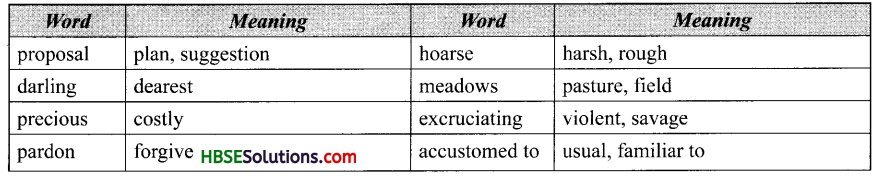
HBSE 10th Class English Solutions First Flight Chapter 11 The Proposal 1 HBSE 10th Class English Solutions First Flight Chapter 11 The Proposal 2

HBSE 10th Class English Solutions First Flight Chapter 11 The Proposal Read More »

HBSE 10th Class English Grammar Phrasal Verb

Haryana State Board HBSE 10th Class English Solutions Grammar Phrasal Verb Exercise Questions and Answers.

Haryana Board 9th Class English Grammar Phrasal Verb

Phrasal Verb :
In English, a verb can give different meanings when different prepositions are added to it. The various combinations of verbs with prepositions or adverb particles are known as Phrases or Prepositional Phrases:

For example:
Bring about = cause to happen
Bring out = bring to light
Bring up = to rear

HBSE 10th Class English Grammar Phrasal Verb

Position of object in Pepositional Phrases:

(i) Noun objects are placed at the end of the phrasai verb or before the preposition/adverb particle;
The wind blew away his hat.
Or
The wind blew his hat away.

(ii) If the object is a pronoun, it can be placed only before the preposition/adverb particle:
If you have a hat on, take ¡t off.
I will ring you up.

(iii) A long object usually goes after the adverb/preposition:
The wind blew away everything that was lying on the roof.

HBSE 10th Class English Grammar Phrasal Verb

Some Important Prepositional Phrases:
HBSE 10th Class English Grammar Phrasal Verb 1
HBSE 10th Class English Grammar Phrasal Verb 2.1
HBSE 10th Class English Grammar Phrasal Verb 2.2
HBSE 10th Class English Grammar Phrasal Verb 3.1
HBSE 10th Class English Grammar Phrasal Verb 3.2
HBSE 10th Class English Grammar Phrasal Verb 4

Some Other Useful Phrasal Verbs:
HBSE 10th Class English Grammar Phrasal Verb 5
HBSE 10th Class English Grammar Phrasal Verb 6

Exercises Based on The Text Book

Exercise 1

Complete the following sentences by using one of the phrases provided after each. Use the appropriate tense form:

1. Though there are several difficulties on our way, yet we should be firm and not …………. (take over, get over, give in, run down).
2. Many people think that India will not be able to …………. her present turmoil in the near future. (take over, give up, get over, put across)
3. How many of us can …………. our traditional habits completely? Perhaps none. (take out, put forward, make up, give up)
4. To everybody’s swpnse, John …………. quite early that day. (turn out, look around, turned up, take over)
5. All present at the meeting agree that they should …………. the question in all detail. (go into, Uy out, pull, bring up)
6. There was so much of noise in the hail that I could not …………. what the speaker was saying. (put across, make out, put up with, get through)
7. There is a rumour that/the husband and the wife have …………. (Break out, fall out, give away, leave out)
8. YoGr washing machine is …………. again, why don’t you take it to the mechanic. (act up, get on, hoot down, back up).
9. Cholera has …………. in the town. The government must do something about it (break down, fall out, break out, leak out)
10. They may not be able to …………. the problem without our help. (tide over, patch up. round up, size up)
Answers:
1. Though there are several difficulties on our way, yet we should be firm and not give in (take over, get over, give in, run down).
2. Many people think that India will not be able to get over her present turmoil in the near future. (take over, give up, get over, put across)
3. How many of us can give up our traditional habits completely? Perhaps none. (take out, put forward, make up, give up)
4. To everybody’s swpnse, John turned up quite early that day. (turn out, look around, turned up, take over)
5. All present at the meeting agree that they should go into the question in all detail. (go into, Uy out, pull, bring up)
6. There was so much of noise in the hail that I could not make out what the speaker was saying. (put across, make out, put up with, get through)
7. There is a rumour that/the husband and the wife have fallen out (Break out, fall out, give away, leave out)
8. Yogr washing machine is acting up again, why don’t you take it to the mechanic. (act up, get on, hoot down, back up).
9. Cholera has broken out in the town. The government must do something about it (break down, fall out, break out, leak out)
10. They may not be able to tide over the problem without our help. (tide over, patch up. round up, size up)

HBSE 10th Class English Grammar Phrasal Verb

Exercise 2

Fill In the blanks with Prepositions:
1. This book consists …………. 200 pages.
2. He lives …………. fruits only.
3. Please look …………. this word in the dictionary.
4. He is looking …………. his lost cow.
5, The issue of reservations has been blown ………….
6. After a fierce fight, the enemy gave ………….
7. He came …………. a lot of wealth.
8. He was brought …………. by his uncle.
9. The old beggar begged …………. alms.
10. We should not boast …………. our abilities.
11. We must abide …………. the rules of the road.
12. Hard work is a key …………. success.
13. I will look …………. the matter.
14. He made …………. a false story.
15. We should stand …………. honour and dignity.
Answers:
1. This book consists of 200 pages.
2. He lives on fruits only.
3. Please look for this word in the dictionary.
4. He is looking for his lost cow.
5, The issue of reservations has been blown over
6. After a fierce fight, the enemy gave in
7. He came by a lot of wealth.
8. He was brought up by his uncle.
9. The old beggar begged for alms.
10. We should not boast of our abilities.
11. We must abide by the rules of the road.
12. Hard work is a key to success.
13. I will look into the matter.
14. He made up a false story.
15. We should stand for honour and dignity.

HBSE 10th Class English Grammar Phrasal Verb Read More »

HBSE 10th Class English Grammar Non-Finites

Haryana State Board HBSE 10th Class English Solutions Grammar Reported Speech Exercise Questions and Answers.

Haryana Board 9th Class English Grammar Reported Speech

* Finite and non-finite Derbs Verbs दो प्रकार के होते हैं-
(a) Finite verbs
(b) Non-finite verbs

Finite का अर्थ होता है ‘सीमित’। इसलिए Finite verbs वे होते हैं जिन पर Number (वचन), Person (व्यक्ति) या Tense (काल) की सीमाएं होती हैं अर्थात इन Verbs को Number, Person या Tense के अनुसार स्वयं को बदलना पड़ता है, जैसे-
The boy wants a book.

The boys want books.
The boys wanted books.

I want a book.
He wants a book.
उपरोक्त वाक्यों में Verb ‘want’ Number, Person और Tense के अनुसार बदलता रहा है।

HBSE 10th Class English Grammar Non-Finites

Non-finite verbs : जैसा कि नाम से स्पष्ट है, इन शब्दों पर कोई बंधन नहीं होता अर्थात ये Number, Person या Tense के बंधनों को स्वीकार नहीं करते और सदा एक समान रहते हैं, जैसे-
I want to swim.
He wants to swim.
They want to swim.
He wanted to swim.
She will want to swim.
The boys want to swim.
उपरोक्त वाक्यों में ‘to swim’ नाम का शब्द Number, Person या Tense के बदलने पर नहीं बदला।
यह एक Non-finite verb है। इस पाठ का हमारा विषय है-Non-finite verbs.

Non-finites तीन प्रकार के होते हैं-
(a) The Infinitive
(b) The Gerund
(c) The Participles.
इन Non-finites और इनके रूपों को निम्नलिखित चार्ट द्वारा दर्शा सकते हैं-
HBSE 10th Class English Grammar Non-Finites -1
अब हम एक-एक करके इनका अध्ययन करेंगे।

A. The Infinitive

Form (रूप)-The infinitive का प्रयोग To के साथ (To+ verb) और बिना To के भी होता है। बिना To के Infinitive को Bare Infinitive कहते हैं।

वे Verbs (क्रियाएं जिनके साथ Infinitive का प्रयोग होता है :
1. Verbs followed by Infinitive-निम्नलिखित क्रियाओं के साथ Infinitive का प्रयोग होता है-
learn, remember, forget, promise, swear, consent, agree, neglect, refuse, propose, regret, try, endeavour, attempt, fail, care, hope, hesitate, prepare, decide, determine, undertake, manage, arrange, cease, seem.
He promised to work hard.
I hope to win the prize.
He managed to run away.
He decided to help me.
He tried to climb the tree.

2. Verbs followed by Infinitive alone or Object+Infinitive-निम्नलिखित क्रियाओं के साथ Infinitive या Object + Infinitive का प्रयोग होता है-
want, with, love, have, like, prefer, ask, help, expect, beg, mean, intend.
He wants to read the book.
He wants me to read the book.

I asked to see the officer.
I asked Mohan to see the officer.

I expect to do this work.
I expect Puneet to do this work.

3. Verbs followed by Object + Infinitive-निम्नलिखित Verbs के साथ केवल Infinitive नहीं लग सकता। Infinitive से पहले कोई Object लगाना आवश्यक है-
tell, order, invite, ask, oblige, compel, allow, permit, teach, instruct, war, urge, advise, tempt, encourage. request, forbid etc.
She invited me to take lunch with her.
The captain ordered the soldiers to fire at the enemy.
Father asked me to bring a book for him.

HBSE 10th Class English Grammar Non-Finites

4. Bare Infinitive (Infinitive without ‘to’) बिना ‘To’ वाले Infinitive का प्रयोग निम्नलिखित अवस्थाओं में होता है:
(i) ‘to feel’, ‘to notice’, ‘to see’, ‘to watch’, ‘to make’, ‘to bid’, ‘to observe’, ‘to hear’, ‘to let’ af fout पश्चात, जैसे-
I let him read the book.
We made him apologize.
I saw her enter the garden.
She heard me sing a song.
He bade me go.

किंतु जब इन क्रियाओं का प्रयोग Passive Voice में किया जाता है, तो इनके बाद to सहित Infinitive का ही प्रयोग किया जाता है, जैसे-
I was heard to sing a song.
He was seen to enter the room.
He was made to go.

लेकिन, जब let का प्रयोग Passive Voice में किया जाता है तो इसके बाद बिना ‘to’ के Infinitive (Bare Infinitive) का ही प्रयोग किया जाता है, जैसे-
He was let play.

(ii) Ought’ एवं ‘used’ के अतिरिक्त Modal Auxiliaries के बाद Bare Infinitive (‘to’ रहित Infinitive) का ही प्रयोग किया जाता है, जैसे-
Can you lift this box?
We should respect our teachers.
Could you help me please?
It may rain today.
You need not go.
We ought to respect our elders.
They used to live here.

लेकिन, जब ‘dare’ तथा ‘need’ का प्रयोग Main Verb के रूप में किया जाए तो प्रायः ‘to’ सहित Infinitive का प्रयोग किया जाता है, जैसे-
He does not need to go there.
She does not dare to come here.

(iii) ‘had better’, ‘would rather’ तथा ‘had rather’ के बाद Bare Infinitive का ही प्रयोग किया जाता है, जैसे-
I would rather die than beg.
You had better stay here.

(iv) Except, than और but के बाद Bare Infinitive का प्रयोग करते हैं, जैसे-
I did nothing but wait for him.
He does nothing except play.
I would sit idle than go to the theatre.

HBSE 10th Class English Grammar Non-Finites

5. Uses of Infinitive (Infinitive के प्रयोग)
(i) उद्देश्य को व्यक्त करने के लिए, जैसे
We go to school to study.
He came here to meet his friend.

(ii) Verb के Subject के रूप में, जैसे
To play with fire is dangerous.
To tell lies is bad.

(iii) Verb के object के रूप में, जैसे-
He wants to go.
She hopes to pass.

(iv) Verb के complement (पूरक) के रूप में, जैसे
His intention is to cross the river.
My hobby is to collect stamps.

(v) Question Words what, how. where के बाद, जैसे-
Tell me what to say.
I don’t know how to solve this sum.

(vi) Adjective के object के रूप में, जैसे-
I am very happy to see you.
It is bad to abuse others.

(vii) किसी Noun की विशेषता प्रकट करने के लिए, जैसे-
This cloth is easy to wash.
English is difficult to learn.

(viii) Noun या Pronoun की विशेषता प्रकट करने के लिए, जैसे
I have some letters to write.
Give me something to eat.

(ix) Too + adjective के साथ Infinitive के प्रयोग का अर्थ नकारात्मक होता है, जैसे-
He is too weak to walk.
(इसका अर्थ है वह इतना कमजोर है कि चल नहीं सकता।)
He was too angry to speak.
He is too poor to buy a bicycle.

(x) Adjective + enough के साथ Infinitive का वही अर्थ है जैसा वाक्य का, जैसे-
He is rich enough to buy a car.

(वह इतना अमीर है कि कार खरीद सकता है।)
Mohan is not intelligent enough to pass the test.

(xi) वाक्यों को संयुक्त करने के लिए; जैसे-
Separate : He went to the post office. He wanted to buy some stamps.
Combined : He went to the post office to buy some stamps.
Separate : He is very ill. He cannot sit up.
Combined : He is too ill to sit up.
Separate : I should come the next day. He want me so.
Combined : He wants me to come the next day.

HBSE 10th Class English Grammar Non-Finites

Exercise 1

Insert ‘to’ where necessary before the infinitives in brackets :

1. He made me (repeat) the lesson.
2. She can (sing) quite well.
3. He will be able (swim) very soon.
4. You ought (go) today, It may (rain) tomorrow.
5. You needn’t (say) anything.
6. How dare you (open) my letters?
7. Can you help me (move) this table?
8. It is easy (find) fault with others.
9. Visitors are asked (not feed) the animals.
10. He tried (make) me (believe) that he was a police officer.
11. Would you like (come) in my car?
12. He heard a cock (crow) in a neighbouring village.
13. You may as well (tell) the truth. It will (be) easy (check) your story.
14. There is nothing (do) but (wait) till somebody comes (let) us out.
15. Iam sorry (disappoint) you but I can’t (let) you (have) any more money.
Answers:
1. repeat
2. sing
3. to swim
4. ought to go; may rain
5. say
6. open
7. move
8. to find
9. not to feed
10. to make; believe
11. to come
12. crow
13. tell; will be easy; to check
14. to do; wait; to let
15. to disappoint; let; have.

Exercise 2

Put the appropriate form of the infinitive (with ‘to ’ or bare infinitive) of the verbs given in brackets:

1. I made them (give) my money back.
2. This dress is simple (wear).
3. You ought (obey) your parents.
4. Why not (take) the day off?
5. He tried (make) me a fool.
6. Do you want (see) this film.
7. I wanted (help) her but I could not (meet) her.
8. He was heard (open) the door.
9. He doesn’t allow me (smoke) in his room.
10. Iam sorry (disturb) you.
11. riow dare you (open) my letter?
12. He would rather (die) than (beg).
13. The thief was seen (enter) the building.
14. This cloth is easy (wash).
15. He is too weak (walk).
Answers:
1. give
2. to wear
3, to obey
4. take
5. to make
6. to see
7. to help, meet
8. to open
9. to smoke
10. to disturb
11. open
12. die, beg
13. to enter
14. to wash
15. to walk.

* Dummy Subject ‘IT’ का प्रयोग-

Dummy या मूक Subject उसे कहते हैं जो वाक्य में किसी प्रकार का अर्थ देने के लिए प्रयुक्त नहीं होता, किंतु वह वाक्य रचना में सहायता करता है। It का प्रयोग dummy subject के रूप में कर सकते हैं।

It+ be के साथ Infinitive का प्रयोग –
हम जानते हैं कि infinitive का प्रयोग वाक्य के subject के रूप में हो सकता है, जैसे-
To smoke is wrong.
To play with fire is dangerous.

लेकिन इस प्रकार के वाक्यों के स्थान पर It + be के साथ infinitive लगाकर प्रयोग करना अधिक बेहतर है, जैसे-
It is wrong to smoke.
It is dangerous to play with fire.

इस प्रकार के वाक्यों को चार प्रकार से प्रयोग किया जा सकता है-
(i) It + be + adjective+ infinitive, जैसे-
It is easy to leam English.
It is bad’to abuse others.
It is wrong to tell lies.

(ii) It+ be + adjective + for + noun/pronoun + infinitive, जैसे-
It is wrong for you to smoke.
It is dangerous for a child to play with fire.
It is easy for Mohan to leam English.
It is wrong for you to tell lies.

(ii) It + be + noun + infinitive, जैसे-
It is a sin to steal.
It was a shame to cut those trees.
It is a pleasure to meet you.

(iv) It+ be + noun + for + noun/pronoun + infinitive. जैसे-
It is a shame for you to abuse him.
It is a pleasure for me to meet you.
It is a sin for man to deceive others.

HBSE 10th Class English Grammar Non-Finites

Note 1. उपरोक्त नियम नं० (ii) में अगर adjective किसी व्यक्ति के गुणों के बारे में हो तो वहां ‘for के स्थान पर ‘of लगता है, जैसे-
It was selfish of Mohan to deceive Hari.
It was kind of you to help me.
It is nice of you to come here.

Note 2.Gerund या clause वाले वाक्यों को भी उपरोक्त तरीके से It+be + infinitive से आरंभ होने वाले वाक्यों में बदल सकते हैं, जैसे-
(i) Smoking is bad for you.
It is bad for you to smoke.

(ii) Playing with fire is dangerous.
It is dangerous to play with fire.
Note 3. Adverb वाले वाक्यों को It + be + Adjective के साथ बदलते हैं, जैसे
(i) He will certainly come.
It is certain that he will come.

(ii) She will surely pass.
It is sure that she will pass.

HBSE 10th Class English Grammar Non-Finites

Exercise 3

Rewrite the following sentences beginning with “It” :

1. To cheat in examination is a sin.
2. To wash this shirt is easy.
3. Laughing at the beggar is very bad.
4. He said that. It was wrong.
5. I leam music. It is difficult for me.
6. He is abusing others. It is not good.
7. Your father helped me. It was very nice.
8. To serve our parents is our duty.
9. Playing is good for health.
10. Stealing is a crime.
11. To abuse others is wrong.
12. He will leam music. It is easy for him.
13. The bear is dancing. It is a fun to see it.
14. To take what belongs to others is bad.
15. To cross the river now is impossible.
Answers:
1. It is a sin to cheat in examination.
2. It is easy to wash this shirt
3. It is bad to laugh at the beggar.
4. It was wrong for bim to say that.
5. It is difficult for me to learn music.
6. It is not good for him to abuse others.
7. It was very nice of your father to help me.
8. It is our duty to serve our parents.
9. It is good for health to play.
10. It is a crime to steal.
11. It is wrong to abuse others.
12. It is easy for him to learn music.
13. It is a fun to see the bear dancing.
14. It is bad to take what belongs to others.
15. It is impossible to cross the river now.

Exercise 4

Complete the following sentences by adding an infinitive or an infinitive followed by other words. Use infinitive without ‘to ’ where necessary:
1. The robber forced the travellers …………….. .
2. No one heard them …………….. .
3. The children’s teacher made them …………….. .
4. I do not wish the neighbours …………….. .
5. The police would not allow anyone …………….. .
6. The conductor asked the passengers …………….. .
7. We expect the repairs …………….. .
8. You should not let that dog …………….. .
9. A spell of fine weather enabled us …………….. .
10. We have an hour to spare, so let’s …………….. .
11. Can’t you persuade your friend …………….. .
12. Most of us felt the suggestion …………….. .
13. They saw two men in dark overcoats …………….. .
14. The manager wants us …………….. .
15. That is the first time I have known your father …………….. .
Answers:
1. to part with their money
2. enter the room
3. repeat the homework
4. to disturb me
5. come near the scene of the crime
6. to take tickets
7. to be completed soon
8. attack people
9. to play a match
10. go out for a walk
11. to help me?
12. to be good
13. enter the house
14. to work hard
15. to smoke.

HBSE 10th Class English Grammar Non-Finites

B. The Gerund

1. Form and Function (रूप एवं कार्य)-Verb (क्रिया) की Ist form के साथ ing लगाकर Gerund बनता है। यह क्रिया (Verb) तथा संज्ञा (Noun) दोनों का कार्य करता है।
2. Gerund का प्रयोग
(i) क्रिया के Subject के रूप में, जैसे-
Smoking is bad for health.
Playing with fire is dangerous.

(ii) क्रिया के Object के रूप में, जैसे-
I avoid smoking.
He risked going outside.

(iii) Subject के पूरक (Complement) के रूप में, जैसे-
Seeing is believing.
The worst thing was waiting.

(iv) किसी Preposition के Object के रूप में, जैसे-
She was fined for coming late.
He congratulated me on winning the prize.

(v) कुछ विशेष वाक्यों में, जैसे-
No smoking.
No parking.
We are looking forward to receiving her.

(vi) Busy और worth विशेषण के बाद, जैसे-
I am busy packing.
This book is worth reading.

(vii) यदि Used to से पहले [is, am, are] लगा होता है तो Gerund का प्रयोग करते हैं; जैसे-
He is used to making excuses.
I am used to visiting trade fairs.

(viii) object to के तुरंत बाद Gerund का प्रयोग करते हैं; जैसे-
He objected to giving me admission.
They objected to playing on the damp ground.

(ix) It is no use के object के रूप में; जैसे-
It is no use crying over spilt milk.
It is no use waiting for her now.

HBSE 10th Class English Grammar Non-Finites

3. निम्नलिखित Verbs के बाद Gerund का प्रयोग होता है-
Stop, finish, dread, prevent, avoid, risk, admit, deny, start, love, hate, recollect, resent, delay, postpone, defer, enjoy, fancy, imagine, forgive, pardon, excuse, suggest, keep, understand, consider, miss, involve etc.^%- The time is over. Please stop writing.
He denied having seen the thief.
Please pardon my saying so.
Don’t risk going out in the storm.
I avoid meeting Mohan.

4. The Gerund and the Infinitive-
कुछ क्रियाओं के बाद Gerund या Infinitive किसी का भी प्रयोग हो सकता है-
begin, continue, attempt, intend, can’t bear, like, prefer, remember, forget, regret, permit, allow, advise, recommend, it needs/requires/waits, try, propose, mean etc.

Note (i) Remember, forget और reset के साथ infinitive का प्रयोग तब होता है जब ‘याद रखना, भूलना, अफसोस करना’ पहले हो और Verb (क्रिया) बाद में। मगर Gerund का प्रयोग तब होता है जब क्रिया (कार्य) तो पहले हो जाए मगर उसे ‘याद करना’, ‘भूलना’, ‘अफसोस करना’ आदि बाद में हो, जैसे-
Please remember to post the letter.
I remember meeting Mohan. I met him last week.
I regret to tell you that Ram has failed.
I regret beating my younger brother yesterday.

(ii) Need और want के साथ Gerund का प्रयोग Passive अर्थ में होता है, जैसे
Your dress needs repairing (to be repaired).
My hair wants cutting (to be cut).

(iii) Try के साथ Infinitive का अर्थ है, ‘प्रयत्न करना’, जबकि इसके साथ Gerund का अर्थ है ‘प्रयोग करना’ या ‘करके देखना’, जैसे
I tried to sleep, but couldn’t.
If you cannot sleep, try taking a sleeping pill.

(iv) Like+gerund का अर्थ है ‘आनन्द उठाना’ मगर Like+Infinitive का अर्थ है चाहना, सहमत होना पसंद करना आदि, जैसे-
I like swimming (i.e. I enjoy swimming).
I did not like to disturb her as she was sleeping.

Exercise 5

Fill in the blanks using the Gerund for the non-finite verbs :
1. It is no use …………….. (cry) over spilt milk.
2. …………….. (run) after the thief. I caught him.
3. I was praised for …………….. (catch) a thief.
4. He insisted on …………….. (buy) a new shirt.
5. …………….. (walk) is a good exercise for heart.
6. He suggested …………….. (break) open the door.
7. I am busy …………….. (Pack).
8. She is expert in …………….. (paint)
9. This book is worth …………….. (read)
10. Please stop …………….. (talk)
11. Would you mind …………….. (help) me a little.
12. She kept …………….. (weep) all the way.
13. …………….. (smoke) is injurious to health.
14. We are looking forward to …………….. (receive) him.
15. Seeing is …………….. (believe)
Answers:
1. crying
2. Running
3. catch
4. buying
5. Walking
6. breaking
7. packing
8. painting
9. reading
10. talking
11. helping
12. weeping
13. Smoking
14. receiving
15. believing.

Exercise 6

Fill in the blanks using the Gerund for the non-finite verbs :
1. My grandmother dislikes …………….. (use) face power.
2. She denied …………….. (take) anything from my bag.
3. I object to …………….. (write) on my walls.
4. He objected to …………….. (give) me admission.
5. Seeing the teacher the boys started …………….. (read)
6. Kittu hates …………….. (make) false excuses.
7. Brave people love …………….. (climb) mountains.
8. …………….. (cheat) in examination is bad.
9. She is fond of …………….. (make) stories.
10. The boy suggested …………….. (go) for a picnic.
11. What I hate most is …………….. (drink).
12. He admitted to …………….. (tell) lies.
13. She practiced …………….. (dance) everyday.
14. Forgive my …………….. (say) so.
15. Let us go for …………….. .(shop)
Answers:
1. using
2. taking
3. writing
4. giving
5. reading
6. making
7. climbing
8. Cheating
9. making
10. going
11. drinking
12. telling
13. dancing
14. saying
15. shoping.

HBSE 10th Class English Grammar Non-Finites

C. The Participles

The Participles एक ऐसा शब्द होता है, जो क्रिया (adjective) तथा विशेषण दोनों का कार्य करता है। Participles तीन प्रकार के होते हैं-
1. Present Participle : Verb की Ist form के साथ ing लगाकर बनता है।
2. Past Participle : इसे क्रिया की III form भी कहते हैं।
3. Perfect Participle : Having के साथ क्रिया की III form लगाने से बनता है।
अब हम इन तीनों के प्रयोगों का अध्ययन करेंगे।

1. Present Participle के प्रयोग-

(a) Continuous Tense बनाने के लिए, जैसे-
She was sleeping.
It will be raining.

(b) एक adjective (विशेषण) के रूप में, जैसे
Barking dogs seldom bite.
He told me an interesting story.

(c) Subject के पूरक (Complement) के रूप में, जैसे
The girl was charming.
The work is tiring.
The story is interesting.

(d) Object के पूरक के रूप में, जैसे-
f I saw him running.
We heard the bombs exploding.

(e) एक साथ होने वाले दो कार्यों के लिए Present Participle का प्रयोग कर सकते हैं। ऐसे में Present Participle एक क्रिया विशेषण (Adverb) का कार्य करता है, जैसे-
He went away laughing.

(f) जब दूसरा कार्य पहले वाले कार्य का भाग हो या उसका परिणाम हो तो दूसरे कार्य के लिए Present Participle का प्रयोग कर सकते हैं, जैसे-
He fired, killing the tiger.
She went away, breaking my heart.

(g) दो वाक्यों को जोड़ने के लिए, जैसे-
I was lying on the beach. I saw a ship.
Lyiwg on the beach, I saw a ship.

HBSE 10th Class English Grammar Non-Finites

2. Past Participle के प्रयोग-

(a) Perfect Tense बनाने के लिए, जैसे-
I have done my work.
Mohan has gone to Delhi.
Shfe had written the letter.

(b) Adjective (विशेषण) के रूप में, जैसे-
I saw a wounded bird.
The tired man took rest.
A faded rose does not smell.

(c) Subject के पूरक (Complement) के रूप में, जैसे-
I am tired.
The shops are closed.

(d) Object के पूरक के रूप में, जैसे-
I found the lock broken.
The news left me surprised.

(e) Adverb (क्रिया-विशेषण) के रूप में, जैसे-
He finished the work, greatly satisfied.
He left the hospital cured.

(d) वाक्यों को जोड़ने के लिए, जैसे-
The speeding car hit him. He died at once.
Hit by the speeding car, he died at once.

HBSE 10th Class English Grammar Non-Finites

3. Perfect Participle के प्रयोग-

जब कोई एक कार्य किसी अन्य कार्य के पूरा हो जाने के बाद होता है तो उस कार्य के लिए Perfect Participle का प्रयोग करते हैं, जैसे-
(i) He milked the cow. Then he went to market.
Having milked the cow, he went to market.

(ii) He finished his work. He went home.
Having finished his work, he went home.

(iii) He completed his studies. Then he started looking for a job.
Having completed his studies, he started looking for a job.

Exercise 7

Put the verbs in brackets into the correct form (Gerund or Infinitive) :

1. Let me ……………. (go) home please.
2. This cloth is easy ……………. (wash)
3. He is used to ……………. (go) to cinema.
4. She objected to ……………. (take) part in the debate.
5. None knows where ……………. (stay).
6. His aim was ……………. (get) a gold medal.
7. He was afraid ……………. (complain).
8. He was happy ……………. (see) me.
9. How dare you ……………. (abuse) me?
10. Could you ……………. me please ? (help/to help/helping)
Answers:
1. Let me go (go) home please.
2. This cloth is easy to wash (wash)
3. He is used to going (go) to cinema.
4. She objected to taking (take) part in the debate.
5. None knows where to stay (stay).
6. His aim was to get (get) a gold medal.
7. He was afraid of complaining (complain).
8. He was happy to see (see) me.
9. How dare you abuse (abuse) me?
10. Could you help me please ?

Exercise 8

Put the verbs in brackets into the correct form (Gerund or Infinitive) :
1. You had better ……………. (stay/to stay/staying) here.
2. It is no use ……………. (wait) for her.
3. Iam looking forward to ……………. (meet) you.
4. He is rich enough ……………. (buy) a car.
5. ……………. English quickly is not an easy thing, (leam/to leam/leaming)
6. She was fined for ……………. (come) late.
7. Let him ……………. (go) now.
8. He wanted me ……………. (ring) in the morning.
9. He did nothing but ……………. . (laugh)
10. My watch keeps on ……………. .(stop)
Answers:
1. You had better stay (stay/to stay/staying) here.
2. It is no use waiting (wait) for her.
3. Iam looking forward to meeting (meet) you.
4. He is rich enough to buy (buy) a car.
5. To learn English quickly is not an easy thing, (leam/to leam/leaming)
6. She was fined for coming (come) late.
7. Let him go (go) now.
8. He wanted me to ring (ring) in the morning.
9. He did nothing but laugh . (laugh)
10. My watch keeps on stopping .(stop)

HBSE 10th Class English Grammar Non-Finites

Exercise 9

Use the appropriate forms of the verbs given in the bracket:
1. I like ……………. my room clean, (keep)
2. The rice will grow well in the ……………. (come) season.
3. ……………. recklessly on the highway is dangerous, (drive)
4. He was too drunk ……………. (drive) home.
5. I prefer storybooks to ……………. my textbooks, (study)
6. ……………. the stolen car wasn’t easy for the police, (find)
7. Are you interested in ……………. a computer ? (buy)
8. The teacher warned her for ……………. late. (be)
9. They felt the floor ……………. (vibrate).
10. Please let me ……………. (go) home.
Answers:
1. I like to keep my room clean, (keep)
2. The rice will grow well in the coining (come) season.
3. Driving recklessly on the highway is dangerous, (drive)
4. He was too drunk to drive (drive) home.
5. I prefer storybooks to studying my textbooks, (study)
6. Finding the stolen car wasn’t easy for the police, (find)
7. Are you interested in buying a computer ? (buy)
8. The teacher warned her for being late. (be)
9. They felt the floor vibrating (vibrate).
10. Please let me go (go) home.

Exercise 10

Use the appropriate forms of the verbs given in the bracket (Gerund or Infinitive) :
1. His mother allowed him ……………. (do) as he liked.
2. He avoids ……………. (meet) me.
3. The teacher made him ……………. (repeat) the exercise.
4. The old man is too weak ……………. (walk).
5. It is easy ……………. (advise) others.
6. Please stop ……………. (make) noise.
7. He will be able ……………. (cross) the bridge.
8. He is intelligent enough ……………. (solve) this sum.
9. Stop ……………. (smoke) as it is injurious to health.
10. Let us go for ……………. (shop).
11. He is intent on ……………. (go) there.
12. I heard a cock ……………. (crow) in the morning.
Answers:
1. His mother allowed him to do (do) as he liked.
2. He avoids meeting (meet) me.
3. The teacher made him repeat (repeat) the exercise.
4. The old man is too weak to walk (walk).
5. It is easy to advise (advise) others.
6. Please stop making (make) noise.
7. He will be able to cross (cross) the bridge.
8. He is intelligent enough to solve (solve) this sum.
9. Stop smoking (smoke) as it is injurious to health.
10. Let us go for shopping (shop).
11. He is intent on going (go) there.
12. I heard a cock crow (crow) in the morning.

HBSE 10th Class English Grammar Non-Finites

Other Exercises (Solved)

Fill in the blanks with Non- Finites:

SET 1

After circling the globe and (a) …………….. (look) at scores of museums, the trustees decided (b) …………….. (appoint) an eminent architect, Richard who had a rich experience of (c) …………….. (design) museums. Richard (d) …………….. (know) for his excellence, started working on this project in 1983 at on (e) …………….. (estimate) cost of 100 million and completed it in 14 years time after (f) …………….. (spend) a billion dollars. This is an act of (g) …………….. (do) something special (h) …………….. (enrich) our cultural heritage.
Answers:
(a) looking
(b) to appoint
(c) designing
(d) known
(e) estimated
(f) spending
(g) doing
(f) to enrich.

HBSE 10th Class English Grammar Non-Finites

SET 2

Group life made the task of (a) …………… (collect) food easier, (b) …………… (Hunt) wild and fast (c) …………… (run) animals with weapons also became easier. Red Indian tribes used (d) …………… (hunt) in groups. Care of (e) …………… (bring up) the young also became possible in a group. Mothers could stay at home (f) …………… , (look) after the children. Thus they managed (g) …………… (get) their food by (h) …………… (kill) wild animals.
Answers:
(a) collecting
(b) hunting
(c) running
(d) to bunt
(e) bringing up
(f) to look
(g) to get
(h) killing.

SET 3

During elections, we can see the supporters of political parties (a) …………… (shout) slogans in the streets. Even the candidates walk on foot (b) …………… (greet) the people. They catch the opportunity (c) …………… (shake) hands with anyone they meet. Their supporters assure the people (d) …………… (solve) the problems (e) …………… (be) faced by them. They urge them (f) …………… (exercise) their votes in favour of their candidates. But after (g) …………… (win) the election it becomes just impossible (h) …………… (meet) these
leaders.
Answers:
(a) shouting
(b) greeting
(c) shaking
(d) to solve
(e) being
(f) to exercise
(g) winning
(h) to meet.

HBSE 10th Class English Grammar Non-Finites

SET 4

It has been decided (a) …………… (build) a number of fly-overs in Delhi. That would mean (b) …………… (cut) hundreds of trees. It would certainly create ecological imbalance, (c) …………… (Think) that this balance should be preserved, several organisation have come forward (d) …………… (sustain) this green cover by (e) …………. (plant) new trees. They are also trying (f) …………… (create) awareness among the people.
Answers:
(a) to build
(b) cutting
(c) Thinking
(d) to sustain
(e) planting
(f) to create.

SET 5

(a) …………… (be) sick for a long time, Aruna stopped (b) …………… (take) interest in anything. She just kept on (c) …………… (think) about her illness. She would not listen to any advice. She developed a habit of (d) …………… (argue) endlessly (e) …………… (know) that it was more a mental problem than a physical one, a specialist began (f) …………… (treat) her on these lines.
Answers:
(a) Being
(b) taking
(c) thinking
(d) arguing
(e) knowing
(f) to treat.

SET 6

I know how (a) …………… (swim). I had learnt (b) …………… (swim) when I was a child. I like (c) …………… (climb) mountains also. But it is very efficient and dangerous (d) …………… (climb) the steep rocks. Once I decided (e) …………… (scale) a steep rock. It was a (f) …………… (thrill) experience.
Answers:
(a) to swim
(b) swimming
(c) climbing
(d) to climb
(e) to scale
(f) thrilling.

HBSE 10th Class English Grammar Non-Finites

SET 7

(a) …………… (Teach) is a passion for some teachers. Rachna, (b) …………… (be) one such teacher wanted (c) …………… (conduct) an experiment for the improvement of results in Mathematics in her school. So instead of (d) …………… (teach) the whole class, she began (e) …………… (take) tutorials with a small groups of students. This method helped in (f) …………… (develop) a sense of confidence in the students and the results greatly improved.
Answers:
(a) Teaching
(b) being
(c) to conduct
(d) teaching
(e) to take
(f) developing.

SET 8

(a) …………… (Sit) on a soft chair or sofa for a long time, is the main cause of back pain. People (b) …………… (have) much fat, become victim of this disease. Those who are used (c) …………… (sit) in a wrong posture also suffer from this pain. It is, therefore, necessary not (d) …………… (sit) in wrong postures and not (e) …………… (use) a sofa seat for a long time. Steps (f) …………… (reduce) fat should also be taken.
Answers:
(a) Sitting
(b) having
(c) to sit
(d) to sit
(e) to use
(f) to reduce.

SET 9

It we want (a) …………… (live) in peace we should try (b) …………… (learn) the art of (c) …………… (give) ‘ more and more to others (d) …………… (build) beautiful cities is not enough. War will destroy them. What is needed is (e) …………… (purify) the inner hearts of the people, if we want (f) …………… (form) a peaceful society.
Answers:
(a) to live
(b) to learn
(c) giving
(d) building
(e) to purify
(f) to form.

HBSE 10th Class English Grammar Non-Finites

SET 10

There was scarcity of rains this year. The villagers were seen (a) …………… (pray) to the Rain God. Their crops had withered. The money they had spent on (b) …………… (buy) the seeds was wasted (c) …………… (be) poor the small farmers could not buy new seeds, Even their young children had taken to (d) …………… (farm) fro want of jobs. The only hope left for them was (e) …………… (pray) to Gods (f) …………… (please) them.
Answers:
(a) to play
(b) buying
(c) being
(d) farming
(e) to pray
(f) to please.

SET 11

It was amusing (a) …………… (watch) him (b) …………… (follow) her. He tried (c) …………… (catch) up with her, but she was bent on (d) …………… (avoid) him.
Answers:
(a) to watch
(b) follow
(c) to catch
(d) avoiding.

SET 12

(a) …………… (Smoke) is very injurious to our health. We must not let our children (b) …………… (fall) a prey to this pernicious habit. Those who are addicted to (c) …………… (smoke) must be made (d) …………… (give) it up if they want to live a healthy life.
Answers:
(a) Smoking
(b) fall
(c) smoking
(d) to give.

HBSE 10th Class English Grammar Non-Finites

SET 13

When the teacher saw Mohan (a) …………… (doze) in the class, he made him (b) …………… (stand) up on the bench. Mohan apologized to the teacher for (c) …………… (neglect) his lecture and promised (d) …………… (not do) so in future.
Answers:
(a) doze/dozing
(b) stand
(c) neglecting
(d) not to do.

SET 14

The cricket series between India and Pakistan was high history in the (a) …………… (make). However for an average cricket fan it was an (b) …………… (entertain) battle between bat and ball. The single-minded goal of (c) …………… (win) was responsible for India’s victory. The Indian team confirmed the idea of feel good (d) …………… (circulate) in the Indian Press.
Answers:
(a) making
(b) entertaining
(c) winning
(d) circulating.

SET 15

(a) …………… (Rise) prices is one of the major problems of the country these days. It has become difficult for the common man (b) …………… (survive). (c) …………… (Live) has become all the more difficult for the poor man, for they do not have enough (d) …………… (buy) the bare necessities of life.
Answers:
(a) Rising
(b) to survive
(c) Living
(d) to buy.

HBSE 10th Class English Grammar Non-Finites

SET 16

(a) …………… (Set) a new precedent, the President of India on 17th April, 2004 urged his fellow citizens (b) …………… (vote) in the (c) …………… (come) Lok Sabha Elections (d) …………… (make) the largest democracy of the world a great success.
Answers:
(a) Setting
(b) to vote
(c) coming
(d) to make.

SET 17

It is difficult especially for lady teachers (a) …………… (report) for duty early morning at the polling centres which are situated as far as 20 kilometres away from their homes. Each time the pre-poll promise of (b) …………… (spare) them from duty is not kept. If it is not possible (c) …………… (spare) them, at least special arrangements should be made (d) …………… (carry) them to and from the pjace of duty.
Answers:
(a) to report
(b) sparing
(c) to spare
(d) to carry.

SET 18

(a) …………… (Hear) the story of my misfortune he agreed (b) …………… (help) me. I was happy (c) …………… (find) a true friend in this hour of trouble. But when he came to know about my requirement he refused (d) …………… (give) me any money.
Answers:
(a) Hearing
(b) to help
(c) to find
(d) to give.

SET 19

Summer is the right time (a) …………… (go) for (b) …………… (spot) the tiger. Corbett National Park, situated just at 300 km North-East of Delhi, is an ideal place for it. You can enjoy (c) …………… (see) the number of tigers (d) …………… (roam) about freely in the open.
Answers:
(a) to go
(b) spotting
(c) seeing
(d) roaming.

HBSE 10th Class English Grammar Non-Finites

SET 20

He suggested (a) …………… (hold) a meeting (b) …………… (discuss) this issue. But his suggestion was turned down because the boss did not want (c) …………… (make) it public. By (d) …………… (consult) his confidants, he decided (e) …………… (put off) the matter.
Answers:
(a) holding
(b) to discuss
(c) to make
(d) consulting
(e) to put off.

SET 21

You had better (a) …………… (leave) his company and concentrate on (b) …………… (study) your books. I fear that he will not let you (c) …………… (study) properly if you don’t shun his company. He is very fond of (d) …………… (talk) on trivial issues. Your father wants you (e) …………… (become) a good engineer. You can’t achieve this goal if you continue (f) …………… (waste) your time in his company.
Ans
(a) leave
(b) studying
(c) study
(d) talking
(e) to become
(f) wasting.

HBSE 10th Class English Grammar Non-Finites

SET 22

I resent (a) …………… (be) treated like this, I am used to (b) …………… (respect) others and (c) …………… (be) respected by others. I will not let you id) …………… (treat) me so rudely. By (e) …………… (speak) so rudely to me, you have made me (f) …………… (avoid) your company.
Answers:
(a) being
(b) respecting
(c) being
(d) treat
(e) speaking
(f) avoid.

HBSE 10th Class English Grammar Non-Finites Read More »