Class 7

HBSE 7th Class Maths Solutions Chapter 4 Simple Equations Ex 4.4

Haryana State Board HBSE 7th Class Maths Solutions Chapter 4 Simple Equations Ex 4.4 Textbook Exercise Questions and Answers.

Haryana Board 7th Class Maths Solutions Chapter 4 Simple Equations Exercise 4.4

Question 1.
Set up equations and solve them to find the undnown numbers in the following cases :
(a) Add 4 to eight times a number; you get 60.
(b) One fifth of a number minus 4 gives 3.
(c) If 1 take three fourths of a number and count up 3 more, 1 get 21.
(d) When I subtracted 11 from twice a number, the result was 15.
(e) Munna subtracts thrice the number of notebooks he has from 50, he finds the result to be 8.
(f) Ibenhal thinks of a number. If she adds 19 to it and divides the sum by 5, she will get 8.
(g) Anwar thinks of a number. If he takes away 7 from \(\frac{5}{2}\) of the number, the rusult is \(\frac{7}{11}\).
Solution:
(a) Let a number be x.
According to question, + 4 = 60
⇒ 8x = 60 – 4
⇒ x = \(\frac{56}{8}\) =7
Required number is 7.

(b) \(\frac{x}{5}\) – 4 = 3
⇒ \(\frac{x-20}{5}\) = 3
⇒ x – 20 = 15
⇒ x = 15 + 20
⇒ x = 35
Required number is 35.

HBSE 7th Class Maths Solutions Chapter 4 Simple Equations Ex 4.4

(c) \(\frac{3 x}{4}\) + 3 = 21
\(\frac{3 x+12}{4}\) = 21
⇒ 3x + 12 = 84
⇒ 3x = 84-12
⇒ x = \(\frac{72}{3}\)
∴ x = 24
Required number is 24.

(d) 2x -11 = 15
⇒ 2x = 15 + 11
⇒ x = \(\frac{26}{2}\)
∴ x = 13
Required number is 13.

(e) 50 – 3x = 8
⇒ 50 – 8 = 3x
⇒ 3x = 42
x = \(\frac{42}{3}\)
∴ x = 14
Required number is 14.

(f) \(\frac{x+19}{5}\) = 8
⇒ x + 19 = 8 x 5
⇒ x = 40 – 19
⇒ x = 21
Required number is 21.

(g) \(\frac{5 x}{2}-7=\frac{11}{2}\)
⇒ \(\frac{5 x+14}{2}=\frac{11}{2}\)
⇒ 2(5x -14) = 11 x 2
⇒ 10x – 28 = 22
⇒ 10x = 22 + 28
⇒ x = \(\)
∴ x = 5
Required number is 5.

Question 2.
Solve the following :
(a) The teacher tells the class that the highest marks obtained by a student in her class is twice the lowest marks plus 7. The highest score is 87. What is the lowest score ?
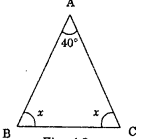
(b) In an isosceles triangle, the base angles are equal. The vertex angle is 40°. What are the base angles of the triangle ? (Remember, the sum of three angles of a triangle is 180°).
(c) Smita’s mother is 34 years old. Two years from now mother’s age will be 4 times Smita’s present age. ?What is Smita’s present age ?
(d) Sachin scored twice as many runs as Rahul. Together, their runs fell two short of a double century. How many runs did each one score?
Solution:
(a) Let lowest score be x
According to question, 2x + 7 = 87
⇒ 2x = 87 – 7
⇒ x = \(\frac{80}{2}\)
∴ x = 40
Required lowest score is 40.

(b) Let base angle be x now base angle are equal We know that the sum of three angles of a triangle is 180°.
HBSE 7th Class Maths Solutions Chapter 4 Simple Equations Ex 4.4 1
x = x
hence, 40° + x + x = 180°
⇒ 2x = 180°-40°
⇒ x = \(\frac{140}{2}\)
∴ x = 70°
Required base angles are 70° and 70°.

(c) Let Smita presentage be x.
According to question 4x – 2 = 34
⇒ 4x = 34 + 2
⇒ x = \(\frac{36}{4}\)
∴ x = 9
Smita’s present age is 9 years.

(d) Let Rahul’s scores be
hence sachin’s scores = 2x
A.t.Q 2x + x = 200-2
⇒ 3x = 198
⇒ x = \(\frac{198}{3}\)
∴ x = 66
Hence, required Rahul’s scores be 99 runs.
Sachin’s scores be 2 x 66 = 132 runs.

Question 3.
Solve the following :
(i) Irfan says that he has 7 marbles more than five times the marbles Parmit has. Irfan has 37 marbles. How many marbles does Parmit have ?
(ii) Laxmi’s father is 49 years old. He is 4 years older than three times Laxmi’s age. What is Laxmi’s age ?
(iii) Maya, Madhra and Mohsina are friends studying in the same class. In a call test in geography, Maya got 16 out of 25. Madhura got 20. Their average score was 19. How much did Mohsina score ?
(iv) People ofSutidargram planted a total of 102 trees in the village garden Some of the trees were fruit trees. The number of non-fruit trees were two more than three times the number of fruit trees. What was the number of fruit trees planted ?
Solution:
(i) Let pannit’s marbles be m.
A.t.Q, 5m + 7 = 37
⇒ 5m = 37 – 7
⇒ x = \(\frac{30}{5}\)
∴ x = 6
Hence, parmit have 6 marbles. (ii) Let Laxmi’s age be years.
A.t.Q, 3y + 4 = 49
3y = 49 – 4
⇒ y = \(\frac{45}{3}\)
⇒ y = 15
Hence, Laxmi’s age is 15 years.

(iii) Let Mohsina score be x.
According to question, \(\frac{16+20+x}{3}\) = 19
⇒ 36 + x = 19 x 3
⇒  x = 57 — 36
∴ x = 21
Hence, Mohsina score is 21.

(iv) Let the number of fruit trees planted be x.
According to questions^: + (3x + 2) = 102
⇒ 4x = 102-2
⇒ x = \(\frac{100}{4}\)
∴ x = 25
Hence, the number of fruit trees planted be 25.

Question 4.
Solve the following riddle :
I am a number,
Tell my identity!
Take me seven times over
And add a fifty!
To reach a triple century
You still need forty!
Solution:
Let I be denoted by x.
According to question, (7x + 50) + 40 = 300
⇒ 7x + 90 = 300
⇒ 7x = 300-90
⇒ x = \(\frac{210}{7}\)
∴ x = 30
Thus I am 30.

HBSE 7th Class Maths Solutions Chapter 4 Simple Equations Ex 4.4 Read More »
HBSE 7th Class Maths Solutions Chapter 4 Simple Equations Ex 4.3

Haryana State Board HBSE 7th Class Maths Solutions Chapter 4 Simple Equations Ex 4.3 Textbook Exercise Questions and Answers.

Haryana Board 7th Class Maths Solutions Chapter 4 Simple Equations Exercise 4.3

Question 1.
Solve the following equations :
(a) 2y + \(\frac{5}{2}=\frac{37}{2}\)
(b) 5t + 28 = 10
(c) \(\frac{a}{5}\) + 3 = 2
(d) \(\frac{q}{4}\) + 7 = 5
(e) \(\frac{5}{2}\)x = -10
(f) \(\frac{5}{2} x=\frac{25}{4}\)
(g) 7m + \(\frac{19}{2}\) = 13
(h) 6z + 10 = -2
(i) \(\frac{3 \cdots}{2}=\frac{2}{3}\)
(j) \(\frac{2b}{3}\) – 5 = 3
Solution:
(a) 2y + \(\frac{5}{2}=\frac{37}{2}\)
\(2 y=\frac{37-5}{2}=\frac{32}{2}=\frac{37}{2}-\frac{5}{2}\)
2y = 16
y = \(\frac{16}{2}\)
∴ y = 8

HBSE 7th Class Maths Solutions Chapter 4 Simple Equations Ex 4.3

(b) 5t + 28 = 10
or, 5t = 10 – 28 = -18
∴ t = \(\frac{-18}{5}\)

(c) \(\frac{a}{5}\) + 3 = 2
or \(\frac{a}{5}\) = 1 – 3 = -1
a = -1 × 5 = -5
∴ a = -5

(d) \(\frac{a}{4}\) + 7 = 5
or, \(\frac{a}{4}\) = 5 – 7 = -2
a = -2 × 4 = -8
∴ a = -8

(e) \(\frac{5}{2}\)x = -10
5x = 2 × (-10) = -20
x = \(\frac{-20}{5}\)
∴ x = -4

(f) \(\frac{5}{2} x=\frac{25}{4}\)
5x × 4 = 25 × 2
20x = 50
x = \(\frac{50}{20}=\frac{5}{2}\)
∴ x = \(\frac{5}{2}\)

(g) 7m + \(\frac{19}{2}\) = 13
or, 7m = 13 – \(\frac{19}{2}\)
= \(\frac{29-19}{2}=\frac{7}{2}\)
or, 7m × 2 = 7
or, m = \(\frac{7}{7 \times 2}=\frac{1}{2}\)
∴ m = \(\frac{1}{2}\)

(h) 6z + 10 = -2
or, 6z = -2 – 10 = -12
or z = \(\frac{-12}{6}\) = -2
∴ z = -2

HBSE 7th Class Maths Solutions Chapter 4 Simple Equations Ex 4.3

(i) \(\frac{3 \cdots}{2}=\frac{2}{3}\)
3l × 3 = 2 × 2 = 4
∴ l = \(\frac{4}{9}\)

(j) \(\frac{2b}{3}\) – 5 = 3
\(\frac{2b}{3}\) = 3 + 5 = 8
2b = 3 × 8 = 24
b = \(\frac{24}{2}\) = 12
∴ b = 12

Question 2.
Solve the following equations :
(a) 2(x + 4) = 12
(b) 3(n-5)=21
(c) 3(n-5) = -21
(d) 3 – 2(2 – y)-7
(e) – 4(2 – x) = 9
(f) 4(2 – x) = 9
(g) 4 + 5 (p – 1) = 34
(h) 34 – 5(p – 1) = 4
Solution:
(a) 2(x + 4) = 12
or, x + 4 = \(\frac{12}{2}\) = 6
or, x = 6 – 4 = 2
∴ x = 2

(b) 3(n – 5) = 21
or, (n – 5) = \(\frac{21}{3}\) = 7
n = 7 + 5 = 12
∴ n = 12

(c) 3(n – 5) = -21
or, (n – 5) = \(\frac{-21}{3}\)= – 7
n = – 7 + 5 = – 2
∴ n = -2

(d) 3 – 2(2 – y) = 7
or, -2(2 – y) = 7 – 3 = 4
or, (2 – y) = \(\frac{4}{-2}\) = -2
-y = – 2 – 2 = – 4
∴ y = 4

(e) -4(2 – x) = 9
or, 2-x = \(\frac{9}{-4}\)
or, -x = \(\frac{-9-8}{4}=\frac{-17}{4}\)
∴ x = \(\frac{17}{4}\)

(f) 4(2 – x) = 9
or, 2 – x = \(\frac{9}{4}\)
or – x = \(\frac{9}{4}\) – 2
= \(\frac{9-8}{4}=\frac{1}{4}\)
∴ x = \(-\frac{1}{4}\)

HBSE 7th Class Maths Solutions Chapter 4 Simple Equations Ex 4.3

(h) 34 – 5(p – 1) = 4
or, – 5(p – 1) = 4 – 34 = – 30
or, (p-1) = \(\frac{-30}{-5}\) = 6
or, P = 6 + 1
∴  P = 7.

Question 3.
Solve the following equations :
(a) 4 = 5(p-2)
(b) – 4 = 5(p – 2)
(c) -16 = -5(2 – p)
(d) 10 = 4 + 3(t + 2)
(e) 28 = 4 + 3(t + 5)
(f) 0 = 16 + 4(m -6)
Solution:
(a) 4 = 6(p – 2)
or, 5(p – 2) = 4
or, (p – 2) = \(\frac{4}{5}\)
or, P = \(\frac{4}{5}+2=\frac{4+10}{5}=\frac{14}{5}\)
∴ P = \(\frac{14}{5}\)

(b) -4 = 5(p – 2)
or, 5 (p – 2) = _4
(p-2) = \(\frac{-4}{5}\)
p = \(\frac{-4}{5}+2=\frac{-4+10}{5}=\frac{6}{5}\)
∴ p = \(\frac{6}{5}\)

(c) -16 = -5(2-p)
or, 5(2-p) = 16
2-p = \(\frac{16}{5}\)
-p = \(\frac{16}{5}-2=\frac{16-10}{5}=\frac{6}{5}\)
∴ p = \(\frac{6}{5}\)

(d) 10 = 4 + 3(t + 2)
or, 4 + 3(t + 2) = 10
3 (t + 2) = 10 – 4 = 6
t + 2 = \(\frac{6}{3}\) = 2
t = 2 – 2 = 0
∴ t = 0

(e) 28 = 4 + 3(t + 5)
or, 4 + 3(t + 5) = 28
3(t + 5) = 28-4 = 24
(t + 5) = \(\frac{24}{3}\) = 8
t = 8-5 = 3
∴ t = 3

(f) 0 = 16 + 4(m – 6)
or, 16 + 4(m – 6) = 0
or, 4 (m -6) = -16
(m – 6) = \(\frac{-16}{4}\) = – 4
m = -4 + 6 = 2
∴ m = 2.

HBSE 7th Class Maths Solutions Chapter 4 Simple Equations Ex 4.3

Question 4.
(a) Construct 3 equations starting with x = 2
(b) Construct 3 equations starting with x=- 2.
Solution:
(a) x = 2
2x = 2 × 2 = 4 ⇒ 2x = 4
3x = 2 × 3 = 6 ⇒ 3x= 6
4x = 2 × 4 = 8 ⇒ 4x = 8

(b) x =-2
2x = -2 × 2 = -4 ⇒ 2x = -4
3x = – 2 × 3 = – 6 ⇒ 3x = – 6
5x = – 2 × 5 = – 10 ⇒ 5x = -10.

HBSE 7th Class Maths Solutions Chapter 4 Simple Equations Ex 4.3 Read More »

HBSE 7th Class Maths Solutions Chapter 4 Simple Equations Ex 4.2

Haryana State Board HBSE 7th Class Maths Solutions Chapter 4 Simple Equations Ex 4.2 Textbook Exercise Questions and Answers.

Haryana Board 7th Class Maths Solutions Chapter 4 Simple Equations Exercise 4.2

Question 1.
Give first the step you will use to separate the variable and then solve the equation:
(a) x – 1 = 0
(b) x + 1 = 0
(c) x – 1 = 5
(d) x + 6 = 2
(e) y -4 = – 7
(f) y -4 = 4
(g) y + 4 = 4
(h) y + 4 = – 4.
Solution:
(a) x – 1 = 0
L.H.S. = x- R.H.S.
1 + 1 = x = 0 + 1 = 1
∴ x = 1
Which is the required solution.

HBSE 7th Class Maths Solutions Chapter 4 Simple Equations Ex 4.2

(b) x + 1 = 0
L.H.S. = x + 1 – 1 = x
R.H.S. = 0 – 1 = -1
∴ x = -1
Which is the required solution.

(c) x – 1 = 5
L.H.S. = x – 1 + 1 = x
R.H.S. = 5 + 1 = 6
∴ x = 6
Which is the required solution.

(d) x + 6 =2
L.H.S. = x + 6 – 6 = x
R.H.S. = 2 – 6 = – 4
∴ x = -4
Which is the required solution.

(e) y- 4 = -7
L.H.S. = y – 4 + 4 = y
R.H.S. = – 7 + 4 = – 3
∴ y = -3
Which is the required solution.

(f) y – 4 = 4
L.H.S. = y – 4 + 4 = y
R.H.S. = 4 + 4 = 8
∴ y = 8
Which is the required solution.

(g) y + 4 = 4
L.H.S. = y + 4 + 4= y
R.H.S. = 4 – 4 = 0
∴ y = 0
Which is the required solution.

HBSE 7th Class Maths Solutions Chapter 4 Simple Equations Ex 4.2

(h) y + 4 = – 4
L.H.S. = y + 4 — 4 = y
R.H.S. = – 4 – 4 = – S
∴ y = -8
Which is the required solution.

Question 2.
Give first the step you will use to separate the variable and then solve the equation.
(a) 3l = 42
(b) \(\frac{b}{2}\) = 6
(c) \(\frac{p}{7}\) = 4
(d) 4x = 25
(e) 8y = 36
(f) \(\frac{z}{3}=\frac{5}{4}\)
(g) \(\frac{a}{5}=\frac{7}{15}\)
(h) 20t = – 10.
Solution:
(a) 3l = 42
L.H.S. = 3l = \(\frac{3}{3}\) x l = l
R.H.S. = 42 = \(\frac{42}{3}\) = 14
∴ l = 14
Which is the required solution.

b) \(\frac{b}{2}\) = 6
L.H.S = \(\frac{b}{2}=\frac{b}{2}\) x 2 = b
R.H.S = 6 = 6 x 2 = 12
∴ b = 12.
Which is the required solution.

(c) \(\frac{p}{7}\) = 4
L.H.S. = \(\frac{p}{7}=\frac{p}{7}\) x 7 = p
R.H.S. = 4 = 4 x 7 = 28
∴ p = 28
Which is the required solution.

(d) 4 x = 25
L.H.S = 8y = \(\frac{8y}{8}\) = y
R.H.S = 36 = \(\frac{36}{8}=\frac{9}{2}\)
∴ y = \(\frac{9}{2}\)
Which is the required solution.

(f) \(\frac{z}{3}=\frac{5}{4}\)
L.H.S = \(\frac{z}{3}=\frac{z}{3}\) x 3 = z
R.H.S = \(\frac{5}{4}=\frac{5}{4} \times 3=\frac{15}{4}\)
∴ y = \(\frac{15}{4}\)
Which is the required solution.

HBSE 7th Class Maths Solutions Chapter 4 Simple Equations Ex 4.2

(f) \(\frac{a}{5}=\frac{7}{15}\)
L.H.S. = \(\frac{a}{5}=\frac{a}{5}\) x 5 = a
R.H.S = \(\frac{7}{15}=\frac{7}{15}\) x 5 = \(\frac{7}{3}\)
∴ a = \(\frac{7}{3}\)
Which is the required solution.

(h) 20t = -10
L.H.S. = 20t = \(\frac{20 t}{20}\) = t
R.H.S = -10 = \(\frac{-10}{20}=-\frac{1}{2}\)
∴ t = \(-\frac{1}{2}\)
Which is the required solution.

Question 3.
Give the step you will use to separate the variable and then solve the equation:
(a) 3n – 2 = 46
(b) 5m + 7 = 17
(c) \(\frac{20 p}{3}\) = 40
(d) \(\frac{3 p}{10}\) = 6
Solution:
3n – 2 = 46
L.H.S. = 3n – 2 + 2
= 3n = \(\frac{3n}{3}\) = n
R.H.S. = 46 + 2 = 48 = \(\frac{48}{3}\) = 16
∴ n = 16
Which is the required solution.

HBSE 7th Class Maths Solutions Chapter 4 Simple Equations Ex 4.2

(b) 5m + 7 = 17
L.H.S. = 5 m + 7 = 5m + 7-7
= 5m = \(\frac{5m}{5}\) = m
R.H.S = 17 = 17 – 7 = 10
= \(\frac{10}{5}\) = 2
∴ m = 2
Which is the required solution.

(c) \(\frac{20 p}{3}\) = 40
L.H.S = \(\frac{20 p}{3}=\frac{20 p}{3} \times 3\)
= 20 p = \(\frac{20 p}{20}\) = p
R.H.S. = 40 = 40 x 3
= 120 = \(\frac{120}{20}\) = 6
∴ P = 6
Which is the required solution.

(d) \(\frac{3 p}{10}\) = 6
L.H.S.
= \(\frac{3 p}{10}=\frac{3 p}{10} \times 10=3 p=\frac{3 p}{3}=p\)
R.H.S. = 6 x 10 = 60 = \(\frac{60}{3}\) = 20
∴ p = 20
Which is the required solution.

Question 4.
Solve the following equations
(a) 10p = 100
(b) 10p + 10 = 100
(c) \(\frac{p}{4}\) = 5
(d) \(\frac{-p}{3}\) = 5
(e) \(\frac{3 p}{4}\) = 6
(f) 3s = – 9
(g) 3s + 12 = 0
(h) 3s = 0
(j) 2q – 6 = 0
(k) 2q + 6 = 0
(l) 2q + 6 = 12
Solution:
(a) 10p = 100
\(\frac{10 p}{10}=\frac{100}{10}\)
∴ p = 10

(b) 10p + 10 = 100
10p = 100 – 10
10p = 90
\(\frac{10 p}{10}=\frac{90}{10}\)
∴ p = 9

HBSE 7th Class Maths Solutions Chapter 4 Simple Equations Ex 4.2

(c) \(\frac{p}{4}\) = 5
\(\frac{p}{4}\) x 4 = 5 x 4
∴ p = 20

(d) \(\frac{-p}{3}\) x 3 = 5 x 3
-p = 15
∴ p = -15

(e) \(\frac{3 p}{4}\) = 6
\(\frac{3 p}{4}\) x 4 = 6 x 4
3p = 24
\(\frac{3 p}{3}=\frac{24}{3}\)
∴ p = 8

(f) 3s = -9
\(\frac{3 s}{3}=\frac{-9}{3}\)
∴ s = -3

(g) 3s+ 12 = 0
3s = -12
\(\frac{3 s}{3}=\frac{-12}{3}\)
∴ s = -4

(h) 3s = 0
or \(\frac{3 s}{3}=\frac{0}{3}\)
∴ s = 0

(i) 2q = 6
or \(\frac{2 q}{2}=\frac{6}{2}\)
∴ q = 3

(j) 2q – 6 = 6
or, 2q = +6
\(\frac{2 q}{2}=\frac{6}{2}\)
∴ q = 3

(k) 2q + 6 = 0
or 2q = -6
\(\frac{2 q}{2}=\frac{-6}{2}\)
∴ q = -3

HBSE 7th Class Maths Solutions Chapter 4 Simple Equations Ex 4.2

(l) 2q + 6 = 12
or 2q = 12 – 6
\(\frac{2 q}{2}=\frac{6}{2}\)
∴ q = 3.

HBSE 7th Class Maths Solutions Chapter 4 Simple Equations Ex 4.2 Read More »

HBSE 7th Class Maths Solutions Chapter 4 Simple Equations Ex 4.1

Haryana State Board HBSE 7th Class Maths Solutions Chapter 4 Simple Equations Ex 4.1 Textbook Exercise Questions and Answers.

Haryana Board 7th Class Maths Solutions Chapter 4 Simple Equations Exercise 4.1

Question 1.
Complete the last column of the table.

EquationValueSay, whether the equation is satisfied, (Yes/No)
1. x + 3 = 0x = 3
2. x + 3 = 0x = 0
3. x + 3 = 0x = -3
4. x – 7 = 1x = 7
5. x – 7 = 1x = 8
6. 5x = 25x = 0
7. 5x = 25x = 5
8. 5x = 25 mx = — 5
9. \(\frac{m}{3}\) = 2m = – 6
10. \(\frac{m}{3}\) = 2m = 0
11. \(\frac{m}{3}\) = 2m = 6

Solution:
1. Put x = 3, x + 3 = 0++
3 + 3 = 0
⇒ 6 ≠ 0 → No.

2. Put x = 0, x + 3 = 0
0 + 3 = 0
⇒ 3 ≠ 0 → No.

3. Put x = – 3, x + 3 = 0
-3 + 3 = 0
⇒ 0 ≠ 0 → Yes.

4. Put x = 7, x – 7 = 1
7 – 7 = 1
⇒ 0 ≠ 1 → No.

5. Put x = 8, x – 7 = 1
8 – 7 = 1
⇒ 1 = 1 → Yes.

6. Put x = 0, 5x = 25
5×0 = 25
⇒ 0 ≠ 25 → No.

7. Put x = 5, 5x = 25
5 x 5 = 25
⇒ 25 = 25 → Yes.

8. Put x = – 5, 5x = 25
5 x (- 5) = 25
⇒ -25 ≠ 25 → No.

HBSE 7th Class Maths Solutions Chapter 4 Simple Equations Ex 4.1

9. Put m = – 6, \(\frac{m}{3}\) = 2
\(\frac{-6}{3}\) = 2
⇒ -2 ≠ 2 → No.

10. Put m = 0, \(\frac{m}{3}\) = 2
\(\frac{0}{3}\) = 2
⇒ 0 ≠ 2→ No.

11. Put m = 6, \(\frac{m}{3}\) = 2
\(\frac{6}{3}\) = 2
⇒ 2 = 2→ Yes.

Question 2.
Check whether the value given in the brackets is a solution to the given equation or not.
(a) n + 5 = : 19 (n = 1)
(b) 7n + 5 = 19 (n = – 2)
(c) 7n + 5 = 19 (n = 2)
(d) 4p – 3 = 13 (P = 1)
(e) 4p – 3 = 13 (P = -4)
4p – 3 = 13 (P = 0)
Solution:
(a) Put n = 1, n + 5 = 19
1 + 5 = 19
1 + 5 = 19
6 ≠ 19
So, the value given in the brackets is not a solution of equation.

(b) Put n = – 2, In+ 5 =19
7 x (- 2) + 5 = 19 -14 + 5 =19
-11 ≠ 19
So, the value given in the brackets is not a solution of equation.

(c) Put n = 2, 7n + 5 =19
7 x 2 + 5 =19
14 + 5 = 19
19 = 19
So, the value given in the brackets is a solution of equation.

HBSE 7th Class Maths Solutions Chapter 4 Simple Equations Ex 4.1

(d) Put p = 1, 4p – 3 =13
4 x 1 – 3 = 13
4 – 3 =13
⇒ 1 ≠ 13
So, the value given in the brackets is a not solution of equation.

(e) Put p = – 4, 4p – 3 =13
4 x (- 4) – 3 =13
-16 – 3 =13
-19 ≠ 13
So, the value given in the brackets is not a solution of equation.

(f) Put p = 0, 4p – 3 =13
4 x 0 – 3 = 13
0 – 3 = 13
-3 ≠ 13
So, the value given in the brackets is not a solution of equation.

Question 3.
Solve the following equations by a trial and error method.
(i) 5p + 2 = 17 (ii) 3m -14 = 4
Solution:
(i) 5p + 2 = 17

pL.H.S.R.H.S.
15 x 1+ 2 = 5 + 2 =717
25 x 2 + 2 = 10 + 2 = 1217
35 x 3 + 2 = 15 + 2= 1717

When p = 3, then L.H.S. = R.H.S.
∴ p = 3 is the solution of the equation.

HBSE 7th Class Maths Solutions Chapter 4 Simple Equations Ex 4.1

(ii) 3m – 14 = 4

mL.H.S.R.H.S.
13 x 1-14 = 3 – 14 = -114
23 x 2-14 = 6 – 14 = -84
33 x 3-14 = 9 – 14 = -54
43 x 4 -14 = 12 – 14 = -24
53 x 5 – 14 = 15 – 14 = 14
63 x 6 – 14 = 18 – 14 = 44

When m = 6, then L.H.S. = R.H.S.
∴ m = 6 is the solution of equation.

Question 4.
Write equations for the following statements :
(i) The sum of numbers x and 4 is 9.
(ii) The difference ofy and 2 is 8.
(Ui) Ten times a is 70.
(iv) The number b divided by 5 gives 6*.
(v) Three fourth oft is 15.
(vi) Seven times m plus 7 gets you 77.
(vii) One fourth of a number x minus 4 leaves 4.
(viii) If you take away 6 from 6 times y, you get 60.
(ix) If you add 3 to one third of z, you get 30.
Solution:
(i) x + 4 = 9
(ii) y – 2 = 8
(iii) 10a = 70
(iv) b/5 = 6
(v) \(\frac{3}{4}\)t = 15
(vi) 7m+ 7 = 77
(vii) \(\frac{1}{4}\)n – 4 = 4
(viii) 6y – 6 = 60
(ix) \(z + 3

Question 5.
Write the following equations in statement forms :
(i) p + 4 = 15
(ii) m-7 = 3
(iii) 2m = 7
(iv) [latex]\frac{m}{5}\) = 3
(v) \(\frac{3m}{5}\) = 6
(vi) 3p + 4= 25
(vii) 4p-2 = 18
(viii) \(\frac{p}{2}\) + 2 = 8
Solution:
(i) The sum of numbers p and 4 is 15.
(ii) Taking away 7 from m gives 3.
(iii) Two times a number m is 7.
(iv) One fifths of m is 3.
(v) Three fifth of m is 6.
(ut) Add 4 to three times p to get 25.
(vii) Taking away 2 from four times ofp gives 18.
(viii) Half of a number p plus 2 is 8.

HBSE 7th Class Maths Solutions Chapter 4 Simple Equations Ex 4.1

Question 6.
Set up an equation in the following cases:
(i) Irfan says that he has 7 marbles more than five times the marbles parmit has. Irfan has 37 marbles. (Take m to be the number of Permit’s marbles).
(ii) Laxmi’s father is 49 years old. He is 4 years older than three times Laxmi’s age. (Take Laxmi’ age to be y years).
(iii) The teacher tells the class that the highest marks obtained by a student in her class is twice the lowest marks plus 7. The highest score is 87. (Take the lowest score to be l).
(iv) In an isosceles triangle, the vertex angle is twice either base angel. (Let the base angle be b in degrees. Remember that the sum of angles of a triangles is 180 degrees).
Solution:
(i) Let us take m to be the number of parmit’s marbles.
Hence the required equation, 5m + 7 = 37
(ii) Let us take y to be the Laxmi’s age.
Hence the required equation, 3y + 4 = 49
(iii) Let us take the lowest score to be l.
Hence the required equation, 2l + 7 = 87
(iv) Let the base angle be b°,
Hence the required equation, 2 b° + b° + b°= 180 or, 4 b° =180°

HBSE 7th Class Maths Solutions Chapter 4 Simple Equations Ex 4.1 Read More »

HBSE 7th Class Maths Solutions Chapter 3 Data Handling InText Questions

Haryana State Board HBSE 7th Class Maths Solutions Chapter 3 Data Handling InText Questions and Answers.

Haryana Board 7th Class Maths Solutions Chapter 3 Data Handling InText Questions

Try These (Page No. 59):

Question 1.
Weigh (in kg.) atleast 20 children (girls and boys) of your class. Organise the data and answer the following questions using this data.
(i) Who is the heaviest of all ?
(ii) What is the most common weight ?
(iii) What is the difference between your weight and that of your best friend ?
Solution:
Sameer reads in class VII. Sameer’s colleage helped his organise the data in the following way:
Five conclusions:

NamesWeight (in kg.)
1. Ajay35
2. Armaan40
3. Ashish35
4. Dipti40
5. Faizaan37
6. Govind33
7. Jay34
8. Kavita36
9. Manisha32
10. Neertg40
11. Sameer48
12. Rohan50
13. Sona42
14. Manshi38
15. Mona35
16. Vijay45
17. Vinay36
18. Saurabh34
19. Mohan40
20. Sanjay40
Total770

(a) My name is Sameer and my weight is 48 kg.
(b) My best friend is Rohan.
(c) In my class minimum weight of Manisha is 32 kg.
(d) In my class maximum weight of Rohan is 50 kg.
(e) Average weight of class VII students are 38.5 kg.
(i) Rohan is the heaviest of all.
(ii) 38.5 kg. is the most common weight. (Hi) Difference between Sameer and
Rohan
= 50 – 48 = 2 kg.

HBSE 7th Class Maths Solutions Chapter 3 Data Handling InText Questions

Try These (Page No. 61):

Question 2.
How would you find the average of your study hours for the whole week ?
Solution:
One a week = 7 days.
Ashish study hours for the whole week = 5, 7, 6, 8, 9, 10, 4.
Total study hours = 49 hours
∴ Mean
= \(\frac{Sum of all observations}{Number of observations}\)
= \(\frac{5+7+6+8+9+10+4}{7}=\frac{49}{7}\) = 7
∴ The average hours for study = 7 hours.

Try These (Page No. 61):

Question 1.
Find the mean of your sleeping hours during one week.
Solution:
My sleeping hours during one week = 4, 3, 5, 6, 7, 5, 6.
Total sleeping hours during one week = 36 hours.
= \(\frac{Sum of all observations}{Number of observations}\)
= \(\frac{4+3+5+6+7+5+6}{7}\)
= \(\frac{36}{7}\) = 5.14 hours.

Question 2.
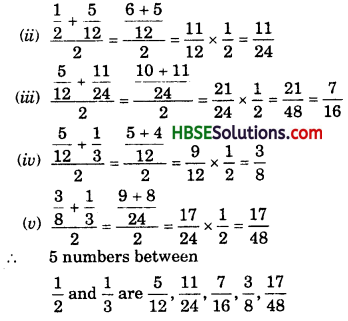
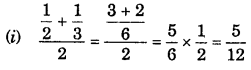
Find atleast 5 numbers between \(\frac{1}{2}\) and \(\frac{1}{3}\)
Solution:
HBSE 7th Class Maths Solutions Chapter 3 Data Handling InText Questions 1
HBSE 7th Class Maths Solutions Chapter 3 Data Handling InText Questions 2

HBSE 7th Class Maths Solutions Chapter 3 Data Handling InText Questions

Try These (Page No. 65):

Question 1.
Find the mode of:
(i) 2, 6, 5, 3, 0, 3, 4, 3, 2, 4, 5, 2, 4.
(ii) 12, 14, 16, 12, 14, 14, 16, 14, 10, 14, IS, 14.
Solution:
(i) Arranging the numbers with same values together, we get,
0, 2, 2, 2, 3, 3, 3, 4, 4, 4, 5, 5, 6.
Mode of this data is 2, 3 and 4 because it occurs three times frequently than other observations.
(ii) Arranging the number with same values together, we get,
10, 12,12,14,14, 14, 14, 14,14, 16, 16,18.
Mode of this data is 14 because it occurs more frequently than other observations.

Try These (Page No. 65-66):

Question 1.
Find the mode of the following data :
12, 14, 12, 16, 15, 13, 14, 18, 19, 12,
14, 15, 16, 15, 16, 16,15, 17, 13, 16,
16, 15, 15, 13, 15, 17, 15, 14, 15,
13, 15, 14.
Solution:
Observations in ascending order are:
12, 12, 12, 13, 13, 13, 13, 14, 14, 14,
14, 14, 15, 15, 15, 15, 15, 15, 15,
15, 15, 15, 16, 16, 16, 16, 16, 16,
17, 17, 18, 19.
We observe that 15 is occuring ten times i.e., maximum number of times.
∴ Mode = 15

HBSE 7th Class Maths Solutions Chapter 3 Data Handling InText Questions

Question 1.
Heights (in cm) of 25 children are given below:
168, 165, 163, 160, 163, 161, 162,
164, 163, 162, 164, 163, 160, 163,
163, 165, 163, 162, 163, 164, 163,
160, 165, 163, 162.
What is the mode of the heights ?
What do we understand by Mode here ?
Solution:
Observations in ascending order are:
160, 160, 160, 161, 162, 162, 162,
162, 163, 163, 163, 163, 163, 163,
163, 163, 163, 163, 164, 164, 164,
165, 165, 165, 168.
We observe that 163 is occuring ten times, i.e., maximum number of times.
Hence, Mode = 163
The mode is the most frequently occuring observation, i.e., the- observation having maximum number of frequencies.

Try These (Page No. 66):

Question 1.
Discuss with your friends and give
(a) Two situations when mean would be an appropriate representative value to use and
(b) Two situations where mode would be and appropriate representative value to use.
Solution:
(a) (i) The height of 5 boys in a group are :
152 cm, 170 cm, 156 cm, 164 cm and 158 cm.
Mean = \(\frac{Sum of the given observations}{Number of observation}\)
= \(\) = 160 cm
hence, It is clear that mean is the appropriate representive value.

(ii) Mean of the first 5 whole number \(\frac{0+1+2+3+4}{5}=\frac{10}{5}\) = 2
Hence, This mean is the appropriate representive value.

(b) The mode of
(i) 5, 5, 7, 8, 8, 9, 7, 9, 10, 10, 11, 9,13.
(ii) 110, 120, 130, 120, 110, 140, 130, 120, 140,120.
Solution:
(i) In the given data, we see that the observation 9 occurs maximum number of times i.e., 3 times
Hence, mode is 9.
(ii) Since, the value 120 occurs maximum number of times, i.e. , 4 times.
Hence, mode is 120.
Hence two sutations, mode is the appropriate representative data.

HBSE 7th Class Maths Solutions Chapter 3 Data Handling InText Questions

Try These (Page No. 67):

Question 1.
Your friend found the median and the mode of a given data. Describe and correct your friends error if any:
35, 32, 35, 42, 38, 32, 34
Median = 42, Mode = 32.
Solution:
We arrange the data in ascending order, we get,
32,32,34, 35, 35, 38, 42.
Median is the middle observation. Therefore 35 is the median.
Here, 32 and 35 both occur two times. Therefore, they are both modes of the data.

Try These (Page No. 71-72):

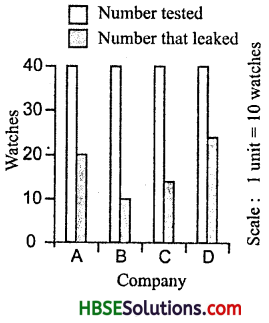
Question 1.
The bar chart shows the result of a survey to test water resistant watches made by different companies.
Each of these companies claimed that their watches were water resistant. After a test the above results were revealed.
HBSE 7th Class Maths Solutions Chapter 3 Data Handling InText Questions 3
(a) Can you work a fraction of the number of watches that leaked to the number tested for each company ?
(b) Could you tell on this basis which company has better matches ?
Solution:
(a) In company A,
Number that leaked = 20,
Number that tested = 40
In company B, No. that leaked = 10,
Number that tested = 40.
In company C, No. that leaked = 12,
Number that tested = 40
In company D, No. that leaked = 22,
Number that tested =S ‘ 40
(b) B company has better matches.

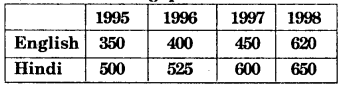
Question 2.
Sale of English and Hindi books in the years 1995, 1996, 1997 and 1998 are given below. Draw a double bar graph and answer the following questions :
HBSE 7th Class Maths Solutions Chapter 3 Data Handling InText Questions 4
Draw a double bar graph and answer the following questions:
(i) In which year was the difference in the sale of the two languages books least ?
(ii) Can you say that the demand for English books rose faster ? Justify.
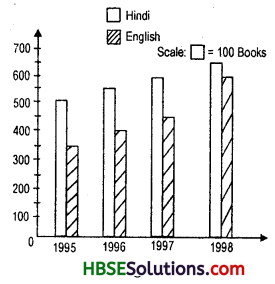
Solution:
HBSE 7th Class Maths Solutions Chapter 3 Data Handling InText Questions 5
(i) 1998 (650 books – 620 books = 30 books)
(ii) Yes, 1995 to 1998 English books increases to = 50, 50, 170.
1995 to 1998 Hindi books increases to = 25, 75, 50.

HBSE 7th Class Maths Solutions Chapter 3 Data Handling InText Questions

Try These (Page No. 74):

Question 1.
Think of some situations, atleast 3 examples of each, that are certain to happen, some that are impossible and some that may or may not happen or Le., situations that have some chance of happening.
Solution:
(i) The sun coming up from the east. This is possible.
(ii) An elephant growing to two ft. height. This is not possible.
(iii) It will be Wednesday on 6th January. If the day on 5 th January is Monday, then on 6th January it will be Tuesday. Thus, it is impossible that the day on 6th January will be Wednesday.

Try These (Page No. 75):

Question 2.
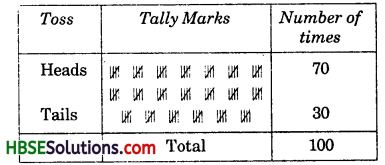
Toss a coin 100 times and record the data. Find the number of times heads and tails occur in it.
Solution:
HBSE 7th Class Maths Solutions Chapter 3 Data Handling InText Questions 6

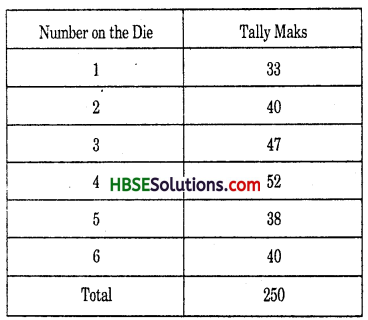
Question 3.
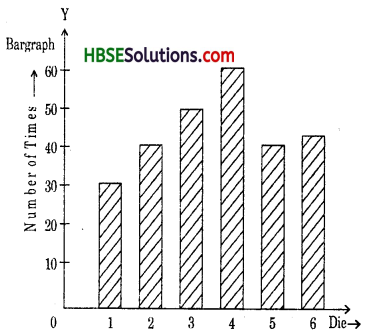
Aftaab threw a die 250 times and got the following table. Draw a bargraph for this data.
HBSE 7th Class Maths Solutions Chapter 3 Data Handling InText Questions 7
Solution:
HBSE 7th Class Maths Solutions Chapter 3 Data Handling InText Questions 8

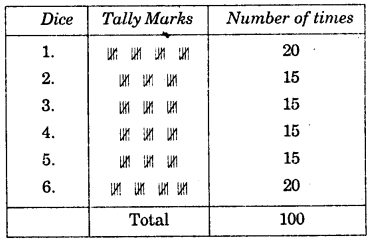
Question 4.
Throw a dice 100 times and record the data. Find the number of times 1, 2,3, 4, 5, 6 occur.
Solution:
HBSE 7th Class Maths Solutions Chapter 3 Data Handling InText Questions 9

HBSE 7th Class Maths Solutions Chapter 3 Data Handling InText Questions

Try These (Page No. 76):

Question 1.
Construct or think of five situations where outcomes do not have equal chances.
Solution:
HBSE 7th Class Maths Solutions Chapter 3 Data Handling InText Questions 10

HBSE 7th Class Maths Solutions Chapter 3 Data Handling InText Questions Read More »

HBSE 7th Class Maths Solutions Chapter 2 Fractions and Decimals InText Questions

Haryana State Board HBSE 7th Class Maths Solutions Chapter 2 Fractions and Decimals InText Questions and Answers.

Haryana Board 7th Class Maths Solutions Chapter 2 Fractions and Decimals InText Questions

Try These (Page 34):

Question 1.
If the product is an improper fraction express it as a mixed fraction.
Find
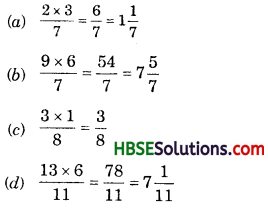
(a) \(\frac{2}{7}\) x 3
(b) \(\frac{9}{7}\) x 6
(c) 3 x \(\frac{1}{8}\)
(d) \(\frac{13}{11}\) x 6
Solution:
HBSE 7th Class Maths Solutions Chapter 2 Fractions and Decimals InText Questions 1

HBSE 7th Class Maths Solutions Chapter 2 Fractions and Decimals InText Questions

Question 2.
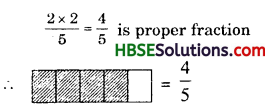
Represent pictorially : 2 x \(\frac{2}{5}=\frac{4}{5}\)
Solution:
HBSE 7th Class Maths Solutions Chapter 2 Fractions and Decimals InText Questions 2

Try These (Page 34):

Question 1.
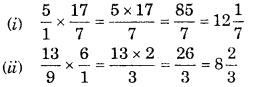
Find
(i) 5 x 2\(\frac{3}{7}\)
(ii) 1\(\frac{4}{9}\) x 6
Solution:
HBSE 7th Class Maths Solutions Chapter 2 Fractions and Decimals InText Questions 3

Try These (Page 35):

Question 1.
Can you tell, what is
(i) \(\frac{1}{2}\) of 10 = ?
(ii) \(\frac{1}{4}\) of 16 = ?
(iii) \(\frac{2}{5}\) of 25 = ?
Solution:
(i) \(\frac{1}{2}\) of 10 = 5
(ii) \(\frac{1}{4}\) of 16 = 4
(iii) \(\frac{2}{5}\) of 25 = 2 x 5 = 10

Try These (Page 39):

Question 1.
Fill in these boxes :
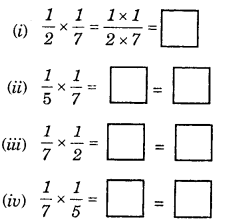
HBSE 7th Class Maths Solutions Chapter 2 Fractions and Decimals InText Questions 4
Solution:
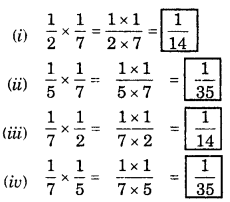
HBSE 7th Class Maths Solutions Chapter 2 Fractions and Decimals InText Questions 5

HBSE 7th Class Maths Solutions Chapter 2 Fractions and Decimals InText Questions

Try These (Page 40):

Question 1.
Find
(i) \(\frac{1 \times 4}{3 \times 5}\)
(ii) \(\frac{2 \times 1}{3 \times 5}\)
Solution:
(i) \(\frac{1 \times 4}{3 \times 5}=\frac{4}{15}\)
(ii) \(\frac{2 \times 1}{3 \times 5}=\frac{2}{15}\)

Try These (Page 40):

Question 1.
Find
(i) \(\frac{8}{3} \times \frac{4}{7}\)
(ii) \(\frac{3}{4} \times \frac{2}{3}\)
Solution:
(i) \(\frac{8 \times 4}{3 \times 7}=\frac{32}{21}\)
(ii) \(\frac{3 \times 2}{4 \times 3}=\frac{2}{4}=\frac{1}{2}\)

Try These (Page 45):

Question 1.
Find
(i) 7 ÷ \(\frac{2}{5}\)
(ii) 6 ÷ \(\frac{4}{7}\)
(iii) 2 ÷ \(\frac{8}{9}\)
Solution:
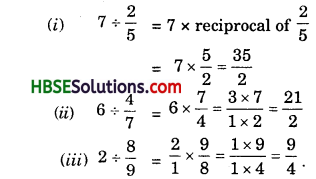
HBSE 7th Class Maths Solutions Chapter 2 Fractions and Decimals InText Questions 6

Try These (Page 45):

Question 1.
Find
(i) 6 ÷ 5\(\frac{1}{3}\)
(ii) 7 ÷ 2\(\frac{4}{7}\)
Solution:
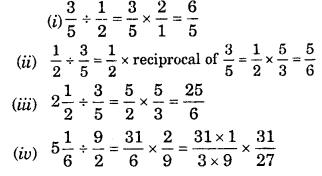
(i) \(\frac{6}{1} \div \frac{16}{3}=\frac{6}{1} \times \frac{3}{16}=\frac{3 \times 3}{1 \times 8}=\frac{9}{8}\)
(ii) \(7 \div \frac{18}{7}=7 \times \frac{7}{18}=\frac{49}{18}\)

HBSE 7th Class Maths Solutions Chapter 2 Fractions and Decimals InText Questions

Try These (Page 45):

Question 1.
Find
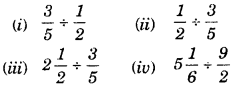
HBSE 7th Class Maths Solutions Chapter 2 Fractions and Decimals InText Questions 7
Solution:
HBSE 7th Class Maths Solutions Chapter 2 Fractions and Decimals InText Questions 8

Try These (Page 46):

Question 1.
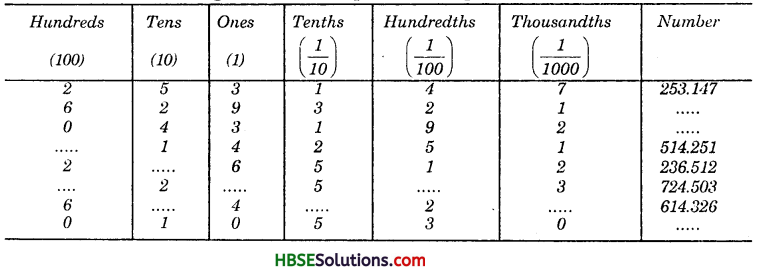
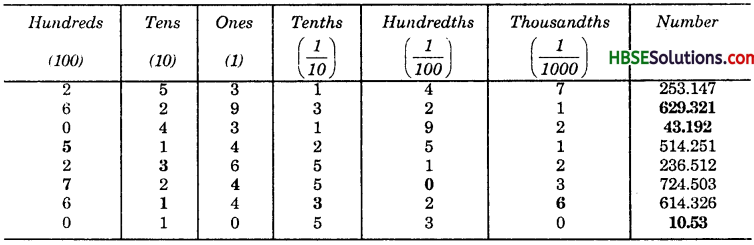
Look at the following table and fill up the blank spaces :
HBSE 7th Class Maths Solutions Chapter 2 Fractions and Decimals InText Questions 9
Using this table you can write a decimal number in its expanded form also. For example 253.417
= 2 x 100 + 5 x 10 + 3 x 1 + 4 x (\(\frac{1}{10}\)) + 1 x (\(\frac{1}{100}\)) + 7 x (\(\frac{1}{1000}\)). So, a decimaln number and its expanded form can be written if the place values of the digits are known to us.
Solution:
HBSE 7th Class Maths Solutions Chapter 2 Fractions and Decimals InText Questions 10

Try These (Page 50):

Question 1.
1. Find: (i) 2.7×4
(ii) 1.8 x 1.2
(iii) 2.3 x 4.35
2. Arrange the products obtained in (1) in descending order.
Solution:
1.(i) 2.7 x 4 = 10.8
(ii) 1.8 x 1.2 = 2.16
(iii) 2.3 x 4.35 = 10.005
2. 10.8 > 10.005 > 2.16.

Try These (Page 51):

Question 1.
Find :
(i) 0.3 x 10
(ii) 1.2 x 100
(iii) 56.3 x 1000
Solution:
(i) 0.3 x 10 = 3
(ii) 1.2 x 100 = 120
(iii) 56.3 x 1000 = 56300

Try These (Page 53):

Question 1.
Find :
(i) 235.4 ÷ 10
(ii) 235.4 ÷ 100
(iii) 235.4 ÷ 1000
Solution:
(i) \(\frac{235.4}{10}\)= 23.54
(ii) \(\frac{235.4}{100}\) = 2.354
(iii) \(\frac{235.4}{1000}\) = 0.2354

HBSE 7th Class Maths Solutions Chapter 2 Fractions and Decimals InText Questions

Try These (Page 53):

Question 1.
Find : (i) 35.7 ÷ 3 = ?
(ii) 25.5 ÷ 3 = ?
Solution:
(i) 35.7 ÷ 3 = 11.9,
(ii) 25.5 ÷ 3 = 8.5

Try These (Page 53):

Question 1.
Find : (i) 43.15 ÷ 5 = ?
(ii) 82.44 ÷ 6 = ?
Solution:
(i) 43.15 ÷ 5 = 8.63,
(ii) 82.44 ÷ 6 = 13.74

Try These (Page 53):

Question 1.
Find : (i) 15.5 ÷ 5 (ii) 126.35 ÷ 7
Solution:
(i) \(\frac{15.5}{5}\) = 3.1
(ii) \(\frac{126.35}{7}\) = 18.05

HBSE 7th Class Maths Solutions Chapter 2 Fractions and Decimals InText Questions

Try These (Page 54):

Question 1.
Find
(i) \(\frac{7.75}{0.25}\)
(ii) \(\frac{42.8}{0.02}\)
(iii) \(\frac{5.6}{1.4}\)
Solution:
(i) \(\frac{7.75}{0.25}=\frac{775}{25}\) = 31
(ii) \(\frac{42.8}{0.02}=\frac{4280}{2}\) = 2140
(iii) \(\frac{5.6}{1.4}=\frac{56}{14}\) = 4

HBSE 7th Class Maths Solutions Chapter 2 Fractions and Decimals InText Questions Read More »

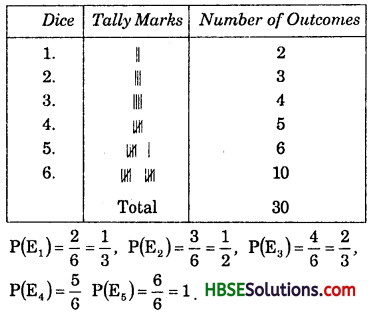
HBSE 7th Class Maths Solutions Chapter 3 Data Handling Ex 3.4

Haryana State Board HBSE 7th Class Maths Solutions Chapter 3 Data Handling Ex 3.4 Textbook Exercise Questions and Answers.

Haryana Board 7th Class Maths Solutions Chapter 3 Data Handling Exercise 3.4

Question 1.
Tell whether the following is certain to happen, impossible, can happen but not certain.
(i) You are older today than yesterday.
(ii) A tossed coin will land heads up.
(iii) A die when tossed shall land up with 8 on top.
(iv) The next traffic light seen will be green.
(v) Tomorrow will be a cloudy day.
Solution:
(i) 0, (ii) between 0 and 1, (iii) 0, (iv) between 0 and 1, (v) between 0 and 1.

Question 2.
There are 6 marbles in a box can with numbers from 1 to 6 marked on each ofthem.
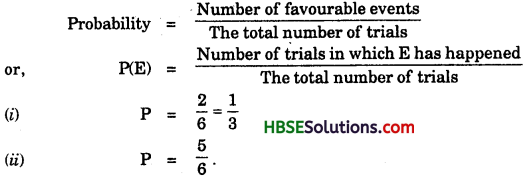
(i) What is the probability of drawing marble with number 2 ?
(ii) What is the probability of drawing marble with number 5 ?
Solution:
HBSE 7th Class Maths Solutions Chapter 3 Data Handling Ex 3.4 1

HBSE 7th Class Maths Solutions Chapter 3 Data Handling Ex 3.4

Question 3.
A coin is flipped to decide which team starts the game. What is the probability that your team will start ?
Solution:
A coin has one head and one tail
∴ P = \(\frac{1}{2}\)

Question 4.
A box contains pairs of socks of two colours (black and white) I have picked out a white sock. I pick out one more with my eyes closed. What is the probability that it will make a pair ?
Solution:
A box contains socks of two colours black and white.
∴ P = \(\frac{1}{2}\)

HBSE 7th Class Maths Solutions Chapter 3 Data Handling Ex 3.4 Read More »
HBSE 7th Class Maths Solutions Chapter 3 Data Handling Ex 3.3

Haryana State Board HBSE 7th Class Maths Solutions Chapter 3 Data Handling Ex 3.3 Textbook Exercise Questions and Answers.

Haryana Board 7th Class Maths Solutions Chapter 3 Data Handling Exercise 3.3

Question 1.
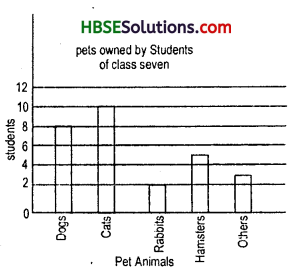
Use the bar-chart to answer the following questions :
(a) Which is the most popular pet ?
(b) How many children have a dog as a pet ?
HBSE 7th Class Maths Solutions Chapter 3 Data Handling Ex 3.3 1
Solution:
(a) cats
(b) 8.

HBSE 7th Class Maths Solutions Chapter 3 Data Handling Ex 3.3

Question 2.
Read the bar-graph and answer the questions that follows :
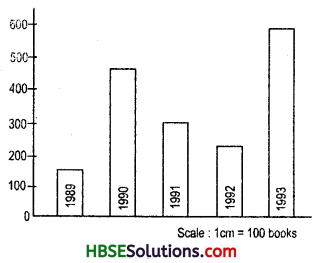
Number of books sold by a bookstore during five consecutive years.
HBSE 7th Class Maths Solutions Chapter 3 Data Handling Ex 3.3 2
(i) About how many books were sold in 1989 ? 1990 ? 1992 ?
(ii) In which year were about 475 books sold ? About 225 books ?
(iiii) In which years were fewer than 250 books sold ?
(iv) Can you explain how you would estimate the number of books sold in 1989 ?
Solution:
(i ) Many books were sold in 1989,1990, 1992
In 1989 = 175. In 1990 = 475, In 1992 = 225 Total = 175 + 475 + 225 = 875 books
(ii) 1990, 1992
(iii) 1989 and 1992.
(iv)Scale : 1 cm = 100 books In 1989 scale is 1.75 cm
∴ Books = 1.75 x 100 = 175 books.

Question 3.
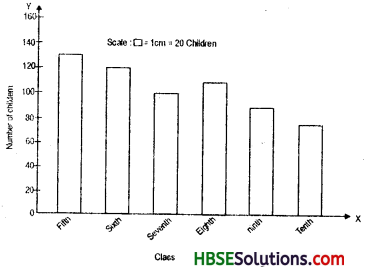
Number of children in six different classes are given below. Represent the data on a bar-graph.

ClassNumber of Children
Fifth135
Sixth120
Seventh95
Eighth100
Ninth90
Tenth80

(a) How would you choose a scale.
(b) Answer the following questions
(i) Which class has the maximum number of children ? And the minimum?
(ii) Find the ratio of students of class sixth to the students of class eight.
Solution:
HBSE 7th Class Maths Solutions Chapter 3 Data Handling Ex 3.3 3
(a) Scale : 1 cm = 20 children in y-axis.
(b) (i) Fifth class has the maximum number of children = 135
Tenth class has the minimum number of children = 80.
(ii) Ratio of students of class sixth to eighth = 120 : 100 = \(\frac{120}{100}=\frac{12}{10}=\frac{6}{5}\) = 6:5

HBSE 7th Class Maths Solutions Chapter 3 Data Handling Ex 3.3

Question 4.
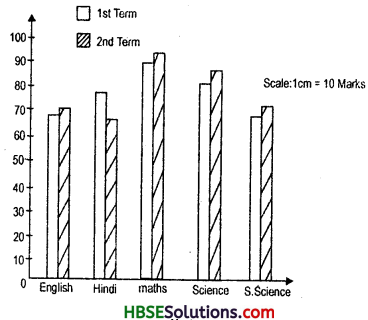
The performance of students in 1st Term and 2nd Term is given. Draw a double bar graph choosing appropriate scale and answer the following:


Subject1st Term (MM: 100)2nd Term (MM: 100)
English6770
Hindi7265
Maths8895
Science8185
S. Science7375

(i) In which subject, has the child improved his performance the most ?
(ii) In which subject is the improvement least ?
(iii) Has the performance gone down in any subject ?
Solution:
HBSE 7th Class Maths Solutions Chapter 3 Data Handling Ex 3.3 4
(i) Maths
(ii) Maths
(iii) Hindi

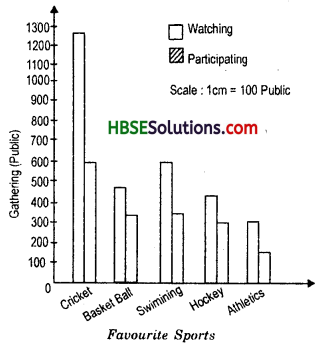
Question 5.
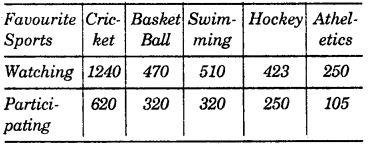
Consider this data collected from a survey of a colony.
HBSE 7th Class Maths Solutions Chapter 3 Data Handling Ex 3.3 5
(i) Draw a double bar graph choosing an appropriate scale.
What do you infer from the bar graph.
(ii) Which sports is most popular ?
(iii) What is more preferred, watching or participating in sports ?
Solution:
HBSE 7th Class Maths Solutions Chapter 3 Data Handling Ex 3.3 6
(i) Cricket is most popular than other sports, because 1240 watching and 620 participating.
(ii) Cricket
(iii) Watching.

HBSE 7th Class Maths Solutions Chapter 3 Data Handling Ex 3.3

Question 6.
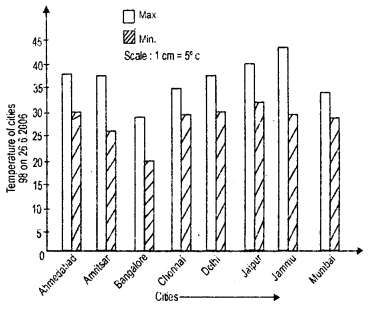
Take the data giving the minimum and the maximum temperature of various cities given in the beginning of this chapter. Plot a double bar-graph using the data:
(i) Which city has the largest difference in the minimum and maximum temperature on the given date ?
(ii) Which is the hottest and the coldest city ?
(iii) Name two cities where maximum temperature of one was less than the minimum temperature of the other.
(iv) Name the city which has the least difference between its minimum and the maximum temperature.
Solution:
(i) Jammu,
(ii) Jammu and Bangalore,
(iii) Bangalore, Amritsar
(iv) Mumbai. (See Fig. )
HBSE 7th Class Maths Solutions Chapter 3 Data Handling Ex 3.3 7

HBSE 7th Class Maths Solutions Chapter 3 Data Handling Ex 3.3 Read More »
HBSE 7th Class Maths Solutions Chapter 3 Data Handling Ex 3.2

Haryana State Board HBSE 7th Class Maths Solutions Chapter 3 Data Handling Ex 3.2 Textbook Exercise Questions and Answers.

Haryana Board 7th Class Maths Solutions Chapter 3 Data Handling Exercise 3.2

Question 1.
The scores in mathematics test (out of 25) of 15 students is as follows :
19.25.23.20.9.20.15.10.5.16.25.20.24, 12,20.
Find the mode and median of this data. Are they same ?
Solution:
We arrange the data in ascending order, we get,
5.9.10.12.15.16.19.20.20.20.20. 25, 25.
Mode of this data is 20 because it occurs 4 times more than frequently than other observations.
Now, Median is the middle observation.
Therefore, 20 is the median.
Yes, Mode and Median are same.

HBSE 7th Class Maths Solutions Chapter 3 Data Handling Ex 3.2

Question 2.
The runs scored in a cricket match by 11 players is as follows :
6,15,120,50,100,80,10,15,8,10,10.
Find the mean, mode and median of this data. Are the three same ?
Solution:
Mean = \(\frac{Sum of the scores}{No. of players}\)
= \(\frac{424}{11}\) = 38.5454 = 38.55
We arrange the data in ascending order, we get 6, 8, 10, 10,10, 15, 15, 50, 80, 100, 120.
∴ Mode of this data is 10 because it occurs three times more than other observations.
Now, Median is the middle observation.
Therefore 15 is the median.
∴ Mean, Mode and Median are not same.

Question 3.
The weights (in kg.) of 15 students of a class are :
38,42,35,37,45,50,32,43,43,40,36,38, 43,38,47.
(i) Find the mode and median of this data.
(ii) Is there more than one mode ?
Solution:
We arrange the data in ascending order, we get,
32,35,36, 37, 38, 38,38, 40,42,43,43,43, 45, 47, 50.
(i) Mode of this data is 38 and 43 because both occur three times more than- other observations.
Now, Median is the middle observation. Therefore 40 is the median.
(ii) Yes, there are two modes 38 and 43.

Question 4.
Find the mode and median of the following data :
13, 16, 12, 14, 19, 12, 14, 13, 14.
Solution:
We arrange the data in ascending order, we get,
12, 12, 13, 13, 14, 14, 14, 16,19.
Therefore, mode of this data is 14 because it occurs three times more than other observations.
Now, median is the middle observation. Therefore 14 is the median.

HBSE 7th Class Maths Solutions Chapter 3 Data Handling Ex 3.2

Question 5.
Tell whether the statement is true or false:
(i) The mode is always one of the numbers in a data.
(ii) The mean can be one of the numbers in a data.
(iii) The median is always one of the numbers in a data.
(iv) A data always has a mode.
(v) The data 6, 4, 3, 8, 9,12,13, 9 has mean 9.
Solution:
(i) False, (ii) Yes, (iii) Yes, (it;) Yes,
(v) Mean = \(\frac{6+4+3+8+9+12+13+9}{8}=\frac{64}{8}\) = 8
∴ False.

HBSE 7th Class Maths Solutions Chapter 3 Data Handling Ex 3.2 Read More »
HBSE 7th Class Maths Solutions Chapter 3 Data Handling Ex 3.1

Haryana State Board HBSE 7th Class Maths Solutions Chapter 3 Data Handling Ex 3.1 Textbook Exercise Questions and Answers.

Haryana Board 7th Class Maths Solutions Chapter 3 Data Handling Exercise 3.1

Question 1.
Find the range of heights of 10 students of your class.
Solution:
The height (in feet) of 10 students of my class VII,
= 3.5, 4, 5, 4, 3, 5, 4, 3.5, 4, 6.
∴ Range of the heights (in feet) of the students = 6-3 = 3 Feet.

Question 2.
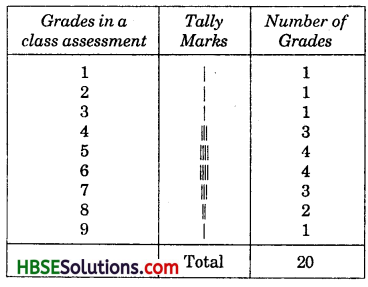
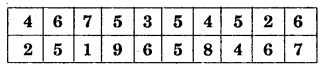
Organise the following marks in a class assessment, in a tabular form.
(i) Which number is the highest ?
(ii) Which number is the lowest ?
(iii) What is the range of the data ?
(iv) Find the arithmetic mean.
HBSE 7th Class Maths Solutions Chapter 3 Data Handling Ex 3.1 1
Solution:
Let us put the data in a tabular form :
HBSE 7th Class Maths Solutions Chapter 3 Data Handling Ex 3.1 2
(i) 9 is the highest grade.
(ii) 1 is the lowest grade.
(wi) Range of the data = 9-1 = 8
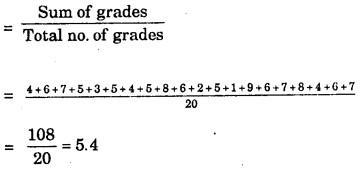
(iv) Arithmetic Mean
HBSE 7th Class Maths Solutions Chapter 3 Data Handling Ex 3.1 3

HBSE 7th Class Maths Solutions Chapter 3 Data Handling Ex 3.1

Question 3.
Find the mean of first five whole numbers.
Solution:
Mean of first 5 whole number
\(\frac{0+1+2+3+4}{5}=\frac{10}{5}=2\)

Question 4.
A cricketer scores the following runs in eight innings: 58, 76,40,35,48,45, 0,100. Find the mean score.
Solution:
Mean score = \(\frac{\text { Sum of scores }}{\text { Total no. of innings }}\)
= \(\frac{58+76+40+35+48+45+0+100}{8}=\frac{402}{8}=\) = 50.25

Question 5.
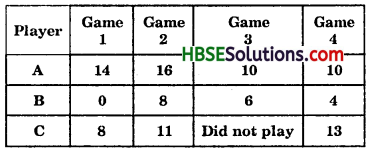
Following table shows the points of scores each player scored in four games:
HBSE 7th Class Maths Solutions Chapter 3 Data Handling Ex 3.1 4
Now answer these questions :
(i) Find the mean to determine A’s average number of points scored per game.
(ii) To find the mean number of points per game for C, would you divide the total points by 3 or by 4 1 Why ?
(Hi) B played in all the four games. How would you find the mean ?
(iv) Who is the best performer ?
Solution:
(i) Mean of A
\(\frac{14+16+10+10}{4}=\frac{50}{4}=\frac{25}{2}\) = 12.5

(ii) Mean of C = \(\frac{8+11+13}{3}=\frac{32}{3}\) = 10.66
because three players play.
(iii) Mean of B
= \(\frac{0+8+6+4}{4}=\frac{18}{4}=\frac{9}{2}\) = 4.5

(iv) Mean of A > Mean of C > Mean of B.
∴ A is the best performer.

HBSE 7th Class Maths Solutions Chapter 3 Data Handling Ex 3.1

Question 6.
The marks (out of 100) obtained by a group of students in a science test are 85, 76, 90, 85, 39, 48, 56, 95, 81 and 75. Find the :
(i) Highest and the lowest mark obtained by the students.
(ii) Range of the marks obtained.
(iii) Mean marks obtained by the group.
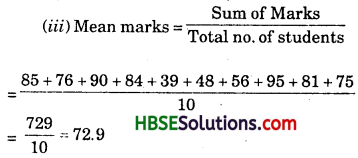
Solution:
(i) Highest marks of the students = 95
Lowest marks of the students = 39 (ii) Range of the marks = highest marks – lowest marks = 95 – 39 = 56
HBSE 7th Class Maths Solutions Chapter 3 Data Handling Ex 3.1 5

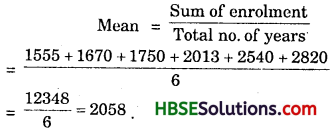
Question 7.
The enrolment of a school during six consecutive years was as follows: 1555, 1670,1750,2013,2540,2820.
Find the mean enrolment of the school for this period.
Solution:
HBSE 7th Class Maths Solutions Chapter 3 Data Handling Ex 3.1 6

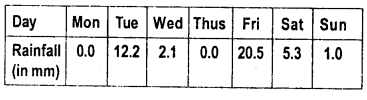
Question 7.
The rainfall (in mm) in a city on 7 days of a certain week was recorded as follows :
HBSE 7th Class Maths Solutions Chapter 3 Data Handling Ex 3.1 7
(i) Find the range of the rainfall in the above data.
(ii) Find the mean rainfall for the week.
(iii) On how many days was the rainfall less
than the mean rainfall. HBSESolutions.com
Solution:
(i) Range of rainfall
= highest rainfall – lowest rainfall.
= 20.5 – 0.0 = 20.5 mm

(ii) Mean rainfall = \(\frac{\text { Sum of rainfall }}{\text { Total no. of days }}\)
= \(\frac{0.0+12.2+2.1+0.0+20.5+5.3+1.0}{7}\)
= \(\frac{41.1}{7}\) = 5.87 mm

(iii) 5 days (Mon, Wed, Thus, Sat, Sun).

HBSE 7th Class Maths Solutions Chapter 3 Data Handling Ex 3.1

Question 8.
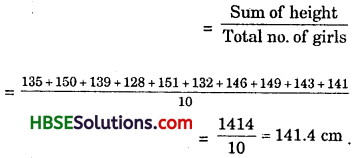
The heights of 10 girls were measured in cm and the results are as follows: 135,150,139,128,151,132,146,149, 143,141.
(i) What is the height of the tallest girl ?
(ii) What is the height of the shortest girl ?
(iii) What is the range of the data ?
(iv) What is the mean of height the girls ?
(v) How many girls have heights more than the mean height.
Solution:
(i) 151 cm. is the height of the tallest girl.
(ii) 128 cm. is the height of the shortest girl.
(iii) Range of data = highest height – shortest height = 151 – 128 = 23 cm. ;
(iv) Mean height of the girls
HBSE 7th Class Maths Solutions Chapter 3 Data Handling Ex 3.1 8

HBSE 7th Class Maths Solutions Chapter 3 Data Handling Ex 3.1 Read More »