Class 7

HBSE 7th Class Maths Solutions Chapter 6 The Triangles and Its Properties InText Questions

Haryana State Board HBSE 7th Class Maths Solutions Chapter 6 The Triangles and Its Properties InText Questions and Answers.

Haryana Board 7th Class Maths Solutions Chapter 6 The Triangles and Its Properties InText Questions

Try These (Page No. 113-114):

Question 1.
Write the six elements (i.e. the 3 sides and the 3 angles) of AABC.
Solution:
Six elements of ΔABC are : ∠A, ∠B, ∠C, \(\overline{\mathrm{AB}}, \overline{\mathrm{BC}}\) and \(\overline{\mathrm{CA}}\).
HBSE 7th Class Maths Solutions Chapter 6 The Triangles and Its Properties InText Questions 1

HBSE 7th Class Maths Solutions Chapter 6 The Triangles and Its Properties InText Questions

Question 2.
Write the :
(i) Side opposite to
the vertex Q of B ΔPQR.
(ii) Angle opposite to the side LM of ΔLMN
(iii) Vertex oppostie to the side RT of ΔRST.
Solution:
A triangle is simple closed curve mode of three line segments. It has three vertices, three sides and three angles.

(i) Side opposite to the vertex Q of ΔPQR is PR.
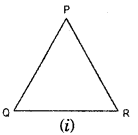
HBSE 7th Class Maths Solutions Chapter 6 The Triangles and Its Properties InText Questions 2

(ii) Angle opposite to side LM of ΔLMN is ∠LMN
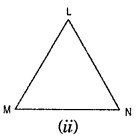
HBSE 7th Class Maths Solutions Chapter 6 The Triangles and Its Properties InText Questions 3

(iii) Vertex opposite to the side RT of ΔRST is S.
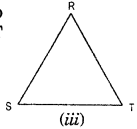
HBSE 7th Class Maths Solutions Chapter 6 The Triangles and Its Properties InText Questions 4

Question 3.
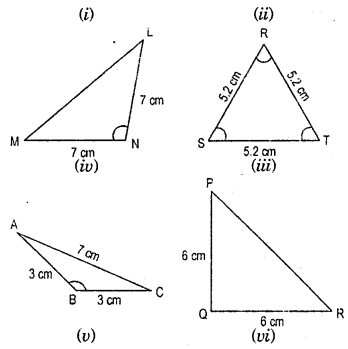
Look at the Fig. and classify each of the triangles according to its (a) Sides (b) Angles
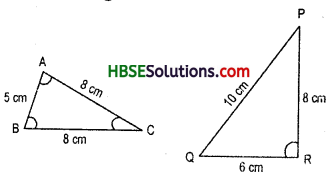
HBSE 7th Class Maths Solutions Chapter 6 The Triangles and Its Properties InText Questions 6
Solution:
(a) Sides : We may classify the triangles according to their sides as follows:
I. A triangle having no two sides equal is called a scalene triangle.
II. A triangle having two sides equal is called an isosceles triangle.
III. A triangle having all sides equal is called an equilateral triangle.
Hence, (ii) ΔPQR is scalene triangle.
(i) ΔABC, (iii) ΔLMN, (v) ΔABC and
(vi) ΔPQR are isosceles triangle, and;
(iv) ARST is equilateral triangle.

(b) Angles : According to angles :
I. A triangle, all of whose angles are acute, is called an acute angle triangle.
II. A triangle, one of whose angles is right angle, is called right angle triangle.
III. A triangle one of whose angles is obtuse, is called an obtuse angle triangle.
Hence, (i) ΔABC, (iv) ΔRST are acute angle triangle.
(ii) ΔPQR, (vi) ΔPQR arc right angle triangle.
(iii) ΔLMN, (v) ΔABC are obtuse angle triangle.

HBSE 7th Class Maths Solutions Chapter 6 The Triangles and Its Properties InText Questions

Think, Discuss & Write (Page No. 114):

Question 1.
How many medians can a triangle have? .
Solution:
The line segment, joining the mid point to its opposite vertex are called a median of the triangle. In a triangle has three vertex. Hence in a triangle has three median. (Fig. 6.19)

Question 2.
Does a median lie wholly in the interior of the triangle ? (If you think that this is not true, draw a figure to show such a case).
Solution:
In a triangle ABC three median AL, BM, CN meet the point O. Hence a median lie wholly in the interior of the triangle.

Think, Discuss & Write (Page No. 115):

Question 1.
How many altitudes can a triangle have ?
Solution:
An altitude has one end point at a vertex of the triangle and the other on the line containing the opposite side. In a triangle has three vertex. So it has three altitude.
e.g. AD, BE, CF are altitude of triangle.
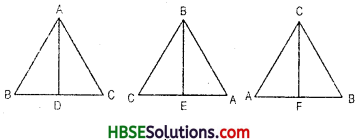
HBSE 7th Class Maths Solutions Chapter 6 The Triangles and Its Properties InText Questions 7

Question 2.
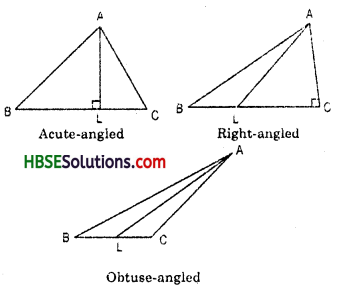
Draw rough sketches of altit udes from A to \(\overline{\mathrm{BC}}\) for the given triangles :
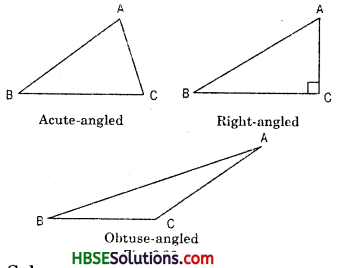
HBSE 7th Class Maths Solutions Chapter 6 The Triangles and Its Properties InText Questions 8
Solution:
HBSE 7th Class Maths Solutions Chapter 6 The Triangles and Its Properties InText Questions 9

Question 3.
Will an altitude always lie in the interior of triangle ? If you think that this need not be true, draw a rough sketch to show such a case.
Solution:
Yes.

Question 4.
Can you think of a triangle in which two altitudes of the triangle are two of its sides ?
Solution:
A triangle has three vertices, and for each vertex there is an altitude. Thus, a triangle has three altitudes. Thus, a triangle in which two altitude of the triangle and two of its sides.

Question 5.
Can the altitude and median be same for a triangle ?
(Hint: For Q. No. 4 and 5, investigate by drawing the altitudes for every type of triangle.)
Solution:
No, the altitude and median arc not same for a tringle.

HBSE 7th Class Maths Solutions Chapter 6 The Triangles and Its Properties InText Questions

Think, Discuss & Write (Page No. 118):

Question 1.
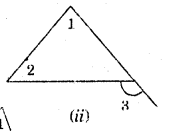
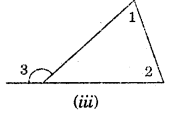
Exterior angles can be formed for a triangle in many ways. Three of them are shown here (fig)
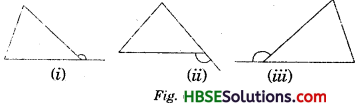
HBSE 7th Class Maths Solutions Chapter 6 The Triangles and Its Properties InText Questions 10
There are three more ways of getting exterior angles. Try to produce those rough sketches.
Solution:
We know that an exterior angle of a triangle is equal to the sum of its interior opposite angles.
i.e. ∠1 + ∠2 = ∠3
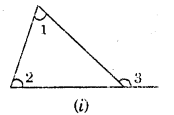
HBSE 7th Class Maths Solutions Chapter 6 The Triangles and Its Properties InText Questions 11
HBSE 7th Class Maths Solutions Chapter 6 The Triangles and Its Properties InText Questions 12
HBSE 7th Class Maths Solutions Chapter 6 The Triangles and Its Properties InText Questions 13

Question 2.
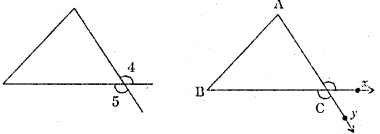
Are the exterior angles formed at each vertex of a triangle equal?
Solution:
(See Fig. ) ∠4 =∠5 (vertically opposite angles )
HBSE 7th Class Maths Solutions Chapter 6 The Triangles and Its Properties InText Questions 14

Question 3.
What can you say about the sum of an exterior angle of a triangle and its adjacent interior angle ?
Solution:
∠ACX is called an exterior angle of the ΔABC atC. (Fig. 6.28)
∠ACB is not adjacent ot ∠ACX.
∠ACB is the interior adjacent angle.
∠A and ∠B are not the interior adjacent angles. They are called the interior angles. They are called the interior opposite angles corresponding to exterior angles ∠ACX.
i.e. Sum of an exterior angles and at vertex -C vertically other angles are equal to 360°.

Think, Discuss & Write (Page No. 118):

Question 1.
What can you say about each of the interior opposite angles, when the exterior angles is
(i) a right angle? (ii) an obtuse angle ? (iii) an acute angle.
Solution:
An exterior angle of a triangle is equal to the sum of its interior oppsite singles, (i) a right angle, i.e. (ii) an obtuse angle.

Question 2.
Can the exterior angle of a triangle be a straight angle ?
Solution:
No; because a straight angle = 180°.

Try These (Page No. 118):

HBSE 7th Class Maths Solutions Chapter 6 The Triangles and Its Properties InText Questions

Question 1.
An exterior angle of a triangle is of measure 70° and one of its interior opposite angles is of measure 25°. find the measure of the other interior oppsite angle.
Solution:
Let us take m to be the number of
parmit’s marbles other interior opposite angle
= exterior angle — first interior
= oppsite angle
= 70° – 25° = 45°

Question 2.
The two interior opposite angles of an exterior angle of a triangle are 60° and 80°. Find the measure of the exterior angle.
Solution:
Exterior angles = 60° + 80° = 140°.

Question 3.
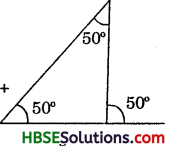
Is something wrong in this diagram (Fig.) ? Comment.
Solution:
We know that,
The sum of interior opposite angles = exterior angles
but from figure,
50 ≠ 50°
Hence this diagram ‘ is wrong.
HBSE 7th Class Maths Solutions Chapter 6 The Triangles and Its Properties InText Questions 15

Try These (Page No. 122):

Question 1.
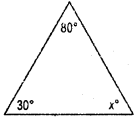
Two angles of a triangle are 30° and 80°.
Find the third angle.
Solution:
By angle – sum property of a triangle
30° + 80° + x° = 180°
110° +x° =180°
∴ x° = 180° – 110° = 70°
∴ third angle = x° = 70°
HBSE 7th Class Maths Solutions Chapter 6 The Triangles and Its Properties InText Questions 16

Question 2.
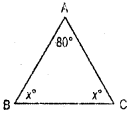
One of the angles of a triangle is 80° and the other two anlges are equal. Find the measure of each of the equal angles.
HBSE 7th Class Maths Solutions Chapter 6 The Triangles and Its Properties InText Questions 17
Solution:
By angle – sum property of a triangle
x° + x° + 80° = 180°
or, 2x°+ 80° = 180°
or, 2x° = 180° -80°
= 100°
= \(\frac{100^{\circ}}{2}\) = 50°
angles are 50°, 50°, 80°

HBSE 7th Class Maths Solutions Chapter 6 The Triangles and Its Properties InText Questions

Question 3.
The three angles of a triangle are in the ratio 1:2:1. Find all the angles of the triangle. Classify the triangle in two different ways.
Solution:
Let the ratio be x :2x:x By angle – sum property of a triangle
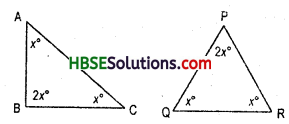
HBSE 7th Class Maths Solutions Chapter 6 The Triangles and Its Properties InText Questions 18
x + 2r + x = 180°
or 4x = 180°
or x = \(\frac{180^{\circ}}{4}\) = 45°
∴ angles are 45°, 90°, 45°
Thus the triangles are Right angled and isosceles triangles.

Think, Discuss & Write (Page No. 122):

Question 1.
Can you have a triangle with two right angles ?
Solution:
Since, the three angles of a triangle have a total measure of 180°.
Hence we cannot have a triangle with two right angles.

Question 2.
Can you have a triangle with two obtuse angles ?
Solution:
No, Because obtuse angle > 90°.

Question 3.
Can you have a triangle with two acute angles ?
Solution:
Yes, Because acute angle < 90°.

Question 4.
Can you have a triangle with all the three angles greater than 60° ?
Solution:
No, Because the three angles of a triangle have a total measure of 180°.

Question 5.
Can you have a triangle with all the three angles equal to 60° ?
Solution:
Yes, Because 60° + 60° + 60° = 180°.

Question 6.
Can you have a triangle with all the three angles less than 60° ?
Solution:
No, Because the three angles of a triangle have a total measure of 180°.

Try These (Page No. 123- 124):

Question 1.
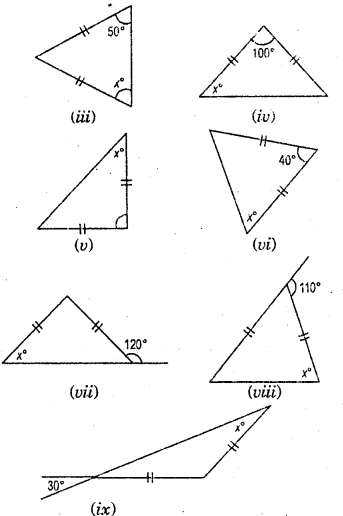
Find angles x in each Fig.
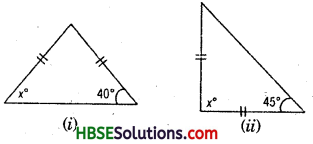
HBSE 7th Class Maths Solutions Chapter 6 The Triangles and Its Properties InText Questions 19
HBSE 7th Class Maths Solutions Chapter 6 The Triangles and Its Properties InText Questions 20
Solution:
In an isosceles triangle
(a) two sides have same length
(b) base angles opposite to the equal sides are equal.
Hence, (i) x° = 40°
(ii) x° + 45° + 45° = 180°
or, x° + 90° = 180°
.’. x° = 180°-90° = 90°

(iii) x° = 50°
(iv) x°+x° + 100° = 180°
2x° = 180°-100° = 80°
x° = \(\frac{80^{\circ}}{2}\) = 40°

(v) x° + x° + 90° = 180°
or, 2x° = 180°-90° = 90°
x° = \(\frac{90^{\circ}}{2}\) = 45°

HBSE 7th Class Maths Solutions Chapter 6 The Triangles and Its Properties InText Questions

(vi) x° + x° + 40° = 180°
or, 2x° = 180°-40° = 140°
x° = \(\frac{140^{\circ}}{2}\) = 70°

(vii) x° + 120° = 180° = Linear pair
or, x° = 180°-120°
.. x° = 60°. (Fig. )
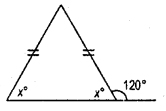
HBSE 7th Class Maths Solutions Chapter 6 The Triangles and Its Properties InText Questions 21

(viii) y° + 110° = Linear pair = 180°
or, y° =180° —110°
y° =70°
Now, x° + x° + y° = 180°
or, 2x° + 70° =180°
2x° =180°-70° = 110°
.’. x = \(\frac{110}{2}\) = 55°
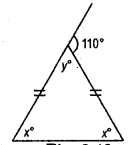
HBSE 7th Class Maths Solutions Chapter 6 The Triangles and Its Properties InText Questions 22

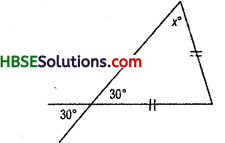
(ix) 30° =30°
= vertically opposite angle
x° =30°,
Because base angles opposite to the equal sides are equal. (Fig.)
HBSE 7th Class Maths Solutions Chapter 6 The Triangles and Its Properties InText Questions 23

Question 2.
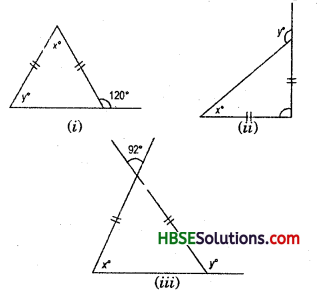
Find angles x andy each Fig.
HBSE 7th Class Maths Solutions Chapter 6 The Triangles and Its Properties InText Questions 24
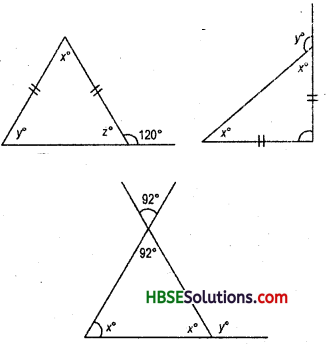
In isosceles triangle base angled are equal. Hence y° = z°
Solution:
(i) z° + 120° = Linear pair = 180°
∴ z° =180° -120°
∴ z° = 60°
or, x°+y° + 2° = 180° (.-. y° = z°)
x° + 60° + 60° = 180°
or, x° = 180°-120° = 60°
∴ x° = 60°,
y° = 60°
HBSE 7th Class Maths Solutions Chapter 6 The Triangles and Its Properties InText Questions 25

(ii) x° + x° + 90° = 180°
or, 2x° = 180° – 90° = 90°
∴ x° = \(\frac{90}{2}\) = 45°
or, x° + y° = 180° = linear pair
45° +y° = 180°
∴ y° = 180°-45° = 135°
∴ x° = 45°,
y° = 135°

(iii) 92°+ 92° = vertically opposite angle
x° + x° + 92° = 180°
or, 2x° = 180° – 92° = 88°
∴ x = \(\frac{88}{2}\) = 44°
or, x° + y° = linear pair = 180°
44° + y = 180°
y = 180°-44° = 136°
∴ x° = 44°,
y° = 136°.

HBSE 7th Class Maths Solutions Chapter 6 The Triangles and Its Properties InText Questions

Think, Discuss & Write (Page No. 127):

Question 1.
Is the sum of any two angles of a triangle always greater than the third angle ?
Solution:
In a triangle, the sum of any two sides of a triangle is always greater than the third side.

Think, Discuss & Write (Page No. 130):

Question 1.
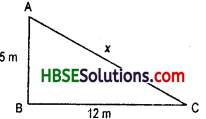
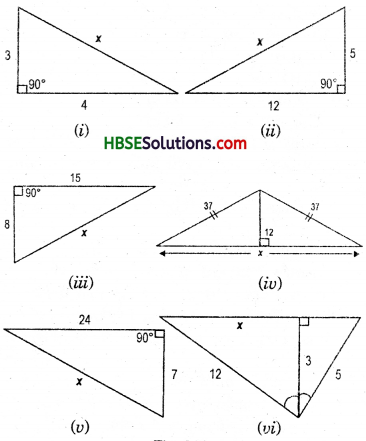
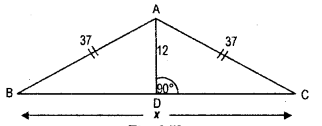
Find the unknown length x in the following figures :
HBSE 7th Class Maths Solutions Chapter 6 The Triangles and Its Properties InText Questions 26
Solution:
By Pythagoras property,
i.e. h2 = p2 + b2
Hence, (i) x2 = 32 + 42
x2 = 9 + 16
x = \(\sqrt{25}\)
∴ x = 5

(ii) x2 = (12)2 + 52
∴ x = \(\sqrt{169}\) = 13
∴ x = 13

(iii) x2 = 82 + 152 = 64 + 225 = 289
∴ x = \(\sqrt{289}\) = 17
∴ x = 17

(iv) x2 = 72 + 242 = 49 + 576 = 625
∴ x = \(\sqrt{625}\)
∴ x = 25

(v) h2 = p2 + b2
In ΔABD, b2 = h2 – p2 = (37)2 – (12)2
= 1369-144 = 1225
b = \(\sqrt{1225}\) = 35
= 35 + 35 = 70

(vi) (12)2 = 32 + x2
144 – 9 = x2
or, 135 = x2,
∴ x = \(\sqrt{135}\)
HBSE 7th Class Maths Solutions Chapter 6 The Triangles and Its Properties InText Questions 27

Think, Discuss & Write (Page No. 131):

Question 1.
Which is the longest side in the triangle PQR right angled at P ?
Solution:
Longest side = QR.

Question 2.
Which is the longest side in the triangle ABC right angled at B ?
Solution:
Longest side = AC.

HBSE 7th Class Maths Solutions Chapter 6 The Triangles and Its Properties InText Questions

Question 3.
Which is the longest side of a right triangle?
Solution:
Hypotenuse is the longest side of a right triangle.

Question 4.
“The diagonal of a rectangle produce by itself the same area as produced by its length and breadth”-This is Baudhayan theorem and Compare it with the Pythagorean property.
Solution:
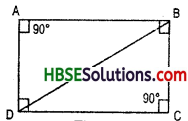
HBSE 7th Class Maths Solutions Chapter 6 The Triangles and Its Properties InText Questions 28

Pythagoras, a Greek philospher of sixth century B.C. is A B said to have found a very important and useful property of right angled triangles. The Indian Mathemetician Baudhayan has also given an equivalent form of this property.
By Pythagoras property, In a right angle triangle,
The square on the hypotenuse = Sum of the squares on the legs.
i.e. h2 = p2 + b2
From above figure,
(BD)2 = (BC)2 + (CD)2
i.e. h2 – p2 + b2
This is Baudhayan Theorem.
HBSE 7th Class Maths Solutions Chapter 6 The Triangles and Its Properties InText Questions Read More »

HBSE 7th Class Maths Solutions Chapter 6 The Triangles and Its Properties Ex 6.5

Haryana State Board HBSE 7th Class Maths Solutions Chapter 6 The Triangles and Its Properties Ex 6.5 Textbook Exercise Questions and Answers.

Haryana Board 7th Class Maths Solutions Chapter 6 The Triangles and Its Properties Exercise 6.5

Question 1.
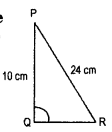
PQR is a triangle right angled at P. If PQ = 10 cm and PR = 24 cm, find QR.
Solution:
HBSE 7th Class Maths Solutions Chapter 6 The Triangles and Its Properties Ex 6.5 1
(PR)2 = (PQ)2 + (QR)2
⇒ (QR)2 =(PR)2 – (PQ)2
= (24)2-(10)2
= 576 – 100 = 476
∴ QR = \(\sqrt{476}\)
= \(\sqrt{2 \times 2 \times 7 \times 17}=\sqrt[2]{119}\)

HBSE 7th Class Maths Solutions Chapter 6 The Triangles and Its Properties Ex 6.5

Question 2.
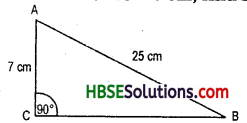
ABC is a triangle right angled at C. If AB = 25 cm and AC = 7 cm, find BC.
HBSE 7th Class Maths Solutions Chapter 6 The Triangles and Its Properties Ex 6.5 2
Solution:
(AB)2 = (AC)2 + (BC)2
(25)2 = 72 + (BC)2
625-49 = (BC)2
576 = (BC)2
\(\sqrt{576}\) =, BC
24 = BC
∴  BC = 24 cm.

Question 3.
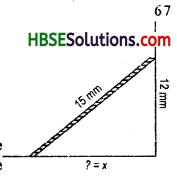
A 15 m long ladder reached a window 12 m high from the ground on placing it against a wall at a distance (Fig. 6.56). Find the distance of the foot of the ladder from the wall.
Solution:
HBSE 7th Class Maths Solutions Chapter 6 The Triangles and Its Properties Ex 6.5 3
Let ? = x
(15)2 = (12)2 + x2
225 -144 = x2
81 = x2
\(\sqrt{81}\) = x
9 = x
∴  x = 9
The distance of the foot of the ladder from the wall = 9mm.

HBSE 7th Class Maths Solutions Chapter 6 The Triangles and Its Properties Ex 6.5

Question 4.
Which of the following can be the sides of a right triangle ?
(i) 2.5 cm, 6.5 cm, 6 cm.
(ii) 2 cm, 2 cm, 5 cm.
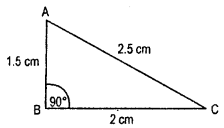
(iii) 1.5 cm, 2 cm, 2.5 cm.
In the case of right angled triangles, identify the right angles.
Solution:
HBSE 7th Class Maths Solutions Chapter 6 The Triangles and Its Properties Ex 6.5 4
In a right triangle
h2 = p2 + b2
(iii) (1.5 cm, 2 cm, 2.5 cm) is the right angle
h2 = p2 + b2
(2.5)2 = (1.5)2 + (2)2
6.25 = 2.25 + 4
6.25 = 6.25
This is satisfied.

Question 5.
A tree is broken at a height of 5 m from the ground and its top touches the ground at a distance of 12 m from the base of the tree. Find the original height of the tree.
Solution:
HBSE 7th Class Maths Solutions Chapter 6 The Triangles and Its Properties Ex 6.5 5
Let the original height of tree = x
∴  x2 = (5)2 + (12)2
= 25 + 144 = 169
∴  x = \(\sqrt{169}\)
∴ The original height of the tree = 13 m.

HBSE 7th Class Maths Solutions Chapter 6 The Triangles and Its Properties Ex 6.5

Question 6.
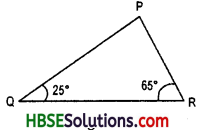
Angle Q and R of a APQR are 25° and 65°. Write which of the following is true:
(i) PQ2 + QR2 = RP2
(ii) PQ2 + RP2 = QR2
(iii) RP2 + QR2 = PQ2
HBSE 7th Class Maths Solutions Chapter 6 The Triangles and Its Properties Ex 6.5 6
Solution:
∠QPR = 180° – (25° + 65°)
= 180°-90°
∴  ∠QPR = 90
By Pythagoras Property,
(QR)2 = (PR)2 + (PQ)2
i.e. h2 = p2 + b2
hence, QR2 = (PQ)2 + (RP)2 i.e. (ii) is true.

Question 7.
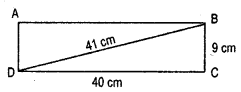
Find the perimeter of the rectangle whose length is 40 cm and a diagonal is 41 cm.
HBSE 7th Class Maths Solutions Chapter 6 The Triangles and Its Properties Ex 6.5 7
Solultion:
From Fig 6.88
(BC) = (BD) – (CD)
= (41) – (40)
= 1681 – 1600 = 81
∴  BC = \(\) = 9 cm.
Thus the perimeter of the rectangle
= 2 ( l x b) = 2(40 + 9)
= 2 x 49 = 98 cm.

HBSE 7th Class Maths Solutions Chapter 6 The Triangles and Its Properties Ex 6.5

Question 8.
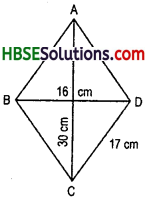
The diagonals of a rhombus measure 16 cm and 30 cm. Find its perimeter.
Solution:
HBSE 7th Class Maths Solutions Chapter 6 The Triangles and Its Properties Ex 6.5 8
Area of Rhombus
= \(\frac{1}{2}\) x d1 x d2 Sq.units.

(where d1 and d2 are diagonals of rhombus) Side of Rhombus (a) = \(\frac{1}{2} \sqrt{\left(d_{1}\right)^{2}+\left(d_{2}\right)^{2}}\)
Perimeter of Rhombus = 4 x a
Here,
d1 = 16 cm
d2 = 30 cm
∴  Side of Rhombus (a)
= \(\frac{1}{2} \times \sqrt{(16)^{2}+(30)^{2}}=\frac{1}{2} \times \sqrt{256 \times 900}\)
= \(\frac{1}{2}\) x \(\sqrt{(16)^{2}+(30)^{2}}\) = \(\frac{1}{2}\) x 34 =17 cm z z
∴ Perimeter of Rhombuse
= 4 x a = 4 x 17= 68
∴ Perimeter of Rhombus = 68 cm.

HBSE 7th Class Maths Solutions Chapter 6 The Triangles and Its Properties Ex 6.5 Read More »

HBSE 7th Class Maths Solutions Chapter 6 The Triangles and Its Properties Ex 6.4

Haryana State Board HBSE 7th Class Maths Solutions Chapter 6 The Triangles and Its Properties Ex 6.4 Textbook Exercise Questions and Answers.

Haryana Board 7th Class Maths Solutions Chapter 6 The Triangles and Its Properties Exercise 6.4

Question 1.
Is it possible to have a triangle with the following sides.
(i) 2 cm, 3 cm, 5 cm
(ii) 3 cm, 6 cm, 7 cm
(iii) 6 cm, 3 cm, 2 cm
Solution:
(i) 2 cm, 3 cm, 5 cm
∵ 2 cm + 3 cm = 5 cm
and third side = 5 cm
∴ Sum of the measure of lengths of two sides = length of third side which is not possible.
∴ A triangle cannot be possible with these sides.

(ii) 3 cm, 6 cm, 7 cm
∵ 3 cm + 6 cm = 9 cm and 9 cm > 7 cm
3 cm + 7 cm = 10 cm and 10 cm > 6 cm
6 cm + 7 cm = 13 cm and 13 cm > 3 cm
Thus, a triangle can be possible with these sides.

HBSE 7th Class Maths Solutions Chapter 6 The Triangles and Its Properties Ex 6.4

(iii) 6 cm, 3 cm, 2 cm
∵ 6 cm + 3 cm = 9 cm and 9 cm > 2 cm
3 cm + 2 cm = 5 cm and 5 cm < 6 cm
2 cm + 6 cm = 8 cm and 8 cm > 5 cm
∴ A triangle cannot be possible with these sides.

Question 2.
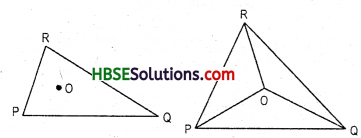
Take any point O in the interior of a triangle PQR. Is
(i) OP + PQ > OQ ?
(ii) OQ + OR > QR ?
(iii) OR + OP > RP ?
HBSE 7th Class Maths Solutions Chapter 6 The Triangles and Its Properties Ex 6.4 1
Solution:
Sum of the lengths of any two sides of a triangle is greater than the length of than the length of the third side. (Fig. 6.47)
(i) Yes (ii) Yes (iii) Yes

Question 3.
AM is a median of a triangle ABC. Is AB + BC + CA + > 2 AM ?
Solution:
Since the sum of the lengths of any two sides of a triangle is greater than the length of the third side.
HBSE 7th Class Maths Solutions Chapter 6 The Triangles and Its Properties Ex 6.4 2
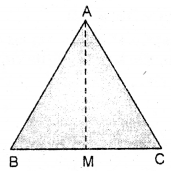
∴ In ΔABM, we have AB + BM > AM ..,(i)
Similarly in AACM, CA + CM > AM …(ii)
Adding (i) and (ii), we have (AB + BM) + (CA + CM) > AM + AM
⇒ [AB + (BM + CM) + CA] > 2AM
⇒ [AB + BC + CA] > 2AM

Question 4.
ΔBCD is quadrialteral. Is AB + BC + CD + DA > AC + BD ?
Solution:
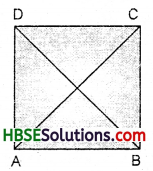
In ΔABC, AB + BC > AC …(i)
Sum of the lengths of any two sides of a triangle is greater than the length of the third side.
HBSE 7th Class Maths Solutions Chapter 6 The Triangles and Its Properties Ex 6.4 3
In ΔACD, CD + DA > AC …(ii)
Adding (i) and (ii), we have
AB + BC + CD + DA > AC + AC …(iii)
In ΔABD, AB + DA > BD …(to)
In ΔBCD, BC + CD > BD …(v)
Adding (iv) and (v), we get
AB + BC + CD + DA > BD + BD …(vi)
Adding (iii) and (vi)
2 (AB + BC + CD + DA) > 2(AC + BD)
AB + BC + CD + DA > AC + BD.

HBSE 7th Class Maths Solutions Chapter 6 The Triangles and Its Properties Ex 6.4

Question 5.
ABCD is quadrilateral. Is AB + BC + CD + DA + < 2 (AC + BD) ?
Solution:
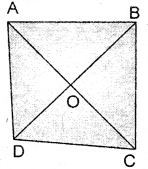
In ΔOAB
OA + OB > AB …(i)
[Sum of the lengths of any two sides of a triangle is greater than the length of the third side]
In ΔOBC, OB + OC > BC …(ii)
HBSE 7th Class Maths Solutions Chapter 6 The Triangles and Its Properties Ex 6.4 4
In ΔOCD, OC + OD > DC …(Hi)
In ΔOAD, OA + OD > AD …(iv)
Adding (i), (ii), (iii) and (iv)
2(OA + OB + OC + OD) > AB + BC + CD + DA
⇒ AB + BC + CD + DA < 2(OA + OB + OC + OD)
⇒ AB + BC + CD + DA < 2(OA + OC + OB + OD)
AB + BC + CD + DA < 2(AC + BD).

Question 6.
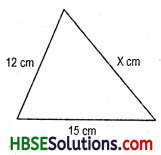
The lengths of two sides of a triangle are 12 cm and 15 cm. Between what two measures should the length of the third side fall ?
HBSE 7th Class Maths Solutions Chapter 6 The Triangles and Its Properties Ex 6.4 5
Solution:
If x cm be the length of third side, we should have
12 + 15 > x ⇒ 27 > x
x + 12 > 15 ⇒ x > 3
and x + 15 > 12 ⇒ x > – 3
The numbers between 3 and 27 satisfy these.
∴ The length of the third side could be any length between 3 cm and 27 cm.

HBSE 7th Class Maths Solutions Chapter 6 The Triangles and Its Properties Ex 6.4 Read More »

HBSE 7th Class Maths Solutions Chapter 6 The Triangles and Its Properties Ex 6.3

Haryana State Board HBSE 7th Class Maths Solutions Chapter 6 The Triangles and Its Properties Ex 6.3 Textbook Exercise Questions and Answers.

Haryana Board 7th Class Maths Solutions Chapter 6 The Triangles and Its Properties Exercise 6.3

Question 1.
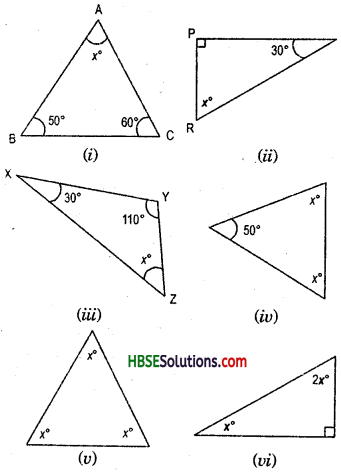
Find the value of the unknown x in the following diagrams :
HBSE 7th Class Maths Solutions Chapter 6 The Triangles and Its Properties Ex 6.3 1
Solution:
By angle – sum’property of triangle,
(i) ∠A + ∠B + ∠C = 180°
or, x° + 50° + 60° = 180°
or, x° + 110 = 180°
or, x° = 180°-110°
∴ x° = 70°.

HBSE 7th Class Maths Solutions Chapter 6 The Triangles and Its Properties Ex 6.3

(ii) ∠P + ∠Q + ∠R = 180°
or, 90° + 30° + x° = 1800
or, 120 + x° = 180°.
∴ x° = 180° -120° = 60°.

(iii) ∠X + ∠Y + ∠Z = 180°
or, 30° + 110° + x° = 180°
or, 140 + x° = 180°.
∴ x° = 180°-140° = 40°

(iv) y x° +x° + 50° = 180°
or, 2x°+ 50° = 180°
or, 2x° = 180° – 50° = 130°
∴ x° = \(\frac{130}{2}\) = 65°

(v) x° + x° + x° = 180°
or, 3x° = 180°
∴ x° = \(\frac{180}{3}\) = 60°.

(vi) x° + 2x° + 90° 180°
or, 3x° = 180°-90° = 90°
∴ x° = \(\frac{90}{3}\) = 30°. 3

Question 2.
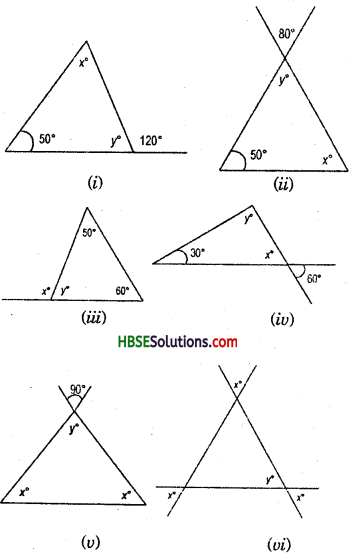
Find the values of the unknowns x and y in the following diagrams:
HBSE 7th Class Maths Solutions Chapter 6 The Triangles and Its Properties Ex 6.3 2
Solution:
By angle – sum property of a triangle the three angles of a triangle have a total measure of 180°.
The external angle of a triangle is equal to the sum of of its interior opposite angles and the linear pair = 180°.

(i) x° + 50° = 120°
x° = 120°-50° = 70°
Now, x° + y° + 30° = 180°
or, 70° + y° + 30° = 180°
or y° = 180°-70° = 30°
= 180° -100° = 80°.
x° = 70° , y° = 80°.

HBSE 7th Class Maths Solutions Chapter 6 The Triangles and Its Properties Ex 6.3

ii) y° = 80° vertically opposite angles
Now, x° + y° + 50° = 180°
or, x° + 80° + 50° = 180°
or, x° + 130° = 180°
∴ x° = 180° -130° = 50°
∴ x° = 50°, y° = 80°.

(iii) x° = 50° + 60° = 110°
or, y° + 50° + 60° = 180°
or, y° + 110° = 180°
∴ y°= 180° -110° = 70°
∴ x° = 110°, y° = 70°.

(iv) x° = 60° = vertically opposite angles
Now, x°+y° + 30° = 180°
60° +y° + 30° = 180°
y° + 90° = 180°
∴ y° = 180°-90° = 90°
∴ x° = 60°, y° = 90°.

(v) y° = 90° = = vertically opposite angle
Now, x° + x° +y° = 180°
or, 2x°+ 90° = 180°
or, 2x° = 180°-90° = 90°
∴ x° = \(\frac{90}{2}\) = 45°
∴ angle are, 45°, 45°, 90°.

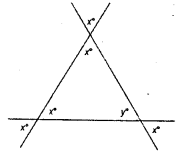
(vi) x° = x° = vertically opposite angles
Now, x° = y° = vertically opposite angles
∴ x° + x° + x° = 180°

HBSE 7th Class Maths Solutions Chapter 6 The Triangles and Its Properties Ex 6.3 3
or, 3x° = 180°
∴ x° = \(\frac{180}{3}\) = 60°
∴ x° = 60°,
∴ x° = 60°,
y° = 60°.

HBSE 7th Class Maths Solutions Chapter 6 The Triangles and Its Properties Ex 6.3 Read More »

HBSE 7th Class Maths Solutions Chapter 6 The Triangles and Its Properties Ex 6.2

Haryana State Board HBSE 7th Class Maths Solutions Chapter 6 The Triangles and Its Properties Ex 6.2 Textbook Exercise Questions and Answers.

Haryana Board 7th Class Maths Solutions Chapter 6 The Triangles and Its Properties Exercise 6.2

Question 1.
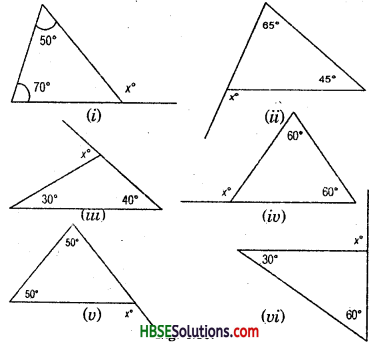
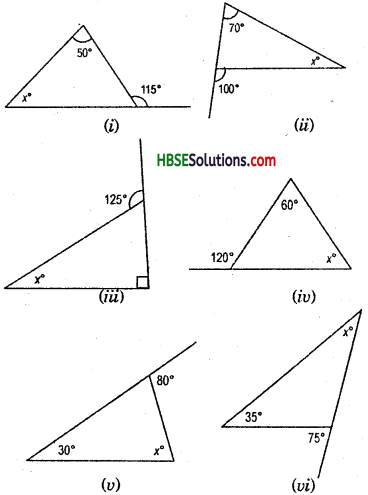
Find the value of the unknown exterior angle x in the following diagrams:
HBSE 7th Class Maths Solutions Chapter 6 The Triangles and Its Properties Ex 6.2 1
Solution:
Since the external angle of a traingle is equal to the sum of the sum of its interior opposite angles. Hence
(i) x° = ∠50° + ∠70° = ∠120°
(ii) x° = ∠65° + ∠45° = 110°
(iii) x° = ∠30° + ∠40° = 70°
(iv) x° = ∠60° + ∠60° = 120°
(v) x° = ∠50° + ∠50° = 100°
(vi) x° = ∠30° + ∠60° = 90°.

HBSE 7th Class Maths Solutions Chapter 6 The Triangles and Its Properties Ex 6.2

Question 2.
find the value of the unknown interior angle x in the following diagrams:
HBSE 7th Class Maths Solutions Chapter 6 The Triangles and Its Properties Ex 6.2 2
Solution:
external angle = sum of interior angle
(i) Hence 115° = angle x° + 50°
or, 115°-50° = x°
65° = x°
∴ x° = 65°.

(ii) 30° + x° = 100°
or, x° = 100°-30
∴ x° = 70°.

(iii) x° + 90° = 125°
or, x° = 125°- 90′
x° = 35°.

HBSE 7th Class Maths Solutions Chapter 6 The Triangles and Its Properties Ex 6.2

(iv) 60° + x° = 120°
or, x° = 120°-60°
∴ x° = 60°.

(v) 30° + x° = 80°
x° = 80° – 30°
∴ x° = 50°.

(vi) x° + 35° = 75°
or, x° = 75° – 35°
∴ x° = 40°

HBSE 7th Class Maths Solutions Chapter 6 The Triangles and Its Properties Ex 6.2 Read More »

HBSE 7th Class Maths Solutions Chapter 6 The Triangles and Its Properties Ex 6.1

Haryana State Board HBSE 7th Class Maths Solutions Chapter 6 The Triangles and Its Properties Ex 6.1 Textbook Exercise Questions and Answers.

Haryana Board 7th Class Maths Solutions Chapter 6 The Triangles and Its Properties Exercise 6.1

Question 1.
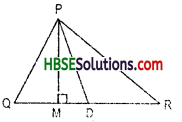
In ∆PQR, D is the mid point of QR.
\(\overline{\mathrm{PM}}\) is …………
PD is ………….
Is QM = MR ?
HBSE 7th Class Maths Solutions Chapter 6 The Triangles and Its Properties Ex 6.1 1
Solution:
\(\overline{\mathrm{PM}}\) is the altitude of ∆PQR. PD i Since median is the segment.
hence, QD = DR
But, QM ≠ MR.

HBSE 7th Class Maths Solutions Chapter 6 The Triangles and Its Properties Ex 6.1

Question 2.
Draw rough sketches for the folowing;
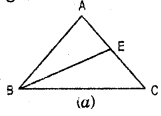
(a) In ∆ABC, BE is a median.
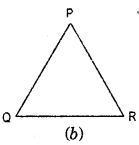
(b) In ∆PQR, PQ and PR are altitudes of the triangle.
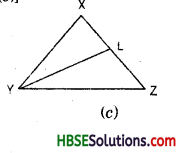
(c) In ∆XYZ, YL is an altitude in the exterior of th triangle.
Answer:
(a) Hence BE is a median[fig (a)]
HBSE 7th Class Maths Solutions Chapter 6 The Triangles and Its Properties Ex 6.1 2

(b) In a ∆PQR, PQ and PR are sides of ∆PQR. [Fig. (b)]
HBSE 7th Class Maths Solutions Chapter 6 The Triangles and Its Properties Ex 6.1 3

(c) YL is the altitude of the triangle. ∆XYZ [Fig. (c)]
HBSE 7th Class Maths Solutions Chapter 6 The Triangles and Its Properties Ex 6.1 4

HBSE 7th Class Maths Solutions Chapter 6 The Triangles and Its Properties Ex 6.1

Question 3.
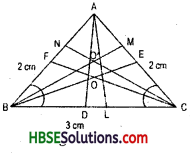
Verify by drawing a diagram if the median and altitude of an isosceles triangle can be same.
Solution:
The median and altitude of an isosceles triangle can not be same.
In a ∆ABC AD, BE, CF are median but AL, BM and CN are altitude.
Hence O and O’ are the mid point of median and altitude respectively.
HBSE 7th Class Maths Solutions Chapter 6 The Triangles and Its Properties Ex 6.1 5

HBSE 7th Class Maths Solutions Chapter 6 The Triangles and Its Properties Ex 6.1 Read More »

HBSE 7th Class Maths Solutions Chapter 5 Lines and Angles InText Questions

Haryana State Board HBSE 7th Class Maths Solutions Chapter 5 Lines and Angles InText Questions and Answers.

Haryana Board 7th Class Maths Solutions Chapter 5 Lines and Angles InText Questions

Try These (Page No. 94):

Question 1.
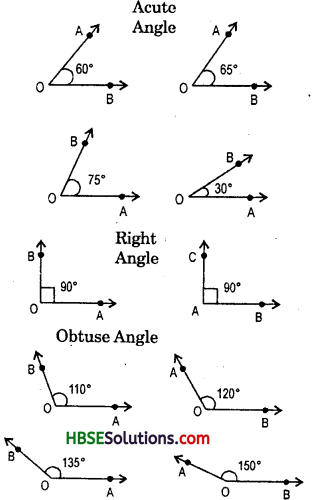
List ten figures around you and identify the acute, obtuse and right angles found in them.
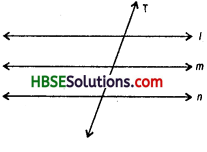
Solution:
HBSE 7th Class Maths Solutions Chapter 5 Lines and Angle1 InText Questions 9

HBSE 7th Class Maths Solutions Chapter 5 Lines and Angles InText Questions

Think, Discuss & Write (Page No. 95):

Question 1.
Can two acute angles be complement of each other ?
Solution:
Yes complementary 30° is and acute angle and 60° is also an acute angle.
30° + 60° = 90° (Complementary angle)

Question 2.
Can two obtuse angles be complement of each other ?
Solution:
No obtuse angle > 90°

Question 3.
Can two right angles be complement of each other ?
Solution:
No, one right angle = 90°

Try These (Page No. 95):

Question 1.
Which pairs of following angles are complementary ?
Solution:
(i) and (iv), because complementary angle = 90°.

Question 2.
What is the measure of the complement each of following given angles ?
(i) 45° (ii) 65° (iii) 41° (iv) 54°
Solution:
(i) Let the complement of 45° is re.
∴ x + 45° = 90°
or x = 90° -45° = 45°
∴ Complement of 45° is 45°.

(ii) Let the complement of 65° is x.
∴ x + 65° = 90°
or re = 90° -65° = 25°
∴ The complement of 65° is 25°.

(iii) Let the complement of 41° be m.
∴ m + 41° = 90°
or m = 90° – 41° = 49°
or m = 49°
Thus, the complement of 41° is 49°.
HBSE 7th Class Maths Solutions Chapter 5 Lines and Angles InText Questions

(iv) Let the complement of 54° be x.
∴ x + 54° = 90°
or re = 90° – 54° = 36°
Thus, the complement of 54° is 36°.

Question 1.
The difference in the measures of two complementary angles is 12°. Find the measures of the angles.
Solution:
HBSE 7th Class Maths Solutions Chapter 5 Lines and Angles InText Questions 2
90° -x = 12°
90° – 12° = x
or 78° = x
∴  x = 78°

Think, Discuss & Write (Page No. 96):

Question 1.
Can two obtuse angles be supplementary ?
Solution:
No, supplementary angle = 180°
obtuse > 90°.

Question 2.
Can two acute angles be supplementary ?
Solution:
Yes, acute angle < 90°

Question 3.
Can two right angles be supplementary ?
Solution:
Yes, right angle
= 90°

Try These (Page No. 97):

Question 1.
Find the supplementary angles in the following given pairs :
Solution:
(i) Measures of the given angles are 110° and 50°.
∵ 110°+ 50° = 160°.
and 160° ≠ 180°
∴ 110° and 50° are not a pair of supplementary angles.

(ii) Measures of the given angles are 105° and 65°.
∵ 105°+ 65° = 170°.
and 170° ≠ 180°
∴ 105° and 65° are not a pair of supplementary angles.

(iii) Measures of the given angles are 50° and 150°.
∵ 50° + 130° = 180°.
∴ 50° and 130° are a pair of supplementary angles.

(iv) Measures of the given angles are 45° and 45°.
∵ 45° + 45° = 90°. and 90° ≠ 180°
∴ 45° and 45° are not a pair of supplementary angles.

HBSE 7th Class Maths Solutions Chapter 5 Lines and Angles InText Questions

Question 1.
What will be the measure of the supplement of each one of the following angles ?
(i) 100° (ii) 90° (iii) 55° (iv) 125°
Solution:
(i) Let the supplementary of 100° be a.
∴ 100° + x = 180°
or x = 180° – 100° = 80°
∴ The measure of the supplement of 100° is 80°.

(ii) Let the supplementary of 90° be x.
∴ x + 90° = 180°
or x = 180°- 90° = 90°
The measure of the supplement of 90° is 90°.

(iii) Let the supplementary of 55° be x.
∴ 55° + x = 180°
or x = 180° -55° = 125°
The supplement of 55° is 125°.

(iv) Let the supplementary of 125° bey.
∴ y + 125° = 180°
or y = 180°-125° = 55°
∴ The supplement of 125° is 55°.

Question 2.
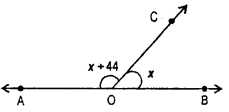
Among two supplementary angles the measure of the larger angle is 44° more than the measure of the smaller. Find their measures.
Solution:
A-t-q, x + x + 44 = 180°
or, 2x + 44 = 180°
HBSE 7th Class Maths Solutions Chapter 5 Lines and Angles InText Questions 3
2x = 180° – 44°
x = \(\frac{136}{2}\) = 68°
∴ 68°, 112°

Try These (Page No. 97-98):

Question 1.
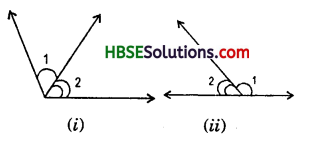
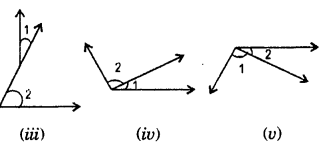
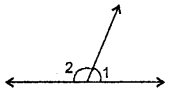
Are the angles marked 1 and 2 adjacent ? If they are not adjacent.
HBSE 7th Class Maths Solutions Chapter 5 Lines and Angles InText Questions 4
HBSE 7th Class Maths Solutions Chapter 5 Lines and Angles InText Questions 5
Solution:
(i) Yes, (ii) Yes, (iii) No, (iv) Yes,
Yes.
(iii) No, because two angles in a plane are said to be adjacent angles, if they have a common vertex, a common arm and the other two arms on opposite sides of the common arm.

HBSE 7th Class Maths Solutions Chapter 5 Lines and Angles InText Questions

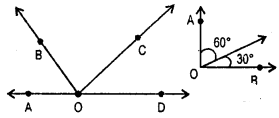
Question 2.
In the given figure are the following adjacent angles ?
(a) ∠AOB and ∠BOC
(b) ∠BOD and ∠BOC
HBSE 7th Class Maths Solutions Chapter 5 Lines and Angles InText Questions 6
Justify your answer.
Solution:
(a) Yes, because they have a common vertex O and a common arm OB.
(b) No, because they are not placed next to each other.

Think, Discuss & Write (Page No. 98):

Question 1.
Can two adjacent angles be supplementary ?
Solution:
Yes, because two adjacent angles form a supplementary.

Question 2.
Can two adjacent angles be complementary ?
Solution:
Y es, because two adjacent angles form a complementary.

Question 3.
Can two obtuse angles be adjacent angles ?
Solution:
Yes, in the figure, ∠BOC and ∠COD are obtuse angles and they are adjacent angles.
HBSE 7th Class Maths Solutions Chapter 5 Lines and Angles InText Questions 7

Question 4.
Can an acute angle be adjacent to an obtuse angle ?
Solution:
Yes, in the figure, ∠1 and ∠2 are adjacent angles. ∠1 is acute and ∠2 is an obtuse angle.
HBSE 7th Class Maths Solutions Chapter 5 Lines and Angles InText Questions 8

Think, Discuss & Write (Page No. 99):

Question 1.
Can two acute angles form a linear pair ?
Solution:
No, because acute angle < 90° and linear pair = 180°. Question 2. Can two obtuse angles form a linear pair ? Solution: No, because obtuse angle > 90°
and linear pair = 180°.

HBSE 7th Class Maths Solutions Chapter 5 Lines and Angles InText Questions

Question 2.
Can two right angles form a linear pair ?
Solution:
Yes, because right angle = 90°
and linear pair = 180°.

Try These (Page No. 99):

Question 1.
Check which of the following pairs of angles form a linear pair:
Solution:
(i) Yes,
∵ 140°+ 40° = 180°
∴ The given pair of angles form a linear pair.

(ii) No,
∵ 60° + 60° = 120°
and 120° ≠ 180°.

(iii) No,
∵ 90° + 80° = 170°
and 170° ≠ 180°.

(iv) Yes,
∵ 115°+ 65° = 180°.

Try These (Page No. 101):

Question 1.
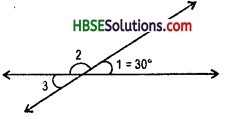
In the given figure, if ∠1 = 30°. find ∠2 and ∠3.
HBSE 7th Class Maths Solutions Chapter 5 Lines and Angles InText Questions 9
Solution:
Since ∠1 + ∠2 = Linear pair = 180°
or, 30° + ∠2 = 180°
or, ∠2 = 180°-30°
∴ ∠2 = 150°
Now, ∠2 + ∠3 = 180°
or, 150° + ∠3 = 180°
or, ∠3 = 180° -150°
∴ ∠3 = 30°
or, ∠1 = ∠2 = vertically opposite angle
∴ 30° = ∠2
∴ ∠2 = 30°

Question 2.
Give an example for vertically opposite angles in your surroundings.
HBSE 7th Class Maths Solutions Chapter 5 Lines and Angles InText Questions 10
Solution:
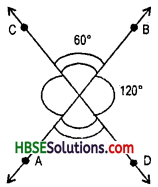
Two angles formed by two intersecting lines having common arm are said to be vertically opposite angles.
Hence, ∠COB = ∠AOD = 60°
= vertically opposite angle
and ∠BOD = ∠AOC = 120°
= vertically opposite angles

HBSE 7th Class Maths Solutions Chapter 5 Lines and Angles InText Questions

Try These (Page No. 104):

Question 1.
Find examples from your surround-ings where lines intersect at right angles.
Solution:
(i) A black board, (ii) A table, (iii) A television (iv) A computer.

Question 2.
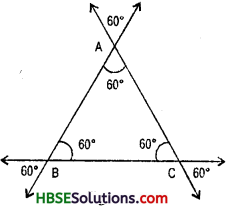
Find the measures of the angles made by the intersecting lines at the vertices of an equilateral triangle.
HBSE 7th Class Maths Solutions Chapter 5 Lines and Angles InText Questions 11
Solution:
Vertices, A, B and C. (Fig.)

Question 3.
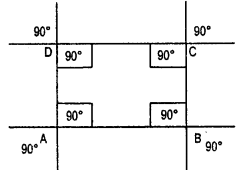
Draw any rectangle and find the measures of angles at the four vertices made by the intersecting lines.
Solution:
HBSE 7th Class Maths Solutions Chapter 5 Lines and Angles InText Questions 12

Question 4.
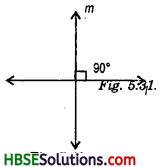
If two lines intersect, do they always intersect at right angles ?
Solution:
HBSE 7th Class Maths Solutions Chapter 5 Lines and Angles InText Questions 13

Try These (Page No. 105):

Question 1.
Suppose Two lines are given. How many transversals can you draw for these lines.
HBSE 7th Class Maths Solutions Chapter 5 Lines and Angles InText Questions 14
Solution:
Many

Question 2.
If three lines have a transversal, how many points of intersections are there ?
Solution:
Three.

HBSE 7th Class Maths Solutions Chapter 5 Lines and Angles InText Questions

Question 3.
Try to identify a few transversals in your surroundings.
Solution:
Road, Rail, ladder etc.

Try These (Page No. 1.6):

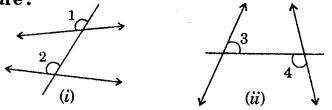
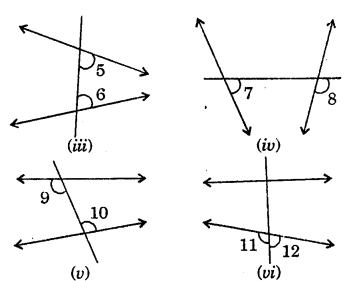
Question 1.
Name the pairs of angles in each Figure.
HBSE 7th Class Maths Solutions Chapter 5 Lines and Angles InText Questions 15
HBSE 7th Class Maths Solutions Chapter 5 Lines and Angles InText Questions 16
Solution:
(ii) i.e. < 1 and < 2 are called pairs corresponding angles. [Fig. (i)]
(it) i.e. <3 and < 4 are called pairs of alternate interior angles. [Fig. (ii)]
(iii) i.e. < 5 and < 6 are called pairs of interior angles on the same side of the transversal. [Fig. (iii)]
(iv) i.e. < 7 and < 8 are called pairs of corresponding angles. [Fig.(iv)]
(v) i.e. < 9 and < 8 are called pairs of alternate interior angles. [Fig. (v)]
(vi) i.e. < 11 and < 12 are called linear pairs. [Fig. (vi)]

Try These (Page No. 109):

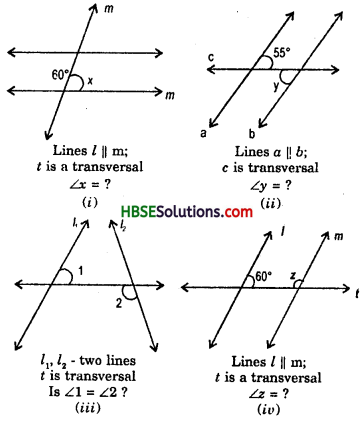
Question 1.
HBSE 7th Class Maths Solutions Chapter 5 Lines and Angles InText Questions 17
HBSE 7th Class Maths Solutions Chapter 5 Lines and Angles InText Questions 18
Solution:
(i) x = 60°
[∵ x and 60° are alternate interior angles]

(ii) ∠y = 55°
[∵ y and 55° are alternate interior angles]

(iii) If two non-parallel lines are intersected by a transversal, then the angle of pairs of alternate interior angles are not equal.
Hence ∠1 = ∠2

(iv) 60° + z = 180°
⇒ z = 180° – 60°
z = 120°
x = 120°
[ ∵ and 60° are interior angles on the same side of the transversal]
∴ z = 120°.

(v) x = 120°
[∵ x and 120° are corresponding angles]

(vi) a + 60° = 180°
⇒ a = 180° – 60° = 120°
a – c
⇒ c = 120° [alternate angles]
c = b
[vertically opp. angles]
⇒ b = 120° [linear pair]
⇒ b+d = 180°
⇒ 120° + d = 180°
∴ d = 180° – 120° = 60°.

HBSE 7th Class Maths Solutions Chapter 5 Lines and Angles InText Questions

Try These (Page No. 100):

Question 1.
HBSE 7th Class Maths Solutions Chapter 5 Lines and Angles InText Questions 19
HBSE 7th Class Maths Solutions Chapter 5 Lines and Angles InText Questions 20
Solution:
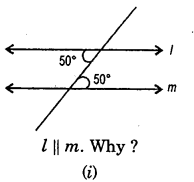
(i) Yes, l || m, because alternate interior angles are equal and 50°.
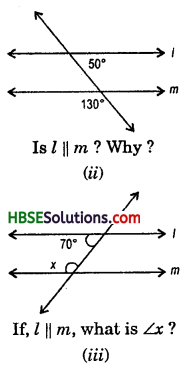
(ii) Yes, l || m, because alternate interior angles are equal and 50°.
(iii) If two parallel lines are intersected by a transversal, then the sum of the interior angles on the same side of the transversal is 180° or supplementary.
Hence, 180° + x = 180°
or, x = 180° -180°
x = 0°
But in this figure one angle is 180°. Hence it is not possible.

HBSE 7th Class Maths Solutions Chapter 5 Lines and Angles InText Questions Read More »

HBSE 7th Class Maths Solutions Chapter 5 Lines and Angles Ex 5.2

Haryana State Board HBSE 7th Class Maths Solutions Chapter 5 Lines and Angles Ex 5.2 Textbook Exercise Questions and Answers.

Haryana Board 7th Class Maths Solutions Chapter 5 Lines and Angles Exercise 5.2

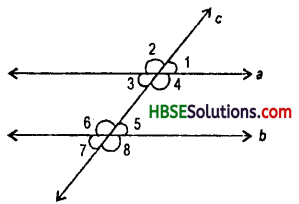
Question 1.
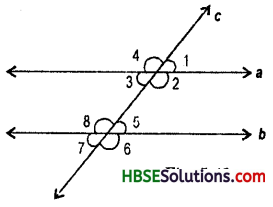
State the property that is used in each of the following statements?
(i) If a // b, then ∠1 = ∠5.
(ii) If ∠4 – ∠6, then a //b.
(iii) If ∠4 + ∠5 = 180°, then a // b.
Solution:
HBSE 7th Class Maths Solutions Chapter 5 Lines and Angles Ex 5.2 1
If two lines are intersected by a transversal and if we have any of the following three conditions.
(a) The angles of any pair of corresponding angles are equal.
(b) The angles of any pair of alternate angles are equal.
(c) The sum of the interior angles on the same side of the transversal is 180°, then the lines are parallel.
(i) In the above figure, if a || b, then ∠1 = ∠5 = corresponding angles.
(ii) If ∠4 = ∠8 – corresponding angles, hence a || b.
(iii) If ∠4 + ∠5 = 180° = supplementary, hence a||b.

HBSE 7th Class Maths Solutions Chapter 5 Lines and Angles Ex 5.2

Question 2.
In the given figure, identify :
(i) The pairs of corresponding angles.
(ii) The pairs of alternate interior angles.
(iii) The pairs of interior angles on the same side of the transversal.
(iv) The vertically opposite angles.
HBSE 7th Class Maths Solutions Chapter 5 Lines and Angles Ex 5.2 2
Solution:
(i) ∠1 and ∠5, ∠4 and ∠8, ∠3 and ∠7, ∠2 and ∠6.
(ii) ∠3 and ∠5, ∠2 and ∠8
(iii) ∠2 and ∠5, ∠3 and ∠8
(iv) ∠1 and ∠3, ∠4 and ∠2, ∠8 and ∠6, ∠5 and ∠7.

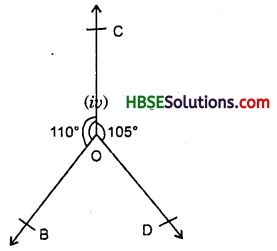
Question 3.
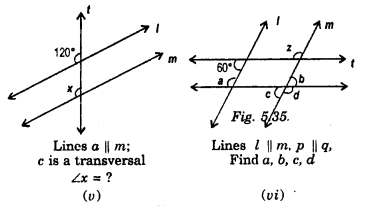
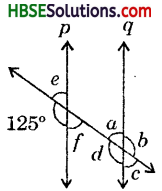
In the adjoining figure, p || q. Find the unknown angles.
HBSE 7th Class Maths Solutions Chapter 5 Lines and Angles Ex 5.2 3
Solution:
∠e + ∠125° = 180°(Linearpair)
∴ ∠e = 180°-125° = 55°
∠e = ∠f = 55° (vertically opposite angles)
∠d = 125° (corresponding angles)
∠d = ∠b =125° (vertically opposite angles)
∠e = ∠a = 55° (corresponding angles)
∠a = ∠c = 55° (vertically opposite angles)
i.e., a = 55°, b = 125°, c = 55°, d = 125°, e = 55° and f = 55°.

HBSE 7th Class Maths Solutions Chapter 5 Lines and Angles Ex 5.2

Question 4.
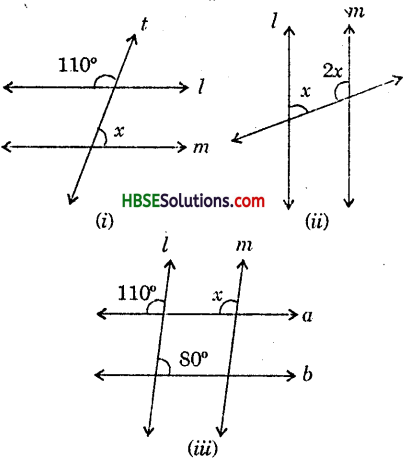
Find the value of x in each of the following figures if l || m.
HBSE 7th Class Maths Solutions Chapter 5 Lines and Angles Ex 5.2 4
Solution:
(i) ∠x = ∠x = (alternate angles)
New ∠x + ∠100° = 180° (Linear pair)
=> Lx = 180°—110°
∴ x = 70°.(Fig.i)
(ii) x + 2x = 1800 (supplementary angles)
3x = 180°
x = \(\frac{180}{3}\)
∴ x = 60°.
x = 100 (Corresponding angles)
or, y + 80° = 180° (Supplemcnatary angles)
∴ y = 100°
s = y = 100° (alternate angles)
(Fig. iii)

Question 5.
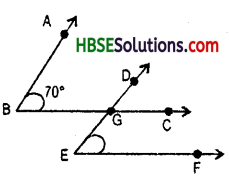
In the given figure, the arms of two angles are parallel. If ∠DGC = 70° then find s
(i) ∠DGC
(ii) ∠DEF
HBSE 7th Class Maths Solutions Chapter 5 Lines and Angles Ex 5.2 5
Solution:
∠ABC = ∠DGC = corresponding angles
= 70°
∴ ∠DGC = 70°
∠DGC = ∠DEF = 70°
= corresponding angles
hence, (i) ∠DGC = 70°
(ii) ∠DEF = 70°

HBSE 7th Class Maths Solutions Chapter 5 Lines and Angles Ex 5.2

Question 6.
In the given figures below, decide whether l is parallel to m ?
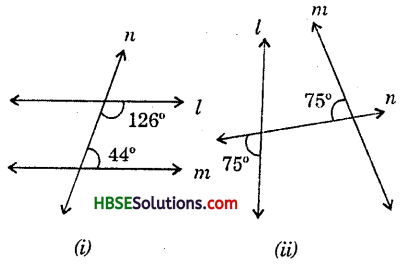
HBSE 7th Class Maths Solutions Chapter 5 Lines and Angles Ex 5.2 6
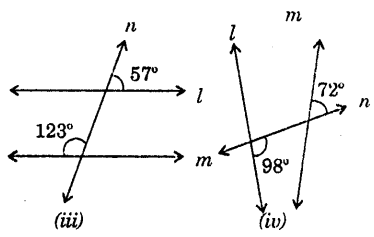
HBSE 7th Class Maths Solutions Chapter 5 Lines and Angles Ex 5.2 7
Solution:
(i) ∠126° + ∠44° = 170° ≠ 180° (Corresponding angles)
Hence l is not parallel to m.
(ii) l is not parallel to m because alternate angles are not equal.
(iii) ∠57° + x = 180° (Linear pair)
∴ x = 180° -57° = 123°
Now x = 123° = alternate angle
Hence l || m because alternate angles are equal.
(iv) l is not parallel to m because alternate
angles are not equal. .

HBSE 7th Class Maths Solutions Chapter 5 Lines and Angles Ex 5.2 Read More »

HBSE 7th Class Maths Solutions Chapter 5 Lines and Angles Ex 5.1

Haryana State Board HBSE 7th Class Maths Solutions Chapter 5 Lines and Angles Ex 5.1 Textbook Exercise Questions and Answers.

Haryana Board 7th Class Maths Solutions Chapter 5 Lines and Angles Exercise 5.1

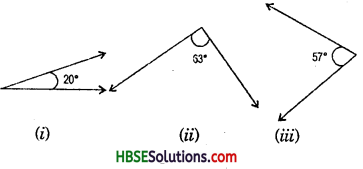
Question 1.
Find the complement of each of the following angles:
HBSE 7th Class Maths Solutions Chapter 5 Lines and Angles Ex 5.1 1
Solution:
If the sum of two angles is 180°, then they are said to be supplementary angles and each of them is called the supplement of the other.
(i) 180° -105° = 75°
(ii) 180°-87° = 93°
(iii) 180°-105° = 75°.

HBSE 7th Class Maths Solutions Chapter 5 Lines and Angles Ex 5.1

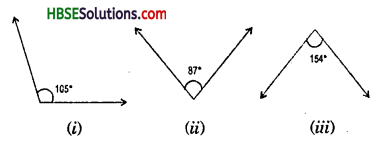
Question 2.
Find the supplement of each of the following angles:
HBSE 7th Class Maths Solutions Chapter 5 Lines and Angles Ex 5.1 2
Solution:
If the sum of two angles is 180°, then they are said to be supplementary angles and each of them is called the supplement of the other.
(i) 180° — 105° = 750
(ii) 180° — 87° = 93°
(iii) 180° — 105° = 75°.

Question 3.
Identify which of the following pairs of angles are complementary and which are supplementary.
(i) 65°, 115°
(ii) 63°, 27°
(iii) 112°, 68°
(iv) 130°, 50°
(v) 45°, 45°
(vi) 80°, 10°
Solution:
Complementary angles = 90° Supplementary angles = 180°
(i) 65° + 115° = 180° = Supplementary
(ii) 63° + 27° = 90° = Complementary
(iii) 112° + 68° = 180° = Supplementary
(iv) 130° + 50° = 180° = Supplementary
(v) 45° + 45° = 90° = Complementary
(vi) 80° + 10° = 90° » Complementary.

Question 4.
Find the angle which is equal to its complement.
Solution:
∵ Let the required angle be x. v It is equal to its complement,
∴ x = 90° – x
⇒ x + x = 90°
⇒ 2x = 90°
∴ x = \(\frac{90^{\circ}}{2}\) = 45
Thus, 45° is equal to its complement.

HBSE 7th Class Maths Solutions Chapter 5 Lines and Angles Ex 5.1

Question 5.
Find the angle which is equal to its supplement.
Solution:
Let the required angle be x and supplement of x = 180 – x
∴ x is equal to its supplement .
∴ x = 180° – x
x + x = 180°
2x = 180°
∴ x = \(\frac{180^{\circ}}{2}\) = 90°
Thus, 90° is equal to its supplement.

Question 6.
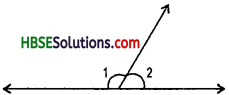
In the given figure ∠1, and ∠2 are supplementary angles. If E ∠1 is decreased, what changes should take place in ∠2 so that both the angles supplementary.
HBSE 7th Class Maths Solutions Chapter 5 Lines and Angles Ex 5.1 3
Solution:
∠1 + ∠2 = 180° .
Supplementary angles if ∠1 is decreased, then 2 is increased but ∠1 + ∠2 = 180°
Hence, 2 is increased so that the sum of the two angles remains the same.

Question 7.
Can two angles be supplementary if both of them are :
(i) acute (ii) obtuse (iii) right ? Sol: Supplementary = 180°
acute angle = < 90° acute angle = > 90°
acute angle = 90°
(i) No, (ii) No, (iii) Yes [because 90° + 90° = 180°]

Question 8.
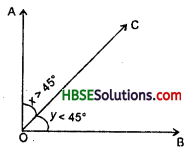
An angle is greater than 45°. Is its complementary angle grater than 45° or equal to 45° or less than 45° ?
HBSE 7th Class Maths Solutions Chapter 5 Lines and Angles Ex 5.1 4
Solution:
A-t-q,
∠AOC < 45°
And BOC < 45°
Because ∠AOC + ∠BOC = 90°
= Complementary angles
Hence, It is complementary and one angle is greater than 45° and other is less than 45″.

HBSE 7th Class Maths Solutions Chapter 5 Lines and Angles Ex 5.1

Question 9.
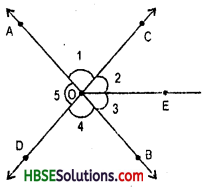
In the given figure
(i) Is ∠1 adjacent to ∠2 ?
(ii) Is ∠AOC adjacent to ∠AOE?
(iii) Do ∠COE and ∠COD form a linear pair ?
(iv) Are ∠BOD and ∠DOA supplementary ?
(v) Is ∠1 vertically opposite to ∠4 ?
(vi) Wliat is the vertically opposite angle of ∠5 ?
HBSE 7th Class Maths Solutions Chapter 5 Lines and Angles Ex 5.1 5
Solution:
(i) Yes
(ii) No, Because OC and OA are not on the opposite side of OE.
(iii) No, Because ∠COE + ∠COD 180°.
(iv) Yes, Because ∠BOD + ∠DOA = 180° Supplementary.
(v) Yes.
(vi) (∠2 + ∠3) is the vertically opposite angle of ∠5.

Question 10.
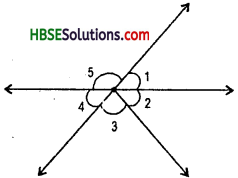
Indicate which pairs of angles are
(i) Vertically opposite angles.
(ii) Linear pairs.
HBSE 7th Class Maths Solutions Chapter 5 Lines and Angles Ex 5.1 6
Solution:
(i) ∠1 = ∠4
i.e. ∠l, ∠4
(ii) ∠4 + ∠5 = 180′ i.e., ∠4, ∠5
and ∠1 + ∠2 + ∠3= 180°,i.c., ∠1, ∠2, ∠3
and ∠1 + ∠5 = 180″, i.e., ∠1,∠5

Question 11.
In the given Fig. is ∠1 adjacent to ∠2 ? Given reasons.
HBSE 7th Class Maths Solutions Chapter 5 Lines and Angles Ex 5.1 7
Solution:
No, ∠1 and ∠2 are not adjacent angles because they do not have a common vertex.

Question 12.
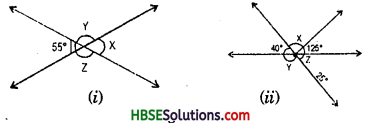
Find the values of the angles X, Y and Z in each of the following:
HBSE 7th Class Maths Solutions Chapter 5 Lines and Angles Ex 5.1 8
Solution:
(i) ∠X = ∠55°
= Vertically opposite angles and
∠X + ∠Y = 180° = Linear pairs
or, ∠55° + ∠Y = 180°
or, ∠Y = 180°-55°
∴ ∠Y = 125°
and ∠Y = ∠Z = Vertically opposite
angles
125° = ∠Z Fig.
∴ ∠Z = 125°
i.e., X = 55°, Y = 125°, Z = 125°.

(ii) ∠Z = 40
= Vertically opposite angles and
∠Y + 40° = Linear pairs = 180°
or, ∠Y = 180° – 40° = 140°
∴ ∠Y = 140°
Now, ∠Y = ∠X + ∠25°
= Vertically opposite angles
or, 140° = ∠X + ∠25°
or, 140°-25° = ∠X
or, 115° = ∠X
∴ ∠X = 115°
i.e., X = 115°, Y = 140°, Z = 40°.

HBSE 7th Class Maths Solutions Chapter 5 Lines and Angles Ex 5.1

Question 13.
Fill in the blanks :
(i) If two angles are complementary, then the sum of their measures is ……………..
(ii) If two angles are supplementary, then the sum of their measures is …………
(Hi) Two angles forming a linear pair are …………….
(iv) If two angles are supplementary, they form a ………………
(v) If two lines intersect at a point, then the vertically opposite angles are always ………….
(vi) If two lies intersect at a point, and if one pair of vertically opposite angles are acute angles, then the other pair of
vertically opposite angles are ……………………
Solution:
(i) 90°. (it) 180°. (iii) adjacent angles. (iv) linear pair (u) equal, (vi) obtuse angles.

Question 14.
In the Fig., name the following pairs of angles.
HBSE 7th Class Maths Solutions Chapter 5 Lines and Angles Ex 5.1 9
(i) Obtuse
vertically opposite angles
(ii) Adjacent complementary angles
(iii) Equal supplementary angles
(iv) Unequal supplementary angles
(v) Adjacent angles that do not form a linear pair.
Solution:
(i) ∠BOC = ∠AOE + ∠EOD, i.e., ∠BOC, (∠AOE + ∠EOD)
(ii) ∠AOB + ∠AOE = 90°, i.e., ∠AOB, ∠AOE
(iii) ∠BOE + ∠EOD = 180°, i.e., ∠BOE, ∠EOD
(iv) ∠AOB + ∠BOC = ∠180°, i.e., ∠AOB, ∠BOC
(v) ∠COD and ∠DOE, ∠DOE and ∠EOA, ∠BOA and ∠AOE.

HBSE 7th Class Maths Solutions Chapter 5 Lines and Angles Ex 5.1 Read More »

HBSE 7th Class Maths Solutions Chapter 4 Simple Equations InText Questions

Haryana State Board HBSE 7th Class Maths Solutions Chapter 4 Simple Equations InText Questions and Answers.

Haryana Board 7th Class Maths Solutions Chapter 4 Simple Equations InText Questions

Try These (Page No. 78):

Question 1.
The value of the expression (lOy – 20) depends on the value of y. Verify this by giving 5 different values to y and finding the value of (lOy – 20) for each. From the different values of (lOy – 20) you obtain, do you see a solution to 10y – 20 = 50 ? If there
is no solution, try giving more values of y and find whether the condition 10y – 20 = 50 is met.
Solution:
The value of an expression depends upon the value of the variable from which the expression is formed.
10y – 20 = 50?
L.H.S. = 10y – 20
If y = 0, 10y – -20 = 10 ×  0 – 20 = 0 – 20 = -20
If y = 1, 10y – -20 = 10 × 1 – 20  = 10 – 20 = -10
If y = 2, 10y – -20 = 10 × 2 – 20 = 20 – 20 = 0
If y = 3, 10y – -20 = 10 × 3 – 20 = 30 – 20 = 10
If y = 4, 10y – -20 = 10 × 4 – 20 = 40 – 20 = 20
If y = 5, 10y – -20 = 10 × 5 – 20 = 50 – 20 = 30
If y = 6, 10y – -20 = 10 × 6 – 20 = 60 – 20 = 40
If y = 7, 10y – -20 = 10 × 7 – 20 = 70 – 20 = 50
if, y = 7, 10y – 20 = 50

HBSE 7th Class Maths Solutions Chapter 4 Simple Equations Ex 4.1

Try These (Page No. 80):

Question 1.
Write at least one other from each equation.
(i) 5P = 20, (ii) 3n + 7 = 1, (iii) \(\frac{m}{5}\) – 2 = 6
Solution:
(i) (a) five times a number p is 20. (b) multiple of p is 20.
(ii) (a) Add 7 to three times n to get 1. (b)
Three times n plus 7 gets you 1.
(iii) (a) You get 6, when you subtract 2 from one fifth of a number m.
(b) One fifth of a number m mumus 2 leaves 6.

Try These (Page No. 88):

Question 1.
Start with the same step x = 5 and make two different equations. Ask two of your classmates to solve the equations. Check whether they get the solution x = 5.
Solution:
x = 5
Multiply both sides by 2, we get,
2x = 10
Multiply both sides by 2, we get
4x = 20
Check: If x = 5, 2 x 5 = 10
10 = 10
If x = 5, 4 x 5 = 20
20 = 20

Try These (Page No. 88):

Question 1.
Try to make two number puzzles, one with the sulution 11 and another with 100.
Solution:
(i) If x = 11
Multiply both sides by 2.2x = 22
Add 4 to both sides 2x + 4 = 26
(ii) If y = 100
Multiply both sides by 2.3y = 300
Subtract 100 from
both sides 3y -100 = 200

HBSE 7th Class Maths Solutions Chapter 4 Simple Equations Ex 4.1

Try These (Page No. 90):

Question 1.
(i) When you multiply a number by 6 and subtract 5 from the product, you get 7. Can you tell what the number is ?
(ii) What is that number one third of which added to 5 gives 8 ?
Solution:
(i) Let x be the number.
hence, 6x – 5 =7
or, Qx = 7 + 5 = 12
or, x = \(\frac{12}{6}\) = 2
Hence number be 2.
(ii)Let y be the number.
hence, \(\frac{y}{3}\) + 5 = 8
\(\frac{y+15}{3}\)
or, y + 15 = 24
∴ y = 24 – 15 = 9
Hence number be 9.

Try These (Page No. 90):

Question 1.
There are two types of boxes containing mangoes. Each box of the larger type contains 4 more mangoes than the number of mangoes contained in 8 boxes of the smaller type. Each larger box contains 100 mangoes. Find the number of managoes contained in the smaller box ?
Solution:
Let the number of mangoes contained in the smaller box be x.
According to questions, 8x + 4 = 100
or, 8x = 100 – 4
or, 8x = 96
or, x = \(\)\frac{96}{8}\(\) = 12
Hence, 8 mangoes contained in the smaller box.

HBSE 7th Class Maths Solutions Chapter 4 Simple Equations InText Questions Read More »